Accelerated Emissions Reductions and Carbon Risk Management in Australian Commercial Buildings: Policy and Technology Perspectives


Abstract
1. Introduction
1.1. Carbon Risks Associated with Commercial Buildings’ Operation
1.2. Why Do We Need to Manage Carbon Risks in Commercial Buildings?
2. Rapid Decarbonisations in Commercial Buildings in Australia: How Practical Is It?
3. Methodology
3.1. Commercial Office Building Archetype and the Quantifiable Characteristics
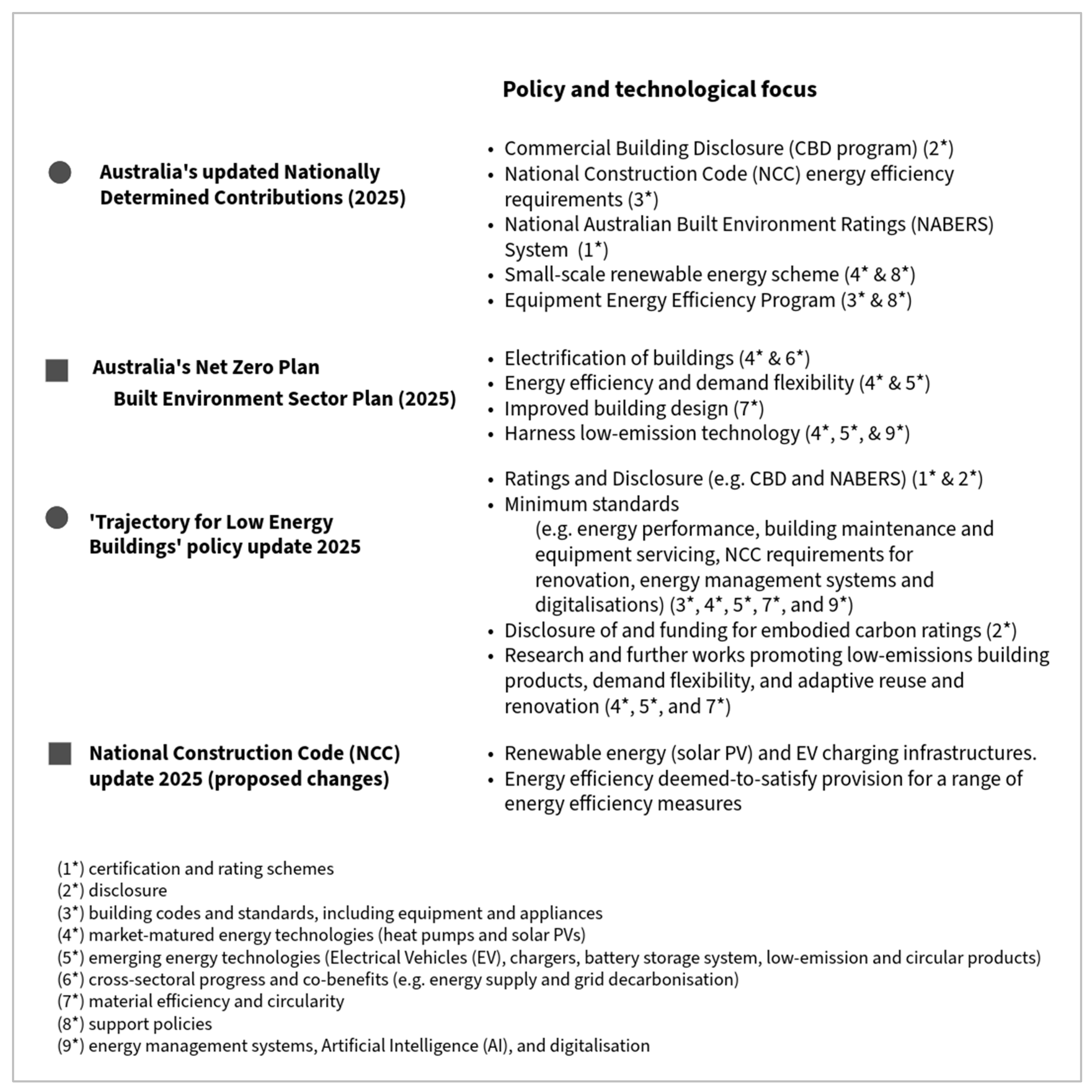
3.2. Net-Zero Transition and Accelerated Pathway Identification—Current Policy and Technology Drivers and Future Decarbonisation Scenarios
3.2.1. Transitional Decarbonisation Goal (By 2035) Scenario
3.2.2. Whole-of-Life Net-Zero Emissions Goal (By 2040) Scenario
3.3. Building Energy Simulation and Modelling for Operational Energy Analysis
3.4. Operational and Embodied Emissions Accounting and the Decarbonisation Pathway
4. Results
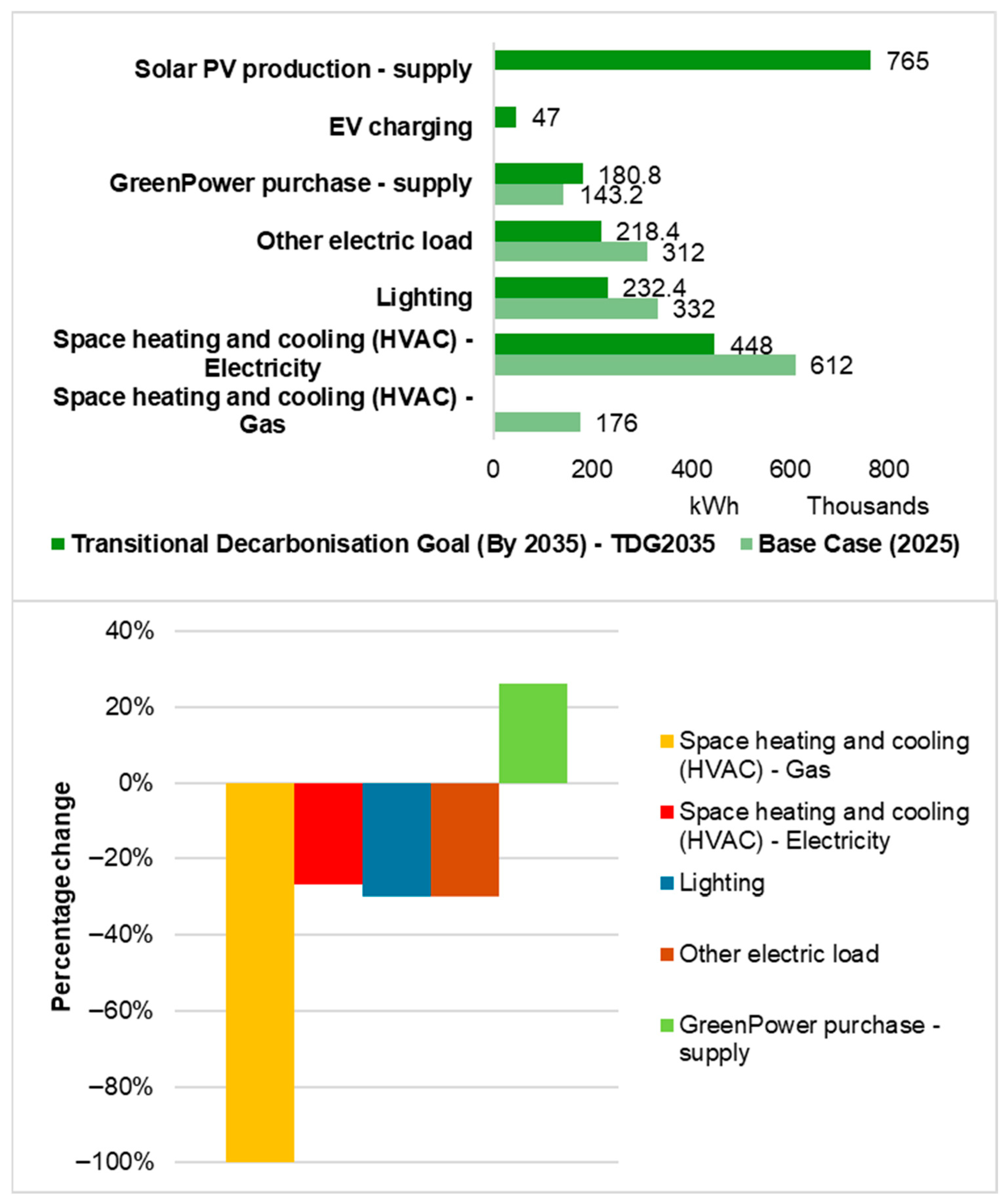
4.1. Operational Energy End-Use Decomposition and Greenhouse Gas Emissions
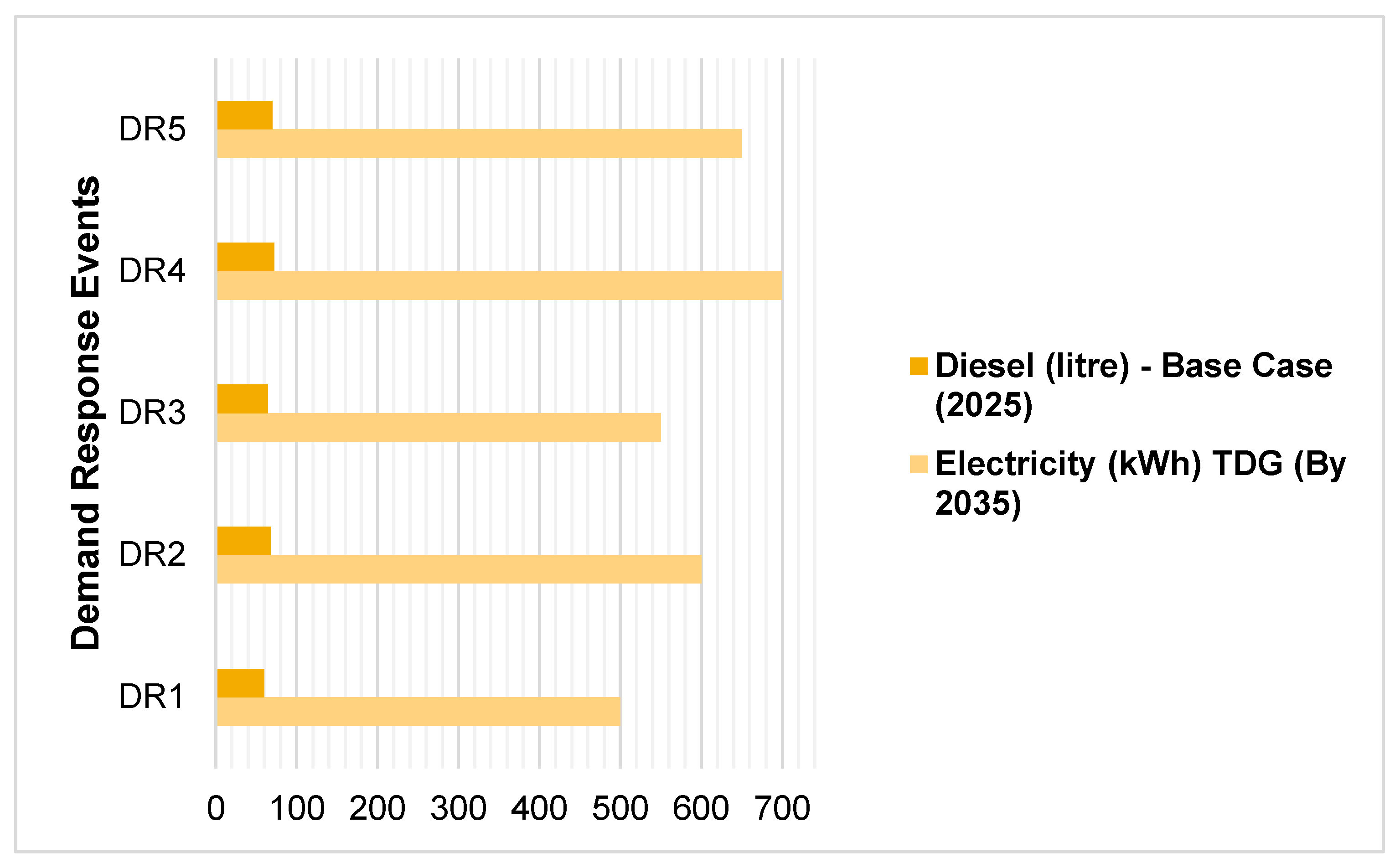
4.2. Energy Resilience and Demand Flexibility—Implications on the Operational Decarbonisation
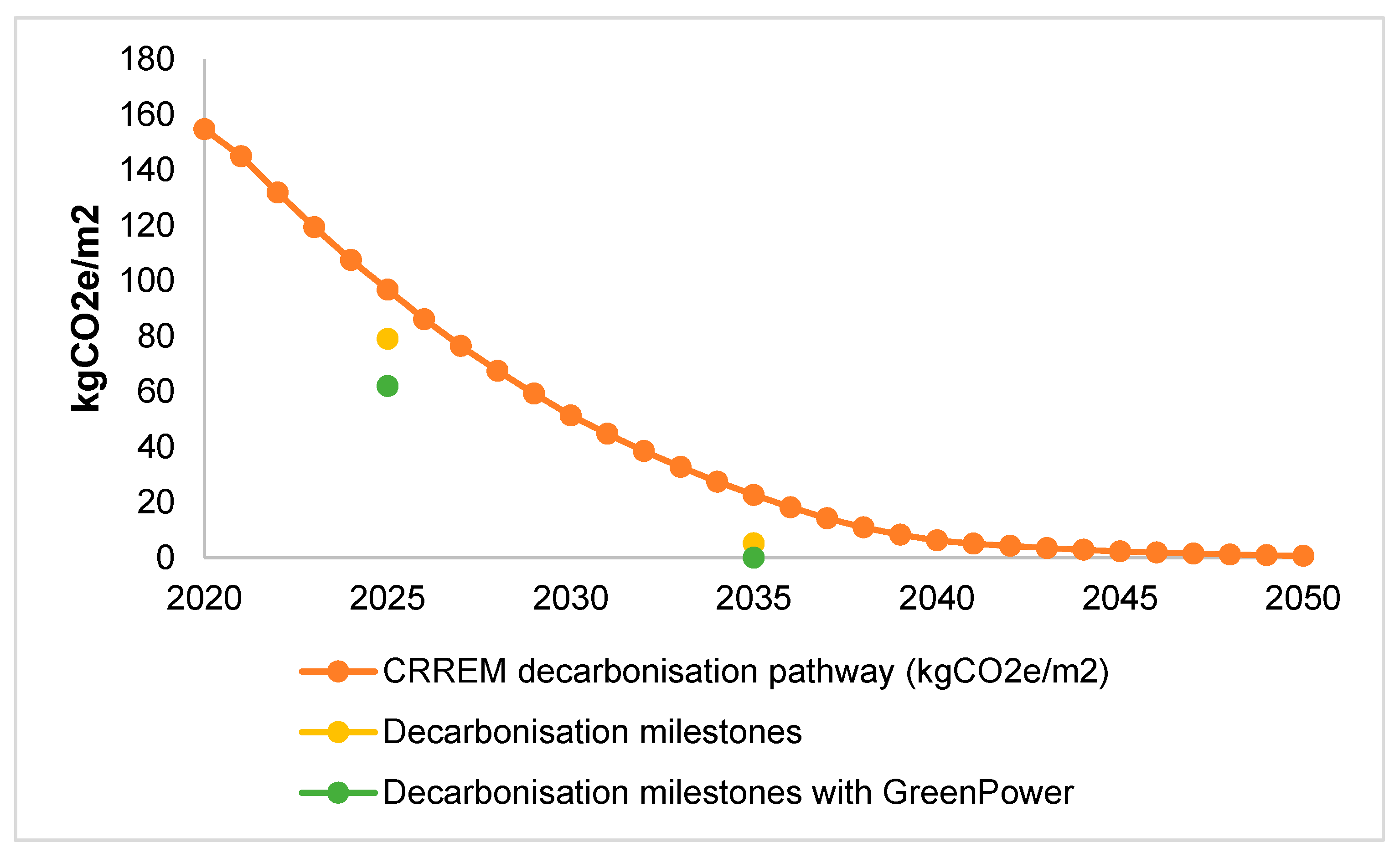
4.3. Upfront Embodied Carbon Reduction Potential and Contributions to the Whole-of-Life Net-Zero Emissions
5. Discussions
6. Conclusions and Limitations
Funding
Data Availability Statement
Conflicts of Interest
References
- Semieniuk, G.; Campiglio, E.; Mercure, J.F.; Volz, U.; Edwards, N.R. Low-carbon transition risks for finance. Wiley Interdiscip. Rev. Clim. Change 2021, 12, e678. [Google Scholar] [CrossRef]
- Gambhir, A.; George, M.; McJeon, H.; Arnell, N.W.; Bernie, D.; Mittal, S.; Monteith, S. Near-term transition and longer-term physical climate risks of greenhouse gas emissions pathways. Nat. Clim. Change 2022, 12, 88–96. [Google Scholar] [CrossRef]
- Xiao, X. Climate transition risk and commercial real estate. SSRN Electron. J. 2025, 4741949. [Google Scholar] [CrossRef]
- Di Febo, E. Transition Risk in Climate Change: A Literature Review. Risks 2025, 13, 66. [Google Scholar] [CrossRef]
- Skillington, K.; Crawford, R.H.; Warren-Myers, G.; Davidson, K. A review of existing policy for reducing embodied energy and greenhouse gas emissions of buildings. Energy Policy 2022, 168, 112920. [Google Scholar] [CrossRef]
- Curmi, L.; Weththasinghe, K.K.; Tariq, M.A. Global Policy Review on Embodied Flows: Recommendations for Australian Construction Sector. Sustainability 2022, 14, 14628. [Google Scholar] [CrossRef]
- Amarasinghe, I.; Liu, T.; Stewart, R.A.; Mostafa, S. Paving the way for lowering embodied carbon emissions in the building and construction sector. Clean Technol. Environ. Policy 2025, 27, 1825–1843. [Google Scholar] [CrossRef]
- United Nations Environment Programme (UNEP). Global Status Report for Buildings and Construction 2024/2025; United Nations Environment Programme (UNEP): Nairobi, Kenya, 2025. [Google Scholar]
- Habert, G.; Röck, M.; Steininger, K.; Lupísek, A.; Birgisdottir, H.; Desing, H.; Lützkendorf, T. Carbon budgets for buildings: Harmonising temporal, spatial and sectoral dimensions. Build. Cities 2020, 1, 429–452. [Google Scholar] [CrossRef]
- Verikios, G.; Reedman, L.; Green, D.; Nolan, M.; Lu, Y.; Rodriguez, S.; Murugesan, M.; Havas, L. Modelling Sectoral Pathways to Net Zero Emissions; EP2024-4366; CSIRO: Canberra, Australia, 2024; 66p. [Google Scholar]
- DCCEEW. Achieving Low Energy Existing Commercial Buildings in Australia; Department of Climate Change, Energy, the Environment and Water: Canberra, Australia, 2019. [Google Scholar]
- DCCEEW. Commercial Building Baseline Study 2022—Final Report; Department of Climate Change, Energy, the Environment and Water: Canberra, Australia, 2022. [Google Scholar]
- DCCEEW. Australia’s 2035 Nationally Determined Contribution; Department of Climate Change, Energy, the Environment and Water: Canberra, Australia, 2025. [Google Scholar]
- DCCEEW. The Trajectory for Low Energy Buildings Update; Department of Climate Change, Energy, the Environment and Water: Canberra, Australia, 2025. [Google Scholar]
- Prasad, D.; Dave, M.; Kuru, A.; Oldfield, P.; Ding, L.; Noller, C.; He, B. Race to Net Zero Carbon: A Climate Emergency Guide for New and Existing Buildings in Australia v1b; Updated 2022; Low Carbon Living Institute: Sydney, Australia, 2021. [Google Scholar]
- DCCEEW. NCC 2025 Worked Examples; Department of Climate Change, Energy, the Environment and Water: Canberra, Australia, 2025. [Google Scholar]
- DCCEEW. Australia’s Long-Term Emissions Reduction Plan; Department of Climate Change, Energy, the Environment and Water: Canberra, Australia, 2025. [Google Scholar]
- Allen, C.; Oldfield, P.; Teh, S.H.; Wiedmann, T.; Langdon, S.; Yu, M.; Yang, J. Modelling ambitious climate mitigation pathways for Australia’s built environment. Sustain. Cities Soc. 2022, 77, 103554. [Google Scholar] [CrossRef]
- Craft, W.; Oldfield, P.; Reinmuth, G.; Hadley, D.; Balmforth, S.; Nguyen, A. Towards net-zero embodied carbon: Investigating the potential for ambitious embodied carbon reductions in Australian office buildings. Sustain. Cities Soc. 2024, 113, 105702. [Google Scholar] [CrossRef]
- Hossain, M.U.; Cicco, I.; Bilec, M.M. Advancing Urban Building Energy Modeling: Building Energy Simulations for Three Commercial Building Stocks through Archetype Development. Buildings 2024, 14, 1241. [Google Scholar] [CrossRef]
- Ma, Y.; Deng, W.; Hong, Y.; Zhang, H.; Ye, Y.; Chen, S.; Xu, D. The advantages and challenges of integrating archetypal building modelling for urban building energy models: A systematic review. Energy Build. 2025, 345, 116066. [Google Scholar] [CrossRef]
- Bell, N.; Bilbao, J.; Kay, M.; Sproul, A. Future climate scenarios and their impact on heating, ventilation and air-conditioning system design and performance for commercial buildings for 2050. Renew. Sustain. Energy Rev. 2022, 162, 112363. [Google Scholar] [CrossRef]
- Baniya, B. Multi-hazard climate risks and resilience planning for urban commercial buildings: Spotlight on building services systems. Build. Simul. 2025, 18, 3201–3224. [Google Scholar] [CrossRef]
- Australian Building Codes Board (ABCB). National Construction Code (NCC), Building Classifications; ABCB: Canberra, Australia, 2025.
- Foo, G.S.; Shen, D. Australian Commercial Buildings Window to Wall Ratios. In Proceedings of the 52nd International Conference of the Architectural Science Association (ASA) 2018, Melbourne, Australia, 28 November–1 December 2018; pp. 231–240. [Google Scholar]
- Afroz, Z.; Goldsworthy, M.; White, S.D. Energy flexibility of commercial buildings for demand response applications in Australia. Energy Build. 2023, 300, 113533. [Google Scholar] [CrossRef]
- DCCEEW. Built Environment Sector Plan; Department of Climate Change, Energy, the Environment and Water: Canberra, Australia, 2025. [Google Scholar]
- Kim, J.; Frank, S.; Im, P.; Braun, J.E.; Goldwasser, D.; Leach, M. Representing small commercial building faults in EnergyPlus, part II: Model validation. Buildings 2019, 9, 239. [Google Scholar] [CrossRef]
- Flechas, G.M. OpenStudio validation of a CLT building in Colorado. ASHRAE Trans. 2021, 127, 37–39. [Google Scholar]
- Baniya, B.; Giurco, D. Net zero energy buildings and climate resilience narratives—Navigating the interplay in the building asset maintenance and management. Energy Rep. 2025, 13, 1632–1648. [Google Scholar] [CrossRef]
- Ren, Z.; Tang, Z.; James, M. Predictive Weather Files for Building Energy Modelling; CSIRO: Canberra, Australia, 2021. [Google Scholar]
- Bamdad, K.; Matour, S.; Izadyar, N.; Law, T. Introducing extended natural ventilation index for buildings under the present and future changing climates. Build. Environ. 2022, 226, 109688. [Google Scholar] [CrossRef]
- Baniya, B.; Giurco, D. Cost-effective and optimal pathways to selecting building microgrid components—The resilient, reliable, and flexible energy system under changing climate conditions. Energy Build. 2024, 324, 114896. [Google Scholar] [CrossRef]
- Vargas-Salgado, C.; Díaz-Bello, D.; Alfonso-Solar, D.; Lara-Vargas, F. Validations of HOMER and SAM tools in predicting energy flows and economic analysis for renewable systems: Comparison to a real-world system result. Sustain. Energy Technol. Assess. 2024, 69, 103896. [Google Scholar] [CrossRef]
- Marqusee, J.; Ericson, S.; Jenket, D. Impact of emergency diesel generator reliability on microgrids and building-tied systems. Appl. Energy 2021, 285, 116437. [Google Scholar] [CrossRef]
- DCCEEW. National Greenhouse Accounts Factors: 2025; Department of Climate Change, Energy, the Environment and Water: Canberra, Australia, 2025. [Google Scholar]
- Carbon Risk Real Estate Monitor (CRREM). CRREM Pathway Methodology; CRREM: Amsterdam, The Netherlands, 2025. [Google Scholar]
- Cang, Y.; Luo, Z.; Yang, L.; Han, B. A new method for calculating the embodied carbon emissions from buildings in schematic design: Taking “building element” as basic unit. Build. Environ. 2020, 185, 107306. [Google Scholar] [CrossRef]
- Elkhayat, Y.; Moran, P.; Barrett, S.; Barry, P.; Goggins, J. Developing a methodology with a tool for calculating and reducing the upfront carbon emissions of buildings: Ireland as a case study. Archit. Eng. Des. Manag. 2025, 1–20. [Google Scholar] [CrossRef]
- Ascione, F.; Nižetić, S.; Wang, F. Future technologies for building sector to accelerate energy transition. Energy Build. 2024, 326, 115044. [Google Scholar] [CrossRef]
- Crawford, R.H. EPiC Database; The University of Melbourne: Melbourne, Australia, 2019. [Google Scholar]
- Cheng, M.; Huang, Z.; Zheng, Y. A review on life-cycle carbon emissions of reinforced concrete buildings: Calculation and reduction. J. Clean. Prod. 2025, 526, 146501. [Google Scholar] [CrossRef]
- Kuru, A.; Lyu, K.; Gocer, O.; Brambilla, A.; Prasad, D. Climate risk assessment of buildings: An analysis of operating emissions of commercial offices in Australia. Energy Build. 2024, 315, 114336. [Google Scholar] [CrossRef]
- Liu, J.; Wu, H.; Huang, H.; Yang, H. Renewable energy design and optimization for a net-zero energy building integrating electric vehicles and battery storage considering grid flexibility. Energy Convers. Manag. 2023, 298, 117768. [Google Scholar] [CrossRef]
- Liu, J.; Zhao, Y.; Xu, Z.; Wu, J.; Liu, K.; Guan, X. Coordinated integration of hydrogen-enabled multi-energy systems to achieve zero-carbon buildings. Build. Environ. 2025, 284, 113433. [Google Scholar] [CrossRef]
- Kurniawati, H.; Broersma, S.; Itard, L.; Mohammadi, S. Integrated Hydrogen in Buildings: Energy Performance Comparisons of Green Hydrogen Solutions in the Built Environment. Buildings 2024, 15, 3232. [Google Scholar] [CrossRef]
- Wang, T.; Ma, M.; Zhou, N.; Ma, Z. Toward net zero: Assessing the decarbonization impact of global commercial building electrification. Appl. Energy 2025, 383, 125287. [Google Scholar] [CrossRef]
- He, Z.; Khazaei, J.; Freihaut, J.D. Optimal integration of Vehicle to Building (V2B) and Building to Vehicle (B2V) technologies for commercial buildings. Sustain. Energy Grids Netw. 2022, 32, 100921. [Google Scholar] [CrossRef]
- Yin, R.; Liu, J.; Piette, M.A.; Xie, J.; Pritoni, M.; Casillas, A.; Yu, L.; Schwartz, P. Comparing simulated demand flexibility against actual performance in commercial office buildings. Build. Environ. 2023, 243, 110663. [Google Scholar] [CrossRef]
- Cai, H.; Wang, X.; Kim, J.; Gowda, A.; Wang, M.; Mlade, J.; Farbman, S.; Leung, L. Whole-building life-cycle analysis with a new GREET® tool: Embodied greenhouse gas emissions and payback period of a LEED-Certified library. Build. Environ. 2022, 209, 108664. [Google Scholar] [CrossRef]
- Röck, M.; Balouktsi, M.; Saade, M.R.M. Embodied carbon emissions of buildings and how to tame them. One Earth 2023, 6, 1458–1464. [Google Scholar] [CrossRef]
- Brown, D.; Tokede, O.; Li, H.X.; Edwards, D. A systematic review of barriers to implementing net zero energy buildings in Australia. J. Clean. Prod. 2024, 467, 142910. [Google Scholar] [CrossRef]





| Building Characteristics | |
|---|---|
| Type | Commercial Office building |
| Storeys | 10 |
| Total floor area | 12,000 m2 |
| Floor-to-Floor height | 3 m |
| Zoning | Closed office with three zones (one for shared spaces and two zones for other office spaces). |
| Window-to-Wall Ratio (WWR) | 35% |
| Construction set | Exterior roof with roof membrane, roof insulation, and metal decking. Exterior concrete wall with wall insulation and Gypsum board. Exterior glass window. Interior floors and internal ceilings with acoustic tiles, ceiling air, and lightweight concrete. |
| Insulation | Roof insulation’s thermal conductivity (1/R) = 0.045 W/m·K. Wall insulation’s thermal conductivity (1/R) = 0.0380 W/m·K. Window glass thermal conductivity (1/R) = 0.082 W/m·K. |
| Infiltration rate | 10 ACH at 50 Pa for the chosen construction set. |
| HVAC system | One gas-fired furnace with a heating coil. Two packaged rooftop heat pumps with both heating and cooling DX coils. Heating setpoint:18 °C. Cooling setpoint: 24 °C. |
| Conditioned area to the total floor area | 100% |
| Lights (lighting density) | 9 Watts per square metre floor area (average for all spaces). |
| Electric equipment (plug load density) | 15 Watts per square metre floor area (average for all spaces). |
| Hot water system | Electric water heater (temperature at outlets <50 °C). |
| Emergency power backup | 120 KVA diesel generator (three-phase output) capable of using renewable diesel. |
Disclaimer/Publisher’s Note: The statements, opinions and data contained in all publications are solely those of the individual author(s) and contributor(s) and not of MDPI and/or the editor(s). MDPI and/or the editor(s) disclaim responsibility for any injury to people or property resulting from any ideas, methods, instructions or products referred to in the content. |
© 2026 by the author. Licensee MDPI, Basel, Switzerland. This article is an open access article distributed under the terms and conditions of the Creative Commons Attribution (CC BY) license.
Share and Cite
Baniya, B. Accelerated Emissions Reductions and Carbon Risk Management in Australian Commercial Buildings: Policy and Technology Perspectives. Buildings 2026, 16, 441. https://doi.org/10.3390/buildings16020441
Baniya B. Accelerated Emissions Reductions and Carbon Risk Management in Australian Commercial Buildings: Policy and Technology Perspectives. Buildings. 2026; 16(2):441. https://doi.org/10.3390/buildings16020441
Chicago/Turabian StyleBaniya, Bishal. 2026. "Accelerated Emissions Reductions and Carbon Risk Management in Australian Commercial Buildings: Policy and Technology Perspectives" Buildings 16, no. 2: 441. https://doi.org/10.3390/buildings16020441
APA StyleBaniya, B. (2026). Accelerated Emissions Reductions and Carbon Risk Management in Australian Commercial Buildings: Policy and Technology Perspectives. Buildings, 16(2), 441. https://doi.org/10.3390/buildings16020441