Article

Freeze–Thaw Damage Model and Mechanism of Rubber Concrete with Recycled Brick–Concrete Aggregate

1
School of Civil Engineering, Sichuan Agricultural University, Chengdu 611830, China
2
MOE Key Laboratory of Deep Earth Science and Engineering, College of Architecture and Environment, Sichuan University, Chengdu 610065, China
3
School of Civil Engineering, Hunan University, Changsha 410082, China
*
Author to whom correspondence should be addressed.
These authors contributed equally to this work.
Buildings 2026, 16(2), 438; https://doi.org/10.3390/buildings16020438
Submission received: 29 November 2025 / Revised: 4 January 2026 / Accepted: 16 January 2026 / Published: 21 January 2026
(This article belongs to the Special Issue The Greening of the Reinforced Concrete Industry)

Abstract

This study investigated the effects of rubber substitution ratios (0%, 5%, 10%, 15%) on the frost resistance of rubber concrete with recycled brick–concrete aggregate (BRC). The freeze–thaw (F–T) damage model was established and improved, and the damage mechanism was revealed. The results showed that with the increase in rubber substitution ratio, the frost resistance indices of BRC did not improve or decline synchronously. An increase in rubber content could enhance one index, such as the relative compressive strength, but was often achieved at the expense of reductions in other indices, such as the relative dynamic elastic modulus (RDEM) and relative quality. Consequently, a single indicator was insufficient for evaluating the overall frost resistance. To address this limitation, an entropy weight-based evaluation system was developed. This system integrated the multiple indices into a unified damage score. When combined with defined damage grades, it enabled a holistic assessment of the damage state. For the nonlinear accelerated damage stage during freeze–thaw cycles, the Weibull distribution-based freeze–thaw damage model demonstrated higher prediction accuracy (R2 > 0.85) compared to the conventional freeze–thaw fatigue model. The freeze–thaw damage in BRC originated from the competition between “pore deterioration and crack propagation at weak interfaces” and “the elastic buffering effect of rubber.” This study provided a reference for the frost-resistance design and freeze–thaw life prediction of BRC in cold regions.

1. Introduction

During the process of urbanization, the annual generation of concrete debris, brick, and stone waste gradually increased, leading to increasingly severe environmental problems [1,2,3,4,5]. Dust pollution from the open-air storage of construction waste and the migration of its hazardous components seriously damaged the ecological environment [6,7,8]. Meanwhile, the accumulation of a large number of waste tires not only impaired the landscape but also posed a potential fire risk due to the spontaneous combustion characteristic of rubber material at high temperatures [9,10,11]. Research demonstrated that utilizing construction waste and discarded tires to produce BRC was a feasible method. This approach not only facilitated the recycling of solid wastes but also enhanced the mechanical properties of concrete. However, studies on BRC, especially concerning its durability in harsh environments and damage evolution mechanisms, remained inadequate, restricting its engineering application.
The use of recycled aggregates and rubber degrades concrete properties, yet its sustainability advantages retain substantial application potential [12,13,14,15,16,17]. Optimizing mix proportions and modifying aggregates through grinding, soaking, or coating can significantly enhance concrete strength and toughness—increasing compressive strength by up to 27%, bond strength by 46.6%, and tensile strain notably. These improvements enable applications in non-load-bearing components, 3D-printed structures, and low-carbon buildings [18,19,20,21,22]. Through experimental design, Emadaldin et al. [23] and Amiri Mostafa et al. [24] proposed a rubber concrete (RC) mix ratio with excellent mechanical properties, which met the requirements of the project for strength, durability, and other indicators, providing technical support for practical application. While these improvements have expanded the application of RC, its durability under environmental conditions, especially frost resistance, continues to be a crucial area of study.
Current research on the frost resistance of rubber concrete (RC) has primarily been based on a combination of experimental methods, microstructural analysis, and reliability-based assessments [25,26,27,28]. Experimentally, F–T cycling tests under controlled environmental conditions are commonly employed to simulate long-term frost exposure, with accompanying measurements of quality loss, strength degradation, and relative durability indices [29,30,31,32]. For performance evaluation and analysis, the frequent use of durability indicators, probabilistic service-life prediction models, and reliability analysis serves to assess the safety margins and frost resistance levels of concrete [33,34,35]. Conversely, the frost resistance of recycled brick aggregate concrete (RBC) has also constituted a key research focus, attributable to the high porosity and water absorption of the aggregate [36,37]. For instance, Zhao et al. investigated the performance deterioration of straw-modified RBC under F–T cycles, established a corresponding damage model, and conducted life prediction, demonstrating that such materials can meet durability requirements at appropriate aggregate replacement levels [37]. However, existing studies have predominantly focused on concrete containing either recycled brick aggregate or rubber alone. Moreover, recycled brick–concrete aggregate differs in material characteristics from conventional aggregate, which may lead to different frost resistance and damage evolution behaviors in BRC that incorporates both. Therefore, studies on the durability degradation of BRC under F–T conditions are relatively scarce and require further investigation.
Building upon these performance evaluations, researchers have increasingly focused on developing damage models to quantify F–T deterioration. For instance, Cheng et al. [38] established a deterioration model incorporating multiple damage variables to evaluate the service life of RC under F–T damage, while other researchers adopted more effective evaluation methods to quantify the F–T damage response of such materials [39]. In particular, some studies have introduced damage mechanics-based models that consider the coupled effects of progressive crack development and moisture transport, enabling more accurate prediction of stiffness reduction and strength loss over successive F–T cycles [40,41]. Additionally, probabilistic approaches combining Weibull distribution and mesomechanics have been applied to model the variability in frost resistance of concrete, reflecting the inhomogeneous nature of its composite material [42,43]. These advanced models provide deeper insight into the damage mechanisms and facilitate the durability design of RC in cold regions. Given that BRC exhibits distinct material properties and failure mechanisms, there was an urgent need to develop corresponding damage models to accurately represent its response to F–T conditions and support its engineering applications.
On this basis, the F–T resistance of BRC was investigated in this study from three aspects: evaluation method, damage prediction model, and damage mechanism. To overcome the limitation of single-index evaluation, a comprehensive scoring system based on multi-index weighting was established, thereby providing a quantitative tool for the assessment of BRC’s F–T resistance. In response to the inadequacy of traditional fatigue models in characterizing nonlinear damage, an F–T damage model based on the Weibull distribution was introduced. This model characterized the performance evolution of BRC, particularly during the accelerated damage stage, with higher accuracy. Furthermore, the F–T damage mechanism of this multiphase composite material with inherent initial defects was elucidated, revealing the competitive interaction between damage-promoting and damage-inhibiting effects during F–T cycles. This offered a new perspective for understanding the damage evolution process of BRC. The research provided a reference for the durability design and engineering application of BRC in cold regions.

2. Materials and Test Methods

2.1. Materials

In this study, the P·C42.5 composite Portland cement was used as the binding material. For fine aggregates, a combination of natural sand (with a fineness modulus of 2.48) and rubber particles (1–3 mm) produced from waste tires was utilized. The material parameters of the rubber are provided in Table 1.
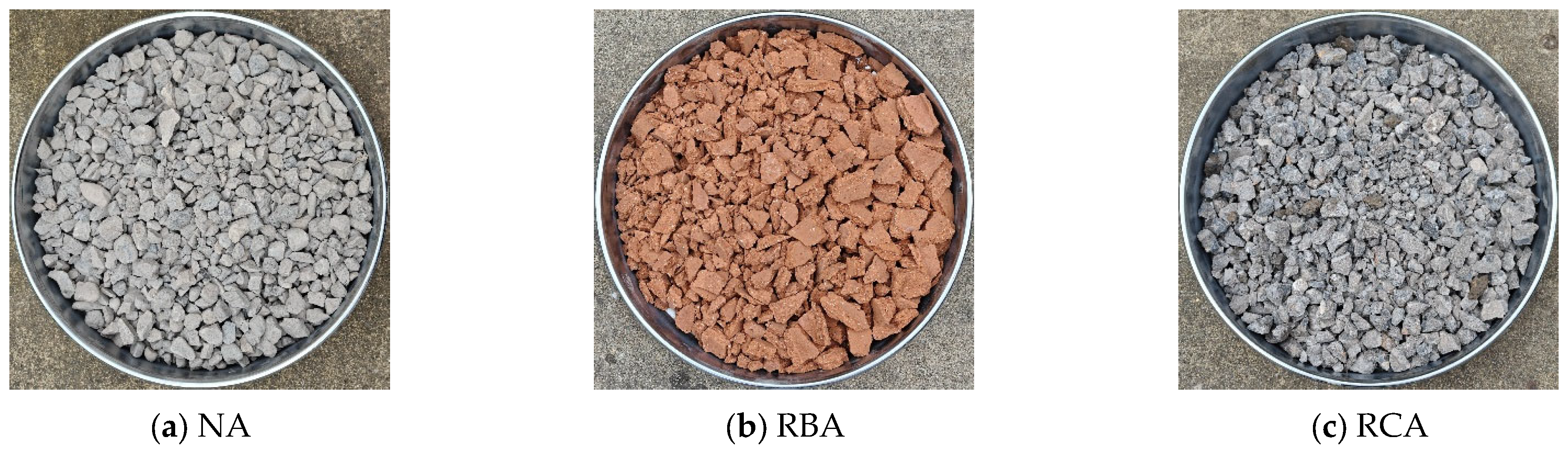
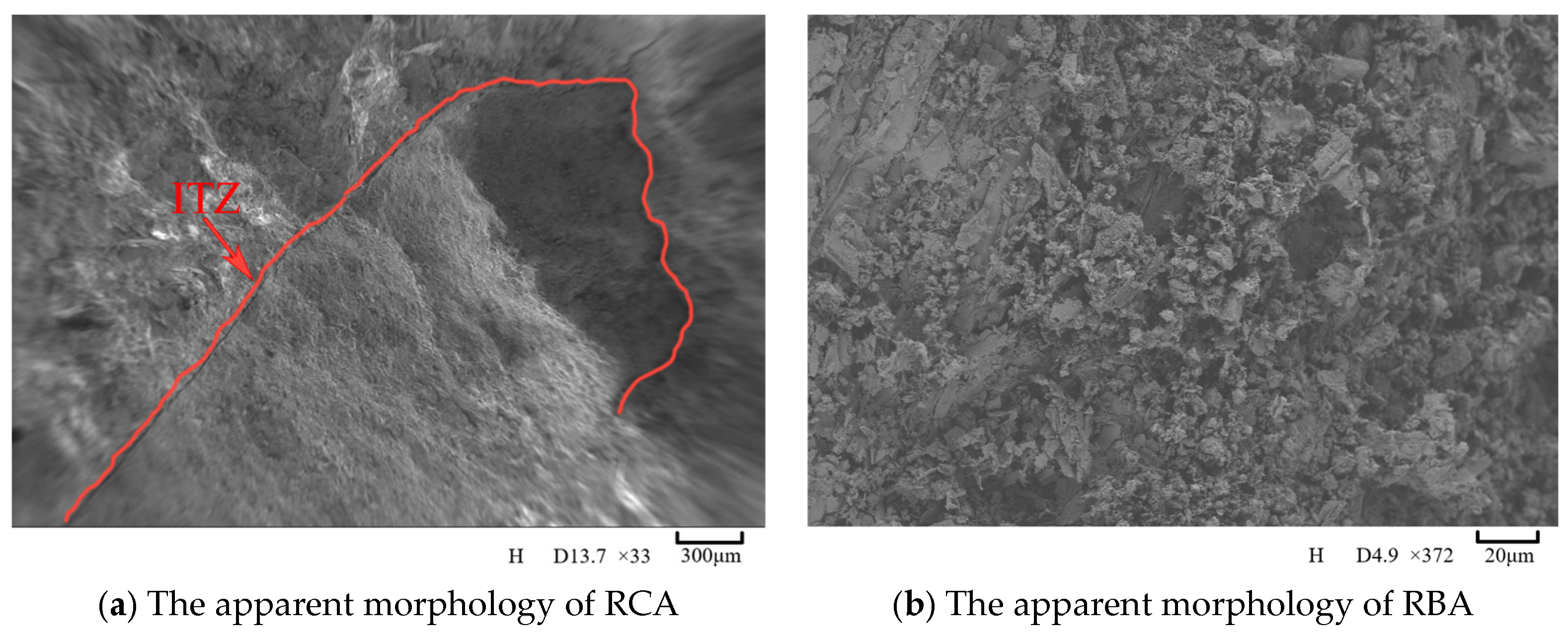
The coarse aggregates, with particle sizes ranging from 4.75 to 31.5 mm, comprised natural coarse aggregate (NA) along with recycled brick aggregate (RBA) and recycled concrete aggregate (RCA) mixed in a 1:1 volume ratio. Figure 1 shows their surface characteristics.
The RCA was produced by crushing and sieving C30 concrete beams, while the RBA was obtained by crushing and sieving MU3.5 clay hollow bricks. The physical and mechanical properties of the coarse aggregates are summarized in Table 2, and the chemical composition of the recycled aggregates is provided in Table 3 [44]. Additionally, a polycarboxylic acid superplasticizer was used as the admixture.

2.2. Mix Proportions

The substitution ratios of 0%, 5%, 10%, and 15% were adopted to replace natural river sand with rubber particles, respectively. The cement content of 370 kg/m3 and the water-to-binder ratio of 0.47 were designed to achieve a target compressive strength of approximately 40 MPa for the control mix (BRC0) after 28-day curing. NA, RCA, and RBA are mixed in a volume ratio of 2:1:1. This volumetric proportion was selected to achieve a balance between the mechanical properties and durability of BRC, while enabling the utilization of a high content of recycled aggregates. The BRC shall be treated with freshwater. Table 4 shows the BRC Mix proportions.

2.3. Experiment Program

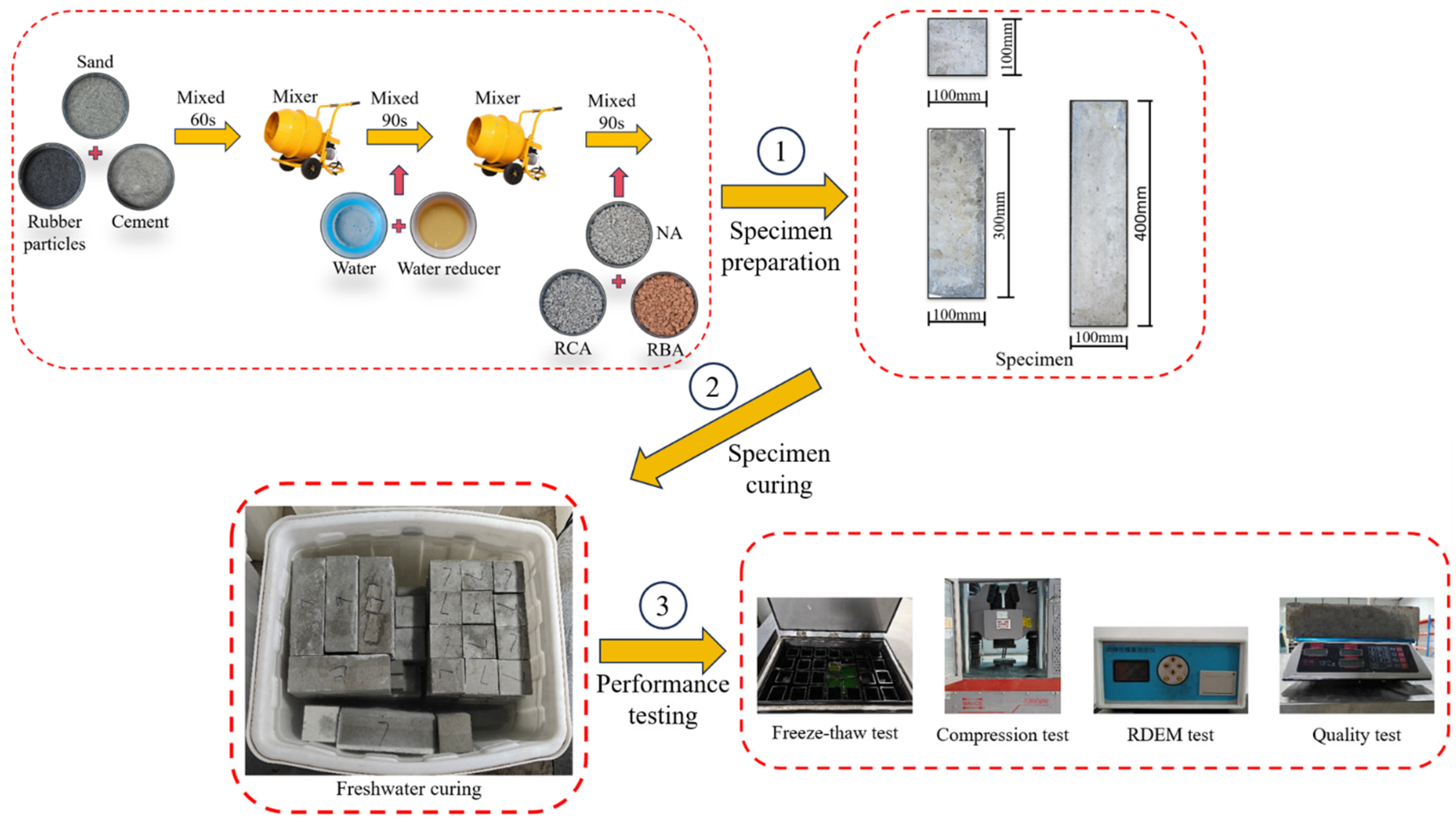
The experiment program is shown in Figure 2. To conduct multi-scale research on the BRC, the specimens were prepared by the coating method, and the frost resistance of the BRC was tested under freshwater curing conditions.
A cumulative total of 300 F–T cycles were applied to the BRC specimens using a rapid F–T testing machine (Model HDK, with a temperature uniformity of <2.0 °C and a compressor power of 4.5 kW). The temperature range was set from −18 °C to 5 °C, and each complete F–T cycle lasted for 4 h [45]. After every 25 cycles, the specimens were removed from the apparatus for the recording of surface erosion and the assessment of frost resistance. A total of 13 measurement points were thus established. At each point, tests were performed on triplicate samples for every mix proportion. The experiment program is shown in Figure 2.
The variation in strength serves as a key indicator for evaluating the frost resistance of BRC after F–T cycles. The strength was measured on 100 mm cubes using a universal testing machine (Model HUT106A, maximum load 1000 kN, power 4.25 kW; manufactured by Shenzhen Wance Testing Machine Company Limited, Shenzhen, China), and the relative strength was determined by Equation (1) [45].
F c s = f c s n f c s 0 × 100 %
where Fcs is the relative compressive strength, %; fcsn is the compressive strength of BRC after n F–T cycles, MPa; fcs0 is the initial compressive strength of BRC, MPa.
The transverse fundamental frequency of BRC was measured on 100 mm × 100 mm × 400 mm prism specimens by a dynamic elastic modulus tester (Model DT-20, frequency measurement range 10–50,000 Hz, output power 0–15 W). The RDEM was then derived by analyzing the change in this fundamental frequency. The corresponding calculation is given by Equation (2) [45].
P n = f n 2 f 0 2 × 100 %
where Pn is the RDEM of BRC after n F–T cycles, %; fn is the resonance fundamental frequency of BRC after n F–T cycles, Hz; f0 is the initial resonance fundamental frequency of BRC before F–T cycles, Hz.
The quality of the BRC was tested on 100 mm × 100 mm × 400 mm prism specimens by an electronic scale. The scale had a maximum capacity of 30 kg and a readability of 0.01 kg. The relative quality was then calculated by Equation (3) [45].
M d = m d N m d 0 × 100 %
where Md is the relative quality of BRC, %; mdN is the quality of BRC after n F–T cycles, kg; md0 is the initial quality of BRC, kg.

3. Results, Analysis, and Discussion

3.1. Compressive Properties

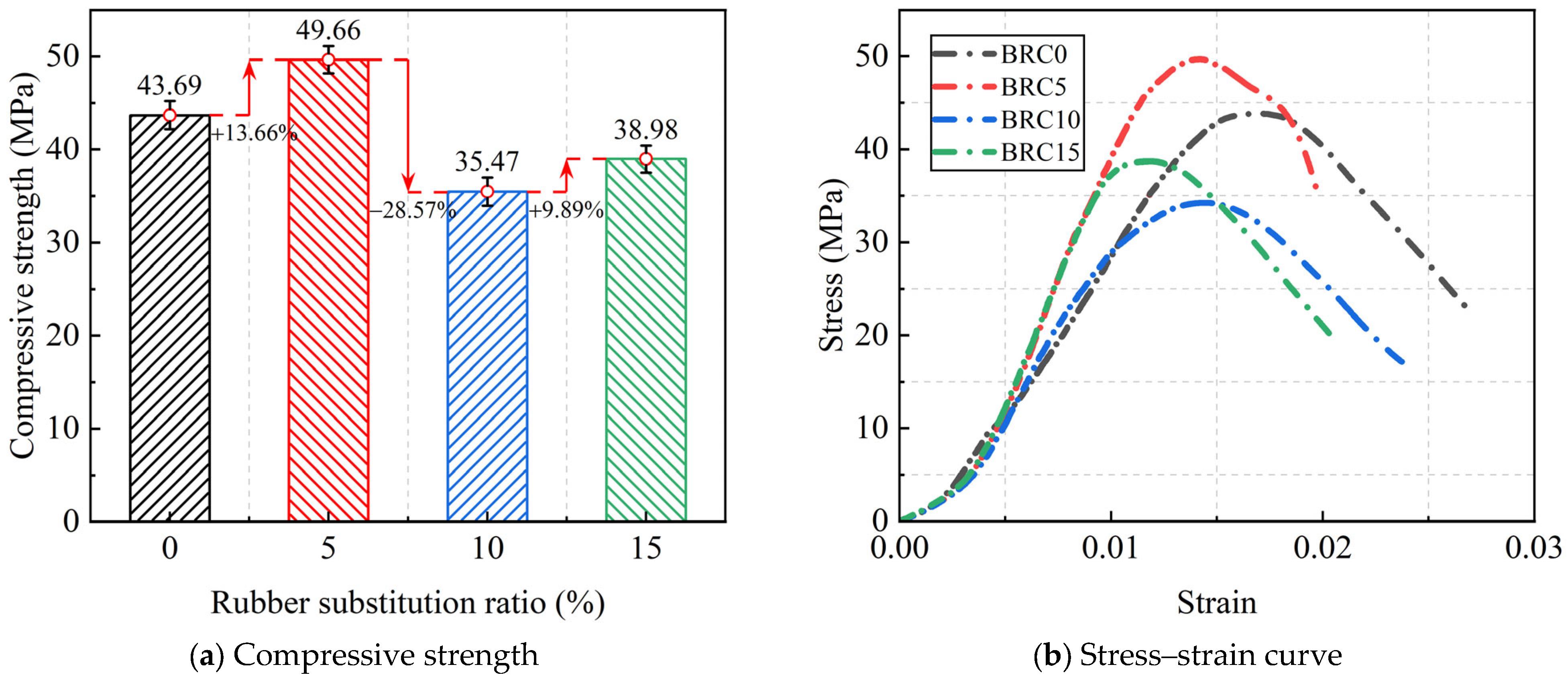
As shown in Figure 3, the compressive strength of BRC initially increased and then decreased with higher rubber substitution ratios, exhibiting a nonlinear trend.
This behavior is attributed to the fact that an appropriate amount of rubber particles can fill matrix pores and improve stress distribution, thereby enhancing the macroscopic mechanical properties of BRC; however, excessively higher rubber substitution ratios led to poor dispersion within the cement matrix and weak interfacial bonding between rubber and cement paste, which easily caused increased interfacial defects, microcrack propagation, and reduced density, ultimately resulting in significant deterioration in compressive strength [46]. When the rubber substitution ratio was 5%, the compressive strength of BRC reached a peak value of 49.66 MPa, which increased by 5.97 MPa compared to the reference group BRC0, with a relative increase of 13.66%. In contrast, when the rubber substitution ratio reached 15%, the compressive strength decreased to 38.98 MPa, a reduction of 4.71 MPa, corresponding to a relative decline of 10.78%. The results indicated that the rubber content significantly influenced the compressive strength of BRC, with an optimal substitution ratio around 5%. Beyond this range, structural degradation effects dominated the material performance.
However, as the rubber substitution ratio increased, the peak stress of BRC gradually decreased, while the stress–strain curve exhibited a more gradual post-peak softening stage, with a slower rate of stress reduction following the peak. This behavior indicates that the incorporation of rubber particles significantly improved the ductility of BRC, enabling greater plastic deformation under stress, enhancing energy dissipation capacity, and effectively suppressing brittle characteristics. The results demonstrated that an appropriate amount of rubber not only increased the deformability of the material but also contributed to improved toughness and failure mode.

3.2. Axial Compressive Properties

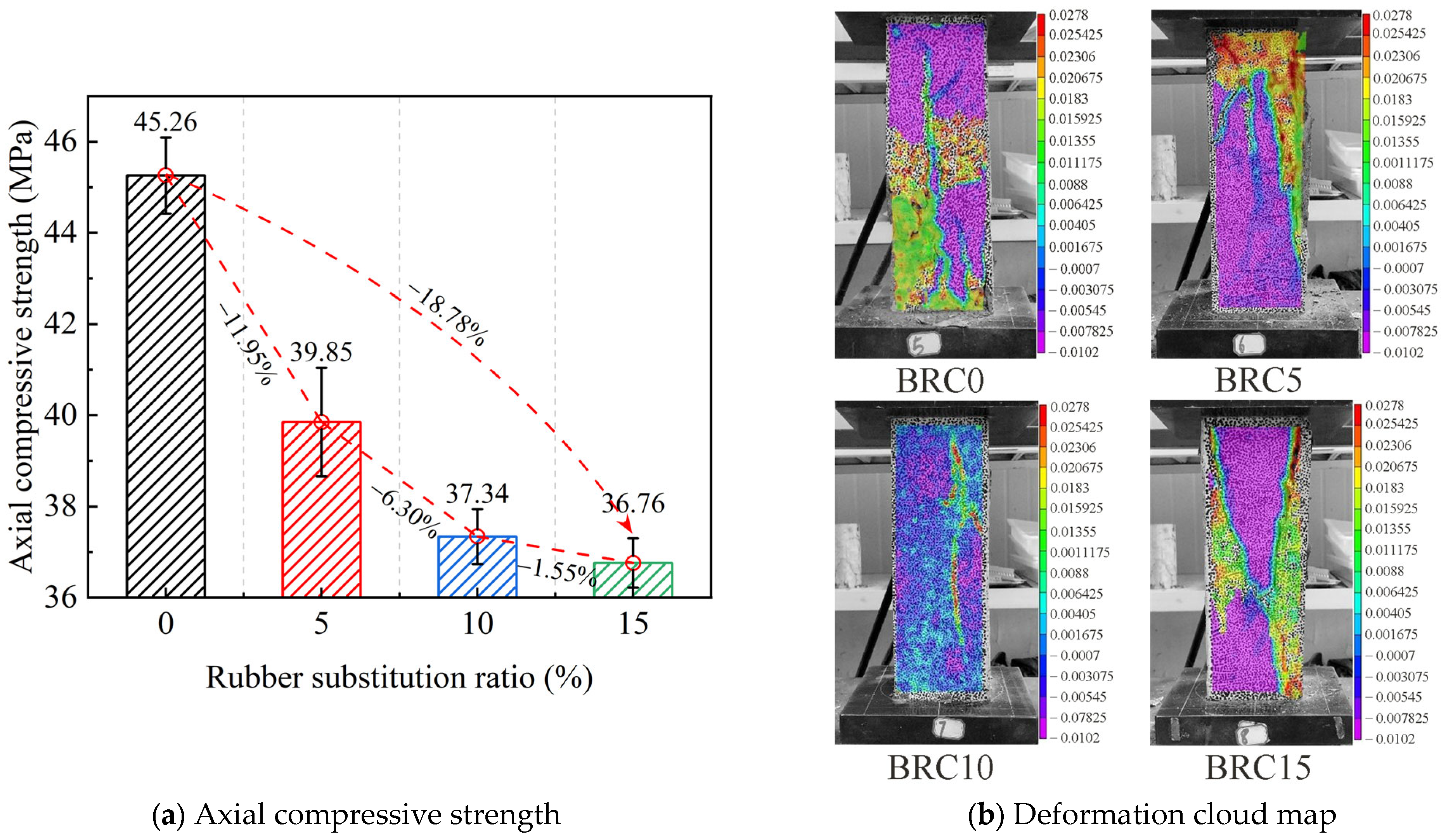
The axial compressive strength and corresponding deformation nephograms of BRC are shown in Figure 4.
The deformation cloud map was obtained through Digital Image Correlation (DIC), a full-field optical measurement technique based on tracking speckle displacement. This involved applying a speckle pattern to the specimen surface, acquiring images during axial loading, and processing the images in Vic-2D software (version 6). The map clearly reflected the distribution and evolution of surface damage under axial loading [15]. The results showed that with the increase in rubber substitution ratio, the damaged areas in the deformation nephograms expanded gradually, and the crack distribution became more extensive. This is primarily because the elastic modulus of rubber is much lower than that of sand and stone, and the interfacial bonding between rubber and cement paste is weak, leading to the formation of numerous weak zones within the composite material and exacerbating stress concentration [47].
As shown in Figure 4b, the BRC15 specimen experienced overall failure. Under axial compression, it exhibited noticeable brittle characteristics, with cracks propagating rapidly and connecting multiple weak zones, ultimately resulting in a complete loss of load-bearing capacity. This phenomenon further indicates that although excessive rubber content can enhance deformability, it significantly reduces the stiffness, strength, and overall stability of the material.
The axial compressive strength exhibited a gradual decreasing trend as the rubber substitution ratio increased. This is primarily attributed to the fact that the elastic modulus of rubber particles is significantly lower than that of natural aggregates. Their incorporation disrupts the continuity of the cementitious matrix, leading to a reduction in overall density, an increase in porosity, and a higher number of internal defects. Under loading, these interfacial weak zones (ITZs) easily initiate stress concentration, accelerating the initiation and propagation of microcracks, thereby compromising the load-bearing capacity of BRC. From an engineering application perspective, although the addition of rubber entails a sacrifice in strength, it significantly enhances the BRC’s toughness, energy absorption capacity, and impact resistance. Therefore, BRC with rubber remains promising in scenarios requiring vibration damping, noise reduction, or crack resistance.
The numerical results showed that when the rubber substitution ratio reached 15%, the axial compressive strength decreased by 8.5 MPa compared to the reference group BRC0, representing a reduction of 18.78%. This further confirms the considerable influence of rubber content on the mechanical properties. In practical engineering, it is essential to balance strength and toughness and to rationally control the rubber content to optimize the overall performance of BRC.

3.3. Elastic Modulus

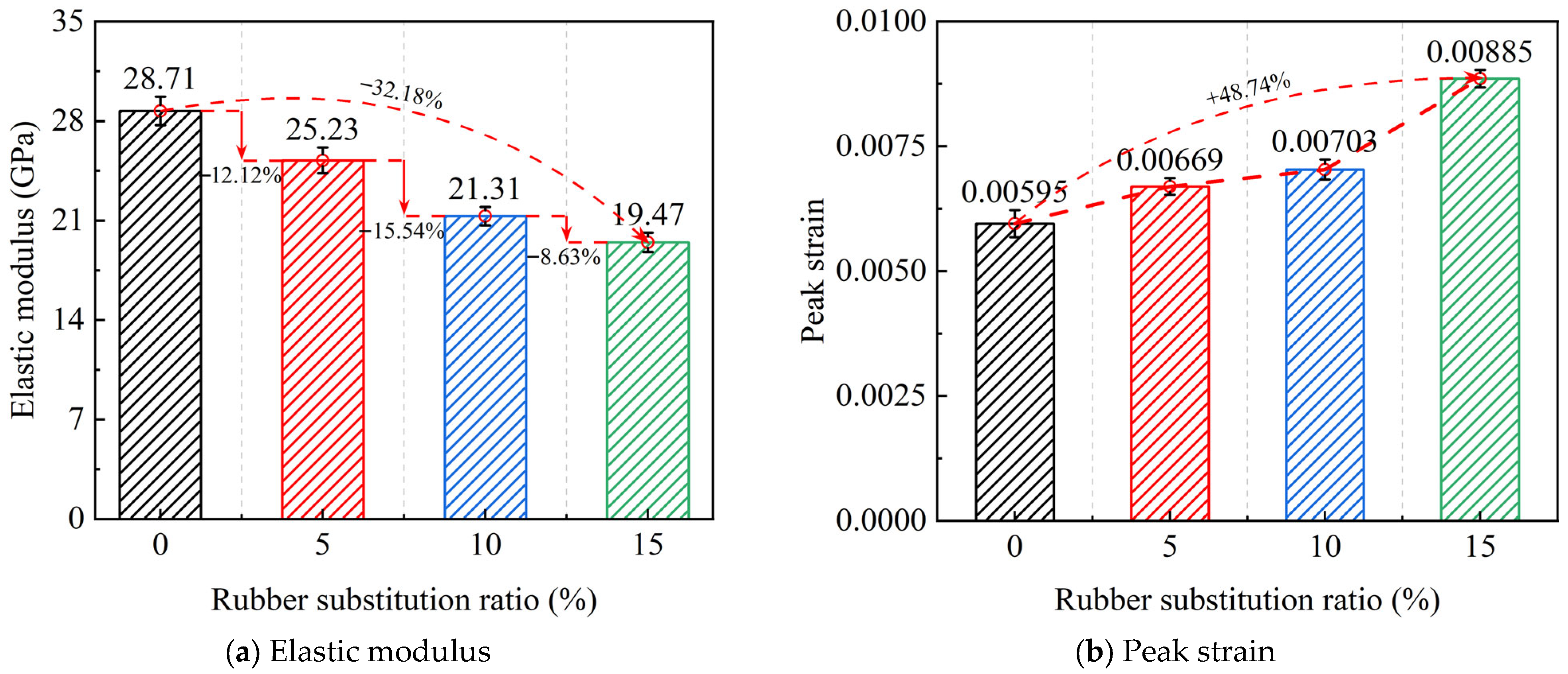
As shown in Figure 5, both the elastic modulus and peak stress of BRC exhibited regular variations with increasing rubber content.
Higher rubber substitution ratios significantly reduced the elastic modulus of the material, while simultaneously increasing the peak strain. This behavior can be attributed to two main factors: on one hand, the incorporation of rubber particles increases interfacial defects and porosity within the material, weakening the matrix stiffness and resulting in a decrease in elastic modulus; on the other hand, the high elasticity and deformability of rubber allow the specimen to undergo greater deformation under load, delaying crack propagation and thereby significantly enhancing the peak strain [48].
Specific data indicated that, compared to the reference group BRC0, the elastic modulus of BRC15 decreased by 9.24 GPa, a reduction of 32.18%; meanwhile, its peak strain increased from 0.00595 to 0.00885, representing an increase of approximately 48.74%. These results further demonstrate that the addition of rubber, while sacrificing material stiffness, markedly improves deformation capacity and toughness, reflecting a distinct material behavior characterized by “trading strength for toughness.”

3.4. Frost Resistance

3.4.1. Surface Erosion

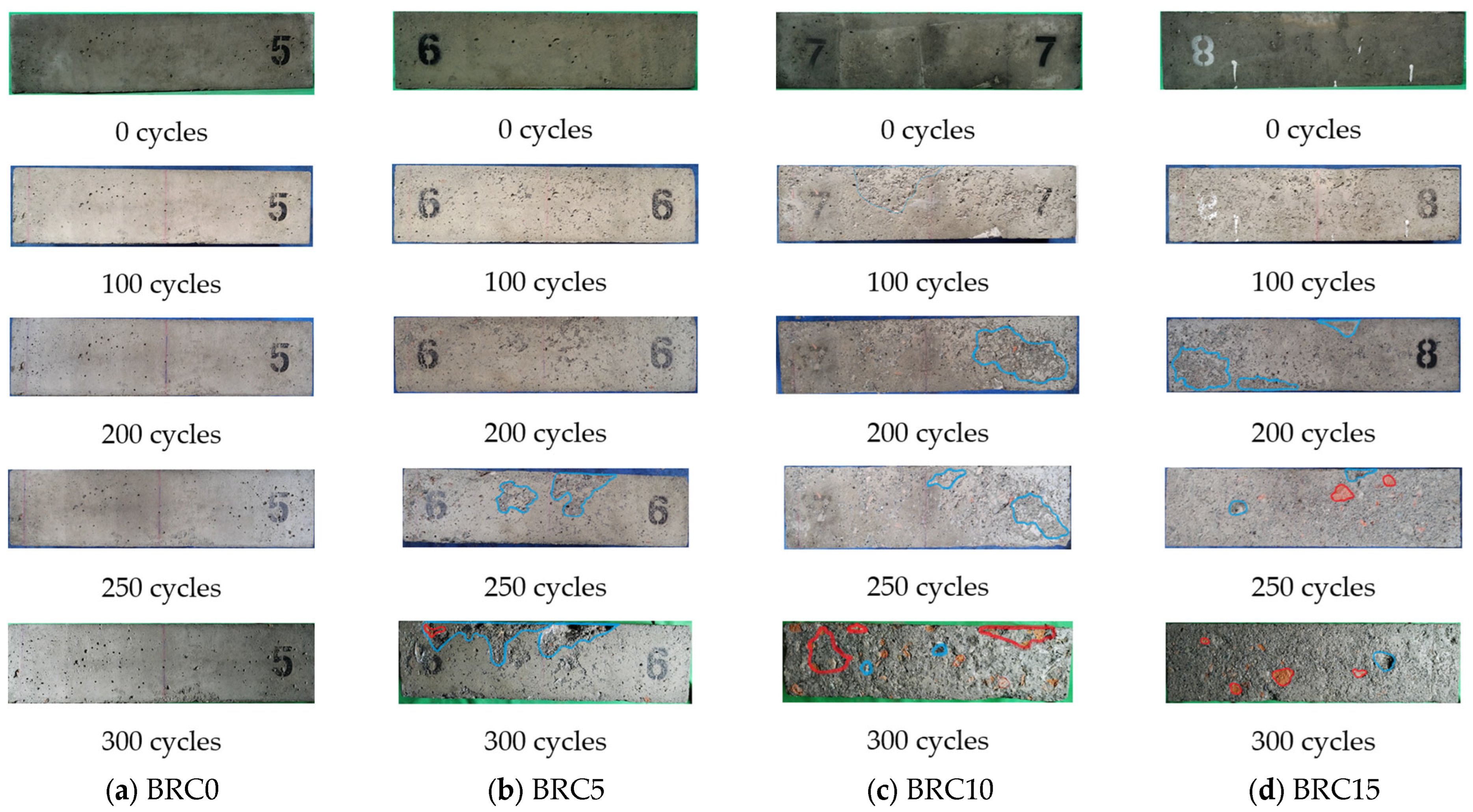
As shown in Figure 6, after F–T cycles, the BRC exhibited noticeable surface erosion. With the increase in rubber substitution ratio, the surface damage became more severe, manifesting as mortar peeling and exposure of coarse aggregates. This is primarily because the bonding between rubber particles and cement paste is weak, and it is difficult to achieve a uniform distribution of rubber within the BRC. This leads to uneven migration and distribution of freezable water in the pore solution, which increases the internal stress during freezing. The resulting non-uniform frost heaving pressure accelerates the propagation of microcracks and the loss of surface material.
Specifically, Figure 6a showed that the BRC0 maintained a relatively intact surface morphology even after 300 F–T cycles, with no significant erosion observed. In contrast, Figure 6d indicates that the BRC15 suffered severe surface damage after the same number of F–T cycles, with extensive mortar spalling and pronounced exposure of coarse aggregates, further confirming the negative effect of rubber content on the frost resistance of BRC.

3.4.2. Relative Compressive Strength

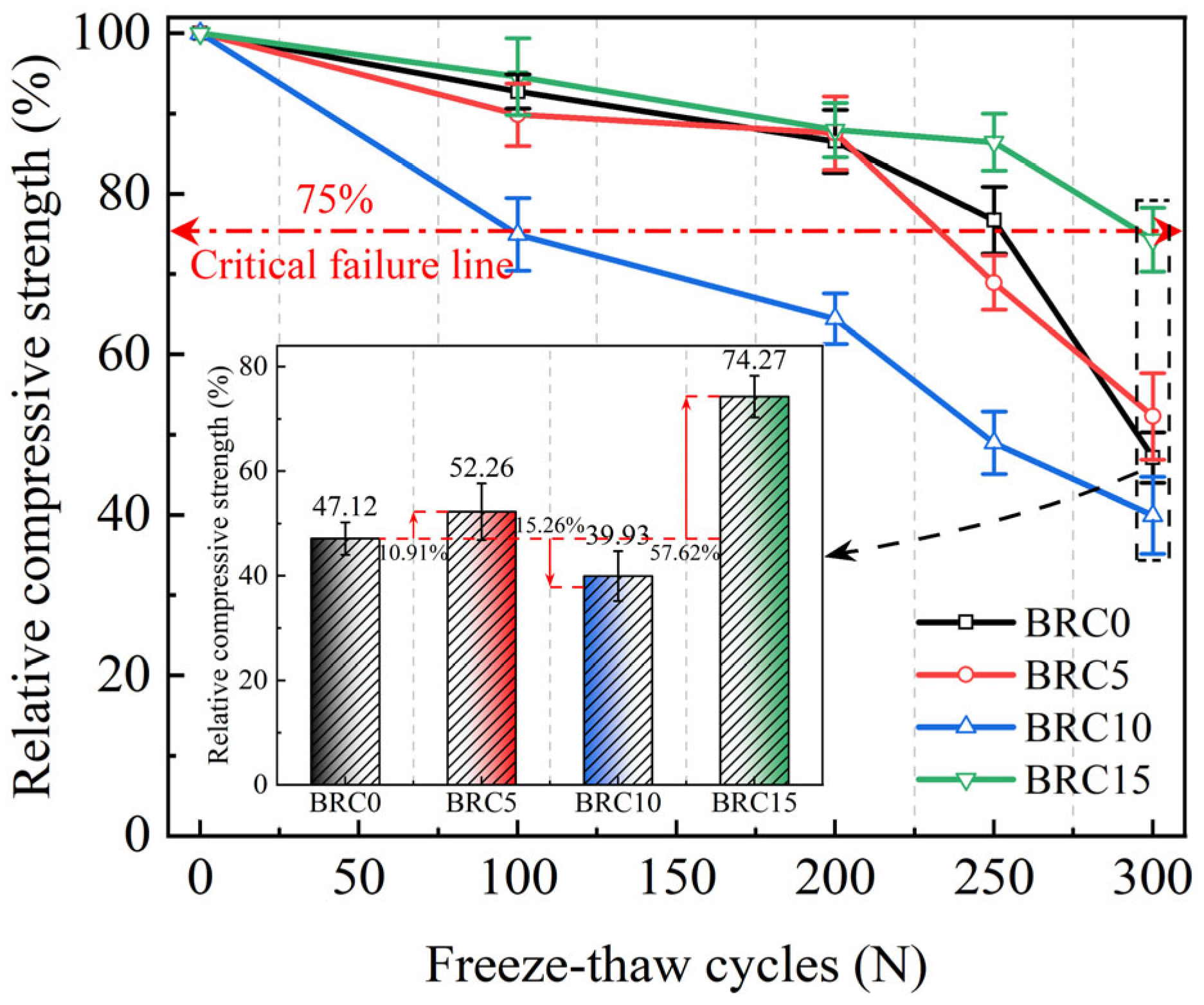
The variation in relative compressive strength of BRC is shown in Figure 7.
As the number of F–T cycles increased, the relative compressive strength showed a gradual decreasing trend. However, since the distribution of rubber within the BRC matrix tends to form unpredictable weak areas, this leads to fluctuations in strength performance as the rubber content increases. Furthermore, with the increase in rubber substitution ratio, this inhomogeneity became more pronounced.
Notably, when rubber particles were uniformly dispersed within the BRC, their elastic properties helped to buffer the stress induced by F–T cycles, thereby contributing to the retention of higher relative compressive strength in the specimens. This effect was particularly prominent in BRC15. After the F–T test was completed, the relative compressive strength of BRC10 was only 39.93%, indicating failure, while BRC15 still retained 74.15% of its strength, demonstrating relatively better frost resistance.
In BRC15, the high rubber content facilitates the formation of an elastic network. This network dissipates frost-heave stress and inhibits the formation of penetrating cracks, thereby protecting the core load-bearing structure. However, the numerous rubber–mortar ITZs present induce micro-damage along these interfaces during F–T cycles. This micro-damage affects the RDEM measurement because the propagation of sound waves is scattered and attenuated by the interfacial defects, leading to a reduction in the recorded RDEM value. Nevertheless, such damage remains localized and discontinuous, while the internal load-bearing skeleton retains its integrity without developing penetrating cracks. Consequently, the overall compressive strength is maintained at a high level.

3.4.3. RDEM

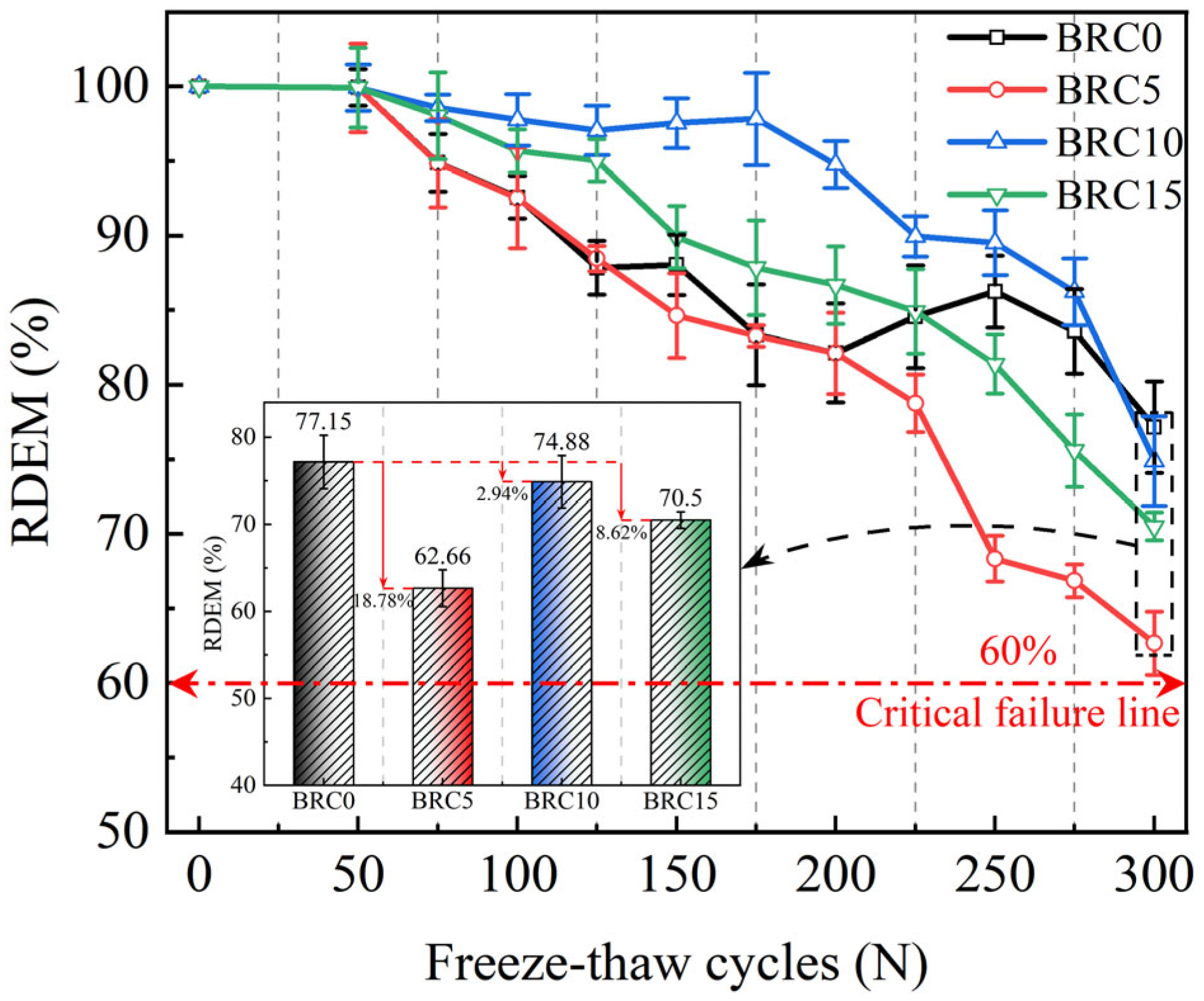
As shown in Figure 8, the RDEM of all BRC specimens remained above 60% after 300 F–T cycles, meeting the requirement specified in code [45], and no specimen failure occurred. The average RDEM was 71.22%, among which BRC5 exhibited the lowest value of 62.66%.
The change in RDEM of BRC with the number of F–T cycles could be divided into two distinct stages. In Stage I (cycles ≤ 150), the expansion stress caused by the phase change in water into ice was relatively small, and the damage to internal cracks and pores remained limited. As a result, the RDEM decreased at a slow rate. In Stage II (cycle > 150), internal microcracks initiated, propagated, and interconnected, leading to a noticeable deterioration in the pore structure. This facilitates the migration and freezing of water within the BRC, which significantly aggravates the damage to the specimen under repeated F–T cycles. Consequently, the RDEM declined at a markedly faster rate compared to Stage I.

3.4.4. Relative Quality

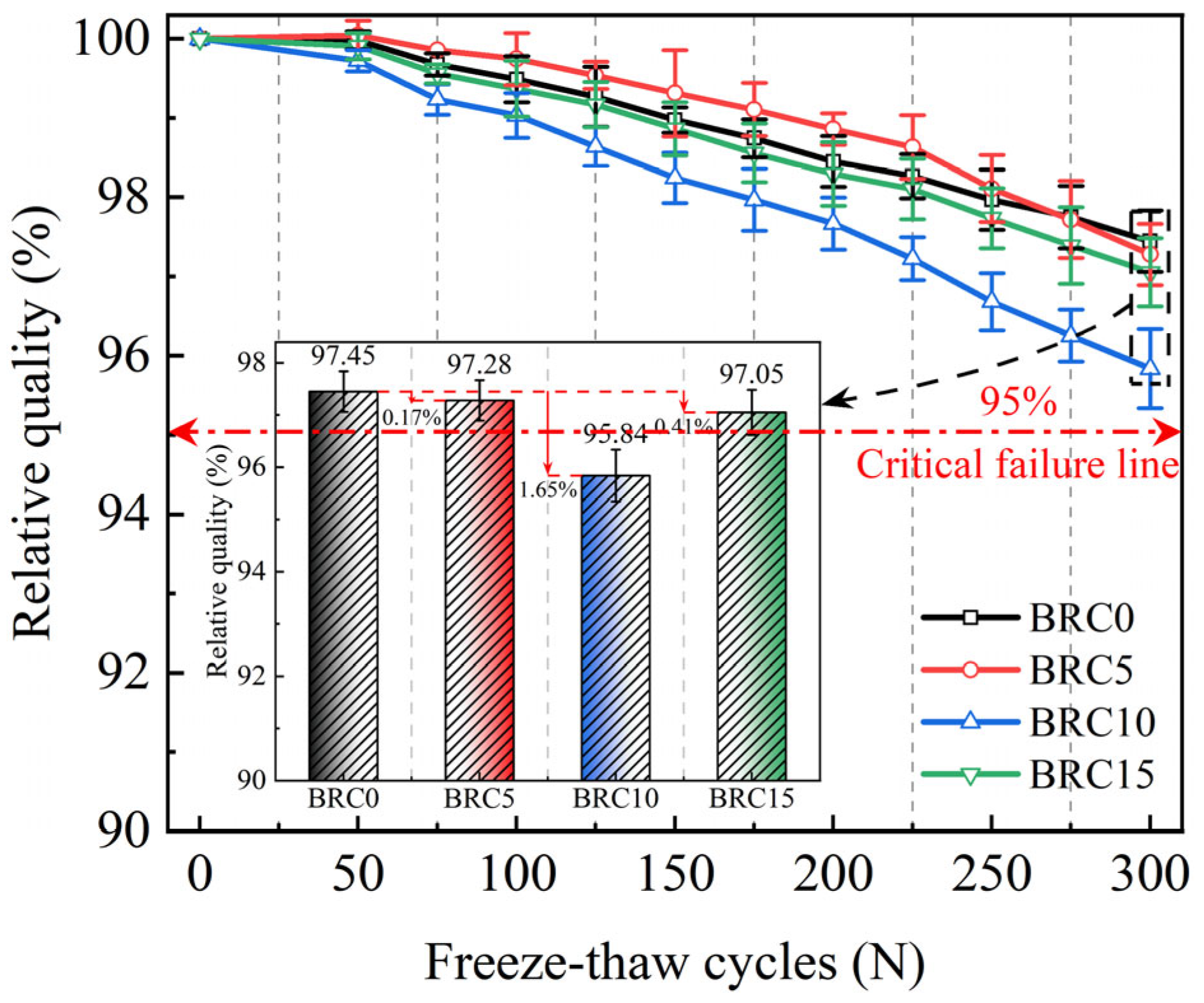
As shown in Figure 9, after 300 F–T cycles, the BRC exhibited excellent durability performance, with an average relative quality of 96.91%. Among all mixtures, BRC10 showed the lowest relative quality of 95.84%, which still exceeded the durability threshold of 95% specified in code [45], and no structural failure was observed in any specimen.
With the increase in rubber substitution ratio, the relative quality of BRC exhibited an initial decrease followed by an increase. At a substitution ratio of 10%, the weak interfacial defects introduced by the rubber became the dominant factor. This aggravated the initiation and propagation of microcracks during F–T cycles and led to notable surface spalling, resulting in the lowest relative quality for BRC10. When the substitution ratio was increased to 15%, the higher rubber content enhanced the overall stress-buffering capacity. This effectively restrained the propagation of cracks towards the surface, thereby mitigating the quality loss associated with surface spalling and yielding a higher relative quality for BRC15 compared to BRC10.
As the number of F–T cycles increased, the quality loss of BRC gradually intensified, a trend that is directly related to the progression of surface erosion. When the number of cycles was below 200, only minor surface defects such as microcracks and isolated pores developed, resulting in a negligible quality loss rate. However, after exceeding 200 cycles, the extent of mortar spalling increased, and microcracks propagated and interconnected, marking the transition into an accelerated damage phase. Ultimately, widespread exposure of coarse aggregates and severe surface erosion occurred, leading to a pronounced increase in the rate of quality loss. These results indicate that the quality loss behavior of BRC under F–T action exhibited typical stage characteristics, with surface erosion becoming the dominant factor controlling quality degradation, particularly during high frequencies of F–T cycles.

3.4.5. Frost Resistance Assessment

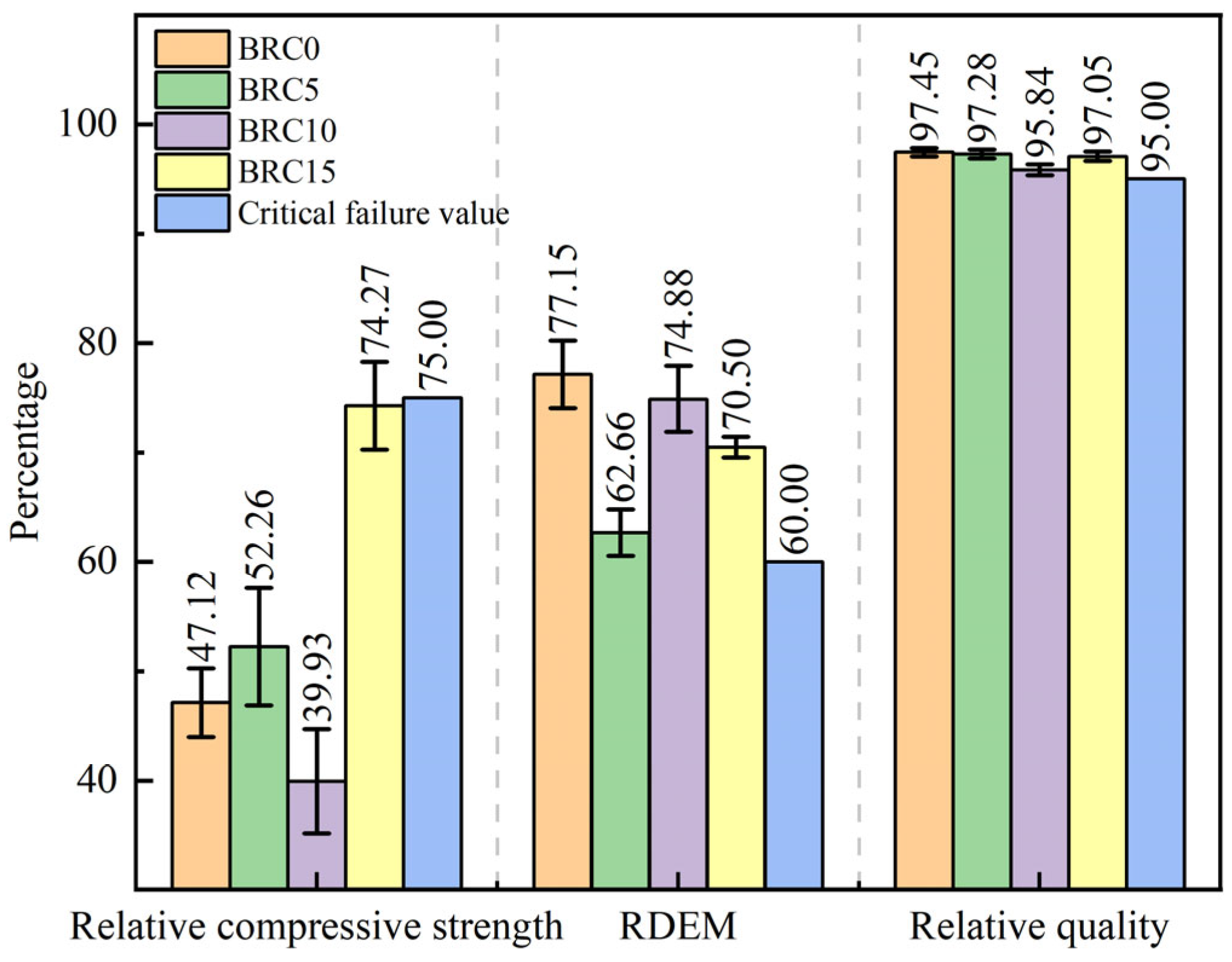
The F–T damage assessment of BRC is shown in Figure 10.
The differences were observed in the effects of F–T action on the frost resistance indicators of BRC. The relative quality loss was relatively minor and remained within the acceptable range specified by the standard [45]. In contrast, the relative compressive strength showed higher sensitivity and decreased significantly; the strength fell below 75% of the critical value defined in the standard. This discrepancy was likely associated with the propagation of internal microcracks and the weakening mechanism of the ITZ during F–T cycles, indicating that the development of micro-defects affects strength more significantly than quality.
The incorporation of rubber particles introduced a substantial number of pores within BRC, which significantly reduced the compactness of the material and adversely affected its compressive strength. Subsequent F–T cycles further aggravated the evolution of this pore structure, causing the pores to gradually expand and interconnect, thereby forming more distinct weak zones and leading to additional degradation in strength performance. Therefore, the impact of F–T damage was particularly direct and significant on strength-related indicators.
On the other hand, the rubber, as an elastomeric material, was able to absorb and dissipate part of the stress generated during F–T cycles, thereby delaying the decline rate of the RDEM and exhibiting a certain resistance to F–T damage. Although the addition of rubber aggravated the deterioration of the internal structure, its impact on the overall quality of the specimen was relatively limited. This phenomenon was attributed to the fact that quality loss is caused by the spalling of surface mortar and aggregates, as described in Section 3.4.1. During the early stages of F–T cycling, the internal pores introduced by rubber contributed little to quality loss; it was only in the later stages, when interconnected pores developed toward the surface, that spalling could be aggravated.
In summary, the role of rubber in the F–T process of BRC exhibited a dual nature: on one hand, it aggravated pore defects leading to strength reduction; on the other hand, it mitigated the degradation of the RDEM through elastic stress dissipation. Meanwhile, quality loss depended more on the process of surface damage and was less affected by internal pores.
To conduct a comprehensive evaluation of the F–T damage degree in BRC, a systematic scoring system was established in this study. The system has a maximum score of 100 points, representing the intact condition of the material prior to F–T cycling. Its lower limit is set at 60 points, which corresponds to the failure threshold of the relative dynamic elastic modulus (RDEM) at 60%. This threshold represents the lowest value among the three frost-resistance indices [45]. As the number of F–T cycles increased, a gradual deterioration in the various performance indicators was observed, leading to corresponding deductions from the total score. Consequently, a lower final score is indicative of more severe material damage.
Given the varying importance of each indicator in characterizing frost resistance, the entropy method was employed to objectively assign weights to the three indicators. This method is grounded in information entropy theory and uses data dispersion as the determination criterion. The calculation process is detailed in Equations (4)–(7).
The raw data matrix X = (xij)m×n was constructed, consisting of m samples and n indicators. In this experiment, m = 13, corresponding to the 13 F–T inspection points; n = 3, corresponding to the 3 frost resistance indicators. To eliminate dimensional effects, the data were normalized to obtain the standardized matrix R = (rij)m×n. Subsequently, the proportion pij of the i-th sample under the j-th indicator was calculated [49]:
p i j = r i j i = 1 m r i j
The information entropy value ej for the j-th indicator was calculated:
e j = k i = 1 m p i j ln p i j
where k = 1/ln(m), ensuring 0 ≤ ej ≤ 1. It is stipulated that pij ln(pij) = 0 when pij = 0.
The differentiation coefficient gj for the j-th indicator was calculated:
g j = 1 e j
The differentiation coefficient gj reflects the degree of dispersion of the j-th indicator. A larger value of gj indicates that the indicator plays a more important role in the evaluation. Finally, the objective weight wj for the j-th indicator was determined by:
w j = g j j = 1 n g j
The weight of each indicator in the frost resistance scoring system was determined through the above analysis as follows: relative compressive strength 67.2%, RDEM 32.5%, and relative quality 0.3%.
Based on the above weight distribution, the calculation equation for the total score (S) was as follows:
S   =   R e l a t i v e   c o m p r e s s i v e   s t r e n g t h   ×   67.2 %   +   R D E M   ×   32.5 %   +   R e l a t i v e   q u a l i t y   ×   0.3 %
The specific scoring criteria for each indicator are detailed in Table 5 [45]. The damage grade was assessed based on the total score S, with detailed results presented in Table 6.
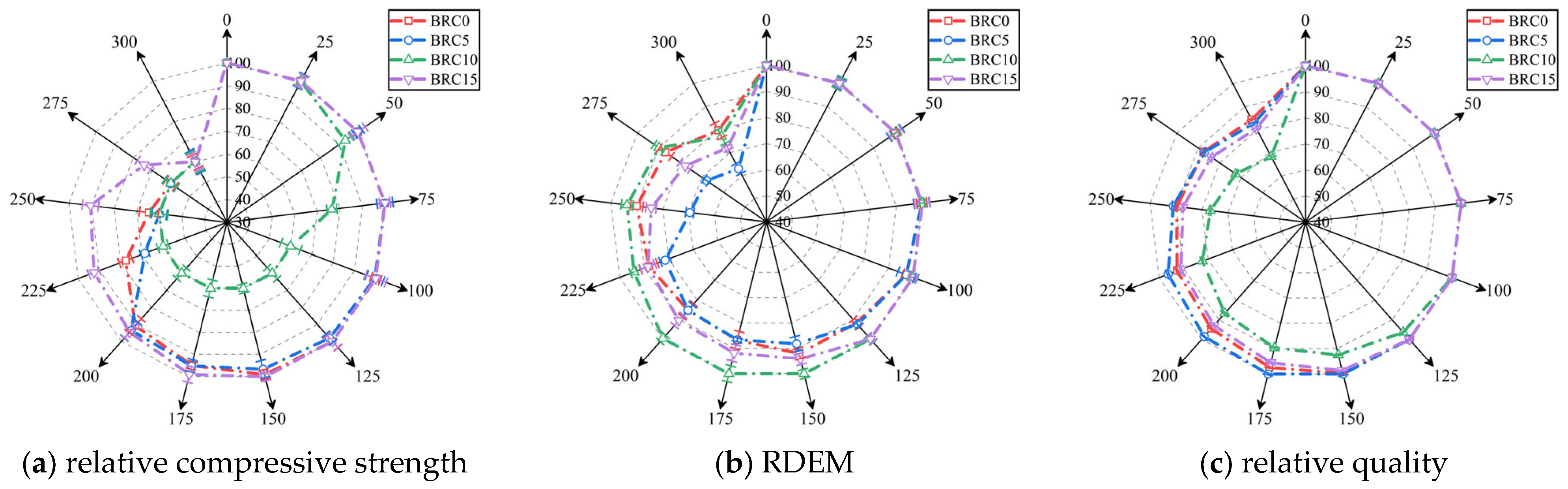
According to the above scoring criteria, the scoring results of BRC’s frost resistance performance indicators were shown in Figure 11.
The study found that the influence of rubber content on different indicators varied significantly: for specimens with higher rubber content (such as BRC15), rubber particles can form an elastic network inside. When the stress generated by F–T cycles causes cracks to form and expand, this elastic network can effectively absorb and disperse the stress through its own elastic deformation, preventing further crack propagation, thereby improving the retention ratio of compressive strength. However, the connection between rubber and mortar is weak, making this area prone to initial damage during F–T action, which reduces material homogeneity. This leads to increased energy loss and changes in the propagation speed of sound waves within the specimen, ultimately resulting in more significant attenuation of the RDEM. Meanwhile, in BRC0, which contained no rubber particles, a denser cement matrix formed without the weak rubber-cement interface, exhibiting stronger interfacial adhesion. During F–T cycles, this composition effectively resisted surface spalling and reduced the attenuation of the RDEM caused by internal damage.
As shown in Figure 11a, the strength score of BRC10 had dropped to 60 points after 100 F–T cycles, while BRC15 did not reach the same level until 300 cycles. This delayed deterioration underscores BRC15’s excellent frost resistance. In Figure 11b, after 300 F–T cycles, the score of BRC5 was the lowest, at 63.04 points, while BRC0 performed the best, reaching 79.60 points. The latter was 16.56 points higher than the former, representing a relative improvement of 26.27%. This shows that its dynamic elastic modulus retention ability is stronger. In Figure 11c, after 300 F–T cycles, BRC0 ranked first with a score of 84.45 points, while BRC10 had the lowest score, at 68.38 points, which was 16.07 points lower than BRC0, a decrease of 19.03%. Therefore, the data clearly showed that after 300 F–T cycles, BRC10 experienced the most severe strength and quality loss. In contrast, BRC0 demonstrated excellent performance in RDEM and quality retention, while BRC15 was more advantageous in maintaining compressive strength.
As shown in Table 7, the total score S and its corresponding damage level reveal the performance differences among BRC specimens with different rubber contents under F–T cycles.
After 100 F–T cycles, the total score of BRC10 was 73.12 points, indicating a moderate damage state with significant bearing capacity degradation and surface spalling. In contrast, BRC15 maintained a score of 100 points, showing only minor performance changes and excellent frost resistance. After 200 F–T cycles, the score of BRC10 was 72.99 points, demonstrating that its damage development stabilized between 100 and 200 cycles at the moderate damage level. At the same point, the score of BRC15 was 93.20 points. This score remained the highest among all groups and was 20.21 points (27.69%) higher than that of BRC10. After 300 F–T cycles, all specimens were in a severe damage state. Among them, BRC0 had the highest score of 66.44 points, and BRC5 had the lowest score of 61.06 points. Furthermore, BRC15 no longer held a scoring advantage, and its score was 1.59 points lower than that of BRC10.

3.4.6. Freeze–Thaw Damage Model

The phase-change stress of water-ice inside the specimen under temperature variation resembles a cyclic loading-unloading process. When frozen to the lowest temperature [−18 °C], the proportion of water converted to ice reaches its maximum, and the frost heave stress exerted on the specimen peaks. Upon thawing to the highest temperature [5 °C], the ice melts back into water, causing the frost heave stress to vanish. Throughout this process, the BRC is subjected to repeated cycles of F–T stress and osmotic pressure, leading to the continuous initiation and propagation of microcracks within, which gradually deteriorate the BRC’s performance. Therefore, F–T cycles damage can be considered a cumulative fatigue degradation process. According to the concrete fatigue life Equation (10) [50].
R = σ min σ max
S = σ max f t = 1 α ( 1 R ) lg ( N )
where R is the stress ratio; σmin and σmax are the minimum and maximum stresses during the F–T cycles, respectively; S is the stress level; ft is the tensile strength, MPa; α is the material parameter, and N is the fatigue life.
During the F–T cycles, the specimen experiences minimal stress (being zero) during melting. Consequently, the fatigue Equation for BRC under F–T cycles is expressible as:
S = 1 α lg ( N )
The initial stress level S0 is defined as the ratio of the maximum stress to the BRC’s tensile strength. As F–T cycling progresses, the tensile strength of the BRC progressively degrades, leading to a corresponding increase in the actual stress level Sa. Specimen failure occurs when Sa reaches the critical value of 1. Consequently, the damage evolution in BRC under F–T cycling can be effectively quantified by monitoring the changes in stress levels.
The damage variable D(n) is expressed as the normalized increase in stress ratio, calculated as the difference between the current stress ratio Sa(n) (after n F–T cycles) and the initial stress ratio S0.
D ( n ) = S a ( n ) S 0 S a ( n )
For concrete that conforms to the fatigue life Equation (11), when subjected to a stress level of S0, the initial life is N. After undergoing n F–T cycles, the specimen’s residual life becomes Nn. The actual stress ratio Sa(n) experienced at this stage equals the stress ratio associated with (Nn) cycles in the fatigue life Equation, which is:
S a ( n ) = 1 α lg ( N n )
According to the definition of Equation (12), the F–T fatigue damage Equation of BRC is:
D ( n ) = 1 S 0 1 α lg ( N n ) = 1 1 1 α S 0 lg ( 1 n N ) , 0 n N 1
As shown in Equation (11), a higher material parameter α leads to a shorter F–T fatigue life N under the same stress level S. Therefore, α is an indicator to measure the material’s resistance to freezing.
Experimental results demonstrate a linear correlation between concrete’s tensile strength degradation and RDEM reduction during F–T cycles [50]. Therefore, the RDEM can be adopted as the regular verification value of the F–T damage model. For the variation laws of the material parameter α of BRC and the number of F–T cycles under different rubber substitution ratios, the following relationship is established:
α = a exp ( n / b ) + c
where a, b, and c are the mix proportion parameters of BRC, the material parameter α of BRC was obtained by regression analysis of the test results according to Equation (14), as listed in Table 8.
The parameter α represents the material’s resistance to F–T fatigue damage. As shown in Equation (15), its value increases with the number of F–T cycles, corresponding to the accumulation of internal defects. As the cycles proceed, microcracks initiate and propagate, pore networks gradually interconnect, and weak zones such as the rubber–mortar ITZ continuously deteriorate. This microstructural degradation reduces the material’s integrity, making it more susceptible to damage under subsequent F–T stress, which results in an exponential increase in α.
The fitting coefficients a, b, and c in Table 8 collectively define the trend of α with the number of F–T cycles for different rubber contents. Coefficient a governs the intensity of damage acceleration. A larger absolute value of a indicates stronger positive feedback in damage processes such as microcrack propagation and pore interconnection, leading to faster damage accumulation. Coefficient b controls the progression of damage acceleration. A larger b value means that more F–T cycles are required for the material to enter the stage of rapid damage accumulation, reflecting the material’s resistance to accelerated damage. Coefficient c is related to the initial state of the material and represents the initial damage level influenced by factors such as initial porosity and weak interfaces.
By substituting the number of F–T cycles as a variable into Equation (15), the variation in the material parameter α with respect to the number of F–T cycles could be quantitatively characterized.
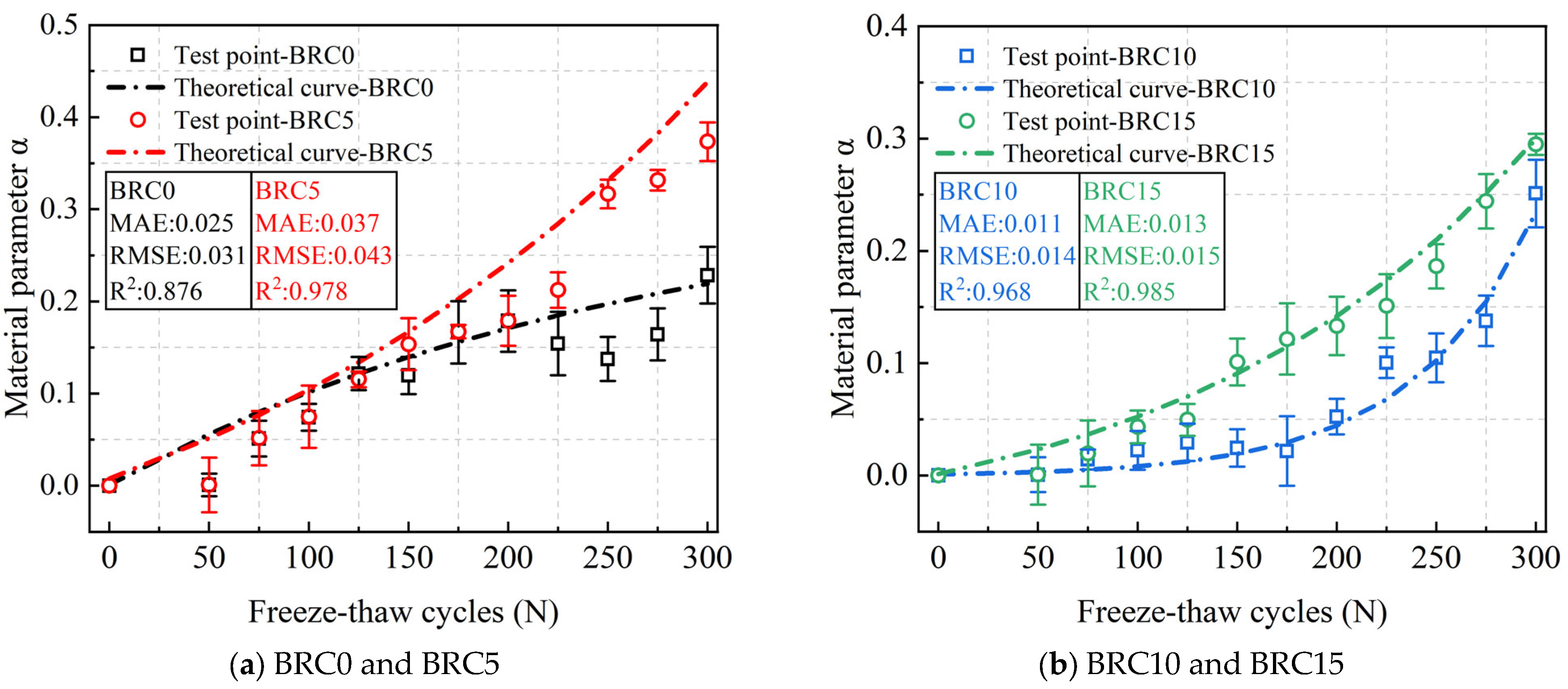
The coefficient of determination (R2) was employed to evaluate the predictive accuracy of the α model. R2 measures the proportion of variance in the experimental data explained by the model, with values closer to 1 indicating a better fit. Specifically, R2 values of 0.876 for BRC0, 0.978 for BRC5, 0.968 for BRC10, and 0.985 for BRC15 confirm that the model effectively captures the changing trend of α. Furthermore, the low magnitude of error metrics, with Mean Absolute Error (MAE) and Root Mean Square Error (RMSE) values below 0.043 for all formulations, underscores the model’s precision. In the F–T cycling tests, the variation trend of parameter α for the four BRC specimens is shown in Figure 12. After 300 cycles, the values of α ranked in descending order as follows: BRC5 > BRC15 > BRC10 > BRC0. A higher value of α indicates more severe damage in the BRC specimens during the F–T process and poorer frost resistance. This ranking, now robustly supported by the high-fidelity model, is consistent with the observed degradation trend of RDEM in the experiment, which further validates the rationality of the proposed model.
Substituting Equation (15) into Equation (14) yields the expression for the damage variable D(n):
D ( n ) = 1 1 1 a exp ( n / b ) + c S 0 lg ( 1 n N ) , 0 < n < N 1
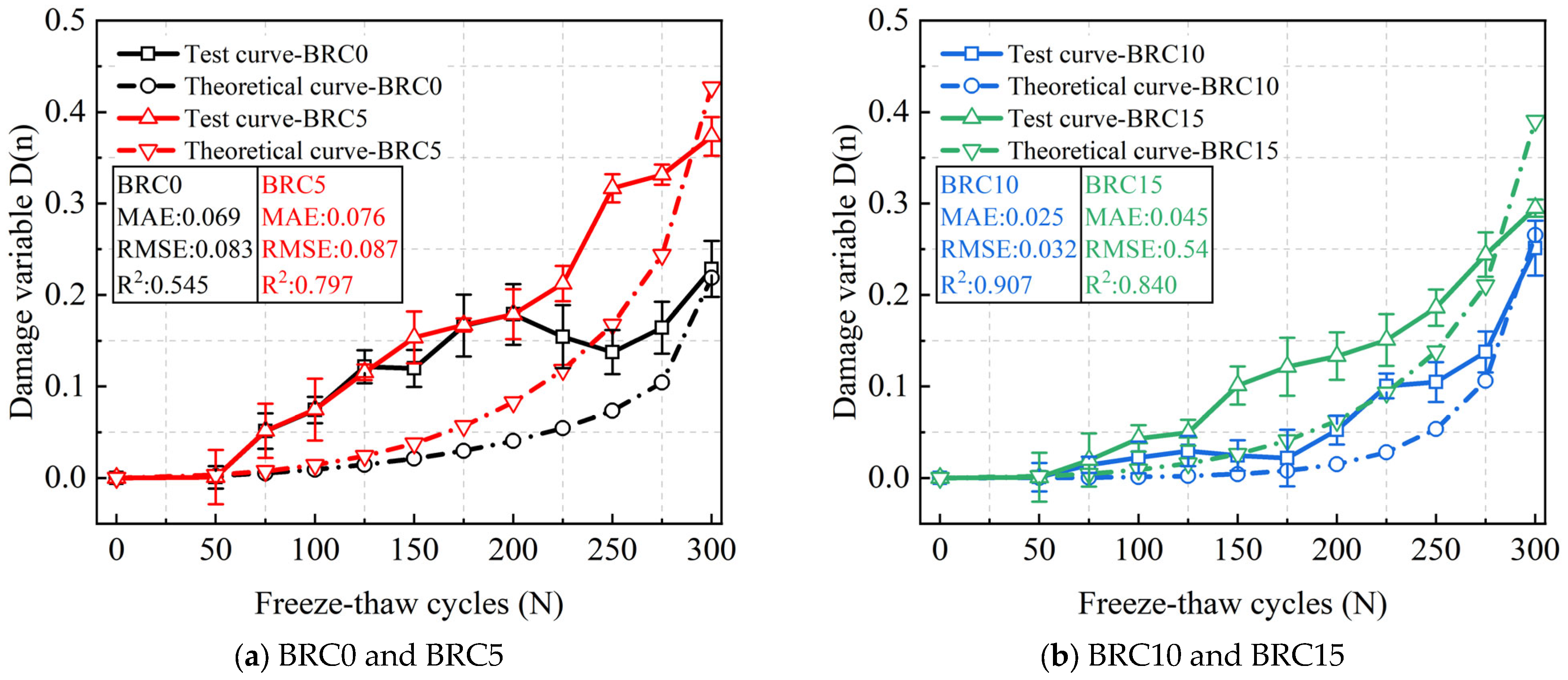
The damage evolution curve of variable D(n) with F–T cycles, derived from Equation (16), is presented in Figure 13.
The predictive performance of this fatigue damage model, however, proved inconsistent. It achieved high accuracy for BRC10 and BRC15 (R2 of 0.907 and 0.840, respectively; MAE < 0.045, RMSE < 0.054) but performed poorly for BRC0 and BRC5, with the latter yielding a notably low R2 of 0.545. This inconsistency stems from a fundamental limitation of the model: its simplified assumptions are inadequate to represent the complex damage behavior emerging from the interplay of rubber content, interfacial effects, and material heterogeneity. Consequently, the model fails to reliably simulate the nonlinear damage progression across all mixtures, particularly during the later stages of F–T cycles, revealing its inherent constraints for modeling the complete damage process.
Given the predictive deviation of the fatigue life model due to nonlinear acceleration effects in the later stages of damage, its ability to describe the full-cycle F–T damage is evidently insufficient. To construct a more robust damage prediction model that performs well throughout the entire process, especially in the later stages, this study employs a model based on the Weibull distribution for optimization [42].
The Weibull distribution model is widely used in material life and failure probability analysis. Its damage variable Dw(n) is defined as [51,52]:
D w ( n ) = 1 exp ( n η ) β
where Dw(n) is the damage variable, with a value range of [0, 1); η is the scale parameter, representing the characteristic life, a larger η value indicates better frost resistance of the BRC; β is the shape parameter, controlling the evolution pattern of the damage curve and reflecting the development process of internal damage within the material.
The Weibull model parameters for BRC with different rubber contents were determined by applying nonlinear regression analysis to the RDEM experimental data, using the Weibull distribution function shown in Equation (17) as the model and Equation (18) for the fitting process. The resulting parameters are listed in Table 9.
L o s s ( η , β ) = i = 1 N D t ( n i ) D p ( n i , η , β ) 2
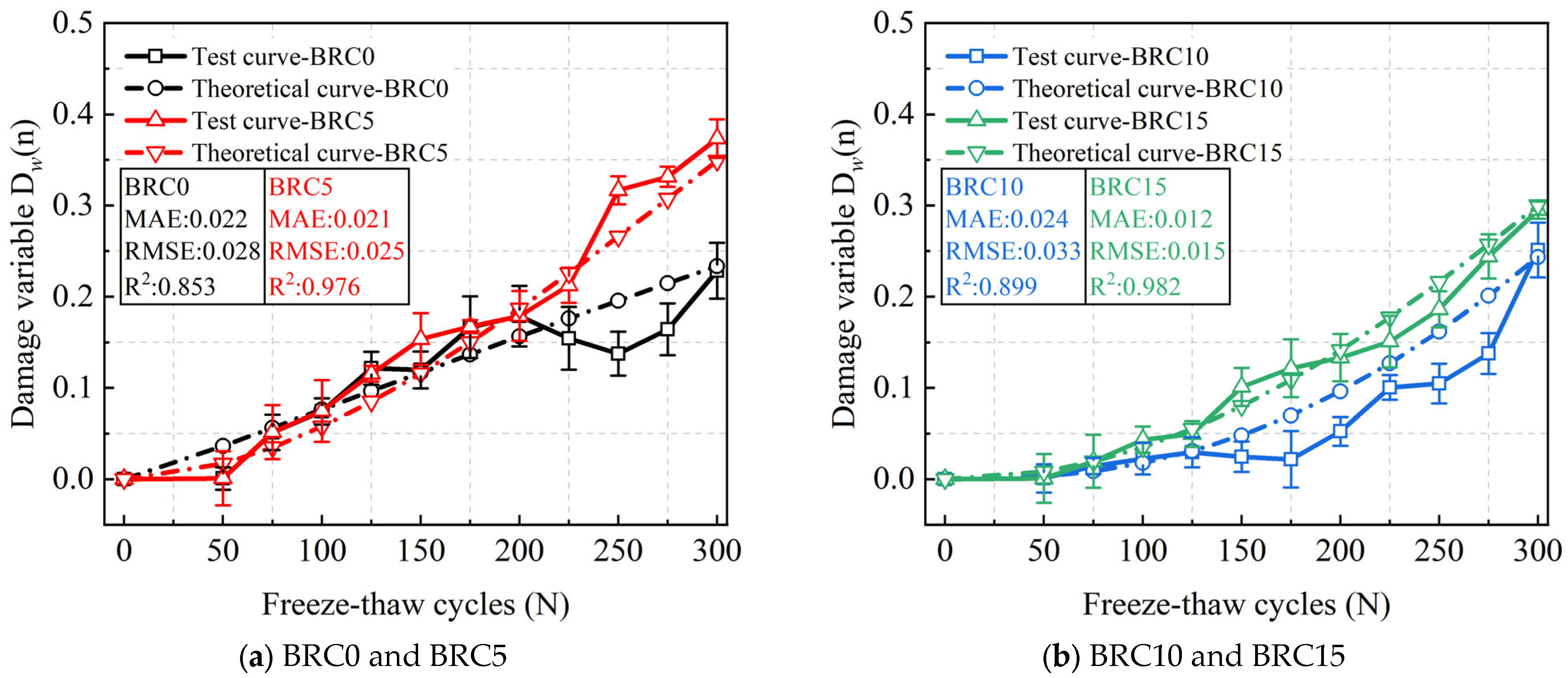
The characteristic F–T life of each mixture, based on the scale parameter η values, is ranked as: BRC0 > BRC10 > BRC15 > BRC5. Among them, the η value of BRC0 (1000) is significantly higher than that of the rubber-containing groups (η values for BRC5~BRC15 range between 480–500), indicating that the incorporation of rubber significantly reduces the characteristic F–T life of the material. It should be noted that the η value of 1000 for BRC0 represents a model extrapolation beyond the tested 300 cycles. This extrapolation reflects the material’s superior frost resistance potential while also encompassing the associated predictive uncertainty.
Regarding the shape parameter β, all mixtures have β values greater than 1 (ranging from 1.1 to 2.5), showing an overall trend of first increasing and then decreasing with increasing rubber content, with BRC10 having the highest β value (2.5). This indicates that the F–T damage of BRC is overall an accelerated cumulative process, and the damage evolution of BRC10 in the later stages of F–T is more severe.
By substituting the model parameters from Table 9 into Equation (17), the predicted curves of the damage variable Dw(n) for BRC with different rubber contents were obtained. The comparison results in Figure 14 show that the prediction curves of the Weibull model highly coincide with the experimental data.
Error analysis further confirms its superior performance: the R2 for all mixes is better than 0.85, with R2 for BRC5 and BRC15 as high as 0.976 and 0.982, respectively; meanwhile, MAE and RMSE are controlled at low levels of 0.012–0.024 and 0.015–0.033, respectively. Compared with the fatigue life model (which had R2 values of only 0.545 and 0.797 for BRC0 and BRC5, respectively, and significantly higher errors), the Weibull model demonstrates higher and more consistent predictive accuracy and robustness across all mixes. This fully indicates that this model has superior capability in describing the full-cycle F–T damage of BRC, especially in capturing the nonlinear accelerated damage in the later stages, providing a more reliable theoretical tool for material durability assessment and life prediction.

3.4.7. Freeze–Thaw Damage Mechanism

The F–T damage mechanism of BRC originates from complex interactions between constituent material properties and cyclic stresses induced by ice-water phase transitions. Systematic investigation of pore structure evolution, crack propagation, and the ITZ behavior reveals how rubber incorporation creates competing effects that govern material degradation.
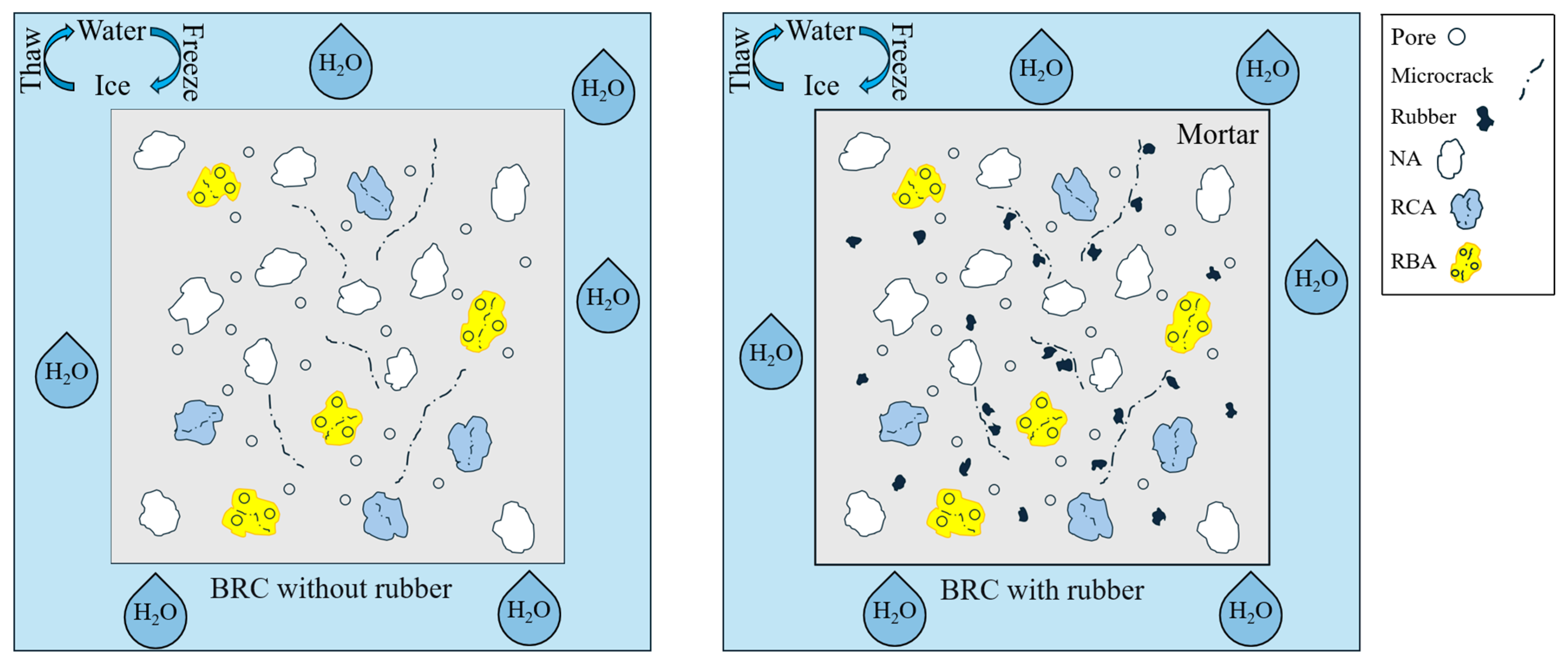
Before F–T cycling, BRC exhibits inherent microstructural heterogeneity. As shown in Figure 15, the internal structure before F–T cycles contains aggregate particles, cement paste, and initial pore networks. Hydrophobic rubber particles with low elastic modulus create potential weakness zones at rubber-cement ITZs, while the high porosity and water absorption of RBA and RCA yield a more porous matrix than conventional concrete, with the initial pore network serving as a reservoir for freezable water.
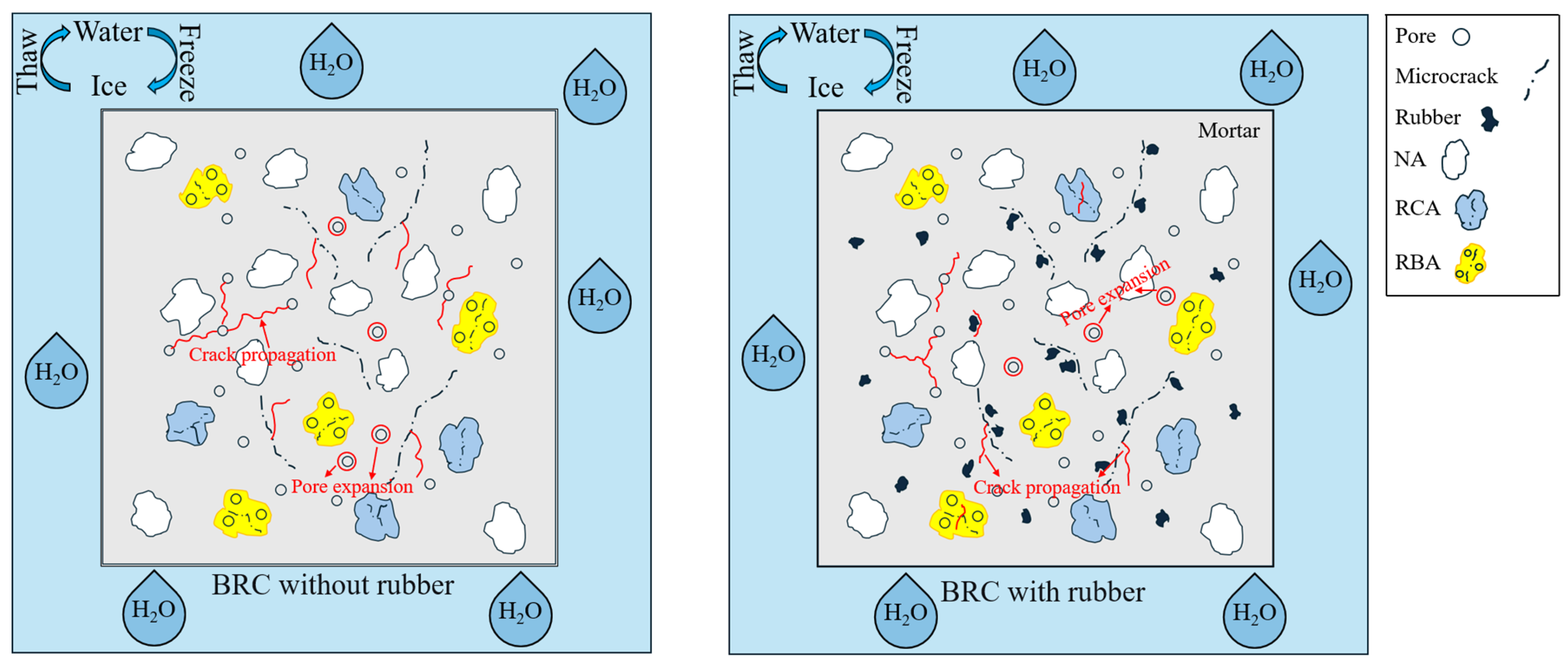
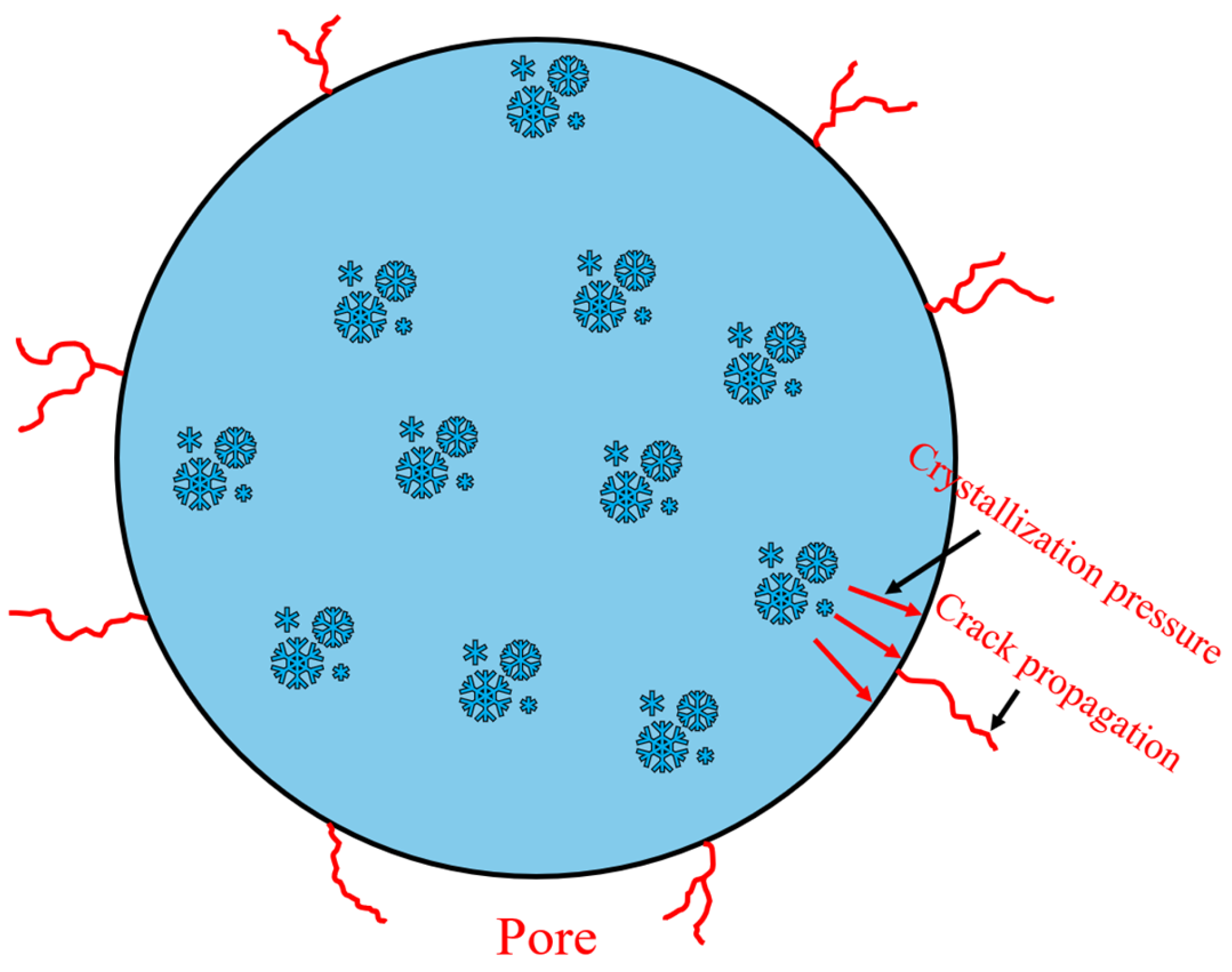
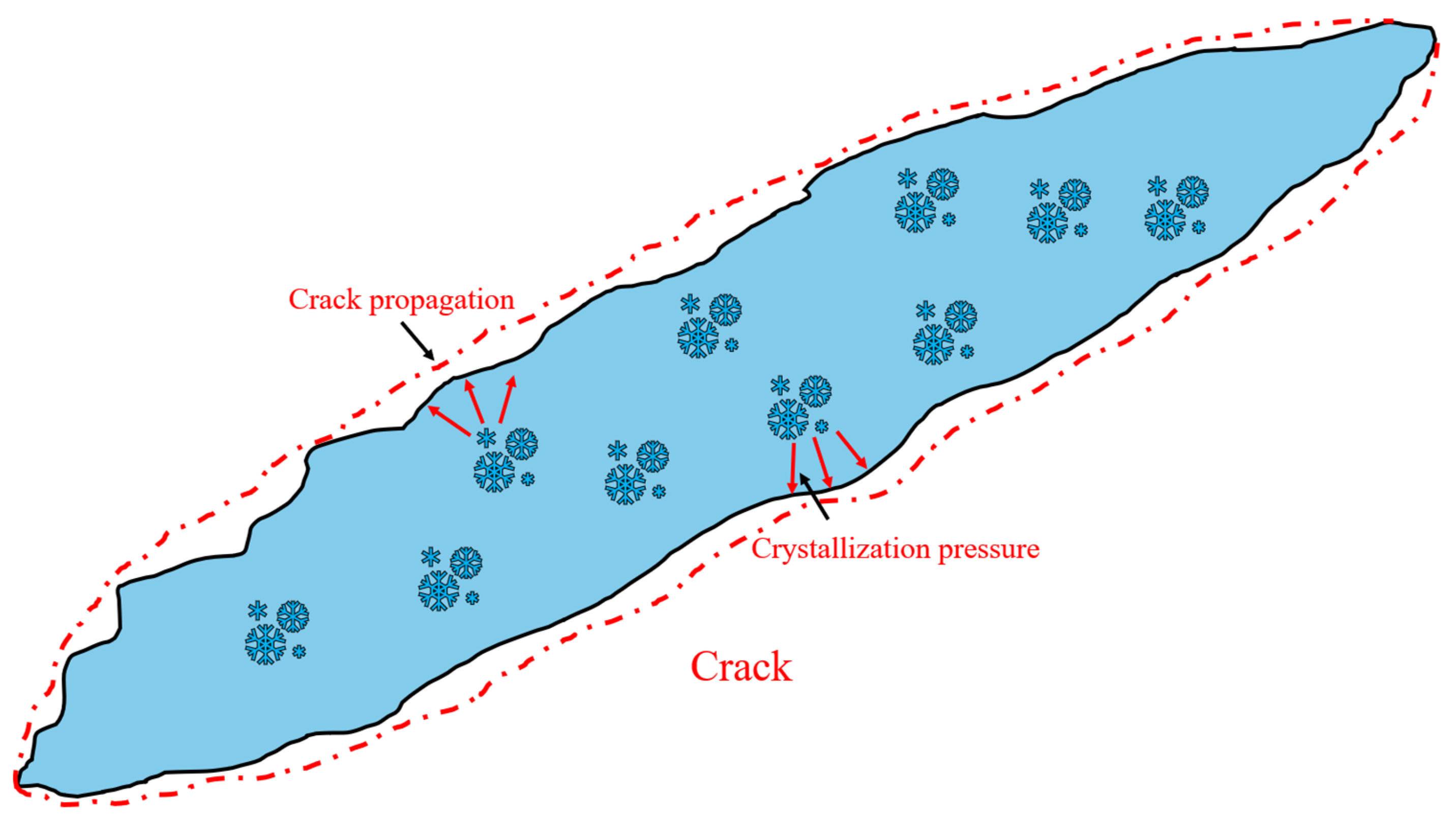
When subjected to F–T cycles, damage develops through interconnected pathways as shown in Figure 16. The repeated pore water phase change generates cyclic frost heaving and hydrostatic pressures. Damage initiates at the most vulnerable locations—particularly rubber-cement ITZs and porous recycled aggregates. Weak interfacial bonding combined with thermal expansion mismatch makes these sites preferential for microcrack initiation. Ice formation in interfacial voids causes ITZ degradation and annular microcracking around rubber particles, while RBA saturation leads to internal frost damage within aggregates.
The deterioration process involves simultaneous pore structure degradation and crack development. As shown in Figure 17, F–T cycles cause pore deterioration through expansion and interconnection of micro-voids. Concurrently, crack propagation occurs as shown in Figure 18, with microcracks extending along weak paths within the cement matrix and along interfaces.
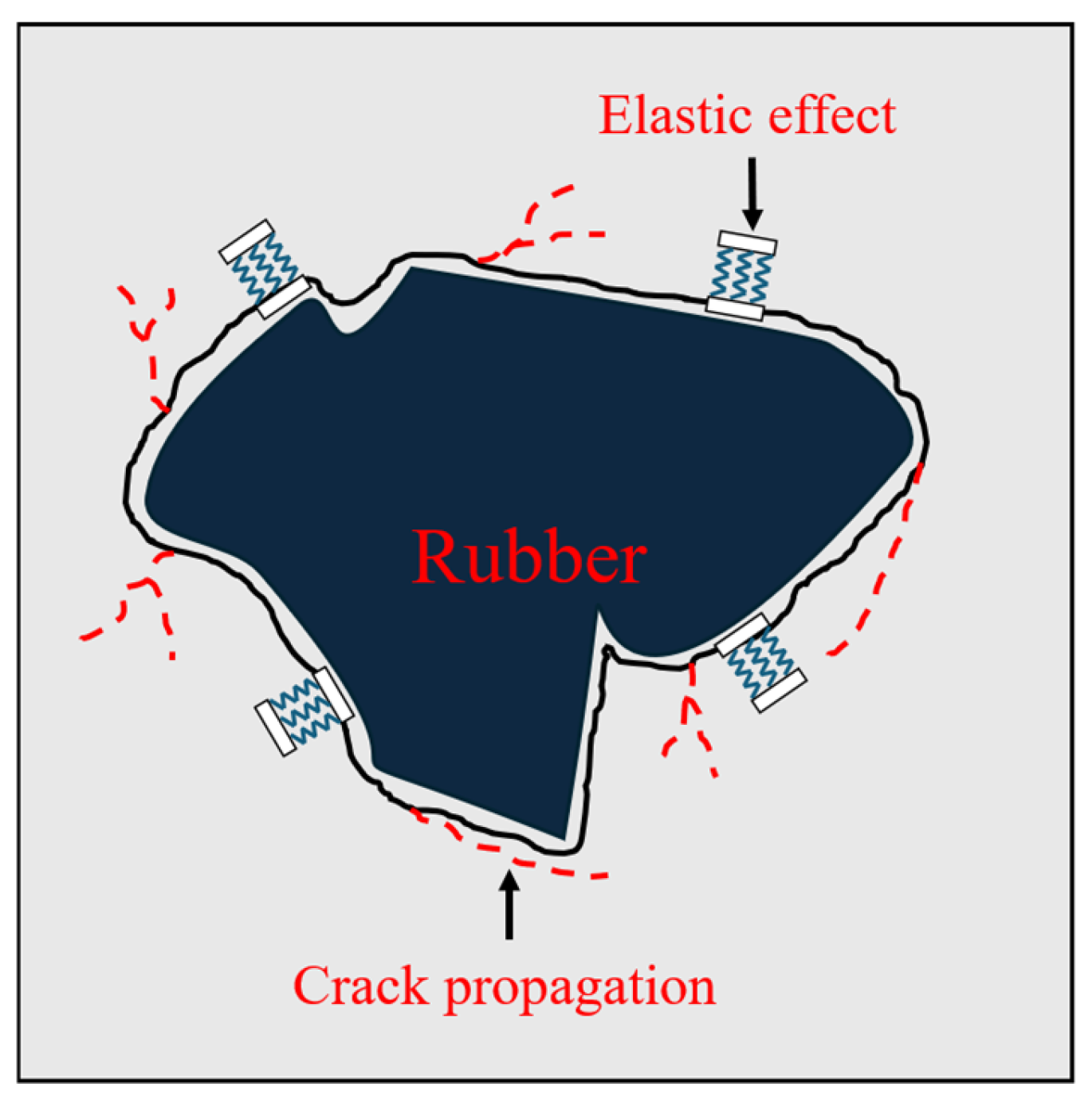
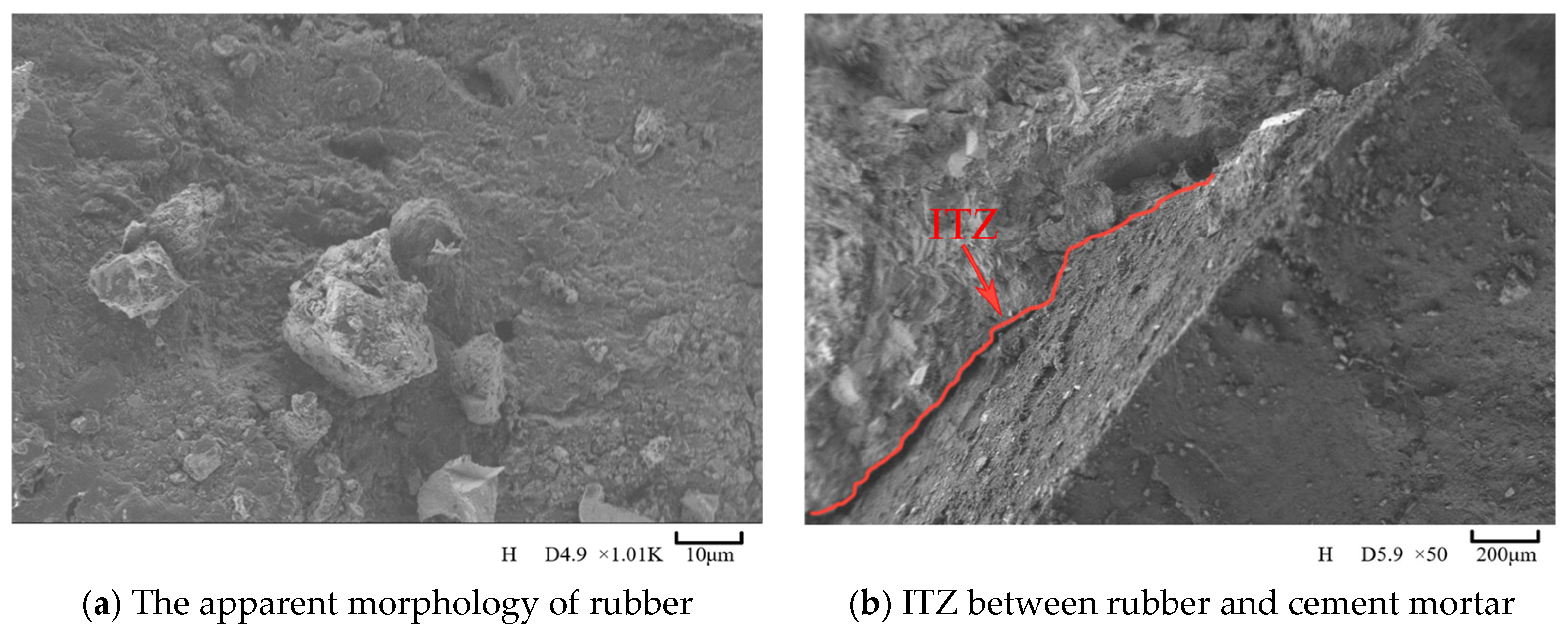
As shown in Figure 19, the rubber-cement ITZ facilitates crack initiation, while rubber particles themselves provide stress-buffering effects. When microcracks approach rubber particles, elastic deformation induces crack deflection and branching, creating more tortuous propagation paths that enhance fracture energy dissipation. As shown in Figure 20, the apparent morphology and ITZ of rubber critically influence this crack–rubber interaction.
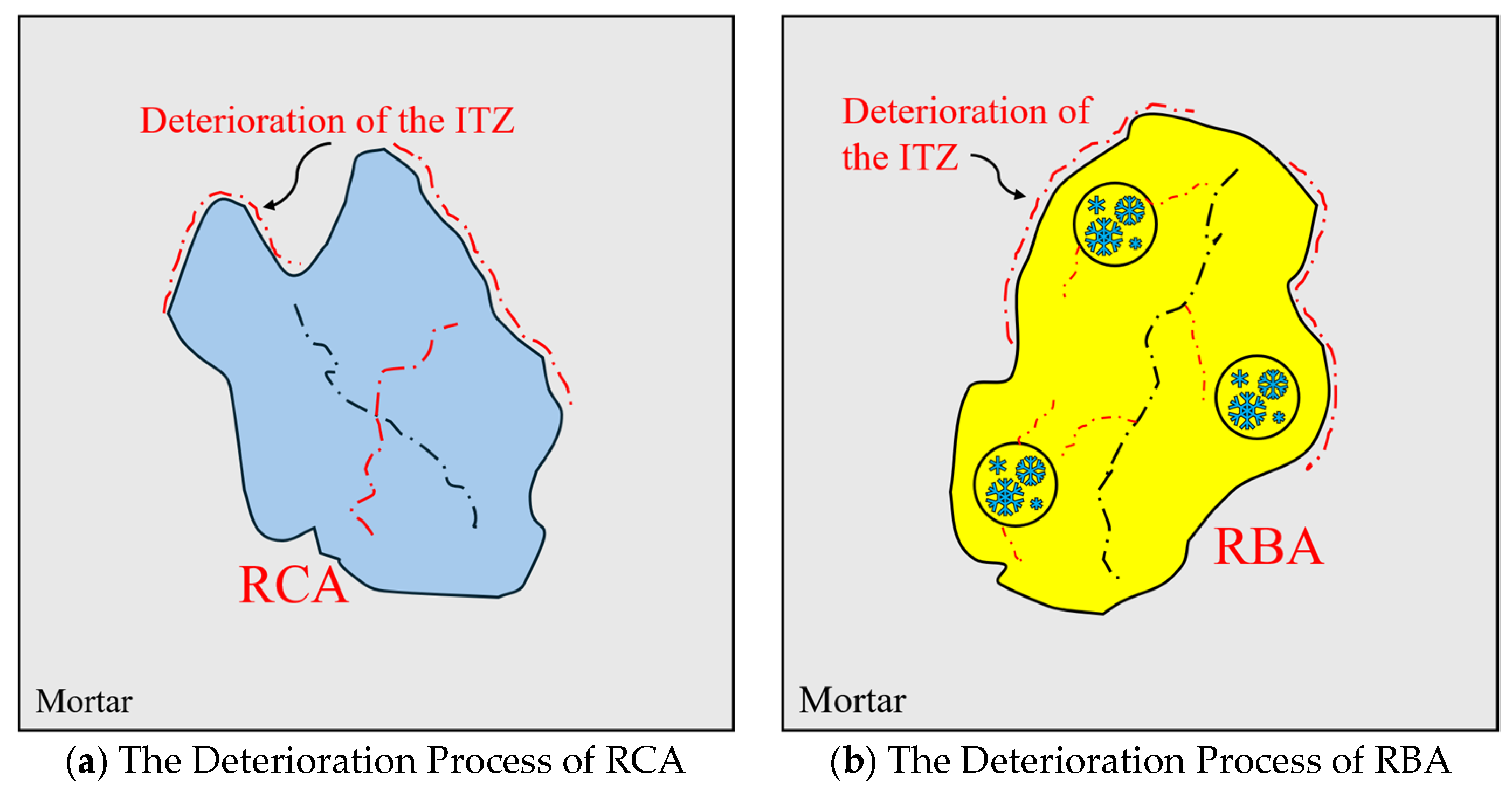
Recycled aggregates significantly affect damage initiation. As shown in Figure 21 and Figure 22, the apparent morphology and ITZ characteristics of RCA and RBA, combined with their inherent porosity and weak cement paste bonding, create critical zones for initial damage.
The combined deterioration of pore structure, ITZs, and continuous crack propagation ultimately manifests as macroscopic damage. Accelerated quality loss results from internal crack propagation reaching the surface, causing mortar spalling. BRC0’s superior RDEM and quality retention performance derives from its denser cement matrix and absence of weak rubber-cement ITZs, providing better resistance to internal damage and surface scaling.
In summary, F–T damage in BRC represents a nonlinear process governed by competition between damage-aggravating mechanisms (pore deterioration, crack propagation, and weak ITZs) and damage-inhibiting mechanisms (elastic stress buffering and crack bridging by rubber). The ultimate frost resistance depends on which mechanism dominates, determined primarily by rubber substitution ratio, dispersion uniformity, and recycled aggregate characteristics. This mechanistic understanding, visually synthesized in Figure 15, provides a theoretical foundation for optimizing BRC mix proportions to enhance cold-region durability.

4. Conclusions

This study investigated the frost resistance of BRC, established and improved F–T damage models, and analyzed the damage mechanism. The main conclusions are as follows:
After 300 F–T cycles, the minimum quality loss (2.55%) and the highest RDEM (77.15%) were exhibited by BRC0. This performance demonstrates its suitability for external components in frequent F–T environments where high surface integrity is demanded. Conversely, the maximum compressive strength retention (74.15%) was shown by BRC15, despite pronounced surface erosion. This renders it more appropriate for non-exposed applications in which residual load-bearing capacity is prioritized.
The multi-index weighting system based on the entropy method merges the relative compressive strength, RDEM, and relative quality (with weights of 67.2%, 32.5%, and 0.3%, respectively) into a single score, which corresponds to five damage grades, thus providing a quantifiable diagnostic tool for F–T damage status. For instance, a score of 73.12 (Grade III) for BRC10 after 100 F–T cycles suggests that corresponding maintenance measures are required.
The F–T damage model based on the Weibull distribution effectively predicts the full-cycle damage of BRC (R2 > 0.85, MAE < 0.024). Compared with the fatigue damage model, this model demonstrates superior capability in characterizing the accelerated damage stage during the later phase of F–T cycles, thereby providing a more reliable theoretical basis for the service life assessment of BRC in engineering applications within cold regions.
The F–T damage of BRC results from internal pore deterioration, crack propagation, and weak ITZ failure. Rubber incorporation plays a dual role—providing elastic buffering yet introducing weak interfaces as damage initiation points—thus requiring careful control of its content and dispersion based on specific F–T environment and performance needs to maximize benefits.
The F–T damage model serves as a predictive tool for the damage evolution of BRC. However, its laboratory-derived parameters require validation for real-world extrapolation, and precise “mix proportion-service life” predictions need regional climate data and a broader parameter database. Subsequent work should therefore focus on model–climate coupling and field validation to develop practical design guidelines.

Author Contributions

Software, J.Z.; data curation, J.Z., S.D., X.Z. and X.C.; writing—original draft preparation, J.Z.; writing—review and editing, J.Z. and S.Y.; resources, J.D. and S.Y.; formal analysis, S.D. and S.Y.; methodology, J.D. and K.L.; investigation, J.D. All authors have read and agreed to the published version of the manuscript.

Funding

This research was funded by the Science and Technology Research Plan of Division City (Funder: Shucheng Yuan; Funding number: 2023GJJ01), the “Project Leader Recruitment” Program of the Rural Revitalization Alliance of Southwest Ethnic Areas (Funder: Zhanyuan Zhu; Funding number: XNXCZX2025006), and the Provincial Undergraduate Training Program on Innovation and Entrepreneurship (Funder: Shucheng Yuan; Funding number: S202510626098).

Data Availability Statement

The data generated or analyzed during this study are all included in the article. Under reasonable request conditions, the original data can be obtained from the corresponding author.

Acknowledgments

The authors sincerely thank all colleagues for their invaluable contributions to this work. We especially acknowledge Haifeng Lin for his technical guidance and Bing Ma for providing material resources during the early stages of this study. We also gratefully acknowledge the financial support provided by the funding bodies listed in the Funding section.

Conflicts of Interest

The authors declare that they have no known competing financial interests or personal relationships that could have appeared to influence the work reported in this paper.

Abbreviations

The following abbreviations are used in this manuscript:
BRCrubber concrete with recycled brick–concrete aggregate
RCrubber concrete
RBCrecycled brick aggregate concrete
NAnatural coarse aggregate
RCArecycled concrete aggregate
RBArecycled brick aggregate
F–Tfreeze–thaw
RDEMRelative Dynamic Elastic Modulus
DICDigital Image Correlation
ITZinterfacial weak zone
R2Coefficient of Determination
MAEMean Absolute Error
RMSERoot Mean Square Error

References

  1. Wang, Y.; Li, F. Optimization experiment on recycled brick-Mixed aggregate ratio and analysis of road performance. Adhesion 2025, 52, 64–67. [Google Scholar]
  2. Sun, Y.; Hou, D.; Shi, Y.; Sun, Y.; Xv, C.; Wang, Y. Mechanical Properties of Recycled Concrete Containing Brick-Concrete Waste Aggregates with Basalt Fiber-Reinforced Polymer (BFRP) Fibers. Buildings 2025, 15, 2047. [Google Scholar] [CrossRef]
  3. Javed, M.H.; Ahmad, A.; Rehan, M.; Farooq, M.; Farhan, M.; Raza, M.A.; Nizami, A.S. Advancing Circular Economy Through Optimized Construction and Demolition Waste Management Under Life Cycle Approach. Sustainability 2025, 17, 4882. [Google Scholar] [CrossRef]
  4. Ghorbani, S.; Ghorbany, S.; Noorzai, E. Development of a data-driven framework to predict waste generation and evaluate influential factors: Machine learning innovations in construction waste management. Clean. Waste Syst. 2025, 11, 100299. [Google Scholar] [CrossRef]
  5. Naghibalsadati, F.; Gitifar, A.; Richter, A.; Tasnim, A.; Ng, K.T.W. Uncovering key themes in modular construction waste management and exploring their impact and centrality. Results Eng. 2025, 25, 104550. [Google Scholar] [CrossRef]
  6. Bayram, B.; Greiff, K.; Gerlich, L.; Luthin, A.; Hildebrand, L.; Traverso, M. Environmental and economic implications of selective demolition and advanced recycling of construction waste. Sustain. Prod. Consum. 2025, 57, 61–79. [Google Scholar] [CrossRef]
  7. Senanayake, A.; Gautam, B.; Harandi, M.; Arashpour, M. Sustainable resource management in construction: Computer vision for recognition of electro-construction waste (ECW). Resour. Conserv. Recycl. 2025, 221, 108380. [Google Scholar] [CrossRef]
  8. Zlobina, V.L.; Medovar, Y.A.; Yushmanov, I.O. Assessing the Hazard of Environmental Pollution by Landfills of Industrial and Municipal Wastes. Water Resour. 2021, 48, 420–426. [Google Scholar] [CrossRef]
  9. Zhang, W.; Xu, C.; Liyungu, J.; Yu, B.; Gu, T. Enhancing mechanical properties of rubberized cement mortar through Polydopamine surface modification: A sustainable approach to waste tire recycling. Constr. Build. Mater. 2025, 487, 142045. [Google Scholar] [CrossRef]
  10. Pei, Y.; Kumar, D.; Han, B.; Adams, S.D.; Khoo, S.Y.; Norton, M.; Kouzani, A.Z. Environmentally informed modelling and optimisation of shredding performance for recycling waste tyres. J. Clean. Prod. 2025, 515, 145696. [Google Scholar] [CrossRef]
  11. Li, C.; Zhang, X.; Li, P. The Development of Carbon Neutral Technologies for the Whole Life Cycle of Tires. China Rubber Ind. 2024, 71, 75–79. [Google Scholar]
  12. Hu, L. Research on the Performance of Recycled Rubber Concrete. Pop. Stand. 2024, 24, 88–90. [Google Scholar]
  13. Shishegaran, A.; Saeedi, M.; Mirvalad, S.; Korayem, A.H. Computational predictions for estimating the performance of flexural and compressive strength of epoxy resin-based artificial stones. Eng. Comput. 2022, 39, 347–372. [Google Scholar] [CrossRef]
  14. Shishegaran, A.; Saeedi, M.; Mirvalad, S.; Korayem, A.H. Mechanical and environmental performances of an epoxy-resin-based recycled artificial stone containing hazardous sediment. J. Build. Eng. 2024, 82, 108162. [Google Scholar] [CrossRef]
  15. Li, K.; Du, S.; Yuan, S.; Liang, W.; Zhu, Z.; Dong, J. Study on the basic mechanical properties, dynamic properties, and frost resistance of rubber recycled aggregate concrete. Constr. Build. Mater. 2025, 471, 14067. [Google Scholar] [CrossRef]
  16. Shishegaran, A.; Saeedi, M.; Mirvalad, S.; Korayem, A.H. The mechanical strength of the artificial stones, containing the travertine wastes and sand. J. Mater. Res. Technol. 2021, 11, 1688–1709. [Google Scholar] [CrossRef]
  17. Shishegaran, A.; Saeedi, M.; Mirvalad, S.; Korayem, A.H. Sustainability evaluation of the artificial stone prepared by metal-contaminated sediment and travertine waste: Comparative analysis across TOPSIS and AECIEI. Environ. Dev. Sustain. 2024, 27, 12677–12702. [Google Scholar] [CrossRef]
  18. Liu, L.; Zong, J.; Hou, X.; Liu, X. Effect of the Inorganic Modification Mode on the Mechanical Properties of Rubber Recycled Concrete. Materials 2024, 17, 2217. [Google Scholar] [CrossRef]
  19. Xiong, B.; Liu, H.; Nie, P.; Li, X.; Liu, Y.; Cheng, X.; Zheng, G.; Tan, K. Effect of different surface modification methods of small particle size recycled rubber powder on mechanical properties of 3D printed concrete. Sustain. Mater. Technol. 2025, 44, e01398. [Google Scholar] [CrossRef]
  20. Kevin, B.; Sarker, P.K.; Madhavan, M.K. Performance assessment and microstructural characterization of combined surface, chemical and polymer treated crumb rubber concrete. Sci. Rep. 2025, 15, 15853. [Google Scholar] [CrossRef]
  21. Guíñez, F.; María, H.S.; Letelier, G.A.; Lincoleo, J.; Palominos, F. Effect of mix dosage on rubberized concrete mechanical performance: A multivariable prediction model towards design provisions. J. Build. Eng. 2024, 90, 109451. [Google Scholar] [CrossRef]
  22. Xiong, B.; Nie, P.; Liu, H.; Li, X.; Li, Z.; Jin, W.; Cheng, X.; Zheng, G.; Wang, L. Optimization of fiber reinforced lightweight rubber concrete mix design for 3D printing. J. Build. Eng. 2024, 88, 109105. [Google Scholar] [CrossRef]
  23. Emadaldin, M.G.; Mehrdad, A.; Alireza, K. Green mix design of rubbercrete using machine learning-based ensemble model and constrained multi-objective optimization. J. Clean. Prod. 2021, 327, 129518. [Google Scholar]
  24. Amiri, M.; Hatami, F.; Golafshani, E.M. Evaluating the synergic effect of waste rubber powder and recycled concrete aggregate on mechanical properties and durability of concrete. Case Stud. Constr. Mater. 2021, 15, e00639. [Google Scholar] [CrossRef]
  25. Li, D.; Sun, B.; Yang, L.; Wang, W. Mechanical and thermal properties of recycled coarse aggregate concrete incorporating microencapsulated phase change materials and recycled tire rubber granules and its F-T resistance. J. Build. Eng. 2025, 101, 111821. [Google Scholar] [CrossRef]
  26. Wang, L. Research Progress on Mechanical Properties and Frost Resistance of Rubber Recycled Concrete. J. Eng. Res. Rep. 2024, 26, 93–101. [Google Scholar] [CrossRef]
  27. Lei, J.; Jing, J.; Ming, Z.; Yang, S. Study on the effect of rubber content on the frost resistance of steel fiber reinforced rubber concrete. Sci. Rep. 2024, 14, 13832. [Google Scholar] [CrossRef]
  28. Wei, D.; Zhu, P.; Yan, X.; Li, H.; Chen, C.; Wang, Z. Potential evaluation of waste recycled aggregate concrete for structural concrete aggregate from freeze-thaw environment. Constr. Build. Mater. 2022, 321, 126291. [Google Scholar] [CrossRef]
  29. Ozel, B.F.; Sakallı, Ş.; Gündüz, Y.; Şahin, Y. Freeze-thaw resistance of pervious concrete produced with different aggregates and fibres. Road Mater. Pavement Des. 2025, 26, 1951–1973. [Google Scholar] [CrossRef]
  30. Li, G.; Tao, R.; Yan, Z.; Xu, T.; Zhao, X. Research on frost resistance and life prediction of fly ash manufactured sand concrete under negative temperature curing. Case Stud. Constr. Mater. 2025, 23, e05012. [Google Scholar] [CrossRef]
  31. Luo, X.; Xing, G.; Tao, J.; Hu, W.; Wei, C.; Chang, Z.; Qiao, L. Macro-microscopic experimental study on the frost resistance and damage mechanism of dune sand concrete under freeze-thaw cycling. Constr. Build. Mater. 2025, 489, 142335. [Google Scholar] [CrossRef]
  32. Cao, G.; Liu, R.; He, S.; Liao, S.; Zhang, Z.; Liu, J. Freeze-Thaw and Carbonation Resistance Performance of All-Lightweight Shale Ceramsite Concrete. J. Mater. Civ. Eng. 2025, 37, 19885. [Google Scholar] [CrossRef]
  33. Kocab, D.; Dvořák, R. An Innovative Approach to Evaluating the Freeze-Thaw Resistance of Concrete Using the Ultrasonic Pulse Velocity Test. Mater. Sci. Forum 2025, 1148, 95–100. [Google Scholar] [CrossRef]
  34. Zhao, Y.; Sun, S.; Liu, Y.; Liu, M. Study on performance deterioration and life prediction of reed straw-recycled brick aggregate concrete after freeze-thaw cycle. Case Stud. Constr. Mater. 2024, 21, e03728. [Google Scholar] [CrossRef]
  35. Tan, G.; Gong, S.; Wang, T.; Li, M.; Li, J.; Ren, X.; Zhang, W.; Wang, C.; Cao, F.; Su, T. Mechanical Damage and Freeze–Thaw Damage of Concrete with Recycled Brick Coarse Aggregate. Sustainability 2024, 16, 5643. [Google Scholar] [CrossRef]
  36. Lv, Z.; Chen, C.; Tan, Z.; Hu, B.; Jin, J. Establishment of strength evolution model and life prediction for diatomite-modified concrete under freeze-thaw conditions. Constr. Build. Mater. 2025, 463, 140049. [Google Scholar] [CrossRef]
  37. Sleiman, S.A.H.; Rhardane, A.; Alam, S.Y.; Grondin, F.; Loukili, A.; Izoret, L. A numerical microscopically informed upscale approach for analyzing the reliability of testing method for concrete resistance to freeze-thaw. Constr. Build. Mater. 2022, 317, 125772. [Google Scholar] [CrossRef]
  38. Cheng, C.; Wang, X.; Wang, X.; Sun, M. Salt-freeze resistance and life prediction of geopolymer recycled concrete mixed with rice husk ash and modified rubber particles. Constr. Build. Mater. 2024, 449, 138433. [Google Scholar] [CrossRef]
  39. Han, X.; Ding, N.; Chen, A.; Wang, Z.; Xu, Y.; Feng, L.; Ji, Y.; Li, K.; Jing, J.; Sun, S.; et al. Experimental study on F-T failure of concrete incorporating waste tire crumb rubber and analytical evaluation of frost resistance. Constr. Build. Mater. 2024, 439, 137356. [Google Scholar]
  40. Liu, L.; Ye, G.; Schlangen, E.; Chen, H.; Qian, Z.; Sun, W.; van Breugel, K. Modeling of the internal damage of saturated cement paste due to ice crystallization pressure during freezing. Cem. Concr. Compos. 2011, 33, 562–571. [Google Scholar] [CrossRef]
  41. Liu, Z.; Ge, X.; Lu, C.; Zhang, Z.; Duan, Y.; Xu, H. Research progress on freeze-thaw constitutive model of concrete based on damage mechanics. Sci. Eng. Compos. Mater. 2024, 31, 0020. [Google Scholar]
  42. Zhou, D.; Chen, D.; Yang, F.; Mei, J.; Yao, Y.; Deng, Y. Freeze–thaw damage analysis and life prediction of modified pervious concrete based on Weibull distribution. Case Stud. Constr. Mater. 2024, 20, e03305. [Google Scholar] [CrossRef]
  43. Miao, H.; Guo, C.; Lu, Z.; Chen, Z. 3D mesoscale analysis of concrete containing defect damages during different freeze-thaw cycles. Constr. Build. Mater. 2022, 358, 129449. [Google Scholar] [CrossRef]
  44. Yuan, S.; Zeng, J.; Mai, J.; Du, S.; Yi, Y.; Li, K.; Liang, W. Research on the dynamic properties of rubber-recycled brick-coarse aggregate concrete through pore structure evolution. Phys. Chem. Earth 2025, 141, 104185. [Google Scholar] [CrossRef]
  45. GB/T 50082-2009; Standard for Test Methods of Long-Term Performance and Durability of Concrete. China Architecture and Building Press: Beijing, China, 2009.
  46. Feng, Y.; Jiang, H.; Wang, W.; Chen, W. Comparative analysis of rubber/cementitious interface enhanced by multiple modifying agents in rubber concrete-experimental and molecular dynamics studies. Compos. Interfaces 2024, 31, 1551–1573. [Google Scholar] [CrossRef]
  47. Marinelli, S.; Marinello, S.; Lolli, F.; Gamberini, R.; Coruzzolo, A.M. Waste Plastic and Rubber in Concrete and Cement Mortar: A Tertiary Literature Review. Sustainability 2023, 15, 7232. [Google Scholar] [CrossRef]
  48. Chen, L.; Chen, X.; Ren, Y.; Lu, B.; Lv, Z. Integrating machine learning with multi-objective optimization to maximize the ductility of macro-synthetic fiber reinforced rubber concrete. Case Stud. Constr. Mater. 2025, 22, e04647. [Google Scholar] [CrossRef]
  49. Zhang, S.; Guo, M.; Sun, C.; Yin, X.; Du, X. Study on recycled LLDPE modified asphalt using fluorescence microscopy and entropy-weight evaluation for process selection. Constr. Build. Mater. 2026, 506, 144977. [Google Scholar] [CrossRef]
  50. Chen, A.; Zhang, Q.; Wang, J.; Gai, Z. Research on Freeze-Thaw Cycle Test and Damage Model of Recycled Concrete. Eng. Mech. 2009, 26, 102–107. [Google Scholar]
  51. Mohtasham, M.; Ashkan, S.; Komeil, R.; Yousof, R.; Arash, A.; Moses, K. Reliability analysis and experimental investigation of impact resistance of concrete reinforced with polyolefin fiber in different shapes, lengths, and doses. J. Build. Eng. 2023, 69, 106262. [Google Scholar] [CrossRef]
  52. Wang, J.; Han, F.; Liu, Q. Research on freeze-thaw damage and life prediction model of polyethylene fiber-reinforced cementitious composites based on reliability analysis. Case Stud. Constr. Mater. 2024, 20, e03049. [Google Scholar] [CrossRef]
Figure 1. Surface characteristics of coarse aggregate.
Buildings 16 00438 g001
Figure 2. Experiment program.
Buildings 16 00438 g002
Figure 3. Compressive properties.
Buildings 16 00438 g003
Figure 4. Axial compressive strength and deformation cloud map.
Buildings 16 00438 g004
Figure 5. Elastic modulus and peak strain.
Buildings 16 00438 g005
Figure 6. Surface erosion.
Buildings 16 00438 g006
Figure 7. Relative compressive strength. Note: The final performance data are enclosed by a black dashed box, with black dashed arrows pointing to the specific values.
Buildings 16 00438 g007
Figure 8. RDEM. Note: The final performance data are enclosed by a black dashed box, with black dashed arrows pointing to the specific values.
Buildings 16 00438 g008
Figure 9. Relative quality. Note: The final performance data are enclosed by a black dashed box, with black dashed arrows pointing to the specific values.
Buildings 16 00438 g009
Figure 10. F–T damage assessment.
Buildings 16 00438 g010
Figure 11. Variation in frost resistance indicators with F–T Cycles.
Buildings 16 00438 g011
Figure 12. The changing trend of material parameter α.
Buildings 16 00438 g012
Figure 13. The changing trend of the damage variable D(n).
Buildings 16 00438 g013
Figure 14. The changing trend of the damage variable Dw(n).
Buildings 16 00438 g014
Figure 15. Specimens before F–T cycles.
Buildings 16 00438 g015
Figure 16. Specimens after F–T cycles.
Buildings 16 00438 g016
Figure 17. Pore deterioration.
Buildings 16 00438 g017
Figure 18. Crack propagation.
Buildings 16 00438 g018
Figure 19. Mechanisms of Rubber’s Behavior.
Buildings 16 00438 g019
Figure 20. The apparent morphology and ITZ of rubber.
Buildings 16 00438 g020
Figure 21. The apparent morphology of recycled aggregates.
Buildings 16 00438 g021
Figure 22. The Deterioration Process of Recycled Aggregates.
Buildings 16 00438 g022
Table 1. Material Parameters of Rubber.
Particle Size (mm)Fiber Content (%)Water Content (%)Apparent Density (kg/m3)
1–30.61.451120
Table 2. Physical and mechanical properties of coarse aggregate.
Coarse Aggregate TypeParticle Size (mm)Water Absorption (%)Crushing Index (%)Apparent Density (kg/m3)Packing Density (kg/m3)
NA4.75–31.51.049.3229011542
RCA4.75–31.55.2813.1128831461
RBA4.75–31.515.2121.2123941032
Table 3. Chemical composition of recycled aggregates (unit: %).
Coarse Aggregate TypeSiO2Al2O3Fe2O3CaOMgOSO3K2OTiO2Na2O
RCA10.283.041.8980.721.800.750.430.390.27
RBA58.5219.035.907.843.030.302.880.771.30
Table 4. Mix proportions (unit: kg/m3).
No.WaterWater
Reducer
CementSandRubber ParticlesNARCARBACuring Method
BRC017513705800605226157Freshwater
BRC517513705517.55605226157
BRC10175137052215.1605226157
BRC15175137049322.65605226157
Table 5. Evaluation criteria for frost resistance indicators.
Indicators and WeightsIndicator Value Range (x)Scoring Calculation RulesScore
Relative compressive strength
Weight: 67.2%
x 90 % Performance remains intact; full marks awarded100
75 % x < 90 % 100 ( 90 % x 90 % 75 % ) × 40 60–100
x < 75 % Below the failure threshold, the minimum score is assigned60
RDEM
Weight: 32.5%
x 95 % Performance remains intact; full marks awarded100
60 % x < 95 % 100 ( 95 % x 95 % 60 % ) × 40 60–100
x < 60 % Below the failure threshold, the minimum score is assigned60
Relative quality
Weight: 0.3%
x 99 % Performance remains intact; full marks awarded100
95 % x < 99 % 100 ( 99 % x 99 % 95 % ) × 40 60–100
x < 95 % Below the failure threshold, the minimum score is assigned60
Note: The value 40 represents the deduction magnitude, which is 100 points minus 60 points.
Table 6. Damage grade assessment.
Total Score (S)Damage GradeDescription of Deterioration State
90 S 100 Grade I (Negligible)Negligible degradation, or no change
80 S < 90 Grade II (Slight)Performance degrades due to microcracking and mortar spalling
70 S < 80 Grade III (Moderate)Significant performance degradation, reduced load-bearing capacity, and pronounced surface spalling
60 S < 70 Grade IV (Severe)Severely degraded performance: metrics are nearing minimum thresholds, indicating a safety risk
S < 60 Grade V (Hazardous)Multiple frost resistance metrics exceed the failure thresholds, indicating poor structural integrity
Table 7. Total scores (S) and corresponding damage grades.
F–T CyclesBRC0BRC5BRC10BRC15
0100 (I)100 (I)100 (I)100 (I)
10099.10 (I)98.79 (I)73.12 (III)100 (I)
15096.74 (I)93.81 (I)73.10 (III)98.10 (I)
20088.97 (II)90.81 (I)72.99 (III)93.20 (I)
25072.90 (III)63.19 (IV)71.01 (III)88.48 (II)
30066.44 (IV)61.06 (IV)65.55 (IV)63.96 (IV)
Note: The Roman numerals I, II, III, and IV in this table represent the damage grade defined in Table 6.
Table 8. Regression Coefficients of Material Parameter α.
No.abc
BRC0−32.44304−269.0040332.54334
BRC522.59428281.1947−21.82732
BRC100.1697560.863290.0751
BRC156.71796177.09744−6.58744
Table 9. Weibull Model Parameters.
No.BRC0BRC5BRC10BRC15
η1000480500490
β1.11.82.52.1
Disclaimer/Publisher’s Note: The statements, opinions and data contained in all publications are solely those of the individual author(s) and contributor(s) and not of MDPI and/or the editor(s). MDPI and/or the editor(s) disclaim responsibility for any injury to people or property resulting from any ideas, methods, instructions or products referred to in the content.