


Abstract
In Building Information Modeling (BIM) of bridge piers, persistent limitations have been observed in the modeling of spiral hoop rebar with variable pitch and diameter. Taking Revit as an example, its built-in family files can only generate spirals with constant geometry. When dealing with non-uniform rebar, designers often have to rely on segmented modeling or manual operations, which is not only time-consuming but also prone to deviations. To solve this problem, this paper proposes a parameterized modeling method based on the secondary development of Revit. By combining the Revit API with the C# programming language, the spiral equation is embedded into the Non-Uniform Rational B-Spline (NURBS) curve reconstruction framework, realizing the continuous modeling of spiral hoop rebar in a unified model. This method also allows users to flexibly input parameters such as cover thickness, rebar diameter, and segment length through a graphical user interface. Through comparative experiments, the proposed method and the traditional family file modeling method were verified respectively in the modeling of a single column and an entire bridge pier. The results indicate that the proposed method reduces the average modeling time of a single bridge pier by 66.5% and that of the entire project by 48.7%. While maintaining high geometric accuracy, this method significantly shortens modeling time and reduces workload, especially demonstrating higher consistency in pitch transition sections and conical sections. Beyond technical performance, this study also demonstrates that the secondary development of Revit provides a practical and feasible solution for the efficient, precise, and generalizable modeling of complex reinforcing bar components in terms of expanding BIM functions, which holds significant practical implications.
1. Introduction
1.1. Research Background
Building Information Modeling (BIM), as an integrated digital methodology [1,2], has gained broad consensus for its core value in driving the transformation and upgrading of the construction industry through information sharing and full life-cycle management [3,4]. Against the backdrop of pursuing new-style building industrialization and sustainable development, BIM is further recognized as a key technological pillar for enhancing efficiency across the entire industrial chain [5,6]. Although this technology has demonstrated significant effectiveness in macro-level coordination—such as clash detection and cost control during process optimization—its depth of application remains constrained by core challenges, including inefficient collaboration mechanisms and bottlenecks in value realization [7,8]. This issue is particularly pronounced during the detailed design phase of buildings. In the detailing of structural components, despite the availability of specialized analysis tools, rebar modeling still relies heavily on extensive, tedious, and error-prone manual interactions [9]. A key pain point lies in the fact that modifications to component dimensions cannot drive the automatic adaptation of the internal rebar model. This directly leads to low design efficiency and high change costs, severely undermining the decision-support advantages BIM has already shown in earlier stages and creating a bottleneck from design to production [10,11]. Therefore, breaking through the technical bottleneck of intelligent linkage between rebars and the main component model is crucial to unlocking the full potential of BIM.
1.2. Existing Problems
Current methods face three core issues: first, insufficient deep integration between mathematical curves and the Revit API makes it difficult to parameterize complex spatial geometries. Second, there is a lack of a complete toolchain supporting “parameter input–automatic generation–dynamic updating,” leading to modeling that relies on repetitive manual operations, resulting in low efficiency and high error rates. Third, adaptability is limited to uniform parameter or simple segmented scenarios, failing to meet engineering requirements for continuously variable pitch and diameter. Therefore, developing an adaptive rebar modeling method where BIM models intelligently update with design parameters is an urgent necessity for overcoming efficiency bottlenecks in the detailed design of prefabricated components.
1.3. Research Objectives
Building on existing challenges, this study aims to develop a parameter-driven adaptive updating method for rebar models. By integrating mathematical modeling with the Revit API, it enables the automatic generation and dynamic updating of spiral reinforcement with variable pitch and variable diameter, thereby enhancing the automation level and reliability of detailed design and offering a concrete pathway for the practical implementation of BIM technology in the construction field. The core hypothesis of this research is: by constructing a computational framework that deeply integrates the NURBS mathematical representation of continuously varying spirals, their underlying helical control equations, and the Revit API, a parameter-driven modeling system can be developed. This plugin, taking key design parameters such as pitch, radius, and height as input, can automatically generate high-precision 3D BIM models of spiral reinforcement and achieve intelligent, synchronized model updates when input parameters change. Its modeling accuracy and efficiency are expected to surpass traditional methods based on static families or manual modeling.
To verify this hypothesis and address the shortcomings of existing research, the main innovation of this work lies in proposing a mathematical-formula-driven BIM modeling approach. By directly encoding precise NURBS curve mathematical models into the BIM platform, it achieves the conversion and parametric control from underlying mathematical logic to 3D BIM geometry. This method innovates beyond the traditional BIM dependency on fixed-form templates, particularly suitable for solving the generation of components with complex mathematical descriptions, such as spiral reinforcement with continuously varying parameters. Based on this, this study developed a prototype Revit plugin using the C# language (C#10.0). This plug in encapsulates the aforementioned algorithms and provides an intuitive parametric user interface, thereby realizing full-process automation of “design–generation–update” for this complex scenario. We will conduct comparative case studies to quantitatively evaluate the method’s performance in terms of modeling accuracy, efficiency, and flexibility in handling complex gradient scenarios, and clarify the boundary conditions for its engineering application.
The structure of this paper is as follows: Section 2 is the literature review; Section 3 introduces the research methodology; Section 4 presents the parametric design of spiral reinforcement; Section 5 covers case study results and analysis; Section 6 provides discussion and analysis; and Section 7 concludes the paper and outlines future research directions.
2. Literature Review
With the deepening application of Building Information Modeling (BIM) technology in engineering, achieving the automated and intelligent creation of rebar models has become crucial for enhancing design efficiency. Although numerous scholars have made significant progress in rebar modeling through secondary development, a core challenge that remains to be addressed in the face of frequent design changes in practice is the “adaptive” updating capability of models—specifically, whether the rebar model can automatically and accurately adjust when component geometry or design parameters are modified. This challenge is particularly pronounced for complex geometric configurations such as “spiral reinforcement with variable pitch and diameter.”
Existing research can be broadly categorized into two streams. The first focuses on developing a relatively mature set of parameterized template-driven methods for conventional components like beams, slabs, and columns. The second stream explores two primary paths for modeling complex reinforcement, especially stirrups. However, both streams exhibit significant limitations in achieving genuine parameter-driven and dynamic adaptation. This section aims to systematically review the progress and shortcomings of these two technical paths, thereby clarifying the positioning and necessity of the present study.
For geometrically regular components such as beams, slabs, and columns, existing research has established a technical approach centered on “parameterized families” and “fixed-logic templates,” which has to some extent improved modeling efficiency [12,13]. This approach primarily relies on the Revit API, developing plugins to associate the geometric logic of reinforcement—such as spacing, number of bars, and cover—with key dimensional parameters of the component [14,15]. For example, adaptive families may be created to position reinforcement [16,17], or WPF may be utilized to develop visual interfaces for parameter adjustment [18,19]. To meet the demands of prefabricated construction, some studies have further introduced database technology to support the associated updating of reinforcement information following modifications to component dimensions [20].
However, the adaptive capacity of this approach is inherently limited and fragile, as its core logic relies on predefined templates with fixed structures. When design modifications fall within the template’s parameter scope (such as changes in cross-sectional dimensions), the model can update automatically. Yet, once modifications involve changes to the reinforcement logic or topology—for instance, transitioning from equally spaced stirrups to variable-pitch spiral reinforcement—the template becomes entirely ineffective. Numerous studies aimed at optimizing design have corroborated this limitation: whether employing hybrid genetic algorithms for optimized reinforcement layout or decomposition-based optimization algorithms to improve computational efficiency, their applicability remains confined to uniformly spaced, regularly arranged straight reinforcement [21,22]. Similarly, while techniques such as IFC-based data exchange [23,24], cross-platform integrated analysis [25,26], and sketch recognition have enhanced efficiency at different stages, none have broken the dependency on fixed reinforcement patterns [27]. Even developed plugins that explicitly pursue adaptability and can adjust after sectional modifications are still technically grounded in templates designed for scenarios with uniform cross-sections and equal spacing in piers, rendering them incapable of handling the continuously varying geometry of spiral reinforcement [28]. Therefore, existing conventional reinforcement automation technology represents a pathway strong in efficiency but weak in adaptability. Its outcomes are difficult to transfer to nonlinear, variable-parameter scenarios like spiral reinforcement, as its core limitation lies in the fact that current adaptive mechanisms are more about iterating parameter values rather than reconstructing geometric logic.
Spiral reinforcement, as a key measure for enhancing the seismic performance of concrete components, presents unique challenges in BIM modeling due to its complex spatial curves. Revit’s native functionality only supports simple spiral reinforcement with uniform pitch and radius, compelling researchers to seek alternative solutions. Existing explorations can be broadly categorized into three types: The first involves approximating variable-parameter characteristics through multi-segment family splicing or manual adjustment of control points. This method suffers from low efficiency, and it is difficult to guarantee model accuracy and smoothness [29]. The second approach focuses on developing dedicated plugins or establishing local component libraries to streamline the initial modeling process [30]. The third category emphasizes building standardized prefabricated component libraries, aiming to optimize production and clash detection rather than addressing the dynamic parameter changes of individual components [31].
These studies share a common limitation: the disconnect between modeling and design changes. They primarily focus on how to create spiral reinforcement models but fail to embed the mathematical essence of the spiral curve—such as the functional relationship between pitch, radius, and height—as core parameters within the model itself. Consequently, when design changes occur (e.g., adjusting the pitch variation rate), existing methods are unable to facilitate intelligent model updates, often necessitating starting from scratch or resorting to cumbersome manual intervention.
In summary, whether it is the parametric template methods for conventional components or the static generation strategies for spiral reinforcement, existing research demonstrates a clear inadequacy in handling continuous, nonlinear design changes. Their shared shortcoming lies in an over-reliance on rigid, case-specific solutions, failing to construct a universal, adaptive modeling framework directly driven by mathematical logic and design intent. Specifically, for the challenge of spiral reinforcement with variable parameters, the current field particularly lacks a method capable of embedding the mathematical model of the spiral curve, using design parameters as the sole driver, and achieving fully automatic and synchronized updates of the BIM model.
Therefore, to address this gap, this study is dedicated to developing a parameter-driven, adaptive modeling method for spiral reinforcement based on the Revit API. The core of this method is to abandon the traditional approaches of “fixed templates” or “static geometry.” Instead, it establishes a real-time, dynamic mathematical relationship between the geometric form of the spiral reinforcement and the input parameters. This ensures that the model can automatically and precisely reconstruct itself under any change in design parameters, fundamentally enhancing the efficiency and reliability of the detailed design phase.
3. Methodology
3.1. Secondary Development Ideas for BIM Model of Spiral Stirrup
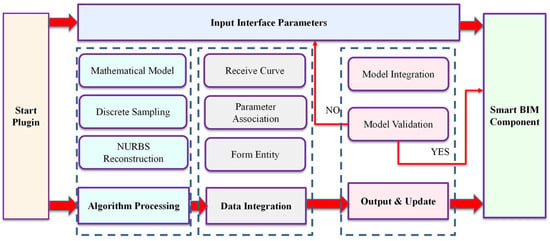
To address the core challenge of traditional BIM modeling, being unable to achieve the integrated creation of spiral reinforcement with “variable pitch + variable diameter,” this study proposes a three-dimensional technical framework of “Mathematical Modeling–API Integration–Parameter-Driven Design”. Based on the parametric equations of cylindrical/conical spiral curves, the geometric rules governing how pitch and diameter vary with height are precisely defined, overcoming the limitation of Revit’s native functionality to fixed parameters. Utilizing NURBS curve interpolation technology, discrete control points are fitted into smooth, continuous curves, ensuring the geometric accuracy of the model. By developing a visual plugin based on the Revit API and C# programming, a closed-loop workflow of “Parameter Input–Automatic Modeling–Dynamic Update” is realized, replacing the traditional manual segmental splicing approach. The technical roadmap of this paper is illustrated in Figure 1.
Figure 1.
The technical roadmap.
This study selected Revit 2020 as the foundational software platform. The methods from the Revit API class library were employed for development, and the integrated development environment used was Visual Studio 2020, running on the NET Framework 4.8.
The Revit API is an open application programming interface provided by Revit, whose core value lies in allowing developers to extend native functionalities through custom code. This study leverages its encapsulated class libraries precisely to overcome Revit’s inherent limitation of supporting only spiral curves with “fixed pitch and fixed diameter.” For this research, the core role of the Revit API is reflected in two aspects: creating variable-parameter spiral curve models that are impossible to achieve with native Revit tools; and supporting the development of a visual interactive interface, enabling engineering personnel to complete modeling through parameter input without programming, thereby significantly improving work efficiency.
The Revit API provides the CylindricalHelix class (inherited from the Curve class). Its static methods only support creating cylindrical spiral curves with “fixed diameter and fixed pitch,” which cannot meet the reinforcement requirements for “variable pitch and variable diameter” in engineering practice. This is the core reason why this study adopts NURBS curves to replace this class for modeling.
The ‘NurbSpline’ class within the Revit API (inherited from the ‘Curve’ class) can be used to create NURBS (Non-Uniform Rational B-Spline) curves. This is a mathematical model widely used in computer graphics and CAD fields (CAD2020) [32], whose core strength lies in its ability to flexibly and precisely represent both standard geometric shapes and complex freeform curves. This characteristic makes it particularly well-suited for the modeling needs of “variable-parameter spiral curves” in this study.
In this paper, the spiral curve is segmented by placing equidistant points along its generating line direction. These points serve as the control points for the NURBS curve. The three-dimensional spatial coordinates of these control points are calculated through algorithmic logic. Subsequently, the coordinates of these control points are sequentially passed to the ‘CreateCurve’ method of the ‘NurbSpline’ class to generate the NURBS curve, thereby approximating the shape of the spiral.
3.2. Geometric Properties of Spiral Line
To address the core challenge of accurately quantifying the geometric features in modeling variable-parameter spiral reinforcement, this section establishes the geometric and mathematical foundation for the spiral curve. It specifically focuses on clarifying the parametric equations for cylindrical and conical spiral curves, which serve as the core theoretical basis for calculating control point coordinates and realizing parametric modeling in subsequent steps.
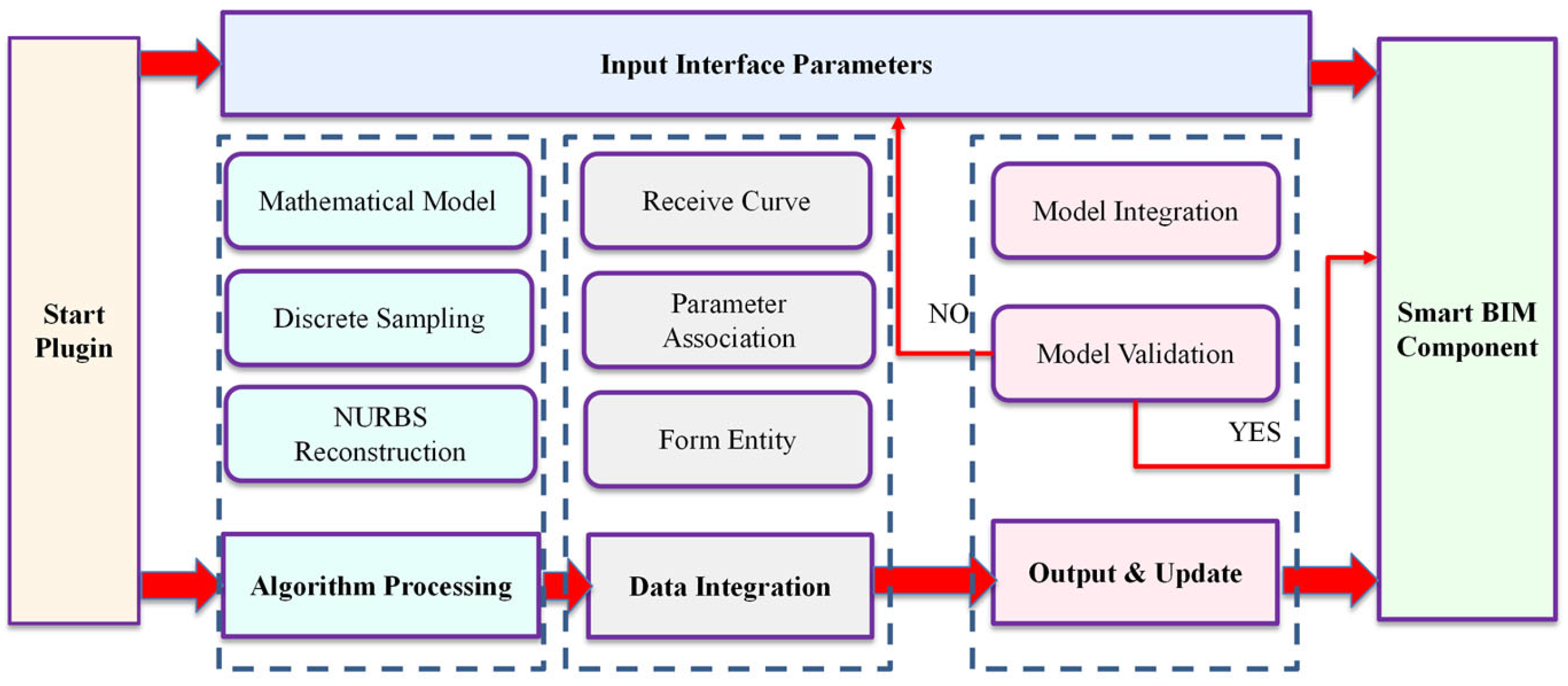
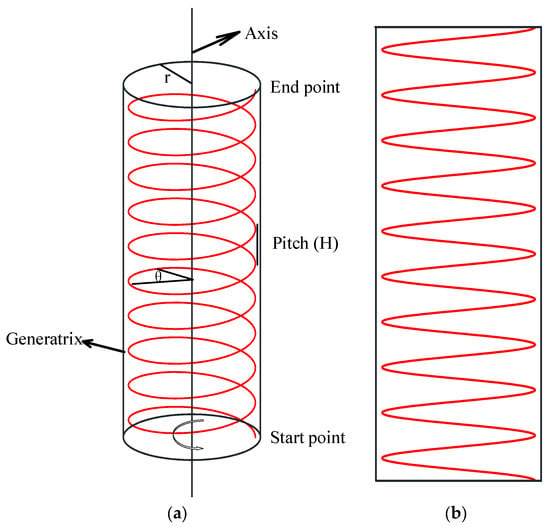
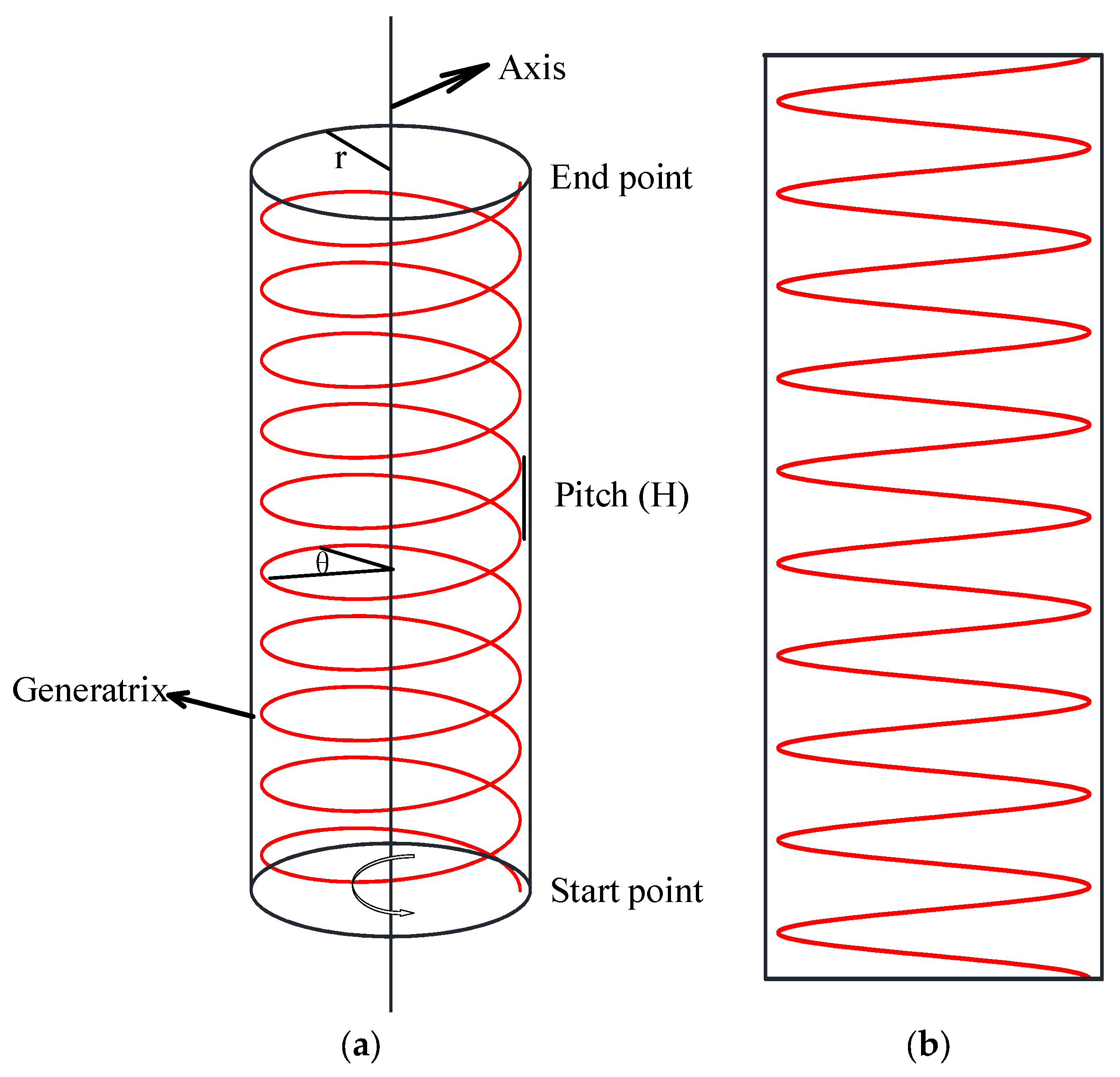
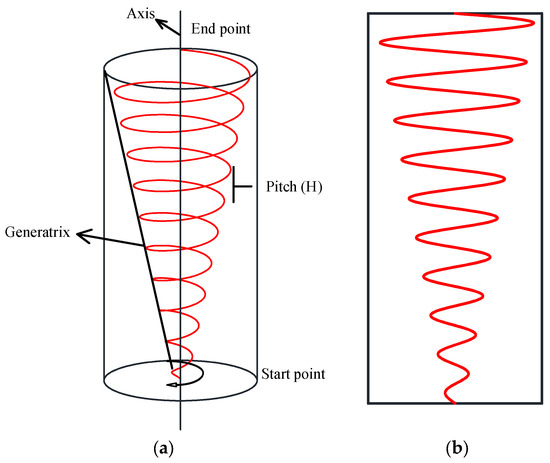
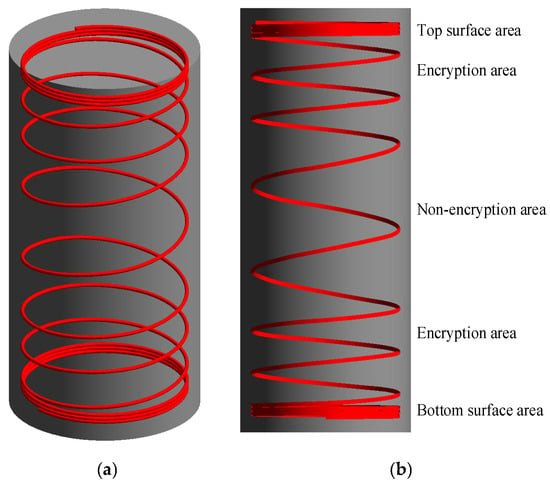
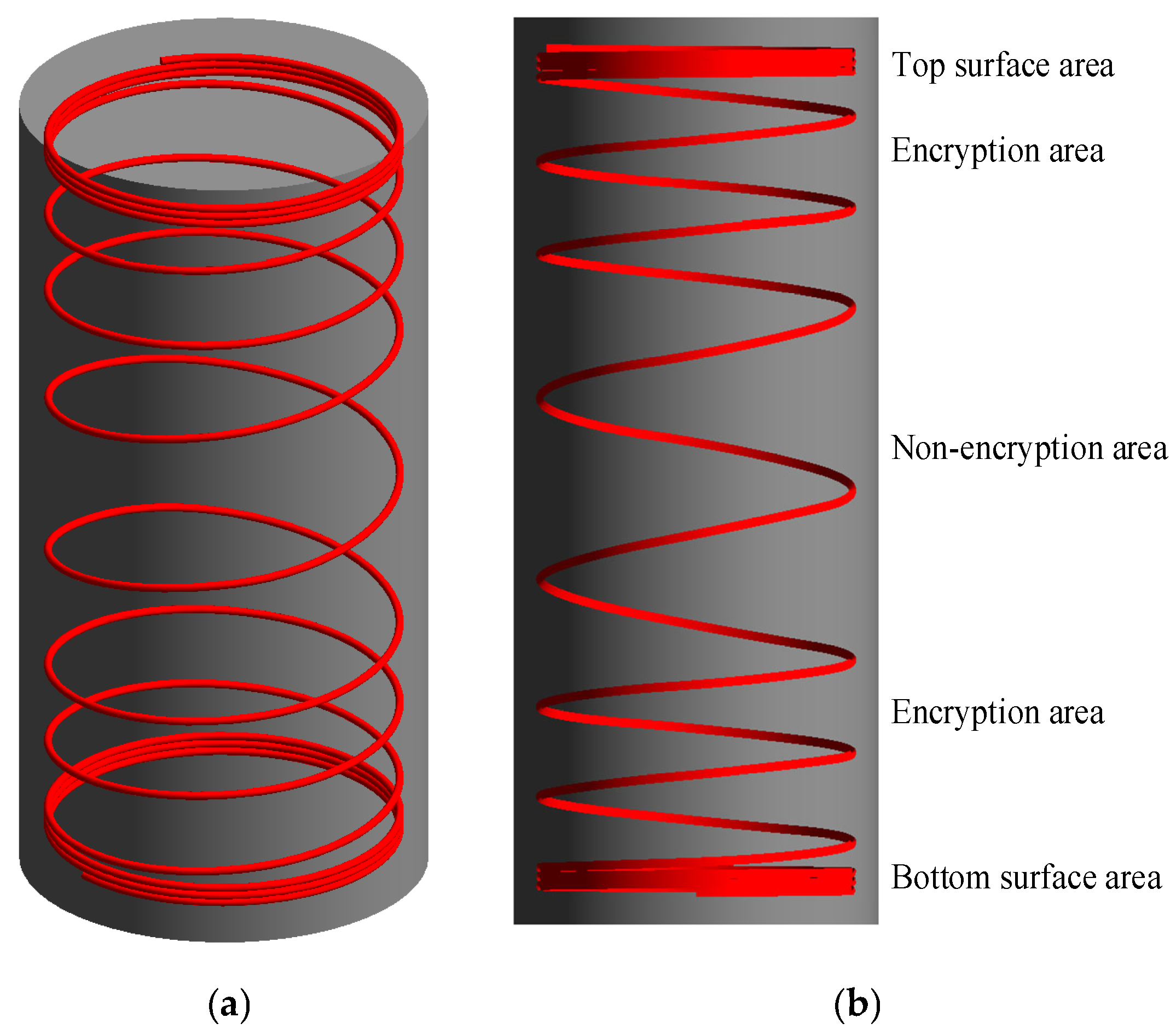
Spiral lines are a type of spatial curve that includes forms such as cylindrical and conical spirals. The moving point is in uniform linear motion on the generatrix of the lateral surface of the cylinder, and the generatrix is simultaneously rotating at a constant speed about the axis of the cylinder. At this point, the trajectory of the moving point is a cylindrical spiral [33], as shown in Figure 2.
Figure 2.
Schematic diagram of cylindrical spiral line: (a) 3D graph and (b) 2D graph.
The formation logic of the conical spiral curve is fundamentally consistent with that of the cylindrical spiral curve. The only difference lies in the fact that “the rotation radius corresponding to the generating line gradually changes with height as the moving point travels along it.” Specifically, a moving point rises uniformly along a generating line on a conical surface while the generating line itself rotates uniformly around the central axis of the cone. The trajectory of this moving point defines the conical spiral curve, as illustrated in Figure 3.
Figure 3.
Schematic diagram of conical spiral line: (a) 3D graph and (b) 2D graph.
According to the definition of the cylindrical helix, the parameter equation of the cylindrical helix can be derived [34]:
Among them, r is the radius of the cylindrical helix, θ is the angle at which the moving point rotates from the starting position, H is the pitch, and is Pi.
From the perspective of motion trajectory, a conical spiral can be seen as a variable-diameter cylindrical spiral. From this, the parameter equation of the conical spiral can be derived:
Here, is the radius increment of the moving point on the conical spiral at a certain moment compared to the cylindrical spiral (virtual) where it was located at the previous moment.
3.3. Mathematical Theory of NURBS Curves
To address the core limitation that Revit’s native functionality cannot generate spiral curves with “variable pitch and variable diameter,” this study employs NURBS (Non-Uniform Rational B-Spline) curves as the modeling medium for the geometric shape of spiral reinforcement. High-precision curve fitting and reinforcement generation are achieved through the Revit API.
The NurbSpline class within the Revit API provides essential support for curve creation. Its core logic is as follows: by inputting an ordered list of three-dimensional control points (a set of XYZ points) and an optional list of weights, a smooth curve can be generated. In this study, the weight list is uniformly set to 1, meaning all control points exert equal influence on the curve.
One advantage of using NURBS is flexibility and accuracy; NURBS can represent standard shapes (like arcs or circles, which are special cases of NURBS) as well as very free-form curves. By default, if we assign equal weights to all control points (as we do in this case for simplicity), the NURBS curve will interpolate a path influenced by these points. The more control points are provided along the true spiral path, the closer the NURBS approximation will be to the ideal mathematical helix. Essentially, the NURBS acts as a smooth interpolating medium; it will pass exactly through every control point if we use interpolation mode, and we can make it closely follow the points through dense sampling and equal weighting. In implementation, we choose to uniformly set all weights of control points to 1, which treats all control points that affect the curve equally. This choice simplifies the creation and still achieves high accuracy given enough points. The degree of the NURBS curve can be chosen (Revit might choose a degree automatically based on number of points if using the NurbSpline.Create() method), typically a cubic (degree 3) NURBS is common, providing smoothness while ensuring continuity.
A NURBS curve is defined by control points, weights, and basis functions, and its k-degree formulation can be written as [35]
where
- C() is a point on the curve;
- di represents the control points;
- ωi denotes the associated weights of control points;
- Ni,k() represents the B-sp line basis functions of degree k;
- is the curve parameter
To adapt to the default logic of the Revit API, a uniform knot vector, , is adopted, with a knot interval of 1, to ensure the uniform local influence of basis functions. Here, i is the index of the basis function (corresponding to the influence interval of control points). k is the degree of the basis function. Ni, k() is the k-degree B-spline basis function, where is the curve parameter. High-degree basis functions are generated by weighting adjacent low-degree basis functions. The core relationships are (weight coefficients satisfying A + B = 1 to ensure smooth transition), and the basis function is non-zero only when . The basis function of degree 0 (k = 0) is a piecewise constant function, effective only in a single knot interval (e.g., , which lacks continuity and cannot fit curves). The basis function of degree 1 (k = 1) is a linear polyline, with the effective interval extending to two knot intervals (e.g., is defined on [1, 3), where the first-order derivative is continuous but the second-order derivative changes abruptly, resulting in corners). The basis function of degree 2 (k = 2) takes a parabolic shape, with an effective interval covering three knot intervals. The first-order derivative is continuous but the second-order derivative is discontinuous (e.g., there is an inflection point at (u = 2), which fails to meet the “no inflection point” force requirement for spiral stirrups). Taking the core basis function (adapted to the distribution of control points of spiral stirrups) as an example, the basis function of degree 3 (k = 3) is derived. The recursion logic is summarized so that the overall curve transitions smoothly. The core advantages of degree 3 are that both the first-order and second-order derivatives are continuous (without corners or inflection points), completely avoiding the defects of low-degree basis functions. Therefore, it is concluded that low-degree basis functions (k ≤ 2) have continuity defects and cannot satisfy the smoothness and force requirements of spiral stirrups. The basis function of degree 3 obtains a cubic polynomial form via De Boor–Cox recursion, and it features high-order continuity, local controllability, and API compatibility, making it the optimal choice for NURBS curve modeling of spiral stirrups.
By adjusting the positions of control points, the magnitude of weights, and the order of basis functions, NURBS curves enable flexible and precise modeling of complex geometries
3.4. The Principle of Dividing Spiral Line Equally
At every point on the spiral, a corresponding point can be found on the generatrix. The generatrix is divided into n segments with equidistant points, with a distance of δz for each segment, and each point is mapped onto the spiral line based on its Z-coordinate value to obtain the control point. Since the angle of rotation of the moving point on one pitch is 2π, we divide 2π by the number of control points within one pitch on the helix to obtain the angular increment δθ between the control points. Due to the different pitches, the number of control points contained in each pitch is also different, and the obtained δθ is also different. Therefore, this is the key to controlling the pitch change of the spiral curve. Finally, the spatial coordinates of the control points on the spiral line are obtained through the parameter equation of the spiral line, and a NURBS curve is created using these control points. In this article, the impact of each control point on the curve is the same, so the weight values corresponding to each control point are set to the same value (usually set to 1). This approximation using multiple line segments requires a large amount of data and only applies when the distance between two consecutive points approaches zero (δz → 0). At this point, the connected line segments can approach the theoretical spiral line [36]. Therefore, it is necessary to divide multiple line segments according to the accuracy requirements of the model of spiral reinforcement, and to control the number of control points on the curve.
4. Parametric Design of Spiral Stirrup Model
Based on the geometric and mathematical foundations, the engineering-oriented modeling of variable-parameter spiral stirrups is realized. To address the pain points of traditional methods—such as manual segmentation and splicing, as well as insufficient efficiency and accuracy—this study identifies key adjustable parameters, designs a phased generation logic, and establishes a parameter-driven integrated process by integrating Revit API with NURBS curves.
4.1. Parameters of the Spiral Curve for Stirrup
The curve serves as the foundation of the steel reinforcement model, and by “laying” the steel bars along the curve, a solid steel reinforcement model can be generated. In this situation, no matter how complex the shape of the steel bar is, when the curve is correctly established, the steel reinforcement model can be created very accurately.
Before defining the spiral curve of the stirrup, it is necessary to understand its construction form. Refer to the 22G101-3 standard atlas [37]; the specification states that there should be horizontal sections at the beginning and end of the spiral stirrup, and the length should not be less than one and a half turns. However, it does not specify the specific number of turns on the surface layer; spiral stirrup in different projects may have different numbers of turns on the surface layer, and it is sufficient to meet the structural requirements. For another, within a certain range of the bottom and top of the pile foundation or bridge pier, an encryption zone needs to be set up, and the length of the encryption zone is generally greater than or equal to 5D, where D is the diameter of the pile foundation or bridge pier. In addition, it is also necessary to set the thickness of the reinforcement protection layer; the thickness of the protective layer of the spiral stirrup is divided into the thickness of the bottom, top, and side protective layers. The thickness of the side protective layer can be indirectly obtained based on the diameter of the defined spiral curve and does not need to be set separately. A summary of adjustable parameters for spiral stirrups is shown in Table 1.
Table 1.
Summary of adjustable parameters for spiral stirrups.
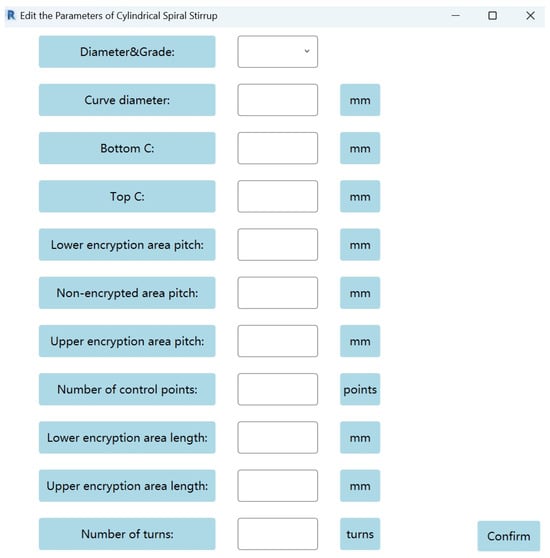
Overall, variables such as the type of steel reinforcement in the stirrup, the diameter of the spiral curve, the thickness of the protective layer at the bottom, the thickness of the protective layer at the top, the pitch of the encrypted area at the bottom, the pitch of the non-encrypted area, the pitch of the encrypted area at the top, the number of equal points of the generatrix, the length of the encrypted area at the bottom, the length of the encrypted area at the top, and the number of turns in the surface layer are designed as variable parameters that users can adjust through the WPF application. Figure 4 shows the user interface of a cylindrical spiral stirrup. “Cbottom” and “Ctop” represent the thickness of the protective layer at the bottom and top.
Figure 4.
User interaction interface of WPF.
4.2. Creation of Cylindrical Spiral Stirrup
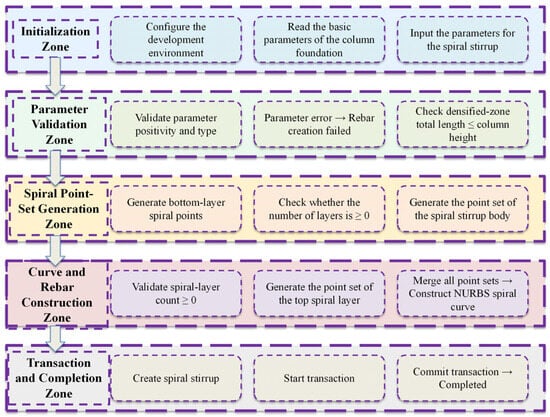
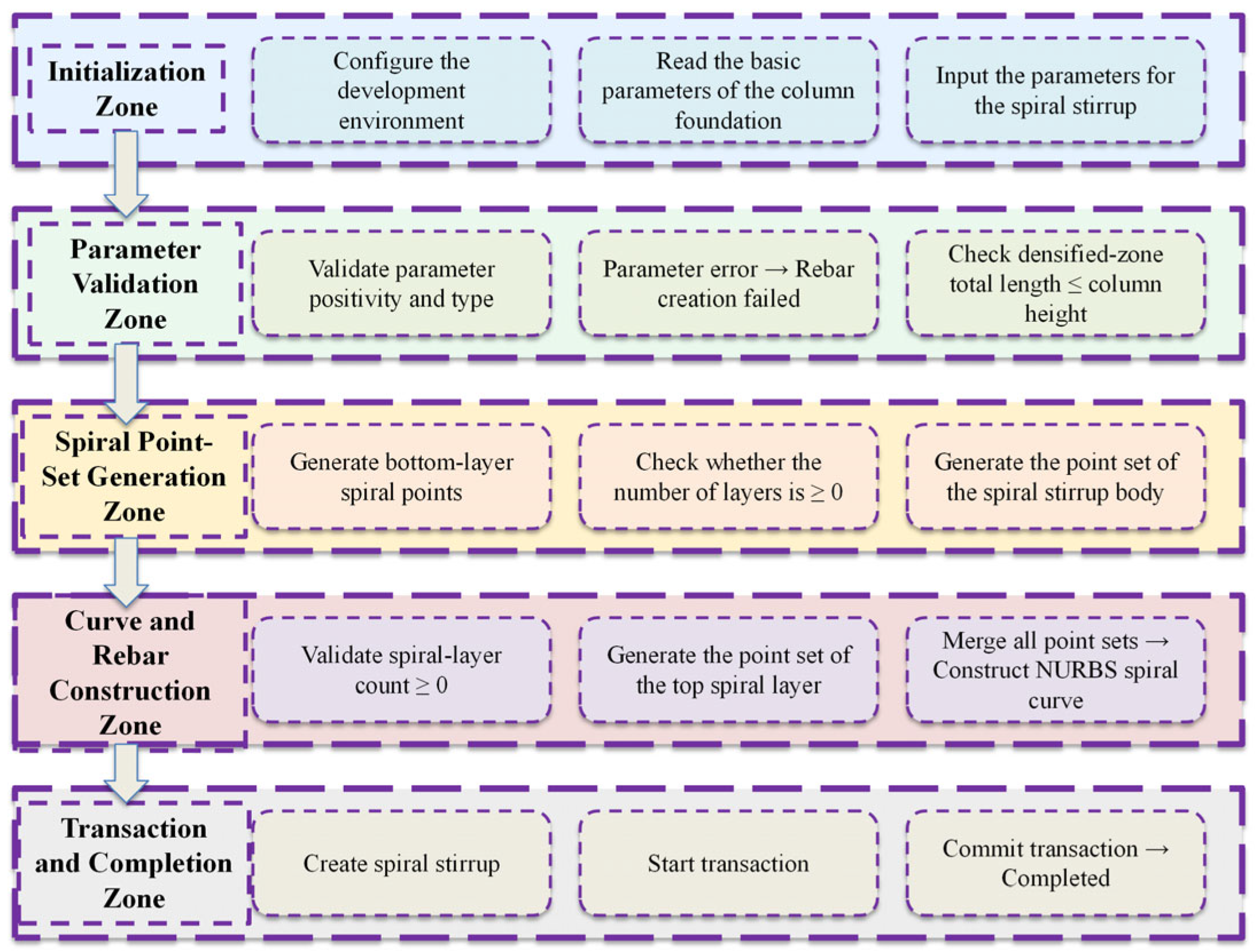
The curve rotation direction of the spiral stirrup in this design is right-handed. During the creation process, the spiral curve is divided into three sections: the bottom layer area, the top layer area, and the encrypted and non-encrypted areas in the middle of the spiral curve. In Visual Studio, code is written to create the spiral stirrup based on the above three sections. The overall flow chart of the design and development of spiral stirrups is shown in Figure 5.
Figure 5.
Overall flow chart for the design and development of spiral stirrup.
In order to meet the reinforcement density and construction requirements of different stress zones, the generation of the geometric shape of spiral stirrups is divided into three stages. Each stage is based on the parametric helical equation, with adjustments for concrete cover, rebar diameter, and anchorage specifications.
Generation of Bottom Horizontal Segment: At the base, generate at least 1.5 turns (or more, depending on design requirements) of a near-zero-pitch helix to form a stable anchorage zone. In this section, the vertical increment is very small, resulting in the steel bars being arranged almost horizontally. The starting elevation takes into account the thickness of the bottom concrete protective layer and half of the diameter of the steel reinforcement to correctly position the center of mass of the steel reinforcement. Accumulate the angle from 0 to the arc value corresponding to the required turn, and obtain the coordinates of the control point through the spiral equation. Record the final angle and height of this stage for seamless transition to the next stage.
Generation of the Middle Variable-Pitch Segment: This segment covers the main height of the column, excluding the top and bottom anchorage zones, and is divided into three subregions: a bottom dense zone, a middle regular zone, and a top dense zone. The algorithm determines the current subregion based on the elevation and automatically applies the corresponding pitch parameter (e.g., smaller pitch for dense zones at both ends and standard pitch for the middle zone). Each control point position is calculated from the incremental angle and corresponding pitch, with the vertical increment matched to the angular step to ensure geometric smoothness. The initial angle seamlessly connects with the final angle of the bottom segment to maintain the continuity of the spiral. This approach enables segmented variation of pitch, ensuring that the geometry reflects the distribution of reinforcement density while allowing for flexible parametric control.
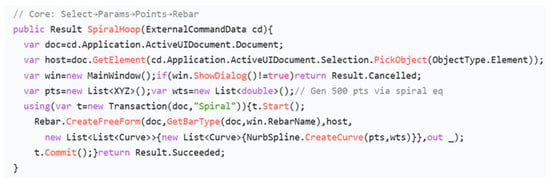
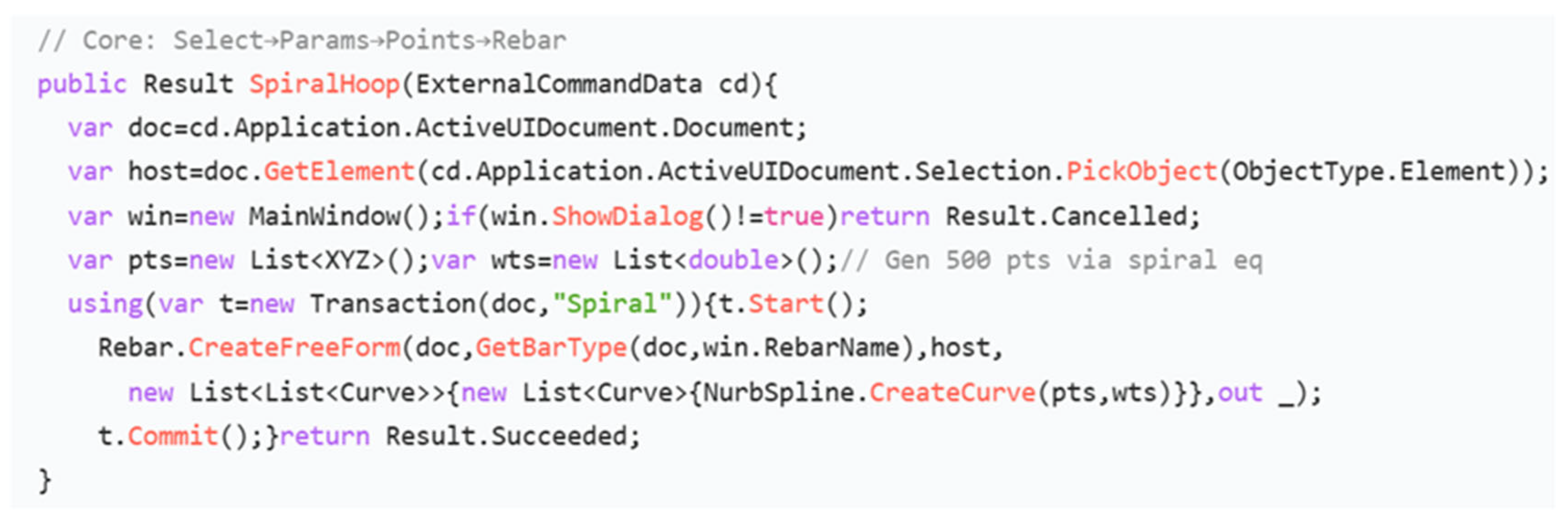
Generation of the Top Horizontal Segment: At the top of the column, a near-zero-pitch spiral similar to the bottom segment (typically 1.5 turns) is generated to form the terminal anchorage zone. This stage starts from the final angle and height of the middle segment and ends at an elevation that considers the top concrete cover, ensuring that the spiral terminates appropriately below the concrete surface. The nearly flat rings in this segment improve both anchorage performance and construction operability. The core code for component reinforcement is shown in Figure 6.
Figure 6.
Core code for spiral stirrup reinforcement.
This staged generation algorithm ensures precise control of reinforcement density across structural zones while maintaining continuous and smooth geometric transitions. The parametric implementation allows for flexible adjustment of pitch, radius, and segment lengths to meet the modeling requirements of various bridge piers and columns.
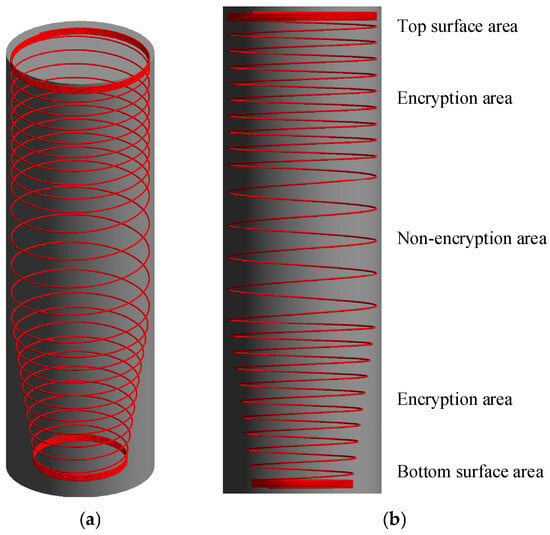
Throughout all stages, a running list of control points (List<XYZ>) is maintained. Once all points are computed and added, we proceed to create the geometric curve. This is done by calling Revit’s static method NurbSpline. Create (curve Points, weights)—where curve Points refers to our list of XYZ points, and weights refers to a parallel list of weights (all set to 1). The result is a NURBS curve (represented internally as a curve object in Revit). We then use Revit’s Rebar API to create the actual rebar element. Specifically, we utilize the Rebar. CreateFreeForm() method, which allows creation of a rebar with arbitrary shape defined by a curve. This method requires parameters such as the Revit document, a rebar bar type (defining the diameter and material of the bar), the host element (the concrete column/pile that the rebar is placed in), the curve loops defining the rebar shape, and a reference to store geometry validation results. In our implementation, we pass the curve obtained from our NURBS as the shape of the rebar. Revit then generates a 3D rebar object that follows this curve path. All of these steps are encapsulated within a Revit Transaction (a requirement of the Revit API for making changes to the model), meaning that they are executed as one atomic action in the BIM model environment. The model diagram of the completed cylindrical spiral stirrup is shown in Figure 7.
Figure 7.
Cylindrical spiral stirrup: (a) 3D graph and (b) 2D graph.
4.3. Creation of Conical Spiral Stirrup
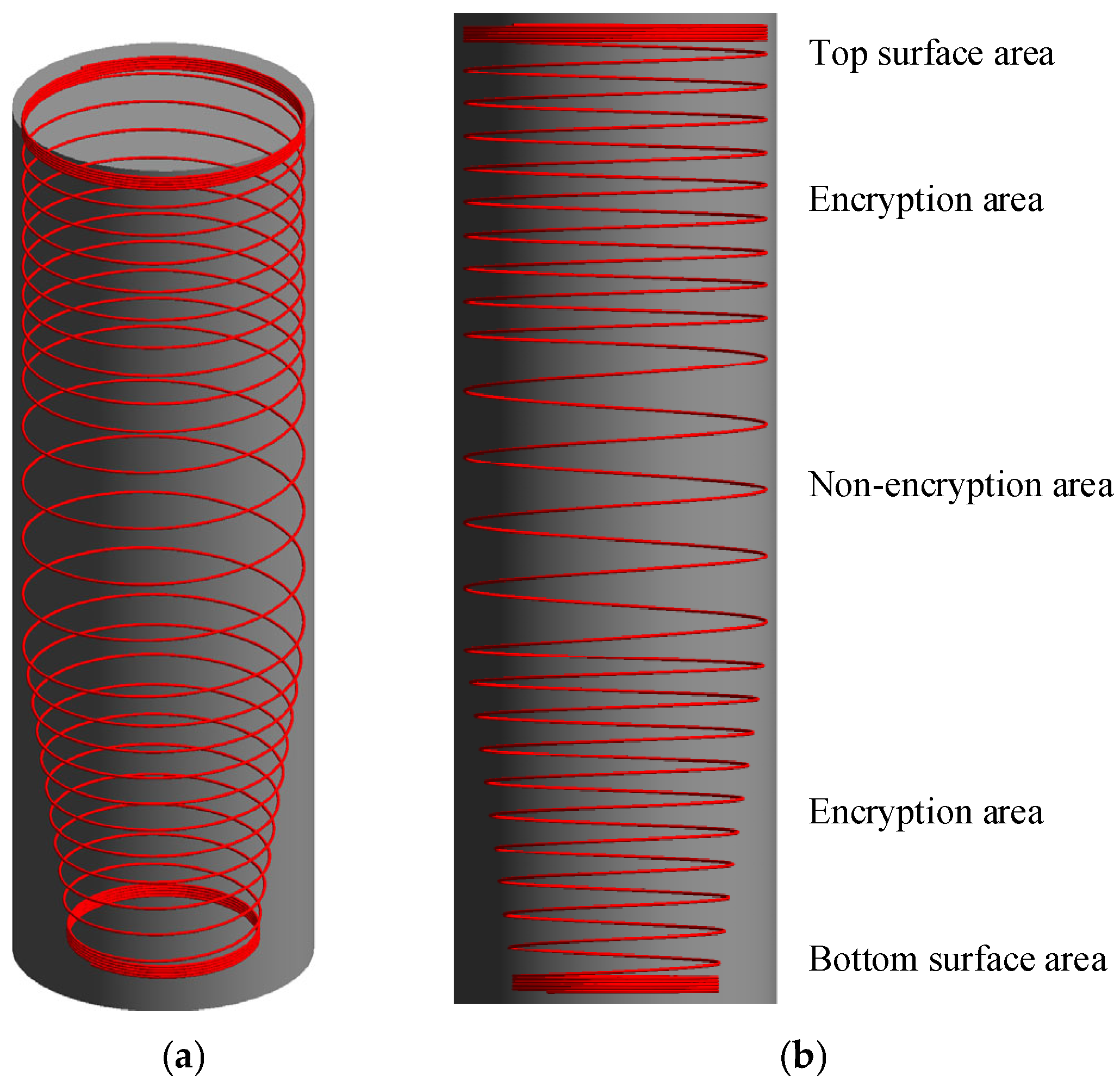
The creation method of conical spiral stirrups and cylindrical spiral stirrups is similar and will not be elaborated further. The key difference lies in the variation in the radius of the virtual cylindrical spiral curve where each control point is located. In this article, the difference between the starting radius and the ending radius of a conical spiral curve is divided equally based on the number of control points, and the control point can update the radius of the curve it is currently on during each iteration; refer to Formulas (9) and (10). Then, by combining the current radius with the parameters of the spiral line, the X and Y coordinate values of the control point can be calculated; refer to Formulas (11) and (12). Furthermore, a spiral curve is created using the method named “CreateCurve” in the “NurbSpline” class, and a spiral hoop is created using the method named “CreateFreeForm” in the “Rebar” class. As shown in Figure 8, the requirements of variable diameter and variable pitch have been achieved.
Figure 8.
Conical spiral stirrup: (a) 3D graph and (b) 2D graph.
The symbols and their meanings in Formulas (8)–(11) are shown in Table 2.
Table 2.
Symbols and meanings for creating conical spiral stirrups.
5. Result
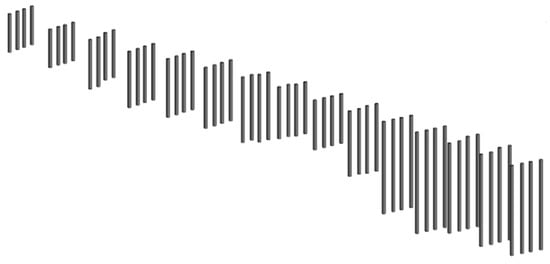
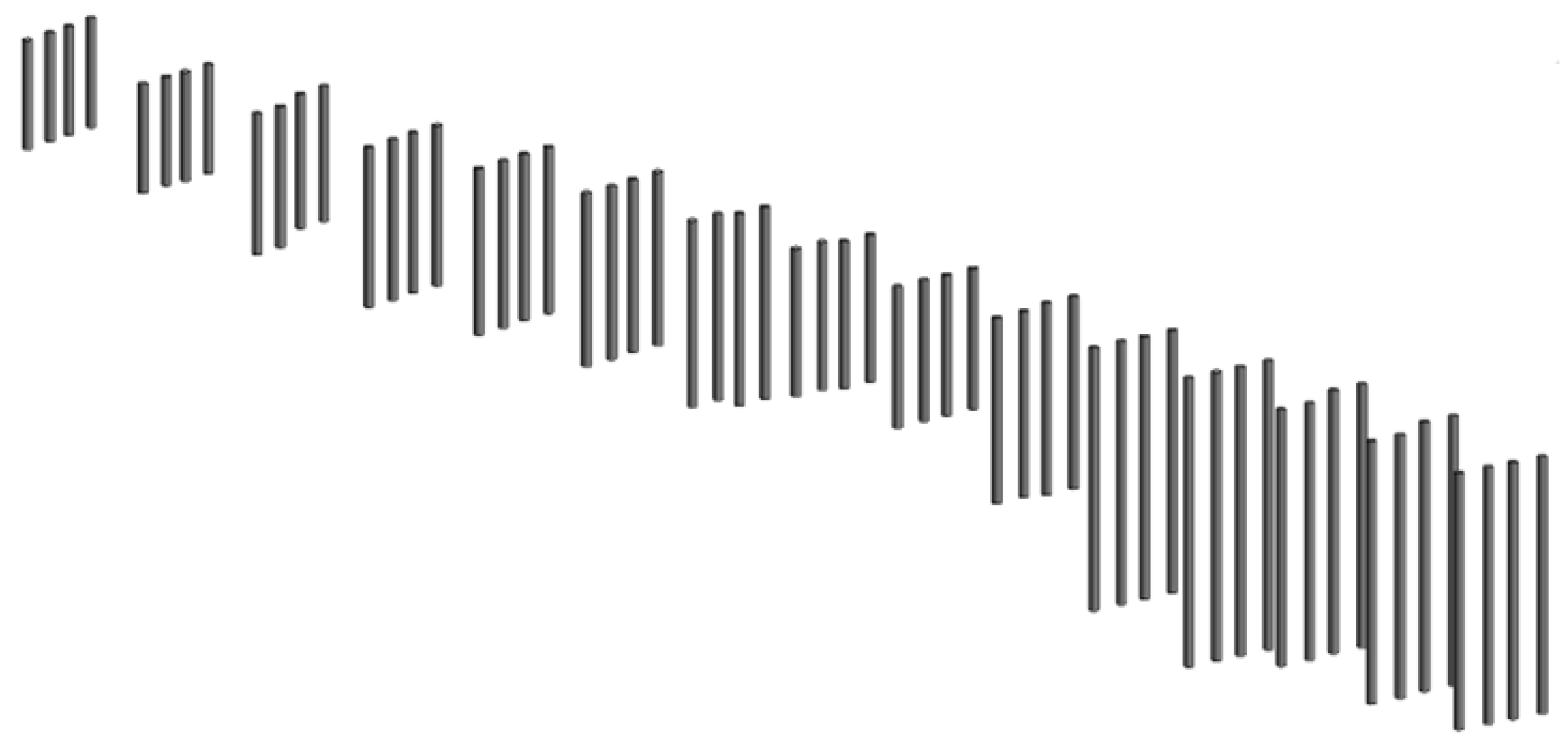
A case study was conducted on a bridge over a city-level river. In the engineering design, parametric modeling was used to model the bridge pier, as shown in Figure 9.
Figure 9.
Project Revit model.
The developed plugin was then used to place rebar by inputting parameters controlling the rebar model in a WPF form, as shown in Figure 6. To objectively evaluate the performance of the developed plugin, a comparative experiment was designed and conducted. The experiment was performed in a unified computing environment: the hardware configuration included an Intel Core i7 processor and 32 GB of RAM, with Autodesk Revit 2020 as the software environment. Six engineers with over 3 years of experience in bridge BIM modeling were recruited as testers to represent the typical user group. Prior to the formal test, all testers received a 30 min training on plugin operation to eliminate the impact of the learning curve. The experimental task required each tester to complete the spiral stirrup modeling of the same bridge pier model using both the traditional manual method and the parametric plugin developed in this study. The modeling time, measured in seconds, was recorded by a third party from the start of operation until the model was fully generated and verified as correct.
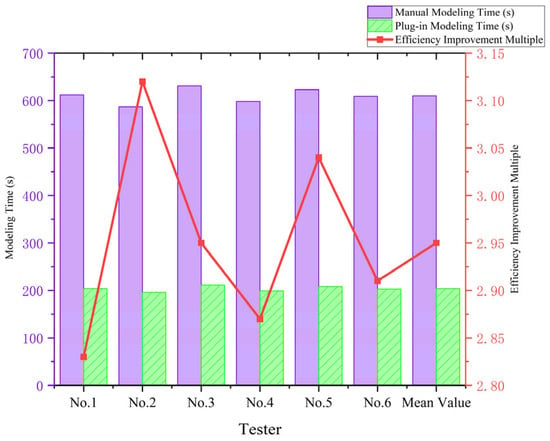
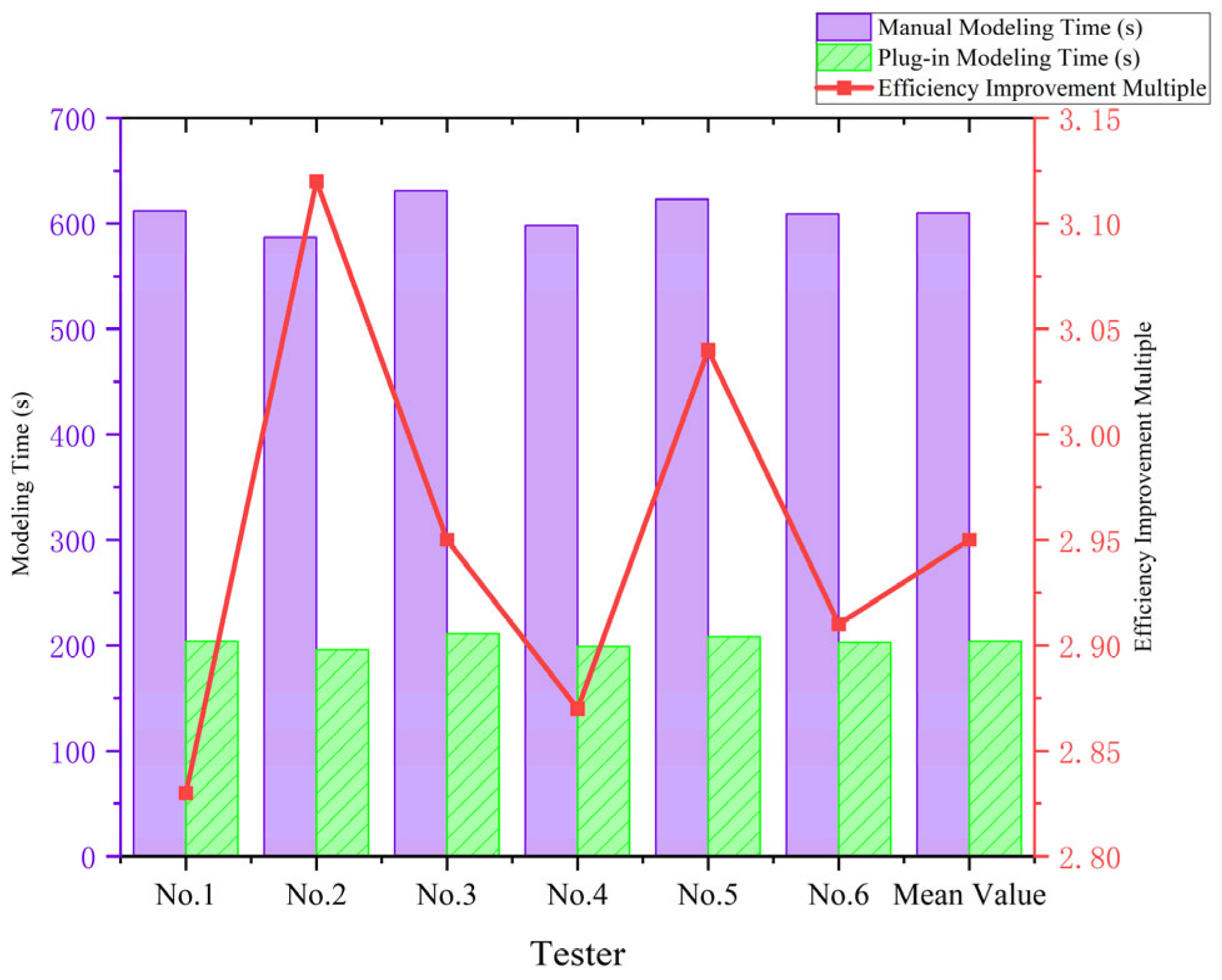
Figure 10 shows a comparison of the time efficiency for manual and parametric modeling for a single bridge pier. As shown in the table, the average time for manual modeling was 610 s, while the average time for parametric modeling was significantly reduced to 204 s, representing a 2.95-fold increase in efficiency. Among the evaluators, Evaluator 2 achieved a maximum efficiency increase of 3.12 times.
Figure 10.
Individual component modeling test results.
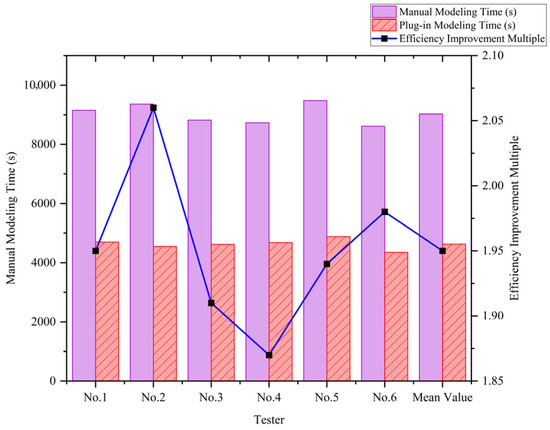
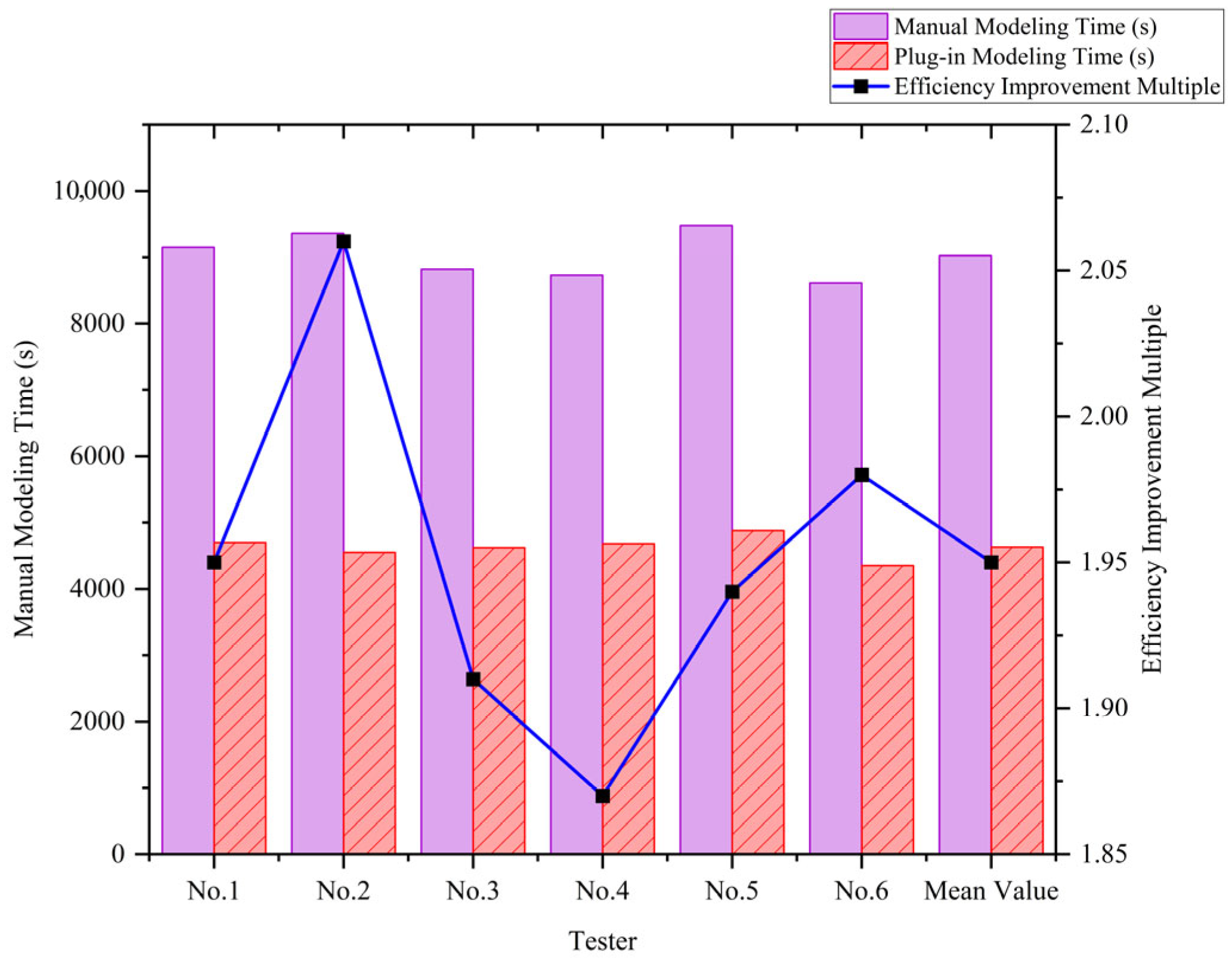
Figure 11 shows the results for the entire project, comparing manual modeling and parametric modeling using the developed plugin. Due to the large number of components in the complete project, the modeling time accounted for a substantial proportion of the overall workflow. As a result, the improvement in modeling efficiency was lower than that observed for individual components; however, there was still a noticeable gain, with a maximum efficiency increase of 2.06 times and an average increase of 1.95 times. With the aid of the plugin, all evaluators were able to complete the entire pier modeling within approximately one and a half hours, compared to more than two hours required for manual modeling.
Figure 11.
Whole-building modeling test results.
6. Discussion
In order to evaluate the effectiveness of the parametric modeling method proposed in this study, we compared it with traditional Revit family-based modeling methods. The comparison focuses on four dimensions: modeling accuracy, modeling efficiency, modeling flexibility, and the overall advantages and disadvantages of this method. The traditional method refers to using Revit’s built-in spiral stirrup families or manually drawing spiral paths, with modeling done for different sections separately. The parametric approach, however, is the automated plugin developed in this study. The research successfully achieved rapid creation of spiral stirrups in bridge piers, enhancing modeling efficiency and accuracy. To verify the developed method, it was applied to a real-world project.
6.1. Modeling Time and Efficiency
In the modeling comparison of spiral stirrups for a single pier, the modeling efficiency of the parametric plugin is significantly improved compared with traditional manual modeling. The core of the efficiency difference originates from the essential distinctions between the two methods in “process complexity” and “change adaptability”. The traditional modeling method requires splitting the spiral stirrup into three types of independent family files, i.e., the bottom densified zone, the middle non-densified zone, and the top densified zone, which are created separately. Each type of family needs manual adjustment of spiral radii and pitch parameters, and after completion, the three segments of family models must be manually spliced to form a complete stirrup. Only the creation and splicing of family files account for the major part of the total modeling time. In contrast, the parametric plugin can automatically integrate the three-segment structure directly according to design specifications through the preset “segmented parameter logic” without splitting family files. Its input interface is intuitive, and even when multiple components or parameter changes are involved, the model can be quickly reconstructed, avoiding repetitive work and greatly reducing repetitive operation steps.
In the whole-project modeling scenario, although the extent of efficiency improvement is lower than that in single-component modeling due to the need for additional tasks such as clash detection between pier and foundation rebars and model collaboration, the batch generation function of the plugin still demonstrates obvious advantages. For projects with multiple piers, the traditional method needs to repeat the family creation and splicing process for each component one by one, while the plugin can generate spiral stirrup models for all piers in batches based on a unified parameter template, significantly shortening the overall modeling cycle and being more suitable for the scenario requirements of rush construction or multiple rounds of scheme optimization in engineering.
Overall, using secondary development technology for adaptive rebar modeling can significantly enhance automation, improving efficiency, saving time and costs, and avoiding wastage of human resources.
6.2. Modeling Accuracy
Modeling accuracy refers to the degree to which the BIM model reflects the designed geometry. In traditional modeling using Revit’s default spiral stirrup families, there are significant geometric approximation errors and functional limitations. Family files typically only support constant pitches, and if variable pitch spirals are needed, they must be manually split into multiple segments or family types. When dealing with conical components (variable diameters), the model cannot transition smoothly and often requires manual surface adjustments or stretching operations. These methods can lead to misalignment, discontinuity, or non-smooth transitions between spiral segments.
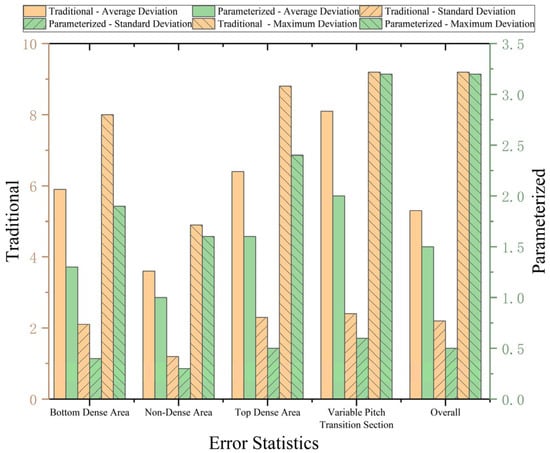
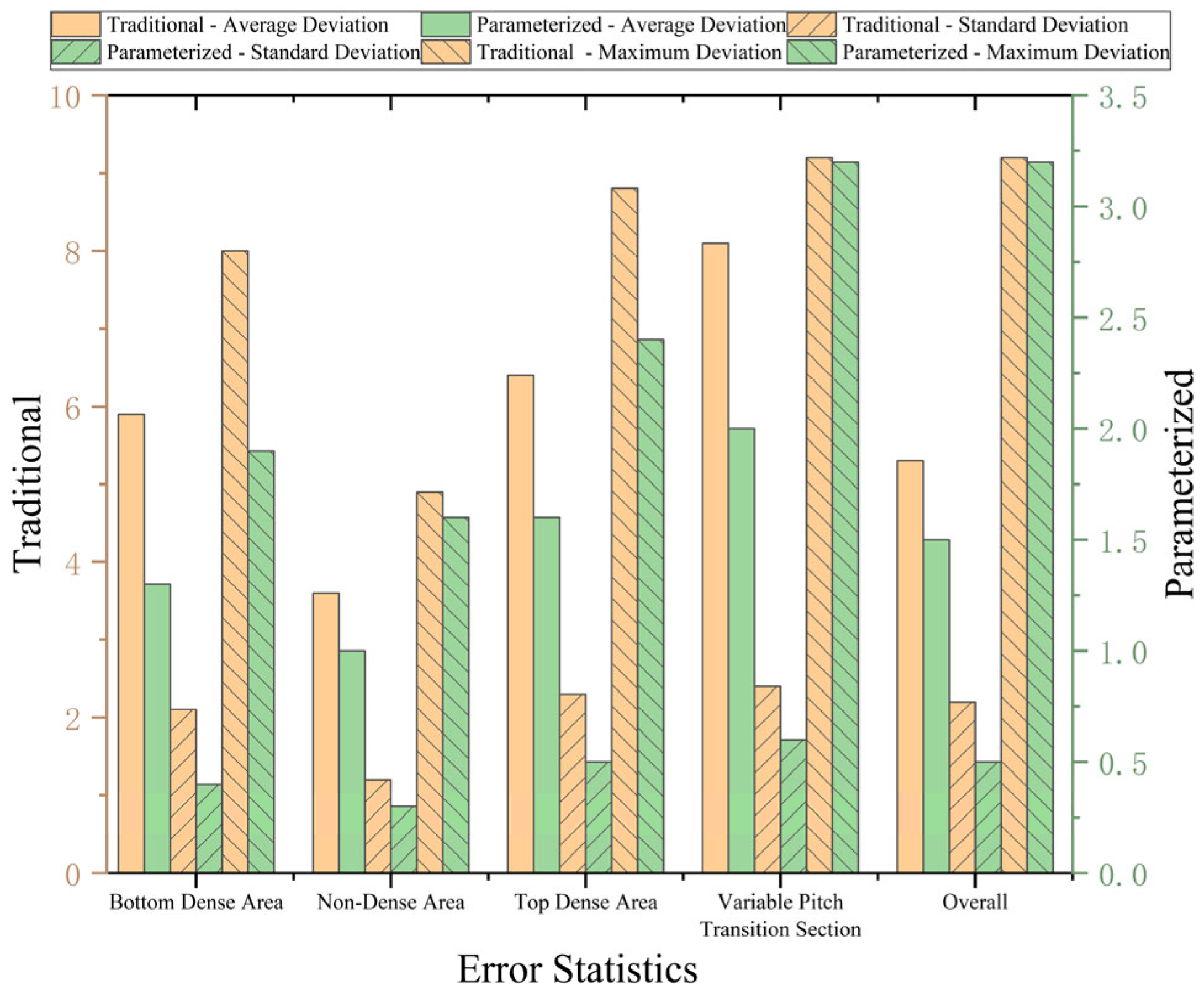
Based on the coordinate system of BIM design theory, the geometric deviations of the two methods were digitally calculated. Thirty coordinate points were selected, distributed across ten cross-sections with three positions per cross-section. The parametric method achieved an average deviation of 1.5 mm, a standard deviation of 0.5 mm, and a maximum deviation of 3.2 mm, with G2 continuity maintained throughout the entire section.
Deviations were concentrated in the variable-pitch transition section. Due to the dynamic pitch variation in this region, the NURBS curve needs to fit the ideal spiral through control points, and minor deviations arise from the density of control points and the accuracy of the interpolation algorithm—this is a normal phenomenon in digital modeling. For the traditional method, the average deviation was 5.3 mm, the standard deviation was 2.2 mm, and the maximum deviation reached 9.2 mm. These deviations mainly stemmed from the manual splicing of segmented families in the dense reinforcement zone and the complex geometry of the transition section. Manual alignment failed to achieve complete coordinate matching, resulting in significant deviations at the splicing joints. Only the non-dense zone exhibited relatively low deviations due to its simple geometry and greater flexibility for manual adjustments, while coordinate breakpoints existed at the splicing positions. A comparison between the two methods confirms that the parametric method offers superior accuracy. The error analysis diagram is shown in Figure 12.
Figure 12.
Error analysis.
In summary, the parametric method significantly reduces the modeling error of spiral stirrups, greatly improving the geometric authenticity of the BIM model. It is especially suitable for applications that require high accuracy.
6.3. Analysis and Comparison with Existing Methods
When combined with existing relevant studies, the parametric method proposed in this research demonstrates distinct advantages in core capabilities, which are specifically reflected in three aspects: First, its geometric adaptability is more aligned with engineering requirements. The traditional Revit family method only supports spiral structures with fixed pitch and diameter, and cannot address the design requirements of “variable diameter” for bridge pile foundations and “segmented variable pitch” for piers; although the Dynamo method can optimize rebar arrangement, it is still limited to scenarios with uniform pitch [38,39]. In contrast, by integrating a unified parametric equation for cylindrical and conical spirals, this method can directly generate complete stirrups with variable pitch and diameter without the need for split modeling, covering mainstream component types such as cylindrical piers and conical pile foundations. Second, it offers higher flexibility and usability in parameter adjustment [40]. Existing nested family methods require adjusting nested levels to achieve parameterization, which is not only complex to operate but also prone to model loading lag due to excessive levels, imposing high technical requirements on operators. This method simplifies operations through a visual WPF interface—no programming or complex family editing experience is required. Modeling can be completed merely by inputting intuitive indicators such as “cover thickness” and “densified zone parameters”; when parameters change, the program automatically recalculates the geometry, significantly reducing the technical threshold and adjustment costs. Third, its multi-software collaboration capability is more comprehensive. When exporting to IFC format, the traditional family method and nested family method often lose key design information such as “pitch segmentation” and “densified zone range”; when imported into structural analysis software, parameters need to be redefined, resulting in information discontinuity. During the modeling process, this method synchronously embeds rebar properties and geometric parameters, which can still be fully retained after IFC export. These pieces of information can be directly used for subsequent detailed design or fabrication list generation, realizing information continuity throughout the “modeling detailed design and construction” process.
6.4. Limitations of the Experiment
It is important to note that while the controlled experiment in this study effectively validated the efficiency advantages of the developed plugin, certain experimental limitations remain. Limited Test Sample Size: The experiment involved only six test participants, all of whom were engineers specialized in bridge BIM modeling. The sample did not include professionals from the architectural field or novice modelers. Therefore, the results may not fully reflect the adaptability of the plugin for users with different professional backgrounds or skill levels. Single Experimental Scenario: The test was conducted solely within the context of a conventional urban bridge project. It did not cover more complex projects involving multiple intersecting specifications or codes. Consequently, the transferability of the results requires further verification. Incomplete Evaluation Metrics: The primary evaluation indicator focused on modeling time. Core engineering performance metrics such as model modification efficiency and error rates were not incorporated. Therefore, a comprehensive assessment of the plugin’s overall performance awaits further refinement.
7. Conclusions and Future Direction
Conclusions
This study addresses the modeling challenges of spiral reinforcement in circular/conical cross-section components such as bridge piers, proposing and validating an integrated solution based on the Revit API and parametric mathematical modeling. The core conclusions are as follows.
Overcoming Fundamental Limitations of Traditional Modeling: By introducing the core technical approach of “integrating mathematical modeling with API and employing NURBS curve fitting,” the study fundamentally resolves the common issues inherent in traditional methods, such as dependency on fixed parameters, inefficient manual splicing, and poor precision control. This method eliminates the need for splitting family files; instead, it achieves the integrated generation of spiral reinforcement with variable pitch and variable diameter through unified parametric equations. Its core innovation lies in the deep integration of engineering specification requirements with geometric mathematical models, enabling a fully automated mapping from “design parameters → geometric shape → solid model.”
Validating the Method’s Broad Engineering Value: This parametric method demonstrates significant advantages across three dimensions: precision, efficiency, and usability. Modeling errors are controlled within acceptable engineering tolerances, surpassing the precision of traditional manual modeling. Efficiency shows a clear improvement over traditional methods, with the advantage of batch generation becoming more pronounced as the number of components increases. The visual operation interface reduces technical barriers, allowing rapid operation without the need for programming or extensive family editing experience, thereby fitting the practical workflow of engineering professionals.
Defining the Study’s Core Contribution Scope: This research establishes a “universal logic for BIM modeling of variable-parameter spiral components.” By following the conceptual framework of “parameterizing geometric equations, achieving precision through curve fitting, and implementing engineering solutions via API,” it provides a reusable technical framework for the BIM modeling of similar complex, irregularly shaped components.
Although existing methods have achieved parameterized generation of spiral stirrups for bridge piers, in the future, it will be based on the same parameterization logic to meet the requirements of stirrups for beam and column components in the field of construction. For beam stirrups and column composite stirrups, the curve equation and parameter settings will be adjusted to match the rectangular cross-section of the beam and column. At the same time, selection options for beam/column and hoop reinforcement types in the existing plugin interface will be added. After the user inputs basic parameters such as beam height and column section size, this will solve the modeling problem in current construction, which is the need to manually draw or split families for beam and column stirrups.
In addition, the multi standard adaptability and operational convenience of the plugin will be optimized. At present, this plugin is mainly adapted to bridge engineering-related standards. In the future, by adding a “standard selection” module to the plugin, its versatility will be further enhanced. After selecting the corresponding standard, the program will automatically match the default parameters under that standard, such as the length of the reinforcement encryption zone and the requirements for the anchorage section, reducing the need for manual adjustment by users. At the same time, the operation process will also be simplified, integrating the existing multi-step parameter input into two steps: “basic information” and “core parameters”, and adding a “parameter preset” function to improve operational efficiency in different engineering scenarios.
In addition, a feature will be developed to link steel bar modeling with quantity statistics to further realize engineering value. Based on existing plugins, a lightweight data linking function will be added. After generating the steel reinforcement model, the program will automatically extract information such as the length and quantity of each steel reinforcement, and export the “Steel Reinforcement Bill of Quantities” in a commonly used format in engineering, such as an Excel spreadsheet. This bill will be associated with basic information such as component numbers and steel specifications, directly meeting the needs of cost calculation or material procurement. This feature does not involve complex processing parameters and only requires direct conversion from “modeling data to quantity data”, reducing the manual statistical process and improving the accuracy and efficiency of data transmission.
This method improves the parameterization ability of variable pitch and spacing of spiral stirrups, enhances modeling efficiency and accuracy, and facilitates accurate and rapid modeling of spiral stirrups in BIM models of bridge piers.
Author Contributions
Conceptualization, S.L. and E.Z.; methodology, H.L., E.Z. and Q.L.; software, E.Z.; validation, E.Z. and Q.L.; formal analysis, E.Z.; investigation, E.Z.; resources, S.L. and E.Z.; data curation, E.Z. and Q.L.; writing—original draft preparation, H.L. and E.Z.; writing—review and editing, S.L. and E.Z.; visualization, E.Z.; supervision, S.L.; project administration, E.Z.; funding acquisition, S.L. All authors have read and agreed to the published version of the manuscript.
Funding
This research was funded by the National Natural Science Foundation of China (No. 52179133, No. U1404526).
Data Availability Statement
Data are contained within the article.
Conflicts of Interest
Author Ershi Zhang was employed by the South China Company, China State Construction Engineering Second Bureau Ltd. The remaining authors declare that the research was conducted in the absence of any commercial or financial relationships that could be construed as a potential conflict of interest.
References
- Abuhussain, M.A.; Waqar, A.; Khan, A.M.; Othman, I.; Alotaibi, B.S.; Althoey, F.; Abuhussain, M. Integrating Building Information Modeling (BIM) for optimal lifecycle management of complex structures. In Structures; Elsevier: Amsterdam, The Netherlands, 2024; Volume 60, p. 105831. [Google Scholar]
- Li, L.; Yuan, J.; Tang, M.; Xu, Z.; Xu, W.; Cheng, Y. Developing a BIM-enabled building life cycle management system for owners: Architecture and case scenario. Autom. Constr. 2021, 129, 103814. [Google Scholar] [CrossRef] [Scilit]
- Rajaram, P.; Swathika, O.G. Data-Driven Predictive Models for Sustainable Smart Buildings. Results Eng. 2025, 27, 105916. [Google Scholar] [CrossRef] [Scilit]
- Zhang, J.; Seet, B.-C.; Lie, T.T. Building Information Modelling for Smart Built Environments. Buildings 2015, 5, 100–115. [Google Scholar] [CrossRef] [Scilit]
- Wang, T.; Chen, H.M. Integration of building information modeling and project management in construction project life cycle. Autom. Constr. 2023, 150, 104832. [Google Scholar] [CrossRef] [Scilit]
- Chong, H.-Y.; Yang, X.; Goh, C.S.; Luo, Y. BIM and AI Integration for Dynamic Schedule Management: A Practical Framework and Case Study. Buildings 2025, 15, 2451. [Google Scholar] [CrossRef] [Scilit]
- Pan, N.-H.; Isnaeni, N.N. Integration of Augmented Reality and Building Information Modeling for Enhanced Construction Inspection—A Case Study. Buildings 2024, 14, 612. [Google Scholar] [CrossRef] [Scilit]
- Zhang, N.; Ye, J.; Zhong, Y.; Chen, Z. Digital Transformation in the Chinese Construction Industry: Status, Barriers, and Impact. Buildings 2023, 13, 1092. [Google Scholar] [CrossRef] [Scilit]
- Feng, L.L. Optimization and Application of Engineering Project Schedule Management Integrating BIM Technology. Eng. Technol. Res. 2024, 6, 21. [Google Scholar]
- Yang, J. Application of BIM technology in construction cost management of building engineering. J. Phys. Conf. Ser. 2021, 2037, 012046. [Google Scholar] [CrossRef] [Scilit]
- Dasović, B.; Galić, M.; Klanšek, U. A Survey on Integration of Optimization and Project Management Tools for Sustainable Construction Scheduling. Sustainability 2020, 12, 3405. [Google Scholar] [CrossRef] [Scilit]
- Pallante, L.; Meriggi, P.; D’amico, F.; Gagliardi, V.; Napolitano, A.; Paolacci, F.; Quinci, G.; Lorello, M.; de Felice, G. An Integrated Data-Driven System for Digital Bridge Management. Buildings 2024, 14, 253. [Google Scholar] [CrossRef] [Scilit]
- Meng, W.; Zhang, H.; Ai, Q.; Bao, T.; Yan, J. CBR-RBR fusion based parametric rapid construction method of bridge BIM model. Adv. Eng. Inform. 2023, 57, 102086. [Google Scholar] [CrossRef] [Scilit]
- Li, S.; Shi, Y.; Hu, J.; Li, S.; Li, H.; Chen, A.; Xie, W. Application of BIM to rebar modeling of a variable section column. Buildings 2023, 13, 1234. [Google Scholar] [CrossRef] [Scilit]
- Khattra, K.S.; Jain, R. Building Information Modeling: A Comprehensive Overview of Concepts and Applications. Adv. Res. 2024, 25, 140–149. [Google Scholar] [CrossRef] [Scilit]
- Xiao, J.; Cao, J. Secondary development and application of Revit based on information management and interaction. In Proceedings of the 2021 7th International Conference on Hydraulic and Civil Engineering Smart Water Conservancy and Intelligent Disaster Reduction Forum (ICHCE & SWIDR), Nanjing, China, 6–8 November 2021; IEEE: New York, NY, USA, 2021; pp. 203–206. [Google Scholar]
- Li, S.; Li, S.; Hu, J.; Shi, Y.; Li, H.; Chen, A.; Xie, W. Intelligent Modeling of Edge Components of Prefabricated Shear Wall Structures Based on BIM. Buildings 2023, 13, 1252. [Google Scholar] [CrossRef] [Scilit]
- Wang, X.; Tang, Q. Research on detailed design methods of precast components in prefabricated buildings based on BIM technology. Heliyon 2024, 10, e35922. [Google Scholar] [CrossRef] [Scilit]
- Singh, M.M.; Sawhney, A.; Sharma, V. Utilising building component data from BIM for formwork planning. Constr. Econ. Build. 2017, 17, 20–36. [Google Scholar] [CrossRef] [Scilit]
- Xue, J.; Xun, X.; Wang, H.; Luo, Q. Dynamic generation method for structural components to achieve digital twin displays of building construction progress. Autom. Constr. 2025, 178, 106406. [Google Scholar] [CrossRef] [Scilit]
- Mangal, M.; Cheng, J.C.P. Automated optimization of steel reinforcement in RC building frames using building information modeling and hybrid genetic algorithm. Autom. Constr. 2018, 90, 39–57. [Google Scholar] [CrossRef] [Scilit]
- Liu, W.J. The application of computer BIM assisted secondary development technology in the structural design of prefabricated subway station. J. Phys. Conf. Ser. 2021, 1744, 022077. [Google Scholar] [CrossRef] [Scilit]
- Borges, M.M. BIM Modelling Automation on Reinforcement Detailing of Slabs. Master’s Thesis, Department of Civil Engineering, Instituto Superior de Engenharia do Porto, Porto, Portugal, 2018. [Google Scholar]
- Artus, M.; Alabassy, M.S.H.; Koch, C. A BIM Based Framework for Damage Segmentation, Modeling, and Visualization Using IFC. Appl. Sci. 2022, 12, 2772. [Google Scholar] [CrossRef] [Scilit]
- Liu, J.; Li, S.; Xu, C.; Wu, Z.; Ao, N.; Chen, Y.F. Automatic and optimal rebar layout in reinforced concrete structure by decomposed optimization algorithms. Autom. Constr. 2024, 126, 103655. [Google Scholar] [CrossRef] [Scilit]
- Wang, D.; Lu, H. Development of a BIM Platform for the Design of Single-Story Steel Structure Factories. Buildings 2024, 14, 747. [Google Scholar] [CrossRef] [Scilit]
- Jeong, W.; Kong, B.; Adhikari, M.D.; Yum, S.-G. The Development of a Framework for the Automated Translation of Sketch-Based Data into BIM Models. Buildings 2024, 14, 916. [Google Scholar] [CrossRef] [Scilit]
- Zhang, F.; Shen, Y.; Tan, L.; Jin, R.; Han, Y. Research on self-adaptive reinforcement plug-in of prefabricated concrete component based on BIM. KSCE J. Civ. Eng. 2024, 28, 2588–2599. [Google Scholar] [CrossRef] [Scilit]
- Liu, Y.; Li, M.; Wong, B.C.; Chan, C.M.; Cheng, J.C.; Gan, V.J. BIM-BVBS integration with open BIM standards for automatic prefabrication of steel reinforcement. Autom. Constr. 2021, 125, 103654. [Google Scholar] [CrossRef] [Scilit]
- Bai, Q.H.; Deng, S.H.; Li, C.G.; Qie, Z. Application of bim in the creation of prefabricated structures local parameterized component database. Archit. Eng. 2019, 4, 13–21. [Google Scholar] [CrossRef] [Scilit]
- Yuan, Z.M.; Sun, C.S.; Wang, Y.W. Design for manufacture and assembly-oriented parametric design of prefabricated buildings. Autom. Constr. 2018, 88, 13–22. [Google Scholar] [CrossRef] [Scilit]
- Nordin, M.E.; Misro, M.Y. Optimized bi-Quadratic Trigonometric Bézier Curve using Particle Swarm Optimization. J. Adv. Res. Appl. Sci. Eng. Technol. 2023, 33, 258–278. [Google Scholar]
- Faltin, B.; Schönfelder, P.; Gann, D.; König, M. Reconstructing as-built beam bridge geometry from construction drawings using deep learning-based symbol pose estimation. Adv. Eng. Inform. 2024, 62, 102808. [Google Scholar] [CrossRef] [Scilit]
- Liu, Y.W.; Zhang, Y. Numerical Solution of Arbitrary Spiral Topology. J. Mudanjiang Norm. Univ. 2019, 13–17. [Google Scholar] [CrossRef]
- Ali, M.; Saini, D.; Kumar, S.; Wahab Sait, A.R. Optimization-Driven Reconstruction of 3D Space Curves from Two Views Using NURBS. Mathematics 2025, 13, 2256. [Google Scholar] [CrossRef] [Scilit]
- Zhu, C.; Song, W.; Liu, L. Design method of transverse gradient coils based on nonuniform rational B-spline (NURBS) curves. Magn. Reson. Med. 2025, 93, 1821–1832. [Google Scholar] [CrossRef] [Scilit]
- China Institute of Building Standard Design & Research. Drawing Rules and Construction Details for Overall Plane Representation of Concrete Structure Construction Drawings (Independent Foundation, Strip Foundation, Raft Foundation, Pile Foundation); Standards Press of China: Beijing, China, 2022; pp. 102–104. [Google Scholar]
- Gbadamosi, A.Q.; Mahamadu, A.M.; Oyedele, L.O.; Akinade, O.O.; Manu, P.; Mahdjoubi, L.; Aigbavboa, C. Offsite construction: Developing a BIM-Based optimizer for assembly. J. Clean. Prod. 2019, 215, 1180–1190. [Google Scholar] [CrossRef] [Scilit]
- Divin, N.V. BIM by using Revit API and Dynamo. A review. AlfaBuild 2020, 14, 1404. [Google Scholar]
- Jin, Z.; Gambatese, J. BIM for temporary structures: Development of a Revit API plug-in for concrete formwork. In Proceedings of the CSCE Annual Conference Growing with Youth, Laval, QC, Canada, 12–15 June 2019; CSCE: Washington, DC, USA, 2019; pp. 12–15. [Google Scholar]

Disclaimer/Publisher’s Note: The statements, opinions and data contained in all publications are solely those of the individual author(s) and contributor(s) and not of MDPI and/or the editor(s). MDPI and/or the editor(s) disclaim responsibility for any injury to people or property resulting from any ideas, methods, instructions or products referred to in the content. |
© 2026 by the authors. Licensee MDPI, Basel, Switzerland. This article is an open access article distributed under the terms and conditions of the Creative Commons Attribution (CC BY) license.