Article

Evolution of Urban Mosque Architecture in Nigeria: A Case Study of Ilorin Central Mosque

by
Muhammed Madandola
1,
Akel Ismail Kahera
2,* and
Djamel Boussaa
1
1
Department of Architecture and Urban Planning, College of Engineering, Qatar University, Doha P.O. Box 2713, Qatar
2
Architecture and Sustainable Urbanism Program, Hamad Bin Khalifa University, Education City P.O. Box 34110, Qatar
*
Author to whom correspondence should be addressed.
Buildings 2026, 16(2), 421; https://doi.org/10.3390/buildings16020421
Submission received: 28 November 2025 / Revised: 27 December 2025 / Accepted: 29 December 2025 / Published: 20 January 2026
(This article belongs to the Section Architectural Design, Urban Science, and Real Estate)

Abstract

Mosque architecture often exhibits distinct identities, elements, and forms associated with geographical locations or dynastic patronage in the Islamic world. However, there has been a significant paradigm shift in mosque architecture over the past century, with external factors influencing the construction and sustainability of contemporary mosques. This study examines the evolution of mosque architecture in Nigeria, concentrating on the Ilorin Central Mosque as a pivotal case study connecting the northern and southern regions. The study employs a qualitative research methodology, utilizing descriptive approach, historical research, architectural analysis, and field observations to examine the architectural language, urban context, and socio-historical factors shaping the mosque’s development. Although geographical settings have always influenced traditional religious designs in Nigeria, the findings reveal a transformation from simple mud structures to grand modern edifices. The Ilorin Central Mosque exemplifies this shift, with its Ottoman-inspired domes and minarets contrasting with the traditional vernacular mosques of the 19th century. The study highlights the challenges of globalization, sustainability, foreign architectural influences, and the tension between local identity and contemporary trends in mosque architecture. The study concludes by arguing that future mosques must reintegrate regionalism, local materials, and climate-responsive principles into contemporary aesthetics while considering the quintessential principles of the Prophet’s Mosque and the religious and social significance of mosques within the urban fabric. The Ilorin Central Mosque exemplifies a microcosm of the transformations in Nigerian mosque architecture, highlighting the necessity of a balanced approach that embraces both cultural heritage and contemporary needs.

1. Introduction

The mosque represents one of the most significant architectural forms in the Islamic world, which currently spans 40 nations and includes one-fifth of the global population [1]. The global growth of Islam has led to a surge in the demand for Islamic buildings, with 3.6 million mosques and Islamic centers, which are crucial for expressing the global Muslim religious identity [2]. Usually, the functions of these buildings extend beyond a place of worship, serving various purposes, such as educational, social, and community centers [3]. It has emerged as the central organizing nucleus for designing new neighborhoods in rapidly expanding cities in the Islamic world [4,5]. In both the Islamic world and non-Muslim contexts, mosques play an important role as the central hub of Muslim spiritual, moral, and cultural life [6,7].
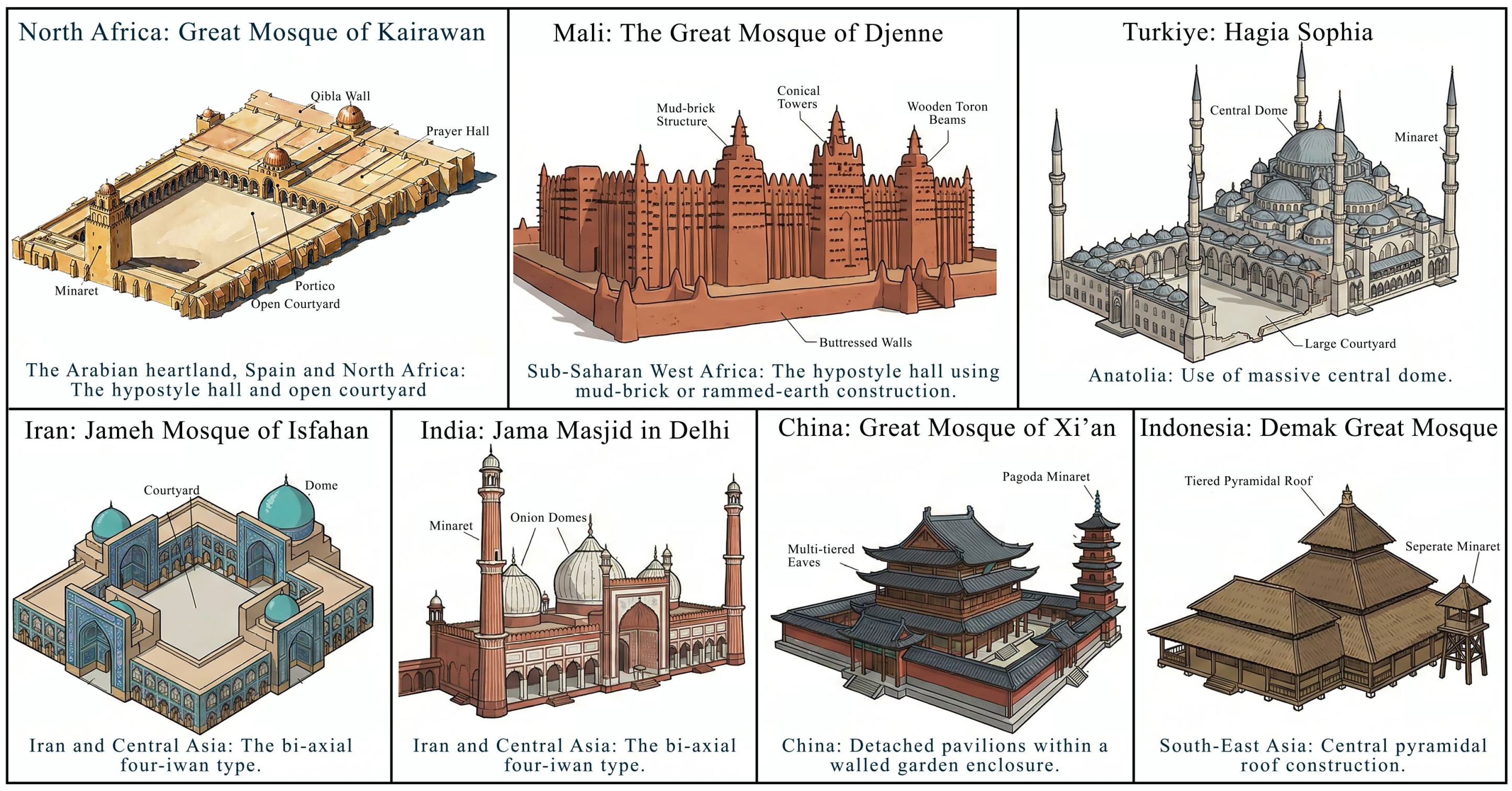
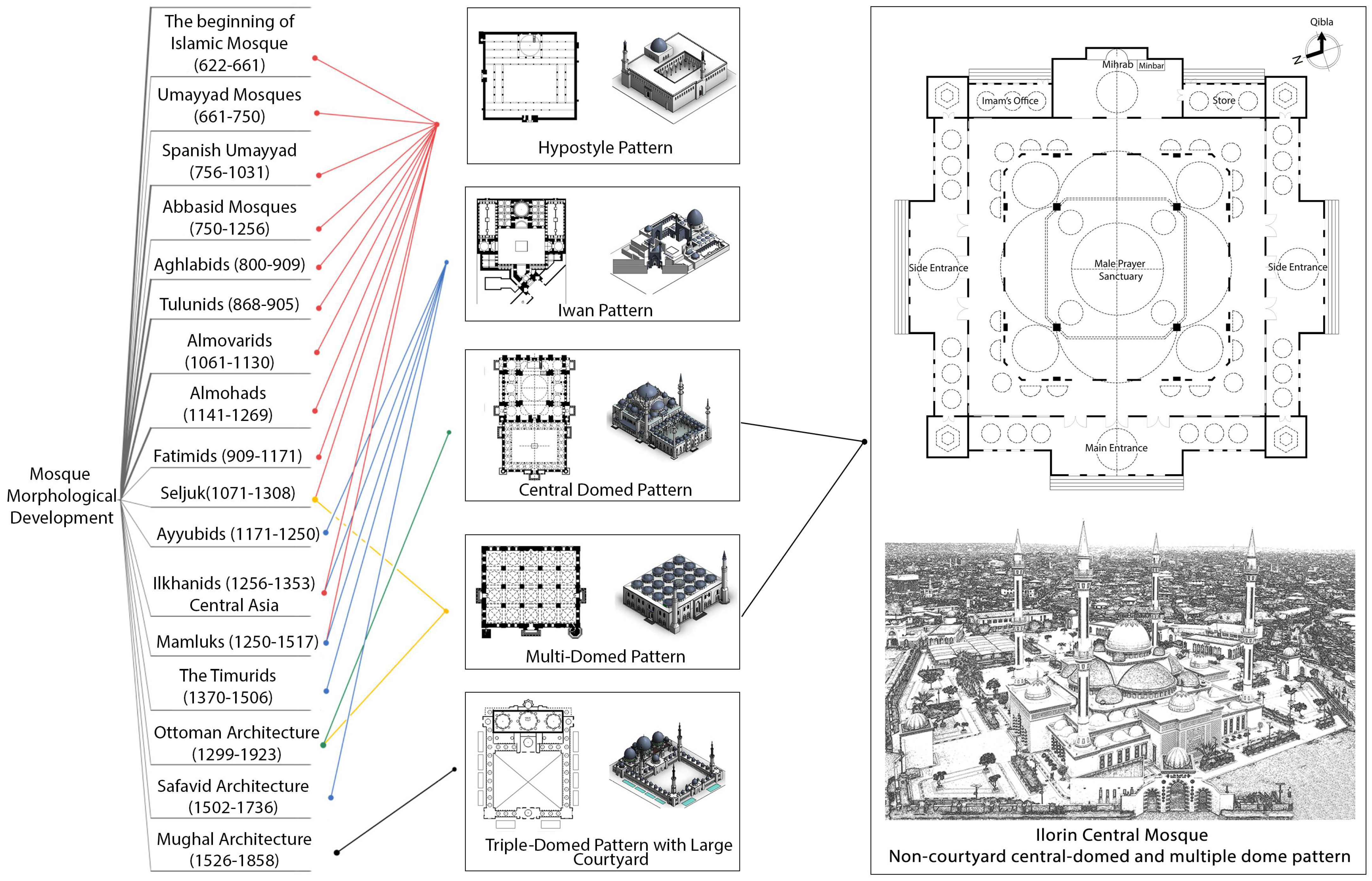
The evolution of the mosque, the quintessential architecture in Islam, is predicated on the establishment of the first Mosque by the Prophet Muhammad (PBUH) and his companions in Madinah in 622 CE. The spread of Islam facilitated the adaptation of mosques to diverse regional architectural traditions, creating variations in style, elevation, and layout. Mosques have historically served as representations of their respective locations, with their architectural forms and details exhibiting and reflecting the unique cultural, environmental, artistic, and social contexts of each locale [8]. Many studies have explored mosque classification based on chronological descriptions, typological and morphological analyses, producing varied categorization based on spatial configuration and distinctive architectural characteristics [9]. The historical corpus on the evolution and development of mosque architecture presents four basic architectural styles: the Arab hypostyle mosque, the Persian four-iwan mosque, the Indian three-dome mosque, and the Turkish central-dome mosque (Figure 1) [1,10]. Focusing on the chronological evolution of mosques from the seminal Prophet’s Mosque (622–661 CE) until the Ottoman Mosque style (1923 CE), a recent study classified the “typo-morphological analysis into five main types of mosques: hypostyle, Iwan, central-domed, multi-domed, and triple-domed with a huge courtyard” [9]. Emerging primarily from Western and Central Asia and North Africa, these styles continue to shape contemporary design of religious architecture. Other less-known, albeit less-studied, styles include distinct examples from West Africa, Southeast Asia, and China, which reflect regional differences, the traditional framework of building technologies and materials, and the long history of pre-Islamic local places of worship within each region [5,11].
Although extensive research has been conducted on the evolution of mosques in Egypt, Turkey, and India, including analyses of minarets and mihrabs, the mosques of Sub-Saharan Africa remain largely overlooked in the academic literature [12]. Existing scholarship often bifurcates Sub-Saharan West Africa as an example of a non-Muslim context, even though Africans constitute a third of the world’s Muslims, with Nigeria being one of the five countries with the highest number of practitioners. Recent studies reflect a literary bias by overlooking the mosques in Sub-Saharan Africa. For example, Ahmed and Fethi [13] purported that there are only “six traditional typologies”, blatantly excluding Sub-Saharan Africa. While famous examples, such as the Great Mosque of Djenné, have been selectively valued in some studies, the vast majority of mosques in Nigeria are ignored and less documented, particularly how the canonical style was reinterpreted and expressed through local idioms until the contemporary period. This study focuses on mosque architecture in West Africa, particularly Nigeria.
In addition to the understudied regional variations, a growing number of studies continue to explore the myriad phenomena of socio-cultural rupture and disconnection from the historic style to the modern prototypes, especially during the colonial and post-colonial periods. In addition, the design and management of mosques face criticism for lacking sustainability and promoting socio-spatial injustice, as they are predominantly male-oriented or “gendered” spaces [14]. According to Khan [5], “ruptures in the continuity of borrowing and uses of the past, the symbolic language of architecture, can be detected in all regional Islamic cultures” (p. 110). Over the past two centuries, mosques have increasingly created complex issues central to any discussion about their future, such as “the representation of identity, foreign influences on form and architectural trends, and the social-cultural role of the mosque” [8]. Although certain elements remain universal, the architectural forms, materials, and decorative styles of mosques have undergone significant transformations. Most anthologies of mosque architecture rely on aesthetic qualities to define the historical legacy, its evolution in the modern era, and the way forward [15].
Furthermore, several studies have highlighted the “shifting paradigms” and significant changes in the functional and formal aspects of many modern mosques [5,16]. Other studies frame this concept as “mosques-as-monuments” or “mosques as tools”, which have been examined in the contexts of Central Asia, the Arabian Peninsula, and Southeast Asia [17]. The modus operandi has shifted towards aesthetics, glamor, architectural supremacy, and ideological symbolism rather than functionality [10]. In particular, many mosques have become “the symbol of nation that is significantly built in monumental scale isolated from the urban fabric” [18]. While the emphasis on human scale and proportion in mosque architecture has been pivotal throughout history, this focus is diminishing in contemporary settings, adversely impacting the psychological comfort and sense of place experienced by worshippers. However, how these concerns translate to the Nigerian context has received little attention. Most studies focus on unique historical examples, often neglecting the evolution of architectural manifestations and production until the current era.
This study explores the evolution of a representative mosque in Ilorin, an important Islamic center in West Africa. The analysis focuses on the historical, cultural, and architectural trajectory from indigenous building traditions and colonial influences to contemporary Islamic identity expression. Examining the Ilorin Central Mosque is important because of its critical role as a local religious architecture where traditional Yoruba forms, Sudano-Sahelian techniques, and modern construction technologies converge. Less is known about the layered architectural history, aesthetic choices made by communities, and the resulting architectural syncretism or erosion of traditional knowledge. An essential inquiry pertains to how external factors and transnational Islamic aesthetics influence the design of religious architecture and spatial organizations. There is a need to explore how factors such as transnational symbolism, facilitated by worldwide, regional, and local networks, have refashioned architectural manifestations in Nigeria.

2. Literature Review

2.1. The Archetypal Principles of Sustainability, Function, and Symbolism

The archetypal principles derived from the practices and teachings of Prophet Muhammad (PBUH) emphasize a holistic approach to mosque function and design, extending beyond a mere place of worship. The first mosque built by the Prophet in Madinah and its expansions in the early decades of Islam serve as an exemplary model for understanding the principles of sustainability, multifunctionality, spatial layout, decoration, materials, and construction techniques. The Prophet and the entire community of believers participated in the construction of the mosque, highlighting the importance of collective effort and humility in Islam. In the early formative stages, the architectonic form was rather simplistic and minimalist in nature, consisting of a hypostyle hall with an open courtyard that primarily served the functional need to accommodate the congregations of the first Muslim state. Nonetheless, the Prophetic principles did not hinder the mosque from being effectively “simple but practical, frugal but durable, and handsome but neither distractive nor pretentious” [19]. Historians have emphasized the significance of the “willed austerity”, “starkness”, and “pristine simplicity of the earliest Islamic worship”, which continues to reverberate through the forces of revivalism and pietism [20].
According to Ayyad [19], “it may seem surprising, however, that the conventional belief is that the mosque of the Prophet and those built in the time of the Rashidun caliphs (11-40/632-61) were void of most characteristic architectural elements of classical mosques”, such as domes and minarets (p. 131). Scholars have discussed the legality of integrating such elements and decorations in mosques, with divergent and dialectical attitudes toward the elaboration of architectural features. Although the Prophet’s Mosque did not originally feature a minaret, minbar, or miḥrab as currently understood, it encompassed the foundational aspects of these enduring components of mosque architecture. Kamal [21] discusses the evolution and historical development of minarets, highlighting that the architectural elements were initially constructed for monumental purposes. However, they subsequently acquired symbolic significance and became enduring features of mosque architecture.
Moreover, constructing a dome was not a factor in the construction of mosques during the first 30 years in Madinah, Kufa, and Basra. Historical sources indicate the presence of a large green dome in Muawiya’s Palace in Damascus, al-Khadra (the Green Palace). Other scholars have proposed that the Green Palace was not a new building but a remodeling of the Byzantine Palace [22]. The Dome of the Rock, completed in 691–692 CE under the Umayyad Caliph ‘Abd al-Malik, is one of the earliest references for such features in Islamic architecture. In terms of functional mosques, the Great Mosque of Damascus, completed in 715 CE, incorporated domes, minarets, and decorations as part of its design, making it the first major congregational mosque with such elements integrated into the prayer hall [21]. From these beginnings, high domes and minarets became a canonical element of mosque architecture across the Islamic world and usually went uncriticized by contemporary ulema, especially when they were privately funded [19].
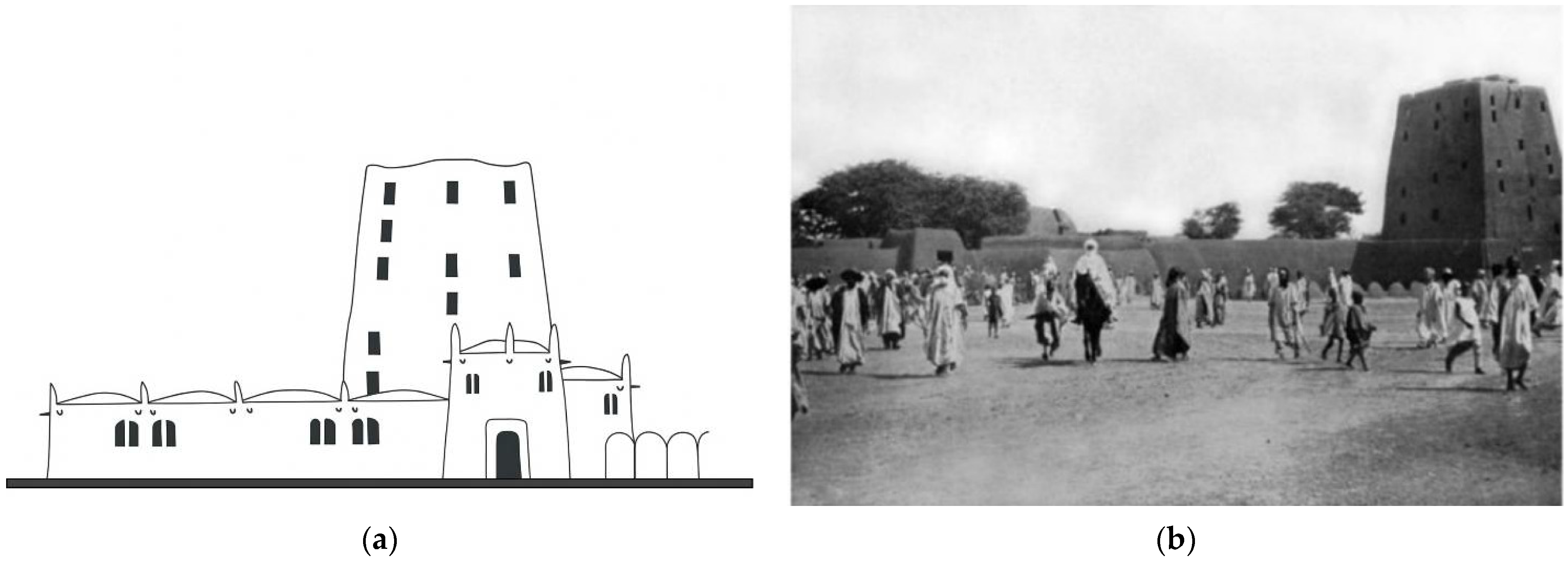
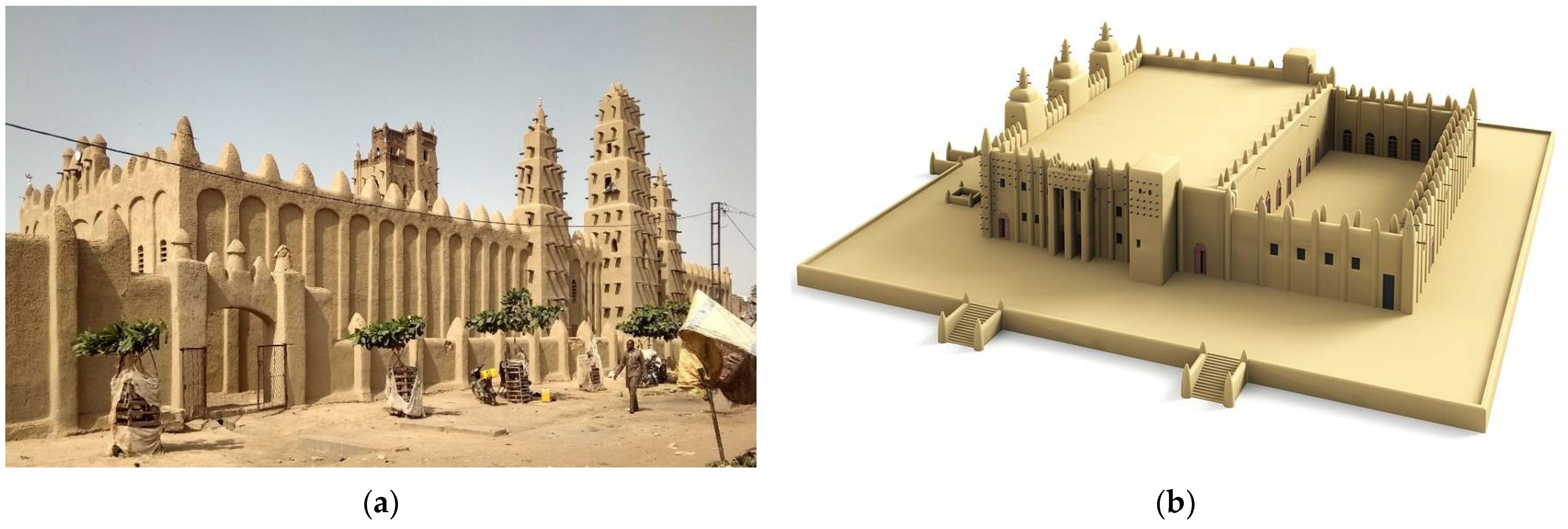
The Maliki school of Islamic jurisprudence, to which most Sub-Saharan West Africans adhere, holds that mosque decoration constitutes an objectionable religious innovation (bid’ah). This perspective is grounded in the belief that neither Prophet Muhammad nor the first generation of exemplary Muslims (sahabah) engaged in such practices [23]. Recent studies have highlighted the architectural significance of mosques constructed using traditional techniques and ephemeral materials such as local mud bricks. Notable examples include the Great Mosque of Djenné and Niono in Mali (Figure 2), which are among the few edifices erected in the last century that demonstrate exceptional design in relation to the regional climate [24,25] and align with Islamic teachings on Khalifah (environmental stewardship) [26,27]. As one of the prominent examples of adobe religious architecture in Nigeria, the Great Mosque of Kano, dating back to the 15th century, incorporates similar material but with a different form characterized by a tower style called “sumi’a” or “hasumiya” (Figure 3). The approach represents one of the ideal characteristics of green architecture: low cost and low carbon emissions, which are currently being re-evaluated for contemporary applications [28,29].
Omer [23] discusses the legitimacy, permissibility, and juristic views of mosque decoration, highlighting several hadiths and Quranic verses that support or oppose its incorporation into religious structures. The Prophet admonished against extravagance, boastfulness, distraction, and the imitation of non-Muslims [19]. Some teachings of Islam can be deduced as explicit prohibitions against wastefulness, injustice, harm, misappropriation of wealth, arrogance, ostentation, and similar behaviors, both in private and public properties [23]. Several hadiths warn against the pursuit of building high and lofty mosques, linking this trend to a potential decline in religious sincerity and a sign of the Day of Judgment [31]. A critical narration states, “I have not been commanded to build lofty mosques.” Ibn Abbas then added, “You will certainly adorn them as the Jews and Christians did” [32]. These hadiths suggest that the shift from functional, simple places of worship to elaborate, decorative structures is a sign of misplaced priorities in Muslim communities. The term “high” signifies extravagance and wastage in construction, in contrast to the Prophet’s life, which is an example of moderation, resource conservation, and waste abhorrence [31]. Another narration states that Prophet Muhammad said, “The Hour will not be established until the people compete with one another in building mosques” [33]. Nonetheless, some scholars maintain that adorning mosques is permissible in principle, provided it adheres to the overarching guidelines governing such decorations. Specifically, the embellishment of mosques should not overshadow their primary function. Given that the appreciation of aesthetic objects is an inherent human trait, it is imperative that the pursuit of beauty and mosque decoration does not occur at the expense of other societal facilities and services. Thus, mosque decoration is deemed acceptable when it is integral to the structure and functionality of the building’s design.
It can be extrapolated that mosques should prioritize function, utility, and community benefits over grandeur or the symbolic expression of power [31,34]. Thus, the size and overall physical appearance of mosques are of secondary importance and become significant only when they align with the enhancement of individuals’ spirituality and contribute to creating an environment that promotes solidarity, equality, and brotherhood among all Muslims [23]. This aligns with the historical precedent of the Prophet’s Mosque in Madinah, which was a modest and practical structure designed to serve the essential needs and requirements of the growing community. The trend of building grand, monumental mosques, often isolated and relying on foreign architectural styles, contrasts with the Sunnah’s emphasis on moderation and humility and can be considered as wasteful in nature. Regional designs that integrate with their surroundings and prioritize openness and natural elements better represent Islamic principles and sustainable identities than monumental structures [31].

2.2. Contemporary Mosque Architecture: Challenges of Globalization Trends and Funding

Similarly to other buildings, mosque architecture has witnessed a shift from vernacular to global styles, culminating in significant worldwide changes. Consequently, current architectural expressions fail to accurately represent the values inherent in Islamic societies [35]. One of the main issues is the dialectical relationship between architecture and culture with regard to mosques and their contextual relationship with urban and social content [2]. Contemporary trends, driven by industrialization, easy transportation, and mass production of building materials, have led to the global adoption of similar architectural styles. These designs often imitate structures and layouts from famous Islamic civilizations, serving as symbols of grandeur, power, or magnificent architectural beauty, sometimes without sufficient consideration of local climatic requirements [24,36].
A major trend is the chasm between the history and future, as well as the situational, temporal, and spatial contexts of mosque architecture. These factors have profoundly impacted mosques over the last two centuries, causing confusion in their visual, urban, and technical aspects [8]. Contemporary mosque architecture increasingly incorporates modern materials such as reinforced concrete, glass, and steel, enabling innovative and complex structural designs, larger spans, and previously unimaginable unobstructed spaces [37]. Such innovation allows for the reinterpretation and synthesis of forms and aesthetics. However, technology has also exacerbated deliberate scale exaggeration and monumentality at the expense of the horizontal dimension, thereby increasing embodied and operational carbon emissions.
With the increase in scale, materiality, and adaptations of modern mosques, the need for substantial funding, patronage, and post-occupancy management arises. Modern mosques are commissioned by a wide array of clients, ranging from national and local governments to community groups, wealthy private individuals and rulers, businessmen, and Arab princes. Research has demonstrated that funding and financial resources significantly influence the size, form, style, construction, architectural elements, and details of mosques [6]. In newly formed states, particularly post-colonial creations, mosque-building projects have been increasingly integrated as part of master plans at various scales to express sovereignty, nationality, and modernity and to define the state in modern Islamic terms [5]. As illustrated by recent examples such as the Sheikh Zayed Grand Mosque in Abu Dhabi, the Hassan II Mosque in Casablanca, and the Great Mosque of Algiers, significant funding can lead to lavish, monumental, and technologically advanced mosques, often considered as symbols of grandeur and architectural beauty [38].
While the funding and management of mosques may not pose significant challenges in Gulf countries and certain regions of the Arab World, the relatively small Muslim population and their non-dominant status in Muslim-minority communities often lead to inadequate financial resources for mosques. This is particularly evident in contexts where state funding for religious buildings is unavailable or prohibited. Many mosques in non-Muslim contexts have historically depended on internal income streams such as donation boxes from congregations, membership fees/regular contributions, donations and appeals, sponsorships, and wasiyyat (contributions from monthly income). These primary sources fund new mosque projects, often supporting simple designs, sustaining operations, and facilitating diverse activities and robust management [39]. Beyond the construction phase, financial constraints pose a significant challenge for mosques in terms of post-occupancy sustainability, which affects the effectiveness, aesthetics, and functional attributes of religious designs.

3. Materials and Methods

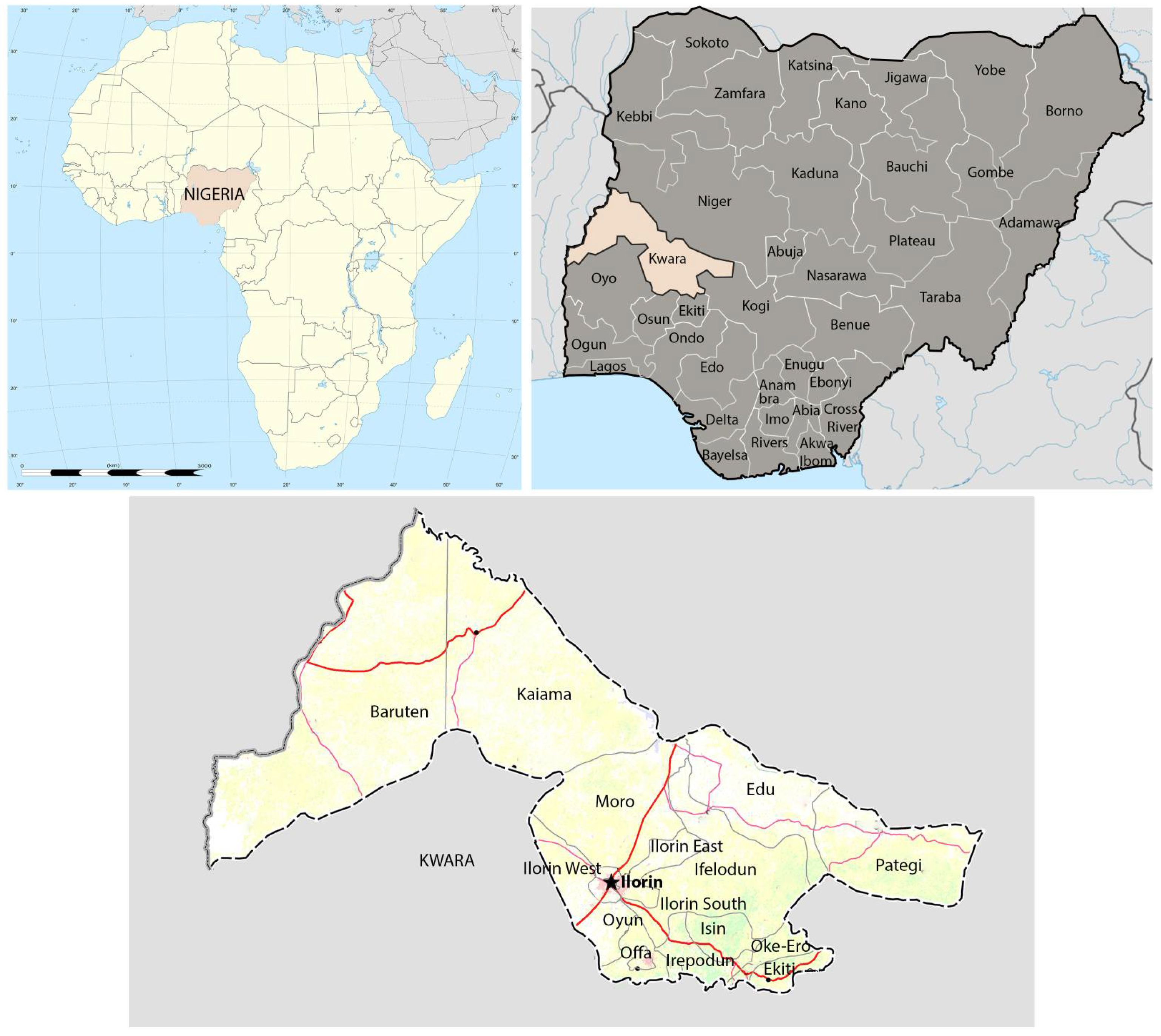
This study employs a qualitative research methodology, utilizing a case study approach and multiple data collection methods involving primary and secondary data sources, including historical research, document analysis, archival studies, and field observations to explore mosque architecture in Nigeria. The Ilorin Central Mosque in the North-Central region was analyzed as a critical case study because of its interstitial context, serving as a transitional zone connecting the north and south and the multi-cultural and multi-ethnic ensemble (Figure 4). In the first stage, data were collected through an extensive literature review of previous studies, including reports and scholarly compendiums on the historical development and typologies of mosques until the modern era. In addition, art is not created ex-nihilo without the complex relationship between multiple forms of representation and the resulting architecture [40]. The analysis also provides a general overview of the building context within specific socio-historical, cultural, economic and technological settings [41]. This approach is particularly relevant to this research, as it allows for a contextual understanding of how the architecture and meaning of the mosque change over time relative to the circumstances of cultural exchange, shifting identity, and globalization.
The authors visited the mosque for documentation and collection of primary data on the architectural language and the overall urban context. During the fieldwork, the authors utilized field notes, annotated sketches, and high-resolution digital photographs. The decorative details of the exterior and interior spaces were compared to discern the changes that occurred in different periods. Of importance to the site visits were the architectural style, materials, and spatial and aesthetic qualities of the modern structures. Integrating immersive on-site observations with informal engagement with worshippers was crucial for correlating architectural typology with significant social and economic events. Detailed narratives were compiled regarding design intentions, symbolic meanings attributed to architectural forms, sources of funding and foreign influence, functions after occupancy, and the community’s perception of the mosque’s image. The fourth stage focuses on synthesizing the collected historical, architectural, and morpho-typological data. The insights from this analysis were integrated to identify the influence of culture and the tension between local identity and foreign architectural models.

4. Results

4.1. Background History of Islam and Central Mosques in Ilorin

The history of Islam in Ilorin is convoluted, with no exact date in historical sources, but many studies highlight the impact of itinerant scholars and traders who proselytized Islam throughout West Africa. It is believed that a small Muslim settlement inhabited Oke Sunna in Ilorin before the 17th century CE. Historical sources indicate that early Muslims initially worshiped in open spaces, sometimes demarcated by stones, sandy soil, potsherds, ropes, or thorny branches, often under natural trees [42]. Mosques in Yorubaland have adopted a similar functional approach until the present epoch. Jawondo [43] buttressed this by acknowledging the spread of mosques across Ilorin town, with examples like the Agbarigidoma Mosque, established as a jiji mosque (open-space mosque) in 1741, and the Munambai Mosque established in 1811. With the establishment of the Ilorin Emirate in 1823 by Sheikh Alimi and his entourage, especially as a direct consequence of the Fulani jihad of the early 19th century in Sokoto [44], one can argue that mosques became a physical symbol of the new theocratic state. Ilorin gained significant momentum as a powerful Islamic center, thus becoming the foremost city for the dissemination of Islam in Yorubaland [45]. Thus, the prevalent urban project focused on building and maintaining mosques to foster the Islamic faith and accommodate the spiritual needs of the nascent Muslim communities.
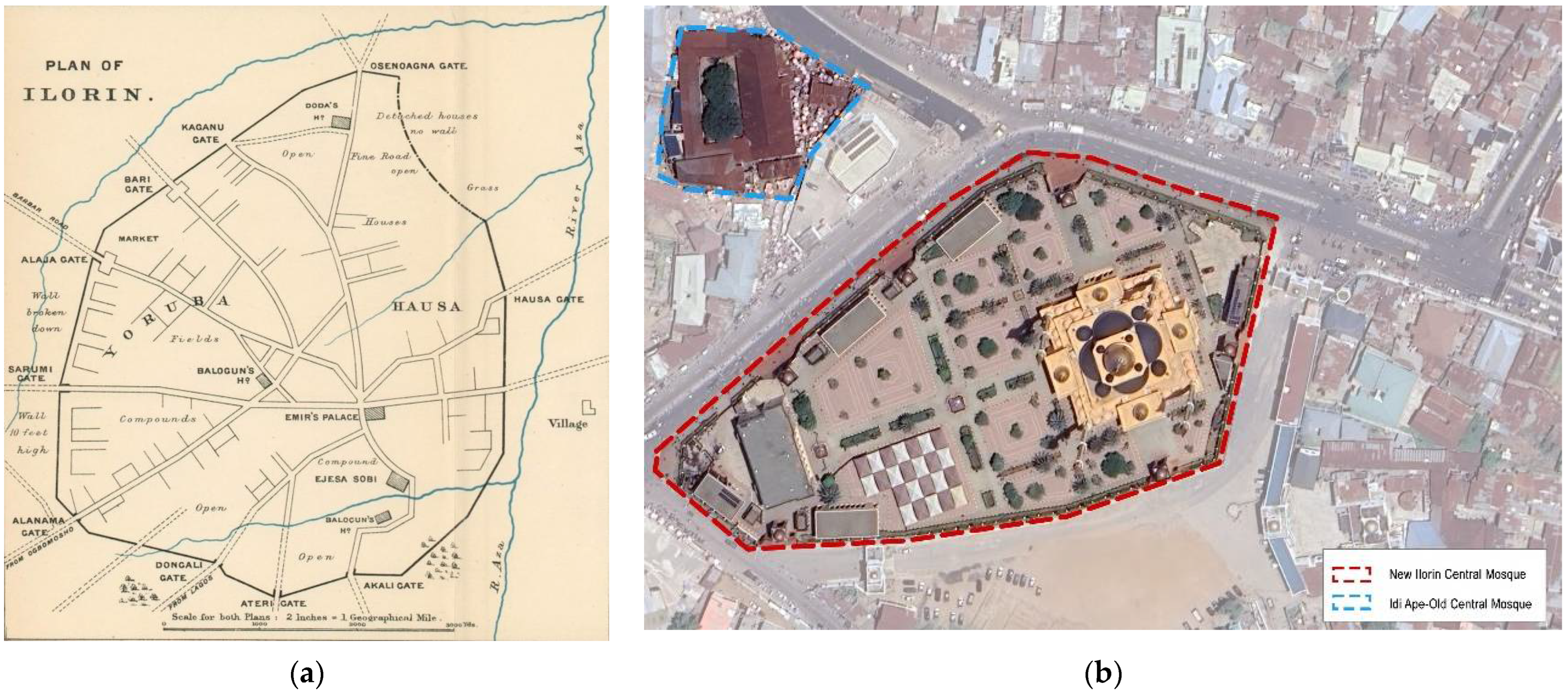
The city of Ilorin occupies a distinct position in Nigeria’s religious, geographical, and political landscape, forged by the confluence of Yoruba and Fulani influences and cultural identities. Specifically, the city is unique as the only Yoruba-majority city established as a Fulani-led Emirate. Consequently, the urban composition of Ilorin exemplifies the diverse influences of various Nigerian ethnic groups, including the Fulani, Hausa, and Yoruba, who resided in the historic center surrounding the Emir’s Palace and Oja-Oba (Emir’s Market) (Figure 5). Early Ilorin mosques did not adhere to a single rigid architectural style, even though they maintained traditional materials, such as simple mud structures with grasses for roofs and poles for pillars. In areas with a high Fulani population, mosques typically featured a round or circular plan, usually with one entrance and no indication of the qiblah on the wall [43]. Although the exact architectural details and imagery of this original structure are not documented, this style can be understood in the context of other typologies in the Futa Djallon region in Guinea, such as the Great Mosque of Dinguiraye. This correlation with broader African typologies highlights the widespread architectural influence and similarities between mosques across West Africa. In contrast, Hausa mosques were usually open, rectangular structures, whereas the Yoruba built closed rectangular buildings. These mosques share features with other mosques in Ibadan and Lagos, Nigeria. Nonetheless, it can be argued that the different typologies functioned as neighborhood mosques and were relatively dispersed throughout the city.
For the historiography of the official congregational jami’ in Ilorin, oral and historical compendiums indicate a series of provisional Friday services in Shaikh Alimi Mosque at Ori-Oke, Munambai Mosque at Oke-Kura, Makana Mosque, and Idi Ape Mosque between 1820 and 1870. It is possible that the extraordinary growth of the Muslim community enforced the development and constant change in official Friday mosques. Idi Ape Mosque was chosen as the first permanent Central Mosque in 1870, establishing a multilateral relationship with the administrative (Emir’s Palace) and commercial settings (Oja-Oba). It continues to receive royal patronage for expansion and renovations. Similarly to other central mosques in Nigeria, the Idi Ape Mosque, also referred to as the Old Ilorin Central Mosque in recent decades, evolved as a venue where Emirs and Muslim dignitaries perform Salat al-Juma services, thereby fostering a closer connection with the community.
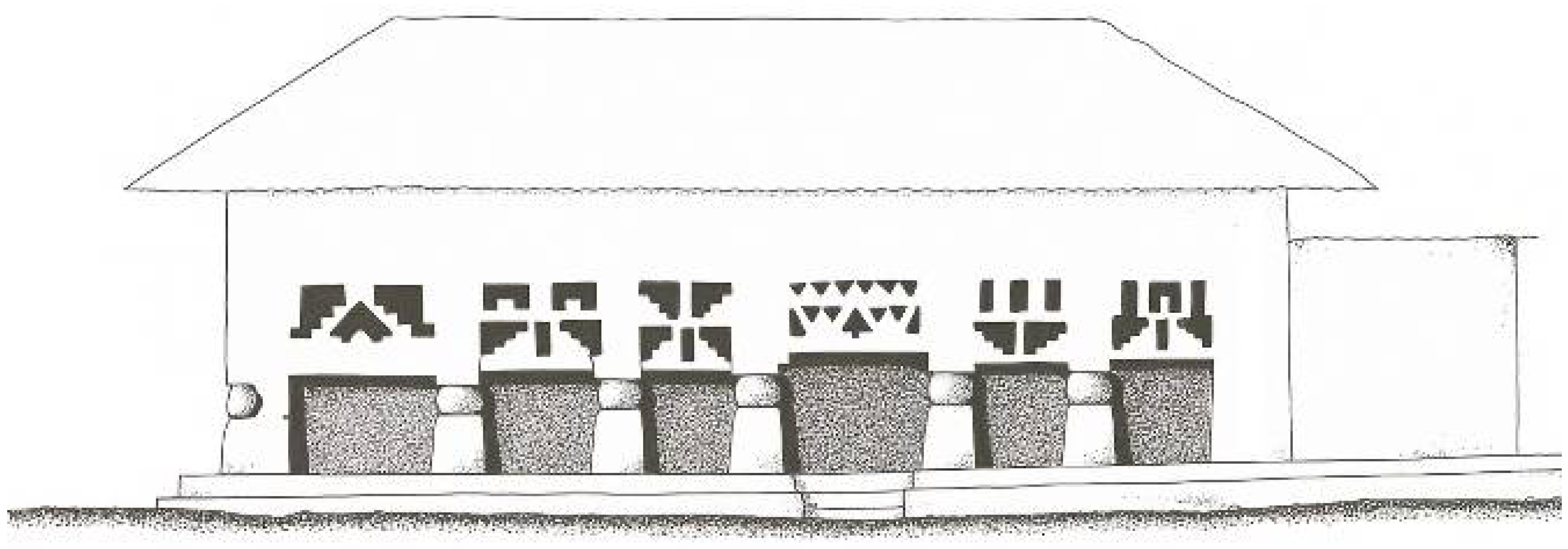
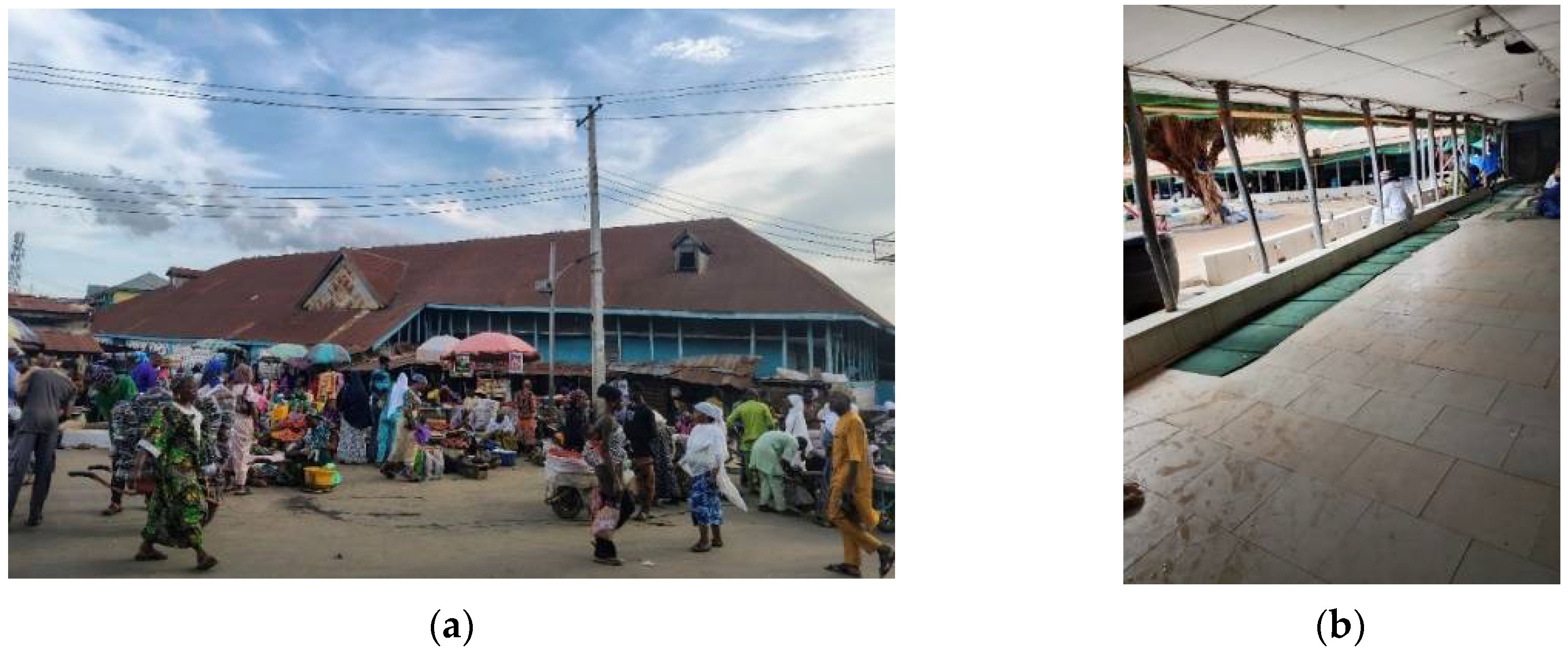
The earliest architectural evidence indicates that the mosque incorporated a typical unadorned mud and roof structure without minarets or domes (Figure 6). One can deduce the physiognomy of the building as executed by ‘architecture without an architect.’ Unlike contemporary construction paradigms, buildings were usually constructed through the collective efforts of the community, with men and youths engaging in the building while children and women sourced water for builders and worshippers. This approach is still evident in the annual replastering of the Djenné and Niono Mosques in Mali during the Crepissage Festival [25,47]. In addition, the symbolism on the facades was rooted in the immediate cultural setting rather than imitating global influence.
After a century of use and continuous expansion, the 19th-century Idi Ape Mosque could no longer cope with the massive growth of Ilorin’s Muslim population and was considered obsolete. Recognizing this need, the ambition for a new central mosque started in 1974 when Alhaji (Dr.) Zulukarnaini Gambari, the ninth Emir of Ilorin, spearheaded the fundraising for a new building that matches Ilorin’s increasing reputation as a city of Islam. The foundation for the new Ilorin Central Mosque was laid on 30 April 1977, on a site adjacent to the old one (see Figure 5). It is important to note that congregational Salat al-Juma continued to be held at Idi-Ape Mosque during the construction phases until 1981, when the new building was completed. The Idi Ape Mosque was reported to have been demolished afterwards and probably reconstructed in a similar style, which may account for the changes in the form as we see it today (see Figure 6 and Figure 7). Nonetheless, the mosque has gained specific appreciation from citizens who have attached heritage and sentimental value to the site. The community usually reverts to the old mosque for special prayer.
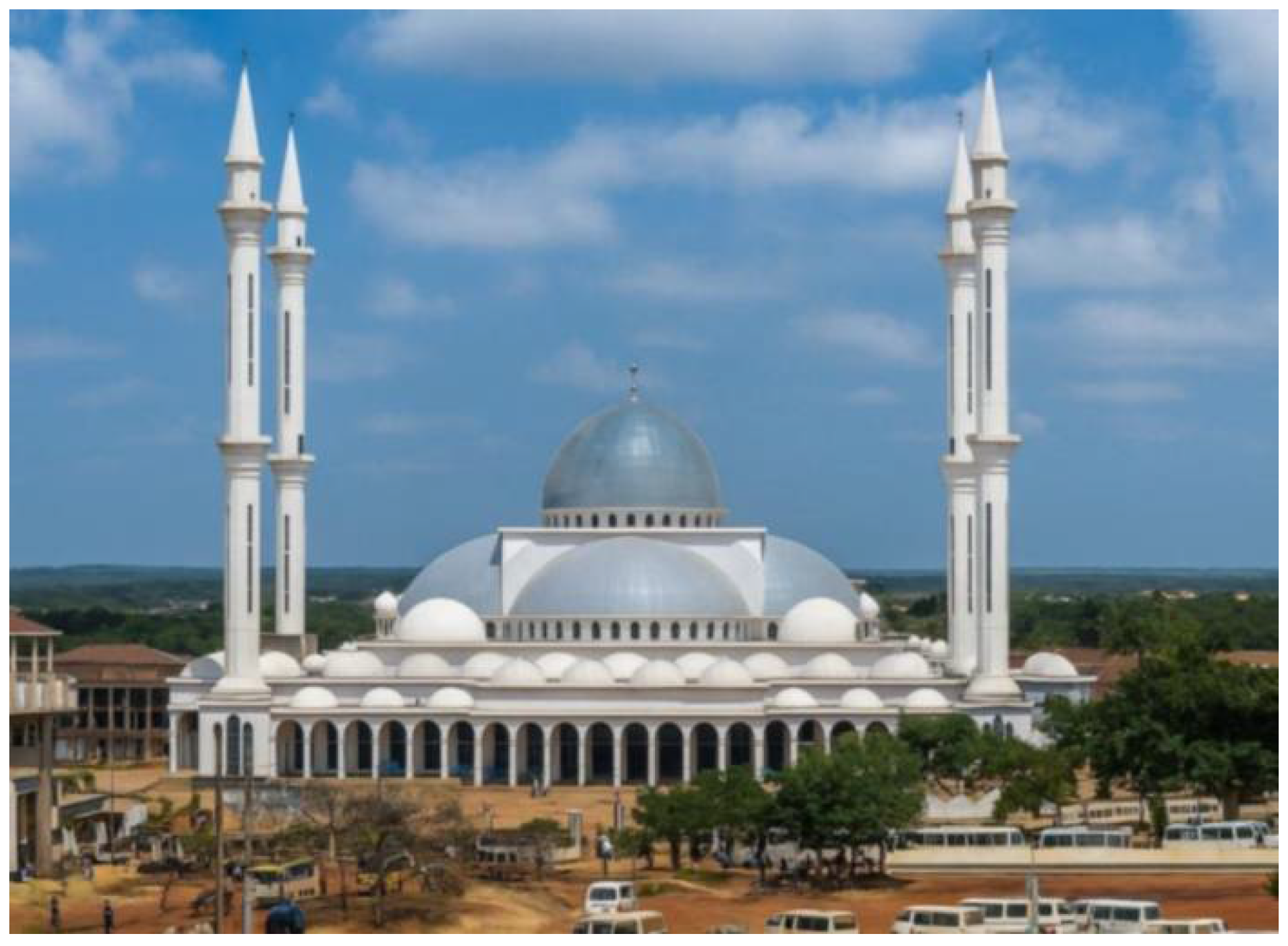
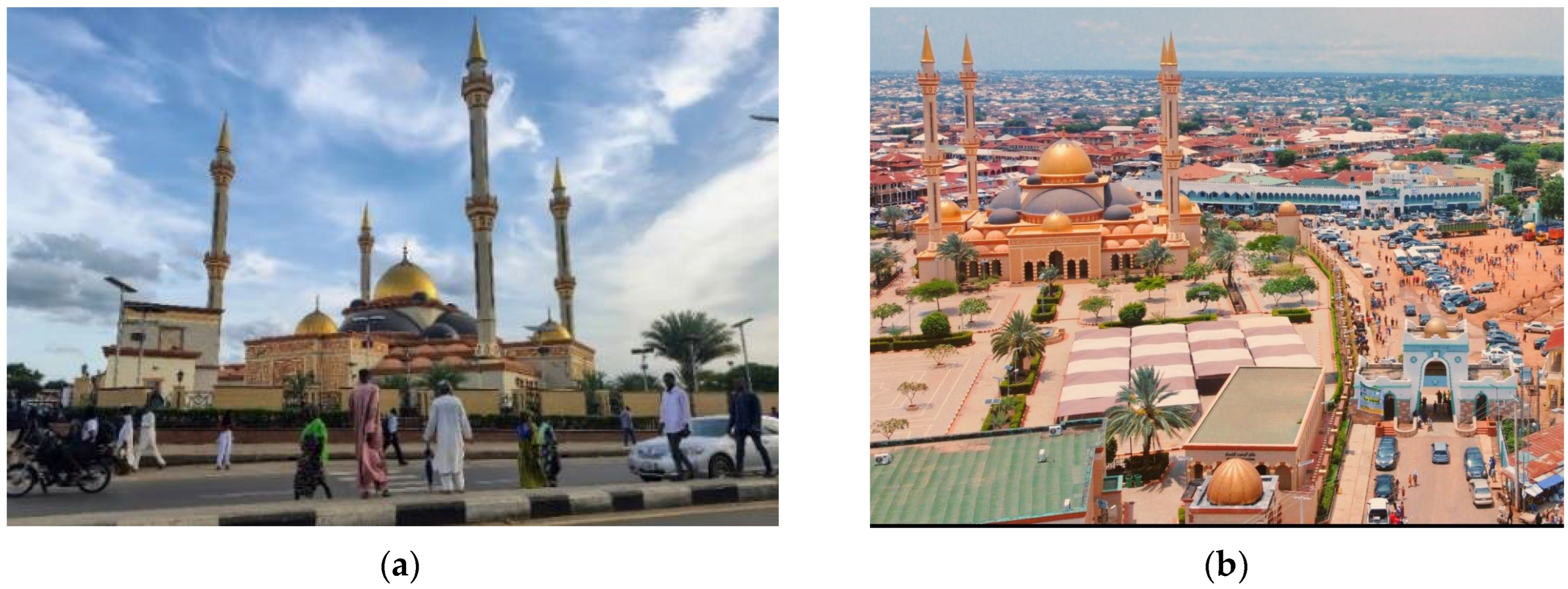
The physical manifestation of this new central mosque reflects the broader acculturation of architectural influences in the 20th century. The new edifice, costing ₦2.5 million (approximately USD 4.1 million) in 1981, was a major leap in terms of scale and design. The structure serves as the principal monument within the city, representing the architectural patronage of the ruler. It also serves as a venue for royal ceremonies and public Eid parades. The mosque’s defining elements are its minarets and 99 domes of varying diameters, importing Ottoman-style imagery into a different context in West Africa (Figure 8). The architectural form is layered with the cascading effect of multiple domes from the outer axis to the central piece 22 m above the floor. In addition, the mosque has a square plan with accentuated entrance porticos and four accessible minarets with a height of 145 m for vertical emphasis. At the time of its opening, it was considered the best of its kind in Nigeria and probably in Africa. Thus, religious architecture reflected a new status and aspiration for excellence and prominence, signaling Ilorin’s emergence as a major spiritual hub on the national stage. Doi [42] articulated this transformation as follows:
The Islamic mosque architecture of Saudi Arabia, Egypt, Turkey, Pakistan and India with some African design patterns of broken architecture pattern are becoming more and more evident. The Hausa mud towers are replaced by huge minarets and domes. The recent gigantic mosque in Ilorin city resembles Aya Sofiya Mosque of Turkey.
Figure 8. Ilorin Central Mosque, constructed in 1981, with 99 domes and four minarets [Source: Enhanced photograph produced by Mr. Saliu Badrudeen].
Buildings 16 00421 g008
In 2007, less than three decades after its initial inauguration, the gigantic mosque required restoration, remodeling, and redecoration to preserve the monument while transforming it into an ultra-modern edifice. In addition to the huge amount spent on constructing the mosque, another substantial expenditure was accrued for renovation, culminating in a total reported expenditure of ₦2.5 billion (more than USD 15 million) through fundraising. Moreover, the Muslim congregation reverted to the Idi Ape Mosque for Salat al-Juma services during the remodeling.
Between 2009 and 2012, a total of 16 specialists in mosque construction were recruited from various countries, including Saudi Arabia and the United Arab Emirates. These experts contributed to different aspects of the renovations, Islamic inscriptions, and calligraphy in collaboration with a Lebanese firm. Although the edifice retained its form, the multiplicity of domes was considered a major issue that contributed to the swift deterioration after less than three decades, and a decision was made to reduce their number. According to lead architect Arch Faworaja, the previous edifice had 86 little domes in the 1980s, which have been reduced to 60 but made more conspicuous with the remodeling. While mosque decorations should be integral to their structure and functionality [23], in this instance, it becomes a detriment to the mosque, with palpable impacts on its functional dimensions and long-term viability.

4.2. Contemporary Architectural Style of Ilorin Central Mosque in the 21st Century

Several critical aspects must be considered in a mosque, including the spatial layout, prayer halls, and decoration. For instance, the selection of construction and building materials should be appropriate for the surrounding area and the specific period of construction. Since architectural elements differentiate a mosque from other buildings, elements such as domes and minarets are also important for examining the transformation of the site boundary.
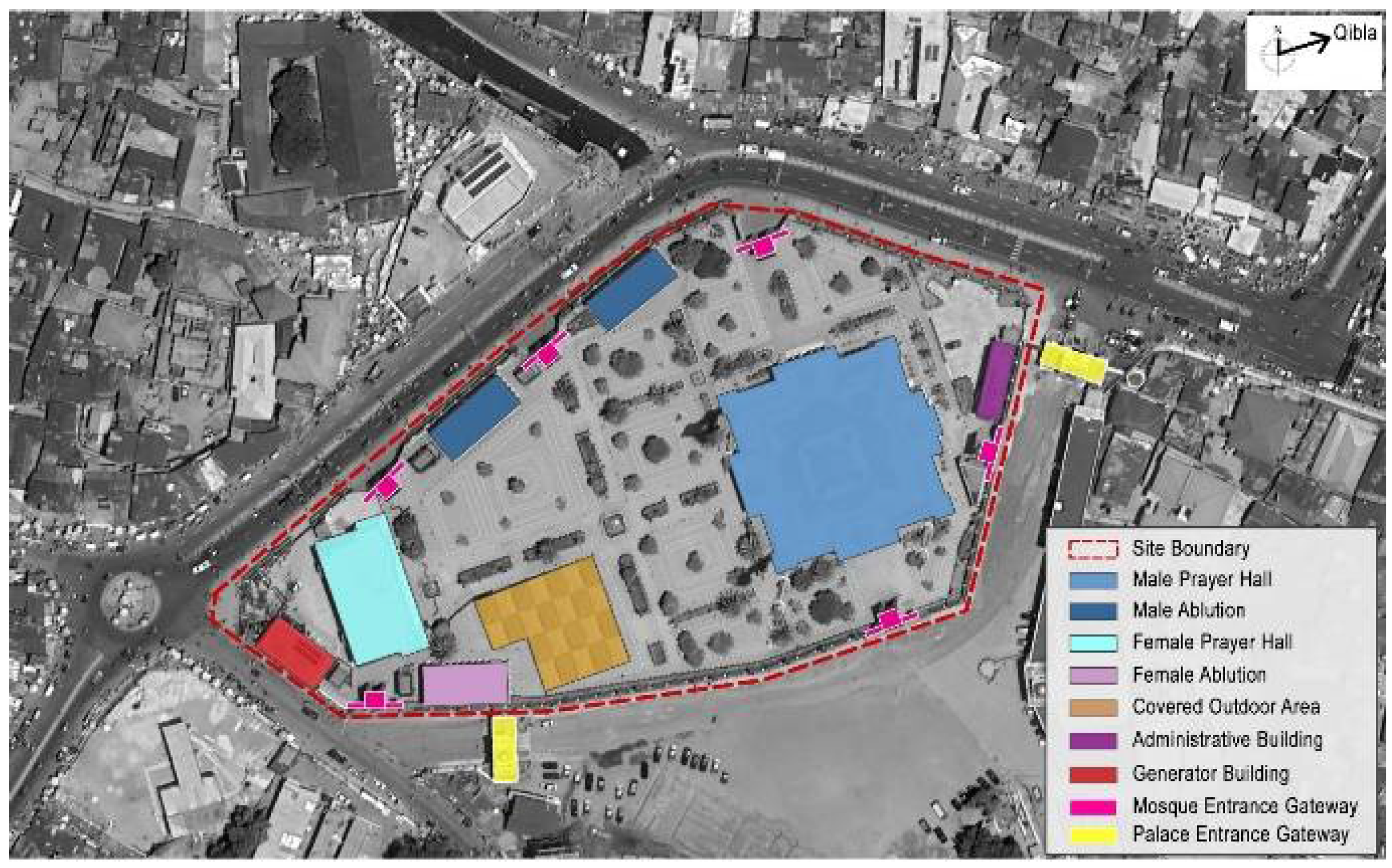
Because of the recent renovation, the mosque now has more functional spaces to enhance its importance to the community. In terms of spatial layout, the site boundary contains the male prayer hall as the centerpiece and the most prominent space oriented toward the northeast qiblah direction (Figure 9). A separate building has also recently been provided to accommodate female worshippers on two floors. The mosque compound now has additional educational facilities such as a modern hybrid library and research space, multipurpose hall, administrative hall, car park, and dedicated men’s and women’s ablution centers to accommodate the needs of worshippers. In light of the iconic reconstruction, the spatial layout integrates a large outdoor area to accommodate various activities within the premises. While the main prayer hall can only hold around 1000 male worshippers, the mosque and precinct can accommodate 20,000 congregants. This site effectively addresses the functions required by the users. In addition, the surrounding site has six decorated entrance gates that commemorate the Emirs, Islamic scholars, and influential political figures who contributed to the evolution of the mosque. These gates provide 24 h surveillance to ensure cleanliness and protection of the iconic mosque while limiting access to the site and its use by worshippers.
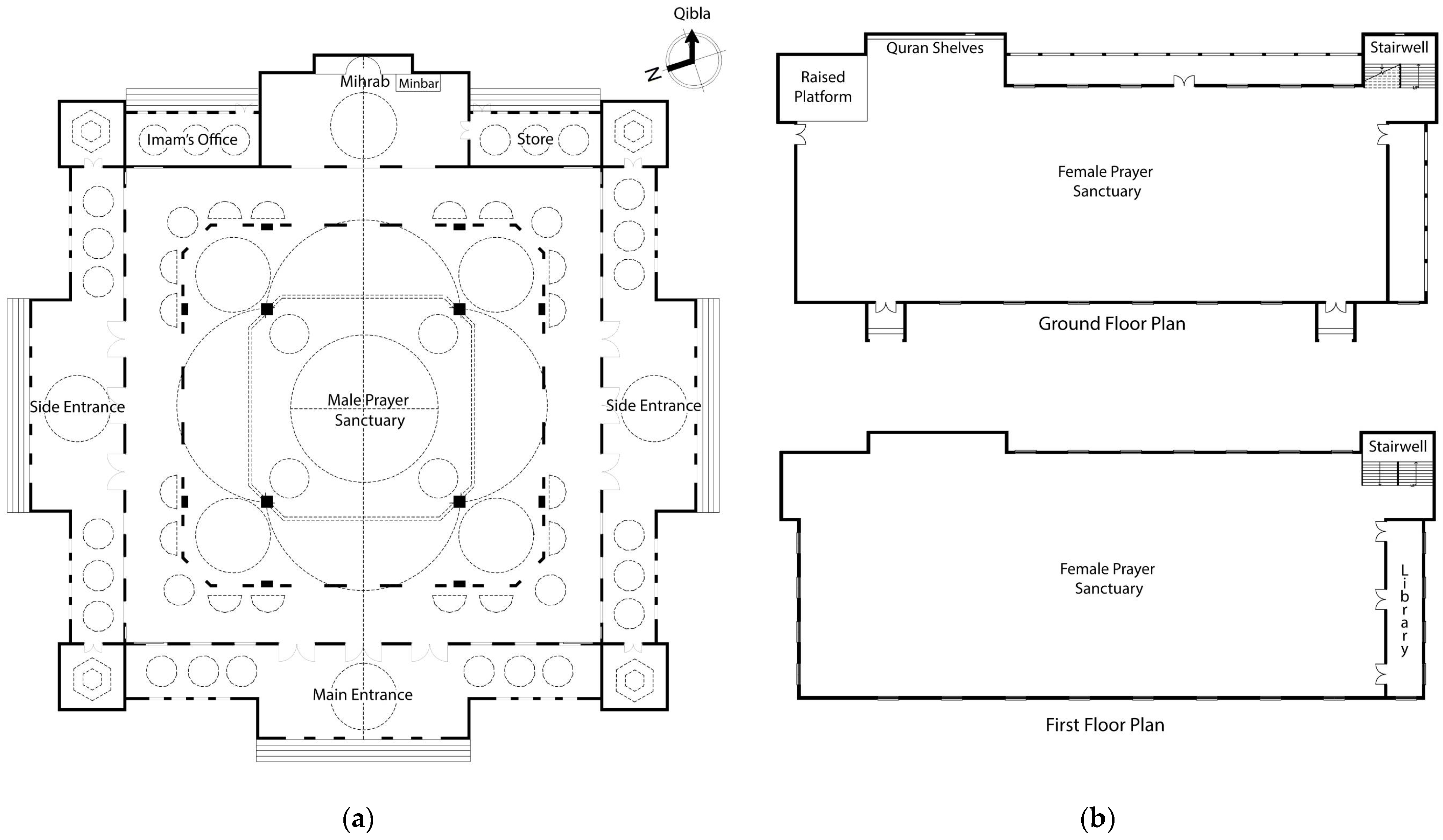
In plan, the main prayer hall is almost square and is surrounded by minaret shafts at the corners and entrance porticos in the middle of all the walls except the qiblah wall. In contrast to traditional mosques, which are usually rectangular, this new mosque utilizes the ordering principles of symmetry and repetition along the central axis. The structural stability is supported by four main columns and a series of arched walls that, in order to support the domes, create a huge obstruction of the view towards the minbar and mihrab. The contrast between the aggrandization of male and female spaces is evident in the floor plans of the buildings (Figure 10). While the male area is more sophisticated, the size of the prayer space is smaller (1490 sqm) compared to the female prayer space (1013 sqm and 1093 sqm on the ground and first floors, respectively).
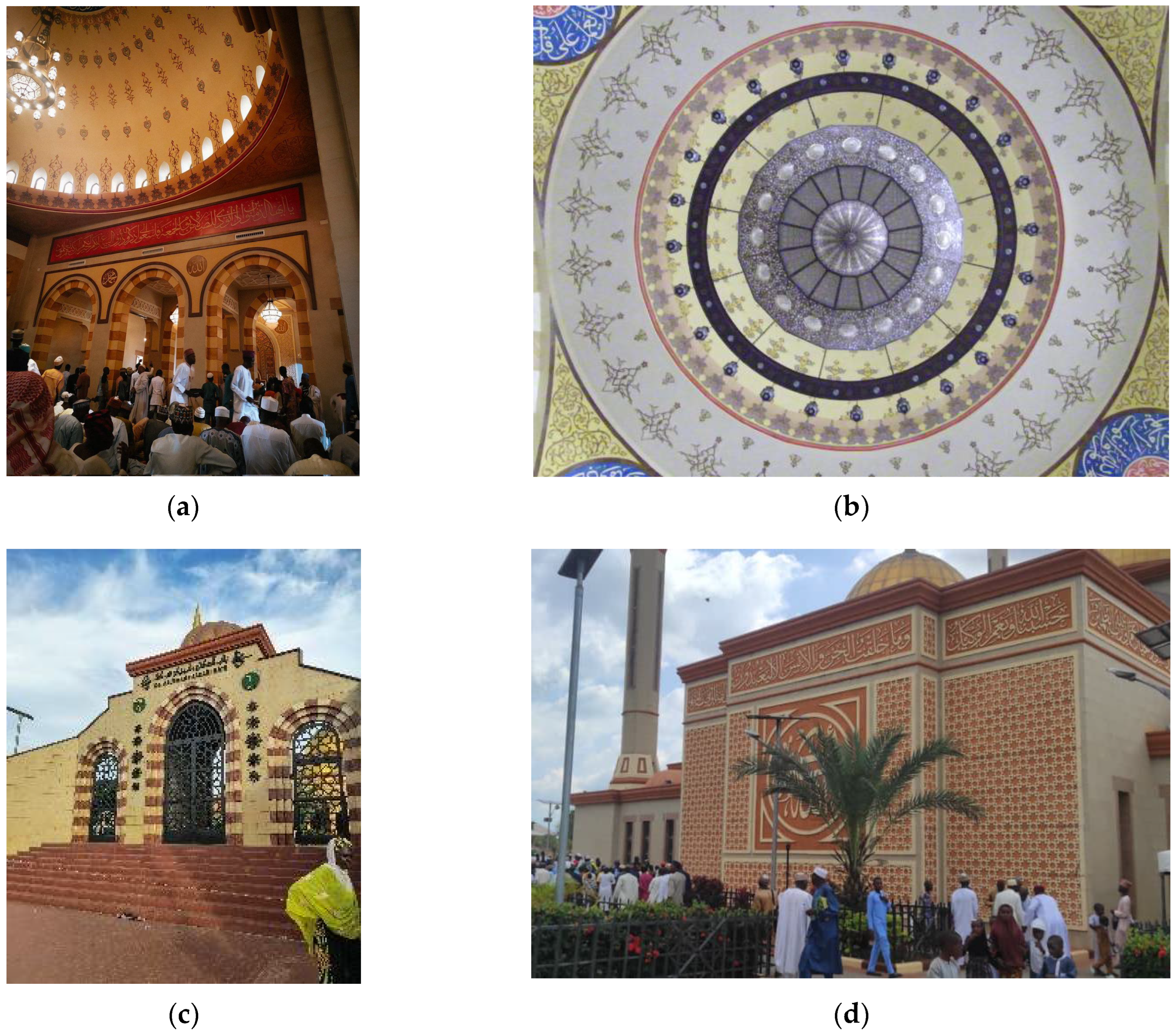
The mosque’s decorations are eclectic, imbibing features from various regions of the Islamic world. The new color selection for the Ilorin Central Mosque focused on cream and reddish-brown earth pigments on high-quality porcelain tiles, cut-to-size marble, and glass-reinforced concrete (GRC) ornamentation (Figure 11). The exterior walls have changed since the earliest models, when white and gray colors were used before reconstruction. For example, the surrounding palace maintains a white and green scheme, which has been associated with the concept of purity and Islam and can be traced back to the time of Prophet Muhammad. The enormous dome is gilded, and the four peripheral domes are coated with black reflective covers. The other domes have painted surfaces to decorate the reinforced concrete.
Some of the decorative elements include Islamic calligraphy, geometrical patterns, and ablaq (alternating rows of light and dark stone) marble, which contribute to the aesthetics (Figure 12). Similarly, the exterior and interior surfaces create a sense of grandeur that differs from the plain white textures. This modern design stands in stark contrast to the simple traditional mud structures of the 19th century. For example, the qiblah wall is extensively decorated with Islamic geometric designs. In addition, Islamic calligraphy was utilized in the mosque as a decorative element or symbolic expression, in contrast to its use to only denote the name of the artist, patron, and execution date in previous centuries.
It can be argued that this architectural intention is more of an aesthetic inspiration for an architectural masterpiece that attracts worshippers and tourists from near and far. Specifically, the emphasis on the architectural form and aesthetics of the mosque indicates a greater interest in their external appearance, often at the expense of their spiritual significance. Nonetheless, the broader architectural choice also failed to consider the long-term maintenance of the building. This appears to be a more grounded issue due to concerns about mosque maintenance and the overall use of the facilities. The capacity to maintain a largely foreign ensemble remains pertinent in terms of financial, human, and technical capabilities. Mosques in Africa face challenges associated with facility management, as newly built mosques deteriorate rapidly because of the absence of facility managers and sustainable funds to maintain them in suitable conditions [51]. In Muslim-majority countries, waqf practices provide a highly structured, perpetual, and often state-regulated mechanism for funding and maintaining mosques [52]. The waqf system in Nigeria is less formal, more localized, and less sustainable. It often depends on the goodwill of individuals, short-term charitable donations, and community leaders to keep the religious buildings in good condition.
Contemporary religious design has largely abandoned the passive durability of vernacular masonry, driven by the use of modern materials such as reinforced concrete, tensioned steel, and extensive glazing. Nonetheless, these new materials have introduced challenges related to the longevity of contemporary “iconic” mosques, which are now experiencing issues such as premature architectural aging, inadequate weathering properties, material degradation and functional obsolescence. Contemporary architectural structures are susceptible to distinct chemical and mechanical failures, which are further intensified by the severe climatic conditions prevalent in the Muslim world, often characterized by extreme temperatures, high humidity, and aggressive marine salinity. For instance, the historical Faisal Mosque in Pakistan has reached a level of deterioration juncture where the Pakistani state is no longer able to manage the asset independently, nearly 36 years after its construction. Recent reports suggest that the Saudi government, the original financier, has proposed to assume responsibility for the major renovation and mosque maintenance, effectively acknowledging the inability of local authorities to sustain the mosque [53]. Recent studies conducted in Erbil indicate that contemporary mosques constructed post-2003 exhibit markedly higher rates of cladding separation, exterior aging, and surface staining than their 100-year-old brick counterparts [54]. These instances of structural degradation highlight the unsustainability of large-scale concrete construction in developing economies, leading to maintenance liabilities that the local economy cannot service.
Among the numerous examples within Islamic societies, the Hassan II Mosque in Casablanca and the Great Mosque of Algiers stand out as contemporary mosques that have exhibited poor material durability and functional obsolescence over time. The Hassan II Mosque in Casablanca exemplifies the ambitious nature of modern mosque architecture. Completed in 1993, the mosque was constructed over the Atlantic Ocean to embody the Quranic verse stating that “God’s throne was built on water” and to create what has been referred to as the “eighth wonder of the world” [55,56]. However, the geographical location of the site resulted in unforeseen structural failure less than a decade after its completion. More than 50 percent of the foundation’s steel reinforcement experienced deterioration due to exposure to oceanic saltwater [38]. The reinforced steel rusted, causing the concrete cover to crack and spall off, exposing the reinforcement and concrete walls to even more rapid deterioration. Between 2005 and 2008, a substantial restoration project was undertaken to replace large sections of the structure and doors and infuse stainless steel to prevent further deterioration of the structure. The inadequate selection of materials and site planning has resulted in financial liability for the restoration and protection of the building. Despite recent efforts, a significant concern regarding the structure remains its stability against seismic activities that are common at the surrounding sites. In terms of function, many people consider the mosque as a tourist attraction rather than a typical religious building.
The Great Mosque of Algiers was constructed between 2012 and 2019, reflecting political aspirations for monumentality in a state-sponsored mosque. As a direct regional competitor to the Hassan II Mosque, a significant impetus for the mosque’s construction was the ambition to feature the world’s tallest minaret, measuring 265 m, and to establish the largest mosque in Africa on the scenic bay of Algiers. Consequently, the mosque faced significant criticism as a “vanity project” for prioritizing the size of the minaret over utility, maintainability, or the creation of a functioning community hub [55]. In a nation already possessing over 30,000 mosques, the project was an expensive endeavor, costing nearly $1.4 billion and diverting resources that could have been allocated to the development of infrastructure and enhancement of healthcare services [57]. Although the mosque is architecturally advanced and equipped with numerous facilities, including a research center, a museum of Islamic art and history, a conference room, a library, and a covered parking area accommodating 6000 vehicles, it has endured public disapproval because of its high cost. Following its theoretical completion after years of construction delays and possibly inflated costs, the mosque remained predominantly closed or underutilized for several years. It has closed its doors to certain prescribed daily prayers and Friday congregations since 2019 [58]. The absence of sustainable endowment to support the substantial operating costs of the building has created concerns regarding further functional obsolescence, which may result in further abandonment and accelerated deterioration of the costly facilities. These concerns have led to the characterization of these mosques as “white elephants”, a term used to describe structures that are costly to construct and unsustainable to maintain.
Similarly to these examples, the Ilorin Central Mosque can be considered a ‘white elephant’ because of the financial burden of building, maintaining, and using the facilities. Beyond the construction phase, the upkeep and maintenance of mosques face distinct challenges. Site observations revealed that while a mosque maintenance committee oversees the administration and facilities of the mosque, it limits its operational efficiency to Friday services only. Such an approach can indicate an instance where the need to decorate surpasses the primary functions of a mosque. The chairman of the management committee stated that maintenance expenses have posed the most significant challenge since the mosque’s reopening after its remodeling in 2013 [59]. Although the mosque is currently limited in its operational scope, many congregants believe that daily use makes maintaining such an iconic building impossible. The experience is special every Friday when worshippers visit the mosque, reminiscent of visiting a museum.
For monumental mosques of this scale, continuous 24 h operation is necessary to accommodate the five daily prayers and ensure cleanliness at the site. While Prophet Muhammed placed significant emphasis on the cleanliness and tidiness of his mosque, insufficient funding for maintenance cannot support the required number of workers to ensure cleanliness. There are concerns regarding the misuse of facilities by users, particularly given the increased usage expected due to the mosque’s proximity to the market, which will likely lead to a higher demand for bathrooms and ablution areas. Consequently, the need to protect the pristine condition of the building and limit the need for repairs supersedes the requirement for unfettered access and use of the mosque. Even though the site has the largest mosque, congregants usually pray and use the facilities of other mosques during daily communal prayer. This is the predicament of monumental mosques in Nigeria.
Similar to the waqf system, recent efforts by the mosque committee have focused on constructing, owning, and managing a 250-bed student hostel to ensure the sustainability of mosque operations. Revenue from student rent would maintain the mosque for 21 years after its construction. A private donor, Alhaji Aliko Dangote, one of the highest contributors to the reconstruction project, recently agreed to fully fund the proposed ₦1.1 billion (USD 735,000) ultramodern hostel project and provide a monthly donation of ₦5 million for the mosque’s operational costs until the project is completed [59].

5. Discussion

This study has focused on the analysis of the evolution of the Ilorin Central Mosque, reflecting the complex relationship between history, building traditions, and external Islamic influences. The mosque reflects the evolving spirit of Muslim society, resulting in a transformation of its design and architectural style. While the earliest mosque in Idi-Ape or other historic precedents can be classified as hypostyle patterns, contemporary manifestations indicate a lack of architectural adaptation, synthesis, and reinterpretation of traditional techniques or mosque heritage. A significant component of the paradigm shift involved the adoption of the Ottoman Mosque architectural style and the extensive incorporation of domes (Figure 13). This architectural pattern shares characteristics with Turkish-sponsored or Ottoman-inspired mosques in Africa, especially the Ghana National Mosque Complex (GNMC), which was created “to replicate the monumentality of Hagia Sophia and its imperial proclivities on African soil” [60]. As part of its diplomacy strategy and religious soft power relationship, Turkey provided financial sponsorship for a new national mosque in the African nation, amounting to USD 10 million [61], which justified imitating the “best practices” of Ottoman architecture. Despite being financed by the local community, the choice of Ottoman architectural style for the Ilorin Central Mosque presents a conundrum. This is particularly perplexing given the presumed influence and closer interactions with the Arab world, especially during pilgrimages to Makkah and Madinah.
The various typo-morphological classifications underscore the significant historical and chronological evolution of mosques in diverse geographical contexts. For example, the Hagia Sophia, which has influenced the design of emblematic African mosques, serves as a quintessential physical formation of Byzantine architecture and a significant cultural and aesthetic expression rooted in social, artistic, and a set of experiences unique to the particular society. Throughout its historical continuity in Istanbul, it has served many functions, notably as a symbol of authority and grandeur through its highly sophisticated ornamental compositions, which are deeply rooted in Ottoman artistry [8]. Similarly, the architectural trajectory in Ilorin reveals the ‘monumentalization’ and ‘spectacularization’ of a religious building by merging the morphological interpretations of the central domed pattern and the non-courtyard multiple dome pattern. The increasing popularity and widespread acceptance of eclecticism, which integrates elements and forms from various Islamic periods to create a novel form, has become a prominent theme. These trends share similarities with monumental mosques that have become more common in emerging states after colonial or foreign rule [17]. Such transformations align with the broader influences of modernization, westernization, and colonization on Nigeria’s architecture and urban landscape, especially during the colonial and post-colonial eras.
Although mosque architecture has continued to evolve worldwide beyond the Islamic epochs, the examined context appears to have arisen from an architectural vacuum in Nigeria, without representing the authentic context of its place and time in the 20th and 21st centuries. This approach has further exacerbated the significant decline in the building craft and quality of workmanship, as well as the knowledge of traditional building techniques in Nigeria. The architectural design of the mosque employs a strategy of “invasive aesthetics”, which seeks to emulate a glorious past because of its aesthetic appeal and symbolic significance. This approach has been favored by numerous patrons and designers, even when its application in different contexts lacks coherence. An intriguing question emerges: What does an Ottoman Mosque in Nigeria convey regarding the local architectural identity, environmental contexts, and social conditions of mosques? Conversely, will the formalistic interpretation of the Ottoman Mosque become the representation of the aesthetic language and typology of future mosques, albeit with its lack of meaning and value in Sub-Saharan Africa?
One positive aspect of the mosque is its location in the city center. This contrasts with the questionable contemporary trend of locating iconic and monumental mosques in special, isolated locations, further away from residential and commercial areas. Studies have highlighted the strategic location of various grand mosques in the Gulf States and North Africa on beachfront and elevated sites [16,17,38]. Nonetheless, the Ilorin Central Mosque showed that while people may have unfettered visual access, this does not translate to physical access during their day-to-day activities. The mosque can be concluded to lack social sustainability because it fails to accommodate the primacy of everyday prayer and other congregants’ social activities [3]. Recurring milieus continue to highlight the unsustainability of building monumental-scale mosques. Ilorin Central Mosque represents a stark contrast to other places of worship architecturally, physically, and socially, based on its size, location, and resources invested in its construction. These findings resonate with other studies that have highlighted the common trend of mosque aggrandizement in Central Asia, the Arabian Peninsula, and Southeast Asia, where religious structures have become allegorical representations of tourist attractions [17]. Contemporary mosque concepts embrace more expressive interpretations of time and place, diverging from traditional cognitive stereotypes and teachings that warn against constructing “high” mosques [31]. However, recent studies have indicated that mosque architecture increasingly incorporates contemporary design principles, such as minimalism, leading to a discernible reduction in traditional Islamic elements [13,35].
Studies have linked the dichotomous trajectories to widespread civilizational devastation that has permeated the entire Muslim architectural and cultural domain [2]. Stemming from colonial and post-colonial interventions, Muslim societies have encountered a disruption in the continuity of indigenous knowledge, architecture, and various forms of visual and cultural production. Some scholars have discussed this phenomenon from the perspective of the erasure of historical depth and pluralistic identity [62]. As Eurocentric notions of superiority gained worldwide influence and acceptance, the process of cultural imprinting impacted ‘other’ nations, societies, and cultures, especially during the industrialization and modernization of the 19th and 20th centuries, and neo-liberalism and post-colonialism in the late 20th century [63]. In the architectural discipline, widespread cultural dissemination and imprinting diminish, undermine, and potentially obliterate indigenous styles, with broader problems of generalization of knowledge and erosion of local specificity. In the domain of Islamic architecture, a discernible pattern has emerged, characterized by a division between historical production and the contemporary built environment. This division is shaped by the intersecting and binary constructs of socio-cultural continuity and rupture [5]. Rabbat [64] acknowledges that the modern Islamic world suffers from a disconnect between its historical epistemology and its contemporary reality, such that vernacular architecture and the architectural developments in Islamic regions post-eighteenth century are deemed derivative and ‘un-Islamic.’ Compared with the prolific mosque architecture of the Islamic golden ages, this devastation has worsened in the last century, severely reducing local production, creativity and innovation [65].
Al-Sabouni [66] discusses the widely recognized identity crisis characterized by the divergent attitudes towards the adulated ‘past,’ which is either revered or dismissed as ‘backward’ or ‘impermanent’ during and following the colonial era. The architectural discourse in the region predominantly features polarized representations that juxtapose tradition, modernity, and Islamic influences. The resultant reactionary response manifests as a complex trepidation between embracing pre-colonial vernacular architecture and adopting a new, modern, and globalized architectural language [36,63]. For example, instance, this reaction has engendered mimicry through “Neo-Islamic” styles, including Neo-Moorish, Neo-Egyptian, Neo-Ottoman, and other eclectic styles [64]. We see the proliferation of imitating modernism and foreign influences that disrupt the visual continuity of urban landscapes. Conversely, numerous projects have adopted a superficial, nostalgic pastiche of Islamic history and identity as a branding tool, disregarding the realities of technological and artistic advancements in the 21st century. Institutions such as the Al Fozan Award for Mosque Architecture (AFAMA) and the Aga Khan Award for Architecture (AKAA) have focused on repositioning Islamic societies through international conferences and awards, creating opportunities to appreciate both historical and contemporary regional architectural and urban traditions. These initiatives advocate local knowledge, cultural sensitivity, sustainability, and traditional architectural and urban solutions that arise from the diverse social, cultural, and economic contexts within the Islamic world.
Civilizational devastation implies a compromise in creative acuity and the ability to generate new forms that are authentic to the culture and foster local identity. As part of the consequences of civilizational devastation, various examples of mosques constructed in the last century sought to modernize, nationalize, or ‘Islamize.’ Within postcolonial mosque discourse, scholars have attributed this phenomenon to a particular ‘inferiority complex’ that has caused the dislocation of generational patrimony, artistic heritage, and the physical manifestation of culture. Research has demonstrated that manifestations of mosque architecture, particularly those lacking logical adaptation to cultural contexts at both the social and artistic levels, contribute to an inferiority complex concerning identity and adaptation [8]. Critiques of mosque design often highlight that an inferiority complex can favor foreign symbols within or beyond Islamic societies, but the modus operandi usually involves a shift away from the maxims of cultural ethos, vernacular forms, environment, and space [67]. In many regions of the Global South, cities have adopted modern and ‘civilized’ architectural vocabulary while depicting traditional buildings as ‘miserable ramshackle’ [67,68]. More importantly, the modernist shifts often lack compatibility with the established local socio-spatial dynamics and indigenous traditions, leading to architectural forms that disregard the quotidian life of the people.
The peripheral regions of the Islamic world, encompassing Sub-Saharan West Africa, China, and Southeast Asia, are significantly threatened by the inferiority complex. The most prevalent challenge is the contemporary trend towards homogenization, which favors standardized, globalized structures to create styles and forms perceived as ‘Islamic.’ Communities in Southeast Asia and Africa feel compelled to build using specific architectural forms or elements to validate their Islamic identity rather than adapting non-Islamic antecedents and architectural grammars. A pervasive crisis is the widespread replication of ‘Model Mosques’ across extensive regions, which precludes the possibility of regional variation. Omer [69] critiques the paradigm shift in the evolution of mosque typology in Malaysia, characterizing it as a ‘Middle Eastern inferiority complex.’ This critique particularly addresses the design of mosques, which incorporate an eclectic composition of Ottoman minarets, Iranian iwans, Arabic hypostyle halls, and an Egyptian dome. Traditional typologies of mosques in Nigeria, such as the Afro-Brazilian style, have been demolished due to the increasing demand for new structures that incorporate symbolic elements [70,71].
The transplantation of architectural styles and greater interest in physical appearance are observed in China, which has a longer architectural tradition. A study has highlighted a similar trend where newly built mosques imitate those in the Middle East [2]. While this trend emphasizes the religious symbols of mosques, it severely separates them from their geographical and cultural context. In regions such as Indonesia, where a significant portion of the Muslim population perceives the dome as emblematic of mosque architecture, there is a notable trend during the reform era towards incorporating Western aesthetics, abstraction, and technology into the architectural design of contemporary mosques [41]. This trend is characterized by the absence of domes and traditional identity. One must continue to question whether the architectural pastiche of the ‘Arab Mosque style’ truly represents the different localities inhabited by Muslim communities. The adoption of Westernized styles as part of the architect’s interpretation of Islamic philosophy is another spectrum of this debacle. There has indeed been a disruption in the continuity of various architectural styles, resulting in these structures becoming more akin to monuments or international attractions rather than serving as places of worship.
One of the principal motivations behind the construction of monumental mosques is the assertion of legitimacy and power. Since the early development of mosques, the Umayyad Caliphate set a precedent for this motivation as a political imperative to establish the permanence of Arab rule in a formerly Byzantine stronghold [22]. Through the direct adaptation and modification of local architecture, the Umayyad Mosque exemplifies a pragmatic solution for accommodating Muslim prayer and addressing new liturgical needs. The syncretism of architectural styles has been evident across various dynasties and empires to define specific lineages and sectarian identities. However, the 19th and 20th centuries introduced significant fissures and added a new dimension to motivation across Muslim societies. European colonialism created stylistic categorizations predicated on exaggerated fundamental distinctions between Eastern and Western cultures and customs, as well as specific elaborated differences within historical Islamic architecture. As highlighted by the examples of post-independence mosques in newly independent Muslim nations, monumental mosques were utilized to assert national sovereignty, which also became a primary instrument of foreign policy for regional powers. In the 21st century, competitive emulation and regional rivalry have emerged as significant motivations for constructing monumental mosques. Additionally, mosque diplomacy has gained prominence, focusing on transmitting national architectural styles to assert soft power and promote ideological branding.
Without a doubt, Islam unequivocally prohibits the excessive beautification and decoration of mosques, particularly when such actions serve to advance personal interests or result in any form of detriment to the welfare of Muslims and their community [23]. The primary function of all facilities and services associated with mosques is to facilitate and enhance the worship of God alone, provide a space for individuals to remember God, perform prayers, and recite the Holy Qur’an [72]. While the form and purpose of mosques should evolve in response to societal changes and advancements, the trend of excessive and superficial beautification and decoration of mosques introduces somewhat unexpected problematic scenarios that impede the mosque’s essential function as a hub for community development, a priority that must remain unaffected. It is debatable whether the socio-economic context of Nigeria, and specifically Ilorin, justifies such embellishments and expenditures on mosques, especially when the community lacks basic societal facilities and services. Similarly, it remains uncertain if the mosque is achieving the intended positive outcomes. It is important for mosque styles to inherit, adapt, and assimilate this outside influence, which augments local building traditions and contributes to the rich identity of Islamic culture.

6. Conclusions

This study contributes to the understanding of the lesser-known evolution and architectural historiography of mosques and the deeply entrenched socio-economic conditions in Nigeria. In Sub-Saharan Africa, built heritage has traditionally been treated as ephemeral structures that ensure the continuity of spiritual traditions and the physical conservation of mosque buildings. The need for periodic upkeep was an intentional aspect of traditional art and architecture in much of West Africa, as highlighted by the extant mosques in Mali. The evolution from a simple regional building to a grand, modern edifice often incorporates styles and materials from the broader Islamic world, occasionally resulting in the complete adoption of foreign aesthetics and values. This transformation shares important commonalities across various regions in terms of visual appearance, structural characteristics, and societal roles. The acceptance, adoption, and celebration of foreign architectural styles may, in certain respects, imply a denial or rejection of the local architectural heritage. The relationship between architecture and identity is particularly significant in the design of religious architecture.
The ongoing challenge for Nigerian mosque architecture lies in achieving a delicate balance between preserving its diverse architectural heritage and responding to the demands of modernization. These challenges directly impact the mosque’s image, form, and symbolism, further perpetuating a cycle of complete dependency that hinders any potential for local development or improvement. Beyond the impracticality of such a situation for the daily operations of the mosque, a more paramount challenge is the ability to fully perform its traditional spiritual and communal functions in the post-occupancy phase. Muslim communities and mosque management valorize religious practice and social values rather than material, historic, architectural, or aesthetic values in decision-making and implementation processes [70]. Nonetheless, the increasing rate of subjugating the historic archetype in West Africa highlights the egregious erosion of the visual identity, artistic and architectural heritage, and communal ideals. Considering the relative economic situation in most communities in Nigeria, exorbitant expenses on mosques that will only serve Friday prayers alone seem inexcusable and abhorrent to many individuals. Likewise, given that the entire earth has been designated as a place of worship for humanity, it raises questions about the necessity of incurring substantial expenses for the act of prayer, which fundamentally does not require a dedicated structure. This debacle necessitates a critical re-evaluation of the mosques and what ‘modern’ truly signifies in the face of the global imperative for sustainable development.
The actions and sayings of the Prophet, known as Sunnah, offer comprehensive guidance on various aspects of life. Within Islamic thought, particular attention is given to the built environment, emphasizing the Prophet’s actions concerning architectural structures, especially after the migration to Madinah. As evidenced by several hadiths, it is essential to reiterate that there is no liturgical requirement for the construction of a mosque, as the entire earth is suitable for performing salat (prayer) at the designated times. Hence, the architectural design of the first mosque in Madinah exemplified simplicity and functionality, serving as an ideal model for future mosques. Admittedly, the ideal mosque was formed by a resolution rather than a constraint, and a recourse rather than a misconception [19,38]. A recurring theme was the construction of the mosque utilizing the finest resources available within the local environment of Medina, while deliberately avoiding excessive materialism associated with domes, minarets, and ornate decorations. This approach constituted the dominant framework during the successive reconstructions undertaken by Rashidun caliphs. Likewise, specific Prophetic traditions caution against ostentation and the construction of excessively tall mosque structures. When evaluated from the perspectives of these early precedents and Islamic theology, the case study diverges from what may be considered an authentic Prophetic model. Additional concerns arise from the intersection of psychological, sociopolitical, theological, and functional considerations.
To comprehend the extent of the evolving manifestations of mosque architecture and their implications, it is essential to extrapolate lessons from the typological diversity that characterized the pre-modern Islamic world. In Islamic jurisprudence, urf (customary practice) is acknowledged as a legitimate source of law that aligns with communities and their distinct characteristics, provided it does not contradict canonical traditions. The mosque has never been a monolithic architectural form but rather a synthesis of faith and place. Local customs have significantly influenced the variety of mosques and their typologies, resulting in indigenized versions that reflect adaptation to the diverse cultures that embraced Islam. The builders incorporated local construction techniques, materials, social structures, and aesthetic languages, driven by environmental and cultural necessities [73]. It is evident the emergence of the four-iwan architectural style in Iran and Central Asia, as well as the central dome typology in the Ottoman Empire, can be attributed to the in-fluence of regional architectural traditions from Persia and Byzantium during the expansion of Islam eastward and northward from the Arabian Peninsula. The mosque took on vernacular forms and syncretism of local architectural styles in the vast peripheries of the Islamic world, such as Sub-Saharan West Africa, China, and Southeast Asia. These typologies enable Muslims to maintain distinct identities while integrating into broader society.
Furthermore, attentiveness to local specificities reinforces the Islamic principles of Khalifah (stewardship), which advocates for humans to act as responsible custodians of the earth. These teachings suggest that architectural practices should be responsive to environmental and climatic conditions [26]. When a mosque disregards the use of local materials and climatic adaptations in favor of an international architectural style, it contravenes the principle of harmony with local ecology and culture. In addition, the preference for foreign materialism engenders a range of challenges, including failure in environmental stewardship, excessive energy consumption and resource wastage (israf). The ripple effect of the erosion of architectural heritage and communal ideas has precipitated more significant challenges that adversely affect the functionality and sustainability of religious structures.
While architecture acts as a mnemonic device and repository of communal memory, the discourse on identity encompasses a unique combination of physical, social, and historical traits that distinguish one place from another [74]. Architecture embodies the physical representation of a community, acknowledging the diversity of production within various socioeconomic, cultural and environmental contexts [63]. Studies have attributed vernacular architecture to more sustainable tenets, particularly through the utilization of knowledge accumulated over successive generations and the efficient use of available communal resources. Furthermore, it can enhance the sense of place attachment and serve as a conduit for intergenerational continuity, facilitating the transmission of traditions and historical narratives to future generations [62,75]. Relph [76] describes the loss of unique identity as a factor of placelessness that erodes tangible links to a community’s past, risking cultural amnesia and unsustainable conditions. International architectural styles often disregard the functional characteristics inherent to the local context, necessitating substantial capital and maintenance expenditures due to the reliance on imported specialized materials and foreign consultants or contractors for project completion. As demonstrated by the case study, these projects incur significant maintenance costs, particularly when renovations or upgrades are required. Furthermore, such projects adversely affect the production of architectural knowledge and the livelihoods of local craftsmen, particularly those associated with traditional guilds, who face diminished employment opportunities.
More importantly, one of the primary challenges is the homogenization of Islamic societies. The emphasis on foreign styles promotes psychological dependency and leads to the de-contextualization of faith and identity [56]. In examining the Ilorin Central Mosque, it becomes evident that the adoption of foreign architectural styles indicates a perceived inadequacy in the local architectural vernacular to embody the pinnacle of architectural achievement in Nigeria. Furthermore, other local Afro-Brazilian mosques in Lagos and various Nigerian cities have encountered criticism and subjugation from certain community members, who perceive them as unrepresentative of Islam due to their ‘archaic’ architectural design [70]. Consequently, Nigeria’s distinctive historical and visual identity is regarded as insignificant rather than a valuable contributor to Islamic civilization. Most historic mosques have been neglected by the National Commission for Museums and Monuments (NCMM) and are not recognized as cultural heritage sites in Nigeria. It is possible to infer a theological hierarchy that perpetuates the erroneous notion that Nigerian culture and its architectural expressions are intrinsically ‘less Islamic’ than those of foreign origin. To be considered ‘properly Islamic,’ one is expected to adopt a more representative and authentic imagery of Islamic architecture, often inspired by stereotypical symbols of domes and minarets [71].
Rather than the practicality and essence of everyday worship, the ambition to construct the ‘grandest mosque in Africa’ as a replica of the Ottoman Mosque appears to encourage exhibitionism (riya’). Several studies have identified trends in contemporary mosque architecture that appear to diverge from the traditional ethos of archetypal mosques, focusing instead on elements of fascination, tourism, and ostentatious design [19,38]. As can be observed with the persistent trend of mosque competition in recent decades, this phenomenon may exacerbate the relentless pursuit of grandeur and unreflective materialism, which is detrimental to the precepts of modesty, sustainability, and the preservation of local cultural integrity.
In the face of cultural homogenization, the concept of critical regionalism emerges as a potential counter-movement to the idea of a universal cultural and civilizational standard [63,77]. This contemporary theory, introduced by Kenneth Frampton, underscores the importance of resisting the adoption of foreign solutions that may be detrimental to local contexts, climates, traditions, customary practices and resource availability. Frampton [78] advocates for architecture to embody a dual mediation between dialectical universal civilization and nostalgic historicism, thereby avoiding the uncritical adoption of alien and exotic architectural forms that lack cultural sensitivity to the local populace. There is a need for future mosques to consciously reintegrate regionalism and local materials, drawing insights from international experiences without resorting to imitation. Such an approach can be culturally redolent, maintaining a connection to historical roots and local identity while embracing contemporary needs and aesthetics. The architectural form of a mosque should be subordinate to its primary communal and worshiping functions.
Among the numerous mosques constructed in accordance with the principles of critical regionalism, the Hikma Religious and Secular Complex in Niger and Bait Ur Rouf Mosque in Dhaka stand out as significant examples. These structures establish connections between the socio-cultural aspirations of Islamic societies and their architectural responses to social and environmental challenges. The architects emphasize the importance of prioritizing climate, local materials, and human scale over monumental symbols, while resisting the dual forces of erasure and commodification in contemporary design of religious architecture. In addition, there is a growing recognition of the necessity for an approach to religious design philosophy that duly considers the quintessential principles of the Prophet’s Mosque and the religious and social significance within the urban fabric. The symbolic importance of sustainability is more pronounced now than ever. Future studies should focus on examining other marginalized case studies in areas commonly referred to as non-Muslim contexts. Creating a compendium of mosques will contribute to understanding regional diversity worldwide.
Several pivotal insights can be derived from the specific challenges to ensure the enduring sustainability of religious edifices in the Ilorin Central Mosque. This study contributes to the understanding of the historical evolution and traditional Islamic principles of the mosque. The architectural analysis underscores the trend of monumental mosques and the necessity of harmonizing local identity with global influences, specifically in the lesser-known context of Nigeria. For a community-focused religious structure, it is imperative to integrate local materials, craftsmanship, and architectural vernacular. Furthermore, this study elucidates the entrenched social complexities involved in constructing monumental mosques. It highlights the need for religious structures to be designed with an inherent capacity for functional reconfiguration, long-term adaptability, and sustainability, thereby avoiding costly large-scale reconstruction.
A major contribution of this study is the prominent and ongoing challenge of project management. The study reveals the significance of financial support for maintaining the Ilorin Central Mosque. It highlights that religious architecture must transcend initial construction fundraising to secure a sustainable operational budget for continuous maintenance, utility, and repair costs. Ultimately, this study contributes to the awareness of prioritizing the functional contribution of religious buildings over less important grandeur. While the challenges of restricted access and functional obsolescence are becoming prevalent in monumental mosques, a viable long-term strategy must be implemented to promote their use. The design and administration of a religious building must actively and physically prioritize and manifest the mosque’s core function as a hub of unity, social support, and collective interaction. This extends beyond the main prayer hall to its surrounding facilities, ensuring that they are welcoming, accessible, and designed to foster community cohesion across all socioeconomic groups.


Author Contributions

Conceptualization, M.M. and A.I.K.; methodology, M.M.; software, M.M.; validation, A.I.K. and D.B.; formal analysis, M.M.; investigation, M.M.; resources, D.B.; data curation, A.I.K.; writing—original draft preparation, M.M.; writing—review and editing, A.I.K. and D.B.; visualization, M.M.; supervision, D.B. and A.I.K.; project administration, D.B.; funding acquisition, A.I.K. All authors have read and agreed to the published version of the manuscript.

Funding

The Article Processing Charge (APC) was covered under a research grant funded by College of Islamic Studies, Hamad Bin Khalifa University (CIS-RD-07-03).

Data Availability Statement

The original contributions presented in this study are included in the article. Further inquiries can be directed to the corresponding author.

Acknowledgments

The authors appreciate the assistance of Architect Saliu Badrudeen and Architect Ilim Omilola, who contributed to the success of the data collection during the fieldwork and site visits. Their input was instrumental in the field measurements and photographic documentation. We also acknowledge the generous cooperation of other local architects who shared invaluable insights, experiences, and expertise on mosque construction and restoration practices.

Conflicts of Interest

The authors declare no conflicts of interest.

References

  1. Hakim, N. Mosque Architecture Past and Present. In Sacred Buildings; Stegers, Ed.; Springer: Berlin/Heidelberg, Germany, 2008; pp. 46–53. [Google Scholar]
  2. Al Naim, M.A.; Al Sayyed, W.A. The Moment and the Place: Mosque Architecture in the Twenty-First Century; Abdullatif Al Fozan Award for Mosque Architecture; Tawarod for Media and Publishing: Beirut, Lebanon, 2020; ISBN 987-1-9163390-5-7. [Google Scholar]
  3. Indrarani, I.A.F.; Sari, S.S.; Lukman, A.L.; Sahid, S. Assessing Social Sustainability in Mosque as Religious Building, Case Study: Al-Lathiif Mosque, Bandung-West Java, Indonesia. J. Islam. Archit. 2025, 8, 627–642. [Google Scholar] [CrossRef]
  4. Bianca, S. Urban form in the Arab World: Past and Present; vdf Hochschulverlag AG an der ETH Zurich/Institut fur Orts: Zurich, Switzerland, 2000. [Google Scholar]
  5. Khan, H.-U. The Architecture of the Mosque, an Overview and Design Directions. In Expressions of Islam in Buildings; Salam, H., Ed.; Concept Media/Aga Khan Award for Architecture: Singapore, 1990; pp. 109–127. [Google Scholar]
  6. Farrag, E. Architecture of Mosques and Islamic Centers in Non-Muslim Context. Alex. Eng. J. 2017, 56, 613–620. [Google Scholar] [CrossRef]
  7. Kahera, A.I.; Abdulmalik, L.; Anz, C. Design Criteria for Mosques and Islamic Centers: Art, Architecture and Worship; Architectural Press: Burlington, MA, USA, 2009; ISBN 1-136-44127-1. [Google Scholar]
  8. Hakky, R. The Mosque of Tomorrow. In Mosque Architecture: Present Issues and Future Ideas; Al-Naim, M.A., Al Huneidi, H.M., Abdul Majid, N.H., Eds.; Abdullatif Al Fozan Award for Mosque Architecture and Institut Terjemahan & Buku Malaysia Berhad: Wangsa Maju, Kuala Lumpur, 2019; pp. 61–81. ISBN 978-967-460-840-8. [Google Scholar]
  9. Ali, L.A.; Mustafa, F.A. Mosque Typo-Morphological Classification for Pattern Recognition Using Shape Grammar Theory and Graph-Based Techniques. Buildings 2023, 13, 741. [Google Scholar] [CrossRef]
  10. Frishman, M. Islam and the Form of the Mosque. In The Mosque: History, Architectural Development & Regional Diversity; Frishman, M., Khan, H.-U., Eds.; Thames & Hudson: London, UK, 1994; pp. 17–42. ISBN 978-0-500-28345-5. [Google Scholar]
  11. Kana’an, R. Rethinking the Friday Mosque: A Critical Enquiry of an Architectural Paradigm. J. Mater. Cult. Muslim World 2024, 4, 211–229. [Google Scholar] [CrossRef]
  12. Pradines, S. Historic Mosques in Sub-Saharan Africa: From Timbuktu to Zanzibar; Brill: Leiden, The Netherlands, 2022. [Google Scholar]
  13. Ahmed, A.Q.; Fethi, I. The Effects of Modern Architecture on the Evolution of Mosques in Sulaymaniyah. Buildings 2024, 14, 3697. [Google Scholar] [CrossRef]
  14. Güna, A. Mosque for All, Socio-Spatial Inclusion in Mosque Architecture: The Case of Türkiye. J. Islam. Archit. 2025, 8, 643–660. [Google Scholar] [CrossRef]
  15. O’Kane, B. Mosques: The 100 Most Iconic Islamic Houses of Worship; Assouline: New York, NY, USA, 2019. [Google Scholar]
  16. Kessler, K. Conceptualizing Mosque Tourism: A Central Feature of Islamic and Religious Tourism. Int. J. Relig. Tour. Pilgr. 2015, 3, 2. [Google Scholar]
  17. Koch, N.; Valiyev, A.; Hazmi Zaini, K. Mosques as Monuments: An Inter-Asian Perspective on Monumentality and Religious Landscapes. Cult. Geogr. 2018, 25, 183–199. [Google Scholar] [CrossRef]
  18. Baharudin, N.; Ismail, A.S. Communal Mosques: Design Functionality towards the Development of Sustainability for Community. Procedia-Soc. Behav. Sci. 2014, 153, 106–120. [Google Scholar] [CrossRef]
  19. Ayyad, E. The Making of the Mosque: A Survey of Religious Imperatives; Gorgias Press: Piscataway, NJ, USA, 2019; ISBN 978-1-4632-0727-4. [Google Scholar]
  20. Hillenbrand, R. Islamic Architecture: Form, Function, and Meaning; Columbia University Press: New York, NY, USA, 1994. [Google Scholar]
  21. Kamal, M.A. Minarets as a Vital Element of Indo-Islamic Architecture: Evolution and Morphology. J. Islam. Archit. 2021, 6, 203–209. [Google Scholar] [CrossRef]
  22. AlSayyad, N. Cities and Caliphs: On the Genesis of Arab Muslim Urbanism; Greenwood Publishing Group: London, UK, 1991. [Google Scholar]
  23. Omer, S. Rationalizing the Permissibility of Mosque Decoration. J. Islam. Archit. 2016, 4, 14–26. [Google Scholar] [CrossRef][Green Version]
  24. Azmi, N.A.; Kandar, M.Z. Factors Contributing in the Design of Environmentally Sustainable Mosques. J. Build. Eng. 2019, 23, 27–37. [Google Scholar] [CrossRef]
  25. Sacko, O. The Involvement of Local Communities in the Conservation Process of Earthen Architecture in the Sahel-Sahara Region—The Case of Djenné, Mali. Built Herit. 2021, 5, 26. [Google Scholar] [CrossRef]
  26. Sobri, M.I.M.; Ismail, S.; Sabil, A.; Yusof, H.; Asif, N.; Setiyowati, E. Systematic Review of Sustainable Design Approach for Mosque. J. Islam. Archit. 2021, 6, 369–375. [Google Scholar] [CrossRef]
  27. Yu, H.; Zahidi, I.; Fai, C.M.; Madsen, D.Ø. Sustainable Development in Mosque Construction. Sci. Rep. 2025, 15, 17916. [Google Scholar] [CrossRef]
  28. Brumaud, C.; Du, Y.; Ardant, D.; Habert, G. Earth, the New Liquid Stone: Development and Perspectives. Mater. Today Commun. 2024, 39, 108959. [Google Scholar] [CrossRef]
  29. Cairns, R. ‘World’s First Net-Zero Energy Mosque’ Is Made with Mud and Solar Panels. Available online: https://www.cnn.com/world/middleeast/net-zero-energy-mosque-abu-dhabi-spc (accessed on 5 October 2025).
  30. Library of Congress the Great Mosque, Kano Nigeria. Available online: https://www.loc.gov/resource/amedscd.2020761022/ (accessed on 23 December 2025).
  31. Rasdi, M.T.M.; Utaberta, N. The Design of Mosques as Community Development Centers from the Perspective of the Sunna and Wright’s Organic Architecture. J. Islam. Archit. 2010, 1, 1–7. [Google Scholar] [CrossRef][Green Version]
  32. Dawud, A. Sunan Abi Dawud, Tradition No. 378; Dar al-I’lam: Amman, Jordan, 2003. [Google Scholar]
  33. Majah, I. Sunan Ibn Majah, Tradition No. 740; Kitab Bhavan: New Delhi, India, 2008. [Google Scholar]
  34. Ayyad, E. A Prophetic Perspective of Mosque Architecture. Islam. Q. 2015, 59, 117–172. [Google Scholar]
  35. Farrag, E. Changes in Mosques’ Architecture Design Between Functionalism and Symbolism. In Mosque Architecture: A Transdisciplinary Debate; Fekry, M., Mohamed, M.A.A., Visvizi, A., Ibrahim, A., Ghamri, L.F., Eds.; Springer International Publishing: Cham, Switzerland, 2023; pp. 63–72. ISBN 978-3-031-24750-7. [Google Scholar]
  36. Al-Malki, A.; Madandola, M.; Boussaa, D.; Furlan, R.; Al-Matwi, R.; Paquet, T.; Bayram, G.; Al-Kandari, A. The Impact of Globalization on the Revival of Innovative Housing Models in Doha, Qatar. J. Infrastruct. Policy Dev. 2024, 8, 3052. [Google Scholar] [CrossRef]
  37. Alnajjar, A.; Dinçel, T.E. Changing Forms and Functions: The Transformation of Mosque Architecture from The Early Islamic Period to The Present. Mekansal Çalışmalar Derg. 2024, 1, 94–106. [Google Scholar]
  38. Madandola, M. Monumental Mosque: A Study of the Paradigmatic Shift in the Essence of Contemporary Religious Architecture in the Gulf States and North Africa 1990–2019. Master’s Thesis, Hamad Bin Khalifa University, Doha, Qatar, 2020. [Google Scholar]
  39. Hamidi, M.L.; Setiawan, G.; Asutay, M. The Quest for Sustainable Mosques: A Paradigm Shift with the Quadruple Bottom Line Framework. Sustain. Futures 2025, 9, 100588. [Google Scholar] [CrossRef]
  40. Kahera, A.I. Art Is Not Created Ex-Nihilo: Order, Space & Form in the Work of Sinan and Palladio. J. Hist. Cult. 2010, 1, 57–79. [Google Scholar]
  41. Kartika, N.; Dienaputra, R.D.; Machdalena, S.; Nugraha, A.; Suryadimulya, A.S.; Yuliawati, S.; Sriwardani, N. Unveiling Historical, Religious, And Philosophical Values of the Indonesia’s Panjunan Red Mosque Via Architectural and Visual Narrative. J. Islam. Archit. 2025, 8, 818–832. [Google Scholar] [CrossRef]
  42. Doi, A.R.I. Mud Mosque and Their Decoration in West Africa. In Proceedings of the Hijra Celebration Symposium on Islamic art, Calligraphy, Architecture and Archaeology; Rahman, A., Ed.; University of Peshwar: Peshwar, Pakistan, 1987; Volume 2, pp. 413–440. [Google Scholar]
  43. Jawondo, I.A. Architectural History of Ilorin Mosques in the Nineteenth and Twentieth Centuries. Soc. Dyn. 2012, 38, 303–313. [Google Scholar] [CrossRef]
  44. Agboola, C.O.O. The Spread of Islam and Islamic Culture in Southern Ilorin Emirate, Northern Nigeria, 1900–1960. J. Pak. Hist. Soc. 1999, 47, 45. [Google Scholar]
  45. Ogunbado, A.F. Islam and Its Impact in Yorubaland. Islam. Q. 2013, 57, 18. [Google Scholar]
  46. Vandeleur, S. An 1897 Plan of the City of Ilorin. Available online: https://commons.wikimedia.org/wiki/File:Plan_of_Ilorin.jpg (accessed on 26 December 2025).
  47. Marchand, T.H.J. The Djenné Mosque: World Heritage and Social Renewal in a West African Town. In Religious Architecture: Anthropological Perspectives; Verkaaik, O., Ed.; Amsterdam University Press: Amsterdam, The Netherlands, 2013; pp. 117–148. ISBN 978-90-8964-511-1. [Google Scholar]
  48. Ago, F. Moschee in Adobe, Sporia e Tipologia Mell’Africa Occidentale; Edizioni Kappa P.zza Borghese: Rome, Italy, 1982. [Google Scholar]
  49. Lambert, D. Aerial View of Ilorin Central Mosque and the Emir’s Palace. Available online: https://commons.wikimedia.org/wiki/File:Aerial_view_of_Ilorin_Central_Mosque_and_the_Emir%27s_palace.jpg (accessed on 26 December 2025).
  50. The Muslim Voice the Nigerian Mosque: Ilorin Central Mosque. Available online: https://muslimvoice.com.ng/2021/12/07/the-nigerian-mosque-ilorin-central-mosque/ (accessed on 9 September 2025).
  51. Mohammed, A.S.; Amoah, C.; Abbas, J.; Naayif, S. Facilities Managers vs. Mosque Management Committees: Evaluating the Need for Professional Facilities Management in Mosque Operations. Facilities 2025, 43, 363–396. [Google Scholar] [CrossRef]
  52. Sabri, R. Transitions in the Ottoman Waqf’s Traditional Building Upkeep and Maintenance System in Cyprus During the British Colonial Era (1878–1960) and the Emergence of Selective Architectural Conservation Practices. Int. J. Herit. Stud. 2015, 21, 512–527. [Google Scholar] [CrossRef]
  53. Abbasi, K. Saudi Govt Shows Interest in Revamping Faisal Mosque. Available online: https://www.dawn.com/news/1927869 (accessed on 26 December 2025).
  54. Kasim, H.M.; Ali, L.A.; Mustafa, F.A. The Effects of Material, Structural Characteristics, and Construction Technology on the Identity of Contemporary Mosques in Erbil City. Prod. Eng. Arch. 2025, 31, 426–447. [Google Scholar] [CrossRef]
  55. Madandola, M. The Debacle of State Mosque Competition in the Middle East and North Africa. Available online: https://manaramagazine.org/2020/03/state-mosque-competition-in-mena/ (accessed on 26 December 2025).
  56. Elleh, N. Architecture and Power in Africa; Greenwood Publishing Group: Westport, CT, USA, 2002. [Google Scholar]
  57. France-Presse, A. Algeria Builds Giant Mosque with World’s Tallest Minaret. Available online: https://www.theguardian.com/world/2016/may/06/algeria-builds-giant-mosque-with-worlds-tallest-minaret (accessed on 26 December 2025).
  58. Aboud, H. The Incredible and Funny Situation of the Great Mosque of Algiers. Available online: https://www.atalayar.com/en/articulo/society/incredible-and-funny-situation-great-mosque-algiers/20230407121144182468.html (accessed on 26 December 2025).
  59. AbdulKareem, M. How Dangote’s Billion-Naira Gift Rekindled Hope at Ilorin Central Mosque. Available online: https://dailytrust.com/how-dangotes-billion-naira-gift-rekindled-hope-at-ilorin-central-mosque/ (accessed on 10 October 2025).
  60. Amoah, L.G.A. Diplomacy of Architecture and the Ghana National Mosque Complex: Concrete Sign of a Soft Turkish Imperium? Third World Q. 2024, 1–24. [Google Scholar] [CrossRef]
  61. Haynes, J. Religious and Economic Soft Power in Ghana-Turkey Relations. Religions 2022, 13, 1030. [Google Scholar] [CrossRef]
  62. Shubbar, F.; Boussaa, D.; Madandola, M. Cultural Heritage Tourism as a Catalyst of Urban Regeneration: The Case of the Historic City of Manama, Bahrain. J. Tour. Cult. Change 2025, 23, 619–661. [Google Scholar] [CrossRef]
  63. Salama, A.M.; El-Ashmouni, M.M. Architectural Excellence in Islamic Societies: Distinction Through the Aga Khan Award for Architecture; Routledge: London, UK, 2021; ISBN 978-1-138-48255-5. [Google Scholar]
  64. Rabbat, N. Continuity and Rupture in Islamic Architecture. Int. J. Islam. Archit. 2021, 10, 47–55. [Google Scholar] [CrossRef]
  65. AlSuwaidi, M.; Boussaa, D.; Madandola, M. Creative Movements and Urban Regeneration in Qatar: The Case of Msheireb in Doha. Cogent Arts Humanit. 2026, 13, 2602410. [Google Scholar] [CrossRef]
  66. Al-Sabouni, M. Architecture with Identity Crisis: The Lost Heritage of the Middle East. J. Biourbanism 2016, 5, 81–98. [Google Scholar]
  67. Madandola, M.; Kahera, A.I. The Power/Knowledge Strategy: A Critique of the Michenzani Housing Project, Zanzibar. In Strategic Rebuilding and Affordable Housing in the Muslim World; Kahera, A.I., Barakat, S., Ghadanfar, S., Eds.; Bloomsbury Publishing PLC: London, UK, 2025; pp. 179–202. [Google Scholar]
  68. Martin, E.B. Zanzibar: Tradition and Revolution; Gallery Publication: Zanzibar, Tanzania, 2007; ISBN 978-0-241-89937-3. [Google Scholar]
  69. Omer, S. Islamic Architecture in Malaysia: A Case of Middle Eastern Inferiority Complex. Available online: https://medinanet.org/2014/02/islamic-architecture-in-malaysia-a-case-of-middle-eastern-inferiority-complex/ (accessed on 24 December 2025).
  70. Sabri, R.; Olagoke, O.A. Rethinking the Conservation of Afro-Brazilian Mosque Legacy. J. Archit. Conserv. 2019, 25, 49–71. [Google Scholar] [CrossRef]
  71. Ogunnaike, A. The Transcontinental Genealogy of the Afro-Brazilian Mosque. MAVCOR J. 2022, 6, 1–50. [Google Scholar] [CrossRef]
  72. Muslim. Sahih Muslim, Tradition No. 429; Dar al-Ma’rifah: Beirut, Lebanon, 2010. [Google Scholar]
  73. Kahera, A.; Benmira, O. Damages in Islamic Law: Maghribī Muftīs and the Built Environment (9th–15th Centuries CE). Islam. Law Soc. 1998, 5, 131–164. [Google Scholar] [CrossRef]
  74. Madandola, M.; Boussaa, D. Cultural Heritage Tourism as a Catalyst for Sustainable Development; the Case of Old Oyo Town in Nigeria. Int. J. Herit. Stud. 2023, 29, 21–38. [Google Scholar] [CrossRef]
  75. Boussaa, D.; Madandola, M. Cultural Heritage Tourism and Urban Regeneration: The Case of Fez Medina in Morocco. Front. Archit. Res. 2024, 13, 1228–1248. [Google Scholar] [CrossRef]
  76. Relph, E.C. Place and Placelessness, 1st ed.; Pion: London, UK, 1976. [Google Scholar]
  77. Fanon, F. The Wretched of the Earth; Grove Press: New York, NY, USA, 2021; ISBN 978-0-8021-4132-3. [Google Scholar]
  78. Frampton, K. Toward a Critical Regionalism: Six Points for an Architecture of Resistance. In Anti-Aesthetic: Essays on Postmodern Culture; Foster, H., Ed.; Bay Press: Washington, DC, USA, 1983; pp. 16–30. [Google Scholar]
Figure 1. Distinctive regional variations in mosque architecture [Source: Aminat Kehinde].
Buildings 16 00421 g001
Figure 2. Adobe architecture of mosques in Sub-Saharan Africa: (a) Great Mosque of Niono in Mali; (b) 3D visualization of the Great Mosque of Djenné in Mali [Source: Authors].
Buildings 16 00421 g002
Figure 3. The Great Mosque of Kano in Nigeria: (a) elevation drawing showing the hasumiya style and form of the mosque; (b) view of the mosque showing the adobe material and human scale of the religious architecture Library of Congress African and Middle Eastern Division, Washington [30].
Buildings 16 00421 g003
Figure 4. Map of Africa showing Nigeria and the context of Ilorin [Source: Authors].
Buildings 16 00421 g004
Figure 5. Map of Ilorin and urban attributes: (a) plan showing the urban districts of the Hausa, Yoruba, and the Emir’s Palace in 1897 [46]; (b) site context of the Idi-Ape Mosque and Ilorin Central Mosque surrounding the Emir’s Palace [Source: Authors].
Buildings 16 00421 g005
Figure 6. Idi Ape Mosque (Old Ilorin Central Mosque) in the early twentieth century showing the elevation façade and indigenous geometric motif [Source: Redrawn by Authors after [48].
Buildings 16 00421 g006
Figure 7. Idi Ape Mosque (Old Ilorin Central Mosque) in 2025: (a) exterior view showing the integration of the mosque with adjoining market and urban fabric; (b) interior view of the mosque showing the courtyard and spatial layout [Source: Authors].
Buildings 16 00421 g007
Figure 9. Site layout of the Ilorin Central Mosque [Source: Authors].
Buildings 16 00421 g009
Figure 10. Floor plans of Ilorin Central Mosque: (a) the main mosque sanctuary dedicated to male worshippers; (b) the layout of the female prayer halls on two floors [Source: Authors].
Buildings 16 00421 g010
Figure 11. Exterior views of Ilorin Central Mosque: (a) street-level view showing the building form and decorations [Source: Authors]; (b) aerial view showing the site context and adjoining palace architecture [49].
Buildings 16 00421 g011
Figure 12. Ornamentation and decorative features of Ilorin Central Mosque: (a) view of the interior dome, triple-arch axis and mihrab; (b) view of the interior decoration of the dome [50]; (c) site entrance porticos showing the ablaq patterns; (d) view of the geometric elements and decoration details on the qiblah wall from outside [Source: Authors].
Buildings 16 00421 g012
Figure 13. Comparison of the syntactic and form composition of traditional mosques and the Ilorin Central Mosque. Source: Adapted from [9].
Buildings 16 00421 g013
Disclaimer/Publisher’s Note: The statements, opinions and data contained in all publications are solely those of the individual author(s) and contributor(s) and not of MDPI and/or the editor(s). MDPI and/or the editor(s) disclaim responsibility for any injury to people or property resulting from any ideas, methods, instructions or products referred to in the content.