Multi-Scale Simulation of Urban Underpass Inundation During Extreme Rainfalls: A 2.8 km Long Tunnel in Shanghai


Abstract
1. Introduction
2. Methods
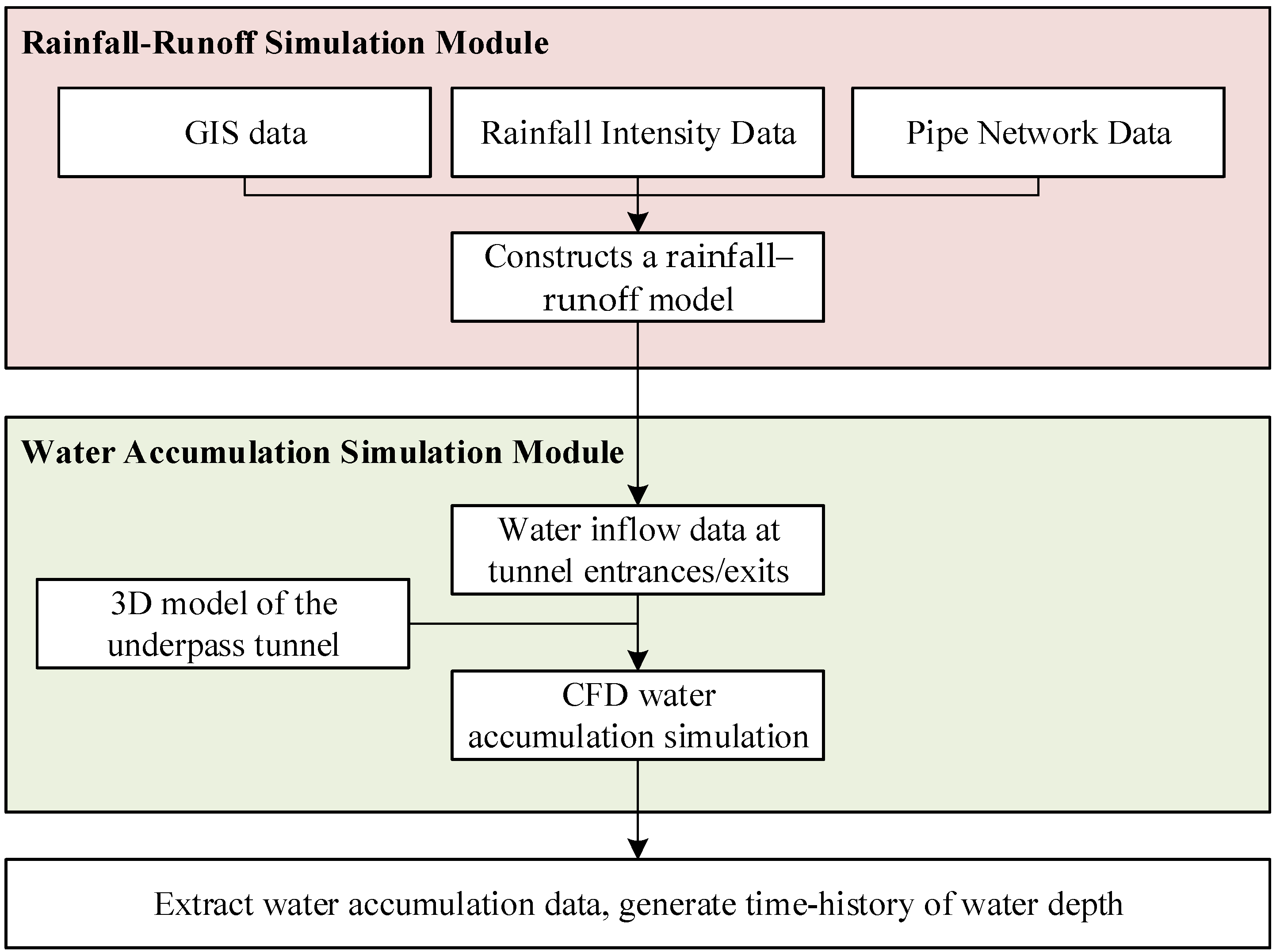
2.1. Overall Research Framework
2.2. Catchment Runoff Simulation (SWMM)
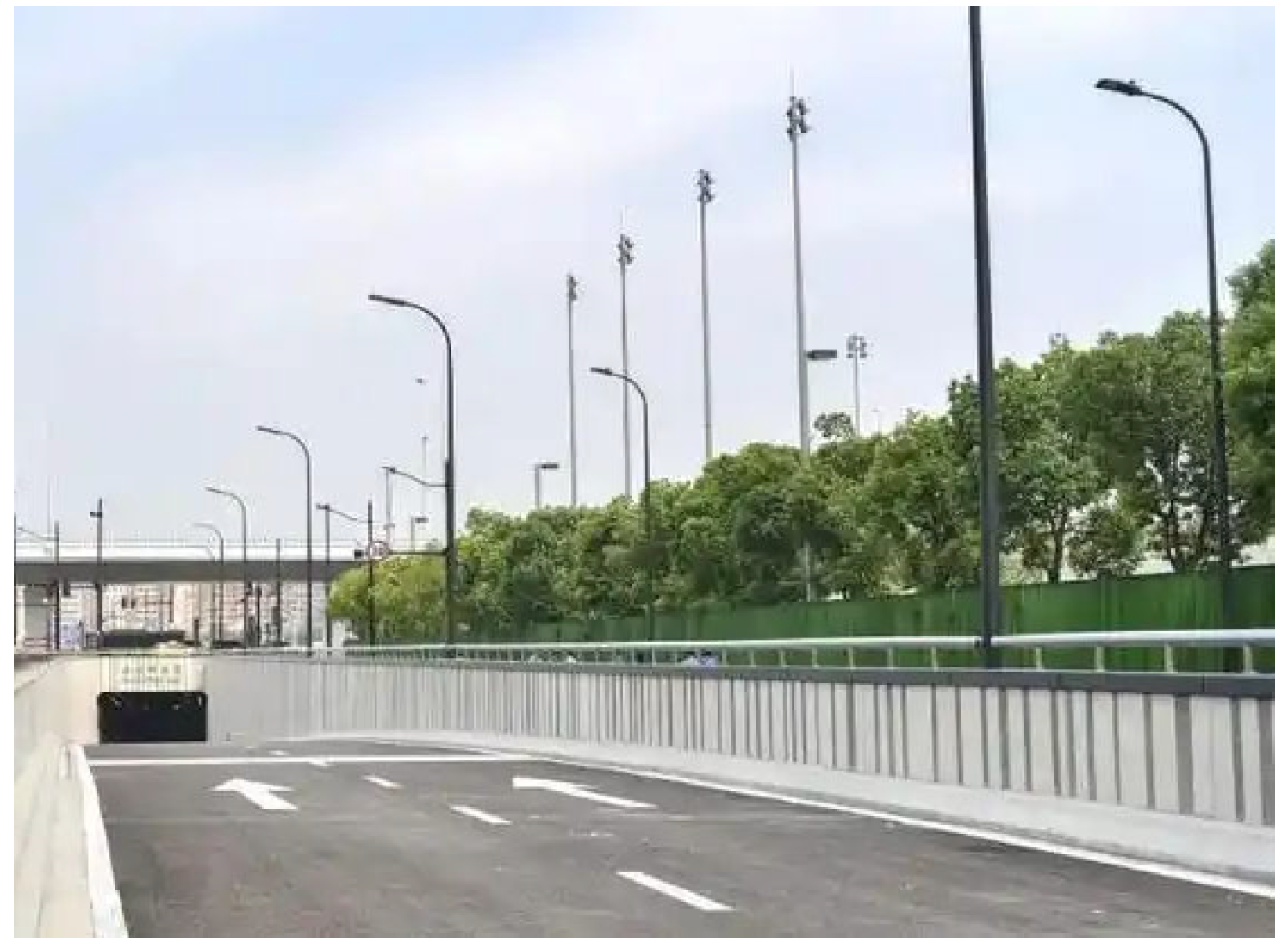
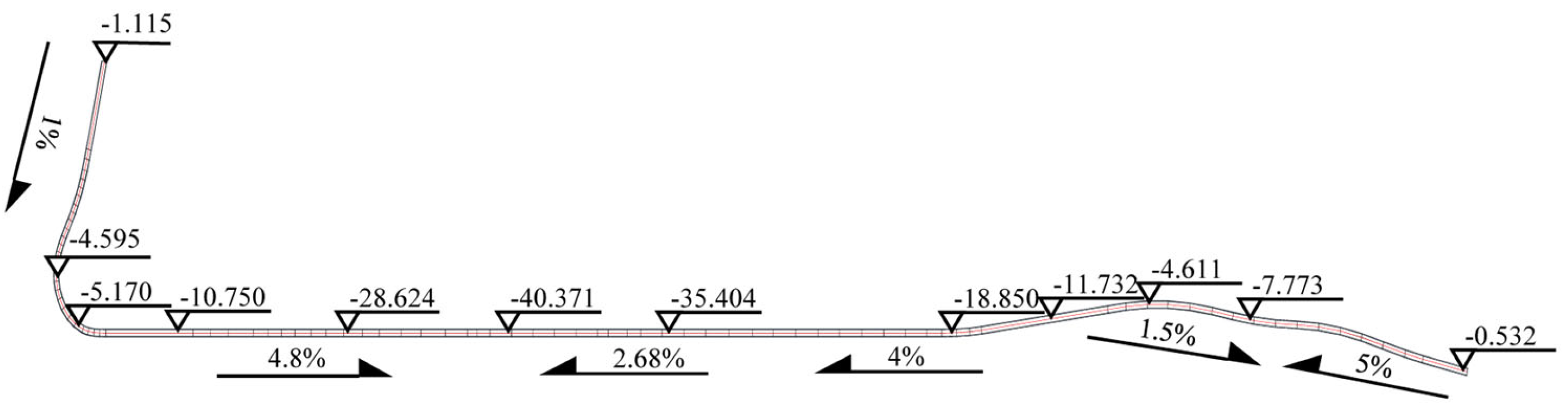
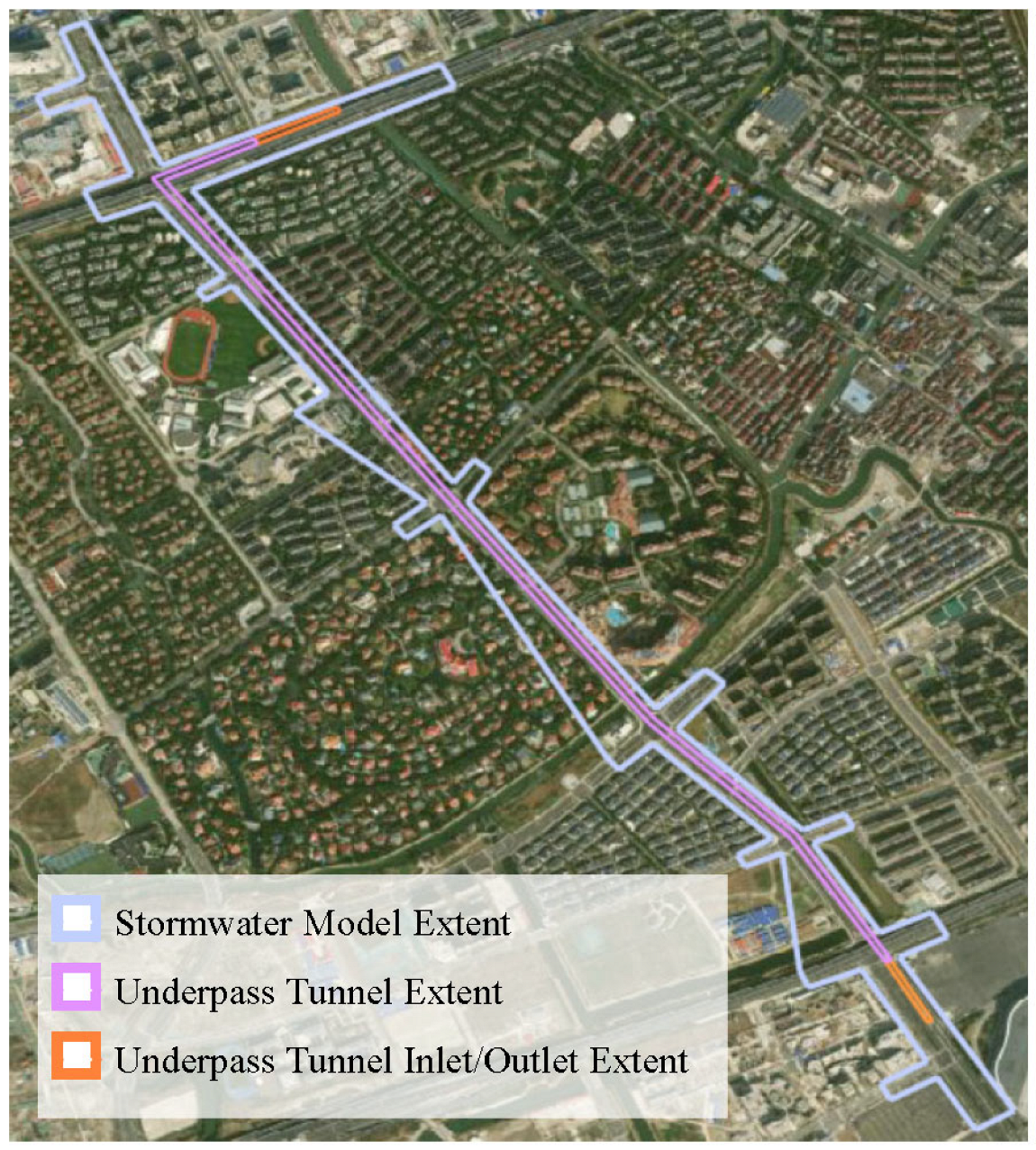
2.2.1. Case Overview
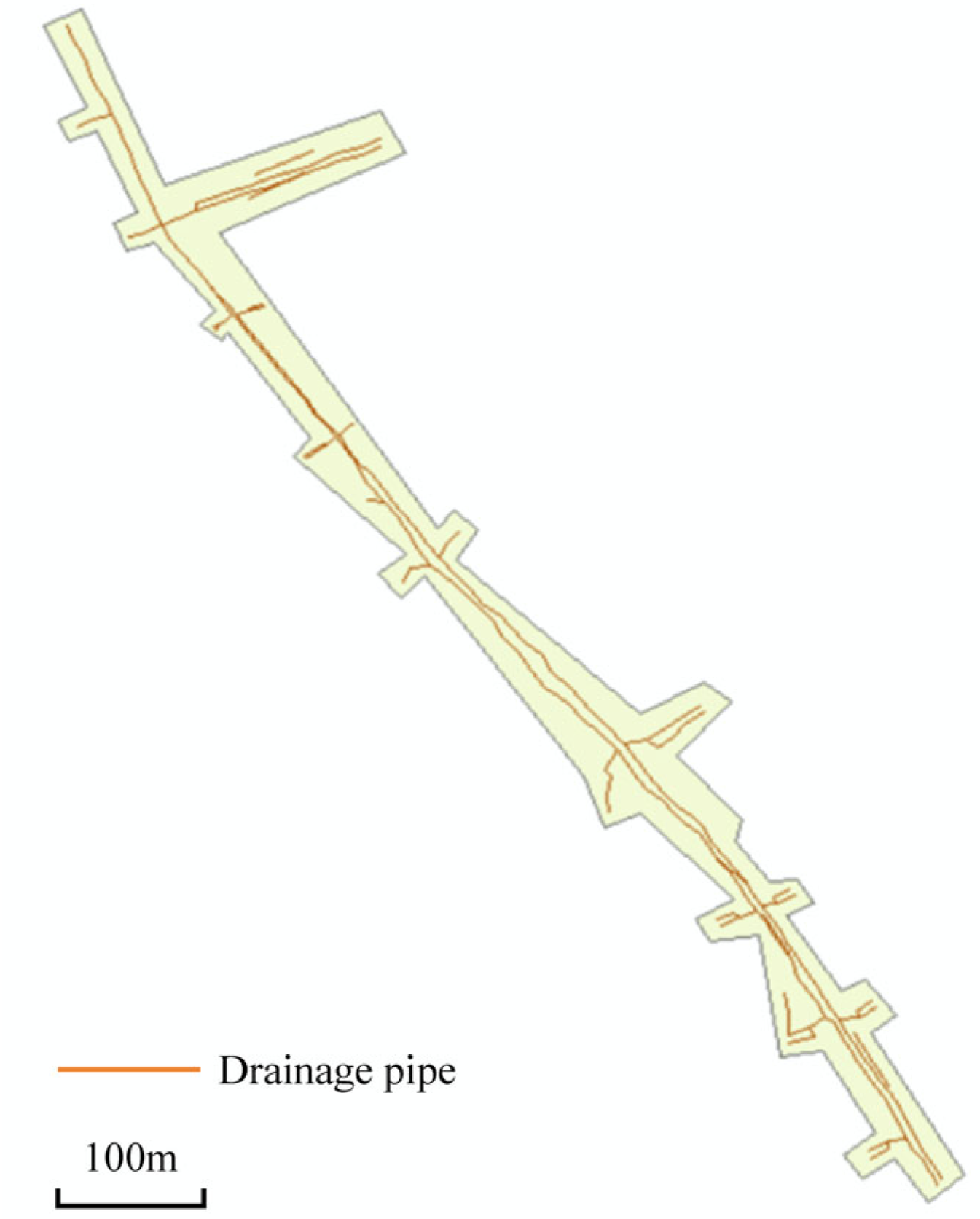
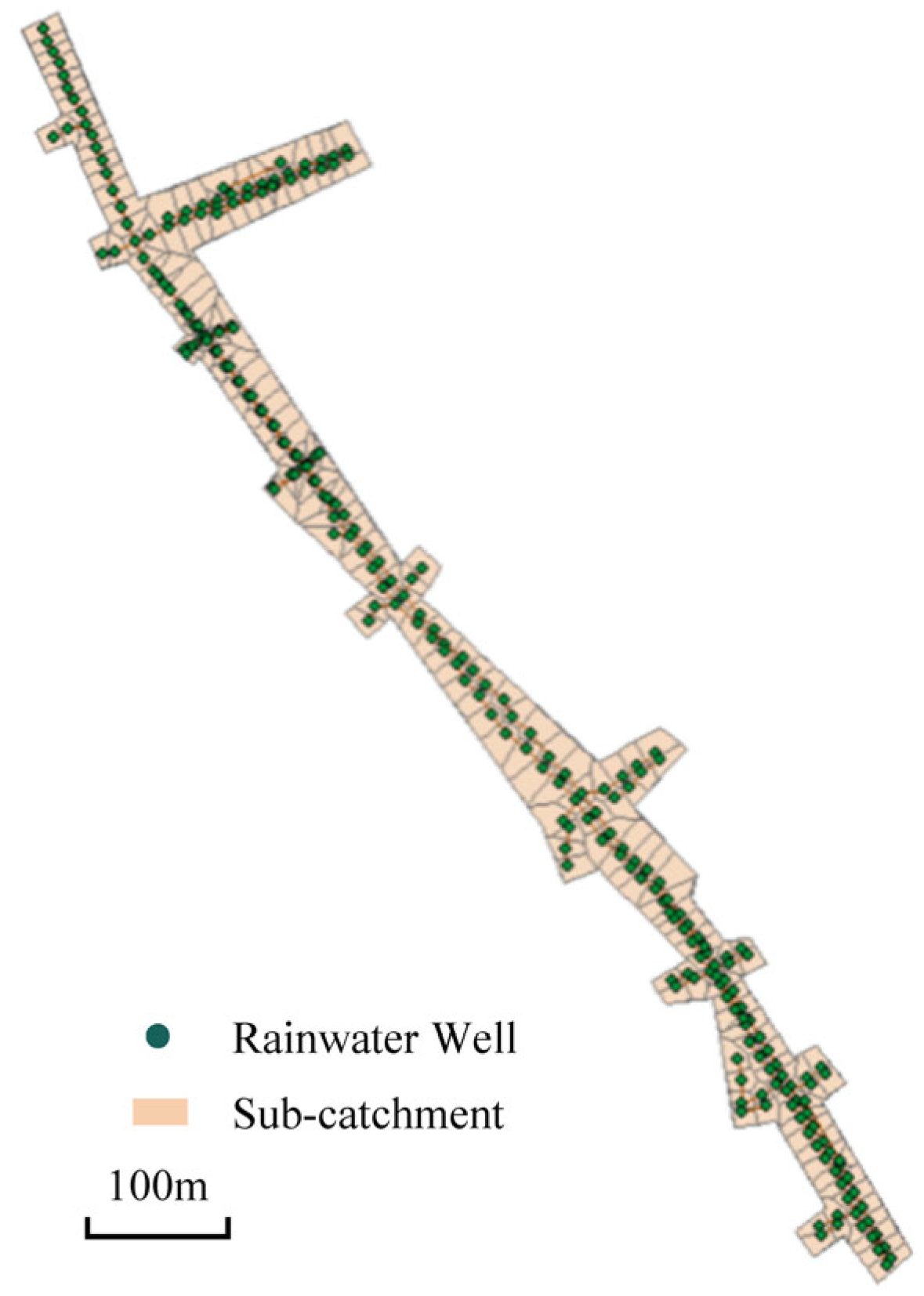
2.2.2. Pipe Network Skeletonization and Sub Catchment Delineation
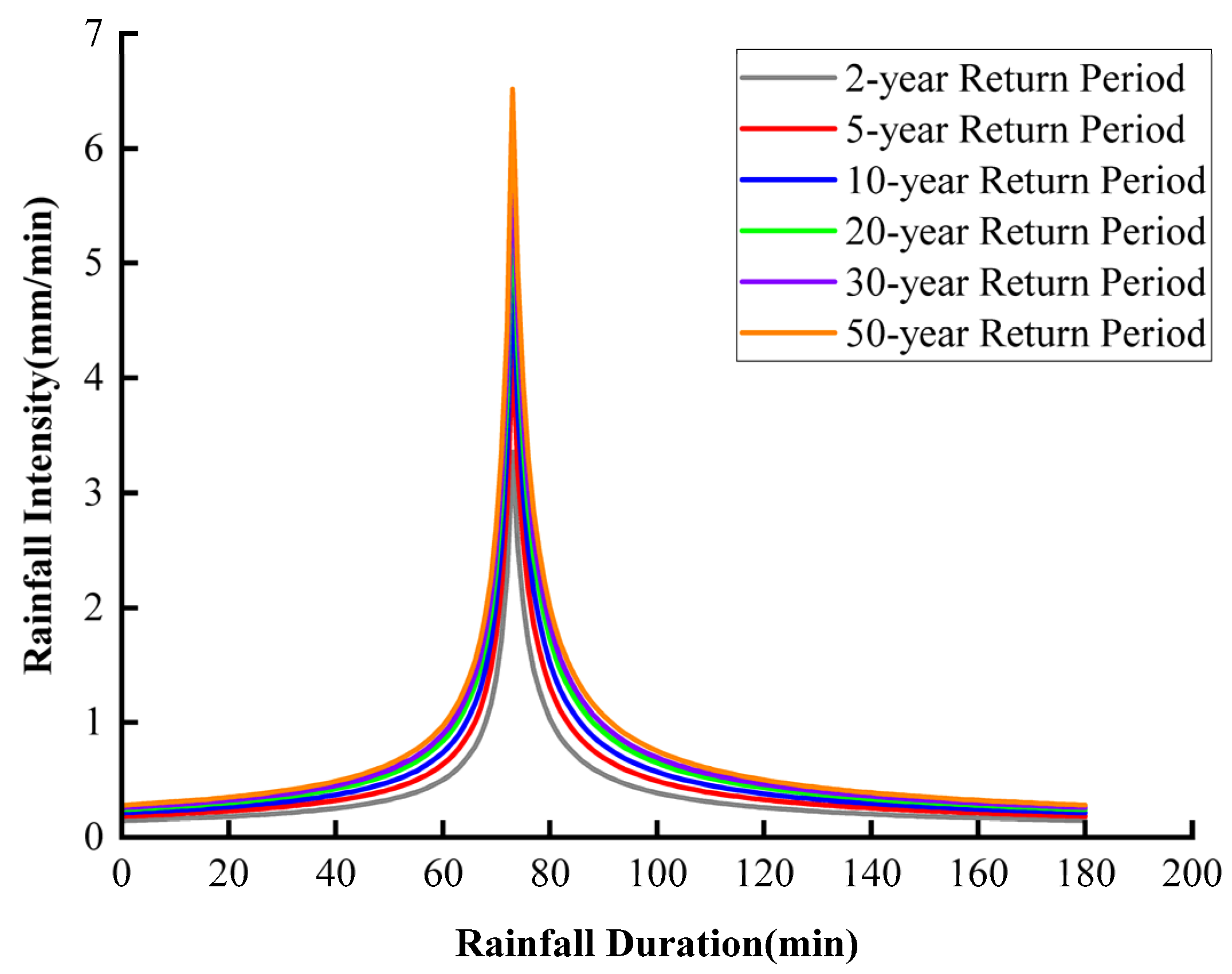
2.2.3. Rainfall Generation
2.2.4. Runoff Data Extraction at Tunnel Entrances/Exits
2.3. Underpass Inundation Simulation (CFD Model)
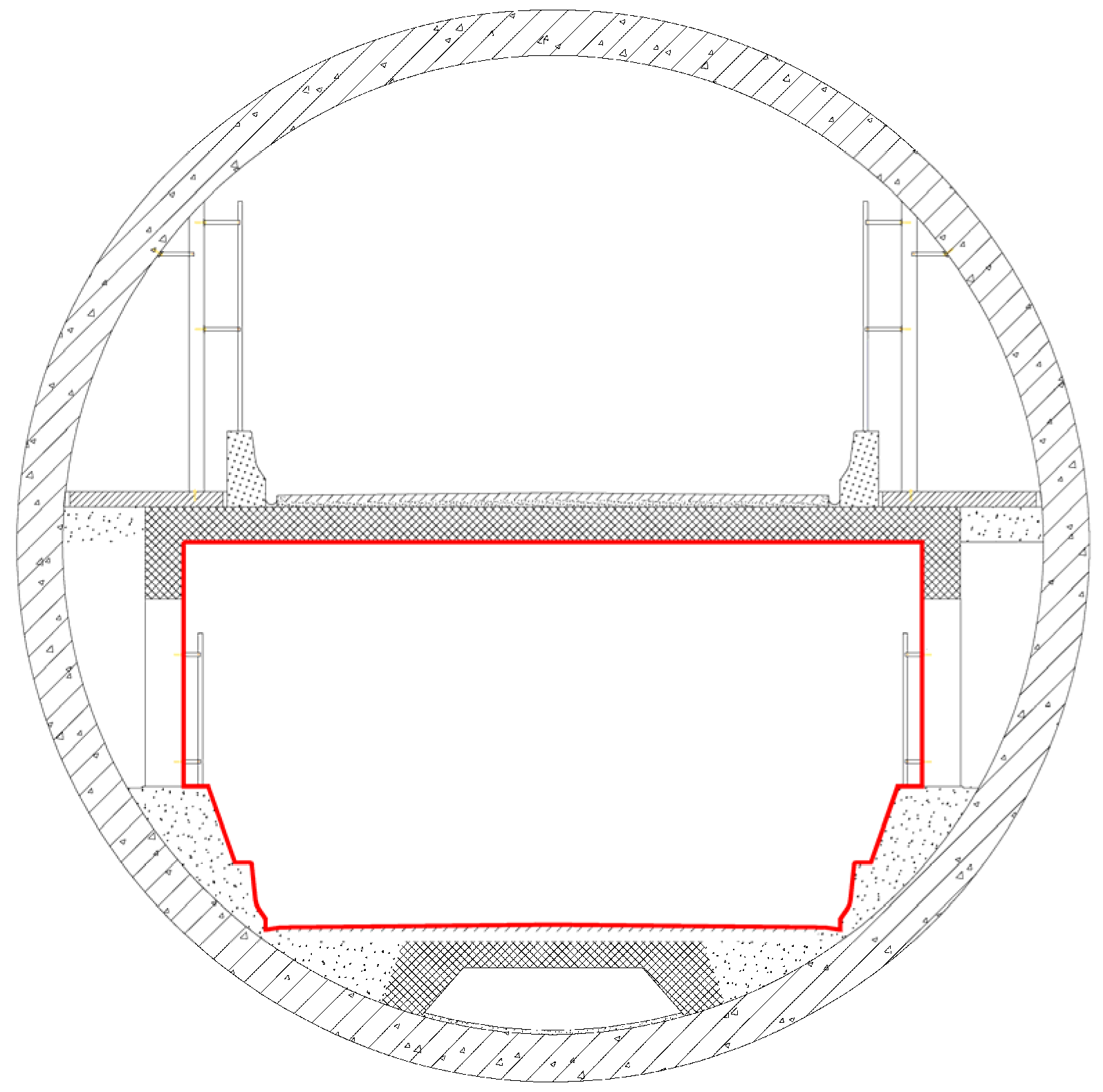
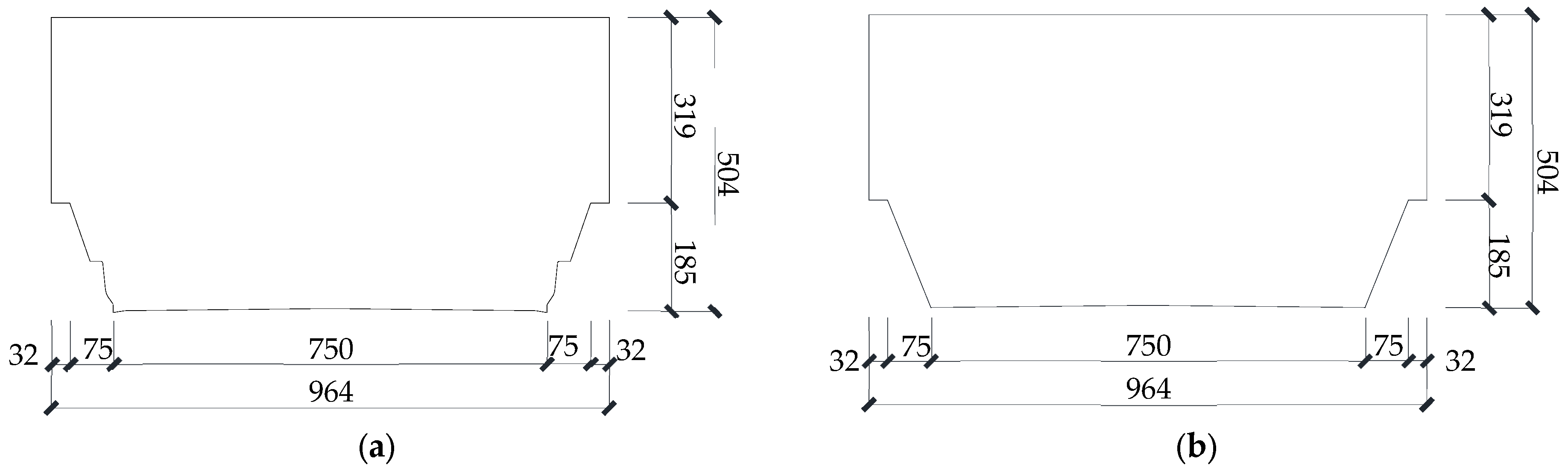
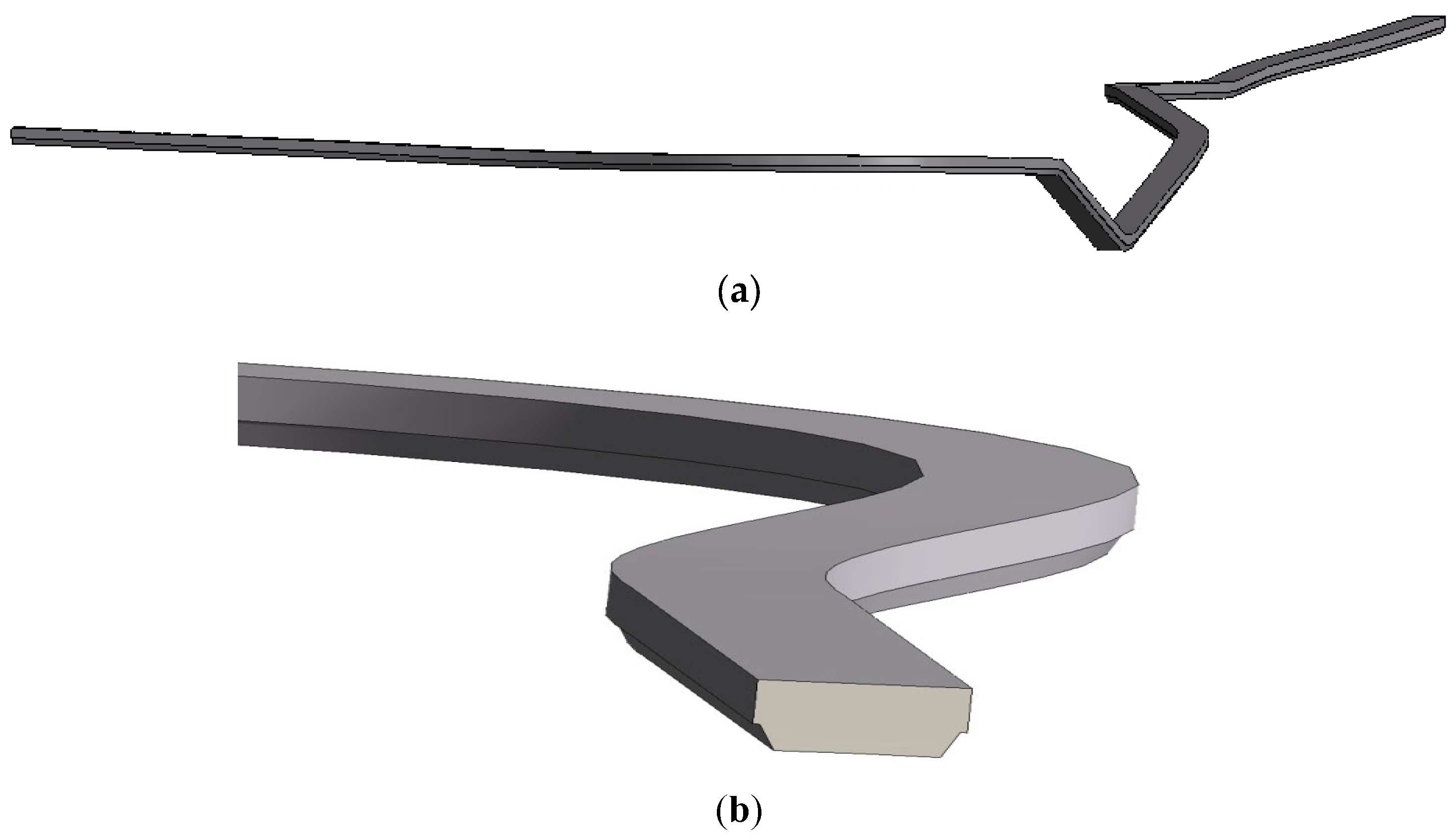
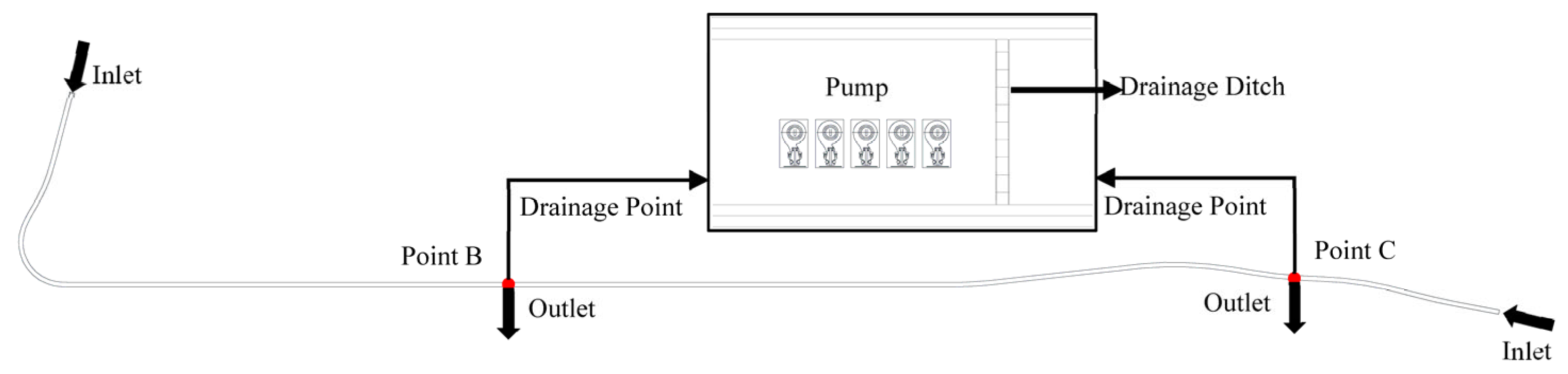
2.3.1. Geometric Model Construction
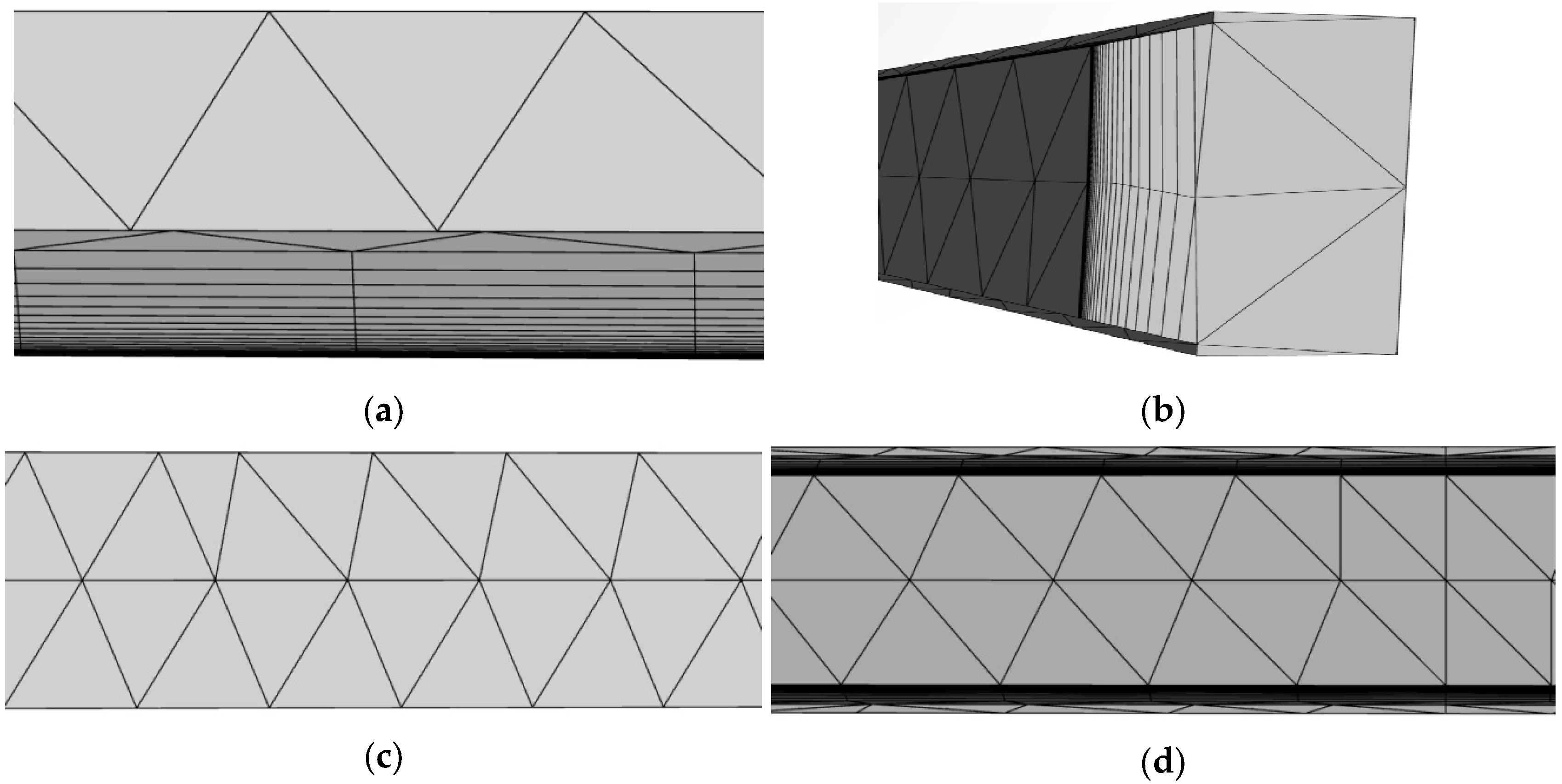
2.3.2. Mesh Generation and Numerical Setup
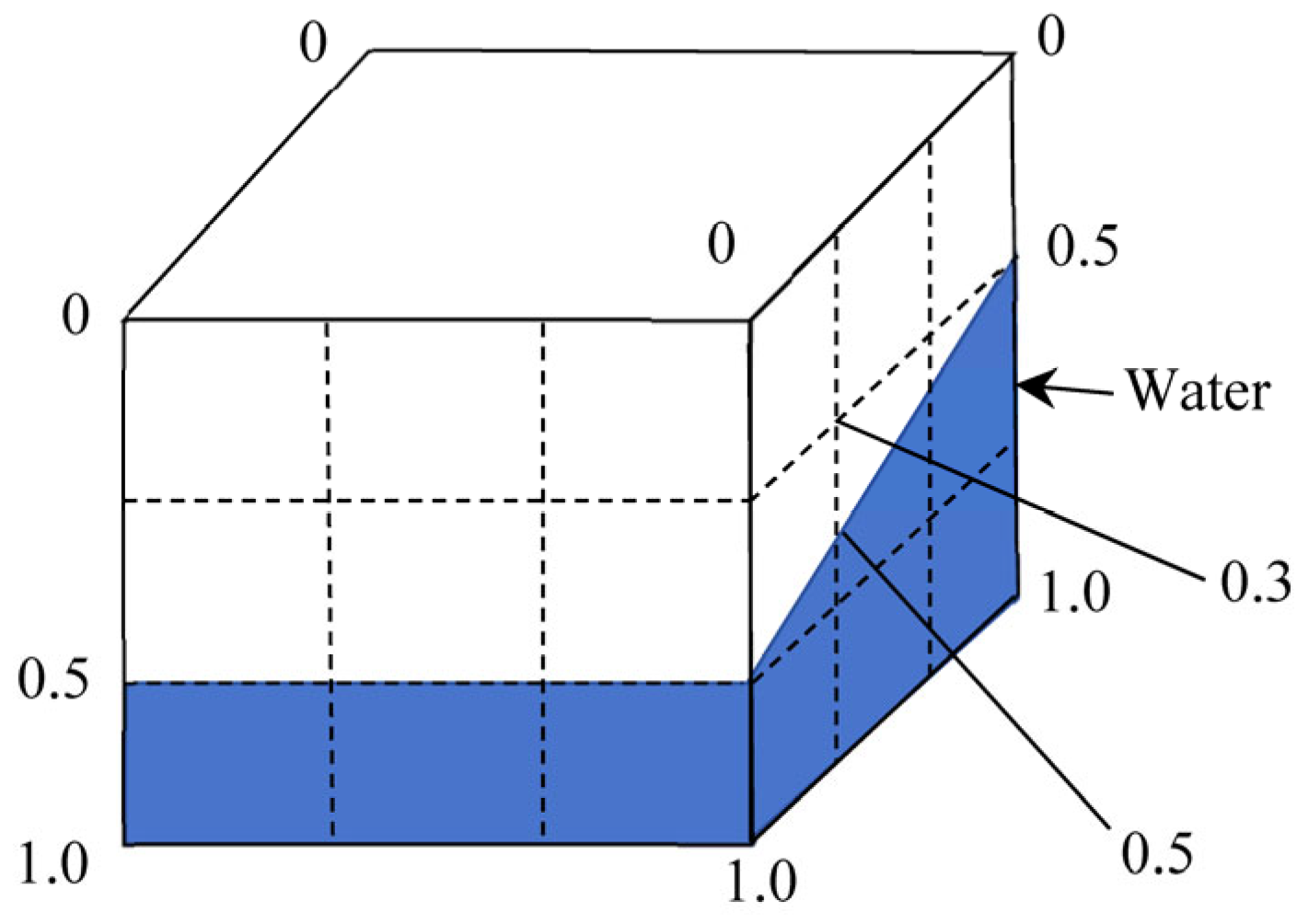
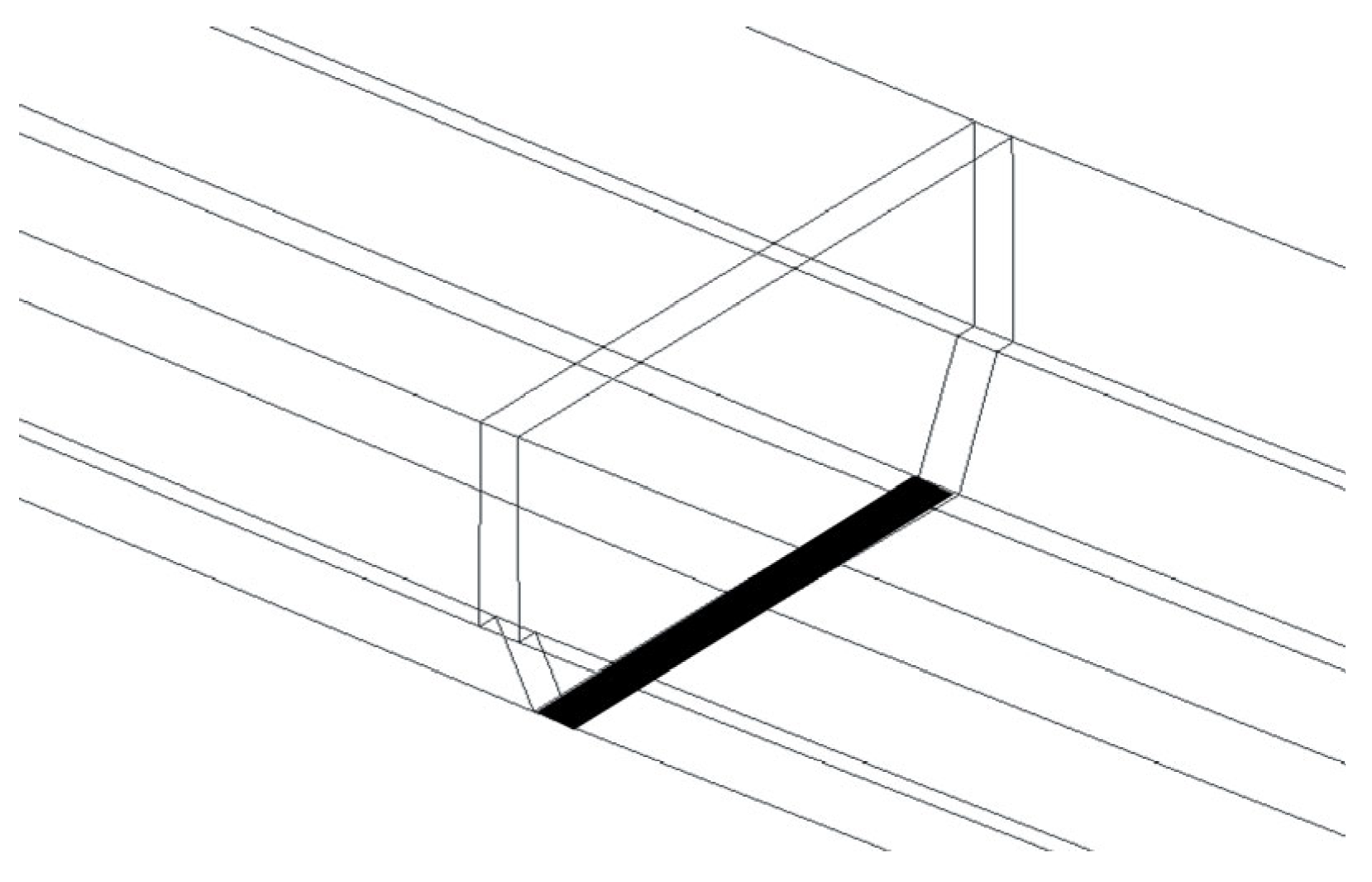
2.3.3. Water Level Identification and Data Processing Method
3. Results and Discussion
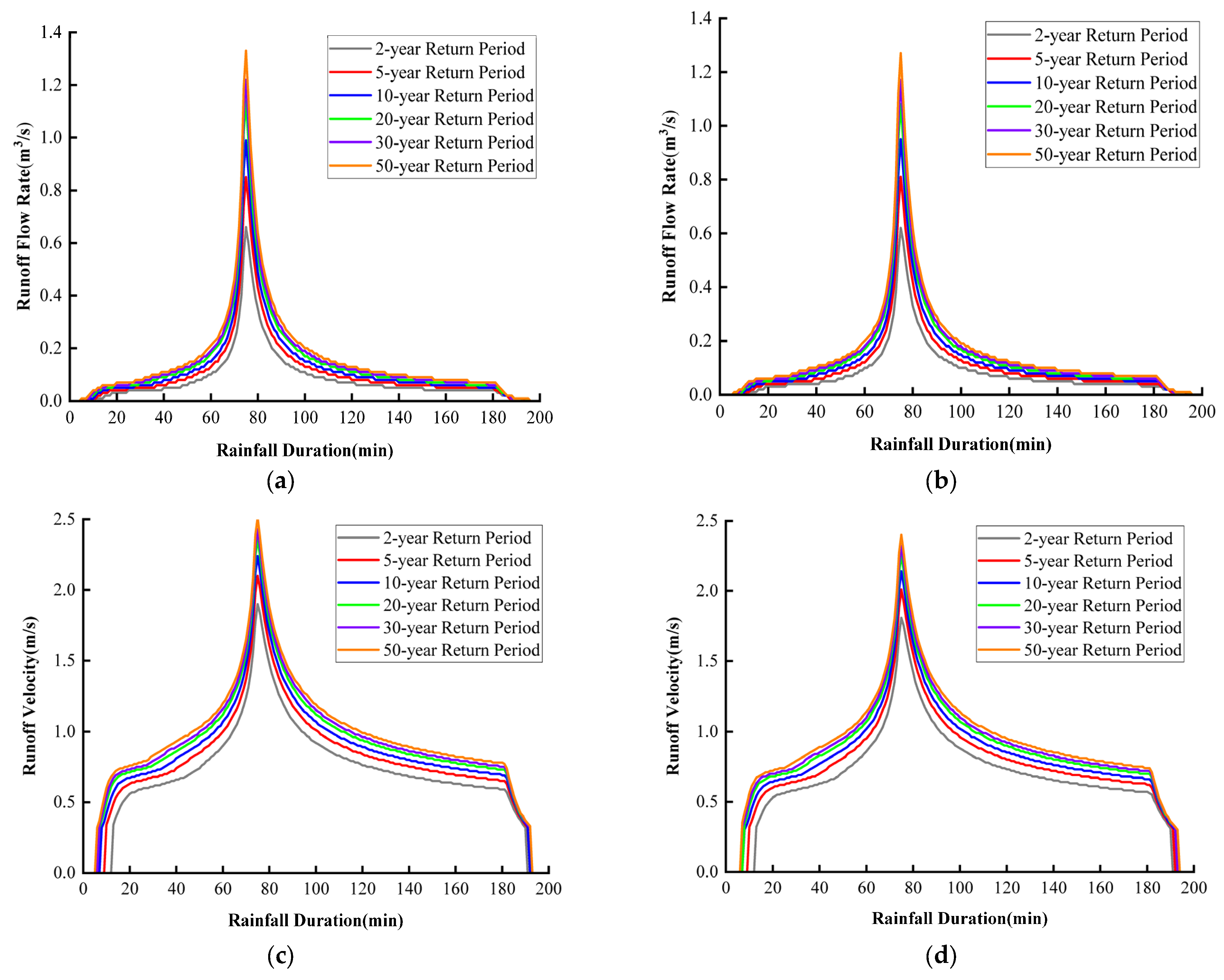
3.1. Rainfall–Runoff Simulation Results (SWMM Output)
3.2. Inundation Dynamics Under Undrained Conditions (CFD Simulation Results)
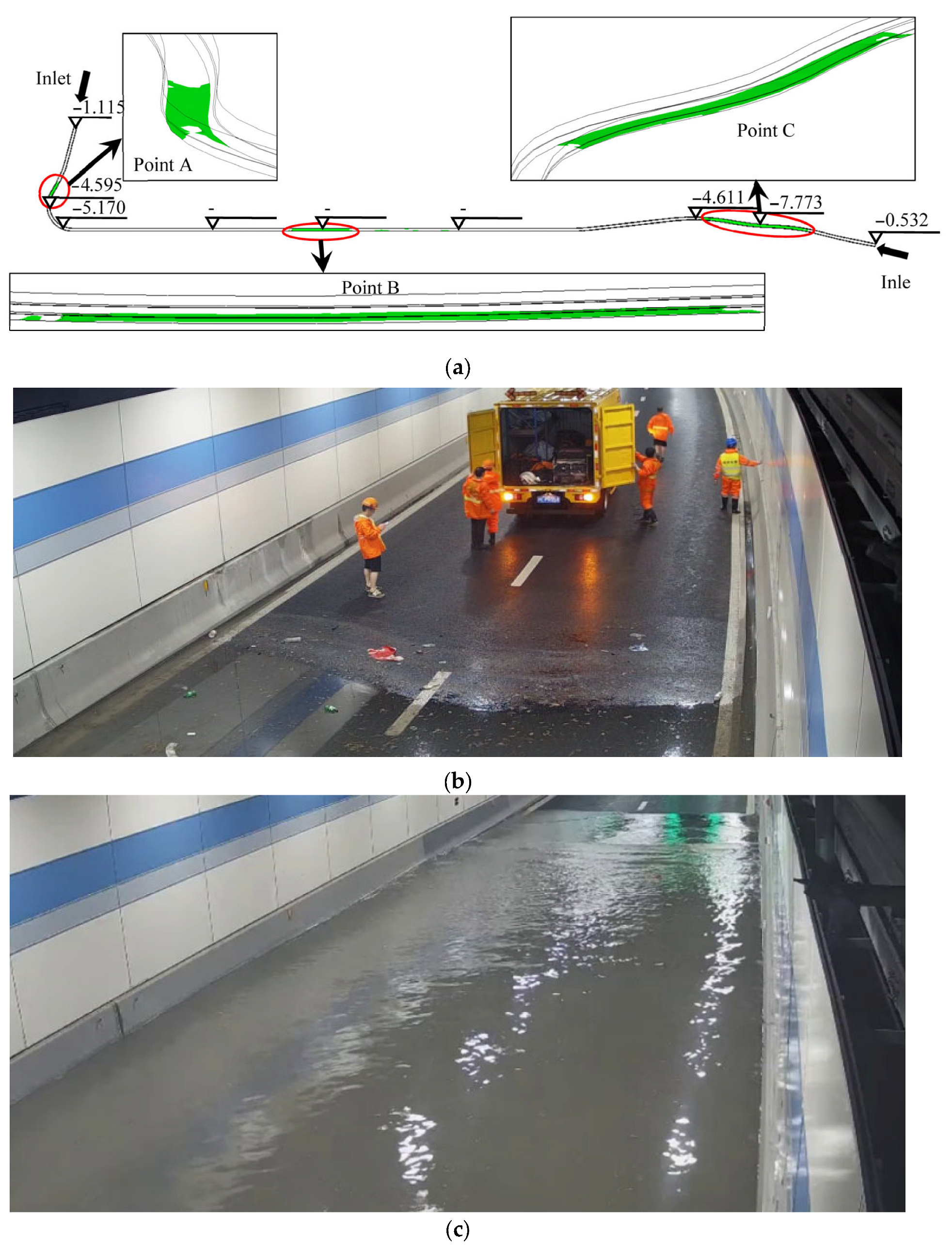
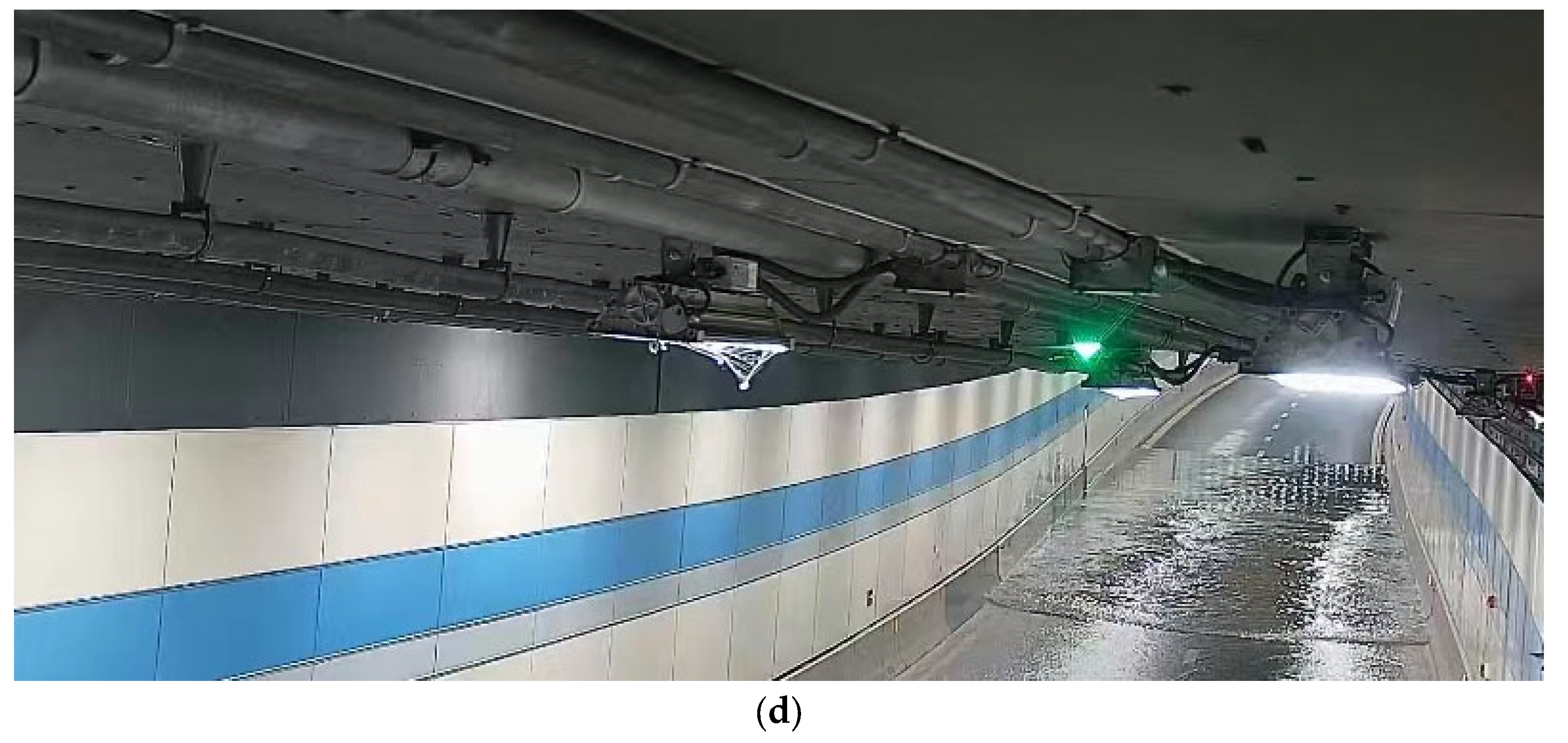
3.2.1. Identification of Critical Inundation Hotspots
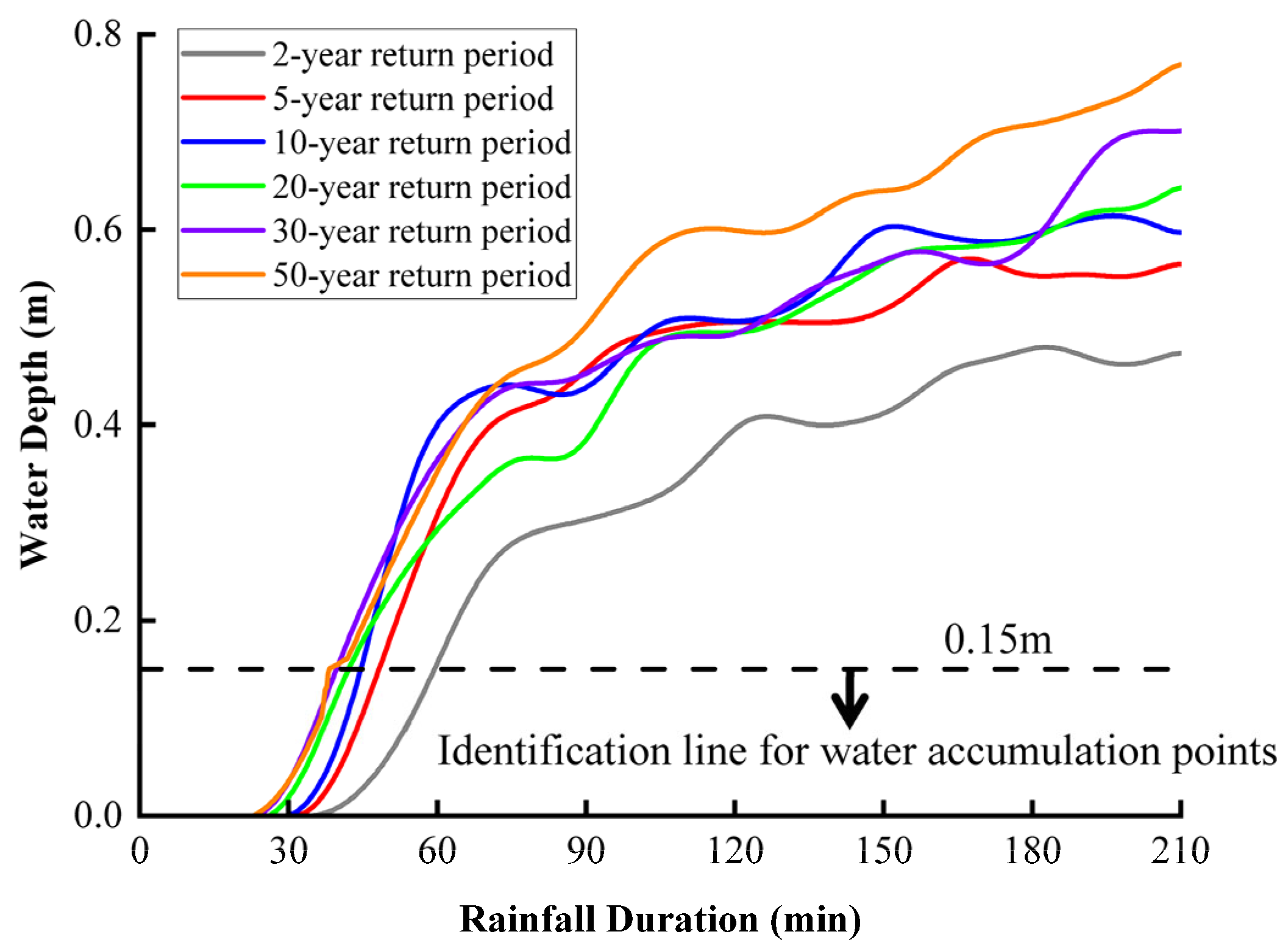
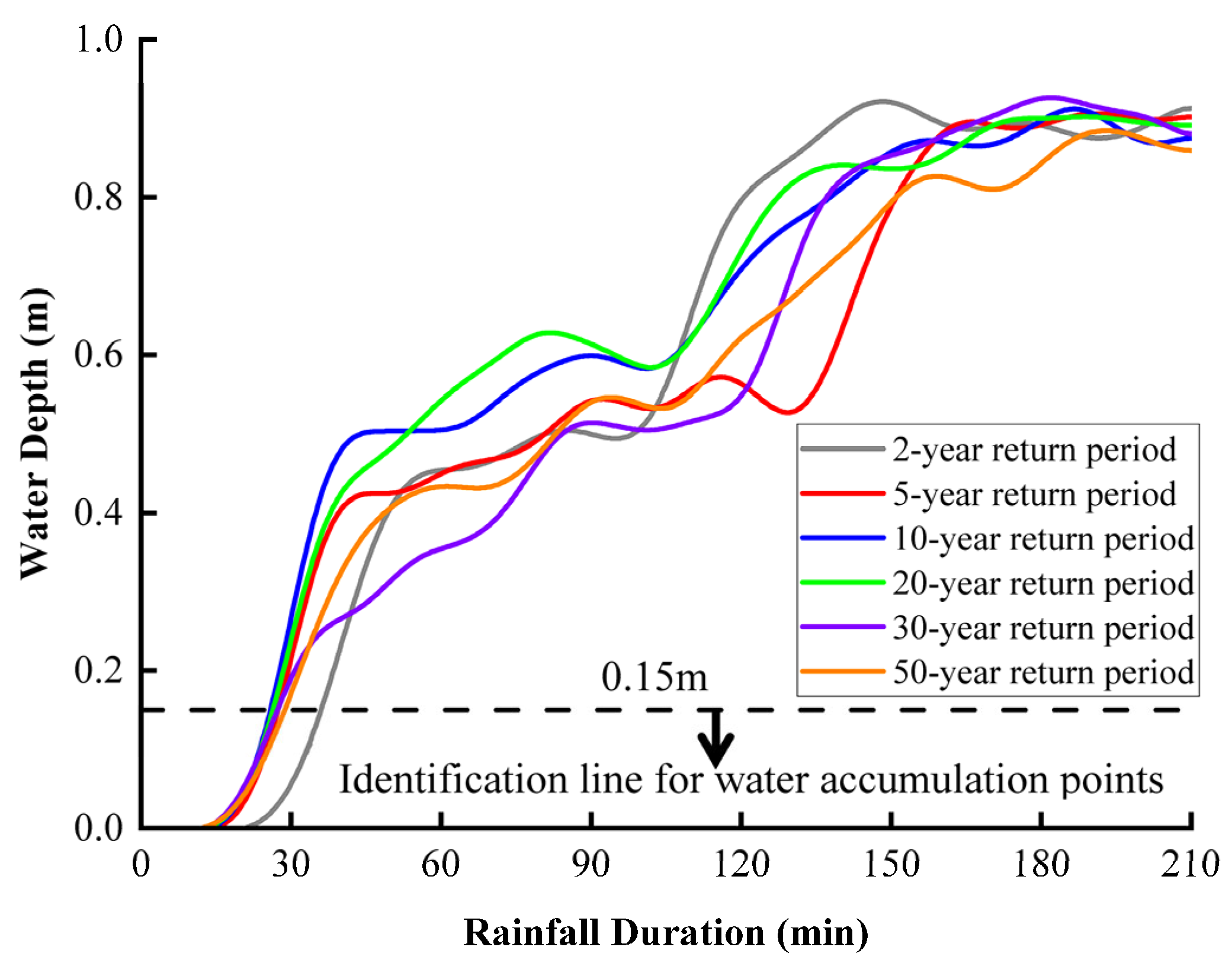
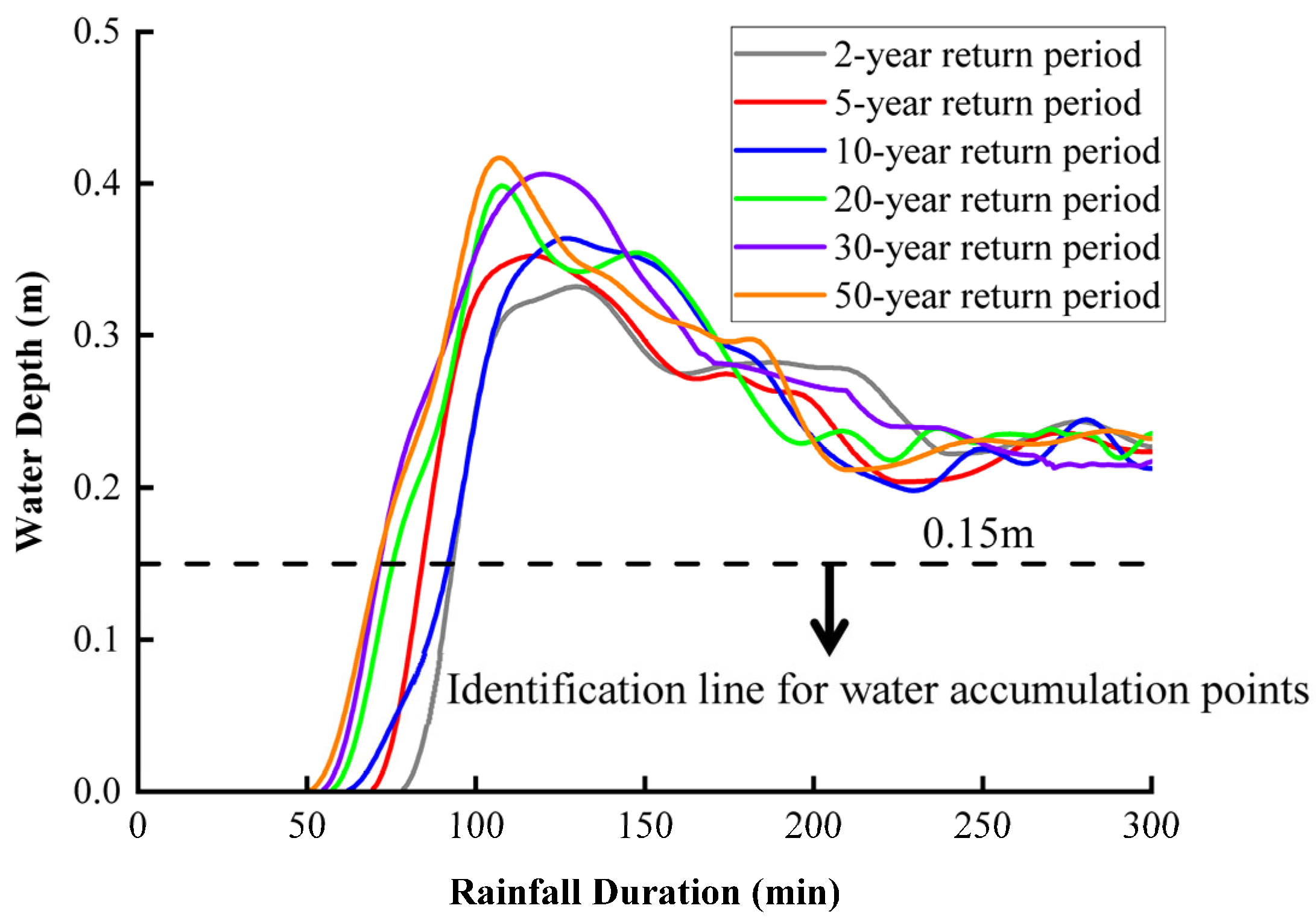
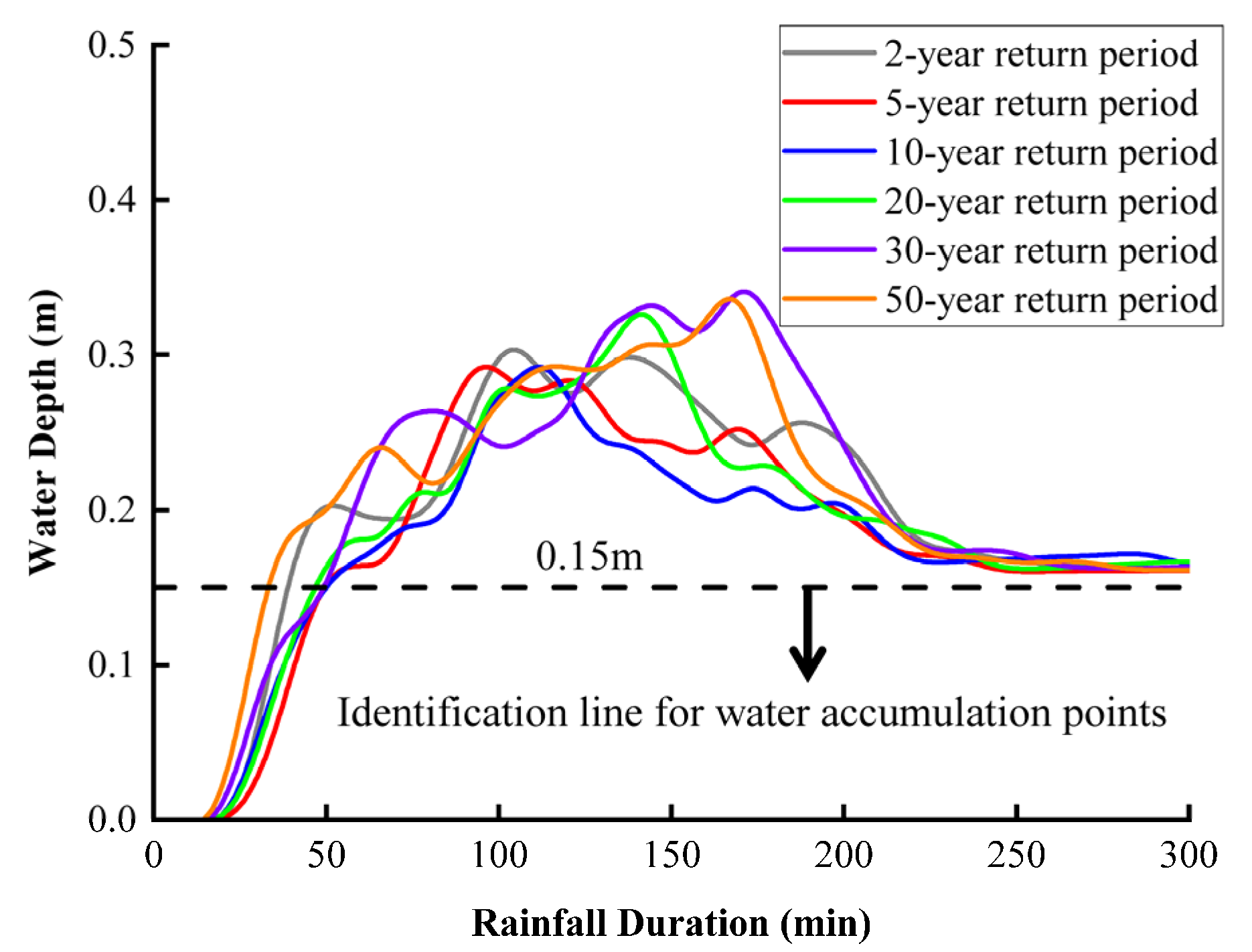
3.2.2. Temporal Evolution of Water Accumulation
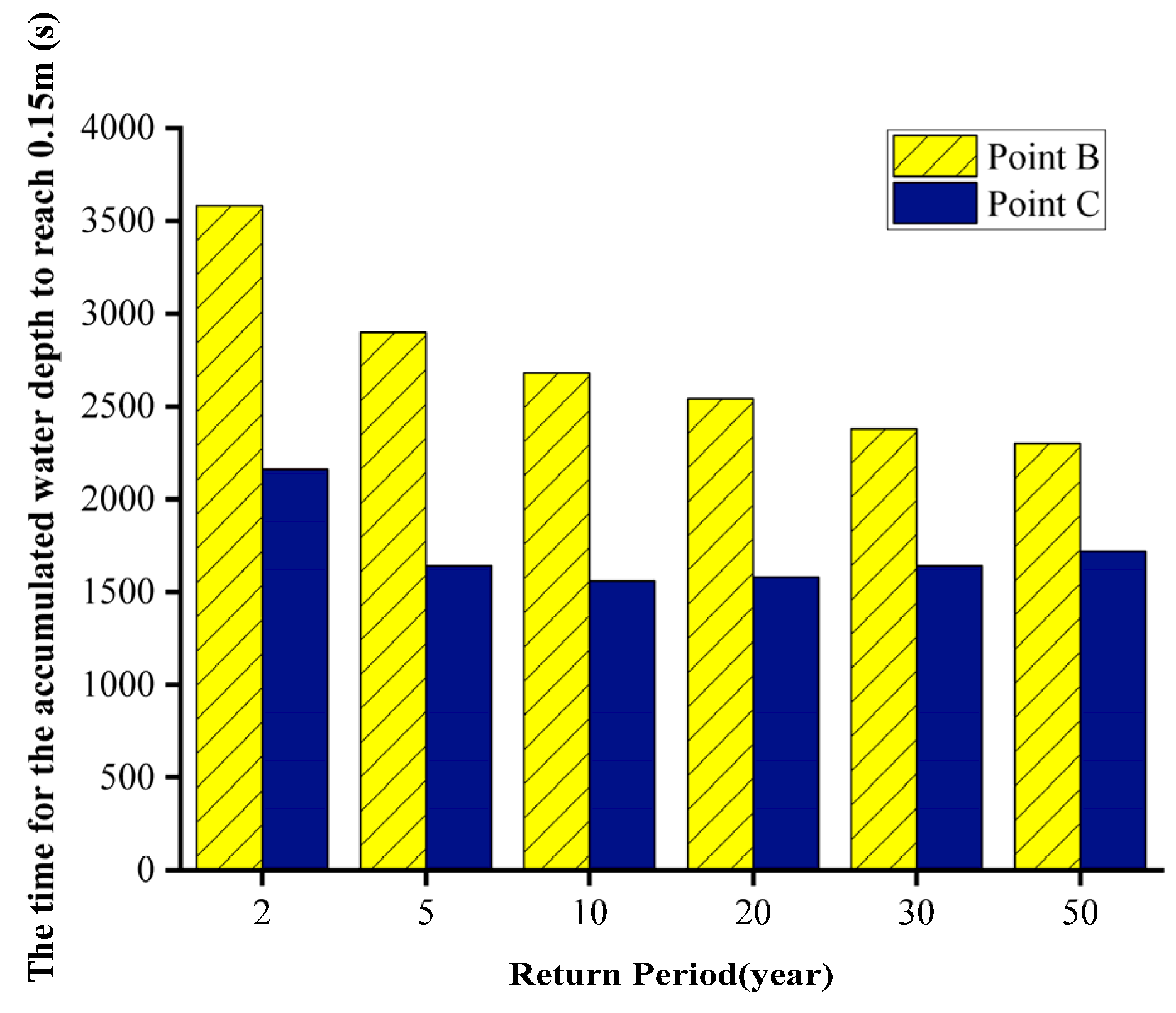
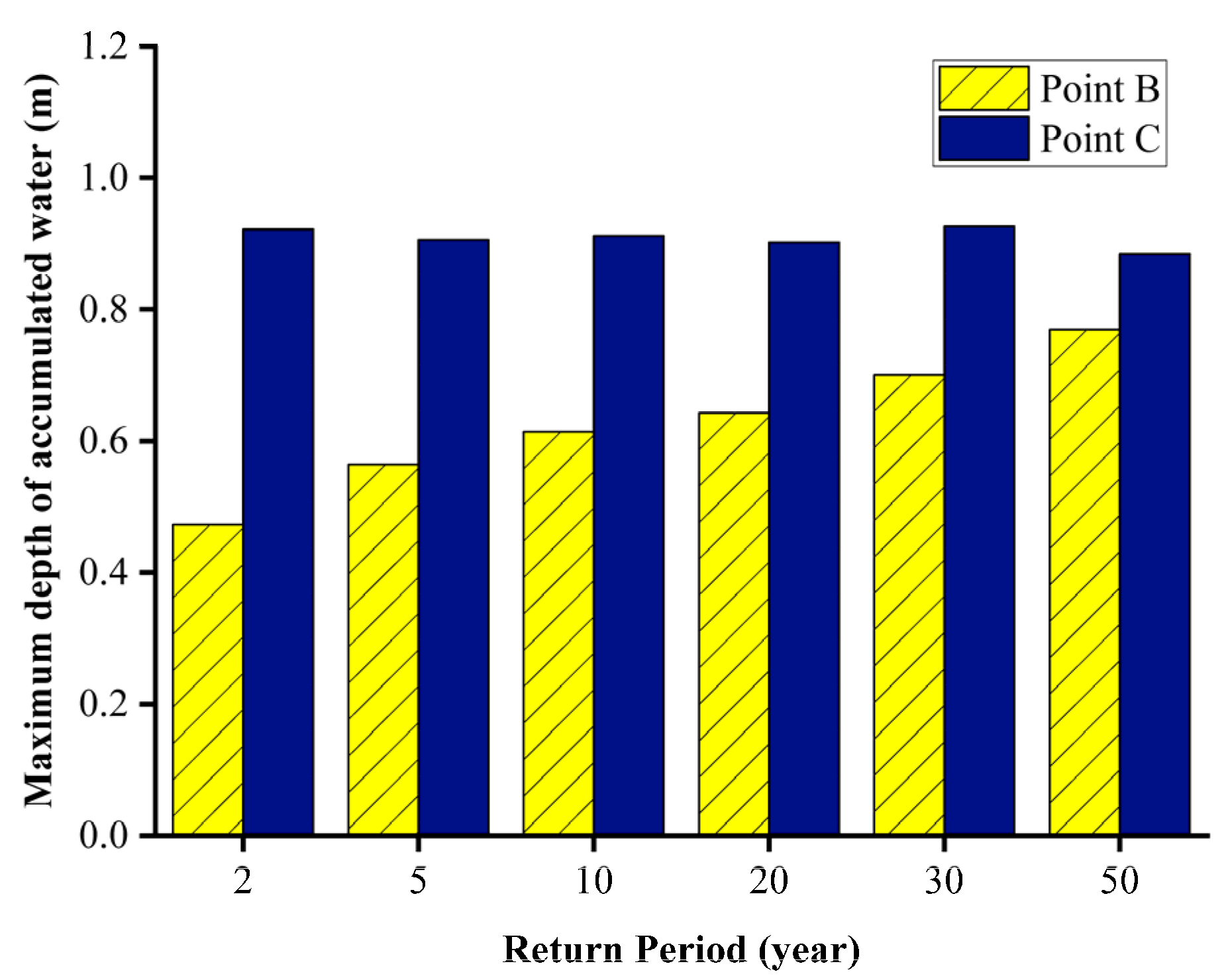
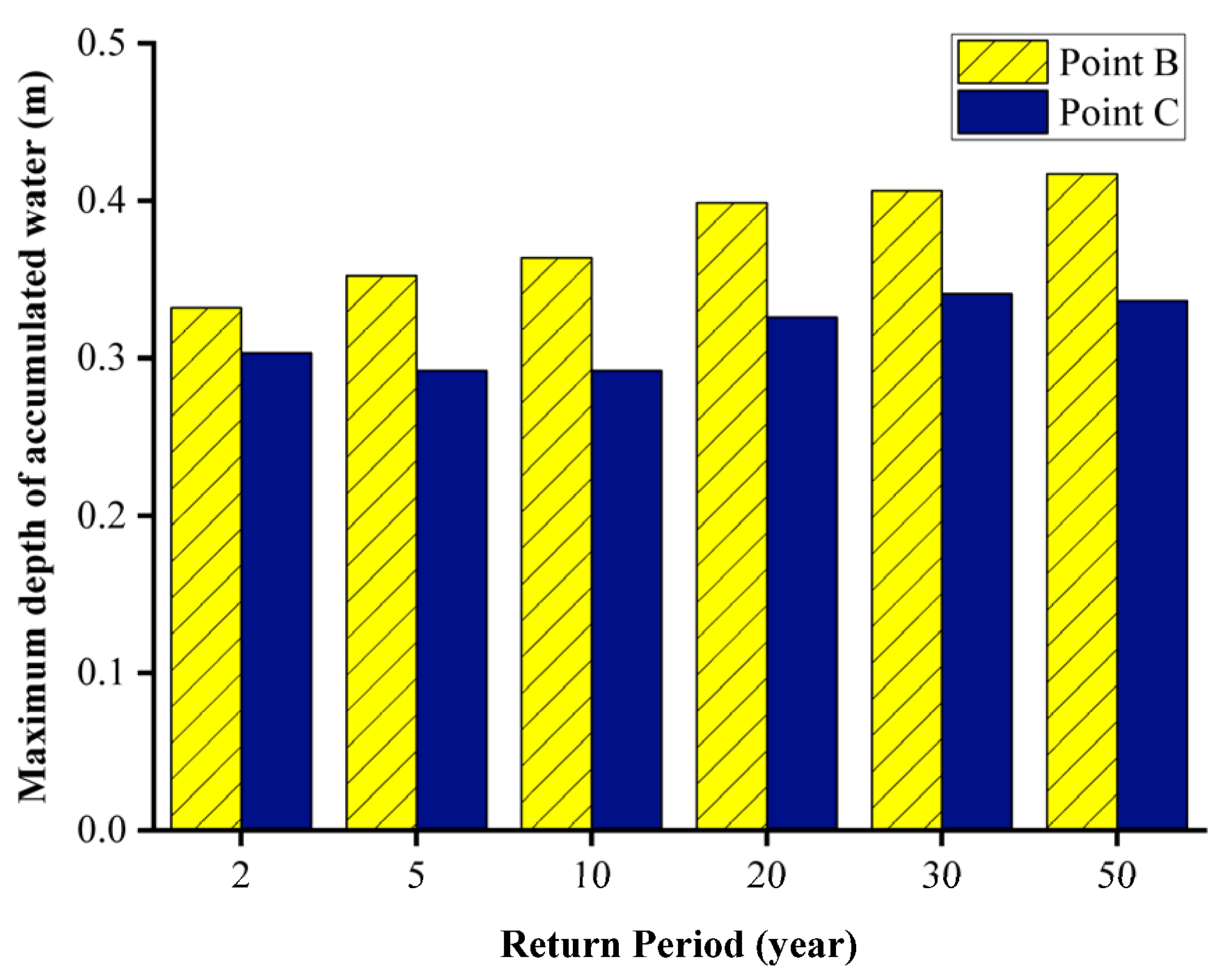
3.2.3. Key Inundation Characteristics Comparison
3.3. Performance Evaluation and Optimization of Drainage Designs
3.3.1. Drainage Schemes Design and Setup
3.3.2. Effectiveness of Standard and Maximum Drainage Schemes
3.3.3. Proposed Optimized Drainage Scheme
4. Conclusions
- The SWMM-CFD framework proved to be a robust tool for simulating the complete inundation life cycle in urban underpasses. It successfully captures the transition from rainfall–runoff generation to complex internal accumulation, effectively accounting for intricate architectural features that traditional 1D or 2D models often overlook.
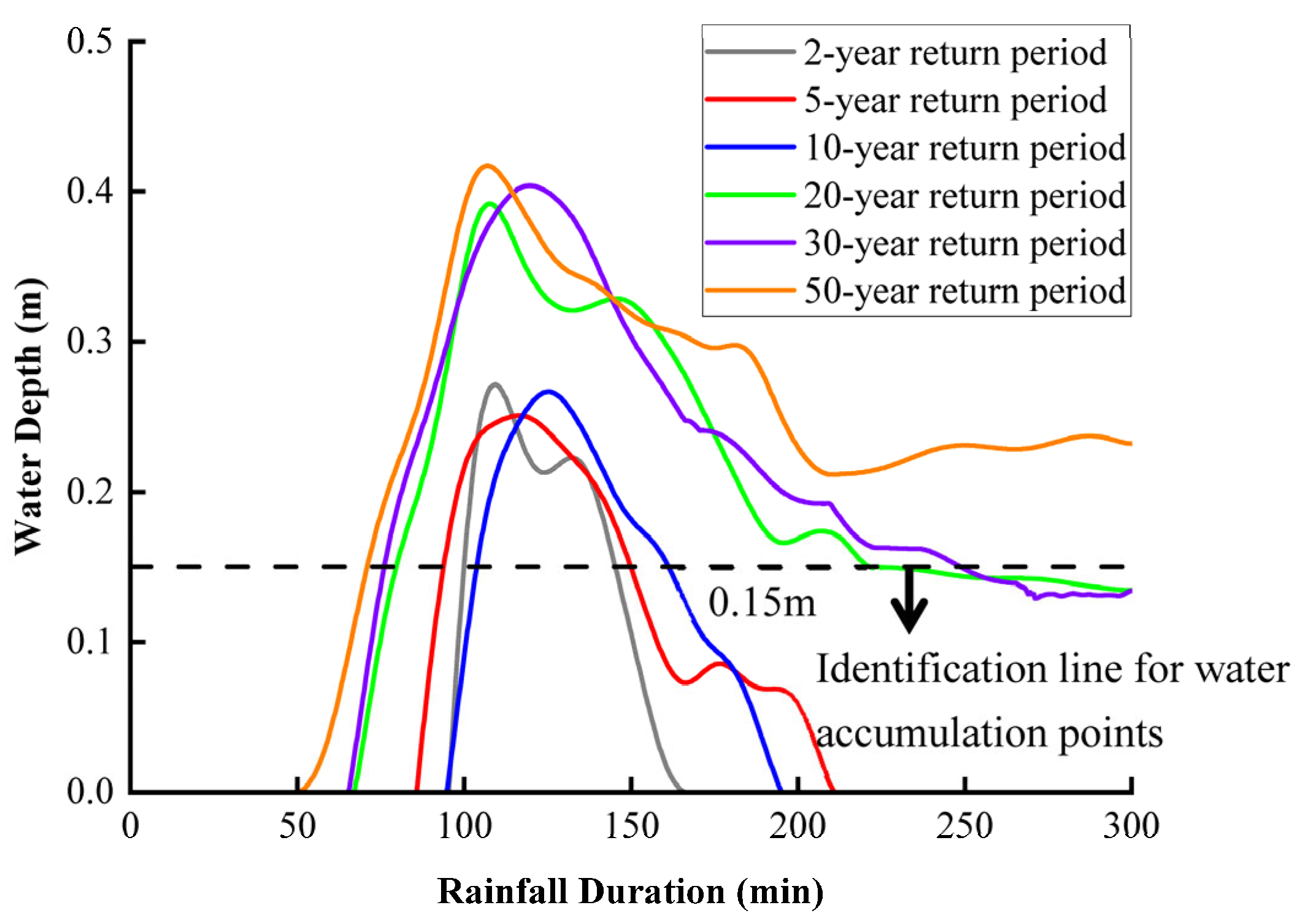
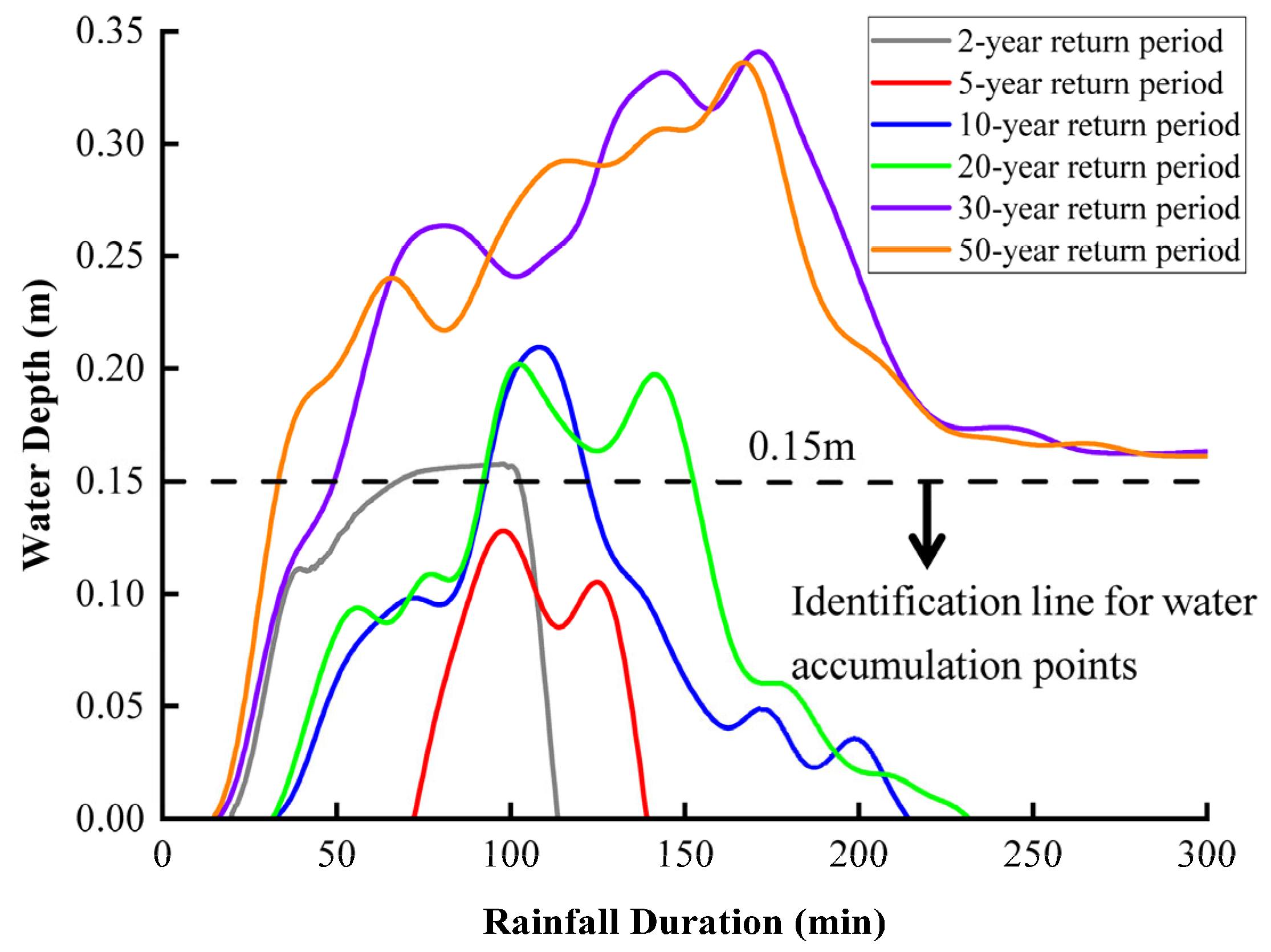
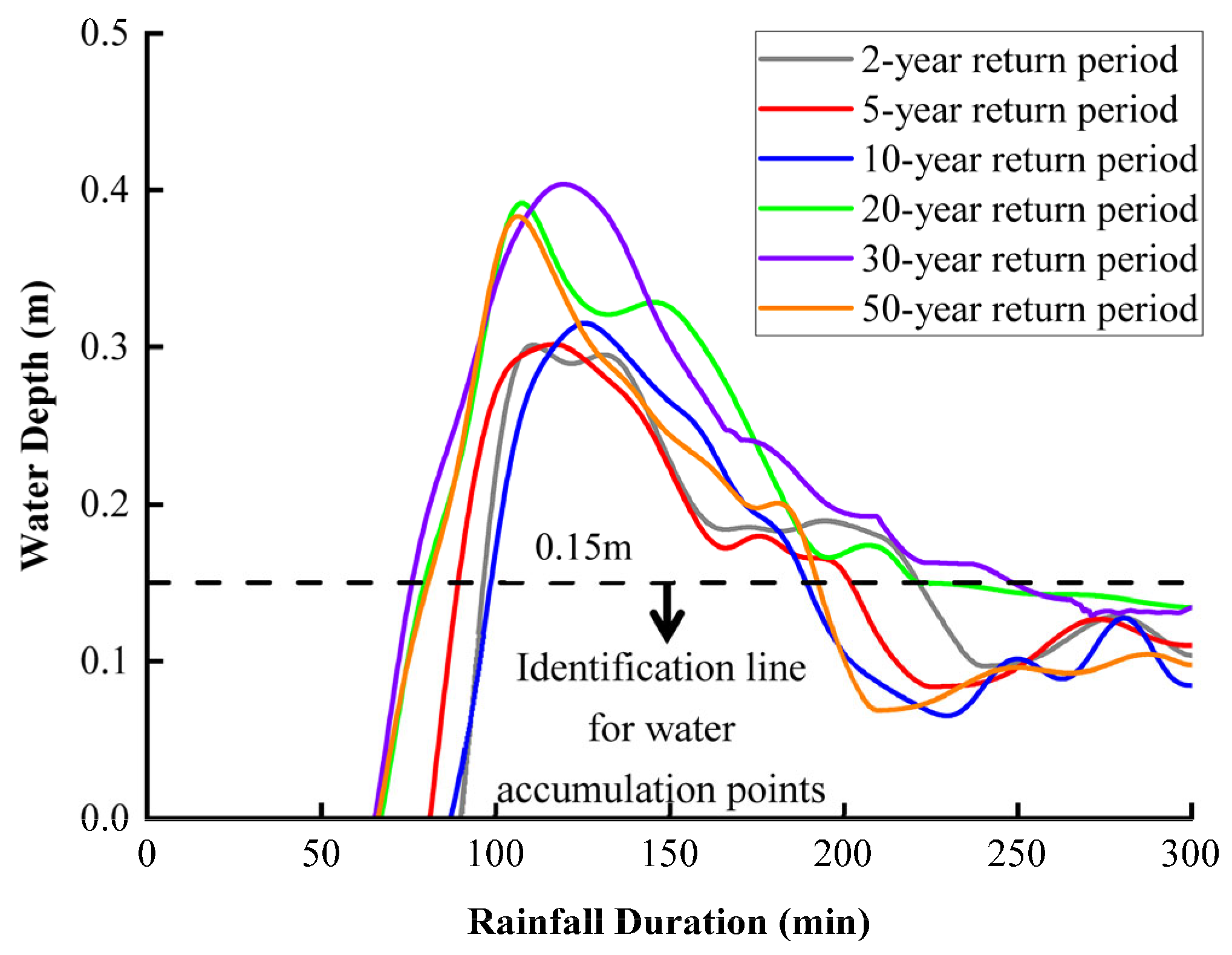
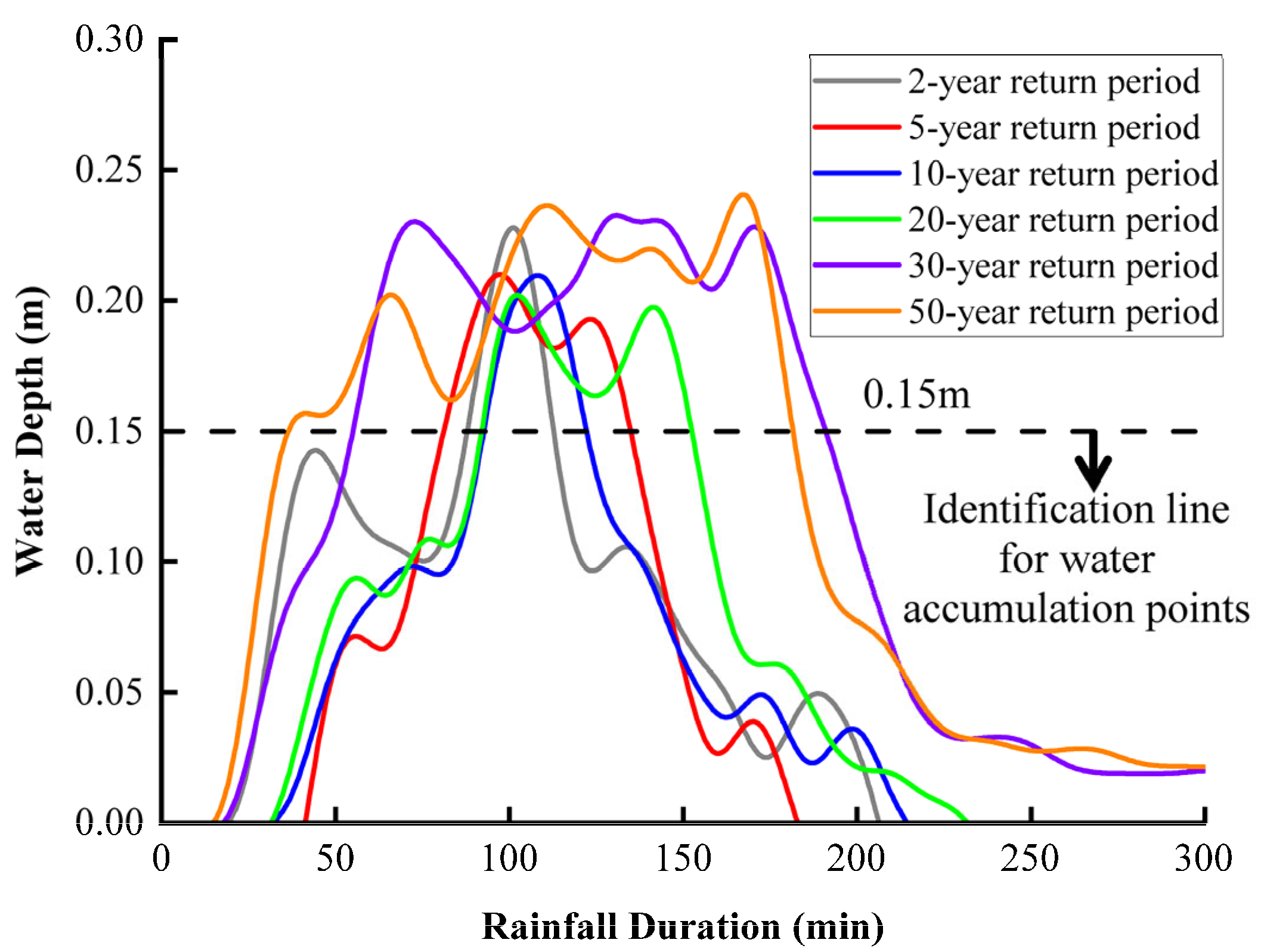
- Two distinct flooding patterns were identified: a systemic response at the tunnel’s lowest point (Point B) and a localized response at the entrance concavity (Point C). While water depth at Point B is strongly correlated with total inflow volume, the accumulation at Point C is governed and eventually capped by local micro-topography.
- A graded drainage strategy, which matches pump capacity to the expected inflow intensity across varying return periods, demonstrated superior performance. This approach significantly improves economic and operational efficiency compared to under-designed (Standard) or over-designed (Maximum) schemes.
- By enabling precise predictions of underpass responses to varying rainfall intensities, this framework allows for the implementation of proactive mitigation measures, such as automated flood barriers. This contributes to the overall flood control capacity and long-term sustainability of urban infrastructure.
Author Contributions
Funding
Institutional Review Board Statement
Informed Consent Statement
Data Availability Statement
Conflicts of Interest
References
- Yang, W.; Zhao, Z.; Pan, L.; Li, R.; Wu, S.; Hua, P.; Wang, H.; Schmalz, B.; Krebs, P.; Zhang, J. Integrated risk analysis for urban flooding under changing climates. Results Eng. 2024, 24, 103243. [Google Scholar] [CrossRef]
- Zhou, R.; Zheng, H.; Liu, Y.; Xie, G.; Wan, W. Flood impacts on urban road connectivity in southern China. Sci. Rep. 2022, 12, 16866. [Google Scholar] [CrossRef] [PubMed]
- Yang, J.; Liu, K.; Wang, M.; Yue, Q. A new algorithm for generation of urban underground stormwater networks and its application for enhanced urban flood simulation. J. Hydrol. 2025, 661, 133571. [Google Scholar] [CrossRef]
- Said, Z.M.; Dindar, S. Key Challenges and Strategies in the Evaluation of Sustainable Urban Regeneration Projects: Insights from a Systematic Literature Review. Sustainability 2024, 16, 9903. [Google Scholar] [CrossRef]
- Zeng, B.; Huang, G.; Chen, W. Research progress and prospects of urban flooding simulation: From traditional numerical models to deep learning approaches. Environ. Model. Softw. 2025, 183, 106213. [Google Scholar] [CrossRef]
- Fan, Y.; Wang, C.; Yu, H.; Pan, J.; Ouyang, Z. Coupling of SWMM with 2D Hydrodynamic Model for Simulation of Sponge City Construction Scheme. IOP Conf. Ser. Earth Environ. Sci. 2021, 643, 012002. [Google Scholar] [CrossRef]
- Lu, J.; Lin, Z.; Lin, H. Numerical Analysis of Flood Invasion Path and Mass Flow Rate in Subway Stations under Heavy Rainfall Conditions. Appl. Sci. 2024, 14, 7497. [Google Scholar] [CrossRef]
- Wang, H.; Lai, Q.; Yang, B. Urban Rainstorm Waterlogging Simulation Based on 1D/2D Bidirectional Coupling. In Proceedings of the 2024 International Conference on Smart City and Information System; Association for Computing Machinery: Kuala Lumpur, Malaysia, 2024; pp. 345–350. [Google Scholar] [CrossRef]
- Hu, H.; Liu, Y.; Du, J.; Liu, R.; Wu, B.; Zeng, Q. Systematic Assessment on Waterlogging Control Facilities in Hefei City of Anhui Province in East China. Water 2024, 16, 620. [Google Scholar] [CrossRef]
- Zhang, S.; Zhe, L.I. Simulation of Urban Rainstorm Waterlogging and Pipeline Network Drainage Process Based on SWMM. J. Phys. Conf. Ser. 2019, 1213, 052061. [Google Scholar] [CrossRef]
- Zhao, X.; Yang, K.; Peng, S.; Xu, Q.; Meng, C. The study of urban rainstorm waterlogging scenario simulation based on GIS and SWMM model—Take the example of Kunming Dongfeng East Road catchment area. In Proceedings of the 2013 21st International Conference on Geoinformatics, Kaifeng, China, 20–22 June 2013. [Google Scholar] [CrossRef]
- Wang, Z.; Chen, Y.; Zeng, Z.; Chen, X.; Li, X.; Jiang, X.; Lai, C. A tight coupling model for urban flood simulation based on SWMM and TELEMAC-2D and the uncertainty analysis. Sustain. Cities Soc. 2024, 114, 105794. [Google Scholar] [CrossRef]
- Wang, H.; Hu, Y.; Guo, Y.; Wu, Z.; Yan, D. Urban flood forecasting based on the coupling of numerical weather model and stormwater model: A case study of Zhengzhou city. J. Hydrol. Reg. Stud. 2022, 39, 100985. [Google Scholar] [CrossRef]
- Niu, S.; Si, C.; Liu, Y.; Cui, X. Research on Urban Flood Coupling Hydrodynamic Model. In Proceedings of the 2018 International Conference on Engineering Simulation and Intelligent Control (ESAIC), Changsha, China, 10–11 August 2018. [Google Scholar] [CrossRef]
- Ma, B.; Wu, Z.; Hu, C.; Wang, H.; Xu, H.; Yan, D.; Soomro, S.-e.-h. Process-oriented SWMM real-time correction and urban flood dynamic simulation. J. Hydrol. 2022, 605, 127269. [Google Scholar] [CrossRef]
- Mondal, P.; Lahiri, S.K.; Ghanta, K.C. Understanding two-phase flow behaviour: CFD Assessment of silicone oil–air and water–air in an intermediate vertical pipe. Can. J. Chem. Eng. 2024, 102, 4416–4439. [Google Scholar] [CrossRef]
- Li, H.; Sansalone, J. CFD with Evolutionary Optimization for Stormwater Basin Retrofits. Am. Soc. Civ. Eng. 2021, 147, 04021017. [Google Scholar] [CrossRef]
- Rezvan, M.; Echols, S.P.; Duarte, J.P. Assessing Computational Tools for Artful Rainwater Design: Evaluating Flow Simulations in Smallscale Hydrology. J. Digit. Landsc. Archit. 2025, 2025, 555–564. [Google Scholar] [CrossRef]
- Yee, T.; Zhang, J.; Gruss, A.B. Evaluation of mixing capability improvement of a circular water storage tank by nozzle system retrofit using computational fluid dynamics. Urban Water J. 2023, 20, 158–170. [Google Scholar] [CrossRef]
- Alizadeh Fard, M.; Baruah, A.; Barkdoll, B.D. CFD modeling of stagnation reduction in drinking water storage tanks through internal piping. Urban Water J. 2021, 18, 608–616. [Google Scholar] [CrossRef]
- Ma, W.; Zhang, C.; Pan, C.; Lu, M.; Li, J.; Ma, J.; Ma, Y.; Qin, K. CFD-based flow simulation and optimization of horizontal tube sedimentation tanks (HTST). Process Saf. Environ. Prot. 2025, 199, 107287. [Google Scholar] [CrossRef]
- Saleem, M.W.; Rashid, M.; Haider, S.; Khalid, M.; Elfeki, A. Simulation of urban flooding using 3D computational fluid dynamics with turbulence model. Results Eng. 2025, 25, 103609. [Google Scholar] [CrossRef]
- Elhamamy, W.; Li, R.; Ni, G. Three-Dimensional (3D) Flood Simulation Aids Informed Decision Making: A Case of a Two-Story Underground Parking Lot in Beijing. Buildings 2024, 14, 3435. [Google Scholar] [CrossRef]
- He, W.; Chen, Y.; Zhang, P.; Zhang, Q.; Ma, J. CFD-based prediction of vortex-induced turbulent flow in urban stormwater manholes: Insights into gravity and pressure flow dynamics. J. Water Process Eng. 2025, 77, 108346. [Google Scholar] [CrossRef]
- Zhang, K.; Li, J.; Ning, L.; Xie, W.; Li, Y.; Ullah, Z.; Peng, K. Three-Dimensional Numerical Simulation Research on Discharge Characteristics of Storm-Drain Inlet in Low-Lying Areas. Water Resour. Manag. 2023, 37, 5273–5287. [Google Scholar] [CrossRef]
- Fang, H.; Zhou, L.; Cao, Y.; Cai, F.; Liu, D. 3D CFD simulations of air-water interaction in T-junction pipes of urban stormwater drainage system. Urban Water J. 2022, 19, 74–86. [Google Scholar] [CrossRef]
- Ampomah, R.; Hosseiny, H.; Stoolmiller, S.; Fares, M.; Smith, V.; Wadzuk, B. Three-Dimensional Numerical Modeling of Urban Green Stormwater Infrastructure Curb Inlets. Am. Soc. Civ. Eng. 2021, 147, 04021039. [Google Scholar] [CrossRef]
- He, W.; Chen, Y.; Zhang, P.; Zhang, Q.; Ma, J. CFD-aided analysis of inlet velocity and pipeline bending angle effects on flow and energy in urban stormwater manholes. J. Water Process Eng. 2025, 74, 107876. [Google Scholar] [CrossRef]
- Zanje, S.R.; Mahyawansi, P.; Sharifi, A.; Leon, A.S.; Petrov, V.; Infimovskiy, Y.Y. Mechanistic Understanding of Field-Scale Geysers in Stormsewer Systems Using Three-Dimensional Numerical Modeling. Processes 2025, 13, 32. [Google Scholar] [CrossRef]
- Rossman, L.A.; Simon, M.A. Storm Water Management Model User’s Manual Version 5.2; EPA/600/R-22/030; U.S. Environmental Protection Agency: Cincinnati, OH, USA, 2022. [Google Scholar]



| Parameter | Meaning | Value |
|---|---|---|
| N-Imperv | Manning’s n for impervious areas | 0.011 |
| N-Perv | Manning’s n for permeable areas | 0.2 |
| N-Conduit | Pipe roughness coefficient | 0.01 |
| Dstore-Imperv | Depression storage for impervious areas (mm) | 1.6 |
| Dstore-Perv | Depression storage for permeable areas (mm) | 6.4 |
| Zero-Imperv | Imperviousness of areas without depression storage (%) | 25 |
| MaxRate | Maximum infiltration rate (in/hr) | 14.77 |
| MinRate | Minimum infiltration rate (in/hr) | 1.77 |
| Decay | Infiltration decay coefficient (hr-1) | 19.64 |
| Imperv | Imperviousness (%) | 80 |
| Return Period (Year) | Tunnel Inlet/Outlet Location | Maximum Flow Velocity (m/s) | Maximum Depth (m) | Maximum Flow Rate (m3/s) |
|---|---|---|---|---|
| 2 | North | 1.90 | 0.05 | 0.66 |
| South | 1.81 | 0.05 | 0.62 | |
| 5 | North | 2.10 | 0.05 | 0.85 |
| South | 2.01 | 0.05 | 0.81 | |
| 10 | North | 2.24 | 0.06 | 0.99 |
| South | 2.14 | 0.06 | 0.95 | |
| 20 | North | 2.36 | 0.06 | 1.14 |
| South | 2.26 | 0.06 | 1.08 | |
| 30 | North | 2.43 | 0.07 | 1.22 |
| South | 2.32 | 0.07 | 1.17 | |
| 50 | North | 2.51 | 0.07 | 1.33 |
| South | 2.40 | 0.07 | 1.27 |
| Return-Period (Years) | Theoretical Inflow (m3) | Designed Drainage Capacity at Point B (m3) | Designed Drainage Capacity at Point C (m3) |
|---|---|---|---|
| 2 | 1948.05 | 828 (2 pumps) | 1242 (3 pumps) |
| 5 | 2444.45 | 1242 (3 pumps) | 1242 (3 pumps) |
| 10 | 2838.69 | 1242 (3 pumps) | 1656 (4 pumps) |
| 20 | 3224.07 | 1656 (4 pumps) | 1656 (4 pumps) |
| 30 | 3494.16 | 1656 (4 pumps) | 2070 (5 pumps) |
| 50 | 3808.26 | 2070 (5 pumps) | 2070 (5 pumps) |
| Return-Period (Years) | Theoretical Inflow (m3) | Designed Drainage Capacity at Point B (m3) | Designed Drainage Capacity at Point C (m3) |
|---|---|---|---|
| 2 | 1948.05 | 2070 (5 pumps) | 2070 (5 pumps) |
| 5 | 2444.45 | 2070 (5 pumps) | 2070 (5 pumps) |
| 10 | 2838.69 | 2070 (5 pumps) | 2070 (5 pumps) |
| 20 | 3224.07 | 2070 (5 pumps) | 2070 (5 pumps) |
| 30 | 3494.16 | 2070 (5 pumps) | 2070 (5 pumps) |
| 50 | 3808.26 | 2070 (5 pumps) | 2070 (5 pumps) |
| Return-Period (Years) | Theoretical Inflow (m3) | Designed Drainage Capacity at Point B (m3) | Designed Drainage Capacity at Point C (m3) |
|---|---|---|---|
| 2 | 1948.05 | 1242 (3 pumps) | 1656 (4 pumps) |
| 5 | 2444.45 | 1656 (4 pumps) | 1656 (4 pumps) |
| 10 | 2838.69 | 1656 (4 pumps) | 2070 (5 pumps) |
| 20 | 3224.07 | 2070 (5 pumps) | 2070 (5 pumps) |
| 30 | 3494.16 | 2070 (5 pumps) | 2484 (6 pumps, 1 extra included) |
| 50 | 3808.26 | 2898 (7 pumps) | 2484 (6 pumps, 1 extra included) |
Disclaimer/Publisher’s Note: The statements, opinions and data contained in all publications are solely those of the individual author(s) and contributor(s) and not of MDPI and/or the editor(s). MDPI and/or the editor(s) disclaim responsibility for any injury to people or property resulting from any ideas, methods, instructions or products referred to in the content. |
© 2026 by the authors. Licensee MDPI, Basel, Switzerland. This article is an open access article distributed under the terms and conditions of the Creative Commons Attribution (CC BY) license.
Share and Cite
Teng, L.; Chi, Y.; Wan, X.; Cheng, D.; Tu, X.; Wang, H. Multi-Scale Simulation of Urban Underpass Inundation During Extreme Rainfalls: A 2.8 km Long Tunnel in Shanghai. Buildings 2026, 16, 414. https://doi.org/10.3390/buildings16020414
Teng L, Chi Y, Wan X, Cheng D, Tu X, Wang H. Multi-Scale Simulation of Urban Underpass Inundation During Extreme Rainfalls: A 2.8 km Long Tunnel in Shanghai. Buildings. 2026; 16(2):414. https://doi.org/10.3390/buildings16020414
Chicago/Turabian StyleTeng, Li, Yu Chi, Xiaomin Wan, Dong Cheng, Xi Tu, and Hui Wang. 2026. "Multi-Scale Simulation of Urban Underpass Inundation During Extreme Rainfalls: A 2.8 km Long Tunnel in Shanghai" Buildings 16, no. 2: 414. https://doi.org/10.3390/buildings16020414
APA StyleTeng, L., Chi, Y., Wan, X., Cheng, D., Tu, X., & Wang, H. (2026). Multi-Scale Simulation of Urban Underpass Inundation During Extreme Rainfalls: A 2.8 km Long Tunnel in Shanghai. Buildings, 16(2), 414. https://doi.org/10.3390/buildings16020414