Assessment and Numerical Modeling of the Thermophysical Efficiency of Newly Developed Adaptive Building Envelopes Under Variable Climatic Impacts
 , ,
, ,  , and
, and
Abstract
1. Introduction
2. Materials and Methods
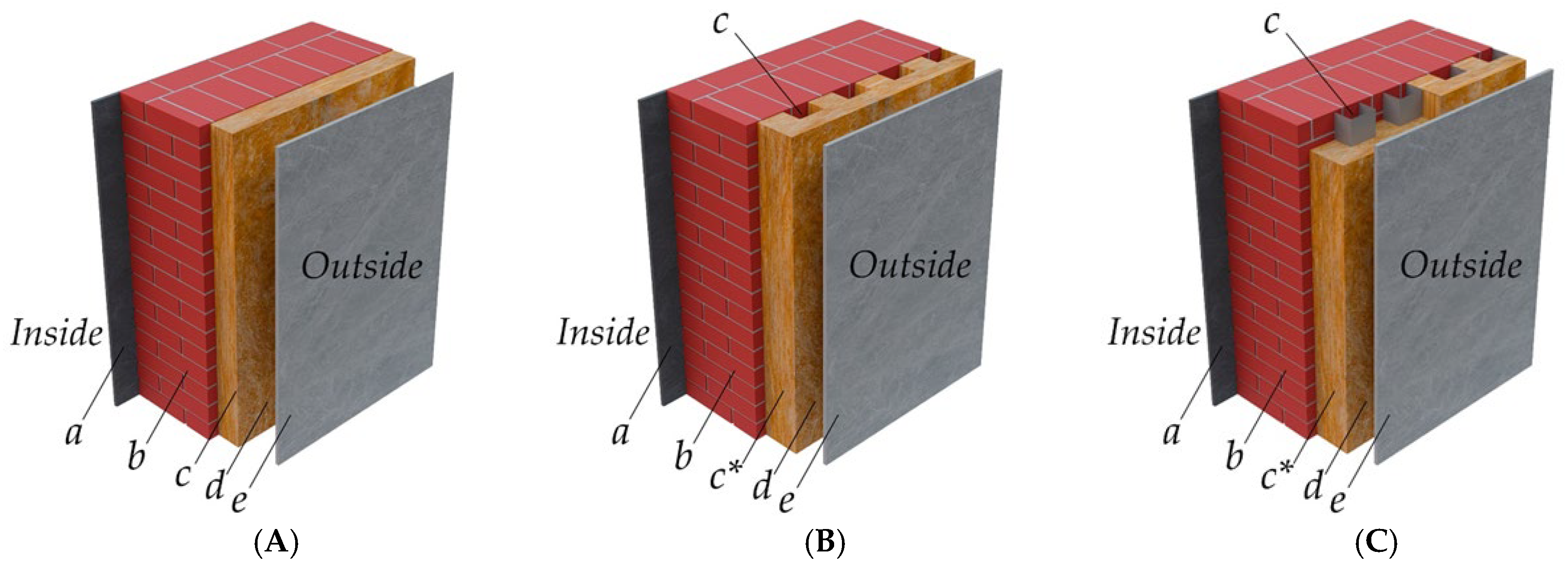
2.1. Configuration and Material Characteristics of the Building Envelope
2.2. Climatic and Indoor Boundary Conditions
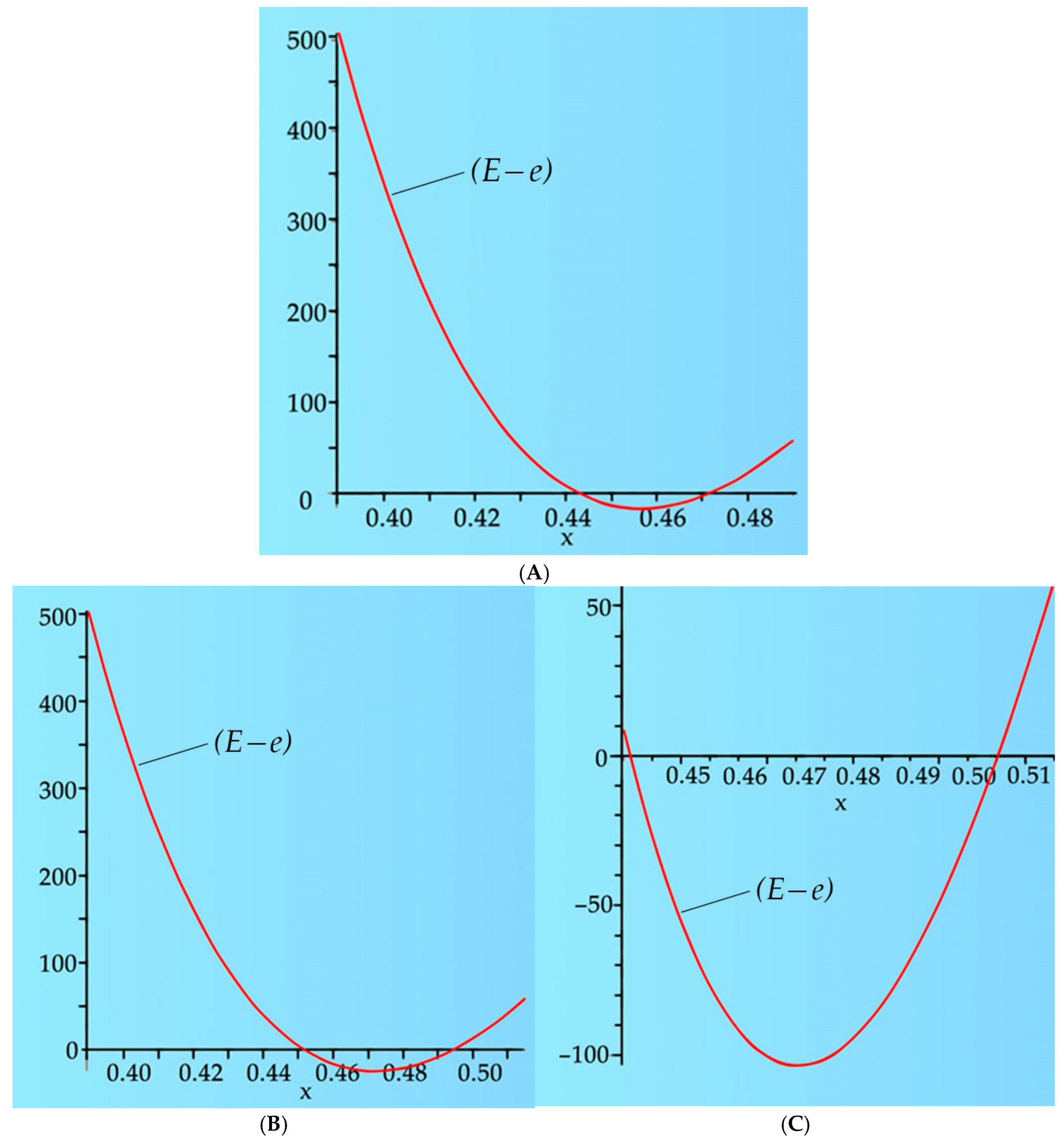
2.3. Finite Element Model. Convergence Study of the Numerical Solution
2.4. Methodology for Determining the Moisture and Air Regimes of Building Envelopes
- 1.
- Determination of the vapor diffusion resistance of the building envelope.
- 2.
- Identification of the water vapor condensation zone within the envelope.
- 3.
- Determination of the amount of moisture accumulated in the condensation zone during the heating period and evaluation of the drying time of the envelope.
- 4.
- Verification of the absence of condensate formation within the ventilated air cavity.
- —the difference between the design air pressures on the external and internal surfaces of the building envelope;
- —the prescribed air permeability of the external wall.
- —the building height;
- —the specific weight of outdoor air;
- —the specific weight of indoor air;
- —the average temperature of the coldest five-day period with a reliability of 0.92;
- —the indoor air temperature during the winter period;
- —the maximum of the average wind speeds by direction for January, with a frequency of occurrence of 16% or higher.
2.5. Input Data for Transient-State Analysis
- –
- on the interior surface—Convection, 20 °C in winter; in summer: 21 °C until 06:00, 24 °C from 06:00 to 12:00, 26 °C from 12:00 to 20:00, and 24 °C from 20:00 to 24:00;
- –
- on the exterior surface of the envelope without considering the ventilated façade—outdoor air temperature in winter and outdoor air temperature including the effect of solar radiation in summer;
- –
- on the surface of the ventilated channel—outdoor air temperature in summer.
3. Results and Discussion
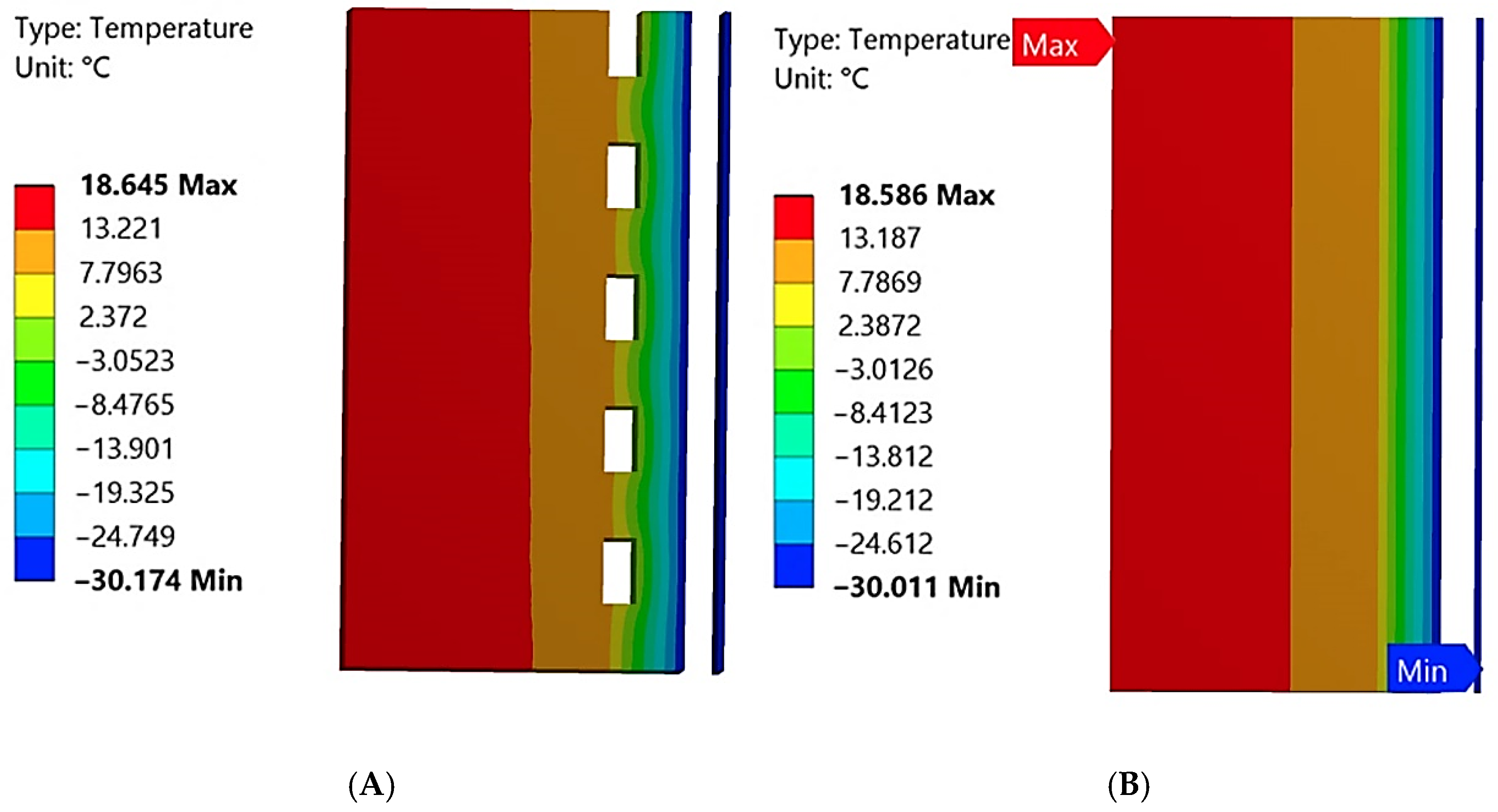
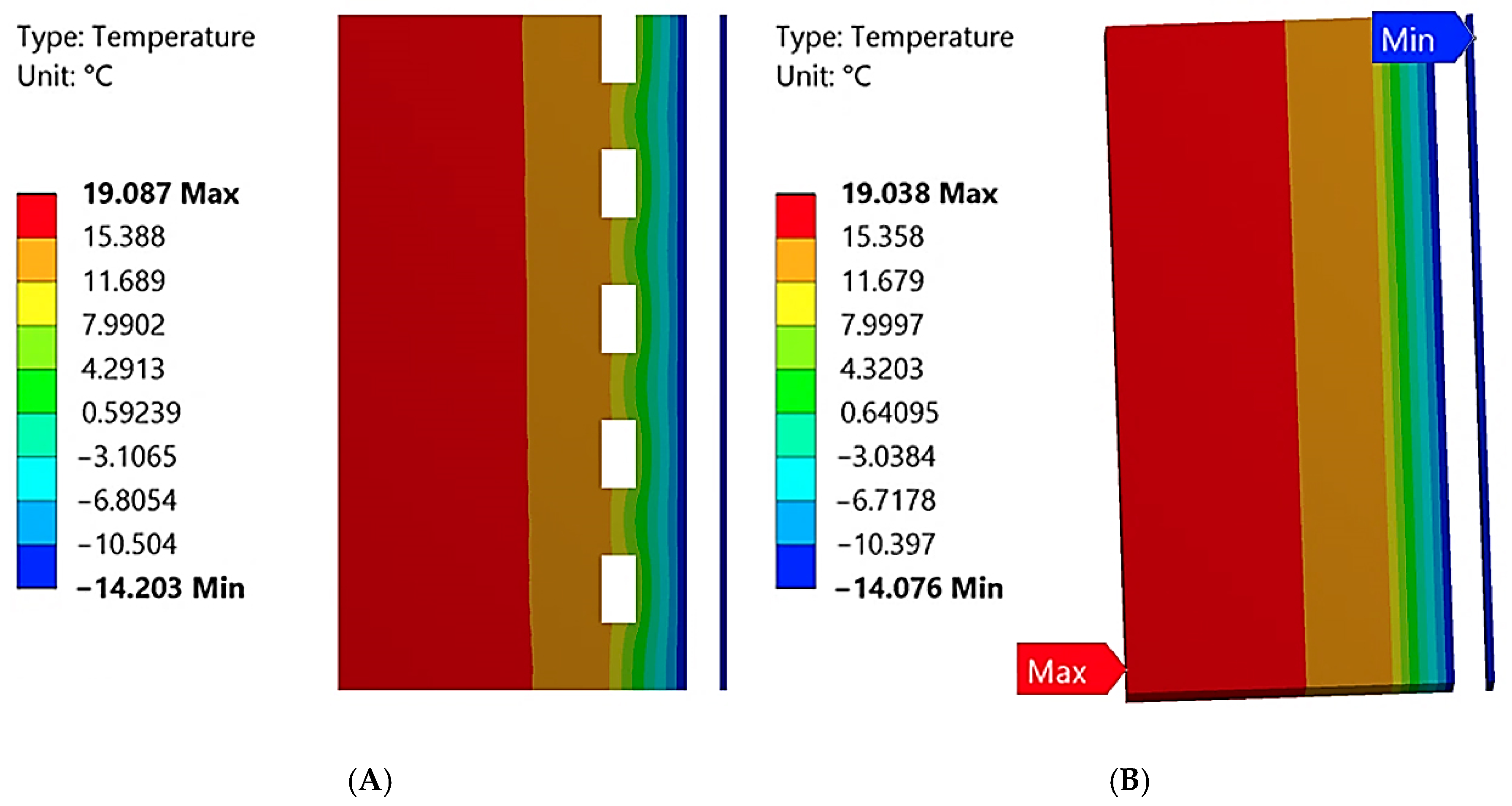
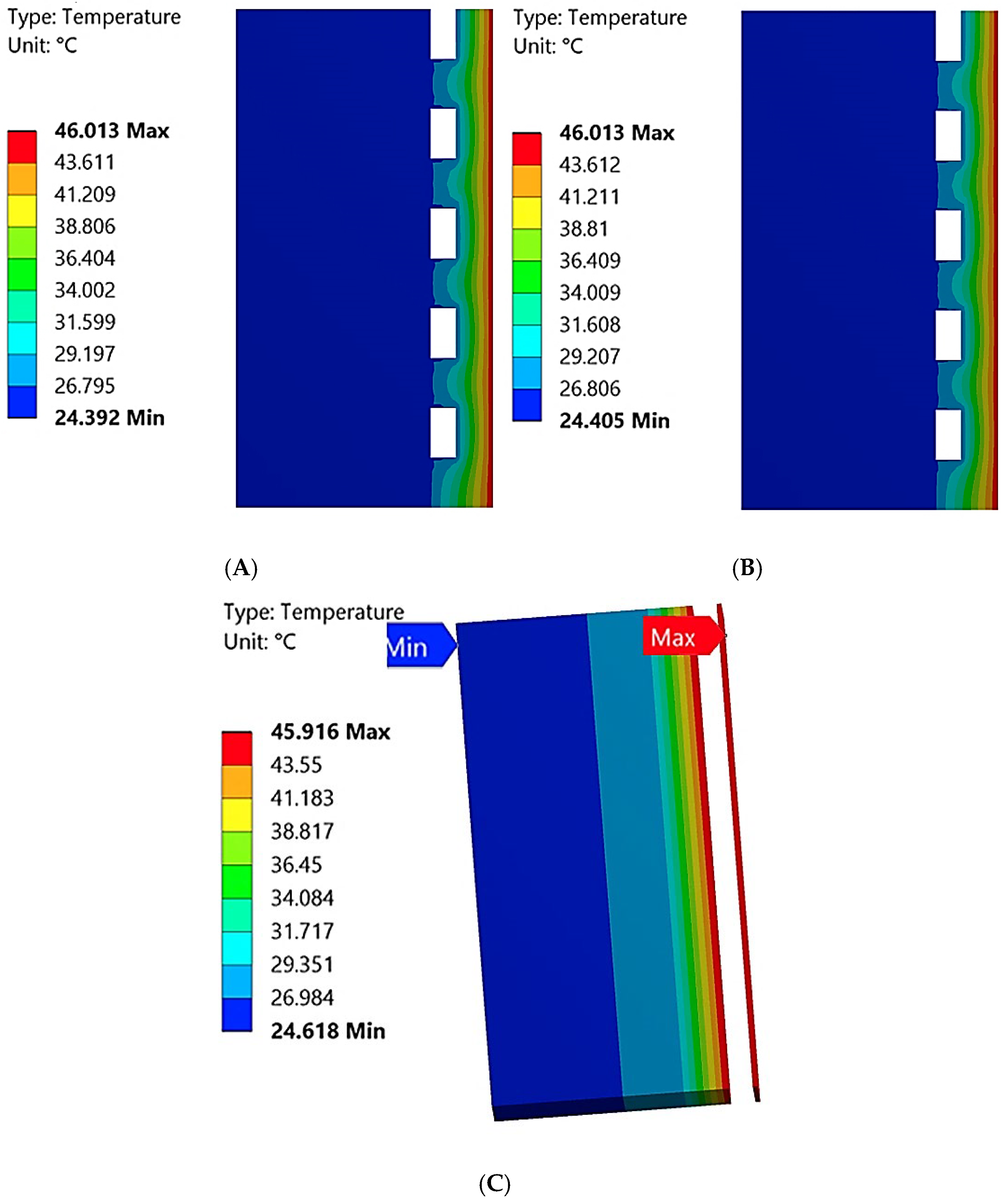
3.1. Calculation of Temperature Fields in Building Envelopes During the Cold Period
3.2. Analysis of the Moisture Regime of the Building Envelope
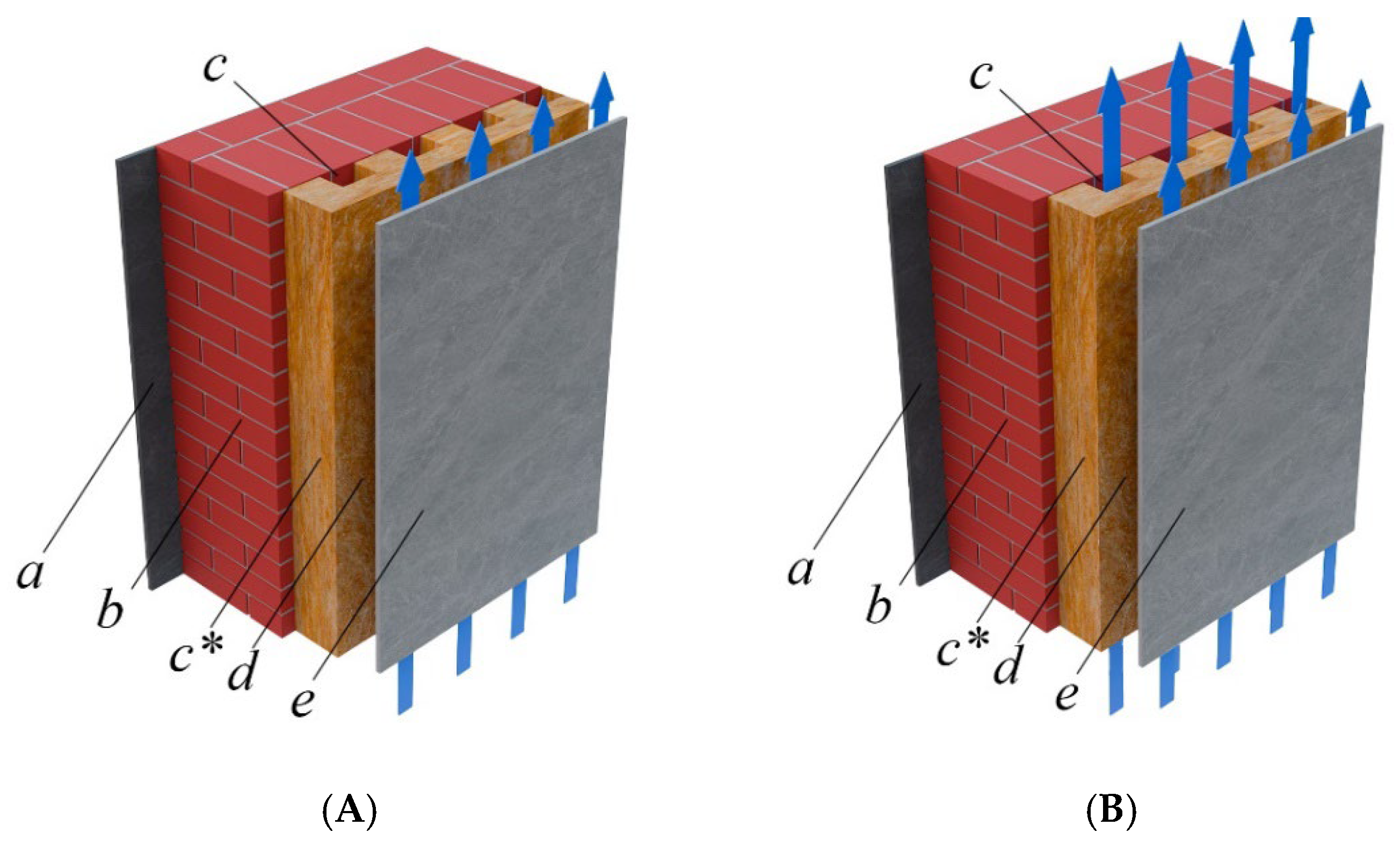
3.3. Calculation of the Air Regime of Exterior Building Envelopes
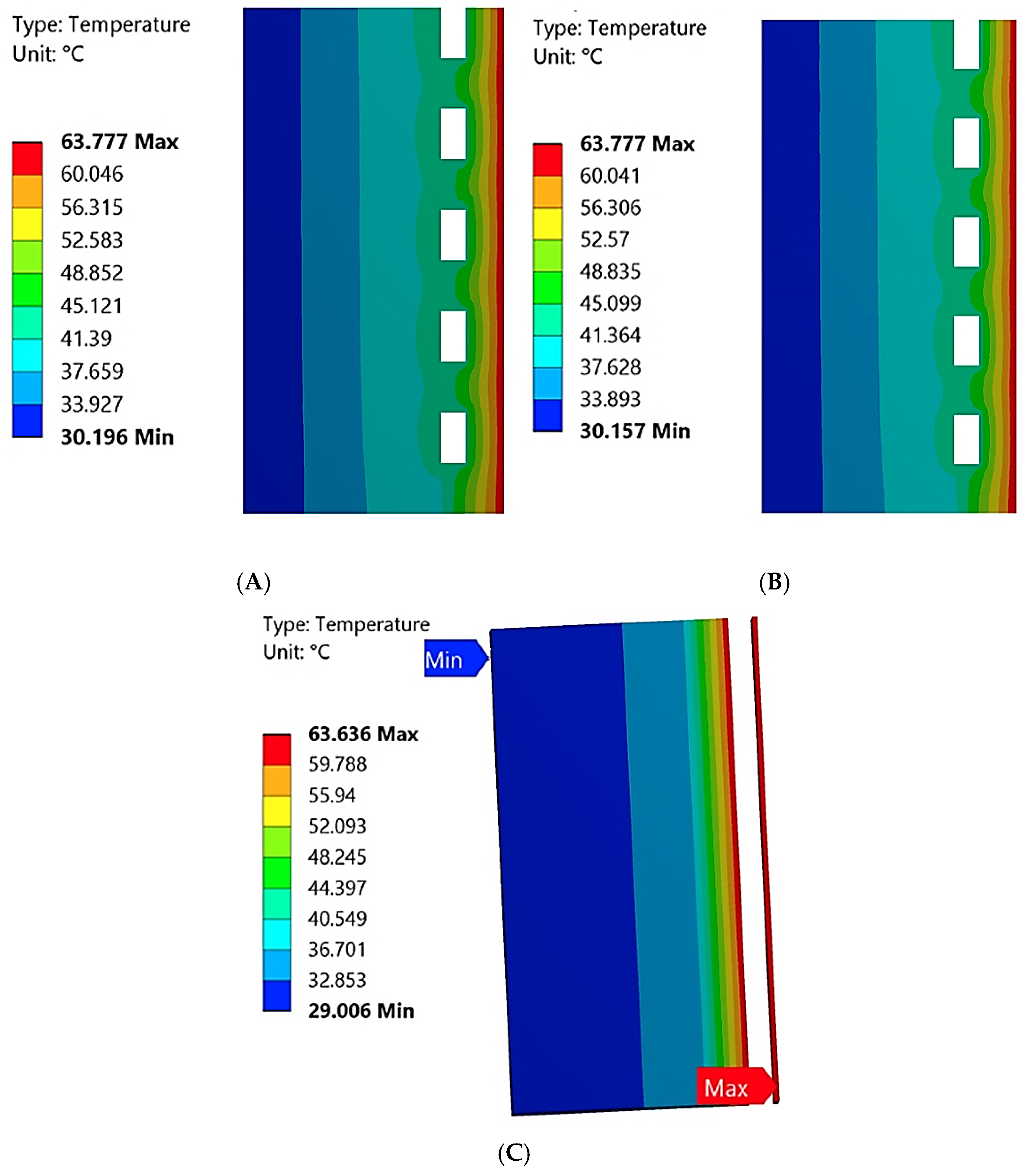
3.4. Calculation of Temperature Fields in Building Envelopes During the Hot Period
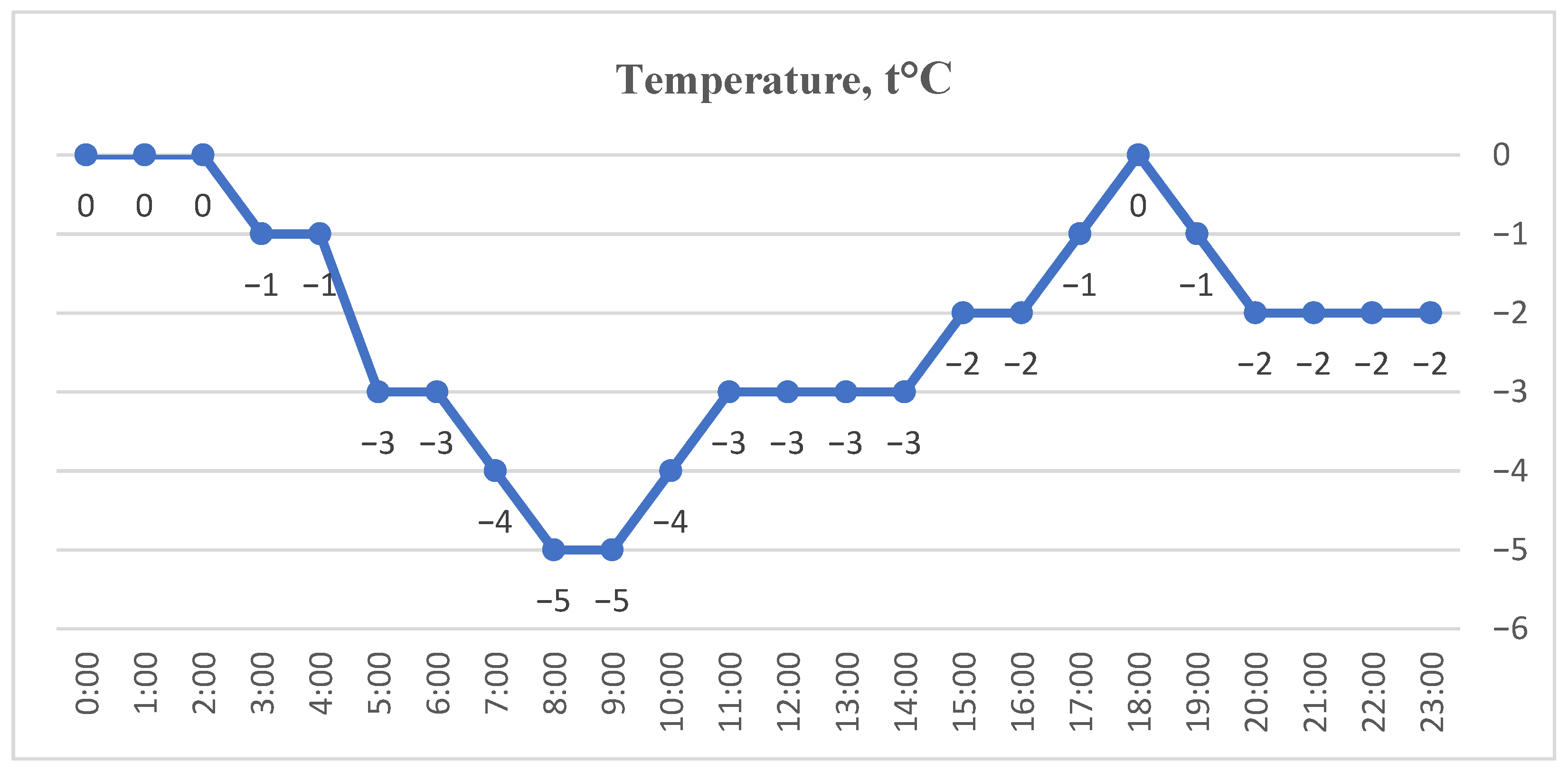
3.5. Analysis of the Transient Regime
4. Conclusions
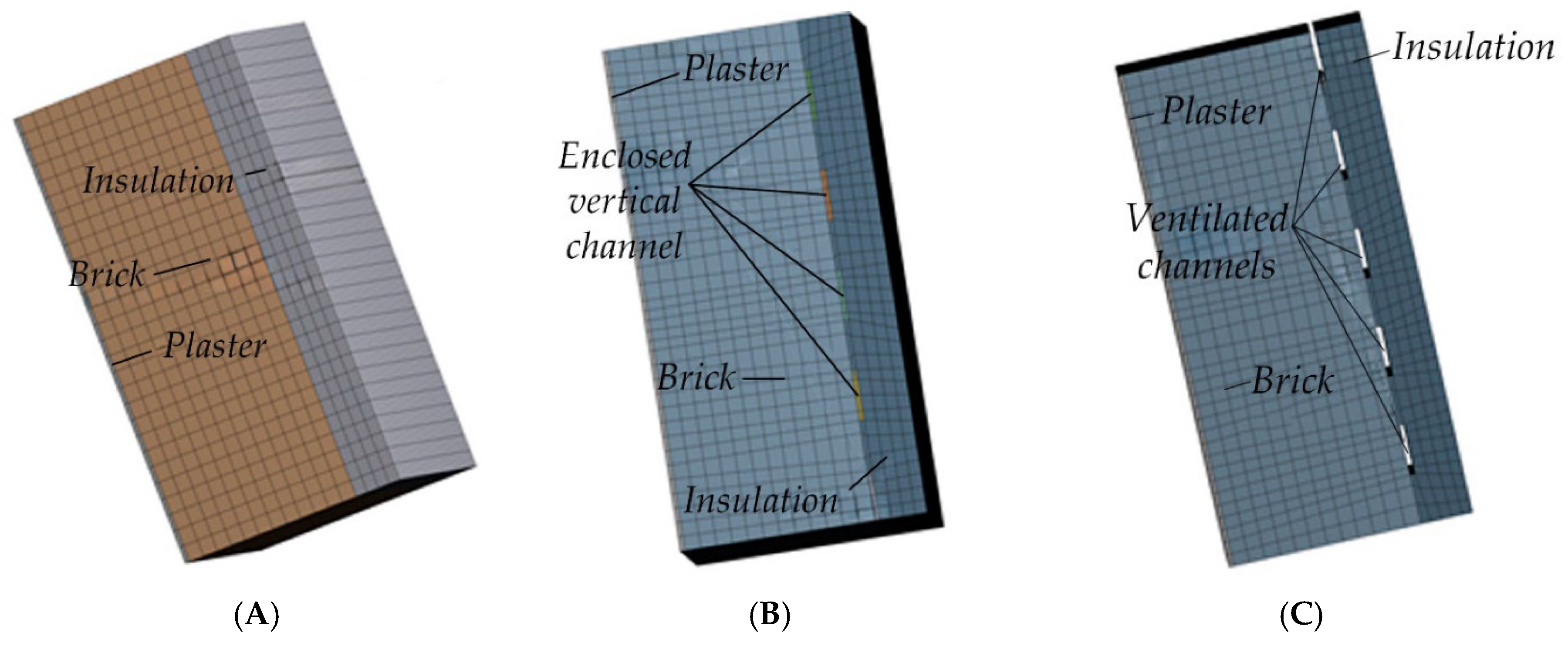
- The comparative analysis showed that the schemes with enclosed vertical channels and a heat-reflective layer exhibit higher thermal resistance than the simple homogeneous scheme under both extreme and moderate thermal loads. Schemes without heat-reflective screens are less effective under the given conditions.
- According to the calculation results, the most effective configuration is Scheme 3/50/75/50, which provides the optimal combination of thermal inertia, heat-transfer resistance, and resistance to overheating in the summer period. The thickness of the air cavity significantly affects convection: at 50 mm the air velocity increases, whereas at 100 mm it decreases considerably. Overall, the natural convection velocity remains very low due to the small height difference between the inlet and outlet.
- In the winter period, the adaptive scheme (Scheme 3) increases the interior surface temperature by 1.5–2.3 °C compared with the baseline configuration, resulting in a 12–18% reduction in heat flux through the envelope. In the summer period, the exterior cladding temperature in the adaptive scheme is 3–5 °C lower, reducing indoor heat gains by 8–14% and decreasing the cooling load.
- The moisture-regime analysis showed that all investigated schemes exhibit condensation in the outermost insulation layer. The amount of condensate is minimal and does not affect the thermal performance of the envelope. No condensation was detected in either the enclosed vertical channels or the ventilated cavity. Schemes with heat-reflective layers generate slightly more condensate and exhibit longer drying times; however, the values are sufficiently small and do not influence the selection of the optimal scheme.
- In the summer period, the use of schemes with ventilated vertical channels reduces heat flux through the envelope by up to 36% under average July temperature conditions. Under extreme temperatures, the performance changes: the configuration with homogeneous insulation becomes more stable due to the sharp reduction in natural convection caused by strong heating of the exterior surface. The heat-reflective layer has virtually no effect on the envelope performance under warm conditions.
- All investigated schemes demonstrate significantly excessive air permeability, particularly in the design of residential buildings approximately 48 m high. To increase air-permeability resistance, the use of an additional plaster layer between the brick masonry and the insulation, or the application of denser vapor-barrier materials, is recommended.
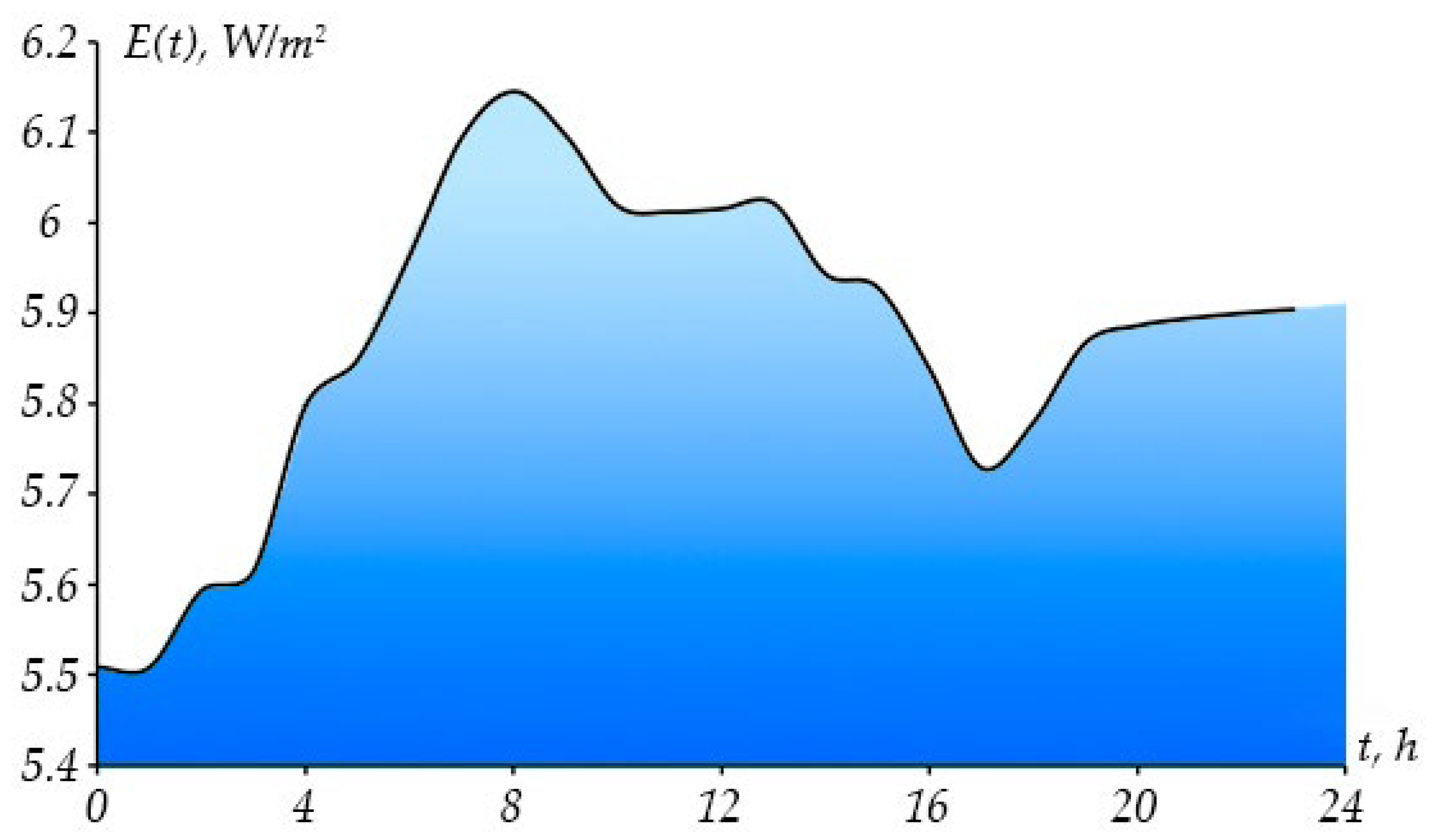
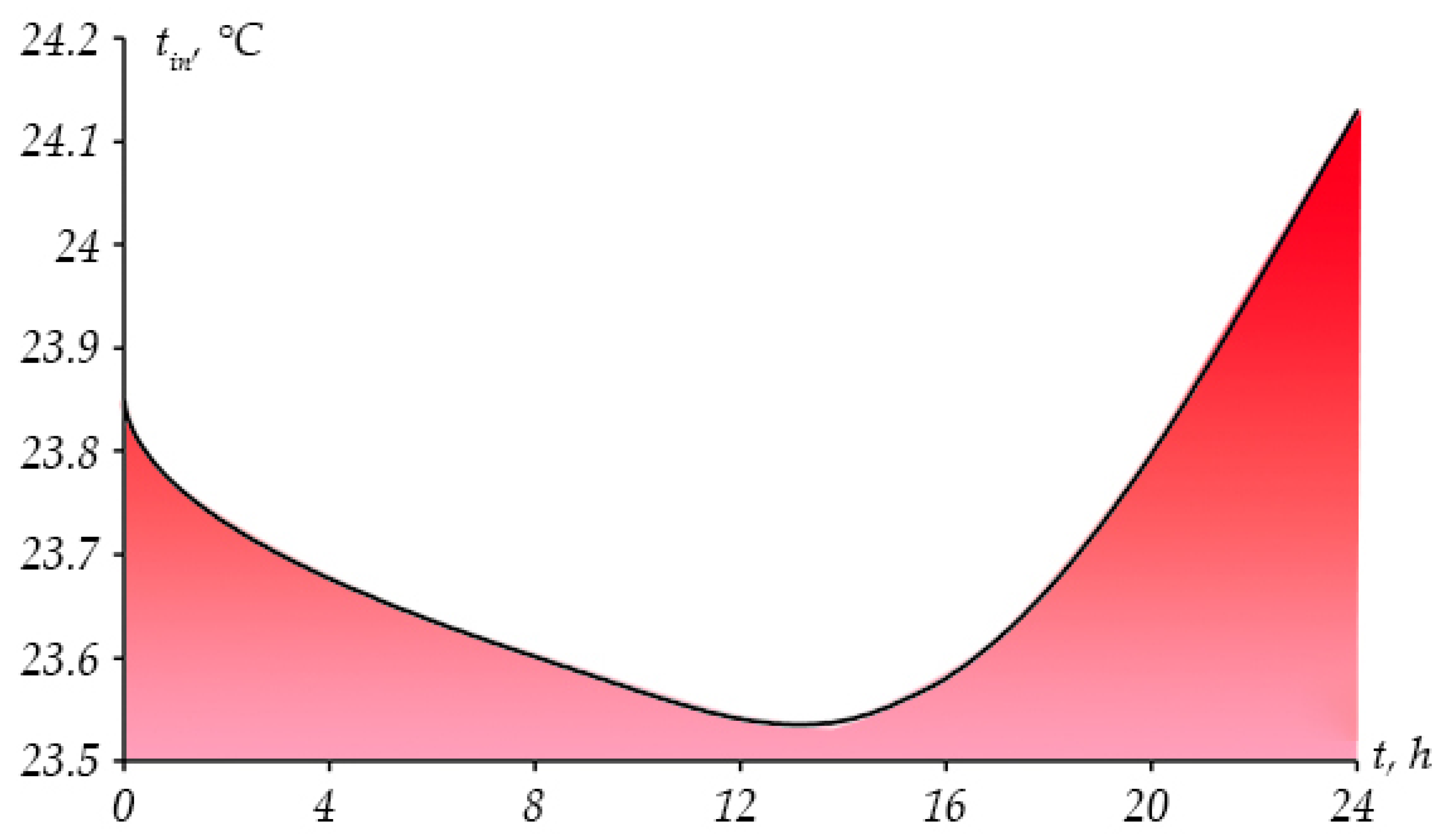
- Transient thermal modeling for Scheme 3/50/75/50 under the conditions of 15 January and 15 July 2024 showed high thermal stability of the envelope. In winter, the heat flux through the envelope did not exceed 6.2 W/m2 while maintaining an indoor air temperature of 20 °C. In summer conditions without active air conditioning, the amplitude of temperature fluctuations at the interior surface did not exceed 0.7 °C, despite an outdoor temperature amplitude of about 22 °C, confirming the high thermal inertia of the adaptive structure.
- A comprehensive comparison of all schemes confirms that Scheme 3/50/75/50 is the most balanced solution for both winter and summer conditions of the southern Kazakhstan climate. This scheme ensures a stable thermal regime, minimization of heat losses, reduction of heat gains in the hot period, low sensitivity to outdoor-temperature fluctuations, high thermal stability, and reliable performance under intense solar radiation.
5. Patents
Author Contributions
Funding
Data Availability Statement
Conflicts of Interest
Appendix A
| Variant of the Building Envelope | Reduced Heat-Transfer Resistance R, (°C·m2)/W | Heat-Flux Density Through the Building Envelope q, W/m2 | Air Velocity in the Ventilated Air Cavity v, m/s | Average Air Temperature in the Ventilated Air Cavity Tп, °C | Air Temperature at the Outlet of the Ventilated Air Cavity Tout, °C | Convective Heat-Transfer Coefficient on the Wall of the Air Cavity αп, W/(m2·K) |
| Scheme 1/50/100 | 3.809 | 14.136 | 0.075 | −29.676 | −29.189 | 9.365 |
| Scheme 1/100/100 | 3.668 | 14.195 | 0.061 | −29.883 | −29.524 | 9.273 |
| Scheme 1/150/100 | 3.662 | 14.221 | 0.054 | −29.974 | −29.682 | 9.223 |
| Scheme 2/50/95/10 | 3.880 | 13.868 | 0.074 | −29.684 | −29.205 | 9.361 |
| Scheme 2/50/90/20 | 3.852 | 13.971 | 0.074 | −29.681 | −29.199 | 9.363 |
| Scheme 2/50/85/30 | 3.782 | 14.237 | 0.075 | −29.672 | −29.183 | 9.366 |
| Scheme 2/50/80/40 | 3.683 | 14.638 | 0.075 | −29.660 | −29.160 | 9.371 |
| Scheme 2/50/75/50 | 3.573 | 15.103 | 0.076 | −29.645 | −29.132 | 9.376 |
| Scheme 2/100/95/10 | 3.737 | 13.926 | 0.060 | −29.888 | −29.535 | 9.270 |
| Scheme 2/100/90/20 | 3.714 | 14.012 | 0.061 | −29.886 | −29.532 | 9.271 |
| Scheme 2/100/85/30 | 3.642 | 14.300 | 0.061 | −29.881 | −29.520 | 9.274 |
| Scheme 2/100/80/40 | 3.551 | 14.683 | 0.062 | −29.873 | −29.505 | 9.279 |
| Scheme 2/100/75/50 | 3.576 | 15.157 | 0.062 | −29.863 | −29.487 | 9.283 |
| Scheme 3/50/95/10 | 4.000 | 13.433 | 0.073 | −29.698 | −29.230 | 9.356 |
| Scheme 3/50/90/20 | 4.050 | 13.267 | 0.073 | −29.703 | −29.241 | 9.354 |
| Scheme 3/50/85/30 | 4.038 | 13.31 | 0.073 | −29.702 | −29.238 | 9.354 |
| Scheme 3/50/80/40 | 3.971 | 13.542 | 0.073 | −29.694 | −29.224 | 9.357 |
| Scheme 3/50/75/50 | 3.892 | 13.827 | 0.074 | −29.685 | −29.207 | 9.361 |
| Scheme 3/100/95/10 | 3.853 | 13.491 | 0.060 | −29.897 | −29.552 | 9.266 |
| Scheme 3/100/90/20 | 4.060 | 13.286 | 0.060 | −29.902 | −29.560 | 9.263 |
| Scheme 3/100/85/30 | 4.035 | 13.375 | 0.060 | −29.900 | −29.557 | 9.264 |
| Scheme 3/100/80/40 | 3.983 | 13.555 | 0.060 | −29.900 | −29.550 | 9.266 |
| Scheme 3/100/75/50 | 3.905 | 13.835 | 0.060 | −29.890 | −29.539 | 9.269 |
Appendix B
| Variant of the Building Envelope | Reduced Heat-Transfer Resistance R, (°C·m2)/W | Heat-Flux Density Through the Building Envelope q, W/m2 | Air Velocity in the Ventilated Air Cavity v, m/s | Average Air Temperature in the Ventilated Air Cavity Tп, °C | Air Temperature at the Outlet of the Ventilated Air Cavity Tout, °C | Convective Heat-Transfer Coefficient on the Wall of the Air Cavity αп, W/(m2·K) |
| Scheme 1/50/100 | 3.658 | 9.623 | 0.066 | −13.816 | −13.465 | 10.304 |
| Scheme 1/100/100 | 3.658 | 9.667 | 0.054 | −13.971 | −13.701 | 10.222 |
| Scheme 1/150/100 | 3.659 | 9.687 | 0.048 | −14.041 | −13.819 | 10.175 |
| Scheme 2/50/95/10 | 3.724 | 9.447 | 0.065 | −13.822 | −13.477 | 10.301 |
| Scheme 2/50/90/20 | 3.704 | 9.4986 | 0.065 | −13.821 | −13.473 | 10.302 |
| Scheme 2/50/85/30 | 3.632 | 9.692 | 0.066 | −13.813 | −13.460 | 10.306 |
| Scheme 2/50/80/40 | 3.538 | 9.961 | 0.066 | −13.804 | −13.442 | 10.310 |
| Scheme 2/50/75/50 | 3.433 | 10.273 | 0.067 | −13.792 | −13.422 | 10.315 |
| Scheme 2/100/95/10 | 3.724 | 9.491 | 0.054 | −13.976 | −13.710 | 10.219 |
| Scheme 2/100/90/20 | 3.704 | 9.5432 | 0.054 | −13.974 | −13.707 | 10.220 |
| Scheme 2/100/85/30 | 3.617 | 9.7378 | 0.054 | −13.969 | −13.696 | 10.223 |
| Scheme 2/100/80/40 | 3.541 | 10.000 | 0.055 | −13.964 | −13.686 | 10.227 |
| Scheme 2/100/75/50 | 3.434 | 10.322 | 0.055 | −13.956 | −13.672 | 10.231 |
| Scheme 3/50/95/10 | 3.853 | 9.1219 | 0.064 | −13.835 | −13.499 | 10.296 |
| Scheme 3/50/90/20 | 3.913 | 8.9792 | 0.064 | −13.840 | −13.509 | 10.293 |
| Scheme 3/50/85/30 | 3.892 | 9.0289 | 0.064 | −13.838 | −13.505 | 10.294 |
| Scheme 3/50/80/40 | 3.847 | 9.1355 | 0.064 | −13.834 | −13.498 | 10.296 |
| Scheme 3/50/75/50 | 3.793 | 9.2677 | 0.065 | −13.829 | −13.489 | 10.298 |
| Scheme 3/100/95/10 | 3.840 | 9.1954 | 0.053 | −13.983 | −13.723 | 10.215 |
| Scheme 3/100/90/20 | 3.926 | 8.9862 | 0.053 | −13.988 | −13.732 | 10.211 |
| Scheme 3/100/85/30 | 3.907 | 9.0313 | 0.053 | −13.987 | −13.730 | 10.212 |
| Scheme 3/100/80/40 | 3.860 | 9.1451 | 0.053 | −13.984 | −13.724 | 10.214 |
| Scheme 3/100/75/50 | 3.790 | 9.3206 | 0.053 | −13.980 | −13.717 | 10.217 |
Appendix C
| Variant of the Building Envelope | Reduced Heat-Transfer Resistance R, (°C·m2)/W | Heat-Flux Density Through the Building Envelope q, W/m2 | Air Velocity in the Ventilated Air Cavity v, m/s | Average Air Temperature in the Ventilated Air Cavity Tп, °C | Air Temperature at the Outlet of the Ventilated Air Cavity Tout, °C | Convective Heat-Transfer Coefficient on the Wall of the Air Cavity αп, W/(m2·K) | Air Velocity in the Ventilated Air Channel v, m/s | Average Air Temperature in the Ventilated Air Channel Tп, °C | Air Temperature at the Outlet of the Ventilated Air Channel Tout, °C | Convective Heat-Transfer Coefficient on the Wall of the Air Channel αп, W/(m2·K) |
| Scheme 1/50/100 | 3.527 | 14.954 | 0.07 | 63.339 | 62.999 | 17.135 | – | – | – | – |
| Scheme 2/50/95/10, 18 m | 3.592 | 21.406 | 0.070 | 63.347 | 63.012 | 17.132 | 9.820 | 42.569 | 41.117 | 44.717 |
| Scheme 2/50/95/10, 48 m | 3.589 | 20.599 | 0.070 | 63.347 | 63.012 | 17.133 | 18.592 | 42.007 | 40.146 | 61.737 |
| Scheme 2/50/90/20, 18 m | 3.583 | 21.930 | 0.070 | 63.346 | 63.010 | 17.133 | 6.638 | 42.976 | 41.855 | 37.321 |
| Scheme 2/50/90/20, 48 m | 3.579 | 21.306 | 0.070 | 63.345 | 63.010 | 17.133 | 12.614 | 42.543 | 41.076 | 38.713 |
| Scheme 2/50/85/30, 18 m | 3.561 | 22.288 | 0.070 | 63.343 | 63.006 | 17.133 | 5.333 | 43.188 | 42.247 | 22.010 |
| Scheme 2/50/85/30, 48 m | 3.557 | 21.762 | 0.070 | 63.342 | 63.005 | 17.134 | 10.154 | 42.824 | 41.583 | 45.475 |
| Scheme 2/50/80/40, 18 m | 3.527 | 22.477 | 0.070 | 63.339 | 62.999 | 17.134 | 4.625 | 43.334 | 42.522 | 32.002 |
| Scheme 2/50/80/40, 48 m | 3.522 | 22.022 | 0.070 | 63.339 | 62.998 | 17.135 | 8.816 | 43.020 | 41.942 | 42.524 |
| Scheme 2/50/75/50, 18 m | 3.482 | 22.547 | 0.070 | 63.333 | 62.989 | 17.136 | 4.110 | 43.434 | 42.711 | 30.519 |
| Scheme 2/50/75/50, 48 m | 3.476 | 22.144 | 0.070 | 63.333 | 62.988 | 17.136 | 7.838 | 43.155 | 42.191 | 40.269 |
| Scheme 3/50/95/10, 18 m | 3.597 | 21.405 | 0.070 | 63.347 | 63.013 | 17.132 | 9.823 | 42.568 | 41.115 | 33.418 |
| Scheme 3/50/95/10, 48 m | 3.592 | 20.598 | 0.070 | 63.347 | 63.012 | 17.133 | 18.595 | 42.006 | 40.144 | 50.496 |
| Scheme 3/50/90/20, 18 m | 3.590 | 21.928 | 0.070 | 63.347 | 63.012 | 17.133 | 6.641 | 42.975 | 41.852 | 25.980 |
| Scheme 3/50/90/20, 48 m | 3.583 | 21.305 | 0.070 | 63.346 | 63.010 | 17.133 | 12.617 | 42.542 | 41.074 | 39.282 |
| Scheme 3/50/85/30, 18 m | 3.570 | 22.286 | 0.070 | 63.344 | 63.008 | 17.133 | 5.337 | 43.187 | 42.244 | 22.586 |
| Scheme 3/50/85/30, 48 m | 3.561 | 21.761 | 0.070 | 63.343 | 63.006 | 17.133 | 10.157 | 42.824 | 41.581 | 34.150 |
| Scheme 3/50/80/40, 18 m | 3.539 | 22.475 | 0.0700 | 63.340 | 63.001 | 17.134 | 4.629 | 43.333 | 42.519 | 20.626 |
| Scheme 3/50/80/40, 48 m | 3.528 | 22.020 | 0.0700 | 63.339 | 62.999 | 17.134 | 8.820 | 43.019 | 41.939 | 31.179 |
| Scheme 3/50/75/50, 18 m | 3.495 | 22.545 | 0.070 | 63.335 | 62.992 | 17.135 | 4.115 | 43.432 | 42.707 | 19.134 |
| Scheme 3/50/75/50, 48 m | 3.482 | 22.142 | 0.070 | 63.334 | 62.989 | 17.136 | 7.843 | 43.153 | 42.188 | 28.912 |
Appendix D
| Variant of the Building Envelope | Reduced Heat-Transfer Resistance R, (°C·m2)/W | Heat-Flux Density Through the Building Envelope q, W/m2 | Air Velocity in the Ventilated Air Cavity v, m/s | Average Air Temperature in the Ventilated Air Cavity Tп, °C | Air Temperature at the Outlet of the Ventilated Air Cavity Tout, °C | Convective Heat-Transfer Coefficient on the Wall of the Air Cavity αп, W/(m2·K) | Air Velocity in the Ventilated Air Channel v, m/s | Average Air Temperature in the Ventilated Air Channel Tп, °C | Air Temperature at the Outlet of the Ventilated Air Channel Tout, °C | Convective Heat-Transfer Coefficient on the Wall of the Air Channel αп, W/(m2·K) |
| Scheme 1/50/100 | 3.534 | 6.1788 | 0.058 | 45.713 | 45.488 | 15.191 | – | – | – | – |
| Scheme 2/50/95/10, 18 m | 3.608 | 4.2178 | 0.058 | 45.719 | 45.498 | 15.189 | 4.424 | 26.731 | 26.990 | 29.639 |
| Scheme 2/50/95/10, 48 m | 3.412 | 4.3667 | 0.058 | 45.719 | 45.498 | 15.189 | 8.278 | 26.835 | 27.142 | 39.547 |
| Scheme 2/50/90/20, 18 m | 3.599 | 4.0976 | 0.058 | 45.719 | 45.698 | 15.189 | 3.719 | 26.681 | 26.917 | 25.847 |
| Scheme 2/50/90/20, 48 m | 3.594 | 4.2333 | 0.058 | 45.718 | 45.497 | 15.189 | 6.000 | 26.775 | 27.069 | 33.953 |
| Scheme 2/50/85/30, 18 m | 3.578 | 4.0321 | 0.058 | 45.717 | 45.495 | 15.190 | 2.700 | 26.659 | 26.885 | 24.265 |
| Scheme 2/50/85/30, 48 m | 3.572 | 4.1628 | 0.058 | 45.716 | 45.494 | 15.190 | 5.119 | 26.750 | 27.038 | 31.596 |
| Scheme 2/50/80/40, 18 m | 3.545 | 3.9864 | 0.058 | 45.714 | 45.490 | 15.191 | 2.470 | 26.647 | 26.868 | 23.479 |
| Scheme 2/50/80/40, 48 m | 3.538 | 4.1139 | 0.058 | 45.714 | 45.490 | 15.191 | 4.697 | 26.734 | 27.021 | 30.421 |
| Scheme 2/50/75/50, 18 m | 3.499 | 3.9543 | 0.058 | 45.710 | 45.483 | 15.192 | 2.314 | 26.642 | 26.863 | 22.934 |
| Scheme 2/50/75/50, 48 m | 3.492 | 4.0813 | 0.058 | 45.710 | 45.482 | 15.193 | 4.409 | 26.731 | 27.019 | 29.597 |
| Scheme 3/50/95/10, 18 m | 3.617 | 4.2124 | 0.057 | 45.720 | 45.500 | 15.188 | 4.399 | 26.727 | 26.983 | 19.879 |
| Scheme 3/50/95/10, 48 m | 3.608 | 4.3631 | 0.058 | 45.719 | 45.499 | 15.189 | 8.254 | 26.832 | 27.137 | 29.794 |
| Scheme 3/50/90/20, 18 m | 3.613 | 4.0915 | 0.057 | 45.720 | 45.500 | 15.189 | 3.154 | 26.676 | 26.909 | 16.086 |
| Scheme 3/50/90/20, 48 m | 3.601 | 4.2291 | 0.058 | 45.719 | 45.498 | 15.189 | 5.978 | 26.772 | 27.064 | 24.200 |
| Scheme 3/50/85/30, 18 m | 3.595 | 4.026 | 0.058 | 45.718 | 45.497 | 15.189 | 2.676 | 26.655 | 26.879 | 14.506 |
| Scheme 3/50/85/30, 48 m | 3.581 | 4.1583 | 0.058 | 45.717 | 45.495 | 15.190 | 5.096 | 26.746 | 27.032 | 21.844 |
| Scheme 3/50/80/40, 18 m | 3.564 | 3.9798 | 0.058 | 45.716 | 45.493 | 15.190 | 2.447 | 26.642 | 26.859 | 13.721 |
| Scheme 3/50/80/40, 48 m | 3.548 | 4.1042 | 0.0579 | 45.714 | 45.490 | 15.191 | 4.675 | 26.732 | 27.015 | 20.669 |
| Scheme 3/50/75/50, 18 m | 3.522 | 3.9475 | 0.058 | 45.712 | 45.487 | 15.192 | 2.292 | 26.638 | 26.854 | 13.176 |
| Scheme 3/50/75/50, 48 m | 3.504 | 4.0764 | 0.058 | 45.711 | 45.484 | 15.192 | 4.387 | 26.727 | 27.013 | 19.845 |
Appendix E
| Variant of the Building Envelope | e0/E0 | e1/E1 | e2/E2 | e3/E3 | e4/E4 | en/Eп |
| Scheme 1/50/100 | 0.550 | 0.552 | 0.672 | 0.714 | – | 0.730 |
| Scheme 1/100/100 | 0.550 | 0.552 | 0.672 | 0.722 | – | 0.730 |
| Scheme 1/150/100 | 0.550 | 0.552 | 0.673 | 0.727 | – | 0.730 |
| Scheme 2/50/95/10, solid section | 0.550 | 0.552 | 0.671 | 0.714 | – | 0.730 |
| Scheme 2/50/95/10, channel section | 0.550 | 0.552 | 0.663 | 0.733 | 0.714 | 0.730 |
| Scheme 2/50/90/20, solid section | 0.550 | 0.552 | 0.676 | 0.714 | – | 0.730 |
| Scheme 2/50/90/20, channel section | 0.550 | 0.552 | 0.659 | 0.760 | 0.714 | 0.730 |
| Scheme 2/50/85/30, solid section | 0.55 | 0.552 | 0.685 | 0.714 | – | 0.730 |
| Scheme 2/50/85/30, channel section | 0.55 | 0.552 | 0.658 | 0.777 | 0.713 | 0.730 |
| Scheme 2/50/80/40, solid section | 0.55 | 0.553 | 0.695 | 0.713 | – | 0.730 |
| Scheme 2/50/80/40, channel section | 0.55 | 0.552 | 0.659 | 0.791 | 0.713 | 0.730 |
| Scheme 2/50/75/50, solid section | 0.55 | 0.553 | 0.706 | 0.712 | – | 0.730 |
| Scheme 2/50/75/50, channel section | 0.55 | 0.552 | 0.660 | 0.807 | 0.712 | 0.730 |
| Scheme 2/100/95/10, solid section | 0.55 | 0.552 | 0.672 | 0.723 | – | 0.730 |
| Scheme 2/100/95/10, channel section | 0.55 | 0.552 | 0.663 | 0.734 | 0.722 | 0.730 |
| Scheme 2/100/90/20, solid section | 0.55 | 0.552 | 0.677 | 0.723 | – | 0.730 |
| Scheme 2/100/90/20, channel section | 0.55 | 0.552 | 0.660 | 0.761 | 0.722 | 0.730 |
| Scheme 2/100/85/30, solid section | 0.55 | 0.552 | 0.686 | 0.722 | – | 0.730 |
| Scheme 2/100/85/30, channel section | 0.55 | 0.552 | 0.659 | 0.779 | 0.722 | 0.730 |
| Scheme 2/100/80/40, solid section | 0.55 | 0.553 | 0.695 | 0.722 | – | 0.730 |
| Scheme 2/100/80/40, channel section | 0.55 | 0.552 | 0.659 | 0.794 | 0.722 | 0.730 |
| Scheme 2/100/75/50, solid section | 0.55 | 0.553 | 0.707 | 0.722 | – | 0.730 |
| Scheme 2/100/75/50, channel section | 0.55 | 0.552 | 0.661 | 0.809 | 0.722 | 0.730 |
| Scheme 3/50/95/10, solid section | 0.55 | 0.552 | 0.663 | 0.715 | – | 0.730 |
| Scheme 3/50/95/10, channel section | 0.55 | 0.552 | 0.655 | 0.817 | 0.715 | 0.730 |
| Scheme 3/50/90/20, solid section | 0.55 | 0.552 | 0.664 | 0.715 | – | 0.730 |
| Scheme 3/50/90/20, channel section | 0.55 | 0.552 | 0.647 | 0.883 | 0.715 | 0.730 |
| Scheme 3/50/85/30, solid section | 0.55 | 0.552 | 0.668 | 0.715 | – | 0.730 |
| Scheme 3/50/85/30, channel section | 0.55 | 0.551 | 0.643 | 0.918 | 0.715 | 0.730 |
| Scheme 3/50/80/40, solid section | 0.55 | 0.552 | 0.674 | 0.713 | – | 0.730 |
| Scheme 3/50/80/40, channel section | 0.55 | 0.551 | 0.639 | 0.952 | 0.715 | 0.730 |
| Scheme 3/50/75/50, solid section | 0.55 | 0.552 | 0.681 | 0.715 | – | 0.730 |
| Scheme 3/50/75/50, channel section | 0.55 | 0.551 | 0.636 | 0.991 | 0.715 | 0.730 |
| Scheme 3/100/95/10, solid section | 0.55 | 0.552 | 0.665 | 0.723 | – | 0.730 |
| Scheme 3/100/95/10, channel section | 0.55 | 0.552 | 0.657 | 0.812 | 0.723 | 0.730 |
| Scheme 3/100/90/20, solid section | 0.55 | 0.553 | 0.664 | 0.722 | – | 0.730 |
| Scheme 3/100/90/20, channel section | 0.55 | 0.553 | 0.647 | 0.893 | 0.722 | 0.730 |
| Scheme 3/100/85/30, solid section | 0.55 | 0.552 | 0.668 | 0.722 | – | 0.730 |
| Scheme 3/100/85/30, channel section | 0.55 | 0.551 | 0.643 | 0.917 | 0.722 | 0.730 |
| Scheme 3/100/80/40, solid section | 0.55 | 0.552 | 0.674 | 0.723 | – | 0.730 |
| Scheme 3/100/80/40, channel section | 0.55 | 0.551 | 0.639 | 0.962 | 0.723 | 0.730 |
| Scheme 3/100/75/50, solid section | 0.55 | 0.552 | 0.682 | 0.723 | – | 0.730 |
| Scheme 3/100/75/50, channel section | 0.55 | 0.551 | 0.637 | 0.992 | 0.723 | 0.730 |
References
- Nurbaturov, K.A.; Kulibayev, A.A.; De, I.M.; Sadykhanov, K.B.; Mikhailova, O.Y.; Botayeva, M.S.; Takenova, D.A. Operational properties of finishing coatings. Bull. Kazn. 2021, 2, 65–77. Available online: https://drive.google.com/file/d/1WBE9qP9QMxbQOlvCpCEd-xZHBiwzp0ly/view (accessed on 20 November 2025).
- Minister for Investments and Development of the Republic of Kazakhstan. On the Establishment of Energy-Efficiency Requirements for Buildings, Structures, Facilities, and Their Elements Forming Part of Building Envelopes. Order No. 406 dated 31 March 2015, Registered with the Ministry of Justice of the Republic of Kazakhstan on 17 June 2015 Under No. 11378. Available online: https://adilet.zan.kz/rus/docs/V1500011378?utm_source=chatgpt.com (accessed on 20 November 2025).
- Dos Santos Pizzatto, S.M.; Pizzatto, F.; Raupp-Pereira, F.; Arcaro, S.; Angioletto, E.; Montedo, O.R.K. Ventilated facade system: A review. Bol. Soc. Esp. Cerám. Vidr. 2025, 64, 100443. [Google Scholar] [CrossRef]
- Borodulin, V.Y.; Nizovtsev, M.I. Modeling heat and moisture transfer of building facades thermally insulated by the panels with ventilated channels. J. Build. Eng. 2021, 40, 102391. [Google Scholar] [CrossRef]
- Nizovtsev, M.I.; Letushko, V.N.; Borodulin, V.Y.; Sterlyagov, A.N. Experimental studies of the thermo and humidity state of a new building facade insulation system based on panels with ventilated channels. Energy Build. 2020, 206, 109607. [Google Scholar] [CrossRef]
- Nizovtsev, M.I.; Belyi, V.T.; Sterlygov, A.N. The facade system with ventilated channels for thermal insulation of newly constructed and renovated buildings. Energy Build. 2014, 75, 60–69. [Google Scholar] [CrossRef]
- Asan, H. Numerical computation of time lag and decrement factor for different building materials. Build. Environ. 2006, 41, 615–620. [Google Scholar] [CrossRef]
- Comaklı, K.; Yüksel, B. Environmental impact of thermal insulation thickness in building. Appl. Therm. Eng. 2004, 24, 933–940. [Google Scholar] [CrossRef]
- Dombaycı, O.A.; Golcu, M.; Pancar, Y. Optimization of insulation thickness for external walls using different energy-sources. Appl. Energy 2006, 83, 921–928. [Google Scholar] [CrossRef]
- Mohsen, M.S.; Akash, B.A. Some prospect of energy savings in buildings. Energy Convers. Manag. 2001, 42, 1307–1315. [Google Scholar] [CrossRef]
- Al-Sallal, K.A. Comparison between polystyrene and fiberglass roof insulation in warm and cold climates. Renew. Energy 2003, 28, 603–611. [Google Scholar] [CrossRef]
- Vasileva, I.L.; Nemova, D.V.; Vatin, N.I.; Fediuk, R.S.; Karelina, M.I. Climate-Adaptive Façades with an Air Chamber. Buildings 2022, 12, 366. [Google Scholar] [CrossRef]
- Cuce, P.M.; Cuce, E. Ventilated Facades for Low-Carbon Buildings: A Review. Processes 2025, 13, 2275. [Google Scholar] [CrossRef]
- Lin, Z.; Song, Y.; Chu, Y. An experimental study of the summer and winter thermal performance of an opaque ventilated facade in a cold zone of China. Build. Environ. 2022, 218, 109108. [Google Scholar] [CrossRef]
- Milardi, D. Adaptive Building Technologies for Building Envelopes Under Climate Change Conditions. In Innovative Computing and Communication; Volosencu, C., Ed.; Lecture Notes in Networks and Systems; Springer: Cham, Switzerland, 2023; p. 518. [Google Scholar] [CrossRef]
- Grillo, E.; Sansotta, S. Experimentation of a new adaptive model for envelope system. In Possible and Preferable Scenarios of a Sustainable Future; Sposito, C., Ed.; Palermo University Press: Palermo, Italy, 2021. [Google Scholar] [CrossRef]
- Sadrzadehrafiei, S.; Mat, K.S.; Lim, C.H. Determining the cost saving and emission reduction of optimum insulation thickness and air gap for building walls. Aust. J. Basic Appl. Sci. 2011, 5, 2287–2294. Available online: https://www.researchgate.net/publication/267856841_Determining_the_Cost_Saving_and_Emission_Reduction_of_Optimum_Insulation_Thickness_and_Air_gap_for_Building_Walls#fullTextFileContent (accessed on 20 November 2025).
- Nurgaziyev, T.; Kadyrova, A.; Shinguzhieva, A.; Umereshova, S. Analysis of energy efficient materials and systems used in constructive solutions of building walls. gbj 2023, 3, 9–17. Available online: https://ojs.wkau.kz/index.php/gbj/article/view/1712 (accessed on 20 November 2025).
- Zhangabay, N.; Tursunkululy, T.; Utelbayeva, A.; Abdikerova, U.; Sultanov, M. A study of temperature and humidity conditions in a new energy-efficient design of a wall structure with air gaps. Modelling 2025, 6, 12. [Google Scholar] [CrossRef]
- Zhangabay, N.; Baidilla, I.; Tagybayev, A.; Sultan, B. Analysis of Thermal Resistance of Developed Energy-Saving External Enclosing Structures with Air Gaps and Horizontal Channels. Buildings 2023, 13, 356. [Google Scholar] [CrossRef]
- Zhangabay, N.; Bonopera, M.; Baidilla, I.; Utelbayeva, A.; Tursunkululy, T. Research of Heat Tolerance and Moisture Conditions of New Worked-Out Face Structures with Complete Gap Spacings. Buildings 2023, 13, 2853. [Google Scholar] [CrossRef]
- Rakhimova, G.; Zhangabay, N.; Samoilova, T.; Rakhimov, M.; Kropachev, P.; Stanevich, V.; Karacasu, M.; Ibraimova, U. Computational Research of the Efficiency of Using a Three-Layer Panel Made of Highly Porous Polystyrene Concrete. Materials 2024, 17, 4133. [Google Scholar] [CrossRef]
- Borodin, K.; Zhangabay, N.Z. Mechanical characteristics, as well as physical-and-chemical properties of the slag-filled concretes, and investigation of the predictive power of the metaheuristic approach. Curved Layer. Struct. 2019, 6, 236–244. [Google Scholar] [CrossRef]
- Tagybayev, A.; Zhangabay, N.; Suleimenov, U.; Avramov, K.; Uspenskyi, B.; Umbitaliyev, A. Revealing patterns of thermophysical parameters in the designed energy-saving structures for external fencing with air channels. East.-Eur. J. Enterp. Technol. 2023, 4, 32–43. [Google Scholar] [CrossRef]
- Abdullah, H.K.; Faraj, S.H. Experimental study for the effect of air gap in building walls on heat gain reduction. Mater. Today Proc. 2022, 61, 1043–1051. [Google Scholar] [CrossRef]
- Tao, S.; Yu, N.; Jiang, F.; Su, X.; Zhao, K. Correlations for forced convective heat transfer coefficients at the windward building façade with vertical louvers. Build. Environ. 2023, 242, 110611. [Google Scholar] [CrossRef]
- Tao, S.; Yu, N.; Ai, Z.; Zhao, K.; Jiang, F. Investigation of convective heat transfer at the facade with balconies for a multi-story building. J. Build. Eng. 2023, 63, 105420. [Google Scholar] [CrossRef]
- Vox, G.; Blanco, I.; Convertino, F.; Schettini, E. Heat transfer reduction in building envelope with green façade system: A year-round balance in Mediterranean climate conditions. Energy Build. 2022, 274, 112439. [Google Scholar] [CrossRef]
- Zhang, Y.; Zhang, L.; Meng, Q. Dynamic heat transfer model of vertical green façades and its co-simulation with a building energy modelling program in hot-summer/warm-winter zones. J. Build. Eng. 2022, 58, 105008. [Google Scholar] [CrossRef]
- Luo, Y.; Zhang, L.; Liu, Z.; Wu, J.; Zhang, Y.; Guo, H. Numerical simulation and performance evaluation of an active building envelope system with solar photovoltaic-thermal collector. Energy 2023, 263, 125936. [Google Scholar] [CrossRef]
- Wang, J.; Zhang, Y.; Tan, Y. Development and energy-saving potential analysis of a dynamic ventilated facade control strategy in cold climates. J. Build. Eng. 2024, 2, 108312. [Google Scholar] [CrossRef]
- Rotas, R.; Fotopoulou, M.; Drosatos, P.; Rakopoulos, D.; Nikolopoulos, N. Adaptive Dynamic Building Envelopes with Solar Power Components: Annual Performance Assessment for Two Pilot Sites. Energies 2023, 16, 2148. [Google Scholar] [CrossRef]
- Zhang, C.; Yu, Z.; Zhu, Q.; Shi, H.; Yu, Z.; Xu, X. Air-Permeable Building Envelopes for Building Ventilation and Heat Recovery: Research Progress and Future Perspectives. Buildings 2024, 14, 42. [Google Scholar] [CrossRef]
- Code of Rules of the Republic of Kazakhstan 2.04-107-2022. Building Heat Engineering: State Standards in the Field of Architecture, Urban Planning and Construction. Code of Rules of the Republic of Kazakhstan. JSC “KazNIISA”, LLP “Astana Stroy-Consulting”, 2013. Approved and Enacted on 1 July 2015. 80p. Available online: https://online.zakon.kz/Document/?doc_id=39838250 (accessed on 25 November 2025).
- Code of Rules of the Republic of Kazakhstan 2.04-01-2017. Building Climatology: State Standards in the Field of Architecture, Urban Planning and Construction. Code of Rules of the Republic of Kazakhstan. JSC “KazNIISA”, LLP “Astana Stroy-Consulting”, 2017. Approved and Enacted on 20 December 2017. 43p. Available online: https://gos24.kz/uploads/documents/2022-12/sp-rk-2.04-01-2017-stroitelnaya-klimatologiya.pdf (accessed on 26 November 2025).
- Available online: https://kazhydromet.kz (accessed on 27 November 2025).
- Andreeva, D.; Nemova, D.; Kotov, E. Multi-Skin Adaptive Ventilated Facade: A Review. Energies 2022, 15, 3447. [Google Scholar] [CrossRef]
- Zhangabay, N.; Zhangabay, A.; Utelbayeva, A.; Tursunkululy, T.; Zakaria, R.; Bakhbergen, S. Full-Scale Experimental Investigation of the Influence of Solar Radiation on the Thermal Behavior of Ventilated Façade Envelope Systems Under Hot Climate Conditions. Buildings 2026, 16, 122. [Google Scholar] [CrossRef]
- Schabowicz, K.; Zawiślak, Ł.; Staniów, P. Efficiency of ventilated facades in terms of airflow in the air gap. Stud. Geotech. Mech. 2021, 43, 224–236. [Google Scholar] [CrossRef]
- Pujadas-Gispert, E.; Alsailani, M.; van Dijk, K.C.A.; Rozema, A.D.K.; Hoope, J.P.T.; Korevaar, C.C.; Moonen, S.P.G. Design, construction, and thermal performance evaluation of an innovative bio-based ventilated façade. Front. Archit. Res. 2020, 9, 681–696. [Google Scholar] [CrossRef]
- Zhangabay, N. Patent for Utility Model of the Republic of Kazakhstan «Adaptive Energy-Efficient Exterior Wall Construction». Kazakhstan Patent KZ11495, 21 November 2025. Available online: https://qazpatent.kz/ (accessed on 30 November 2025).
- Zhangabay, N. Patent for Invention of the Republic of Kazakhstan «Energy-Saving Wall Enclosing Structure with Air Channels». Kazakhstan Patent KZ36701, 19 July 2024. Available online: https://qazpatent.kz/ (accessed on 30 November 2025).





| Layer | Description | Thickness, mm | Width, mm | Thermal Conductivity, W/(m·°C) | Thermal Admittance (24 h Period), S, W/(m·°C) | Vapor Permeability μ, mg/(m·h·Pa) | Emissivity | Specific Heat Capacity, J/(kg·°C) | ||
|---|---|---|---|---|---|---|---|---|---|---|
| Without Reflective Coating | With Reflective Coating | |||||||||
| a | Cement-sand plaster | 10 | – | 0.76 | 9.6 | 0.09 | – | – | 926 | |
| b | Ceramic brick masonry | 380 | – | 0.7 | 9.2 | 0.11 | – | – | 924 | |
| c* | Insulation | “DiRock” insulation | Scheme | 100 | 0.035 | 0.3 | 0.005 | 0.9 | 0.039 | 321 |
| c | Alternating vertical channels (Figure 1—3 c*, c) | Scheme | Scheme | – | – | – | – | – | ||
| d | Air cavity (Figure 1—3 d) | Table 2 – | – | – | – | – | – | – | ||
| e | Porcelain stoneware cladding | 10 | – | 3.49 | 25.04 | 0.008 | – | – | – | |
| Wall Assembly Configuration | Thickness of the Ventilated Air Cavity mm (Figure 1—3 d) | Thickness of the Basalt-Fiber Insulation Layer “DiRock” mm (Figure 1) | Thickness of the Enclosed Air Cavity (Air Channel), mm (Figure 1) | Designation |
|---|---|---|---|---|
| Scheme 1 | 50 | 100 | – | Scheme 1/50/100 |
| 100 | 100 | – | Scheme 1/100/100 | |
| Scheme 2 | 50 | 95 | 10 | Scheme 2/50/95/10 |
| 50 | 90 | 20 | Scheme 2/50/90/20 | |
| 50 | 85 | 30 | Scheme 2/50/85/30 | |
| 50 | 80 | 40 | Scheme 2/50/80/40 | |
| 50 | 75 | 50 | Scheme 2/50/75/50 | |
| 100 | 95 | 10 | Scheme 2/100/95/10 | |
| 100 | 90 | 20 | Scheme 2/100/90/20 | |
| 100 | 85 | 30 | Scheme 2/100/85/30 | |
| 100 | 80 | 40 | Scheme 2/100/80/40 | |
| 100 | 75 | 50 | Scheme 2/100/75/50 | |
| 150 | 75 | 50 | Scheme 2/150/75/50 | |
| Scheme 3 | 50 | 95 | 10 | Scheme 3/50/95/10 |
| 50 | 90 | 20 | Scheme 3/50/90/20 | |
| 50 | 85 | 30 | Scheme 3/50/85/30 | |
| 50 | 80 | 40 | Scheme 3/50/80/40 | |
| 50 | 75 | 50 | Scheme 3/50/75/50 | |
| 100 | 95 | 10 | Scheme 3/100/95/10 | |
| 100 | 90 | 20 | Scheme 3/100/90/20 | |
| 100 | 85 | 30 | Scheme 3/100/85/30 | |
| 100 | 80 | 40 | Scheme 3/100/80/40 | |
| 100 | 75 | 50 | Scheme 3/100/75/50 |
| № | Parameter | Value |
|---|---|---|
| 1 | Absolute maximum temperature | 44.2 °C |
| 2 | Absolute minimum temperature | −30.3 °C |
| 3 | Average temperature of the coldest five-day period with a probability of 0.92 | −14.3 °C |
| 4 | Average monthly outdoor temperature in July | 26.4 °C |
| 5 | Average relative humidity of the coldest month (January) | 73% |
| 6 | Annual average humidity | 57% |
| 7 | Maximum and average total solar radiation under clear-sky conditions in July for vertical surfaces with western orientation: | —maximum 749.3 MJ/m2; —average 175.8 MJ/m2. |
| 8 | Minimum of the mean wind speeds by compass points in July, occurring with a frequency of 16% or more | 1.3 m/s |
| 9 | Maximum of the mean wind speeds by compass points in January | 6 m/s |
| 10 | Duration of the heating season | 137 days |
| 11 | Indoor temperature | winter 20–22 °C, summer 24–28 °C. |
| 12 | Indoor humidity at a temperature of: | up to 24 °C—50–60%, above 24 °C—40–50%. |
| Scheme | Number of Nodes | Number of Finite Elements | Average Element Quality |
|---|---|---|---|
| Scheme 1 | 401,610 | 87,480 | 0.93023 |
| Scheme 2–3/XX/95/10, cold period | 415,420 | 98,766 | 0.90448 |
| Scheme 2–3/XX/95/10, warm period | 415,420 | 95,202 | 0.90448 |
| Scheme 2–3/XX/90/20, cold period | 401,768 | 95,480 | 0.94872 |
| Scheme 2–3/XX/90/20, warm period | 403,697 | 94,608 | 0.94837 |
| Scheme 2–3/XX/85/30, cold period | 421,726 | 100,320 | 0.95318 |
| Scheme 2–3/XX/85/30, warm period | 414,527 | 97,130 | 0.95356 |
| Scheme 2–3/XX/80/40, cold period | 427,078 | 101,640 | 0.9394 |
| Scheme 2–3/XX/80/40, warm period | 415,640 | 97,075 | 0.94708 |
| Scheme 2–3/XX/75/50, cold period | 401,514 | 95,418 | 0.93292 |
| Scheme 2–3/XX/75/50, warm period | 396,072 | 92,290 | 0.93953 |
| Scheme | Number of Nodes | Number of Finite Elements | Average Element Quality |
|---|---|---|---|
| Scheme 1 | 64,438 | 14,112 | 0.92011 |
| Scheme 2–3/XX/95/10, cold period | 121,270 | 27,460 | 0.87595 |
| Scheme 2–3/XX/95/10, warm period | 121,270 | 26,563 | 0.87595 |
| Scheme 2–3/XX/90/20, cold period | 123,175 | 28,354 | 0.86615 |
| Scheme 2–3/XX/90/20, warm period | 114,865 | 25,120 | 0.89854 |
| Scheme 2–3/XX/85/30, cold period | 102,109 | 23,362 | 0.86735 |
| Scheme 2–3/XX/85/30, warm period | 106,877 | 23,365 | 0.89153 |
| Scheme 2–3/XX/80/40, cold period | 102,109 | 23,362 | 0.87931 |
| Scheme 2–3/XX/80/40, warm period | 101,511 | 22,078 | 0.88712 |
| Scheme 2–3/XX/75/50, cold period | 91,377 | 20,788 | 0.8767 |
| Scheme 2–3/XX/75/50, warm period | 92,886 | 20,050 | 0.85173 |
| Time | Temperature, °C | Wind Speed, m/s | Direct Radiation, W/m2 | Reflected Radiation, W/m2 | Temperature Considering Solar Radiation, °C |
|---|---|---|---|---|---|
| 00:00 | 23 | 1.1 | 0 | 0 | 23 |
| 01:00 | 23 | 1.6 | 0 | 0 | 23 |
| 02:00 | 23 | 1.9 | 0 | 0 | 23 |
| 03:00 | 23 | 1.8 | 0 | 0 | 23 |
| 04:00 | 23 | 1.7 | 0 | 0 | 23 |
| 05:00 | 22 | 1.8 | 0 | 0 | 22 |
| 06:00 | 22 | 1.8 | 0 | 69.8 | 24 |
| 07:00 | 24 | 1.7 | 0 | 116.9 | 26 |
| 08:00 | 26 | 1.6 | 0 | 141.3 | 29 |
| 09:00 | 28 | 2.5 | 0 | 156.5 | 31 |
| 10:00 | 28 | 3.3 | 0 | 166.4 | 31 |
| 11:00 | 29 | 4.1 | 0 | 172.5 | 32 |
| 12:00 | 29 | 4.1 | 0 | 175.4 | 32 |
| 13:00 | 29 | 3.7 | 113.6 | 175.3 | 34 |
| 14:00 | 30 | 3.9 | 312.2 | 172.2 | 38 |
| 15:00 | 31 | 3.5 | 475.2 | 165.8 | 43 |
| 16:00 | 29 | 3.2 | 579.9 | 155.5 | 43 |
| 17:00 | 30 | 3.2 | 602.7 | 139.8 | 44 |
| 18:00 | 29 | 2.5 | 513.8 | 114.2 | 42 |
| 19:00 | 27 | 1.9 | 265.1 | 63.9 | 35 |
| 20:00 | 26 | 1.2 | 0 | 0 | 26 |
| 21:00 | 24 | 1.0 | 0 | 0 | 24 |
| 22:00 | 23 | 0.8 | 0 | 0 | 23 |
| 23:00 | 22 | 0.6 | 0 | 0 | 22 |
| Envelope Configuration | Condensate Mass, g/m2 | Drying Rate, g/(Day·m2) | Drying Time, Days |
|---|---|---|---|
| Scheme 1/50/100 | 1.477 | 2.843 | 0.5 |
| Scheme 1/100/100 | 1.659 | 2.816 | 0.6 |
| Scheme 1/150/100 | 1.745 | 2.789 | 0.6 |
| Scheme 2/50/95/10 | 2.174 | 2.644 | 1.0 |
| Scheme 2/50/90/20 | 2.515 | 2.573 | 1.1 |
| Scheme 2/50/85/30 | 2.759 | 3.018 | 1.2 |
| Scheme 2/50/80/40 | 2.962 | 4.667 | 0.5 |
| Scheme 2/50/75/50 | 3.186 | 4.609 | 0.6 |
| Scheme 2/100/95/10 | 2.368 | 2.619 | 1.1 |
| Scheme 2/100/90/20 | 2.7125 | 2.551 | 1.2 |
| Scheme 2/100/85/30 | 2.96 | 2.994 | 1.2 |
| Scheme 2/100/80/40 | 3.186 | 4.761 | 0.5 |
| Scheme 2/100/75/50 | 3.399 | 4.702 | 0.6 |
| Scheme 3/50/95/10 | 3.153 | 2.727 | 0.7 |
| Scheme 3/50/90/20 | 4.030 | 2.803 | 2.3 |
| Scheme 3/50/85/30 | 4.518 | 2.480 | 2.5 |
| Scheme 3/50/80/40 | 5.014 | 3.14 | 2.6 |
| Scheme 3/50/75/50 | 5.577 | 3.38 | 2.7 |
| Scheme 3/100/95/10 | 3.275 | 2.689 | 0.7 |
| Scheme 3/100/90/20 | 4.334 | 2.789 | 2.5 |
| Scheme 3/100/85/30 | 4.518 | 2.939 | 2.5 |
| Scheme 3/100/80/40 | 5.318 | 2.343 | 2.7 |
| Scheme 3/100/75/50 | 5.757 | 4.548 | 0.9 |
| Envelope Configuration | 18 m | 48 m | 18 m | 48 m |
|---|---|---|---|---|
| Scheme 1/50/100 | 373 | 976 | 269 | 269 |
| Scheme 1/100/100 | 374 | 976 | 269 | 269 |
| Scheme 1/150/100 | 374 | 976 | 269 | 269 |
| Scheme 2/50/95/10 | 390 | 1018 | 269 | 269 |
| Scheme 2/50/90/20 | 405 | 1059 | 269 | 269 |
| Scheme 2/50/85/30 | 421 | 1101 | 269 | 269 |
| Scheme 2/50/80/40 | 437 | 1142 | 269 | 269 |
| Scheme 2/50/75/50 | 453 | 1183 | 269 | 269 |
| Scheme 2/100/95/10 | 390 | 1018 | 269 | 269 |
| Scheme 2/100/90/20 | 405 | 1059 | 269 | 269 |
| Scheme 2/100/85/30 | 421 | 1101 | 269 | 269 |
| Scheme 2/100/80/40 | 437 | 1141 | 269 | 269 |
| Scheme 2/100/75/50 | 453 | 1183 | 269 | 269 |
| Scheme 3/50/95/10 | 390 | 1018 | 269 | 269 |
| Scheme 3/50/90/20 | 405 | 1059 | 269 | 269 |
| Scheme 3/50/85/30 | 421 | 1100 | 269 | 269 |
| Scheme 3/50/80/40 | 437 | 1142 | 269 | 269 |
| Scheme 3/50/75/50 | 453 | 1183 | 269 | 269 |
| Scheme 3/100/95/10 | 390 | 1018 | 269 | 269 |
| Scheme 3/100/90/20 | 405 | 1059 | 269 | 269 |
| Scheme 3/100/85/30 | 421 | 1101 | 269 | 269 |
| Scheme 3/100/80/40 | 437 | 1142 | 269 | 269 |
| Scheme 3/100/75/50 | 453 | 1183 | 269 | 269 |
Disclaimer/Publisher’s Note: The statements, opinions and data contained in all publications are solely those of the individual author(s) and contributor(s) and not of MDPI and/or the editor(s). MDPI and/or the editor(s) disclaim responsibility for any injury to people or property resulting from any ideas, methods, instructions or products referred to in the content. |
© 2026 by the authors. Licensee MDPI, Basel, Switzerland. This article is an open access article distributed under the terms and conditions of the Creative Commons Attribution (CC BY) license.
Share and Cite
Zhangabay, N.; Oner, A.; Ibraimova, U.; Ibrahim, M.N.M.; Tursunkululy, T.; Utelbayeva, A. Assessment and Numerical Modeling of the Thermophysical Efficiency of Newly Developed Adaptive Building Envelopes Under Variable Climatic Impacts. Buildings 2026, 16, 366. https://doi.org/10.3390/buildings16020366
Zhangabay N, Oner A, Ibraimova U, Ibrahim MNM, Tursunkululy T, Utelbayeva A. Assessment and Numerical Modeling of the Thermophysical Efficiency of Newly Developed Adaptive Building Envelopes Under Variable Climatic Impacts. Buildings. 2026; 16(2):366. https://doi.org/10.3390/buildings16020366
Chicago/Turabian StyleZhangabay, Nurlan, Arukhan Oner, Ulzhan Ibraimova, Mohamad Nasir Mohamad Ibrahim, Timur Tursunkululy, and Akmaral Utelbayeva. 2026. "Assessment and Numerical Modeling of the Thermophysical Efficiency of Newly Developed Adaptive Building Envelopes Under Variable Climatic Impacts" Buildings 16, no. 2: 366. https://doi.org/10.3390/buildings16020366
APA StyleZhangabay, N., Oner, A., Ibraimova, U., Ibrahim, M. N. M., Tursunkululy, T., & Utelbayeva, A. (2026). Assessment and Numerical Modeling of the Thermophysical Efficiency of Newly Developed Adaptive Building Envelopes Under Variable Climatic Impacts. Buildings, 16(2), 366. https://doi.org/10.3390/buildings16020366