Management Optimization and Risk Assessment of 500 kV Substation Construction Projects with Multi-Professional Collaboration
 ,
,
Abstract
1. Introduction
- (1)
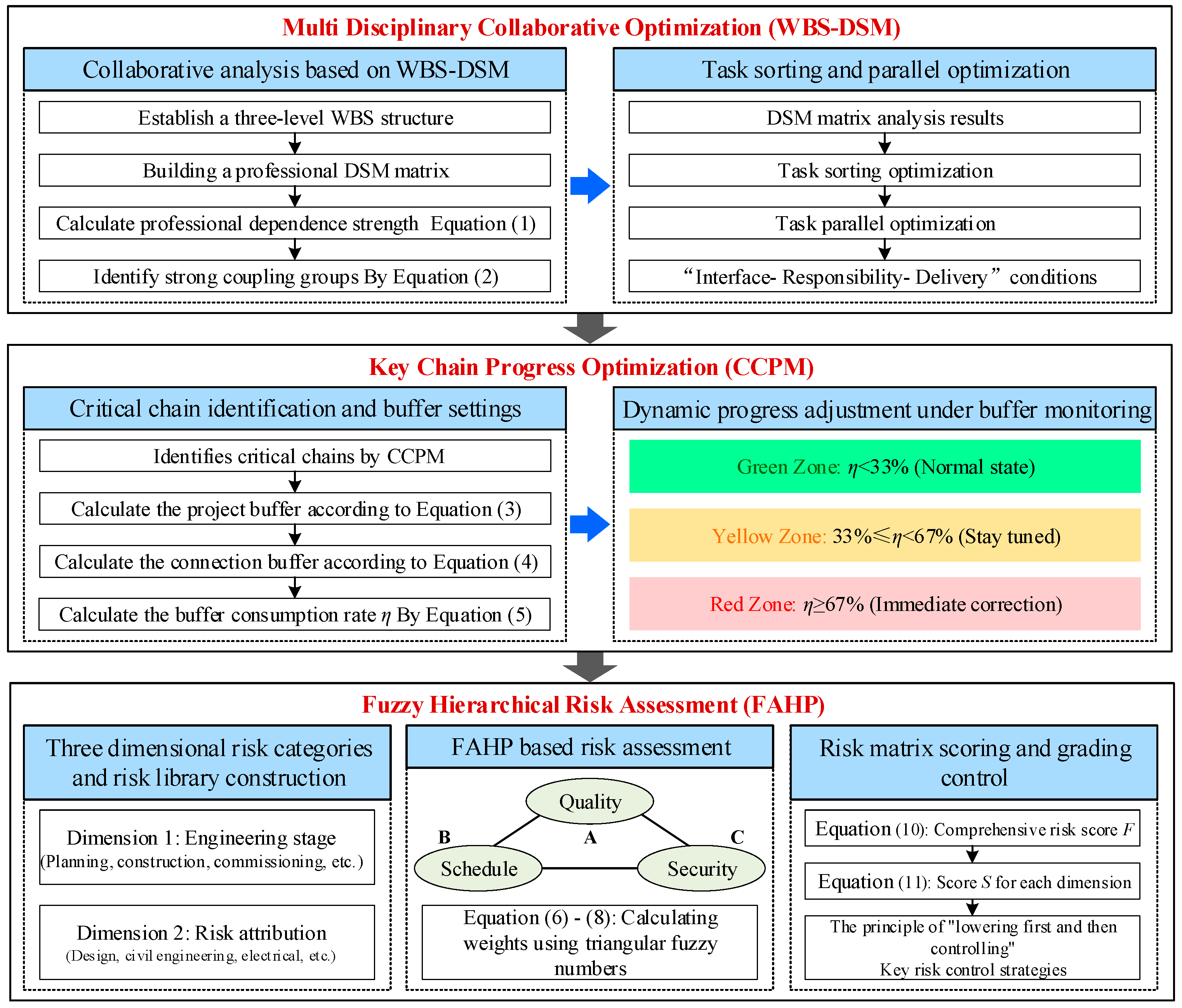
- We construct a multi-professional task decomposition and dependency identification method based on WBS-DSM coupling analysis, systematically sort out the connections among various professions, and arrange sequential and parallel tasks to shorten the construction period.
- (2)
- We adopt the CCPM method to establish a schedule optimization model considering resource constraints, and improve schedule robustness through reasonable buffer setting.
- (3)
- We use FAHP to construct a three-dimensional risk assessment system of “quality-schedule-safety”, realize quantitative risk assessment, and propose targeted control suggestions, to provide theoretical support and practical guidance for the construction management of high-voltage projects.
2. Analysis of the Characteristics and Management Issues of 500 kV Substation Projects
2.1. Characteristics of 500 kV Substation Construction Projects
2.2. Analysis of Existing Problems in Engineering Management
2.2.1. Multi-Professional Collaboration Issues
2.2.2. Schedule Management Issues
2.2.3. Quality and Safety Risk Issues
3. Construction Engineering Management Optimization Model for Multi-Professional Collaboration
3.1. Overall Framework of the Model
3.2. WBS-DSM-Based Collaborative Task Process Optimization Model
3.2.1. Work Breakdown Structure (WBS)
3.2.2. Task Process Optimization Based on DSM Analysis
- (1)
- Optimize the involvement time of key pre-requisite specialties.
- (2)
- Clarify the ‘interface-responsibility-delivery’ collaborative management mechanism: define the work boundaries and handover points of tightly coupled specialties, designate the responsible parties (design, construction, supervision) for each collaboration node, and specify the technical standards, time nodes, and acceptance criteria for each deliverable.
- (3)
- Optimize task sequence and parallel strategies: For strongly coupled tasks (), advance through synchronous design and joint review; for weakly dependent tasks (), schedule parallel construction under conditions of spatial and resource independence.
3.3. Engineering Schedule Management Optimization Model Based on CCPM
4. Construction Engineering Risk Assessment Method Based on FAHP
4.1. Establishment of Risk Database for Substation Construction Projects
4.2. Engineering Risk Assessment Based on FAHP
4.2.1. Basic Principles of FAHP
4.2.2. Three-Level Risk Assessment Method Based on FAHP
- (1)
- Goal layer: Comprehensive risk of 500 kV substation engineering construction.
- (2)
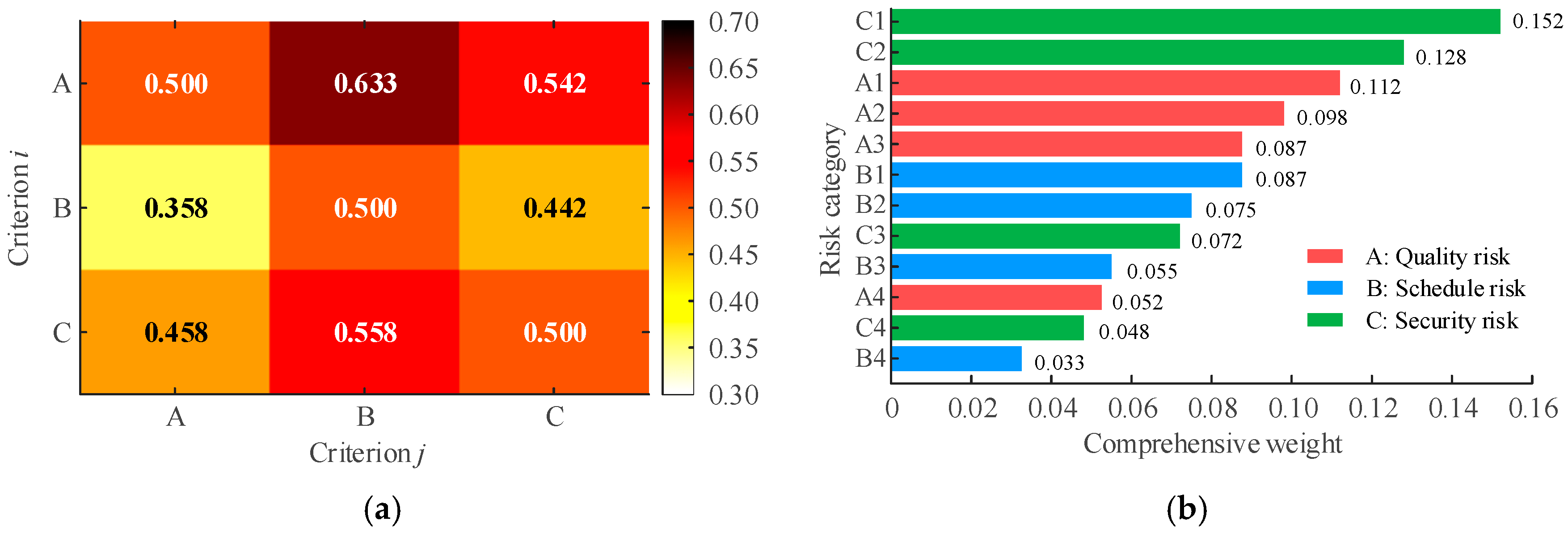
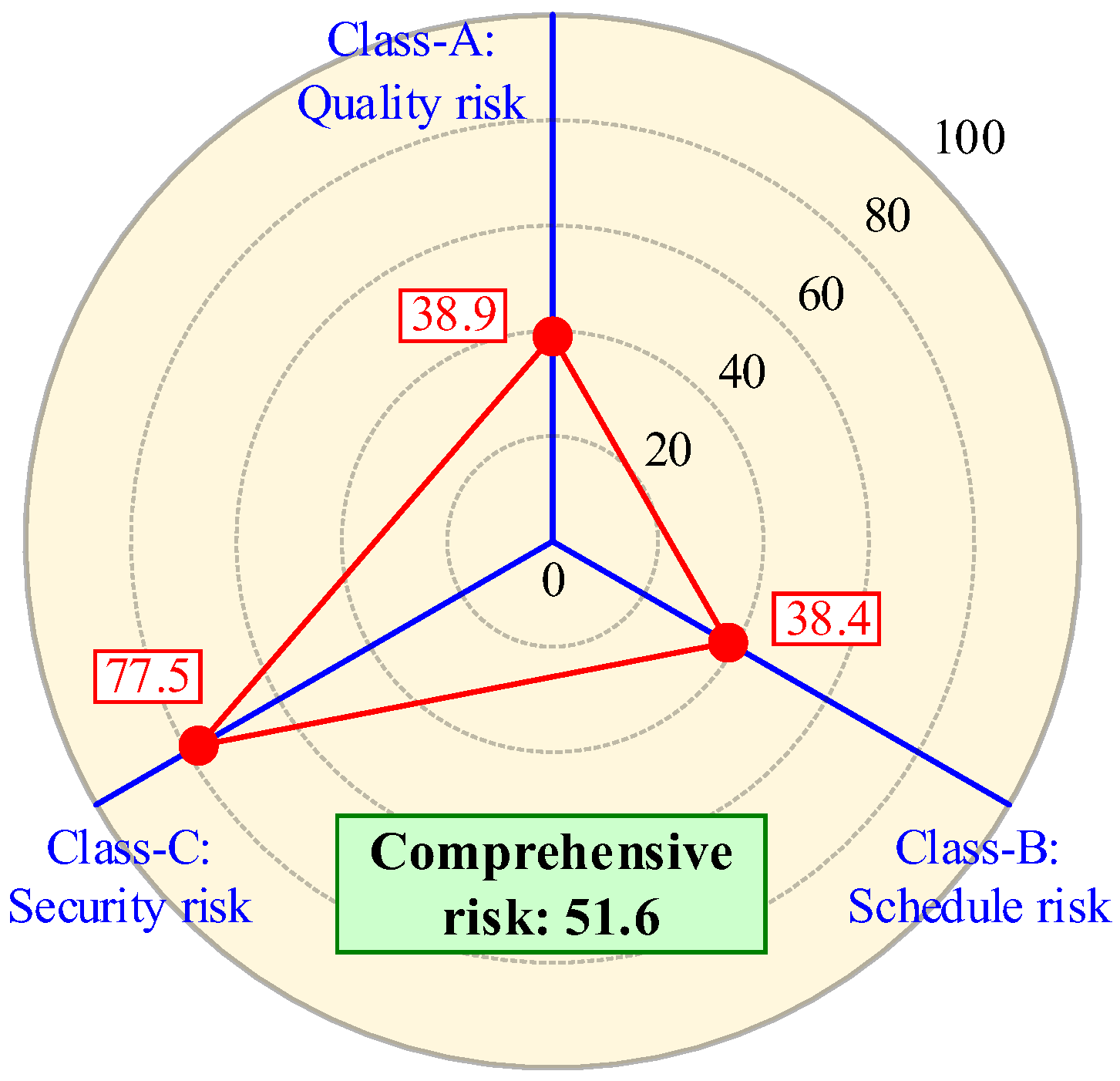
- Criteria layer: Class A-Quality risk (affecting project quality, such as causing quality defects, rework, and rectifications); Class B-Schedule risk (affecting project progress, such as causing delays or postponed commissioning); Class C-Safety risk (affecting construction safety, such as potentially causing personal injury or equipment damage).
- (3)
- Scheme layer: Composed of key risk factors. From the constructed risk database, based on the probability of occurrence and degree of impact, four of the most representative risk items are selected for each category, as shown in Table 2.
5. Case Study
5.1. Analysis of Engineering Management Optimization
5.1.1. Analysis of Engineering Task Process Optimization Based on WBS-DSM
- (1)
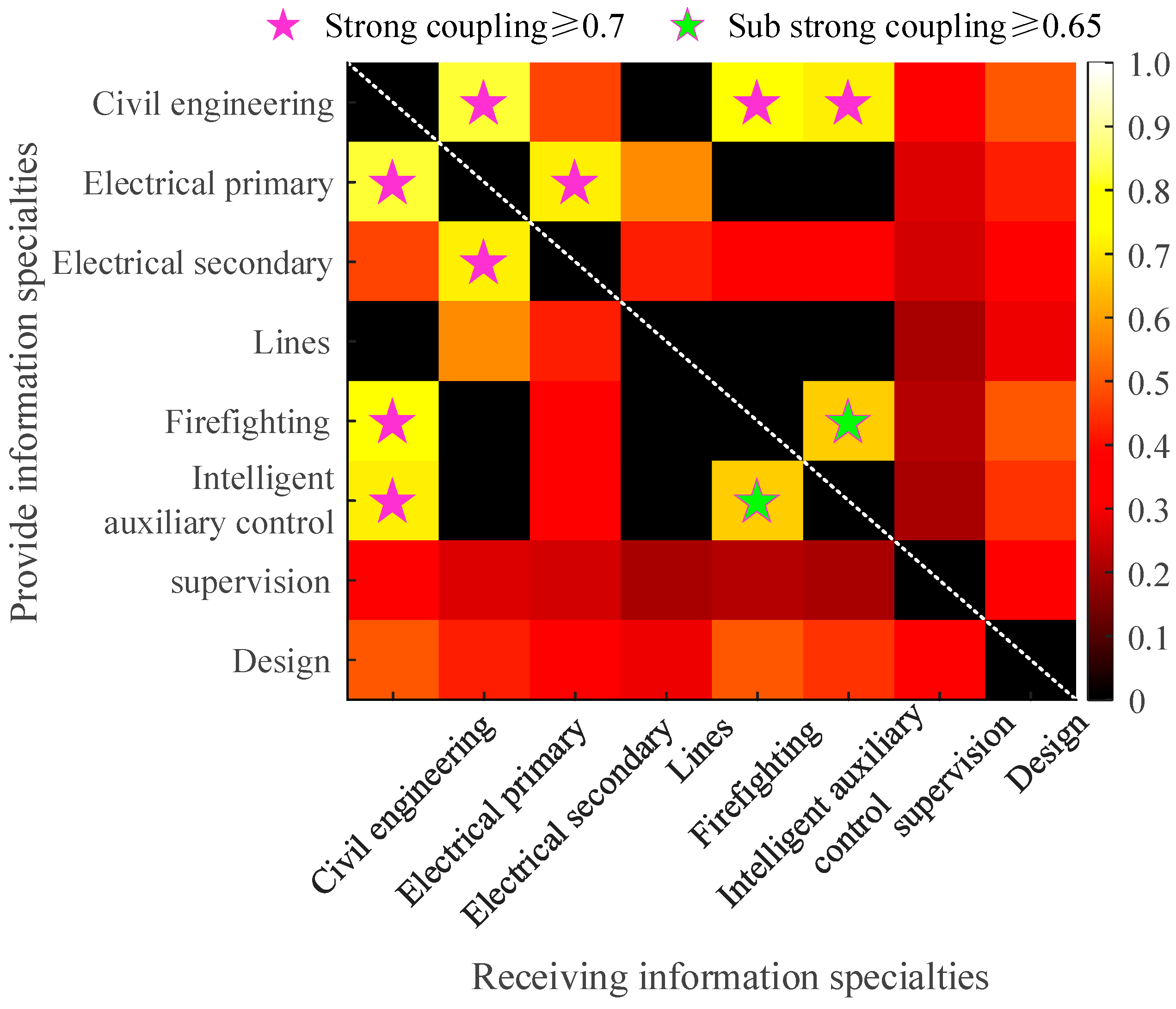
- Advance the intervention time of the fire protection and intelligent auxiliary control professions. Manufacturers of fire protection and intelligent auxiliary control professions are required to participate in the preliminary design stage, and jointly carry out the planning and design of pipe embedding paths and embedded parts in parallel with the civil engineering profession. Clarify the technical requirements and interface conditions of the fire protection and intelligent auxiliary control systems at the preliminary design review meeting; complete the pipe embedding scheme and embedded box layout drawing of the fire protection and intelligent auxiliary control systems before the design of civil engineering construction drawings.
- (2)
- Collaborative management of “interface-responsibility-delivery”. Establish a clear interface management mechanism for the identified strongly coupled professions. Taking civil engineering–electrical primary as an example, define interface nodes: grounding grid design confirmation (responsible party: design unit; delivery standard: grounding grid plan and grounding resistance calculation report), foundation dimension review (responsible party: construction unit; delivery standard: measured deviation < ±5 mm), and embedded part acceptance (responsible party: supervision unit; delivery standard: compliance with design drawings and construction specifications). By clarifying the responsible party, delivery standards, and acceptance conditions, quality problems and schedule delays caused by ambiguous interfaces are avoided.
- (3)
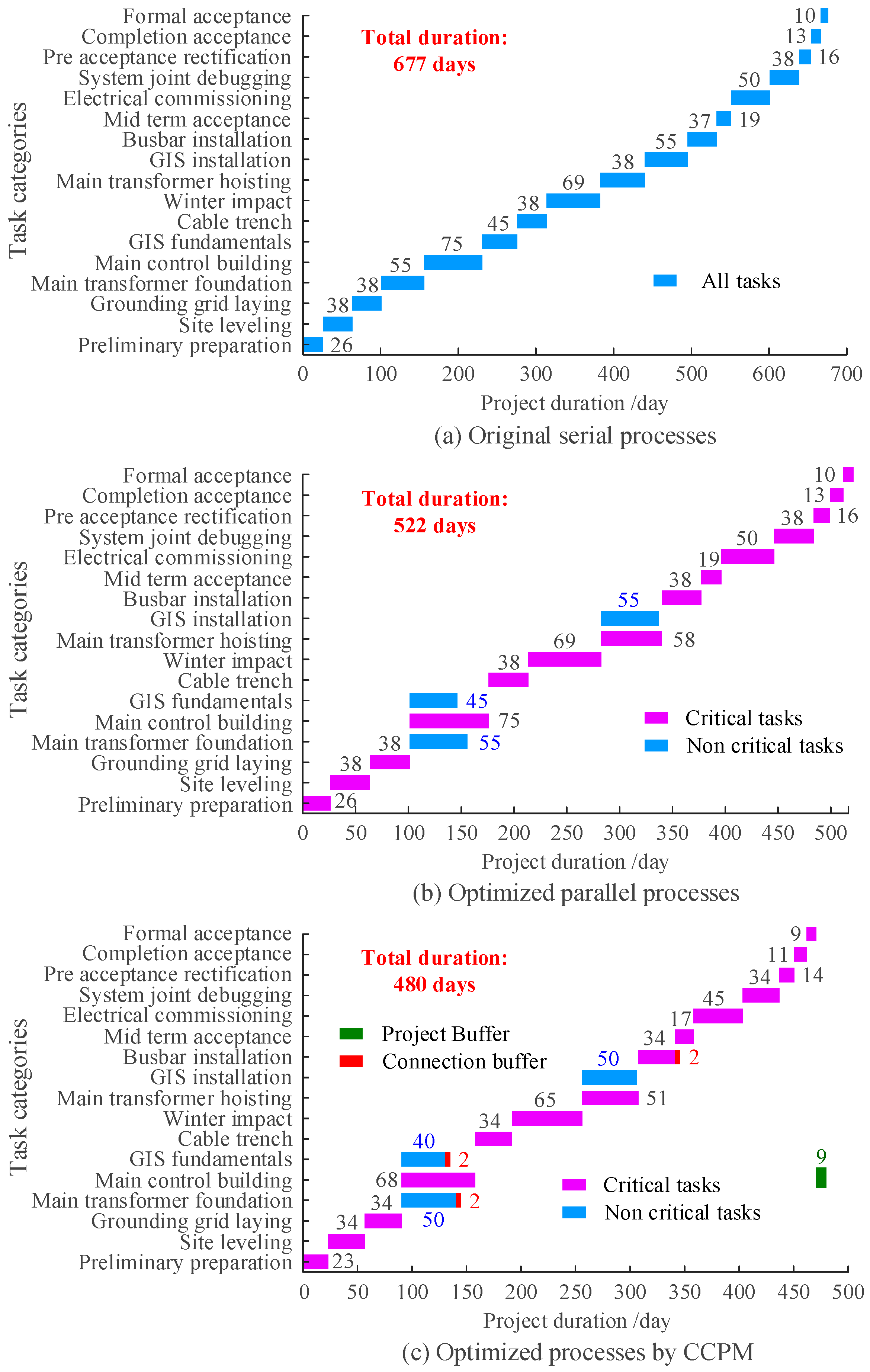
- Optimize task sequence and implement parallel strategies. Replan the construction operation sequence; for strongly coupled tasks, adopt synchronous design and joint review to promote them collaboratively. For tasks of weakly dependent professions (), arrange parallel construction under the conditions of independent space and resources to shorten the length of the critical path. For example, the grounding grid laying and main transformer foundation construction tasks are spatially independent and weakly dependent, so parallel operation can be arranged; while the main transformer hoisting and equipment commissioning have strong dependence, and wiring testing shall be carried out after hoisting and positioning, which needs to be executed sequentially.
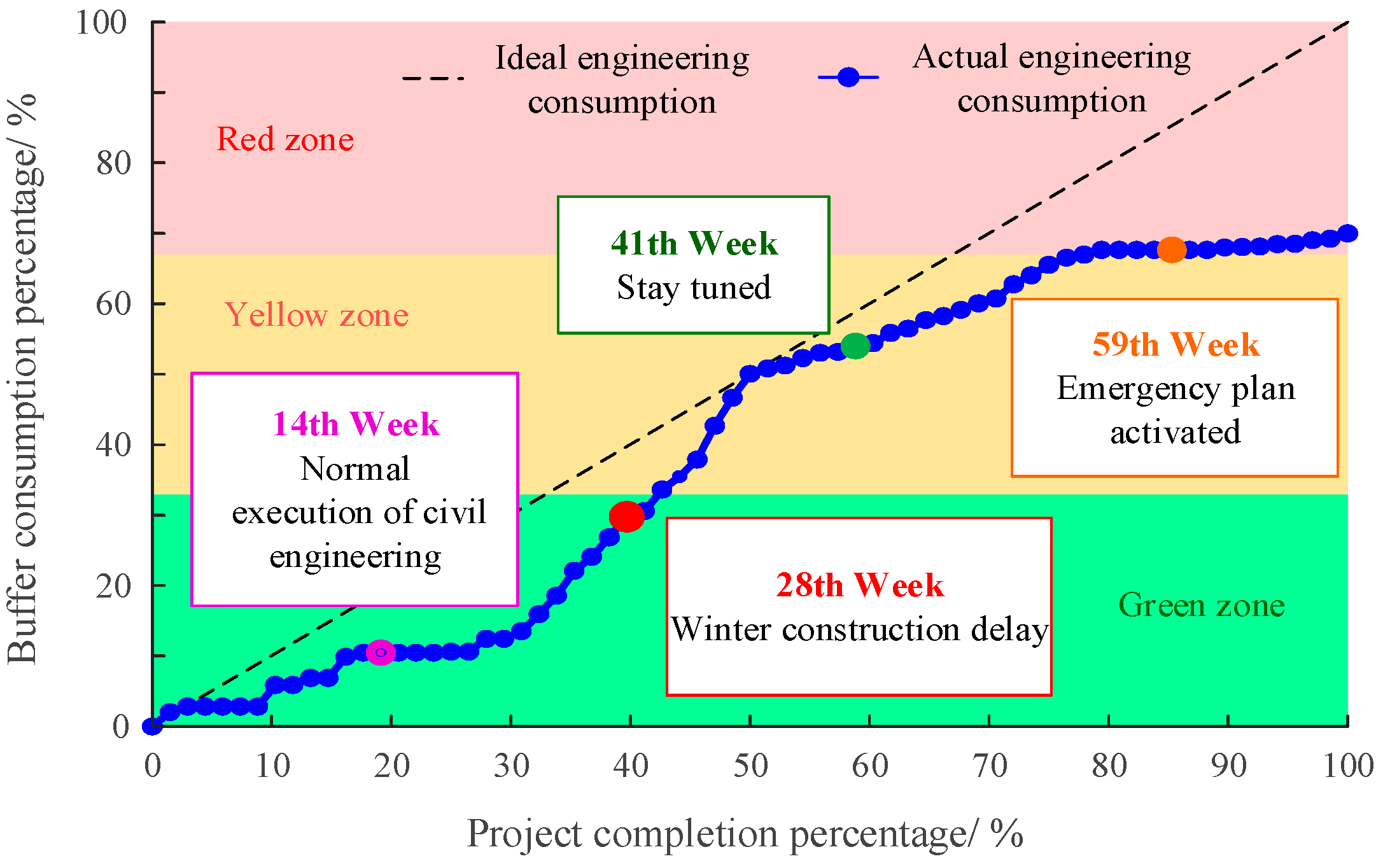
5.1.2. Analysis of Engineering Schedule Management Optimization Based on CCPM
5.2. Engineering Risk Assessment and Control Recommendations
5.2.1. Analysis of Engineering Risk Assessment Results Based on FAHP
5.2.2. Engineering Risk Management Recommendations
- (1)
- The principle of reducing first, controlling later. The proposed risk control strategies include: designing for source avoidance, optimizing overall site layout, reserving space, selecting modular equipment, reducing individual unit weight, adopting standardized designs, and minimizing on-site changes; improving process technology through the use of new construction methods and advanced equipment (such as dual-crane lifting and intelligent monitoring systems); optimizing engineering measures by setting up protective facilities and warning zones, and equipping emergency devices and materials; optimizing management measures by developing special plans, enhancing staff training, implementing full-process monitoring, and enforcing strict acceptance standards; accepting risk through purchasing insurance and formulating emergency response plans.
- (2)
- Key risk control measures. Develop targeted measures for high-weight risks: For the risk control of main transformer hoisting, reserve hoisting space during the design phase, design permanent hoisting foundations, and select dual cranes of over 200 tons for construction preparation; monitor weather forecasts 72 h in advance, and halt operations if wind force exceeds level 3 during work; conduct full video monitoring with dedicated personnel in command; prepare emergency response teams, standby cranes, and purchase equipment insurance for emergencies.
- (3)
- Risk control measures for live-line crossings. Optimize the route during the design phase to avoid crossings as much as possible, select high-crossing schemes, and increase safety distances; during construction preparation, apply for a power outage in advance, and if a power outage is not possible, develop a special crossing plan; during work, set up crossing frames, install protective nets, assign dedicated personnel for monitoring, and measure safety distances; prepare emergency communication equipment and formulate an electric shock emergency plan.
6. Discussion
7. Conclusions
- (1)
- Schedule Optimization: The combined WBS-DSM and CCPM strategy effectively resolved the coupling conflicts among multi-disciplinary tasks. By converting subjective safety times into centralized buffers, the proposed method significantly shortened the construction cycle compared to traditional serial scheduling and enhanced the robustness of the schedule against uncertainties
- (2)
- Risk Assessment: The constructed “Quality-Schedule-Safety” three-dimensional assessment system realized the transition from qualitative estimation to quantitative evaluation. The results identified safety risks as the most critical dimension, providing a scientific basis for prioritizing management resources towards high-risk operations.
- (3)
- Practical Implication: The proposed data-driven framework successfully transforms experience-based management into objective decision support. It provides a replicable digital solution for high-voltage infrastructure projects, facilitating the efficient construction of the new power system.
Author Contributions
Funding
Data Availability Statement
Conflicts of Interest
Abbreviations
| AHP | Analytic Hierarchy Process |
| BIM | Building Information Modeling |
| CPM | Critical Path Method |
| CCPM | Critical Chain Project Management |
| DSM | Design Structure Matrix |
| FAHP | Fuzzy Analytic Hierarchy Process |
| PCA | Principal Component Analysis |
| WBS | Work Breakdown Structure |
Appendix A

| Serial Number | Risk Category | Typical Risk |
|---|---|---|
| 1 | Design Risks (12 items) | Insufficient design depth, mismatched drawing interfaces, lack of coordination among design disciplines, unreasonable selection of building materials, improper layout of sockets and electric heaters, frequent design changes, inadequate data survey, untimely submission of owner-supplied materials, inaccurate submission of owner-supplied materials, unrecognized secondary risk operations, missing general design, slow submission of equipment parameters |
| 2 | Civil Construction Risks (15 Items) | Civil construction is affected by the drawings of primary equipment, traditional wall construction cycles are long, pipelines and embedded boxes are disorganized, building material quality is poor, the construction cycle of cable trenches across roads is long, temporary roads in the substation are blocked, building decoration planning is insufficient, special-shaped covers for cable trenches have not been customized, there are quality issues with asphalt shingle roofs, cable trench drainage covers are suspended, rebar types are chosen improperly, soil replacement under building floors is inadequate, cable trench covers for boundary walls are delayed in delivery, finished product protection is inadequate, topsoil stripping is handled improperly |
| 3 | Electrical Installation Risks (12 Items) | Main transformer hoisting operations, GIS installation quality control, cable laying quality issues, discrepancies between substation fittings bidding and on-site conditions, damage to the main control room and small room doors, unclear responsibilities for fire alarm and firefighting systems, firewall framework guide lines not built in one go, high difficulty of construction at the substation exit delays in the supply of secondary optical cable tails, insufficient quantity of equipment and material inspections, chaotic management of manufacturer service personnel on site, omissions in the substation fittings bidding. |
| 4 | Line Construction Risks (10 Items) | Insufficient distance control for wires crossing trees, inconsistent forms of line foot pins, serious staff reduction in later stages of the project, inconsistent principles among multiple design units, high difficulty in safety management during winter construction, many issues during the first tender for materials supplied by the subcontractor, lack of experience in the application of prefabricated foundations, issues with fixed-length wires on long-distance special alignment segments, multiple difficulties in the construction of spiral anchor foundations, uneven stress on double-string insulators |
| 5 | Material Supply Risks (6 items) | Delayed reporting of owner-supplied materials, untimely supply of materials, chaotic management of owner-supplied materials, loss or damage of small materials, mismatch between material arrival and project progress, insufficient reserves for testing material consumption |
| 6 | Coordinated Risk Management (10 Items) | The on-site project team is unable to work on the internal network, construction organization is unbalanced, the bill of quantities is inaccurate, awareness of finished product protection is weak, management of manufacturer service personnel on the work site is chaotic, environmental protection measures are not properly implemented, consideration is insufficient when introducing new processes and equipment, there are many repetitive and habitual violations, initial issues in line projects are prominent, it is difficult to coordinate 66 kV and 220 kV power outage plans |
| 7 | Environmental Impact Risks (5 items) | Low temperatures in cold regions affect concrete pouring, quality control of foundation construction on frozen soil in cold regions, high safety risks during winter construction, extreme weather affecting construction progress, complex geological conditions leading to adjustments in foundation plans |
| Task i | Task Name | Baseline Schedule | Traditional Construction Period | Task i | Task Name | Baseline Schedule | Traditional Construction Period |
|---|---|---|---|---|---|---|---|
| 1 | Preliminary preparation | 20 | 26 | 10 | GIS Installation | 45 | 55 |
| 2 | Site leveling | 30 | 38 | 11 | Busbar Installation | 29 | 38 |
| 3 | Grounding grid installation | 30 | 38 | 12 | Mid-term Evaluation | 15 | 19 |
| 4 | Main Transformer Foundation | 45 | 55 | 13 | Electrical commissioning | 40 | 50 |
| 5 | Main Control Building | 60 | 75 | 14 | System Integration Testing | 30 | 38 |
| 6 | Introduction to GIS | 35 | 45 | 15 | Pre-acceptance Rectification | 12 | 16 |
| 7 | Cable trench | 30 | 38 | 16 | Completion Acceptance | 10 | 13 |
| 8 | Winter impact | 60 | 69 | 17 | Official Acceptance | 8 | 10 |
| 9 | Main Transformer Hoisting | 45 | 38 |
References
- Shu, Y.; Zhang, Z.; Tang, Y.; Zhang, F.; Zhong, W.; Shi, H.; Yang, L.; Kong, M.; Gu, Z. Fundamental issues of new-type power system construction. Proc. CSEE 2024, 44, 8327–8340. [Google Scholar]
- Cheng, Q.; Li, F.; Luo, S.; Wu, W.; Zhang, N.; Kang, C. Research on the Planning Methodology Framework and Key Supporting Technologies for New Power Systems. Power Syst. Technol. 2025, 49, 2219–2231. [Google Scholar]
- Zhang, Z.; Kang, C. Challenges and prospects for constructing the new-type power system towards a carbon neutrality future. Proc. CSEE 2022, 42, 2806–2819. [Google Scholar]
- Han, H. Research on construction management methods for 500kV substation projects. China Plant Eng. 2023, 10, 14–17. [Google Scholar]
- Omoniyi, O.B. Assessing the influence of various work breakdown structures on project completion time. Eng. Technol. Appl. Sci. Res. 2024, 14, 13773–13779. [Google Scholar] [CrossRef]
- Wang, S.; Cao, L.; Shang, M.; Fang, Y.; Zhang, W.; Zhang, T. The Application of Gantt Charts in Large-Scale Software Development Project Management. Oil Geophys. Prospect. 2018, 53, 310–315+19–20. [Google Scholar]
- Zhong, Q.; Tang, H.; Chen, C. A framework for selecting construction project delivery method using design structure matrix. Buildings 2022, 12, 443. [Google Scholar] [CrossRef]
- Liu, M. Research on building construction schedule optimization model based on BIM technology. Mod. Electron. Tech. 2017, 40, 103–105+109. [Google Scholar]
- Sarkar, D.; Jha, K.N.; Patel, S. Critical chain project management for a highway construction project with a focus on theory of constraints. Int. J. Constr. Manag. 2018, 21, 194–207. [Google Scholar] [CrossRef]
- Peng, G.; Han, L.; Liu, Z.; Guo, Y.; Yan, J.; Jia, X. An application of fuzzy analytic hierarchy process in risk evaluation model. Front. Psychol. 2021, 12, 715003. [Google Scholar] [CrossRef]
- Chen, L.; Lu, Q.; Zhao, X. Rethinking the construction schedule risk of infrastructure projects based on dialectical systems and network theory. J. Manag. Eng. 2020, 36, 04020066. [Google Scholar] [CrossRef]
- Huang, Z. Application of PCA-TOPSIS Model in Risk Assessment of EPC Railway Engineering Projects. Constr. Econ. 2023, 44, 194–200. [Google Scholar]
- Dong, P.; Su, B.; Wang, K. Risk assessment of typical application projects based on AHP and DEMATEL for big data. J. Nav. Univ. Eng. 2025, 37, 98–103+112. [Google Scholar]
- Wu, X.; Lin, L.; Gu, J. Comprehensive benefit analysis of engineering consultation in the whole process of power transmission and transformation projects—Taking seven pilot projects of the State Grid as examples. Constr. Econ. 2020, 41, 15–21. [Google Scholar]
- Yang, Q.; Lü, J.; Sonia, K. Progress in modeling and optimization for complex R&D project based on design structure matrix. Syst. Eng.-Theory Pract. 2016, 36, 989–1002. [Google Scholar]
- Xiong, Y. Analysis of schedule management method for photovoltaic power station engineering projects based on critical chain technology. Eng. Technol. Res. 2024, 9, 169–171. [Google Scholar]
- Xu, M.; Cao, W.; Yao, S.; Xu, H.; Niu, R.; Zhou, N. Risk assessment of repeated and frequent power outages in distribution networks based on fuzzy analytic hierarchy process. Electr. Power Autom. Equip. 2018, 38, 19–25+31. [Google Scholar]
- Li, L.; Qiao, Y. Evaluation of the construction effect of smart power plants based on fuzzy analytic hierarchy process. Autom. Instrum. 2025, 3, 126–129. [Google Scholar]
- Chen, J.; Zhuang, Y.; Chen, S.; Zhang, Z.; Zhang, Y. Comprehensive post-evaluation model for 500kV substation engineering projects using fuzzy comprehensive evaluation method. Heliyon 2025, 11, e42706. [Google Scholar] [CrossRef]
- Global Energy Monitor. China continues to lead the world in wind and solar, with twice as much capacity under construction as the rest of the world combined. In Global Energy Monitor Report; Global Energy Monitor: Covina, CA, USA, 2024. [Google Scholar]
- International Energy Agency. Electricity 2025: Analysis and Forecast to 2027; IEA Publications: Paris, France, 2025. [Google Scholar]
- Shen, W.; Ying, W. Large-scale construction programme resilience against creeping disruptions: Towards inter-project coordination. Int. J. Proj. Manag. 2022, 40, 671–684. [Google Scholar] [CrossRef]
- Wang, S.; Jing, A.; Luan, C.; Quan, Y.; Yang, Q.; Hao, S. Research on multi-project schedule management of spacecraft based on CCM and MAS. Spacecr. Eng. 2025, 34, 135–142. [Google Scholar]
- Goldratt, E.M. Critical Chain; North River Press: Great Barrington, MA, USA, 1997. [Google Scholar]
- Amoah, K.B.O.; Okere, G.; Deshpande, A. Construction delay analysis: Causes, impacts, and mitigation strategies. J. Civ. Eng. Res. 2024, 14, 1–9. [Google Scholar]
- Durdyev, S. Review of construction journals on causes of project cost overruns. Eng. Constr. Archit. Manag. 2020, 28, 1241–1260. [Google Scholar] [CrossRef]
- Tukel, O.I.; Rom, W.O.; Eksioglu, S.D. An investigation of buffer sizing techniques in critical chain scheduling. Eur. J. Oper. Res. 2006, 172, 401–416. [Google Scholar] [CrossRef]
- Anastasiu, L.; Câmpian, C.; Roman, N. Boosting construction project timeline: The case of critical chain project management (CCPM). Buildings 2023, 13, 1249. [Google Scholar] [CrossRef]
- Liu, S.; Song, Z.; Zhang, Y.; Guo, D.; Sun, Y.; Zeng, T.; Xie, J. Risk assessment of deep excavation construction based on combined weighting and nonlinear FAHP. Front. Earth Sci. 2023, 11, 1204721. [Google Scholar] [CrossRef]
- Cheng, J.; Dong, L.; Xiaole, S. Risk assessment of drilling and blasting method based on nonlinear FAHP and combination weighting. Appl. Sci. 2025, 15, 4239. [Google Scholar] [CrossRef]
- Rallabandi, L.; Vandrangi, R. Consistency improvement method for fuzzy pair-wise comparison matrix in analytic hierarchy process. Proc. Eng. Sci. 2024, 6, 1361–1368. [Google Scholar] [CrossRef]




| Statistic Item | Quantity/Item | Statistic Item | Quantity/Item |
|---|---|---|---|
| Design Risk | 12 | Material Supply Risk | 6 |
| Civil construction risks | 15 | Coordinated Risk Management | 10 |
| Electrical Installation Risk | 12 | Environmental impact risk | 5 |
| Line Construction Risk | 10 | Total | 70 |
| Label | Risk Name | Risk Causes and Impacts |
|---|---|---|
| A1 | Insufficient design depth | Construction requires numerous changes, affecting project quality |
| A2 | Confusion between buried pipes and the box | The pipe layout is chaotic, affecting both appearance and quality. |
| A3 | Raw material quality issues | Poor quality construction materials, inadequate supervision and inspections, and substandard materials entering the site |
| A4 | Finished product protection is inadequate | Edges and top surfaces are unprotected, susceptible to damage from subsequent construction impacts. |
| B1 | Shortened the construction schedule to speed up work | - |
| B2 | Delay in the supply of materials | The delayed supply of materials caused construction delays. |
| B3 | Delay in the processing of preliminary procedures | The approval process for forestry and grassland projects is lengthy and highly uncertain. |
| B4 | Cross-disciplinary job conflict | Multiple professional overlaps, resource conflicts, and idle work |
| C1 | Main Transformer Hoisting Operations | Heavy individual unit, high lifting risk |
| C2 | Live-line work | - |
| C3 | Cold-region permafrost construction | Risks of concrete pouring and welding at low temperatures |
| C4 | Risk of falling from height | Tower assembly and GIS installation, among other high-altitude tasks, carry high risks |
Disclaimer/Publisher’s Note: The statements, opinions and data contained in all publications are solely those of the individual author(s) and contributor(s) and not of MDPI and/or the editor(s). MDPI and/or the editor(s) disclaim responsibility for any injury to people or property resulting from any ideas, methods, instructions or products referred to in the content. |
© 2026 by the authors. Licensee MDPI, Basel, Switzerland. This article is an open access article distributed under the terms and conditions of the Creative Commons Attribution (CC BY) license.
Share and Cite
Shen, X.; Chu, Y.; Wang, C.; Liu, X.; Wu, L.; Wu, J.; Cheng, L. Management Optimization and Risk Assessment of 500 kV Substation Construction Projects with Multi-Professional Collaboration. Buildings 2026, 16, 339. https://doi.org/10.3390/buildings16020339
Shen X, Chu Y, Wang C, Liu X, Wu L, Wu J, Cheng L. Management Optimization and Risk Assessment of 500 kV Substation Construction Projects with Multi-Professional Collaboration. Buildings. 2026; 16(2):339. https://doi.org/10.3390/buildings16020339
Chicago/Turabian StyleShen, Xiaoping, Yunfei Chu, Chong Wang, Xin Liu, Longfei Wu, Jiazhen Wu, and Long Cheng. 2026. "Management Optimization and Risk Assessment of 500 kV Substation Construction Projects with Multi-Professional Collaboration" Buildings 16, no. 2: 339. https://doi.org/10.3390/buildings16020339
APA StyleShen, X., Chu, Y., Wang, C., Liu, X., Wu, L., Wu, J., & Cheng, L. (2026). Management Optimization and Risk Assessment of 500 kV Substation Construction Projects with Multi-Professional Collaboration. Buildings, 16(2), 339. https://doi.org/10.3390/buildings16020339