Article

Lean Framework for Minimizing Construction and Demolition Waste in Zimbabwe

1
Department of Property Studies and Urban Design, National University of Science and Technology, Ascot, Bulawayo P.O. Box AC 939, Zimbabwe
2
Department of Construction Management, Nelson Mandela University, Gqeberha 6019, South Africa
*
Author to whom correspondence should be addressed.
Buildings 2026, 16(2), 337; https://doi.org/10.3390/buildings16020337 (registering DOI)
Submission received: 26 August 2025 / Revised: 12 October 2025 / Accepted: 15 October 2025 / Published: 14 January 2026
(This article belongs to the Section Construction Management, and Computers & Digitization)

Abstract

Construction and demolition waste (CDW) constitute a menace in Zimbabwe. The industry’s image is tainted by rampant disposal on roadsides, in watercourses, and in landfills. Concerted practical efforts to proffer solutions to the problems of CDW disposal have achieved little. Therefore, this study aimed to develop a lean-based framework that could help reduce the impacts of CDW. An in-depth review of the related literature was conducted to establish that lean construction approaches have been adopted to minimise CDW. The literature review led to the compilation of a semi-structured questionnaire used to expedite survey research, which received insights and perspectives from 260 construction personnel gathered through a purposive sampling technique. The top-ranked lean CDW minimisation framework embeds recycling, recovering, and reuse, Kaizen (continuous improvement), Last Planner System (LPS), Just-in-Time (JIT), and Andon (visualisation). The four-step framework shows potential for reducing CDW in Zimbabwe and similar regional contexts. Some of the findings show that the recycling technologies needed to recycle construction waste are not yet available in Zimbabwe. The available regulatory frameworks are not very clear on using recovered, salvaged, and recycled construction materials. Designers are not designing in a way that controls waste streams on sites.

1. Introduction

Some manufacturing industry sectors have achieved great production strides as they have pioneered and adopted lean manufacturing (LM). According to Shaqour [1], the aim of LM is continuous improvement (CI) by removing all forms of waste. The author added that the construction industry is considered one of the significant waste-generating sectors harming the economy and the environment. Memon et al. [2] stated that lean construction (LC) is a production management system implemented to manage construction work, focusing on waste minimisation and value creation. In Brazil, the United Kingdom (UK), the United States (US), and Australia, industries have been reaping the benefits of LC [3]. Construction waste is a devastating dilemma, especially since demolition and construction activities are considered the highest waste generators [4]. This means construction waste is a problem in many countries that needs to be minimised by employing LC techniques.
According to Bajjou and Chafi [4] and Karaz et al. [5], “There is, therefore, an urgent need to urgently seek new and more effective management systems to reduce the impact of waste and improve the performance of construction projects”. Hamzeh and Albanna [6] confirmed, “To reap the benefits of Lean Construction, construction companies should integrate, empower and enable all personnel involved in the construction process whether on or off-site”. In Peru, lean-based frameworks have added client value, enhanced construction productivity, reduced levels of CDW, improved project delivery time, and improved communication [7]. The application of lean tools for the minimisation of CDW was investigated by Gomez et al. [8], Gutiérrez [9], Erazo-Rondinel and Huaman-Orosco [7], Orihuela et al. [10], Erazo et al. [11], and Suarez et al. [12]. Put simply, LC is a technique that has been tried and tested in many developing and developed countries with acceptable results.
Karaz et al. [5] defined CDW as a mixture of debris from construction activities such as demolition, rebuilding, restoration, renovation, and rehabilitation. CDW is a global phenomenon. For example, in 2014, the USA disposed of approximately 500 tons of CDW [13]. Data for Zimbabwe are unavailable, but citizens can see the menace. Construction projects in the Zimbabwean construction industry perform poorly, resulting in the need for innovative strategies from LC and the theory of constraints [14]. Shaqour [1] postulated that the adoption of LC approaches is essential for the reduction of CDW and the enhancement of Egyptian construction performance. Accordingly, this study sought to outline the gaps in the current dominant CDW minimisation techniques in Zimbabwe and to develop a lean-based framework for the minimisation CDW in the Zimbabwean context. The study sought responses to the following research questions: What are the gaps in the dominant CDW minimisation practices in Zimbabwe? Is it possible for lean CDW minimisation tools to minimise the impacts of CDW in Zimbabwe? Which lean-based techniques would minimize the impacts of CDW in Zimbabwe?
The main landfills for dumping CDW and general waste in Harare are the Golden Quarry and Pomona dumping areas [15]. The landfill areas are also the dumping sites for toxic waste and chemicals. These CDW dumping sites are a serious health hazard, as vagabonds and scavengers often scout the areas for usable objects. According to [15], all forms of solid waste used to be dumped near Mukuvisi River. The CDW in Zimbabwe is a mixture of bricks, concrete, metal, wood, broken glass, and urban solid waste, which is burnt, compacted, and covered by at least 0.2 m of soil [15]. There is little environmental control, which could lead to leachate from toxic chemicals. According to [16], CDW in Zimbabwe constitutes 13.9% of the waste in market areas, 8.7% of the waste in commercial areas, and the rest is dumped on roadsides and in landfills, watercourses, and open spaces. The waste contains 39.6% metal and 12.1% wood [16].
This study utilises a lean framework based on the implementation of construction project phases in the four major PMBOK project phases of initiation, planning, execution, closeout, and commissioning. The techniques utilised in the framework will be ranked using information from the study respondents. The next section discusses the materials and methods, followed by the literature review, methodology, results, discussion and finally the study conclusion.

2. Materials and Methods

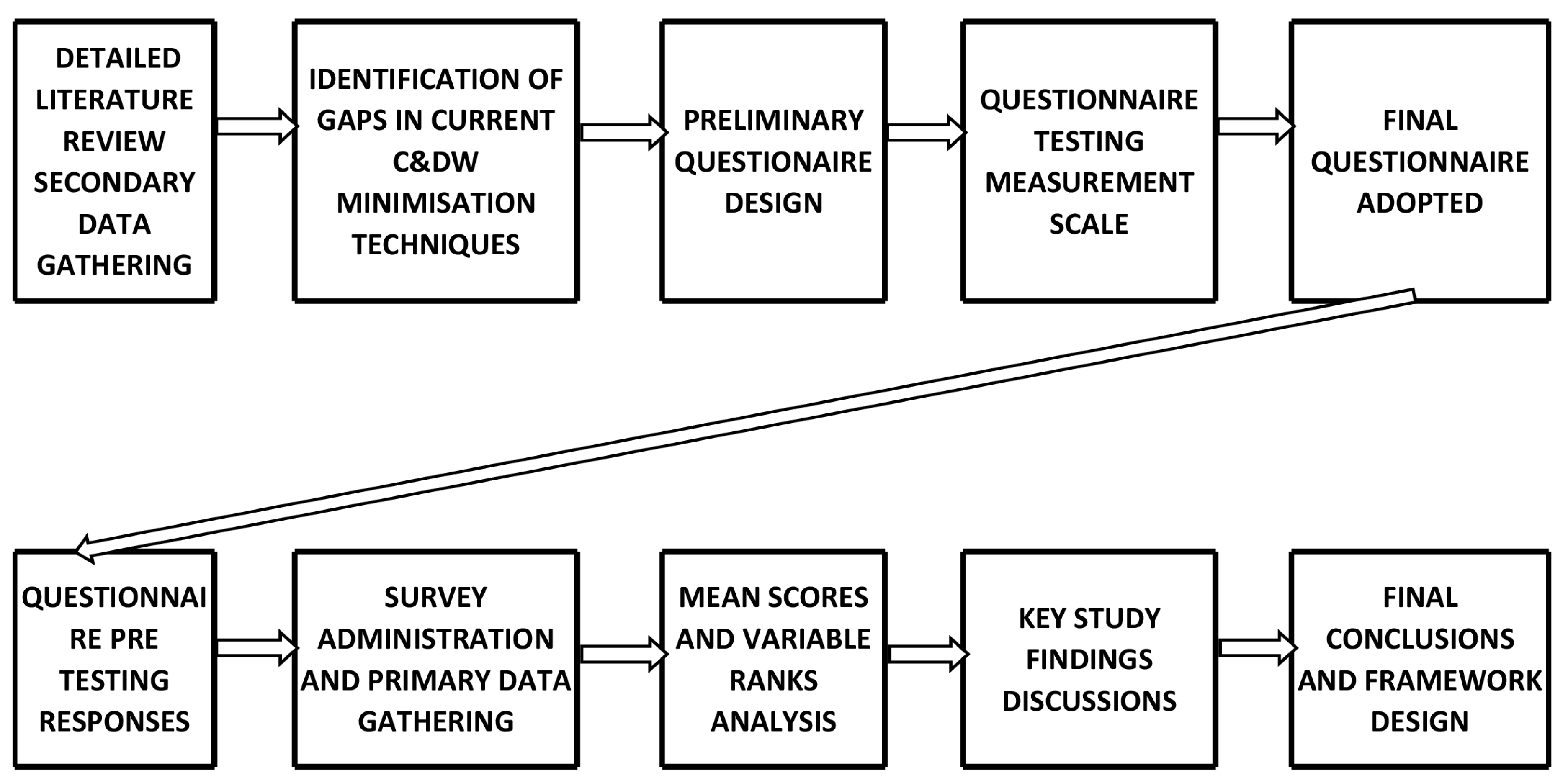
Research ethical clearance reference (number [0367]) was obtained for this study, and the study adopted a descriptive research design comprising a detailed literature review and survey questionnaire administration. The study adopted a descriptive research design within the confines of positivism epistemology. Positivism epistemology entails “working with an observable social reality to produce law-like generalisations” [17]. Statistical analysis of the gathered research data created the basis for evaluation and design of the lean-based CDW framework. The research study population and sample helped gather the data to solve the problems and make all study assumptions. Analysis of the literature and the survey created the basis for evaluating the gaps in the current CDW minimisation techniques and LC to be utilised. Quantitative data were extracted from questionnaires. The questionnaire was tested using academic subjects before it was refined and adopted for study. Questionnaires were delivered to the quantity surveyors, skilled workers, contractors, architects, semi-skilled workers, consultants, and project managers. The questionnaire consisted of three sections. The first section enquired about the respondents’ construction experiences and education level. The methodology schematic utilised for the study is shown in Figure 1.
As illustrated in Figure 1, a detailed literature review was conducted to articles indexed in Scopus and web of science, as well as Zimbabwean journals and articles from the International Group of Lean Construction (IGLC) journal. The literature review was conducted focusing on the current CDW minimisation techniques in Zimbabwe, gaps in the current CDW minimisation techniques, and any lean techniques being utilised in developed and developing countries for the minimisation of CDW. Data from the literature assisted in crafting the research questions. The questions were used in the questionnaire, which was pretested before administration.

3. Prior Literature Review

3.1. Gaps in the Current CDW Minimisation Techniques

A detailed literature review was undertaken to identify gaps in the CDW minimisation techniques in Zimbabwe and identify any lean tools and techniques that can be integrated into the framework for minimising it in Zimbabwe. According to Tsiko and Togarepi [15], CDW in Harare continues to increase at a rate that is higher than the financial and technological resources available to manage it, and the production of CDW keeps on increasing with concomitant economic, social, and environmental effects. The authors added that the public dumping of CDW is causing poor-quality spaces and visual intrusion. Madebwe and Madebwe [18] outlined that Operation Restore Order (Murambatsvina), which was carried out in Zimbabwe from 2005 to 2006, increased the amount of CDW generated in Zimbabwe from 1.0 ton/m2 of the total ground level area to 2.0 tons/m2. According to Abdel-Shafy and Mansour [19], developing and developed countries produce CDW. The gaps in Zimbabwean CDW management appear because CDW is produced, but lessons must be learned on how to use the CDW and minimise it. Zimbabwe, as a developing country with limited financial and technological resources, will require a lean framework tailor-made for its context: direct transfer of frameworks from other developing nations with adequate knowhow and resources will not work.
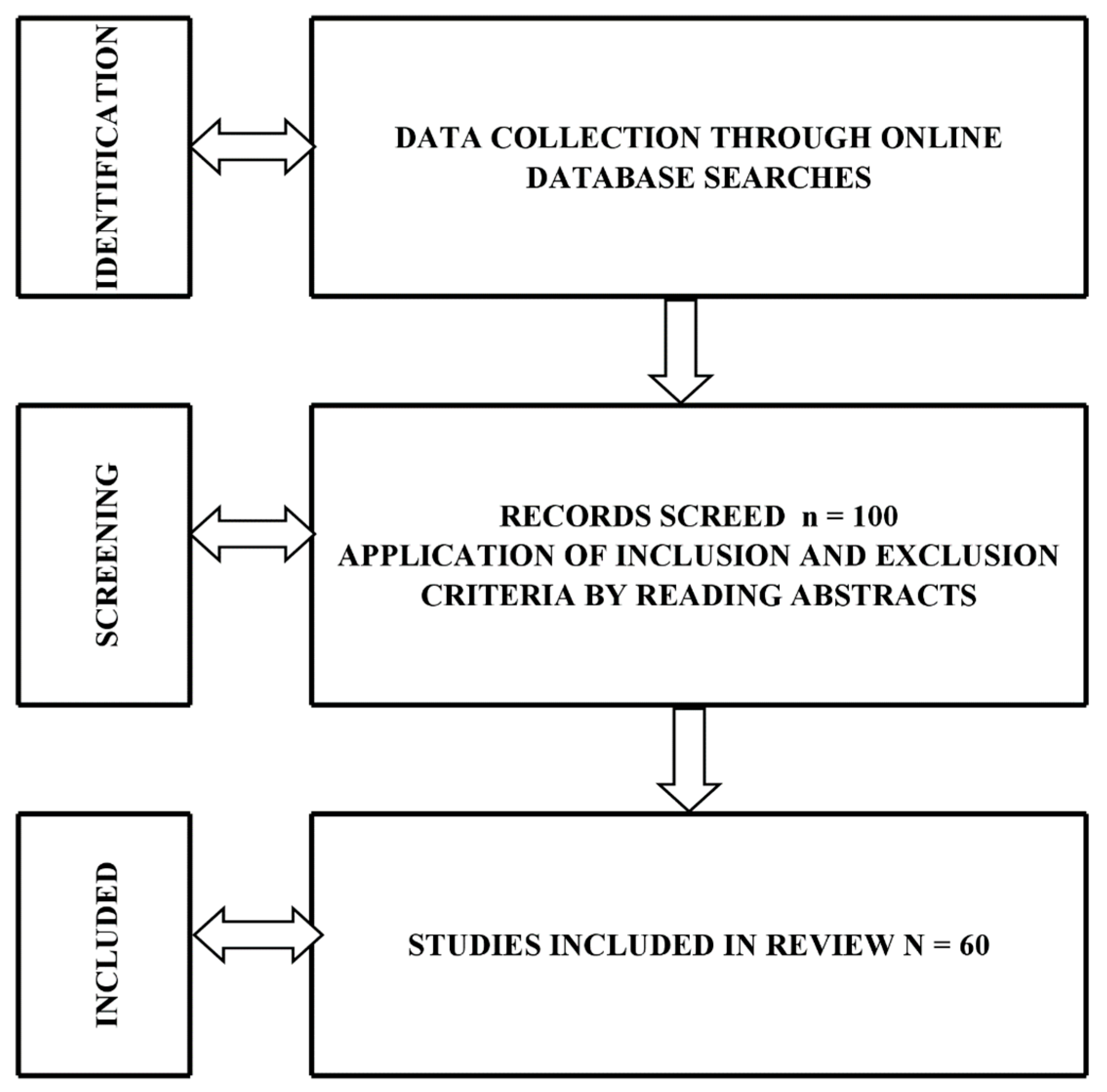
The researcher selected 100 articles from online databases. Abstract screening and content analysis was conducted on the articles. The selected articles contained purely lean technical issues, and were mainly written in English. A total of 60 articles were then selected; this is considered a sufficient sample size for analysis. The literature inclusion and exclusion schematic is shown in Figure 2.
Magadzire and Maseva [20] highlighted that the expertise and technologies needed to recycle CDW are not yet available in Zimbabwe. Laws and regulations could be enacted to foster the adoption of lean-based CDW minimisation, effective control, and monitoring. Also, incentive policies could be formulated to encourage contractors to embrace CDW minimisation [21]. Currently, the dominant CDW minimisation techniques in Zimbabwe are mainly dumping and disposal, which do not yield any financial savings for contractors or clients [20]. Ayalp and Anac [21] further highlighted that tax reductions should be embraced to encourage using recovered, salvaged, and recycled construction materials. This means that the adoption of recycling will enable the integration of a lean, circular economy and sustainability, which may bring for favourable results in the management of CDW in developing nations. In short, the government of Zimbabwe is not incentivising contractors to adopt LC practices. Designers do not understand waste streams and are not involved in CDW minimisation [22]. Gálvez-Martos and Istrate [22] stated that some items in CDW minimisation plans must constitute legal conditions for permitting construction. Magadzire and Maseva [20] highlighted that the expertise and technologies needed to recycle CDW are not yet available in Zimbabwe, and there are no laws and regulations to foster the adoption of lean-based CDW minimisation. Tax reductions could be implemented to encourage the use of recovered, salvaged, and recycled construction materials. Additionally, designers do not understand waste streams and are not involved in CDW minimisation, and local authorities do not approve CDW management plans during the pre-construction phase. Table 1 below illustrates the gaps in the current CDW minimisation strategies;

3.2. Lean Tools and Techniques

According to Forbes and Ahmed [23], LC is a technique used to design construction systems to minimise waste. Lean is a strategy that was developed by the Japanese automotive industry and converted to be appropriate for use in the construction industry in Koskela’s 1992 report [24]. Ballard and Tommelein [25] defined LC as applying lean thinking to the design and implementation of construction projects. This means the effective implementation of LC tools and techniques helps minimise the use of materials and saves time. Bajjou et al. [26] noted that LC principles for the construction industry are transparency, process variability, continuous improvement, and flow variability. Waheed et al. [24] stated that lean and sustainability share the same agenda of CDW reduction.
According to Bajjou et al. [26] LC enables waste awareness, cycle time reductions, value stream mapping, space utilisation, and waste disposal management, which can be used for the minimisation of CDW in construction. Karaz et al. [5] stated that the employment of lean-based CDW minimisation techniques can help to provide value for the client. LC provides tools such as the Last Planner System (LPS) and Just-in-Time (JIT), which helps reduce variability in construction, helps materials to be received on time, and shields the downstream from waste [5]. LC tools can help improve planning in the Zimbabwean construction industry and minimise CDW by reducing material stockpiles on site, as materials are delivered just-in-time for use.
Pedo et al. [27] proclaimed that LC can enhance CDW management through early identification of construction process standardisation and CDW analysis, which enables stakeholders to make decisions about design early, in order to reduce re-works and design alterations. LC helps minimise CDW generation by enabling stakeholders make key decisions early, which minimises variations and re-works. In summary, LC enhances CDW minimisation by providing customer value, reducing work variability, allowing materials to be received on time, shielding the downstream from waste, early detection of requirements for work standardisation, waste analysis, providing accurate information on building systems, and enabling early decision making on CDW and design to reduce re-works. Table 2 below illustrates Lean tools applied in CDW minimisation.

4. Survey Design and Administration

The questionnaire is used for data gathering in quantitative studies and contains standardised questions [17]. Questionnaires were delivered to the contractors, architects, consultants, project managers, and site tradespeople. In the first section, enquiries were made about the respondents’ personal experience of work on construction sites and their levels of education. In the second section, enquiries were made about the context of the respondents’ companies regarding their waste management systems and plans and how effective they were. In the third section, enquiries were made about the leading root causes of waste on the site on which the company was currently working and the actions taken in terms of time and material loss. Information was also requested about any plans to eliminate waste further and whether practitioners were willing to use LC as a waste elimination strategy. The questionnaires used structured questions where respondents responded to pre-set questions. Closed-ended questions were used in the questionnaires. Responses from these were then used to gather quantitative data.

4.1. Sampling

Purposive sampling was used to select the most suitable research subjects. According to Saunders et al. [17], in purposive sampling, the researcher’s judgment of the knowledge and experience of participants is used when selecting a sample, and purposive sampling is highly effective with small research samples. Farell et al. [28] stated that purposive sampling is used in construction research when there are few experts in the required study area. Purposive sampling was used because there is minimal knowledge of LC in Zimbabwe, which limited the sample size considerably.
A study population of about 350 participants, including contractors, quantity surveyors, project managers, engineers, and skilled and semi-skilled workers, was selected. About 260 responses were received from the participants. A response rate of approximately 79.8%% was attained for skilled and semi-skilled workers, 77.1% was obtained for contractors, 78.1% was obtained for professionals; an overall total response rate of 79.3% was obtained. According to Johnson and Owens [29], a total overall response rate of less than 60% is sometimes accepted for publication. Thus, a response rate of 79.3% was acceptable. The response rate was calculated using the formula response rate = [(Responses/Sample size) × 100].
A sample of contractors was selected from those with operational sites in and around Harare and Bulawayo. Contractors outnumbered the other professionals because they are responsible for time and material wastage on site, and they are the ones who are primarily accountable to the client for the effects of the waste. Sub-contractors were also selected. Project managers were required because they could implement and drive the integration of LC principles. The sample list included architects, civil or structural engineers, contractors, construction tradespeople, construction workers and consultant organisations, engineers, quantity surveyors, construction managers, and project managers.
According to Saunders et al. [17], “Sampling techniques enable you to reduce the amount of data you need to collect by considering only data from a sub-group rather than all possible cases or elements”. A table compiled by Saunders et al. [17] was used to select the sample size. According to the Construction Industry Federation of Zimbabwe (CIFOZ), there is a list of approximately 2020 registered construction companies. Using the table, a sample size of 322 was achieved, with a 5% margin of error.

4.2. Data Analysis Procedures

Descriptive and inferential statistics were used in data analysis. Descriptive statistics produce a set of data, allowing researchers to describe the characteristics and attributes of a research population [30]. Inferential statistics enable a researcher to infer findings from a sample [30]; the mean and standard deviation were used for the descriptive statistics. The relative important index and regression analysis were used for the inferential statistics. Reliability was determined by applying Cronbach’s alpha.
Data analysis was carried out using the Statistical Product and Service Solutions (SPSS) Package version 27. Using SPSS, descriptive statistics, such as the mode, median, standard deviation, and kurtosis, were used to analyse the findings.

5. Results

5.1. Survey Response

An overall total response rate of 79.3% was obtained for the study. The respondents’ profiles are given in Table 3. Questionnaires were distributed to bricklayers, semi-skilled workers, skilled workers, professionals, and contractors.

5.2. Gaps in CDW Minimisation Practices

The respondents indicated gaps in the dominant CDW minimisation practices in Zimbabwe, and their responses were captured. The gaps stem from the challenges being posed by the huge deposits of CDW and the shortcomings of the existing CDW minimisation techniques. The responses were rated using the following scale: 1 = insignificant, 2 = less significant, 3 = neutral, 4 = significant, 5 = very significant, and U = unsure. The scores were ranked using the relative important index (RII). The results from the SPSS analysis in Table 4 show that CDW production keeps increasing, there is no expertise to recycle CDW, and poor-quality spaces caused by the dumped CDW are the significant gaps in the dominant CDW management practices. The results in the table indicate that the data were reliable, with a Cronbach’s alpha of 0.974. This is supported by Madanake [31], who postulated that a sufficient budget and expertise are required for successful LC rewarding, training, and development systems in construction. Madanake [31] confirmed that a lack of technical skills, training, and team building, as well as poor management literacy and computer illiteracy could erode workers’ confidence in adopting LC tools. Bosnich [32] asserted that some of the barriers to, and gaps in, adopting lean CDW management are a lack of knowledge about recycling opportunities, contamination of CDW, no recycled CDW markets, technological barriers, no recycling budgets, no design for deconstruction, landfill gate prices being too low, no lean policy, no confidence in recycled materials, no communication, and lack of knowledge. Table 4 illustrates the gaps in CDW minimisation practices rankings.

5.3. Lean Tools and Techniques

The respondents suggest the lean tools and techniques that could enhance CDW minimisation practices in Zimbabwe, and their responses were captured. The responses were rated using the following scale: 1—not significant, 2—less significant, 3—neutral, 4—significant, 5—very significant, and U—unsure. The scores were ranked using the relative important index (RII).

5.3.1. Mean Analysis and Ranking of Lean Techniques

Table 5 gives the findings of the respondents on the best lean-based CDW minimisation techniques. The top-ranked lean strategy with a high likelihood of minimising CDW in Zimbabwe was LT1 recycling, recovering, and reuse, with MS = 4.62 and SD = 0.63. The second top-ranked lean technique was LT2 Kaizen/continuous improvement, with MS = 4.52 and SD = 0.82. The third top-ranked lean technique was LT3 concurrent engineering, with MS = 4.27 and SD = 1.06. The fourth top-ranked lean technique was LT4, the Last Planner System (LPS), with MS = 4.15 and SD 1.29. The fifth top-ranked lean tool with a high likelihood of minimising CDW in Zimbabwe was Just-In-Time (JIT), with MS = 4.08 and SD = 1.30. The mean score (MS) and the standard deviation SD were used to measure how far the overall rating of LMPs deviated from the mean. The mean score (MS) and relative importance index (RII) were used for ranking the given variables.

5.3.2. Proposed Lean Framework for Minimising Construction and Demolition Waste in Zimbabwe

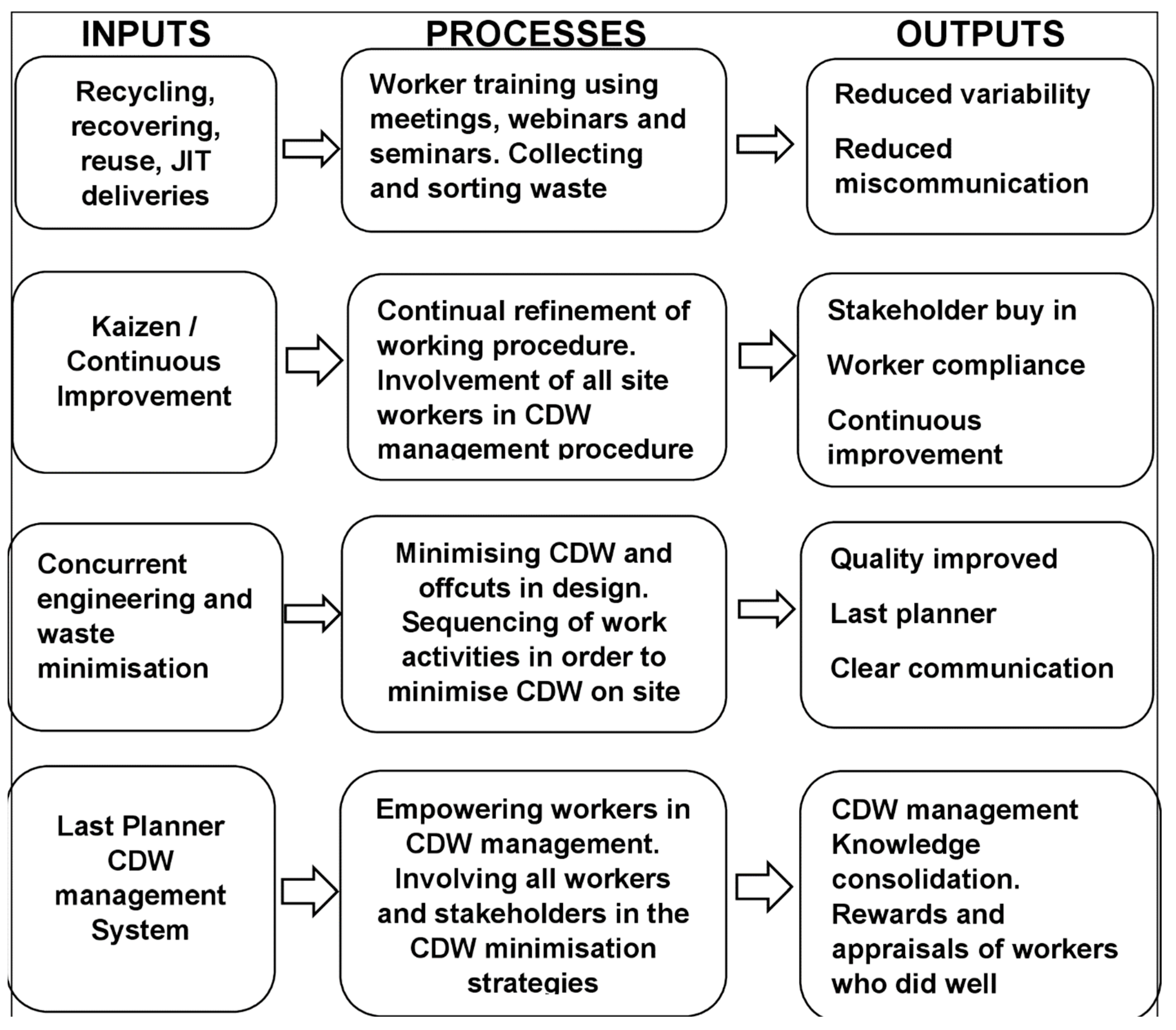
The top five ranked lean strategies—recycling, continuous improvement, concurrent engineering, the Last Planner System (LPS), and Just In Time (JIT)—were then adopted and utilised in the proposed lean framework for the minimisation of CDW in Zimbabwe. The framework processes will also include worker training, worker consultation, stakeholder involvement, and the use of worker rewards and appraisals. The proposed lean framework is shown in Figure 3.
The recycling process will start with worker exercises using seminars, webinars, and daily huddle meetings. Continuous improvement and worker feedback procedures will be utilised for the refinement of the working CDW minimisation procedure. Proper activity sequencing will be utilised in the construction processes and the plans made for the selecting, sorting, and transportation of CDW at every step. Workers and major stakeholders are empowered in the Last Planner System to create an environment of worker confidence and involvement.

6. Discussion

The results show that recycling, recovering, and re-using were the essential lean tools and techniques to enhance CDW minimisation practices in Zimbabwe, with a relative important index (RII) score of 0.92. This was followed by Kaizen/continuous improvement. Bajjou and Chaffi [4] asserted that the following nine lean principles represent the basis of lean construction: customer focus, transparency, JIT supply, CI, waste elimination, worker or people involvement, effective planning and scheduling, quality, and standardisation. Abo-Zaid and Othman [33] also confirmed that lean tools decrease non-value activities, increase customer value, decrease variability, simplify processes, increase output, increase transparency, and allow process completion, continuous improvements, flow and conversion improvement, and establishing benchmarks.

6.1. Step 1: Recycle, Reuse, and Reduce (3Rs)

The (CDW) recycling industry is one of the most important elements of construction sustainability and can help to reduce carbon emissions [34]. A CDW recycling plant must be accredited. According to Abdelhamid [35], recycling is effective at conserving resources and diverting CDW from landfills, and the reduction, reuse, and recycling of CDW, combined with a small amount of disposal, make for a very comprehensive CDW management strategy. Concerted efforts need to be made toward improving the quality and provision of certification for recycled CDW [36]. Ceramic wastes from CDW were separated from construction debris and mixed with gravel, river sand, cement, and potable water for use as an aggregate material for construction [37,38]. Recycled gravel can be used in the mixing of concrete, as Fawzy [39] confirmed that increasing the volume of recycled gravel from medium-grade concrete leads to a decrease in concrete slump.
According to Waheed et al. [24], sustainable construction can be achieved by balancing developing buildings and conserving natural resources. This balance can be achieved by changing the traditional linear construction process into a cyclic process depending on the 3Rs method of recycling, reduction, and reuse of CDW. The authors added that the recycling approach guarantees the best practices for material consumption and improves construction processes as follows:
  • Reduce: Reducing CDW from the earliest phases of design may be helpful in the construction sector. The process aims to reduce the environmental impacts of CDW and construction costs. Reducing the materials used minimises resource usage from project inception and reduces transportation work [40,41,42].
  • Reuse: Construction material reuse is performed to prevent material wastage and the dumping of CDW in landfill. Material reuse requires fewer resources, less labour, and less energy when compared with the manufacture of new construction materials from raw materials [43,44].
  • Recycle: Construction material recycling plays an important role in CDW management plans. Recycling is the reprocessing of CDW into usable raw materials or usable products. Recycling extends material life, in addition to reducing construction resource consumption and avoiding CDW disposal costs [43,44].

6.2. Step 2: Continuous Improvement (CI)

Continuous improvement (CI), or Kaizen, is a very intensive, practical, and focused approach to workplace process improvement that helps in CDW minimisation by defining tasks for all responsible stakeholders. CI also defines the time and necessary tools to uncover CDW-related areas for improvement on site and implement the changes, leading to efficient resource usage [24]. According to Omotayo et al. [45], continuous improvement is the process of incorporating incremental changes to construction activities in order to deliver value for all construction stakeholders. Continuous improvement has also been used in other sectors, like health care, agriculture, sport, governance, and quality management [46,47,48,49,50]. The nine principles of continuous improvement are
  • Learning and worker training
Continuous improvement (CI) requires constant worker training and learning. The continuity of training depends on the institution’s targets, ambition, and financial commitment. Learning and training help create new insights and influence behavioural changes in workers [51].
  • Waste reduction and elimination
Physical tangible CDW and non-physical waste is generated on construction sites. Waste minimisation through continuous-improvement-based methods provides enhanced profitability and improved client value [52].
  • Employee engagement
Continuous improvement principles focusing on learning and waste reduction are driven by employee engagement [53]. According to Brajer-Marczak [54], employee engagement creates an enabling environment for the magnification of organisational values. This leads to improved worker well-being, which helps facilitate the continuous improvement.
  • Increased productivity
Research has shown that CI increases construction productivity [55]. Continuous improvement worker training costs can be reduced when the organisation’s culture of continuous improvement has been adopted by all managerial levels, and production costs can be continually reduced when non-value-adding construction activities are minimised [56].
  • Continuous improvement in any working environments
There are no limitations as to where and how continuous improvement can be implemented. The implementation of continuous improvement at work depends on the organisational mission and core values, communication approaches, and organisational structure. The company’s waste reduction policy and knowledge of CI also influence its CI implementation strategies [57].
  • Transparent communication
Transparent communication is one of the most effective tools for facilitating CI. Transparent communication is more effective when there is a standardisation of work processes and roles [58].
  • Focus on areas of greatest need
The focal areas of CI dictate the direction of improvement on site. Benchmarking tools, progress reports, and construction feedback loops are utilized when prioritising tasks for CI. Construction projects should prioritise the movement of CDW, time management activities, defect reduction, over-processing management, and construction variation management [59].
  • Focus on process improvement
CI always focuses on practical implementation. The planning and execution of CI can be enhanced by an organisational cultural change towards CI. A thorough analysis of processes before on-site decision-making may also eliminate CDW. The overall goal of CI is the reduction of CDW; therefore, a well-informed CI process requires well-informed decision-making [60].
  • Prioritising employee improvement
Employee improvement arises when workers are engaged in training and CDW minimisation. Worker improvement leads to improved client value and satisfaction [61].

6.3. Step 3: Concurrent Engineering (CE)

Engineering (CE) is the designing and construction of building components in parallel, i.e., not sequentially. The approach minimises CDW, reduces product design time, and helps create better designs. It is one of the concepts that has effectively yielded adaptation in CDW minimisation [60]. CE can help overcome the existing fragmentation in the construction industry [61]. CE reduces project schedules by about 20–25% without increasing project costs [62]. According to El-Bibany & Abulhassan [63], CE can be implemented using the following phases:
  • Reduce waste and prepare for change
Construction buildings can be designed for disassembly, minimising material offcuts. A clear understanding of the implementation of CE issues is important for all stakeholders.
  • Promote re-use, creating a team environment
Integrated Product Development Teams (IPDT) work to design buildings for adaptive reuse and refurbishment. An integrated collaboration-based product development team should be appointed.
  • Reduce re-works
Develop building designs right the first time. Good team environment interfaces are required for a well-functioning CE team.
  • Reduce project durations sustaining CE
Reduce project alterations and building time. Design effective worker reward systems. CE encourages team training and performance, not individual-based performance.

6.4. Step 4: Last Planner Systems (LPS)

According to Camuffo et al. [61], the LPS involves workers in safety and waste management planning. Involving workers reduces CDW and health and safety issues at work. Ghosh [62] stated that involving workers promotes safety, improves workers’ commitment, enhances worker self-esteem, and brings a sense of belonging. According to Simukonda and Emuze [64], changing workers’ attitudes and behaviours through involvement in health and safety education and training could improve construction risk management. The Last Planner System can be implemented using the following phases:
  • Phase Scheduling (Pull Planning)
Working with the whole team on the CDW management phases to be implemented, as well on worker duty allocation. Workers state when or how they can deliver their duties in the CDW minimisation process.
  • Weekly Schedule Plans
Every week, all the workers come together to give feedback and make promises. All team members commit themselves and present what they plan to accomplish at work in relation to CDW management in the coming week.
  • Daily Huddle Meetings
Brief, usually early morning, daily feedback meetings to check on the worker commitments. Any impending issues are addressed before they become big problems.
  • Milestone Planning
Major CDW minimisation goals and deadlines are set, and overall project progress is assessed.
  • Percent Plan Complete
A measurement of how many CDW minimisation tasks promised by workers were completed, providing a yardstick for assessing CDW minimisation strategy effectiveness [65].

7. Conclusions

The increase in CDW has affected the economy, as more disposal funds are still needed to clear watercourses and roadsides. Blocked roadsides have social and environmental effects, creating unsightly spaces and causing congestion on roads with many potholes. The situation continues because the expertise and technologies needed to recycle CDW are not yet available in Zimbabwe. Interviewees stated that there were no clear laws and regulations to foster the adoption of lean-based CDW minimisation, and many in the Zimbabwean Construction Industry did not yet know lean-based techniques. There were no regulatory frameworks to encourage using recovered, salvaged, and recycled construction materials. Contractors said that the designers did not design to control waste streams and were not involved in CDW minimisation activities on construction sites. Consequently, there are gaps in the dominant CDW minimisation practices on Zimbabwean construction sites. Recycling, recovering, and re-using were some of the techniques recommended for adoption in the proposed CDW minimisation framework. Continuous improvement strategies, JIT, worker or people involvement, effective planning and scheduling, quality, and standardisation were some of the lean techniques that were adopted for the minimisation of CDW in Zimbabwe. The lack of recycling facilities, technical knowhow, and concrete lean and circular economy policies may hinder effective implementation of the framework in the current sociopolitical environment. Future studies to validate this study can focus on practical challenges to the adoption of lean construction in Zimbabwe, the impacts of lean training for the cultural shifts needed in the Zimbabwean construction industry, the governance reforms needed for the adoption of lean and circular economy in Zimbabwe, the effectiveness of lean frameworks for adoption in developing nations, barriers to the adoption of lean construction health and safety in Zimbabwe, and practical integration of lean and BIM in the management of CDW in Zimbabwe. The authors recommend the design and implementation of national lean, recycling and circular economy policies as a way of making the adoption of a lean and circular economy smooth and national. There is a need for the approval of CDW management plans during the approval of working drawings.

Author Contributions

Conceptualization, K.M., F.A.E. and J.S.; methodology, K.M., F.A.E. and J.S.; software, K.M., F.A.E. and J.S.; validation, K.M., F.A.E. and J.S.; formal analysis, K.M., F.A.E. and J.S.; investigation, K.M., F.A.E. and J.S.; resources, K.M., F.A.E. and J.S.; data curation, K.M., F.A.E. and J.S.; writing—original draft preparation, K.M., F.A.E. and J.S.; writing—review and editing, K.M., F.A.E. and J.S.; project administration, K.M., F.A.E. and J.S.; funding acquisition, K.M., F.A.E. and J.S.; All authors have read and agreed to the published version of the manuscript.

Funding

This research APC was funded by the National University of Science and Technology grant number: RDB/91/25.

Data Availability Statement

The original contributions presented in the study are included in the article, further inquiries can be directed to the corresponding author.

Acknowledgments

The authors thank the National University of Science and Technology in Zimbabwe for funding the publication.

Conflicts of Interest

The authors declare no conflict of interest.

References

  1. Shaqour, E.N. The impact of adopting lean construction in Egypt: Level of knowledge, application, and benefits. Ain Shams Eng. J. 2022, 13, 101551. [Google Scholar] [CrossRef]
  2. Memon, A.H.; Akhund, M.A.; Laghari, A.A.N.; Imad, H.U.; Bhangwar, S.N. Adaptability of lean construction techniques in Pakistan’s construction industry. Civ. Eng. J. 2018, 4, 5–10. [Google Scholar] [CrossRef]
  3. Xing, W.; Hao, J.L.; Qian, L.; Tam, V.W.; Sikora, K.S. Implementing lean construction techniques and management methods in Chinese projects: A case study in Suzhou, China. J. Clean. Prod. 2019, 286, 25–27. [Google Scholar] [CrossRef]
  4. Bajjou, M.S.; Chafi, A. Lean construction implementation in the Moroccan industry: Awareness, benefits and barriers. J. Eng. Des. Technol. 2018, 16, 533–556. [Google Scholar] [CrossRef]
  5. Karaz, M.; Teixeira, J.C.; Rahla, K.M. Construction and demolition waste—A Shift toward lean construction and building information models. In Sustainability and Automation in Intelligent Constructions, Proceedings of the International Conference on Automation Innovation in Construction (CIAC-2019), Leiria, Portugal, 7–8 November 2019; Rodrigues, H., Gaspar, F., Fernandes, P., Mateus, A., Eds.; Springer: Berlin/Heidelberg, Germany, 2020; pp. 51–58. [Google Scholar]
  6. Hamzeh, F.; Albanna, R. Developing a tool to assess workers’ understanding of lean concepts in construction. In Proceedings of the 27th Annual Conference of the International Group for Lean Construction (IGLC), Dublin, Ireland, 3–5 July 2019; pp. 179–190. [Google Scholar]
  7. Erazo-Rondinel, A.A.; Huaman-Orosco, C. Exploratory study of the leading lean tools in construction projects in Peru. In Proceedings of the 29th Annual Conference of the International Group for Lean Construction (IGLC29), Lima, Peru, 13 July 2021; pp. 542–551. [Google Scholar] [CrossRef]
  8. Gomez, S.; Ballard, G.; Naderpajouh, N.; Ruiz, S. Integrated Project Delivery for Infrastructure Projects in Perú. In Proceedings of the 26th Annual Conference of the International 87 Group for Lean Construction, Chennai, India, 16–22 July 2018. [Google Scholar] [CrossRef]
  9. Gutiérrez, F.M. Influence of Integrated Teams and Co-Location to Achieve the Target Cost in Building Projects. In Proceedings of the 28th Annual Conference of the International Group for Lean Construction, Berkeley, CA, USA, 6–12 July 2020. [Google Scholar] [CrossRef]
  10. Orihuela, P.; Noel, M.; Pacheco, S.; Orihuela, J.; Yaya, C.; Aguilar, R. Aguilar, Application of virtual and augmented reality techniques during the design and construction process of building projects. In Proceedings of the 27th Annual Conference of the International Group for Lean Construction, Dublin, Ireland, 1–7 July 2019. [Google Scholar] [CrossRef]
  11. Erazo, A.; Guzman, G.; Espinoza, S. Applying BIM Tools in IPD Project in Perú. In Proceedings of the 28th Annual Conference of the International Group for Lean Construction, Berkeley, CA, USA, 6–12 July 2020. [Google Scholar] [CrossRef]
  12. Suarez, J.C.; Zapata, J.; Brioso, X. Using 5D Models and CBA for Planning the Foundations and Concrete Structure Stages of a Complex Office Building. In Proceedings of the 28th Annual Conference of the International Group for Lean Construction, Berkeley, CA, USA, 6–12 July 2020. [Google Scholar] [CrossRef]
  13. Environmental Protection Agency (EPA). Sustainable Management of Construction and Demolition Materials; United States Environmental Protection Agency: Washington, DC, USA, 2017. Available online: https://cfpub.epa.gov/si/si_public_file_download.cfm?p_download_id=537438&Lab=NRMRL (accessed on 14 October 2025).
  14. Moyo, C.; Emuze, F. Building a lean house with the theory of constraints for construction operations in Zimbabwe: A conceptual framework. In Proceedings of the 31st Annual Conference of the International Group for Lean Construction (IGLC31), Lille, France, 26 June–2 July 2023; pp. 870–881. [Google Scholar] [CrossRef]
  15. Tsiko, S.; Togarepi, S. A situational analysis of waste management in Harare, Zimbabwe. J. Am. Sci. 2012, 5, 692–706. [Google Scholar]
  16. Jerie, S. The role of informal sector solid waste management practices to climate change abatement: A focus on Harare and Mutate, Zimbabwe. J. Environ. Waste Manag. Recycl. 2018, 1, 57–67. [Google Scholar]
  17. Saunders, M.; Lewis, P.; Thornhill, A. Research Methods for Business Students, 8th ed.; Pearson Education: Harlow, UK, 2019. [Google Scholar]
  18. Madebwe, V.; Madebwe, C. Demolition waste management in the aftermath of Zimbabwe’s Operation Restore Order (Murambatsvina): The case of Gweru, Zimbabwe. J. Appl. Sci. Res. 2006, 2, 217–221. [Google Scholar]
  19. Abdel-Shafy, H.I.; Mansour, M.S. Solid waste issue: Sources, composition, disposal, recycling, and valorization. Egypt. J. Petroleum. 2018, 27, 1275–1290. [Google Scholar] [CrossRef]
  20. Magadzire, F.R.; Maseva, C. Policy and legislative environment governing waste management in Zimbabwe. Am. J. Sci. 2006, 8, 692–706. [Google Scholar]
  21. Ayalp, G.G.; Anaç, M. A comprehensive analysis of the barriers to effective construction and demolition waste management: A bibliometric approach. Clean. Waste Syst. 2024, 8, 100141. [Google Scholar] [CrossRef]
  22. Gálvez-Martos, J.L.; Istrate, I.R. Construction and demolition waste management. In Advances in Construction and Demolition Waste Recycling; Pacheco-Torgal, F., Ding, Y., Colangelo, F., Tuladhar, R., Koutamanis, A., Eds.; Woodhead Publishing: Berlin, Germany, 2020; pp. 51–68. [Google Scholar] [CrossRef]
  23. Forbes, L.H.; Ahmed, S.M. Morden Construction: Lean Project Delivery and Integrated Practices, 2nd ed.; Routledge: New York, NY, USA, 2020. [Google Scholar]
  24. Waheed, W.; Khodeir, L.; Fathy, F. Integrating lean and sustainability for waste reduction in construction from the early design phase. HBRC J. 2024, 20, 337–364. [Google Scholar] [CrossRef]
  25. Ballard, G.; Tommelein, I. Current Process Benchmark for the Last Planner System. 2016. Available online: https://p2sl.berkeley.edu/wp-content/uploads/2016/10/Ballard_Tommelein-2016-Current-Process-Benchmark-for-the-Last-Planner-System.pdf (accessed on 14 October 2025).
  26. Bajjou, M.S.; Chafi, A.; Ennadi, A. Development of a Conceptual Framework of Lean Construction Principles: An Input–Output Model. J. Adv. Manuf. Syst. 2019, 18, 1–34. [Google Scholar] [CrossRef]
  27. Pedo, B.; Tezel, A.; Koskela, L.; Whitelock-Wainwright, A.; Lenagan, D.; Nguyen, Q.A. Lean Contributions to BIM Processes: The Case of Clash Management in Highways Design. In Proceedings of the 29th Annual Conference of the International Group for Lean Construction (IGLC29), Lima, Peru, 14–17 July 2021; pp. 116–125. [Google Scholar] [CrossRef]
  28. Farell, P.; Sherratt, F.; Richardson, A. Writing Built Environment Dissertations and Projects: Practical Guidance and Examples, 2nd ed.; John Wiley & Sons, Ltd.: West Sussex, UK, 2017. [Google Scholar]
  29. Johnson, T.; Owens, L. Survey response rate reporting in the professional literature. In Proceedings of the 58th Annual Conference of the American Association for Public Opinion Research (AAPOR), Nashville, TN, USA, 15–18 May 2003; pp. 127–133. [Google Scholar]
  30. Taherdoost, H. Designing a Questionnaire for a Research Paper: A Comprehensive Guide to Design and Develop an Effective Questionnaire. Asian J. Manag. Sci. 2022, 11, 8–16. [Google Scholar] [CrossRef]
  31. Madanayake, U.H. Application of Lean Construction Principles and Practices to Enhance the Construction Performance and Flow. In Proceedings of the 4th World Construction Symposium 2015: Sustainable Development in the Built Environment: Green Growth and Innovative Directions, Colombo, Sri Lanka, 12–14 June 2015. [Google Scholar]
  32. Bosnich, T. Applying Lean Construction Principles to Waste Management and Identifying Minimisation Opportunities to Inform the Industry. 2019. Available online: https://www.toiohomai.ac.nz/sites/default/files/inline-files/Applying%20lean%20construction%20principles%20to%20waste%20management%20and%20identifying%20minimisation%20opportunities%20to%20inform%20the%20industry_0.pdf (accessed on 14 October 2025).
  33. Abo-Zaid, M.A.; Othman, A.A.E. Lean construction for reducing construction waste in the Egyptian construction industry. In Proceedings of the 2nd International Conference on Sustainable Construction and Project Management-Sustainable Infrastructure and Transport for Future Cities, Aswan, Egypt, 16–18 December 2018; pp. 1–13. [Google Scholar]
  34. Maponga, K.; Emuze, F. A Case for Lean-Based Guidelines for Construction and Demolition Waste Minimization in Zimbabwe. In Proceedings of the 32nd Annual Conference of the International Group for Lean Construction (IGLC 32), Auckland, New Zealand, 1–7 July 2024; pp. 930–941. [Google Scholar] [CrossRef]
  35. Abdelhamid, M.S. Assessment of different construction and demolition waste management approaches. HBRC J. 2014, 10, 317–326. [Google Scholar] [CrossRef]
  36. Elmaraghy, A.; Voordijk, H.; Marzouk, M. An Exploration of BIM and Lean Interaction in Optimizing Demolition Projects. In Proceedings of the 26th Annual Conference of the International Group for Lean Construction (IGLC), Chennai, India, 16–22 July 2018. [Google Scholar] [CrossRef]
  37. Beshara, I.A.R. Accreditation system for construction and demolition waste recycling facilities in Egypt. HBRC J. 2023, 19, 183–197. [Google Scholar] [CrossRef]
  38. Awoyera, P.O.; Ndambuki, J.M.; Akinmusuru, J.O.; Omole, D.O. Characterization of ceramic waste aggregate concrete. HBRC J. 2018, 14, 282–287. [Google Scholar] [CrossRef]
  39. Fawzy, Y.A. Impact of recycled gravel obtained from low or medium concrete grade on concrete properties. HBRC J. 2018, 14, 1–8. [Google Scholar] [CrossRef]
  40. Wagih, A.M.; El-Karmoty, H.Z.; Ebid, M.; Okba, S.H. Recycled construction and demolition concrete waste as aggregate for structural concrete. HBRC J. 2013, 9, 193–200. [Google Scholar] [CrossRef]
  41. Sweis, G.; Hiyassat, A. Understanding the causes of material wastage in the construction industry. Jordan J. Civ. Eng. 2021, 15, 180–192. [Google Scholar]
  42. Aristizábal-Monsalve, P.; Vásquez-Hernández, A.; Botero, L.F.B. Perceptions on the processes of sustainable rating systems and their combined application with Lean construction. J. Build. Eng. 2022, 46, 103627. [Google Scholar] [CrossRef]
  43. Aslam, M.S.; Huang, B.; Cui, L. Review of construction and demolition waste management in China and USA. J. Environ. Manag. 2020, 264, 110445. [Google Scholar] [CrossRef]
  44. Steel, J.; Drogemuller, R.; Toth, B. Model interoperability in building information modelling. Softw. Syst. Model. 2012, 11, 99–109. [Google Scholar] [CrossRef]
  45. Omotayo, T.S.; Kulatunga, U.; Awuzie, B. Continuous Cost Improvement in Construction: Theory and Practice; Routledge: New York, NY, USA, 2022. [Google Scholar]
  46. Meshref, A.N.; Elkasaby, E.A.A.; Ibrahim, A. Selecting Key Drivers for a Successful Lean Construction Implementation Using Simos’ and WSM: The Case of Egypt. Buildings 2022, 12, 673. [Google Scholar] [CrossRef]
  47. Imai, M. Kaizen: The Key to Japan’s Competitive Success; McGraw-Hill Education: New York, NY, USA, 1986. [Google Scholar]
  48. Kapur, A.; Adair, N.; O’Brien, M.; Naparstek, N.; Cangelosi, T.; Jancasz, J.; Zuvic, P.; Joseph, S.; Meier, J.; Bloom, B.; et al. Improving efficiency and safety in external beam radiation therapy treatment delivery using a Kaizen approach. Int. J. Radiat. Oncol. 2016, 96, S73. [Google Scholar] [CrossRef]
  49. Prashar, A. Process improvement in farm equipment sector (FES): A case on Six Sigma adoption. Int. J. Lean Six Sigma 2014, 5, 62–88. [Google Scholar] [CrossRef]
  50. Suárez-Barraza, M.F.; Ramis-Pujol, J.; Llabrés, X.T. Continuous process improvement in Spanish local government: Conclusions and recommendations. Int. J. Qual. Serv. Sci. 2009, 1, 96–112. [Google Scholar] [CrossRef]
  51. El-Shaboury, N.; Abdelhamid, M.; Marzouk, M. Framework for economic assessment of concrete waste management strategies. Waste Manag. Res. 2018, 37, 268–277. [Google Scholar] [CrossRef] [PubMed]
  52. Jin, H.W.; Doolen, T.L. A comparison of Korean and US continuous improvement projects. Int. J. Prod. Perform. Manag. 2014, 63, 384–405. [Google Scholar] [CrossRef]
  53. Suárez-Barraza, M.F.; Ramis-Pujol, J.; Kerbache, L. Thoughts on Kaizen and its evolution: Three different perspectives and guiding principles. Int. J. Lean Six Sigma 2011, 2, 288–308. [Google Scholar] [CrossRef]
  54. Brajer-Marczak, R. Employee engagement in continuous improvement of processes. Management 2015, 18, 88–103. [Google Scholar] [CrossRef]
  55. Omotayo, T.; Awuzie, B.; Egbelakin, T.; Obi, L.; Ogunnusi, M. AHP-systems thinking analyses for Kaizen costing implementation in the construction industry. Buildings 2020, 10, 230. [Google Scholar] [CrossRef]
  56. Omotayo, T.; Kulatunga, U. A continuous improvement framework using IDEF0 for post-contract cost control. J. Constr. Proj. Manag. Innov. 2017, 7, 1807–1823. [Google Scholar] [CrossRef]
  57. Shang, G.; Pheng, L.S. Barriers to lean implementation in the construction industry in China. J. Technol. Manag. China 2014, 9, 155–173. [Google Scholar] [CrossRef]
  58. Henderson, J.; Ruikar, K. Technology implementation strategies for construction organisations. Eng. Constr. Arch. Manag. 2010, 17, 309–332. [Google Scholar] [CrossRef]
  59. Wong, C.H. ICT implementation and evolution: Case studies of intranets and extranets in UK construction enterprises. Constr. Innov. 2007, 7, 254–273. [Google Scholar] [CrossRef]
  60. Yisa, S.B.; Ndekugri, I.; Ambrose, B. A review of changes in the UK construction industry: Their implications for the marketing of construction services. Eur. J. Mark. 1996, 30, 47–64. [Google Scholar] [CrossRef]
  61. Camuffo, A.; De Stefano, F.; Paolino, C. Safety Reloaded: Lean Operations and High Involvement Work Practices for Sustainable Workplaces. J. Bus. Ethics 2015, 143, 245–259. [Google Scholar] [CrossRef]
  62. Ghosh, S. Does Formal Daily Huddle Meetings Improve Safety Awareness? Int. J. Constr. Educ. Res. 2014, 10, 285–299. [Google Scholar] [CrossRef]
  63. El-Bibany, H.; Abulhassan, H. Constraint-based collaborative knowledge integration systems for the AEC industry. In Proceedings of the Conference on Concurrent Engineering in Construction, Institute of Structural Engineers, London, UK, 3–4 July 1997; pp. 216–226. [Google Scholar]
  64. Simukonda, W.; Emuze, F. A Perception Survey of Lean Management Practices for Safer Off-Site Construction. Buildings 2024, 14, 2860. [Google Scholar] [CrossRef]
  65. Wang, X.; Zheng, A.; Hou, Y. Study on Impact Resistance of All-Lightweight Concrete Columns Based on Reinforcement Ratio and Stirrup Ratio. Buildings 2025, 15, 3028. [Google Scholar] [CrossRef]
Figure 1. Methodology schematic.
Buildings 16 00337 g001
Figure 2. Literature inclusion and exclusion schematic.
Buildings 16 00337 g002
Figure 3. Lean implementation framework.
Buildings 16 00337 g003
Table 1. Gaps in current CDW minimisation techniques.
GapsEffectsSources
No management expertiseNo expertise and technologies for recycling.[16,20]
No financial resourcesCDW continues to increase more than the available financial and technological resources.[18]
Poor CDW policiesThere are no laws and regulations to foster lean CDW minimisation.[21]
No CDW tax reductionsNo tax reductions on recycled construction materials.[21]
Designers not involved in CDW minimisation.Designers do not understand waste streams and are not involved in CDW management.[22]
No waste management approvals.Local authorities do not approve CDW management plans.[21,22]
Production of CDW continues to increase.CDW increases at a rate that is higher than available financial resources[9,18]
Environmental problems.Negative environmental effects.[18]
Table 2. Lean tools applied in CDW minimisation.
Lean ToolsApplication TechniquesSources
  • Definition of values
  • Visualise flows of customer requirements.
  • 5S
Uses flow charts to depict every work process. Identify and monitor CDW-generating work areas. Sorting and creating order on work sites.[27,28,29]
  • Standardisation
  • Clear visualisation
Setting a standard working procedure. Using signs on site[30,31]
  • Value stream mapping (VSM)
  • Circular economy
Uses flow charts to depict every work process. Identify and monitor CDW-generating work areas. [27,32]
  • BIM
  • JIT
  • Daily huddle meetings
Digital representation of the building. Models could be utilised. Supply of materials when they are needed.[2,5]
  • Continuous improvement
Documenting and constantly checking back work for improvement. [30]
  • Daily construction CDW huddle meetings
Short everyday meetings focus on CDW-specific issues.[2]
Table 3. Respondents profile.
AttributeSub-AttributeResponses%
Professional rolesBricklayers, class one to class four207.7
Semi-skilled bricklayers8030.8
Carpenters, class one to class four207.7
Semi-skilled carpenters5019.2
Painters207.7
Professionals4316.5
Contractors 2710.4
General experience in construction1–5 years10741.2
6–10 Years6826.2
11–15 Years4115.8
More than 15 Years4416.9
Experience of contractors1–5 Years518.5
6–10 Years414.8
11–15 Years1555.6
More than 15 Years311.1
Education levels of professionalsOrdinary level 00
National Certificate00
National Diploma1330.2
Degree 3060.8
Education levels of Skilled workersOrdinary level 00
National Certificate3382.5
National Diploma717.5
Degree 00
Education levels of Semi-Skilled workersOrdinary level 13892
National Certificate128
National Diploma00
Degree 00
Education levels of contractorsOrdinary level 518.5
National Certificate10 37
National Diploma518.5
Degree 726
Table 4. Gaps in CDW minimisation practices rankings.
CodeGaps in PracticesMSSTD DEVVarianceRIIRank
GAP1Production of CDW keeps on increasing4.540.640.4040.911
GAP2No expertise and technologies to recycle CDW4.230.930.8730.852
GAP3Dumping of CDW will cause environmental challenges3.921.472.1560.783
GAP4No CDW management plans3.771.432.0310.754
GAP5Designers do not understand waste streams3.621.331.7820.725
GAP6No laws and regulations to foster the embrace of lean2.961.462.1220.596
GAP7Tax reductions could be embraced to encourage2.771.341.8000.557
Table 5. Lean techniques and tools.
CodeLean TechniquesMSSTD DEVVarianceRIIRank
LT1Recycling, recovering, and reuse4.620.630.390.921
LT2Kaizen/continuous improvement4.520.820.680.902
LT3Concurrent engineering4.271.061.120.853
LT4Last Planner System4.151.291.680.834
LT5Just-In-Time (JIT)4.081.301.690.825
LT6Increased visualisation4.081.111.230.826
LT7Standardisation3.921.412.000.787
LT8Building Information Modelling (BIM)3.921.391.930.788
LT9Daily huddle meetings3.791.371.870.769
LT10Quality3.691.411.990.7310
LT11Waste (Muda)3.651.422.000.6911
LT12The five s’s (5S)3.461.311.720.6912
LT13Pull production3.461.632.640.6313
LT14Site organisation3.151.542.370.6314
LT15Value stream mapping (VSM)3.151.462.140.5715
LT16Kanban2.851.732.990.5416
LT17Six sigma1.921.361.850.3817
Disclaimer/Publisher’s Note: The statements, opinions and data contained in all publications are solely those of the individual author(s) and contributor(s) and not of MDPI and/or the editor(s). MDPI and/or the editor(s) disclaim responsibility for any injury to people or property resulting from any ideas, methods, instructions or products referred to in the content.