What Drive Residents to Adopt the Concept of Green Housing in Nanjing, China


Abstract
1. Introduction
2. Theoretical Background and Hypotheses Development
2.1. Research Theories
2.2. Hypotheses Development
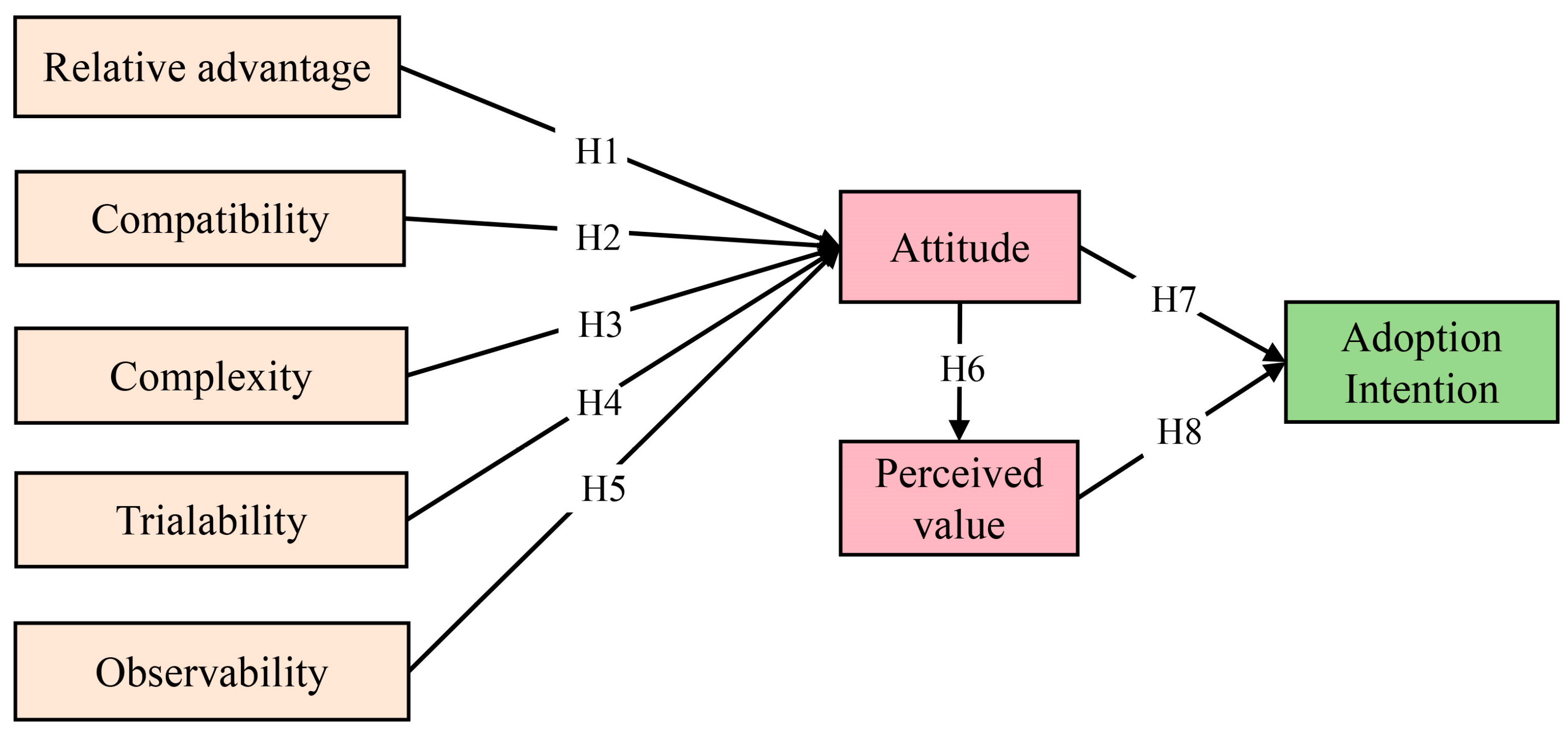
2.2.1. Relative Advantage and Attitude Toward Green Housing Adoption
2.2.2. Compatibility and Attitude Toward Green Housing Adoption
2.2.3. Complexity and Attitude Toward Green Housing Adoption
2.2.4. Trialability and Attitude Toward Green Housing Adoption
2.2.5. Observability and Attitude Toward Green Housing Adoption
2.2.6. Attitude, Perceived Value, and Adoption Intention of Green Housing
2.2.7. Perceived Value and Intention to Adopt Green Housing
3. Data and Methodology
3.1. Study Area
3.2. Questionnaire Design
3.3. Data Collection
3.4. Research Methods
4. Results and Analysis
4.1. Common Method Bias Assessment
4.2. Sample Characteristics
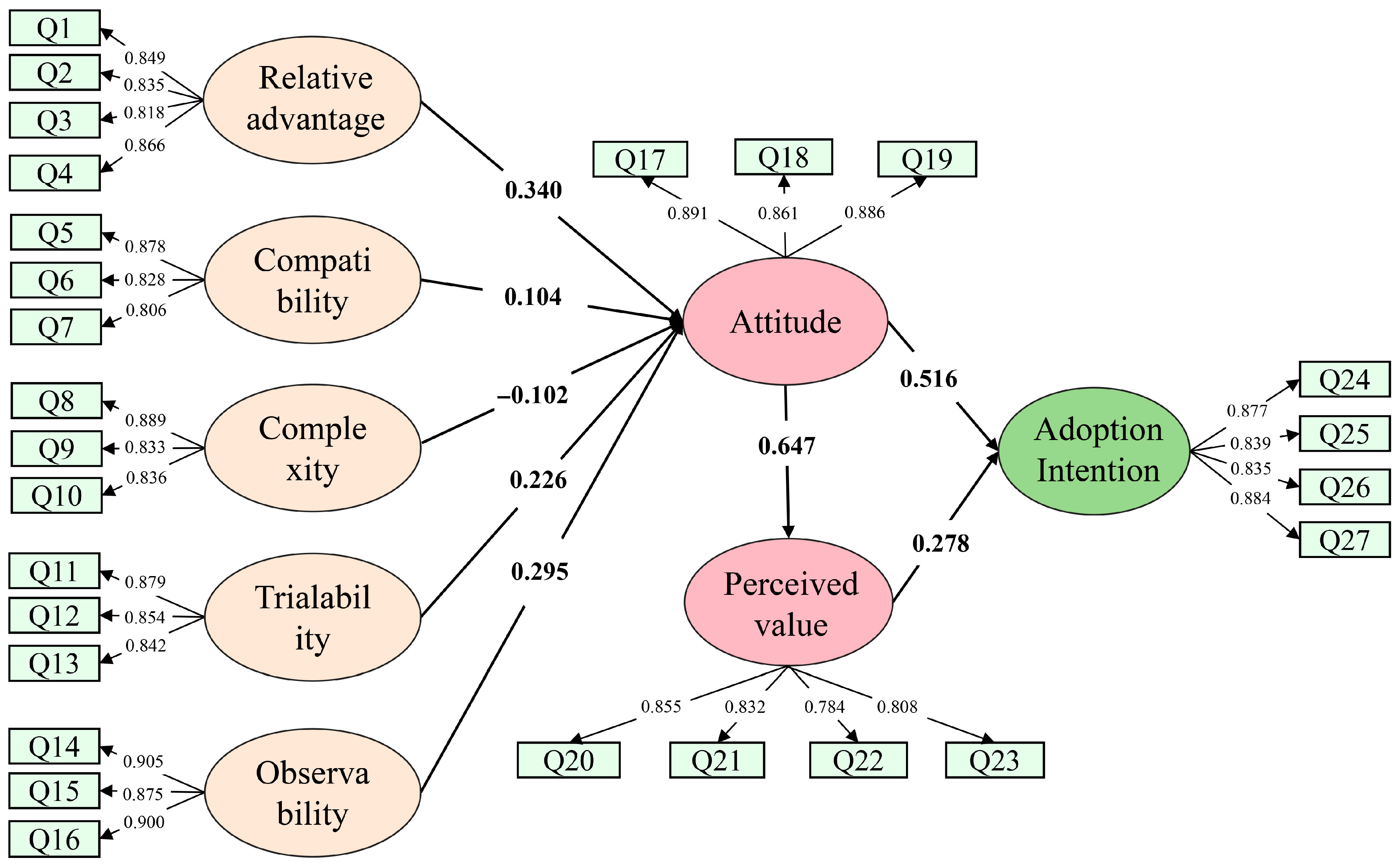
4.3. Structural Model Evaluation
4.4. Mediation Effect Analysis
5. Discussion
5.1. Key Findings
5.2. Theoretical Implications
5.3. Practical Implications
5.4. Limitations and Future Research
6. Conclusions
Author Contributions
Funding
Institutional Review Board Statement
Informed Consent Statement
Data Availability Statement
Conflicts of Interest
Abbreviations
| PLS-SEM | Partial least squares structural equation modeling |
| CA | Cronbach’s alpha |
| CR | Composite reliability |
| AVE | Average variance extracted |
| HTMT | Heterotrait–monotrait |
| VIF | Variance inflation factor |
References
- Jiang, Y.; Zhang, Y.; Yeganeh, A.; Zhao, D. Resilience of green building supply chain: Capabilities, risks and influence mechanism. J. Green Build. 2024, 19, 41–69. [Google Scholar] [CrossRef]
- Zhong, X.; Hu, M.; Deetman, S.; Steubing, B.; Lin, H.X.; Hernandez, G.A.; Harpprecht, C.; Zhang, C.; Tukker, A.; Behrens, P. Global greenhouse gas emissions from residential and commercial building materials and mitigation strategies to 2060. Nat. Commun. 2021, 12, 6126. [Google Scholar] [CrossRef]
- Zuo, J.; Zhao, Z.Y. Green building research–current status and future agenda: A review. Renew. Sustain. Energy Rev. 2014, 30, 271–281. [Google Scholar] [CrossRef]
- Shen, C.; Li, P. Green housing on social media in China: A text mining analysis. Build. Environ. 2023, 237, 110338. [Google Scholar] [CrossRef]
- Golbazi, M.; El Danaf, A.; Aktas, C.B. Willingness to pay for green buildings: A survey on students’ perception in higher education. Energy Build. 2020, 216, 109956. [Google Scholar] [CrossRef]
- Jiang, H.; Payne, S. Green housing transition in the Chinese housing market: A behavioural analysis of real estate enterprises. J. Clean. Prod. 2019, 241, 118381. [Google Scholar] [CrossRef]
- GB/T 50378–2019; Assessment Standard for Green Building. Ministry of Housing and Urban rural Development: Beijing, China, 2019.
- Zhang, L.; Sun, C.; Liu, H. Does green housing perform better? Residents’ post-occupancy perceptions and willingness-to-pay. J. Hous. Built Environ. 2025, 40, 101–131. [Google Scholar] [CrossRef]
- Heidari, M.; Thangavel, S.; Al Naamani, E.; Khashehchi, M. Emerging Trends in Smart Green Building Technologies. In Sustainable Technologies for Energy Efficient Buildings; CRC Press: Boca Raton, FL, USA, 2024; pp. 313–336. [Google Scholar]
- Shum, C.; Zhong, L. A review of smart solar shading systems and their applications: Opportunities in cold climate zones. J. Build. Eng. 2023, 64, 105583. [Google Scholar] [CrossRef]
- Huo, H.; Deng, X.; Wei, Y.; Liu, Z.; Liu, M.; Tang, L. Optimization of energy-saving renovation technology for existing buildings in a hot summer and cold winter area. J. Build. Eng. 2024, 86, 108597. [Google Scholar] [CrossRef]
- Chen, L.; Hu, Y.; Wang, R.; Li, X.; Chen, Z.; Hua, J.; Osman, A.I.; Farghali, M.; Huang, L.; Li, J.; et al. Green building practices to integrate renewable energy in the construction sector: A review. Environ. Chem. Lett. 2024, 22, 751–784. [Google Scholar] [CrossRef]
- Ragab, K.M.; Orhan, M.F. Evaluating conventional and renewable energy systems for green buildings: A case study on energy efficiency and cost optimization. Case Stud. Therm. Eng. 2024, 63, 105233. [Google Scholar] [CrossRef]
- Wang, Q.; Gao, W.; Su, Y.; Zhang, Y. A Comparative Study of the Latest Editions of China–Japan–US Green Building Evaluation Standards. Buildings 2024, 14, 3698. [Google Scholar] [CrossRef]
- Li, X.; Feng, W.; Liu, X.; Yang, Y. A comparative analysis of green building rating systems in China and the United States. Sustain. Cities Soc. 2023, 93, 104520. [Google Scholar] [CrossRef]
- Abdelaal, F.; Guo, B.H. Knowledge, attitude and practice of green building design and assessment: New Zealand case. Build. Environ. 2021, 201, 107960. [Google Scholar] [CrossRef]
- Williams, K.; Dair, C. What is stopping sustainable building in England? Barriers experienced by stakeholders in delivering sustainable developments. Sustain. Dev. 2007, 15, 135–147. [Google Scholar] [CrossRef]
- Ikingura, A.; Grabiec, A.M.; Radomski, B. Examining Key Barriers and Relevant Promotion Strategies of Green Buildings Adoption in Tanzania. Energies 2025, 18, 1081. [Google Scholar] [CrossRef]
- Azhgaliyeva, D.; Rahut, D.B. Promoting Green Buildings: Barriers, Solutions, and Policies (No. 1331); ADBI Working Paper; Asian Development Bank Institute: Tokyo, Japan, 2022. [Google Scholar]
- Cohen, C.; Pearlmutter, D.; Schwartz, M. Promoting green building in Israel: A game theory-based analysis. Build. Environ. 2019, 163, 106227. [Google Scholar] [CrossRef]
- Hu, Q.; Xiong, F.; Shen, G.Q.; Liu, R.; Wu, H.; Xue, J. Promoting green buildings in China’s multi-level governance system: A tripartite evolutionary game analysis. Build. Environ. 2013, 242, 110548. [Google Scholar] [CrossRef]
- Tunji-Olayeni, P.; Kajimo-Shakantu, K.; Ayodele, T.O. Factors influencing the intention to adopt green construction: An application of the theory of planned behaviour. Smart Sustain. Built Environ. 2024, 13, 291–308. [Google Scholar] [CrossRef]
- Cai, T.; Choong, W.W.; Wee, S.C.; Xu, T. Urban residents’ intention to purchase green buildings in China’s emerging first-tier cities: A multigroup analysis. Energy Build. 2025, 344, 116031. [Google Scholar] [CrossRef]
- Mushi, F.V.; Nguluma, H.; Kihila, J. Modeling and Predicting Factors Influencing the Intention to Adopt Green Buildings in Tanzania. Int. J. Constr. Educ. Res. 2025, 1–31. [Google Scholar] [CrossRef]
- Spiering, K.; Erickson, S. Study abroad as innovation: Applying the diffusion model to international education. Int. Educ. J. 2006, 7, 314–322. [Google Scholar]
- Bungau, C.C.; Bungau, T.; Prada, I.F.; Prada, M.F. Green buildings as a necessity for sustainable environment development: Dilemmas and challenges. Sustainability 2022, 14, 13121. [Google Scholar] [CrossRef]
- Ruokamo, E.; Laukkanen, M.; Karhinen, S.; Kopsakangas-Savolainen, M.; Svento, R. Innovators, followers and laggards in home solar PV: Factors driving diffusion in Finland. Energy Res. Soc. Sci. 2023, 102, 103183. [Google Scholar] [CrossRef]
- Wang, C.; Wang, Y.; Zhao, Y.; Shuai, J.; Shuai, C.; Cheng, X. Cognition process and influencing factors of rural residents’ adoption willingness for solar PV poverty alleviation projects: Evidence from a mixed methodology in rural China. Energy 2023, 271, 127078. [Google Scholar] [CrossRef]
- Nordhoff, S.; Malmsten, V.; van Arem, B.; Liu, P.; Happee, R. A structural equation modeling approach for the acceptance of driverless automated shuttles based on constructs from the Unified Theory of Acceptance and Use of Technology and the Diffusion of Innovation Theory. Transp. Res. Part F Traffic Psychol. Behav. 2021, 78, 58–73. [Google Scholar] [CrossRef]
- Yuen, K.F.; Cai, L.; Qi, G.; Wang, X. Factors influencing autonomous vehicle adoption: An application of the technology acceptance model and innovation diffusion theory. Technol. Anal. Strateg. Manag. 2021, 33, 505–519. [Google Scholar] [CrossRef]
- Uzumcu, O.; Acilmis, H. Do innovative teachers use AI-powered tools more interactively? A study in the context of diffusion of innovation theory. Technol. Knowl. Learn. 2024, 29, 1109–1128. [Google Scholar] [CrossRef]
- Xu, S.; Kee, K.F.; Li, W.; Yamamoto, M.; Riggs, R.E. Examining the diffusion of innovations from a dynamic, differential-effects perspective: A longitudinal study on AI adoption among employees. Commun. Res. 2024, 51, 843–866. [Google Scholar] [CrossRef]
- Rogers, E.M.; Singhal, A.; Quinlan, M.M. Diffusion of innovations. In An Integrated Approach to Communication Theory and Research; Routledge: Oxfordshire, UK, 2014; pp. 432–448. [Google Scholar]
- Scherer, R.; Siddiq, F.; Tondeur, J. The technology acceptance model (TAM): A meta-analytic structural equation modeling approach to explaining teachers’ adoption of digital technology in education. Comput. Educ. 2019, 128, 13–35. [Google Scholar] [CrossRef]
- Gupta, P.; Zhang, F.; Chauhan, S.; Goyal, S.; Bhardwaj, A.K.; Gajpal, Y. Understanding small and medium enterprises’ behavioral intention to adopt social commerce: A perceived value perspective. J. Enterp. Inf. Manag. 2024, 37, 959–992. [Google Scholar] [CrossRef]
- Deo, K.; Prasad, A. Factors influencing green energy consumer behaviour in Australia. J. Clean. Prod. 2024, 460, 142609. [Google Scholar] [CrossRef]
- Bagozzi, R.P. The self-regulation of attitudes, intentions, and behavior. Soc. Psychol. Q. 1992, 55, 178–204. [Google Scholar] [CrossRef]
- Dash, M.; Bhusan, P.B.; Samal, S. Determinants of customers’ adoption of mobile banking: An empirical study by integrating diffusion of innovation with attitude. J. Internet Bank. Commer. 2014, 19, 1–21. [Google Scholar]
- Alhammadi, K.; Marashdeh, H.; Hussain, M. Assessing the effect of innovation diffusion and technology readiness theories on attitude, behavioral intention and implementation of smart learning. Cross Cult. Strateg. Manag. 2023, 30, 657–675. [Google Scholar] [CrossRef]
- Pham, Q.T.; Tran, X.P.; Misra, S.; Maskeliūnas, R.; Damaševičius, R. Relationship between convenience, perceived value, and repurchase intention in online shopping in Vietnam. Sustainability 2018, 10, 156. [Google Scholar] [CrossRef]
- Shin, H.; Kang, S.E.; Lee, C.K. Impact of innovation characteristics of airport self-bag-drop service on attitude, trust, and behavioural intention: Using trust transfer theory. Asian J. Technol. Innov. 2023, 31, 604–624. [Google Scholar] [CrossRef]
- Zolkepli, I.A.; Kamarulzaman, Y. Social media adoption: The role of media needs and innovation characteristics. Comput. Hum. Behav. 2015, 43, 189–209. [Google Scholar] [CrossRef]
- Karahanna, E.; Straub, D.W.; Chervany, N.L. Information technology adoption across time: A cross-sectional comparison of pre-adoption and post-adoption beliefs. MIS Q. 1999, 23, 183–213. [Google Scholar] [CrossRef]
- Ayanwale, M.A.; Molefi, R.R. Exploring intention of undergraduate students to embrace chatbots: From the vantage point of Lesotho. Int. J. Educ. Technol. High. Educ. 2024, 21, 20. [Google Scholar] [CrossRef]
- Khan, A.J.; Ul Hameed, W.; Iqbal, J.; Shah, A.A.; Tariq, M.A.U.R.; Ahmed, S. Adoption of sustainability innovations and environmental opinion leadership: A way to foster environmental sustainability through diffusion of innovation theory. Sustainability 2022, 14, 14547. [Google Scholar] [CrossRef]
- Xia, Z.; Wu, D.; Zhang, L. Economic, functional, and social factors influencing electric vehicles’ adoption: An empirical study based on the diffusion of innovation theory. Sustainability 2022, 14, 6283. [Google Scholar] [CrossRef]
- Komenda, M.; Bulhart, V.; Karolyi, M.; Jarkovský, J.; Mužík, J.; Májek, O.; Šnajdrová, L.; Růžičková, P.; Rážová, J.; Prymula, R.; et al. Complex reporting of the COVID-19 epidemic in the Czech Republic: Use of an interactive web-based app in practice. J. Med. Internet Res. 2020, 22, e19367. [Google Scholar] [CrossRef]
- Pan, Y.; Froese, F.; Liu, N.; Hu, Y.; Ye, M. The adoption of artificial intelligence in employee recruitment: The influence of contextual factors. In Artificial Intelligence and International HRM; Routledge: Oxfordshire, UK, 2023; pp. 60–82. [Google Scholar]
- Huang, A.; Chao, Y.; de la Mora Velasco, E.; Bilgihan, A.; Wei, W. When artificial intelligence meets the hospitality and tourism industry: An assessment framework to inform theory and management. J. Hosp. Tour. Insights 2022, 5, 1080–1100. [Google Scholar] [CrossRef]
- Al-Rahmi, W.M.; Yahaya, N.; Aldraiweesh, A.A.; Alamri, M.M.; Aljarboa, N.A.; Alturki, U.; Aljeraiwi, A.A. Integrating technology acceptance model with innovation diffusion theory: An empirical investigation on students’ intention to use E-learning systems. IEEE Access 2019, 7, 26797–26809. [Google Scholar] [CrossRef]
- Hwang, B.G.; Tan, J.S. Green building project management: Obstacles and solutions for sustainable development. Sustain. Dev. 2012, 20, 335–349. [Google Scholar] [CrossRef]
- Raman, R.; B, S.; G, V.; Vachharajani, H.; Nedungadi, P. Adoption of online proctored examinations by university students during COVID-19: Innovation diffusion study. Educ. Inf. Technol. 2021, 26, 7339–7358. [Google Scholar] [CrossRef]
- Koloseni, D.; Mandari, H. Expediting financial inclusion in Tanzania using FinTech: The perspective of diffusion of innovation theory. Technol. Sustain. 2024, 3, 171–194. [Google Scholar] [CrossRef]
- Ejigu, A.K.; Yeshitela, K. Envisioning sustainable sanitation planning: A unified approach of diffusion of innovation and theory of planned behavior in predicting ecosan toilet adoption in Arba Minch City, Ethiopia. Front. Environ. Sci. 2024, 12, 1371659. [Google Scholar] [CrossRef]
- Shiu, E.; Walsh, G.; Hassan, L.M.; Parry, S. The direct and moderating influences of individual-level cultural values within web engagement: A multi-country analysis of a public information website. J. Bus. Res. 2015, 68, 534–541. [Google Scholar] [CrossRef]
- Jiang, Y.; Wang, X.; Yuen, K.F. Augmented reality shopping application usage: The influence of attitude, value, and characteristics of innovation. J. Retail. Consum. Serv. 2021, 63, 102720. [Google Scholar] [CrossRef]
- Charton-Vachet, F.; Lombart, C.; Louis, D. Impact of attitude towards a region on purchase intention of regional products: The mediating effects of perceived value and preference. Int. J. Retail. Distrib. Manag. 2020, 48, 707–725. [Google Scholar] [CrossRef]
- Salehzadeh, R.; Pool, J.K. Brand attitude and perceived value and purchase intention toward global luxury brands. J. Int. Consum. Mark. 2017, 29, 74–82. [Google Scholar] [CrossRef]
- Masukujjaman, M.; Wang, C.K.; Alam, S.S.; Lin, C.Y.; Ho, Y.H.; Siddik, A.B. Green home buying intention of Malaysian millennials: An extension of theory of planned behaviour. Buildings 2022, 13, 9. [Google Scholar] [CrossRef]
- Chan, A.P.; Darko, A.; Ameyaw, E.E.; Owusu-Manu, D.G. Barriers affecting the adoption of green building technologies. J. Manag. Eng. 2017, 33, 04016057. [Google Scholar] [CrossRef]
- Abbasi, G.A.; Kumaravelu, J.; Goh, Y.N.; Dara Singh, K.S. Understanding the intention to revisit a destination by expanding the theory of planned behaviour (TPB). Span. J. Mark. ESIC 2021, 25, 282–311. [Google Scholar] [CrossRef]
- Andrews, J.E.; Ward, H.; Yoon, J. UTAUT as a model for understanding intention to adopt AI and related technologies among librarians. J. Acad. Librariansh. 2021, 47, 102437. [Google Scholar] [CrossRef]
- Vishwakarma, P.; Mukherjee, S.; Datta, B. Travelers’ intention to adopt virtual reality: A consumer value perspective. J. Destin. Mark. Manag. 2020, 17, 100456. [Google Scholar] [CrossRef]
- Zhang, N.; Liu, R.; Zhang, X.Y.; Pang, Z.L. The impact of consumer perceived value on repeat purchase intention based on online reviews: By the method of text mining. Data Sci. Manag. 2021, 3, 22–32. [Google Scholar] [CrossRef]
- Hu, H.; Geertman, S.; Hooimeijer, P. Personal values that drive the choice for green apartments in Nanjing China: The limited role of environmental values. J. Hous. Built Environ. 2016, 31, 659–675. [Google Scholar] [CrossRef]
- Goodyear, M.D.; Krleza-Jeric, K.; Lemmens, T. The declaration of Helsinki. BMJ 2007, 335, 624–625. [Google Scholar] [CrossRef]
- Japutra, A.; Molinillo, S.; Utami, A.F.; Ekaputra, I.A. Exploring the effect of relative advantage and challenge on customer engagement behavior with mobile commerce applications. Telemat. Inform. 2022, 72, 101841. [Google Scholar] [CrossRef]
- She, Y.; Pu, N.; Wang, Y.; Li, J.; Peng, X.; Lv, Q.; Ma, M. Drivers for the Acceptance of Green Housing Insurance from the Perspective of House Owners. Buildings 2025, 15, 1241. [Google Scholar] [CrossRef]
- Ramezani, N.; Tamošaitienė, J.; Sarvari, H.; Golestanizadeh, M. Determining Essential Indicators for Feasibility Assessment of Using Initiative Green Building Methods in Revitalization of Worn-Out Urban Fabrics. Sustainability 2025, 17, 3389. [Google Scholar] [CrossRef]
- Moore, G.C.; Benbasat, I. Development of an instrument to measure the perceptions of adopting an information technology innovation. Inf. Syst. Res. 1991, 2, 192–222. [Google Scholar] [CrossRef]
- Zhang, Y.; Wang, H.; Gao, W.; Wang, F.; Zhou, N.; Kammen, D.M.; Ying, X. A survey of the status and challenges of green building development in various countries. Sustainability 2019, 11, 5385. [Google Scholar] [CrossRef]
- Akcay, E.C. Barriers to undertaking green building projects in developing countries: A Turkish perspective. Buildings 2023, 13, 841. [Google Scholar] [CrossRef]
- Chanda, R.C.; Vafaei-Zadeh, A.; Hanifah, H.; Thurasamy, R. Modeling eco-friendly house purchasing intention: A combined study of PLS-SEM and fsQCA approaches. Int. J. Hous. Mark. Anal. 2025, 18, 123–157. [Google Scholar] [CrossRef]
- Liu, Y.; Hong, Z.; Zhu, J.; Yan, J.; Qi, J.; Liu, P. Promoting green residential buildings: Residents’ environmental attitude, subjective knowledge, and social trust matter. Energy Policy 2018, 112, 152–161. [Google Scholar] [CrossRef]
- Davis, F.D. Perceived usefulness, perceived ease of use, and user acceptance of information technology. MIS Q. 1989, 13, 319–340. [Google Scholar] [CrossRef]
- Huang, M.Y. Effects of consumer perception, attitude, and purchase intention on the willingness to pay for green building housing products. J. Hous. Built Environ. 2023, 38, 1559–1583. [Google Scholar] [CrossRef]
- Ho, S.P.; Wen, S.C.; Hsu, W.C.; Bambo, I.M.A. Raising the demand for residential green buildings: A general consumer behavior model, the evidence, and the strategies. Build. Environ. 2024, 252, 111267. [Google Scholar] [CrossRef]
- Hair, J.F. A Primer on Partial Least Squares Structural Equation Modeling (PLS-SEM); Sage: Thousand Oaks, CA, USA, 2014. [Google Scholar]
- Hair, J.F.; Ringle, C.M.; Sarstedt, M. PLS-SEM: Indeed a silver bullet. J. Mark. Theory Pract. 2011, 19, 139–152. [Google Scholar] [CrossRef]
- Fornell, C.; Larcker, D.F. Structural equation models with unobservable variables and measurement error: Algebra and statistics. J. Mark. Res. 1981, 18, 382. [Google Scholar] [CrossRef]
- Hess, T.J.; Fuller, M.; Campbell, D.E. Designing interfaces with social presence: Using vividness and extraversion to create social recommendation agents. J. Assoc. Inf. Syst. 2009, 10, 889–919. [Google Scholar] [CrossRef]
- Henseler, J.; Ringle, C.M.; Sarstedt, M. A new criterion for assessing discriminant validity in variance-based structural equation modeling. J. Acad. Mark. Sci. 2015, 43, 115–135. [Google Scholar] [CrossRef]
- Ghasemy, M.; Teeroovengadum, V.; Becker, J.M.; Ringle, C.M. This fast car can move faster: A review of PLS-SEM application in higher education research. High. Educ. 2020, 80, 1121–1152. [Google Scholar] [CrossRef]
- Adelana, O.P.; Ayanwale, M.A.; Ishola, A.M.; Oladejo, A.I.; Adewuyi, H.O. Exploring pre-service teachers’ intention to use virtual reality: A mixed method approach. Comput. Educ. X Real. 2023, 3, 100045. [Google Scholar] [CrossRef]
- Ahmad, M.; Khan, I.; Khan, M.Q.S.; Jabeen, G.; Jabeen, H.S.; Işık, C. Households’ perception-based factors influencing biogas adoption: Innovation diffusion framework. Energy 2023, 263, 126155. [Google Scholar] [CrossRef]
- Agag, G.; El-Masry, A.A. Understanding consumer intention to participate in online travel community and effects on consumer intention to purchase travel online and WOM: An integration of innovation diffusion theory and TAM with trust. Comput. Hum. Behav. 2016, 60, 97–111. [Google Scholar] [CrossRef]
- Olubunmi, O.A.; Xia, P.B.; Skitmore, M. Green building incentives: A review. Renew. Sustain. Energy Rev. 2016, 59, 1611–1621. [Google Scholar] [CrossRef]
- Li, Q.; Long, R.; Chen, H.; Chen, F.; Cheng, X. Chinese urban resident willingness to pay for green housing based on double-entry mental accounting theory. Nat. Hazards 2019, 95, 129–153. [Google Scholar] [CrossRef]
- Ren, W.; Wang, Y. Study on the factors affecting the green housing purchase intention in urban residents—Taking the Beijing-Tianjin-Hebei region as an example. Sustainability 2023, 15, 3735. [Google Scholar] [CrossRef]
- Wu, Q.; Zheng, Z.; Li, W. Can housing assets affect the Chinese residents’ willingness to pay for green housing? Front. Psychol. 2022, 12, 782035. [Google Scholar] [CrossRef]
- Caprotti, F.; Gong, Z. Social sustainability and residents’ experiences in a new chinese eco-city. Habitat. Int. 2017, 61, 45–54. [Google Scholar] [CrossRef]
- Zhang, L.; Fan, Y.; Yang, X.; Zhang, J. Promoting green real estate development by increasing residents’ satisfaction. Sustainability 2021, 13, 9156. [Google Scholar] [CrossRef]
- Azeem, F.; Memon, Z.; Ammar, A. Transition to Green Building Through Retrofitting: Quantitative Analysis of Appropriate Sizing of Lighting, Cooling and Water Consumption Using Parametric Variations in Residential Building. Buildings 2025, 15, 939. [Google Scholar] [CrossRef]
- Wang, W.; Zhang, S.; Su, Y.; Deng, X. Key Factors to Green Building Technologies Adoption in Developing Countries: The Perspective of Chinese Designers. Sustainability 2018, 10, 4135. [Google Scholar] [CrossRef]
- Zhang, X.; Shen, L.; Wu, Y. Green strategy for gaining competitive advantage in housing development: A China study. J. Clean. Prod. 2011, 19, 157–167. [Google Scholar] [CrossRef]
- Zhang, Y.; He, Z. Brief analysis of the development and application of green building design and green energy-saving buildings. Iran. J. Sci. Technol. Trans. Civ. Eng. 2024, 48, 1131–1141. [Google Scholar] [CrossRef]
- Zhang, X.; Shen, L.; Wu, Y.; Qi, G. Barriers to implement green strategy in the process of developing real estate projects. Open Waste Manag. J. 2011, 4, 33–37. [Google Scholar] [CrossRef]
- Shi, Q.; Zuo, J.; Huang, R.; Huang, J.; Pullen, S. Identifying the critical factors for green construction–an empirical study in China. Habitat. Int. 2013, 40, 1–8. [Google Scholar] [CrossRef]
- Lai, Y.; Li, Y.; Feng, X.; Ma, T. Green retrofit of existing residential buildings in China: An investigation on residents’ perceptions. Energy Environ. 2022, 33, 332–353. [Google Scholar] [CrossRef]
- Bal, M.; Stok, F.M.; Van Hemel, C.; De Wit, J.B. Including social housing residents in the energy transition: A mixed-method case study on residents’ Beliefs, Attitudes, and motivation toward sustainable energy use in a zero-energy building renovation in the Netherlands. Front. Sustain. Cities 2021, 3, 656781. [Google Scholar] [CrossRef]
- Putra, A.R.S.; Pedersen, S.M.; Liu, Z. Biogas diffusion among small scale farmers in Indonesia: An application of duration analysis. Land Use Policy 2019, 86, 399–405. [Google Scholar] [CrossRef]
- Pinho, C.; Franco, M.; Mendes, L. Application of innovation diffusion theory to the E-learning process: Higher education context. Educ. Inf. Technol. 2021, 26, 421–440. [Google Scholar] [CrossRef]
- He, Q.; Zhao, H.; Shen, L.; Dong, L.; Cheng, Y.; Xu, K. Factors Influencing Residents’ Intention toward Green Retrofitting of Existing Residential Buildings. Sustainability 2019, 11, 4246. [Google Scholar] [CrossRef]
- Yilmaz, B. Factors influencing consumers’ behaviour towards purchasing organic foods: A theoretical model. Sustainability 2023, 15, 14895. [Google Scholar] [CrossRef]
- Liu, C.; Zheng, Y.; Cao, D. Similarity effect and purchase behavior of organic food under the mediating role of perceived values in the context of COVID-19. Front. Psychol. 2021, 12, 628342. [Google Scholar] [CrossRef]
- Billanes, J.; Enevoldsen, P. Influential factors to residential building Occupants’ acceptance and adoption of smart energy technologies in Denmark. Energy Build. 2022, 276, 112524. [Google Scholar] [CrossRef]
- Li, H.; Haq, I.U.; Nadeem, H.; Albasher, G.; Alqatani, W.; Nawaz, A.; Hameed, J. How environmental awareness relates to green purchase intentions can affect brand evangelism? Altruism and environmental consciousness as mediators. Rev. Argent. De. Clin. Psicol. 2020, 29, 811–825. [Google Scholar]
- Liao, C.; Huang, Y.; Zheng, Z.; Xu, Y. Investigating the factors influencing urban residents’ low-carbon travel intention: A comprehensive analysis based on the TPB model. Transp. Res. Interdiscip. Perspect. 2023, 22, 100948. [Google Scholar] [CrossRef]
- Zhao, S.W.; Chen, L.W. Influencing factors and mechanism of green housing purchase intention-Based on grounded Theory. Enterpr. Econ. 2020, 4, 28–36. [Google Scholar]
- Liu, L.; Zhao, H. Research on consumers’ purchase intention of cultural and creative products—Metaphor design based on traditional cultural symbols. PLoS ONE 2024, 19, e0301678. [Google Scholar] [CrossRef] [PubMed]
- Bokolo, A.J. Examining the adoption of sustainable eMobility-sharing in smart communities: Diffusion of innovation theory perspective. Smart Cities 2023, 6, 2057–2080. [Google Scholar] [CrossRef]



| Variable | Measurement Item | Questionnaire Item | Source |
|---|---|---|---|
| Relative advantage | Q1 | Compared with conventional housing, I believe green housing offers a significantly higher overall quality of living. | [1,3,67,68] |
| Q2 | I believe green housing promotes a more energy-efficient and environmentally friendly lifestyle. | ||
| Q3 | The health and comfort performance of green housing is superior to that of conventional housing. | ||
| Q4 | Choosing green housing can bring me greater long-term benefits, such as energy savings and reduced costs. | ||
| Compatibility | Q5 | The environmental philosophy of green housing aligns with my personal values. | [33,69] |
| Q6 | The living mode of green housing matches my expectations for an ideal residential environment. | ||
| Q7 | I believe green housing can harmonize with the lifestyle and atmosphere of the surrounding community. | ||
| Complexity | Q8 | I think the installation and maintenance costs of green housing are too high. | [70,71] |
| Q9 | I believe the technologies used in green housing are not yet fully mature. | ||
| Q10 | Compared with conventional housing, I find the functions of green housing more complex. | ||
| Trialability | Q11 | I would like to experience some features of green housing before making a purchase or moving in. | [33,72] |
| Q12 | If I could try living in or learn about the real usage conditions of green housing, I would feel more confident choosing it. | ||
| Q13 | Having the opportunity to experience green housing in advance would help me better assess whether it suits me. | ||
| Observability | Q14 | I can clearly observe the tangible effects of green housing in areas such as energy savings, air quality, and noise reduction. | [22,33,73] |
| Q15 | Communities or residents around me visibly demonstrate the positive changes brought by green housing. | ||
| Q16 | When others share their experiences with green housing, I can clearly recognize its value. | ||
| Attitude | Q17 | I hold an overall positive attitude toward green housing. | [22,74,75] |
| Q18 | I believe living in a green home is an enjoyable experience. | ||
| Q19 | Compared with other housing options, adopting green housing represents a better behavioral choice. | ||
| Perceived value | Q20 | I believe green housing provides a lifestyle more aligned with future residential trends. | [73,76,77] |
| Q21 | Choosing green housing makes me feel that I am contributing to the sustainable development of the city. | ||
| Q22 | I believe green housing will continue to enhance the overall sense of housing value in the future. | ||
| Q23 | Green housing gives me a sense of residential identity associated with quality and sophistication. | ||
| Adoption Intention | Q24 | If conditions allow, I am willing to choose green housing as my future living space. | [22,75] |
| Q25 | I am willing to learn more about green housing projects and consider living in one. | ||
| Q26 | Given the same price, I would prefer to choose green housing over conventional housing. | ||
| Q27 | I am willing to recommend green housing to others around me. |
| Characteristic | Category | N | % |
|---|---|---|---|
| Gender | Male | 212 | 54.8 |
| Female | 175 | 45.2 | |
| Age | 20 years old or below | 70 | 18.1 |
| 21–30 years old | 118 | 30.5 | |
| 31–40 years old | 146 | 37.7 | |
| Above 40 years old | 53 | 13.7 | |
| Education Level | High school or below/Vocational school | 61 | 15.8 |
| Junior college | 123 | 31.8 | |
| Bachelor’s degree | 145 | 37.4 | |
| Master’s degree or above | 58 | 15.0 | |
| Duration of Residence in Green Housing | Less than 1 year | 20 | 5.2 |
| 1–2 years | 89 | 23.0 | |
| 2–3 years | 176 | 45.5 | |
| More than 3 years | 102 | 26.3 |
| Variable | Item | Factor Loading | Cronbach’s Alpha | CR | AVE |
|---|---|---|---|---|---|
| Relative advantage | Q1 | 0.849 | 0.863 | 0.907 | 0.709 |
| Q2 | 0.835 | ||||
| Q3 | 0.818 | ||||
| Q4 | 0.866 | ||||
| Compatibility | Q5 | 0.878 | 0.787 | 0.876 | 0.702 |
| Q6 | 0.828 | ||||
| Q7 | 0.806 | ||||
| Complexity | Q8 | 0.889 | 0.813 | 0.889 | 0.728 |
| Q9 | 0.833 | ||||
| Q10 | 0.836 | ||||
| Trialability | Q11 | 0.879 | 0.821 | 0.893 | 0.737 |
| Q12 | 0.854 | ||||
| Q13 | 0.842 | ||||
| Observability | Q14 | 0.905 | 0.873 | 0.922 | 0.798 |
| Q15 | 0.875 | ||||
| Q16 | 0.900 | ||||
| Attitude | Q17 | 0.891 | 0.854 | 0.911 | 0.774 |
| Q18 | 0.861 | ||||
| Q19 | 0.886 | ||||
| Perceived value | Q20 | 0.855 | 0.838 | 0.891 | 0.673 |
| Q21 | 0.832 | ||||
| Q22 | 0.784 | ||||
| Q23 | 0.808 | ||||
| Adoption Intention | Q24 | 0.877 | 0.881 | 0.918 | 0.738 |
| Q25 | 0.839 | ||||
| Q26 | 0.835 | ||||
| Q27 | 0.884 |
| Relative Advantage | Compatibility | Complexity | Trialability | Observability | Attitude | Perceived Value | Adoption Intention | |
|---|---|---|---|---|---|---|---|---|
| Relative advantage | 0.842 | |||||||
| Compatibility | 0.497 | 0.838 | ||||||
| Complexity | −0.343 | −0.445 | 0.853 | |||||
| Trialability | 0.522 | 0.516 | −0.551 | 0.858 | ||||
| Observability | 0.436 | 0.502 | −0.421 | 0.503 | 0.893 | |||
| Attitude | 0.673 | 0.582 | −0.513 | 0.661 | 0.651 | 0.880 | ||
| Perceived value | 0.434 | 0.307 | −0.247 | 0.379 | 0.420 | 0.647 | 0.820 | |
| Adoption Intention | 0.484 | 0.385 | −0.288 | 0.409 | 0.497 | 0.696 | 0.612 | 0.859 |
| Relative Advantage | Compatibility | Complexity | Trialability | Observability | Attitude | Perceived Value | Adoption Intention | |
|---|---|---|---|---|---|---|---|---|
| Relative advantage | ||||||||
| Compatibility | 0.600 | |||||||
| Complexity | 0.408 | 0.559 | ||||||
| Trialability | 0.619 | 0.641 | 0.674 | |||||
| Observability | 0.500 | 0.603 | 0.499 | 0.595 | ||||
| Attitude | 0.782 | 0.709 | 0.615 | 0.789 | 0.755 | |||
| Perceived value | 0.508 | 0.372 | 0.297 | 0.455 | 0.489 | 0.763 | ||
| Adoption Intention | 0.554 | 0.456 | 0.337 | 0.480 | 0.564 | 0.800 | 0.708 |
| Path | β | STDEV | t | p | Hypothesis |
|---|---|---|---|---|---|
| Relative advantage → Attitude | 0.340 | 0.059 | 5.772 | 0.000 | Supported |
| Compatibility → Attitude | 0.104 | 0.034 | 3.054 | 0.002 | Supported |
| Complexity → Attitude | −0.102 | 0.042 | 2.452 | 0.014 | Supported |
| Trialability → Attitude | 0.226 | 0.047 | 4.791 | 0.000 | Supported |
| Observability → Attitude | 0.295 | 0.029 | 10.056 | 0.000 | Supported |
| Attitude → Perceived value | 0.647 | 0.041 | 15.600 | 0.000 | Supported |
| Attitude → Adoption Intention | 0.516 | 0.036 | 14.278 | 0.000 | Supported |
| Perceived value → Adoption Intention | 0.278 | 0.042 | 6.612 | 0.000 | Supported |
| Path | Effect | Standard Deviation | t | p | BT = 5000 95% CI | |
|---|---|---|---|---|---|---|
| Lower | Upper | |||||
| Relative advantage → Attitude → Perceived value → Adoption intention | 0.061 | 0.015 | 3.965 | 0.000 | 0.034 | 0.094 |
| Compatibility → Attitude → Perceived value → Adoption intention | 0.019 | 0.007 | 2.813 | 0.005 | 0.007 | 0.033 |
| Complexity → Attitude → Perceived value → Adoption intention | −0.018 | 0.008 | 2.297 | 0.022 | −0.034 | −0.003 |
| Trialability → Attitude → Perceived value → Adoption intention | 0.041 | 0.011 | 3.784 | 0.000 | 0.022 | 0.064 |
| Observability → Attitude → Perceived value → Adoption intention | 0.053 | 0.011 | 5.026 | 0.000 | 0.033 | 0.074 |
Disclaimer/Publisher’s Note: The statements, opinions and data contained in all publications are solely those of the individual author(s) and contributor(s) and not of MDPI and/or the editor(s). MDPI and/or the editor(s) disclaim responsibility for any injury to people or property resulting from any ideas, methods, instructions or products referred to in the content. |
© 2026 by the authors. Licensee MDPI, Basel, Switzerland. This article is an open access article distributed under the terms and conditions of the Creative Commons Attribution (CC BY) license.
Share and Cite
Liu, Y.; Li, X.; Feng, H.; Zhu, R. What Drive Residents to Adopt the Concept of Green Housing in Nanjing, China. Buildings 2026, 16, 335. https://doi.org/10.3390/buildings16020335
Liu Y, Li X, Feng H, Zhu R. What Drive Residents to Adopt the Concept of Green Housing in Nanjing, China. Buildings. 2026; 16(2):335. https://doi.org/10.3390/buildings16020335
Chicago/Turabian StyleLiu, Yuxiao, Xiaobin Li, Hao Feng, and Rong Zhu. 2026. "What Drive Residents to Adopt the Concept of Green Housing in Nanjing, China" Buildings 16, no. 2: 335. https://doi.org/10.3390/buildings16020335
APA StyleLiu, Y., Li, X., Feng, H., & Zhu, R. (2026). What Drive Residents to Adopt the Concept of Green Housing in Nanjing, China. Buildings, 16(2), 335. https://doi.org/10.3390/buildings16020335