Article

A Lithology Spatial Distribution Simulation Method for Numerical Simulation of Tunnel Hydrogeology

1
College of Civil Engineering and Architecture, Jiaxing Nanhu University, Jiaxing 314001, China
2
Department of Geotechnical Engineering, Tongji University, Shanghai 200092, China
*
Author to whom correspondence should be addressed.
Buildings 2026, 16(2), 325; https://doi.org/10.3390/buildings16020325
Submission received: 28 November 2025 / Revised: 6 January 2026 / Accepted: 8 January 2026 / Published: 13 January 2026

Abstract

With the continuous growth of the global population, cities worldwide face the challenge of limited surface land area, making the utilization of underground space increasingly important. The structural stability of underground tunnels is a critical component of underground space safety, influenced by the distribution of the surrounding composite strata and hydrogeological environment. To better analyze the structural stability of underground tunnels, this study proposes a method for estimating the distribution of composite strata that considers the surrounding hydrogeological conditions. The method uses a hydrogeological analysis of the tunnel area to determine the spatial estimation range and unit scale to meet the actual project requirements and then uses the geostatistical kriging method to obtain a distance-weighted interpolation algorithm for the impact area. First, the spatial data are used to obtain the statistical characteristics. Second, the statistical data are interpolated, multifractal theory is used to compensate for the kriging method of sliding weighted average defects, and the local singularity of the regionalized variables is measured. Finally, the mean results of 100 simulations are compared with the empirical results for the tunnel. The interpolation results reveal that this method can be used to quickly obtain good interpolation results.

1. Introduction

Under the effect of crustal movement and weathering, the lithological distribution of rock bodies has significant spatial variability [1,2,3]. The hydrogeological characteristics of rock mass (e.g., permeability characteristics) are closely linked to its lithological distribution, which directly affects the analysis of the seepage field of a tunnel, the calculation of water influx, and the design of anti-drainage programs [4,5,6,7,8]. Moreover, variability in lithological spatial distribution is an important factor in the high risks associated with tunnel construction [9,10,11,12,13]. Accurately modeling the lithological spatial distribution of tunnels plays a very important role in addressing these problems [14,15,16].
Geostatistical methods are commonly used to analyze lithological distributions. The stratigraphy of the study area is divided based on borehole data and other known ground investigation data. Moreover, a three-dimensional stratigraphic model is established using geostatistical methods to directly determine the lithological spatial distribution of the study area [17,18,19,20,21]. Nevertheless, given the limited amount of borehole data measured, traditional mathematical and statistical methods are unable to address the challenges of selecting spatial sample points; spatially valuing the relationship between two or more sets of spatial data; and considering the local singularities of lithological spatial distribution, which refers to abrupt changes and anomalies in local data. When local geological conditions are encountered, such as uplift and subsidence (e.g., faults), the traditional kriging method, based on the principle of a sliding weighted average, cannot accurately reflect the lithological distribution of specific tectonic regions in tunnels [22,23]. To address the scarcity of borehole data, some researchers have achieved favorable modeling results by integrating advanced machine learning techniques with other geological survey data, such as seismic data [24,25,26,27]. Machine learning effectively combines subsurface and seismic-derived geological properties, significantly enhancing the accuracy and resolution of the final geological model. However, substantial data volumes remain essential for machine training. In addition, the spatial interpolation range and scale of lithological distribution are affected by the interpolation range and sampling scale, which also need to be addressed. A spatial interpolation range that is too large and a scale of estimation that is too small increase the computational volume and reduce estimation efficiency, which is not conducive to subsequent hydrogeology-related research [28].
For these reasons, lithological spatial distribution is often simplified, and variability in the lithological spatial distribution is disregarded in hydrogeological tunnel analysis. Many scholars have recently proposed analytical solutions for tunnel water influx using simplified lithological distributions, seepage field boundary conditions, and seepage theory [29,30,31,32,33,34]. Numerical simulations use the finite difference method and the finite element method to establish a homogenized hydrogeological analysis model to analyze the role of tunnels in the groundwater environment around the mechanism of impact [35,36,37]. Given that this assumption of rock homogenization is often far removed from the actual engineering situation, we require a method that can quickly determine the spatial interpolation range and scale according to the actual conditions of a tunnel project and that can appropriately reflect the local singularity caused by the specific geological structure of the tunnel area.
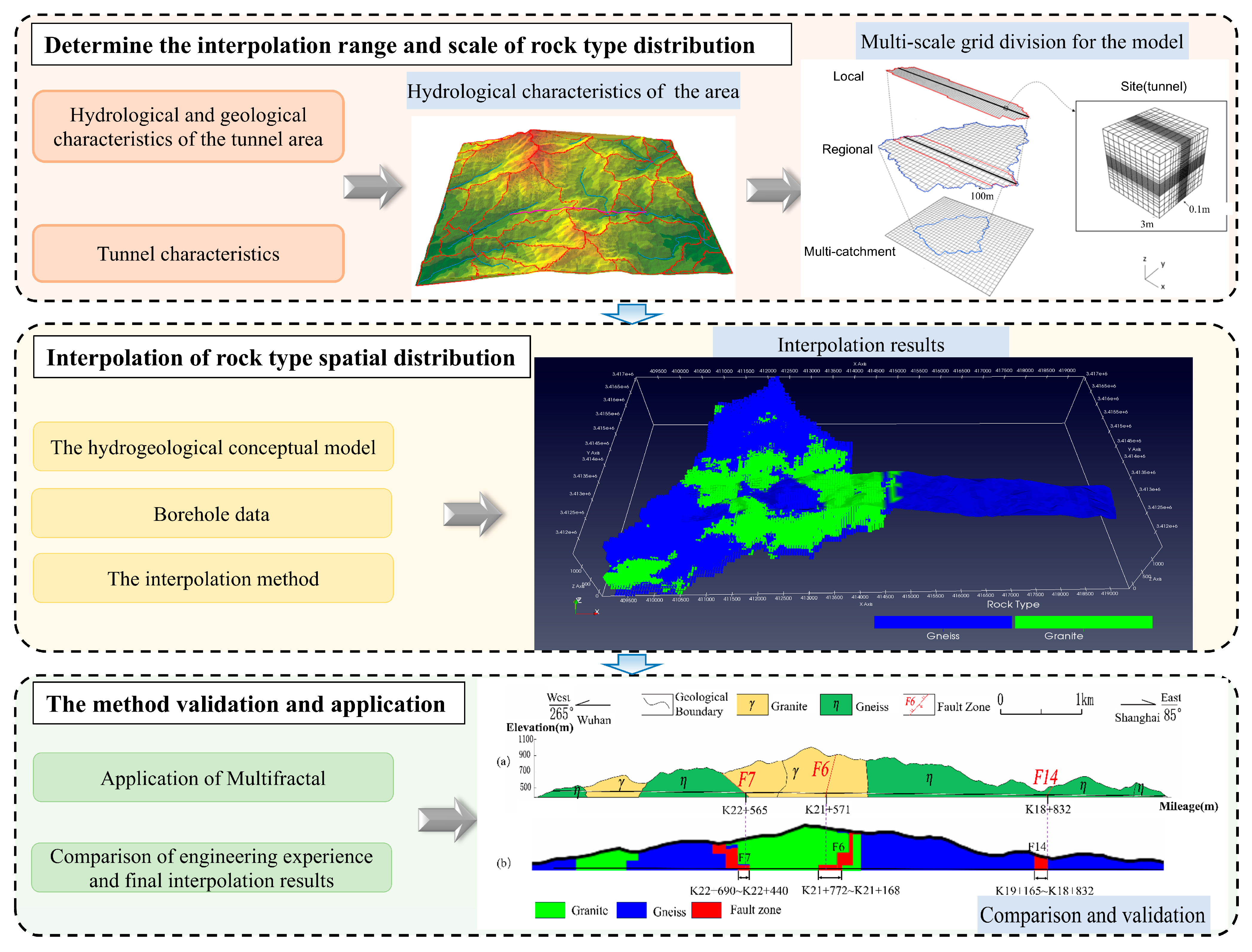
This study proposes a lithological spatial distribution simulation method for establishing a three-dimensional hydrogeological model of tunnel areas. This method is characterized as follows. (1) By combining the actual tunnel engineering situation and the need for numerical hydrogeological analysis, the interpolation range and scale of lithological spatial distribution can be determined quickly; simultaneously, the conversion process from the traditional three-dimensional geological model to the numerical model can be eliminated, and this conversion can be directly used for the subsequent numerical analysis of hydrogeology. (2) By defining the kriging indication of lithological distribution along the tunnel construction direction, the interpolation results can be optimized continuously by optimizing the measured data during tunnel engineering construction. (3) Multifractal theory can be introduced [38,39], and by defining the kriging of the lithological distribution along the tunnel construction direction, the interpolation results can be continuously optimized by the measured data during construction. Multifractal theory is applied to compensate for the shortcomings in the kriging method and to describe the singularity law of the field values, along with changes in the range of the measured data. The specific steps of the method are shown in Figure 1.
The innovative aspects of this paper are as follows: (1) The grid resolution can be determined based on the requirements of subsequent hydrogeological analysis scales in the tunnel area, balancing both the analytical efficiency and accuracy of the hydrogeological model. (2) Incorporating Kriging interpolation and multiple fractal principles during the construction of the three-dimensional hydrogeological model enhances the prediction accuracy of lithological distribution, more realistically reflecting the influence of lithological distribution on hydrogeological characteristics within the study area.

2. Materials and Methods

2.1. Determining the Scope and Scale of Lithological Spatial Distribution Modeling

The interpolation range and scale of the lithological spatial distribution in the tunnel area should be set flexibly according to the research objectives. In addition, the computational efficiency should be increased as much as possible to ensure accuracy while meeting the actual project requirements. The spatial interpolation range is generally affected by the sampling interpolation range, typically 1.5–2 times the range value. This ensures that all points that may be correlated to the sampling points are included, and simultaneously, avoids the inclusion of too many irrelevant points, which can increase the computational burden and noise. Given that the lithological spatial distribution examination in this study was mainly oriented toward hydrogeological analysis in tunnel engineering, the spatial interpolation range of the lithological distribution also needs to meet the hydrogeological analysis requirements. The spatial interpolation range should include all the hydrogeological unit areas affected by the tunnel project. The hydrogeologic unit area can be determined via hydrogeologic analysis.
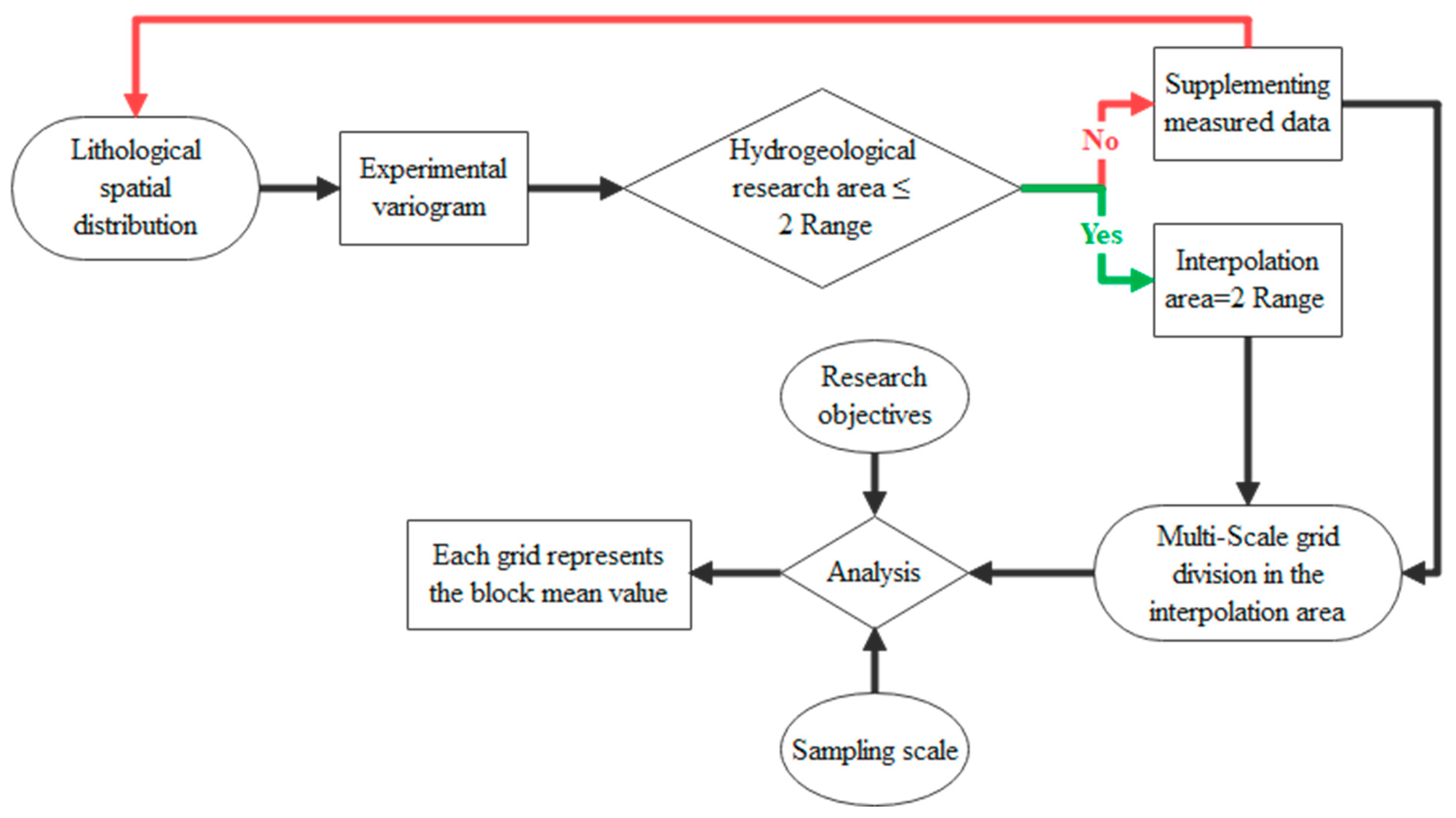
In addition to determining the spatial extent of the interpolation, the scale of the interpolation needs to be determined. This is reflected primarily in the size of the grid cells used to generate the predicted rock mass distribution maps. The grid resolution should match the purpose of the study and the effective resolution of the data (limited by the sampling density and varve). Resolutions much smaller than the sampling density or range are meaningless and produce “false details”. A resolution that is too coarse obscures important spatial correlations. Therefore, actual engineering research requirements, sampling density, and other information should be combined to determine a comprehensive approach. The steps for determining the scope and scale of lithological spatial distribution simulations are shown in Figure 2.

2.2. Spatial Interpolation Methods

In a real-world project in Shanghai, China, researchers have employed a combination of multiple fractal analysis and Kriging interpolation methods to investigate the distribution of geological strata in the tunnel area [39]. Virtual borehole data was generated on the GIS platform using actual measured borehole data, where the thickness of lithological strata missing within the virtual borehole was set to zero, and then triangular prism formations were generated from a reference triangle. Based on virtual drilling, kriging interpolation was employed to obtain preliminary stratigraphic distribution results. Subsequently, multiple fractals were introduced to investigate the anomalous distribution of strata and refine the interpolation outcomes.

2.2.1. Indicator Kriging

We all know that faults tend to be highly anisotropic, with large ratios and principal axes aligned with the fault plane. We believe that lithological anisotropy is more clearly demonstrated in physical parameters, such as permeability, and may not be the primary factor influencing lithological distribution. Therefore, after obtaining the lithological distribution results, our next research focus will be to investigate the impact of lithological anisotropy on lithological permeability characteristics. This needs to be explored further. Returning to the issue of lithological distribution, assuming that there are two lithologies with isotropic properties in tunnel study Area D, the lithological spatial distribution is obtained through interpolation using indicator kriging (in the case of multiple lithologies). Let Z(X) denote the lithological sampling value at point X in Area D, and let Z denote the critical value of different lithologies on D. For each sample point (XD) on D, the indicator function is defined as follows:
I X ; Z = 1 Z X Z 0 Z X > Z
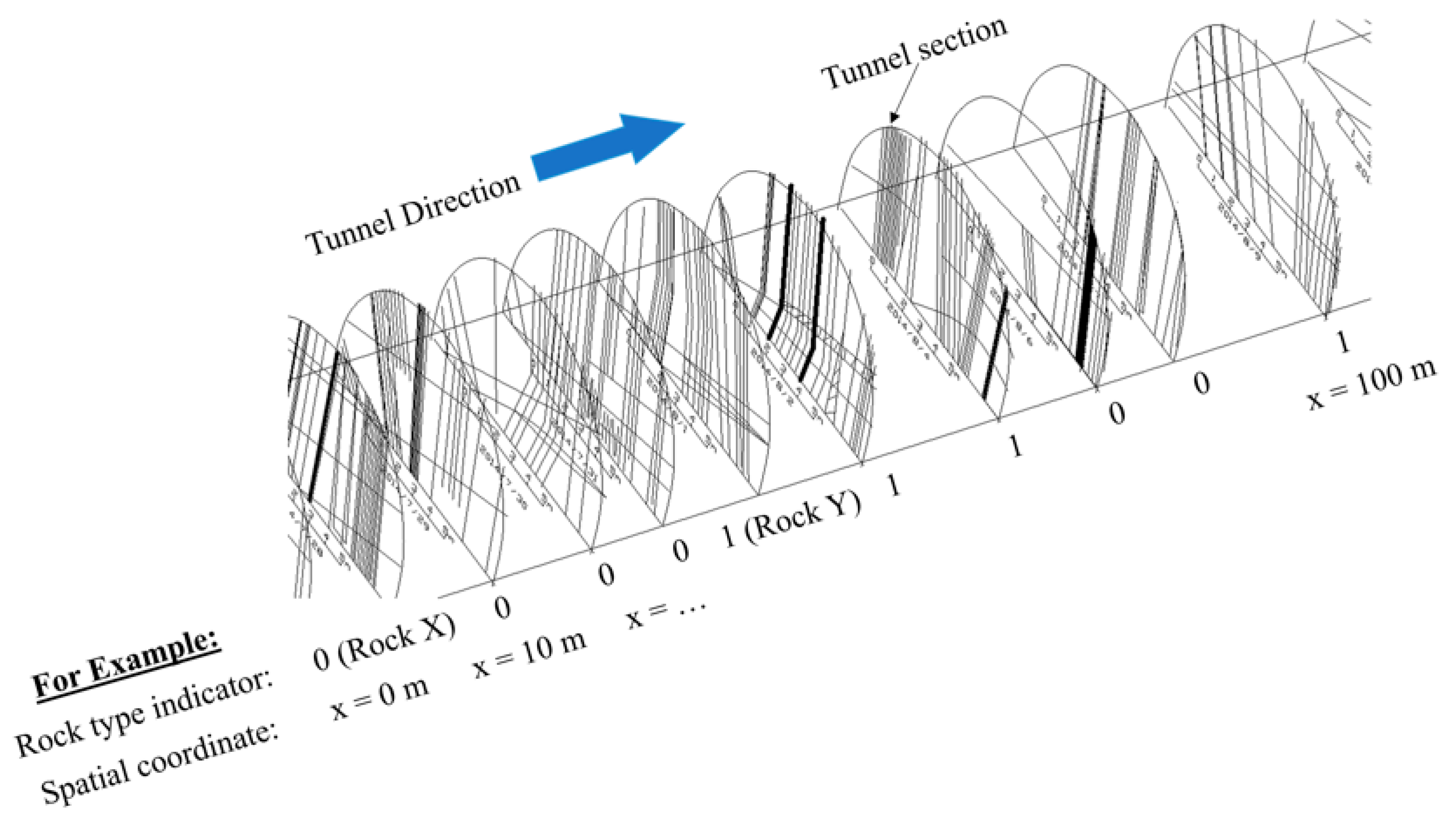
where “0” denotes the corresponding Rock X of the first lithology category, i.e., greater than the critical lithology value, and “1” denotes Rock Y of the second lithology category, i.e., less than the critical lithology value, as shown in Figure 3.
One hundred measurements of rock type were taken during tunnel excavation to construct a 1D semi-variogram. The excavated faces were coded with 0 for Gneiss and 1 for Granite, with each measurement located at a spatial coordinate, allowing for the computation of covariance at different sample pair distances. This semi-variogram was used in the subsequent geostatistical analyses. The measurements are basically 1-dimensional because they were taken along the tunnel axis, which is more or less a linear feature.
Therefore, the condition for the optimal unbiased estimator of the lithology value at point X is as follows:
α = 1 n λ α Z = 1 σ E 2 = E ϕ A ; Z ϕ A ; Z 2 = M I N
where σ E 2 represents the unbiased estimated variance; ϕ(A;Z) denotes the cumulative distribution function; F(Z), of the lithology values; F(Z) indicates the value at Z of the distribution function of the lithology values, Z(X); and ϕ*(A;Z) represents the linear estimate of ϕ(A;Z).
The lithological variability function yields the following set of indicative kriging equations:
β = 1 n λ β γ X α , X β ; Z + μ = γ ¯ X α , A ; Z α = 1 , 2 , , n α = 1 n λ α = 1
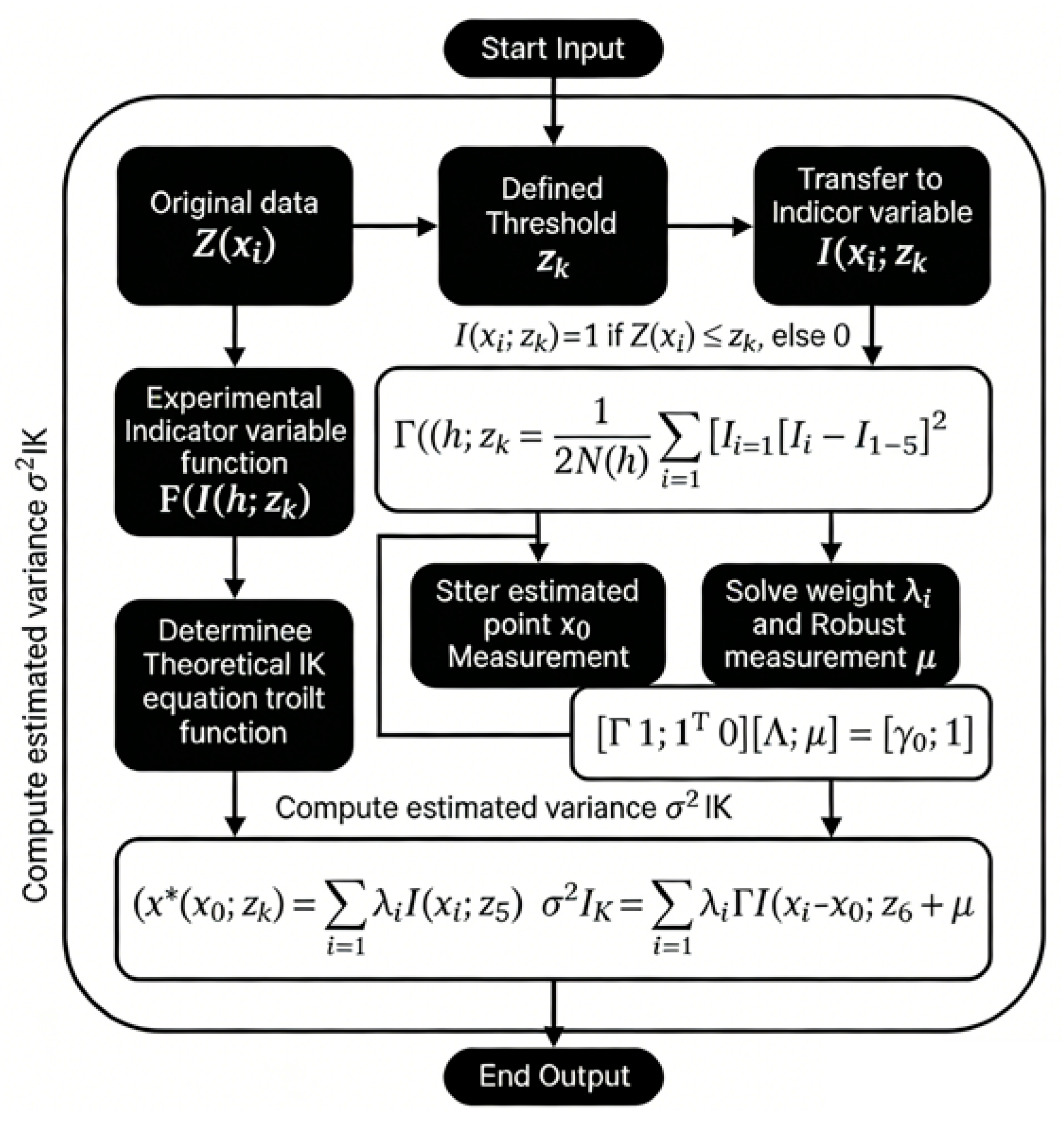
where γ ¯ X α , A ; Z represents the average indicated variability function value between point Xα and Area A. γ(Xα,Xβ;Z) can be calculated by fitting a curve to the test variability function values established using the borehole data. A kriging interpolation program is used to calculate the lithology values of all grid cells in the model (including faults and folds), and the calculated average lithology values of the grid cells are imported into the model to obtain the initial lithological spatial distribution of the rock. A flowchart of indicator kriging equations is shown in Figure 4.

2.2.2. Conditional Simulation of Rock Types

As tunnel construction progresses, the measured data along the tunnel direction are continuously updated, and the interpolation results are continuously optimized with the updated measured data through conditional simulation. Compared with the general simulation in geostatistics, conditional simulation requires that the simulated results have the same covariance function or variance function as the actual data and that the simulated value at a specific measured point is equal to the measured value at that point. Let Zsc(X) be a conditional simulation of a regional variable Z(X), and let the simulated value be equal to the measured value at the measured point, Xα, i.e.,
Z s c X α = Z X α
The formula for the conditional simulation, Zsc(X), can be obtained by simply replacing the above unknown kriging error, [Zs(X) − Z*sk(X)], with an unconditionally simulated kriging error, [Zs(X) − Z*sk(X)], that is isomorphic and independent of this error:
Z s c X = Z k X + Z s X Z s k X
We used the point cloud of primary geology information as conditioning data, along with the spatial model shown in Figure 3 to perform random indicator conditional simulations using the GSTAT package in R. Using the above conditional simulation methods, we can obtain not only lithological distributions with spatial variability but also a better fit to the constantly updated measured values.

2.2.3. Multifractal Theory

The kriging method is a spatial interpolation method based on a semi-variance function, which is essentially a sliding weighted average method. Spatial variability is the essence of the weighted average; thus, the data are inevitably smoothed, especially because of the specific local geological structure of the region, and its local area interpolation results can easily be inaccurate. Introducing multifractal theory can compensate for the shortcomings of the kriging method. The multifractal theory was first proposed by Mandelbrot [40], and its mathematical model has been gradually improved and applied to geological modeling. The basic multifractal concept was introduced to analyze the distribution of singularities in the geometric support of physical and other quantities.
Multifractals are characterized by the method of moments, which employs a dissecting function to compute the multifractal dimension, α, with the following equation:
α = lim ε 0 lg χ ε lg ε = lim ε 0 lg i = 1 N ε μ i ε lg ε
where < > represents the statistical moment of the measure, μi(ε), defined on the set, S, of profiled data; ε denotes the size of the capacity scale; and N(ε) indicates the number of capacities. Numerous spatial interpolation and filtering methods are based on the sliding weighted averages of the field values, and Equation (6) is rewritten as
Z ^ X 0 = Ω X 0 , ε ω X 0 X Z X
where Ω(X0,ε) represents a small sliding window of radius ε around the center point, X0, and ω(║X0X║) denotes a weighting function of any point, X, in Ω(X0,ε), separated from X0 by a distance of ║X0X║. Equation (7) can be calculated by the kriging method, but this does not involve a local singularity measure. The multifractal method proposed by Cheng [41] expresses the sliding average relationship as follows:
Z ^ X 0 = ε α 2 Ω X 0 , ε ω X 0 X Z X
where α represents the local multifractal dimension at X0.
This expression not only contains the spatial correlation component but can also be used to determine local singularity. The multifractal method is suitable for describing local anomalies, and the usual weighted average method is only a specific case of the multifractal method under certain conditions.

3. Application Cases

3.1. Sources of Measured Data

We selected the Mingtangshan Tunnel in China as an example, as it has 12 rock boreholes that are distributed along the direction of the tunnel axis. The lithological data for the boreholes are shown in Table 1; the granite is mainly strongly weathered, and the Gneiss is mainly moderately weathered.
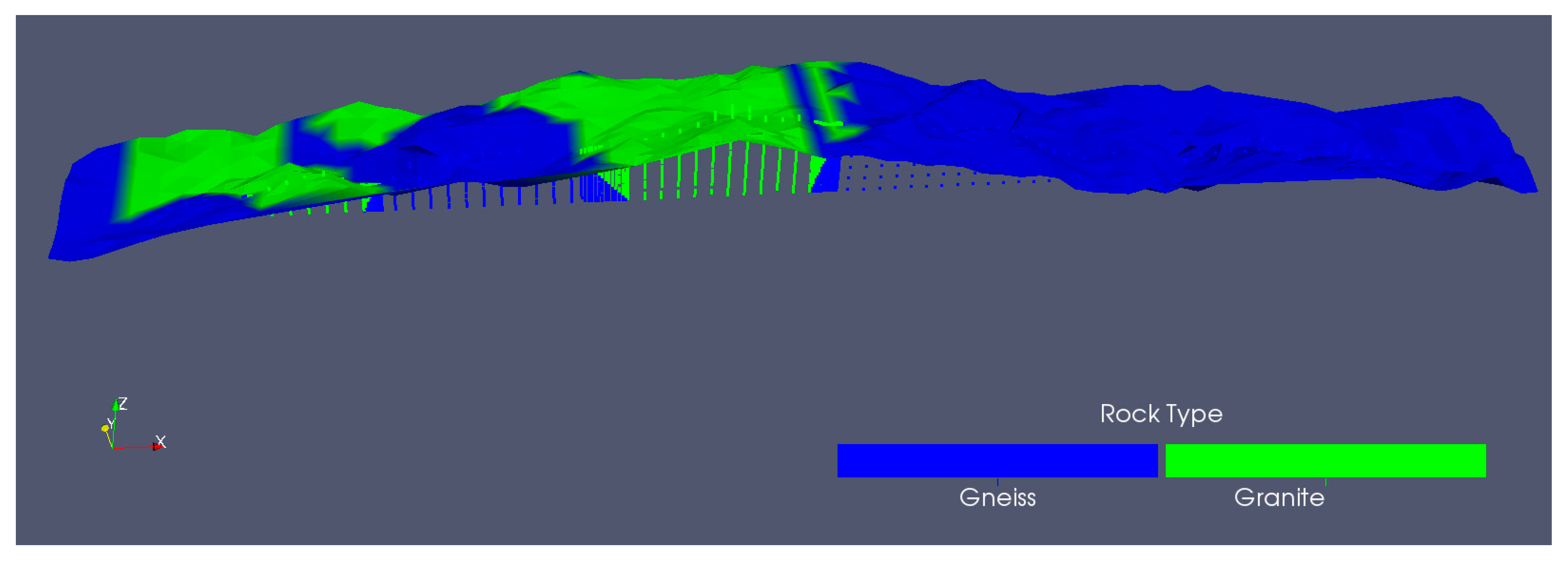
Geophysical and borehole data were converted into point clouds (Figure 5), and these point clouds were used as conditioning data in simulations using the geostatistical model derived from construction-stage rock type measurements.

3.2. Interpolated Spatial Range and Scale

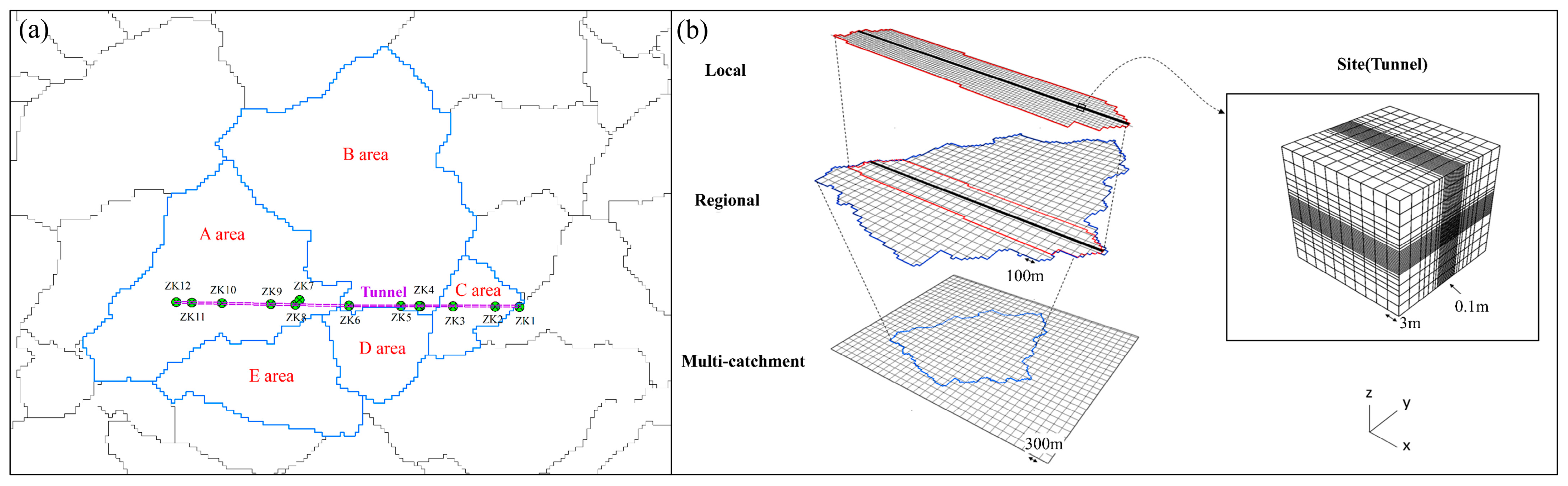
The hydrogeological analysis of the area around the Mingtangshan Tunnel and the division of hydrogeological units are shown in Figure 6a. The tunnel crosses five hydrogeological units—A, B, C, D, and E—and its influence range is concentrated here. Typically, different research objectives have different requirements for the accuracy and scale of lithological distribution, and we used Modmuse (Version 5.4.0.0) in Modelflow to realize the multiscale grid division of the different research areas. As shown in Figure 6b, the multi-catchment region is used mainly for large-scale hydrogeological analysis; this does not require a highly accurate lithological distribution, and the largest-scale grid can be used. Given that the range of this region typically exceeds two times the range and influence range of the tunnel, this region is not involved in simulating lithological distribution. The range of the region typically falls between the influence range and range of the tunnel, and part of the region should be included in the lithological distribution simulation. The area usually falls between the influence range and two times the range. Part of the area should be included in the estimation of lithological distribution, and a medium-scale grid should be used. The Mingtangshan project was selected as an example, and 100 m was used as the scale of the basic unit. Given that the local area was used to analyze the mechanism of the tunnel itself, higher accuracy in the lithological distribution was required, so 0.1–3 m was the scale of the basic unit.
The measured boreholes were spatially distributed along the tunnel direction, and it was challenging to meet the numerical analysis modeling requirements for the whole tunnel area when there were only 12 borehole data points. Therefore, virtual borehole interpolation was carried out in the blue border area in Figure 6a; virtual borehole data were derived from actual borehole data. As shown in Figure 6a, there were 12 actual boreholes distributed along the tunnel axis. Through horizontal and vertical grid partitioning, the actual boreholes ere stratified and assigned values to generate virtual borehole data. The interpolation area was 15,000 m long and 12,000 m wide, and the specific boundary coordinate parameters are shown in Table 2.
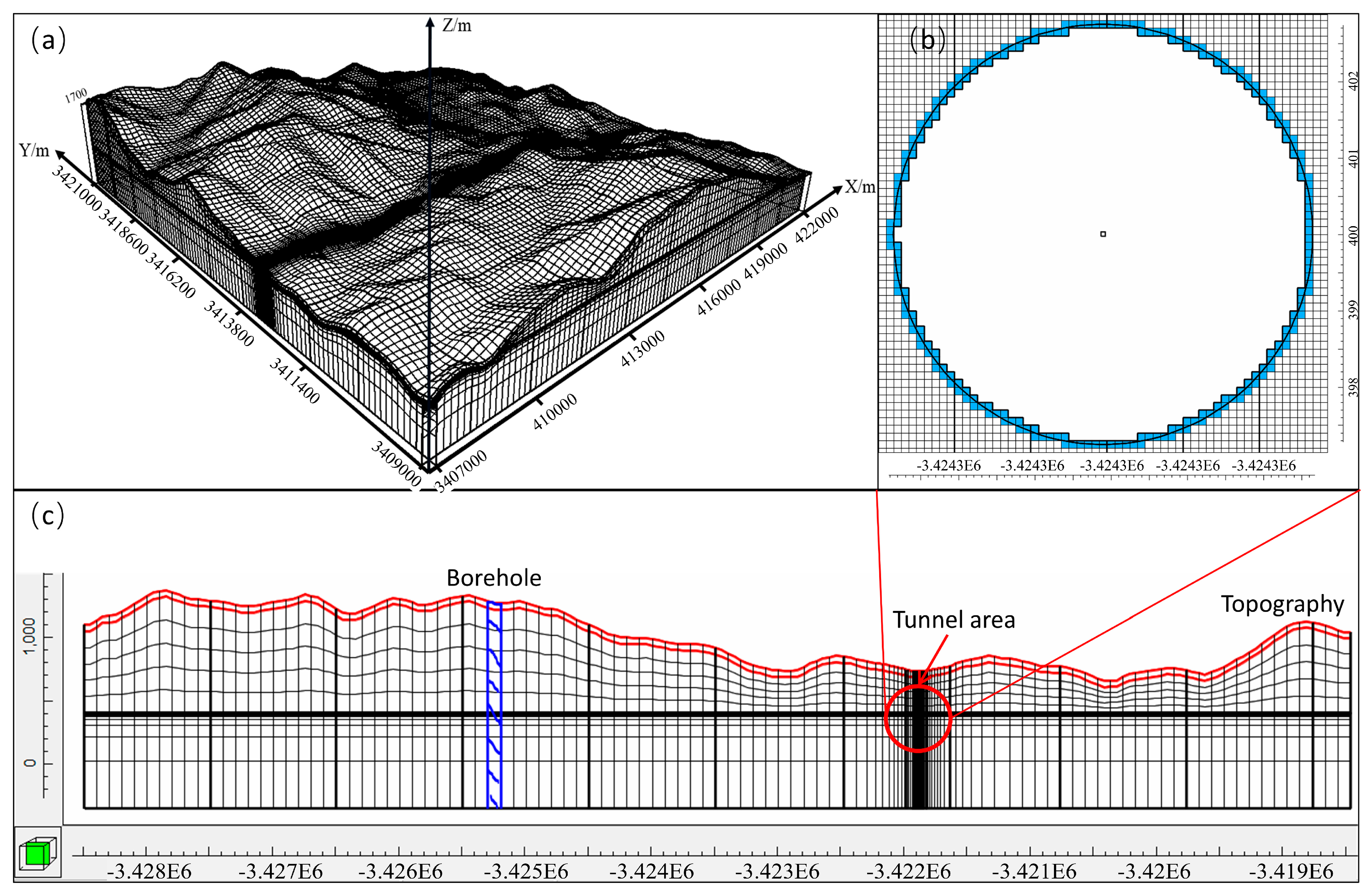
After determining the range and scale of the interpolation space area, the surface elevation data were imported into the model to generate a 3D grid model considering the real terrain, as shown in Figure 7. Via multiscale grid division, both the accuracy requirements of the calculation problem were met, and the model calculation efficiency was increased. The gridding scheme contained a total of 1,140,720 finite-difference cells, and kriging interpolation was used to assign the lithology values to these cells one by one and calculate the final lithology mean value.

3.3. Interpolation Analysis

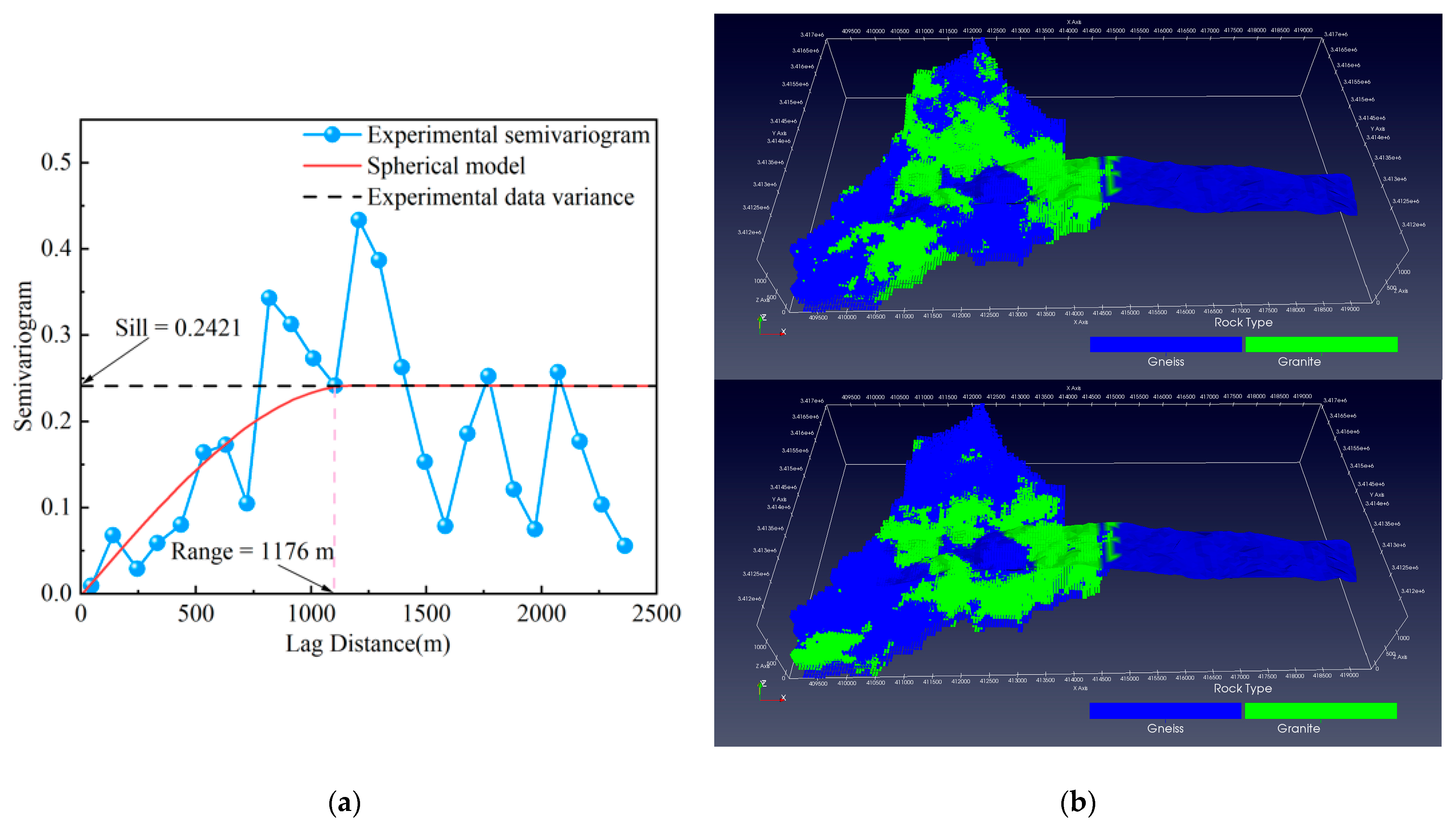
Spatial interpolation is an example of the spatial interpolation of surface lithological distributions; the remaining stratigraphic properties follow suit. In this work, the GSTAT program package of the R language (version 4.0.3) was used to write the indicated kriging interpolation algorithm to calculate the experimental variability function values of the lithological distribution in the tunnel area under different lag distance conditions. Based on the distribution of the experimental variogram function values, the theoretical spherical model was used to fit the semi-variogram function curves: range, α = 1176 m; nugget, C0 = 0; and sill C = 0.2421 (Figure 8a). The semi-variogram was used in the subsequent geostatistical analyses. We assumed that the 3D geostatistical model was isotropic. Note that some kind of assumption needs to be made here, since we have very little information in the directions normal to the tunnel axis. The majority of information we have is along the tunnel axis. Therefore, we based this on the measurement along the tunnel made cross-validation to confirm that the Spherical model (C0 = 0) [42] was better than the Gaussian model and the Exponential model. In addition, Gaussian models are better suited for highly smooth, continuously varying regional variables, such as terrain elevation and continuous subsidence fields. The Exponential model is applicable when spatial correlation decreases with distance but lacks a clearly defined boundary, such as certain physicochemical properties of soil.
The experimental semi-variance function obtained from the fitting was used to interpolate the lithological distribution in the tunnel area. The results were then imported into the 3D model to obtain the lithological distribution map of the tunnel site area, as shown in Figure 8b. The blue cells represent strongly weathered granite, and the green cells represent moderately weathered Gneiss. Using the geostatistical model and conditioning data, 100 simulations of different possible rock type fields were created (all fields obey the variogram model and the measured borehole and geophysical data have interpolations that differ from the measurements). These fields can be imported directly into ModelMuse. The grid centroids from the model domain were used as the simulation grid for the geostatistical simulation. We used a point cloud of the primary geology information as conditioning data to perform 100 random indicator simulations. Two examples of these simulations in Area A are shown above. We performed several postprocessing steps to remove ‘islands’ and other geologically unsupported features. Outlines of the postprocessing steps: the first step is creating an experimental variogram (semi-variance plotted against lag distance between sample pairs). The experimental variogram is computed for measured values. A variogram model is then fitted to the experimental variogram, giving a space random function for the variable z(x). Local rock type measurements are then collected to use as conditioning data, which constrains the random simulation at measurement locations. Realizations of fields can then be simulated that honor the variogram model and are constrained by the conditioning data. Since the same variogram model and conditioning data can be honored by many different fields, we created 100 simulations to reflect different possible realizations.
The kriging interpolation results cannot reflect the local singularity of the lithological distribution because of the sliding weighted average. In the presence of faults and other geological structures in the tunnel site area, the interpolation results often deviate from the actual situation. For this reason, the conditional simulation method was used to consider the local singularity of the lithological distribution.
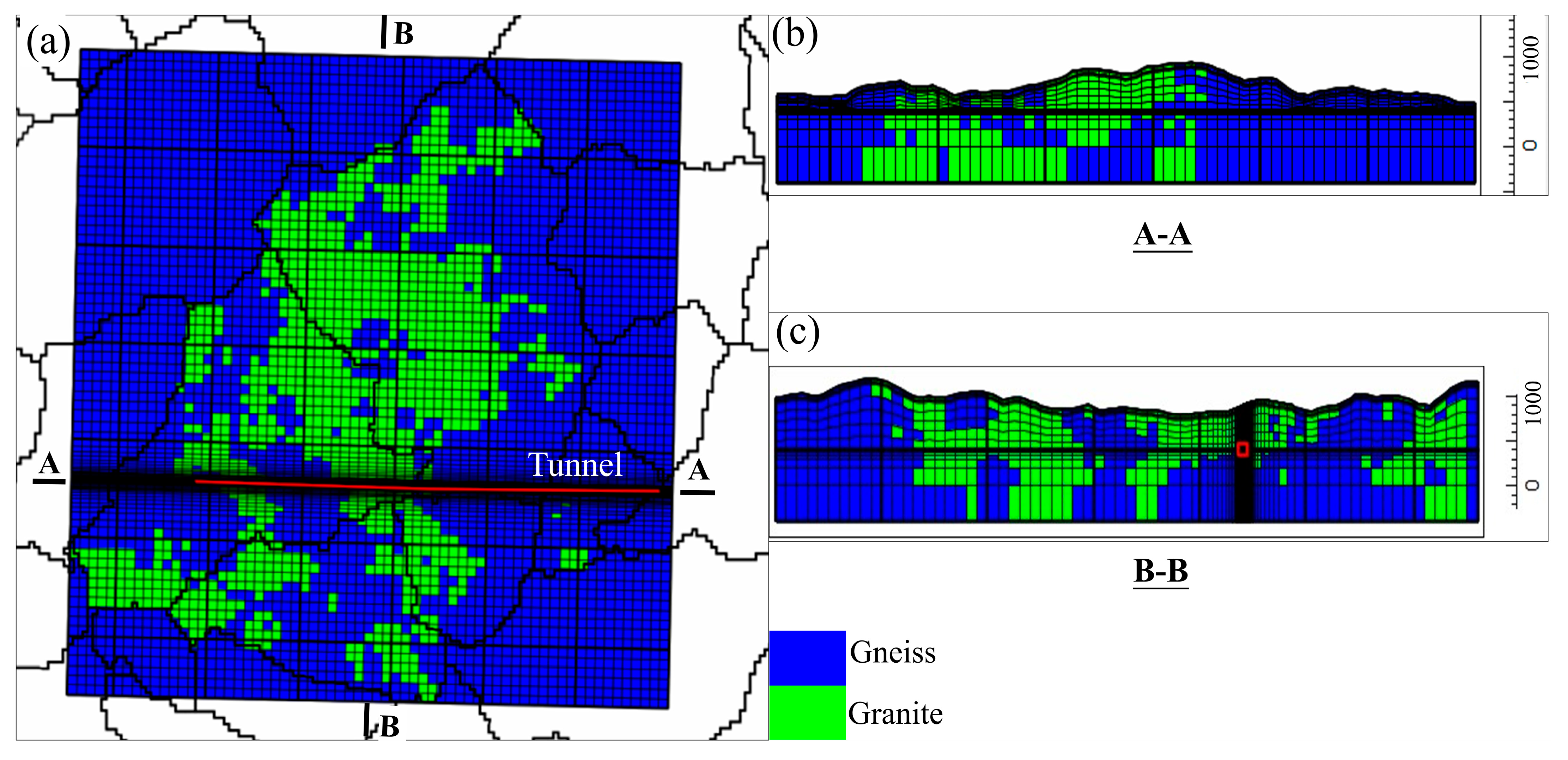
The lithological values with more than 50% of the time were used as the final interpolation results of the unit to obtain the lithological distribution of the tunnel site after the condition simulation was updated.
According to the update of the measured data, the conditional simulation continuously optimizes the initial kriging interpolation results by continuously updating the measured values. The final optimization results are shown in Figure 9. The green area shows that the number of times granite appeared in the area grid was greater than 50, and the blue area shows that the number of times Gneiss appeared in the area was greater than 50.

3.4. Multifractal Interpolation Results

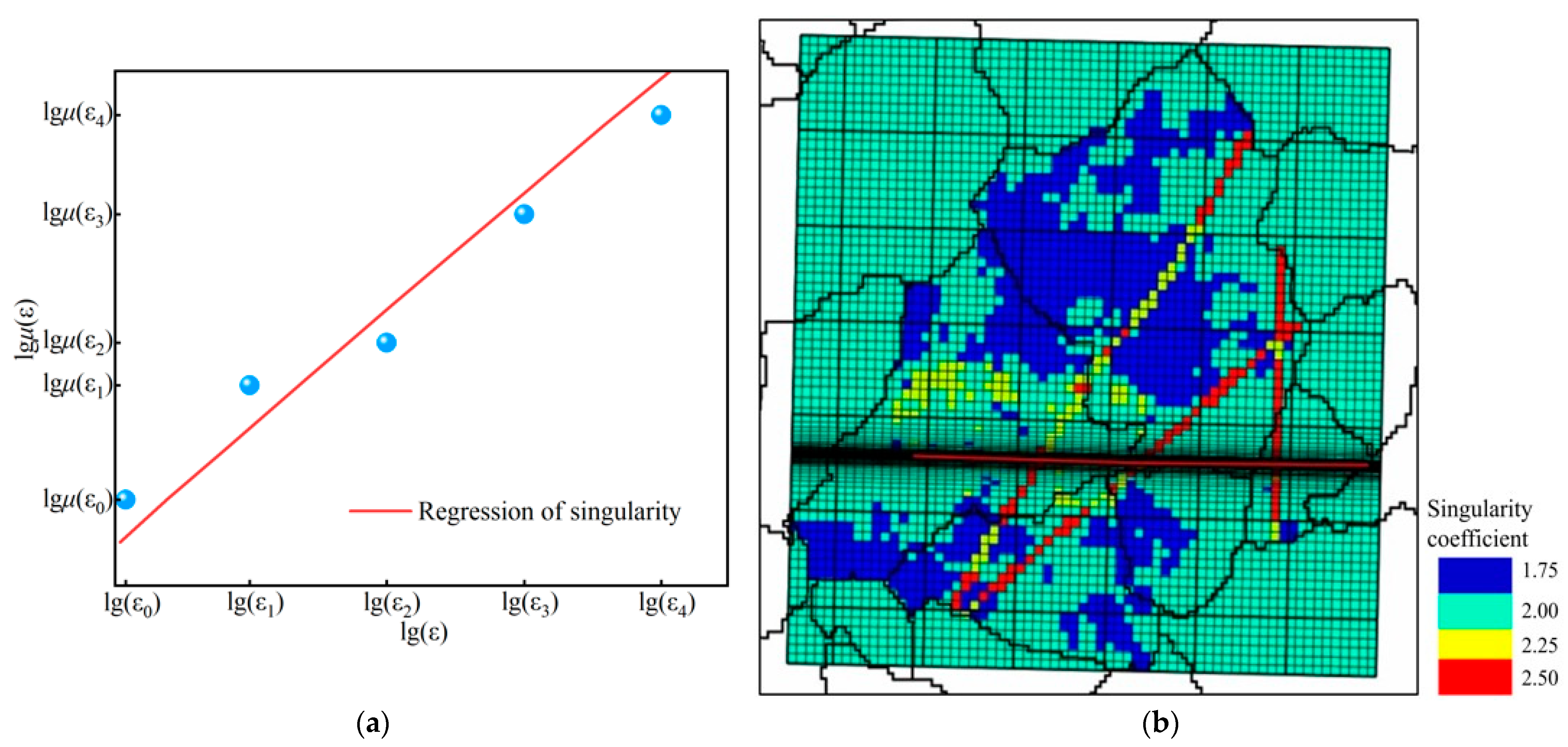
The primary objective of this study’s multifractal analysis was to determine the fractal dimension of rock type distribution within the tunnel area based on the current grid resolution. This result was then used to evaluate the reliability of interpolation outcomes at the boundary between faulted and non-faulted zones, enabling subsequent corrections. The lithological distribution of the top rock layer was based on the kriging method and was selected to measure the local singularity of the lithological distribution and integrate the theory of multifractality. First, we calculated the local singularity index at the virtual borehole of the grid, which can be defined as the multifractal measure, μ(ε), for the volume of the form surrounded by the lithological distribution within the range of ε × ε. Considering the interpolation of the regional mesh division scale, the side of the square with a length of 0.1 m, d, 2d, 3d, and 4d (d is the smaller value of a single grid size, considering the accuracy of multiscale grid division; in this case, d = 25 m) was used to obtain different measures, μ(ε). As shown in the double logarithmic diagram in Figure 10a, the slope of the straight regression line for lgεlgμ(ε) is the singularity index of the point, also known as the fractal dimension, α(X0). When the linear correlation coefficient of lgεlgμ(ε) is greater than the specified threshold (R = 0.9), the relationship between the indices of μ(ε) and ε is established; otherwise, α(X0) is used. As shown in Figure 10b, the spatial interpolation kriging method uses multifractal theory, which compensates for the defects of local smoothing in the semi-variogram function and can measure the local singularity characteristics of the localized uplift and subsidence of the surface lithology (especially in the area of faults). Notably, calculating the singularity coefficient is completely based on the original borehole distribution information, so the boreholes should be placed as close as possible to the characteristic points of lithological changes when engineering geological sampling is considered.
The core advantage of multiple fractal analysis lies in quantifying variability across different scales within spatial or sequential data. Research indicates its effectiveness across diverse lithologies, ranging from homogeneous sandstones to heterogeneous shales. Even in highly metamorphosed crystalline rocks such as Gneiss and Granite, the regularity analysis derived from this method clearly distinguishes distinct lithological units. This demonstrates the method’s significant potential for characterizing the fine-scale structures within complex lithologies.
When borehole density is lower, the primary challenge stems from data sparsity. This leads to two problems: (1) Increased Uncertainty: Any interpolation or extrapolation based on sparse data significantly increases uncertainty. A study on determining in situ stress clearly demonstrated that selecting different characteristic points—whether through interpolation techniques or manual judgment—yields markedly different results on curves with few data points. (2) Reliability of Scale Analysis: Fractal analysis requires sufficient data points to reliably calculate statistical properties at different scales. Insufficient data may fail to accurately capture true scale-invariance patterns.
Therefore, under low-density conditions, fractal analysis should not be relied upon alone. It should be combined with geostatistical models, seismic data, or geological conceptual models to constrain inter-well predictions.

4. Discussion

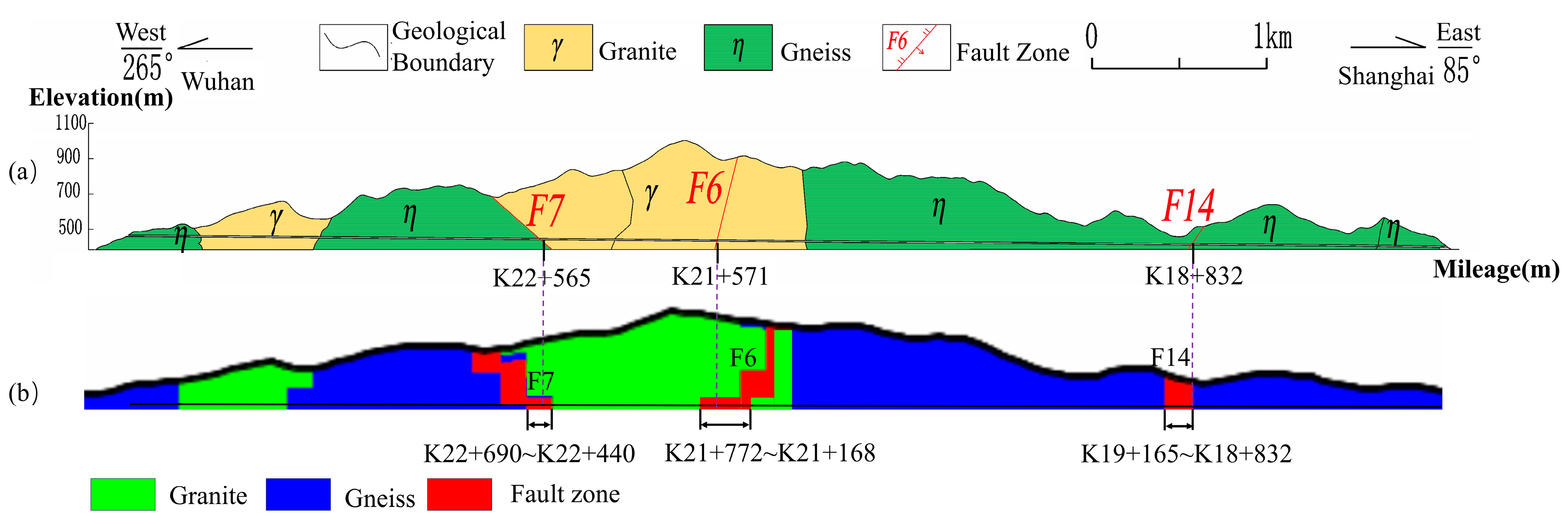
With the kriging method, multifractal theory was used to spatially interpolate all the rock layers in the area, and the results were compared with the engineering geological distribution map created empirically (Figure 11). The comparison map shows that when the distribution of specific geological formations, such as faults F7, F6, and F14, is estimated, the method can accurately estimate the dip angles of the faults and the locations of the faults intersecting the tunnel. For example, Figure 11b shows that the model estimates that the intersection area of fault F7 and the tunnel is K22 + 690~440, the intersection area of fault F6 and the tunnel is K21 + 772~168, and the intersection area of fault F14 and the tunnel is K19 + 165~K18 + 832. The actual survey map of the project in Figure 3 shows that the actual intersection of faults and tunnels falls in the interval of the model estimation. The model can successfully estimate the intersection area between the fault and the tunnel, thus guiding construction in sensitive areas and reducing the probability of engineering accidents. In terms of estimating the general lithologic distribution in the region, the results on the right side of fault F6 have a small error compared with the actual engineering empirical results, which may be due to lower sampling in the larger-error area and the large grid division caused by the high altitude. In addition, taking the tunnel face along the tunnel axis as an example, we compared the simulated results of rock type distribution in cross sections with the actual face conditions recorded during construction. The comparison value represents the ratio of the mileage where the simulated and actual values matched to the total tunnel length, the overall error rate is no greater than 10%, and the geological characteristics of the engineering geological map are consistent with the application requirements of tunnel engineering.
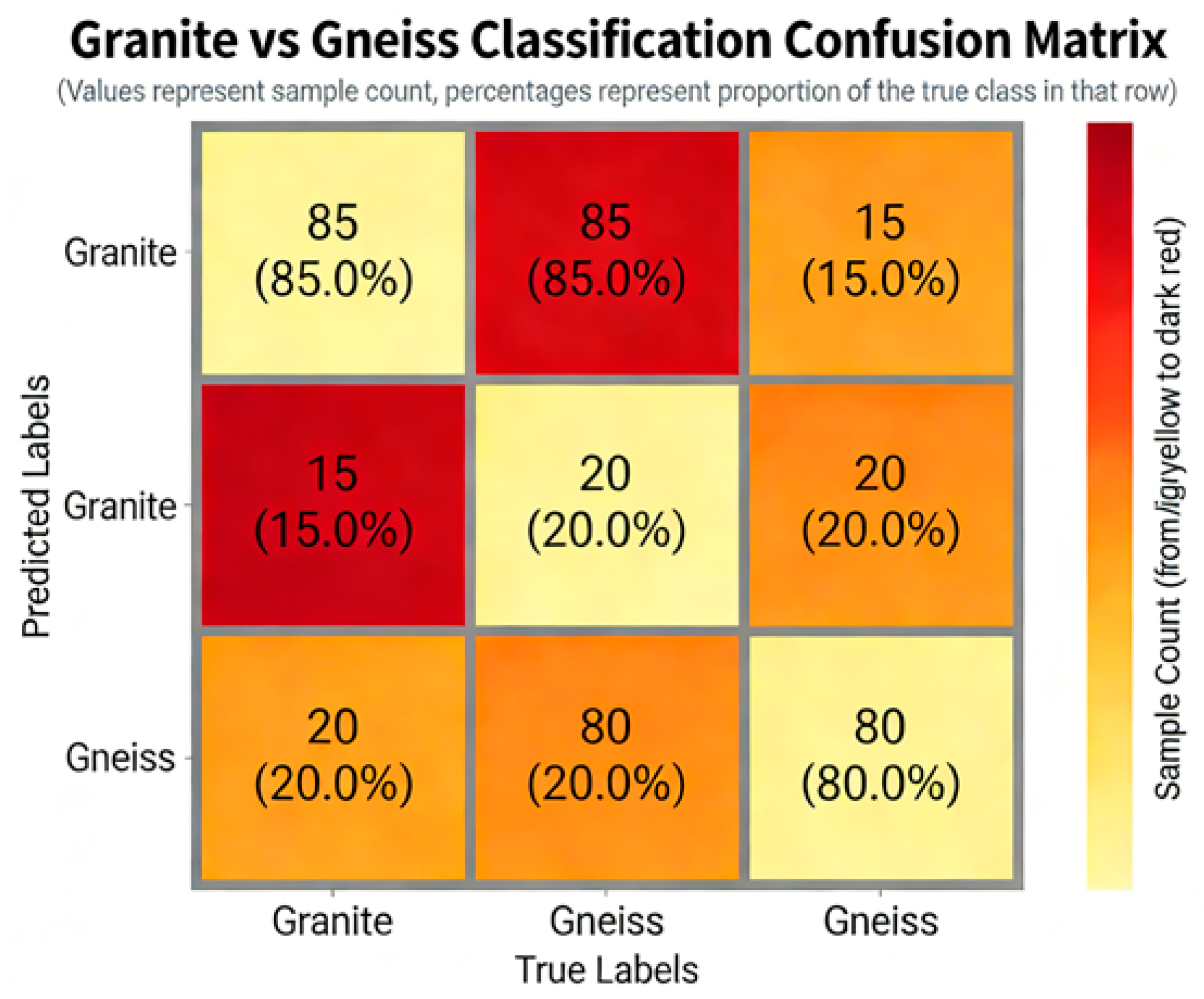
To quantitatively evaluate the accuracy of the lithological distribution model’s predictions, a confusion matrix for the Granite and Gneiss classification model was introduced (Figure 12). Its rows represent predicted lithological labels, columns represent true lithological labels, and cell values indicate the proportion of corresponding predictions. For the number of samples in the true combination, the percentage in parentheses indicates the proportion of this sample count relative to the total samples in the corresponding true category. The shade of color corresponds to the sample quantity (darker shades indicate more samples). Regarding the sample distribution, among samples with true Granite, 85 were correctly predicted as Granite (85%); among samples with true Gneiss, 85 were misclassified as Granite (85%), while 80 were correctly predicted as Gneiss (80%). Regarding the model metrics, the overall classification accuracy reached 82.5% (meaning 165 out of 200 samples were correctly classified). Specifically, Gneiss recognition achieved a precision rate of 84.2% (84.2% of samples predicted as Gneiss were actual Gneiss) and a recall rate of 80% (80% of actual Gneiss samples were correctly identified). Confusion between the two rock types was noticeable: 15% of Granite samples were misclassified as Gneiss, while 20% of Gneiss samples were misclassified as Granite. This indicates that the model demonstrates good accuracy in distinguishing between the two rock types.
The estimation results in Section 3.4 indicate that the singularity coefficient fluctuated more along the fault distribution region, which also reveals that the multifractal theory has a good optimization effect on the estimation of lithological distribution in a region with a specific geological structure. By filtering through spatial self-similarity to measure the local singularities in the spatial data distribution, this mitigates the shortcomings of local smoothing in the semi-variate function in the kriging method.
Although the combination of traditional Kriging interpolation methods with multiple fractal principles can effectively capture the spatial variability of partial lithological distributions, sparse drilling data still significantly increases model uncertainty. Sparse borehole data, featuring insufficient quantity and uneven spatial/depth coverage, drastically amplifies lithology model uncertainty, as lithology modeling relies heavily on direct borehole observations for classification and spatial extrapolation. It fails to capture lithological spatial heterogeneity, missing critical boundaries or anomalous bodies, leading to biased initial classification. Sparse vertical data hinders horizontal stratigraphic correlation, distorting the overall lithological framework with misjudged depositional environments. Unverified model assumptions (e.g., horizontal stratigraphy) cause structural deviations. Data-driven models suffer underfitting/overfitting. Geostatistical interpolation errors surge in “data deserts”, elevating risks in geological exploration and geotechnical engineering decisions.

5. Conclusions

This study integrated Kriging interpolation, multiple fractals, and finite differences to establish a lithological distribution simulation method. This method effectively predicts lithological distribution within the study area. By incorporating hydrogeological conditions in the tunnel zone, the lithological distribution results can be rapidly applied to construct a three-dimensional hydrogeological model, laying the foundation for subsequent hydrogeological simulation studies. The method has the following characteristics: (1) it is tailored to the numerical analysis of tunnel hydrogeology, which eliminates the conversion process from the traditional 3D geological model to the numerical model; (2) it can flexibly adjust the scale of the lithological analysis to meet different analysis accuracies and efficiencies; and (3) it combines with the hydrogeological conditions of the actual project to show the local singularities of the lithological distribution under complex geological conditions.
Recently, the combination of computer technology and tunnel engineering has become increasingly common, as has the use of mathematical methods based on geostatistics, stochastic simulation, and multifractal theory in studies of parameter spatial variability. The precision and efficiency of parameter estimation have also continuously increased. Notably, the lithological spatial distribution simulation method proposed here assumes that lithology is isotropic, which is quite different from the actual geological situation, as faults tend to be highly anisotropic, with large ratios and principal axes aligned with the fault plane. We believe that lithological anisotropy is the primary characteristic of physical parameters such as permeability, while randomness and uncertainty are the main features of lithological distribution. Therefore, after obtaining the lithological distribution results, our next research focus will be to investigate the impact of lithological anisotropy on lithological permeability characteristics. This needs to be explored further. In addition, this study used a multiscale interpolation method but did not consider the effects of spatial processes acting simultaneously at multiple scales. In the future, a nested structure can also be considered for further analysis.

Author Contributions

Conceptualization, X.L.; methodology, Y.L. and X.L.; software, Y.L.; validation, Y.L.; formal analysis, Y.L.; investigation, J.W.; resources, Y.L.; data curation, J.W.; writing—original draft preparation, J.W.; writing—review and editing, Y.L.; visualization, Y.L.; supervision, J.W.; project administration, Y.L.; funding acquisition, Y.L. All authors have read and agreed to the published version of the manuscript.

Funding

This research was supported by a project supported by the Scientific Research Fund of Zhejiang Provincial Education Department (Y202454589); the Jiaxing Science and Technology Project (2024AD30052); and a project supported by the Scientific Research Fund of Jiaxing Nanhu University (62302YL).

Data Availability Statement

The raw data supporting the conclusions of this article will be made available by the authors on request.

Conflicts of Interest

The authors declare no conflicts of interest.

References

  1. Phoon, K.K.; Kulhawy, F.H. Characterization of geotechnical variability. Can. Geotech. J. 1999, 36, 612–624. [Google Scholar] [CrossRef]
  2. Sun, H.Y.; Le, L.; Dai, Y.M.; Rui, Y.; Zhu, H.H.; Li, X.J.; Li, X.H.; Xue, G.G. Groundwater environmental effects risk evaluation in mountain tunnel construction: A dynamic decision support system based on fuzzy two-dimensional cloud probability model. Tunn. Undergr. Space Technol. 2025, 156, 106276. [Google Scholar] [CrossRef]
  3. Zhai, S.J.; Du, G.Y.; Zhuang, Z.X.; Gao, C.H.; Wang, C.L. Effect of resonance compaction method on the bearing capacity Considering geotechnical spatial variability characteristics. Eng. Geol. 2023, 324, 107256. [Google Scholar] [CrossRef]
  4. Bobet, A. Deep tunnel in transversely anisotropic rock with groundwater flow. Rock Mech. Rock Eng. 2016, 49, 4817–4832. [Google Scholar] [CrossRef]
  5. Chen, Z.Q.; Yu, B.X.; Li, Z.; Zhuang, D.Y.; Liu, M.Y. An active drainage method for groundwater environment protection and tunnel safety control. Transp. Geotech. 2025, 51, 101502. [Google Scholar] [CrossRef]
  6. Frenelus, W.; Peng, H.; Zhang, J. Evaluation methods for groundwater inflows into rock tunnels: A state-of-the-art review. Int. J. Hydrol. 2021, 5, 152–168. [Google Scholar] [CrossRef]
  7. Karakus, M.; Fowell, R.J. Effects of different tunnel face advance excavation on the settlement by FEM. Tunn. Undergr. Space Technol. 2003, 18, 513–523. [Google Scholar] [CrossRef]
  8. Li, X.J.; Li, Y.D.; Chang, C.F.; Tan, B.; Chen, Z.Y.; Sege, J.; Wang, C.; Yoram, R. Stochastic goal-oriented rapid impact modeling of uncertainty and environmental impacts in poorly-sampled sites using ex-situ priors. Adv. Water Resour. 2018, 111, 174–191. [Google Scholar] [CrossRef]
  9. Fang, K.; Miao, M.; Tang, H.M.; Dong, A.; Jia, S.; An, P.; Zhang, B.; Tu, J. Model test on deformation and failure behaviour of arching-type slope under excavation condition. Eng. Geol. 2022, 302, 106628. [Google Scholar] [CrossRef]
  10. Gong, Q.M.; Yin, L.J.; Ma, H.S.; Zhao, J. TBM tunnelling under adverse geological conditions: Anoverview. Tunn. Undergr. Space Technol. 2016, 57, 4–17. [Google Scholar] [CrossRef]
  11. Holmøy, K.H.; Nilsen, B. Significance of geological parameters for predicting water inflow in hard rock tunnels. Rock Mech. Rock Eng. 2014, 47, 853–868. [Google Scholar] [CrossRef]
  12. Schwarz, L.; Reichl, I.; Kirschner, H.; Robl, K.P. Risks and hazards caused by groundwater during tunnelling: Geotechnical solutions used as demonstrated by recent examples from Tyrol, Austria. Environ. Geol. 2006, 49, 858–864. [Google Scholar] [CrossRef]
  13. Marinos, V.; Carter, T.G. Maintaining geological reality in application of GSI for design of engineering structures in rock. Eng. Geol. 2018, 239, 282–297. [Google Scholar] [CrossRef]
  14. Loew, S.; Barla, G.; Diederichs, M. Engineering geology of Alpine tunnels: Past, present and future. In Geologically Active-Proceedings of the 11th IAEG Congress, Auckland, New Zealand, 5–10 September 2010; CRC Press: Boca Raton, FL, USA, 2010; pp. 201–253. [Google Scholar]
  15. Nie, L.C.; Jia, S.X.; Li, Z.Q.; Guo, Q.; Wang, T.Y.; Du, Y.C.; Li, S.; Jing, P. A high-resolution detection approach combining probe drilling and horizontal cross-hole resistivity tomography to interpret water conducting channels ahead of the tunnel: A case study in Yunnan, China. Eng. Geol. 2024, 331, 107449. [Google Scholar] [CrossRef]
  16. Vincenzi, V.; Gargini, A.; Goldscheider, N.; Piccinini, L. Differential hydrogeological effects of draining tunnels through the Northern Apennines, Italy. Rock Mech. Rock Eng. 2014, 47, 947–965. [Google Scholar] [CrossRef]
  17. Giacomelli, S.; Zuccarini, A.; Amorosi, A.; Bruno, L.; Di, P.G.; Martini, A.; Severi, P.; Berti, M. 3D geological modelling of the Bologna urban area (Italy). Eng. Geol. 2023, 324, 107242. [Google Scholar] [CrossRef]
  18. Ji, G.J.; Cai, Z.Z.; Lu, Y.; Zhu, J.X.; Xiao, K.Y.; Sun, L. Study on exploring the extraction of geological elements from 3D geological models within the constraints of geological knowledge. Comput. Geosci. 2024, 193, 105726. [Google Scholar] [CrossRef]
  19. Kaufmann, O.; Martin, T. 3D geological modeling from boreholes, cross-sections and geological maps, application over former natural gas storages in coal mines. Comput. Geosci. 2008, 34, 278–290. [Google Scholar] [CrossRef]
  20. Wu, X.C.; Liu, G.; Weng, Z.P.; Tian, Y.P.; Zhang, Z.T.; Li, Y.; Chen, G. Constructing 3D geological models based on large-scale geological maps. Open Geosci. 2021, 13, 851–866. [Google Scholar] [CrossRef]
  21. Xiong, Z.M.; Guo, J.T.; Xia, Y.P.; Lu, H.; Wang, M.Y.; Shi, S.S. A 3D multi-scale geology modeling method for tunnel engineering risk assessment. Tunn. Undergr. Space Technol. 2018, 73, 71–81. [Google Scholar] [CrossRef]
  22. Arslan, H. Spatial and temporal mapping of groundwater salinity using ordinary kriging and indicator kriging: The case of Bafra Plain, Turkey. Agric. Water Manag. 2012, 113, 57–63. [Google Scholar] [CrossRef]
  23. Khan, M.; Almazah, M.M.A.; Ellahi, A.; Niaz, R.; Al-Rezami, A.Y.; Zaman, B. Spatial interpolation of water quality index based on Ordinary kriging and Universal kriging. Geomat. Nat. Hazards Risk 2023, 14, 2190853. [Google Scholar] [CrossRef]
  24. Zhou, C.; Ouyang, J.; Ming, W.; Zhang, G.; Du, Z.; Liu, Z. A Stratigraphic Prediction Method Based on Machine Learning. Appl. Sci. 2019, 17, 3553. [Google Scholar] [CrossRef]
  25. Zhou, F.; Liu, L. Machine Learning Prediction of Deep Potential Ores and its Explanation Based on Integration of 3D Geological Model and Numerical Dynamics Simulation: An Example from Dongguashan Orefield, Tongling Copper District, China. Nat. Resour. Res. 2024, 34, 121–147. [Google Scholar] [CrossRef]
  26. Feng, Y.; Wen, G.; Shang, J.; Wen, S.; Wu, B. Research on 3D geological modeling based on boosting integration strategy. Ore Geol. Rev. 2024, 171, 106157. [Google Scholar] [CrossRef]
  27. Kamenski, A.; Močilac, K.I.; Cvetković, M. Shale Volume, Seismic Attributes, and Proper Data Preparation: Critical Components for Modelling Subsurface Lithology Distribution. Geol. Croat. 2025, 78, 173–183. [Google Scholar] [CrossRef]
  28. Yang, F.R.; Lee, C.H.; Kung, W.J.; Yeh, H.F. The impact of tunneling construction on the hydrogeological environment of “Tseng-Wen Reservoir Transbasin Diversion Project” in Taiwan. Eng. Geol. 2009, 103, 39–58. [Google Scholar] [CrossRef]
  29. Cheng, P.; Zhao, L.H.; Luo, Z.B.; Li, L.; Li, Q.; Deng, X.; Peng, W. Analytical solution for the limiting drainage of a mountain tunnel based on area-well theory. Tunn. Undergr. Space Technol. 2019, 84, 22–30. [Google Scholar] [CrossRef]
  30. Du, C.W.; Wamg, M.S.; Tan, Z.S. Analytic solution for seepage filed of subsea tunnel and its application. J. Rock Mech. Eng. 2011, 30, 3567–3573. (In Chinese) [Google Scholar]
  31. Farhadian, H.; Katibeh, H.; Huggenberger, P.; Butscher, C. Optimum model extent for numerical simulation of tunnel inflow in fractured rock. Tunn. Undergr. Space Technol. 2016, 60, 21–29. [Google Scholar] [CrossRef]
  32. Huang, F.M.; Wang, M.S.; Tan, Z.S.; Wang, X.Y. Analytical solutions for steady seepage into an underwater circular tunnel. Tunn. Undergr. Space Technol. 2010, 25, 391–396. [Google Scholar] [CrossRef]
  33. Kolymbas, D.; Wagner, P. Groundwater ingress to tunnels—The exact analytical solution. Tunn. Undergr. Space Technol. 2007, 22, 23–27. [Google Scholar] [CrossRef]
  34. Liu, J.H.; Li, X.J. Analytical solution for estimating groundwater inflow into lined tunnels considering waterproofing and drainage systems. Bull. Eng. Geol. Environ. 2021, 80, 6827–6839. [Google Scholar] [CrossRef]
  35. Butscher, C. Steady-state groundwater inflow into a circular tunnel. Tunn. Undergr. Space Technol. 2012, 32, 158–167. [Google Scholar] [CrossRef]
  36. Hou, C.; Zhang, Z.; Yang, X. Three-dimensional tunnel face stability considering the steady-state seepage in saturated and unsaturated regions with changing water levels. Comput. Geotech. 2022, 146, 104741. [Google Scholar] [CrossRef]
  37. Usman, W.J.; Alqarni, M.S. A three-dimensional comprehensive numerical analysis of groundwater seepage and advanced nanofluid dynamics around tunnels. Nonlinear Dyn. 2026, 114, 72. [Google Scholar] [CrossRef]
  38. Sun, H.Q. Geostatistics and Its Application; China University of Mining and Technology Press: Beijing, China, 1990. [Google Scholar]
  39. Wang, C.H.; Zhu, H.H. Application of multifractal and Kriging interpolation to reconstruction of stratum. Rock Soil. Mech. 2011, 32, 1864–1869. (In Chinese) [Google Scholar]
  40. Mandelbrot, B.B. The Fractal Geometry of Nature; W. H. Freeman and Company: New York, NY, USA, 1983. [Google Scholar]
  41. Cheng, Q. Multifractal Modeling and Spatial Analysis with GIS: Gold Potential Estimation in the Mitchell Sulphurets Area, Northwestern British Columbia. Ph.D. Thesis, University of Ottawa, Ottawa, ON, Canada, 1994. [Google Scholar]
  42. Li, X.J.; Wang, C.H.; Zhu, H.H. Kriging interpolation and its application to generating stratum model. Rock Soil. Mech. 2009, 30, 157–161. (In Chinese) [Google Scholar]
Figure 1. Conceptual workflow for the interpolation and modeling analysis methods.
Buildings 16 00325 g001
Figure 2. Workflow for determining the scope and scale of lithological spatial distribution modeling.
Buildings 16 00325 g002
Figure 3. The excavated faces are coded as 0 or 1 for different rock types.
Buildings 16 00325 g003
Figure 4. A flowchart of indicator kriging equations.
Buildings 16 00325 g004
Figure 5. Three-dimensional presentation of the measured data (borehole data).
Buildings 16 00325 g005
Figure 6. Methods for determining interpolation ranges and scales: (a) determination of the interpolation range by hydrogeological analysis of the tunnel area and (b) multiscale meshing of the tunnel area.
Buildings 16 00325 g006
Figure 7. Grid cells of the 3D model and borehole comparison: (a) regional model mesh generation, (b) tunnel area mesh generation, and (c) cross-sectional mesh generation.
Buildings 16 00325 g007
Figure 8. Interpolation results for the lithologic distributions: (a) half-variation in surface lithological distributions and (b) two examples of lithological distribution interpolation results in Area A.
Buildings 16 00325 g008
Figure 9. Lithological distribution of the study area after 100 indicator simulations: (a) horizontal lithological distribution, (b) lithological distribution of Section A-A, and (c) lithological distribution of Section B-B.
Buildings 16 00325 g009
Figure 10. Multifractal interpolation results: (a) regression of singularity and (b) spatial distribution of singularity.
Buildings 16 00325 g010
Figure 11. Comparison of the final interpolation results with the engineering empirical results: (a) engineering empirical results for a certain cross-section along the tunnel axis direction and (b) final interpolation results.
Buildings 16 00325 g011
Figure 12. Granite vs. Gneiss classification confusion matrix along with tunnel axis direction.
Buildings 16 00325 g012
Table 1. Lithology sequence distribution of the boreholes.
Borehole IDDistribution of Lithology with Depth
B-1Gniess 0~49.4 m; Granite None
B-2Gniess 0~69.2 m; Granite None
B-3Gniess 0~47.7 m; Granite None
B-4Gniess 0~120.1 m; Granite None
B-5Gniess 0~40.1 m; Granite None
B-6Gniess 0~325 m; Granite None
B-7Gniess 0~432.8 m; Granite None
B-8Gniess None; Granite 0~360 m
B-9Gniess 0~250 m; Granite None
B-10Gniess None; Granite 0~102.6 m
B-11Gniess 0~51 m, 60.5~67.6 m; Granite 51~60.5 m
B-12Gniess 0~49.4 m; Granite None
Table 2. Coordinates of the points used for interpolation.
Endpoint IDBoundary PointX/mY/m
1First407,0003,409,000
2Second422,0003,409,000
3Third422,0003,421,000
4Fourth407,0003,421,000
Interpolation zone top coordinate, Z/mInterpolation zone bottom coordinate, Z/m
Surface elevation (500~1000 m)−500 m
Disclaimer/Publisher’s Note: The statements, opinions and data contained in all publications are solely those of the individual author(s) and contributor(s) and not of MDPI and/or the editor(s). MDPI and/or the editor(s) disclaim responsibility for any injury to people or property resulting from any ideas, methods, instructions or products referred to in the content.