3.1. Experimental Validation of the Crack Evaluation Model
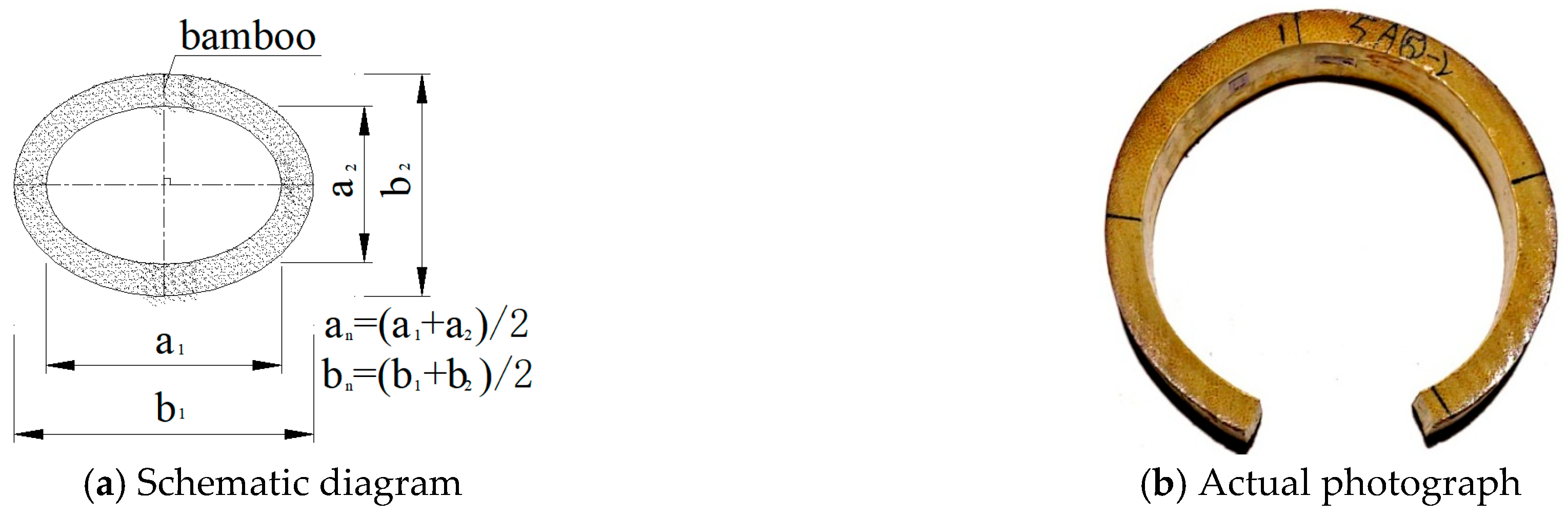
The bamboo wall was divided into three equal layers. Based on the study of Shu et al. [
21], tangential elastic modulus values were adopted, while other material parameters were obtained from Askarinejad et al. [
22]. The modulus of the middle layer was taken as the average of the inner (yellow) and outer (green) layers. The material parameters are listed in
Table 2.
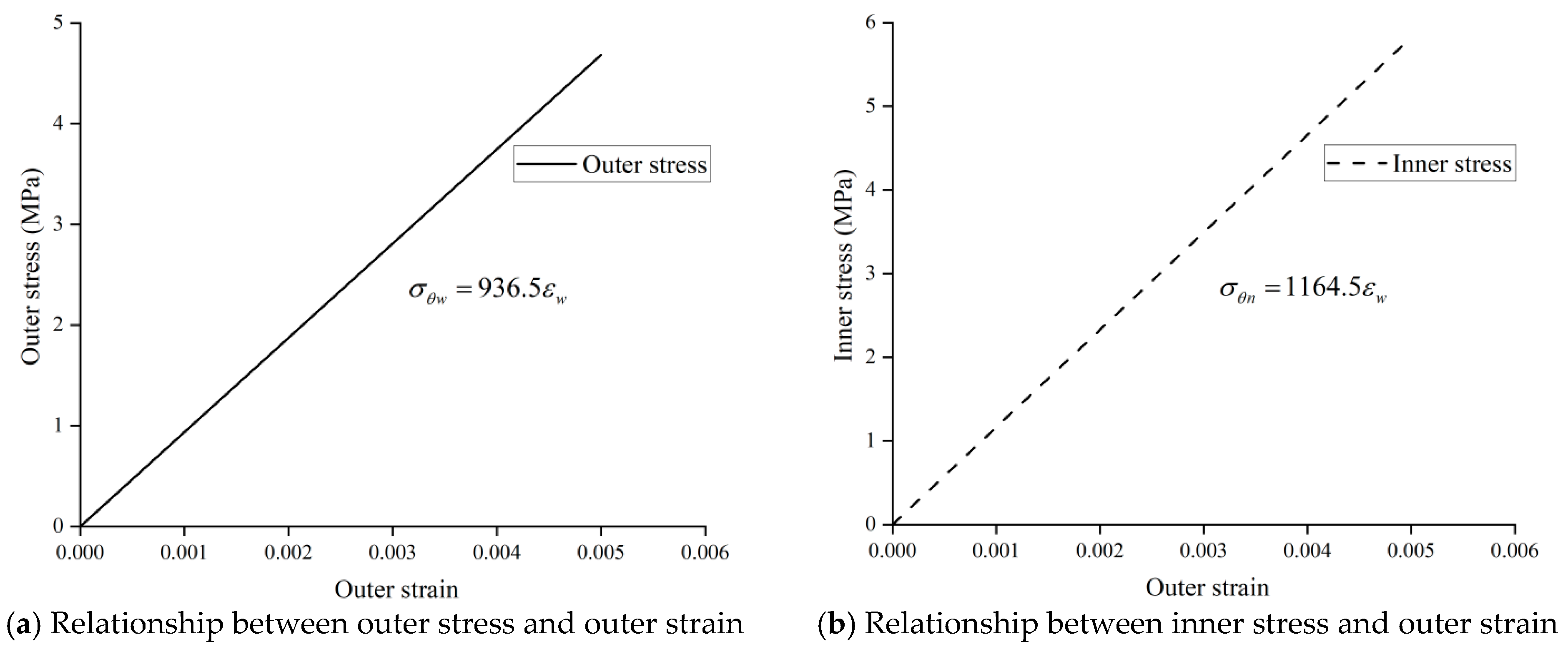
The ratio of tangential to radial elastic modulus of bamboo was taken as 1 ( = 1). The strains εw and εn were calculated according to Equations (2) and (3), respectively, and then substituted into Equations (4) and (5) in this study to calculate the theoretical tangential stress of bamboo.
The relevant parameters for the theoretical tangential stress under Condition 1 were calculated according to Equations (1)–(5) and are summarized in
Table 3.
The relevant parameters for the theoretical tangential stress calculation under Condition 2 are summarized in
Table 4.
The relevant parameters for the theoretical tangential stress calculation under Condition 3 are summarized in
Table 5.
The relevant parameters for the theoretical tangential stress calculation under Condition 4 are summarized in
Table 6.
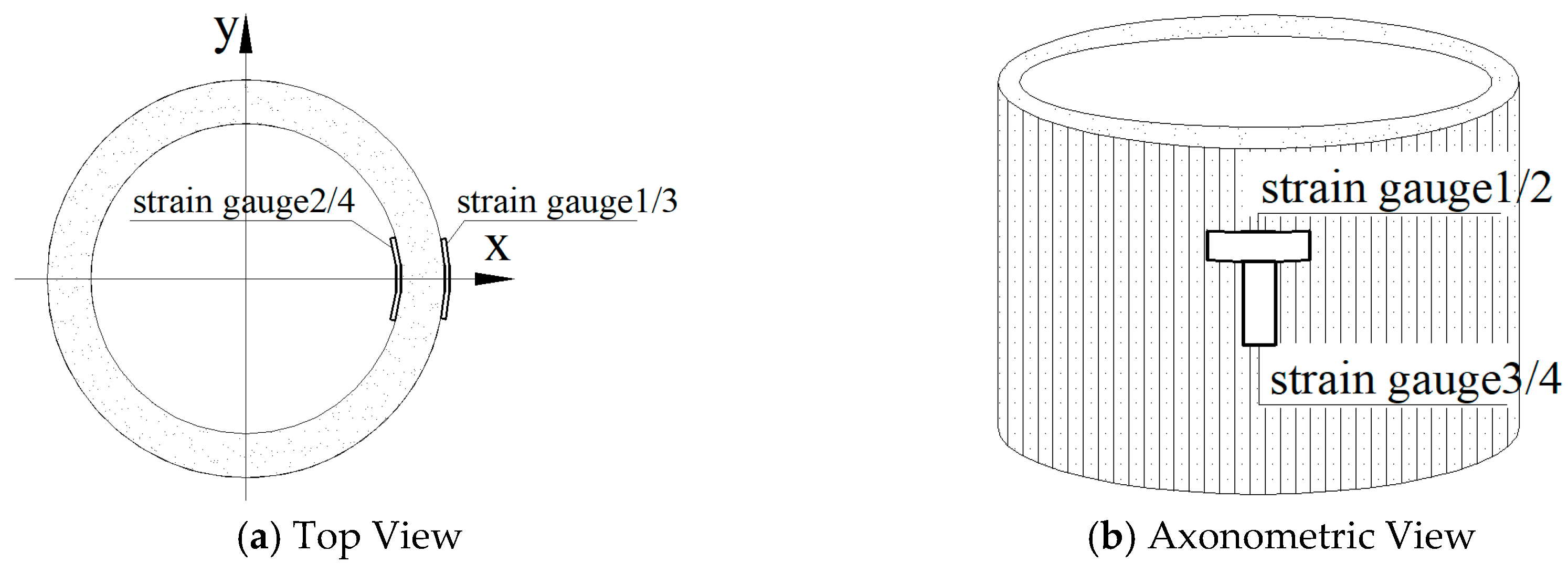
The measured tangential strain from strain gauges at the corresponding time points for each specimen under the four conditions (
Table 3,
Table 4,
Table 5 and
Table 6) was first averaged and then multiplied by the elastic modulus
to obtain the measured tangential stress.
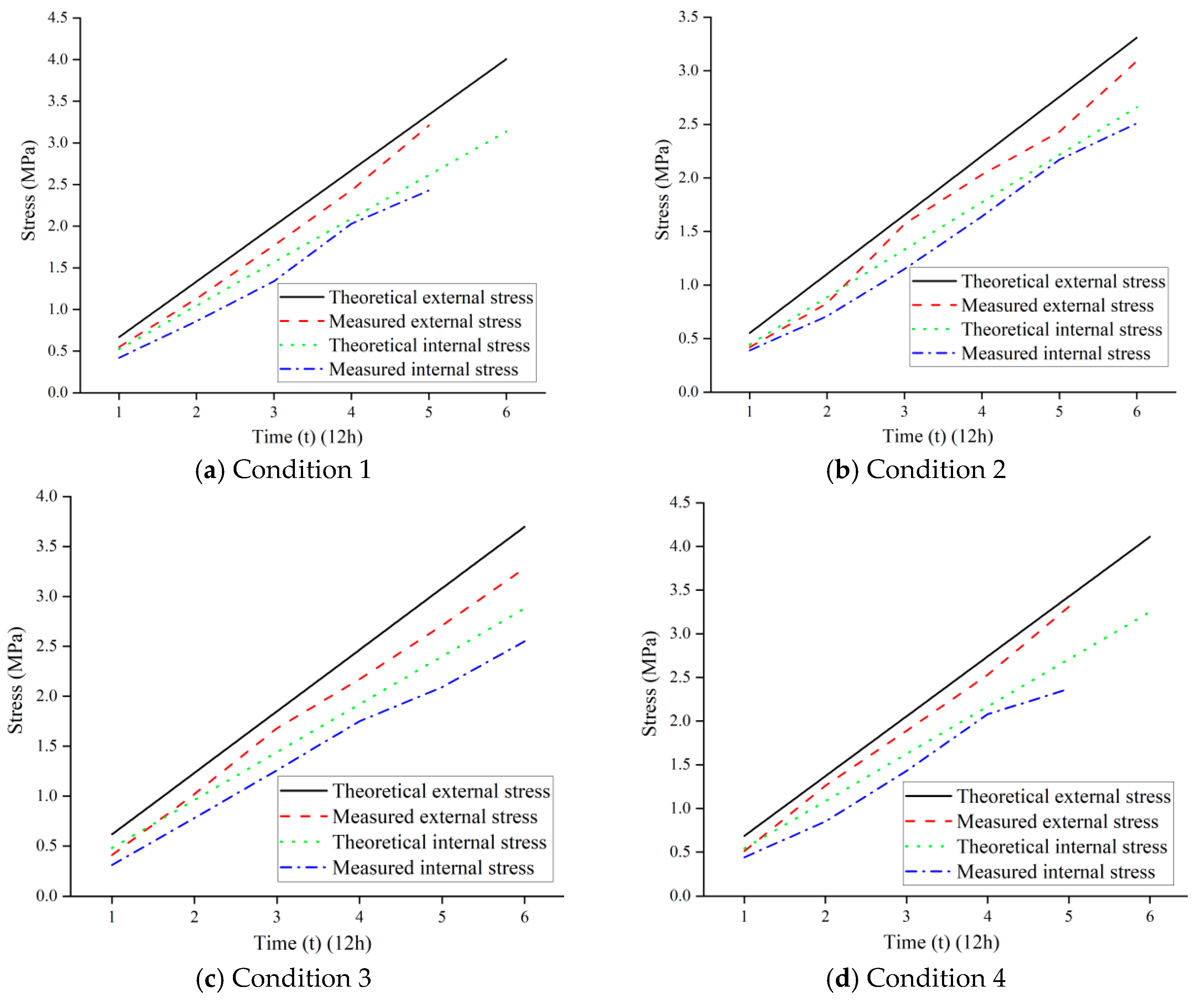
The tangential stress was plotted against time, with the tangential stress on the y-axis and time on the x-axis. The theoretical and measured values were compared in a graph plotted in
Figure 3.
As shown in
Figure 3, the temporal variation in the measured tangential stress was generally consistent with that predicted by the bamboo cracking evaluation model, indicating that the model provided a reasonable representation of the cracking behavior.
The measured values were slightly lower than the theoretical predictions, suggesting that the stresses calculated using the model were slightly overestimated. This provided a certain safety margin when applying the model in engineering assessments of bamboo cracking. It should be noted that the theoretical values in this study are higher than the experimental values, which is normal, as the theoretical model was based on idealized assumptions. In experiments, test specimens might be influenced by material imperfections, inherent variability, and instability in experimental conditions, and consequently tend to fall short of the ideal results.
Under Condition 1, when the time reached 5 × 12 h, the theoretical tangential stress on the outer surface exceeded the tangential tensile strength of green bamboo, indicating that cracking should occur; however, only four specimens exhibited cracks. When the time reached 6 × 12 h, 15 specimens had cracked. The model exhibited an accuracy of 75%, with cracking lagging approximately 12 h.
Under Condition 2, the theoretical stress did not reach the tangential tensile strength, and no specimens cracked during the test. The measured cracking behavior agrees well with the theoretical predictions.
Under Condition 3, when the time reached 6 × 12 h, the theoretical tangential stress on the outer surface slightly exceeded the tangential tensile strength of green bamboo, but only 2 specimens cracked, indicating that the model includes a safety margin. Under Condition 4, at the time of 5 × 12 h, the theoretical tangential stress exceeded the tangential tensile strength, but only six specimens cracked. When the time reached 6 × 12 h, 16 specimens exhibited cracking. The model accuracy reached 80%, with a cracking lag of approximately 12 h.
In summary, the evaluation model of bamboo cracking achieved an accuracy of 75–80%. It predicted that cracking typically manifested with a delay of approximately 12 h after the theoretical tangential stress exceeded the material’s tensile strength.
To further relate the theoretical model to practical drying conditions, we analyzed the tangential stresses predicted by the model in real-world scenarios. During actual bamboo drying, moisture gradients develop within the culm due to changes in ambient humidity and temperature, generating internal stresses. Our model calculations indicated that tangential stresses on the inner and outer surfaces reached relatively high levels during the early and middle stages of drying, particularly in thin-walled and low-density regions, which were prone to crack initiation and propagation. Comparison with experimentally observed crack locations showed a strong correlation between predicted high-stress regions and actual cracking sites. This demonstrated that the model can effectively reflect the risk of cracking under realistic drying conditions and provides a theoretical basis for optimizing bamboo drying processes and protective strategies.
3.3. Assessing Crack Behavior in Bamboo with Palm-Fiber Reinforcement
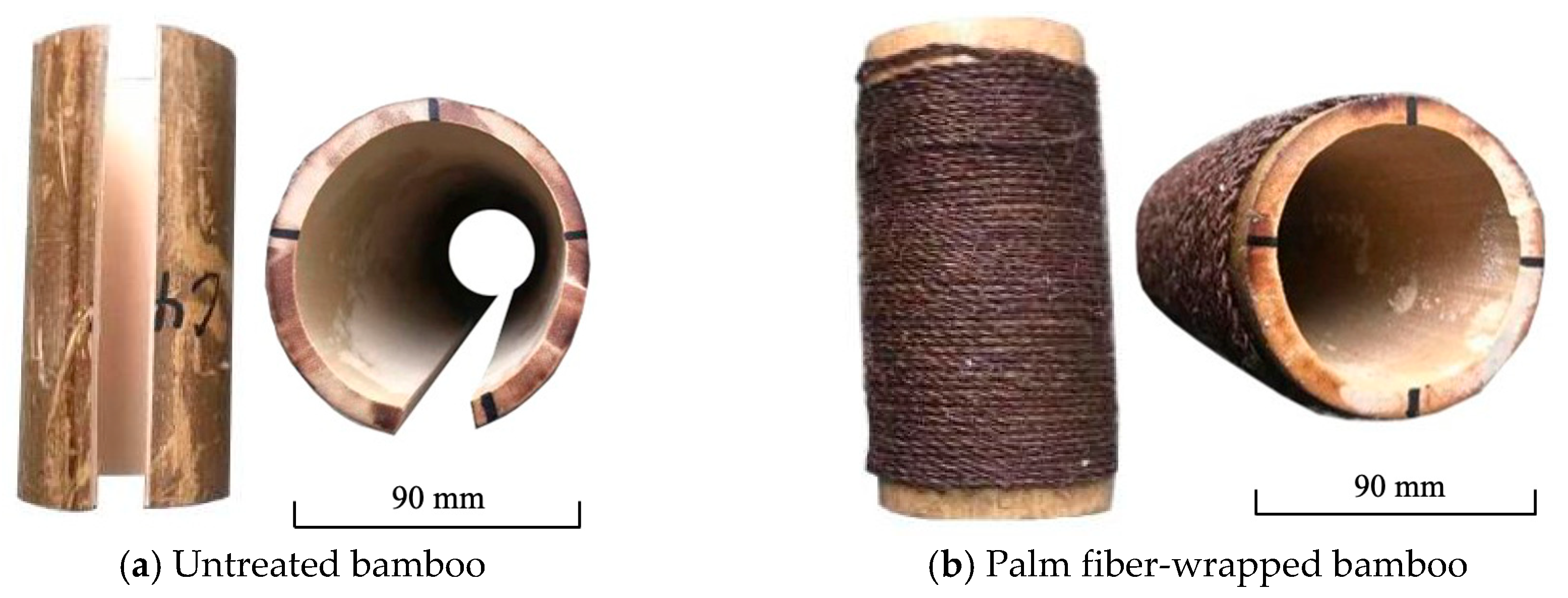
In the climate chamber test, the cracking time of bamboo was recorded, and the test was terminated when the moisture content of the untreated specimens decreased below 5%. The appearance of the bamboo specimens after the test is shown in
Figure 8.
The specific cracking times are summarized in
Table 7.
As shown in
Table 7, under identical conditions, the 5-year-old bamboo exhibited the highest cracking resistance. The cracking resistance of 3- and 7-year-old bamboo was comparable to that of the 5-year-old specimens, whereas the 1-year-old bamboo demonstrated the poorest performance.
When the surface wrapping method with palm fiber reinforcement was applied, the cracking resistance of bamboo was significantly improved. In particular, the cracking time of the 1-year-old bamboo was markedly prolonged. Moreover, the 3-, 5-, and 7-year-old bamboo specimens exhibited no cracking until the moisture content dropped below 5%.
It should be pointed out that bamboo comprises more than 1600 species, which exhibit significant differences in anatomical structure and mechanical properties. This study focuses solely on a specific species from a specific region used in our experiments (Phyllostachys edulis from Liyang, Changzhou, Jiangsu Province). Although the proposed method may be applicable to other species and regions, further calibration and validation are required to account for inter-species differences.





 ,
,