Review

Advances in Vibration Research on Concrete Mix: Bibliometric Analysis and Hotspot Discussion

1
School of Power and Mechanical Engineering, Wuhan University, Wuhan 430072, China
2
China Construction Second Engineering Bureau Co., Ltd., Beijing 100160, China
3
School of Transportation and Civil Engineering, Nantong University, Nantong 226019, China
*
Authors to whom correspondence should be addressed.
Buildings 2026, 16(18), 3741; https://doi.org/10.3390/buildings16183741 (registering DOI)
Submission received: 15 August 2026 / Revised: 9 September 2026 / Accepted: 18 September 2026 / Published: 20 September 2026
(This article belongs to the Special Issue Development and Research of Cement-Based Materials)

Abstract

Research on the vibration of concrete mix is ushering in a critical opportunity for theoretical breakthroughs and construction innovations. This review aims to provide a systematic, data-driven overview of the research landscape of concrete mix vibration, with particular emphasis on identifying how existing knowledge can support real-time vibration quality control and the development of intelligent vibration systems for construction sites. To achieve this, this review conducts a bibliometric analysis of the research on concrete mix vibration using VOSviewer analysis software. The analysis reveals that this research field is undergoing the surge stage since 2022. The major research countries include China, the United States, Japan, and South Korea. Among them, 47.9% of global publications and 66.7% of global major research organizations in this field originate from China. However, the cooperative relationships among organizations still need to be improved. The research hotspots in this field can be subdivided into the following: research on the vibration mechanism of concrete mix, research on the compactness of vibrated concrete mix, and research on intelligent vibration technology for concrete mix. This review further focuses on in-depth discussions of the above research hotspots, systematically combs through existing research achievements, and identifies the key issues that urgently need to be addressed. From a practical perspective, this review suggests that the precise perception of vibration parameters, visual recognition of surface rheological states, and energy-based methods collectively offer promising pathways for improving on-site dynamic quality evaluation; meanwhile, real-time monitoring and feedback control systems provide the foundation for intelligent vibration construction. However, the practical implementation of these technologies requires further validation under real construction conditions, particularly in complex scenarios. Finally, this review points out the significant research directions on which future breakthroughs in intelligent vibration technology and concrete vibration theory will depend. This review has important reference value for grasping the academic research trends and engineering application status in this field.

1. Introduction

Normal concrete mix is the most commonly used material in construction engineering. As it typically serves as the primary load-bearing structure, any damage to it not only poses great difficulties and high costs for repairs but also tends to exert adverse impacts on society and the environment [1]. To meet the requirements for high-quality concrete in terms of mechanical properties and durability, concrete mix typically exhibits high viscoplasticity [2]. However, this property brings about difficulties in placement and spreading, as well as challenges in achieving proper compaction during pouring. Given the loose composition of materials in concrete mix, appropriate intense vibration must be applied. This vibration forces the sufficient movement of aggregates and paste within the mixture, compels the expulsion of entrapped gas, and enhances the interlocking tightness between aggregates [3,4,5]. Therefore, the forming quality of concrete can be improved.
Based on the differences in vibration requirements of concrete mix, commonly used vibrators include the following: vibrating table, internal vibrator, plate vibrator, and form vibrator. Among these, the vibrating table, due to its simplicity and high efficiency in applying vibration, is often used in laboratory experimental research. The internal vibrator, with its good adaptability and operational convenience, is widely applied in the vibration construction of concrete mix [6,7].
Currently, control methods for concrete mix vibration primarily rely on qualitative indicators such as the following: concrete is considered compaction when there is no obvious subsidence on the surface, cement paste appears, and no more bubbles emerge [8]. However, these control methods impose loose constraints on vibration effects and lack strong controllability. As a result, the judgment of compactness during vibration relies heavily on personal experience, leading to random process control. This objective reality makes it become a common issue in practice that vibration quality defects will occur, but with no means of real-time identification and handling [9].
The core of the above issues lies in these aspects: unclear dynamic evolution laws of the concrete mix properties under vibration, immature mechanisms for time and space sensing of on-site vibration data, and feedback control of construction defects.
Specifically, first, the objectively quantifiable rheological theory of concrete mix and dynamic compactness evaluation methods are underdeveloped. Concrete mix exhibits shear-thinning properties. Under the action of excitation force, the contact angle and friction angle between internal particles of concrete mix decrease, and the initial contact state of internal components is disrupted. This leads to a reduction in the plastic viscosity and yield stress of concrete mix, which further causes the settlement of coarse aggregates, creates escape channels for entrapped gas, and prompts random movement of internal components. Meanwhile, the concrete mix compactness changes continuously during collisions [10,11,12,13]. Such vibration-induced compaction mechanisms are chaotic and complex. Therefore, it is difficult to accurately judge the compaction effect of concrete mix during vibration solely based on workers’ visual observations of the surface flow state.
Second, there is a lack of accurate and reliable methods for real-time monitoring and the control of vibration operations in actual construction. Existing techniques struggle to detect non-compliant vibration behaviors or process defects in real time. Thus, traditional operations have long faced challenges such as invisible compaction states and uncontrollable process flows, which easily lead to quality defects in hardened concrete, including voids, sand streaks, and cracks [14,15]. To determine whether concrete is properly compacted, it is necessary to wait until concrete hardens and then select representative locations for testing concrete performance [16]. However, these testing methods are usually single-point inspections and may even damage the original structure. Even if concrete quality defects are detected using these methods, the irreversibility of the concrete forming process means that only post-remedial measures can be taken to address the defects [17]. As a result, this not only delays the construction schedule, but also significantly increases construction costs. Such issues are commonplace in engineering practice.
In response to the above troubles, numerous scholars have already conducted a series of relevant studies. Against this backdrop, industry professionals have also successively published reviews by summarizing the research progress in concrete mix vibration. These papers aim to help relevant personnel quickly understand this research field and grasp the existing research achievements. Among them, information such as the research focuses of key reviews is presented in Table 1.
It is evident that existing reviews on concrete mix vibration research share strong similarities in their writing logic and focused content. These reviews essentially focus on direct discussions and prospects regarding the compactness, influencing factors, and emerging technologies of concrete mix vibration.
Unfortunately, no scholars have yet employed bibliometrics to conduct a systematic analysis of existing research papers on concrete mix vibration, so as to gain insights into the research history of this field, the characteristics of relevant research countries/institutions, and to refine research hotspots. Undoubtedly, carrying out this work will help to more comprehensively understand key information about the research progress in concrete mix vibration and more pertinently summarize the research achievements made and prospect the future development directions [22]. In addition, as shown in Table 1, new reviews on concrete mix vibration research have been published each year from 2021 to 2024. This is the reason that concrete mix vibration research has become a relatively popular research direction, where technologies and theories in this field are continuously updated. For this reason, conducting continuous review analyses is an important research task.
To this end, this review aims to achieve three main objectives. First, it seeks to identify the research landscape of concrete mix vibration through bibliometric analysis. Specifically, it aims to reveal the historical development stages, the geographic and institutional distribution of research activity, and the prevailing research hotspots based on keyword co-occurrence patterns. Second, it aims to compare and synthesize the existing literature within each identified hotspot. Particular attention is given to the vibration mechanism, compactness evaluation methods, and intelligent vibration technologies. Through this comparative synthesis, a coherent technical and theoretical framework can be established, and the relative strengths and limitations of different research approaches can be highlighted. Third, it intends to synthesize the key unresolved issues and challenges, and to project future research directions that are critical for advancing both the fundamental understanding and engineering application of concrete mix vibration. By fulfilling these objectives, this review is expected to provide readers with a systematic and practically oriented overview of the field, enabling them to efficiently grasp both the current state of knowledge and the open questions that warrant further investigation.

2. Literature Retrieval and Analysis

To accurately capture the dynamics and progress of research on concrete mix vibration, precisely retrieving relevant literature and conducting in-depth analysis through bibliometrics constitutes an effective and intuitive research approach. Therefore, this review uses the Web of Science Core Collection as the retrieval database and employs VOSviewer 1.6.20 software for visual analysis of the selected literatures [23]. The analysis aims to clarify the research development history of concrete mix vibration, conduct a comparative analysis of the distribution and collaborative relationships of relevant countries and institutions, and identify research hotspots.

2.1. Retrieval and Analysis Method

Web of Science Core Collection follows Bradford’s Law in bibliometrics and has become an important database for accessing global academic information [24]. It is selected as the sole data source for the bibliometric analysis in this review. This decision is justified by several considerations, as follows:
The Web of Science Core Collection is widely recognized as one of the most authoritative and rigorously curated databases in bibliometric studies. It provides consistent indexing standards, reliable data, and comprehensive coverage of high-quality international journals. The use of a single well-established database also ensures data fairness and comparability. Incorporating multiple data sources would potentially introduce inconsistencies in indexing practices and complicate the comparability of the analysis. Thus, while the use of a single database may limit the scope of retrieval, the Web of Science Core Collection provides a sufficiently robust and authoritative foundation for identifying the overall research landscape and major trends in this field.
Therefore, this review retrieves authoritative literature on concrete mix vibration through the Science Citation Index Expanded (SCI-E) within the Web of Science Core Collection, covering the period from 1996 to 2026. This provides a reliable data source for bibliometric analysis.
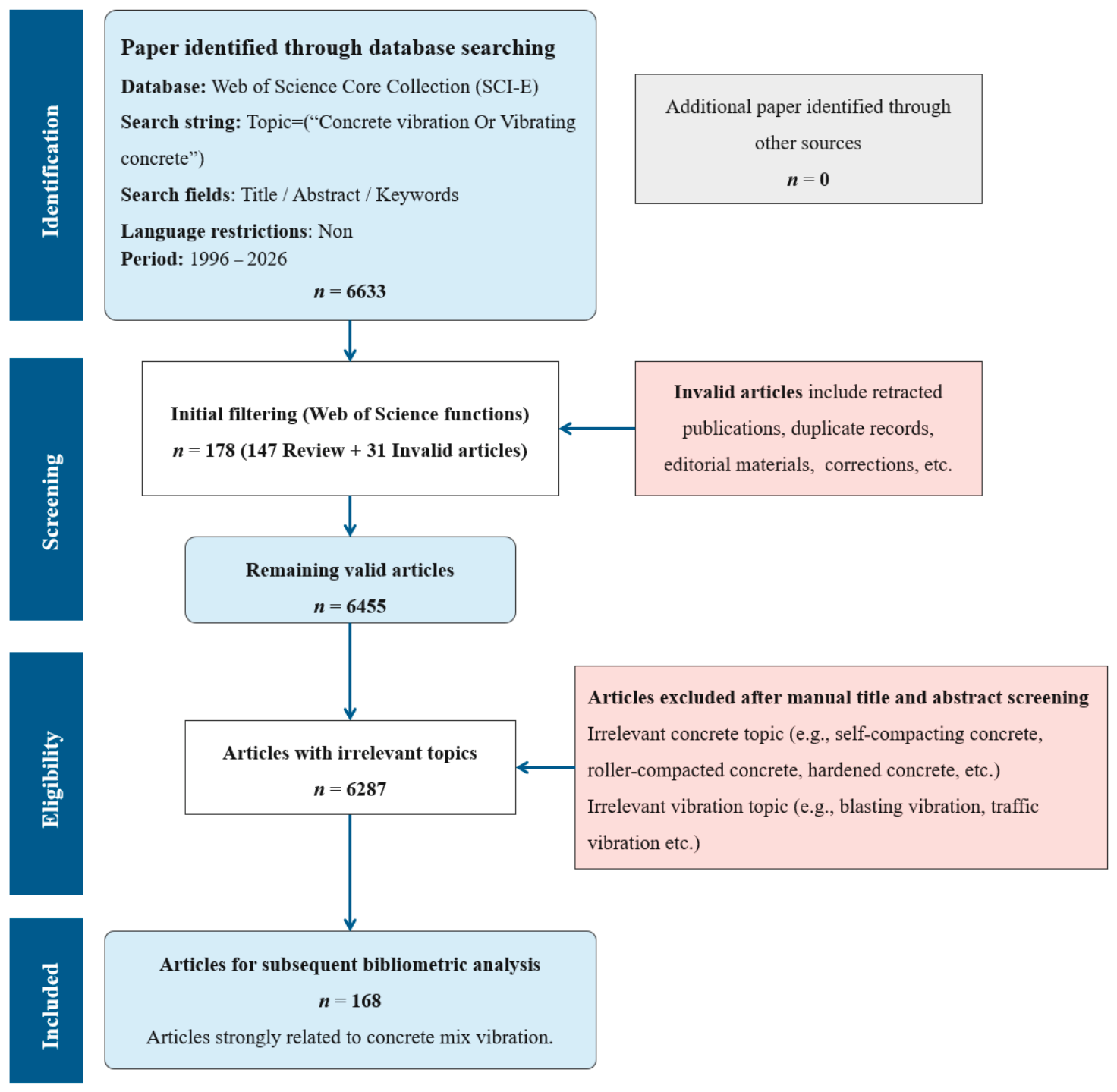
Specifically, considering that some scholars may use “Concrete” to implicitly refer to “Concrete mix” in their writing, and different scholars may use terms like “Vibration”, “Vibrating”, “Vibrate”, and “Vibrated” to denote vibration, as shown in Figure 1, the PRISMA-style screening process proceeded as follows:
Firstly, 6633 papers are retrieved using the search string—Topic = (“Concrete vibration Or Vibrating concrete”), because adding the topic “Vibrate concrete or Vibrated concrete” to the search string does not increase the number of retrieved papers. The search fields of the topic cover the title, abstract, and keywords. No language restrictions are applied during the retrieval process, as all publications indexed in SCI-E are assigned with English titles and abstracts, making them retrievable through the Topic field regardless of the original language of the full text.
Secondly, using the built-in literature filtering function of Web of Science, non-research article types are systematically excluded to ensure that only original research with complete content is retained. Specifically, 147 review articles and 31 invalid items—including retracted publications, duplicate records, editorial materials, and corrections—are removed at this stage. These types are excluded because they do not present original experimental or observational data, contain unreliable or superseded findings, or lack substantive research content for bibliometric analysis. This initial filtering step retains 6455 valid research articles with complete original content for further screening.
Thirdly, the remaining 6455 articles undergo manual screening through title and abstract review. This process is conducted by all seven authors based on predefined exclusion criteria. Articles are excluded if they fall into either of the following categories: (1) irrelevant concrete topics, including self-compacting concrete (which does not require external vibration due to its distinct rheological properties), roller-compacted concrete (which is consolidated by rolling rather than vibration), and hardened concrete (whose vibration-related studies belong to structural dynamics rather than forming technology); (2) irrelevant vibration topics, including blast-induced vibration and traffic-induced vibration, which concern external load responses of structures rather than the vibration consolidation process of concrete mix. Any disagreements among the reviewers are resolved through discussion and consensus to ensure consistency. Through this process, 6287 articles are excluded.
Ultimately, after full-text review, 168 articles that are strongly relevant to concrete mix vibration are retained. A systematic visualization bibliometric analysis is conducted on the 168 articles using VOSviewer software on basis of bibliometrics. This analysis covered three dimensions: publication time, contributing countries and institutions, and keywords.

2.2. Results of Bibliometric Analysis

2.2.1. Time Analysis of Published Articles

The analysis of the publication times of research articles on concrete mix vibration reveals the following:
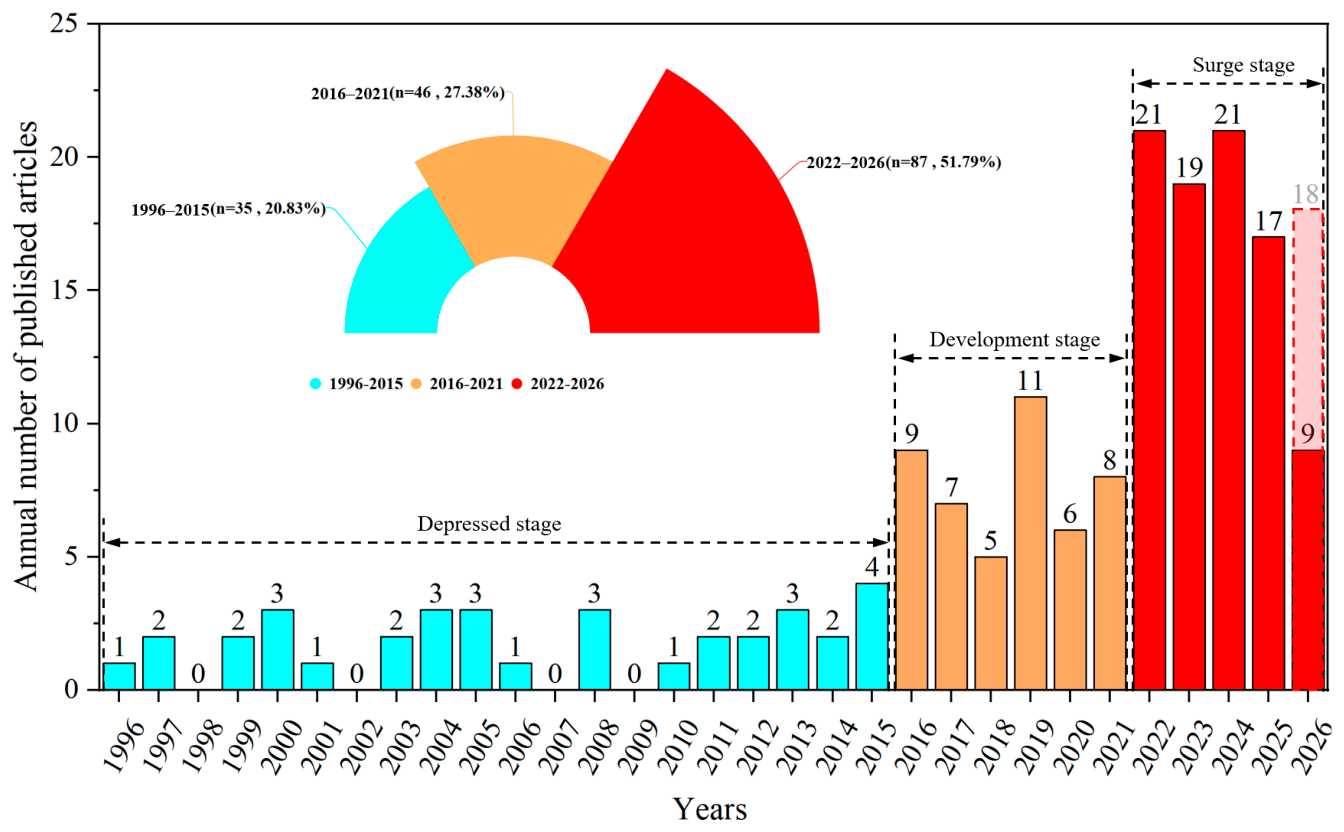
As shown in Figure 2, relevant articles were published intermittently between 1996 and 2015. This period is a lack of consistent research, and the annual number of published articles is fewer than five. Therefore, the period is the depressed stage of concrete mix vibration research. In contrast, the annual number of published articles increased between 2016 and 2021 and shows a trend of continuous research. This period represents the development stage of concrete mix vibration research.
Since the literature retrieval in this review was completed in June 2026, complete data on 2026 publications are not yet available. Nine articles have been published in the first half of 2026. It is predicted that at least eighteen articles related to the vibration of concrete mix will be published by the end of 2026 based on the publication trends of the preceding four years. Notably, there has been explosive growth in related articles since 2022. The number of published articles from 2022 to 2026 accounts for 51.8% of the total number of published articles over the 30 years from 1996 to 2026. This period is defined as a surge stage of concrete mix vibration research.
During this surge stage, several factors may have collectively contributed to the rapid growth of research output. First, the rapid advancements in artificial intelligence (AI) and the increasing maturity of numerical simulation technologies have provided new tools to address the long-standing technical and theoretical bottlenecks in concrete mix vibration research. For instance, deep learning-based methods for real-time compactness evaluation [25,26,27,28,29,30] and high-fidelity SPH-DEM, CFD-DEM, and other coupled frameworks for mesoscopic rheological simulation [31,32,33,34,35] have developed quickly during this period, suggesting a temporal correlation between technological maturity and research activity.
Second, the development of intelligent vibration machinery, which demands more precise control technologies, has stimulated interdisciplinary research at the intersection of civil engineering, robotics, and sensor technologies. Studies on real-time vibration process perception and feedback control systems [36,37,38,39,40,41,42] have become increasingly prominent since 2022, coinciding with the broader trend of smart construction.
Third, external policy pressures—including the European Union’s Carbon Border Tax [43], the United States’ Infrastructure Investment and Jobs Act [44], and China’s 14th Five-Year Plan [45]—have collectively heightened global demand for high-quality, durable, and resource-efficient concrete technologies. These policies have incentivized innovation in concrete materials and construction processes, indirectly encouraging research on vibration technologies that directly affect concrete quality.
It should be noted, however, that while these factors temporally align with the observed surge in publications, the bibliometric analysis itself does not establish direct causal relationships. These factors can only be considered as possible contributing factors to the observed rapid growth.
It is worth noting that only 168 articles closely related to concrete mix vibration are retrieved through precise searches in the Web of Science Core Collection, indicating that large-scale research has not yet been formed in this field. However, the analysis shows that the number of articles published in the past four years has surged, suggesting that this field has gradually become a popular research. Therefore, conducting an analysis of existing research on concrete mix vibration at this stage, focusing on the distribution and cooperative relationships of relevant countries and institutions and extracting key research hotspots, is of great significance for future industry cooperation and grasping research directions.

2.2.2. Country and Organization Analysis of Published Articles

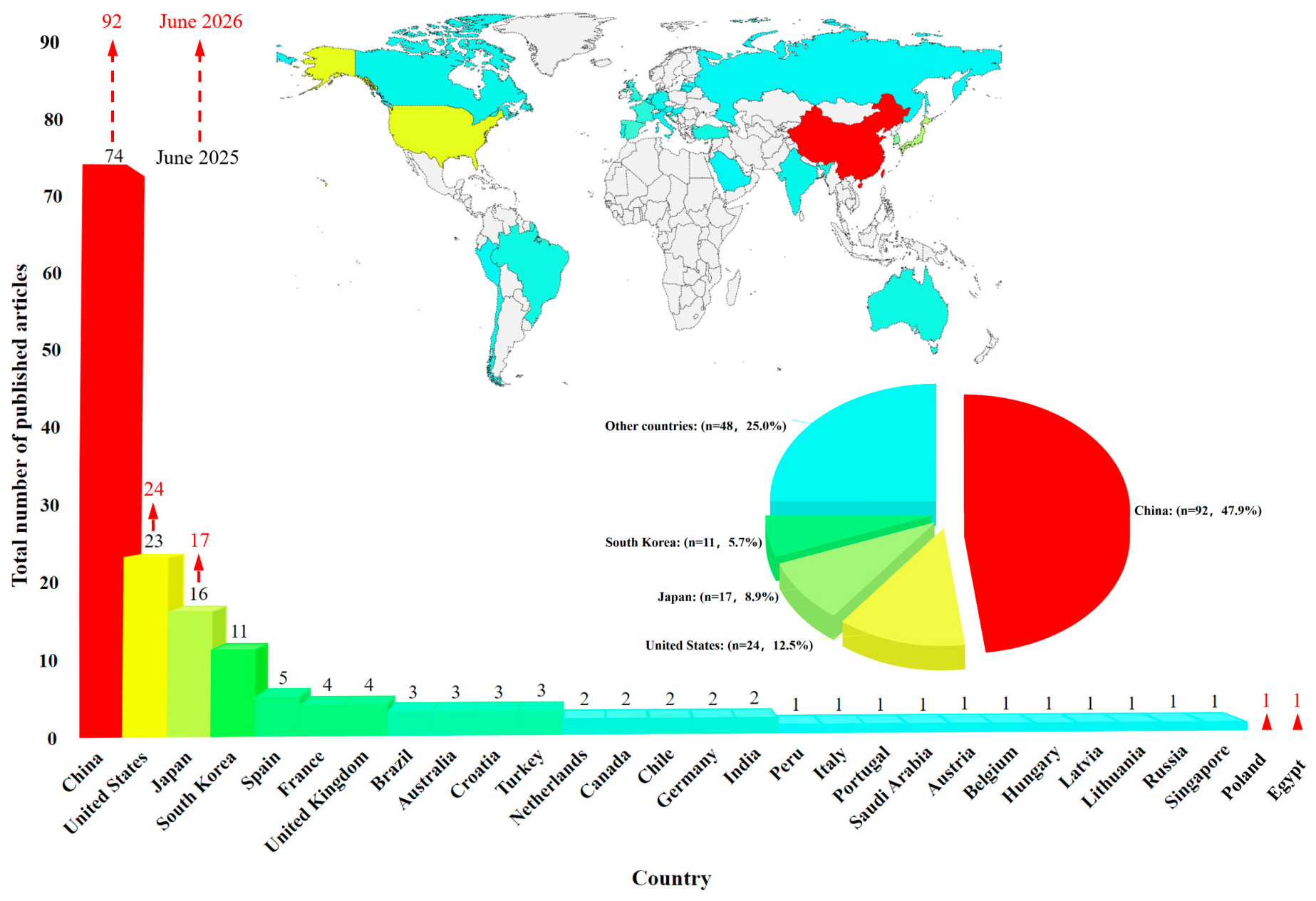
Statistics for the geographical distribution of the authors’ countries reveal the following: as shown in Figure 3, a total of 29 countries have participated in research on concrete mix vibration, showing a wide geographical distribution. However, most countries have not conducted sustained in-depth research. Only China, the United States, Japan, and South Korea can be regarded as major research countries. Among them, China accounts for 47.9% of global publications, and the majority of related research over the past year has been conducted in China.
The reasons that China is the most prominent research country are analyzed as follows:
China has achieved an internationally leading level in infrastructure development, relatively fully developing its vast domestic infrastructure market. Meanwhile, with the proposal of initiatives such as the “Belt and Road” [46], China has effectively expanded foreign infrastructure investment markets. As the world’s largest consumer of concrete [47] (accounting for over 50% of global consumption), China has an extremely high demand for concrete vibration research to improve construction efficiency and implement high-standard quality control. Additionally, the Chinese government has issued policies to strongly promote the practical application of smart construction, providing substantial financial support for numerous concrete-related research projects. At the same time, Chinese universities and research institutions have relatively strict assessment requirements for publications in international journals, which has also contributed to the surge in the number of relevant research articles to a certain extent.
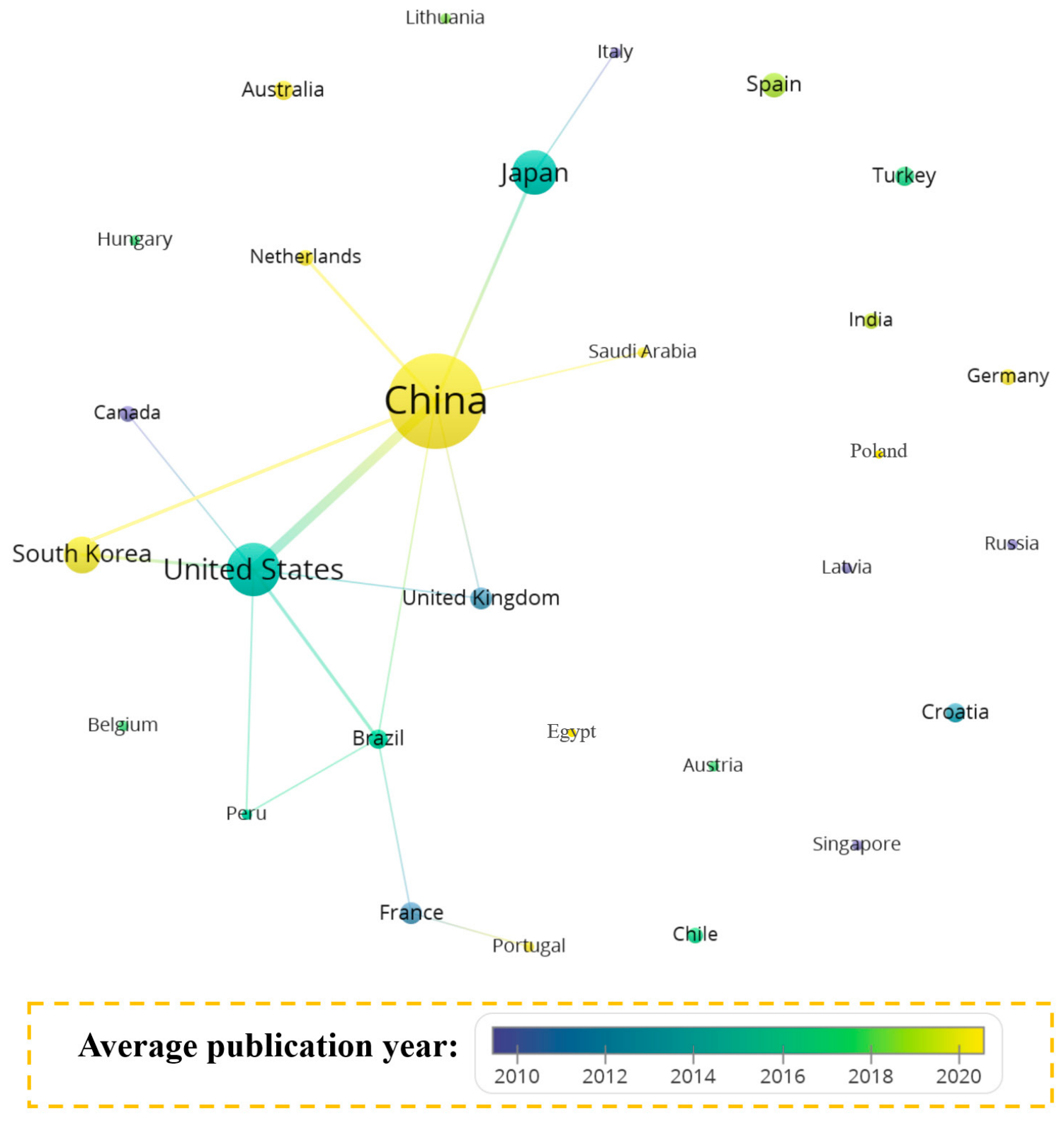
Further, using the number of publications, publication time, and collaborative relationships as the basis for visualization, the country co-occurrence network relationships are generated via VOSviewer, as shown in Figure 4. Among them, the size of the nodes represents the number of publications by each country, the color of the nodes indicates the average publication year of each country, and the thickness of the connecting lines between nodes reflects the closeness of cooperation between two countries.
It is evident that a cooperation network has been formed among these major research countries. This state of cooperation is conducive to integrating technologies, theories, and the unique advantages of these major research nations. Nevertheless, only 28.0% of secondary research countries have direct cooperative ties with the major research. Most secondary research countries remain in a state of research isolation. Therefore, the overall international cooperation in the field of concrete mix vibration research is relatively weak and needs to be further strengthened.
Additionally, an analysis from the perspective of the average publication year of papers reveals that the average publication year for China and South Korea is after 2020, which is later than that of the United States and Japan. This phenomenon indicates that China and South Korea have demonstrated stronger emerging research vitality, while the United States and Japan, because they started research earlier and possess a relatively profound research foundation, have the earlier average publication year.
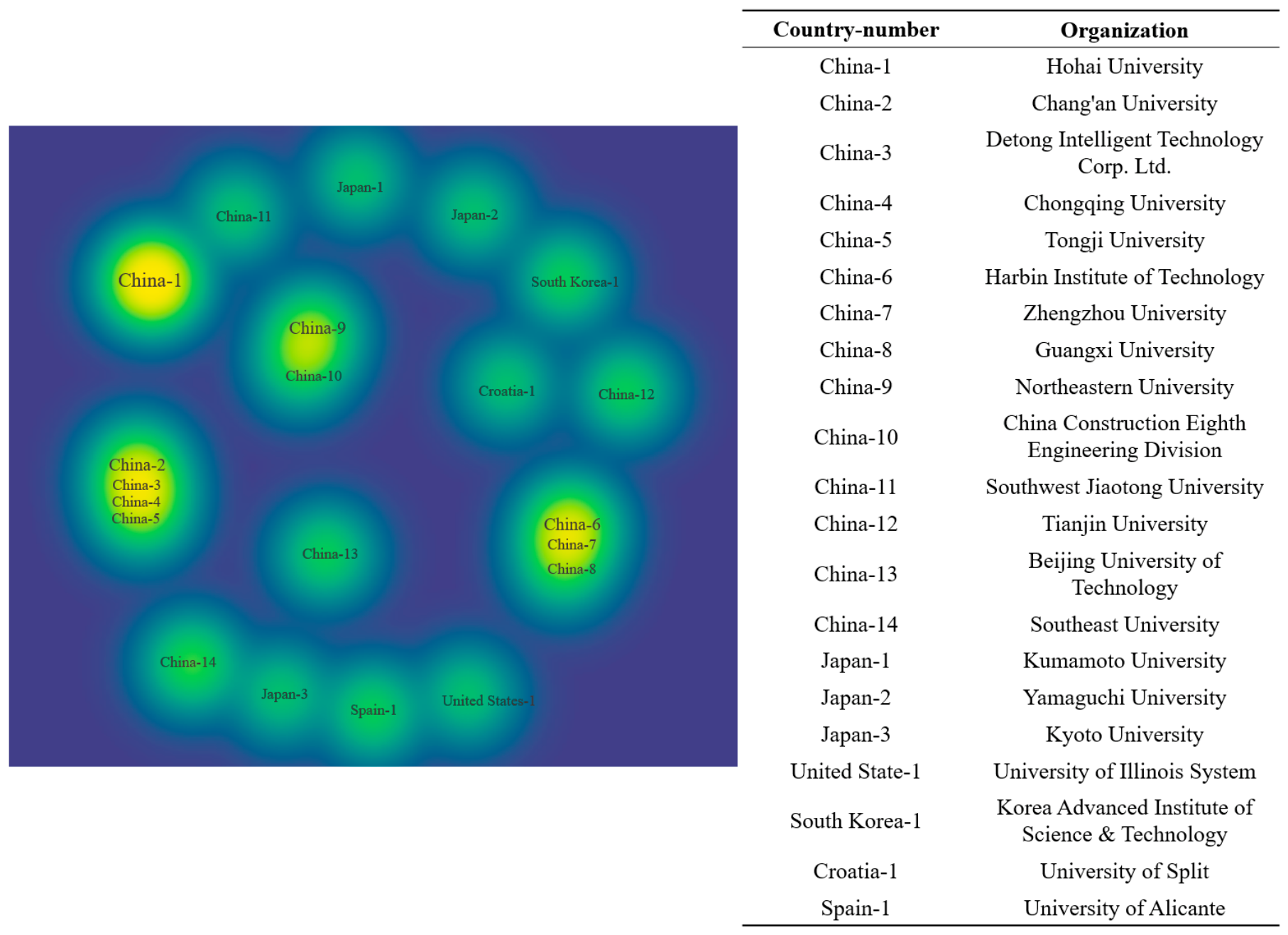
The subsequent analysis of organization cooperation using VOSviewer reveals that a total of 207 organizations worldwide have participated in research on concrete mix vibration. To filter out the impact of secondary research organizations on the analysis results, a threshold of a minimum of 3 published articles is set for organizations, thereby selecting 21 major research organizations. Further, the organization co-occurrence network relationships are generated on the basis of publication quantity and collaborative relationships as visualization factors, as shown in Figure 5. Among them, the brightness of nodes represents the number of published articles by organization, and the overlapping of two nodes indicates collaborative relationships between the organizations.
The statistical results of major research organizations reveal that the number of Chinese organizations accounts for 66.7% of all organizations, still ranking first. The difference is that the number of Japanese organizations has surpassed that of the United States, ranking second. This statistic indicates that although the United States and South Korea are major research countries in the field of concrete mix vibration, they lack organizations conducting sustained and in-depth research. In contrast, more organizations in China and Japan have been continuously involved in this research, which is more conducive to leveraging the advantages of each organization and facilitating the rapid and comprehensive development of country in the research on concrete mix vibration.
It is worth noting that compared with the statistics on inter-country collaborative relationships, the cooperative relationships of these major research organizations are in a state of more severe deficiency. In other words, the existing inter-country cooperation mainly originates from secondary research organizations. Meanwhile, as the most prominent research country, Chinese organizations also present insufficient collaboration, especially among the most major research organizations. This phenomenon may be influenced by factors such as differences in research objectives and policy orientations between countries/organizations or intellectual property protectionism. Nevertheless, it is undeniable that such a state of collaborative relationships not only tends to result in repeated resource input and low research efficiency but also restricts overall technological breakthroughs and optimization of engineering applications in this field.

2.2.3. Keywords Analysis of Published Articles

Conducting a keyword co-occurrence analysis of the literature helps clarify the current research hotspots in concrete mix vibration. For this purpose, the keyword co-occurrence analysis is performed using VOSviewer. The following settings and procedures are applied to ensure transparency and reproducibility:
(1) Clustering settings: The VOSviewer default clustering algorithm based on the modularity-based clustering method (resolution parameter set to 1.00) is adopted to group keywords into clusters. This algorithm optimizes the clustering by maximizing the number of within-cluster links while minimizing between-cluster links.
(2) Normalization method: The association strength normalization is used to calculate the similarity between keywords. This method normalizes co-occurrence frequencies by dividing the observed co-occurrence by the product of the frequencies of the two keywords, which effectively reduces the bias caused by high-frequency general terms.
(3) Occurrence threshold: The minimum occurrence frequency of a keyword is set to 3 to filter out low-frequency and potentially insignificant keywords.
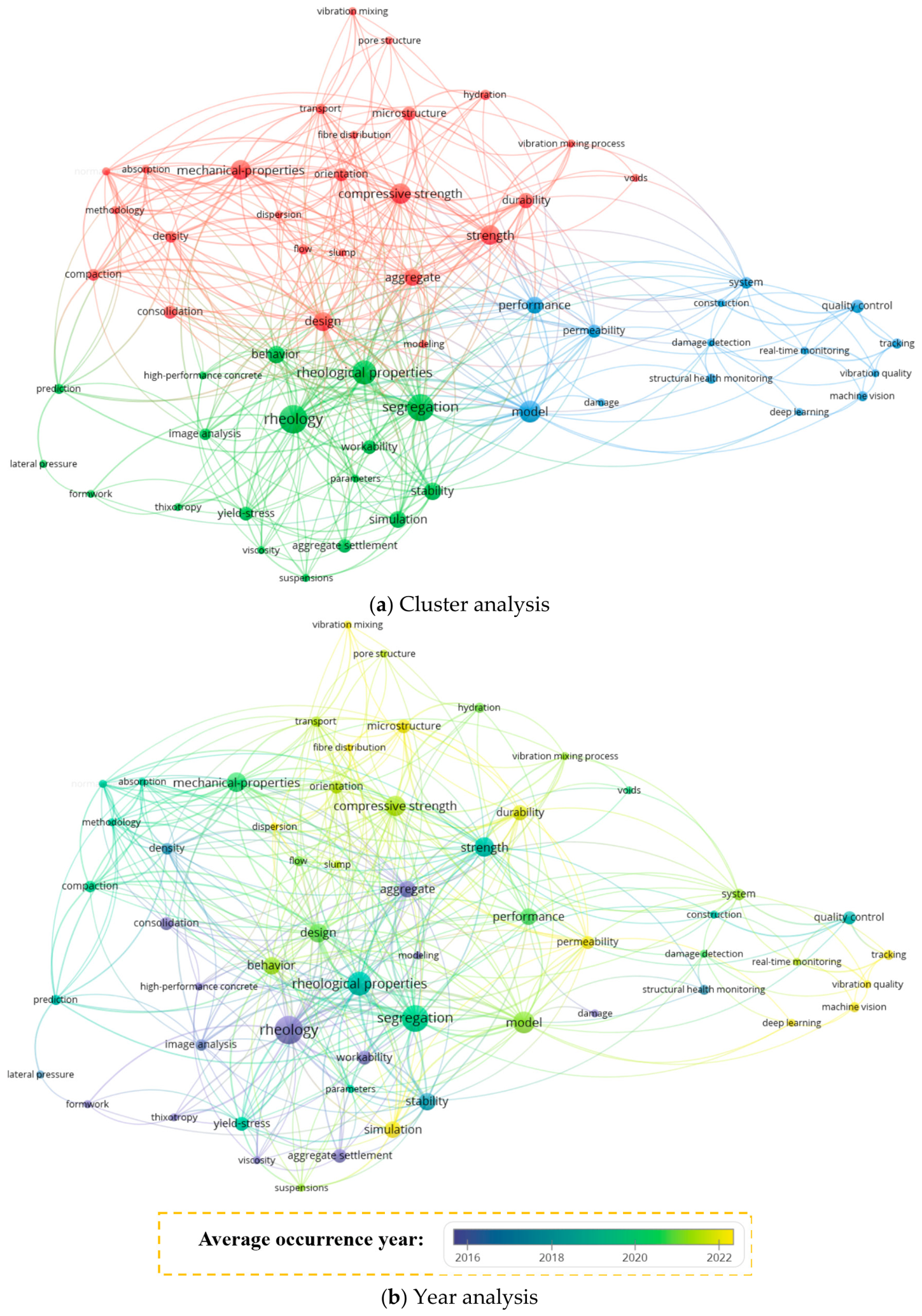
(4) Keyword-merging procedure: Synonyms and plural/singular variants are manually merged. For example, “rheological property” and ‘rheological properties’ are consolidated into “rheological properties”; “mechanical properties” and “mechanical-properties” are consolidated into “mechanical-properties”; “model” and “modeling” are treated as separate terms based on their distinct semantic contexts. Additionally, high-frequency keywords with no practical reference value for clustering—such as “concrete” and “vibration”—are manually removed, as they are too generic to provide meaningful distinctions between research themes. Keywords that are independent of the largest association set of keywords are also eliminated based on the software’s correlation analysis to ensure that only well-connected keywords are retained for clustering. After these procedures, 57 main keywords are retained for visual co-occurrence analysis, as shown in Figure 6. Herein, the size of the nodes represents the occurrence frequency of the keywords, and the thickness of the connecting lines between nodes represents the co-occurrence frequency of the keywords. The color of the nodes indicates the keyword clusters in Figure 6a, while the color of the nodes represents the average occurrence year of the keywords in Figure 6b.
Figure 6 indicates that the keywords can be categorized into three clusters. Among them, the first cluster (green) contains 18 keywords, with high-frequency keywords including rheology, rheological properties, behavior, yield stress, segregation, aggregate settlement, simulation, etc. It is evident that relevant literature in this cluster focuses primarily on the vibration mechanism of concrete mix, covering research contents such as the rheology of concrete mix, the kinematics of coarse aggregates, and simulation science. In addition, the comparison of the occurrence years of keywords reveals that research on the vibration mechanism of concrete mix starts earlier than the other two clusters. However, due to the complexity of this mechanism, scholars are still continuing to introduce emerging theories and analytical methods to perfect the mechanism [48,49,50].
The second cluster (red) includes 25 keywords, with high-frequency keywords such as compressive strength, strength, mechanical-properties, durability, and microstructure. Furthermore, the keywords in the second cluster co-occur frequently with “segregation” in the first category, and all of these high-frequency keywords are closely related to the compactness of concrete. Therefore, it can be concluded that the relevant literature in this cluster primarily focuses on the compactness of vibrated concrete mix [3,51,52,53]. This inference is further supported by the presence of keywords like compaction, consolidation, and voids in the second cluster. In addition, the comparison of the occurrence years of keywords reveals that the overall publication years of the second cluster lags behind that of the first cluster. This is because research on the compactness of vibrated concrete mix is an engineering application-oriented exploration based on the vibration mechanistic interpretation.
The third cluster (blue) contains 14 keywords. It seems difficult to summarize the research hotspot of this cluster merely through its high-frequency keywords: performance, permeability, and model. However, it is not hard to find from the other keywords on the right of the cluster—such as system, structural health monitoring, real-time monitoring, tracking, machine vision, and deep learning—that these non-high-frequency keywords are all closely related to interdisciplinary integration or intelligent technologies [38,54,55,56]. Meanwhile, these non-high-frequency keywords connect with the research of the first and second clusters through high-frequency keywords as the link. Therefore, it can be inferred that the relevant literature in the third cluster mainly focuses on the further engineering application exploration around the intelligent vibration technology of concrete mix. This inference is also supported by engineering-oriented keywords in the third category, such as construction, quality control, and damage detection. In addition, the comparison of the occurrence years of keywords reveals that the overall publication year of the third cluster is closer to the current year. This is because the research and development of intelligent technologies have only emerged in the concrete industry in recent years. This is also the reason why these keywords related to intelligent technologies have not yet become high-frequency keywords in the third category.
Based on the aforementioned statistical analysis of keywords, the current research hotspots in concrete mix vibration can be summarized as follows: (1) research on vibration mechanism of concrete mix; (2) research on compactness of vibrated concrete mix; (3) research on intelligent vibration technology for concrete mix.
It is noteworthy that the influencing factors of concrete mix vibration are typically treated as an independent research hotspot for dedicated analysis in existing reviews on concrete mix vibration [18,19,20,21]. Despite the multitude of factors affecting concrete mix vibration, the ultimate goal of such research lies in exploring the vibration mechanism and controlling concrete compactness. Thus, these influence factors, and in particular the two core factors—concrete mix properties and vibration parameters—can be naturally integrated into the first and second research hotspots proposed in this review for elaboration.
Additionally, the mechanistic research serves as the theoretical foundation for all related explorations, compactness research directly addresses critical needs in engineering practice, and intelligent vibration research points toward advanced development directions. These three dimensions evidently form a more comprehensive coverage of concrete mix vibration research, spanning fundamental principles, engineering applications, and cutting-edge technologies.
Therefore, the following sections will proceed to provide a detailed review of the existing research works centered around above three hotspots, aiming to fully grasp the current research status, key challenges, and future development trends in this field.

3. Research Hotspots in Concrete Mix Vibration

The world-recognized core database—SCI-E—is utilized to retrieve relevant authoritative literature in the aforementioned bibliometric analysis. This ensures the reliability of the literature analysis on concrete mix vibration research, eliminates interference from peripheral literature, and facilitates precise identification of the research hotspots. On this basis, considering that China stands as the prominent non-English-speaking country in this research field, the core studies within its domestic databases also constitute a critical analytical target. Consequently, centering on the identified three research hotspots, this review further retrieves representative studies from China’s core database—China National Knowledge Infrastructure (CNKI). Subsequently, these studies are integrated with the literature retrieved from SCI-E to conduct the comprehensive analysis and discussion of the research hotspots in concrete mix vibration.

3.1. Research on Vibration Mechanism of Concrete Mix

3.1.1. Constitutive Model of Vibrated Concrete Mix

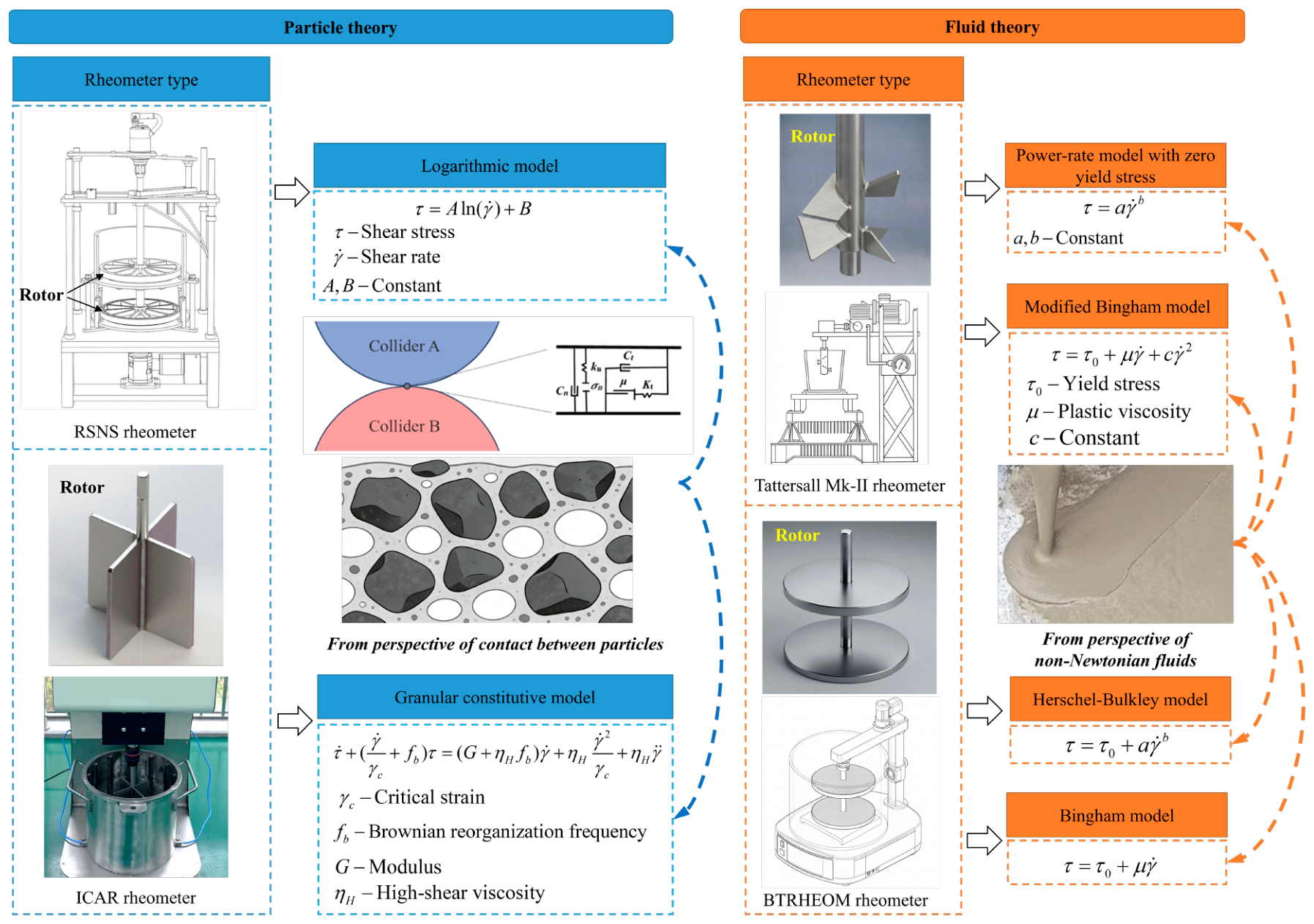
Concrete mix is a kind of particle fluid with viscosity and large deformation capacity. The plastic viscosity of the fluid, together with the contact angle and friction angle of internal particles, jointly forms the shear deformation resistance of concrete mix [51,57], which exhibits obvious rheological properties. Without external vibration force, the concrete mix basically presents as a stable state. Once a sufficient vibration force is applied, its shear deformation resistance will decrease, transforming into a complex flow state.
The rheology of concrete mix involves the analysis of the evolution of yield stress, plastic viscosity, and elastoplasticity under shear stress, which serves as a more effective method to characterize the changeable workability of concrete mix [58,59,60]. Existing studies have also proposed that the influence radius of the internal vibrator increases as the yield stress of concrete mix decreases and the plastic viscosity increases [61]. Moreover, the liquefaction and compactness of the concrete mix are also closely related to rheological parameters [62,63,64]. Therefore, from the perspective of rheology, establishing dynamic constitutive models of concrete mix constitutes a crucial theoretical basis to study the complex vibration mechanism.
However, the components of concrete mix exhibit multiphase coupling characteristics. Some scholars, adhering to the particle theory, consider the concrete mix as a dense particle suspension [65]. While others, following the fluid theory, regard it as a non-Newtonian fluid [58,66]. Currently, due to the complexity of the behavioral characteristics of concrete mix, there remains controversy in the academic community regarding material attributes of the mixture. The prevailing view is that static concrete mix is generally regarded as a Bingham fluid [67,68]. However, as illustrated in Figure 7, there exist multiple differentiated characterization methods for the constitutive models of concrete mix under vibration.
It is found that vibrated concrete mix presents challenges in constitutive modeling due to its complex physical response mechanisms. Moreover, establishment of the constitutive model should consider the influence of multiple factors such as external vibration conditions. Differences also exist in the rheometers used by different scholars during their research [69,70,71,72,73,74,75]. These obstacles make it still difficult to establish a unified characterization method for the constitutive model of concrete mix under vibration.

3.1.2. Simulation Model of Vibrated Concrete Mix

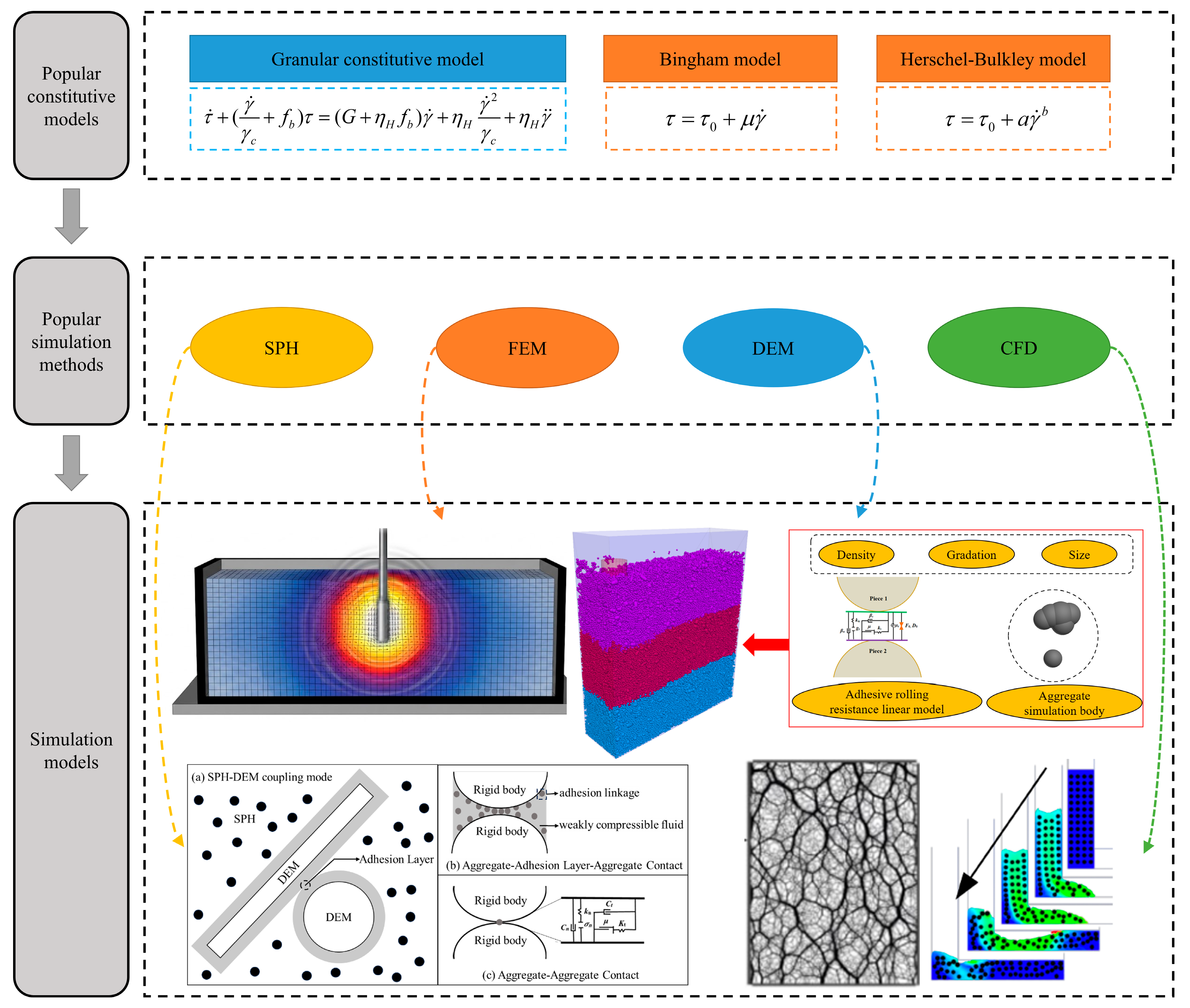
Concrete mix is a complex material, containing not only particles ranging from micrometers to millimeters in size but also organic and inorganic materials [58]. The controversies still remain regarding its vibration constitutive model. These factors have introduced additional difficulties and uncertainties for investing the mechanisms of vibration responses using simulation methods [76,77]. Nevertheless, as shown in Figure 8, building on existing research on constitutive models, some scholars have tentatively carried out meaningful simulation studies, striving to improve the theoretical system of concrete mix under dynamic conditions.
It is found that granular constitutive models, Bingham and Herschel-Bulkley (H-B) fluid models are mostly used as the constitutive models for vibrated concrete mix in current simulation studies. The common simulation methods involve the independent application or coupling of Smoothed Particle Hydrodynamics (SPH), Finite Element Method (FEM), Discrete Element Method (DEM), and Computational Fluid Dynamics (CFD). Through these approaches, various simulation models have been established to investigate the rheological properties and vibration responses of an internal medium in vibrated concrete mix.

3.1.3. Internal Medium Movement of Vibrated Concrete Mix

The vibration process of concrete mix essentially involves the internal medium absorbing energy to randomly move and collide [79,80,81]. The distribution of coarse aggregates, mortar, and gas are altered during this process, and thereby, the final compaction of concrete mix is affected.
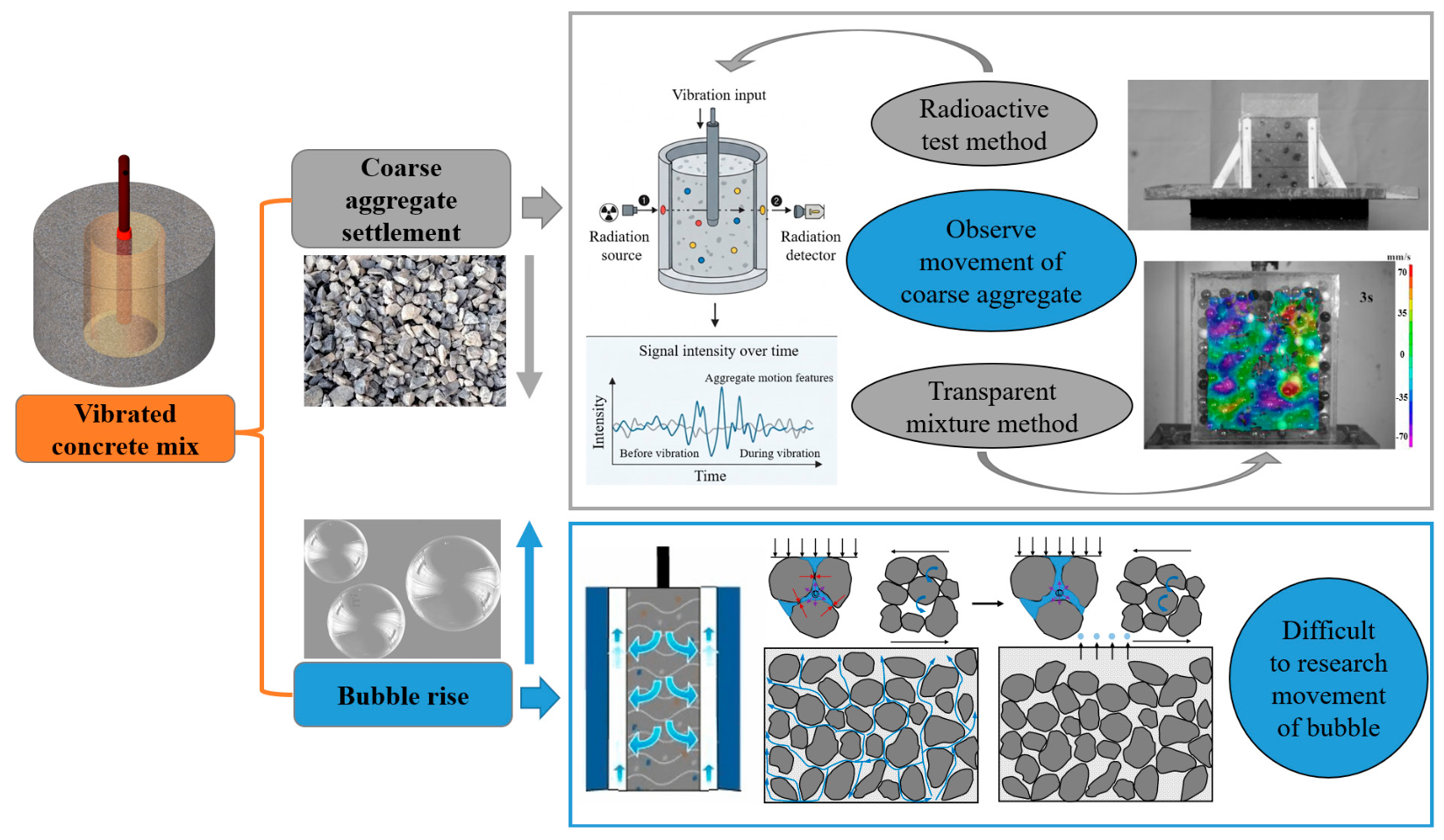
Coarse aggregates account for approximately half of the total weight of concrete, forming a key part of the network skeleton structure of concrete. The coarse aggregate settlement process also affects the segregation state of concrete. Additionally, the content and pore size of bubbles are even more critical factors directly related to the compactness of concrete. Since mortar, by contrast, fills the entire mixture in a fluid state throughout, its movement patterns are not the focus of research. Therefore, exploring the mechanisms of coarse aggregate settlement and bubble rise is of great significance for clarifying the vibration mechanism of concrete mix.
The coarse aggregate settlement and bubble rise are related to numerous factors such as the rheological parameters and wet bulk density [82,83,84]. The opacity of concrete mix makes it more hard to observe the real-time movement state of internal medium. To overcome these difficulties, apart from the aforementioned simulation-based methods, some scholars have also conducted relevant mechanistic investigations using various physical experiment methods, as shown in Figure 9.
In research on the mechanism of coarse aggregate settlement, the radioactive experiment method has become a reliable research tool due to its good penetrating performance [85,86,87]. In addition, to study the movement of substances inside opaque material, preparing transparent or translucent materials with similar properties has emerged as a more economical and effective experimental method [88].
Currently, many related studies use a single liquid mixed with glass beads to prepare translucent mixtures [89,90,91]. Nevertheless, such mixtures differ significantly from concrete mix in terms of the material composition. To address this issue, Li et al. [51] developed a translucent dense particle suspension by mixing white oil, silica fume, fused silica sand, and fused silica stone. This mixture exhibits material composition and vibrational properties more similar to those of concrete mix. Further, the settlement mechanism is revealed by observing the coarse aggregate settlement process in a translucent dense particle suspension. Their research achieves the quantitative characterization of the settlement process of coarse aggregates in concrete mix through a coupling relationship between static and dynamic forces.
However, it is difficult to find suitable observable materials to replace bubbles for tracking their dynamic rising process. Moreover, unlike coarse aggregates with fixed physical properties, bubbles exhibit complex and unstable physical properties due to coalescence and rupture during ascent. Therefore, current research on bubble rise mechanisms remains limited to general studies on the overall pore distribution and its impact on concrete performance [92,93,94,95], while the specific movement mechanisms still await further investigation.

3.2. Research on Compactness of Vibrated Concrete Mix

Currently, workers mainly rely on personal experience to qualitatively judge the compactness of vibrated concrete mix. The compactness can also be quantitatively inferred through mechanical and durability tests of hardened concrete or cutting the concrete to obtain the distribution status of coarse aggregates and pores [96,97]. However, these methods lack real-time capability and comprehensiveness. Sometimes, it is necessary to drill core samples, which destroys the integrity of the structure. This traditional compactness evaluation method has seriously restricted the refined development of concrete vibration technology.
For this reason, how to efficiently evaluate the compactness of vibrated concrete mix has gradually become a popular research direction. Many scholars have conducted a series of studies mainly from the aspects of non-destructive testing, machine learning, and energy theory.

3.2.1. Non-Destructive Testing Method

With the development of detection technology, numerous non-destructive testing methods have emerged to address issues like structural damage and cumbersome operations in traditional compactness evaluation methods.
Given that compacted concrete expels a large amount of internal air, it has good impermeability. Previous studies have used an Autoclam permeameter attached to the concrete surface to measure air and water permeability, thereby assessing the compaction effect of vibration [98].
There is a close correlation between concrete compactness and the distribution of coarse aggregates. Non-destructive testing techniques can analyze the distribution of coarse aggregates in concrete, providing an important basis for compactness evaluations. Considering that coarse aggregates, mortar, and air have different electrical conductivities, measuring the resistivity of concrete helps distinguish the material composition of corresponding areas [99]. Based on the differences in the propagation and reflection modes of waves in concrete with different compactness, many scholars have also used electromagnetic waves, elastic waves, ultrasonic waves, etc., to evaluate and predict the forming quality of concrete [100,101].
In addition, by using a penetrative X-ray/CT scanner to scan concrete [102], three-dimensional images are generated based on the differences in attenuation coefficients. Through this, the porosity of concrete and the distribution of coarse aggregates can be known, thus enabling a non-destructive evaluation of concrete compactness. Moreover, the nuclear magnetic resonance (NMR) instrument can also be used to calculate the porosity of concrete. It is based on the principle of analyzing the distribution of pore water through the relaxation time of hydrogen atoms. This method has become a common non-destructive testing method for concrete porosity in the laboratory, providing an important basis for evaluating concrete compactness [52].
In light of the above analysis, as shown in Table 2, some of the devices and testing principles of the currently common non-destructive testing methods for concrete compactness are presented.
However, the devices of many non-destructive testing methods have obvious limitations in their application scope. They have remained at the laboratory research stage for a long time. Even though some technologies can be used for on-site detection, non-destructive testing methods still cannot overcome the limitation of single-point detection and thus cannot fully demonstrate the overall vibration compactness of the concrete structure. Moreover, considering that most non-destructive testing methods are for evaluating hardened concrete, it is impossible to carry out timely defect treatments during vibration. To effectively improve the vibration construction quality of concrete mix, how to establish a real-time evaluation method for vibration compactness is an urgent problem to be solved. Machine learning and energy theory provide important solutions to this problem.

3.2.2. Machine Learning Method

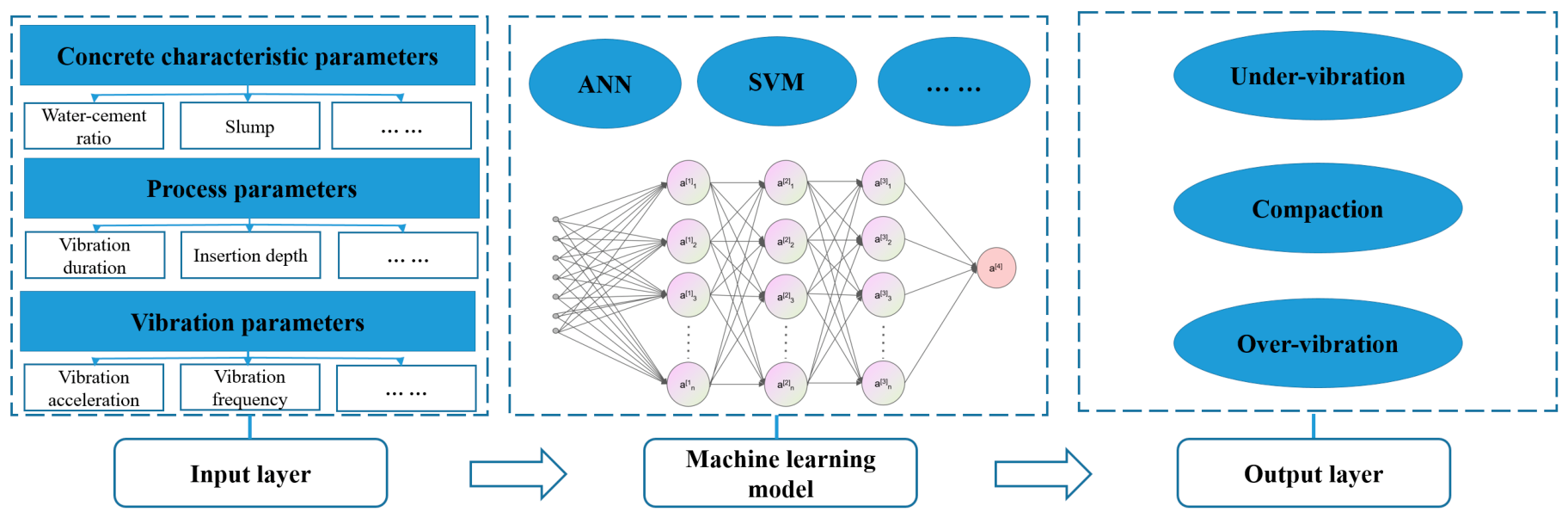
Given that concrete mix is a multiphase time-varying material with a complicated vibration mechanism, it is difficult to establish a reliable regression model using traditional data analysis methods to achieve the dynamic evaluation of vibration compactness. Therefore, as shown in Figure 10, some scholars have proposed taking the influencing factors of vibrated concrete compactness, namely concrete characteristic parameters, process parameters, and vibration parameters, as the input variables and the compactness as the output variable. Then, machine learning algorithms with stronger data analysis capabilities, such as artificial neural networks (ANN) and support vector machine (SVM), are introduced to conduct model training and establish corresponding high-precision regression models.
However, the compactness of concrete mix during vibration is related to many factors. To establish a more universally applicable mathematical model for evaluating the compactness through machine learning, it is necessary to further construct a large-scale multi-parameter database to optimize the model. In addition, the internal vibrator has a non-negligible influence range. Currently, the mathematical models established based on machine learning usually do not take into account the effects that the surrounding vibration points have on the current evaluation area. In this way, it is difficult to comprehensively analyze the total effect of distributed vibration, which will inevitably have an adverse impact on the evaluation accuracy.
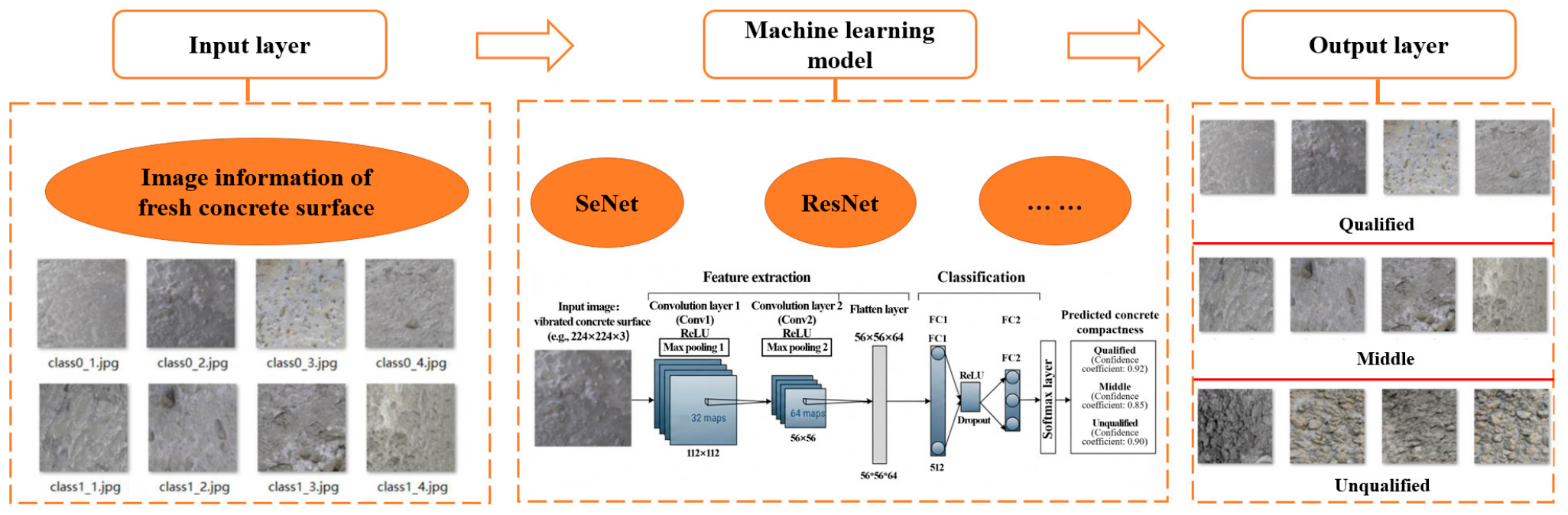
In recent years, deep learning, an important branch of machine learning, has also opened up new research ideas for the compactness evaluations of vibrated concrete mix. Some scholars have proposed using computer vision recognition and image processing techniques for data collection and processing. They apply deep learning methods to simulate the process in which humans use their eyes to capture the vibration state of the concrete mix surface and then evaluate the compactness based on the brain’s experience.
This method integrates numerous influencing factors such as material properties, equipment performance, and vibration process. It directly takes the surface state of the vibrated concrete mix as the key input parameter for evaluating the compactness, as shown in Figure 11.
This kind of technology combines visual recognition and deep learning to achieve the dynamic evaluation of the compactness during vibration. In the application process, the camera needs to be installed near the internal vibrator to dynamically capture the surface images of concrete mix. It is suitable for vibrating machinery with appropriate installation platform. However, this method is not convenient for applications in manual vibration lacking an installation platform or in areas where it is difficult for cameras to capture images. Moreover, there are many unknown coupling relationships between the apparent rheological states and the internal compactness of concrete mix. This data collection and analysis method cannot fully understand the internal compactness.

3.2.3. Energy Theory Method

The vibration duration is the simplest and most direct indicator for controlling the concrete mix compactness [3]. However, both the steel bars and concrete mix have relatively high impedance, which hinders the transmission of the excitation force. As a result, under the same vibration duration, there are significant differences in the vibration states of concrete mix within the influence range of the internal vibrator. Therefore, it is difficult to achieve an accurate and comprehensive compactness evaluation of concrete mix by relying solely on a single vibration duration. Nevertheless, considering that there is a mapping relationship between the vibration energy transmitted into concrete mix and the compactness, the energy can be used as the more reliable evaluation indicator by quantifying the vibration duration to energy and analyzing its distribution within concrete mix. This indicator can not only achieve the real-time compactness evaluation of concrete mix, but also provide insights into the internal compactness.
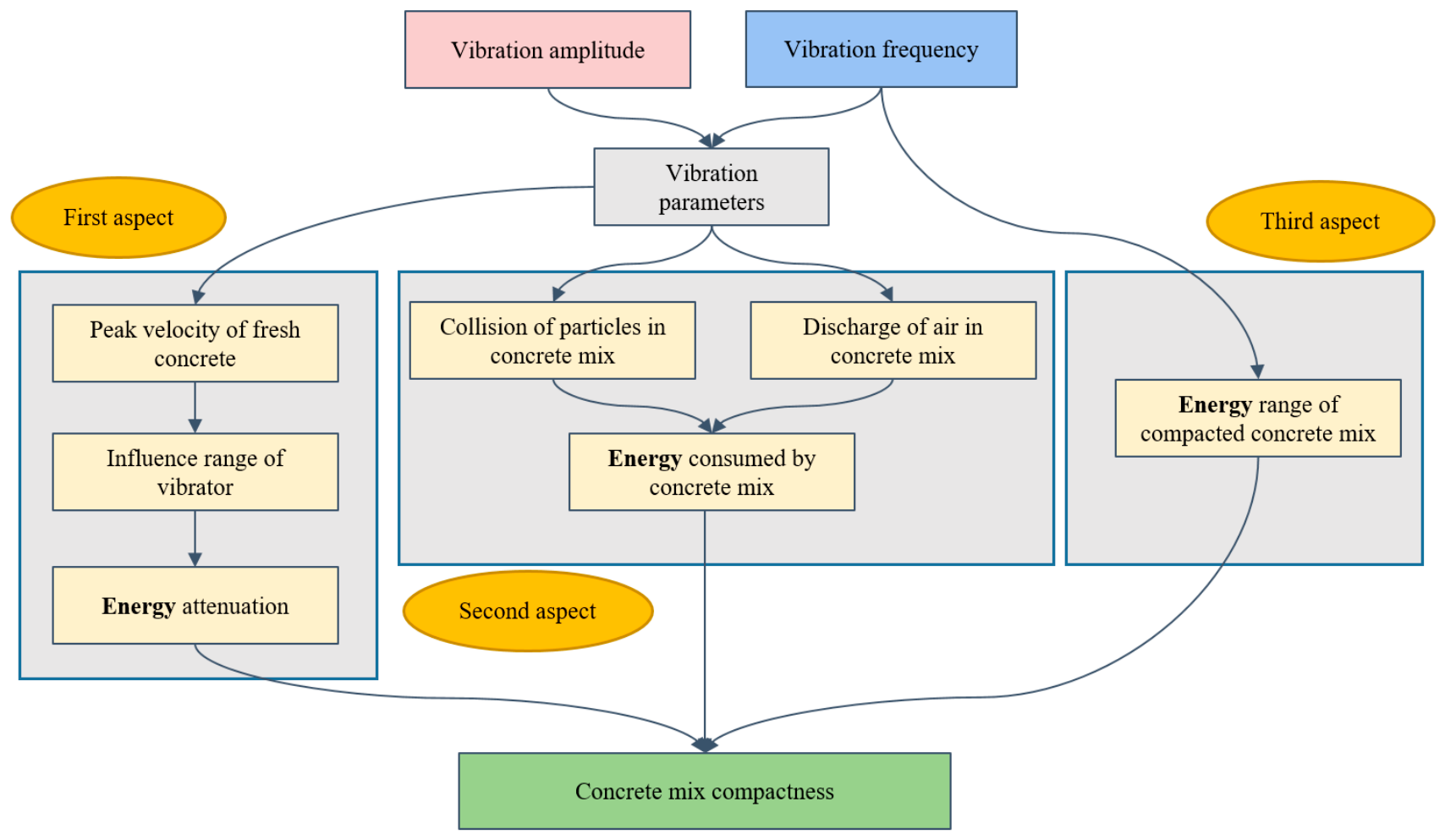
As shown in Figure 12, the energy consumed by concrete is essentially a quantitative transformation of vibration parameters. Expressing the influence of vibration parameters on the concrete mix compactness through energy is mainly reflected in three aspects:
Firstly, the vibration frequency and amplitude determine the influence range of the vibrator, and then, the vibration energy decays within this range following certain laws. Secondly, the vibration frequency and amplitude influence the movement of the internal medium in concrete mix, which is macroscopically manifested as energy consumed by concrete mix. Thirdly, the vibration frequency dictates the energy range required for the compacted concrete.
These three aspects also represent the main research routes for exploring the compactness of vibrated concrete mix through energy theory at present.
In addition to the frequency and amplitude, the vibration direction is another critical parameter that significantly affects the compaction effectiveness. In concrete mix vibration, the vibration energy can be transmitted in different directional modes—typically vertical, horizontal, or a combination of both—depending on the type of vibrator and its placement. The directional characteristics of vibration influence the rearrangement of coarse aggregates, the escape pathways of entrapped air, and the uniformity of compaction. However, the directional effect is often overlooked in current research. Most existing studies [52,75,103] focus directly on a single type of vibrator—such as internal vibrators that generate horizontal vibrations or vibrating tables that produce vertical vibrations—to investigate the relationship between compactness and energy input derived from frequency and amplitude. Systematic studies on how different vibration directions couple with frequency and amplitude to influence concrete compactness remain scarce.

3.3. Research on Intelligent Vibration Technology for Concrete Mix

Concrete vibration construction mainly falls into two fundamental modes: manual and mechanical [104]. With the vigorous development of computer, sensor, and IoT technologies [105], many experts have successively put forward the digital theory based on these two construction modes, guiding the vibration of concrete mix into the digital construction stage. In this new stage, a virtual decision-making brain is being established to endow both mechanical and manual vibration construction with intelligence [106].

3.3.1. Vibration Process Perception of Mechanical Construction

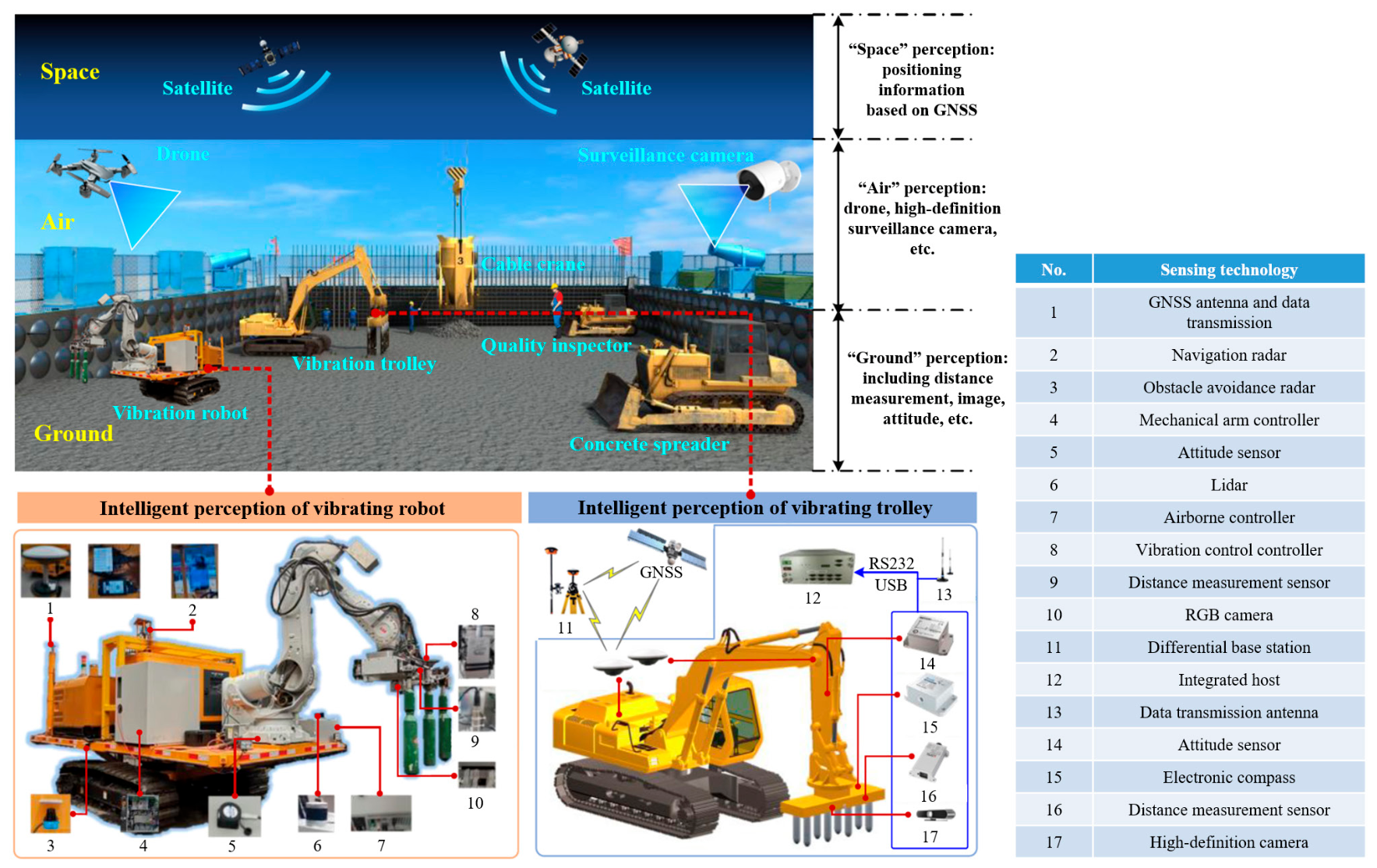
How to develop intelligent vibrating equipment that can dynamically sense multisource heterogeneous parameters in complex construction sites and transmit them to the decision-making system is a key technical challenge in achieving intelligent vibration. The rapid development of various sensing and transmission technologies, such as positioning and wireless communication technologies [107], is providing crucial technical support for the field of intelligent vibration.
To achieve fine control of vibration construction, the key on-site process parameters that need to be sensed in real-time mainly include the following: the work position, the vibration duration, the insertion angle, and depth of the internal vibrator. In terms of the intelligent sensing of the mechanical vibration construction, by combining various sensing technologies, scholars have innovatively proposed the representative idea based on the characteristics of the vibrating trolleys commonly used in construction, as shown in Figure 13.
However, the developments of intelligent vibrating machinery are mostly in their infancy, and the practical application effects still need significant optimization. It is important to note that intelligent vibrating machinery specially developed for one structural form is generally difficult to be directly applied to other types of structures. This development approach prevents the effective reuse of common intelligent resources. Therefore, developing highly intelligent vibrating machinery that can be flexibly applied to various construction scenarios is a significant research topic. Nevertheless, limited by the current development of intelligent technologies and complex application scenarios, there are still huge challenges in developing the highly intelligent vibrating machinery.
For this reason, researching intelligent technology for manual vibration become also a popular direction. This research is favored because the manual vibration mode offers greater flexibility and convenience, enabling its application in diverse construction scenarios, especially those areas that vibrating machinery cannot reach.

3.3.2. Vibration Process Perception of Manual Construction
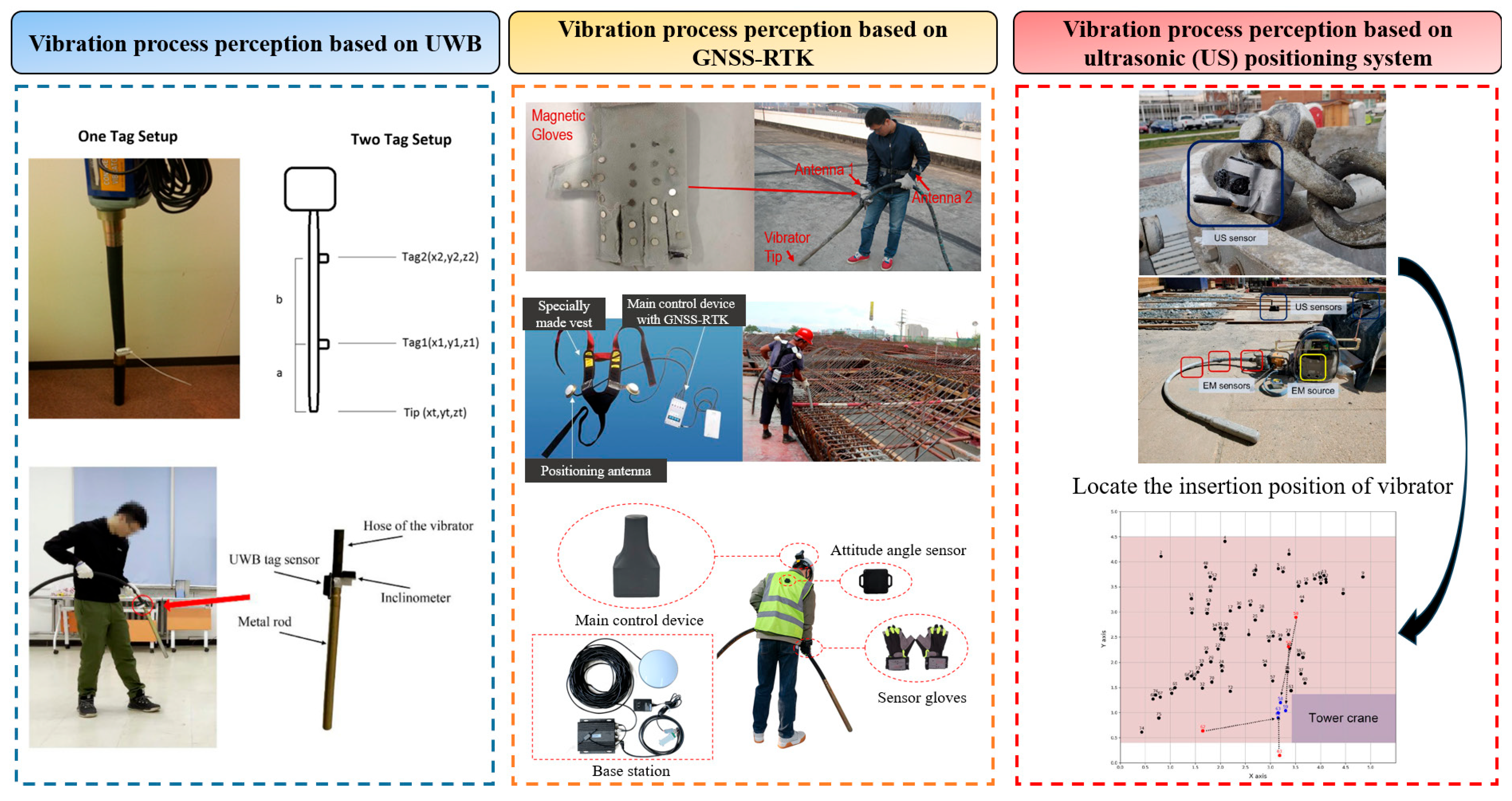
The structure and construction characteristics of a manual handheld internal vibrator differ from those of vibrating machinery, and thus, there are also differences in the sensing schemes for the required vibration process parameters. Through the research and comparison of various technologies by many scholars, it has been found that, currently, the acquisition scheme of the vibration process parameter based on real-time positioning technology is relatively mainstream and effective, as shown in Figure 14.
Figure 14. Vibration process perception based on real-time positioning technology [38,108]. Reproduced with permission from Ref. [38], Elsevier, 2024; Ref. [108], Springer, 2022.
Buildings 16 03741 g014
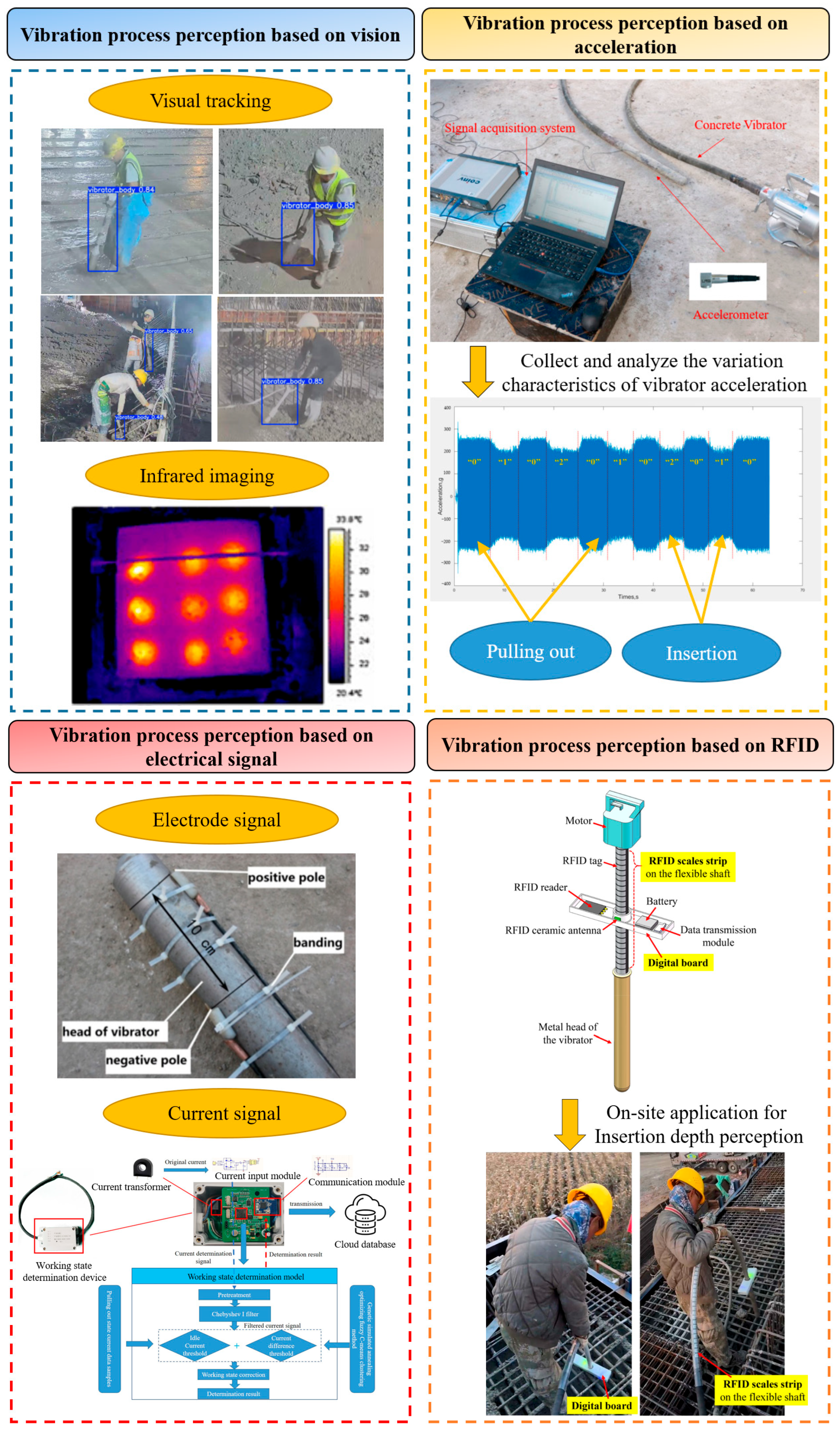
Additionally, non-real-time positioning technologies such as visual tracking, infrared imaging, and electrical signal detection have also been innovatively applied to the parameter sensing of manual vibration, as shown in Figure 15.
However, the manual vibration is often used in relatively complex construction scenarios. Due to the lack of development of systematized high-robustness equipment and the support of highly accurate parameter analysis algorithms, some technical solutions are still difficult to be directly applied to the complex construction scenarios [109].
A typical example of such complex scenarios is foundation construction, which involves large raft foundations, pile caps, thick footings, and heavily reinforced base slabs [110,111]. These structural elements are characterized by a substantial concrete depth, dense reinforcement cages, and confined spaces that make it difficult for large vibrating machinery to operate. As a result, manual handheld vibrators remain the primary consolidation tool in these scenarios. The large depth of concrete foundations requires careful control of the vibrator insertion depth to ensure that the bottom layers and interlayer interfaces are adequately compacted. Therefore, the intelligent perception technologies discussed above—particularly real-time depth sensing and positioning systems—hold particular promise for foundation construction, as they can guide workers to insert the vibrator to the correct depth and position. However, their application in foundation scenarios remains limited, and future research should prioritize the adaptation and validation of these technologies for such demanding conditions.
In addition, because the worker has a high degree of flexibility, even if the current relevant research is applied in actual construction, they still require subjective cooperation from the worker. Therefore, the future intelligent vibration technology will inevitably develop towards the direction of unmanned or less-manned operations. However, based on the current research progress, it is still of great significance to conduct intelligent technology research centered around manual vibration. This is because this research can not only provide key technical accumulation and experience for the research on highly intelligent vibrating machinery in the future, but also play a transitional role from traditional to intelligent vibration construction.
Figure 15. Vibration process perception based on non-real-time positioning technology [37,38,39,112]. Reproduced with permission from Ref. [37], MDPI, 2023; Ref. [38], Elsevier, 2024; Ref. [39], MDPI, 2024; Ref. [112], Elsevier, 2022.
Buildings 16 03741 g015

3.3.3. Intelligent Supervision and Feedback Control System

The ultimate goal of conducting research on the intelligent vibration should be to eliminate the invisible and uncontrollable factors in the traditional vibration mode and meet the needs of refined and efficient construction. Therefore, how to send decision- making information in real time to supervise and control the worker or machinery is the key technical point for achieving intelligent vibration.
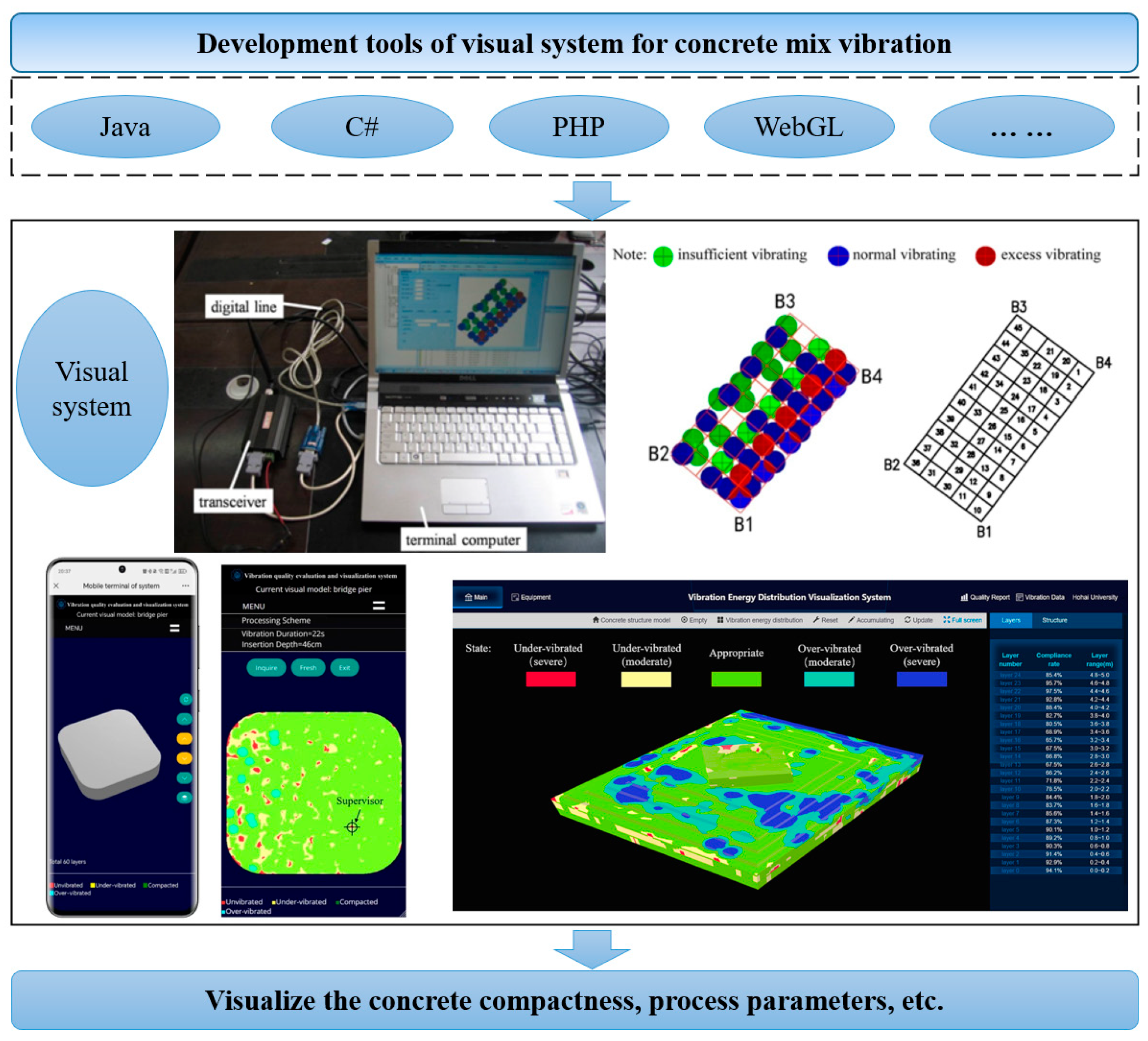
However, the feedback method based on the traditional readable forms obviously can no longer fully adapt to the highly complex intelligent vibration technology. In comparison, the digital twin can achieve more efficient monitoring and control for the entity by creating the high precision and visible copy of the virtual space [113].
For this reason, scholars have attempted to integrate various software development tools such as Java and C# with vibration technology to develop the new visual feedback method, as shown in Figure 16.
Figure 16. Supervision and feedback control system for intelligent vibration based on visible model [38,114]. Reproduced with permission from Ref. [38], Elsevier, 2024; Ref. [114], Elsevier, 2022.
Buildings 16 03741 g016
Presenting the construction information of concrete mix vibration in the form of a visual model is an intuitive approach. However, considering that concrete structures usually have large dimensions, it is sometimes difficult to obtain defect treatment plans in real time based solely on the visual approach. Additionally, the visual system is more convenient for supervisors to monitor the vibration process. Nevertheless, the vibration effect is closely related to the compliance operation of the worker or machinery. If the monitoring and evaluation results cannot be effectively and quickly fed back to the on-site operators, simply supervision without control will still not fundamentally achieve the aim of eliminate defects during vibration.
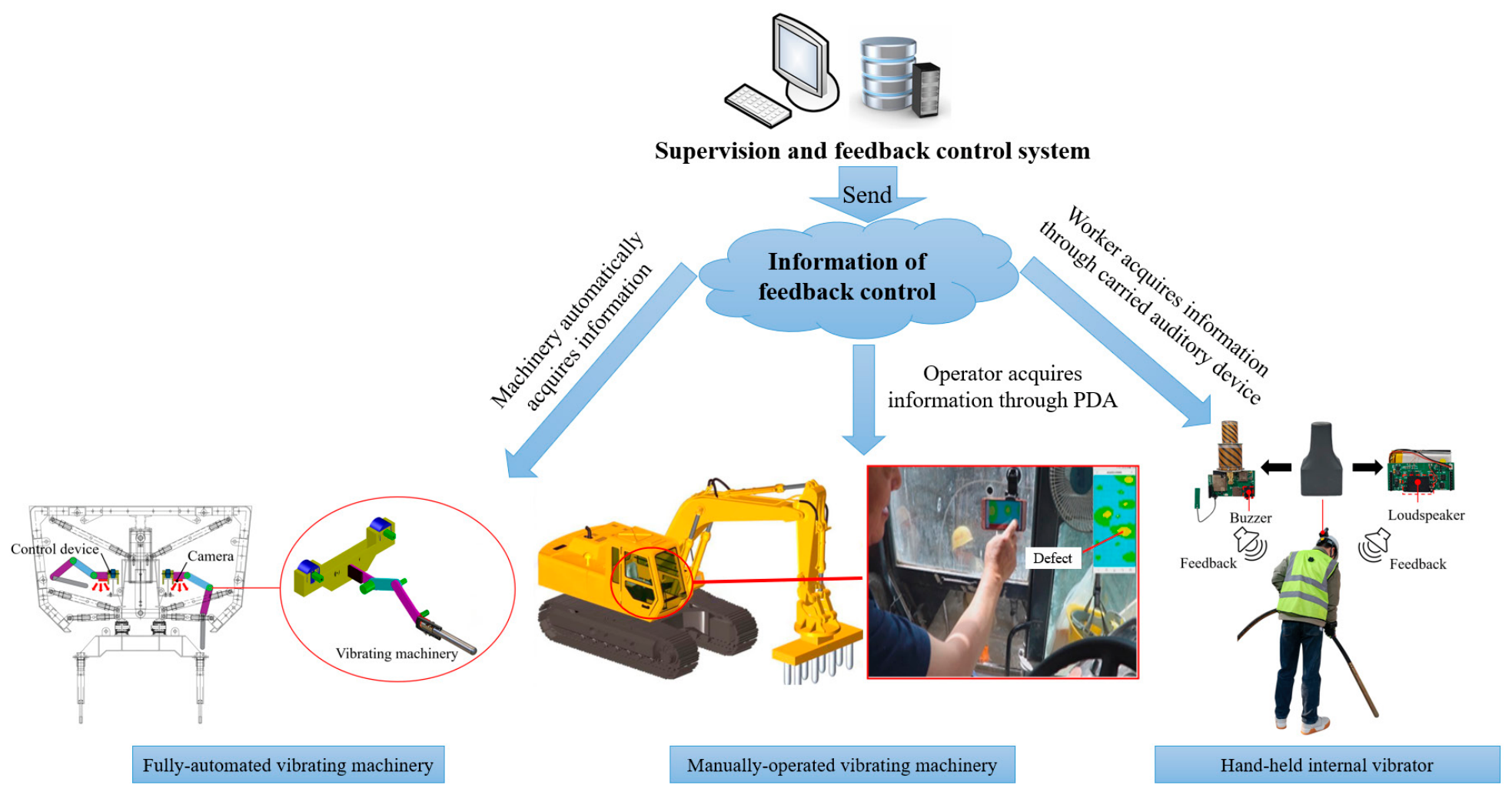
As shown in Figure 17, it is an efficient intelligent construction mode to directly send decision-making information to the vibration machinery through the information flow and drive the machinery to automatically carry out the vibration operation. Additionally, the vibrating trolley is generally operated by an operator who drives the robotic arm to vibrate in the cockpit. The operator can receive feedback control information through Personal Digital Assistants (PDAs) such as mobile phones and tablets in the cockpit [115]. In contrast, in the manual vibration mode, it is inconvenient for workers to carry and check PDAs. Therefore, place buzzers and speakers can be placed on the safety helmets of workers to send feedback control information, directly guiding the workers to adjust the current vibration process [38]. However, considering the high noise level at construction sites, the feedback control methods suitable for the manual vibration mode still need to be optimized and explored.

4. Discussion

4.1. Distinction from Previous Reviews

As noted in the Introduction, four reviews on concrete mix vibration have been published between 2021 and 2024. However, these reviews share a common format—they are all traditional narrative reviews that rely on the authors’ subjective selection of literature and follow a similar sequential structure, without applying any bibliometric analysis. To clearly distinguish the present review from these previous efforts, a systematic comparison is provided in Table 3. As shown, this review introduces several novel features: (1) it applies bibliometric analysis using VOSviewer to provide an objective, data-driven overview of the research landscape; (2) it adopts a PRISMA-style four-stage screening process to ensure transparency and reproducibility; (3) it identifies research hotspots through keyword clustering analysis rather than subjective summarization; and (4) it includes a dedicated Discussion chapter that critically compares the features and distinctions of existing research methods from multiple dimensions, offers a forward-looking perspective, and acknowledges the review’s limitations, rather than merely summarizing existing findings. These distinctions collectively position this review as a more systematic and analytically grounded contribution to the field.

4.2. Comparative Assessment of Principal Research Methods

Throughout the reviewed literature, a variety of research methods have been employed to investigate concrete mix vibration. To provide a clear overview of their respective characteristics, these principal methods are compared across multiple dimensions.
As shown in Table 4, rheological models provide a fundamental theoretical basis for understanding flow behavior, but the particle and fluid description of concrete mix remains controversial, leaving room for further refinement. Nevertheless, these models offer clear mathematical formulations, low computational cost, and good scalability, making them a practical choice for theoretical analyses. Experimental validation is typically conducted using rheometers, which provide reliable measurements of yield stress and plastic viscosity under controlled laboratory conditions.
Numerical simulations provide valuable insights into the vibration mechanism, but their accuracy is moderate, constrained by the current limitations in simulation fidelity due to the various assumptions involved in modeling. Furthermore, the substantial computational cost hinders scalability, and the simulation outcomes must be validated against physical experiments to ensure their credibility.
Non-destructive testing methods are well-established and achieve high accuracy for post-hardening quality assessment; however, these methods lack real-time capability. The testing process requires specimen preparation and multiple repeated measurements for validation, resulting in moderate computational cost. Moreover, the data obtained from each test are site-specific and have limited scalability for broader application.
Machine learning methods enable dynamic compactness evaluation, but their accuracy is highly data-dependent, and poor generalizability across diverse construction scenarios remains a major challenge due to the lack of large-scale databases. The computational cost is relatively high, as model training requires substantial data processing and iterative optimization. The validation of the prediction result ultimately depends on corresponding experiments. In addition, the scalability of machine learning models is largely constrained by the availability and coverage of training data.
Energy-based methods, supported by a well-established mathematical formulation framework, are characterized by low computational cost and favorable scalability, rendering them highly promising for real-time monitoring applications. However, their moderate accuracy is limited by the ongoing debate surrounding the energy-related mechanism in concrete mix. Furthermore, the predictive outcomes must be corroborated by physical experiments to ensure their validity.
Notably, engineering readiness varies significantly across these methods. Non-destructive testing has reached the highest readiness level with established field applications. Rheological models, machine learning, and energy-based method are at a medium stage—well established in laboratory settings but still facing challenges in widespread field deployment. Numerical simulation methods are primarily suitable for laboratory-scale mechanism studies. Their direct application to actual engineering practice remains challenging due to the substantial computational demand and the complexity of defining realistic boundary conditions for on-site construction scenarios.
This comparative assessment underscores the need for continued interdisciplinary efforts to bridge the gap between academic research and practical construction needs.

4.3. Future Research and Challenges

The rapid development of advanced technologies such as computers and robots is gradually reshaping the vibration theory and construction pattern of concrete mix. It brings broad development opportunities and challenges for resolving the unclear vibration mechanism of concrete mix, the unknown dynamic compactness of concrete mix, and the uncontrollable difficulties in the vibration construction process. Based on the research gaps identified in the preceding analysis, the following future research directions are prioritized according to their fundamental importance and potential engineering impact.
(1) Advancing the fundamental understanding of vibration mechanisms. The most critical gap identified in Section 3.1 is the lack of a unified constitutive model for vibrated concrete mix, as the particle and fluid description remains controversial, and simulation fidelity is constrained by various modeling assumptions. The continuous iterative upgrading of computer technologies such as CPU and GPU provides reliable technical support for optimizing the computing efficiency of complex simulation models. How to fully utilize computer technologies to establish simulation models that are more in line with the actual characteristics of concrete mix is an important research direction for further clarifying the constitutive model, rheological properties, and internal medium movement (especially the movement of bubbles) of the vibrated concrete mix. However, considering that concrete mix has multiphase coupling and time-varying characteristics and its internal components are invisible, the implementation of this research still faces challenges.
(2) Establishing reliable dynamic compactness evaluation methods. As presented in Section 3.2, existing non-destructive testing methods are limited to a post-hardening assessment; machine learning approaches suffer from poor generalizability due to the lack of large-scale databases, and the energy-based method still requires further development. Clarifying the energy-related mechanism—including energy transfer, energy-compactness mapping, and the influence of vibration parameters—is an effective means to achieve the dynamic evaluation of the compactness. Additionally, the optimization and upgrading of machine learning (especially deep learning) technologies offer more possibilities for solving the problem of the unknown dynamic compactness. Establishing a large-scale computational model with higher accuracy and universality based on machine learning is also the key approach foundation for achieving intelligent control of the vibration construction.
(3) Developing scenario-adapted intelligent vibration technologies. As identified in Section 3.3, current intelligent vibration research has achieved initial success in process perception and feedback control. However, the application of these technologies in challenging construction scenarios remains limited. The emergence of intelligent and robotic technologies provides new opportunities for technological breakthroughs, particularly in two distinct scenarios. The first involves complex construction scenarios (such as narrow and deep construction areas), where manual operation is difficult and precise guidance is essential. The second involves repetitive production scenarios (such as standard prefabricated components), where automated vibration systems can significantly improve both the efficiency and quality consistency. Therefore, a research direction of great significance is how to adapt relevant technologies for these challenging applications. However, given the complex and variable nature of construction environments and the immaturity of supporting technologies such as digital twin, a substantial technological gap still exists for engineering implementation.
In summary, the recommended research priority follows a sequential logic: mechanistic understanding, followed by compactness evaluation, and finally intelligent application. This sequential logic ensures that mechanistic understanding provides a solid theoretical foundation for compactness evaluation, which in turn offers essential methodological and management support for intelligent construction.

4.4. Limitations of the Review

Several methodological limitations of this review should be acknowledged to ensure a balanced interpretation of the findings.
(1) The bibliometric analysis is restricted to a single database—the Web of Science Core Collection (SCI-E). While this database ensures the authority, consistency, and quality of the retrieved literature, it inevitably excludes relevant studies indexed exclusively in other databases such as regional databases like CNKI. The subsequent narrative discussion on research hotspots incorporates CNKI literature to compensate for this limitation. However, the quantitative bibliometric analysis based on SCI-E and the qualitative narrative review supplemented by CNKI differ in their coverage. This also implies that, while a single authoritative database can provide a broadly reliable research landscape, the inclusion of additional databases might alter the findings regarding country-level and institutional collaboration patterns identified in this review.
(2) The literature search is based on a limited set of search terms—specifically, “concrete vibration” or “vibrating concrete.” Although alternative expressions such as “vibrate concrete” or “vibrated concrete” are tested and confirmed not to increase the retrieval results, the search string may still fail to capture studies using less common terminology. This may lead to the omission of relevant publications.
(3) Although the literature screening process is independently conducted by seven authors from diverse backgrounds (including academic institutions and engineering practice) based on predefined exclusion criteria, with any disagreements resolved through discussion to ensure consistency, the process inevitably involves some degree of subjectivity.
(4) The bibliometric analysis reflects the state of research up to June 2026. Articles published after this date are not included due to the retrieval cutoff. Given that the field has been in a surge stage since 2022, it is likely that new studies published after the cutoff may influence the trends reported in this review.
(5) The association strength normalization (VOSviewer default) is used for the keyword similarity calculation. While this is the standard practice in bibliometrics, different normalization methods may yield different clustering results. Consequently, the hotspot identification provided in this review offers a reliable reference, but should not be regarded as the sole classification.
Despite these limitations, this review provides the first systematic bibliometric overview of concrete mix vibration research and offers a valuable reference for both researchers and practitioners. The identified limitations also point to directions for future improvement—such as multi-database integration and dynamic updating of the bibliometric dataset.

5. Conclusions

This review set out to achieve three main objectives: (1) to identify the research landscape of concrete mix vibration through bibliometric analysis; (2) to compare and synthesize the existing literature within the identified hotspots; and (3) to synthesize unresolved issues and project future research directions. The main findings corresponding to each objective are summarized below.
(1) Through bibliometric analysis, the results reveal that research on concrete mix vibration has undergone three developmental stages: a depressed stage (1996–2015), a development stage (2016–2021), and a surge stage since 2022. The surge is temporally associated with advancements in AI, numerical simulation technologies, and policy-driven infrastructure demands. Geographically, China leads global publications (47.9%), followed by the United States, Japan, and South Korea; China and South Korea exhibit stronger emerging research vitality, while the United States and Japan possess earlier and more established research foundations. International and inter-organizational collaboration remains insufficient, particularly among leading research institutions. Keyword co-occurrence analysis objectively identifies three research hotspots: vibration mechanism, compactness of vibrated concrete mix, and intelligent vibration technology.
(2) Through comparative synthesis of the literature within each hotspot, this review finds that rheological models and numerical simulations are the primary tools for mechanism investigations. For compactness evaluation, non-destructive testing methods are limited to post-hardening assessment without real-time capability, while machine learning and energy-based methods enable dynamic evaluation but still require further development. For intelligent vibration technology, process perception and feedback control have achieved initial progress in both mechanical and manual vibration. Nevertheless, their applicability in complex construction scenarios and repetitive production scenarios remains limited and needs to be strengthened.
(3) By synthesizing unresolved issues, three prioritized research needs emerge: establishing high-fidelity simulation models grounded in a unified constitutive framework, further improving dynamic compactness evaluation methods, and developing scenario-adapted intelligent vibration systems for challenging construction applications and repetitive production scenarios. The recommended research progression follows a sequential logic—mechanistic understanding, followed by compactness evaluation, and finally intelligent application—ensuring that technological developments are built upon a solid theoretical foundation.
(4) Several methodological limitations should be directly acknowledged. The bibliometric analysis is restricted to the Web of Science Core Collection, which may exclude relevant studies from other databases. The search strategy is based on a limited set of terms, potentially omitting studies using less common terminology. The manual screening process inevitably involves some degree of subjectivity. The analysis reflects literature up to June 2026, and publications after this date are not included. Despite these limitations, this review provides the first systematic bibliometric overview of concrete mix vibration research, offering a valuable reference for both researchers and practitioners. Ultimately, as emerging technologies continue to advance, vibration technology is expected to transform from experience-driven to intelligent-driven practice.

Author Contributions

X.L.: Conceptualization, methodology, software, investigation, data curation, writing—original draft preparation, writing—review and editing. J.G.: Conceptualization, methodology, software, investigation, resources, data curation, writing—review and editing. M.Z.: software, validation, investigation, data curation, visualization. Q.W.: software, investigation, data curation, writing—original draft preparation. Y.Y.: validation, formal analysis, investigation, data curation. J.W.: investigation, data curation, writing—original draft preparation. J.L.: Conceptualization, methodology, software, writing—review and editing, project administration, funding acquisition. All authors have read and agreed to the published version of the manuscript.

Funding

This research was funded by Large Instruments Open Foundation of Nantong University [grant number KFJN2617].

Data Availability Statement

No new data were created or analyzed in this study. Data sharing is not applicable to this article.

Conflicts of Interest

Authors Xingjun Liu and Junxia Wang were employed by the company China Construction Second Engineering Bureau Co., Ltd. The remaining authors declare that the research was conducted in the absence of any commercial or financial relationships that could be construed as a potential conflict of interest.

References

  1. Choi, S.K.; Tareen, N.; Kim, J.; Park, S.; Park, I. Real-Time Strength Monitoring for Concrete Structures Using EMI Technique Incorporating with Fuzzy Logic. Appl. Sci. 2018, 8, 75. [Google Scholar] [CrossRef] [Scilit]
  2. Zhao, K.Y.; Zhao, L.J.; Hou, J.R.; Zhang, X.B.; Feng, Z.X.; Yang, S.M. Effect of vibratory mixing on the slump, compressive strength, and density of concrete with the different mix proportions. J. Mater. Res. Technol. JMRT 2021, 15, 4208–4219. [Google Scholar] [CrossRef] [Scilit]
  3. Howes, R.; Hadi, M.N.S.; South, W. Concrete strength reduction due to over compaction. Constr. Build. Mater. 2019, 197, 725–733. [Google Scholar] [CrossRef] [Scilit]
  4. Petrou, M.F.; Wan, B.L.; Gadala-Maria, F.; Kolli, V.G.; Harries, K.A. Influence of mortar rheology on aggregate settlement. ACI Mater. J. 2000, 97, 479–485. [Google Scholar] [CrossRef] [Scilit] [PubMed]
  5. Chia, K.S.; Kho, C.C.; Zhang, M.H. Stability of fresh lightweight aggregate concrete under vibration. ACI Mater. J. 2005, 102, 347–354. [Google Scholar] [CrossRef] [Scilit] [PubMed]
  6. Rubio-Hernández, F.J.; Velázquez-Navarro, J.F.; Ordóñez-Belloc, L.M. Rheology of concrete: A study case based upon the use of the concrete equivalent mortar. Mater. Struct. 2013, 46, 587–605. [Google Scholar] [CrossRef] [Scilit]
  7. Rao, R.; Deng, Q.D.; Fu, J.Y.; Liu, C.H.; Ouyang, X.W.; Huang, Y.H. Improvement of mechanical strength of recycled blend concrete with secondary vibrating approach. Constr. Build. Mater. 2020, 237, 117661. [Google Scholar] [CrossRef] [Scilit]
  8. GB50666-2011; Chinese Standard, Code for Construction of Concrete Structures. China Construction Industry Press: Beijing, China, 2011. Available online: https://ebook.chinabuilding.com.cn/zbooklib/bookpdf/probation?SiteID=1&bookID=61072 (accessed on 1 January 2026). (In Chinese)
  9. Yu, S.; Huang, S.; Li, Y.; Liang, Z. Insights into the frost cracking mechanisms of concrete by using the coupled thermo-hydro-mechanical-damage meshless method. Theor. Appl. Fract. Mech. 2025, 136, 104814. [Google Scholar] [CrossRef] [Scilit]
  10. Gao, X.J.; Zhang, J.Y.; Su, Y. Influence of vibration-induced segregation on mechanical property and chloride ion permeability of concrete with variable rheological performance. Constr. Build. Mater. 2019, 194, 32–41. [Google Scholar] [CrossRef] [Scilit]
  11. Mähner, D.; Basler, F.; Hesselink, J. Influence of vibrations on young concrete. Beton-Stahlbetonbau 2019, 114, 176–184. [Google Scholar] [CrossRef] [Scilit]
  12. Basler, F.; Mähner, D.; Fischer, O.; Hilbig, H. Influence of early-age vibration on concrete strength. Struct. Concr. 2023, 24, 6505–6519. [Google Scholar] [CrossRef] [Scilit]
  13. Kim, J.H.; Shin, T.Y. First step in modeling the flow table test to characterize the rheology of normally vibrated concrete. Cem. Concr. Res. 2022, 152, 106678. [Google Scholar] [CrossRef] [Scilit]
  14. Nadesan, M.S.; Dinakar, P. Permeation properties of high strength self-compacting and vibrated concretes. J. Build. Eng. 2017, 12, 275–281. [Google Scholar] [CrossRef] [Scilit]
  15. Wu, S.; Li, C.; Li, Y.; Wang, C.; Zhang, C. Study on influence of three elements of vibration on fresh concrete. Blasting 2018, 35, 6–11. Available online: https://kns.cnki.net/kcms2/article/abstract?v=0dH_rU7swB8pmg1VIjDNsXr7pBmnq7kieXMtaCfz59VVp0URxykK5yBZBPIMuc2QffLlW4QkUfpYpJgb0pO0AUcCYXnMWfPTbeeoDUoP1tz2C1clbe6Ygl1eEu9Zso9HMHuJeqwAXYDChhwYVF8Y7EW2uwKWUz7SGT_ZBIgk4vut69jQ9hD8gQ (accessed on 1 January 2026). (In Chinese)
  16. Xu, T.; Li, J. Assessing the spatial variability of the concrete by the rebound hammer test and compression test of drilled cores. Constr. Build. Mater. 2018, 188, 820–832. [Google Scholar] [CrossRef] [Scilit]
  17. Zhang, X.P.; Li, B.; Jiang, Y.J.; Wu, F.B.; Gao, Y. Ambient vibration-based quantitative assessment on tunnel lining defect using laser Doppler vibrometer. Measurement 2025, 239, 115481. [Google Scholar] [CrossRef] [Scilit]
  18. Zhao, X.; Huang, Y.; Dong, W.; Liu, J.; Ma, G. A review of compaction mechanisms, influencing factors, and advanced methods in concrete vibration technology. J. Build. Eng. 2024, 93, 109847. [Google Scholar] [CrossRef] [Scilit]
  19. Tian, Z.H.; Ma, Y.S.; Li, J.J. Research progress on compactness technology of concrete vibration. J. Build. Mater. 2023, 27, 46–57. (In Chinese) [Google Scholar] [CrossRef]
  20. Li, L.; Wu, J.; Zhang, Y.; Li, K.; Liu, Y.; Liu, L.; Chen, Y. Research progress of concrete vibratory technology. Acad. J. Sci. Technol. 2022, 3, 71–77. [Google Scholar] [CrossRef] [Scilit]
  21. Wen, J.X.; Huang, F.L.; Wang, Z.; Yi, Z.L.; Xie, Y.J.; Li, H.J.; Cheng, H. Research status and development trend of concrete vibration technology. Bull. Chin. Ceram. Soc. 2021, 40, 3326–3336. (In Chinese) [Google Scholar] [CrossRef]
  22. Liu, Y.; Gan, Y.; Yang, Z.; Qiang, S. Intelligent construction technology for reservoir dams. Autom. Constr. 2025, 175, 106177. [Google Scholar] [CrossRef] [Scilit]
  23. van Eck, N.J.; Waltman, L. Software survey: VOSviewer, a computer program for bibliometric mapping. Scientometrics 2010, 84, 523–538. [Google Scholar] [CrossRef] [Scilit] [PubMed]
  24. Von Ungern-Sternberg, S. Bradford’s law in the context of information provision. Scientometrics 2000, 49, 161–186. [Google Scholar] [CrossRef] [Scilit]
  25. Wang, D.; Guan, T.; Yang, S.; Wang, X.T.; Zhai, H.F.; Ren, B.Y. Intelligent monitoring of concrete vibration quality based on space-air-ground integrated perception. J. Chin. Ceram. Soc. 2023, 51, 1219–1227. (In Chinese) [Google Scholar] [CrossRef]
  26. Fan, S.; He, T.; Li, W.H.; Zeng, C.; Chen, P.; Chen, L.F.; Shu, J.P. Machine learning-based classification of quality grades for concrete vibration behaviour. Autom. Constr. 2024, 167, 105694. [Google Scholar] [CrossRef] [Scilit]
  27. Jiang, D.Q.; Kong, L.J.; Wang, H.; Pan, D.X.; Li, T.; Tan, J.S. Precise control mode for concrete vibration time based on attention-enhanced machine vision. Autom. Constr. 2024, 158, 105232. [Google Scholar] [CrossRef] [Scilit]
  28. Li, T.; Wang, H.; Tan, J.; Kong, L.; Zhang, H.; Pan, D.; Zhao, Z. Intelligent quality assessment of concrete vibration using computer vision and large language models. Autom. Constr. 2025, 180, 106507. [Google Scholar] [CrossRef] [Scilit]
  29. Li, J.; Chen, Z.; Li, Z.; Kong, L.; Zhang, H. Integrating Computer Vision and Audio Signals for Concrete Vibration Activity Recognition and Assessment. J. Constr. Eng. Manag. 2026, 152, 04026099. [Google Scholar] [CrossRef] [Scilit]
  30. Wang, S.; Chen, L.; Shi, P.; Wu, Q.; Ju, X.; Chen, L. Computer vision based manual concrete vibration quality monitoring. Dev. Built Environ. 2026, 26, 100895. [Google Scholar] [CrossRef] [Scilit]
  31. Yan, W.S.; Cui, W.; Qi, L. DEM study on the response of fresh concrete under vibration. Granul. Matter 2022, 24, 37. [Google Scholar] [CrossRef] [Scilit]
  32. Shin, T.Y.; Kim, J.H. Flow simulation of fresh concrete accounting for vibrating compaction. Cem. Concr. Res. 2023, 173, 107300. [Google Scholar] [CrossRef] [Scilit]
  33. Cao, G.D.; Bai, Y.L.; Shi, Y.H.; Li, Z.G.; Deng, D.Q.; Jiang, S.Q.; Xie, S.; Wang, H. Investigation of vibration on rheological behavior of fresh concrete using CFD-DEM coupling method. Constr. Build. Mater. 2024, 425, 135908. [Google Scholar] [CrossRef] [Scilit]
  34. Huang, C.; Tian, Z.H.; Ma, Y.S.; Shen, L. Principle of fiber orientation control inside UHPC based on SPH-DEM simulation. China Civ. Eng. J. 2025, 58, 68–76. (In Chinese) [Google Scholar] [CrossRef]
  35. Huang, C.; Shen, L.; Yu, W.Y.; Alkayem, N.F.; Han, Y.; Tian, Z.H.; Yin, H.; Cusatis, G. High-fidelity SPH-DEM framework for mesoscopic rheological behavior of fresh fiber-reinforced concrete. Int. J. Mech. Sci. 2025, 289, 110061. [Google Scholar] [CrossRef] [Scilit]
  36. Quan, Y.H.; Wang, F.L. Machine learning-based real-time tracking for concrete vibration. Autom. Constr. 2022, 140, 104343. [Google Scholar] [CrossRef] [Scilit]
  37. Ma, Y.S.; Tian, Z.H.; Xu, X.B.; Liu, H.R.; Li, J.J.; Fan, H.Y. Research on Response Parameters and Classification Identification Method of Concrete Vibration Process. Materials 2023, 16, 2958. [Google Scholar] [CrossRef] [Scilit] [PubMed]
  38. Li, J.J.; Tian, Z.H.; Ma, Y.S.; Li, L.J.; Shen, W.H.; Zhao, J.X. Feedback control system for vibration construction of fresh concrete. Mech. Syst. Signal Proc. 2024, 216, 111461. [Google Scholar] [CrossRef] [Scilit]
  39. Quan, Y.H.; Wang, X.Z.; Liu, Y.C.; Sun, H.P.; Wang, F.L. Real-Time Monitoring of Concrete Vibration Depth Based on RFID Scales. Buildings 2024, 14, 885. [Google Scholar] [CrossRef] [Scilit]
  40. Wang, D. Research on Concrete Intelligent Vibration of High Arch Dam Driven by Space-Air-Ground Sensing Data. Doctoral Thesis, Tianjin University, Tianjin, China, 2022. Available online: https://theses.lib.tju.edu.cn/#/home (accessed on 1 January 2026). (In Chinese)
  41. Li, Z.; Zhang, S.P.; Niu, Y.Z.; Li, Y. Concrete vibrating technology and intelligent development of prefabricated box girders for high speed railway. J. Railw. Sci. Eng. 2024, 21, 4851–4860. [Google Scholar] [CrossRef]
  42. Liu, S.L. Development and application of automatic vibration system for precast box girder in railway engineering. Railw. Constr. Technol. 2025, 2, 45–48+78. (In Chinese) [Google Scholar] [CrossRef]
  43. Overland, I.; Huda, M.S. Climate clubs and carbon border adjustments: A review. Environ. Res. Lett. 2022, 17, 093005. [Google Scholar] [CrossRef] [Scilit]
  44. Chen, Z.H.; Ki, D.; Li, Z.K.; Wang, K.L. Assessing equity in infrastructure investment distribution among US cities. Cities 2025, 162, 105898. [Google Scholar] [CrossRef] [Scilit]
  45. Xue, S.; Na, J.; Wang, L.; Wang, S.; Xu, X. The Outlook of Green Building Development in China during the “Fourteenth Five-Year Plan” Period. Int. J. Environ. Res. Public Health 2023, 20, 5122. [Google Scholar] [CrossRef] [Scilit] [PubMed]
  46. Chongdon, P. The Reality and Challenges of The ‘One Belt, One Road’ initiative. J. Corp. Innov. 2021, 44, 131–150. [Google Scholar] [CrossRef]
  47. Du, T.; Wang, J.; Wang, H.M.; Tian, X.; Yue, Q.; Tanikawa, H. CO2 emissions from the Chinese cement sector: Analysis from both the supply and demand sides. J. Ind. Ecol. 2020, 24, 923–934. [Google Scholar] [CrossRef] [Scilit]
  48. Wang, W.Y.; Chen, Z.T.; Zhou, H.Q.; Han, T.C.; Zhang, Y.; Lv, Q.F. Deep learning-based framework for realistic three-dimensional image generation, aggregate segmentation, and mesoscale simulation of concrete. Case Stud. Constr. Mater. 2026, 25, e06516. [Google Scholar] [CrossRef] [Scilit]
  49. Cai, Y.X.; Liu, Q.F.; Yu, L.W.; Meng, Z.Z.; Hu, Z.; Yuan, Q.; Savija, B. An experimental and numerical investigation of coarse aggregate settlement in fresh concrete under vibration. Cem. Concr. Compos. 2021, 122, 104153. [Google Scholar] [CrossRef] [Scilit]
  50. Cao, G.; Li, Z. Numerical flow simulation of fresh concrete with viscous granular material model and smoothed particle hydrodynamics. Cem. Concr. Res. 2017, 100, 263–274. [Google Scholar] [CrossRef] [Scilit]
  51. Li, J.J.; Xiang, J.Z.; Tian, Z.H.; Lu, W.J.; Xie, L.H.; Zhao, Y.P. Experiment and simulation study on coarse aggregates settlement in vibrated concrete based on transparent granular suspensions. J. Build. Eng. 2023, 76, 107381. [Google Scholar] [CrossRef] [Scilit]
  52. Li, J.J.; Tian, Z.H.; Yu, X.; Xiang, J.Z.; Fan, H.Y. Vibration quality evaluation of reinforced concrete using energy transfer model. Constr. Build. Mater. 2023, 379, 131247. [Google Scholar] [CrossRef] [Scilit]
  53. Pan, J.; He, J.; Zhu, J.; Gao, X. Theoretical and experimental study on the electrical resistivity method for evaluating fresh concrete segregation. J. Build. Eng. 2022, 48, 103943. [Google Scholar] [CrossRef] [Scilit]
  54. Wang, D.; Ren, B.Y.; Cui, B.; Wang, J.J.; Wang, X.L.; Guan, T. Real-time monitoring for vibration quality of fresh concrete using convolutional neural networks and IoT technology. Autom. Constr. 2021, 123, 103510. [Google Scholar] [CrossRef] [Scilit]
  55. Gong, J.; Yu, Y.; Krishnamoorthy, R.; Roda, A. Real-time tracking of concrete vibration effort for intelligent concrete consolidation. Autom. Constr. 2015, 54, 12–24. [Google Scholar] [CrossRef] [Scilit]
  56. Tian, Z.H.; Sun, X.; Su, W.H.; Li, D.X.; Yang, B.; Bian, C.; Wu, J. Development of real-time visual monitoring system for vibration effects on fresh concrete. Autom. Constr. 2019, 98, 61–71. [Google Scholar] [CrossRef] [Scilit]
  57. Li, Z.; Ohkubo, T.; Tanigawa, Y. Yield model of high fluidity concrete in fresh state. J. Mater. Civ. Eng. 2004, 3, 195–201. [Google Scholar] [CrossRef] [Scilit]
  58. Jiao, D.; Shi, C.; Yuan, Q.; An, X.; Liu, Y.; Li, H. Effect of constituents on rheological properties of fresh concrete-A review. Cem. Concr. Compos. 2017, 83, 146–159. [Google Scholar] [CrossRef] [Scilit]
  59. Boddepalli, U.; Panda, B.; Gandhi, I.S.R. Rheology and printability of Portland cement based materials: A review. J. Sustain. Cem.-Based Mater. 2023, 12, 789–807. [Google Scholar] [CrossRef] [Scilit]
  60. Juradin, S.; Krstulovic, P. The vibration rheometer: The effect of vibration on fresh concrete and similar materials. Mater. Werkst. 2012, 43, 733–742. [Google Scholar] [CrossRef] [Scilit]
  61. Banfill, P.F.G.; Teixeira, M.; Craik, R.J.M. Rheology and vibration of fresh concrete: Predicting the radius of action of poker vibrators from wave propagation. Cem. Concr. Res. 2011, 41, 932–941. [Google Scholar] [CrossRef] [Scilit]
  62. Roussel, N. Rheology of fresh concrete: From measurements to predictions of casting processes. Mater. Struct. 2007, 40, 1001–1012. [Google Scholar] [CrossRef] [Scilit]
  63. Roussel, N. A thixotropy model for fresh fluid concretes: Theory, validation and applications. Cem. Concr. Res. 2006, 36, 1797–1806. [Google Scholar] [CrossRef] [Scilit]
  64. Banfill, P.F.G.; Xu, Y.M.; Domone, P.L.J. Relationship between the rheology of unvibrated fresh concrete and its flow under vibration in a vertical pipe apparatus. Mag. Concr. Res. 1999, 51, 181–190. [Google Scholar] [CrossRef] [Scilit]
  65. Larrard, F.D. Concrete Mixture Proportioning: A Scientific Approach; CRC Press: London, UK, 1999. [Google Scholar] [CrossRef] [Scilit]
  66. Geiker, M.R.; Brandl, M.; Thrane, L.N.; Nielsen, L.F. On the effect of coarse aggregate fraction and shape on the rheological properties of self-compacting concrete. Cem. Concr. Aggreg. 2002, 24, 3–6. [Google Scholar] [CrossRef] [Scilit]
  67. Shamanna, G.; Nagaraj, A.; Achutha, A. Concrete Shear Box: New Instrument to Assess Stiff to Flowing Concrete Using Bingham Model. ACI Mater. J. 2021, 118, 227–240. [Google Scholar] [CrossRef] [Scilit]
  68. Geiker, M.R.; Brandl, M.; Thrane, L.N.; Bager, D.H.; Wallevik, O. The effect of measuring procedure on the apparent rheological properties. Cem. Concr. Res. 2002, 32, 1791–1795. [Google Scholar] [CrossRef] [Scilit]
  69. Tattersall, G.H.; Bakert, P.H. The effect of vibration on the rheological properties of fresh concrete. Mag. Concr. Res. 1988, 40, 79–89. [Google Scholar] [CrossRef] [Scilit]
  70. Hu, C.; Larrard, F.d. The rheology of fresh high-performance concrete. Cem. Concr. Res. 1996, 26, 283–294. [Google Scholar] [CrossRef] [Scilit]
  71. Larrard, F.D.; Ferraris, C.F.; Sedran, T. Fresh concrete: A Herschel-Bulkley material. Mater. Struct. 1998, 31, 494–498. [Google Scholar] [CrossRef] [Scilit]
  72. Feys, D.; Verhoeven, R.; De Schutter, G. Fresh self compacting concrete, a shear thickening material. Cem. Concr. Res. 2008, 38, 920–929. [Google Scholar] [CrossRef] [Scilit]
  73. Koch, J.A.; Castaneda, D.I.; Ewoldt, R.H.; Lange, D.A. Vibration of fresh concrete understood through the paradigm of granular physics. Cem. Concr. Res. 2019, 115, 31–42. [Google Scholar] [CrossRef] [Scilit]
  74. Hanotin, C.; Kiesgen de Richter, S.; Michot, L.J.; Marchal, P. Viscoelasticity of vibrated granular suspensions. J. Rheol. 2015, 59, 253–273. [Google Scholar] [CrossRef] [Scilit]
  75. Li, Z.; Cao, G. Rheological behaviors and model of fresh concrete in vibrated state. Cem. Concr. Res. 2019, 120, 217–226. [Google Scholar] [CrossRef] [Scilit]
  76. Xu, Z.S.; Li, Z.G. Numerical method for predicting flow and segregation behaviors of fresh concrete. Cem. Concr. Compos. 2021, 123, 104150. [Google Scholar] [CrossRef] [Scilit]
  77. Yu, S.; Ren, X.; Zhang, J. Modeling the rock frost cracking processes using an improved ice—Stress—Damage coupling method. Theor. Appl. Fract. Mech. 2024, 131, 104421. [Google Scholar] [CrossRef] [Scilit]
  78. Li, J.J.; Tian, Z.H. Experimental and simulation study on vibration of fresh concrete based on energy transfer. J. Build. Eng. 2026, 119, 115307. [Google Scholar] [CrossRef] [Scilit]
  79. Hoffman, R.L. Discontinuous and dilatant viscosity behavior in concentrated suspensions II. Theory and experimental tests. J. Colloid Interface Sci. 1974, 46, 491–506. [Google Scholar] [CrossRef] [Scilit]
  80. Hoffman, R.L. Discontinuous and dilatant viscosity behavior in concentrated suspensions III. Necessary conditions for their occurrence in viscometric flows. Adv. Colloid Interface Sci. 1982, 17, 161–184. [Google Scholar] [CrossRef] [Scilit]
  81. Xing, Y.; Tian, Z.; Du, H. 5D visual feedback and control of compaction quality of working units of RCC dam. J. Hydroelectr. Eng. 2019, 38, 29–40. [Google Scholar] [CrossRef]
  82. Lai, M.H.; Wu, K.J.; Ou, X.L.; Zeng, M.R.; Li, C.W.; Ho, J.C.M. Effect of concrete wet packing density on the uni-axial strength of manufactured sand CFST columns. Struct. Concr. 2022, 23, 2615–2629. [Google Scholar] [CrossRef] [Scilit]
  83. Wong, H.H.C.; Kwan, A.K.H. Packing density of cementitious materials: Part 1—Measurement using a wet packing method. Mater. Struct. 2007, 41, 689–701. [Google Scholar] [CrossRef] [Scilit]
  84. Zhang, J.Y.; Gao, X.J.; Su, Y. Influence of poker vibration on aggregate settlement in fresh concrete with variable rheological properties. J. Mater. Civ. Eng. 2019, 31, 10. [Google Scholar] [CrossRef] [Scilit]
  85. Gökçe, H.S.; Öztürk, B.C.; Çam, N.F.; Andiç-Çakır, Ö. Gamma-ray attenuation coefficients and transmission thickness of high consistency heavyweight concrete containing mineral admixture. Cem. Concr. Compos. 2018, 92, 56–69. [Google Scholar] [CrossRef] [Scilit]
  86. Vanhove, Y.; Djelal, C.; Schwendenmann, G.; Brisset, P. Study of self consolidating concretes stability during their placement. Constr. Build. Mater. 2012, 35, 101–108. [Google Scholar] [CrossRef] [Scilit]
  87. Petrou, M.F.; Harries, K.A.; Gadala-Maria, F.; Kolli, V.e.G. A unique experimental method for monitoring aggregate settlement in concrete. Cem. Concr. Res. 2000, 30, 809–816. [Google Scholar] [CrossRef] [Scilit]
  88. Wei, L.; Xu, Q.; Wang, S.; Wang, C.; Chen, J. Development of transparent cemented soil for geotechnical laboratory modelling. Eng. Geol. 2019, 262, 105354. [Google Scholar] [CrossRef] [Scilit]
  89. Li, Z.; Tanigawa, Y. Investigation on granular characteristics of fresh concrete based on visualized experiment using alternative materials. J. Struct. Constr. Eng. 2012, 77, 1175–1184. [Google Scholar] [CrossRef] [Scilit]
  90. Tian, Z.; Li, X.; Peng, Z. Test of carbomer gel to simulate the rheological performance of cement paste. J. Build. Mater. 2015, 18, 243–248. (In Chinese) [Google Scholar] [CrossRef]
  91. Tian, Z.; Li, X.; Zhu, F.; Peng, Z. Experimental simulation study on aggregate motion of rheological concrete. J. Build. Mater. 2016, 19, 22–28. (In Chinese) [Google Scholar] [CrossRef]
  92. Zheng, X.H.; Ge, Y.; Yuan, J. Influence of air content and vibration time on frost resistance of air entrained concrete. Adv. Mater. Res. 2014, 857, 110–115. [Google Scholar] [CrossRef] [Scilit]
  93. Yang, Y.; Zhao, W.G. Analysis on identifying thin-plate void parameters in concrete based on vibro-acoustic method. Measurement 2025, 242, 116281. [Google Scholar] [CrossRef] [Scilit]
  94. Yu, Z.M.; Dong, W.; Wang, F.; Huang, Y.M.; Ma, G.W. Enhancing concrete strength through precision vibration engineering: Aggregate settlement and pore stats. Constr. Build. Mater. 2025, 464, 140117. [Google Scholar] [CrossRef] [Scilit]
  95. Zhang, J.Y.; Gao, X.J.; Yu, L.C. Improvement of viscosity-modifying agents on air-void system of vibrated concrete. Constr. Build. Mater. 2020, 239, 117843. [Google Scholar] [CrossRef] [Scilit]
  96. Solak, A.M.; Tenza-Abril, A.J.; Baeza-Brotons, F.; Benavente, D. Proposing a new method based on image analysis to estimate the segregation index of lightweight aggregate concretes. Materials 2019, 12, 3642. [Google Scholar] [CrossRef] [Scilit] [PubMed]
  97. Navarrete, I.; Lopez, M. Understanding the relationship between the segregation of concrete and coarse aggregate density and size. Constr. Build. Mater. 2017, 149, 741–748. [Google Scholar] [CrossRef] [Scilit]
  98. Zheng, Y.; Li, H. Evaluation of protective quality of prestressed concrete containment buildings of nuclear power plants. J. Cent. South Univ. Technol. 2011, 18, 238–243. [Google Scholar] [CrossRef] [Scilit]
  99. Yim, H.J.; Bae, Y.H.; Kim, J.H. Method for evaluating segregation in self-consolidating concrete using electrical resistivity measurements. Constr. Build. Mater. 2020, 232, 117283. [Google Scholar] [CrossRef] [Scilit]
  100. Chen, H.; Zhou, M.; Gan, S.; Nie, X.; Xu, B.; Mo, Y.L. Review of wave method-based non-destructive testing for steel-concrete composite structures: Multiscale simulation and multi-physics coupling analysis. Constr. Build. Mater. 2021, 302, 123832. [Google Scholar] [CrossRef] [Scilit]
  101. Sharma, S.; Mukherjee, A. Monitoring freshly poured concrete using ultrasonic waves guided through reinforcing bars. Cem. Concr. Compos. 2015, 55, 337–347. [Google Scholar] [CrossRef] [Scilit]
  102. Bian, C. Study on Theoretical Model of Fresh Concrete Consolidation and Real-Time Intelligient Controlling Method. Doctoral Thesis, Hohai University, Nanjing, China, 2019. Available online: https://lib.hhu.edu.cn/ (accessed on 1 January 2026). (In Chinese)
  103. Navarrete, I.; Lopez, M. Estimating the segregation of concrete based on mixture design and vibratory energy. Constr. Build. Mater. 2016, 122, 384–390. [Google Scholar] [CrossRef] [Scilit]
  104. Jin, J. Explore on green construction of the construction engineering. Appl. Mech. Mater. 2013, 291, 1011–1015. [Google Scholar] [CrossRef] [Scilit]
  105. Mishra, M.; Lourenço, P.B.; Ramana, G.V. Structural health monitoring of civil engineering structures by using the internet of things: A review. J. Build. Eng. 2022, 48, 103954. [Google Scholar] [CrossRef] [Scilit]
  106. Zhong, D.H.; Shi, M.N.; Cui, B.; Wang, J.J.; Guan, T. Research progress on intelligent construction of dam. J. Hydraul. Eng. 2019, 50, 38–52+61. [Google Scholar] [CrossRef]
  107. Wang, L.C. Enhancing construction quality inspection and management using RFID technology. Autom. Constr. 2008, 17, 467–479. [Google Scholar] [CrossRef] [Scilit]
  108. Lee, S.G.; Skibniewski, M.J. Automated monitoring and warning solution for concrete placement and vibration workmanship quality issues. AI Civ. Eng. 2022, 1, 4. [Google Scholar] [CrossRef] [Scilit]
  109. Tian, Z.H.; Bian, C. Visual monitoring method on fresh concrete vibration. KSCE J. Civ. Eng. 2014, 18, 398–408. [Google Scholar] [CrossRef] [Scilit]
  110. Abushama, K.; Hawkins, W.; Pelecanos, L.; Ibell, T. Optimising Embodied Carbon in Axial Tension Piles: A Comparative Study of Concrete, Steel, and Timber Piles Using a Hybrid Genetic Approach. Materials 2025, 18, 2160. [Google Scholar] [CrossRef] [Scilit] [PubMed]
  111. Abushama, K.; Hawkins, W.; Pelecanos, L.; Ibell, T. Optimizing the Embodied Carbon of Concrete, Timber, and Steel Piles with a Case Study. In Proceedings of the 1st International Conference on Net-Zero Built Environment: Innovations in Materials, Structures, and Management Practices, NTZR 2024, Oslo, Norway, 19–21 June 2024; pp. 899–911. [Google Scholar] [CrossRef] [Scilit]
  112. Li, J.J.; Tian, Z.H.; Sun, X.; Ma, Y.S.; Liu, H.R. Working state determination for concrete internal vibrator using genetic simulated annealing clustering method. Case Stud. Constr. Mater. 2022, 17, e01163. [Google Scholar] [CrossRef] [Scilit]
  113. Tian, Z.H.; Bian, C.; Mao, L.; Wu, Y.J. Development research on visual kinematic monitoring system of concrete vibrating process. J. Build. Mater. 2013, 16, 508–513. (In Chinese) [Google Scholar] [CrossRef]
  114. Li, J.J.; Tian, Z.H.; Sun, X.; Ma, Y.S.; Liu, H.R.; Lu, H. Modeling vibration energy transfer of fresh concrete and energy distribution visualization system. Constr. Build. Mater. 2022, 354, 18. [Google Scholar] [CrossRef] [Scilit]
  115. Fan, Q.X.; Zhou, S.W.; Lin, P.; Yang, N. Complete sets of intelligent control technologies and applications for large-scale water conservancy and hydropower Engineering construction. J. Hydraul. Eng. 2016, 47, 916–923+933. (In Chinese) [Google Scholar] [CrossRef]
Figure 1. Literature retrieval process.
Buildings 16 03741 g001
Figure 2. Statistics of annual number of published articles.
Buildings 16 03741 g002
Figure 3. Statistics of number of articles published by different countries.
Buildings 16 03741 g003
Figure 4. Country co-occurrence network relationship.
Buildings 16 03741 g004
Figure 5. Organization co-occurrence network relationships.
Buildings 16 03741 g005
Figure 6. Keywords co-occurrence network relationships.
Buildings 16 03741 g006
Figure 7. Main constitutive models of vibrated concrete mix.
Buildings 16 03741 g007
Figure 8. Establishing simulation model of vibrated concrete mix [78]. Reproduced with permission from Ref. [78], Elsevier, 2026.
Buildings 16 03741 g008
Figure 9. Methods for research medium movement of vibrated concrete mix [51]. Reproduced with permission from Ref. [51], Elsevier, 2023.
Buildings 16 03741 g009
Figure 10. Compactness evaluation of vibrated concrete mix based on machine learning.
Buildings 16 03741 g010
Figure 11. Compactness evaluation of vibrated concrete mix based on deep learning [40]. Reproduced with permission from Ref. [40], Author of the PhD Dissertation, 2022.
Buildings 16 03741 g011
Figure 12. Researching influence of vibration parameters on concrete mix compactness based on energy theory.
Buildings 16 03741 g012
Figure 13. Development framework of intelligent vibrating machinery in concrete dam construction [40]. Reproduced with permission from Ref. [40], Author of the PhD Dissertation, 2022.
Buildings 16 03741 g013
Figure 17. Direct supervision and feedback control method for intelligent vibration [38]. Reproduced with permission from Ref. [38], Elsevier, 2024.
Buildings 16 03741 g017
Table 1. Reviews of concrete mix vibration.
No.AuthorsYearJournalReview Content
1Xiaokuan Zhao, et al. [18]2024Journal of Building Engineering① Compaction mechanisms of concrete mix;
② Influencing factors of vibrated concrete mix;
③ Advanced methods in concrete mix vibration technology;
④ Providing new insights for the future development of concrete mix vibration technology.
2Zhenghong Tian, et al. [19]2023Journal of Building Materials (in Chinese)① Compaction theory of concrete mix;
② Influence factors of vibrated concrete mix;
③ Compactness evaluation of concrete mix;
④ Information-based vibration technology;
⑤ Prospecting the digital vibrating technology of concrete mix development direction.
3Lindan Li, et al. [20]2022Academic Journal of Science and Technology① Parameters affecting compactness of concrete mix;
② Compactness evaluation of concrete mix;
③ Key technologies of concrete mix vibration
④ Development trends of concrete mix vibration.
4Jiaxin Wen, et al. [21]2021Bulletin of the Chinese Ceramic Society
(in Chinese)
① Compaction mechanisms of concrete mix;
② Influencing factors and compaction process of vibrated concrete mix;
③ Compactness evaluation of concrete mix;
④ Proposing development direction of intelligent vibration technology.
Table 2. Non-destructive testing methods for concrete compactness [52]. Reproduced with permission from Ref. [52], Elsevier, 2023.
No.Testing MethodsRepresentative DevicesPrinciples
1Penetration methodBuildings 16 03741 i001Uncompacted concrete has a large porosity and poor impermeability.
2Resistivity methodBuildings 16 03741 i002The electrical conductivity of coarse aggregates, mortar, and air is different.
3Wave methodBuildings 16 03741 i003There are differences in the propagation and reflection of waves in concrete with different compactness.
4Scanning methodBuildings 16 03741 i004Three-dimensional images are generated based on the difference of attenuation coefficients to obtain the internal structure of concrete.
5NMR methodBuildings 16 03741 i005The porosity of concrete is calculated based on the principle of analyzing the distribution of pore water by the relaxation time of hydrogen atoms.
Table 3. Comparison between this review and previous reviews on concrete mix vibration.
DimensionPrevious ReviewsThis Review
Review methodologyTraditional narrative reviewBibliometric analysis + narrative review
Literature screening processNot explicitly reportedPRISMA-style four-stage screening with clear criteria
Quantitative analysisNot appliedVOSviewer-based visualization (countries, organizations, keywords)
Hotspot identificationBased on authors’ summaryKeyword clustering analysis objectively identifies three hotspots
Discussion depthDirect summarizationDedicated Discussion chapter is set to critically compare, prospect, and acknowledge limitations
Table 4. Comparison of principal research methods in concrete mix vibration studies.
MethodRheological Models (Bingham,
H-B)
Numerical Simulations (SPH, FEM, DEM, CFD)Non-Destructive Testing MethodsMachine Learning MethodsEnergy-Based Methods
ApplicabilityTheoretical basis for flow behaviorReveal the vibration mechanismPost-hardening quality assessmentReal-time compactness evaluationReal-time compactness evaluation
Required input dataRheological parameters Material properties, boundary conditions, vibration parametersElectrical/wave/radiation signalsConcrete, process and vibration parameters/
image information
Concrete, process and vibration parameters
AccuracyModerateModerate HighData-dependentModerate
Computational costLowHighMediumHighLow
Experimental validationRheometer testsPhysical experiment verificationMultiple tests for verificationPhysical experiment verificationPhysical experiment verification
ScalabilityHighLow Low Limited by data availabilityHigh
LimitationsThe particle and fluid description of concrete mix remains controversialSimulation fidelity remains to be enhancedOnly for hardened concretePoor generalizability; need large-scale databaseThe energy-related mechanisms remain insufficiently understood
Engineering readinessMediumLowHighMediumMedium
Disclaimer/Publisher’s Note: The statements, opinions and data contained in all publications are solely those of the individual author(s) and contributor(s) and not of MDPI and/or the editor(s). MDPI and/or the editor(s) disclaim responsibility for any injury to people or property resulting from any ideas, methods, instructions or products referred to in the content.