Simulation-Based Decision Framework for Adaptive Construction Control in High-Rise Buildings: Structural Deformation and Correction Criteria



Abstract
1. Introduction
1.1. Related Works
1.1.1. GNSS and Structural Health Monitoring (SHM) of Tall Structures
1.1.2. Deformation Mechanisms Relevant to Construction Surveying
1.1.3. The Extent of Deformation in High-Rise Buildings During Construction and Its Significance for the Accuracy of the As-Built Surveys
1.2. Research Gap and Rationale for the Proposed Approach
- Which deformation mechanisms and typical response ranges of high-rise buildings, as reported in the literature, are relevant from the perspective of geodetic control network transfer and the setting out of structural elements?
- How should decision-making criteria be defined to determine whether a correction should be applied to the as-built control network or only to the coordinates of design points?
- What is the impact of applying adaptive corrections on the residual positional errors of stakeout points on subsequent storeys?
- How can the decision-making process and the effects of corrections be illustrated in a form that is clear for surveying practice (limit plots, storey sketches, elevation profiles)?
2. Materials and Methods
2.1. Dynamic Construction Control with Periodic GNSS Ties
2.2. Research Methodology
2.2.1. Research Assumptions and Procedures
2.2.2. Observation Model, Uncertainty Representation and Decision Metrics
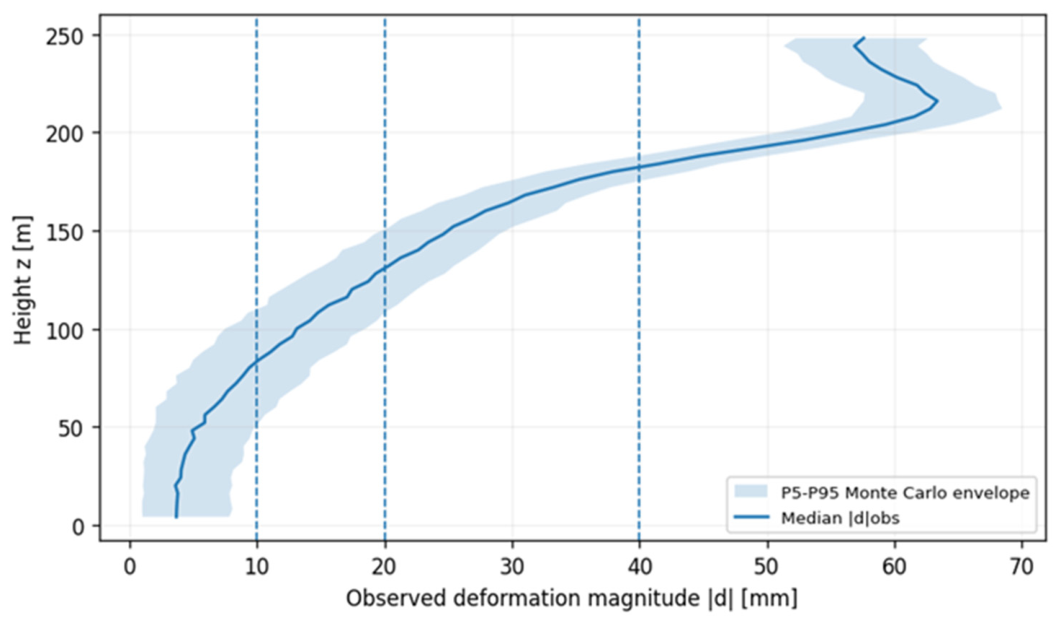
- the distributions of and (e.g., the median and the P5–P95 percentiles).
- the probabilities of exceeding the thresholds P( > Tk) and P( > Ek).
- the stability of zone classification for each storey:
| Algorithm 1. Monte Carlo uncertainty-propagation procedure for SI–SIV decision stability |
|
2.2.3. Multi-Stage Procedure
3. Synthetic Benchmark Case Study
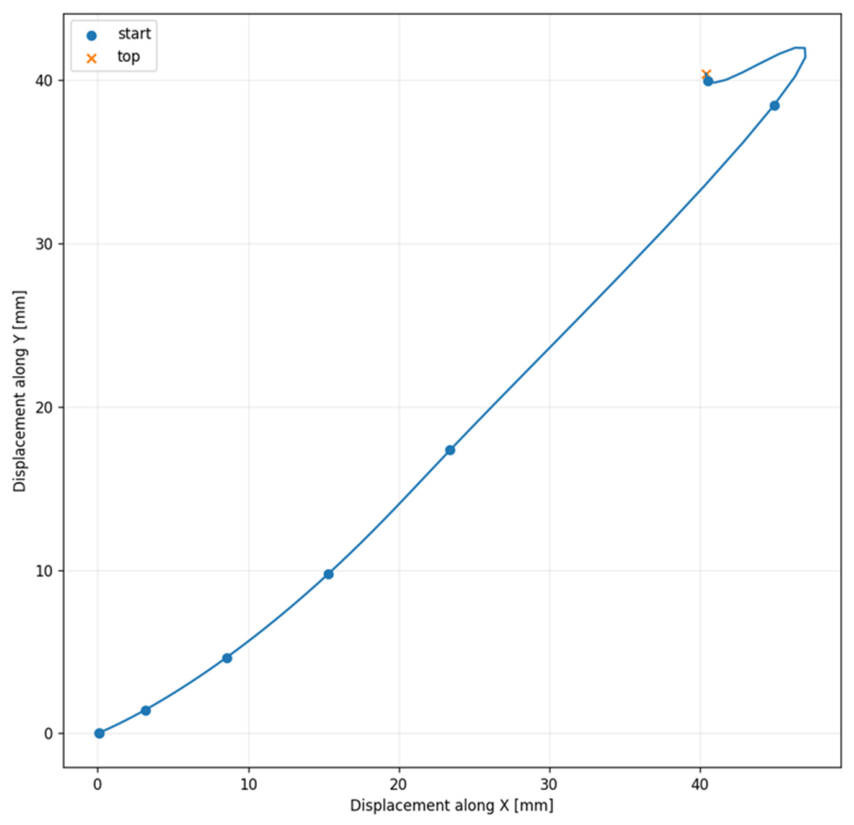
3.1. Benchmark Geometry and Prescribed Deformation Signal
3.2. Results of the Classification of Storeys into Decision Zones
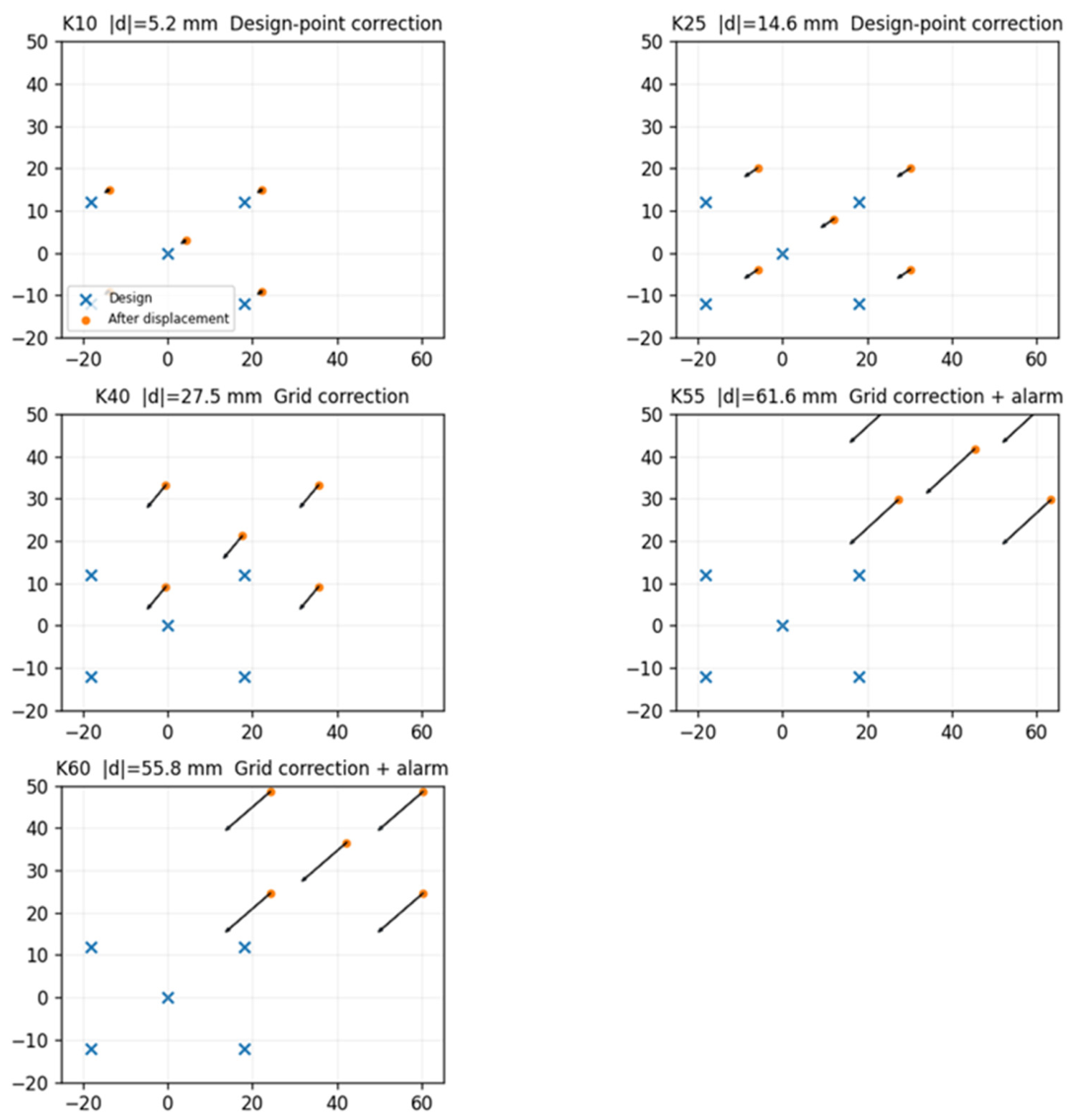
3.3. Adjustments to Floor Plans—Sketches and Surveying Interpretation
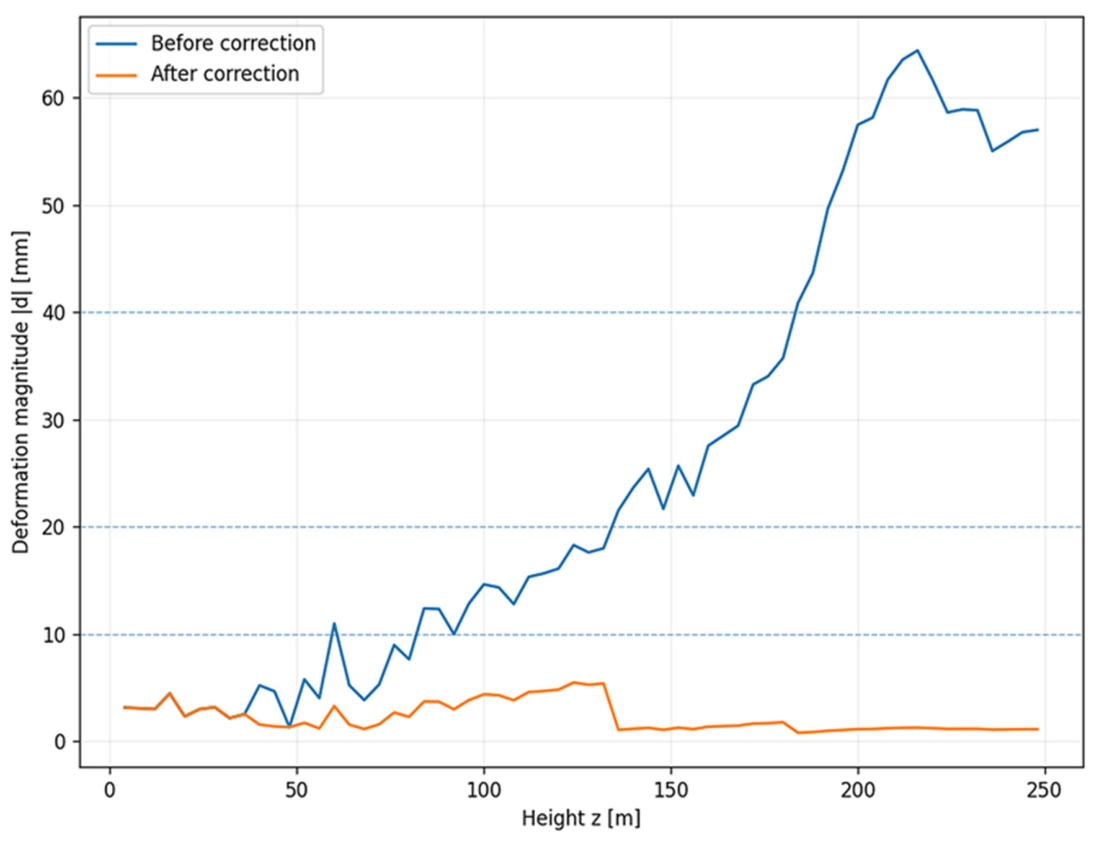
3.4. Effectiveness of the Correction Procedure Used
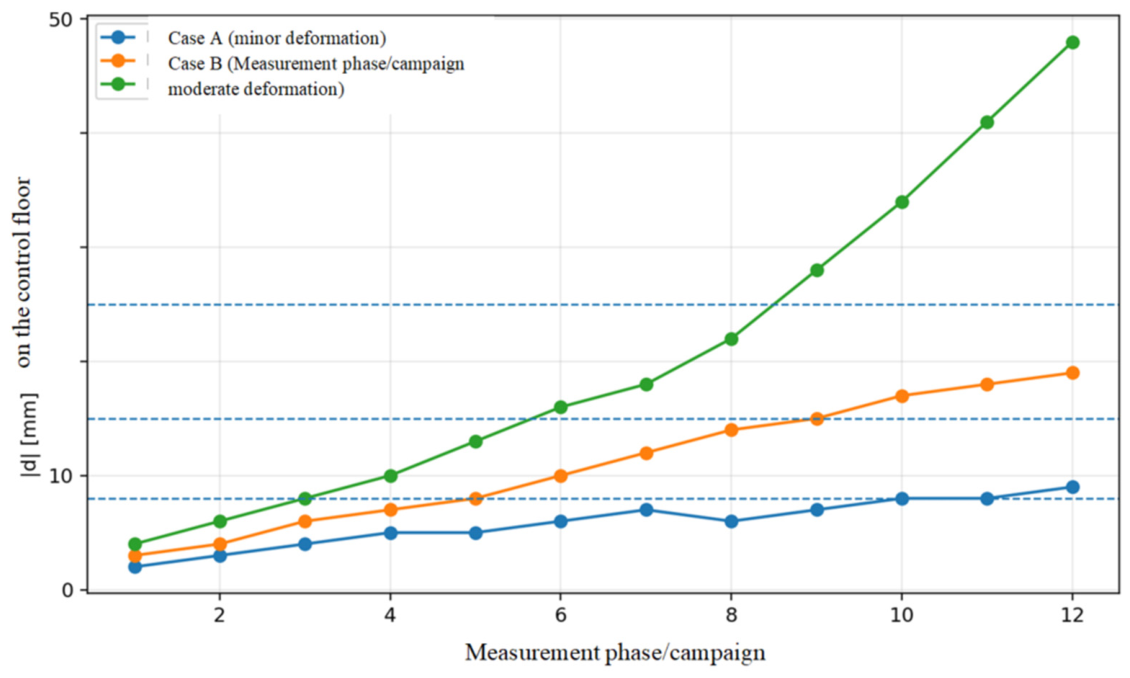
3.5. Illustrative Decision Scenarios (A–C)
3.6. Sensitivity of the Decision Outcomes to the Deformation-Profile Parameters
4. Discussion
5. Conclusions
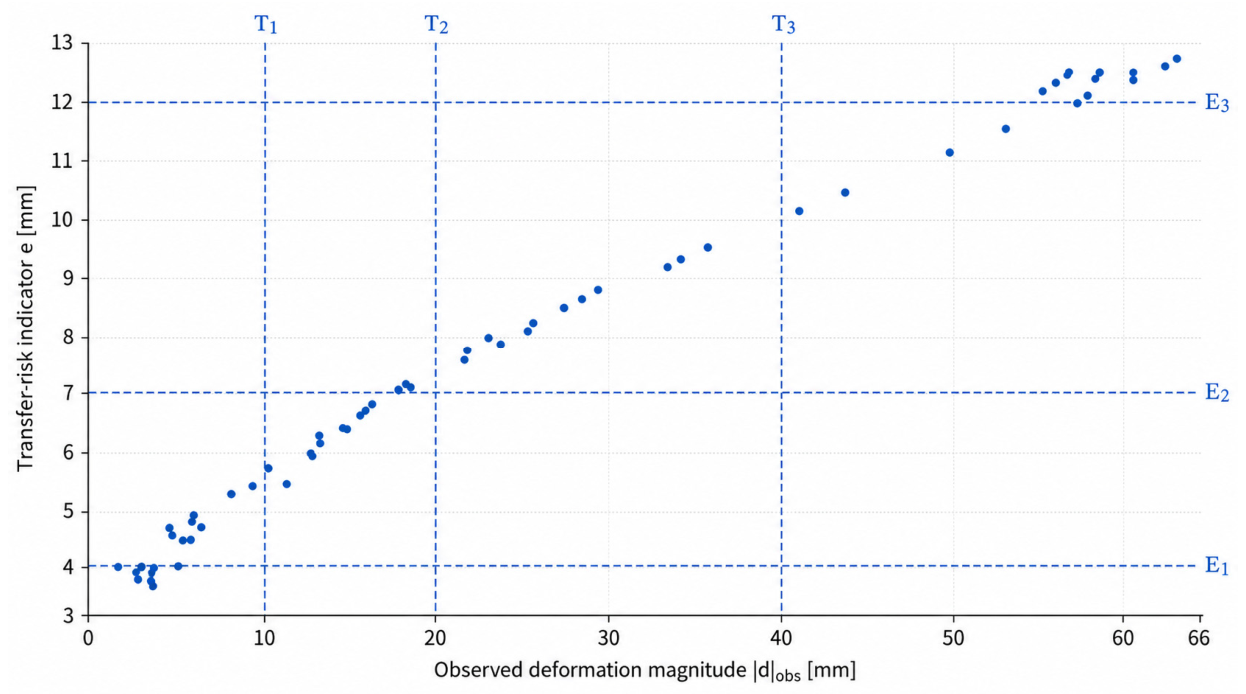
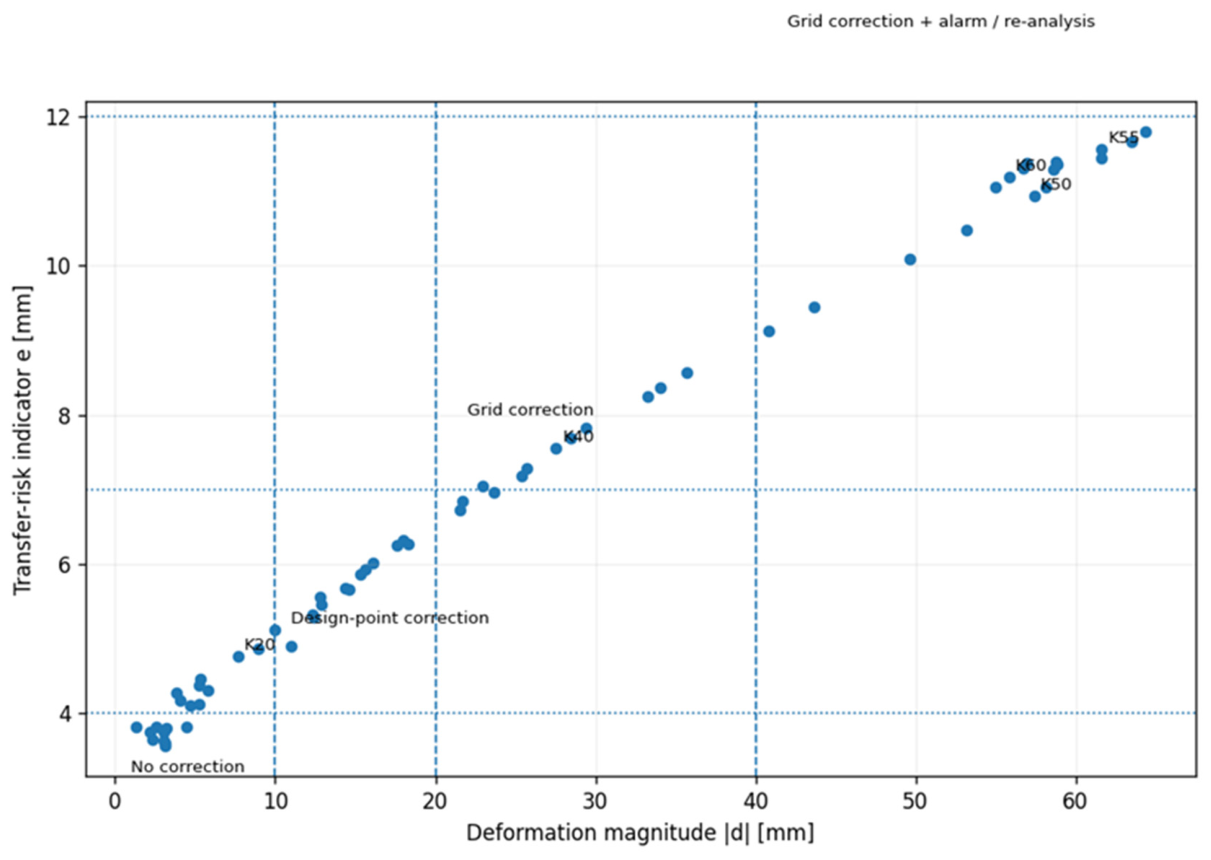
- Under the synthetic benchmark, the four-zone maximum-risk operator provides an internally consistent escalation rule from monitoring to design-point correction, grid correction and alarm/re-analysis. In the representative uncertainty realisation, 10, 23, 12 and 17 storeys fall in Zones I–IV, respectively.
- The residual values are conditional on = 2.5 mm, = 2.0 mm, the transfer-risk coefficients and the assumed 70/95/98% intervention efficiencies. Mean residuals in the representative realisation are about 3.29 mm in Zone II, 1.37 mm in Zone III, and 1.12 mm in Zone IV; these values are benchmark outputs and not demonstrated field accuracy.
- The Monte Carlo analysis represents repeated measurement-uncertainty realisations for one fixed prescribed deformation profile. It quantifies the stability of threshold crossing and zone assignment; it does not estimate structural-event probabilities and it is not a full GNSS control-network adjustment.
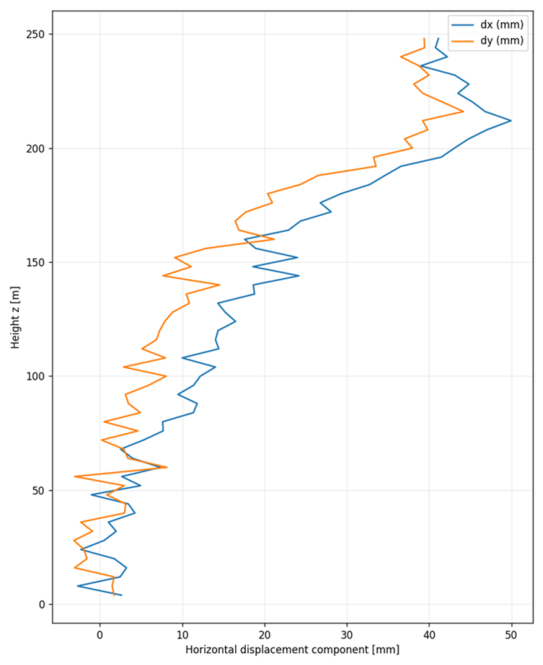
- Equation (8) is a synthetic stress-test signal combining a global height-dependent component with a localised bell-shaped anomaly. Its parameters are chosen to exercise the decision zones, not to predict deformation of a particular building; field application requires measured or structurally validated deformation inputs.
- The sensitivity analysis shows that the global profile parameters materially affect the height at which intervention becomes likely: for the tested ±20% changes, the 50% onset of Zones III–IV shifts from 120 to 152 m for parameter a and from 116 to 148 m for parameter p. This confirms that decision thresholds cannot be interpreted independently of the deformation model used as input.
- Field validation is therefore essential. Further work should include measured deformation histories, point-by-point network adjustment, full covariance and reliability analysis, comparison of GNSS and conventional surveying solutions, tests of control-point density and geometry, and empirical calibration of the thresholds, transfer-risk coefficients, and correction efficiencies.
Author Contributions
Funding
Data Availability Statement
Conflicts of Interest
References
- Im, S.B.; Hurlebaus, S.; Kang, Y.J. Summary Review of GPS Technology for Structural Health Monitoring. J. Struct. Eng. 2013, 139, 1653–1664. [Google Scholar] [CrossRef] [Scilit]
- Shan, J.; Zhang, H.; Shi, W.; Lu, X. Health monitoring and field-testing of high-rise buildings: A review. Struct. Concr. 2020, 21, 1272–1285. [Google Scholar] [CrossRef] [Scilit]
- Su, J.; Xia, Y.; Weng, S. Review on field monitoring of high-rise structures. Struct. Control Health Monit. 2020, 27, e2629. [Google Scholar] [CrossRef] [Scilit]
- Yang, Y.; Xu, W.; Gao, Z.; Yu, Z.; Zhang, Y. Research Progress of SHM System for Super High-Rise Buildings Based on Wireless Sensor Network and Cloud Platform. Remote Sens. 2023, 15, 1473. [Google Scholar] [CrossRef] [Scilit]
- Yi, T.-H.; Li, H.-N.; Gu, M. Recent Research and Applications of GPS-Based Monitoring Technology for High-Rise Structures. Struct. Control Health Monit. 2013, 20, 649–670. [Google Scholar] [CrossRef] [Scilit]
- Zhang, X.; Zhang, Y.; Li, B.; Qiu, G. GNSS-Based Verticality Monitoring of Super-Tall Buildings. Appl. Sci. 2018, 8, 991. [Google Scholar] [CrossRef] [Scilit]
- Quesada-Olmo, N.; Jimenez-Martinez, M.J.; Farjas-Abadia, M. Real-time high-rise building monitoring system using global navigation satellite system technology. Measurement 2018, 123, 115–124. [Google Scholar] [CrossRef] [Scilit]
- Lovse, J.W.; Teskey, W.F.; Lachapelle, G.; Cannon, M.E. Dynamic Deformation Monitoring of Tall Structure Using GPS Technology. J. Surv. Eng. 1995, 121, 35–40. [Google Scholar] [CrossRef] [Scilit]
- Tamura, Y.; Matsui, M.; Pagnini, L.-C.; Ishibashi, R.; Yoshida, A. Measurement of wind-induced response of buildings using RTK-GPS. J. Wind Eng. Ind. Aerodyn. 2002, 90, 1783–1793. [Google Scholar] [CrossRef] [Scilit]
- Park, H.S.; Sohn, H.G.; Kim, I.S.; Park, J.H. Application of GPS to monitoring of wind-induced responses of high-rise buildings. Struct. Des. Tall Build. 2008, 17, 117–132. [Google Scholar] [CrossRef] [Scilit]
- Yi, T.-H.; Li, H.-N.; Gu, M. Experimental assessment of high-rate GPS receivers for deformation monitoring of bridge. Measurement 2013, 46, 420–432. [Google Scholar] [CrossRef] [Scilit]
- He, Y.; Han, X.; Li, Q.; Zhu, H.; He, Y. Monitoring of wind effects on 600 m high Ping-An Finance Center during Typhoon Haima. Eng. Struct. 2018, 167, 308–326. [Google Scholar] [CrossRef] [Scilit]
- Su, J.Z.; Xia, Y.; Zhu, L.D.; Zhu, H.P.; Ni, Y.Q. Typhoon- and temperature-induced quasi-static responses of a supertall structure. Eng. Struct. 2017, 143, 91–100. [Google Scholar] [CrossRef] [Scilit]
- Li, Q.S.; Zhi, L.H.; Yi, J.; To, A.; Xie, J. Monitoring of typhoon effects on a super-tall building in Hong Kong: Monitoring of Typhoon Effects. Struct. Control Health Monit. 2014, 21, 926–949. [Google Scholar] [CrossRef] [Scilit]
- Yi, J.; Li, Q.S. Wind tunnel and full-scale study of wind effects on a super-tall building. J. Fluids Struct. 2015, 58, 236–253. [Google Scholar] [CrossRef] [Scilit]
- Choi, S.; Kim, Y.; Kim, J.; Park, H. Field Monitoring of Column Shortenings in a High-Rise Building during Construction. Sensors 2013, 13, 14321–14338. [Google Scholar] [CrossRef] [Scilit] [PubMed]
- Samarakkody, D.I.; Thambiratnam, D.P.; Chan, T.H.T.; Moragaspitiya, P.H.N. Differential axial shortening and its effects in high rise buildings with composite concrete filled tube columns. Constr. Build. Mater. 2017, 143, 659–672. [Google Scholar] [CrossRef] [Scilit]
- Elansary, A.; Metwally, M.I.; El-Attar, A. Assessment of mitigation alternatives for differential shortening in high-rise reinforced concrete buildings. J. Eng. Appl. Sci. 2023, 70, 152. [Google Scholar] [CrossRef] [Scilit]
- Moragaspitiya, P.; Thambiratnam, D.; Perera, N.; Chan, T. A numerical method to quantify differential axial shortening in concrete buildings. Eng. Struct. 2010, 32, 2310–2317. [Google Scholar] [CrossRef] [Scilit]
- Park, H.S. Optimal compensation of differential column shortening in high-rise buildings. Struct. Des. Tall Build. 2003, 12, 49–66. [Google Scholar] [CrossRef] [Scilit]
- Woo Park, S.; Woon Choi, S.; Seon Park, H. Moving average correction method for compensation of differential column shortenings in high-rise buildings. Struct. Des. Tall Build. 2013, 22, 718–728. [Google Scholar] [CrossRef] [Scilit]
- Yu, L.; Xiong, C.; Chen, W.; Gao, Y.; Ye, Z.; Shi, Q. A combined algorithm for denoising GNSS-RTK positioning solutions with application to displacement monitoring of a super-high-rise building. Meas. Sci. Technol. 2021, 32, 115121. [Google Scholar] [CrossRef] [Scilit]
- Yigit, C.O.; Bezcioglu, M.; Ilci, V.; Ozulu, I.M.; Alkan, R.M.; Dindar, A.A.; Karadeniz, B. Assessment of Real-Time PPP with Trimble RTX correction service for real-time dynamic displacement monitoring based on high-rate GNSS observations. Measurement 2022, 201, 111704. [Google Scholar] [CrossRef] [Scilit]
- Xiong, C.; Shang, Z.; Wang, M. Improved Hybrid Denoising Method for Dynamic Monitoring of a Super-High-Rise Building Based on a GNSS-RTK Technique. J. Struct. Eng. 2024, 150, 04024116. [Google Scholar] [CrossRef] [Scilit]
- Xiao, X.; Han, H.; Wang, J.; Li, D.; Chen, C.; Wang, L. Dynamic Deformation Analysis of Super High-Rise Buildings Based on GNSS and Accelerometer Fusion. Sensors 2025, 25, 2659. [Google Scholar] [CrossRef] [Scilit] [PubMed]
- ISO 4463-1:1989; Measurement Methods for Building—Setting-Out and Measurement—Part 1: Planning and Organization, Measuring Procedures, Acceptance Criteria. International Organization for Standardization: Geneva, Switzerland, 1989.
- EN 13670:2009; Execution of Concrete Structures. European Committee for Standardization: Brussels, Belgium, 2009.




| Symbol/Parameter | Value (in the Simulation) | Meaning |
|---|---|---|
| H | 248 m | Building height (reference object) |
| N | 62 | Number of storeys (height increment Δz = H/N = 4.0 m) |
| Projection | 36 × 24 m | Floor plan dimensions (regular model) |
| Control points | 5 (illustrative geometry) | 4 corners + centre point O; one common storey translation is simulated, not five independent point adjustments |
| Model | Equation (8) | Power-law baseline + deterministic localised bell-shaped anomaly; synthetic stress-test input, not a structural constitutive model |
| a | 55 mm | Amplitude of the global height-dependent component at z = H |
| p | 1.6 | Exponent of deviation increase with height |
| A, , | 20 mm, 210 m, 18 m | Localised-anomaly amplitude, centre height and vertical spread |
| Direction | = 20°; = 45° | Deterministic azimuth interpolation used only to obtain x–y components for visualisation |
| 2.5 mm | Scenario standard deviation of independent horizontal Global Navigation Satellite System (GNSS) coordinate noise (processed solution + centring/stabilisation) | |
| 2.0 mm | Scenario standard deviation of a two-dimensional reference-frame bias drawn once per Monte Carlo campaign | |
| Equation (16) | Transfer-risk indicator [mm]; not a statistical error or standard deviation | |
| 10 µm/m = 0.01 mm/m | Height coefficient in the transfer-risk indicator | |
| 0.10 | Dimensionless deformation coefficient in the transfer-risk indicator | |
| Monte Carlo | 500 realisations | Distribution and decision-stability analysis |
| thresholds | T1 = 10 mm; T2 = 20 mm; T3 = 40 mm | Internal intervention thresholds for deformation magnitude |d| |
| e thresholds | E1 = 4 mm; E2 = 7 mm; E3 = 12 mm | Internal intervention thresholds for the transfer-risk indicator e |
| Zone | Number of Storeys | Mean |d| [mm] | Maximum |d| [mm] | Mean Transfer-Risk e [mm] | Mean Residual After Correction [mm] |
|---|---|---|---|---|---|
| I | 10 | 2.83 | 4.46 | 3.71 | 2.83 |
| II | 23 | 10.96 | 18.29 | 5.17 | 3.29 |
| III | 12 | 27.43 | 35.70 | 7.52 | 1.37 |
| IV | 17 | 56.16 | 64.35 | 10.98 | 1.12 |
| Storey | z [m] | [mm] | [mm] | || [mm] | e [mm] | Decision (Maximum-Risk) | Residual [mm] |
|---|---|---|---|---|---|---|---|
| 1 | 4.00 | 2.63 | 1.74 | 3.15 | 3.56 | No correction (Zone I) | 3.15 |
| 10 | 40.00 | 4.27 | 3.01 | 5.22 | 4.12 | Design-point correction (Zone II) | 1.57 |
| 20 | 80.00 | 7.63 | 0.52 | 7.65 | 4.77 | Design-point correction (Zone II) | 2.29 |
| 30 | 120.00 | 14.37 | 7.27 | 16.10 | 6.01 | Design-point correction (Zone II) | 4.83 |
| 40 | 160.00 | 17.59 | 21.19 | 27.54 | 7.56 | Grid correction (Zone III) | 1.38 |
| 50 | 200.00 | 43.08 | 37.98 | 57.43 | 10.94 | Grid correction + alarm/re-analysis (Zone IV) | 1.15 |
| 55 | 220.00 | 45.35 | 41.72 | 61.62 | 11.56 | Grid correction + alarm/re-analysis (Zone IV) | 1.23 |
| 60 | 240.00 | 42.21 | 36.55 | 55.84 | 11.19 | Grid correction + alarm/re-analysis (Zone IV) | 1.12 |
| Case | Perturbed Value | Mean Share in Zones III–IV [%] | Height Where P(SIII–IV) ≥ 0.5 [m] | Height Where P(SIV) ≥ 0.5 [m] |
|---|---|---|---|---|
| Baseline | a = 55 mm; p = 1.60; A = 20 mm | 48.4 | 132 | 184 |
| a −20% | a = 44 mm | 40.9 | 152 | 192 |
| a +20% | a = 66 mm | 53.9 | 120 | 176 |
| p −20% | p = 1.28 | 55.9 | 116 | 180 |
| p +20% | p = 1.92 | 42.6 | 148 | 188 |
| A −20% | A = 16 mm | 48.4 | 132 | 188 |
| A +20% | A = 24 mm | 48.4 | 132 | 184 |
Disclaimer/Publisher’s Note: The statements, opinions and data contained in all publications are solely those of the individual author(s) and contributor(s) and not of MDPI and/or the editor(s). MDPI and/or the editor(s) disclaim responsibility for any injury to people or property resulting from any ideas, methods, instructions or products referred to in the content. |
© 2026 by the authors. Licensee MDPI, Basel, Switzerland. This article is an open access article distributed under the terms and conditions of the Creative Commons Attribution (CC BY) license.
Share and Cite
Krawczyk, K.; Odziemczyk, W. Simulation-Based Decision Framework for Adaptive Construction Control in High-Rise Buildings: Structural Deformation and Correction Criteria. Buildings 2026, 16, 3710. https://doi.org/10.3390/buildings16183710
Krawczyk K, Odziemczyk W. Simulation-Based Decision Framework for Adaptive Construction Control in High-Rise Buildings: Structural Deformation and Correction Criteria. Buildings. 2026; 16(18):3710. https://doi.org/10.3390/buildings16183710
Chicago/Turabian StyleKrawczyk, Karol, and Waldemar Odziemczyk. 2026. "Simulation-Based Decision Framework for Adaptive Construction Control in High-Rise Buildings: Structural Deformation and Correction Criteria" Buildings 16, no. 18: 3710. https://doi.org/10.3390/buildings16183710
APA StyleKrawczyk, K., & Odziemczyk, W. (2026). Simulation-Based Decision Framework for Adaptive Construction Control in High-Rise Buildings: Structural Deformation and Correction Criteria. Buildings, 16(18), 3710. https://doi.org/10.3390/buildings16183710