Why She Stays: A Role-Based Analysis of Women’s Motivations in Construction


 ,
,  ,
,  and
and 
Abstract
1. Introduction
Gaps in the Existing Research
- RQ1: What motivates women to enter site-based, office-based, and fluid roles in the construction industry?
- Objective 1: Identify the themes shaping women’s motivation across the three role types.
- RQ2: How do these role-based motivational differences inform targeted recruitment and retention strategies?
- Objective 2: Translate the comparative findings into role-specific recommendations for attracting and sustaining women in construction careers.
2. Literature Review
2.1. Masculine Culture and Workplace Environment
2.2. Glass Ceiling and Leaky Pipeline
2.3. Motivations for Career Entry in Construction
2.3.1. Intrinsic Motivations
2.3.2. Extrinsic Motivations
2.3.3. Social Motivations
2.4. Job Roles and Role Differentiation in Construction
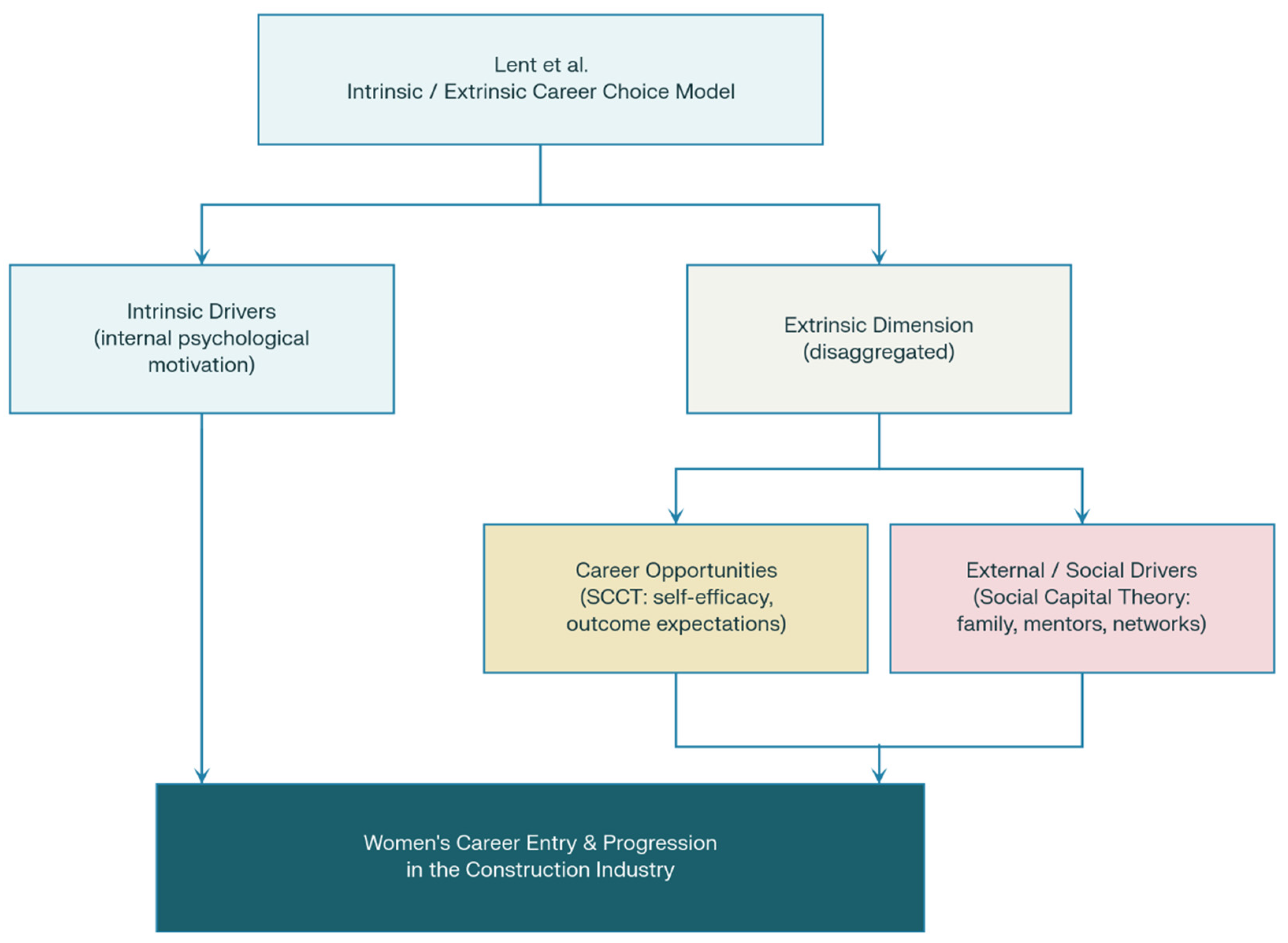
3. Theoretical/Conceptual Framework
4. Research Method
4.1. Sample
4.2. Data Collection
4.3. Data Analysis
4.4. Ethics Statement
5. Findings
5.1. Intrinsic Drivers
5.2. Career Opportunities
5.3. External/Social Drivers
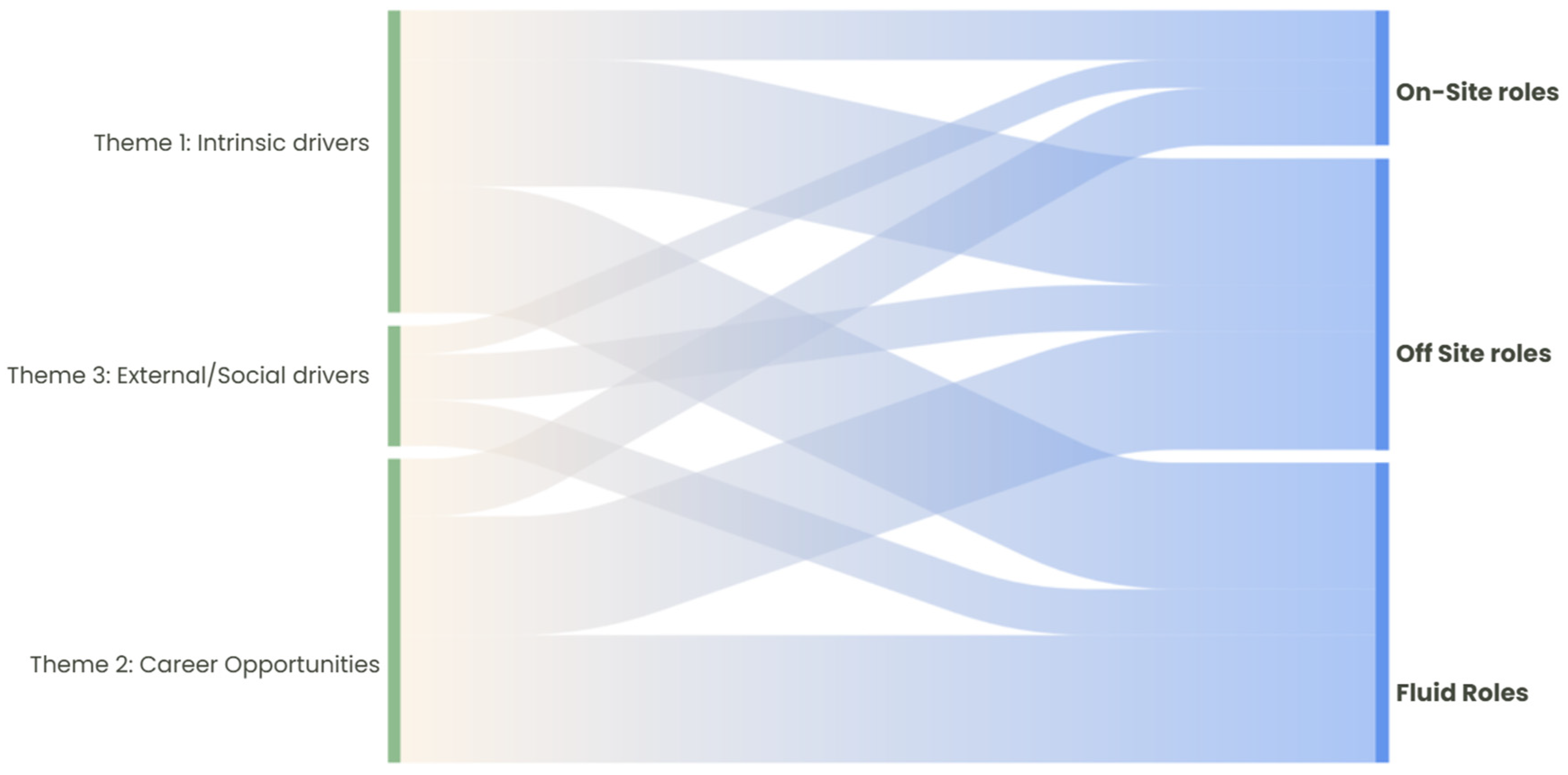
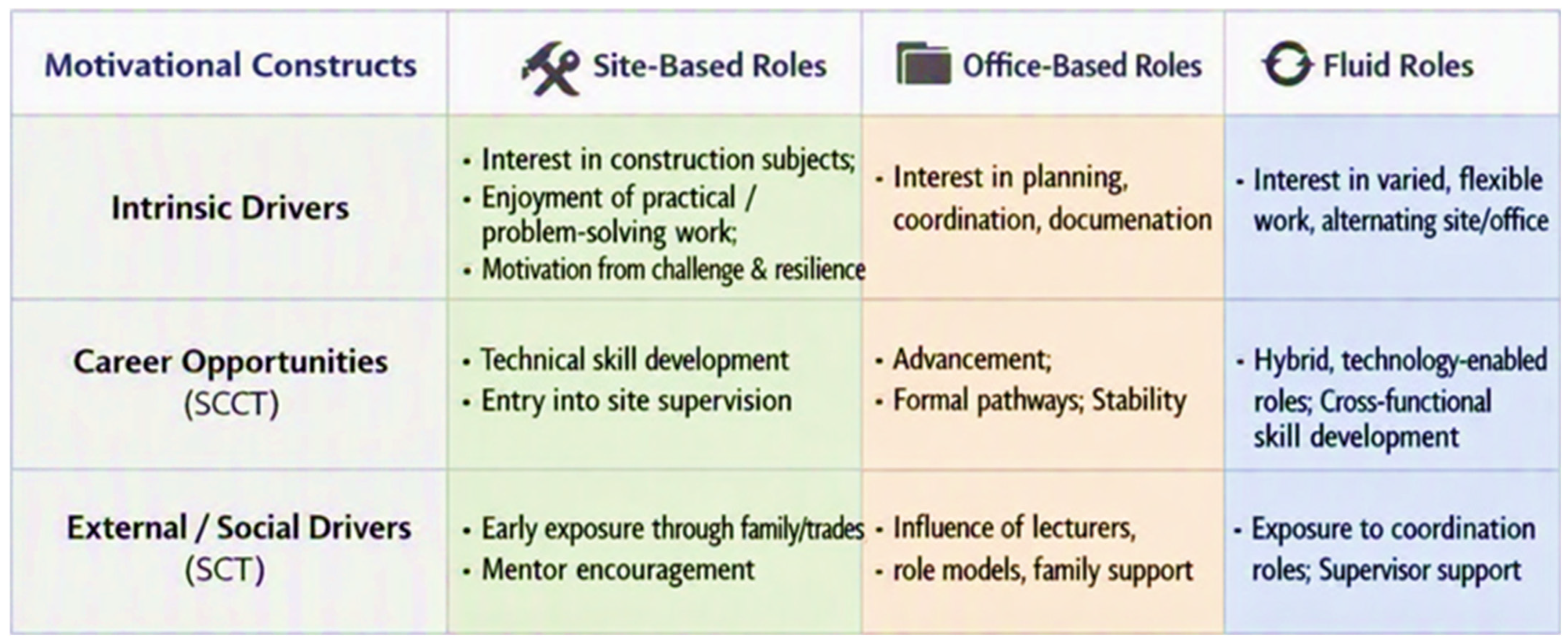
5.4. Cross-Role Comparison
6. Discussion
6.1. Intrinsic Drivers
6.2. Career Opportunities
6.3. External/Social Drivers
7. Contributions, Implications, and Recommendations
Author Contributions
Funding
Institutional Review Board Statement
Informed Consent Statement
Data Availability Statement
Acknowledgments
Conflicts of Interest
Abbreviations
| COR | Conservation of Resources |
| SCCT | Social Cognitive Career Theory |
| SCT | Social Capital Theory |
| BCW | Behaviour Change Wheel |
| COM-B | Capability, Opportunity, Motivation–Behaviour |
| STEM | Science, Technology, Engineering and Mathematics |
| NAWIC | National Association of Women in Construction |
| ACED | Architecture, Construction, Engineering, Development |
| W-BIM | Women in Building Information Modelling (BIM) |
References
- Holdsworth, S.; Sandri, O.; Turner, M.; West, M. Increasing women in construction using public procurement: Exploring the impact of a government-led building equality Policy. Gend. Work Organ. 2026, 33, 2114–2128. [Google Scholar] [CrossRef] [Scilit]
- Australian Bureau of Statistics. Characteristics of Employment, Tablebuilder. Australian Bureau of Statistics. 2014 to 2024. Available online: https://www.abs.gov.au/statistics/microdata-tablebuilder/available-microdata-tablebuilder/characteristics-employment-australia (accessed on 16 July 2026).
- Ghanbaripour, A.N.; Tumpa, R.J.; Sunindijo, R.Y.; Zhang, W.; Yousefian, P.; Camozzi, R.N.; Hon, C.; Talebian, N.; Liu, T.; Hemmati, M. Retention over attraction: A review of women’s experiences in the Australian construction industry; challenges and solutions. Buildings 2023, 13, 490. [Google Scholar] [CrossRef] [Scilit]
- Senaratne, S.; Jayakodi, S.; Pascoe, R.D.; Atkins, A. Challenges and strategies for the retention of female construction professionals: An empirical study in Australia. Buildings 2025, 15, 2187. [Google Scholar] [CrossRef] [Scilit]
- Talari, N.; Palagiri, A.; Tawalare, A. Factors influencing the professional lives of women civil engineers in India: A structural equation modeling approach. J. Civ. Eng. Educ. 2026, 152, 04026010. [Google Scholar] [CrossRef] [Scilit]
- Edirisinghe, R.; Rathnayake, B. Using the behaviour change wheel-based interventions to improve gender diversity in construction: A systematic literature review. Eng. Constr. Archit. Manag. 2025, 32, 234–257. [Google Scholar] [CrossRef] [Scilit]
- English, J.; Hay, P. Black South African women in construction: Cues for success. J. Eng. Des. Technol. 2015, 13, 144–164. [Google Scholar] [CrossRef] [Scilit]
- Hasan, A.; Tivendale, L.; Udawatta, N.; Mahmood, M.N. Personal and organizational factors for plugging the leaky pipeline: Learnings from the experiences of early career female construction management professionals. J. Manag. Eng. 2024, 40, 04024059. [Google Scholar] [CrossRef] [Scilit]
- Muthambi, L.; Agumba, J.N.; Adebowale, O.J. Motivating factors for professional women in construction career progression. Int. J. Manpow. 2025, 46, 853–866. [Google Scholar] [CrossRef] [Scilit]
- Francis, V. What influences professional women’s career advancement in construction? Constr. Manag. Econ. 2017, 35, 254–275. [Google Scholar] [CrossRef] [Scilit]
- Ardeshiri, A.; Vij, A.; Arthur, N. Attracting young women to construction careers: A preference study to inform workforce strategies. Constr. Manag. Econ. 2026, 44, 214–239. [Google Scholar] [CrossRef] [Scilit]
- Carnemolla, P.; Galea, N. Why Australian female high school students do not choose construction as a career: A qualitative investigation into value beliefs about the construction industry. J. Eng. Educ. 2021, 110, 819–839. [Google Scholar] [CrossRef] [Scilit]
- Dainty, A.R.; Bagilhole, B.M.; Neale, R.H. A grounded theory of women’s career under-achievement in large UK construction companies. Constr. Manag. Econ. 2000, 18, 239–250. [Google Scholar] [CrossRef] [Scilit]
- Acker, J. Hierarchies, jobs, bodies: A theory of gendered organizations. Gend. Soc. 1990, 4, 139–158. [Google Scholar]
- Norberg, C.; Johansson, M. “Women and “ideal” women”: The representation of women in the construction industry. Gend. Issues 2021, 38, 1–24. [Google Scholar] [CrossRef] [Scilit]
- Hing, L.S.; Sakr, N.; Sorenson, J.B.; Stamarski, C.S.; Caniera, K.; Colaco, C. Gender inequities in the workplace: A holistic review of organizational processes and practices. Hum. Resour. Manag. Rev. 2023, 33, 100968. [Google Scholar] [CrossRef] [Scilit]
- Kalev, A.; Deutsch, G. Gender inequality and workplace organizations: Understanding reproduction and change. In Handbook of the Sociology of Gender; Springer: Cham, Switzerland, 2018; pp. 257–269. [Google Scholar] [CrossRef] [Scilit]
- Tumpa, R.J.; Ghanbaripour, A.N.; Brotto, G.; Amar, J.H.; Zhang, W.; Ghamarimajd, Z.; Talebian, N.; Sunindijo, R.Y.; Yousefian, P. Hard hats and glass ceilings: Women’s experiences in the construction industry in developed western nations. J. Constr. Eng. Manag. 2025, 151, 04025161. [Google Scholar] [CrossRef] [Scilit]
- Debs, L.; Kota, B.R. Gender differences in construction management students’ sense of belonging. In Proceedings of the 2021 ASEE Virtual Annual Conference Content Access, Virtual, 26 July 2021–19 July 2022. [Google Scholar]
- Yan, D.; Sunindijo, R.Y.; Wang, C.C.; Ding, Y.; Yang, Z. Gendered self-presentation in the construction industry: Insights from linkedin narratives and in-depth interviews. J. Constr. Eng. Manag. 2026, 152, 04026138. [Google Scholar] [CrossRef] [Scilit]
- Amponsah-Asante, L.N.; Botchway, B.; Ofori, J.N.; Acheampong, A.; Simpeh, E.K.; Antwi-Afari, M.F. The future is built by all: Unearthing barriers to women’s career progression and retention in the construction industry. Int. J. Constr. Manag. 2026, 26, 2408–2426. [Google Scholar] [CrossRef] [Scilit]
- Zhang, R.P.; Holdsworth, S.; Turner, M.; Andamon, M.M. Does gender really matter? A closer look at early career women in construction. Constr. Manag. Econ. 2021, 39, 669–686. [Google Scholar] [CrossRef] [Scilit]
- Chandra, V.; Loosemore, M. Women’s self-perception: An inter-sector comparison of construction, legal and nursing professionals. Constr. Manag. Econ. 2004, 22, 947–956. [Google Scholar] [CrossRef] [Scilit]
- Yang, H.; Li, H.; Wang, G.; Cao, D.; Huang, B. What Drives Workers into the Labor-Intensive Chinese Construction Industry: Profiling Motivational Diversity across Heterogeneous Groups. J. Constr. Eng. Manag. 2026, 152, 05026002. [Google Scholar] [CrossRef] [Scilit]
- Borg, J.; Scott-Young, C.M.; Bartram, T. The role of HRM in supporting the career advancement of early-career professional women in construction: A conceptual model. Empl. Relat. Int. J. 2026, 48, 1–21. [Google Scholar] [CrossRef] [Scilit]
- Rodrigo, N.; Wijewickrama, M.K.; Rajenthiran, N.; Jayathilaka, W.; Chang, R. Challenges and solutions for women in construction industry related disciplines: A literature review. In Proceedings of the 12th World Construction Symposium; University of Moratuwa: Moratuwa, Sri Lanka, 2024; p. 331. [Google Scholar]
- Rutherford, N.N.; Daniel, E.I. A systematic review of the barriers and attraction strategies for females in construction. Proc. Inst. Civ. Eng.-Manag. Procure. Law. 2025, 178, 140–150. [Google Scholar] [CrossRef] [Scilit]
- Afful, A.E.; Wang, C.C.; Sunindijo, R.Y.; Frimpong, S.; Boadu, E.; Baah, B. Evolving job roles of women in the construction industry. J. Constr. Eng. Manag. 2025, 151, 03125001. [Google Scholar] [CrossRef] [Scilit]
- Lent, R.W.; Brown, S.D.; Hackett, G. Toward a unifying social cognitive theory of career and academic interest, choice, and performance. J. Vocat. Behav. 1994, 45, 79–122. [Google Scholar] [CrossRef] [Scilit]
- Portes, A. Social capital: Its origins and applications in modern sociology. Annu. Rev. Sociol. 1998, 24, 1–24. [Google Scholar] [CrossRef] [Scilit]
- Braun, V.; Clarke, V. Using thematic analysis in psychology. Qual. Res. Psychol. 2006, 3, 77–101. [Google Scholar] [CrossRef] [Scilit]
- Powell, A.; Bagilhole, B.M.; Dainty, A.R.J.; Neale, R.H. An investigation of women’s career choice in construction. In 20th Annual ARCOM Conference, 1–3 September 2004; Khosrowshahi, F., Ed.; Heriot Watt University. Association of Researchers in Construction Management: Edinburgh, UK, 2004; Volume 1, pp. 477–484. [Google Scholar]
- Hashiguchi, N.; Sengoku, S.; Kubota, Y.; Kitahara, S.; Lim, Y.; Kodama, K. Age-dependent influence of intrinsic and extrinsic motivations on construction worker performance. Int. J. Environ. Res. Public Health 2021, 18, 111. [Google Scholar] [CrossRef] [Scilit] [PubMed]
- Blosser, E.G. An Analysis of gendered outreach messages on the engineer girl website: How female engineers promote engineering to young women. In Proceedings of the 2021 ASEE Virtual Annual Conference Content Access, Virtual, 26 July 2021–19 July 2022. [Google Scholar]
- Blosser, E. Undoing Gender: How young women decide to become engineers. J. Women Minor. Sci. Eng. 2024, 30, 29–53. [Google Scholar] [CrossRef] [Scilit]
- Sugathadasa, R.; De Silva, M.L.; Thibbotuwawa, A.; Bandara, K.A. Motivation factors of engineers in private sector construction industry. J. Appl. Eng. Sci. 2021, 19, 794–805. [Google Scholar] [CrossRef] [Scilit]
- Rasheed, E.O.; Yu, J.; Hale, S.; Booth, N. The impact of external and internal sources of motivation on young women’s interest in construction-related careers: An exploratory study. Int. J. Constr. Educ. Res. 2022, 18, 159–178. [Google Scholar] [CrossRef] [Scilit]
- Lu, S.L.; Sexton, M. Career journeys and turning points of senior female managers in small construction firms. Constr. Manag. Econ. 2010, 28, 125–139. [Google Scholar] [CrossRef] [Scilit]
- Toohey, T.; Colosimo, D.; Boak, A. Australia’s Hidden Resource: The Economic Case for Increasing Female Participation; Goldman Sachs JBWere Investment Research: Sydney, Australia, 2009. Available online: https://web.archive.org/web/20110218012530/http://www.eowa.gov.au/Pay_Equity/Files/Australias_hidden_resource.pdf (accessed on 16 July 2026).
- Radford, A.; Kim, J.W.; Hallacy, C.; Ramesh, A.; Goh, G.; Agarwal, S.; Sastry, G.; Askell, A.; Mishkin, P.; Clark, J.; et al. Learning transferable visual models from natural language supervision. In Proceedings of the International Conference on Machine Learning, PmLR, Virtual, 18–24 July 2021; Volume 139, pp. 8748–8763. [Google Scholar]
- Whittock, M. Women’s experiences of non-traditional employment: Is gender equality in this area a possibility? Constr. Manag. Econ. 2002, 20, 449–456. [Google Scholar] [CrossRef] [Scilit]
- Watts, J.H. Leaders of men: Women ‘managing’ in construction. Work. Employ. Soc. 2009, 23, 512–530. [Google Scholar] [CrossRef] [Scilit]
- Ray, C. Dissecting Human Capital Resources: Unpacking the Structure and Activation of Human Capital Resources Within Firms. Ph.D. Thesis, University of South Carolina, Columbia, SC, USA, May 2022. [Google Scholar]
- Sang, K.; Powell, A. Gender inequality in the construction industry: Lessons from Pierre Bourdieu. In Proceedings of the 28th Annual ARCOM Conference, 3–5 September 2012; Smith, S.D., Ed.; Association of Researchers in Construction Management: Edinburgh, UK, 2012; pp. 237–247. [Google Scholar]
- Afful, A.E.; Wang, C.C.; Sunindijo, R.Y. Tapping into the Potential of Construction Technologies to Increase the Participation of Women in the Construction Industry. J. Constr. Eng. Manag. 2026, 152, 03126015. [Google Scholar] [CrossRef] [Scilit]



| Motivation Type | Key Drivers | Barriers | Trends |
|---|---|---|---|
| Intrinsic | Personal interest, self alignment, resilience | Career aspiration–reality gap | Increasing focus on self-perception and intrinsic resilience |
| Extrinsic | Financial rewards, job security, work–life balance | Limited career advancement, inflexible work hours | Growing emphasis on flexible policies and structured training |
| Social | Family support, mentorship, role models | Negative perceptions, male-dominated culture | Shift towards improving industry image and leveraging social networks |
| Participant ID | Years in Construction | Current Job Title | Role Category | Organisation Type | Organisation Size |
|---|---|---|---|---|---|
| SR-01 | 6 years | Site Engineer | Site Role | Builder | Tier 1 |
| SR-02 | 4 years | WHSE Advisor | Site Role | Builder | Tier 1 |
| SR-03 | 4 years | Site Engineer | Site Role | Builder | Tier 1 |
| SR-04 | 10 years | Plumber | Site Roles | Subcontractor | Tier 3 |
| SR-05 | 5 years | Site Engineer | Site Roles | Builder | Tier 1 |
| SR-06 | 4 Years | Carpenter | Site Roles | Builder | Tier 1 |
| SR-07 | 4 Years | WHSE Coordinator | Site Roles | Builder | Tier 1 |
| SR-08 | 7 years | Site Officer | Site Roles | Off-site modular company | Tier 2 |
| SR-09 | 8 years | Carpenter | Site Roles | Subcontractor | Tier 3 |
| FR-01 | 10 years | Prefab Specialist | Fluid Role | Builder | Tier 1 |
| FR-02 | 15 years | Project Manager | Fluid Role | Builder | Tier 1 |
| FR-03 | 23 years | Project Director | Fluid Role | Builder | Tier 1 |
| FR-04 | 4 years | Project Manager | Fluid Role | Consultant | Tier 2 |
| FR-05 | 10 years | Project Engineer | Fluid Role | Builder | Tier 1 |
| FR-06 | 4 Years | Project Manager | Fluid Role | Consultant | Tier 1 |
| FR-07 | 6 Years | Project Manager | Fluid Role | Consultant | Tier 1 |
| FR-08 | 5 Years | Project Manager | Fluid Role | Consultant | Tier 1 |
| FR-09 | 5 Years | Project Engineer | Fluid Role | Consultant | Tier 1 |
| OFR-01 | 15 Years | Design Systems lead | Office-based role | Consultant | Tier 2 |
| OFR-02 | 5 Years | Senior People Advisor | Office-based role | Builder | Tier 1 |
| OFR-03 | 6 Years | Submissions Manager | Office-based role | Builder | Tier 1 |
| OFR-04 | 7 Years | Cost Planner/Estimator | Office-based role | Consultant | Tier 2 |
| OFR-05 | 7 Years | Senior Structural Engineer | Office-based role | Consultant | Tier 2 |
| OFR-06 | 23 Years | Co-Founder | Office-based role | Consultant | Tier 3 |
| OFR-07 | 12 Years | Cost Planner/Estimator | Office-based role | Builder | Tier 2 |
| OFR-08 | 12 Years | Company Director | Office-based role | Builder | Tier 3 |
| OFR-09 | 20 Years | Senior Structural Engineer | Office-based role | Consultant | Tier 1 |
| OFR-10 | 22 years | Founding Director | Office-based role | Consultant | Tier 3 |
| OFR-11 | 6 Years | Cost Planner/Estimator | Office-based role | Consultant | Tier 2 |
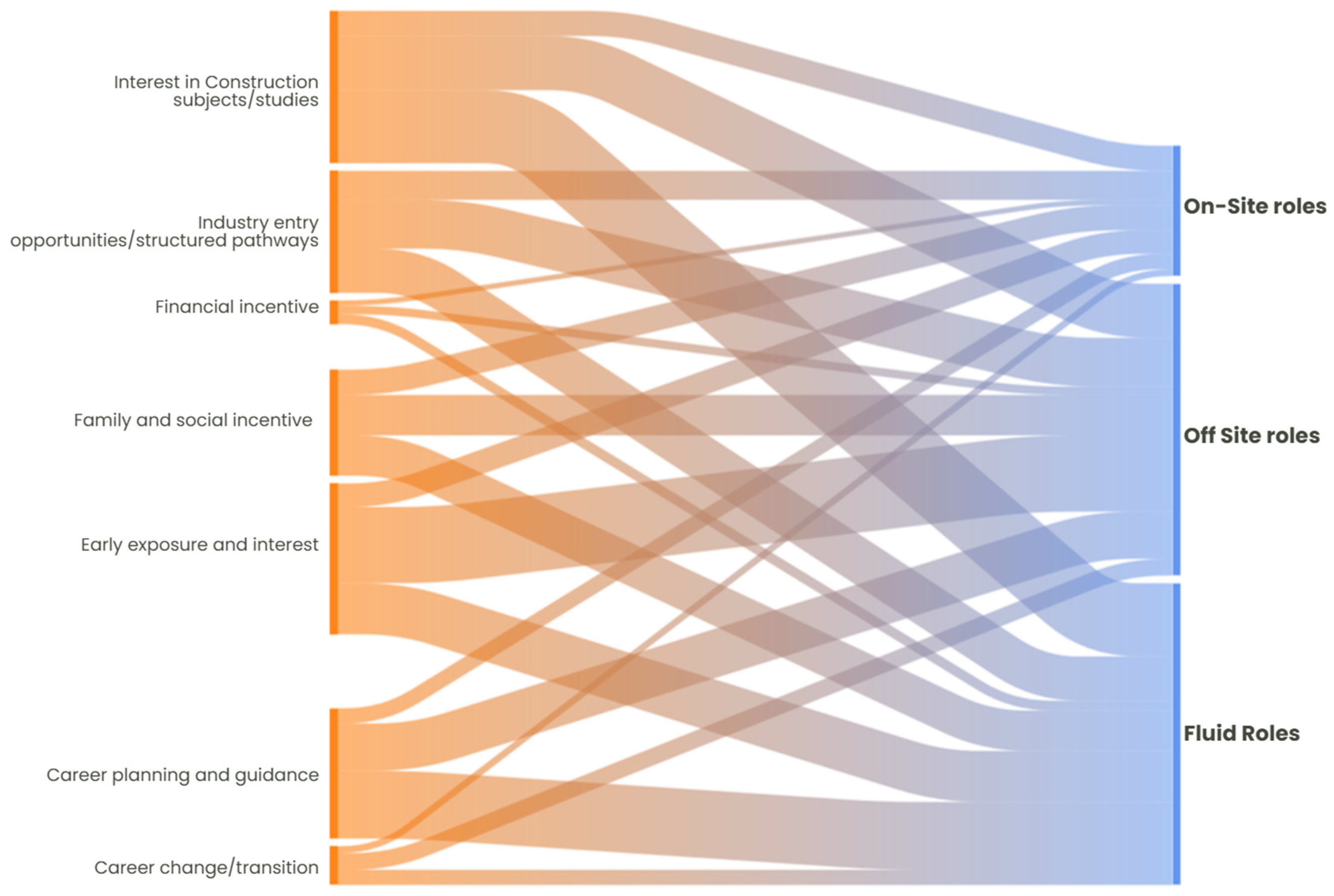
| Code | Quotations (n) | Share of Total (%) | Theoretical Theme |
|---|---|---|---|
| Interest in construction subjects/studies | 90 | 21.0 | Intrinsic drivers |
| Early exposure and interest | 89 | 20.8 | Intrinsic drivers |
| Career planning and guidance | 77 | 18.0 | Career opportunities |
| Industry entry opportunities/structured pathways | 72 | 16.8 | Career opportunities |
| Family and social incentive | 63 | 14.7 | External/social drivers |
| Career change/transition | 23 | 5.4 | Career opportunities |
| Financial incentive | 14 | 3.3 | External/social drivers |
Disclaimer/Publisher’s Note: The statements, opinions and data contained in all publications are solely those of the individual author(s) and contributor(s) and not of MDPI and/or the editor(s). MDPI and/or the editor(s) disclaim responsibility for any injury to people or property resulting from any ideas, methods, instructions or products referred to in the content. |
© 2026 by the authors. Licensee MDPI, Basel, Switzerland. This article is an open access article distributed under the terms and conditions of the Creative Commons Attribution (CC BY) license.
Share and Cite
Afful, A.E.; Wang, C.C.; Sunindijo, R.Y.; Baah, B.; Otsyina, G. Why She Stays: A Role-Based Analysis of Women’s Motivations in Construction. Buildings 2026, 16, 3709. https://doi.org/10.3390/buildings16183709
Afful AE, Wang CC, Sunindijo RY, Baah B, Otsyina G. Why She Stays: A Role-Based Analysis of Women’s Motivations in Construction. Buildings. 2026; 16(18):3709. https://doi.org/10.3390/buildings16183709
Chicago/Turabian StyleAfful, Aba Essanowa, Cynthia Changxin Wang, Riza Yosia Sunindijo, Benjamin Baah, and Grace Otsyina. 2026. "Why She Stays: A Role-Based Analysis of Women’s Motivations in Construction" Buildings 16, no. 18: 3709. https://doi.org/10.3390/buildings16183709
APA StyleAfful, A. E., Wang, C. C., Sunindijo, R. Y., Baah, B., & Otsyina, G. (2026). Why She Stays: A Role-Based Analysis of Women’s Motivations in Construction. Buildings, 16(18), 3709. https://doi.org/10.3390/buildings16183709