Article

Why She Stays: A Role-Based Analysis of Women’s Motivations in Construction

by
Aba Essanowa Afful
1,*,
Cynthia Changxin Wang
1,
Riza Yosia Sunindijo
1,
Benjamin Baah
2 and
Grace Otsyina
3
1
School of Built Environment, The University of New South Wales (UNSW), Sydney, NSW 2052, Australia
2
School of Civil Engineering and Construction Management, Adelaide University, Adelaide, SA 5005, Australia
3
Department of Construction Technology and Management, Kwame Nkrumah University of Science and Technology, Kumasi AK384, Ghana
*
Author to whom correspondence should be addressed.
Buildings 2026, 16(18), 3709; https://doi.org/10.3390/buildings16183709
Submission received: 21 July 2026 / Revised: 8 September 2026 / Accepted: 15 September 2026 / Published: 17 September 2026

Abstract

The construction industry is actively promoting female participation, but the motivation to drive their entry and stay, particularly into different job roles, remains underexplored. Previous studies typically treated extrinsic motivation as a single, undifferentiated construct. This study therefore examines the motivations shaping women’s entry into the construction industry across on-site, off-site, and fluid job roles. Semi-structured interviews were conducted with 29 female construction professionals in Australia across different roles. Data were thematically analysed using ATLAS.ti (version 25), producing twelve initial codes that were refined into seven core motivational codes and synthesised into three key motivational factors. The three main identified factors aligned with three distinct theories: intrinsic drivers with career choice theory, career opportunities with social cognitive career theory, and external/social drivers with social capital theory. Across 428 coded quotations, personal and social factors outweighed financial considerations. Interest in construction subjects/studies (21.0%) and early exposure (20.8%) were most frequently cited, while financial incentives were least cited (3.3%). Finally, motivational patterns were found to vary across the three roles. This study developed a role-sensitive motivational framework that is informed by the intrinsic/extrinsic career choice model to explain women’s motivations across construction roles and to guide the design of recruitment, education, and career pathway strategies in male-dominated industries.

1. Introduction

Despite the decades of policy attention, women have continued to remain significantly underrepresented in the Australian construction industry. Presently, they occupy just 12.5% of the workforce and only 3% of trade roles [1,2]. Globally, women make up less than 10% of the construction workforce despite representing half the global labour force, with participation rates in countries such as Germany, Belgium, and Spain sitting around 9%, and the United Kingdom and Canada below 14% [3]. Even where women do enter the industry, retention remains precarious. Studies have shown that female supervisors are roughly three times more likely to leave construction than their male counterparts, and Australia’s overall female participation rate has declined from 17% in 2006 to 12.9% in 2020 [1,4]. This “leaky pipeline” suggests that the central challenge is no longer simply attracting women into the industry, but understanding why so few remain, and by extension, why some do [3,4].
The existing body of research on women in the construction industry overwhelmingly focuses on barriers, retention, and attrition, with entry motivations addressed only incidentally rather than as a primary focus of inquiry. The barriers are often categorised into structural, cultural, and organisational factors which emphasise workplace culture, discrimination, work–life balance, and constrained career progression. These dominate the literature and are consistently framed as the central explanatory variables for women’s underrepresentation. The emphasis on barriers and retention is reinforced by the theoretical frameworks employed. Talari et al. [5] for instance apply conservation of resources (COR) and social cognitive career theory (SCCT) exclusively to explain job satisfaction, organisational commitment, and productivity as outcomes of already-employed women, not to explain why women chose their roles in the first place. Similarly, the Behaviour Change Wheel (BCW) and the Capability, Opportunity, Motivation–Behaviour (COM-B) model, although structured around “attraction, entry, retention and progression” stages, allocate the bulk of their mapped interventions to retention and progression [6]. Where entry-stage strategies appear, they target the removal of recruitment barriers (anti-discriminatory hiring, awareness campaigns, STEM curriculum exposure) rather than an account of the intrinsic motivations that draw women towards specific roles [6].
Where motivation is discussed, it tends to be an incidental finding embedded within retention-focused qualitative work rather than the explicit research question. A South African study was among the few to build a research theme explicitly around “women’s personal motivation for entering and staying in the construction industry,” identifying drivers such as family exposure to tradespeople, aptitude in mathematics and science, and encouragement from male relatives [7]. Hasan et al. [8] likewise highlight motivational factors such as confidence, curiosity, and prior understanding of the male-dominated culture but frame it around job satisfaction and turnover intention among early-career site-based professionals, not around the initial decision to enter a technical versus managerial versus administrative pathway.
Critically, no reviewed study systematically differentiates entry motivations by role type. English and Hay [7] note that women are channelled into either administrative/clerical positions or site-based trades, but the motivational narratives for each pathway are described rather than compared. Hasan et al. [8] restricted their sample to site-based construction management professionals, precluding any comparison with administrative or purely technical roles. Talari et al. [5] likewise concluded that career advancement was the only non-significant predictor in their SEM model, leading the authors to suggest that women may treat career growth as “a passive outcome of hard work rather than something actively pursued”. This finding hints at differentiated motivational orientations but is not pursued as such, because the study’s variables are outcome-oriented (satisfaction, commitment, productivity) rather than antecedent (why the role was chosen).
This pattern extends to retention strategies. Mentorship, flexible work policies, and inclusive recruitment are widely proposed as solutions, but these are designed to address barriers already impeding women who have entered the field, rather than derived from an understanding of the motivations that could inform targeted recruitment into technical, managerial, or administrative pathways specifically. Studies that mention the “leaky pipeline” metaphor treat entry, retention, and progression as sequential stages of loss rather than examining whether the motivational profile of entrants differs by the stage or role at which they enter. This creates a fragmented understanding of how entry motivations vary by role type and how they change over time, and it limits the field’s ability to design differentiated interventions.

Gaps in the Existing Research

Much of the existing literature has approached this problem from two disconnected angles that the present study seeks to bridge. Research has tended to focus either on women who have already entered construction-related university programmes or the workforce, e.g., [9,10], or, more recently, on young women who have not yet chosen a career, using discrete-choice experiments or qualitative preference methods to examine pre-entry perceptions [11,12]. Very little work connects these two populations to examine how early career perceptions translate into lived experiences of attraction, retention and attrition once women are inside the industry.
A second limitation concerns the dominant explanatory frameworks which draw on expectancy value theory, social cognitive career theory and self-determination theory to locate the “problem” within women’s motivations, self-efficacy beliefs or skill alignment [9,12]. This individualising lens risks what Dainty et al. [13] and more recent commentators [11] describe as a continued problematisation of women’s career behaviour. It takes away focus from interrogating the institutionalised gender norms, masculine-coded “ideal worker” expectations and organisational cultures that reward long hours and presenteeism [14,15]. Existing frameworks (COR, SCCT, BCW/COM-B) are theoretically capable of modelling entry motivation but have so far been applied almost exclusively to post-entry outcomes [6]. There remains no study that uses a dedicated, theory-driven, comparative design to examine how motivations for entering technical (e.g., site-based project management), managerial, and administrative roles differ from one another and how these motivational patterns have evolved historically. This gap constrains the development of recruitment strategies tailored to specific career pathways and job roles rather than to women in construction as an undifferentiated group.
To address this gap, this paper moves beyond the focus on barriers and retention challenges that has dominated the literature towards a framework that prioritises the entry and motivation of women in the construction industry as the focus of analysis while differentiating them based on the individual roles that women occupy in the construction industry. This paper responds to that need by examining how motivations differ across site-based, office-based, and fluid roles, and by asking what these differences reveal about why women choose, and remain in, particular career pathways within construction. Accordingly, this study is guided by the following research questions and objectives.
  • RQ1: What motivates women to enter site-based, office-based, and fluid roles in the construction industry?
  • Objective 1: Identify the themes shaping women’s motivation across the three role types.
  • RQ2: How do these role-based motivational differences inform targeted recruitment and retention strategies?
  • Objective 2: Translate the comparative findings into role-specific recommendations for attracting and sustaining women in construction careers.
The subsequent section will review the existing literature concerning women’s motivations and the division of roles within the construction industry, situating this study within current research on barriers, retention, and entry motivations.

2. Literature Review

Over the past decade, research on women in construction has expanded significantly. Early studies relied mainly on broad workforce statistics, but recent studies offer more detailed reviews of the cultural, organisational, and psychological themes that reproduce gender inequality in the industry [16,17]. Across countries and research methods, researchers consistently identify several interconnected patterns: persistently low participation rates, a deeply rooted masculine occupational culture, experiences of tokenism among the small number of women who enter the field, and structural barriers that create both a glass ceiling and a leaky pipeline throughout women’s careers [1,18]. These emergent themes form the conceptual foundation for analysing women’s lived experiences in construction. The review is organised around three strands: culture and workplace environment, glass ceiling and leaky pipeline, and career entry motivations.

2.1. Masculine Culture and Workplace Environment

A substantial body of research identifies construction’s occupational culture as the foundational mechanism through which gender inequality is reproduced. Early work by Dainty et al. [13] remains influential in establishing this cultural baseline, depicting UK construction workplaces as competitive, conflict-driven environments in which women experience both overt and subtle forms of exclusion, resulting in a self-reinforcing cycle of limited participation and constrained career progression. Subsequent studies across different national contexts confirm the persistence of this masculinised culture. Tumpa et al. [18] argue that construction in Western economies continues to be organised around a deeply gendered occupational identity that positions physically demanding, site-based work as inherently male, thereby relegating women to peripheral administrative roles. Research on emerging entrants to the field shows similar trends. Debs and Kota [19] find that female construction management students report a significantly lower sense of belonging than male peers, shaped by gender stereotyping, isolation, and the need to continually demonstrate competence. These experiences are consistent with longstanding descriptions of construction as a “macho” or “cowboy” culture. Across these studies, cultural masculinity is shown to manifest through informal male-dominated recruitment networks, job advertisements emphasising physical strength, and workplace norms that valorise long hours and presenteeism over flexibility. These “ideal worker” expectations systematically disadvantage women, particularly those with caregiving responsibilities, reinforcing gendered patterns of exclusion despite ongoing policy efforts to diversify the sector.

2.2. Glass Ceiling and Leaky Pipeline

Across the construction management literature, researchers consistently document pronounced attrition patterns and stalled advancement among women once they enter the profession. Evidence from Yan et al. [20] shows that women progress, on average, one hierarchical level behind male peers with comparable age and experience, with the junior-to-middle-management transition emerging as a persistent bottleneck. Subsequent research adopts the leaky pipeline framework to conceptualise this dynamic. Hasan et al. [8], for example, identify mentorship deficits, inflexible career structures, and exclusion from high-visibility project assignments as key mechanisms driving disproportionate mid-career exit. Sector-wide analyses reinforce these findings, highlighting structural barriers including limited sponsorship access, biased performance evaluations, and inadequate parental leave provisions that cumulatively reduce the pool of women positioned for senior roles [21].
Research on women’s career advancement in construction consistently finds that organisational support, visible leadership commitment, and access to mentorship are the strongest predictors of advancement beyond middle management [20]. In their absence, a persistent glass ceiling remains at senior and executive levels. In their absence, a durable glass ceiling persists at senior and executive levels. SEM analysis of Indian female civil engineers reinforces this conclusion, showing that organisational culture and structural support exert greater statistical influence on career sustainability than individual factors such as self-efficacy [5].

2.3. Motivations for Career Entry in Construction

Across construction career development research, women’s entry motivations consistently cluster into three recurrent categories: intrinsic motivations rooted in personal interest and value alignment; extrinsic motivations tied to tangible rewards such as pay and job security; and social motivations shaped by family influence, mentorship, and exposure to role models. Studies across male-dominated industries show that intrinsic and social drivers typically carry greater weight than purely financial considerations, yet structural barriers such as limited exposure opportunities, weak recruitment pathways, and gendered perceptions of viability often prevent these motivations from translating into actual entry. Table 1 summarises the typologies and trends of research findings from the literature on the motivations for career entry in construction.

2.3.1. Intrinsic Motivations

Women’s motivations, aspirations, and self-perceptions in construction consistently reflect a strong intrinsic and value-based orientation. Early-career entrants describe being drawn to construction through personal interest in buildings, enjoyment of practical and problem-solving work, and a sense of contributing to the community, rather than through salary or career rewards [22]. Childhood exposure to the industry often reinforces this interest. This intrinsic orientation continues into managerial roles, where women more frequently use story-based self-presentation that emphasises purpose, motivation and passion, rather than achievement-focused statements, signalling a value-driven approach to their work [20]. Emotional intelligence, self-driven motivation and initiative are also widely cited strengths among female managers, reinforcing the centrality of internal purpose in how women engage with construction careers. However, a tension emerges between women’s aspirations and workplace realities. Talari et al. [5] show that alignment between career aspirations and workplace conditions significantly predicts satisfaction, commitment and productivity among women civil engineers, yet this alignment is often undermined by discriminatory task allocation, unsupportive cultures and limited personal fulfilment. These structural barriers erode motivation over time, even when intrinsic interest remains high. Zhang et al. [22] similarly report that rigid work practices and perceived incompatibility between senior site-based roles and future family responsibilities lead many early-career women to doubt the feasibility of long-term progression. Despite these barriers, women in construction report levels of self-esteem comparable to, or higher than, women in other sectors. Chandra and Loosemore [23] found that construction professionals had the lowest discrepancy between importance ratings and self-scores, indicating strong relative self-worth, particularly in domains such as competence, morality and intelligence. Lower confidence tended to cluster in areas women rated as less important, such as physical competence and appearance. Women also employ deliberate resilience strategies, including developing technical competence, seeking peer or mentor support, and adapting behaviour to workplace norms [22]. Chandra and Loosemore [23] note that this resilience may partly reflect a selection effect, as women who enter and remain in construction may differ systematically from the broader female population.

2.3.2. Extrinsic Motivations

Financial and developmental rewards continue to shape women’s engagement with construction, though their influence varies across contexts and career stages. Economic rationality remains a powerful motivator for entering construction, particularly for workers from disadvantaged backgrounds. Yang et al. [24] found that Chinese construction workers, particularly women, older workers and those with lower education, reported stronger financial reward motivations than younger, more educated entrants who prioritised developmental rewards such as skill growth. This contrasts with findings from developed countries, where intrinsic interest and skill development typically outweigh financial motives. Yet limited advancement opportunities remain a persistent barrier. Talari et al. [5] reported that career advancement did not significantly predict professional life outcomes for Indian female civil engineers, attributing this to internalised gender norms and structural ceilings that reduce the returns on training and skill development. Borg et al. [25] similarly found that although career opportunities attract women to construction, they are not distributed equally, with women facing salary disparities and blocked progression. Promotion plays an important role in retention, functioning as both a financial and psychological reward. Muthambi et al. [9] identified promotion as a key motivator for South African women, with self-esteem, career success and feeling valued as the strongest promotion-related factors. Structured training also matters early in women’s careers. Zhang et al. [22] showed that access to graduate or cadetship programs supported positive transitions, while their absence left women feeling isolated. Borg et al. [25] reinforced this, recommending leadership development and mentoring tailored to early-career women, since “challenge” is the most salient need at this stage under the kaleidoscope career model. Work–life balance is also central. Muthambi et al. [9] identified family support to be the strongest motivator for South African women expressed through flexible hours, time off for family responsibilities and shared domestic support. Talari et al. [5] reported that work–life balance significantly predicts professional outcomes for Indian female civil engineers, recommending flexible work options as a key organisational response. Borg et al. [25] linked this directly to the “blending work and relationships” barrier, calling for flexible policies, expanded parental and carers’ leave, and ensuring that women are not penalised for caregiving. Yang et al. [24] extended this logic beyond gender, showing that construction’s project-based and flexible nature attracts disadvantaged workers seeking to balance employment with family obligations.

2.3.3. Social Motivations

Support systems play a central role in sustaining women’s careers in construction, with family support consistently emerging as the strongest motivator. Muthambi et al. [9] found that it ranked highest among motivating factors, helping women balance domestic and professional responsibilities and strengthening autonomy and relatedness, both critical to psychological well-being under self-determination theory. Shared household duties and emotional encouragement also support women’s willingness to accept promotions and maintain job satisfaction [9]. Beyond family, workplace support groups foster mentorship and a sense of belonging, countering isolation in male-dominated settings [9]. Rodrigo et al. [26] similarly note that difficulties balancing family and work life remain a top-cited barrier, reinforcing why supportive networks matter so much.
Mentorship is repeatedly identified as essential for attracting and retaining women. Rodrigo et al. [26] list the lack of role models and mentors among the key challenges facing women in construction, with mentors offering motivation, emotional support and guidance. Rutherford and Daniel [27] reported role models to be the most endorsed enabler for improving gender balance in apprenticeships, while Carnemolla and Galea [12] recommend establishing diverse role models and champions to communicate career potential to young women. Yan et al. [20] add that visible female role models and sponsorship from male managers can support leadership advancement. Yet still, cultural and social perceptions remain a major deterrent.
Rodrigo et al. [26] identify stereotypes and unfair perceptions of women’s capabilities as a persistent challenge linked to construction’s masculine image. Rutherford and Daniel [27] revealed discrimination to be the most significant barrier in their systematic review, followed by gender stereotyping and misrecognition. Carnemolla and Galea [12] show that high school students often reject construction careers because they perceive the industry as male-dominated and fear that they will not be respected or valued. Despite this, targeted strategies are beginning to shift perceptions. Rodrigo et al. [26] highlight the role of training, targeted recruitment and industry partnerships in creating more female-friendly work experiences, while Carnemolla and Galea [12] recommend public campaigns linking construction to STEM and celebrating women already in the field.

2.4. Job Roles and Role Differentiation in Construction

A prior published study established job role differentiation as a critical yet historically underexplored dimension of gender diversity in construction, forming the foundation for the present analysis [28]. That study showed that construction work has traditionally been divided into on-site and off-site roles, each carrying distinct demands and gendered implications [28]. On-site roles include trades such as plumbing, electrical work and carpentry, as well as supervisory positions like site engineers and foremen, while off-site roles encompass leadership, professional office-based positions and administrative functions [28]. The prior study introduced the concept of fluid roles, a job-level pattern in which a single position spans site-based and office-based tasks without any formal change in title or contract. This phenomenon is now well established in the international construction literature and reflects a global shift enabled by Construction 4.0 technologies such as BIM, mobile monitoring tools and cloud-based project platforms, which allow for real-time coordination across settings.
Fluid roles as established by the prior study are distinct. First, they differ from hybrid occupations, which involve formally combining two previously separate job types into a new title. Fluid roles do not merge job descriptions; instead, the same role is performed across multiple settings as project needs change. Second, they are not career transitions or ‘boundaryless careers’, which describe movement across employers or occupational identities over time. Fluid roles occur within a single role and employer, with the individual alternating between site and office responsibilities. Afful et al. [28] explains that this is often enabled by digital tools that allow for real-time coordination across settings without a formal change in title or position.
Building on this job role categorisation, the present study examines women’s motivations through a role-based motivational framework, addressing a key gap in the literature by analysing how motivations differ across on-site, off-site and fluid roles.

3. Theoretical/Conceptual Framework

This study’s three-theme structure is grounded in work by Lent et al. [29], who propose the intrinsic/extrinsic career choice model. This model frames motivation as arising from “internally satisfying task attributes” or “externally conferred rewards and contextual conditions”. Building on this foundation, the present study advances the model by disaggregating the extrinsic dimension into two theoretically distinct theories: career opportunities and external/social drivers. This refinement is supported by converging evidence from SCCT and social capital theory (SCT) [29], applied by Talari et al. [5] to female civil engineers, and distinguishes cognitive–structural mechanisms such as self-efficacy and outcome expectations from contextual supports and barriers that operate through relational and environmental channels. This separation justifies treating career opportunities as a distinct structural construct rather than subsuming it under general extrinsic reward. SCT [30], operationalised empirically by Yang et al. [24], further demonstrates that relational resources such as family support and acquaintance networks predict career entry independently of job attributes or advancement incentives.
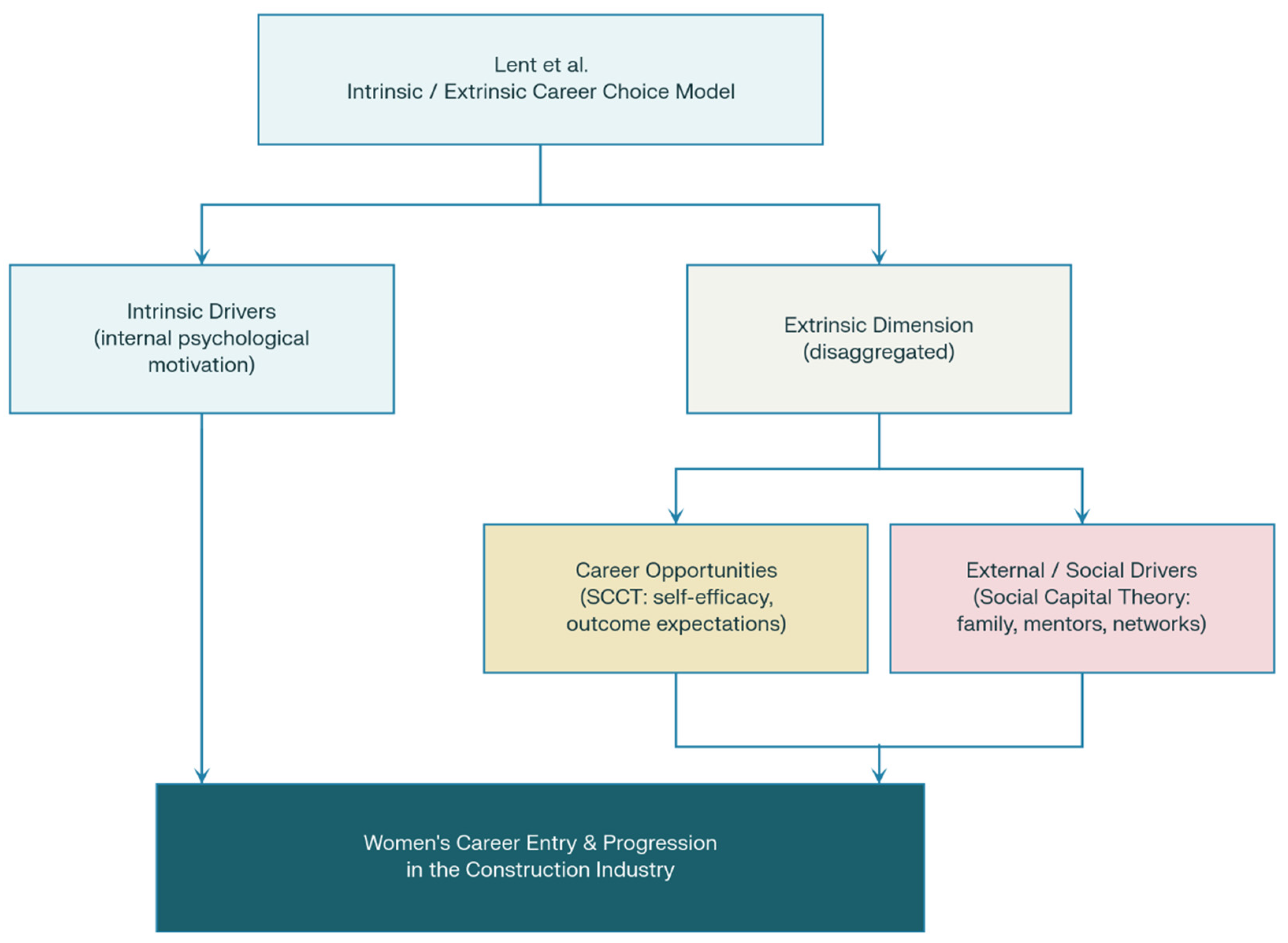
These frameworks support isolating external/social drivers as a discrete construct rather than conflating them with career structural opportunity. Anchoring the model in Lent et al. [29] while refining its extrinsic dimension through social cognitive career theory and social capital theory produces a layered conceptual structure comprising intrinsic drivers (internal psychological motivation), career opportunities (structural–cognitive incentives), and external/social drivers (relational–contextual influence). This tripartite organisation mirrors the analytical logic of Afful et al.’s [28] individual–organisational–industry framework but reframes it around motivational psychology rather than levels of analysis, offering a novel theoretical contribution that remains grounded in the established career choice literature [5,24]. This theoretical framework is captured conceptually in Figure 1.
The diagram shows the intrinsic/extrinsic career choice model proposed by Lent et al. [29] at the top splitting into two branches: intrinsic drivers on the left, and the extrinsic dimension on the right. The extrinsic branch is then disaggregated into two theoretically distinct sub-constructs, career opportunities (grounded in SCCT) and external/social drivers (grounded in SCT), and all three final constructs converge to explain women’s career entry and progression in construction.

4. Research Method

This study adopts a qualitative research design informed by an interpretivist epistemology and idealist ontology, recognising that women’s experiences of job roles and career motivations in construction are socially constructed and best understood through their own accounts rather than reduced to quantifiable variables. A thematic analysis approach, following Braun and Clarke’s [31] six-phase framework, was selected because the aim was to identify patterned meaning across a heterogeneous sample rather than to produce a detailed phenomenological account of a single bounded experience. Data were generated through in-depth, semi-structured interviews that combined predetermined core questions with the flexibility to probe emerging issues, enabling rich, participant-driven insight into lived experience.

4.1. Sample

Participants were female construction professionals working in Australia across three job role categories—site roles, fluid roles, and office-based roles—with role categorisation based on participants’ own self-identification of where they predominantly spend their working time rather than researcher-imposed labels. Purposive sampling was used to recruit information-rich participants, supplemented by snowball sampling through professional networks including the National Association of Women in Construction (NAWIC), the Architecture, Construction, Engineering, Development (ACED) Women Network, and Women in Building Information Modelling (W-BIM). Inclusion criteria required participants to be aged 18 or older, currently working in Australian construction, have a minimum of four years’ industry experience and be current users of construction technologies. The final sample comprised 29 participants: office-based roles formed the largest group (n = 11, 37.9%), followed by fluid roles (n = 9, 31.0%) and site roles (n = 9, 31.0%). Experience ranged from 4 to 23 years, capturing perspectives from early-career practitioners through to senior directors and founders. The sample characteristics are summarised in Table 2.
Organisational tiering followed the widely recognised Australian industry classification distinguishing large full-service builders (Tier 1), mid-sized contractors (Tier 2), and specialist subcontractors/smaller firms (Tier 3), used to interpret variation in resourcing and technology adoption across the sample. In this study, organisational representation skewed towards Tier 1 firms across all three role categories, though site and office-based roles also included meaningful representation from Tier 2 and Tier 3 subcontractors and smaller consultancies, ensuring that the sample was not limited to large-firm experiences alone.

4.2. Data Collection

Data were collected using an interview guide that combined fixed questions with flexible probes, developed in line with the study’s objectives and provided to participants in advance along with a consent form. Interviews were conducted either in person or via Microsoft Teams according to participant preference, audio-recorded with consent, and lasted around 45 min. Consent was reaffirmed verbally at the start of each session, and participants were reminded that they could withdraw at any time without consequence. Sample size was guided by the concept of information power and salient saturation rather than a predetermined numerical target. This draws on evidence that thematic saturation in focused qualitative studies often stabilises within 12–20 interviews. Heterogeneous purposive samples typically require 20–40 participants. Recruitment continued until additional interviews largely reinforced existing themes rather than introducing new conceptual themes, at which point salient saturation was judged to have been reached across all three role categories. Saturation was determined by the absence of new codes or sub-themes emerging in the final interviews.

4.3. Data Analysis

Interview transcripts were analysed thematically using ATLAS.ti (version 25), following an inductive coding process in which codes were generated as issues emerged from the data, iteratively compared with existing codes, and grouped into candidate sub-themes before being consolidated into overarching themes. Themes were then reviewed and refined against the full transcript set to ensure accuracy and ranked according to their prominence based on frequency of mention across interviews. These frequencies reflect the prevalence of the identified motivations across participants’ accounts, rather than their relative importance or strength of influence. Theoretical perspectives were not used to predetermine codes or themes but were subsequently applied as interpretive lenses to contextualise and explain the patterns identified inductively from the data. To strengthen validity and triangulation, findings were cross-checked against the study’s prior systematic literature review to confirm alignment between literature-derived and empirically derived categories. A validation focus group with a subset of participants was subsequently conducted to test the credibility and acceptability of emerging findings. Participant self-identification of role category provided an additional validation mechanism, confirming that the “fluid role” operates as a genuine practitioner-recognised category rather than a purely theoretical construct. No ambiguous or borderline cases were identified, as all participants clearly and confidently self-classified their roles.

4.4. Ethics Statement

Ethics approval for this study was obtained from the University of New South Wales Human Research Ethics Committee (approval reference iRECS6102) prior to data collection. Written or verbal consent was obtained from all participants before interviews commenced. Participant identities are protected through pseudonymised role-based identifiers (e.g., SR-05, FR-02, OFR-08).

5. Findings

Thematic analysis of interview data from female construction professionals produced seven codes describing motivations for entering the industry, distributed across on-site, off-site and fluid job roles. These codes were then synthesised into three overarching themes that align with the study’s theoretical framework, intrinsic drivers, career opportunities, and external/social drivers, as shown in Table 3.
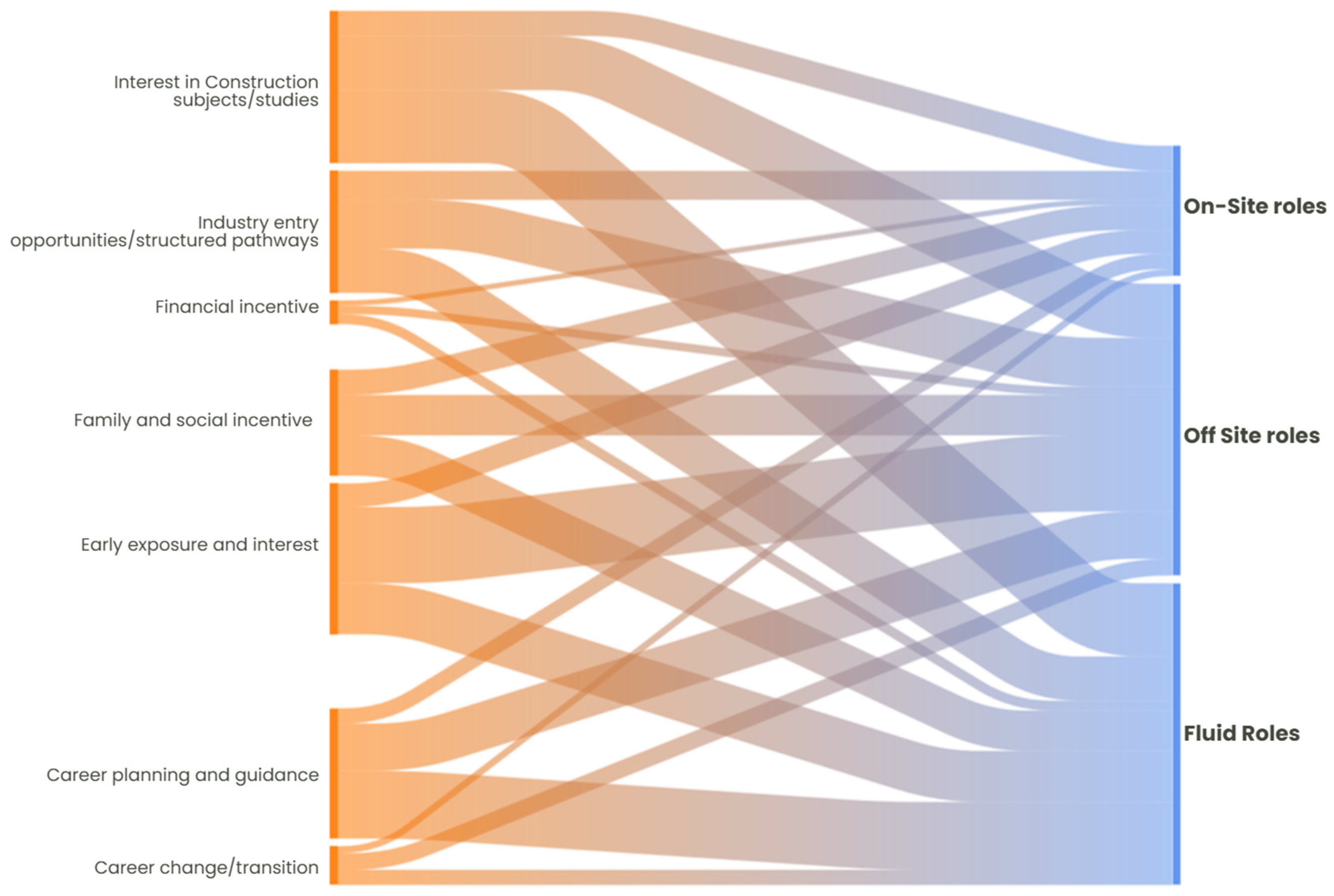
A Sankey visualisation (Figure 2) generated in ATLAS.ti (version 25) illustrates how the seven inductively derived codes connect to the three overarching motivational themes. This snapshot provides a transparent representation of the analytic process, showing how participants’ coded statements flowed into the categories of intrinsic drivers, career opportunities and external/social drivers across on-site, off-site and fluid roles.
Across all 428 coded quotations, motivations were shaped predominantly by personal and social factors rather than economic considerations. The two most frequent codes, interest in construction subjects or studies (21.0%) and early exposure and interest (20.8%), show that participants’ entry into the field was strongly anchored in personal affinity and early engagement with the built environment. Career planning and guidance (18.0%) and industry entry opportunities or structured pathways (16.8%) highlight the importance of deliberate, supported routes into the profession, including apprenticeships, cadetships and mentorship-based decision-making. Family and social incentive accounted for 14.7% of quotations, underscoring the influence of close personal networks. Financial incentive was the least cited motivator at 3.3%, indicating that pay played a secondary role relative to personal interest, early exposure and relational support.
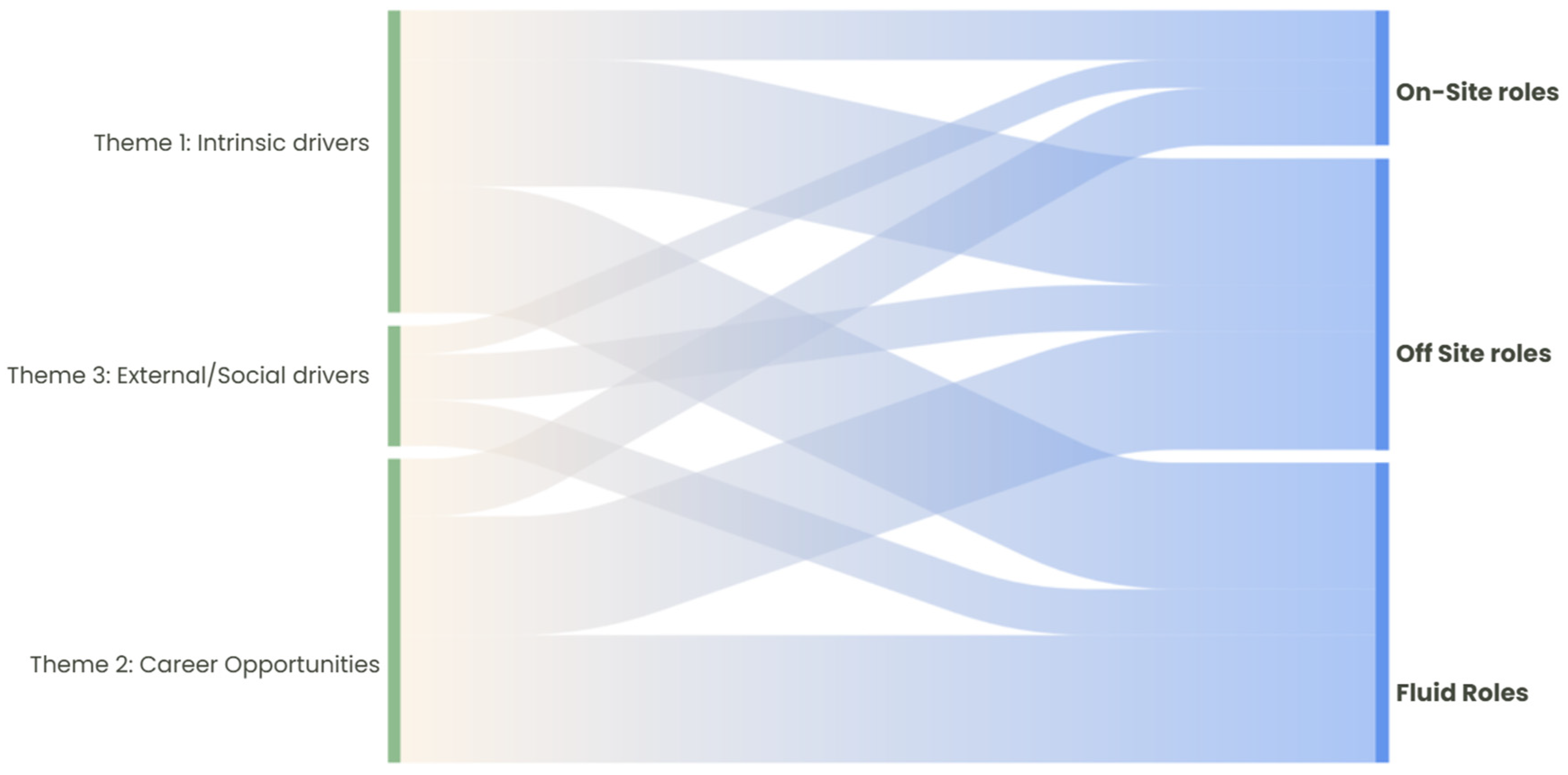
When mapped onto the study’s theoretical framework, the seven codes cluster into three distinct constructs: intrinsic drivers (41.8% of quotations), grounded in personal interest and career choice theory; career opportunities (40.2%), reflecting social cognitive career theory’s emphasis on structured pathways and career agency; and external/social drivers (18.0%), aligned with social capital theory’s focus on relational and network-based resources. These proportions descriptively illustrate the distribution of coded material rather than ranking the theoretical constructs or establishing their comparative importance. This distribution indicates that, contrary to assumptions in prior workforce attraction research that financial incentives or external interventions primarily shape women’s entry into construction, participants’ accounts were dominated by intrinsic and opportunity-based motivations. A Sankey analysis visualisation from ATLAS.ti (version 25) is shown in Figure 3 below.
The pattern carries implications for recruitment and retention strategies, suggesting that industry efforts may be more effective when they foreground meaningful work, early exposure, and clear developmental pathways rather than relying predominantly on financial incentives.

5.1. Intrinsic Drivers

Intrinsic drivers reflect motivations rooted in personal interest, embodied enjoyment, and identification with construction work itself. This theme accounted for 41.8% of coded quotations, split between interest in construction subjects/studies and early exposure and interest.
Participants frequently described construction as aligning with their strengths, identity and enjoyment of visible outcomes. As one participant explained, “when you see something tangible… it’s rewarding… I like contributing to the community and also doing what I love” (SR05). Another emphasised the social value of project delivery: “being a part of something that aids in the community… building hospitals and bridges… is pretty unreal… very… rewarding” (OFR02).
Early exposure was a recurring pathway into on-site roles, often shaped by family proximity and hands-on experiences. A trade participant described this clearly: “my dad was a plumber… I had that opportunity through my dad to have an apprenticeship with him” (SR04). Others recalled embodied enjoyment of physical work from childhood, such as “getting my hands dirty… was just always fun as a kid” (SR06). These accounts highlight how early, authentic contact with construction environments builds familiarity, confidence and self-alignment.
For office-based roles, intrinsic drivers were more often tied to disciplinary interest and professional identity. Participants described discovering construction through formal education pathways and career exploration activities. OFR09 captured this process: “I really loved maths and science… trying to decide what I wanted to do at Uni… went to… university career fair days…” (OFR09). Such narratives reflect how exposure through STEM subjects, university outreach and career fairs can act as informational bridges into built environment professions.
Fluid-role participants described sustained interest across multiple contexts, often beginning with disciplinary immersion and evolving through varied project experiences. FR03 expressed this strongly: “went back to study architecture… Loved it, absolutely loved it…” (FR03). These accounts show how intrinsic motivation can be maintained through expanding scope, responsibility and cross-contextual engagement.

5.2. Career Opportunities

Career opportunities capture motivations tied to structured pathways, career planning, and perceived professional mobility, together representing 40.2% of coded quotations. This theme reflects a SCCT lens, in which career agency and perceived opportunity structure choice.
Participants frequently described entering the industry through structured programs, accessible degree pathways, graduate schemes or lateral transitions, rather than through early intrinsic interest or pre-existing industry connections. For many, construction became visible only when a concrete opportunity appeared. SR01 exemplified this deliberate, opportunity-led entry: “I would go and look at the subjects involved in each course. Construction was the only one where I was reading the subjects and I thought, those I wouldn’t mind doing or I found those interesting.” She later added, “when I started, I thought, if I’m going to start my degree, I want to finish it… I wanted to make sure that what I was doing, I would be able to follow through with.”
Structured pathways were especially influential for on-site roles. SR07 described entering construction through a formal employment agency partnership with Sydney Metro and Transport NSW: “they put you through a certificate two in construction… after you complete the certificate… they screen you… and I was fortunate enough to be employed.” She then emphasised the need for earlier promotion of such programs: “I don’t think it’s as early enough as people still in high school… you don’t know much about this role in school either.”
For some, entry was unplanned and shaped by informational cues. SR05 recalled discovering engineering only through university outreach: “there was a pamphlet that said, if you like math… this is what jobs you can check out. And engineering came up.” She admitted, “I never actually wanted to be an engineer… I didn’t even know what I was getting into when I got this degree,” highlighting how visibility and guidance, not prior intent, redirected her trajectory.
Financial incentives appeared less frequently but were decisive for a small number of participants. SR04 described choosing a plumbing apprenticeship through her father’s business: “I wasn’t sure what I wanted to do yet… and I just took it because it’s good money really.” She also noted the barriers she would have faced without family support: “if I didn’t have my family… there would definitely be barriers… they would be sexist in the sense of will she be able to do the work?”
Off-site participants often entered through graduate programs or adjacent professional fields. OFR03 described a gradual transition from graphic design into submissions work: “from being a graphic designer, my role evolved into graphics and submissions… from submissions coordinator… into a submissions manager.” She observed that “there’s no set trajectory… people maybe accidentally land in submissions or tendering,” underscoring the invisibility of many office-based pathways.
Fluid-role participants framed career opportunities through adaptability and breadth. FR02 captured this clearly: “there’s a lot of opportunity… you can go many different ways.” FR03 described her shift from architecture into project management after candid advice from a colleague: “someone told me that project managers make a lot more money than architects, so I was like if I’m going to be doing this, I may as well get paid for it.” She later reflected on the progression available: “there was a lot of scope for progression… so I started to become a manager… which is really good growth.”

5.3. External/Social Drivers

External/social drivers, accounting for 18.0% of quotations, capture the influence of family networks, informal role models, and social capital on entry decisions. This theme draws on social capital theory, foregrounding how relational resources shape access to construction careers.
For many participants, the presence or absence of a construction-connected family member determined not only whether they entered the industry but how legitimate and navigable that entry felt.
In site-based roles, family influence was often decisive. SR04 offered the clearest example of familial entry into a trade: “I started when I was I think it was 16 or 15 and I chose that industry because my dad was a plumber… I had that opportunity through my dad to have an apprenticeship with him.” She added, “he got me to come to work with him since I was like five and six,” showing that exposure was a long developmental process rather than a single moment. Her reflection that “I would’ve definitely wanted to go on a different path… but this opportunity was there” underscores how family networks resolve the uncertainty that prevents many young women from accessing trades. She further noted, “if I didn’t have my family… there would definitely be barriers… they would be sexist in the sense of will she be able to do the work?”, highlighting how informal social capital substitutes for formal access in male-dominated trades.
Even when entry occurred through formal programs, family socialisation still shaped comfort and legitimacy. SR07 explained, “all my life I’ve been exposed to it… my brothers are builders, my dad’s a builder… And I thought… I wouldn’t mind trying it.” SR06 similarly linked her orientation toward physical work to her mother’s modelling: “she didn’t have a trade, but she was just doing stuff around the house… I never wanted to sit in the office all day long.”
In office-based roles, family influence operated through professional identity and informational networks. OFR10 described growing up in a family of architects: “I grew up around building… going to site inspections with my dad.” OFR05 noted, “all of us were pushed… influenced by my dad to go into the construction industry.” OFR11 described a subtler mechanism of bridging social capital: “my mum… said ‘why don’t you try construction? I have a few friends… and they do very well.’” Here, a parent’s professional peer network provided access to occupational possibilities otherwise invisible.
Fluid-role participants described both enabling and constraining family influences. FR04 recalled early site exposure: “I’d always helped my dad on site as a little kid… I was the 14-year-old getting the coffees… saying, hey, I’m the apprentice for today.” Her mother later validated project management as a viable path: “my mum… said what about project management?” In contrast, FR01 described gendered discouragement: “my dad said… ‘nah, you can’t do that. This is for men.’”
Yet she turned this into motivation: “I don’t think you’re right… it kind of drove me to continue, go harder, and really try to prove them wrong.” This illustrates that family influence can constrain as well as enable, and that resisting gendered expectations can strengthen occupational identity.

5.4. Cross-Role Comparison

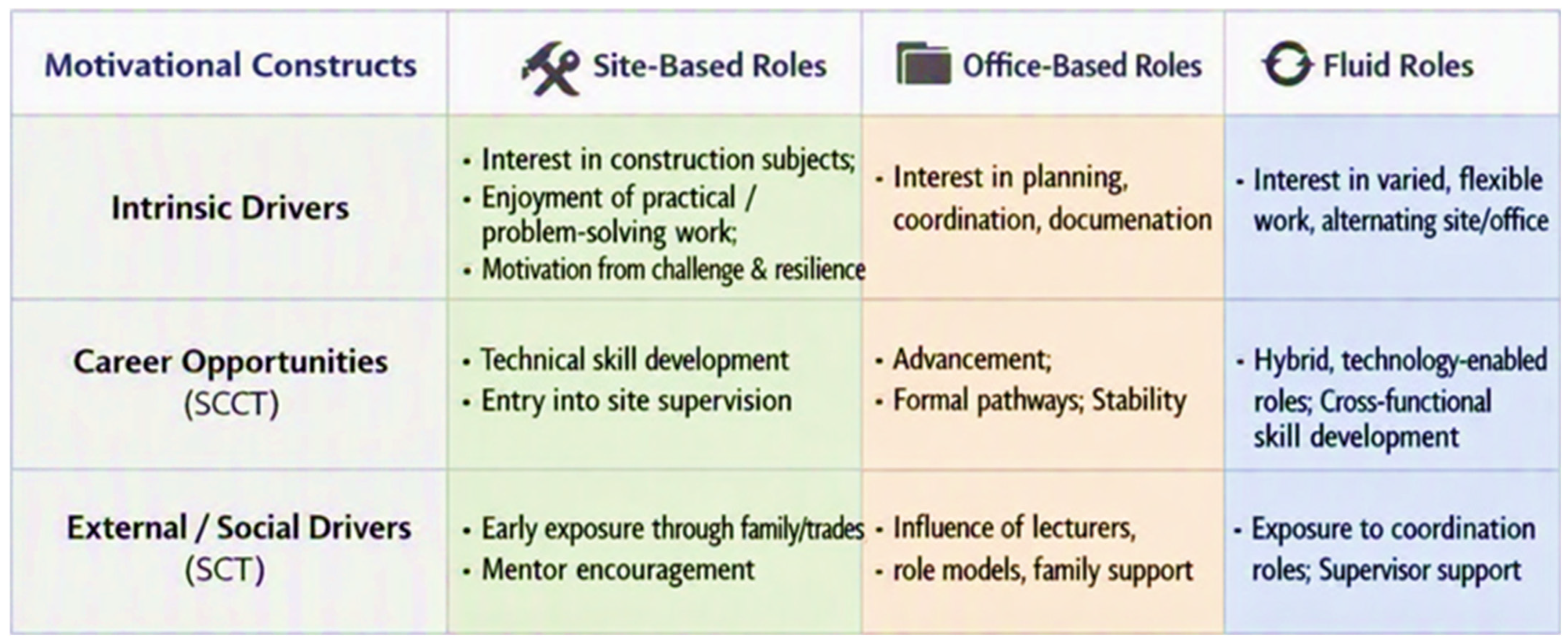
To summarise the findings, motivational patterns differed distinctly across role categories. On-site roles were driven by hands-on identity, early physical exposure and structured entry pathways such as apprenticeships and traineeships; family influence was often decisive in making site work feel legitimate and accessible. Off-site roles were shaped more by disciplinary interest and professional identity, with entry typically occurring through STEM subjects, university programs, career fairs or graduate schemes; social influence operated through informational networks rather than direct construction exposure. Fluid roles reflected cross-contextual interest and career adaptability, with women describing sustained engagement across multiple settings and lateral transitions (e.g., architecture → project management); external/social drivers included both supportive and constraining family influences, often motivating persistence and progression. Figure 4 is a matrix representation of the motivational constructs influencing the different role types. This role-based framework aggregates the findings of the study.

6. Discussion

The discussion is organised around the three motivational constructs identified in this study. Each section interprets how these dimensions shape women’s entry and progression within construction.

6.1. Intrinsic Drivers

There is broad agreement between this study and prior research that intrinsic motivation rooted in personal interest and early exposure is central to women’s attraction to construction. The dominance of personal interest and early exposure (41.8% of quotations) aligns closely with Powell et al. [32], who identified intellectual interest as a sustaining factor in women’s construction career choice, and with Hashiguchi et al. [33], who argued that intrinsic motivation flourishes when work is experienced as meaningful rather than purely instrumental. It also corroborates Blosser’s [34,35] finding that personal interest is the leading driver among women pursuing construction engineering and management degrees. However, this pattern is not universal. Sugathadasa et al. [36] emphasised esteem needs, while Rasheed et al. [37] highlighted social media as the most influential motivational drivers. This study’s findings, however, found intrinsic interest as the most prominent, likely reflecting differences in career stage and participants’ point of reflection.
This study further demonstrates that intrinsic motivation varies across construction roles, highlighting the value of considering role-specific contexts when interpreting women’s career motivations. Site-based trade participants anchored interest in “doing” construction whereas office-based and fluid participants articulated intrinsic motivation through disciplinary and academic identity. Prior studies [36,37] have treated intrinsic motivation largely as a unitary construct; these findings suggest that it branches along the site/office axis, revealing a contextual dimension not previously made explicit.

6.2. Career Opportunities

The strong presence of structured pathways and career planning (40.2%) differs from research that suggests that women enter construction mainly in response to labour shortages or diversity-driven recruitment [3,10]. Ghanbaripour et al. [3], for example, point out that the use of shortage-based “attraction” campaigns to recruit women is the main tool used by the Australian construction industry, thereby treating entry as something dictated by industry needs rather than a personal choice. Instead, the findings here show that many women made intentional, planned decisions about entering the industry. This aligns more closely with Lu and Sexton [38], who argue that women’s career choices often reflect personal agency rather than external pressure. This was especially visible among fluid-role participants, who described “opportunity” and self-directed decisions after internships or early work experiences. This pattern also fits with ideas from SCCT, which highlights confidence and expectations about future outcomes as important for career persistence. While this study did not formally test SCCT, the language that participants used suggests that these ideas are relevant.
A key difference from some economic-focused studies is the low importance of financial incentive (3.3%). This contrasts with labour market accounts [39] that frame women’s recruitment into construction mainly around wages and skills-shortage conditions. In this study, financial factors were present but clearly secondary to structured pathways, planning, and personal agency. The low prevalence of financial incentive may thus be due to the professional fluidity of roles within the group, where entry has been through more structured routes in which financial incentive is a background condition rather than a differentiating motivator.

6.3. External/Social Drivers

This study strongly supports existing social capital research showing that family influence plays a major role in women’s entry into construction. SR04’s apprenticeship pathway closely reflects Radford et al. [40], who argue that women entering male-dominated trades without family connections face hiring bias and exclusion from networks. The findings also align with Dainty et al. [13], Whittock [41] and Watts [42], who show that informal networks often shape access and mobility in construction more than formal HR processes, disadvantaging those without industry-linked families.
However, one pattern in this study complicates the usual interpretation. FR01 described her father discouraging her interest, “this is for men”, yet this acted as motivation rather than a barrier. Instead of deterring her, the resistance pushed her to continue and “prove him wrong.” This contrasts with most social capital accounts, where family influence is treated as either supportive [43] or absent/exclusionary [40]. Very few studies consider discouragement as something that can be reinterpreted as motivating. This gap is unsurprising given how family influence has usually been measured. Studies such as Radford et al. [40] and Whittock [41] focus on supportive networks, making it difficult to capture situations where family resistance or discouragement is later interpreted as a source of motivation.
This suggests that current social capital frameworks may overlook how resisting gendered messages within families can strengthen determination and occupational identity. Sang and Powell [44] and Afful et al. [45] point to this possibility, but it remains underdeveloped in the literature. The findings here indicate that family influence is not always one-directional: it can enable, constrain, or, as this study has found, generate resilience when challenged.

7. Contributions, Implications, and Recommendations

This study makes three clear contributions to the women-in-construction literature. First, it separates extrinsic motivation: whereas prior work [29] treats extrinsic factors as a single category, this study shows that they operate through two distinct mechanisms—career opportunities (linked to agency, planning and structured pathways) and external/social drivers (linked to family networks and social capital). Moreover, the findings demonstrate that job role context moderates motivation type, with intrinsic motivation articulated more through hands-on engagement in site roles but as disciplinary and academic in office and fluid roles. This challenges existing frameworks that assume motivation is consistent across roles [30]. Third, it reveals that resistance from family influence can be generative, not only exclusionary. While the social capital literature typically presents family networks as either supportive or absent, FR01’s experience of paternal discouragement becoming a source of determination suggests that opposition within family networks can strengthen persistence. These insights refine the intrinsic/extrinsic career choice model into a three-layer, role-sensitive framework, offering a more precise lens for understanding women’s entry and progression in male-dominated industries.
In practice, this study provides clear actions for recruitment, education, and pathway design. For instance, in recruitment, participants’ limited reference to financial incentives and stronger emphasis on personal interest, meaningful work, structured opportunities, and social support suggest that employers may benefit from complementing remuneration-focused messaging with clearer communication about project purpose, career development, mentoring, and the tangible contribution of construction work. Internships and other early industry experiences may also provide useful opportunities for career exploration and mentoring, while engagement with families and wider social networks could help broaden awareness among women who lack existing connections to the construction industry. In education, participants’ accounts of early exposure and subject interest indicate potential value in providing construction-related STEM experiences before key subject selection and career decision stages, including applied learning, site visits, and project-based activities that reflect both site-based and professional career pathways. Finally, since professional recognition (e.g., chartered engineer status) motivated office-based entrants, firms and professional bodies should make credentialing pathways and timelines more visible and accessible early in women’s careers to sustain the career opportunities driver identified in this study.

Author Contributions

Conceptualization, A.E.A., C.C.W. and R.Y.S.; methodology, A.E.A., C.C.W. and R.Y.S.; software, A.E.A.; validation, A.E.A., C.C.W. and R.Y.S.; formal analysis, A.E.A.; investigation, A.E.A., C.C.W. and R.Y.S.; resources, C.C.W. and R.Y.S.; data curation, A.E.A.; writing—original draft preparation, A.E.A.; writing—review and editing, A.E.A., C.C.W., R.Y.S., B.B. and G.O.; visualisation, A.E.A.; supervision, C.C.W. and R.Y.S.; project administration, C.C.W. and R.Y.S.; funding acquisition, C.C.W. and R.Y.S. All authors have read and agreed to the published version of the manuscript.

Funding

This research was funded by the Australian Government’s Women’s Leadership and Development Program (4-HO83M87): Attracting, Retaining and Empowering Women in Construction and the UNSW School of Built Environment.

Institutional Review Board Statement

The study was conducted in accordance with the Declaration of Helsinki, and approved by the University of New South Wales Human Research Ethics Committee (approval reference iRECS6102) on 14 October 2024.

Informed Consent Statement

Informed consent was obtained from all subjects involved in the study.

Data Availability Statement

The data that support the findings of this study are available on request from the corresponding author, AEA. The data are not publicly available due to their containing information that could compromise the privacy of research participants.

Acknowledgments

The authors wish to acknowledge the Department of the Prime Minister and Cabinet’s Office for Women, under the Australian Government’s Women’s Leadership and Development Program and the UNSW School of Built Environment whose grant has supported this study.

Conflicts of Interest

The authors declare no conflicts of interest.

Abbreviations

The following abbreviations are used in this manuscript:
CORConservation of Resources
SCCTSocial Cognitive Career Theory
SCTSocial Capital Theory
BCWBehaviour Change Wheel
COM-BCapability, Opportunity, Motivation–Behaviour
STEMScience, Technology, Engineering and Mathematics
NAWICNational Association of Women in Construction
ACEDArchitecture, Construction, Engineering, Development
W-BIMWomen in Building Information Modelling (BIM)

References

  1. Holdsworth, S.; Sandri, O.; Turner, M.; West, M. Increasing women in construction using public procurement: Exploring the impact of a government-led building equality Policy. Gend. Work Organ. 2026, 33, 2114–2128. [Google Scholar] [CrossRef] [Scilit]
  2. Australian Bureau of Statistics. Characteristics of Employment, Tablebuilder. Australian Bureau of Statistics. 2014 to 2024. Available online: https://www.abs.gov.au/statistics/microdata-tablebuilder/available-microdata-tablebuilder/characteristics-employment-australia (accessed on 16 July 2026).
  3. Ghanbaripour, A.N.; Tumpa, R.J.; Sunindijo, R.Y.; Zhang, W.; Yousefian, P.; Camozzi, R.N.; Hon, C.; Talebian, N.; Liu, T.; Hemmati, M. Retention over attraction: A review of women’s experiences in the Australian construction industry; challenges and solutions. Buildings 2023, 13, 490. [Google Scholar] [CrossRef] [Scilit]
  4. Senaratne, S.; Jayakodi, S.; Pascoe, R.D.; Atkins, A. Challenges and strategies for the retention of female construction professionals: An empirical study in Australia. Buildings 2025, 15, 2187. [Google Scholar] [CrossRef] [Scilit]
  5. Talari, N.; Palagiri, A.; Tawalare, A. Factors influencing the professional lives of women civil engineers in India: A structural equation modeling approach. J. Civ. Eng. Educ. 2026, 152, 04026010. [Google Scholar] [CrossRef] [Scilit]
  6. Edirisinghe, R.; Rathnayake, B. Using the behaviour change wheel-based interventions to improve gender diversity in construction: A systematic literature review. Eng. Constr. Archit. Manag. 2025, 32, 234–257. [Google Scholar] [CrossRef] [Scilit]
  7. English, J.; Hay, P. Black South African women in construction: Cues for success. J. Eng. Des. Technol. 2015, 13, 144–164. [Google Scholar] [CrossRef] [Scilit]
  8. Hasan, A.; Tivendale, L.; Udawatta, N.; Mahmood, M.N. Personal and organizational factors for plugging the leaky pipeline: Learnings from the experiences of early career female construction management professionals. J. Manag. Eng. 2024, 40, 04024059. [Google Scholar] [CrossRef] [Scilit]
  9. Muthambi, L.; Agumba, J.N.; Adebowale, O.J. Motivating factors for professional women in construction career progression. Int. J. Manpow. 2025, 46, 853–866. [Google Scholar] [CrossRef] [Scilit]
  10. Francis, V. What influences professional women’s career advancement in construction? Constr. Manag. Econ. 2017, 35, 254–275. [Google Scholar] [CrossRef] [Scilit]
  11. Ardeshiri, A.; Vij, A.; Arthur, N. Attracting young women to construction careers: A preference study to inform workforce strategies. Constr. Manag. Econ. 2026, 44, 214–239. [Google Scholar] [CrossRef] [Scilit]
  12. Carnemolla, P.; Galea, N. Why Australian female high school students do not choose construction as a career: A qualitative investigation into value beliefs about the construction industry. J. Eng. Educ. 2021, 110, 819–839. [Google Scholar] [CrossRef] [Scilit]
  13. Dainty, A.R.; Bagilhole, B.M.; Neale, R.H. A grounded theory of women’s career under-achievement in large UK construction companies. Constr. Manag. Econ. 2000, 18, 239–250. [Google Scholar] [CrossRef] [Scilit]
  14. Acker, J. Hierarchies, jobs, bodies: A theory of gendered organizations. Gend. Soc. 1990, 4, 139–158. [Google Scholar]
  15. Norberg, C.; Johansson, M. “Women and “ideal” women”: The representation of women in the construction industry. Gend. Issues 2021, 38, 1–24. [Google Scholar] [CrossRef] [Scilit]
  16. Hing, L.S.; Sakr, N.; Sorenson, J.B.; Stamarski, C.S.; Caniera, K.; Colaco, C. Gender inequities in the workplace: A holistic review of organizational processes and practices. Hum. Resour. Manag. Rev. 2023, 33, 100968. [Google Scholar] [CrossRef] [Scilit]
  17. Kalev, A.; Deutsch, G. Gender inequality and workplace organizations: Understanding reproduction and change. In Handbook of the Sociology of Gender; Springer: Cham, Switzerland, 2018; pp. 257–269. [Google Scholar] [CrossRef] [Scilit]
  18. Tumpa, R.J.; Ghanbaripour, A.N.; Brotto, G.; Amar, J.H.; Zhang, W.; Ghamarimajd, Z.; Talebian, N.; Sunindijo, R.Y.; Yousefian, P. Hard hats and glass ceilings: Women’s experiences in the construction industry in developed western nations. J. Constr. Eng. Manag. 2025, 151, 04025161. [Google Scholar] [CrossRef] [Scilit]
  19. Debs, L.; Kota, B.R. Gender differences in construction management students’ sense of belonging. In Proceedings of the 2021 ASEE Virtual Annual Conference Content Access, Virtual, 26 July 2021–19 July 2022. [Google Scholar]
  20. Yan, D.; Sunindijo, R.Y.; Wang, C.C.; Ding, Y.; Yang, Z. Gendered self-presentation in the construction industry: Insights from linkedin narratives and in-depth interviews. J. Constr. Eng. Manag. 2026, 152, 04026138. [Google Scholar] [CrossRef] [Scilit]
  21. Amponsah-Asante, L.N.; Botchway, B.; Ofori, J.N.; Acheampong, A.; Simpeh, E.K.; Antwi-Afari, M.F. The future is built by all: Unearthing barriers to women’s career progression and retention in the construction industry. Int. J. Constr. Manag. 2026, 26, 2408–2426. [Google Scholar] [CrossRef] [Scilit]
  22. Zhang, R.P.; Holdsworth, S.; Turner, M.; Andamon, M.M. Does gender really matter? A closer look at early career women in construction. Constr. Manag. Econ. 2021, 39, 669–686. [Google Scholar] [CrossRef] [Scilit]
  23. Chandra, V.; Loosemore, M. Women’s self-perception: An inter-sector comparison of construction, legal and nursing professionals. Constr. Manag. Econ. 2004, 22, 947–956. [Google Scholar] [CrossRef] [Scilit]
  24. Yang, H.; Li, H.; Wang, G.; Cao, D.; Huang, B. What Drives Workers into the Labor-Intensive Chinese Construction Industry: Profiling Motivational Diversity across Heterogeneous Groups. J. Constr. Eng. Manag. 2026, 152, 05026002. [Google Scholar] [CrossRef] [Scilit]
  25. Borg, J.; Scott-Young, C.M.; Bartram, T. The role of HRM in supporting the career advancement of early-career professional women in construction: A conceptual model. Empl. Relat. Int. J. 2026, 48, 1–21. [Google Scholar] [CrossRef] [Scilit]
  26. Rodrigo, N.; Wijewickrama, M.K.; Rajenthiran, N.; Jayathilaka, W.; Chang, R. Challenges and solutions for women in construction industry related disciplines: A literature review. In Proceedings of the 12th World Construction Symposium; University of Moratuwa: Moratuwa, Sri Lanka, 2024; p. 331. [Google Scholar]
  27. Rutherford, N.N.; Daniel, E.I. A systematic review of the barriers and attraction strategies for females in construction. Proc. Inst. Civ. Eng.-Manag. Procure. Law. 2025, 178, 140–150. [Google Scholar] [CrossRef] [Scilit]
  28. Afful, A.E.; Wang, C.C.; Sunindijo, R.Y.; Frimpong, S.; Boadu, E.; Baah, B. Evolving job roles of women in the construction industry. J. Constr. Eng. Manag. 2025, 151, 03125001. [Google Scholar] [CrossRef] [Scilit]
  29. Lent, R.W.; Brown, S.D.; Hackett, G. Toward a unifying social cognitive theory of career and academic interest, choice, and performance. J. Vocat. Behav. 1994, 45, 79–122. [Google Scholar] [CrossRef] [Scilit]
  30. Portes, A. Social capital: Its origins and applications in modern sociology. Annu. Rev. Sociol. 1998, 24, 1–24. [Google Scholar] [CrossRef] [Scilit]
  31. Braun, V.; Clarke, V. Using thematic analysis in psychology. Qual. Res. Psychol. 2006, 3, 77–101. [Google Scholar] [CrossRef] [Scilit]
  32. Powell, A.; Bagilhole, B.M.; Dainty, A.R.J.; Neale, R.H. An investigation of women’s career choice in construction. In 20th Annual ARCOM Conference, 1–3 September 2004; Khosrowshahi, F., Ed.; Heriot Watt University. Association of Researchers in Construction Management: Edinburgh, UK, 2004; Volume 1, pp. 477–484. [Google Scholar]
  33. Hashiguchi, N.; Sengoku, S.; Kubota, Y.; Kitahara, S.; Lim, Y.; Kodama, K. Age-dependent influence of intrinsic and extrinsic motivations on construction worker performance. Int. J. Environ. Res. Public Health 2021, 18, 111. [Google Scholar] [CrossRef] [Scilit] [PubMed]
  34. Blosser, E.G. An Analysis of gendered outreach messages on the engineer girl website: How female engineers promote engineering to young women. In Proceedings of the 2021 ASEE Virtual Annual Conference Content Access, Virtual, 26 July 2021–19 July 2022. [Google Scholar]
  35. Blosser, E. Undoing Gender: How young women decide to become engineers. J. Women Minor. Sci. Eng. 2024, 30, 29–53. [Google Scholar] [CrossRef] [Scilit]
  36. Sugathadasa, R.; De Silva, M.L.; Thibbotuwawa, A.; Bandara, K.A. Motivation factors of engineers in private sector construction industry. J. Appl. Eng. Sci. 2021, 19, 794–805. [Google Scholar] [CrossRef] [Scilit]
  37. Rasheed, E.O.; Yu, J.; Hale, S.; Booth, N. The impact of external and internal sources of motivation on young women’s interest in construction-related careers: An exploratory study. Int. J. Constr. Educ. Res. 2022, 18, 159–178. [Google Scholar] [CrossRef] [Scilit]
  38. Lu, S.L.; Sexton, M. Career journeys and turning points of senior female managers in small construction firms. Constr. Manag. Econ. 2010, 28, 125–139. [Google Scholar] [CrossRef] [Scilit]
  39. Toohey, T.; Colosimo, D.; Boak, A. Australia’s Hidden Resource: The Economic Case for Increasing Female Participation; Goldman Sachs JBWere Investment Research: Sydney, Australia, 2009. Available online: https://web.archive.org/web/20110218012530/http://www.eowa.gov.au/Pay_Equity/Files/Australias_hidden_resource.pdf (accessed on 16 July 2026).
  40. Radford, A.; Kim, J.W.; Hallacy, C.; Ramesh, A.; Goh, G.; Agarwal, S.; Sastry, G.; Askell, A.; Mishkin, P.; Clark, J.; et al. Learning transferable visual models from natural language supervision. In Proceedings of the International Conference on Machine Learning, PmLR, Virtual, 18–24 July 2021; Volume 139, pp. 8748–8763. [Google Scholar]
  41. Whittock, M. Women’s experiences of non-traditional employment: Is gender equality in this area a possibility? Constr. Manag. Econ. 2002, 20, 449–456. [Google Scholar] [CrossRef] [Scilit]
  42. Watts, J.H. Leaders of men: Women ‘managing’ in construction. Work. Employ. Soc. 2009, 23, 512–530. [Google Scholar] [CrossRef] [Scilit]
  43. Ray, C. Dissecting Human Capital Resources: Unpacking the Structure and Activation of Human Capital Resources Within Firms. Ph.D. Thesis, University of South Carolina, Columbia, SC, USA, May 2022. [Google Scholar]
  44. Sang, K.; Powell, A. Gender inequality in the construction industry: Lessons from Pierre Bourdieu. In Proceedings of the 28th Annual ARCOM Conference, 3–5 September 2012; Smith, S.D., Ed.; Association of Researchers in Construction Management: Edinburgh, UK, 2012; pp. 237–247. [Google Scholar]
  45. Afful, A.E.; Wang, C.C.; Sunindijo, R.Y. Tapping into the Potential of Construction Technologies to Increase the Participation of Women in the Construction Industry. J. Constr. Eng. Manag. 2026, 152, 03126015. [Google Scholar] [CrossRef] [Scilit]
Figure 1. Conceptual framework of women’s career motivation in construction industry.
Buildings 16 03709 g001
Figure 2. Sankey visualisation of motivation codes. Source: ATLAS.ti (version 25).
Buildings 16 03709 g002
Figure 3. Sankey visualisation of themes. Source: ATLAS.ti (version 25).
Buildings 16 03709 g003
Figure 4. Role-based motivational framework.
Buildings 16 03709 g004
Table 1. Summary of typologies and trends.
Motivation TypeKey DriversBarriersTrends
IntrinsicPersonal interest, self alignment, resilienceCareer aspiration–reality gapIncreasing focus on self-perception and intrinsic resilience
ExtrinsicFinancial rewards, job security, work–life balanceLimited career advancement, inflexible work hoursGrowing emphasis on flexible policies and structured training
SocialFamily support, mentorship, role modelsNegative perceptions, male-dominated cultureShift towards improving industry image and leveraging social networks
Table 2. Sample characteristics.
Participant IDYears in ConstructionCurrent Job TitleRole Category Organisation Type Organisation Size
SR-016 yearsSite EngineerSite RoleBuilderTier 1
SR-024 yearsWHSE AdvisorSite RoleBuilderTier 1
SR-034 yearsSite EngineerSite Role BuilderTier 1
SR-0410 yearsPlumberSite RolesSubcontractorTier 3
SR-055 yearsSite EngineerSite RolesBuilderTier 1
SR-064 YearsCarpenterSite RolesBuilderTier 1
SR-074 YearsWHSE CoordinatorSite RolesBuilderTier 1
SR-087 yearsSite OfficerSite RolesOff-site modular companyTier 2
SR-098 yearsCarpenterSite RolesSubcontractorTier 3
FR-0110 yearsPrefab SpecialistFluid RoleBuilderTier 1
FR-0215 yearsProject ManagerFluid RoleBuilderTier 1
FR-0323 yearsProject DirectorFluid RoleBuilderTier 1
FR-044 yearsProject ManagerFluid RoleConsultantTier 2
FR-0510 yearsProject EngineerFluid RoleBuilderTier 1
FR-064 YearsProject ManagerFluid RoleConsultantTier 1
FR-076 YearsProject ManagerFluid RoleConsultantTier 1
FR-085 YearsProject ManagerFluid RoleConsultantTier 1
FR-095 YearsProject EngineerFluid RoleConsultantTier 1
OFR-0115 YearsDesign Systems leadOffice-based roleConsultantTier 2
OFR-025 YearsSenior People AdvisorOffice-based roleBuilderTier 1
OFR-036 YearsSubmissions ManagerOffice-based roleBuilderTier 1
OFR-047 YearsCost Planner/EstimatorOffice-based roleConsultantTier 2
OFR-057 YearsSenior Structural EngineerOffice-based roleConsultantTier 2
OFR-0623 YearsCo-FounderOffice-based roleConsultantTier 3
OFR-0712 YearsCost Planner/EstimatorOffice-based roleBuilderTier 2
OFR-0812 YearsCompany DirectorOffice-based roleBuilderTier 3
OFR-0920 YearsSenior Structural EngineerOffice-based roleConsultantTier 1
OFR-1022 yearsFounding DirectorOffice-based roleConsultantTier 3
OFR-116 YearsCost Planner/EstimatorOffice-based roleConsultantTier 2
Table 3. Motivational codes for women’s entry into construction careers.
CodeQuotations (n)Share of Total (%)Theoretical Theme
Interest in construction subjects/studies9021.0Intrinsic drivers
Early exposure and interest8920.8Intrinsic drivers
Career planning and guidance7718.0Career opportunities
Industry entry opportunities/structured pathways7216.8Career opportunities
Family and social incentive6314.7External/social drivers
Career change/transition235.4Career opportunities
Financial incentive143.3External/social drivers
Disclaimer/Publisher’s Note: The statements, opinions and data contained in all publications are solely those of the individual author(s) and contributor(s) and not of MDPI and/or the editor(s). MDPI and/or the editor(s) disclaim responsibility for any injury to people or property resulting from any ideas, methods, instructions or products referred to in the content.