Article

A Decision-Support Framework for Early-Stage Pile Foundation Selection

1
Department of Architecture and Construction Production, Korkyt Ata Kyzylorda University, Kyzylorda 120000, Kazakhstan
2
Faculty of Environmental Engineering, Warsaw University of Technology, 00-653 Warsaw, Poland
3
Construction Company KGS-Astana LLP, Astana 010000, Kazakhstan
*
Author to whom correspondence should be addressed.
Buildings 2026, 16(18), 3701; https://doi.org/10.3390/buildings16183701
Submission received: 21 August 2026 / Revised: 6 September 2026 / Accepted: 11 September 2026 / Published: 16 September 2026
(This article belongs to the Section Building Structures)

Abstract

Early-stage selection of pile foundation systems is associated with considerable uncertainty due to limited site information and the need to consider multiple geotechnical, structural, and construction-related factors simultaneously. This study proposes a rule-based decision-support framework, named GeoSupport Decision Platform (GSDP), for transparent and systematic evaluation of pile foundation alternatives across varying engineering conditions. A multicriteria scoring procedure is introduced into the proposed framework to evaluate the recommended pile alternative for the application. The implemented procedure combines compatibility scores and weighting coefficients based on engineering judgement and related to soil type, groundwater conditions, frost depth, load level, vibration/noise restrictions, and site accessibility. The ranked pile alternative list, closely linked to the suitability scores, is an outcome of the framework. The applicability of the GSDP framework is illustrated through two case studies based on construction sites in Kokshetau and Astana, Kazakhstan, representing different geotechnical and construction conditions. For the Kokshetau construction site, the GSDP framework recommends driven piles with a suitability score of 0.975 as the most suitable foundation alternative, followed by bored piles and micropiles, with suitability scores of 0.905 and 0.845, respectively. In contrast, for the Astana case, bored/CFA piles are ranked first with a suitability score of 0.970, followed by micropiles (0.825) and driven piles (0.775). In both cases, the highest-ranked pile alternative corresponds to the pile foundation system adopted at the respective construction site. The results show that the framework generates transparent, interpretable recommendations through a weighted scoring procedure and provides brief explanations that align with the engineering solution chosen for the case study. The contrasting rankings, which demonstrate the ability of the framework to respond to site-specific conditions rather than systematically favoring a single pile type, indicate the GSDP’s practical engineering significance for the preliminary selection of pile foundations when site investigation data are limited.

1. Introduction

Pile foundations are widely used in civil engineering to transfer structural loads to deeper, more stable soil layers when near-surface soils lack sufficient bearing capacity. Selecting an appropriate pile foundation system at the early design stage is a complex engineering task that directly affects constructability, safety, the structure’s long-term performance, and finally, construction costs. The decision concerning the foundation selection depends on numerous interacting factors, including soil stratification, groundwater conditions, frost effects, loading requirements, site accessibility, environmental constraints, and project-specific limitations [1,2,3]. In current engineering practice, pile foundation selection is still largely based on engineering experience, and the chosen solution is then verified using empirical correlations and design-code recommendations. Very often, at an early stage of design, the data do not fully reflect the complexity and uncertainty of real geotechnical conditions, particularly in heterogeneous or seasonally frozen soils. Hence, the decision on the pile foundation is not based on complete data. Furthermore, the number of criteria that must be met in the pile foundation design process and during pile installation sometimes requires changing the previously selected pile foundation, thereby increasing costs. Another issue is the wide variety of pile foundation types, which cannot be analyzed in detail equally at the early stages of decision-making and design processes due to their time-consuming and costly nature. Although such approaches can be accepted, it seems reasonable to distinctly divide the decision-making process into two stages. At the early stage of design, when detailed data are limited, the pile foundation alternative should be determined, with main pile alternatives including driven, bored, and micropiles. Then, at the next stage, once the data set is complete, especially for soil stratigraphy and parameters, the exact pile type should be selected from the previously determined pile type alternatives. Tools to improve the decision-making process are sought at both stages.
To improve the consistency and transparency of engineering decisions, decision-support systems and multicriteria decision-making (MCDM) approaches have increasingly been applied in geotechnical engineering, becoming important tools for structuring decisions under uncertainty [4,5,6,7,8]. These approaches enable systematic comparison of alternative foundation solutions using multiple criteria, such as bearing capacity, constructability, environmental impact, risk, and site constraints. However, some MCDM approaches reported in the literature involve relatively complex procedures that may limit their straightforward application during preliminary engineering assessment [9,10,11,12,13,14]. Moreover, their applicability is also limited due to the limited selection of pile alternatives. The multicriteria decision-making model presented by Turskis et al. [12,14] analyses only bored piles in sand, considering only the cost and time required for pile installation. Moreover, procedures involving grey numbers and methods such as TOPSIS, COPRAS, and ARAS may require additional methodological steps and expertise for practical application. On the other hand, the PROMETHEE II methods diversify the types of piles and introduce simpler evaluation methods, but still focus on bored piles, omitting micropiles and driven piles [11]. Another issue is that existing approaches combine technical and economic criteria in a single assessment procedure, making it difficult to evaluate the selected solution solely on the technical suitability of pile alternatives during the early-stage assessment.
Overall, tools that facilitate accurate decision-making about foundation type selection at the early stage of the construction process remain in demand. Recent studies emphasize that geotechnical tools supporting decision-making should not operate as black-box prediction systems, but rather as explainable, interpretable engineering support frameworks that assist engineers in practical decision-making [15,16]. Moreover, many solutions are focused on isolated prediction problems and do not directly address the broader engineering decision-making process required for practical foundation selection. In addition, concerns regarding the transparency and explainability of frameworks, limited datasets, and reproducibility remain significant challenges for the practical implementation of AI-assisted geotechnical systems and multicriteria decision frameworks [15,16,17,18,19,20,21,22].
Therefore, there is a need for an explainable, evidence-informed engineering decision-support framework that integrates transparent, evidence-based, multicriteria evaluation procedures that assess technical aspects regardless of economic ones, with the diversity of pile alternatives in early-stage pile foundation selection, rather than relying exclusively on black-box predictive models. To address this challenge, the study introduces an explainable decision-support framework, the GeoSupport Decision Platform (GSDP). The GSDP is intended to support early-stage decision-making before detailed geotechnical analysis and foundation design are undertaken by providing a structured and interpretable preliminary ranking of pile alternatives, including bored piles, driven piles, and micropiles, across diverse soil and construction conditions. Rather than aiming to replace established MCDM approaches, the proposed framework integrates geological data and construction constraints arising from groundwater levels, frost effects, vibration restrictions, and site accessibility into simple, transparent rule-based scoring procedures when only limited site information is available. Hence, the GSDP aims to efficiently position the recommended pile alternatives for construction, based solely on technical factors, and excluding the cost, at the early stage of the decision-making process. The GSDP methodological contribution novelty, therefore, lies not in introducing a new weighted-sum algorithm but in structuring pile-selection criteria, engineering compatibility rules, and field-based evidence within a transparent and explainable early-stage decision-support framework.
The paper presents the scope of the framework and its architecture, with data acquisition, decision support, recommended solution modules and sensitivity analysis. The study further demonstrates the framework’s applicability using two case-study datasets from construction sites in Kokshetau and Astana, Kazakhstan, representing diverse geotechnical and construction conditions. The two cases, involving different pile foundation systems, are used to examine whether the framework produces proper site-specific rankings under contrasting engineering conditions. Finally, the advantages and drawbacks of the GeoSupport Decision Platform are discussed, and its future development is introduced.

2. Materials and Methods

2.1. Scope of the Framework

The proposed GeoSupport Decision Platform (GSDP) framework is developed to support the early-stage selection of pile foundations. The framework aims to improve transparency and consistency in the preliminary assessment of the feasibility of pile alternatives for a given construction site. The proposed assessment results from a systematic comparison of alternative pile foundation solutions across two groups of factors: (1) varying geotechnical conditions on the construction site, and (2) technical requirements for pile foundation installation and construction site neighbourhood limitations. The geotechnical conditions at the construction site and its accessibility are compared with the conditions under which piles are recommended for application and with the technical requirements for their implementation, respectively. Hence, it considers both the recommendations for the optimal choice under the given geotechnical conditions and the limitations resulting from technical feasibility. The proposed framework is a first attempt at a tool intended not to replace detailed code-based geotechnical design, but rather to assist engineers during conceptual and preliminary decision-making. The feasibility of each foundation solution should be verified for a given geological condition at the construction site through foundation design [23,24].

2.2. GeoSupport Decision Platform (GSDP)

2.2.1. GSDP Architecture

The primary objective of the GSDP framework is to support engineers in selecting and evaluating suitable foundation alternatives, rather than replacing code-based geotechnical design. In this context, the GSDP framework aims to transform input data as engineering evidence into structured engineering recommendations that are explainable and traceable for engineering practice, education, and research. The GSDP prototype is implemented using a Python-based framework and executed locally to ensure reproducibility and transparency of the decision-support logic.
The platform is developed in Python 3.14.2. The application is implemented using the Streamlit 1.53.0 framework to provide an interactive graphical user interface. Users can enter all input parameters through the interface. The platform automatically processes these inputs using the proposed decision-support algorithm and generates a ranked list of foundation alternatives together with explanatory comments. The implementation also uses the Pandas library 2.3.3 for data management and exporting tabular results, and NumPy 2.4.1 for statistical calculations during the evaluation process.
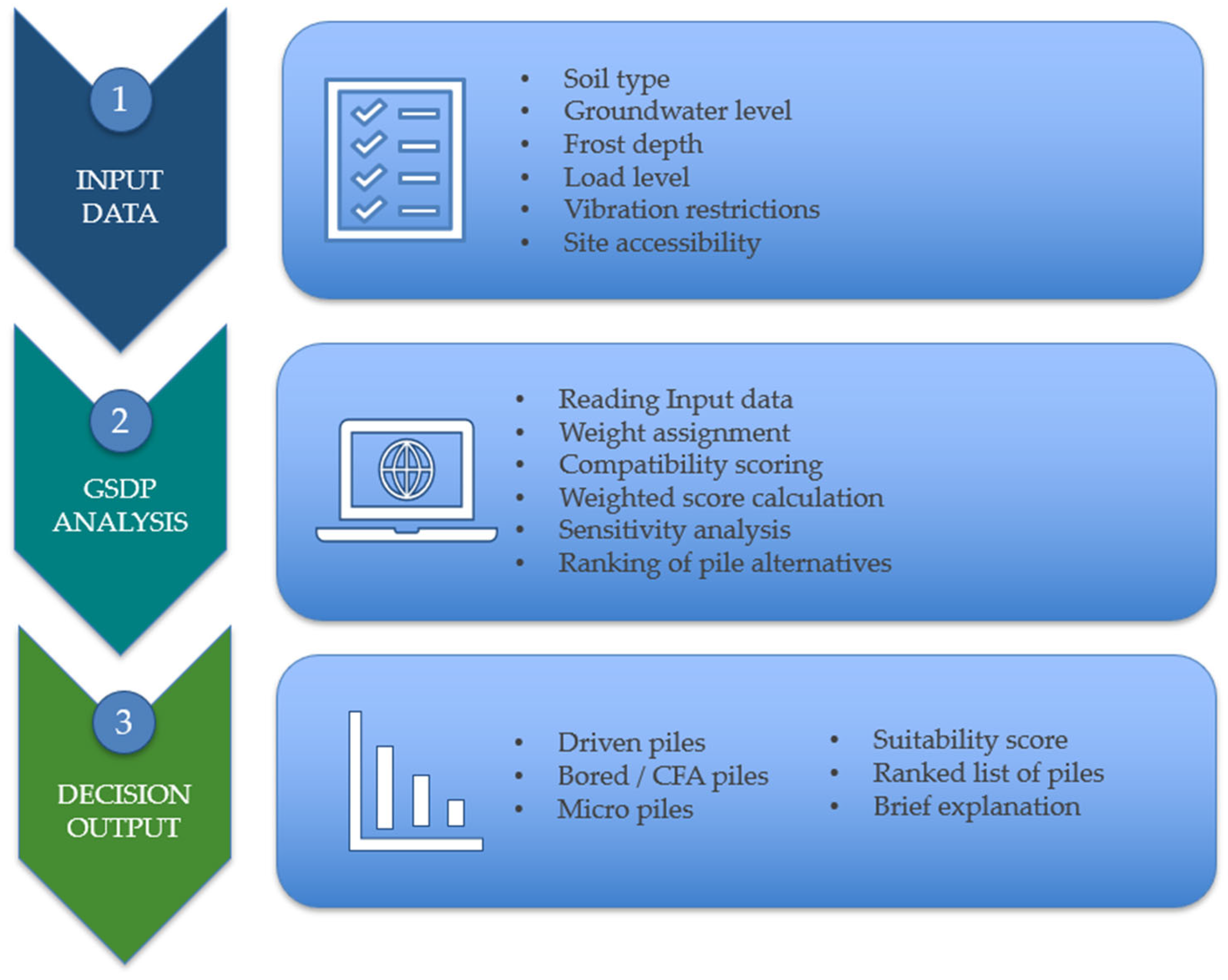
The methodological workflow of the GSDP consists of the following sequential modules (Figure 1):
  • Input Data—data acquisition,
  • GSDP Analysis—decision-support stage,
  • Decision Output—recommended solution.
The Input Data Module requires basic site parameters available at the early design stage. Geotechnical conditions are incorporated as key input parameters that affect both feasibility assessment and performance evaluation. The module gathers and analyses field-test data from geological surveys conducted on the construction site. These boundary conditions define the conditions under which pile foundation alternatives are analyzed. It ensures that the decision-support process reflects the actual engineering environment and accounts for the site’s inherent variability.
The GSDP Analysis Module covers the following stages:
  • Defines the requirements and limitations for pile usage based on the available data,
  • Compares the defined boundary conditions with the geological conditions recommended for the given pile application, considering both requirements and constraints,
  • Checks the relevance level based on a scoring system that assigns appropriate weights to individual boundary conditions.
The Decision Output Module provides a ranked list of pile foundation alternatives, each with a brief explanation.
The user interface of the GSDP framework is presented in Figure 1.
Hence, the decision-making process implemented in the GSDP framework follows a structured sequence. Information is transferred sequentially between the three interconnected modules. The Input Data Module first collects and validates the project-specific parameters before passing them to the GSDP Analysis Module. The calculated suitability scores, together with the corresponding engineering explanations, are then automatically transferred to the Decision Output Module. Initially, site-specific input parameters are defined, including soil type, groundwater conditions, load level, frost depth and construction constraints. The input parameters are then matched to the feasibility conditions for recommending a pile alternative, as well as to practical constraints such as vibration restrictions and site accessibility. Finally, the system ranks pile foundation alternatives and provides an explanation based on both empirical evidence and engineering logic. The output of the GSDP framework consists of a qualitative assessment in the form of a ranked list of pile foundation alternatives with suitability scores, along with a brief explanation of the recommended solution. This structure makes the results transparent and understandable for engineering practice. Moreover, the proposed framework has a modular structure that allows future integration of subgroups of pile types, soil categories and new decision criteria without modifying the core algorithm.
This workflow reflects the typical reasoning process used by geotechnical engineers when formalizing their work in a digital environment.

2.2.2. Data Acquisition Stage- Input Data Module

The input parameters are organized into six categories. Soil stratification, groundwater level, frost depth, load level, vibration/noise restrictions and site access are defined as input parameters.
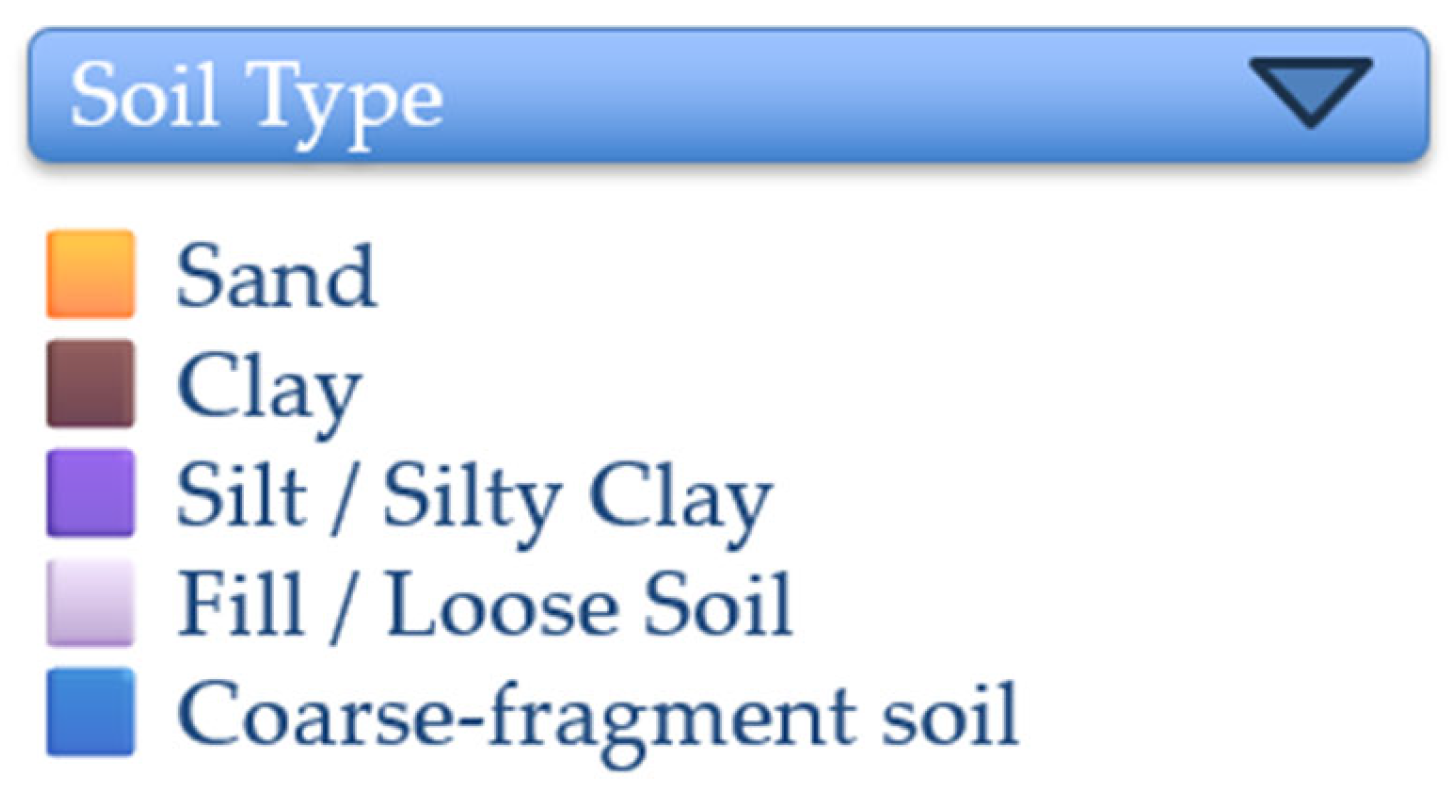
The soil type parameter provides a qualitative description of the representative ground conditions, as presented in Figure 2 (e.g., sand, clay, silty soils, loose and coarse-fragment soil). For heterogeneous and layered soil profiles, the representative soil category is selected based on the soil that is most frequent throughout the profile. In the current implementation, this parameter can be evaluated from archive data or borehole results when detailed soil parameters are not yet known. Hence, it is intended for early-stage matching rather than detailed geological characterization. The use of a single representative soil category is therefore a simplification of heterogeneous ground conditions and may affect the resulting suitability scores and ranking.
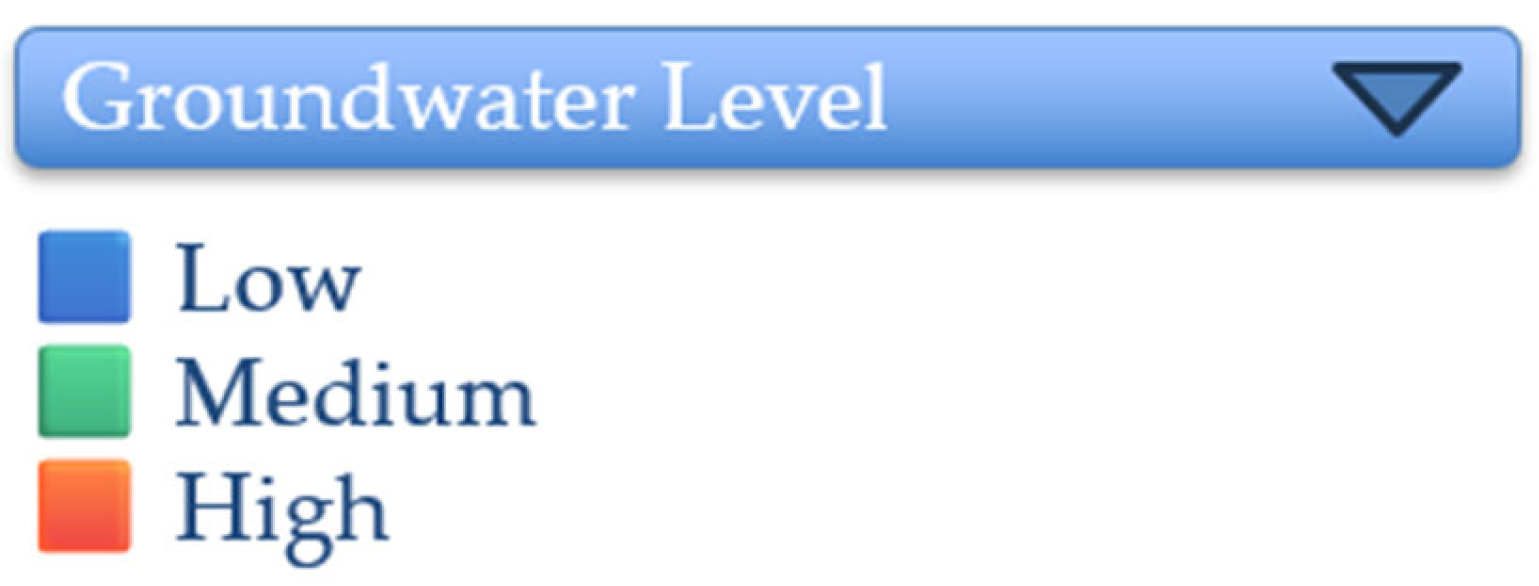
Groundwater level is introduced as an indicator (low, medium, high) affecting the constructability and feasibility of different pile installation methods (Figure 3). Based on engineering judgement, groundwater at depths less than 2.0 m below ground level is assumed to be high; between 2.0 m and 5.0 m below ground level, medium; and at depths greater than 5.0 m below ground level, low. Higher groundwater levels generally increase the complexity of bored and cast-in-place pile construction, while driven piles are less sensitive to groundwater conditions. At this stage of framework implementation, water fluctuations are not considered; they will be introduced in a subsequent version of the framework.
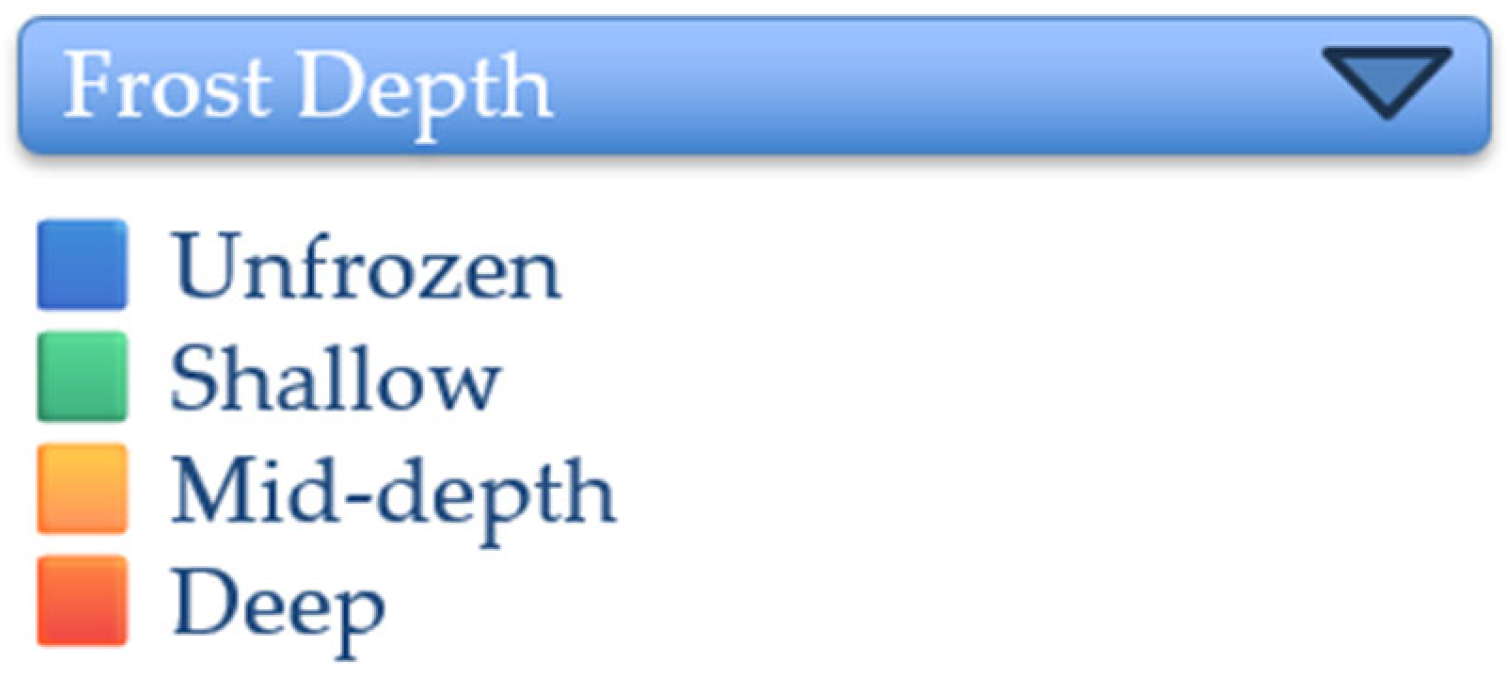
Frost depth is introduced as an additional input parameter representing the depth of seasonal soil freezing and relates to construction-time conditions (Figure 4). This parameter affects both pile installation conditions and soil mechanical behavior, particularly in near-surface layers. The near-surface layer thickness is defined as 2.0 m, with two sub-depths: shallow, to 1.0 m below ground level, and mid-depth, from 1.0 to 2.0 m below ground level. Frost depth below 2.0 m is defined as deep. In contrast, the “Unfrozen” category represents conditions in which no frozen ground layer is present at the time of pile installation, including construction performed during the warm season.
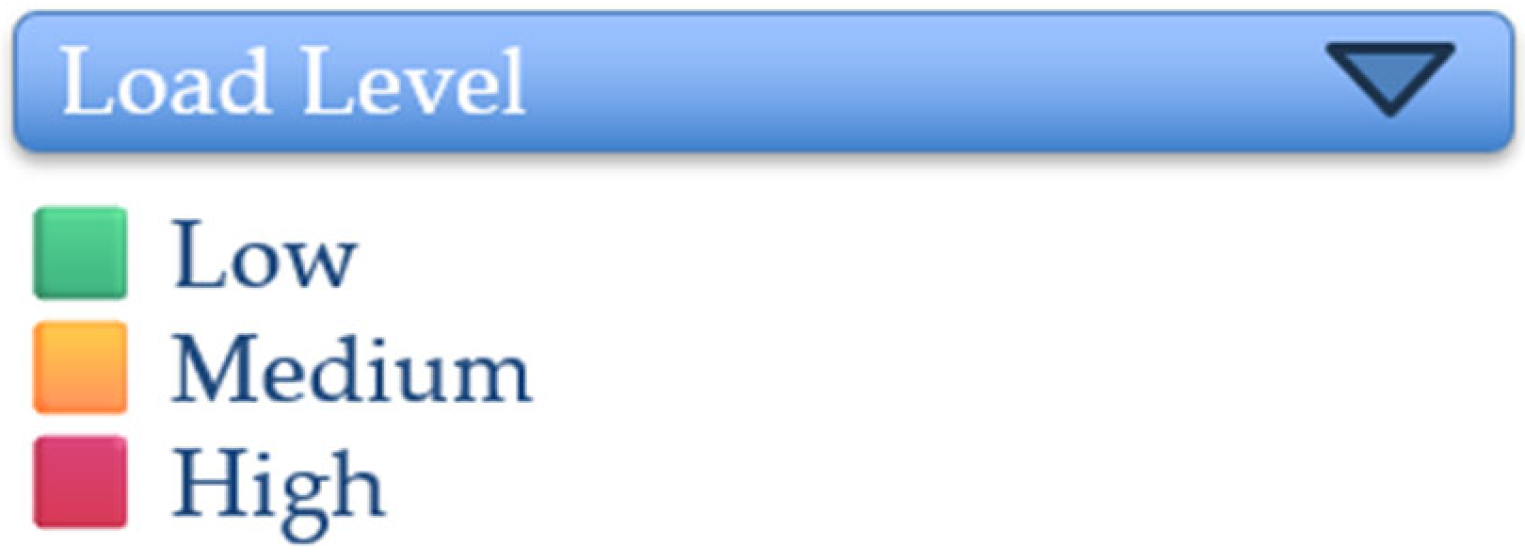
The load level parameter reflects the expected structural requirement (low, medium, high) at the conceptual stage (Figure 5). Loads below 500 kN are considered low, loads from 500 kN to 1000 kN are medium, and loads above 1000 kN are high. The load intervals are established more for the pile specified in the procedure rather than for different building types. The load level parameter affects the relative preference for pile systems, which differ in load-bearing capacity; for example, driven and bored piles achieve significantly greater load-bearing capacity than micropiles.
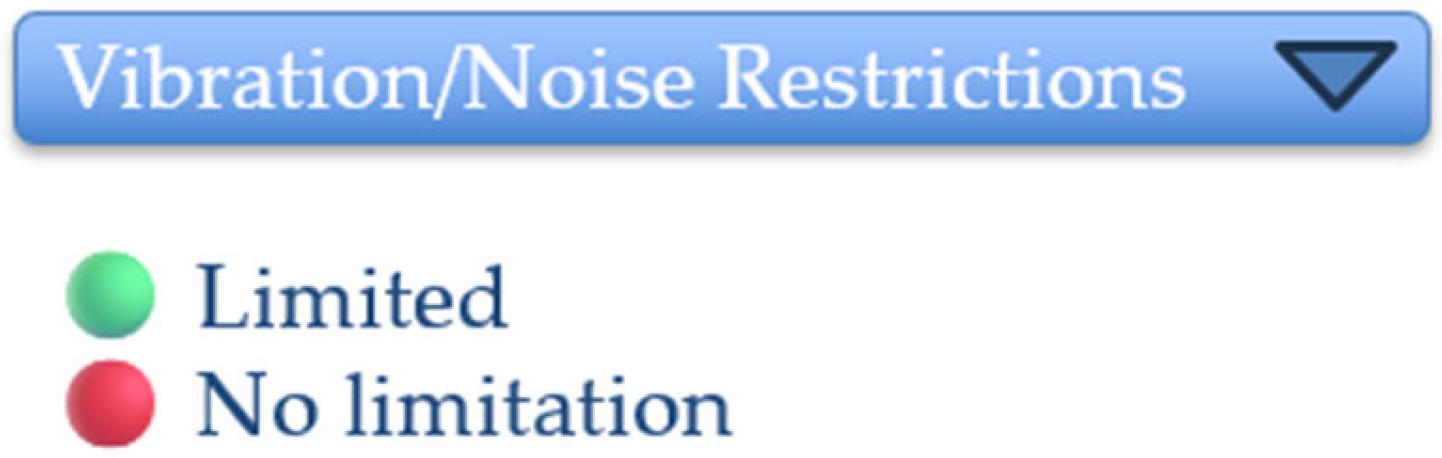
The vibration and noise restriction parameter is introduced as a qualitative indicator reflecting environmental and urban constraints that affect foundation selection (Figure 6). Under such limitations, driven piles are penalized, whereas low-vibration alternatives, including bored piles and micropiles, are assigned higher suitability scores.
The site access parameter presents the availability of space and logistical conditions for heavy construction equipment (Figure 7). Limited access reduces the feasibility of using large piling rigs and increases the relative suitability of micropiles or other compact installation techniques.
Although early-stage decision-making is associated with the uncertainty of input data, the thresholds are used to classify groundwater level, frost depth, and load level. The thresholds are introduced to simplify the categorization of input parameters at the early stages of the decision-making process. However, they can affect the compatibility scores when observations are located very close to the defined threshold.
All input parameters are formulated in general categories to support preliminary assessment across a range of geotechnical and construction conditions. However, the applicability of piles should be carefully considered in local conditions at the next stage of the decision-making process.

2.2.3. Decision-Support Stage—GSDP Analysis Module

The core feature of the GSDP framework is the integration of real-world construction site data into the decision-support logic.
The procedure compares the boundary conditions defined in the Input Data Module with the conditions under which it is recommended and feasible to construct three pile alternatives: driven piles, bored piles, and micropiles.
Soil category, groundwater level, frost depth, load level, vibration/noise restrictions, and site access conditions are considered in the multicriteria evaluation procedure. Each criterion is assigned a weighting coefficient that reflects its relative importance in the preliminary selection of a pile foundation. The weighting coefficients used in the current GSDP implementation are defined as an initial engineering parameterization based on the relative importance of each criterion, engineering relevance, practical considerations commonly applied during preliminary pile-foundation selection, and established foundation-engineering literature [1,2,3]. The weighting coefficients are presented in Table 1.
The weighting coefficients are assigned based on the expected effect of each criterion on the early-stage selection of pile alternatives during the conceptual design stage, when only limited site investigation data are usually available. Higher weights (0.25) are assigned to soil type and load, as these criteria play the most significant role in selecting pile alternatives, directly affecting pile suitability and ensuring the required load-bearing capacity of pile foundation systems. Groundwater conditions and vibration/noise restrictions are assigned intermediate weights (0.15) because they mainly affect constructability and installation constraints. Frost depth and site accessibility receive the lowest weights (0.10) because they primarily affect construction logistics and seasonal installation conditions rather than the fundamental suitability of a pile alternative. Additionally, the current study does not aim to establish universally applicable weighting coefficients; rather, the coefficients are intended to demonstrate the functionality and transparency of the proposed GSDP framework.
For each pile foundation alternative, compatibility with a given site condition is represented by a compatibility score ranging from 0 to 1, where 1 indicates the highest suitability, and 0 indicates the lowest suitability with respect to a particular criterion rather than the absolute technical infeasibility of the pile alternative. The compatibility scores are assigned based on engineering judgement and published recommendations regarding the applicability of pile foundation systems under different geotechnical and construction conditions [1,2,3]. The assigned compatibility scores are independent within each group of input parameters (Table 2). The weighting coefficients and compatibility scores are defined independently of the field-test results and are not calibrated using the outcomes of the two case studies.
The proposed weighting coefficients and compatibility scores are intended to support transparent and consistent preliminary decision-making. They represent the initial parameterization of the GSDP framework. Hence, they should not be interpreted as universally applicable design values.
Within the weighted additive procedure, the final suitability score is determined by the combined contribution of all considered criteria. The final suitability score is calculated using a weighted scoring procedure, where each criterion weighting coefficient is multiplied by the corresponding compatibility score of a pile alternative:
S i = j = 1 n w j x i j
where
( S i ) is the final suitability score for pile alternative (i);
( w j ) is the weighting coefficient assigned to criterion (j) according to Table 1;
( x i j ) is the compatibility score of criterion (j) for pile alternative (i), according to Table 2.
For each pile foundation alternative, the scores for all criteria are summed to obtain the final suitability score and ranking. The final suitability score can range from 0.455 to 1.00, 0.665 to 1.00 and 0.740 to 1.00, respectively, for driven piles, bored piles and micropiles. The lowest and highest suitability scores for driven piles are when they are installed in loose soil with a high-water level, shallow frost depth, low load level, and with limitations on noise and vibration or site access and in sand with low or medium water level, unfrozen soil or deep frost depth, high load level, and without any limitations on noise and vibration or site access, respectively. The sand, high water level, any frost depth, low load level, and limited site access to the construction site, regardless of the limitations on noise and vibration, ensure the lowest suitability score for bored piles. For micropiles, the lowest score is also received for sand and high-water-level conditions, but at deep frost depth and high load level, regardless of limitations on site access, noise, and vibration. The highest suitable score for bored piles is when they are installed in unfrozen clay or coarse-fragmented soils with low water and high load levels, with good access to the construction site, regardless of limitations on noise and vibration. In contrast, micropiles are most suitable for installation in unfrozen, loose soils with low or medium water levels, under low loads, on construction sites with limited access, regardless of noise and vibration limitations.
The numerical values provide a quantitative representation of the relative suitability of each pile alternative for use in the weighted scoring procedure. The resulting suitability scores are used to rank the pile alternatives within the same site scenario and should not be interpreted as absolute or normalized measures of performance across different pile systems.

2.2.4. Sensitivity Analysis

A basic sensitivity analysis was conducted to assess the stability of the proposed GSDP framework using the Kokshetau case study as the baseline scenario. The baseline conditions included sand, low groundwater level, deep frost depth, medium load level, no vibration/noise restrictions, and good site access. The corresponding baseline suitability scores were 0.975 for driven piles, 0.905 for bored/CFA piles, and 0.845 for micropiles (Table 3). To maintain a total weight of 1.00, each weighting coefficient was individually increased by 20%, while the remaining coefficients were proportionally reduced. The resulting suitability scores and rankings were then compared with the baseline results.
The sensitivity analysis shows that the ranking remained unchanged across all six +20% single-weight perturbation scenarios, with driven piles consistently ranked first, followed by bored/CFA piles and micropiles. The suitability scores vary only moderately relative to the baseline values. These results indicate that, for the Kokshetau reference scenario, the ranking remains stable when a single input weight is altered.
The present sensitivity analysis considers only variations in the criterion weights. Uncertainty in the compatibility scores presented in Table 3 was not included in this analysis and may also affect the final suitability scores and ranking of pile alternatives. Further studies should therefore examine the sensitivity of the framework to variations in both criterion weights and compatibility scores.

2.2.5. Recommended Solutions Stage—Decision Output Module

A ranked list of pile foundation alternatives results from a scoring and ranking procedure that assigns a suitability score to each alternative. Higher scores indicate better overall compatibility with the specified site conditions and available field evidence. However, the final suitability score is used only for comparative ranking of pile foundation alternatives and should be interpreted only as a relative ranking indicator for qualitative assessment. The acceptance of the recommended solution should always be finally checked and accepted by the designer. A brief explanation of the recommendation is supplemented to the ranked list of pile alternatives. The brief explanations are generated using predefined rule-based templates linked to the input criteria. They highlight the site conditions that most strongly support or limit the suitability of each pile alternative, thereby making the resulting ranking more transparent and interpretable.

3. Case-Study Application Results

3.1. Prototype Evidence-Informed Scoring Framework

The two case studies were used to demonstrate the practical application and preliminary performance of the GSDP framework under contrasting geotechnical and construction conditions. Those case studies were two construction sites in Kazakhstan: Kokshetau and Astana.

3.2. Case Study 1—Kokshetau Construction Site

3.2.1. Construction Site Characterization—Case Study 1

The testing construction site is in Kokshetau, in northern Kazakhstan. The site is characterized by heterogeneous, layered soils consisting of sands, loams, and gravelly deposits with low groundwater conditions and significant seasonal freezing. Frost penetration depth in the study area typically ranges from 2.0 to 2.5 m, resulting in substantial seasonal variation in soil stiffness and pile installation conditions [25]. The required design pile load for the designed structure for which the pile alternatives were sought was approximately 1000 kN (100 t).

3.2.2. GSDP Application—Case Study 1

For the Kokshetau case, the sandy soil, low groundwater level, and deep frost penetration were selected, consistent with the field test conditions. There were no vibration and noise restrictions, and the construction site was accessible without any limitations. The medium-load category was adopted in the GSDP framework.
As a result, a ranked list of alternative piled foundations, with brief explanations, was generated. The summary of the pile foundation recommended for implementation is presented in Table 4.
The most suitable foundation alternative identified by the GSDP framework was driven piles, which achieved the highest suitability score. Bored/CFA piles were ranked second, while micropiles received the lowest score under the site conditions considered. The ranking reflects the favorable compatibility of driven piles with the site characteristics, load requirements, and field-test evidence obtained from the Kokshetau case study. However, the practical feasibility of each recommendation should be verified through foundation design, based on knowledge of the site’s detailed soil-water conditions.

3.2.3. Applied Piled Foundation and Its Field-Testing Results

Driven reinforced concrete piles, with cross-sections of 30 × 30 cm and 40 × 40 cm, were selected for installation at the Kokshetau construction site based on preliminary engineering considerations. The piles ranged in length from approximately 11.5 m to 15.5 m, allowing penetration through variable near-surface layers into deeper, more competent soil strata. This configuration was intended to ensure reliable load transfer and to minimize the negative effect of freeze–thaw-affected soils on soil-structure interaction [25].
The field investigation program included static load testing (SLT) to evaluate the load–settlement response and verify the performance of the driven piles under site-specific conditions, in accordance with the standards [23,26,27]. The piles were loaded in two cycles with a maximum load of 1373 kN. According to the technical report [25], the field-tested piles met the required load-bearing capacity.

3.3. Case Study 2—Astana Construction Site

3.3.1. Construction Site Characterization—Case Study 2

The second construction site is in Astana, Kazakhstan. The site is characterized by heterogeneous layered soils comprising loams, sandy and gravelly deposits, and a substantial thickness of coarse-fragment soils in the deeper part of the profile. The groundwater level is recorded at approximately 3.4 m below ground level. The frost depth can reach 2.5 m below ground level in winter; however, earthworks, including foundation construction, have been scheduled for the summer. The foundation system was designed for high structural loads, with a design pile load of approximately 10,598 kN [28].

3.3.2. GSDP Application—Case Study 2

For the Astana case, the input parameters were selected according to the site-specific geotechnical and construction conditions. Coarse-fragment soil was selected as the representative soil category in the GSDP framework, together with a medium groundwater level and a high load level. As the pile installation was planned for the warm season, no frozen ground layer was considered present at the time of construction; hence, the corresponding unfrozen ground conditions were adopted in the GSDP framework. Due to the dense urban development and the proximity of existing buildings, the vibration/noise restriction category was set to “Limited”. At the same time, the construction site was considered accessible without significant limitations.
Application of these parameters to the GSDP produced a different ranking from that obtained for the Kokshetau case. Bored/CFA piles received the highest overall score, followed by micropiles and driven piles. The preference for bored piles is primarily associated with their high compatibility with coarse-fragment soil conditions and the absence of impact-induced vibration during installation. The resulting ranking is presented in Table 5.

3.3.3. Applied Bored Pile Foundation and Static Load Testing

Bored reinforced-concrete piles were adopted for the Astana project, providing an independent field case involving a pile technology different from that used at the Kokshetau site. The tested piles had a diameter of 1200 mm and lengths of approximately 26.5–28.1 m, with a design pile load of approximately 10,598 kN [28].
Static load tests were performed to evaluate the load–settlement response of the constructed bored piles [23,26,27]. The tested piles sustained loads exceeding the design requirement, with the field tests reaching approximately 12,857 kN. The load–settlement response confirmed that the implemented bored-pile foundation performed adequately under the site-specific geotechnical and loading conditions [28].

3.3.4. Comparison of GSDP Results with Case-Study Outcomes

The two case studies were compared to examine whether the GSDP framework responds to contrasting geotechnical and construction conditions. The different rankings indicate that the framework responds to changes in site-specific input conditions rather than systematically assigning the highest score to a single pile type. In both cases, the pile alternative ranked first by the GSDP corresponds to the pile foundation system independently adopted for the respective construction project. The subsequent field tests provided additional evidence that the implemented pile systems achieved the required performance under the corresponding site conditions. The results of the case study comparison are presented in Table 6.
It should be underlined that in both cases, the field tests were not used to calibrate the GSDP score or to determine the ranking. The GSDP assessment was based on the predefined site-input criteria and compatibility matrix, whereas the field test results were subsequently used only as independent evidence of the field performance of the implemented pile type and not as validation of the complete GSDP ranking procedure.

4. GeoSupport Decision Platform (GSDP) Evaluation

4.1. GSDP Advantages and Drawbacks

The GSDP has both strengths and weaknesses, which, in turn, determine its advantages and limitations in application. The framework’s strengths include its transparent decision-making process, a simple, user-friendly interface, and the integration of engineering rules with field-test evidence. Following this, the framework enables the provision of quick preliminary recommendations based on key site conditions at the early stages of the decision-making process when detailed geotechnical data are missing. The straightforward scoring procedure and interpretability of the resulting ranking are GSDP’s main practical features. The framework’s strength lies in its assessment based solely on technical issues; it does not focus on a single pile alternative installed using different techniques. Moreover, the input parameter categories are formulated in general terms to support preliminary assessment under a range of geotechnical and construction conditions. However, this universality, which increases its attractiveness at the early stage of the decision process, makes it necessary to carefully evaluate the recommended pile alternative for specific local conditions when detailed geotechnical data are available at the next stage of the decision-making process. Furthermore, the modular structure of the framework enables future development by adding new decision criteria and specifying existing ones without modifying the core algorithm. Briefly, the advantage of using the framework is the ability to quickly assess the feasibility of a pile alternative.
The framework’s weaknesses include the general formulation of input conditions and the limited number of proposed pile foundation solutions. The range of input parameters limits the framework to construction sites in seismically safe regions and under non-hazardous environmental conditions, since these factors are not included. At this initial stage, only the main pile alternatives and the factors most affecting each alternative’s feasibility are considered. The soil type, one of the most heavily weighted input parameters, is simplified for heterogeneous or layered soils, and its definition can most strongly affect the results. Also, the thresholds used to simplify the categorization of groundwater level, frost depth, and load level can affect compatibility scores when observations are very close to these thresholds. Another limitation is related to the additive weighted-sum structure of the current GSDP framework, in which the criteria are treated as independent and compensation between criteria is possible. Interactions between geotechnical and construction factors, such as soil conditions, groundwater level, frost depth, and load demand, are not explicitly represented in the present scoring procedure. Furthermore, as the sensitivity analysis covers only weighting coefficients, the compatibility scores may also affect the final suitability scores. Moreover, the input parameters allow only a qualitative assessment of the selected pile alternative. Additionally, the framework methodology was demonstrated through only two case studies, limiting its applicability. Altogether, the GSDP drawbacks stem from reliance on predefined engineering rules and a limited database. Consequently, the GSDP recommendations should be interpreted as preliminary guidance and must be verified by detailed geotechnical investigations and code-based foundation design.

4.2. GSDP Future Enhancements and Expanded Scope

The GeoSupport Decision Platform (GSDP) is just the first stage of the framework. At this stage of development, it is intended to support the decision-making process by providing recommendations on early-stage pile foundation selection rather than replacing established MCDM approaches. However, the implemented methodology and core algorithm offer potential to enhance and extend the framework.
In a further version of the framework, the criteria implemented in the Input Data Module can be specified in more detail. Future versions can include more soil categories and specific soil parameters. Also, the vibration and noise restriction parameter can be refined by introducing more detailed categories. For groundwater level, frost depth, load level, and vibration restriction, a transition interval can be introduced. Fluctuations in groundwater levels will be factored into the groundwater level category. Additionally, a new decision criterion, such as aggressive environmental conditions or climate conditions, can be considered at the next stages of the work.
Also, some improvements can be introduced to the GSDP Analysis Module in the final suitability-score procedure, particularly to the scope of weighting coefficients. Future versions of the framework can determine weighting factors using more advanced techniques, such as the Analytic Hierarchy Process (AHP), or data-driven calibration based on expanded databases. The framework’s sensitivity to variations in compatibility scores can be examined, and its results can be implemented.
It would be worthwhile developing the Decision Output Module to allow selection of a specific pile type from the available alternatives: driven piles, bored piles, or micropiles. It is possible to expand the framework’s scope to include additional stages of the decision-making process, and even to expand with a design stage that allows selection of pile depth and cross-section size.
As the current framework maintains its strict focus on technical issues, construction costs and installation duration can be considered in a further version. However, a time-consuming criterion and cost–benefit analysis should be introduced as a separate module that follows the recommended solution stage. Such a structure will allow for a clear separation of technical aspects from economic aspects.
In short, the proposed GSDP framework, improved in its architecture and extended with new modules, is intended to evolve significantly from a tool supporting decision-making at its early stages to later stages of a more comprehensive engineering decision-making process, while simultaneously accounting for economic factors and, at the same time, remaining transparent and interpretable.

5. Conclusions

Overall, the current implementation of GSDP is a rule-based decision-support framework, developed under considerable uncertainty due to limited, quantitatively defined input parameters. Its novelty relative to available frameworks lies in structuring pile-selection criteria, engineering compatibility rules, and field-based evidence within a transparent and explainable early-stage decision-support framework. It enables transparent, systematic evaluation of pile foundation alternatives across varying engineering conditions at the early stage of the decision-making process. Although its application is limited, a multicriteria scoring procedure ensures transparent and interpretable recommendations, with brief explanations of selected pile alternatives consistent with the engineering solution demonstrated in the case studies. However, the framework’s principal limitation is its reliance on a limited number of construction sites. Hence, it should be validated across different geological conditions and with larger field databases in the future to identify its applicability limitations. Further work should also include a comparison of the proposed framework with established multicriteria decision-making techniques and machine learning approaches to further demonstrate its advantages and limitations.
Due to GSDP’s drawbacks, the framework is intended to demonstrate the applicability of transparent, evidence-informed decision-support procedures rather than to provide a universally applicable design process. Although it has potential for future development by specifying existing criteria, adding new decision criteria, and becoming more precise and reliable through validation across more scenarios differing in geological conditions, it cannot replace human expertise, engineering judgement, or detailed geotechnical design procedures. Undoubtedly, its role is to support engineers in evaluating alternative pile foundation designs during project planning and decision-making. It should be emphasized that a detailed geotechnical investigation and specialist expert remain essential before selecting the final pile foundation system.
The program is addressed to geotechnical engineers, foundation designers, construction engineers, and project planners involved in the preliminary selection of pile foundation solutions. At this stage, it is intended to support engineering judgement during the early stages of project development, when only limited construction-site information is available, and multiple foundation alternatives are under consideration. However, GSDP may serve as a foundation for future expansion toward larger databases of pile-type diversity and more detailed data on them, as well as an enriched input parameter module and advanced AI-assisted geotechnical decision-support systems.

Author Contributions

Conceptualization, A.M. and G.Z.; methodology, A.M.; software, A.M.; validation, A.M. and A.D.; formal analysis, A.M.; investigation, A.M., Y.A. and A.I.; resources, A.M.; data curation, A.D. and D.M.; writing—original draft preparation, A.M.; writing—review and editing, A.M. and A.D.; visualization, A.I.; supervision, A.M. and A.D.; project administration, A.M.; funding acquisition, A.M. All authors have read and agreed to the published version of the manuscript.

Funding

This research was funded by the Science Committee of the Ministry of Science and Higher Education of the Republic of Kazakhstan, grant number AP22684471.

Data Availability Statement

The data presented in this study are not publicly available because the raw field and technical data are owned by KGS-Astana LLP. The data may be made available from the corresponding author upon reasonable request and with the permission of KGS-Astana LLP.

Acknowledgments

The authors would like to acknowledge the support provided by the testing team involved in the field investigations in Kokshetau. The authors have reviewed and edited the output and take full responsibility for the content of this publication.

Conflicts of Interest

Author Yergen Ashkei is employed by the Construction Company KGS-Astana LLP. The remaining authors declare that the research was conducted in the absence of any commercial or financial relationships that could be construed as a potential conflict of interest.

Abbreviations

The following abbreviations are used in this manuscript:
CFAContinuous Flight Auger
MCDMMulticriteria Decision-Making
GSDPGeoSupport Decision Platform
SLTStatic Load Test
PLTPile Load Test

References

  1. Das, B.M.; Sivakugan, N. Principles of Foundation Engineering, 9th ed.; Cengage Learning: Boston, MA, USA, 2019. [Google Scholar]
  2. Coduto, D.P.; Yeung, M.R.; Kitch, W.A. Foundation Design: Principles and Practices, 3rd ed.; Pearson: New York, NY, USA, 2016. [Google Scholar]
  3. Tomlinson, M.; Woodward, J. Pile Design and Construction Practice, 6th ed.; CRC Press: Boca Raton, FL, USA, 2014. [Google Scholar]
  4. Mickovski, S.B.; van Beek, L.P.H. A decision support system for the evaluation of eco-engineering strategies for slope protection. Geotech. Geol. Eng. 2006, 24, 483–498. [Google Scholar] [CrossRef] [Scilit]
  5. Mickovski, S.B.; Stokes, A.; van Beek, L.P.H. A decision support tool for windthrow hazard assessment and prevention. For. Ecol. Manag. 2005, 216, 64–76. [Google Scholar] [CrossRef] [Scilit]
  6. Rehman, Z.U. Trends and challenges of technology-enhanced learning in geotechnical engineering education. Sustainability 2023, 15, 7972. [Google Scholar] [CrossRef] [Scilit]
  7. Shim, J.P.; Warkentin, M.; Courtney, J.F.; Power, D.J.; Sharda, R.; Carlsson, C. Past, present, and future of decision support technology. Decis. Support Syst. 2002, 33, 111–126. [Google Scholar] [CrossRef] [Scilit]
  8. Toll, D.G.; Barr, R.J. A computer-aided learning system for the design of foundations. Adv. Eng. Softw. 1998, 29, 637–643. [Google Scholar] [CrossRef] [Scilit]
  9. Basari, E.; Eski, O.; Uzan Araz, O.; Turan, M.E. Selection of pile foundation systems using an integrated multi-criteria decision-making approach. Dicle Univ. J. Eng. 2021, 12, 133–145. [Google Scholar] [CrossRef] [Scilit]
  10. Dachowski, R.; Gałek, K. Selection of the best method for underpinning foundations using the PROMETHEE II method. Sustainability 2020, 12, 5373. [Google Scholar] [CrossRef] [Scilit]
  11. Sušinskas, S.; Zavadskas, E.K.; Turskis, Z. Multiple criteria assessment of pile-column alternatives. Balt. J. Road Bridge Eng. 2011, 6, 145–152. [Google Scholar] [CrossRef] [Scilit]
  12. Turskis, Z.; Daniūnas, A.; Zavadskas, E.K.; Medzvieckas, J. Multicriteria evaluation of building foundation alternatives. Comput. Civ. Infrastruct. Eng. 2016, 31, 717–729. [Google Scholar] [CrossRef] [Scilit]
  13. Zavadskas, E.K.; Sušinskas, S.; Daniūnas, A.; Turskis, Z.; Sivilevičius, H. Multiple criteria selection of pile-column construction technology. J. Civ. Eng. Manag. 2012, 18, 834–842. [Google Scholar] [CrossRef] [Scilit]
  14. Zavadskas, E.K.; Turskis, Z.; Vilutienė, T. Multiple criteria analysis of foundation installation alternatives using the additive ratio assessment (ARAS) method. Arch. Civ. Mech. Eng. 2010, 10, 123–141. [Google Scholar] [CrossRef] [Scilit]
  15. Liu, H.; Su, H.; Sun, L.; Dias-da-Costa, D. State-of-the-art review on the use of AI-enhanced computational mechanics in geotechnical engineering. Artif. Intell. Rev. 2024, 57, 196. [Google Scholar] [CrossRef] [Scilit]
  16. Phoon, K.K.; Zhang, L.M.; Cao, Z.J. Special issue on “Machine learning and AI in geotechnics”. Georisk Assess. Manag. Risk Eng. Syst. Geohazards 2023, 17, 1–6. [Google Scholar] [CrossRef] [Scilit]
  17. Arbi, S.J.; Rehman, Z.U.; Hassan, W.; Khalid, U.; Ijaz, N.; Maqsood, Z.; Haider, A. Optimized machine learning-based enhanced modeling of pile bearing capacity in layered soils using random and grid search techniques. Earth Sci. Inform. 2025, 18, 332. [Google Scholar] [CrossRef] [Scilit]
  18. Shahin, M.A.; Jaksa, M.B.; Maier, H.R. Recent advances and future challenges for artificial neural systems in geotechnical engineering applications. Adv. Artif. Neural Syst. 2009, 2009, 308239. [Google Scholar] [CrossRef] [Scilit]
  19. Toll, D.G.; Barr, R.J. A decision support system for geotechnical applications. Comput. Geotech. 2001, 28, 575–590. [Google Scholar] [CrossRef] [Scilit]
  20. Yamaç, S.S.; Şeker, C.; Negiş, H. Evaluation of machine learning methods to predict soil moisture constants with different combinations of soil input data for calcareous soils in a semi-arid area. Agric. Water Manag. 2020, 234, 106121. [Google Scholar] [CrossRef] [Scilit]
  21. Zhang, P.; Yin, Z.-Y.; Jin, Y.-F. Machine learning-based modelling of soil properties for geotechnical design: Review, tool development and comparison. Arch. Comput. Methods Eng. 2022, 29, 1229–1245. [Google Scholar] [CrossRef] [Scilit]
  22. Zhang, P.; Yin, Z.-Y.; Jin, Y.-F.; Ye, G.-L. An AI-based model for describing cyclic characteristics of granular materials. Int. J. Numer. Anal. Methods Geomech. 2020, 44, 2521–2544. [Google Scholar] [CrossRef] [Scilit]
  23. SP RK 5.01-103-2013; Pile Foundations. Committee for Construction and Housing and Utilities: Astana, Kazakhstan, 2015.
  24. SP RK 5.01-102-2013; Bases and Foundations of Buildings and Structures. Committee for Construction and Housing and Utilities: Astana, Kazakhstan, 2019.
  25. KGS-Astana LLP. Field Investigation Report for the Kokshetau Hospital Construction Site, Kazakhstan; Unpublished Technical Report; KGS-Astana LLP: Astana, Kazakhstan, 2025. [Google Scholar]
  26. GOST 5686-2012; Soils. Field Testing Methods Using Piles. Standardinform: Moscow, Russia, 2012.
  27. MSP 5.01-101-2003; Design and Installation of Pile Foundations. Committee for Construction and Housing and Utilities: Astana, Kazakhstan, 2007.
  28. KGS-Astana LLP. Field Investigation Report on Static Load Testing of Bored Piles at the Diamond Multifunctional Complex Construction Site; KGS-Astana LLP: Astana, Kazakhstan, 2022. [Google Scholar]
Figure 1. Conceptual structure of the GSDP framework.
Buildings 16 03701 g001
Figure 2. Soil categories considered during early-stage matching in the GSDP framework.
Buildings 16 03701 g002
Figure 3. Groundwater level categories applied at the conceptual design stage.
Buildings 16 03701 g003
Figure 4. Frost depth used in the considered scenarios.
Buildings 16 03701 g004
Figure 5. Categorical representation of anticipated load demand at the conceptual design stage.
Buildings 16 03701 g005
Figure 6. Vibration/noise restrictions categories.
Buildings 16 03701 g006
Figure 7. Site access categories.
Buildings 16 03701 g007
Table 1. Weighting coefficient applied to the criterion in the GSDP framework.
CriterionWeight
Soil Type0.25
Groundwater0.15
Frost Depth0.10
Load Level0.25
Vibration/Noise Restrictions0.15
Site Access Conditions0.10
Total1.00
Table 2. Compatibility scores applied in the GSDP framework.
Input
Parameter
CategoryDriven Piles (D)Bored/CFA Piles (B)Micropiles (M)Compatibility Score Range
Soil TypeSand1.00.80.7
Clay0.81.00.8
Silt/Silty clay0.60.80.80.3–1.0
Fill/Loose soil0.30.51.0
Coarse-fragment soil0.71.00.8
Groundwater LevelLow1.01.01.0
Medium1.00.81.00.5–1.0
High0.80.50.8
Frost DepthUnfrozen1.01.01.0
Shallow0.80.80.80.7–1.0
Mid-depth0.90.80.8
Deep1.00.80.7
Load LevelLow0.60.71.0
Medium0.90.90.80.5–1.0
High1.01.00.5
Vibration/
Noise Restrictions
Limited0.01.01.00–1.0
No limitation1.01.01.0
Site Access
Conditions
Good1.01.01.00.3–1.0
Limited0.30.61.0
Table 3. Sensitivity analysis of GSDP recommendations under different weighting scenarios.
ScenarioDrivenBored/CFAMicropilesRanking
Baseline0.9750.9050.845D > B > M
Soil +20%0.9770.8980.835D > B > M
Groundwater +20%0.9760.9080.850D > B > M
Frost depth +20%0.9760.9030.842D > B > M
Load +20%0.9700.9050.842D > B > M
Vibration/noise +20%0.9760.9080.850D > B > M
Site access +20%0.9760.9070.848D > B > M
Table 4. Ranked pile list for Kokshetau construction site.
RankPile TypeSuitability ScoreRecommendationBrief Explanation
1Driven piles0.975RecommendedHighest compatibility with site conditions, including sandy soils, low groundwater level, medium load demand, and unrestricted site access.
2Bored/CFA piles0.905AlternativeSuitable for the considered site conditions, but with slightly lower compatibility under groundwater and frost conditions compared to driven piles.
3Micropiles0.845Less suitableTechnically feasible under the considered site conditions, but with lower overall compatibility than driven and bored/CFA piles.
Table 5. Ranked pile list for Astana construction site.
RankPile TypeSuitability ScoreRecommendationBrief Explanation
1Bored/CFA piles0.970RecommendedHighest compatibility with the site conditions, particularly the coarse-fragment soil profile, high load demand, and vibration/noise restrictions associated with the surrounding urban development.
2Micropiles0.825AlternativeSuitable for coarse-fragment soils and vibration-sensitive conditions, but less appropriate for the very high load demand of the considered project.
3Driven piles0.775Less suitableTechnically feasible, but less suitable due to reduced compatibility with coarse-fragment soils and the vibration/noise restrictions associated with impact-driven installation.
Table 6. Case comparison of GSDP results and implemented pile foundation systems.
ParameterCase 1—KokshetauCase 2—Astana
Representative soil typeSandCoarse-fragment soil
Groundwater levelLowMedium
Ground/frost conditionDeep frostUnfrozen
Load levelMediumHigh
Vibration/noise restrictionNo limitationLimited
Site accessGoodGood
GSDP Rank 1Driven piles (0.975)Bored/CFA piles (0.970)
GSDP Rank 2Bored/CFA piles (0.905)Micropiles (0.825)
GSDP Rank 3Micropiles (0.845)Driven piles (0.775)
Pile type adopted at the siteDriven pilesBored piles
Field testingSLT SLT
Disclaimer/Publisher’s Note: The statements, opinions and data contained in all publications are solely those of the individual author(s) and contributor(s) and not of MDPI and/or the editor(s). MDPI and/or the editor(s) disclaim responsibility for any injury to people or property resulting from any ideas, methods, instructions or products referred to in the content.