Article

Self-Healing Performance of Concrete with Combined Incorporation of CCCW and Microcapsules

1
State Key Laboratory of Hydroscience and Engineering, Tsinghua University, Beijing 100084, China
2
Beijing Jinyu Group Co., Ltd., Beijing 100052, China
3
School of River and Ocean Engineering, Chongqing Jiaotong University, Chongqing 400074, China
4
Beijing Building Materials Academy of Science Research, Beijing 100041, China
*
Author to whom correspondence should be addressed.
Buildings 2026, 16(18), 3644; https://doi.org/10.3390/buildings16183644

Submission received: 24 July 2026 / Revised: 9 September 2026 / Accepted: 11 September 2026 / Published: 13 September 2026
(This article belongs to the Section Building Materials, and Repair & Renovation)

Abstract

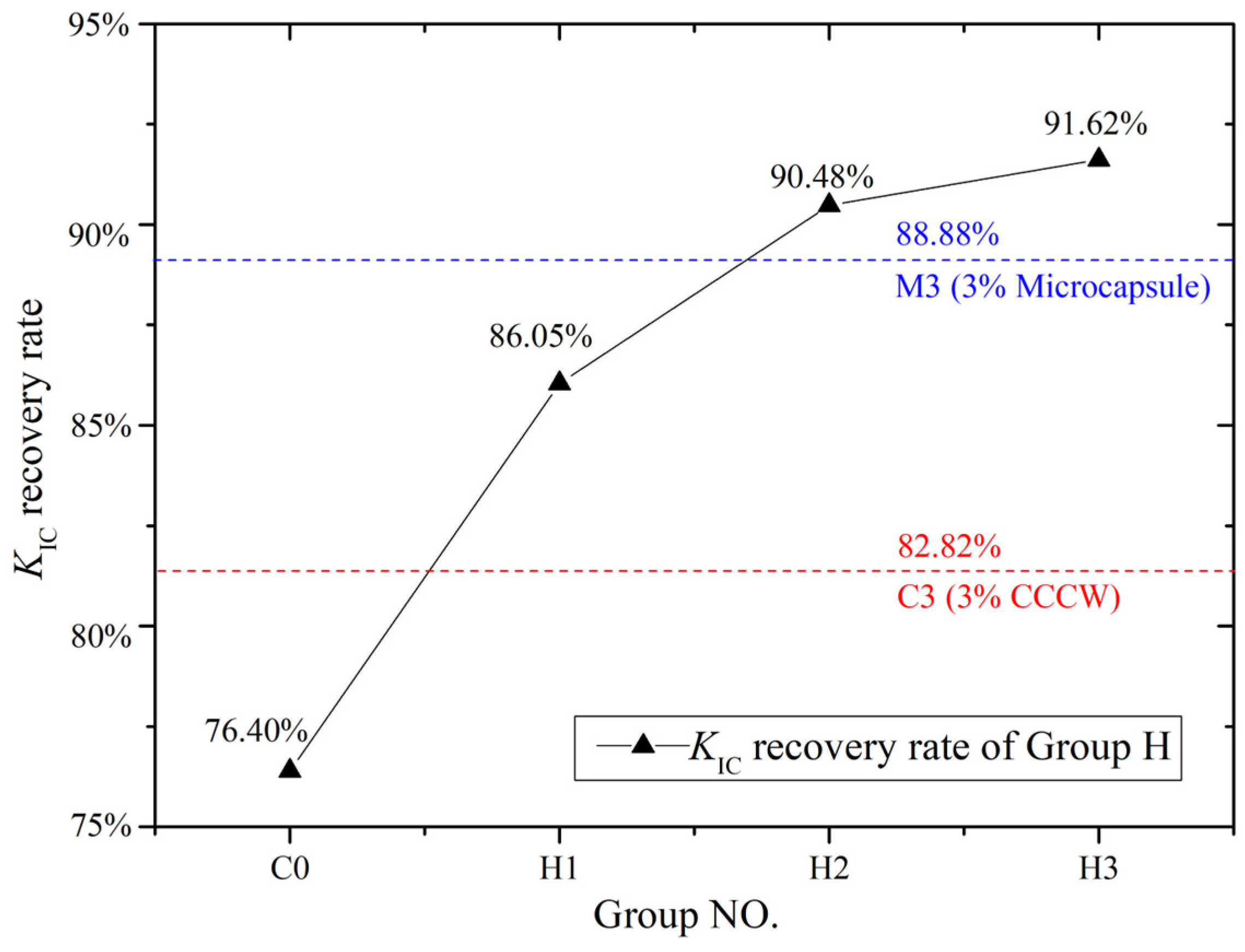
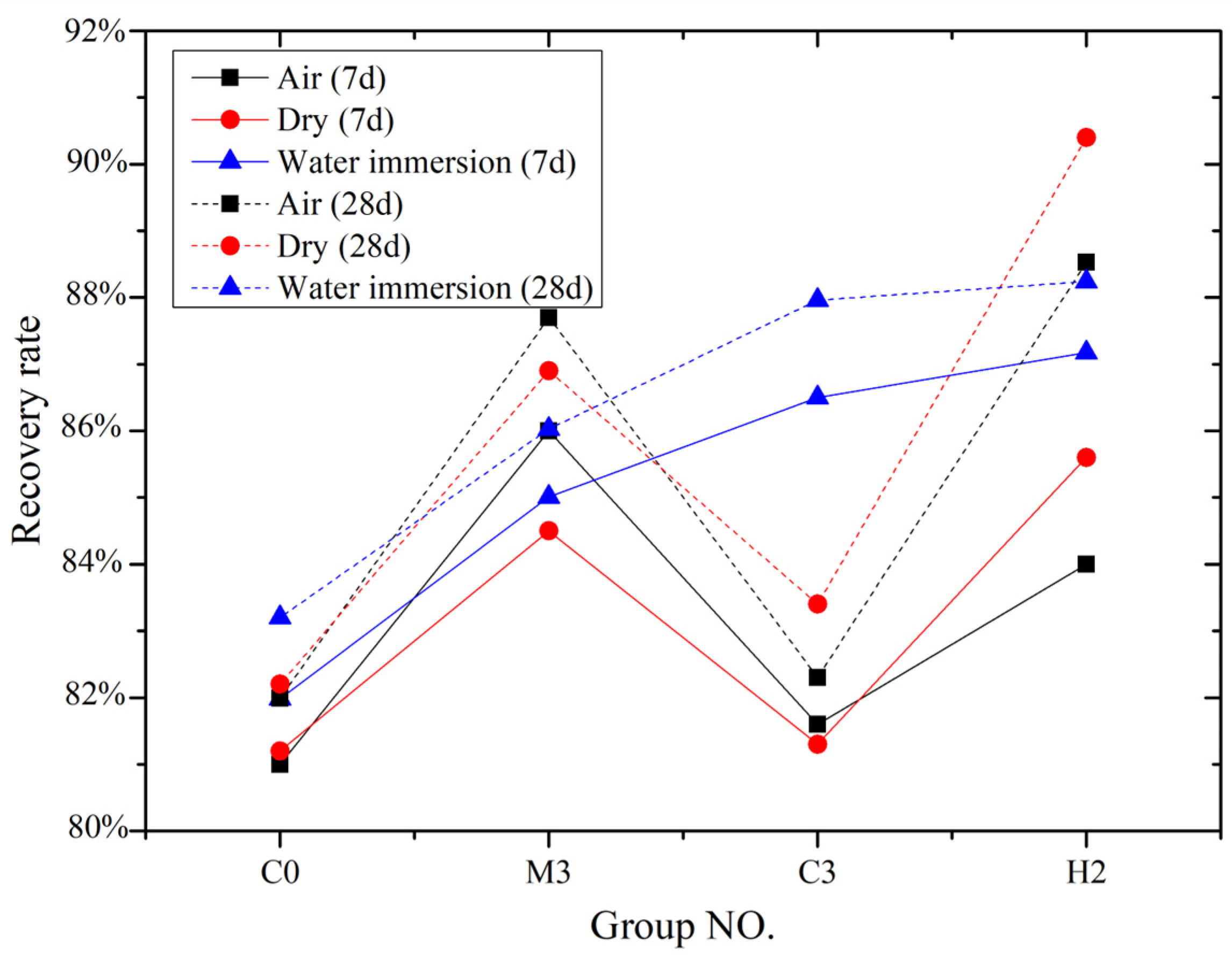
Crack-induced durability deterioration remains a critical challenge for concrete structures. Cementitious capillary crystalline waterproofing materials (CCCW) enable moisture-driven crystallization, while alginate/epoxy microcapsules provide stress-induced bonding. However, it remains unclear whether combining the two agents produces a complementary repair effect or only an additive one under different humidity conditions. This study investigates the self-healing properties of concrete containing CCCW and alginate/epoxy microcapsules. The results indicate that the healing performance of microcapsules depends little on moisture dependence and shows stable repair performance, while CCCW performs well in humid environments but is inhibited under dry conditions. At a fixed total dosage of 3%, the optimal hybrid system containing 2% microcapsule and 1% CCCW achieves higher recovery rates than any single-admixture group under all three curing conditions. This improvement is consistent with potentially complementary contributions from microcapsules and CCCW, although the detailed chemical nature and temporal evolution of the observed deposits require further investigation. This study provides a reference for the design and application of multi-component self-healing concrete in complex service environments.
Keywords: concrete; CCCW; microcapsule; self-healing; microcracks concrete; CCCW; microcapsule; self-healing; microcracks