1. Introduction
The construction industry is responsible for about 40% of the global natural resource exploitation [
1]. The current practices in the construction industry follow a linear supply chain model (take-make-dispose) with minimum consideration of the End-of-Life (EOL) phase of the structures [
2]. There is a need to change this model to a circular model that aims to keep resources in use for as long as possible, which will minimize waste and reduce the negative environmental impact [
3]. Adopting Circular Construction (CC) is highly dependent on the way of handling the structure’s components at the EOL phase, where two main options are available: demolition or deconstruction [
4].
Demolition of steel structures results in most steel being recycled, although some steel end up in landfills due to contamination or recycling limitations [
5]. Deconstruction is a more methodical approach that focuses on carefully disassembling the structure to maximize the recovery of valuable components [
6]. Following deconstruction, recovered materials can be managed through two main pathways: reuse or recycling. In practice, a combination of reuse and recycling often occurs. Recycling is a common approach for handling materials at the EOL, but it entails energy-intensive processes, such as steel melting and fabrication, which can elevate energy consumption [
7]. Additionally, these processes may compromise material quality, potentially leading to increased demand for new materials in future applications [
8]. Alternatively, reuse often presents a more sustainable approach, as it involves minimal physical alterations [
9]. Furthermore, the embodied energy and Greenhouse Gas (GHG) emissions of the structures made of reused components are 63% and 56% lower, respectively, than those of the new components [
10].
As steel production accounts for nearly 8% of global CO
2 emissions [
11], steel reuse presents a significant opportunity for advancing CC. Reusing structural steel—rather than downcycling it through energy-intensive recycling—offers significant potential to reduce embodied carbon and extend material life cycles [
12]. Despite steel’s inherent recyclability, steel component reuse remains underdeveloped due to technical, regulatory, logistical, and economic barriers [
7]. However, implementing deconstruction and reuse practices necessitates radical changes in the construction industry, moving away from the traditional approach of fixed-lifespan structures to a more flexible approach that facilitates deconstruction and component reuse [
13]. This will require the adoption of new business models and technologies that prioritize deconstruction and support CC [
14].
While several studies have recognized the importance of the EOL phase of existing structures and the potential for component reuse, there remains a lack of systematic, multi-case analyses grounded in real-world deconstruction projects. Existing research often emphasizes theoretical frameworks or isolated pilot initiatives, offering limited insight into the practical challenges, enabling conditions, and contextual factors that shape successful implementation and scalability. Moreover, there is a lack of structured approaches for systematically identifying and organizing the key factors influencing deconstruction and reuse processes across different project contexts. Accordingly, this paper addresses these gaps by developing a framework of factors affecting efficient deconstruction and structural steel reuse, identified through a thematic analysis of the literature, and applies it to multiple case studies to examine reuse practices across diverse contexts. The study analyzes fifteen case studies: two from North America, twelve from Europe, and one from Asia. Based on this analysis, a structural steel reuse classification model is developed to enable systematic cross-case comparison and to assess coordination complexity and scalability across different types of reverse supply chains (RSC).
The findings identify recurring barriers and enabling factors across different typologies and project configurations, highlighting emerging best practices. This study contributes by (i) providing a structured, factor-based framework derived from thematic analysis, (ii) analyzing a multi-regional set of real-world case studies, and (iii) introducing a reuse classification model to evaluate coordination complexity and scalability. By examining how these factors interact across donor–receiver relationships, project timing, and geographic conditions, the study provides methodological insights and practical recommendations to support the large-scale implementation of CC in the built environment.
The paper is organized into eight sections.
Section 2 presents a literature review on deconstruction processes, structural steel reuse challenges, and recent initiatives supporting reuse.
Section 3 describes the research methodology.
Section 4 presents the development of a framework of factors influencing efficient deconstruction and structural steel reuse.
Section 5 discusses the case studies and maps the proposed framework across the examined projects.
Section 6 develops a structural steel reuse classification model and conducts a systematic cross-case comparison to examine variations in coordination complexity, implementation challenges, and scalability potential.
Section 7 proposes recommendations to support large-scale structural steel reuse across RSC. Finally,
Section 8 presents the conclusions and outlines directions for future research.
2. Literature Review
2.1. Structural Steel Deconstruction and Circular Pathways
The deconstruction process at the EOL phase of a structure follows a systematic approach to maximize component reuse and recycling, reducing environmental impact and promoting CC.
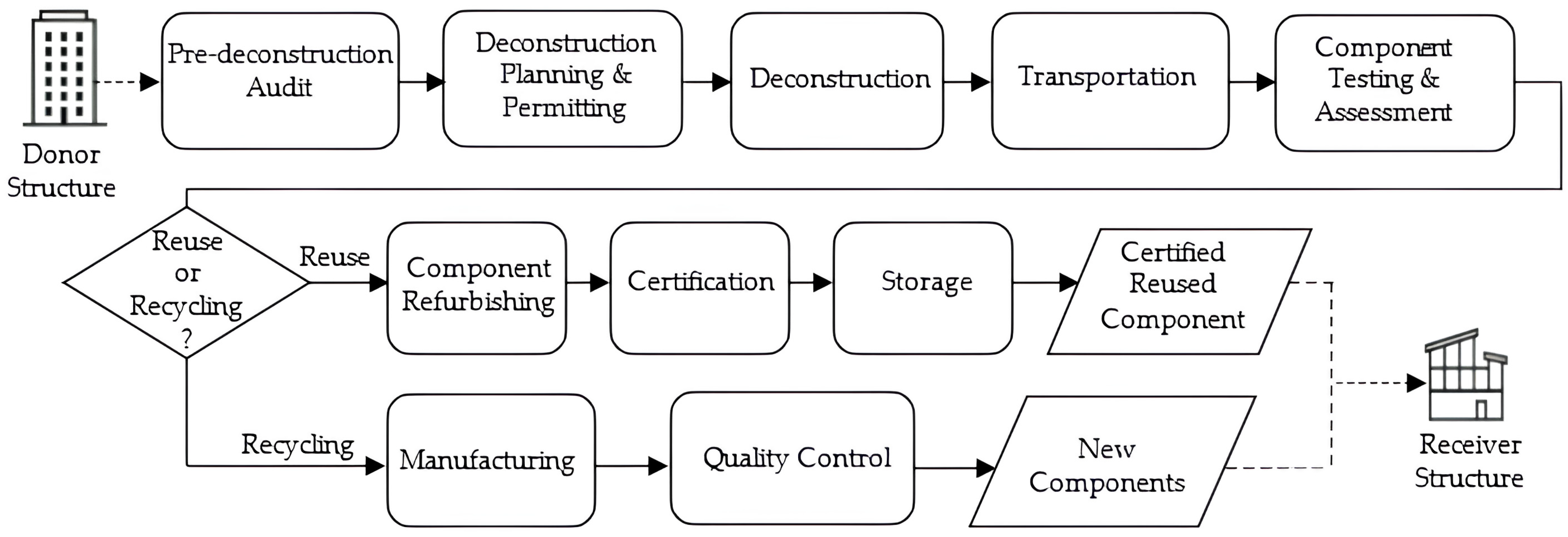
Figure 1 illustrates the stages involved in the EOL phase of structures. The process begins with the identification of a donor structure, where a structure suitable for deconstruction is selected. A pre-deconstruction audit is then conducted, including a comprehensive evaluation of the donor structure to identify reusable, recyclable, or disposable components. The audit assesses the economic and environmental feasibility of deconstruction, providing essential data that guides the development of the deconstruction planning and permitting stage [
15]. During this stage, a comprehensive deconstruction plan is created, which includes securing the necessary permits, coordinating logistics, and organizing the workforce and equipment. This process ensures that the deconstruction is carried out efficiently, safely, and in full compliance with regulatory standards and safety protocols. Once planning is complete, the deconstruction stage follows, where the structure is methodically dismantled to recover intact components, minimizing damage [
16]. Subsequently, in the transportation stage, recovered materials and components are transferred to processing or storage facilities for further assessment. Following this, the component testing and assessment stage evaluates the materials for structural integrity, safety, and compliance with standards to determine their suitability for reuse or recycling. The assessment typically includes visual inspection and mechanical testing (e.g., tensile strength, toughness) to ensure compliance with current structural standards. Reusable components proceed to the reuse pathway, where they are refurbished, certified, and stored for future use in new projects, thereby enhancing resource efficiency. ISO [
17] and ASTM [
18] standards provide essential frameworks for certifying structural steel, incorporating evaluations such as non-destructive material testing and structural integrity inspections to ensure reliability and safety in new applications. Similarly, components suitable for recycling are processed in the recycling pathway, where they are transformed into raw materials for new products or structural components.
2.2. Challenges of Structural Steel Reuse in the Built Environment
Despite the environmental benefits of steel reuse, its implementation remains limited in practice. Based on a synthesis of the literature, the authors classify the main challenges into four interrelated categories, as follows:
(1) Lack of information, traceability and certification mechanisms: A major barrier to effective deconstruction and component reuse is the absence of reliable and accessible information regarding existing structures and their material properties. There is a lack of communication and sharing information through the forward and RSC and risk sharing between companies [
19]. According to direct communication with CANAM (Canada), a major barrier to steel reuse is the lack of a centralized digital platform connecting developers, engineers, and fabricators to available reclaimed steel. Recent reviews also show that supply-chain fragmentation and uncertainty in component condition increase perceived risk and reuse costs [
20,
21].
(2) Deconstruction and recovery constraints: Most existing buildings were not designed for deconstruction, relying on welded or composite connections that complicate non-destructive deconstruction. Separating steel from concrete in composite systems is technically complex and costly, while the absence of standardized demountable connection strategies further limits reuse potential [
21].
(3) Design challenges: A key challenge lies in ensuring the availability of reclaimed components in suitable dimensions, quantities, and locations that meet project-specific design requirements [
22]. Current design tools and standards are typically tailored to new materials, with limited consideration for the variability and uncertainty inherent in reclaimed components. The absence of design methodologies and digital tools capable of integrating reusable components into new structural systems further restricts implementation.
(4) Economic, regulatory, and market limitations: Economic challenges remain decisive, driven by unclear financial incentives, higher upfront dismantling costs, and limited business models for reuse. Government-backed incentive schemes and carbon pricing mechanisms could reduce financial risk and stimulate RSC development [
23]. Furthermore, the lack of harmonized standards for reused components, certification requirements (e.g., CE marking in Europe), and regulatory uncertainty increase time, cost, and liability exposure for practitioners [
21].
In addition, the reuse market remains undeveloped, characterized by low client demand, negative perceptions of reclaimed steel quality, and expectations of significantly reduced prices [
20].
These challenge categories provide a high-level synthesis of the principal barriers to structural steel reuse identified in the literature. The subsequent thematic analysis examines the underlying factors associated with these challenges alongside broader conditions influencing efficient deconstruction and structural steel reuse.
2.3. Recent Initiatives for Steel Reuse
Recent initiatives across Europe and North America have accelerated structural steel reuse by addressing technical, environmental, and supply chain barriers through coordinated research programs, technical standards, and industry-led implementation tools.
At the research level, European programs have played a leading role, notably through the Provisions for a Greater Reuse of Steel Structures (PROGRESS) and the Accompanying Measure for Dissemination, Valorisation and Collaborative Exploitation of Circularity of Constructional Steel Products (ADVANCE) projects. PROGRESS documented and analyzed real-world reuse projects across Europe, providing empirical evidence on deconstruction practices and reuse pathways [
24], while ADVANCE developed an early-stage life cycle assessment tool for steel buildings based on a macro-component approach [
25]. This tool enables sustainability evaluation during conceptual design when limited data are available and aligns with environmental impact indicators established under CEN/TC 350 standards for building sustainability assessment. In parallel, the Circular Construction in Regenerative Cities (CIRCuIT) project has promoted CC at the urban scale through pilot projects and digital tools supporting component reuse, material tracking, and design-for-disassembly, demonstrating coordinated European efforts toward scalable reuse in the built environment [
26].
Complementing these research initiatives, technical standards have strengthened the engineering basis for reuse. The Steel Construction Institute (SCI) published SCI P427: Structural Steel Reuse—Assessment, Testing and Design Principles, which provides protocols for inspection, testing, and design of reclaimed structural steelwork, and SCI P440: Reuse of Pre-1970 Steelwork, which extends guidance to older steel sections. Together, these documents establish a structured technical framework to support safe incorporation of reclaimed steel into new construction [
27,
28].
Industry-led initiatives have further advanced implementation practices. In the United Kingdom, the Delivering Innovative Steel ReUse ProjecTs (DISRUPT) addressed both technical and supply chain constraints. DISRUPT I adopted a whole-value-chain perspective, developing business models and case studies and producing the DISRUPT Steel Reuse Toolkit. DISRUPT II focused on improving the availability of reclaimed steel from demolition through collaboration with demolition contractors and industry partners, emphasizing procurement strategies, risk management, and recovery practices [
29]. In France, SUEZ’s batiRIM
® platform supports selective deconstruction by digitally mapping building materials in advance, facilitating higher reuse rates and short-loop circular economy practices [
30]. In Canada, WSP has developed a digital steel-reuse tool that assists designers in matching reclaimed steel sections with new projects, supporting embodied carbon reduction and practical integration of reused structural components [
31].
Although recent research initiatives have significantly advanced structural steel reuse through improved deconstruction practices, technical guidance, digital tools, and pilot implementations, several research gaps remain. Existing studies predominantly focus on individual aspects of the reuse process, such as deconstruction techniques, structural assessment, certification, environmental evaluation, or digital platforms. Consequently, there remains a lack of integrated approaches capable of systematically identifying and organizing the factors influencing efficient structural steel reuse across the entire RSC. Moreover, comparative analyses of real-world reuse projects remain limited, restricting the understanding of how these factors interact under different project conditions and influence implementation scalability.
Accordingly, this study aims to address these gaps by developing a comprehensive framework of factors affecting efficient deconstruction and structural steel reuse through thematic analysis of the literature. Fifteen real-world case studies—two from North America, twelve from Europe, and one from Asia—are subsequently examined to identify reuse practices across diverse contexts and support the development of a structural steel reuse classification model. The study further provides practical recommendations to enable the large-scale implementation of structural steel reuse.
3. Methodology
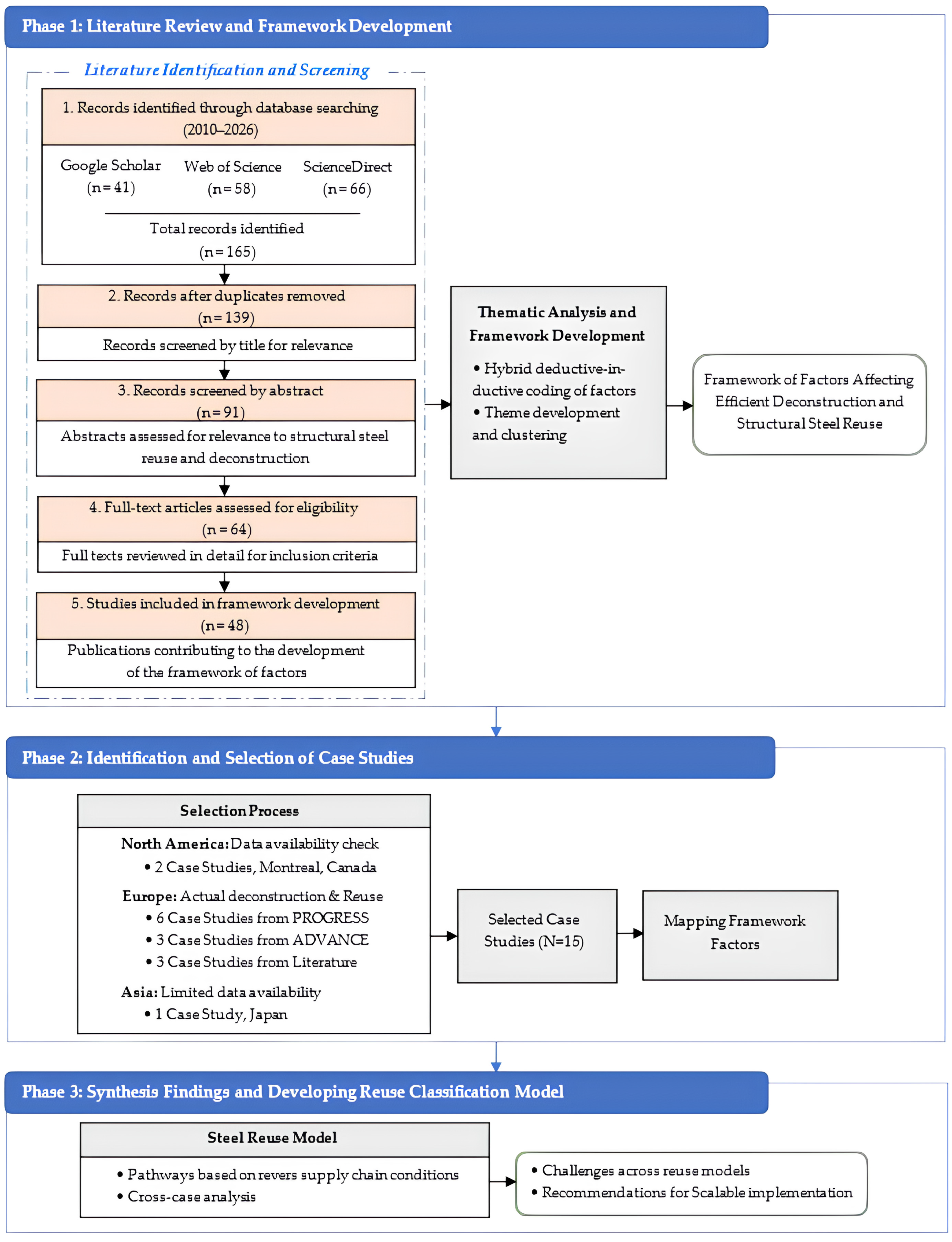
This study adopts a mixed qualitative methodology that begins with a systematic literature review to develop a framework of factors affecting efficient deconstruction and structural steel reuse. The framework is then applied across multiple case studies to enable comparative analysis, followed by the development of a reuse classification model to support scalable implementation across RSC. Based on this process, the study identifies key challenges and derives practical recommendations for large-scale structural steel reuse. The overall research methodology and analysis workflow are illustrated in
Figure 2 and structured into three main phases.
Phase 1. Literature review and framework development: A comprehensive and systematic review of recent peer-reviewed journal articles, conference proceedings, books, and review papers addressing deconstruction, structural steel reuse, and CC was conducted using Google Scholar, Web of Science, and ScienceDirect. The search covered publications from 2010 to 2026 and was structured around four main groups of terms: (i) structural steel and component reuse; (ii) deconstruction, disassembly, and EOL recovery; (iii) CC and RSCs; and (iv) technical, organizational, logistical, digital, economic, and regulatory aspects influencing reuse. Representative search terms included structural steel reuse, reclaimed structural steel, deconstruction, design for deconstruction, design for disassembly, CC, material reuse, RSCs, reuse logistics, material passports, material traceability, and regulatory barriers. Relevant terms were combined using Boolean operators to identify studies addressing structural steel reuse and its associated implementation conditions.
As detailed in the literature identification and screening component of
Figure 2, the search initially identified 165 records across the three databases. Following duplicate removal, 139 records were screened by title, of which 91 proceeded to abstract screening. Subsequently, 64 publications were assessed through full-text review. Studies were retained when they addressed structural steel or component reuse and provided evidence relevant to the technical, organizational, logistical, digital, economic, or regulatory factors influencing reuse implementation. Publications outside the scope of structural or component reuse, studies focused exclusively on recycling, and publications without sufficient relevance to the framework objectives were excluded. Following the screening process, 48 studies were included in the thematic analysis and framework development.
To systematically extract and interpret the factors influencing structural steel reuse, this study adopted Braun and Clarke’s [
32] reflexive thematic analysis, implemented through a hybrid deductive–inductive approach. This approach was selected for its methodological flexibility and its suitability for synthesizing heterogeneous evidence in circular construction research [
33]. Braun and Clarke’s thematic analysis provided the overall analytical process for coding, developing, reviewing, and defining themes, while the hybrid deductive–inductive approach defined how themes were interpreted and developed within this process. The deductive component used broad dimensions identified from the literature as a guiding analytical structure, whereas the inductive component allowed more specific sub-factors and factors to emerge and be refined from the reviewed studies. The two modes of analysis were therefore integrated throughout the analytical process to support the systematic development and refinement of the resulting themes. The analysis followed six structured stages, ensuring transparency and traceability from raw data to the final framework:
The process began with familiarization with the data, where all selected studies were reviewed in detail to identify recurring concepts, terminologies, and reported challenges and enablers. Particular attention was given to practical descriptions of reuse implementation, such as difficulties in tracking components, coordination challenges, and economic constraints.
Subsequently, initial coding was conducted by extracting and labeling relevant text segments at a semantic level. This ensured that codes remained closely grounded in the original data. For example, statements describing the absence of tracking systems were coded as limited digital technologies, while references to insufficient worker knowledge were coded as lack of expertise.
Following the initial coding, the codes were interpreted using broad deductive dimensions identified in the literature, including technical, organizational, supply chain, and regulatory aspects. These dimensions provided a guiding structure for organizing and interpreting the coded evidence while allowing further refinement as patterns emerged from the reviewed studies.
The analysis then proceeded with inductive theme development, in which the codes were iteratively grouped and refined into higher-level sub-factors and factors. For instance, the code limited digital technologies was refined into the sub-factor digital technologies under deconstruction planning, while lack of expertise was reclassified under stakeholder familiarity with reuse practices within willingness to reuse. This iterative process allowed patterns and relationships to emerge directly from the data.
In the theme review and consolidation stage, the resulting themes were critically evaluated to ensure internal coherence and clear differentiation. Overlapping concepts were merged, and ambiguous classifications were resolved through cross-study comparison.
Finally, in the definition and structuring stage, the refined themes were organized into five overarching clusters: structural attributes, business attributes, value chain activities, project management, and regulations. This resulted in a hierarchical framework of factors influencing structural steel reuse. The proposed framework subsequently provided the analytical basis for examining the selected case studies and systematically identifying recurring reuse practices, implementation challenges, and enabling conditions across different project contexts.
To enhance methodological transparency,
Table 1 presents illustrative examples of the analytical process, demonstrating how raw data excerpts were first coded inductively, then interpreted through a deductive approach, and finally structured into sub-factors, factors, and clusters.
Phase 2. Identification and selection of case studies: Following framework development, real-world case studies of structural steel reuse from different geographic regions were examined. Early work by Gorgolewski et al. [
34] documented 29 reuse projects across North America, identifying a broad set of potential case studies. However, most of these projects date back more than two decades and lack detailed technical documentation on deconstruction processes, component assessment, logistics, and RSC coordination, which limits their suitability for systematic comparative analysis within the scope of this study. Accordingly, the present research focuses on more recent projects for which sufficient technical and organizational information is available. In North America, publicly accessible data on steel deconstruction and reuse remains limited. Detailed information about two major case studies was accessible to the authors—both located in Montreal, Canada: The Original Champlain Bridge deconstruction and the Montreal Olympic Stadium roof deconstruction. These projects are large-scale, high-profile, and publicly funded infrastructure projects. To enhance data reliability and address potential information gaps, supplementary data collection and verification were conducted through targeted discussions with engineers involved in the projects, including professionals from JCCBI and the Olympic Stadium project. Another notable candidate case study considered was the Bay Bridge deconstruction in San Francisco; however, the lack of accessible technical documentation precluded its inclusion in this paper [
35].
On the other hand, compared to North America, European projects demonstrate more advanced and systematically applied practices in structural steel reuse, as evidenced by the scope and documentation of research initiatives, such as the PROGRESS and ADVANCE mentioned in
Section 2.3. These initiatives categorize reuse into seven main categories [
36]: (1) relocation of industrial halls and hangars; (2) partial or full reuse of primary structures; (3) reuse of cladding or constituent products; (4) conversions of structural functions; (5) major refurbishments; (6) buildings designed for reuse; and (7) unsuccessful reuse cases. After reviewing 48 documented projects from these initiatives, nine case studies (six from PROGRESS and three from ADVANCE) were selected from the first two categories because they demonstrated actual deconstruction and structural steel reuse. In addition, a limited number of cases were identified through a literature review, from which three UK cases were selected based on sufficient technical detail.
To improve representativeness, additional case studies were explored beyond Europe and North America. However, only one sufficiently documented case from Asia (Japan) was identified and included. Despite an extended search, documented applications of structural steel reuse through deconstruction in other regions, such as Africa, South America, and the Middle East, remain scarce or lack the technical detail required for inclusion. Accordingly, the final sample reflects the current geographical distribution of documented practice rather than a deliberate regional restriction. The predominance of European cases is associated with the higher maturity of CC initiatives and greater availability of structured datasets. The inclusion of North American and Asian cases is primarily driven by data availability and documentation quality within the scope of the review. The case studies were subsequently examined using the proposed framework to enable consistent qualitative analysis across diverse project contexts.
Phase 3. Synthesizing findings and developing a reuse classification model: The proposed framework provided the analytical basis for examining the selected case studies by systematically identifying the factors influencing structural steel reuse across different project contexts. Given the varying levels of technical and organizational information available among the examined projects, the framework was applied qualitatively to synthesize the available evidence rather than as a quantitative assessment tool. Each case was therefore analyzed using the proposed framework to identify recurring reuse practices, implementation challenges, and enabling conditions according to the level of information available.
Building upon these synthesized findings, a reuse classification model-based RSC configurations was developed to enable systematic comparison across the selected case studies and to evaluate scalability under different RSC conditions. Each case was subsequently mapped according to the developed model, enabling structured cross-case analysis of coordination complexity, recurring constraints, enabling conditions, and performance characteristics. Based on this comparative analysis, the study synthesized the main challenges encountered across reuse models and derived practical recommendations aimed at supporting the large-scale implementation of structural steel reuse.
4. Framework of Factors Affecting Efficient Deconstruction and Structural Steel Reuse
A structured framework of factors affecting efficient deconstruction and structural steel reuse is developed through a comprehensive and systematic review of recent research papers, conference proceedings, books, and review articles. Rather than compiling isolated findings, this study synthesizes recurring technical, organizational, operational, and institutional themes reported across the literature into an integrated structure suitable for comparative analysis and practical application.
Table 2 summarizes the resulting framework, organizing the identified factors into five clusters: structure attributes, business attributes, value chain activities, project management, and regulations. These clusters shape reuse feasibility and scalability across project phases.
Structure attributes determine the technical readiness of components for reuse, including structural design, component condition, and location. Business attributes reflect organizational willingness to reuse and organizational competencies, influencing early decision-making and risk perception. Value chain activities govern implementation outcomes, encompassing deconstruction planning, safety planning, logistics optimization, storage conditions, and lean processes. Project management supports alignment between technical objectives and stakeholder capacities through feasibility studies and public consultation and stakeholders’ involvement. Finally, regulations shape the enabling environment for reuse through sustainability programs, legislative financial incentives, and regulatory support. These clusters are closely interconnected throughout the reuse process. Technical and organizational conditions influence the planning and implementation of value chain activities. Project management coordinates these activities with project requirements and stakeholder responsibilities. Regulatory conditions further influence project decisions and the implementation of reuse activities. As a result, changes or constraints within one cluster may affect the conditions represented by others, emphasizing the importance of considering the framework as an integrated system.
The proposed framework is intended as a qualitative screening and structuring approach rather than a quantitative scoring or optimization tool. In practice, engineers and project stakeholders can use the framework at the early assessment stage to systematically review the conditions affecting the recovery and reuse of structural steel. The process begins by examining the available project information against the five framework clusters: structure attributes, business attributes, value chain activities, project management, and regulations. Relevant factors and sub-factors can then be identified according to the project context, allowing stakeholders to recognize information gaps, technical constraints, coordination requirements, and enabling conditions that may influence reuse feasibility.
The framework therefore supports decision-making by ensuring that the principal technical, organizational, logistical, managerial, and regulatory considerations are addressed before selecting a reuse pathway. It does not currently assign numerical weights, calculate an overall effectiveness score, or produce an automatic reuse decision. Instead, it provides a consistent analytical basis for project evaluation and multidisciplinary discussion. In this study, the framework guided the examination of the selected case studies, while the subsequent cross-case analysis and reuse classification model were used to compare coordination complexity and scalability across RSC configurations.
5. Case Studies
This section presents real-world structural steel reuse case studies from North America, Europe, and Asia, covering diverse project types and implementation contexts. As described in
Section 3, a total of fifteen cases were examined, including two from North America, twelve from Europe, and one from Asia, enabling a systematic comparison of coordination complexity, implementation challenges, and scalability across different geographical and institutional settings. The cases are analyzed to identify recurring barriers and enabling factors, providing empirical insights to support the broader adoption and scaling of structural steel reuse in construction practice. The main features of the examined case studies are summarized in
Table 3.
Rather than providing a narrative review of previously reported projects, this section systematically consolidates heterogeneous information from multiple data sources into a common analytical structure based on the proposed framework. The depth of analysis varies according to the level of technical and organizational information available for each project. The two Canadian case studies were analyzed in greater detail because supplementary information was obtained through direct discussions with project stakeholders, enabling comprehensive mapping of the proposed framework. For the remaining case studies, the analysis was conducted using the highest level of documented evidence available from published technical reports, project documentation, and the scientific literature. Collectively, these case studies provide the empirical foundation for the cross-case analysis, the development of the structural steel reuse classification model, and the identification of recurring implementation challenges and enabling conditions presented in the subsequent sections.
Table 2.
Factors affect efficient deconstruction and component reuse.
Table 2.
Factors affect efficient deconstruction and component reuse.
| Cluster | Factor | Sub-Factor | Description | Ref. |
|---|
Structure
attributes | Structural
design | Structure components | Determines recoverability and reuse feasibility | [37] |
| Modular design | Enables adaptability and easier disassembly | [38] |
| Mechanical connections | Facilitates component separation | [39] |
| Component condition | Structural integrity | Governs refurbishment requirements | [40] |
| Assessment for reuse | Supports decision-making for reuse pathways | [41] |
| Historical value | Influences conservation-driven reuse | [42] |
| Sustainability features | Enhances reuse attractiveness | [40] |
| Location | Accessibility | Affects dismantling efficiency | [15] |
| Urban context | Shapes logistics and coordination | [7] |
| Environmental considerations | Constrains dismantling operations | [43] |
Business
attributes | Willingness to reuse | Stakeholder familiarity with reuse practices | Improves confidence in cost predictability and project feasibility | [44] |
| Organization competences | Sustainability decision support tools | Enables innovative circular solutions | [45] |
| Value chain activities | Deconstruction planning | Planning and assessment | Improves recovery rates and operational efficiency | [16] |
| Digital technologies | Support component inventory, process visualization, and resource coordination | [46] |
| Quality management | Ensure salvaged components meet reuse standards | [39] |
| Heavy machinery | Enables safe dismantling of structural elements | [39] |
| Reuse and recycling program | Diverts materials from landfill and integrates them into new projects | [47] |
| Environmental monitoring | Ensures regulatory compliance and minimizes environmental impacts | [15] |
| Safety planning | Risk assessment | Identifies hazards and mitigates operational risks | [46] |
| Training programs | Improve worker safety and handling of reusable components | [48] |
| Site safety audits | Monitor compliance with safety procedures | [49] |
| Emergency response plan | Provides preparedness for unexpected incidents | [20] |
Logistics
optimization | Logistics planning | Reduces transport impacts and preserves component value | [50] |
| Data access | Enables sharing information on available reusable components | [21] |
| Material Passports/Digital Product Passports (MPs/DPPs) | Verify environmental benefits and increase reuse confidence | [51] |
| Tracking metrics | Monitor recovery rates and component flows | [39] |
| Real-time reporting | Supports adaptive logistics and performance monitoring | [20] |
Storage conditions
Lean processes | Storage quality | Maintains component quality | [15] |
| Value stream mapping | Minimizes waste and improves workflow | [39] |
| Waste reduction | Reduces material losses during dismantling and handling | [46] |
| Quality control measures | Enforce standards and minimize defects in reused materials | [52] |
| Training programs | Improve refurbishment practices and operational consistency | [48] |
Project
management | Feasibility study | Sustainability-oriented evaluation | Evaluates environmental viability of reuse strategies | [53] |
| Cost-effectiveness | Assesses economic feasibility of reuse options | [1] |
| Public consultation and stakeholders’ involvement | Advertising campaign | Raise awareness and promote acceptance of reuse practices | [49] |
| Collaboration of value chain actors | Supports coordination and knowledge transfer | [54] |
| Coordination with adjacent cities’ administrations | Aligns regulations and regional planning | [42] |
| Experiential learning through pilot projects | Enables testing and refinement of reuse practices | [49] |
| Competitions | Encourages innovation and industry engagement | [54] |
| Regulations | Legislations | Sustainability programs | Promote adoption of sustainable construction practices | [41] |
| Legislative financial incentives | Enable reuse through economic incentives | [1] |
| Regulatory support | Facilitate reuse through supportive policies | [43] |
Table 3.
Main features of the examined case studies.
Table 3.
Main features of the examined case studies.
| Case Study | Structural Typology and System | Reuse Configuration | Quantity of Reused Steel | Donor Connections | Technical Verifications | Motivators | Challenges |
|---|
| | Donor | Receiver | In Situ Reuse | Relocation | Component-Level Reuse | | Bolted | Welded | Original Documentation | Laboratory Testing | Structural Strengthening | Sustainability | Regulations | Economic Viability | Disassembly | Structural Adaptation | Code Compliance | Storage |
|---|
| Original Champlain Bridge [19] | Steel truss cantilever bridge (1962) | Multiple external projects | | | x
| 401 tonnes (413 steel components) | x
| x
| x
| x
| | x
| x
| x
| x
| x
| x
| x
|
| Montreal Olympic Stadium Roof, Canada [55] | Cable-supported modular roof (1976) | External reuse applications | | | x
| ~921.7 tonnes (4758 components) | x
| x
| x
| x
| | x
| x
| | x
| x
| x
| x
|
SEGRO warehouse, Slough, UK
[56] | Single-story steel portal-frame warehouse with integrated office space (2000) | Steel portal-frame warehouse with integrated office space and modified secondary system (2015) | | x
| | Entire steel frame reused | x
| | x
| | | x
| | x
| x
| | x
| |
HIDROTIM office, Timisoara, Romania
[57] | Single-story steel portal-frame industrial hall with overhead crane (1960) | Five-story office building with hybrid reused–new steel frame system (2004) | x
| | | ~50% of total steel in final structure | | x
| x
| | x
| x
| x
| x
| x
| x
| x
| x
|
MEXX DAY hall, Timisoara, Romania
[58] | Single-story steel portal-frame industrial hall (standard steel kit) (2009) | Steel portal-frame adapted for cereal storage with offices and laboratories (2018) | | x
| | Entire steel frame reused | x
| x
| x
| | x
| | x
| | x
| x
| x
| |
Agrocolumna warehouse, Copăceni, Romania
[59] | Steel-framed warehouse with two-story office building (2004) | Warehouse and office building, (2012) | | x
| | 15.236 tonnes | x
| | x
| | x
| x
| | x
| x
| x
| | |
Bus Station Schiphol–Noord, Amsterdam, the Netherlands
[60] | Steel portal-frame structure, detention facility (2010) | Steel portal-frame structure, Bus station (2015) | | x
| | Entire steel structural frame | x
| | x
| | x
| x
| | x
| x
| | | |
S-Market, Urjala, Finland
[61] | Single-story steel-framed discount store (1980s) | Steel-framed S-Market (2009) | | x
| | 100% of steel frame | x
| | x
| x
| | | x
| x
| x
| | | |
Waste-Sorting Canopy, Épinal, France
[62] | Steel-framed indoor riding hall with welded truss frames (1970s) | Relocated steel canopy reusing truss frames (2020s) | | x
| | Nearly entire structure | | x
| | x
| x
| | | | x
| x
| | |
Sibiu Modular Steel Building Complex, Râmnicu Vâlcea, Romania
[63]
| Modular steel portal-frame halls from Baia Mare, Râmnicu Vâlcea, Târgu Mureş, Cluj-Napoca (2008–2010) | Steel portal-frame structure, Sibiu complex (2019) | | | x
| Columns: 5.622 tonnes; Beams: 8.581 tonnes | x
| | x
| x
| x
| | | x
| x
| | | |
Commercial hall, Tuuri, Finland
[64] | Temporary steel-framed market hall (2018) | Single-story steel-frame commercial hall (2024) | x
| | | Entire steel frame hall | x
| | x
| | | | | x
| | | | |
| Holbein Gardens, UK [29] | Steel-framed buildings (Grosvenor projects) + reclaimed stock (Cleveland Steel) | Vertical extension of existing building (2022) | | | x
| 25 tonnes
(34% reused) | x
| | x
| x
| x
| x
| x
| |
| x
| x
| |
| Sloane Square House, UK [65] | Reclaimed steel stock | Multi-story building extension (underway) | | | x
| 21 tonnes |
| | x
| | x
| | x
| | x
| | | |
Honda Central Building, UK
[66] | Steel portal frame warehouse (2001) | Steel portal frame warehouse (2005) | | x
| | Entire steel frame reused | x
| | | x
|
| | | x
| | x
| x
| |
| Open Lab 3, Japan [67] | Steel frame laboratory | Same-site reconstructed building | x
| | | ~57% of structural steel reused | x
| x
| x
| x
| x
| x
| | x
| x
| x
| | |
5.1. Original Champlain Bridge Deconstruction
Case Study 1 is a large-scale infrastructure deconstruction project (2020–2023) in Montréal, Canada. The original Champlain Bridge is one of the largest infrastructure projects in North America. It was built in 1962 by Jacques Cartier and Champlain Bridges Incorporated (JCCBI). The bridge faced several significant structural problems that contributed to its eventual deconstruction, with the primary issue being severe corrosion exacerbated by de-icing salts and an inadequate drainage system in the original design. The absence of a proper drainage system led to the accumulation of water and salt on critical structural components, worsening corrosion and compromising the integrity of the bridge. Throughout its service life, the bridge required frequent and significant maintenance activities, including repainting the steel structure, repairing piers, replacing the concrete deck with a steel deck, and reinforcing girders. Despite these efforts, the bridge’s deterioration continued to worsen, compromising its performance and reliability [
49]. The planned deconstruction cost was around CAD 225 million, and the deconstruction was carried out from July 2020 to November 2023 [
19]. Several factors contributed to enabling the deconstruction process and promoting the potential of steel reuse in this project. The data were derived from the JCCBI website [
19], the steel components catalogue [
68], consultation reports [
69], the competition report [
70], alongside meetings with the JCCBI team.
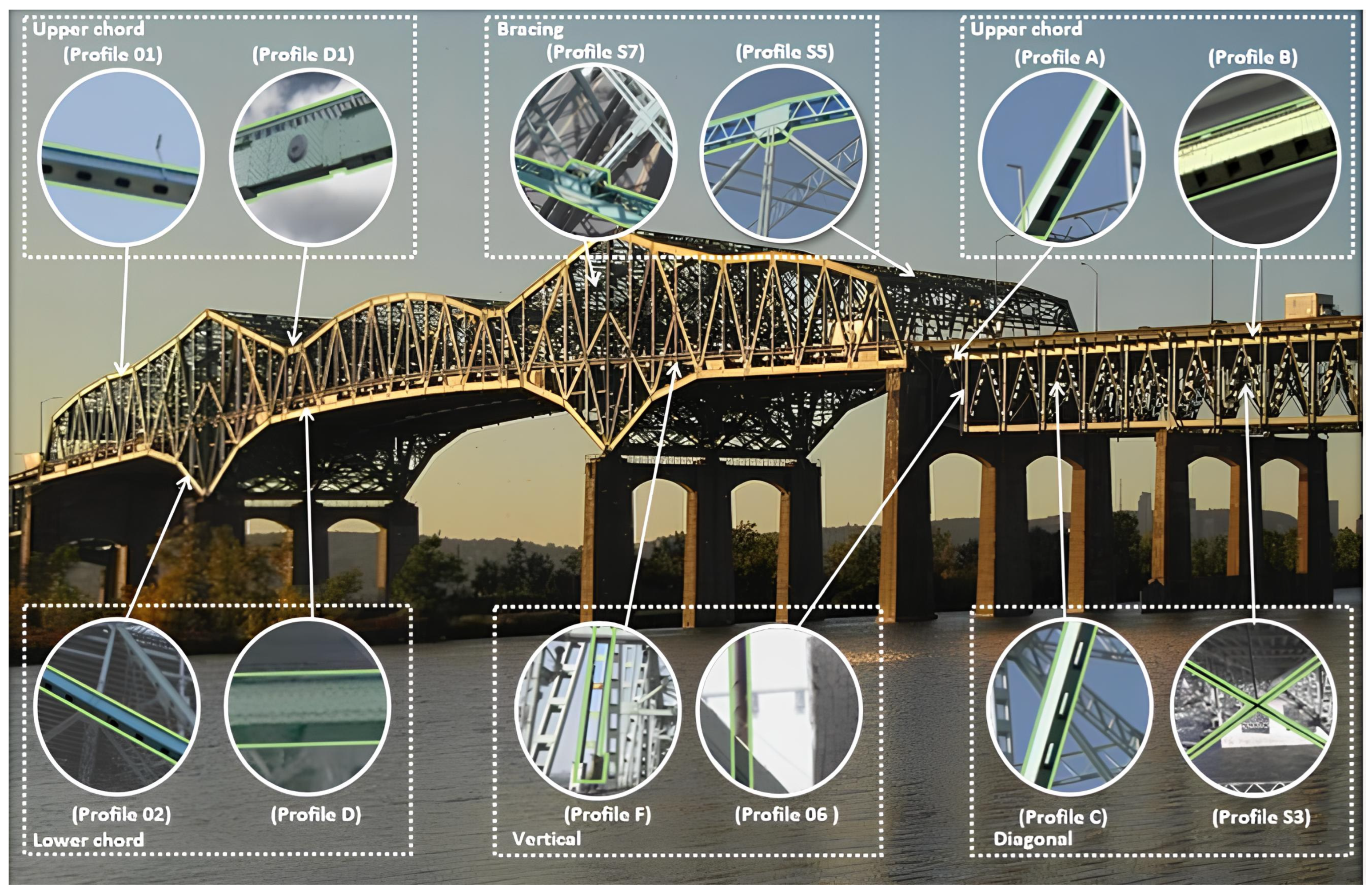
(1) Structure attributes: The main part of the original Champlain Bridge was a steel truss cantilever, with approach viaducts constructed of prestressed concrete beams supporting a prestressed concrete deck paved with asphalt. A total of 413 steel components, with a total weight of 401 tonnes, were identified and catalogued for potential reuse in other steel construction projects.
Figure 3 illustrates the different locations of the reusable steel components in the Champlain Bridge. The authors conducted an analysis of the data provided in the catalogue to gain insights into the quantities and weights of different types of reusable steel components [
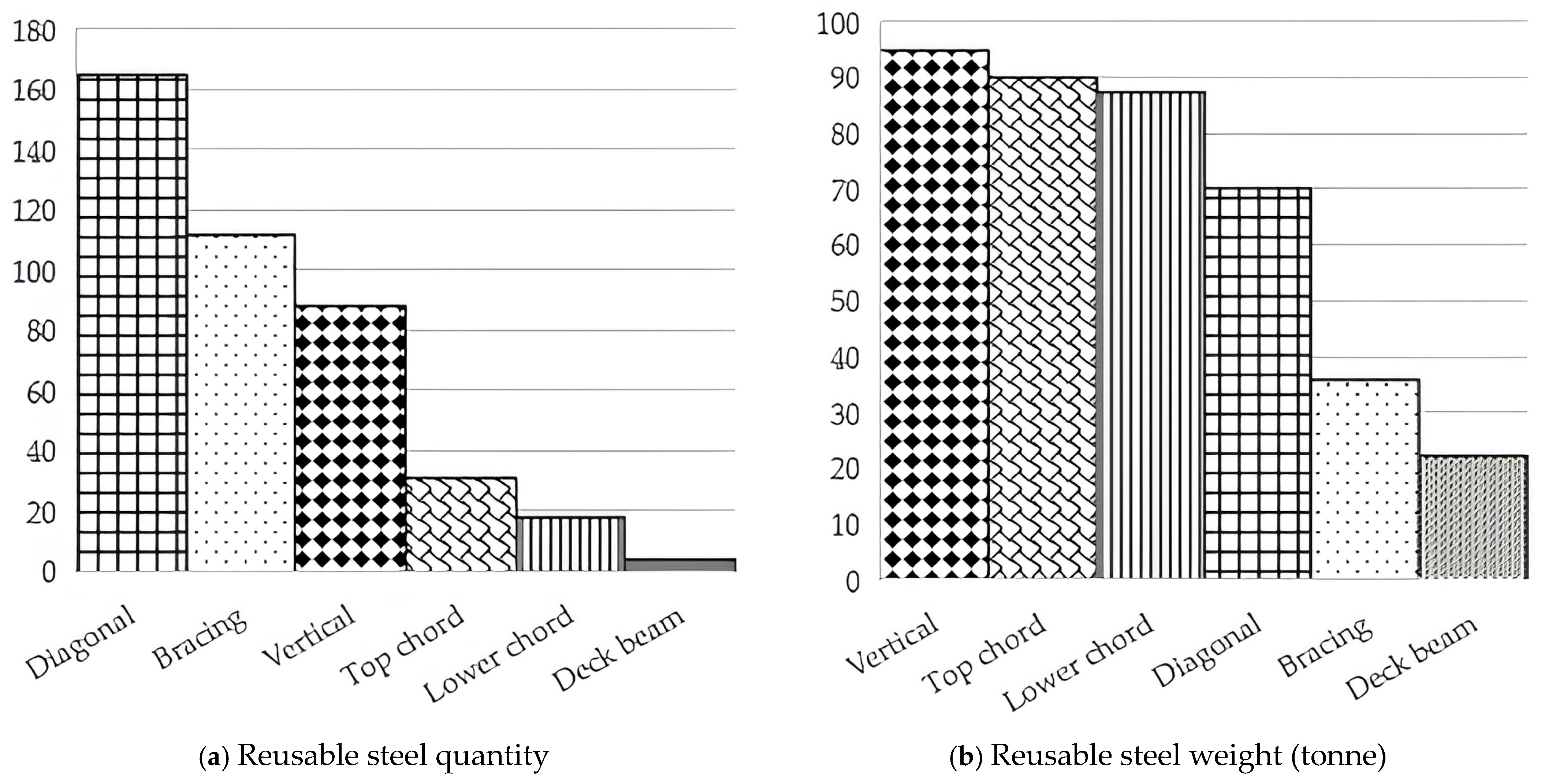
68]. This is done by classifying the reusable steel components based on their location, followed by calculating the amount of reusable steel components and the corresponding weight percentage for each category.
Figure 4 shows the quantity and weight of the reusable steel across various bridge locations. As shown in
Figure 4, the vertical components are the heaviest, totaling around 95 tonnes, despite their moderate quantity. Top and lower chord components are also substantial in weight, with 90 and 87 tonnes respectively. Diagonal components, though the most numerous, are lighter compared to the top three in terms of weight. Deck beam components are the lowest in both quantity and weight, making them the least significant in the reusable items. Understanding these distributions aids in planning the reuse of these materials in future projects, optimizing both component usage and structural efficiency.
Mechanical connections enable easier component separation during deconstruction, using techniques like heat cutting for large elements, unbolting, and removing rivets. In addition, the proximity of the bridge to the surrounding infrastructures facilitated the deconstruction process and the reuse of components by providing easy access for logistics, as well as enabling efficient removal and transport of salvaged materials. Also, the bridge’s legacy and historical significance added intrinsic value to its components, making them appealing for preservation and reuse in heritage projects. The urban setting increased demand for reused components, promoting interest from local builders and developers in acquiring salvaged components. Moreover, due to environmental considerations, the deconstruction contractor has to propose a greenhouse gas compensation strategy for ensuring a carbon-neutral project.
(2) Business attributes: JCCBI set sustainability targets for handling and transportation, emphasizing the innovative reuse of components rather than traditional recycling. They also implemented continuous performance monitoring to improve the project’s profitability. Furthermore, a sustainability decision support tool was created, incorporating environmental, economic, social, and technical factors. The tool was utilized to evaluate different scenarios and compare all the available deconstruction methods, possible ways for the reuse/recycling of the components, and transportation methods.
(3) Value chain activities: JCCBI enhanced logistics by devising a phased deconstruction strategy that prioritizes the safe removal of components while minimizing disruption to surrounding areas. A comprehensive assessment was conducted to evaluate the bridge’s structural integrity and determine which components were suitable for reuse. Also, they developed a 4D model for the bridge’s deconstruction to facilitate comprehensive planning, scheduling, and coordination. Visualizing the deconstruction process over time aided in efficient resource allocation, minimized disruptions, and improved cost efficiency through identifying and eliminating unnecessary activities. Moreover, non-destructive tests were performed to evaluate the quality of the bridge components. For quality control, they conducted regular inspections and evaluations of reusable steel components. Also, they provided training for employees on best practices for refurbishment. The structural steel components were dismantled using specialized equipment, including cranes, barges, and excavators. Additionally, JCCBI implemented a reusing and recycling program as they directed the contractor to meet specific reuse and recycling targets, including 100% steel reuse or recycling and a 90% overall component recovery from the bridge, with penalties for non-compliance.
Moving to safety planning, the deconstruction process involved 200 specialists and laborers with specialized training in safe deconstruction practices, machinery operation, and emergency response protocols. Regular safety audits and inspections were carried out to ensure compliance with safety regulations and to address any emerging risks. An emergency response plan was established, detailing procedures dealing with accidents, injuries, or other unforeseen incidents.
For logistics optimization, a phased deconstruction strategy was developed to prioritize the safe removal of components while minimizing disruption. To facilitate data access and flows, a data labeling system was implemented for each reusable component. Additionally, a traceability protocol using QR codes was established to monitor the materials, enabling precise georeferencing of each component from its origin to its destination. Reusable components were systematically stored on-site in designated areas specifically allocated for sorting and inventory management. These storage areas were equipped with protective measures to shield components from adverse weather conditions and potential damage.
To mitigate deconstruction waste, JCCBI integrated specific clauses into the design-build contract of the deconstruction to establish a comprehensive sustainability program. This program prioritizes the reuse of components wherever feasible, thereby reducing advancing sustainable practices throughout the project.
(4) Project management: In 2017, JCCBI commissioned the PTA Consortium (Parsons/Tetra Tech/Amec Foster Wheeler) to conduct a feasibility study and targeted environmental analysis for the Champlain Bridge deconstruction, assessing different options for deconstruction methods, transportation of components, and component recovery. The study evaluated various scenarios based on sustainable development criteria, focusing on technical feasibility, economic viability, environmental impacts, and social acceptability [
49]. Furthermore, the project implemented integrated sustainability initiatives, including material reuse and recycling targets, material traceability, climate change mitigation through a net-zero carbon commitment, environmental protection measures, Envision
® certification, and research collaboration with universities and research institutions.
The community was engaged through a multiplatform advertising campaign to gather innovative ideas regarding sustainable development, environmental protection, and component reuse. The consultation involved 4186 participants via various channels. An advisory committee was established consisting of representatives from different environmental and cultural organizations to provide strategic guidance and expertise throughout the project. Moreover, JCCBI searched similar projects and identified the Bay Bridge deconstruction project in San Francisco as a relevant example [
68]. The California Department of Transportation initiated a program to repurpose components of the bridge but reused less than 1% of the bridge’s steel [
49]. In contrast, JCCBI developed its reuse program earlier in the project, aiming to achieve a significantly higher percentage of component reuse. Furthermore, they maximized the reuse potential by launching a competition for structural steel reuse and developing a catalogue listing 413 reusable components made available for the participants [
68].
(5) Legislations: The Government of Canada has shown a robust commitment to sustainability, requiring all ministries and agencies to contribute to the United Nations Sustainable Development Goals and aligning with Canada’s national sustainability strategy. Consequently, the deconstruction of the Original Champlain Bridge was designed to promote environmental performance for future projects, reflecting both national and international sustainability objectives. The project was supported by various financial incentives, including public funding sources such as local tax revenues, federal funds, fares, and bonds.
5.2. Montreal Olympic Stadium Roof Deconstruction
The Case Study 2 is the ongoing deconstruction and replacement of the Montreal Olympic Stadium roof structure (2024–2027). The stadium, originally completed for the 1976 summer Olympics, has faced decades of technical and structural challenges related to its complex retractable-roof design. A series of failures, escalating maintenance demands, and weather-related safety concerns led to the decision to remove the existing roof and install a new fixed system [
55,
71]. Several factors influence the feasibility of deconstruction and component reuse, which are examined in detail below. The case study is informed by data collected from publicly available project documentation and official websites, the reusable components catalogue, and consultations and interviews with stakeholders involved in the Olympic Stadium roof deconstruction project.
(1) Structure attributes: The modular design of the Montreal Olympic Stadium roof comprises a series of prefabricated sections that support controlled dismantling and component-level reuse. The extensive use of mechanical connections, including tension fittings and clamps for steel cables and trusses, further facilitates selective disassembly. The roof structure incorporates approximately 22,237 m of steel cables, 42,019 m
2 of textile membrane, and 434 connecting fixtures, with a substantial share of structurally viable components suitable for salvage and repurposing [
72]. Reusable steel components are catalogued, enabling quantitative assessment of reuse potential.
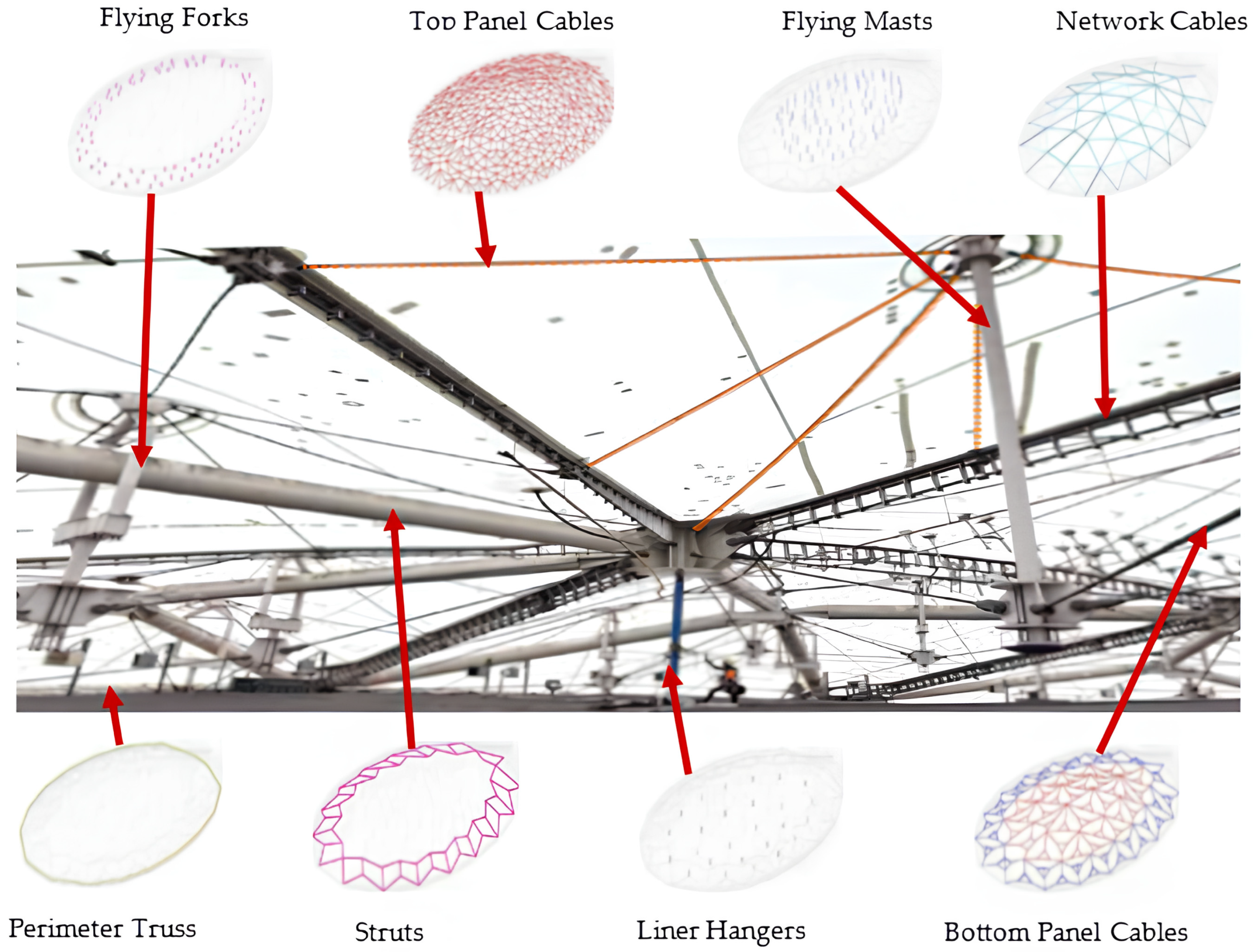
Figure 5 illustrates the location of reusable steel components in the Montreal Olympic Stadium roof. The small shapes surrounding the roof structure represent the roof’s top view. They indicate the relative location of each group of components within the roof. Based on analysis of the component catalogue, a total of 4758 steel roof components were identified, corresponding to approximately 921.7 tonnes of steel available for reuse in other projects.
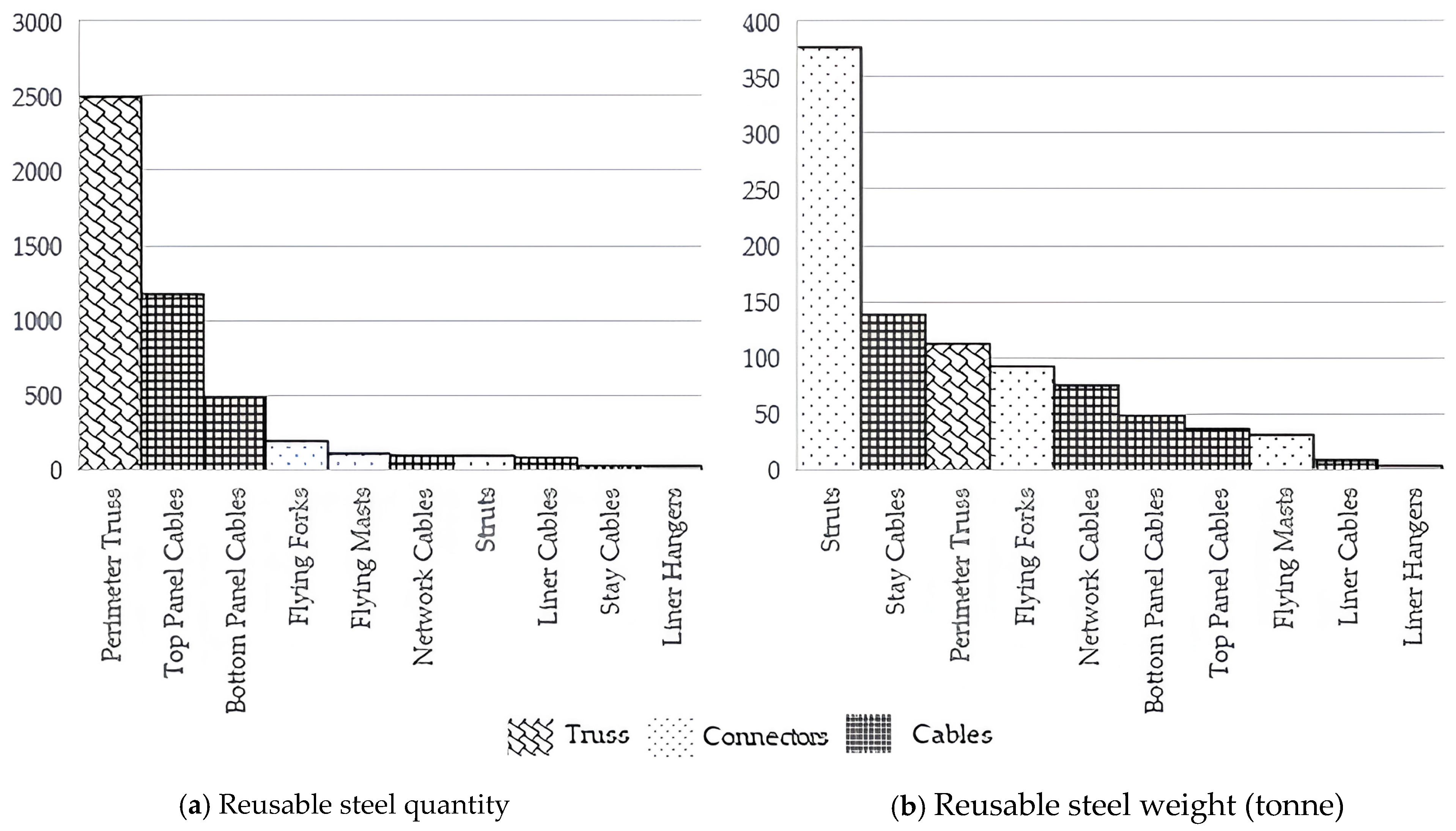
Figure 6 presents these components by quantity and weight, classified into trusses, connectors, and cables. While struts and stay cables contribute significantly to the total steel weight, they are less numerous. Perimeter trusses represent the most abundant category, with a moderate cumulative weight of approximately 112 tonnes. In contrast, top and bottom panel cables are numerous but relatively lightweight, whereas network cables offer a balance between quantity and weight, supporting a wider range of reuse scenarios. Beyond structural characteristics, the stadium’s historical significance enhanced the value of its components for reuse. Moreover, the stadium’s proximity to major highways, public transit systems, and industrial areas supported efficient logistics and increased interest from local actors in acquiring reused steel components.
(2) Business attributes: The Industrial Ecology Technology Transfer Center was mandated to map EOL pathways for dismantled components, distinguishing components suitable for direct reuse from those requiring recycling or upcycling, and to facilitate market engagement through industry workshops [
73].
(3) Value chain activities: Comprehensive assessments were conducted to evaluate the roof’s structural integrity and to determine which components were suitable for reuse. Regular safety audits were carried out to ensure compliance with safety regulations and to address emerging risks. By late 2024, safety inspectors had carried out 65 site visits, verifying workforce qualifications and adherence to collective agreement requirements [
74]. This proactive auditing approach helped prevent issues and ensured strict compliance with safety regulations throughout the deconstruction process. Dismantling methods were developed by the general contractor using detailed 2D planning, supported by 4D simulations to visualize sequencing and manage interfaces. Throughout deconstruction, engineers continuously monitored structural behaviour using surveys and sensors, enabling real-time adjustments to maintain structural stability [
72]. Careful dismantling practices limited damage to recovered elements. Recovered components are first stored on site and are planned to be relocated later to an off-site storage facility through an 18–24-month storage tender process. Quality control is supported by an external firm responsible for defining appropriate testing protocols, complemented by an environmental management plan and milestone-based safety and quality audit.
(4) Project management: The Montreal Olympic Park, in collaboration with the City of Montreal Design Bureau, launched an international design ideas competition supported by a multi-platform communication campaign, inviting architects, designers, professionals, and students to propose new applications for recovered roof components [
75,
76]. Consultations were conducted with stakeholders involved in the Champlain Bridge deconstruction project to exchange knowledge on planning approaches, contractual frameworks, and project coordination practices.
(5) Legislation: As explained in case study 1, at the federal level, the Government of Canada has committed all ministries and federal agencies to contribute to the United Nations Sustainable Development Goals through the Federal Sustainable Development Strategy, providing an overarching policy framework that supports resource efficiency, waste reduction, and circular economy practices. At the provincial level, the Government of Quebec approved a public investment of approximately CAD 870 million for the replacement of the Montreal Olympic Stadium roof, enabling the implementation of environmental management measures and sustainability-oriented project requirements within a publicly funded infrastructure program [
55].
Although several structural and organizational factors support deconstruction and component reuse, the actual reuse rate remains moderate. Approximately 20% of the recovered components are reused by weight, while the remaining steel recycled in compliance with the waste management plan.
5.3. Case Studies from Recent European Projects
As mentioned in
Section 2.3, ADVANCE project is a European collaborative research initiative aimed at supporting GHG reduction and circular economy objectives by addressing challenges related to both the deconstruction and reuse of existing steel buildings, as well as the design, construction, and documentation of new buildings to facilitate future reuse. The project is funded through EU research program and builds on prior European initiatives, including PROGRESS, which developed technical recommendations and recertification protocols for the reuse of steel in buildings, SB STEEL, which advanced LCA methodologies and sustainability strategies for steel, and LVS3, which investigated life-value extension, durability, and circular business models for steel components. ADVANCE focuses on extending the service life of structural steel elements by prioritizing reuse over energy-intensive recycling [
36]. In addition, several innovative approaches have been demonstrated. For example, Petite Maison (Luxembourg), adopts a Design for Disassembly (DfD) approach as a temporary demonstration building, with reuse and dismantling requirements explicitly embedded at the design stage [
77]. Another ADVANCE case involves the National Tube Stockholders (NTS) building in Thirsk, UK, where a steel portal-frame structure fabricated in 2008 but never erected due to the economic recession was stored for nearly ten years before reused. Approximately 16% of the originally fabricated steel, was recovered and reused to construct a new warehouse for NTS, demonstrating the reuse potential of long stored, uninstalled structural steel [
78].
(1) SEGRO warehouse, Slough, UK: This case study investigates the relocation and reuse of a steel-framed warehouse building within a single-owner context in Slough, UK. The building was originally constructed in 2000. It was dismantled in 2015 and re-erected on a nearby plot approximately 1.6 km away to enable new infrastructure development. Reuse was enabled by ownership continuity and the involvement of the original design team, allowing reliance on existing drawings and engineering judgement. The primary steel structure was reused with minimal technical difficulty. The process required only cleaning, local repairs, and on-site repainting; however, removal of the column base plates was time-consuming. Challenges arose from incomplete as-built documentation and functional mismatches with current warehouse standards. The relocation achieved 56% embodied carbon savings at completion and a 25% cost reduction. These outcomes demonstrate the technical and environmental feasibility of whole-building steel reuse through relocation [
56].
(2) HIDROTIM office, Timisoara, Romania: This case study examines the adaptive reuse of an existing steel industrial hall in Timișoara, Romania. The structure was originally constructed in the 1960s as a single-story hydraulic testing laboratory with an overhead crane and was later converted into a five-story office building. Approximately 50% of the steel used in the final structure originated from the existing building, supplemented by new steel elements to meet updated functional and seismic requirements. Quality control relied on the availability of original drawings, verified through on-site measurements, structural assessment, and cross-section classification, followed by targeted strengthening of reused members. Key motivators for steel reuse included regulatory constraints limiting demolition, economic feasibility, reduced material consumption, and improved environmental performance. Major challenges related to cross-section slenderness, limited seismic ductility, additional design effort, and the need for temporary storage and careful handling during deconstruction. The project demonstrates that large proportions of existing structural steel can be reused through in situ structural reconversion when supported by reliable documentation, structural assessment, and targeted strengthening [
57].
(3) MEXX DAY hall, Timisoara, Romania: This case study documents the full relocation and reuse of a standard steel portal-frame industrial hall originally erected in 2009 in Romania. The project is notable for achieving complete reuse of the main and secondary steel structure, demonstrating the adaptability of standardized steel kit systems beyond their initial location and function. The case highlights that full structural steel reuse through relocation is technically viable when documentation is preserved and design adaptations are systematically incorporated at an early stage [
58].
(4) Agrocolumna warehouse, Copăceni, Romania: This case study documents the relocation and reuse of a steel-framed warehouse and attached office building originally constructed in 2004 in Romania. The project is characterized by the complete reuse of the original steel structure, enabled by the availability of original design documentation and steel certificates, which eliminated the need for laboratory material testing. A direct comparison with a conventional new-build alternative demonstrated lower costs and reduced environmental impacts, confirming the feasibility of whole-building steel reuse through relocation [
59].
(5) Bus Station Schiphol–Noord, Amsterdam, the Netherlands: This case study demonstrates the relocation and reuse of a steel T2 hangar as the Bus Station Schiphol–Noord, opened in 2015. The steel structure originated in the early 1940s as an aircraft hangar and was subsequently reused as a detention structure before being dismantled, stored, and reassembled for its current function. The primary steel portal-frame system was retained as the main load-bearing structure and reassembled using bolted connections. The case is distinguished by multiple successive reuse cycles of the same steel structure across different functions over several decades, demonstrating the long-term durability and adaptability of structural steel. Quality control relied on the availability of original drawings, on-site verification, systematic numbering and photographic documentation of dismantled components, and controlled restoration prior to reassembly. The case highlights that careful deconstruction, documentation, and interim storage are critical enablers for successful whole-structure steel reuse, although they require additional time and logistical planning [
60].
(6) S-Market, Urjala, Finland: This case study documents the relocation and reuse of a steel-framed discount store originally built in the 1980s in Tampere, Finland, and reassembled as an S-Market supermarket in Urjala in 2009. The unique aspect of the project is the 100% reuse of the primary steel frame, including composite RHS columns, main and secondary steel trusses, and trapezoidal roof profiles, transferred between two sites within the same climatic and loading region. Quality control relied on the availability of original structural drawings, visual inspection of steel components, and verification against unchanged Finnish design codes, without mechanical testing. Structural compatibility was facilitated by similar snow load conditions and the continued applicability of the original design code, although fire regulations required the addition of in situ intumescent fire protection for the reused steel frame. The case demonstrates that early design alignment, preserved documentation, and demountable bolted connections are key enablers for efficient steel frame reuse and cost savings, estimated at approximately 10% of total construction costs [
61].
(7) Waste-Sorting Canopy, Épinal, France: This case study documents the deconstruction and relocation of a steel-framed indoor riding hall originally built in the 1970s in Gennevilliers, France, and its reuse as a canopy for a waste-sorting center in Épinal. A distinctive feature of the case is that nearly the entire structural system was reused, including complete truss components, despite the presence of local buckling in some members, which were identified and excluded from reuse. Quality control relied on pre-deconstruction inspection, surface hardness measurements, and selective destructive tensile and chemical testing of non-reusable components. Structural compatibility challenges arose from increased loading requirements at the receiver site, leading to reduced frame spacing and the addition of supplementary truss diagonals, while maintaining the original structural system. The study emphasizes that rigorous deconstruction planning, early assessment of joints and welds, and risk-based selection of inspection methods are critical to enabling large-scale steel reuse [
62].
(8) Sibiu Modular Steel Building Complex, Râmnicu Vâlcea, Romania: This case study examines the component-level reuse of modular steel portal-frame systems from multiple donor buildings reassembled into a new complex in 2019. The project is distinguished by the selective reuse of steel components originating from several donor structures rather than a one-to-one building relocation. Quality control measures included inspection of existing structures, identification of available design documentation, and experimental investigation of the mechanical properties of reused steel components. Structural compatibility was addressed through redesign and strengthening of reused members in response to updated loading conditions and revised design codes. Several components, including longitudinal members, were excluded from reuse due to incompatibility with the new configuration. A detailed cost comparison demonstrated economic advantages for reuse over new construction, representing the primary reported motivation for steel reuse. The study highlights the importance of early technical assessment, documentation availability, and planned strengthening interventions to support effective steel reuse across multiple donor buildings [
63].
(9) Commercial hall, Tuuri, Finland: This case documents the full relocation and reuse of a temporary steel-frame hall built in 2018 and reassembled in 2024. The structure was designed for disassembly, using bolted connections and transportable components. Quality control relied on the availability of original structural drawings and documentation. The original load-bearing steel frame was reused as a whole without reported structural modification. The case highlights DfD as a key enabler of successful whole-building steel reuse. It also emphasizes the importance of early planning, documentation availability, and coordination among stakeholders to support reuse outcomes [
64].
(10) Holbein Gardens, UK: This case involved the vertical extension of an existing building originally constructed in the 1980s. The receiver structure is a contemporary building extension integrating reclaimed steel elements sourced from previous demolition projects. Approximately 25 t of steel were reused within a total of 67 t of structural steel. Technical verification included both destructive and non-destructive testing in accordance with the SCI Steel Reuse Protocol (P427/P440), enabling certification and CE marking. The primary motivator was carbon reduction, achieving approximately 60 t of CO
2 savings. Key challenges included material traceability, testing requirements, and integration with new structural systems [
29].
(11) Sloane Square House, UK: This case involved the vertical extension of an existing building, integrating structural steel sourced from reclaimed stock managed by a supplier rather than a single identifiable donor structure. The project demonstrates a stock-based reuse approach, where reclaimed steel components were selectively adapted and incorporated into a newly designed structural system. Technical verification followed the SCI Steel Reuse Protocol, supported by digital tools and parametric design integration (e.g., Revit-based workflows). The project was primarily driven by high carbon savings (~60% reduction) and design innovation objectives, while highlighting key challenges related to aligning available reclaimed components with structural requirements and managing the constraints of a dynamic inventory [
65].
(12) Honda Central Building, UK: The Honda Central Receiving Building, documented by SteelConstruction.info, presents a case of deconstruction-based structural steel reuse through full building relocation within the same industrial site. The project involved dismantling a steel portal frame warehouse, storing its components, and re-erecting the structure to serve a similar logistical function. This configuration reflects a closed-loop reuse approach, where the structural system was largely preserved with minimal transformation. The principal strength of this case lies in the high level of system retention, including the reuse of primary structural components with limited reprocessing and the preservation of the original structural configuration. This enabled rapid reassembly, reduced construction time, and minimized material and embodied carbon impacts. These outcomes were supported by a set of favorable conditions, namely: (i) same-site relocation, which minimized transportation and reverse logistics complexity; (ii) functional and typological continuity between the donor and receiver structures; (iii) stable ownership and coordinated project delivery; and (iv) limited design modifications. Together, these factors significantly reduced technical and logistical uncertainties typically associated with structural steel reuse.
Despite these advantages, the case reflects a controlled implementation context and therefore does not represent typical construction scenarios involving fragmented stakeholders and distributed supply chains. Nevertheless, it provides a clear demonstration of the technical and economic potential of structural steel reuse when system-level continuity and logistical simplicity are maintained [
66].
5.4. Asian Context of Structural Steel Reuse
Beyond Europe and North America, documented applications of structural steel reuse through deconstruction remain limited. Within Asia, the implementation of reuse practices is still emerging and is often constrained by challenges related to material traceability, regulatory frameworks, and the fragmentation of construction supply chains.
Japan represents one of the few contexts in the region where structural steel reuse has been explored through both a documented project and a number of prototype and experimental developments. While full-scale implementation remains rare, several studies have focused on demountable steel systems and reusable connection technologies, aiming to facilitate future reuse, although these approaches are not yet widely implemented at project scale [
79,
80].
A notable documented example is the Open Lab 3 project by Obayashi Corporation in Japan. This project provides a case of in situ deconstruction and direct structural steel reuse within the same structure. The project involved the dismantling of an existing steel-framed laboratory building and the construction of a new facility on the same site, integrating reclaimed structural components from the original structure, thereby minimizing logistical complexity and associated uncertainties. The deconstruction process was conducted through selective dismantling, enabling the recovery of steel beams and columns while preserving their structural integrity. Recovered components were subsequently inspected, tested, and adapted to meet the structural and design requirements of the new building. From a performance perspective, the project achieved substantial material and environmental benefits, including the reuse of approximately 57% of structural steel components and a reduction of about 49% in CO
2 emissions compared to conventional construction practices. These outcomes highlight the potential of on-site reuse strategies to contribute to circular construction objectives [
67].
Despite its advantages, this case reflects a controlled implementation context characterized by a single owner, coordinated project delivery, and well-suited site conditions. Accordingly, it represents an optimal scenario that may not be directly replicable in typical construction projects involving fragmented stakeholders and distributed supply chains. Nevertheless, it serves as a critical benchmark for the development of CC frameworks, particularly in illustrating the feasibility of eliminating reverse logistics through localized material reuse and enhanced traceability.
6. Analysis of the Case Studies
This section presents the findings obtained from the framework-based analysis of the examined case studies. The analysis synthesizes recurring reuse practices, implementation challenges, and enabling conditions to examine how reuse pathways differ in terms of coordination complexity and scalability potential.
6.1. Reuse Model Classification and Cross-Case Comparison
Building upon the synthesized findings obtained from the framework-based analysis of the selected case studies, a steel reuse model classification based on RSC configurations was developed to enable systematic comparison across the reviewed cases, as illustrated in
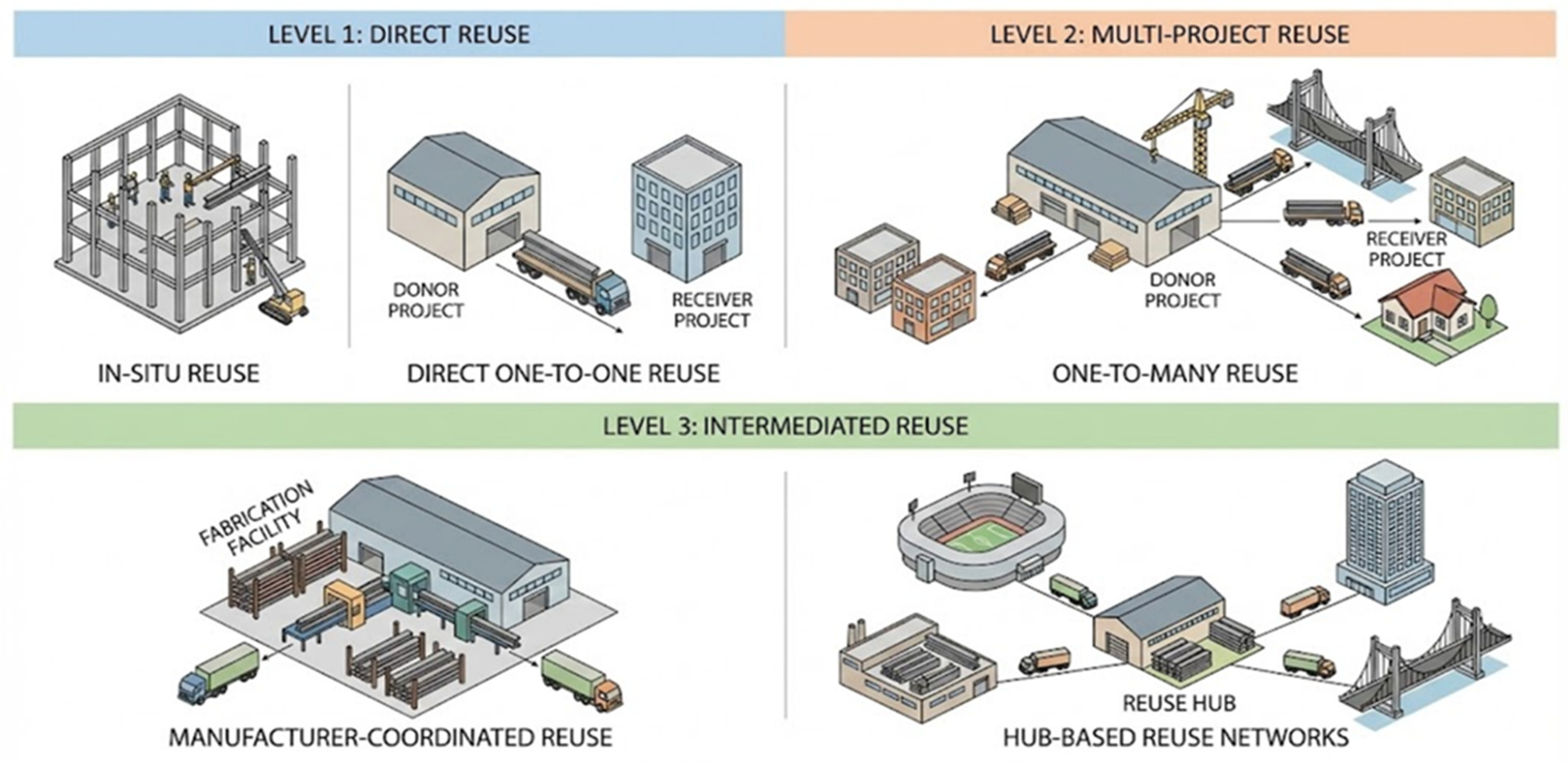
Figure 7. The classification is organized into three hierarchical levels based on the complexity of logistics and the nature of relationships between participants. Level 1: Direct reuse focuses on localized or simple transfers, including in situ reuse within the same construction site and direct one-to-one reuse where components move from a single donor project to a single receiver project. Level 2: Multi-project reuse introduces a broader scale of distribution through one-to-many reuse, allowing a donor project to supply multiple receiver projects. Finally, Level 3: Intermediated reuse represents the most integrated systems, utilizing manufacturer-coordinated reuse through fabrication facilities or hub-based reuse networks. In these systems, manufacturing facilities or hubs act as intermediaries to manage the flow of components and provide interim storage until suitable donor–receiver matches are identified across a wide network of donors and receivers.
To provide an explicit basis for cross-case comparison, the reuse models were examined across three qualitative dimensions: coordination complexity, implementation requirements, and scalability potential. Coordination complexity considers the donor–receiver configuration, material matching and allocation requirements, stakeholder coordination, and the involvement of intermediary actors. Implementation requirements consider dismantling, technical verification, storage, logistics, traceability, and governance conditions. Scalability potential considers the capacity of the reuse configuration to extend beyond individual donor–receiver arrangements toward multiple reuse applications or broader reuse networks. These criteria provide a consistent basis for comparing the three reuse levels using the evidence available across the examined case studies. Based on their documented reuse configurations, the examined case studies were mapped to the proposed classification model, as summarized in
Table 4.
Based on this mapping and the defined comparison criteria, the reviewed case studies illustrate how the reuse levels differ in their coordination complexity, implementation requirements, and scalability potential. Level 1 (direct reuse) is typically the most straightforward to implement, as demonstrated by the in situ and direct one-to-one reuse European case studies discussed in
Section 5.3, where reuse is enabled by strong alignment between the donor structure and the receiver requirements, limited logistical complexity, and clear material traceability. However, this model remains highly context-dependent and is constrained by geometric compatibility, project timing, and documentation availability.
Level 2 (multi-project reuse) is exemplified by large deconstruction projects such as the Original Champlain Bridge deconstruction and the Montreal Olympic stadium, where a single donor supplies multiple receiver projects. While this model enables higher overall reuse and broader distribution of reclaimed steel, it introduces increased logistical complexity, coordination demands, and reliance on external decision-making frameworks to match supply with diverse reuse applications. These cases highlight that multi-project reuse is feasible at scale but requires deliberate planning, structured allocation mechanisms, and extended stakeholder engagement.
Level 3 (intermediated reuse) represents the most systemically scalable pathway but also the most institutionally demanding. Manufacturer-coordinated reuse models, such as those explored by steel fabricators in Canada (e.g., Canam), indicate the potential for reuse to be embedded within fabrication and supply-chain operations, leveraging industrial expertise, controlled environments, and quality assurance processes. Similarly, hub-based reuse networks—analogous to established material redistribution models in the retail sector (e.g., Home Depot for construction materials)—illustrate how centralized hubs could facilitate storage, sorting, certification, and redistribution of reusable steel components. While such hub-based systems are not yet mature for structural steel, the reviewed cases suggest strong potential for adaptation, particularly if supported by standardized assessment protocols and digital inventory systems.
Overall, the case studies show that direct reuse models are easier to implement at the individual project scale. In contrast, intermediated models offer greater potential for scaling steel reuse beyond isolated applications. However, their effective implementation depends on the availability of enabling infrastructure, appropriate governance mechanisms, and supportive market incentives.
6.2. Common Challenges Across Steel Reuse Models
Across the reviewed cases, the most common challenge is the dismantling of steel components, which appear consistently across all reuse configurations. In Level 1 (direct reuse) cases, dismantling is generally manageable due to limited transfer distances and strong alignment between donor and receiver projects. Challenges at this level are more commonly associated with documentation gaps, verification of structural capacity, and occasional localized strengthening.
In contrast, Level 2 (multi-project reuse) is characterized by increased dismantling complexity, with temporary storage requirements and higher logistical and allocation uncertainty. These conditions increase the risk of component damage, loss of traceability, and prolonged storage. In addition, material availability and matching between recovered components and new project requirements emerge as critical constraints, particularly when reusable components originate from demolition rather than planned deconstruction. The lack of efficient collection, storage, and distribution systems further limits reuse potential.
For Level 3 (intermediated reuse), dismantling remains a necessary operation but is no longer the primary limiting factor. The feasibility is governed by system-level capacity, including the availability of storage infrastructure, standardized quality control and verification procedures, established certification pathways, and governance arrangements to manage liability and market coordination. This reflects broader industry challenges related to the lack of harmonized design rules, certification protocols, and regulatory clarity for reused structural steel, which continue to slow adoption.
Across all reuse levels, dismantling constitutes a recurring technical challenge; however, as reuse systems extend beyond individual projects, storage capacity, logistics, and institutional readiness increasingly determine the feasibility and scalability of structural steel reuse. Economic constraints also play a significant role, as reuse often involves higher upfront costs associated with deconstruction, inspection, testing, and transport, while the financial benefits remain uncertain. Furthermore, the lack of coordinated engagement across the construction ecosystem, including designers, contractors, fabricators, and policymakers, represents a critical barrier to scaling reuse practices.
6.3. Comparative Contributions and Implications for Construction
Compared with previous studies that primarily examine individual technical, environmental, regulatory, or project-specific aspects of structural steel reuse, this study provides an integrated analytical approach that combines a factor-based framework, multi-case empirical evidence, and a reuse model classification. This integration enables the simultaneous examination of project conditions, RSC configurations, coordination requirements, and scalability potential. The main comparative advantage of the proposed approach is therefore its ability to move beyond isolated technical assessments and explain how structural steel reuse performance is shaped by the interaction of technical, organizational, logistical, and institutional factors across different project contexts.
From a construction engineering and management perspective, the findings demonstrate that scaling structural steel reuse depends not only on the recoverability or structural suitability of steel components but also on early project planning, donor–receiver coordination, documentation availability, storage strategies, certification pathways, and stakeholder integration. Direct reuse models may be easier to implement within individual projects, whereas multi-project and intermediated models provide greater potential for broader market adoption but require more advanced coordination, infrastructure, and governance. These findings provide a structured basis for owners, designers, engineers, contractors, fabricators, and policymakers to select appropriate reuse pathways and align project delivery strategies with the complexity of the selected RSC.
Technologically, the study highlights the importance of digital traceability, BIM integration, MPs/DPPs, standardized testing, and coordinated inventory systems in reducing uncertainty and improving reuse decision-making. From a structural engineering perspective, reuse preserves the value of existing steel components by avoiding remelting and supporting the continued use of verified structural members whose properties, condition, and performance can be demonstrated. However, the study does not independently evaluate metallurgical performance; instead, it identifies inspection, testing, certification, and structural verification as essential enabling conditions for safe reuse.
Environmentally, the proposed framework and reuse classification support the wider adoption of structural steel reuse by identifying the conditions required to retain components at their highest functional value and avoid energy-intensive recycling and new steel production. Although this study does not quantify carbon dioxide reductions for the examined cases, the findings clarify the organizational and supply chain conditions needed to realize the embodied-carbon benefits associated with steel reuse. Quantitative environmental assessment across reuse models remains an important direction for future research.
7. Recommendations to Enable Large-Scale Steel Reuse
Based on the framework-guided case study analysis, reuse model classification, and cross-case comparison, the following recommendations are proposed to address the dominant technical, organizational, and system-level challenges identified across the examined case studies. Although this study focuses on improving the large-scale reuse of existing structural steel components recovered from EOL structures, the case study analysis demonstrates that several challenges originate from decisions made during the original design stage. Accordingly, while most recommendations target the planning, management, verification, logistics, and governance of existing reuse projects, selected recommendations also address future construction practices that can improve the recoverability and reuse potential of structures at the EOL.
(1) Integrate DfD and Design for Disassembly and Reuse (DfD&R) at early project stages: Across all reuse configurations, dismantling was identified as the most recurrent technical challenge. The analysis of the examined case studies demonstrate that reuse outcomes improve significantly when DfD and DfD&R principles are incorporated at the early design stage. Early identification of reusable steel components, connection types, and disassembly sequences reduces damage, minimizes the need for corrective strengthening, and preserves component traceability, particularly in direct and multi-project reuse scenarios [
77].
(2) Establish structured interim storage and handling strategies for multi-project reuse: For multi-project reuse, the case studies highlight storage and logistics as critical challenges once components are detached from a single donor but not immediately reassigned to receiver projects. Planned interim storage, controlled handling procedures, and clear allocation mechanisms are required to prevent material degradation, loss of documentation, and scheduling conflicts. Integrating storage and logistics planning into large deconstruction programs is therefore essential for enabling one-to-many reuse at scale.
(3) Standardize verification and certification procedures for reused structural steel: Verification requirements for reused structural steel vary widely across the reviewed cases, depending on the availability of original documentation, inspection outcomes, and testing requirements. Establishing standardized quality assessment criteria, acceptance thresholds, testing protocols, and certification formats would reduce engineering uncertainty and facilitate regulatory approval. Such standardization becomes increasingly critical as reuse shifts from project-specific applications toward intermediated reuse systems.
(4) Support the development of manufacturer- and hub-coordinated reuse systems: The reviewed cases indicate that manufacturer- and hub-coordinated reuse models offer the greatest potential for scaling structural steel reuse but require institutional and market support. Fabrication-embedded reuse and centralized hubs can consolidate storage, quality control, certification, and redistribution functions, mitigating many logistical and coordination challenges observed in multi-project reuse. However, their effectiveness depends on appropriate governance frameworks, clear liability structures, and market incentives to encourage participation across the RSC.
(5) Enhance traceability and digital integration across reuse systems: Improved traceability is a cross-cutting requirement for all reuse models. The cases suggest that transitioning from manual tracking toward integrated digital material traceability systems—linked to BIM and MPs/DPPs—can significantly improve coordination between designers, engineers, and contractors. Continuous updating of component records during dismantling and storage supports verification, permitting, and reuse decision-making, particularly in multi-project and intermediated reuse contexts.
(6) Develop economic and policy incentives to improve feasibility: Given the high upfront costs associated with deconstruction, testing, and storage, financial and regulatory incentives are required to support reuse practices. Carbon accounting frameworks that recognize the benefits of reuse, including reduced embodied emissions, can further strengthen the business case [
81].
(7) Promote integrated decision-support tools and quantitative assessment methods: There is a need for multi-criteria decision-making tools that evaluate reuse feasibility considering structural, environmental, and economic factors. Such tools can support stakeholders in selecting optimal reuse strategies and improving project-level decision-making [
65].
Overall, the findings indicate that scaling structural steel reuse is less constrained by technical feasibility than by organizational readiness and system-level coordination. Addressing dismantling, storage, verification, and governance challenges through interventions aligned with reuse model complexity is therefore essential to transition steel reuse from project-based applications toward large-scale RSC implementation.
8. Conclusions and Future Work
The transition toward CC is increasingly vital as the construction industry faces urgent challenges related to climate change, carbon emissions, and resource depletion. Adopting a circular approach offers a practical strategy to reduce waste, conserve resources, and lower embodied energy. This study emphasizes the critical role of structural steel reuse as a pathway to support CC. It begins with the development of a framework of factors that influence efficient deconstruction and component reuse, including structural attributes, business models, value chain activities, project management, and regulations, identified through a thematic analysis of the literature. These factors were applied to a set of real-world case studies to evaluate process effectiveness and uncover common challenges. Fifteen representative case studies were analyzed, enabling comparison across diverse structural systems, project scales, and organizational contexts. The analysis revealed several success criteria, including the development of a phased deconstruction strategy, comprehensive audits of structural integrity, and the integration of digital technologies for effective planning and coordination, thereby enhancing overall project efficiency. Additionally, incorporating specific sustainability clauses into the deconstruction contract significantly increases the potential for steel reuse. Furthermore, presenting a sustainability decision support tool to evaluate various deconstruction methods can facilitate informed decision-making. Engaging the community and collaborating with environmental organizations, along with organizing competitions for innovative reuse ideas, further fostering a culture of sustainability within the construction industry.
In support of these findings, the paper conducted a cross-case analysis of the examined case studies using a reuse classification model to compare pathways in terms of coordination complexity, implementation challenges, and scalability. The proposed classification clarifies how reuse configurations differ across direct, multi-project, and intermediate reverse supply chain structures, providing practical insights for evaluating scalability potential. This analysis revealed that reuse outcomes vary significantly depending on the structural system, reuse model, and level of planning and coordination involved. Common challenges were identified across reuse models, and targeted recommendations were developed to address technical, logistical, and institutional barriers. For Level 1 (direct reuse), the recommendations emphasize component recovery, verification, and traceability. Level 2 (multi-project reuse) requires greater attention to storage, handling, allocation, and coordination. Level 3 (intermediated reuse) involves more integrated requirements for standardized verification and certification, coordinated reuse systems, governance mechanisms, and market support. Other measures, including digital traceability, economic and policy incentives, and decision-support methods, provide broader support across the three reuse levels.
The principal scientific and practical findings of this study can be summarized as follows:
(1) A structured, factor-based framework was developed through thematic analysis to systematically identify the key factors influencing efficient deconstruction and structural steel reuse across RSCs.
(2) Fifteen representative case studies—two from North America, twelve from Europe, and one from Asia—were systematically examined to identify reuse practices across diverse project contexts.
(3) A structural steel reuse classification model was developed to evaluate coordination complexity and scalability across different RSC configurations, providing a structured basis for comparing direct, multi-project, and intermediated reuse pathways.
(4) From a construction engineering and management perspective, the findings demonstrate that successful structural steel reuse depends less on technical feasibility than on early coordination, information availability, supply chain integration, and organizational readiness. The proposed framework and reuse classification model provides a structured basis for owners, engineers, contractors, and policymakers to evaluate reuse pathways, anticipate coordination requirements, and align project delivery strategies with CC objectives.
(5) Technologically, the study highlights the importance of digital traceability, BIM integration, MPs/DPPs, standardized testing, and coordinated inventory systems in reducing uncertainty and improving reuse decision-making. From a structural engineering perspective, the findings emphasize that maximizing the value of existing structural steel components depends on robust inspection, testing, certification, and verification procedures that enable their safe reuse.
(6) Environmentally, the proposed framework supports more efficient recovery and redeployment of structural steel, facilitating the broader adoption of reuse practices that contribute to reducing embodied carbon, conserving material resources, and advancing CC.
Despite these contributions, this study has several limitations. The analysis is based on a limited number of documented case studies, with a predominance of European projects and relatively limited representation from other regions. In addition, the availability and quality of case study data vary, which may affect the consistency of cross-case comparison. The qualitative nature of the thematic analysis and case study evaluation may also introduce interpretation bias and limit the ability to quantitatively assess the relative impact of different factors across cases. Furthermore, the absence of standardized quantitative metrics restricts the generalizability and comparability of the findings across different project contexts. In addition, the study does not capture the long-term performance of reused structural steel components, leaving durability, maintenance requirements, and lifecycle behavior insufficiently addressed. Liability and risk allocation considerations are also not explicitly examined, despite their critical role in influencing adoption. Finally, the interdependencies between technical, regulatory, economic, and logistical factors are not explicitly analyzed, limiting system-level understanding of scalability barriers.
Future work should focus on expanding the geographical scope of case studies, particularly in underrepresented regions, and developing quantitative assessment tools to complement the proposed framework. The proposed framework can be further operationalized through quantitative assessment methods that enable its systematic application and benchmarking across different RSC configurations. This would support the development of performance indicators and quantitative models for evaluating reuse performance, coordination complexity, and environmental benefits across different reuse pathways. Furthermore, future research should explicitly address liability and risk governance frameworks, including contractual and regulatory mechanisms that define responsibility across reuse chains. Stakeholder-specific analyses should also be integrated to better capture differing perspectives and improve decision-making relevance. In addition, system-level approaches such as network analysis or system dynamics could be used to better understand interactions between influencing factors. Further research should also explore the integration of structural steel reuse into BIM and LCA workflows, evaluate scalable business models that support RSC, and develop MPs/DPPs to enhance component traceability and data continuity across dismantling, storage, and reuse stages. In addition, investigating governance frameworks and incentive mechanisms remains essential to support large-scale adoption.
Overall, this study provides valuable insights into the real-world challenges and lessons learned from structural steel reuse projects, offering a consolidated knowledgebase that can inform practitioners, policymakers, and researchers. The detailed case studies data, not only highlights recurring barriers and successful strategies across diverse contexts but also offers practical guidance to support the planning and execution of future reuse-oriented initiatives. These contributions strengthen the foundation for advancing CC and scaling up structural steel reuse across the built environment. By integrating a factor-based framework, multi-case evidence, and a reuse model classification, this work advances the operationalization of CC and provides a structured foundation for scaling structural steel reuse beyond isolated projects toward coordinated RSC practices. These contributions strengthen the role of construction engineering and management in enabling circularity and accelerating the transition to a low-carbon built environment.