Article

Experimental Study on the Physical and Mechanical Properties of Loess Improved by an LM-1 Curing Agent and Cement Composite

1
School of Civil Engineering, Lanzhou Jiaotong University, Lanzhou 730070, China
2
Northwest Research Institute Co., Ltd. of C.R.E.C, Lanzhou 730070, China
*
Author to whom correspondence should be addressed.
Buildings 2026, 16(15), 3109; https://doi.org/10.3390/buildings16153109
Submission received: 23 June 2026 / Revised: 21 July 2026 / Accepted: 31 July 2026 / Published: 5 August 2026
(This article belongs to the Section Building Materials, and Repair & Renovation)

Abstract

This study focuses on loess in the Lanzhou region and employs a self-developed LM-1 ionic cementitious curing agent (mainly sodium silicate) combined with cement for loess improvement. Through mechanical tests, X-ray diffraction (XRD), Scanning Electron Microscopy (SEM) analysis, the mechanical properties, microstructure, and mineralogical evolution of composite-improved loess were systematically investigated, with emphasis on revealing the reinforcement mechanism. The results show that combining LM-1 and cement significantly enhances the unconfined compressive strength (UCS) of loess. The optimal proportion of 1.5% LM-1 + 10% cement achieves 7-day and 28-day UCS values of 3.43 MPa and 4.12 MPa, representing increases of 69.0% and 54.7% over 10% cement alone, and outperforming 12% cement-only specimens. This formulation develops a uniform, dense C-S-H gel network with optimized pore structure and reduced microcracks. LM-1 generates hydrated silicate products through alkali-activated reactions, which together with cement hydration C-S-H gel form a dual-gel cementation system, while effectively accelerating cement hydration. This provides a theoretical basis and technical support for balancing cement reduction and performance enhancement in subgrade reinforcement and slope protection in loess regions.

1. Introduction

Loess is a Quaternary sediment composed mainly of silt and rich in carbonates, and is widely distributed across the arid and semi-arid regions of Northwest China. Owing to its unique formation and environmental conditions, loess exhibits physical characteristics dominated by silt particles, a loose, porous structure, and high salt content [1,2,3], as well as distinctive mechanical properties, including high compressibility, weak cementation, and strong water sensitivity and collapsibility [4]. These characteristics make it difficult for loess to meet the requirements of strength and water stability when directly used as engineering fill or building foundations, frequently leading to engineering problems such as road sliding, slope collapse, and pavement cracking, which severely affect the service safety and lifespan of infrastructure in loess regions [5,6]. Therefore, research on loess reinforcement and improvement techniques has attracted widespread attention. The mainstream improvement methods include physical and chemical approaches.
Physical improvement typically employs techniques such as surface rolling, loess replacement, dynamic compaction, and compaction densification to enhance engineering performance [7,8]. These methods aim to reduce deformation within the bearing layer and increase the bearing capacity of the foundation by replacing the loess or increasing its dry density [9,10]. However, these methods often suffer from disadvantages such as large engineering volumes, high energy consumption, and limited applicability [11,12,13].
Chemical improvement involves adding chemical stabilizers to loess to alter its internal microstructure through a series of physicochemical reactions, thereby improving its engineering properties [14,15]. Traditional cementitious materials such as cement, lime, and fly ash offer advantages for loess improvement, including ready availability, favorable stabilization effects, ease of construction, and broad applicability. Nevertheless, with increasing engineering demands, the drawbacks of these materials have gradually emerged, including poor durability, narrow application scope, high energy consumption, and groundwater pollution [16,17]. Therefore, the development of novel loess stabilizers that are energy-saving, emission-reducing, cost-effective, and environmentally friendly has become a practical engineering demand and a new research direction for scholars worldwide [18].
With the rapid development of materials science, engineering researchers have carried out extensive and in-depth studies on loess stabilizers. Mariri et al. [19] replaced cement with recycled polyester fiber and natural zeolite and determined the equivalent strength mixing ratios. Sarli et al. [20] improved loess with nano-SiO2 and recycled polyester fiber to explore their effects under different proportions. The results indicated that the maximum dry density of improved loess decreased and the optimum water content increased after mixing the two materials, and the shear strength reached the maximum at a mixing ratio of 4%. Li et al. [21] adopted lithium silicate, lime, and polypropylene fiber to improve loess-like sub-sandy loess. They found that lithium silicate could provide a favorable alkaline environment for hydration reactions, and polypropylene fiber could greatly improve the tensile capacity of the loess mass. Tang et al. [22] studied the mechanical properties and the improvement mechanism of lignin- and lime-improved loess. It was proven that the combined improvement effect was superior to the single lignin or single lime improvement. Yang et al. [23] found that lime reacts with lignin in soil to form stable structures and reduce porosity. Meanwhile, lignin fills internal voids, further improving the overall structural stability of soil. Wang et al. [24] found that fly ash-based composites effectively enhanced the mechanical properties of loess during compression, bestowing the loess with enhanced impermeability and durability. The UCS of the improved loess specimens reached 8.25 MPa after 28 days of curing. Ma et al. [25,26] studied the mechanical properties and durability of loess modified with a composite CG-2 curing agent and cement. It was found that the unconfined compressive strength of composite modified loess was remarkably higher than that of loess modified by cement alone. The curing agent can reduce the mineral crystal interplanar spacing, strengthen the cementation of soil particles, and alter the particle contact mode, so as to improve the physical and mechanical properties of modified loess. Chen et al. [27] took phosphogypsum as the raw material, a self-prepared curing agent as the cementitious material, and polymer dispersant as the admixture to investigate the properties of phosphogypsum road base materials. XRD and SEM analyses revealed that the main hydration products are C-S-H gel and ettringite, along with abundant unreacted dihydrate gypsum.
The above research status reveals that single improvement material has obvious limitations, and the combined application of multiple modifiers has become the mainstream trend in loess improvement technology. The combined use of lime, cement, and other materials can effectively enhance the strength of loess through cementation and filling effects. Microstructure analysis can essentially clarify the improvement mechanism. The LM-1 stabilizer adopted in this study takes raw loess as the base material, which is low-cost, eco-friendly, and has remarkable economic and ecological benefits compared with traditional materials. A better improvement effect can be achieved by mixing LM-1 stabilizer with cement. Although this stabilizer has wide application prospects, relevant research in the northwest loess areas is still insufficient. This study can provide a reliable reference for its application and promotion in loess regions.
Based on this, this study takes Lanzhou loess as the research object and systematically investigates the physical and mechanical properties of loess improved by different dosages of LM-1 combined with cement through compaction tests, unconfined compressive strength (UCS) tests, scanning electron microscopy (SEM), and X-ray diffraction (XRD) analysis. The focus is to reveal the synergistic mechanism of LM-1 and cement, and to elucidate the differences in the later-age strength compensation effect of LM-1 under various cement contents, as well as its microscopic mechanism. In particular, this study proposes and validates a “low cement, high activation” improvement mode, which uses an appropriate amount of the LM-1 curing agent to activate the later-age strength potential of a low-cement-content system, thereby reducing cement consumption while maintaining or even improving subgrade strength. The research findings can provide a theoretical basis and technical support for the green and low-carbon construction of subgrades in loess regions.

2. Materials and Methods

2.1. Materials

2.1.1. Loess

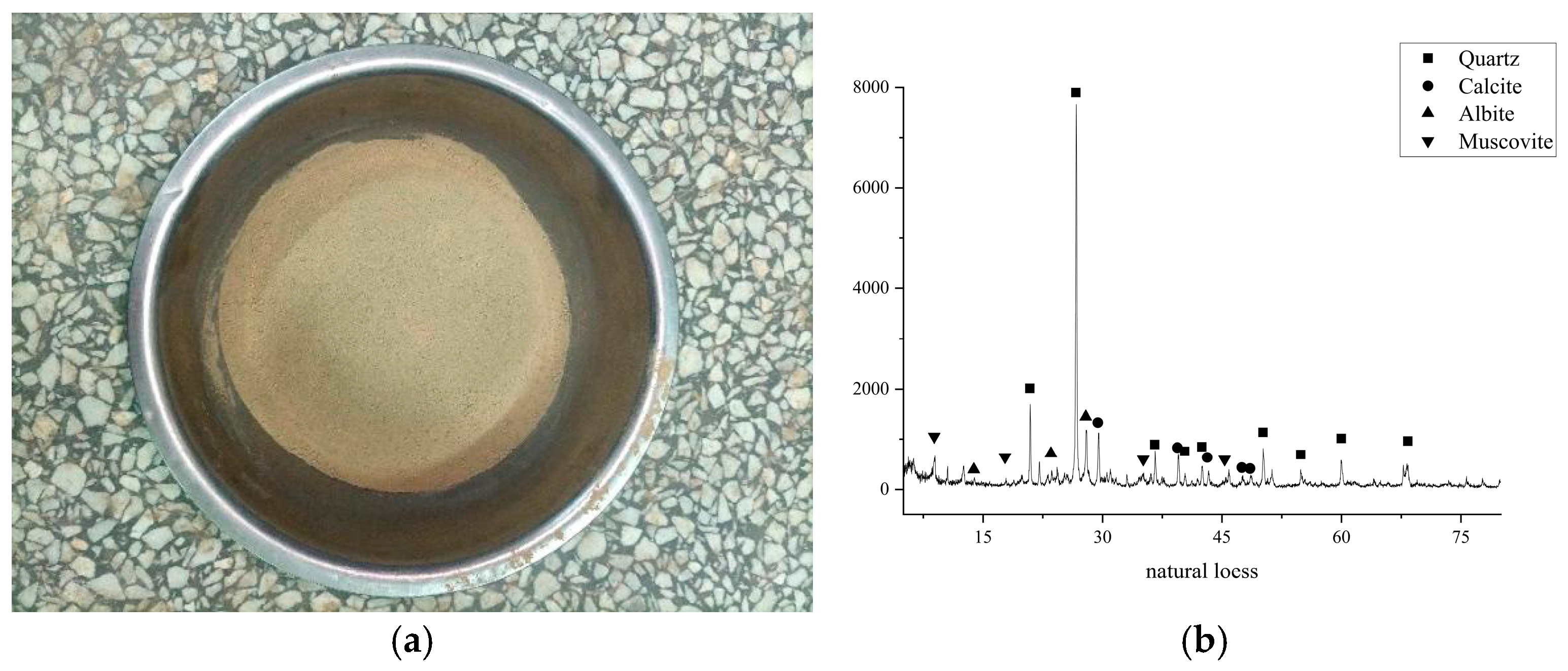
The loess used in this test was collected from Lanzhou New District at a depth of approximately 0.5–2 m. It is Lanzhou Q3 loess, belonging to Quaternary silty clay. The loess samples are yellowish-brown and exhibit typical loess characteristics, such as a loose structure and strong water sensitivity. After the undisturbed loess samples were retrieved, they were crushed with impurities removed and sieved through a 4.75 mm sieve. Subsequently, the loess was placed in a constant-temperature drying oven at 105 °C and dried to constant weight for test preparation, as shown in Figure 1a. The loess samples were crushed in an agate mortar and sieved through a 0.075 mm sieve. The resulting powders were then subjected to X-ray diffraction (XRD) analysis for phase identification, with the results shown in Figure 1b. In accordance with the test methods specified in the Test Methods of Soils for Highway Engineering [28], representative natural loess samples were selected to determine basic physical properties, including liquid limit, plastic limit, maximum dry density, and optimum water content. The test results are summarized in Table 1.

2.1.2. LM-1 Curing Agent

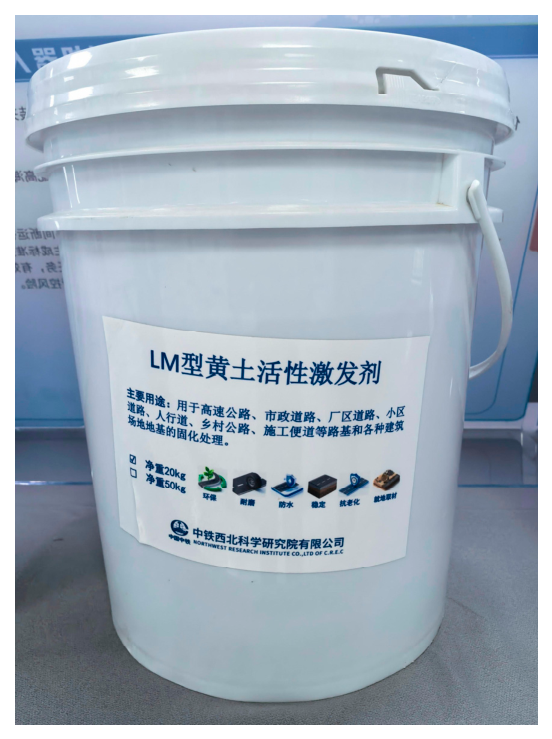
The LM-1 curing agent used in this study was developed by the Northwest Research Institute Co., Ltd. of China Railway Engineering Corporation (Lanzhou, China), as shown in Figure 2. This is an ionic cementitious curing agent that uses soluble sodium silicate as its functional core and is compounded with a variety of inorganic active components. It is chemically stable at room temperature, appears colorless or light yellow, has no obvious odor, and contains no soluble heavy metals. Its mechanism of action is as follows: after the loess stabilizer is mixed with moist loess, it reacts with air to generate cementitious substances, which form a cementitious skeleton within the pores between loess particles. High-valent cations change the electrical properties of loess particle surfaces through ion exchange, reduce the thickness of the water film around loess particles, increase the adsorption force between loess particles, enhance compactness, and reduce water permeability. In this study, the LM-1 dosage, cement content, and loess content are defined as the percentage by mass of each in the improved loess. Unless otherwise specified, the LM-1 dosage referred to hereinafter is that of the original solution after dilution at a 1:5 ratio, and all LM-1 mentioned is the diluted solution. The basic physical properties of the LM-1 curing agent are shown in Table 2.

2.1.3. Cement

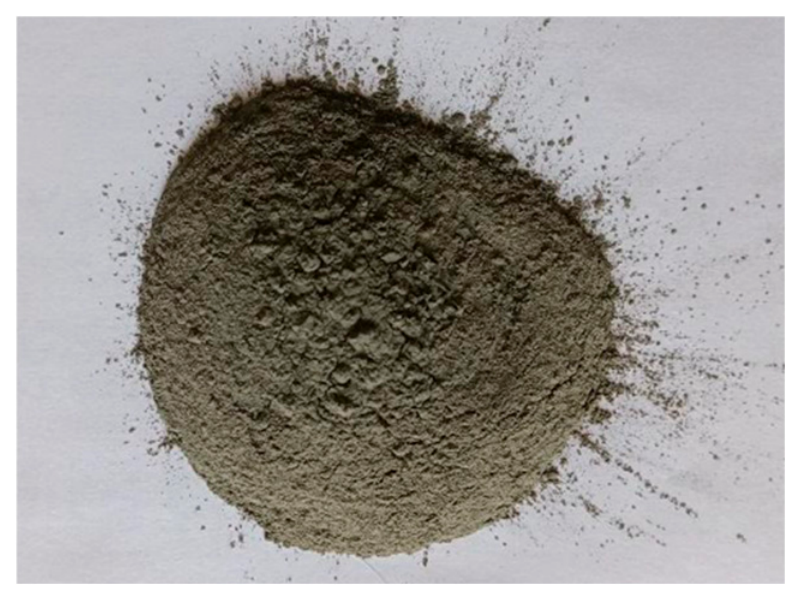
The cement used in this test is Hailuo brand ordinary Portland cement P·O 42.5, as shown in Figure 3. Its main parameters are shown in Table 3.

2.2. Methods

2.2.1. Preliminary Test and Mix Proportion Group Setup

To determine the optimal dosage of the LM-1 curing agent, a preliminary test was conducted. According to the reference dosage recommended in the technical documentation, a mixture of 1 kg of original LM-1 + 5 kg of water + 30 kg of cement for 300 kg of loess gave a relatively good stabilization effect. Here, the 5 kg of water was used to dilute the original LM-1 at a dilution ratio of 5. Based on this, a cement content of 10% and six LM-1 dosages (0%, 1.2%, 1.5%, 1.8%, 2.1%, 2.4%) were set. Compaction tests and 7-day unconfined compressive strength (UCS) tests were carried out on the improved loess with these six mix proportions, and the optimal LM-1 dosage was determined based on the 7-day UCS results. Subsequently, one LM-1 dosage (the optimal value determined from the previous tests) and three cement contents of 8%, 10%, and 12% were selected. Compaction tests and 7 d unconfined compressive strength (UCS) tests were carried out on the improved loess with these three mix proportions, and the optimal cement content was determined based on the 7 d UCS results.
After the preliminary tests, the optimal dosage was used as the baseline and adjusted by ±0.3%, together with the cement-only improved loess group (i.e., 0% curing agent dosage), resulting in a total of four different curing agent dosages. According to the Technical Standard for Application of Soil Stabilizer [29], three dosages of inorganic binders should be set, one of which is the reference value, and the other two should be increased and decreased by 2% relative to the reference value. Assuming that the reference value of cement content obtained from the preliminary tests is y%, the cement contents are set as (y − 2)%, y%, and (y + 2)%. These three cement contents were combined with the four LM-1 dosages, giving a total of 12 composite mix proportions. This 4 × 3 factorial design enables systematic evaluation of the individual and interactive effects of the two additives, as well as identification of the optimal mix proportion for Lanzhou loess subgrade improvement. Various macro- and micro-scale tests were conducted on the improved loess with these 12 mix proportions, and the specific test methods are detailed in the following sections.

2.2.2. Compaction Test

In subgrade filling engineering, the compactness and water content of loess not only reflect the compaction effect of subgrade fillers but also directly affect the engineering quality of subgrade construction. Loess achieves the optimal compaction state at the maximum dry density and optimum water content. Therefore, these two parameters serve as critical indicators guiding subgrade fill construction. The compaction test is a standard method for determining the maximum dry density and optimum water content of loess.
Compaction tests were conducted on 12 groups of composite curing agent-improved loess with different mix proportions to investigate the variation in compaction characteristics under various LM-1 and cement dosages, and to obtain the corresponding optimum water content and maximum dry density for subsequent tests. According to the test methods specified in Test Methods of Soils for Highway Engineering [28], heavy compaction tests were carried out using an electric compactor. Before moisture conditioning, a certain amount of water is first added to prepare five specimens with water content levels spaced at 2% intervals near the plastic limit of the natural loess. The soil is then conditioned for 12–24 h to allow thorough wetting of the loess particles. Before compaction, cement is added to the loess and mixed thoroughly. Subsequently, the diluted LM-1 solution is evenly sprayed onto the surface of the loess, followed by another thorough mixing.
The detailed compaction parameters are presented in Table 4.

2.2.3. Unconfined Compressive Strength (UCS) Test

The unconfined compressive strength of loess directly reflects its compressive bearing capacity and the effectiveness of improvement. The test is simple, rapid, widely applicable, and well-established. In practical engineering applications, the unconfined compressive strength of loess at a curing age of 7 days is often used as an indicator for evaluating engineering quality. According to the Highway Engineering Test Procedures for Inorganic Binder-Stabilized Materials [30], standard specimens with a diameter of 50 mm and a height of 50 mm were prepared. The water content and density were taken as the optimum water content and maximum dry density of the composite curing agent-improved loess for different mix proportions as determined by compaction tests. The preparation method for the improved loess was the same as that for the compaction test. After demolding, the specimens were wrapped in plastic film and placed in a curing room for standard curing at curing ages of 7 days or 28 days. During the preparation, maintenance, transportation, and testing of specimens, some specimens may be subject to accidental disturbances, resulting in unreliable strength values. Specifically, these include but are not limited to: eccentric compression caused by slight misalignment between the specimen axis and the loading plate during the UCS test; surface scratches, edge damage or cracks caused by accidental collision during the handling and transportation of the specimen; local damage caused by the demolding process, especially on the specimens with low early strength; and uneven compaction or slight segregation during specimen preparation possibly introducing invisible internal defects on the surface. The above anomalies are recorded during testing, and the strength results for these specimens will be excluded. According to the specification, if there are fewer than 6 valid specimens after elimination, the test will be supplemented or the whole set of tests will be redone until the standard deviation of the remaining 6 valid specimens in this group is less than 6% of its average value, so as to ensure that the final data participating in the statistics are all from the specimens without obvious physical defects, and the degree of dispersion is within an acceptable range.
The formula for calculating the specimen mass is
m s g = ρ d g V λ ( 1 + 0.01 w s g )
where m s g represents the mass of the specimen (g), w s g represents the water content of the conditioned mixture (%), ρ d g represents the dry density of the conditioned mixture (g/cm3), V represents the volume of the mold (cm3), and λ represents the degree of compaction (%).
The design scheme of the unconfined compressive strength test is shown in Table 5, where x represents the optimal LM-1 dosage obtained from the preliminary tests.

2.2.4. X-Ray Diffraction (XRD)

X-ray diffraction (XRD) can clarify the variations in mineral composition and content of loess modified by composite curing agents. A Bruker D8 Advance X-ray diffractometer (Bruker AXS GmbH, Karlsruhe, Germany) was used in the test. The test samples were powders ground from fractured specimens of natural loess, cement-improved loess, and optimally proportioned composite-improved loess after 7-day unconfined compressive strength tests. Data files were stored after the test, and MDI Jade software (JADE 6.0) was applied for data analysis to determine the mineral composition and content of loess samples.

2.2.5. Scanning Electron Microscopy (SEM)

Scanning electron microscopy (SEM) is adopted to investigate variations in microstructural features, including internal pore size and morphology, spatial distribution and arrangement of loess particles, and interparticle bonding forms. A ZEISS-Gemini SEM 500 (Carl Zeiss Ltd., Cambridge, UK) scanning electron microscope was employed. The test samples were fractured specimens of natural loess, cement-improved loess, and optimally proportioned composite-improved loess after 7-day unconfined compressive strength tests. SEM images of loess modified by composite curing agents with diverse mix ratios were captured, and post-processing of these images was carried out with Image-Pro Plus 6.0 image analysis software.

3. Results and Analysis

3.1. Results and Analysis of Preliminary Test

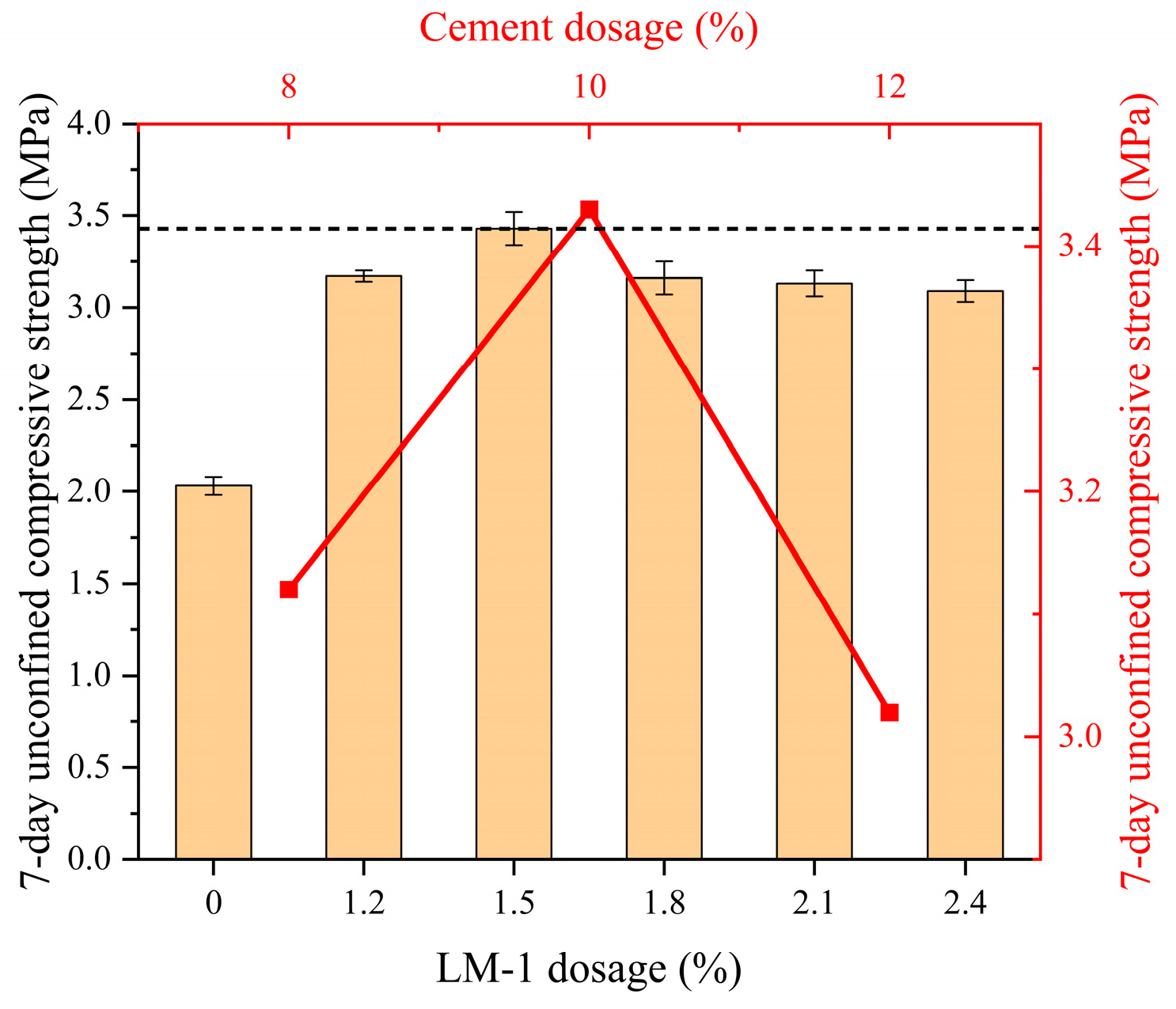
Based on the test results, the relationship curves of the optimum water content, maximum dry density, and 7-day unconfined compressive strength of loess improved with the composite curing agent at a cement content of 10% under different LM-1 dosages were plotted. The test results are shown in Table 6. The relationship curves between LM-1 dosage and the 7-day unconfined compressive strength of the improved loess and the relationship curves between cement dosage and the 7-day unconfined compressive strength of the improved loess are shown in Figure 4.
As shown in Figure 4, at a cement content of 10%, the 7-day unconfined compressive strength reaches its maximum when the LM-1 dosage is 1.5%. When the dosage increases to 1.8%, the strength decreases to 3.16 MPa, a reduction of 7.9%. Further increasing the dosage results in the unconfined compressive strength stabilizing at approximately 3.1 MPa. This indicates that excessive LM-1 addition beyond 1.8% no longer provides additional strength improvement. Consequently, 1.5% was selected as the reference LM-1 dosage for the subsequent formal experiments. With the LM-1 dosage fixed at 1.5%, the specimen containing 10% cement achieved a 7-day UCS of 3.43 MPa, substantially exceeding those of the specimens with 8% and 12% cement. Therefore, 10% was adopted as the reference cement content for the formal testing program.

3.2. Results and Analysis of Compaction Test

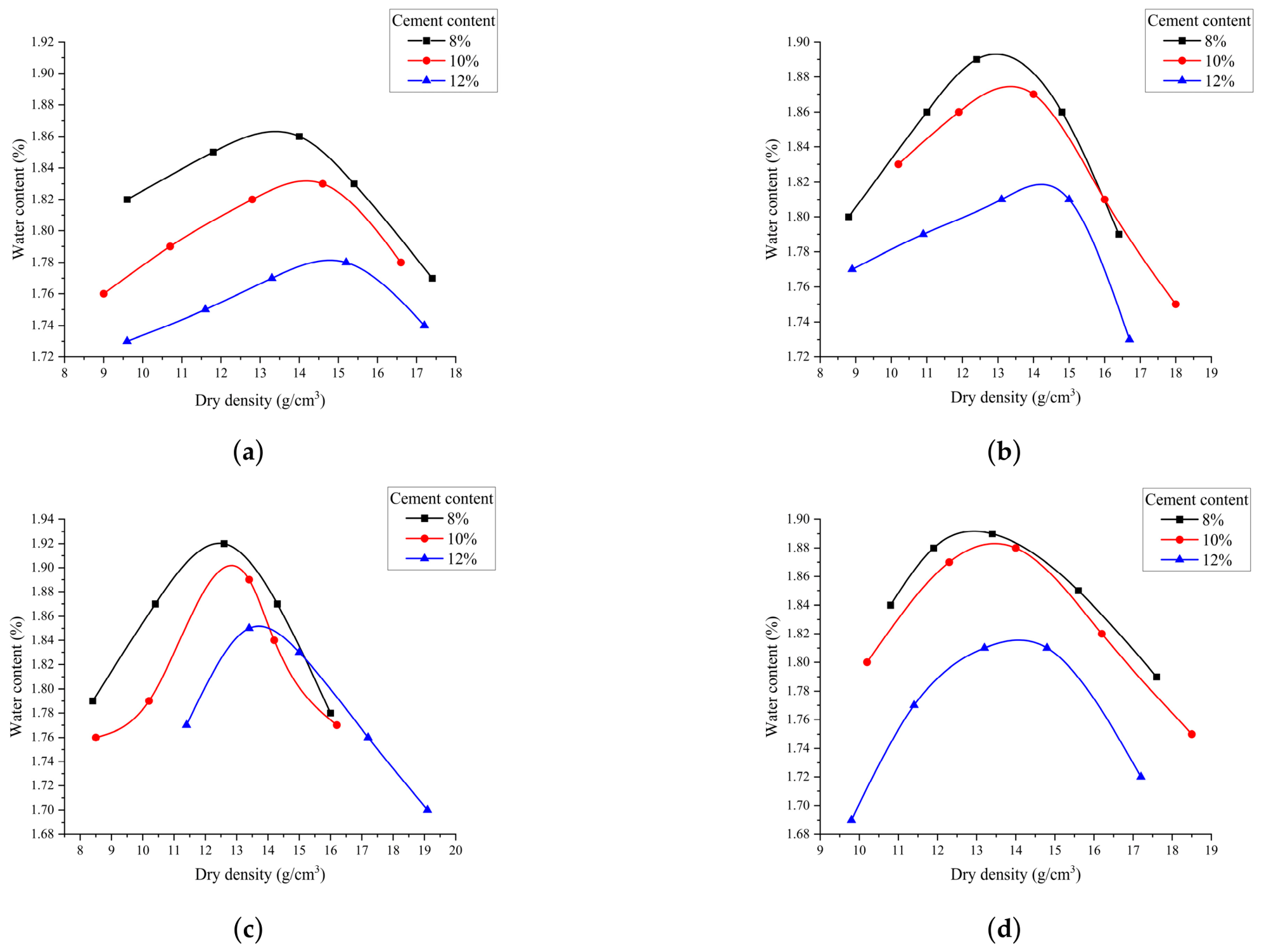
The compaction test results under different LM-1 and cement dosages are shown in Table 7, and the corresponding compaction curves are presented in Figure 5. Curve fitting was performed to acquire the maximum dry density and optimum water content of improved loess at various dosages, as presented in Table 8.

3.2.1. Effect of Cement Content on Optimal Compaction Parameters of Improved Loess

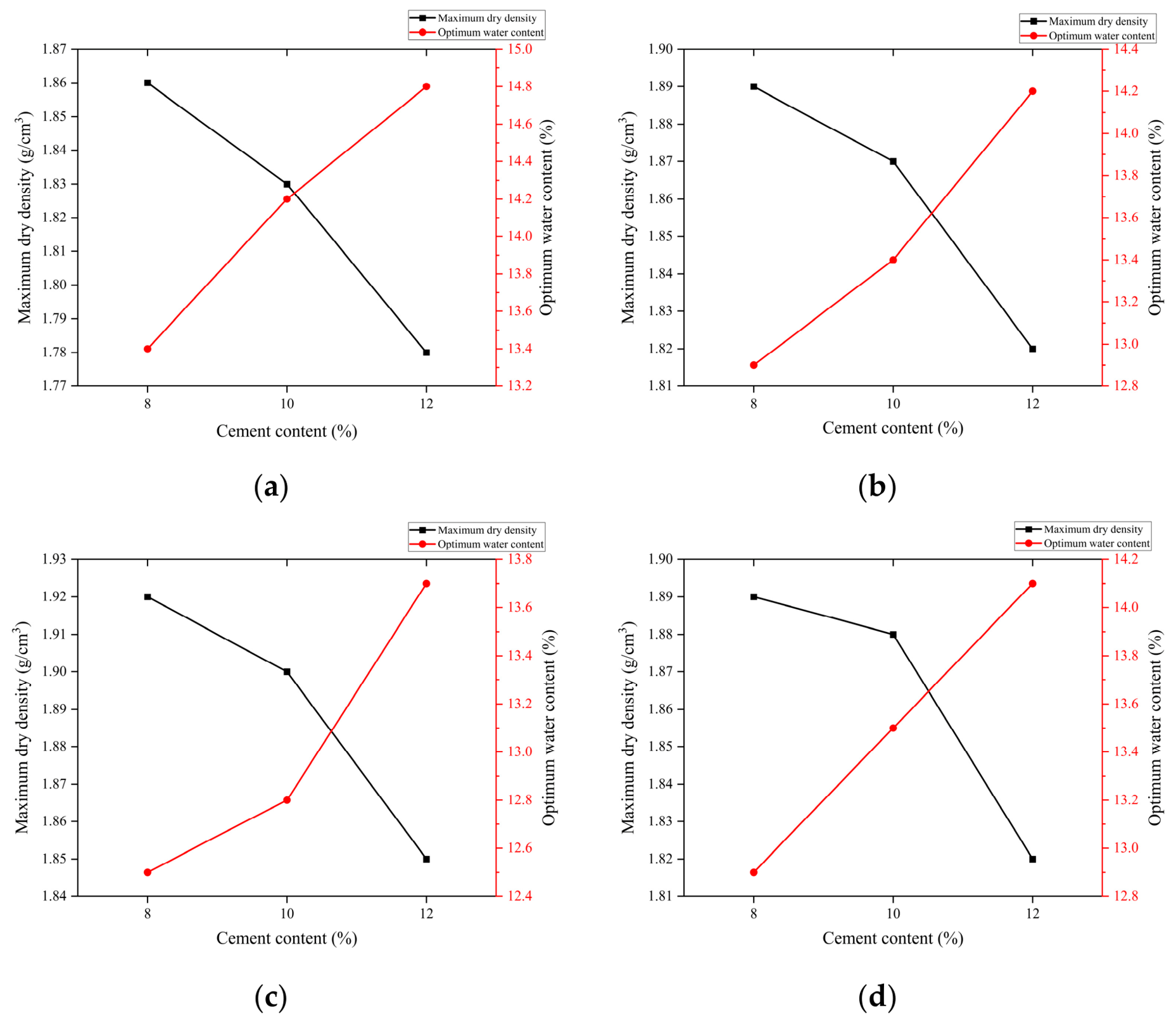
Based on the compaction data in Table 8, variation curves of maximum dry density and optimum water content versus cement content were plotted at a fixed LM-1 dosage, as illustrated in Figure 6. The influence of cement content on the optimum compaction parameters of improved loess was analyzed.
As shown in Figure 6, at a fixed LM-1 dosage, the maximum dry density of improved loess decreases gradually, whereas the optimum water content rises with the growing cement content. It can be observed from Figure 6a–d that when LM-1 dosage is 0%, 1.2%, 1.5% and 1.8%, the maximum dry density falls by 4.49%, 3.85%, 3.78% and 3.85%, respectively, and the optimum water content rises by 10.45%, 10.08%, 9.60% and 9.30% as cement content increases from 8% to 12%. Further, compared with natural loess, the sample with 0% LM-1 dosage and 12% cement content has its maximum dry density reduced by 9.18% and optimum water content increased by 5.71%. Cement hydration produces abundant cementitious products, including C-S-H gel. These hydrophilic substances need thicker water films compared with the original clay particles, which greatly boosts water demand and elevates optimum water content. The fast flocculation reaction between cement and clay particles forms flocculent structures wrapping ineffective pores. This restricts the sliding and rearrangement of loess particles in the compaction process, preventing loess from reaching the densest state and lowering maximum dry density. Furthermore, partial free water is consumed and converted into chemically bound water during hydration, losing its lubricating effect and further increasing the demand for initial water content.

3.2.2. Effect of LM-1 Dosage on Optimal Compaction Parameters of Improved Loess

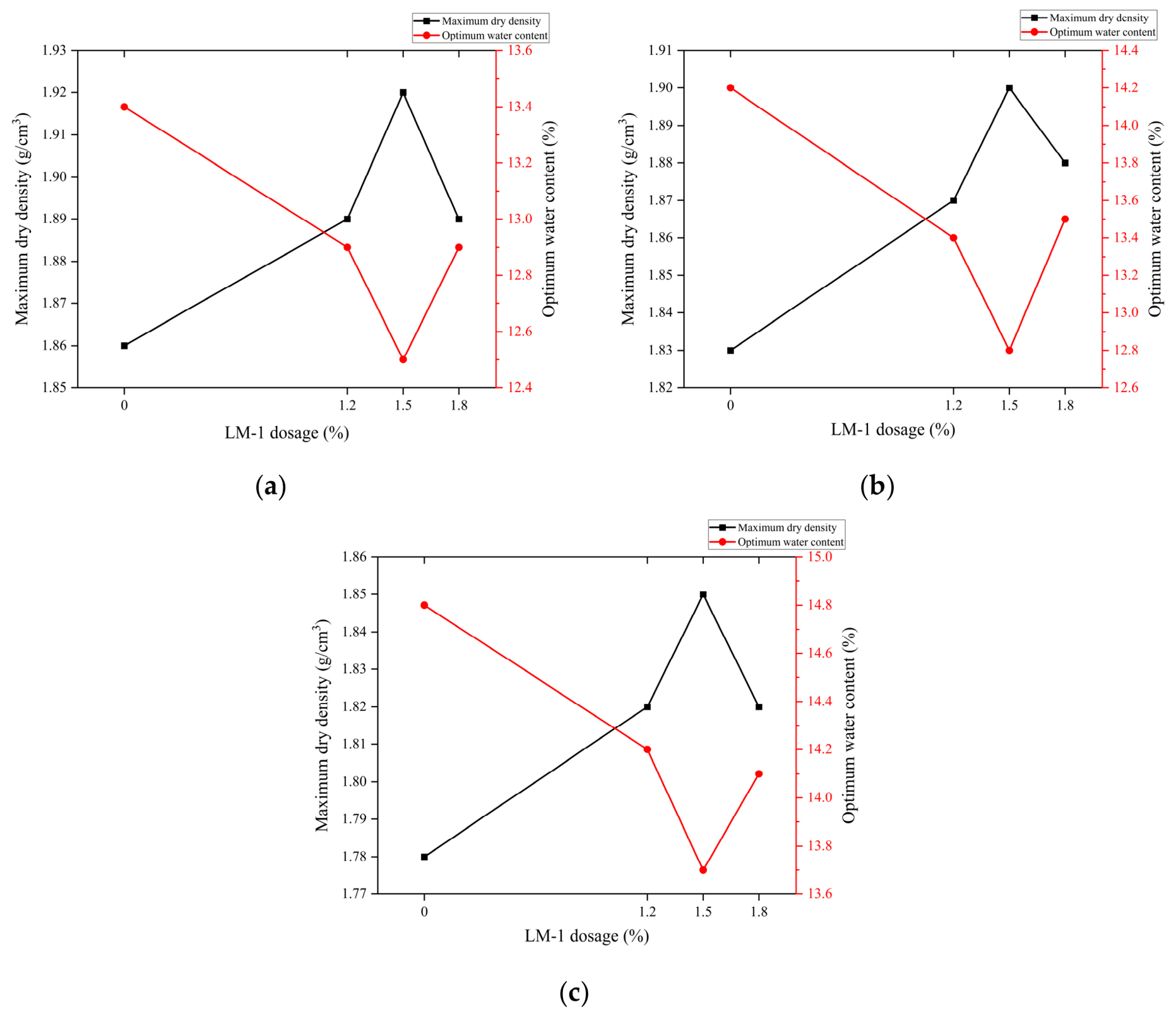
Based on the compaction data in Table 8, variation curves of maximum dry density and optimum water content versus LM-1 dosage were plotted under fixed cement content to explore its influence on the optimal compaction parameters of improved loess, as presented in Figure 7.
As shown in Figure 7, with fixed cement content, the maximum dry density of improved loess rises at first and then declines, while the optimum water content shows an opposite trend with increasing LM-1 dosage. A turning point in compaction performance appears at the dosage of 1.5%, corresponding to the peak maximum dry density and minimum optimum water content. For specimens with cement contents of 8%, 10%, and 12%, compared with the sample without LM-1 addition, the maximum dry density rises by 3.23%, 3.83%, and 3.93%, and the optimum water content drops by 6.72%, 9.86%, and 7.43% at 1.5% LM-1 dosage, respectively. The variation is attributed to the conversion of dominant effects between ion exchange and excessive liquid introduction. At low dosages, high-valence cations in LM-1 substitute low-valence cations on clay surfaces, compressing the electric double layer, thinning the bound water film, and lowering loess plasticity, which promotes particle movement and densification. Formed aggregates fill internal voids and further improve maximum dry density. The decrease in bound water cuts compaction water demand, thus reducing optimum water content. When the dosage exceeds the optimal value, surplus curing agent liquid creates excessive interparticle lubrication and restricts compaction. Liquid occupancy increases loess porosity and decreases maximum dry density. Excessive free water elevates total water content, and newly formed inter-aggregate micropores need more water filling, leading to the rise in optimum water content. The critical dosage corresponds to the saturation point of ion exchange, and the excess liquid over this point will adversely affect the improvement.

3.3. Results and Analysis of the Unconfined Compressive Strength Test

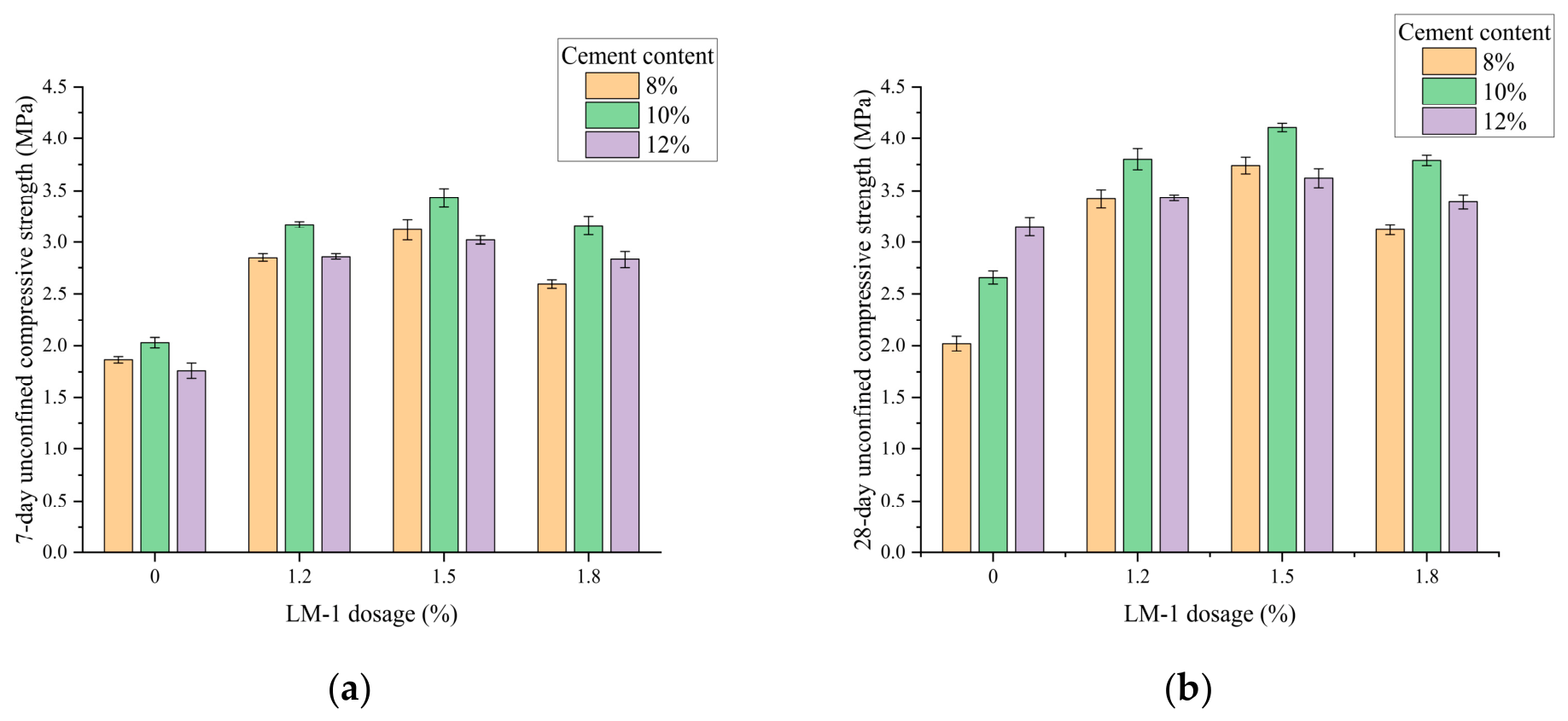
Unconfined compressive strength tests were carried out to investigate the effect of the composite curing agent on the strength of loess with different mix proportions and dosages. The corresponding results are shown in Table 9 and Figure 8.
According to the 7-day unconfined compressive strength criteria for cement-stabilized materials specified in Ref. [31], base courses of secondary and lower-grade roads under light and medium traffic require a strength range of 2.0–4.0 MPa. For expressways and first-class roads under light and medium traffic, as well as secondary roads under heavy traffic, the required 7-day strength ranges from 3.0 to 5.0 MPa. Accordingly, all three groups of loess improved with 0% LM-1 fail to meet the requirements for any of the aforementioned base courses. In contrast, loess treated with the composite curing agent at all other mix proportions qualifies for base courses of secondary and lower-grade roads under light and medium traffic. Moreover, the loess modified with the optimal mix proportion of 1.5% LM-1 + 10% cement achieves a 7-day strength of 3.43 MPa, which also satisfies the strength requirements for expressway and first-class road base courses under light and medium traffic, as well as for secondary roads under heavy traffic.
As shown in Figure 8 and Table 9, for improved loess specimens with a fixed cement content, both the 7 d and 28 d unconfined compressive strengths initially increase and then decrease with rising LM-1 dosage, with a consistent turning point at 1.5% LM-1. At a given curing age and LM-1 dosage, the 7 d and 28 d strengths of loess with 10% cement exceed those of specimens with 8% and 12% cement, except for the 28 d cured group without LM-1 addition. At an LM-1 dosage of 1.5%, compared with the specimens without LM-1, the 7-day strengths of loess with 8%, 10%, and 12% cement increase by 67.74%, 68.97%, and 71.59%, respectively, while the corresponding 28-day strengths increase by 85.35%, 54.74%, and 15.05%.
As illustrated in Figure 8, for specimens with identical cement content, the 7-day and 28-day unconfined compressive strength rise initially and then decline with increasing LM-1 dosage, and the turning point consistently appears at the dosage of 1.5%. Except for the 28-day cured group with zero LM-1 addition, samples containing 10% cement exhibit higher strength values at both curing ages compared with those with 8% and 12% cement content under the same LM-1 dosage.
Released free water accelerates cement hydration and generates abundant gel and hydration products, which builds a stable cementation skeleton and continuously improves loess strength. Excessive LM-1 introduces surplus free water and reduces actual dry density. The over-compressed double layer triggers excessive particle flocculation to form coarse aggregates and abundant macropores, weakening interfacial bonding between hydration products and loess particles. Excess ions also change pore solution properties and interfere with the normal hydration reaction, leading to strength deterioration.
Under a fixed LM-1 dosage, a 10% cement proportion achieves superior strength at two curing stages, confirming it as the optimal cement content. Hydration products formed at this proportion match well with the pore structure and cementation demand of modified loess. Insufficient hydration products at 8% cement fail to bond internal voids and aggregates completely, resulting in low skeleton strength. Excessive cement at 12% causes severe volume shrinkage and increased microcracks. Thick hydration coating covers particle surfaces and restrains ion exchange behavior, while excessive ion concentration also brings adverse impacts. Accordingly, the combined proportion of 10% cement and 1.5% LM-1 presents the best synergistic modification effect.
At a constant LM-1 dosage of 1.5%, the 7-day strength growth rates of the three cement groups are close to each other, being 67.74%, 68.97%, and 71.59%. This proves early strength enhancement is mainly attributed to improved compaction quality and an optimized hydration environment caused by ion exchange. Nevertheless, obvious divergence exists in long-term strength growth rates, reaching 85.35%, 54.74%, and 15.05%, respectively. LM-1 delivers much more remarkable late-stage reinforcement effects on low-cement modified loess, with its growth rate over five times that of high-cement modified loess. Optimized particle hydrophilicity and layout make limited hydration products bond to the loess skeleton more efficiently, bringing a higher relative strength increment. Adequate cement can form a high-strength skeleton independently, which gradually weakens the auxiliary effect of LM-1. Extra water and hydration disturbance further limit its improvement effect under high cement content. In conclusion, 10% cement mixed with 1.5% LM-1 is the optimal ratio. The LM-1 curing agent is applicable to engineering projects requiring cement conservation and late strength improvement of low-cement-stabilized loess.

3.4. Results and Analysis of X-Ray Diffraction Test (XRD)

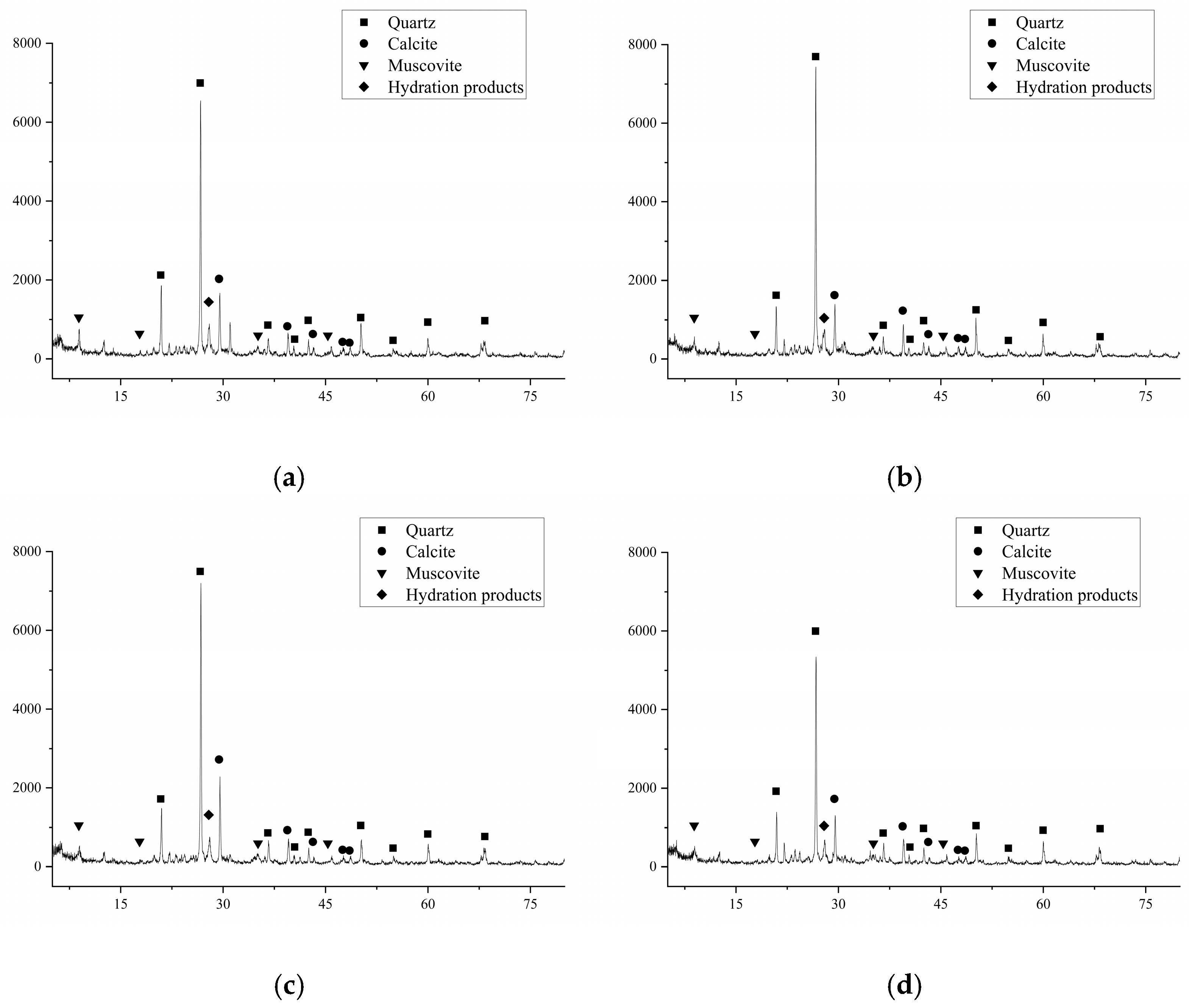
To investigate the effects of the composite curing agent with different mix proportions on product formation and phase evolution in the improved loess, X-ray diffraction (XRD) analysis was conducted. The tested soil samples included 10% cement-improved loess, 12% cement-improved loess, 1.5% LM-1 + 10% cement-improved loess, and 1.5% LM-1 + 12% cement-improved loess. The samples were prepared by crushing the fractured blocks obtained after unconfined compressive strength tests in an agate mortar, followed by sieving through a 0.075 mm sieve to obtain fine powders. The XRD data were subsequently imported into MDI Jade software for mineral composition and interplanar spacing analysis. The results are presented in Figure 9.
To further elucidate the mineral composition and improvement mechanism of loess modified by the LM-1 and cement composite, XRD tests were conducted on the four groups of improved loess samples. The results indicate that the main mineral components in all four groups—quartz, calcite, muscovite, and hydrated minerals—are essentially consistent with those of natural loess, suggesting that the improvement process did not alter the primary mineral framework of the loess.
Notably, albite, which was detected in natural loess, was absent in all improved samples. This critical change indicates that albite participated in the chemical reactions during the improvement process. Albite, a framework silicate mineral containing silicon and aluminum, undergoes alkali-activated reactions in the mildly alkaline environment provided by the sodium silicate (water glass) in LM-1. Its aluminosilicate framework is dissolved and repolymerized to form hydrated silicate gels. These gels, together with the C–S–H gel generated by cement hydration, constitute a composite cementitious system that significantly enhances the overall strength and stability of the loess. The disappearance of albite provides mineralogical evidence for the effective activation of reactive aluminosilicate components in loess by the sodium silicate in LM-1, revealing a distinct chemical improvement mechanism beyond simple cement hydration.
A clear pattern emerges when examining the intensities of the hydrated mineral diffraction peaks across the sample groups. The 1.5% LM-1 + 12% cement group exhibits the highest intensity, followed by the 1.5% LM-1 + 10% cement group, then the 12% cement-only group, and finally the 10% cement-only group. However, the total amount of hydration products reflected by XRD does not exhibit a simple positive correlation with unconfined compressive strength (UCS). Although the 1.5% LM-1 + 12% cement group shows the highest intensity of hydrated mineral peaks and the densest microstructure in SEM observations, its 7-day UCS is actually lower than that of the 1.5% LM-1 + 10% cement group. This phenomenon can be attributed to the relatively insufficient water-to-cement ratio when the cement content increases from 10% to 12%, which prevents a portion of the cement particles from fully hydrating—leaving them as inert fillers that induce localized stress concentrations. In addition, the hydration shrinkage of excess cement introduces microcracks, thereby reducing the overall cementation quality.

3.5. Results and Analysis of Scanning Electron Microscopy (SEM)

To quantitatively explore the pore structure evolution of loess modified by the curing agent, pore characteristic parameters of natural and improved loess microstructures were analyzed at 500× magnification. The modification effect was assessed by comparing differences in microscopic parameters before and after treatment.
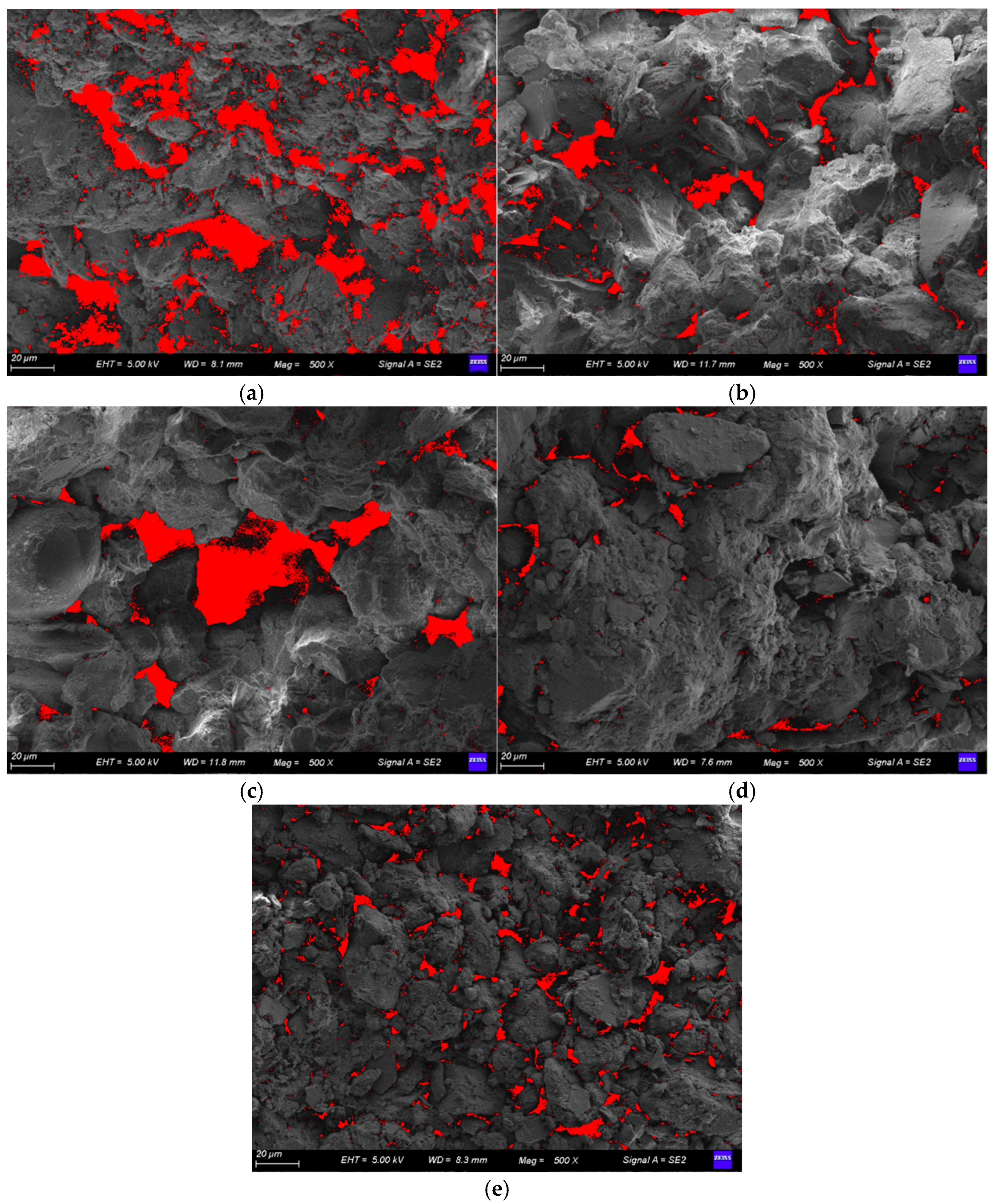
In accordance with the loess pore extraction method proposed by Hong et al. [32], internal pores of loess specimens were located and marked through automatic detection and manual screening using Image-Pro Plus 6.0 software. Interparticle pores were marked red, and the loess skeleton appeared gray. The processed images are illustrated in Figure 10.

3.5.1. Pore Characteristic Parameters

The quantity and area of loess pores were extracted via Image-Pro Plus 6.0, and the results are summarized in Table 10.
As shown in Table 10, natural loess has an average pore area of 4.85 μm2, the maximum among all samples. It presents a typical inter-aggregate void structure with abundant macropores.
After the addition of 10% cement, the number of pores in the loess decreased to 1505, representing a reduction of 14.6%. The total pore area drops drastically to 1396.79 μm2 with a decrease of 83.7%, and the average pore area is reduced to 0.93 μm2, falling by 80.9%.
When cement content increases to 12%, the pore structure is improved compared with natural loess but poorer than that of 10% cement-improved loess. The pore quantity decreases to 1638, down by 7.0%. The total and average pore areas reach 2731.61 μm2 and 1.67 μm2, with reduction rates of 68.0% and 65.6%, respectively. This indicates that a higher cement dosage cannot guarantee a better modification effect. Excess cement induces microcracks due to intense hydration heat, uneven volumetric shrinkage, and non-uniform distribution of hydration products, which degrade pore structure. This conclusion is consistent with the strength results in Section 3.3.
Adding 1.5% LM-1 further optimizes the pore structure of 10% cement-improved loess. Compared with 10% cement-improved loess alone, 1.5% LM-1 + 10% cement-improved loess witnesses the pore number dropping from 1505 to 1071, a 28.8% reduction. The total pore area decreases by 73.5% to 369.47 μm2, and the average pore area declines by 62.8% to 0.34 μm2. Relative to natural loess, the three parameters decrease by 39.2%, 95.7%, and 92.9%.
Nevertheless, raising cement content to 12% combined with 1.5% LM-1 fails to maintain the optimization trend. The 1.5% LM-1 + 12% cement-improved loess contains 1948 pores, exceeding the quantity of natural loess. Its total pore area is 1188.49 μm2, lower than that of 12% cement-improved loess, yet 3.2 times that of 1.5% LM-1 + 10% cement-improved loess. The average pore area is 0.61 μm2, also obviously larger than that of the 1.5% LM-1 + 10% cement-improved loess. This group features the largest pore quantity and moderate single pore size, revealing numerous micropores and microcracks inside the loess matrix. Activated by LM-1, excessive cement triggers a fierce hydration reaction and releases massive instantaneous hydration heat, resulting in asymmetric volumetric shrinkage and dense microcrack networks. These small-sized yet numerous cracks lead to pore characteristics of large quantity, moderate total area, and small average size.

3.5.2. Pore Fractal Dimension

The equivalent perimeter and area of microscopic pores are extracted using Image-Pro Plus 6.0 for fractal dimension calculation. This index reflects the complexity of loess pore structure, with values ranging from 1 to 2. A higher fractal dimension represents more complicated pore morphology and greater deviation from a smooth surface. The calculation formula is shown as follows:
log P = D 2 log A + C
where P represents the equivalent pore perimeter (μm), A represents the equivalent pore area (μm2), C represents the constant, and D represents the fractal dimension.
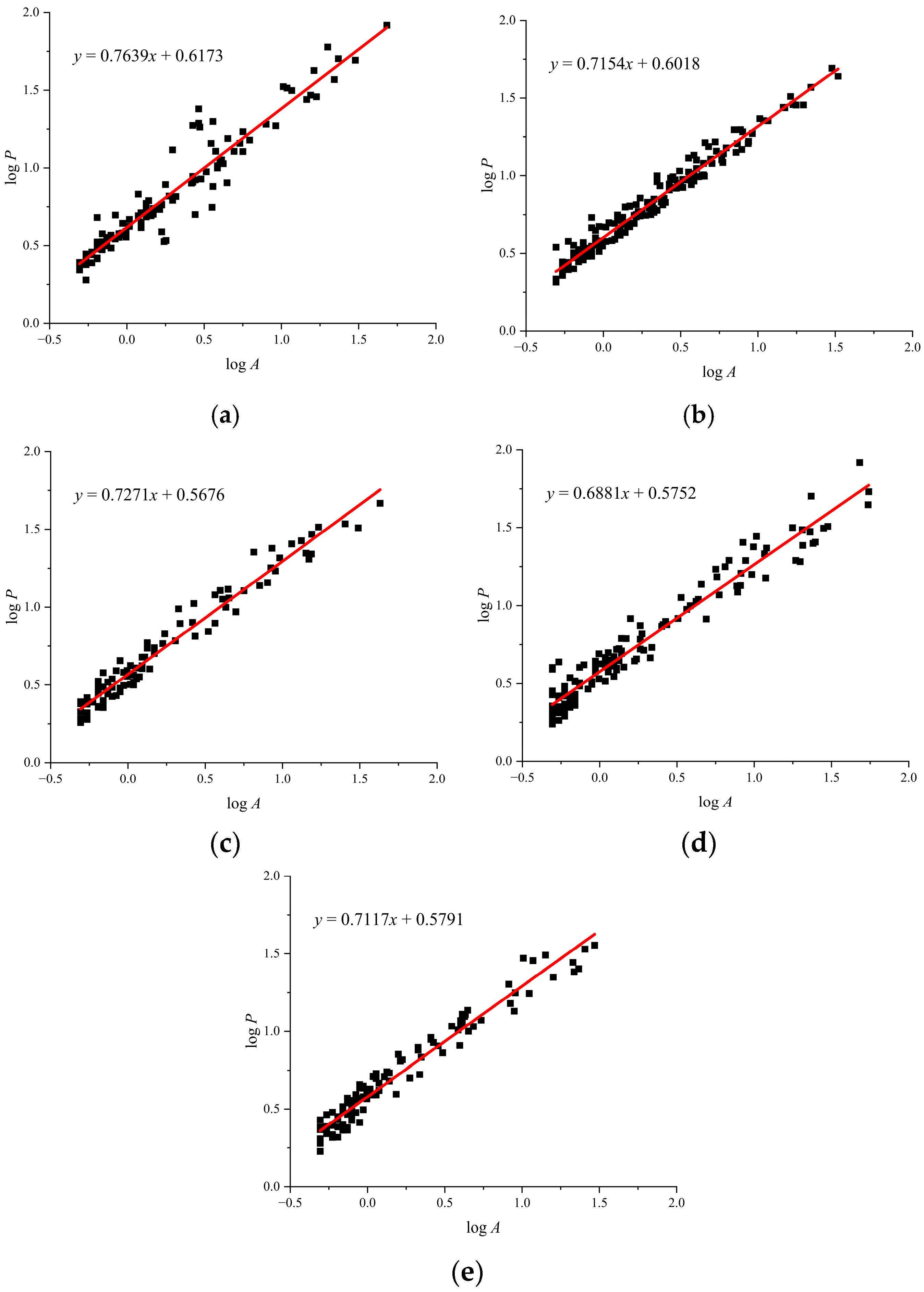
The log P log A double logarithmic plot and linear fitting curve were constructed based on the equivalent perimeter and area data of loess pores, as shown in Figure 11. From the fitting results, the pore fractal dimensions of each improved loess were obtained, as presented in Table 11.
As shown in Table 11, natural loess possesses the highest pore boundary fractal dimension, manifesting highly irregular jagged edges of primary pores. After improvement with 10% cement, the fractal dimension falls to 1.430, a 6.4% reduction relative to natural loess; the value drops to 1.454 for 12% cement improvement, a decrease of 4.8%. The fractal dimension of the 10% cement group is lower than that of the 12% cement group, proving that an appropriate cement dosage facilitates smoother and more regular pore outlines, which is consistent with the variation trends of total pore area, average pore area, and strength properties.
The addition of 1.5% LM-1 further optimizes the fractal dimension of the 10% cement group. The fractal dimension of the 1.5% LM-1 + 10% cement-improved loess reaches 1.376, decreasing by 3.8% compared with the 10% cement-improved loess alone and by 9.9% compared with natural loess, ranking the lowest among all specimens. LM-1 facilitates tight particle arrangement through ion exchange and works synergistically with cement hydration products to form well-ordered pore boundaries. This compact and regular pore structure helps maintain stable mechanical performance during loess service. The fractal dimension of the 1.5% LM-1 + 12% cement-improved loess is 1.423, which is 2.1% and 6.9% lower than those of the 12% cement-improved loess and natural loess, respectively, and remains higher than that of the 1.5% LM-1 + 10% cement-improved loess. This further confirms that 10% is the optimal cement content under the experimental conditions.

3.6. Mechanism Analysis of LM-1 and Cement Composite Improvement

3.6.1. Mechanism Analysis of Cement Improvement

When cement is mixed with water, its constituent minerals—CaO, SiO2, Al2O3, Fe2O3, and SO3—immediately undergo a series of chemical reactions, generating various mineral phases including 3CaO·SiO2, 2CaO·SiO2, 3CaO·Al2O3, and 4CaO·Al2O3·Fe2O3. These phases further react with water through hydration to form compounds such as Ca(OH)2, CaO·SiO2·H2O, CaO·Al2O3·H2O, and CaO·Fe2O3·H2O. Initially, these compounds dissolve in water, re-exposing the cement particle surfaces and allowing hydration to proceed continuously. As the reactions advance, the concentrations of Ca(OH)2 and CaO·SiO2·H2O gradually reach supersaturation, at which point the newly formed compounds precipitate as colloidal particles dispersed throughout the solution. These colloids are collectively referred to as C–S–H gel. A portion of the gel interacts with surrounding active clay particles, while the remainder gradually coagulates and hardens, eventually forming a cementitious skeleton that binds the soil mass. This process transforms the soil from discrete particles into aggregated units, shifts interparticle contacts from predominantly point-to-point to surface-to-surface, and changes the pore structure from one dominated by macropores and inter-aggregate voids to one dominated by intergranular pores. Consequently, the strength and stability of the soil are significantly improved. The principal reactions are as follows:
2(3CaO·SiO2) + 6H2O → 3CaO·2SiO2·3H2O + 3Ca(OH)2
2(2CaO·SiO2) + 4H2O → 3CaO·2SiO2·3H2O + Ca(OH)2
3CaO·Al2O3 + 6H2O → 3CaO·Al2O3·6H2O
4CaO·Al2O3·Fe2O3 + 2Ca(OH)2 + 10H2O → 3CaO·Al2O3·6H2O + 2CaO·Fe2O3·6H2O

3.6.2. Mechanism Analysis and Speculation on LM-1 Improvement

The primary component of LM-1 is sodium silicate (Na2O·nSiO2). Consequently, the solution contains abundant silicate species, including metasilicate (HSiO3), disilicate (Si2O52−), hydrodisilicate (HSi2O5), orthosilicate (SiO32−), and silicic acid (Si(OH)4).
Taking natural mica as an example, the mechanism by which LM-1 improves loess minerals can be elucidated as follows. A small fraction of natural mica disperses into flaky particles in aqueous solution. During hydration and dispersion, these particles expose Al3+ at their edges, which adsorb negatively charged silicate ions. In the alkaline sodium silicate solution, the aluminol groups (Al–OH) at the particle edges exhibit acidic behavior; upon H+ dissociation, Al–O–Si bonds form, facilitating the adsorption of silicate ions or colloids. Meanwhile, the silanol groups (Si–OH) at the edges adsorb silicate ions or colloids via Si–O–Si bonding with the Si–OH groups in sodium silicate, yielding hydrated silica gel. In addition, Ca2+ and Mg2+ ions in the pore solution readily undergo electrostatic adsorption with silicate ions, forming calcium silicate hydrate and magnesium silicate hydrate gels that adhere to particle surfaces and promote aggregation.
For the majority of non-dispersed particles in natural mica and albite, anions from LM-1—such as HSiO3 and HSi2O5—undergo exchange adsorption with dissolved Na+ within the mineral interlayers, binding the lamellae together and generating hydrated sodium aluminosilicate minerals. The various hydrated silicate minerals formed through these processes seal the interlayer gaps at particle edges and subsequently block the pores within the improved loess. This further densifies the soil matrix, leading to a corresponding increase in unconfined compressive strength.


4. Conclusions

This study focuses on loess in the Lanzhou region and adopts an independently developed LM-1 ionic cementitious curing agent—mainly composed of sodium silicate—in combination with cement for the composite improvement of loess. Systematic investigations were carried out on the mechanical properties, microstructural characteristics, and mineralogical evolution of the modified loess, with particular emphasis on revealing the synergistic reinforcement mechanism under low cement dosage. The main conclusions are summarized as follows:
(1)
The combined addition of LM-1 and cement markedly enhances the unconfined compressive strength (UCS) of loess, exhibiting a pronounced synergistic effect. The optimal improvement performance is achieved at a mix proportion of 1.5% LM-1 and 10% cement. Under this formulation, the 7 d and 28 d UCS values reach 3.43 MPa and 4.12 MPa, respectively, corresponding to increases of 68.97% and 54.74% compared with the specimen containing 10% cement alone, and 94.9% and 30.8% relative to that with 12% cement only. Notably, the loess treated with 10% cement and LM-1 consistently exhibits higher strength than the 12% cement sample, accompanied by a more homogeneous microstructure and fewer microcracks. These results demonstrate that an appropriate LM-1 dosage can substantially improve mechanical performance while reducing cement consumption.
(2)
The composite modifier exerts a significant optimization effect on the microstructure of loess. Scanning electron microscopy (SEM) observations reveal that the specimen modified with 1.5% LM-1 + 10% cement develops a uniform and dense network of C-S-H gel with isolated and closed pores. In contrast, groups with excessive cement content alone or 12% cement combined with LM-1 exhibit obvious shrinkage microcracks and degraded pore structures, despite a generally compact matrix. X-ray diffraction (XRD) analysis further indicates that the characteristic diffraction peaks of albite nearly disappear after modification, confirming that alkali-activated reactions generate new hydrated silicate products. These newly formed products, together with the C-S-H gel from cement hydration, constitute a dual-gel cementation system. Meanwhile, the significantly enhanced diffraction peaks of hydrated minerals demonstrate that LM-1 effectively accelerates the cement hydration process.
(3)
By integrating macroscopic mechanical test data and microscopic characterization results, the mix proportion of 1.5% LM-1 + 10% cement is identified as the optimal formulation for subgrade improvement of Lanzhou loess. This proportion achieves substantial strength enhancement with reduced cement usage, and the resulting modified loess exhibits a uniform, dense microstructure with limited microcracks, which is conducive to long-term performance. The findings of this research provide a theoretical basis and technical support for addressing the trade-off between cement conservation and performance enhancement in subgrade modification and slope protection projects in loess regions.

Author Contributions

C.G.: Conceptualization; Methodology; Funding acquisition; Writing: review and editing; Supervision; Q.H.: Investigation; Data curation; Formal analysis; Visualization; Writing: original draft; W.M.: Funding acquisition; Supervision; Project administration; W.Z.: Resources; Supervision; B.X.: Validation; Investigation; D.J.: Methodology; Resources. All authors have read and agreed to the published version of the manuscript.

Funding

This research was funded by the National Natural Science Foundation of China (Grant No. 42362033), the Science and Technology Research and Development Program Project of China Railway Group Limited (2023-Major-01), and the Science and Technology Research and Development Program Project of China Railway Group Limited (2025-Special-08).

Data Availability Statement

The data that support the findings of this study are available from the corresponding author [Qicheng He] upon reasonable request.

Conflicts of Interest

Authors Weijun Mi and Wenjuan Zhang were employed by the company Northwest Research Institute Co., Ltd. of C.R.E.C. The remaining authors declare that the research was conducted in the absence of any commercial or financial relationships that could be construed as potential conflicts of interest. The authors declare that they have no known competing financial interests or personal relationships that could have appeared to influence the work reported in this paper. For China Railway Group Limited, the funded researcher Weijun Mi had no role in the study design; in the collection, analysis, or interpretation of data; in the writing of the manuscript, but in the decision to publish the results. For Lanzhou Jiaotong University, the funded researcher Chunxiang Guo played a role in the study design; in the collection, analysis, or interpretation of data; in the writing of the manuscript; and in the decision to publish the results.

References

  1. Wang, L.; Wang, L.; Xie, W.; Xu, S.; Xia, X.; Zhou, T. Characteristics and mechanism of loess liquefaction-induced flow slide in Jishishan M6.2 earthquake, China. Soil Dyn. Earthq. Eng. 2025, 195, 109342. [Google Scholar] [CrossRef]
  2. Niu, Y.; Li, Q.; Wang, X.; Cheng, Y.; Zhang, Y.; Li, T. Study on mechanical properties and constitutive model of cement and polypropylene fiber improved loess considering freeze-thaw cycles. Constr. Build. Mater. 2025, 462, 140011. [Google Scholar] [CrossRef]
  3. Fang, R.; Zhang, S.; Deng, L.; Fan, W.; Wang, H. Research on a classification model of loess seismic landslides based on random forest in the Haiyuan region. Bull. Eng. Geol. Environ. 2023, 82, 78. [Google Scholar] [CrossRef]
  4. Li, Y.; Shi, W.; Aydin, A.; Beroya-Eitner, M.A.; Gao, G. Loess genesis and worldwide distribution. Earth Sci. Rev. 2020, 201, 102947. [Google Scholar] [CrossRef]
  5. Zhang, W.; Li, Y.; Wang, R.; Beroya-Eitner, M.A. A model for the formation and evolution of structure of initial loess deposits. CATENA 2022, 214, 106273. [Google Scholar] [CrossRef]
  6. Chang, Z.; Huang, F.; Huang, J.; Jiang, S.-H.; Zhou, C.; Zhu, L. Experimental study of the failure mode and mechanism of loess fill slopes induced by rainfall. Eng. Geol. 2021, 280, 105941. [Google Scholar] [CrossRef]
  7. Zhu, H.Y.; Chen, J.X.; Luo, Y.B.; Li, Y.; Shi, Z.; Liu, W.W.; Wu, Y.F. The angle for setting foot reinforcement bolt based on the failure mode of shallow tunnel in loess. Tunn. Undergr. Space Technol. 2021, 108, 103689. [Google Scholar] [CrossRef]
  8. Liu, Y.; Tang, C.; Wen, J.; Guo, H.; Fan, H. Mechanical characterization and water stability of loess improved by bio-based materials: An eco-friendly approach. Sci. Total Environ. 2024, 921, 171111. [Google Scholar] [CrossRef] [PubMed]
  9. Yan, X.; Xu, Q.; Dong, S.; Sun, Y.; Ma, L.; He, X.; Hai, C.; Yuan, Z. Improved stabilization of loess soil using magnesium oxysulfate cement-based ecological composite binder. Constr. Build. Mater. 2024, 445, 137865. [Google Scholar] [CrossRef]
  10. You, Z.; Xu, J.; Liu, H.; Peng, Y.; Zhang, Z. Laboratory evaluation of water absorption and drainage performance of a new wicking geotextile in loess-sand mixtures. Geotext. Geomembr. 2025, 53, 1558–1576. [Google Scholar] [CrossRef]
  11. Chen, J.; Luo, Y.; Li, Y.; Yuan, S.; Xu, J.; Wang, J.; Shao, S.; Luo, Y.; Xu, L.; Cheng, X.; et al. A state-of-the-art review on loess tunnels. J. Traffic Transp. Eng. 2025, 12, 1533–1632. [Google Scholar] [CrossRef]
  12. Yang, X.; Hu, Z.; Wang, Y.; Zhang, Y.; Wang, X.; Hou, B.; Wei, Y.; Liu, C. Mechanical properties and micro-mechanisms of geopolymer solidified salinized loess. Constr. Build. Mater. 2024, 455, 139211. [Google Scholar] [CrossRef]
  13. Chang, I.; Im, J.; Prasidhi, A.; Cho, G. Effects of Xanthan gum biopolymer on soil strengthening. Constr. Build. Mater. 2015, 74, 65–72. [Google Scholar] [CrossRef]
  14. Sadeghi, E.; Nikudel, M.; Ghasemi, S.; Bayat, N. Chemical and thermal stabilization of gypseous loess soils: Comparative study of natural environmental friendly materials (zeolite and gypsum) and cement. Case Stud. Constr. Mater. 2025, 23, e04945. [Google Scholar] [CrossRef]
  15. Chen, J.; Wu, C.; Zhang, Z.; Gong, S.; Fu, B.; Feng, H. Dynamic properties of loess improved by nano-MgO and hydrated lime under humidification conditions. iScience 2025, 28, 114215. [Google Scholar] [CrossRef] [PubMed]
  16. Shi, G.; Xue, Y.; Yang, D.; Zhang, A.; Guan, W.; Zhang, J.; Pan, X.; Wang, D.; Jin, C. Study on the mechanical properties of Yili loess improved by EICP biomimetic mineralization technology under freeze-thaw cycle conditions. Mater. Des. 2026, 263, 115574. [Google Scholar] [CrossRef]
  17. Li, S.; Lei, R.; Bian, X.; Wang, Z.; Zhang, G.; Xu, H. A biohybrid mineralization strategy based on calcium lignosulfonate–reinforced enzyme-induced carbonate precipitation for improving loess roadbed permeability resistance. Sustain. Mater. Technol. 2025, 46, e01764. [Google Scholar] [CrossRef]
  18. Gao, X.; Xie, W.; Yuan, K.; Liu, Q. Mechanical properties and microstructural evolution of fly ash stabilized loess: Insights from multiscale analysis and environmental impacts. Environ. Technol. Innov. 2026, 41, 104729. [Google Scholar] [CrossRef]
  19. Mariri, M.; Moayed, R.; Kordnaeij, A. Stress–Strain Behavior of Loess Soil Stabilized with Cement, Zeolite, and Recycled Polyester Fiber. J. Mater. Civ. Eng. 2019, 31, 04019291. [Google Scholar] [CrossRef]
  20. Sarli, M.; Hadadi, F.; Bagheri, R. Stabilizing Geotechnical Properties of Loess Soil by Mixing Recycled Polyester Fiber and Nano-SiO2. Geotech. Geol. Eng. 2020, 38, 1151–1163. [Google Scholar] [CrossRef]
  21. Li, B.; Shi, Z.; Liu, J.; Zhang, H. Strength characteristics and microscopic mechanism of composite modified loess-like sub-sandy soil. Bull. Chin. Ceram. Soc. 2023, 42, 373–382. (In Chinese) [Google Scholar] [CrossRef]
  22. Tang, X.; Wang, K.; Wan, S.; Wang, Z. Mechanical characteristics and amelioration mechanism of lignin-lime ameliorated loess. Water Resour. Power 2025, 43, 88–91+41. (In Chinese) [Google Scholar] [CrossRef]
  23. Yang, X.; Zhang, Z.; Hu, X.; Cai, S.; Lv, Q.; Shi, G.; Zhang, Y.; Yu, X. Experimental study on mechanical properties and microstructure of lime-lignin-amended loess under freeze-thaw cycles. Sci. Rep. 2025, 15, 41978. [Google Scholar] [CrossRef] [PubMed]
  24. Wang, X.; Xu, Q.; Xu, P.; Pu, C.; Zhou, L.; Dong, S.; Gong, X. Composite-improved loess with fly ash-based solid waste materials. J. Rock Mech. Geotech. Eng. 2026, 18, 3023–3037. [Google Scholar] [CrossRef]
  25. Ma, X.; Liu, Y.; Hao, Z.; Yin, W. Study on mechanical properties and durability of composite improved loess using CG-2 curing agent and cement. Constr. Build. Mater. 2024, 451, 138801. [Google Scholar] [CrossRef]
  26. Ma, X.; Liu, Y.; Yin, W.; Wang, X.; Guo, S. Experimental Study on Strength and Microstructure of Loess Improved by CG-2 Curing Agent and Cement. Buildings 2024, 14, 877. [Google Scholar] [CrossRef]
  27. Chen, W.; Zheng, S.; Chen, L.; Guo, R.; Li, X.; Yu, F. Analysis of mechanical properties and microstructural mechanisms of curing agent-stabilized phosphogypsum road base materials and their engineering application. Results Eng. 2025, 28, 107191. [Google Scholar] [CrossRef]
  28. JTG 3430-2020; Test Methods of Soils for Highway Engineering. China Communication Press: Beijing, China, 2020.
  29. CJJ/T 286-2018; Technical Standard for Application of Soil Stabilizer. China Architecture & Building Press: Beijing, China, 2018.
  30. JTG 3441-2024; Test Methods of Materials Stabilized with Inorganic Binders for Highway Engineering. China Communication Press: Beijing, China, 2024.
  31. JTG/T F20-2015; Technical Guidelines for Construction of Highway Roadbases. China Communication Press: Beijing, China, 2015.
  32. Hong, Q.; Lai, H.; Liu, Y. Implementation of three-dimensional digital method for microstructure characteristics of Q2 loess. Chin. J. Undergr. Space Eng. 2024, 20, 1806–1817+1866. (In Chinese) [Google Scholar] [CrossRef]
Figure 1. Loess used in the experiment: (a) Sieved loess sample; (b) XRD pattern.
Buildings 16 03109 g001
Figure 2. LM-1 curing agent: (It is mainly used for the solidification treatment of subgrade and foundation of various construction sites such as expressways, municipal roads, factory roads, residential roads, sidewalks, rural roads, construction sidewalks, etc.).
Buildings 16 03109 g002
Figure 3. Cement used in the experiment.
Buildings 16 03109 g003
Figure 4. Relationship between LM-1 dosage and 7-day UCS of improved loess and relationship between cement dosage and 7-day UCS of improved loess.
Buildings 16 03109 g004
Figure 5. Water content–dry density curves of loess under different LM-1 curing agent dosages: (a) 0% LM-1; (b) 1.2% LM-1; (c) 1.5% LM-1; (d) 1.8% LM-1.
Buildings 16 03109 g005
Figure 6. Relationship between cement content and optimal compaction parameters at a fixed LM-1 dosage: (a) 0% LM-1; (b) 1.2% LM-1; (c) 1.5% LM-1; (d) 1.8% LM-1.
Buildings 16 03109 g006
Figure 7. Relationship between LM-1 dosage and optimal compaction parameters at a fixed cement content: (a) 8% cement; (b) 10% cement; (c) 12% cement.
Buildings 16 03109 g007
Figure 8. Relationship between the unconfined compressive strength of improved loess and composite curing agent mix proportion: (a) 7-day curing age; (b) 28-day curing age.
Buildings 16 03109 g008
Figure 9. XRD diffraction patterns of different soils: (a) 10% cement; (b) 12% cement; (c) 1.5% LM-1 + 10% cement; (d) 1.5% LM-1 + 12% cement.
Buildings 16 03109 g009
Figure 10. Software-processed loess microstructure images (red areas indicate interparticle pores): (a) natural loess; (b) 10% cement-improved loess; (c) 12% cement-improved loess; (d) 1.5% LM-1 + 10% cement-improved loess; (e) 1.5% LM-1 + 12% cement-improved loess.
Buildings 16 03109 g010
Figure 11. log P log A double logarithmic linear fitting diagram of loess pore parameters: (a) natural loess; (b) 10% cement-improved loess; (c) 12% cement-improved loess; (d) 1.5% LM-1 + 10% cement-improved loess; (e) 1.5% LM-1 + 12% cement-improved loess.
Buildings 16 03109 g011
Table 1. Basic physical parameters of natural Lanzhou loess.
ParameterValue
Density (g/cm3)1.22
Liquid limit (%)25.1
Plastic limit (%)19.1
Plasticity index6
Maximum dry density (g/cm3)1.86
Optimum water content (%)13.8
Table 2. Basic physical properties of LM-1 curing agent.
ParameterValue
Density (g/cm3)1.41
Water solubility (%)100
pH value7.6
Volatilization rate (%)<1
Boiling point (°C)>100
Freezing point (°C)<0
Active ingredient content (%)96
Recommended dilution ratio1:5
Table 3. Basic physical properties of cement.
ParameterValue
Specific surface area (m2/kg)345.7
SoundnessQualified
Initial setting time (min)180
Final setting time (min)240
28 d compressive strength (MPa)53.6
Loss on ignition (%)4.11
Chloride ion content (%)0.026
Magnesium oxide content (%)1.05
Sulfur trioxide content (%)1.75
Table 4. Basic parameters of compaction.
ParameterValue
Hammer mass (kg)4.5
Hammer base diameter (mm)50
Drop height (mm)450
Mold inner diameter (mm)100
Mold height (mm)127
Mold volume (mL)997
Total blow count5
Blow count per layer27
Average unit compaction energy (J)2.687
Table 5. Unconfined compressive strength test scheme.
LM-1 Dosage (%)Cement Content (%)Number of SpecimensNumber of Parallel TestsCuring Age (d)Degree of Compaction (%)
0y − 28 × 2 = 16Eight specimens were prepared for parallel tests under each working condition.7, 2896
y8 × 2 = 16
y + 28 × 2 = 16
x − 0.3y − 28 × 2 = 16
y8 × 2 = 16
y + 28 × 2 = 16
xy − 28 × 2 = 16
y8 × 2 = 16
y + 28 × 2 = 16
x + 0.3y − 28 × 2 = 16
y8 × 2 = 16
y + 28 × 2 = 16
Table 6. Preliminary test results.
LM-1 Dosage (%)Cement Content (%)Maximum Dry Density (g/cm3)Optimum Water Content (%)7-Day Unconfined Compressive Strength (MPa)
0101.8813.32.03
1.2101.8914.13.17
1.5101.9012.83.43
1.8101.9313.33.16
2.1101.9013.83.13
2.4101.8914.03.09
1.581.9212.53.12
1.5121.8513.73.02
Table 7. Standard compaction test results under different LM-1 and cement dosages.
LM-1 DosageCement ContentParameterStandard Compaction Test Results
0%8%Water content (%)9.611.814.015.417.4
Dry density (g/cm3)1.821.851.861.831.77
10%Water content (%)9.010.712.814.616.6
Dry density (g/cm3)1.761.791.821.831.78
12%Water content (%)9.611.613.315.217.2
Dry density (g/cm3)1.731.751.771.781.74
1.2%8%Water content (%)8.811.012.414.816.4
Dry density (g/cm3)1.801.861.891.861.79
10%Water content (%)10.211.914.016.018.0
Dry density (g/cm3)1.831.861.871.811.75
12%Water content (%)8.910.913.115.016.7
Dry density (g/cm3)1.771.791.811.811.73
1.5%8%Water content (%)8.410.412.614.316.0
Dry density (g/cm3)1.791.871.921.871.78
10%Water content (%)8.510.213.414.216.2
Dry density (g/cm3)1.761.791.891.841.77
12%Water content (%)11.413.415.017.219.1
Dry density (g/cm3)1.771.851.831.761.70
1.8%8%Water content (%)10.811.913.415.617.6
Dry density (g/cm3)1.841.881.891.851.79
10%Water content (%)10.212.314.016.218.5
Dry density (g/cm3)1.801.871.881.821.75
12%Water content (%)9.811.413.214.817.2
Dry density (g/cm3)1.691.771.811.811.72
Table 8. Optimal compaction parameters under different LM-1 and cement dosages.
LM-1 Dosage (%)Cement Content (%)Maximum Dry Density (g/cm3)Optimum Water Content (%)
081.8613.4
101.8314.2
121.7814.8
1.281.8912.9
101.8713.4
121.8214.2
1.581.9212.5
101.9012.8
121.8513.7
1.881.8912.9
101.8813.5
121.8214.1
Table 9. Unconfined compressive strength at different LM-1 and cement dosages.
LM-1 Dosage (%)Cement Content (%)7-Day Unconfined Compressive Strength (MPa)28-Day Unconfined Compressive Strength (MPa)
081.862.02
102.032.66
121.763.15
1.282.853.42
103.173.80
122.863.43
1.583.123.74
103.434.12
123.023.62
1.882.603.12
103.163.79
122.833.40
Table 10. Statistical results of loess pore characteristic parameters.
Loess TypePore QuantityTotal Pore Area (μm2)Average Pore Area (μm2)
Natural loess17628546.874.85
10% cement-improved loess15051396.790.93
12% cement-improved loess16382731.611.67
1.5% LM-1 + 10% cement-improved loess1071369.470.34
1.5% LM-1 + 12% cement-improved loess19481188.490.61
Table 11. Fractal dimensions of loess pores.
Loess TypeFractal Dimension
natural loess1.528
10% cement-improved loess1.430
12% cement-improved loess1.454
1.5% LM-1 + 10% cement-improved loess1.376
1.5% LM-1 + 12% cement-improved loess1.423
Disclaimer/Publisher’s Note: The statements, opinions and data contained in all publications are solely those of the individual author(s) and contributor(s) and not of MDPI and/or the editor(s). MDPI and/or the editor(s) disclaim responsibility for any injury to people or property resulting from any ideas, methods, instructions or products referred to in the content.