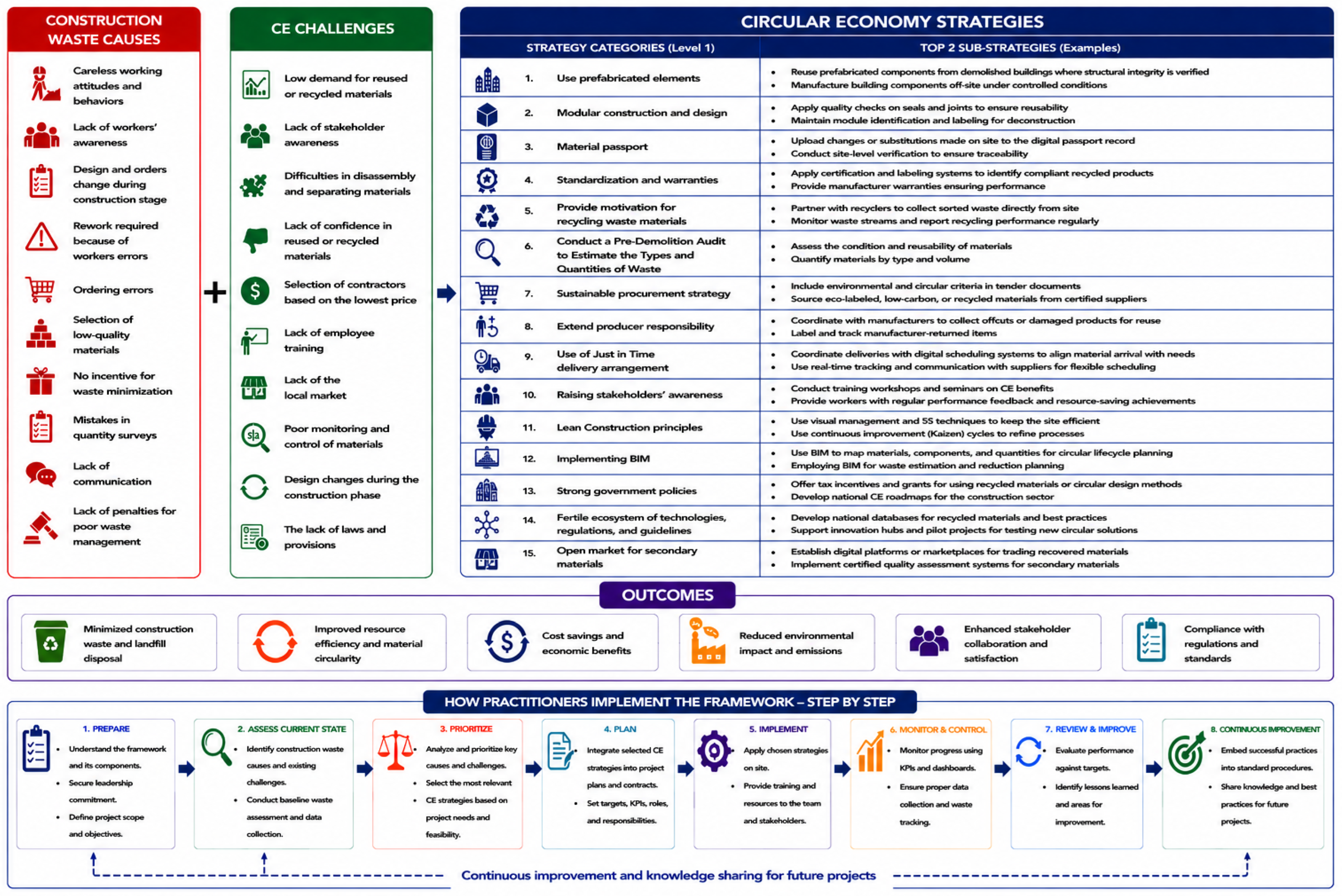


A Circular Economy Framework for Minimizing Construction Waste During the Construction Phase of Residential Projects in Jordan

Abstract
1. Introduction
2. Literature Review
- What are the primary challenges limiting the implementation of CE principles in residential construction projects during the construction phase in Jordan?
- Which CE strategies and sub-strategies are most effective for minimizing construction waste?
- How can the identified challenges and strategies be integrated into a practical framework tailored to the Jordanian construction sector?
- How do experts evaluate the applicability and effectiveness of the proposed framework?
3. Materials and Methods
4. Results and Discussion
4.1. Statistical Analysis Results
4.2. CE Challenges
4.3. CE Strategies
5. Framework Experts Evaluation
6. Conclusions
Supplementary Materials
Author Contributions
Funding
Data Availability Statement
Conflicts of Interest
References
- Islam, N.; Sandanayake, M.; Muthukumaran, S.; Navaratna, D. Review on Sustainable Construction and Demolition Waste Management—Challenges and Research Prospects. Sustainability 2024, 16, 3289. [Google Scholar] [CrossRef]
- Ogunmakinde, O.E.; Egbelakin, T.; Sher, W. Contributions of Circular Economy to the UN Sustainable Development Goals Through Sustainable Construction. Resour. Conserv. Recycl. 2022, 178, 106023. [Google Scholar] [CrossRef]
- Kupusamy, K.; Nagapan, S.; Abdullah, A.H.; Kaliannan, S.; Sohu, S.; Subramaniam, S.; Maniam, H. Construction Waste Estimation Analysis in Residential Projects of Malaysia. Technol. Appl. Sci. Res. 2019, 9, 4842–4845. [Google Scholar] [CrossRef]
- Ting, S.N.; Sakawi, A.M.F.; Lau, H.H.; Whyte, X.A. Minimisation of Construction Waste Using Waste Management Principles. ASM Sci. J. 2022, 17, 1–9. [Google Scholar] [CrossRef]
- Alshdiefat, A.S.; Sharif, A.A.; Abu Ghunmi, N.A.M.; Lee, A.; Rana, M.Q. Factors Impacting Women Leadership in the Jordanian Construction Sector. Buildings 2024, 14, 944. [Google Scholar] [CrossRef]
- Kayyali, M. Construction is Third Among the Growth Sectors. Alghad Newspaper. 1 August 2023. [CrossRef]
- Zeadat, Z.F. Implementing Sustainable Construction Practices in the Jordanian Housing Industry. J. Sustain. Real Estate 2024, 16, 2298554. [Google Scholar] [CrossRef]
- Bekr, G.A. Study of the Causes and Magnitude of Wastage of Materials on Construction Sites in Jordan. J. Constr. Eng. 2014, 2014, 283298. [Google Scholar] [CrossRef]
- Green Growth National. Green Growth National Action Plan 2021–2025; Ministry of Environment (MoEnv): Amman, Jordan, 2020. [Google Scholar]
- Royal Scientific Society of Jordan. Green Building Development in Jordan; Royal Scientific Society: Amman, Jordan, 2013. [Google Scholar]
- Zighan, S.; Abualqumboz, M. Project Life-Cycle Readiness Approach to Manage Construction Waste in Jordan. Constr. Econ. Build. 2021, 21, 58–79. [Google Scholar] [CrossRef]
- Alawneh, R.; Ghazali, F.; Ali, H.; Sadullah, A.F. A Novel Framework for Integrating Sustainable Development Goals into Sustainable Building Assessment. Sustain. Cities Soc. 2019, 49, 101612. [Google Scholar] [CrossRef]
- De Silva, S.; Samarakoon, S.M.S.M.K.; Haq, M.A.A. Use of Circular Economy Practices During the Renovation of Old Buildings in Developing Countries. Sustain. Futur. 2023, 6, 100135. [Google Scholar] [CrossRef]
- Al-Sharif, M.; Geldermans, B.; Rinke, M. From Waste to Wealth: A Study of Concrete Recycling in Jordan. Front. Sustain. 2024, 5, 1398918. [Google Scholar] [CrossRef]
- Australian Bureau of Statistics. Waste Account, Australia, Experimental Estimates, 2018–19 Financial Year; Australian Bureau of Statistics: Canberra, ACT, Australia, 2020.
- Department for Environment, Food and Rural Affairs. UK Statistics on Waste; Department for Environment, Food and Rural Affairs (DEFRA): London, UK, 2021.
- Ginga, C.P.; Ongpeng, J.M.C.; Daly, M.K.M. Circular Economy on Construction and Demolition Waste. Materials 2020, 13, 2970. [Google Scholar] [CrossRef] [PubMed]
- Saiful Amry, N.N.; Mohd Noor, M.Z.; D’Silva, J.L. Recovering Construction Industry Through Circular Waste Management. Int. J. Acad. Res. Bus. Soc. Sci. 2023, 13, 199–207. [Google Scholar] [CrossRef] [PubMed]
- Bonifazi, G.; Grosso, C.; Palmieri, R.; Serranti, S. Current Trends and Challenges in Construction and Demolition Waste Recycling. Curr. Opin. Green Sustain. Chem. 2025, 53, 101032. [Google Scholar] [CrossRef]
- Al-Kharisha, A.H. Implications of Construction and Demolition Waste Management in Jordan. Environ. Ecol. Res. 2023, 11, 249–273. [Google Scholar] [CrossRef]
- Sweis, G.; Thneibat, M.; Hiyassat, M.; Abu-Khader, W. Understanding the Causes of Material Wastage in the Construction Industry. Jordan J. Civ. Eng. 2021, 15, 180–192. [Google Scholar]
- Hasibuan, G.C.R.; Al Fath, M.T.; Yusof, N.; Dewi, R.A.; Syafridon, G.G.A.; Jaya, I.; Anas, M.R. Integrating Circular Economy into Construction and Demolition Waste Management: A Bibliometric Review of Sustainable Engineering Practices in the Built Environment. Case Stud. Chem. Environ. Eng. 2025, 11, 101159. [Google Scholar] [CrossRef]
- Ghisellini, P.; Cialani, C.; Ulgiati, S. A Review on Circular Economy. J. Clean. Prod. 2016, 114, 11–32. [Google Scholar] [CrossRef]
- Hussein, N.A.H.K.; Huang, X.; Li, X.; Yao, J. Assessing the Impact of Circular Economy Practices on Global Waste Management Systems. Estidamaa 2024, 2024, 22–29. [Google Scholar] [CrossRef]
- Geisendorf, S.; Pietrulla, F. The Circular Economy and Circular Economic Concepts—A Literature Analysis. Thunderbird Int. Bus. Rev. 2018, 60, 771–782. [Google Scholar] [CrossRef]
- Saroosh, M.; Iqbal, K.; Khan, A. Implementing Circular Economy Principles in Construction Waste Management: A Conceptual Framework for Maximizing Resource Efficiency and Minimizing Environmental Impact. Tech. J. 2024, 3 (ICACEE), 938–946. [Google Scholar]
- Murray, A.; Skene, K.; Haynes, K. The Circular Economy: An Interdisciplinary Exploration of the Concept and Application in a Global Context. J. Bus. Ethics 2017, 140, 369–380. [Google Scholar] [CrossRef]
- Adams, K.T.; Osmani, M.; Thorpe, T.; Thornback, J. Circular Economy in Construction: Current Awareness, Challenges and Enablers. Proc. Inst. Civ. Eng. Waste Resour. Manag. 2017, 170, 15–24. [Google Scholar] [CrossRef]
- Resourcify. Key Figures for Waste Management: Recycling Rate and Circular Economy. 2022. Available online: https://www.resourcify.com/en/knowledge-centre/recycling-rate-circular-economy (accessed on 15 March 2024).
- Bongers, A.; Casas, P. Circular Economy and Optimal Recycling Rate: A Macroeconomic Approach. Ecol. Econ. 2022, 199, 107504. [Google Scholar] [CrossRef]
- Mhatre, P.; Gedam, V.; Unnikrishnan, S.; Verma, S. Circular Economy in Built Environment: Literature Review. J. Build. Eng. 2021, 35, 101995. [Google Scholar] [CrossRef]
- Victar, H.C.; Waidyasekara, A.S. Optimising Construction Waste Management in Sri Lanka Through Circular Economy Strategies. Eng. Constr. Archit. Manag. 2025, 32, 4275–4309. [Google Scholar] [CrossRef]
- Bradley, R.; Jawahir, I.S.; Badurdeen, F.; Rouch, K. Total Life Cycle Cost Model for Circular Economy. Resour. Conserv. Recycl. 2018, 135, 141–149. [Google Scholar] [CrossRef]
- Wuni, I.Y. A Systematic Review of the Critical Success Factors for Implementing Circular Economy in Construction Projects. Sustain. Dev. 2023, 31, 1195–1213. [Google Scholar] [CrossRef]
- Wuni, I.Y.; Shen, G.Q. Developing Critical Success Factors for Integrating Circular Economy into Modular Construction Projects in Hong Kong. Sustain. Prod. Consum. 2022, 29, 574–587. [Google Scholar] [CrossRef]
- Ahmed, Z.; Mahmud, S.; Acet, D.H. Circular Economy Model for Developing Countries: Evidence from Bangladesh. Heliyon 2022, 8, e09530. [Google Scholar] [CrossRef] [PubMed]
- Akinade, O.; Oyedele, L.; Oyedele, A.; Davila Delgado, J.M.; Bilal, M.; Akanbi, L.; Ajayi, A.; Owolabi, H. Design for Deconstruction Using a Circular Economy Approach: Barriers and Strategies for Improvement. Prod. Plan. Control 2020, 31, 829–840. [Google Scholar] [CrossRef]
- Adi, T.J.W.; Wibowo, P. Application of Circular Economy in the Indonesia Construction Industry. IOP Conf. Ser. Mater. Sci. Eng. 2020, 849, 012049. [Google Scholar] [CrossRef]
- Tserng, H.P.; Chou, C.M.; Chang, Y.T. Key Strategies to Implement Circular Economy in Building Projects. Sustainability 2021, 13, 754. [Google Scholar] [CrossRef]
- Wijewansha, A.S.; Tennakoon, G.A.; Waidyasekara, K.G.A.S.; Ekanayake, B.J. Implementation of Circular Economy Principles During Pre-Construction Stage: The Case of Sri Lanka. Built Environ. Proj. Asset Manag. 2021, 11, 750–766. [Google Scholar] [CrossRef]
- Medina, E.M.; Fu, F.; Fu, F. A New Circular Economy Framework for Construction Projects. Proc. Inst. Civ. Eng. Eng. Sustain. 2021, 174, 304–315. [Google Scholar] [CrossRef]
- Többen, J.; Opdenakker, R. Developing a Framework to Integrate Circularity into Construction Projects. Sustainability 2022, 14, 5136. [Google Scholar] [CrossRef]
- Abadi, M.; Moore, D.R.; Sammuneh, M.A. A Framework of Indicators to Measure Project Circularity in Construction. Proc. Inst. Civ. Eng. Manag. Procure. Law 2021, 175, 54–66. [Google Scholar] [CrossRef]
- Tokazhanov, G.; Galiyev, O.; Lukyanenko, A.; Nauyrzbay, A.; Ismagulov, R.; Durdyev, S.; Turkyilmaz, A.; Karaca, F. Circularity Assessment Tool Development for Construction Projects in Emerging Economies. J. Clean. Prod. 2022, 362, 132293. [Google Scholar] [CrossRef]
- Guerra, B.C.; Leite, F. Circular Economy in the Construction Industry: Stakeholders’ Awareness and Challenges. Resour. Conserv. Recycl. 2021, 170, 105617. [Google Scholar] [CrossRef]
- Asante, R.; Faibil, D.; Agyemang, M.; Khan, S.A. Life Cycle Stage Practices and Strategies for Circular Economy Assessment in the Construction and Demolition Industry. Environ. Sci. Pollut. Res. 2022, 29, 82110–82121. [Google Scholar] [CrossRef] [PubMed]
- Gamage, I.; Senaratne, S.; Perera, S.; Jin, X. Implementing Circular Economy Through the Construction Project Life Cycle. Buildings 2024, 14, 653. [Google Scholar] [CrossRef]
- Ma, W.; Hao, J.L. Enhancing Circular Economy for Construction Waste Management in China. J. Clean. Prod. 2024, 450, 141763. [Google Scholar] [CrossRef]
- Lee, P.H.; Juan, Y.K.; Han, Q.; de Vries, B. Construction Companies’ Attitudes Toward Circular Economy Adoption. Ain Shams Eng. J. 2023, 14, 102219. [Google Scholar] [CrossRef]
- Amarasinghe, I.; Hong, Y.; Stewart, R.A. Visualising a Framework for Enhancing Material Circularity in Building Construction Projects: Drivers, Barriers, and Strategies. Build. Environ. 2024, 253, 111359. [Google Scholar] [CrossRef]
- Noy, C. Sampling Knowledge: The Hermeneutics of Snowball Sampling in Qualitative Research. Int. J. Soc. Res. Methodol. 2008, 11, 327–344. [Google Scholar] [CrossRef]
- Rahman, S.M.S.; Azeem, A.; Ahammed, F. Selection of an Appropriate Waste-to-Energy Conversion Technology for Dhaka City, Bangladesh. Int. J. Sustain. Eng. 2017, 10, 99–104. [Google Scholar] [CrossRef]
- Weerakoon, T.G.; Zvirgzdins, J.; Lapuke, S.; Wimalasena, S.; Drukis, P. Integrating Circular Economy (CE) Principles into Construction Waste Management (CWM) Through Multiple Criteria Decision-Making (MCDM). Sustainability 2025, 17, 7770. [Google Scholar] [CrossRef]
- Abu-Qdais, H.; Al-Omoush, S.; Jalalipour, H.; Nassour, A. Towards a Circular Economy in Jordan: Selecting Organic Waste Treatment Options Using a Multi-Criteria Decision-Making Approach. Sustainability 2025, 17, 2146. [Google Scholar] [CrossRef]
- Kurbatova, A.; Abu-Qdais, H.A. Using Multi-Criteria Decision Analysis to Select Waste-to-Energy Technology for a Mega City: The Case of Moscow. Sustainability 2020, 12, 9828. [Google Scholar] [CrossRef]
- Hwang, B.G.; Tan, J.S. Green Building Project Management: Obstacles and Solutions for Sustainable Development. Sustain. Dev. 2012, 20, 335–349. [Google Scholar] [CrossRef]
- Ott, R.L.; Longnecker, M.T. An Introduction to Statistical Methods and Data Analysis, 7th ed.; Cengage Learning: Boston, MA, USA, 2015. [Google Scholar]
- Mustafa, M.F.; Isa, M.R.M.; Rauf, U.F.A.; Ismail, M.N.; Shukran, M.A.M.; Khairuddin, M.A.; Wahab, N.; Safar, N.Z.M. Student Perception Study On Smart Campus: A Case Study On Higher Education Institution. Malays. J. Comput. Sci. 2021, 2021, 1–20. [Google Scholar] [CrossRef]
- Saaty, R.W. How to Make a Decision: The Analytic Hierarchy Process. Eur. J. Oper. Res. 1990, 48, 9–26. [Google Scholar] [CrossRef]
- Kendall, M.G.; Smith, B.B. The Problem of m Rankings. Ann. Math. Stat. 1939, 10, 275–287. [Google Scholar] [CrossRef]
- HaitherAli, H.; Gopakumar, A. Sustainable Urban Development: Evaluating the Potential of Construction and Demolition Waste Recycling in Emerging Economies. Sustain. Futur. 2024, 7, 100179. [Google Scholar] [CrossRef]
- Karali, N.; Shah, N. Bolstering Supplies of Critical Raw Materials for Low-Carbon Technologies Through Circular Economy Strategies. Energy Res. Soc. Sci. 2022, 88, 102534. [Google Scholar] [CrossRef]
- Mangla, S.K.; Luthra, S.; Mishra, N.; Singh, A.; Rana, N.P.; Dora, M.; Dwivedi, Y. Barriers to Effective Circular Supply Chain Management. Prod. Plan. Control 2018, 29, 551–569. [Google Scholar] [CrossRef]
- Kippert, K.; Ali, M.; Hamaideh, A.; Fricke, K. Waste-derived Products and Secondary Raw Materials as a Chance to Reduce MSW Management Costs in Developing Countries—Case Study for Jordan. In Proceedings of the 5th Eurasia Waste Management Symposium, Istanbul, Turkey, 26–28 October 2020. [Google Scholar]
- Gonella, J.d.S.L.; Godinho Filho, M.; Campos, L.M.d.S.; Ganga, G.M.D. People’s Awareness and Behaviours of Circular Economy around the World: Literature Review and Research Agenda. Sustain. Account. Manag. Policy J. 2024, 15, 1118–1154. [Google Scholar] [CrossRef]
- Kirchherr, J.; Piscicelli, L.; Bour, R.; Kostense-Smit, E.; Muller, J.; Huibrechtse-Truijens, A.; Hekkert, M. Barriers to the Circular Economy: Evidence from the European Union. Ecol. Econ. 2018, 150, 264–272. [Google Scholar] [CrossRef]
- Munaro, M.R.; Tavares, S.F. Barriers, Drivers, and Stakeholders Toward Circular Economy in Construction. Clean. Responsible Consum. 2023, 8, 100107. [Google Scholar] [CrossRef]
- Suleiman, A.; Almasaeid, H.; Hussein, N.; Abahre, J. Addressing the Causes and Effects of Poor Communication in the Jordanian Construction Industry: A Study on Improving Project Performance. Civ. Environ. Eng. 2023, 19, 156–166. [Google Scholar] [CrossRef]
- Attia, S.; Al-Obaidi, M.; Mori, M.; Campain, C.; Giannasi, E.; van Vliet, M.; Gasparri, E. Disassembly Calculation Criteria and Methods for Circular Construction. Autom. Constr. 2024, 165, 105521. [Google Scholar] [CrossRef]
- Daneshmand, M.; Noroozi, F.; Corneanu, C.; Mafakheri, F.; Fiorini, P. Industry 4.0 and Prospects of Circular Economy: A Survey of Robotic Assembly and Disassembly. Int. J. Adv. Manuf. Technol. 2022, 124, 2973–3000. [Google Scholar] [CrossRef]
- Formentini, G.; Ramanujan, D. Design for Circular Disassembly: Evaluating End-of-Life Status. J. Clean. Prod. 2023, 405, 137009. [Google Scholar] [CrossRef]
- Baazouzi, S.; Rist, F.P.; Weeber, M.; Birke, K.P. Optimization of Disassembly Strategies for Electric Vehicle Batteries. Batteries 2021, 7, 74. [Google Scholar] [CrossRef]
- Jaeger, B.; Upadhyay, A. Understanding Barriers to Circular Economy: Cases from the Manufacturing Industry. J. Enterp. Inf. Manag. 2020, 33, 729–745. [Google Scholar] [CrossRef]
- Vanegas, P.; Peeters, J.R.; Cattrysse, D.; Tecchio, P.; Ardente, F.; Mathieux, F.; Dewulf, W.; Duflou, J.R. Ease of Disassembly of Products to Support Circular Economy Strategies. Resour. Conserv. Recycl. 2018, 135, 323–334. [Google Scholar] [CrossRef] [PubMed]
- Alshdiefat, A.S.; Sharif, A.A.; Alharahsheh, A.I.; Albrka, S.I.; Olsson, N.O.E.; Younes, M.; Bang, S. Construction and Demolition Waste Management in Jordan: A Multifaceted Perspective. Constr. Innov. 2025, 25, 290–305. [Google Scholar] [CrossRef]
- Bilal, M.; Khan, K.I.A.; Thaheem, M.J.; Nasir, A.R. Current State and Barriers to Circular Economy in the Building Sector. J. Clean. Prod. 2020, 276, 123250. [Google Scholar] [CrossRef]
- Charef, R.; Morel, J.C.; Rakhshan, K. Barriers to Implementing Circular Economy in Construction. Sustainability 2021, 13, 12989. [Google Scholar] [CrossRef]
- Bergmans, I.J.B.; Bhochhibhoya, S.; Van Oorschot, J.A.W.H. Assessing Circular Redesign of Prefabricated Building Elements. J. Facade Des. Eng. 2023, 11, 169–196. [Google Scholar] [CrossRef]
- Gutiérrez, N.; Negrão, J.; Dias, A.; Guindos, P. Bibliometric Review of Prefabricated and Modular Timber Construction from 1990 to 2023: Evolution, Trends, and Current Challenges. Sustainability 2024, 16, 2134. [Google Scholar] [CrossRef]
- Minunno, R.; O’Grady, T.; Morrison, G.M.; Gruner, R.L.; Colling, M. Strategies for Applying Circular Economy to Prefabricated Buildings. Buildings 2018, 8, 125. [Google Scholar] [CrossRef]
- Shaded, W.; Aref, J. The Prefabricated Housing System and Its Impact on the Traditional Building System in Palestine: A Special Case in Hebron, Nablus, and Ramallah. Int. J. Archit. Eng. Urban Res. 2023, 6, 297–319. [Google Scholar] [CrossRef]
- Alhola, K.; Ryding, S.O.; Salmenperä, H.; Busch, N.J. Exploiting the Potential of Public Procurement for Circular Economy. J. Ind. Ecol. 2019, 23, 96–109. [Google Scholar] [CrossRef]
- Al-Sinan, M.A.; Bubshait, A.A. Procurement Agenda for Transition to Circular Economy. Sustainability 2022, 14, 11528. [Google Scholar] [CrossRef]
- Klein, N.; Ramos, T.B.; Deutz, P. Circular Economy Practices and Strategies in Public Sector Organizations: An Integrative Review. Sustainability 2020, 12, 4181. [Google Scholar] [CrossRef]
- Qazi, A.A.; Appolloni, A. A Systematic Review on Barriers and Enablers toward Circular Procurement Management. Sustain. Prod. Consum. 2022, 33, 343–359. [Google Scholar] [CrossRef]
- Witjes, S.; Lozano, R. Towards a More Circular Economy: Linking Sustainable Public Procurement and Business Models. Resour. Conserv. Recycl. 2016, 112, 37–44. [Google Scholar] [CrossRef]
- Alkilani, S.; Jupp, J. Paving the Road for Sustainable Construction in Developing Countries: A Study of the Jordanian Construction Industry. In Proceedings of the Australasian Journal of Construction Economics and Building—Conference Series; UTS ePress: Mumbai, India, 2013; Volume 1, pp. 84–93. [Google Scholar] [CrossRef]
- Freihat, L.; Al-Qaaida, M.S.; Huneiti, Z.; Abbod, M.F. Green Human Resource Management/Supply Chain Management/Regulation and Legislation and Their Effects on Sustainable Development Goals in Jordan. Sustainability 2024, 16, 2769. [Google Scholar] [CrossRef]
- Fobbe, L.; Hilletofth, P. Moving toward a Circular Economy in Manufacturing Organizations: The Role of Circular Stakeholder Engagement Practices. Int. J. Logist. Manag. 2023, 34, 674–698. [Google Scholar] [CrossRef]
- Kaya, F.E. A Stakeholder-Centric Approach to Advancing the Circular Economy in the Building Sector. Architecture 2025, 5, 6. [Google Scholar] [CrossRef]
- Salvioni, D.; Almici, A. Circular Economy and Stakeholder Engagement Strategy. Symphonya Emerg. Issues Manag. 2020, 1, 26–44. [Google Scholar] [CrossRef]
- Salvioni, D.M.; Almici, A. Transitioning toward a Circular Economy: The Impact of Stakeholder Engagement on Sustainability Culture. Sustainability 2020, 12, 8641. [Google Scholar] [CrossRef]
- Tabas, A.M.; Rehman, M.A.; Khitous, F.; Urbinati, A. Stakeholder and Customer Engagement in Circular Economy Ecosystems: A Systematic Literature Review and Research Agenda. Bus. Strategy Environ. 2025, 34, 402–416. [Google Scholar] [CrossRef]
- Abu Hajar, H.A.; Mustafa, Z.H.; AlAmaren, A.A.; Jawabreh, A.A.; Slehat, B.A.; Alkhawaldeh, B.O.; Alrahamneh, R.A. Towards a Circular Economy Scheme in Jordan: Environmental and Socio-Economic Appraisal of Municipal Solid Waste Recycling Pathways. Sustainability 2026, 18, 1230. [Google Scholar] [CrossRef]
- AlJaber, A.; Martinez-Vazquez, P.; Baniotopoulos, C. Circular Economy in the Building Sector: Investigating Awareness, Attitudes, Barriers, and Enablers Through a Case Study in Saudi Arabia. Sustainability 2024, 16, 1296. [Google Scholar] [CrossRef]
- Almulhim, A.I.; Abubakar, I.R. Understanding Public Environmental Awareness and Attitudes Toward Circular Economy Transition in Saudi Arabia. Sustainability 2021, 13, 10157. [Google Scholar] [CrossRef]
- Organisation for Economic Co-Operation and Development. The Circular Economy in Cities and Regions; OECD Publishing: Paris, France, 2020. [Google Scholar] [CrossRef]
- Bertino, G.; Kisser, J.; Zeilinger, J.; Langergraber, G.; Fischer, T.; Österreicher, D. Fundamentals of Building Deconstruction as a Circular Economy Strategy. Appl. Sci. 2021, 11, 939. [Google Scholar] [CrossRef]
- Julien, E.; Blanchet, P.; Gosselin, L. Fully Prefabricated Wood Wall Connection to Improve Building Envelope and On-Site Efficiency. Buildings 2022, 12, 2185. [Google Scholar] [CrossRef]
- O’Grady, T.M.; Minunno, R.; Chong, H.Y.; Morrison, G.M. Interconnections: Analysis of Disassemblable Building Connection Systems Towards Circular Economy. Buildings 2021, 11, 535. [Google Scholar] [CrossRef]
- Çetin, S.; Raghu, D.; Honic, M.; Straub, A.; Gruis, V. Data Requirements for Material Passports in Circular Buildings. Sustain. Prod. Consum. 2023, 40, 422–437. [Google Scholar] [CrossRef]
- Koppelaar, R.H.E.M.; Pamidi, S.; Hajósi, E.; Herreras, L.; Leroy, P.; Jung, H.Y.; Concheso, A.; Daniel, R.; Francisco, F.B.; Parrado, C.; et al. A Digital Product Passport for Critical Raw Materials Reuse and Recycling. Sustainability 2023, 15, 1405. [Google Scholar] [CrossRef]
- Langley, D.J.; Rosco, E.; Angelopoulos, M.; Kamminga, O.; Hooijer, C. Orchestrating a Smart Circular Economy: Guiding Principles for Digital Product Passports. J. Bus. Res. 2023, 169, 114259. [Google Scholar] [CrossRef]
- Bao, Z.; Lu, W. Developing Efficient Circularity for Construction and Demolition Waste Management. Sci. Total Environ. 2020, 724, 138264. [Google Scholar] [CrossRef] [PubMed]
- Gåvertsson, I.; Milios, L.; Dalhammar, C. Quality Labelling for Reused ICT Equipment to Support Consumer Choice in Circular Economy. J. Consum. Policy 2020, 43, 353–377. [Google Scholar] [CrossRef]
- Regueiro, C.; Gómez-Goiri, A.; Pedrosa, N.; Semertzidis, C.; Iturbe, E.; Mansell, J. Blockchain-Based Refurbishment Certification System for Circular Economy. Blockchain Res. Appl. 2024, 5, 100172. [Google Scholar] [CrossRef]
- Shooshtarian, S.; Maqsood, T.; Wong, P.S.P.; Zaman, A.; Caldera, S.; Ryley, T. Utilisation of Certification Schemes for Recycled Products in Construction Sector. Bus. Strategy Environ. 2024, 33, 1759–1777. [Google Scholar] [CrossRef]
- Niyommaneerat, W.; Suwanteep, K.; Chavalparit, O. Sustainability Indicators to Achieve Circular Economy: A Case Study of Renewable Energy and Plastic Waste Recycling CSR Projects in Thailand. J. Clean. Prod. 2023, 391, 136203. [Google Scholar] [CrossRef]
- Voukkali, I.; Papamichael, I.; Loizia, P.; Lekkas, D.F.; Rodríguez-Espinosa, T.; Navarro-Pedreño, J.; Zorpas, A.A. Waste Metrics in the Framework of Circular Economy. Waste Manag. Res. 2023, 41, 1741–1753. [Google Scholar] [CrossRef] [PubMed]
- Akanbi, L.; Oyedele, L.; Delgado, J.M.D.; Bilal, M.; Akinade, O.; Ajayi, A.; Mohammed-Yakub, N. Reusability Analytics Tool for End-of-Life Assessment of Building Materials in a Circular Economy. World J. Sci. Technol. Sustain. Dev. 2019, 16, 40–55. [Google Scholar] [CrossRef]
- Bellini, A.; Andersen, B.; Klungseth, N.J.; Tadayon, A. Achieving a Circular Economy Through Reuse of Construction Products. J. Clean. Prod. 2024, 450, 141753. [Google Scholar] [CrossRef]
- Walker, S.; Coleman, N.; Hodgson, P.; Collins, N.; Brimacombe, L. Evaluating the Environmental Dimension of Material Efficiency Strategies Relating to Circular Economy. Sustainability 2018, 10, 666. [Google Scholar] [CrossRef]
- Rainville, D.A. Stimulating Circular Economy Through Public Procurement. Res. Policy 2021, 50, 104193. [Google Scholar] [CrossRef]
- Santos, P.; Cervantes, G.C.; Zaragoza-Benzal, A.; Byrne, A.; Karaca, F.; Ferrández, D.; Salles, A.; Bragança, L. Circular Material Usage Strategies and Principles in Buildings: A Review. Buildings 2024, 14, 281. [Google Scholar] [CrossRef]
- Zhang, X.; Zhang, X. Automated Component Delivery Management for Prefabricated Buildings. Autom. Constr. 2024, 162, 105388. [Google Scholar] [CrossRef]
- Guarnieri, P.; Cerqueira-Streit, J.A.; Batista, L.C. Reverse Logistics and the Sectoral Agreement of Packaging Industry in Brazil Towards a Transition to Circular Economy. Resour. Conserv. Recycl. 2020, 153, 104541. [Google Scholar] [CrossRef]
- Ranta, V.; Aarikka-Stenroos, L.; Mäkinen, S.J. Creating Value in the Circular Economy: Business Models Analysis. J. Clean. Prod. 2018, 201, 988–1000. [Google Scholar] [CrossRef]
- Tari, A.; Trudel, R. Affording Disposal Control: Circular Take-Back Programs and Valuation. J. Mark. 2024, 88, 110–126. [Google Scholar] [CrossRef]
- Uhrenholt, J.N.; Kristensen, J.H.; Rincón, M.C.; Jensen, S.F.; Waehrens, B.V. Factors Affecting Financial Performance of Take-Back Systems. J. Clean. Prod. 2022, 335, 130319. [Google Scholar] [CrossRef]
- Dey, P.K.; Malesios, C.; Chowdhury, S.; Saha, K.; Budhwar, P.; De, D. Adoption of Circular Economy Practices in Small and Medium-Sized Enterprises: Evidence from Europe. Int. J. Prod. Econ. 2022, 248, 108496. [Google Scholar] [CrossRef]
- Maher, R.; Yarnold, J.; Pushpamali, N.N.C. Circular Economy for Business: A Framework for SMEs. J. Clean. Prod. 2023, 412, 137114. [Google Scholar] [CrossRef]
- Ünal, E.; Urbinati, A.; Chiaroni, D. Managerial Practices for Designing Circular Economy Business Models. J. Manuf. Technol. Manag. 2019, 30, 561–589. [Google Scholar] [CrossRef]
- Erceg, A.; Dotlić, P.; Milohnoja, M. 5S—Improving Operational Efficiency. TEMEL Int. J. 2017, 1, 1–8. [Google Scholar]
- Sartal, A.; Ozcelik, N.; Rodríguez, M. Bringing the Circular Economy Closer to SMEs. J. Clean. Prod. 2020, 256, 120363. [Google Scholar] [CrossRef]
- Senthil Kumar, K.M.; Akila, K.; Arun, K.K.; Prabhu, S.; Selvakumar, C. Implementation of 5S Practices in Small Scale Manufacturing Industries. Mater. Today Proc. 2022, 62, 1913–1916. [Google Scholar] [CrossRef]
- AlJaber, A.; Alasmari, E.; Martinez-Vazquez, P.; Baniotopoulos, C. Life Cycle Cost in Circular Economy of Buildings Using BIM: A State-of-the-Art Review. Buildings 2023, 13, 1858. [Google Scholar] [CrossRef]
- Guerriero, A.; Busio, F.; Saidani, M.; Boje, C.; Mack, N. Combining Building Information Modeling and Life Cycle Assessment for Defining Circular Economy Strategies. Sustainability 2024, 16, 4561. [Google Scholar] [CrossRef]
- Jayasinghe, L.B.; Waldmann, D. Development of a BIM-Based Web Tool as a Material and Component Bank for Sustainable Construction. Sustainability 2020, 12, 1766. [Google Scholar] [CrossRef]
- Tomczak, A.; Benghi, C.; van Berlo, L.; Hjelseth, E. Requiring Circularity Data in BIM with Information Delivery Specification. Circ. Econ. 2024, 1. [Google Scholar] [CrossRef]
- Genç, T.S. Circular Economy with Tax Policy: Mitigating Distortions in Steel Production. J. Clean. Prod. 2024, 451, 142120. [Google Scholar] [CrossRef]
- Joensuu, T.; Edelman, H.; Saari, A. Circular Economy Practices in the Built Environment. J. Clean. Prod. 2020, 276, 124215. [Google Scholar] [CrossRef]
- Kalmykova, Y.; Sadagopan, M.; Rosado, L. Circular Economy: From Review of Theories and Practices to Development of Implementation Tools. Resour. Conserv. Recycl. 2018, 135, 190–201. [Google Scholar] [CrossRef]
- Han, Y.; Shevchenko, T.; Yannou, B.; Ranjbari, M.; Shams Esfandabadi, Z.; Saidani, M.; Bouillass, G.; Bliumska-Danko, K.; Li, G. Exploring How Digital Technologies Enable a Circular Economy of Products. Sustainability 2023, 15, 2067. [Google Scholar] [CrossRef]
- Körppen, T.; Ullrich, A.; Böttcher, T.; Krcmar, H. How Digital Platforms Can Foster a Circular Economy. In Proceedings of the Pacific Asia Conference on Information Systems (PACIS), Ho Chi Minh City, Vietnam, 1–5 July 2024. [Google Scholar]
- Łękawska-Andrinopoulou, L.; Tsimiklis, G.; Leick, S.; Moreno Nicolás, M.; Amditis, A. Circular Economy Matchmaking Framework for Marketplace Deployment. Sustainability 2021, 13, 5668. [Google Scholar] [CrossRef]
- Petrik, D.; Hiller, S.; Morar, D. Digital Platforms for Circular Economy: Taxonomy and Archetypes. Electron. Mark. 2025, 35, 60. [Google Scholar] [CrossRef]


| Respondents/Position | Category | Project Manager | Supervisor | Contractor | Consultant | Overall | |||||
|---|---|---|---|---|---|---|---|---|---|---|---|
| No | % | No | % | No | % | No | % | No | % | ||
| Gender | Male | 9 | 82% | 4 | 44% | 7 | 100% | 3 | 75% | 23 | 74% |
| Female | 2 | 18% | 5 | 56% | 0 | 0% | 1 | 25% | 8 | 26% | |
| Age | 20–30 Y | 0 | 0% | 3 | 33% | 0 | 0% | 0 | 0% | 3 | 10% |
| 31–40 Y | 4 | 36% | 2 | 22% | 1 | 14% | 0 | 0% | 7 | 23% | |
| Over 40 Y | 7 | 64% | 4 | 45% | 6 | 86% | 4 | 100% | 21 | 67% | |
| Experience | 1–10 Y | 0 | 0% | 3 | 33% | 0 | 0% | 0 | 0% | 3 | 10% |
| 11–20 Y | 4 | 36% | 2 | 22% | 3 | 43% | 0 | 0% | 9 | 29% | |
| Over 20 Y | 7 | 64% | 4 | 45% | 4 | 57% | 4 | 100% | 19 | 61% | |
| Percentage of residential projects | 20–40% | 0 | 0% | 2 | 22% | 0 | 0% | 0 | 0% | 2 | 6% |
| 41–60% | 4 | 36% | 3 | 34% | 2 | 29% | 1 | 25% | 10 | 32% | |
| 61–80% | 3 | 28% | 2 | 22% | 4 | 57% | 2 | 50% | 11 | 36% | |
| 81–100% | 4 | 36% | 2 | 22% | 1 | 14% | 1 | 25% | 8 | 26% | |
| Experience with CE | <2 Y | 1 | 9% | 2 | 33% | 2 | 29% | 0 | 0% | 5 | 16% |
| 2–4 Y | 3 | 27% | 3 | 33% | 4 | 57% | 1 | 25% | 11 | 35% | |
| 5–6 Y | 6 | 55% | 4 | 34% | 1 | 14% | 1 | 25% | 12 | 39% | |
| Over 6 Y | 1 | 9% | 0 | 0% | 0 | 0% | 2 | 50% | 3 | 10% | |
| Range of RII Values | Impact Level |
|---|---|
| High (H) | |
| High-Medium (H-M) | |
| Medium (M) | |
| Medium-Low (M-L) | |
| Low (L) |
| Importance Scale | Definition |
|---|---|
| 1 | Equal importance |
| 3 | Moderate importance of one over another |
| 5 | Strong importance of one category over another |
| 7 | Very strong importance of one category over another |
| 9 | The extreme importance of one category over another |
| 2, 4, 6, 8 | Intermediate values |
| W | Interpretation |
|---|---|
| 0 | No agreement |
| 0.10 | Weak agreement |
| 0.30 | Moderate agreement |
| 0.60 | Strong agreement |
| 1 | Perfect agreement |
| CE | CWM | Resource Efficiency | Cost Savings | Recycling Rate | ||
|---|---|---|---|---|---|---|
| CE | Pearson Correlation | 1 | 0.823 ** | 0.882 ** | 0.804 ** | 0.852 ** |
| Sig. (2-tailed) | <0.001 | <0.001 | <0.001 | <0.001 | ||
| N | 31 | 31 | 31 | 31 | 31 | |
| CWM | Pearson Correlation | 0.823 ** | 1 | 0.883 ** | 0.831 ** | 0.814 ** |
| Sig. (2-tailed) | <0.001 | <0.001 | <0.001 | <0.001 | ||
| N | 31 | 31 | 31 | 31 | 31 | |
| Resource Efficiency | Pearson Correlation | 0.882 ** | 0.883 ** | 1 | 0.821 ** | 0.872 ** |
| Sig. (2-tailed) | <0.001 | <0.001 | <0.001 | <0.001 | ||
| N | 31 | 31 | 31 | 31 | 31 | |
| Cost Savings | Pearson Correlation | 0.804 ** | 0.831 ** | 0.821 ** | 1 | 0.874 ** |
| Sig. (2-tailed) | <0.001 | <0.001 | <0.001 | <0.001 | ||
| N | 31 | 31 | 31 | 31 | 31 | |
| Recycling Rate | Pearson Correlation | 0.852 ** | 0.814 ** | 0.872 ** | 0.874 ** | 1 |
| Sig. (2-tailed) | <0.001 | <0.001 | <0.001 | <0.001 | ||
| N | 31 | 31 | 31 | 31 | 31 |
| Category | Challenges | Mean | RII | Local Rank | Global Rank | Impact Level |
|---|---|---|---|---|---|---|
| Materials and Storage | The inability to determine the quantity and quality of materials (M1) | 3.91 | 0.782 | 4 | 16 | H-M |
| Destruction of materials at the site during the construction process (M2) | 4.03 | 0.806 | 3 | 11 | H | |
| Difficulties in disassembling (M3) | 4.26 | 0.853 | 1 | 3 | H | |
| Poor monitoring materials (M4) | 4.09 | 0.818 | 2 | 8 | H | |
| Lack quality control (M5) | 3.91 | 0.782 | 5 | 17 | H-M | |
| Project Staff and stakeholders | Workers lack the necessary skills (PS1) | 3.97 | 0.7941 | 4 | 13 | H-M |
| Lack of stakeholder’s awareness (PS2) | 4.32 | 0.8647 | 1 | 2 | H | |
| Poor communication between stakeholders and construction departments (PS3) | 3.97 | 0.7941 | 5 | 14 | H-M | |
| Lack of knowledge of how to use modern technologies (PS4) | 2.59 | 0.5176 | 10 | 31 | M | |
| Lack of appropriate safety (PS5) | 3.32 | 0.6647 | 7 | 23 | H-M | |
| Rework due to work errors (PS6) | 3.82 | 0.7647 | 6 | 18 | H-M | |
| Lack of employee training (PS7) | 4.24 | 0.8471 | 3 | 6 | H | |
| Late response from the consultant (PS8) | 2.62 | 0.5059 | 11 | 32 | M | |
| Lack of motivation and incentives (PS9) | 3.29 | 0.6588 | 8 | 24 | H-M | |
| Lack of confidence in reused or recycled materials (PS10) | 4.24 | 0.8471 | 2 | 4 | H | |
| Lack experienced project manager (PS11) | 2.65 | 0.5294 | 9 | 29 | M | |
| Financing Challenges | Low demand for reused or recycled materials (F1) | 4.38 | 0.8765 | 1 | 1 | H |
| Time spent on dismantling, transportation and recycling (F2) | 3.65 | 0.7235 | 4 | 21 | H-M | |
| The high cost of recycling (F3) | 3.71 | 0.7412 | 3 | 19 | H-M | |
| Lack of the local market (F4) | 4.12 | 0.8235 | 2 | 7 | H | |
| Site management and supervision | The site responsible for recycling is far from the workplace (SM1) | 2.97 | 0.5941 | 1 | 26 | M |
| Inadequate work site (SM2) | 2.47 | 0.4941 | 4 | 33 | M | |
| Difficulties faced by delivery vehicles to reach the site (SM3) | 2.15 | 0.4294 | 5 | 34 | M | |
| Bad site layout (SM4) | 2.88 | 0.5765 | 2 | 27 | M | |
| Delay in making a decision (SM5) | 2.76 | 0.5529 | 3 | 28 | M | |
| Equipment breakdown (SM6) | 1.82 | 0.3647 | 6 | 35 | M-L | |
| Design and contract documents | The terms of the contract are not clear (DC1) | 3.18 | 0.6353 | 6 | 25 | H-M |
| Poor design and contract documents (DC2) | 3.94 | 0.7882 | 4 | 15 | H-M | |
| Design changes during the construction phase (DC3) | 4.09 | 0.8176 | 2 | 9 | H | |
| Designed without considering material dimensions (DC4) | 3.68 | 0.7353 | 5 | 20 | H-M | |
| Selection of contractors based on the lowest price (DC5) | 4.24 | 0.8471 | 1 | 5 | H | |
| Graphics complexity (DC6) | 2.65 | 0.5294 | 7 | 30 | M | |
| Prepare BOQ without considering waste (DC7) | 4.09 | 0.8176 | 3 | 10 | H | |
| Policy | The lack of laws and provisions that help in the process of recycling materials (P1) | 4.03 | 0.8059 | 1 | 12 | H |
| Lack of industry incentives for ‘greener’ activities (P2) | 3.41 | 0.6824 | 2 | 22 | H-M |
| CE Category | Resource Efficiency Strategies | Sub Strategies | Priority | Rank |
|---|---|---|---|---|
| Resource Efficiency (0.2063) | Use prefabricated elements (0.3432) | Manufacture building components off-site under controlled conditions | 0.2608 | 2 |
| Coordinate delivery and on-site assembly of prefabricated modules | 0.2481 | 3 | ||
| Reuse prefabricated components from demolished buildings where structural integrity is verified | 0.2797 | 1 | ||
| Use cranes and modular transport systems | 0.2214 | 4 | ||
| Modular construction and design (0.3317) | Install factory-built modules on site with minimal assembly time | 0.2539 | 3 | |
| Maintain modular identification and labeling for deconstruction | 0.2641 | 2 | ||
| Apply quality checks on seals and joints to ensure reusability | 0.2897 | 1 | ||
| Use standardized connections | 0.1923 | 4 | ||
| Material passport (0.3251) | Tag materials/components with QR or RFID codes during installation. | 0.2023 | 4 | |
| Conduct site-level verification to ensure traceability. | 0.2514 | 2 | ||
| Upload changes or substitutions made on site to the digital passport record. | 0.2985 | 1 | ||
| Develop standard operating procedures (SOPs) for each material type. | 0.2478 | 3 |
| CE Category | Recycling Strategies | Sub Strategies | Priority | Rank |
|---|---|---|---|---|
| Recycling Rate (0.1672) | Standardization and warranties (0.3508) | Provide manufacturer warranties ensuring performance and durability of remanufactured items | 0.2587 | 2 |
| Apply certification and labeling systems to identify compliant recycled products | 0.2903 | 1 | ||
| Develop product standards for quality assurance of recycled aggregates, steel, and timber | 0.2171 | 4 | ||
| Establish government-approved testing protocols for recycled product acceptance | 0.2339 | 3 | ||
| Provide motivation for recycling waste materials (0.3316) | Partner with recyclers to collect sorted waste directly from site. | 0.2462 | 3 | |
| Monitor waste streams and report recycling performance regularly. | 0.2584 | 2 | ||
| Promote training for site workers on proper waste handling and segregation techniques. | 0.1915 | 4 | ||
| Integrate waste monitoring systems into project performance KPIs. | 0.3039 | 1 | ||
| Conduct a Pre-Demolition Audit (0.3176) | Identify and categorize building components | 0.2166 | 4 | |
| Quantify materials by type and volume | 0.2437 | 3 | ||
| Assess the condition and reusability of materials | 0.2884 | 1 | ||
| Engage certified auditors and waste experts | 0.2513 | 2 |
| CE Category | Cost Savings Strategies | Sub Strategies | Priority | Rank |
|---|---|---|---|---|
| Cost Savings (0.1974) | Sustainable procurement strategy (0.3619) | Include environmental and circular criteria in tender documents | 0.2738 | 1 |
| Require documentation of environmental product declarations (EPDs) | 0.2383 | 3 | ||
| Source eco-labelled, low-carbon, or recycled materials from certified suppliers | 0.2517 | 2 | ||
| Evaluate suppliers based on environmental performance, not just cost | 0.2362 | 4 | ||
| Extend producer responsibility (0.3071) | Implement on-site take-back systems for packaging and unused materials | 0.3221 | 1 | |
| Coordinate with manufacturers to collect offcuts or damaged products for reuse | 0.2039 | 4 | ||
| Label and track manufacturer-returned items | 0.2121 | 3 | ||
| Ensure EPR clauses are enforced in procurement contracts | 0.2619 | 2 | ||
| Use of Just in Time delivery arrangement (0.331) | Coordinate deliveries with digital scheduling systems to align material arrival with construction needs | 0.2905 | 1 | |
| Reduce on-site material storage to minimize damage and space use | 0.2110 | 4 | ||
| Use real-time tracking and communication with suppliers for flexible scheduling | 0.2321 | 3 | ||
| Adopt lean supply chain management to synchronize demand and production | 0.2674 | 2 |
| CE Category | Waste Management Strategies | Sub Strategies | Priority | Rank |
|---|---|---|---|---|
| Waste Management (0.2138) | Raising stakeholders’ awareness (0.3188) | Conduct training workshops and seminars on CE benefits | 0.2894 | 1 |
| Involve subcontractors in sustainability reporting | 0.2331 | 3 | ||
| Showcase pilot projects demonstrating successful CE applications | 0.2208 | 4 | ||
| Provide workers with regular performance feedback and resource-saving achievements | 0.2567 | 2 | ||
| Lean Construction principles (0.3567) | Conduct value stream mapping to identify waste sources and non-value-adding activities | 0.2486 | 3 | |
| Use visual management and 5S techniques to keep the site efficient | 0.2719 | 1 | ||
| Maintain daily coordination meetings to optimize material flow | 0.2212 | 4 | ||
| Use continuous improvement (Kaizen) cycles to refine processes | 0.2583 | 2 | ||
| Implementing BIM (0.3295) | Use BIM to map materials, components, and quantities for circular lifecycle planning | 0.2858 | 1 | |
| Simulate deconstruction and reuse scenarios | 0.2136 | 4 | ||
| Employing BIM for waste estimation and reduction planning | 0.2581 | 2 | ||
| Use BIM-based digital twins to monitor building performance and material flows over time | 0.2425 | 3 |
| CE Category | Government Policies Strategies | Sub Strategies | Priority | Rank |
|---|---|---|---|---|
| Government Policies (0.2153) | Strong government policies (0.3533) | Offer tax incentives and grants for using recycled materials or circular design methods | 0.2642 | 1 |
| Develop national CE roadmaps for the construction sector | 0.2509 | 2 | ||
| Document waste diversion and recycling to meet permit conditions | 0.2438 | 3 | ||
| Enforce transparent reporting and monitoring systems | 0.2411 | 4 | ||
| Fertile ecosystem of technologies (0.3156) | Promote interdisciplinary collaboration between research, industry, and government | 0.2614 | 2 | |
| Develop national databases for recycled materials and best practices | 0.2928 | 1 | ||
| Support innovation hubs and pilot projects for testing new circular solutions | 0.2557 | 3 | ||
| Create clear regulatory frameworks to support reuse and remanufacturing | 0.2001 | 4 | ||
| Open market for secondary materials (0.3311) | Establish digital platforms or marketplaces for trading recovered materials | 0.2757 | 1 | |
| Create material banks storing reusable building components | 0.2368 | 3 | ||
| Implement certified quality assessment systems for secondary materials | 0.2522 | 2 | ||
| Encourage construction waste exchanges between demolition and new projects | 0.2353 | 4 |
| No. | Name | Job Scope | Position | Sector | Institution |
|---|---|---|---|---|---|
| 1 | Expert 1 | Environmental Engineering | Consultant | Public | Jordanian Ministry of Environment |
| 2 | Expert 2 | Material reuse and recycling systems | Manager | Private | Construction Company |
| 3 | Expert 3 | Civil Engineer and structural design | Chief of Engineers | Private | Construction Company |
| 4 | Expert 4 | Contract administration | Manager | Public | Ministry of Public Works & Housing |
| 5 | Expert 5 | National waste management policies | Consultant | Public | Jordanian Ministry of Environment |
| 6 | Expert 6 | Site management and supervision | Site manager | Public | Ministry of Public Works & Housing |
| 7 | Expert 7 | Recycled materials | Project manager | Private | Construction Company |
| 8 | Expert 8 | Construction waste management | School of Civil Engineering | Public | The University of Jordan |
| 9 | Expert 9 | Site management and supervision | Site manager | Public | Greater Amman Municipality |
| The Advantages of the Framework | Very Important | Important | Not Important | The Percentage for Important and Very Important |
|---|---|---|---|---|
| Lower procurement costs | 7 | 2 | 0 | 100% |
| Corporate social responsibility goals | 3 | 3 | 3 | 66% |
| Reduce demand for virgin resources | 8 | 1 | 0 | 100% |
| Reduce CO2 emissions | 4 | 2 | 3 | 66% |
| Waste becomes visible and measurable | 2 | 3 | 4 | 56% |
| Coordination between teams | 4 | 2 | 3 | 66% |
| Breaking down traditional silos in construction projects | 1 | 2 | 6 | 33% |
| Support sustainable construction | 6 | 2 | 1 | 88% |
| Enhance resource efficiency | 8 | 1 | 0 | 100% |
| Reduce disposal fees | 7 | 1 | 1 | 88% |
| Improve the performance | 4 | 2 | 3 | 66% |
| Improving the company’s image | 6 | 2 | 1 | 88% |
| Longer lifespan of materials | 7 | 2 | 0 | 100% |
| Enhance the competitiveness | 2 | 3 | 4 | 55% |
| Reduce ecological impact | 5 | 2 | 3 | 77% |
| Workflow predictability | 1 | 4 | 4 | 55% |
| Digital monitoring of waste | 3 | 3 | 3 | 66% |
| Advantages | E1 | E2 | E3 | E4 | E5 | E6 | E7 | E8 | E9 | Mean Rank | Kendall’s W |
|---|---|---|---|---|---|---|---|---|---|---|---|
| Lower procurement costs | 4 | 7 | 5 | 6 | 7 | 7 | 8 | 7 | 5 | 6.222 | 0.934 |
| Corporate social responsibility goals | 15 | 16 | 15 | 16 | 17 | 13 | 17 | 11 | 15 | 15.000 | |
| Reduce demand for virgin resources | 1 | 2 | 1 | 1 | 3 | 4 | 2 | 1 | 2 | 1.889 | |
| Reduce CO2 emissions | 6 | 5 | 4 | 3 | 6 | 2 | 5 | 4 | 6 | 4.556 | |
| Waste becomes visible and measurable | 10 | 13 | 10 | 9 | 10 | 12 | 10 | 9 | 10 | 10.333 | |
| Coordination between teams | 12 | 15 | 16 | 11 | 14 | 17 | 11 | 17 | 14 | 14.111 | |
| Breaking down traditional silos in construction projects | 17 | 17 | 14 | 17 | 16 | 15 | 16 | 14 | 17 | 15.889 | |
| Support sustainable construction | 2 | 1 | 3 | 2 | 1 | 3 | 4 | 3 | 1 | 2.222 | |
| Enhance resource efficiency | 3 | 3 | 2 | 4 | 2 | 1 | 1 | 2 | 3 | 2.333 | |
| Reduce disposal fees | 8 | 8 | 9 | 7 | 9 | 6 | 7 | 8 | 9 | 7.889 | |
| Improve the performance | 13 | 12 | 12 | 13 | 13 | 11 | 14 | 12 | 12 | 12.444 | |
| Improving the company’s image | 11 | 10 | 11 | 14 | 12 | 10 | 13 | 15 | 13 | 12.111 | |
| Longer lifespan of materials | 9 | 6 | 7 | 8 | 5 | 8 | 6 | 6 | 7 | 6.889 | |
| Enhance the competitiveness | 16 | 14 | 17 | 15 | 15 | 16 | 15 | 16 | 16 | 15.556 | |
| Reduce ecological impact | 5 | 4 | 6 | 5 | 4 | 5 | 3 | 5 | 4 | 4.556 | |
| Workflow predictability | 14 | 11 | 13 | 12 | 11 | 14 | 12 | 13 | 11 | 12.333 | |
| Digital monitoring of waste | 7 | 9 | 8 | 10 | 8 | 9 | 9 | 10 | 8 | 8.667 |
Disclaimer/Publisher’s Note: The statements, opinions and data contained in all publications are solely those of the individual author(s) and contributor(s) and not of MDPI and/or the editor(s). MDPI and/or the editor(s) disclaim responsibility for any injury to people or property resulting from any ideas, methods, instructions or products referred to in the content. |
© 2026 by the authors. Licensee MDPI, Basel, Switzerland. This article is an open access article distributed under the terms and conditions of the Creative Commons Attribution (CC BY) license.
Share and Cite
Altawalba, A.N.; Ghazali, F.E.M. A Circular Economy Framework for Minimizing Construction Waste During the Construction Phase of Residential Projects in Jordan. Buildings 2026, 16, 2742. https://doi.org/10.3390/buildings16142742
Altawalba AN, Ghazali FEM. A Circular Economy Framework for Minimizing Construction Waste During the Construction Phase of Residential Projects in Jordan. Buildings. 2026; 16(14):2742. https://doi.org/10.3390/buildings16142742
Chicago/Turabian StyleAltawalba, Alma’moon Nahar, and Farid E. Mohamed Ghazali. 2026. "A Circular Economy Framework for Minimizing Construction Waste During the Construction Phase of Residential Projects in Jordan" Buildings 16, no. 14: 2742. https://doi.org/10.3390/buildings16142742
APA StyleAltawalba, A. N., & Ghazali, F. E. M. (2026). A Circular Economy Framework for Minimizing Construction Waste During the Construction Phase of Residential Projects in Jordan. Buildings, 16(14), 2742. https://doi.org/10.3390/buildings16142742