Article

Driving Multi-Dimensional Value Realization in Green Retrofit of Existing Residential Communities

1
College of Civil Engineering, Sanjiang University, Nanjing 210012, China
2
College of Civil Engineering, Nanjing Tech University, Nanjing 211816, China
3
School of Civil Engineering and Architecture, Zhejiang Sci-Tech University, Hangzhou 310018, China
*
Author to whom correspondence should be addressed.
Buildings 2026, 16(13), 2631; https://doi.org/10.3390/buildings16132631
Submission received: 27 April 2026 / Revised: 15 June 2026 / Accepted: 25 June 2026 / Published: 1 July 2026

Abstract

Green retrofit of existing residential communities (GRERC) is critical for upgrading aging building stocks, but their true value extends far beyond physical improvements. A successful retrofit must simultaneously deliver economic, social, and ecological benefits. However, in practice, the value realization is often constrained by a complex network of interdependent factors. This study maps these underlying structures. We first extracted a preliminary set of variables from existing literature and case studies, validating them through survey data. By applying Decision-Making Trial and Evaluation Laboratory (DEMATEL) and Interpretive Structural Modeling (ISM) techniques, subsequently, the reciprocal influences and the multi-level structural organization within the identified system were mapped. Our analysis isolates three foundational drivers: government evaluation standards, policy incentives, and ecological awareness. Crucially, these elements do more than exert direct pressure—they dictate the systemic transmission pathways that enable value realization. To bridge the gap between policy and practice, regulators must prioritize making evaluation standards practically actionable. Furthermore, scaling GRERC effectively will require redesigning incentive mechanisms to attract broader social participation and dramatically improving public access to retrofit information.

1. Introduction

China’s sustained economic growth and rapid urbanization have significantly increased the total floor area of residential buildings, making this sector a major source of national carbon emissions and energy consumption. A considerable proportion of residential buildings exhibit poor thermal insulation performance, resulting in substantial energy consumption and carbon emissions. As of 2024, close to 40% of China’s existing building stock fails to meet energy efficiency standards. A large number of aging residential buildings suffer from deficient envelope performance, outdated equipment, and inadequate operation and maintenance management, causing building life-cycle energy consumption to constitute a persistently high portion of national energy use [1]. In 2024, carbon emissions from building operations in China reached 24.7 billion tCO2, with energy consumption of 13.0 billion tce, accounting for 22.1% of national energy-related carbon emissions and 21.8% of total energy use; nearly 60% of these emissions and energy use were attributable to urban and rural residential buildings [2]. The two key Chinese government bodies overseeing macroeconomic policy and urban–rural development have submitted a proposal, aiming for an increase of over 200 million square meters in the floor area of existing building energy retrofits by 2025 compared to 2023 [3]. Beyond China, countries worldwide are also vigorously promoting the green retrofitting of existing buildings. The United States has formulated a plan to reduce building-related emissions by half by 2050 [4]. The EU’s revised Energy Performance of Buildings Directive (EPBD, 2024) sets targets for residential buildings: reduce average primary energy use by 16% by 2030 and 20–22% by 2035 [5].
Current energy retrofitting approaches for residential buildings primarily include building envelope retrofit [6,7], renewable energy utilization [8,9,10], and lighting and ventilation control [11]. In China, such retrofits are predominantly government-led and have achieved notable improvements in functional performance, energy efficiency, and environmental quality. However, persistent challenges remain, including limited effectiveness, low efficiency, and insufficient benefit realization [12]. These outcomes fall short of the goal of neighborhood-scale integrated green retrofit, yet the value of green retrofit has not been fully realized. Tetteh et al. [13] noted that the contribution of green retrofitting in developing economies remains considerably lower than that in developed economies. Conventional performance or benefit evaluation for green retrofit of existing residential communities (GRERC) has predominantly focused on cost–benefit assessments targeting energy efficiency, emission reduction and resource consumption, while largely overlooking significant non-energy benefits [14]. These non-energy benefits include improvements in indoor thermal comfort, enhanced quality of the living environment, better physical and mental health, and increased life satisfaction and overall well-being [15,16]. The value realization of GRERC transcends economic or environmental dimension, necessitating an integrated economic-social-environmental framework, with complex influencing mechanisms. Identifying the relevant influencing factors and their pathways is therefore essential to enhance green retrofit value and promote the refined development of green renewal in existing residential communities.
Existing studies on GRERC mainly focus on renovation willingness [17,18], incentive policies [19,20], driving pathways [21], and benefit evaluation [20]. These studies emphasize how to effectively promote green retrofit and measure benefits from a single dimension. They predominantly focus on the prerequisites for retrofit behaviors and external driving forces, tending to adopt “whether retrofitting has been initiated” or “whether a single economic or environmental indicator has improved” as evaluation criteria. However, they rarely pursue a more profound question—whether retrofit projects have truly realized their comprehensive value across multiple dimensions, including economic, social, and environmental aspects. Moreover, research on influencing factors has largely concentrated on residents’ renovation willingness [22,23], retrofit scheme selection [24], and driving pathways [25]. Existing studies on influencing factors exhibit a pronounced “process-oriented” tendency, focusing primarily on residents’ willingness to retrofit, comparative analysis of technical schemes, and driving mechanisms. Although these studies have provided an important foundation for understanding retrofit decision-making, their analytical frameworks are essentially oriented toward the single objective of facilitating retrofit initiation, failing to extend the analytical perspective to the evaluation of value realization following the completion of retrofitting. Consequently, there is a lack of systematic theoretical construction and empirical exploration regarding whether retrofit investments can be translated into multi-dimensional, perceptible comprehensive value. Therefore, from the perspective of multi-dimensional value realization, systematically identifying and analyzing the influencing factors and their interaction mechanisms in the value realization of GRERC constitutes a significant research gap in the current academic landscape.
This study first identifies the key determinants influencing the value realization of GRERC. The Decision-Making Trial and Evaluation Laboratory (DEMATEL) and Interpretive Structural Modeling (ISM) method is applied to analyze the cause-effect linkages and influence pathways among these identified determinants, revealing their multi-level structure and interactive mechanisms. This approach overcomes the fragmentation often associated with traditional qualitative analysis by identifying core factors and influence pathways that affect the multidimensional value realization of green retrofit projects. It enables decision-makers to more accurately diagnose root causes and optimize implementation priorities, aligning retrofit outcomes with societal needs. Ultimately, this promotes the value realization of green retrofit projects, improves the efficiency of retrofit funding utilization, enhances residents’ well-being and health, reduces building energy-use intensity and carbon emission intensity, and supports the achievement of the 2030/2060 goals.
The subsequent sections of this paper proceed as follows. Section 2 outlines the relevant literature on value realization of green retrofit in residential buildings and related influencing factors. Section 3 describes the DEMATEL–ISM modeling methodology and identifies key determinants. Section 4 applies DEMATEL to evaluate these factors and uses ISM to structure them hierarchically and analyze influence pathways to synthesize the principal findings, followed by a comprehensive discussion and implication presentation in Section 5, and culminates in the overall conclusion of the research in Section 6.

2. Literature Review

2.1. Research Status on the Value Realization of GRERC

Green and sustainable building retrofit has demonstrated significant effectiveness in energy conservation and emission reduction, cost savings, and improvement of occupants’ health conditions [26]. The value of green retrofit in existing buildings derives from its economic, environmental, and social benefits [27,28]. As an integral part of existing buildings, GRERC should also pursue coordinated economic–social–environmental value. The Sustainable Development Goals (SDGs) issued by the United Nations state the need to meet economic development while avoiding compromising the interests of future generations. The SDGs encompass three integrated and indivisible dimensions: economic, environmental, and social [29]. GRERC is fundamentally congruent with the core tenets of sustainable development, necessitating a steadfast commitment to the three bottom lines of economic, environmental, and social concerns [30].
Accordingly, this study conceptualizes the value of GRERC from the core dimensions of coordinated ‘economic–social–ecological’ value. The economic value lies in efficient resource and energy utilization, cost savings, and property appreciation [26,31]. The social value includes satisfying residents’ demand for a comfortable living environment, enhancing well-being and health, and promoting social harmony [26,32,33]. The ecological value is reflected in energy conservation and emission reduction, improvement of indoor and outdoor water and air environments, and enhancement of residents’ ecological awareness [26,31,33,34,35,36]. These three dimensions are interrelated and mutually reinforcing; the ultimate objective of GRERC is to achieve coordinated public value across the economic, social, and ecological dimensions.
At present, research related to value realization in GRERC mainly focuses on economic benefit assessment. With growing global attention to sustainable development and the strategic shift towards urban renewal, economic appraisal of the building retrofit has become a focal issue internationally [37]. Economic benefit assessments primarily emphasize energy savings [38,39] and integrated grid value [40,41] generated by green retrofit. For instance, Han et al. estimated that the optimal retrofit scheme for a residential community in Tangshan had a static investment payback period of 13.7 years and was assessed as economically viable when a comprehensive evaluation incorporated its long-term environmental benefits and anticipated policy incentives [39]. In addition, green retrofit may generate a green premium, thereby enhancing the market value of residential properties [35,42].
Overall, studies examining GRERC from a value perspective remain limited. Most focus on conceptual definitions of value and economic benefit evaluation, while scant regard has been given to value realization from the perspective of coordinated economic–social–ecological dimensions and the related influencing factors.

2.2. Factors Influencing the Value Realization of GRERC

Direct research on factors influencing the value realization of GRERC is limited. However, through systematic review and integration of relevant literature under a multidimensional economic–social–ecological value realization framework, several key influencing factors can be identified. It should be noted that certain factors may simultaneously affect multiple value dimensions; the present classification is based on the dimension to which each factor is most closely related.

2.2.1. Influencing Factors Related to Economic Value Realization

Household wealth fundamentally dictates the depth of energy retrofits. Wealthier residents are significantly more likely to fund intensive upgrades, which naturally yields steeper energy savings and shorter payback cycles [43,44]. Conversely, a lack of upfront capital severely bottlenecks low-income households. This financial friction limits their technology choices and shrinks investment scales, directly eroding potential comfort and efficiency gains.
Technical strategy also matters. For instance, data from Northwest China proves that synergistic, multi-factor envelope upgrades easily outperform isolated interventions regarding both initial costs and long-term financial recovery [45]. To truly drive down heating demands and emissions, retrofits must deploy climate-specific packages that merge envelope improvements with equipment upgrades and operational tweaks. Ultimately, how well these physical measures align with local weather patterns dictates the reliability of the economic returns [39].
Beyond hardware, project governance heavily influences economic viability. Urban retrofits are notorious for stakeholder friction; thus, establishing rational risk-sharing frameworks is non-negotiable for capturing value [46]. Success rates spike when information flows seamlessly between local governments, property managers, contractors, and banks [47]. Post-construction, rigorous operation and maintenance (O&M) protocols become the primary engine for cutting ongoing carbon emissions and locking in sustainable returns [48].
Innovative business models offer another structural solution. Integrating Energy Service Companies (ESCOs) via Energy Performance Contracting (EPC) has proven highly effective at driving efficiency [49]. Similarly, the European Union’s One-Stop-Shop (OSS) model bundles design, financing, and construction, slashing transaction costs and improving the scalability of deep retrofits [50,51].

2.2.2. Influencing Factors Related to Social Value Realization

Social value realization heavily depends on psychological and institutional triggers. Resident demand surges when they perceive high control, anticipate clear benefits, and feel supported by local social norms, which directly boosts project execution rates [52]. To activate this “demand–behavior–value” chain, policymakers must aggressively target information asymmetry, ensuring that residents fully grasp both the risks and the rewards [53].
Regulatory pressure acts as the backbone of this transformation. Rigid building codes and mandatory evaluation standards are essential for capping residential energy use [54], much like how the EU’s Energy Performance Certificate system enforces a standardized baseline to drive efficiency [55]. Looking at broader urban governance interventions in China—such as sponge city rollouts and older community renewals—data confirms that strict institutional enforcement is what stabilizes environmental performance and secures public welfare goals [56]. Consistent government oversight limits uncertainty. When authorities maintain rigorous supervision and clear rule-setting, stakeholder conflicts plummet. This allows for accurate performance tracking, ensuring that improvements in living quality and energy conservation actually endure over time [57].
Financial interventions, meanwhile, must be precision-targeted to maximize social equity. In Chongqing, for example, rolling out income-tiered subsidies drastically improved the willingness of lower- and middle-income families to participate, accelerating their payback periods [58]. Ultimately, the interplay between national incentives and local enforcement dictates both the scale and depth of retrofits [59]. This aligns with Swiss data showing that aggressive subsidy intensity directly correlates with massive, double-digit drops in household energy use [60]. However, if negotiation and enforcement costs spiral out of control—a frequent issue in Chinese residential projects—completion rates will stall, stripping away potential utility savings and asset appreciation [61].

2.2.3. Influencing Factors Related to Ecological Value Realization

Data from Guangzhou confirms that prioritizing accessible green spaces and spatial connectivity during neighborhood renewals directly translates public health benefits into long-term community vitality [62]. In fact, community-scale renewals naturally extend beyond isolated buildings. Broadening the scope to include landscape greening, integrated water management, and solid waste recycling creates major new levers for curbing overall carbon emissions [63]. Research from Germany shows that electrification measures such as heat pumps, when implemented synergistically with envelope upgrade and operation optimization, more effectively convert energy savings and comfort improvements into dual economic and environmental value [64]. Accounting studies in China demonstrate that promoting green building materials and improving building energy efficiency are critical pathways to reducing incremental carbon emissions during retrofit [65]. Measured data from individual dwellings indicate that coordinated retrofit of envelope, equipment, and control systems significantly reduces annual energy consumption and operating costs, providing cost-effectiveness evidence for transition toward nearly zero-energy buildings [66].
Research on multi-family housing in Poland shows that coupling greywater systems with waste heat recovery and heat pump/heat exchange equipment can simultaneously reduce potable water and domestic hot water energy consumption, recover thermal energy and resources, amplify synergies between operating cost reduction and carbon mitigation, and enhance retrofit value [67]. Empirical evidence from Brazil demonstrates that rainwater and greywater reuse significantly reduce potable water consumption and water bills and represent promising alternatives from the perspective of urban drainage and energy use impacts [68]. Increased ecological awareness among residents promotes voluntary pro-environmental behavior; urban renewal provides opportunities to enhance such awareness, thereby supporting sustainable social development [69].
In summary, this study examines factors influencing the value realization of GRERC from the perspective of the residential community as an integrated unit. Although direct research remains limited and existing studies primarily emphasize economic benefit estimation, systematic review reveals a set of influencing factors under the coordinated economic-social-ecological value realization framework. These factors are categorized accordingly, providing a solid theoretical foundation for subsequent analysis.

3. Methodology

3.1. Research Procedure

To systematically deconstruct how various forces shape GRERC value realization, this study employs a dual-stage DEMATEL–ISM modeling framework. This strategy excels at mapping out complex causal chains and hierarchical architectures within multi-factorial systems, making it a natural fit for untangling the intricate interaction pathways characteristic of green retrofits [70]. By merging these two methodologies, we can simultaneously quantify influence intensity, determine causal directionality, and establish a clear structural hierarchy. This integrated approach moves beyond surface-level correlations to provide a rigorous, multi-dimensional foundation for the subsequent analysis.
A detailed breakdown of the analytical steps is provided below.
(1) Identification of influencing factors
Based on case experience and literature review, influencing factors are screened from the perspective of economic-social-ecological value realization. The systematic factor set is defined as: X = X i , i = 1 , 2 , , n .
(2) Construction of the direct influence matrix X
Experts in GRERC are invited to evaluate the influence intensity of factor i on factor j using a 0–4 scale: 0 = no influence (diagonal elements), 1 = little influence, 2 = average influence, 3 = high influence, and 4 = very high influence. After scoring, values are averaged and rounded to integers. The direct influence matrix is constructed as X = x ij n × n , where x ij represents the consolidated, quantified influence that factor i exerts on factor j. For instance:
X = 0 x 12 x 1 n x 21 0 x 2 n x n 1 x n 2 0
(3) Calculation of the normalized influence matrix N
The equation is:
N = X max max 1 i n j = 1 n x ij , max 1 j n i = 1 n x ij
(4) Calculation of the total influence matrix T
Using the normalized matrix N and the identity matrix, the total influence matrix T is derived. The equation is:
T = N + N 2 + + N k = k = 1 N k = N I N 1
(5) Determination of four indicators
The equations are:
Influence degree ( D ) : sum of each row of T .
D i = j = 1 n x ij i = 1 , 2 , , n
Influenced degree (C ) sum of each column of T.
C i = j = 1 n x ij i = 1 , 2 , , n
Centrality ( M ) : D + C .
M i = D i + C i
Causality ( R ) : D C .
R i = D i C i
(6) Threshold value ( λ ) determination
The equation is:
λ = α + β
where α and β denote the mean and standard deviation of all elements in matrix T , respectively. The primary purpose of the threshold λ is to simplify the system structure by eliminating relationships with relatively minor influence, thereby facilitating the hierarchical partitioning of the system.
(7) Construction of the adjacency matrix A
Based on the total influence matrix T , elements are screened using the threshold λ . Values ≥ λ are assigned 1, and values < λ are assigned 0. The adjacency matrix is thus constructed as A = a ij n × n , where a ij = 0 or 1. 0 indicates no direct influence between factors, and 1 indicates the existence of a direct influence.
Specifically, let t ij denote the element in the i-th row and j-th column of matrix T , and a ij denote the corresponding element in matrix A. The rule is defined as:
a ij = 1 , t ij λ i , j = 1 , 2 , , n a ij = 0 , t ij < λ i , j = 1 , 2 , , n
(8) Construction of the reachability precursor matrix B
The equation is:
B = A + I
(9) Construction of the reachability matrix R
Boolean algebra operations are applied to matrix B iteratively until stability is achieved, producing the reachability matrix R .
(10) Determination of factor hierarchy
Hierarchical analysis is conducted based on the reachability matrix R to identify the reachable set ( R ) , antecedent set ( Q ) , and intersection set ( C ) for each influencing factor.
Reachable set ( R ) : In the reachability matrix R , the reachable set corresponding to a ij consists of the influencing factors associated with elements equal to 1 in the corresponding row, representing all elements that can be reached from a ij .
Antecedent set ( Q ) : In the reachability matrix R , the antecedent set corresponding to a ij consists of the influencing factors associated with elements equal to 1 in the corresponding column, representing all elements that can reach a ij .
Intersection set ( C ) : The intersection of the two, defined as Ci = Ri Qi
If Ri = Ci , factor i is assigned to the current highest hierarchical level. After removing this level, the procedure is repeated until all factors are hierarchically classified.
(11) Development of the multi-level system architecture diagram
Based on causal hierarchy and reachability relationships, intra-level and cross-level influence pathways are visualized to produce the final structural model.

3.2. Identification of Influencing Factors

This study identifies factors influencing the value realization of GRERC through both literature analysis and case analysis.

3.2.1. Literature Review Method

Influencing factors affecting the value realization of GRERC were identified through a literature analysis method, which compensates for the limitation of case analysis being confined to specific projects. To ensure comprehensiveness, validity, and timeliness, the literature was screened according to the following criteria. Publications were retrieved from the Scopus, Google Scholar, and Web of Science databases. The search topics included “building retrofit” and “residential community retrofit.” Journals possessing an impact factor greater than or equal to 3 (IF ≥ 3) were selected with the period from 2018 to 2025. After excluding irrelevant articles, influencing factors were determined by merging high-frequency terms and synonymous expressions.

3.2.2. Case Study Method

To better align the sample with the research objectives and aims, this study adopted a purposive sampling strategy to select the sample [71]. Ultimately, five typical cases of GRERC were selected (Appendix A), based on the following criteria: the implementation period of the cases fell between 2020 and 2025; the cases covered different geographical regions of China; and the cases had high information accessibility, with publicly available retrofitting processes. This selection strategy helps ensure the typicality and information richness of the cases; however, it may introduce a “success bias”—all selected cases are retrofitted projects with relatively satisfactory outcomes. This bias is controllable, as this study aims to identify the influencing factors of value realization rather than to assess the overall success rate of retrofit.
Factor identification follows a triangulation approach based on systematic literature review, case analysis, and expert validation [72,73]. First, a systematic literature search was conducted through databases to extract influencing factors of green retrofit that had been identified in existing studies. Second, an in-depth analysis of five cases was performed to extract influencing factors as they emerged in actual contexts. Finally, a cross-comparison method was employed for factor integration, wherein literature-derived factors were matched with case-derived factors. Factors that appeared in both sources were retained, while factors that appeared in only one type of source but were verified as important through expert validation were supplemented.
Based on literature and case analysis results, and through further consultation with experts involved in green retrofit projects, factors were refined, merged, and standardized. Ultimately, 16 influencing factors were identified and classified into three dimensions: economic, social, and ecological value realization (Table 1). It should be noted that some factors may influence multiple dimensions; classification is based on the dimension to which each factor is most closely related.

3.3. Questionnaire Development and Data Collection

Following the preliminary identification of factors, a questionnaire survey was designed and administered (see Appendix B for details). The purpose of this stage was to conduct reliability and validity testing and critical screening of the initially identified factor list. Specifically, the questionnaire assessed respondents’ perceptions of the importance of each influencing factor using a 5-point Likert scale, aiming to eliminate factors either non-critical or unsatisfactory reliability. This process ensured that the factors entering the subsequent DEMATEL-ISM model possessed high relevance and representativeness.
The questionnaire was structured into two distinct sections: the first captured socio-demographic profiles and baseline familiarity with GRERC, while the second utilized a five-point Likert scale to evaluate factor importance. On this scale, scores ranged from “1” (not important) to “5” (very important), a design chosen specifically to sharpen the granularity of respondent feedback and ensure the final factor selection was both rational and empirically grounded.
To guarantee data quality, this study targeted a cohort with deep domain expertise and practical field experience. Participants were recruited from a cross-section of academia, construction firms, and government regulatory bodies. While we generally required a bachelor’s degree, this criterion was flexibly adjusted for mid-to-senior level managers whose extensive on-the-ground experience provided equivalent, if not superior, professional judgment.
This study employed a stratified sampling strategy to balance broad representativeness with logistical feasibility. After categorizing the population by organization type, we applied quota-based sampling within each stratum, and invitation links were distributed to the identified contacts through diverse online channels (e.g., email, industry WeChat groups, etc.) to maximize reach and streamline data management. A total of 380 invitation links were sent out, of which 230 responses were received, yielding an overall response rate of 60.5%.
Geographically, the respondents were predominantly concentrated in Jiangsu Province. As an economically leading region with advanced urbanization, Jiangsu serves as a primary hub for China’s national urban renewal and green building pilot projects. The insights of practitioners from this region are therefore highly valuable, as they reflect the operational frontier of green retrofit practices in China and offer benchmark experiences for other provinces [47]. Nevertheless, this geographic concentration may introduce a regional bias, potentially limiting the direct generalizability of the findings to less-developed regions. Additionally, the reliance on digital distribution channels may introduce a selection bias toward professionals with greater digital connectivity and institutional access. These factors should be taken into account when interpreting the generalizability of the findings, and we discuss this further in the Limitations section.
Of the 230 total responses collected, this study filtered out participants who admitted to having “no understanding” of GRERC. This left a final pool of 216 valid questionnaires. The detailed breakdown of respondent demographics and organizational affiliations is summarized in Table 2.
Reliability analysis yielded a Cronbach’s Alpha of 0.955, exceeding the 0.8 threshold, indicating high internal consistency and suitability for further analysis (Table 3).
Deleting the indicator “enterprise reputation and qualifications related to green retrofit” increased α to 0.957, indicating improved reliability. Similarly, removing “related industry development level” improved reliability. Therefore, these two indicators were excluded.
KMO and Bartlett’s tests were conducted to verify sampling adequacy and correlation validity (Table 4). The overall KMO value was 0.932 (>0.5) and significance levels were far below 0.001, indicating strong correlations and good validity of the survey data.
After reliability and validity testing, 14 influencing factors were retained for subsequent analysis (Table 5).
Based on the 14 key factors screened through the questionnaire survey, an expert consultation approach was adopted. Five experts in related fields were invited to form an expert panel, including one staff member from a government department related to construction, two industry practitioners, one scholar from a university or research institute, and one professional from another sector familiar with green building retrofit. The panel members were either directly engaged in or well acquainted with GRERC, ensuring the scientific rigor and rationality of their evaluations. Although the sample size of experts is limited, the DEMATEL method prioritizes the depth and quality of expert insights over larger, potentially less coherent samples. A panel size of four to five experts is consistent with the established methodological guidelines of the DEMATEL approach [77].
Questionnaires were distributed through on-site interviews and email correspondence, and relevant experts were invited to rate the degree of mutual influence among the influencing factors using a 0–4 scoring method (see Appendix C for the detailed scoring table), to determine the extent to which each specific indicator influences others. The scores assigned to each influencing factor across different questionnaires were averaged, rounded to the nearest integer, and presented in integer form to generate the original direct influence matrix X (Appendix D).

4. Results

4.1. Evaluation of Impact Factors Based on the DEMATEL Method

The matrix X was processed using the DEMATEL procedure described in Section 3.1 based on the valid dataset. The four indicators were calculated (Table 6). Specifically, the influence degree ( D ) indicates the total effect an element exerts on other elements, while the influenced degree (C) reflects the total effect an element receives from other elements. The centrality ( M ) represents the overall importance of an element within the system structure, and the causality ( R ) describes the net influence relationship: values greater than zero identify cause factors that exert stronger influence on other variables, whereas values less than zero indicate result factors that are more strongly affected by other variables.
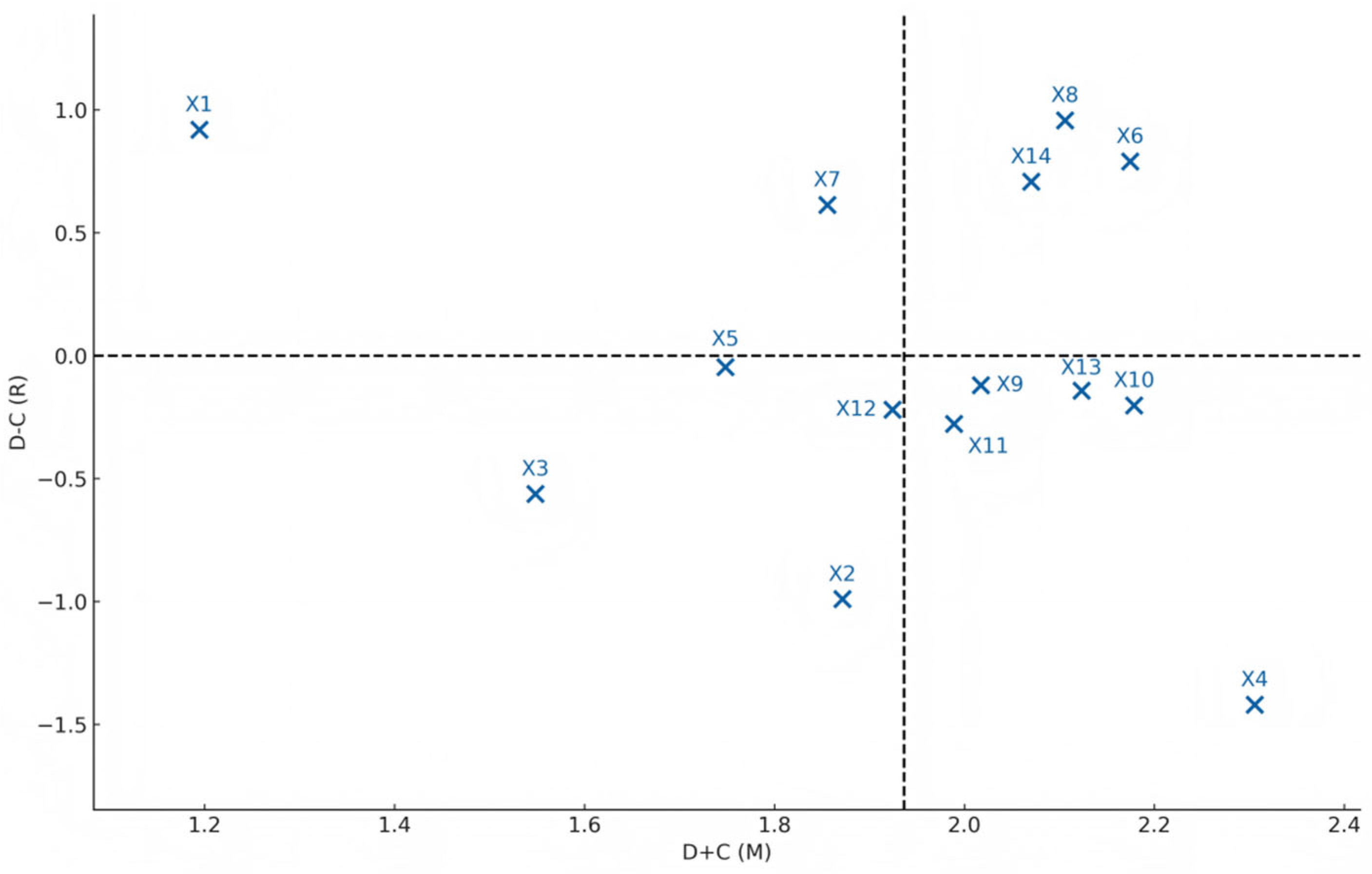
The results highlight a clear hierarchy of influence. Indicators X8, X6, X14, and X7 emerge as powerful systemic drivers with high influence degrees. Conversely, X4, X2, X10, X11, and X13 function as reactive elements, proving highly susceptible to external shifts within the system. When assessing overall importance, X4, X10, and X6 command the highest centrality, marking them as the strategic anchors of the GRERC value realization framework. Causal mapping further distinguishes the roles of these variables: X8 and X6 possess positive cause degrees, reinforcing their status as foundational catalysts. In contrast, the negative cause degrees of X4 and X2 classify them as result factors—essential outcomes that are ultimately shaped by the interplay of more dominant driving forces.
Using centrality as the horizontal coordinate and causality as the vertical coordinate, a centrality–cause diagram was generated (Figure 1). The horizontal axis represents centrality (M = D + C), indicating overall importance. the vertical axis represents causality (R = D − C), distinguishing cause factors (R > 0) from effect factors (R < 0). Factors are labeled by their corresponding codes (X1–X14). Factors X6 and X8 in the first quadrant indicate high importance and causal influence. Factors X1 and X7 in the second quadrant indicate low importance but causal influence. Factors X12, X2, X5, and X3 in the third quadrant indicate low importance and result-type characteristics. Factors X4, X10, X13, X9, and X11 in the fourth quadrant indicate high importance but result-type characteristics.

4.2. Multi-Level System Architecture of Impact Factors Based on the ISM Method

All elements in the total influence matrix T (Appendix D) were processed to obtain the mean (0.06915) and standard deviation (0.04285). Therefore, the threshold value λ was calculated as 0.112. Using λ as the reference value, elements in matrix T greater than or equal to λ were assigned “1”, and those less than λ were assigned “0”, forming the adjacency matrix A (Appendix D).
Boolean algebra operations were then performed on matrix B until the results stabilized, yielding the reachability matrix R (Table 7). A value of 1 indicates that a path exists between two factors, whereas 0 indicates no path.
The reachability matrix R was further analyzed to obtain the reachable set ( R ), antecedent set ( Q ), and intersection set ( C ) for each factor (Table 8). The reachable set comprises all nodes that can be reached from a given node through direct or indirect paths. The antecedent set contains all nodes that can directly or indirectly influence the given node. The intersection set identifies hierarchical dependencies among nodes by comparing the reachable and antecedent sets.
From Table 8, if a factor’s reachable set is identical to its intersection set, the factor is classified as an apex element in the ISM model. After removing apex factors from the reachable and antecedent sets, the procedure is repeated for the remaining factors until all levels are determined (Table 9). The top layer represents the direct causes of the ultimate system objective; each subsequent lower layer represents the causes of the layer above. The bottom level represents the root causes of the system, and the higher levels represent the resulting effects.
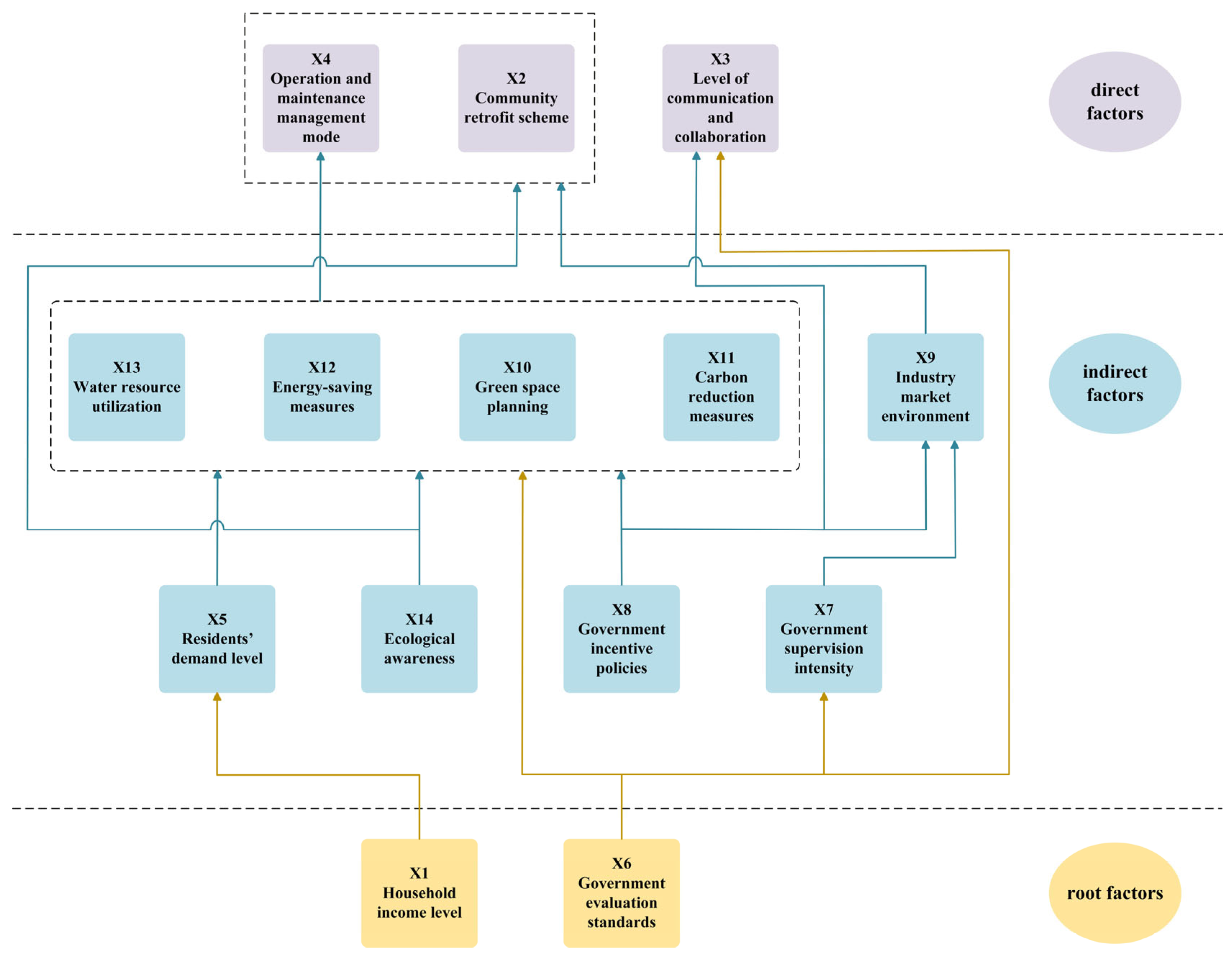
Based on the reachable sets, antecedent sets, and intersections in Table 8, together with the multi-level system architecture in Table 9, the multi-level system architecture model of impact factors was constructed (Figure 2). The diagram presents the hierarchical structure derived from ISM analysis, spanning four levels. Solid arrows indicate causal relationships (lower levels → higher levels). Level 1 (top) contains direct factors (X2, X3, X4). Level 2 and 3 contain indirect drivers (X9–X13, X5, X7, X8, X14). Level 4 (bottom) contains root factors (X1, X6). The results indicate that the direct factors affecting the value realization of GRERC are X2, X3, and X4. Factors located at lower levels represent deeper causal drivers. X1 and X6 are the most fundamental root causes within the overall causal system. All other factors, except the direct and root causes, function as indirect drivers influencing the system.

5. Discussion

5.1. Interpretation of Results

The ultimate measure of GRERC success requires looking beyond physical upgrades to measure and optimize the integrated value created across economic, social, and environmental dimensions [28]. Moving past simple factor identification, this study mapped how different variables interact to drive value realization. Integrating DEMATEL and ISM allowed us to trace the transmission pathways of these influences across multiple hierarchical levels, revealing the deeper mechanisms at play [70].
Government evaluation standards (X6) stand out as the primary driving force. Both the DEMATEL calculations and the ISM hierarchy confirm this centrality, with X6 anchoring the foundational level of the entire system. Practically, these standards do not just set benchmarks; they dictate the evolution of subsequent factors. Our pathway analysis shows this influence shaping technical choices, operational models, and stakeholder coordination. The practice of existing building retrofit in China follows a government-led model, wherein the evaluation standards formulated by the government directly determine the entire process of project approval, fund allocation, and project acceptance [19]. Such a dynamic sheds light on a common issue in China: infrastructure often improves visibly post-retrofit, yet sustainability performance remains inconsistent [56]. Without mandatory, enforceable standards—especially for energy efficiency and low-carbon transport—achieving comprehensive value is difficult. The voluntary nature of the current green retrofit evaluation framework severely blunts its impact on actual practice [19]. In contrast, in EU countries such as Germany and the Netherlands, the mandatory requirement for Energy Performance Certificates (EPC) and their market-based linkage mechanisms allow households to autonomously formulate retrofit decisions based on precise energy efficiency classifications. In China, the “top-down” dominant influence of government-formulated evaluation standards may be attenuated within market-driven governance systems. For countries with strong state intervention in the building sector (e.g., China, Singapore, and certain Middle Eastern nations) the standard-dominated pathway revealed in this study holds direct transferable value, but cultural and institutional differences should be carefully considered.
Sitting slightly higher in the hierarchy but remaining fundamentally important are government incentive policies (X8). Rather than triggering initial change, these policies act as amplifiers. The structural models indicate that incentives dictate implementation strategies and behavioral shifts, which then cascade into higher-level outcomes. This aligns closely with China’s current reality, where local authorities heavily drive retrofit agendas [19]. While existing literature confirms that policy backing is essential to attract social capital [25], our findings highlight an inherent structural flaw. Because current incentives largely focus on scaling up the number of projects, long-term project performance and actual value creation are frequently sidelined.
Ecological awareness (X14) acts as another core driver, but it operates distinctly from institutional forces. It bypasses formal mechanisms to directly mold stakeholder preferences and daily decisions. Our results link ecological awareness to operational efficiency and design choices, driving value realization indirectly across several routes. This corroborates previous claims that a lack of environmental awareness and technical literacy often leads to poor retrofit performance [19]. Furthermore, the data highlights how income brackets influence retrofit demand; wealthier households are significantly more likely to support deep retrofits and secure better energy savings, a trend observed in earlier studies [43].

5.2. Policy Implications

Urgent adjustments to current practices are required to translate green retrofit initiatives into scalable, consistent value.
Most critically, evaluation standards must shift from serving as mere guidelines to becoming enforceable rules. Voluntary adoption and weak oversight currently render existing frameworks largely symbolic. The industry does not need a higher volume of standards; it needs criteria that are straightforward to verify and embed into daily workflows. Implementing precise performance metrics and integrating IoT monitoring can drastically reduce the uncertainty of energy assessments. As noted by others, transitioning to performance-based certification, such as mandatory labeling, is a proven method for tightening quality control [78].
On the financial side, subsidies must pivot from funding scale to rewarding actual effectiveness. Public funding successfully launched the retrofit market, yet the focus on rapid expansion has compromised long-term quality. Because green retrofits suffer from high upfront capital requirements and slow payback cycles [79,80], external financial support is non-negotiable [81]. While countries like Germany successfully leverage development banks for long-term, low-interest retrofit loans [82], China still relies heavily on direct local government funding. Transitioning toward Energy Performance Contracting (EPC) models could attract much-needed private capital, boosting financial sustainability. Additionally, creating robust benefit-sharing mechanisms would ensure that financial gains from efficiency improvements are fairly distributed among stakeholders, especially residents whose daily habits determine actual energy use.
Lastly, project managers must stop treating residents as passive recipients. Behavioral factors driven by ecological awareness demonstrably alter retrofit outcomes, reinforcing the established link between user habits and energy efficiency [83]. Promoting green retrofits requires sustained public engagement, not just engineering fixes. Opening communication channels and integrating resident feedback during the design phase ensures the final project meets actual user needs, which inherently boosts social value and satisfaction.

6. Conclusions

This research investigated the mechanisms of value realization in the GRERC by analyzing the interaction networks of various impact factors. The integration of DEMATEL and ISM allowed us to locate key variables within a complex causal hierarchy.
Government evaluation standards, incentive policies, and ecological awareness emerged as the three pillars of this system. Their critical role is defined by how they control the transmission pathways of influence, rather than just their isolated impacts. Consequently, achieving value in green retrofits is fundamentally a byproduct of merging institutional frameworks with behavioral shifts.
Despite rapid progress in the sector, a distinct gap remains between policy ambitions and on-the-ground realities. Disconnected standards, poorly targeted incentives, and superficial stakeholder engagement currently bottleneck project success. Moving forward, policymakers must adopt an integrated strategy that physically links regulations, funding structures, and user behavior.
Limitations of this study are also acknowledged. First, the research primarily focuses on the Chinese context, which may limit the generalizability of the findings to other institutional or cultural environments. In terms of sample composition, the questionnaire sample exhibited a degree of selection bias, most notably a regional overrepresentation of respondents from Jiangsu Province and a reliance on online distribution channels, which may favor practitioners with stronger digital connectivity and institutional access. While the concentration in Jiangsu arguably captures perspectives from a region at the forefront of green retrofit practice, the findings should be interpreted with caution when generalizing to less developed regions or to practitioners outside established professional networks. Second, subjectivity is inherent in the selection of influencing factors and the DEMATEL expert scoring process, compounded by the limited size of the expert panel. Third, owing to the static nature of the DEMATEL-ISM model, this study fails to capture temporal dynamics or performance variations before and after retrofitting. Most critically, the study lacks empirical validation. The identified causal pathways and hierarchical structure have not been systematically compared with actual outcomes of completed retrofit projects, independent expert verification and prior empirical studies. Future research should extend to a broader range of geographical regions, incorporate empirical case studies, and adopt longitudinal research designs to track performance data before and after green retrofit. Advancing these research directions will contribute to the development of a more generalizable and dynamic framework for value realization in green retrofit, thereby providing scientific evidence to support the sustainable development of buildings and communities.

Author Contributions

Conceptualization, D.B. and H.G.; methodology, D.B. and X.S.; software, X.S.; formal analysis, X.S. and D.B.; investigation, X.S., Y.W. and J.S.; writing—original draft preparation, D.B. and X.S.; writing—review and editing, D.B. and S.Y.; supervision, S.Y.; funding acquisition, D.B. and S.Y. All authors have read and agreed to the published version of the manuscript.

Funding

This research was funded by the Civil Engineering (University-Level Key Discipline) Research Project (Grant No. 2024SJTM010), the Philosophy and Social Science Foundation of Zhejiang Province, China (Grant No. 25NDJC057YBMS).

Institutional Review Board Statement

The study was conducted in accordance with the Declaration of Helsinki and approved by the Ethics Committee of the School of Civil Engineering, Sanjiang University (Protocol Code: SJU-SCE-20241205002; Date of Approval: 5 December 2024).

Informed Consent Statement

Informed consent was obtained from all subjects involved in the study.

Data Availability Statement

The original contributions presented in the study are included in the article; further inquiries can be directed to the corresponding author.

Conflicts of Interest

The authors declare no conflicts of interest.

Appendix A

Table A1. Case Information for Influencing Factors.
No.Case NameCorresponding FactorsDetailed Information
1Renovation of Meiqi Community, YangzhouCommunity retrofit schemeThe Meiqi Community renovation project in Yangzhou focuses on addressing infrastructure deficiencies and improving living quality. Key measures include façade refurbishment, upgrading internal roads and underground pipelines, and improving parking and security facilities. The renovation directly responds to residents’ needs for safety, travel convenience, and improved living comfort. In addition, supplementary greening and public space optimization enhance the ecological environment and recreational functions within limited space, contributing to the overall environmental quality of the aging neighborhood.
Residents’ demand level
Green space planning
2Xiaosongtao Lane Renovation, Nanjing: Creating a “Green Model” of Urban RenewalCommunity retrofit schemeThe Xiaosongtao Lane shantytown project centers on a "Retain–Renovate–Demolish" framework, prioritizing the surgical preservation of historic street textures over indiscriminate clearance. This strategy utilizes classified interventions—carefully balancing selective demolition with the restoration of heritage structures to maintain urban continuity. To manage the complexities of displacement, the team implemented a "One Household, One Policy" resettlement logic, incentivizing voluntary on-site relocation and housing exchanges to transform the shantytown into a functional, modern residential hub.
Environmental design in this renewal focuses on micro-spatial optimization. By integrating existing tree canopies with newly designed ventilation corridors and rooftop greenery, the project effectively enhances alley-level airflow and public biomass. Furthermore, the push for energy sustainability moves beyond theory into practical low-carbon applications. The integration of rooftop photovoltaic arrays, the strategic reuse of salvaged green building materials, and a heavy reliance on passive natural ventilation collectively ensure that the community meets its long-term decarbonization and conservation targets.
Green space planning
Energy-saving measures
3Green, Low-Carbon and Smart Renovation of Old Communities in Yunyan District, GuiyangCommunity retrofit schemeThe renovation blueprint prioritizes the radical upgrading of infrastructure, centering on the integration of ecological and intelligent systems within aging neighborhoods. By overhauling essential road networks, subterranean pipelines, and digital facility frameworks, the project successfully modernizes community utility while elevating overall habitability. Operationally, the initiative demonstrated formidable cross-sector synergy, managing a massive rollout that encompassed nearly 15,000 households across diverse districts. This success hinged on a robust collaborative network between municipal authorities, engineering teams, and grassroots organizations—a partnership essential for complex resource mobilization and large-scale implementation. Ultimately, the project’s high performance in infrastructure and smart service delivery functions as a direct response to public demand for safety, logistical convenience, and a higher standard of urban living.
Level of communication and collaboration
Residents’ demand level
4Renovation of Baimadang Community, ChongqingCommunity retrofit schemeThe Baimadang Community project serves as a testing ground for a novel, market-oriented renovation model. By leveraging PPP and ROT (Renovate-Operate-Transfer) financing, the initiative successfully integrated private capital into public infrastructure. To ensure the project was grounded in local reality, the team conducted exhaustive door-to-door surveys and iterative consultation sessions with residents. The resulting physical upgrades—ranging from facade restoration and parking expansion to the creation of vibrant shared green spaces—directly targeted functional gaps in community sustainability.
Crucially, the Baimadang model shifts away from "one-off" construction toward a lifecycle-based operational strategy. By weaving together professional property management, social community services, and commercial space leasing, the project created a self-sustaining ecosystem that keeps residents engaged long after the initial repairs. Public input was not a formality; courtyard meetings and feedback loops functioned as the primary design drivers. From a regulatory perspective, the government catalyzed this transition by formalizing the project into "best practice" lists and refining policy incentives. This strategic backing not only mitigated local fiscal burdens but also successfully mobilized broader market forces into the urban renewal sector.
Operation and maintenance management mode
Residents’ demand level
Government incentive
policies
5Renovation of Mudan Community, ShenyangOperation and maintenance management modeThe Mudan Community renovation prioritized a “community diagnosis” methodology, pinpointing local frictions before implementation. By integrating Party-building leadership with deep-level resident participation, the project ensured that design choices remained tethered to actual operation and maintenance (O&M) realities. This long-term operational sustainability is further bolstered by a normalized assessment mechanism and the “People’s Designer” model, both of which foster genuine co-governance between residents and property management. Throughout the process, the project team maintained high responsiveness to public needs, actively recalibrating renovation plans based on incoming feedback. Ultimately, this high-quality renewal was catalyzed by government-led institutional innovations—specifically through strategic policy guidance, resource pooling, and the modernization of grassroots governance.
Residents’ demand level
Government incentive
policies

Appendix B

Questionnaire on Influencing Factors of Value Realization in Green Retrofit of Existing Residential Communities.
Dear Respondent,
Hello! We are conducting an in-depth study on the influencing factors of value realization in the green retrofit of existing residential communities. I am carrying out a survey on green retrofit practices in existing residential communities. Based on your actual circumstances and professional experience, please complete the basic information section and evaluate the importance of each influencing factor. A five-point Likert scale (1–5) is adopted to reflect the importance level of each factor.
I hereby solemnly declare that the data collected will be used solely for academic research and thesis writing, and all information you provide will be kept strictly confidential. Thank you for your support!
1. Your organization type [Single choice] *
○ Universities and research institutes
○ Construction-related enterprises
○ Construction-related government departments
○ Other organizations
(If you selected “Universities and research institutes” in Question 1)
2. Years of work experience in universities or research institutes [Single choice] *
○ Less than 1 year
○ 1–3 years
○ 3–5 years
○ 5–10 years
○ More than 10 years
3. Number of research projects on green retrofit of existing residential communities you have participated in [Single choice] *
○ None
○ 1–3
○ 3–5
○ 6 or more
(If you selected “Construction-related enterprises” in Question 1)
4. Years of work experience in the construction industry [Single choice] *
○ Less than 1 year
○ 1–3 years
○ 3–5 years
○ 5–10 years
○ More than 10 years
5. Type of construction-related organization you work for [Single choice] *
○ Developer/Owner
○ Design firm
○ Construction contractor
○ Consulting/management firm
○ Construction-related supplier
6. Number of green retrofit projects of existing residential communities you have participated in [Single choice] *
○ None
○ 1–3
○ 3–5
○ 6 or more
(If you selected “Construction-related government departments” in Question 1)
7. Years of work experience in government [Single choice] *
○ Less than 1 year
○ 1–3 years
○ 3–5 years
○ 5–10 years
○ More than 10 years
8. Number of decision-making processes on green retrofit of existing residential communities you have participated in [Single choice] *
○ None
○ 1–3
○ 3–5
○ 6 or more
9. Are you familiar with the concept of “green retrofit of existing residential communities”? [Single choice] *
○ Very familiar
○ Fairly familiar
○ Somewhat familiar
○ Not familiar at all
10. Has your residential community undergone green retrofit? [Single choice] *
○ Yes
○ No
11. Importance Evaluation of Influencing Factors [Matrix single choice] *
Instructions: Based on your learning, professional practice, and research experience, please assess the degree to which the following factors influence the realization of value in the green retrofit of existing residential communities. Rate each factor from 1 to 5, where:
1 = Not important
2 = Slightly important
3 = Moderately important
4 = Important
5 = Very important
Influencing Factor12345
Household income level
Community retrofit scheme
Level of communication and collaboration
Operation and maintenance management mode
Reputation and qualifications of green retrofit enterprises
Development level of related industries
Residents’ demand level
Government evaluation standards
Government supervision intensity
Government incentive policies
Industry market environment
Green space planning
Carbon reduction measures
Energy-saving measures
Water resource utilization
Ecological awareness

Appendix C

Table A2. Influencing Factors Scoring Matrix.
X1X2X3X4X5X6X7X8X9X10X11X12X13X14
X1
X2
X3
X4
X5
X6
X7
X8
X9
X10
X11
X12
X13
X14

Appendix D

Appendix D presents the three matrices involved in the implementation of the DEMATEL-ISM approach, namely, direct influence matrix X (Table A3), total influence matrix T (Table A4) and adjacency matrix A (Table A5).
Table A3. Direct Influence Matrix X.
X1X2X3X4X5X6X7X8X9X10X11X12X13X14
X102233111211111
X200221000011110
X302021000111110
X402200000111110
X500030000033331
X612231032322222
X702140201422221
X823332110422222
X903231111011112
X1002122211102121
X1102131111120111
X1202132111111011
X1302122211221101
X1402121222133330
Note: This matrix was derived from independent evaluations conducted by five experts in the GRERC field using a 0–4 scoring method, with the scores subsequently averaged and rounded to integers. The scoring scale is defined as follows: 0 = no influence, 1 = low influence, 2 = moderate influence, 3 = high influence, and 4 = very high influence. Diagonal elements were mandatorily set to zero.
Table A4. Total Influence Matrix T.
X1X2X3X4X5X6X7X8X9X10X11X12X13X14
X10.00410.10870.09570.1530.11470.05090.04830.04690.09160.07450.07250.07050.07250.0525
X20.00060.02210.07060.08250.04150.00910.00690.00670.01340.04590.04470.04340.04470.0082
X30.00080.07970.0190.08640.0430.01050.00820.00790.04130.04770.04650.04520.04650.0102
X40.00070.07850.07220.02870.01510.00980.00770.00740.04050.04450.04330.04210.04330.0089
X50.00180.04570.03050.13720.02960.02530.01960.01890.02940.11950.11630.1130.11630.0475
X60.03460.13630.11430.18380.07460.03930.11510.08620.14180.11910.1160.11270.1160.0921
X70.00550.12430.07960.1910.03860.0860.02870.05410.15560.10570.10290.10.10290.0593
X80.06070.16340.14230.18480.10520.06460.05990.03030.16220.11980.11670.11330.11670.0916
X90.0040.13150.0930.14360.05590.04950.04720.04580.03360.06910.06730.06540.06730.0753
X100.0050.10590.0660.12230.08570.07930.05050.04830.06540.04540.09690.06780.09690.0524
X110.00390.10020.06220.13810.05390.04860.04570.04440.05940.09160.03580.0610.06360.0474
X120.00380.09850.06130.13850.08010.04710.04490.04360.05840.06590.06410.03450.06410.0473
X130.0050.10670.06680.12240.08570.07930.05060.04840.09170.09890.07070.06790.04290.0532
X140.00760.12970.0820.15060.07410.09330.08820.08560.08440.14320.13940.13540.13940.0358
Note: This matrix was derived from the normalized matrix N and the identity matrix I.
Table A5. Adjacency Matrix A.
X1X2X3X4X5X6X7X8X9X10X11X12X13X14
X100011000000000
X200000000000000
X300000000000000
X400000000000000
X500010000011110
X601110010111110
X701010000100000
X801110000111110
X901010000000000
X1000010000000000
X1100010000000000
X1200010000000000
X1300010000000000
X1401010000011110
Note: This matrix was derived from the total influence matrix T.

References

  1. Liao, R. Constructing more breathing green buildings. People’s Daily Overseas Edition, 3 April 2024, p. 11. Available online: http://env.people.com.cn/n1/2024/0403/c1010-40208793.html (accessed on 28 September 2025). (In Chinese)
  2. China Association of Building Energy Efficiency, Professional Committee of Building Energy and Emissions. Research Report on Carbon Emissions in Urban and Rural Construction Sector, 2025th ed.; China Association of Building Energy Efficiency, Professional Committee of Building Energy and Emissions: Beijing, China, 2025; Available online: https://kns.cnki.net/kcms2/article/abstract?v=tC3tAMdiXNcb4pLjm9akAKAYvFCaqEGYz3bLfBJ-CoFjlaZdXpytGYNGCtETwuiDtz1d1NgeAky0JjJ4dESeX4VwGoaY0tiVYI5aCrngRhCVlF9kYCPvT8CE5oOu5q3cwSIHrmdXbYOh74WXHFrG-zG-b3kfwtyBO5FpPara1kz2U8PPgAGgqQ==&uniplatform=NZKPT&language=CHS (accessed on 7 March 2026). (In Chinese)
  3. National Development and Reform Commission and the Ministry of Housing and Urban-Rural Development. Work Plan for Accelerating Energy Conservation and Carbon Reduction in the Building Sector. Available online: https://www.gov.cn/zhengce/zhengceku/202403/content_6939607.htm (accessed on 28 September 2025). (In Chinese)
  4. Zhang, H.; Hewage, K.; Karunathilake, H.; Feng, H.; Sadiq, R. Research on Policy Strategies for Implementing Energy Retrofits in the Residential Buildings. J. Build. Eng. 2021, 43, 103161. [Google Scholar] [CrossRef]
  5. Maduta, C.; Tsemekidi-Tzeinaraki, S.; Castellazzi, L.; Dagostino, D.; Melica, G.; Paci, D.; Bertoldi, P. Updates on the Energy Performance of Buildings Directive Implementation in the EU Member States; Publications Office of the European Union: Luxembourg, 2025. [Google Scholar] [CrossRef]
  6. Borràs, J.G.; Mas, Á.; Lerma, C. Green Roof as a Sustainable and Energy Efficient Construction Tool. In Case Studies of Building Rehabilitation and Design; Delgado, J.M.P.Q., Ed.; Springer International Publishing: Cham, Switzerland, 2021; Volume 19, pp. 13–27. [Google Scholar] [CrossRef]
  7. Fernandes, M.A.O.; Keijzer, E.; van Leeuwen, S.; Kuindersma, P.; Melo, L.; Hinkema, M.; Gutierrez, K.G. Material-versus Energy-Related Impacts: Analysing Environmental Trade-Offs in Building Retrofit Scenarios in the Netherlands. Energy Build. 2021, 231, 110650. [Google Scholar] [CrossRef]
  8. Opoku, R.; Adjei, E.A.; Ahadzie, D.K.; Agyarko, K.A. Energy Efficiency, Solar Energy and Cost Saving Opportunities in Public Tertiary Institutions in Developing Countries: The Case of KNUST, Ghana. Alex. Eng. J. 2020, 59, 417–428. [Google Scholar] [CrossRef]
  9. Jiang, W.; Ju, Z.; Tian, H.; Liu, Y.; Arıcı, M.; Tang, X.; Li, Q.; Li, D.; Qi, H. Net-Zero Energy Retrofit of Rural House in Severe Cold Region Based on Passive Insulation and BAPV Technology. J. Clean. Prod. 2022, 360, 132198. [Google Scholar] [CrossRef]
  10. Soutullo, S.; Giancola, E.; Sánchez, M.N.; Ferrer, J.A.; García, D.; Súarez, M.J.; Prieto, J.I.; Antuña-Yudego, E.; Carús, J.L.; Fernández, M.Á.; et al. Methodology for Quantifying the Energy Saving Potentials Combining Building Retrofitting, Solar Thermal Energy and Geothermal Resources. Energies 2020, 13, 5970. [Google Scholar] [CrossRef]
  11. O’Donovan, A.; O’Sullivan, P.D. The Impact of Retrofitted Ventilation Approaches on Long-Range Airborne Infection Risk for Lecture Room Environments: Design Stage Methodology and Application. J. Build. Eng. 2023, 68, 106044. [Google Scholar] [CrossRef] [PubMed]
  12. Guo, H.; Hu, Z.; Li, W. Effectiveness Evaluation of Owners’ Driving Force of Residential Buildings Energy Saving Retrofit Using ANP-FCE in China. Environ. Dev. Sustain. 2024, 1–21. [Google Scholar] [CrossRef]
  13. Tetteh, M.O.; Darko, A.; Chan, A.P.C.; Jafari, A.; Brilakis, I.; Chen, W.; Nani, G.; Kwame Yevu, S. Scientometric Mapping of Global Research on Green Retrofitting of Existing Buildings (GREB): Pathway towards a Holistic GREB Framework. Energy Build. 2022, 277, 112532. [Google Scholar] [CrossRef]
  14. Middlemiss, L.; Stevens, M.; Ambrosio-Albalá, P.; Pellicer-Sifres, V.; van Grieken, A. How Do Interventions for Energy Poverty and Health Work? Energy Policy 2023, 180, 113684. [Google Scholar] [CrossRef]
  15. Bobrova, Y.; Papachristos, G.; Chiu, L.F.; Tikhomirova, S.; Coon, T.M. Home for the Common Future (HCF): The Use of Home-Meanings to Promote Domestic Energy Retrofit. Energy Res. Soc. Sci. 2024, 107, 103358. [Google Scholar] [CrossRef]
  16. Chatterjee, S.; Ürge-Vorsatz, D. Measuring the Productivity Impacts of Energy-Efficiency: The Case of High-Efficiency Buildings. J. Clean. Prod. 2021, 318, 128535. [Google Scholar] [CrossRef]
  17. Yang, Y.; Sun, R.; Dai, J.; Zhu, M. Evolutionary Analysis of Stakeholder Behavior in Green Retrofitting of Traditional Residential Buildings Based on Dissemination and Game Models. PLoS ONE 2023, 18, e0282314. [Google Scholar] [CrossRef] [PubMed]
  18. Lai, Y.; Li, Y.; Feng, X.; Ma, T. Green Retrofit of Existing Residential Buildings in China: An Investigation on Residents’ Perceptions. Energy Environ. 2022, 33, 332–353. [Google Scholar] [CrossRef]
  19. Liu, G.; Li, X.; Tan, Y.; Zhang, G. Building Green Retrofit in China: Policies, Barriers and Recommendations. Energy Policy 2020, 139, 111356. [Google Scholar] [CrossRef]
  20. Madushika, U.G.D.; Lu, W. Green Retrofitting Application in Developing Economies: State of the Art and Future Research Directions. Energy Build. 2023, 301, 113712. [Google Scholar] [CrossRef]
  21. Liu, T.; Ma, G.; Wang, D. Pathways to Successful Building Green Retrofit Projects: Causality Analysis of Factors Affecting Decision Making. Energy Build. 2022, 276, 112486. [Google Scholar] [CrossRef]
  22. He, Q.; Zhao, H.; Shen, L.; Dong, L.; Cheng, Y.; Xu, K. Factors Influencing Residents’ Intention toward Green Retrofitting of Existing Residential Buildings. Sustainability 2019, 11, 4246. [Google Scholar] [CrossRef]
  23. Li, H.; Shuying, F.; Skitmore, M.; Talebian, N. Willingness-to-Pay for Energy-Saving Retrofits of Residential Buildings and Its Influencing Factors: The Case of the Pearl River Delta, China. Technol. Econ. Dev. Econ. 2022, 28, 1684–1710. [Google Scholar] [CrossRef]
  24. Akhatova, A.; Kranzl, L. Agent-Based Modelling of Building Retrofit Adoption in Neighbourhoods. Energy Build. 2025, 328, 115172. [Google Scholar] [CrossRef]
  25. Sun, G.; Zhang, H.; Feng, J. Factors Driving Social Capital Participation in Urban Green Development: A Case Study on Green Renovation of Old Residential Communities under Urban Renewal in China. Buildings 2025, 15, 221. [Google Scholar] [CrossRef]
  26. Ruiz-Valero, L.; Makaremi, N.; Haines, S.; Touchie, M. Co-Benefits of Residential Retrofits: A Review of Quantification and Monetization Approaches. Build. Environ. 2025, 270, 112576. [Google Scholar] [CrossRef]
  27. Zhao, D.; Mo, Y. Construction Cost Decomposition of Residential Building Energy Retrofit. Buildings 2023, 13, 1363. [Google Scholar] [CrossRef]
  28. Iwuanyanwu, O.; Gil-Ozoudeh, I.; Okwandu, A.C.; Ike, C.S. Retrofitting Existing Buildings for Sustainability: Challenges and Innovations. Eng. Sci. Technol. J. 2024, 5, 2616–2631. [Google Scholar] [CrossRef]
  29. Ioppolo, G.; Cucurachi, S.; Salomone, R.; Saija, G.; Shi, L. Sustainable Local Development and Environmental Governance: A Strategic Planning Experience. Sustainability 2016, 8, 180. [Google Scholar] [CrossRef]
  30. Anderson, R. Sustainability and the Bottom Line: The Responsible Collusion of Economics, Social Responsibility, and the Environment. J. Values-Based Leadersh. 2009, 2, 2. Available online: https://scholar.valpo.edu/jvbl/vol2/iss1/2 (accessed on 28 September 2025).
  31. Considine, B.; Liu, Y.; McNabola, A. Energy Savings Potential and Life Cycle Costs of Deep Energy Retrofits in Buildings with and without Habitable Style Loft Attic Conversions: A Case Study of Ireland’s Residential Sector. Energy Policy 2024, 185, 113980. [Google Scholar] [CrossRef]
  32. Xu, J.F.; Green, A.; Jain, S.; Chan, D.; Billington, S.L. Impact of Sustainable Retrofitting on Resident Wellbeing: A Critical Review. Build. Environ. 2025, 284, 113354. [Google Scholar] [CrossRef]
  33. Schroderus, S.; Kuurola, P.; Kempe, M.; Fedorik, F.; Leivo, V.; Haverinen-Shaughnessy, U. Impacts of Building Energy Retrofits on Energy Consumption, Indoor Environment, and Hygrothermal Performance in Future Climate Scenarios. Energy Build. 2025, 347, 116413. [Google Scholar] [CrossRef]
  34. Zuo, J.; Zhao, Z.Y. Green Building Research–Current Status and Future Agenda: A Review. Renew. Sustain. Energy Rev. 2014, 30, 271–281. [Google Scholar] [CrossRef]
  35. Dell’Anna, F.; Bottero, M. Green Premium in Buildings: Evidence from the Real Estate Market of Singapore. J. Clean. Prod. 2021, 286, 125327. [Google Scholar] [CrossRef]
  36. Olubunmi, O.A.; Xia, P.B.; Skitmore, M. Green Building Incentives: A Review. Renew. Sustain. Energy Rev. 2016, 59, 1611–1621. [Google Scholar] [CrossRef]
  37. Kong, W.; Luo, H.; Yu, Z.; Li, Y.; Wang, C.; Meng, X. Economic Evaluation of Retrofitting Existing Buildings from a Sustainability Perspective: Global Trends and Bibliometric Analysis. Environ. Dev. Sustain. 2025, 27, 17451–17467. [Google Scholar] [CrossRef]
  38. An, J.; Jung, D.; Jeong, K.; Ji, C.; Hong, T.; Lee, J.; Kapp, S.; Choi, J. Energy-Environmental-Economic Assessment of Green Retrofit Policy to Achieve 2050 Carbon-Neutrality in South Korea: Focused on Residential Buildings. Energy Build. 2023, 289, 113059. [Google Scholar] [CrossRef]
  39. Han, Y.; Yang, S.; Sun, Z.; Li, J. Research on the Green Retrofitting Strategies of Existing Residential Buildings in Cold Areas. Energy Build. 2025, 347, 116320. [Google Scholar] [CrossRef]
  40. Wilson, E.J.; Parker, A.; Fontanini, A.; Present, E.; Reyna, J.L.; Adhikari, R.; Bianchi, C.; CaraDonna, C.; Dahlhausen, M.; Kim, J.; et al. End-Use Load Profiles for the US Building Stock: Methodology and Results of Model Calibration, Validation, and Uncertainty Quantification (No. NREL/TP-5500-80889); National Renewable Energy Laboratory (NREL): Golden, CO, USA, 2022. [Google Scholar] [CrossRef]
  41. Bruck, A.; Ruano, S.D.; Auer, H. Values and Implications of Building Envelope Retrofitting for Residential Positive Energy Districts. Energy Build. 2022, 275, 112493. [Google Scholar] [CrossRef]
  42. Gholamzadehmir, M.; Pandolfi, A.M.; Del Pero, C.; Leonforte, F.; Sdino, L. Increasing the Market Value of Buildings through Energy Retrofitting: A Comparison of Actual Retrofit Costs and Perceived Values. Buildings 2025, 15, 376. [Google Scholar] [CrossRef]
  43. Belaïd, F. Decarbonizing the Residential Sector: How Prominent Is Household Energy-Saving Behavior in Decision Making? Energy J. 2024, 45, 125–148. [Google Scholar] [CrossRef]
  44. He, J.; He, Y.; Wu, S.; Yu, H.; Bao, C. Comparative Analysis of Residents’ Willingness to Pay for Diverse Low-Carbon Measures in Hangzhou, China: Implications for Urban Sustainability and Policy. Buildings 2025, 15, 623. [Google Scholar] [CrossRef]
  45. Liu, P.; Li, M.; Zhu, J.; Yuan, W. Study on Energy Retrofits for Rural Residential Envelopes in Northwest China. Sci. Rep. 2025, 15, 14799. [Google Scholar] [CrossRef] [PubMed]
  46. Huo, X.; Xue, H.; Xu, X.; Hao, T.; Jiao, L. A Risk Sharing Model for Old Community Renewal Project Based on Bargaining Game Model. Sci. Rep. 2024, 14, 24316. [Google Scholar] [CrossRef] [PubMed]
  47. Shen, L.; Tang, L.; Mu, Y. Critical Success Factors and Collaborative Governance Mechanism for the Transformation of Existing Residential Buildings in Urban Renewal: From a Social Network Perspective. Heliyon 2024, 10, e27672. [Google Scholar] [CrossRef] [PubMed]
  48. Hauashdh, A.; Nagapan, S.; Jailani, J.; Gamil, Y. An Integrated Framework for Sustainable and Efficient Building Maintenance Operations Aligning with Climate Change, SDGs, and Emerging Technology. Results Eng. 2024, 21, 101822. [Google Scholar] [CrossRef]
  49. Zhang, M.; Li, R.; Xia-Bauer, C. Managing Energy Consumption by Adapted Energy Performance Contracting Modes in Rural China. Heliyon 2024, 10, e30135. [Google Scholar] [CrossRef] [PubMed]
  50. Pardalis, G.; Mahapatra, K.; Mainali, B. Comparing Public- and Private-Driven One-Stop-Shops for Energy Renovations of Residential Buildings in Europe. J. Clean. Prod. 2022, 365, 132683. [Google Scholar] [CrossRef]
  51. Pardalis, G.; Mahapatra, K.; Palm, J. From Blueprint to Reality: An Ex-Ante and Ex-Post Evaluation of One-Stop Shops for Building Renovation. Energy Build. 2025, 328, 115149. [Google Scholar] [CrossRef]
  52. Conradie, P.; Martens, E.; Van Hove, S.; Van Acker, B.; Ponnet, K. Applying an Extended Model of Theory of Planned Behaviour to Predict Intent to Perform an Energy Efficiency Renovation in Flanders. Energy Build. 2023, 298, 113532. [Google Scholar] [CrossRef]
  53. Rochlitz, F.; Hagist, C. Determinants for Energy-Efficient Housing Adoption—A Scoping Review for Owner-Occupants in Germany. Energy Build. 2024, 311, 114093. [Google Scholar] [CrossRef]
  54. Aydin, E.; Brounen, D. The Impact of Policy on Residential Energy Consumption. Energy 2019, 169, 115–129. [Google Scholar] [CrossRef]
  55. Sesana, M.M.; Salvalai, G.; Della Valle, N.; Melica, G.; Bertoldi, P. Towards Harmonising Energy Performance Certificate Indicators in Europe. J. Build. Eng. 2024, 95, 110323. [Google Scholar] [CrossRef]
  56. Wang, R.; Wu, H.; Chiles, R.; Yang, Y. Sustainability Outcomes and Policy Implications: Evaluating China’s “Old Urban Neighborhood Renewal” Experiment. PLoS ONE 2024, 19, e0301380. [Google Scholar] [CrossRef] [PubMed]
  57. Qin, B.; Han, S.; Li, Y.; Wu, P. Research on the Formation Mechanism of Multiple Subjects’ Collaborative Governance in Chinese Old Urban Residential Area Renovation. Buildings 2025, 15, 2686. [Google Scholar] [CrossRef]
  58. You, K.; Qian, Q.K.; Cai, W.; Wang, X.; Visscher, H. Subsidy Allocation for Residential Building Energy Retrofit: A Perspective of Families’ Incomes. Sustain. Cities Soc. 2024, 104, 105317. [Google Scholar] [CrossRef]
  59. Liu, Z.; Yu, C.; Qian, Q.K.; Huang, R.; You, K.; Visscher, H.; Zhang, G. Incentive Initiatives on Energy-Efficient Renovation of Existing Buildings towards Carbon–Neutral Blueprints in China: Advancements, Challenges and Prospects. Energy Build. 2023, 296, 113343. [Google Scholar] [CrossRef]
  60. Hondeborg, D.; Probst, B.; Petkov, I.; Knoeri, C. The Effectiveness of Building Retrofits under a Subsidy Scheme: Empirical Evidence from Switzerland. Energy Policy 2023, 180, 113680. [Google Scholar] [CrossRef]
  61. Jia, L.; Qian, Q.K.; Meijer, F.; Visscher, H. Exploring Key Risks of Energy Retrofit of Residential Buildings in China with Transaction Cost Considerations. J. Clean. Prod. 2021, 293, 126099. [Google Scholar] [CrossRef]
  62. Yang, W.; Li, X.; Feng, X. Examining the Scale Effect of Nearby Residential Green Space on Residents’ BMI: A Case Study of Guangzhou, China. Urban For. Urban Green. 2024, 95, 128329. [Google Scholar] [CrossRef]
  63. Luo, X.; Ren, M.; Zhao, J.; Wang, Z.; Ge, J.; Gao, W. Life Cycle Assessment for Carbon Emission Impact Analysis for the Renovation of Old Residential Areas. J. Clean. Prod. 2022, 367, 132930. [Google Scholar] [CrossRef]
  64. Bayer, D.R.; Pruckner, M. Data-Driven Heat Pump Retrofit Analysis in Residential Buildings: Carbon Emission Reductions and Economic Viability. Appl. Energy 2024, 373, 123823. [Google Scholar] [CrossRef]
  65. He, Y.; Wang, Y.; Song, Z.; Yu, H.; Xue, Y. Study on Carbon Emissions from the Renovation of Old Residential Areas in Cold Regions of China. Sustainability 2023, 15, 3018. [Google Scholar] [CrossRef]
  66. Wang, Z.; Shen, H.; Deng, G.; Liu, X.; Wang, D. Measured Performance of Energy Efficiency Measures for Zero-Energy Retrofitting in Residential Buildings. J. Build. Eng. 2024, 91, 109545. [Google Scholar] [CrossRef]
  67. Stec, A.; Piotrowska, B.; Słyś, D. Greywater as an Undervalued Tool for Energy Efficiency Enhancement and Decarbonizing the Construction Sector: A Case Study of a Dormitory in Poland. Energy Build. 2025, 330, 115337. [Google Scholar] [CrossRef]
  68. Ghisi, E.; Freitas, D.A. Economic Feasibility of Rainwater Harvesting and Greywater Reuse in a Multifamily Building. Water 2024, 16, 1580. [Google Scholar] [CrossRef]
  69. He, X.; Ran, X.; Mao, J. Urban Renewal and Transformation of Residents’ pro-Environmental Behaviors: Evidence from the Renovation of Old Residential Areas in Chengdu, China. Sustainability 2024, 16, 6227. [Google Scholar] [CrossRef]
  70. Trivedi, A.; Jakhar, S.K.; Sinha, D. Analyzing Barriers to Inland Waterways as a Sustainable Transportation Mode in India: A Dematel-ISM Based Approach. J. Clean. Prod. 2021, 295, 126301. [Google Scholar] [CrossRef]
  71. Campbell, S.; Greenwood, M.; Prior, S.; Shearer, T.; Walkem, K.; Young, S.; Bywaters, D.; Walker, K. Purposive Sampling: Complex or Simple? Research Case Examples. J. Res. Nurs. 2020, 25, 652–661. [Google Scholar] [CrossRef] [PubMed]
  72. Lewis, M.W. Iterative Triangulation: A Theory Development Process Using Existing Case Studies. J. Oper. Manag. 1998, 16, 455–469. [Google Scholar] [CrossRef]
  73. Errida, A.; Lotfi, B. The Determinants of Organizational Change Management Success: Literature Review and Case Study. Int. J. Eng. Bus. Manag. 2021, 13, 18479790211016273. [Google Scholar] [CrossRef]
  74. Piccardo, C.; Gustavsson, L. Deep Energy Retrofits Using Different Retrofit Materials under Different Scenarios: Life Cycle Cost and Primary Energy Implications. Energy 2023, 281, 128131. [Google Scholar] [CrossRef]
  75. Guo, L.; Dzeng, R.-J.; Hao, S.; Zhang, C.; Zhang, S.; Tang, L. Exploring Stakeholders in Elderly Community Retrofit Projects: A Tripartite Evolutionary Game Analysis. Sustainability 2024, 16, 8016. [Google Scholar] [CrossRef]
  76. Wacinkiewicz, D.; Słotwiński, S. The Statutory Model of Energy Performance Contracting as a Means of Improving Energy Efficiency in Public Sector Units as Seen in the Example of Polish Legal Policies. Energies 2023, 16, 5060. [Google Scholar] [CrossRef]
  77. Nechita, R.-M.; Stochioiu, F.-P.-G.; Grecu, I. Identifying and Prioritising Factors for Effective Decision-Making in Data-Driven Organisations: A DEMATEL Approach. Systems 2025, 13, 687. [Google Scholar] [CrossRef]
  78. Koltsios, S.; Fokaides, P.; Georgali, P.-Z.; Tsolakis, A.C.; Chatzipanagiotidou, P.; Klumbytė, E.; Jurelionis, A.; Šeduikytė, L.; Κontopoulos, C.; Malavazos, C.; et al. An Enhanced Framework for Next-Generation Operational Buildings Energy Performance Certificates. Int. J. Energy Res. 2022, 46, 20079–20095. [Google Scholar] [CrossRef]
  79. Liu, C.; Mohammadpourkarbasi, H.; Sharples, S. Life Cycle Carbon and Cost Assessments of the Retrofit to Passivhaus EnerPHit Standard of Suburban Residential Buildings in Hunan, China. Energy Build. 2025, 332, 115417. [Google Scholar] [CrossRef]
  80. Aquino, A.; Bassetti, M.; Martini, F.; Martini, C.; Salvio, M. Energy Efficiency of the Italian Office Buildings: Highlights from Mandatory Energy Audits. Energy Build. 2025, 347, 116275. [Google Scholar] [CrossRef]
  81. Battini, F.; Pernigotto, G.; Morandi, F.; Gasparella, A.; Kämpf, J.H. Assessment of Subsidization Strategies for Multi-Objective Optimization of Energy Efficiency Measures for Building Renovation at District Scale. Energies 2023, 16, 5780. [Google Scholar] [CrossRef]
  82. Mayer, Z.; Volk, R.; Schultmann, F. Analysis of Financial Benefits for Energy Retrofits of Owner-Occupied Single-Family Houses in Germany. Build. Environ. 2022, 211, 1087226. [Google Scholar] [CrossRef]
  83. Hamed, M.M.; Alkhreasha, A.; AlShaer, A.; Olabi, A.G. Promoting Sustainable Development Goals through Energy-Related Behaviors of Household Occupants: Fostering Sustainable Energy Solutions in Developing Countries. Renew. Sustain. Energy Rev. 2025, 213, 115511. [Google Scholar] [CrossRef]
Figure 1. Centrality–Causality Diagram of Impact Factors.
Buildings 16 02631 g001
Figure 2. Multi-Level System Architecture Model of Impact Factors.
Buildings 16 02631 g002
Table 1. Preliminary List of Influencing Factors for Value Realization in GRERC.
Category Influencing Factor Source
Economic ValueHousehold income level[43,44]
Community retrofit scheme[39,45,74]; Cases 1–4
Level of communication and collaboration[46,47,75]; Case 3
Operation and maintenance management mode[48,49]; Cases 4–5
Reputation and qualifications of green retrofit enterprises[76]
Development level of related industries[50,51]
Social ValueResidents’ demand level[52,53]; Cases 1, 3–5
Government evaluation standards[54,55]
Government supervision intensity[56,57]
Government incentive policies[58,59,60]; Cases 4–5
Industry market environment[61]
Ecological ValueGreen space planning[62,63]; Cases 1–2
Carbon reduction measures[63,64,65]
Energy-saving measures[31,33,66,67]; Case 2
Water resource utilization[63,67,68]
Ecological awareness[52,69]
Note: Detailed information on the cases referenced in this table is provided in Appendix A.
Table 2. Categories and Proportions of Valid Respondents.
Respondent Category Number Proportion (%)
Personnel from universities and research institutes5023.15
Personnel from construction-related enterprises5625.93
Personnel from construction-related government departments4420.37
Personnel from other organizations6630.56
Total216100
Table 3. Reliability Analysis of Influencing Factors (Cronbach’s Alpha).
No. Factor Corrected Item–Total Correlation Cronbach’s α If Item Deleted Reliability Assessment
1Household income level0.7470.952Good reliability
2Community retrofit scheme0.760.952Good reliability
3Level of communication and collaboration0.7740.952Good reliability
4Operation and maintenance management mode0.7280.953Good reliability
5Reputation and qualifications of green retrofit enterprises0.5530.957Poor reliability
6Development level of related industries0.5480.957Poor reliability
7Residents’ demand level0.6840.954Acceptable reliability
8Government evaluation standards0.7540.952Good reliability
9Government supervision intensity0.8020.951High reliability
10Government incentive policies0.7790.952Good reliability
11Industry market environment0.8090.951High reliability
12Green space planning0.8060.951High reliability
13Carbon reduction measures0.8270.951High reliability
14Energy-saving measures0.8120.951High reliability
15Water resource utilization0.7450.952Good reliability
16Ecological awareness0.7940.951Good reliability
Table 4. KMO and Bartlett’s Test Results.
Test Indicator Value
KMO Measure of Sampling AdequacyKMO value0.932
Bartlett’s Test of SphericityApproximate Chi-square2989.535
df171
Sig. (p-value)0.000
Table 5. Final List of Influencing Factors for Value Realization in GRERC.
No. Influencing Factor
X1Household income level
X2Community retrofit scheme
X3Level of communication and collaboration
X4Operation and maintenance management mode
X5Residents’ demand level
X6Government evaluation standards
X7Government supervision intensity
X8Government incentive policies
X9Industry market environment
X10Green space planning
X11Carbon reduction measures
X12Energy-saving measures
X13Water resource utilization
X14Ecological awareness
Table 6. DEMATEL-Based Analysis of Influencing Factors.
Factor Influence
Degree (D)
Influenced
Degree (C)
Centrality
(M = D + C)
Causality
(R = D − C)
Weight Factor Type
X11.05640.13811.19450.91830.0441Cause factor
X20.44031.43121.8715−0.99090.0690Effect factor
X30.49291.05551.5484−0.56260.0571Effect factor
X40.44271.86292.3056−1.42020.0851Effect factor
X50.85060.89771.7483−0.04710.0645Effect factor
X61.48190.69262.17450.78930.0802Cause factor
X71.23420.62151.85570.61270.0685Cause factor
X81.53150.57452.10600.95700.0777Cause factor
X90.94851.06872.0172−0.12020.0744Effect factor
X100.98781.19082.1786−0.20300.0804Effect factor
X110.85581.13311.9889−0.27730.0734Effect factor
X120.85211.07221.9243−0.22010.0710Effect factor
X130.99021.13312.1233−0.14290.0783Effect factor
X141.38870.68172.07040.70700.0764Cause factor
Note: The weight (W) is derived from the normalization of the centrality degree (M), W i = M i / M i .
Table 7. Reachability Matrix (R).
X1X2X3X4X5X6X7X8X9X10X11X12X13X14
X110011000011110
X201000000000000
X300100000000000
X400010000000000
X500011000011110
X601110110111110
X701010010100000
X801110001111110
X901010000100000
X1000010000010000
X1100010000001000
X1200010000000100
X1300010000000010
X1401010000011111
Table 8. Reachable Set, Antecedent Set, and Intersection.
FactorReachable Set ( R )Antecedent Set ( Q )Intersection ( C = R Q )
X11,4,5,10,11,12,1311
X222,6,7,8,9,142
X333,6,83
X441,4,5,6,7,8,9,10,11,12,13,144
X54,5,10,11,12,131,55
X62,3,4,6,7,9,10,11,12,1366
X72,4,7,96,77
X82,3,4,8,9,10,11,12,1388
X92,4,96,7,8,99
X104,101,5,6,8,10,1410
X114,111,5,6,8,11,1411
X124,121,5,6,8,12,1412
X134,131,5,6,8,13,1413
X142,4,10,11,12,13,141414
Table 9. Multi-Level System Architecture of Impact Factors.
LevelFactors
Level 1 (Top Level)X2, X3, X4
Level 2X9, X10, X11, X12, X13
Level 3X5, X7, X8, X14
Level 4 (Bottom Level)X1, X6
Disclaimer/Publisher’s Note: The statements, opinions and data contained in all publications are solely those of the individual author(s) and contributor(s) and not of MDPI and/or the editor(s). MDPI and/or the editor(s) disclaim responsibility for any injury to people or property resulting from any ideas, methods, instructions or products referred to in the content.