Article

Feasibility of Ambient Vibration Screening by Periodic Steel-Sheet Piles

1
CCCC Central-South Engineering Company, Ltd., Changsha 410205, China
2
School of Civil and Environmental Engineering, Hunan University of Technology, Zhuzhou 412007, China
3
School of Civil Engineering, Central South University, Changsha 410075, China
*
Authors to whom correspondence should be addressed.
Buildings 2026, 16(13), 2524; https://doi.org/10.3390/buildings16132524 (registering DOI)
Submission received: 27 May 2026 / Revised: 14 June 2026 / Accepted: 19 June 2026 / Published: 25 June 2026
(This article belongs to the Section Building Structures)

Abstract

Train-induced vibrations pose a significant threat to foundation pit slopes adjacent to railways during parallel construction or line renovation projects. To address this issue, this paper proposes a periodic steel-sheet pile barrier for vibration mitigation in narrow construction sites. Firstly, field tests were conducted along the Qinbei Railway in China. The acceleration time history and dominant frequency (27.6 Hz) of ground vibrations were obtained. Secondly, based on periodic structure theory, the dispersion relations and band-gap characteristics of periodic steel-sheet piles were analyzed using the finite element method. Parametric studies were then performed to investigate the effects of key factors, including periodic constants, pile spacing and pile count per unit cell, and construction deviations, on the band-gap boundaries and width. Subsequently, frequency-domain, time-domain, and slope stability analyses were carried out to evaluate the isolation performance. The results show that the optimized barrier, with parameters of a = 1.6 m, D = 0.1 m, n1 = n2 = 4, and L = 2S, reduced the peak acceleration by 70% and achieved a vibration reduction of up to 88% at the dominant frequency. Furthermore, slope stability analysis revealed that the barrier increased the factor of safety from 1.16 to 1.46, exceeding the code-required minimum of 1.2–1.3. This study provides a potentially cost-effective and construction-friendly solution for protecting temporary foundation pit slopes from train-induced vibrations in railway-adjacent areas.

1. Introduction

Railway parallel construction and line renovation projects frequently involve temporary foundation pit excavations for bearing platforms adjacent to existing railways. Train-induced vibrations from high-speed and heavy-haul railway operations propagate through the surrounding soil [1,2,3], threatening the stability of adjacent foundation pit slopes. Continuous vibration can alter soil properties, reduce shear strength, and potentially trigger slope failure, endangering both construction safety and railway operations [4,5,6]. Thus, developing effective vibration isolation measures for temporary slopes under space and time constraints has become a critical challenge in geotechnical engineering.
Current vibration isolation techniques for slopes and foundation pits primarily include trenching [7,8,9,10,11,12], pile barriers [13,14,15,16,17,18], and vibration isolation walls [19,20,21,22]. Conventional open trenches usually require relatively large excavation widths and may disturb the existing railway subgrade, which limits their applicability in narrow sites. Traditional pile barriers can provide vibration attenuation, but their construction is relatively time-consuming and costly for temporary works. Vibration isolation walls have good structural continuity, but their effectiveness depends strongly on material selection and construction quality. Therefore, a reusable, easy-to-install, and space-saving vibration-screening system is required for temporary foundation pit slopes adjacent to operating railways.
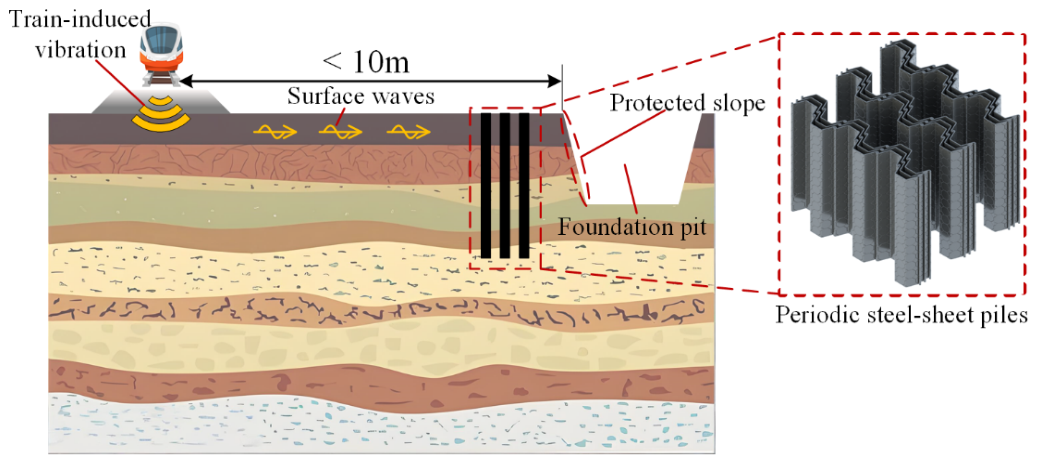
Steel-sheet piles are one of the most commonly used retaining structures in geotechnical engineering [23,24], offering advantages such as low cost, lightweight construction, and ease of installation. Leveraging these benefits, this paper proposes a steel-sheet pile vibration isolation structure tailored for narrow sites adjacent to railways, as illustrated in Figure 1. Despite their widespread application, studies on the use of steel-sheet piles for vibration isolation remain limited. Existing research has primarily focused on single-row configurations [25,26], while the wave attenuation mechanism of multi-row periodic steel-sheet pile barriers remains insufficiently understood. This research gap limits their application in vibration mitigation design for temporary slopes. Therefore, this study investigates the band-gap characteristics and vibration-screening performance of multi-row periodic steel-sheet pile barriers.
Periodic structure theory has attracted considerable attention in recent decades due to its unique dynamic properties, particularly the formation of band gaps that prevent wave propagation within certain frequency ranges [27,28,29,30,31,32]. Based on periodic structure theory, the band-gap characteristics of periodic steel-sheet piles and their suitability for mitigating train-induced vibrations were systematically investigated. Multi-row configurations were examined to address the current lack of understanding regarding their isolation performance. The findings are expected to provide a practical reference for similar engineering applications.
This paper is structured as follows: Section 2 describes field tests obtaining acceleration records and dominant frequencies. Section 3 introduces surface wave (SW) theory in periodic structures. Section 4 presents a dispersion curve analysis and parametric studies of band-gap frequencies. In Section 5 and Section 6, frequency-domain, time-domain, and slope stability analyses are conducted to evaluate the isolation performance of periodic steel-sheet piles. Section 7 concludes this study.

2. Field Test of Train-Induced Ambient Vibration

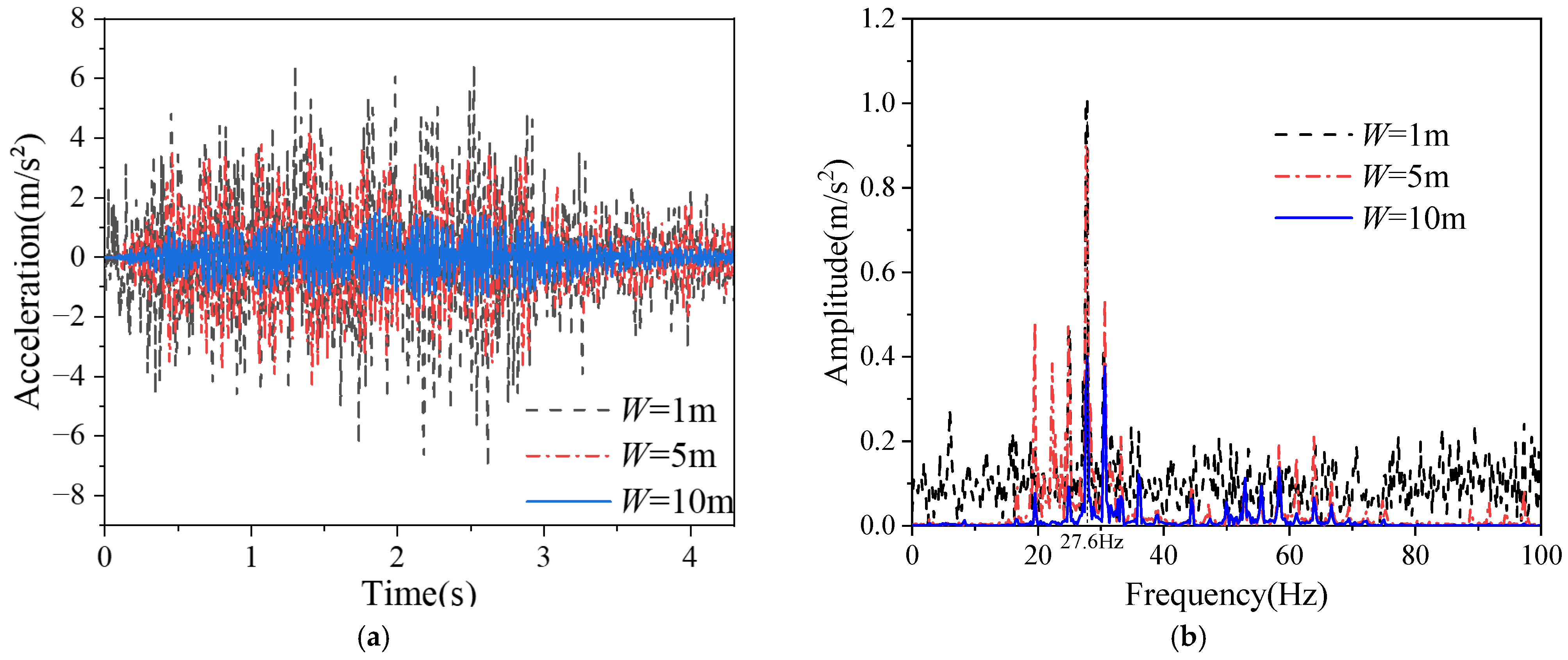
Field vibration characteristics are fundamental to the design of vibration isolation structures. To this end, field tests were conducted along the Qinbei Railway in Guangxi, China. Given that the renovation project necessitated a foundation pit excavation within 10 m of the existing railway, ground vibrations were measured at distances of 1 m, 5 m, and 10 m from the track. The acceleration time histories and their corresponding Fourier spectra are presented in Figure 2a and Figure 2b, respectively. The results reveal that the vibration energy was primarily concentrated in the 25–30 Hz range, with a dominant frequency of 27.6 Hz. Given that the ground vibration energy was predominantly carried by SWs, this paper investigated the feasibility of periodic steel-sheet piles for mitigating their impact on the adjacent slope.

3. Modeling and Methodology

3.1. Unit-Cell Model and Material Parameters

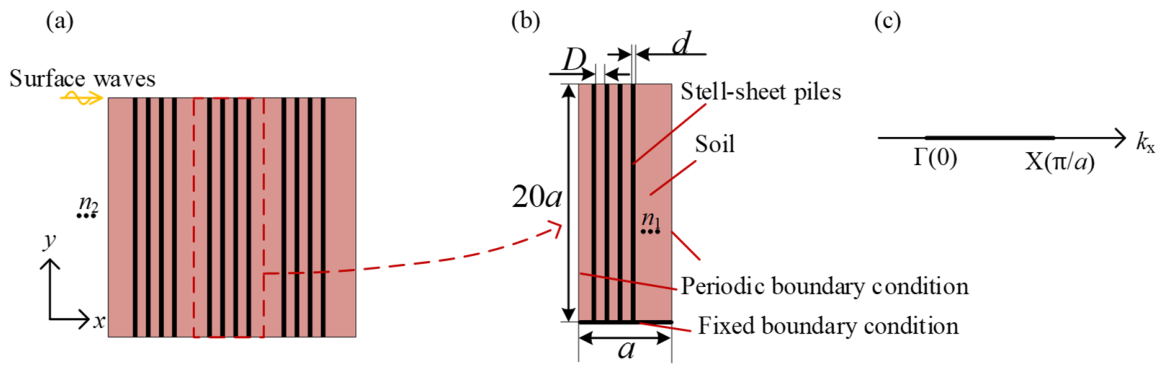
To mitigate the impact of surface waves on the protected foundation pit slope, periodic steel-sheet piles were arranged between the railway and the excavation, as shown in Figure 3a. Due to the continuous nature of the sheet-pile installation, a two-dimensional plane strain model can be adopted for the analysis. In the context of periodic structures, an infinitely periodic system can be simulated using a single unit cell combined with periodic boundary conditions on both sides, as illustrated in Figure 3b. Fixed boundary conditions are applied at the bottom of the unit cell, while the top surface maintains a free boundary to simulate a semi-infinite space. According to the Floquet–Bloch theorem in solid-state physics, the dispersion relation between the wave vector and frequency can be obtained by sweeping the wave vector across the irreducible Brillouin zone, a line segment ΓX, as shown in Figure 3c.
The material properties of the soil, including mass density (ρ), Poisson’s ratio (ν), and Young’s modulus (E), were obtained from laboratory tests, while those of the steel-sheet piles were adopted from Cheng and Shi [33]. The soil damping ratio was adopted from the literature [34,35], and a representative value of 0.03 was used in the present analysis. Damping of the steel-sheet piles was neglected because of its relatively small contribution. The influence of the soil damping ratio is further examined through a sensitivity analysis in Section 6.3. All material parameters are summarized in Table 1. The thickness and spacing of the steel-sheet piles are denoted as “d” and “D”, respectively. The number of steel-sheet piles per unit cell is denoted as n1. The unit cell model has a height of 20a, which is sufficient to represent a semi-infinite medium [36,37], where “a” is a periodic constant, also referred to as the line spacing between unit cells. Quadrilateral elements with a maximum size of 0.1 m (λ/22, where λ is the Rayleigh wavelength at 27.6 Hz) were employed.

3.2. Governing Equations

In this work, the soil is treated as an elastic medium. In the absence of body force, the governing equation can be expressed in terms of displacement and gives [29]:
ρ ( r ) u ¨ j ( r ) =   μ ( r ) u j ( r ) +   μ ( r ) x j u ( r ) + x j λ ( r )   u ( r )
where u j ( r )   ( j = x , y ) are the two components of the elastic displacement vector of u ( r ) , r = (x, y) denotes the position vector, ρ ( r ) is the mass density, λ ( r ) and μ ( r ) are the Lamé constants, and   =   x , y is divergence.
Taking into account plane harmonic waves which can be expressed as follows:
u ( r ) = e i ω t U ( r )
where U ( r ) is the displacement field, denoting the amplitude of vibration, i = 1 , and ω is the angular frequency.
Substituting Equation (2) into Equation (1) gives:
ρ ( r ) ω 2 U ¨ j ( r ) =   μ ( r ) U j ( r ) +   μ ( r ) x j U ( r ) + x j λ ( r )   U ( r )
According to Floquet-Bloch theory, the periodic boundary condition is obtained and gives:
U ( r + R ) = U ( r ) e ikR
where k is the wave vector and R is the lattice vector.
By combining the governing equation Equation (3) with the periodic boundary condition Equation (4), the eigenequations in terms of displacement can be derived. These eigenequations allow us to obtain the dispersion relation relating to the angular frequency of ω and wave vector of k. It should be noted that both SW modes and body wave modes exist in the eigenfrequency analysis of a unit cell model. An energy distribution parameter ξ is adopted to identify the SW from the body waves [38] and gives
ξ = y W ε d Ω w W ε d Ω
where Ω is the whole unit cell. Wε is the elastic strain energy density [34]. In this research, to observe the evolution of the surface modes, the lower limit of parameter ξ is taken as 0.6. Modes with ξ ≥ 0.6 are seen as SW modes.

3.3. Numerical Validation

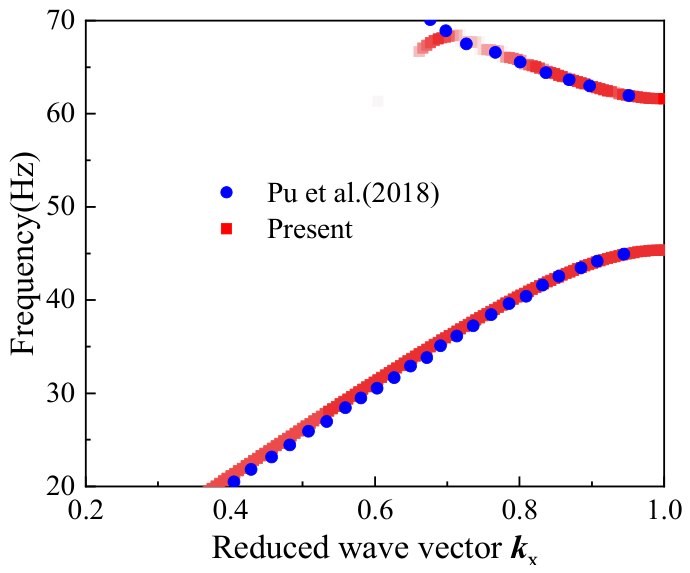
To validate the numerical simulation method used in this paper, the band diagram of a phononic crystal composed of periodic geofoam on a soil substrate, as calculated by Pu, et al. [39], was tested using the method described in this paper. The periodic constant was 1 m, and the filling ratio of geofoam was 0.3. The same Bloch-periodic boundary conditions and eigenfrequency analysis procedure were adopted in the present model. The mass density ρ, Poisson ratio ν, and Young’s modulus E of geofoam were taken as 60 kg/m3, 0.32, and 37 MPa, respectively, while for the soil, they were 1800 kg/m3, 0.25, and 46 MPa, respectively. A structured quadrilateral mesh was used in the numerical model, consisting of 707 mesh vertices and 600 quadrilateral elements.
By scanning the wave vector along the boundary of the irreducible Brillouin zone, a band diagram relating the angular frequency to the wave vector is obtained in Figure 4. Both models predict the same variation trend of the surface wave branches. The difference in the characteristic boundary frequencies is within 1%, indicating that the numerical method used in this study can reliably capture the band-gap characteristics of periodic surface wave barriers.

4. Dispersion Diagram and Parametric Study

4.1. Dispersion Diagram Analysis

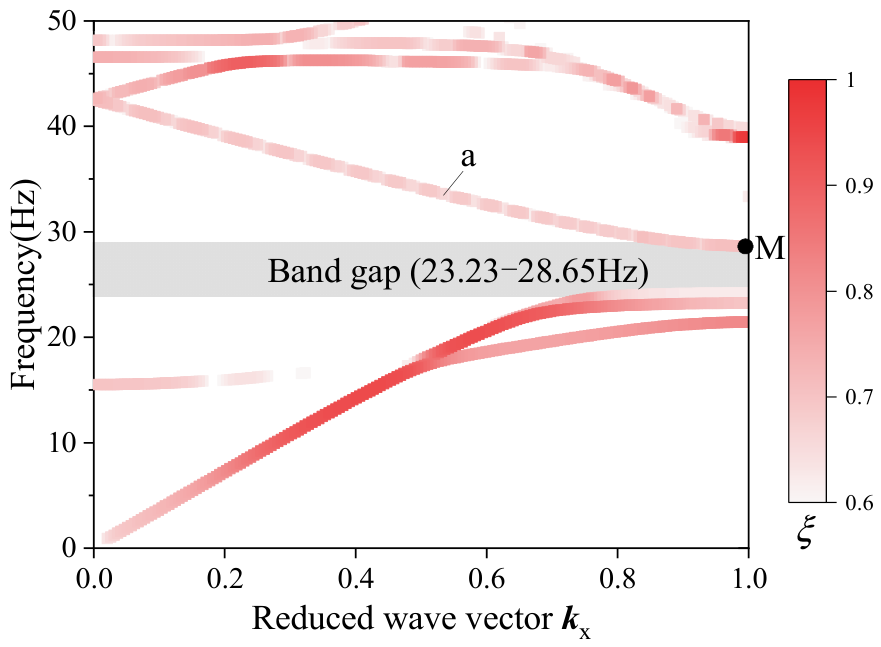
Based on the theoretical framework presented in Section 3.2, the dispersion curves were obtained by sweeping the wave vector along the boundary of the irreducible Brillouin zone and solving the eigenvalue problem for the unit cell. Figure 5 illustrates the dispersion curves for the periodic steel-sheet piles with the following geometric parameters: a = 1.6 m, D = 0.1 m, d = 0.02 m, n1 = 4, and H = 20a. The material properties are taken from Table 1.
As observed in Figure 5, there are frequency ranges (band gaps) where surface bands are absent, indicating that the SWs will be effectively blocked within those frequency ranges. Consequently, a distinct band gap from 23.23 Hz to 28.65 Hz can be identified.
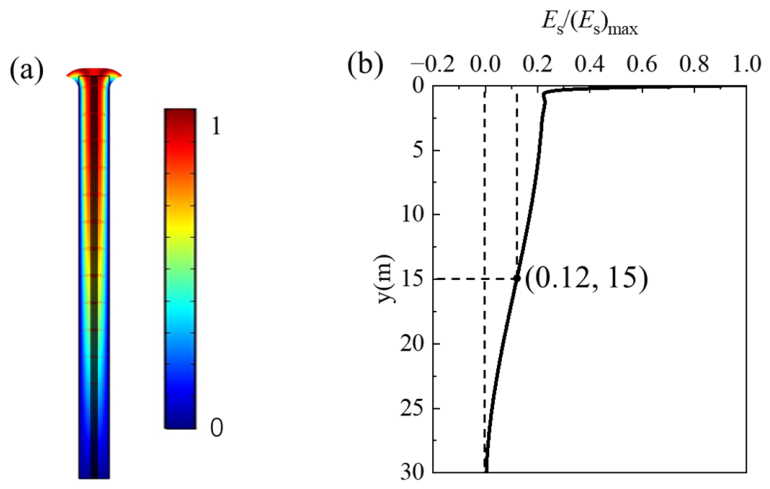
To investigate the vibration characteristics at the band-gap boundary, the mode shape corresponding to the upper edge of the band gap was extracted, as shown in Figure 6a. The results indicate that the mode at the upper edge is predominantly vertically polarized, with vibration energy penetrating into the deeper part of the model. Figure 6b presents the variation in normalized elastic strain energy (Es) with depth for mode M. It can be observed that the vibration energy decays slowly with increasing depth; even at a depth of 15 m (the midpoint of the model), 12% of the energy remains. This residual energy suggests significant energy leakage. Consequently, band a in Figure 6 is identified as a leaky SW mode [29], indicating the potential attenuation of SWs.
Based on the dispersion curves, the upper-boundary frequency (UBF), lower-boundary frequency (LBF), and band-gap width (WBG) are investigated as functions of key geometric parameters. For simplicity, the steel-sheet pile thickness is fixed at d = 0.02 m throughout the parametric study.

4.2. Effects of Periodic Constants

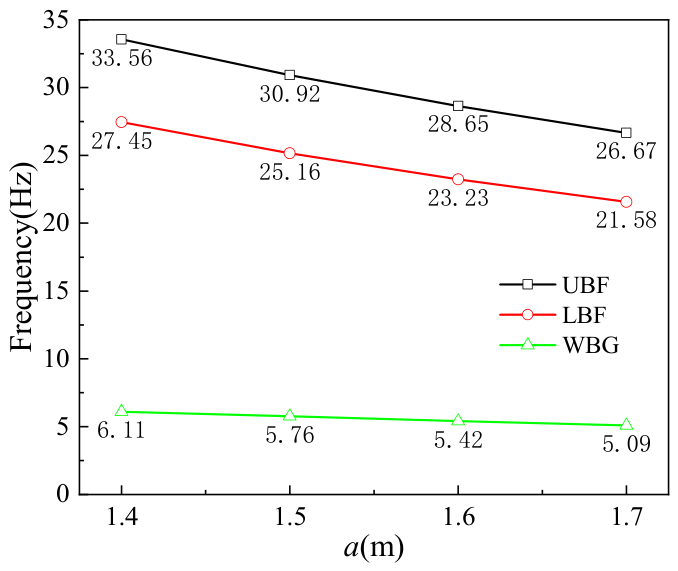
Figure 7 shows the UBF, LBF, and WBG of SWs at the Brillouin zone boundary (point X) versus periodic constants (a), for D = 0.1 m, n1 = 4, and H = 20a. All three values decrease as a increases, indicating that attenuating low-frequency vibrations requires a larger periodic constant and, consequently, a greater barrier footprint. Given the measured dominant frequency of 27.6 Hz, a periodic constant of a = 1.6 m is adopted.

4.3. Effect of Pile Spacing per Unit Cell

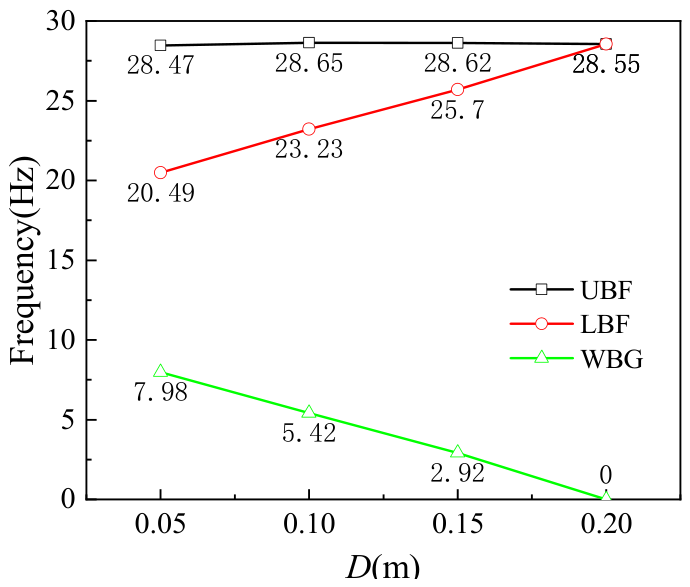
Figure 8 illustrates the effect of pile spacing (D) per unit cell on the UBF, LBF, and WBG of SWs, for a = 1.6 m, n1 = 4, and H = 20a. The results indicate that increasing D has little effect on the UBF but leads to an increase in the LBF and a corresponding decrease in the WBG. From a theoretical perspective, a smaller pile spacing is desirable to maximize the band-gap width. Nevertheless, practical construction constraints limit the minimum achievable pile spacing. Considering both isolation performance and constructability, a spacing of D ≤ 0.1 m is recommended. Accordingly, D = 0.1 m is adopted for the subsequent parametric studies.

4.4. Effect of the Number of Piles per Unit Cell

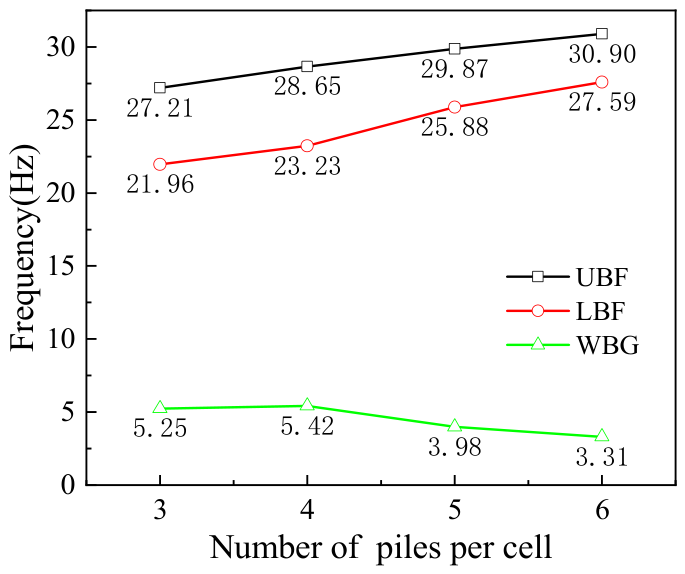
Figure 9 plots the UBF, LBF, and WBG against the pile count per unit cell (n1) for D = 0.1 m, a = 1.6 m, and H = 20a. Increasing n1 raises the band-gap boundaries (UBF and LBF) but reduces their width. While n1 values of 4, 5, and 6 all cover the target frequency of 27.6 Hz, a higher n1 results in a higher LBF, thereby compromising low-frequency isolation effectiveness. Additionally, it raises construction costs. Hence, n1 = 4 is adopted as the optimal configuration.

4.5. Effects of Construction Deviation

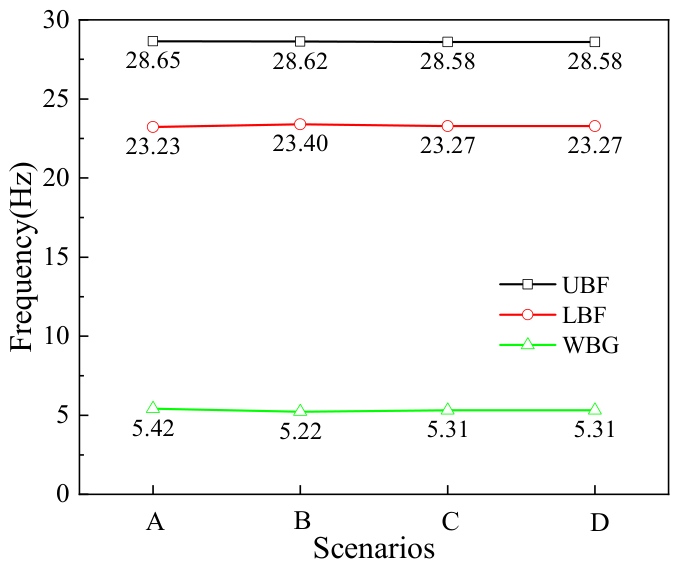
In practice, uniform arrangement of steel-sheet piles within a unit cell is challenging due to site-specific geological conditions and spatial constraints; consequently, construction deviations are unavoidable. Taking the baseline configuration of n1 = 4, a = 1.6 m, and H = 20a, the spacing between adjacent piles within a unit cell is defined as (D1, D2 and D3). Three representative construction deviation scenarios (BCD) are summarized in Table 2, where Group A represents the baseline case for comparison. Figure 10 presents the effects of these deviation groups on the UBF, LBF, and WBG.
Compared with Scenario A, the maximum variations in the upper boundary frequency, lower boundary frequency, and band-gap width are 0.24%, 0.73%, and 3.69%, respectively. These small variations indicate that the band-gap characteristics are only slightly affected by the considered construction deviations. Therefore, the proposed periodic steel-sheet pile barrier has good tolerance to non-uniform pile spacing, which is beneficial for practical construction in complex site conditions.

5. Frequency Domain Analysis

5.1. Modeling and Validation

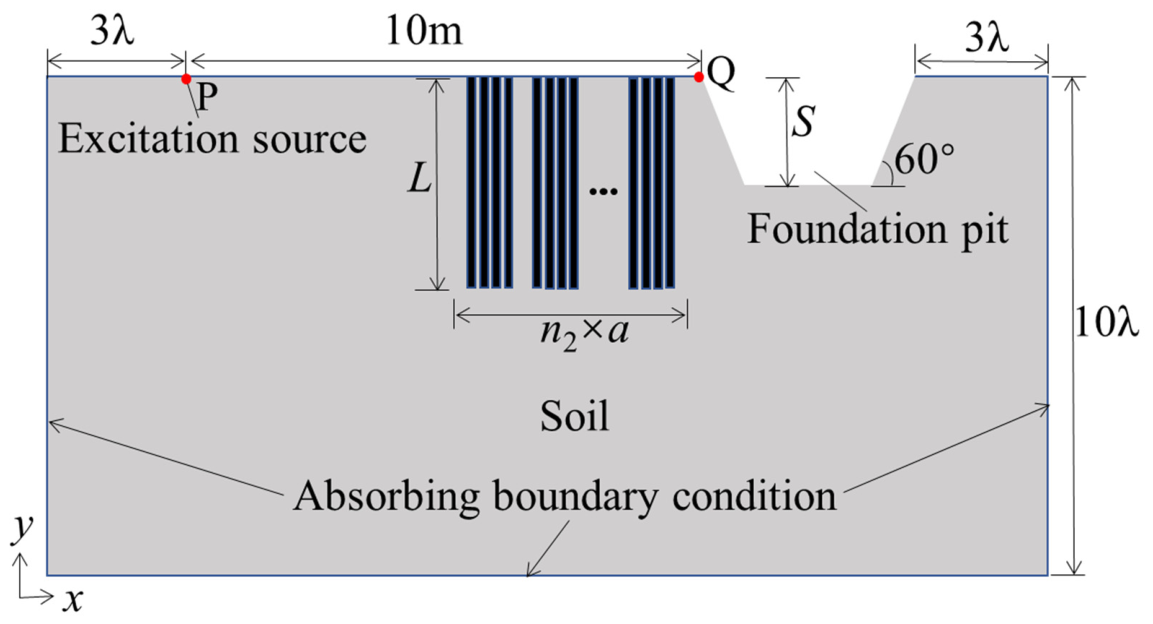
Based on the two-dimensional plane strain model illustrated in Figure 11, a frequency-domain analysis is conducted to further investigate the effects of the number of rows (n2) and the installation depth (L) of steel-sheet piles on SW attenuation. The geometric parameters of the unit cell are set as follows: a = 1.6 m, D = 0.1 m, n1 = 4, and H = 20a. The corresponding dispersion curves for this configuration are presented in Figure 5, which exhibit a band gap ranging from 23.23 Hz to 28.65 Hz.
In accordance with engineering practice, the foundation pit—with a depth of S and a slope angle of 60°—is positioned 10 m from the excitation source. A point source P ( F = A   e i ω t ; A = 1 N) is located at a distance of 3λ from the left boundary of the model. Similarly, the foundation pit is situated 3λ from the right boundary. To ensure an accurate assessment of the SW barrier, a model depth of 10λ is adopted, which has been demonstrated to be sufficient in previous studies [39,40]. Here, λ = 2.2 m is the Rayleigh wavelength at 27.6 Hz. A quadrilateral mesh with a maximum element size of λ/5 is used, and damping is omitted due to the inherently low damping of the steel-sheet piles.
To mitigate the impact of SWs on the foundation pit slope, periodic steel-sheet piles are arranged between the excitation source and the foundation pit. A monitoring point, denoted as Point Q, is set at the top corner of the foundation pit. The left, right, and bottom boundaries of the model are assigned absorbing boundary conditions to simulate a semi-infinite half-space.
To quantitatively evaluate the isolation performance of the wave barrier, a frequency response function (FRF) is defined as follows:
F R F = 20 × log 10 ( Q 1 Q 2 )
where Q1 and Q2 represent the displacement amplitudes at point Q in the absence and presence of the wave barrier, respectively.
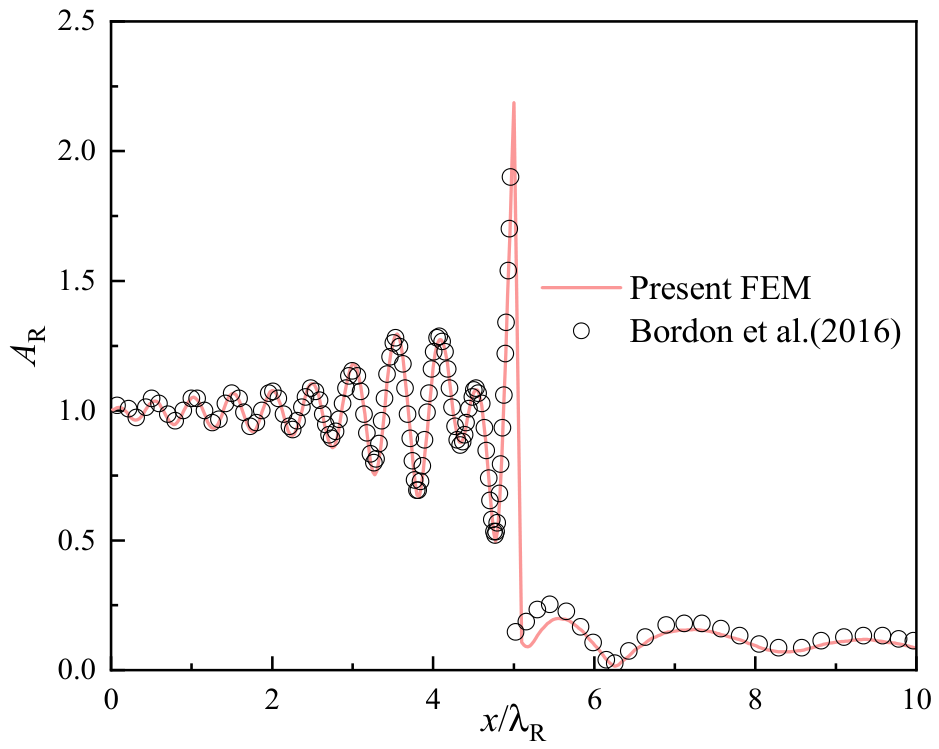
To validate the numerical model, an open trench with a width of 0.1λR and a depth of λR (where λR is the Rayleigh wavelength at the excitation frequency of 50 Hz) is considered under vertical excitation at 50 Hz, without steel sheet piles. The transmission coefficient is evaluated in terms of the amplitude reduction factor (AR) defined as
A R = v 1 v 2
where v 1 and v 2 denote the vertical displacement amplitudes of the soil without and with the open trench, respectively.
The computed ground vibrations are compared with the results of Bordón, Aznárez and Maeso [35] obtained using conventional and dual BEM. Good agreement is observed in Figure 12, confirming the validity of the present model.

5.2. Effects of the Number of Rows

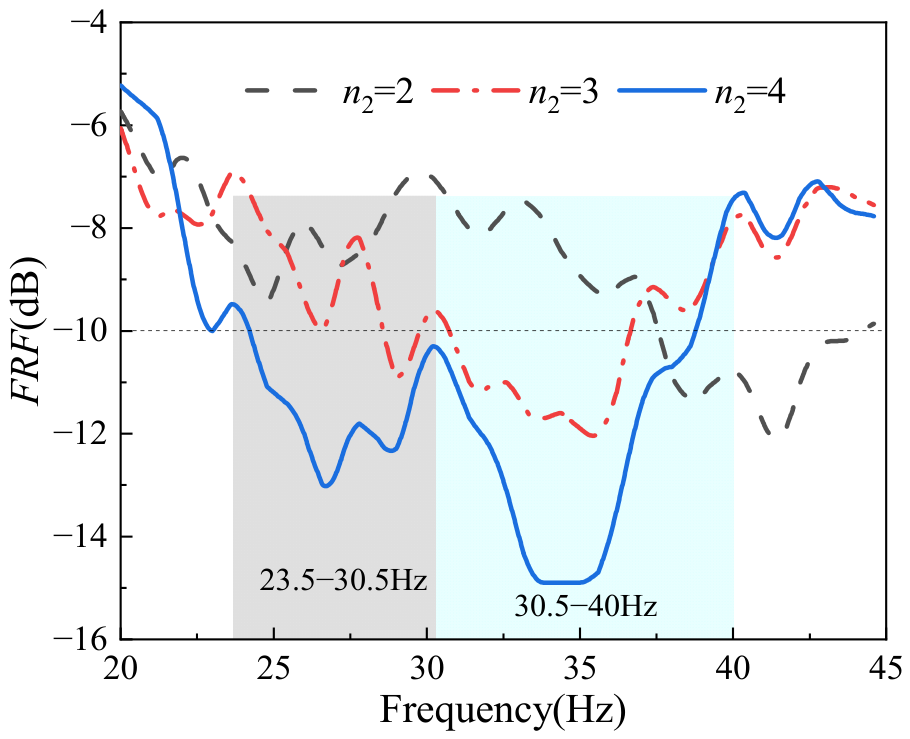
Figure 13 illustrates the transmission spectra of the steel-sheet pile barriers with different numbers of rows (n2). The number of rows was varied from two to four. Two distinct attenuation zones (AZs) are observed, spanning frequency ranges of 23.5–30.5 Hz and 30.5–40 Hz. As can be seen from the band diagram in Figure 5, the first attenuation zone corresponds to the band gap of 23.23–28.65 Hz, where surface wave propagation is effectively inhibited. The second attenuation zone is attributed to the leaky surface wave mode, namely, band a, which also contributes to wave attenuation within this frequency range. Therefore, the frequency-domain response is consistent with the band-gap analysis.
It is observed that the vibration isolation effect improves as the number of steel-sheet pile rows increases. When the number of rows reaches four (n2 = 4), most values of FRF around the dominant frequency fall below −10 dB, indicating satisfactory isolation performance. In this configuration, the barrier occupies a width of 6.4 m, which is less than the available 10 m in practical engineering applications, thus satisfying the site constraint.

5.3. Effects of Pile Depth

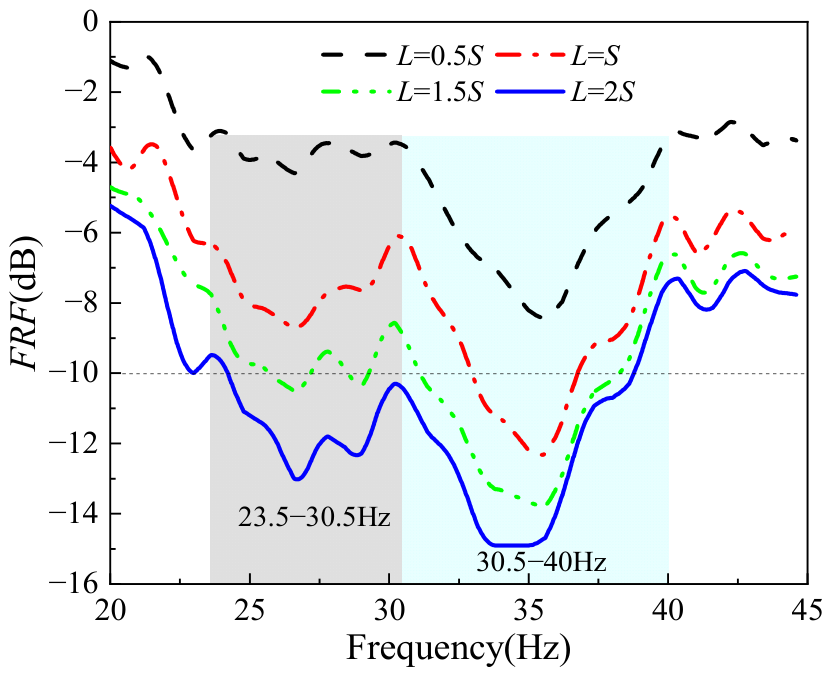
The effect of the normalized steel-sheet pile depth L on the FRF is shown in Figure 14, where L is normalized by the foundation pit depth S. The pile depth is varied from 0.5S to 2S. A similar correspondence between the FRF attenuation zones and the band characteristics can also be observed in Figure 14, further confirming that the improvement in screening performance with increasing pile depth is governed by the band gap and leaky surface wave attenuation mechanisms.
Figure 14 reveals a clear inverse relationship between the normalized pile depth and FRF values, confirming that deeper piles improve screening efficiency. When the pile depth reaches 2S (L = 2S), the FRF at the dominant frequency of 27.6 Hz decreases below −10 dB, indicating effective attenuation of the measured train-induced vibration. Therefore, for practical applications, the installation depth of the steel-sheet piles is recommended to be not less than twice the foundation pit depth.

6. Application

6.1. Time-Domain Response to Train-Induced Ground Vibration

In this section, the transient response of the model shown in Figure 11 to train-induced ground vibrations is investigated using the following geometrical parameters: a = 1.6 m, D = 0.1 m, n1 = n2 = 4, H = 20a, and L = 2S. In the simulation, the acceleration time history corresponding to the measurement point at W = 1 m in Figure 2 is applied at point source P (Figure 11). This record is selected because it represents the strongest measured vibration among the three monitoring distances and, therefore, provides a conservative input for evaluating the screening performance of the proposed barrier.
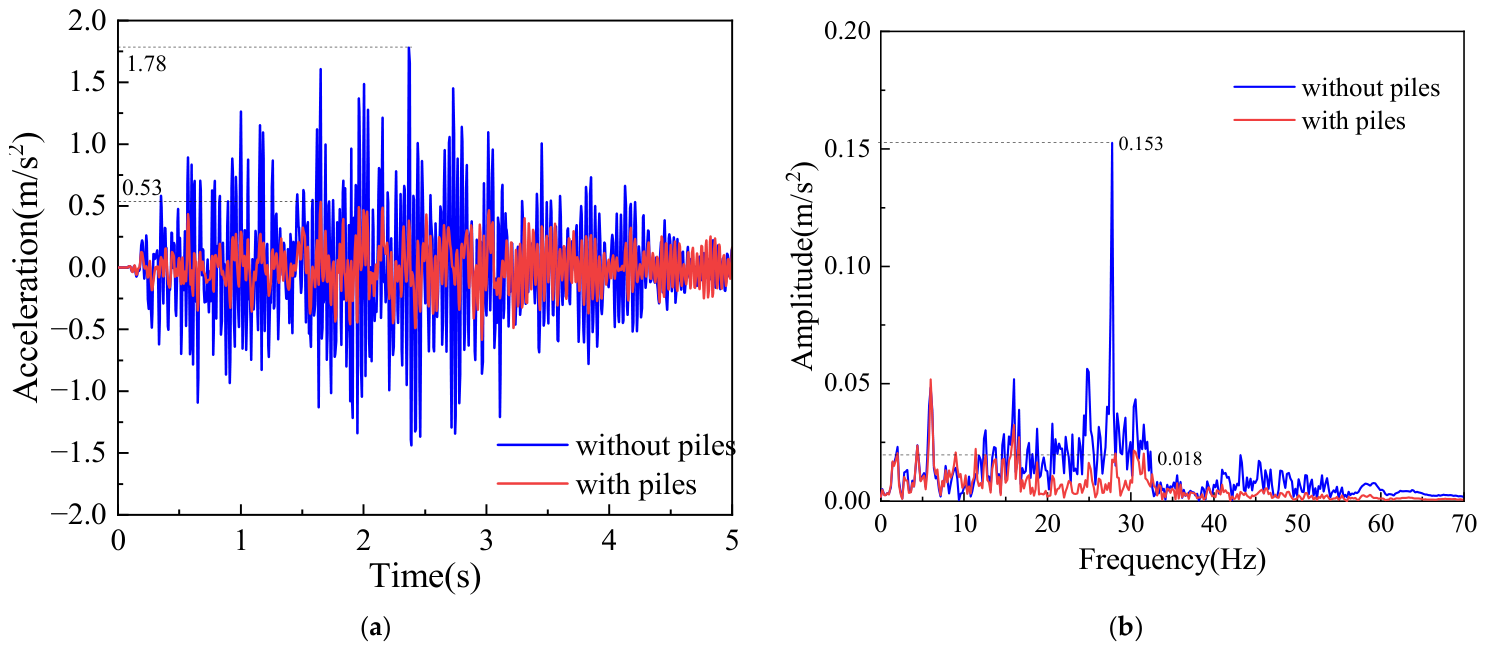
The resulting acceleration response at point Q is presented in Figure 15. It can be observed from Figure 15a that after the installation of the periodic steel-sheet piles, the peak acceleration is reduced from 1.78 m/s2 to 0.53 m/s2, corresponding to a reduction of 70%. This indicates that the barrier can effectively reduce the transient vibration intensity transmitted to the top corner of the foundation pit slope. At the dominant frequency of 27.6 Hz in Figure 15b, the acceleration amplitude decreases from 0.153 m/s2 to 0.018 m/s2, achieving an 88% reduction. This frequency lies within the first attenuation zone identified in the frequency-domain analysis and is close to the complete band gap predicted by the dispersion analysis. These results demonstrate that periodic steel-sheet piles can effectively mitigate vibrations on foundation pit slopes adjacent to railways.

6.2. Slope Stability Analysis Under Different Conditions

To evaluate the influence of train-induced vibration on slope stability, the strength reduction method was adopted to calculate the factor of safety (FOS) of the foundation pit slope. In this method, the shear strength parameters of soil are gradually reduced until the slope reaches a critical failure state. The reduction factor corresponding to this critical state is defined as the FOS. The soil strength parameters used in the analysis are listed in Table 1, including cohesion, internal friction angle, density, and elastic parameters.
Three conditions were considered: natural state (no train vibration), train-induced vibration without the barrier, and train-induced vibration with the periodic steel-sheet pile barrier. The dynamic effect of train-induced vibration is introduced using the acceleration time-history record shown in Figure 15a. The critical failure state was identified according to the rapid increase in slope displacement during the strength reduction process, and the corresponding critical slip surface was inferred from the deformation pattern.
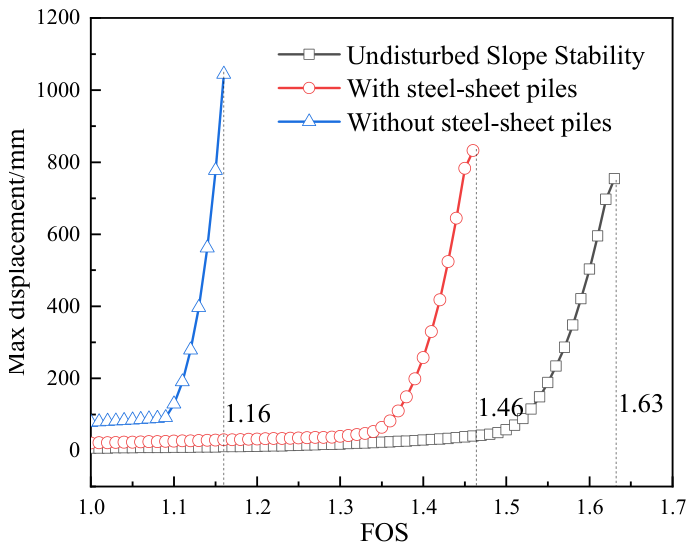
As shown in Figure 16, the FOS values are 1.63 (natural), 1.16 (without a barrier), and 1.46 (with a barrier). According to the Chinese code for temporary foundation pits adjacent to railways [41], the required minimum FOS is 1.2–1.3. The results indicate that train-induced vibration alone reduces the FOS below the acceptable level (1.16 < 1.2), whereas the proposed barrier restores it to a safe value (1.46 > 1.3). Thus, the periodic steel-sheet pile barrier not only attenuates vibration amplitudes but also effectively mitigates the stability threat, offering a practically meaningful solution for protecting slopes adjacent to railways.

6.3. Discussion on Engineering Applicability

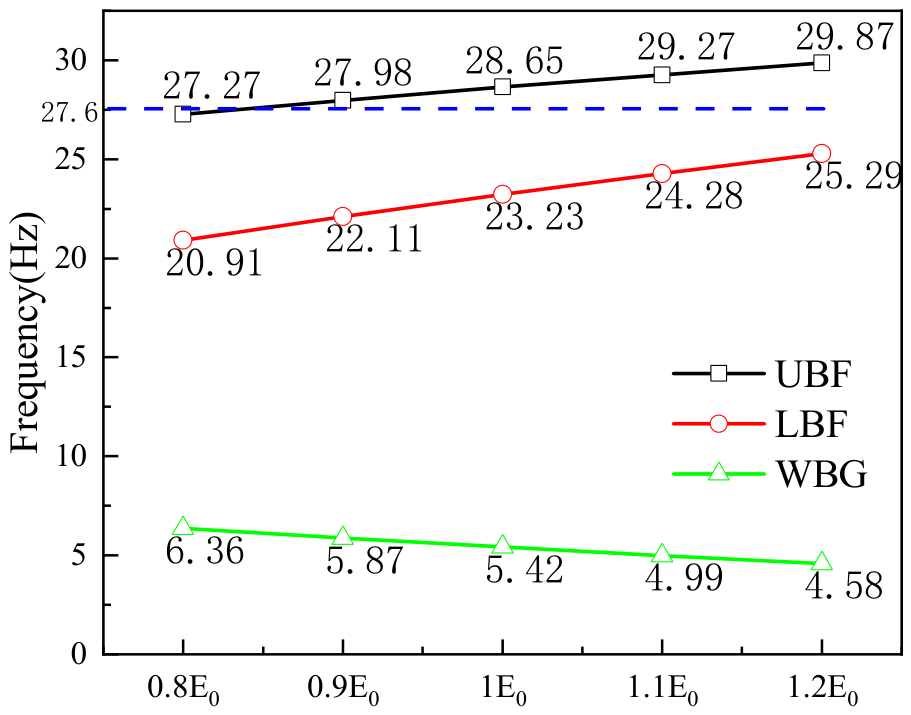
The above analyses were conducted based on the assumption of a homogeneous linear-elastic soil. To evaluate the influence of soil stiffness on the band-gap characteristics, a sensitivity analysis was performed by varying the soil Young’s modulus from 0.8E0 to 1.2E0, where E0 denotes the baseline Young’s modulus listed in Table 1. As shown in Figure 17, both the upper and lower band-gap boundaries shift upward as the soil stiffness increases. Specifically, the UBF increases from 27.27 Hz to 29.87 Hz, while the LBF increases from 20.91 Hz to 25.29 Hz. Meanwhile, the band-gap width decreases from 6.36 Hz to 4.58 Hz. These results indicate that the soil stiffness has a direct influence on the band-gap frequency range.
It is worth noting that the measured dominant frequency of 27.6 Hz remains within the band gap when the soil modulus varies from 0.9E0 to 1.2E0. When the soil modulus decreases to 0.8E0, the upper band-gap boundary shifts to 27.27 Hz, which is slightly lower than the dominant frequency. This suggests that the proposed barrier exhibits reasonable robustness within a moderate stiffness variation range, whereas site-specific soil stiffness should be carefully determined when the soil is significantly softer than the baseline condition.
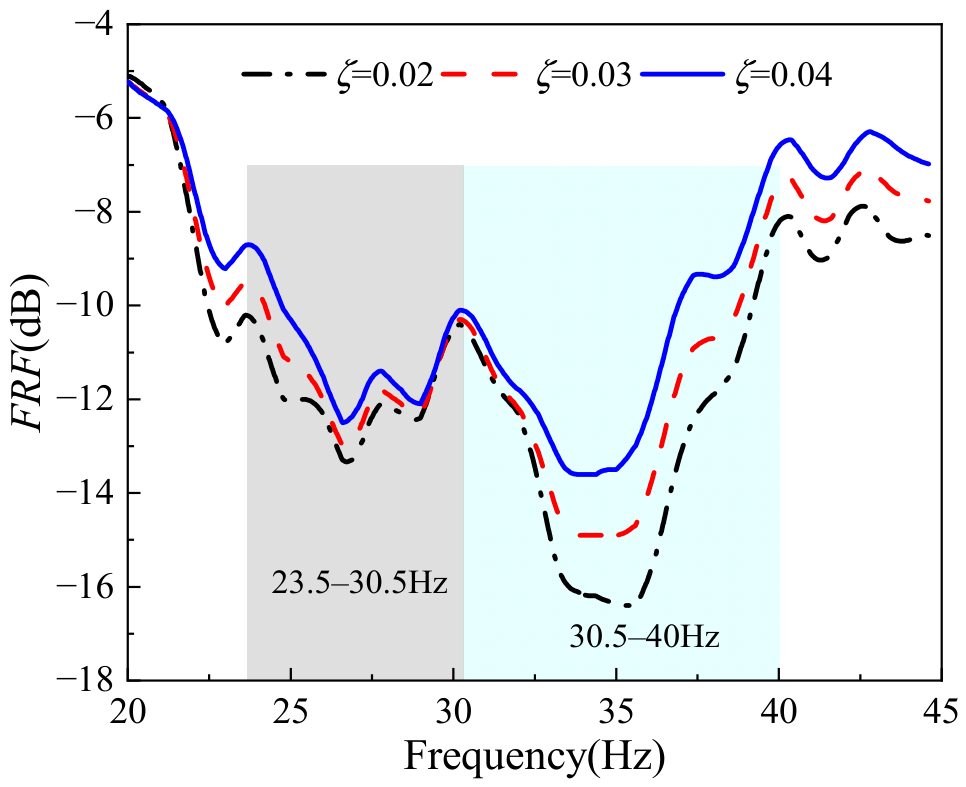
The influence of soil damping was further examined by varying the damping ratio from 0.02 to 0.04. As shown in Figure 18, the two attenuation zones remain almost unchanged under different damping ratios, indicating that the damping ratio mainly affects the attenuation amplitude rather than the frequency range of the attenuation zones. In addition, the response at the measured dominant frequency of 27.6 Hz remains below −10 dB for all damping ratios considered. Therefore, the baseline damping ratio of 0.03 does not change the main conclusion regarding the screening performance of the proposed barrier. It should be noted that soil damping may be frequency-dependent in actual ground conditions, and site-specific damping properties should be determined through field or laboratory tests for practical applications.
The frequency-domain model adopts a stationary point-source excitation to clarify the wave-screening mechanism of the periodic barrier and to evaluate its attenuation characteristics over a wide frequency range. In reality, train-induced vibration is generated by moving axle loads and is affected by train speed, axle spacing, track irregularity, and soil–track interaction. Therefore, the reported reductions of 70% in peak acceleration and 88% at the dominant frequency should be interpreted as the predicted screening performance under the adopted field-record input and numerical model, rather than as universal values for all moving-train conditions. Since the measured dominant frequency of 27.6 Hz falls within the attenuation zone of the proposed barrier, the main conclusion regarding target-frequency mitigation remains valid. Nevertheless, moving-load simulations and field validation are recommended in future studies.
From the viewpoint of engineering feasibility, the proposed periodic steel-sheet pile barrier is suitable for temporary foundation pit slopes in narrow railway-adjacent sites because of its rapid installation, limited excavation disturbance, and potential reusability. A qualitative comparison with open trenches, conventional pile barriers, and vibration isolation walls is provided in Table 3. Although a detailed project-specific cost estimate depends on local unit prices, construction equipment, soil conditions, and pile reuse rate, the proposed barrier is potentially more economical for temporary works. Therefore, the term “cost-effective” in this study refers to its potential engineering economy under temporary and space-constrained construction conditions, rather than a fixed cost reduction percentage.
The field test in this study was used to determine the dominant vibration frequency and provide the input acceleration record. Direct field validation or physical model testing of the proposed steel-sheet pile barrier was not conducted. Therefore, the present study should be regarded as a numerical feasibility investigation supported by field-measured vibration data. Further field tests are needed to validate the proposed barrier under actual railway operation conditions.

7. Conclusions

This paper investigated the vibration isolation performance of periodic steel-sheet piles for protecting foundation pit slopes adjacent to railways. The main conclusions are summarized as follows:
  • Field measurements along the Qinbei Railway revealed that train-induced ground vibrations are predominantly composed of SWs, with a dominant frequency of 27.6 Hz. Based on periodic structure theory, periodic steel-sheet piles with optimized geometric parameters (a = 1.6 m, D = 0.1 m, and n1 = 4) were designed, yielding a complete band gap ranging from 23.23 Hz to 28.65 Hz that effectively covers the dominant frequency.
  • Parametric studies demonstrate that periodic constants (a), the pile spacing of a unit cell (D), and the pile count per unit cell (n1) can effectively tune the upper and lower boundary frequencies as well as the band-gap width, enabling the proposed barrier to accommodate the vibration isolation requirements of complex practical engineering scenarios. The construction deviation analysis further showed that the barrier has good robustness. Compared with the baseline case, the maximum variations in the upper-boundary frequency, lower-boundary frequency, and band-gap width were 0.24%, 0.73%, and 3.69%, respectively, and the measured dominant frequency remained within the band gap under all deviation scenarios.
  • Frequency-domain, time-domain, and slope stability analyses confirmed the effectiveness of the optimized barrier. The two attenuation zones observed in the FRF curves were consistent with the band characteristics: the first attenuation zone corresponded to the complete band gap, while the second was associated with the leaky surface wave mode. With parameters of a = 1.6 m, D = 0.1 m, n1 = n2 = 4, and L = 2S, the peak acceleration at the foundation pit slope was reduced by 70%, and the acceleration amplitude at the dominant frequency was attenuated by 88%. Moreover, the barrier increases the factor of safety from 1.16 to 1.46, exceeding the code requirement of 1.2–1.3. These results demonstrate that periodic steel-sheet piles offer an effective and reliable solution for mitigating train-induced vibrations on temporary foundation pit slopes adjacent to railways.
  • Additional sensitivity analyses showed that soil stiffness variations can shift the band-gap frequency range, whereas the damping ratio mainly affects the attenuation amplitude. The proposed design maintained effective screening performance within the considered ranges of soil stiffness and damping. Nevertheless, this study still has several limitations. The stationary point-source model cannot fully capture the spatially distributed and time-varying characteristics of moving train loads, and the reported vibration reduction should be interpreted under the adopted field-record input and numerical conditions. In addition, the soil was assumed to be homogeneous, whereas actual sites often exhibit layered conditions that may influence surface wave dispersion and band-gap locations. The field data were used to determine the input vibration rather than to directly validate the proposed barrier. Future work should further consider moving-load simulations, layered soil profiles, detailed cost evaluation, and field validation of the proposed periodic steel-sheet pile barrier.

Author Contributions

Conceptualization, Y.W. and W.L.; methodology, Y.W., W.L. and H.W.; software, Y.L. and L.Z.; validation, Z.L., L.H. and Y.L.; formal analysis, H.W., W.L. and Y.L.; investigation, H.W., Z.L., L.Z. and L.H.; resources, Y.W. and H.W.; data curation, H.W., Z.L. and L.H.; writing—original draft preparation, H.W.; writing—review and editing, Y.W. and W.L.; visualization, Y.L. and L.Z.; supervision, Y.W. and W.L.; project administration, H.W. and Y.W.; funding acquisition, Y.W. All authors have read and agreed to the published version of the manuscript.

Funding

This research was funded by the Scientific Research Project of the Education Department of Hunan Province, China (grant number: 25B0520).

Data Availability Statement

The original contributions presented in this study are included in the article. Further inquiries can be directed to the corresponding authors.

Conflicts of Interest

Authors Hao Wei, Zhongfeng Li, Lijie Zhang and Liufu Hu were employed by the company CCCC Central-South Engineering Company, Ltd. The remaining authors declare that the research was conducted in the absence of any commercial or financial relationships that could be construed as a potential conflict of interest.

References

  1. Guo, X.; Tian, D.; Sun, J.; Zhang, D.; Liu, Y.; Zhang, J. Evaluation of train-induced vibrations in medium-to-high speed railways: A parametric study. Front. Built Environ. 2025, 11, 1577763. [Google Scholar]
  2. Hsu, W.L.; Chen, W.B.; Hsieh, M.T. Comparative analysis of methods for predicting train-induced vibrations. J. Low Freq. Noise Vib. Act. Control 2025, 44, 720–737. [Google Scholar]
  3. Khodaei, S.; Chakeri, H.; Darbor, M.; Tabrizi, A.H.N. The effect of foam concrete grouting on urban structure vibrations in Tabriz metro lines 1 and 2. Sci. Rep. 2025, 15, 45511. [Google Scholar] [CrossRef] [PubMed]
  4. Seyedi, M. Impact of Train-Induced Vibrations on Residents’ Comfort and Structural Damages in Buildings. J. Vib. Eng. Technol. 2024, 12, 1961–1978. [Google Scholar] [CrossRef]
  5. Zou, C. Probabilistic Prediction and Assessment of Train-Induced Vibrations Based on Mixture Density Model. Buildings 2024, 14, 3468. [Google Scholar] [CrossRef]
  6. Li, D.; Yin, J.; Zhan, J.; Wang, H.; Jiang, Q.; Wang, F. Modeling Train-Induced Vibrations of Layered Soils in Seasonally Frozen Regions. J. Cold Reg. Eng. 2026, 40, 04026009. [Google Scholar] [CrossRef]
  7. Leung, K.; Beskos, D.; Vardoulakis, I. Vibration isolation using open or filled trenches: Part 3: 2-D non-homogeneous soil. Comput. Mech. 1990, 7, 137–148. [Google Scholar]
  8. Ahmad, S.; Al-Hussaini, T. Simplified design for vibration screening by open and in-filled trenches. J. Geotech. Eng. 1991, 117, 67–88. [Google Scholar]
  9. Adam, M.; von Estorff, O. Reduction of train-induced building vibrations by using open and filled trenches. Comput. Struct. 2005, 83, 11–24. [Google Scholar] [CrossRef]
  10. Garcia-Bennett, A.; Jones, C.; Thompson, D. A numerical investigation of railway ground vibration mitigation using a trench in a layered soil. In Proceedings of the Noise and Vibration Mitigation for Rail Transportation Systems: Proceedings of the 10th International Workshop on RailwayNoise, Nagahama, Japan, 18–22 October 2010; Springer: Tokyo, Japan, 2012; pp. 315–322. [Google Scholar]
  11. Zoccali, P.; Cantisani, G.; Loprencipe, G. Ground-vibrations induced by trains: Filled trenches mitigation capacity and length influence. Constr. Build. Mater. 2015, 74, 1–8. [Google Scholar] [CrossRef]
  12. Jayawardana, P.; Thambiratnam, D.P.; Perera, N.; Chan, T. Dual in-filled trenches for vibration mitigation and their predictions using artificial neural network. Soil Dyn. Earthq. Eng. 2019, 122, 107–115. [Google Scholar] [CrossRef]
  13. Cai, Y.; Ding, G.; Xu, C.; Wang, J. Vertical amplitude reduction of Rayleigh waves by a row of piles in a poroelastic half-space. Int. J. Numer. Anal. Methods Geomech. 2009, 33, 1799–1821. [Google Scholar] [CrossRef]
  14. Ding, X.; Qu, L.; Yang, J.; Wang, C. Experimental study on the pile group-soil vibration induced by railway traffic under the inclined bedrock condition. Acta Geotech. 2020, 15, 3613–3620. [Google Scholar] [CrossRef]
  15. Guo, X.; Wang, B.; Mei, C.C.; Liu, H. Scattering of periodic surface waves by pile-group supported platform. Ocean Eng. 2017, 146, 46–58. [Google Scholar] [CrossRef]
  16. Zhao, C.; Zeng, C.; Wang, Y.; Bai, W.; Dai, J.W. Theoretical and Numerical Study on the Pile Barrier in Attenuating Seismic Surface Waves. Buildings 2022, 12, 1488. [Google Scholar] [CrossRef]
  17. Yang, Z.; Wu, W.; Liu, H.; Zhang, Y.; Liang, R. Flexible support of a pile embedded in unsaturated soil under Rayleigh waves. Earthq. Eng. Struct. Dyn. 2023, 52, 226–247. [Google Scholar] [CrossRef]
  18. Cao, S.; Li, D.; Yin, J.; Xu, Q.; Qian, D.; Chen, C.; Wang, H.; Zhang, L.; Shi, X.; Wang, F. Effect of periodic vibration-isolation piles on soil vibration in deep-buried tunnels of suburban railways. Sci. Prog. 2024, 107, 1–21. [Google Scholar]
  19. Li, D.; Qian, D.; Cao, S.; Chen, C.; Yin, J.; You, Z.; Wang, H.; Zhang, L.; Shi, X.; Wang, F. Investigation of the vibration isolation effect of composite vibration isolation walls on ground surface vibrations in deep tunnels of suburban railways. Sci. Rep. 2024, 14, 19093. [Google Scholar] [CrossRef] [PubMed]
  20. Li, D.; Qian, D.; Cao, S.; Chen, C.; Yin, J.; You, Z.; Wang, H.; Zhang, L.; Shi, X.; Wang, F. Effect of Composite Vibration Isolation Walls on Vibrations in the Tunnel Interval Area of Suburban Railways. Urban Rail Transit 2025, 11, 235–249. [Google Scholar] [CrossRef]
  21. Van Hoorickx, C.; Schevenels, M.; Lombaert, G. Double wall barriers for the reduction of ground vibration transmission. Soil Dyn. Earthq. Eng. 2017, 97, 1–13. [Google Scholar] [CrossRef]
  22. Liu, Z.; Miao, L.; Zhang, B. Attenuation Analysis of Novel Metamaterial Vibration Isolation Wall in Subway Engineering. J. Vib. Eng. Technol. 2026, 14, 101. [Google Scholar] [CrossRef]
  23. Ahmadi, H.M.; De Matteis, G.; Mazzolani, F.M. Effectiveness of Perforated Shear Panels for Improving the Failure Modes of Beam-to-Column Connections in Steel Shear Walls. In Proceedings of the 10th International Conference on Behaviour of Steel Structures in Seismic Areas: STESSA 2022; Springer: Cham, Switzerland, 2022. [Google Scholar]
  24. Ahmadi, H.M.; Matteis, G.D. Cyclic Behaviour of Steel Shear Walls with Beam-Only Connection Shear Panels. In Proceedings of the 10th International Conference on Behaviour of Steel Structures in Seismic Areas: STESSA 2022; Lecture Notes in Civil Engineering; Springer: Cham, Switzerland, 2022; pp. 659–666. [Google Scholar]
  25. Dijckmans, A.; Ekblad, A.; Smekal, A.; Degrande, G.; Lombaert, G. Efficacy of a sheet pile wall as a wave barrier for railway induced ground vibration. Soil Dyn. Earthq. Eng. 2016, 84, 55–69. [Google Scholar] [CrossRef]
  26. Toygar, O.; Ulgen, D.; Fidan, N.B. Experimental Study on Reutilization of Waste Rubber Chips with Sheetpiles as a Coupled-Wave Barrier to Reduce Ground-Borne Vibrations. J. Vib. Eng. Technol. 2024, 12, 8451–8463. [Google Scholar] [CrossRef]
  27. Zhao, D.; Shi, X.; Liu, S.; Wang, F. Theoretical and experimental investigation on wave propagation in the periodic impedance layered structure modulated by magnetorheological fluid. J. Intell. Mater. Syst. Struct. 2020, 31, 882–896. [Google Scholar] [CrossRef]
  28. Li, S. Numerical analysis of wave propagation and vibration attenuation effects of periodic scattering piles in unsaturated poroviscoelastic ground. Geomech. Geoengin. 2022, 19, 40–57. [Google Scholar] [CrossRef]
  29. Chen, X.; Wang, Y.; Meng, F.; Xie, K.; Yi, L.; Zheng, Y. Isolation effect analysis of periodic pile barriers for Rayleigh waves using complex band diagram. Comput. Geotech. 2023, 158, 105370. [Google Scholar] [CrossRef]
  30. Liu, Y.-Z.; Yu, S.-S.; Liu, Z.; Yu, G.-L. A field experiment on surface wave isolation by partially embedded periodic pile barriers. J. Vib. Control 2023, 29, 871–881. [Google Scholar]
  31. Zhou, P.; Wan, S.; Wang, X.; Song, A.; Yue, R. Topology optimization on periodic pile barriers considering material damping based on complex band diagrams. Comput. Geotech. 2023, 164, 105774. [Google Scholar] [CrossRef]
  32. Wang, Y.; Chen, X.; Meng, F.; Yi, L.; Li, T.; Xie, K.; Tang, L. A novel vibration barrier for low-frequency surface waves in the ground. J. Vib. Control 2024, 31, 1709–1718. [Google Scholar] [CrossRef]
  33. Cheng, Z.; Shi, Z. Novel composite periodic structures with attenuation zones. Eng. Struct. 2013, 56, 1271–1282. [Google Scholar] [CrossRef]
  34. Jiang, Y.; Meng, F.; Chen, Y.; Zheng, Y.; Chen, X.; Zhang, J.; Huang, X. Vibration attenuation analysis of periodic underground barriers using complex band diagrams. Comput. Geotech. 2020, 128, 103821. [Google Scholar] [CrossRef]
  35. Bordón, J.D.R.; Aznárez, J.J.; Maeso, O. Two-dimensional numerical approach for the vibration isolation analysis of thin walled wave barriers in poroelastic soils. Comput. Geotech. 2016, 71, 168–179. [Google Scholar] [CrossRef]
  36. Oudich, M.; Badreddine Assouar, M. Surface acoustic wave band gaps in a diamond-based two-dimensional locally resonant phononic crystal for high frequency applications. J. Appl. Phys. 2012, 111, 014504. [Google Scholar] [CrossRef]
  37. Pu, X.; Shi, Z. A novel method for identifying surface waves in periodic structures. Soil Dyn. Earthq. Eng. 2017, 98, 67–71. [Google Scholar] [CrossRef]
  38. Graczykowski, B.; Mielcarek, S.; Trzaskowska, A.; Sarkar, J.; Hakonen, P.; Mroz, B. Tuning of a hypersonic surface phononic band gap using a nanoscale two-dimensional lattice of pillars. Phys. Rev. B 2012, 86, 085426. [Google Scholar] [CrossRef]
  39. Pu, X.; Shi, Z.; Xiang, H. Feasibility of ambient vibration screening by periodic geofoam-filled trenches. Soil Dyn. Earthq. Eng. 2018, 104, 228–235. [Google Scholar] [CrossRef]
  40. Pu, X.; Shi, Z. Periodic pile barriers for Rayleigh wave isolation in a poroelastic half-space. Soil Dyn. Earthq. Eng. 2019, 121, 75–86. [Google Scholar] [CrossRef]
  41. JGJ 120-2012; Technical Specification for Retaining and Protection of Building Foundation Excavations. Ministry of Housing and Urban-Rural Development of the People’s Republic of China: Beijing, China, 2012. (In Chinese)
Figure 1. Schematic diagram of wave isolation using periodic steel-sheet piles. The colored strata represent different soil layers, and the yellow arrows indicate the propagation direction of surface waves. Other colors are used only for visual distinction and do not represent quantitative material properties.
Buildings 16 02524 g001
Figure 2. A field test of ambient vibration at distances of 1 m, 5 m, and 10 m from the track: (a) acceleration record; (b) Fourier spectra.
Buildings 16 02524 g002
Figure 3. Vibration isolation using periodic steel-sheet piles. (a) Cross-sectional diagram. (b) Unit cell model. (c) The irreducible Brillouin zone (denoted by the thick solid line).
Buildings 16 02524 g003
Figure 4. Numerical verification based on the results reported by Pu et al. [39].
Buildings 16 02524 g004
Figure 5. Dispersion curves for SWs. The branch labeled “a” denotes the leaky SW mode, and point M marks the lower boundary of band a.
Buildings 16 02524 g005
Figure 6. (a) Normalized displacement field of mode M, where the maximum value is normalized to 1; (b) variation in normalized elastic strain energy (Es) with depth for the same mode.
Buildings 16 02524 g006
Figure 7. Band-gap boundaries and width as a function of periodic constants.
Buildings 16 02524 g007
Figure 8. Band-gap boundaries and width as a function of pile spacing per unit cell.
Buildings 16 02524 g008
Figure 9. Band-gap boundaries and width as a function of the number of piles per unit cell.
Buildings 16 02524 g009
Figure 10. Band-gap boundaries and width for different construction deviation scenarios.
Buildings 16 02524 g010
Figure 11. Transmission model of steel-sheet pile barriers with finite rows. λ denotes the Rayleigh wavelength; P and Q represent the point excitation source and the monitoring point at the top corner of the foundation pit, respectively; L and S denote the installation depth of the steel-sheet piles and the depth of the foundation pit, respectively; n2 and a denote the number of pile rows and the row spacing, respectively; and the ellipsis “…” denotes the omitted intermediate pile rows in the finite-row arrangement.
Buildings 16 02524 g011
Figure 12. Comparative study for ground vibration screening using open trench [35].
Buildings 16 02524 g012
Figure 13. Frequency response for different rows.
Buildings 16 02524 g013
Figure 14. Frequency response for different pile depths.
Buildings 16 02524 g014
Figure 15. Transient response of the model under the train-induced ground vibration: (a) acceleration record; (b) Fourier spectra.
Buildings 16 02524 g015
Figure 16. Factor of safety of the foundation pit slope under different conditions.
Buildings 16 02524 g016
Figure 17. Effect of soil Young’s modulus on band-gap boundaries and width. E0 denotes the baseline soil Young’s modulus listed in Table 1.
Buildings 16 02524 g017
Figure 18. Effect of soil damping ratio on the frequency response function. The light gray area indicates the first attenuation region (23.5–30.5 Hz), and the light green area indicates the second attenuation region (30.5–40 Hz).
Buildings 16 02524 g018
Table 1. Material properties.
MaterialDensity, ρ (kg/m3)Poisson’s Ratio, νYoung’s Modulus, E (GPa)Damping Ratio, ζCohesion
(kPa)
Internal Friction Angle (°)
Soil18100.30.0210.032012
Steel-sheet piles78900.2752090--
Table 2. Construction deviation scenarios.
MaterialsD1 (m)D2 (m)D3 (m)
Scenario A0.10.10.1
Scenario B0.050.20.05
Scenario C0.20.050.05
Scenario D0.090.120.09
Table 3. Qualitative comparison of different vibration isolation measures.
MethodConstruction CharacteristicsSpace RequirementReusabilityApplicability to Temporary Slopes
Open trenchRequires excavation and may disturb the existing subgradeHighLowLimited in narrow railway-adjacent sites
Conventional pile barrierRequires pile construction and longer construction durationMedium to highLowRelatively costly for temporary works
Vibration isolation wallRequires continuous wall construction and strict material controlMediumLowMore suitable for permanent works
Periodic steel-sheet pile barrierRapid installation with limited excavation disturbanceMediumHighSuitable for temporary and narrow sites
Disclaimer/Publisher’s Note: The statements, opinions and data contained in all publications are solely those of the individual author(s) and contributor(s) and not of MDPI and/or the editor(s). MDPI and/or the editor(s) disclaim responsibility for any injury to people or property resulting from any ideas, methods, instructions or products referred to in the content.