Experimental Study on Interface Friction and Pad Stability in Walking-Type Incremental Launching Construction Using Skid Shoes

Abstract
1. Introduction
- Large-scale prototype tests were conducted to quantify the frictional behavior of multiple skid shoe interface materials under vertical loads up to 8000–9000 kN.
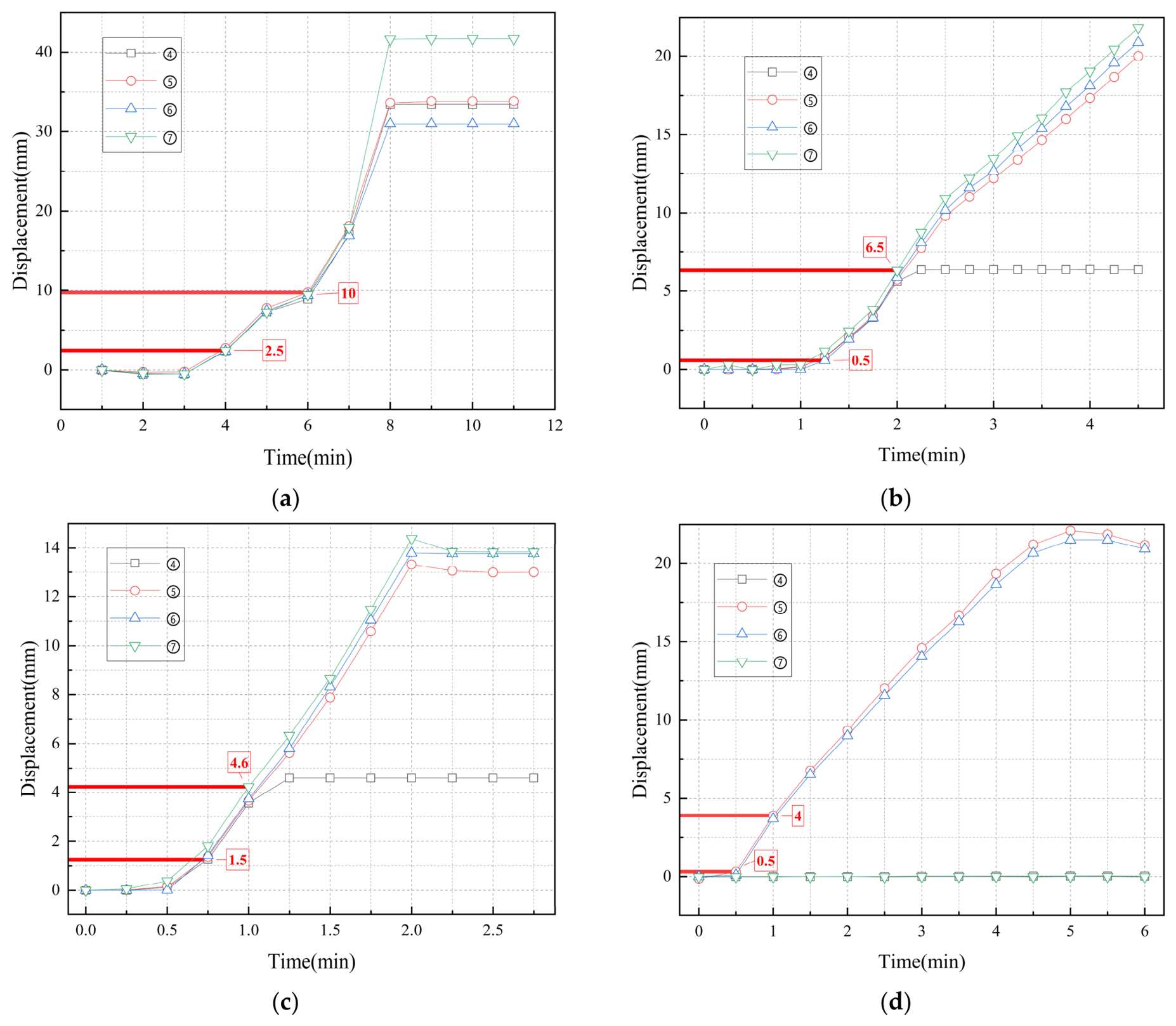
- The instability mechanism of multilayer pad systems was experimentally investigated, and a displacement-based stability assessment criterion was proposed.
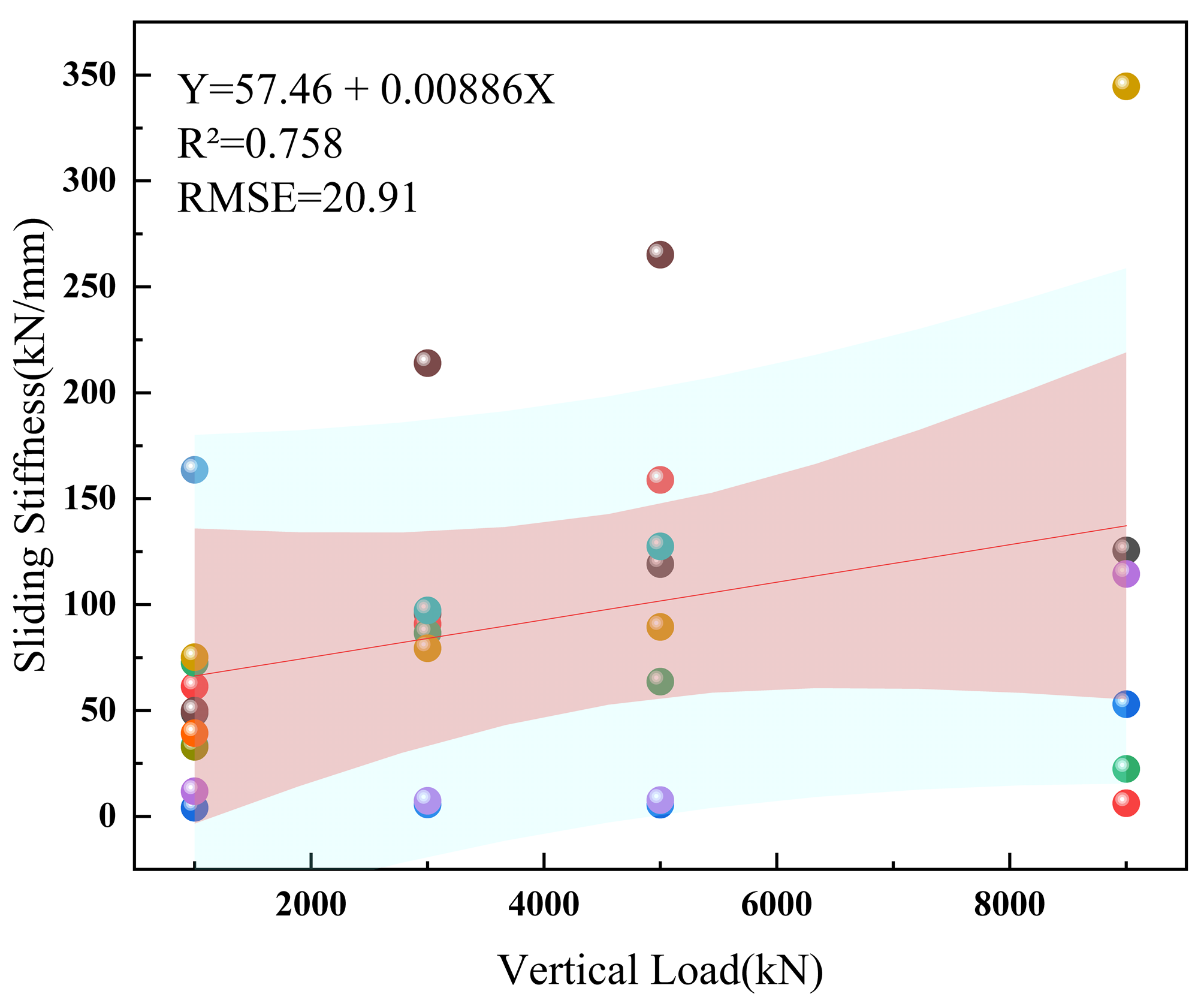
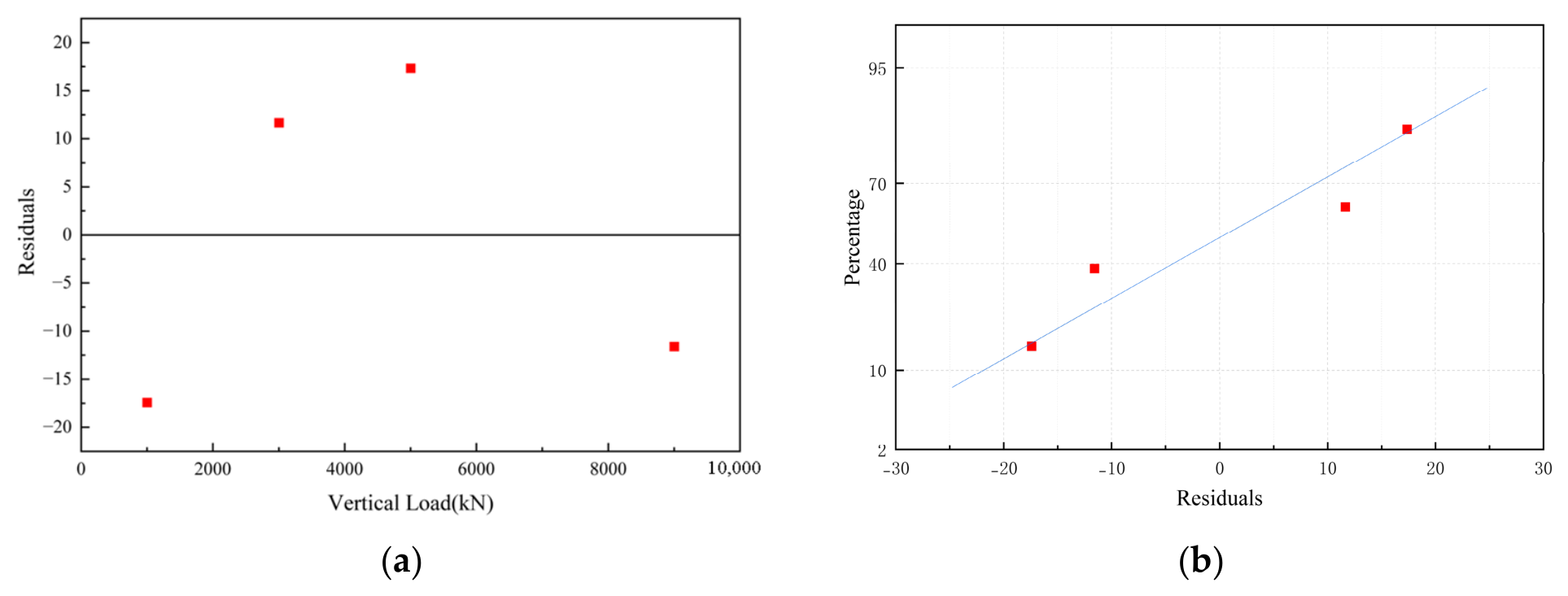
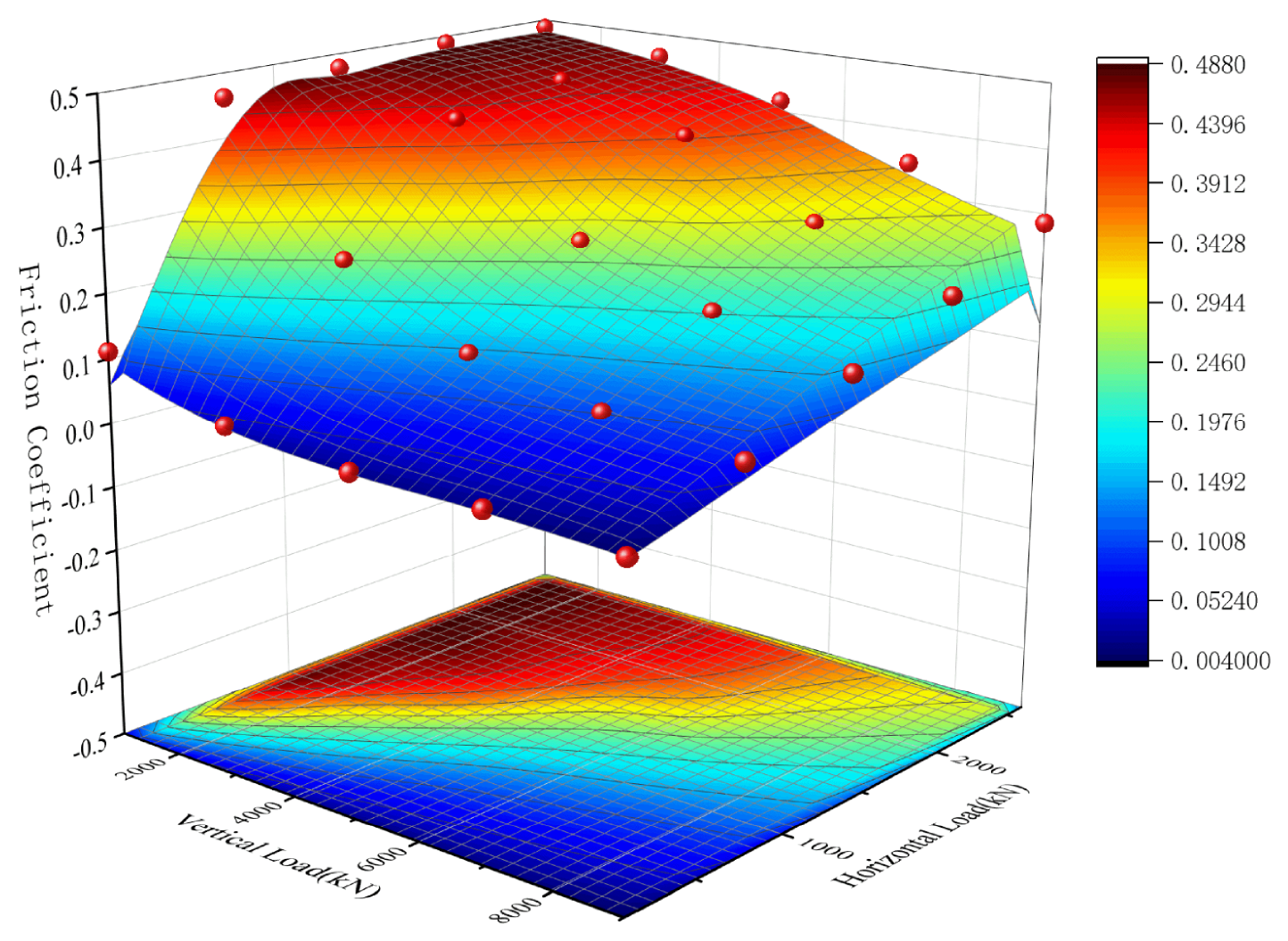
- A load-dependent sliding stiffness model was established and evaluated through residual analysis and error assessment.
- Design-oriented recommendations regarding material selection, allowable pad stacking height, safety factors, and displacement monitoring were developed for practical bridge launching applications.
2. Project Background
2.1. Project Overview
2.2. Construction Method
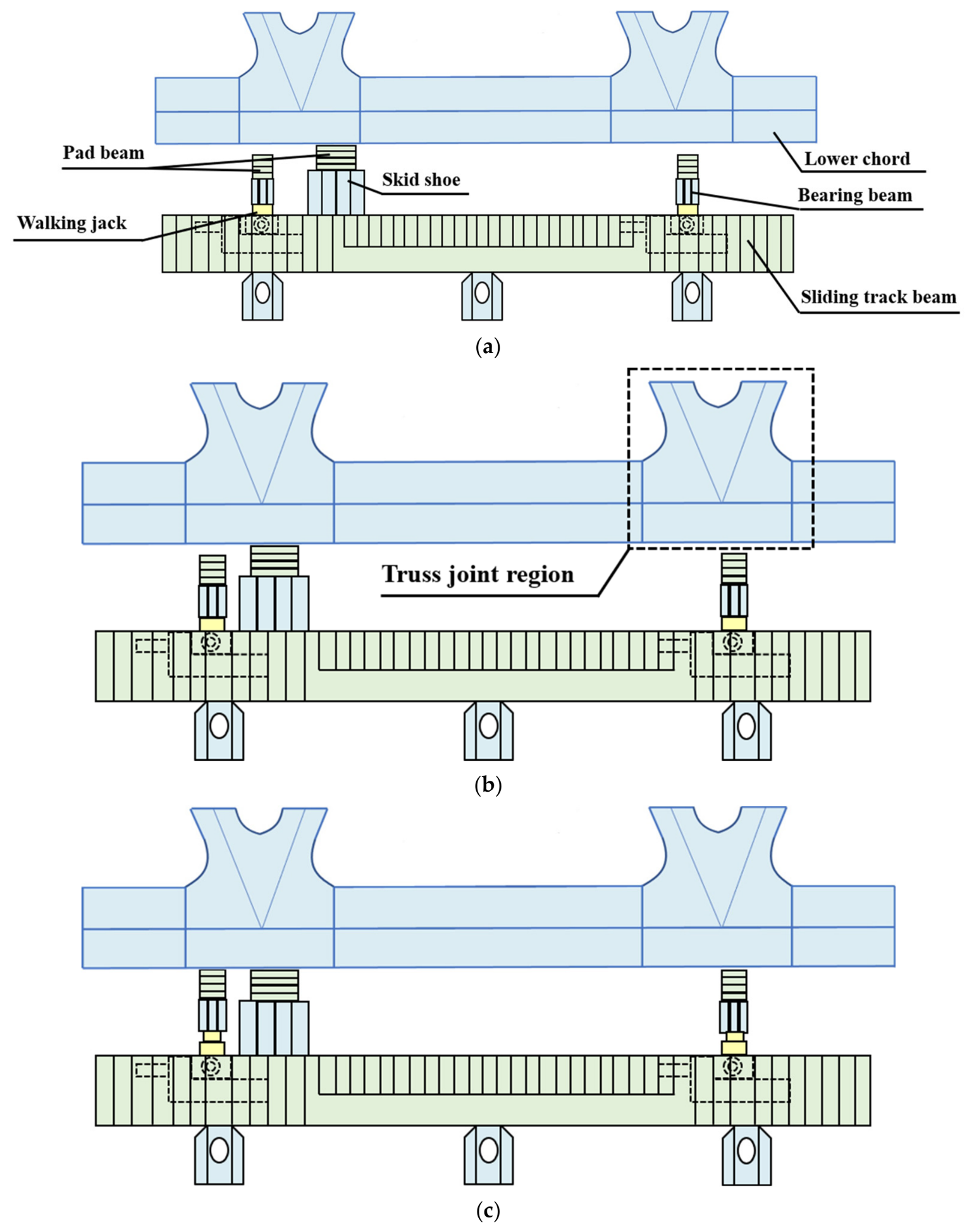
- Step 1: The front and rear walking jacks are positioned on the sliding track beams above the piers. At this stage, they are not in contact with the lower chord of the truss and remain unloaded. Simultaneously, skid shoes are installed at the lower chord panel joints. The pad beams are placed in full contact with the lower chord to support the self-weight of the truss girder, as shown in Figure 2b.
- Step 2: The front and rear walking jacks are raised vertically to make full contact with the bottom surface of the truss lower chord. Each walking jack has a maximum jacking capacity of 3000 kN, which remains within the design requirement stipulating that the load between adjacent lower chord joints must not exceed 3900 kN. Meanwhile, the skid shoes provide a maximum vertical load capacity of 18,000 kN, as shown in Figure 2c.
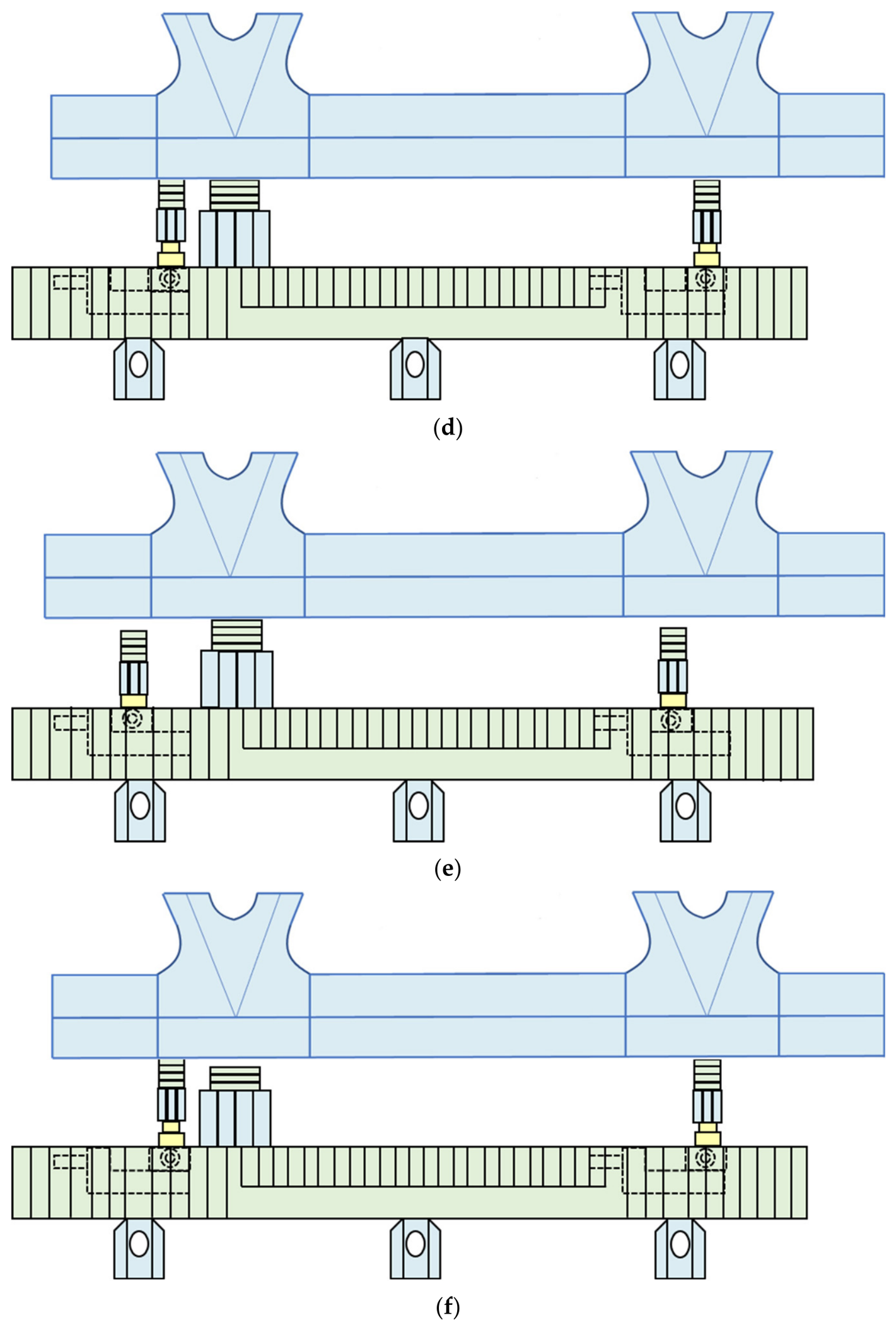
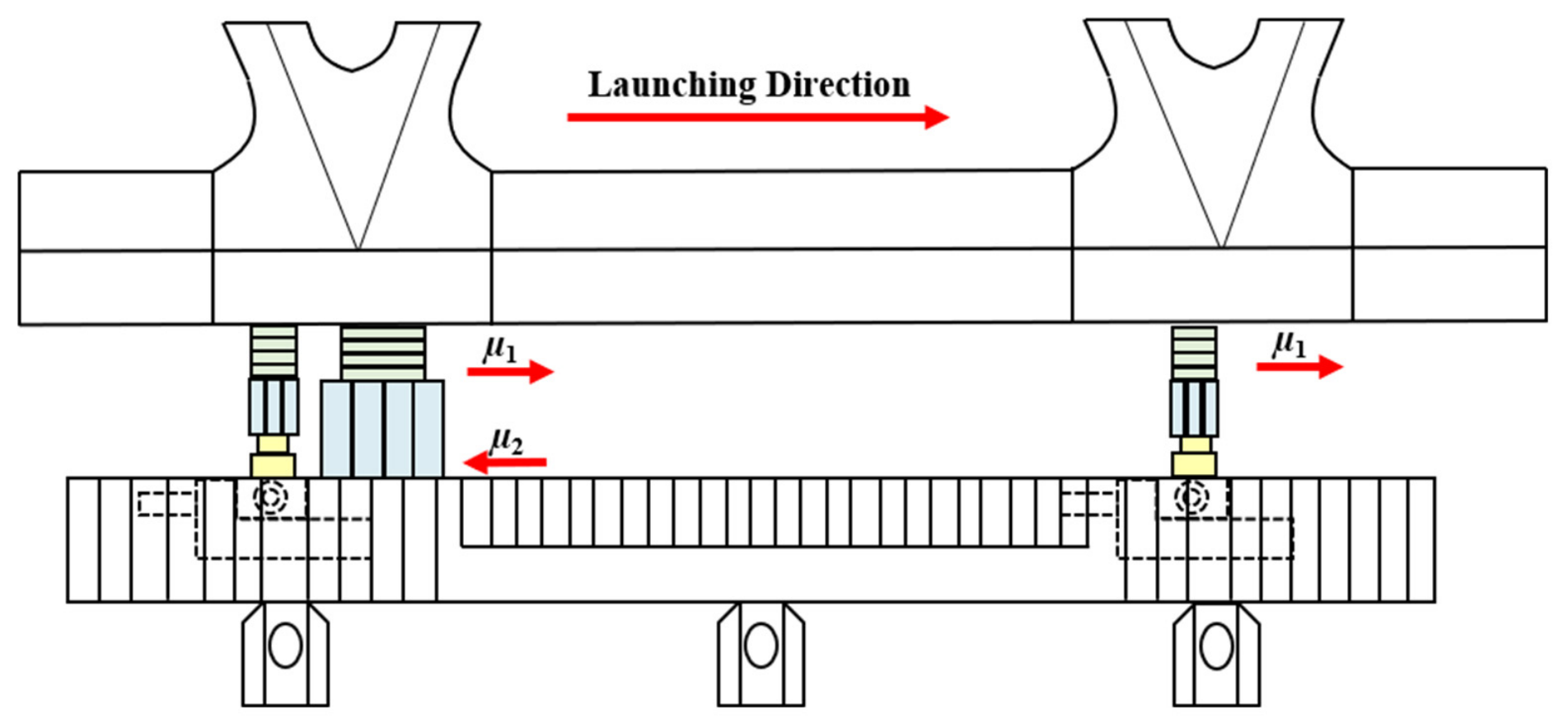
- Step 3: The walking jacks apply a horizontal force to push the steel truss forward. This movement is achieved through the friction between the lower chord of the truss and the skid shoes, facilitating the advancement of the truss. Concurrently, the skid shoes slide along the sliding track beams. The sliding mechanism is driven by the friction generated between the pad beams (mounted on the skid shoes to increase the contact area) and the lower chord of the truss. To minimize the coefficient of friction, stainless steel plates are installed between the skid shoes and the sliding track beams, and lubricating grease is applied. After completing a sliding stroke of 600 mm, the horizontal jacking operation ceases, and the vertical jacks of both the front and rear walking jacks are prepared for retraction (i.e., unloading and cylinder shortening), as shown in Figure 2d.
- Step 4: The vertical jacks of the front and rear walking jacks begin their return stroke (i.e., unloading and cylinder retraction) until the skid shoes fully support the vertical load and reach full load-bearing capacity. At this stage, the vertical jacks are completely disengaged from the skid shoes. Subsequently, the horizontal jacks are then retracted, returning to their initial position as in Step 1, as shown in Figure 2e.
- Step 5: The front and rear walking jacks are extended vertically until full contact is established with the bottom surface of the truss lower chord. The jacking points are situated within the truss joint area to avoid loading between panel points, with a maximum permitted jacking force of 12,000 kN. The skid shoes are then detached from the lower chord and transition into a non-load-bearing state. A winch is employed to retract the skid shoes back to their initial positions, allowing them to be repositioned below the subsequent set of lower chord joints. The vertical jacks are subsequently retracted (unloaded and shortened) until the skid shoes fully support the vertical load (100%), marking the completion of the cycle and the readiness for the next launching phase, as illustrated in Figure 2f.


2.3. Construction Challenges
3. Test Program
3.1. Test Design
3.2. Measurement Arrangement
3.2.1. Skid Shoe Tests
3.2.2. Interface Friction Tests
3.3. Loading Scheme
3.3.1. Skid Shoe Tests
3.3.2. Interface Friction Tests
4. Test Results and Analysis
4.1. Failure Modes
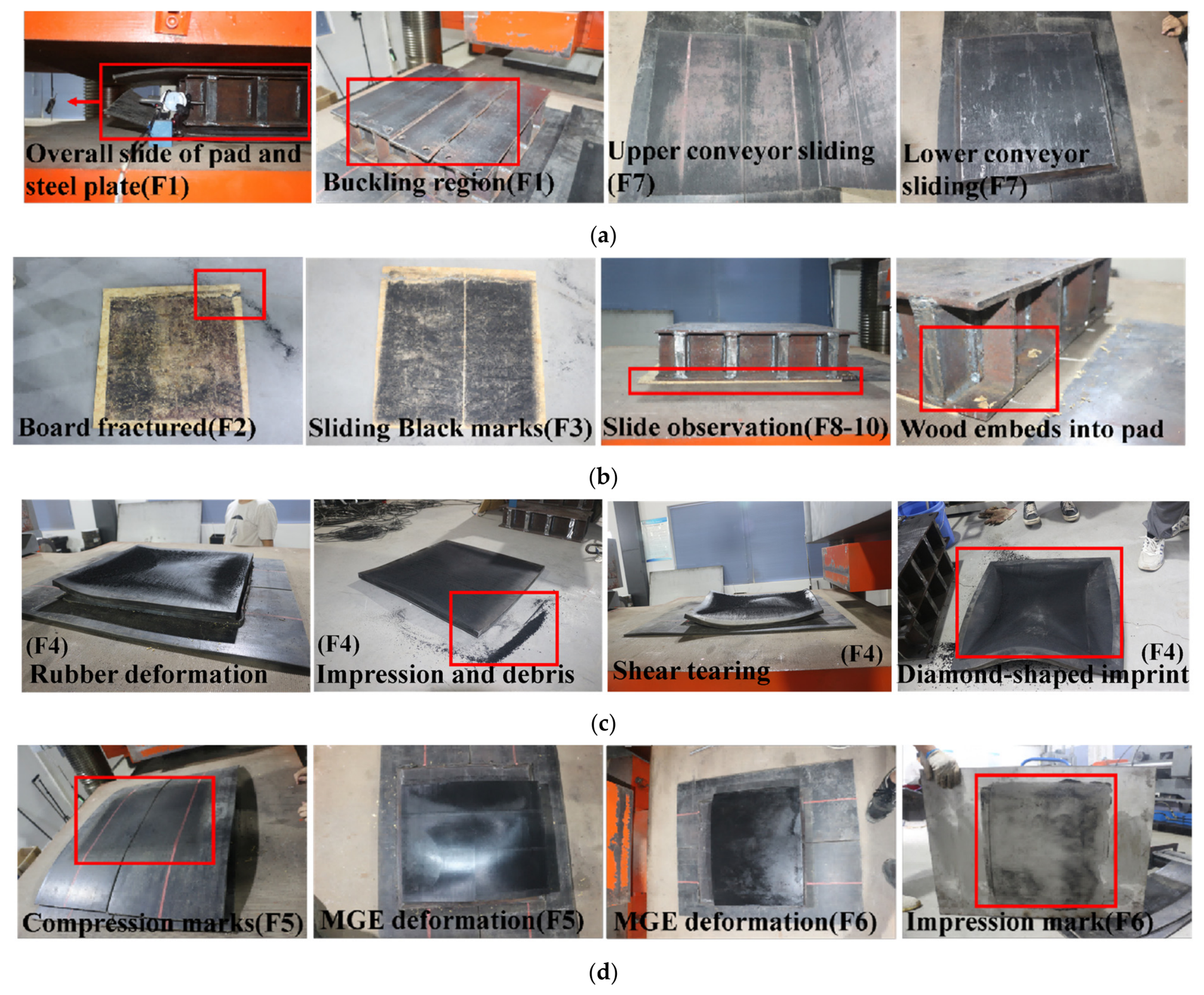
4.1.1. Skid Shoe Tests
4.1.2. Interface Friction Tests
4.2. Load–Displacement Behavior
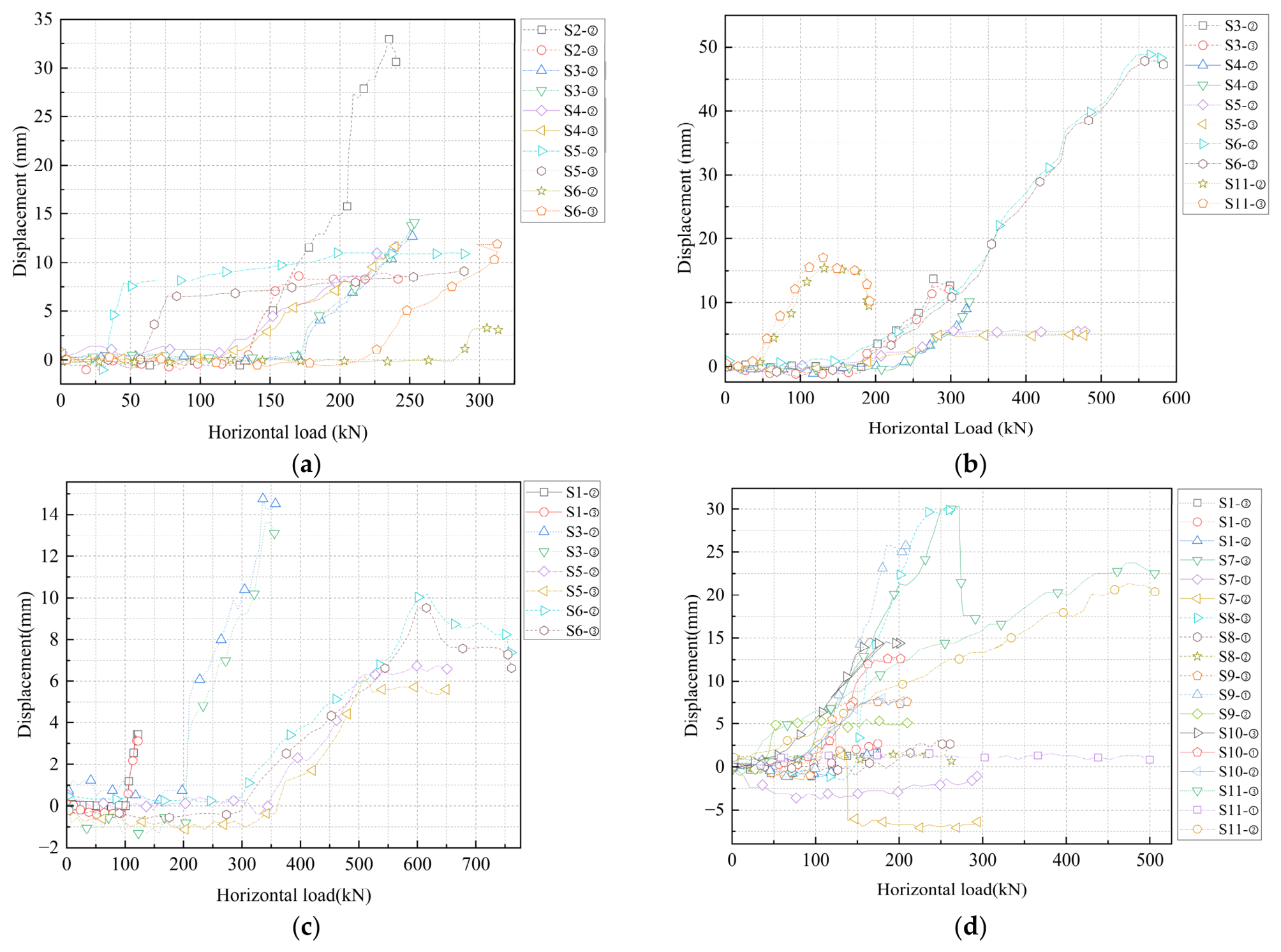
4.2.1. Skid Shoe Tests
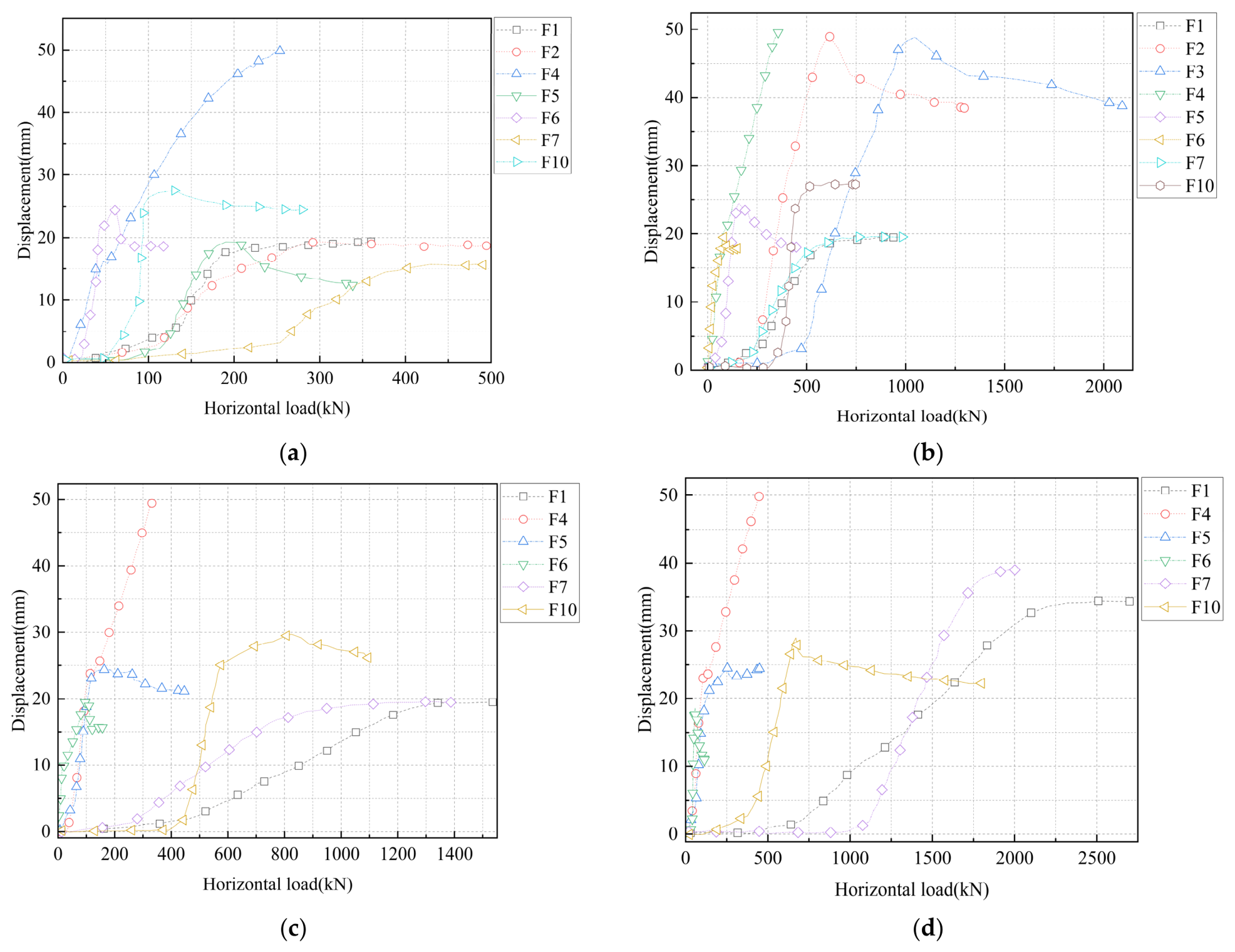
4.2.2. Interface Friction Tests
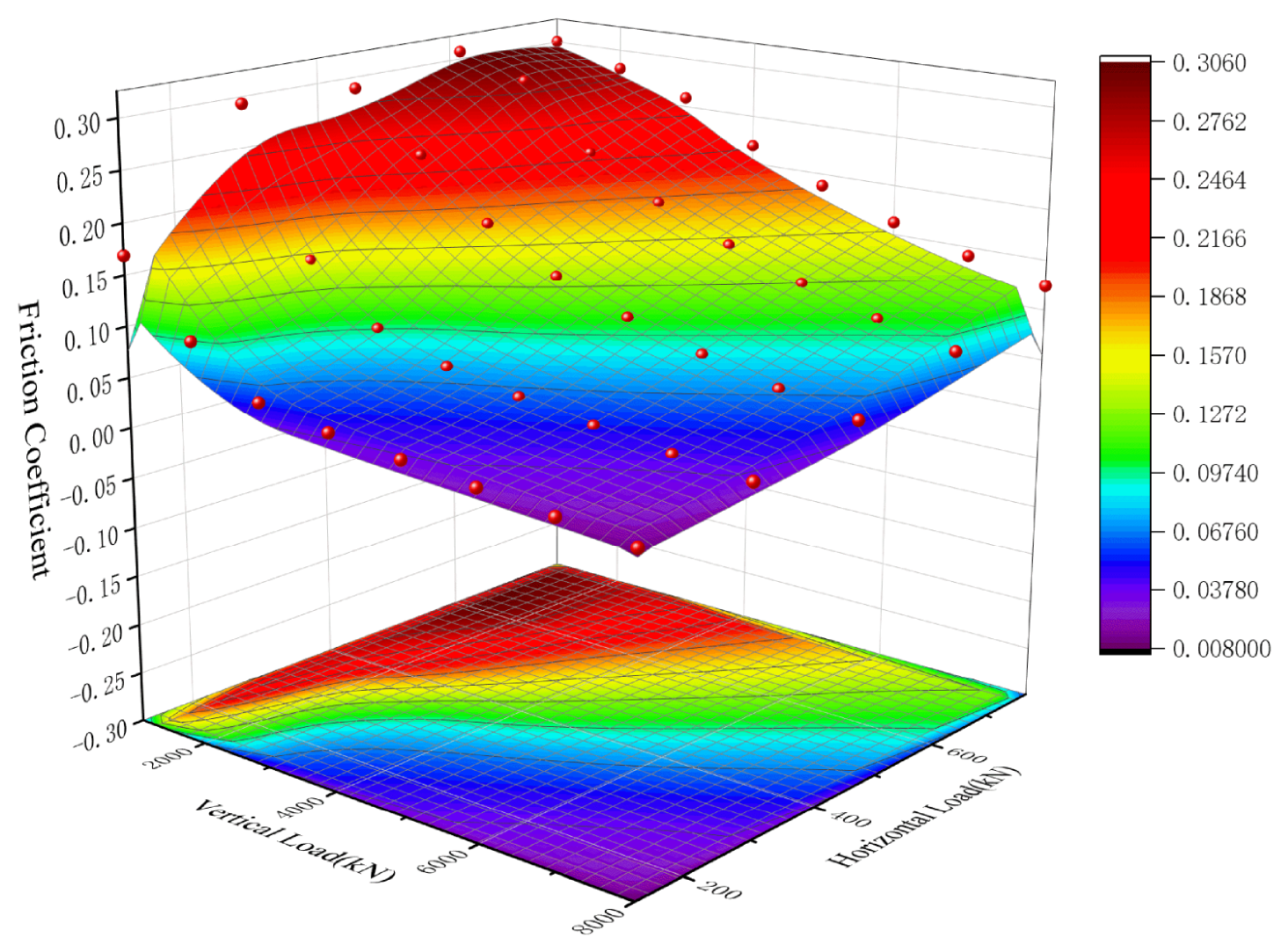
4.3. Friction Coefficient Results
4.3.1. Skid Shoe Tests
4.3.2. Interface Friction Tests
4.4. Stability Analysis of Skid Shoe Tests
4.4.1. Stability Analysis
4.4.2. Applicability and Limitations of the Proposed Stability Criterion
4.4.3. Engineering Stability Enhancement Measures
- Shear keys, anchor bolts, or high-friction inserts may be installed at the lower interfaces to increase shear resistance and delay slip initiation.
- Lateral limiters may be introduced at regular intervals (e.g., every three to five layers) to prevent progressive accumulation of interlayer displacement.
- Relative interlayer displacements should be monitored during launching. When cumulative slip approaches the allowable limit, corrective actions such as re-jacking, re-tightening, or additional restraints should be implemented before construction proceeds.
4.5. Engineering Applicability and Scale Effect
5. Load-Dependent Sliding Stiffness Characterization and Regression Modeling
5.1. Calculation of Nominal Sliding Stiffness
5.2. Regression Modeling of Sliding Stiffness
6. Engineering Design Recommendations
- n ≤ 8 layers: [δ] ≤ 2.0 mm
- 9 ≤ n ≤ 12 layers: [δ] ≤ 2.5 mm
- n ≥ 13 layers: [δ] ≤ 3.5 mm
7. Conclusions
- The lubricated MGE–stainless steel interface consistently exhibited low friction coefficients under heavy vertical loads. The measured friction coefficients ranged from 0.017 to 0.074 under vertical loads up to 8000 kN, demonstrating stable low-friction behavior within the investigated loading range.
- Material combinations involving densified wood, rubber, and steel generated significantly higher friction coefficients than the MGE-based interface and are therefore suitable for establishing the high-friction side of the friction-gradient system required for skid shoe launching operations.
- Progressive accumulation of interlayer slip was identified as the primary instability mechanism of multilayer pad assemblies. Instability consistently initiated at the lower interfaces and propagated upward as the pad stacking height increased.
- Based on the measured instability displacements, a displacement control criterion was proposed for pad systems employing the same pad geometry, interface configuration, and loading conditions as those investigated in this study. The resulting safety factors ranged from 1.86 to 2.86, exceeding the minimum engineering requirement adopted in this work.
- The experimental results provide practical guidance for interface-material selection, multilayer pad configuration, displacement monitoring, and stability control in walking-type incremental launching construction.
Author Contributions
Funding
Data Availability Statement
Conflicts of Interest
References
- Zellner, W.; Svensson, H. Incremental launching of structures. J. Struct. Eng. 1983, 109, 520–537. [Google Scholar] [CrossRef]
- Hu, Z.; Wu, D.; Sun, L.Z. Integrated investigation of an incremental launching method for the construction of long-span bridges. J. Constr. Steel Res. 2015, 112, 130–137. [Google Scholar] [CrossRef]
- Rosignoli, M. Thrust and guide devices for launched bridges. J. Bridge Eng. 2000, 5, 75–83. [Google Scholar] [CrossRef]
- Biezma, M.V.; Schanack, F. Collapse of steel bridges. J. Perform. Constr. Facil. 2007, 21, 398–405. [Google Scholar] [CrossRef]
- Wang, H.; Wu, Y.; Jian, L.; Zhao, Q. A nose beam segmental construction process for large-span composite emergency bridges. Structures 2024, 66, 106877. [Google Scholar] [CrossRef]
- Sun, Y.; Tai, X.X.; Liu, K.; Zhu, A.Z.; Zhu, H.P. Determining launching construction parameters of superlong superwide bridges: A multiobjective optimization method using machine learning techniques. Structures 2022, 41, 15–28. [Google Scholar] [CrossRef]
- Liu, Z.; Zhao, K.; Xiong, Y.; Wang, B. Calculation method of temporary cable force in incremental launching construction of large span steel box girder without auxiliary pier. Sci. Rep. 2024, 14, 20635. [Google Scholar] [CrossRef] [PubMed]
- Wu, X.; Wu, T.; Chen, W. Analysis of height difference between three trusses of a steel truss bridge during incremental launching. Stahlbau 2018, 87, 910–922. [Google Scholar] [CrossRef]
- Martins, H.M.; Thrall, A.P.; Byers, D.D.; Zoli, T.P. Behavior of incrementally launched modular steel truss bridges. Eng. Struct. 2025, 326, 119509. [Google Scholar]
- Wang, J.F.; Lin, J.P.; Xu, R.Q. Incremental launching construction control of long multispan composite bridges. J. Bridge Eng. 2015, 20, 04015006. [Google Scholar] [CrossRef]
- Zhao, L.; Xu, R.; Wang, Y.; Tian, C.; Qiu, K. Local deformation analysis and optimization of steel box girder during incremental launching. Buildings 2024, 14, 2241. [Google Scholar] [CrossRef]
- Chacón, R.; Uribe, N.; Oller, S. Numerical validation of the incremental launching method of a steel bridge through a small-scale experimental study. Exp. Tech. 2016, 40, 333–346. [Google Scholar]
- Rogač, M. Serviceability limit state of incrementally launched steel bridge I-girders. Eng. Struct. 2024, 315, 118465. [Google Scholar] [CrossRef]
- Chacón, R.; Zorrilla, R. Structural health monitoring in incrementally launched steel bridges: Patch loading phenomena modeling. Autom. Constr. 2015, 58, 60–73. [Google Scholar] [CrossRef]
- Fontan, A.N.; Diaz, J.M.; Baldomir, A.; Hernandez, S. Improved optimization formulations for launching nose of incrementally launched prestressed concrete bridges. J. Bridge Eng. 2011, 16, 461–470. [Google Scholar] [CrossRef]
- Granata, M.F.; Margiotta, P.; Arici, M. A parametric study of curved incrementally launched bridges. Eng. Struct. 2013, 49, 373–384. [Google Scholar]
- Granata, M.F. Analysis of non-uniform torsion in curved incrementally launched bridges. Eng. Struct. 2014, 75, 374–387. [Google Scholar] [CrossRef]
- Tanner, P.; Bellod, J.L.; Sanz, D.; Hingorani, R. Lessons from incidents attributable to the uncertainties in bridge launching illustrated by a case study. Civ. Eng. Environ. Syst. 2013, 30, 146–161. [Google Scholar] [CrossRef]
- Perez, V.P.; Gonzalez, L.P.; Peireti, H.C.; Alfonso, F.T. The launching of the Pavilion Bridge, Zaragoza, Spain. Struct. Eng. Int. 2011, 21, 437–442. [Google Scholar] [CrossRef]
- O’Connor, M.; Attrill, M.; Gibb, I.; Oh, S.H. Launching of Leigh Road Bridge, Slough, UK. Proc. Inst. Civ. Eng.-Civ. Eng. 2016, 169, 129–135. [Google Scholar] [CrossRef]
- Bernardo, H.; Thompson, S.; Vazquez, A.; Ward, A.; Gonzalez, J.M.; Niño, F. Launched south approach viaduct in the Queensferry Crossing, UK: Design and construction. Proc. Inst. Civ. Eng.-Bridge Eng. 2019, 172, 145–153. [Google Scholar] [CrossRef]
- Navarro, M.G.; Lebet, J.P.; Beylounü, R. Launching of the Vaux Viaduct. Struct. Eng. Int. 2000, 10, 16–18. [Google Scholar] [CrossRef]
- Lebet, J.P. Measurements during construction and launching of a 130 m span length composite bridge. Compos. Constr. Steel Concr. V 2006, 25–34. [Google Scholar] [CrossRef]
- Gale, R. Incremental launching of steel girders in British Columbia—Two case studies. Struct. Eng. Int. 2018, 21, 443–449. [Google Scholar]
- Marzouk, M.; El-Dein, H.Z.; El-Said, M. Application of computer simulation to construction of incremental launching bridges. J. Civ. Eng. Manag. 2007, 13, 27–36. [Google Scholar] [CrossRef]
- Alonso-Martinez, M.; del Coz Díaz, J.J.; Navarro-Manso, A.; Castro-Fresno, D. Bridge-structure interaction analysis of a new bidirectional and continuous launching bridge mechanism. Eng. Struct. 2014, 59, 298–307. [Google Scholar]
- Navarro-Manso, A.; del Coz Díaz, J.J.; Alonso-Martínez, M.; Castro-Fresno, D.; Rabanal, F.P.A. Patch loading in slender and high depth steel panels: FEM-DOE analyses and bridge launching application. Eng. Struct. 2015, 83, 74–85. [Google Scholar]
- Navarro-Manso, A.; del Coz Díaz, J.J.; Alonso-Martínez, M.; Blanco-Fernández, E.; Castro-Fresno, D. New launching method for steel bridges based on a self-supporting deck system: FEM and DOE analyses. Autom. Constr. 2014, 44, 183–196. [Google Scholar] [CrossRef]
- Zhu, C.; Li, R.; Zhang, Z.Y. Jacking force controlling technique of PC beam flexible piers based on multiple points pushing method. Appl. Mech. Mater. 2013, 395, 548–554. [Google Scholar] [CrossRef]
- Zhang, H.; Luo, Z.; Guo, J. Design of automatic positioning equipment for cross beam. Open Constr. Build. Technol. J. 2016, 10, 17–26. [Google Scholar] [CrossRef]
- Sampaio, A.Z.; Martins, O.P. The application of virtual reality technology in the construction of bridge: The cantilever and incremental launching methods. Autom. Constr. 2014, 37, 58–67. [Google Scholar] [CrossRef]
- Li, X.; Cao, Y.; Pan, P. Experimental investigation of tribological performance of PTFE-derived solid lubricants in sliding building bearings. Constr. Build. Mater. 2024, 436, 136924. [Google Scholar] [CrossRef]
- Sun, W.; Liu, X.; Liu, K.; Xu, J.; Lu, Y.; Ye, J. A self-sustaining PTFE/PEEK heterolayered structure for ultra-low friction and wear. Friction 2024, 12, 120–135. [Google Scholar] [CrossRef]
- Bergmann, A.; Sumpf, J. A semi-analytical calculation model for the coefficient of friction of spherical protrusions: Deformative and adhesive friction parts. Friction 2024, 12, 1939–1951. [Google Scholar] [CrossRef]
- Hou, Y.; Chen, L.; Zhang, Z.; Chang, J.; Weng, D.; Ma, Y.; Wang, J. A novel UHMWPE composite with low friction coefficient for long-term ice sliding. Friction 2024, 12, 2477–2487. [Google Scholar] [CrossRef]
- Chen, T.; Ma, W.; Zhu, K.; Hu, Z. Wear simulation of UHMWPE against different counterface roughness in reciprocating unidirectional sliding motion. Sci. Rep. 2024, 14, 15858. [Google Scholar] [CrossRef] [PubMed]
- Chen, J.; Wu, B.; Zhu, L.; Huang, G.; Xu, S. Comparative study on the performance of the pad of the walking-type incremental launching steel box beam. Mod. Transp. Technol. 2021, 18, 50–55. (In Chinese) [Google Scholar]
- GB 50007-2011; Code for Design of Building Foundation. Ministry of Housing and Urban-Rural Development of the People’s Republic of China: Beijing, China, 2011.
- JTG 3363-2019; Specifications for Design of Foundation of Highway Bridges and Culverts. Ministry of Transport of the People’s Republic of China: Beijing, China, 2019.





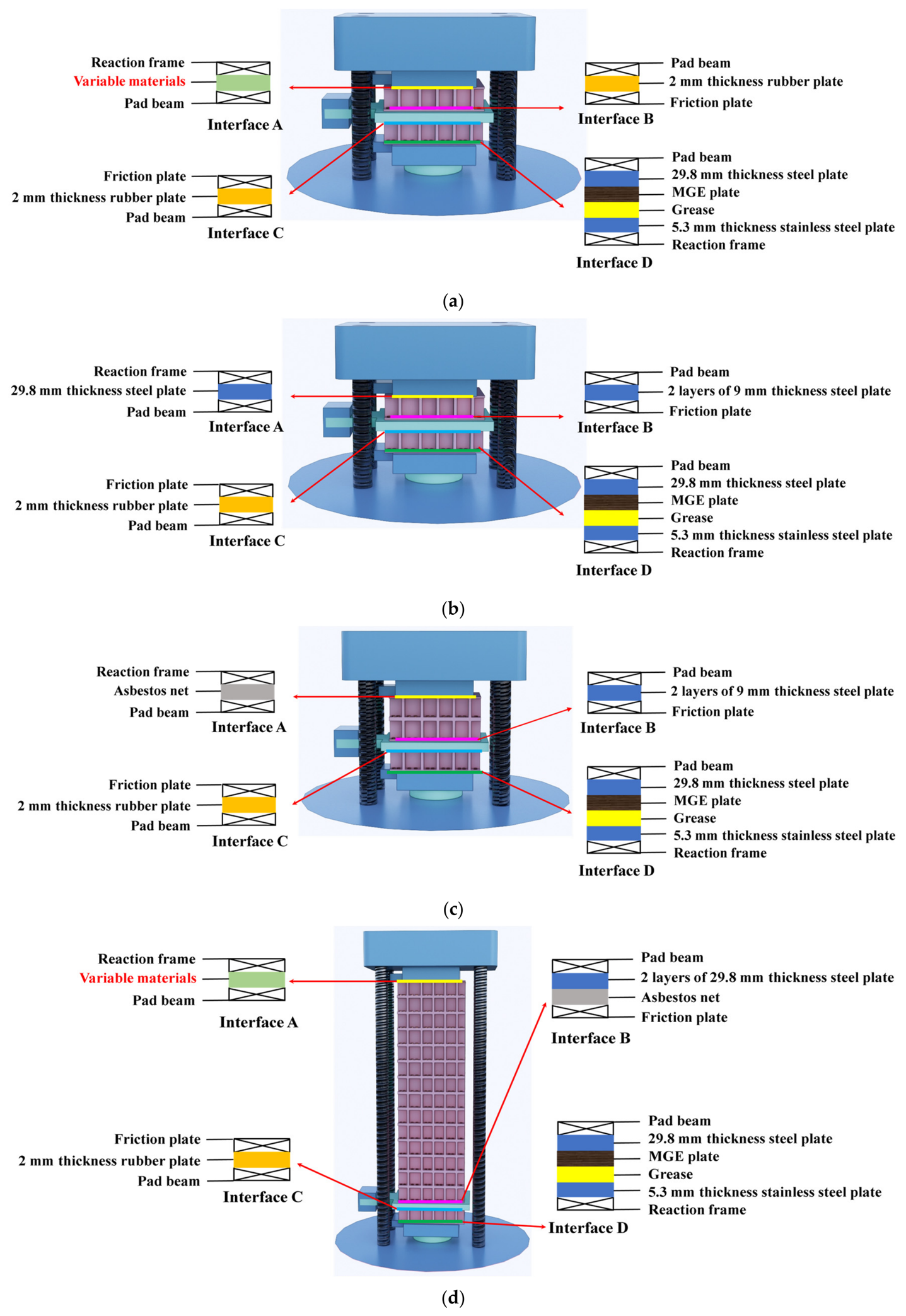
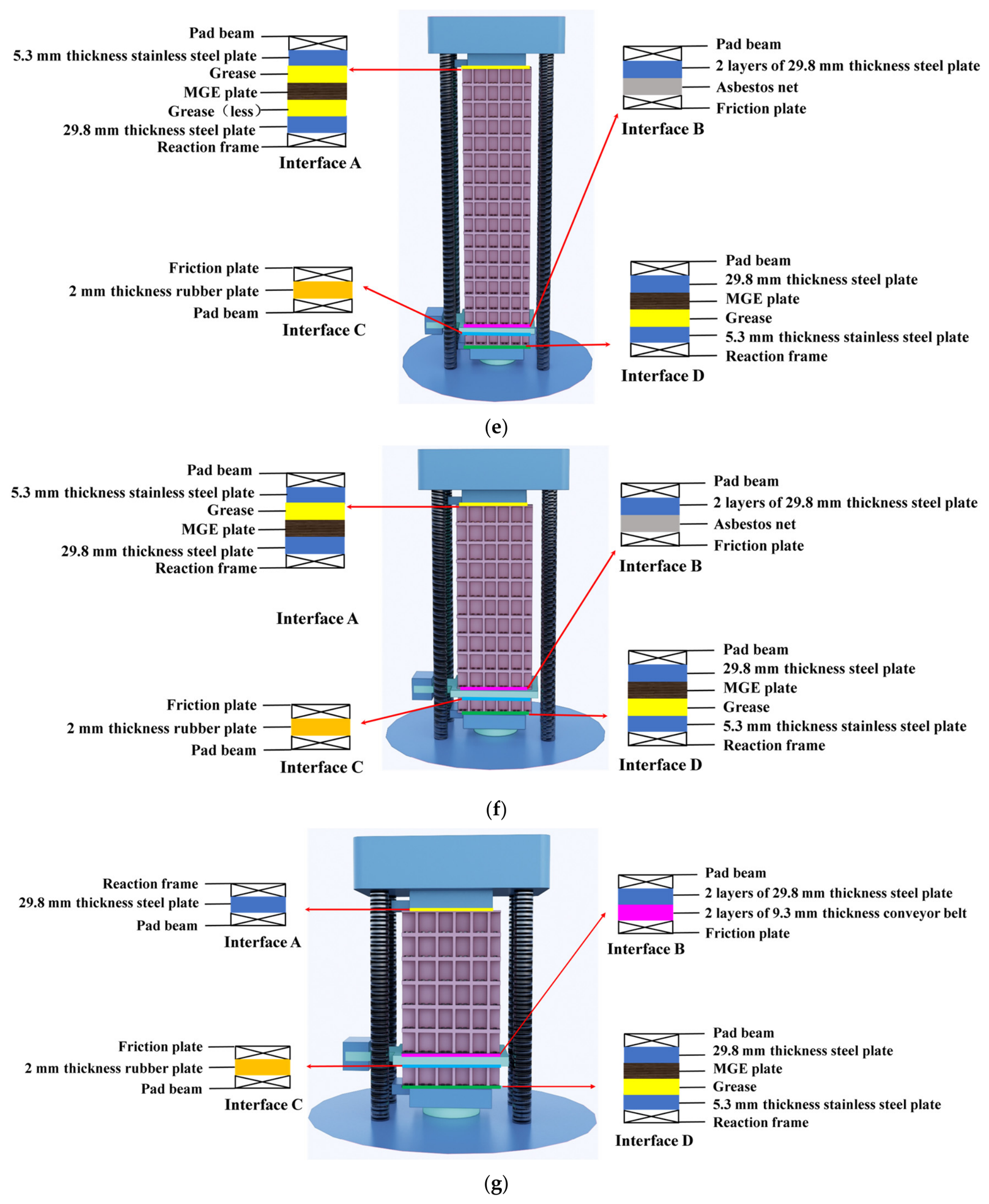
| Specimen No. | Interface A | Pads | Interface B | Interface C | Interface D |
|---|---|---|---|---|---|
| S1 | Stainless steel plate | 1 | Thin rubber plate | Thin rubber plate | Thick steel plate + MGE plate + Grease + Stainless steel plate |
| Grease | |||||
| MGE plate | |||||
| Thick steel plate | |||||
| S2 | Thick rubber plate | ||||
| Thick steel plate | |||||
| S3 | Thin rubber plate | ||||
| Thick steel plate | |||||
| S4 | Thin steel plate | ||||
| Thick steel plate | |||||
| S5 | Thick steel plate | 2 layers of thin steel plate | |||
| S6 | Asbestos net | 2 | |||
| S7 | Stainless steel plate | 14 | 2 layers of thin steel plate + Asbestos net | ||
| MGE plate | |||||
| Grease | |||||
| S8 | Stainless steel plate | ||||
| Grease | |||||
| MGE plate | |||||
| Thick steel plate | |||||
| S9 | Stainless steel plate | 16 | |||
| Grease | |||||
| MGE plate | |||||
| Grease | |||||
| Thick steel plate | |||||
| S10 | Stainless steel plate | 10 | |||
| Grease | |||||
| MGE plate | |||||
| Thick steel plate | |||||
| S11 | Thick steel plate | 6 | 2 layers of thin steel plate | ||
| Conveyor belts |
| Specimen No. | Variable Interface Conditions |
|---|---|
| F1 | 2 conveyor belts + Thick steel plate + Pad beam + 2 conveyor belts |
| F2 | 2 conveyor belts + Densified wood board + Thick steel plate + 2 conveyor belts |
| F3 | Densified wood board + Thick steel plate + 2 conveyor belts |
| F4 | 2 conveyor belts + Thick steel plate + Thick rubber pad |
| F5 | 2 conveyor belts + Thick steel plate + MGE plate + 2 conveyor belts |
| F6 | 2 conveyor belts + Thick steel plate + MGE plate(greased) + Stainless steel plate + 2 conveyor belts |
| F7 | 2 conveyor belts + Thick steel plate + 2 conveyor belts |
| F8 | 2 conveyor belts + 2 pad beam layers + Densified wood board + 2 conveyor belts |
| F9 | Densified wood board + 3 pad beam layers + Densified wood board |
| F10 | Densified wood board + 1 pad beam layer + Densified wood board |
| Material Type | Length (mm) | Width (mm) | Thickness (mm) |
|---|---|---|---|
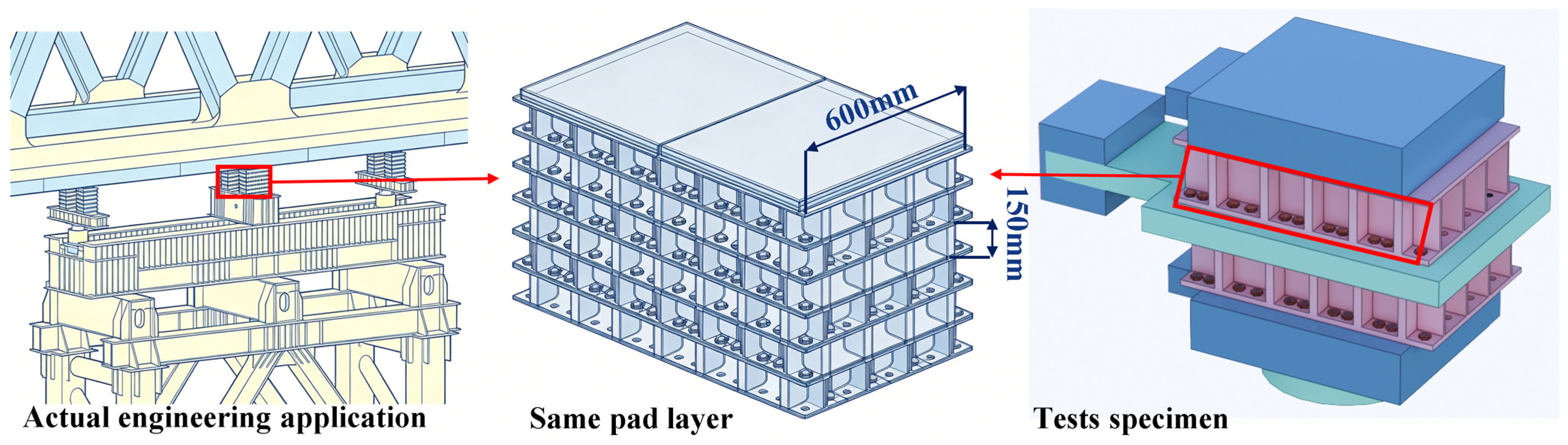
| Pad beam (I-steel) | 600 | 150 | 150 |
| Thin steel plate | 600 | 300 | 9 |
| Thick steel plate | 545 | 545 | 29.8 |
| Thin rubber plate | 620 | 620 | 2 |
| Thick rubber pad | 598 | 552 | 21.4 |
| MGE plate | 550 | 448 | 30.1 |
| Stainless steel plate | 998 | 700 | 5.3 |
| Conveyor belt | 1008 | 397 | 9.3 |
| Densified wood board | 610 | 603 | 8.1 |
| Asbestos netting | / | / | / |
| Specimen No. | Vertical Load (kN) | Horizontal Load (kN) | Sliding Interfaces | Friction Coefficient |
|---|---|---|---|---|
| S1 | 3000 | 221 | MGE plate + Grease | 0.074 |
| 3000 | 164.41 | 0.055 | ||
| 8000 | 132.7 | 0.017 | ||
| 8000 | 180.63 | 0.023 | ||
| 8000 | 191.68 | 0.024 | ||
| S2 | 1000 | 248.43 | Pad + Rubber | 0.248 |
| S3 | 1000 | 253.62 | Pad + Rubber | 0.254 |
| 2000 | 302.27 | 0.151 | ||
| 3000 | 360.53 | 0.120 | ||
| S4 | 1000 | 241.06 | Rubber + Horizontal Actuator | 0.241 |
| 2000 | 326.58 | 0.163 | ||
| S5 | 1000 | 289.74 | Thick Steel + Reaction Frame | 0.290 |
| 2000 | 482.14 | 0.241 | ||
| 3000 | 657.51 | Pads + Steel | 0.219 | |
| S6 | 1000 | 314.08 | Pads + Steel | 0.314 |
| 2000 | 588.21 | 0.294 | ||
| 3000 | 777.2 | 0.259 | ||
| S7 | 8000 | 244.77 | Pads | 0.031 |
| 8000 | 304.51 | 0.038 | ||
| S8 | 8000 | 263.92 | MGE plate + Grease | 0.033 |
| 8000 | 234.44 | 0.029 | ||
| S9 | 8000 | 209.38 | MGE plate + Grease | 0.026 |
| 8000 | 211.58 | 0.026 | ||
| S10 | 8000 | 202.73 | MGE plate + Grease | 0.025 |
| 8000 | 203.49 | 0.025 | ||
| S11 | 8000 | 515.3 | Pads | 0.064 |
| 2000 | 193.88 | 0.097 |
| Property | PTFE Plate | MGE Plate | Source |
|---|---|---|---|
| Elastic Modulus (MPa) | 1420 | 1000–1500 * | Ref. [37]; UHMWPE literature [32,33,34,35,36] |
| Compressive Strength (MPa) | 25 | ≥150 | Ref. [37]; OVT data |
| Friction Coefficient (μ) | 0.08–0.12 | 0.017–0.074 | Ref. [37]; Present study |
| Wear Rate (mm3/km) | ≥3.0 | 0.5 | ASTM D3702; OVT data |
| Creep Rate (70 °C/24 h) | ≥3.0% | ≤0.5% * | ASTM D621; OVT data |
| Operating Temperature Range (°C) | −180 to +260 | −100 to +300 | ASTM D794; OVT data |
| Shore Hardness (Shore D) | 50–65 | ≥70 | ASTM D2240; OVT data |
| Specimen No. | Vertical Load (kN) | Horizontal Load (kN) | Sliding Interfaces | Friction Coefficient |
|---|---|---|---|---|
| F1 | 1000 | 350 | Pad + Thick Steel Plate | 0.350 |
| 3000 | 925 | 0.308 | ||
| 5000 | 1508 | 0.302 | ||
| 9000 | 2610 | 0.290 | ||
| F2 | 1000 | 480 | Densified Wood + Thick Steel Plate | 0.480 |
| 3000 | 1280 | 0.427 | ||
| F3 | 5000 | 2078 | Densified Wood + Thick Steel Plate | 0.416 |
| F4 | 1000 | 260 | Rubber + Thick Steel Plate | 0.260 |
| 3000 | 360 | 0.120 | ||
| 5000 | 343 | 0.069 | ||
| 9000 | 440 | 0.049 | ||
| F5 | 1000 | 320 | MGE + Thick Steel Plate | 0.320 |
| 3000 | 440 | 0.147 | ||
| 5000 | 430 | 0.086 | ||
| 9000 | 440 | 0.049 | ||
| F6 | 1000 | 115 | Stainless Steel + MGE | 0.115 |
| 3000 | 147 | 0.049 | ||
| 5000 | 155 | 0.031 | ||
| 9000 | 112 | 0.012 | ||
| F7 | 1000 | 493 | Conveyor Belt + Thick Steel Plate | 0.493 |
| 3000 | 1000 | 0.333 | ||
| 5000 | 1370 | 0.274 | ||
| 9000 | 2116 | 0.235 | ||
| F8 | 1000 | 395 | Pad + Densified Wood | 0.395 |
| 1000 | 290 | 0.290 | ||
| 1000 | 436 | 0.436 | ||
| F9 | 1000 | 405 | Densified Wood + Pad | 0.405 |
| 3000 | 870 | 0.290 | ||
| 5000 | 1100 | 0.220 | ||
| F10 | 1000 | 260 | Densified Wood + Pad | 0.260 |
| 3000 | 610 | 0.203 | ||
| 5000 | 950 | 0.190 | ||
| 9000 | 1820 | 0.202 |
| Specimen No. | Number of Pad Layers | Slip Initiation Displacement, δ1 (mm) | Critical Instability Displacement, δcr (mm) | Top and Bottom Layers Displacement Difference, Δδ (mm) |
|---|---|---|---|---|
| S8 | 14 | 2.5 | 10.0 | 0.5 |
| S9 | 16 | 0.5 | 6.5 | 15.5 |
| S10 | 10 | 1.5 | 4.6 | 9.4 |
| S11 | 6 | 0.5 | 4.0 | 4.0 |
| Specimen No. | Vertical Load (kN) | (kN) | (kN) | (mm) | (kN/mm) |
|---|---|---|---|---|---|
| F1 | 1000 | 130 | 350 | 4.5 | 48.9 |
| 3000 | 140 | 925 | 8.2 | 95.7 | |
| 5000 | 150 | 1508 | 11.4 | 119.1 | |
| 9000 | 110 | 2610 | 19.9 | 125.6 | |
| F2 | 1000 | 75 | 480 | 6.6 | 61.4 |
| 3000 | 100 | 1280 | 13 | 90.8 | |
| F3 | 5000 | 140 | 2078 | 12.2 | 158.9 |
| F4 | 1000 | 87 | 260 | 42.5 | 4.1 |
| 3000 | 135 | 360 | 39.2 | 5.7 | |
| 5000 | 146 | 343 | 35.2 | 5.6 | |
| 9000 | 200 | 440 | 38.0 | 6.3 | |
| F5 | 1000 | 30 | 320 | 4.0 | 72.5 |
| 3000 | 85 | 440 | 4.1 | 86.6 | |
| 5000 | 80 | 430 | 5.5 | 63.6 | |
| 9000 | 90 | 440 | 6.6 | 53.0 | |
| F6 | 1000 | 52 | 115 | 5.3 | 11.9 |
| 3000 | 93 | 147 | 7.3 | 7.4 | |
| 5000 | 77 | 155 | 10.1 | 7.7 | |
| 9000 | 65 | 112 | 2.1 | 22.4 | |
| F7 | 1000 | 95 | 493 | 5.3 | 75.2 |
| 3000 | 80 | 1000 | 11.6 | 79.4 | |
| 5000 | 90 | 1370 | 14.3 | 89.5 | |
| 9000 | 90 | 2116 | 17.7 | 114.5 | |
| F8 | 1000 | 120 | 395 | 8.2 | 33.5 |
| 1000 | 115 | 290 | 3.5 | 50.0 | |
| 1000 | 110 | 436 | 9.9 | 32.9 | |
| F9 | 1000 | 110 | 405 | 7.5 | 39.3 |
| 3000 | 150 | 870 | 7.4 | 97.3 | |
| 5000 | 220 | 1100 | 6.9 | 127.5 | |
| F10 | 1000 | 80 | 260 | 1.1 | 163.6 |
| 3000 | 75 | 610 | 2.5 | 214.0 | |
| 5000 | 75 | 950 | 3.3 | 265.2 | |
| 9000 | 200 | 1820 | 4.7 | 344.7 |
Disclaimer/Publisher’s Note: The statements, opinions and data contained in all publications are solely those of the individual author(s) and contributor(s) and not of MDPI and/or the editor(s). MDPI and/or the editor(s) disclaim responsibility for any injury to people or property resulting from any ideas, methods, instructions or products referred to in the content. |
© 2026 by the authors. Licensee MDPI, Basel, Switzerland. This article is an open access article distributed under the terms and conditions of the Creative Commons Attribution (CC BY) license.
Share and Cite
Liu, X.; Wang, Y.; Xu, S.; Jiang, L.; Cheng, G. Experimental Study on Interface Friction and Pad Stability in Walking-Type Incremental Launching Construction Using Skid Shoes. Buildings 2026, 16, 2486. https://doi.org/10.3390/buildings16132486
Liu X, Wang Y, Xu S, Jiang L, Cheng G. Experimental Study on Interface Friction and Pad Stability in Walking-Type Incremental Launching Construction Using Skid Shoes. Buildings. 2026; 16(13):2486. https://doi.org/10.3390/buildings16132486
Chicago/Turabian StyleLiu, Xiaoguang, Yuqi Wang, Shenghui Xu, Lei Jiang, and Gao Cheng. 2026. "Experimental Study on Interface Friction and Pad Stability in Walking-Type Incremental Launching Construction Using Skid Shoes" Buildings 16, no. 13: 2486. https://doi.org/10.3390/buildings16132486
APA StyleLiu, X., Wang, Y., Xu, S., Jiang, L., & Cheng, G. (2026). Experimental Study on Interface Friction and Pad Stability in Walking-Type Incremental Launching Construction Using Skid Shoes. Buildings, 16(13), 2486. https://doi.org/10.3390/buildings16132486