Research on the Evaluation of Prefabricated MEP Systems for Energy Stations Based on the AHP–Entropy–Fuzzy Model

 ,
, 

Abstract
1. Introduction
1.1. Research Background
- (1)
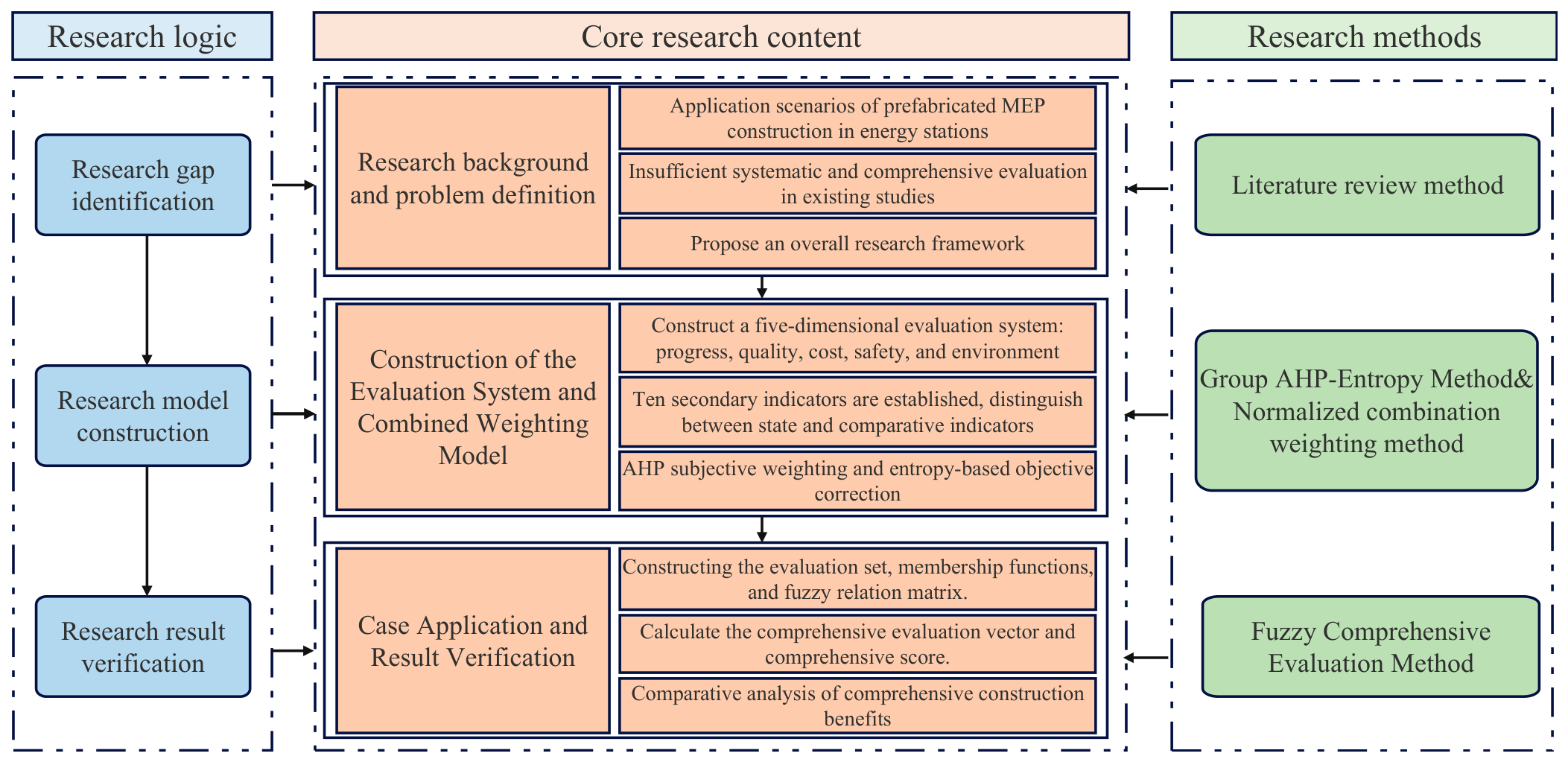
- A multi-dimensional evaluation index system is established by considering key factors such as construction progress, quality, cost, and environmental performance, thereby forming a structured and hierarchical evaluation framework.
- (2)
- A combined weighting approach is proposed, in which subjective weights derived from the AHP are integrated with objective weights obtained from the entropy method, enhancing the scientific robustness and reliability of the evaluation results.
- (3)
- A fuzzy comprehensive evaluation method is employed to construct membership functions and evaluation matrices, enabling the calculation of overall performance scores.
- (4)
- The proposed framework is further validated through a practical engineering case, demonstrating its applicability and effectiveness in assessing prefabricated energy station systems.
1.2. Research Framework
2. Models and Methods
2.1. AHP–Entropy Model Construction
2.2. Evaluation Index System Construction
- (1)
- Schedule Benefit
- (2)
- Quality Benefit
- (3)
- Cost Benefit
- (4)
- Safety Benefit
- (5)
- Environmental Benefit
2.3. Evaluation Model Construction
2.3.1. Determination of Subjective Weights
2.3.2. Determination of Objective Weights
- (1)
- State-type indicators, which directly reflect system performance or management outcomes (e.g., first-time acceptance pass rate), for which actual observed values are used.
- (2)
- Comparative indicators, which reflect performance improvements through comparison (e.g., construction duration and cost). These indicators are normalized using the mean values of the traditional construction samples as benchmarks and transformed into benefit-type indicators.
2.3.3. Determination of Combined Subjective–Objective Weights
2.3.4. Construction of the Fuzzy Comprehensive Evaluation Model
3. Case Analysis
3.1. Project Case Description
3.2. Project Ledger Data
4. Results and Discussion
4.1. Evaluation Analysis
4.2. TOPSIS-Based Sensitivity Analysis
5. Conclusions
Author Contributions
Funding
Institutional Review Board Statement
Informed Consent Statement
Data Availability Statement
Conflicts of Interest
References
- Lv, G.; Cao, B.; Jun, L.; Liu, G.; Ding, Y.; Yu, J.; Zhang, Y.; Zhang, D. Optimal scheduling of integrated energy system under the background of carbon neutrality. Energy Rep. 2022, 8, 1236–1248. [Google Scholar] [CrossRef]
- Rezaie, B.; Rosen, M.A. District heating and cooling: Review of technology and potential enhancements. Appl. Energy 2012, 93, 2–10. [Google Scholar] [CrossRef]
- Zhou, Y.; Zheng, S.; Hensen, J.L.M. Machine learning-based digital district heating/cooling with renewable integrations and advanced low-carbon transition. Renew. Sustain. Energy Rev. 2024, 199, 114466. [Google Scholar]
- Zhang, J.; Wang, Q.; Gui, S.; Zhou, J.; Sun, J. Identification of the key issues and technical paths for intelligent operation of water source heat pump energy stations applying digital twin technology. Appl. Sci. 2024, 14, 5094. [Google Scholar] [CrossRef]
- Zhang, J.; Sun, J.; Zhao, H.; Huang, F.; Xu, B.; Wang, Q. Toward Smart and Green Energy Stations: A Cognitive Digital Twin Framework for Intelligent Management. IEEE Internet Comput. 2026, 30, 46–55. [Google Scholar] [CrossRef]
- Du, J.; Zhang, J.; Castro-Lacouture, D.; Hu, Y. Lean manufacturing applications in prefabricated construction projects. Autom. Constr. 2023, 150, 104790. [Google Scholar] [CrossRef]
- Qi, B.; Razkenari, M.; Costin, A.; Kibert, C.; Fu, M. A systematic review of emerging technologies in industrialized construction. J. Build. Eng. 2021, 39, 102265. [Google Scholar] [CrossRef]
- Zhang, Y.; Ma, J.; Zhang, X.; Feng, S.; Fu, E.; Cheng, J. Application of BIM Technology in Complex Energy Station Buildings. J. Inf. Technol. Civ. Eng. Archit. 2021, 13, 113–120. [Google Scholar]
- Zhang, N.; Pan, J.; Wang, J. Typical Application and Specialized Technology of Modular Prefabricated Assembly Construction in Building Mechanical and Electrical Engineering. Build. Constr. 2022, 44, 584–587. [Google Scholar]
- Guo, J.; Li, B.; Jing, H.; Hu, C.; Lin, S. Study on the impact of optimal design of internal space layout of pre-assembled substation on the stability of equipment operation. Appl. Math. 2025, 10, 1–16. [Google Scholar] [CrossRef]
- Lavikka, R.; Chauhan, K.; Peltokorpi, A.; Seppänen, O. Value creation and capture in systemic innovation implementation: Case of mechanical, electrical and plumbing prefabrication in the Finnish construction sector. Constr. Innov. 2021, 21, 837–856. [Google Scholar] [CrossRef]
- Valkonen, T.; Lindberg, A.; Alhava, O.; Talebi, S.; Koskela, L.; Seppänen, O. Tolerance management in prefabrication of mechanical, electrical, and plumbing installations. Constr. Manag. Econ. 2026, 44, 279–299. [Google Scholar] [CrossRef]
- Cheng, B.; Huang, J.; Lu, K.; Li, J.; Gao, G.; Wang, T.; Chen, H. BIM-enabled life cycle assessment of concrete formwork waste reduction through prefabrication. Sustain. Energy Technol. Assess. 2022, 53, 102449. [Google Scholar] [CrossRef]
- Gallo, P.; Romano, R.; Belardi, E. Smart green prefabrication: Sustainability performances of industrialized building technologies. Sustainability 2021, 13, 4701. [Google Scholar] [CrossRef]
- Ding, Y.; Guo, Z.Z.; Zhou, S.X.; Wei, Y.Q.; She, A.M.; Dong, J.L. Research on carbon emissions during the construction process of prefabricated buildings based on BIM and LCA. J. Asian Archit. Build. Eng. 2025, 24, 1426–1438. [Google Scholar]
- Tian, Y.; Spatari, S. Environmental life cycle evaluation of prefabricated residential construction in China. J. Build. Eng. 2022, 57, 104776. [Google Scholar] [CrossRef]
- Zhai, Y.; Sun, Y.; Li, Y.; Tang, S. Design for Assembly (DFA) evaluation method for prefabricated buildings. Buildings 2023, 13, 2692. [Google Scholar] [CrossRef]
- Liu, Y.; Zhang, B.; Qin, J.; Zhu, Q.; Lyu, S. Integrated Performance Assessment of Prefabricated Component Suppliers Based on a Hybrid Method Using Analytic Hierarchy Process–Entropy Weight and Cloud Model. Buildings 2024, 14, 3872. [Google Scholar] [CrossRef]
- Xia, M.; Zhao, L.; Zhao, L. A comprehensive risk-assessment method for prefabricated buildings using EPC: A case study from China. Sustainability 2022, 14, 1910. [Google Scholar] [CrossRef]
- Solapure, D.M.; Vyas, G.S.; Dalvi, R.S.; Nikhar, C.K. Integration of BIM-LCC for evaluation of sustainable construction methods using AHP and entropy. Innov. Infrastruct. Solut. 2025, 10, 520. [Google Scholar] [CrossRef]
- Jato-Espino, D.; Castillo-Lopez, E.; Rodriguez-Hernandez, J.; Canteras-Jordana, J.C. A review of application of multi-criteria decision making methods in construction. Autom. Constr. 2014, 45, 151–162. [Google Scholar] [CrossRef]
- Tan, T.; Mills, G.; Papadonikolaki, E.; Liu, Z. Combining multi-criteria decision making methods with building information modelling: A review. Autom. Constr. 2021, 121, 103451. [Google Scholar]
- Wu, X.; Han, J.; Cui, H.; Li, T.; Bai, X.; He, Y.; Liu, N. A comparative review of recent research progress in prefabricated buildings in China and other countries. Buildings 2024, 14, 1062. [Google Scholar] [CrossRef]
- Shahpari, M.; Saradj, F.M.; Pishvaee, M.S.; Piri, S. Assessing the productivity of prefabricated and in-situ construction systems using hybrid multi-criteria decision making method. J. Build. Eng. 2020, 27, 100979. [Google Scholar]
- Abanda, F.H.; Tah, J.H.M.; Cheung, F.K.T. BIM in off-site manufacturing for buildings. J. Build. Eng. 2017, 14, 89–102. [Google Scholar] [CrossRef]
- Zhang, Y.; Zhang, L.; Zhao, W.; Wei, C. Current status and future prospects of prefabricated buildings. Acad. J. Archit. Geotech. Eng. 2025, 7, 25–30. [Google Scholar] [CrossRef]
- Daly, M.; Kempton, L.; McCarthy, T. Sustainability of prefabricated construction in Australia: Industry perspectives on challenges and opportunities. J. Build. Eng. 2025, 102, 111805. [Google Scholar] [CrossRef]
- Sethy, B.P.; Gupta, P.; Chandra, A.; Sethi, K.C.; Behera, A.P.; Sharma, K. Optimizing construction time, cost, and quality: A hybrid AHP-NSGA-III model for enhanced multi-objective decision making. Asian J. Civ. Eng. 2025, 26, 1043–1057. [Google Scholar]
- Hatefi, S.M.; Ahmadi, H.; Tamošaitienė, J. Risk assessment in mass housing projects using the integrated method of Fuzzy Shannon Entropy and fuzzy EDAS. Sustainability 2025, 17, 528. [Google Scholar] [CrossRef]
- Ren, Q.; Sun, M. Using AHP-Entropy method to explore the influencing factors of spatial demand of EVs public charging stations: A case study of Jinan, China. J. Clean. Prod. 2025, 491, 144779. [Google Scholar] [CrossRef]
- Zhao, X.; Yang, Q.; Fan, X.; Yan, G.; Liu, L.; Yang, Y.; Zhang, H. Review of module division methods for mechanical, electrical, and plumbing systems in construction. J. Build. Eng. 2025, 101, 111753. [Google Scholar] [CrossRef]
- Salomon, V.A.P.; Gomes, L.F.A.M. Consistency Improvement in the Analytic Hierarchy Process. Mathematics 2024, 12, 828. [Google Scholar] [CrossRef]
- Chai, N.; Zhou, W.; Hu, X. Safety evaluation of urban rail transit operation considering uncertainty and risk preference: A case study in China. Transp. Policy 2022, 125, 267–288. [Google Scholar] [CrossRef]
- Li, X.; Peng, Y.; Guo, Y.; Wang, W.; Song, X. An integrated simulation and AHP-entropy-based NR-TOPSIS method for automated container terminal layout planning. Expert Syst. Appl. 2023, 225, 120197. [Google Scholar]
- Yang, M.; Ji, Z.; Zhang, L.; Zhang, A.; Xia, Y. A hybrid comprehensive performance evaluation approach of cutter holder for tunnel boring machine. Adv. Eng. Inform. 2022, 52, 101546. [Google Scholar] [CrossRef]
- Neri, M.; Guelpa, E.; Khor, J.O.; Romagnoli, A.; Verda, V. Hierarchical model for design and operation optimization of district cooling networks. Appl. Energy 2024, 371, 123667. [Google Scholar] [CrossRef]
- Chong, O.W.; Zhang, J. Logic representation and reasoning for automated BIM analysis to support automation in offsite construction. Autom. Constr. 2021, 129, 103756. [Google Scholar] [CrossRef]
- Huang, L.; Pradhan, R.; Dutta, S.; Cai, Y. BIM4D-based scheduling for assembling and lifting in precast-enabled construction. Autom. Constr. 2022, 133, 103999. [Google Scholar]
- Jiang, Y.; Li, M.; Guo, D.; Wu, W.; Zhong, R.Y.; Huang, G.Q. Digital twin-enabled smart modular integrated construction system for on-site assembly. Comput. Ind. 2022, 136, 103594. [Google Scholar]
- Bánhidi, Z.; Dobos, I. Sensitivity of TOPSIS ranks to data normalization and objective weights on the example of digital development. Cent. Eur. J. Oper. Res. 2024, 32, 29–44. [Google Scholar]
- Gaona, À.; Guisasola, A.; Baeza, J.A. An integrated TOPSIS framework with full-range weight sensitivity analysis for robust decision analysis. Decis. Anal. J. 2025, 17, 100642. [Google Scholar] [CrossRef]





| Objective Layer | Criterion Layer | Indicator Layer |
|---|---|---|
| Comprehensive benefit (G) | Schedule benefit (C1) | I11 Schedule improvement rate |
| Quality benefit (C2) | I21 First-time acceptance pass rate I22 First-pass commissioning success rate I23 Reduction rate of rework input | |
| Cost benefit (C3) | I31 Total cost variation rate | |
| Safety benefit (C4) | I41 Reduction rate of high-risk operation exposure index I42 Reduction rate of near-miss incident frequency I43 Timely closure rate of safety hazards | |
| Environmental benefit (C5) | I51 Reduction rate of construction waste I52 Dust compliance rate |
| G | C1 | C2 | C3 | C4 | C5 |
|---|---|---|---|---|---|
| C1 | 1.0000 | 1.0293 | 1.8098 | 1.4546 | 2.4897 |
| C2 | 0.9716 | 1.0000 | 1.3264 | 1.4025 | 2.0038 |
| C3 | 0.5525 | 0.7539 | 1.0000 | 1.1958 | 1.4422 |
| C4 | 0.6875 | 0.7130 | 0.8363 | 1.0000 | 1.0086 |
| C5 | 0.4017 | 0.4991 | 0.6934 | 0.9915 | 1.0000 |
| C2 | I21 | I22 | I23 | C4 | I41 | I42 | I43 |
|---|---|---|---|---|---|---|---|
| I21 | 1.0000 | 0.8851 | 1.3639 | I41 | 1.0000 | 1.3511 | 2.2016 |
| I22 | 1.1298 | 1.0000 | 2.1409 | I42 | 0.7402 | 1.0000 | 2.3072 |
| I23 | 0.7332 | 0.4671 | 1.0000 | I43 | 0.4542 | 0.4334 | 1.0000 |
| C5 | I51 | I52 |
|---|---|---|
| I51 | 1.0000 | 3.0313 |
| I52 | 0.3299 | 1.0000 |
| Judgment Matrix | Order (n) | Consistency Explanation | ||||
|---|---|---|---|---|---|---|
| objective layer—criterion layer | 5 | 5.0291 | 0.0073 | 1.12 | 0.0065 | |
| C2 | 3 | 3.0120 | 0.0060 | 0.58 | 0.0104 | |
| C4 | 3 | 3.0135 | 0.0067 | 0.58 | 0.0116 |
| Criterion Layer | Subjective Weight of the Criterion Layer | Indicator Layer | Local Subjective Weight | Global Subjective Weight |
|---|---|---|---|---|
| C1 | 0.2821 | I11 | 1.0000 | 0.2821 |
| C2 | 0.2476 | I21 | 0.3427 | 0.0849 |
| I22 | 0.4321 | 0.1070 | ||
| I23 | 0.2252 | 0.0558 | ||
| C3 | 0.1793 | I31 | 1.0000 | 0.1793 |
| C4 | 0.1616 | I41 | 0.4473 | 0.0723 |
| I42 | 0.3718 | 0.0601 | ||
| I43 | 0.1809 | 0.0292 | ||
| C5 | 0.1294 | I51 | 0.7519 | 0.0973 |
| I52 | 0.2481 | 0.0321 |
| Indicator Layer | Sample-Level Quantification Formula | Definition |
|---|---|---|
| I11 | Calculated based on the key construction duration; the shorter the duration, the higher the indicator value. | |
| I21 | Ratio of the number of items passing the first acceptance to the total number of acceptance items; the greater the number of items passing the first acceptance, the higher the indicator value. | |
| I22 | Ratio of the number of systems passing the first commissioning to the total number of systems; the greater the number of systems passing the first commissioning, the higher the indicator value. | |
| I23 | Calculated based on the proportion of rework man-hours; the lower the proportion of rework, the higher the indicator value. | |
| I31 | Calculated based on the total construction cost; the lower the cost, the higher the indicator value. | |
| I41 | Calculated based on the composite high-risk operation exposure index; the lower the exposure, the higher the indicator value. | |
| I42 | Calculated based on the frequency of near-miss incidents; the lower the frequency, the higher the indicator value. | |
| I43 | Ratio of the number of hazards closed on schedule to the total number of hazards; the greater the number of hazards closed on schedule, the higher the indicator value. | |
| I51 | Calculated based on the amount of construction waste generated; the lower the waste generation, the higher the indicator value. | |
| I52 | Ratio of the number of days meeting dust control standards to the total monitoring days; the greater the number of compliant days, the higher the indicator value. |
| Indicator Layer | Entropy of Information (ej) | Coefficient of Variation (dj) | Objective Weight () |
|---|---|---|---|
| I11 | 0.619133 | 0.380867 | 0.1070 |
| I21 | 0.727320 | 0.272680 | 0.0766 |
| I22 | 0.787240 | 0.212760 | 0.0598 |
| I23 | 0.637092 | 0.362908 | 0.1020 |
| I31 | 0.616124 | 0.383876 | 0.1079 |
| I41 | 0.574542 | 0.425458 | 0.1196 |
| I42 | 0.608763 | 0.391237 | 0.1099 |
| I43 | 0.606243 | 0.393757 | 0.1106 |
| I51 | 0.690071 | 0.309929 | 0.0871 |
| I52 | 0.574716 | 0.425284 | 0.1195 |
| Indicator Layer | Subjective Weights () | Objective Weight () | Combined Weights () |
|---|---|---|---|
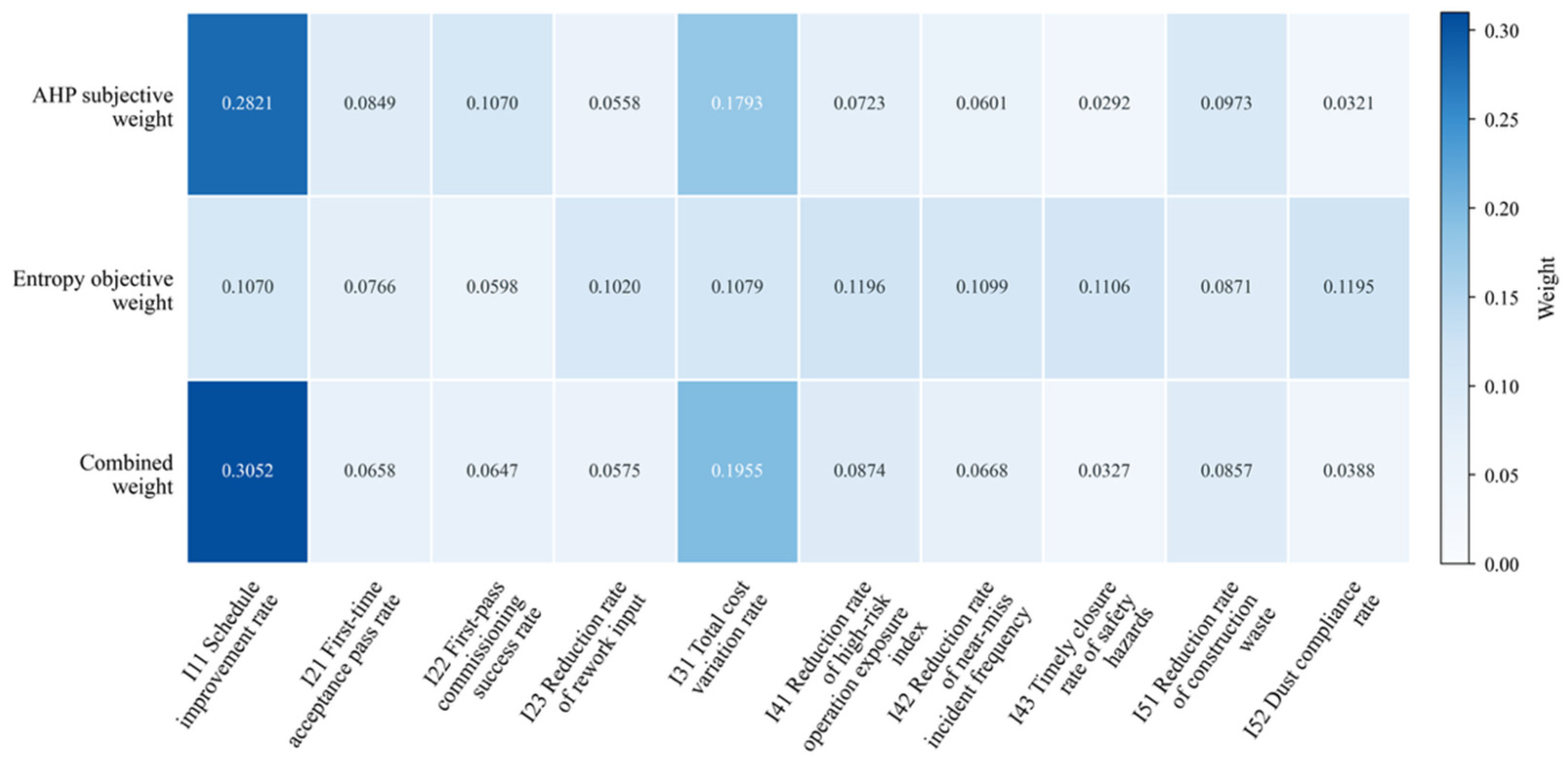
| I11 | 0.2821 | 0.1070 | 0.3052 |
| I21 | 0.0849 | 0.0766 | 0.0658 |
| I22 | 0.1070 | 0.0598 | 0.0647 |
| I23 | 0.0558 | 0.1020 | 0.0575 |
| I31 | 0.1793 | 0.1079 | 0.1955 |
| I41 | 0.0723 | 0.1196 | 0.0874 |
| I42 | 0.0601 | 0.1099 | 0.0668 |
| I43 | 0.0292 | 0.1106 | 0.0327 |
| I51 | 0.0973 | 0.0871 | 0.0857 |
| I52 | 0.0321 | 0.1195 | 0.0388 |
| Indicator Layer | Observation Item | Traditional MEP Installation Method | Prefabricated MEP Installation Method | Comparative Results |
|---|---|---|---|---|
| I11 | Construction duration | 127.5 h | 101.0 h | Decreased by 20.78% |
| I21 | Number of items passed the initial acceptance/Total number of acceptance items | 113/122 (92.62%) | 136/140 ((97.14%) | Increased by 4.88% |
| I22 | Number of systems successfully debugged on the first attempt/Total number of systems debugged | 24/27 (88.89%) | 33/35 (94.29%) | Increased by 6.07% |
| I23 | Rework hours/Total hours | 80 h/1270 h (6.30%) | 39 h/970 h (4.02%) | Decreased by 36.17% |
| I31 | Construction cost | ¥842.3 × 10⁴ | ¥858.6 × 10⁴ | Increased by 1.94% |
| I41 | Average High-Risk Work Exposure Index | 35.95 | 31.65 | Decreased by 11.96% |
| I42 | Number of near-miss incidents/Total hours | 13/1270 h (0.010236) | 6/970 h (0.006186) | Decreased by 39.57% |
| I43 | Number of hazards resolved on schedule/Total number of hazards | 84/97 (86.60%) | 92/98 (93.88%) | Increased by 8.41% |
| I51 | Total volume of construction waste | 0.404 t | 0.119 t | Reduced by 70.54% |
| I52 | Duration of dust emission compliance/Total monitoring duration | 117 h/131 h (89.31%) | 125 h/131 h (95.42%) | Increased by 6.84% |
| Construction Method | I11 | I21 | I22 | I23 | I31 | I41 | I42 | I43 | I51 | I52 |
|---|---|---|---|---|---|---|---|---|---|---|
| Traditional MEP installation method | 0.051724 | 0.172131 | 0.363636 | 0.063172 | 0.727642 | 0.028302 | 0.080645 | 0.041865 | 0.116564 | 0.031677 |
| Prefabricated MEP installation method | 0.965517 | 0.985714 | 0.981818 | 0.928441 | 0.065041 | 0.839623 | 0.678283 | 0.984150 | 0.990798 | 0.803995 |
| Construction Method | B1 (Low) | B2 (Medium) | B3 (High) | Overall Score (F) | Judgment Level |
|---|---|---|---|---|---|
| Traditional MEP installation method | 0.6551 | 0.2559 | 0.0890 | 60.85 | low |
| Prefabricated MEP installation method | 0.1701 | 0.1478 | 0.6821 | 87.80 | high |
| Perturbation Level | Criterion Group | ||||||
|---|---|---|---|---|---|---|---|
| Baseline | Combined weights | 0.3031 | 0.6450 | 0.3419 | — | — | — |
| 10% | C1 Progress | 0.2892 | 0.6614 | 0.3722 | 0.3181 | 0.6274 | 0.3093 |
| 10% | C2 Quality | 0.3039 | 0.6473 | 0.3434 | 0.3025 | 0.6430 | 0.3405 |
| 10% | C3 Cost | 0.3196 | 0.6240 | 0.3044 | 0.2857 | 0.6674 | 0.3817 |
| 10% | C4 Safety | 0.3010 | 0.6460 | 0.3450 | 0.3052 | 0.6441 | 0.3390 |
| 10% | C5 Environment | 0.3020 | 0.6467 | 0.3447 | 0.3042 | 0.6435 | 0.3393 |
| 20% | C1 Progress | 0.2764 | 0.6766 | 0.4003 | 0.3341 | 0.6085 | 0.2744 |
| 20% | C2 Quality | 0.3045 | 0.6497 | 0.3452 | 0.3018 | 0.6411 | 0.3393 |
| 20% | C3 Cost | 0.3352 | 0.6043 | 0.2691 | 0.2674 | 0.6913 | 0.4240 |
| 20% | C4 Safety | 0.2987 | 0.6471 | 0.3484 | 0.3070 | 0.6433 | 0.3363 |
| 20% | C5 Environment | 0.3007 | 0.6484 | 0.3477 | 0.3052 | 0.6422 | 0.3370 |
| 50% | C1 Progress | 0.2432 | 0.7158 | 0.4726 | 0.3863 | 0.5464 | 0.1601 |
| 50% | C2 Quality | 0.3065 | 0.6577 | 0.3513 | 0.3000 | 0.6365 | 0.3366 |
| 50% | C3 Cost | 0.3768 | 0.5517 | 0.1749 | 0.2068 | 0.7721 | 0.5653 |
| 50% | C4 Safety | 0.2910 | 0.6505 | 0.3595 | 0.3114 | 0.6414 | 0.3300 |
| 50% | C5 Environment | 0.2965 | 0.6543 | 0.3578 | 0.3075 | 0.6390 | 0.3315 |
Disclaimer/Publisher’s Note: The statements, opinions and data contained in all publications are solely those of the individual author(s) and contributor(s) and not of MDPI and/or the editor(s). MDPI and/or the editor(s) disclaim responsibility for any injury to people or property resulting from any ideas, methods, instructions or products referred to in the content. |
© 2026 by the authors. Licensee MDPI, Basel, Switzerland. This article is an open access article distributed under the terms and conditions of the Creative Commons Attribution (CC BY) license.
Share and Cite
Liu, Y.; Zhang, F.; Gui, S.; Loh, Y.; Kamarazaly, M.A.; Zhang, J. Research on the Evaluation of Prefabricated MEP Systems for Energy Stations Based on the AHP–Entropy–Fuzzy Model. Buildings 2026, 16, 2485. https://doi.org/10.3390/buildings16132485
Liu Y, Zhang F, Gui S, Loh Y, Kamarazaly MA, Zhang J. Research on the Evaluation of Prefabricated MEP Systems for Energy Stations Based on the AHP–Entropy–Fuzzy Model. Buildings. 2026; 16(13):2485. https://doi.org/10.3390/buildings16132485
Chicago/Turabian StyleLiu, Yuxuan, Fan Zhang, Shuqiang Gui, YungHao Loh, Myzatul Aishah Kamarazaly, and Jiaji Zhang. 2026. "Research on the Evaluation of Prefabricated MEP Systems for Energy Stations Based on the AHP–Entropy–Fuzzy Model" Buildings 16, no. 13: 2485. https://doi.org/10.3390/buildings16132485
APA StyleLiu, Y., Zhang, F., Gui, S., Loh, Y., Kamarazaly, M. A., & Zhang, J. (2026). Research on the Evaluation of Prefabricated MEP Systems for Energy Stations Based on the AHP–Entropy–Fuzzy Model. Buildings, 16(13), 2485. https://doi.org/10.3390/buildings16132485