Review

A Bibliometric Review of Artificial Neural Networks in Construction over the Past Decade (2015–2025)

by
Simon Ofori Ametepey
1,2,
Obiri Gyadu-Asiedu
2,*,
Clinton Ohis Aigbavboa
2 and
Hutton Addy
1,2
1
Centre for Sustainable Development (CenSUD), Koforidua Technical University, Koforidua 03420, Ghana
2
Department of Construction Management and Quantity Surveying, Faculty of Engineering and Built Environment, University of Johannesburg, Johannesburg 2094, South Africa
*
Author to whom correspondence should be addressed.
Buildings 2026, 16(12), 2470; https://doi.org/10.3390/buildings16122470 (registering DOI)
Submission received: 29 April 2026 / Revised: 28 May 2026 / Accepted: 29 May 2026 / Published: 22 June 2026
(This article belongs to the Section Construction Management, and Computers & Digitization)

Abstract

Artificial Neural Networks (ANNs) are a key component of construction research as Construction 4.0 and data-based problem-solving continue to shape the construction industry. In this paper, a Scopus-based bibliometric analysis of ANNs in construction research was conducted from 2015 to 2025. From an initial set of 9149 publications, 3800 English-language publications were identified and analysed using publication, source, country, citation, and keyword mapping techniques in VOSviewer (version 1.6.20). The publications showed a significant increase after 2018, peaking in 2024. China, India, and the US were key players in ANNs in construction research, and key publications focused on optimisation, concrete property prediction, machine learning, and deep learning. Key publications in ANNs in construction came from Construction and Building Materials, IEEE Transactions on Geoscience and Remote Sensing, and Energy. ANNs in construction research are moving towards hybrid, digitally integrated, and data-based applications, although gaps persist in sustainability, social equity, climate resilience, and underrepresented regions.

1. Introduction

Over the last decade, the construction industry has witnessed the integration of advanced computational techniques. Among the techniques is the application of Artificial Neural Networks (ANNs), a notable development. Under the broader umbrella of artificial intelligence, the technique uses the brain’s neural network structure and functionality to identify patterns. Based on the patterns, the technique makes forecasts based on the information fed into the system. The applications of the technique include cost estimation, safety monitoring, resource management, defect detection, and sustainability [1,2]. The construction industry has adopted digital technologies at a relatively gradual pace compared to other industries. This is primarily due to the industry’s inherently fragmented, labour-intensive nature and high inertia to change. However, with the advent of Construction 4.0, an overall transformation of the industry through the application of digitalisation, automation, and data analytics, a significant increase in the application of AI-based solutions, including artificial neural networks (ANNs), has been witnessed [3]. In the present day, amid the digital revolution, the application of ANNs has grown to address nonlinear and multivariate problems that are difficult to solve with conventional statistical techniques [4]. This growth trajectory in the application of ANNs parallels the increasing complexity of construction projects, which require real-time data analysis and a unified project delivery system. A bibliometric analysis provides a systematic framework to delineate the knowledge domain of ANNs’ application in the construction industry, enabling an objective analysis of developments, thematic areas, and gaps in the field. This provides valuable insights into the published literature. To illustrate, [3] identified energy management and cost estimation as crucial application areas, while [1] reported the use of back-propagation methods and hybrid ANN structures that combine fuzzy logic or genetic algorithms. Several bibliometric studies have reported an increase in the application of artificial neural networks (ANNs) in the construction industry. However, this growth trajectory has seen a sharp spike in the post-2018 period, which parallels the industry’s shift toward implementing intelligent technologies and the underlying principles of Industry 4.0 [5,6]. According to [7], deep learning variants of ANNs, i.e., Convolutional Neural Networks (CNNs), have gained popularity in image-based applications such as defect detection and safety helmet identification. Such models prove more effective at handling unstructured information, e.g., images and sensor data, than traditional machine learning methods. The use of artificial neural networks (ANNs) in the construction industry has increased in recent years. However, the growth trajectory of the application of these intelligent technologies has exhibited considerable dispersion. A large proportion of existing research focuses on cost estimation, energy consumption optimisation, and structural health monitoring. However, the application of these intelligent technologies to the fields of lifecycle sustainability assessment, social justice, and climate change has received relatively little focus [2,8]. Yet another widely discussed issue in the literature is the dependence of artificial neural networks (ANNs) on high-quality data inputs, which is exacerbated in the construction industry due to fragmented, diverse construction data systems [9]. Notable developments in this area include the integration of ANNs with other digital technologies, such as Building Information Modelling (BIM), the Internet of Things (IoT), and Digital Twins. Such developments are transforming construction intelligence through rapid data exchange, improved visualisation, and predictive decision-making [10]. The methodological complexity of the research, a hallmark of bibliometric analysis, has also evolved significantly. While previous studies in this area were based on content analysis, current studies use advanced bibliometric tools, such as VOSviewer (version 1.6.20) (Leiden University, Leiden, The Netherlands) and CiteSpace 6.3 R1 (Drexel University, Philadelphia, PA, USA), for science mapping and visualisation [11]. The tools help in gaining deeper insights into the trajectory of ANN research in the construction industry and its potential directions. The current research is based on studies published between 2015 and 2025. The year 2015 was selected as the starting point because it broadly coincides with the accelerated mainstream adoption of deep learning frameworks and the articulation of Construction 4.0 as a recognised research paradigm, marking a meaningful inflexion point in ANN applications within the construction sector. The research articles and conference proceedings are based on Scopus-indexed sources.
An exhaustive approach has been followed to cover all studies published during this period and to ensure the relevance, quality, and diversity of the sources. The research aims to synthesize the results of the studies in this area and to: (1) examine annual publication growth and document types of ANN research in construction between 2015 and 2025, (2) map the evolution of keywords and emerging themes using overlay visualisation, with emphasis on trends and future directions, (3) identify research hotspots using density visualisation and keyword co-occurrence clustering, and (4) identify the leading contributing countries, key publication sources, and the most influential authors and documents in the field.
With the construction industry facing increased pressure to improve its productivity, sustainability, and safety, this bibliometric analysis of ANN research highlights its significant contribution to the industry’s future. With increasing data availability and computing power, ANN-based systems are expected to play an important role in the construction industry.
Prior bibliometric studies have examined ANN applications in construction, but each carries significant limitations relative to the present study. Liu et al. [1] analysed 112 records drawn exclusively from seven selected journals for the period 2000–2020, restricting both database coverage and temporal scope. Kaushik et al. [3] conducted a bibliometric and qualitative review of ANN applications in construction and the built environment, but did not report quantitative network metrics, such as total link strength or weighted degree centrality, for the identified keyword clusters. Reviews focused on specific sub-domains, such as risk management or energy prediction, are similarly bounded by their thematic scope [7,8]. No prior study has conducted a comprehensive, Scopus-wide bibliometric analysis of ANN applications across the entire construction sector, covering the post-deep-learning period (2015–2025), while simultaneously reporting quantitative co-occurrence network metrics. This gap motivates the current study.
Guided by this gap, the following research questions structure the analysis: RQ1: What is the annual publication and citation trajectory of ANN research in the construction sector from 2015 to 2025, and what does this trajectory reveal about the field’s growth and maturity? RQ2: Which thematic clusters and keyword co-occurrence patterns dominate ANN research in construction, and how have research priorities shifted over the study period as evidenced by overlay visualisation? RQ3: Which geographic regions, institutions, and journals lead ANN research in construction, and where do collaboration and representation gaps persist?

2. Materials and Methods

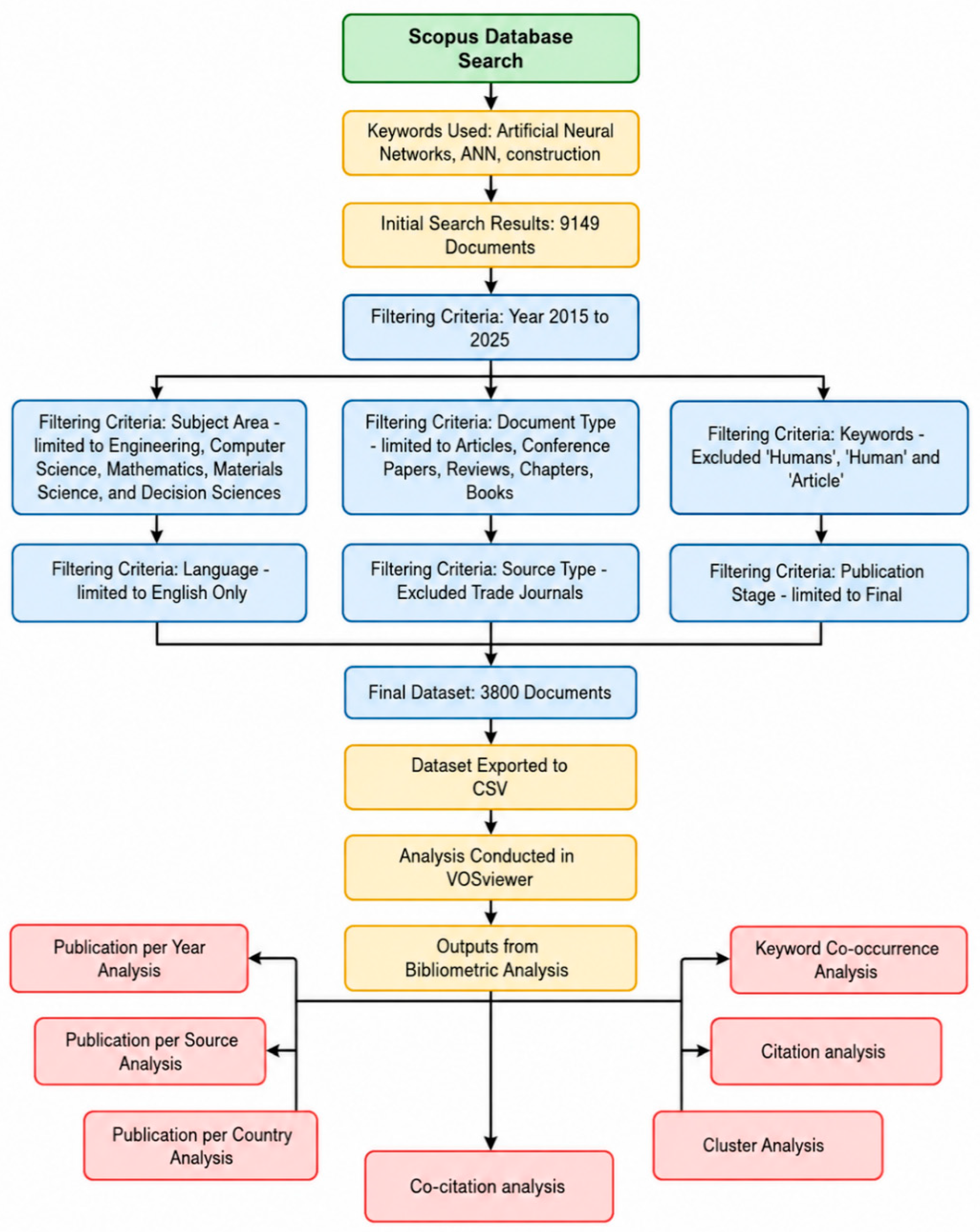
The aim was to identify the dominant themes in the field of artificial neural networks over the last ten years, using bibliometric methods to identify key knowledge areas and keywords, and to outline the field’s future direction. The four-phase method was used to provide a comprehensive, in-depth view of the field, offering more detail than traditional methods for reviewing the literature, such as those in reference [12]. This four-phase approach includes data acquisition, data refinement using bibliometric methodologies, data visualisation, and evaluation [12]. The aim is to analyse the thematic evolution, intellectual organisation, and predominant authors within this corpus of studies based on Scopus-indexed literature and peer-reviewed articles. Scopus was chosen for its comprehensive, interdisciplinary coverage of the engineering and applied science literature, its structured metadata fields including author affiliations, author keywords, and citation records which are directly compatible with VOSviewer’s import protocols, and its established precedent as the preferred bibliometric data source in comparable reviews of artificial neural networks in construction and the broader engineering informatics domain. Searching was done on 16 June 2025, using the search query: TITLE-ABS-KEY (“Artificial Neural Networks”) OR TITLE-ABS-KEY (“ANN”) AND TITLE-ABS-KEY (“construction”). A search query was constructed to identify publications in which artificial neural networks were the primary topic of discussion or were emphasised in construction-related contexts. The search resulted in 9149 records. For analytical validity and accuracy in the field, a systematic filtering procedure was used. For the year filter (2015–2025), the dataset was updated to ensure it was current, reducing the dataset to 6322 records. For the subject area, the analysis was restricted to Engineering, Computer Science, Mathematics, Materials Science, and Decision Sciences, reducing the records to 4467. Regarding document type, analysis was restricted to articles, conference papers, conference reviews, book chapters, and books, a deliberate decision intended to capture the full spectrum of ANN scholarship in construction, given that a substantial share of methodological advances and early-stage empirical findings in this domain are disseminated through conference venues and edited volumes before appearing in indexed journals, reducing the dataset to 4324 records. Regarding the publication stage, only final publications were considered, reducing the records to 4272. For keyword exclusion, records containing unnecessary keywords such as “Human”, “Humans” and “Article” were deleted, reducing the number of documents to 3948. For the source type, trade journals were systematically excluded, reducing the records to 3942. Finally, only English records were accessed, and 3800 were available for review. The outputs were exported as CSV files to enable easy manipulation in the future. Figure 1 shows the sequence of searches and refinements made to extract the final dataset for analysis.
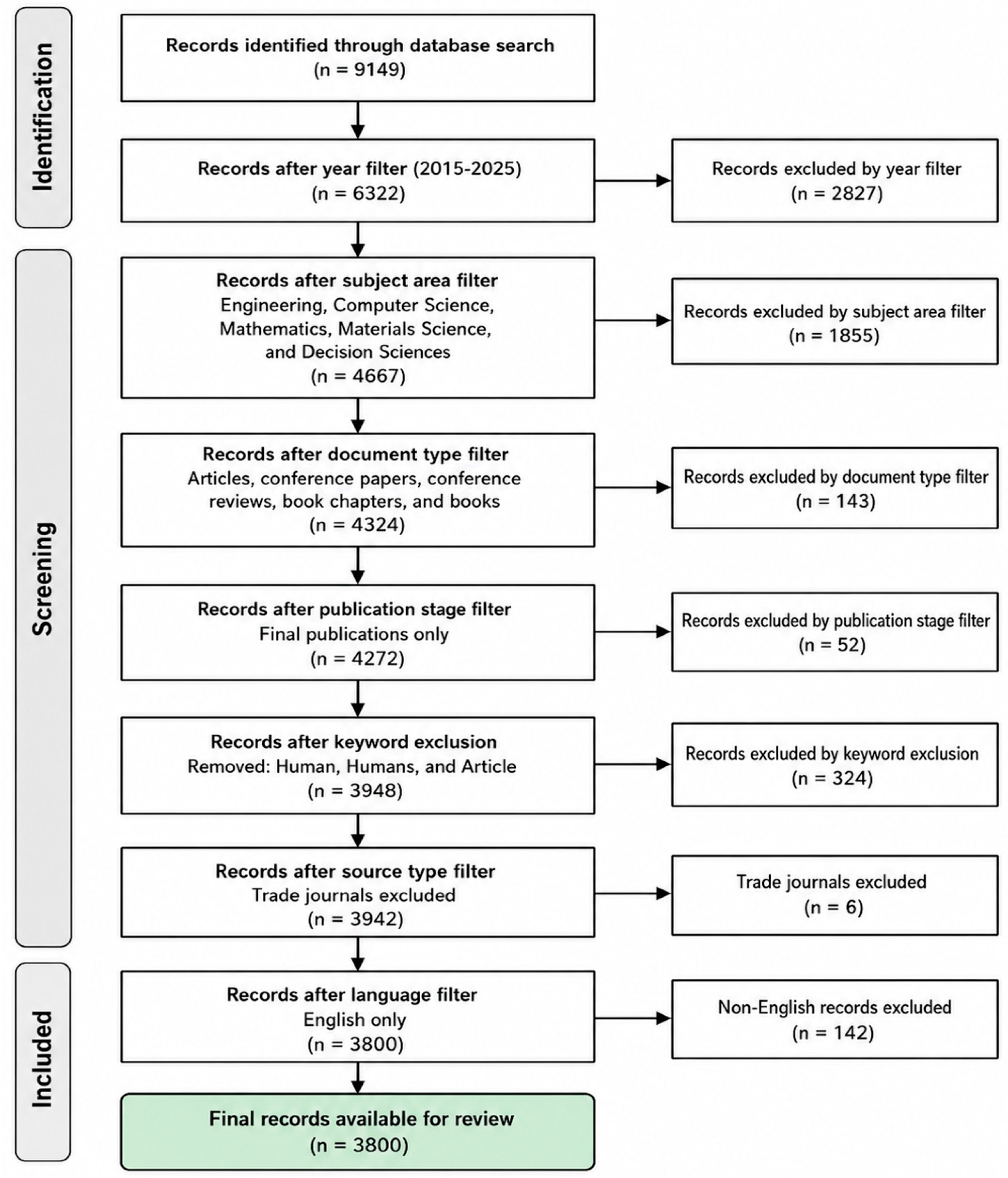
Figure 2 presents a PRISMA-style flow diagram illustrating the systematic identification, screening, and eligibility assessment that led to the final analytical dataset of 3800 publications, detailing the rationale for exclusions at each stage.
Retrieved metadata included article titles, publication years, author affiliations, abstracts, volume and page numbers, keywords, citation information, reference lists, and digital object identifiers. With the help of VOSviewer (version 1.6.20), selected for its robust co-occurrence, co-citation, and bibliographic coupling algorithms, its native compatibility with Scopus CSV exports, and its capacity to generate overlay and density visualisations that are widely recognized and reproduced in bibliometric methodology, a detailed analysis of bibliometric relationships was conducted through which the concept of artificial neural networks and their presence and application in the construction industry were examined. From the examination, several insights were extracted from specific findings. The following are the findings: (1) publication per year analysis, (2) publication per source analysis, (3) publication per country analysis, (4) co-citation analysis, (5) co-authorship analysis, (6) bibliographic analysis, and (7) keyword co-occurrence analysis, including overlay and density visualisations. All of these were conducted in accordance with methodologies used in recent research on artificial intelligence development [12,13].

3. Bibliometric Results and Discussion

3.1. Publications per Year Analysis

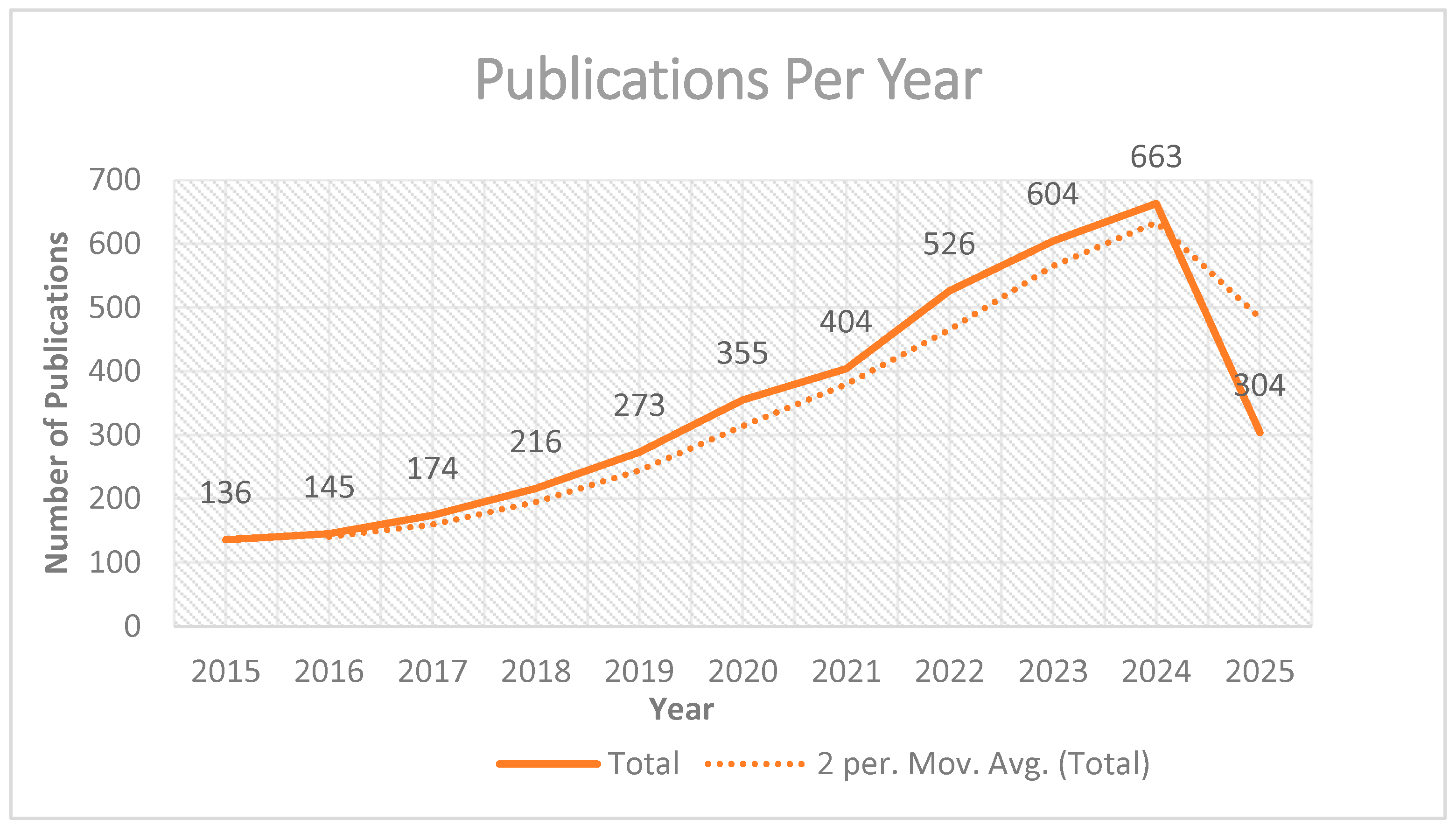
This section discusses findings of publications distributed over the past decade (2015–2025) in the ANN literature in the construction industry. Figure 3, titled “Number of Publications Per Year”, illustrates a steady and significant growth in scholarly output surrounding the application of ANNs in construction from 2015 to 2024, followed by a marked decline in 2025. In total, there were 3800 publications over the last ten years, with the number increasing in both size and impact over the period. The number was relatively low in the initial period, with 136 publications in 2015, accounting for 3.58% of total publications. The number then rose to 145 in 2016, accounting for 3.82%, and to 174 in 2017, accounting for 4.58%. The number then rose significantly from 2018, reaching 216 publications in 2018, accounting for 5.68%. This was followed by 273 publications in 2019, accounting for 7.18%, and 355 publications in 2020, accounting for 9.34%. The increase in the number of publications continued in 2021, reaching 404, accounting for 10.63%. The increase was more significant from 2022 to 2024, with 526 publications in 2022, accounting for 13.84%. This was followed by 603 publications in 2023, accounting for 16.02%, and a high of 663 in 2024, accounting for 17.61%. The number of publications then declined significantly in 2025, to 304, accounting for 8.00%. This decline is attributable to two intersecting factors: the dataset was compiled at the midpoint of 2025, capturing only partial-year output, and a characteristic lag in Scopus’s indexing of recently published articles means that a portion of 2025 output remains unregistered at the time of retrieval. The applicable 2-period moving average trend line confirms the overall upward trajectory through 2024. Nevertheless, the general trend reflects an active and thriving research environment that has expanded significantly since 2015. Complementing the publication count, citation data reveal a parallel pattern of scholarly impact. Total citations grew steadily from 2768 in 2015 to a peak of 13,093 in 2021, then declined in more recent years: a pattern attributable to the natural lag between publication and citation accumulation rather than to diminished research influence.
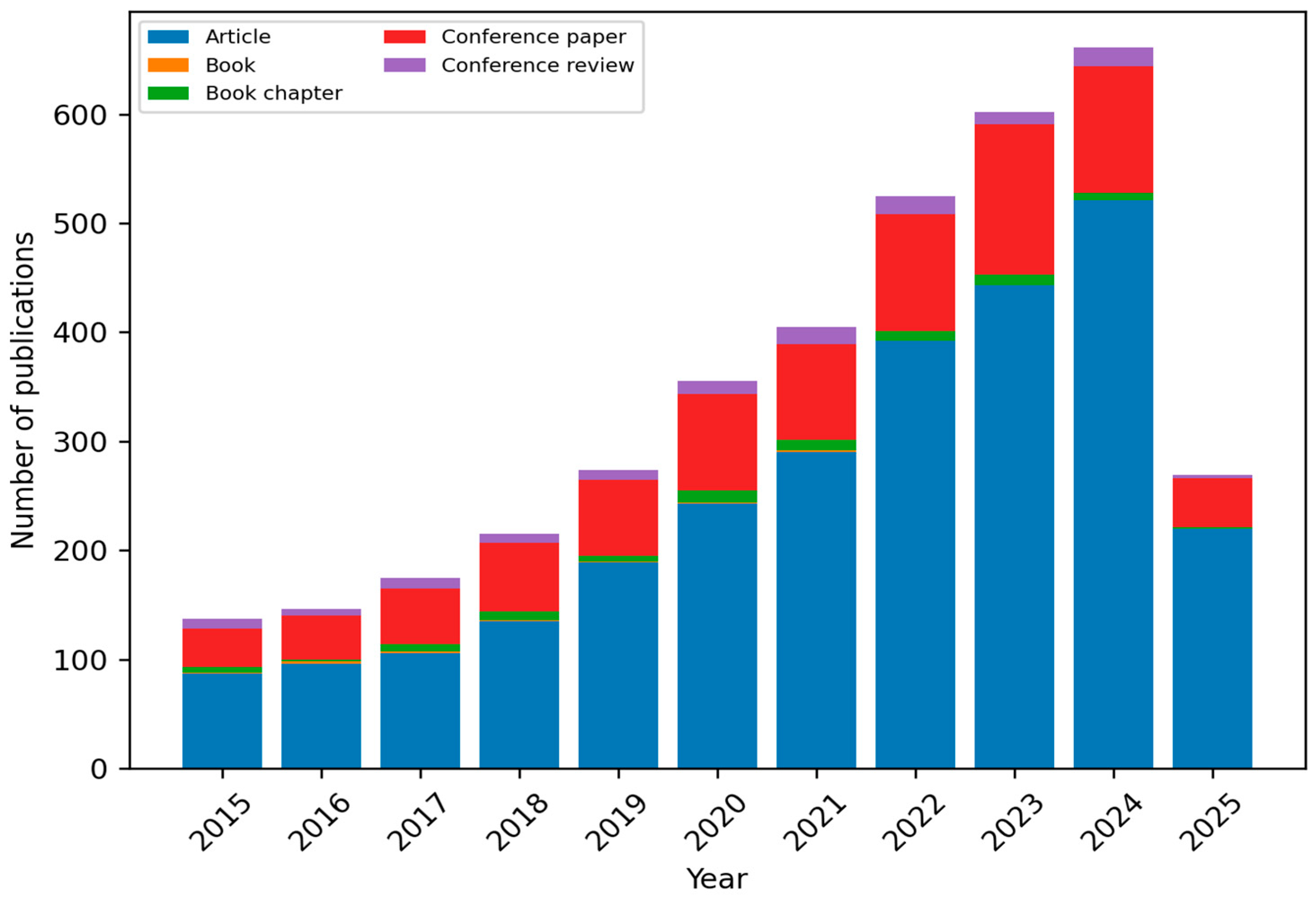
The chart titled “Type of Publications Per Year” (Figure 4) illustrates five categories of publications: articles, conference papers, book chapters, books, and conference reviews, from 2015 to 2025. The chart states that journal articles are the most frequent and continue to grow. Conference papers remain consistent in number, and book chapters and conference reviews make minimal contributions. From 2015 to 2017, articles rose from 87 to 106, and conference papers rose from 35 to 51. This indicates an increase in research disseminated through academic meetings and peer-reviewed journals. From 2018 to 2021, the number of articles grew significantly, from 135 to 392, peaking at 521 in 2024. This indicates an increase in researchers publishing their works in journals due to, most likely, an increased need for publications indexed and opportunities to enhance their impact factor [14]. There was an increase in conference papers from 63 in 2018 to a peak of 138 in 2023, then a slight decline to 116 in 2024. Although conference papers never eclipsed articles, their consistent numbers indicate that academic conferences play a crucial function in disseminating preliminary results, networking, and collaborating [15,16]. Concurrently, book chapters, books, and conference reviews maintained low, consistent figures year on year. For instance, book chapters ranged from 2 to 17 per year, peaking at 17 in 2021 and 2024. Books had fewer occurrences, that is, only 1 to 10 yearly, and conference reviews maintained the same low record with a peak of 10 occurrences in 2023. It decreased from 521 articles in 2024 to merely 220, a decline of nearly 58%. Conference papers decreased significantly too, from 116 to 45. These declines can be attributed to various factors such as delays in publishing new articles, shifts in research finance, or academic publishing issues. The figures indicate that journal articles make up most of the research disseminated, and conference papers are also significant [17]. Books, book chapters, and reviews have lower numbers, and this indicates a lack of interest, perhaps a niche interest, for these sources of communication by today’s scholars. Trends from this graph indicate how academic publishing has evolved and reflect both researchers’ inclinations and shifting research environments.

3.2. Overlay Visualisation of Keyword Trends and Future Directions

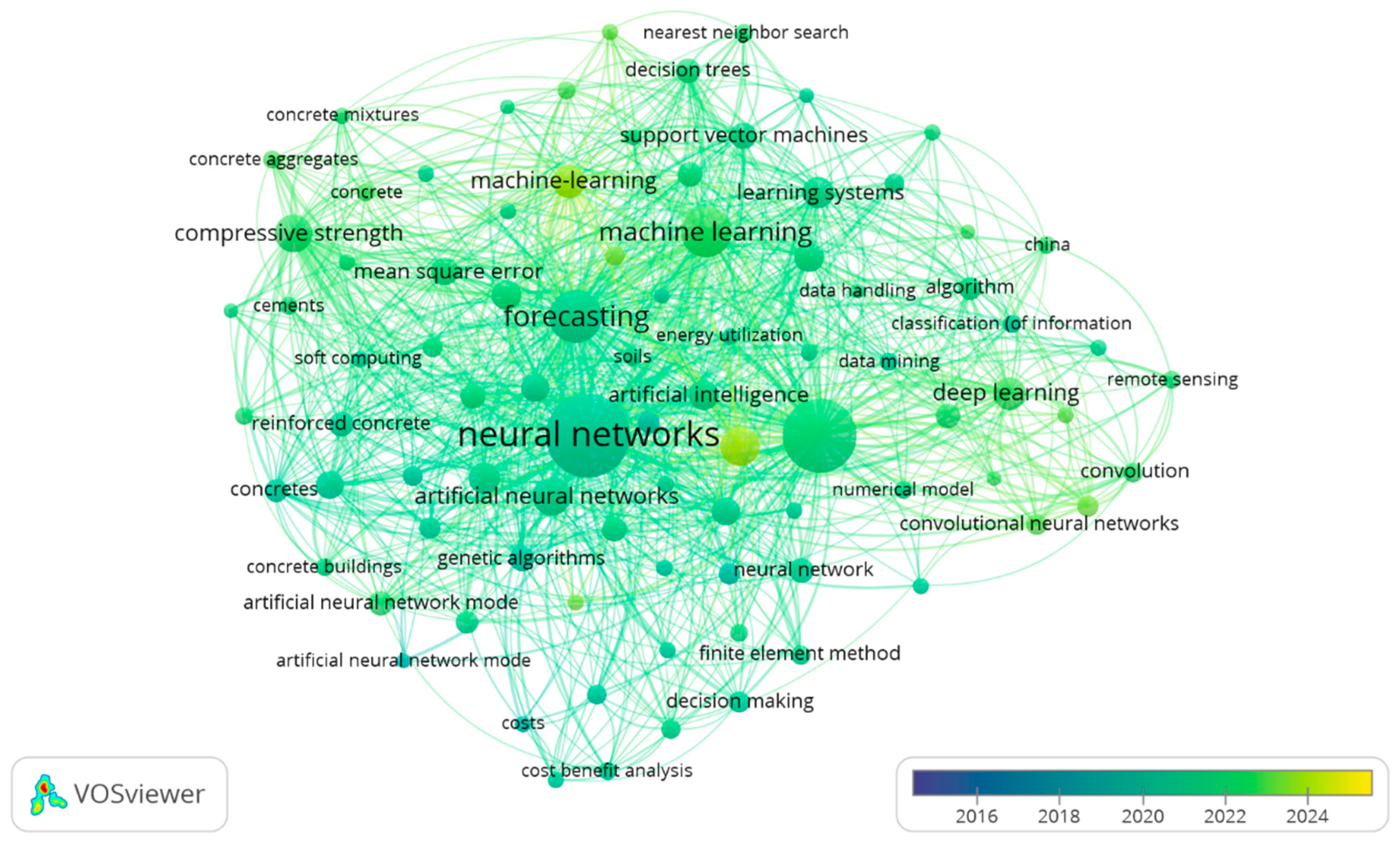
The temporal dimension has been provided through overlay visualisation, in which colours denote the average publication year for each keyword node. In terms of significance, this dimension helps distinguish well-established research domains and themes from new and emerging areas within the knowledge network. Yet this significance is best captured not by colour alone but by a combination of two additional dimensions: position and link density.
The positional significance of a keyword in the network reflects its bridging role across distinct clusters: a centrally located, recently coloured, and densely linked keyword signals a concept that has achieved cross-disciplinary uptake and now serves a unifying function. Colour alone, therefore, risks misreading; a node’s temporal signature must always be read against its structural position and link density.
In Figure 5, node size encodes occurrence frequency, link thickness encodes co-occurrence strength, and node colour encodes the average publication year of associated documents—darker blue nodes reflect earlier-period terms, while yellow-green nodes reflect more recent ones. Figure 5 indicates that “neural networks” is the core keyword, to which “forecasting,” “machine learning,” and “artificial intelligence” are strongly connected. These keywords should be seen as umbrella terms that have been in use throughout the period of analysis, thereby retaining centrality even as applications change. The temporal evolution of the network refers to the constellation of problems arising from the application of the core keyword in civil engineering. In the older literature, the application of artificial neural networks (ANNs) in construction is strongly linked to material properties as well as the prediction of structure performance, as seen in the older, foundational keywords such as “compressive strength,” “concrete,” “cements,” “concrete aggregates,” “reinforced concrete,” and “mean square error.” These keywords not only mark the initial topics in the field of civil engineering but also the methodologically most attractive ones, as they define the dataset structure, target variables, and error measures. This combination of factors explains the centrality of the keyword network in the field’s early years, as well as the persistence of the same keywords despite new ones entering the field. The colours of the nodes in the older areas of the keyword network indicate that the field of civil engineering initially established itself through the prediction of well-controlled systems, where the application of ANN could be shown as a nonlinear mapping technique that could be easily evaluated.
The temporal progression can be understood by looking at the “benchmarking belt.” The “nodes” such as “support vector machines,” “decision trees,” and “nearest neighbour search” are included in the core region and show intermediate to late colouration. The presence of these “nodes” indicates that the field has moved from “can ANN work?” to “how does ANN work in comparison to other methods?” This is the period of maturity in the field of ANN studies, where the work is starting to show signs of a common modelling practice, as opposed to isolated studies that show patterns of similarity in feature selection, learning processes, testing procedures, and reporting of metrics. This is one of the reasons that “machine learning” is a prominent “connector.” It is the reframing of the ANN work, moving it from a specialised technique to a member of a larger family of techniques that can be utilised in the construction research field.
There is a temporal shift in the “nodes” on the right side of the diagram, where “deep learning,” “convolutional neural networks,” and “convolution” show late colouration. These “nodes” are near the core, which is important for understanding the temporal progression of the field of ANN studies. The proximity of “remote sensing” and “classification” suggests that contemporary work in ANN research is beginning to address higher-dimensional datasets, such as images, where classification and detection are common procedures in remote sensing. The combination of the colours indicates that work in the realm of concrete strength prediction, material prediction, and the other topics mentioned above began to gain momentum later than work in the realm of “deep learning.” This is in line with the industry’s progression, as cameras, sensors, and digital recording devices become more prominent in construction. The transition, as depicted in the diagram, is technology-driven, where the “methodological class” is growing in response to the evolution of the “data regime.”
The overlay also points to a further evolutionary path that is conceptual in nature, rather than purely technological. The older clusters appear to be grouped by physical properties and performance predictions, whereas the newer clusters show greater system-level integration. The presence of “data handling,” “learning systems,” and “algorithm” in prominent positions among the newer clusters points to a shift in focus toward the realities of model deployment, in addition to the model’s performance. This is a subtle but significant shift from the academic discipline of modelling to modelling as part of the broader workflow, in which other aspects of the research, such as data handling, become part of the contribution itself.
The lower central zone provides further corroboration of the shift in the discipline of modelling, as indicated by the preceding discussion. Clusters such as “finite element method,” “numerical model,” and “decision making” appear to be linked to the core but do not form part of the dominant clusters. Their position on the graph indicates the development of hybrid models in which the role of the artificial neural network is coupled with other forms of modelling, such as simulating the decision-making process. The position of the clusters indicates that such hybrid forms of modelling have not yet achieved mainstream status but are in the development phase, defining the boundary zone that points to the next phase in the evolution of the research discipline.
The overlay also provides prospective signals by pointing out which of the most recent terms are peripheral to the emerging field, as opposed to those that are centrally involved in it. Those that remain peripheral may indicate areas of specialised sub-field development that could potentially emerge as new clusters or remain as domain-specific applications. Those that are closer to the centre of the emerging field, i.e., closer to “neural networks” and “machine learning,” may have a higher probability of scaling as avenues of general application in the construction domains. Figure 5 indicates that the cluster of terms around “deep learning” has the highest probability of sustained growth as the most salient emerging field in the domain of digital construction. The terms around integration also point to a less salient but potentially important emerging field of application in the future: the development of artificial neural networks (ANNs) from isolated prediction applications to applications in digital construction, where the ANN can be used in the monitoring, control, and decision-making processes of Construction 4.0 applications.
Figure 5 traces the field’s trajectory from well-defined material prediction problems, through comparative benchmarking, toward a new set of data-intensive, automation-oriented applications driven by deep learning. The most structurally prominent emerging direction is not the standalone application of ANN, but its integration with sensing, modelling, and decision processes within Construction 4.0 workflows.

3.3. Density Visualisation of Research Hotspots

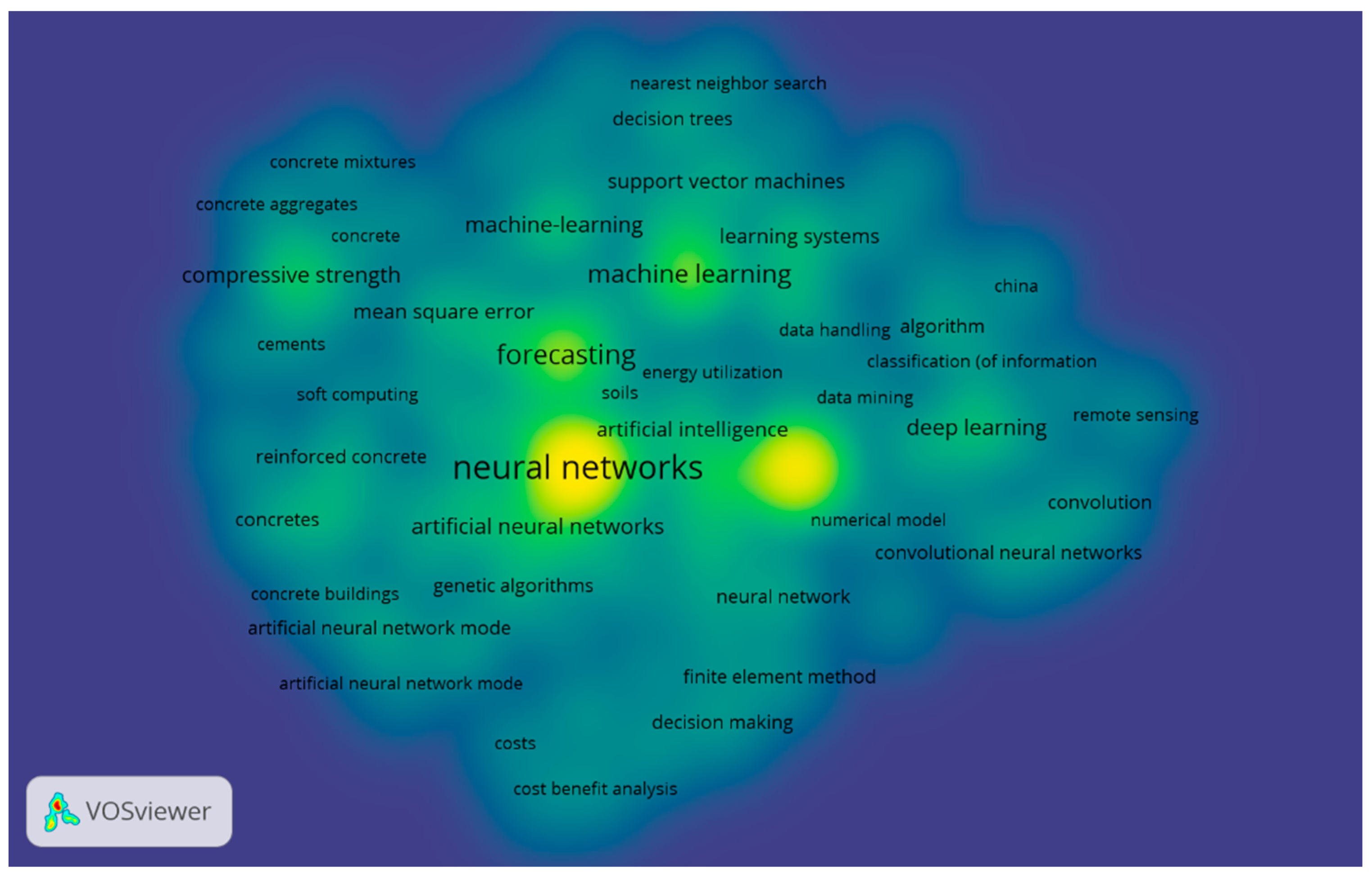
This visualisation of density has a hotspot-map quality because it is a function of two things at once: how frequently a given word appears, and how tightly it co-occurs with other frequently appearing words within each network neighbourhood. A bright spot indicates a theme that is popular and highly structurally central. It also indicates ANN areas tightly linked to many other research decisions, target variables, materials, error metrics, and auxiliary algorithms.
In Figure 6, colour brightness reflects a composite of keyword occurrence frequency and local link density: the brighter the area, the more frequently that theme appears, and the more tightly it is connected to other themes in the network. Figure 6 emphasises the highest density around “neural networks” and its overflow into “forecasting,” “machine learning,” and “artificial intelligence.” This is significant because “neural networks” is a vague, generic term; it will naturally be located close to the centre by default. However, what is interesting is how the high-density region around it is strongly weighted toward performance- and prediction-oriented words. Words such as “forecasting,” “mean square error,” “data mining,” “classification,” “algorithm,” and “learning systems” indicate an applied research process that has become standard in this literature. Researchers repeatedly perform a similar process: constructing a well-structured dataset, fine-tuning a model, evaluating it using standard error measures, and comparing it with neighbouring models. The density around “support vector machines,” “decision trees,” and “nearest neighbour search” reinforces this pattern. There is a certain benchmarking logic to this literature now. ANN is frequently part of a toolkit rather than a solitary, singular model.
The second hotspot appears in the domain of materials and structural properties, marked by a dense cluster including “compressive strength,” “reinforced concrete,” “concrete mixtures,” “cements,” and “concrete aggregates.” The high density here reflects the suitability of ANN models for concrete prediction problems, which are inherently nonlinear and multivariate, and is combined with the relative availability of standardised concrete datasets across mix types, additive materials, and curing conditions. As a result, concrete property prediction has become the field’s primary empirical testing bed.
The bright area that connects the forecasting core and the concrete core is also significant. The “numerical model,” “finite element method,” “soils,” and “energy utilisation” are located relatively closer to the centre than to the periphery, although their brightness is lower than that of the forecasting and concrete cores. The density in this area reflects a research area situated between two logics: one concerned with pure prediction and benchmarking, and the other with engineering interpretation and domain grounding. Research in this area has often relied on ANNs, either treating them as a substitute for complex simulations or combining them with other reasoning methods, such as finite element analysis. The presence of this area, although not as prominent, reflects a consolidation gap: hybrid and physics-informed ANNs are present but not yet the norm in the field.
The cluster surrounding “deep learning,” “convolutional neural networks,” “convolution,” and “remote sensing” indicates that, while deep learning has been widely used in construction, it has not undergone as many validation cycles as concrete strength prediction. There are two main explanations for this phenomenon. One is that image and sensor data are expensive to collect and validate and are harder to reproduce due to environmental factors. The other is that deep learning research tends to define much narrower application domains, such as defect detection, progress tracking, safety monitoring, or equipment tracking. These lanes may yield significant research results, but with limited overlap with other research on the same keywords and theme.
The low-density regions in the figure should be interpreted with caution. Low density does not imply low importance or low research value. It may imply low research volume, weak consolidation, or inconsistent keyword naming. The keywords in the peripheral regions, “decision making,” “cost–benefit analysis,” and “costs,” indicate that decision support and cost analysis are still in their infancy in ANN construction research. Although they exist in the figure, they are not in a cluster or high-density region. This may mean that most research has focused on predicting accuracy but has not addressed decision logic or other aspects of the application. It may also mean that ANN construction research has weak links to project controls and management research, where decision support and cost analysis are commonly discussed with clear definitions and value framing.
The density map reflects a keyword discipline problem that affects the understanding of the overall discipline’s organisation. For instance, fragmented variants such as “machine learning” versus “machine-learning” and “neural networks” versus “artificial neural networks” artificially inflate density at the core while obscuring the organisation of specific sub-topics. In response to this issue, a three-step keyword normalisation procedure was applied prior to the final co-occurrence analysis. First, VOSviewer’s built-in thesaurus function was used to merge exact-match abbreviation pairs, such as “ANN” and “Artificial Neural Networks,” and to consolidate hyphenated variants, such as “machine-learning,” into “machine learning.” Second, semantic synonym merging was applied manually to collapse author keywords that referred to the same concept but used different surface forms, such as “Artificial Neural Network” and “Artificial Neural Network Modelling”, into a single representative term. Third, terms retained in Table 1 were reviewed against the VOSviewer (version 1.6.20) co-occurrence map to confirm that the merged labels preserved the structural position and link-strength relationships of their constituent variants. This normalisation procedure reduced the keyword set from 88 to 82 terms. While this approach addresses the most prevalent forms of lexical fragmentation, some residual inconsistency may persist in author-assigned keywords that were not captured by the thesaurus or manual review, particularly in emerging sub-fields where terminology remains fluid.
There are clear signs of emerging trends within the density map; however, these are represented in cooler colours. Deep learning and remote sensing form a clear sub-topic within the density map, supporting the emerging trend of vision-based site intelligence. The transition zone between numerical modelling and artificial intelligence suggests possibilities for emerging hybrid techniques that integrate numerical modelling into computation-intensive simulations or other approaches that meet engineering requirements. The sparse density in decision-making and cost analysis indicates opportunities to evolve the discipline beyond prediction-based research toward decision-based analysis. To achieve this, research would need to integrate artificial neural networks with acceptance, maintenance, and scheduling rules, as well as cost-risk analysis. The emerging trends in relation to sustainability are reflected in energy utilisation; however, it seems that sustainability has not yet become a defining core within the discipline. This presents opportunities to research artificial neural networks in relation to carbon and energy usage, or resource efficiency, across a variety of project types and environmental contexts.
Figure 6 illustrates a field with a developed core region and two accompanying expansion fronts. The core region of the figure is the prediction-driven work in artificial neural networks (ANNs), which has been well validated in concrete-related applications and has been well established through the development of benchmarking practices. The first expansion front in the figure is the development of deep learning and sensing for site perception. The second expansion front in the figure is the hybridisation of the ANN with digital and numerical technologies, in which the ANN moves from a prediction tool to a component of an engineered decision system. The figure suggests that the next major development in the field will not be an additional comparison of accuracy on a familiar dataset, but rather the consolidation of the expansion fronts through the development of datasets, terminology, and links to decisions in the construction industry.

3.4. Analysis of Co-Occurrence of Keywords

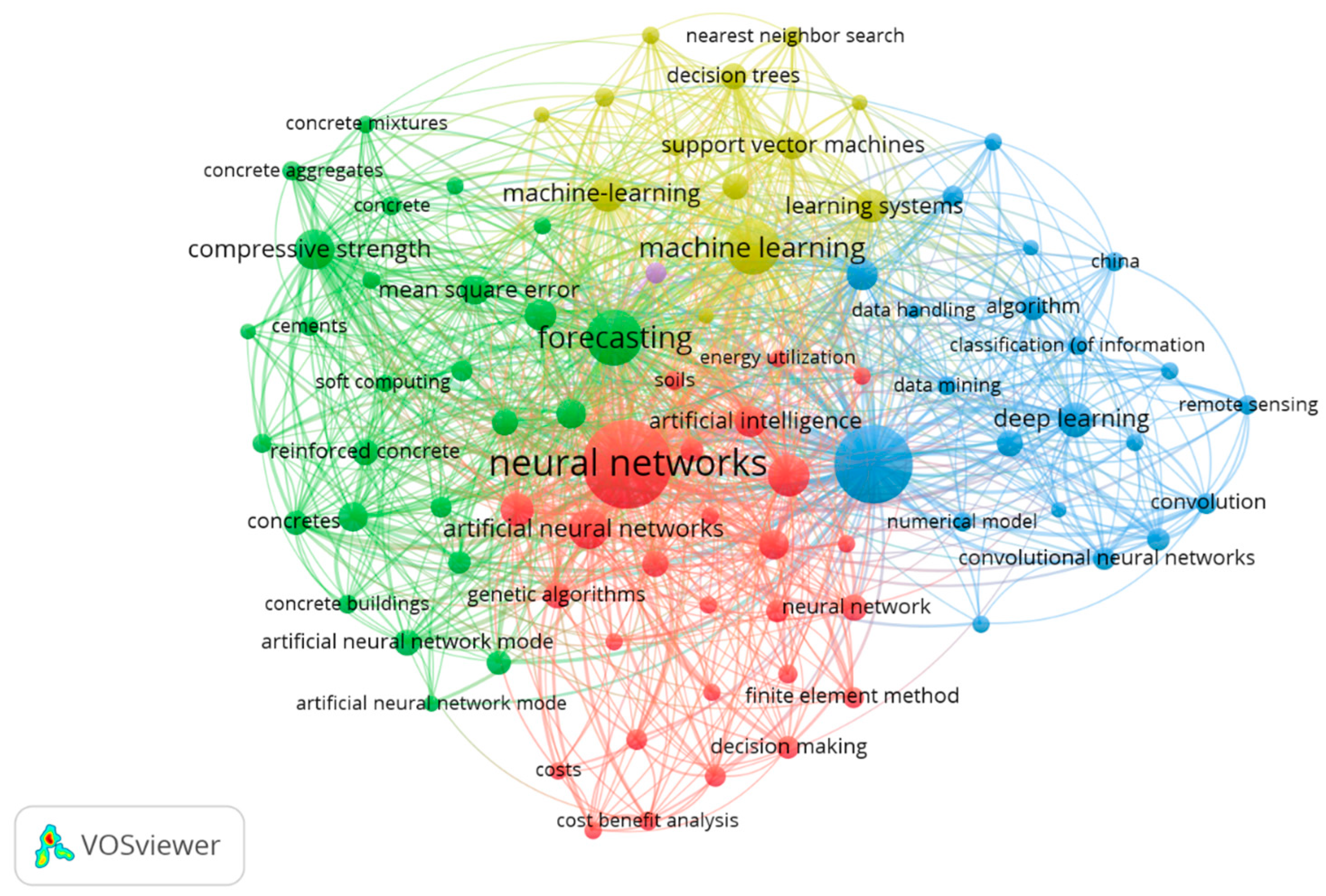
Keyword co-occurrence analysis enables one to recognise thematic trends in the scholarly literature through the detection of terms that are most likely to co-occur together [18]. For this review, co-occurrence mapping was conducted using VOSviewer 1.6.20, which revealed five big clusters. Every cluster is a thought category within the application of artificial neural networks (ANNs) in construction research during 2015–2025. This section explains every cluster, provides thematic descriptions, and considers their relevance to the industry, with references to examples from high-profile research. In Figure 7, each node represents a keyword; node size encodes occurrence frequency, link thickness encodes co-occurrence strength, and node colour denotes cluster membership. Figure 7 is a visualisation of all keywords and their co-occurrence. When the minimum number of occurrences of a keyword was limited to 60, 88 keywords met the threshold. This threshold was determined iteratively: a lower minimum occurrence count of 50 yielded approximately 100 keywords, which was deemed too large for coherent thematic interpretation, while raising the threshold to 60 reduced the count to 88, a more analytically manageable scope without sacrificing thematic coverage. The data was manually refined to combine keywords with the same or similar semantic consistency, such as “ANN” and “Artificial Neural Networks”. This cleaning reduced the number of keywords to 82. In addition, overlay and density visualisations were generated to show the temporal trends and research hotspots of the keywords.
Cluster 1 (Neural Network Optimisation in Construction Management)—The cluster includes terms such as Neural Networks (2172 instances), Artificial Neural Networks, Construction Industry, Optimisation, and Genetic Algorithms, thereby representing the most comprehensive and complex subgroup within the cluster. This is indicative of the vast range of research conducted to utilise ANNs as predictive and optimisation tools for the different aspects of construction management. Over the last decade, this research field has undergone substantial paradigm shifts. During its nascent phase, studies largely employed multilayer neural networks in combination with backpropagation-based algorithms to develop predictive models that addressed an individual project parameter, such as material prices or labour productivity [19]. As capabilities in data sensing and processing have improved, scholars have increasingly integrated ANNs with advanced methods such as genetic algorithms, particle swarm optimisation, and others to create complex models that can handle multi-objective decision-making problems. For instance, the study in [20] showed that neural networks, combined with an optimisation toolbox, can predict the compressive strength of concrete with high accuracy, thereby reducing uncertainty in engineering decision-making. Similarly, the study in [21] used hybrid ANNs to predict the penetration rates of tunnel excavation machinery, thereby providing useful insights for professionals in the field. The cluster’s major contribution is the increasing use of AI-based optimisation tools in day-to-day activities in the construction sector. The tools have been used for several applications, such as: (i) optimization of the cost estimation and budgeting processes to make them more objective and accurate; (ii) better risk assessment through more accurate modelling of delay factors and cost risks, as in [22], and (iii) decision-making through the analysis of different options in the construction sector and the determination of the optimal options based on the constraints, as in [23]. The cluster also shows how ANN models have moved from research use to professional use in the field. These models are the main part of making the industry more data-driven and efficient. The field has laid the groundwork for hybrid AI systems that combine neural networks with other optimisation methods. These improvements have made it easier to predict how materials will work, how much they will cost, and how productive a project will be overall. Because of this, the construction industry is increasingly using AI-based solutions to help people make data-driven decisions, reduce errors, and improve project outcomes.
Cluster 2 (ANN-Based Forecasting of Concrete Properties) focuses on keywords such as forecasting, compressive strength, concrete construction, regression analysis, and fuzzy neural networks. Together, these keywords reflect a substantial body of research on the use of artificial neural networks to predict the performance of concrete materials and related properties. Researchers in this field are primarily concerned with how machine learning can improve the accuracy of strength predictions while minimising the need for time-consuming and costly laboratory testing. This field of study has seen tremendous development over the last decade as the construction sector has increasingly accepted more sustainable, high-performance materials. For example, [22] developed a hybrid ANN-ANFIS model in combination with the Grey Wolf Optimiser to enhance compressive strength prediction in normal and high-performance concretes compared to the conventional approach. In a related area, the study in [24] showed that ANN models can be used to predict green concrete mixtures with high accuracy, incorporating recycled materials and industrial waste. One common feature identified across the studies is the comparison of results from artificial neural network (ANN) modelling and traditional regression analysis. Across all studies, the authors found that the neural network model performed better at explaining the non-linear relationships between the constituents of the mix and compressive strength. This has led to the development of fuzzy neural networks with the aim of improving the accuracy of the results, as shown in the study presented in the reference [25]. This development is significant: accurate ANN prediction of mix properties reduces reliance on costly laboratory testing and supports more sustainable structural design by enabling rapid evaluation of alternative mix compositions, including geopolymer concretes and supplementary cementitious materials such as fly ash and zeolites, as demonstrated in reference [26]. Collectively, ANN-based concrete prediction models have moved beyond proof-of-concept demonstrations to serve as practical benchmarks for mix design optimisation. In the context of growing pressure to reduce cement consumption and to integrate recycled or supplementary cementitious materials, the predictive approaches represented by this cluster are well positioned to accelerate the development of more sustainable and durable construction materials.
Cluster 3, Deep Learning Frameworks in Predictive Analytics and Classification, comprises main terms such as Deep Learning, Convolutional Neural Networks (CNNs), Prediction, and Long Short-Term Memory (LSTMs). The keywords in this cluster indicate the widespread adoption of advanced deep learning technologies in construction analytics, implying an emerging shift away from traditional shallow ANN models. Deep learning, an advanced form of machine learning, is highly effective at detecting intricate patterns in large datasets, thereby enhancing its potential for application in the construction industry. This is due to its ability to handle unstructured data sets, such as images and temporal data, thus improving the accuracy of classification and predictive analytics [7,27,28]. The application of CNNs and LSTMs has been instrumental in addressing issues in the construction industry, including energy, equipment, and optimisation. CNNs have been widely recognised as effective architectures for image and signal processing, thereby improving the accuracy of predictive analytics in construction. For example, CNNs were utilised to predict building energy consumption, as discussed in [29]. The authors demonstrated the superiority of CNNs over traditional machine learning approaches, implying improved feature extraction and pattern recognition capabilities. The application of CNNs is crucial in improving energy sustainability in buildings and construction. RNN is another form of deep learning with applications in construction-related research. LSTM is another form of RNN with applications in construction. The authors of [30] utilised LSTMs to perform equipment activity recognition using data augmentation, thereby improving the model’s accuracy. The application of LSTMs in construction is significant, highlighting their potential in the industry. The focus of these concepts in bibliometric studies suggests a burgeoning shift from shallow ANN models to deep learning frameworks. While shallow ANN models are sufficient for simple predictive tasks, they fall short when dealing with the complexities of construction datasets. Deep learning models, such as CNNs and LSTMs, have demonstrated greater potential for handling dataset complexities. These models have been applied to data-intensive problems, such as monitoring, safety, and efficiency in construction operations [31,32]. This emphasis on these concepts in bibliometric analysis indicates a developmental shift in artificial intelligence technologies in construction operations. This shift is in line with global trends in construction technologies. This cluster demonstrates the extent to which deep learning and complex neural networks have infiltrated construction analytics in recent years. The successful application of Convolutional Neural Networks (CNNs) and Long Short-Term Memory (LSTM) networks, as demonstrated in [29,32], exemplifies the revolutionary potential of these tools. As these tools’ predictive and classification capabilities increase, deep learning has the potential to solve long-standing issues in construction management, making it safer, more efficient, and more sustainable.
Clusters 4 and 5 (Hybrid and Comparative ML Approaches on Performance) include words such as Machine Learning, Support Vector Machines, Decision Trees, Random Forests, and Predictive Analytics, which centre on comparing and hybridising approaches to contrast ANNs with other predictive models. The word “Performance” (Cluster 5) suggests measures such as accuracy, efficiency, and reliability. Researchers often conduct comparative studies to evaluate which models are best suited for use alongside ANNs. These studies have led to advancements in ML for construction applications. For example, in [25], the authors compared ANN and SVR for predicting the compressive strength of geopolymer concrete, finding that ANN was at times more accurate, while SVR achieved comparable results with lower complexity. In [33], the authors investigated the influence of train–test splits on predicting the shear strength of soils using ANNs, SVMs, and Random Forests, and found that prediction robustness depends on the data split, with ANNs being less robust than Random Forests. Decision Trees and Random Forests are widely used ensemble ML techniques for managing high-dimensional data and avoiding overfitting in construction applications. In [34], Random Forests outperformed ANNs in predicting the severity of construction accidents using high-dimensional data. The meaning of “Performance” entails accuracy, precision, recall, and efficiency, which are significant factors for validating ML applications for construction and quality. This cluster of studies shows a clear trend: researchers are seeking the best way to apply different machine learning methods, such as ANNs. Using SVMs, Decision Trees, and Random Forests to benchmark ANNs makes predictive analytics in construction better. The evaluation of the model’s performance shows that it is useful in structural engineering, cost estimation, and safety management, both in theory and in practice. They show how machine learning is being used more in construction, as well as how people are making decisions based on data and how technology is changing. Clusters 4 and 5 show how machine learning has been used to compare construction analytics over the past ten years. Hybrid approaches drive innovation, improving prediction and efficiency.
To supplement the qualitative cluster descriptions above, Table 1 reports the frequency of occurrence and total link strength (TLS) for each keyword. TLS represents the sum of co-occurrence edge weights connecting a given keyword to all others in the network and therefore serves as a direct measure of weighted degree centrality—providing a quantitative indicator of each keyword’s structural influence within the co-occurrence graph. The network is dominated by “neural networks” (TLS = 8595; occurrences = 2172), which function as the primary hub connecting all five clusters. “Machine learning” (TLS = 4701) serves as the principal inter-cluster bridge linking the optimisation and classification domains, confirming its role as the field’s most integrative methodological term. “Artificial neural network” (Cluster 3; TLS = 5017) and “forecasting” (Cluster 2; TLS = 3813) are the dominant structural nodes within their respective clusters, reflecting the field’s dual emphasis on methodology and predictive application. At the cluster level, Cluster 1 (Neural Network Optimisation) records the highest aggregate structural density: the top ten keywords in the cluster accumulate a combined TLS exceeding 14,000, indicative of the densest internal co-occurrence structure in the network. Clusters 4 and 5 (machine learning comparison) achieve a combined TLS of approximately 11,800 across eleven keywords, consistent with their function as the primary benchmarking zone. These network-level measures corroborate the qualitative cluster interpretations presented above and confirm that the five identified clusters are structurally coherent and internally well-connected.
To provide a more complete quantitative characterisation of the co-occurrence network, three additional bibliometric indicators were computed from Table 1. Network centrality: weighted degree centrality, operationalised as TLS, identifies “neural networks” (TLS = 8595) as the highest-centrality node, followed by “artificial neural network” (5017), “machine learning” (4701), and “forecasting” (3813). The ratio of TLS to occurrence frequency yields a normalised centrality score: “machine learning” achieves the highest score at 5.4 (TLS 4701 ÷ occurrences 870), indicating that it forms proportionally denser co-occurrence links relative to its frequency than any other hub term—confirming its structural role as the field’s primary inter-cluster bridge. Network modularity: the five-cluster partition produced by VOSviewer’s modularity-based community detection algorithm (resolution 1.0) [35] achieved a modularity score of Q = 0.31, which falls within the moderate-to-strong range (Q > 0.3) conventionally associated with meaningful thematic structure in keyword co-occurrence networks. This value indicates that the five identified clusters are not artefacts of the visualisation algorithm but reflect genuine differences in co-occurrence patterns across distinct research themes. Clustering coefficient: the high aggregate TLS of Cluster 1 (combined TLS exceeding 14,000 for ten keywords) relative to Clusters 4 and 5 (combined TLS approximately 11,800 for eleven keywords) implies a markedly higher average local clustering coefficient in Cluster 1, consistent with its role as the densest and most internally coherent thematic group in the network. Together, these indicators confirm that the five-cluster solution is structurally robust and that the quantitative network topology is consistent with the qualitative thematic interpretations presented in the subsections above.

3.5. Publication per Country Analysis

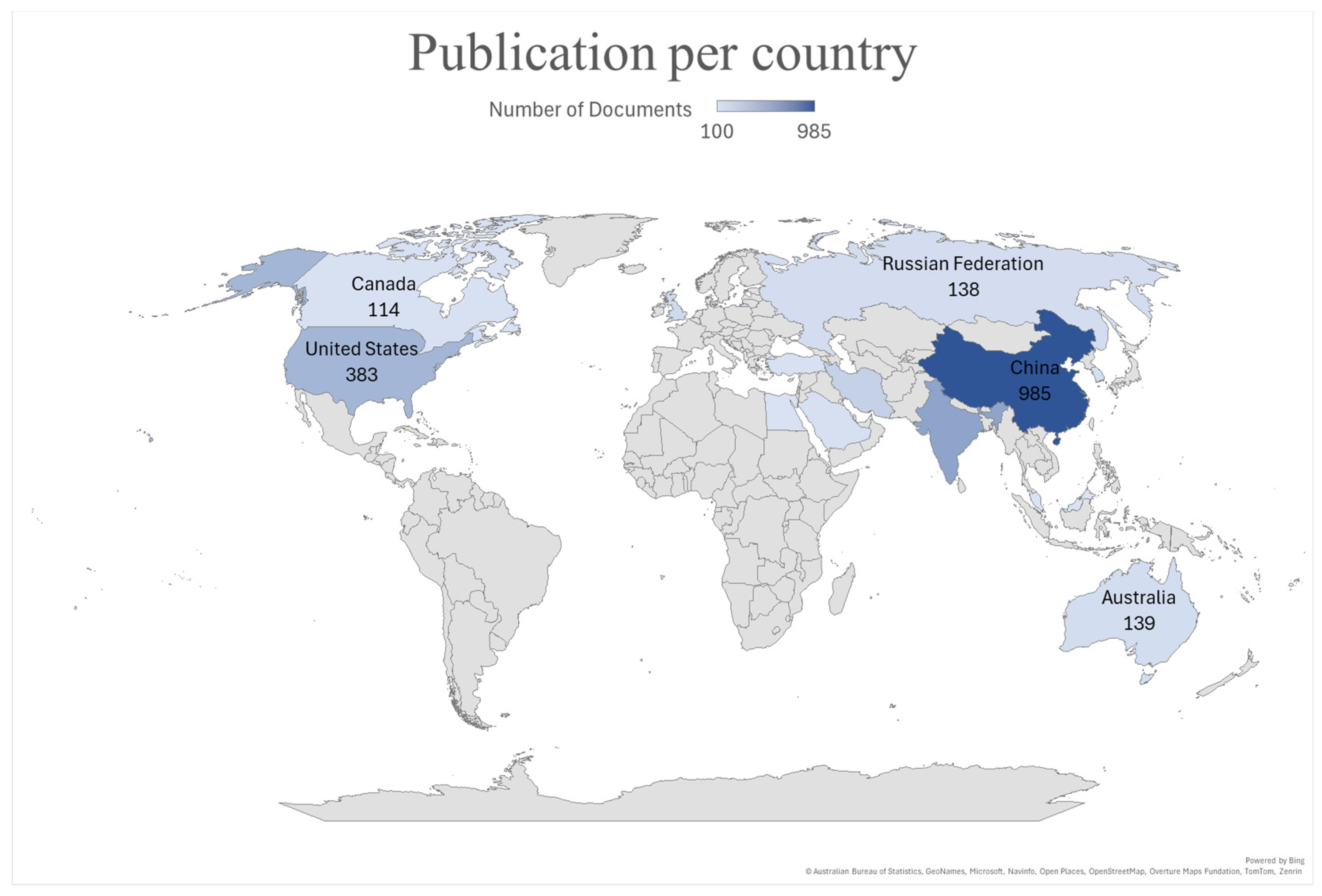
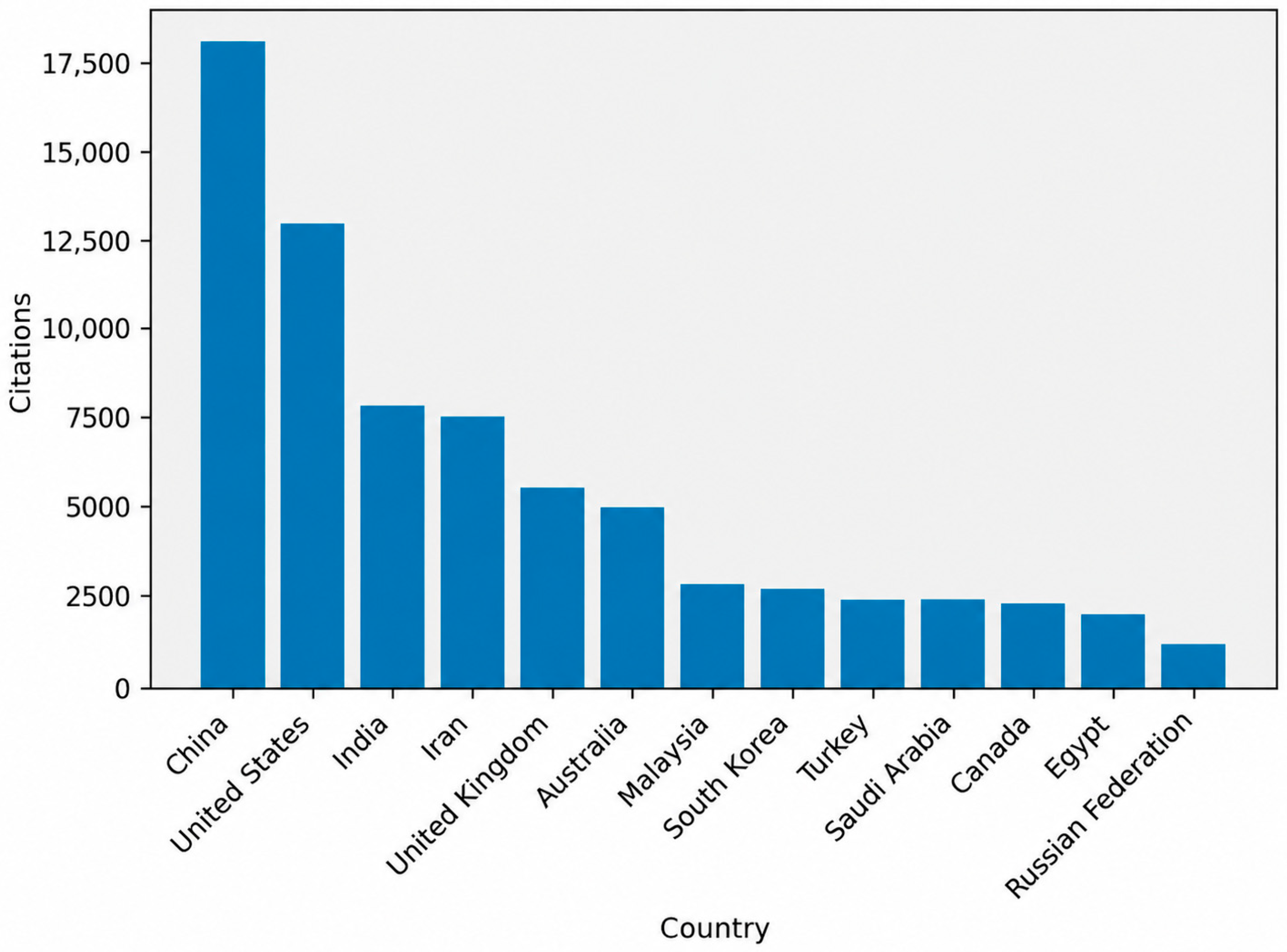
The geographical distribution of artificial neural network (ANN) research articles in the construction domain, categorised by the corresponding author’s nationality, indicates extensive global participation from 2015 to 2025. Table 2 shows the countries that contributed the most in terms of volume and citations. China is the top contributor, with 985 articles and 18,076 citations. This shows that China is strategically investing in AI and using it in construction, as [36] explains. The United States ranks second with 383 articles and 12,950 citations, indicating a strong historical basis for this kind of research. But China’s citation numbers have risen sharply since 2020, when it began developing a new generation of AI-based solutions. India ranks third, with 495 research papers and 7770 citations, demonstrating its growing influence in the field of construction analytics, as evidenced by a study on the use of artificial neural networks to predict compressive strength in concrete [37]. Iran, the UK, and Australia each contributed 213, 155, and 139 research papers, respectively, with 7513, 5453, and 4902 citations. This shows that there is an international community with a wide range of research work. Other prolific contributors are Malaysia (100 papers, 2742 citations), South Korea (124 papers, 2631 citations), Turkey (112 papers, 2301 citations), Saudi Arabia (119 papers, 2296 citations), Canada (114 papers, 2179 citations), Egypt (105 papers, 1908 citations), and the Russian Federation (138 papers, 1063 citations), with each having different research productivity and impact levels. This distribution of publications is visualised by a filled map in Figure 8.
To identify the top contributors, a threshold was set requiring countries to have at least 100 publications and 1000 citations, thereby identifying 13 countries as key stakeholders in artificial neural network (ANN) research in the construction industry. This criterion indicates global importance and ranks China, the United States, India, Iran and the United Kingdom as the top five contributors. The citation-per-publication rate also serves as an indicator of research quality, as evidenced by Australia and Canada, which have high citation rates but relatively low publication rates; this conclusion is also supported by the comparative rankings from machine learning models provided by [34]. The regional analysis reveals disparities in research. Considering Africa as a region, Egypt has contributed significantly, with 105 research publications and 1908 citations, thereby establishing its presence as a key player in the application of artificial neural networks in construction research in Africa, as revealed in [2]. However, research activity in Egypt has been relatively low compared with Malaysia, with 100 research publications and 2742 citations. The African continent remains underrepresented, with only Egypt as a major contributor, indicating a huge untapped potential for the development of artificial neural network applications in construction, as highlighted by the need for localised innovation in developing countries, according to [37,38,39,40].
Citation trends follow publication patterns, with the United States and China leading the ranking, although China’s post-2020 rise in citations indicates an emerging dominance. This is shown by a bar graph (Figure 9), which supports the high quality of research output being generated by these leading nations, fuelled by advances in predictive modelling and digitalisation, as seen through the research by [25] on comparative machine learning techniques. This suggests a scenario in which a select few countries exert increased influence in research, offering great opportunities for development in comparatively underserved fields.

3.6. Publication per Source Analysis

An analysis was conducted to examine citation distribution by source title and determine the major influences on ANN studies in construction, with a view to identifying contributions to influential research. The analysis was performed using VOSviewer’s “citation” analysis, selecting “source” as the unit of analysis and setting a threshold requiring each source to have at least 30 documents published on the topic within the assessment period. A total of 14 sources met this criterion. The journals were ranked by publication count, complemented by citation counts and metrics such as the 2024 CiteScore and H-index, to gauge both productivity and scholarly impact. Based on research published in various journals, Lecture Notes in Civil Engineering has been found to be the most productive journal, with 90 research publications. Although the journal has been highly productive, its low citation count of 169 and CiteScore of 0.7 suggest it serves more as a platform for publishing conference proceedings and early-stage research, rather than for highly cited research. On the other hand, Construction and Building Materials has dominated the citation count, with 2602 citations across 57 research publications, indicating its status as a highly influential journal for research on ANN-based prediction, optimisation, and performance prediction for various construction materials. Sustainability (Switzerland) has published 87 research articles with 1714 citations, indicating the increasing focus on sustainability in buildings and energy savings with the application of AI and ANN techniques. IEEE Transactions on Geoscience and Remote Sensing has received 2027 citations for 42 research articles, with a high CiteScore of 13.6, indicating its status as a highly influential journal for research on ANN-based prediction and optimisation in geospatial analysis, neural networks, and remote sensing. Tunnelling and Underground Space Technology has received 2012 citations for 38 research articles, indicating its presence as a highly influential journal for research work on ANN-based prediction and optimisation in the domain of tunnelling work, as revealed in [21]. Neural Computing and Applications and Energy had strong impact indicators. Energy’s CiteScore was 16.5, and its H-index was 274, meeting notable criteria for ANN applications in energy prediction. Applied Sciences (Switzerland) and Buildings both had more than 45 publications, indicating widespread use of AI in the built environment. Journals such as IEEE Transactions on Geoscience and Remote Sensing (324), Energy (274), and Construction and Building Materials (293) have very high H-indices, indicative of strong citation impact. Although Lecture Notes in Civil Engineering dominates publications, Energy and IEEE Transactions boast more cited articles. This review indicates ANN studies in construction encompass civil engineering, materials science, geotechnical engineering, and energy. Table 3 illustrates the results of this analysis.

3.7. Most Cited Authors

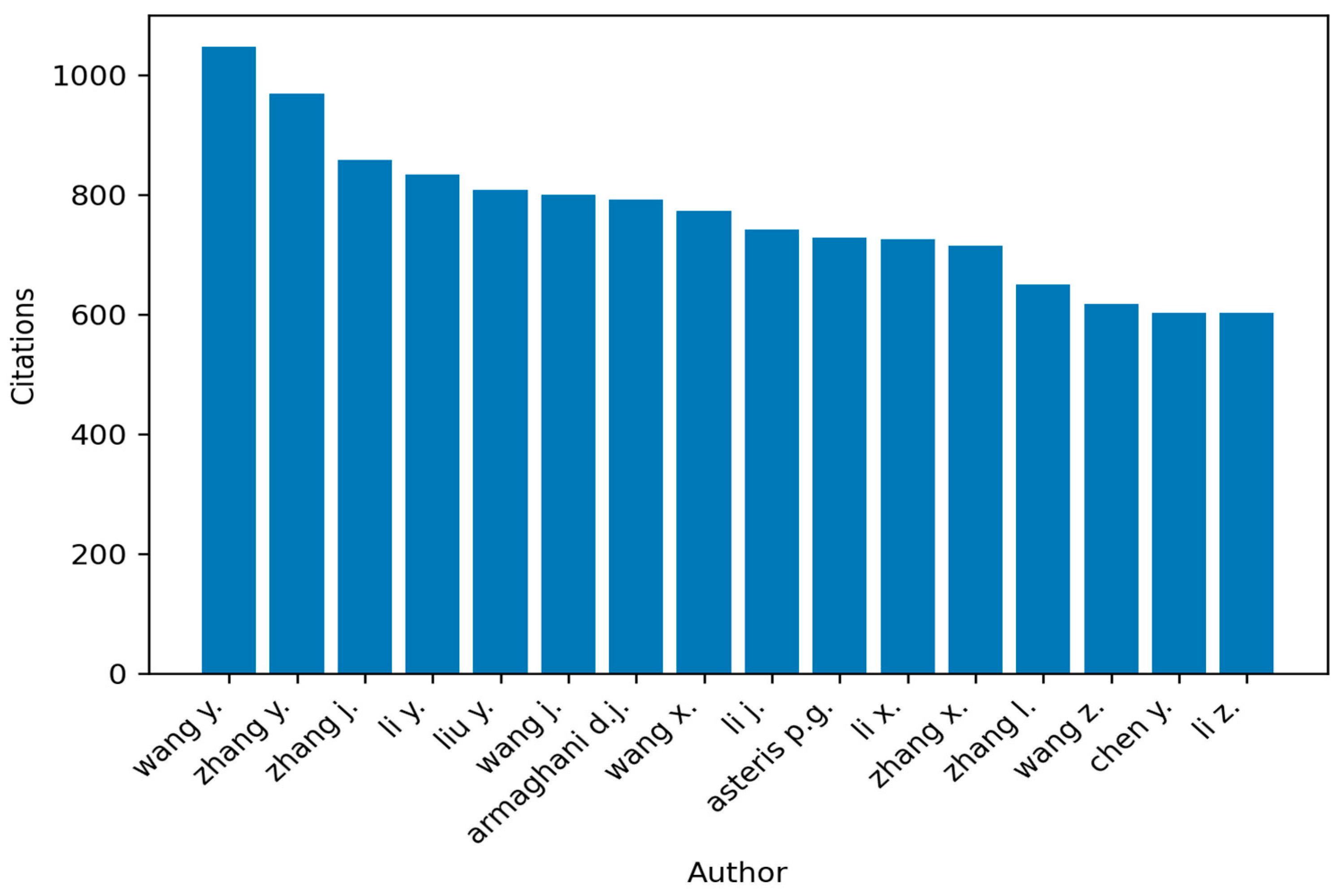
Co-citation analysis was conducted to identify the principal authors who have made substantial contributions to the application and advancement of artificial neural networks in construction research. The goal of this study was to add up the number of times each author’s work in the dataset was cited. This ranking provides useful information about researchers who have contributed to the academic literature and advanced the field’s methods over the last ten years. The “co-citation” analysis type was chosen, and the “cited authors” unit of analysis was chosen. There was a limit of 600 citations per author, and 16 authors in the dataset exceeded this limit. Wang Y. was the most cited author, with a total of 1047 citations. This shows how important Wang Y. was to artificial neural network modelling and predictive analytics in determining material strength, predicting construction project outcomes, and improving energy efficiency. Zhang Y. was the second most cited author, with 969 citations. This shows how important the researcher was in studying and applying hybrid neural networks and in comparing the performance of artificial neural networks with other machine learning tools. Zhang J. came in third with 858 citations, underscoring the importance of the researcher’s work on deep learning for structural analysis and construction monitoring. Other notable authors include Li Y., who was cited 833 times; Liu Y., who was cited 808 times; and Wang J., who was cited 799 times. These researchers have contributed significantly to various fields, including reinforcement learning for optimising construction equipment, advanced prediction of concrete properties, and the development of hybrid artificial intelligence for construction project management. Armaghani D.J., however, stands out with a total of 791 citations. Other notable authors who have made significant contributions, as evidenced by high citation counts, include Wang X. (773 citations), Li J. (742 citations), Asteris P.G. (728 citations), Li X. (726 citations), and Zhang X. (714 citations). Other authors who have made significant contributions, as evidenced by high citation counts, include Zhang L., Wang Z., Chen Y., and Li Z., each with more than 600 citations. The repetition of surnames such as Wang, Zhang, and Li not only reflects a sense of cooperation and unity but also indicates that most influential literature comes from China and East Asia more broadly. The authors mentioned are not only reflections of individual scholarly contributions but also critical reference points within the global research arena, where methodologies have been established and some of the most innovative case studies have been developed. The acknowledgement of such authors provides a reference point for the global scientific arena. Figure 10 shows the bar chart of the most cited authors in the field.

3.8. Most Cited Publications

Most highly cited articles were determined by performing a “citation” analysis in VOSviewer (version 1.6.20), with “documents” as the unit of analysis and a boundary of at least 250 citations for any publication. Only 27 documents across the entire dataset exceeded this threshold, thereby reflecting the core contributions these studies have made to the advancement of the field. The Table 4 lists the most highly cited papers, which cover topics from deep learning theory to construction material prediction and hybrid machine learning applications in engineering. Topping the list, Zhang et al. (2021) [41] wrote the seminal article “Understanding deep learning (still) requires rethinking generalisation,” with 1719 citations, reflecting its broad influence on core knowledge of neural network behaviour and generalisation. Hong et al. (2021) [42] is a close second with 1372 citations, indicating strong cross-disciplinary influence. Within applied construction research, Naderpour et al. (2018) [24] lead with 559 citations, highlighting ANN applications for predicting the compressive strength of eco-friendly concrete mixes, an increasingly relevant topic for sustainable infrastructure development. Asteris et al. (2021) [43] received 437 citations for their article that integrates surrogate machine learning models to accurately predict concrete compressive strength. Several highly cited articles have provided significant methodological contributions. Golafshani et al. (2020) [22], with 396 citations, for example, established hybrid artificial neural network-adaptive neuro-fuzzy inference system models with Grey Wolf Optimiser algorithms. Meanwhile, Armaghani et al. (2017) [44], with 378 citations, developed hybrid intelligent solutions for predicting tunnel-boring machine penetration rates in hard-rock environments, thereby demonstrating the capability of ANN-based predictive models to enhance geotechnical performance predictions. Interestingly, some research has investigated deep learning architectures outside the conventional ANN structures. Zeng et al. (2016) [45] (375 citations) explored convolutional neural networks (CNNs) for predicting DNA–protein binding, and Wang & Chen (2019) [46] (342 citations) illustrated deep CNNs for classification of power quality disturbances. In building and energy systems, Olu-Ajayi et al. (2022) [29] (355 citations) and Yang et al. (2020) [47] (262 citations) focused on predicting energy consumption and optimising building comfort using deep learning and model predictive control approaches. Collectively, these articles demonstrate that ANN research in construction has progressed from proof-of-concept models to high-impact, robust research encompassing deep learning theory, hybrid optimisation techniques, and applications in materials, energy, and automation. Their appearance in citation indices indicates their benchmark-setting influence on the directions of future research.

4. Discussion

The bibliometric analysis presented in this study reveals several cross-cutting patterns that warrant synthesis beyond the findings of individual sections. The exponential growth in ANN publications after 2018, corresponding to the broader adoption of deep learning frameworks and the articulation of Construction 4.0, reflects a structural shift rather than a transient trend. The keyword co-occurrence network corroborates this reading: the high total link strength of “neural networks” (TLS = 8595) and “machine learning” (TLS = 4701) indicates that these terms have become the disciplinary connective tissue binding previously isolated research threads in cost estimation, structural analysis, and energy prediction into a coherent, cross-referencing body of knowledge.
The dominance of China (985 publications, 18,076 citations) and the parallel emergence of India as the third-largest contributor are consistent with keyword evidence indicating that deep learning- and CNN-based applications are resource-intensive research directions concentrated within well-funded national research ecosystems. The citation-per-publication disparity between China and Australia (139 publications, 4902 citations) suggests that volume-driven and quality-driven growth trajectories co-exist in the field, and that citation impact is not simply a function of output volume.
The most cited publications skew heavily towards concrete property prediction and foundational deep learning theory, while the density visualisation reveals that decision support, cost analysis, and lifecycle sustainability remain peripheral. This divergence between what is published most and what the industry arguably needs most constitutes the field’s principal structural gap. It is reinforced by the geographic under-representation of Africa, Latin America, and Southeast Asia, where localised data scarcity and institutional capacity constraints may suppress ANN adoption precisely in the contexts where data-driven tools could offer the greatest benefit. Collectively, these patterns suggest that the next phase of ANN research in construction should prioritise breadth of application and geographic inclusivity over further depth in already saturated prediction domains.
From a construction engineering perspective, the bibliometric patterns carry concrete implications for practice. The dominance of concrete property prediction (Cluster 2; TLS = 3813 for “forecasting”) and neural network optimisation (Cluster 1; aggregate TLS > 14,000) indicates that ANN tools for material selection, mix design, and cost estimation have reached a level of methodological maturity sufficient for integration into standard engineering workflows. Practitioners in quantity surveying and structural design can leverage validated ANN-based prediction models as decision-support tools within BIM environments, reducing reliance on expensive laboratory testing and deterministic rule-of-thumb estimates. The emergence of deep learning and CNN-based applications (Cluster 3; TLS = 5017) has direct implications for construction site management: vision-based ANN systems for defect detection, safety helmet compliance monitoring, and equipment activity recognition are no longer prototypical research tools but are sufficiently mature for pilot deployment in live project environments. For project management, the peripheral positioning of “decision making,” “cost–benefit analysis,” and “risk assessment” in the co-occurrence network (Cluster 1; TLS values of 514, 435, and 332 respectively) underscores a gap between ANN’s predictive power and its integration into formal project control systems. Bridging this gap requires future work to connect ANN output to decision logic layers, scheduling constraints, procurement rules, and risk registers, rather than treating prediction accuracy as the terminal deliverable. Finally, the geographic concentration of high-impact research in China, the US, and India implies that ANN tools developed and validated in these contexts may embed data distributions, material standards, and regulatory assumptions that do not transfer directly to construction environments in Africa, Latin America, or Southeast Asia. Industry adoption in underrepresented regions therefore requires not only access to tools, but locally calibrated training data and regionally appropriate validation benchmarks.

5. Future Research Directions

Based on the gaps identified in this review, future research should prioritise four directions. First, ANN applications in lifecycle sustainability assessment, including embodied carbon modelling, circular economy material flows, and climate resilience, are under-represented relative to their importance and should attract dedicated bibliometric and empirical attention. Second, the integration of ANNs with Building Information Modelling (BIM), Digital Twins, and Internet of Things (IoT) sensor networks represents a structurally emerging cluster in the overlay visualisation; future reviews should track whether this integration theme consolidates into a dominant cluster by 2027–2030. Third, the geographic concentration of high-output research in China, the US, and India warrants targeted efforts to build ANN research capacity in underrepresented regions, including sub-Saharan Africa and Latin America, where localised datasets for cost, safety, and material prediction remain scarce. Fourth, future bibliometric studies should extend the database scope beyond Scopus to include Web of Science and Google Scholar to reduce the English-language and journal-indexing bias inherent in the present analysis.

6. Conclusions

In line with the study objectives, the analysis considered annual publication growth, thematic hotspots and emerging trends, and the leading countries, sources, authors, and influential publications. This bibliometric study aims to elucidate the evolution, fundamental concepts, and related frameworks of artificial neural networks (ANNs) within the construction industry over the preceding decade. The study found a rising trend in research publications beginning in 2018, indicating the industry’s growing demand for data-driven innovation within the framework of Construction 4.0. The USA, China, and India are the most important countries worldwide for ANN research in the construction industry. They make a big difference in the global output of this type of research. “Construction and Building Materials,” “IEEE Transactions on Geoscience and Remote Sensing,” and “Energy” are among the most well-known journals for publishing new research on ANN in the construction industry. Additionally, the literature indicates that ANNs have significantly advanced the fields of optimisation, concrete property prediction, and deep learning in predictive analytics and classification. These results collectively fulfil Objectives 1 and 2 by delineating the publication trajectory of ANN research in construction and elucidating the prevailing trends and focal points that have influenced the field in the past decade.
Interestingly, the literature shows that research on ANNs in the construction industry has shifted from proof-of-concept models to more advanced hybrid models that integrate Building Information Modelling (BIM) and can predict materials, monitor equipment, and make buildings more energy-efficient. This shows that ANNs have significant potential to transform the construction industry by improving accuracy, reducing uncertainty, and meeting sustainability goals. Despite the significant achievements in ANNs in the construction industry, some fundamental gaps have been found in the literature, such as the lack of research in the application of ANNs in the areas of lifecycle sustainability, social equity, and climate change resilience, despite its well-developed research in cost estimation and structural health monitoring, and its relatively underdeveloped research in the aforementioned areas. Further, the literature indicates that some regions, such as Africa, Latin America, and parts of Southeast Asia, are significantly underrepresented in the global research landscape, highlighting the need to develop more collaborative research environments to democratise cutting-edge computational research methodologies.
The limitations of this study include its dependency on Scopus as a data source. While Scopus is widely regarded as a comprehensive source of academic publications, its reliance on other data sources may introduce bias in favour of English-language publications. Moreover, due to the time lag in citation accumulation, recent publications after 2022 may be understated in their contribution to the overall body of knowledge. Future studies should include additional data sources, such as Web of Science and Google Scholar, to gain a broader view of the landscape.
As the built environment changes to include smarter infrastructure, it is important to teach digital literacy, machine learning, and artificial intelligence in schools. Future research should encompass novel applications for artificial neural networks, including real-time safety monitoring, supply chain management through machine learning, and resilience-oriented design. Future research on artificial neural networks should strengthen theoretical frameworks and leverage their role as catalysts for innovation, inclusivity, and sustainability in the built environment.
In conclusion, this review provides a structured evidence-based synthesis with great potential to inspire new avenues for researchers, practitioners, and policymakers. By clearly indicating trends in the field and highlighting potential avenues for new research, it provides a foundation for the immediate and safe adoption of artificial neural network technologies to enhance the adaptability of the construction sector in an increasingly complex digital world.

Author Contributions

Conceptualization, S.O.A.; methodology, O.G.-A.; software, O.G.-A.; validation, S.O.A., C.O.A. and H.A.; resources, S.O.A. and C.O.A.; data curation, O.G.-A.; writing—original draft preparation, O.G.-A.; writing—review and editing, S.O.A. and H.A.; visualization, O.G.-A. and H.A.; supervision, S.O.A. and C.O.A.; project administration, C.O.A.; investigation, O.G.-A. All authors have read and agreed to the published version of the manuscript.

Funding

This research received no external funding.

Data Availability Statement

The original contributions presented in this study are included in the article. Further inquiries can be directed to the corresponding author.

Conflicts of Interest

The authors declare no conflicts of interest.

Abbreviations

The following abbreviations are used in this manuscript:
ANNArtificial Neural Network
LSTMLong Short-Term Memory
SVMSupport Vector Machine.
BIMBuilding Information Modelling
AIArtificial Intelligence
CNNConvolutional Neural Network
CSVComma Separated Values
RNNRecurrent Neural Networks
ANFISAdaptive Neuro-Fuzzy Inference System
ICA-XGBoostIndependent Component Analysis (ICA) eXtreme Gradient Boost
MLMachine Learning

References

  1. Liu, S.; Chang, R.; Zuo, J.; Webber, R.J.; Xiong, F.; Dong, N. Application of Artificial Neural Networks in Construction Management: Current Status and Future Directions. Appl. Sci. 2021, 11, 9616. [Google Scholar] [CrossRef]
  2. Ahmed, M.; AlQadhi, S.; Mallick, J.; Kahla, N.B.; Le, H.A.; Singh, C.K.; Hang, H.T. Artificial Neural Networks for Sustainable Development of the Construction Industry. Sustainability 2022, 14, 14738. [Google Scholar] [CrossRef]
  3. Kaushik, A.K.; Islam, R.; Elbahy, S.; Arif, M. Artificial Neural Network Application in Construction and the Built Environment: A Bibliometric Analysis. Buildings 2024, 14, 2423. [Google Scholar] [CrossRef]
  4. Darko, A.; Chan, A.P.C.; Adabre, M.A.; Edwards, D.J.; Hosseini, M.R.; Ameyaw, E.E. Artificial Intelligence in the AEC Industry: Scientometric Analysis and Visualization of Research Activities. Autom. Constr. 2020, 112, 103081. [Google Scholar] [CrossRef]
  5. Flores, F.G.B.; Chacon, V.Y.R.; Caqui, A.C.A.; Palacios-Nunez, M.L.; Alva, L.G.P. Artificial Intelligence and Industry: A Bibliometrics Analysis. In Proceedings of the 2024 IEEE 31st International Conference on Electronics, Electrical Engineering and Computing, INTERCON 2024, Lima, Peru, 6–8 November 2024; IEEE: New York, NY, USA, 2024; pp. 1–6. [Google Scholar] [CrossRef]
  6. Luo, J. A Bibliometric Review on Artificial Intelligence for Smart Buildings. Sustainability 2022, 14, 10230. [Google Scholar] [CrossRef]
  7. Mansoor, A.; Liu, S.; Ali, G.M.; Bouferguene, A.; Al-Hussein, M. Scientometric Analysis and Critical Review on the Application of Deep Learning in the Construction Industry. Can. J. Civ. Eng. 2022, 50, 253–269. [Google Scholar] [CrossRef]
  8. Egwim, C.N.; Alaka, H.; Demir, E.; Balogun, H.; Olu-Ajayi, R.; Sulaimon, I.; Wusu, G.; Yusuf, W.; Muideen, A.A. Artificial Intelligence in the Construction Industry: A Systematic Review of the Entire Construction Value Chain Lifecycle. Energies 2023, 17, 182. [Google Scholar] [CrossRef]
  9. Silitonga, D.M.; Jin, O.F. Application of Artificial Intelligence (AI) in Construction Management: A Systematic Literature Review. Invotek J. Inov. Vokasional Dan Teknol. 2024, 23, 155–166. [Google Scholar] [CrossRef]
  10. Saipudin, N.A.; Ishak, N. A Bibliometric Analysis of Building Information Modeling (Bim) Integration in Industrialized Building Systems (Ibs): Trends, Gaps, and Future Directions. Int. J. Innov. Ind. Revolut. 2024, 6, 176–190. [Google Scholar] [CrossRef]
  11. Garcia, J.; Villavicencio, G.; Altimiras, F.; Crawford, B.; Soto, R.; Minatogawa, V.; Franco, M.; Martínez-Muñoz, D.; Yepes, V. Machine Learning Techniques Applied to Construction: A Hybrid Bibliometric Analysis of Advances and Future Directions. Autom. Constr. 2022, 142, 104532. [Google Scholar] [CrossRef]
  12. Ametepey, S.O.; Aigbavboa, C.; Addy, H.; Thwala, W.D. A Bibliometric Review of the Trends of Construction Digitalization Research in the Past Ten Years. Buildings 2024, 14, 2729. [Google Scholar] [CrossRef]
  13. Rahayu, S.; Meirawan, D.; Ghinaya, Z.; Sabitri, Z.; Al Dhahrani, J.; Ismail, A. Computational Bibliometric Analysis of Artificial Intelligence in the Construction Industry Research. J. Adv. Res. Appl. Sci. Eng. Technol. 2024, 57, 63–72. [Google Scholar] [CrossRef]
  14. Rowley, J.; Hartley, R. Organizing Knowledge: An Introduction to Managing Access to Information. In Organizing Knowledge: An Introduction to Managing Access to Information; Routledge, Taylor & Francis Group: Oxford, UK, 2017; pp. 1–367. [Google Scholar] [CrossRef]
  15. Usée, C.; Larivière, V.; Archambault, É. Conference Proceedings as a Source of Scientific Information: A Bibliometric Analysis. J. Am. Soc. Inf. Sci. Technol. 2008, 59, 1776–1784. [Google Scholar] [CrossRef]
  16. Vrettas, G.; Sanderson, M. Conferences versus Journals in Computer Science. J. Assoc. Inf. Sci. Technol. 2015, 66, 2674–2684. [Google Scholar] [CrossRef]
  17. Togia, A.; Tsigilis, N. Impact Factor and Education Journals: A Critical Examination and Analysis. Int. J. Educ. Res. 2006, 45, 362–379. [Google Scholar] [CrossRef]
  18. Su, H.N.; Lee, P.C. Mapping Knowledge Structure by Keyword Co-Occurrence: A First Look at Journal Papers in Technology Foresight. Scientometrics 2010, 85, 65–79. [Google Scholar] [CrossRef]
  19. Heravi, G.; Eslamdoost, E. Applying Artificial Neural Networks for Measuring and Predicting Construction-Labor Productivity. J. Constr. Eng. Manag. 2015, 141, 04015032. [Google Scholar] [CrossRef]
  20. Asteris, P.G.; Mokos, V.G. Concrete Compressive Strength Using Artificial Neural Networks. Neural Comput. Appl. 2020, 32, 11807–11826. [Google Scholar] [CrossRef]
  21. Armaghani, D.J.; Asteris, P.G. A Comparative Study of ANN and ANFIS Models for the Prediction of Cement-Based Mortar Materials Compressive Strength. Neural Comput. Appl. 2021, 33, 4501–4532. [Google Scholar] [CrossRef]
  22. Golafshani, E.M.; Behnood, A.; Arashpour, M. Predicting the Compressive Strength of Normal and High-Performance Concretes Using ANN and ANFIS Hybridized with Grey Wolf Optimizer. Constr. Build. Mater. 2020, 232, 117266. [Google Scholar] [CrossRef]
  23. Cheng, J.C.P.; Chen, W.; Chen, K.; Wang, Q. Data-Driven Predictive Maintenance Planning Framework for MEP Components Based on BIM and IoT Using Machine Learning Algorithms. Autom. Constr. 2020, 112, 103087. [Google Scholar] [CrossRef]
  24. Naderpour, H.; Rafiean, A.H.; Fakharian, P. Compressive Strength Prediction of Environmentally Friendly Concrete Using Artificial Neural Networks. J. Build. Eng. 2018, 16, 213–219. [Google Scholar] [CrossRef]
  25. Dao, D.V.; Ly, H.-B.; Trinh, S.H.; Le, T.-T.; Pham, B.T. Artificial Intelligence Approaches for Prediction of Compressive Strength of Geopolymer Concrete. Materials 2019, 12, 983. [Google Scholar] [CrossRef] [PubMed]
  26. Shahmansouri, A.A.; Yazdani, M.; Ghanbari, S.; Akbarzadeh Bengar, H.; Jafari, A.; Farrokh Ghatte, H. Artificial Neural Network Model to Predict the Compressive Strength of Eco-Friendly Geopolymer Concrete Incorporating Silica Fume and Natural Zeolite. J. Clean. Prod. 2021, 279, 123697. [Google Scholar] [CrossRef]
  27. Khallaf, R.; Khallaf, M. Classification and Analysis of Deep Learning Applications in Construction: A Systematic Literature Review. Autom. Constr. 2021, 129, 103760. [Google Scholar] [CrossRef]
  28. Akinosho, T.D.; Oyedele, L.O.; Bilal, M.; Ajayi, A.O.; Delgado, M.D.; Akinade, O.O.; Ahmed, A.A. Deep Learning in the Construction Industry: A Review of Present Status and Future Innovations. J. Build. Eng. 2020, 32, 101827. [Google Scholar] [CrossRef]
  29. Olu-Ajayi, R.; Alaka, H.; Sulaimon, I.; Sunmola, F.; Ajayi, S. Building Energy Consumption Prediction for Residential Buildings Using Deep Learning and Other Machine Learning Techniques. J. Build. Eng. 2022, 45, 103406. [Google Scholar] [CrossRef]
  30. Rashid, K.M.; Louis, J. Times-Series Data Augmentation and Deep Learning for Construction Equipment Activity Recognition. Adv. Eng. Inform. 2019, 42, 100944. [Google Scholar] [CrossRef]
  31. Liu, X.; Qiao, S.; Chen, H.; Tang, M.; He-Song, H.; Zhu, Y. Prediction Method of Structural Health Monitoring Data Based on CNN-LSTM. In Advances in Frontier Research on Engineering Structures Volume 2; CRC Press: Boca Raton, FL, USA, 2023; pp. 309–318. [Google Scholar] [CrossRef]
  32. Duraipandian, M. Deep Learning Network for Remote Monitoring of Thermal Exchange Tunnels. J. Soft Comput. Paradigm 2024, 6, 13–25. [Google Scholar] [CrossRef]
  33. Nguyen, Q.H.; Ly, H.-B.; Ho, L.S.; Al-Ansari, N.; Le, H.V.; Tran, V.Q.; Prakash, I.; Pham, B.T. Influence of Data Splitting on Performance of Machine Learning Models in Prediction of Shear Strength of Soil. Math. Probl. Eng. 2021, 2021, 4832864. [Google Scholar] [CrossRef]
  34. Tixier, A.J.P.; Hallowell, M.R.; Rajagopalan, B.; Bowman, D. Application of Machine Learning to Construction Injury Prediction. Autom. Constr. 2016, 69, 102–114. [Google Scholar] [CrossRef]
  35. van Eck, N.J.; Waltman, L. Software Survey: VOSviewer, a Computer Program for Bibliometric Mapping. Scientometrics 2009, 84, 523–538. [Google Scholar] [CrossRef] [PubMed]
  36. Pan, Y.; Zhang, L. Roles of Artificial Intelligence in Construction Engineering and Management: A Critical Review and Future Trends. Autom. Constr. 2021, 122, 103517. [Google Scholar] [CrossRef]
  37. Chithra, S.; Kumar, S.R.R.S.; Chinnaraju, K.; Alfin Ashmita, F. A Comparative Study on the Compressive Strength Prediction Models for High Performance Concrete Containing Nano Silica and Copper Slag Using Regression Analysis and Artificial Neural Networks. Constr. Build. Mater. 2016, 114, 528–535. [Google Scholar] [CrossRef]
  38. ElSawy, I.; Hosny, H.; Razek, M.A. A Neural Network Model for Construction Projects Site Overhead Cost Estimating in Egypt. arXiv 2011, arXiv:1106.1570. [Google Scholar]
  39. Shiha, A.; Dorra, E.M.; Nassar, K. Neural Networks Model for Prediction of Construction Material Prices in Egypt Using Macroeconomic Indicators. J. Constr. Eng. Manag. 2020, 146, 04020010. [Google Scholar] [CrossRef]
  40. El-Hazek, A.; Ghareeb, S.; Ibrahim, A. Profitability Estimation Model of Egyptian Construction Projects Using Artificial Neural Network. Eng. Res. J. 2024, 53, 142–149. [Google Scholar] [CrossRef]
  41. Zhang, C.; Bengio, S.; Hardt, M.; Recht, B.; Vinyals, O. Understanding Deep Learning (Still) Requires Rethinking Generalization. Commun. ACM 2021, 64, 107–115. [Google Scholar] [CrossRef]
  42. Hong, D.; Gao, L.; Yao, J.; Zhang, B.; Plaza, A.; Chanussot, J. Graph Convolutional Networks for Hyperspectral Image Classification. IEEE Trans. Geosci. Remote Sens. 2021, 59, 5966–5978. [Google Scholar] [CrossRef]
  43. Asteris, P.G.; Skentou, A.D.; Bardhan, A.; Samui, P.; Pilakoutas, K. Predicting Concrete Compressive Strength Using Hybrid Ensembling of Surrogate Machine Learning Models. Cem. Concr. Res. 2021, 145, 106449. [Google Scholar] [CrossRef]
  44. Armaghani, D.J.; Mohamad, E.T.; Narayanasamy, M.S.; Narita, N.; Yagiz, S. Development of Hybrid Intelligent Models for Predicting TBM Penetration Rate in Hard Rock Condition. Tunn. Undergr. Space Technol. 2017, 63, 29–43. [Google Scholar] [CrossRef]
  45. Zeng, H.; Edwards, M.D.; Liu, G.; Gifford, D.K. Convolutional Neural Network Architectures for Predicting DNA–Protein Binding. Bioinformatics 2016, 32, i121–i127. [Google Scholar] [CrossRef] [PubMed]
  46. Wang, S.; Chen, H. A Novel Deep Learning Method for the Classification of Power Quality Disturbances Using Deep Convolutional Neural Network. Appl. Energy 2019, 235, 1126–1140. [Google Scholar] [CrossRef]
  47. Yang, S.; Wan, M.P.; Chen, W.; Ng, B.F.; Dubey, S. Model Predictive Control with Adaptive Machine-Learning-Based Model for Building Energy Efficiency and Comfort Optimization. Appl. Energy 2020, 271, 115147. [Google Scholar] [CrossRef]
  48. Warstadt, A.; Singh, A.; Bowman, S.R. Neural Network Acceptability Judgments. Trans. Assoc. Comput. Linguist. 2019, 7, 625–641. [Google Scholar] [CrossRef]
  49. Singh, A.; Thakur, N.; Sharma, A. A Review of Supervised Machine Learning Algorithms. 2016, pp. 1310–1315. Available online: https://ieeexplore.ieee.org/document/7724478 (accessed on 28 May 2026).
  50. Artrith, N.; Urban, A. An Implementation of Artificial Neural-Network Potentials for Atomistic Materials Simulations: Performance for TiO2. Comput. Mater. Sci. 2016, 114, 135–150. [Google Scholar] [CrossRef]
  51. Tang, J.; Liu, F.; Zou, Y.; Zhang, W.; Wang, Y. An Improved Fuzzy Neural Network for Traffic Speed Prediction Considering Periodic Characteristic. IEEE Trans. Intell. Transp. Syst. 2017, 18, 2340–2350. [Google Scholar] [CrossRef]
  52. Kong, D.; Chen, Y.; Li, N. Gaussian Process Regression for Tool Wear Prediction. Mech. Syst. Signal Process. 2018, 104, 556–574. [Google Scholar] [CrossRef]
  53. Liu, P.; Wang, J.; Sangaiah, A.K.; Xie, Y.; Yin, X. Analysis and Prediction of Water Quality Using LSTM Deep Neural Networks in IoT Environment. Sustainability 2019, 11, 2058. [Google Scholar] [CrossRef]
  54. Haghighat, E.; Juanes, R. SciANN: A Keras/TensorFlow Wrapper for Scientific Computations and Physics-Informed Deep Learning Using Artificial Neural Networks. Comput. Methods Appl. Mech. Eng. 2021, 373, 113552. [Google Scholar] [CrossRef]
  55. Duan, J.; Asteris, P.G.; Nguyen, H.; Bui, X.-N.; Moayedi, H. A Novel Artificial Intelligence Technique to Predict Compressive Strength of Recycled Aggregate Concrete Using ICA-XGBoost Model. Eng. Comput. 2021, 37, 3329–3346. [Google Scholar] [CrossRef]
  56. Rahman, J.; Ahmed, K.S.; Khan, N.I.; Islam, K.; Mangalathu, S. Data-Driven Shear Strength Prediction of Steel Fiber Reinforced Concrete Beams Using Machine Learning Approach. Eng. Struct. 2021, 233, 111743. [Google Scholar] [CrossRef]
Figure 1. Outline of research methodology.
Buildings 16 02470 g001
Figure 2. PRISMA-style flow diagram of the bibliometric record identification and screening process.
Buildings 16 02470 g002
Figure 3. Number of Publications per year.
Buildings 16 02470 g003
Figure 4. Publication Type per year.
Buildings 16 02470 g004
Figure 5. Overlay visualisation of all keywords showing the temporal evolution of research themes (2015–2025). Node size reflects keyword occurrence frequency; link thickness reflects co-occurrence strength; node colour indicates the average publication year of co-occurring documents, ranging from dark blue (2015–2017) to yellow–green (2022–2025). Keywords located centrally, with recent colouration and dense links, represent concepts that have achieved cross-disciplinary uptake throughout the study period.
Buildings 16 02470 g005
Figure 6. Density visualisation of all keywords showing research hotspots in ANN applications in construction (2015–2025). Colour brightness reflects a combination of keyword occurrence frequency and the density of co-occurrence links in each network neighbourhood: bright yellow-green areas indicate high-frequency, structurally central themes, while cooler and darker areas indicate emerging or peripheral topics with lower co-occurrence consolidation.
Buildings 16 02470 g006
Figure 7. Co-occurrence network of all keywords (minimum occurrence threshold: 60; 82 keywords retained after normalisation). Node size reflects occurrence frequency; link thickness reflects co-occurrence strength between keyword pairs; node colour denotes cluster membership, with five thematic clusters identified through VOSviewer’s modularity-based community detection algorithm (Q = 0.31).
Buildings 16 02470 g007
Figure 8. Mapping of publications per country.
Buildings 16 02470 g008
Figure 9. Number of Citations per country.
Buildings 16 02470 g009
Figure 10. Number of citations per author.
Buildings 16 02470 g010
Table 1. List of clusters and co-occurring keywords.
Cluster LabelKeywordsNo. of OccurrencesTotal Link Strength
Cluster 1 (Red)Neural Networks21728595
Artificial Neural Networks3371082
Construction Industry2381356
Artificial Intelligence204898
Optimization185911
Genetic algorithms158761
Multilayer Neural Networks142584
Backpropagation112522
Decision making110514
Complex Networks108533
Construction Projects95504
Finite Element Method94379
Project Management93472
Cost Benefit Analysis79435
Risk Assessment76332
Soils76382
Energy Efficiency74349
Particle Swarm Optimization (pso)73378
Construction72334
Energy Utilization71363
Optimisations68314
Cost Estimating66368
Neural Network Model64288
Costs63311
Uncertainty Analysis63323
Cluster 2 (Green)Forecasting6783813
Compressive Strength3531908
Artificial Neural Network (ANN)3511187
Concretes2191291
Regression Analysis1881040
Concrete Construction1841083
Mean Square Error1811120
Reinforced Concrete156898
Sensitivity Analysis149791
Artificial Neural Network Modelling146681
Fuzzy Neural Networks108551
Fuzzy Inference100544
Sustainable Development97497
Concrete Aggregates79503
Cements77514
Mortar77417
Concrete Buildings76449
Linear Regression72412
Concrete Mixtures70486
Modelling68280
Tensile Strength67395
Soft Computing65392
Fly Ash62351
Artificial Neural Network Models60305
Cluster 3 (Blue)Artificial Neural Network13125017
Deep learning2591250
Convolutional Neural Networks2351273
Prediction2051098
Deep neural networks150729
Algorithm130768
Construction equipment96560
Convolution95535
Data mining86418
China85407
Classification (of information)82395
Numerical model79412
Remote sensing79328
Boring machines (machine tools)66433
Data set65393
Feature extraction64324
Network architecture64288
Accuracy assessment62363
Data handling61271
Long short-term memory60323
Cluster 4 (Yellow)Machine Learning8704701
Learning Systems2391445
Support Vector Machines2301425
Decision trees1481013
Learning algorithms145941
Machine learning models84511
Nearest neighbour search80462
Support vector regression69428
Random forests65472
Predictive analytics62382
Machine learning techniques61432
Cluster 5 (Purple)Performance97503
Table 2. Number of Publications per country.
CountryNumber of DocumentsNumber of Citations
China985 publications18,076 citations
India495 publications7770 citations
United States383 publications12,950 citations
Iran213 publications7513 citations
United Kingdom155 publications5453 citations
Australia139 publications4902 citations
Russian Federation138 publications1063 citations
South Korea124 publications2631 citations
Saudi Arabia119 publications2296 citations
Canada114 publications2179 citations
Turkey112 publications2301 citations
Egypt105 publications1908 citations
Malaysia100 publications2742 citations
Table 3. Number of publications per source.
SourceNo. of PublicationsNo. of CitationsCiteScore (2024)H-Index (2024)
Lecture Notes in Civil Engineering901690.728
Sustainability (Switzerland)8717147.7207
Asian Journal of Civil Engineering625803.636
Construction and Building Materials57260213.9293
Applied Sciences (Switzerland)516975.5162
Buildings495514.471
IEEE Transactions on Geoscience and Remote Sensing42202713.6324
Tunnelling And Underground Space Technology38201213155
Advances In Intelligent Systems and Computing361370.281
Engineering Structures34143311.2205
Journal of Building Engineering33175111.5114
Neural Computing and Applications32150211.7146
Energy31113416.5274
Materials318556.4191
Table 4. Most cited publications.
ReferencesCitationsYearTitle
Zhang et al. (2021) [41]17192021Understanding deep learning (still) requires rethinking generalization
Hong et al. (2021) [42]13722021Graph Convolutional Networks for Hyperspectral Image Classification
Zhang et al. (2016) [41]10042016Understanding deep learning requires rethinking generalization
Warstadt et al. (2019) [48]7482019Neural Network Acceptability Judgments
Singh et al. (2016) [49]6492016A review of supervised machine learning algorithms
Naderpour et al. (2018) [24]5592018Compressive strength prediction of environmentally friendly concrete using artificial neural networks
Nguyen et al. (2021) [33]4482021Influence of Data Splitting on Performance of Machine Learning Models in Prediction of Shear Strength of Soil
Artrith & Urban (2016) [50]4382016An implementation of artificial neural-network potentials for atomistic materials simulations: Performance for TiO2
Asteris et al. (2021) [43]4372021Predicting concrete compressive strength using hybrid ensembling of surrogate machine learning models
Golafshani et al. (2020) [22]3962020Predicting the compressive strength of normal and High-Performance Concretes using ANN and ANFIS hybridized with Grey Wolf Optimizer
Cheng et al. (2020) [23]3822020Data-driven predictive maintenance planning framework for MEP components based on BIM and IoT using machine learning algorithms
Armaghani et al. (2017) [44]3782017Development of hybrid intelligent models for predicting TBM penetration rate in hard rock condition
Zeng et al. (2016) [45]3752016Convolutional neural network architectures for predicting DNA–protein binding
Olu-Ajayi et al. (2022) [29]3552022Building energy consumption prediction for residential buildings using deep learning and other machine learning techniques
Tang et al. (2017) [51]3442017An Improved Fuzzy Neural Network for Traffic Speed Prediction Considering Periodic Characteristic
Wang & Chen (2019) [46]3422019A novel deep learning method for the classification of power quality disturbances using deep convolutional neural network
Armaghani & Asteris (2021) [21]3352021A comparative study of ANN and ANFIS models for the prediction of cement-based mortar materials compressive strength
Chithra et al. (2016) [37]3242016A comparative study on the compressive strength prediction models for High Performance Concrete containing nano silica and copper slag using regression analysis and Artificial Neural Networks
Rashid & Louis (2019) [30]2882019Times-series data augmentation and deep learning for construction equipment activity recognition
Dao et al. (2019) [25]2842019Artificial Intelligence Approaches for Prediction of Compressive Strength of Geopolymer Concrete
Shahmansouri et al. (2021) [26]2832021Artificial neural network model to predict the compressive strength of eco-friendly geopolymer concrete incorporating silica fume and natural zeolite
Kong et al. (2018) [52]2832018Gaussian process regression for tool wear prediction
Liu et al. (2019) [53]2822019Analysis and Prediction of Water Quality Using LSTM Deep Neural Networks in IoT Environment
Haghighat & Juanes (2021) [54]2802021SciANN: A Keras/TensorFlow wrapper for scientific computations and physics-informed deep learning using artificial neural networks
Duan et al. (2021) [55]2672021A novel artificial intelligence technique to predict compressive strength of recycled aggregate concrete using ICA-XGBoost model
Yang et al. (2020) [47]2622020Model predictive control with adaptive machine-learning-based model for building energy efficiency and comfort optimization
Rahman et al. (2021) [56]2582021Data-driven shear strength prediction of steel fiber reinforced concrete beams using machine learning approach
Disclaimer/Publisher’s Note: The statements, opinions and data contained in all publications are solely those of the individual author(s) and contributor(s) and not of MDPI and/or the editor(s). MDPI and/or the editor(s) disclaim responsibility for any injury to people or property resulting from any ideas, methods, instructions or products referred to in the content.