Factors Affecting Conflict Resolution Capacity: An Organizational Perspective from Construction Firms
Abstract
1. Introduction
2. Conceptual Framework
2.1. CM Skills
2.2. Conceptualizing Leadership Within the Construction Industry
- Democratic/Participative Leadership (PL): Consults subordinates regarding the decisions and actions to be taken, encouraging their active intervention without centralizing power in their person [26].
- Laissez-faire/Liberal Leader (LL): Exercises minimal use of their authority, granting employees a high margin of autonomy under the premise that they will make the best decisions possible; this type of leader provides full backing to their followers, expecting them to meet the established goals [24].
2.3. Work Motivation of the CM
2.4. Conflict Resolution Capacity
3. Conceptual Model and Hypotheses Development
4. Methodology and Data Analysis
4.1. Methodological Diagnostics: Non-Response Bias and Common Method Bias
4.2. Research Method
5. Result and Discussion
IPMA (Importance–Performance Map Analysis)
6. Conclusions
Author Contributions
Funding
Institutional Review Board Statement
Informed Consent Statement
Data Availability Statement
Acknowledgments
Conflicts of Interest
Abbreviations
| WM | Work Motivation |
| PL | Participative Leadership |
| CRC | Conflict Resolution Capacity |
| EXP | Experience |
| AGE | Age |
| GEN | Gender |
References
- Olomolaiye, P.; Price, A.D.F. A review of construction operative motivation. Build. Environ. 1989, 24, 279–287. [Google Scholar] [CrossRef]
- Löwstedt, M.; Fasth, J.; Styhre, A. Leadership under Construction: A Qualitative Exploration of Leadership Processes in Construction Companies in Sweden. J. Constr. Eng. Manag. 2021, 147, 05021010. [Google Scholar] [CrossRef]
- Tabassi, A.A.; Roufechaei, K.M.; Ramli, M.; Bakar, A.H.A. Leadership competences of sustainable construction project managers. J. Clean. Prod. 2016, 124, 339–349. [Google Scholar] [CrossRef]
- Stogdill, R. Handbook of Leadership: A Survey of Theory and Research; The Free Press: New York, NY, USA, 1974. [Google Scholar]
- Bolden, R.; Gosling, J. Leadership competencies: Time to change the tune? Leadership 2006, 2, 147–163. [Google Scholar] [CrossRef]
- Hogan, R.; Kaiser, R.B. What we know about leadership. Rev. Gen. Psychol. 2005, 9, 169–180. [Google Scholar] [CrossRef]
- Vroom, V.H.; Jago, A.G. The role of situation in leadership. Am. Psychol. 2007, 62, 17–24. [Google Scholar] [CrossRef] [PubMed]
- Van Vugt, M.; Hogan, R.; Kaiser, R.B. Leadership, followership, and evolution: Some lessons from the past. Am. Psychol. 2008, 63, 182–196. [Google Scholar] [CrossRef] [PubMed]
- Yukl, G. Leadership in Organizations, 7th ed.; Pearson: Upper Saddle River, NJ, USA, 2010. [Google Scholar]
- Caravedo, B. Energía Social y Liderago Transformador; Universidad del Pacífico: Lima, Perú, 2011. [Google Scholar]
- Escandon-Barbosa, D.M.; Hurtado-Ayala, A. Influencia de los estilos de liderazgo en el desempeño de las empresas exportadoras colombianas. Estud. Gerenciales 2016, 32, 137–145. [Google Scholar] [CrossRef]
- Fraher, A.; Grinth, K. Agonistic Governance: The antinomies of decision-making in U.S. Navy SEALs. Leadership 2018, 14, 220–239. [Google Scholar] [CrossRef]
- Day, D.V. Introduction: Leadership and organizations. In The Oxford Handbook of Leadership and Organizations; Day, D.V., Ed.; Oxford Library of Psychology; Oxford University Press: New York, NY, USA, 2014; pp. 3–12. [Google Scholar]
- Skipper, C.O.; Bell, L.C. Assessment with 360 evaluations of leadership behavior in construction project managers. J. Manag. Eng. 2006, 2, 75–80. [Google Scholar] [CrossRef]
- Toor, S.; Ofori, G. Leadership research in the construction industry: A review of empirical work and possible future directions. In Proceedings of the CME 2007 Conference—Construction Management and Economics: ‘Past, Present and Future’; University of Reading: Reading, UK, 2007; pp. 993–1003. [Google Scholar]
- Almirón, V.; Tikhomirova, A. Transactional Leadership vs Transformational Leadership. Reidocrea 2015, 4, 24–27. [Google Scholar]
- Burns, J.M. Leadership; Harper&Row: New York, NY, USA, 1978. [Google Scholar]
- Bass, B.M.; Avolio, B. Transformational leadership and organizational culture. Public Adm. Q. 1993, 17, 112–121. [Google Scholar]
- Chan, A.; Chan, E. Impact of Perceived Leadership Styles on Work Outcomes: Case of Building Professionals. J. Constr. Eng. Manag. 2005, 131, 413–422. [Google Scholar] [CrossRef]
- Ghiselli, E.E.; Brown, C.W. Psicología Industrial, su Aplicación al Personal de la Empresa; Revolucionaria: La Habana, Cuba, 1970. [Google Scholar]
- Lewin, K.; Lippitt, R.; White, R.K. Patterns of aggressive behavior in experimentally created “social climates”. J. Soc. Psychol. 1939, 10, 271–299. [Google Scholar] [CrossRef]
- Koontz, H.; Weichrich, H. Administración, 10th ed.; McGraw-Hill: México City, Mexico, 1994. [Google Scholar]
- Stogdill, R.M. Personal factors associated with leadership: A survey of the literature. J. Psychol. 1948, 25, 35–71. [Google Scholar] [CrossRef]
- Warrick, D.D. Leadership styles and their consequences. J. Exp. Learn. Simul. 1981, 3, 155–172. [Google Scholar]
- Adams, J.; Yoder, J.D. Effective Leadership for Women and Men; Ablex: Norwood, NJ, USA, 1985. [Google Scholar]
- Gonos, J.; Gallo, P. Model for leadership style evaluation. Management 2013, 18, 157–168. [Google Scholar]
- Chen, Y.F.; Tjosvold, D. Participative Leadership by Western Managers in China: The Role of Relationships. J. Manag. Stud. 2006, 43, 1727–1752. [Google Scholar] [CrossRef]
- Koopman, P.L.; Wierdsma, A.F. Participative management. Pers. Psychol. 1998, 8, 297–324. [Google Scholar]
- Likert, R. The Human Organization: Its Management and Value; McGraw-Hill: México City, Mexico, 1967. [Google Scholar]
- Vroom, V.H.; Jago, A.G. The New Leadership: Managing Participation in Organizations; Prentice-Hall: Englewood Cliffs, NJ, USA, 1988. [Google Scholar]
- Bass, B.M. Bass & Stogdill’s Handbook of Leadership: Theory, Research, and Managerial Applications; Free Press: New York, NY, USA, 1990. [Google Scholar]
- Chan, A.P.; Suen, H.C. Dispute resolution mechanisms for construction projects in Mainland China. J. Constr. Eng. Manag. 2005, 131, 634–642. [Google Scholar]
- Tabassi, A.A.; Ramli, M.; Bakar, A.H.A. Transformational leadership and teamwork improvement: The case of construction firms. J. Manag. Dev. 2014, 32, 798–810. [Google Scholar] [CrossRef]
- Ofori, G. Leadership in the Construction Industry: Controlling Cost and Quality; Routledge: London, UK, 2012. [Google Scholar]
- Müller, R.; Turner, R. Leadership competency profiles of successful project managers. Int. J. Proj. Manag. 2010, 28, 437–448. [Google Scholar] [CrossRef]
- Asghar, S.; Oino, I. Leadership Styles and Job Satisfaction. Mark. Forces 2018, 13, 1–13. [Google Scholar] [CrossRef]
- Limsila, K.; Ogunlana, S.O. Performance and leadership outcome of construction project managers in Thailand. Int. J. Proj. Manag. 2008, 26, 424–433. [Google Scholar]
- Johari, S.; Jha, K. Impact of Work Motivation on Construction Labor Productivity. J. Manag. Eng. 2020, 36, 04020052. [Google Scholar] [CrossRef]
- Maloney, W.; McFillen, J. Motivational Impact of Work Crews. J. Constr. Eng. Manag. 1987, 113, 208–221. [Google Scholar] [CrossRef]
- Soliman, E.; Altabtai, H. Employee motivation in construction companies in Kuwait. Int. J. Constr. Manag. 2021, 23, 110. [Google Scholar] [CrossRef]
- Herzberg, F. Work and the Nature of Man; World Pub. Co: Cleveland, OH, USA, 1966. [Google Scholar]
- Maslow, A.H. A theory of human motivation. Psychol. Rev. 1943, 50, 370–396. [Google Scholar] [CrossRef]
- Deci, E.L.; Ryan, R.M. The “what” and “why” of goal pursuits: Human needs and the self-determination of behavior. Psychol. Inq. 2000, 11, 227–268. [Google Scholar]
- Hackman, J.R.; Oldham, G.R. Motivation through the design of work: Test of a theory. Organ. Behav. Hum. Perform. 1976, 16, 250–279. [Google Scholar] [CrossRef]
- Pinto, J.K.; Prescott, J.E. Variations in critical success factors over the stages in the project life cycle. J. Manag. 1988, 14, 5–18. [Google Scholar] [CrossRef]
- Leung, M.Y.; Huang, Y.X.; Olomolaiye, P. Influence of survival, social, and self-actualization values on construction project managers’ motivation. J. Constr. Eng. Manag. 2008, 134, 835–843. [Google Scholar]
- Amabile, T.M. Motivational synergy: Toward new conceptualizations of intrinsic and extrinsic motivation in the workplace. Hum. Resour. Manag. Rev. 1993, 3, 185–201. [Google Scholar] [CrossRef]
- Rose, T.; Manley, K. Motivation toward financial and non-financial incentives of contractors. Constr. Manag. Econ. 2011, 29, 5–16. [Google Scholar]
- Navarro, J.; Arrieta, C.; Casiciatutela, C. Dynamics of work motivation: A study from the chaos and complexity theory. Rev. Psicol. Trab. Organ. 2011, 27, 183–196. [Google Scholar] [CrossRef][Green Version]
- Petri, H.L. Motivation: Theory, Research, and Applications; Wadsworth Publishing: Belmont, CA, USA, 1991. [Google Scholar]
- Jaffar, N.; Abdul-Tharim, A.H.; Mohd-Kamar, I.F. Conflict in the construction industry: A theoretical framework. In Proceedings of the 2nd International Conference on Business and Economic Research (ICBER 2011), Langkawi, Malaysia, 14–16 March 2011; pp. 574–581. [Google Scholar]
- Rahim, M.A. A measure of styles of handling interpersonal conflict. Acad. Manag. J. 1983, 26, 368–376. [Google Scholar] [CrossRef]
- Thomas, K.W.; Kilmann, R.H. Thomas-Kilmann Conflict Mode Instrument; Xicom, Inc.: Tuxedo, NY, USA, 1974. [Google Scholar]
- Gardiner, P.D.; Simmons, J.E. The analysis of conflict and dispute in construction. Int. J. Proj. Manag. 1992, 10, 109–113. [Google Scholar]
- Loosemore, M. A grounded theory of construction crisis management. Constr. Manag. Econ. 1999, 17, 9–19. [Google Scholar] [CrossRef]
- Chen, G.; Zhao, J.; Wang, X. Trust and conflict management in construction projects. J. Manag. Eng. 2014, 30, 174–181. [Google Scholar]
- Harmon, K.M. Conflicts between owner and contractors: Risk and liability. J. Manag. Eng. 2003, 19, 165–174. [Google Scholar] [CrossRef]
- Mitropoulos, P.; Howell, G. Model for understanding, preventing, and resolving project disputes. J. Constr. Eng. Manag. 2001, 127, 223–231. [Google Scholar] [CrossRef]
- De Dreu, C.K.; Weingart, L.R. Task versus relationship conflict, team performance, and team member satisfaction: A meta-analysis. J. Appl. Psychol. 2003, 88, 741. [Google Scholar] [PubMed]
- Rahim, M.A. Toward a theory of managing organizational conflict. Int. J. Confl. Manag. 2002, 13, 206–235. [Google Scholar] [CrossRef]
- Chan, A.P.; Chan, A.P. Key performance indicators for measuring construction success. Benchmarking An. Int. J. 2004, 11, 203–221. [Google Scholar] [CrossRef]
- Grenier, S.; Gagné, M.; O’Neill, T. Self-determination theory and its implications for team motivation. App. Psychol. 2024, 73, 1833–1865. [Google Scholar] [CrossRef]
- Cohen, J. Statistical Power Analysis for the Behavioral Sciences, 2nd ed.; Lawrence Erlbaum Associates: Hillside, NJ, USA, 1988. [Google Scholar]
- Hair, J.; Hult, G.; Ringle, C.; Sarstedt, M. A Primer on Partial Least Square Structural Equation Modeling (PLS-SEM); Sage: Thousand Oaks, CA, USA, 2017. [Google Scholar]
- Albort-Morant, G.; Henseler, G.; Cepeda-Carrión, J.; Leal-Rodríguez, G. Potential and Realized Absorptive Capacity as Complementary Drivers of Green Product and Process Innovation Performance. Sustainability 2018, 10, 381. [Google Scholar] [CrossRef]
- Roldán, J.L.; Sánchez-Franco, M.J. Variance-based structural equation modeling: Guidelines for using partial least squares in information systems research. In Research Methodologies, Innovations and Philosophies in Software Systems Engineering and Information Systems; IGI Global: Hershey, PA, USA, 2012. [Google Scholar] [CrossRef]
- Rigdon, E.E. Rethinking Partial Least Squares Path Modeling: In Praise of Simple Methods. Long Range Plan. 2012, 45, 341–358. [Google Scholar] [CrossRef]
- Henseler, J.; Ringle, C.M.; Sarstedt, M. A new criterion for assessing discriminant validity in variance based structural equation modeling. J. Acad. Mark. Sci. 2015, 43, 115–135. [Google Scholar] [CrossRef]
- Becker, J.M.; Rai, A.; Ringle, C.M.; Völckner, F. Discovering unobserved heterogeneity in structural equation models to avert validity threats. MIS Q. Manag. Inf. Syst. 2013, 37, 665–694. [Google Scholar] [CrossRef]
- Sarstedt, M.; Hair, J.F.; Ringle, C.M.; Thiele, K.O.; Gudergan, S.P. Estimation issues with PLS and CB-SEM: Where the bias lies! J. Bus. Res. 2016, 69, 3998–4010. [Google Scholar] [CrossRef]
- Hair, J.F.; Ringle, C.M.; Sarstedt, M. PLS-SEM: Indeed a silver bullet. J. Mark. Theory Pract. 2011, 19, 139–152. [Google Scholar] [CrossRef]
- Hair, J.F.; Sarstedt, M. Partial Least Squares Structural Equation Modeling: Basic Concepts, Applications, and Software; Springer: Cham, Switzerland, 2019. [Google Scholar]
- Petter, S.; Straub, D.; Rai, A. Specifying formative constructs in information systems research. MIS Q. Manag. Inf. Syst. 2007, 31, 623–656. [Google Scholar] [CrossRef]
- Hair, J.F.; Hult, G.T.M.; Ringle, C.M.; Sarstedt, M. A Primer on Partial Least Squares Structural Equation Modeling (PLS-SEM), 3rd ed.; Sage: Thousand Oaks, CA, USA, 2022. [Google Scholar] [CrossRef]


| CM (n = 118) | ||
|---|---|---|
| Man: 87.2% | Woman: 12.8% | |
| Age CM 25–29 years (12%) | 30–49 (65%) | 50–65 (23%) |
| Contractor Age | <30 years: 27% | |
| 31–50 years: 39% | ||
| >50 years: 34% | ||
| CM Qualifications | Engineering 78% | Architecture 22% |
| Infrastructure Typology | Civil Engineering 79% | |
| Building Construction 16% | ||
| Industrial Construction 5% | ||
| Industrial 5% | ||
| CM Experience | (1–5 years): 25% | |
| (6–10 years): 28% | ||
| (11–20 years): 30% | ||
| >20 years: 17% | ||
| BIM technology is used in the construction phase | 92.3% No 7.7% Yes (1–3 years) | |
| Contractor size | 11–50: 20.7% | |
| 51–250: 31% | ||
| More than 250: 48.3% | ||
| Field of Activity | National 68.8% International 30.2% | |
| ISO 9001 Certification | Yes (88.8%) No (11.20%) | |
| ISO 14001 Certification | Yes (88.9%) No (11.10%) | |
| OHSAS 18001 Certification | Yes (84.6%) No (15.40%) | |
| Annual Turnover | <2 Million euros: 8% | |
| Between 2–10 Million Euros: 9.5% | ||
| Between 11–50 Million Euros: 17% | ||
| 50 Million euros > €: 45.5% | ||
| % Public Sector Contracts (last 3 years) | <20%: 21.1% | |
| Between 20–40%: 10.5% | ||
| Between 40–60%: 24.6% | ||
| >80%: 43.9% | ||
| Constructs | Items | Indicators Adapted from the Literature | |
|---|---|---|---|
| Work Motivation (WM) | WM1 | The idea of working every day as a construction manager in your job motivates you. | [38,39,40] |
| WM2 | You derive personal satisfaction from your job duties. | ||
| WM3 | To achieve the established goals, as a construction manager, you foster motivation among your team members. | ||
| WM4 | Serving as a site manager brings you personal and professional achievement, irrespective of the day-to-day challenges on-site. | ||
| Participative Leadership (PL) | PL1 | Foster teamwork and personal relationships to achieve peak performance. | [4,5,26] |
| PL2 | Communication is a key factor among team members. | ||
| PL3 | Responsibility is shared with subordinates by consulting them and including them in the decision-making team. | ||
| PL4 | Participation is an important factor among team members. | ||
| Conflict Resolution Capacity (CRC) | CRS1 | To resolve conflicts during infrastructure execution (technical or quality-related), you, as the Site Manager, propose alternative solutions that improve upon the original project design. | [51,52,53] |
| CRS2 | In the event of a financial conflict (project losses), the outcome is improved by submitting new claims or change orders to the Project Management. | ||
| CRS3 | When a conflict arises between members of my team, I always try to resolve it. | ||
| CRS4 | I believe that my clients are satisfied with the way I resolve conflicts that arise during the execution of works or infrastructure. | ||
| Control Variables | |||
| Experience | EXP | Years of experience as a CM | |
| Age | AGE | age of the CM | |
| Gender | GEN | gender of the CM | |
| Estimated Value | Suggested Threshold | ||
|---|---|---|---|
| SRMR | 0.065 | <0.080 | God fit |
| d_ULS | 0.509 | <95% HI | Optimal |
| d_G | 0.181 | <95% HI | Optimal |
| Items | Weight | VIF | 5.0% | 95.0% | |
|---|---|---|---|---|---|
| PL | PL1 | 0.576 *** | 1.501 | 0.367 | 0.778 |
| PL2 | 0.185 n.s. | 1.515 | −0.097 | 0.445 | |
| PL3 | 0.200 * | 1.323 | 0.022 | 0.384 | |
| PL4 | 0.332 ** | 1.665 | 0.090 | 0.550 | |
| WM | WM1 | −0.338 * | 2.484 | −0.646 | −0.007 |
| WM2 | 0.627 ** | 2.905 | 0.219 | 0.958 | |
| WM3 | 0.642 *** | 1.294 | 0.458 | 0.791 | |
| WM4 | 0.180 n.s. | 1.512 | −0.094 | 0.452 | |
| CRC | CRC1 | 0.234 n.s. | 1.147 | −0.015 | 0.544 |
| CRC2 | −0.102 n.s. | 1.081 | −0.345 | 0.126 | |
| CRC3 | 0.627 *** | 1.212 | 0.377 | 0.780 | |
| CRC4 | 0.482 *** | 1.208 | 0.269 | 0.618 | |
| EXP | 1.000 | 1.000 | 1.000 | 1.000 | |
| AGE | 1.000 | 1.000 | 1.000 | 1.000 | |
| GEN | 1.000 | 1.000 | 1.000 | 1.000 |
| Path | Coeficient (β)/T-Valor | Impact | Hipothesis Testing |
|---|---|---|---|
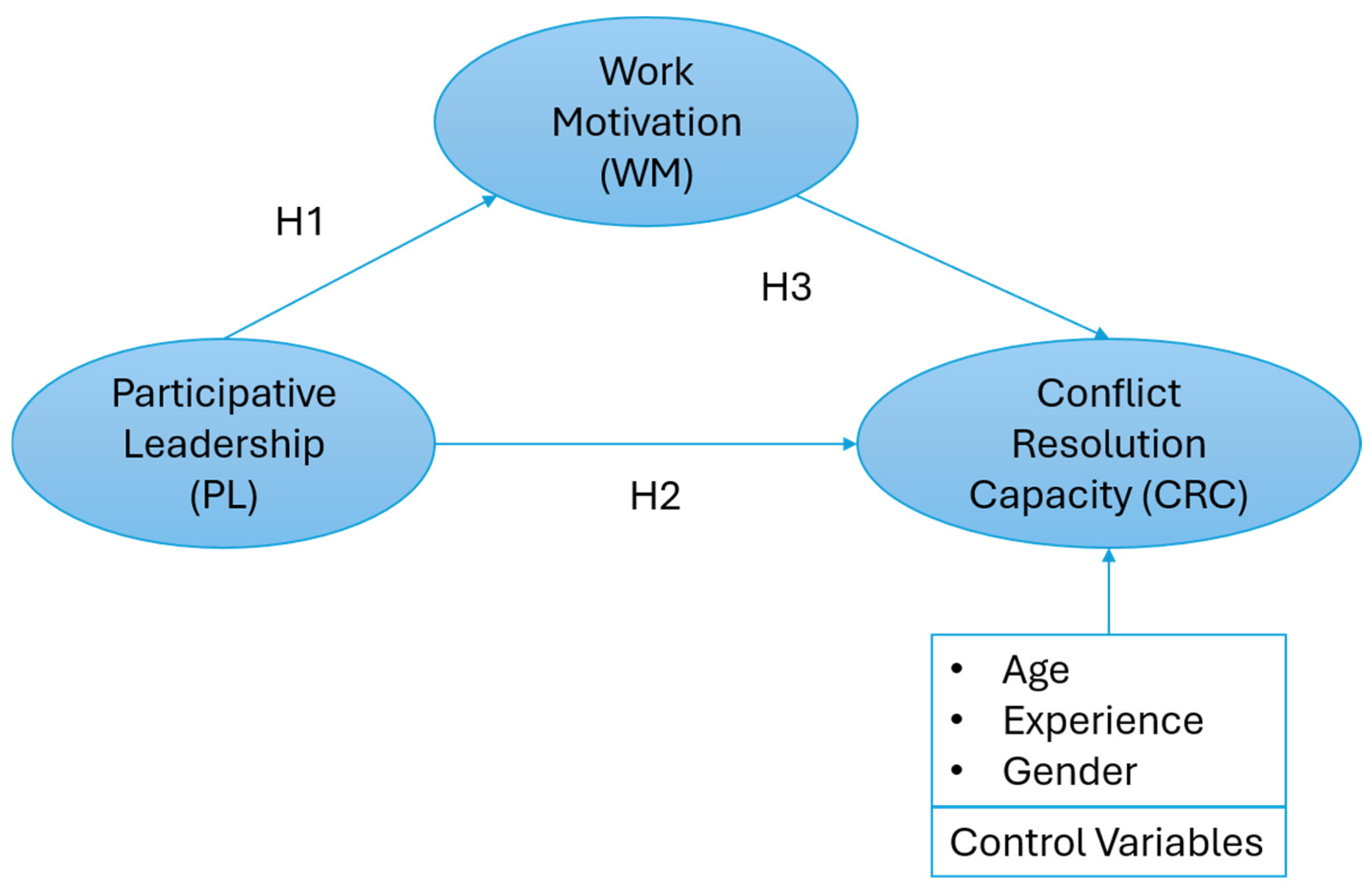
| H1: PL → MW | 0.603 ***/10.651 | Strong/Positive | H1 is Confirmed: |
| H2: PL → CRC | 0.477 ***/5.278 | Moderate/Positive | H2 is Confirmed: |
| MW → CRC | 0.325 ***/3.355 | Positive | |
| Variables de control | |||
| EXP → CRC | 0.019 n.s./0.170 | Negligible | |
| AGE→ CRC | 0.014 n.s./0.014 | Negligible | |
| GEN → CRC | −0.037 n.s./0.223 | Weak/Negative | |
| R2 (CRC) = 0.525 (52.5%) R2 (MW) = 0.363 (36.3%) | |||
| H3: PL → MW → RDC Mediation Hypothesis | |||
| Effect of the predictor on the mediator: 0.603 (a) | |||
| Effect of the mediator on CRC: 0.325 (b) | |||
| Direct effect: 0.675 (c’) | |||
| Variance Accounted Forà VAF = (a × b)/(a × b + c’) = 0.2250 VAF = 22.50% | |||
| 0.20 < VAF < 0.80 | |||
| The Hypothesis H3 is Confirmed: There is Partial Mediation | |||
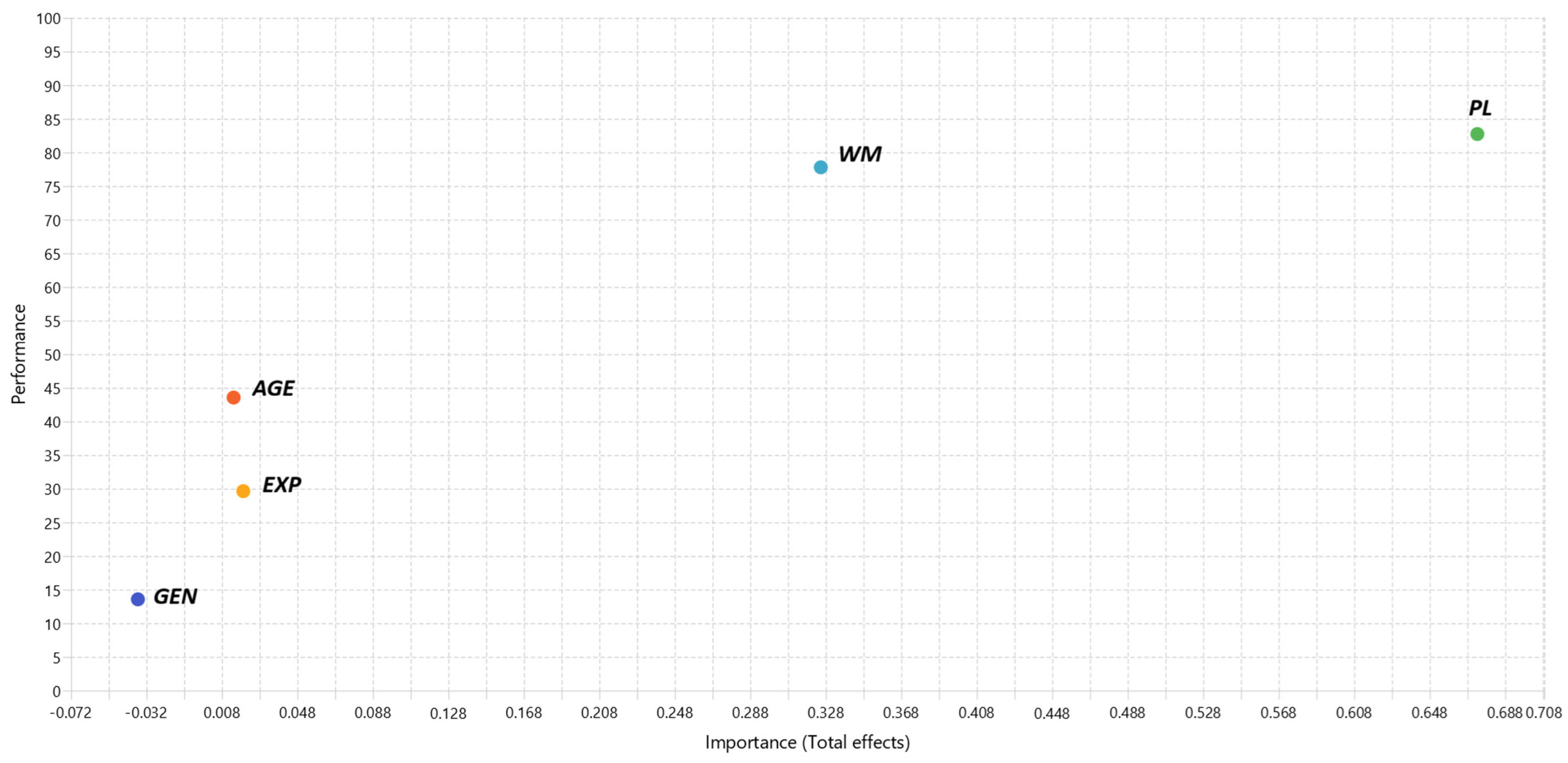
| Construct | Importance (Total Effects) | Performance (0–100) |
|---|---|---|
| PL | 0.673 | 82.73 |
| WM | 0.325 | 77.78 |
| Age | 0.014 | 43.55 |
| Exp | 0.019 | 29.64 |
| Gen | −0.037 | 13.56 |
Disclaimer/Publisher’s Note: The statements, opinions and data contained in all publications are solely those of the individual author(s) and contributor(s) and not of MDPI and/or the editor(s). MDPI and/or the editor(s) disclaim responsibility for any injury to people or property resulting from any ideas, methods, instructions or products referred to in the content. |
© 2026 by the authors. Licensee MDPI, Basel, Switzerland. This article is an open access article distributed under the terms and conditions of the Creative Commons Attribution (CC BY) license.
Share and Cite
Manzanares, M.V.; Manzanares, F.V. Factors Affecting Conflict Resolution Capacity: An Organizational Perspective from Construction Firms. Buildings 2026, 16, 2471. https://doi.org/10.3390/buildings16122471
Manzanares MV, Manzanares FV. Factors Affecting Conflict Resolution Capacity: An Organizational Perspective from Construction Firms. Buildings. 2026; 16(12):2471. https://doi.org/10.3390/buildings16122471
Chicago/Turabian StyleManzanares, Marcelo Villena, and Francisco Villena Manzanares. 2026. "Factors Affecting Conflict Resolution Capacity: An Organizational Perspective from Construction Firms" Buildings 16, no. 12: 2471. https://doi.org/10.3390/buildings16122471
APA StyleManzanares, M. V., & Manzanares, F. V. (2026). Factors Affecting Conflict Resolution Capacity: An Organizational Perspective from Construction Firms. Buildings, 16(12), 2471. https://doi.org/10.3390/buildings16122471