Integrating OpenBIM and LCA for Sustainable Construction: A Systematic Review and Proposed Research Framework

 ,
,  , ,
, ,  , and
, and
Abstract
1. Introduction
2. Literature Review and Methods
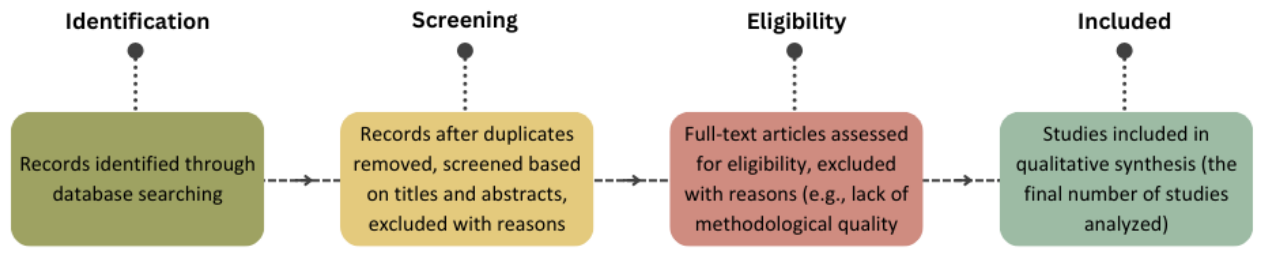
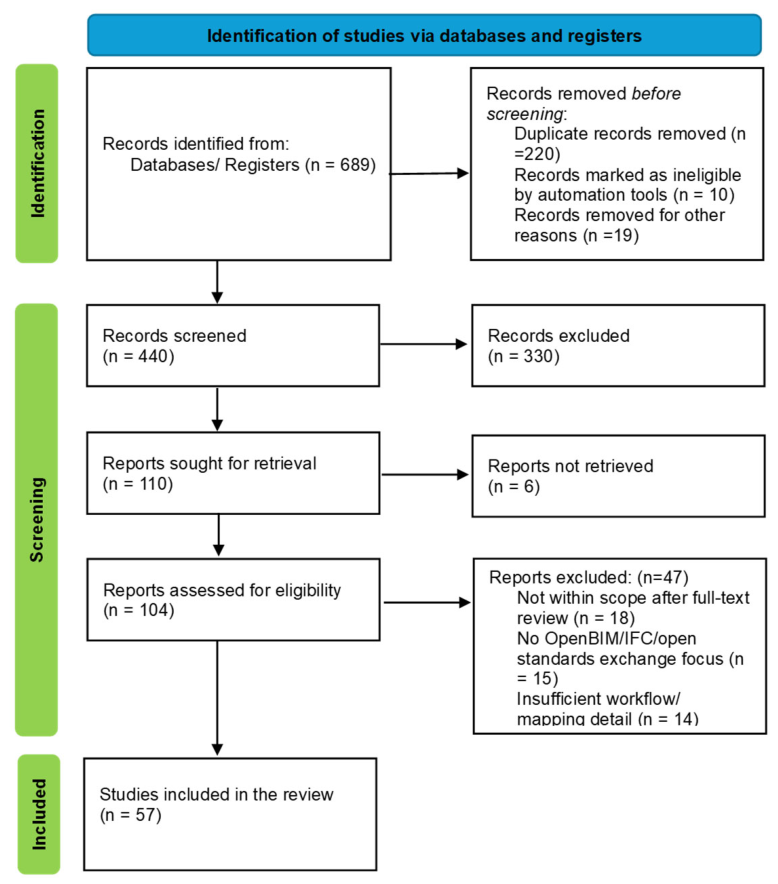
2.1. Search Strategy for a Systematic Literature Review Approach
2.2. Selecting Keywords and Studies
2.3. Extracting Information from the Existing Studies
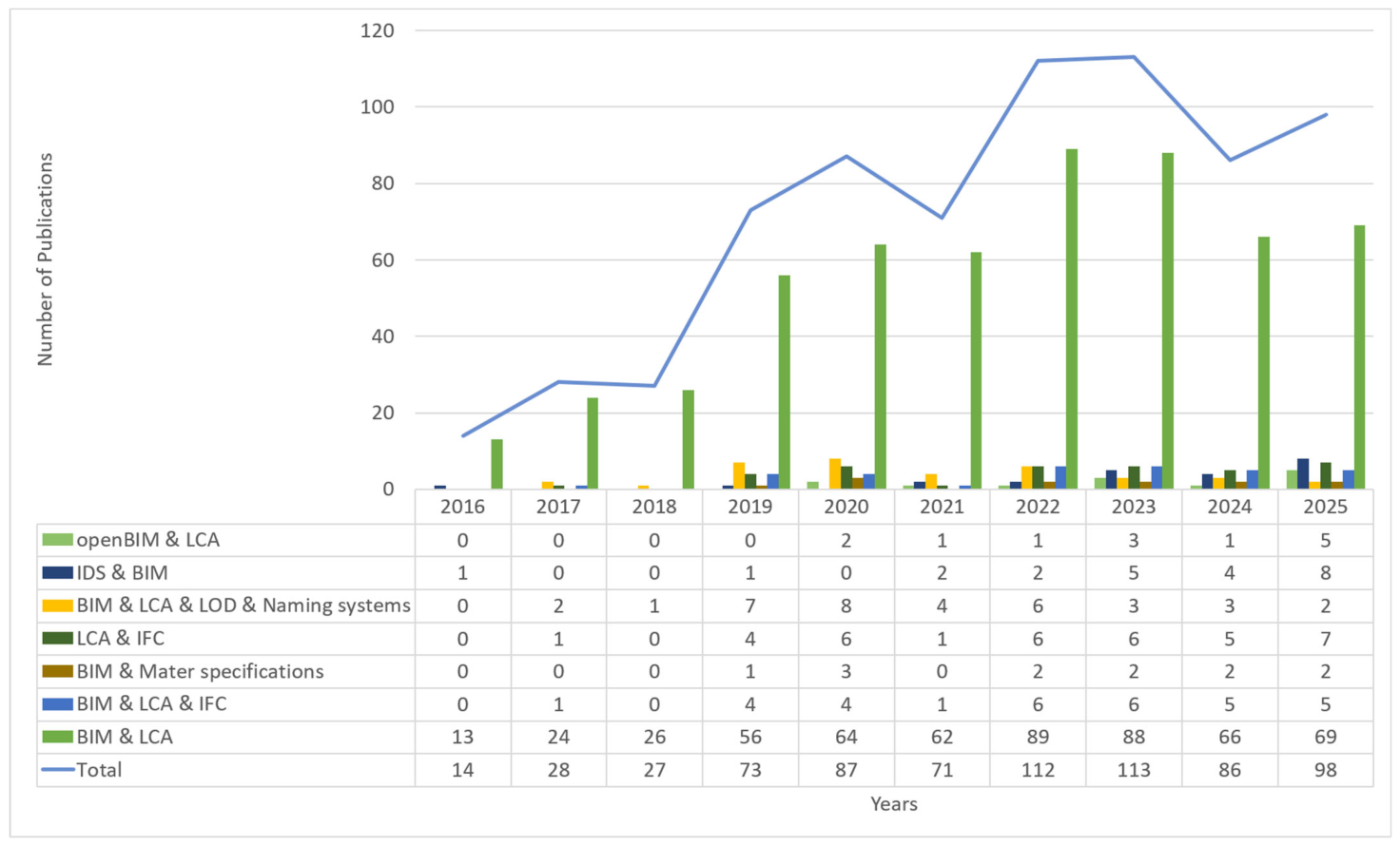
2.4. Bibliometric Analysis
2.5. Trend Analysis of Key Research Areas
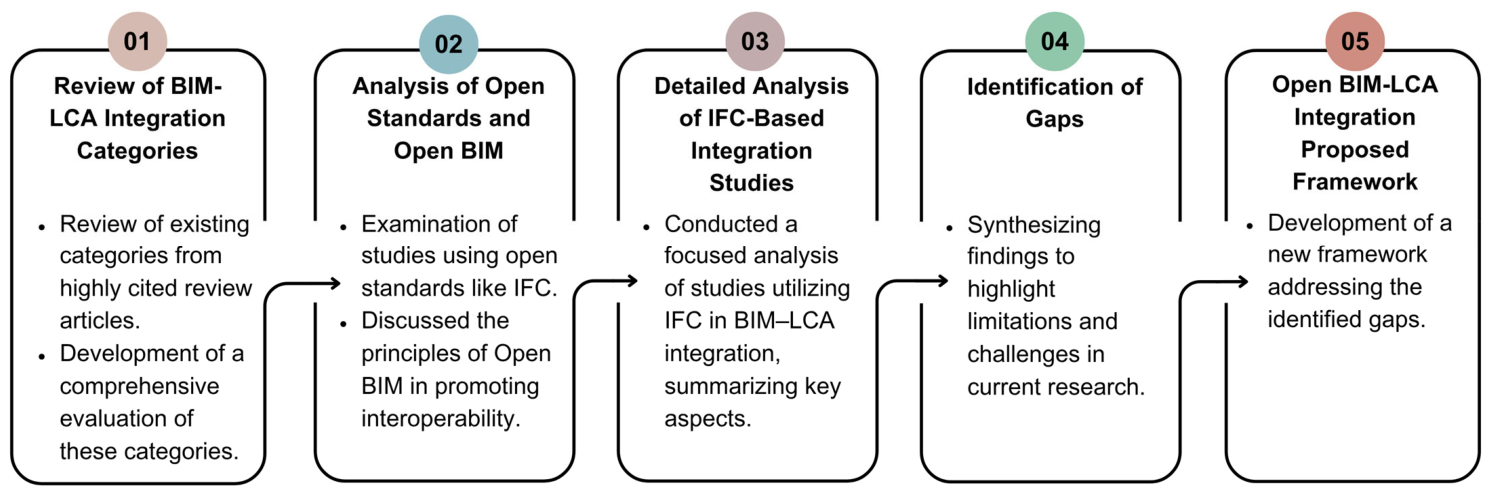
2.6. Analytical Framework
3. Findings
3.1. The Current State of BIM–LCA Integration Methods
3.2. OpenBIM and Its Potential for the Integration of BIM and LCA
3.2.1. Comparison with Conventional BIM–LCA Integration
3.2.2. Innovations and Challenges Specific to OpenBIM
3.3. Analyzing the Research Articles Related to the Integration of BIM and LCA via IFC
4. Discussion
4.1. Proposed Framework
4.2. Addressing the Gaps
4.3. Practical Implementation Challenges and Mitigation Potential of the Proposed OpenBIM–LCA Framework
5. Conclusions
Supplementary Materials
Author Contributions
Funding
Data Availability Statement
Conflicts of Interest
References
- Abualdenien, J.; Schneider-Marin, P.; Zahedi, A.; Harter, H.; Exner, H.; Steiner, D.; Singh, M.; Borrmann, A.; Lang, W.; Petzold, F.; et al. Consistent Management and Evaluation of Building Models in the Early Design Stages. J. Inf. Technol. Constr. 2020, 25, 212–232. [Google Scholar] [CrossRef]
- IEA. Global Status Report for Buildings and Construction—Towards a Zero-Emissions, Efficient and Resilient Buildings and Constructi on Sector. Available online: https://www.iea.org/reports/global-status-report-for-buildings-and-construction-2019 (accessed on 30 November 2024).
- Elghaish, F.; Abrishami, S.; Hosseini, M.R. Integrated project delivery with blockchain: An automated financial system. Autom. Constr. 2020, 114, 103182. [Google Scholar] [CrossRef]
- Youssef, N.; Rabenantoandro, A.Z.; Dakhli, Z.; Chehade, F.H.; Lafhaj, Z. Environmental evaluation of geopolymer bricks. MATEC Web Conf. 2019, 281, 03005. [Google Scholar] [CrossRef]
- Xu, J.; Teng, Y.; Pan, W.; Zhang, Y. BIM-integrated LCA to automate embodied carbon assessment of prefabricated buildings. J. Clean. Prod. 2022, 374, 133894. [Google Scholar] [CrossRef]
- ISO 14040:2006; Environmental Management—Life Cycle Assessment—Principles and Framework. ISO: Vernier, Switzerland, 2006. Available online: https://www.iso.org/standard/37456.html (accessed on 30 November 2024).
- Santos, R.; Costa, A.; Silvestre, J.; Pyl, L. Integration of LCA and LCC analysis within a BIM-based environment. Autom. Constr. 2019, 103, 127–149. [Google Scholar] [CrossRef]
- Chen, Z.; Chen, L.; Zhou, X.; Huang, L.; Sandanayake, M.; Yap, P.-S. Recent Technological Advancements in BIM and LCA Integration for Sustainable Construction: A Review. Sustainability 2024, 16, 1340. [Google Scholar] [CrossRef]
- Horn, R.; Ebertshauser, S.; Di Bari, R.; Jorgji, O.; Traunspurger, R.; von Both, P. The BIM2LCA Approach: An Industry Foundation Classes (IFC)-Based Interface to Integrate Life Cycle Assessment in Integral Planning. Sustainability 2020, 12, 6558. [Google Scholar] [CrossRef]
- buildingSMART International openBIM for Architecture, Engineering, and Construction. Available online: https://www.buildingsmart.org/architecture-engineering-construction/ (accessed on 30 November 2024).
- Tomczak, A.; van Berlo, L.; Bolpagni, M.; Krijnen, T.; Borrmann, A. A review of methods to specify information requirements in digital construction projects. IOP Conf. Ser. Earth Environ. Sci. 2022, 1101, 092024. [Google Scholar] [CrossRef]
- Owerko, T.; Wrzosek, M.; Rochel, M.; Tomaszkiewicz, K.; Pasalski, J.; Kasznia, D.; Łaguna, P. Acceptance tests of BIM models using the IDS standards within openBIM. In Proceedings of the 2024 28th International Conference on Methods and Models in Automation and Robotics (MMAR), Międzyzdroje, Poland, 27–30 August 2024; pp. 476–480. [Google Scholar]
- Antunes, M.L.R.; César, K.M.L.; Ribeiro, J.C.L.; de Oliveira, D.S.; Carvalho, J.M.F. de Analysis of IFC interoperability data schema for project representation. Autom. Constr. 2024, 166, 105650. [Google Scholar] [CrossRef]
- Zheng, B.; Hussain, M.; Yang, Y.; Chan, A.; Chi, H. Trade-offs between accuracy and efficiency in BIM-LCA integration. Eng. Constr. Archit. Manag. 2023, 32, 237–258. [Google Scholar] [CrossRef]
- Soust-Verdaguer, B.; Llatas, C.; Moya, L. Comparative BIM-based Life Cycle Assessment of Uruguayan timber and concrete-masonry single-family houses in design stage. J. Clean. Prod. 2020, 277, 121958. [Google Scholar] [CrossRef]
- Arenas, N.; Shafique, M. Reducing embodied carbon emissions of buildings—A key consideration to meet the net zero target. Sustain. Futures 2024, 7, 100166. [Google Scholar] [CrossRef]
- Lima, M.; Duarte, S.; Exenberger, H.; Fröch, G.; Flora, M. Integrating BIM-LCA to Enhance Sustainability Assessments of Constructions. Sustainability 2024, 16, 1172. [Google Scholar] [CrossRef]
- Klumbyte, E.; Georgali, P.; Spudys, P.; Giama, E.; Morkunaite, L.; Pupeikis, D.; Jurelionis, A.; Fokaides, P. Enhancing whole building life cycle assessment through building information modelling: Principles and best practices. Energy Build. 2023, 296, 113401. [Google Scholar] [CrossRef]
- Sameer, H.; Bringezu, S. Building information modelling application of material, water, and climate footprint analysis. Build. Res. Inf. 2021, 49, 593–612. [Google Scholar] [CrossRef]
- Kamari, A.; Kotula, B.; Schultz, C. A BIM-based LCA tool for sustainable building design during the early design stage. Smart Sustain. Built Environ. 2022, 11, 217–244. [Google Scholar] [CrossRef]
- Hosseini Gourabpasi, A.; Jalaei, F.; Ghobadi, M. Developing an openBIM Information Delivery Specifications Framework for Operational Carbon Impact Assessment of Building Projects. Sustainability 2025, 17, 673. [Google Scholar] [CrossRef]
- Parece, S.; Resende, R.; Rato, V. A BIM-based tool for embodied carbon assessment using a Construction Classification System. Dev. Built Environ. 2024, 19, 100467. [Google Scholar] [CrossRef]
- Arenas, N.; Shafique, M. Recent progress on BIM-based sustainable buildings: State of the art review. Dev. Built Environ. 2023, 15, 100176. [Google Scholar] [CrossRef]
- van Eck, N.J.; Waltman, L. Software Survey: VOSviewer, a Computer Program for Bibliometric Mapping. Scientometrics 2010, 84, 523–538. [Google Scholar] [CrossRef] [PubMed]
- Teng, Y.; Xu, J.; Pan, W.; Zhang, Y. A systematic review of the integration of building information modeling into life cycle assessment. Build. Environ. 2022, 221, 109260. [Google Scholar] [CrossRef]
- Crippa, J.; Araujo, A.; Bem, D.; Ugaya, C.; Scheer, S. A systematic review of BIM usage for life cycle impact assessment. Built Environ. Proj. Asset Manag. 2020, 10, 603–618. [Google Scholar] [CrossRef]
- Xue, K.; Hossain, M.; Liu, M.; Ma, M.; Zhang, Y.; Hu, M.; Chen, X.; Cao, G. BIM Integrated LCA for Promoting Circular Economy towards Sustainable Construction: An Analytical Review. Sustainability 2021, 13, 1310. [Google Scholar] [CrossRef]
- Marrero, M.; Wojtasiewicz, M.; Martinez-Rocamora, A.; Solis-Guzman, J.; Alba-Rodriguez, M. BIM-LCA Integration for the Environmental Impact Assessment of the Urbanization Process. Sustainability 2020, 12, 4196. [Google Scholar] [CrossRef]
- Veselka, J.; Nehasilova, M.; Dvorakova, K.; Ryklova, P.; Volf, M.; Ruzicka, J.; Lupisek, A. Recommendations for Developing a BIM for the Purpose of LCA in Green Building Certifications. Sustainability 2020, 12, 6151. [Google Scholar] [CrossRef]
- Palumbo, E.; Soust-Verdaguer, B.; Llatas, C.; Traverso, M. How to Obtain Accurate Environmental Impacts at Early Design Stages in BIM When Using Environmental Product Declaration. A Method to Support Decision-Making. Sustainability 2020, 12, 6927. [Google Scholar] [CrossRef]
- Forth, K.; Abualdenien, J.; Borrmann, A. Calculation of embodied GHG emissions in early building design stages using BIM and NLP-based semantic model healing. Energy Build. 2023, 284, 112837. [Google Scholar] [CrossRef]
- Su, S.; Wang, Q.; Han, L.; Hong, J.; Liu, Z. BIM-DLCA: An integrated dynamic environmental impact assessment model for buildings. Build. Environ. 2020, 183, 107218. [Google Scholar] [CrossRef]
- Santos, R.; Costa, A.; Silvestre, J.; Vandenbergh, T.; Pyl, L. BIM-based life cycle assessment and life cycle costing of an office building in Western Europe. Build. Environ. 2020, 169, 106568. [Google Scholar] [CrossRef]
- Asare, K.; Ruikar, K.; Zanni, M.; Soetanto, R. BIM-based LCA and energy analysis for optimised sustainable building design in Ghana. Sn Appl. Sci. 2020, 2, 1855. [Google Scholar] [CrossRef]
- Kurian, R.; Kulkarni, K.; Ramani, P.; Meena, C.; Kumar, A.; Cozzolino, R. Estimation of Carbon Footprint of Residential Building in Warm Humid Climate of India through BIM. Energies 2021, 14, 4237. [Google Scholar] [CrossRef]
- Chen, C.; Zhao, Z.; Xiao, J.; Tiong, R. A Conceptual Framework for Estimating Building Embodied Carbon Based on Digital Twin Technology and Life Cycle Assessment. Sustainability 2021, 13, 13875. [Google Scholar] [CrossRef]
- Hollberg, A.; Genova, G.; Habert, G. Evaluation of BIM-based LCA results for building design. Autom. Constr. 2020, 109, 102972. [Google Scholar] [CrossRef]
- Kim, S.; Kim, H.; Lee, J.; Hong, T.; Jeong, K. An Integrated Assessment Framework of Economic, Environmental, and Human Health Impacts Using Scan-to-BIM and Life-Cycle Assessment in Existing Buildings. J. Manag. Eng. 2023, 39, 04023034. [Google Scholar] [CrossRef]
- Atashbar, H.; Noorzai, E. Optimization of Exterior Wall Cladding Materials for Residential Buildings Using the Non-Dominated Sorting Genetic Algorithm II (NSGAII) Based on the Integration of Building Information Modeling (BIM) and Life Cycle Assessment (LCA) for Energy Consumption: A Case Study. Sustainability 2023, 15, 15647. [Google Scholar] [CrossRef]
- Lee, S.; Tae, S.; Jang, H.; Chae, C.U.; Bok, Y. Development of Building Information Modeling Template for Environmental Impact Assessment. Sustainability 2021, 13, 3092. [Google Scholar] [CrossRef]
- Mohammed, A. Process Map for Accessing Automatization of Life Cycle Assessment Utilizing Building Information Modeling. J. Archit. Eng. 2023, 29, 04023012. [Google Scholar] [CrossRef]
- ISO 19650-1:2018; International Organization for Standardization. Organization and Digitization of Information about Buildings and Civil Engineering Works, Including Building Information Modelling (BIM)—Information Management Using Building Information Modelling—Part 1: Concepts and principles. International Organization for Standardization: Geneva, Switzerland, 2018.
- Almeida, R.; Chaves, L.; Silva, M.; Carvalho, M.; Caldas, L. Integration between BIM and EPDs: Evaluation of the main difficulties and proposal of a framework based on ISO 19650:2018. J. Build. Eng. 2023, 68, 106091. [Google Scholar] [CrossRef]
- Nehasilova, M.; Lupisek, A.; Coufalova, P.; Kupsa, T.; Veselka, J.; Vlasata, B.; Zelezna, J.; Kunova, P.; Volf, M. Rapid Environmental Assessment of Buildings: Linking Environmental and Cost Estimating Databases. Sustainability 2022, 14, 10928. [Google Scholar] [CrossRef]
- Gui, Y.; Chen, L. Research on the application of BIM-based digital bridge design, construction and operation and maintenance secondary development. In Proceedings of the 2021 7th International Conference on Hydraulic and Civil Engineering & Smart Water Conservancy and Intelligent Disaster Reduction Forum (ICHCE & SWIDR), Nanjing, China, 6–8 November 2021; pp. 260–265. [Google Scholar]
- Sobhkhiz, S.; Taghaddos, H.; Rezvani, M.; Ramezanianpour, A. Utilization of semantic web technologies to improve BIM-LCA applications. Autom. Constr. 2021, 130, 103842. [Google Scholar] [CrossRef]
- Okonta, E.D.; Vukovic, V.; Hayat, E. Prospective Directions in the Computer Systems Industry Foundation Classes (IFC) for Shaping Data Exchange in the Sustainability and Resilience of Cities. Electronics 2024, 13, 2297. [Google Scholar] [CrossRef]
- Li, M.; Liu, Y.; Wang, B.; Cheng, J. An OpenBIM-based Framework for Lifecycle Management of Steel Reinforcement. In 41st International Symposium on Automation and Robotics in Construction (ISARC 2024); IAARC: Montreal, QC, Canada, 2024; pp. 653–660. [Google Scholar] [CrossRef]
- Sadeghi, M.; Elliott, J.W.; Mehany, M.H. Information-augmented exchange objects to inform facilities management BIM guidelines: Introducing the level of semantics schema. J. Facil. Manag. 2022, 21, 260–281. [Google Scholar] [CrossRef]
- Son, S.; Lee, G.; Jung, J.; Kim, J.; Jeon, K. Automated generation of a model view definition from an information delivery manual using idmXSD and buildingSMART data dictionary. Adv. Eng. Inform. 2022, 54, 101731. [Google Scholar] [CrossRef]
- ISO 12006-3:2022; Building Construction—Organization of Information About Construction Works—Part 3: Framework for Object-Oriented Information. International Organization for Standardization: Geneva, Switzerland, 2022.
- Xu, Z.; Wang, J.; Zhu, H. A Semantic-Based Methodology to Deliver Model Views of Forward Design for Prefabricated Buildings. Buildings 2022, 12, 1158. [Google Scholar] [CrossRef]
- Khorchi, A.; Boton, C. An OpenBIM-based 4D approach to support coordination meetings in virtual reality environments. J. Build. Eng. 2024, 85, 108647. [Google Scholar] [CrossRef]
- Alothman, A.; Vilventhan, A. Development of Building Information Model–Enabled Facility Management for Metro Rail Stations. J. Constr. Eng. Manag. 2025, 151, 05024018. [Google Scholar] [CrossRef]
- Forth, K.; Hollberg, A.; Borrmann, A. BIM4EarlyLCA: An interactive visualization approach for early design support based on uncertain LCA results using open BIM. Dev. Built Environ. 2023, 16, 100263. [Google Scholar] [CrossRef]
- Dervishaj, A.; Gudmundsson, K. From LCA to circular design: A comparative study of digital tools for the built environment. Resour. Conserv. Recycl. 2024, 200, 107291. [Google Scholar] [CrossRef]
- Rodriguez, B.X.; Simonen, K.; Huang, M.; Wolf, C.D. A taxonomy for Whole Building Life Cycle Assessment (WBLCA). Smart Sustain. Built Environ. 2019, 8, 190–205. [Google Scholar] [CrossRef]
- Ghose, A.; Lissandrini, M.; Hansen, E.R.; Weidema, B.P. A core ontology for modeling life cycle sustainability assessment on the Semantic Web. J. Ind. Ecol. 2022, 26, 731–747. [Google Scholar] [CrossRef]
- ISO 22057:2022; Sustainability in Buildings and Civil Engineering Works—Data Templates for the Use of Environmental Product Declarations (EPDs) for Construction Products in Building Information Modelling (BIM). International Organization for Standardization: Geneva, Switzerland, 2022.
- ISO 23386:2020; Building Information Modelling and Other Digital Processes Used in Construction—Methodology to Describe, Author and Maintain Properties in Interconnected Data Dictionaries. International Organization for Standardization: Geneva, Switzerland, 2020.
- ISO 23387:2025; Building Information Modelling (BIM)—Data Templates for Objects Used in the Life Cycle of Assets. International Organization for Standardization: Geneva, Switzerland, 2025.
- Cozzitorto, C.; Jalaei, F.; Sultan, Y.; Davari, S.; Bhonde, D. openBIM Implementations for a Canadian Roadmap; National Research Council of Canada: Ottawa, ON, USA, 2024.
- Ait-Lamallam, S.; Yaagoubi, R.; Sebari, I.; Doukari, O. Extending the IFC Standard to Enable Road Operation and Maintenance Management through OpenBIM. Isprs Int. J. Geo-Inf. 2021, 10, 496. [Google Scholar] [CrossRef]
- Kim, I.; Choi, J.; Teo, E.A.L.; Sun, H. Development of K-BIM e-Submission prototypical system for the openBIM-based building permit framework. J. Civ. Eng. Manag. 2020, 26, 744–756. [Google Scholar] [CrossRef]
- Hakimi, O.; Liu, H.; Abudayyeh, O.; Houshyar, A.; Almatared, M.; Alhawiti, A. Data Fusion for Smart Civil Infrastructure Management: A Conceptual Digital Twin Framework. Buildings 2023, 13, 2725. [Google Scholar] [CrossRef]
- Oostwegel, L.; Jaud, S.; Muhic, S.; Rebec, K. Digitalization of culturally significant buildings: Ensuring high-quality data exchanges in the heritage domain using OpenBIM. Herit. Sci. 2022, 10, 10. [Google Scholar] [CrossRef]
- Akbarieh, A.; Jayasinghe, L.; Waldmann, D.; Teferle, F. BIM-Based End-of-Lifecycle Decision Making and Digital Deconstruction: Literature Review. Sustainability 2020, 12, 2670. [Google Scholar] [CrossRef]
- Farghaly, K.; Soman, R.; Collinge, W.; Mosleh, M.; Manu, P.; Cheung, C. Construction Safety Ontology Development and Alignment with Industry Foundation Classes (IFC). J. Inf. Technol. Constr. 2022, 27, 94–108. [Google Scholar] [CrossRef]
- Lu, K.; Deng, X.; Jiang, X.; Cheng, B.; Tam, V.W.Y. A review on life cycle cost analysis of buildings based on building information modeling. J. Civ. Eng. Manag. 2023, 29, 268–288. [Google Scholar] [CrossRef]
- Borkowski, A.S. Evolution of BIM: Epistemology, genesis and division into periods. J. Inf. Technol. Constr. 2023, 28, 646–661. [Google Scholar] [CrossRef]
- Turk, Z. Interoperability in construction—Mission impossible? Dev. Built Environ. 2020, 4, 100018. [Google Scholar] [CrossRef]
- Xu, H.; Chen, J.; Kim, J.I. An integrated LCA–BIM framework for assessing carbon emissions in buildings in China’s cold regions. J. Clean. Prod. 2025, 522, 146255. [Google Scholar] [CrossRef]
- Xu, Y.; Gong, X.; Tao, X.; Kwok, H.H.L.; Limsawasd, C.; Cheng, J.C.P. Automated openBIM-based discrete event simulation modeling for cradle-to-site embodied carbon assessment. Autom. Constr. 2025, 175, 106217. [Google Scholar] [CrossRef]
- Strelets, K.; Zaborova, D.; Kokaya, D.; Petrochenko, M.; Melekhin, E. Building Information Modeling (BIM)-Based Building Life Cycle Assessment (LCA) Using Industry Foundation Classes (IFC) File Format. Sustainability 2025, 17, 2848. [Google Scholar] [CrossRef]
- Deng, X.; Lu, K. Multi-level assessment for embodied carbon of buildings using multi-source industry foundation classes. J. Build. Eng. 2023, 72, 106705. [Google Scholar] [CrossRef]
- Alwan, Z.; Jones, B. IFC-based embodied carbon benchmarking for early design analysis. Autom. Constr. 2022, 142, 104505. [Google Scholar] [CrossRef]
- Theissen, S.; Hoper, J.; Drzymalla, J.; Wimmer, R.; Markova, S.; Meins-Becker, A.; Lambertz, M. Using Open BIM and IFC to Enable a Comprehensive Consideration of Building Services within a Whole-Building LCA. Sustainability 2020, 12, 5644. [Google Scholar] [CrossRef]
- Růžička, J.; Veselka, J.; Rudovský, Z.; Vitásek, S.; Hájek, P. BIM and automation in complex building assessment. Sustainability 2022, 14, 2237. [Google Scholar] [CrossRef]
- Llatas, C.; Soust-Verdaguer, B.; Hollberg, A.; Palumbo, E.; Quinones, R. BIM-based LCSA application in early design stages using IFC. Autom. Constr. 2022, 138, 104259. [Google Scholar] [CrossRef]
- Barbini, A.; Malacarne, G.; Massari, G.; Matt, D. Environmental impacts visualization through open BIM procedures. TECHNE-J. Technol. Archit. Environ. 2022, 23, 240–249. [Google Scholar] [CrossRef]
- Płoszaj-Mazurek, M.; Ryńska, E. Artificial Intelligence and Digital Tools for Assisting Low-Carbon Architectural Design: Merging the Use of Machine Learning, Large Language Models, and Building Information Modeling for Life Cycle Assessment Tool Development. Energies 2024, 17, 2997. [Google Scholar] [CrossRef]
- Ramaji, I.; Gultekin-Bicer, P.; Crowley, R.; Lambert, J. Investigation of Leveraging BIM Standards to Facilitate Sustainability Evaluations from Early Stages of Design. Comput. Civ. Eng. 2017, 2017, 175–183. [Google Scholar] [CrossRef]
- Lu, K.; Deng, X. OpenBIM-based assessment for social cost of carbon through building life cycle. Sustain. Cities Soc. 2023, 99, 104871. [Google Scholar] [CrossRef]
- Xu, Z.; Wang, S.; Wang, E. Integration of BIM and Energy Consumption Modelling for Manufacturing Prefabricated Components: A Case Study in China. Adv. Civ. Eng. 2019, 2019, 1609523. [Google Scholar] [CrossRef]
- Han, D.; Rajabifard, A. Improving the Decision-Making for Sustainable Demolition Waste Management by Combining a Building Information Modelling-Based Life Cycle Sustainability Assessment Framework and Hybrid Multi-Criteria Decision-Aiding Approach. Recycling 2024, 9, 70. [Google Scholar] [CrossRef]
- Fenz, S.; Giannakis, G.; Bergmayr, J.; Iousef, S. RenoDSS-A BIM-based building renovation decision support system. Energy Build. 2023, 288, 112999. [Google Scholar] [CrossRef]
- Tauscher, H.; Wong, K.W. A Testbed For Applying Operationalized Graph Grammars to Sustainability Analysis in Integrated Bim-Gis Scenarios. Int. Arch. Photogramm. Remote Sens. Spat. Inf. Sci. 2022, XLVIII-4-W4-2022, 147–152. [Google Scholar] [CrossRef]
- Forth, K.; Braun, A.; Borrmann, A. BIM-integrated LCA—Model analysis and implementation for practice. IOP Conf. Ser. Earth Environ. Sci. 2019, 323, 012100. [Google Scholar] [CrossRef]
- Zhang, S.; Zhang, S.; Wu, Z.; Wang, X.; Jiang, Z.; Wang, C.; Zhao, G. IFC-enabled LCA for carbon assessment in pumped storage hydropower (PSH) with concrete face rockfill dams. Autom. Constr. 2023, 156, 105121. [Google Scholar] [CrossRef]
- Ramaji, I.; Messner, J.; Mostavi, E. IFC-Based BIM-to-BEM Model Transformation. J. Comput. Civ. Eng. 2020, 34, 04020005. [Google Scholar] [CrossRef]
- Xu, J.; Teng, Y.; Pan, W. A BIM-LCA integrated method for enhancing efficiency of embodied carbon estimation of prefabricated high-rise buildings. In Proceedings of the 37th Annual ARCOM Conference, Virtual, 6–7 September 2021; pp. 14–23. [Google Scholar]
- ISO 14025:2006; Environmental Labels and Declarations—Type III Environmental Declarations—Principles and Procedures. International Organization for Standardization: Geneva, Switzerland, 2006.
- EN 15804:2012+A2:2019; Sustainability of Construction Works—Environmental Product Declarations—Core Rules for the Product Category of Construction Products. European Committee for Standardization: Brussels, Belgium, 2019.
- ISO 14044:2006; Environmental Management—Life Cycle Assessment—Requirements and Guidelines. International Organization for Standardization: Geneva, Switzerland, 2006.
- Rostaminikoo, R.; Eirdmousa, S.J.; Jrade, A.; Gourabpasi, A.H.; Jalaei, F.; Jalaei, F.; Rostamiasl, V. Developing an Information Delivery Framework for OpenBIM-LCA Integration to Enhance Data Interoperability During the Design and Construction of Sustainable Buildings. In ISARC Proceedings 2025, CSCE/CRC 2025-Montreal, Canada; IAARC: Montreal, QC, Canada, 2025. [Google Scholar] [CrossRef] [PubMed]
- Jalaei, F.; Rostamiasl, V.; Jrade, A.; Jalaei, F.; Hosseini, A.; Jalilzadeh Eirdmousa, S.; Rostaminikoo, R. Creating Data Mapping and Naming Conventions for Enhanced OpenBIM-LCA Interoperability. In ISARC Proceedings 2025, CSCE/CRC 2025-Montreal, Canada; IAARC: Montreal, QC, Canada, 2025. [Google Scholar] [CrossRef] [PubMed]





| Reference | BIM-Specific Dimensions | |||||
|---|---|---|---|---|---|---|
| LOD | Geometric and Spatial Data | Material Data Specifications | Data Exchange & Interoperability | Embedded Environmental Data | Operational and Lifecycle Data | |
| [72] | Not explicitly discussed. | Extracted component quantities using IFC relationships, exterior-wall detection via Revit plug-in. | Extracted material types using IFC relationships, quantification is paired with emission factors via the classic factor method. | Extended IFC for attributes needed for cold-region assessment. | Applied cold-region factors (heating, winter loss) to IFC-derived quantities. | Considered Whole life (A–C). |
| [73] | Not explicitly discussed. | Extracted quantities from IFC elements. | Extracted from BIM using IFC, considering emission factors, transport, and equipment parameters. | Extended IFC, a generic IFC to XML converter automatically builds DES models. | Mapped EFs and construction-resource parameters from the IFC into the DES template. | Considered A1–A5 only, operational stage is out of scope. |
| [74] | 300 | Prepared the Revit model for IFC export; quantities are driven by BoQ. | Introduced explicit user parameters to store names, LCIA units, and quantity bases. | Exported to IFC 4.3, grouped user-defined properties into Psets for export for a table-based (schedule) export by IfcOpenShell. | Embedded EPD-derived GWP values as element/material attributes. | Not addressed. |
| [21] | Mapped required BEM data to applicable LODs | Relied on IFC geometry/space boundaries; addresses transfer to IDF/gbXML. | Noted missing material libraries and the need to map material properties. | Described IFC → IDF transformation and IDS-based auditing. | Linked environmental data via post-BEM mapping to ecoinvent. | Included on operational schedules/HVAC/location metadata. |
| [9] | Utilized early benchmarks at low LOD, with detailed EPD data integrated at LOD 300+ for certification. | Extracted from IfcWall, IfcSlab, and IfcSpace, this supports volumetric and spatial calculations for LCA. | Defined by IfcMaterial and IfcPropertySet, enhanced with external databases such as Ökobau. dat and GENERIS®. | Enabled bidirectional data exchange of IFCXML between BIM and LCA tools, reducing manual data entry. | Not directly embedded in IFC; external databases (e.g., Ökobau.dat) supply this information during mapping. | Included end-of-life scenarios using IFC for deconstruction and waste flow, and partial modeling of operational energy through IfcEnergyAnalysisProperties. |
| [7] | Streamlined LCA utilizing generic data (LOD < 300) and comprehensive LCA employing EPD data for detailed analysis (LOD ≥ 300). | Extracted from IFC entities. | Linked material properties to IfcMaterial and external databases such as Ecoinvent. | Utilized IFC4 for information exchange, requiring enhancements for smooth integration at both material and project levels. | Limited incorporation of environmental data; properties related to environmental impacts are absent in IFC4 for thorough assessments. | Partially addressed data on operational energy use, maintenance, and end-of-life stages, but required manual input from designers. |
| [14] | Not explicitly discussed. | Evaluated the accuracy of BoQ extraction. | Extracted from BIM using IFC; encountered issues with misclassification and an incomplete Bill of Quantities. | Used IFC for data sharing; however, issues include incorrect object classification and missing data. | Not incorporated in IFC; external tools and datasets (e.g., Ecoinvent) are connected. | Primarily focuses on production and construction phases (A1–A5). |
| [5] | LOD standards are not explicitly referenced. | Extracted from IFC files. | Categorized by quantities and types, associated with specific construction elements. | Enabled IFC4 workflows by automating data transfer between BIM and LCA tools; challenges include inconsistent data mappings and naming conventions. | Not embedded; supplementary data are linked externally via tools such as SimaPro. | Not addressed. |
| [75] | Not explicitly discussed, but multi-level assessment is conducted. | Extracted from multiple IFC models, supporting hierarchical relationships. | Connected through IfcMaterial, and additional data enrichment features. | Enabled interoperability for multi-source IFC integration across Revit, ArchiCAD, and other tools. | Stored embodied carbon data in IFC models using custom property sets for delivery and reuse in carbon audits. | Comprehensively modeled lifecycle stages (A–D) |
| [76] | Not explicitly discussed, concentrating on the early design stages. | Extracted from IFC entities; provides geometric data for embodied carbon calculations. | Incorporated embedded embodied carbon factors into the BIM model, enhancing the data with external ICE database values. | Used the open-source IFC2x3 schema for data exchange and employed IfcOpenShell for automated data extraction. | Incorporated embodied carbon data into IFC files. | Not addressed. |
| [77] | 300/400 | Extracted from IFC entities and enhanced through User-Defined Property Sets. | Linked building services components to LCA datasets using material and service life data. | Created custom property sets for building services due to limitations in standardized attributes. | Linked environmental impact data using UUIDs assigned to building service components. | Modeled stages A1–A3, B4, C3–C4, and D; excluded operational energy (B6). |
| [78] | 350 | Extracted from IFC entities | Included types and quantities; limitations noted in linking these directly to environmental impacts. | Facilitated semi-automatic workflows and data exchange with SBToolCZ. | Utilized external databases for carbon and quality assessments through manual or semi-automated workflows. | Minimally included; lifecycle stages beyond A1 to A3 are modeled inconsistently. |
| [79] | 200 | Extracted from IFC entities | Enhanced extracted material information with regional databases such as BEDEC and BCCA for LCA. | Utilized IFC4.1 to enhance interoperability, incorporating additional properties to enrich data. | Incorporated environmental properties such as GWP into IFC models. | Not addressed. |
| [80] | Focused on early-stage visualization processes and conceptual modeling. | Extracted from IFC entities. | Connected to environmental properties through external CSV files. | Utilized IFC files for data integration and visualization, facilitating open workflows across various platforms. | Calculated environmental impact values were assessed externally and linked to IFC objects. | Not addressed. |
| [81] | Relied on simplified parametric models for initial assessments. | Included parametric models with geometric properties for predicting carbon footprints. | Sourced from databases such as Ökobaudat and EPDs, integrated via AI-driven workflows. | Utilized IFC for data exchange, facilitating interoperability in web-based applications for LCA and AI integration. | Calculated and integrated through material takeoff; not included in IFC models. | Partially addressed. |
| [82] | Emphasized various LCA levels (Generic, System, Component) in alignment with LOD 200, 300, and 350. | Extracted from IFC entities. | Externally sourced from databases such as Athena and Ecoinvent; no native embedding into IFC models has been demonstrated. | Used IFC for data exchange, but the limited implementation of MVDs hinders full interoperability. | Not directly embedded in IFC files; external mapping is necessary for LCA workflows. | Not addressed. |
| [83] | 300 | Extracted from IFC entities for structural and service components. | Linked to LCI databases; SCC-specific data added manually through extended property sets such as Pset_EnvironmentalCostValues. | Relied on IFC for interoperability but lacks robust MVD usage for automating workflows across platforms. | Embedded social cost of carbon (SCC) data in IFC with extended property sets; however, the process is manual. | Included stages are A1–A5, B1–B5, B6–B7, and C1–C4, with operational phases representing the majority of SCC contributions at 84.6%. |
| [84] | Not explicitly discussed but indirectly addressed through the modeling of prefabricated components and their processes. | Extracted from IFC entities, the components are modeled to include attributes such as size, shape, and placement. | Integrated into the BIM model and connected to energy consumption for the production and transportation stages. | Enhanced IFC with new property sets to include energy consumption information | Embedded in IFC with property sets | Concentrated on the stages of raw material production, transportation, and factory production, while excluding operational and end-of-life phases. |
| [31] | Not considered. | Extracted from IFC entities, the lack of detailed geometry is compensated for using a knowledge database. | Connected via NLP-based matching to an LCA knowledge database. | Relied on openBIM principles and IFC, enhanced interoperability is achieved by integrating BIM Collaboration Format (BCF) for feedback loops. | Manually enhanced in later design stages; early-stage models depend on defaults from the LCA knowledge database. | Focused on embodied emissions (A1–A3, C3–C4), with limited consideration of maintenance or operational phases. |
| [55] | Not considered. | Extracted from IFC entities. | Matched with a Knowledge Database for LCAs using NLP techniques to enhance semantics. | Used IFC as the main format and expanded BCF to convey decisions and incorporate LCA results. | Integrated into BIM models using property sets derived from the LKdb. | Covered stage include A1–A3, B4, and C3–C4, operational phases are excluded. |
| [85] | Although not explicitly discussed, the end-of-life phase was addressed. | Included the volume of building components, assembly codes, according to NBS standards. | Linked LCA data through Dynamo scripts. | Utilizes IFC properties enhanced by shared parameters and integrates external databases through Dynamo scripts. | Sourced from eToolLCD and external LCA databases. | Focus on EoL scenarios (C1–C4) and benefits beyond the system boundary (D). |
| [86] | Not explicitly discussed, detailed thermal and material properties for external walls. | Modeled second-level space boundaries and facade details in IFC format. | Retrieved and expanded using the BIMERR Building Material and Component Database. | Relied on IFC as the primary standard for data exchange, providing seamless integration with RenoDSS modules. | Embedded sustainability KPIs, like GWP in the IFC data and extended through RenoDSS. | Included operational energy demand and cost data, lifecycle stages A1–A3 and B2 analyzed for renovation scenarios. |
| [87] | 300 | Extracted from IFC entities, focusing on building-level details and city-scale context through CityGML integration | Enriched using historical engineering drawings and mapped to LCA databases for material impact analysis | Utilized IFC and CityGML as primary data standards to integrate data for sustainability analysis | Included material attributes embedded in IFC for building scale analysis | Covered lifecycle phases such as A1–A3, C3, C4, and D. |
| [22] | 200–300 | Developed model in Revit, enabling QTO. | Partially included, generic materials were used in LOD 200, with predefined material libraries applied for LOD 300. | Used SECClasS classification system for data exchange, linked to BIM objects. | Embedded GWP data using external databases such as ICE and EPDs. | Included A1–A3 and B4. |
| [88] | 200–300 | Extracted from IFC models created using Autodesk Revit and ArchiCAD. | Connected to LCA tools through Dynamo, relying on predefined material libraries. | Used IFC as the exchange standard, but variations occur during the import/export. | Partially embedded in BIM objects for end-of-life and embodied energy analysis. | Covered lifecycle stages A1–A3 and C3–C4, along with module D (partially). |
| [89] | Considered multiple LOD levels. | Extracted from IFC entities. | Integrated within IFC entities, focusing on the characteristics of concrete and steel. | Utilized the extended IFC schema (IFC4x3_RC3) for semantic data exchange. | Included some property sets for materials and operations. | Reviewed O&M data for hydropower reservoirs and structures. |
| [90] | Not directly addressed. | Extracted from IFC entities. | Employed layering and thermal properties for precise energy simulation. | Concentrated on converting IFC into OpenStudio models. | Supported attributes such as solar heat gain, but lacks comprehensive environmental data. | Restricted to operational energy and lighting data. |
| [91] | Not directly addressed. | Extracted from IFC entities. | Connected to LCA data sources such as SimaPro and Ecoinvent. | Employed IFC schema as the data exchange standard. | Incorporated carbon emission factors into the IFC schema. | Focused on embodied carbon (A1–A3). |
| Reference | LCA-Specific Dimensions | |||||
|---|---|---|---|---|---|---|
| LCI Data | Impact Categories and Methods | Construction and Transportation Processes | Maintenance and Replacement Data | End-of-Life Scenarios | Data Validation and Consistency | |
| [72] | Used China-standard factors for materials/energy; municipal tariffs for use-phase. | Evaluated carbon emissions across the full cycle. | Included loaded vs. empty conditions with vehicle-specific factors and modeled winter penalties (extra losses, delay). | Used a gamma-process degradation to schedule repairs, calculated materials, machinery, labor. | Approximated as 1% of the sum of prior phases. | IFC-based automation and the exterior-wall identification algorithm. |
| [73] | Used emission factors for materials, transport, and equipment; a specific database is not mentioned. | Reported GWP only. | Quantified energy and fuel consumption for transport and construction. | Not considered. | Not discussed. | IDS-based validation. |
| [74] | Used International EPD System (generic) values; EPDs cited as Type III declarations per ISO 14025 [92]. | Implemented GWP only; noted the same path can be extended to other indicators by adding attributes. | Not incorporated. | Not considered. | Not discussed. | Focused on rules/naming and user-defined Psets for consistent export. |
| [21] | Mapped EnergyPlus outputs to LCI (e.g., ecoinvent) for GWP. | Calculated GWP; lists typical LCIA families. | Not incorporated. | Not considered. | Not discussed. | Strongly emphasized on IDS-based validation of IFC submissions. |
| [9] | Connected to external databases (e.g., Ökobau.dat) through IFC properties. | Supported EN15804 [93] for GWP, ODP, and other environmental metrics; aligns with certification workflows such as DGNB. | Integrated impacts and workflows indirectly via LCA data, lacking clear IFC entity representation. | Limited representation in the IFC for lifecycle maintenance and replacement. | Modeled with IFCXML to integrate LCA results for iterative design feedback and certification. | Limited validation workflows, compliance checks are not automated, necessitating manual adjustments. |
| [7] | Sourced from EPDs and databases like Ecoinvent, EPDs address modules A1–A3, providing limited data for later lifecycle stages. | Used CML 2001 midpoint method for environmental metrics such as GWP, AP, EP, and ODP. | Required manual entry; not directly represented in IFC. | Partially addressed through estimated service life, but additional properties are needed. | Modeled through modules C2 to C4, waste scenarios depend on designer inputs. | Depended on manual checks; lacking automated validation mechanisms. |
| [14] | Enhanced BoQ including transport and energy data; LCI datasets from Ecoinvent v3.0 integrated into SimaPro. | Evaluated environmental impacts using the EN 15978 [93] and CML 2001 midpoint methods for GWP, AP, EP, and other metrics. | Assumed transportation distances and construction energy demand calculated based on the types of machinery used. | Not considered. | Not discussed. | Validated by manual BoQ validation against 2D and 3D models; the IFC-based approach is prone to significant BoQ deviations. |
| [5] | Generated using BIM, enhanced with external sources for transportation and equipment details. | Embodied carbon is assessed using SimaPro with databases such as Ecoinvent; it complies with EN 15978 for reporting. | Modeled with predefined routes and emission factors for cradle-to-site phases. | Not considered. | Not discussed. | Automated extraction of IFC-based workflows for data, though the checks for data consistency are limited. |
| [75] | Incorporated with custom databases for carbon emission factors, unit-in-place data, and quota data. | Embodied carbon calculated using process-based LCA, following ISO 14040 [6] and ISO 14044 [94] standards. | Modeled using region-specific databases and algorithms for overlap deduction. | Considered during the usage phase, with repeated calculations for optimization. | Included are the impacts of waste treatment and recycling, along with deductions for recovered materials (e.g., steel). | Automated collision detection guarantees precise BoQ calculations, minimizing errors. |
| [76] | Used the ICE database for embodied carbon factors and density values; focuses on cradle-to-gate assessment. | Embodied carbon benchmarking aligns with the RIBA 2030 Climate Challenge through a detailed analysis of materials. | Not incorporated. | Not considered. | Not discussed. | Automated data extraction through IFC-based workflows, although validation mechanisms remain limited. |
| [77] | Sourced from ÖKOBAUDAT and IBU.data, LCI datasets were linked to corresponding BIM objects via UUIDs. | Assessed environmental impacts, including GWP, ODP, AP, EP, and others, as defined by EN 15978 and EN 15804. | Modeled transport distances and materials for building services installation but lacked detailed logistics data. | Included the service life of components (e.g., HVAC systems). | modeled waste treatment and recycling for Modules C3–C4 and D, including reuse scenarios. | Ensured consistency through rule-based linking in mapping BIM objects to LCA datasets. |
| [78] | Sourced from external tools and databases such as SBToolCZ; lacks complete integration with IFC. | Assessed embodied carbon and other quality metrics using the SBToolCZ framework; impact categories align with ISO 14044. | Included construction materials and limited transportation modeling. | Not considered. | Not discussed. | Reduced errors with semi-automated workflows, but they rely heavily on manual inputs. |
| [79] | Sourced from the BEDEC and Ecoinvent databases for embodied carbon calculations. | Analyzed GWP, costs, and working hours using modular LCSA frameworks. | Covered modules A1 to A3 and A5; the transportation data is minimal and relies on general assumptions. | Not considered. | Included (C1, C2, C4) with assumptions regarding demolition and landfill processes. | Used Dynamo scripts for automated enrichment and validation, but manual checks are still necessary for element selection. |
| [80] | Gathered from environmental databases and processed externally in CSV format. | Focused on the Environmental Cost Indicator (ECI), using normalization across phases of a product’s lifecycle. | Included installation data and assumptions for transport processes. | Modeled but lack detailed breakdowns; replacement data not explicitly included. | Modeled, including disposal and recycling pathways. | IFC models are manually validated and updated to incorporate external environmental data, with limited automation. |
| [81] | Sourced from databases such as Ökobaudat and integrated through AI to predict carbon footprints. | Analyzed embodied and operational carbon footprints, focusing on A1–A3 and C3–C4, with a limited assessment of B6. | Included fundamental transportation impacts and restricted modeling of construction processes. | Not considered. | Included phases C3–C4 with assumptions about disposal and recycling. | Validated material selection and suggested optimizations; AI-driven workflows exhibit some inconsistencies. |
| [82] | Manually mapped from external sources, including the Athena and Ecoinvent databases. | Embodied carbon and energy calculations dominate the analysis using EN 15978. | Simplified impacts are included based on general assumptions. | Not considered. | Limited impacts are modeled. | No automated validation for data consistency or accuracy, Manual workflows dominate. |
| [83] | Sourced from external databases and manually linked to BIM elements. | SCC calculated using three LCIA models (LIME, EPS, ReCiPe), focusing on human health, ecosystem quality, and social costs | Simplified assumptions included, lack of detailed logistics modeling | B1–B5 included but not deeply modeled; replacement data is simplified | C1–C4 included focusing on the impacts of disposal and recycling. | Manual workflows dominate; no automated validation or consistency checks for LCI data integration |
| [84] | Detailed for raw material production, transportation, and factory-level prefabrication processes. | Evaluated energy consumption across stages but did not include broader environmental impact categories. | Included distances and energy usage for various raw materials | Not considered | Not discussed | Energy data relies heavily on manual inputs, with limited validation mechanisms |
| [31] | Derived from Ökobaudat and linked to BIM models using NLP for semantic matching. | Evaluated GWP and related environmental categories using the Ökobaudat database. | Considered simplified transportation data and manufacturing impacts | Limited inclusion of maintenance phases; default lifespans and replacement rates are sourced from the knowledge database. | Incorporated as default options in the database, ensuring consistency for C3–C4 and module D. | Automated semantic healing improves validation by addressing inconsistencies and missing details. |
| [55] | Sourced from Ökobaudat and integrated into workflows via NLP-based element matching. | Focused on GWP. | Modeled based on generic data from the LKdb, with limited specificity. | Replacement rates for layers are included but rely on generic LKdb defaults. | C3–C4 and benefits beyond the system boundary (D) are accounted for. | Semantic model healing improves consistency by enriching incomplete or missing data at early design stages |
| [85] | Sourced from eToolLCD, with dynamic linking to BIM elements using Dynamo visual programming. | Evaluated GWP, ADP, and other categories using CML-IA methodology. | Considered transportation distances and related emissions for demolition and recycling scenarios. | Not considered. | Covered C1–C4 and quantified recycling and disposal impact. | Dynamo scripts and external spreadsheets are used to ensure alignment between BIM data and LCA. |
| [86] | Sourced from ÖKOBAUDAT and other regional databases. | Evaluated GWP, AP, and other metrics using EN 15804. | Modeled the impact of material sourcing, transportation, and installation within renovation scenarios. | Included recurring maintenance costs and refurbishment cycles for key materials like insulation. | Some recycling and disposal costs are considered. | Utilized RenoDSS scenario generator to validate and align building data with KPIs. |
| [87] | Sourced from the ÖKOBAUDAT database for material impact analysis. | Analyzes GWP, ozone depletion potential, acidification, and eutrophication, based on DGNB. | Transportation data and impacts are considered in material flow and lifecycle scenarios. | Not considered. | Included C3 and C4 phases. | Data integration involved manual validation for consistency, focusing on material mapping. |
| [22] | Sourced from ICE database, supplemented by EPDs. | Focused on GWP for assessing embodied carbon. | Not incorporated. | Modeled for B4 stage using predefined service life values. | Not discussed. | Manual data validation required for resolving inconsistencies in BIM models. |
| [88] | Sourced from ÖKOBAUDAT and GaBi datasets for embodied carbon and energy metrics. | Evaluated GWP, ozone depletion, and other metrics aligned with DGNB guidelines. | Not incorporated. | Not considered. | Included C3 and C4 phases. | Errors in geometry and material assignments during IFC imports, requiring manual adjustments. |
| [89] | Integrated through IFC ontologies for material and energy-related assessments. | Analyzed production, transportation, construction, and O&M phases, focusing on CO2 emissions. | Considered carbon emissions from transport distances, machinery, and material usage. | Included O&M data for energy usage and reservoir maintenance with carbon conversion factors. | Not discussed. | Implements rule-based reasoning and SPARQL queries for data validation and consistency. |
| [90] | Not included. | Concentrated on operational energy use. | Not incorporated. | Not considered. | Not discussed. | Validation through OpenStudio and BIMserver. |
| [91] | Utilized SimaPro and Ecoinvent databases for embodied carbon factors. | Focused on embodied carbon emissions during material production and construction stages. | Transportation impacts are included in carbon calculations for prefabricated components. | Not considered. | Not discussed. | Automated data validation is achieved via the IFC-enabled data transfer tool. |
Disclaimer/Publisher’s Note: The statements, opinions and data contained in all publications are solely those of the individual author(s) and contributor(s) and not of MDPI and/or the editor(s). MDPI and/or the editor(s) disclaim responsibility for any injury to people or property resulting from any ideas, methods, instructions or products referred to in the content. |
© 2026 by the authors. Licensee MDPI, Basel, Switzerland. This article is an open access article distributed under the terms and conditions of the Creative Commons Attribution (CC BY) license.
Share and Cite
Jalaei, F.; Jrade, A.; Rostamiasl, V.; Jalaei, F.; Jalilzadeh Eirdmousa, S.; Rostaminikoo, R.; Hosseini Gourabpasi, A. Integrating OpenBIM and LCA for Sustainable Construction: A Systematic Review and Proposed Research Framework. Buildings 2026, 16, 2445. https://doi.org/10.3390/buildings16122445
Jalaei F, Jrade A, Rostamiasl V, Jalaei F, Jalilzadeh Eirdmousa S, Rostaminikoo R, Hosseini Gourabpasi A. Integrating OpenBIM and LCA for Sustainable Construction: A Systematic Review and Proposed Research Framework. Buildings. 2026; 16(12):2445. https://doi.org/10.3390/buildings16122445
Chicago/Turabian StyleJalaei, Farnaz, Ahmad Jrade, Vafa Rostamiasl, Farzad Jalaei, Saeed Jalilzadeh Eirdmousa, Reza Rostaminikoo, and Arash Hosseini Gourabpasi. 2026. "Integrating OpenBIM and LCA for Sustainable Construction: A Systematic Review and Proposed Research Framework" Buildings 16, no. 12: 2445. https://doi.org/10.3390/buildings16122445
APA StyleJalaei, F., Jrade, A., Rostamiasl, V., Jalaei, F., Jalilzadeh Eirdmousa, S., Rostaminikoo, R., & Hosseini Gourabpasi, A. (2026). Integrating OpenBIM and LCA for Sustainable Construction: A Systematic Review and Proposed Research Framework. Buildings, 16(12), 2445. https://doi.org/10.3390/buildings16122445