1. Introduction
1.1. Background
With rapid advances in artificial intelligence and robotics, the application of robots in the built environment has expanded at an unprecedented pace [
1]. However, traditional industrial robots primarily operated in highly controlled environments, such as manufacturing assembly lines, autonomous mobile robots (AMRs), designed to perform specific tasks using mobile platforms and manipulators with fewer than three degrees of freedom, are increasingly being adopted by new users and occupants of human-centered built environments [
2,
3,
4]. Driven by global demographic changes, such as population aging and resulting labor shortages, along with rising demand for convenience-oriented services, the deployment of service robots has increased significantly, with hundreds of thousands of units entering daily life. Among these, AMRs have exhibited the most notable growth [
5]. Using cost-effective mobile platforms equipped with multi-sensor systems, AMRs are now widely deployed in complex indoor environments (e.g., hospitals, airports, shopping malls, and office buildings) where they must constantly coexist and interact with human occupants [
6].
Since industrial robots were first introduced into assembly lines, robot-related accidents have continued to occur. As a result, early stationary robot workspaces were inherently considered hazardous areas, designed primarily to optimize robot operation while restricting human access [
7,
8]. However, with the recent emergence of AI-embedded service robots, cases of robots directly interacting with humans in these shared everyday spaces have been increasing. From the robot’s perspective, these human environments are irregular and constantly changing, posing a significant challenge to designing robots to ensure safety [
9].
1.2. Literature Review
To complement the challenges of “designing the robot,” the concept of “design for robots” has been proposed. This approach focuses on making the environment more robot-friendly rather than modifying the robot itself [
10]. Several studies, often using autonomous cleaning robots (e.g., Roomba) as examples, inductively derive environmental design elements required to improve robot performance [
2,
10]. Based on observations of robot operation, they propose Robot-Inclusive Space (RIS) design principles such as selecting appropriate wall and floor colors, textures, and pattern sizes to enhance sensory recognition, and reducing environmental noise that may interfere with sensing. In a similar context, Farkas et al. [
9] suggest that spatial requirements for a robot-compatible environment resemble those of barrier-free design for accessibility and propose criteria for such environments. Meanwhile, Tan et al. [
11] emphasize that the level of robot-inclusiveness in the built environment should be considered alongside the robot’s autonomy and categorize the essential components of inclusiveness into five domains: observability, accessibility, manipulability, activity, and safety. The usefulness of low-autonomy robots in highly robot-inclusive environments has been quantitatively demonstrated to some extent [
12]. Therefore, the necessity and general direction of RIS design are well acknowledged in existing research. However, more studies are needed to provide detailed guidance on spatial design tailored for specific robot users.
The absence of such guidelines translates directly into new operational challenges in the field. Recent reports of service robot collisions, navigation failures, and unexpected malfunctions in public facilities clearly illustrate these issues [
13,
14]. These incidents do not arise merely from internal mechanical or software defects; rather, they stem from fundamental mismatches between robotic sensing and locomotion mechanisms and the human-centered design of current indoor environments. For example, floor materials with low slip resistance or highly polished surfaces with excessive reflectance can severely distort sensor measurements and disrupt mapping. Similarly, specific surface textures, unevenness, or repetitive patterns of finishing materials can negatively affect the physical stability of a robot’s locomotion platform [
11,
15]. Despite these distinct operational challenges, current building evaluation frameworks remain predominantly human-centered, and empirical evidence regarding how specific material properties—such as color, texture, reflectance, and friction—affect a robot’s sensing and locomotion capabilities is fragmented [
16,
17,
18]. This lack of empirical evidence and detailed guidelines stems partly from the diversity of sensing and driving systems responsible for robot perception and mobility. Although technical progress addressing the limitations of individual sensing modalities has been widely studied [
17,
19,
20], the adaptive capabilities of robots that integrate multiple sensors have not been sufficiently explored. Locomotion performance also varies depending on the platform type, such as wheeled, legged (e.g., bipedal humanoid robots [
21], or other specialized systems (e.g., underwater Remotely Operated Vehicles [
22]), and even among robots with similar platforms, factors like motor torque and wheel control mechanisms can result in substantial performance differences [
23].
Another crucial area requiring further research to determine the appropriate level of RIS design is the development of metrics and criteria to evaluate material properties in relation to robot performance. Current International Organization for Standardization (ISO) standards provide test procedures for assessing AMR capabilities, such as obstacle detection, mapping accuracy, rated speed, and maximum incline [
24,
25,
26]. However, these tests focus solely on validating the robot’s own performance. There remains a significant gap in knowledge about which characteristics of indoor finishing materials influence robot performance and how to measure and evaluate them using objective indicators.
1.3. Review Objective and Contribution
To the authors’ knowledge, there is a lack of scientific review studies that attempt to shed light on such a critical relationship. To address this void and develop a solid analytical framework, this study adopts an exploratory sequential mixed-methods approach. By synthesizing a traditional literature review with practical evidence, this study derives measurable performance and material indicators and quantitatively evaluates their appropriateness in relation to one another through expert assessment.
The primary research contribution of this study is the derivation of a novel exploratory framework that quantitatively links architectural finishing material properties to robotic performance. Ultimately, by establishing a foundational research framework that clarifies how architectural material choices dictate robotic reliability, this exploratory mixed-methods review contributes to the design of virtual or real-world experimental scenarios to assess the strength of these correlations for future empirical validation in robot-inclusive spaces.
2. Research Methods
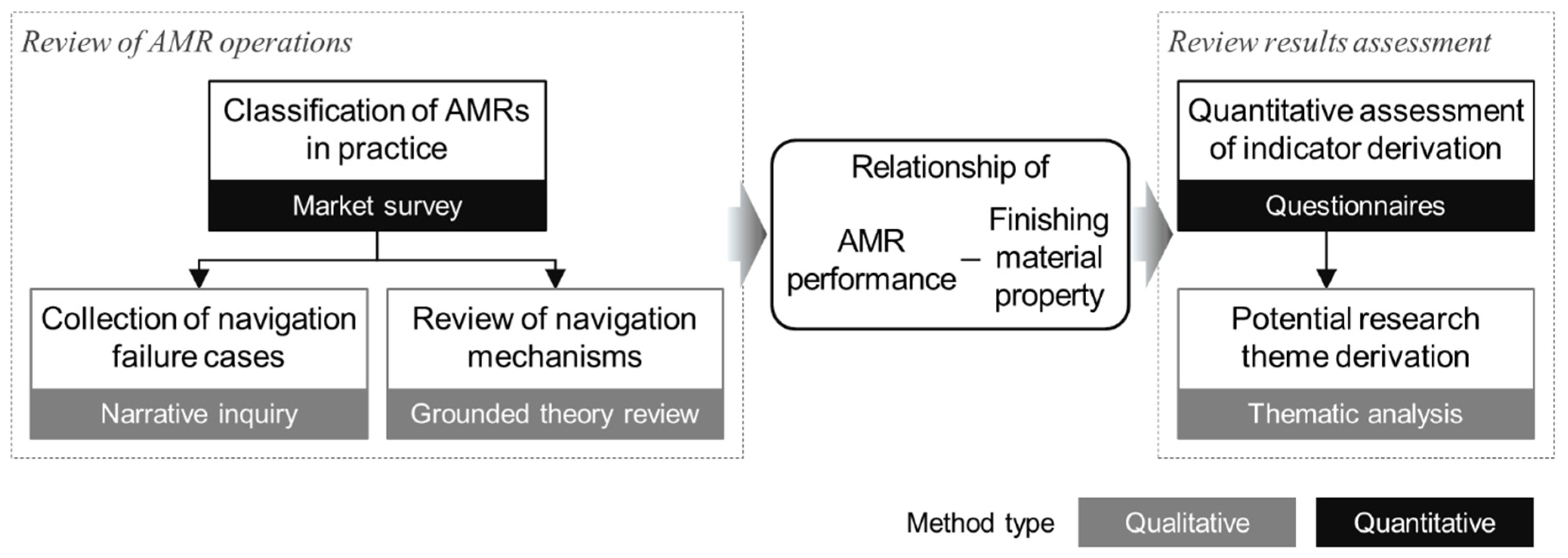
To systematically review and bridge the critical knowledge gap regarding how indoor finishing materials affect AMR performance, this study employs an exploratory sequential mixed-methods design, as shown in
Figure 1. Due to the limited consolidated academic literature on RIS, relying solely on a traditional literature review method is insufficient to capture the complexities of real-world operations. Therefore, this review approach is specially designed to convert qualitative, scattered operational insights into measurable quantitative indicators by establishing a clear hierarchy of roles for diverse data sources.
In the first phase, a technical market survey is performed to identify the types of AMRs currently used in real-world built environments. By systematically summarizing the sensor configurations and mobile-platform features of 19 commercial AMR models, this step clarifies the hardware baseline.
Next, to explore how these technical features translate into practical limitations, narrative inquiries are performed using news reports and in-depth expert interviews. These sources serve as preliminary data for specifying and contextualizing real-world navigation failures that are often overlooked in controlled settings. Subsequently, academic literature is reviewed to confirm whether these empirically identified problems are being addressed as scientific challenges and to establish a theoretical foundation for them.
Subsequently, the identified issues are synthesized to derive measurable assessment indicators. A critical step in this process is defining the operational scope. Although the term “navigation” is frequently used in a broad sense to encompass overall robot movement, this study explicitly distinguishes performance into two functional domains—sensing and locomotion. This distinction allows for a precise analysis of how different material properties, such as reflectance and friction, specifically impact either a robot’s perception capabilities or its physical mobility mechanisms. Based on this hierarchical synthesis of practical and theoretical evidence, variables linking these domains to material attributes are structured.
Finally, to quantitatively analyze these hypothesized relationships, a survey is administered to an independent panel of 11 experienced professionals in both robotics and architecture. This distinct participant group was deliberately selected through purposive sampling to cross-validate the findings from earlier interviews and the literature, enabling an objective, in-depth analysis of the operational relationships. To conclude the review process, a thematic analysis of the experts’ open-ended responses is conducted to identify expanded research agendas for future empirical studies.
3. Review of Autonomous Mobile Robot Operations in Built Environment
3.1. Classification of AMRs in Practice
With the rapid growth of the robotics industry, the ISO has continually developed and revised standards for robotic systems. For instance, ISO 8373 [
24] classifies robots according to their mobile platform mechanisms, such as wheeled, legged, tracked, and aerial platforms. In addition, the AMR is a concept defined by the International Federation of Robotics as a robot that autonomously navigates and performs tasks in service environments rather than in manufacturing settings [
5]. Although this definition does not restrict AMRs to wheeled locomotion, most commercial AMRs currently use wheeled platforms for technical and economic efficiency [
27]. As a consequence, ISO 18646-1 and 2 [
25,
26], which provide performance evaluation standards for service robot mobility, also prescribe test procedures based on wheeled locomotion. Despite this progress in standardizing AMR performance evaluation, there is still no clearly established framework or guideline for sensor configurations, even though sensing plays a direct and critical role in autonomous navigation performance.
3.1.1. Sensor Applications
This study investigates the sensor configurations of commercial AMRs by selecting service categories that are rapidly expanding within public-use facilities. According to the World Robotics 2024 Report [
5], service robot types with the highest sales growth include transportation robots (35%), hospitality robots (31%), agricultural robots (21%), and cleaning robots (4%). In addition, medical robots show a notable 36 percent increase, primarily due to rising demand for disinfection robots following the COVID-19 pandemic. Based on these trends, this study focuses on four AMR service types commonly deployed in public-use facilities: Hospitality, Transportation, Cleaning, and Disinfection.
Data collection is conducted by identifying AMRs available in the Korean market via online search engines and by examining manufacturers’ detailed product specifications. To ensure representativeness in the analysis, at least three models are included for each service type.
Table 1 summarizes the manufacturers, model names, and sensor configurations of 19 AMR models, categorized by service type. Specifically, hospitality robots include three models, such as DAL-e (manufacturer: Hyundai Motor Group (HMG)); transportation robots comprise seven models, including Servi (manufacturer: Bear Robotics); cleaning robots consist of five models, including Neo 2 (manufacturer: Avidbots); and disinfection robots include four models, such as Adibot A1 (manufacturer: TGR). While this regional sampling approach presents a potential limitation, it does not restrict the generalizability of the findings. As detailed in
Table 1, the selected AMR models are produced by manufacturers originating from six different countries: the Republic of Korea (i.e., South Korea), China, the United States (i.e., USA), Canada, Japan, and Denmark. This multinational composition ensures that the analyzed hardware characteristics and sensor configurations reflect diverse global manufacturing trends rather than localized conditions.
A review of commercial AMRs revealed that they use a variety of sensing technologies, primarily designed for surrounding perception and distance measurement. Regarding vision-based perception, AMRs employ 2D cameras (S4) and depth cameras (S5). For ranging and object detection, laser sensors (S1) and Light Detection and Ranging (LiDAR) sensors (S2) are widely adopted, along with ultrasonic sensors (S3). Additionally, the sensor configurations include Passive Infrared (PIR) sensors (S6) for thermal detection and bumper sensors (S7) for physical impact recognition. Because product specifications differ slightly across models—particularly regarding sensor labels and technical details—this study standardized the analysis using the seven sensor categories listed above and recorded their presence or absence.
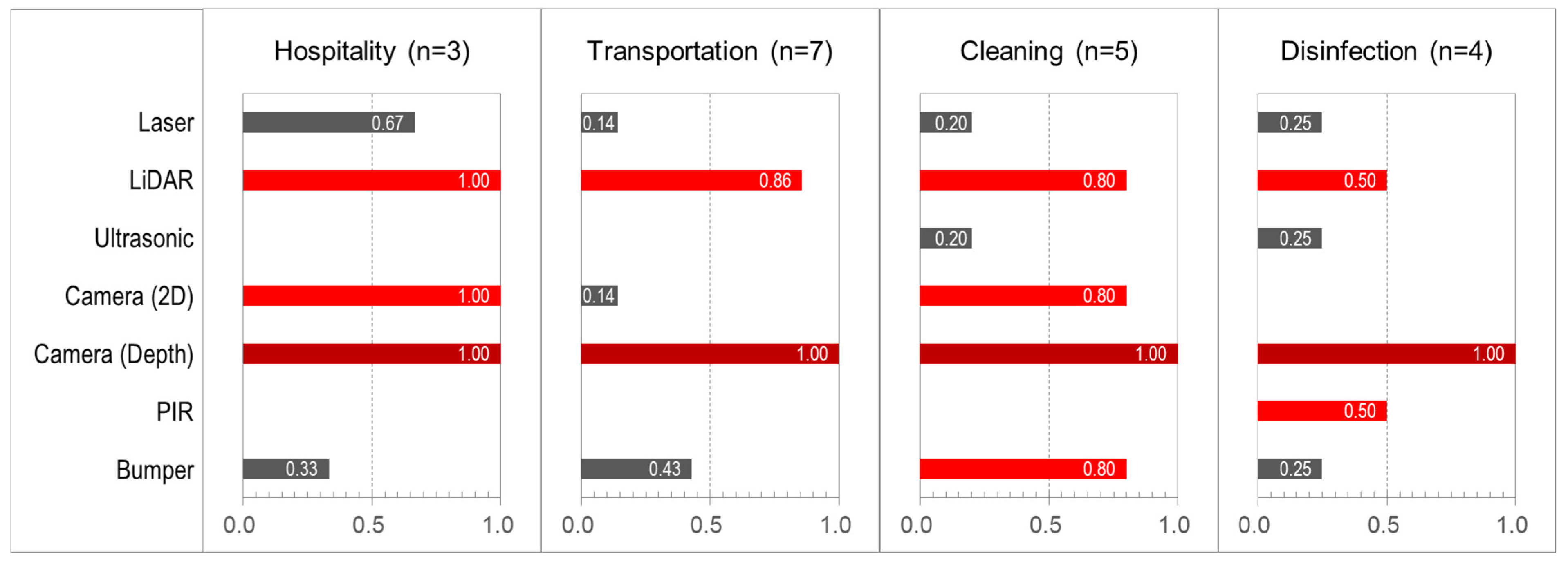
Figure 2 presents a percentage-based comparison of sensor adoption rates across AMRs for the four service types. To clearly visualize these configurations, sensors equipped in all surveyed models across all types are shown in maroon, while the most frequently adopted sensors within each service type, excluding the universally equipped ones, are shown in red. Regardless of service type, all AMRs were equipped with depth cameras. LiDAR was identified as the second-most frequently adopted sensor; however, it cannot be considered essential because its inclusion varied across models. AMRs used for Hospitality, Transportation, and Cleaning generally favored a multi-sensor configuration that included LiDAR, whereas Disinfection AMRs demonstrated comparatively lower levels of sensor fusion. In particular, the LiDAR adoption rate in Disinfection AMRs was approximately 0.5, indicating that the sensor is frequently omitted in this category.
This indicates that the primary mission of Disinfection AMRs is not human interaction, which involves a high degree of uncertainty, but rather the repetitive execution of sterilization tasks along predefined routes. In contrast, Hospitality AMRs require frequent human interaction, which explains why 2D cameras are universally adopted in this category. A similarly high adoption rate of 2D cameras is observed in Cleaning AMRs (0.8), whose core functions include contaminant detection and status identification. This suggests that services involving greater human or environmental interaction rely more heavily on sensor fusion, particularly on 2D cameras for object recognition. Additionally, the adoption of bumper sensors in Cleaning AMRs (0.8) reflects the need for accurate navigation in tight indoor spaces. Disinfection AMRs, however, more often use ultrasonic and PIR sensors. This pattern is due to their operating environment, in which interactions with moving objects are limited and environmental awareness is more critical than human recognition.
In summary, differences in AMR sensor configurations mainly stem from two factors. First, the nature of interaction required by each task determines the primary sensing target. Hospitality and Transportation AMRs need to recognize humans, whereas Cleaning AMRs focus on contamination detection, resulting in different sensor fusion strategies. Second, variations in operational modes cause different environmental conditions that the robot must adapt to. Disinfection AMRs usually operate in spaces and times with minimal human presence, requiring sensor setups that do not rely on human-oriented lighting and can function effectively even in low-light conditions.
3.1.2. Hardware Configurations
As observed in
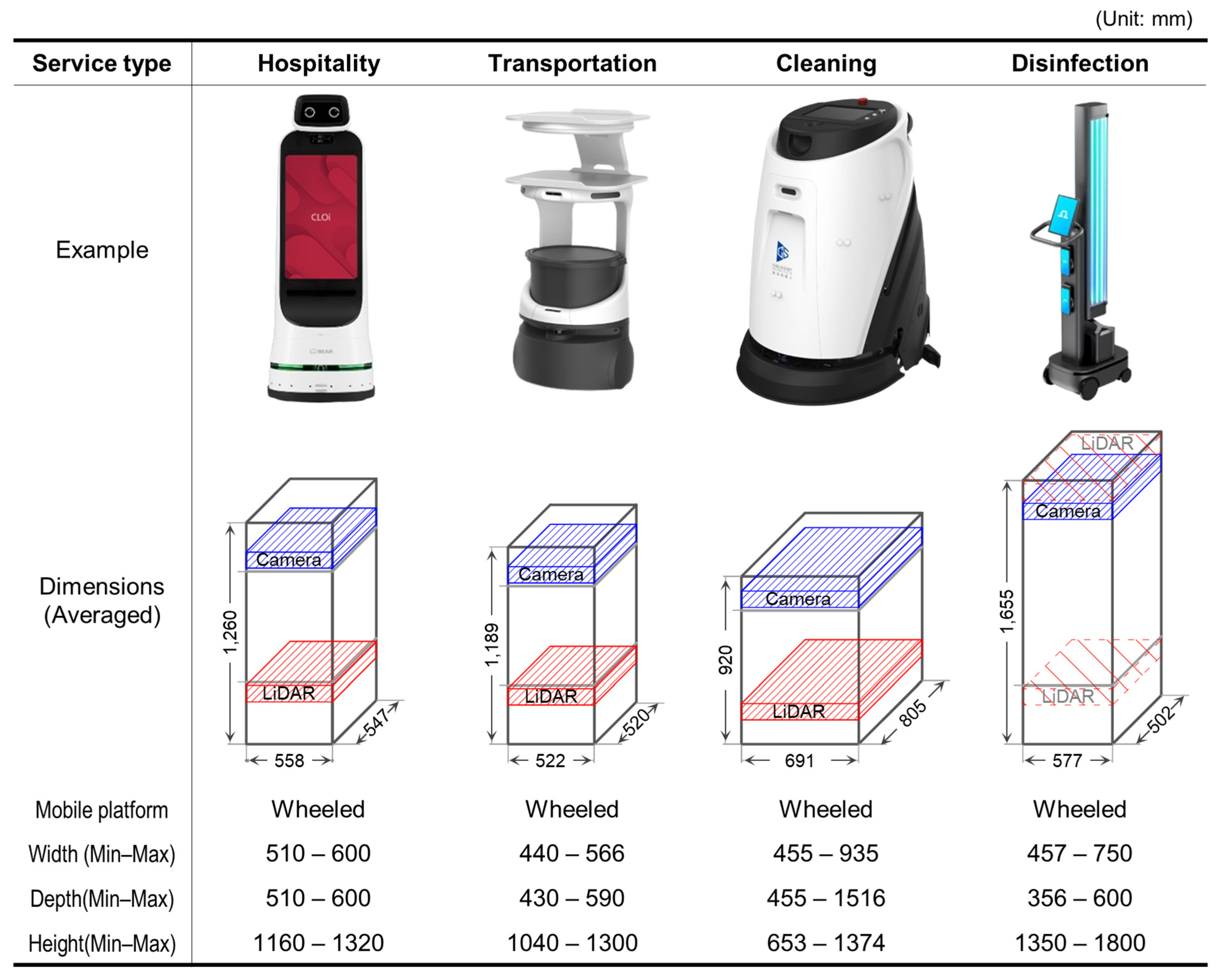
Section 3.1.1, the primary environmental perception sensor used in AMRs is the depth camera, with LiDAR serving as the most common complementary option. To identify the typical sensing coverage of AMRs, this study examined the average dimensions of commercial models and analyzed the placement of these two sensors.
Figure 3 illustrates the average size of AMRs in each service type, as presented in
Table 1, along with a schematic representation of depth camera and LiDAR placement.
These two sensors serve as key reference points that divide the robot body into upper, middle, and lower sections. In most AMRs, LiDAR is located in the lower body, while cameras are mounted in the upper body. However, Disinfection AMRs exhibit a distinct deviation from this pattern. Of the four models examined, only two were equipped with LiDAR. One of them (PEANUT M2) positioned the sensor in the lower section, similar to other service robots, while the other (AdiBot A1) installed it in the upper section. This suggests that a dominant design consensus regarding sensor placement has not yet been established for Disinfection AMRs.
Hospitality and Transportation AMRs generally measure less than 600 mm in both width and depth, with an average height of approximately 1200 mm. This dimensional configuration aligns with the human scale, allowing the robot to interact visually from slightly below eye level. Cleaning AMRs, by contrast, maintain a similar width but exhibit greater depth due to the cleaning apparatus mounted at the midsection. Their overall height is also noticeably lower, a design choice that enhances locomotion stability and reflects their operational characteristics, where interaction with the surrounding environment is more critical than interaction with humans. Disinfection AMRs, on the other hand, reach heights of up to 1800 mm to support wide-area sterilization tasks, resulting in dimensions comparable to the height of an average adult.
As mentioned earlier, all AMRs in the dataset employ wheeled mobility platforms. A distinctive characteristic shared across these models is a tall profile relative to their footprint, meaning their height is considerably greater than their base. To mitigate stability issues arising from this configuration, AMRs commonly adopt design strategies such as lowering the center of gravity, reducing ground clearance, and embedding wheels partially within the chassis. While these features improve balance and stability during locomotion, they simultaneously limit the robot’s ability to traverse obstacles or level differences. As a consequence, architectural elements such as ramps, thresholds, and floor discontinuities can hinder the mobility of these AMRs. Interestingly, applying this low-center-of-gravity strategy to androids or bipedal robots [
21] presents a distinct advantage. While it limits obstacle traversal for wheeled AMRs, legged robots can easily overcome such discontinuities using stepping kinematics. Thus, adopting this design in androids could maximize locomotion stability without compromising mobility.
3.2. Navigation Failure Case Statements
A comprehensive review of news articles and academic literature identified recurring issues in navigation performance within human-centered environments.
Table 2 summarizes these issues using keywords derived from media reports; insights from three experts with professional backgrounds in robot design, manufacturing, and related network infrastructure; and empirical evidence from academic studies.
News articles have repeatedly reported incidents where service robots made unexpected turns, collided with objects or people, or became uncontrollable. The leading cause of these accidents was identified as sensor perception errors. In many cases, robots failed to detect obstacles such as children or staircases, or deviated from their intended paths due to incomplete sensor feedback. Even robots equipped with multiple sensors, including ultrasonic, infrared, and camera-based systems, exhibited repeated perception failures in specific environments, particularly when reflections or transparent surfaces were present.
Interviewees also highlighted several perceptual and locomotion problems observed during robot operation. For example, glass doors are often not detected by sensors, and dark floors are frequently misinterpreted as cliffs. Electrical cables and thresholds measuring only about 1 cm in height can obstruct movement, while carpets reduce wheel traction, causing robots to slip or stall. Additionally, Cleaning AMRs have been reported to damage soft floor materials due to their substantial weight, ranging from 50 to 70 kg.
Academic studies support these practical observations. Optical and LiDAR sensors often fail to detect black or glossy surfaces due to low reflectance or specular reflections. Glass and polished surfaces allow light to pass through rather than bounce back, causing mapping errors or collisions. Ultrasonic sensors have difficulty detecting small or soft objects, and Time-of-Flight (ToF) sensors, which send out laser pulses and measure the return time to determine distance, have blind spots at close range. Camera-based systems can lose visual perception entirely in poor lighting or harsh environmental conditions.
Published studies also report locomotion issues associated with low ground clearance. AMRs with such configurations often lose traction and become unstable when passing over uneven surfaces, ramps, or thresholds, and documented cases include overturning or rolling back on inclined surfaces. These observations confirm that AMR performance is susceptible to the optical, geometric, and mechanical features of the built environment. Material properties such as reflectance, transparency, surface texture, color, and flatness directly affect sensor reliability and locomotion stability.
3.3. Review of Navigation Mechanisms
AMRs perceive and operate within indoor environments by estimating their own location while simultaneously constructing a map of their surroundings, a process known as Simultaneous Localization and Mapping (SLAM). LiDAR-based SLAM offers high-precision mapping capabilities but is costly and sensitive to specific environmental conditions. Visual-SLAM, on the other hand, provides low-cost access to rich environmental information, although its performance is highly affected by lighting conditions [
51]. As a result, recent approaches increasingly combine multiple sensing modalities, such as LiDAR, vision, and ultrasonic sensors, within sensor-fusion-based SLAM frameworks, aiming to compensate for the weaknesses of individual sensors and improve overall system robustness.
Sensors can be broadly classified as passive or active, depending on whether they emit energy. Passive sensors, such as vision cameras and PIR sensors, detect external energy without generating their own signals. Active sensors, including LiDAR and ultrasonic sensors, emit electromagnetic or acoustic waves and measure the reflected signals to infer distances and detect objects.
Electromagnetic waves, such as laser pulses used in SLAM, may be reflected or transmitted when passing through materials with different refractive indices [
17,
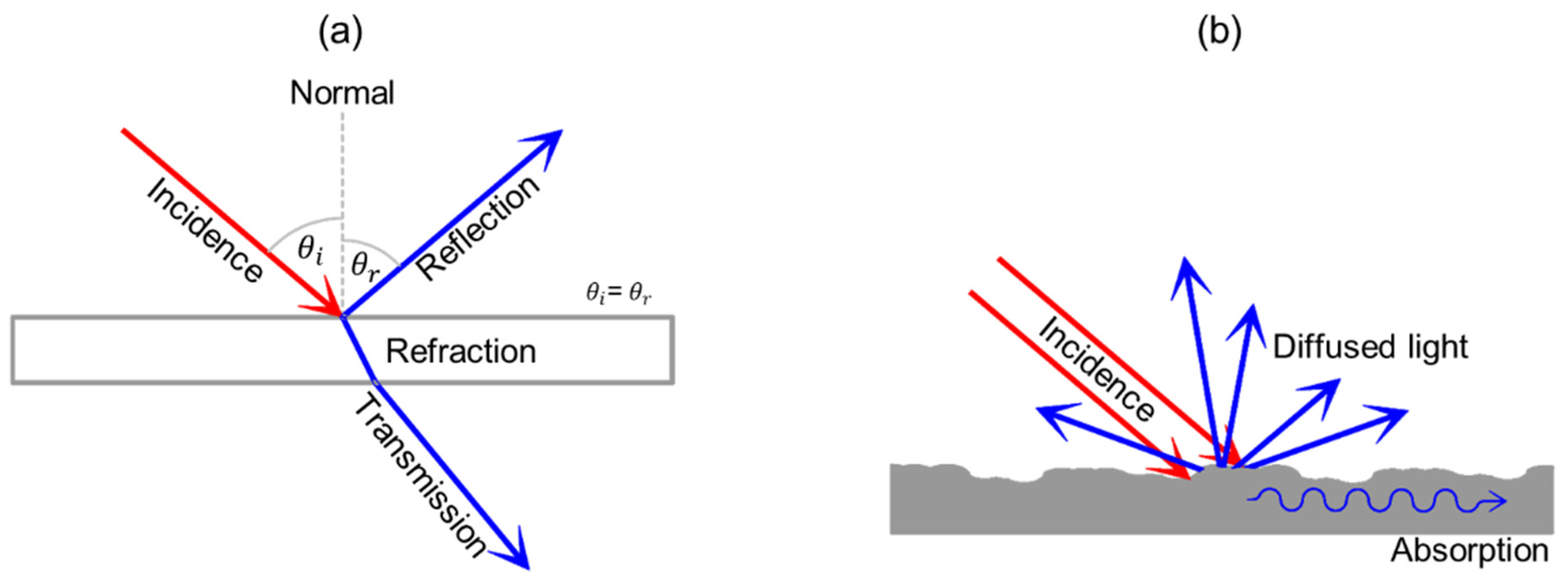
52]. On highly polished surfaces such as glass or metal, absorption of incident waves is minimal, and reflection or transmission is the dominant mode of interaction. Reflected waves can be classified as either specular or diffuse reflections. Specular reflection occurs when the angle of reflection equals the angle of incidence, as shown in
Figure 4a. Highly polished surfaces exhibit predominantly specular reflection, which presents challenges not only for machine perception systems but also for human vision, as objects become difficult to detect under such conditions. Conversely, most real-world objects have imperfect surfaces that scatter incident light in multiple directions, resulting in diffuse reflection, as illustrated in
Figure 4b. Diffuse reflection enables objects to be visually perceived, and variations in the wavelengths reflected or absorbed by a surface within the visible spectrum ultimately determine the material’s perceived color.
Therefore, whether a sensor is passive or active, its detection wavelength range is a critical aspect of its performance. Vision sensing, a representative passive method, operates in the visible spectrum, from approximately 400 to 750 nm. However, for other sensors, it is necessary to understand the wavelength bands they are designed to detect.
PIR sensors operate based on the pyroelectric effect, in which incident infrared radiation generates electrical charges within the sensing material. PIR sensors detect infrared light in the 800–1400 nm range and detect human presence within their field of view. The thermal infrared signal goes through three stages before being converted into an analog signal. First, human body radiation is focused onto the pyroelectric element using a Fresnel lens. The infrared signal is then transformed into a weak electrical signal, which is amplified and filtered to produce a final analog output [
53].
LiDAR sensors primarily use laser wavelengths in the NIR region, typically 905 nm or 1550 nm, although 905 nm systems are more common due to cost advantages. LiDAR emits multiple laser pulses and detects the reflected waves using a receiver. By applying ToF calculations to the reflected pulses and combining the distance estimates from each beam, LiDAR obtains detailed information about the surrounding environment [
54]. Laser sensors, also known as commercial ToF sensors, use NIR wavelengths, typically 850 nm or 940 nm. These systems are composed of a laser emitter and a photodetector [
55]. The laser emitter releases short pulses toward an object, and the reflected light is detected by the photodetector, enabling the distance to be calculated.
Ultrasonic sensors also measure distance using a ToF principle, but emit acoustic waves rather than electromagnetic signals. They operate in two measurement modes. The first is reflective sensing, in which the emitted sound wave returns to the same sensor after encountering an obstacle. The second is one-way ranging, in which the transmitter and receiver are positioned separately to measure the distance between them. Operating at frequencies above 20 kHz, ultrasonic sensors demonstrate strong detection performance on glass surfaces where electromagnetic sensors often fail [
56].
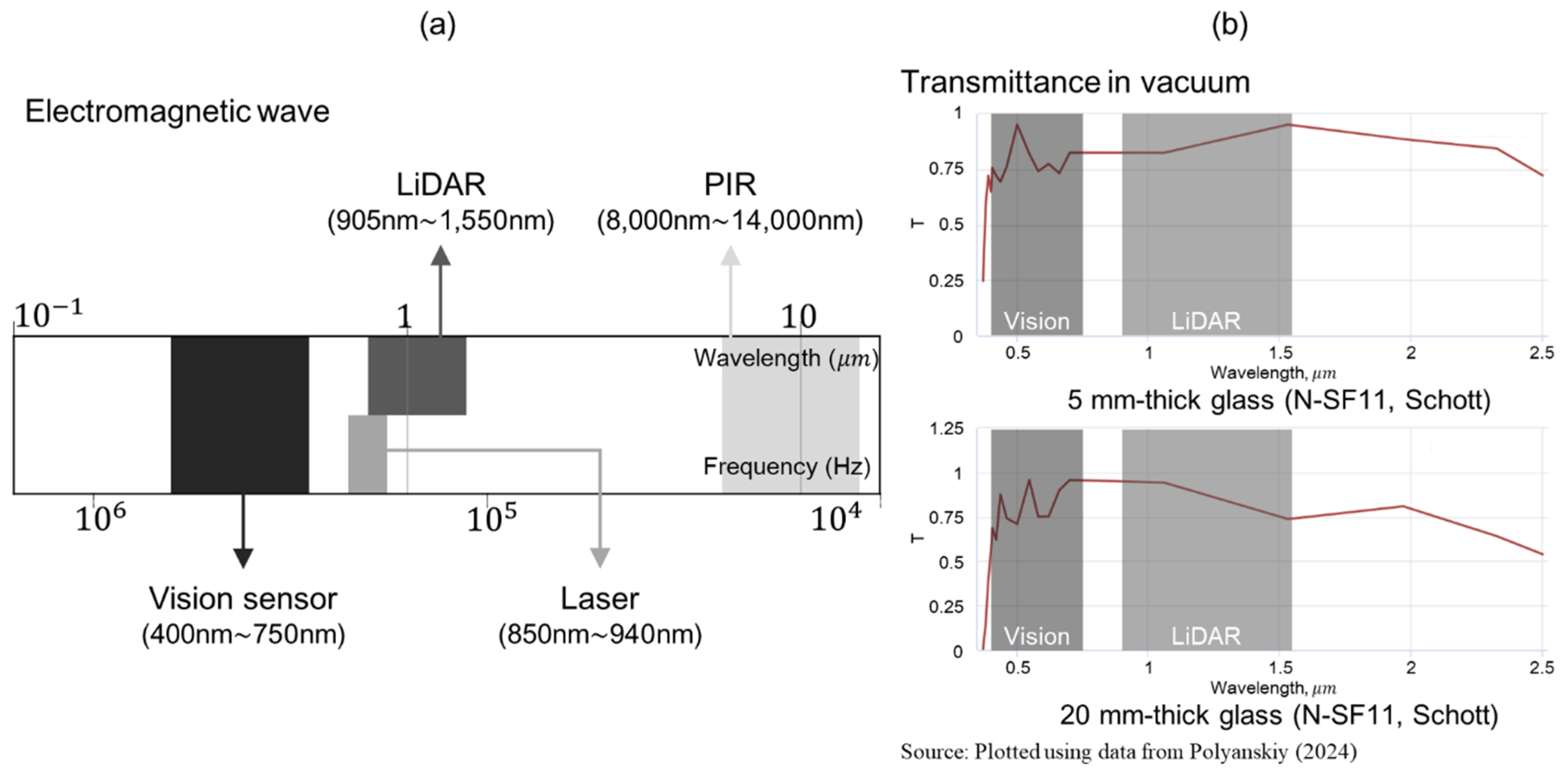
Figure 5a presents an overview of the wavelength detection ranges for passive and active sensors as identified in the reviewed literature.
Figure 5b compares the transmittance of a specific type of optical glass (i.e., N-SF11 manufactured by Schott) at two thicknesses, 5 mm and 20 mm, across the wavelength ranges most commonly used in vision and LiDAR sensor systems of AMRs. The values presented were computed using an optical transmission calculator based on the complex refractive index database [
57].
The results show that although thinner glass generally exhibits higher transmittance across both ranges, this thickness-dependent variation is significantly more pronounced at longer LiDAR wavelengths (approximately 1.5 µm). Specifically, thicker glass effectively suppresses transmission at these wavelengths, while reducing the thickness leads to a drastic increase in transmittance. This implies that detection reliability for longer-wavelength LiDAR is highly sensitive to material dimensions; it may perform adequately on thick glass but faces a heightened risk of blindness on thin glass, unlike shorter-wavelength (below 1 µm) systems, which exhibit more stable characteristics.
From a locomotion perspective, AMRs universally utilize wheeled mobility platforms. These platforms can be categorized by their steering mechanisms into holonomic systems, direct steering systems where the wheels move in parallel, and differential steering systems that allow independent wheel control [
15]. These steering configurations produce different turning radii and maneuvering strategies. Holonomic platforms can rotate in place and perform reversing movements in narrow corridors, but their motor torque distribution makes them more vulnerable on uneven surfaces, ramps, and thresholds. In contrast, direct steering platforms require more space to reverse. Their maneuvering capabilities are similar to those of wheelchairs, which is why accessibility standards for barrier-free environments are often referenced when discussing spatial requirements for robot inclusiveness [
10,
58].
4. Relationship Between Building Finishing Materials and AMR Performance
4.1. AMR Performance Indicators and Assessment Metrics
Based on the conceptual distinction between sensing and locomotion established in the previous section, this study defines specific performance indicators and metrics to assess each domain quantitatively. Accordingly, the Robot’s Sensing Performance Indicator (RPI(S)) and the Robot’s Locomotion Performance Indicator (RPI(L)) were established with reference to ISO standards [
25,
26]. RPI(S) comprises obstacle-detection capability and mapping accuracy, while RPI(L) comprises speed and path consistency. Additionally, reflecting the narrative inquiry results summarized in
Table 2, a surface-preservation indicator was incorporated to account for potential damage to floor finishing materials. The assessment metrics for these indicators were derived from relevant ISO test procedures and structured to enable evaluation of each indicator using one or two quantitative measures. A complete overview of these indicators and their associated assessment metrics is provided in
Table 3.
4.2. Finishing Material Property Indicators and Assessment Metrics
The absorption, reflection, and transmission properties of architectural finishing materials regarding electromagnetic and acoustic waves depend on wavelength. As a result, traditional evaluation methods for built environments are designed around human perceptual ranges, such as the visible spectrum (approximately 400 to 700 nm) and the audible frequency range (approximately 20 Hz to 20 kHz). However, the sensing wavelengths used by AMRs differ from those perceived by humans, meaning that assessment criteria focused solely on human perception cannot fully explain how finishing materials affect AMR sensing and locomotion performance.
In this study, Finishing Material Property Indicators (FMPI) were derived from the keywords presented in
Table 2 to identify material properties that influence AMR sensing and locomotion performance. Since a robot-inclusive assessment framework for finishing materials has not yet been established, many relevant material characteristics are dispersed across human-centered architectural criteria, and standardized test methods are either incomplete or unavailable. Therefore, this study identified applicable human-centered metrics and systematized them in
Table 4, referencing relevant standards and literature to establish a valid basis for each indicator.
As indicated in the literature summarized in
Table 2 [
17,
49], the transparency and specular reflection of glass are frequently discussed together in the context of laser-signal detection. Since their related metrics—transmittance and reflectance—share a common spectrophotometric framework, these attributes were grouped under a single indicator category.
In contrast, locomotion indicators such as “Slipperiness” and “Unevenness” were derived from accessibility standards, such as the Americans with Disabilities Act (ADA) Standards [
58]. In the absence of established robot-specific architectural standards, the adoption of these human-centered accessibility criteria serves primarily as a temporary proxy. Inevitably, these wheelchair-based metrics do not fully capture the distinct mechanical characteristics of AMR locomotion systems. This discrepancy underscores the need to interpret these human-centered metrics with caution. It highlights the critical need for a robot-centered assessment framework that accounts for hardware configurations, including driving mechanisms, wheel materials, and sensor placement.
4.3. Experts’ Assessment on the Material-Robot Performance Relationship
The relationships between AMR performance and finishing material properties, along with the related indicators summarized in
Table 3 and
Table 4, reflect potential correlations identified through qualitative analysis. To assess the practical significance of these relationships, an expert survey was conducted. To ensure a rigorous and technically grounded evaluation, this study employed purposive sampling to select a highly experienced panel of professionals rather than the general public. Furthermore, to prevent group bias, the assessment was conducted via independent individual surveys, with equal weight applied to all respondents’ scores. The survey presented the identified relationships and asked respondents to rate each relationship’s appropriateness on a five-point Likert scale (1: not appropriate at all, 2: somewhat inappropriate, 3: neutral, 4: appropriate, 5: highly appropriate).
The survey included five experts in architecture and six in robotics. The architecture specialists had an average of 15.2 years of experience in design, facility management, and spatial consulting. The robotics specialists had an average of 19.5 years of experience in research and development of control and locomotion algorithms for construction and service robots. To verify the consistency of the collected survey data before conducting a detailed analysis, Kendall’s coefficient of concordance (W) was calculated for the appropriateness scores. The analysis revealed a statistically significant, moderate level of agreement among all 11 experts (W = 0.395, * p < 0.001). This confirms that despite their distinct professional backgrounds, the panel reached a reliable consensus on the overall indicators.
4.3.1. Influence of Materials on Robot Sensing Performance
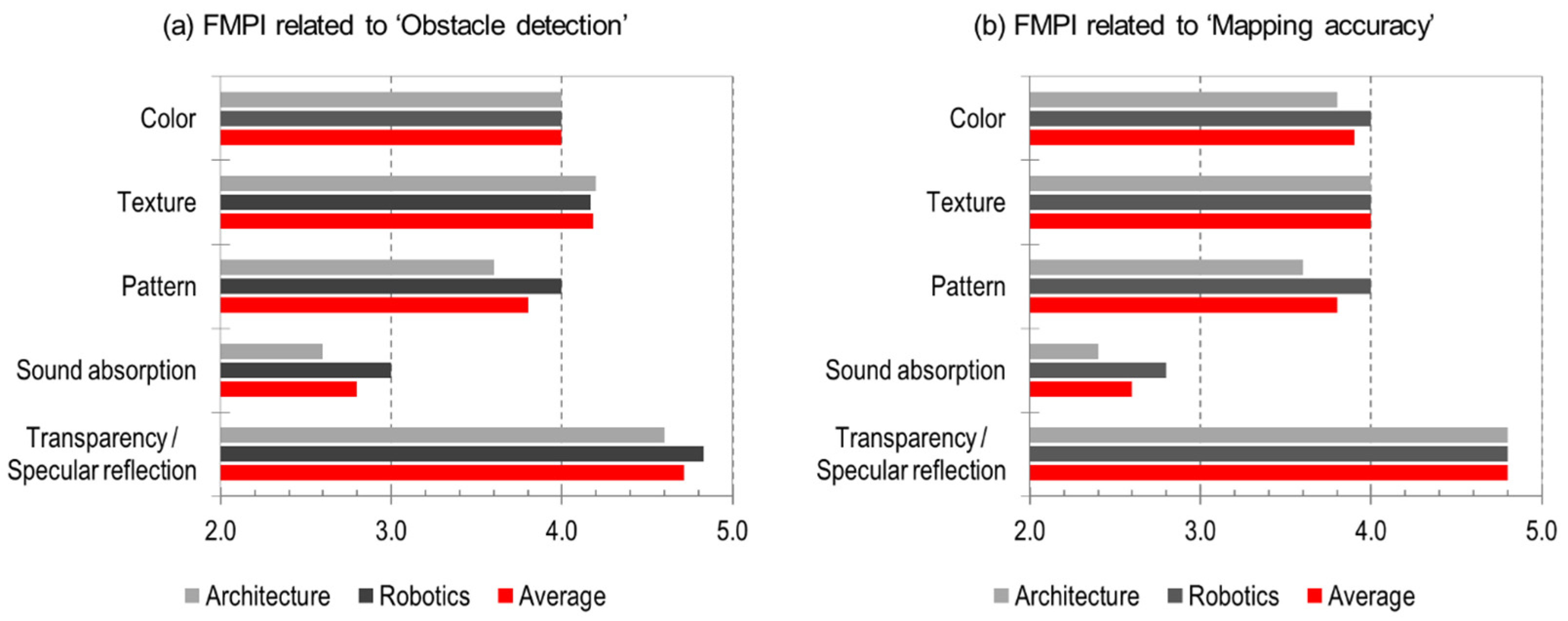
Figure 6 shows the assessment results for the appropriateness of the relationships between FMPI and RPI(S), specifically regarding obstacle detection capability and mapping accuracy. The indicator “Transparency/Specular reflection” received an average score above 4.7 from both expert groups, confirming it as the most influential factor affecting sensing performance. In contrast, while robotics experts gave average scores above 4.0 to “Color” and “Pattern,” architectural experts rated these indicators lower, at 3.8 and 3.6, respectively. Written responses from architectural experts supported this finding. They noted that color and pattern are elements directly related to spatial esthetics and should be modified only with caution, even when improving inclusiveness for robots. Their feedback reflects a design-driven conservatism rather than a view of technical irrelevance. The FMPI “Sound absorption”, although identified in the literature as a factor influencing ultrasonic sensing, received average scores below 3.0 across all expert groups.
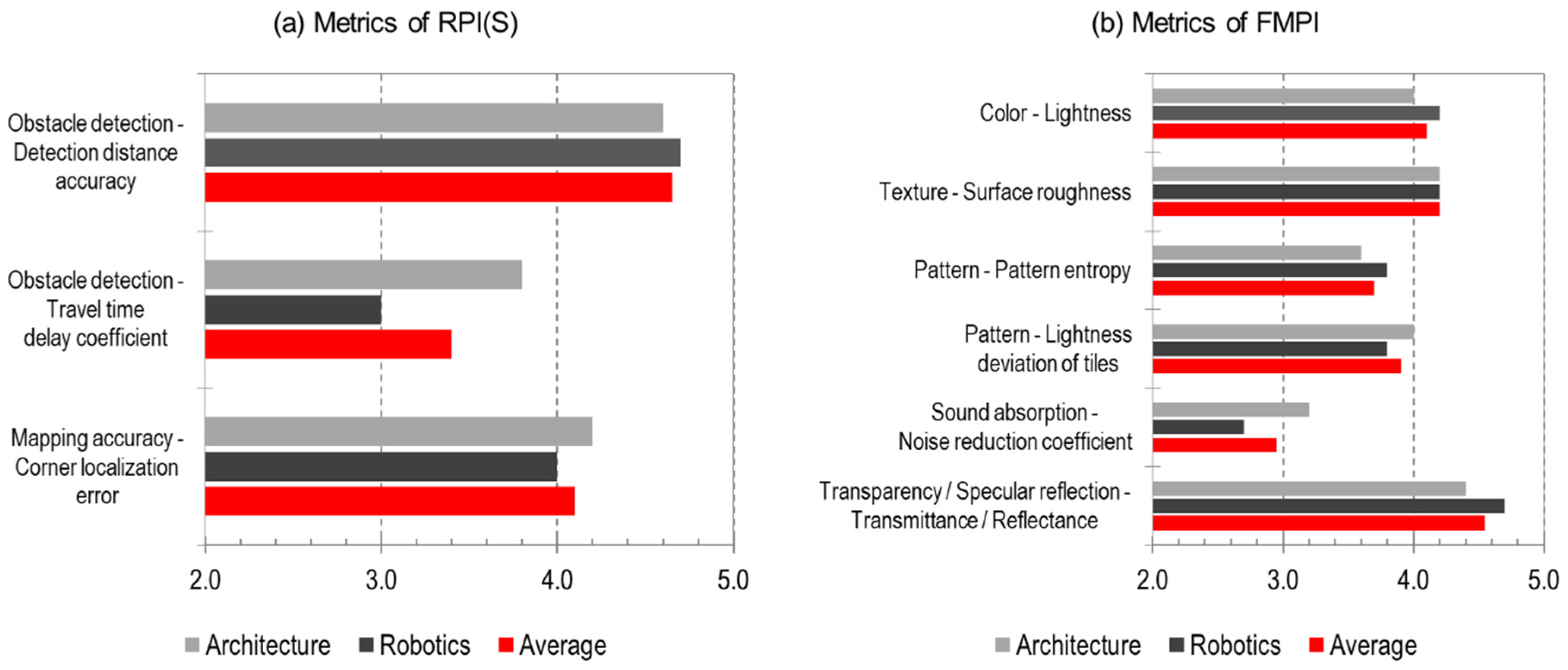
Figure 7 shows the evaluated suitability of the derived metrics, with
Figure 7a representing RPI(S) and
Figure 7b representing FMPI. Most RPI(S) metrics scored above 4.0, indicating strong consensus on their relevance. However, the “Travel time delay coefficient” revealed a noticeable difference: architectural experts rated it an average of 3.8. In contrast, robotics experts gave it a neutral score of 3.0, indicating that obstacle detection success is more important than temporal delay.
FMPI metrics showed a consistent pattern: items associated with higher appropriateness scores in
Figure 6 were also evaluated more positively. For example, the “Noise reduction coefficient” scored relatively low at 2.9, while “Pattern entropy” and “Lightness deviation of tiles” received scores of 3.7 and 3.9, respectively—above neutral, yet just below the 4.0 threshold. These findings suggest that, although FMPI metrics are generally considered relevant, their practical use depends on technical feasibility and contextual design considerations.
4.3.2. Influence of Materials on Robot Locomotion Performance
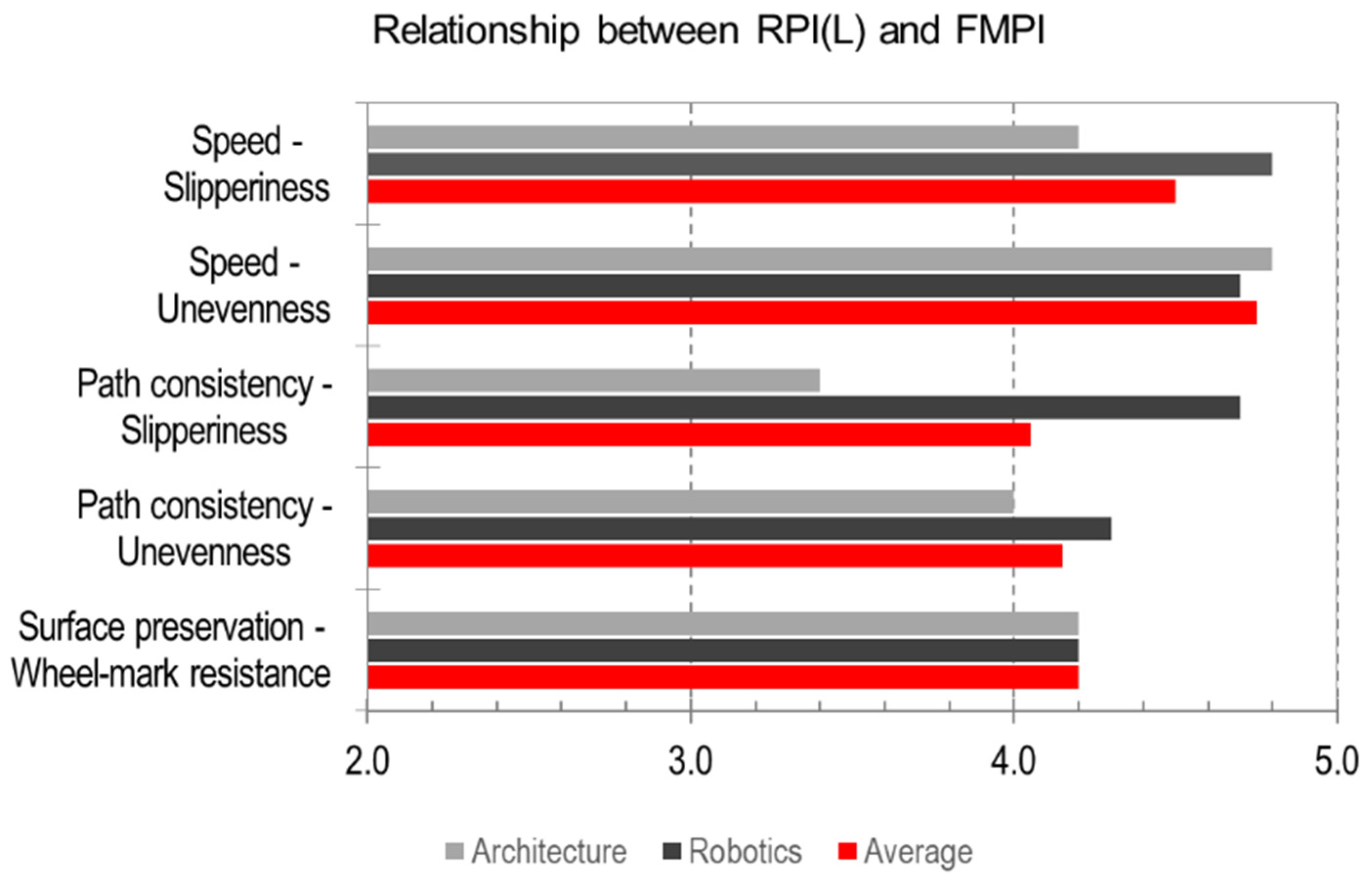
Figure 8 shows the evaluated relevance of the relationships between RPI(L) and FMPI. The items “Slipperiness,” “Unevenness,” and “Wheel-mark resistance” each received mean scores above 4.0, indicating strong agreement among respondents that floor friction and surface roughness are directly linked to locomotion stability. A closer inspection reveals a notable difference between the two expert groups in their understanding of the “Path consistency–Slipperiness” relationship. Architectural experts gave an average score of 3.4, showing a more cautious judgment, while robotics experts rated the same relationship at 4.7. Instead of relying solely on these descriptive differences, a detailed statistical verification of why such perceptual gaps occur is presented in
Section 4.3.3.
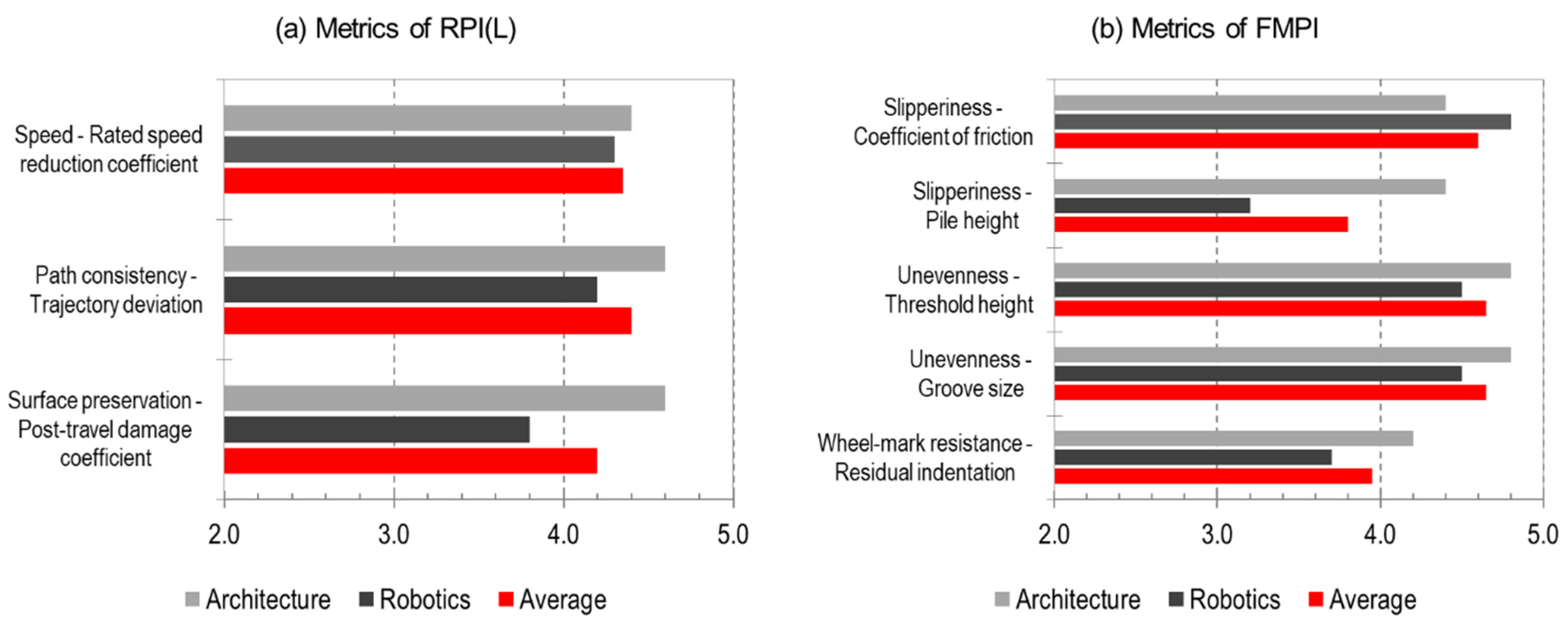
As shown in
Figure 9, all metrics related to RPI(L), such as “Speed,” “Path consistency,” and “Surface preservation,” received mean scores of 4.0 or higher. This indicates that these metrics are seen as suitable and valid for evaluating locomotion performance. In contrast, the assessment of FMPI showed notable variation across different metrics. For example, the relationships “Slipperiness–(Carpet) Pile height” and “Wheel-mark resistance–Residual indentation” were rated above 4.0 on average by architectural experts. In contrast, robotics experts gave lower scores of 3.2 and 3.7, respectively. Conversely, “Threshold height” and “Groove size” received average scores of 4.5 from robotics experts, showing their greater perceived importance from that perspective.
4.3.3. Statistical Verification of Perceptual Differences Between Expert Groups
Overall, experts from both fields responded that the RPI, FMPI, and metrics derived through systematic qualitative methods from various data sources were generally appropriate (i.e., Median ≥ 4.0). Although
Figure 6,
Figure 7,
Figure 8 and
Figure 9 reveal some perceptual differences between the two expert groups, a Mann–Whitney U test was conducted to more stably verify the statistical significance of these differences. The results indicated that at the 95% confidence level, most items did not show statistically significant differences in perception between the two disciplines. However, significant differences were observed in one item regarding the RPI-FMPI relationship and two items regarding the Indicator–Metric relationships.
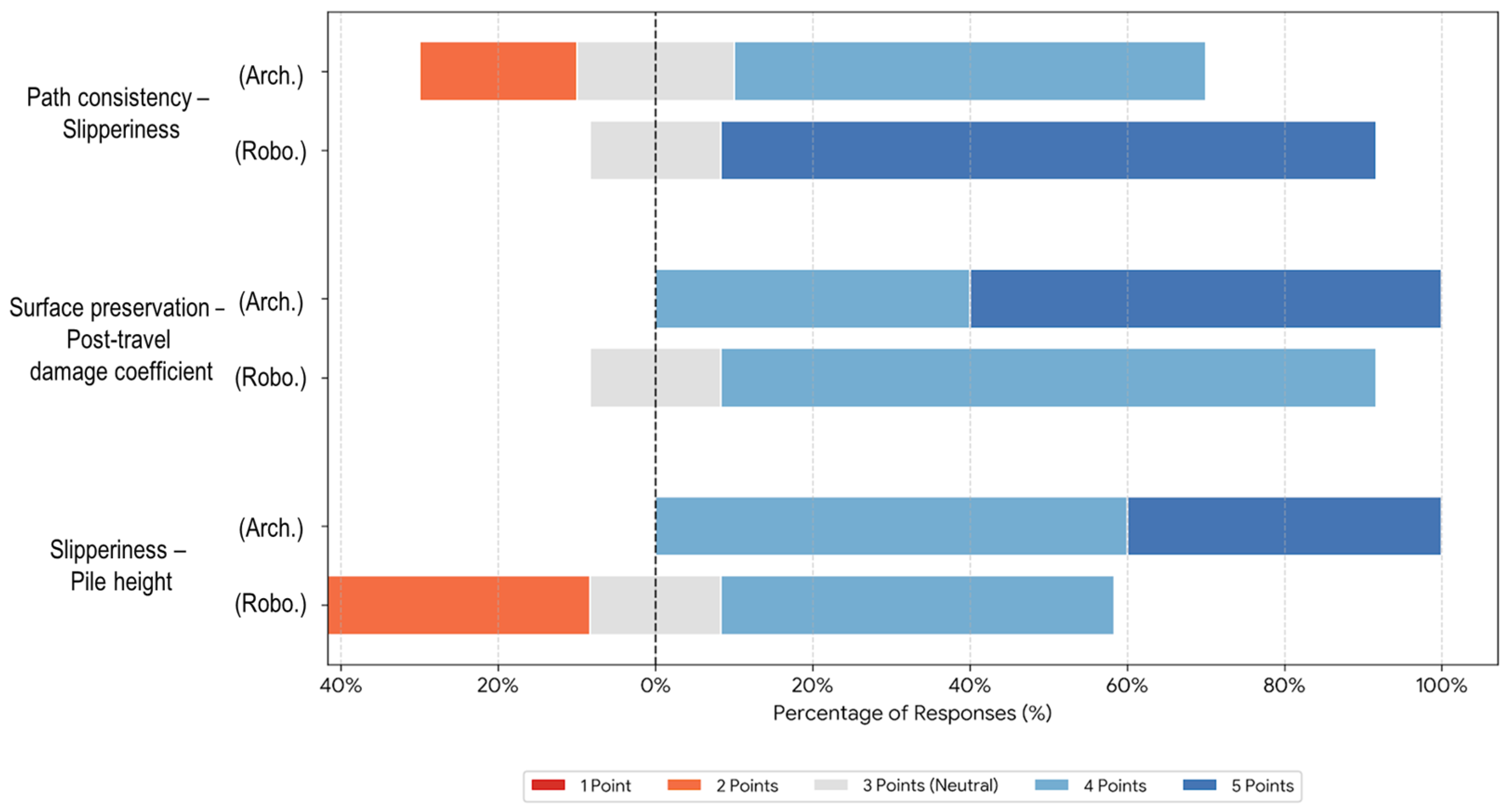
Figure 10 illustrates the differences in response distributions for these three items using a diverging stacked bar chart.
Regarding the RPI-FMPI relationship, a significant difference was found in “Path consistency–Slipperiness” (
p = 0.033). Robotics experts (Median = 5) assigned significantly higher appropriateness scores than architectural experts (Median = 4). As shown in
Figure 10, a large proportion of robotics experts rated it 5 (highly appropriate), indicating strong consensus that floor slipperiness directly affects a robot’s wheel slip and trajectory control. This high sensitivity can be attributed to the fact that issues related to locomotion stability tend to be much more prominent during real-world physical deployments than in virtual simulations. In contrast, architectural responses were more dispersed, including scores of 2 (somewhat inappropriate), showing a relatively cautious judgment compared to the robotics perspective.
For the Indicator–Metric relationships, significant differences were found in “Surface preservation–Post-travel damage coefficient” (
p = 0.042) and “Slipperiness–Pile height” (
p = 0.045). Architectural experts (Median = 5) placed greater importance on the “Post-travel damage coefficient” compared to robotics experts (Median = 4), reflecting the architectural sector’s high sensitivity to physical damage and the long-term maintenance of building flooring. Similarly, for “Pile height,” architectural experts (Median = 4) rated it significantly higher than robotics experts (Median = 3.5).
Figure 10 shows that some robotics experts even gave this metric a score of 2. This discrepancy highlights the fundamental difference in the evaluation frameworks of the two disciplines. Architectural experts, familiar with barrier-free design standards, tend to interpret these metrics through the lens of wheelchair mobility needs (e.g., ADA limits on pile height). Conversely, robotics experts base their judgments on direct operational experience, recognizing that human-centered criteria such as pile height alone may not fully capture the complex traction loss and entrapment issues experienced by AMR wheels.
4.4. Finishing Material-AMR Performance Relational Diagrams
The assessment results showed that many metrics received mean scores of 4.0 or higher, indicating that the relationships initially proposed in the survey demonstrated conceptual validity at the expert level. Based on these evaluations, to contribute to future empirical studies that can directly inform RIS design guidelines, it is necessary to establish clear priorities among these relationship pairs.
Therefore, a Wilcoxon signed-rank test was conducted to verify the statistical significance of the differences in appropriateness scores. Given the extensive number of survey items, the tests were performed separately for categories divided into sensing and locomotion.
Table 5 summarizes the results for the RPI–FMPI relationships. Rather than presenting all possible pairwise comparisons, the relationships are ranked by their mean scores, displaying the
p-values derived from sequential adjacent comparisons (i.e., comparing each item only with its immediately preceding higher-ranked item).
Although multiple pairs might show statistical significance under comprehensive cross-testing, the sequential adjacent comparison revealed that only “Sound absorption” exhibited a significant difference. Specifically, the relationship between “Obstacle detection” and “Sound absorption” showed a sharply lower mean score of 2.82, which was statistically significant compared to the preceding item (p = 0.02). Consequently, this item was excluded from the relational framework. As discussed earlier, this exclusion is structurally supported by the engineering rationale that AMRs utilize high-frequency ultrasonic waves that exhibit minimal correlation with human-audible sound absorption metrics, reflecting the diminishing role of ultrasonic-only sensing in current AMR operations.
Furthermore,
Table 6 presents the Wilcoxon signed-rank test results for the Indicator–Metric relationships, conducted separately for RPI and FMPI across both domains. The sequential adjacent comparisons indicated that statistically significant differences generally emerged around the mean score of 4.0 and below 3.5. For example, in RPI(S), significant drops were observed at “Corner localization error” (Mean = 4.09,
p = 0.01) and “Travel time delay coefficient” (Mean = 3.36,
p = 0.04). Similarly, in FMPI(L), a significant difference was found at “Residual indentation” (Mean = 3.91,
p = 0.02).
Based on the statistical boundaries observed near 4.0 and 3.5, these two values were adopted as threshold criteria for Tier classification: Tier 1 (primary) for scores of 4.0 or above, and Tier 2 (secondary) for scores between 3.5 and 4.0. Items falling below 3.5 were excluded.
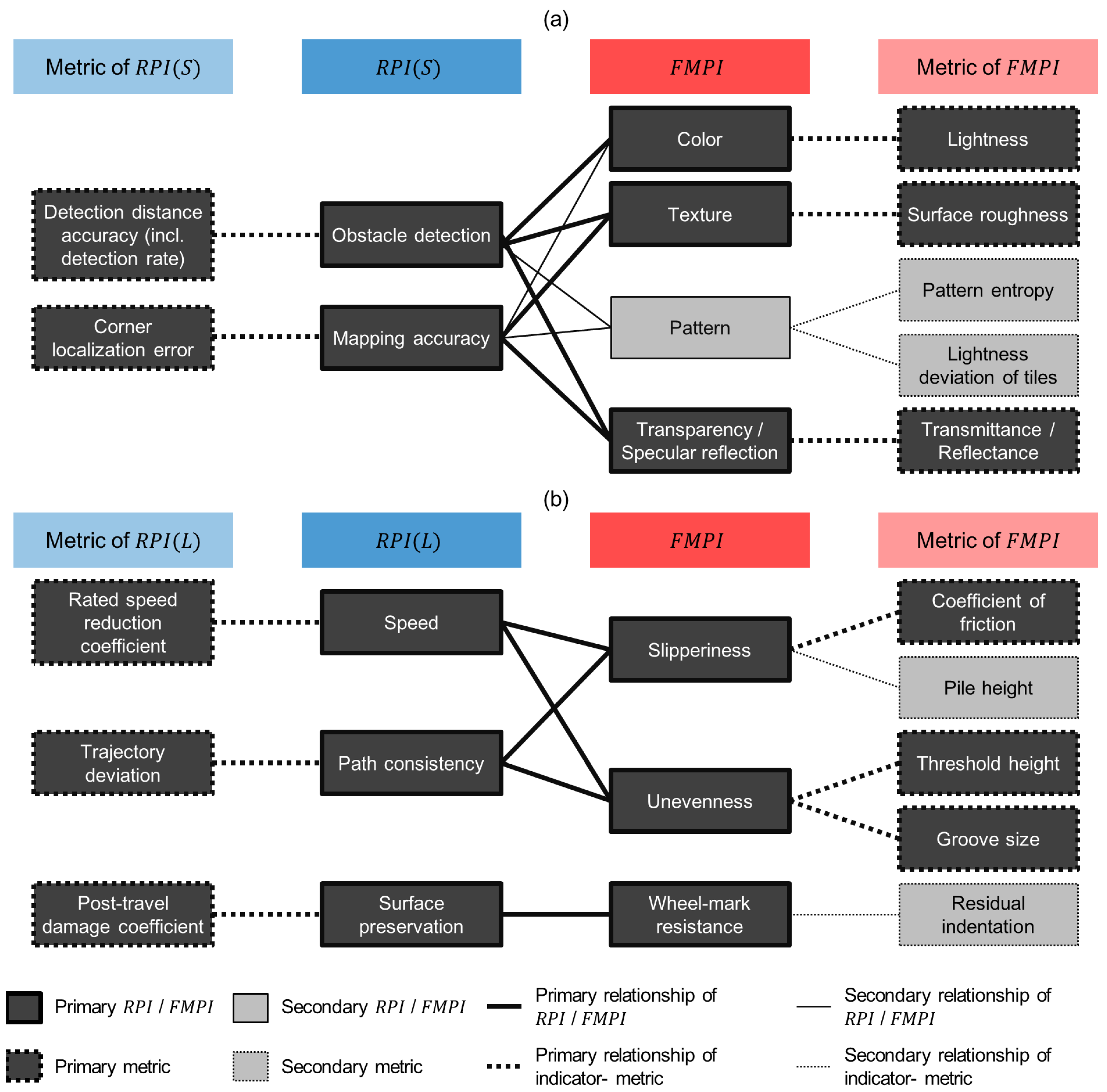
Figure 11a,b show the updated relational diagrams that summarize this Tier classification.
However, because these two thresholds (4.0 and 3.5) do not have absolute statistical significance across all pairwise comparisons, it is entirely possible to apply different sensitivities when using
Figure 11, depending on specific contextual needs. For instance, if the lower bound for Tier 1 in the RPI–FMPI relationships is conservatively adjusted from 4.0 to 4.2, six relationships—including “Obstacle detection–Texture” (Mean = 4.18), “Path consistency–Unevenness” (Mean = 4.18), and “Path consistency–Slipperiness” (Mean = 4.09)—would be reclassified from Tier 1 to Tier 2. Conversely, if the Tier 1 threshold for Indicator–Metric relationships is relaxed to 3.8, metrics such as “Lightness deviation of tiles” (Mean = 3.91) and “Residual indentation” (Mean = 3.91) would be elevated to Tier 1.
While these diagrams are not intended as definitive design guidelines for immediate application, they serve as an empirically grounded foundation. By classifying critical relationships between FMPI and RPI into tiers, this hypothesized framework systematically guides which variables require physical validation first. Specifically, the framework prioritizes the relationship between “Slipperiness” and “Path consistency” as a Tier 1 variable requiring immediate physical validation. To quantitatively validate this framework beyond expert opinion, future studies must construct controlled experimental environments. By incorporating the operational insights derived from the thematic analysis in
Section 5, researchers can design concrete experimental scenarios. To empirically test the impact of slipperiness, an experiment could be designed to precisely measure the robot’s trajectory deviation under controlled conditions, such as dry, wet, or contaminated floors. By transitioning from expert-based evaluation to physical validation, these diagrams systematically guide future experimental setups toward establishing concrete guidelines for robot-inclusive spaces.
5. Potential Research Themes
In addition to the appropriateness assessment, this study conducted a follow-up inquiry with the same expert group to identify research areas not represented in the relational diagram. Experts were asked to suggest future research directions they deemed necessary for improving AMR sensing and locomotion performance in indoor built environments, and their responses were collected in an open-ended format. These responses were then compiled and analyzed using an inductive coding approach. Statements expressing similar ideas were grouped and consolidated, and recurring concepts were organized into higher-level categories. These categories were refined into themes and subthemes based on conceptual similarity and scope. The final structure from this thematic grouping process is presented in
Table 7.
The first theme focuses on developing a foundational knowledge system. Experts commonly emphasized that the current understanding of how finishing material properties influence AMR sensing performance remains fragmentary. They suggested research directions such as establishing palette-type design guidelines that incorporate visual elements, including color, reflectance, and transparency; clarifying compatibility criteria based on sensor configurations; and studying performance sensitivity in relation to AMR specifications. These suggestions point to the need to gather and consolidate knowledge in this domain systematically.
The second theme focuses on operation-oriented research. Experts observed that AMR performance is affected not only by the inherent properties of finishing materials but also by environmental conditions arising from use and maintenance. They pointed out several overlooked issues, such as the potential use of BIM-based spatial information to support robot perception, variations in friction caused by contamination or moisture, and the development of level differences due to long-term material degradation. These factors indicate that AMR-related challenges vary across operational environments and should be included in future research plans.
The third theme involves the development of robot-friendly materials. Rather than merely enhancing existing material properties, this approach emphasizes designing materials and visual processing methods specifically for robotic use. Suggested research topics include identifying color and pattern schemes that improve robotic perception, developing visual cues to support sensor-based object recognition, and applying surface treatments to make boundaries between transparent or reflective materials more detectable. These ideas highlight an emerging opportunity to develop materials directly to support AMR-friendly built environments.
6. Conclusions
This explanatory mixed-methods review was driven by the critical understanding that existing building environment assessment frameworks, which are predominantly human-centered, fail to adequately account for the specific sensing and locomotion requirements of AMRs. Although earlier research and practical reports have occasionally noted that individual finishing material attributes—such as color, reflectance, texture, and friction—might influence robot navigation, this knowledge is mostly anecdotal and thus has remained highly fragmented. Crucially, there has been a significant lack of an analytical framework that can quantitatively link these varied material properties to robotic operational reliability. To fill this gap, this review systematically synthesized fragmented academic literature and practical knowledge to develop a structured, measurable framework that directly links architectural finishing materials to AMR performance.
To achieve this, the review employed an integrative mixed-methods design, explicitly distinguishing AMR performance into two areas: sensing and locomotion. By examining the sensor configurations and mechanical features of 19 commercially available AMRs along with a narrative synthesis of real-world navigation failures, the study effectively turned qualitative operational insights into clear assessment indicators. Building upon existing human-centered evaluation methods, this review derived RPI (i.e., obstacle detection, mapping accuracy, speed, path consistency, and surface preservation) and FMPI (i.e., color, texture, pattern, sound absorption, transparency, slipperiness, unevenness, and wheel-mark resistance), outlining specific measurement criteria for each domain, and established the potential relationships between the two types of indicators.
Then, an independent expert assessment involving 11 experienced professionals from the fields of architecture and robotics was conducted to identify primary relationships between RPI and FMPI that scored higher than 4.0 on a five-point Likert scale. As a result, five relationships for sensing (i.e., color on obstacle detection, texture on obstacle detection and mapping accuracy, and transparency on obstacle detection and mapping accuracy) and five for locomotion (i.e., slipperiness on speed and path consistency, unevenness on speed and path consistency, wheel-mark resistance on surface preservation) were identified as primary.
Additional thematic analysis of the experts’ open-ended responses identified essential, yet previously overlooked, research areas. This qualitative inquiry yielded three expanded research themes: the development of a foundational knowledge system (palette-based guidelines, sensor-wise segmented analysis, and sensitivity analysis by robot specifications), operation-oriented research (BIM-based informational utilization, resistance to contamination and wear), and the creation of robot-friendly finishing materials (robot-specific signage systems, robot-specific color/pattern development). To advance these themes into practical applications, future studies must establish controlled experimental environments to quantitatively validate the hypothesized relational framework derived in this review. Ultimately, the empirical evidence from these controlled experiments should inform the development of new architectural norms and standards tailored to RIS.
However, this study has several limitations that should be acknowledged. First, the technical market survey was based on a sample of 19 commercial AMRs. While it included multinational manufacturers to reflect global trends, the sample size remains limited. Second, in the absence of robot-specific architectural standards, human-centered accessibility criteria (e.g., ADA standards) were used as temporary proxies to derive indicators of finishing material properties. These human-centered metrics may not fully capture the distinct mechanical characteristics of AMR locomotion systems.
The main contribution of this review is its organized synthesis of disjointed, multidisciplinary knowledge into a coherent, empirically grounded relational diagram. As a foundational review for RIS, it turns scattered qualitative insights into measurable concepts, explaining how architectural material choices influence robotic reliability in the built environment. Rather than serving as a definitive design guideline for immediate application, this exploratory framework systematically guides the design of future empirical scenarios. By doing so, this review provides a vital theoretical and practical foundation for designing indoor environments in which humans and robots can coexist safely and efficiently.
Author Contributions
Conceptualization, J.C.; data curation, B.L.; formal analysis, J.C.; funding acquisition, T.W.K.; methodology, J.C.; project administration, T.W.K.; supervision, T.W.K.; visualization, M.K.; writing—original draft, J.C.; writing—review and editing, T.W.K. All authors have read and agreed to the published version of the manuscript.
Funding
This work is supported by the Post-Doctor LAB employment support Program (INU SURE LAB Program) (2025) in the Incheon National University.
Institutional Review Board Statement
Ethical review and approval were waived for this study in accordance with national legislation. Under Article 13, Paragraph 1, Subparagraph 2 of the Enforcement Rule of the Bioethics and Safety Act of the Republic of Korea, ethics approval is not required for non-interventional studies that do not collect or record sensitive personal information. As this research strictly consisted of a non-interventional survey administered to subject-matter experts and did not involve sensitive data collection, it met the national criteria for exemption.
Informed Consent Statement
Informed consent for participation was obtained from all subjects involved in the study.
Data Availability Statement
The data that support the findings of this study are available from the corresponding author upon reasonable request.
Acknowledgments
During the preparation of this manuscript/study, the authors used Gemini Version 3.0 for the purposes of language and grammatical refinement. The authors have reviewed and edited the output and take full responsibility for the content of this publication.
Conflicts of Interest
The authors declare that they have no known competing financial interests or personal relationships that could have appeared to influence the work reported in this paper.
Abbreviations
| AMR | Autonomous Mobile Robot |
| RIS | Robot-Inclusive Space |
| ISO | International Organization for Standardization |
| LiDAR | Light Detection and Ranging |
| PIR | Passive Infrared |
| ToF | Time-of-Flight |
| SLAM | Simultaneous Localization and Mapping |
| RPI(S) | Robot’s Sensing Performance Indicator |
| RPI(L) | Robot’s Locomotion Performance Indicator |
| FMPI | Finishing Material Property Indicators |
| ADA | Americans with Disabilities Act |
| BIM | Building Information Model |
References
- Lim, Z.Q.; Shah, K.W.; Gupta, M. Autonomous Mobile Robots Inclusive Building Design for Facilities Management: Comprehensive PRISMA Review. Buildings 2024, 14, 3615. [Google Scholar] [CrossRef]
- Mohan, R.E.; Tan, N.; Tjoelsen, K.; Sosa, R. Designing the Robot Inclusive Space Challenge. Digit. Commun. Netw. 2015, 1, 267–274. [Google Scholar] [CrossRef]
- Zeng, Z.; Yeo, M.S.K.; Borusu, C.S.C.S.; Muthugala, M.A.V.J.; Budig, M.; Elara, M.R.; Wang, Y. A Framework for Auditing Robot-Inclusivity of Indoor Environments Based on Lighting Condition. Buildings 2024, 14, 1110. [Google Scholar] [CrossRef]
- Jurkat, A.; Klump, R.; Schneider, F. Tracking the Rise of Robots: The IFR Database. Jahrb. Für Natl. Stat. 2022, 242, 669–689. [Google Scholar] [CrossRef]
- Müller, C.; Kraus, W.; Graf, B.; Bregler, K. World Robotics 2024—Service Robots; IFR Statistical Department, VDMA Services GmbH: Frankfurt am Main, Germany, 2024. [Google Scholar]
- Ezhilarasu, A.; Pey, J.J.J.; Muthugala, M.A.V.J.; Budig, M.; Elara, M.R. Enhancing Robot Inclusivity in the Built Environment: A Digital Twin-Assisted Assessment of Design Guideline Compliance. Buildings 2024, 14, 1193. [Google Scholar] [CrossRef]
- Boden, M.; Bryson, J.; Caldwell, D.; Dautenhahn, K.; Edwards, L.; Kember, S.; Newman, P.; Parry, V.; Pegman, G.; Rodden, T.; et al. Principles of Robotics: Regulating Robots in the Real World. Connect. Sci. 2017, 29, 124–129. [Google Scholar] [CrossRef]
- Nolan, A. Making Life Richer, Easier and Healthier: Robots, Their Future and the Roles for Public Policy; OECD Science, Technology and Industry Policy Papers; OECD Publishing: Paris, France, 2021; Volume 117. [Google Scholar]
- Winfield, A.F.T.; Winkle, K.; Webb, H.; Lyngs, U.; Jirotka, M.; Macrae, C. Robot Accident Investigation: A Case Study in Responsible Robotics. Softw. Eng. Robot. 2021, 6, 165–187. [Google Scholar] [CrossRef]
- Elara, M.R.; Rojas, N.; Chua, A. Design Principles for Robot Inclusive Spaces: A Case Study with Roomba. In Proceedings of the 2014 IEEE International Conference on Robotics and Automation (ICRA), Hong Kong, China, 31 May–7 June 2014; pp. 5593–5599. [Google Scholar]
- Tan, N.; Mohan, R.E.; Watanabe, A. Toward a Framework for Robot-Inclusive Environments. Autom. Constr. 2016, 69, 68–78. [Google Scholar] [CrossRef]
- Naraharisetti, P.R.; Saliba, M.A.; Fabri, S.G. Towards the Quantification of Robot-Inclusiveness of a Space and the Implications on Robot Complexity. In Proceedings of the 2022 8th International Conference on Automation, Robotics and Applications (ICARA), Prague, Czech Republic, 18–20 February 2022; pp. 39–43. [Google Scholar]
- Morales, M. Robot “drowns” in Fountain Mishap. BBC News, 18 July 2017.
- Wakefield, J. Robot Runs over Toddler in Shopping Centre. BBC News, 14 July 2016.
- Farkas, Z.V.; Korondi, P.; Fodor, L. Safety Aspects and Guidelines for Robot Compatible Environment. In Proceedings of the IECON 2012—38th Annual Conference on IEEE Industrial Electronics Society, Montreal, QC, Canada, 25–28 October 2012; pp. 5547–5552. [Google Scholar]
- Wu, S.; Reddy, G.K.; Banerjee, D. Pitch-Black Nanostructured Copper Oxide as an Alternative to Carbon Black for Autonomous Environments. Adv. Intell. Syst. 2021, 3, 2170066. [Google Scholar] [CrossRef]
- Wang, X.; Wang, J. Detecting Glass in Simultaneous Localisation and Mapping. Robot. Auton. Syst. 2017, 88, 97–103. [Google Scholar] [CrossRef]
- Kim, M.G.; Seon, J.H.; Jeong, S.J.; Kim, S.H. A Study on the Design of Embedded System-Based Wheel Drive Robots for Overcoming the Terrain. Trans. Korea Inf. Process. Soc. 2024, 13, 559–567. [Google Scholar] [CrossRef]
- Zhmud, V.A.; Kondratiev, N.O.; Kuznetsov, K.A.; Trubin, V.G.; Dimitrov, L.V. Application of Ultrasonic Sensor for Measuring Distances in Robotics. J. Phys. Conf. Ser. 2018, 1015, 032189. [Google Scholar] [CrossRef]
- Yim, H.; Kang, H.; Nguyen, T.D.; Choi, H.R. Electromagnetic Field & ToF Sensor Fusion for Advanced Perceptual Capability of Robots. IEEE Robot. Autom. Lett. 2024, 9, 4846–4853. [Google Scholar] [CrossRef]
- Salem, K.M.; Mohamed, M.S.; ElMessmary, M.H.; Ehsan, A.; Elgharib, A.O.; ElShimy, H. Design and Development of Cost-Effective Humanoid Robots for Enhanced Human–Robot Interaction. Automation 2025, 6, 41. [Google Scholar] [CrossRef]
- Salem, K.M.; Rady, M.; Aly, H.; Elshimy, H. Design and Implementation of a Six-Degrees-of-Freedom Underwater Remotely Operated Vehicle. Appl. Sci. 2023, 13, 6870. [Google Scholar] [CrossRef]
- Zeng, L.; Guo, S.; Wu, J.; Markert, B. Autonomous Mobile Construction Robots in Built Environment: A Comprehensive Review. Dev. Built Environ. 2024, 19, 100484. [Google Scholar] [CrossRef]
- ISO 8373:2021; Robotics—Vocabulary. International Organization for Standardization (ISO): Geneva, Switzerland, 2021.
- ISO 18646-1:2016; Robotics—Performance Criteria and Related Test Methods for Service Robots—Part 1: Locomotion for Wheeled Robots. International Organization for Standardization (ISO): Geneva, Switzerland, 2016.
- ISO 18646-2:2024; Robotics—Performance Criteria and Related Test Methods for Service Robots—Part 2: Navigation. International Organization for Standardization (ISO): Geneva, Switzerland, 2024.
- Farkas, Z.V.; Nádas, G.; Kolossa, J.; Korondi, P. Robot Compatible Environment and Conditions. Period. Polytech. Civ. Eng. 2021, 65, 784–791. [Google Scholar] [CrossRef]
- Hyundai Motor Group Robotics LAB Service Robot DAL-e User Manual. Available online: https://robotics.hyundai.com/assets/file/DAL-e_%20manual.pdf (accessed on 15 October 2025).
- Motion Advisor Guide Robot. Available online: https://motionadvisor.co.kr/%EB%8F%84%EC%84%9C%EA%B4%80/view/459829 (accessed on 15 October 2025).
- Pudu Technology Smart Delivery Robot-Pudu Robotics. Available online: https://www.pudutech.com/ (accessed on 15 October 2025).
- Bear Robotics Servi User Manual. Available online: https://static1.squarespace.com/static/652cbb3fb1f91809d4610dc0/t/6667a7076722af4e43f69f87/1718069000619/Servi+User+Manual.pdf (accessed on 15 October 2025).
- Bear Robotics Servi+ User Manual. Available online: https://static1.squarespace.com/static/652cbb3fb1f91809d4610dc0/t/6683574fd99cec6481bda2c9/1719883618543/Servi+Plus_User+Manual_EN.pdf (accessed on 15 October 2025).
- Hyundai Motor Group Robotics LAB DAL-e Delivery. Available online: https://robotics.hyundai.com/en/unveiled-robots/service/dalEDelivery.do (accessed on 15 October 2025).
- Dinerbot T5 Orionstar | Robot Serveur 4 Plateaux 40 kg. Europbots. Available online: https://europbots.com/produits/T5.html?lang=en#specs (accessed on 15 June 2026).
- LG Electronics LG CLOi ServeBot. Available online: https://www.lg.com/us/business/download/resources/CT41000281/CAT_CLOi_ServeBot_122108_LR%5B20211221_100401%5D.pdf (accessed on 15 October 2025).
- ROBOTIS | Actuator for Physical AI. Available online: https://www.robotis.com/en/product/ecosystem-outgaemi.php (accessed on 15 June 2026).
- Twinny NarGo Delivery. Available online: https://twinny.ai/eng_amr#none (accessed on 15 October 2025).
- Avidbots Neo-2 by Avidbots: The Multi-Application Cleaning Robot. Available online: https://avidbots.com/assets/Knowledge/Neo-2_The_Multi-Application_Cleaning_Robot_RED.pdf (accessed on 15 October 2025).
- Motion Advisor Cleaning robot (ECOBOT). Available online: https://www.motionadvisor.co.kr/%EB%B3%91%EC%9B%90/view/461981 (accessed on 15 October 2025).
- PUDU CC1 Pro|AI-powered ‘Always-on’ 4-in-1 Commercial Cleaning Robot. Available online: https://www.pudurobotics.com/en/products/cc1-pro (accessed on 15 June 2026).
- SoftBank Robotics Whiz Operational Manual. Available online: https://apac.softbankrobotics.com/apac/wp-content/manual/Whiz-Operational-Manual_EN.pdf (accessed on 15 October 2025).
- Liton KEENON M2 Disinfection Robot User Manual. Available online: https://manuals.plus/keenon/m2-disinfection-robot-manual (accessed on 16 October 2025).
- OhmniLabs OhmniClean Autonomous UV-C Disinfection Robot. Available online: https://ohmnilabs.com/products/ohmniclean-uvc-disinfection-robot/ (accessed on 16 October 2025).
- ADIBOT A1 | The Fully Autonomous UV-C Disinfection Robot. Available online: https://tgr.co/intl/adibot-a1 (accessed on 15 June 2026).
- Robotize UVD Robot Autonomous UV-C Dsiinfection Robot. Available online: https://www.robotize.co.il/wp-content/uploads/2022/06/specs-brochure-UVD-Eng.pdf (accessed on 16 October 2025).
- Kim, S. “Less than a Year in Service”… Gumi City Hall’s First “Robot Public Officer” Damaged After Falling Down Stairs. Available online: https://www.yna.co.kr/view/AKR20240627074500053 (accessed on 15 September 2025).
- Dannheim, C.; Icking, C.; Mäder, M.; Sallis, P. Weather Detection in Vehicles by Means of Camera and LIDAR Systems. In Proceedings of the 2014 Sixth International Conference on Computational Intelligence, Communication Systems and Networks, Tetova, Macedonia, 27–29 May 2014; pp. 186–191. [Google Scholar]
- Kim, J.H.; Patil, V.; Chun, J.M.; Park, H.S.; Seo, S.W.; Kim, Y.S. Design of Near Infrared Reflective Effective Pigment for LiDAR Detectable Paint. MRS Adv. 2020, 5, 515–522. [Google Scholar] [CrossRef]
- Wei, H.; Li, X.; Shi, Y.; You, B.; Xu, Y. Multi-Sensor Fusion Glass Detection for Robot Navigation and Mapping. In Proceedings of the 2018 WRC Symposium on Advanced Robotics and Automation (WRC SARA), Beijing, China, 16 August 2018; pp. 184–188. [Google Scholar]
- Zhang, B.; Li, G.; Zheng, Q.; Bai, X.; Ding, Y.; Khan, A. Path Planning for Wheeled Mobile Robot in Partially Known Uneven Terrain. Sensors 2022, 22, 5217. [Google Scholar] [CrossRef] [PubMed]
- Li, Y.; An, J.; He, N.; Li, Y.; Han, Z.; Chen, Z.; Qu, Y. A Review of Simultaneous Localization and Mapping Algorithms Based on Lidar. World Electr. Veh. J. 2025, 16, 56. [Google Scholar] [CrossRef]
- Chartier, G. Introduction to Optics, 1st ed.; Springer: New York, NY, USA, 2005. [Google Scholar]
- Yan, J.; Lou, P.; Li, R.; Hu, J.; Xiong, J. Research on the Multiple Factors Influencing Human Identification Based on Pyroelectric Infrared Sensors. Sensors 2018, 18, 604. [Google Scholar] [CrossRef] [PubMed]
- Li, Y.; Ibanez-Guzman, J. Lidar for Autonomous Driving: The Principles, Challenges, and Trends for Automotive Lidar and Perception Systems. IEEE Signal Process. Mag. 2020, 37, 50–61. [Google Scholar] [CrossRef]
- Lielamurs, E.; Sayed, I.; Cvetkovs, A.; Novickis, R.; Zencovs, A.; Celitans, M.; Bizuns, A.; Dimitrakopoulos, G.; Koszescha, J.; Ozols, K. A Distributed Time-of-Flight Sensor System for Autonomous Vehicles: Architecture, Sensor Fusion, and Spiking Neural Network Perception. Electronics 2025, 14, 1375. [Google Scholar] [CrossRef]
- Liu, Y.; Wang, S.; Xie, Y.; Xiong, T.; Wu, M. A Review of Sensing Technologies for Indoor Autonomous Mobile Robots. Sensors 2024, 24, 1222. [Google Scholar] [CrossRef] [PubMed]
- Polyanskiy, M.N. Refractiveindex.info Database of Optical Constants. Sci. Data 2024, 11, 94. [Google Scholar] [CrossRef] [PubMed]
- U.S. Department of Justice. 2010 ADA Standards for Accessible Design; U.S. Department of Justice: Washington, DC, USA, 2010. [Google Scholar]
- International Commission on Illumination. CIE 15: Technical Report: Colorimetry, 3rd ed.; International Commission on Illumination: Vienna, Austria, 2004. [Google Scholar]
- ISO 21920-2:2021; Geometrical Product Specifications (GPS)—Surface Texture: Profile—Part 2: Terms, Definitions and Surface Texture Parameters. International Organization for Standardization (ISO): Geneva, Switzerland, 2021.
- Attneave, F. Some Informational Aspects of Visual Perception. Psychol. Rev. 1954, 61, 183–193. [Google Scholar] [CrossRef] [PubMed]
- ISO 11654:1997; Acoustics—Sound Absorbers for Use in Buildings—Rating of Sound Absorption. International Organization for Standardization (ISO): Geneva, Switzerland, 1997.
- ISO 9050:2003; Glass in Building—Determination of Light Transmittance, Solar Direct Transmittance, Total Solar Energy Transmittance, Ultraviolet Transmittance and Related Glazing Factors. International Organization for Standardization (ISO): Geneva, Switzerland, 2003.
- ISO 7176-13:1989; Wheelchairs—Part 13: Determination of Coefficient of Friction of Test Surfaces. International Organization for Standardization (ISO): Geneva, Switzerland, 1989.
- ISO 24343-1:2007; Resilient and Laminate Floor Coverings—Determination of Indentation and Residual Indentation—Part 1: Residual Indentation. International Organization for Standardization (ISO): Geneva, Switzerland, 2007.
| Disclaimer/Publisher’s Note: The statements, opinions and data contained in all publications are solely those of the individual author(s) and contributor(s) and not of MDPI and/or the editor(s). MDPI and/or the editor(s) disclaim responsibility for any injury to people or property resulting from any ideas, methods, instructions or products referred to in the content. |