Strategies for Road Project Execution with Land Access Restrictions: A Systematic Review



Abstract
1. Introduction
2. Materials and Methods
2.1. Systematic Review Design and PRISMA Protocol
2.2. Databases and Search Strategy
2.3. Inclusion and Exclusion Criteria
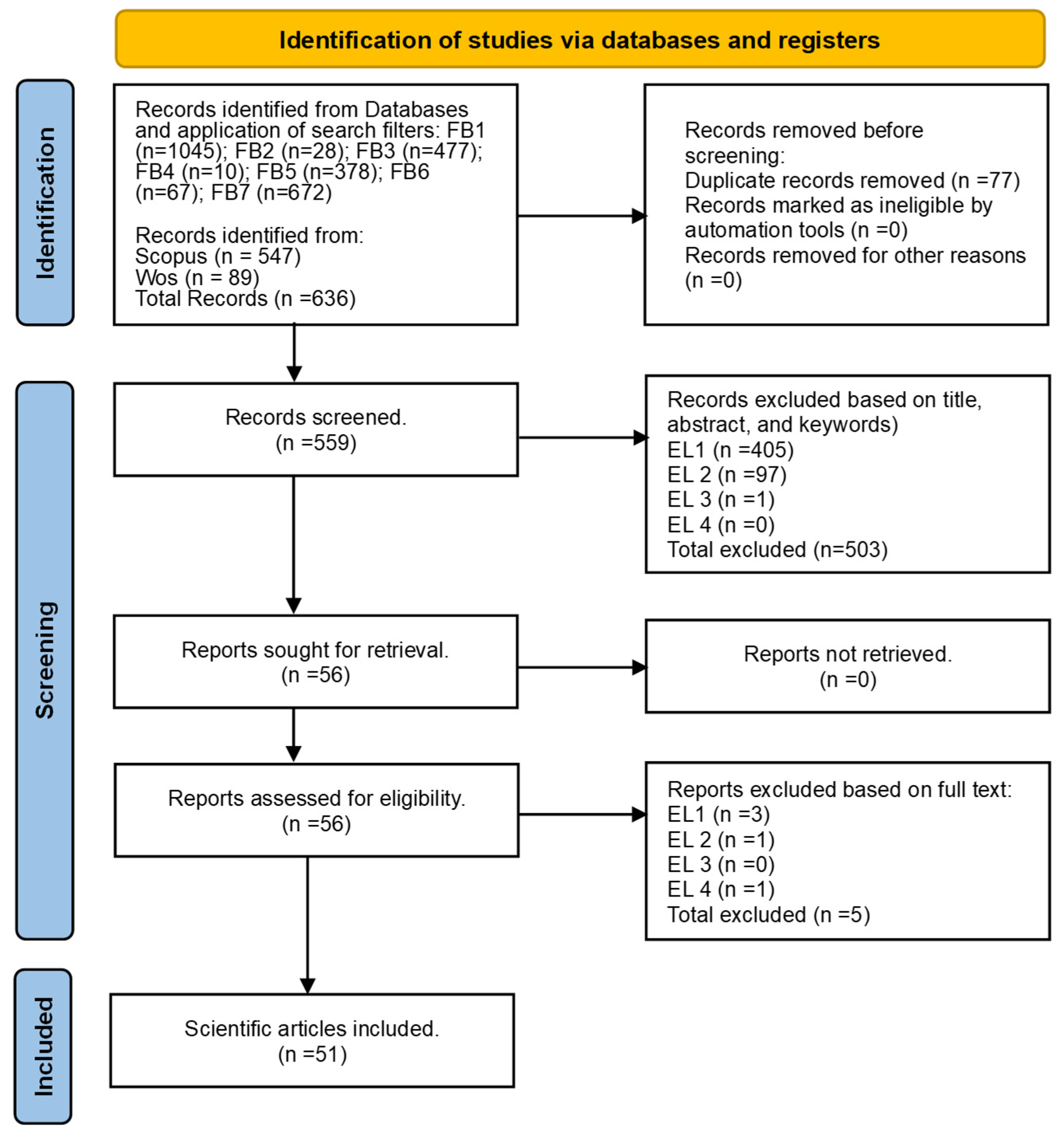
2.4. Study Selection Process
2.5. Reliability of Selection and Study Screening
2.6. Bibliometric Methodologys
2.7. Thematic Categorization
2.8. Quality Assessment of Included Studies
3. Results
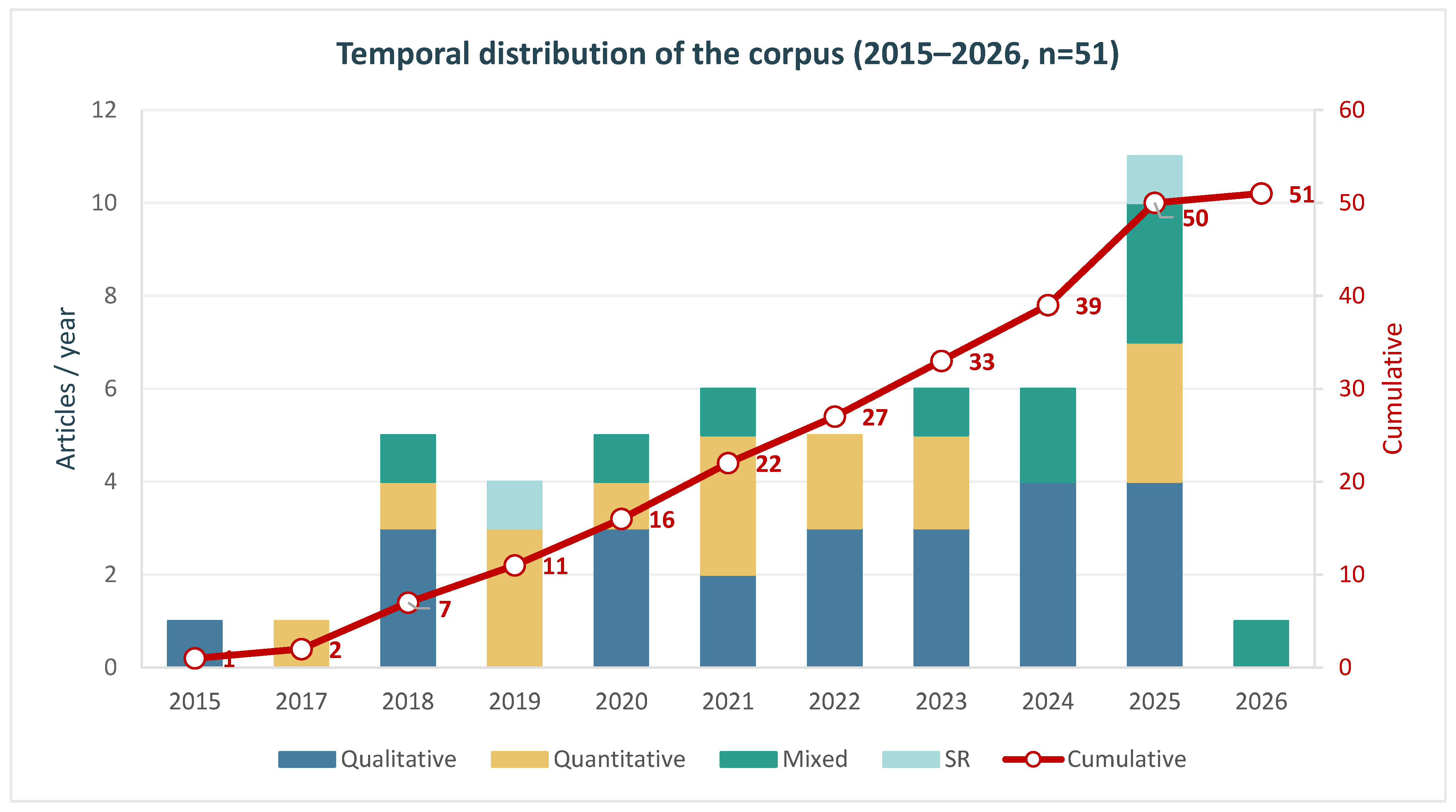
3.1. Characterization of the Corpus
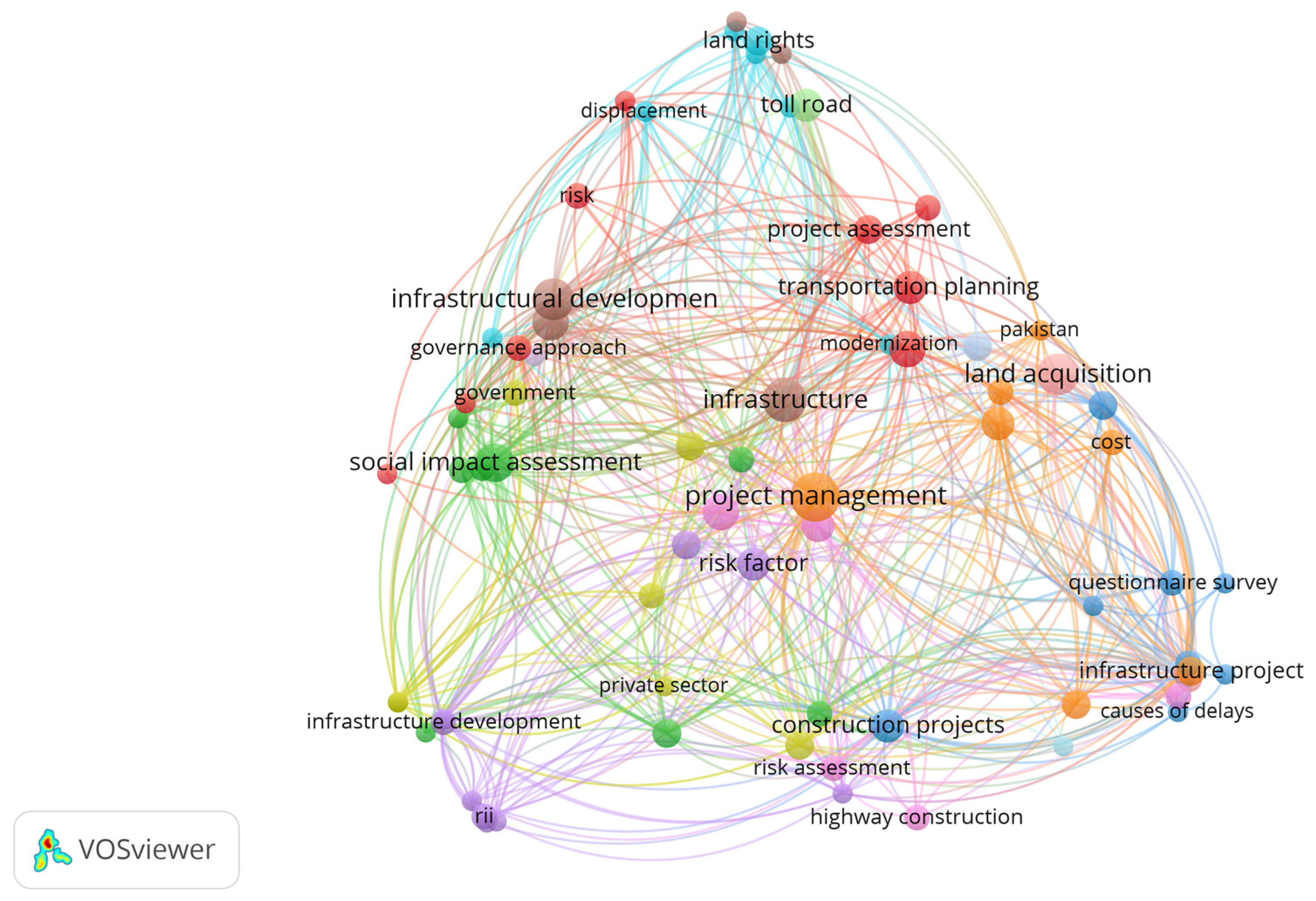
3.2. Bibliometric Analysis
3.3. Thematic Synthesis
4. Discussion
4.1. Land Access Restrictions
4.2. Execution Strategies
4.3. Impact on Performance
4.4. Limitations and Future Directions
5. Conclusions
Supplementary Materials
Author Contributions
Funding
Data Availability Statement
Acknowledgments
Conflicts of Interest
Abbreviations
| PRISMA | Preferred Reporting Items for Systematic Reviews and Meta-Analyses |
| PPP | Public–Private Partnership |
| BOT | Build–Operate–Transfer |
| EPC | Engineering, Procurement and Construction |
| EOT | Extension of Time |
| LAR | Land Acquisition Risk |
| ROW | Right-of-Way |
| UAV | Unmanned Aerial Vehicle |
| GIS | Geographic Information System |
| AHP | Analytic Hierarchy Process |
| RII | Relative Importance Index |
| ANOVA | Analysis of Variance |
| PCA | Principal Component Analysis |
| IFC | International Finance Corporation |
| LAPSSET | Lamu Port–South Sudan–Ethiopia Transport |
| SJR | SCImago Journal & Country Rank |
Appendix A
- Equation applied in Scopus (TITLE-ABS-KEY), executed on 11 March 2026:
- Equation applied in Web of Science (TOPIC), executed on 11 March 2026:

| Study (Year) | MMAT Category | T1 | T2 | 1 | 2 | 3 | 4 | 5 | Verified Justification |
|---|---|---|---|---|---|---|---|---|---|
| Kazda et al. (2020) [32] | 1 Qualitative | Y | Y | Y | Y | Y | Y | Y | Methodology section explicitly applies historical monographic and typological methods (with methodological citation) to two airport expropriation cases; findings derive from the documented case chronologies |
| Babalola (2025) [22] | 1 Qualitative | Y | Y | Y | Y | Y | Y | Y | Self-declared qualitative design; interviews with affected residents and planning practitioners plus media content |
| Hasan Afandi and Basrun Umanailo (2018) [33] | 1 Qualitative | Y | Y | Y | CT | Y | Y | Y | Qualitative case study in Watudakon village; primary data direct from community plus secondary legal documents; findings anchored in field responses and quoted officials (Regent statement village secretary interview); collection technique not specified |
| Aalders et al. (2021) [34] | 1 Qualitative | Y | Y | Y | Y | Y | Y | Y | Walking ethnography along LAPSSET corridor 2016–2019 with about 30 semi-structured in-depth interviews |
| Brock (2024) [18] | 1 Qualitative | Y | Y | Y | Y | Y | Y | Y | Political-ecology case study with fieldwork on the Lyon-Turin railway |
| Hofmann (2020) [35] | 1 Qualitative | Y | Y | Y | CT | Y | Y | Y | Theoretically informed short article (Bull. Lat. Am. Res. 2020 39 S1 47–51) framed by developmentalist-discourse and neoliberal-rationality concepts in the author voice; findings traceably derived from cited official documents (23 April 2020 decree canceled SEMARNAT consultation) and recorded statements; data collection procedure not described |
| Pinuji et al. (2023) [20] | 1 Qualitative | Y | Y | Y | Y | CT | Y | Y | Primary data from field observations and interviews; analysis procedure not detailed |
| Uribe (2019) [36] | 1 Qualitative | Y | Y | Y | Y | Y | Y | Y | Ethnographic account of road building and land legibility in the Colombian Amazon |
| Tassadiq (2024) [37] | 1 Qualitative | Y | Y | Y | Y | Y | Y | Y | Fifteen months of ethnography in Lahore: participant observation oral histories and interviews |
| Demetracopoulou et al. (2024) [6] | 1 Qualitative | Y | Y | Y | Y | Y | Y | Y | Twenty interviews with TxDOT and private-sector experts; inductive and axial coding declared |
| Danial et al. (2022) [2] | 1 Qualitative | Y | Y | Y | Y | Y | Y | Y | Qualitative identification of delayed site-possession causes from 15 project case studies with two-stage analysis |
| Zou et al. (2025) [7] | 1 Qualitative | Y | Y | Y | Y | Y | Y | Y | Interviews with 201 Zhuang minority residents plus participant observation and on-site interviews with cadres |
| Sari et al. (2022) [19] | 1 Qualitative | Y | Y | Y | Y | Y | Y | Y | Socio-legal method explicitly framed (Wheeler and Thomas); primary data from field identification and measurements plus Land Office secondary data; findings derived from statute analysis applied to the Semarang-Demak case |
| Buditiawan et al. (2022) [47] | 1 Qualitative | Y | Y | Y | Y | Y | Y | Y | Self-declared descriptive qualitative; documentation observation and in-depth interviews analyzed via Social Impact Analysis |
| Cupers (2025) [48] | 1 Qualitative | Y | Y | Y | Y | Y | Y | Y | Three months of fieldwork; 30 semi-structured and life-story interviews; archival research at Kenya National Archives |
| Indah et al. (2023) [49] | 1 Qualitative | Y | Y | Y | Y | Y | CT | Y | Qualitative-explorative design; topic via biblioshiny; data from observation website documents and literature; analysis with NVivo 12 Pro and Vensim PLE explicitly declared; interpretation trail not fully detailed |
| Kahangirwe and Vanclay (2024) [50] | 1 Qualitative | Y | Y | Y | Y | Y | Y | Y | Analysis of 10 Ugandan road projects; document analysis in-depth and group interviews and field visits |
| Mohamed Azmi et al. (2025) [51] | 1 Qualitative | Y | Y | Y | Y | Y | Y | Y | Doctrinal examination of legislative resources and valuation methods (comparison cost investment residual profit) with confirmatory interviews at Sarawak Land and Survey Department; findings derived from legal sources and court practice |
| van der Ploeg and Vanclay (2018) [55] | 1 Qualitative | Y | Y | Y | Y | Y | Y | Y | Five months of ethnographic fieldwork plus document analysis of internal company documents |
| Ogwang and Vanclay (2021) [58] | 1 Qualitative | Y | Y | Y | Y | Y | Y | Y | Multi-method case study: document analysis of field observations, key informant interviews and focus groups |
| Bathla (2024) [61] | 1 Qualitative | Y | Y | Y | Y | Y | Y | Y | Critical ethnography along Delhi expressway 2018–2020 triangulated with local media reports |
| Nhat et al. (2025) [8] | 1 Qualitative | Y | Y | Y | Y | Y | Y | Y | Semi-structured interviews with 57 participants and thematic analysis; design self-described as mixed-method qualitative (multiple qualitative techniques) |
| Mulyani et al. (2025) [16] | 1 Qualitative | Y | Y | Y | Y | Y | Y | N | Stakeholder informants via snowball; Strauss–Corbin analysis from fieldwork onset with field notes of description and reflection; findings anchored in documented cases and Law 2/2012 provisions; methods section contradictorily self-describes as quantitative descriptive |
| Andrić et al. (2025) [39] | 3 Quant non-randomized | Y | Y | Y | Y | Y | Y | Y | Dataset of 138 completed South Asian projects drawn from official ADB project completion reports (defined institutional frame); NVivo content analysis of delay causes plus regression functions and Random Forest modeling |
| Titirla et al. (2021) [21] | 3 Quant non-randomized | Y | Y | Y | Y | Y | Y | Y | Delay data from 120 Greek projects in similar contractual environment; linear regression and neural network with 12 variables |
| Darsa et al. (2023) [45] | 3 Quant non-randomized | Y | Y | Y | Y | Y | Y | Y | Three-phase design: 30 factors from literature and pilot; questionnaire to 340 with 245 responses (72.05 percent) and 10 excluded for incompleteness; ANN trained on 81 completed road projects administered by the Ethiopian Roads Administration each with an official schedule performance report (complete outcome data Table 8) |
| Leksono et al. (2019) [14] | 3 Quant non-randomized | Y | Y | CT | Y | Y | Y | Y | UAV photogrammetry on the Cisumdawu corridor validated with 15 Ground Control Points and Independent Control Points and compared against conventional terrestrial measurement: single-site application limits representativeness |
| Hu and Han (2018) [53] | 3 Quant non-randomized | Y | Y | CT | Y | Y | Y | Y | Value for Money assessment of the Heda freeway PPP case with sensitivity analysis across three scenarios (LAR responsibility discount rates profit margins); single-case representativeness not claimable |
| Shrivastava et al. (2019) [13] | 4 Quant descriptive | Y | Y | Y | Y | Y | CT | Y | Samples and Instruments section: Defined target population (professionals in Indian railway projects); 520 responses received via email SurveyMonkey and hardcopy; sample adequacy formally tested (KMO 0.934 communality); EFA-PCA in SPSS (Statistics 26 (IBM Corp., Armonk, NY, USA); distributed count and response rate not reported |
| Devi (2025) [38] | 4 Quant descriptive | Y | Y | Y | Y | Y | CT | Y | Survey of 72 professionals with reported composition (41.33 percent clients, 38.90 percent consultants, 12.50 percent contractors) plus preliminary data from 50 road projects; RII; response rate not reported |
| Kapote et al. (2023) [40] | 4 Quant descriptive | Y | Y | Y | CT | Y | Y | Y | Questionnaire plus field visits across 25 Maharashtra road and highway projects from PWD ZP municipal corporation contractors and consultancies; all 25 instruments completed by experienced field professionals and objective performance measures computed from project records; selection method of the 25 projects not described |
| Nguekam et al. (2019) [42] | 4 Quant descriptive | Y | Y | Y | Y | Y | Y | Y | Satellite identification field campaign and GIS processing producing full census of 1502 impacted buildings (census design eliminates non-response risk) |
| Sandhyavitri et al. (2017) [44] | 4 Quant descriptive | Y | Y | Y | Y | Y | CT | Y | Survey covering the national toll regulator (BPJT) and the four major toll operators by name: near-census of the relevant institutional population; probability–impact scores processed with Monte Carlo and tornado; non-response not discussed |
| Zhang et al. (2025) [46] | 4 Quant descriptive | Y | Y | Y | Y | Y | CT | Y | Expert-scoring survey of 168 senior engineers across institutions (April 2025) with AHP entropy weighting and consistency tests |
| Gatitu et al. (2021) [15] | 4 Quant descriptive | Y | Y | Y | Y | Y | Y | Y | Self-declared cross-sectional descriptive survey; defined target population (clients, consultants, contractors) sample of 80 with reported stakeholder distribution and 87.5 percent response rate; RII analysis |
| Karimi et al. (2022) [56] | 4 Quant descriptive | Y | Y | Y | Y | Y | Y | Y | Questionnaire distributed to 100 participants with 79 valid responses (79 percent response rate); RII and Spearman analysis |
| Nikjow et al. (2021) [3] | 4 Quant descriptive | Y | Y | Y | Y | Y | Y | Y | Questionnaires distributed to 115 respondents with 106 credible responses (92 percent response rate); respondent background (experience roles) reported in Figure 2; RII plus Shapiro–Wilk checks |
| Ting Sim Nee et al. (2022) [57] | 4 Quant descriptive | Y | Y | Y | Y | Y | Y | Y | Occurrence and impact analysis from project files and correspondence of 111 Sarawak public projects (records-based no non-response) |
| Idrees et al. (2021) [59] | 4 Quant descriptive | Y | Y | Y | Y | Y | CT | Y | Random sampling with formal sample-size formula (Tanis and Hogg) requiring n = 84; 78 valid responses obtained near target; stakeholder groups represented; Cronbach alpha reliability; distributed-to-received ratio not reported |
| Nguyen P.T. (2025) [54] | 4 Quant descriptive | Y | Y | Y | Y | Y | CT | Y | Survey of 90 PPP experts all with substantial documented experience and written rating guidelines; FACULTY (consequence–likelihood plus spherical fuzzy AHP); non-response not reported |
| Huynh et al. (2026) [5] | 5 Mixed methods | Y | Y | Y | Y | Y | Y | Y | Sequential mixed-methods design; statistical analysis explicitly explored consensus and divergence among stakeholder groups and project sizes producing an integrated account of convergence partial alignment and divergence |
| Li et al. (2021) [41] | 5 Mixed methods | Y | Y | Y | Y | Y | CT | Y | Staged hybrid design with explicit rationale: Conceptual model then 10 expert semi-structured interviews (6 practitioners, 4 scholars, over 8 years experience) refining the questionnaire then fuzzy set screening; divergence handling not reported |
| Putri et al. (2024) [43] | 5 Mixed methods | Y | Y | Y | Y | Y | CT | Y | Self-declared sequential exploratory mixed method combining qualitative and quantitative phases |
| Putri et al. (2023) [52] | 5 Mixed methods | Y | Y | Y | Y | Y | CT | Y | Self-declared concurrent triangulation; stakeholder interviews plus questionnaires to 325 affected residents with equal weighting |
| Takano (2018) [17] | 5 Mixed methods | Y | Y | Y | Y | Y | CT | Y | A total of 201 structured surveys to randomly selected household heads (48.2 percent of universe, 95 percent CI, 5 percent error) with current and retrospective data integrated with qualitative methods on the same case; divergence handling not reported |
| Nguyen et al. (2020) [10] | 5 Mixed methods | Y | Y | Y | Y | Y | CT | Y | In-depth interviews with six PPP experts informing questionnaire survey of 150 respondents analyzed with word cloud technique |
| Samoilov et al. (2024) [9] | 5 Mixed methods | Y | Y | Y | Y | Y | CT | Y | Explicitly justified mixed design (qualitative depth of PPP markets plus statistical breadth of 261-respondent survey) documented in six methodological stages with systematic country selection; divergence handling not reported |
| Rabe et al. (2020) [60] | 5 Mixed methods | Y | Y | Y | Y | Y | CT | Y | Two-step design: descriptive statistics of 153 Chinese infrastructure cases (weighted average cost overruns) plus two in-depth case studies |
| Saeedi et al. (2019) [4] | NA Review | NA | NA | NA | NA | NA | NA | NA | Review article (3 databases, explicit keywords, 1985–2018, flowchart, 43 papers accounted justified approach with declared limitations); single-pass abstract screening no a priori protocol no duplicate selection no appraisal of its 43 included studies (confirmed at fourth reading: rigor mentions in text describe the reviewed studies not its own method); AMSTAR-2 |
| Zhasmukhambetova et al. (2025) [11] | NA Review | NA | NA | NA | NA | NA | NA | NA | PRISMA-guided systematic review of 83 studies implemented in EPPI-Reviewer with a priori protocol independent reconciled screening and an MMAT quality appraisal of its included studies; appraised with AMSTAR-2 |
| Grubisic et al. (2015) [12] | NA Conceptual | NA | NA | NA | NA | NA | NA | NA | Conceptual framework paper: risk categories and investigative questions proposed and illustrated on the Brazil HST case using secondary sources (IPEA feasibility studies); the authors themselves state the model needs future testing in practice to validate the categorization and evaluate the proposed risks; no primary data collection hence outside the scope of empirical appraisal tools |
| AMSTAR-2 Item | Saeedi [4] | Zhasmukhambetova [11] | Evidence |
|---|---|---|---|
| 1. Research question and inclusion criteria include the components | Y | Y | Defined scope and eligibility components |
| 2. Protocol established prior to the review | N | PY | [11]: Detailed a priori protocol published as its Supplementary Material; registration not stated. [4]: No protocol mentioned |
| 3. Selection of study designs explained | N | Y | Ref. [11] justifies empirical-focus eligibility; Ref. [4] does not discuss design selection |
| 4. Comprehensive literature search strategy | PY | Y | [4]: Three databases (IEEE Xplore Scopus Google Scholar), keywords and 1985–2018 window with flowchart. [11]: Databases, search engines, organization websites, physical books; full terms in S1; EPPI-Reviewer |
| 5. Study selection performed in duplicate | N | Y | [11]: Screening conducted independently and reconciled; inconsistencies resolved through discussion. [4]: Not reported |
| 6. Data extraction performed in duplicate | N | PY | [11]: Data extraction form in protocol S1; duplicate extraction implied by reconciliation. [4]: Not reported |
| 7. List of excluded studies with justification | N | N | Neither provides an itemized excluded-studies list (PRISMA counts only in [11]: 1295 to 83) |
| 8. Included studies described in adequate detail | Y | Y | [4]: Categories defined in detail. [11]: Detailed analysis of 83 studies |
| 9. Risk of bias of included studies assessed | N | Y | [11]: MMAT Quality Appraisal Report published as its Supplementary Material. [4]: No appraisal |
| 10. Funding sources of included studies reported | N | N | Standard gap in both |
| 11. Appropriate methods for statistical combination | NA | NA | No meta-analysis conducted in either (narrative synthesis) |
| 12. Risk of bias impact on meta-analysis assessed | NA | NA | No meta-analysis |
| 13. Risk of bias accounted for in interpretation | Y | Y | Ref. [11] discusses quality in its Limitations chapter; Ref. [4] explicitly accounts for study weaknesses when interpreting (case-specific scope qualitative predominance and small samples reducing reliability) confirmed at final reading |
| 14. Heterogeneity discussed and explained | Y | Y | Ref. [4] notes qualitative predominance and small samples of prior work; Ref. [11] has a dedicated Limitations section |
| 15. Publication bias investigated | NA | NA | No quantitative synthesis |
| 16. Conflicts of interest reported | Y | Y | Both declare no conflicts; Ref. [11] also declares funding (Bolashak scholarship) |
| Overall confidence (strict rule) | Critically low (critical flaws in items 2, 7, 9) | Moderate (single critical weakness: no excluded-studies list) | Per AMSTAR-2 rules: more than one critical-domain flaw lowers overall rating. Neither review is excluded from the corpus; appraisal informs interpretation weight |
References
- Global Infrastructure Hub; Oxford Economics. Global Infrastructure Outlook: Infrastructure Investment Needs: 50 Countries, 7 Sectors to 2040; Global Infrastructure Hub: Sydney, Australia, 2017. [Google Scholar]
- Danial, N.; Misnan, M.S. Possession of site: Another layer of complexity in Road construction. Sustainability 2022, 14, 6809. [Google Scholar] [CrossRef] [Scilit]
- Nikjow, M.A.; Liang, L.; Qi, X.; Sepasgozar, S.M.E.; Chileshe, N. Triggers of delays in international projects using engineering procurement and construction delivery methods. Sustainability 2021, 13, 9503. [Google Scholar] [CrossRef] [Scilit]
- Saeedi, M.H.; Nejat, A.; Smith, M. Schedule estimates for preconstruction activities of highway projects: A review of the literature. Open Transp. J. 2019, 13, 116–126. [Google Scholar] [CrossRef] [Scilit]
- Huynh, N.M.; Vo, M.T.; Le-Hoai, L. Delay causes of the site-clearance process for public infrastructure projects in Vietnam: Differences across roles and project sizes. J. Proj. Manag. 2026, 11, 1–14. [Google Scholar] [CrossRef] [Scilit]
- Demetracopoulou, V.; O’Brien, W.J.; Khwaja, N. Influential factors for risk assessment and allocation on complex design-build infrastructure projects: The Texas experience. Front. Built Environ. 2024, 10, 1330506. [Google Scholar] [CrossRef] [Scilit]
- Zou, H.-X.; Zhan, H.J.; Tosone, A. “Sacred rock in the way”: The interplay of modernity and cultures in the highway construction of Southwest China. Societies 2025, 15, 207. [Google Scholar] [CrossRef] [Scilit]
- Nhat, N.M.; Hoang, N.K. Driving sustainable transport infrastructure in urban regions of developing markets: Leveraging private sector involvement. Int. J. Sustain. Dev. Plan. 2025, 20, 4279–4291. [Google Scholar] [CrossRef] [Scilit]
- Samoilov, A.; Osei-Kyei, R.; Kussaiyn, M.; Mamyrbayev, A.; Mukashev, Y. Cross-Country comparison of risk factors in public-private partnerships in infrastructure development. Sustainability 2024, 16, 5712. [Google Scholar] [CrossRef] [Scilit]
- Nguyen, P.T.; Likhitruangsilp, V.; Onishi, M. Success factors for public-private partnership infrastructure projects in Vietnam. Int. J. Adv. Sci. Eng. Inf. Technol. 2020, 10, 858–865. [Google Scholar] [CrossRef] [Scilit]
- Zhasmukhambetova, A.; Evdorides, H.; Davies, R.J. Critical risk factors affecting time and cost in highway construction: A global systematic literature review. Futur. Transp. 2025, 5, 192. [Google Scholar] [CrossRef] [Scilit]
- Grubisic, V.; Zagheni, E.; Asaff, Y.; Dias, A. A framework for categorizing risks in high speed train (HST) projects: The example of the first HST in Brazil. Transp. Probl. 2015, 10, 37–46. [Google Scholar] [CrossRef] [Scilit]
- Shrivastava, R.; Gupta, S.; Mittal, A.; Saxena, B. Critical risk factors causing the time and cost overruns of Indian railway projects. Int. J. Eng. Adv. Technol. 2019, 9, 5395–5401. [Google Scholar] [CrossRef] [Scilit]
- Leksono, B.E.; Soedomo, A.S.; Apriani, L.; Sugito, N.T.; Rabbani, A. Acceleration of land certification with unmanned aerial vehicle in toll road construction area. Indones. J. Geogr. 2019, 51, 294–302. [Google Scholar] [CrossRef] [Scilit]
- Gatitu, J.N.; Kabubo, C.K.; Ajwang, P. Approaches on mitigating variation orders in road construction industry in Kenya: The case of Kenya National Highways Authority (KeNHA). Eng. Technol. Appl. Sci. Res. 2021, 11, 3737–3743. [Google Scholar] [CrossRef] [Scilit]
- Mulyani, S.; Pajrin, R.; Kurniasih, Y. Handling of land acquisition conflict for inner toll roads: Socio-legal perspective. Adv. Innov. Soc. 2025, 6, 382. [Google Scholar] [CrossRef] [Scilit]
- Takano, G. Reasentamiento por un megaproyecto de infraestructura en Lima, Perú. Rev. INVI 2018, 33, 135–159. [Google Scholar] [CrossRef] [Scilit]
- Brock, A. A green extractivist railway? Exploring the political ecology of Europe’s largest infrastructure project. J. Political Ecol. 2024, 31, 488–515. [Google Scholar] [CrossRef] [Scilit]
- Sari, E.; Yamin, M.; Purba, H.; Sembiring, R. Land procurement for public interest against destroyed land: Natural events and legal certainty. Civ. Eng. J. 2022, 8, 1167–1177. [Google Scholar] [CrossRef] [Scilit]
- Pinuji, S.; de Vries, W.T.; Rineksi, T.W.; Wahyuni, W. Is obliterated land still land? tenure security and climate change in Indonesia. Land 2023, 12, 478. [Google Scholar] [CrossRef] [Scilit]
- Titirla, M.; Larbi, W.; Aretoulis, G. Prediction methods for the actual duration of Greek highway projects. WSEAS 2021, 18, 1389–1396. [Google Scholar] [CrossRef] [Scilit]
- Babalola, T.O. How Responsible Are Land Acquisitions for Megaprojects in Global South Cities? Cities 2025, 166, 106307. [Google Scholar] [CrossRef] [Scilit]
- Page, M.J.; McKenzie, J.E.; Bossuyt, P.M.; Boutron, I.; Hoffmann, T.C.; Mulrow, C.D.; Shamseer, L.; Tetzlaff, J.M.; Akl, E.A.; Brennan, S.E.; et al. The PRISMA 2020 statement: An updated guideline for reporting systematic reviews. BMJ 2021, 372, n71. [Google Scholar] [CrossRef] [Scilit] [PubMed]
- Elsevier. Scopus; Elsevier B.V.: Amsterdam, The Netherlands, 2024; Available online: https://www.scopus.com (accessed on 15 January 2025).
- Clarivate. Web of Science; Clarivate Analytics: Philadelphia, PA, USA, 2024; Available online: https://www.webofscience.com (accessed on 15 January 2025).
- Cohen, J. A coefficient of agreement for nominal scales. Educ. Psychol. Meas. 1960, 20, 37–46. [Google Scholar] [CrossRef] [Scilit]
- Van Eck, N.J.; Waltman, L. VOSviewer; Leiden University: Leiden, The Netherlands, 2023; Available online: https://www.vosviewer.com (accessed on 20 January 2025).
- Hernández-Sampieri, R.; Mendoza Torres, C.P. Metodología de la Investigación: Las Rutas Cuantitativa, Cualitativa y Mixta; McGraw-Hill: Mexico City, Mexico, 2018. [Google Scholar]
- Hong, Q.N.; Pluye, P.; Fàbregues, S.; Bartlett, G.; Boardman, F.; Cargo, M.; Dagenais, P.; Gagnon, M.-P.; Griffiths, F.; Nicolau, B.; et al. Mixed Methods Appraisal Tool (MMAT), Version 2018; McGill University: Montréal, QC, Canada, 2018. [Google Scholar]
- Shea, B.J.; Reeves, B.C.; Wells, G.; Thuku, M.; Hamel, C.; Moran, J.; Moher, D.; Tugwell, P.; Welch, V.; Kristjansson, E.; et al. AMSTAR 2: A critical appraisal tool for systematic reviews that include randomised or non-randomised studies of healthcare interventions, or both. BMJ 2017, 358, j4008. [Google Scholar] [CrossRef] [Scilit] [PubMed]
- SCImago. SCImago Journal & Country Rank; SCImago Lab: Granada, Spain, 2026; Available online: https://www.scimagojr.com (accessed on 15 January 2025).
- Kazda, A.; Novák Sedláčková, A.; Bračić, M. Expropriation and airport development. Civ. Environ. Eng. 2020, 16, 282–288. [Google Scholar] [CrossRef] [Scilit]
- Hasan Afandi, A.; Basrun Umanailo, M.C. Watudakon citizens’ social conflict on Joker toll Road development in 2017 in Kesamben district, Jombang regency. J. Soc. Sci. Res. 2018, 5, 656–661. [Google Scholar] [CrossRef] [Scilit]
- Aalders, J.T.; Bachmann, J.; Knutsson, P.; Musembi Kilaka, B. The making and unmaking of a megaproject: Contesting temporalities along the LAPSSET corridor in Kenya. Antipode 2021, 53, 1273–1293. [Google Scholar] [CrossRef] [Scilit]
- Hofmann, S. Putting large-scale infrastructure projects first: The COVID-19 pandemic in indigenous Mexico. Bull. Lat. Am. Res. 2020, 39, 47–51. [Google Scholar] [CrossRef] [Scilit]
- Uribe, S. Illegible infrastructures: Road building and the making of state-spaces in the Colombian Amazon. Environ. Plan. D 2019, 37, 886–904. [Google Scholar] [CrossRef] [Scilit]
- Tassadiq, F. Colonial laws, postcolonial infrastructures: Land acquisition, urban informality, and politics of infrastructural development in Pakistan. Environ. Plan. D 2024, 42, 401–421. [Google Scholar] [CrossRef] [Scilit]
- Devi, L.P. Delay analysis of infrastructure construction projects in India. J. Inst. Eng. Ser. A 2025, 106, 763–771. [Google Scholar] [CrossRef] [Scilit]
- Andrić, J.M.; Lin, S.; Cheng, Y.; Sun, B. Investigating the possible regression functions for modelling delays in infrastructure projects in South Asia. KSCE J. Civ. Eng. 2025, 29, 100209. [Google Scholar] [CrossRef] [Scilit]
- Kapote, M.; Patil, P.; Pimplikar, S. Effective Pre-Qualification Systems—Are They Essential for Minimising Delays on Road Projects? Organ. Technol. Manag. Constr. Int. J. 2023, 15, 213–220. [Google Scholar] [CrossRef] [Scilit]
- Li, Y.; Xiang, P.; You, K.; Guo, J.; Liu, Z.; Ren, H. Identifying the key risk factors of mega infrastructure projects from an extended sustainable development perspective. Int. J. Environ. Res. Public Health 2021, 18, 7515. [Google Scholar] [CrossRef] [Scilit] [PubMed]
- Nguekam, E.W.T.; Foahom, B.; Mbetjock, C.K. Contribution of geographic information systems to the identification of goods impacted by the construction of the Yaoundé-Nsimalen highway. J. Urban Environ. Eng. 2019, 13, 353–359. [Google Scholar] [CrossRef]
- Putri, N.E.; Noer, M. Social risk assessment of land acquisition for the construction of the Sicincin-Padang toll road section, West Sumatra, Indonesia. Kasetsart J. Soc. Sci. 2024, 45, 1–18. [Google Scholar] [CrossRef] [Scilit]
- Sandhyavitri, A.; Talha, I.; Fauzi, M.; Sutikno, S. Managing construction risks of the toll Road project in Indonesia. Int. J. Adv. Sci. Eng. Inf. Technol. 2017, 7, 1934. [Google Scholar] [CrossRef] [Scilit]
- Darsa, M.H.; Negash, B.T. Significant factors causing delay of Ethiopian road construction projects performed by foreign general contractors. Int. J. Sustain. Constr. Eng. Technol. 2023, 14, 103–116. [Google Scholar] [CrossRef] [Scilit]
- Zhang, B.; Zheng, Y.; Chen, J. A study on the comprehensive cost risk evaluation of highway construction based on the AHP-Improved entropy weight method. Buildings 2025, 15, 3404. [Google Scholar] [CrossRef] [Scilit]
- Buditiawan, K.; Irawan, A.B.; Setyawan, D.; Rinawati, H.S.; Yolarita, E.; Khasanah, M. Mitigation of social impacts of alternative road development plans based on local wisdom in West Sumatra, Indonesia. Adv. Civ. Eng. 2022, 2022, 6895084. [Google Scholar] [CrossRef] [Scilit] [PubMed]
- Cupers, K. Anticipation by redress: Transforming African mega-infrastructure futures. Environ. Plan. D 2025, 43, 575–579. [Google Scholar] [CrossRef] [Scilit]
- Indah, V.F.; Rusli, B.; Myrna, R.; Nawawi, Z. How are companies involved in the construction of the trans Sumatra toll road, in Indonesia? Role analysis and development policy. J. Infrastruct. Policy Dev. 2023, 7, 2588. [Google Scholar] [CrossRef] [Scilit]
- Kahangirwe, P.; Vanclay, F. Social impacts arising from Road infrastructure projects in Sub-Saharan africa. Impact Assess. Proj. Apprais. 2024, 42, 309–322. [Google Scholar] [CrossRef] [Scilit]
- Mohamed Azmi, A.S.; Petrus Adan, V.S.; Johaimi Ling, N.L.F. A review of land acquisition procedures and compensation practices for the Pan Borneo Highway project in Sarawak, Malaysia. Plan. Malays. 2025, 23, 1–15. [Google Scholar] [CrossRef] [Scilit]
- Putri, N.E.; Noer, M. Hybrid policy model in the land acquisition decision-making process for toll road project in West Sumatra, Indonesia. Acad. J. Interdiscip. Stud. 2023, 12, 250–263. [Google Scholar] [CrossRef] [Scilit]
- Hu, X.; Han, J. Highway project value of money assessment under PPP mode and its application. Math. Probl. Eng. 2018, 2018, 1802671. [Google Scholar] [CrossRef] [Scilit]
- Nguyen, P.T. Assessing concession period risks of public-private partnership infrastructure projects using FACULTY. Humanit. Soc. Sci. Commun. 2025, 6, 1333–1349. [Google Scholar] [CrossRef] [Scilit]
- van der Ploeg, L.; Vanclay, F. Challenges in implementing the corporate responsibility to respect human rights in the context of project-induced displacement and resettlement. Resour. Policy 2018, 55, 210–222. [Google Scholar] [CrossRef] [Scilit]
- Karimi, S.; Piroozfar, P. Exploring causes of delays in national road and highway projects in developing construction economy. J. Eng. Proj. Prod. Manag. 2022, 12, 137–148. [Google Scholar] [CrossRef] [Scilit]
- Ting, S.N.; Jarit, B.; Lee, Y.Y. Occurrence and impact analysis for time-related risks in Malaysia public infrastructure projects. J. Sustain. Sci. Manag. 2022, 17, 104–127. [Google Scholar] [CrossRef] [Scilit]
- Ogwang, T.; Vanclay, F. Resource-Financed infrastructure: Thoughts on four chinese-financed projects in Uganda. Sustainability 2021, 13, 3259. [Google Scholar] [CrossRef] [Scilit]
- Idrees, S.; Shafiq, M.T. Factors for time and cost overrun in public projects. J. Eng. Proj. Prod. Manag. 2021, 11, 23. [Google Scholar] [CrossRef] [Scilit]
- Rabe, W.; Kostka, G.; Habich-Sobiegalla, S. Socio-Economic development and infrastructure cost performance in China. J. Curr. Chin. Aff. 2020, 49, 185–206. [Google Scholar] [CrossRef] [Scilit]
- Bathla, N. Extended urbanisation and the politics of uncertainty: The contested pathways of highway corridors in India. Geogr. J. 2024, 190, e12441. [Google Scholar] [CrossRef] [Scilit]

| FB(n) | Filter | Inclusion | Exclusion |
|---|---|---|---|
| FB1 | Publication Period | 2015–2026 | Before 2015 and after March 2026 |
| FB2 | Publication Period | Final publication | Preprints, in-press articles and Early Access |
| FB3 | Document Type | Scientific articles (Article) and review articles (Review Article) | Conference proceedings, book chapters, editorials, letters and notes |
| FB4 | Source type | Indexed journals (Journal) | Conferences, book series and technical reports |
| FB5 | Subject area | Engineering, Social Sciences, Environmental Sciences, Business, Public Administration, Construction, Operations Management, Urban Planning, Architecture and Law | Medicine, Biology, Chemistry, Physics, Mathematics and areas unrelated to the object of study |
| FB6 | Language | English, Spanish and Portuguese | Any other language |
| FB7 | Open access | All Open Access | Restricted or paywalled articles |
| Criterion | Description | Inclusion | Exclusion |
|---|---|---|---|
| EL1 | Project type | Major road infrastructure construction projects in the pre-operational phase: roads, highways, tunnels, bridges or railways, with original empirical evidence and sufficient methodological detail | Routine maintenance, operation of existing roads, non-road infrastructure (buildings, industrial facilities, mining) and purely theoretical studies without original data |
| EL2 | Land access restriction | Articles that explicitly document conditions of partial or restricted access to the land linked to road execution: acquisition delays, disputes with owners, unauthorized occupation, compensation conflicts or phased release of the worksite | Articles that mention land acquisition tangentially without reporting its effect on road project execution |
| EL3 | Response strategy | Articles describing at least one constructive, project management, contractual, legal, regulatory or technological strategy applied or proposed as a response to land access restriction in road works | Articles that only document the land-related problem without describing any response strategy, action or solution |
| EL4 | Empirical evidence | Articles that report the quantitative or qualitative impact of land access restrictions or applied strategies on project performance in schedule, cost or scope | Articles without reported performance indicators and narrative reviews without original data |
| Reviewer 2: Include | Reviewer 2: Exclude | Total | |
|---|---|---|---|
| Reviewer 1: Include | A = 46 | B = 16 | 62 |
| Reviewer 1: Exclude | C = 13 | D = 484 | 497 |
| Total | 59 | 500 | 559 |
| Category | Definition | Subcategory | Definition |
|---|---|---|---|
| C1. Land access restrictions | Type of land access restriction that conditions physical access to the site and determines the applicable strategy family. | C1.1 Land acquisition and expropriation | Documents the conflicts that arise during the formal land acquisition process: disputes over price, ownership or owners’ refusal to relinquish the property. |
| C1.2 Social, cultural and informal conflicts | Records situations where communities, informal occupants or groups with cultural ties to the territory prevent or hinder access to the worksite. | ||
| C1.3 Regulatory and institutional framework | Analyzes how land laws, decrees and public policies condition the land acquisition processes in road infrastructure projects. | ||
| C2. Execution strategies | Strategy, solution or mechanism documented for executing road projects under land access restrictions. | C2.1 Technical and constructive strategies | Documents how worksite teams adapt the design or reorganize construction to advance in available zones without waiting for full land release. |
| C2.2 Project management strategies | Explores tools and methods to anticipate land-related delays, manage risks and recover the schedule when the land is not available. | ||
| C2.3 Social and institutional strategies | Documents how negotiation, community consultation and inter-institutional coordination managed to unblock land access in road works. | ||
| C2.4 Contractual and legal mechanisms | Analyzes how PPP and BOT contracts and extension-of-time clauses distribute the land-related risk between the State and the executors of road works. | ||
| C3. Impact on performance | Effect of the applied strategies on the performance of the road project under land access restrictions. | C3.1 Impact on schedule | Studies that document the effect on the schedule as the prioritized dimension. |
| C3.2 Impact on cost | Studies that document the effect on the budget as the prioritized dimension. | ||
| C3.3 Impact on scope | Studies that document the effect on the project scope as the prioritized dimension. |
| Continent | Country | Continent | Country | Scopus Only | Scopus + WoS | ||||
|---|---|---|---|---|---|---|---|---|---|
| n | % | n | % | n | % | n | % | ||
| Asia | Indonesia | 32 | 63% | 10 | 19.6% | 8 | 15.7% | 2 | 3.9% |
| China | 7 | 13.7% | 6 | 11.8% | 1 | 2.0% | |||
| Vietnam | 4 | 7.8% | 3 | 5.9% | 1 | 2.0% | |||
| India | 4 | 7.8% | 3 | 5.9% | 1 | 2.0% | |||
| Malaysia | 3 | 5.9% | 3 | 5.9% | 0 | 0.0% | |||
| Pakistan | 2 | 3.9% | 2 | 3.9% | 0 | 0.0% | |||
| Kazakhstan | 1 | 2.0% | 1 | 2.0% | 0 | 0.0% | |||
| Afghanistan | 1 | 2.0% | 1 | 2.0% | 0 | 0.0% | |||
| Africa | Kenya | 7 | 14% | 3 | 5.9% | 3 | 5.9% | 0 | 0.0% |
| Uganda | 2 | 3.9% | 2 | 3.9% | 0 | 0.0% | |||
| Cameroon | 1 | 2.0% | 1 | 2.0% | 0 | 0.0% | |||
| Ethiopia | 1 | 2.0% | 0 | 0.0% | 1 | 2.0% | |||
| Europe | United Kingdom | 6 | 12% | 2 | 3.9% | 1 | 2.0% | 1 | 2.0% |
| Croatia | 1 | 2.0% | 1 | 2.0% | 0 | 0.0% | |||
| Germany | 1 | 2.0% | 0 | 0.0% | 1 | 2.0% | |||
| Greece | 1 | 2.0% | 1 | 2.0% | 0 | 0.0% | |||
| Netherlands | 1 | 2.0% | 1 | 2.0% | 0 | 0.0% | |||
| Latin America | Peru | 4 | 8% | 1 | 2.0% | 1 | 2.0% | 0 | 0.0% |
| Mexico | 1 | 2.0% | 1 | 2.0% | 0 | 0.0% | |||
| Colombia | 1 | 2.0% | 1 | 2.0% | 0 | 0.0% | |||
| Brazil | 1 | 2.0% | 1 | 2.0% | 0 | 0.0% | |||
| North America | USA | 2 | 4% | 2 | 3.9% | 1 | 2.0% | 1 | 2.0% |
| Oceania | 0 | 0 | 0 | 0 | 0 | 0 | 0 | 0 | |
| Total | 51 | 100% | 42 | 82.4% | 9 | 17.6% | |||
| Methodological Approach | No. of Articles | % |
|---|---|---|
| Qualitative | 23 | 45.1% |
| Quantitative | 16 | 31.4% |
| Mixed | 10 | 19.6% |
| Systematic Review | 2 | 3.9% |
| Total | 51 | 100% |
| SJR Quartile | No. of Articles | % |
|---|---|---|
| Q1 | 15 | 29.4% |
| Q2 | 16 | 31.4% |
| Q3 | 15 | 29.4% |
| Q4 | 4 | 7.8% |
| No assigned quartile (N/A) | 1 | 2.0% |
| Total | 51 | 100% |
| Category | Subcategory | No. | % |
|---|---|---|---|
| C1. Land access restrictions | C1.1 Land acquisition and expropriation | 3 | 6% |
| C1.2 Social and informal conflicts | 2 | 4% | |
| C1.3 Regulatory and institutional framework | 4 | 8% | |
| C2. Execution strategies | C2.1 Technical and constructive strategies | 5 | 10% |
| C2.2 Project management strategies | 13 | 25% | |
| C2.3 Social and institutional strategies | 10 | 20% | |
| C2.4 Contractual and legal mechanisms | 5 | 10% | |
| C3. Impact on performance | C3.1 Impact on schedule | 5 | 10% |
| C3.2 Impact on cost | 3 | 6% | |
| C3.3 Impact on scope | 1 | 2% | |
| Total | 51 | 100% |
| Author [No.] (Year)/Approach | Object | Main Finding | Contribution to Management |
|---|---|---|---|
| C1.1 Land acquisition and expropriation—C1. Land access restrictions | |||
| Kazda et al. [32] (2020), Qualitative | OR | Expropriation (eminent domain) of private property generates conflicts and prolonged bottlenecks in the courts. | Strategy: Imposition of expropriation as a last resort. Impact: Negative on schedule; it stalls physical execution by displacing the conflict to prolonged lawsuits. |
| Mulyani et al. [16] (2025), Mixed | OR | The lack of space to negotiate nullifies the agreement, forcing the government to deposit the money with the courts (consignment). | Strategy: Forced judicial consignment of compensation funds. Impact: Negative on schedule; the community rejects the money, blocking schedule progress. |
| Shrivastava et al. [13] (2019), Quantitative | OR | Land acquisition and site handover is a critical risk that causes cost and time deviations in Asian countries. | Strategy: Contractual classification of land unavailability as an external fundamental risk. Impact: Protects the contractor’s cost and schedule by exempting them from penalties for exogenous delays. |
| C1.2 Social, cultural and informal conflicts—C1. Land access restrictions | |||
| Babalola [22] (2025), Qualitative | OR | Ignoring informal occupants in expropriation provoked protests, marginalization and landlessness, materializing displacement risks. | Strategy: Mass forced eviction without census or prior mitigation. Impact: Total paralysis of the works due to physical resistance, destroying the project’s schedule. |
| Hasan Afandi and Basrun Umanailo [33] (2018), Qualitative | OR | The community rejected the compensation; the government used the courts and coercively demolished dwellings, generating social conflict. | Strategy: Physical demolition backed by courts after rejection of the fair price. Impact: Negative on schedule and cost; produced wooden blockades that stopped the machinery. |
| C1.3 Regulatory and institutional framework—C1. Land access restrictions | |||
| Aalders et al. [34] (2021), Qualitative | OR | There is a legal clash between community land rights and compulsory acquisition; excluded communities contest the works. | Community strategy: Pastoralist communities established settlements directly on the corridor alignment to force the renegotiation of their land rights. Impact: Alters the original scope and fragments the schedule. |
| Brock [18] (2024), Qualitative | OR | Railway projects use hybrid bills to grant automatic expropriation, bypassing planning laws. | Strategy: Use of parliamentary hybrid bills to bypass municipal audits. Impact: Secures the land quickly in schedule terms by concentrating expropriation authority in parliament, bypassing ordinary municipal controls. |
| Hofmann [35] (2020), Qualitative | OR | The State exploits crises to decree megaprojects as essential, privatizing ejidos and ignoring indigenous rights. | Strategy: Presidential decrees of national priority during health emergencies. Impact: Positive on schedule; accelerates physical occupation by suppressing community legal protections. |
| Pinuji et al. [20] (2023), Qualitative | OR | The law designates flooded areas as obliterated land, revoking tenure without compensation, which paralyzed the project. | Strategy: Regulatory shortcut to revoke rights over flooded areas while avoiding payments. Impact: Total failure; triggered judicial opposition that paralyzed the works for 5 years in schedule. |
| C2.1 Technical and constructive strategies—C2. Execution strategies | |||
| Uribe [36] (2019), Qualitative | OER | Requiring formal deeds from traditional occupants (legibility) aggravated the tenure conflict and paralyzed the works for 10 years. | Strategy: Imposition of formal cadastral mapping on informal lands. Impact: Generates prolonged paralysis in schedule and forces redesign of the alignment to bypass tenure conflicts, affecting scope and cost. |
| Tassadiq [37] (2024), Qualitative | OER | Colonial law excludes informal occupants; the State improvises extraordinary subsidies (grant-in-aid: exceptional payments outside the formal legal framework) to prevent the works from stopping. | Strategy: Creation of economic escape valves (off-legal payments) to settle informal occupants. Impact: Deactivates violent blockades, preventing lethal cost overruns in schedule. |
| Demetracopoulou et al. [6] (2024), Qualitative | OE | In design–build contracts, the contractor applies three strategies to address right-of-way restrictions: geometric alignment optimization to avoid conflicting parcels, alternative designs to bypass restrictive elements, and prioritization of available parcels in the construction sequence. | Allocating the land-related risk to the contractor in the design phase activates technical strategies that make it possible to reduce or eliminate conflicting parcels without waiting for formal resolution of the land, protecting the project’s schedule and scope. |
| Devi [38] (2025), Quantitative | OER | Delay in handing over the site to the contractor (influenced by the government) is a factor that directly impacts time. | Strategy: Application of RSI and PCA to rank delay factors and identify late site handover as the dominant client-side factor. Impact: Allows managers to focus mitigation on land release, reducing schedule deviations. |
| Danial et al. [2] (2022), Qualitative | OER | The contractor applied three physical strategies across three Malaysian road infrastructure projects: sectional site handover under Clause 38.3, allowing work to proceed in released sections while blocked areas remained inaccessible; alignment changes to bypass conflicting land; and formal scope downsizing as a last resort when other options failed to resolve the blockage. | Sectional site handover with progress in released sections (Clause 38.3) and alignment change are the constructive strategies that make it possible to maintain physical progress of the works while full land possession has not been completed. |
| C2.2 Project management strategies—C2. Execution strategies | |||
| Andrić et al. [39] (2025), Quantitative | OE | The Random Forest model outperforms linear regression in predicting delays across 138 South Asian megaprojects (F = 253.27 vs. 0.25), identifying land acquisition and resettlement as the main causes of delays averaging 86.66% of the baseline schedule. | The Random Forest model accurately calibrates the schedule floats required for land acquisition in South Asian projects, enabling realistic contractual schedules that absorb the land-release process. |
| Grubisic et al. [12] (2015), Qualitative | OE | Extra land acquisition is an explicit, categorical risk in high-speed train projects. | Strategy: Application of the risk breakdown structure (RBS) in the early phase. Impact: Isolates the risk and prevents cost overruns by injecting contingency budgets from the feasibility phase. |
| Huynh et al. [5] (2026), Mixed | OER | The digitization of cadastral files is the main factor reducing site-clearance time in Vietnamese road projects (F = 21.514, p < 0.001), especially in small projects lacking digital databases and large projects with high file volumes. | Administrative digitization of cadastral files and inter-institutional coordination reduce the right-of-way clearance time and protect the project’s critical path before construction starts. |
| Kapote et al. [40] (2023), Quantitative | OER | Road projects experience cost and time growth due to ineffective contractor pre-qualification mechanisms. | Strategy: Mathematical filter of bidders. Impact: Prevents cost and schedule escalations by ensuring that only contractors with solvency take on the project’s land access restrictions. |
| Leksono et al. [14] (2019), Quantitative | OE | The integration of UAVs, geodetic GPS, and photogrammetry enables cadastral mapping with a 0.128 m error in toll-road land acquisition zones, accelerating parcel certification and allowing construction to begin with only 35% of the land released. | The UAV reduces the cadastral certification time of untitled parcels and enables construction to start with partially released land, protecting the contractual start date of the road works. |
| Li et al. [41] (2021), Mixed | OER | Fuzzy set theory weighted by expert judgment identifies land acquisition and resettlement as the second most severe risk among 75 factors in Chinese infrastructure megaprojects, with an impact value of 3.510 and the highest severity among economic risks. | Prioritizing the land-related risk in second place out of 75 factors through fuzzy sets makes it possible to allocate specific budget contingencies before the start, protecting the project’s cost against acquisition uncertainty. |
| Nguekam et al. [42] (2019), Quantitative | OE | Map overlay in Geographic Information System (GIS) reveals exactly 1502 impacted buildings. | Strategy: Objective satellite survey using GIS tools (software version not applicable; GIS applied as a methodological approach). Impact: Adjusts and limits indemnities to their real value, protecting the cost baseline. |
| Putri et al. [43] (2024), Mixed | OER | The social risk index quantifies conflict probability on customary Ulayat lands before acquisition; on the Sicincin–Padang toll road, its prior use could have prevented delays exceeding two years caused by unidentified conflicts. | The anticipated assessment of land-related social risk through a quantified index makes it possible to identify the parcels with the greatest potential conflict and to design differentiated strategies of compensation and consultation before the works begin. |
| Saeedi et al. [4] (2019), SR | OE | A multiple regression model validated on 35 U.S. highway projects predicts right-of-way acquisition duration using parcel condemnation, parcel number, and design changes: duration = 142 + 738 × condemnation + 2.26 × parcels + 3.28 × revisions. The model supports realistic bidding dates and protects construction schedules from acquisition uncertainty. | Strategy: Application of predictive software and multiple regression equations. Impact: Allows setting realistic bidding dates, protecting the critical path against schedule deviations. |
| Sandhyavitri et al. [44] (2017), Quantitative | OE | Land acquisition cost is a high-uncertainty variable with severe impact on the final budget. | Strategy: Application of the Pareto Principle, Monte Carlo simulations and tornado diagrams. Impact: Statistically confines the damage from interest during construction (IDC), shielding cost. |
| Darsa et al. [45] (2023), Quantitative | OER | An artificial neural network using the Garson algorithm identifies late land acquisition as the fifth delay factor (6.54%) in Ethiopian road projects by foreign contractors, distinguishing it more accurately than the conventional Relative Importance Index. | The artificial neural network makes it possible to focus mitigation resources on the highest-impact land-related factors, guiding preventive management toward anticipated land acquisition as a lever to protect the schedule. |
| Titirla et al. [21] (2021), Quantitative | OE | A neural network with 12 input variables, including land requirements, predicts Greek highway duration with a mean squared error of 1.53 × 10⁻⁶, far outperforming two-variable linear regression. | Including land requirement as a predictive variable in the neural model substantially improves the estimation of actual duration, enabling contractual schedules that absorb the land process and reduce the risk of schedule overruns. |
| Zhang et al. [46] (2025), Quantitative | OE | The risk originating from delayed compensation payments obtains the highest severity score for construction. | Strategy: Use of the Improved Entropy Method combined with the Analytic Hierarchy Process (AHP). Impact: Isolates the real weight of the land-related contingency by eliminating biases, shielding cost. |
| C2.3 Social and institutional strategies—C2. Execution strategies | |||
| Zou et al. [7] (2025), Qualitative | OER | Political micro-mediation with Zhuang ethnic leaders unblocked access to the Sacred Rock on the G75 corridor in Guangxi (China), where the spiritual value of the site made any formal mechanism of monetary compensation or expropriation impossible. | Strategy: Political micro-mediation carried out by local leaders (village cadres). Impact: Positive on schedule and scope; pacifies the intra-family dispute without altering the road’s geometry. |
| Sari et al. [19] (2022), Qualitative | OER | The application of Indonesian Government Regulation No. 18/2021 enabled compensation for land destroyed by tidal flooding, unblocking land acquisition for the Semarang–Demak toll road and resolving the legal vacuum that had halted the works. | The application of the regulatory framework for land destroyed by climate events enables compensation and works progress in road corridors affected by flooding, resolving the legal blockage without requiring judicial resolution. |
| Buditiawan et al. [47] (2022), Qualitative | OER | The social impact study, combined with Minangkabau local wisdom and mediation by the Ninik Mamak, unblocked Ulayat land disputes in West Sumatra where formal mechanisms under Law 2/2012 had failed. | The social impact study integrated with local customary authorities is the strategy that unblocks Ulayat lands when formal legal instruments are insufficient; its effectiveness depends on activation before construction begins. |
| Cupers [48] (2025), Qualitative | OR | Pastoralist communities in Isiolo used the LAPSSET corridor as a catalyst for historical land claims, forcing the project to seek alternative locations for the resort city due to community opposition. | Institutional redress of historical land-titling debts is the precondition for unblocking corridors with second-generation restrictions; standard monetary compensation does not operate in these contexts of historical exclusion. |
| Indah et al. [49] (2023), Qualitative | OER | The concessionaires take on delegated roles (CSR) to commercially enable fragmented sections of the Trans-Sumatra toll road. | Strategy: Constructive sectionalization and delegation of social unblocking to operators. Impact: Maintains partial corridor functionality and investment returns through modular openings as land is released, avoiding total paralysis from customary land restrictions. |
| Kahangirwe and Vanclay [50] (2024), Qualitative | OER | Including resettlement costs in project financing from the design phase, under IFC (2023) standards, removes site-access blockages caused by unfunded compensation payments in ten Ugandan road projects. | The anticipated incorporation of the resettlement budget into project financing is the strategy that prevents site-access blockages due to delayed payments in road projects in Sub-Saharan Africa. |
| Mohamed Azmi et al. [51] (2025), Qualitative | OER | The government lacks regular procedures to compensate customary rights, requiring exceptional payments. | Strategy: Authorization of special ex gratia payments outside the formal norm for informal affected parties. Impact: Deactivates pockets of violence, preventing schedule extensions. |
| Putri et al. [52] (2023), Mixed | OE | Community exclusion from route selection and valuation generated friction; the pseudo-participatory consultative approach failed. | Strategy: Binding tripartite communicative planning policy (community–state–private). Impact: Participatively shields the geometric scope and speeds up schedule agreements. |
| Takano [17] (2018), Mixed | OER | Individual negotiations secured land for Lima’s Yellow Line at low cost, but harmed 74.6% of displaced residents, closed 47 of 70 home-based businesses, and fragmented family networks, exposing the social limits of resettlement as a land-release strategy. | Strategy: Door-to-door, individualized negotiation to divide communal resistance. Impact: Secures the physical road in scope and minimizes corporate cost, shifting financial ruin to the displaced. |
| Gatitu et al. [15] (2021), Quantitative | OER | Resolving land ownership disputes before tendering curbs the occurrence and mitigation of variation orders. | Strategy: Resolution of land disputes as a tender prerequisite (RII = 0.749). Impact: Reduces variation orders, protecting cost and schedule; in economies with high land informality, its application requires additional unblocking instruments because full possession before tendering is not always achievable. |
| C2.4 Contractual and legal mechanisms—C2. Execution strategies | |||
| Nhat et al. [8] (2025), Mixed | OER | Simplified land acquisition and participatory planning reduce land-related costs in PPP public transport projects, where site clearance can account for up to 80% of the total budget according to the World Bank. | Simplified land acquisition and continuous dialogue with communities reduce site-clearance costs and protect the financial viability of the contract under the PPP scheme in the face of the land barrier. |
| Hu and Han [53] (2018), Quantitative | OE | Land acquisition (LAR) is the main source of social instability that deters private capital. | Strategy: Legal assignment of LAR risk exclusively to the government. Impact: Generates positive Value for Money, protecting the firm’s cost and schedule under PPP schemes. |
| Nguyen et al. [10] (2020), Mixed | OE | Adequate and precise risk allocation (such as land) is the Critical Success Factor in PPP contracts. | Strategy: Structuring of guarantees through international consortia and multilateral institutions. Impact: Isolates the local risk, protecting commercial profitability and cost budgets. |
| Nguyen, P.T. [54] (2025), Mixed | OE | The FACULTY method identifies land acquisition and compensation as the most critical risk among 27 factors in Vietnamese concession-based infrastructure projects, quantifying its uncertainty more precisely than conventional methods. | Strategy: Dynamic adjustment clauses and automatic extension of the concession period. Impact: Absorbs delays by translating the financial impact into an increase in the operating schedule. |
| Samoilov et al. [9] (2024), Mixed | OER | Multidimensional flexibility models reduce losses from land acquisition delays in concession projects in Colombia, Kazakhstan, and Ghana. In Colombia, late land acquisition ranks among the top five risks, with an impact of 3.71. | Strategy: Implementation of multidimensional flexibility models and financial system dynamics. Impact: Cushions operational losses, recovering cost despite stalled parcels. |
| C3.1 Impact on schedule—C3. Impact on performance | |||
| van der Ploeg and Vanclay [55] (2018), Qualitative | OR | Execution in seven sections and parallel deployment of five resettlement firms over 600 km reduced land-related blockages and maintained corridor progress, though resettlement was delayed by up to three additional years. | Segmenting the corridor into independently executable sections makes it possible to protect the overall schedule when the land restriction is partial and localized. |
| Karimi et al. [56] (2022), Quantitative | OR | Spearman analysis (n = 79) identifies land acquisition as the main delay factor in Afghan road projects, with negotiations with tribal leaders and community sensitization programs used to protect schedules. | Quantifying the land-related impact on the schedule through RII and Spearman makes it possible to prioritize unblocking actions and negotiate contractual extensions with statistical evidence. |
| Nikjow et al. [3] (2021), Quantitative | OR | The EPC Fast-Track model starts construction before full land release; in the Mecca Light Railway, this led to a 34.4% cost overrun and major schedule delays due to the absence of land-flexibility clauses. | Including EOT clauses and contractual tolerance for partial land blockages in EPC contracts is the condition that protects the schedule when the land is not fully released at the start. |
| Ting Sim Nee et al. [57] (2022), Quantitative | OR | In 111 Sarawak projects, continuation from available chainage and physical relocation of works protected schedules despite lack of site possession, resulting in official EOTs instead of total stoppages. | Starting from the chainage (available metric chain along the alignment) and formalizing the EOT as a contractual instrument make it possible to maintain productivity and transfer the responsibility for the delay to the promoter, protecting the contractor’s schedule. |
| Zhasmukhambetova et al. [11] (2025), SR | OR | The synthesis of 83 global studies confirms that early ROW sequencing with specific schedule float assigned and deferred mobilization of blocked fronts are the highest-impact strategies documented to protect the schedule. | Allocating specific time contingencies for land acquisition from the planning phase is the preventive measure with the strongest empirical support for protecting the schedule in road projects. |
| C3.2 Impact on cost—C3. Impact on performance | |||
| Ogwang and Vanclay [58] (2021), Qualitative | OR | Separate state financing of land compensation (USD 40M of Uganda’s own funds) and advance acquisition without an approved loan are strategies that unblock the corridor and protect the cost of the main contract, although they transfer the sovereign cost to the host State. | Separating the land-compensation budget from the construction budget and advancing it as an enabling condition for the main contract protects the project’s cost structure vis-à-vis international creditors. |
| Idrees et al. [59] (2021), Quantitative | OR | Package-based execution (Metro Multan) and alignment modification with station relocation (Orange Line Lahore) are the documented strategies that allow continued physical progress and protect cost in the face of judicial land blockages (RII = 0.808). | Independent package-based execution and direct negotiation with market-price compensation are the responses that best protect cost by avoiding total stoppages and judicial suspension orders. |
| Rabe et al. [60] (2020), Qualitative | OR | Starting works under preliminary NDRC approval before resettlement is resolved, and overlapping construction and resettlement, are the documented strategies that enabled progress, although in contexts of underestimated compensation schedules they produced cost overruns of up to 607%. | Setting the land-compensation schedule contractually in advance and realistically, backed by independent valuation, is the condition that protects the budget against price escalation due to delayed acquisition. |
| C3.3 Impact on scope—C3. Impact on performance | |||
| Bathla [61] (2024), Qualitative | OR | Construction on available fronts up to the limit of the blockage (Dwarka Expressway, 14 years of litigation) made it possible to advance 90% of the corridor, but the unresolved restriction over the NPV colony permanently fragmented the scope. | The case documents that imposing a surface design on consolidated informal settlements crystallizes the fragmentation of the scope. The only verified way out was redesign as an elevated roadway on pillars: evasive engineering from pre-investment is the condition that the case shows as decisive for preserving the corridor. |
| Strategy Family | Optimal Moment of Activation | Institutional Condition Where It Is Effective | Concrete Mechanism | Evidence (Outcome) |
|---|---|---|---|---|
| Technical and constructive | Design and pre-investment | Concessions structured from feasibility | Alternative designs and prior segmentation of work fronts | Positive impact [6,37]; collision when deferred [2,36] |
| Project management | Planning | Institutional capacity to structure risk | Dimensioned float, risk breakdown structure, predictive models | Wide float in parametric models [4,39]; minimal in neural networks [21] |
| Social and institutional | Before tendering | Multilateral safeguards with guaranteed budget | Phased resettlement and mediation with leaders | Cohesion preserved [50]; marginalization in self-financed PPP [17,49] |
| Contractual and legal | Tendering and contract | Consolidated administration with open tendering | Allocation of the release risk to the State and supervision | Contingencies absorbed [9,54]; perpetual renegotiation with permissive clauses [8,10,53] |
Disclaimer/Publisher’s Note: The statements, opinions and data contained in all publications are solely those of the individual author(s) and contributor(s) and not of MDPI and/or the editor(s). MDPI and/or the editor(s) disclaim responsibility for any injury to people or property resulting from any ideas, methods, instructions or products referred to in the content. |
© 2026 by the authors. Licensee MDPI, Basel, Switzerland. This article is an open access article distributed under the terms and conditions of the Creative Commons Attribution (CC BY) license.
Share and Cite
Mayo-Alvarez, L.; Pasapera-Trujillo, F. Strategies for Road Project Execution with Land Access Restrictions: A Systematic Review. Buildings 2026, 16, 2431. https://doi.org/10.3390/buildings16122431
Mayo-Alvarez L, Pasapera-Trujillo F. Strategies for Road Project Execution with Land Access Restrictions: A Systematic Review. Buildings. 2026; 16(12):2431. https://doi.org/10.3390/buildings16122431
Chicago/Turabian StyleMayo-Alvarez, Luis, and Fabiola Pasapera-Trujillo. 2026. "Strategies for Road Project Execution with Land Access Restrictions: A Systematic Review" Buildings 16, no. 12: 2431. https://doi.org/10.3390/buildings16122431
APA StyleMayo-Alvarez, L., & Pasapera-Trujillo, F. (2026). Strategies for Road Project Execution with Land Access Restrictions: A Systematic Review. Buildings, 16(12), 2431. https://doi.org/10.3390/buildings16122431