1. Introduction
Urban industrial heritage (UIH) constitutes the material manifestation of industrialization within an urban space and serves as a critical medium through which labor memory and local identity can be understood [
1,
2]. In the context of contemporary urban governance, industrial heritage is no longer confined to the preservation of abandoned factories [
3,
4], machinery, or production landscapes [
5]. Rather, it has evolved into a comprehensive urban issue closely associated with land conservation [
6], cultural continuity [
7], public space provision, and sustainable urban regeneration [
8]. This broader significance has been further reinforced by Target 11.4 of the United Nations Sustainable Development Goals [
9,
10], which explicitly calls for strengthening efforts to “protect and safeguard the world’s cultural and natural heritage,” thereby providing an important sustainability-oriented value framework for industrial heritage conservation. Existing studies have demonstrated that the adaptive reuse of industrial buildings can generate synergies between heritage preservation [
11,
12], land-saving strategies, environmental benefits, and community participation [
13,
14]. Moreover, industrial heritage regeneration has been shown to revitalize declining urban areas by fostering social innovation and place-based innovation mechanisms, thereby restoring public vitality and spatial value [
15,
16]. Consequently, a central challenge in current UIH research lies in how to determine the multifaceted value of industrial heritage amid rapid urban transformation and, more importantly [
17], how to translate such value into conservation and reuse pathways that can be publicly understood, socially participated in, and sustainably utilized over time.
The Nizhny Tagil Charter emphasizes that public interest in, attachment to, and appreciation of industrial heritage constitute one of the most reliable foundations for its conservation [
18,
19]. This statement indicates that public value perception is not a peripheral factor in heritage protection [
20,
21], but a prerequisite for the social legitimacy and long-term vitality of heritage sites [
22,
23]. In this study, public value perception refers to how different publics recognize, evaluate, and express the significance of urban industrial heritage in relation to its historical memory, material remains, spatial experience, everyday usability, safety, and governance responsiveness. It is understood not as a fixed expert-defined value category, but as a socially situated perception that varies across user groups and communicative contexts. Operationally, it is identified through UGC evidence, including frequently mentioned value elements, semantic associations between these elements, and the sentiment expressions attached to them.
Existing studies on heritage value perception have generated important findings across different study sites [
24,
25]. In traditional villages, rural architectural heritage, and local cultural landscapes [
26,
27,
28,
29], scholars have examined how residents and visitors perceive historical [
30,
31], cultural [
32,
33,
34], aesthetic [
35], social [
36,
37,
38], and utilitarian values, and how such perceptions influence place attachment, conservation attitudes [
39,
40,
41,
42], and willingness to participate [
43,
44]. In industrial heritage studies [
45,
46], related research has increasingly addressed authenticity, perceived value [
47], tourism experience, community support [
48,
49], and reuse preference [
50,
51]. Recent work in heritage conservation and adaptive reuse has further confirmed that public perception and public value perception are important dimensions in understanding heritage protection, visitor experience, willingness to pay, community support, and reuse decision-making, including empirical studies based on Chinese heritage cases [
52,
53,
54,
55]. These studies demonstrate that public perception is already an established concern in heritage, conservation, and adaptive reuse research. However, most existing studies still rely on questionnaires, interviews, expert–public comparison, or visual evaluation methods, and often focus on relatively stable heritage tourism settings, single stakeholder groups, or completed reuse projects [
56]. Less attention has been paid to how heterogeneous publics express and negotiate industrial heritage value through everyday digital discourse when urban industrial heritage is still embedded in land redevelopment, public space provision, community improvement, and unfinished regeneration processes. Therefore, the first research gap addressed by this study is not the absence of public perception research, but the insufficient understanding of how differentiated public value perceptions emerge in the specific context of ongoing urban industrial heritage regeneration.
Methodologically, existing studies on industrial heritage value perception have mainly followed three approaches [
55,
57]. The first is expert-led value assessment, including the Analytic Hierarchy Process, the Delphi method, fuzzy comprehensive evaluation, and multi-criteria decision-making models [
58,
59]. These approaches are useful for establishing systematic indicator frameworks and assigning comparative weights to historical [
60], technological [
61,
62], artistic [
63], social, and economic values. The second approach is based on questionnaire surveys and structural equation modeling, which can test causal relationships between perceived value, place attachment, satisfaction, behavioral intention, and conservation support [
64,
65]. The third approach uses interviews, field observation, and case comparison to interpret local memory, stakeholder conflict, and spatial use in heritage regeneration processes [
66,
67]. Nevertheless, these methods share a common limitation: they tend to rely on predefined indicators, structured questionnaires, or specific interview settings. As a result, it is difficult for them to capture the spontaneous perceptions that emerge through everyday encounters, online expressions, and actual public use. This limitation is especially significant when the conservation and adaptive reuse of urban industrial heritage are still unfolding and public opinion remains dynamic. Therefore, the second research gap concerns the methodological difficulty of capturing value divergence, emotional fluctuation, and concrete public demands in a timely and bottom-up manner.
The expansion of social media platforms and online review systems provides a new opportunity to address this limitation [
68]. Compared with conventional survey data [
69], user-generated content (UGC) is spontaneous [
70,
71], contextual [
72], and large-scale [
73], making it suitable for capturing public evaluations, emotional expressions, visual preferences [
74,
75], and spatial use demands in everyday discourse. However, UGC should not be treated as platform-neutral evidence. Roma and Aloini have shown that the characteristics of UGC vary across social media platforms, because platform environments shape how users produce, present, and circulate content [
76]. Rednote and WeChat public accounts differ in both platform design and likely user composition. Rednote is an image–text lifestyle-sharing platform widely popular among young women in urban China; creator and influencer content, interest-based discovery, peer recommendations, and source credibility are important to how posts circulate and are evaluated [
77]. By contrast, WeChat public accounts are one-to-many information channels operated by organizations or individuals for subscribers; the WeChat data in this study consist only of comments attached to local public-account articles, not posts from personal networks. The two sources are therefore complementary but neither functionally nor demographically equivalent. In tourism studies, UGC has been widely used to explain information adoption [
78,
79], destination image, satisfaction, and loyalty behavior [
80,
81]. In cultural heritage studies, sentiment analysis and aspect-based sentiment analysis based on online reviews have been applied to interpret visitor experience [
82], service perception, and heritage site management issues [
83]. More recently, several studies have begun to use social media data in industrial heritage research, particularly to examine visual preference, tourism experience, or the discrepancy between public perception and professional design intention during regeneration processes [
84]. Two limitations are especially relevant to the present study. First, existing UGC-based industrial heritage studies have not sufficiently examined the deeper structure of public value cognition embedded in everyday online discourse. Second, when heterogeneous social media sources are used, the decision to merge or separate platform data requires case-specific justification. In the Guanggang industrial heritage site case, direct aggregation would obscure the different concerns made visible in visitor-oriented Rednote discourse and community-oriented WeChat public-account discourse. Together, these two limitations define the third research gap: the lack of platform-sensitive empirical analysis that links UGC-based value expressions to mismatches between public perceptions, heritage values, and ongoing conservation or adaptive reuse practices.
Taken together, these gaps indicate that the problem addressed in this study is not a general absence of research on industrial heritage value, public participation, or digital heritage perception. Rather, three more specific issues remain insufficiently connected. Theoretically, it remains unclear how heterogeneous publics foreground different dimensions of urban industrial heritage value when the same site functions simultaneously as a material heritage asset, a redevelopment area, and an emerging public space. Methodologically, although platform studies have shown that UGC is not platform-neutral, heritage research still needs clearer case-based procedures for using multi-platform UGC without conflating visitor-oriented and community-oriented expressions. Contextually, in China’s government-led urban regeneration, it remains insufficiently explained how online public perceptions can inform conservation and adaptive reuse strategies for industrial heritage sites that are not yet fully open or institutionally stabilized. To address these issues, this study takes the Guangzhou Iron and Steel Plant industrial heritage site as a case study and uses UGC from the Rednote and WeChat public platforms to examine how different platform-contextual discourses make different dimensions of industrial heritage value visible.
This study addresses three research questions. First, what value elements of the Guanggang industrial heritage site are most prominently perceived and discussed by the public on different platforms? Second, how do the semantic structures and corpus-level sentiment patterns of public discourse differ between visitor-oriented and community-oriented platform contexts? Third, what mismatches can be identified between differentiated public value perceptions and current conservation or adaptive reuse conditions, and what strategy implications can be derived for more responsive industrial heritage regeneration? By answering these questions, this study makes three specific contributions. Conceptually, it specifies dual foregrounding as a bounded selection process that explains how platform affordances, user self-selection, and users’ relationships to the site make different value concerns visible, without attributing those differences to platform alone. Methodologically, it contributes to platform-sensitive digital heritage research by showing why heterogeneous UGC sources should be interpreted in relation to their communicative contexts rather than treated as a single undifferentiated corpus. Practically, it translates digital public perception into conservation and adaptive reuse implications concerning value interpretation, zoned access, community-oriented function integration, and feedback-driven governance.
2. Materials and Methods
2.1. Research Framework
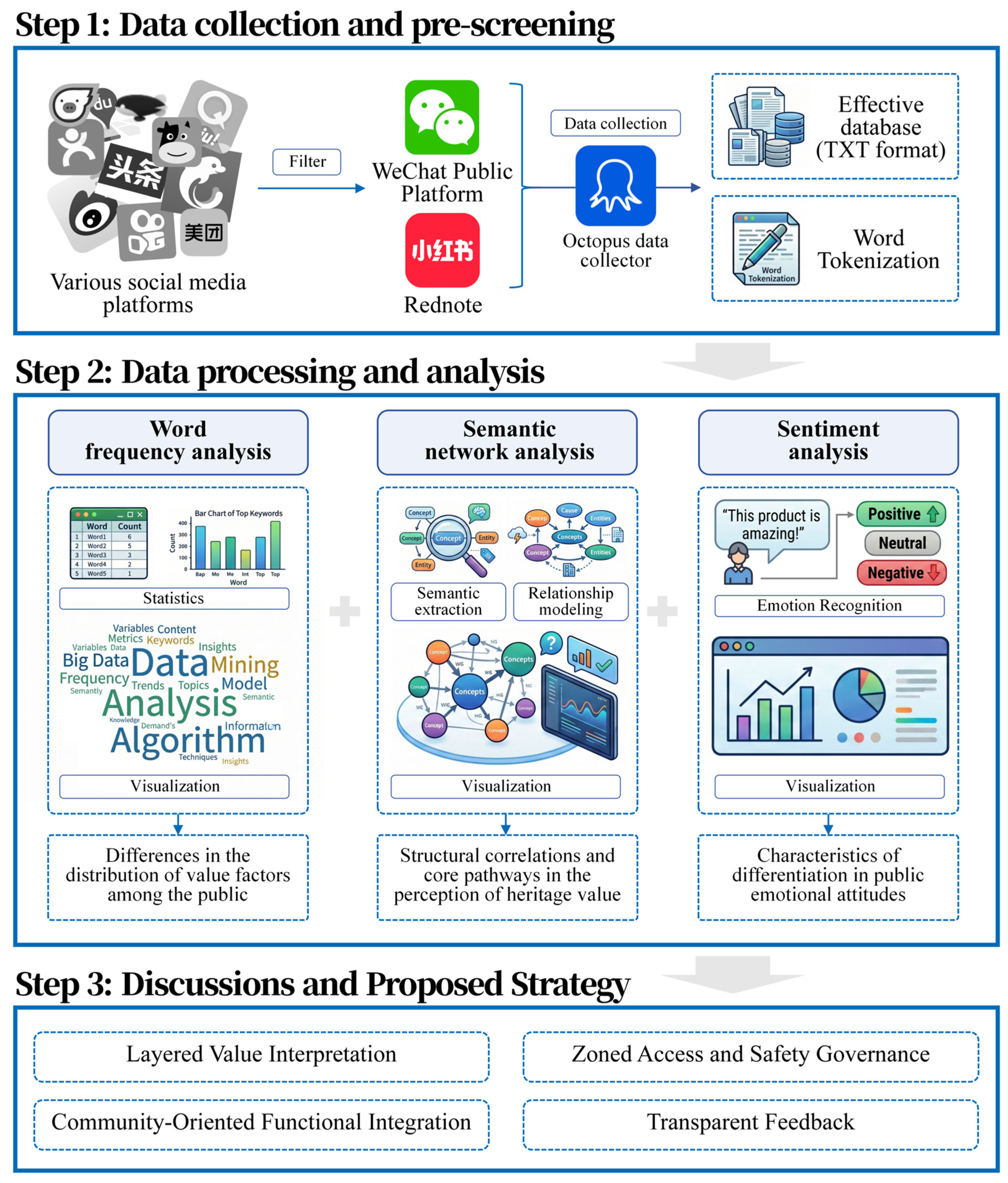
In this study, a UGC-based research framework was developed for identifying public value perception of urban industrial heritage (
Figure 1). The framework includes three sequential steps. First, publicly accessible texts related to the Guanggang industrial heritage site were collected from the Rednote and WeChat public platforms using Octopus Collector, and irrelevant, duplicate, advertising, or non-Guanggang samples were removed through pre-screening. Second, in order to identify the distribution of public value concerns, the structural associations of heritage value perception, and corpus-level sentiment patterns, the retained texts were cleaned, standardized, converted into TXT format, and analyzed using ROST CM 6.0 through word-frequency analysis, semantic network analysis, and sentiment analysis. Third, the analytical results were interpreted in relation to the current conservation and adaptive reuse conditions of Guanggang, and were further translated into four strategy dimensions: layered value interpretation, zoned access and safety governance, community-oriented functional integration, and transparent feedback.
2.2. Research Area
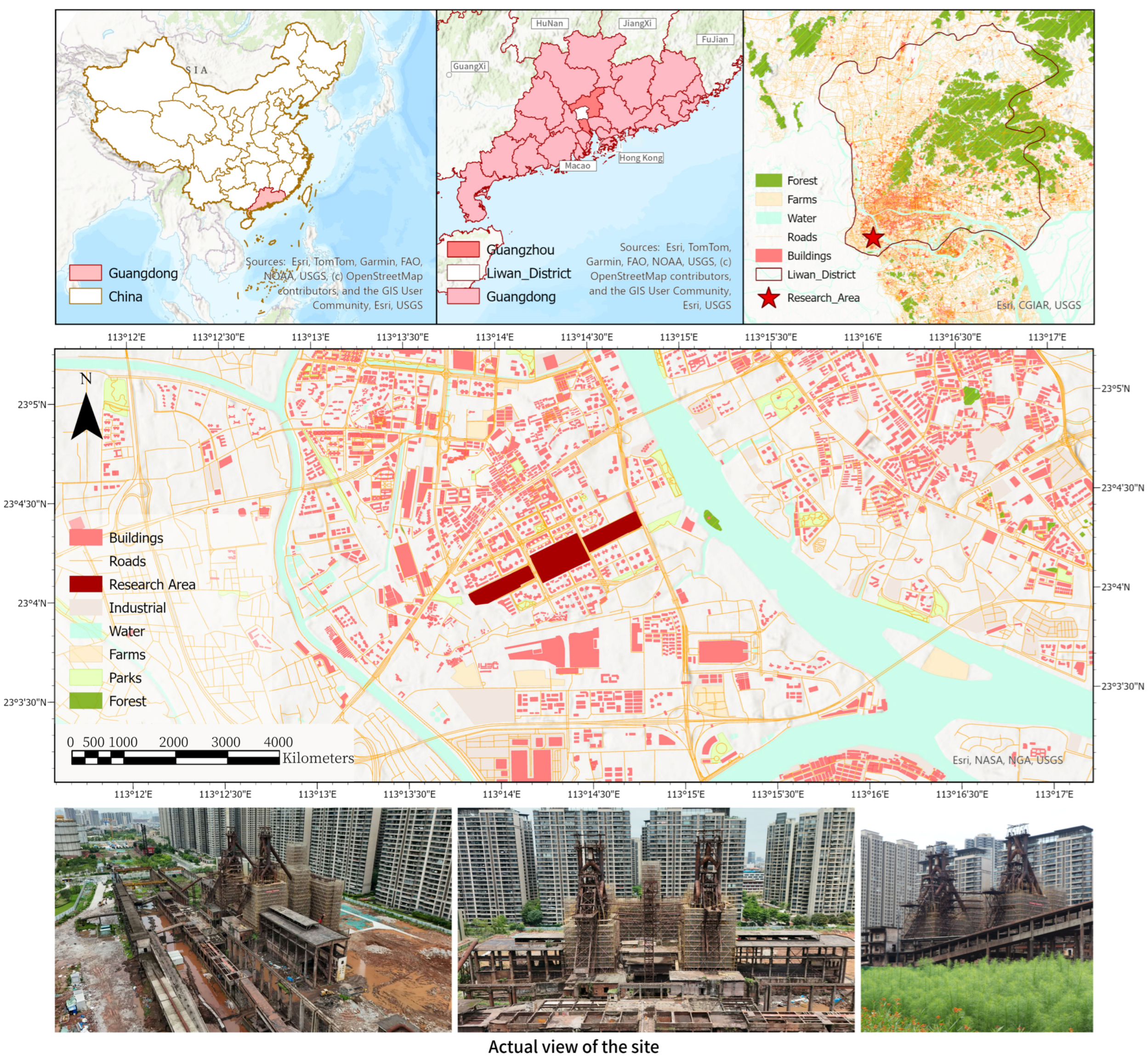
The Guanggang industrial heritage site is located in Guanggang New Town, Guangzhou, Guangdong Province, China, and is surrounded by high-density residential communities with a permanent population of approximately 200,000 residents. Throughout this paper, “Guanggang industrial heritage site” refers to the retained industrial remains and the regeneration area examined as the case; “Guanggang Park” refers specifically to the planned park reuse within that site; and “Guanggang New Town” refers to the wider surrounding redevelopment area. These terms are related but are not used synonymously. The shorthand “Guanggang” is retained only in reproduced platform keywords, place names, or source language. The Guangzhou Iron and Steel Plant, the largest steel production base in twentieth-century Guangzhou, officially commenced operation in 1958. It later became the first Sino-foreign joint venture enterprise in China’s steel industry and witnessed several distinctive phases of China’s industrialization process, including the historical campaigns associated with “mass steel production” and the policy orientation of “taking steel production as the key link.” Consequently, the site carries substantial collective memory for former factory workers and their families. In 2013, the Regulatory Detailed Plan for Guanggang New Town was officially approved, leading to the demolition of portions of the former industrial facilities. At present, the remaining industrial heritage area covers approximately 34.72 hectares. The core zone has retained a relatively complete assemblage of steel production process relics and is scheduled to be developed into a post-industrial landscape park.
According to relevant heritage assessments, the site contains 12 traditional-style historic buildings and one municipally designated industrial heritage site, providing significant historical, technological, and landscape value (
Figure 2). The “12 traditional-style historic buildings” refer to individual building resources identified in the heritage assessment, whereas the “municipally designated industrial heritage site” refers to an officially recognized industrial heritage unit rather than a single building. At present, Guanggang Park is not fully open to the public. Visitors are mainly able to observe the exterior of selected large-scale industrial remains, surrounding post-industrial landscapes, and several visible historic structures from accessible areas or site boundaries, while most individual buildings and production-related relics are not yet open for interior visitation. During the May 2025 field survey, no systematic visitor-oriented interpretation system was observed in the accessible areas, such as permanent historical plaques, route-based heritage panels, QR code interpretation, or materials explaining the steelmaking process and workers’ memory. Therefore, visitors currently encounter Guanggang mainly through visual observation of the remaining structures, while contextual information on its historical, technological, and social significance remains limited. These site conditions make Guanggang a transitional case in which public perception is formed before a mature museum, tourism, or park-management system has been established.
At the same time, Guanggang exemplifies several structural contradictions commonly embedded in the conservation and adaptive reuse of urban industrial heritage in China. Although the core industrial relics were preserved, the prioritization of real-estate redevelopment over heritage conservation severely compromised the overall spatial integrity of the former industrial complex and its supporting facilities, thereby affecting the integrity of its historical, artistic, and technological values to varying degrees. Moreover, although the Guanggang Park regeneration plan was proposed more than a decade ago, its implementation has progressed slowly due to repeated revisions and planning adjustments. The site has not yet been fully opened to the public, and public participation has remained largely limited to small-scale opinion solicitation processes. However, this unfinished and transitional condition is precisely what makes Guanggang analytically valuable for this study: public perception has not yet been stabilized by a mature tourism, museum, or park-management systems and is still being formed and contested through everyday online discourse. Therefore, Guanggang provides a suitable case for investigating how different publics perceive industrial heritage value during the implementation stage of conservation and adaptive reuse, especially in relation to accessibility, safety, public facilities, construction progress, and governance responsiveness.
2.3. Data Collection and Preprocessing
To clarify the temporal sequence of the research process, this study distinguishes between the on-site survey and the online UGC collection. The on-site survey and UAV photography were conducted in May 2025 to record the physical condition and spatial context of the Guanggang industrial heritage site. The online UGC retrieval was conducted separately and was completed on 1 December 2025. This date refers to the retrieval cut-off date rather than the publication month of the posts; therefore, the corpus included all retrievable public posts and comments published before 1 December 2025, not only those posted in December 2025. No starting-date restriction was imposed. However, publication-date metadata were not consistently available across the retrieved records, so the earliest publication year cannot be verified reliably. The corpus should therefore be interpreted as a retrieval-bounded sample up to 1 December 2025 rather than as a complete time series.
Octopus Collector was used as a keyword-based data extraction tool. The crawler did not apply an additional algorithm beyond the keyword retrieval logic of the selected platforms; instead, it extracted publicly accessible search results returned by the platforms according to the predefined keywords. Reposts and duplicated platform records were handled during duplicate removal: records with identical or near-identical titles, body texts, source links, or publication information were retained only once. Platform recommendation ranking or algorithmically promoted visibility was not used as an inclusion criterion; all candidate records had to be retrieved through the predefined keywords and pass the subsequent relevance screening. For Rednote, the keywords “Guangzhou Iron and Steel Plant,” “Guanggang ruins,” and “Guanggang industrial heritage” were used. The extracted fields included post titles, body texts, source links, and publication information, when available. A total of 2591 relevant posts were initially obtained. After removing posts with insufficient text length, vague or non-substantive content, real-estate advertisements, duplicate records, and irrelevant samples referring to other industrial heritage sites such as Shougang, Chongqing Iron and Steel, and Redtory, 219 valid posts were retained. The final Rednote corpus contained 34,887 Chinese characters.
For the WeChat public platform data, the keywords “Guanggang Park” and “Guanggang industrial heritage” were used to search local public accounts, including Guanggang Zui Shenghuo, Guanggang Wei Shenghuo, and Guanggang New Town Living Circle. The extracted fields included article titles, article texts, associated comments, source links, and publication information when available. This process yielded 23 relevant articles and 533 associated comments. After comments without substantive content were excluded, 526 valid comments were retained, comprising 16,572 Chinese characters. It should be clarified that the WeChat data used in this study were collected from publicly accessible local public accounts and their associated comment sections, rather than from private WeChat personal networks or closed social circles. Therefore, the WeChat corpus should not be interpreted as a general sample of all WeChat users or all site visitors. Instead, it represents the community-oriented public discourse generated around local information channels related to Guanggang Park and Guanggang New Town. In contrast, the Rednote corpus mainly represents image–text sharing and interest-based expressions related to ruin exploration, photography, and urban visiting. The two datasets were therefore used to contrast different public expression contexts rather than to make a demographic comparison between equivalent platform populations. User identity, residence status, and relationship to the site were not inferred from platform affiliation alone. When posts or comments contained explicit textual cues, such as self-identification as homeowners, residents, nearby users, visitors, photographers, or explorers, these cues were used only to interpret the author’s relationship to the site. When such cues were absent, the text was interpreted at the level of platform-contextual discourse rather than assigned to a specific stakeholder category. Therefore, “visitor-oriented” and “community-oriented” refer to dominant communicative contexts in the corpus, not verified demographic categories for every individual user. Following this platform-sensitive understanding of UGC [
76], the two datasets were therefore processed, analyzed, and interpreted as separate corpora throughout the study. The purpose was not to compare Rednote and the WeChat public platform as equivalent demographic samples, but to examine how different platform contexts make different dimensions of public value perception visible. Accordingly, word-frequency analysis, semantic network analysis, and sentiment analysis were conducted separately for the two corpora, and the results were interpreted in relation to their respective communicative contexts. To ensure data validity and prevent deviation from the research scope, a rule-based filtering and manual verification procedure was applied after data collection. In addition, these known differences in platform functions and likely user composition were treated as a source of selection bias and as part of the interpretive context. In particular, Rednote’s image–text, influencer, and peer-recommendation ecology and its younger, more female-skewed user community may make visual and experiential expressions more visible, whereas comments under local WeChat public accounts may make community and governance concerns more visible. Because user-level demographic data were unavailable, the separate-corpus design does not control for demographics and does not attribute the observed differences to platform effects.
Prior to the word-frequency analysis, a document-level relevance coding procedure was conducted to avoid conflating general discussions of Guanggang New Town with public perceptions of urban industrial heritage. Each retained sample was coded according to its primary discussion object. Three categories were used: (1) industrial heritage-centered texts, which explicitly referred to industrial remains, factory buildings, blast furnaces, railways, docks, ruins, industrial history, workers’ memory, or industrial heritage value; (2) park/regeneration-centered texts, which focused on Guanggang Park, Central Park, access, construction progress, safety, public facilities, landscape design, demolition, preservation, or planning issues directly related to the adaptive reuse of the former industrial site; and (3) general Guanggang New Town texts, which referred only to real estate, residential life, commercial facilities, or general urban development without a substantive connection to the industrial heritage site or its regeneration. Only samples in categories (1) and (2) were retained for the final analysis, because they directly addressed either the heritage remains themselves or the ongoing conservation and adaptive reuse process through which the industrial heritage is being transformed into public space. Samples in category (3) were excluded from the analytical corpus. Two authors independently coded the samples, and disagreements were resolved through discussion. The coding results are reported in
Table 1.
Subsequently, to improve data consistency and analytical reproducibility, all collected texts were preprocessed using a standardized procedure. The preprocessing included six steps: invalid textual element removal; typographical error correction; conversion from traditional Chinese to simplified Chinese; dialectal and colloquial expression standardization; synonym and near-synonym merging; and text-format unification. Invalid textual elements, including emojis, web links, user mentions, platform tags, and duplicated punctuation, were removed. Obvious typographical errors were corrected only when the intended meaning could be clearly identified from the sentence context.
To ensure consistency in Chinese word segmentation, a customized segmentation dictionary was constructed before the ROST CM 6.0 analysis. The dictionary included site names, industrial heritage terms, material remains, spatial elements, activity-related expressions, and governance-related terms. In addition, a synonym-merging table was developed to standardize lexical variants referring to the same object, behavior, or planning issue. Dialectal and colloquial expressions were standardized only when their meanings were clear and unambiguous; expressions with uncertain meanings were retained in their original form to avoid changing the semantic meaning or emotional orientation of the original texts.
All cleaned texts were converted into .txt format. The final corpus contained 745 valid samples and 51,459 Chinese characters, including 219 Rednote posts and 526 WeChat comments. This corpus served as the textual basis for the subsequent word-frequency analysis, semantic network analysis, and sentiment analysis. To ensure transparency and reproducibility, the representative customized segmentation dictionary, synonym-merging rules, and dialect standardization rules are provided in
Supplementary Materials Section S1.
2.4. Research Methods
2.4.1. Word-Frequency Analysis
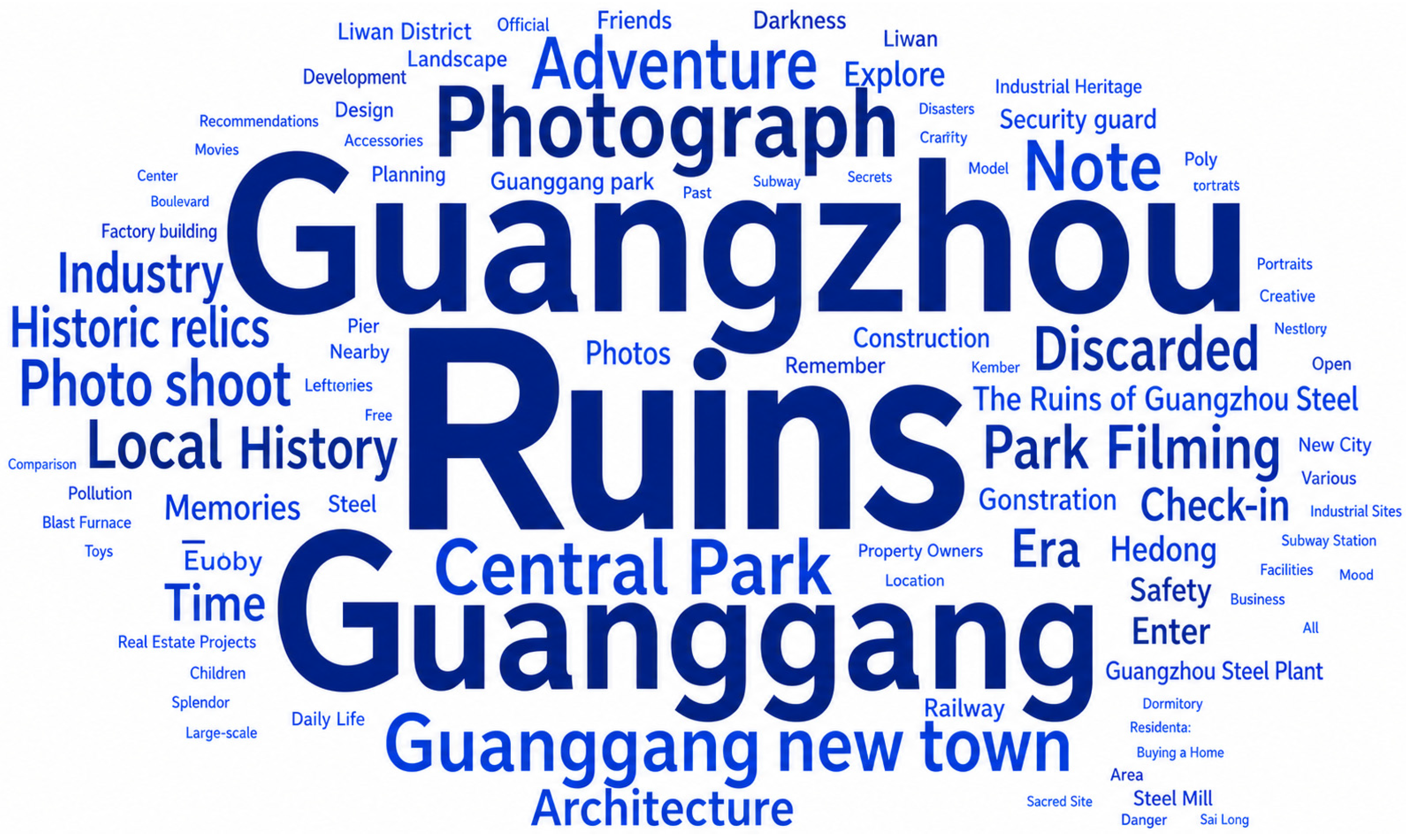
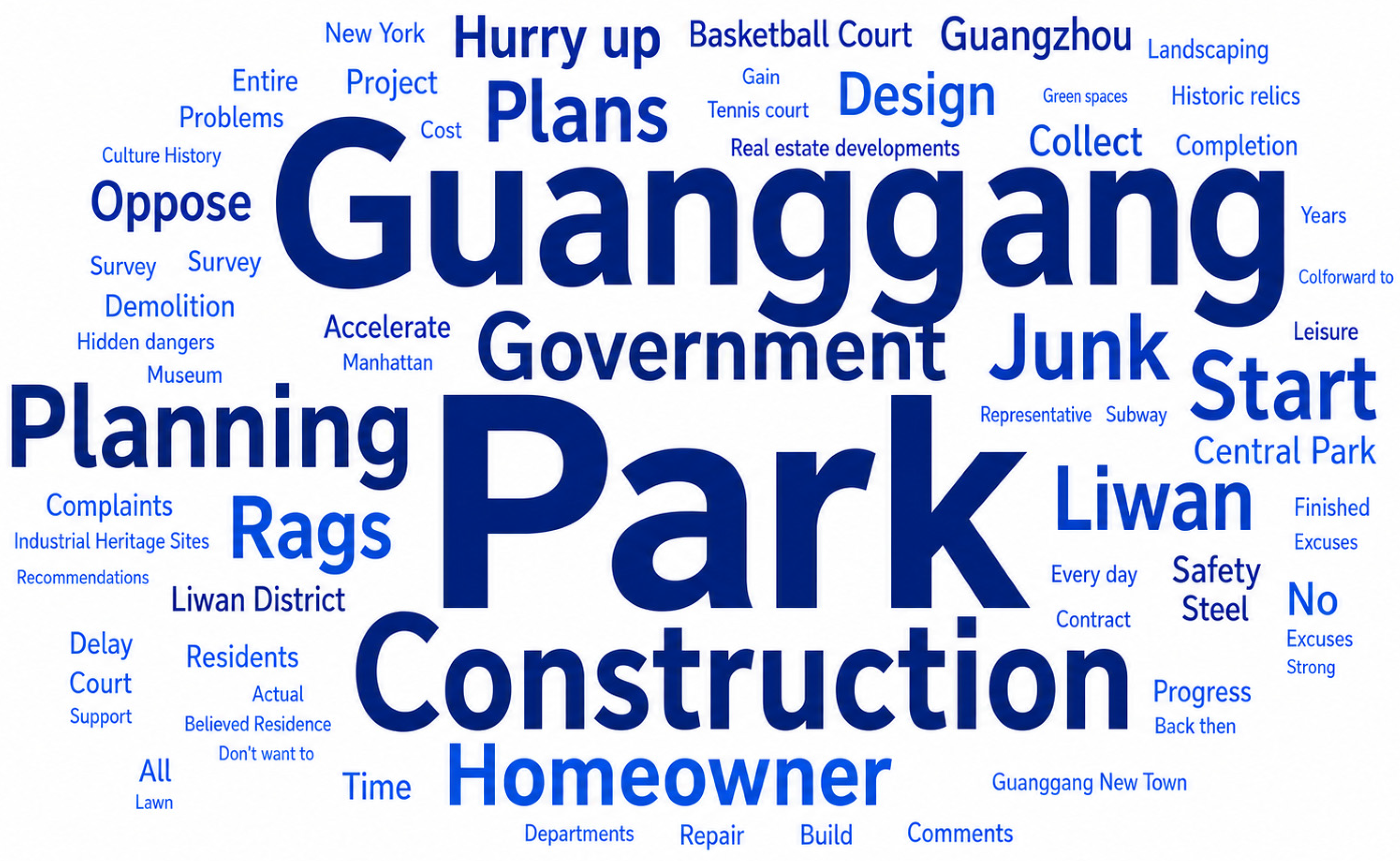
Word-frequency analysis is derived from content analysis, which Berelson defined as a method for the objective, systematic, and quantitative description of communication content. This method can be used to identify repeatedly occurring core terms in textual data and thereby assess the intensity of public attention toward the study site. In this study, ROST CM 6.0 was used to construct a customized vocabulary list and conduct Chinese word segmentation. Before word segmentation, the customized segmentation dictionary and synonym-merging table described in
Supplementary Materials Section S1 were imported into ROST CM 6.0. This procedure was used to reduce segmentation errors and ensure that key heritage-related terms, place names, spatial elements, and colloquial expressions were consistently identified across the two platform corpora. High-frequency terms in Rednote posts and WeChat comments were then calculated separately. The thresholds of ≥10 occurrences for Rednote texts and ≥6 occurrences for WeChat comments were used as descriptive reporting thresholds rather than statistical cut-off points. The frequency tables report recurrent terms from the cleaned corpus; however, not all listed terms were interpreted as direct evidence of industrial heritage value. Contextual terms such as place names, planned park names, transport facilities, and developer-related words were retained to situate the discourse, while the interpretation focused on terms related to material remains, industrial memory, spatial experience, reuse demands, safety, public facilities, and governance responsiveness. In this study, “check-in” refers to the social media practice of recording, photographing, and sharing a visit, rather than a digital access requirement for entering the park. On this basis, the main perceptual content expressed by the public regarding the value elements, spatial experiences, and reuse demands of the Guanggang industrial heritage site was extracted.
2.4.2. Semantic Network Analysis
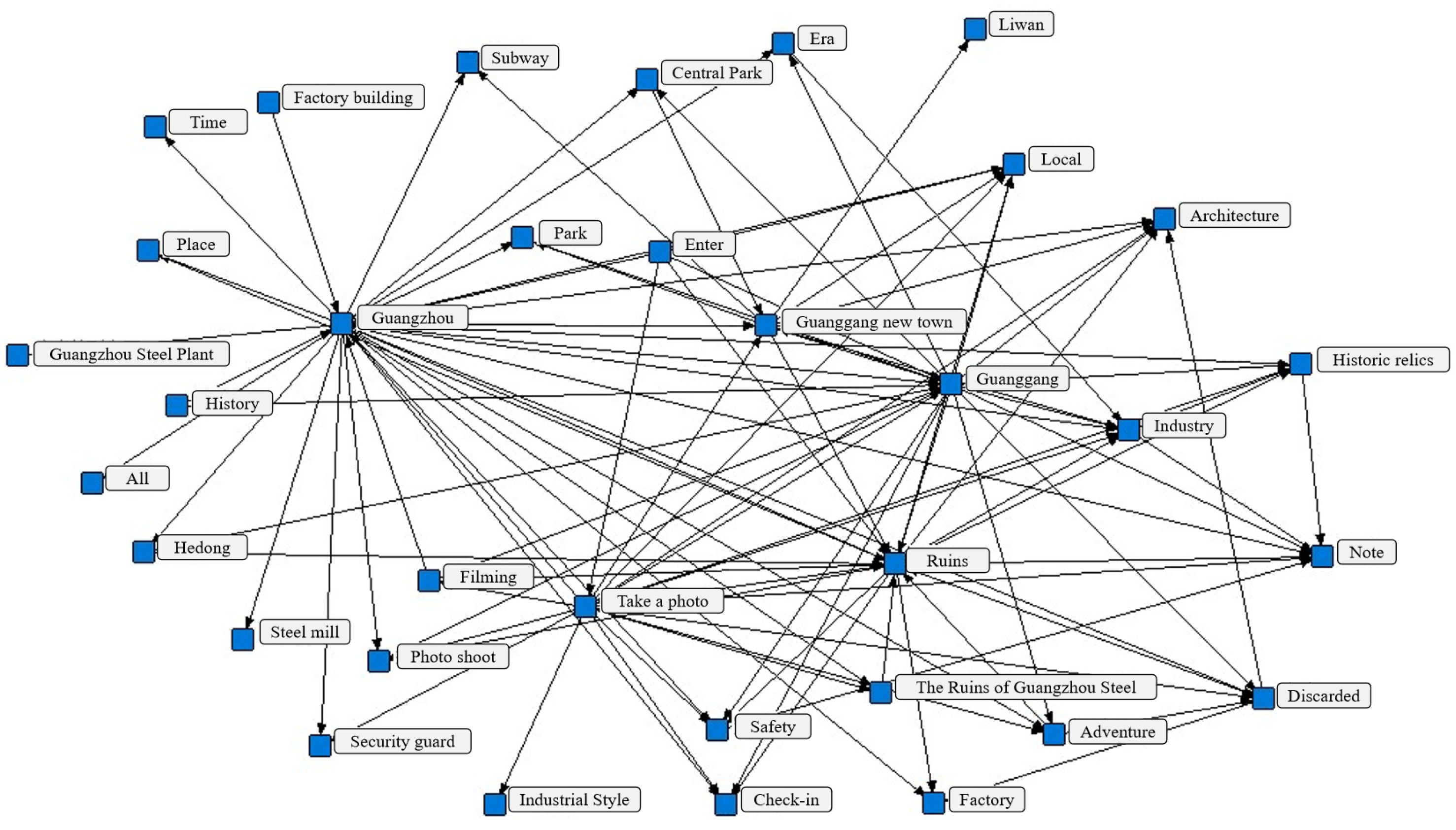
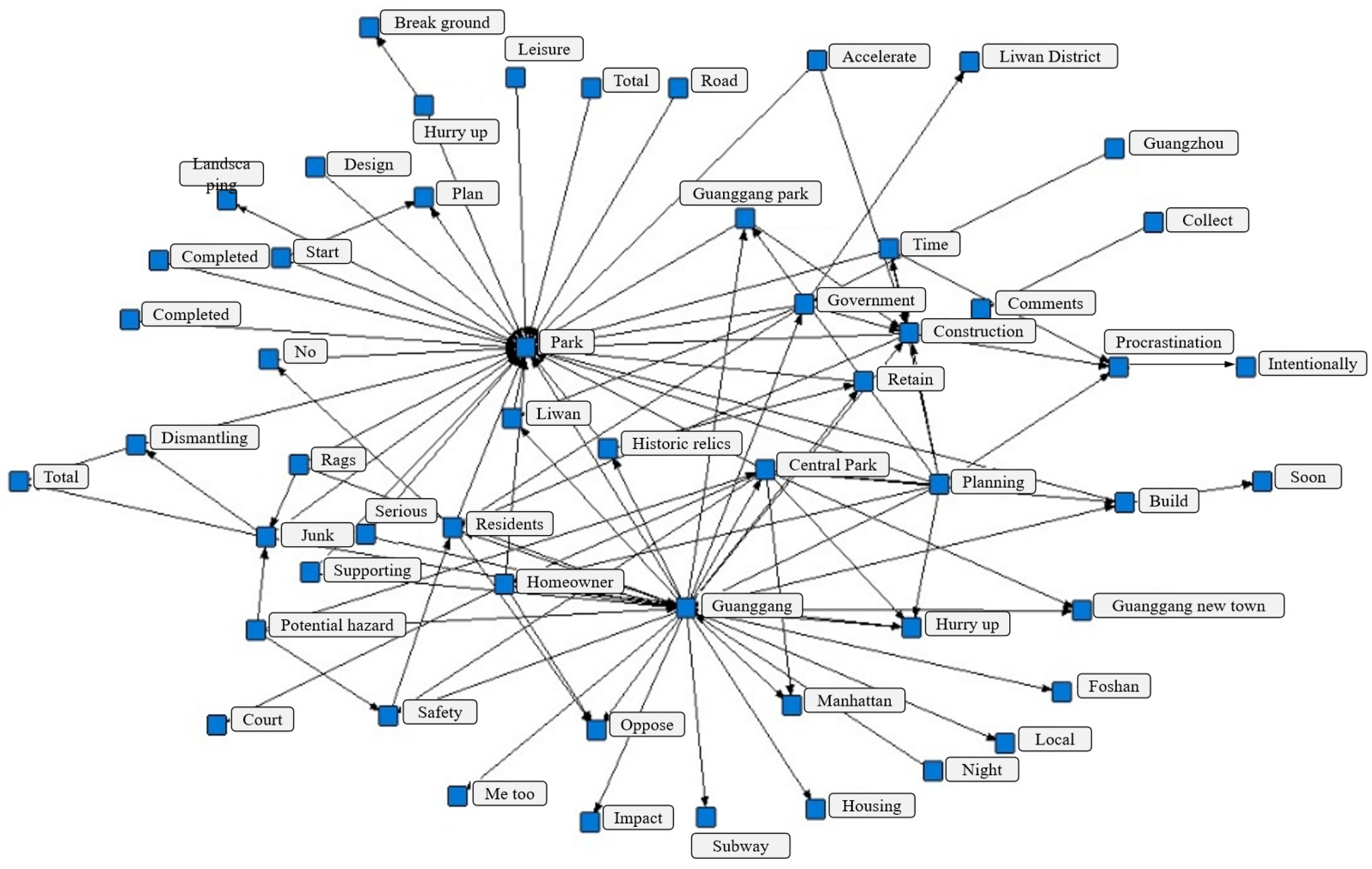
Semantic network analysis was used to identify the co-occurrence structure between recurrent terms in the two platform corpora. After word segmentation, synonym merging, and stop word removal, the recurrent terms identified in the word-frequency analysis were used as network nodes. Co-occurrence was defined within the same post or comment: when two retained terms appeared in the same textual unit, a semantic association between them was recorded by ROST CM 6.0. The connection strength shown in the visual network represents the relative frequency of co-occurrence generated by the software rather than a manually assigned relationship.
The Rednote and WeChat corpora were processed separately to avoid conflating different platform-contextual discourse structures. Generic stop words, function-like words, emojis, platform tags, user mentions, duplicated punctuation, and non-substantive expressions were removed before network construction. The customized segmentation dictionary and synonym-merging rules described in
Supplementary Materials Section S1 were used to ensure the consistent identification of place names, heritage-related terms, spatial elements, activity-related expressions, and governance-related terms. In this study, the semantic network graphs were used as descriptive co-occurrence visualizations to identify core semantic associations and recurrent interpretive pathways. Because the ROST CM 6.0 output used in this study did not provide a standardized export of complete edge lists for calculating comparable network metrics, the analysis does not make formal claims based on centrality, density, modularity, or clustering coefficients. Instead, the interpretation focuses on visually identifiable co-occurrence patterns and is cross-checked with the word-frequency results and representative textual meanings. This descriptive scope is sufficient for the present research objective because the analysis asks which value associations recur within each platform corpus, not whether the two networks differ statistically in topology. A formal structural comparison would require reproducible complete edge-list exports and common pruning thresholds, which were not available for the present dataset.
2.4.3. Sentiment Analysis
Sentiment analysis was used as a descriptive method for identifying the corpus-level distribution of lexicon-based sentiment categories in UGC texts. Following previous work on textual sentiment classification [
83], this study used the sentiment analysis module of ROST CM 6.0 to classify each text as positive, neutral, or negative. ROST CM 6.0 applies a lexicon-based Chinese sentiment classification procedure and reports both polarity categories and sentiment-intensity scores. In this study, the automated results were used to compare platform-contextual emotional tendencies rather than to make psychological claims about individual users.
To improve the reliability of the sentiment results, a manual validation procedure was added. A stratified validation subset of 150 texts, accounting for 20.1% of the full corpus, was sampled according to platform source and ROST-generated sentiment category. The subset included 44 Rednote texts and 106 WeChat public platform comments. Two authors independently coded the sampled texts as positive, neutral, or negative according to the dominant emotional orientation expressed in the whole text. The validation subset and coding criteria are provided in
Supplementary Materials Section S2. The automated ROST results were therefore interpreted together with representative text excerpts, rather than treated as self-evident outputs. Manual validation improves confidence in category consistency within the sampled texts, but it does not convert lexicon-based classifications into direct measurements of individual attitudes or population-level sentiment.
4. Discussion
Rather than treating the observed differences as a direct platform effect, this study conceptualizes dual foregrounding as a bounded selection process. The process operates in three linked steps: platform affordances and distribution practices make some forms of expression easier to produce and circulate; users’ self-selection and relationships to the site influence which concerns they choose to articulate; and the resulting corpus makes some value dimensions more visible than others [
76]. Rednote therefore provides evidence of concerns made visible within an image–text and interest-based environment [
84], whereas comments under local WeChat public accounts provide evidence of concerns made visible within issue-focused community information channels [
85,
86]. Because demographic attributes and algorithmic exposure were not observed, this process is an interpretive model of selective visibility, not a causal model that separates the effects of platform, demographics, and stakeholder position.
It should be noted that this study does not claim that social media discourse has directly shaped formal planning decisions or governance outcomes at the Guanggang industrial heritage site. Rather, UGC is treated as supplementary evidence for identifying public concerns, perceived value conflicts, and unmet demands during an ongoing regeneration process. In this sense, social media posts do not replace formal public participation or value negotiation, but help reveal issues that may not be sufficiently captured through limited official consultation channels. Because Guanggang Park is still under construction, the corpus was not treated as a pure record of industrial heritage appreciation; park-related issues such as access, construction progress, safety, facilities, and residential environment were included only when they were directly linked to the adaptive reuse of the former industrial site. Accordingly, the higher proportion of negative sentiment in the WeChat public platform comments should not be interpreted as a simple platform effect or as evidence that WeChat users were generally more negative. Rather, it reflects the specific communicative context of local public-account discussions, where residents and property owners were more likely to comment on delayed construction, unclear access conditions, safety concerns, public facilities, and insufficient information about the ongoing regeneration process. The sentiment comparison is therefore used only as an approximate corpus-level signal of issue emphasis, not as a direct measure of individual attitudes.
China’s current policy framework provides an important institutional background for interpreting this phenomenon [
87,
88]. The National Industrial Heritage Management Measures emphasize the protection of core industrial remains, the establishment of exhibition and interpretation facilities, public participation, and the integration of industrial heritage use with urban transformation [
89]. The national policy on strengthening historical and cultural heritage protection in urban and rural construction further highlights the systematic protection, utilization, and inheritance of historical and cultural resources [
90]. Meanwhile, China’s urban renewal policy has increasingly shifted from large-scale demolition toward retention-based improvement, public service provision, and respect for residents’ willingness [
3]. In this policy context, urban industrial heritage is not only a material object to be preserved, but also a governance interface where heritage value, land redevelopment, safety management, public facilities, and residents’ everyday interests intersect.
The first observed outcome is visual-cultural foregrounding. Within the Rednote corpus, users who chose to document the Guanggang industrial heritage site through viewing, entering, photographing, and sharing made ruin aesthetics, industrial visuality, exploratory experience, and shareability especially visible [
91]. This pattern identifies what the Rednote corpus captures well, but it does not establish that Rednote users as a demographic group inherently value heritage in this way. It also reveals a practical risk: visual interest may remain at the level of image consumption if it is not connected with industrial processes, workers’ memory, and Guangzhou’s industrial history.
The second observed outcome is livelihood-governance foregrounding [
64]. Within the local WeChat public-account corpus, comments about the Guanggang industrial heritage site made park construction, planning progress, government response, safety hazards, greening, sports facilities, roads, lawns, and complaints especially visible. Textual self-identification by some commenters as residents or property owners helps explain why proximity to risks, public service expectations, and trust in the regeneration process entered this corpus [
92]. However, the corpus does not establish the residence status or demographic characteristics of every commenter. This localized interpretation is particularly relevant to urban industrial heritage sites located in high-value redevelopment areas in China. Sun and Chen argue that industrial heritage can contribute to sustainable urban regeneration only when it moves beyond aestheticized, commercialized, or creative-park narratives and becomes embedded in the social and spatial restructuring of surrounding areas [
4]. Zhang’s study of industrial heritage in China’s mega-events also shows that industrial heritage practices are often shaped by state-led governance and entangled with capital accumulation, urban regeneration, and heritage preservation [
3]. The Guanggang industrial heritage site supports these observations but provides finer-grained evidence from public discourse. When planning schemes are repeatedly adjusted, construction progress remains unclear, and participation channels are limited, public discussion may shift from heritage value itself to government credibility, developer responsibility, promised facilities, and living-environment quality [
93].
Taken together, dual foregrounding does not simply mean that multiple factors mediate heritage perception. It specifies how platform affordances and user self-selection filter which already-existing concerns enter each corpus, producing two complementary but partial views of the same regeneration process. Visual-cultural discourse can underrepresent everyday service, safety, and governance concerns, whereas livelihood-governance discourse can underrepresent historical, technological, and interpretive values. Reading the two corpora together can therefore inform strategy design, but it cannot establish the independent causal effects of platform or demographics.
Based on these findings, the proposed strategies were derived from the main platform-mediated concerns identified in the empirical analysis. Rednote foregrounded ruins, industrial aesthetics, photography, exploration, and check-ins, indicating the need to transform visual attention into layered heritage interpretation. WeChat comments focused more on construction progress, access, safety, public facilities, residential environment, and governance response, supporting strategies related to zoned access, community-oriented functional integration, and transparent feedback. Therefore, the following strategies are not generic recommendations, but responses to UGC-based public discourse about heritage value, spatial experience, public use, safety, and governance.
- (1)
A layered value interpretation system should connect blast furnaces, factory buildings, railways, and docks with steelmaking processes, Guanggang workers’ memory, and Guangzhou’s industrialization history. This is consistent with the policy emphasis on exhibition, interpretation, industrial culture communication, and public education.
- (2)
Zoned access should be combined with safety governance. For industrial structures with visual and interpretive value but potential risks, controlled viewing boundaries, photography routes, and accessible platforms should be provided, rather than adopting complete demolition or total closure.
- (3)
Community-oriented public functions, such as greening, slow-mobility routes, sports fields, children’s activity areas, resting seats, and night lighting, should be integrated without damaging core industrial remains. These functions are the social conditions through which industrial heritage can become publicly used and locally supported.
- (4)
A transparent feedback mechanism should regularly disclose construction progress, retained heritage lists, risk assessments, phased implementation plans, and responses to residents’ opinions. Although social innovation has been shown to strengthen the place-based effects of industrial heritage regeneration [
94], in the Guanggang case it must be localized through public disclosure, community feedback, and institutional trust. The key to future regeneration is therefore not to choose between “heritage retention” and “community park development,” but to rebuild a shared public understanding of industrial heritage value through a process that is interpretable, accessible, usable, safe, and trustworthy.
5. Conclusions
Taking the Guanggang industrial heritage site as a case study, this study examined platform-mediated public discourse about urban industrial heritage value using UGC texts from Rednote and WeChat public accounts. The retrieved corpora showed distinct emphases. Rednote discourse foregrounded ruin landscapes, industrial aesthetics, photography-based check-ins, and exploratory experiences, whereas WeChat comments emphasized park construction, public facilities, safety, governance responsiveness, and the residential environment. These findings indicate that the retrieved discourse framed urban industrial heritage both as a cultural landscape with visual and communicative appeal and as an emerging public space expected to be accessible, usable, safe, and responsive to community needs.
This study advances the understanding of platform-mediated public value discourse in urban industrial heritage by conceptualizing dual foregrounding as a bounded selection process rather than a platform-driven causal mechanism. The process links platform affordances, user self-selection, and relationships to the site with the selective visibility of value concerns in each corpus. In this case, Rednote discourse made visuality, exploratory experience, and shareability especially visible, whereas local WeChat public-account discourse made usability, risk, and governance responsiveness especially visible. Because demographic variables and algorithmic exposure were not observed, the finding specifies the interpretive value and blind spots of each data source rather than attributing the differences to platform alone.
Methodologically, this study shows that, for heterogeneous platform data in this case, separate analysis was necessary to avoid conflating visitor-oriented visual discourse with community-oriented regeneration discourse. By separately analyzing Rednote and WeChat public platform data, this study reveals how different platform contexts make different value dimensions visible. The combined use of word-frequency analysis, semantic network analysis, and sentiment analysis provides an integrated approach for identifying public attention, semantic associations, and approximate corpus-level sentiment patterns in urban heritage regeneration.
The findings suggest that industrial heritage conservation and adaptive reuse should move beyond the simple retention of physical remains or the creation of post-industrial landscape imagery. Historical, technological, and aesthetic values need to be translated into public values that can be understood, accessed, used, and trusted. For the Guanggang industrial heritage site and comparable cases, this requires layered value interpretation, zoned access combined with safety governance, community-oriented functional integration, and transparent feedback mechanisms. In this sense, the key challenge is not to choose between “heritage retention” and “community park development,” but to coordinate heritage value, everyday use, public service provision, and community trust.
This study also has limitations. Because the Guanggang industrial heritage site has not yet been fully opened, the perceptions identified in this study reflect the project implementation stage rather than long-term evaluations after mature operation. Publication-date metadata were not consistently available across all retrieved records; therefore, the earliest publication year cannot be verified and the corpus cannot support a time-series interpretation. In addition, the two platform datasets cannot represent all stakeholder groups involved in the regeneration process. Platform affiliation cannot by itself verify user identity, age, gender, residence status, or stakeholder category. Rednote texts tend to reflect visitor-oriented and image-sharing practices, whereas WeChat public platform comments mainly reflect users who follow local public accounts and are willing to comment on community issues. The perspectives of former factory workers who are not active online, elderly residents, silent residents, internal planners, developers, and administrative actors may be underrepresented. Future research should combine UGC analysis with a survey-linked or consent-based sample that records age, gender, residence status, relationship to the site, and platform-use intensity. Multivariable models or matched comparisons could then separate demographic composition and stakeholder position from platform context, while interviews, field observation, and stakeholder consultation could examine how public value perception is translated into formal participation and governance processes. Although manual validation improves confidence in category consistency, lexicon-based classification may still miss irony, mixed emotions, and context-dependent meanings; sentiment percentages should therefore not be read as direct measurements of individual attitudes.