Article

Bi-Objective Station Planning of a Mobile Manipulator Considering Dexterity and Stiffness for Robotic 3D Concrete Printing

1
Shanghai Key Laboratory of Intelligent Manufacturing and Robotics, School of Mechatronic Engineering and Automation, Shanghai University, Shanghai 200444, China
2
National Demonstration Center for Experiment Engineering Training Education, Shanghai University, Shanghai 200444, China
3
Shanghai Golden Arrow Robot Technology Co., Ltd., 701 Building 3, No. 377 Shanlian Road, Baoshan District, Shanghai 200444, China
*
Author to whom correspondence should be addressed.
Buildings 2026, 16(12), 2361; https://doi.org/10.3390/buildings16122361 (registering DOI)
Submission received: 11 May 2026 / Revised: 3 June 2026 / Accepted: 9 June 2026 / Published: 12 June 2026
(This article belongs to the Section Building Structures)

Abstract

This study investigates the station planning problem of a mobile manipulator for robotic 3D concrete printing. The problem is formulated as a station planning problem considering two trajectory-level performance objectives: kinematic dexterity and structural stiffness. A directional dexterity metric based on the minimum normalized velocity directional manipulability along the task path is used to evaluate the worst-case motion capability of the manipulator during trajectory execution. A stiffness-related metric based on the maximum absolute Z-axis deformation of the end-effector is used to evaluate the worst-case deformation under operational loads. These two trajectory-level criteria are normalized and integrated through a weighted scalarization strategy, and a genetic algorithm is employed to search for station configurations under reachability constraints. Case studies on representative wall geometries show that the proposed method improves motion performance and reduces deformation compared with non-optimized station placements. The results indicate that the proposed framework provides an effective station planning strategy for mobile manipulators in trajectory-following robotic tasks.

1. Introduction

Mobile manipulators combine the mobility of autonomous platforms with the operational capability of robotic manipulators, making them suitable for large-scale and complex robotic tasks. Such systems have been explored in industrial production [1], rehabilitation [2], construction [3], and aviation-related operations [4]. In robotic 3D concrete printing (3DCP), mobile manipulators provide an effective solution for overcoming the workspace limitation of conventional stationary robotic systems while maintaining the flexibility required for trajectory-following tasks.
In practical 3DCP tasks, the mobile platform usually needs to stop at a proper station before the manipulator starts to follow the printing trajectory. The choice of this station determines the spatial relationship between the robot and the task, and therefore has a direct influence on process performance. Existing studies have shown that installation pose or base placement can affect task feasibility, motion performance, and stiffness-related behavior [5,6]. For mobile robotic systems, optimization of the platform itself can also improve operational effectiveness and task adaptability [7]. From this perspective, station planning is not only a geometric placement issue, but also a task-level decision problem.
Dexterity is commonly used to describe the motion capability of a manipulator. Yoshikawa introduced a classical manipulability measure based on the Jacobian matrix and the corresponding manipulability ellipsoid [8]. Klein and Blaho [9] further discussed dexterity measures for the design and control of kinematically redundant manipulators. In addition, kinematic indices such as the Jacobian determinant, condition number, and minimum singular value have been used in installation-pose and posture optimization problems [10]. However, for trajectory-following tasks such as 3DCP, these general dexterity measures are not always sufficient, because the required motion is constrained by the local direction of the task path rather than unconstrained motion in the whole workspace.
Stiffness is another important factor for process quality. When the manipulator works under load, insufficient stiffness may lead to end-effector deformation and consequently reduce positioning accuracy. Early work on Cartesian stiffness control established the mapping relationship between joint stiffness and Cartesian stiffness [11]. Later studies further improved stiffness modeling for robotic systems [12,13,14]. Related work has also been extended to multiple coordinated robot systems [15], quasi-static payload analysis of reconfigurable robot configurations [16], elastostatic parameter identification of heavy industrial robots [17], and stiffness-oriented posture optimization in robotic machining applications [18,19,20]. These studies show that robot configuration has a strong influence on deformation under load, and therefore on the achievable process accuracy.
For robotic 3D concrete printing, dexterity and stiffness cannot be treated as two independent issues. During printing, the nozzle is required to follow a prescribed spatial trajectory while maintaining stable motion and sufficient geometric accuracy. If the manipulator has poor motion capability at a critical point on the path, unstable velocity transmission may occur. If excessive compliance appears during execution, deformation errors may accumulate and affect both layer quality and the final geometric accuracy of the printed structure [21]. Therefore, station planning in 3DCP is essentially a trajectory-dependent problem in which both kinematic performance and structural stiffness need to be considered.
Although robot placement and station planning have been widely studied, many existing methods mainly evaluate reachability, workspace coverage, or general kinematic performance. These criteria are useful for determining whether a task can be reached, but they do not directly describe whether the manipulator can efficiently generate motion along the required direction of a continuous printing path. For robotic 3D concrete printing, the nozzle motion is trajectory-constrained, and the local path direction is more relevant than the overall isotropic motion capability of the manipulator. In addition, a reachable station may still be unsuitable if it leads to excessive end-effector deformation under gravity and extrusion-related loads. This gap motivates the present study.
In this paper, the station planning problem of a mobile manipulator for robotic 3D concrete printing is studied by integrating trajectory-level dexterity and stiffness-related deformation into a unified planning framework. A trajectory-level directional dexterity index is defined using the minimum normalized velocity directional manipulability along the task path, so that the worst-case velocity transmission capability of a candidate station can be evaluated. A stiffness-oriented index is defined using the maximum absolute Z-axis deformation of the end-effector under operational loads, which reflects the worst-case compliance-induced error during task execution. Based on these two indicators, station planning is formulated as a constrained optimization problem with two performance objectives, which are normalized and combined through a weighted scalarization strategy to determine a single balanced station.
The main contributions of this work are summarized as follows:
  • A station planning problem for a mobile manipulator in robotic 3D concrete printing is formulated by considering two trajectory-level performance objectives: motion capability and deformation-related accuracy.
  • A task-oriented dexterity metric and a stiffness-oriented deformation metric are established to evaluate the worst-case performance of a candidate station along the entire printing trajectory.
  • A weighted scalarization-based optimization framework is developed to determine station configurations that balance dexterity and stiffness requirements for representative wall-printing tasks.
  • Case studies on different wall geometries are conducted to demonstrate that the proposed method can improve trajectory-level motion performance and reduce end-effector deformation compared with non-optimized station placements.
The remainder of this paper is organized as follows. Section 2 introduces the application context and formulates the station planning problem in robotic 3D concrete printing. Section 3 presents the kinematic and dynamic modeling of the mobile manipulator. Section 4 develops the dexterity-oriented optimization method, and Section 5 presents the stiffness-oriented optimization model. Section 6 further integrates the two criteria into a unified optimization framework. Finally, Section 7 concludes the paper and discusses future work.

2. Problem Formulation and System Modeling

2.1. Application Context: 3D Concrete Printing

Three-dimensional concrete printing (3DCP) has emerged as a promising construction technology for the automated fabrication of complex architectural components and building structures. Compared with conventional construction approaches, it offers potential advantages such as reduced material waste, shortened construction cycles, increased design freedom, and reduced labor demand [22,23]. Recent studies have also examined geometric form configurations and corner-wall combinations in 3D printed residential structures [21].
Despite these advantages, the workspace limitation of conventional stationary industrial robots makes it difficult to directly print large-scale building components or complete structures on construction sites. For this reason, mobile manipulators provide an attractive alternative. By combining robotic manipulation with autonomous mobility, they can enlarge the effective workspace while retaining the positioning capability required for layer-by-layer material deposition.
In 3DCP applications using mobile manipulators, the robot end-effector, namely the print nozzle, is required to follow a prescribed spatial trajectory while maintaining a stable extrusion velocity. This is important for uniform material deposition, proper interlayer bonding, and geometric accuracy of the final structure. Therefore, the overall printing quality depends not only on the robot itself, but also on how the robot is positioned with respect to the target wall segment before the printing process starts.
Related studies have also investigated mobile robot scheduling, manipulator kinematics, and task-specific station optimization in different robotic applications [24,25,26].

2.2. System Description

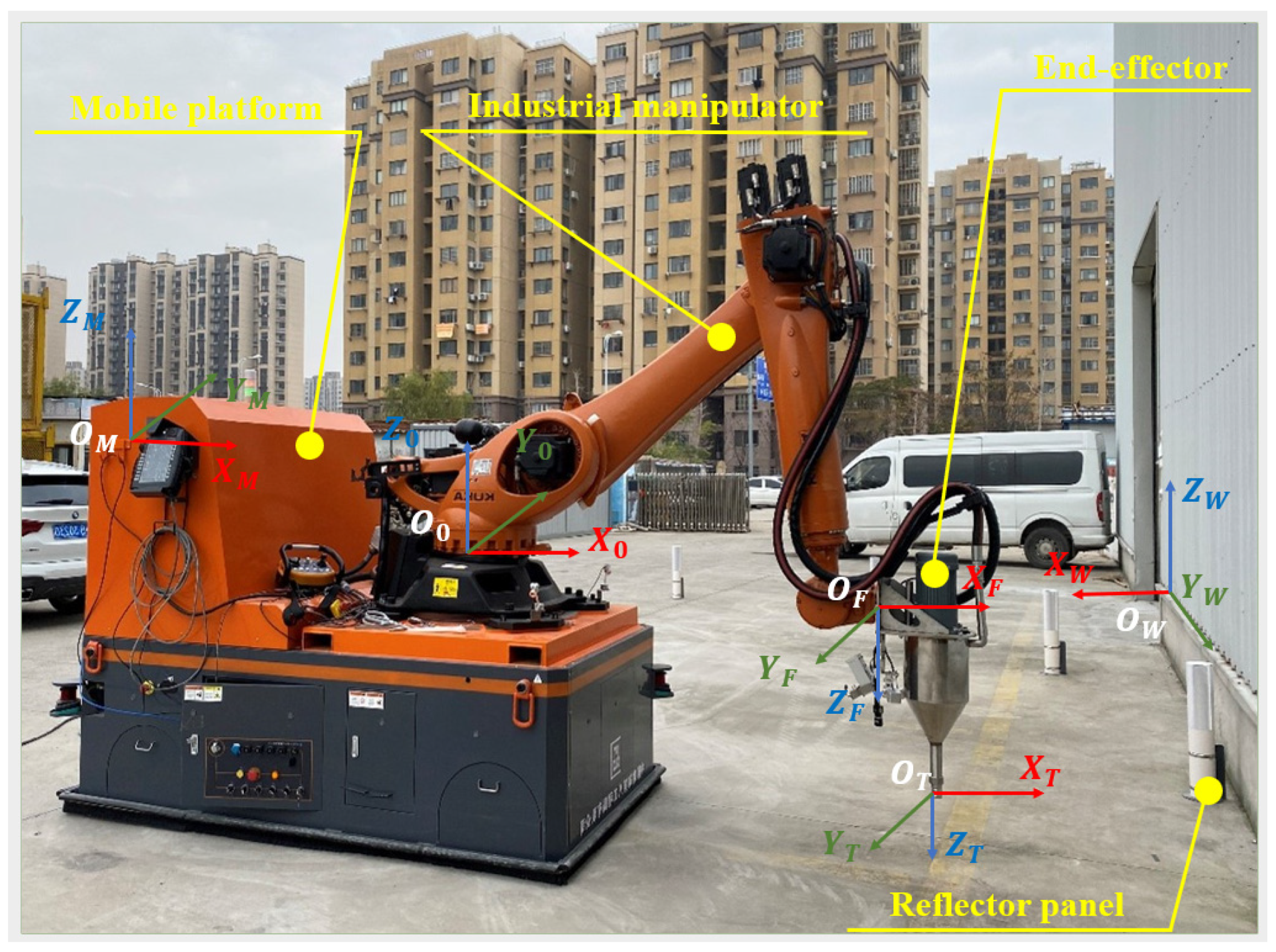
The mobile manipulator studied in this paper is shown in Figure 1, which consists of a six-degree-of-freedom KUKA KR90 R3100 serial robotic arm, an omnidirectional mobile platform with Mecanum wheels [27], and a localization module based on artificial landmarks [28,29]. The Mecanum wheels allow the platform to move with three degrees of freedom (DOF) on a horizontal surface: namely, translation along W x or W y axes in the world coordinate system {W}, and rotation around the W z axis. P M W   =   [ x ,   y ,   θ ] T , the vector is defined as the origin of the coordinate system {M} with respect to {W}.
The coordinate systems of the system are defined as follows: {W}: world/task coordinate system, {M}: mobile platform coordinate system; {O}: manipulator coordinate system, located at the mounting point of the robotic arm on the platform. {T}: tool coordinate system, located at the tip of the end-effector (concrete nozzle).
Reflector panels are a key component of the localization module, a type of artificial landmark characterized by high reflectivity. The on-board LIDAR detects these reflectors by sensing their high-intensity reflective signals, allowing it to distinguish them from surrounding ordinary environmental objects. During the 3DCP mission, the system can detect the reflectors’ positions in real-time by using pre-positioned reflectors to accurately determine the exact location of the mobile platform within the world coordinate system { W } . This localization module is essential to ensure that the platform can later navigate to and dock at the optimal static station as determined by the optimization framework in this paper. During such maneuvers, addressing potential wheel slip [30] and ensuring tip-over stability [31] are critical to prevent geometric inaccuracies or structural failures in the printed object. Slight deviations from the planned trajectory or velocity fluctuations may compromise geometric accuracy, interlayer quality, and structural properties of the final product [29].
With this requirement, the robotic arm’s station planning becomes a critical issue: i.e., determining the optimal static station (position and attitude) of the mobile platform before executing the print job on the specified wall. A suboptimal station may force the robotic arm to generate greater joint velocities and torques during motion, which in turn can lead to multiple failures.
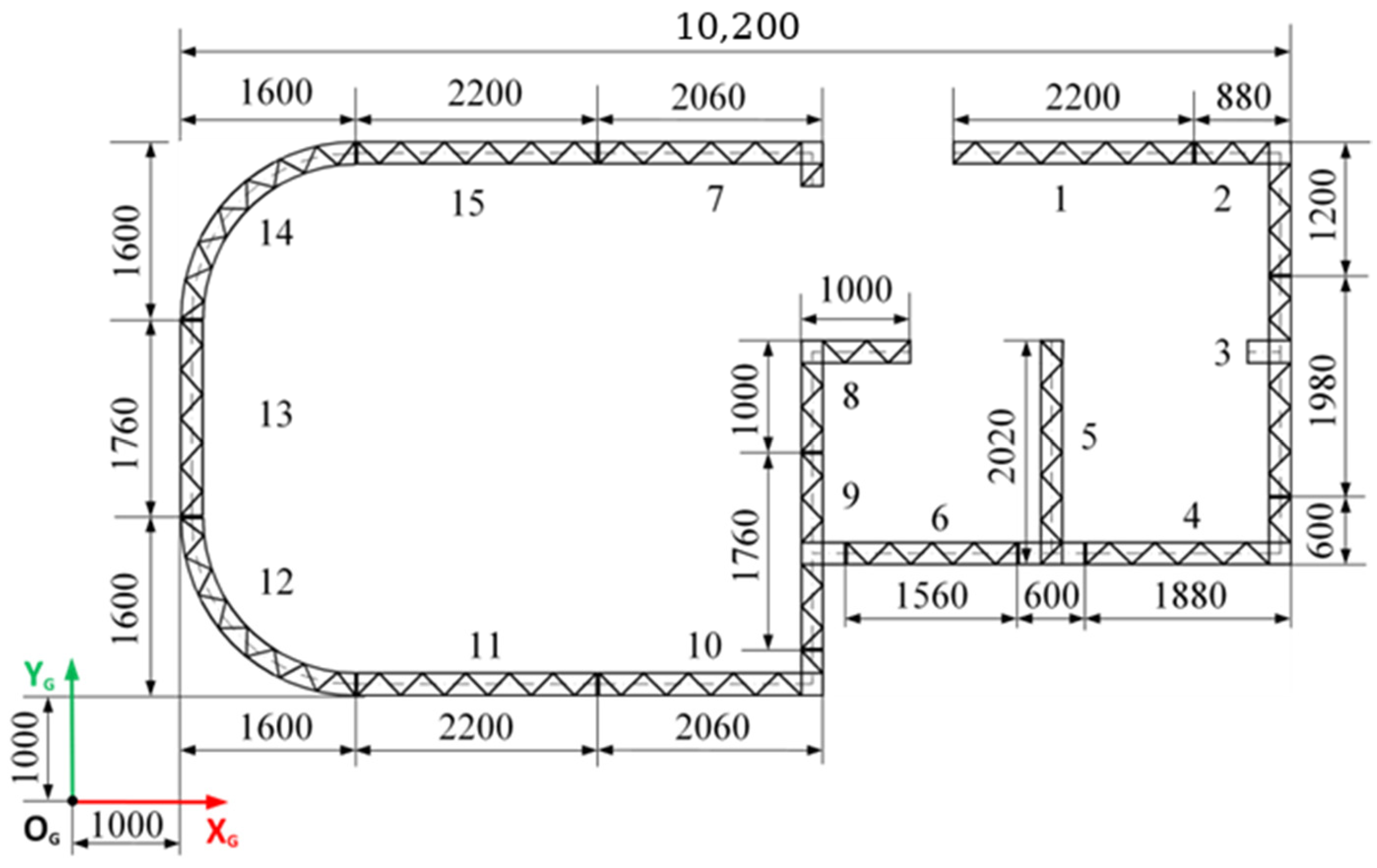
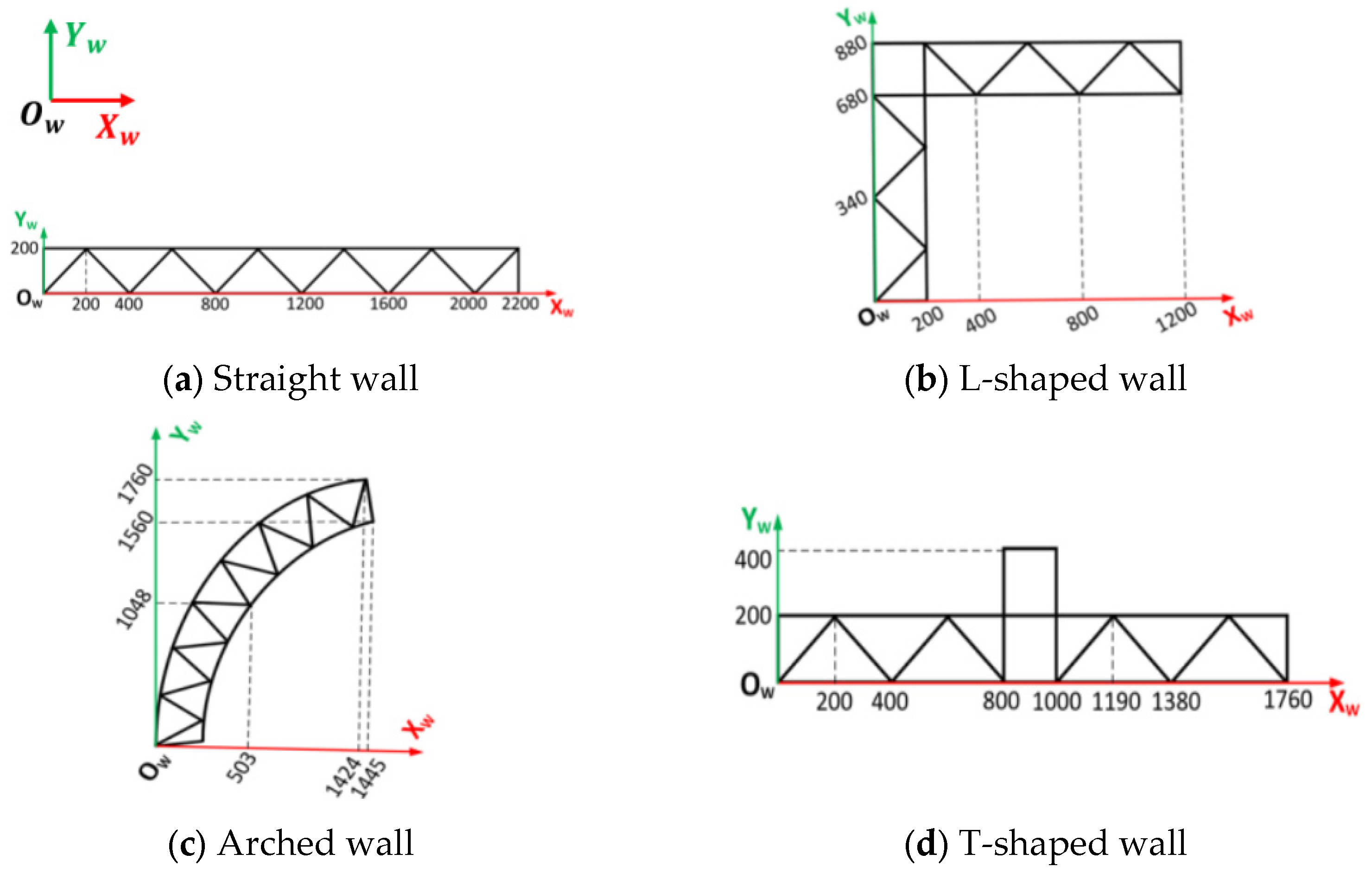
Given the geometric complexity of full-size building structures (e.g., the floor plan of the residential building in Figure 2), there is no suitable station at which the complete building can be printed directly. A practical strategy is therefore to break down the overall geometry into smaller, directly printable segments. Common wall types, such as straight, L-shaped, arched, and T-shaped walls (Figure 3), serve as the basic units for printing. This decomposition is guided by two principles: (1) corner walls are split to preserve the sides for subsequent reinforcement. (2) The printing trajectory of any individual segment must lie entirely within the accessible workspace of the mobile manipulator. Thus, the planning problem is defined as determining the optimal station of the mobile manipulator corresponding to the decomposed wall segments, i.e., P M W   =   [ x ,   y ,   θ ] T .
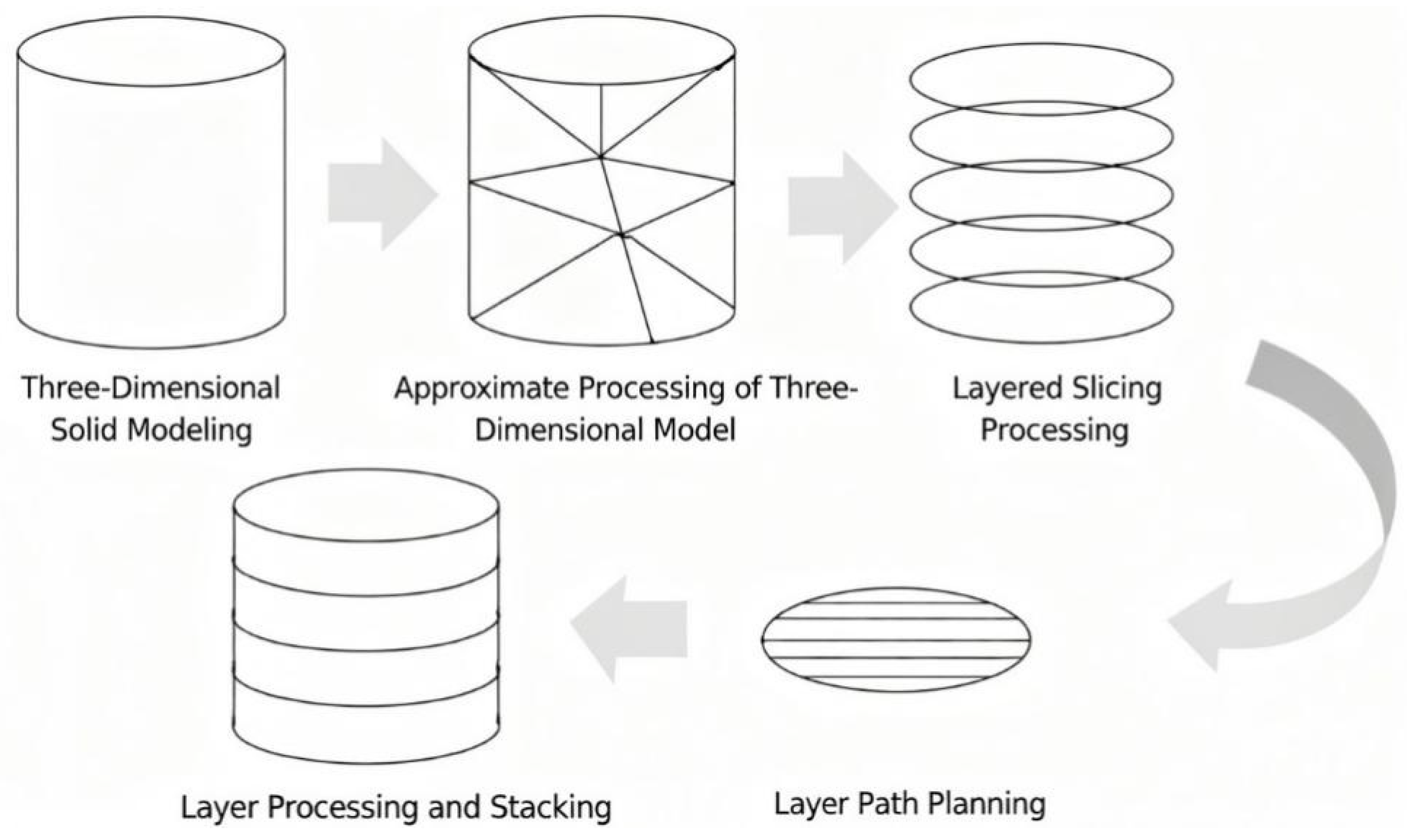
After decomposition, the walls are sliced into different layers based on the segmented wall types (Figure 4), that is, the contour of each layer that needs to be printed when printing the wall and the path that the nozzle needs to travel during the printing process.

2.3. Dexterity and Stiffness Challenges in Station Planning

In the actual task, a station is not chosen arbitrarily. For a specific wall segment trajectory T defined in {W}, A suboptimal pose leads to performance limitations that can be analyzed as two fundamental issues.
  • Kinematic dexterity issues: An inappropriate station may force a manipulator to operate near its workspace boundary or in a kinematic singularity configuration. While this manifests itself superficially as reachability constraints or erratic motion, the root cause is a loss of critical kinematic dexterity—specifically a reduced ability to efficiently transfer velocity along the tool path. This compromises end-effector velocity stability and directly impacts the quality of the print job.
  • The structural stiffness problem: Operating in extended configurations can also induce low structural stiffness. The observable effect is end-effector positioning error under operational loads such as gravity and extrusion forces. The intrinsic cause is excessive compliance, leading to elastic deformations that cause the nozzle to deviate from its intended path, thereby affecting the dimensional accuracy of the printed structure.
To address these dual challenges, the following sections establish comprehensive kinematic and dynamic models to formalize dexterity and stiffness performance. By quantifying these competing requirements, we develop an integrated optimization framework aimed at simultaneously satisfying both motion fluency and operational accuracy, ensuring a robust and balanced station planning solution for complex 3DCP tasks.
Accordingly, the quality of the final station planning result is evaluated according to three task-oriented criteria. First, the selected station must satisfy the reachability constraint, meaning that all sampled points on the printing trajectory should have valid inverse kinematic solutions. Second, the station should provide sufficient trajectory-level directional dexterity, which is quantified by the minimum normalized velocity directional manipulability along the path. Third, the station should maintain sufficient stiffness-related accuracy, which is evaluated by the maximum absolute Z-axis deformation of the end-effector under the prescribed operational load. These criteria jointly determine whether the selected station can support feasible, stable, and accurate robotic 3D concrete printing.

3. Kinematic and Dynamic Modeling

After clarifying the station planning problem in Section 2, this section presents the kinematic and dynamic modeling of the mobile manipulator. The kinematic model is used to describe the relationship between the station configuration, joint variables, and end-effector pose. The dynamic model is then used to describe the relationship between link inertial properties, joint motion, external loads, and joint forces or torques. These models provide the basis for the subsequent dexterity evaluation and stiffness-oriented deformation analysis [32].

3.1. Kinematic Modeling of the Mobile Manipulator

The forward kinematics of the system is defined by a set of joint angles q     R 6 and the position of the moving platform, P M W   =   [ x ,   y ,   θ ] T , whose end-effector position in the world coordinate system can be expressed as a series of homogeneous transformation matrices multiplied together:
T T W ( P M W ,   q )   =   T T W ( P M W ) M T O O T   T ( q )
where T M W ( P M W ) is the transformation from {M} to {W} defined by P M W , T O M is the transformation from the manipulator’s base coordinate system to the moving platform coordinate system and T T O ( q ) is the manipulator’s forward kinematics function.
The kinematic equations of a robotic arm can be summarized as:
x = x ( q )
The application of the first derivative with respect to the variable t to both sides of the equation results in the differential relationship between the variables q and x being revealed:
x ˙ e   =   J ( q ) q ˙
The quantity x ˙ e R 6 is referred to as the generalized velocity in the operational space, commonly abbreviated as the operational velocity. The Jacobian matrix of the robotic arm, J ( q ) R 6 × 6 , provides a linear mapping from the joint space velocity q ˙ to the task space velocity of the end-effector.

3.2. Dynamic Modeling Based on the Newton–Euler Method

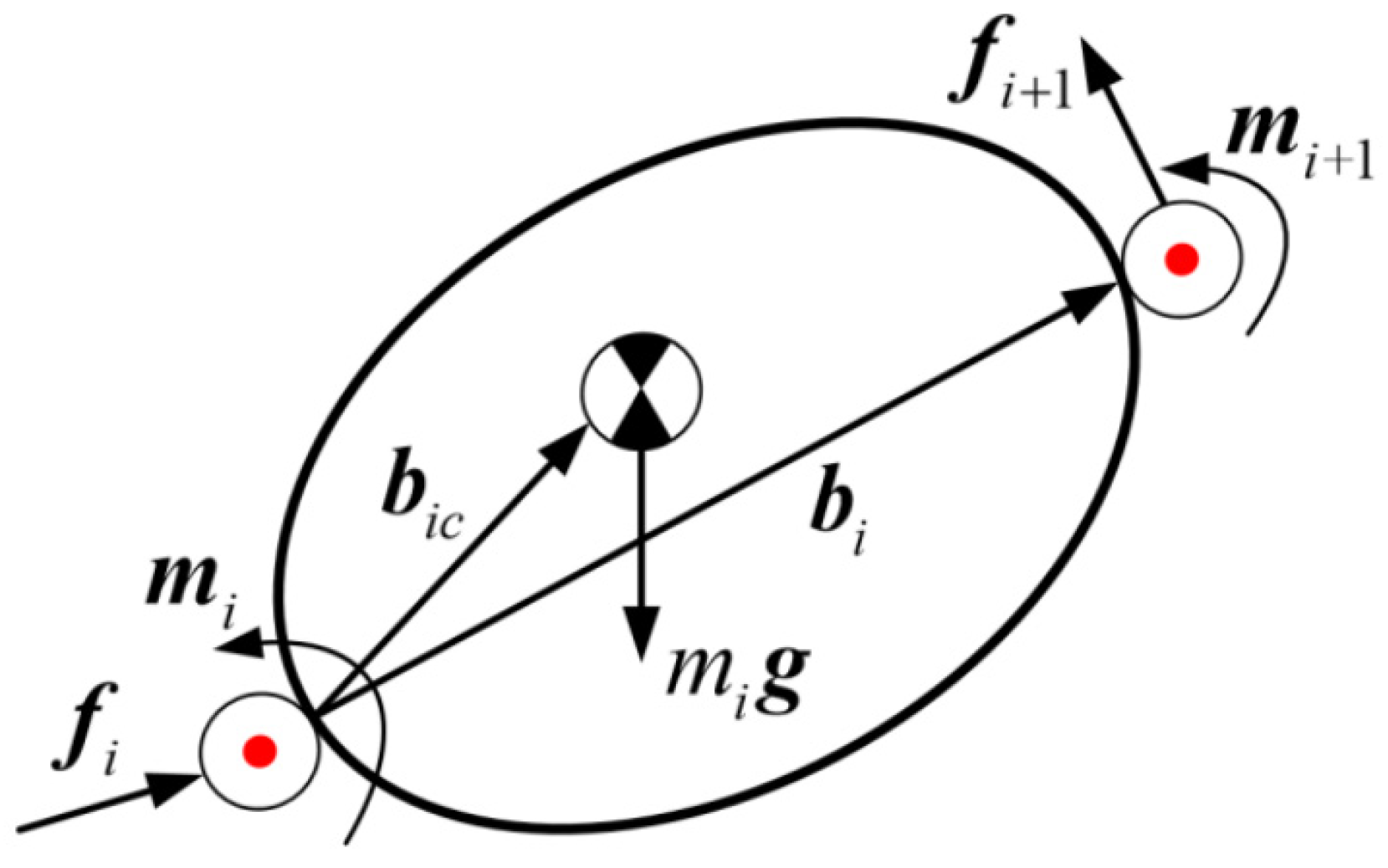
The kinematic relationship described above provides the mapping from joint-space motion to task-space motion. In contrast, the Newton–Euler method is used here for dynamic modeling, because it establishes the relationship between link inertial properties, joint motion, external loads, and the constraint forces or torques transmitted between adjacent links. Related studies have also used robot dynamic modeling and parameter identification to improve the accuracy of articulated robot models [33]. The force relationships between adjacent links of the robotic arm are illustrated in Figure 5.
The backward iteration equation for the constraint forces and constraint torques at each joint of the robotic arm is:
ω i = M i t ˙ i + B i + H i + 1 i ω i + 1
where ω i includes the joint constraint force vector f i and constraint torque vector m i at the joint, ω i represented in the base coordinate system {O} as follows:
w i = [ f i T m i T ] = [ f i x f i y f i z m i x m i y m i z ] T
M i is the generalized mass matrix of the connecting rod:
M i = [ m i E m i b ~ i c T m i b ~ i c I i ]
In the equation: m i is the mass of link, b ~ i c is the vector representing the center of mass of link, E is the identity matrix, I i is the representation of the moment of inertia matrix of link i relative to the rotation axis of joint i in the base index system {O}.
t ˙ i is the linear acceleration vector and angular acceleration vector of the joint:
t ˙ i = [ a i g α i ]
B i represents the cross-term matrix involving centripetal force and gyroscopic torque:
B i = [ m i ω i × ( ω i × b i c ) ω i × ( I i ω i ) ]
H i + 1 i represents the transformation matrix for forces and moments between joint i+1 and joint i, expressed as follows:
H i + 1 i = [ 1 0 b ~ i 1 ]
In the formula: b ~ i is the antisymmetric matrix of b i . The transformation matrix H i + 1 i describes the configuration of a robotic arm, meaning that for a given robotic arm, this matrix is solely influenced by the dimensions of its individual links.
The constraint forces/moments at each joint are calculated through backward iteration using Equation (4). This method is initiated by calculating from the end-effector of the robotic arm, numbered n + 1, backward to the last joint of the robotic arm, numbered n, until reaching joint 1 of the robotic arm.

3.3. Connection Between Dynamic Loads and Stiffness-Oriented Deformation

The dynamic model provides the joint force and torque information required for evaluating load-induced deformation. In the following stiffness analysis, the external wrench acting on the end-effector and the configuration-dependent Jacobian are used to estimate the deformation of the end-effector under operational loads. Therefore, the kinematic model defines the motion and configuration of the manipulator, the dynamic model provides the load transmission relationship, and the stiffness model further maps the load-induced joint deformation to Cartesian deformation at the nozzle.

4. Dexterity-Oriented Station Planning

With the kinematic and dynamic models established in Section 3, this section addresses the first core challenge identified in Section 2.3: optimizing kinematic dexterity through strategic station planning. To systematically evaluate and compare candidate stations, a quantitative performance metric is essential. Unlike point-wise metrics that assess manipulator capability at isolated configurations, the station planning problem requires trajectory-level evaluation that captures the manipulator’s performance consistency across the entire task path. Therefore, a dexterity metric is formulated to quantify and compare the manipulator’s motion capability throughout the operational trajectory for different station configurations.

4.1. Dexterity Metrics

In the 3DCP task, the outlet of the 3D printing unit for concrete is always vertically downward. When the printing motion is performed on the same slice, the motion process only involves a translational motion in the operation space (e.g., the toothed trajectory in the middle of the wall in Figure 4), and there is no rotational motion, so the magnitude of the angular velocity at the end of the nozzle during the printing process is 0. And when printing between different slices, that is, when the printing of one layer is finished, the nozzle needs to be lifted vertically, and at this time, the motion involved is only the rise in the Z-axis direction, without translational or rotational motion in the other directions.

4.1.1. Manipulability Index

Following the description of the nozzle’s trajectory during the printing process, an analysis of the dexterity is conducted. Dexterity metrics are utilized to assess the motion of the robotic arm at varying positions, a critical component in construction tasks that necessitate adapting to complex paths while maintaining a high level of manipulability. A number of standardized methodologies are routinely employed for the purpose of evaluating dexterity. These encompass condition numbers, isotropy metrics, minimum singular values, and Manipulability metrics. Among the available metrics, the one proposed by Yoshikawa is arguably the most classic, defining an ellipsoid of Manipulability. The transformation of ellipsoid maps involves the conversion of unit velocity sphere ( θ ˙   R n ) in joint space to Cartesian velocity space. The mapping relation is determined by the Jacobi matrix, denoted J ( q ) R m × n of the robotic arm. Yoshikawa’s definition of the determinant of the product of a Jacobian matrix and its transpose is as follows:
ω = det ( J ( θ ) J T ( θ ) ) = λ 1 λ 2 λ m = σ 1 σ 2 σ m
where ω represents the manipulability index, whose physical meaning is a comprehensive measure of the robotic arm’s motion capability in all directions, serving as an indicator of its overall flexibility; λ i represents the eigenvalues of matrix J ( θ ) J T ( θ ) , where λ 1 λ 2 λ m ; σ i represents the singular values of the Jacobian matrix J ( θ ) .
In the field of manipulability, Yoshikawa’s seminal contributions include the formulation of the manipulability ellipsoid. This development represents a significant advancement in the theoretical framework of manipulability, building upon its existing definition. This ellipsoid provides a clearer and more intuitive geometric representation of the robotic arm’s motion flexibility. The definition of the joint velocity of the robotic arm is given as a unit sphere, as follows:
x ˙   T ( J ( θ ) J T ( θ ) ) 1   x ˙ = 1
where x ˙ R m is the Cartesian velocity vector of the end-effector. This ellipsoid provides a generalized, isotropic metric for evaluating the overall kinematics of the robotic arm.

4.1.2. Velocity Direction Manipulability (VDM)

However, this generalized metric is not optimal for path-following type tasks. Unlike the conventional manipulability index, which evaluates the overall velocity capability in Cartesian space, the VDM metric focuses on the velocity transmission capability along the local direction of the printing trajectory. This distinction is important for robotic 3D concrete printing because the nozzle is not required to move freely in all Cartesian directions. Instead, it must follow a prescribed path with a specific local tangent direction at each trajectory point. Therefore, a task-directional metric is more suitable than a general isotropic manipulability index for evaluating station quality in this path-following task. A more relevant assessment is to consider the ability of the robotic arm to generate velocity along a specific task direction. We define this particular task direction as the unit vector, p     R m . To quantify this ability, we model the velocity of the end-effector as a scalar velocity magnitude, along that particular direction p : the Velocity Direction Manipulability of the end-effector, β .
During the 3DCP process, the concrete 3D printing unit’s nozzle remains in a vertical downward position. The operation is confined to translational motion within the operational space, with no rotational movement. Therefore, it can be concluded that the angular velocity at the end-effector of the concrete 3D printing unit is equal to zero. The unit direction vector of the end-effector’s linear velocity corresponding to each task point can be calculated from the coordinates of the adjacent along the trajectory in the wall coordinate system {W} and converted into the robot arm base coordinate system {O} as follows:
(1)
When the adjacents of the running trajectory are at the same height:
p v O = R z w p v w = [ R z ( θ ) O W ] [ ( x i + 1 x i ) ( y i + 1 y i ) o ] T ( x i + 1 x i ) 2 + ( y i + 1 y i ) 2
(2)
When the adjacents of the travel path are not at the same height, this indicates the completion of printing a specific layer. Subsequently, the concrete 3D printing unit ascends vertically to initiate the printing of the subsequent layer.
p v O = [ 0 0 1 ] T
The movement velocity at the end of the concrete 3D printing unit is:
  x ˙   =   β     p
where p = [ p v T o p ω T o ] T R 6 × 1 is the velocity direction at the end of the concrete 3D printing unit, p v T o is obtained via Equation (12) or Equation (13), p ω T o is [ 0 0 0 ] ; β is the linear velocity magnitude at the end of the run direction p for concrete 3D-printed units.
Substituting Equation (11) into Equation (14) yields:
β = [ p T ( J ( q ) J ( q ) T ) 1 p ] 1 2
We define this β as our core dexterity metric, Velocity Direction Manipulability (VDM). VDM represents the maximum velocity amplitude achievable by the end-effector in the p-direction per unit of joint velocity, and is computed using the formula:
To account for the physical limits of each joint, we normalize the joint velocities, leading to the normalized VDM ( β norm ):
β norm   =   ( p T [ ( J ( q ) W ) ( J ( q ) W ) T ] 1 p ) 1 2
where W   =   diag ( q ˙ 1 ,   max , , q ˙ n ,   max ) is a diagonal matrix of the maximum permissible joint velocities. This normalized metric provides a dimensionless and physically meaningful measure of the velocity transmission efficiency in the task direction.

4.2. Trajectory-Level Dexterity Optimization Framework

The term “trajectory-level” means that the station is not evaluated only at a single task point. Instead, the VDM value is calculated at all sampled points along the complete printing trajectory, and the minimum value is used to represent the worst-case motion capability of the candidate station. This max-min strategy is adopted because a local dexterity bottleneck may cause unstable velocity transmission even if the average dexterity along the path is acceptable. Therefore, the proposed trajectory-level VDM index evaluates not only the directional motion capability, but also the consistency of this capability over the entire printing path. We define the global trajectory-level dexterity index, J dex , as the minimum VDM value over all points on the trajectory T :
J dex ( P M W , T )   =   min s T β norm ( s )
This index quantifies the worst-case kinematic performance for a given station P M W . Consequently, the optimization problem for dexterity enhancement is formulated as finding the optimal station P M * W that maximizes this minimum dexterity value:
P M * W   =   arg max P M W ( J dex ( P M W , T ) )   =   arg max P M W ( min s T β norm ( s ) )
This max-min formulation directly targets the improvement of the performance bottleneck, ensuring a more uniform and robust capability throughout the task execution. The optimization is subject to two primary constraints:
(1)
Placement Space Constraint: The station P M W must lie within a predefined feasible area, determined by the system’s physical limits and workspace geometry.
(2)
Task Reachability Constraint: For a given P M W , a valid inverse kinematic solution must exist for every point on the trajectory T.

4.3. Dexterity Performance Analysis and Validation

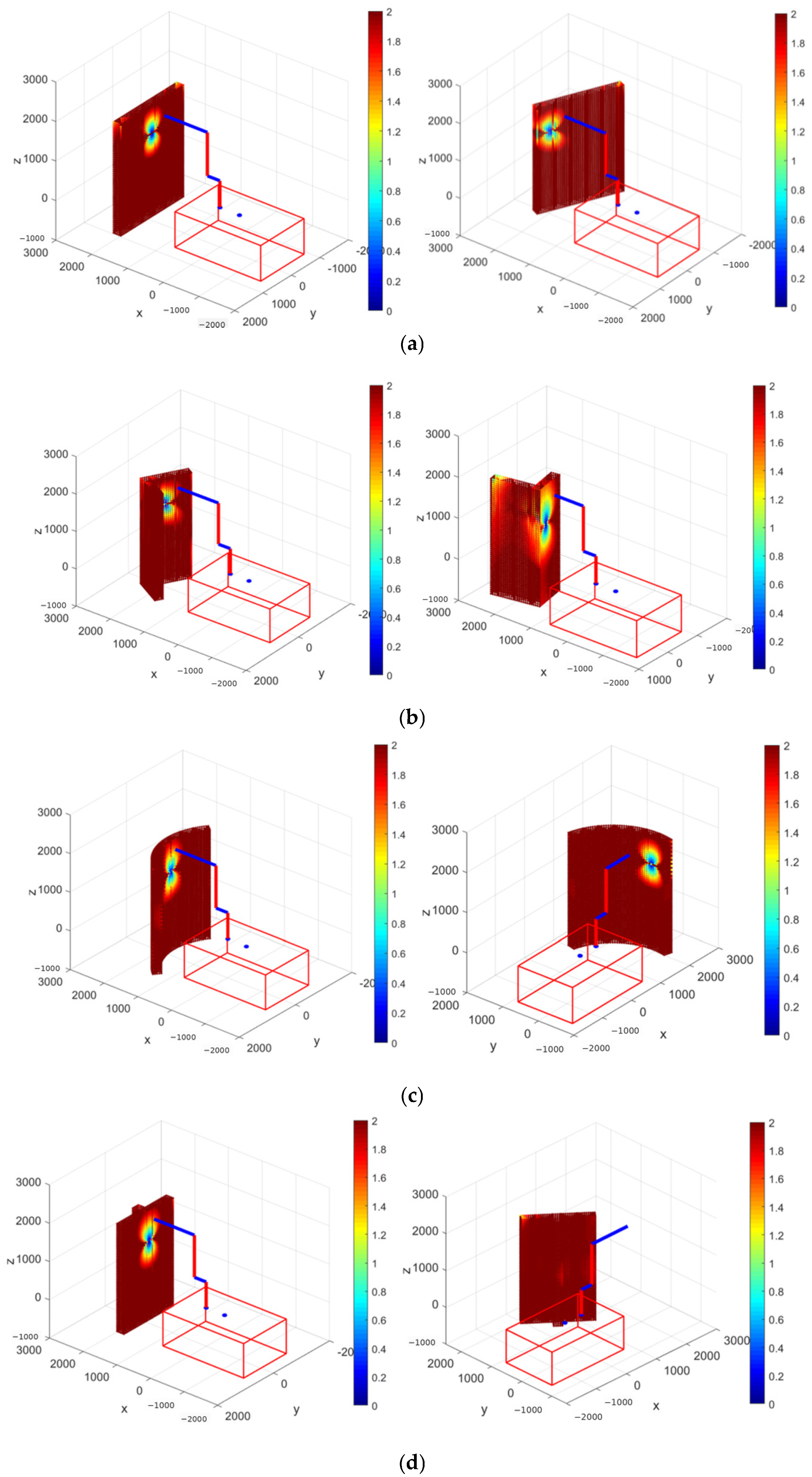
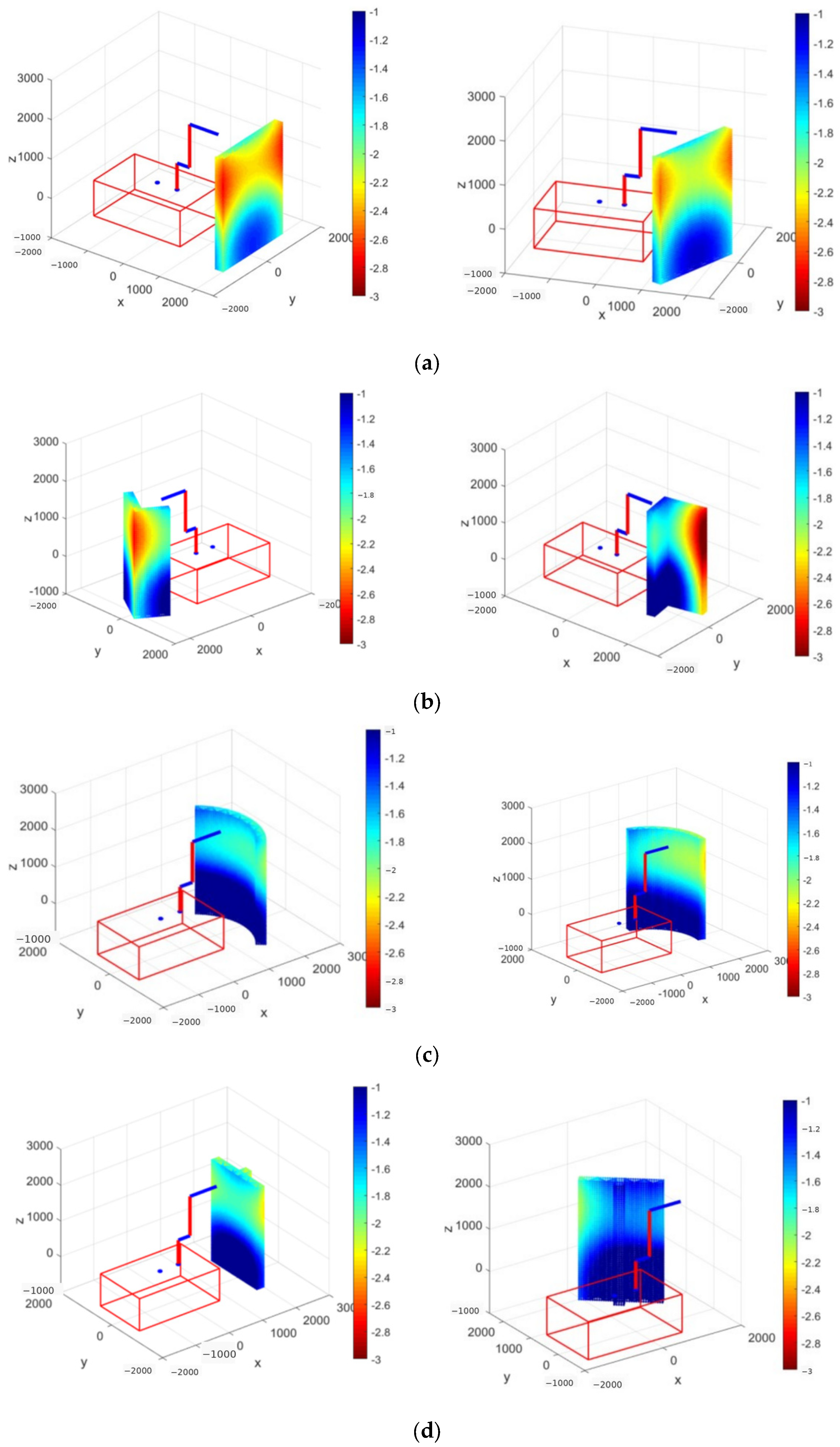
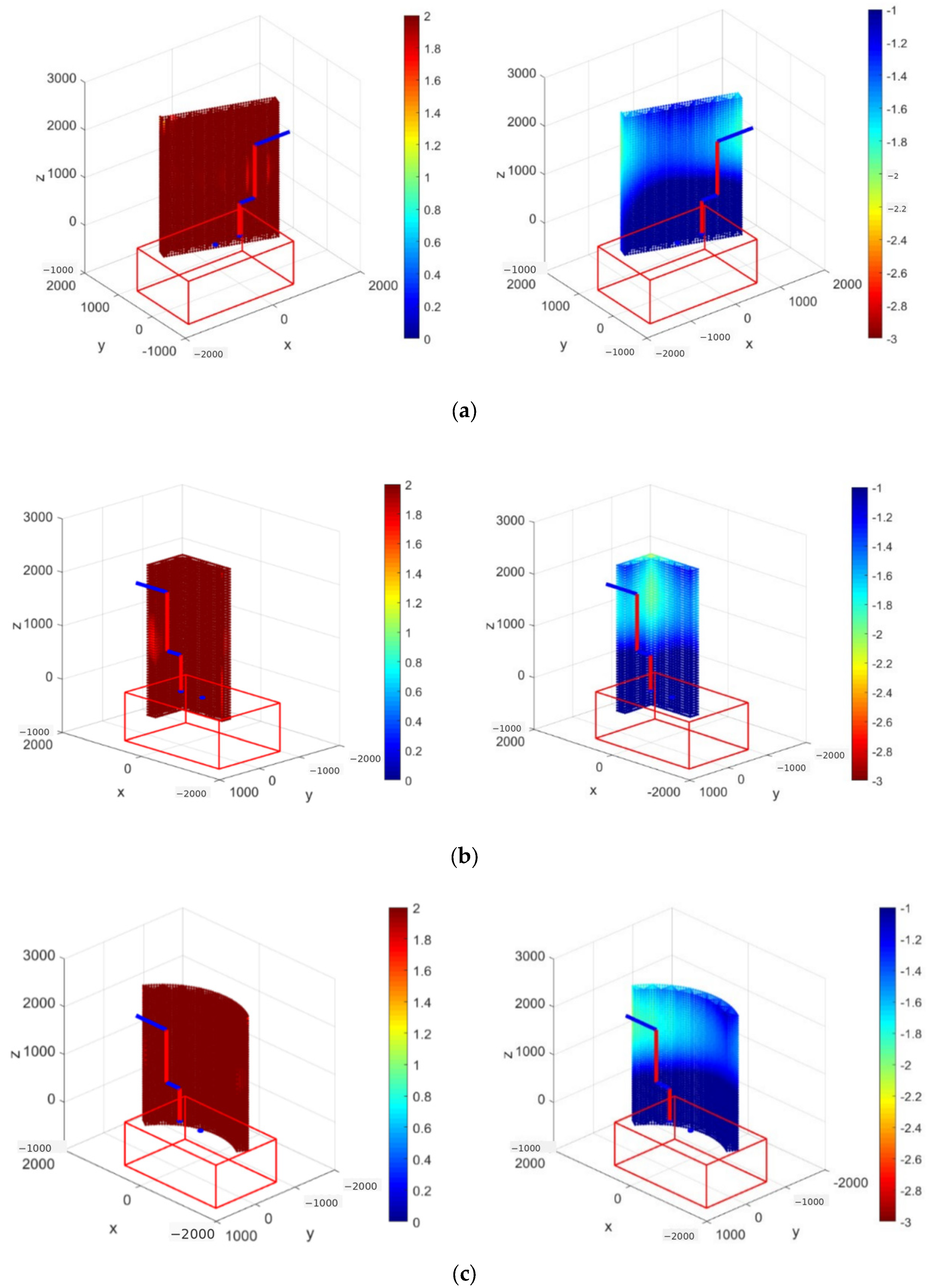
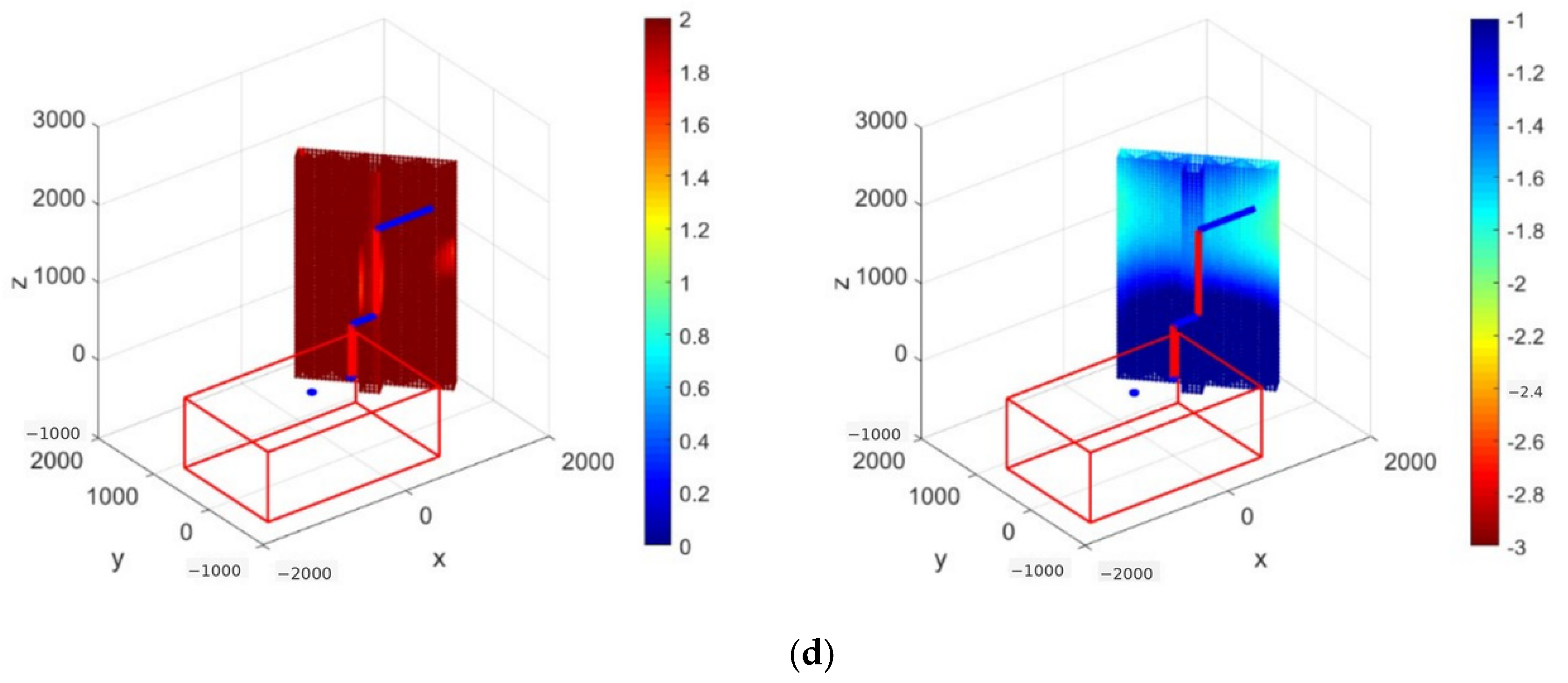
To demonstrate the efficacy of the proposed metric and framework, we conducted case studies on various wall types. For each wall type, we compared the VDM distribution for two chosen station stations. The results are visualized as color maps on the wall geometry (Figure 6). In these visualizations, the color spectrum corresponds to the VDM value, where blue indicates poor dexterity (values approaching zero, indicating proximity to a singularity) and red signifies high dexterity (excellent velocity transmission). The results clearly show that the station pose has a significant impact on the dexterity distribution. Regions with low VDM values (colored blue) are consistently observed where the manipulator is forced into near-singular configurations.
As shown in the results, the low-VDM regions are consistently observed when the manipulator must fully extend to reach the far corners of the trajectory. In these configurations, the arm approaches an elbow singularity, causing the Jacobian to become ill-conditioned and the velocity transmission capability to drop significantly.
Table 1 summarizes the minimum VDM values and the corresponding joint velocities at the point of minimum VDM for poor and optimized stations across the four representative wall types.
It should be noted that some joint velocity values for poor stations are extremely large and exceed the practical velocity limits of industrial manipulators. These values are not intended to represent executable robot commands. They are theoretical velocity demands obtained under near-singular configurations, where the Jacobian matrix becomes ill-conditioned and the required end-effector motion is strongly amplified in joint space. Therefore, the large velocity values indicate that the corresponding station is unsuitable for actual operation. In contrast, the optimized stations avoid these near-singular configurations and produce much smaller joint velocity demands.

4.4. Dexterity Optimization Using Genetic Algorithm

The dexterity-oriented station planning problem considered here is difficult to solve by closed-form or gradient-based methods. The objective is defined by the minimum performance value along the whole trajectory, and its evaluation further depends on task reachability over all trajectory points. As a result, the search space is highly nonlinear and non-convex, and the fitness landscape may contain multiple local optima. In addition, the feasibility of a candidate station is constrained by inverse kinematics and workspace limitations, which makes the problem less suitable for direct analytical optimization. For these reasons, a genetic algorithm is adopted in this study as a practical global search method for station planning. Unlike the conventional methods like NSGA-II which is commonly used when the objective is to obtain a Pareto front for multiple conflicting objectives. In this study, however, the two performance objectives are normalized and combined through weighted scalarization to determine a single final station for each wall segment. Therefore, a standard genetic algorithm is adopted as a practical global search method for the resulting scalar constrained optimization problem.
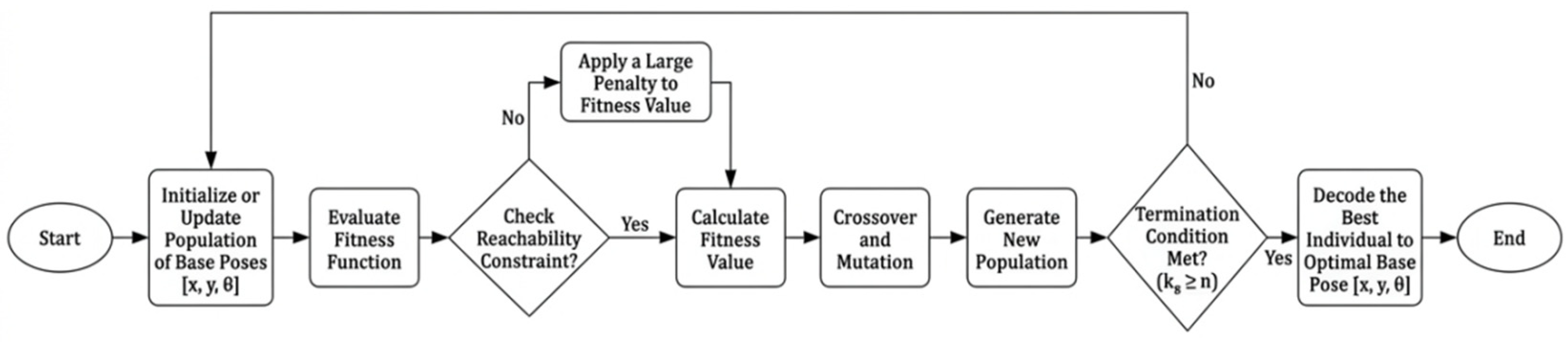
The specific workflow of the GA implemented in this study is illustrated in Figure 7.
All simulations and optimization procedures were performed on a computer equipped with an Intel Core i7-12700H CPU, 16 GB RAM, and Windows 11. The kinematic calculation, stiffness evaluation, and genetic-algorithm-based optimization were implemented in MATLAB R2022b. The geometric model and robot-related parameters were obtained from SolidWorks 2022.
In this study, the genetic algorithm is used as a global search tool rather than as a methodological novelty. Each individual in the population represents a candidate station configuration of the mobile platform, including its planar position and orientation. During fitness evaluation, each candidate station is first checked against the reachability constraint. If any point on the printing trajectory is unreachable, the fitness evaluation for this candidate station is terminated and a large penalty value is assigned, so that the infeasible individual is unlikely to be selected in subsequent generations. For feasible candidates, the fitness value is calculated from the corresponding trajectory-level performance index.
The main parameters of the genetic algorithm were set as follows. The population size was set to 25. The stochastic uniform selection function was used for parent selection. The elite count strategy was adopted to preserve individuals with the best fitness for the next generation. The crossover probability was set to 0.8. Gaussian mutation was used, and the scale parameter was set to 1. The maximum number of generations was set to 200. The algorithm terminates when the maximum generation number is reached, and the individual with the best fitness is decoded as the optimized station.
These settings were used for the dexterity-oriented, stiffness-oriented, and integrated station optimization procedures. The novelty of this work does not lie in the genetic algorithm itself, but in the use of trajectory-level directional dexterity and stiffness-oriented deformation metrics for station planning in robotic 3D concrete printing. The genetic algorithm is adopted because the search space is nonlinear and constrained, and because the objective evaluation involves reachability checking and trajectory-level performance calculation over all sampled path points.
The computational cost of the proposed optimization framework is mainly determined by the number of candidate stations, the number of sampled trajectory points, and the cost of inverse kinematic, dexterity, and stiffness evaluations at each point. For each candidate station, all trajectory points must be checked for reachability and evaluated for the corresponding performance indices. Therefore, the method can be extended to longer or more complex paths, but the computational cost increases with the number of sampled path points and the number of genetic-algorithm fitness evaluations. In practical implementation, the trajectory sampling density can be adjusted according to the required accuracy and available computational resources.
Regarding convergence, the genetic algorithm was terminated when the maximum number of generations was reached. During the optimization process, the best fitness value generally decreases rapidly in the early generations and then gradually stabilizes, indicating that the population approaches a stable solution. Because the genetic algorithm is a stochastic global search method, it does not provide a strict analytical convergence guarantee. However, it is suitable for the present problem because the objective function is nonlinear, constrained, and evaluated through trajectory-level reachability and performance calculations.
min P M W ( J dex ( P M W , T ) ) = min P M W (   min s     T   β norm ( s ) )
Following evaluation, a New Population is created using genetic operators. Parents are selected based on their fitness (Selection), and offspring are generated through Crossover and Mutation. A crossover fraction of 0.8 and a Gaussian mutation function are employed. This iterative process continues until a termination criterion is met, such as reaching the maximum of 200 generations. The individual with the best-found fitness is then decoded to yield the optimal station P M * W .
By applying the GA-based optimization defined in Equation (19), we identified the optimal station for each wall type (Table 2). The results (Figure 6) show a significant improvement: the optimized placements yield a dexterity distribution that is not only much higher on average but also more uniform, with the minimal VDM values across the entire trajectory being substantially increased (Table 2). Our results show that the max-min approach optimizes velocity transmission and avoids singularities during tasks.
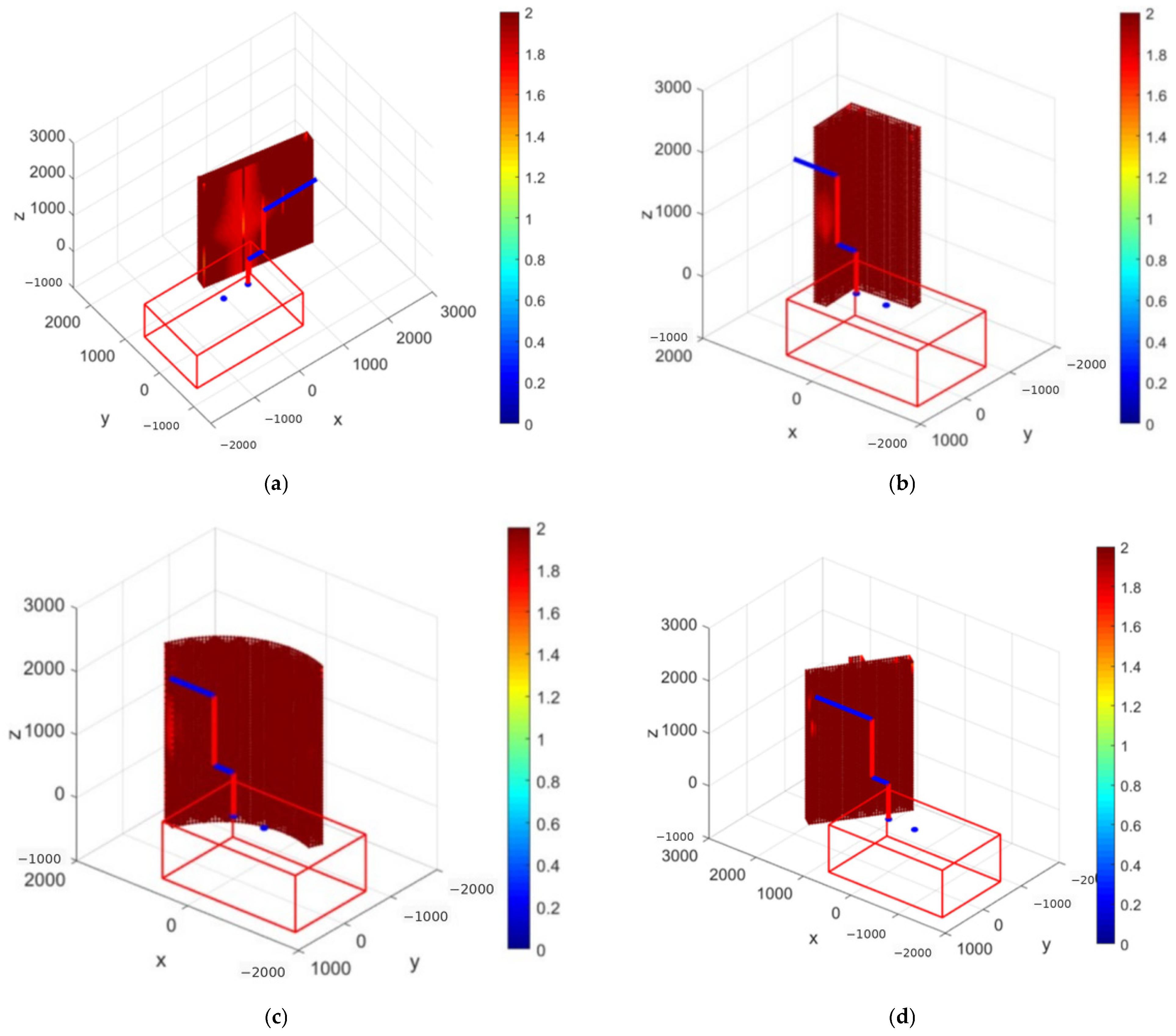
The results (Figure 8) show a significant improvement: the optimized stations yield a dexterity distribution that is not only much higher on average but also more uniform. The visualizations for the optimized poses show that the majority of the task space is colored red, indicating a consistently high Velocity Directional Manipulability across the entire trajectory. This confirms that our task-oriented, max-min optimization framework effectively leads to better performance in the overall velocity transmission efficiency and robustly avoids kinematic singularities during task execution.

5. Stiffness-Oriented Station Planning

While dexterity ensures smooth motion, stiffness is equally vital for accuracy under load. In precision robot applications like 3D concrete printing, the static stiffness of the robot arm under load significantly impacts the geometric accuracy of the final part. This influence parallels the importance of Z-axis dexterity in 3DCP. Z-axis compliance can result in incremental layer height discrepancies, potentially compromising the structural integrity of the end product. Therefore, assessing stiffness for specific tasks is not only advantageous but imperative for the viability of this manufacturing technology. This section introduces a task-specific framework for evaluating robotic arm stiffness and optimizing its station to minimize maximum end effector deformation.

5.1. Task-Oriented Stiffness Performance Metrics

The stiffness of an industrial robot quantifies the resistance of its end-effector to elastic deformation when subjected to an external wrench. The foundational principle for this analysis is the mapping between the manipulator’s joint-space stiffness and its Cartesian-space stiffness. Assuming the manipulator’s compliance is dominated by its joints, the relationship between the Cartesian stiffness matrix, K x , and the joint stiffness matrix, K q , is established via the Jacobian matrix J   ( q ) :
K x   =   J T ( q ) K q J 1 ( q )
This equation formally demonstrates that the manipulator’s task-space stiffness is highly dependent on its configuration. Therefore, actively modifying the operational configurations by adjusting the station is an effective strategy for optimizing stiffness performance. In 3DCP, the primary loads—comprising the gravitational force of the end-effector and extruded material, as well as the dynamic forces from material extrusion—act predominantly in the vertical (Z-axis) direction. The deformation along the Z-axis is the most critical factor as it directly compromises the printed layer height, leading to cumulative geometric errors and potential structural failure. For this reason, we define the End-Effector Deformation along the Z-axis ( δ z ) as our core stiffness performance metric. It is calculated as the Z-component of the end-effector’s displacement vector ΔX.
In this study, the external load acting on the end-effector is treated as a wrench applied at the nozzle. It includes three force components and three moment components. The force components are expressed in Newtons, and the moment components are expressed in Newton-meters. This load represents the combined effect of the end-effector weight, the fresh concrete-related load, and the extrusion-related process load. Based on the configuration-dependent Jacobian and the joint stiffness model, the load-induced joint deformation is mapped to the Cartesian deformation of the end-effector, and the Z-axis component is used as the stiffness-related deformation index.
Before determining ΔX, it must be clarified that the constraint forces and torques acting on each joint are caused not only by the end-effector forces and torques, but also by the masses of the robotic arm’s linkages and the angular velocities and accelerations of each joint. Throughout this project, the robotic arm operates dynamically during 3D printing tasks, meaning that each joint possesses angular velocity and acceleration. As previously discussed, following the optimization of the mobile platform’s positioning based on velocity direction manipulability metrics, the angular velocities of all the joints in the robotic arm remain small and stable within defined ranges. Consequently, the angular accelerations at these joints can be considered negligible. In this project, therefore, the constraint forces/moments acting on each joint are induced by the link configuration, the end-effector force/moment, the mass of each robotic arm link and the angular velocity of each joint. The relationship between the driving force at each robotic arm joint and joint deformation is as follows:
τ = K q Δ q
where Δ q denotes the additional angular displacement of the joint resulting from the driving torque, τ, which arises from the masses of the robotic arm’s linkages and the end-effector load, as well as the velocities and accelerations of each joint. τ , solve using the robotic arm model established in Section 3.
Subsequently, from the differential relation, we obtain:
Δ X = J ( q ) Δ q
The determination of the generalized displacement ΔX at the end-effector of the robotic arm can be achieved through the integration of the aforementioned equations.
Δ X   = J ( q )   K q 1   J T ( q )   τ
δ z = [ 0 , 0 , 1 , 0 , 0 , 0 ] Δ X
A smaller magnitude of δ z indicates a higher resistance to the primary operational loads and, consequently, better stiffness performance for this specific task.

5.2. Trajectory-Level Stiffness Optimization Framework

To ensure geometric accuracy over the entire printing process, we again employ a “min-max” optimization strategy. For any given station P M W , we first evaluate the Z-axis deformation at all points along the printing trajectory T and identify the maximum value. This maximum deformation represents the worst-case stiffness performance for that particular station.
We define the trajectory-level stiffness index, J s t i f f , as the maximum absolute Z-axis deformation over the trajectory T:
J stiff ( P M W , T )   =   max s T   | δ z ( s ) |
where s is a point on the trajectory. This index quantifies the worst-case geometric error attributable to manipulator compliance for a given station P M W .
In this study, the signed Z-axis deformation indicates the direction of end-effector displacement along the vertical axis. However, for station optimization and quantitative comparison, the absolute value of the Z-axis deformation is used because the magnitude of deviation from the desired nozzle position determines the stiffness-related printing error. Therefore, the trajectory-level stiffness index is defined as the maximum absolute Z-axis deformation along the complete printing trajectory.
The stiffness-oriented station planning problem is thus formulated as finding the optimal station, P b * , that minimizes this worst-case deformation:
P M * W   =   arg min P M W J stiff ( P M W , T )   =   arg min P M W ( max s T | δ z ( s ) | )
As with the dexterity optimization, this problem is subject to station space constraints and task reachability constraints. By directly targeting the stiffness bottleneck, this min-max formulation ensures a more uniform and robust geometric accuracy throughout the entire printing task.

5.3. Stiffness Performance Analysis and Validation

To validate the proposed stiffness metric and optimization framework, case studies were conducted on the four representative wall geometries. For each wall type, two distinct initial stations were selected, and the end-effector’s Z-axis deformation was computed for all points along the corresponding print trajectory.
The results are visualized as color maps superimposed on the wall geometry in Figure 9. These visualizations clearly demonstrate the significant influence of the station on the stiffness distribution across the task space. Regions of low stiffness (indicated by larger deformations and colors shifting towards red) are consistently observed, particularly when the manipulator must extend toward the periphery of its workspace. These configurations correspond to poses where the gravitational and process loads exert a larger moment about the base and key joints, thus amplifying deflection.
Table 3 provides a quantitative comparison, detailing the maximum deformation value for each pose. The data confirms that a well-chosen station can substantially reduce the maximum deformation experienced during the task, thereby confining potential geometric errors to a much smaller range.
The deformation distributions in Figure 9 are plotted using signed Z-axis deformation values, where the sign indicates the direction of end-effector displacement. In contrast, the values reported in Table 3 correspond to the maximum absolute deformation along the trajectory, because the magnitude of deviation from the desired nozzle position is the key factor affecting printing accuracy.

5.4. Stiffness Optimization Using Genetic Algorithm

The stiffness-oriented station planning problem has similar computational characteristics. The optimization objective is defined by the maximum deformation over the full trajectory, and the evaluation of each candidate station requires repeated kinematic and stiffness analysis under reachability constraints. This leads to a nonlinear constrained optimization problem with no straightforward analytical solution. Therefore, the same genetic algorithm framework is used here to search for the station that minimizes the worst-case deformation while maintaining task feasibility.
While the overall GA workflow remains the same (as illustrated in Figure 7), the core of its application to the stiffness problem lies in the definition of the fitness function. Here, the objective is to minimize the worst-case end-effector deformation. Therefore, the fitness of each candidate station P M W is directly defined by the trajectory-level stiffness index, J stiff :
Fitness ( P M W )   =   J stiff ( P M W , T )   =   max s     T | δ z ( s ) |
As before, the Task Reachability Constraint is strictly enforced during the evaluation of each individual. Any pose that fails to provide a valid inverse kinematic solution for the entire trajectory T is assigned a large penalty to its fitness value, effectively removing it from the selection pool for subsequent generations. The algorithm then proceeds through the iterative steps of selection, crossover, and mutation as detailed in Section 4.4, progressively evolving the population toward solutions with lower maximum deformation.
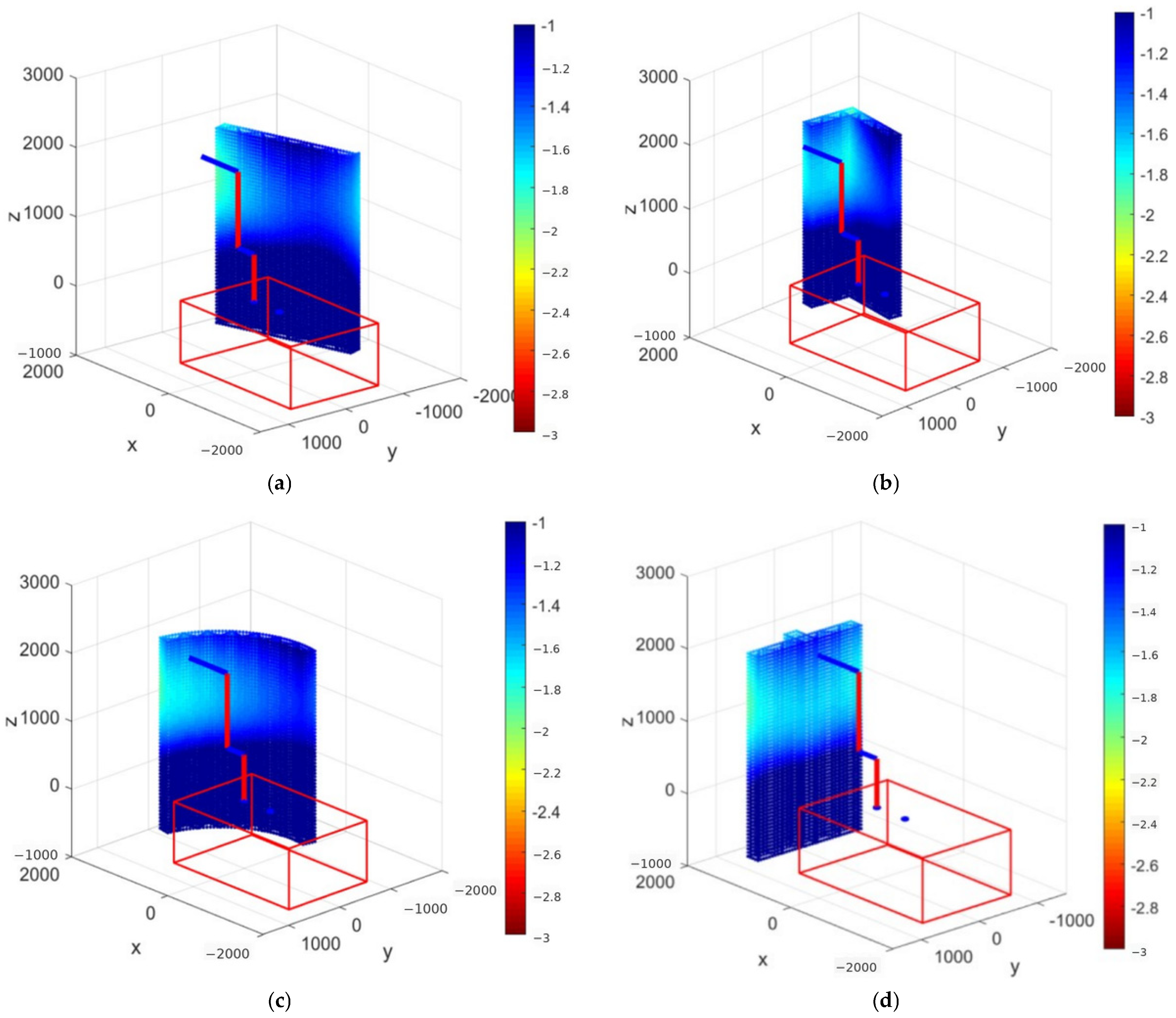
Upon meeting the termination criterion, the GA yields the optimal station P M * W for a given wall type. The optimized poses and their corresponding performance improvements are presented in Table 4 and the corresponding figures for the optimized poses (end-effector) show a predominantly blue coloration across the wall surfaces (Figure 10), visually confirming that the maximum deformation has been significantly reduced and a high level of stiffness is maintained throughout the task. The results confirm that this task-oriented optimization framework successfully identifies stations that elevate the manipulator’s static stiffness performance, leading to a quantifiable improvement in potential geometric accuracy for the 3D printing task.

6. Integrated Optimization of Dexterity and Stiffness

In this study, the station planning problem considers two performance objectives: trajectory-level directional dexterity and stiffness-related deformation. To obtain a single executable station for each printing task, the two normalized objectives are combined using a weighted scalarization strategy.
While optimizing for dexterity (Section 4) or stiffness (Section 5) independently yields significant performance gains in their respective domains, a truly robust solution for 3DCP must consider both criteria simultaneously. A pose that offers excellent dexterity may be compromised by low stiffness, and vice versa. This section formulates an integrated optimization framework to find a single station that achieves this balance.

6.1. Formulation of the Unified Objective Function

Although the station planning problem considers two performance objectives, namely dexterity and stiffness, the final optimization is performed using a weighted scalarization strategy. Therefore, the purpose is not to generate a Pareto front, but to determine a single balanced station for each wall segment. To make the two objectives comparable, the trajectory-level dexterity index and stiffness-related deformation index are first normalized and then combined into a scalar objective function. The dexterity index J dex is already a dimensionless measure. The stiffness index J stiff , which represents deformation in mm, is normalized by dividing it by a maximum acceptable deformation, δ z , max . This yields a normalized stiffness cost, where a value of 1 corresponds to the maximum tolerable error.
With both metrics normalized, the Unified Objective Function, J u n i f i e d , for a given station P M W and trajectory T is defined as:
J unified ( P M W , T )   =   ω s ( J stiff ( P M W , T ) δ z , max ) ω d J dex ( P M W , T )
where
  • J dex ( P M W , T )   =   min   s T β norm ( s ) is the trajectory-level dexterity index (the minimum VDM).
  • J stiff ( P M W , T )   =   max s T   | δ z ( s ) | is the trajectory-level stiffness index (the maximum Z-axis deformation).
  • ω s   =   ω d are non-negative weighting coefficients that represent the relative importance of dexterity and stiffness, respectively, satisfying ω s + ω d   =   1 .
  • A negative sign is applied to the dexterity term because the overall goal is to minimize the unified objective function, and higher dexterity (a larger J dex ) is desirable.
The selection of the weighting factors ω s and ω d allows the framework to be adapted to specific task requirements. For general-purpose 3DCP, an equal weighting ( ω s   =   ω d ) provides a balanced starting point. But in tasks requiring high-velocity printing of simple geometries, dexterity might be prioritized ( ω s   <   ω d ). Conversely, for tasks demanding high geometric precision, stiffness would be more critical ( ω s   >   ω d ). The integrated optimization problem is thus to find the optimal station P M * W
P M * W = arg min P M W J unified ( P M W , T )

6.2. Integrated Optimization Using Genetic Algorithm

To solve the comprehensive optimization problem defined before, we again employ the Genetic Algorithm (GA) as detailed in the previous sections. The GA workflow remains identical to that shown in Figure 7. The only modification lies in the fitness function, which is now defined directly by the unified objective function J unified :
Fitness ( P M W )   =   J unified ( P M W , T )
The GA iteratively evolves a population of candidate poses, evaluating each individual against this new fitness criterion. In each generation, candidate stations that violate the placement space constraint or fail to satisfy the task reachability constraint are assigned a large penalty. Feasible individuals are evaluated using the weighted scalarized objective function. Selection, crossover, and mutation are then performed to generate the next population. Upon termination, the algorithm returns the station with the best scalarized performance, corresponding to a balanced combination of high trajectory-level dexterity and small stiffness-related deformation. The algorithm naturally seeks individuals (poses) that yield a low value for the fitness function, which corresponds to a favorable combination of high dexterity (large J dex ) and high stiffness (small J stiff ). The Task Reachability Constraint and Placement Space Constraints are enforced throughout the process as before. Upon termination, the algorithm returns the station P M * W that offers the best-found balance between kinematic efficiency and static stiffness for the entire task trajectory.

6.3. Analysis of Integrated Optimization Results

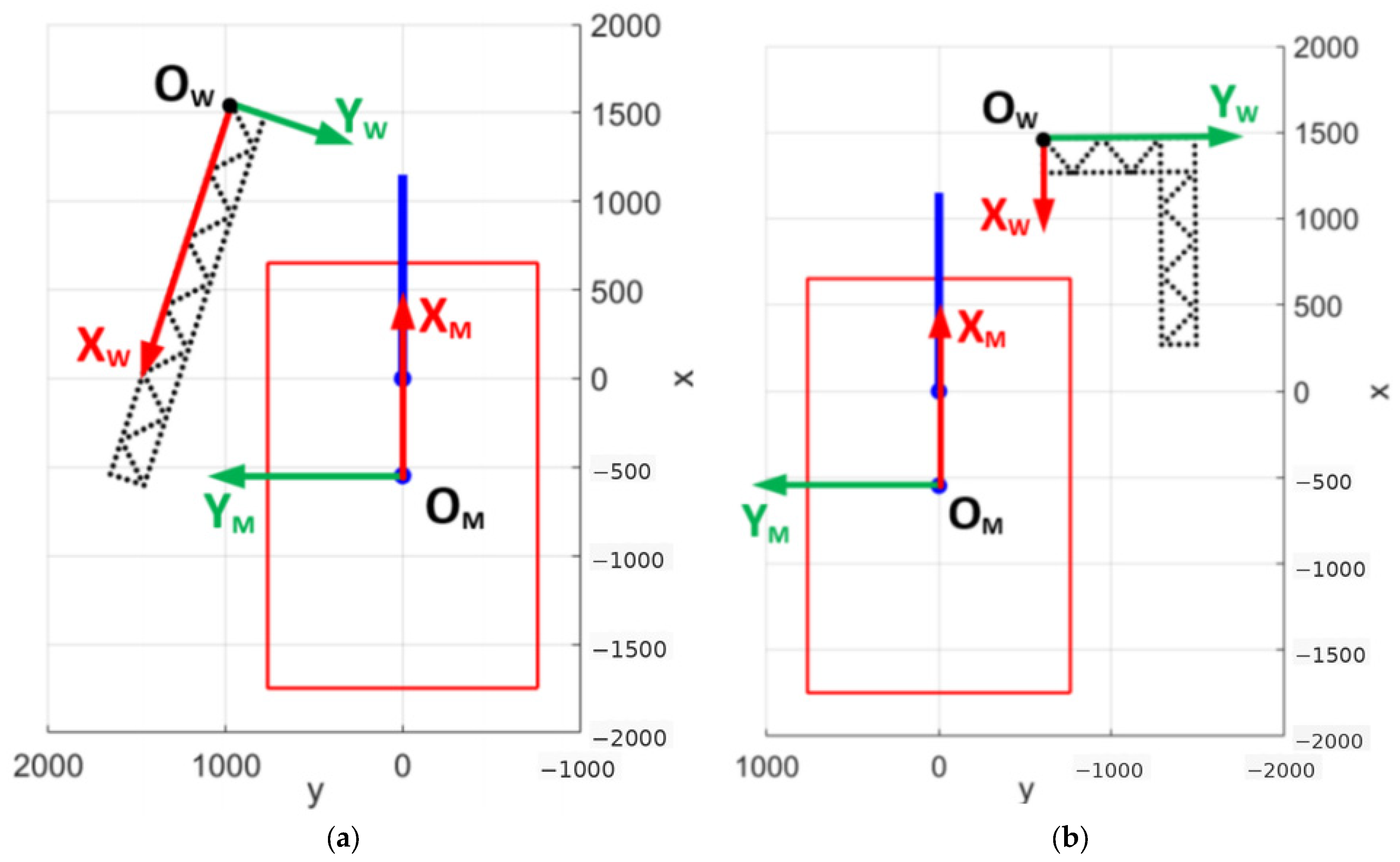
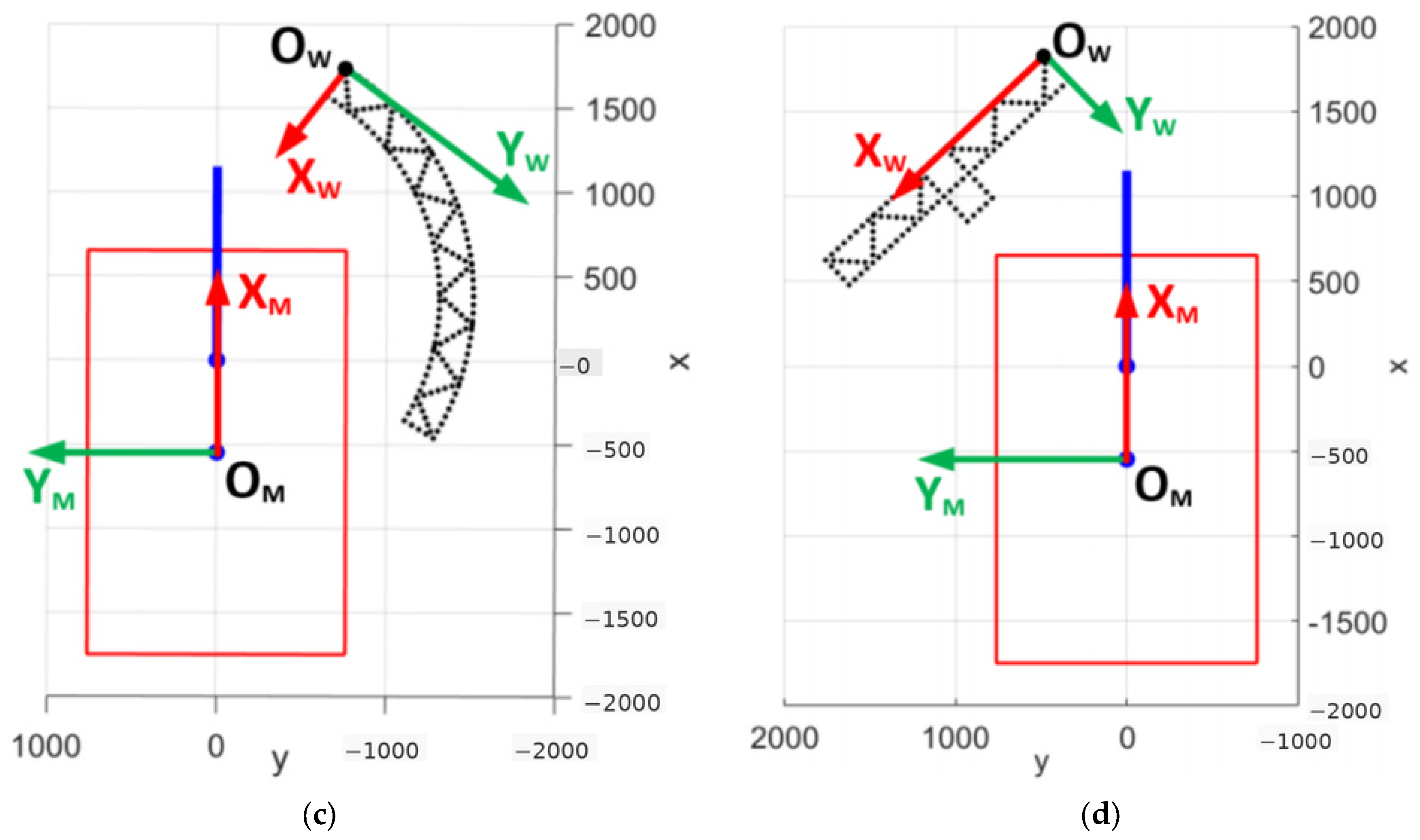
To validate the integrated optimization framework, the GA was applied to each of the four wall types with equal weighting ( ω s   =   ω d ). Figure 11 illustrates the final station of the mobile platform for each wall type relative to the task geometry.
A detailed performance breakdown for these integrated optimized poses is provided in Table 5, which lists the resulting minimum VDM and maximum deformation. These results can be compared with the outcomes of the single-objective optimizations in Section 3 and Section 4 to analyze the trade-offs made.
Furthermore, Figure 12 visualizes both the VDM and the deformation distributions for the final optimized poses. The dexterity plots (a) in these figures are predominantly red, while the stiffness plots (b) are predominantly blue. This visually confirms that a balanced performance—high dexterity and high stiffness—is achieved across the entire trajectory, demonstrating the effectiveness of the unified optimization approach.
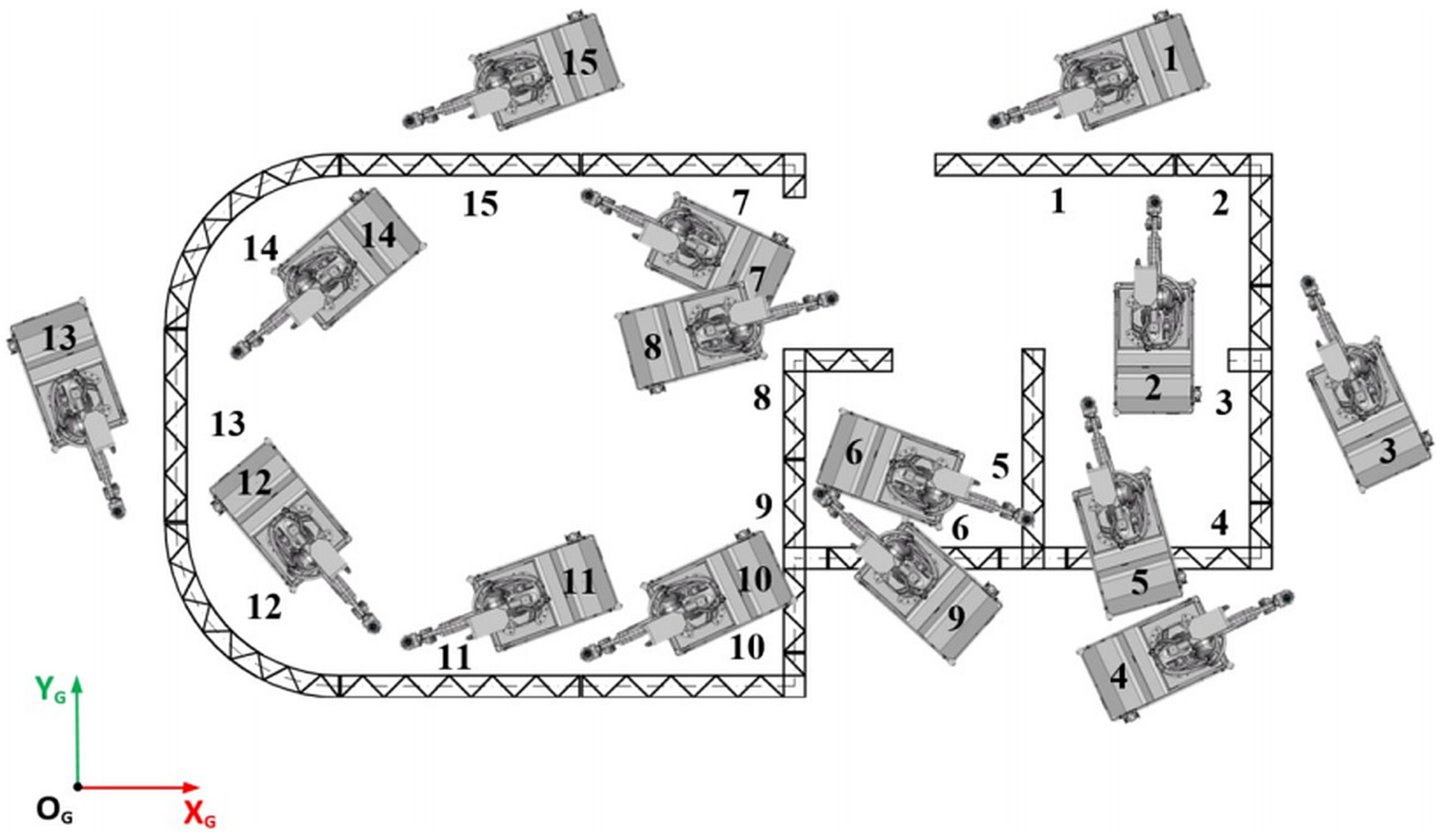
Finally, to demonstrate the applicability of the proposed framework to a complete construction task, the integrated optimization was performed for all 15 sub-walls of the example residential building. Figure 13 provides a holistic visualization of this result, illustrating the final optimized station for each individual wall segment. It is noted that while the figure shows all poses simultaneously, in practice, a task execution sequence must be determined to avoid collisions between the mobile platform and previously printed walls.

7. Discussion and Conclusions

7.1. Discussion

The results of this study show that station selection is an important factor affecting the performance of mobile manipulators in robotic 3D concrete printing. By evaluating station candidates from both dexterity and stiffness perspectives, the proposed framework provides a practical way to analyze the trade-off between motion capability and deformation-related accuracy over the entire printing trajectory.
The comparison results in Table 1, Table 2, Table 3, Table 4 and Table 5 indicate that optimizing only one criterion may improve one aspect of performance at the expense of the other. For example, a station obtained from dexterity-oriented optimization can provide a higher minimum VDM, but its stiffness performance may not be optimal. In contrast, the unified optimization framework yields a more balanced result. Although the dexterity value in the integrated solution is slightly lower than that of the dexterity-only optimum in some cases, the corresponding deformation is reduced to a level close to the stiffness-only optimum. This suggests that the proposed framework is able to identify station configurations that achieve a reasonable compromise between trajectory-level motion capability and deformation control.
From the viewpoint of 3D concrete printing, this balance is meaningful. Stable velocity transmission is important for maintaining process continuity and extrusion consistency, while reduced Z-axis deformation helps limit cumulative geometric error during layered deposition. Therefore, station planning should be regarded not only as a reachability issue, but also as a task-level decision closely related to process quality.
At the same time, the current study has several limitations. First, the analysis is mainly based on a quasi-static model and does not explicitly consider dynamic effects such as vibration, impact, or high-speed transient loading. Second, the compliance model is simplified by focusing mainly on joint-related effects, while other sources of deformation may also influence the printing result. Third, concrete material properties and extrusion parameters may affect the load acting on the nozzle. In particular, concrete density, consistency, and extrusion throughput influence the gravitational load of the deposited material and the process-related force at the nozzle. In the present study, these effects are represented by a fixed operational load condition to focus on the influence of station configuration on dexterity and stiffness. If the material density, consistency, or extrusion throughput changes significantly, the external load vector should be updated and the stiffness-related deformation should be recalculated. Therefore, the proposed framework can be extended to different material systems by calibrating the load parameters according to the actual printing process. Fourth, the effects of docking accuracy, wheel slip, ground unevenness, and tip-over stability are not explicitly included in the present optimization model. The current study focuses on the station planning problem after the mobile platform has reached the target station and is assumed to be statically positioned. Under this assumption, the dominant factors affecting the execution of the printing trajectory are the manipulator’s dexterity and stiffness at the selected station. In practical implementation, however, localization errors, docking deviations, wheel slip, ground unevenness, and tip-over stability may introduce additional positioning errors or feasibility constraints. These factors can be incorporated in future work by adding uncertainty margins, robust constraints, or error propagation models to the station planning framework. Fifth, the present model does not explicitly simulate the curing and buildability process of fresh concrete. In practical 3DCP, formwork, auxiliary support, setting speed, and chemical admixtures may influence the feasible printing constraints. For example, faster setting or appropriate admixtures may improve layer stability and allow higher printing speed, whereas insufficient setting may require lower nozzle speed or additional support. These factors mainly affect the admissible process parameters, operational load, and trajectory constraints. Although they do not change the mathematical structure of the proposed station planning framework, they should be incorporated through calibrated load and process constraints in practical implementation.
These limitations also indicate several directions for future work. It would be meaningful to extend the model by incorporating dynamic effects, to combine station planning with task sequencing and collision avoidance in larger construction scenarios, and to further validate the proposed framework through physical printing experiments.

7.2. Conclusions

This study proposed a station planning framework for a mobile manipulator in robotic 3D concrete printing by combining robotic modeling and task-oriented performance evaluation. The kinematic model was used to describe the relationship between station configuration, joint motion, and end-effector trajectory. The dynamic model provided the basis for analyzing load transmission during printing, while the stiffness formulation was used to estimate the deformation of the end-effector under operational loads. Based on these modeling components, a velocity directional manipulability metric and a maximum absolute Z-axis deformation metric were introduced to evaluate the motion capability and deformation-related accuracy of candidate stations.
A task-oriented dexterity metric was established using the minimum normalized velocity directional manipulability along the printing trajectory, and a stiffness-oriented metric was defined using the maximum Z-axis deformation under operational loads. Based on these two criteria, a unified objective function was constructed and solved using a genetic algorithm under reachability constraints.
The results on representative wall geometries show that the proposed method can improve trajectory-level motion performance and reduce end-effector deformation compared with non-optimized station placements. These results indicate that station planning should be treated as an important task-level optimization problem for mobile manipulators rather than only as a geometric placement issue.
Although the current framework is developed in the context of robotic 3D concrete printing, the underlying idea of integrating trajectory-level motion and stiffness criteria may also be useful in other trajectory-following robotic tasks where both reachability and execution quality need to be considered. Future work will focus on dynamic modeling, experimental validation, and the integration of station planning with higher-level task planning in more complex scenarios.

Author Contributions

Conceptualization, T.S.; methodology, Y.Z. and X.Y.; software, Y.Z.; validation, Y.Z. and X.Y.; formal analysis, Y.Z.; investigation, Y.Z.; resources, T.S. and S.G.; data curation, Y.Z.; writing—original draft preparation, Y.Z.; writing—review and editing, X.Y., S.G. and T.S.; visualization, Y.Z.; supervision, T.S. and S.G.; project administration, T.S.; funding acquisition, T.S. All authors have read and agreed to the published version of the manuscript.

Funding

This research was funded by the National Natural Science Foundation of China, grant number 82227807 and the Shanghai Municipal of Science and Technology Commission, grant number 24S11901600.

Data Availability Statement

The data presented in this study are available from the corresponding author upon reasonable request.

Conflicts of Interest

Author Tao Song was employed by the company Shanghai Golden Arrow Robot Technology Co., Ltd. The remaining authors declare that the research was conducted in the absence of any commercial or financial relationships that could be construed as a potential conflict of interest.

References

  1. Hercik, R.; Byrtus, R.; Jaros, R.; Koziorek, J. Implementation of autonomous mobile robot in smart factory. Appl. Sci. 2022, 12, 8912. [Google Scholar] [CrossRef]
  2. Wang, L.; Chen, L.; Shao, Z.; Zhang, Z.; Du, L. Stop planning of teleplatform for large civil aircraft painting with industrial robot. IOP Conf. Ser. Mater. Sci. Eng. 2018, 394, 032064. [Google Scholar] [CrossRef]
  3. Song, T.; Zhang, K.; Yan, Z.; Li, Y.; Guo, S.; Li, X. Research on upper limb motion intention classification and rehabilitation robot control based on sEMG. Sensors 2025, 25, 1057. [Google Scholar] [CrossRef] [PubMed]
  4. Zeng, L.D.; Guo, S.; Wu, J.; Markert, B. Autonomous mobile construction robots in built environment: A comprehensive review. Dev. Built Environ. 2024, 19, 100484. [Google Scholar] [CrossRef]
  5. Zhang, Z.Y.; Xiao, J.; Liu, H.T.; Huang, T. Base placement optimization of a mobile hybrid machining robot by stiffness analysis considering reachability and nonsingularity constraints. Chin. J. Aeronaut. 2023, 36, 398–416. [Google Scholar] [CrossRef]
  6. Xue, Y.; Sun, Z.Z.; Liu, S.W.; Gao, D.; Xu, Z.F. Stiffness-oriented placement optimization of machining robots for large component flexible manufacturing system. Machines 2022, 10, 389. [Google Scholar] [CrossRef]
  7. Song, T.; Xi, F.; Guo, S. Optimization of a mobile platform for a wheeled manipulator. J. Mech. Robot. 2016, 8, 061007. [Google Scholar] [CrossRef]
  8. Yoshikawa, T. Manipulability of robotic mechanisms. Int. J. Robot. Res. 1985, 4, 3–9. [Google Scholar] [CrossRef]
  9. Klein, C.A.; Blaho, B.E. Dexterity measures for the design and control of kinematically redundant manipulators. Int. J. Robot. Res. 1987, 6, 72–83. [Google Scholar] [CrossRef]
  10. Qin, X.Y.; Zhang, H.; Zhou, T.L.; Xiong, Z.H. Where to install the manipulator: Optimal installation pose planning based on whale algorithm. In 2022 IEEE/ASME International Conference on Advanced Intelligent Mechatronics (AIM); IEEE: Piscataway, NJ, USA, 2022; pp. 962–967. [Google Scholar] [CrossRef]
  11. Salisbury, J.K. Active stiffness control of a manipulator in cartesian coordinates. In 19th IEEE Conference on Decision and Control including the Symposium on Adaptive Processes; IEEE: Piscataway, NJ, USA, 1980; pp. 95–100. [Google Scholar] [CrossRef]
  12. Chen, S.F.; Kao, I. Conservative congruence transformation for joint and Cartesian stiffness matrices of robotic hands and fingers. Int. J. Robot. Res. 2000, 19, 835–847. [Google Scholar] [CrossRef]
  13. Alici, G.; Shirinzadeh, B. Enhanced stiffness modeling, identification and characterization for robot manipulators. IEEE Trans. Robot. 2005, 21, 554–564. [Google Scholar] [CrossRef]
  14. Zhou, J.; Nguyen, H.N.; Kang, H.J. Simultaneous identification of joint compliance and kinematic parameters of industrial robots. Int. J. Precis. Eng. Manuf. 2014, 15, 2257–2264. [Google Scholar] [CrossRef]
  15. Tian, Y.Z.; Wang, B.W.; Liu, J.R.; Shen, H.; Xi, F.; Li, L. Stiffness modeling and analysis of a multiple coordinated robot system. Int. J. Adv. Manuf. Technol. 2018, 94, 4265–4276. [Google Scholar] [CrossRef]
  16. Klimchik, A.; Wu, Y.; Dumas, C.; Caro, S.; Furet, B.; Pashkevich, A. Identification of geometrical and elastostatic parameters of heavy industrial robots. In 2013 IEEE International Conference on Robotics and Automation; IEEE: Piscataway, NJ, USA, 2013; pp. 3707–3714. [Google Scholar] [CrossRef]
  17. Mohamed, R.P.; Xi, F.; Lin, Y. A combinatorial search method for the quasi-static payload capacity of serial modular reconfigurable robots. Mech. Mach. Theory 2015, 92, 240–256. [Google Scholar] [CrossRef]
  18. Chen, C.; Peng, F.; Yan, R.; Li, Y.; Wei, D.; Fan, Z.; Tang, X.; Zhu, Z. Stiffness performance index based posture and feed orientation optimization in robotic milling process. Robot. Comput. Integr. Manuf. 2019, 55, 29–40. [Google Scholar] [CrossRef]
  19. Lin, Y.; Zhao, H.; Ding, H. Posture optimization methodology of 6R industrial robots for machining using performance evaluation indexes. Robot. Comput. Integr. Manuf. 2017, 48, 59–72. [Google Scholar] [CrossRef]
  20. Xiong, G.; Ding, Y.; Zhu, L.M. Stiffness-based pose optimization of an industrial robot for five-axis milling. Robot. Comput. Integr. Manuf. 2019, 55, 19–28. [Google Scholar] [CrossRef]
  21. İlerisoy, Z.Y.; Takva, Ç.; Top, S.M.; Gökgöz, B.İ.; Gebel, Ş.; İlcan, H.; Şahmaran, M. The effectiveness of 3D concrete printing technology in architectural design: Different corner-wall combinations in 3D printed elements and geometric form configurations in residential buildings. Arch. Sci. Rev. 2025, 1–17. [Google Scholar] [CrossRef]
  22. He, Y.; Xie, F.; Liu, X.J.; Xie, Z.; Zhao, H.; Yue, Y.; Li, M. Stiffness-performance-based redundant motion planning of a hybrid machining robot. Machines 2022, 10, 1157. [Google Scholar] [CrossRef]
  23. Zujović, M.; Obradović, R.; Rakonjac, I.; Milošević, J. 3D printing technologies in architectural design and construction: A systematic literature review. Buildings 2022, 12, 1319. [Google Scholar] [CrossRef]
  24. Dang, Q.V.; Nguyen, L. A heuristic approach to schedule mobile robots in flexible manufacturing environments. Procedia CIRP 2016, 40, 390–395. [Google Scholar] [CrossRef]
  25. Vinogradov, I.B.; Kobrinskii, A.Y.; Stepananko, Y.A.; Tyves, L.I. Features of the kinematics of manipulators and volume methods. Transl. Mech. Mach. 1973, 27/28, 665–672. [Google Scholar]
  26. Sundaram, A.M.; Budjakoski, N.; Klodmann, J.; Roa, M.A. Task-specific robot station optimization for robot-assisted surgeries. Front. Robot. AI 2022, 9, 899646. [Google Scholar] [CrossRef]
  27. Shafiq, M.U.; Imran, A.; Maznoor, S.; Majeed, A.H.; Ahmed, B.; Khan, I.; Mohamed, A. Real-time navigation of mecanum wheel-based mobile robot in a dynamic environment. Heliyon 2024, 10, e26829. [Google Scholar] [CrossRef]
  28. Wang, S.; Chen, X.; Ding, G.; Li, Y.; Xu, W.; Zhao, Q.; Gong, Y.; Song, Q. A lightweight localization strategy for LiDAR-guided autonomous robots with artificial landmarks. Sensors 2021, 21, 4479. [Google Scholar] [CrossRef]
  29. Ercan, S.; Meier, S.; Gramazio, F.; Kohler, M. Automated localization of a mobile construction robot with an external measurement device. In 36th ISARC; International Association on Automation and Robotics in Construction: Oulu, Finland, 2019; pp. 929–936. [Google Scholar] [CrossRef]
  30. Song, T.; Xi, F.; Guo, S.; Tu, X.; Li, X. Slip analysis for a wheeled mobile manipulator. J. Dyn. Syst. Meas. Control 2017, 140, 121005. [Google Scholar] [CrossRef]
  31. Song, T.; Xi, F.; Guo, S.; Mohamed, R. Tip-over stability analysis for a wheeled mobile manipulator. J. Dyn. Syst. Meas. Control 2017, 139, 054501. [Google Scholar] [CrossRef]
  32. Xi, F.; Sun, Q. A motion simulation method for reconfigurable machines. Int. J. Manuf. Res. 2008, 3, 216–235. [Google Scholar] [CrossRef]
  33. Qin, Y.; Yin, Z.; Yang, Q.; Zhang, K. Dynamics parameter identification of articulated robot. Machines 2024, 12, 595. [Google Scholar] [CrossRef]
Figure 1. Composition of the mobile manipulator.
Buildings 16 02361 g001
Figure 2. Schematic plan of an example residential building (Unit: mm).
Buildings 16 02361 g002
Figure 3. Structural dimensions of four common types of walls (Unit: mm).
Buildings 16 02361 g003
Figure 4. Slicing process in 3DCP.
Buildings 16 02361 g004
Figure 5. Schematic diagram of force relationships between adjacent connecting rods.
Buildings 16 02361 g005
Figure 6. VDM distributions for four wall types under poor stations and optimized stations. (a) Straight wall, (b) L-shaped wall, (c) Arched wall, (d) T-shaped wall.
Buildings 16 02361 g006
Figure 7. Workflow of the genetic algorithm for pose optimization.
Buildings 16 02361 g007
Figure 8. VDM distributions for four wall types under GA optimized station. (a) Straight wall, (b) L-shaped wall, (c) Arched wall, (d) T-shaped wall.
Buildings 16 02361 g008
Figure 9. Signed Z-axis deformation distributions for four wall types under poor stations and optimized stations. The quantitative objective reported in Table 3 is the maximum absolute Z-axis deformation. (a) Straight wall, (b) L-shaped wall, (c) Arched wall, (d) T-shaped wall.
Buildings 16 02361 g009
Figure 10. Maximum Z-axis deformation for four wall types under GA optimized station. (a) Straight wall, (b) L-shaped wall, (c) Arched wall, (d) T-shaped wall.
Buildings 16 02361 g010
Figure 11. Optimal stations for the four wall types after integrated optimization: (a) straight wall; (b) L-shaped wall; (c) arched wall; (d) T-shaped wall.
Buildings 16 02361 g011aBuildings 16 02361 g011b
Figure 12. Integrated optimization results for the four wall types: (a) straight wall; (b) L-shaped wall; (c) arched wall; (d) T-shaped wall. In each subfigure, the left part shows the VDM distribution and the right part shows the Z-axis deformation distribution.
Buildings 16 02361 g012aBuildings 16 02361 g012b
Figure 13. Schematic diagram of the integrated optimized stations for all sub-walls of the example residential building. The numbers indicate the decomposed sub-wall segments, and each optimized station corresponds to the printable segment with the same number.
Buildings 16 02361 g013
Table 1. Comparison of minimum VDM and joint velocities (deg/s at the point of minimum VDM) for poor and optimized stations across wall types.
Wall TypeStation [ x ,   y ,   θ ] Joint Velocities (deg/s)Minimum VDM Value
Straight wall[1100 mm, −2448 mm, 90°][3.87, 0, 0,
−2368, 0, 2370]
0.007
[1391 mm, −2273 mm, 115°][−2.97, 1.77, −1.78,
147.72, −0.98, −147.69]
0.138
L-shaped wall[1766.8 mm, −1460.2 mm, −120°][2.84, −2 15, 2.14,
−133.53, −1.12, 133.51]
0.152
[−1912.7 mm, 946.5 mm, −10°][2.71, 4.28, −2.21,
−182.77, 3.27, 182.76]
0.111
Arched wall[2084.6 mm, −528.9 mm, 135°][3.88, −0.46, 0.37,
1053.87, 0.42, −1053.8]
0.019
[1904.8 mm, −847.6 mm, 110°][3.38, −0.21,0.19,
−198.95, 0, 198.92]
0.102
T-shaped wall[900.0 mm, −2248.0 mm, 90°][−3.87, 0, 0,
2368.01, 0, −2368.01]
0.008
[869.3 mm, 1839.0 mm, −140°][0.48, −5.86, 8.24,
−13.2, −0.7, −12.36]
1.162
Table 2. GA Optimized stations and corresponding minimum VDM values for four wall types.
Wall TypeStation [ x ,   y ,   θ ] VDMJoint Velocities
Straight wall[2384.8 mm, 1270.1 mm, −170.8°]1.466[0, 2.18, −7.04, −4.69, −3.09, 6.0]
L-shaped wall[1859.3 mm, −818.4 mm, 176.89°]1.759[1.53, 4.17, −4.98, −0.55, −1.51, −0.43]
Arched wall[2202.5 mm, 573.9 mm, −152.05°]1.661[0, −0.02, −4.08, 9.68, −0.24, −10.51]
T-shaped wall[1203.3 mm, −2152.1 mm, 125.8°]1.638[0, 2.10, −6.86, 1.11, −0.56, −4.85]
Table 3. Maximum Z-axis deformations for poor and optimized stations across wall types.
Wall TypeStation [ x ,   y ,   θ ] Maximum Z-Axis Deformation
Straight wall[1100 mm, −2448 mm, 90°]2.724
[1391 mm, −2273 mm, 115°]2.378
L-shaped wall[−1912.7 mm, 946.5 mm, −10°]2.741
[2084.6 mm, −528.9 mm, 135°]3.087
Arched wall[1904.8 mm, −847.6 mm, 110°]2.178
[900.0 mm, −2248.0 mm, 90°]2.321
T-shaped wall[869.3 mm, 1839.0 mm, −140°]2.20
[−1912.7 mm, 946.5 mm, −10°]2.502
Table 4. GA Optimized stations and corresponding maximum Z-axis deformation for four wall types.
Wall TypesStation [ x ,   y ,   θ ] Maximum Z-Axis Deformation (mm)
Straight wall[1878.9 mm, −1252.4 mm, 162.79°]1.937
L-shaped wall[2135.8 mm, −74.87 mm, −170.9°]1.973
Arched wall[2171.8 mm, 679.1 mm, −163.11°]1.885
T-shaped wall[891.4 mm, −1875.8 mm, 90.8°]1.898
Table 5. Performance metrics (minimum VDM and maximum deformation) under integrated GA optimization with equal weighting.
Wall TypeStation [ x ,   y ,   θ ] VDMMax. Z-Axis Deformation (mm)Unified Objective
( J unified )
Straight wall[1695.4 mm, 1571.0 mm, −161.92°]1.3511.9630.612
L-shaped wall[2008.9 mm, −618.5 mm, 179.59°]1.7052.0280.323
Arched wall[2272.1 mm, 769.7 mm, −142.48°]1.6471.9820.335
T-shaped wall[1278.3 mm, 2058.4 mm, −133.16°]1.6001.9390.339
Disclaimer/Publisher’s Note: The statements, opinions and data contained in all publications are solely those of the individual author(s) and contributor(s) and not of MDPI and/or the editor(s). MDPI and/or the editor(s) disclaim responsibility for any injury to people or property resulting from any ideas, methods, instructions or products referred to in the content.