Article

Staged Return Water Temperature Control for Air-Source Heat Pumps with Phase-Change Storage: Experimental Enhancement of COP and Indoor Temperature Stability

1
School of Municipal and Environmental Engineering, Shenyang Jianzhu University, Shenyang 110168, China
2
Liaoning Jianda Industry-Academia-Research Energy-Saving Technology Group Co., Ltd., Shenyang 116001, China
*
Author to whom correspondence should be addressed.
Buildings 2026, 16(12), 2353; https://doi.org/10.3390/buildings16122353
Submission received: 13 May 2026 / Revised: 2 June 2026 / Accepted: 9 June 2026 / Published: 12 June 2026
(This article belongs to the Section Building Energy, Physics, Environment, and Systems)

Abstract

In the practical operation of air-source heat pump heating systems coupled with phase-change energy storage tanks, wide fluctuations in outdoor temperatures often cause issues such as excessive heating, frequent unit start–stops, and low operational efficiency. Traditional start–stop control strategies struggle to balance heating quality with system energy savings. To enhance the system’s energy efficiency across all operating conditions and improve the stability of indoor temperatures, this study introduces a straightforward and easy-to-implement return water temperature zone control strategy. Using physical reference points, a three-zone control approach for return water temperature was created, which integrates outdoor temperature feedback along with combined indoor temperature adjustments. The proposed strategy’s effectiveness was confirmed through comparative experiments that split the heating season into two parts: one employing traditional control and the other using the zone control method. The results show that, compared to empirical start–stop control, the segmented control strategy increased the system’s average coefficient of performance (COP) from 3.06 to 3.11, representing a 1.63% improvement; reduced indoor temperature deviation from 1.4 °C to 1.2 °C, a 14.2% decrease; and narrowed the amplitude of extreme temperature deviations from 7.9 °C to 3.9 °C, a 50.6% reduction. Total electricity consumption for the entire heating season was approximately 4191 kWh. These findings indicate that the proposed control strategy effectively improves system energy efficiency and indoor temperature stability while meeting heating demands. It significantly suppresses excessive heating during transitional seasons and enhances heating reliability under extreme low-temperature conditions. This study involves low retrofitting costs and balances both energy-saving and comfort objectives, providing a practical, engineering-ready solution for the intelligent control of air-source heat pump heating systems.

1. Introduction

As demand for clean heating in the construction sector continues to rise, air-source heat pumps have been widely adopted in various types of buildings across China due to their high efficiency, environmental friendliness, and flexible installation options [1,2,3]. However, in cold northern regions, the heating capacity of these units decreases significantly as outdoor temperatures drop. Additionally, low-temperature, high-humidity environments are prone to frost formation, causing the system to frequently switch to reverse cycle defrost mode, which severely disrupts heating continuity and reduces energy efficiency [4,5]. To align the fluctuating output of the heat source with the variable load demands of terminal units, the introduction of phase-change thermal storage devices to achieve spatiotemporal decoupling of heat has become a mainstream technological approach [6,7,8]. Phase-change thermal storage tanks can store high-temperature heat when the heat pump has excess capacity and can release it to supplement heating when the heat pump’s capacity is insufficient or the unit is shut down [9,10,11]. This process helps balance peak and off-peak loads and maintain stable system operation. A core challenge in researching control strategies for such systems is how to effectively regulate the heat pump return water temperature across a wide range of outdoor temperatures to coordinate heat supply, storage, and release, while ensuring indoor thermal comfort and avoiding excessive heating [12,13].
Current research on the dynamic regulation of return or supply water temperatures in air-source heat pump (ASHP) heating systems can be broadly categorized into three main areas: climate compensation, variable water temperature control, and thermal storage integration. Regarding climate compensation, Potočnik et al. [14] proposed an adaptive heating curve method based on online optimization for air-to-water heat pump systems. This approach uses two reference points to parameterize a linear heating curve and adaptively regulates the supply water temperature in response to outdoor temperature variations by adjusting the reference points online, demonstrating the beneficial impact of climate compensation strategies on enhancing system energy efficiency. In the area of variable supply temperature dynamic control, Liu et al. [15] developed a coupled heat transfer model for ASHP floor heating systems to determine the optimal relationship between supply water temperature and outdoor temperature. They introduced a variable supply temperature control strategy based on hourly outdoor temperature data. Their results showed that, compared to a constant supply temperature, the system’s daily electricity consumption could be reduced by 29.5% to 56.7%, with a corresponding improvement in the system’s COP. Sun et al. [16] developed an adaptive supply water temperature control method that predicts the optimal supply water temperature setpoint based on the thermal balance between indoor fan coil heat exchange and building heat load, employing the least squares method for adaptive parameter identification. Field experiments confirmed that this method increased the ASHP unit’s COP by 21.16% and reduced system energy consumption by 34.24%. Building on this work, Gao et al. [17] further integrated outdoor temperature feedforward with indoor temperature feedback, proposing an optimal supply water temperature control strategy that uses outdoor temperature as the primary feedforward parameter and indoor temperature as an auxiliary feedback correction. Experimental results demonstrated that this strategy reduced system energy consumption by 31.14% under summer operating conditions, significantly enhancing the robustness and accuracy of indoor temperature control.
Regarding the integration of air-source heat pumps with phase-change thermal storage, Pardiñas et al. [18] conducted a systematic analysis of various configurations and performance characteristics of systems combining latent heat storage with heat pumps. They noted that phase-change materials (PCMs) can reduce the volume of buffer tanks and decouple heat supply from demand; however, their cost-effectiveness requires further evaluation. Chen et al. [19] performed experimental research on a solar-assisted air-source heat pump coupled with phase-change energy storage for heating systems. Their results demonstrated that incorporating phase-change energy storage can mitigate evaporator icing issues under extreme weather conditions, with the heat pump’s average COP reaching 4.92 on sunny days—significantly higher than that of traditional heating methods. Emhofer et al. [20] reported an experimental study integrating a PCM heat exchanger into the post-compression superheated gas section of an air-source heat pump. They confirmed the technical feasibility at ambient temperatures of −2 °C and supply water temperatures of 40 °C. The inclusion of PCM increased the average domestic hot water (DHW) supply temperature by approximately 10 K, with the system’s average COP expected to improve by about 3.1%. However, most of these studies have focused on optimizing a single supply water temperature profile or verifying the performance of phase-change thermal storage systems [21,22,23], with few systematically investigating both aspects within a unified staged control framework [24,25,26]. In particular, for composite systems combining air-source heat pumps with phase-change thermal storage tanks, integrated dynamic control strategies that comprehensively account for wide-ranging outdoor temperature variations and real-time indoor temperature adjustments remain scarce [27,28,29].
To address the issues outlined above, this paper presents a three-stage return water temperature control scheme that integrates outdoor temperature feedforward with indoor temperature correction, using the heating system of an industrial plant in the Shenyang area as a case study. The core innovation of this study lies not only in combining feedforward and feedback concepts but also in the method for physically extracting the system’s intrinsic thermodynamic equilibrium point from long-term steady-state operational data. Specifically, we identify a stable physical equilibrium point that reflects the heat balance relationship between supply and demand in the heat pump–phase-change storage tank coupled system. This approach overcomes the limitations of traditional climate compensation curves, which either neglect building thermal inertia and thermal storage dynamics or rely on offline empirical fitting [30,31,32]. Furthermore, the feedback coefficient is calculated based on the ratio of building heat loss to terminal heat exchange capacity and is calibrated using experimental data to accommodate the thermal response delay of the phase-change storage tank during charging and discharging. This control strategy features a simple structure and parameters with clear physical significance, facilitating its implementation in a PLC [33,34]. To verify its practical effectiveness, traditional control and the segmented dynamic control strategy proposed in this paper were alternately operated during the same heating season, with COP and indoor temperature stability serving as the primary evaluation metrics for comparison.
This study proposes a practical control strategy for air-source heat pump systems integrated with phase-change thermal storage, aiming to balance heating capacity and energy efficiency. From an engineering perspective, this strategy eliminates the need for complex online identification of building thermal characteristics and can be implemented cost-effectively within existing PLC control systems, facilitating rapid retrofitting of operational systems. The study not only provides a theoretical foundation for designing composite thermal storage air-source heat pump heating systems but also offers a practical model for energy-efficient and low-carbon operation in industrial buildings located in cold regions.

2. Method

This study begins with the configuration of the PLC controller. A formula for the return water temperature is then established, followed by the collection of data from the factory building throughout an entire heating season. The experimental data are subsequently used to compare the heat pump’s energy efficiency and indoor temperature stability under two different control methods. Finally, the annual economic benefits are calculated based on the improved performance.

2.1. Experiment Method

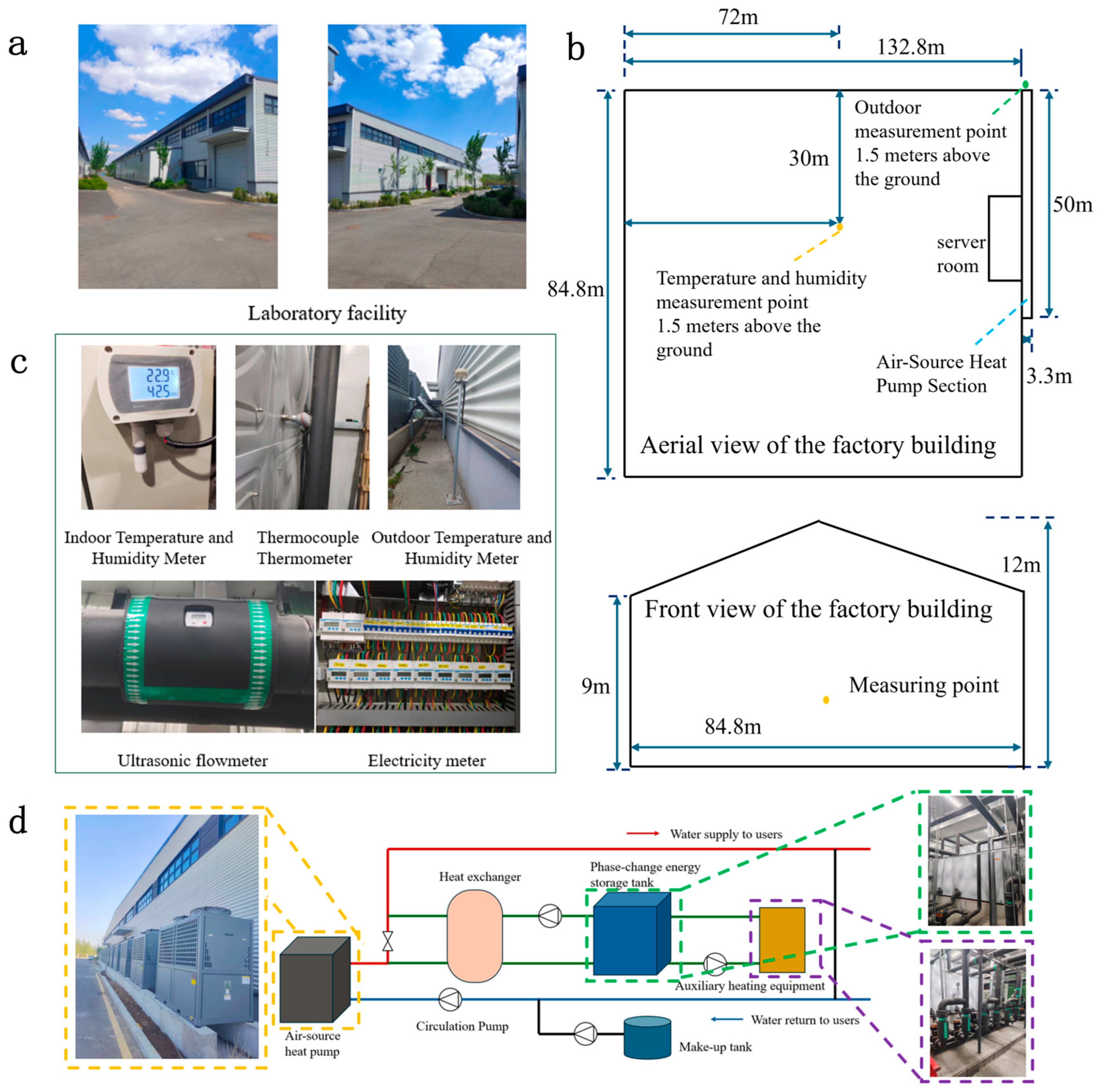
The experiments were conducted on a heating test platform in an industrial building in Shenyang, Liaoning Province. The building measured 132.8 m in length, 84.8 m in width, with a ridge height of 12 m and an eave height of 9 m. This study employed a hybrid heating system consisting of air-source heat pumps coupled with phase-change thermal storage tanks. The heat source was a multi-module air-source heat pump unit; each module had a standard heating capacity of 150 kW, and ten modules were installed. During the test, modules 1–6 handled the primary heating load, while the remaining four served as redundant backups. Each heat pump was equipped with two compressors, which defrosted alternately without affecting heat supply stability. One of the six heat pumps acted as the master unit, and the other five as slave units. The controller monitored each compressor’s runtime to ensure balanced operation. Under most weather conditions, the system’s heating capacity closely matched the actual load, so all six heat pumps operated simultaneously. As the temperature approached the setpoint, half of the compressors were shut down. If the actual load was particularly low and the controller detected that a single compressor’s runtime was too short, it would shut down some units to reduce heat output. The thermal storage unit consisted of a phase-change tank with an effective volume of 60 m3, which exchanged heat with the main circulation loop via an externally connected plate heat exchanger. The system used peak/off-peak electricity pricing to store excess heat during off-peak periods and release it during peak periods. Figure 1 shows the experimental setup.
Various physical parameters were measured during the experiment. An ultrasonic heat meter (Zhisheng Instrument Co., Ltd., Linyi, China) was installed on the main return water pipe to monitor the total heat supply. Supply and return water temperatures were recorded using PT100 sensors (Xuan Sheng Instrument Technology Co., Ltd., Suzhou, China), enabling continuous multi-point data collection. Power consumption on the unit side was monitored by an electricity meter (Zhengtai Instrumentation Co., Ltd., Yueqing, China). Indoor thermal environment parameters were obtained using a multi-point cross-validation approach: a primary temperature and humidity sensor (Xingyi Sensor Manufacturing Co., Ltd., Sanhe, China) was installed on a column in the central area of the factory at a height of 1.5 m above the ground, while two auxiliary measurement points were added at different locations within the room to verify indoor temperature and humidity [35]. Outdoor meteorological conditions were recorded in real time by a weather data logger (Renzhi Measurement and Control Technology Co., Ltd., Jinan, China) installed 1.5 m above ground level in a well-ventilated, open area. All of the aforementioned instruments are equipped with IoT cloud synchronization capabilities, with a uniform data upload interval set to 30 min to enable automated recording [36,37,38]. Detailed information is summarized in Table 1.
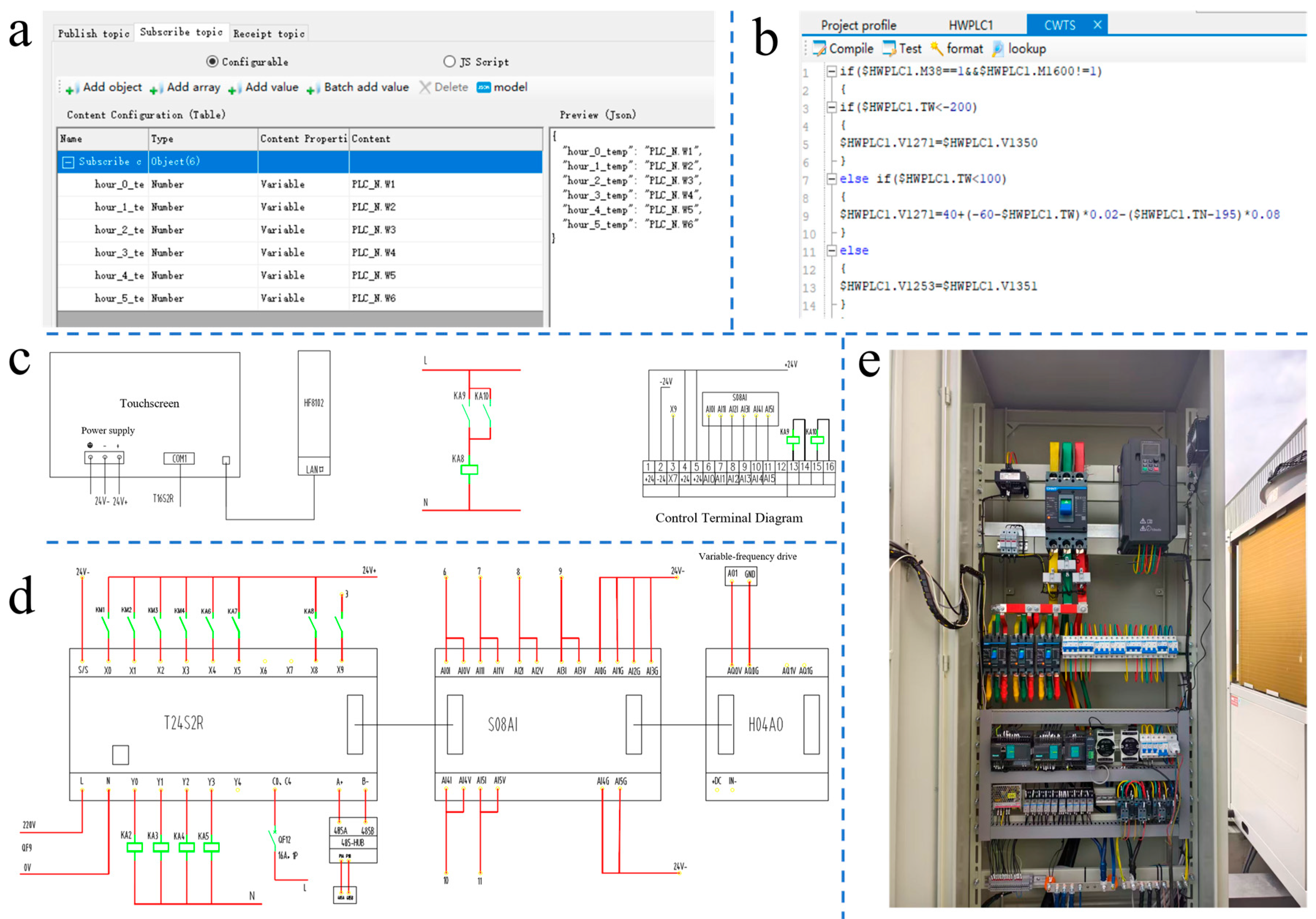
To compare the performance of the two control modes, this experiment employed an alternating operation method within the same heating cycle. The first approach utilized fixed-parameter control based on engineers’ experience, while the second approach implemented the segmented control law proposed in this paper, which combines outdoor temperature feedback with indoor temperature correction. This strategy was programmed into the lower-level controller via a PLC to achieve dynamic setpoint control of the return water temperature. As shown in Figure 2, the PLC selected for the experiment is the T24S2R model, which integrates nine digital input points (X0–X9) and four relay output points (Y0–Y4). To enable temperature and analog signal acquisition, the system was expanded with an H04A0 thermistor input module and an S08AI analog input module, forming a complete signal acquisition and closed-loop control chain. The upper-level monitoring system was developed using Haiwell Cloud SCADA software (version: 3.43.0.17). First, variable mapping was established with the T24S2R via the serial port (COM1), binding outdoor temperature and humidity, indoor temperature and humidity, and actual return water temperature as floating-point variables. In the periodic script, the logic for segmented control laws and the calculation of return water temperature setpoints were implemented, with results transmitted via the RS485 communication protocol. Simultaneously, the cloud data reporting function was enabled to upload heating output, power consumption, and key temperature points to the cloud database every minute. This experiment switched to the second strategy on 21 January 2026. The test period spanned from 14 November 2025 to 22 March 2026, during which the first control strategy was used from 14 November 2025 to 20 January 2026, and the second control strategy was applied from 21 January 2026 to 22 March 2026. Throughout the experiment, the system operated continuously for 24 h a day, recording heating output, equipment power consumption, and indoor and outdoor climate parameters, thereby strictly simulating the heating conditions of the factory building under normal operating conditions.

2.2. Dynamic Setpoint Control Strategy for Return Water Temperature

To ensure that air-source heat pump heating systems can meet terminal heat demand amid wide fluctuations in outdoor temperature—while avoiding excessive heating and frequent cycling—this paper proposes a three-stage return water temperature control strategy based on a combination of outdoor temperature feedback and indoor temperature correction. The basic form is as follows:
T R = 45   ° C , T W < 20   ° C 40 + α ( 6 T W ) β ( T N 19.5 ) , 20   ° C T W 10   ° C 30   ° C , T W > 10   ° C
where T R is the setpoint for the unit’s return water temperature, °C; T W is the outdoor temperature, °C; T N is the actual indoor temperature, °C; α and β are the indoor and outdoor temperature correction factors.
The formula for calculating the building heat load (total heat transfer area) is expressed as follows [39]:
Q b = K b × ( T N T W )
where K b is the building’s overall heat transfer coefficient, kW/°C.
The heat exchange rate of an end-use device can generally be expressed as follows [40]:
Q e = K e × ( T w a t e r T N ) n
where K e is the overall heat transfer coefficient of the terminal cooling unit, kW/°C; n is the nonlinear heat transfer coefficient of the terminal device.
In this equation, n ranges from 1.0 to 1.3; for approximation purposes, n can be taken as 1 to linearize the expression. Near the reference point, let T w a t e r T R .
Q e K e × ( T R T N )
When the system is in steady state, Q b = Q e .
K b × T N T W = K e × T R T N
Taking the derivative of Equation (5) yields the fluctuation in return water temperature with respect to outdoor temperature, which is denoted by α .
α = d T R d T W = K b K e
It can be shown that α represents the ratio of the building’s heat loss to the terminal’s heat exchange capacity. After verifying the stability of the experimental data, the value of α is set to 0.2. β is then defined as (1 − α ).

2.2.1. Reference Operating Conditions

To avoid extracting biased mapping relationships during periods of significant load fluctuations, this paper selected a time interval from the system’s long-term operational data in which both indoor and outdoor temperatures were relatively stable and the unit operated continuously in a steady state. Statistical analysis indicates that the average outdoor temperature during this period was approximately −6 °C, the indoor temperature remained stable at around 19.5 °C, and the corresponding return water temperature was approximately 40 °C. Under this thermal equilibrium, the heat dissipation at the terminals closely matches the unit’s heating capacity, allowing this condition to be regarded as a reliable reference operating point. This reference provides a physical basis for the dynamic setting formula, enabling control variables to be adjusted around this condition based on climatic factors rather than relying solely on empirical fitting.

2.2.2. Dynamic Correction Terms at Conventional Heating Temperatures

When the outdoor temperature falls within the conventional heating range of −20 to 10 °C, the return water temperature is dynamically adjusted from a baseline of 40 °C, comprising two components:
Outdoor temperature feedback represents the essential concept underlying climate compensation. When the outdoor temperature T W is 6 °C lower than the reference value, the term T W becomes positive, causing the return water temperature to increase proportionally to compensate for the higher building heat load. Conversely, when the outdoor temperature is 6 °C higher than the reference value, the return water temperature is reduced. The coefficient 0.2 indicates that, near the reference value, for every 1 °C decrease in outdoor temperature, the return water temperature setpoint increases by approximately 0.2 °C. This coefficient is determined by the characteristics of the heating system and the heat dissipation capacity of the terminal units and can be understood as the weighting factor representing the impact of outdoor temperature changes on the return water temperature.
Indoor temperature correction eliminates indoor temperature deviations caused by factors such as building thermal inertia, solar gain, and variations in indoor heat generation within a pure feedforward control system, a negative feedback correction based on the actual measured indoor temperature is introduced. When the indoor temperature T N exceeds the set reference of 19.5 °C (i.e., T N ), this correction term becomes positive, reducing the return water temperature setpoint to suppress further indoor temperature increases. Conversely, when the indoor temperature is below the reference, the correction increases the return water temperature to maintain indoor temperature stability. The coefficient of 0.8 represents the correction weight for indoor temperature deviation, designed to prevent drastic fluctuations and ensure a stable control process.

2.2.3. Temperature Setting Methods for Extreme Weather Conditions

During extremely cold weather ( T W < −20 °C), the building’s heat load is very high, and dynamic regulation may be affected by factors such as the unit’s output limits or defrosting conditions. In such cases, setting the return water temperature to a fixed 45 °C ensures heating safety and maintains a baseline indoor temperature, thereby preventing system instability caused by continuous temperature adjustments. When the outdoor temperature exceeds 10 °C, heating demand decreases significantly. If the dynamic formula is still applied, the return water temperature may drop to excessively low levels, resulting in insufficient heat dissipation at the terminals or frequent unit start–stop cycles. Therefore, setting the return water temperature directly to a low level of 30 °C not only maintains continuous heating at low temperatures and prevents indoor overheating but also helps improve the energy efficiency of the heat pump operation.
In summary, this control strategy utilizes actual steady-state operating data as a reference and employs a composite structure to achieve segmented, adaptive adjustment of the return water temperature. Compared to traditional single-outdoor-temperature climate compensation curves, this method incorporates closed-loop correction based on indoor temperature, effectively balancing thermal comfort and energy efficiency under variable operating conditions.

2.3. System Energy Efficiency

The actual operating energy efficiency of an air-source heat pump heating system is typically determined by the ratio of measured heat output to electricity consumption. This “black-box” testing method avoids reliance on parameters—such as compressor efficiency and heat exchange temperature differences—that are difficult to measure accurately in theoretical models, thereby providing a more precise reflection of the unit’s and system’s actual performance under specific control strategies.
Considering only the energy efficiency of the heat pump unit itself, which reflects the compressor cycle and heat exchange capacity, refer to Equation (7).
C O P h p = Q h W h p
where C O P h p is the coefficient of performance of the heat pump unit; Q h is the heat output, kWh; W h p is the power consumption of the heat pump, kWh.

2.4. Economic Analysis Formula

Assuming that, under both control strategies, the system’s heat output remains constant to meet the same heating demand, the amount of electricity saved is given by Equation (8).
W = W 1 W 2 = Q h C O P 1 Q h C O P 2
After some derivation, the formula becomes
W = W 1 × ( 1 1 1 + C O P )
where W is the amount of electricity saved, kWh; C O P is percentage of savings from COP, W 1 W 2 is the electricity consumption of the heat pump under the two control methods, kWh.

3. Results and Analysis

To verify the effectiveness of the segmented control strategy proposed in this paper, the entire heating season was divided into two phases for comparative analysis. Phase 1, from 14 November 2025 to 20 January 2026, utilized a traditional on-off control method based on engineering experience. Phase 2, from 21 January 2026 to 22 March 2026, implemented the three-stage return water temperature control law proposed herein, which incorporates outdoor temperature feedback and composite indoor temperature correction. System operation data under both control methods were continuously recorded, encompassing a wide range of outdoor temperatures from 10.2 °C to −20.2 °C, thereby providing sufficient conditions for comparative analysis.

3.1. Overall Energy Efficiency Comparison

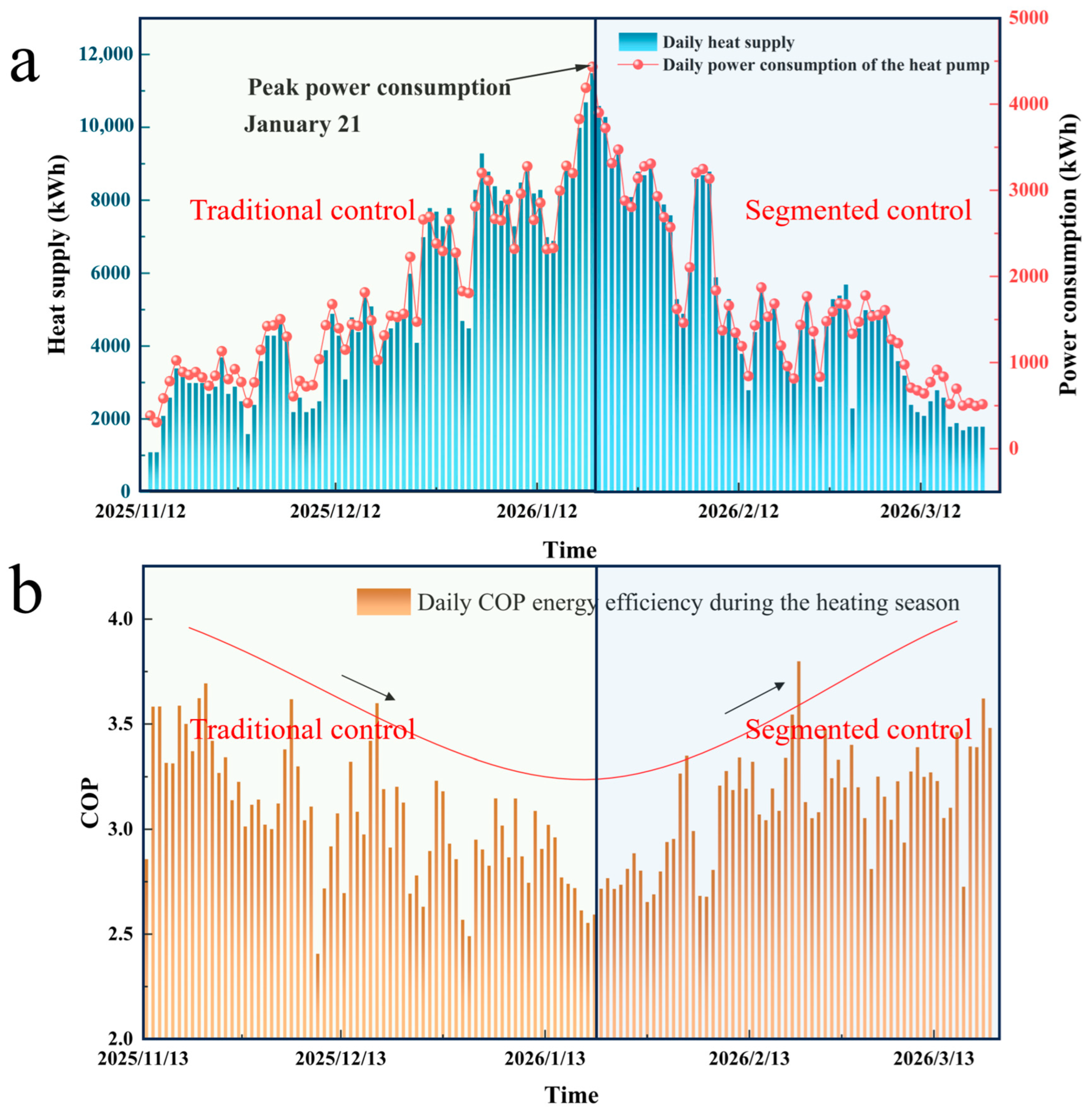
Throughout the entire operational cycle, the second control strategy exhibited a distinct advantage in terms of energy efficiency. As illustrated in Figure 3, statistical analysis indicates that during the initial control phase (68 days), the system’s average daily heating output was 5169.1 kWh, with a mean COP of 3.06. In the subsequent control phase (61 days), the average daily heating output increased to 5252.4 kWh, while the average COP rose to 3.11, reflecting an improvement of approximately 1.63% compared to the first control method. Since the heat load is influenced by various outdoor parameters and the specific effects are difficult to quantify, the consistency of external conditions for the two control methods is assessed based on the heat supply. Under conditions of comparable heating demand, conventional empirical control approaches yield suboptimal heat pump performance. This outcome is attributed to the reliance of empirical start–stop control strategies on subjective judgment, which often leads to the adoption of excessively conservative, elevated return water temperature settings to maintain heating safety margins. Such practices result in prolonged operation of the heat pump under high condensing temperature conditions, thereby increasing the compression ratio and substantially diminishing the COP. Conversely, the staged control strategy dynamically determines the optimal return water temperature in real time, based on outdoor and indoor temperature measurements. This approach enables the heat pump to operate predominantly within a low condensation temperature range, thereby fundamentally enhancing the thermodynamic efficiency of the system.

3.2. Analysis of Indoor Temperature Stability

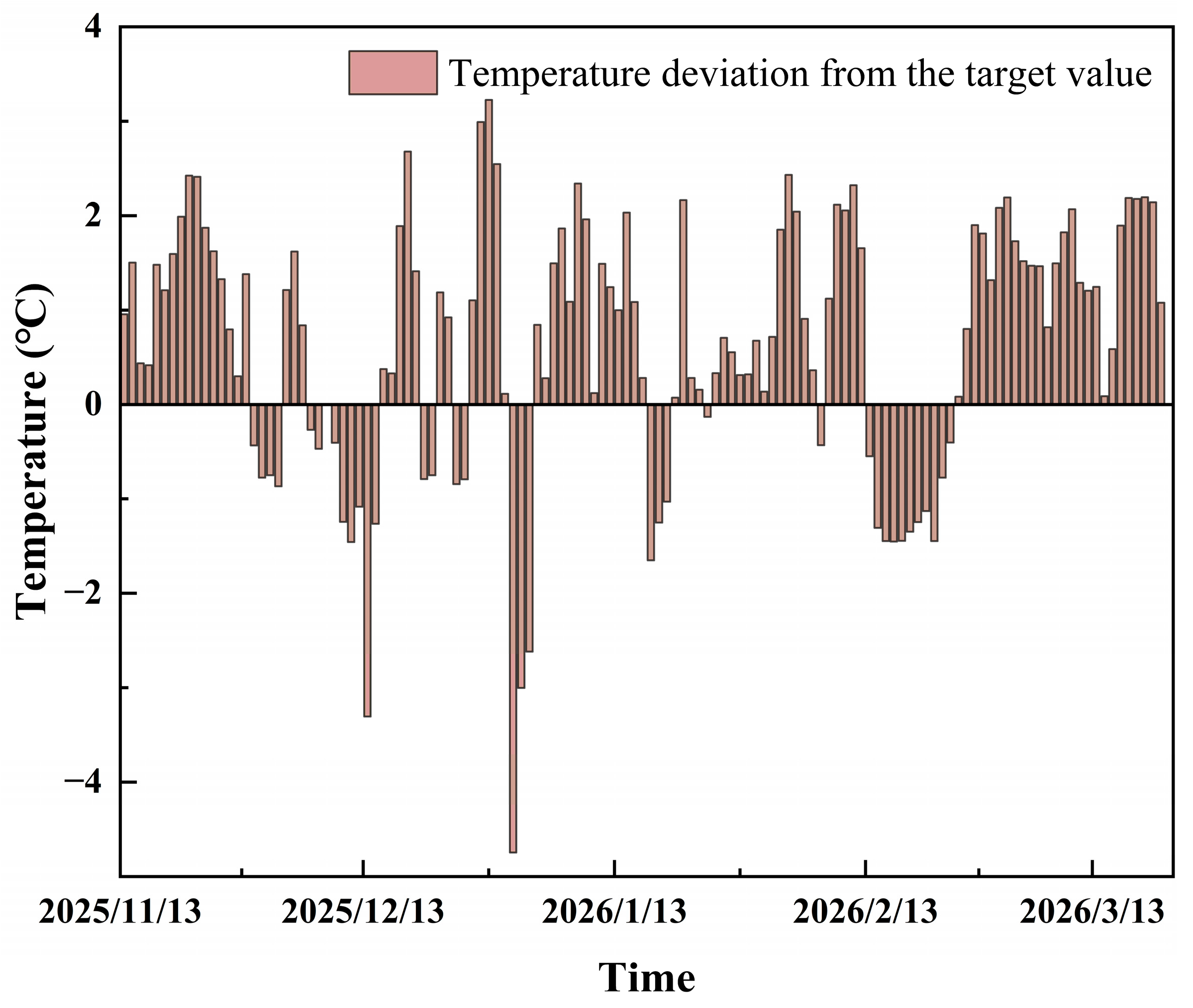
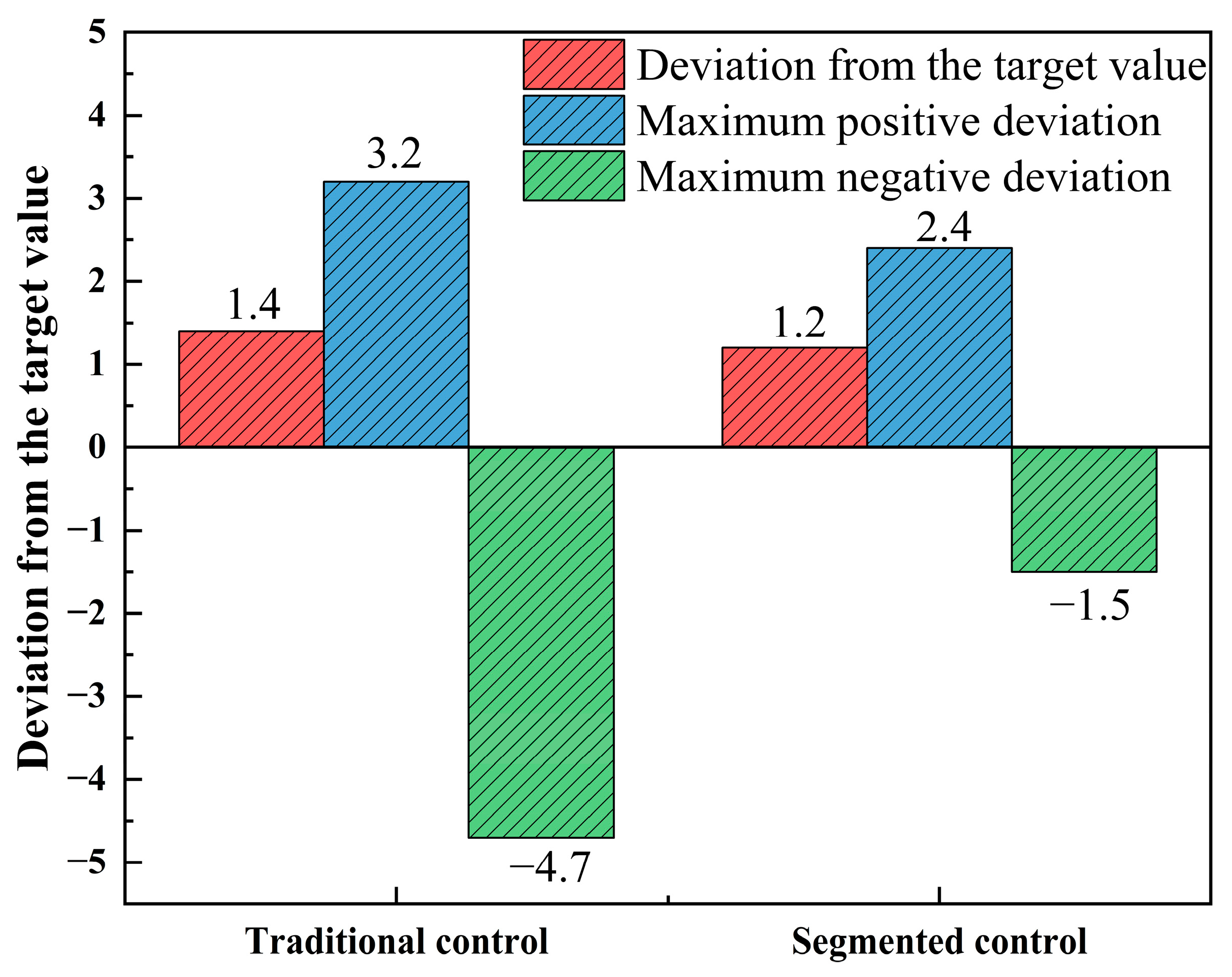
Indoor temperature stability serves as a critical metric for assessing heating performance. As illustrated in Figure 4 and Figure 5, with a target comfort temperature set at 19.5 °C, the absolute deviations of indoor temperature from this benchmark were evaluated under two distinct control strategies. During the initial control phase, the mean absolute deviation was 1.4 °C. The highest positive deviation was recorded on 19 December 2025, when the factory temperature reached 22.7 °C, resulting in a deviation of 3.2 °C. Conversely, the greatest negative deviation occurred on 1 January 2026, with a factory temperature of 14.8 °C and a deviation of 4.7 °C, yielding a total fluctuation range of 7.9 °C. In comparison, the subsequent control phase exhibited a reduced mean absolute deviation of 1.2 °C, corresponding to a 14.2% improvement. The maximum positive deviation during this period was observed on 4 February 2026 (factory temperature: 21.9 °C; deviation: 2.4 °C), while the maximum negative deviation occurred on 17 February 2026 (factory temperature: 18.0 °C; deviation: 1.5 °C), resulting in a narrowed fluctuation range of 3.9 °C, representing a 50.6% decrease. These findings substantiate that the segmented control strategy proposed herein effectively mitigates excessive heating during early winter and early spring, thereby enhancing indoor temperature stability. Moreover, it ensures maintenance of the indoor temperature lower bound under extreme cold conditions, significantly improving thermal comfort.

3.3. Economic Analysis

Based on actual measurement data, the cumulative electricity consumption of the heat pump over 68 days under the first control method was 118,477 kWh. Extrapolated to a full heating season (assumed to be 150 days), the baseline electricity consumption is approximately 261,346 kWh. The staged control strategy proposed in this paper increases the system’s average COP by 1.63%. Consequently, the estimated electricity savings for the entire heating season are approximately 4191 kWh. At an electricity rate of 1 yuan/kWh (the average industrial electricity rate in the Shenyang area), this corresponds to cost savings of about 4191 yuan per heating season. It should be noted that this energy savings estimate is based on a linear extrapolation of the measured COP improvement from half a heating season to the full season. Considering the higher outdoor temperatures during the transitional season and the greater energy efficiency benefits of the second control strategy under low heat load conditions, the actual COP improvement for the full season may exceed 1.63%, resulting in even more substantial energy savings. The staged control retrofit equipment used in this study includes a PLC control system as well as temperature and humidity instruments. The specific cost depends on the industrial infrastructure and the brands of the instruments; generally, the payback period is approximately one year. Overall, the three-stage return water temperature control method proposed in this paper holds significant practical engineering value for improving energy efficiency and reducing operating costs.

4. Conclusions

This paper addresses challenges such as excessive heating, frequent unit start–stop cycles, and low energy efficiency in air-source heat pump heating systems integrated with phase-change energy storage tanks, particularly under conditions of wide outdoor temperature fluctuations. It proposes a three-stage return water temperature control strategy based on outdoor temperature feedback combined with composite indoor temperature correction. By dividing the entire heating season into two phases—empirical start–stop control and segmented control—and conducting comparative experiments, the following key conclusions were drawn:
(1)
Regarding energy efficiency improvement, the proposed segmented control strategy increased the system’s average COP from 3.06 to 3.11, representing a 1.63% increase. This strategy calculates the return water temperature setpoint in real time based on the outdoor temperature and applies a secondary correction using an indoor temperature feedback term. This enables the heat pump to operate as much as possible within the low condensation temperature range, thereby enhancing system efficiency.
(2)
Regarding indoor temperature stability, under the second control method, the average absolute deviation of indoor temperature from the target value of 19.5 °C decreased from 1.4 °C with the first control method to 1.2 °C, representing a reduction of 14.2%. Additionally, the range of extreme deviations narrowed from 7.9 °C to 3.9 °C, a reduction of 50.6%. This effectively suppresses excessive heating during the transitional season while ensuring the minimum heating capacity under extreme low-temperature conditions.
(3)
In terms of economic efficiency, the total electricity consumption for the entire heating season is approximately 4191 kWh. Based on the average industrial electricity rate of 1 yuan per kWh in the Shenyang region, this translates to electricity cost savings of approximately 4191 yuan per heating season. Considering that the energy efficiency benefits of this strategy are even more pronounced during periods of higher outdoor temperatures in the transitional season, the actual energy savings for the entire season are expected to be even greater.
In summary, the three-stage return water temperature control law proposed in this paper is straightforward in design, easy to integrate and implement in actual heat pump controllers, and effectively balances the dual objectives of energy conservation and comfort, making it highly promising for engineering applications.

Author Contributions

Conceptualization, Z.W.; methodology, Y.F.; software, M.J. (Mingzhi Jiang); validation, G.F.; formal analysis, M.J. (Mingchao Jiang); investigation, R.B.; writing—original draft, M.J. (Mingzhi Jiang); writing—review and editing, G.F.; funding acquisition, G.F. All authors have read and agreed to the published version of the manuscript.

Funding

The research was supported by the National Natural Science Foundation of China Joint Fund for Regional Innovation and Development (U23A20657).

Data Availability Statement

The data presented in this study are available on request from the corresponding author. The data are not publicly available because some unfinished projects are still using this data.

Conflicts of Interest

Author Mingzhi Jiang, Zhiwei Wang, Mingchao Jiang, and Yongliang Fu were employed by the company Liaoning Jianda Industry–Academia–Research Energy-Saving Technology Group Co., Ltd. The remaining authors declare that the research was conducted in the absence of any commercial or financial relationships that could be construed as a potential conflict of interest.

References

  1. Jiang, S.; Zhao, H.; Ni, L. Review and prospect of air source heat pump research: A bibliometric insight. Int. J. Refrig. 2025, 170, 172–191. [Google Scholar] [CrossRef]
  2. Żelazna, A.; Pawłowski, A. Review of the role of heat pumps in decarbonization of the building sector. Energies 2025, 18, 3255. [Google Scholar] [CrossRef]
  3. Cao, J.; Zheng, L.; Peng, J.; Wang, W.; Leung, M.K.; Zheng, Z.; Hu, M.; Wang, Q.; Cai, J.; Pei, G.; et al. Advances in coupled use of renewable energy sources for performance enhancement of vapour compression heat pump: A systematic review of applications to buildings. Appl. Energy 2023, 332, 120571. [Google Scholar] [CrossRef]
  4. Gibb, D.; Rosenow, J.; Lowes, R.; Hewitt, N.J. Coming in from the cold: Heat pump efficiency at low temperatures. Joule 2023, 7, 1939–1942. [Google Scholar] [CrossRef]
  5. Xu, Z.; Li, H.; Xu, W.; Shao, S.; Wang, Z.; Gou, X.; Zhao, M.; Li, J. Investigation on the efficiency degradation characterization of low ambient temperature air source heat pump under partial load operation. Int. J. Refrig. 2022, 133, 99–110. [Google Scholar] [CrossRef]
  6. Abdelsalam, M.Y.; Teamah, H.M.; Lightstone, M.F.; Cotton, J.S. Hybrid thermal energy storage with phase change materials for solar domestic hot water applications: Direct versus indirect heat exchange systems. Renew. Energy 2020, 147, 77–88. [Google Scholar] [CrossRef]
  7. Yu, C.; Ji, Y.; Zhu, Y.; Wang, J.; Shi, X.; Li, Y. Collaborative configuration and optimal operation of cogeneration system based on phase change heat storage. J. Phys. Conf. Ser. 2023, 2564, 012054. [Google Scholar] [CrossRef]
  8. Ma, W.; Liu, Y.; Xi, Z.; Xia, S.; Zhang, X.; Wu, N. Modeling and optimization of a thermal Storage-Assisted solar heating system for small residential buildings. Therm. Sci. Eng. Prog. 2025, 68, 104392. [Google Scholar] [CrossRef]
  9. Ma, L.; Sun, Y.; Wang, F.; Wang, M.; Zhang, S.; Wang, Z. Advancements in anti-frosting and defrosting techniques for air source heat pumps: A comprehensive review of recent progress. Appl. Energy 2025, 377, 124358. [Google Scholar] [CrossRef]
  10. Rastegarpour, S.; Scattolini, R.; Ferrarini, L. Performance improvement of an air-to-water heat pump through linear time-varying MPC with adaptive COP predictor. J. Process Control 2021, 99, 69–78. [Google Scholar] [CrossRef]
  11. Klingebiel, J.; Höges, C.; Göbel, S.; Bannmüller, P.; Boelsen, T.; Venzik, V.; Vering, C.; Müller, D. Optimal defrost initiation for air-source heat pumps: Evaluating the improvement potential of common defrosting controllers. Energy 2025, 324, 135871. [Google Scholar] [CrossRef]
  12. Zhou, W.; Wang, B.; Wang, M.; Chen, Y. Performance analysis of the coupled heating system of the air-source heat pump, the energy accumulator and the water-source heat pump. Energies 2022, 15, 7305. [Google Scholar] [CrossRef]
  13. Han, D.; Chang, Y.S.; Kim, Y. Performance analysis of air source heat pump system for office building. J. Mech. Sci. Technol. 2016, 30, 5257–5268. [Google Scholar] [CrossRef]
  14. PotoČnik, P.; Govekar, E. Adaptive optimization of heating curves in buildings heated by a weather-compensated heat pump. Sci. Technol. Built Environ. 2019, 25, 1380–1393. [Google Scholar] [CrossRef]
  15. Liu, Y.; Nan, X.; Han, H.; Li, J. The variable water temperature control strategy of the air-source heat pump compatible with floor heating system for an apartment. J. Build. Eng. 2024, 90, 109440. [Google Scholar] [CrossRef]
  16. Sun, Y.; Chen, X.; Wu, S.; Wei, W.; Wang, W.; Deng, S. Performance analysis of air source heat pump space heating system with an adaptive control for supply water temperature. Appl. Therm. Eng. 2022, 211, 118401. [Google Scholar] [CrossRef]
  17. Gao, J.; Yang, G.; Guo, X.; Li, T.; Xu, X.; Zhu, Q. An optimal control strategy for small-scale ASHP-integrated central air-conditioning systems: Coordinating indoor and outdoor temperatures. Build. Environ. 2025, 273, 112745. [Google Scholar] [CrossRef]
  18. Pardiñas, Á.Á.; Alonso, M.J.; Diz, R.; Kvalsvik, K.H.; Fernández-Seara, J. State-of-the-art for the use of phase-change materials in tanks coupled with heat pumps. Energy Build. 2017, 140, 28–41. [Google Scholar] [CrossRef]
  19. Chen, H.; Wang, Y.; Li, J.; Cai, B.; Zhang, F.; Lu, T.; Yang, J.; Jiang, L.; Zhang, Y.; Zhou, J. Experimental research on a solar air-source heat pump system with phase change energy storage. Energy Build. 2020, 228, 110451. [Google Scholar] [CrossRef]
  20. Emhofer, J.; Marx, K.; Sporr, A.; Barz, T.; Nitsch, B.; Wiesflecker, M.; Pink, W. Experimental demonstration of an air-source heat pump application using an integrated phase change material storage as a desuperheater for domestic hot water generation. Appl. Energy 2022, 305, 117890. [Google Scholar] [CrossRef]
  21. Zhou, C.; Ni, L.; Li, J.; Lin, Z.; Wang, J.; Fu, X.; Yao, Y. Air-source heat pump heating system with a new temperature and hydraulic-balance control strategy: A field experiment in a teaching building. Renew. Energy 2019, 141, 148–161. [Google Scholar] [CrossRef]
  22. Nyers, A.; Nyers, J. COPmax and Optimal Control of the Heat Pump Heating System Depending on the Warm Water Temperature. Energies 2025, 18, 3553. [Google Scholar] [CrossRef]
  23. Suresh, C.; Awasthi, A.; Kumar, B.; Lee, H.; Jeon, Y. Comprehensive review on heat pump systems integrated with phase change material-based thermal energy storage for sustainable building heating. Renew. Sustain. Energy Rev. 2026, 226, 116197. [Google Scholar] [CrossRef]
  24. Kutlu, C.; Erdinc, M.T.; Dik, A.; Chen, Z.; Lyu, Q.; Su, Y.; Riffat, S. A study on the combination of crystallization-controllable phase change materials and solar-assisted heat pump for electricity demand shifting in space heating. Energy Convers. Manag. 2025, 324, 119260. [Google Scholar] [CrossRef]
  25. Rendall, J.; Elatar, A.; Nawaz, K.; Sun, J. Medium-temperature phase change material integration in domestic heat pump water heaters for improved thermal energy storage. Renew. Sustain. Energy Rev. 2023, 185, 113656. [Google Scholar] [CrossRef]
  26. Liu, X.; Chen, W.; Li, F.; Du, S.; Yao, G.; Zhang, P.; Xu, K.; Wang, Z. Research on Parameter Optimization and Control Strategy of Air Source Heat Pump Coupled with Thermal Energy Storage System. Buildings 2025, 15, 2870. [Google Scholar] [CrossRef]
  27. Hlanze, P.; Jiang, Z.; Cai, J.; Shen, B. Model-based predictive control of multi-stage air-source heat pumps integrated with phase change material-embedded ceilings. Appl. Energy 2023, 336, 120796. [Google Scholar] [CrossRef]
  28. Li, B.; Li, Z.; Wu, C.; Song, S.; Tian, J.; Ren, B.; Lu, Y.; Duan, Y.; Liu, S.; Zhu, C.; et al. Dynamic heat storage and release characteristics and flow control optimization of photovoltaic/thermal-heat pump coupled packed bed thermal energy storage system (PV/T-HP-PBTES). Energy 2025, 334, 137736. [Google Scholar] [CrossRef]
  29. Pavlov, G.K.; Olesen, B.W. Thermal energy storage—A review of concepts and systems for heating and cooling applications in buildings: Part 1—Seasonal storage in the ground. HvacR Res. 2012, 18, 515–538. [Google Scholar] [CrossRef]
  30. Del Col, D.; Azzolin, M.; Benassi, G.; Mantovan, M. Energy efficiency in a ground source heat pump with variable speed drives. Energy Build. 2015, 91, 105–114. [Google Scholar] [CrossRef]
  31. Arteconi, A.; Hewitt, N.J.; Polonara, F. State of the art of thermal storage for demand-side management. Appl. Energy 2012, 93, 371–389. [Google Scholar] [CrossRef]
  32. Kong, X.; Liu, Y.; Li, H.; Fan, M.; Cao, W. Optimization of solar-air source heat pump heating system with phase change heat storage. Appl. Therm. Eng. 2024, 245, 122897. [Google Scholar] [CrossRef]
  33. Sun, J.; Nawaz, K.; Rendall, J.; Elatar, A.; Brechtl, J. Heat pump water heater enhanced with phase change materials thermal energy storage: Modeling study. Int. Commun. Heat Mass Transf. 2023, 146, 106917. [Google Scholar] [CrossRef]
  34. Ning, Z.; Zhang, X.; Ji, J.; Shi, Y.; Du, F. Research progress of phase change thermal storage technology in air-source heat pump. J. Energy Storage 2023, 64, 107114. [Google Scholar] [CrossRef]
  35. Huang, K.; Bai, R.; Feng, G.; Li, X.; Fan, C.; Cao, H.; Yu, H. Dynamic oil fume exhaust method and calculation formula suitable for residential kitchens in cold regions. Build. Environ. 2025, 287, 113773. [Google Scholar] [CrossRef]
  36. Diller, T.; Soppelsa, A.; Nagpal, H.; Fedrizzi, R.; Henze, G. A dynamic programming based method for optimal control of a cascaded heat pump system with thermal energy storage. Optim. Eng. 2024, 25, 229–251. [Google Scholar] [CrossRef]
  37. Alimohammadisagvand, B.; Jokisalo, J.; Kilpeläinen, S.; Ali, M.; Sirén, K. Cost-optimal thermal energy storage system for a residential building with heat pump heating and demand response control. Appl. Energy 2016, 174, 275–287. [Google Scholar] [CrossRef]
  38. Li, M.Y.; Li, B.; Liu, C.; Su, S.; Xiao, H.; Zhu, C. Design and experimental investigation of a phase change energy storage air-type solar heat pump heating system. Appl. Therm. Eng. 2020, 179, 115506. [Google Scholar] [CrossRef]
  39. Søndergaard, H.A.N.; García-Céspedes, J.; Shaker, H.R.; de Felipe, J.J.; Jørgensen, B.N. Predicting hourly thermal demand of buildings for digital twin-based energy network modeling using a steady-state model capturing thermal inertia. Energy Built Environ. 2025. [Google Scholar] [CrossRef]
  40. Niu, J.; Liang, Z.; Xu, S. Research on fluid heat transfer characteristics of heat pipe radiator directly driven by heat pump. Therm. Sci. 2024, 28, 3617–3631. [Google Scholar] [CrossRef]
Figure 1. Experimental photos, sensor layout, and heating system principles, (a) experimental site; (b) experimental measurement points; (c) experimental equipment; (d) the principles of heating systems.
Buildings 16 02353 g001
Figure 2. PLC wiring and software configuration, (a) data format settings; (b) control code; (c) touchscreen wiring diagram; (d) PLC wiring diagram; (e) wiring diagram for a distribution panel.
Buildings 16 02353 g002
Figure 3. System energy efficiency under two control modes, (a) heat supply and electricity consumption during the heating season; (b) heat pump COP during the heating season.
Buildings 16 02353 g003
Figure 4. Temperature range during the heating season.
Buildings 16 02353 g004
Figure 5. Comparison of temperature fluctuations under two control conditions.
Buildings 16 02353 g005
Table 1. The detailed specifications and measurement ranges of the experimental instruments and equipment.
Test
Parameter
Instrument NameModel
Number
Measurement
Range
Measurement
Accuracy
Data Logging
Method
HeatUltrasonic heat meterMFU-DN200.05–5 m3/hLevel 2Continuous
recording
Outdoor
temperature
Weather Box−40–80 °C±0.5 °CContinuous
recording
Indoor
temperature
Temperature and humidity sensorCWS19−40–125 °C±0.2 °CContinuous
recording
Water temperature Thermocouple temperature sensorPt100−50–300 °C±0.15 °CContinuous
recording
Power consumptionElectricity meterDTSU6660–100 A±0.5%Continuous
recording
Disclaimer/Publisher’s Note: The statements, opinions and data contained in all publications are solely those of the individual author(s) and contributor(s) and not of MDPI and/or the editor(s). MDPI and/or the editor(s) disclaim responsibility for any injury to people or property resulting from any ideas, methods, instructions or products referred to in the content.