Article

Optimization of Residential Building Design Elements for Energy Efficiency in Hot Summer and Cold Winter Regions Using Energy Simulation and GBDT: A Case Study of Rural Housing in Hangzhou


1
College of Civil Engineering and Architecture, Zhejiang University, Hangzhou 310058, China
2
The Architectural Design and Research Institute of Zhejiang University Co., Ltd., Hangzhou 310028, China
3
Island and Coastal Zone Institute, Urban and Rural Innovation Design Research Center, Zhejiang University, Hangzhou 310058, China
4
Center for Balance Architecture, Zhejiang University, Hangzhou 310058, China
5
Jiangshan Urban Planning and Design Institute, Jiangshan Territorial Spatial Planning Center, Quzhou 324100, China
*
Author to whom correspondence should be addressed.
Buildings 2026, 16(12), 2335; https://doi.org/10.3390/buildings16122335
Submission received: 30 April 2026 / Revised: 28 May 2026 / Accepted: 1 June 2026 / Published: 11 June 2026

Abstract

The escalating energy consumption in China’s rural residences necessitates the adoption of targeted energy-efficient design strategies. However, existing studies have mainly focused on urban buildings or cold-climate rural residences, and insufficient attention has been given to form-based energy optimization for rural housing in hot summer and cold winter regions. Hangzhou was selected because it is a representative city in this climate zone, where rural residences face both summer cooling and winter heating demands. This study systematically investigates passive design pathways for rural residential buildings by optimizing architectural forms. We conducted in-depth field surveys and data analysis on 76 diverse samples, including both self-built and unified construction types, to establish three representative typical residential models (rectangular, L-shaped, U-shaped) for the Hangzhou region. DesignBuilder was employed to simulate the impacts of eight morphological elements—Shape Coefficient, building area, aspect ratio, orientation, number of floors, floor height, floor height ratio, and roof slope—on building energy consumption. The Gradient Boosting Decision Tree (GBDT) method was then used to quantify the nonlinear effects and relative importance of these elements. The results indicate clear nonlinear relationships between elements and the energy-saving rate. Floor height is identified as the most critical factor affecting energy consumption, followed by roof slope, with building area and other elements also showing significant influence. Based on the quantitative analysis, this study proposes energy-efficient design optimization strategies for rural housing in Hangzhou, offering a validated methodological framework and practical design references for the sustainable development of rural residences in hot summer and cold winter regions.

1. Introduction

1.1. Research Background

The building sector is a critical contributor to global energy consumption, responsible for over one-third of final energy use [1,2,3] and up to 40% of total energy-related carbon emissions [4,5]. Therefore, mitigating building energy consumption is a crucial step toward achieving the United Nations’ Sustainable Development Goals (SDGs), particularly SDG 11 (Sustainable Cities and Communities) and SDG 13 (Climate Action) [2,6,7].
In line with these global objectives, China has established its national “Dual Carbon” targets, prioritizing the enhancement of energy efficiency across its vast building stock. However, policy and research efforts have predominantly focused on urban areas, often overlooking the rural building sector [8]. This oversight is critical, as rural buildings account for over 20% of the nation’s total operational energy consumption [9,10]. Moreover, this energy demand is progressively increasing, driven by ongoing socioeconomic development, construction expansion, and residents’ rising demand for improved living standards [11,12].
In contrast to their urban counterparts, research and practice in energy-saving design for rural residential buildings have remained relatively underdeveloped. The vast stock of existing rural dwellings, particularly self-built homes lacking professional guidance, is widely plagued by issues such as inadequate design, inconsistent construction quality, low energy efficiency, and poor indoor thermal comfort [13]. Consequently, interventions at the early schematic design stage hold significant potential for enhancing the energy performance of these buildings [14].

1.2. Literature Review

Performance-Oriented Design (POD), which emerged in the 1970s, has gained increasing prominence with the advancement of performance simulation and parametric modeling tools [15]. This approach enables designers to control building performance from the earliest design stages, utilizing computational tools to systematically explore the design space against objectives like energy efficiency and thermal comfort. For example, Yu et al. (2015) successfully applied an improved multi-objective genetic algorithm (NSGA-II) to optimize building energy efficiency and thermal comfort [16]. Liu et al. (2015), using a Building Information Modeling (BIM) platform with a particle swarm optimization algorithm, effectively addressed the co-optimization of life-cycle cost and carbon emissions [17]. Liang et al. (2026) integrated deep learning-based computer vision with Geographic Information System (GIS) for large-scale morphological mapping of vernacular courtyard dwellings [18]. Meanwhile, others have confirmed the reliability of machine learning in performance prediction through the use of surrogate models [19]. The advancement of Computational Design and Information and Communication Technologies (ICT) has further empowered architects to integrate multi-dimensional performance feedback at the initial design phase, facilitating the realization of complex geometries and free-form architecture [20,21,22]. Consequently, POD has proven highly effective for enhancing the performance of complex urban buildings, such as offices and educational facilities, by supporting data-driven decision-making from the outset. Although the direct application of these sophisticated and computationally intensive methods to rural residential projects remains challenging, POD offers a viable pathway toward the construction of sustainable and high-performance rural homes [23,24].
Quantitative, simulation-based approaches are increasingly used for the design optimization of rural residential buildings, typically focusing on the complex relationship between architectural form and building performance. A significant body of research has focused on the impact of building shape parameters, analyzing the effects on energy consumption of elements such as plan layout [25], building orientation [26], aspect ratio [27], shape factor [28,29] and building height [30]. However, while studies exist on the impacts of both building shape and functional layout, they are often based on the characteristics of urban buildings, limiting the direct applicability of their findings to the rural context.
In addition, although a few studies have conducted cross-climate analyses or proposed climatic suitability zones [31], the majority of existing research has concentrated on severe cold regions where heating is the primary concern [32]. Evidently, findings from these cold-climate (marked as “D” in Köppen–Geiger climate classification [33]) studies are not directly applicable to Southern China, which is predominantly characterized by a Hot Summer and Cold Winter (HSCW) climate (marked as “C” in Köppen–Geiger climate classification [33]) that presents conflicting seasonal demands.
To address these knowledge gaps, this study takes rural buildings in Hangzhou, a typical HSCW climate region, as its research object to establish and validate a systematic framework for optimizing the architectural form of rural residential buildings in such climates. Specifically, this study aims to: (1) identify and categorize the key architectural form elements, including building shape and functional layout, that critically influence the passive performance of rural residential buildings; (2) simulate the impact of these form elements on year-round energy consumption (for both cooling and heating), based on typical models derived from the HSCW zone; and (3) use The Gradient Boosting Decision Tree (GBDT) machine learning method to quantitatively analyze the nonlinear relationships between each form element and the energy-saving rate, and to determine the ©mportance ranking of these elements.
This study makes the following primary contributions:
  • It grounds the simulation models in real rural housing practices by deriving representative prototypes from 76 field-surveyed samples in Hangzhou, rather than relying solely on idealized or generic models.
  • It provides a design-oriented understanding of how architectural form affects energy performance in HSCW rural residences by linking nonlinear parameter responses with their relative importance.
  • It converts the analytical findings into layout-specific optimization guidance, offering practical support for architects and local practitioners in the early design stage of rural housing.

2. Materials and Methods

Compared with previous studies that mainly relied on single-case simulations, idealized models, or traditional sensitivity analysis, the methodological improvement of this study lies in integrating field survey-based prototype extraction, dynamic energy simulation, and GBDT-based nonlinear analysis into a unified workflow. This approach improves the representativeness of the simulation models and enables the relative importance of multiple architectural form parameters to be quantified simultaneously.

2.1. Study Area

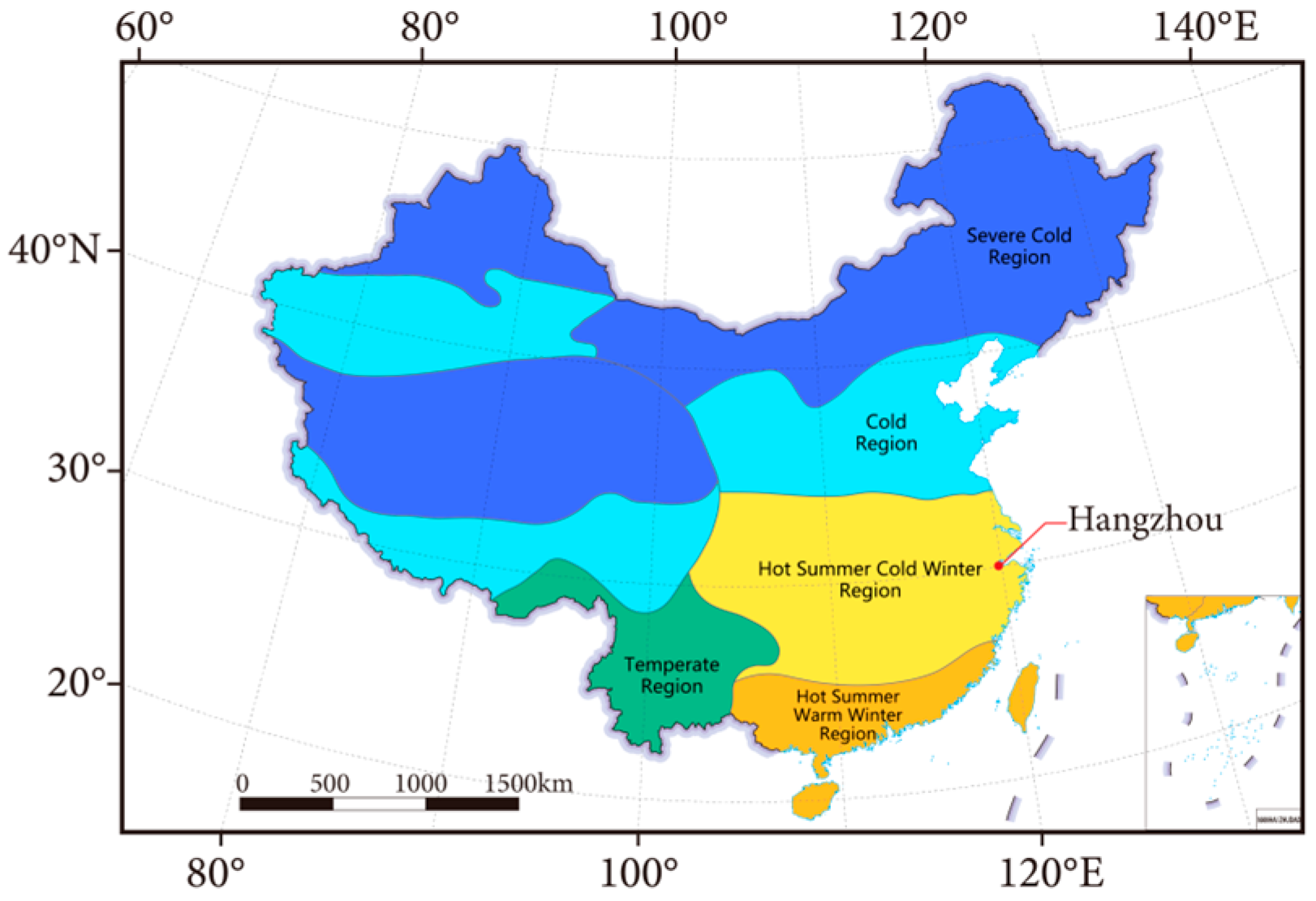
This study characterized by a typical subtropical monsoon climate, which is marked as Cfa in Köppen–Geiger Climate classification [33]. This pronounced seasonal fluctuation in temperature and humidity creates substantial annual cooling and heating demands for residential buildings, making Hangzhou a representative area for investigating energy-efficient building design strategies (Figure 1).

2.2. Data Collection

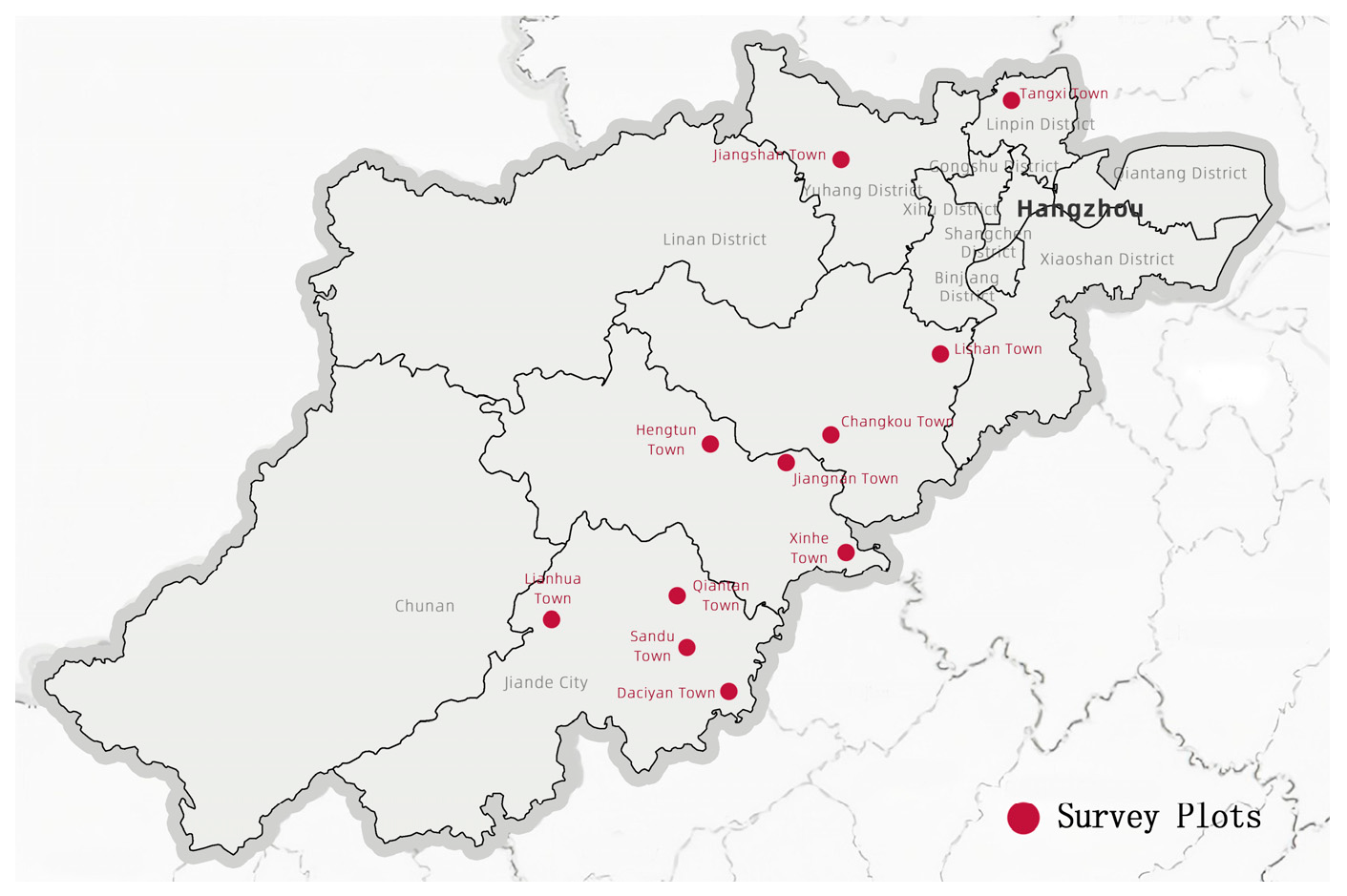
To enhance the practical relevance of the simulation experiments, this study conducted a comprehensive field survey from 2023 to 2024 across 11 towns in Hangzhou (Figure 2). The primary objective of this survey was to gather fundamental information essential for subsequent simulation modeling, including a thorough understanding of the current construction status and actual usage patterns of rural residences in Hangzhou, prevailing indoor thermal environment issues, and occupants’ air conditioning usage habits. Detailed architectural form information was also meticulously collected to inform the establishment of typical building models.
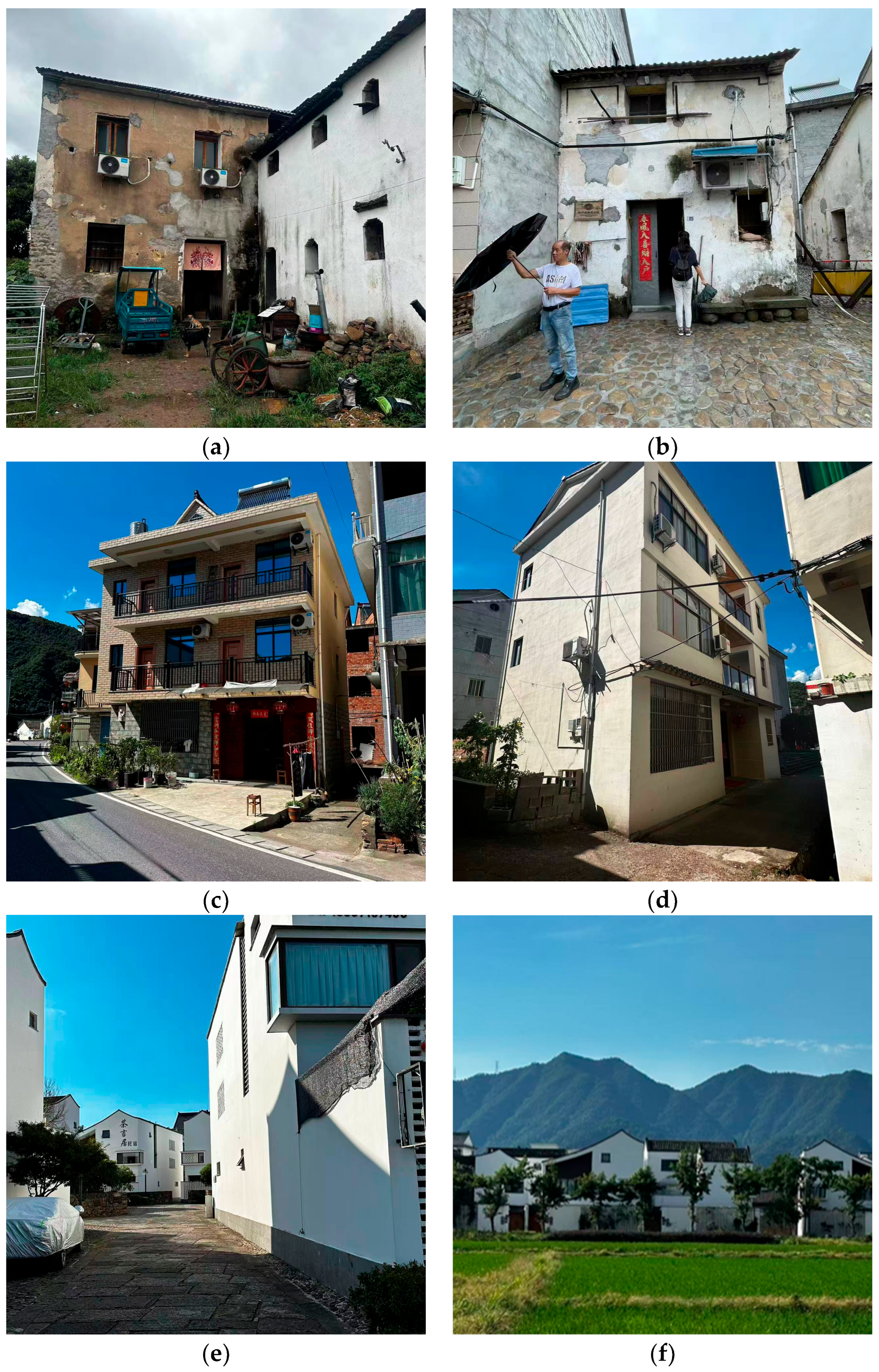
The key data collected for this study were categorized into two main aspects. First, floor plans for 76 rural residential samples were obtained through a combination of on-site measurements and analysis of local design atlases (Appendix A). These samples encompassed the primary construction modes prevalent in rural China, including self-built residences by villagers, constructions adhering to standard design atlases, and government-led unified constructions (Figure 3). In addition, the form elements were selected based on a literature review (Appendix B), field survey observations, and their controllability in early-stage architectural design. Accordingly, this study selected eight form-related elements: shape coefficient, building area, aspect ratio, orientation, number of floors, floor height, floor height ratio, and roof slope. These elements represent the main controllable morphological characteristics of rural residences and can be directly extracted from the surveyed housing samples.
Second, occupant behavior and energy consumption data were acquired through a combination of structured questionnaires (Appendix C) and in-depth interviews. All respondents participated voluntarily and provided informed consent before the survey and interviews. The collected information included the number of air conditioning units installed per household, the specific rooms where they were installed, and the operational schedules of air conditioning in primary energy-consuming spaces (bedrooms and living rooms) during both summer and winter.

2.3. Extraction of Typical Models

Based on a comprehensive statistical analysis of the architectural form characteristics of 76 rural residential samples in Hangzhou, three representative typical residential models were established for the subsequent simulation. The survey data revealed that rectangular plans constituted the highest proportion (67%), while L-shaped and U-shaped plans accounted for 12% and 16%, respectively. Consequently, these three plan types were selected for detailed investigation, representing 95% of the most prevalent plan configurations observed in the survey. The plan layouts and three-dimensional models of the three typical residential types are presented in Table 1, with their specific architectural form parameters detailed in Appendix D.

2.4. Building Form Simulation Experiments

This study employed DesignBuilder (version 7.0, DesignBuilder Software Ltd., Stroud, UK) as the primary tool for building performance simulation and analysis. DesignBuilder, leveraging the EnergyPlus (version 9.4, U.S. Department of Energy, Washington, DC, USA) simulation engine, offers a comprehensive platform for building performance analysis with an intuitive graphical user interface. It is widely recognized for its advantages in modeling efficiency, result accuracy, functional integration, and user-friendliness, making it particularly well-suited for simulating buildings with conventional geometries in energy consumption and environmental performance assessments [35].
Building upon the three typical rural residential models established for the Hangzhou region (i.e., rectangular, L-shaped, and U-shaped residences), this study developed sub-models for eight key architectural form design elements: shape coefficient, building area, aspect ratio, building orientation, number of floors, floor height, floor height ratio, and roof slope.
To isolate the impact of building form, simplified boundary conditions were adopted across all models, thereby reducing the confounding effects from other variables. Therefore, the simulation results should be interpreted as relative comparisons among different form parameters rather than predictions of the actual energy use of a specific household. Each floor of the residential building was treated as a single, uniform thermal zone. Internal heat gains from occupants, equipment, and lighting were excluded by setting occupancy rates and equipment power to zero, focusing solely on air conditioning energy consumption. The cooling period was defined from June 15 to September 15 (indoor setpoint temperature of 26 °C), and the heating period from December 15 to February 20 of the following year (indoor setpoint temperature of 18 °C). Ventilation rate set to 1 air change per hour.
The simulations in this section primarily focused on the air conditioning energy consumption under different building form variations, thus excluding the influence of functional layouts and other equipment. It was assumed that all rooms were energy-consuming spaces, and air conditioning operated continuously throughout the calculation period.
The simulation process employed a whole-year dynamic energy calculation method, integrating dynamic parameters such as outdoor temperature and humidity, natural illumination, and solar radiation. Annual cooling and heating energy consumption were calculated on an hourly basis, with their cumulative annual sum representing the total building energy consumption:
E c h = E c + E h
where E c h represents the annual total energy consumption per unit area, E c represents the annual cooling energy consumption per unit area, and E h represents the annual heating energy consumption per unit area, all in units of kWh/m2.
To quantify the impact of building form design variables on energy consumption, the energy-saving rate (ESR) [36] was used as an indicator, calculated as:
η = [ E 0 E i E 0 ] × 100 %
where η is the energy-saving rate for a given value of the form design factor; E 0 is the total energy consumption per unit area when the form design factor adopts the typical model’s baseline value; E i is the total energy consumption per unit area when the form design factor adopts other values, both in kWh/m2.
This study employed a controlled variable method for the individual analysis of each building form design element. When one element was varied within its predefined range, all other elements maintained their baseline values or standardized settings as defined in the typical models. To ensure the accuracy of the comparative analysis and eliminate calculation errors arising from different units, all input data for the architectural form design variables were normalized to the [0, 1] range. The study explored eight categories of relevant form elements (Appendix E).

2.5. Data Analysis

The data analysis in this study consisted of two parts. First, the single-parameter simulation results were analyzed to identify the response trends between each architectural form parameter and the energy-saving rates. For this part, the original simulation points obtained from DesignBuilder were fitted using linear or polynomial regression functions according to the distribution characteristics of the data. These fitted curves were used only to illustrate the variation trends of cooling, heating, and total energy-saving rates under different parameter values.
Second, the relative importance of the eight architectural form parameters was further evaluated using the Gradient Boosting Decision Tree (GBDT) model. GBDT is a powerful ensemble learning algorithm belonging to the Boosting family. It serially trains multiple decision trees (typically shallow trees, like Classification and Regression Trees). Each tree learns and corrects the residual errors (in the direction of the gradient descent) left by the previous tree. The final prediction is obtained by the weighted sum of the predictions from all trees. The principle of the GBDT algorithm can be expressed by the following formula:
F m ( x ) = F 0 ( x ) + v m = 1 M j = 1 J m γ j m · I ( x R j m )
F 0 ( x ) : Initial model (often the target mean or arg minγL(yi,γ)).
v : Learning rate, controlling the contribution of each tree (prevents overfitting).
R j m : The region of the j-th leaf node in the m-th tree.
γ j m : The output weight of the m-th tree for the leaf node R j m .
I : Indicator function (equals 1 if sample x belongs to R j m ).
GBDT was selected because the objective of this study was not only to evaluate energy-saving trends but also to quantify the relative contribution of multiple architectural form parameters. Compared with linear regression, GBDT does not require a predefined linear relationship between input parameters and energy-saving rates. Compared with black-box nonlinear models, it provides more interpretable feature-importance results. Therefore, it is suitable for identifying the priority of design elements in early-stage rural residential design.
For the feature-importance analysis, eight architectural form parameters were used as input features: shape coefficient, building area, aspect ratio, orientation, number of floors, floor height, floor height ratio, and roof slope. The cooling, heating, and total energy-saving rates were used as target variables. Based on 160 simulation samples, separate GBDT regression models were developed for the three target variables. The dataset was randomly divided into training and testing subsets at a ratio of 8:2, with 80% of the samples used for model training and the remaining 20% used for independent testing. Model performance was evaluated using the coefficient of determination (R2), mean absolute error (MAE), and root mean square error (RMSE). After model validation, the trained GBDT models were used to calculate the relative importance of the eight architectural form parameters.

3. Results

3.1. Nonlinear Relationship Prediction

3.1.1. Shape Coefficient

Due to the limited experimental data on shape coefficient, curve fitting was not performed on it. The corresponding energy-saving rates are listed in Table 2. Overall, as the shape coefficient increases from 1 to 1.3, the total energy-saving rate per unit area shows a clear decreasing trend, indicating that more complex and less compact building forms have poorer energy performance.
The sensitivity of different energy consumption types to the shape coefficient varies significantly. As the shape coefficient increases, the decline rate of the heating energy-saving rate is initially lower than, and subsequently higher than, that of the cooling energy-saving rate, indicating that the response mechanisms of different types of energy consumption are slightly different.

3.1.2. Building Area

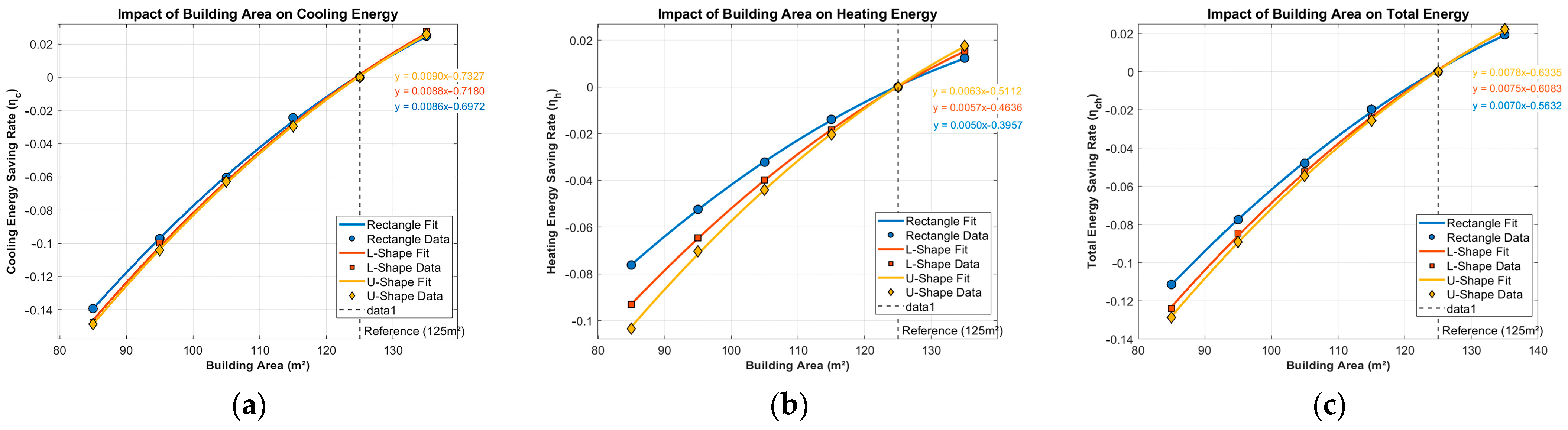
As shown in Table 3 and Figure 4, changes in building area have a positive nonlinear impact on the energy-saving rates for heating, cooling, and total energy consumption, and the trends are relatively consistent across different shape coefficients and energy consumption types.
As the building area increases from 85 m2 to 135 m2, the energy-saving rates for cooling, heating, and total energy consumption all show a continuous upward trend, indicating that a reasonable increase in building scale helps improve energy efficiency performance. The improvement in energy-saving rate due to area increase is more pronounced for smaller-scale residences.
The energy performance of different building plan types differs under the same building area. Additionally, it can be observed that the magnitude of change in energy-saving rate with increasing area follows the order U-shape > L-shape > Rectangle. Notably, rectangular buildings perform best across all area intervals.
Further analysis of sub-item energy consumption shows that the improvement in heating energy-saving rate with increasing area is significantly higher than that for cooling. For example, for rectangular buildings from 85 m2 to 135 m2, the heating energy-saving rate increases from −7.62% to 1.23%, while the cooling energy-saving rate increases from −13.93% to 2.48%. This suggests that increasing the building area is more effective in reducing heating energy consumption.

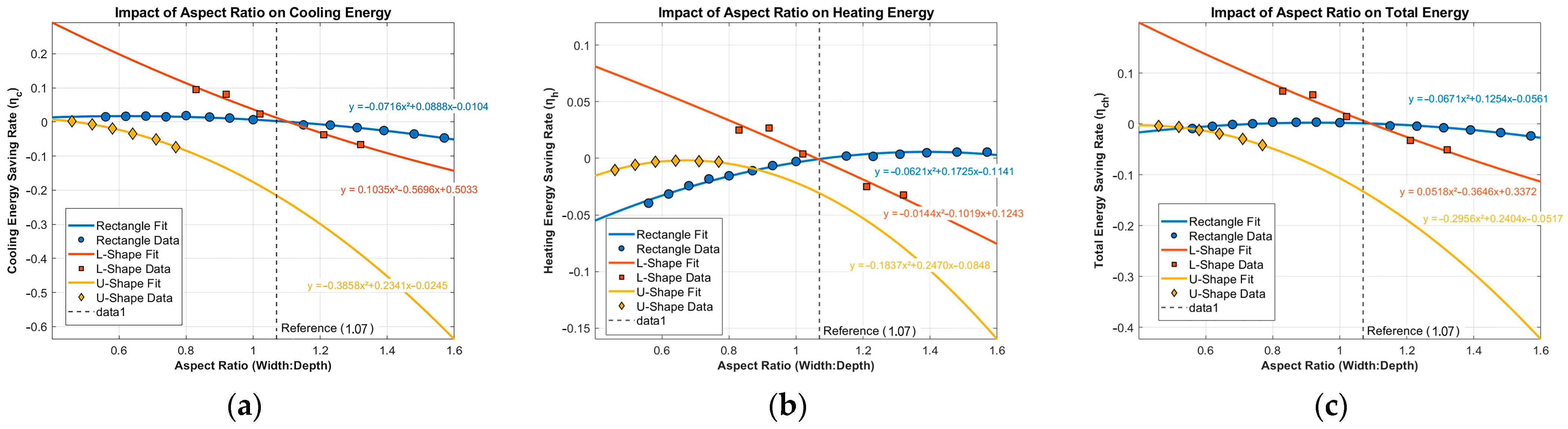
3.1.3. Aspect Ratio

As shown in Table 4 and Figure 5, changes in the aspect ratio have a significant nonlinear impact on the energy-saving rates for heating, cooling, and total energy consumption, and the pattern of influence varies noticeably depending on the building plan shape.
Overall, for rectangular plan buildings, the relationship between the total energy-saving rate and the aspect ratio shows a downward-opening parabolic trend, fitted by the function y = −0.0671x2 + 0.1254x − 0.0561. The energy-saving rate first increases and then decreases as the ratio increases, reaching an optimal value (about 0.25%) at a ratio of approximately 0.93.
The response characteristics of different building shapes show contrasting differences. Rectangular planar structures exhibit optimal performance when the aspect ratio approaches 1:1, with energy efficiency showing minimal variation across this ratio range. And the magnitude of change in energy-saving rate with the aspect ratio is much greater for L-shape and U-shape buildings than for rectangular buildings. The fitting function for the total energy-saving rate of L-shape buildings (y = −0.0518x2 − 0.3646x + 0.3372) indicates that their energy-saving rate continuously decreases as the aspect ratio increases, and its curve intersects with that of the rectangular building near a aspect ratio of 1.1. U-shape buildings exhibit a more pronounced nonlinear relationship (y = −0.2956x2 + 0.2404x − 0.0517). Their energy-saving rate is generally lower than that of rectangular and L-shape buildings, and the optimal ratio range is narrower than for rectangular buildings.
Analysis of sub-item energy consumption further reveals the energy response mechanisms for different functions: the cooling energy-saving rate is optimal at a aspect ratio of about 0.62, while the heating energy-saving rate peaks around 1.39.

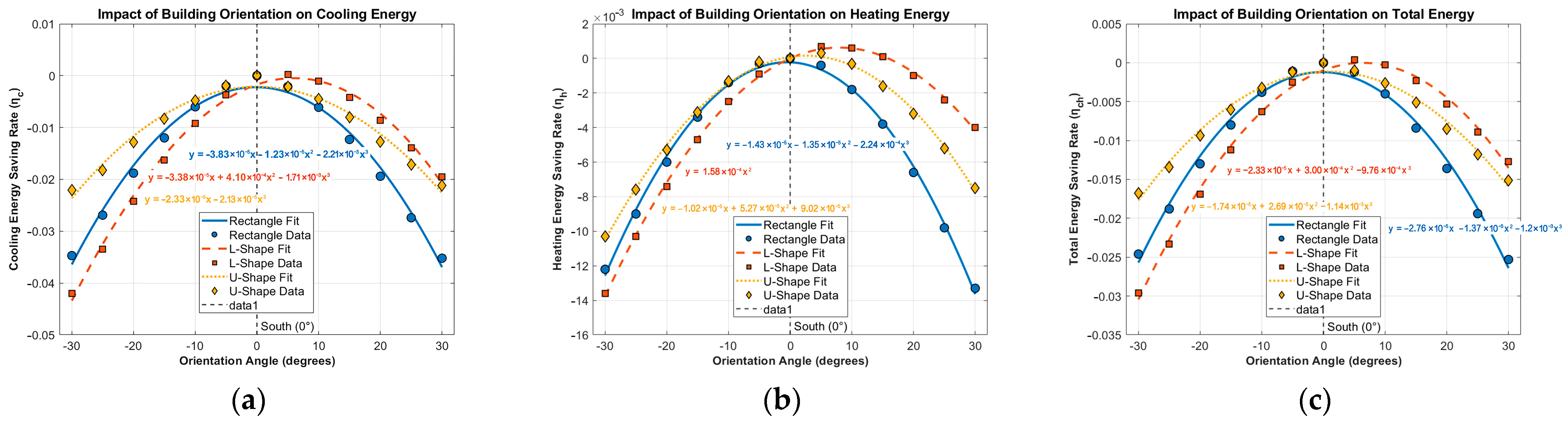
3.1.4. Orientation

As shown in Table 5 and Figure 6, changes in orientation have a nonlinear impact on the energy-saving rates for heating, cooling, and total energy consumption. The relationship can be represented by cubic functions, and the pattern of influence varies somewhat depending on the building plan shape.
The energy-saving rates for cooling, heating, and total energy consumption of residential buildings all show a trend of first decreasing and then increasing as the orientation angle changes, with the peak occurring between 0° and ES5°.
The decreasing trend on either side of the peak shows that the rate of decrease in energy-saving rate as the rotation increases is slightly different on the south and north sides, with the east orientation having a slightly more adverse effect on cooling energy consumption than the west. For example, for the total energy-saving rate of rectangular plan buildings, when the orientation rotates 30° west from true south, the energy-saving rate decreases by 2.46%; when rotating 30° east from true south, it decreases by 2.53%. The rectangular plan building shows the least noticeable difference in trends between east and west among the three plan types, while the L-shape plan shows the most significant difference.
Further analysis reveals that the building’s shape coefficient influences the relationship between energy-saving rate and orientation. In terms of sensitivity, the order is Rectangle > L-shape > U-shape. For the total energy-saving rate, when the orientation is southwest, the order of energy-saving rate is U-shape > Rectangle > L-shape; when the orientation is southeast, the order is L-shape > U-shape > Rectangle.
Comparing the cooling and heating energy-saving rates shows that cooling energy consumption is more affected by orientation. For a rectangular plan house rotated 30° west from true south, the cooling energy-saving rate decreases by 3.47%, while the heating energy-saving rate decreases by 1.22%.

3.1.5. Number of Floors

The corresponding energy-saving rates for different numbers of floors are shown in Table 6. Due to the limited experimental data on number of floors, curve fitting was not performed on it. Overall, as the number of floors increases from 1 to 4, the total energy-saving rate per unit area shows a continuous upward trend, indicating that appropriately increasing the number of floors helps improve overall energy efficiency. However, the magnitude of improvement in the energy-saving rate shows a clear nonlinear decreasing characteristic as the number of floors increases. In addition, the response characteristics of different building shapes show no significant contrast.

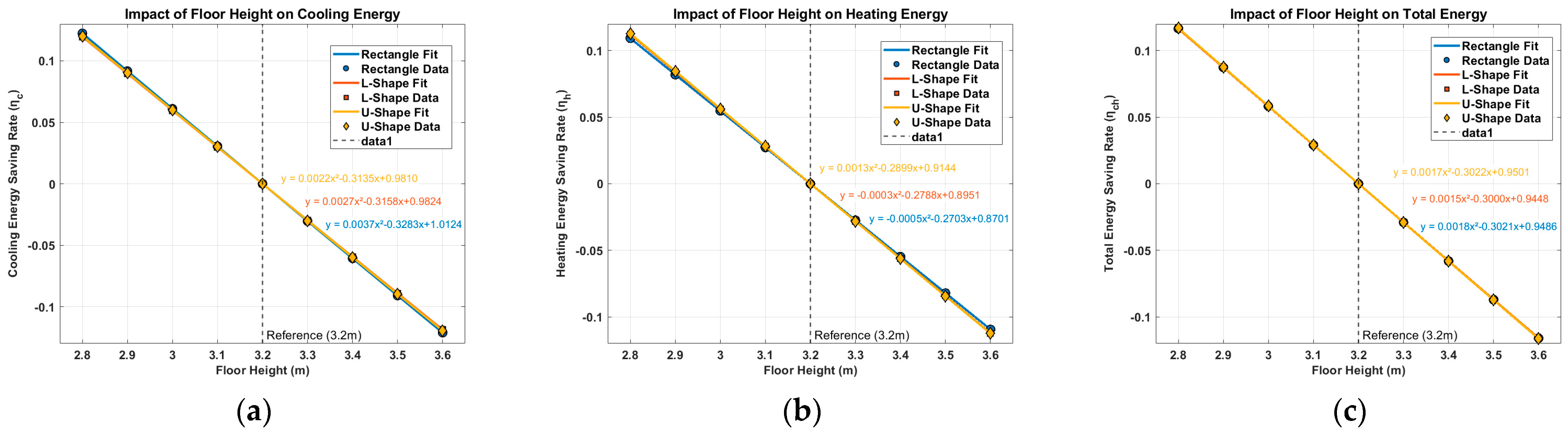
3.1.6. Floor Height

As shown in Table 7 and Figure 7, changes in floor height have a significant nonlinear impact on the energy-saving rates for cooling, heating, and total energy consumption, and the pattern of influence is consistent across different building plan shapes. The energy-saving rate has a quadratic relationship with floor height.
Overall, as the floor height increases from 2.8 m to 3.6 m, the total energy-saving rate per unit area shows a continuous decreasing trend, indicating that excessive floor height has a significant negative impact on building energy efficiency. For rectangular plan buildings, the relationship between the total energy-saving rate and floor height can be described by the quadratic function y = 0.0017x2 − 0.3022x + 0.9501 (Note: x likely represents floor height or its deviation from baseline). The energy-saving rate decreases from about −0.5% (Note: This seems inconsistent with the +11.66% value in the Table 7 for 2.8 m; the function might be fitting the actual energy consumption or a transformed variable, not directly η. The text description of the trend is primary.) at a floor height of 2.8 m to about −9.5% at 3.6 m.

3.1.7. Floor Height Ratio

Due to the limited experimental data on Storey height ratio, curve fitting was not performed on it. As shown in Table 8, variations in the floor height ratio exert a non-linear influence on the energy-saving rates for cooling, heating, and total energy consumption, exhibiting unique response characteristics. As the floor height ratio increases, the overall energy-saving rate exhibits a gradual downward trend.
The responses of different energy consumption types to changes in the floor height ratio present a sharp contrast. As the floor height ratio increases, the variation trend of the cooling energy-saving rate is similar to that of the overall energy-saving rate, but with a greater magnitude of change. However, the heating energy-saving rate increases as the floor height ratio increases.

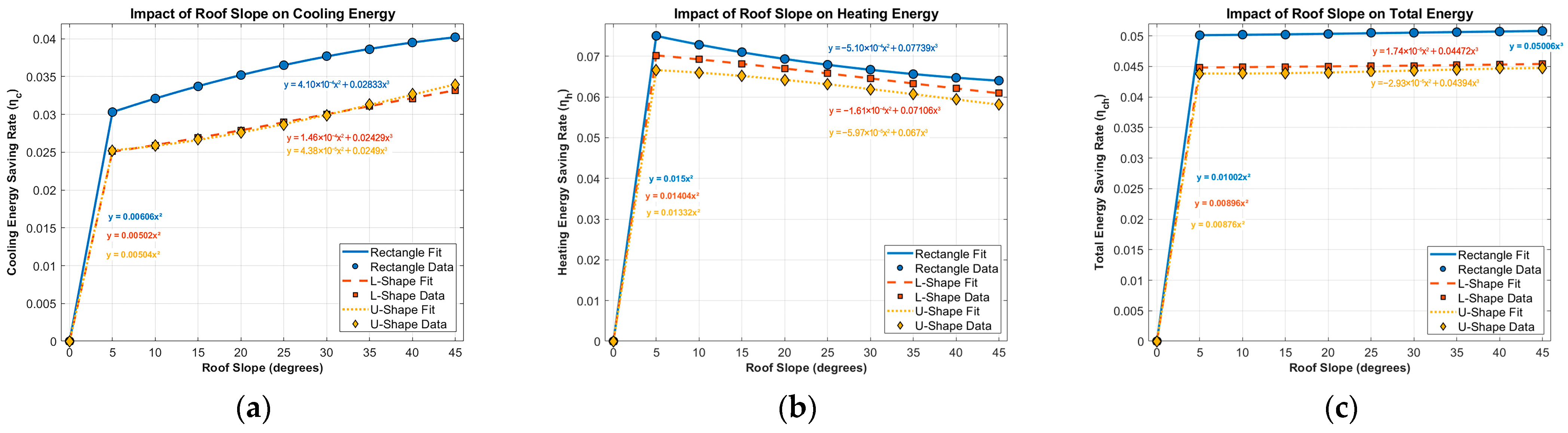
3.1.8. Roof Slope

As shown in Table 9 and Figure 8, changes in roof slope have a significant nonlinear impact on the energy-saving rates for heating, cooling, and total energy consumption, and the underlying mechanisms differ fundamentally between energy consumption types. Unlike other influencing factors, because the trend of energy-saving rate under the influence of roof slope between 0° and 5° differs significantly from the trend after 5°, two different functions were used to fit the nonlinear relationship.
Overall, as the roof slope increases from 0° to 45°, the total energy-saving rate per unit area shows a continuous upward trend, indicating that adopting a sloped roof form is beneficial for improving the building’s overall energy efficiency.
Different building shapes show similar trends in response to changes in roof slope but differ in efficiency. Under all slope conditions, rectangular buildings consistently perform best, while U-shape buildings have the relatively lowest energy performance. For example, at a 45° slope, the total energy-saving rate of rectangular buildings is about 0.8 percentage points higher than that of U-shape buildings.
Analysis of sub-item energy consumption shows that the heating energy-saving rate exhibits a unique trend of first increasing and then decreasing with increasing slope (increasing when the roof slope is below 5°, slowly decreasing above 5°), indicating that the impact mechanism of slight slope changes on winter thermal performance differs from that in summer. Moreover, the sensitivity of heating energy-saving rate to roof slope is much greater than that of cooling energy-saving rate.

3.2. Relative Importance of Influencing Factors

To justify the use of GBDT for relative importance analysis, its performance was compared with ridge regression and XGBoost using the same 160 simulation samples. Ridge regression was used as a linear baseline model, while XGBoost was used as another tree-based ensemble model. As shown in Table 10, GBDT outperformed ridge regression for all three energy-saving indicators, confirming the need to capture nonlinear relationships. Although XGBoost achieved slightly higher R2 values for cooling and heating energy-saving rates, GBDT showed comparable accuracy and performed slightly better for the total energy-saving rate. Considering both prediction performance and the interpretability of feature-importance results, GBDT was selected as the main model for relative importance analysis.
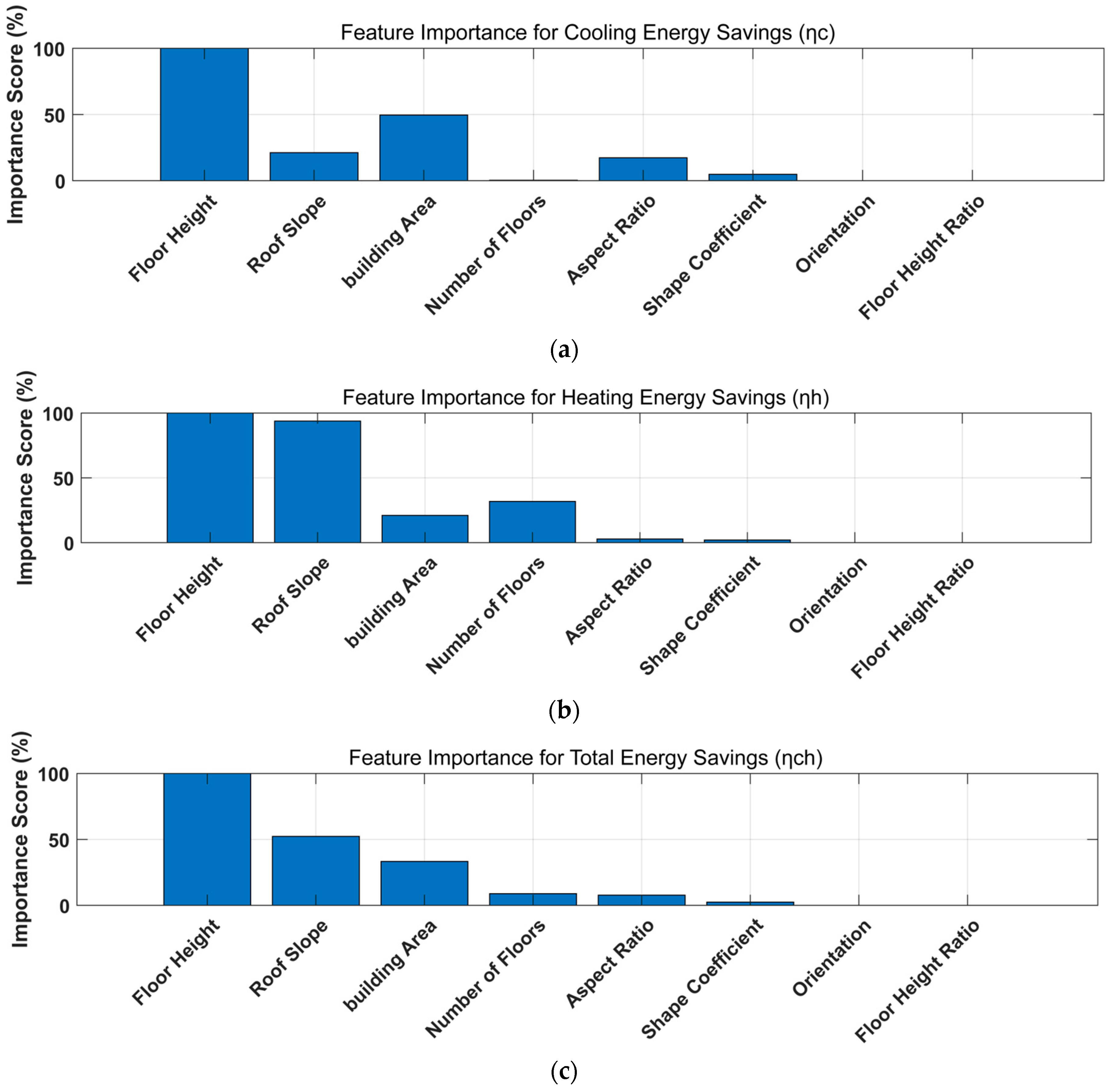
Through a quantitative analysis of energy consumption data from 160 building models with different parameter combinations using the GBDT model, the relative importance ranking of influencing factors was determined based on the contributions of eight key morphological design factors—shape coefficient, orientation, building area, aspect ratio, number of floors, floor height, floor height ratio, and roof slope—to the energy-saving rates of cooling, heating, and total energy consumption. As shown in Figure 9, the importance rankings of these factors differ somewhat across cooling, heating, and total energy-saving rates, reflecting the diversity of physical pathways in building energy response mechanisms.
Among the key morphological factors influencing building energy consumption, floor height demonstrates the highest relative importance, with its importance score set as the reference value of 100%. A greater floor height leads to increased air volume and external wall surface area, significantly elevating both cooling load in summer and heating load in winter. This is followed by roof slope, which reflects the impact of roof inclination on the formation of an attic thermal buffer zone. However, the importance ranking of roof slope varies between cooling and heating energy-saving rates: it ranks third in cooling energy-saving rate, with an importance score approximately 25% that of floor height, but second in heating energy-saving rate—consistent with its ranking for total energy-saving rate—with a score about 90% that of floor height. Building area, a key indicator of the building plan, ranks third in importance for total energy consumption, with a score around 30% that of floor height. For cooling and heating energy-saving rates, its importance ranks second and fourth, respectively. This indicates that an increase in building area reduces the ratio of external surface area to internal air volume, thereby decreasing heat exchange loss.
The number of floors ranks fourth and third in importance for total and heating energy-saving rates, respectively, but has a negligible impact on cooling energy-saving rate, close to 0%. In contrast, the aspect ratio has an importance score of about 20% that of floor height for cooling energy-saving rate, yet less than 5% for heating energy-saving rate, ultimately ranking fifth for total energy-saving rate with a score around 10%. This suggests that both the number of floors and the aspect ratio influence energy-saving rates, but their effects differ between cooling and heating.
The shape coefficient ranks sixth in importance for cooling, heating, and total energy-saving rates, indicating that the irregularity of the building plan has a minor impact on energy consumption. The importance scores of orientation and floor height ratio are significantly low. This suggests that, within the parameter range and model conditions set in this study, deviations in building azimuth and differences in inter-floor height ratios have a relatively weak impact on overall building energy performance compared to factors such as floor height and roof slope.
In summary, building energy performance is the result of multiple interacting factors. Compared to heating, cooling energy consumption is more sensitive to changes in building plan morphology. During the design stage, priority should be given to adjusting highly sensitive factors (e.g., floor height, roof slope, building area), and differentiated strategies should be adopted for various energy consumption types based on climate adaptability, to achieve overall optimization of energy efficiency and thermal comfort.

4. Discussion

4.1. Impact Mechanisms of Design Elements on Energy Consumption

This study not only confirms several findings reported in previous studies, but also reveals new form-specific and climate-specific response patterns for rural residences in hot summer and cold winter regions.
At the plan organization level, the regularity of the building plan (characterized by the shape factor) is a fundamental determinant of energy consumption. This study found a significant negative correlation between shape factor and energy consumption, a conclusion consistent with Li’s (2022) study on Hongnan Village in Yancheng City, which also identified shape factor as the most significant factor affecting energy consumption [37]. Research by Huang Yanlu and Li Zheng (2024) further confirmed a linear relationship between shape factor and building energy consumption [38]. This trend primarily stems from the deterioration of the thermal performance of the building envelope: a larger shape factor means a relatively larger external surface area, leading to increased heat transfer loss, increasing both winter heat loss and summer heat gain.
Regarding the aspect ratio, this study found that its impact on energy consumption follows a parabolic trend. This echoes the findings of Feng Weijia et al. (2024) on high-rise residential clusters in Hangzhou, which identified the average aspect ratio as the most significant factor affecting energy consumption [39]. Building on this, the present study further found that the magnitude of change in energy-saving rate with the aspect ratio is much greater for L-shaped and U-shaped buildings than for rectangular buildings. The energy-saving rate for L-shaped buildings continuously decreases as the aspect ratio increases, while U-shaped buildings exhibit a more pronounced nonlinear relationship. This finding suggests that aspect-ratio optimization should not be applied uniformly across different layouts, but should be adjusted according to specific plan forms. In terms of building area, this study found that as building area increases, the energy-saving rate continuously rises, and the improvement in heating energy-saving rate is significantly greater than that for cooling. This is mainly because, as building scale expands, the ratio of external envelope area to building volume or usable building area is optimized, thereby reducing the relative impact of ground heat exchange.
Building orientation primarily modulates energy consumption by influencing solar heat gains and leveraging prevailing wind directions. This study confirms that true south and orientations up to 5° east of south are optimal in the Hangzhou area, and deviations from this range increase energy consumption, with cooling energy consumption being more sensitive to orientation changes than heating. This is largely consistent with the findings of Yu Zhichun et al. (2024) on folk dwellings in Hangzhong, which validated the key role of orientation optimization in reducing annual heating and cooling energy consumption through single-objective optimization [40]. However, a unique finding of this study is that the sensitivity of L-shaped and U-shaped buildings to orientation differs significantly from that of rectangular buildings. When oriented southwest, the order of total energy-saving rate is U-shaped > Rectangular > L-shaped; when oriented southeast, the order is L-shaped > U-shaped > Rectangular. This result is likely related to the self-shading effects of the buildings, revealing an interaction mechanism between complex plan forms and orientation that has rarely been addressed in existing research.
At the vertical organization level, the number of stories and floor height emerge as pivotal modulating factors. In terms of the number of stories, this study found that increasing the number of stories reduces unit heating energy consumption, consistent with the findings of Huang Zishuo et al. (2022), which indicated that fully utilizing courtyard spaces in farmhouses across different climate zones can reduce air conditioning energy consumption by 7.21% to 33.99% [41]. In terms of floor height, as floor height increases, the energy-saving rate decreases significantly. This is because a higher floor height entails a larger volume of air requiring temperature regulation and an expanded exterior wall surface area for heat dissipation, thus significantly increasing both cooling and heating energy demands. This finding corroborates the research of Yu Zhichun et al. (2024), which included floor height as a key design parameter in their optimization framework and noted that properly controlling floor height plays an important role in improving indoor thermal comfort and reducing energy consumption [40]. More importantly, this study further indicates that floor height has a more dominant influence than many commonly discussed plan-related parameters, suggesting that controlling conditioned volume through vertical spatial design is particularly important for rural residences in HSCW regions.
This study found that transitioning from a flat roof to a pitched roof (0° to 5°) yields significant energy-saving benefits (approximately 5% total energy-saving rate), validating the effectiveness of the attic space as a thermal buffer layer. However, the marginal benefit becomes limited after the roof slope exceeds 5°, indicating that the energy-saving effect of roof slope is not linear. Research by Zhu Yiyun et al. (2017) on rural buildings in the Qinba Mountains also confirmed that the optimization potential for roof heat transfer is much greater than that for walls [42]. However, a unique finding of this study is that the heating energy-saving rate shows a trend of first increasing and then decreasing with increasing slope (increasing below 5°, gradually decreasing above 5°), indicating that the impact mechanism of slight slope changes on winter thermal performance differs from that in summer, providing a refined basis for determining economically reasonable roof slopes in design practice.

4.2. Relative Importance of Design Elements

Based on the GBDT analysis of 160 simulation samples, this study identified the relative importance of eight architectural form parameters. The overall importance ranking was floor height > roof slope > building area > number of floors > aspect ratio, while shape coefficient, orientation, and floor height ratio showed relatively lower importance. Unlike many previous studies that focused on one or several individual design variables, this study evaluated multiple form-related parameters within a unified framework. Therefore, the results provide not only a ranking of influential factors, but also a basis for understanding which design elements should be prioritized in early-stage rural housing design.
Some findings are consistent with previous studies. For example, the high importance of roof slope, especially for heating energy-saving rate, agrees with Hu Zhenlu (2023), who identified the roof as one of the most sensitive envelope components affecting energy consumption [43]. Similarly, the high importance of floor height is consistent with Yu Zhichun et al. (2024), who included floor height as a key optimization parameter [40]. These consistencies indicate that the GBDT-based ranking is supported by basic physical mechanisms, including conditioned air volume, envelope heat transfer, and the thermal-buffering effect of roof space.
More importantly, the relative importance ranking also reveals findings that differ from some previous studies. Li Wenhao’s (2022) study ranked shape factor as the most important factor [37], whereas shape coefficient ranked sixth in this study. This difference may be related to research scale and sample composition. Li’s study focused more on residential area morphology, where the variation in shape-related indicators was larger. In contrast, this study focused on individual rural residential prototypes, among which rectangular plans accounted for 67% of the surveyed samples. The relatively limited variation in plan irregularity may have reduced the importance score of shape coefficient in the GBDT analysis. Another notable finding is that floor height ranked first in this study, with its GBDT importance score set as 100%. Although Yu Zhichun et al. (2024) also considered floor height as an important optimization parameter, their study placed greater emphasis on envelope thermal performance [40]. The difference may be explained by both research scope and analytical method. This study intentionally focused on architectural form variables, while the GBDT model quantified the independent contribution of each parameter under the same dataset. Compared with traditional sensitivity analysis, this approach is more suitable for identifying nonlinear effects and reducing the interference of parameter interactions.
Overall, the main contribution of this study lies in constructing a “form simulation—response fitting—importance evaluation” workflow for rural residential design. Existing studies often use energy simulation to compare energy consumption among different schemes, while fewer studies further translate simulation results into interpretable design priorities. By combining DesignBuilder simulation, response-curve fitting, and GBDT-based feature-importance analysis, this study links parameter response mechanisms with design decision-making. This provides a clearer basis for determining which form elements should be optimized first in rural residences in hot summer and cold winter regions.

4.3. Design Optimization Strategies

Based on the above quantitative analysis results, the following energy-efficient design strategies are proposed for rural residences in Hangzhou, aiming to provide a scientific basis and actionable guidance for architects in the early design phase.
Floor height is the most critical factor affecting energy consumption. When floor height increases from 2.8 m to 3.6 m, the total energy-saving rate per unit area decreases from +11.66% to −11.60%, showing a significant quadratic decreasing trend. Therefore, it is recommended to control the floor height of primary living spaces within 3.0 m. For spaces requiring greater height, such as living rooms, localized high ceilings can be used to meet psychological needs, supplemented by thermal buffer measures such as suspended ceilings to reduce the actual conditioned volume.
The impact of roof slope on energy consumption is also significant, with heating energy-saving rate being particularly sensitive to slope. It is recommended that new residences adopt a roof slope of no less than 5° and utilize the attic space as a thermal buffer layer to effectively reduce heat exchange between the top floor and the outdoors. Additionally, installing vents in the attic can utilize summer thermal pressure ventilation to further reduce cooling demand.
An increase in building area helps reduce unit energy consumption, but this must be considered alongside actual site conditions. Three stories appears to be a favorable choice; compared to one or two stories, three stories significantly reduce unit heating energy consumption (with an energy-saving rate improvement of about 10%), while the improvement in energy-saving rate from increasing to four stories is markedly diminished (only about 1.2%), making three stories the optimal choice from an economic perspective. Furthermore, priority should be given to compact rectangular plans, with the aspect ratio controlled between 0.9 and 1.0 (optimal value 0.93). If site constraints require L-shaped or U-shaped plans, special attention should be paid to controlling the aspect ratio. For L-shaped plans, the aspect ratio should not exceed 1.1; for U-shaped plans, the aspect ratio should be strictly controlled within the narrow range of 0.8 to 1.2, and self-shading effects should be utilized to optimize orientation.
In terms of building orientation, true south and orientations up to 5° east of south are optimal in the Hangzhou area. Rectangular plans should ideally face true south; L-shaped plans are recommended to face 5° to 10° east of south to utilize southeastern solar heat gain while reducing western exposure; U-shaped plans can face 5° to 10° west of south to use their form’s self-shading to mitigate overheating in the summer afternoon. In actual design, adjustments should also be made based on the surrounding building layout and prevailing wind direction.
The practical value of these energy-saving strategies is particularly evident in their direct responsiveness to the current construction landscape of rural residences in Hangzhou. Currently, rural residents in Hangzhou exhibit a growing demand for improved living quality and indoor thermal comfort. Without scientific guidance in energy-efficient design, this trend can readily result in escalating energy consumption. The quantitative analytical methods and specific optimization strategies presented in this study offer technical support and design references for local initiatives, such as the promotion of “Hangzhou-style residential architecture,” the compilation of design atlases, and rural design outreach programs. In practical design applications, architects and homeowners often need to balance multiple objectives. But designers can leverage the revealed mechanisms of each element and their importance rankings—as elucidated in this research—to tailor optimization strategies according to specific project priorities (e.g., emphasis on energy-saving, comfort, or cost control). Beyond technical parameters, the successful implementation of such energy-saving strategies requires a synergistic relationship between professional design and local building practices [8]. These approaches aim to maximize a building’s inherent energy-saving potential while simultaneously satisfying fundamental functional and comfort requirements.

4.4. Limitations and Future Prospects

This study has several limitations. First, although the cases cover the main rural residential construction modes in Hangzhou, the sample size and geographical coverage remain limited. Future research should expand the dataset to other hot-summer and cold-winter cities and compare regional differences. Second, the simulations used standardized and simplified boundary conditions to isolate the effects of architectural form. This approach improves internal comparability but may underestimate or overestimate absolute energy use under real intermittent operation. Future work should combine long-term measured data, household behavior models, and uncertainty analysis. Third, the present calculation is based on a typical meteorological year. Atypical weather scenarios, including extreme heat waves and unusually cold periods, may alter the relative importance of orientation, roof form, and envelope heat transfer. Future studies should therefore test representative extreme-year weather files or morphed climate scenarios. In addition, this study mainly focused on architectural form parameters and did not consider other important factors, such as envelope construction and material thermal properties. Future research could incorporate additional design variables to establish a more comprehensive optimization framework. Finally, the machine learning model was not calibrated using measured building performance data, and its predictive accuracy could be further improved in future studies through field validation and data-driven calibration.

5. Conclusions

This study explored form-based passive design strategies for rural residences in Hangzhou, a representative hot summer and cold winter region. Based on field surveys, energy simulation, and GBDT-based analysis, the following conclusions can be drawn:
(1)
Based on the field survey of 76 rural housing samples in Hangzhou, three representative residential prototypes—rectangular, L-shaped, and U-shaped—were established. These prototypes reflect the main local rural housing forms and provide a practical basis for simulation-based energy optimization.
(2)
The eight architectural form parameters showed different nonlinear effects on cooling, heating, and total energy-saving rates. Among them, floor height had the greatest influence on energy performance, followed by roof slope and building area. In contrast, orientation and floor height ratio showed relatively limited effects under the parameter ranges used in this study.
(3)
The results indicate that controlling floor height, adopting an appropriate pitched roof, increasing building compactness, and optimizing the aspect ratio can effectively improve energy performance. For rural residences in Hangzhou, a floor height within 3.0 m, a roof slope of no less than 5°, and compact plan forms are recommended in early-stage design.
(4)
Response-curve fitting and GBDT-based importance analysis helped identify nonlinear parameter responses and relative importance rankings, providing a quantitative basis for translating simulation results into design-oriented strategies for energy-efficient rural housing in hot summer and cold winter regions. The proposed framework can support architects and local practitioners in developing energy-efficient rural housing in hot summer and cold winter regions.
Overall, this study provides methodological support and practical design references for the green and low-carbon development of rural residences. Future research should further incorporate measured energy data, occupant behavior, envelope properties, material performance, and extreme weather scenarios to improve the robustness and applicability of the findings.

Author Contributions

Conceptualization, H.Z., and J.W.; methodology, H.Z., Y.Z., D.G., Y.C., and J.W.; software, Y.Z., and D.G.; validation, Y.Z., and Y.L.; formal analysis, Y.L.; investigation, Y.L.; resources, Y.L., and Y.C.; writing—original draft preparation, Y.C., and J.W.; writing—review and editing, Y.Z., and J.W.; supervision, D.G., and J.W.; project administration, D.G.; funding acquisition, Y.Z., and D.G. All authors have read and agreed to the published version of the manuscript.

Funding

This research was funded by: 1. National Natural Science Foundation of China (Grant No. 52378042); 2. The 2024 Pilot Project of Zhejiang University’s Balanced Architecture Research Center, Sustainable Construction Technology and Demonstration of “Ecological-Human Settlement” Environment in Waterfront Villages and Towns (Grant No. 24ZJUPJ001Z); 3. Key Project of the Annual Regular Topics of Zhejiang Provincial Philosophy and Social Sciences Planning in 2026: Research and application of the evaluation system for the construction of “Maritime Garden” in Dongtou District (Grant No. 26NDJC003Z); 4. Research results of “Social Sciences Empowering High-quality Development Action in Mountainous Island Counties” (Grant No. 25SSKE0103); 5. Student Research Training Program of Zhejiang University in 2026: “Research on the Development of Building-Attached Intelligent Modules for Intelligent Unmanned Aerial Vehicle Delivery” (Grant No. 26ZSRC028).

Data Availability Statement

The original contributions presented in this study are included in the article. Further inquiries can be directed to the corresponding author.

Acknowledgments

During the preparation of this work the authors used ChatGPT (GPT-5.2, OpenAI, San Francisco, CA, USA) in order to improve language and readability. After using this tool/service, the authors reviewed and edited the content as needed and take full responsibility for the content of the publication.

Conflicts of Interest

Authors Huan Zhang, Dian Gu and Jie Wang were employed by the company The Architectural Design and Research Institute of Zhejiang University Co., Ltd. The remaining authors declare that the research was conducted in the absence of any commercial or financial relationships that could be construed as a potential conflict of interest.

Abbreviations

The following abbreviations are used in this manuscript:
PODPerformance-Oriented Design
HSCWHot summer and cold winter
GBDTGradient Boosting Decision Tree
CARTClassification and Regression Trees

Appendix A

Table A1. Survey sample plan drawings.
(1) Sample Floor Plan of a Rectangular Residence
1F2F3F1F2F3F1F2F3F
Buildings 16 02335 i016Buildings 16 02335 i017Buildings 16 02335 i018
Buildings 16 02335 i019Buildings 16 02335 i020Buildings 16 02335 i021
Buildings 16 02335 i022Buildings 16 02335 i023Buildings 16 02335 i024
Buildings 16 02335 i025Buildings 16 02335 i026Buildings 16 02335 i027
Buildings 16 02335 i028Buildings 16 02335 i029Buildings 16 02335 i030
Buildings 16 02335 i031Buildings 16 02335 i032Buildings 16 02335 i033
Buildings 16 02335 i034Buildings 16 02335 i035Buildings 16 02335 i036
Buildings 16 02335 i037Buildings 16 02335 i038Buildings 16 02335 i039
Buildings 16 02335 i040Buildings 16 02335 i041Buildings 16 02335 i042
Buildings 16 02335 i043Buildings 16 02335 i044Buildings 16 02335 i045
Buildings 16 02335 i046Buildings 16 02335 i047Buildings 16 02335 i048
Buildings 16 02335 i049Buildings 16 02335 i050Buildings 16 02335 i051
Buildings 16 02335 i052Buildings 16 02335 i053Buildings 16 02335 i054
Buildings 16 02335 i055Buildings 16 02335 i056Buildings 16 02335 i057
Buildings 16 02335 i058Buildings 16 02335 i059Buildings 16 02335 i060
Buildings 16 02335 i061Buildings 16 02335 i062Buildings 16 02335 i063
Buildings 16 02335 i064Buildings 16 02335 i065Buildings 16 02335 i066
(2) Sample floor plan of L-shaped residence
1F2F3F1F2F3F1F2F3F
Buildings 16 02335 i067Buildings 16 02335 i068Buildings 16 02335 i069
Buildings 16 02335 i070Buildings 16 02335 i071Buildings 16 02335 i072
Buildings 16 02335 i073Buildings 16 02335 i074Buildings 16 02335 i075
(3) Sample floor plan of U-shaped residence
1F2F3F1F2F3F1F2F3F
Buildings 16 02335 i076Buildings 16 02335 i077Buildings 16 02335 i078
Buildings 16 02335 i079Buildings 16 02335 i080Buildings 16 02335 i081
Buildings 16 02335 i082Buildings 16 02335 i083Buildings 16 02335 i084
Buildings 16 02335 i085Buildings 16 02335 i086Buildings 16 02335 i087
(4) Sample floor plan of T-shaped residence
1F2F3F1F2F3F1F2F3F
Buildings 16 02335 i088Buildings 16 02335 i089Buildings 16 02335 i090
Buildings 16 02335 i091

Appendix B

Table A2. Literature review of architectural form elements.
Building TypeSourceArchitectural form Elements
Plan OrganizationVertical Organization
Urban residential buildingsRocchi, L. et al. [44], 2018Orientation, aspect ratioBuilding height
Nair, G. et al. [45], 2018Plan type, building areaNumber of floors
Ma, Y. et al. [46], 2023Floor areaNumber of floors
Rural residential buildingsSui, J. et al. [47], 2007Aspect ratio, floor area ratioFloor height
Jin, H. et al. [48], 2015Width and depthBuilding height
Ji, L. [49], 2016Plan type, width, depth, aspect ratioNumber of floors, roof slope
Shao, T. et al. [50], 2021Building area, aspect ratioFloor height, roof slope
Lü, B. et al. [51], 2022shape coefficientNumber of floors, floor height
Li, W. [37], 2022Aspect ratio, plan typeBuilding height
Zhang, Y. [52], 2023Building area, aspect ratioFloor height, roof slope

Appendix C

Survey Questionnaire on Air Conditioning Usage in Rural Residential Buildings
Part I—Basic Information
  • 1. Your gender: (Single choice)
    ○male○female
  • 2. Your age: (Single choice)
    ○Under 18○18~30○31~45○46~60○over 60
  • 3. Number of permanent residents in your household: __________ (Fill in the blank)
    Part II—Indoor Thermal Environment Evaluation
  • 4. How do you feel indoors during summer without air conditioning? (Single choice)
    ○Very hot, unbearable○Hot, somewhat uncomfortable○Slightly hot, bearable○Comfortable
  • 5. How do you feel indoors during winter without air conditioning? (Single choice)
    ○Very cold, unbearable○Cold, somewhat uncomfortable○Slightly cold, bearable○Comfortable
    Part III—Air Conditioning Usage
  • 6. Number of air conditioners installed in your household: (Single choice)
    ○1 or less○2○3○4○5 or more
  • 7. Rooms with air conditioners installed: (Single choice)
    ○Bedrooms only○Bedrooms + living room○Bedrooms + living room + other rooms
  • 8. Summer: In which time periods do you use air conditioning? (Multiple choice)
    (1) Bedroom usage periods(2) Living room usage periods
    □6:00–10:00□6:00–10:00
    □10:00–14:00□10:00–14:00
    □14:00–18:00□14:00–18:00
    □18:00–22:00□18:00–22:00
    □22:00–6:00□22:00–6:00
  • 9. Winter: In which time periods do you use air conditioning? (Multiple choice)
    (1) Bedroom usage periods(2) Living room usage periods
    □6:00–10:00□6:00–10:00
    □10:00–14:00□10:00–14:00
    □14:00–18:00□14:00–18:00
    □18:00–22:00□18:00–22:00
    □22:00–6:00□22:00–6:00

Appendix D

Table A3. Architectural Form Data of Three Typical Residential Models.
Shape CoefficientBuilding AreaTotal Frontage WidthTotal DepthOrientationNumber of FloorsFloor HeightRoof slope
Rectangular125 m211.6 m10.8 mDue South33.2 m27°
L-shaped14.22 m12.75 m
U-shaped8.74 m16.44 m

Appendix E

Table A4. Experimental range and step size for each morphological element.
Design ElementStartEndStep Size
Shape CoefficientCategorized into three types: Rectangular (1.0), L-shaped (1.2), U-shaped (1.3)
data
Building Area85 m2135 m210 m2
Aspect Ratio0.56 1.57 0.6
OrientationWS30°ES30°
Number of Floors141
Floor Height2.8 m3.6 m0.1 m
Floor Height Ratio11.30.1

References

  1. Belaïd, F.; Ranjbar, Z.; Massié, C. Exploring the Cost-Effectiveness of Energy Efficiency Implementation Measures in the Residential Sector. Energy Policy 2021, 150, 112122. [Google Scholar] [CrossRef]
  2. Wen, B.; Musa, N.; Onn, C.C.; Ramesh, S.; Liang, L.; Wang, W. Evolution of Sustainability in Global Green Building Rating Tools. J. Clean. Prod. 2020, 259, 120912. [Google Scholar] [CrossRef]
  3. Wang, H.; Chen, W.; Shi, J. Low Carbon Transition of Global Building Sector under 2- and 1.5-Degree Targets. Appl. Energy 2018, 222, 148–157. [Google Scholar] [CrossRef]
  4. Cai, K.; Wu, L. Grey Prediction of Carbon Emission and Carbon Peak in Several Developing Countries. Eng. Appl. Artif. Intell. 2024, 133, 108210. [Google Scholar] [CrossRef]
  5. Yang, L.; Yan, H.; Lam, J. Thermal Comfort and Building Energy Consumption Implications—A Review. Appl. Energy 2014, 115, 164–173. [Google Scholar] [CrossRef]
  6. Akuraju, V.; Pradhan, P.; Haase, D.; Kropp, J.P.; Rybski, D. Relating SDG11 Indicators and Urban Scaling—An Exploratory Study. Sustain. Cities Soc. 2020, 52, 101853. [Google Scholar] [CrossRef]
  7. Doni, F.; Gasperini, A.; Soares, J.T. What is the SDG 13? In SDG13—Climate Action: Combating Climate Change and Its Impacts; Emerald Publishing Limited: Leeds, UK, 2020. [Google Scholar] [CrossRef]
  8. Liang, L.; Wen, B.; Xu, F.; Yang, Q. From Poor Buildings to High Performance Buildings: The Spontaneous Green Evolution of Vernacular Architecture. Appl. Sci. 2023, 13, 10162. [Google Scholar] [CrossRef]
  9. Evans, M.; Yu, S.; Song, B.; Deng, Q.; Liu, J.; Delgado, A. Building Energy Efficiency in Rural China. Energy Pol. 2014, 64, 243–251. [Google Scholar] [CrossRef]
  10. Xu, Z.; Wang, X.; Tang, S.; Chen, Y.; Yang, Y. Construction and Case Analysis of a Comprehensive Evaluation System for Rural Building Energy Consumption from an Energy–Building–Behavior Composite Perspective. Sustainability 2024, 16, 6959. [Google Scholar] [CrossRef]
  11. He, B.; Yang, L.; Ye, M.; Mou, B.; Zhou, Y. Overview of Rural Building Energy Efficiency in China. Energy Pol. 2014, 69, 385–396. [Google Scholar] [CrossRef]
  12. Xu, J.; Gao, W.; Huo, X. Analysis on Energy Consumption of Rural Building Based on Survey in Northern China. Energy Sustain. Dev. 2018, 47, 34–38. [Google Scholar] [CrossRef]
  13. Duan, Z.; Li, H.; Hu, K.; Shi, C. Energy Efficiency Assessment of Existing Rural Houses in Nantong Based on Human Thermal Comfort. Buildings 2024, 14, 1974. [Google Scholar] [CrossRef]
  14. Wang, M.; Xu, Y.; Shen, R.; Wu, Y. Performance-Oriented Parametric Optimization Design for Energy Efficiency of Rural Residential Buildings: A Case Study from China’s Hot Summer and Cold Winter Zone. Sustainability 2024, 16, 8330. [Google Scholar] [CrossRef]
  15. Shi, X. Performance-Based and Performance-Driven Architectural Design and Optimization. Front. Archit. Civ. Eng. China 2010, 4, 512–518. [Google Scholar] [CrossRef]
  16. Yu, W.; Li, B.; Jia, H.; Zhang, M.; Wang, D. Application of Multi-Objective Genetic Algorithm to Optimize Energy Efficiency and Thermal Comfort in Building Design. Energy Build. 2015, 88, 135–143. [Google Scholar] [CrossRef]
  17. Liu, S.; Meng, X.; Tam, C. Building Information Modeling Based Building Design Optimization for Sustainability. Energy Build. 2015, 105, 139–153. [Google Scholar] [CrossRef]
  18. Liang, L.; Li, X.; Liu, S.; Guo, Z.; Tang, S.; Wen, B. Integrating Computer Vision and GIS for Large-Scale Morphological Mapping and Driving Force Analysis of Vernacular Courtyard Dwellings. Buildings 2026, 16, 1118. [Google Scholar] [CrossRef]
  19. Prada, A.; Gasparella, A.; Baggio, P. On the Performance of Meta-Models in Building Design Optimization. Appl. Energy 2018, 225, 814–826. [Google Scholar] [CrossRef]
  20. Castro Pena, M.L.; Carballal, A.; Rodríguez-Fernández, N.; Santos, I.; Romero, J. Artificial Intelligence Applied to Conceptual Design. A Review of Its Use in Architecture. Autom. Constr. 2021, 124, 103550. [Google Scholar] [CrossRef]
  21. Caetano, I.; Leitão, A. Architecture Meets Computation: An Overview of the Evolution of Computational Design Approaches in Architecture. Archit. Sci. Rev. 2020, 63, 165–174. [Google Scholar] [CrossRef]
  22. Penttilä, H. Describing the Changes in Architectural Information Technology to Understand Design Complexity and Free-Form Architectural Expression. Electron. J. Inf. Technol. Constr. 2006, 11, 395–408. [Google Scholar]
  23. Li, R.; Luo, L.; Li, X.; Wu, J.; Jiang, F.; Wang, W. Multi-Objective Optimization for Generative Morphological Design Using Energy and Comfort Models with a Practical Design of New Rural Community in China. Energy Build. 2024, 313, 114282. [Google Scholar] [CrossRef]
  24. Wu, D.; Zhang, Y.; Zhang, J.; Lv, H.; Fu, M. Robust Retrofits for Rural House Envelope Considering Construction Quality and Occupant Behavior Uncertainties: A MOO-Integrated Taguchi Method. Energy Build. 2024, 323, 114832. [Google Scholar] [CrossRef]
  25. Ying, X.; Li, W. Effect of Floor Shape Optimization on Energy Consumption for U-Shaped Office Buildings in the Hot-Summer and Cold-Winter Area of China. Sustainability 2020, 12, 2079. [Google Scholar] [CrossRef]
  26. Deng, Q.; Wang, G.; Wang, Y.; Zhou, H.; Ma, L. A Quantitative Analysis of the Impact of Residential Cluster Layout on Building Heating Energy Consumption in Cold IIB Regions of China. Energy Build. 2021, 253, 111515. [Google Scholar] [CrossRef]
  27. Ying, X.; Huang, F.; Tao, C. Low Energy Consumption Form of the U-Shaped Plan Office Building in the Yangtze River Delta. Sci. Rep. 2023, 13, 11250. [Google Scholar] [CrossRef]
  28. Depecker, P.; Menezo, C.; Virgone, J.; Lepers, S. Design of Buildings Shape and Energetic Consumption. Build. Environ. 2001, 36, 627–635. [Google Scholar] [CrossRef]
  29. Hwang, J.; Lim, H.; Lim, J. Reducing Uncertainty of Building Shape Information in Urban Building Energy Modeling Using Bayesian Calibration. Sustain. Cities Soc. 2024, 116, 105895. [Google Scholar] [CrossRef]
  30. He, P.; Xue, J.; Shen, G.; Ni, M.; Wang, S.; Wang, H.; Huang, L. The Impact of Neighborhood Layout Heterogeneity on Carbon Emissions in High-Density Urban Areas: A Case Study of New Development Areas in Hong Kong. Energy Build. 2023, 287, 113002. [Google Scholar] [CrossRef]
  31. Yang, Q.; Lu, W.; Xu, F.; Luo, X.; Wen, B. A Passive Strategy for Energy-Saving Retrofitting of Courtyard Dwellings and Its Climatic Adaptability. Energy Build. 2026, 352, 116811. [Google Scholar] [CrossRef]
  32. Xu, F.; Bai, Y.; Wen, B.; Xie, W.; Huang, L.; Ou, Y.N.; Luo, X.H.; Yang, Q.X. Contemporary Evolution of Tibetan-Style Dwellings under Urbanization: A Case Study of the Shannan City. J. Asian Archit. Build. Eng. 2025, 1–18. [Google Scholar] [CrossRef]
  33. Beck, H.; Zimmermann, N.; McVicar, T.; Vergopolan, N.; Berg, A.; Wood, E.F. Present and Future Köppen-Geiger Climate Classification Maps at 1-km Resolution. Sci. Data 2018, 5, 180214. [Google Scholar] [CrossRef]
  34. GB 50178-93; Standard of Climatic Regionalization for Architecture. China Planning Press: Beijing, China, 1993. (In Chinese)
  35. Wen, B.; Yang, Q.; Xu, F.; Zhou, J.; Zhang, R. Phenomenon of Courtyards Being Roofed and Its Significance for Building Energy Efficiency. Energy Build. 2023, 295, 113282. [Google Scholar] [CrossRef]
  36. Cao, D.; Hao, Z.; Ding, Y.; Wei, W. Energy-Saving Design of High-Rise Office Buildings in Severe Cold C-Class Regions Based on Solar-Thermal Performance. Ind. Constr. 2023, 53, 84–90, 121. [Google Scholar] [CrossRef]
  37. Li, W. Morphological Study of New Rural Residential Areas in Hot Summer and Cold Winter Regions Under Energy-Saving Orientation. Master’s Thesis, Southeast University, Nanjing, China, 2022. (In Chinese) [Google Scholar] [CrossRef]
  38. Huang, Y.; Li, Z. Discussion on Energy-Saving Green Residential Design in Rural Areas. Value Eng. 2024, 43, 154–158. (In Chinese) [Google Scholar] [CrossRef]
  39. Feng, W.; Chen, J.; Yang, Y.; Gao, W.; Zhao, Q.; Xing, H.; Yu, S. The Impact of Building Morphology on Energy Use Intensity of High-Rise Residential Clusters: A Case Study of Hangzhou, China. Buildings 2024, 14, 2245. [Google Scholar] [CrossRef]
  40. Yu, Z.; Guo, Z.; Ling, Z.; Chen, Y. Research on Low-Carbon Building Design Strategies for Folk Dwellings in Hanzhong Based on Single Objective Optimization. Buildings 2024, 14, 2154. [Google Scholar] [CrossRef]
  41. Huang, Z.; Liu, Y.; Pan, C.; Wang, Y.; Yu, H.; He, W. Energy-Saving Effects of Yard Spaces Considering Spatiotemporal Activity Patterns of Rural Chinese Farm Households. J. Clean. Prod. 2022, 355, 131843. [Google Scholar] [CrossRef]
  42. Zhu, Y.; Zhao, J.; Sang, G.; Zhao, Q. Study on Thermal Performance of Energy-Saving Structures in Rural Buildings in the Qinba Mountain Area. J. Ningxia Univ. 2017, 38, 426–432. (In Chinese) [Google Scholar]
  43. Zheng, W.; Liu, X.; Hu, Z.; Wang, Y. Research on Passive Energy-Saving Strategies for Rural Buildings in Hot Summer and Cold Winter Regions. Refrig. Air Cond. 2023, 23, 57–64. (In Chinese) [Google Scholar]
  44. Rocchi, L.; Kadziński, M.; Menconi, M.E.; Grohmann, D.; Miebs, G.; Paolotti, L.; Boggia, A. Sustainability Evaluation of Retrofitting Solutions for Rural Buildings through Life Cycle Approach and Multi-Criteria Analysis. Energy Build. 2018, 173, 281–290. [Google Scholar] [CrossRef]
  45. Nair, G.; Gustavsson, L.; Mahapatra, K. Factors Influencing Energy Efficiency Investments in Existing Swedish Residential Buildings. Energy Policy 2010, 38, 2956–2963. [Google Scholar] [CrossRef]
  46. Ma, Y.; Ye, D.; Chen, Y.; Deng, W.; Xie, J.; Ye, Y.; Wang, J. Establishment of Residential Building Prototypes and Investigation of the Energy-Saving Effects of Passive Technologies. Build. Energy Effic. 2023, 51, 10–16, 25. (In Chinese) [Google Scholar]
  47. Sui, J.; Jia, Z.; Wang, S.; Sun, J. Evaluation System of Building Shape under the Concept of Sustainable Development. Archit. J. 2007, 12, 74–77. (In Chinese) [Google Scholar]
  48. Jin, H.; Shao, T. Study on Optimal Design of Energy Saving for Rural Housing in Severe Cold Regions. Archit. J. 2015, S1, 218–220. (In Chinese) [Google Scholar]
  49. Ji, L. Study on Energy-Saving Model of Rural Buildings in Hot Summer and Cold Winter Regions. Master’s Thesis, Tianjin University, Tianjin, China, 2016. (In Chinese) [Google Scholar]
  50. Shao, T.; Zheng, W. Energy-Saving Sensitivity Analysis of Spatial Design Factors in Rural Houses Based on Differences in Envelope Performance. Build. Sci. 2021, 37, 101–110, 125. (In Chinese) [Google Scholar] [CrossRef]
  51. Lü, B.; He, L. Optimization of Building Energy Consumption and Comfort under the Regulation of Building Spatial Form. Build. Energy Effic. 2022, 50, 30–35. (In Chinese) [Google Scholar]
  52. Zhang, Y. Energy-Saving Optimization of External Form of Rural Houses in Cold Regions Based on Indoor Thermal Comfort. Master’s Thesis, Harbin Institute of Technology, Harbin, China, 2023. (In Chinese) [Google Scholar] [CrossRef]
Figure 1. Location of Hangzhou in China’s building climate zones based on GB 50178-93 [34].
Buildings 16 02335 g001
Figure 2. Distribution of survey plots.
Buildings 16 02335 g002
Figure 3. Three typical patterns of rural architecture in Hangzhou. (a,b) Residences built autonomously by villagers. (c,d) Residences built autonomously by villagers with reference to a pattern book. (e,f) Buildings built uniformly by the government.
Buildings 16 02335 g003
Figure 4. Fitted response relationship between building area and energy-saving rate: (a) Impact of building area on cooling energy. (b) Impact of building area on heating energy. (c) Impact of building area on total energy. The original simulation points and fitted curves are shown to illustrate the response trend.
Buildings 16 02335 g004
Figure 5. Fitted response relationship between aspect ratio and energy-saving rate: (a) Impact of aspect ratio on cooling energy; (b) Impact of aspect ratio on heating energy; (c) Impact of aspect ratio on total energy. The original simulation points and fitted curves are shown to illustrate the response trend.
Buildings 16 02335 g005
Figure 6. Fitted response relationship between orientation and energy-saving rate: (a) Impact of orientation on cooling energy. (b) Impact of orientation on heating energy. (c) Impact of orientation on total energy. The original simulation points and fitted curves are shown to illustrate the response trend.
Buildings 16 02335 g006
Figure 7. Fitted response relationship between floor height and energy-saving rate: (a) Impact of floor height on cooling energy; (b) Impact of floor height on heating energy; (c) Impact of floor height on total energy. The original simulation points and fitted curves are shown to illustrate the response trend.
Buildings 16 02335 g007
Figure 8. Fitted response relationship between roof slope and energy-saving rate: (a) Impact of roof slope on cooling energy; (b) Impact of roof slope on heating energy; (c) Impact of roof slope on total energy. The original simulation points and fitted curves are shown to illustrate the response trend.
Buildings 16 02335 g008
Figure 9. GBDT analysis chart of the relative importance ranking of design elements in cooling, heating, and overall energy-saving rate. (a) Relative importance ranking of design elements in cooling energy efficiency rate. (b) Relative importance ranking of design elements in heating energy efficiency rate. (c) Relative importance ranking of design elements in total energy efficiency rate.
Buildings 16 02335 g009
Table 1. Floor Plans and Models of Three Typical Residential Types.
RectangularL-ShapedU-Shaped
Plan OutlineBuildings 16 02335 i001Buildings 16 02335 i002Buildings 16 02335 i003
First Floor PlanBuildings 16 02335 i004Buildings 16 02335 i005Buildings 16 02335 i006
Second Floor PlanBuildings 16 02335 i007Buildings 16 02335 i008Buildings 16 02335 i009
Third Floor PlanBuildings 16 02335 i010Buildings 16 02335 i011Buildings 16 02335 i012
Model DiagramBuildings 16 02335 i013Buildings 16 02335 i014Buildings 16 02335 i015
Table 2. Energy-saving rate per unit area of sub-model units with shape coefficients.
Shape CoefficientPlan TypeCooling Energy-Saving Rate
ηc
Heating Energy-Saving Rate
ηh
Total Energy-Saving Rate
ηch
* 1Rectangle0%0%0%
1.2L-shape−11.77%−9.27%−10.66%
1.3U-shape−13.58%−15.83%−14.58%
* Note: This value is used as the baseline for the shape coefficient.
Table 3. Energy-saving rate per unit area of sub-model units with building areas.
Building AreaCooling Energy-Saving Rate
ηc
Heating Energy-Saving Rate
ηh
Total Energy-Saving Rate
ηch
RectangleL-ShapeU-ShapeRectangleL-ShapeU-ShapeRectangleL-ShapeU-Shape
85 m2−13.93%−14.78%−14.87%−7.62%−9.31%−10.34%−11.13%−12.39%−12.84%
95 m2−9.72%−9.98%−10.43%−5.24%−6.47%−7.03%−7.74%−8.44%−8.91%
105 m2−6.04%−6.23%−6.28%−3.22%−3.98%−4.41%−4.79%−5.24%−5.44%
115 m2−2.44%−2.91%−2.95%−1.39%−1.85%−2.05%−1.97%−2.44%−2.55%
* 125 m20%0%0%0%0%0%0%0%0%
135 m22.48%2.76%2.59%1.23%1.53%1.77%1.93%2.22%2.22%
* Note: Baseline value is NS0° orientation.
Table 4. Energy-saving rate per unit area of sub-model units with aspect ratios.
Aspect RatioCooling Energy-Saving Rate
ηc
Heating Energy-Saving Rate
ηh
Total Energy-Saving Rate
ηch
0.56 1.52%−3.96%−0.91%
0.62 1.66%−3.15%−0.47%
0.68 1.73%−2.42%−0.11%
0.74 1.52%−1.82%0.04%
0.80 1.87%−1.54%0.35%
0.87 1.45%−1.09%0.32%
0.93 1.15%−0.64%0.35%
1.00 0.67%−0.28%0.25%
* 1.07 0%0%0%
1.15 −0.85%0.20%−0.39%
1.23 −0.92%0.17%−0.44%
1.31 −1.65%0.36%−0.76%
1.39 −2.51%0.49%−1.18%
1.48 −3.52%0.55%−1.71%
1.57 −4.68%0.55%−2.36%
* Note: 1.07 is the baseline aspect ratio for rectangular residences.
Table 5. Energy-saving rate per unit area of sub-model units with different orientations.
Orientation AngleCooling Energy-Saving Rate
ηc
Heating Energy-Saving Rate
ηh
Total Energy-Saving Rate
ηch
RectangleL-ShapeU-ShapeRectangleL-ShapeU-ShapeRectangleL-ShapeU-Shape
WS30°−3.47%−4.20%−2.21%−1.22%−1.36%−1.03%−2.46%−2.96%−1.68%
WS25°−2.69%−3.35%−1.82%−0.90%−1.03%−0.76%−1.88%−2.33%−1.34%
WS20°−1.88%−2.42%−1.28%−0.60%−0.74%−0.53%−1.30%−1.69%−0.94%
WS15°−1.20%−1.63%−0.83%−0.34%−0.47%−0.31%−0.80%−1.12%−0.60%
WS10°−0.60%−0.92%−0.48%−0.14%−0.25%−0.13%−0.38%−0.63%−0.32%
WS5°−0.20%−0.37%−0.19%−0.03%−0.09%−0.02%−0.11%−0.25%−0.12%
* NS0°0%0%0%0%0%0%0%0%0%
ES5°−0.21%0.02%−0.21%−0.04%0.07%0.03%−0.12%0.04%−0.10%
ES10°−0.61%−0.10%−0.45%−0.18%0.06%−0.03%−0.40%−0.03%−0.26%
ES15°−1.23%−0.42%−0.80%−0.38%0.01%−0.16%−0.84%−0.23%−0.51%
ES20°−1.94%−0.86%−1.27%−0.66%−0.10%−0.32%−1.36%−0.53%−0.85%
ES25°−2.74%−1.39%−1.72%−0.98%−0.24%−0.52%−1.94%−0.89%−1.18%
ES30°−3.52%−1.95%−2.12%−1.33%−0.40%−0.75%−2.53%−1.27%−1.51%
* Note: This value is used as the baseline for orientation (True South).
Table 6. Energy-saving rate per unit area of sub-model units with different numbers of floors.
FloorsCooling Energy-Saving Rate
ηc
Heating Energy-Saving Rate
ηh
Total Energy-Saving Rate
ηch
RectangleL-ShapeU-ShapeRectangleL-ShapeU-ShapeRectangleL-ShapeU-Shape
1−2.45%−3.39%−3.80%−19.44%−16.82%−15.36%−9.99%−9.27%−8.98%
2−0.52%−0.90%−1.05%−5.01%−4.23%−3.82%−2.51%−2.36%−2.29%
* 30.00%0.00%0.00%0.00%0.00%0.00%0.00%0.00%0.00%
40.29%0.57%0.67%2.46%2.04%1.82%1.25%1.21%1.19%
* Note: The third layer is the baseline value.
Table 7. Energy-saving rate per unit area of sub-model units with different floor heights.
Floor HeightCooling Energy-Saving Rate
ηc
Heating Energy-Saving Rate
ηh
Total Energy-Saving Rate
ηch
RectangleL-ShapeU-ShapeRectangleL-ShapeU-ShapeRectangleL-ShapeU-Shape
2.8 m12.24%11.97%12.02%10.93%11.22%11.29%11.66%11.65%11.69%
2.9 m9.17%8.98%9.01%8.20%8.42%8.45%8.74%8.73%8.76%
3 m6.10%5.97%6.00%5.47%5.62%5.63%5.82%5.81%5.84%
3.1 m3.05%2.98%3.01%2.73%2.81%2.82%2.91%2.91%2.92%
* 3.2 m0.00%0.00%0.00%0.00%0.00%0.00%0.00%0.00%0.00%
3.3 m−3.04%−2.97%−3.00%−2.74%−2.81%−2.82%−2.90%−2.90%−2.92%
3.4 m−6.07%−5.95%−5.99%−5.47%−5.62%−5.63%−5.81%−5.80%−5.83%
3.5 m−9.10%−8.93%−8.97%−8.21%−8.42%−8.44%−8.71%−8.70%−8.73%
3.6 m−12.12%−11.88%−11.95%−10.95%−11.23%−11.25%−11.60%−11.60%−11.64%
* Note: 3.2 m is the baseline value.
Table 8. Energy-saving rate per unit area of sub-model units with different floor height ratios.
Floor Height RatioFloor Height CombinationCooling Energy-Saving Rate
ηc
Heating Energy-Saving Rate
ηh
Total Energy-Saving Rate
ηch
* 13.2 + 3.2 + 3.20.00%0.00%0.00%
1.13.4 + 3.1 + 3.10.00%0.03%0.00%
1.23.6 + 3 + 3−0.03%0.03%−0.01%
1.33.8 + 2.9 + 2.9−0.08%0.07%−0.02%
* Note: The base value of the floor-to-ceiling ratio is 1, meaning all floors have the same ceiling height.
Table 9. Energy-saving rate per unit area of sub-model units with different roof slopes.
Roof SlopeCooling Energy-Saving Rate
ηc
Heating Energy-Saving Rate
ηh
Total Energy-Saving Rate
ηch
RectangleL-ShapeU-ShapeRectangleL-ShapeU-ShapeRectangleL-ShapeU-Shape
* 0°0%0%0%0%0%0%0%0%0%
3.03%2.51%2.52%7.50%7.02%6.66%5.01%4.48%4.38%
10°3.21%2.59%2.59%7.28%6.92%6.59%5.02%4.49%4.39%
15°3.37%2.69%2.67%7.10%6.81%6.52%5.02%4.49%4.39%
20°3.52%2.79%2.76%6.93%6.70%6.42%5.03%4.50%4.40%
25°3.65%2.90%2.86%6.79%6.58%6.31%5.05%4.51%4.41%
30°3.77%3.00%2.99%6.67%6.45%6.19%5.05%4.51%4.43%
35°3.86%3.11%3.13%6.56%6.33%6.07%5.06%4.52%4.45%
40°3.95%3.21%3.27%6.47%6.21%5.94%5.07%4.53%4.47%
45°4.02%3.32%3.39%6.40%6.09%5.81%5.08%4.54%4.47%
* Note: 0° is the baseline value for roof slope.
Table 10. Performance comparison of regression models for predicting energy-saving rates.
ModelOutput VariableR2MSERMSEMAE
Ridge RegressionCooling energy saving0.72860.00060.02390.0147
Heating energy saving0.63660.00070.02560.0144
Total energy saving0.75080.00050.02150.0138
GBDTCooling energy saving0.82320.00040.01930.0119
Heating energy saving0.64010.00060.02550.012
Total energy saving0.76680.00040.02080.0119
XGBoostCooling energy saving0.82960.00040.01890.0119
Heating energy saving0.64610.00060.02530.0122
Total energy saving0.75990.00040.02110.0122
Disclaimer/Publisher’s Note: The statements, opinions and data contained in all publications are solely those of the individual author(s) and contributor(s) and not of MDPI and/or the editor(s). MDPI and/or the editor(s) disclaim responsibility for any injury to people or property resulting from any ideas, methods, instructions or products referred to in the content.