1. Introduction
1.1. Background
Much conservation theory has an origin in early 19th-century thinking concerning the authenticity of religious buildings, with writers such as Ruskin [
1] influenced by the debates concerning the restoration of heritage buildings, setting out principles that remain largely unchallenged and safeguarded in various conventions such as the ‘Venice Charter’ [
2]. Amongst these tenets of conservation principles is how the identity of a heritage building is intrinsically tied to its location and therefore presents a strong constraint to relocation. Concurrently, these writers decried the despoilation created by buildings for the Industrial Revolution, declaring that these buildings, derived from science rather than art, were imperfect and thereby without symbolic significance [
1] (p. 15). Birignani [
3] (p. 69) comments on the inherent tension between pure conservation and the more stylistic restoration school of Viollet-Le-Duc. As such, the dominant value in conservation is seen as architectural history and archaeology [
4] (p. 261).
As ‘functional’ utilitarian buildings following on from the Industrial Revolution become valued as heritage sites, this exclusivity of thinking makes conservation decisions more difficult, needing a new approach in evaluation [
5] (pp. 60–61), a process that Bold and Pickard [
6] (p. 107) suggest includes widening the participation in the conservation decision-making process. Despite this growing recognition of industrial heritage within international conservation discourse, there remains no widely adopted methodology capable of systematically evaluating how multiple stakeholders construct significance around functional heritage assets, particularly where relocation, adaptive reuse, or altered urban context complicate conventional notions of authenticity. This absence represents both a methodological and policy deficit within conservation practice. One approach to widen participation was by trialling a taxonomy survey approach where conservation decisions are framed to consider all stakeholders for the building [
7], using a particular type of heritage railway building, signal boxes, selected as a case study subject for being specific in function. This research demonstrated the concept of taxonomy surveying to make conservation decisions for the subject buildings. However, before it can be recommended as a viable conservation decision-making process for practice, policy, and research, it needs testing on a wider range of ‘functional’ utilitarian buildings.
This challenge is becoming increasingly urgent within contemporary sustainability agendas, where pressure to retain and repurpose functional buildings with acquired heritage significance frequently collides with conservation doctrines grounded in permanence, fabric retention, and locational authenticity. Furthermore, the perception of value is significant and will inevitably have a place in how individual societies recognise national heritage and the place this has in an international evaluation. Accepting the sustainability value of refurbishing existing buildings creates an added complication for the conservationist in making informed decisions concerning the specific needs of functional buildings in an environment under regulatory and financial pressures. It is appropriate to test if the experimental taxonomy surveying has a wider application as a useful methodology to support the reuse of existing functional buildings, particularly industrial heritage buildings. Furthermore, this test must recognise that there is a tension between conservation theory and various ways of perceiving restoration.
1.2. Taxonomy Surveying
Taxonomy surveying, as developed in earlier work [
7], goes beyond simply being a survey technique and serves as an alternative epistemological framework for assessing heritage significance in functional buildings originally constructed for a utilitarian purpose. Rather than privileging architectural fabric, fixed location, or expert-led interpretation alone, the methodology reconceptualises heritage building significance as relational, contingent, and dynamically constructed through stakeholder interaction with technological, social, operational, and spatial narratives. This flexibility means that where each type of functional building has different technologies embodied within the building, it allows a differing approach for assessment. As a methodology that includes heritage values forming part of national significance, taxonomy surveying becomes a powerful tool for adoption internationally, as it allows the conservationist to adapt stakeholder perception for local requirements.
For taxonomy surveying to be effective, the building conservationist needs to define each specific facet, that is, the taxonomy of a functional heritage building as perceived by every stakeholder who will interact with the building. This framework is flexible, as each building will have differing stakeholders, all with differing perceptions of the building taxonomies. However, this flexibility is demanding, as the building conservationist has to envisage how each stakeholder sees a particular taxonomy, which goes beyond traditional expert-driven discourse and into identifying differing perceptions.
The initial development of taxonomy surveying was created for one type of heritage functional building with a very specific and utilitarian function. Broadening the methodology to include a wide range of functional buildings carries the risk that there is no objective measure of the difficulties in making use of the methodology. Therefore, the chosen case study approach is deliberately limited to a range of functional buildings with a utilitarian purpose from the same industry, railways, as the original work in this field. As these buildings would originally co-exist as part of the function, it is preferable for the research process to use a site containing co-located case study buildings. Such sites are invariably living museums of buildings open to the public rather than commercially active locations. While this appears to be a constraint, it does open the methodology to considering the mimesis of these sites, adding the public as a powerful and engaged stakeholder in the assessment.
1.3. Research Aims
The primary aim is to test taxonomy surveying as it is applied to a more diverse range of heritage buildings. This testing is completed by identifying a suitable sample of buildings displaying the characteristics of utilitarian heritage buildings and presenting long-term reuse challenges. The consideration of these facets is in terms of the context and narrative that explores both building and location. Testing the taxonomy surveying process uses a working museum site with a variety of case study buildings, either originally on site or relocated, and exploring if the process is a viable tool for making conservation decisions that have an active input to the adaptive reuse of existing heritage buildings.
A secondary aim is to test how taxonomy surveying applies to relocated buildings. Living museums of buildings often include relocated buildings, which usually present an additional issue with assessing the heritage value. However, in contrast to accepted methodologies, the described stakeholder-centred approach derived from taxonomy surveying allows a perception concerning the values presented by the relocated building. As a result, the development of taxonomy surveying, as applied to relocated buildings, has a potential value in conservation practice and provides a foundation for academic understanding of these buildings.
This testing of research aims makes three contributions to industrial heritage scholarship and conservation practice. First, it reconceptualises heritage significance in functional industrial buildings as a relational and stakeholder-generated condition rather than one determined principally through architectural fabric or fixed location. Second, it develops taxonomy surveying into a transferable methodological framework capable of informing adaptive reuse decisions under conditions of technological obsolescence and changing urban context. Third, through railway heritage case studies, it demonstrates how relocated and operationally obsolete buildings can retain authenticity through continuity of narrative, interpretation, and socio-technical meaning.
2. Presenting Heritage Utilitarian Buildings
As part of the technological developments and far-reaching social changes, the Industrial Revolution has left a legacy in terms of utilitarian buildings that are functional in nature, defined by purpose rather than occupation, with an aesthetic style loosely defined by engineering vernacular. Condemned as barbaric by contemporary writers seeking architecture with a religious and moral fervour [
8] (p. 14), these ‘functional’ utilitarian buildings now recognisably have heritage value, speaking of the processes within an industrialised society that provide an additional layer of interpretation onto the built fabric and political culture attached to the buildings [
9] (p. 67). Despite this, Nevell [
10] (p. 101) comments that industrial sites are vulnerable to damage and loss, identifying specific local factors as influential to the pressures faced by the sites. This represents the practical difficulties of what Orbaşli [
11] (p. 157) describes as the scope of conservation widening, “from the ‘sites, monuments and ensembles’ remit of the 1964 Venice Charter to encompass everything from cultural landscapes to industrial heritage and twentieth-century architecture”. Orbaşli [
12] (p. 158) goes on to observe that conservation theories of largely nineteenth-century origin and doctrines based on these theories need questioning as a guide to conservation in the twenty-first century.
Besides the challenges presented by the intention to safeguard buildings as works of art in the architecture and historical evidence [
2] (p. 2), these accepted theories include the idea of place. In this line of thinking, the history of a place is inseparable from the building, as making it into a monument or relocating it is forbidden except in the most extreme circumstances. One rarely acknowledged aspect [
12] (p. 127) is that the setting of a building is subject to change, such that the dynamic association of a place becomes less about remembrance [
13] (p. 13) and more about an unimaginative dedication to the location [
14] (p. 117), potentially diluting authenticity by holding the building in an artificial stasis. Furthermore, these urban fragments give context to the more obvious heritage assets [
15] (p. 63), with context providing a dynamic where direct experience provides meaningfulness to the place, especially for a place providing an ‘exceptional setting’ as a location [
16] (pp. 25–26). In this regard, functional, utilitarian heritage buildings expressing an urban context are less location specific than the criteria conventionally applied to heritage buildings and are more strongly defined by the building’s original urban context.
One aspect where relocation becomes a particularly controversial issue is with living museums of relocated buildings, perhaps around the core of the original building [
17] (p. 117). This process is, in part, a defensive reaction to the urban redevelopment sweeping away the buildings [
18] (pp. 364–365). Stratton [
17] (p. 122) describes tourist sites of relocated buildings as discredited concepts and argues for more extensive protection for in situ preservation, for which Davis [
19] (p. 24) defines obsolescence of a functional building as ‘relative’ rather than ‘absolute’, freeing the structure for a reimagined future. However, this assumes in situ preservation within an unchanging environment, something that is difficult to realise for utilitarian buildings in an industrialised setting [
20] (p. 241), where adhering to a purist notion of conservation leaves the building “abandoned on the shores of history” [
21] (p. 48). Complicating the assessment is how the cultural landscape to understand built environment heritage will shift as community memory undergoes a change [
22] (p. 2022).
In these circumstances, using museums to save and interpret buildings might be preferable, and as cautiously allowed by the Burra Charter [
23] (p. 5), in contrast to the more absolute position taken by the Venice Charter. Using education as a conservation rationale will confirm an identity through creating synthetic landscapes, inviting visitors “to see amalgams as fundamentally authentic mainly because the individual buildings are deemed authentic” [
14] (p. 116). This can challenge authenticity, especially as visitors will have varying aspirational demands from the museum, whether perceiving authenticity, history, or social aspects [
24] (p. 654). Stratton [
17] (p. 117) observes that at best “industrial heritage projects can present challenging and important concepts relating to technology, industrialization and urban life”, while at worst they are “offering history and culture in its most trite and flavourless form”, with the often-realised risk that containing the past leads to a disconnect from the present [
25] (p. 543). This risk carries the possibility that heritage then becomes an economic commodity for marketing rather than something with cultural significance that merits understanding [
26] (pp. 323–324).
Heritage railways are potentially analogous to museums of industrial heritage [
27] (p. 115), marketing myths of heritage in pursuit of visitor income [
28] (p. 40). This then becomes a conflict between scholarly approaches to heritage and how people personally connect with the past [
29] (p. 265). The result is ‘mimesis’, a staged authenticity as a facsimile of the past, where the railway buildings become part of a romanticised pastoral landscape rather than acknowledged as integral within an industrial society [
30] (pp. 4–6), which appears to ignore an ethical responsibility for building heritage authenticity to connect with the larger social environment that produced the building. Pacey [
31] (p. 306) describes this mimesis as a desire to create an aesthetic ideal from a perfected past world, with the potential, identified by Orbaşli and Woodward [
32] (p. 168), for losing “authentic railway structures or erosion of its integrity as a whole”. Accordingly, where heritage railways potentially become linear theme parks presenting tourists with an idealised, mythical past age, the presentation of the associated buildings loses authenticity unless supported by a robust taxonomical process.
The Dublin Principles state that presentation of industrial centres should, “raise awareness and appreciation for the industrial heritage in the full richness of its meaning for contemporary societies” [
33] (p. 7). Attaching social value to meaning requires interpretation to explain the significance of meaning [
34] (p. 44) within a community-led vision of all stakeholders working with heritage professionals [
35] (p. 506). The risk, identified by Stratton [
17] (p. 119), is that community involvement becomes “a source of public nostalgia … for … the close-knit communities”, represented by the industries. However, Jones and Munday [
36] (p. 589) describe how a local community heritage group became a successful stakeholder in the development of an industrial world heritage site. Furthermore, Nevell and Nevell [
37] (pp. 124–125) note how in exploring unfamiliar narratives from the past for heritage sites, it is possible to add value to these sites by dissolving boundaries between the public and heritage professionals, although Landorf [
35] (pp. 506–507) cautions that there is no way of measuring the effectiveness of community participation in the sustainable management of industrial heritage sites. This assumes unchanging conservation values dictated by conventional discourse yet allows for a democratisation of the conservation process by using stakeholder involvement. Consequently, this is an environment where the taxonomy surveying process allows for flexibility, a measure in building conservation decisions.
3. Context and Narrative
Two strands of investigation emerge from arguments concerning the democratisation of conservation. The first is to consider how, for heritage buildings where the function has a utilitarian purpose, the value of the location is context rather than place. The other strand needing investigation is how giving these functional heritage buildings a meaningful narrative necessitates widening participation in the narrative to all stakeholders. Dalton [
16] (p. 25) argues that a fixed position is one factor in conceptualising place, with other ways of seeing place including how it becomes a setting for social interaction or becomes emotionally meaningful, something inhabitable rather than viewed. This phenomenological conceptualisation makes a place occupied by subject buildings, as experienced by the building users, larger than any individual component that defines the space. It also means that if meaningful context becomes more critical than the purity of how a heritage site carries what is possible to define as a spiritual message that preserves memory [
6] (pp. 122–123), this must give a sense of a location, along with the human interaction associated with the location, being dynamic. This dynamic includes dissolving the boundaries between everybody connected with the building. Accordingly, this process of contextual association with specific locations acknowledges the potential for differing groups of people to have individual perceptions about place, that is, the space they inhabit or observe.
For a site with industrial heritage, this needs an understanding of the social, economic, and technological significance to establish the full meaning [
38] (p. 10). Therefore, presenting these heritage buildings must include not only the building, as the work of art or historical evidence as defined in the Venice Charter [
2] (p. 2) and expanded by the Burra Charter to include scientific or social evidence [
23] (p. 2). Presentation must instead also include the Dublin Principles recognition that the conservation of the building will encompass, “organisation of work and workers, and the complex social and cultural legacy that shaped the life of communities” [
33] (p. 3). Achieving these objectives requires tools capable of conserving industrial built heritage without diluting authenticity. Xie [
39] (p. 1328) comments that “cooperation between the stakeholders is extremely significant to the development of industrial heritage tourism”, a cooperation that not only describes the buildings and work carried out within but also includes the associated industrial cultural, political, and social contexts [
9] (pp. 78–79).
To promote awareness towards achieving authenticity relating to industrial heritage, the Dublin Principles set out how “an interdisciplinary approach supported by interdisciplinary research” [
33] (p. 3) contributes to understanding the significance of industrial sites accessible for all stakeholders, whether they are the public, scholars, or managers of heritage sites [
33] (p. 4). This interdisciplinary approach includes site surveys, for which previous work [
7] (pp. 147–148) investigated how taxonomy surveys can assess a functional, utilitarian heritage building in context and attach a narrative as an integrated conservation rationale that reflects differing stakeholder values. To achieve this outcome, the conservationist needs to classify, through a taxonomical methodology, the knowledge of everybody who interacts with the heritage building. One consequence is how the heritage nature of building function becomes the decisive element, defined through a narrative for all stakeholders rather than a strict adherence to place, thereby allowing the possibility for relocation, if unavoidable, “to an environment where that narrative naturally continues” [
7] (p. 148). This narrative is dynamic, facilitating a conservation process described as encapsulating the history, articulating the social aspects, reinventing excellence in conservation techniques, and facilitating the experiential, to communicate the Industrial Revolution legacy through an imaginative presentation of the surviving buildings [
7] (pp. 155–156). This weighting towards differing stakeholder values promotes an assessment of significance, supporting informed decisions on adaptive reuse.
While this taxonomy survey methodology appears to work for discrete, individual buildings, it is untested in relation to heritage projects, including heritage railways, identified earlier as being susceptible to uncertain perceptions of authenticity. Trimm [
25] (p. 530) describes how heritage sites can be, “less concerned with presenting the past than shoring up a notion of the present as an advanced stage of modernity”, underlining the necessity of dissolving the divide between scholarly attention to history and presenting an authentic narrative accessible to an ‘Everyman’. In this regard, it should be possible, using a taxonomy model for each building and the whole site, to create an adaptable conservation model for industrial heritage projects that provides authentic meaning, imaginatively presented in context, that is accessible for all stakeholders.
4. Methodology
Accepted thinking concerning the adaptive reuse of heritage buildings is seen as a joint process involving the building owner and conservationist practitioner, something that Bullen and Love [
40] (p. 223) identify as making a positive contribution to sustainability. Taxonomy surveying for industrial heritage sites broadens the number of stakeholders beyond the owner and the strict practitioner discipline, with a successful assessment requiring conservation practitioners to engage with the interdisciplinary approach to identify the significance of heritage sites envisaged in the Dublin Principles [
33] (pp. 3–4). Taxonomy surveying, where the building conservationist takes an informed perspective for all potential stakeholders, has an already determined value for a specific type of individual buildings. However, for taxonomy surveying to have a broader validity as a tool for determining heritage value, this needs testing on a diverse range of functional heritage buildings, with the proposed methodology being by way of a case study for a group of heritage buildings as a lead into identifying authenticity. While there is a risk of using a single site for case studies, this directly engages with the issues identified by Trimm [
25] (p. 530) in the risk of heritage sites shoring up the past and by Dawson [
41] (p. 124) observing how conservation in a new location can challenge authenticity. This requires the research to consider, as Flyvbjerg [
42] (p. 236) argues, how a conservation practitioner places themselves within the case study context. Primary data collection, therefore, becomes contextual, with the surveyor regarding the physical infrastructure in developing each stakeholder perspective. While not part of the process, to give a sense of place, this data collection does allow chance observations of those who interact with the infrastructure [
43] (p. 857).
While there is a wide range of heritage industrial sites, previous work used a specific type of railway building. A deliberate widening in applying the taxonomy surveying methodology is best considered within the context of a case study site containing a selection of railway buildings with different functions to provide a singular case study focus. Besides testing taxonomy surveying across a diversity of functions, to allow comparison and to contrast the different case study elements, it is also important for the surveyor to model the perceptions of each stakeholder beyond the site custodian and building conservationist. Because the public is one group of stakeholders in circumstances where the site is a museum, the selection of an appropriate railway centre or heritage railway, rather than an operational railway with sharply defined areas of public access, will serve as a test with a wider range. Such sites are also more likely to display relocated buildings, plus new buildings that support the site objectives, so they serve as a more rigorous test. It is also appropriate to exclude, at this stage, museums of industrial heritage that incorporate a railway, as the variety of buildings presented may distort the controlled test of the taxonomy surveying methodology specifically for railway buildings, although we recognise that future research will benefit from including such sites. Completion of this process allows the identification of a suitable case study site with a diversity of buildings for comparative work on site, leaving the option for further comparative research on a broader range of buildings. Thus, the controlled scope of the study is a deliberate precondition for future work.
Surveying is undertaken by an appropriately qualified professional in building conservation. This allows a baseline of reporting accuracy. However, because taxonomy surveying requires a full contextual understanding in each case, Flyvbjerg [
42] (p. 239) warns against erasing phenomenological detail in favour of conceptual closure. Therefore, the surveyor needs to adopt a divergent approach to consider and understand the stakeholders’ perspectives and knowledge. Divergence in perspectives, therefore, becomes an integral part of the taxonomy methodology, with this recorded in a structured manner within the survey.
5. Case Study
To test the concept of taxonomy surveying for groups of buildings, both as a means for testing the resilience of the methodology and widening the scope of the process, the case study applies the process developed in previous work [
7] to a heritage railway centre containing a diverse mixture of buildings. The selection criterion is a site with a diverse range of buildings that are ancillary to the core purpose of the railway presentation, thus retaining the utilitarian function fundamental to testing taxonomy surveying. As described, a museum site rather than a complete railway is preferred, as such sites give a greater opportunity for the visiting public, as one group of stakeholders, to interact with the buildings.
Established in 1967 within a former Great Western Railway (GWR) locomotive depot as a volunteer-supported railway preservation centre for operating steam locomotives, the heritage railway centre, as a registered charity, developed into a museum of railway history and therefore is subject to the same criticisms of creating a mimesis of interpreted reality. It therefore presents a suitable case study to test the application of taxonomy surveying and explore the previously discussed risk identified by Trimm [
25] (p. 543) of a disconnect between authenticity of history and the presented display. The principal heritage buildings on site at the centre are three buildings nationally ‘listed’ with statutory protection for preservation because of historic importance, one of which is relocated, some smaller original buildings from when the site was a locomotive depot, plus several other relocated railway buildings, including station buildings and signal boxes. Not considered as heritage buildings are some purpose-built buildings, including an engineering workshop and a museum to display rolling stock.
In an expert-driven discourse concerning building conservation, decision-making falls to the building conservationist and academic historian, who will create a narrative focused on authenticity and scholarly integrity. However, in a taxonomical methodology, these are not the only stakeholders. For this museum of railway history, five stakeholder groups are identified: the custodian, building conservationists, academic historians, railway enthusiasts, and a range of visitors, from those with a professional railway background to those for whom the museum is a chosen day out with minimal knowledge concerning railways or buildings. For the custodian, the Great Western Society (GWS) is their memorandum of association [
44] and sets out the stakeholder objectives:
… to preserve, restore and operate as a permanent public exhibition and museum for the advancement of technical historical and general education and for permanent preservation display and demonstration steam and other railway locomotives rolling stock equipment machinery and relics of historical operational and general interest and educational value with particular reference to the former Great Western Railway
[sic]
It is likely that railway enthusiasts and visitors with a railway background will be aware of the GWR, defined by Simmons and Biddle [
45] (p. 195) as the British railway company that most “bore a character all its own”. Railway enthusiasts will be aware of railway history, served by the extensive literature that Carter [
46] (p. 25) describes as a book mania ranging from amateur scholarship of perhaps questionable reliability to respectable academic enterprises. For academic historians, the GWR needs a setting in context that covers not only the history of railways but also includes wide-ranging aspects of the museum site, redeveloped in the 1930s as part of the wider political environment of the Depression. Finally, there are the casual visitors, for whom the museum narrative exists to provide a story within the physical engagement with the objects and buildings that, where required, can be tested by sample conversations adapted from the mobilities paradigm to access people’s attitudes about the surrounding environment [
43] (pp. 849–50). For each of these stakeholders, the taxonomy survey process needs to draw out the narrative that best balances authenticity with the specific perspectives of the identified stakeholder groups.
5.1. Entrance Steps
While not one of the museum buildings, a new accessible entrance constructed in 2023 is an example of the conflicting pressures addressing authenticity and the desire to create a mimesis. The site is rail-locked, with the only non-rail access being a subway from the main line railway station and up a flight of steps. This represented a long-standing restriction on access for wheelchair users and people with pushchairs, failing to meet the accessibility requirement expected from a charitable organisation, so is replaced by a modern ramp.
In terms of the stakeholders, for the custodian and many of the visitors, the ramp serves a purely utilitarian function. However, for academic historians, the industrial archaeology of the original broad gauge 1850s engine shed found during construction will be significant [
47] (pp. 8–11). Design for the ramp includes “GWR features including hoop fencing, period lighting and authentic drainage ducts” [
47] (p. 10). These design features, building conservationists, and possibly railway enthusiasts, will be noted as replicating the traditional Edwardian style characteristic of the GWR architectural style, despite some architectural detailing from the engine shed reconstruction era inspired by the GWR station at Cardiff Central, by having a “geometrical 1930s style” [
48].
5.2. Coal Stage and Water Tank
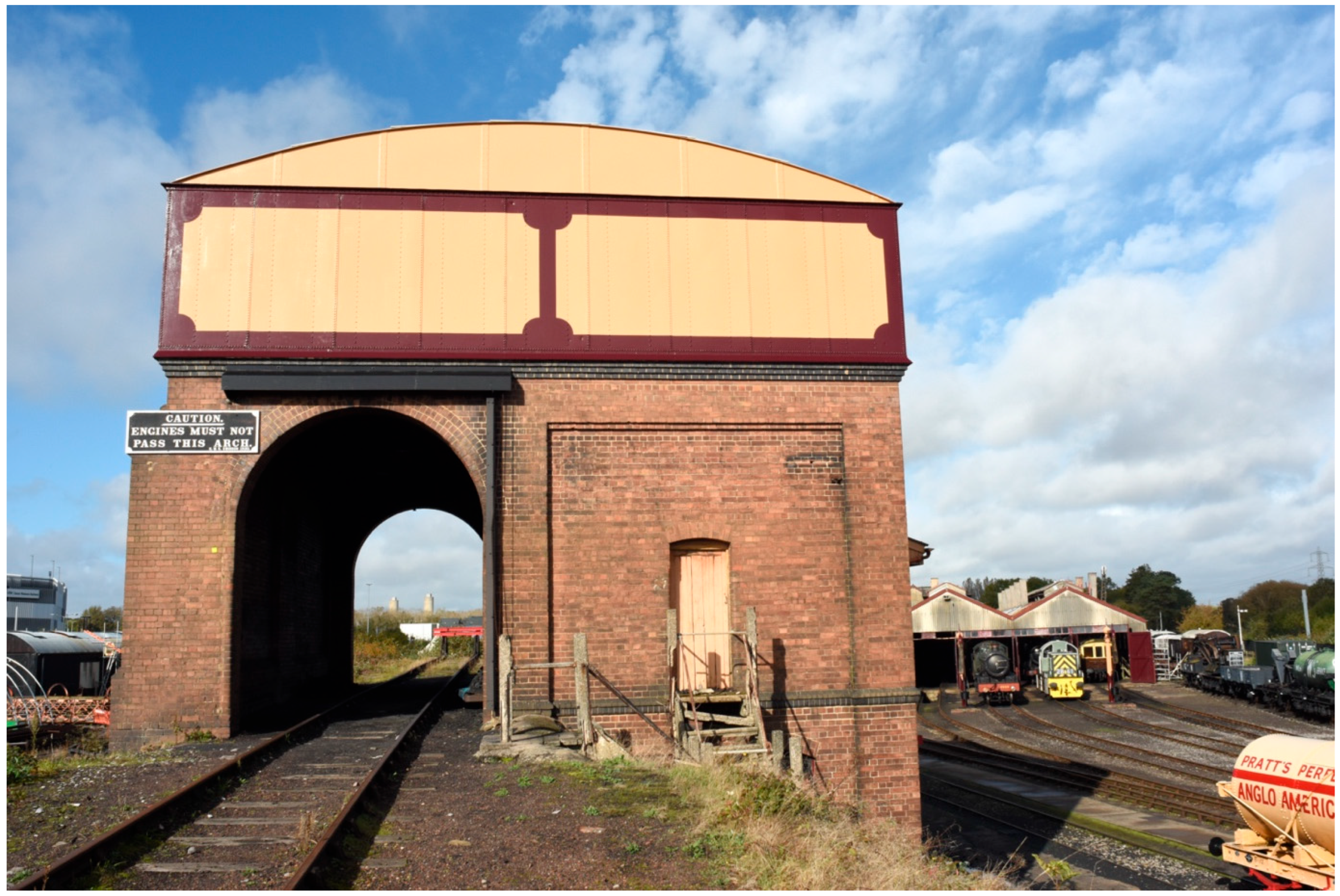
This statutorily listed structure (
Figure 1) is probably the last surviving and the least altered example of the GWR standard coaling stage design, noted as being built using government loans in the Depression [
49]. Recently refurbished and possessing a utility value for the custodian in continuing to function in the original purpose of servicing steam locomotives, it also serves as part of the created mimesis, presenting a locomotive depot. In addition, the water tank façade facing the main line railway station serves as an advertisement for the museum. Based upon a visual inspection, the refurbishment work addresses required repairs and repainting rather than conjectural restoration. This level of minimal intervention includes retaining evidence of what is assumed to be a bullet hole visible on the tank, probably acquired during a Second World War air raid [
50] (p. 12).
With the building retaining its original function and repairs solely to support the function, this lack of any attempt at conjectural restoration means the building conforms to what building conservationists would expect. Constructed as part of a political response to the Depression, this building will interest academic historians as part of the wider 1930s socio-political environment, along with the consequential Second World War and the redundancy of the building as part of the British Railways modernisation plan to withdraw steam locomotives. Railway enthusiasts and visitors from a professional railway background will see the building entirely in terms of functionality, recognising the reasons for construction and how the building operates. Casual visitors will meet a building outside their direct experience, so they will perceive a building of unknown purpose with “odd bits tacked on” and without explanation of the function, which may render the title ‘coal stage’ confusing. For the younger visitor, a particular challenge arises, as coal is probably outside their direct experience. Even the knowledge of how coal contributes to the working of a steam locomotive cannot be assumed as prior knowledge and may even carry a negative connotation relating to carbon contribution to the climate crisis.
5.3. Engine Shed
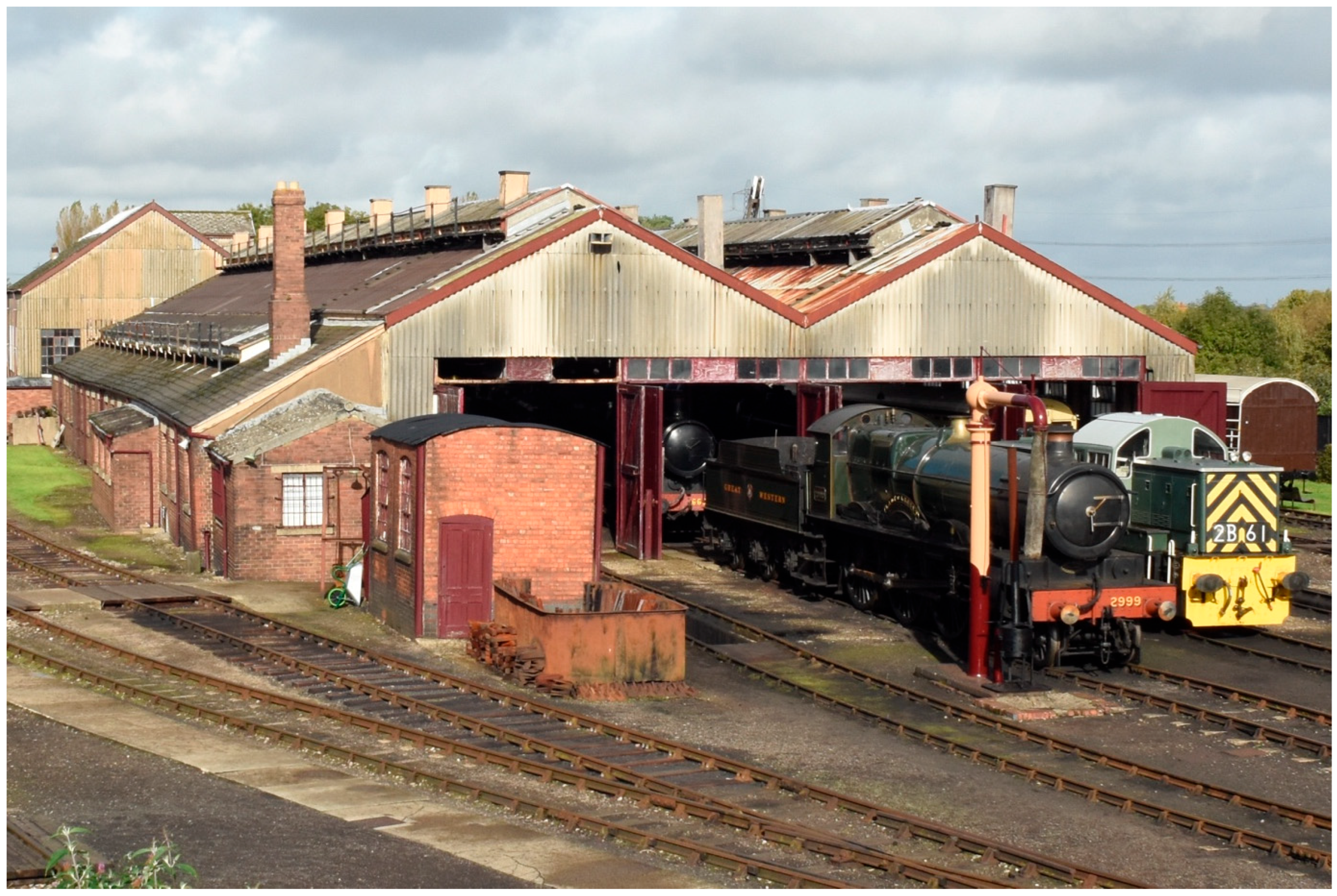
As the centre piece of the heritage railway centre, the engine shed (
Figure 2) for the custodian serves an unaltered purpose from when constructed, namely undercover storage and light maintenance of railway locomotives, while supporting the presentation of a desired mimesis by creating the atmosphere of a GWR working depot. Being largely unaltered, the building represents the authentic fabric that building conservationists would seek to conserve. However, the statutory listing [
51] makes it clear that the utilitarian nature of this steel-framed functional building, without the suggestion of Edwardian detailing evident in the coal stage, carries a significant conservation dilemma for impending refurbishment works, particularly in addressing decisions concerning the asbestos cladding. In a similar manner to the coal stage, academic historians will consider construction of the building as part of a political response to the Depression, and sharing the same history as the coal stage, as an integrated whole, with the two buildings forming an integrated historical significance, even though constructional details are disparate. Entry to engine sheds is normally forbidden, so railway enthusiasts will view this engine shed as a rare insight into a closed world. In contrast, professional railway visitors may have personal experience of modern engine sheds, known in the modern railway era as motive power depots, and will appreciate the contrast of ‘steam age’ practice with their working conditions. For casual visitors, this building represents “somewhere to store and to clean engines”, which is a superficially accurate contextual perception without the detail that other stakeholders will bring to the understanding of the building.
5.4. Transfer Shed (Including Burlescombe Station)
Another statutory listed building on the site [
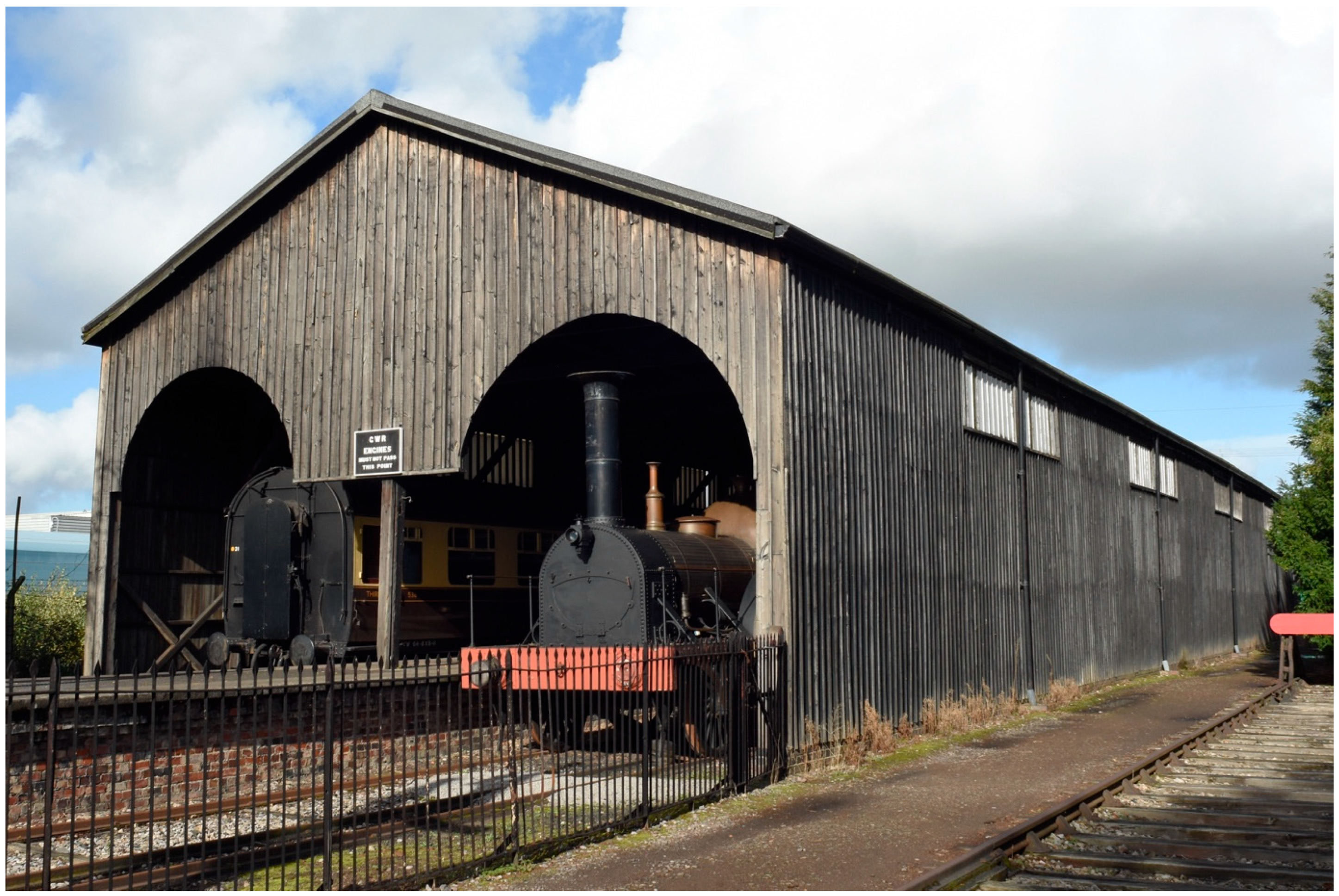
52], the transfer shed (
Figure 3), is a legacy of the Brunel era broad gauge, non-standard track width that prevented Great Western railway trains from running onto other railways. For the custodian, this building is the centrepiece of an exhibit concerning the pre-1892 GWR broad gauge, representing an important part of the GWR narrative. This is a complicated building for building conservationists to assess in terms of authenticity and detail, relocated in approximately 1983 according to the listing record onto a modern engineering brick base. While the superstructure is deemed authentic and presents a viable narrative, the relocation diminishes authenticity when assessed against theoretical conservationist criteria. As the transfer shed exemplifies a turbulent era in early railway development, it is a building of considerable analytical interest to academic historians seeking to understand changes in freight handling. Railway enthusiasts will most likely see the building in terms of the GWR broad gauge, with the freight handling seen as incidental rather than central to their understanding of the building. It is possible that professional railway visitors will take a similar view, with handling individual freight consignments likely feeling anachronistic. In an age of standardised container freight transport, casual visitors are likely to struggle with the idea of gauge and the consequential need to transfer freight, presenting an additional challenge for the custodian to provide a narrative to engage with these visitors.
5.5. Oxford Road, Eynsham, Heyford and Didcot Halt Stations
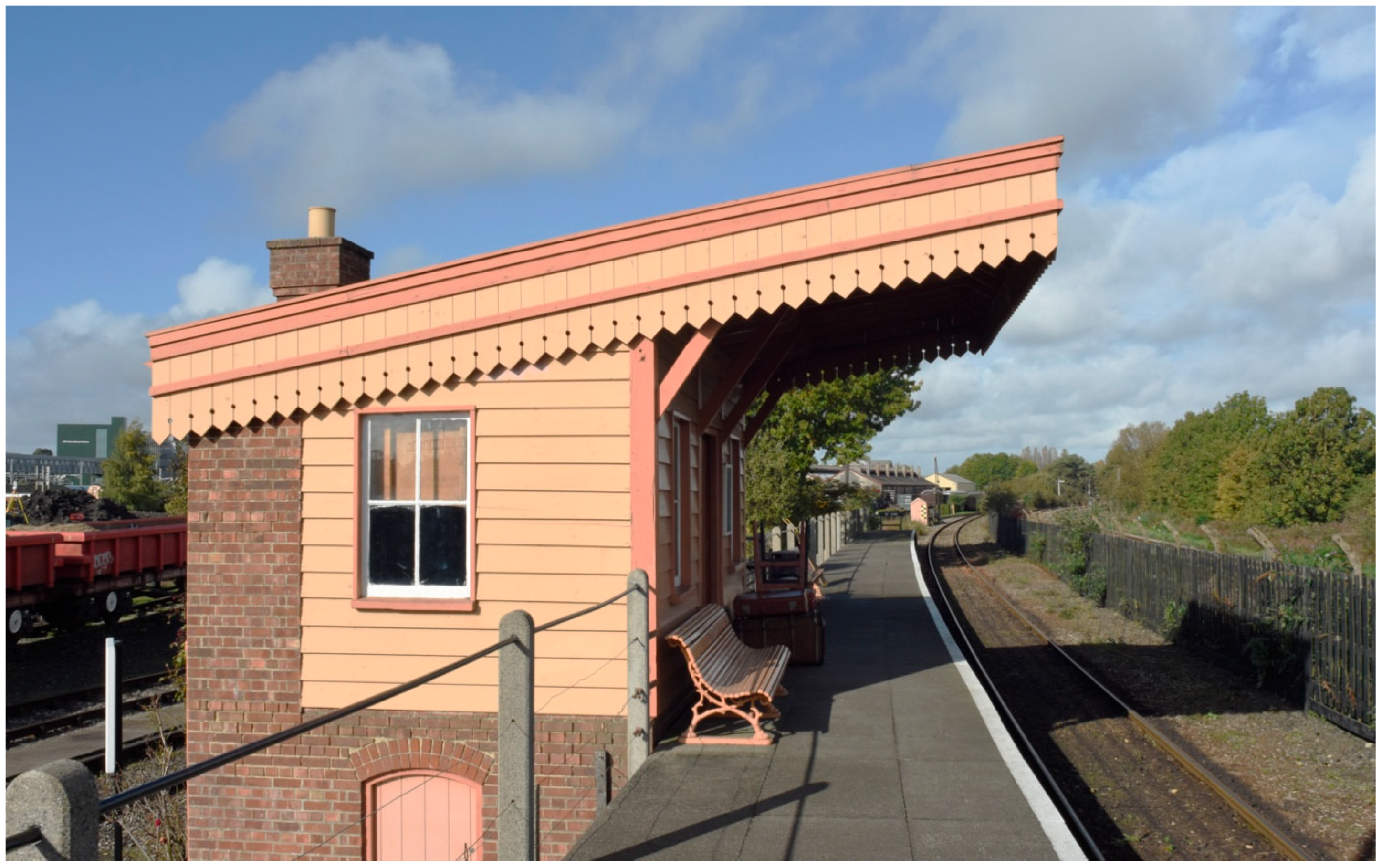
Relocated to their current site, each of these buildings is an original structure on a modern base, which, for Heyford, has a supporting frame and, for Eynsham (
Figure 4), includes an example of the original platform, which allows the custodian to present a recreation of stations as part of short operational sections of railway. As none of the buildings are subject to any formal designation as a heritage asset, both building conservationists and academic historians will note the relocation as part of creating mimesis, with historians additionally being aware of how stations are part of the complexity of railway administration associated with the development of railways. Railway enthusiasts will be aware of the different building configurations, although all in a GWR style, indicating the relative importance of each station. Likewise, professional railway visitors will be aware of the purpose of each building, possibly with less of a historical awareness than the railway enthusiast or historian. For casual visitors, the railway station represents a place to buy tickets, where railway administration occurs and accommodation for railway staff, all seen with perhaps only a passing curiosity into the complexity of railway organisation that has the potential to obscure the historical significance of these buildings.
5.6. Radstock North and Frome Mineral Junction Signal Boxes
In a similar manner to the railway stations, both buildings are an original structure on a modern base, which the custodian presents in two contrasting eras of signalling development, demonstrating the boundary between mimesis and presenting a viable narrative. In a similar manner to the station buildings, with neither building subject to any formal designation as a heritage asset, building conservationists and academic historians will note the relocation as part of creating mimesis. This replicates conditions identified in the original taxonomy survey work, where Reeves et al. [
20] (pp. 249–250) note the “idealised environment simulating an original setting”. Most railway enthusiasts will be familiar with the operational role of signal boxes, with an awareness of the different designs, so there will be a familiarity with the buildings as presented, without being aware of the compromises inherent with relocation. This perception equally applies to professional railway visitors who, depending on where they work in the industry, will have personal experience of signal boxes without an awareness of conservation issues. Casual visitors, with only a limited understanding of how railways operate, will have a limited understanding of what the purpose of a signal box is, perhaps even conditioned by old films to perceive the building as “full of levers that need pulling”.
5.7. Site-Level Taxonomy Assessment
Beyond the individual building assessments, taxonomy surveying can be applied to the whole heritage site. The complete site includes a modern visitor centre, museum displays, a usually closed to the public engineering workshop and a Second World War air raid shelter. These contribute to the whole experience, so it is appropriate and necessary to derive taxonomy observations for the entire heritage site. With reference to the memorandum of association, the custodian will point to the site fulfilling the objectives of creating a permanent museum to display relics of the Great Western Railway. In contrast, building conservationists and academic historians will identify how the educational objectives of the site have, out of necessity, created a mimesis that compromises authenticity. Carter [
46] (p. 110) defines railway enthusiasm as a sense of looking backwards to an idealised past, and the mimesis offered by the entire heritage site provides an abundance of the mythologised past that mimesis creates for railway enthusiasts. This could equally apply to professional railway visitors, who will bring their experiences and understanding, with a recognition of differences compared to modern railway practice. For casual visitors, the collection of buildings is a backdrop to seeking an experiential connection based upon their thoughts and previous experiences, as defined by Willson and McIntosh [
53] (p. 88), potentially driven by notions of nostalgia for a mythologised historic railway.
6. Discussion
As a means for testing the application of a taxonomical surveying approach to validate heritage value, it proved possible to create a taxonomy and model the perceptions of every stakeholder for each building assessed within the case study site. Overall, the taxonomy survey proved applicable across all the case study buildings, including the relocated structures. However, these findings need exploring in the context of whether this addresses the Dublin Principles without diluting authenticity, and whether the taxonomy survey model is validated by this exercise.
In exploring adherence to the Dublin Principles, the case study site is typical of the sites identified by Stratton [
17] (p. 117), with a core of original buildings augmented by relocated buildings. Of these buildings, the most authentic in terms of fidelity to location and positioning in relation to each other are the coal stage and engine shed, which support the conventional argument that relocation creates a disconnect from authenticity. However, the argument becomes more nuanced when considering the transfer shed, relocated to a setting that seeks to support authenticity. There are precedents for relocation where the structures are at risk, most famously the Abu Simbel Temple, where UNESCO comment that the manner of relocation ensured the “form and design … continues to be authentic” [
54]. Other protected heritage structures that have been relocated include railway buildings, such as the steam locomotive water point at St Pancras station in London [
55]. Without relocation, Reeves et al. [
20] (pp. 252–253) describe how a functional heritage building remaining in an original location while the surrounding context changes will be lost in a sterile space. It is against these criteria that it is appropriate to validate the relocation of buildings that would otherwise be lost or left abandoned. Significantly, the transfer shed and other relocated buildings on site show evidence of relocation through details such as modern plinths, thus creating a mimesis, while presenting, for expert observation, evidence of relocation.
Trimm’s argument about a loss of concern in presenting the past [
25] (p. 530) is a challenge where there is an intention to create a mimesis. Meeting this challenge requires recognising that the environment presented by heritage buildings is not a passive space, and to become meaningful needs the experiential space as described by Willson and McIntosh [
53] (p. 88), comprising an emotional, mindful, engaged and personal significance. Each building surveyed provided this mix of significance, achieved by the taxonomy surveying methodology, providing an equal consideration of perspectives from the public and heritage professionals as identified by Nevell [
10] (p. 125). Heritage professionals will raise concerns about how engagement will undermine interpretive thinking, the authenticity which underlies much academic discourse concerning mimesis, yet if “specialists are not actively communicating their expertise, that void will be filled by other, less well-informed, sources” [
10] (p. 125). The measure of success in presenting the buildings surveyed now rests upon the site custodian’s objectives in advancing education and the Dublin Principles’ objective of heritage accessible to the public. The taxonomy survey results give a full perspective of stakeholder engagement, allowing heritage to be made accessible to the public, especially in circumstances where heritage engagement is potentially unpredictable [
22] (p. 2022).
Within this engaged space, the question that needs to be asked is whether the assessment of each building, or group of buildings, validates the process of taxonomy surveying and can address the research aim. Research identifies that, optimally, there needs to be communication between stakeholders when making decisions for building design [
56] (p. 270), an idea adaptable in terms of building conservation decision-making, through the breaking down of barriers between public and heritage professionals. This becomes the Everyman model of assessing buildings with heritage value, whether formally recognised by statutory protection or perceived as having significance, being tested by taxonomy surveying. For each case study building, it was found possible to apply this taxonomy surveying methodology with no identified barriers preventing the surveyor from developing a viable narrative, thereby providing a tool that encompasses how every stakeholder interacts with the building. Each assessment went beyond the building itself, the taxonomy surveying requiring a consideration of related machinery and the intangibles of technical know-how, applying the internationally accepted Dublin Principles.