


Abstract
To address the resource-constrained project scheduling problem (RCPSP), the pulse discrete time (PDT) model is commonly used and then solved by integer programming optimization. This method can obtain the exact optimal solution, but it encounters difficulties with low computational efficiency when the RCPSP has a large size and high complexity. This study hypothesizes that a reasonably reduced scheduling horizon, derived from a feasible heuristic solution, can preserve the optimal solution while significantly reducing the computational burden of the PDT formulation. To test this hypothesis, the research analyzes the scheduling horizon of RCPSP and strictly proves that a reasonably reduced scheduling horizon keeps the same optimal solution. Based on this proof, the serial schedule generation scheme algorithm is adopted to obtain the reduced scheduling horizon, and then an improved PDT model is proposed accordingly. The key novelty lies in: (1) the rigorous mathematical proof of optimality preservation under horizon reduction, and (2) the systematic integration of SSGS-based horizon reduction with explicit elimination of redundant pulse variables. Numerical experiments demonstrate that, for RCPSP instances with 90 and 120 activities, compared with the original PDT model, the improved PDT model contains significantly fewer decision variables and constraints, reducing the number of decision variables to 6.6–9.8% and the number of constraints to 24.7–26.5% of those in the original PDT model, and thus achieves significant improvement in computational efficiency while obtaining the exact optimal solution.
1. Introduction
As an essential aspect of project management, project scheduling allocates resources to the processing of project activities over time. To address project scheduling problem, the critical path method (CPM) and the program evaluation and review technique (PERT) were developed and have been commonly used in the past few decades [1]. However, the CPM and PERT usually assume unlimited resources [2,3], which do not arise in engineering practice. Since the resources are scarce and their supply is generally less than the demand, the resource constraints should be incorporated in project scheduling, which gives rise to the resource-constrained project scheduling problem (RCPSP).
The RCPSP is an important and challenging problem in project management, and it aims to schedule the start times for the activities of a project, so that the project duration is minimized under the constraints of the resource availability and the precedence relations between the activities of the project [4,5,6]. Four types of resources are typically distinguished in project scheduling: renewable, non-renewable, partially renewable, and doubly constrained resources [7,8]. Among these, renewable resources—including workforce, equipment, and machinery—are the focus of RCPSP, as their availability is restored upon activity completion. Owing to its broad relevance, RCPSP has been extensively studied and applied across diverse domains such as construction management, manufacturing, and software development [9,10,11].
The RCPSP has been proved to be an NP-hard problem in the strong sense, and the existing methods for solving RCPSP include heuristic methods, metaheuristic methods, and exact methods [12]. In heuristic methods [13], a feasible schedule is constructed by applying a schedule generation scheme with a designated priority rule. Two primary variants exist: the activity-increment-based serial schedule generation scheme and the time-increment-based parallel schedule generation scheme [14]. Within each scheme, priority rules govern the selection of activities from the eligible set, progressively extending a partial schedule toward completion. Typical priority rules include earliest start time (EST), latest start time (LST), latest finish time (LFT), and minimum slack (MSLK) [15]. Different from heuristic methods, metaheuristic methods are essentially random search procedures which mimic a certain natural evolution phenomenon [16]. Typical metaheuristic methods include genetic algorithm (GA) [17,18], ant colony optimization (ACO) [19,20], particle swarm optimization (PSO) [21,22], and simulated annealing (SA) [3,23]. As for exact methods, the RCPSP is usually formulated by an integer programming model using pulse variables, step variables, or on/off variables [24,25,26], and then solved by the branch-and-bound algorithm.
Among the existing exact formulations, pulse-based, step-based, and event-based models represent three commonly used discrete time modeling frameworks for RCPSP. Pulse-based formulations define binary variables according to the exact starting times of activities, which provides a relatively straightforward representation of precedence relations and resource allocation. Step-based formulations describe whether an activity is being processed during a specific time period and can intuitively characterize activity execution states, but usually involve a larger number of time-dependent variables. Event-based formulations discretize schedules according to activity events rather than time periods, which may reduce the number of variables in some cases, but often require more complicated sequencing and logical constraints.
Compared with step-based and event-based formulations, the pulse discrete time (PDT) model has a relatively clear mathematical structure and is convenient for exact optimization modeling. Therefore, the PDT model has attracted increasing attention in recent RCPSP studies. However, the computational performance of discrete time exact formulations is highly sensitive to the scheduling horizon. When the scheduling horizon is conservatively estimated, the number of time-indexed decision variables and resource constraints increases rapidly [27], leading to substantial model expansion and computational burden, especially for large-scale RCPSP instances [28]. Although previous studies have attempted to improve exact formulations through preprocessing techniques, constraint strengthening, hybrid optimization strategies, and intelligent search methods, limited attention has been paid to systematic scheduling horizon reduction [29] and feasible-schedule-assisted variable domain reduction while preserving exact optimality.
In recent years, hybrid and AI-based scheduling approaches have also attracted increasing attention. Hybrid methods combine complementary optimization strategies to improve convergence performance and solution quality, while AI-based methods introduce intelligent learning or adaptive search mechanisms to enhance exploration capability for large-scale scheduling problems [30]. Nevertheless, these approaches generally rely on stochastic search procedures and cannot theoretically guarantee the global optimal solution. Therefore, improving the computational efficiency of exact optimization formulations remains an important research direction for RCPSP.
Among the three categories of methods for solving RCPSP, the procedures of heuristic methods are simple and can be easily implemented, but they can only provide feasible solutions, rather than the optimal solution. Compared with heuristic methods, metaheuristic methods can provide near-optimal solutions [31], but the theoretical optimal solution cannot be guaranteed due to the nature of random search for metaheuristic methods [32]. Compared with heuristic methods and metaheuristic methods, exact methods can obtain the theoretical optimal solution, but they are not applicable for solving large-scale RCPSPs considering their computational efficiency [6,33].
Existing preprocessing techniques for exact RCPSP formulations can be broadly categorized into lower bound-based methods and time-window tightening approaches. Lower bound-based methods derive bounds from forbidden activity sets [34], LP relaxation combined with constraint propagation [35], and energetic reasoning to prune the branch-and-bound search space [36]. On the time-window side, constraint propagation techniques iteratively reduce activity time windows based on resource feasibility conditions [37]. While these methods effectively reduce the search space, they focus on bounding or pruning rather than directly reducing the size of the IP formulation by eliminating decision variables. The use of a heuristic upper bound to reduce the scheduling horizon of time-indexed formulations has been informally noted in the literature [12], but a rigorous mathematical proof that such reduction preserves the optimal solution within the PDT framework has not been formally established prior to this work.
In this paper, an intensive study has been conducted for the PDT [24] model, which is commonly used in the exact methods for RCPSP. Particularly, the scheduling horizon of RCPSP is investigated, and strict proof has been presented showing that the same optimal solution remains when the scheduling horizon is reasonably reduced. Based on this proof, the SSGS is adopted to provide a reasonably reduced horizon for RCPSP, and then an improved PDT model is proposed to obtain the optimal solution. As verified by the illustrative examples, compared with the original PDT model, the improved PDT model can significantly reduce the number of decision variables and constraints, and achieves remarkable improvement in computational efficiency while retaining the same optimal solution results.
2. Resource-Constrained Project Scheduling Problem
2.1. Model Assumptions and Scope
The RCPSP formulation in this study is based on the following assumptions from an engineering perspective: (1) Deterministic activity durations: Each activity has a known, fixed duration determined in advance based on engineering estimates or historical data. (2) Renewable resources with fixed availability: Resources such as labor crews, construction equipment, or manufacturing machines are renewable—they become available again once an activity is completed. Each resource type has a fixed availability level (e.g., 3 cranes, 12 workers) throughout the project. (3) Non-preemptive activities: Once an activity starts, it must proceed continuously until completion without interruption. This reflects practical constraints in construction (e.g., concrete pouring cannot be paused) and manufacturing (e.g., machine setup costs make interruptions inefficient). (4) Finish–start precedence relationships: Activities have finish–start dependencies with zero time lag, meaning a successor activity can start immediately when all its predecessors finish. This is the most common precedence type in project networks. (5) Makespan minimization objective: The objective is to minimize project duration (makespan), which is the primary concern in most construction and manufacturing scheduling contexts. It should be acknowledged that this formulation is deterministic and does not directly address uncertainties in activity durations, stochastic resource availabilities, or dynamic resource allocation during project execution. These are important practical considerations that represent valuable extensions for future research. However, the deterministic model serves as a fundamental baseline, and the reduction strategy framework developed in this study can potentially be extended to stochastic and dynamic settings. For instance, the reduced horizon could be updated dynamically as the project progresses and uncertainties are resolved.
2.2. Problem Formulation
The RCPSP can be stated as follows. The problem considers a project network consisting of activities. In the project, there are types of renewable resources and the availability of the resource is . For the type of renewable resource, once an activity that required the resource is completed, the resource units occupied by the activity are released and can be used again by another activity. The duration of activity is , and activity needs units of resource during each period of its duration. To mode the start and completion of the project, activity 0 and activity are introduced as dummy activities. The two activities do not occupy time or consume resources; thus, (, ). The precedence relations among the activities are the finish–start type; any activity can be started only after all its immediate predecessors have been completed.
The objective of RCPSP is to minimize the total project duration by scheduling the start time of each activity, under the constraints of resource availability and the precedence relations. The model of RCPSP (denoted as Model 1) can be formulated as follows:
subject to
The objective function in Equation (1) aims to minimize the start time of the dummy activity , i.e., the total project duration. The constraints given by Equation (2) ensure that activity starts after all of its predecessor activities, , are finished, where denotes the set of immediate predecessors of activity . In the constraints given by Equation (3), indicates whether activity is being processed at time ; i.e., if , otherwise . The constraints given by Equation (3) ensure that the total requirement of renewable resource for all activities being processed at time does not exceed the availability . The constraints given by Equation (4) ensure that the start time of each activity assumes non-negative integers. In addition, Equation (5) ensures that the project has a scheduling horizon , which explains why the constraints in Equation (3) are specified for each time . The horizon is calculated as the sum of the duration for all activities,
This value corresponds to the project duration in the case where all activities are sequentially connected in series. In this case, at any time, there is only one activity being processed, and the resource requirement is at minimum. Thus, the optimal solution remains the same when comparing the RCPSP models with or without Equation (5).
With the prescribed horizon , the explicit range for the start time of each activity can be calculated by the critical path method (CPM) [38]. Particularly, the earliest start time and the latest start time of each activity can be respectively calculated by the forward and backward pass analysis of the project network. In this case, the constraints given by Equations (4) and (5) can be replaced by
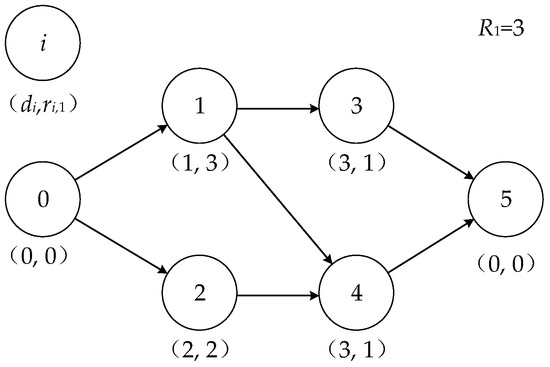
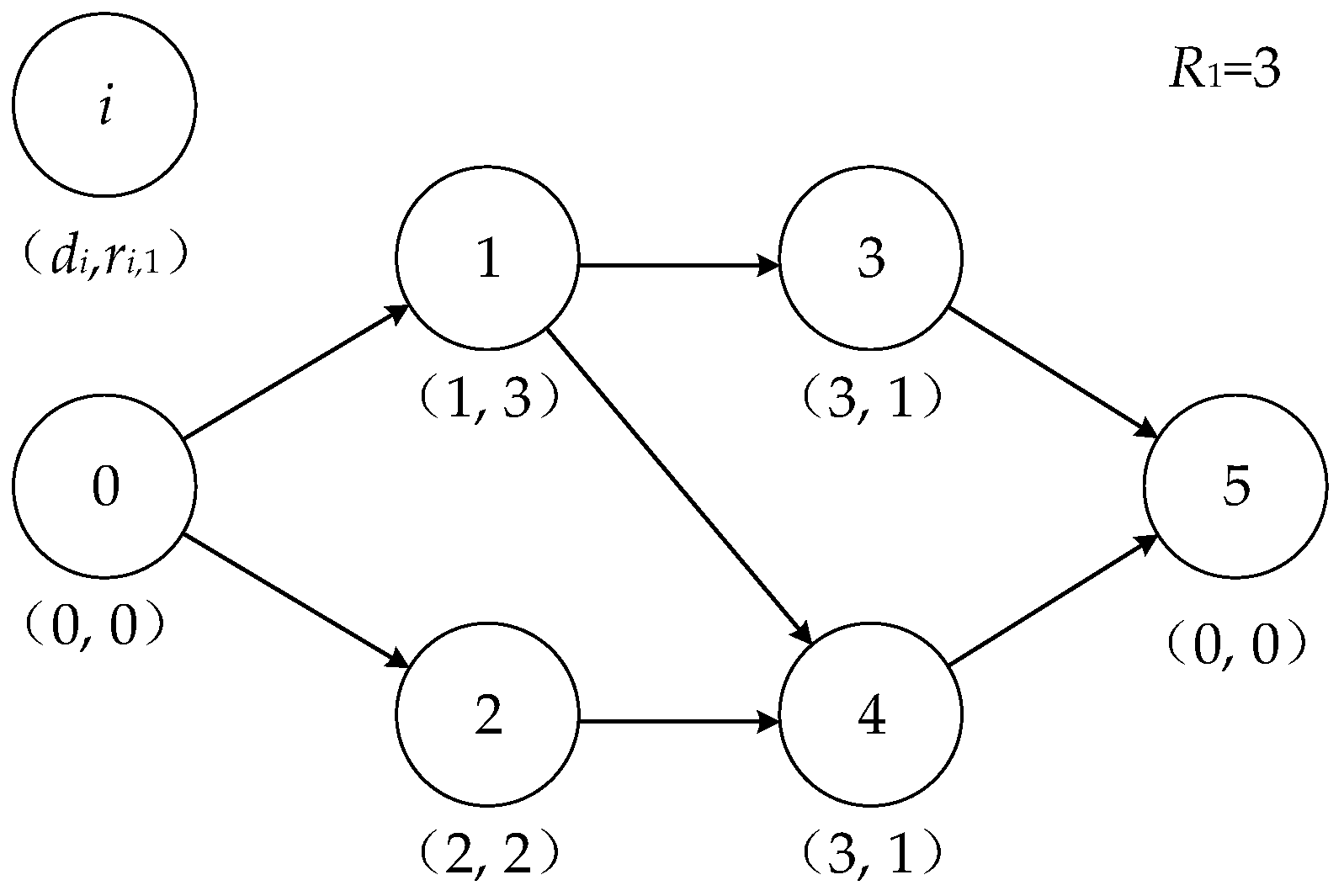
Figure 1 presents the project network of a simple RCPSP, where one renewable resource with availability is considered. For this example, RCPSP, the scheduling horizon , can be calculated by Equation (6). Then, the earliest and latest start times for each activity can be obtained accordingly, as shown in Table 1.
Figure 1.
Illustrative example—precedence relations, durations, and resource requirements.
Table 1.
Illustrative example—earliest and latest times for the activities.
3. Pulse Discrete Time (PDT) Model
In Model 1 for RCPSP, as defined by Equations (1)–(5), the start times of all activities are the decision variables , which are required to be non-negative integers. Moreover, in the constraints given by Equation (3), the indicator function is a nonlinear function of . Therefore, Model 1 is not an integer programming model, which involves only linear functions of decision variables.
In the exact methods for RCPSP, pulse variables [24], step variables [25], or on/off variables [26] are introduced to formulate the integer programming model, so that the theoretical optimal solution can be obtained. Among the integer programming models, the classical PDT model is more widely used. In PDT model, the pulse variables are decision variables, indicating whether activity starts at time . The impulse variable is a binary integer; if activity starts at time , otherwise . Using the introduced pulse variables, the start time of activity can be written as
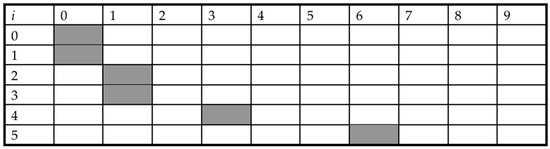
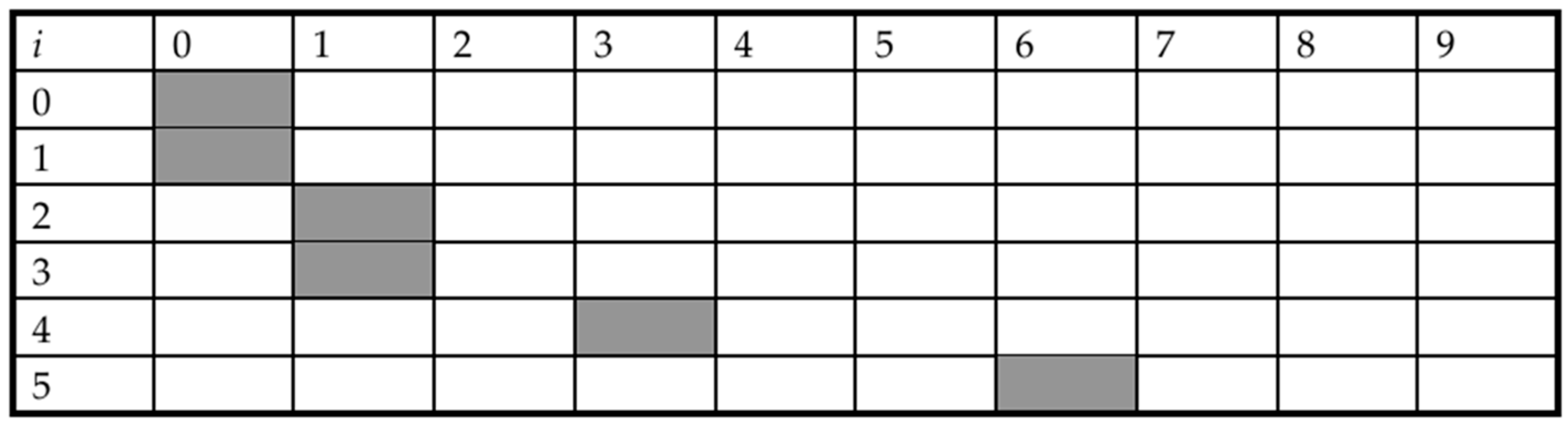
For the example RCPSP illustrated in Figure 1, Figure 2 shows the representation of a typical schedule using pulse variables. In Figure 2, it can be seen that there are 60 cells corresponding to 6 activities and 10 time instants. In addition, a gray cell indicates the corresponding variable equal to one, while a white cell indicates the variable equal to zero. Using Equation (8) for this specific schedule, the start times for activities 0~5 can be easily obtained as 0, 0, 1, 1, 1, 3, and 6. Furthermore, the pulse variables can be used to judge whether activity is in process at time ,
which is to examine whether activity starts in the interval of . For example, in the RCPSP presented in Figure 1, activity 4 has a duration of 3. Thus, in order to judge whether activity 4 is in process at time 5, it is equivalent to examine whether activity 4 starts in the interval of .
Figure 2.
Representation of a project schedule using pulse variables.
With the pulse variables, the PDT model [24] for RCPSP can be formulated as
subject to
where the constraints given by Equation (11) ensure that each activity starts at exactly one point in time, i.e., the process of each activity is assumed to be continuous without interruption. The constraints given by Equation (12) are similar to those in Equation (2) and are used to assure the precedence relations between activities. The constraints given by Equation (13) correspond to the resource availability at different time instants, similar to those in Equation (3). The constraints given by Equation (14) specify the earliest and latest start times of the activities, similar to those in Equation (7).
4. Improved PDT Model with Reduced Scheduling Horizon
The scheduling horizon is an important parameter for RCPSP, and it greatly affects the number of decision variables and the number of constraints (as seen in Equation (13)) in the PDT model. In the research, an in-depth investigation has been conducted on the scheduling horizon of RCPSP, and it has been rigorously proven that the optimal solution of RCPSP remains the same when the scheduling horizon is reasonably reduced. Based on this proof, the research has proposed the improved PDT model, where the SSGS is adopted to provide a reasonably reduced horizon, and the redundant pulse variables are eliminated.
4.1. Proof Showing That the Optimal Solution Remains the Same When the Scheduling Horizon of RCPSP Is Reasonably Reduced
Consider Model 1 for RCPSP (as specified by Equations (1)–(5)), and denote as one feasible solution of this model. Since is a feasible solution for Model 1, it follows that the project duration at this solution is not greater than the horizon of Model 1 (i.e., ), considering the constraints in Equation (5). With this project duration , Model 2 can be constructed by modifying Model 1 with a reduced scheduling horizon . Specifically, Model 2 is formulated as follows:
subject to
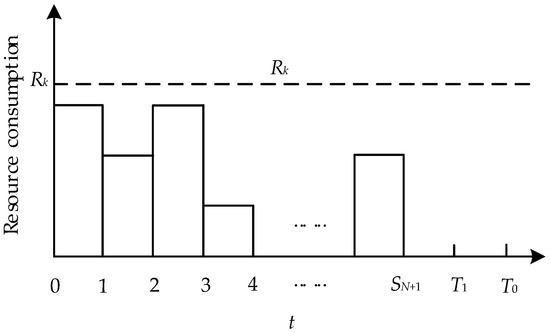
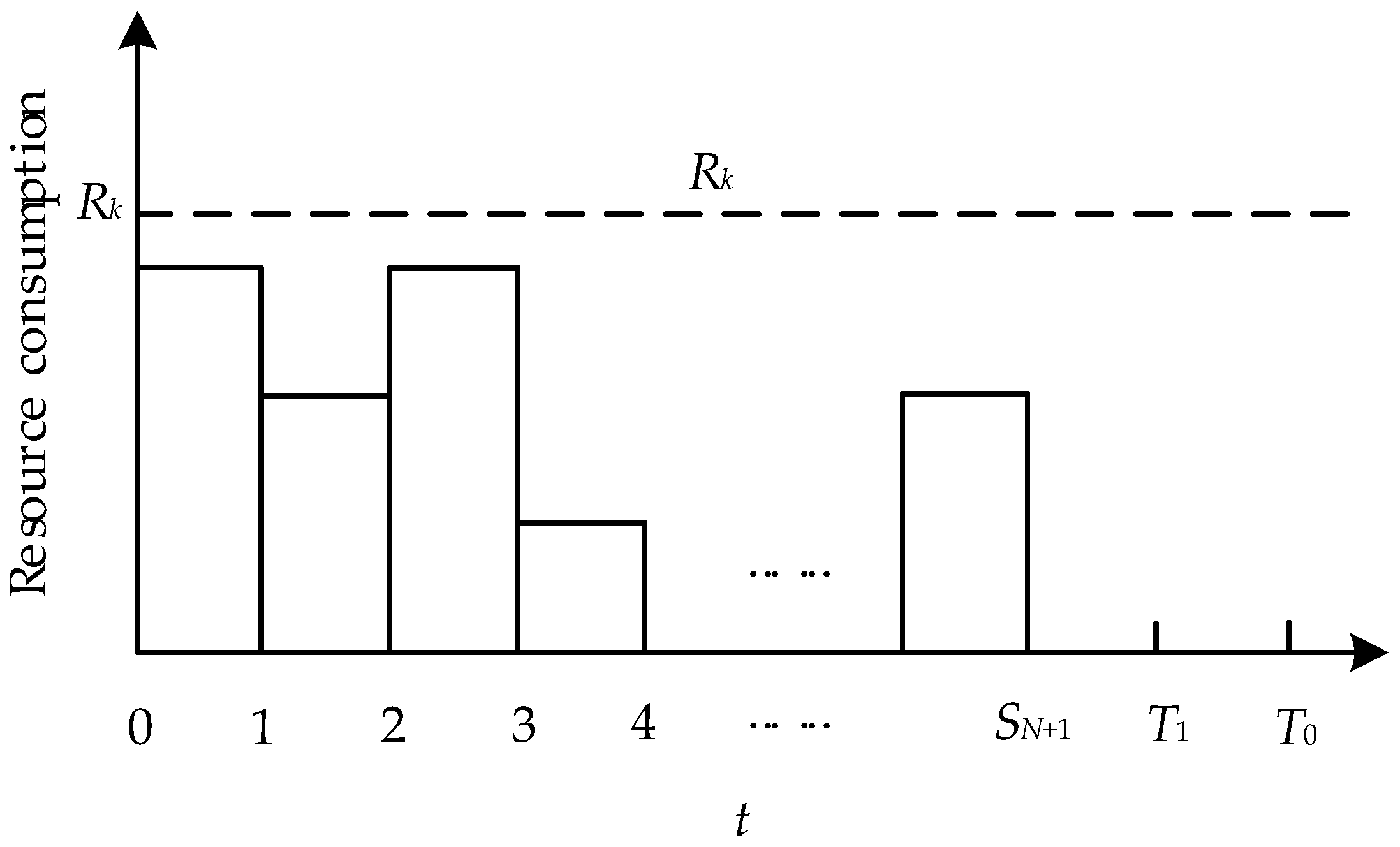
A strict proof is presented below, showing that Model 2 and Model 1 have the same optimal solution. The proof consists of two parts. In the first part, it is to show the statement that the feasible region of Model 2 is a subset of the feasible region of Model 1, and in the second part, it is to show the statement that the optimal solution of Model 1 also lies in the feasible region of Model 2. Particularly, denote and as the feasible regions of Model 1 and Model 2, and consider any feasible solution of Model 2. It can be seen that this solution satisfies the constraints in Equations (2) and (4) of Model 1 (which are identical to Equations (17) and (19) in Model 2). In addition, this solution satisfies Equation (20) in Model 2, i.e., . Combined with the premise (Model 2 is constructed with a reduced horizon), it can be shown that , i.e., this solution satisfies the constraint in Equation (5) of Model 1. Furthermore, for this solution , it satisfies the resource constraints at any time (as seen in Equation (18)), and its corresponding project duration is (as seen in Equation (20)). This implies that its resource requirement is 0 at time (outside the project duration, as seen in Figure 3), which is certainly less than the availability. Thus, the solution satisfies the resource constraints at any time , i.e., satisfying the constraints given by Equation (3). In summary, any feasible solution of Model 2 can satisfy all the constraints of Model 1 (given by Equations (2)–(5)) and thus is also a feasible solution of Model 1. This part shows that the feasible region of Model 2 is a subset of the feasible region of Model 1 (i.e., ).
Figure 3.
Resource requirements at different time instants for the feasible solution of Model 2.
Denote as the optimal solution of Model 1; it can be shown that it also lies in the feasible region of Model 2, i.e., . Recall that the scheduling horizon of Model 2 is the project duration (the objective function) at the feasible solution of Model 1. Compared with the feasible solution , the optimal solution of Model 1 has a smaller objective function value, and thus it can be shown that (satisfying the constraint in Equation (20) of Model 2). In addition, it can be shown that the optimal solution of Model 1 automatically satisfies the constraints in Equations (17) and (19), since they are the same as Equations (2) and (4) of Model 1. Additionally, from Equation (3), it can be seen that the solution satisfies the resource constraints at any time . Thus, the solution satisfies the resource constraints at any time (satisfying Equation (18)), since the horizon of Model 2 is not greater than the horizon of Model 1. Therefore, the optimal solution of Model 1 can satisfy all the constraints of Model 2 (given by Equations (17)–(20)), and thus also lies in the feasible region of Model 2, i.e., .
With the two proved statements above, it easily follows that Model 2 and Model 1 have the same optimal solution; equivalently, the optimal solution remains the same when the scheduling horizon of RCPSP is reasonably reduced.
4.2. Reasonably Reduced Horizon Obtained by Serial Schedule Generation Scheme
In the research, the SSGS [14] is implemented to obtain a feasible solution for Model 1, whose project duration is then used as the reduced scheduling horizon to construct Model 2. To get a feasible solution for Model 1, SSGS consists of stages, in each of which an activity is selected and scheduled (with its start time specified).
At stage , SSGS examines two disjoint sets of activities: the scheduled set and the decision set . The set contains all the activities which were already scheduled with their start times specified. At stage , only the activity 0 (the dummy start activity) has been scheduled with its start time , and thus the scheduled set is . At stage , the decision set is defined as
That is, the set contains all the unscheduled activities () whose immediate predecessors have been scheduled ().
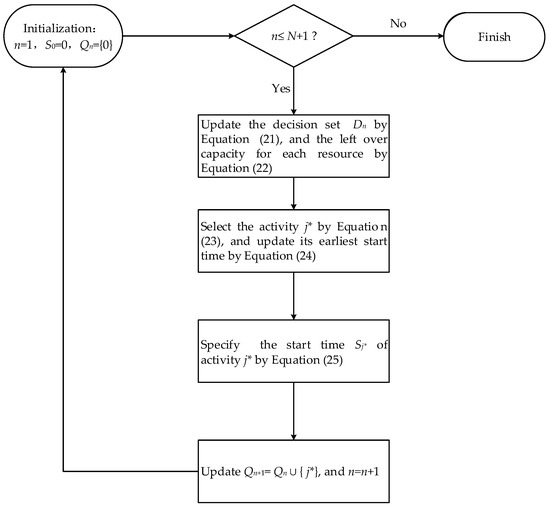
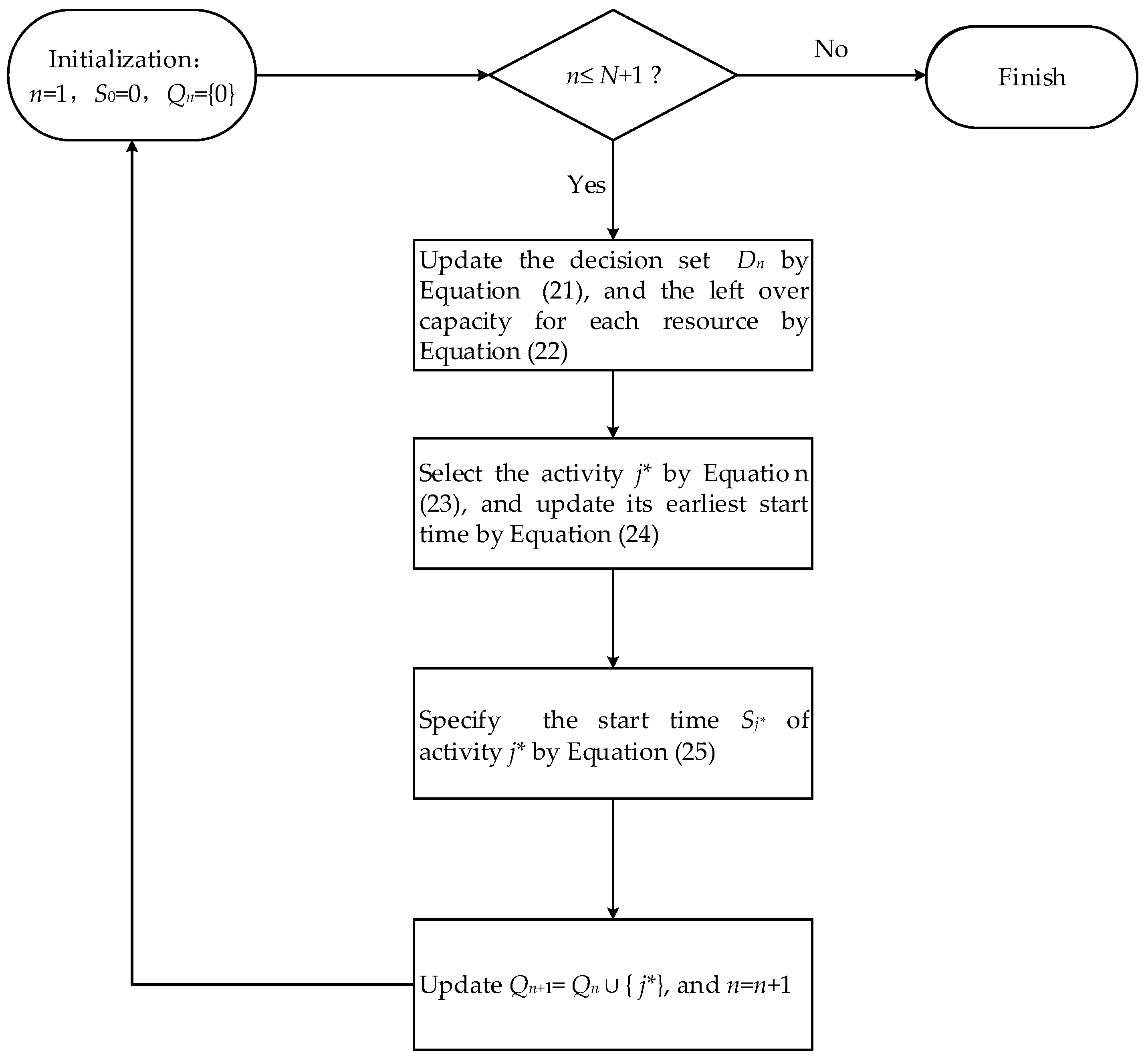
The flowchart of SSGS is presented in Figure 4. At each stage , the decision set can be updated by Equation (21), and the left-over capacity of the renewable resource at each time can be updated as follows:
Figure 4.
Flowchart for the SSGS.
Next, an activity is selected from the decision set using a specific priority rule. Multiple priority rules, such as the most total successors (MTS), the latest start time (LST), the earliest start time (EST), and the minimum slack (MSLK), have been proposed for SSGS [15]. Among them, the latest start time rule is more widely used in SSGS, due to its ease of use and good performance. In the research, the latest start time rule is used to select the activity from the decision set , such that
That is, the selected activity has the minimum latest start time among the set . For the selected activity , its earliest start time can be updated as below,
Then, the start time of activity can be specified with the following criterion:
That is, the start time is scheduled as early as possible, as long as it satisfies the precedence relations and the left-over capacities of all renewable resources. After specifying , the scheduled set of activities is updated by adding the activity , i.e., , and the stage number is increased by . The above procedures are repeated in SSGS, until the start times of all activities have been scheduled and .
4.3. Improved PDT Model with Reasonably Reduced Horizon
Using the SSGS presented in Section 4.2, a feasible solution for Model 1 can be obtained as , whose project duration will be used as the proposed reduced horizon . Furthermore, for the Model 2 defined by Equations (16)–(20) with reduced horizon , the corresponding PDT model can be formulated as follows:
subject to
Note that the latest start time in Equation (30) is calculated with the reduced horizon . It is illustrated using the example RCPSP in Figure 1, in which the proposed reduced horizon can be obtained using SSGS. With the reduced horizon, the latest start time of each activity can be updated, as shown in Table 2. By comparing the results in Table 2 with those in Table 1, it can be seen that the intervals of for all activities are narrowed when the proposed reduced horizon is used for the PDT model. For example, the interval for scheduling the start time of activity 2 is in Table 1, whereas the interval shrinks to in Table 2.
Table 2.
Illustrative example—earliest and latest times for the activities calculated with the reduced horizon of T1.
By observing the constraints in Equations (30) and (31), it can be seen that there are many pulse variables (assuming the value of 0), among the variables associated with each activity . Therefore, for each activity , the redundant decision variables assuming the value of 0 can be explicitly eliminated, and the decision variables are defined only at . By doing this, the number of decision variables can be greatly reduced. Based on the idea of reducing the scheduling horizon and eliminating redundant variables, the improved PDT model can be constructed as follows:
subject to
In the constraint given by Equation (35), to examine whether activity is in process at time , it is required to check whether the start time of activity (which also satisfies ) falls within the interval of . Equivalently, it is required to check whether the start time falls within the interval of , i.e., whether it falls within the following defined interval:
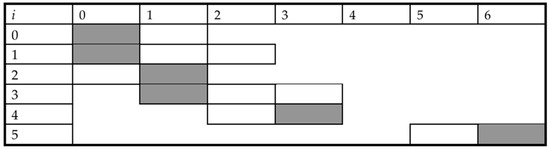
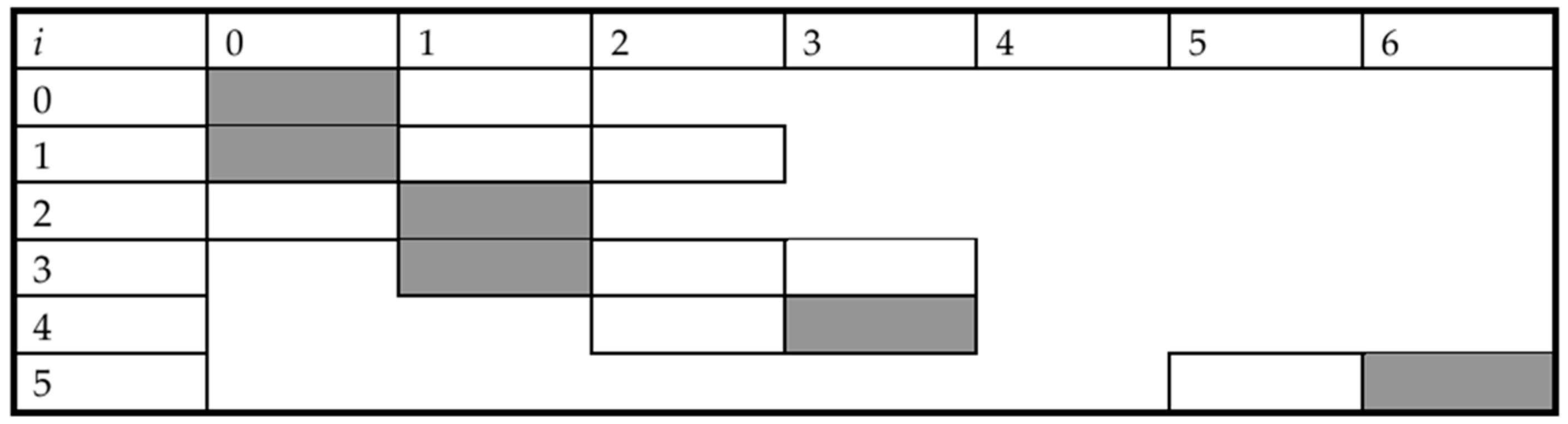
For the example RCPSP in Figure 1, Figure 5 shows the representation of a project schedule using pulse variables in the improved PDT model. For example, activity 1 has from Table 2, so only variables , , are defined (row 1, columns 0–2). In this schedule, activity 1 starts at t = 0 (gray cell), so and (white cells). Time instants outside [0, 2] are shown as shaded blank regions since no variables are defined there. It can be seen in Figure 5 that the number of pulse variables in the improved PDT model is 14, which is much less than that in the original PDT model (60 impulse variable as seen in Figure 2). In addition, by comparing the constraints in Equation (35) and those in Equation (13), it can be seen that the improved PDT model with smaller horizon () can also reduce the number of constraints with respect to resource availability. Compared with the original PDT model, the improved PDT model aims to enhance computational efficiency by reducing the number of decision variables and constraints. The superiority of the improved PDT model is expected to be pronounced when the RCPSP involves a wide range of renewable resources and a large project network.
Figure 5.
Representation of a project schedule using pulse variables in the improved PDT model.
5. Numerical Experiments
In order to compare the performance of the improved PDT model with the original PDT model, two case studies, which respectively involve 90 activities and 120 activities, are used in numerical experiments. The experiments are implemented using MATLAB R2023a and Gurobi Optimizer 12.0.3 and ran on a desktop computer with a 3.20 GHz CPU (Intel Core i9-14900K) and 32 GB RAM. Default Gurobi parameter settings are adopted for all experiments. The optimization process terminates when proven optimality is achieved, and all reported instances are solved to exact optimality with 0% optimality gap. No time limit is imposed on the solver. For fairness and methodological consistency, the comparisons in this study are restricted to exact methods for RCPSP, since metaheuristic approaches generally provide approximate or near-optimal solutions without guaranteeing optimality.
5.1. Case Study 1—The RCPSP with 90 Activities
In Case Study 1, the RCPSP with 90 activities is considered. The problem involves four renewable resources, the availabilities of which are respectively R1 = 17, R2 = 12, R3 = 12, and R4 = 13. In addition, the set of immediate predecessors, the duration , and the resource requirements , , , and for each activity, are shown in Table 3.
Table 3.
The set Pi of immediate predecessors, the duration di, and the resource requirements ri,1, ri,2, ri,3, and ri,4 for the activities in Case Study 1.
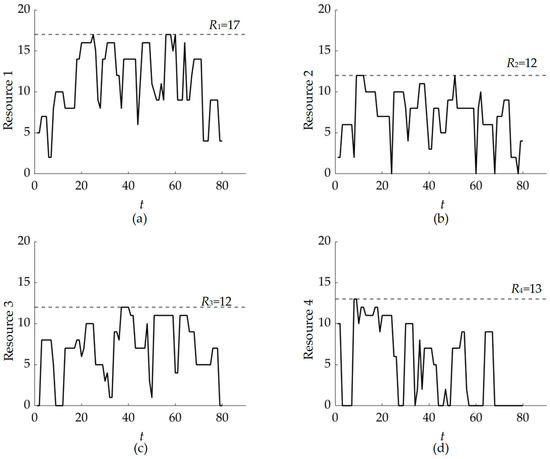
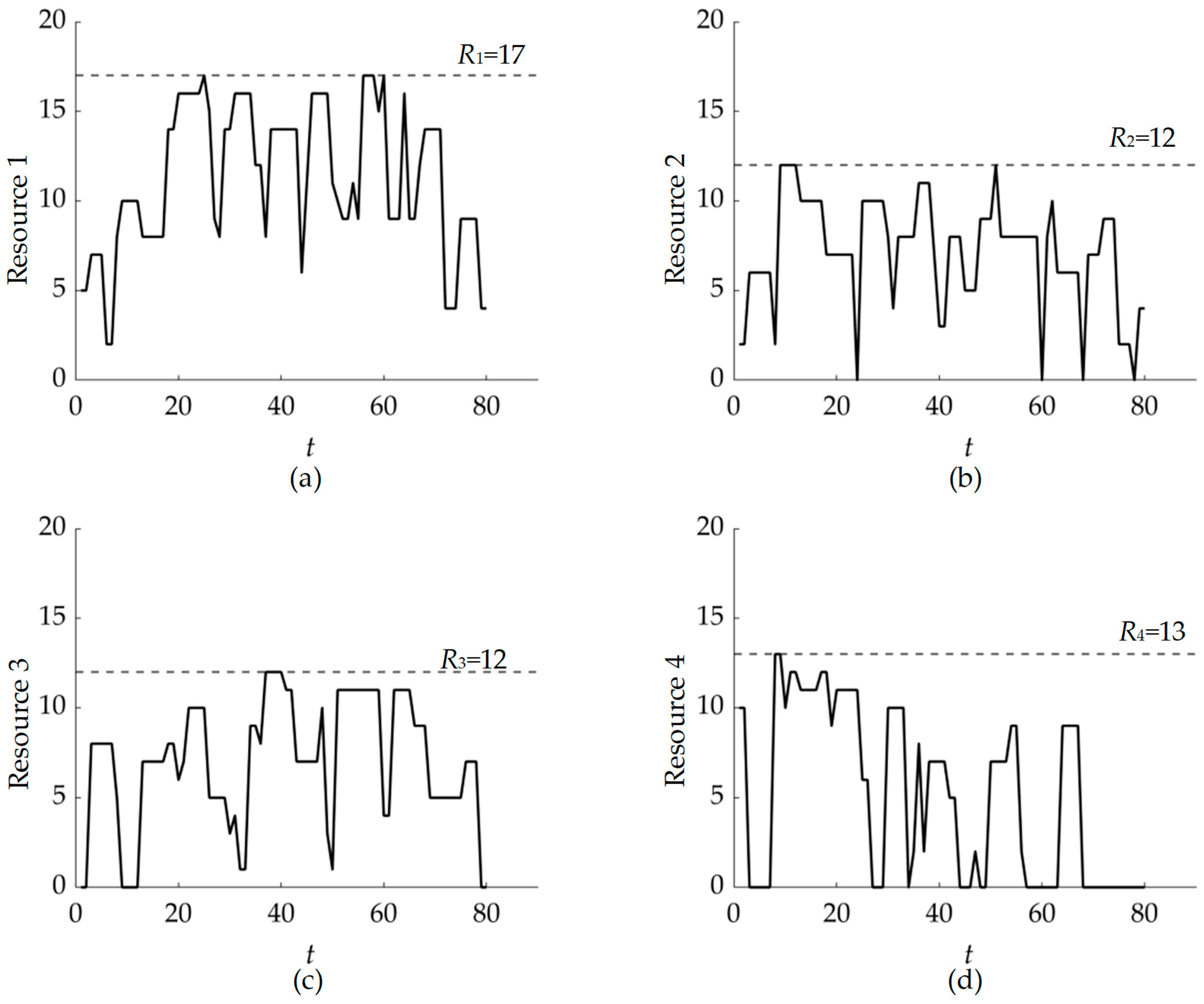
To address this RCPSP, the SSGS method, as presented in Section 4.2, is adopted to obtain a better project schedule, which has a project duration of 82 days. At the obtained schedule, the requirement of four resources at different time instants is shown in Figure 6. As can be seen in Figure 6, the requirement of each resource is below the availability at all time instants, verifying the feasibility of the obtained schedule. With this reduced scheduling horizon , an improved PDT model for this RCPSP, can be formulated by Equations (32)–(36) and then solved optimally. For comparison, the PDT model of this problem is also constructed by Equations (10)–(15) and solved optimally.
Figure 6.
The requirements of four resources at the schedule obtained by SSGS for Case Study 1. (a) The requirement of resource 1, (b) the requirement of resource 2, (c) the requirement of resource 3, (d) the requirement of resource 4.
The results of the two models are compared in Table 4. From this table, it can be seen that the improved PDT model can obtain the optimal project duration (objective function value) of 80 days, which is the same as the PDT model. In addition, the computational efficiency of the improved PDT model is much higher than the original PDT model, with its computing time about 5.6% that of the PDT model. To explain the reason for the improvement in computational efficiency, Table 4 also compares the number of decision variables and constraints for the two models. From the table, it can be seen that the number of decision variables in the improved PDT model is about 6.6% of that in the PDT model, and the number of constraints in the improved PDT model is about 26.5% of that in the PDT model. Compared with the PDT model, the proposed improved PDT model can significantly reduce the number of decision variables and constraints, and thus obtain remarkable improvement in computational efficiency.
Table 4.
Comparison between the PDT model and the improved PDT model for Case Study 1.
5.2. Case Study 2—The RCPSP with 120 Activities
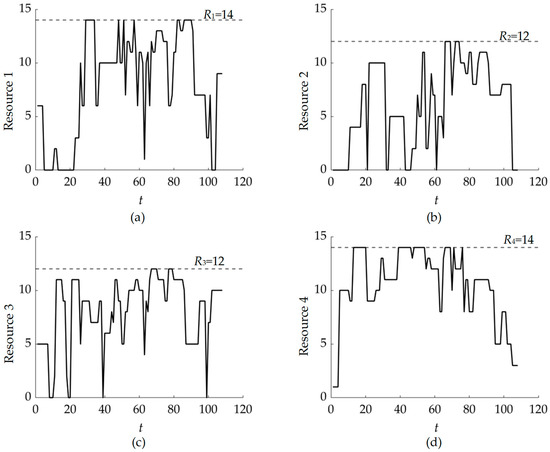
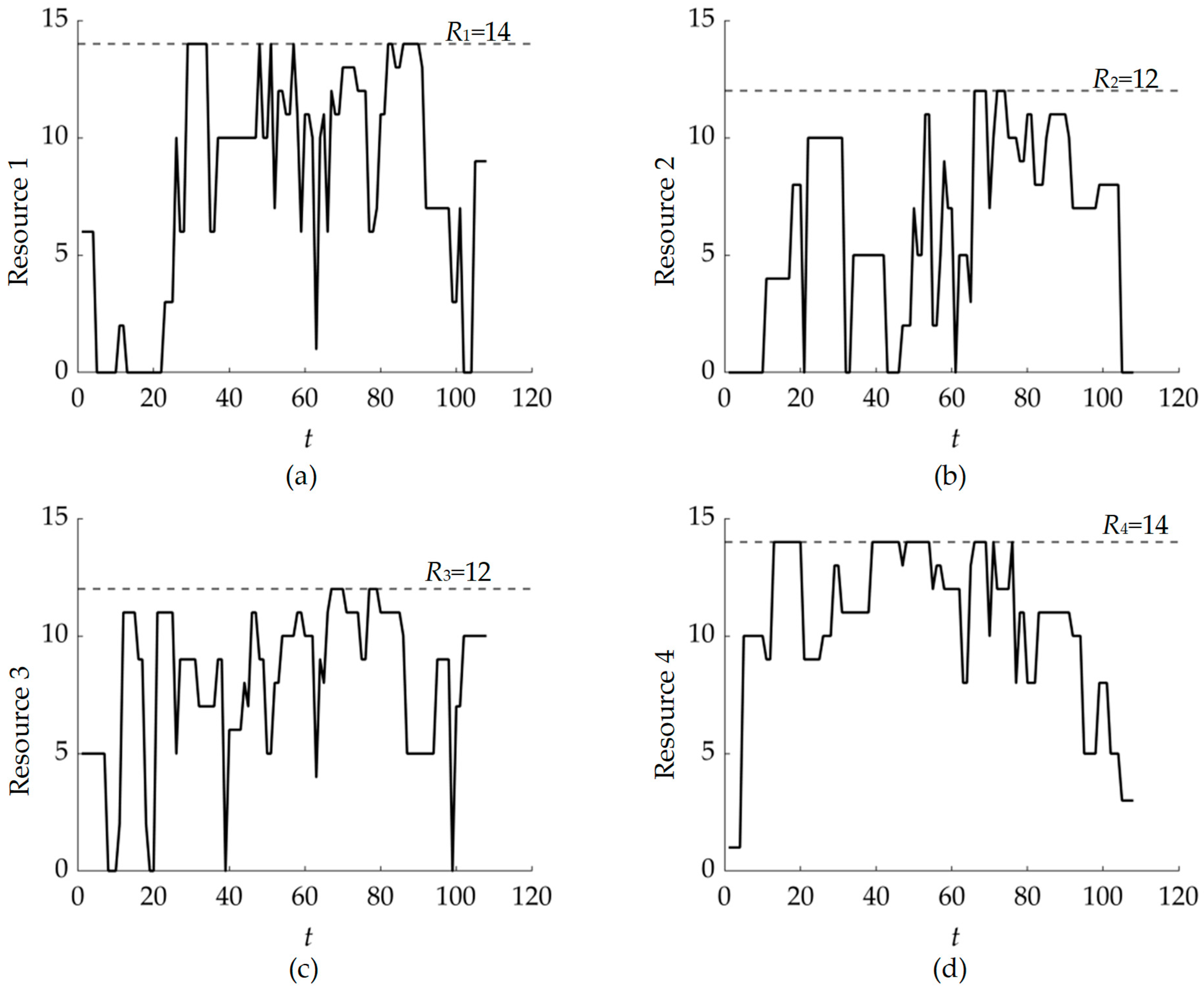
Case Study 2 considers a larger scale RCPSP with 120 activities and four renewable resources, whose availabilities are respectively R1 = 14, R2 = 12, R3 = 12, and R4 = 14. The data for the activities, including the set of immediate predecessors, the duration , and the resource requirements , , , and , are given in Table 5 and Table 6.
Table 5.
The set Pi of immediate predecessors, the duration di, and the resource requirements ri,1, ri,2, ri,3, and ri,4 for the activities 1~60 in Case Study 2.
Table 6.
The set Pi of immediate predecessors, the duration di, and the resource requirements ri,1, ri,2, ri,3, and ri,4 for the activities 61~120 in Case Study 2.
To build the improved PDT model for this RCPSP, the reduced horizon of 126 days is provided by using the SSGS method to obtain a better project schedule. At the obtained project schedule, the requirement of the four resources at different time instants is shown in Figure 7, and it is verified that the requirement is below availability. Then, the improved PDT model for this problem can be constructed according to Equations (32)–(36) with the reduced horizon , and compared with the original PDT model constructed according to Equations (10)–(15).
Figure 7.
The requirements of four resources at the schedule obtained by SSGS for Case Study 2. (a) The requirement of resources 1, (b) the requirement of resource 2, (c) the requirement of resource 3, (d) the requirement of resource 4.
Table 7 compares the results of the two models, including the number of decision variables, the number of constraints, the optimal project duration, and the computing time. Compared with the PDT model, the improved PDT model can obtain the same optimal project duration of 108 days. In addition, the improved PDT model significantly reduces the number of decision variables and constraints, with the number of decision variables about 9.8% of that in the PDT model and the number of constraints about 24.7% of that in the PDT model. This explains the reason why there is remarkable improvement in the computational efficiency, with the computing time for the improved PDT model about 2.3% of that for the PDT model.
Table 7.
Comparison between the PDT model and the improved PDT model for Case Study 2.
5.3. Discussion
5.3.1. Resource Tightness Characterization
To quantitatively characterize the resource-tightness levels of the two case studies, the resource strength (RS) parameter defined by Kolisch and Sprecher [11] is computed for each renewable resource. RS is given by:
where is the actual resource availability, is the minimum feasibility threshold defined as the largest single-activity resource demand, and is the peak resource usage determined via the resource-dependent earliest start schedule. Specifically, is obtained by scheduling each non-dummy activity at its earliest start time using the mode with maximum resource demand for resource , and taking the maximum total resource usage across all time periods:
where the summation is taken over all non-dummy activities that are in progress at time period under the resource-dependent earliest start schedule. This schedule represents the most resource-intensive parallel execution scenario, and thus serves as the upper reference level. When , resource constraints are effectively non-binding even under maximum parallel activity execution. A smaller RS value indicates tighter resource constraints. The computed RS values for the two case studies are summarized in Table 8.
Table 8.
Resource strength (RS) values for the two case studies.
The average RS values of 0.1870 and 0.1105 for Case Study 1 and Case Study 2, respectively, indicate that both case studies represent highly resource-constrained scheduling scenarios. Notably, RS = 0.20 corresponds to the tightest resource constraint level in the standard PSPLIB benchmark design [11], and RS = 0.10 falls below this threshold, confirming that Case Study 2 represents an even more severely constrained problem.
The selection of these resource-tightness levels reflects a deliberate focus on the practically meaningful regime for exact optimization methods. For instances with loose resource constraints (RS close to 1.0), the SSGS heuristic already yields a near-optimal or even optimal schedule, leaving minimal room for horizon reduction; as a result, both the original and improved PDT formulations solve in negligible time, making meaningful computational comparison impossible. Conversely, for instances with extremely tight constraints (RS below 0.10), the NP-hard nature of the RCPSP implies that exact optimization may remain intractable even with formulation improvements, as documented by the negative correlation between RS and exact solver computation time reported in [11]. The two case studies therefore represent the regime where the proposed reduction strategy is simultaneously necessary (the original PDT is computationally expensive) and effective (the improved PDT achieves tractable solution times).
5.3.2. Comparative Analysis and Scalability
To provide deeper insights into the performance of the proposed reduction strategy across problem scales, Table 9 synthesizes the key computational metrics for the two case studies.
Table 9.
Comparative summary of computational results for the two case studies.
Several observations can be drawn from Table 9. First, the speed-up factor increases substantially from 17.96× in Case Study 1 to 44.35× in Case Study 2 as problem size grows from 90 to 120 activities, demonstrating that the efficiency gains of the proposed approach are superlinear with respect to problem scale. This amplified benefit for larger instances is attributable to two compounding mechanisms: the absolute number of variables eliminated grows disproportionately with problem size (31,227 vs. 61,571), and tighter time windows enable more effective constraint propagation and earlier pruning of infeasible branches in each solver iteration. The computing time is reduced from over 2.7 h to less than 4 min in Case Study 2, representing a transformative improvement that makes exact optimization practical at this scale.
Second, constraint reduction remains consistent across both cases, with approximately 73–75% of constraints eliminated regardless of problem size. This consistency suggests that the constraint reduction mechanism scales proportionally with problem size, contributing to faster constraint checking and propagation in each branch-and-bound iteration.
Third, and most importantly, both case studies confirm empirically the theoretical guarantee established in Section 4.1: the improved PDT model obtains the same optimal project durations (80 days and 108 days, respectively) as the original PDT model, validating the correctness of the reduction strategy across different problem scales, network structures, and resource configurations.
5.3.3. Practical Applicability and Limitations
The proposed reduction strategy is particularly relevant for large-scale construction projects, which typically exhibit the following characteristics that make them suitable for this approach: (1) Complex precedence networks: Construction projects involve hundreds of activities with intricate finish-start dependencies (e.g., foundation must be complete before structural framing). (2) Multiple resource types: Projects require various renewable resources (cranes, skilled labor crews, formwork systems) with limited availability. (3) Tight resource constraints: Equipment and specialized labor are expensive; projects are typically planned with tight resource utilization to minimize costs. (4) Makespan criticality: Time is money in construction; delays incur penalty costs and opportunity costs, making schedule optimization valuable. In practical workflow, the reduction strategy can be implemented as follows: (1) project planners input activity data into scheduling software; (2) SSGS or another heuristic generates an initial feasible schedule; (3) the schedule duration T1 and activity time windows are automatically computed; (4) the reduced horizon PDT model is formulated and solved by an integer programming solver; (5) the optimal schedule is output for execution.
Limitations in dynamic environments should be acknowledged: the deterministic formulation does not handle real-time uncertainties (weather delays, material delivery issues, equipment breakdowns). For projects with high uncertainty, the reduction strategy could be embedded in a rolling-horizon framework, where the schedule is periodically re-optimized as uncertainties resolve.
6. Conclusions
In this paper, an intensive investigation has been conducted on the PDT model, which is widely used in the exact methods for solving RCPSP. Particularly, the scheduling horizon of RCPSP is analyzed and it has been strictly proven that the optimal solution of RCPSP remains the same if the scheduling horizon is reasonably reduced. To obtain the reduced horizon, the SSGS is implemented to obtain a feasible schedule of RCPSP, whose project duration provides a good alternative for the horizon. With the idea of reducing the scheduling horizon and eliminating redundant pulse variables, the improved PDT model is proposed to enhance computational efficiency while rigorously preserving the exact optimal solution, through scheduling horizon reduction and elimination of redundant pulse variables.
As illustrated in the numerical experiments involving cases with 90 and 120 activities, the reduced-horizon PDT formulation achieved 90–93% reduction in decision variables (from 33,416 to 2189 in Case Study 1; from 68,277 to 6706 in Case Study 2) and 94–98% reduction in computing time (speed-up factors of 17.96× and 44.35× respectively), while obtaining identical optimal solutions. In addition, compared with the original PDT model, the proposed improved PDT model greatly reduces the number of decision variables and constraints, and achieves remarkable enhancement in computational efficiency. Therefore, the proposed improved PDT model shows great potential in commercial development and real-world applications.
The proposed approach differs fundamentally from metaheuristic methods (genetic algorithms, particle swarm optimization) in objective: exact methods guarantee optimality, while metaheuristics provide near-optimal solutions with no optimality guarantee. For projects where schedule optimality is critical (e.g., time-sensitive construction contracts with heavy delay penalties), the exactness of the proposed approach justifies the computational cost, especially given that the reduction strategy makes this cost acceptable for instances up to 120+ activities.
The effectiveness of the proposed reduction strategy is, however, condition-dependent. It performs most effectively under tight resource constraints, where the feasible solution space is strongly restricted. Under loose resource conditions, SSGS typically generates near-optimal schedules (T1 ≈ T0), leaving limited room for additional horizon reduction. In addition, the effectiveness of the method depends on the quality of the heuristic solution used to estimate the horizon; weaker heuristics may lead to loose bounds and reduce the benefit of variable elimination. Furthermore, the computational advantages become more significant as problem size increases, making the approach particularly suitable for large-scale instances. It should also be noted that the current formulation is based on deterministic assumptions and does not explicitly account for stochastic activity durations or dynamic resource availability, limiting its direct applicability in highly uncertain environments. Finally, although the case studies (90 and 120 activities) are representative, broader computational validation across diverse network structures, resource configurations, and project types would further strengthen the generalizability of the findings.
Future work will extend the proposed approach to real industrial RCPSP instances and broader benchmark sets (e.g., PSPLIB instances across diverse RS levels and network complexities) to further validate its practical applicability and scalability.
Author Contributions
Conceptualization, Y.Z. and J.W.; methodology, Y.Z. and J.W.; software, Y.Z.; validation, Y.Z.; formal analysis, Y.Z. and J.W.; investigation, Y.Z. and J.W.; writing—original draft preparation, Y.Z.; writing—review and editing, J.W.; supervision, J.W.; project administration, J.W.; funding acquisition, J.W. All authors have read and agreed to the published version of the manuscript.
Funding
This research was funded by the China Postdoctoral Science Foundation, grant number 2017M622575. This financial support is gratefully acknowledged.
Data Availability Statement
The data and code used to support the findings of this study are available from the corresponding author upon request.
Conflicts of Interest
The authors declare no conflicts of interest.
References
- Ahuja, H.N.; Dozzi, S.P.; AbouRizk, S.M. Project Management: Techniques in Planning and Controlling Construction Projects; John Wiley & Sons: Hoboken, NJ, USA, 1994; ISBN 978-0-471-59168-9. [Google Scholar]
- Cheng, M.-Y.; Tran, D.-H.; Wu, Y.-W. Using a Fuzzy Clustering Chaotic-Based Differential Evolution with Serial Method to Solve Resource-Constrained Project Scheduling Problems. Autom. Constr. 2014, 37, 88–97. [Google Scholar] [CrossRef] [Scilit]
- Bettemir, Ö.H.; Sonmez, R. Hybrid Genetic Algorithm with Simulated Annealing for Resource-Constrained Project Scheduling. J. Manag. Eng. 2015, 31, 04014082. [Google Scholar] [CrossRef] [Scilit]
- Hartmann, S.; Briskorn, D. An Updated Survey of Variants and Extensions of the Resource-Constrained Project Scheduling Problem. Eur. J. Oper. Res. 2022, 297, 1–14. [Google Scholar] [CrossRef] [Scilit]
- Karnebogen, M.; Zimmermann, J. Generation Schemes for the Resource-Constrained Project Scheduling Problem with Partially Renewable Resources and Generalized Precedence Constraints. Ann. Oper. Res. 2024, 338, 173–192. [Google Scholar] [CrossRef] [Scilit]
- Aghileh, M.; Tereso, A.; Alvelos, F.; Lopes, M.O.M. Multi-Project Scheduling with Uncertainty and Resource Flexibility: A Narrative Review and Exploration of Future Landscapes. Algorithms 2025, 18, 314. [Google Scholar] [CrossRef] [Scilit]
- Watermeyer, K.; Zimmermann, J. A Constructive Branch-and-Bound Algorithm for the Project Duration Problem with Partially Renewable Resources and General Temporal Constraints. J. Sched. 2023, 26, 95–111. [Google Scholar] [CrossRef] [Scilit]
- Torba, R.; Dauzère-Pérès, S.; Yugma, C.; Gallais, C.; Pouzet, J. Solving a Real-Life Multi-Skill Resource-Constrained Multi-Project Scheduling Problem. Ann. Oper. Res. 2024, 338, 69–114. [Google Scholar] [CrossRef] [Scilit]
- Chen, L.; Zhang, J.; Chen, Z.; Demeulemeester, E. Resource-Constrained Project Scheduling Problem with Hybrid Energy and Dynamic Energy Prices. Int. J. Prod. Res. 2025, 63, 9155–9180. [Google Scholar] [CrossRef] [Scilit]
- Brucker, P.; Drexl, A.; Möhring, R.; Neumann, K.; Pesch, E. Resource-Constrained Project Scheduling: Notation, Classification, Models, and Methods. Eur. J. Oper. Res. 1999, 112, 3–41. [Google Scholar] [CrossRef] [Scilit]
- Kolisch, R.; Sprecher, A. PSPLIB-a Project Scheduling Problem Library: OR Software-ORSEP Operations Research Software Exchange Program. Eur. J. Oper. Res. 1997, 96, 205–216. [Google Scholar] [CrossRef] [Scilit]
- Artigues, C.; Hartmann, S.; Vanhoucke, M. Fifty Years of Research on Resource-Constrained Project Scheduling Explored from Different Perspectives. Eur. J. Oper. Res. 2025, 328, 367–389. [Google Scholar] [CrossRef] [Scilit]
- Liu, Y.; Zhou, J.; Lim, A.; Hu, Q. A Tree Search Heuristic for the Resource Constrained Project Scheduling Problem with Transfer Times. Eur. J. Oper. Res. 2023, 304, 939–951. [Google Scholar] [CrossRef] [Scilit]
- Peng, J.; Gao, W.; Li, Y.; He, S.; Wang, K.; Xu, M. A Heuristic Solution for Multi-Mode Resource-Constrained Project Scheduling Problem with Transfer Times: The Multi-Project Case. Expert Syst. Appl. 2025, 290, 128122. [Google Scholar] [CrossRef] [Scilit]
- Türkakın, O.H.; Arditi, D.; Manisalı, E. Comparison of Heuristic Priority Rules in the Solution of the Resource-Constrained Project Scheduling Problem. Sustainability 2021, 13, 9956. [Google Scholar] [CrossRef] [Scilit]
- Lova, A.; Tormos, P. Analysis of Scheduling Schemes and Heuristic Rules Performance in Resource-Constrained Multiproject Scheduling. Ann. Oper. Res. 2001, 102, 263–286. [Google Scholar] [CrossRef] [Scilit]
- Servranckx, T.; Coelho, J.; Vanhoucke, M. A Genetic Algorithm for the Resource-Constrained Project Scheduling Problem with Alternative Subgraphs Using a Boolean Satisfiability Solver. Eur. J. Oper. Res. 2024, 316, 815–827. [Google Scholar] [CrossRef] [Scilit]
- Ozdamar, L. A Genetic Algorithm Approach to a General Category Project Scheduling Problem. IEEE Trans. Syst. Man Cybern. Part C (Appl. Rev.) 1999, 29, 44–59. [Google Scholar] [CrossRef] [Scilit]
- Zhang, H. Ant Colony Optimization for Multimode Resource-Constrained Project Scheduling. J. Manag. Eng. 2012, 28, 150–159. [Google Scholar] [CrossRef] [Scilit]
- Li, H.; Zhang, H. Ant Colony Optimization-Based Multi-Mode Scheduling under Renewable and Nonrenewable Resource Constraints. Autom. Constr. 2013, 35, 431–438. [Google Scholar]
- Joy, J.; Rajeev, S.; Abraham, E.C. Particle Swarm Optimization for Multi Resource Constrained Project Scheduling Problem with Varying Resource Levels. Mater. Today Proc. 2021, 47, 5125–5129. [Google Scholar] [CrossRef] [Scilit]
- Shen, Z.; Wu, J. Multiobjective Ant Colony System Algorithm for Component-Level Construction Schedule Optimization. J. Constr. Eng. Manag. 2025, 151, 04025002. [Google Scholar] [CrossRef] [Scilit]
- Jeffcoat, D.E.; Bulfin, R.L. Simulated Annealing for Resource-Constrained Scheduling. Eur. J. Oper. Res. 1993, 70, 43–51. [Google Scholar] [CrossRef] [Scilit]
- Klein, N.; Gnägi, M.; Trautmann, N. Mixed-Integer Linear Programming for Project Scheduling under Various Resource Constraints. Eur. J. Oper. Res. 2024, 319, 79–88. [Google Scholar] [CrossRef] [Scilit]
- Klein, N. Integer Programming for Multi-Mode Resource-Constrained Project Scheduling. Ann. Oper. Res. 2025. [Google Scholar] [CrossRef] [Scilit]
- Koné, O.; Artigues, C.; Lopez, P.; Mongeau, M. Event-Based MILP Models for Resource-Constrained Project Scheduling Problems. Comput. Oper. Res. 2011, 38, 3–13. [Google Scholar] [CrossRef] [Scilit]
- Liu, J.; Liu, Y.; Shi, Y.; Li, J. Solving Resource-Constrained Project Scheduling Problem via Genetic Algorithm. J. Comput. Civ. Eng. 2020, 34, 04019055. [Google Scholar] [CrossRef] [Scilit]
- He, W.; Li, W.; Meng, X. Scheduling Optimization of Prefabricated Buildings under Resource Constraints. KSCE J. Civ. Eng. 2021, 25, 4507–4519. [Google Scholar] [CrossRef] [Scilit]
- Hua, Z.; Liu, Z.; Yang, L.; Yang, L. Improved Genetic Algorithm Based on Time Windows Decomposition for Solving Resource-Constrained Project Scheduling Problem. Autom. Constr. 2022, 142, 104503. [Google Scholar] [CrossRef] [Scilit]
- Goli, A. Efficient Optimization of Robust Project Scheduling for Industry 4.0: A Hybrid Approach Based on Machine Learning and Meta-Heuristic Algorithms. Int. J. Prod. Econ. 2024, 278, 109427. [Google Scholar] [CrossRef] [Scilit]
- Bahroun, Z.; Tanash, M.; As’ad, R.; Alnajar, M. Artificial Intelligence Applications in Project Scheduling: A Systematic Review, Bibliometric Analysis, and Prospects for Future Research. Manag. Syst. Prod. Eng. 2023, 31, 144–161. [Google Scholar] [CrossRef] [Scilit]
- Pellerin, R.; Perrier, N.; Berthaut, F. A Survey of Hybrid Metaheuristics for the Resource-Constrained Project Scheduling Problem. Eur. J. Oper. Res. 2020, 280, 395–416. [Google Scholar] [CrossRef] [Scilit]
- Bahroun, Z.; As’ad, R.; Tanash, M.; Athamneh, R. The Multi-Skilled Resource-Constrained Project Scheduling Problem: A Systematic Review and an Exploration of Future Landscapes. Manag. Syst. Prod. Eng. 2024, 32, 108–132. [Google Scholar] [CrossRef] [Scilit]
- Mingozzi, A.; Maniezzo, V.; Ricciardelli, S.; Bianco, L. An Exact Algorithm for the Resource Constrained Project Scheduling Problem Based on a New Mathematical Formulation. Manag. Sci. 1998, 44, 714–729. [Google Scholar] [CrossRef] [Scilit]
- Brucker, P.; Knust, S. A Linear Programming and Constraint Propagation-Based Lower Bound for the RCPSP. Eur. J. Oper. Res. 2000, 127, 355–362. [Google Scholar] [CrossRef] [Scilit]
- Baptiste, P.; Demassey, S. Tight LP Bounds for Resource Constrained Project Scheduling. OR Spectr. 2004, 26, 251–262. [Google Scholar] [CrossRef] [Scilit]
- Dorndorf, U.; Pesch, E.; Phan-Huy, T. A Time-Oriented Branch-and-Bound Algorithm for Resource-Constrained Project Scheduling with Generalised Precedence Constraints. Manag. Sci. 2000, 46, 1365–1384. [Google Scholar] [CrossRef] [Scilit]
- Yaqin, H.N.; Tjendani, H.T.; Witjaksana, B. Analysis of the Acceleration of Time and Cost of Implementing Building Construction Projects Using the Critical Path Method (CPM) Method. Devot. J. Res. Community Serv. 2023, 4, 336–346. [Google Scholar]

Disclaimer/Publisher’s Note: The statements, opinions and data contained in all publications are solely those of the individual author(s) and contributor(s) and not of MDPI and/or the editor(s). MDPI and/or the editor(s) disclaim responsibility for any injury to people or property resulting from any ideas, methods, instructions or products referred to in the content. |
© 2026 by the authors. Licensee MDPI, Basel, Switzerland. This article is an open access article distributed under the terms and conditions of the Creative Commons Attribution (CC BY) license.