Article

Research on an Intelligent Analysis Method for Carbon Emissions Based on Construction Processes

1
Beijing Building Construction Research Institute, Co., Ltd., Beijing 100039, China
2
College of Architecture and Civil Engineering, Beijing University of Technology, Beijing 100124, China
*
Author to whom correspondence should be addressed.
Buildings 2026, 16(11), 2267; https://doi.org/10.3390/buildings16112267
Submission received: 6 April 2026 / Revised: 4 May 2026 / Accepted: 20 May 2026 / Published: 4 June 2026
(This article belongs to the Section Construction Management, and Computers & Digitization)

Abstract

To address the monitoring needs for carbon emissions during the construction phase, this paper proposes an intelligent analysis method based on construction activities. Fine-grained monitoring of construction carbon emissions is achieved through the collaborative application of a carbon emission quantification model, a digital twin monitoring model, and a Long Short-Term Memory (LSTM) prediction model. Firstly, based on three dimensions—time, space, and elements—the method constructs a quantification model for construction carbon emissions grounded in construction activities. This model accurately captures the dynamic relationships between material transportation losses, construction machinery usage, and carbon emissions. Secondly, leveraging digital twin technology, an integrated monitoring model is established, unifying three dimensions: element information, temporal processes, and model hierarchy. This model enables continuous data acquisition during the construction period. Finally, a Long Short-Term Memory (LSTM) neural network is introduced to enhance the accuracy of carbon emission predictions. Using a public building in Beijing as a case study, the research demonstrates that, with the traditional inventory method as a baseline (which exhibited a deviation of 18–25% from actual emissions verified through post-construction reconciliation), the proposed activity-based model reduced the calculation deviation for core division works to within 3.2%, an absolute reduction of approximately 15–22% points. The LSTM prediction model achieves an overall short-term prediction accuracy of 89%, with the Mean Absolute Percentage Error (MAPE) reaching approximately 11% across the full validation set. For a representative two-week forecasting case, the model yields a MAPE of 4.3%, with a deviation of 23 tCO2e between predicted and actual emissions. This provides a viable technical pathway for carbon emission monitoring during the construction phase of building projects.

1. Introduction

Energy consumption in the construction sector is a significant factor contributing to global carbon emissions. The carbon emissions during the construction phase are second only to those during the operation phase [1], but these emissions are concentrated in a shorter period of time. Therefore, accurate quantification and effective management of construction-phase emissions hold a pivotal position in the full lifecycle accounting of buildings [2].
However, current research and practice regarding construction carbon emissions still exhibit several critical shortcomings. Regarding carbon emission measurement, commonly used quantification models typically employ the inventory analysis method [3,4]. While these methods are straightforward and have been widely adopted in practice, they share a fundamental limitation: they are inherently static. They rely on design quantities and average loss factors determined before construction begins, failing to adequately capture the dynamic and non-linear nature of actual site operations. Even when Building Information Modeling (BIM) is introduced for carbon estimation [5,6], the calculation remains anchored to planned schedules and design-basis quantities, rather than reflecting what truly occurs on-site. Consequently, a systematic mapping between real construction activities and their resulting carbon emissions has not been established.
Beyond quantification, the capability for systematic process-level monitoring of carbon emissions during the construction period remains largely absent. Digital twin (DT) technology has seen increasing application in construction, but its primary focus has been on structural safety monitoring and project progress tracking [7]. They are often limited to broad indicators such as noise, dust, or total energy consumption, rather than breaking down carbon emissions into individual building activity levels, lacking specific mechanisms to connect continuous on-site data streams with activity-based carbon accounting engines. As a result, even when on-site anomalies occur—such as excessive material loss rates or machinery overuse—their carbon consequences cannot be promptly quantified and traced back to the responsible work processes during the construction period.
Simultaneously, the predictive dimension of construction carbon emissions is underdeveloped. Liu Chunsen et al. [8] successfully applied a Long Short-Term Memory (LSTM) network to forecast carbon emissions in the transportation sector, demonstrating the suitability of such architectures for emission time-series. However, existing LSTM-based emission prediction models are predominantly trained on macro-level historical datasets. Their input features are static, aggregated, and temporally coarse. They are not designed to accept the type of ongoing, process-tagged field parameters—such as daily material consumption, machinery shift usage, or transport distances—that a construction site generates. This offline nature prevents these models from delivering forward-looking warnings that are directly actionable for on-site construction management within a specific project. The comparison results of methods are shown in Table 1.
To fill this gap, this paper proposes an intelligent analysis method for construction carbon emissions that follows the logic of the construction process itself. The method comprises three collaborative components: a construction-activity-based carbon emission quantification model that maps materials and machinery to unit processes; a digital twin-enabled full-process monitoring model that supplies time-stamped field data to the quantification engine; and an LSTM-based prediction model trained on the resulting process-level emission time-series to forecast near-term trends. The novelty of this work lies in the closed-loop mechanism among these components: the monitoring model feeds real-world consumption data into the quantification model at the pace of construction, transforming it from a static estimator into a dynamic process tracker; the refined emission time-series then serves as the training and inference input for the LSTM model, whose outputs provide a forward-looking basis for management adjustments. This architecture elevates construction carbon accounting from a purely retrospective, end-of-project report into a process-traceable and trend-predictable management tool, enabling carbon hotspots to be located at the unit-process level during the construction period.
The remainder of this paper is organized as follows: Section 2 details the methodology of the three models and their integration logic. Section 3 presents a case study on a public building in Beijing to validate the method. Section 4 discusses the findings, limitations, and future extensions. Section 5 concludes the paper.

2. Methodology

2.1. Construction Carbon Emission Quantification Model Based on Construction Processes

This study rigorously defines the calculation boundary for carbon emissions during the construction phase of a building project across three dimensions. Regarding the temporal boundary, the scope is defined as the entire duration from the official commencement of construction to the project’s completion and handover, ensuring the completeness and accuracy of carbon emission calculations on a temporal level. The spatial boundary encompasses all necessary emission source locations within construction production activities, including areas within the construction red line, thereby clarifying the spatial scope and guaranteeing the comprehensiveness of carbon emission calculations on a spatial level. The elemental boundary primarily focuses on the relationship between the consumption of materials, construction machinery, transportation machinery, and the resulting carbon emissions. By considering these key elements, the factors contributing to carbon emissions are accurately captured.
Carbon emission factors are primarily referenced from the Standard for Building Carbon Emission Calculation (GB/T 51366-2019 [9]). Other uncertain emission factors are determined by synthesizing information from the IPCC Guidelines for National Greenhouse Gas Inventories [10], the Provincial Greenhouse Gas Inventory Compilation Guide (Trial) [11], and relevant databases and literature.
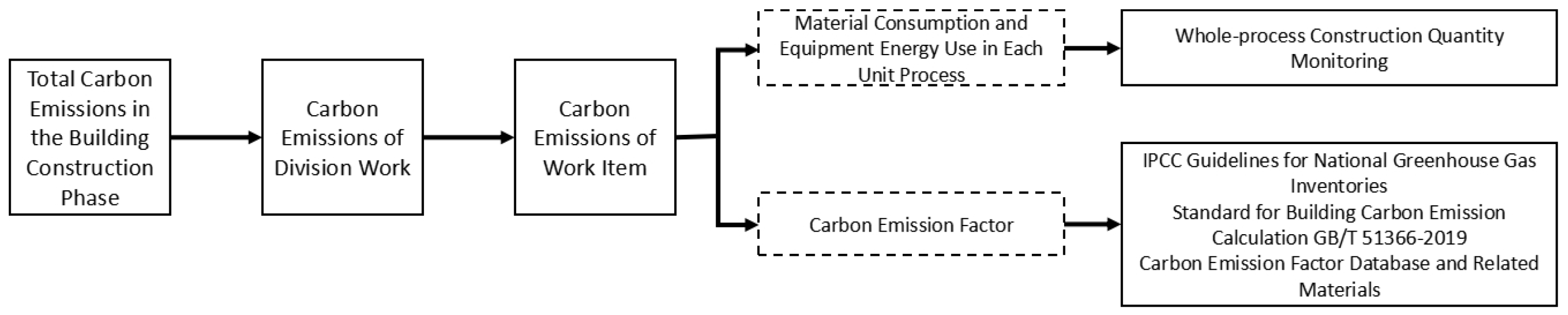
Given the intricate complexity and multi-phase concurrent nature of construction processes in the building engineering field, this study integrates the activity-based inventory analysis method with the database generated from the established digital twin monitoring model for full-process construction carbon emissions. Utilizing key parameters such as real-time material consumption and machinery shift usage, monitoring values like Pmi and Smi, provided by the database, a construction carbon emission quantification model based on construction processes is established, as shown in Figure 1.
The hierarchical logic of this model follows the progressive relationship of unit process, work item, division work, and total emissions. The carbon emissions for a unit process are calculated by collecting the consumption of materials and machinery shifts within each unit process and combining them with carbon emission factors. The carbon emissions of all unit processes within the same work item are summed to obtain the carbon emissions for that work item. The carbon emissions of work items are then accumulated to form the carbon emissions for division work. Finally, the carbon emissions of all division works are aggregated to obtain the total carbon emissions for the project.
Figure 1 presents the hierarchical and bottom-up architecture of the construction carbon emission quantification model. The underlying logic is grounded in the activity-based analysis method, wherein carbon emissions are progressively aggregated from the finest granularity to the project total. Specifically, the model decomposes the entire construction process into unit processes, each serving as the minimal accounting cell. Carbon emissions for a unit process are calculated by multiplying the monitored material consumption (Pmi) and machinery shift usage (Smi) by corresponding emission factors. Unit processes are then grouped into work items, which correspond to bill-of-quantity items. Multiple work items collectively form division work, and the sum of all division works yields the total construction carbon emissions. This structure not only aligns with the established construction quantity surveying practice but also accommodates real-time monitoring data from the digital twin system, thereby transforming static inventory-based accounting into a dynamic process-oriented approach.
The total carbon emissions E during the construction phase of a building project are the sum of the carbon emissions from all division works. The calculation Formula (1) is as follows:
E = E a
Let the quantity of the n-th work item within the a-th division work of the building project be Can. Then the carbon emissions Ea for the a-th division work are calculated using Formula (2) as follows:
E a = E a n × C a n
For the carbon emissions Ean of the n-th work item within the a-th division work during construction, the quantification model primarily focuses on two aspects from the elemental boundary: material consumption and equipment energy use. The resulting calculation Formula (3) is as follows:
E a n = E P n + E W n Y + E W n S
where Ean—Total carbon emissions of the n-th work item (kg CO2e).
During construction, there is a certain degree of material loss due to different construction techniques, and there are recyclable materials such as steel. Therefore, by integrating the monitored data of actual material consumption from the full-process carbon emission monitoring, the quantification Formula (4) for carbon emissions generated from material consumption is derived as follows:
E P n = m = 1 n i = 1 z P m i × E F P i
where EPn—Total carbon emissions contained within the material element of the n-th work item (kg CO2e);
Pmi—Monitored value of the consumption of the i-th construction material in the m-th unit process of the work item. The unit is determined by the material type, e.g., t, m3, etc.;
EFPi—Carbon emission factor of the i-th construction material (kg CO2e/unit);
m—Unit process number (1, 2, …, n);
z—Number of material types.
Carbon emissions generated from equipment energy use are calculated primarily based on the type of energy consumed by the equipment and its energy consumption per shift. The machinery used in construction mainly involves two categories: transportation machinery and construction machinery. The resulting calculation Formulas (5) and (6) are as follows:
E W n Y = i = 1 k Y i × E F Y i
E W n S = m = 1 n i = 1 z S m i × E F S i
where EWn−Y—Total carbon emissions from the energy consumed by the i-th transportation machinery (kg CO2e);
EWn−S—Total carbon emissions contained within the construction machinery element of the n-th work item (kg CO2e);
Yi—Monitored value of the construction work quantity for the i-th transportation machinery during construction transportation (t·km);
EFYi—Carbon emission factor of the i-th transportation machinery (kg CO2e/t·km);
Smi—Monitored value of the construction shift work quantity for the i-th construction machinery in the m-th unit process of the work item;
EFSi—Carbon emission factor of the i-th construction machinery (kg CO2e/shift);
m—Unit process number (1, 2, …, n);
k—Number of machinery types.

2.2. Digital Twin-Based Monitoring Model for Full-Process Construction Carbon Emissions

The construction process is characterized by complex and dynamic site conditions, along with intricate information on various construction elements. To achieve high-precision, real-time, and systematic monitoring of construction energy consumption, the concept of intelligent construction is adopted for full-process energy consumption monitoring. By referencing the five-dimensional digital twin model constructed by Tao Fei et al. [12] and the intelligent construction system established by Liu Zhansheng et al. [13], a carbon emission quantification and prediction model suitable for the field of intelligent construction is developed.
The model aims to provide a universal reference framework for the full construction process of various engineering projects from multiple dimensions and spatiotemporal scales. Its core can be summarized into three key dimensions: the Element Information Dimension, which focuses on key elements and information flows during construction; the Time Process Dimension, which considers the temporal sequence characteristics of construction; and the Model Hierarchy Dimension, which reflects the hierarchical structure and complexity of the model. By integrating these three dimensions, the model comprehensively reflects the dynamic changes in carbon emissions within intelligent construction, providing support for the accurate prediction of carbon emissions.

2.2.1. Element Information Dimension

In the full-process construction carbon emission monitoring model proposed in this study, the Element Information Dimension plays a central role. It is specifically responsible for the systematic collection and processing of carbon emission data generated by construction processes. This dimension focuses on three fundamental elements—materials, equipment, and personnel—to construct a well-organized and logically clear data architecture. This design not only aids in deepening the understanding of the inherent mechanisms of construction carbon emission behaviors but also provides a structured data foundation for subsequent technical applications and algorithm development, making the mining and analysis of carbon emission data more efficient and precise.
In the specific implementation of this study, the definition and description of the Element Information Dimension IX are formalized into Formulas (7)–(10). Their mathematical expressions accurately characterize the relationships among the elements and their roles in carbon emission data management:
I X = { I P , I W , I G }
I P = { P i d ,   P p o s i t i o n , P t y p e , P t i m e , P a s s o c i a t i o n , E P n , }
I W = { W i d ,   W p o s i t i o n , W t y p e , W Y t i m e , W S t i m e , E W n , }
I G = { G i d ,   G p o s i t i o n , G t y p e , G t i m e , G a s s o c i a t i o n , }
In the formulas, the Element Information Dimension IX comprises IP, IW, IG, representing the three key elements: materials, equipment, and personnel. IW, which denotes equipment element information, includes monitored data such as Wid, Wposition, Wtype, WY−time, WS−time, and EWn. Here, Wid is the equipment monitoring ID, Wposition is the monitoring location, Wtype is the machinery category, WY−time is the working duration of transportation equipment (unit: h), WS−time is the shift usage associated with construction equipment for specific processes (unit: shift), and EWn is the carbon emissions generated by equipment energy consumption (unit: kg CO2e). IP (material element information) and IG (personnel element information) contain similar types of monitored data as IW. IP encompasses material ID, location, type, usage time, associated processes, and material carbon emissions, while IG covers personnel ID, work location, job type, working duration, and associated processes.

2.2.2. Time Process Dimension

In the full-process construction carbon emission monitoring model constructed in this paper, the Time Dimension IT serves as the key axis for organizing information. Through high-precision timestamps, it can accurately pinpoint the construction phase of each step and completely record construction operations. The Time Dimension categorizes construction types based on the logical sequence of construction processes. Preliminary works like site leveling and earth excavation lay the foundation for subsequent activities. This is followed by main structural construction, such as concrete pouring and steel reinforcement fixing. This phase is typically lengthy, involves numerous steps, and demands precise time management. After the main structure is completed, the decoration and finishing stage begins. The scheduling here is relatively flexible. The final stage involves equipment installation, which often overlaps with the finishing works.
This categorization method decomposes the construction project into units with clear temporal and operational characteristics. It aids in identifying the carbon emission profiles of different construction processes. For example, preliminary work often involves high-energy-consuming equipment, resulting in significant emissions, while decoration work relies more on manual labor and small equipment, leading to lower emissions. This information provides data support for refined carbon emission management and the formulation of reduction strategies. Throughout the construction process, materials, equipment, and personnel are closely linked to construction processes. The Time Dimension reflects the process sequences associated with these elements. For in-depth analysis, the model formalizes the Time Process Dimension based on the unit process list, abstracting it into the mathematical expression shown in Formula (11):
I T = { T a n 1 , T a n 2 , , T a n m }
Here, Tanm represents the m-th unit process contained within the n-th work item of the a-th division work in the building project. The construction carbon emission monitoring model developed in this study adopts a hierarchical process decomposition strategy, breaking down complex construction workflows into fundamental units with distinct temporal attributes and operational characteristics. Specifically, the g-th sub-work item within the i-th division work further contains the n-th unit process. This stepwise decomposition method enables more precise capture and expression of the carbon emission relationships between construction processes and the elements IP, IW, IG within the Element Information Dimension IX. Through detailed analysis of these fine-grained process units, the carbon emission status corresponding to different processes within each division work can be quantified and characterized. By delving into the intrinsic connections between the Time Process Dimension and carbon emission data, the model enhances the capability for real-time monitoring and dynamic analysis of construction carbon emissions, promoting the deep integration and optimization of construction process energy efficiency and environmental impact.

2.2.3. Model Hierarchy Dimension

In the full-process construction carbon emission monitoring model constructed in this study, the Model Hierarchy Dimension IC serves as the core architecture, deeply revealing the intrinsic logic and interaction relationships among different dimensions. This dimension is divided into four progressive levels from bottom to top: the Unit Level (CC), the Organization Level (CO), the System Level (CS), and the Enterprise Level (CE). It is formally expressed as Formula (12):
I C = { C C , C O , C S , C E }
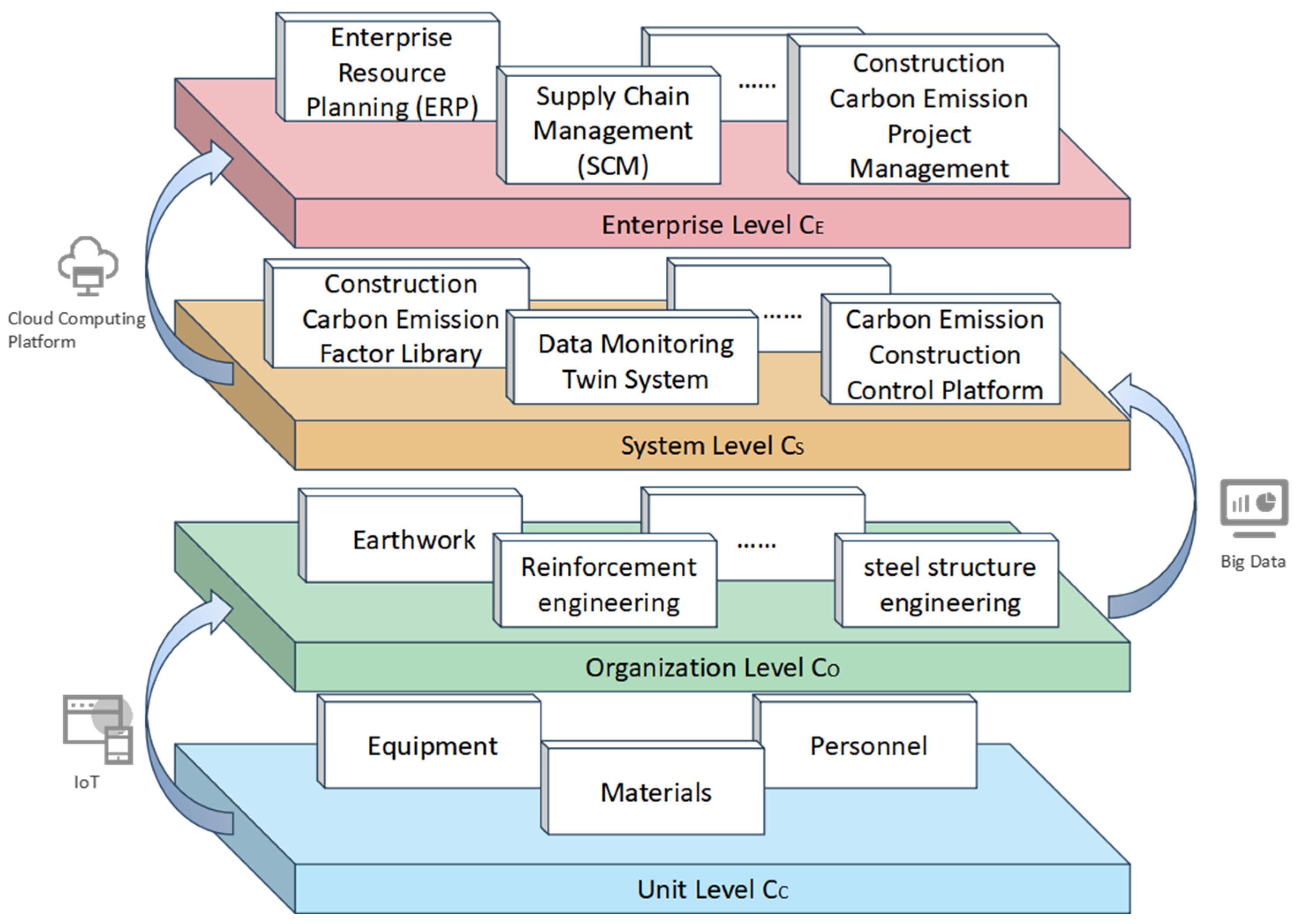
The characteristic of each level containing the one below it maps to different elements in the actual construction process. Utilizing cutting-edge technologies such as the Internet of Things, cloud computing, and big data, Figure 2 clearly presents this complex hierarchical structure in an intuitive and visual manner.
As shown in Figure 2, the Unit Level (CC) focuses on individual entities, such as a single worker or a structural component. The Element Information Dimension records their carbon emission characteristics. Formula (9) incorporates the Unit Level as a fundamental element, indicating that it serves as the cornerstone for building upper levels and provides raw data support for analyzing carbon emission characteristics at subsequent levels.
The Organization Level (CO) is formed by combining multiple Unit Level (CC) elements according to optimized process flows. It corresponds to specific construction phases, fulfills partial building functions, and integrates the Element Information and Time Process Dimensions. Taking the steel reinforcement fixing work group as an example, it consists of Unit Level elements—steel materials, steel fixers, and a steel bar cutter—combined in a specific process sequence. Its carbon emissions are the sum of emissions from all unit elements during that process period. Formula (12) explicitly shows the compositional relationship by expressing the Organization Level (CO) alongside the Unit Level (CC), reflecting the containment of unit elements by the organizational level.
The System Level (CS) encompasses multi-domain systems. It builds business collaboration networks based on the Unit and Organization Levels, integrates complex systems, and possesses the capability for cross-substructure management. Taking the civil construction system as an example, it integrates multiple Organization-Level work groups, such as earth excavation, formwork support, and concrete pouring. System-level carbon emission control is achieved by coordinating the timing of processes and resource allocation. Figure 2 illustrates the connections among subsystems at the System Level and their integration of lower-level elements. Formula (12), using set notation, indicates the hierarchical containment of the Organization and Unit Levels by the System Level and mathematically describes the rules for internal collaboration and data interaction.
The Enterprise Level (CE) is the top tier of the model. It encompasses comprehensive construction information, elucidates the interaction mechanisms among subsystems, and analyzes and predicts system dynamics. Taking a construction enterprise as an example, it integrates System Level (CS) data from multiple projects to form a corporate carbon emission database. This provides decision-making support for formulating cross-project emission reduction strategies, such as centralized procurement of low-carbon materials or deployment of electric construction machinery. Figure 2 presents the technical scheme for the Enterprise Level to consolidate information from all lower levels. Formula (12) places the Enterprise Level (CE) at the end of the set, demonstrating its comprehensive containment of lower levels and providing mathematical support for the enterprise-level overarching control of the entire construction process.

2.2.4. Operational Logic and Data Flow of the Monitoring Model

The digital twin monitoring system is deployed across the physical construction site through a heterogeneous sensor network, including weight sensors at material yards, energy consumption monitors on construction machinery, and GPS-fuel-consumption integrated terminals on transport vehicles. These sensors transmit data wirelessly to an edge computing node every 5 min, with critical event-driven triggers activating an immediate push at sub-minute intervals. All data packets are stamped with a unified Coordinated Universal Time (UTC) timestamp at the point of acquisition, enabling temporal alignment across diverse sensor streams.
Within the digital twin platform, data synchronisation is achieved by buffering incoming streams in a sliding time window of 10 min; data arriving within the same window are grouped and mapped to the corresponding unit process based on the Time Process Dimension IT. The mapping between sensor data and specific unit processes is established by a pre-configured association table that links each sensor’s physical location and monitored equipment to the construction schedule and work breakdown structure. For instance, the weight sensor at the B2 floor reinforcement yard is associated with the “steel bar fixing” unit process of the “above-ground 3rd floor civil work” during its scheduled period. Once a unit process is completed, its accumulated material and machinery data are sealed and transferred to the blockchain module for immutable storage. This design ensures that process boundaries are dynamically allocated in real time as construction progresses, providing a transparent and reproducible workflow from raw sensor output to process-level carbon emission data.
Blockchain integration was implemented using a consortium chain architecture based on Hyperledger Fabric, selected for its permissioned access model and modular consensus design suited to construction stakeholder environments. The consensus mechanism employed was Practical Byzantine Fault Tolerance (PBFT), with three endorsing peer nodes deployed across the site server, the general contractor’s cloud infrastructure, and the client’s data centre. Given the 5-min periodic data push cycle and sub-minute event-driven triggers from the sensor network, continuous IoT data streams were batched into hash-anchored blocks at 10-min intervals prior to on-chain commitment. Latency tests conducted during system commissioning indicated an average end-to-end delay of 2.1 s from block proposal to final commitment, with peak latency remaining below 5 s under concurrent event-triggered uploads. This latency margin is well within the 5-min monitoring response window, confirming that blockchain integration does not constitute a performance bottleneck for real-time carbon monitoring in this configuration.

2.3. Deep Learning-Based Construction Carbon Emission Prediction Model

Building upon the established full-process construction carbon emission monitoring model, this study establishes a collaborative interaction mechanism between the digital twin model and the LSTM model. Target prediction values and actual monitored values of key carbon emission influencing factors are mapped to energy consumption control factors. By referencing industry technical standards, specifications, and plans, a prediction indicator system is formed to provide adjustment suggestions for the carbon emission management process. Consequently, a scientific and standardized prediction model for full-process construction carbon emissions is constructed.

2.3.1. Influencing Factors of Construction Carbon Emissions

Based on existing research on influencing factors for green construction carbon emissions in standards and relevant literature [14,15], and grounded in the established full-process monitoring model, three first-level indicators are defined according to the three key factors at the unit level: equipment, materials, and personnel. These are Material Consumption, Energy Consumption, and Construction Management. Key secondary indicators for construction carbon emission assessment are selected, including main material types, low-carbon material utilization rate, transportation and storage loss rate, construction energy types, clean energy utilization rate, and novel construction techniques.
In this study, construction management encompasses three operational dimensions: (a) the application of novel construction techniques, scored according to the percentage of work items adopting such techniques relative to total work items; (b) on-site material management efficiency, quantified by the ratio of actual material waste to design allowance; and (c) equipment scheduling optimization, measured by idle-time ratio derived from machinery energy consumption logs. Expert scores for this indicator were calibrated against benchmarks specified in the Standard for Green Construction Evaluation (GB/T 50640 [16]). While the quantification of management-related emissions is inherently less direct than that of material or energy consumption, the above operational definitions ensure that the indicator captures measurable management practices rather than subjective impressions, thereby preserving the transparency and reproducibility of the assessment framework.
A panel of 12 experts was convened, comprising six senior construction engineers with over 15 years of site management experience, four sustainability consultants specialised in building carbon auditing, and two academic researchers in construction engineering. Each expert independently rated the importance of the six secondary indicators on a 5-point Likert scale (1 = negligible influence on construction carbon emissions; 5 = extremely strong influence), guided by a unified scoring rubric that defined each indicator with reference to national standards such as the Standard for Building Carbon Emission Calculation (GB/T 51366-2019) and typical construction practice.
To minimise subjective bias, a two-round Delphi-style consultation was conducted. In the first round, experts provided initial scores along with justifications; the anonymised summary statistics and arguments were then circulated, after which experts could revise their scores in the second round. The final scores from the second round were used as the primary data for weight calculation. The entropy weight method was subsequently applied to these scores to derive objective indicator weights, as detailed in Section 2.3.2. The rationale for combining expert scoring with entropy weighting is twofold: expert scoring supplies the domain-specific initial evaluation that captures nuanced engineering judgement, while entropy weighting extracts the intrinsic information structure from the evaluation data, reducing the impact of individual outliers and ensuring that indicators with higher consensus (low entropy) receive appropriate emphasis. The results of the comprehensive weight calculation are shown in Table 2.
The comprehensive weights presented in Table 2 were derived using the entropy weight method, an objective weighting technique that determines indicator importance based on the degree of variation in the evaluation data. The underlying principle is that an indicator with lower information entropy exhibits greater variability across assessment samples, thus containing more distinguishing information and meriting a higher weight. In this study, a panel of engineering experts first scored each secondary indicator on a 1–5 scale according to its relevance to construction carbon emission assessment. These scores were then normalized to form a standard evaluation matrix. The information entropy Ej for indicator j was computed as shown in Formula (13):
E j = k   p i j l n ( p i j )
where pij denotes the proportion of the i-th expert’s score for indicator j and k = 1/ln(m) with m being the number of experts. The entropy weight of each secondary indicator was subsequently calculated as shown in Formula (14):
w j = ( 1 E j ) /   ( 1 E j )
The ‘Comprehensive Weight’ column in Table 2 is the product of the first-level indicator weight and the corresponding second-level weight, representing the relative contribution of each secondary indicator to the overall assessment system. This objective approach mitigates the subjectivity inherent in purely expert-dependent methods, ensuring that the weighting reflects the intrinsic data characteristics of the specific construction project.

2.3.2. Mathematical Description of Prediction and LSTM Model Design

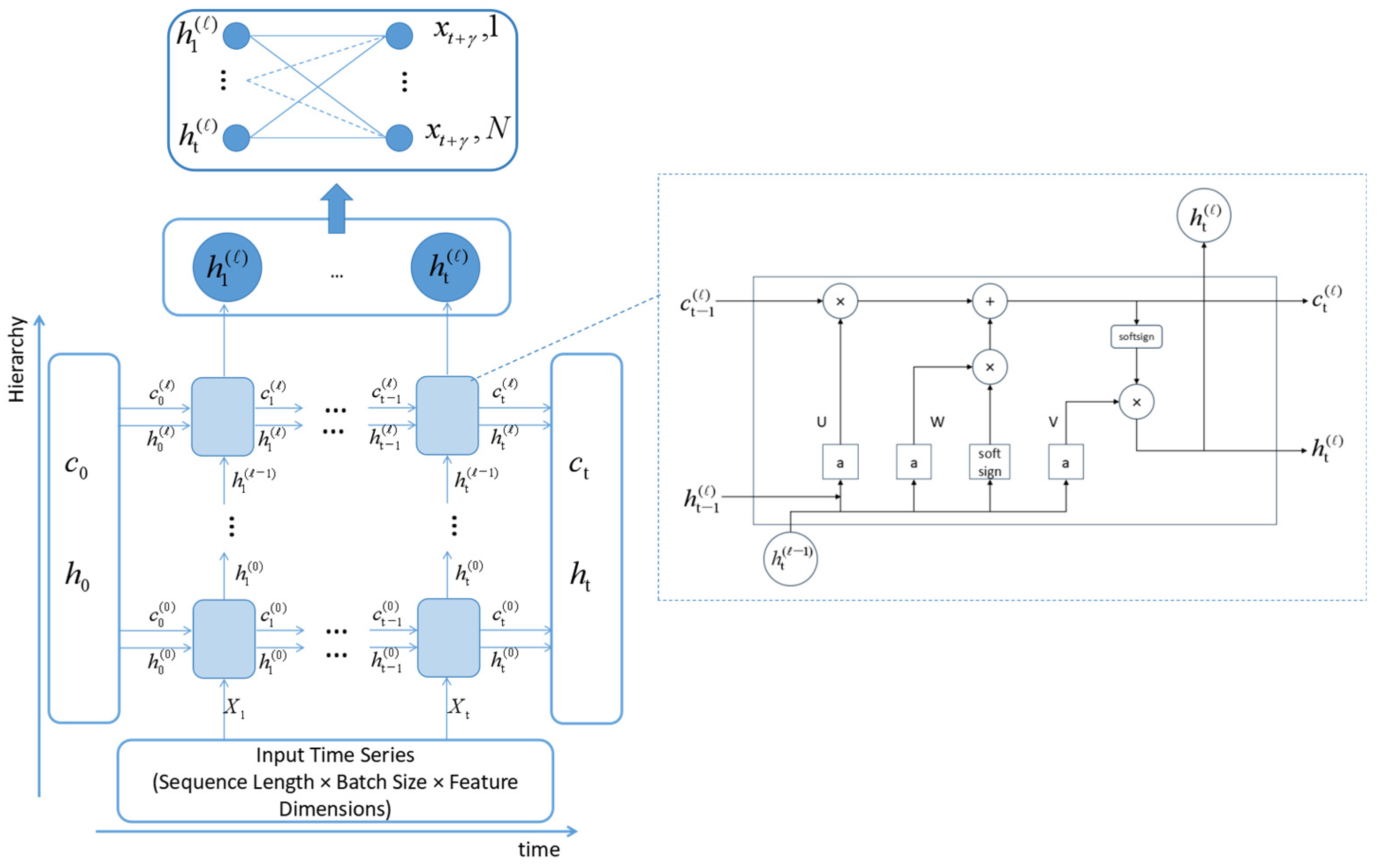
Construction carbon emission prediction is a time series forecasting problem. Unlike common regression prediction models, it requires full consideration of the “sequential dependency” among input variables, which adds complexity. Therefore, a Long Short-Term Memory (LSTM) network is adopted to build the construction carbon emission prediction model.
Integrating the data characteristics required for LSTM training with the historical data structure from the full-process monitoring model, and based on the main carbon emission influencing indicators, both the feature variable set input to the LSTM and the judgment threshold for the output carbon emission warning coefficient are determined. This yields construction carbon emission assessments at different times, forming the existing time series data. Accordingly, the mathematical description for full-process construction carbon emission prediction is the following: given T sets of time series data, each data set Xt contains N carbon emission assessment scores, as shown in Formula (15):
X t = [ x t , 1 , x t , 2 , , x t , N ] T
where xt,n ∈ [0, 5], t = 1, 2, …, T. For each data set Xt, there is a weight constant W, as shown in Formula (16):
W = [ w 1 , w 2 , , w N ] T
Based on the past t (1 ≤ t ≤ T) time series data and the weight constant W, to predict the construction carbon emission assessment data contained in the future γ (≥1) time series, the carbon emission assessment indicator Ht for the full process can be calculated, as shown in Formula (17):
H t = W T X t
The constructed LSTM network structure is shown in Figure 3. The LSTM network extracts hidden state features from the past t time series. Combined with a linear regression method, it predicts the future t + γ-th time series.

2.3.3. LSTM Model Training

In the full-process construction carbon emission prediction problem, the prediction is based on the carbon emission data from the immediately preceding t days. Therefore, after normalizing the preprocessed time series data composed of the main influencing factors, the preprocessed assessment data from the first t periods (assessment_data), the weights of the assessment influencing factors (assessment_weight), and the number of days to predict (n) are formed into matrix inputs, respectively. The data from the t + γ period is used as the output for error correction comparison.
During training, the case data covers an 18-month construction period. Considering the relatively small sample size, the number of hidden layers in the model is set to 1, and 5-fold cross-validation is employed to avoid overfitting. The training step length is set to T = 7. A 7-day step aligns with the periodic nature of construction processes, fully covering a weekly scheduling cycle while preserving cross-week resource consumption correlations. The 540 data groups are divided into 77 valid samples using a 7-day step. Each time, 4/5 of the samples are selected as the training set and 1/5 as the validation set. This process is repeated 5 times, and the average prediction error is taken as the evaluation metric for the model’s generalization ability, ensuring stability across different data subsets.
The Adam optimizer is chosen. Compared to algorithms like SGD, Adam’s lower sensitivity to hyperparameters makes it suitable for the small-sample training in this study. The initial learning rate is set to 0.1. After trial and error with rates of 0.01, 0.1, and 0.5, 0.1 resulted in the fastest convergence speed and the lowest loss value. The loss function stabilizes after 50 iterations, so the number of training epochs is set to 50. The L1 loss function is selected, as its sensitivity to outliers is lower than that of L2 loss, making it more suitable for the fluctuating scenarios in construction data. The calculation of L1 loss is shown in Formula (18).

L 1 = | y t r u e y p r e d |

3. Case Study: Application of the Method to a Building

3.1. Case Selection and Data Collection Design

3.1.1. Case Suitability Description

To verify the engineering applicability and technical effectiveness of the proposed intelligent analysis method for construction process carbon emissions based on construction processes, a public building construction project was selected as a demonstrative case for in-depth elaboration. The total floor area of this case project is 39,350 m2, with 7 above-ground floors and 3 underground floors. It employs a frame-shear wall structure, with a prefabrication rate of 30% for the main structure. The construction period spans from March 2023 to December 2024, covering the entire process, including earthwork excavation, foundation pit support, pile foundation construction, civil works, and equipment installation.
Regarding data support capability, material transportation during project construction primarily relied on diesel trucks. Construction machinery included conventional equipment such as tower cranes (QTZ80 model, Zoomlion Heavy Industry Science & Technology Co., Ltd., Changsha, China), concrete pump trucks (SY5313THB model, Sany Heavy Industry Co., Ltd., Changsha, China), and steel bar cutters (GQ40 model, XCMG Construction Machinery Co., Ltd., Xuzhou, China). To ensure real-time and credible data collection, 32 IoT monitoring terminals were deployed on-site. These included weight sensors at material yards, energy consumption monitoring modules for construction machinery, and GPS locators with fuel consumption meters for transport vehicles. This setup enabled the real-time collection of core parameter data for the quantification model, such as material consumption Pmi, machinery shift usage Smi, and transport vehicle workload Yi. All collected data were encrypted and stored via blockchain nodes to ensure tamper-resistance, providing a reliable data foundation for subsequent carbon emission quantification, calculation, and analysis.
In terms of model suitability, the 30% prefabrication rate for the main structure and the 18-month construction period, which could be divided into 77 valid sample groups using a 7-day step length, met the 5-fold cross-validation requirements for the LSTM model’s small-sample training. These foundational conditions provided room for subsequent strategy optimization and could fully verify the predictive model’s value in guiding construction management.

3.1.2. Data Collection Scheme and Preprocessing Procedure

The collected data were mapped to the model. Relying on the Element Information Dimension IX and the Time Process Dimension IT of the digital twin monitoring model, precise alignment between the monitored data and the quantification model parameters was achieved.
For material data, the real-time consumption Pmi of main materials like steel and concrete was collected via weight sensors at the stockyard. The corresponding Carbon emission factor parameters EFPi were matched by referencing the Standard for Building Carbon Emission Calculation (GB/T 51366-2019).
For construction machinery data, large equipment like tower cranes and concrete pump trucks recorded shift working hours WStime and monitored shift work quantity values Smi via energy consumption monitoring modules. Transport vehicles used GPS locators and fuel meters to obtain transport mileage and fuel consumption, from which the transport workload Yi (t·km) was calculated and matched with the Carbon emission factor for diesel transport machinery EFYi = 0.42 kg CO2e/kg.
Regarding temporal association, all monitored data were bound to specific construction processes according to the Time Process Dimension IT. The recording format was, for example, “Week 2 of May 2024, steel fixing process on above-ground 3rd floor.” This provided the temporal basis for the cumulative calculation of division work carbon emissions in Formula (2). Simultaneously, data were encrypted and stored using blockchain technology to ensure credibility during parameter transmission.
To ensure data quality and model calculation accuracy, the following standardized preprocessing procedure was adopted:
For missing value handling: For continuous data like machinery energy consumption, the mean value of adjacent time points was used for imputation. For data strongly associated with processes, like material consumption, imputation was performed using the mean value from the same process period. After imputation, data completeness reached 99.7%.
For outlier removal: Based on the 3-sigma rule, extreme data points in machinery energy consumption and material consumption that exceeded the mean ± 3 standard deviations were removed, accounting for approximately 0.8% of the data. This prevented interference from outliers in model training and quantification calculations.
Data normalization was performed: Data with different dimensions, such as transport distance (km), material consumption (t/m3), and machinery shift usage (shift), were normalized to the [0, 1] interval. This ensured consistency in the input data for the LSTM model.
To verify the credibility of data transmission and storage, 100 randomly selected sets of blockchain-encrypted stored monitoring data were compared with manually recorded data for consistency. The results are shown in Table 3 below:
Table 3 reports an overall consistency ratio of 91.0% between automatically monitored and manually verified records, with process duration showing the lowest consistency at 85.0%. These results indicate that the data acquisition pipeline operated with satisfactory reliability under site conditions. The comparison in Table 3, however, evaluates agreement between two recording modalities—sensor-based monitoring and manual documentation—rather than isolating the specific contribution of blockchain to data integrity. While blockchain encryption and distributed storage were deployed throughout the data collection period, the observed consistency may also partially reflect sensor calibration, redundant validation protocols, and standard quality assurance practices. Accordingly, the integrated system—comprising IoT sensors, edge computing, and blockchain storage—collectively enabled credible data transmission and tamper-resistant archiving, as evidenced by the 91.0% consistency with manual records. A controlled experiment isolating the incremental effect of blockchain alone would be required to establish its individual causal contribution.

3.2. Engineering Validation of the Models

3.2.1. Validation of the Monitoring Model

For the monitoring model constructed in this study, five typical emergency scenarios during construction were selected to test the full-process response time of the digital twin monitoring model—from data collection and anomaly identification to warning notification—thereby validating the model’s real-time monitoring capability. The results are shown in Table 4 below:
The mechanical overload scenario for the concrete pump truck was triggered when its shift usage exceeded 120% of the daily average, i.e., 18 shifts. This prompted a control suggestion: “Equipment overload warning, recommend shutdown for maintenance for 30 min.” The scenario of excessive steel material loss was triggered when the steel transportation loss rate exceeded 5% and a single transport loss reached 6.2%. The warning indicated abnormal material loss and suggested checking the transportation securing method. In the scenario where process carbon emissions exceeded the threshold, the weekly carbon emissions from the steel reinforcement fixing process actually reached 215 tons, leading to targeted suggestions for optimizing the fixing technique. The transport route deviation scenario was triggered when the material transport route deviated from the planned path by more than 10 km, generating a route deviation warning and a dispatch suggestion to switch to the shortest path. The equipment energy consumption anomaly scenario was triggered when the tower crane’s energy consumption exceeded the average for the same period by 30% and its single-shift consumption reached 125 kWh. This produced an energy consumption anomaly warning, suggesting an operational check of the equipment’s status.
In this study, warning accuracy was evaluated using 50 emergency events spanning the five scenario types described in Table 4—10 events per scenario—comprising both induced anomalies during commissioning tests and naturally occurring incidents during construction. Since all 50 events represented anomaly conditions, every event was expected to trigger a warning; consequently, no true negative (TN) cases exist in this evaluation. A warning is considered a true positive (TP) if the system issues an alert for an event and the corresponding on-site inspection confirms the specified anomaly condition; a false positive (FP) if an alert is issued but no anomaly is verified; and a false negative (FN) if an anomaly is later confirmed through manual inspection but no warning was issued. Given the absence of TN cases, accuracy is calculated as TP/(TP + FP + FN), which in this context is equivalent to recall or detection rate. Across the 50 events, the system correctly issued warnings for 46 events (true positives) and produced 4 misclassifications (3 false positives and 1 false negative), yielding a detection accuracy of 92% (46/50), with a false positive rate of 6.0% (3/50) and a false negative rate of 2.0% (1/50). These metrics provide a profile of the monitoring model’s alerting performance and should be considered alongside the average response time of 3.3 min when evaluating the system’s practical utility.
The results showed that the monitoring model’s average response time to these various emergency scenarios was 3.3 min, meeting the real-time control target of ≤5 min. The warning accuracy rate reached 92%. The model was capable of promptly capturing carbon emission anomalies during construction and effectively outputting precise warnings and adaptive control suggestions in real-time for different scenarios.

3.2.2. Validation of the Prediction Model

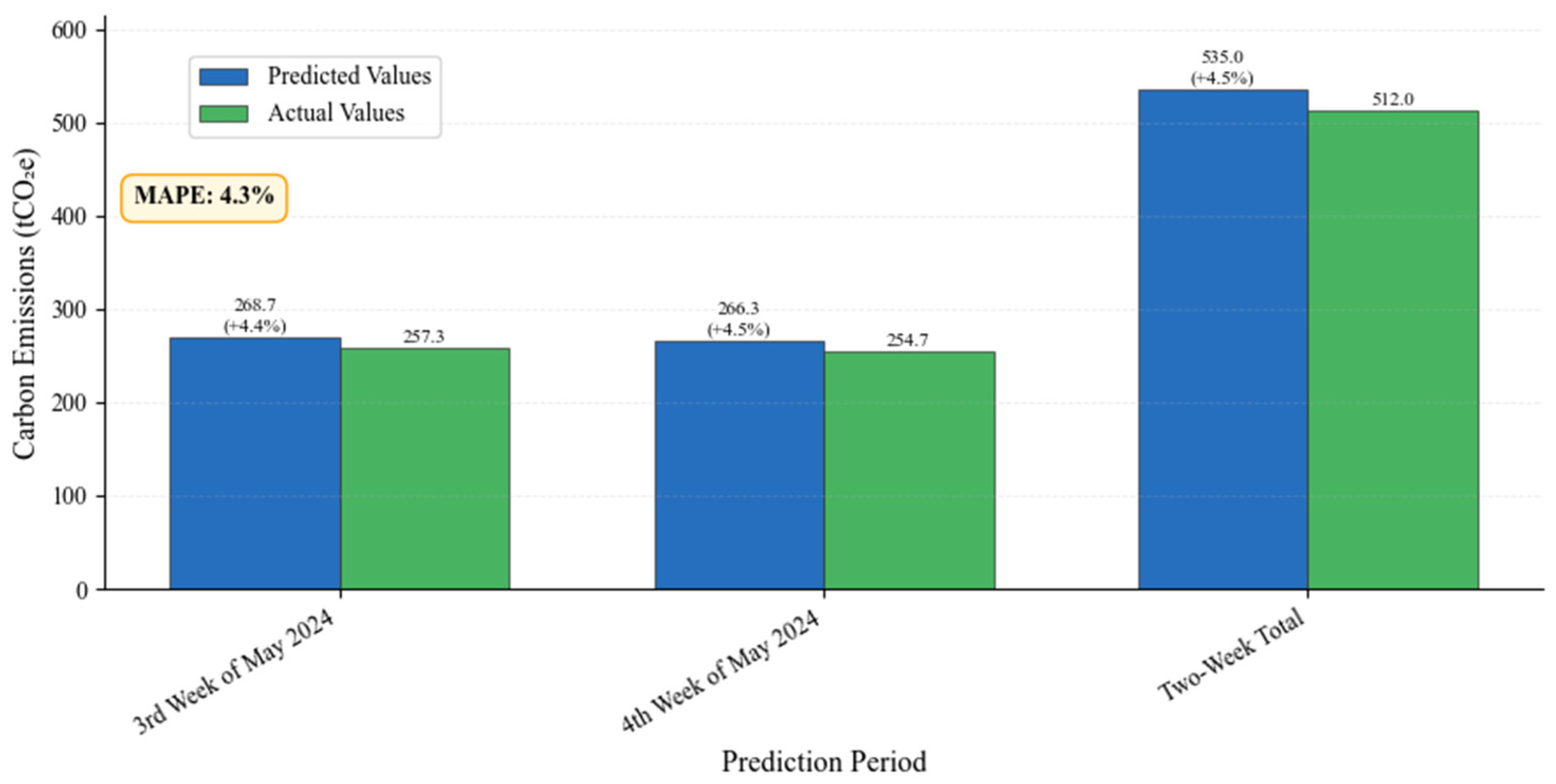
The LSTM model was trained using monitoring data from the first 16 months of the project (480 sets of raw data, divided into 68 training samples with a 7-day step). It was then used to predict the carbon emissions of the above-ground civil works for the upcoming two weeks in May 2024. The model’s accuracy was verified by comparing predicted values with actual monitored values. Concurrently, low-carbon optimization strategies were formulated and implemented based on the prediction results to verify the model’s engineering practicality. A comparison between the LSTM model’s short-term prediction results and the actual values is shown in Figure 4.
Figure 4 presents the comparison between LSTM-predicted and actual monitored carbon emissions for above-ground civil works over the two-week period. The model predicted a cumulative emission of 535 tCO2e, compared with the actual recorded value of 512 tCO2e, yielding an absolute deviation of 23 tCO2e and the Mean Absolute Percentage Error (MAPE) of 4.3% for this specific forecasting window. This case-level MAPE of 4.3% corresponds to a short-term prediction accuracy of 95.7% for the two-week period shown. Across the full validation set—comprising all 5-fold cross-validation samples and prediction windows—the model attained an overall MAPE of approximately 11%, corresponding to a global short-term prediction accuracy of 89%. The low case-level deviation confirms the model’s practical utility for guiding near-term construction management decisions; the global metric provides a more conservative and generalizable estimate of expected model performance.
The above results should be interpreted with due consideration of sample size constraints. The LSTM model was trained on 77 valid samples derived from an 18-month construction period of a single project. While this sample size satisfies the minimum requirement for 5-fold cross-validation, it remains small for deep neural network training. The reported global prediction accuracy of 89% (MAPE ≈ 11%) therefore represents an initial benchmark obtained under the specific conditions of this case, rather than a performance ceiling. In more complex construction environments—where carbon emissions are subject to weather variability, subcontractor scheduling fluctuations, and material supply disruptions—prediction errors may exceed those observed here. Expanding the training corpus with multi-project data is essential for improving both robustness and accuracy.

3.3. Analysis of Engineering Application Results

3.3.1. Multi-Dimensional Carbon Emission Quantification Results

The traditional inventory method prescribed in the Standard for Building Carbon Emission Calculation (GB/T 51366-2019) was adopted as the comparative baseline. Specifically, this method calculates carbon emissions by multiplying design quantities of materials and estimated machinery shift usage—both extracted from the bill of quantities and construction organization plan—with standard emission factors, without incorporating field-monitored consumption data or temporal process information. Material loss is accounted for using a fixed loss coefficient rather than measured values. In contrast, the proposed activity-based quantification model integrates real-time material and machinery usage data through the digital twin monitoring system, thereby capturing dynamic on-site conditions.
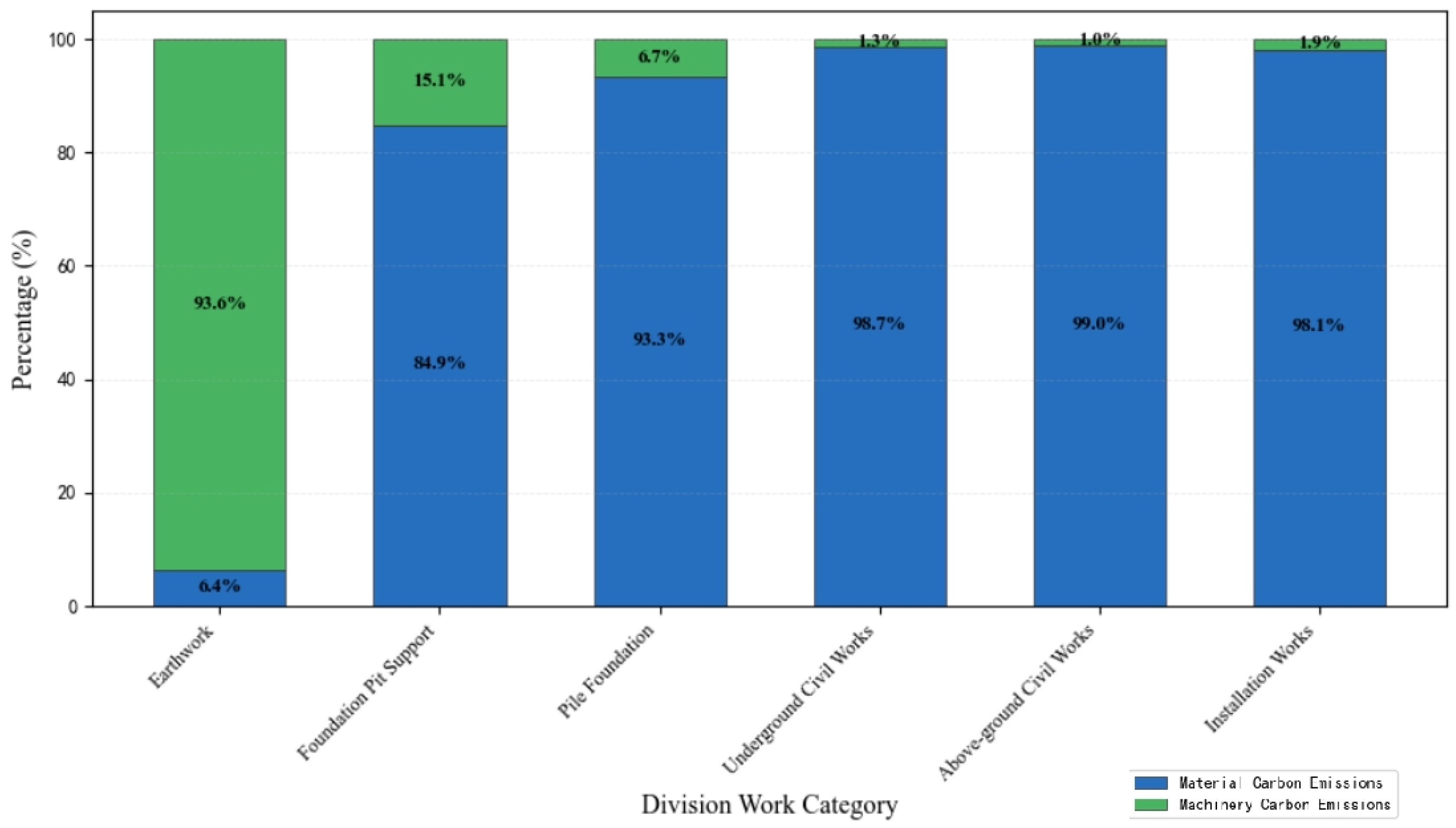
Table 5 presents the resulting carbon emissions for each division work. Civil works—comprising both underground and above-ground structures—accounted for 86.8% of total project emissions, serving as the dominant emission source. This result is primarily attributable to the substantial consumption of building materials (13,700 tons of steel and 40,000 m3 of concrete for civil works), the high frequency of steel fixing and concrete pouring processes, the prolonged operation of large machinery such as tower cranes and concrete pump trucks, and the extensive construction footprint and lengthy civil construction cycle. Given this predominant contribution, targeted emission reduction efforts for civil works are particularly critical.
When validated against actual emissions verified through post-construction material reconciliation and fuel receipts, the traditional static method yielded a deviation ranging from 18% to 25%. The proposed method reduced this deviation to within 3.2% for core division works, representing an absolute reduction in calculation deviation of approximately 15–22% points and confirming the improved accuracy achieved through dynamic, process-level quantification updated by monitored field data.
To visually demonstrate the proportional impact of material and machinery elements on carbon emissions across different division works, the system generated a percentage stacked bar chart, as shown in Figure 5. Figure 5 clearly reflects the differences in carbon emission distribution between the two major construction elements—material consumption and equipment energy use—across various division works. Through in-depth analysis of the chart information, it can be observed that the proportion of material-related carbon emissions is generally high in each work item. This result is also consistent with existing related carbon emission studies [17,18], primarily stemming from the energy consumption and emissions during the production, transportation, and processing of large quantities of building materials.

3.3.2. Sensitivity Analysis of Key Influencing Factors

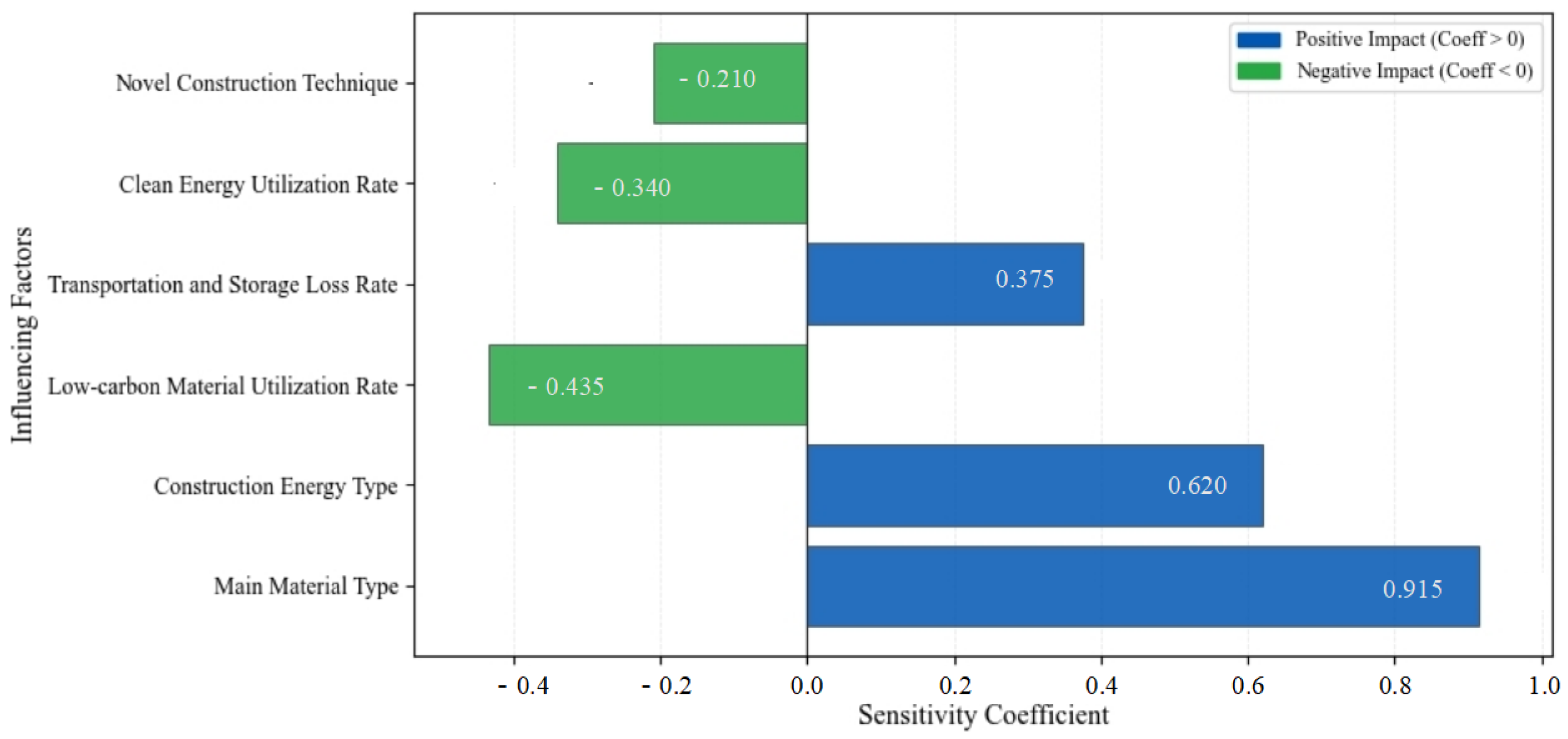
Based on the weights of construction carbon emission influencing factors determined by the entropy weight method, a single-factor sensitivity analysis was conducted. Each of the six secondary influencing factors varied within a ±20% range, and the rate of change in total carbon emissions was calculated. The sensitivity coefficient was obtained by dividing the emission change rate by the factor change rate, quantifying the degree of influence of each factor on carbon emissions. The results are shown in Figure 6.
The sensitivity ranking indicates that the main material type (0.915) is the most sensitive factor affecting carbon emissions, followed by construction energy type (0.620). Both have a positive influence, indicating that optimizing material selection, adopting low-carbon alternative materials, reducing reliance on fossil fuels, and promoting electric machinery can significantly reduce carbon emissions. Regulating factors with emission reduction potential, although the low-carbon material utilization rate (−0.435) and clean energy utilization rate (−0.340) have slightly lower sensitivity than the former two, they offer clear room for engineering adjustment and serve as important levers for emission reduction. Furthermore, the transportation and storage loss rate (0.375) and new-type construction techniques (−0.210) have relatively lower sensitivity but should still be incorporated into the monitoring system to achieve marginal emission reduction through refined management.

3.4. Low-Carbon Optimization Strategies

Based on the quantification results and sensitivity analysis, three optimization strategies are formulated with quantitative linkages to the case findings.
First, increasing the prefabrication rate of the main structure directly addresses the dominant emission source identified in the case. Civil works—both underground and above-ground—accounted for 86.8% of total project emissions, with material-related carbon emissions constituting the overwhelming majority (98.7% of underground civil works and 99.0% of above-ground civil works). Sensitivity analysis further identified the main material type as the most influential factor (sensitivity coefficient = 0.915). In the case project, raising the prefabrication rate from 30% to 40% for the above-ground superstructure reduced on-site concrete pouring by approximately 1200 m3 and steel fixing work by an estimated 180 tonnes, contributing to the 23 tCO2e reduction observed during the two-week prediction window. Extending this adjustment across the full construction period is estimated to yield a total emission reduction of approximately 8–12% for civil works.
Second, optimizing construction energy sources targets the second most sensitive factor identified—construction energy type (sensitivity coefficient = 0.620). In the case project, tower cranes and concrete pump trucks accounted for over 60% of machinery-related emissions. Replacing diesel-powered equipment with electric alternatives for stationary machinery and optimizing transport routes to keep material haulage distance within 10 km—consistent with the route deviation warning threshold validated in Table 4—are projected to reduce machinery-related emissions by an estimated 15–20%, equivalent to approximately 120–160 tCO2e over the construction period.
Third, reducing the transportation and storage loss rate (sensitivity coefficient = 0.375) offers incremental but operationally feasible reductions. In this case, the steel reinforcement loss rate of 6.2% observed in the emergency scenario (Table 4) exceeded the design allowance of 5%. Restoring this loss rate to within the design threshold, combined with GIS-based route optimization for just-in-time delivery, could reduce material waste emissions by an estimated 3–5%. The combined effect of these three strategies is estimated to achieve an overall emission reduction of 10–15% for the case project, transforming the qualitative suggestions typically found in construction guidelines into empirically grounded, case-specific targets.

4. Discussion

4.1. Comparison with Existing Studies

To contextualize the findings of this study, the proposed method is compared with relevant prior work across three dimensions: quantification accuracy, real-time monitoring capability, and prediction performance.
Traditional inventory-based approaches, such as the elemental calculation method employed by Li et al. [3] and the energy-consumption inventory method used by Wang [4], rely predominantly on static design data and empirical loss factors. While straightforward, these methods fail to capture the dynamic fluctuations inherent in construction processes. The activity-based quantification model established in this study incorporates real-time material consumption and machinery usage data, enabling a more faithful representation of on-site conditions. The case study demonstrated an absolute reduction in calculation deviation of 15–22% points compared to conventional inventory methods (whose deviation from verified emissions, based on post-construction material reconciliation and fuel receipts, ranged from 18% to 25%), with the core division work calculation errors remaining within 3.2%.
Prior research on construction carbon monitoring has largely been retrospective, providing aggregated post-construction reports rather than continuous oversight. By integrating digital twin technology with IoT sensors and blockchain-enabled data storage, the monitoring model presented here achieved an average emergency response time of 3.3 min and a warning accuracy of 92%.
The LSTM-based prediction model achieved an overall short-term prediction accuracy of 89% (MAPE ≈ 11%), with a case-level MAPE of 4.3% for the two-week validation period. This result is comparable to the prediction accuracy reported by Liu et al. [8] for LSTM-based carbon emission forecasting in the transportation sector, suggesting a consistent predictive capability of this architecture across domains. Nevertheless, the current model was trained on a single building project, which limits its generalizability. The sensitivity analysis further identified main material type and construction energy type as the dominant influencing factors, consistent with the findings of Li et al. [14] for prefabricated buildings and Sandanayake et al. [17] for foundation construction. Expanding the training dataset to encompass diverse structural types (steel, masonry) and infrastructure types will be essential for broader applicability.
In summary, the comparative analysis confirms that the proposed method offers tangible improvements in accuracy and timeliness over conventional approaches, while also identifying avenues for further refinement in terms of data diversity and model generalizability.

4.2. Scope of Validation and Directions for Extension

The present validation was conducted on a single public building with a frame-shear wall structure and a 30% prefabrication rate, which delimits the scope within which conclusions may be drawn. Extension of the training dataset is therefore necessary. One proposed direction involves incorporating engineering cases from different climatic regions. Although climate does not enter the LSTM model as an explicit input feature, it exerts indirect effects on carbon-relevant parameters through site operations. In cold regions, supplementary energy is required for concrete heating and winter protection measures. High-temperature environments necessitate additional water consumption for curing and supplementary cooling. Adverse weather conditions can interrupt construction activities, thereby prolonging machinery operation and increasing fuel consumption. These mechanisms modify the magnitude and distribution of core input parameters—material consumption, machinery shift usage, transport workload, and process duration—thereby broadening the feature variability to which the model is exposed.
A more direct and consequential expansion path lies in the inclusion of different building structural types and other infrastructure categories. These project types differ fundamentally in material composition, construction sequences, and equipment deployment. Their carbon emission characteristics may therefore deviate substantially from those observed in the current case. Testing the model on such typologically diverse data will provide a more rigorous assessment of its predictive robustness than climatic variation alone. Accordingly, the present validation is positioned as an initial proof of concept; broader verification across structural typologies and infrastructure categories constitutes the necessary subsequent phase of this research program. Furthermore, the current model employs fixed emission factors sourced from national standards, which do not capture fluctuations in embodied carbon arising from unplanned supplier or route changes during construction. In the future, dynamic emission factors can be introduced through supplier environmental product declarations (EPDs).

5. Conclusions

Addressing the need for carbon emission monitoring during the construction phase of building projects, this paper proposes an intelligent analysis method based on construction processes. This method achieves refined management through the synergistic application of three models: a construction carbon emission quantification model, a digital twin monitoring model, and an LSTM prediction model. Validated using a public building project in Beijing, the core conclusions are as follows:
The construction carbon emission quantification model defines boundaries across three dimensions: time, space, and elements. By integrating activity-based inventory analysis with real-time data, it establishes a multi-level calculation logic that accurately maps the relationships affecting carbon emissions. Case validation shows that, with the traditional inventory method as a baseline (deviation: 18–25%), the proposed model reduces the calculation deviation for core division works to within 3.2%, an absolute reduction of approximately 15–22% points compared to the baseline, thereby addressing the lack of dynamism in traditional approaches.
The digital twin monitoring model integrates three dimensions: element information, temporal processes, and model hierarchy. Combined with IoT and blockchain technologies, it enables real-time data collection and credible transmission. With a monitoring response time of ≤5 min and a warning accuracy rate of 92%, it fills the gap in real-time monitoring of all construction elements and supports dynamic resource allocation.
The LSTM prediction model, using a 7-day step length to align with the construction cycle and optimized for small-sample issues via 5-fold cross-validation, achieves an overall short-term prediction accuracy of 89% (MAPE ≈ 11%) across the full validation set. In the two-week case study, the predicted value deviated from actual emissions by 4.3% (MAPE), corresponding to an absolute difference of 23 tCO2e.
Analysis of key influencing factors indicates that the main material types and construction energy types are the core sensitive factors affecting construction carbon emissions. Factors such as low-carbon material utilization rate, transportation distance, and equipment efficiency possess clear potential for engineering adjustment, providing a quantitative basis for designing emission reduction strategies.
Combined with engineering application, the control priorities are clarified: above-ground and underground civil works are the key division works; material-related carbon emissions are the core source; and the main material types and construction energy types are the core influencing factors. The proposed low-carbon strategies can achieve a reduction of 10–15%, serving as a reference for similar projects. The intelligent analysis method for construction carbon emissions proposed in this study can provide core technical support for the construction phase within the whole-life-cycle low-carbon management of infrastructure. It effectively bridges carbon emission control between the infrastructure construction and operation & maintenance phases, reducing the transitional gaps in whole-life-cycle low-carbon management and offering practical reference for infrastructure sustainable development. Future research will expand the sample size by incorporating engineering data from projects in different climatic regions and with different building structural types, further enhancing the generalizability of the LSTM model.

Author Contributions

Resources, Z.W.; data curation, Y.Z.; writing—original draft preparation, G.G.; methodology, J.W.; Formal Analysis, Z.L. All authors have read and agreed to the published version of the manuscript.

Funding

This work was supported by the Key Technologies Research and Development Program (No. 2024YFC3811200).

Data Availability Statement

All data collected during the study are included in the submitted article or can be obtained from the corresponding author upon request.

Conflicts of Interest

Authors Zeqiang Wang and Yifeng Zhao were employed by the company Beijing Building Construction Research Institute. The remaining authors declare that the research was conducted in the absence of any commercial or financial relationships that could be construed as potential conflicts of interest.

References

  1. Weon, Y.H. A Study of Life-Cycle Energy Consumption and Basic Unit of CO2 Emission of Prototype Office Building; The Graduate School of Kwangwoon University: Seoul, Republic of Korea, 2013; pp. 87–91. [Google Scholar]
  2. Chen, K.H. Research on Carbon Emission Accounting in the Construction Stage of Building Engineering. Doctoral Dissertation, Guangdong University of Technology, Guangzhou, China, 2014. [Google Scholar]
  3. Li, D.Z.; Wang, Y.; Li, C.Z.; Lü, J.J. Elemental Calculation of Carbon Emissions in the Construction Stage of Building Engineering. Jiangsu Constr. 2023, S0, 109–114. [Google Scholar]
  4. Wang, J. Calculation and Analysis of Life-Cycle CO2 Emissions for Urban Residential Areas in China; Tsinghua University: Beijing, China, 2009. [Google Scholar]
  5. Dong, Y.P.; Wang, H.J.; Fei, K.; Xu, Z. Research on Carbon Emission Measurement Methods in the Construction Stage of Building Engineering. Contam. Control Air-Cond. Technol. 2022, 4, 98–101. [Google Scholar]
  6. Xiao, L.; Li, Z.Y.; Wang, C.; Zhang, H.; Guo, S.; Liu, W.; Wang, J. Research on Carbon Emission Measurement in the Materialization Phase of Railway Projects Based on BIM. Constr. Econ. 2022, 43, 295–301. [Google Scholar]
  7. Li, L. Research on Intelligent Early Warning of Safety Risks in Subway Construction Based on BIM and Multi-Source Monitoring; China University of Mining and Technology: Beijing, China, 2022. [Google Scholar]
  8. Liu, C.S.; Qu, J.S.; Ge, Y.J.; Tang, J.; Gao, X.; Liu, L. Prediction of Carbon Emissions from China’s Transportation Industry Based on LSTM Model. China Environ. Sci. 2023, 43, 2574–2582. [Google Scholar]
  9. GB/T 51366-2019; Standard for Building Carbon Emission Calculation. China Architecture & Building Press: Beijing, China, 2019.
  10. Intergovernmental Panel on Climate Change (IPCC). 2006 IPCC Guidelines for National Greenhouse Gas Inventories. Available online: https://www.ipcc-nggip.iges.or.jp/public/2006gl/chinese/index.html (accessed on 20 September 2024).
  11. National Development and Reform Commission. Guidelines for the Compilation of Provincial Greenhouse Gas Inventories (Trial); National Development and Reform Commission: Beijing, China, 2011.
  12. Tao, F.; Liu, W.R.; Zhang, M.; Hu, T.; Qi, Q.; Zhang, H.; Sui, F.; Wang, T.; Xu, H.; Huang, Z.; et al. Five-Dimensional Digital Twin Model and Its Ten Applications. Comput. Integr. Manuf. Syst. 2019, 25, 1–18. [Google Scholar]
  13. Liu, Z.S.; Liu, Z.; Sun, J.J.; Du, X. Intelligent Construction Method and Model Test Based on Digital Twin. J. Build. Struct. 2021, 42, 26–36. [Google Scholar]
  14. Li, M.M.; Chen, W.G.; Li, L. Research on Carbon Emission Calculation and Influencing Factors in the Materialization Stage of Prefabricated Buildings. J. Saf. Environ. 2024, 24, 2024–2032. [Google Scholar]
  15. Zhou, Y.; Hou, X.L.; Li, X.; Ma, J.; Zhang, P. Prediction and Spatial Distribution of Carbon Emissions in the Materialization Stage of Urban Residential Buildings. J. Saf. Environ. 2025, 25, 2037–2045. [Google Scholar]
  16. GB/T 50640-2023; Evaluation Standard for Green Construction of Building and Municipal Engineering. China Planning Press: Beijing, China, 2023.
  17. Sandanayake, M.; Zhang, G.; Setunge, S. Environmental emissions at foundation construction stage of buildings—Two case studies. Build. Environ. 2016, 95, 189–198. [Google Scholar] [CrossRef]
  18. Lu, Y.; Cui, P.; Li, D. Carbon emissions and policies in China’s building and construction industry: Evidence from 1994 to 2012. Build. Environ. 2016, 95, 94–103. [Google Scholar] [CrossRef]
Figure 1. The Unit Process-Based Construction Carbon Emission Quantification Model.
Buildings 16 02267 g001
Figure 2. The Full-Process Construction Carbon Emission Monitoring Model.
Buildings 16 02267 g002
Figure 3. The LSTM Prediction Model for Full-Process Construction Carbon Emissions.
Buildings 16 02267 g003
Figure 4. Comparison of LSTM Short-term Carbon Emission Predictions and Actual Values.
Buildings 16 02267 g004
Figure 5. Carbon Emissions for Each Construction Division Work.
Buildings 16 02267 g005
Figure 6. Sensitivity analysis bar chart of key influencing factors.
Buildings 16 02267 g006
Table 1. Comparison of existing approaches for construction carbon management.
Functional DimensionTraditional
[3,4]
BIM [5,6]IoT [7]LSTM [8]This Study
Dynamic quantification (activity-level)Δ (partially, but anchored to planned schedule)✓ (process-based engine updated by field data)
Continuous on-site monitoring
(IoT-enabled, carbon-specific)
Forward-looking prediction✓ (LSTM trained on project-specific process-level data)
Integration of the above three✓ (closed-loop: monitoring → quantification → prediction)
Note: ✓ = feature present; Δ = partially present with limitations; ✗ = feature absent.
Table 2. Comprehensive Weights of Main Influencing Factors for Construction Carbon Emission Assessment.
First-Level IndicatorSecond-Level IndicatorWeight of First-Level IndicatorWeight of Second-Level IndicatorComprehensive Weight
Material ConsumptionMain Material Type0.3930.3070.121
Low-carbon Material Utilization Rate0.1060.042
Transportation and Storage Loss Rate0.0950.037
Energy ConsumptionConstruction Energy Type0.3740.2830.106
Clean Energy Utilization Rate0.1050.039
Construction ManagementNovel Construction Technique0.2330.1010.024
Table 3. Comparison of Consistency Between Monitored Data and Manual Data.
Data TypeSample CountConsistent SamplesConsistency Ratio
Material Consumption302790.00%
Machinery Shift Usage302893.30%
Transport Distance201995%
Process Duration201785.00%
Overall1009191.00%
Table 4. Monitoring model validation results.
Emergency Scenario TypeTrigger ConditionResponse TimeWarning
Mechanical Overload—Concrete Pump TruckConcrete pump truck shift usage exceeds 120% of the daily average3.2 minEquipment overload warning, recommends shutdown for maintenance for 30 min
Excessive Material Loss —Steel ReinforcementSingle-transport loss rate for steel reinforcement exceeds 5%2.8 minAbnormal material loss, suggests checking the transportation securing method
Process Carbon Emission Exceeds Threshold—Steel Reinforcement FixingWeekly carbon emissions from steel fixing process exceed 200 tCO2e4.5 minProcess emission exceeds limit, suggests optimizing the fixing technique
Transport Route Deviation—MaterialsMaterial transport route deviates from the planned path by more than 10 km2.1 minRoute deviation warning, suggests switching to the shortest path
Abnormal Equipment Energy Consumption—Tower CraneTower crane energy consumption exceeds the average for the same period by 30%3.7 minEnergy consumption anomaly warning, suggests checking the equipment operating status
Table 5. Carbon Emissions of Division Works.
Division Work CategoryMaterial Carbon Emissions/kg CO2eMachinery Carbon Emissions/kg CO2eTotal Carbon Emissions/kg CO2e
Earthwork38,254.11562,196.81600,450.92
Foundation Pit Support3,060,387.59545,585.193,605,972.78
Pile Foundation2,032,391.39146,807.732,179,199.12
Underground Civil Works14,825,668.55196,913.4215,022,581.97
Above-ground Civil Works26,686,704.61259,591.8826,946,296.49
Disclaimer/Publisher’s Note: The statements, opinions and data contained in all publications are solely those of the individual author(s) and contributor(s) and not of MDPI and/or the editor(s). MDPI and/or the editor(s) disclaim responsibility for any injury to people or property resulting from any ideas, methods, instructions or products referred to in the content.