Article

Clay Content of Soils as a Predictive Factor of the Compressive Strength of Unstabilised Rammed Earth

Department of Structural Mechanics and Hydraulic Engineering, University of Granada, 18001 Granada, Spain
*
Author to whom correspondence should be addressed.
Buildings 2026, 16(11), 2239; https://doi.org/10.3390/buildings16112239
Submission received: 9 April 2026 / Revised: 9 May 2026 / Accepted: 14 May 2026 / Published: 2 June 2026
(This article belongs to the Special Issue Earth-Based Eco-Efficient Architecture and Construction)

Abstract

Rammed earth has long been recognised for its economic, environmental, and social advantages, and it is increasingly considered a sustainable alternative within the construction industry. Its primary benefit lies in the use of local soils, thereby minimising environmental impacts associated with material transport. At present, the assessment of soil suitability relies primarily on particle size distribution (PSD) envelopes or the maximum dry density achieved in compaction tests. Although the mechanical performance of unstabilised rammed earth (URE)—most notably its unconfined compressive strength (UCS)—depends heavily on soil clay content due to clay’s role as a natural binder, clay-rich soils are often excluded by existing criteria, despite reports of acceptable strength in such materials. In this study, URE specimens were prepared from a single local soil by systematically varying its clay fraction. The optimum moisture content (OMC) of all mixtures was determined, and all specimens were cured under controlled conditions for 28 days before being subjected to UCS testing. One-way ANOVA confirmed a statistically significant influence of clay content on UCS, and a logarithmic regression model was developed and benchmarked against published data. The results indicate that, under the controlled material and curing conditions investigated, the clay fraction can serve as a practical first-order indicator of compressive strength and related physical parameters in URE, although its predictive capacity must be interpreted together with mineralogy, moisture state, compaction conditions, and soil fabric.

1. Introduction

Due to the urgent need to reduce pollution generated by the construction industry, there is growing interest in traditional building techniques that have been employed for centuries yet remain underutilised today. In parallel, recent research into environmentally benign materials has renewed attention on earth as a primary construction medium [1,2,3,4]. Earth construction has a long-standing tradition extending back millennia. It was among the earliest methods developed by humans, and many of the world’s most significant heritage structures were erected from earth [5,6]. As a building material, earth offers numerous benefits, including widespread availability, low cost, and ease of handling, making it one of the most prevalent construction techniques globally. It is estimated that roughly 30–40% of the world’s population resides in earth-based dwellings [7]. Among the various approaches to earth construction, rammed earth (RE) is one of the most common in historical buildings. The technique, which consists of compacting a moistened earth mixture within temporary formwork, is a historically widespread construction method due to the abundance of raw materials and its suitability for building large-scale fortifications and defensive walls [6].
Rammed earth mixtures generally comprise gravel, sand, silt, and clay, with the latter serving as the intrinsic binder once water is introduced to facilitate compaction [8]. The clay’s mineralogy is critical; expansive clays are unsuited to RE applications [9]. Consequently, parameters such as the plastic limit (PL) and plasticity index (PI) are often constrained to mitigate shrinkage potential [10,11]. In the absence of any external binder, the material is termed unstabilised rammed earth (URE). Although various stabilisers have been explored to enhance RE’s performance, cement remains the most prevalent; its use improves mechanical properties but tends to undermine the environmental advantages of RE [12].
Notwithstanding increasing scholarly attention, the broad adoption of RE is impeded by a lack of standardised methods and quality control during construction. To remedy this, several investigators have proposed soil suitability criteria for URE based on particle size distribution (PSD) [9,13]. Such criteria have become so entrenched that some extant standards incorporate modified PSD-based requirements [9,14]. In Spain, although no specific structural standard for rammed earth currently exists, practical guidance documents such as [15] have historically contributed to the adoption of PSD-based suitability criteria. Moreover, the density of compacted URE specimens has been correlated with unconfined compressive strength (UCS): higher densities generally yield greater UCS values [16]. However, Ciancio [10] emphasised that PSD alone cannot fully characterise soil suitability. Linear and drying shrinkage have also served as indicators, with elevated values denoting poor suitability for URE [10].
The strength of URE is significantly influenced by matric suction [17,18], which itself depends strongly on the soil’s clay content [19,20], since clay is the only naturally occurring binder in the mixture [8]. Common PSD envelopes address not only mechanical strength but also construction-related issues such as shrinkage, erosion, and permeability [9]. Consequently, clay-rich soils are often excluded from these envelopes due to their high shrinkage and erosion potential [21,22], which has led to a disproportionate representation of soils with low clay content in the literature [7] and overlooking of clay’s fundamental role as a binder.
These criteria typically guide the selection, rejection, or modification of local soils based primarily on maximising UCS [10]. However, PSD envelopes were originally defined through qualitative thresholds [9], providing only a broad estimate of soil suitability rather than a quantitative prediction of UCS, erosion susceptibility, shrinkage, or other performance metrics. In contrast, formal standards usually require quantitative performance-based criteria [23]. The ability to predict such parameters—particularly mechanical properties—from simple and reproducible soil descriptors is therefore essential to improve material selection, quality control, and design procedures for rammed earth construction [24].
Recent geotechnical studies have also highlighted the importance of explicitly defining material behaviour, boundary conditions, and modelling assumptions when evaluating soil mechanical response—for example, in numerical analyses of bearing capacity in granular soils under different footing constraints [25]. In contrast to such soil–structure interaction problems, the present study focuses on the material-scale characterisation of compacted earthen construction materials. Specifically, it assesses whether clay content can serve as a practical first-order indicator of UCS in unstabilised rammed earth under controlled material, compaction, and curing conditions.
To evaluate the influence of clay content on the mechanical performance of rammed earth, and to explore its potential for preliminary UCS estimation, unconfined compressive strength tests were carried out on specimens prepared with varying clay fractions from a single soil source. The compressive strength and elastic modulus were analysed in relation to clay content, and the results were assessed statistically using one-way ANOVA and regression analysis. Parameters related to moisture-dependent physical behaviour, including dry density and drying shrinkage, were also correlated with clay content. Finally, the experimental results were compared with data reported in previous studies to contextualise the proposed relationship within the existing literature.

2. Materials and Methods

2.1. Soil Characterisation

To enable comparison between different mixtures using the same base material, soil was obtained from Chauchina (Granada, Spain). This natural soil was sieved according to the UNE-EN 933-1 standard [26], showing almost no clay–silt fraction. Using clay (soil fraction below 0.002 mm) obtained from a brick factory near the extracted natural soil, ten different mixtures were prepared by varying the clay content relative to the natural soil, and their particle size distribution (PSD) was compared against three of the most widely used PSD envelopes from previous studies [9,14,15].
Three of these mixtures were adjusted to comply with at least one of the PSD envelopes, with one formulation falling within the limits of all three reference envelopes. In one mixture, the gravel content was increased without altering the clay fraction. As a result, this mixture did not meet the criteria of any of the established envelopes (see Figure 1). The remaining mixtures were prepared by incrementally increasing the clay content beyond the upper limits of the PSD envelopes (Table 1). One of these consisted exclusively of clay. Particles with a diameter greater than 2 mm were classified as gravel, those between 2 mm and 0.063 mm as sand, those between 0.002 mm and 0.063 mm as silt, and those below 0.002 mm as clay. These particle size limits are in accordance with [27,28].
The mineralogical composition of the clay fraction used to modify the base soil was determined by X-ray diffraction (XRD), and the results are summarised in Table 2. The clay was mainly composed of illite (30.2%), together with quartz (26.3%), calcite (15.3%), and smaller amounts of kaolinite (9.5%), albite (6.7%), and montmorillonite (5.5%). This mineral assemblage is indicative of a predominantly low- to moderate-activity clay, characterised by a dominance of illitic phases and a relatively low proportion of highly expansive minerals.

2.2. Specimen Manufacturing

Six specimens were fabricated for each mixture, except for the control mixture (dosage D6), for which specimens were prepared on each testing day, resulting in a total of 12 specimens (three per day) in order to detect any anomalies due to daily ambient conditions. All specimens shared the same dimensions as those used in the standard Proctor test (10 cm diameter and 12 cm height), allowing the application of an equivalent compaction energy corresponding to the previously determined optimum moisture content (OMC) (see Figure 2 and Table 1).
Given that standard Proctor specimens have a lower slenderness ratio than the ideal minimum of 2, as recommended by various authors [29,30,31], two additional sets of six cylindrical specimens (10 cm diameter and 20 cm height) and cubic specimens were fabricated for the control mixture to evaluate potential slenderness and form effects. To ensure equivalent compaction energy in both types of cylindrical specimens, compaction was performed using an automatic Proctor hammer. The Proctor specimens were compacted with 78 blows in total—26 blows per 4 cm layer—whereas cylindrical specimens received 130 blows, also distributed across 4 cm layers (26 blows per layer). This ensured a uniform compaction energy of 600 kJ/m3 for all cylindrical specimens.
Regarding the cubic specimens, compaction was carried out manually using a manual Proctor hammer, ensuring equivalent compaction relative to the cylindrical specimens. The density of the cubic specimens reached 98% of that of the standard Proctor specimens, indicating that the compaction was nearly equivalent.
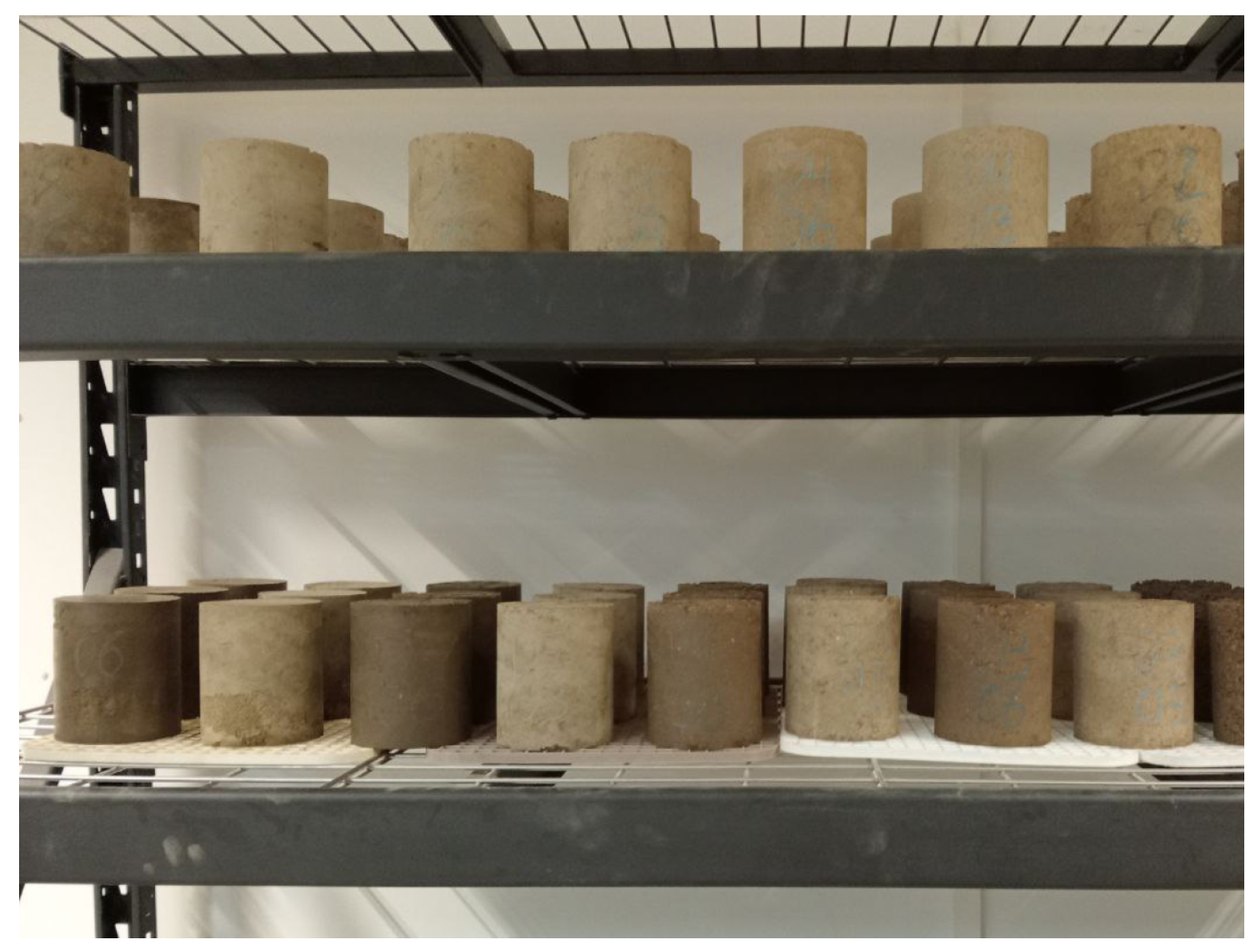
All mixtures were prepared at +1% above the OMC, following recommendations by other authors [32]. Specimens were cured under controlled environmental conditions [25 ± 2 °C, 40 ± 3% RH]. They were placed on perforated shelves to enable uniform air-drying from all faces until weight stabilisation was achieved (Figure 3). All tests were conducted after 28 days of curing, once stabilisation had been confirmed for all mixtures.

2.3. Hygrothermal Characterisation

2.3.1. Dry Density

Knowledge of the density of rammed earth (RE) elements is crucial for load calculations during the design process [33]. Dry density (DD) is defined as the ratio of a specimen’s mass—including the air contained within its pores—to its apparent volume (m3). Reported DD values for RE range widely from 1700 to 2200 kg/m3 [33]. Moreover, DD is closely related to compaction degree and mechanical strength: Burroughs [34] regarded the maximum dry density (MDD) of RE specimens as a reliable predictor of achieving a minimum unconfined compressive strength of 2 MPa, deemed suitable for RE construction.
Several authors have linked the clay–silt fraction of RE soils to the final dry density attained. Burroughs [34] proposed the clay–silt content as a predictor of MDD, while Hall and Allison [35,36] demonstrated that the hygrothermal properties of RE—such as bulk porosity and void-size distribution, which strongly influence DD—can be tailored and predicted by modifying the particle size distribution (PSD) and compaction energy.
Accordingly, after 28 days of curing and prior to UCS testing, DD was measured for each mixture and correlated with clay content to establish a logarithmic regression model.

2.3.2. Drying Shrinkage

Clayey soils are often excluded from unstabilised rammed earth (URE) applications due to their high shrinkage potential. Conventional linear shrinkage tests are performed on soils to assess expected shrinkage levels or, when the mineralogy is unknown, to gauge clay reactivity [10,37]. However, these tests pertain solely to the soil particles. As an alternative, Ciancio et al. [10] proposed measuring the drying shrinkage (DS) of URE specimens, providing a more accurate estimate of clay activity effects on shrinkage, and informing the design of construction-joint spacing.
Drying shrinkage limits are specified in several standards. For example, the New Zealand Standard [38] allows a maximum shrinkage of 0.3 mm in a 600 mm sample (0.05% DS), whereas Walker et al. [13] permit up to 30 mm shrinkage (5% DS) for the same length. Both standards use DS rather than linear shrinkage to set their limits.
Therefore, reductions in specimen height and diameter were measured after 28 days of curing and prior to UCS testing to determine the DS for each mixture. The relationship between DS and clay content was analysed to assess the feasibility of predicting DS in URE specimens.

2.4. Mechanical Testing

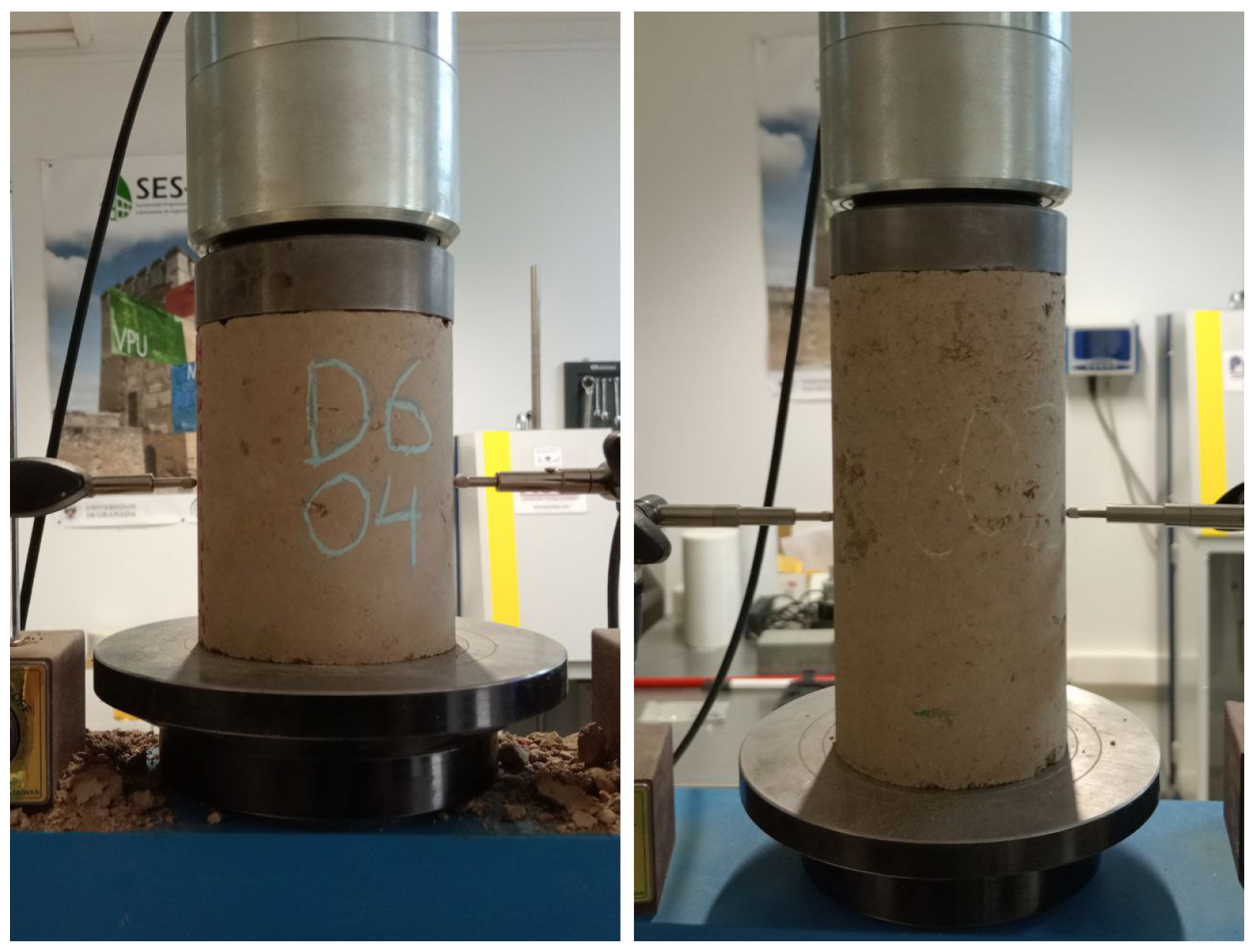
Unconfined Compressive Tests (UCTs) were conducted after 28 days of curing by applying a constant and homogeneous axial load perpendicular to the compacted layers, in accordance with UNE-EN 12390-3 [39], which was adopted due to the absence of a specific standard for RE (Figure 4). As the maximum compressive strength values were significantly below the lower threshold of the standard (20 MPa), the loading rate was reduced to 0.2 MPa/s. The preload was limited to less than 30% of the peak load. Axial load was measured using the load cell integrated in the testing machine, with a capacity of 300 kN and a resolution of 1 N. Axial displacement was recorded through crosshead displacement previously calibrated with LVDTs, since direct strain measurements using strain gauges could not be reliably performed due to the poor adhesion of the gauges to the specimen surface, and horizontal displacement was recorded directly with LVDTs. Stress and strain values were acquired at a frequency of 2 Hz. All equipment was calibrated according to manufacturer specifications prior to testing.
The elastic modulus of the cylindrical specimens was determined from the linear portion of the stress–strain ( σ - ϵ ) curve between 35% and 75% of the peak stress, consistent with previous studies [40,41], as this interval better represents the elastic behaviour of RE in UCS testing. Equation (1) was used for the calculation:
E = σ 75 % σ 35 % ϵ 75 % ϵ 35 %
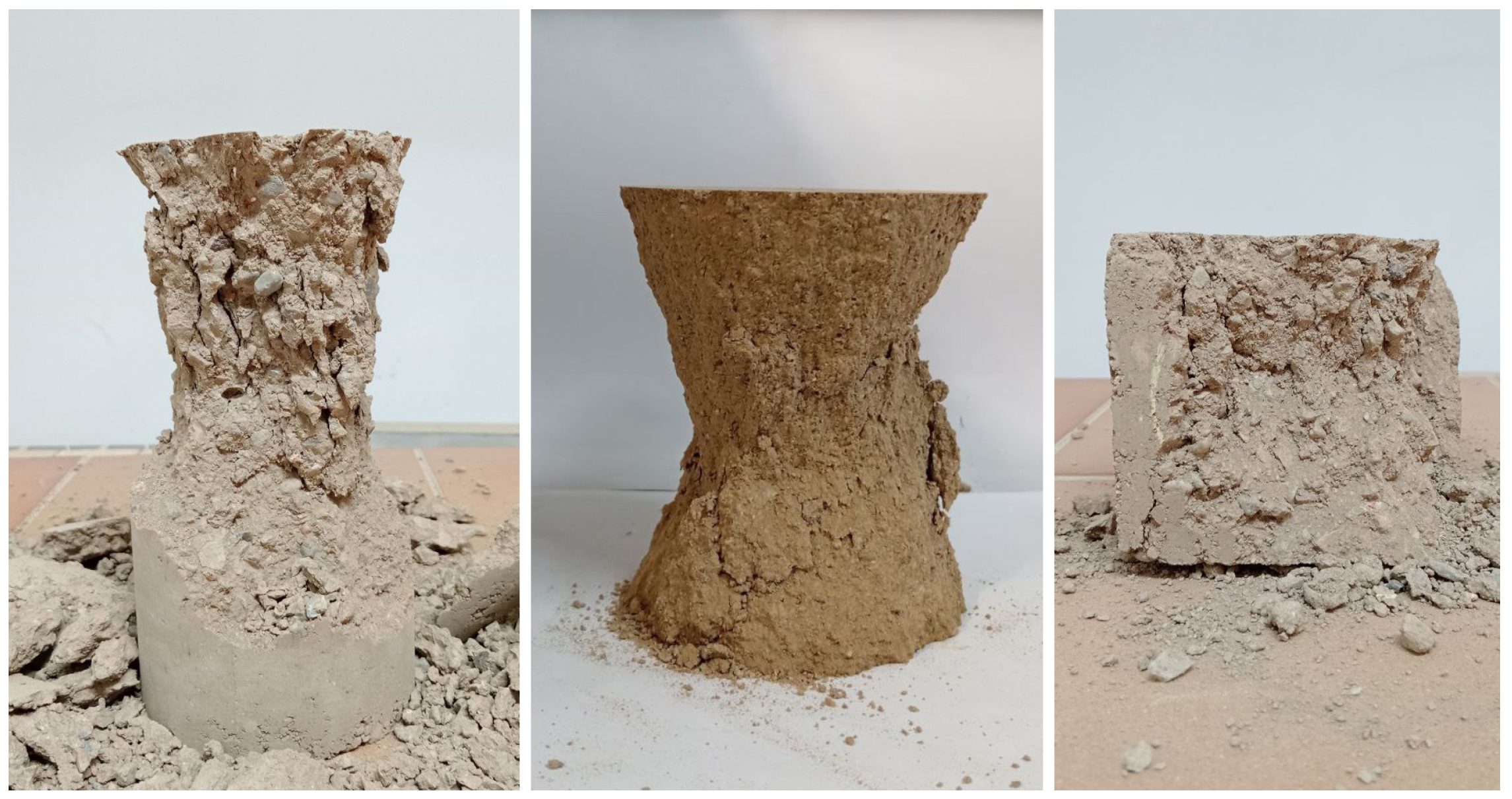
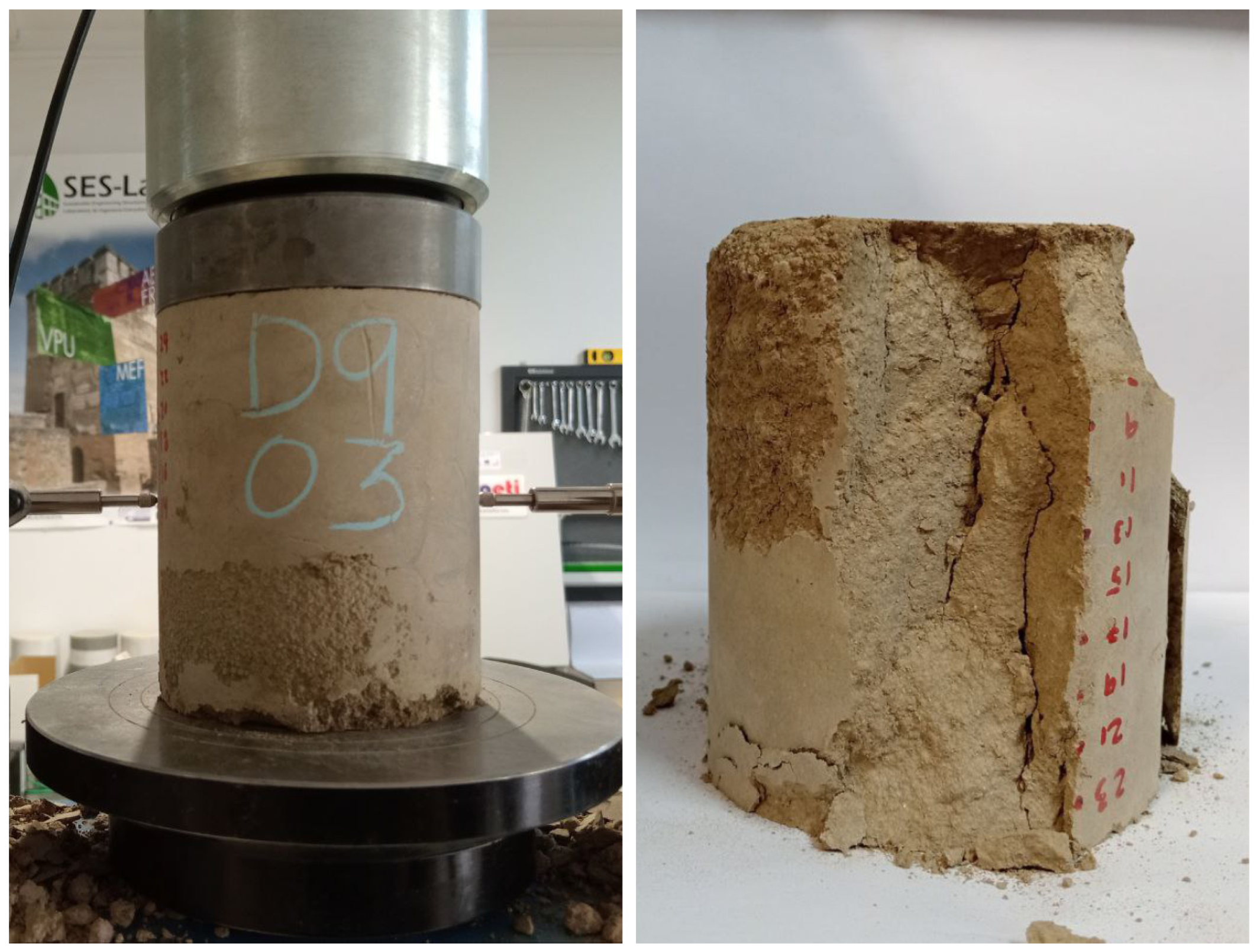
Specimens exhibiting visible manufacturing defects, anomalous failure patterns such as excessive vertical cracking, or deviations from the hourglass-shaped failure typical of RE (Figure 5) were excluded from analysis.

2.5. Statistical Analysis

Prior to statistical evaluation, the normality of each dataset was assessed using the Shapiro–Wilk test, which is less sensitive to sample size and distribution asymmetry than commonly used alternatives such as the Kolmogorov–Smirnov test [42]. Outliers were subsequently identified and removed using Grubbs’ test, which detects extreme values in normally distributed data based on their deviation from the dataset mean [43]. This process was complemented by the rejection of specimens exhibiting failure anomalies, as discussed in Section 2.4.
Once outliers were removed, one-way analysis of variance (ANOVA) was performed to assess whether clay content could be considered a significant predictor of compressive strength. A regression model was then fitted to the experimental data to quantify the relationship between UCS and clay content (CC). Additionally, a sensitivity analysis was performed excluding dosage D10 (100% clay) in order to evaluate the influence of this end-member mixture on the proposed UCS–clay regression model. Furthermore, the model was compared with values reported in the literature. Regression models were also derived for parameters related to the hygrothermal behaviour of unstabilised rammed earth (URE)—namely, dry density (DD) and drying shrinkage (DS)—against clay content (CC). A similar procedure, including normality and outlier testing, was applied to data from cylindrical specimens with a slenderness ratio of 2 to analyse the influence of specimen slenderness, and to cubic specimens to evaluate the effect of specimen geometry on UCS via ANOVA. All statistical analyses were conducted using the open-source software RStudio (version 2023.12.0+369).

2.6. Comparison with Previous Studies

To contextualize the experimental results with prior research, a systematic review of the literature was conducted. Data were extracted from studies involving both unstabilised rammed earth (URE) and stabilised rammed earth (SRE), provided that the latter included unstabilised control specimens, which were treated as URE. Given the many variables that influence UCS in RE [7], comparisons were made not only based on clay content but also considering compaction energy, specimen geometry and slenderness, and curing conditions (particularly relative humidity). All of the results considered from literature studies were from specimens compacted employing the OMC. Due to the lack of standardised protocols for these variables [23], inconsistencies between studies were flagged graphically rather than normalised. Studies were excluded if they (i) did not quantify clay content, (ii) used less than 5% clay (the minimum used in this study), (iii) classified clay as material larger than 0.002 mm (the upper bound adopted here based on [27,28]), or (iv) used expansive clays in high percentages when mineralogy was reported [44].
Studies employing static compression rather than dynamic ramming for compaction were also excluded, in line with the definition of conventional URE [45]. When not directly reported, compaction energy was estimated using the formulation provided by [10]:
E o m c = n o m c m × g × d
e o m c = E o m c V o m c
where n o m c is the number of blows per layer, m is the hammer mass (kg), g is the gravitational acceleration (m/s2), d is the drop height (m), and V o m c is the volume of the compacted layer.
Studies involving hypercompaction [46,47,48,49] or dual-compaction presses [50] were excluded. In terms of curing, works that used oven-drying, tested specimens in wet conditions, or cured specimens for less than 28 days were omitted due to their impact on suction behaviour and strength development [51].
It is worth noting that many studies fail to report compaction energy and/or curing RH, even though these variables have significant effects on the mechanical performance of RE. When it was not possible to define the compaction energy used, the corresponding results were not considered.
Regarding geometry, only studies testing cylindrical, cubic, or prismatic specimens were included, while those involving full-scale elements such as walls, vaults, columns, or blocks were excluded. However, none of the prismatic specimen results provided sufficient information to estimate the compaction energy employed. Thus, only cylindrical and cubic specimens were compared with the empirical results from this study, and prismatic geometries were not considered in the procedure for assessing the potential influence of form on UCS.
To quantitatively assess the agreement between the proposed model and the literature data, the relative error between predicted and reported UCS values was calculated for each data point. The relative error was defined as follows:
Error ( % ) U C S p r e d U C S l i t U C S l i t × 100
where U C S p r e d is the value predicted by the regression model proposed in this study, and U C S l i t is the value reported in the literature. Positive values indicate overestimation, while negative values indicate underestimation of UCS.

3. Results and Discussion

3.1. Optimum Moisture Content and Maximum Dry Density

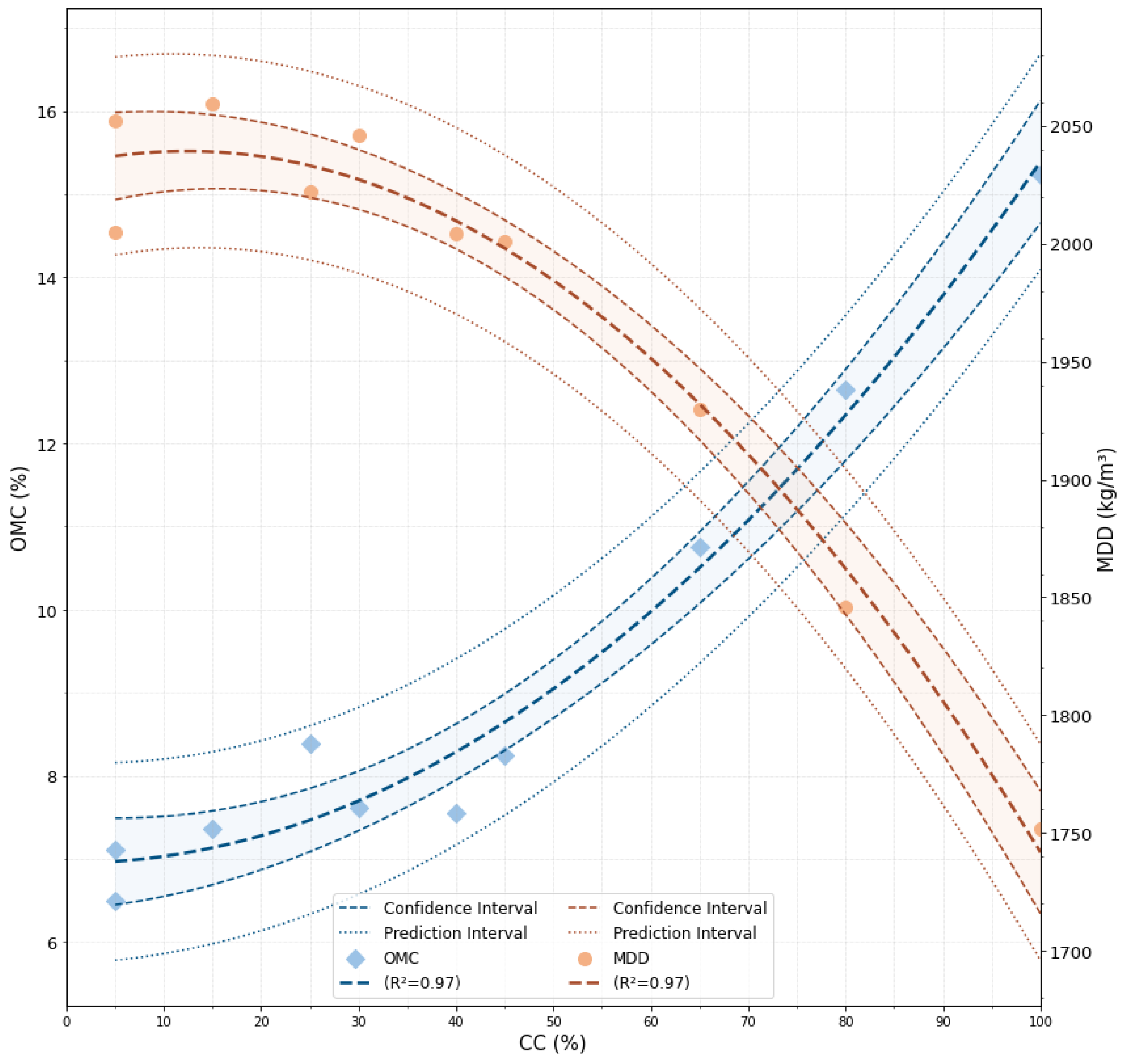
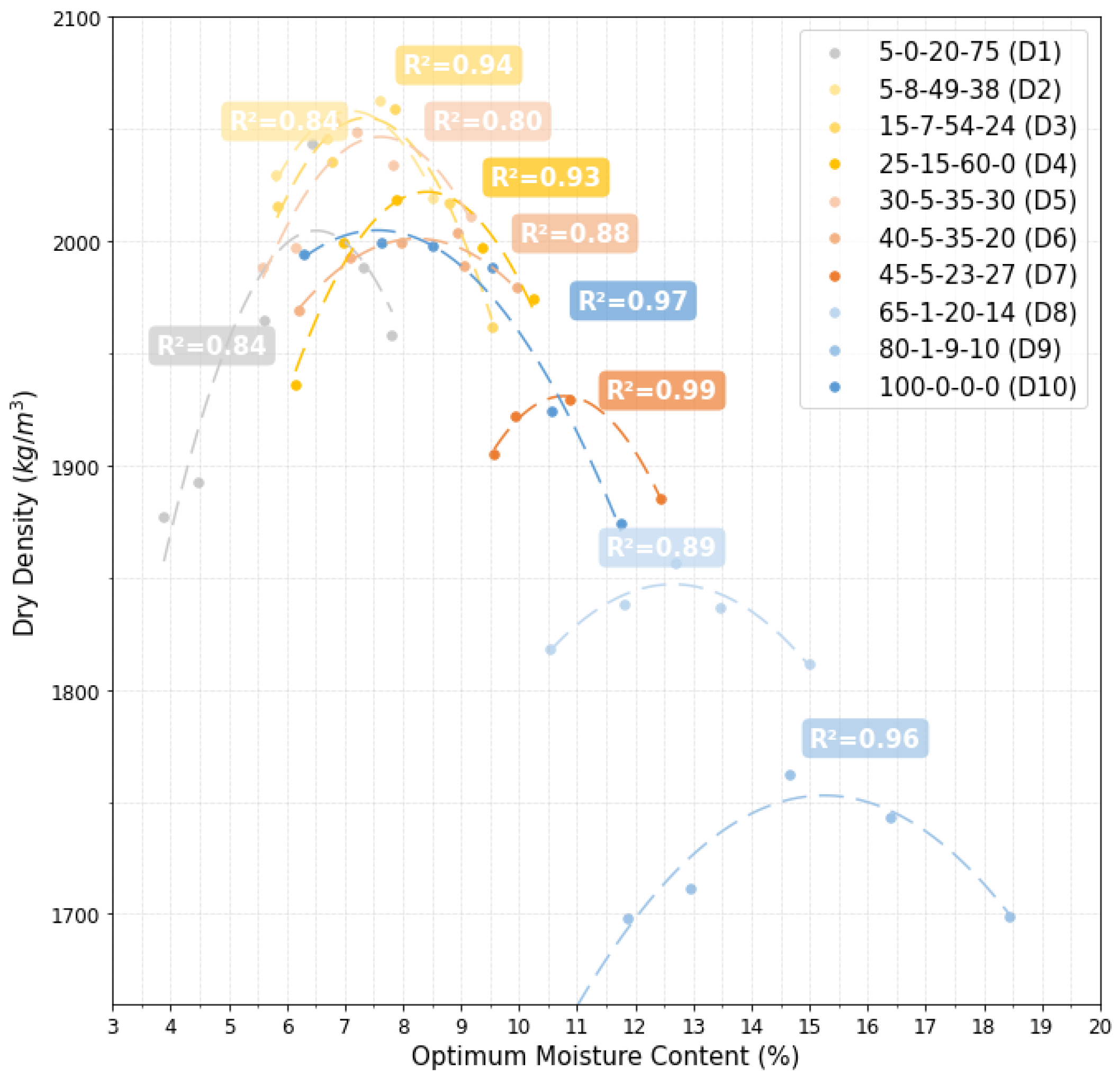
The experimental campaign showed consistent behaviour across replicate specimens for all mixtures, with relatively low variability in OMC and MDD values. The mean values obtained from the standard Proctor tests are summarised in Table 1. For all mixtures, standard Proctor tests were performed to determine the optimum moisture content (OMC) and maximum dry density (MDD) (Figure 2). A second-order polynomial relationship was fitted between clay content and OMC, with a coefficient of determination R 2 = 0.97 . As the clay content increased, the OMC increased accordingly. Similarly, MDD also followed a quadratic trend ( R 2 = 0.97 ) but decreased as the clay fraction rose (Figure 6). Moreover, as can be seen in Figure 2, the OMC-MDD curves became less sharp as the clay content in the mixtures increased, indicating a lower sensitivity of the MDD to moisture deviations around OMC values with higher clay content.
The empirical correlations obtained are as follows:
OMC ( % ) = 7.005 0.28 cc + 8.677 cc 2 , R 2 = 0.97
MDD ( kg / m 3 ) = 2035.100 + 85.053 cc 377.250 cc 2 , R 2 = 0.97
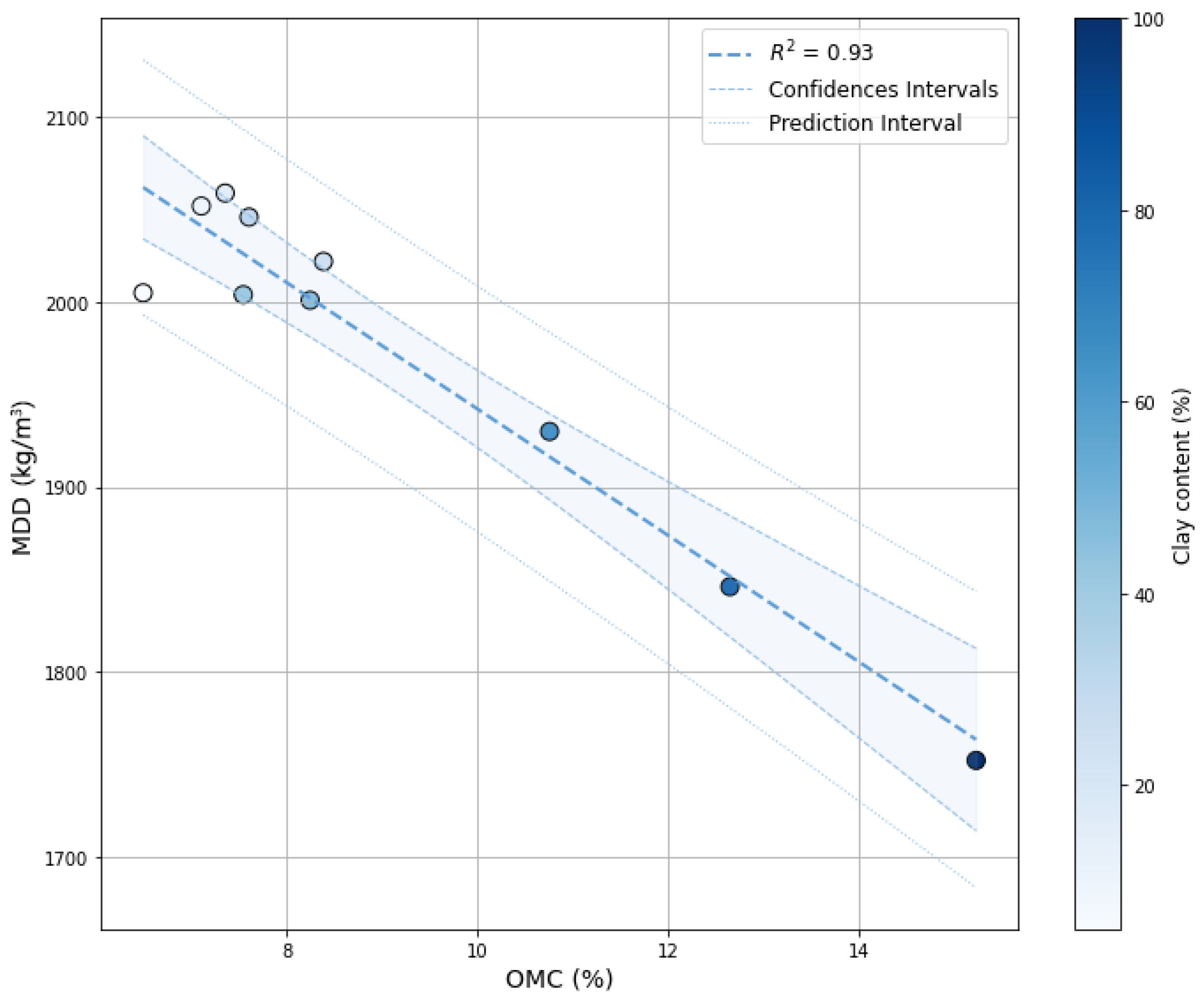
where cc is the clay content expressed as a fraction (CC/100). These high- R 2 polynomial fits (Figure 6) confirm that OMC and MDD can be reliably predicted from clay content, in agreement with previous findings [8]. Moreover, a linear correlation between MDD and OMC was fitted (Figure 7), showing that there is an inversely proportional relation between OMC and MDD.

3.2. Dry Density (DD) and Drying Shrinkage (DS)

3.2.1. Dry Density (DD)

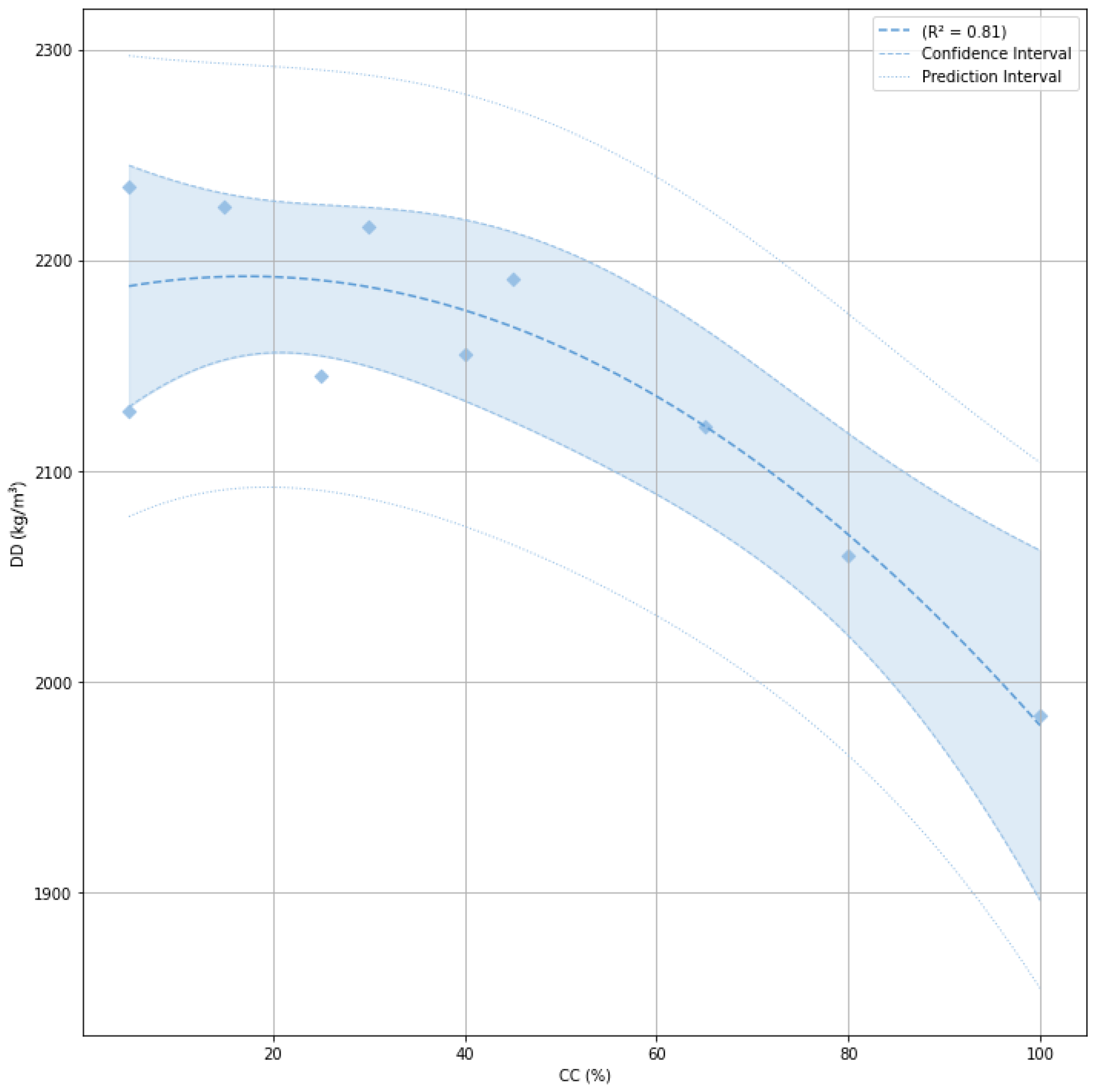
Dry density (DD) values, calculated as described in Section 2.3.1, exhibited a polynomial dependence on clay content (CC) (Figure 8), described by the following expression:
DD ( kg / m 3 ) = 2183.038 + 1.074 · CC 0.031 · CC 2 , R 2 = 0.81

3.2.2. Drying Shrinkage (DS)

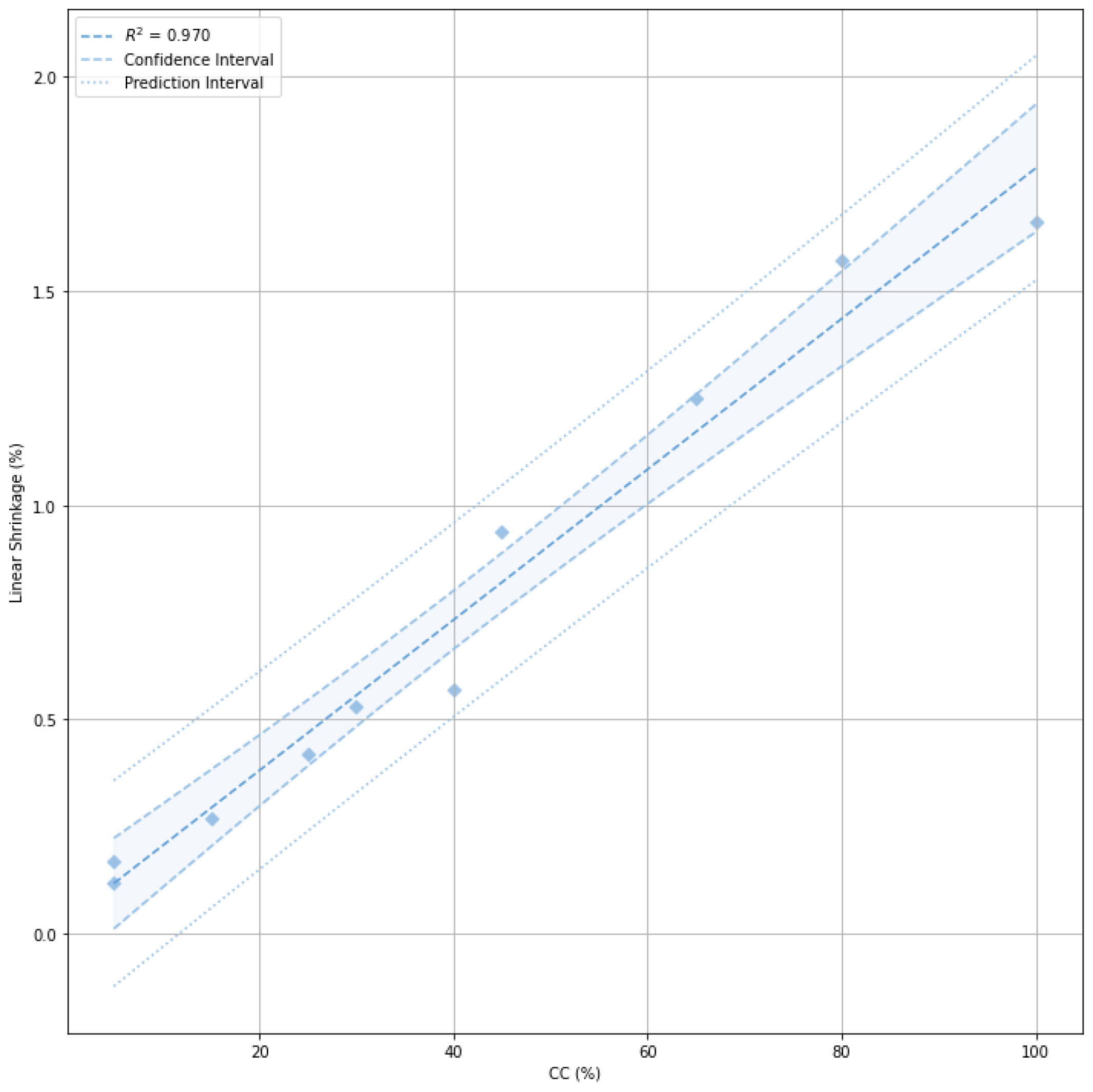
Drying shrinkage (DS) was calculated as the percentage reduction in specimen height from the initial height H i to the height H f prior to UCS testing. A linear relationship between CC and DS was observed (Figure 9), with R 2 = 0.97 , described by
D S ( % ) = 0.018 · C C + 0.030 , R 2 = 0.97
The mean DS values for each mixture are shown in Table 3. The maximum DS (1.66%) occurred for D9 (100% clay), corresponding to 2 mm of shrinkage in a 120 mm sample. The minimum DS (0.12%) was observed for D1 (5% clay), equivalent to 0.144 mm of shrinkage.

3.2.3. Moisture Content Remaining (MCR)

The MCR values for each mixture are reported in Table 3, except for D1, from which cores could not be extracted due to its fragile state. The minimum MCR was 0.1% for D2, while the maximum was 0.67% for D7 (65% clay). The standard deviations were high regardless of clay content.

3.3. Results of Experimental Testing on Rammed Earth Specimens

3.3.1. Stress–Strain Behaviour of Rammed Earth

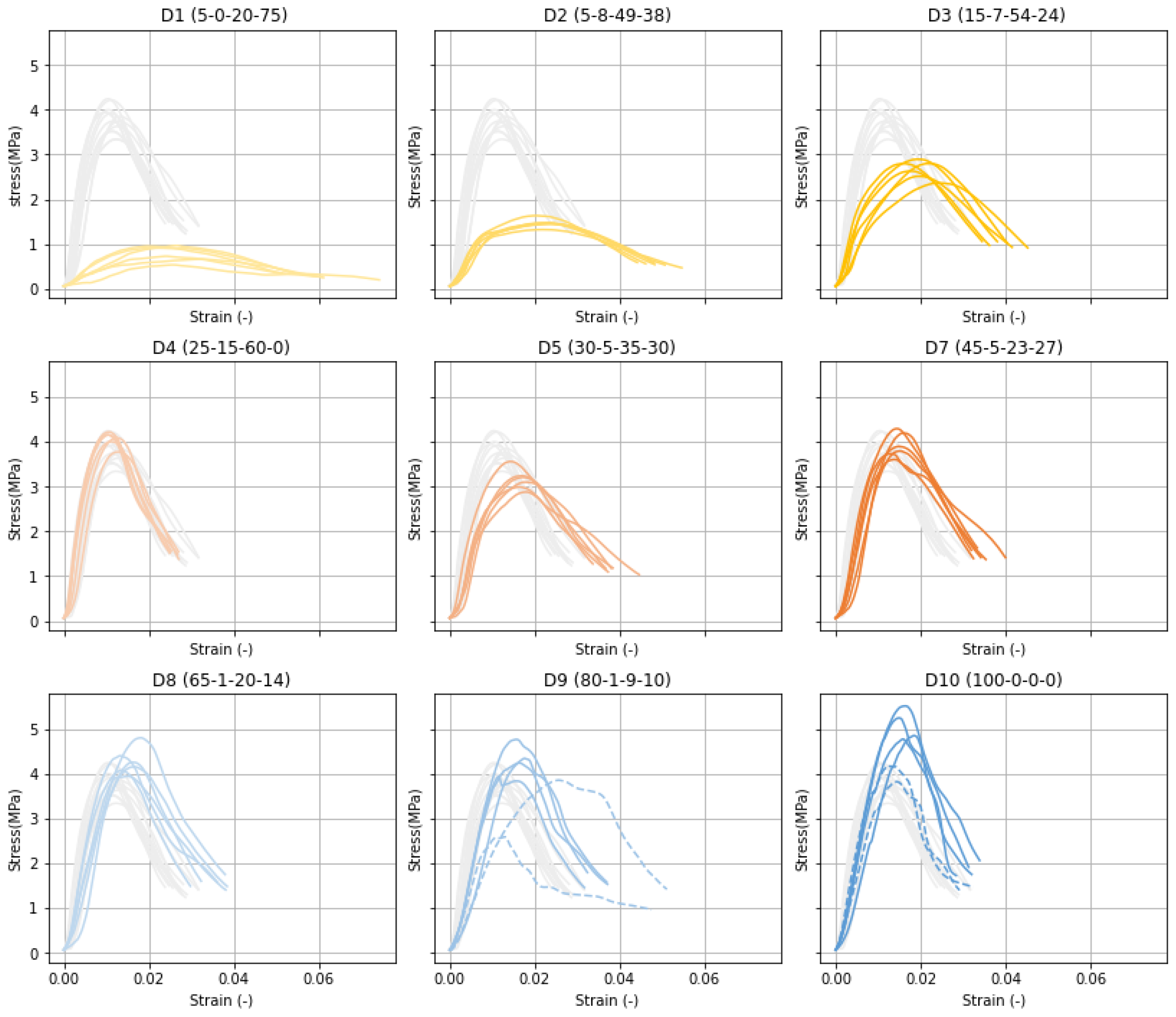
The axial stress–strain curves for each mixture were compared with those of the untreated natural soil (Figure 10). Mixtures with lower clay content than the natural soil (5% and 15% clay) exhibited no initial elastic behaviour and a pronounced plastic response, with a gentler post-peak softening branch. Mixtures with clay contents close to that of the natural soil (25%, 30%, 45%) displayed stress–strain behaviour nearly identical to the control, although the 30% mixture showed a slightly more gradual post-peak decline.
For higher clay contents, the elastic ranges converged toward those of the control mixtures, but all high-clay mixtures exhibited increasingly softer post-peak branches as the clay content rose. Most mixtures showed consistent, homogeneous behaviour across their six replicates. However, mixtures D9 (80% clay) and D10 (100% clay) displayed greater variability: one D9 specimen had a markedly lower peak stress, and its companion failed at a significantly different strain. In the 100% clay group, two specimens showed irregular plastic regions and reduced peak stresses, both coinciding with visible defects on their lower faces (Figure 11), likely affecting their test performance.
Based on failure-mode criteria (absence of the characteristic hourglass-shaped fracture; Figure 5) and Grubbs’ test for outliers (Section 2.5), the two 100% clay specimens and the lower-strength 80% clay specimen were excluded from statistical analysis. Figure 10 presents the complete stress–strain response of all tested specimens prior to statistical averaging, including the discarded specimens represented with dashed lines.

3.3.2. Mechanical Properties of Different Mixtures

Grubbs’ test was applied to each series of UCS and elastic modulus data to identify anomalous values. Since Grubbs’ test detects only one outlier per application [43], a second test was performed on any series from which an outlier had been removed. Specimens previously deemed invalid by failure-mode criteria (Section 2.4) were retained in these tests to cross-validate both exclusion methods.
For the nine clay-content series and the control (natural soil), only one outlier was detected: the 80% clay series contained a sample with UCS = 2.59 MPa, which was excluded (Grubbs’ test, p = 0.0433 , α = 0.05 ). A second Grubbs’ test on the remaining 80% specimens found no further outliers, even though one additional specimen had been excluded for failure-mode reasons. In the slenderness ratio comparison, only specimen CS5 (UCS = 2.47 MPa) was identified as an outlier ( p = 0.0054 ) and removed. A subsequent test suggested CS2 as a potential outlier ( p = 0.1227 ), but this did not meet the α = 0.05 criterion and was retained.
Prior to ANOVA, the Shapiro–Wilk test confirmed that all data series were normally distributed ( p > 0.05 ) at the 95% confidence level (Section 2.5). Consequently, one-way parametric ANOVAs were performed.
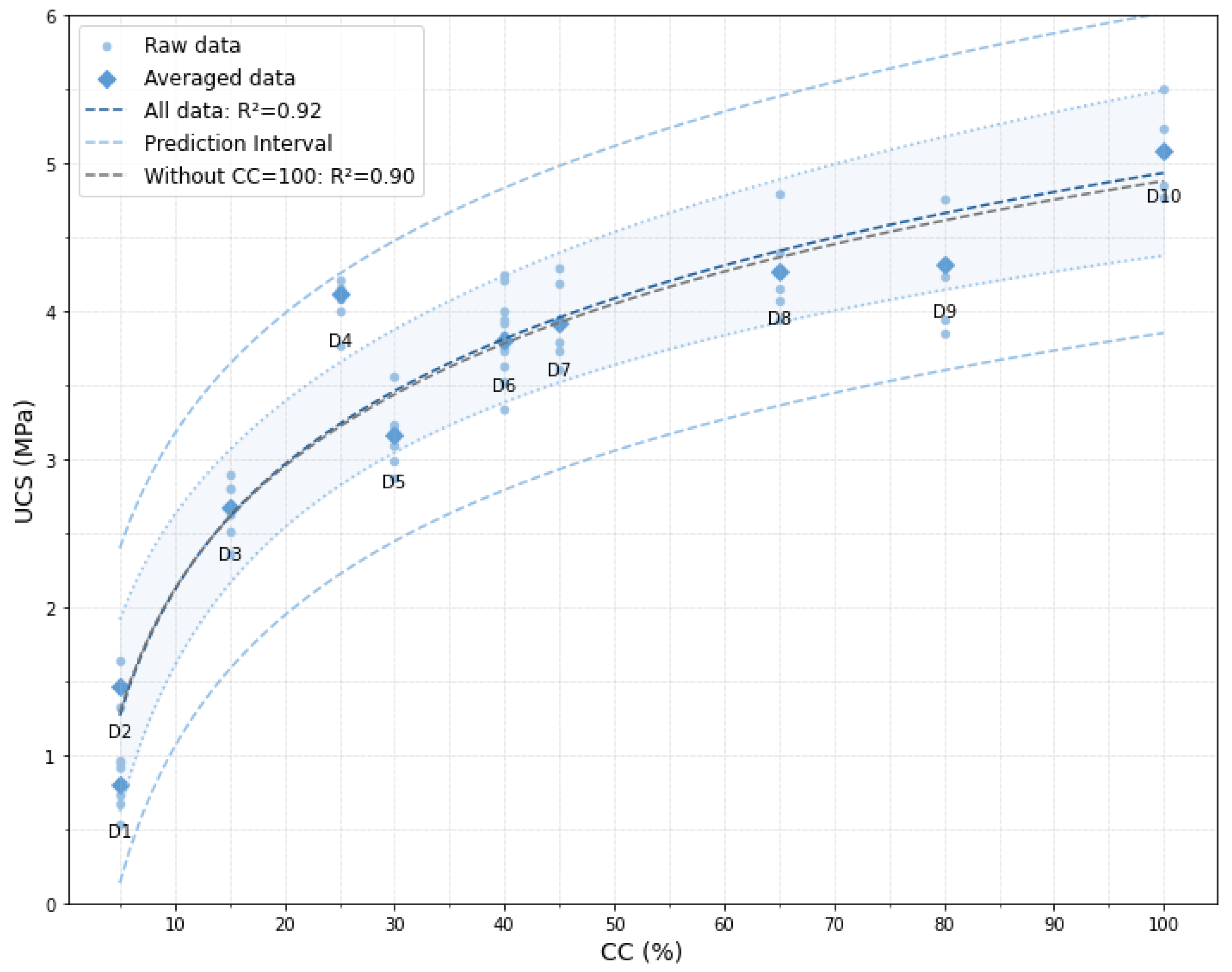
First, UCS was analysed with clay content (CC) as the sole factor. The null hypothesis ( H 0 : no effect of CC on UCS) was rejected ( p = 5.5 × 10 14 ), indicating a significant influence of CC. A logarithmic regression model (see Figure 12) was then fitted as a function of CC. Additionally, a sensitivity analysis was performed excluding the results from D10 (100% clay), yielding a second regression model based on the reduced dataset ( C C W D 10 ):
UCS ( MPa ) = 1.225 ln ( CC ) 0.703 , R 2 = 0.92
UCS ( MPa ) = 1.198 ln ( CC WD 10 ) 0.636 , R 2 = 0.90
The unconfined compressive strength (UCS), elastic modulus (E), and dry density (DD) for each mixture are summarised in Table 3. The highest UCS was found for the 100% clay specimens. Mixtures conforming to the PSD envelopes (D1, D2, and D3) exhibited strengths 83%, 69%, and 44% lower than the 100% clay specimens, respectively.
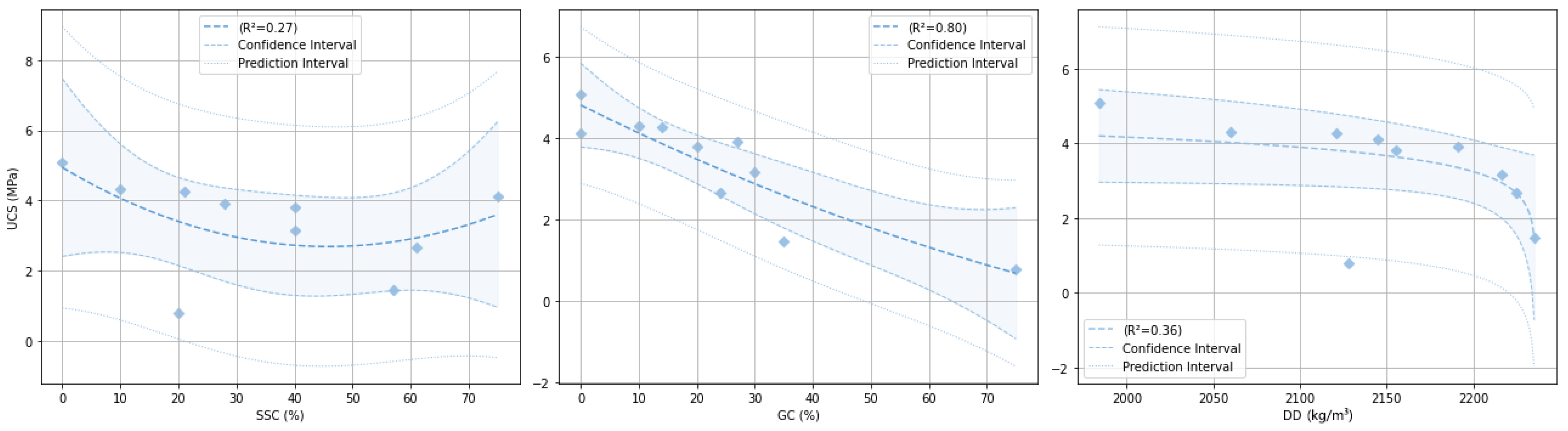
In contrast, when UCS was modelled against gravel content (GC) or sand–silt content (SSC), the coefficients of determination were lower ( R 2 = 0.80 and R 2 = 0.27 , respectively). The relation with GC remained reasonably good because gravel was replaced by clay. Dry density, as reported by other authors [34], showed R 2 = 0.36 . These three regression models are shown in Figure 13.
The elastic modulus ranged from 47 MPa to 582 MPa. Mixtures with higher clay contents (45%, 65%, 80%, and 100%) exhibited E values between 420 MPa and 453 MPa (Table 3), substantially above those of low-clay mixtures (5% and 15%). The peak E occurred in the 25% and 40% clay mixtures, approximately 20% higher than other groups.
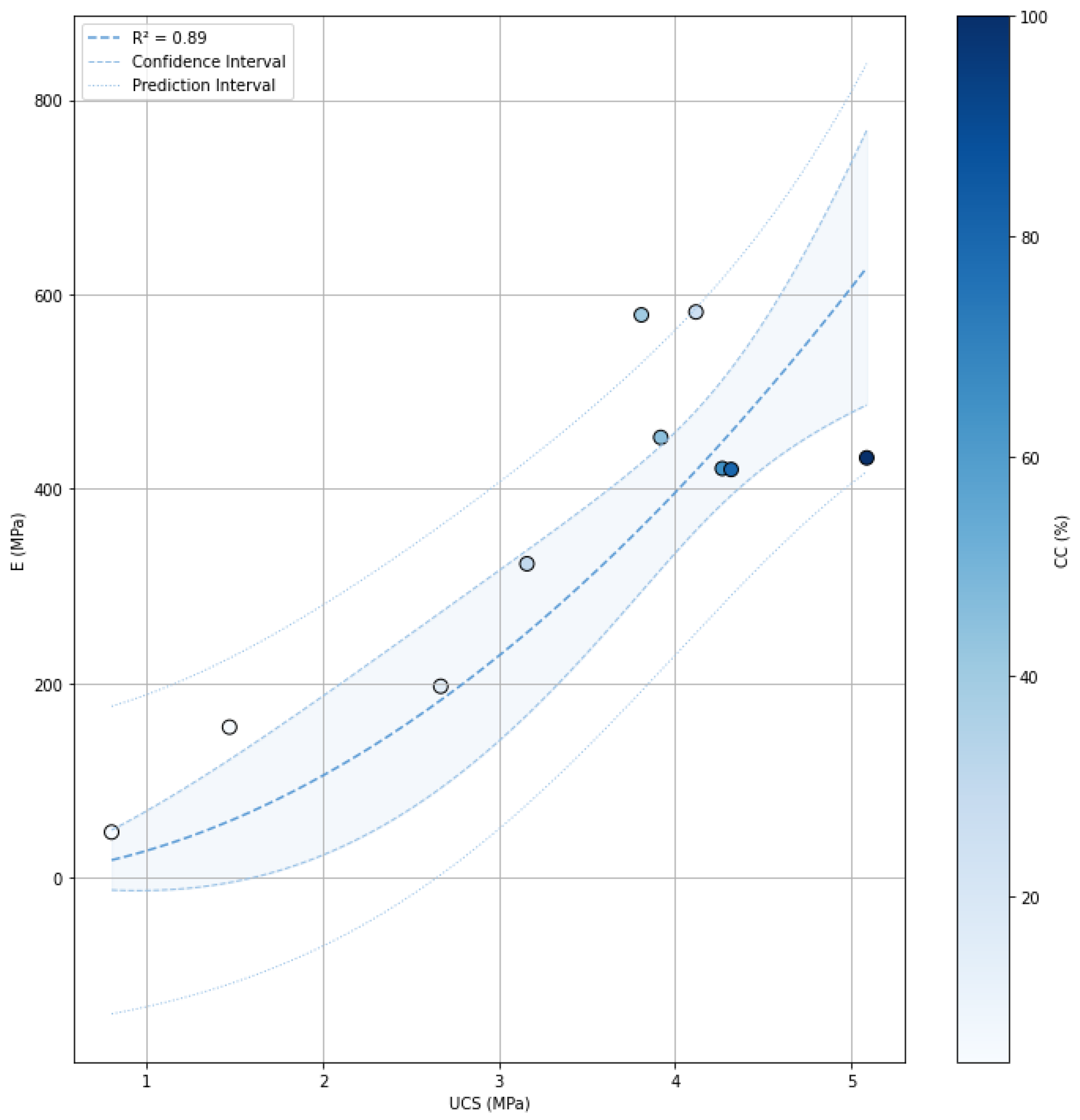
Following structural standards for materials such as concrete, E can be expressed as a function of UCS and CC in the form E = K UCS b . For the RE specimens in this study, the multiple regression model (see Figure 14) is
E ( MPa ) = 50.287 e 0.905 cc UCS 1.913 , R 2 = 0.89
where UCS is the unconfined compressive strength (MPa) and cc is the clay content as a fraction instead of a percentage (CC/100).
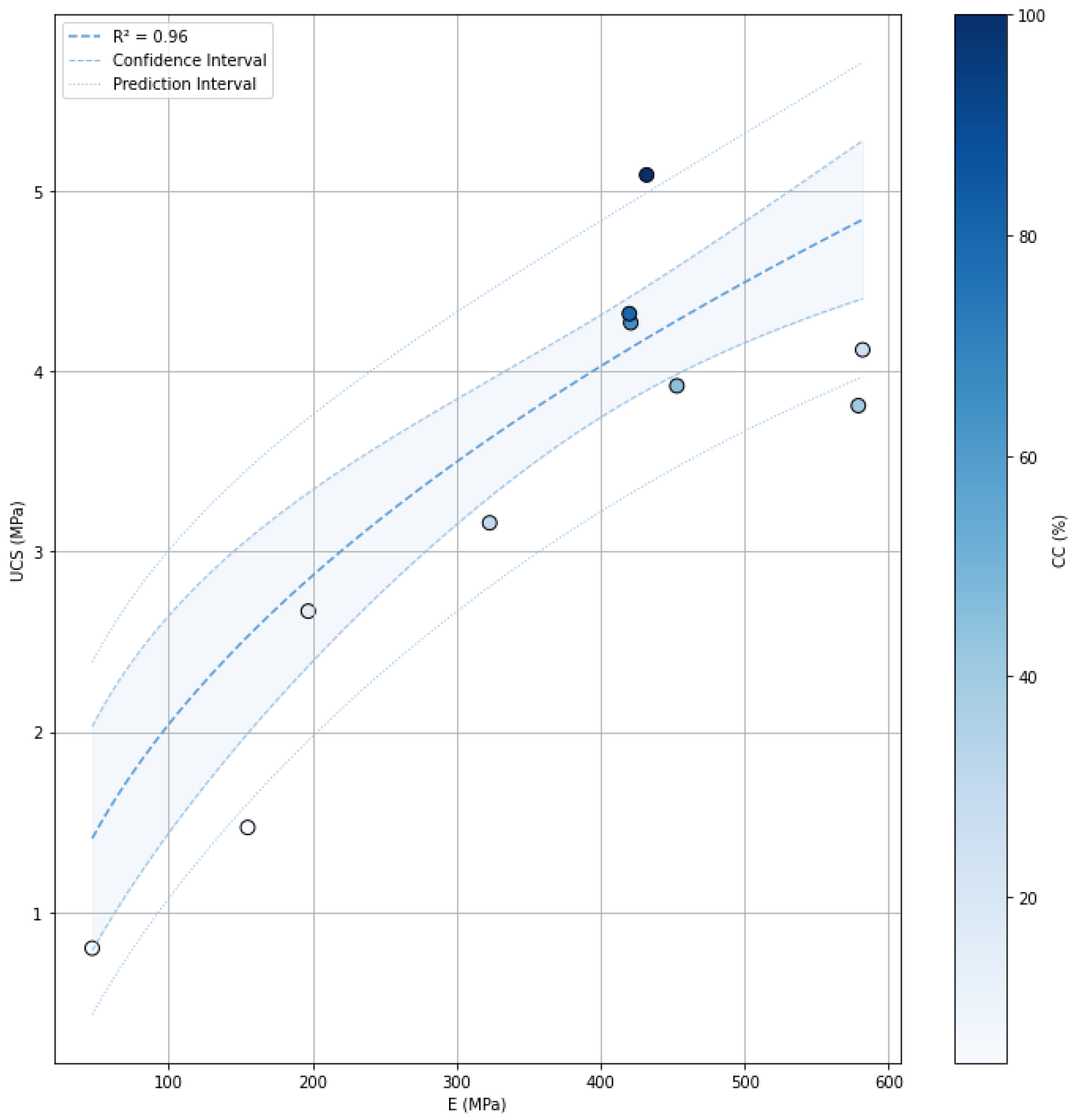
If the fitted expression for E as a function of UCS and CC (Equation (11)) is inverted to express UCS as a function of E and CC, the resulting multiple regression model (Figure 15) yields a coefficient of determination of R 2 = 0.96 , following Equation (12):
UCS = E 46.791 · e 1.068 · cc 1 2.038
where E is the elastic modulus (MPa) and cc is the clay content as a fraction instead of a percentage (CC/100).

3.4. EffectS of Specimen Slenderness and Form on UCS

The UCS results for specimens with slenderness ratios of 1.2 (Standard Proctor specimens), 2 (cylindrical specimens), and cubic specimens, compacted with identical energy, made from dosage D6 used as the control dosage, are presented in Table 4. The mean UCS values differ by only 2.6% between cylindrical specimens (with respect to their slenderness), while the mean elastic modulus for the slender specimens is 11.0% higher. In contrast, cubic specimens exhibited nearly half the mean UCS value of the cylindrical specimens and only 20% of their mean elastic modulus. However, the standard deviation of E for the slender specimens was nearly twice that of both the standard Proctor and cubic specimens. DD differed by just 1.3% relative to the standard Proctor specimens, whereas the difference in dry density between cylindrical and cubic specimens was 4.7%. One slender specimen (CS5, UCS = 2.47 MPa) was identified as an outlier (Section 2.5) and excluded from further analysis; it is therefore omitted from Table 4.
Second, to assess slenderness ratio effects in cylindrical specimens, UCS results for specimens with slenderness ratios of 1.2 and 2 (constant compaction energy and curing) were compared by ANOVA. The null hypothesis ( H 0 : slenderness does not affect UCS) could not be rejected ( p = 0.4330 ), suggesting no significant slenderness effect on UCS. A similar ANOVA for elastic modulus also failed to reject H 0 ( p = 0.3530 ). Based on these results, slenderness was not considered a confounding factor when comparing cylindrical specimens from the literature.
Regarding the effect of specimen shape between cylindrical and cubic forms, the ANOVA results indicated a significant difference in both UCS values ( p = 1.97 × 10 10 ) and elastic modulus ( p = 3.47 × 10 7 ). Accordingly, a shape correction factor of 1.89 was defined for comparison between the UCS values of cubic and cylindrical specimens in the literature, based on the mean results presented in Table 4. These results should be considered exclusively to compare empirical results from this study with those present in the literature; nevertheless, further research on different slenderness ratios with respect to those considered in this study and different forms (such as prismatic specimens) should be conducted.

3.5. Comparison with Previous Studies

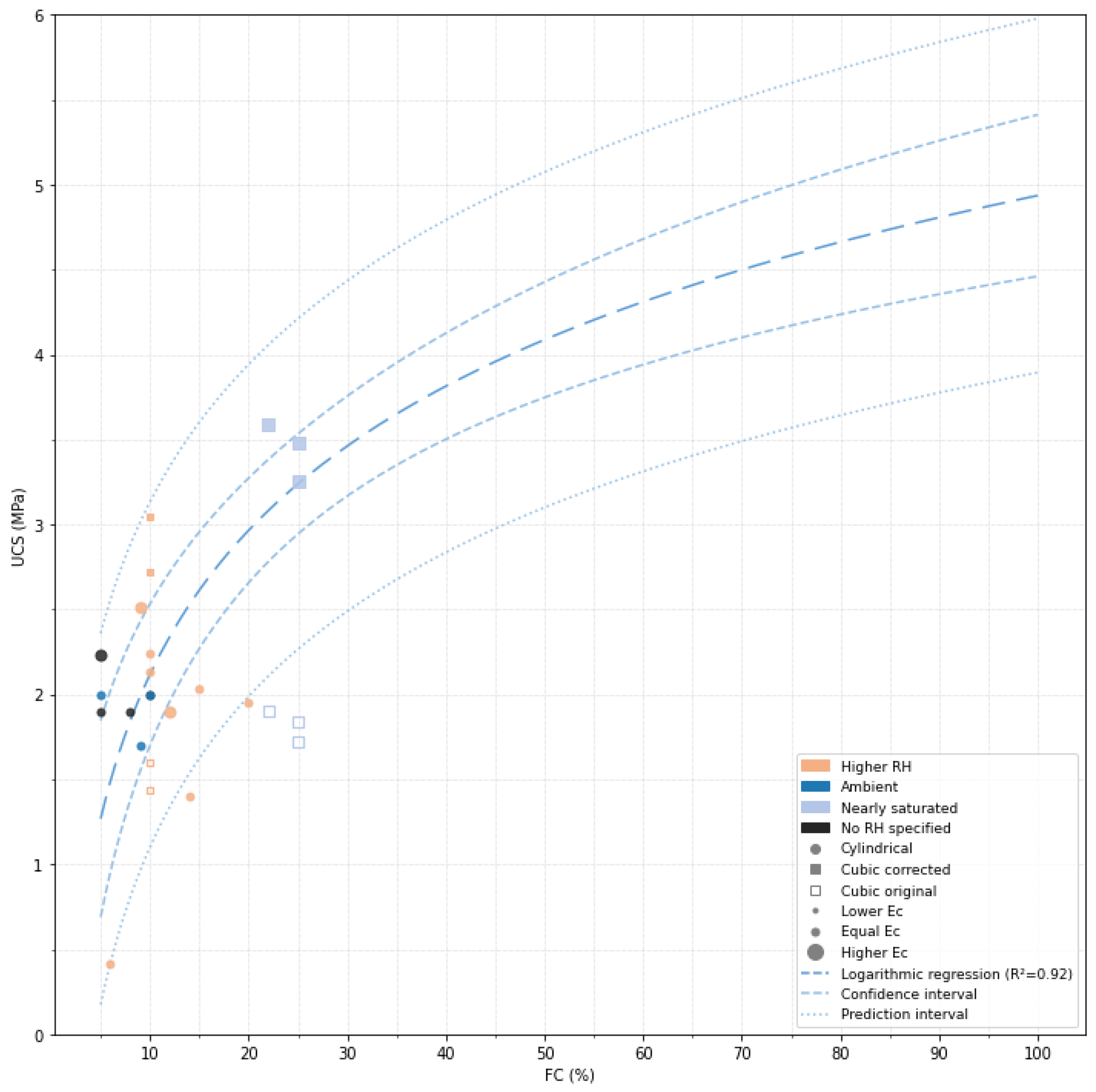
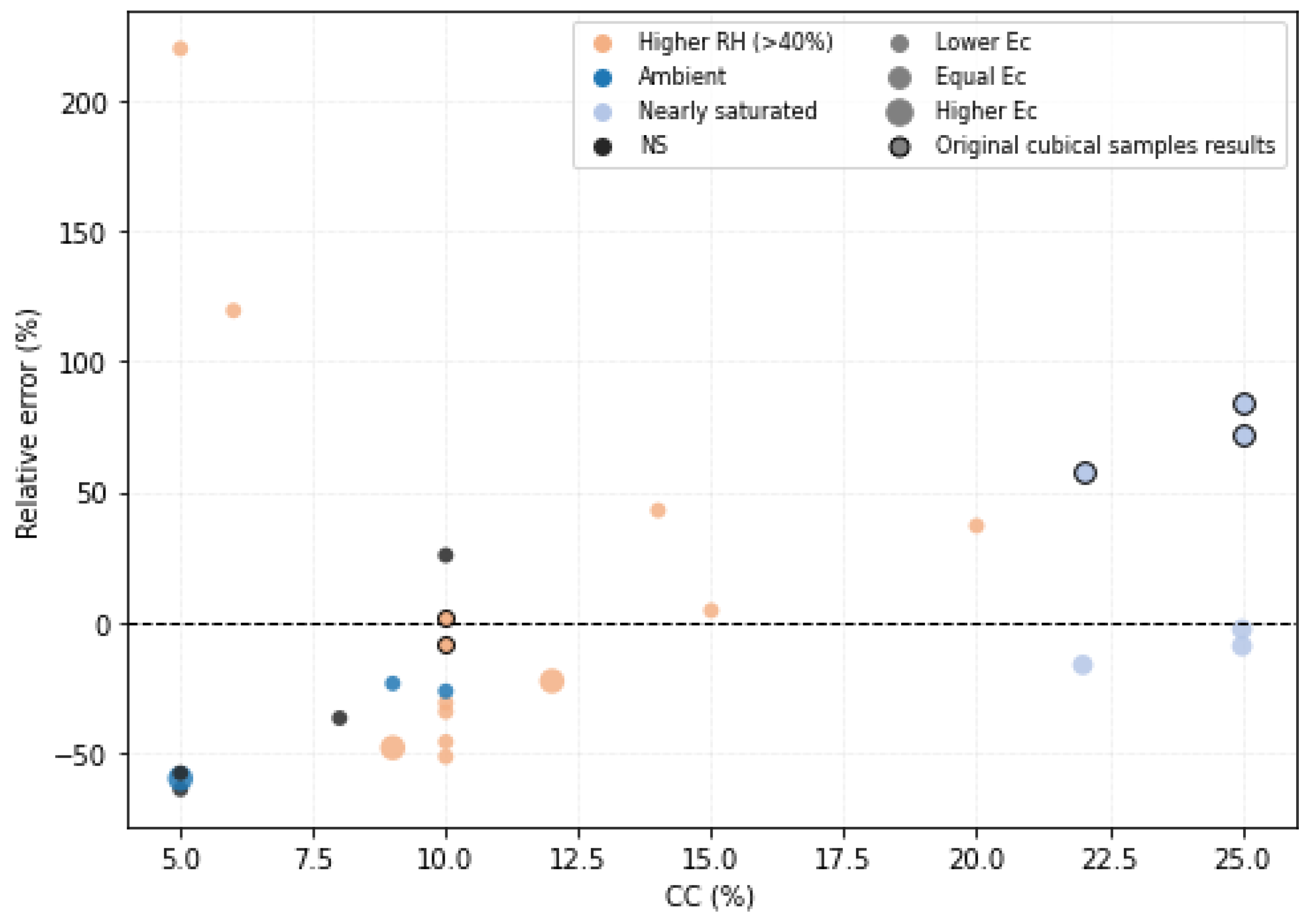
Using the regression model and its associated intervals, UCS results collected from the literature (Table 5) were plotted against clay content and compared with the experimental results obtained in this study (Figure 16). Data points were classified according to specimen geometry, compaction energy, and relative curing humidity, following the inclusion criteria described in Section 2.6. These variables are represented in Figure 16 by distinct symbols and marker sizes, allowing comparison of the literature data with the proposed UCS–clay regression model. Among the literature specimens for which compaction energy was available, 75% fell within the 95% prediction interval of the proposed regression model. The remaining data points were located outside the prediction interval, although most of them were close to its boundaries. When grouped according to compaction energy, specimens compacted at energy levels equal to or higher than those used in the present study were generally located within or near the prediction interval, whereas some specimens compacted at lower energy levels showed larger deviations. When grouped according to relative curing humidity, no systematic trend could be established from the available literature data. Among the literature data located outside the prediction interval, 80% corresponded to specimens cured under higher relative humidity. However, 60% of the specimens cured under such higher relative humidity conditions were still located within the prediction interval. To quantify the discrepancy between the proposed regression model and the literature data, the relative error between predicted and reported UCS values was calculated according to Equation (4). The resulting error distribution is shown in Figure 17. Positive values indicate overestimation by the proposed model, whereas negative values indicate underestimation. The largest relative errors corresponded to specimens whose manufacturing or curing conditions differed more markedly from those adopted in the present study, particularly specimens compacted with lower energy levels or cured under very high relative humidity. The comparison also included cylindrical and cubic specimens when sufficient information was available in the literature. Cubic specimens are highlighted in Figure 17 when plotted without applying the correction factor derived in Section 3.4. This representation allows the influence of specimen geometry on the comparison with literature data to be identified separately from the effects of clay content, compaction energy, and relative curing humidity.

3.6. Discussion

The present findings confirm that unconfined compressive strength (UCS) in unstabilised rammed earth (URE) was strongly correlated with clay content (CC) under the controlled conditions of this study. Although the 100% clay mixture does not represent a conventional unstabilised rammed earth composition, its inclusion allowed the upper boundary of the clay-content spectrum to be explored experimentally. Nevertheless, the sensitivity analysis performed without D10 yielded a very similar regression model, suggesting that the overall UCS–clay relationship identified in this study is not solely dependent on this extreme case. Conventional PSD envelopes, which restrict clay to mitigate shrinkage and erosion, have led most studies to focus on soils with less than 25% clay (Figure 16). Despite the linear increase in drying shrinkage (DS) associated with higher clay fractions, mixtures containing 65%, 80%, and 100% clay exhibited acceptable DS values, the maximum being 1.66%. According to the New Zealand Standard, that maximum DS value would not be acceptable (maximum 0.05%) [38], whereas for Walker et al. [13] it is far below the maximum allowed (5%). However, even soils deemed suitable by PSD criteria would fail the strict New Zealand limit. Moreover, although clayey soils are traditionally viewed as more vulnerable to erosion and shrinkage under weather exposure, stabilisation is recommended irrespective of clay content to meet standard criteria [10,58,59,60]. Consequently, soils that are suitable in terms of compressive strength are often discarded simply because their clay content exceeds PSD-based limits, even though these issues could be managed with appropriate stabilisers.
Some authors address this limitation by adjusting natural soils with additional sand or gravel to fit PSD envelopes [10,61]. Although the role of clay as a binder has been recognised [7,8,19,44], 26 of the reviewed studies did not quantify clay content at all. Clay content was also found to influence OMC, MDD, and other hygrothermal-related parameters.
Experimental mixtures complying with PSD envelopes (e.g., D3) achieved UCS values nearly 50% lower than the 100% clay mixture. Conversely, high-clay mixtures (80% and 100%) recorded the highest UCS values, despite having the lowest dry densities (2060 and 1984 kg/m3, respectively). Notably, D1 (5% clay) and D8 (65% clay) exhibited almost identical mean densities (2128 vs. 2121 kg/m3), yet D8’s UCS was five times greater. The 100% clay specimens averaged 5.09 MPa UCS, well above the 1.1–2.5 MPa range reported by Ávila et al. [7]. The PSD-compliant D3 blend, with mean UCS = 2.67 MPa, aligns with the upper bound of typical literature values.
Soil clay content showed great potential in this study not only as a UCS predictor but also as a predictor of URE hygrothermal behaviour, validating the close relation between UCS and the porous structure of URE established by previous authors [17,18,19,35]. Although suction was not directly measured in this study, the moisture content remaining after curing (Table 3) provides indirect information on the water state of the specimens. The observed increase in MCR with clay content suggests a slightly higher water retention capacity in mixtures with greater fine fractions, which is consistent with the expected behaviour of clay-rich soils. The elastic modulus (E) measured here (47–582 MPa) also falls within the broad 60–1000 MPa range documented elsewhere [7], recognising that definitions of the elastic range vary. Validation of standard Proctor specimens against the slenderness of cylindrical specimens suggests that routine Proctor testing can reliably estimate UCS, thereby reducing material use and testing time. A similar trend was also observed for elastic modulus E, although additional variables are likely involved. Moreover, the successful ability of CC to predict UCS values ( R 2 = 0.92 ) can be enhanced by considering E, increasing the coefficient of determination to R 2 = 0.96 .
There was a statistically significant difference between cylindrical and cubic specimens, even with nearly identical densities, but no statistical difference between slenderness ratios of 1.2 (standard Proctor specimens) and 2. Further research should explore the influence of specimen geometry, size, and compaction protocols in greater depth. The proposed prediction interval includes UCS values from literature specimens regardless of their relative curing humidity and compaction energy. Comparison with the error values reported in the literature (Figure 17) indicates that clay content may serve as a potential predictor of UCS when the compaction energy is equal to or higher than that employed in the present study and the relative curing humidity remains within the range commonly reported in the literature (20–90%). However, when lower compaction energies or more extreme curing conditions (>90% RH) are considered, the relative error with respect to the UCS estimated from clay content increases considerably. Therefore, further research is required to determine whether clay content can reliably predict UCS within the same range of curing humidity and compaction energy for soils containing different clay mineralogies, or whether the sensitivity to factors other than clay content becomes more pronounced. The correction factor applied to cubic specimens provided a good adjustment for specimens compacted with low energy, but it resulted in an overestimation of UCS for cubic specimens manufactured with higher compaction energy. Consequently, further investigation into the relationship between specimen geometry and UCS is required, and the correction factor proposed in the present study should not be considered directly generalisable to other rammed earth specimen manufacturing conditions.
The results obtained in this study should be interpreted within the range of the materials and procedures investigated within the range of clay contents in this study. All mixtures were produced from a single parent soil combined with one external clay source, meaning that the influence of natural variability in mineralogy, particle morphology, and soil fabric was not independently assessed. In addition, the artificial addition of clay may not fully reproduce the particle arrangement and inter-particle interactions found in naturally occurring soils, potentially influencing compaction behaviour and mechanical response. Since these factors are known to affect the hydro-mechanical behaviour of earthen materials, the proposed relationships should not be interpreted as universally applicable to all unstabilised rammed earth soils. Instead, the results demonstrate the potential of clay content as a practical first-order indicator under controlled material conditions.

4. Conclusions

Clay content has been shown to correlate strongly with the UCS of URE under the controlled conditions of this study, owing to its binding action and contribution to matric suction, enabling a preliminary estimation of expected strength from clay fraction alone. While PSD envelopes define soil suitability qualitatively, they do not provide numerical performance estimates; in contrast, clay content shows potential as a practical first-order indicator for the quantitative estimation of UCS, optimum moisture content (OMC), maximum dry density (MDD) and drying shrinkage (DS), and in combination with UCS can also predict elastic modulus (E) similarly to structural codes. Nevertheless, the observed relationships should be interpreted within the range of materials and testing conditions investigated, as factors such as mineralogy, suction, soil fabric, and curing conditions may also influence the mechanical response of unstabilised rammed earth.
Despite being traditionally excluded due to concerns regarding high shrinkage and erosion susceptibility, the clay-rich mixtures tested in this study exhibited substantially improved UCS without a proportionate increase in shrinkage. Although additional durability-related assessments would still be required, the results suggest that clay-rich soils may represent viable alternatives for unstabilised rammed earth construction when appropriate measures to control shrinkage and moisture exposure are considered.
The empirical polynomial models derived here predict OMC and MDD from clay content ( R 2 = 0.97 ), and UCS followed a logarithmic relationship for clay contents above 5% ( R 2 = 0.92 ). Prediction of UCS is further enhanced by combining clay content with E (yielding R 2 = 0.96 ).
Specimen slenderness ratios of 1.2 and 2.0 did not significantly affect UCS or elastic modulus when compaction energy and curing conditions were constant, validating the use of standard Proctor specimens for routine characterisation. However, when using cubic specimens, value adjustments are necessary to enable comparison of UCS and elastic modulus results with those obtained from cylindrical specimens. Furthermore, almost all of the literature data with documented protocols conform to the proposed UCS–clay model, reinforcing its general applicability.
To improve comparability across studies, it is essential to standardise reporting of compaction energy and relative curing humidity. Finally, further investigation into the long-term durability and shrinkage of high-clay URE under variable environmental exposures, along with systematic exploration of specimen geometry and compaction protocols, would refine testing procedures and enhance the reliability of mechanical characterisation in rammed earth.

Author Contributions

Á.B.-H.: Writing—Original Draft, Methodology, Investigation, Data Curation, Conceptualisation. E.P.: Methodology, Investigation. R.A.C.: Supervision, Data Curation. R.G.: Supervision, Methodology. All authors have read and agreed to the published version of the manuscript.

Funding

This research was partially supported by the Spanish Ministry via a doctoral grant to Álvaro Blanca-Hoyos within the program “Formación de Investigadores—Contratos Predoctorales (FPU) Universidad de Granada-Banco Santander (FPU23/03229)”. This research is part of the project “Evaluación de la Vulnerabilidad Estructural de Patrimonio Construido en Tapia—VulTapia” (Evaluation of the Structural Vulnerability of Heritage Built in Rammed Earth), grant number C-ING-134-UGR23, funded by the Consejería de Universidad, Investigación e Innovación and by ERDF Andalusia Program 2021–2027.

Data Availability Statement

Data will be made available upon request.

Acknowledgments

This study was developed within the framework of the “Science in the Alhambra” Scientific Unit of Excellence (U.C.E. Ciencia en la Alhambra), and it was carried out in the Research Group TEP167 Sustainable Engineering Structures Laboratory (SES-Lab).

Conflicts of Interest

The authors declare that they have no known competing financial interests or personal relationships that could have appeared to influence the work reported in this paper.

References

  1. Dayaratne, R. Reinventing Traditional Technologies for Sustainability: Contemporary Earth Architecture of Sri Lanka. J. Green Build. 2010, 5, 23–33. [Google Scholar] [CrossRef]
  2. Ciancio, D.; Beckett, C. Rammed earth: An overview of a sustainable construction material. In Proceedings of the Third International Conference on Sustainable Construction Materials and Technologies, Kyoto, Japan, 18–21 August 2013; Volume 2013, pp. 1–9. [Google Scholar]
  3. Mora-Ruiz, V.; Soto-Paz, J.; Attia, S.; Mejía-Parada, C. Sustainable Earthen Construction: A Meta-Analytical Review of Environmental, Mechanical, and Thermal Performance. Buildings 2025, 15, 918. [Google Scholar] [CrossRef]
  4. Puertas, E.; Ávila, F.; García-Macías, E.; Gallego, R. Preventive Preservation of Rammed Earth Historical Heritage Through Continuous Monitoring, Architectural Inspections, and Data Fusion. Buildings 2024, 14, 3294. [Google Scholar] [CrossRef]
  5. Minke, G. Building with Earth: Design and Technology of a Sustainable Architecture; Birkhäuser: Basel, Switzerland, 2006. [Google Scholar]
  6. Gandreau, D.; Delboy, L. UNESCO World Heritage Inventory of Earthen Architecture; CRAterre-ENSAG: Grenoble, France, 2012. [Google Scholar]
  7. Ávila, F.; Puertas, E.; Gallego, R. Characterization of the mechanical and physical properties of unstabilized rammed earth: A review. Constr. Build. Mater. 2021, 270, 121435. [Google Scholar] [CrossRef]
  8. Liu, Q.; Tong, L. Engineering properties of unstabilized rammed earth with different clay contents. J. Wuhan Univ. Technol. Mater. Sci. Ed. 2017, 32, 914–920. [Google Scholar] [CrossRef]
  9. Houben, H.; Guillaud, H. Earth Construction: A Comprehensive Guide; Intermediate Technology Publications: Rugby, UK, 1994. [Google Scholar]
  10. Ciancio, D.; Jaquin, P.; Walker, P. Advances on the assessment of soil suitability for rammed earth. Constr. Build. Mater. 2013, 42, 40–47. [Google Scholar] [CrossRef]
  11. NZS4298:1998; Materials and Workmanship for Earth Buildings. Standards New Zealand: Wellington, New Zealand, 1998.
  12. Ávila, F.; Puertas, E.; Gallego, R. Characterization of the mechanical and physical properties of stabilized rammed earth: A review. Constr. Build. Mater. 2022, 325, 126693. [Google Scholar] [CrossRef]
  13. Walker, P. The Australian Earth Building Handbook; Standards Australia International: Sydney, Australia, 2001. [Google Scholar]
  14. SAZS. Standard Code of Practice for Rammed Earth Structures; Standards Association Zimbabwe: Harare, Zimbabwe, 2001. [Google Scholar]
  15. del Río, G.B.; Barrios, P.B. Bases para el Diseño y Construcción con Tapial; Centro de Publicaciones, Secretaría General Técnica, Ministerio de Obras Públicas y Transportes (MOPT): Madrid, Spain, 1992.
  16. Burroughs, S. Recommendations for the selection, stabilization, and compaction of soil for rammed earth wall construction. J. Green Build. 2010, 5, 101–114. [Google Scholar] [CrossRef]
  17. Jaquin, P.A.; Augarde, C.E.; Gallipoli, D.; Toll, D.G. The strength of unstabilised rammed earth materials. Geotechnique 2009, 59, 487–490. [Google Scholar] [CrossRef]
  18. Hajjar, A.E.; Chauhan, P.; Prime, N.; Plé, O. Effect of suction on the mechanical characteristics of uniformly compacted rammed earth. IOP Conf. Ser. Earth Environ. Sci. 2018, 143, 012045. [Google Scholar] [CrossRef]
  19. Bui, Q.B.; Morel, J.C.; Hans, S.; Walker, P. Effect of moisture content on the mechanical characteristics of rammed earth. Constr. Build. Mater. 2014, 54, 163–169. [Google Scholar] [CrossRef]
  20. Mihić, I.B.; Kraus, I.; Kaluđer, J.; Fekete, A.P. Architectural Features and Soil Properties of Traditional Rammed Earth Houses: Eastern Croatia Case Study. Buildings 2024, 14, 2049. [Google Scholar] [CrossRef]
  21. Elert, K.; Jroundi, F.; Benavides-Reyes, C.; Gómez, E.C.; Gulotta, D.; Rodriguez-Navarro, C. Consolidation of clay-rich earthen building materials: A comparative study at the Alhambra fortress (Spain). J. Build. Eng. 2022, 50, 104081. [Google Scholar] [CrossRef]
  22. Anglade, E.; Aubert, J.E.; Sellier, A.; Papon, A. Physical and mechanical properties of clay–sand mixes to assess the performance of earth construction materials. J. Build. Eng. 2022, 51, 104229. [Google Scholar] [CrossRef]
  23. Martin-Antunes, M.A.; Perlot, C.; Espuelas, S.; Marcelino, S.; Seco, A. Recent developments in stabilized rammed earth: Testing protocols and the recommendations for standardization. J. Build. Eng. 2025, 106, 112436. [Google Scholar] [CrossRef]
  24. Zhou, T.; Zhang, H.; Li, B.; Zhang, L.; Tan, W. Evaluation of compressive strength of cement-stabilized rammed earth wall by ultrasonic-rebound combined method. J. Build. Eng. 2023, 68, 106121. [Google Scholar] [CrossRef]
  25. Salari, M.; Lezgy-Nazargah, M.; Shafaie, V.; Rad, M.M. Numerical Study of the Ultimate Bearing Capacity of Two Adjacent Rough Strip Footings on Granular Soil: Effects of Rotational and Horizontal Constraints of Footings. Buildings 2024, 14, 1653. [Google Scholar] [CrossRef]
  26. UNE-EN: 933-1; Ensayos para Determinar las Propiedades Geométricas de los áRidos. Parte 1: Determinación de la Granulometría de las partíCulas. Método del Tamizado. AENOR (Asociación Española de Normalización): Madrid, Spain, 2012.
  27. UNE-EN ISO 14688-1:2017; Geotechnical Investigation and Testing—Identification and Classification of Soil—Part 1: Identification and Description. International Organization for Standardization (ISO): Geneva, Switzerland, 2017.
  28. Messing, I.; Soriano, A.M.M.; Svensson, D.N.; Barron, J. Variability and compatibility in determining soil particle size distribution by sieving, sedimentation and laser diffraction methods. Soil Tillage Res. 2024, 238, 105987. [Google Scholar] [CrossRef]
  29. Bui, Q.B.; Morel, J.C. Assessing the anisotropy of rammed earth. Constr. Build. Mater. 2009, 23, 3005–3011. [Google Scholar] [CrossRef]
  30. Maniatidis, V.; Walker, P. Structural Capacity of Rammed Earth in Compression. J. Mater. Civ. Eng. 2008, 20, 230–238. [Google Scholar] [CrossRef]
  31. Ciancio, D.; Gibbings, J. Experimental investigation on the compressive strength of cored and molded cement-stabilized rammed earth samples. Constr. Build. Mater. 2012, 28, 294–304. [Google Scholar] [CrossRef]
  32. Walker, P.; Keable, R.; Martin, J.; Maniatidis, V. Rammed Earth: Design and Construction Guidelines; BRE Bookshops: San Francisco, CA, USA, 2005. [Google Scholar]
  33. Maniatidis, V.; Walker, P.; Swaney, B.; Harris, C.; Williams, C.; Sheppard, D.; Pearson, G.; Renwick, J.; Brewis, J.; Cheng, K.; et al. A Review of Rammed Earth Construction for DTi Partners in Innovation Project ‘Developing Rammed Earth for UK Housing’; University of Bath: Bath, UK, 2003. [Google Scholar]
  34. Burroughs, S. Relationships between the density and strength of rammed earth. Constr. Mater. 2009, 162, 113–120. [Google Scholar] [CrossRef]
  35. Hall, M.; Allinson, D. Analysis of the hygrothermal functional properties of stabilised rammed earth materials. Build. Environ. 2009, 44, 1935–1942. [Google Scholar] [CrossRef]
  36. Lam, A.; Hamzaoui, R.; Kindinis, A.; Idir, R.; Lamberet, S.; Patrix, S. Thermal, Hygrothermal, Mechanical and Environmental Study of Stabilized Earth with GGBS-Based Binders. Buildings 2025, 15, 594. [Google Scholar] [CrossRef]
  37. Burroughs, S. Soil Property Criteria for Rammed Earth Stabilization. J. Mater. Civ. Eng. 2008, 20, 264–273. [Google Scholar] [CrossRef]
  38. NZS 4298:2024; Materials and Construction for Earth Buildings. Standards New Zealand: Wellington, New Zealand, 2024.
  39. UNE-EN: 12390-3; Ensayos de Hormigón Endurecido. Parte 3: Determinación de la Resistencia a Compresión De Probetas. AENOR (Asociación Española de Normalización): Madrid, Spain, 2019.
  40. Toufigh, V.; Kianfar, E. The effects of stabilizers on the thermal and the mechanical properties of rammed earth at various humidities and their environmental impacts. Constr. Build. Mater. 2019, 200, 616–629. [Google Scholar] [CrossRef]
  41. Kosarimovahhed, M.; Toufigh, V. Sustainable usage of waste materials as stabilizer in rammed earth structures. J. Clean. Prod. 2020, 277, 123279. [Google Scholar] [CrossRef]
  42. Demir, S. Comparison of Normality Tests in Terms of Sample Sizes under Different Skewness and Kurtosis Coefficients. Int. J. Assess. Tools Educ. 2022, 9, 397–409. [Google Scholar] [CrossRef]
  43. Adikaram, K.K.; Hussein, M.A.; Effenberger, M.; Becker, T. Data transformation technique to improve the outlier detection power of grubbs’ test for data expected to follow linear relation. J. Appl. Math. 2015, 2015, 708948. [Google Scholar] [CrossRef]
  44. Otcovská, T.P.; Mužíková, B.; Padevět, P. Mechanical properties of rammed earth with respect to clay mixture composition. Acta Polytech. 2019, 59, 372–383. [Google Scholar] [CrossRef]
  45. Hall, M.; Djerbib, Y. Rammed earth sample production: Context, recommendations and consistency. Constr. Build. Mater. 2004, 18, 281–286. [Google Scholar] [CrossRef]
  46. Yoon, K.B.; Ryu, H.M.; Lee, G.H.; Gopalan, A.I.; Sai-anand, G.; Lee, D.E. Enhanced compressive strength of rammed earth walls stabilized with eco-friendly multi-functional polymeric system. Renew. Sustain. Energy Rev. 2021, 152, 111681. [Google Scholar] [CrossRef]
  47. Bruno, A.W.; Perlot, C.; Mendes, J.; Gallipoli, D. A microstructural insight into the hygro-mechanical behaviour of a stabilised hypercompacted earth. Mater. Struct. Constr. 2018, 51, 32. [Google Scholar] [CrossRef]
  48. Bruno, A.W.; Gallipoli, D.; Perlot, C.; Mendes, J. Mechanical behaviour of hypercompacted earth for building construction. Mater. Struct. Constr. 2017, 50, 160. [Google Scholar] [CrossRef]
  49. Gerard, P.; Mahdad, M.; McCormack, A.R.; François, B. A unified failure criterion for unstabilized rammed earth materials upon varying relative humidity conditions. Constr. Build. Mater. 2015, 95, 437–447. [Google Scholar] [CrossRef]
  50. Champiré, F.; Fabbri, A.; Morel, J.C.; Wong, H.; McGregor, F. Impact of relative humidity on the mechanical behavior of compacted earth as a building material. Constr. Build. Mater. 2016, 110, 70–78. [Google Scholar] [CrossRef]
  51. Narloch, P.L.; Woyciechowski, P.; Jeda, P. The Influence of Loam Type and Cement Content on the Compressive Strength of Rammed Earth. Arch. Civ. Eng. 2015, 61, 73–88. [Google Scholar] [CrossRef]
  52. Koutous, A.; Hilali, E. Compression stress-strain curve of rammed earth: Measuring and modelling. Results Eng. 2023, 18, 101012. [Google Scholar] [CrossRef]
  53. Ávila, F.; Fagone, M.; Gallego, R.; Puertas, E.; Ranocchiai, G. Experimental and numerical evaluation of the compressive and shear behavior of unstabilized rammed earth. Mater. Struct. Constr. 2023, 56, 118. [Google Scholar] [CrossRef]
  54. Bui, T.T.; Bui, Q.B.; Limam, A.; Maximilien, S. Failure of rammed earth walls: From observations to quantifications. Constr. Build. Mater. 2014, 51, 295–302. [Google Scholar] [CrossRef]
  55. Schroeder, H. Moisture transfer and change in strength during the construction of earthen buildings. Inf. Constr. 2011, 63, 107–116. [Google Scholar] [CrossRef]
  56. Losini, A.E.; Grillet, A.C.; Woloszyn, M.; Lavrik, L.; Moletti, C.; Dotelli, G.; Caruso, M. Mechanical and Microstructural Characterization of Rammed Earth Stabilized with Five Biopolymers. Materials 2022, 15, 3136. [Google Scholar] [CrossRef] [PubMed]
  57. Silva, R.A.; Oliveira, D.V.; Miranda, T.; Cristelo, N.; Escobar, M.C.; Soares, E. Rammed earth construction with granitic residual soils: The case study of northern Portugal. Constr. Build. Mater. 2013, 47, 181–191. [Google Scholar] [CrossRef]
  58. Hallal, M.M.; Asce, S.M.; Sadek, S.; Asce, M.; Najjar, S.S.; Asce, A.M. Evaluation of Engineering Characteristics of Stabilized Rammed-Earth Material Sourced from Natural Fines-Rich Soil. J. Mater. Civ. Eng. 2018, 30, 04018273. [Google Scholar] [CrossRef]
  59. Arrigoni, A.; Beckett, C.; Ciancio, D.; Dotelli, G. Life cycle analysis of environmental impact vs. durability of stabilised rammed earth. Constr. Build. Mater. 2017, 142, 128–136. [Google Scholar] [CrossRef]
  60. Kariyawasam, K.K.; Jayasinghe, C. Cement stabilized rammed earth as a sustainable construction material. Constr. Build. Mater. 2016, 105, 519–527. [Google Scholar] [CrossRef]
  61. Koutous, A.; Hilali, E. Reinforcing rammed earth with plant fibers: A case study. Case Stud. Constr. Mater. 2021, 14, e00514. [Google Scholar] [CrossRef]
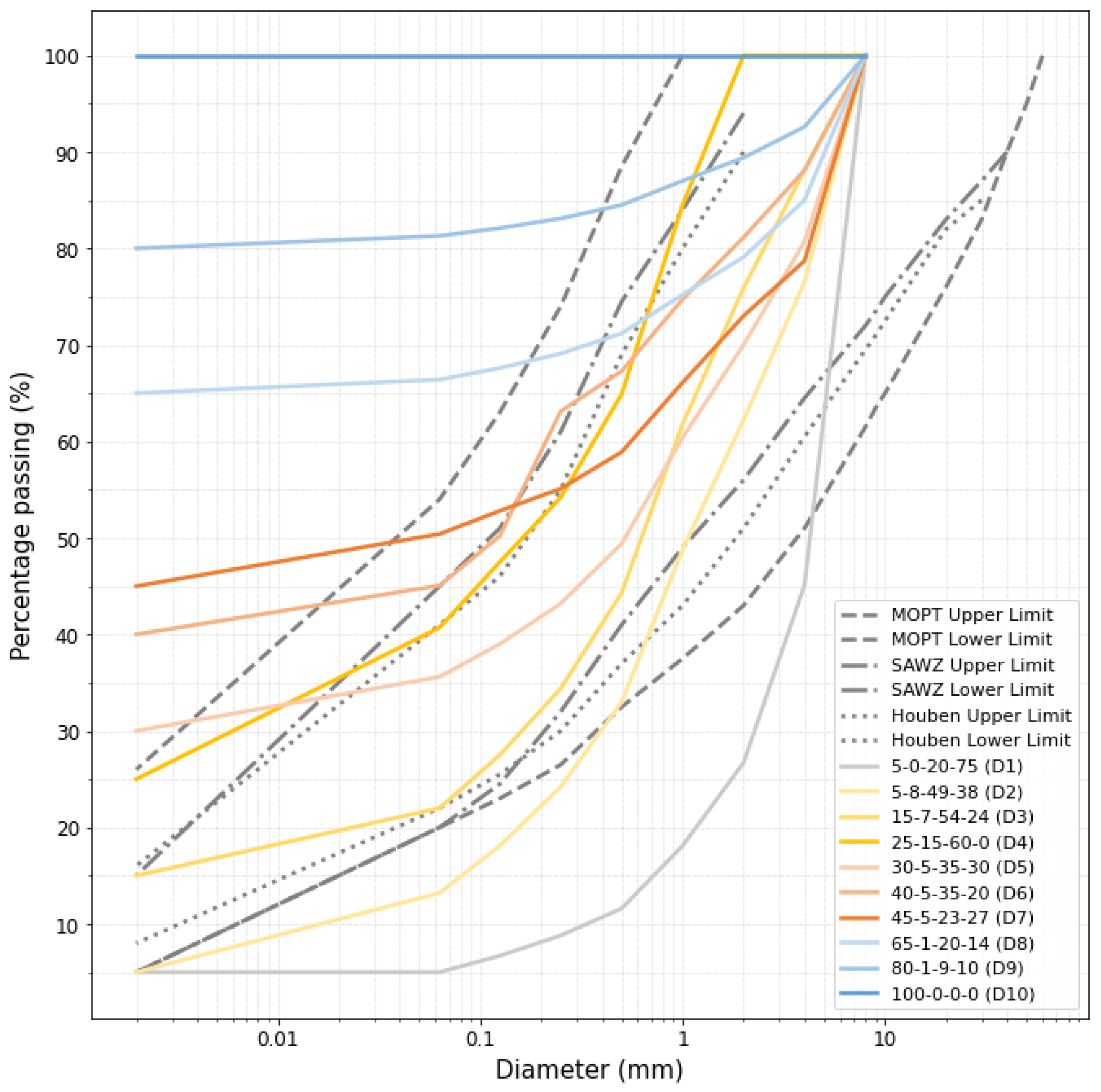
Figure 1. Particle size distribution (PSD) of the ten soil mixtures compared with three commonly used PSD envelopes.
Buildings 16 02239 g001
Figure 2. Standard Proctor results of each dosage used in the experimental campaign.
Buildings 16 02239 g002
Figure 3. Curing of specimens on perforated shelves to ensure uniform air-drying.
Buildings 16 02239 g003
Figure 4. Unconfined Compressive Testing (UCT) of standard Proctor specimens (left) and cylindrical specimens with a slenderness ratio of 2 (right).
Buildings 16 02239 g004
Figure 5. Hourglass-shaped failure mode for cylindrical specimens with a slenderness ratio of 2 (left), standard Proctor specimens (centre), and cubic specimens (right) after UCT. This was considered the expected failure pattern.
Buildings 16 02239 g005
Figure 6. Polynomial relation between the clay percentage (CC) of soil mixtures and the mean OMC (%) and MDD (kg/m3) values from each dosage. Along with the best fit (dashed lined), 95% confidence and prediction intervals are shown.
Buildings 16 02239 g006
Figure 7. Linear correlation between OMC (%) and MDD (kg/m3), following the expression MDD (kg/m3) = 2284.56 − 34.23 · OMC, is represented by a dashed line. Dots represent the mean experimental values and are coloured according to clay content (%).
Buildings 16 02239 g007
Figure 8. Polynomial relation between DD ( kg / m 3 ) and CC (%). Diamond markers represent the mean experimental values obtained for each dosage. Along with the best fit (dashed lined), 95% confidence and prediction intervals are shown.
Buildings 16 02239 g008
Figure 9. Linear relation between the clay percentage of soil mixtures and the mean DS (%) value from each dosage. Along with the best fit (dashed lined), 95% confidence and prediction intervals are shown. The mean experimental values obtained for each dosage are represented with diamond markers.
Buildings 16 02239 g009
Figure 10. Stress–strain curves from specimens of each proposed dosage (clay–silt–sand–gravel%) compared to the stress–strain curves of the control mixture (Dosage D6), represented in grey. Discarded samples (Section 2.4) are represented by dashed lines.
Buildings 16 02239 g010
Figure 11. Irregularities in the base of one of the rejected specimens (left), and its subsequent anomalous cracking pattern (right).
Buildings 16 02239 g011
Figure 12. Logarithmic regression of UCS versus CC(%). The blue dashed line is the best fit; 95% confidence and prediction intervals are also shown. The grey dashed line is the best fit without considering the results obtained from D10. Discarded specimens are omitted.
Buildings 16 02239 g012
Figure 13. Average UCS values as a function of sand–silt content (SSC) (left), gravel content (GC) (centre), and dry density (DD) (right). The dashed line is the best fit for each function; 95% confidence and prediction intervals are also shown. Diamond markers represent the mean experimental values obtained for each dosage.
Buildings 16 02239 g013
Figure 14. E (MPa) values as function of UCS values (MPa) and CC (%), represented by a colour map. The dashed line is the best fit; 95% confidence and prediction intervals are also shown. Average experimental values are shown as dots.
Buildings 16 02239 g014
Figure 15. UCS (MPa) values as function of E values (MPa) and CC (%), represented by a colour map. The dashed line is the best fit; 95% confidence and prediction intervals are also shown.
Buildings 16 02239 g015
Figure 16. Results from previous work reviewed [19,30,40,52,53,54,55,56,57] compared with the regression curve and confidence and prediction intervals estimated from the experimental results from this work. The differences in these results gathered from previous works with respect to those obtained experimentally in the present study are highlighted in terms of compaction energy (Ec), relative humidity during curing time (RH), and the form of the sample.
Buildings 16 02239 g016
Figure 17. Relative error between predicted and literature UCS values as a function of clay content. Data points are coloured according to relative humidity conditions and scaled according to compaction energy. UCS values from cubic specimens without any correction factor are highlighted with a black edge. The dashed line indicates zero error.
Buildings 16 02239 g017
Table 1. Dosage (D) (clay–silt–sand–gravel%) based on [27], optimum moisture content (OMC), and maximum dry density (MDD) of the ten proposed soils.
NameDosage (%)OMC (%)MDD (kg/m3)
D15-0-20-756.502005
D25-8-49-387.112052
D315-7-54-247.362059
D425-15-60-08.392022
D530-5-35-307.612046
D640-5-35-207.552004
D745-5-23-278.252001
D865-1-20-1410.761930
D980-1-9-1012.651846
D10100-0-0-015.231752
Table 2. Mineralogical composition of clay obtained from X-ray diffraction test.
MineralClay (%)
Quartz26.30
Calcite15.30
Albite6.70
Illite30.20
Kaolinite9.50
Montmorillonite5.50
Table 3. Mean values of dry density (DD), moisture content remaining (MCR), drying shrinkage (DS), unconfined compressive strength (UCS), and elastic modulus (E) obtained from specimens of each dosage, along with the standard deviation obtained.
DD (kg/m3)MCR (%)DS (%)UCS (MPa)E (MPa)
D1 (5-0-20-75)2128 ± 34-0.12 ± 0.040.80 ± 0.1847 ± 14
D2 (5-8-49-38)2235 ± 160.10 ± 0.030.17 ± 0.031.47 ± 0.10155 ± 24
D3 (15-7-54-24)2225 ± 70.28 ± 0.120.27 ± 0.042.67 ± 0.20197 ± 57
D4 (25-15-60-0)2145 ± 60.47 ± 0.090.42 ± 0.154.12 ± 0.08582 ± 41
D5 (30-5-35-30)2216 ± 50.28 ± 0.070.53 ± 0.113.16 ± 0.24323 ± 43
D6 (40-5-35-20)2155 ± 160.45 ± 0.150.57 ± 0.083.81 ± 0.28579 ± 55
D7 (45-5-23-27)2191 ± 240.31 ± 0.090.94 ± 0.253.92 ± 0.27453 ± 31
D8 (65-1-20-14)2121 ± 130.67 ± 0.081.25 ± 0.064.27 ± 0.30421 ± 65
D9 (80-1-9-10)2060 ± 70.57 ± 0.131.57 ± 0.144.32 ± 0.34420 ± 28
D10 (100-0-0-0)1984 ± 160.60 ± 0.111.66 ± 0.125.09 ± 0.35432 ± 64
Table 4. Results obtained from standard Proctor specimens (NPS) with a slenderness ratio of 1.2, cylindrical specimens (CS) with a slenderness ratio of 2, and cubic specimens (Cu) made from dosage D6. The results are shown for each sample, along with the average and the standard deviation (Std) for both types of specimens (excluding discarded specimens).
ρ (kg/m3)UCS (MPa)E (MPa)
NPS121383.26510
NPS221513.34391
NPS321413.29445
NPS421583.76530
NPS521223.33546
NPS621483.65612
Mean21433.43506
Std120.2178
CS121723.56677
CS221763.32576
CS321803.65357
CS421733.62677
CS621623.49552
Mean21723.52567
Std70.13130
Cu120391.7296
Cu220691.6092
Cu320781.89110
Cu420752.04128
Cu520671.9799
Cu620911.9697
Mean20701.86104
Std170.1713
Table 5. The clay percentage, form of the sample (C = cylindrical, Cu = cubic), compaction energy (Ec), relative humidity used during curing time (RH), and unconfined compressive strength (UCS) were obtained from previous studies. When information was not provided or it was not possible to calculate the compaction energy, it was highlighted as Not Specified (NS).
Clay (%)FormEc (kJ/m3)RH (%)UCS (MPa)Reference(s)
25.00Cu/Cu1274/127495/953.48/3.25[51,51]
22.00Cu1274953.59[51]
20.00C600601.95[52]
15.00C600602.03[52]
14.00C600601.40[53]
12.00C2700651.90[30]
10.00C/C600602.24/2.13[52]
C/C600Ambient/NS2.00/1.17[19,54]
Cu/Cu393683.04/2.72[55]
9.00C2700/60059/Ambient2.51/1.60[19,56]
8.00C600NS1.90[54]
6.00C600580.41[57]
5.00C600/1320NS/Ambient2.23/2.00[19,40]
C600NS/581.90/0.25[54,57]
Disclaimer/Publisher’s Note: The statements, opinions and data contained in all publications are solely those of the individual author(s) and contributor(s) and not of MDPI and/or the editor(s). MDPI and/or the editor(s) disclaim responsibility for any injury to people or property resulting from any ideas, methods, instructions or products referred to in the content.