Article

Service Performance Evaluation of RC Beam Structures by Fusing Crack Features with Static-Dynamic Responses

1
Department of Civil Engineering, Tsinghua University, Beijing 100084, China
2
Ministry of Transport of the People’s Republic of China, Beijing 100736, China
3
Key Laboratory of Civil Engineering Safety and Durability of China Ministry of Education, Tsinghua University, Beijing 100084, China
*
Author to whom correspondence should be addressed.
Buildings 2026, 16(11), 2189; https://doi.org/10.3390/buildings16112189
Submission received: 29 April 2026 / Revised: 19 May 2026 / Accepted: 23 May 2026 / Published: 29 May 2026
(This article belongs to the Special Issue Artificial Intelligence in Building Structural Performance and Safety)

Abstract

Accurate service performance evaluation of reinforced concrete (RC) beam structures is crucial for ensuring structural safety and guiding maintenance decisions. However, current practice primarily relies on qualitative visual inspections that fail to quantitatively link apparent defects to internal mechanical behavior. To address this, a novel evaluation framework fusing apparent crack features with static and dynamic responses is proposed. A context-aware grid-based deep learning model (CGDL-Crack) is developed that combines transfer learning with skeleton extraction, achieving crack localization with a maximum validation AP of 96.4% under complex backgrounds. Based on large-scale parametric finite element simulations and Sobol global sensitivity analysis, key state indicators—including static reaction forces, modal frequencies, and crack widths—are identified, and an artificial neural network (ANN) surrogate model is constructed to map multi-source monitoring data to material constitutive parameters. Full-process failure tests on 17 RC beams demonstrate that crack width follows bilinear growth and remains sensitive after stiffness indices saturate. The updated FE model accurately predicts ultimate bearing capacity, demonstrating the effectiveness of the proposed framework and its application potential for RC beam-type components in bridge and building engineering.

1. Introduction

1.1. Research Background and Challenges

Reinforced concrete (RC) beams are among the most widely used structural members in both transportation infrastructure and building engineering. In the bridge sector, they constitute the backbone of highway networks [1], while in building structures they serve as primary load-bearing elements in frames, transfer beams, and foundation systems. These members degrade significantly under combined thermo-mechanical and environmental actions. Notably, reinforcement corrosion serves as a major contributing factor to this deterioration by triggering expansive pressure, longitudinal cracking, and bond loss, ultimately accelerating the structural failure process. Many in-service structures, mostly constructed between the 1980s and the early 21st century [2], were designed with lower historical standards. Long-term overloaded operation has led to the frequent occurrence of defects [3], which can cause severe safety accidents if not addressed timely [4,5]. Among these defects, cracks serve as a critical early indicator of reduced bearing capacity and durability failure, occupying a central position in bridge management and maintenance [6]. Currently, bridge and building maintenance rely heavily on manual visual inspection. This method is not only labor-intensive, making it difficult to cover the vast stock of bridges and buildings [7], but also prone to subjective errors such as misdiagnosis [8]. Although deep learning-based detection has emerged, existing algorithms often lack robustness against complex environmental interference [9]. Moreover, prevailing evaluation standards primarily focus on qualitative ratings [10], failing to quantitatively map apparent defects to mechanical performance degradation. Consequently, there is an urgent need for robust crack identification algorithms and quantitative evaluation methods that fuse multi-source information to realize precise structural condition assessment.
Although the experimental campaign presented herein focuses on simply supported RC beams, this specimen type represents a canonical flexural member shared by bridge and building structures. More importantly, the proposed framework is not limited to a specific support condition; its core lies in fusing apparent crack features with static and dynamic responses to update mechanically meaningful model parameters. Therefore, by reconstructing the FE simulation database and response feature set according to the target boundary conditions and structural configurations, the methodology can be extended to other RC beam-type components, such as continuous beams, transfer girders, and bridge girders. The present study establishes a controlled experimental validation for this mechanics-driven evaluation strategy for RC beam-type components.

1.2. Related Works

To achieve automatic recognition and measurement of bridge surface cracks, early studies mostly employed heuristic algorithms based on digital image processing, extracting crack features via thresholding [11], edge detection [12], region processing [13,14], and template matching [15,16]. Although these methods are effective in specific scenarios, their generalization performance is generally poor [17], making it difficult to effectively eliminate noise interference in complex backgrounds. In recent years, deep learning technology has gradually taken a dominant position, with relevant research primarily categorized into image classification [18,19], object detection [20,21], and semantic segmentation [22,23]. However, practical implementation faces distinct challenges. Image classification lacks localization capabilities, while object detection generates bounding boxes with high background redundancy due to the slender geometry of cracks. Semantic segmentation, though precise, incurs prohibitive annotation and computational costs. Furthermore, existing algorithms often falter against out-of-distribution ‘crack-like’ interferences (e.g., structural joints and cables), highlighting an urgent need for enhanced robustness and engineering applicability. In this context, the objective of this study is not to replace pixel-level semantic segmentation for complete crack boundary extraction, but to develop a lightweight grid-level localization method that can efficiently identify crack regions and provide stable regions of interest for subsequent crack-width measurement. Therefore, the proposed model is evaluated within its grid-based classification setting.
Data supporting the service performance evaluation of bridge structures mainly derive from four categories of inspection and monitoring: apparent defect detection, non-destructive testing (NDT), dynamic testing, and static load testing. Regarding apparent defect detection, Liu et al. [24] utilized UAV photogrammetry to reconstruct 3D models of bridge piers and realized quantitative crack analysis. Bolourian et al. [25] optimized UAV acquisition paths by fusing genetic algorithms with the A* algorithm. Morgenthal et al. [26] further proposed automated frameworks fusing photogrammetry with feature detection for geometric computation. In terms of NDT, Liu et al. [27], Kaur et al. [28], and Jin et al. [29] verified the effectiveness of acoustic emission, piezoelectric sensing, and magnetic flux leakage technologies in stress monitoring and reinforcement corrosion detection, respectively. Maser et al. [30] compared the applicability of ground-penetrating radar (GPR) and other geophysical methods in bridge deck damage assessment. For dynamic testing, Zhang et al. [31] updated FE models by identifying modes under ambient excitation. For static load testing, Qin et al. [32] and Hasançebi et al. [33] performed parameter inversion using static displacement and strain data. However, evaluation methods based on single-source data all exhibit limitations: visual inspection lacks quantitative correlations with mechanical degradation [10]; dynamic modes are noise-susceptible and insensitive to local damage [34,35]; and static tests cannot reveal ultimate bearing capacity due to non-destructive constraints [36]. Consequently, constructing a multi-source synergy mechanism is crucial.
Since design-based FE models often fail to reflect service states due to evolving boundary conditions [37] and material deviations, model updating has become essential. In terms of updating strategies, Lu et al. [38] established a Kriging response surface model, updated design parameters using vibration test results, and predicted static behaviors. Zong et al. [39] proposed an FE model updating method fusing dynamic modes and static displacements and applied it to a rigid frame arch bridge. Tang et al. [40] optimized local stiffness using artificial bee colony algorithms. Addressing computational efficiency and parameter sensitivity, Xu et al. [41] proposed a Bayesian updating framework based on Adaptive Nested Sampling (ANS), which saved approximately 86% of computation time while ensuring accuracy. Meanwhile, Yang et al. [42] identified concrete modulus and expansion joints as dominant frequency parameters. Wang et al. [43] proposed a nonlinear model updating algorithm for biaxial reinforced concrete constitutive models of shear walls. Recently, Shahmansouri et al. [44] proposed a scaling-based integrated ML–mechanics model for predicting the lateral response of self-centering walls, demonstrating the potential of combining data-driven prediction with mechanics-based constraints to improve model generalizability. Although the aforementioned studies have made significant progress in model updating within the elastic stage, two key limitations remain. First, existing methods mostly focus on linear behaviors, making it difficult to effectively capture nonlinear mechanical characteristics and ultimate bearing capacity after the structure enters the plastic stage. Second, a quantitative physical mapping relationship between appearance defects (such as cracks) and model structural parameters has not yet been established. This leads to the utilization of defect data remaining at the level of subjective qualitative evaluation, failing to truly realize physically driven model updating through damage quantification. Different from conventional non-destructive evaluation methods that mainly identify local defects or from crack-width measurement approaches that provide only apparent geometric information, the proposed framework establishes a quantitative link between surface crack features and internal mechanical parameters. By fusing image-derived crack widths with static and dynamic responses, the method enables FE-model-oriented parameter updating and provides a mechanics-based route for evaluating the service performance of RC beam structures.

2. Materials and Methods

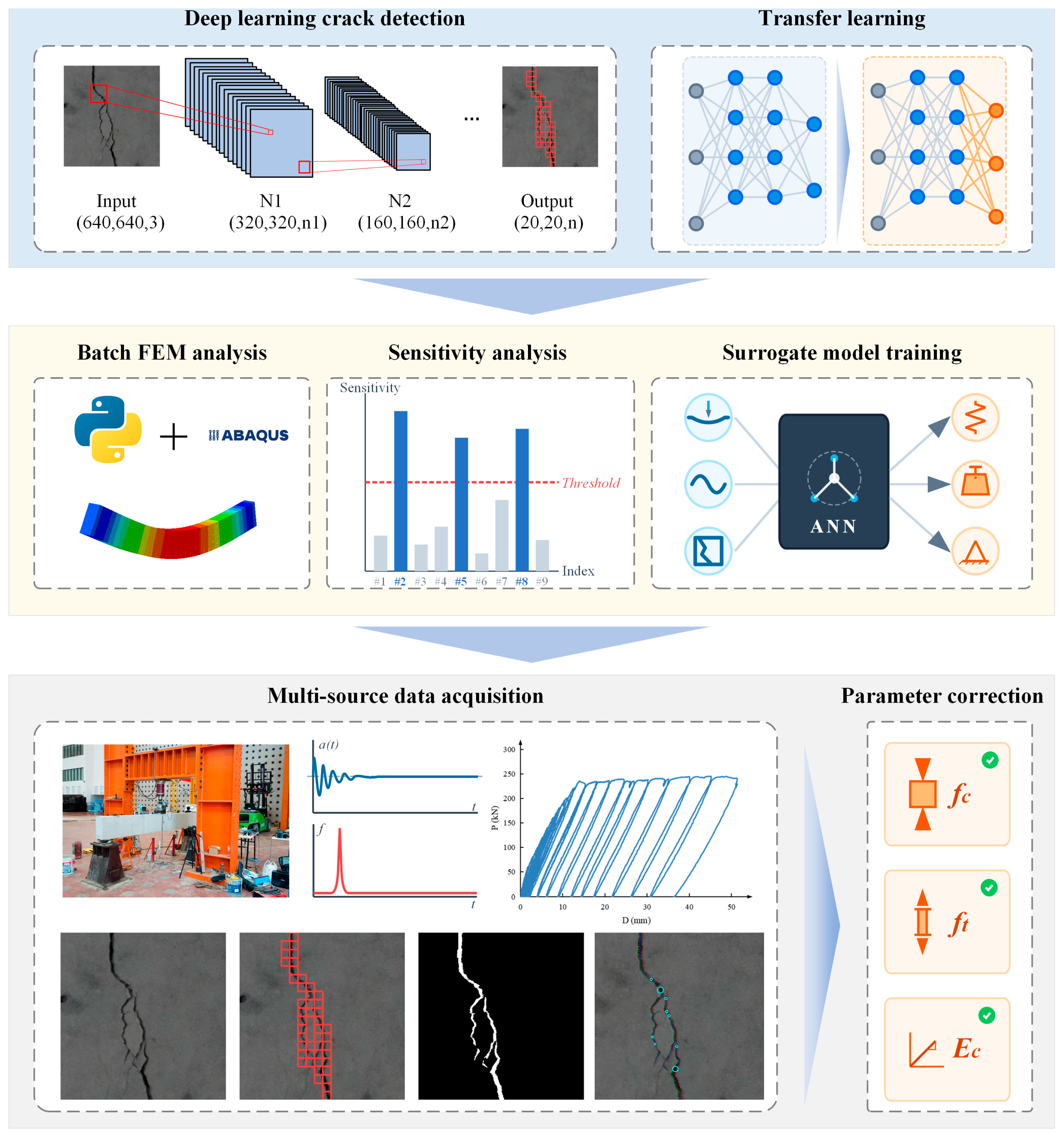
To achieve quantitative performance evaluation of flexure-dominated RC beam members using multi-source data, this study proposes a framework fusing computer vision, finite element (FE) simulation, and deep learning. The following subsections detail the methods employed in three core phases, while the materials (specimens, datasets, and instrumentation) are described in their respective contexts. This framework aims to bridge the gap between apparent defect extraction in complex environments and the updating of mechanical model parameters. The overall technical workflow is illustrated in Figure 1, comprising three core phases:
First, a context-aware grid-based deep learning network (CGDL-Crack) is developed to quantify unstructured crack images. By optimizing detection heads and skeleton extraction, this model converts visual data into high-precision geometric features (e.g., crack width), providing reliable physical inputs for evaluation (Section 3). Second, a parameter inversion system is established using an ANN surrogate model. Based on Sobol global sensitivity analysis of large-scale FE simulations, this model maps sensitive multi-source responses—specifically static forces, modal frequencies, and crack widths—to material constitutive parameters, realizing physically driven model updating (Section 4). Finally, the framework is validated through full-process loading tests on 17 RC beams. Multi-source experimental data are collected to verify the inversion accuracy and the overall effectiveness of the proposed evaluation method (Section 5).

3. Context-Aware Grid-Based Deep Learning Crack Identification Framework

This section proposes a context-aware grid-based deep learning crack identification algorithm, CGDL-Crack, aimed at effectively addressing the limitations of existing deep learning identification algorithms regarding insufficient generalization and interference robustness, as well as the mismatch between crack localization information and crack extraction requirements.

3.1. Model Architecture

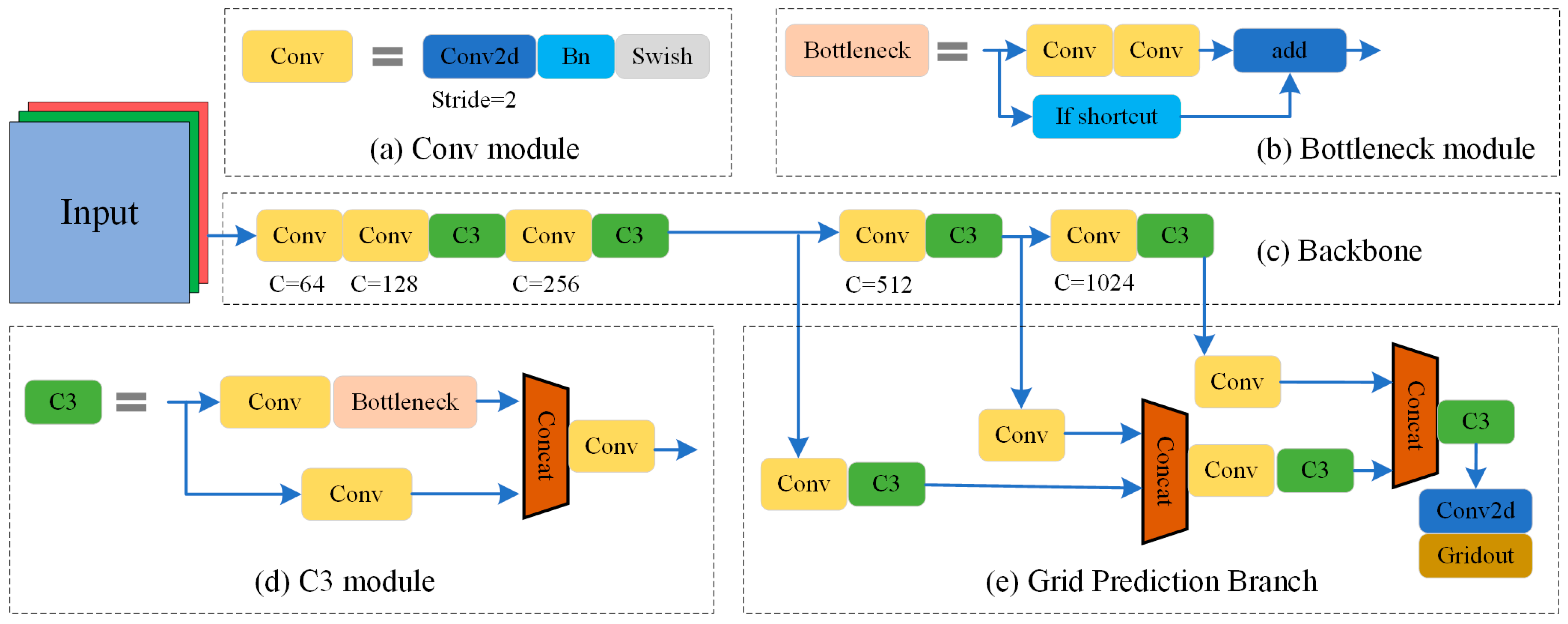
The CGDL-Crack model proposed in this study was improved and optimized based on the research of Li et al. [45] utilizing the YOLOv5 [46] framework. To accommodate the slender and irregular geometric features of concrete cracks, this model discards the anchor box branch used for object detection in the original YOLOv5 and innovatively designs a dedicated grid prediction branch; its overall architecture and core components are shown in Figure 2.
The model architecture primarily consists of a backbone network and a grid prediction branch, incorporating three core modules as detailed in Figure 2. The Conv module (Figure 2a) serves as the fundamental unit for extracting local features and introducing nonlinearity. To facilitate deep network training, the Bottleneck module (Figure 2b) incorporates residual connections [47] to mitigate the gradient vanishing problem. The C3 module (Figure 2d), based on the Cross Stage Partial (CSP) architecture, is employed to enhance feature expression while reducing computational redundancy.
Constructed by alternately stacking Conv and C3 modules, the backbone network (Figure 2c) performs progressive down-sampling to extract high-level semantic features. These features are then processed by the grid prediction branch (Figure 2e), which aggregates multi-scale feature maps via skip connections and concatenation to achieve robust feature fusion. Distinct from traditional bounding box regression, this branch divides the input image into a 20 × 20 regular grid. Each grid unit functions as an independent binary classifier, outputting the probability of crack existence. This grid-based mechanism effectively suppresses background noise interference while providing more refined spatial localization for slender crack targets.
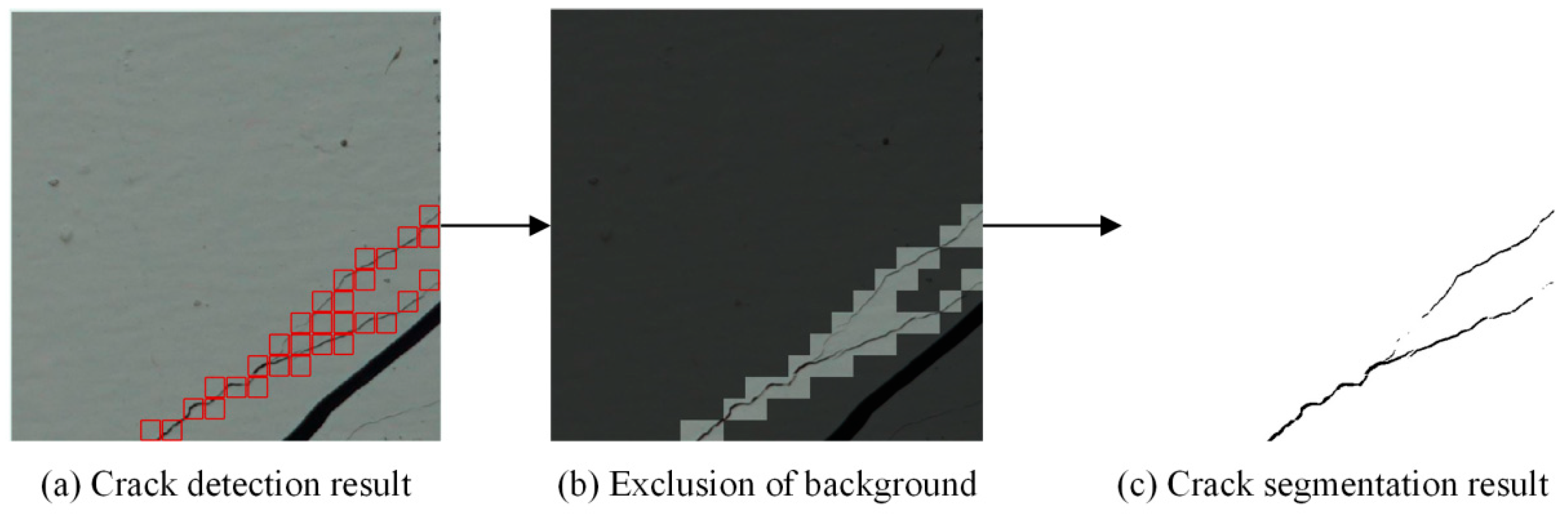
Distinct from general image classification, CGDL-Crack functions as a batch classifier with a global receptive field, enabling the integration of whole-image context for local grid predictions. Compared to traditional bounding-box detection, this grid-based mechanism is optimized for the slender geometry of cracks. By eliminating the high background redundancy inherent in rectangular anchors, the grid format significantly improves the signal-to-noise ratio of annotation data. This increased effective label density facilitates rapid convergence on small-scale datasets, while the refined spatial localization effectively isolates environmental interference for subsequent extraction, as shown in Figure 3.

3.2. Dataset and Evaluation Metrics

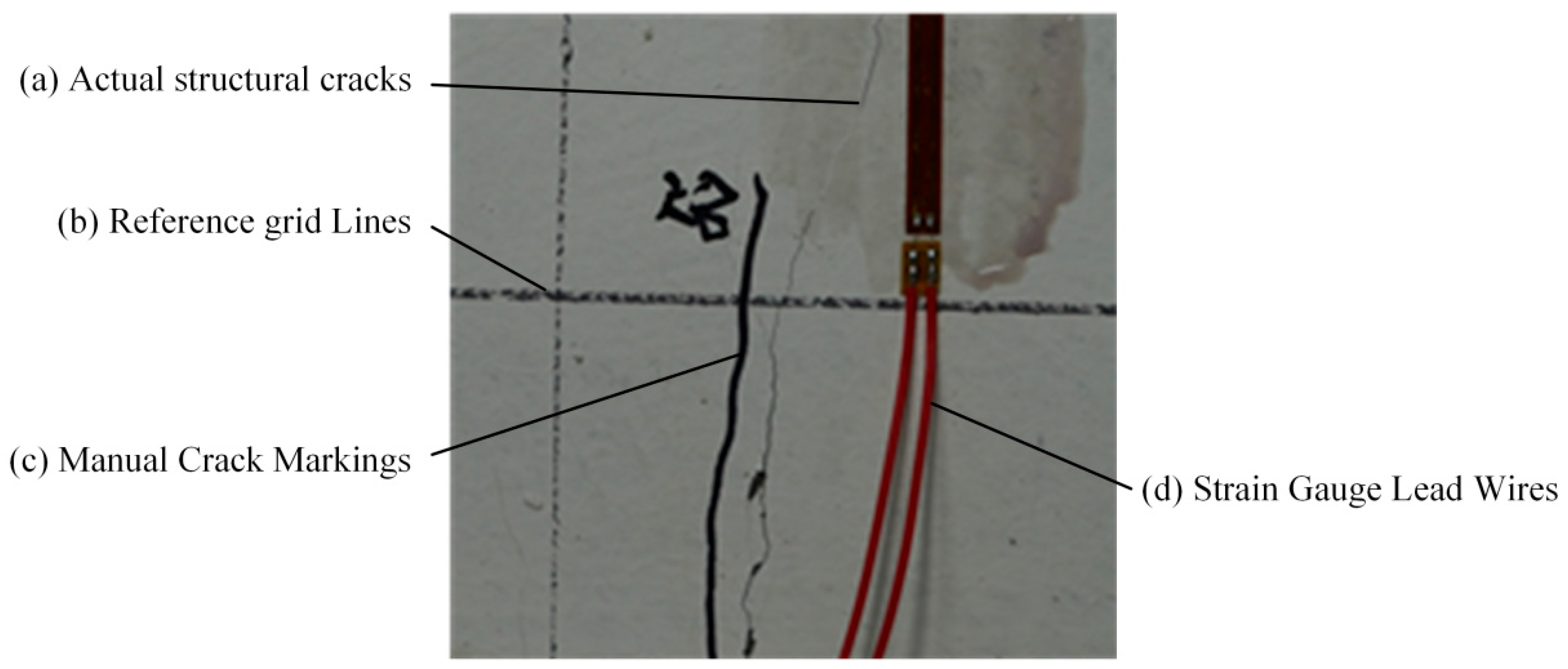
To improve robustness across the selected in situ and laboratory scenarios considered in this study, a hybrid dataset comprising 600 images (640 × 640 pixels) was constructed, equally split between in-service bridges and laboratory members. The laboratory subset was specifically introduced to address ‘crack-like’ noise distinct from field environments, such as reference grids, strain gauge wires, and manual markings (Figure 4). Incorporating these samples forces the model to distinguish linear topological interference from genuine cracks, ensuring robust performance for the subsequent experimental validation described in Section 5.
To address the aforementioned interferences, this study adopted a dual-category grid annotation method for “cracks” and “interferences.” The images were divided into 20 × 20 grid units, and an “interference-first” annotation rule was executed: if both crack pixels and linear interferents existed simultaneously within a grid, it was mandatorily labeled as the “interference” category. This strategy effectively forces the model to learn to distinguish the subtle textural differences between real cracks and “crack-like” noise, thereby ensuring the purity of subsequent crack-width measurements. The statistical information of the dataset is presented in Table 1.
The robustness of CGDL-Crack should be interpreted within the field-laboratory image domain represented by the training dataset, including concrete surfaces with visible cracks and typical crack-like linear interferences. For images with severe occlusion, very low resolution, strong shadow, wet or contaminated surfaces, or surface textures that differ substantially from the training samples, additional data augmentation or fine-tuning may be required.
Based on the characteristics of the grid-based output, Precision and Recall were adopted as the basic evaluation metrics, calculated as follows:
P = T P T P + F P , R = T P T P + F N
where T P , F P , and F N represent the numbers of true positive, false positive, and false negative grids, respectively. Considering the need for performance stability under different confidence thresholds in practical engineering applications, this study selected Average Precision ( A P ) as the core evaluation metric. The A P value is defined as the area integral under the P R curve, objectively reflecting the model’s comprehensive balance between suppressing false detections and reducing missed detections.

3.3. Transfer Learning Model Training

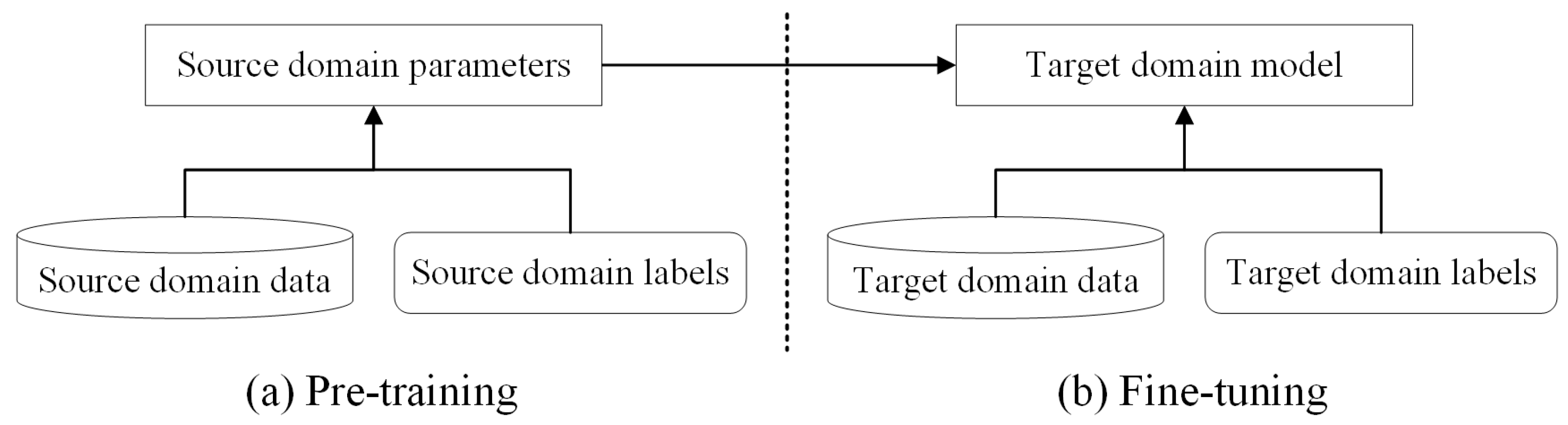
Acquiring images of concrete surface cracks in laboratory scenarios is challenging, making the construction of large-scale datasets difficult. Training directly from scratch on small samples is prone to model overfitting, which severely limits generalization performance. To address this, this study introduces a transfer learning strategy [48], with the core workflow illustrated in Figure 5. The process consists of two stages: (1) Pre-training: The model is first trained on a large-scale general dataset (approx. 18,000 images) to capture fundamental visual features such as crack edges and textures. (2) Fine-tuning: The pre-trained weights are transferred and re-optimized using the “field-laboratory” hybrid dataset described in Section 3.2. This knowledge transfer mechanism enables the model to inherit general identification capabilities while rapidly adapting to specific laboratory interferences, ensuring high performance even with limited training data.
During the training process, BCEWithLogitsLoss was adopted as the loss function to quantify the deviation between the model’s grid output and the ground truth labels. The loss value is calculated as follows:
l g r i d = i = 1 S 1 × S 2 c [ p i * ( c ) log p i c + ( 1 p i * ( c ) ) log 1 p i ( c ) ]
where S 1 and S 2 represent the number of grid divisions along the width and height directions of the image, respectively; p i * ( c ) is the ground truth probability that grid i contains an object of category c (taking a value of 0 or 1); and p i ( c ) is the corresponding model output probability.
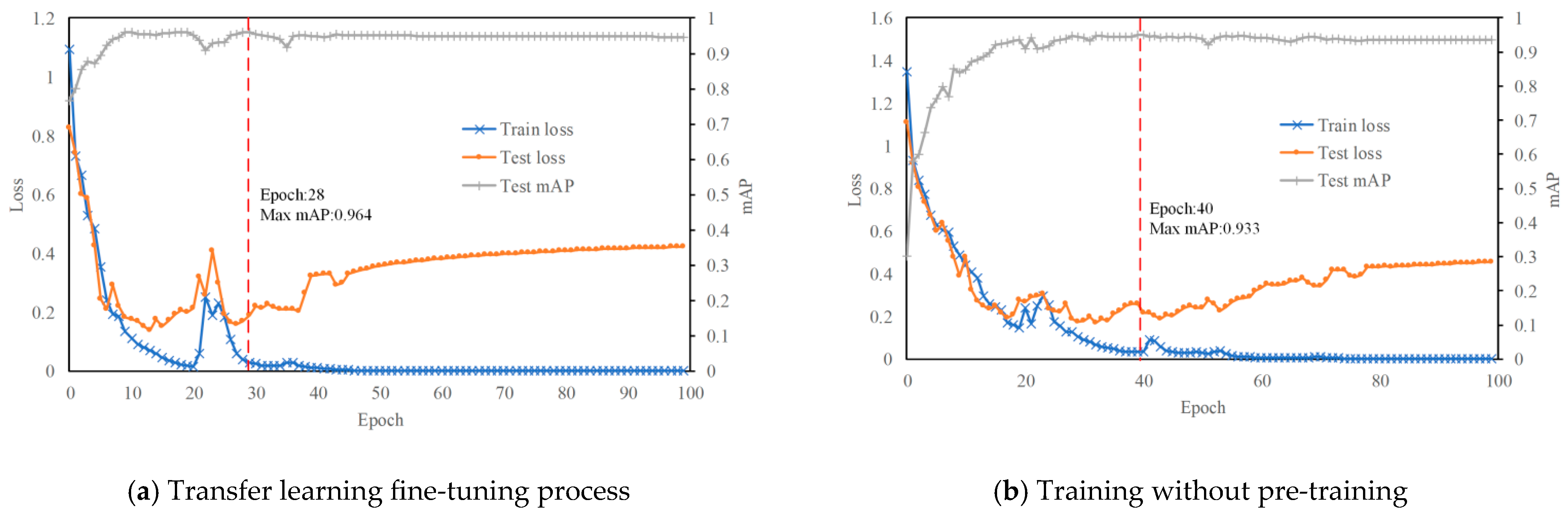
Figure 6a illustrates the evolution of loss and Average Precision ( A P ) during fine-tuning. The model achieved a maximum validation A P of 96.4%. Notably, the validation loss exhibited a “descending followed by ascending” trend in later iterations, suggesting the model began to overfit non-crack noise such as micro-voids. However, the AP value fluctuated only slightly (dropping to approx. 93%), which indicates that the impact of this overfitting remained within a controllable range.
To validate the transfer learning strategy, a comparative experiment without pre-training was conducted (Figure 6b). The model without pre-training achieved a maximum validation AP of 93.3%, which is lower than that of the transfer learning model. More importantly, the pre-trained model demonstrated significantly faster convergence during the early stages. This comparison confirms that introducing prior visual knowledge enhances feature extraction efficiency, accelerates convergence, and improves final detection performance under the small-sample field-laboratory training setting adopted in this study.

3.4. Crack Extraction and Parameter Measurement

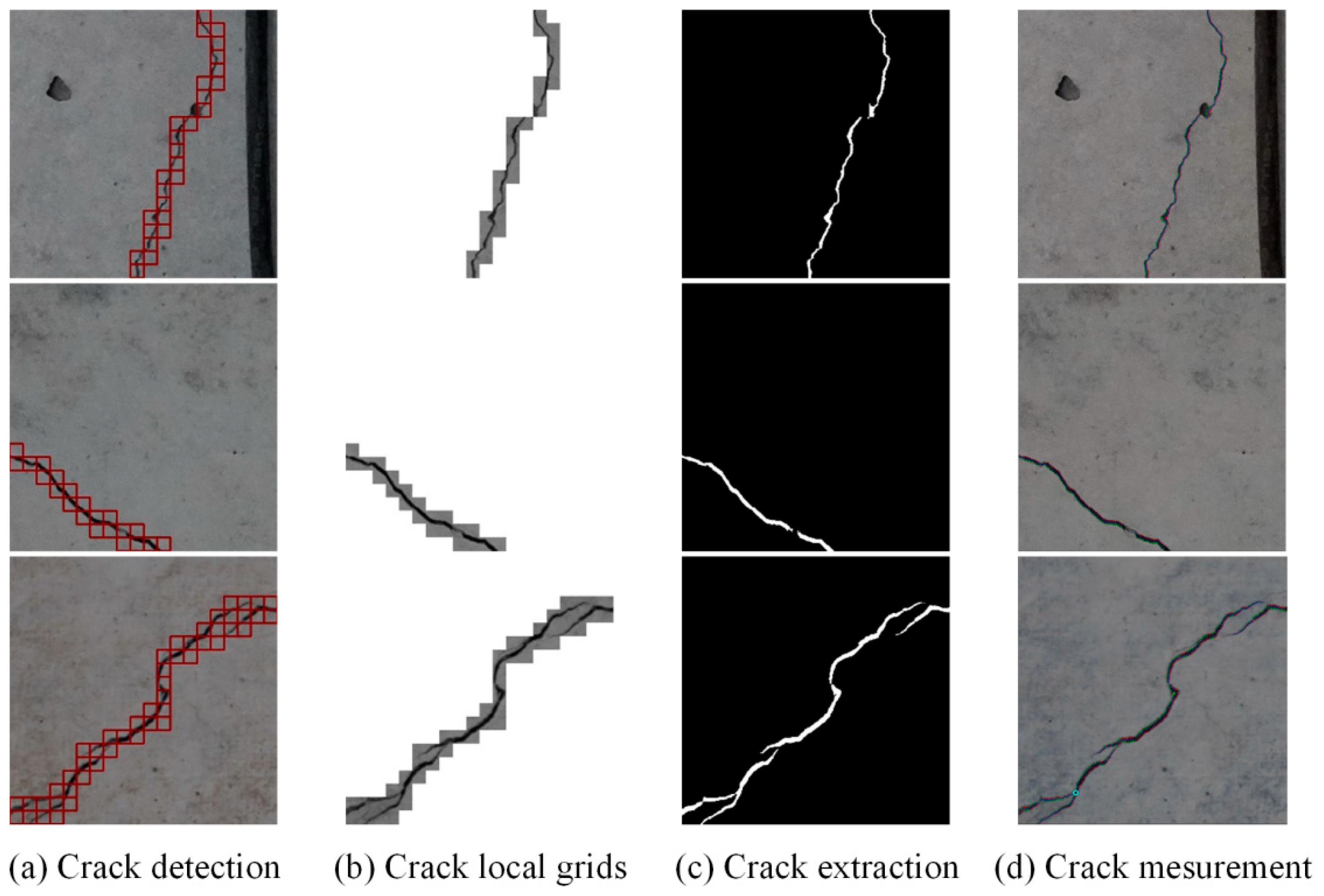
Based on the grid localization results, high-confidence crack Regions of Interest (ROIs) are cropped. To mitigate uneven lighting and shadow effects, an adaptive brightness equalization algorithm is applied, followed by automatic binarization using the Otsu method [49], which maximizes inter-class variance. Subsequently, a morphological filtering strategy based on connected component analysis is adopted to eliminate residual speckle noise. By setting specific area thresholds derived from the topological continuity of cracks, isolated non-crack artifacts are effectively filtered out, retaining only genuine crack morphologies.
To quantify these binary features, a skeleton-based measurement algorithm is proposed. The medial axis of the crack is extracted via directional tracking, and topological breakpoints are repaired using interpolation. Crack widths are then calculated based on the orthogonal section principle: for each pixel on the skeleton, the Euclidean distance to the crack edge along the normal direction is computed. This process yields image-derived geometric indices, including maximum and average widths. As demonstrated in Figure 7, this algorithmic chain accurately extracts crack topologies from complex backgrounds, providing quantitative geometric inputs for the subsequent ANN-based performance evaluation.
Through this image-processing chain, unstructured crack images are transformed into quantitative geometric descriptors, including average and maximum crack widths. These descriptors provide physically interpretable inputs for subsequent multi-source parameter inversion. Since the inversion framework jointly uses crack features, static responses, dynamic responses, and design priors, the crack-width index acts as a complementary damage-sensitive feature rather than a standalone evaluation criterion.

4. Model Parameter Prediction Method Based on ANN Surrogate Model

To overcome the data scarcity of destructive testing, a Python-based (version 3.10.13) automated Abaqus simulation framework is established to generate a large-scale synthetic dataset, enabling subsequent global sensitivity analysis and ANN surrogate model training.

4.1. Simulation of Mechanical Performance of Concrete Beams Based on Finite Element Analysis

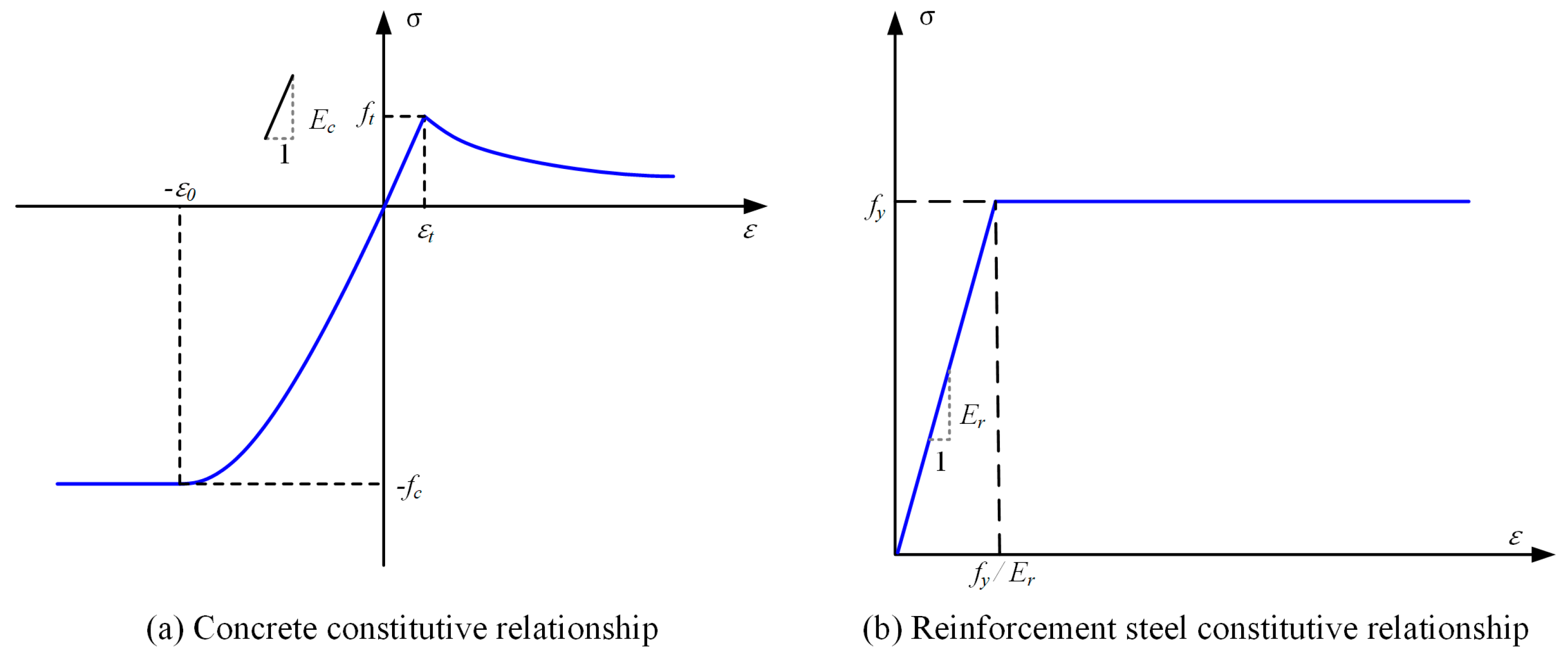
To accurately simulate nonlinear behavior and construct a high-dimensional sample space, stochastic constitutive models were implemented. As illustrated in Figure 8, the concrete compression behavior adopted the modified Mander model [50] with a shape parameter r to decouple elastic modulus from strength, while the tensile behavior followed the Belarbi–Hsu softening model [51]. The steel reinforcement was modeled using an ideal elastic–plastic relationship.
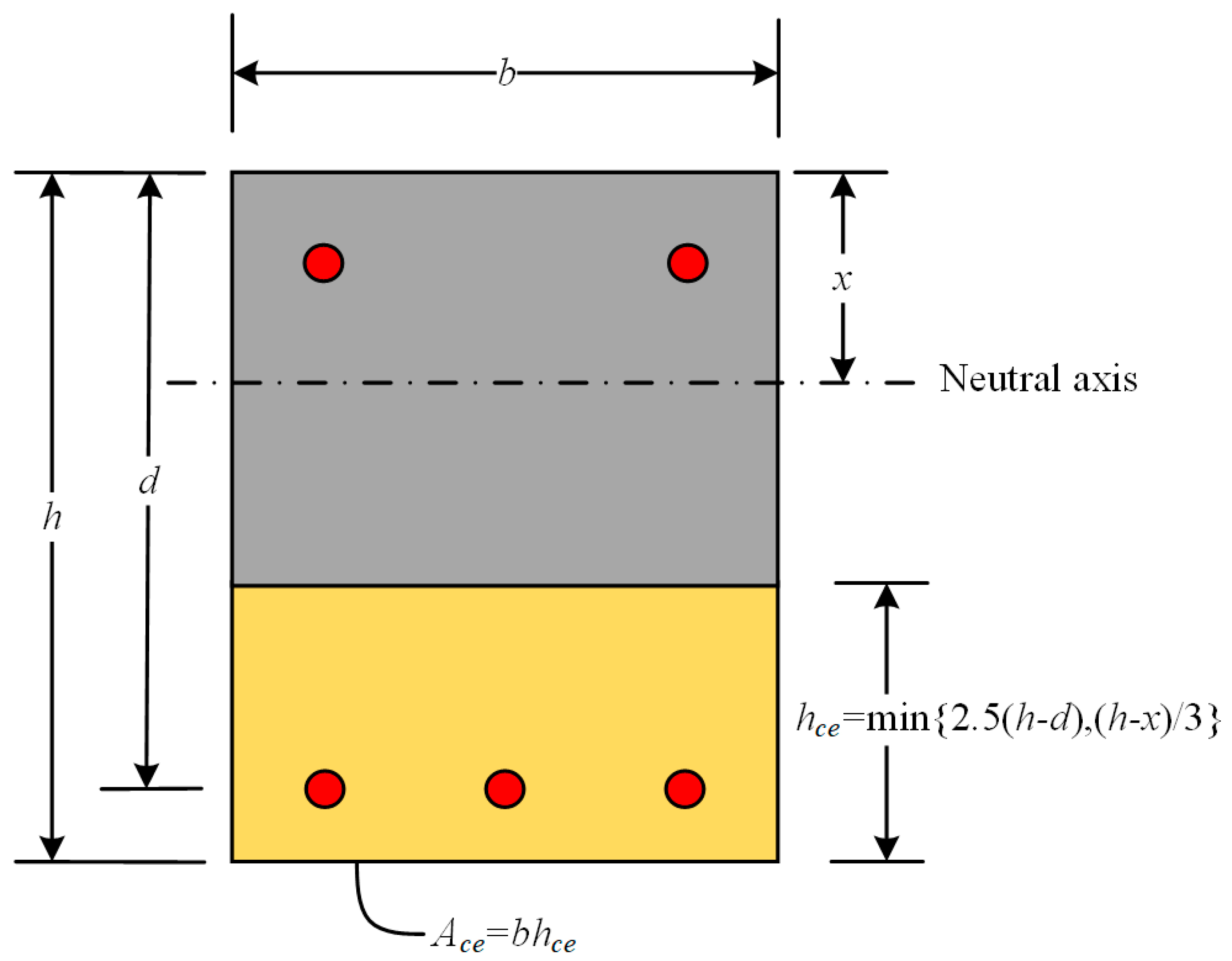
To quantify apparent damage, the Smeared Crack Model was employed to map element strains to macroscopic crack widths w . The smeared crack model was adopted because it enables efficient large-scale parametric simulations and provides global response indices suitable for surrogate model training. The calculation is based on the accumulation of mean bond strain over the average crack spacing D m :
w = ε σ c E c D m ; D m = 50 + 0.05 k 1 k 2 D r / ρ e
where k 1 = 0.8 and k 2 = 0.5 are coefficients for deformed bars in bending, and D r is the reinforcement diameter. The effective reinforcement ratio is defined as ρ e = A r / A c e , where A r is the reinforcement area, and A c e is the effective tensile area, calculated as shown in Figure 9.
To establish a high-dimensional sample space for sensitivity analysis and surrogate model training, this study selected six key parameters that significantly affect the static and dynamic responses of the components: concrete compressive strength f c , tensile strength f t and elastic modulus E c ; steel yield strength f y and elastic modulus E r ; longitudinal reinforcement ratio ρ and beam span L . Considering that the variability of the steel elastic modulus is small in engineering practice, it was fixed at 206 GPa. The range of values for each parameter covers a broad spectrum of conditions from the elastic working stage to the plastic failure stage, as shown in Table 2. Since a full factorial design would generate an excessive 7500 combinations, a two-stage hybrid sampling strategy was adopted to reduce computational costs. The first stage fixed the span at 3200 mm to focus on material nonlinearity, while the second stage fixed concrete tensile strength and elastic modulus at their mean values to traverse other design parameters. This approach yielded a final library of 1740 independent cases, effectively balancing coverage density in sensitive regions with computational efficiency. The selected parameter ranges cover the main geometric and material variations governing the flexure-dominated response, including concrete strength, tensile behavior, elastic modulus, reinforcement ratio, and beam span. By combining these variables, the database captures stiffness degradation, cracking development, and load-bearing evolution from the elastic stage to the plastic stage, thereby providing a mechanically consistent basis for sensitivity analysis and surrogate model training.
Batch simulations were performed in Abaqus/Standard using 2D beam elements, modeling concrete as rectangular sections and reinforcement as equivalent box-sections. Deformation compatibility was enforced via Joint Node constraints under simply supported conditions with a uniform 50 mm mesh. To comprehensively capture stiffness degradation and dynamic evolution across the “elastic-cracking-yielding” stages, a seven-step analysis sequence was implemented: (1) Initial modal analysis; (2) Elastic loading ( L / 400 ) to extract reaction forces and crack widths; (3) First unloading; (4) Damaged state modal analysis; (5) Plastic loading ( L / 200 ); (6) Second unloading; and (7) Residual state modal analysis. These cumulative indices constitute the complete response vector characterizing the structural service state.
To automate the above process, an automated batch processing program was developed based on the secondary development of the Abaqus kernel using Python. This program automatically reads the parameter list and sequentially executes material library construction, geometric modeling, section attribute assignment, analysis step definition, and job submission. It then automatically extracts structural response indices from the output database and stores them in the dataset, providing standardized data support for subsequent research.

4.2. Parameter Sensitivity Analysis

To screen effective feature vectors for model updating, Sobol global sensitivity analysis was applied to the 1740 simulation cases targeting the six uncertain parameters. This variance-based method decomposes the total output variance V(Y) to derive the first-order sensitivity index Si, which quantifies the main effect of individual inputs:
V Y = V 1 + V 2 + + V p + V 12 p ; S i = V i V Y
where S i ranges from 0 to 1. Higher values indicate a dominant impact on structural response fluctuations, providing a quantitative physical criterion for feature selection.
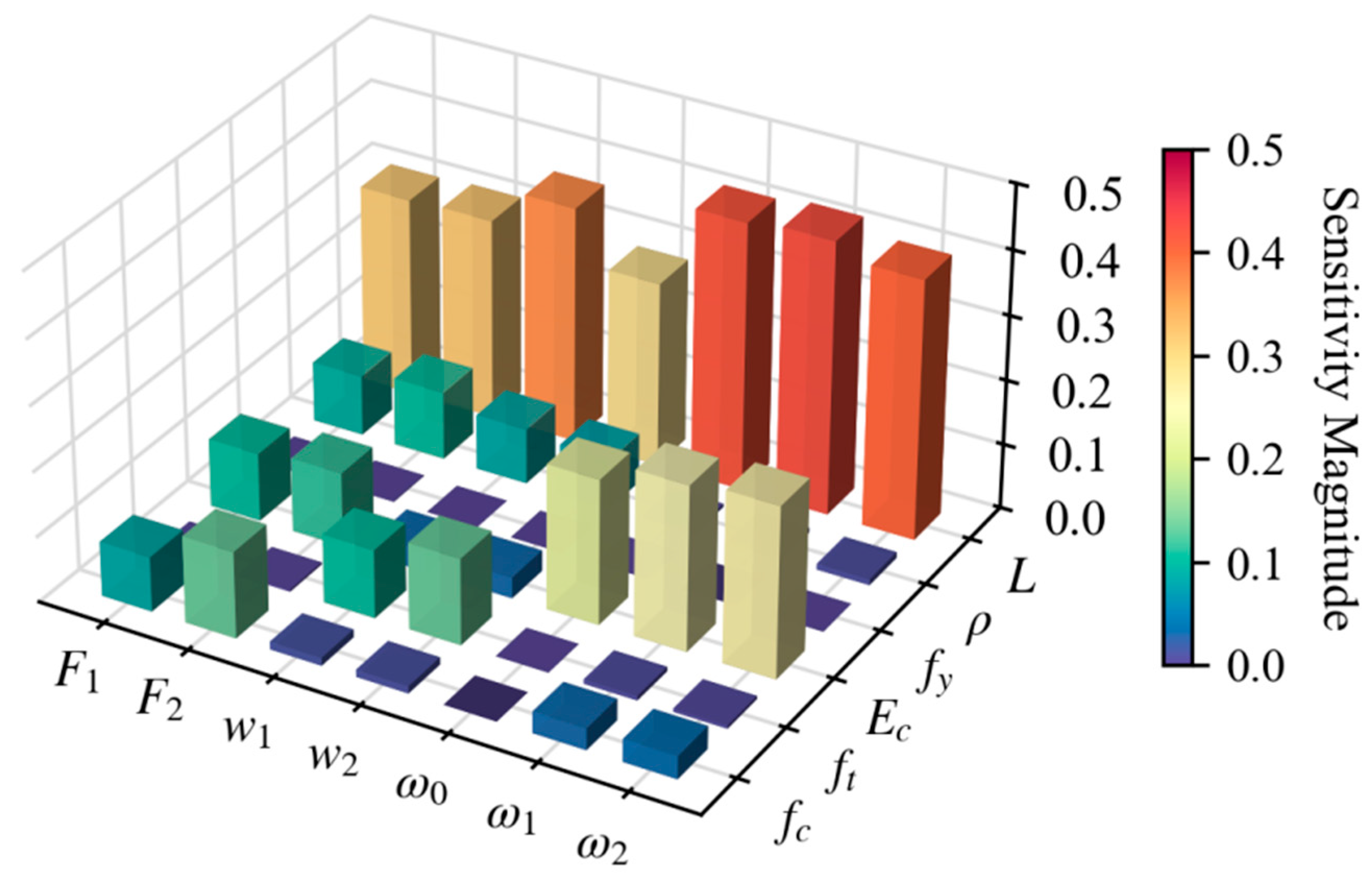
The quantitative sensitivity results (Figure 10) reveal that beam span L and reinforcement ratio ρ exert dominant control over structural responses. Specifically, L exhibits extremely high sensitivity across all indices due to geometric nonlinearity, while ρ governs static forces and crack evolution. Given that these parameters are typically determinate design priors in engineering practice, they are excluded from inversion targets. Instead, they are explicitly integrated into the input layer of the updating algorithm to serve as essential physical constraints.
Regarding material properties, concrete parameters ( f c , f t , E c ) dominate high-order responses and crack widths in the plastic stage. As core indicators of structural health, they are selected as the primary output variables for updating. Conversely, steel yield strength ( f y ) exhibits negligible sensitivity ( S i 0 ) under service loads and is therefore excluded.
Consequently, the ANN architecture is defined: the input vector comprises design priors and measured multi-source responses, mapping to the target concrete parameters ( f c , f t , E c ). The strong physical dependency verified by sensitivity analysis serves as the foundation for ensuring the accuracy and robustness of this surrogate model.

4.3. Construction and Training of the Surrogate Model

Structural parameter identification is a nonlinear inverse problem in which repeated finite element analyses can lead to substantial computational cost, especially when material nonlinearity and cracking behavior are considered. To improve inversion efficiency, a fully connected ANN was constructed as an inverse surrogate model. The surrogate directly maps multi-source structural responses to concrete constitutive parameters after being trained on the FE simulation database. In this manner, the computationally intensive nonlinear simulations are completed offline, while rapid parameter updating can be achieved during the evaluation stage.
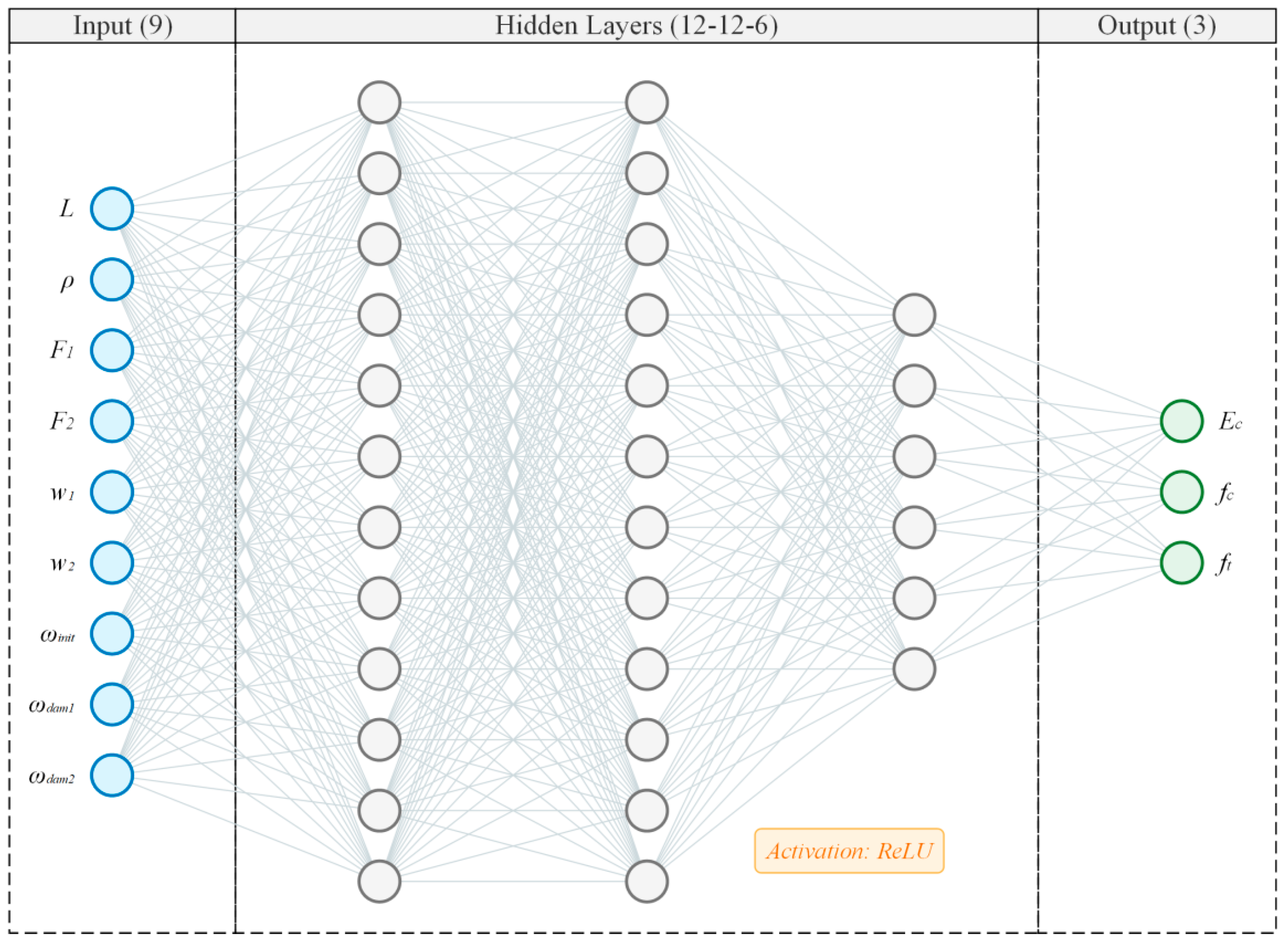
Based on the feature selection results determined in Section 4.2, the model input layer contains nine neurons (span L , reinforcement ratio ρ , reaction forces F 1 , F 2 and crack widths w 1 , w 2 under two load levels, and fundamental frequencies ω i n i t , ω d a m 1 , ω d a m 2 at three stages), while the output layer contains three neurons ( E c , f c , f t ). The fundamental frequency was selected as the representative dynamic feature because it is a stable global stiffness indicator and can be consistently extracted from both FE simulations and impact hammer tests. Its combination with static force and crack-width indices enables the surrogate model to integrate global and local damage-sensitive information.
After hyperparameter optimization and network pruning, the final hidden layer topology was determined as a three-layer architecture of [12-12-6] (as shown in Figure 11). Full connectivity was adopted between layers, and the ReLU activation function was introduced to enhance the model’s nonlinear representation capability.
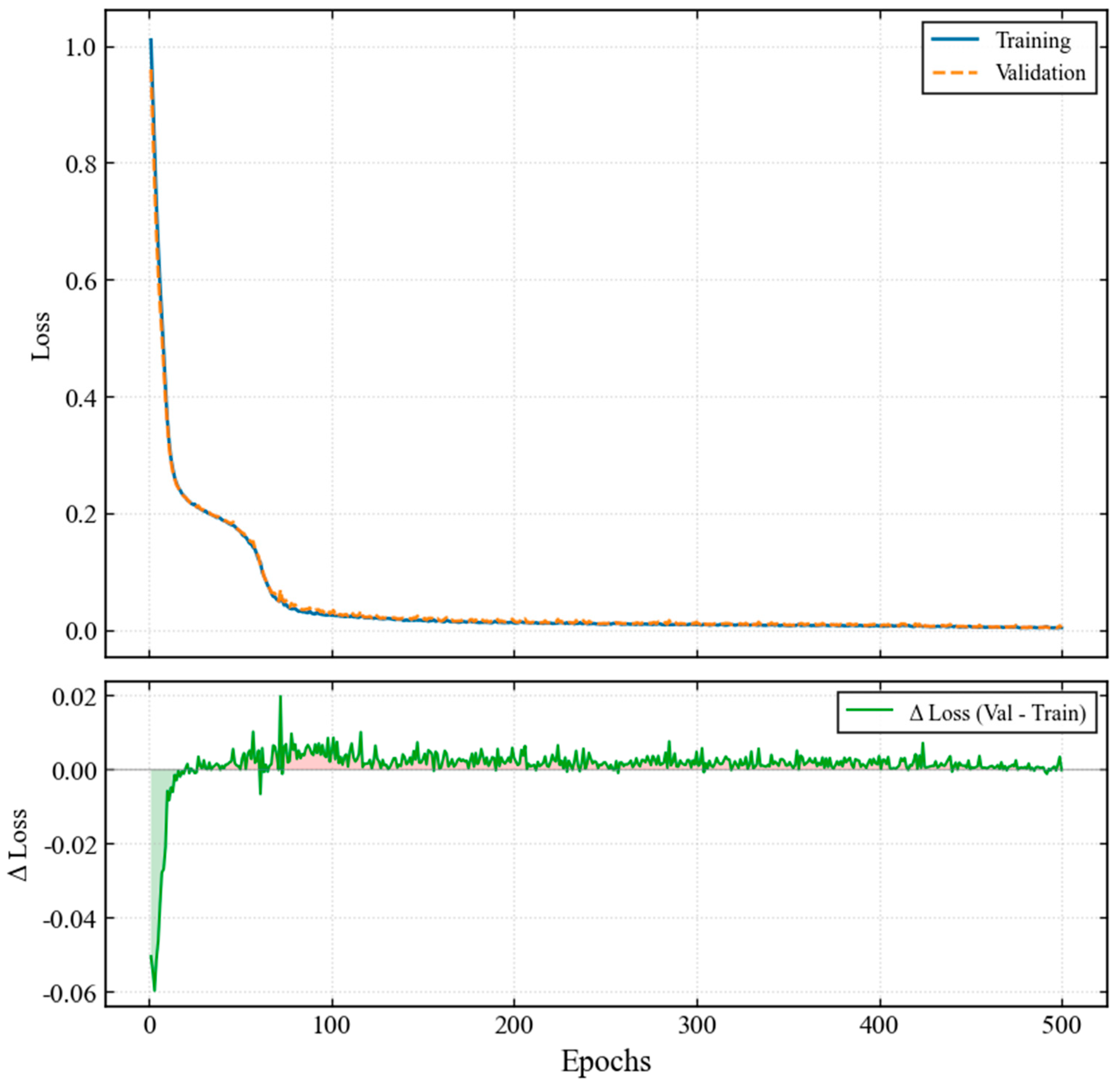
The 1740 simulation cases were divided via random stratified sampling into a training set (80%, 1392 cases) and a validation set (20%, 348 cases). Implemented in PyTorch (version 2.1.2), the model employed the Mean Squared Error (MSE) loss function and Adam optimizer, with an initial learning rate of 0.001 and a maximum of 500 epochs. As illustrated in Figure 12, both training and validation losses decreased synchronously and stabilized without significant oscillation. The stable loss difference ( Δ L o s s 0 ) in the final stages confirms the model’s stable interpolation capability and absence of overfitting. These results indicate that the ANN surrogate model provides a stable and efficient inverse mapping within the mechanically defined simulation database, supporting rapid parameter updating without repeated nonlinear FE analysis.
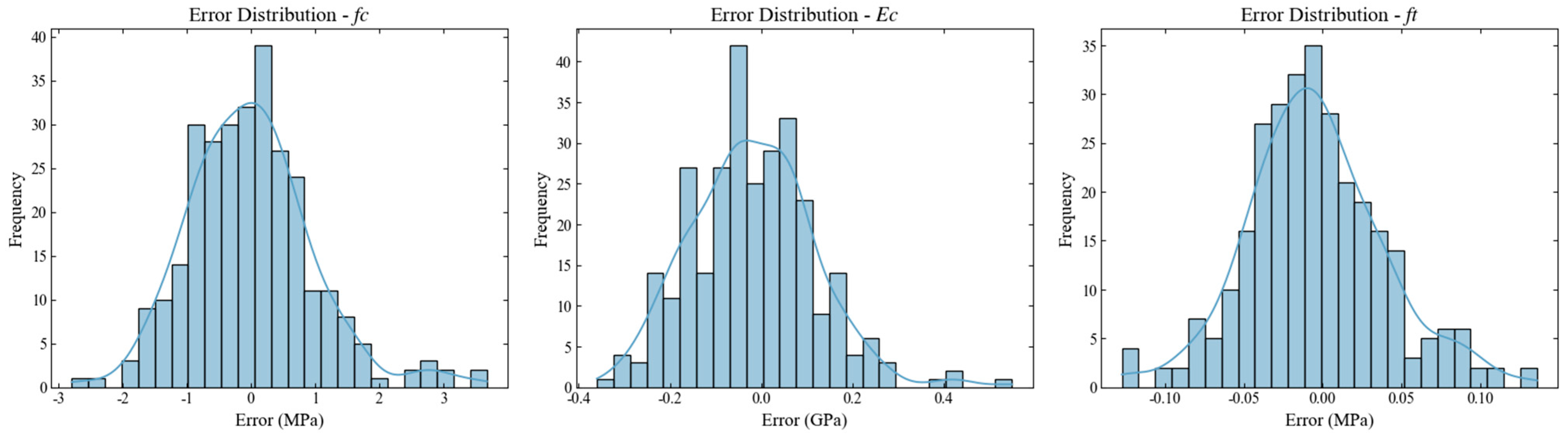
To evaluate the inversion accuracy of the surrogate model, test set samples were input into the trained model for blind testing, and the absolute error distribution of each output parameter is shown in Figure 13. Statistical results show that for the concrete elastic modulus E c , the errors between 90% of the predicted results and the true values were within 0.5 GPa. For compressive strength f c and tensile strength f t , the error ranges were within ± 1.5   M P a and ± 0.4   M P a , respectively. In engineering practice, the actual mechanical properties of concrete may deviate from the nominal values associated with the design strength grade due to material variability, curing conditions, and construction processes. Therefore, identifying effective concrete parameters from structural responses is meaningful for FE model updating and performance evaluation. Compared to the inherent dispersion of concrete materials, the aforementioned prediction accuracy satisfies the requirements for engineering parameter updating, validating the effectiveness of this surrogate model in mechanical performance evaluation.

5. Method Validation: Full-Process Static and Dynamic Performance Tests on Single Beams

To validate the effectiveness of the proposed evaluation method, full-process tests under graded loading were conducted on RC single beams in this section, synchronously collecting static and dynamic responses and crack morphology data. Subsequently, the ANN surrogate model constructed in Section 4 was utilized to perform parameter inversion on the measured data. Through comparison with experimental ground truth, the accuracy and applicability of the method were quantitatively evaluated.

5.1. Experimental Design

In this study, 17 rectangular RC single beam specimens were designed and fabricated (Structural Laboratory of the Department of Civil Engineering, Tsinghua University, Beijing, China). All specimens adopted uniform cross-sectional dimensions, with a height of 400 mm and a width of 200 mm. HRB400 grade deformed steel bars with diameters of 16, 22, 25, and 28 mm were used as longitudinal tensile reinforcement according to the specimen design, while HRB335 grade steel bars with a diameter of 6 mm were used for erection bars in the compression zone and stirrups. Taking the standard simply supported beam L-1 as the control group, a specimen sequence with multi-parameter gradients was formed by varying key variables such as span L , reinforcement ratio ρ , concrete strength grade (C30~C60), and support type (pin-roller/rubber bearing), as shown in Table 3. During specimen casting, six standard cubic test blocks were reserved for each concrete strength grade as material-level reference specimens.
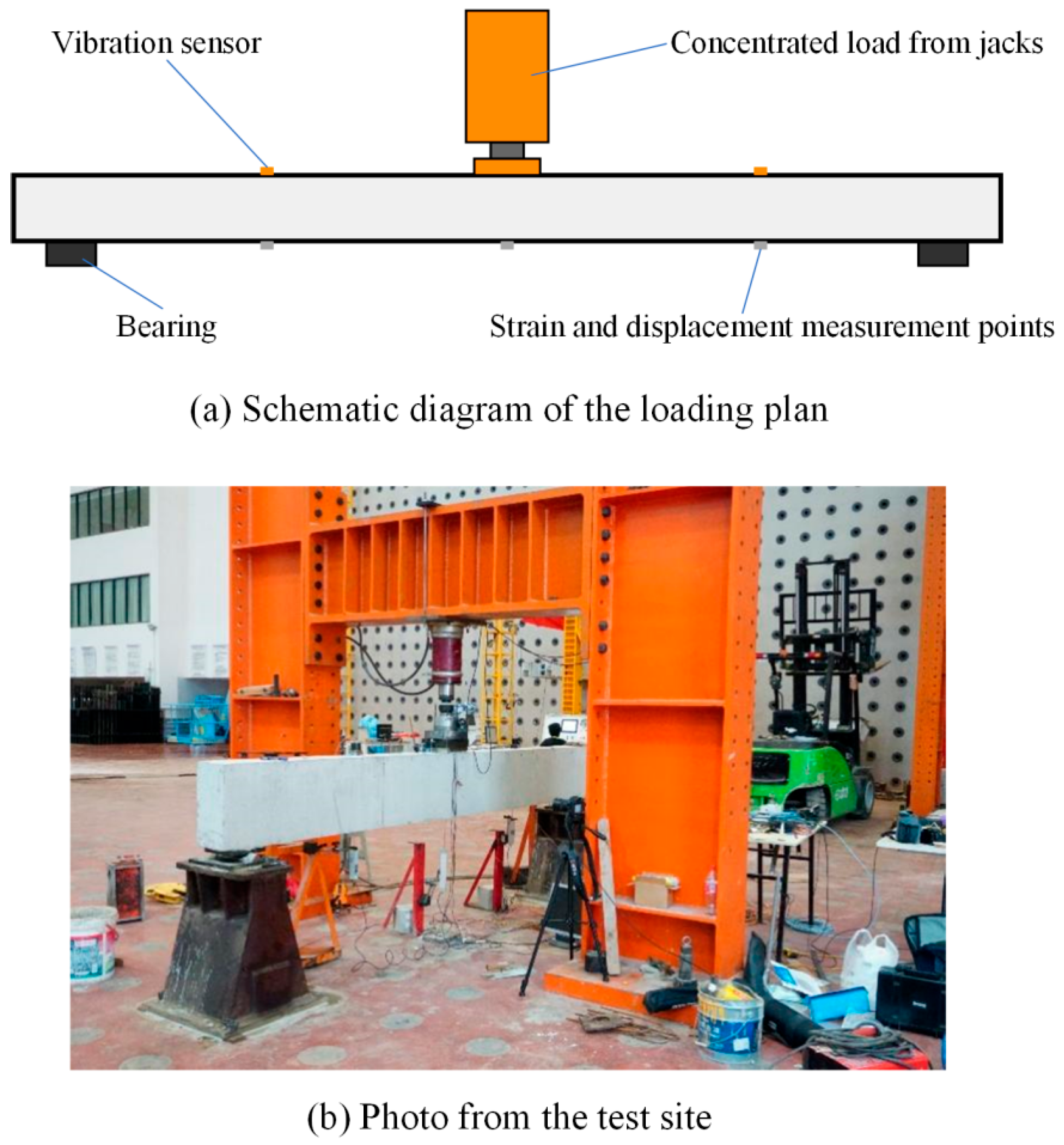
Three-point loading was adopted during the test, and the test setup is shown in Figure 14. The entire loading process was carried out using graded loading, initially employing force control and switching to displacement control after the member yielded. For members with a design yield load of P u , in the force control stage, the load increment for each grade was set to 10 % P u after the initiation of the first crack. As the force loading grades continued to increase, the beam member was judged to have yielded when the load approached the peak value and the mid-span deflection began to develop rapidly; at this point, the loading mode was switched to displacement control. In the displacement control stage, the load was increased by 50 % Δ per grade, based on the mid-span displacement at yield Δ . When the load dropped to 85% of the ultimate bearing capacity, or when the concrete at the top of the beam exhibited obvious crushing failure, loading was stopped, and the test for that member was terminated.
Loading and unloading cycles were repeated during the test. After reaching a specific loading grade, static characteristic data collection and surface image acquisition were completed under the sustained load state. Dynamic testing was conducted after unloading, followed by surface photography again. After the completion of each loading and unloading cycle, the next loading grade commenced. The correspondence between the reaction force on the loading machine and the readings of each displacement meter was recorded in real-time throughout the loading process.
To acquire multi-dimensional validation data, a laboratory monitoring system was established. For static responses, five Linear Variable Differential Transformers (LVDTs) were installed at the supports and quarter-span points ( 0 ,   L / 4 ,   L / 2 ,   3 L / 4 ,   L ) to record full-process deflection profiles. Additionally, resistance strain gauges were attached to the mid-span longitudinal reinforcement to monitor stress evolution and capture the steel yield point.
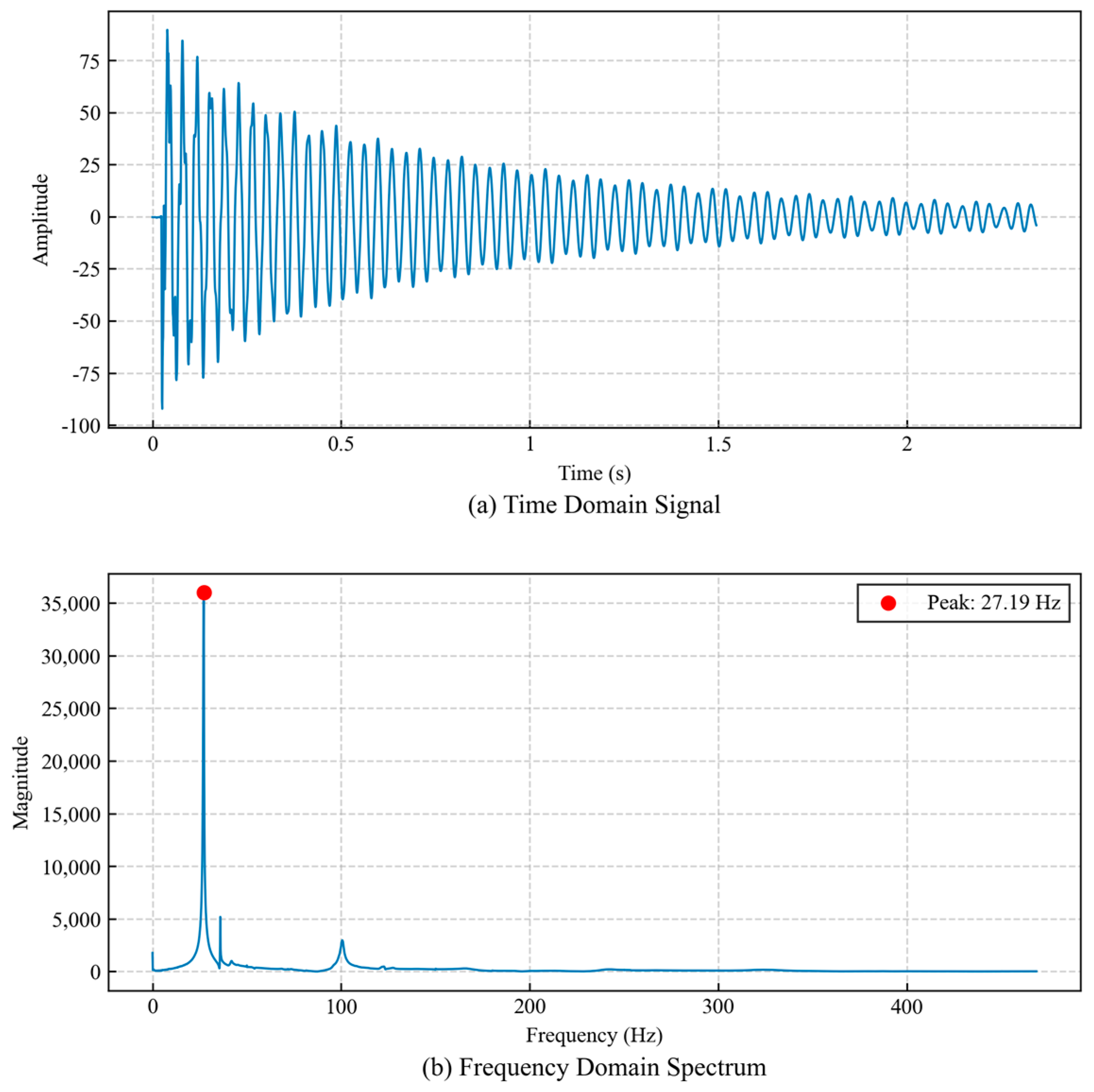
For apparent damage, a photogrammetry setup comprising two side cameras and one bottom camera captured surface images during loading and unloading phases. The cameras were Nikon D5000 digital single-lens reflex cameras (Nikon Corporation, Tokyo, Japan), enabling precise crack-width quantification. Regarding dynamic characteristics, vertical accelerometers (manufactured by China Orient Institute of Noise & Vibration, Beijing, China) were deployed on the beam’s top surface at quarter-span points. Impact hammer excitation was performed after each unloading cycle to identify modal frequencies and damping ratios from time-domain decay signals, collectively forming a comprehensive “static-image-dynamic” dataset.
The laboratory program provides a controlled validation environment in which key influencing factors can be varied independently and the full loading process can be observed. This design is suitable for verifying the internal consistency of the proposed multi-source framework before its extension to field structures with more complex environmental and operational conditions.

5.2. Experimental Phenomena and Data Acquisition

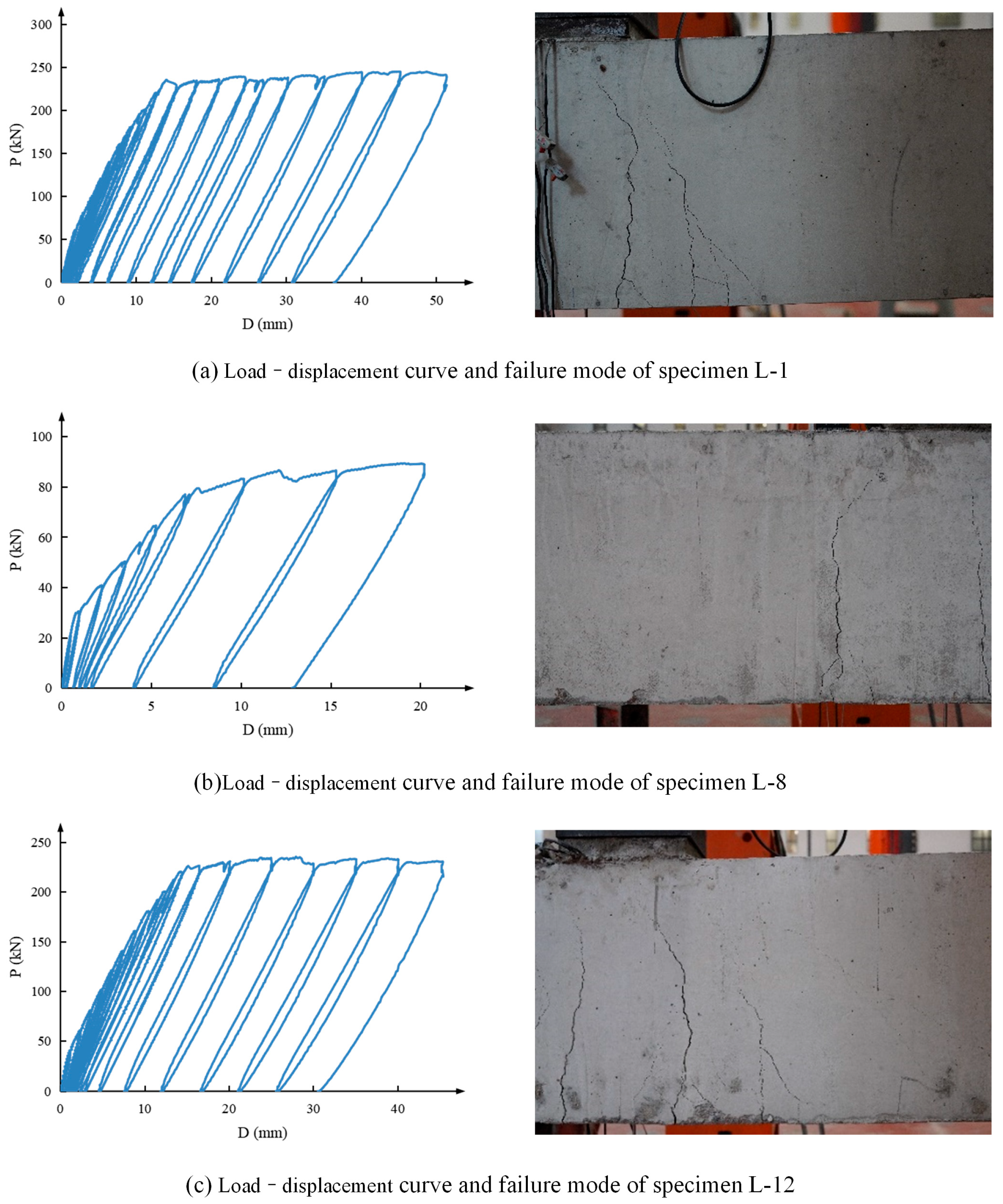
With the exception of specimen L-7, which failed in shear due to excessive stirrup spacing, the remaining 16 beams exhibited typical flexural failure. Therefore, the experimental validation of the proposed framework mainly focuses on experimentally observed flexure-dominated damage evolution, while L-7 provides a boundary case for observing the behavior beyond the primary flexural evaluation scenario. During the initial loading phase, vertical cracks emerged at the mid-span bottom and propagated upward, while the members retained high flexural stiffness with minimal residual deformation. Upon reaching the yield load, the structural behavior shifted significantly: mid-span deflection and crack widths accelerated rapidly, accompanied by distinct residual deformation. Following the transition to displacement control, plastic deformation accumulated continuously while the increase in bearing capacity became less pronounced. Ultimately, flexural cracks penetrated the compression zone, leading to concrete crushing and spalling at the mid-span top, which marked the termination of loading. The full-process load–displacement curves and final failure patterns for typical specimens are illustrated in Figure 15.
The time-history waveforms collected by the vibration pickups during dynamic testing were subjected to Discrete Fourier Transform (DFT) to obtain the vibration spectrum of the members. Taking specimen L-1 as an example, the vibration signals collected by the vibration pickups during the loading process and their corresponding spectra are shown in Figure 16.

5.3. Multi-Source Data Processing and Analysis

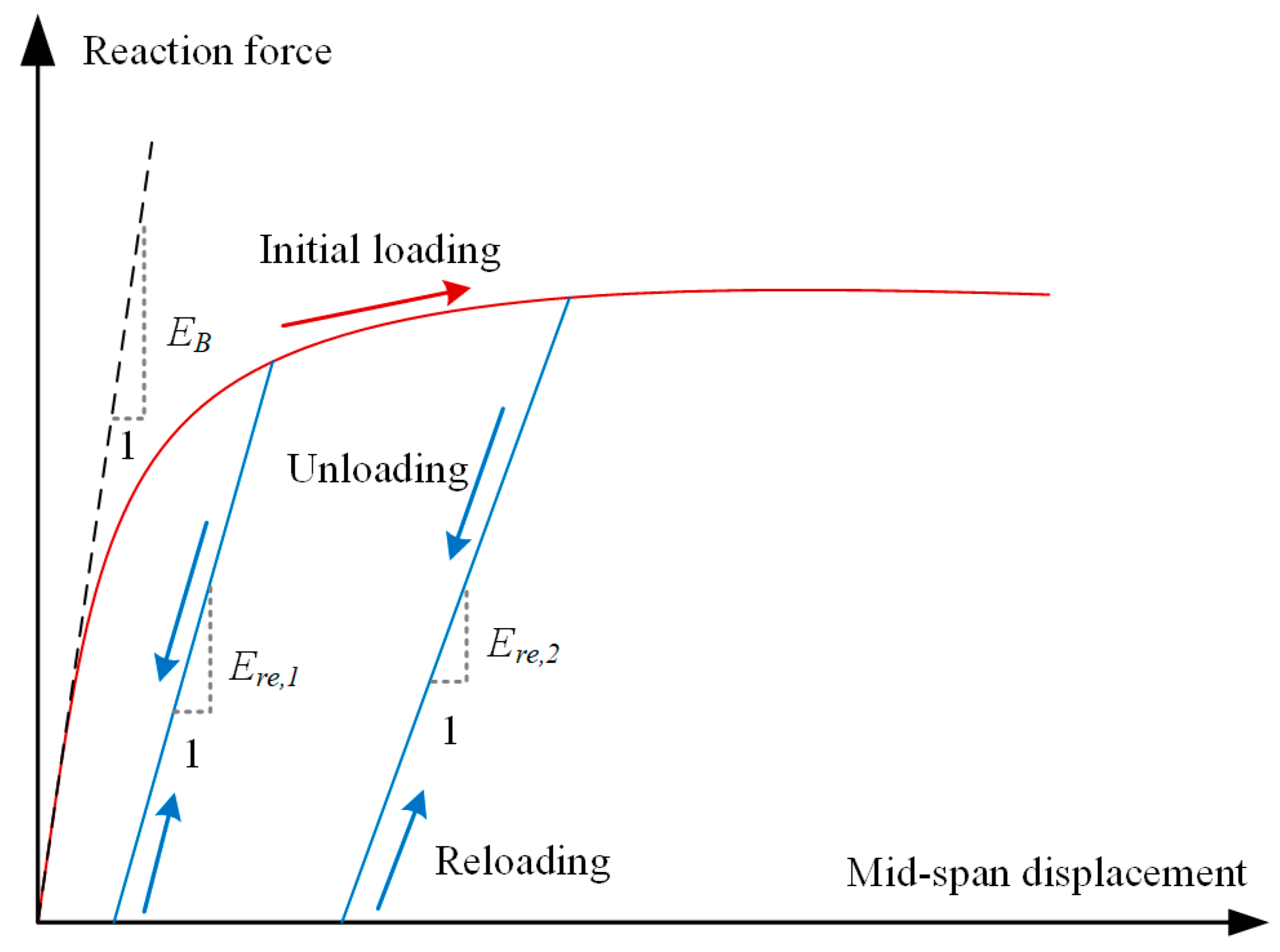
First, the static performance of the single beams throughout the loading process was analyzed. Figure 17 illustrates the typical mid-span load–displacement curves. With the exception of specimen L-7 (shear failure), all members exhibited characteristic under-reinforced flexural behavior with distinct yielding plateaus. Recognizing that in-service bridges typically operate in a cracked state, the reloading stiffness reflects the structural health more authentically than the initial tangent stiffness. Consequently, this study defined the service stiffness E r e as the slope of the reloading segment and the baseline stiffness E B as the secant of the initial 0~5 kN elastic segment. A stiffness degradation coefficient was then introduced to quantify damage evolution: γ E = E r e / E B .
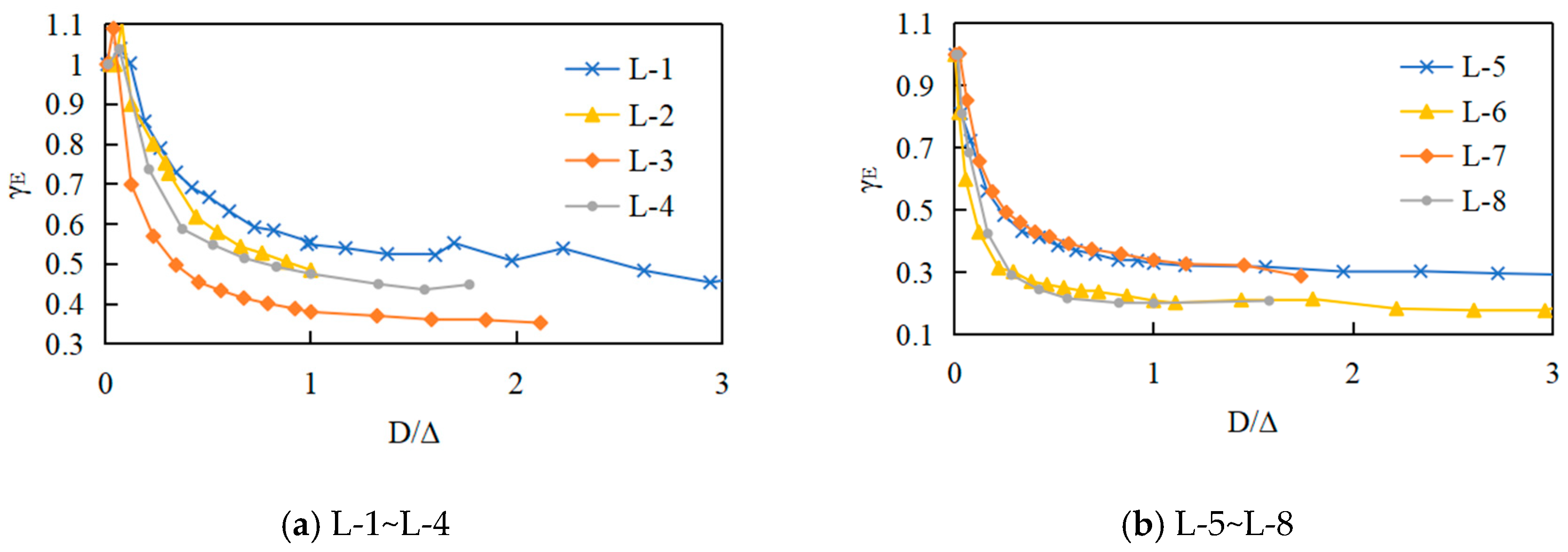
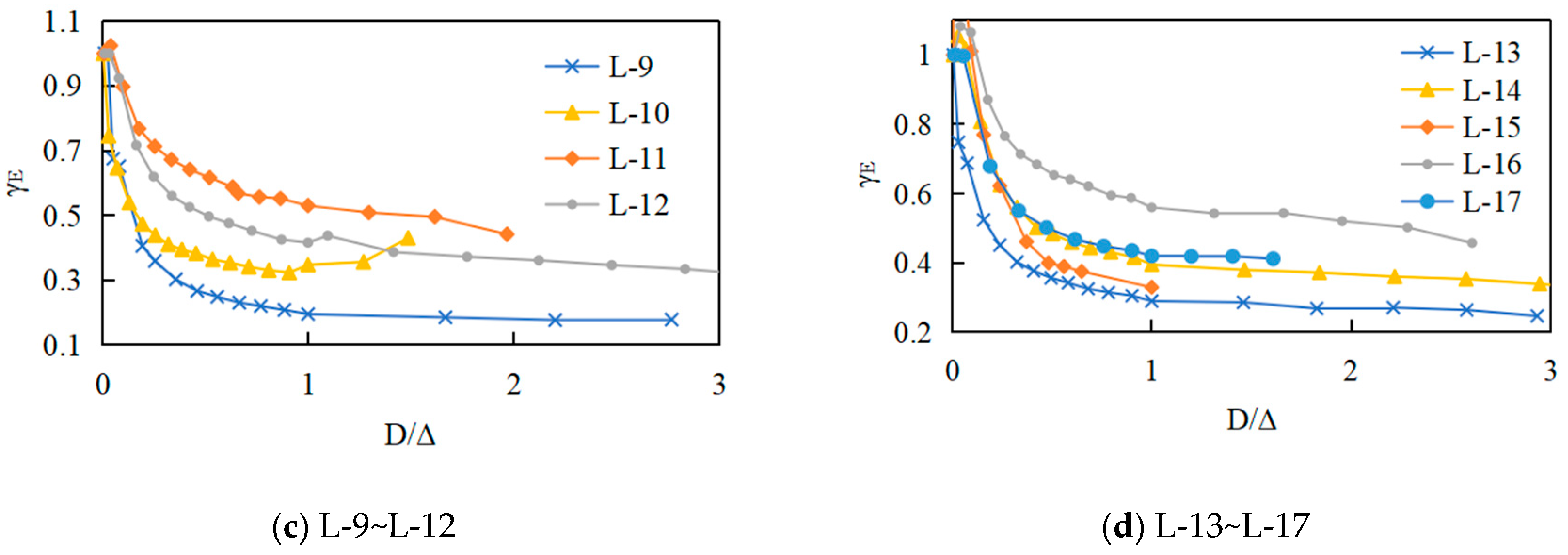
Figure 18 summarizes the evolution laws of γ E for all specimens, where D is the mid-span displacement and Δ is the mid-span displacement at yield. The results indicate that during the initial cracking stage of the concrete at the bottom of the beam, the abrupt change in the cross-sectional moment of inertia led to a significant decrease in stiffness. As cracks propagated toward the compression zone, γ E exhibited continuous nonlinear decay before yielding. Once the longitudinal reinforcement yielded, although the displacement increased sharply, the morphology of the main cracks tended to stabilize, causing the stiffness degradation coefficient to enter a plateau phase at a lower level.
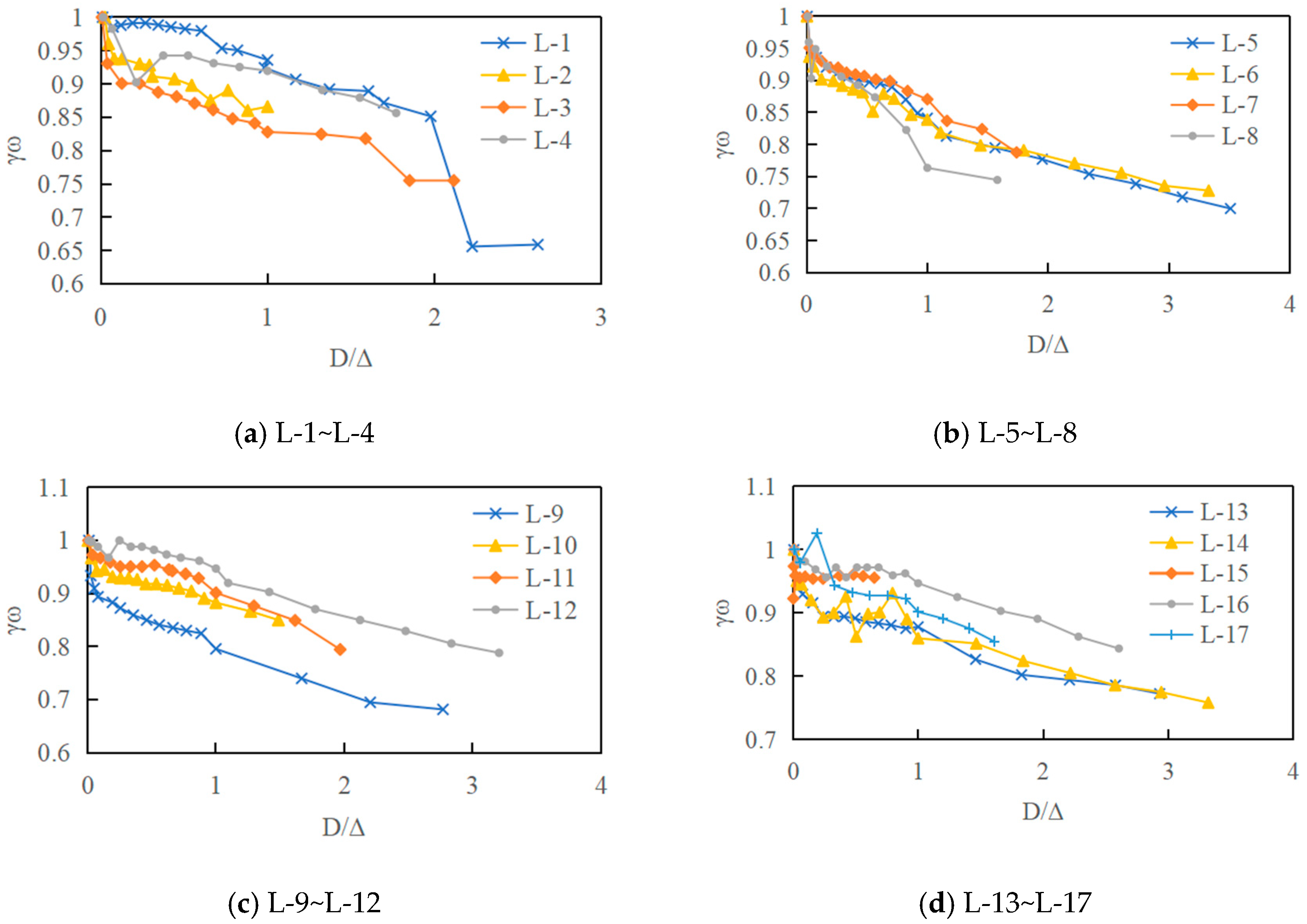
Next, the changes in dynamic performance during the full single-beam loading process were analyzed. Analogous to the stiffness behavior, the fundamental frequency of the beams decreases due to the accumulation of cracking damage. To quantify this evolution, a frequency degradation coefficient is defined as γ ω = ω / ω 0 , where ω and ω 0 represent the fundamental frequencies in the current unloaded state and the initial state, respectively. As illustrated in Figure 19, γ ω exhibited a consistent monotonic downward trend throughout the loading process for all test specimens.
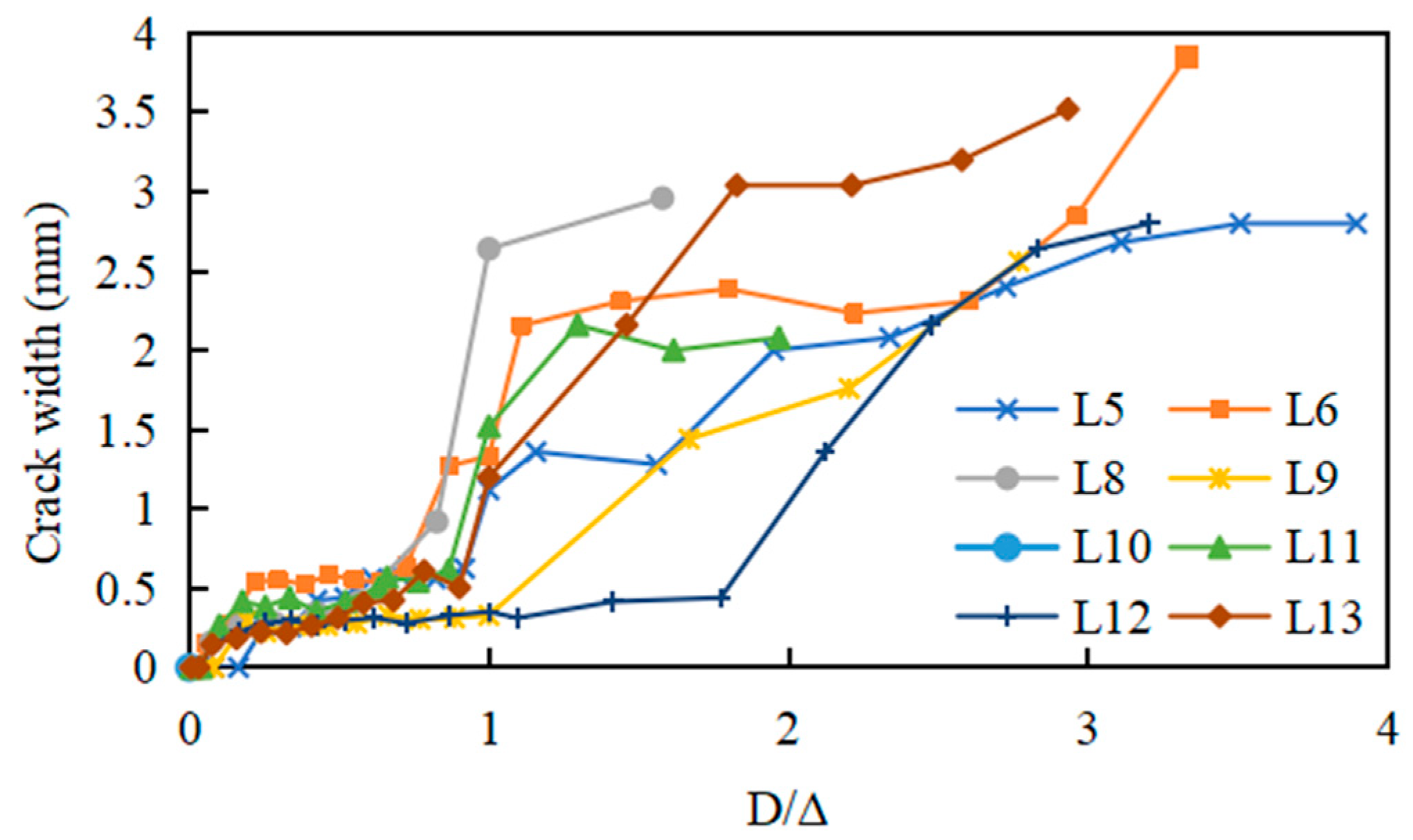
Finally, the crack development during the full single-beam loading process was analyzed. The crack identification and measurement algorithm proposed in Section 3 was employed to process the member surface images collected during the test. The variations in the average width of bottom cracks for selected members with the loading process are summarized in Figure 20.
Quantitative analysis of Figure 20 reveals a distinct bilinear evolution in crack width, with the turning point aligning with the reinforcement yield displacement. Post-yielding, crack width maintains a high linear growth rate throughout the plastic stage, in contrast to the stiffness degradation coefficient shown in Figure 18, which rapidly enters a saturation plateau. The implications of this sensitivity complementarity are discussed in Section 6.

5.4. Performance Evaluation Based on ANN Surrogate Model

Based on the trained ANN surrogate model, parameter updating was performed on the 17 test beams using the measured multi-source response vectors collected in Section 5.2. To account for the uniformity of material properties within the same casting batch and to eliminate random errors associated with individual updates, the arithmetic mean of the updated results for members of the same strength grade (e.g., the C40 group) was calculated. These averaged values were subsequently input into the finite element model as the final updated parameters. Specifically, the updated compressive strength for the primary C40 group (14 beams) converged to a mean of 45.4 MPa (CV: 6.8%), aligning well with actual material over-strength characteristics. Moreover, the updated strengths for the C30, C50, and C60 specimens were 35.7 MPa, 65.6 MPa, and 63.1 MPa, respectively, indicating that the method can capture the material over-strength and grade-level differences in the tested beams.
It should be noted that the concrete parameters identified by the ANN surrogate model are equivalent constitutive parameters for FE model updating, rather than direct replacements for standard cube compressive strengths. Standard cube tests characterize material-level strength under prescribed loading conditions, whereas the inverse analysis in this study identifies member-level parameters from static, dynamic, and crack-width responses. Therefore, the updated parameters may include the combined influence of actual material strength, cracking state, bond behavior, boundary condition, and modeling assumptions.
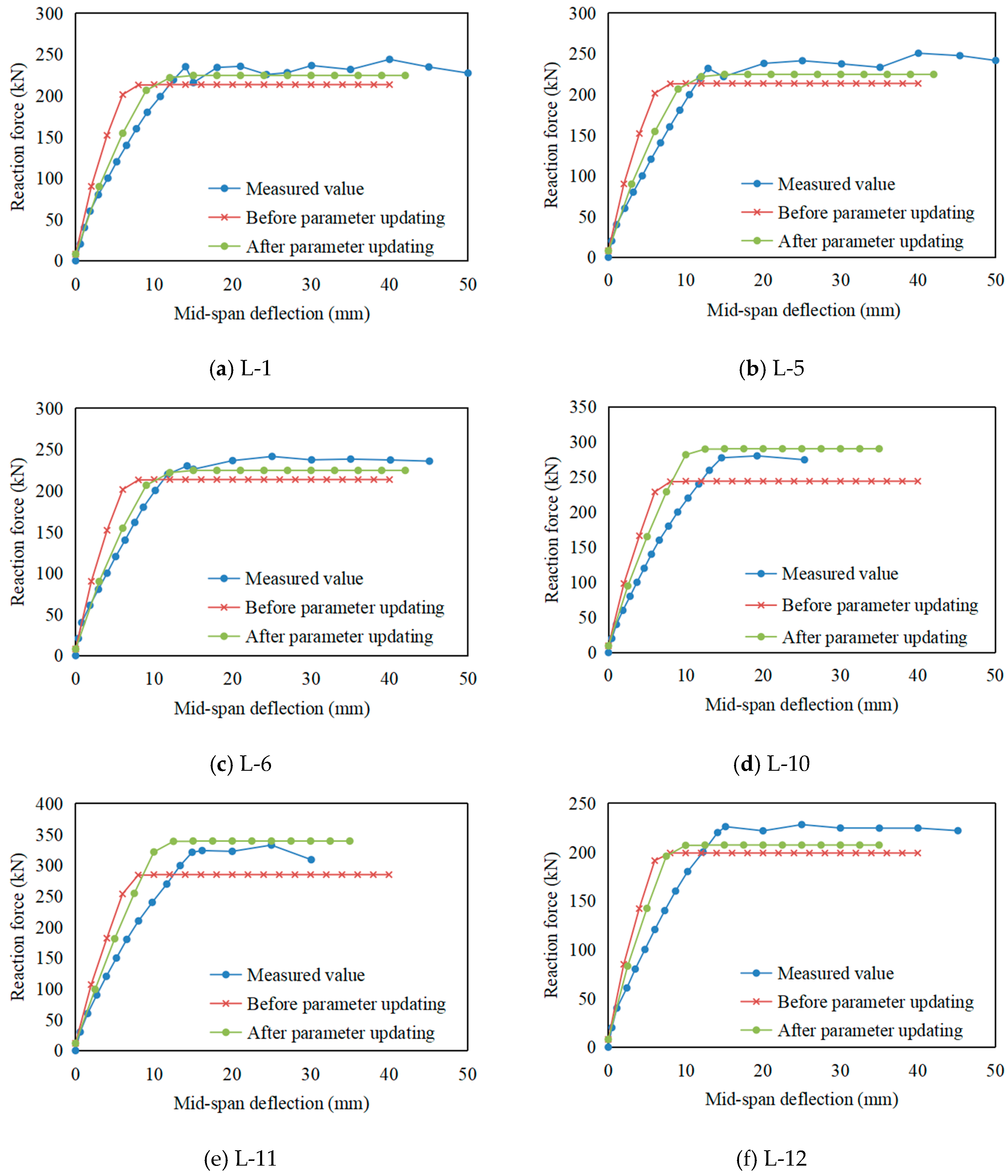
The updated parameters were substituted into the FE model for forward validation against experimental data. Representative specimens covering the primary variable gradients were selected for comparison in Figure 21. Results indicate that the initial model significantly underestimated ultimate bearing capacity due to the conservatism of standard code values. In contrast, the updated model exhibited high consistency with measured curves, reproducing the ultimate capacity and the main nonlinear response trends. This validates the proposed ANN-based method’s ability to capture the authentic material service state.
Notably, the stiffness of the updated numerical model during the cracked working stage was slightly higher than the experimental measured values. The source of this systematic deviation and its engineering implications are discussed in Section 6.

6. Discussion

The experimental and numerical results presented in Section 5 validate the proposed multi-source fusion framework. This section further discusses the key findings, methodological limitations, and potential extensions.

6.1. Sensitivity Complementarity Between Apparent Features and Mechanical Responses

A comparison of the stiffness evolution (Figure 18) and the crack-width evolution (Figure 20) reveals a pronounced sensitivity complementarity. Although crack width is commonly used as a serviceability and durability indicator, and a value around 0.5 mm is often treated as a practical warning threshold, the more critical insight in this study emerges from the post-yielding behavior. The stiffness degradation coefficient γ E rapidly enters a saturation plateau after reinforcement yielding, losing its sensitivity to further plastic deformation. In sharp contrast, crack width exhibits non-saturating sensitivity, maintaining a high linear growth rate throughout the plastic stage. This indicates that global indices such as stiffness and frequency are effective for identifying early-stage damage, whereas crack width is the dominant indicator for quantifying deep plastic accumulation and ultimate safety margins. This complementarity supports the necessity of the proposed multi-source fusion strategy, which ensures precise evaluation coverage from initial cracking to near-collapse states.
The average crack width is closely associated with flexural damage evolution and therefore has an indirect relationship with the load-carrying capacity of RC beams. However, ultimate bearing capacity is jointly controlled by reinforcement ratio, concrete strength, span, boundary conditions, and failure mode; thus, crack width alone cannot provide a unique prediction of capacity. In the proposed framework, average crack width is therefore used as a damage-sensitive feature fused with static and dynamic responses, allowing the ANN surrogate model to establish a more reliable relationship between apparent damage and mechanical performance.

6.2. Sources of Model Deviation

As observed in Figure 21, the stiffness of the updated numerical model during the cracked working stage was slightly higher than the experimental measurements. The deviations in the updated numerical results may arise from several sources, including material variability, image quality and crack-width extraction error, sensor measurement noise, and finite element modeling assumptions. Among these factors, the slight overestimation of cracked-stage stiffness is mainly attributed to the inherent characteristics of the smeared crack model employed in the FE analysis, which simulates cracking by softening the material constitutive laws at integration points. This averaging treatment within continuum mechanics cannot fully reproduce the local curvature concentration effects caused by discrete crack tips. Despite this minor stiffness deviation, the prediction accuracy for the core structural safety indicator—bearing capacity—meets the requirements for engineering evaluation, thereby confirming the engineering applicability of the proposed framework.

6.3. Limitations and Future Work

Several limitations and future extensions should be noted. First, the present validation is based on simply supported RC beam specimens dominated by flexural behavior. For cases involving shear-dominated damage or structural systems such as continuous beams, transfer girders, and field bridge structures with more complex boundary conditions and load redistribution mechanisms, the proposed framework can be extended by reconstructing the FE simulation database and redefining the corresponding response feature vector.
Second, although the hybrid field-laboratory image dataset improves the robustness of CGDL-Crack against typical crack-like interferences, its scale remains limited. Future work may expand the dataset, introduce external test sets, and conduct benchmarking against representative segmentation networks under more diverse illumination, surface texture, and environmental conditions.
Third, the crack-width index extracted from images serves as a damage-sensitive geometric descriptor in the multi-source input vector. For field deployment, calibration against high-precision measurements such as DIC or microscope-based manual measurements would further improve the traceability and uncertainty assessment of crack-width quantification.
Finally, future studies may further enhance the proposed framework by incorporating probabilistic analysis, richer dynamic features such as mode shapes and damping ratios, and more refined crack models such as cohesive crack models or XFEM, thereby improving its capability for reliability-oriented structural evaluation.

7. Conclusions

To bridge the gap between apparent defects and mechanical performance of RC beam structures, this study proposes a multi-source evaluation framework fusing crack features with static and dynamic responses. The main conclusions are:
  • The proposed CGDL-Crack framework, leveraging grid-based prediction and transfer learning, achieves robust crack localization under complex field-laboratory backgrounds. Combined with skeleton extraction, it effectively converts unstructured images into quantitative geometric indices (e.g., crack width), providing reliable apparent-damage inputs for mechanical performance evaluation;
  • A nonlinear parameter inversion mechanism based on Sobol sensitivity analysis and an ANN surrogate model was established. By fusing design priors, static responses, modal frequencies, and crack-width indices, the model enables efficient identification of concrete constitutive parameters and provides a computationally efficient approach for FE model updating;
  • Experimental results on 17 RC beams reveal a sensitivity complementarity: while stiffness indices saturate post-yielding, crack width exhibits non-saturating bilinear growth, serving as a sensitive indicator for post-yield damage evolution. The updated FE model demonstrates high fidelity in predicting ultimate bearing capacity and nonlinear evolution, confirming the effectiveness of the proposed framework for quantitative service performance evaluation of RC beam structures.

Author Contributions

Conceptualization, Y.L. and L.Y.; Methodology, C.F. and Y.L.; Software, C.F. and H.F.; Validation, H.F. and L.Y.; Formal Analysis, H.F.; Investigation, C.F. and H.F.; Resources, Y.L. and L.Y.; Data Curation, C.F.; Writing—Original Draft Preparation, C.F. and H.F.; Writing—Review & Editing, Y.L. and L.Y.; Visualization, C.F. and H.F.; Supervision, Y.L.; Project Administration, Y.L.; Funding Acquisition, Y.L. All authors have read and agreed to the published version of the manuscript.

Funding

This research was funded by the National Natural Science Foundation of China, grant number 52522807.

Data Availability Statement

The data presented in this study are available on request from the corresponding author due to the large volume of raw experimental images and finite element simulation files, which are not suitable for repository hosting in their current form.

Acknowledgments

The authors express their sincere appreciation to the National Natural Science Foundation of China for its support. During the preparation of this manuscript, the authors used Gemini 3.0 pro for the purposes of translating and polishing the language of specific paragraphs to improve readability. The authors have reviewed and edited the output and take full responsibility for the content of this publication.

Conflicts of Interest

The authors declare no conflicts of interest.

References

  1. Editorial Department of China Journal of Highway and Transport. Review on China’s Bridge Engineering Research: 2024. China J. Highw. Transp. 2024, 37, 1–160. (In Chinese) [Google Scholar] [CrossRef]
  2. He, S.; Wang, A.; Zhu, Z.; Zhao, Y. Research Progress on Intelligent Detection Technologies for Highway Bridges. China J. Highw. Transp. 2021, 34, 12–24. (In Chinese) [Google Scholar] [CrossRef]
  3. He, S.; Zhao, X.; Ma, J.; Zhao, Y.; Song, H.; Song, H.; Cheng, L.; Yuan, Z.; Huang, F.; Zhang, J.; et al. Review of Highway Bridge Inspection and Condition Assessment. China J. Highw. Transp. 2017, 30, 63–80. (In Chinese) [Google Scholar] [CrossRef]
  4. Xu, F.; Zhang, M.; Wang, L.; Zhang, J. Recent Highway Bridge Collapses in China: Review and Discussion. J. Perform. Constr. Facil. 2016, 30, 04016030. [Google Scholar] [CrossRef]
  5. Han, L.; Fan, J. Analysis and Reflection on Bridge Collapse Accidents in China in Recent Years. Highway 2013, 124–127. (In Chinese) [Google Scholar]
  6. Liu, Y.; Feng, C.; Chen, W.; Fan, J. Review of Bridge Apparent Defect Inspection Based on Machine Vision. China J. Highw. Transp. 2024, 37, 1–15. (In Chinese) [Google Scholar] [CrossRef]
  7. Zhang, J.; Jin, J.; Wang, Y.; Zhou, W.; Liu, Z. Study Progress of Intelligent Inspection Technology and Equipment for Highway Bridge. J. Highw. Transp. Res. Dev. 2023, 40, 1–27+58. (In Chinese) [Google Scholar] [CrossRef]
  8. Graybeal, B.A.; Phares, B.M.; Rolander, D.D.; Moore, M.; Washer, G. Visual Inspection of Highway Bridges. J. Nondestruct. Eval. 2002, 21, 67–83. [Google Scholar] [CrossRef]
  9. Feng, H.; Liu, Y.; Liu, X.; Liu, C. Research on Two-Stage Identification Algorithm of Bridge Cracks Based on Convolutional Neural Network. Eng. Mech. 2025; in press. (In Chinese). [CrossRef]
  10. Ministry of Transport of the People’s Republic of China. Standards for Technical Condition Evaluation for Highway Bridges (JTG/T H21-2011); Ministry of Transport: Beijing, China, 2011. (In Chinese)
  11. Niblack, W. An Introduction to Digital Image Processing; Strandberg Publishing Company: Copenhagen, Denmark, 1985. [Google Scholar]
  12. Liu, Y.; Fan, J.; Tao, M. Crack Detection on Concrete Surfaces Using Digital Image Processing. J. Build. Struct. 2014, 35, 356–361. (In Chinese) [Google Scholar] [CrossRef]
  13. Alekseychuk, O. Detection of Crack-Like Indications in Digital Radiography by Global Optimisation of a Probabilistic Estimation Function; BAM Dissertationsreihe; Bundesanstalt für Materialforschung und -prüfung (BAM): Berlin, Germany, 2006; Volume 18. [Google Scholar]
  14. Huang, Y.; Tsai, Y. Dynamic Programming and Connected Component Analysis for an Enhanced Pavement Distress Segmentation Algorithm. Transp. Res. Rec. 2011, 2225, 89–98. [Google Scholar] [CrossRef]
  15. Shan, T.; Wang, S.; Zhang, X.; Jiao, L. Automatic Image Enhancement Driven by Evolution Based on Ridgelet Frame in the Presence of Noise. In Workshops on Applications of Evolutionary Computation, Proceedings of the EvoWorkshops 2005, Lausanne, Switzerland, 30 March–1 April 2005; Springer: Berlin/Heidelberg, Germany, 2005; pp. 304–313. [Google Scholar] [CrossRef]
  16. Li, X.; Jiang, H.; Yin, G. Detection of Surface Crack Defects on Ferrite Magnetic Tile. NDT E Int. 2014, 62, 6–13. [Google Scholar] [CrossRef]
  17. Liu, Y.; Fan, J.; Nie, J.; Kong, S.; Qi, Y. Review and Prospect of Digital-Image-Based Crack Detection of Structure Surface. China Civ. Eng. J. 2021, 54, 79–98. (In Chinese) [Google Scholar] [CrossRef]
  18. Hüthwohl, P.; Lu, R.; Brilakis, I. Multi-Classifier for Reinforced Concrete Bridge Defects. Autom. Constr. 2019, 105, 102824. [Google Scholar] [CrossRef]
  19. Yue, Q.; Xu, G.; Liu, X. Crack Intelligent Recognition and Bridge Monitoring Methods. China J. Highw. Transp. 2024, 37, 16–28. (In Chinese) [Google Scholar] [CrossRef]
  20. Yu, J.; Liu, B.; Yin, D.; Gao, W.; Xie, Y. Intelligent Identification and Measurement of Bridge Cracks Based on YOLOv5 and U-Net3+. J. Hunan Univ. (Nat. Sci.) 2023, 50, 65–73. (In Chinese) [Google Scholar] [CrossRef]
  21. Akgül, İ. Mobile-DenseNet: Detection of Building Concrete Surface Cracks Using a New Fusion Technique Based on Deep Learning. Heliyon 2023, 9, 10. [Google Scholar] [CrossRef] [PubMed]
  22. Jin, T.; Zhang, W.; Chen, C.; Chen, B.; Zhuang, Y.; Zhang, H. Deep-Learning- and Unmanned Aerial Vehicle-Based Structural Crack Detection in Concrete. Buildings 2023, 13, 3114. [Google Scholar] [CrossRef]
  23. Tran, T.S.; Nguyen, S.D.; Lee, H.J.; Tran, V.P. Advanced Crack Detection and Segmentation on Bridge Decks Using Deep Learning. Constr. Build. Mater. 2023, 400, 132839. [Google Scholar] [CrossRef]
  24. Liu, Y.; Nie, X.; Fan, J.; Liu, X. Image-Based Crack Assessment of Bridge Piers Using Unmanned Aerial Vehicles and Three-Dimensional Scene Reconstruction. Comput.-Aided Civ. Infrastruct. Eng. 2020, 35, 511–529. [Google Scholar] [CrossRef]
  25. Bolourian, N.; Hammad, A. LiDAR-Equipped UAV Path Planning Considering Potential Locations of Defects for Bridge Inspection. Autom. Constr. 2020, 117, 103250. [Google Scholar] [CrossRef]
  26. Morgenthal, G.; Hallermann, N.; Kersten, J.; Taraben, J.; Debus, P.; Helmrich, M.; Rodehorst, V. Framework for Automated UAS-Based Structural Condition Assessment of Bridges. Autom. Constr. 2019, 97, 77–95. [Google Scholar] [CrossRef]
  27. Liu, L.; Zheng, D.; Zhou, J.; Yang, J.; Zhang, H. Parameters That Influence Corrosion Detection in Reinforced Concrete Based on Eddy Current Thermography. Adv. Civ. Eng. 2020, 2020, 7962945. [Google Scholar] [CrossRef]
  28. Kaur, N.; Goyal, S.; Anand, K.; Sahu, G.K. A Cost-Effective Approach for Assessment of Pre-Stressing Force in Bridges Using Piezoelectric Transducers. Measurement 2021, 168, 108324. [Google Scholar] [CrossRef]
  29. Jin, Z.; Sam, M.A.I.M.N.; Oogane, M.; Ando, Y. Serial MTJ-Based TMR Sensors in Bridge Configuration for Detection of Fractured Steel Bar in Magnetic Flux Leakage Testing. Sensors 2021, 21, 668. [Google Scholar] [CrossRef]
  30. Maser, K.; Martino, N.; Doughty, J.; Birken, R. Understanding and Detecting Bridge Deck Deterioration with Ground-Penetrating Radar. Transp. Res. Rec. 2012, 2313, 116–123. [Google Scholar] [CrossRef]
  31. Zhang, Z.; He, L.; Xue, J.; Chen, M.; Huang, F.; Marano, G.C.; Briseghella, B. Refined Baseline Finite Element Model of a Three-Span Integral Abutment Bridge by Using Operational Modal Data. J. Fuzhou Univ. (Nat. Sci. Ed.) 2022, 50, 228–236. (In Chinese) [Google Scholar] [CrossRef]
  32. Qin, S.; Zhou, Y.-L.; Cao, H.; Wahab, M.A. Model Updating in Complex Bridge Structures Using Kriging Model Ensemble with Genetic Algorithm. KSCE J. Civ. Eng. 2018, 22, 3567–3578. [Google Scholar] [CrossRef]
  33. Hasançebi, O.; Dumlupınar, T. Linear and Nonlinear Model Updating of Reinforced Concrete T-Beam Bridges Using Artificial Neural Networks. Comput. Struct. 2013, 119, 1–11. [Google Scholar] [CrossRef]
  34. Wei, X.-C.; Liu, Y.-F.; Fan, J.-S.; Liu, X.-G.; Kong, S.-Y. Safety Assessment of Existing Pin-Jointed Grid Structures with Crooked Members Using Static Model Updating. Eng. Struct. 2021, 247, 113107. [Google Scholar] [CrossRef]
  35. Hou, R.; Xia, Y. Review on the New Development of Vibration-Based Damage Identification for Civil Engineering Structures: 2010–2019. J. Sound Vib. 2021, 491, 115741. [Google Scholar] [CrossRef]
  36. Xiao, J.-L.; Nie, X.; Liu, Y.-F.; Fan, J.-S. Structural Performance Assessment of RC Flexural Members through Crack-Based Fibre Beam-Column Model Updating. Comput. Struct. 2023, 281, 107029. [Google Scholar] [CrossRef]
  37. Yang, W. Influence of Temperature and Shear Deformation on Performance Parameters of Rubber Bearing. Master’s Thesis, Huazhong University of Science and Technology, Wuhan, China, 2013. (In Chinese) [Google Scholar]
  38. Lu, P.; Li, D.; Shi, Q.; Chen, Y. Prediction Method of Static Load Test Results of Variable Section Bridge Based on Dynamic Load Test Data. China J. Highw. Transp. 2022, 35, 213–221. (In Chinese) [Google Scholar] [CrossRef]
  39. Zong, Z.; Xia, Z. Finite Element Model Updating Method for Bridge Combined Modal Flexibility and Static Displacement. China J. Highw. Transp. 2008, 21, 43–49. (In Chinese) [Google Scholar] [CrossRef]
  40. Tang, Y.; Yue, J.; Hua, X. Local Stiffness Correction for Finite Element Model of Bridge by Employing Artificial Bee Colony Algorithm. J. Railw. Sci. Eng. 2021, 18, 2333–2343. (In Chinese) [Google Scholar] [CrossRef]
  41. Xu, X.; Hong, Y.; Xu, J.; Zhou, Z.; Pu, Q.; Wen, X. Finite Element Model Updating for Bridges Based on Adaptive Nested Sampling and Bayesian Theory. J. Southwest Jiaotong Univ. 2025, 60, 503–512. (In Chinese) [Google Scholar] [CrossRef]
  42. Yang, S.; Liu, B.; Yang, M.; Li, P. Effect of Environmental Temperature and Boundary Conditions on Concrete Beam Bridges’ Natural Frequency. J. Vib. Shock 2017, 36, 164–172. (In Chinese) [Google Scholar] [CrossRef]
  43. Wang, J.; Liu, C.; Nie, X.; Fan, J.; Zhu, Y. Nonlinear Model Updating Algorithm for Biaxial Reinforced Concrete Constitutive Models of Shear Walls. J. Build. Eng. 2021, 44, 103215. [Google Scholar] [CrossRef]
  44. Shahmansouri, A.A.; Jafari, A.; Akbarzadeh Bengar, H.; Zhou, Y.; Taciroglu, E. A scaling-based generalizable integrated ML-mechanics model for lateral response of self-centering walls. Eng. Struct. 2025, 336, 120326. [Google Scholar] [CrossRef]
  45. Li, B.; Qi, Y.; Fan, J.; Liu, Y.; Liu, C. A Grid-Based Classification and Box-Based Detection Fusion Model for Asphalt Pavement Crack. Comput.-Aided Civ. Infrastruct. Eng. 2023, 38, 2279–2299. [Google Scholar] [CrossRef]
  46. Khanam, R.; Hussain, M. What Is YOLOv5: A Deep Look into the Internal Features of the Popular Object Detector. arXiv 2024, arXiv:2407.20892. [Google Scholar] [CrossRef]
  47. He, K.; Zhang, X.; Ren, S.; Sun, J. Deep Residual Learning for Image Recognition. In Proceedings of the 2016 IEEE Conference on Computer Vision and Pattern Recognition (CVPR), Las Vegas, NV, USA, 27–30 June 2016; IEEE: Piscataway, NJ, USA, 2016; pp. 770–778. [Google Scholar] [CrossRef]
  48. Pan, S.J.; Yang, Q. A Survey on Transfer Learning. IEEE Trans. Knowl. Data Eng. 2010, 22, 1345–1359. [Google Scholar] [CrossRef]
  49. Otsu, N. A Threshold Selection Method from Gray-Level Histograms. Automatica 1975, 11, 23–27. [Google Scholar] [CrossRef]
  50. Mander, J.B.; Priestley, M.J.N.; Park, R. Theoretical Stress-Strain Model for Confined Concrete. J. Struct. Eng. 1988, 114, 1804–1826. [Google Scholar] [CrossRef]
  51. Belarbi, A.; Hsu, T.T.C. Constitutive Laws of Concrete in Tension and Reinforcing Bars Stiffened by Concrete. ACI Struct. J. 1994, 91, 465–474. [Google Scholar] [CrossRef] [PubMed]
Figure 1. Technical framework of this study.
Buildings 16 02189 g001
Figure 2. CGDL-Crack model architecture.
Buildings 16 02189 g002
Figure 3. CGDL-Crack effectively excludes background interference.
Buildings 16 02189 g003
Figure 4. Interferences on the structural surface in a laboratory environment.
Buildings 16 02189 g004
Figure 5. Flowchart of the transfer learning process.
Buildings 16 02189 g005
Figure 6. Comparison of training metric evolution under different strategies.
Buildings 16 02189 g006
Figure 7. Typical results of crack identification, binarization, and measurement processing.
Buildings 16 02189 g007
Figure 8. Constitutive relationship curves of concrete and steel.
Buildings 16 02189 g008
Figure 9. Calculation method for effective tensile area.
Buildings 16 02189 g009
Figure 10. Sensitivity analysis between member parameters and response indices.
Buildings 16 02189 g010
Figure 11. Architecture of the ANN surrogate model.
Buildings 16 02189 g011
Figure 12. Variation in loss values during surrogate model training.
Buildings 16 02189 g012
Figure 13. Error distribution of the surrogate model on the test set.
Buildings 16 02189 g013
Figure 14. Test setup and loading/measurement scheme.
Buildings 16 02189 g014
Figure 15. Load–displacement curves and final failure patterns of typical beam members.
Buildings 16 02189 g015
Figure 16. Dynamic measurement waveforms and corresponding spectrum of beam L-1 during loading.
Buildings 16 02189 g016
Figure 17. Schematic diagram of reaction force-mid-span displacement curves under cyclic loading.
Buildings 16 02189 g017
Figure 18. Variation in stiffness degradation coefficients of test beams with the loading process.
Buildings 16 02189 g018aBuildings 16 02189 g018b
Figure 19. Variation in first-order frequency degradation coefficients of test beams with the loading process.
Buildings 16 02189 g019
Figure 20. Variation in average width of bottom cracks with the loading process.
Buildings 16 02189 g020
Figure 21. Comparison of FE simulation results before and after parameter updating with experimental load–displacement curves for typical specimens.
Buildings 16 02189 g021
Table 1. Summary of CGDL-Crack training dataset.
AttributeValue
Total Images600
Image Resolution640 × 640 × 3
Crack Grid Labels14,614
Interference Grid Labels8009
Table 2. Batch modeling parameter value scheme.
ParameterValue DistributionCount
Concrete compressive strength f c 30~60 MPa4
Concrete tensile strength f t 0.6~1.4 ×   f t , m  15
Concrete elastic modulus E c 0.8~1.2 ×   E c , m  25
Steel yield strength f y 0.8~1.2 ×   f y , 0  35
Reinforcement ratio ρ 0.5%~1.5%3
Span of the beam L 1600/2400/3200/4000/4800 mm5
1  f t , m is the theoretical mean tensile strength derived from f c (standard power function relation). 2  E c , m is the theoretical mean elastic modulus derived from the Mander model parameters. 3  f y , 0 is the baseline yield strength of steel, taken as 400 MPa.
Table 3. Details of RC beam specimens.
Specimen IDSpan (mm)Stirrup Spacing
(mm)
Longitudinal ReinforcementConcrete GradeSupport TypeRemark (Variable)
L-13200100 3 Φ 22 C40Pin-RollerControl Group
L-21600100 3 Φ 22 C40Pin-RollerSpan-to-Depth Ratio
L-34000100 3 Φ 22 C40Pin-RollerSpan-to-Depth Ratio
L-44800100 3 Φ 22 C40Pin-RollerSpan-to-Depth Ratio
L-5320050 3 Φ 22 C40Pin-RollerStirrup Ratio
L-63200150 3 Φ 22 C40Pin-RollerStirrup Ratio
L-73200200 3 Φ 22 C40Pin-RollerStirrup Ratio
L-83200100 2 Φ 16 C40Pin-RollerReinforcement Ratio
L-93200100 3 Φ 16 C40Pin-RollerReinforcement Ratio
L-103200100 3 Φ 25 C40Pin-RollerReinforcement Ratio
L-113200100 3 Φ 28 C40Pin-RollerReinforcement Ratio
L-123200100 3 Φ 22 C30Pin-RollerConcrete Strength
L-133200100 3 Φ 22 C50Pin-RollerConcrete Strength
L-143200100 3 Φ 22 C60Pin-RollerConcrete Strength
L-151600100 3 Φ 22 C40RubberSupport Condition
L-164000100 3 Φ 22 C40RubberSupport Condition
L-174800100 3 Φ 22 C40RubberSupport Condition
Disclaimer/Publisher’s Note: The statements, opinions and data contained in all publications are solely those of the individual author(s) and contributor(s) and not of MDPI and/or the editor(s). MDPI and/or the editor(s) disclaim responsibility for any injury to people or property resulting from any ideas, methods, instructions or products referred to in the content.