Article

Prediction and Interpretation of Shear Capacity of FRP-RC Beams Using Heterogeneous Weighted Ensemble Model and Shapley Additive Explanation Analysis

1
School of Civil and Architectural Engineering, Guangxi University of Science and Technology, Liuzhou 545006, China
2
University Engineering Research Center of Digital and Intelligent Construction and Management, Liuzhou 545006, China
3
College of Information Science and Technology, Zhengzhou Normal University, Zhengzhou 450044, China
*
Author to whom correspondence should be addressed.
Buildings 2026, 16(11), 2162; https://doi.org/10.3390/buildings16112162
Submission received: 18 April 2026 / Revised: 19 May 2026 / Accepted: 25 May 2026 / Published: 28 May 2026
(This article belongs to the Section Building Structures)

Abstract

To accurately predict the shear capacity of fiber-reinforced polymer (FRP) bar-reinforced concrete (RC) beams and overcome the poor prediction stability of conventional machine learning models, this study develops and trains a heterogeneous weighted ensemble prediction model, namely the MLP-XGBoost model, by integrating the Multi-Layer Perceptron (MLP) and Extreme Gradient Boosting (XGBoost) algorithms. A comparative analysis was conducted among the MLP-XGBoost model, conventional baseline models, and traditional empirical formulas in this study. The results demonstrate that all machine learning models outperform traditional empirical formulas in predictive accuracy, while among these machine learning models, the MLP-XGBoost model proposed in this study exhibits the optimal performance in both accuracy and stability. Furthermore, to address the “black-box” nature of machine learning models, this study employs the Shapley Additive Explanations (SHAP) method to quantitatively assess the contribution of each input feature to the shear capacity of FRP-RC beams. A prediction formula for the shear capacity of FRP-reinforced concrete beams with high predictive accuracy, based on the interpretable results of SHAP analysis. This approach provides a more reliable tool for evaluating the shear performance of FRP-RC beams and offers valuable guidance for the optimal design of engineering structures.

1. Introduction

Fiber-Reinforced Polymer (FRP) bars, known for their advantages such as light weight, high strength, and excellent corrosion resistance, have been widely adopted as internal longitudinal tensile reinforcement in concrete beams [1,2,3]. However, compared to steel bars, FRP bars have lower axial stiffness, which weakens their dowel action and reduces the crack resistance of FRP-RC beams under shear loading, making them more susceptible to brittle failure [4,5,6]. Therefore, understanding the mechanical behavior of FRP-RC beams under shear loading and accurately predicting their shear capacity is crucial for advancing the use of FRP bars in structural engineering, as well as ensuring the reliable design and performance evaluation of FRP-RC beams.
Although extensive experimental and theoretical research has been conducted on the shear behavior of beam members, most existing predictive formulas still rely on empirical derivations, limiting their predictive effectiveness [7]. Among the current prediction methods, models based on the mechanical properties of materials often require complex iterative calculations due to the highly nonlinear interactions among parameters [8,9,10]. This complexity makes these models difficult to apply in practical engineering calculations [11,12,13]. In contrast, the empirical formula method offers a straightforward calculation process and has been incorporated into several standards and codes [14,15]. However, it fails to fully capture the load-transfer mechanism of beams. Therefore, developing shear capacity prediction models that combine mechanical interpretability with excellent predictive accuracy remains a critical area for further research.
The rise of data-driven machine learning (ML), fueled by advancements in artificial intelligence, has led to its growing application in addressing complex structural engineering problems. ML techniques excel at capturing intricate relationships between input and output variables, enabling the development of robust and accurate predictive models [16,17,18,19,20]. Machine learning has been applied to various scenarios, including, but not limited to, predicting the load capacity and failure modes of RC walls and columns [21,22,23], estimating the shear capacity of conventional RC beams [24,25,26], assessing the delamination of concrete surface layers [27], evaluating the bond strength between concrete and longitudinal reinforcement [28], analyzing seismic damage in RC structures and bridges [29,30,31], and forecasting the mechanical properties of concrete [32]. Owing to its powerful predictive capability and demonstrated success, ML technology has been widely employed in studies on the shear behavior of beam components, as evidenced by the existing literature. To predict the shear capacity of FRP-reinforced concrete beams without stirrups, Alam et al. [33] developed a hybrid model integrating Support Vector Regression with a Bayesian optimization algorithm. Trained on a database of 216 samples with a shear span-to-depth ratio (a/d) greater than 2.5, the model achieved a coefficient of determination (R2) of 0.9773, demonstrating excellent agreement with experimental results. Phan Duy et al. [34]. proposed an extended Beam Arch Action (BAA) model to predict the shear capacity of deep FRP-RC beams without stirrups. This hybrid approach integrates mechanical modeling with data-driven analysis. By employing constrained optimization, they derived correction factors for arch action. Additionally, two data-driven models, namely M5P and Artificial Neural Network (ANN), were employed as benchmark models for validating the extended BAA model. The results demonstrated that the extended model achieved higher predictive accuracy than conventional machine learning models. Zhao Jitao et al. [35] utilized two algorithms, Artificial Neural Network (ANN) and XGBoost, to construct a shear capacity prediction model for FRP-RC beams based on 455 sets of experimental data. The prediction results of the model were compared with the calculated values from three code-specified formulas. The results demonstrate that the predictive accuracy of the machine learning model is significantly superior to that of the current code formulas, with the R2 of ANN and XGBoost on the test set reaching 0.877 and 0.879, respectively.
Although ML techniques have demonstrated great potential in predicting the shear capacity of FRP-RC beams, clear technical gaps remain in current research. Conventional ML models can improve fitting ability, but their prediction stability and generalization performance are highly sensitive to hyperparameters and data fluctuations. Existing ensemble methods mostly rely on simple averaging or voting strategies, which neither achieve dynamic optimal fusion of complementary models tailored to the characteristics of FRP-RC shear problems nor focus on the weighted ensemble of heterogeneous models. As a result, it is difficult to overcome the performance bottleneck of conventional models through complementary advantages, and the demand for highly accurate and strongly generalizable prediction models in engineering practice remains unmet.
This study aims to propose a shear capacity prediction method for FRP-RC beams with both interpretability and high accuracy. To this end, the researchers constructed a database containing 634 sets of shear test data of FRP-RC beams. The comprehensive performance of five ML models was trained and evaluated, and through a thorough comparison, MLP and XGBoost were selected as the base learners. By adaptively weighting and fusing the prediction results of the two models, an MLP-XGBoost ensemble model was established to balance prediction accuracy and stability. To clarify the contribution degree of each input feature to the shear capacity and break the “black-box” limitation of the machine learning model, this study adopted the Shapley Additive Explanations (SHAP) method to interpret the model. Furthermore, based on the SHAP analysis results and the mechanical model of shear capacity, a mechanically interpretable prediction formula for the shear capacity of FRP-RC beams was proposed in this study.

2. Database

2.1. Feature Selection and Database Development

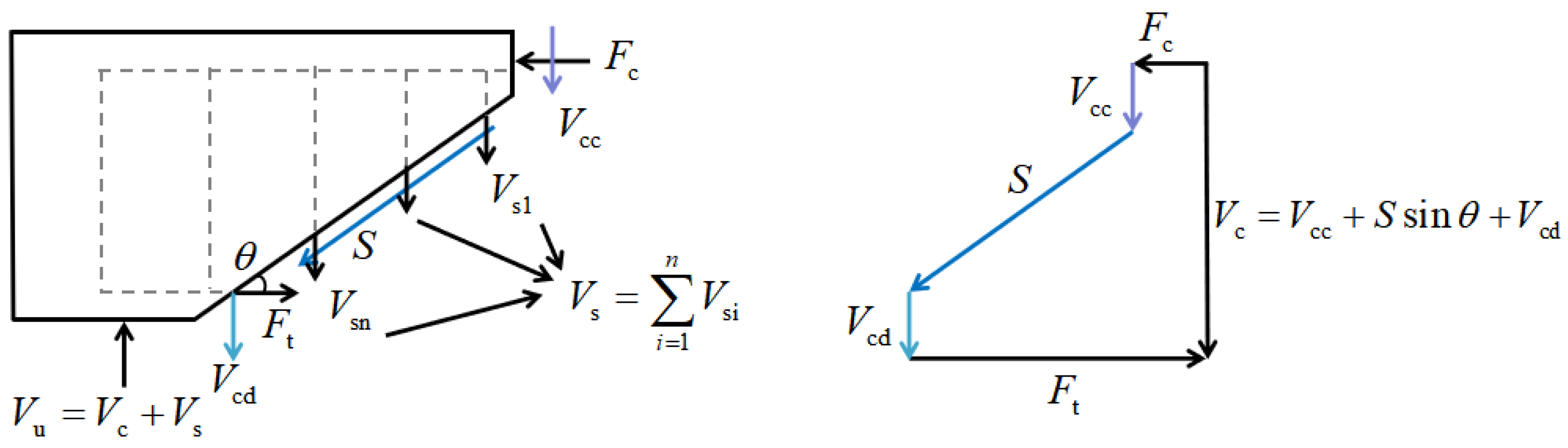
The shear resistance mechanism of FRP-RC beams is illustrated in Figure 1. As shown, the shear capacity mainly consists of three components: the contribution of concrete to the shear capacity, the contribution of longitudinal reinforcement, and the contribution of stirrups. Based on this, the study selected 10 parameters, classified into three categories, as input features for training the machine learning model. These parameters are classified as follows:
(1)
Concrete-related parameters: the shear span-to-depth ratio (a/d), the effective depth (d0), the section width (b), and the concrete strength (fcu).
(2)
Longitudinal reinforcement-related parameters: the ultimate tensile strength of longitudinal reinforcement (ffu), the longitudinal reinforcement ratio (ρf), and the elastic modulus of longitudinal reinforcement (Ef).
(3)
Stirrup-related parameters: the ultimate tensile strength of stirrups (ffv), the stirrup ratio (ρv), and the elastic modulus of stirrups (Efv).
It is worth noting that the concrete strength used in this study refers to the standard cubic compressive strength. During the data collection process, data on the axial compressive strength of concrete were converted according to Equation (1) [34].
fc = 0.8 fcu
where fc is the compressive strength of concrete cylinders.
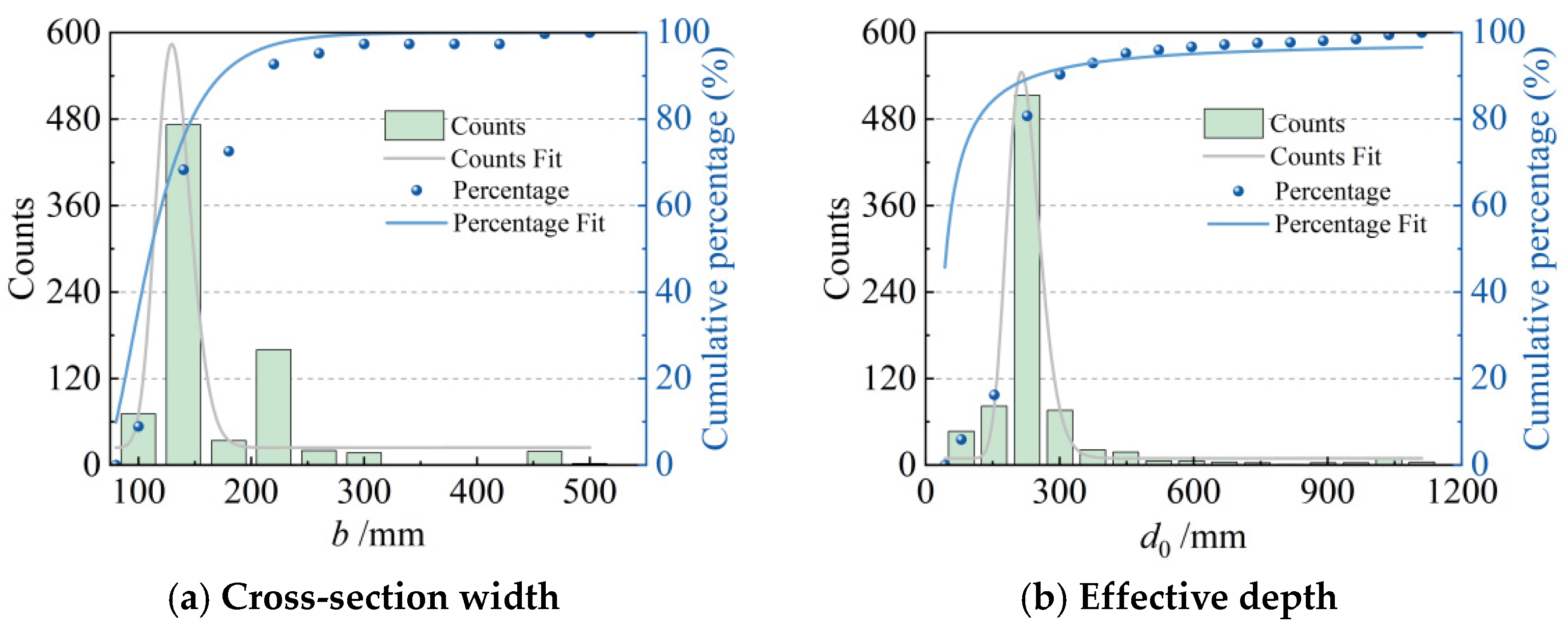
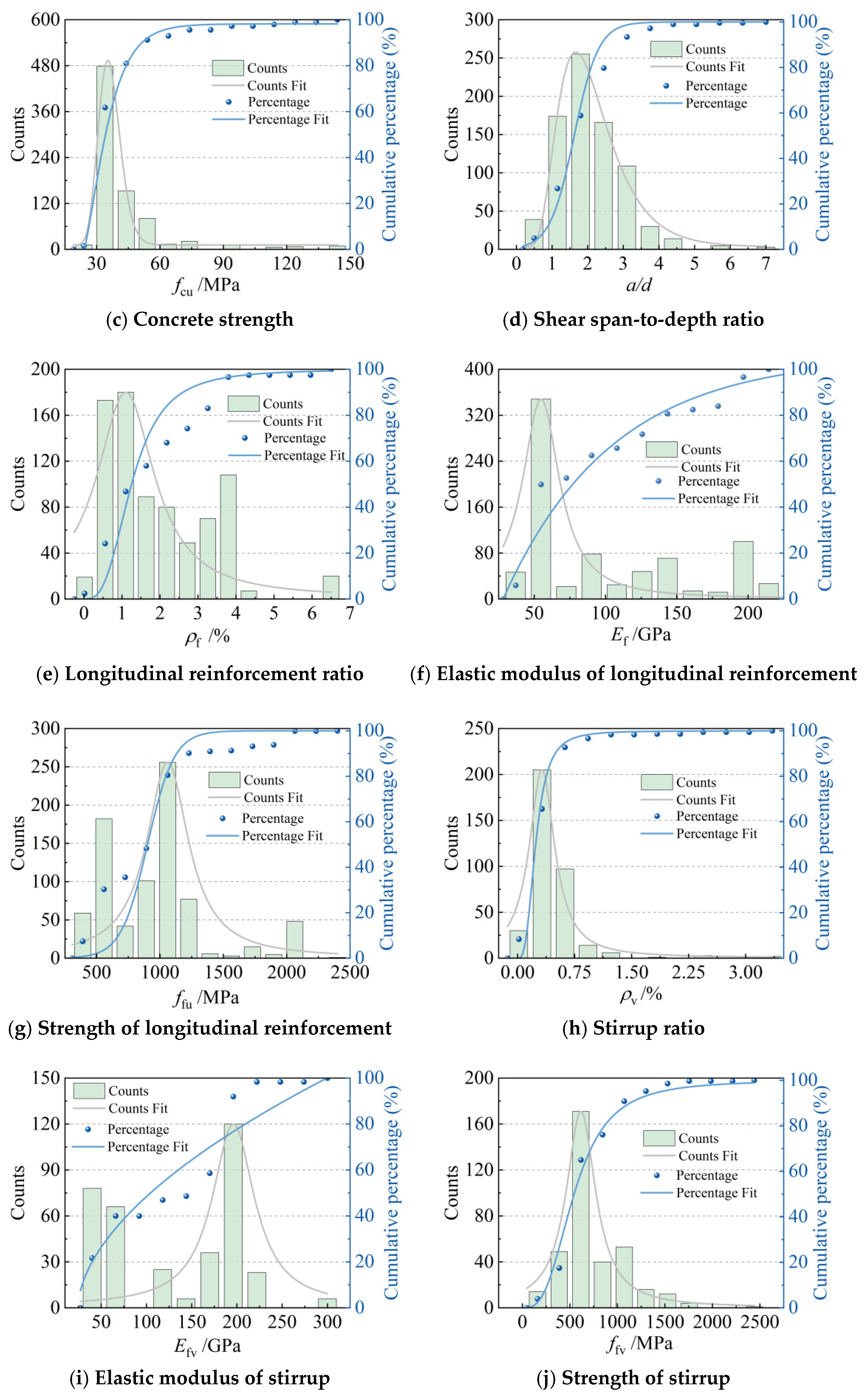
To avoid data heterogeneity caused by differences in loading protocols and boundary conditions, all shear capacity data in this study were collected from four-point bending static loading tests under uniformly applied simply supported boundary conditions. The database contains a total of 299 beams with stirrups and 335 beams without stirrups. All experimental beams were of rectangular cross-section and failed in shear, with shear-span ratios ranging from 0.5 to 7. Considering that key material parameters may also contribute to data heterogeneity, statistical analysis was conducted on all input variables, especially the critical material parameters, as presented in Table 1. All sources of the database are summarized in Appendix A. GFRP reinforcement was the most common, constituting 57.22% of the samples. Geometrically, 53.89% of the beams had a/d between 1 and 2.5, while only 8% had d0 exceeding 300 mm. Material-wise, over 90% of the specimens used concrete with compressive strengths ranging from 30 to 60 MPa. Approximately 70% of the samples had ρf ranging from 0.5% to 4%. For beams with stirrups, about 80% had ρv between 0.3% and 0.5%, and 70% had ffv ranging from 500 to 1500 MPa. Table 1 provides a statistical summary of the database, including the mean, standard deviation, maximum, and minimum values for all input features. Figure 2 shows the histogram and cumulative probability plot of the sample distribution.
It is worth noting that Figure 2 shows that most parameters are reasonably well covered within the typical range of engineering applications, while a slight sample imbalance exists in some extreme-value intervals. The normality test results in Table 1 indicate that none of the parameters follow a normal distribution. This deviation from normality contradicts the basic assumptions of classical machine learning algorithms, such as linear regression and Gaussian Naive Bayes [36]. In this study, a grouped cross-validation strategy was adopted to mitigate the influence of sample imbalance. Meanwhile, typical machine learning models, including MLP and XGBoost, were selected for predicting the shear capacity, ensuring that the established model exhibits stable predictive performance and satisfactory generalization ability.

2.2. Feature Correlation Analysis

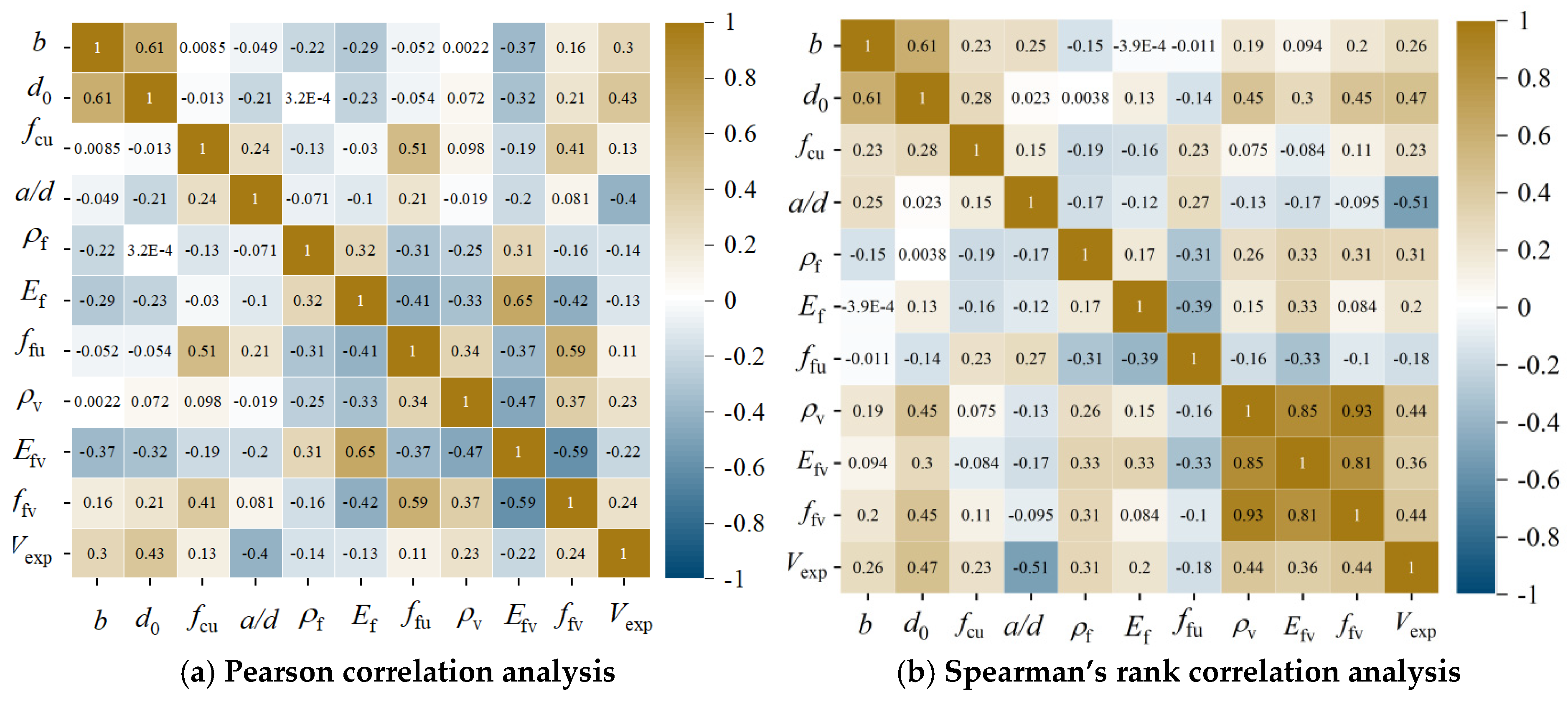
To comprehensively evaluate the relationships among input features, both Pearson and Spearman correlation analyses were conducted in this study. The Pearson correlation coefficient was used to quantify the linear dependence between variables, while the Spearman rank correlation coefficient was used to capture monotonic, nonlinear relationships. The latter is more suitable for characterizing the complex mechanical behavior of shear capacity. To ensure model accuracy, multicollinearity analysis was performed using Pearson correlation matrices to identify and eliminate highly correlated variables. A correlation coefficient threshold of |r| = 0.85 [37] was adopted to detect multicollinearity. As shown in Figure 3, all correlation coefficients remained below this threshold, confirming the physical independence and informational diversity of the selected input features, which ensures reliable modeling. When the Pearson correlation coefficient is approximately equal to the Spearman rank correlation coefficient, the variables exhibit an inherent linear relationship. The comparison of correlation heat maps reveals that the coefficients of the same feature differ noticeably between the two analytical methods. This indicates that the factors affecting the shear capacity of FRP-RC beams present weak interdependence and a highly nonlinear relationship.

3. Methodology

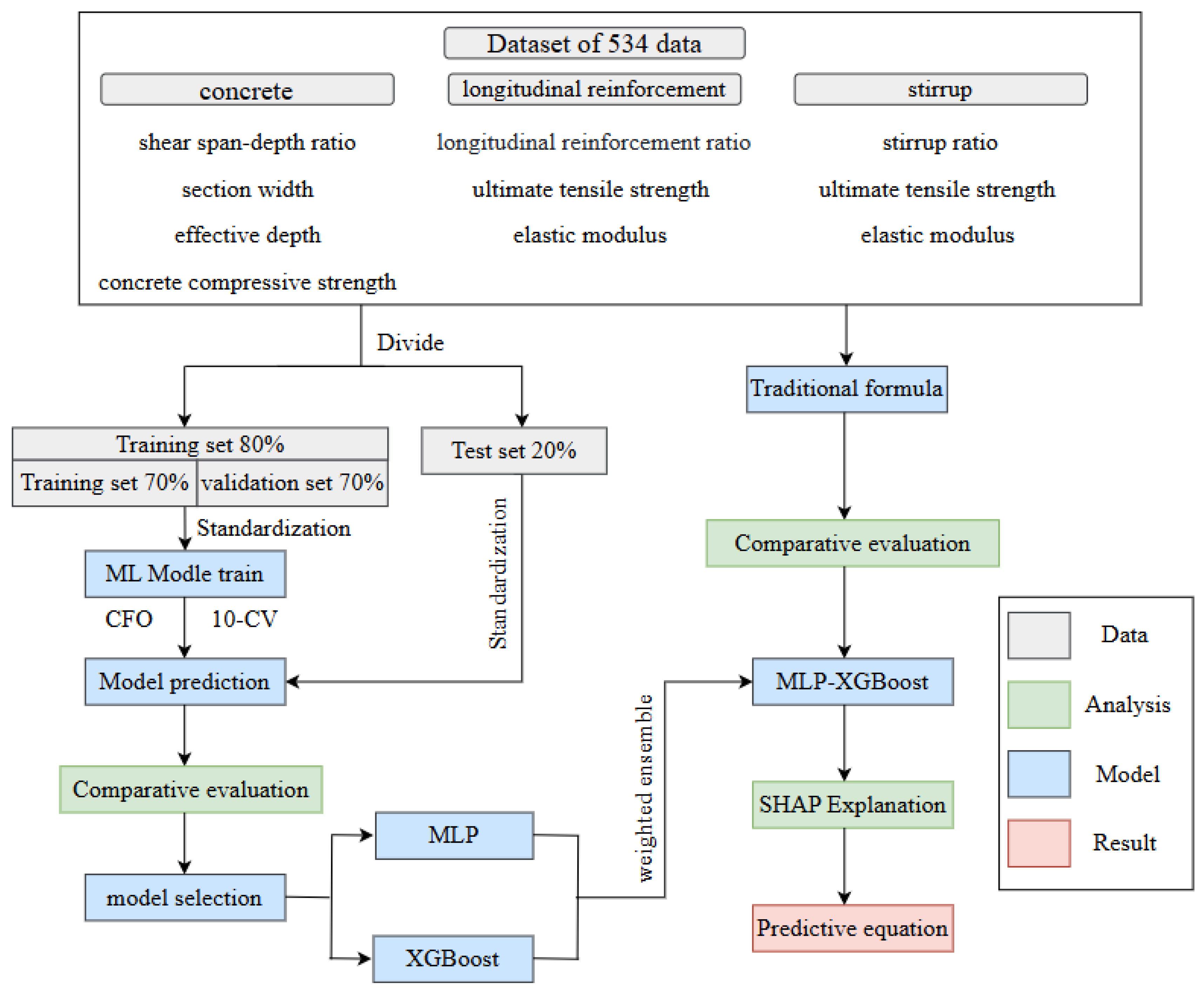
The overall research framework of this paper is illustrated in Figure 4. First, all input features are subjected to Z-score standardization, as illustrated in Equation (2) [38]. This procedure eliminates the feature dominance problem caused by significant differences in dimensional scales and improves the convergence efficiency of the machine learning model.
X stand = X μ σ 2
where X, μ, and σ represent the specific values, mean values, and standard deviations of the input features, respectively.
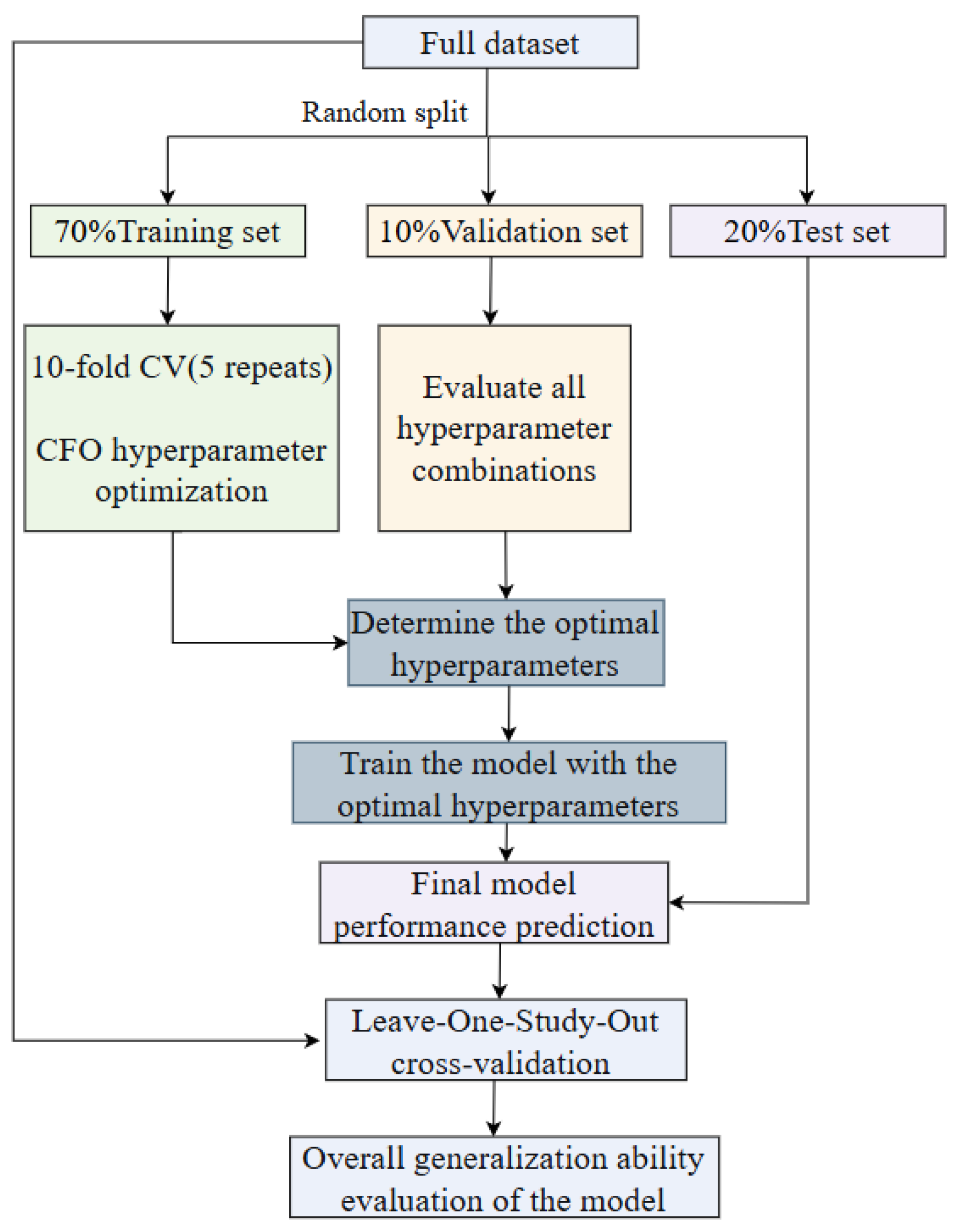
Next, five supervised machine learning models are introduced. During model construction, the dataset is randomly divided into a training set, a validation set, and a test set at a ratio of 7:1:2.
The training set (70%) is used for model training and hyperparameter optimization.
The validation set (10%) is used to evaluate candidate hyperparameter configurations.
The test set (20%) is used for final performance evaluation and is never involved in the entire process of model training or hyperparameter tuning.
Referring to most existing studies in this field, researchers generally only partition the dataset into a training set and a test set, without explicitly separating an independent validation set in the manuscript description. Therefore, except for Section 3.1.6, the training set and validation set are collectively referred to simply as the training set throughout this paper. For hyperparameter optimization, the caterpillar fungus optimizer (CFO) [39] algorithm is adopted in this paper. Combined with repeated 10-fold cross-validation (5 repetitions) performed on the training set, this procedure effectively reduces the risk of overfitting and enhances model stability. The validation set is used to further evaluate all hyperparameter combinations to ensure the selection of the optimal configuration. After determining the optimal hyperparameters, each model is trained on the full training set to obtain the optimally trained model. Through comparative analysis, the two best-performing models, MLP and XGBoost, are selected. Their prediction results are weighted and combined to construct the MLP-XGBoost weighted ensemble model. The MLP-XGBoost model is compared with the other machine learning models and theoretical formulas, demonstrating its superior performance in predicting the shear capacity of FRP-RC beams. Finally, Leave-One-Study-Out (LOSO) cross-validation is conducted on the entire dataset to rigorously evaluate the model’s generalization ability across different experimental programs. Furthermore, the SHAP algorithm is employed to interpret the MLP-XGBoost model, thereby overcoming its “black-box” nature. Through quantitative analysis of the SHAP values, the correlation between each input feature and the shear capacity of FRP-RC beams is elucidated. Based on these SHAP values, a prediction equation for the shear capacity of FRP-RC beams is established.

3.1. Machine Learning Algorithms

3.1.1. Multilayer Perceptron (MLP)

The Multilayer Perceptron (MLP) is a fully connected, feedforward artificial neural network. It consists of an input layer, hidden layers, and an output layer. Each layer comprises multiple neurons, with each neuron fully connected to all neurons in the previous layer via weighted connections [40]. The input layer receives the raw features, and its number of neurons equals the dimensionality of the feature space. The hidden layers perform hierarchical transformations and feature abstraction of the inputs through weight matrices, bias vectors, and nonlinear activation functions, subsequently propagating the processed signals forward [41]. Finally, the output layer maps the resulting high-level features to the final predictions according to the specific task. The overall working principle of the MLP can be represented as a composite function, as shown in Equation (3):
y ^ = g W o f W h x + b h + b o
where x denotes the input vector; Wo and Wh are the weight matrices of the hidden and output layers, respectively; bh and bo are the bias vectors of the hidden and output layers, respectively; and y ^ is the model’s output prediction vector.

3.1.2. Decision Tree (DT)

The Decision Tree (DT) regression model is a supervised machine learning method. It operates by recursively partitioning a dataset into subsets based on input features. The primary objective is to construct a reliable predictive model by inferring key decision rules from the features. The fundamental structure of a DT comprises a root node, internal nodes, branches, and leaf nodes. The root node represents the feature and corresponding threshold used for the first data split. Internal nodes contain features, which are attributes used to determine subsequent splits. The branches connecting the nodes illustrate the relationships between the values of independent variables and the target variable. Finally, leaf nodes, which are the terminal points of the tree, hold the predicted value of the target variable.
The primary objective of DT regression is to identify the optimal split points that partition the data into distinct regions R 1 , R 2 , , R n , where the predicted value for each region corresponds to the mean of the target values of the samples within that region. This is achieved by minimizing the following objective function, as shown in Equation (4):
min i = 1 n x j R j ( y j y R i ¯ ) 2
where y j is the true value, and y R i ¯ is the mean of the target values within the region R j .

3.1.3. Random Forest (RF)

The Random Forest (RF) regression model is an ensemble model that uses decision trees (DTs) as base learners [42]. Its core principle is to integrate the Bagging ensemble technique with a random feature selection strategy, combining multiple individual DTs to perform predictions. Specifically, it generates multiple training subsets via Bootstrap sampling and constructs a decision tree for each subset. During the node-splitting stage of each decision tree, the algorithm selects the optimal splitting feature from a randomly chosen subset of m features. This randomness effectively reduces inter-tree correlation, thereby improving the model’s generalization and robustness. Regarding the hyperparameter max_features, it is typically recommended to set its value to m = p/3. The final prediction result of the model is the arithmetic mean of the prediction values of each decision tree, as shown in Equation (5).
p x = 1 N i = 1 n p i x
where N represents the number of DTs, and pi(x) represents the prediction result of the i-th DT.

3.1.4. Light Gradient Boosting Machine (LightGBM)

Light Gradient Boosting Machine (LightGBM) is a gradient boosting framework specifically designed for high computational speed and efficiency [43]. Built on decision tree algorithms, it significantly reduces training time and memory consumption while maintaining high predictive accuracy. Its core principle is based on an additive process, in which multiple weak classifiers are sequentially combined to construct a high-performance predictive model. The mathematical formulation for the inference process is provided below.
The objective function of the model, as shown in Equation (6):
y i ^ = k = 1 K f k ( x i ) ,       f k
where f k denotes the k-th regression tree, represents the space of all possible regression trees, and K indicates the total number of trees.

3.1.5. eXtreme Gradient Boosting (XGBoost)

eXtreme Gradient Boosting (XGBoost) is an ensemble machine learning model based on decision trees [44]. As a tree-based ensemble method, XGBoost employs gradient boosting to enhance performance by combining multiple weak learners (decision trees). The training process is iterative: at each iteration, a decision tree is added to correct errors from previous iterations and improve accuracy. The mathematical model of XGBoost can be expressed by Equation (7):
y ^ i = k = 1 K f k x i ,       f k
Here, y ^ i denote the predicted value for sample i; K is the number of weak learners; fk denotes the output value of the k-th weak learner; represents the function space of all possible decision trees, and xi is the feature vector of sample i.

3.1.6. Model Ensemble MLP-XGBoost

Ensemble learning is an established paradigm in machine learning that enhances the predictive performance and generalization of a model by leveraging the strengths of multiple base learners. The essence of this approach is to combine multiple weak learners through sample weighting and learner weighting, resulting in an ensemble learner that achieves superior performance and stronger generalization compared to any individual weak learner. An effective ensemble model requires that the base learners possess both a certain level of accuracy and sufficient diversity.
The dataset is firstly split into a training set, a validation set, and a test set at a ratio of 7:1:2. The MLP and XGBoost models are trained on the training set, and their hyperparameters are optimized using the Caterpillar Fungus Optimizer (CFO) algorithm [39]. Let the actual shear capacity in the validation set be yv. The predicted shear values of the MLP and XGBoost models on the validation set are then obtained, denoted as yv, MLP and yv, XGBoost, respectively. The mean absolute error between the actual and predicted values on the validation set is calculated and defined as MAEMLP and MAEXGBoost, with the corresponding formula shown in Equations (8) and (9). Finally, the ensemble weights of the two models are determined according to the error performance on the validation set.
M A E MLP = 1 n y v , M L P y v         M A E XGBoost = 1 n y v , X G B o o s t y v
W MLP = M A E XGBoost M A E XGBoost + M A E MLP   W XGBoost = M A E MLP M A E XGBoost + M A E MLP
When a significant discrepancy exists between the training errors of the two base models, the better-performing model is selected as the final output to ensure higher accuracy. To implement this strategy, an error threshold, a = 0.1, is defined. Relative error analysis of the MLP and XGBoost models indicates that more than 50% of the relative errors between the predicted values and the experimental values fall within the range of −0.1 to 0.1. Therefore, a = 0.1 is selected as the threshold parameter. Functionally, this threshold avoids two extreme scenarios: if a is set too small, the strategy will frequently assign weights of 0 or 1, effectively reducing the ensemble to a single-model selection process and undermining the stability of weighted fusion; conversely, if a is too large, the model will rarely trigger the selection mechanism, forcing a simple weighted average even when there is a significant performance gap between the two base models, which may degrade prediction accuracy. Therefore, selecting a = 0.1 ensures both the stability of weight computation and the rationality of the ensemble decision. Accordingly, the model error is calculated as shown in Equation (10) when the relative difference between the two models exceeds this threshold.
M A E M L P M A E X G B oost max ( E M L P , E X G B o o s t ) > a   if M A E M L P > M A E X G B o o s t   W M L P = 0 , W X G B oost = 1 M A E M L P < M A E X G B o o s t   W M L P = 1 , W X G B oost = 0
On the test set, the MLP and XGBoost predictions are yt,MLP and yt,XGBoost, respectively. The final prediction result after model ensembling is given by: y t = W MLP y t , MLP + W XGBoost y t , XGBoost .
To fully verify the rationality of the selected a value, a systematic sensitivity analysis was conducted. Five candidate values, 0.05, 0.10, 0.15, 0.20, and 0.25, were selected for comparison. Key evaluation metrics, including the coefficient of determination (R2), root mean square error (RMSE), and mean absolute error (MAE), were compared across different threshold levels, and the results are presented in Table 2. When a varied within the range of 0.05 to 0.25, the prediction metrics of each model fluctuated only within a very limited range, with the variation of R2 being merely 0.7%, and no significant improvement or deterioration in performance was observed. When a = 0.10, the models achieved the best performance across all metrics. These results demonstrate that the models themselves possess a certain level of superiority, that the final predictive performance of the ensemble model is relatively insensitive to variations in this parameter, and that a can smoothly integrate the outputs of the two base models over a relatively wide range without overreacting to local fluctuations.

3.2. Performance Indicators

This study uses five evaluation metrics to quantitatively assess model performance: Mean Absolute Error (MAE), Mean Absolute Percentage Error (MAPE), Root Mean Square Error (RMSE), Mean Square Error (MSE), and the Coefficient of Determination (R2). MAPE measures the percentage deviation between true values and predicted values, with smaller values indicating lower prediction errors. RMSE reflects the standard deviation of prediction errors, where smaller values denote higher predictive accuracy. R2 evaluates the overall goodness-of-fit of the model; values closer to 1 indicate a better fit. The formulas for all metrics are summarized in Table 3.

3.3. Performance Optimization

3.3.1. 10-Cross-Validation

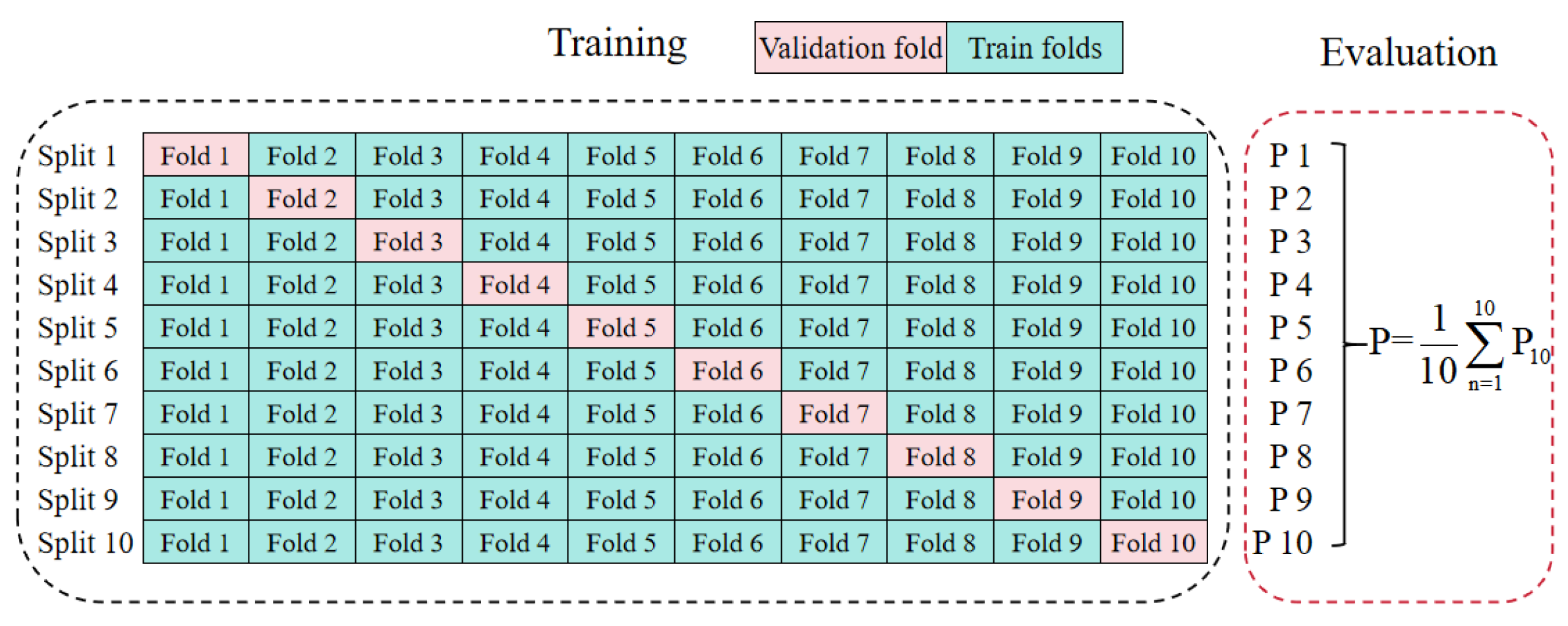
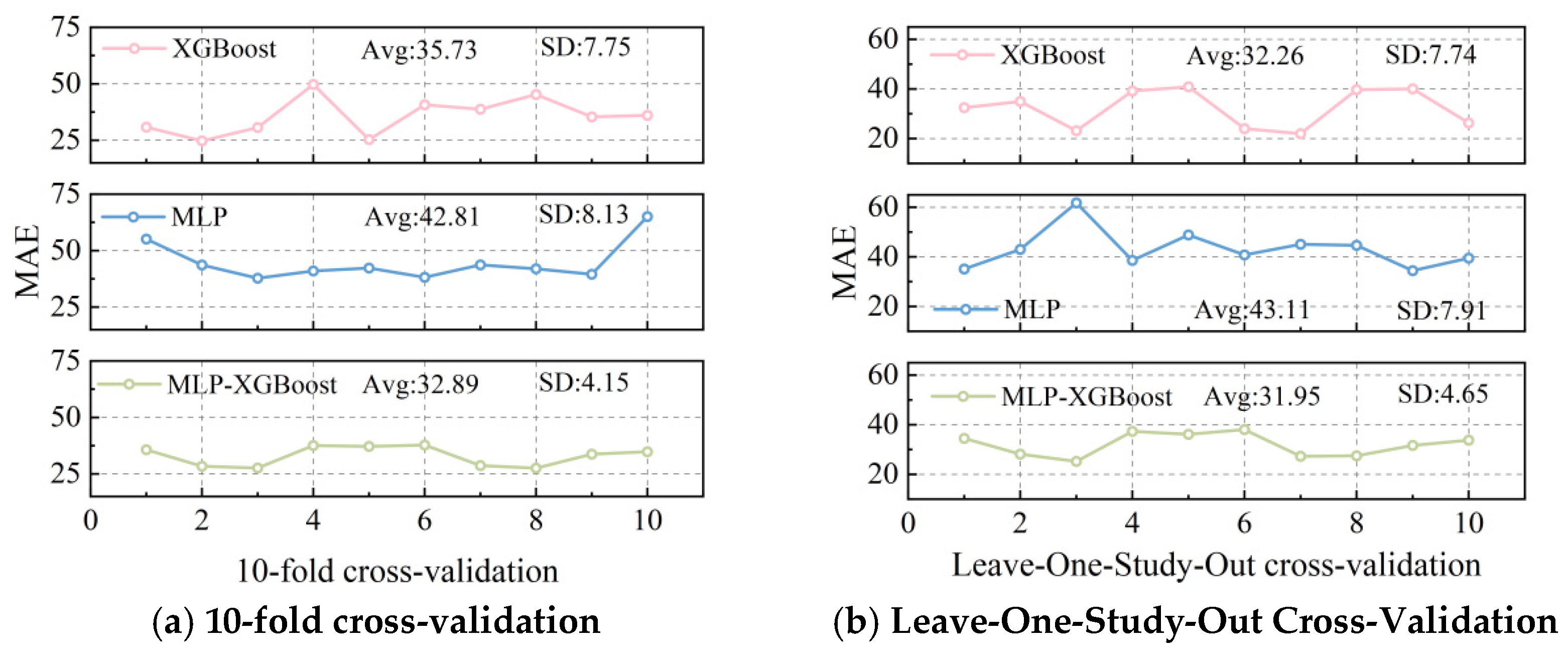
To mitigate overfitting, 10-fold cross-validation was employed during model training. This method strikes an optimal balance between computational efficiency and predictive accuracy and is widely adopted in machine learning applications [45,46,47]. The training set is randomly divided into ten equally sized folds. In each iteration, one fold serves as the validation set, while the remaining nine form the training set. This process is repeated ten times, ensuring that each fold is used as the validation set once. The final performance is averaged across all iterations. Figure 5 illustrates the principle of 10-fold cross-validation. To verify the robustness of the MLP-XGBoost model, a repeated cross-validation strategy was employed in this study, specifically conducting five independent runs of 10-fold cross-validation. Table 4 presents the performance metrics of the MLP-XGBoost model from the repeated cross-validation. Figure 6a shows the cross-validation MAE values of the MLP-XGBoost ensemble model for FRP-RC beams, with the MAE values for all folds remaining within 15% of the mean, confirming that the model exhibits good stability and strong generalization ability during training.
In addition, to further verify the generalization ability of the model, leave-one-study-out cross-validation was additionally performed. Firstly, all collected literature sources were sorted chronologically according to their publication years, and the entire dataset was partitioned into ten subsets with comparable sample sizes. During the grouping process, all experimental data from the same independent study are completely retained in the same subset without random splitting, thereby effectively ensuring the independence of data sources between the training samples and the test samples. For multiple independent studies published in the same year, their corresponding data were allocated to different subsets. In cases where only a limited number of studies were available in a single year, those datasets were merged with experimental data from subsequent years to form an integrated subset. The results of the leave-one-study-out cross-validation are presented in Figure 6b. The cross-validation results demonstrate that the proposed MLP-XGBoost hybrid model maintains stable and reliable prediction accuracy across different data folds. Figure 7 illustrates the flowchart of dataset partitioning and application in this study.

3.3.2. Caterpillar Fungus Optimizer Intelligent Optimization Algorithm

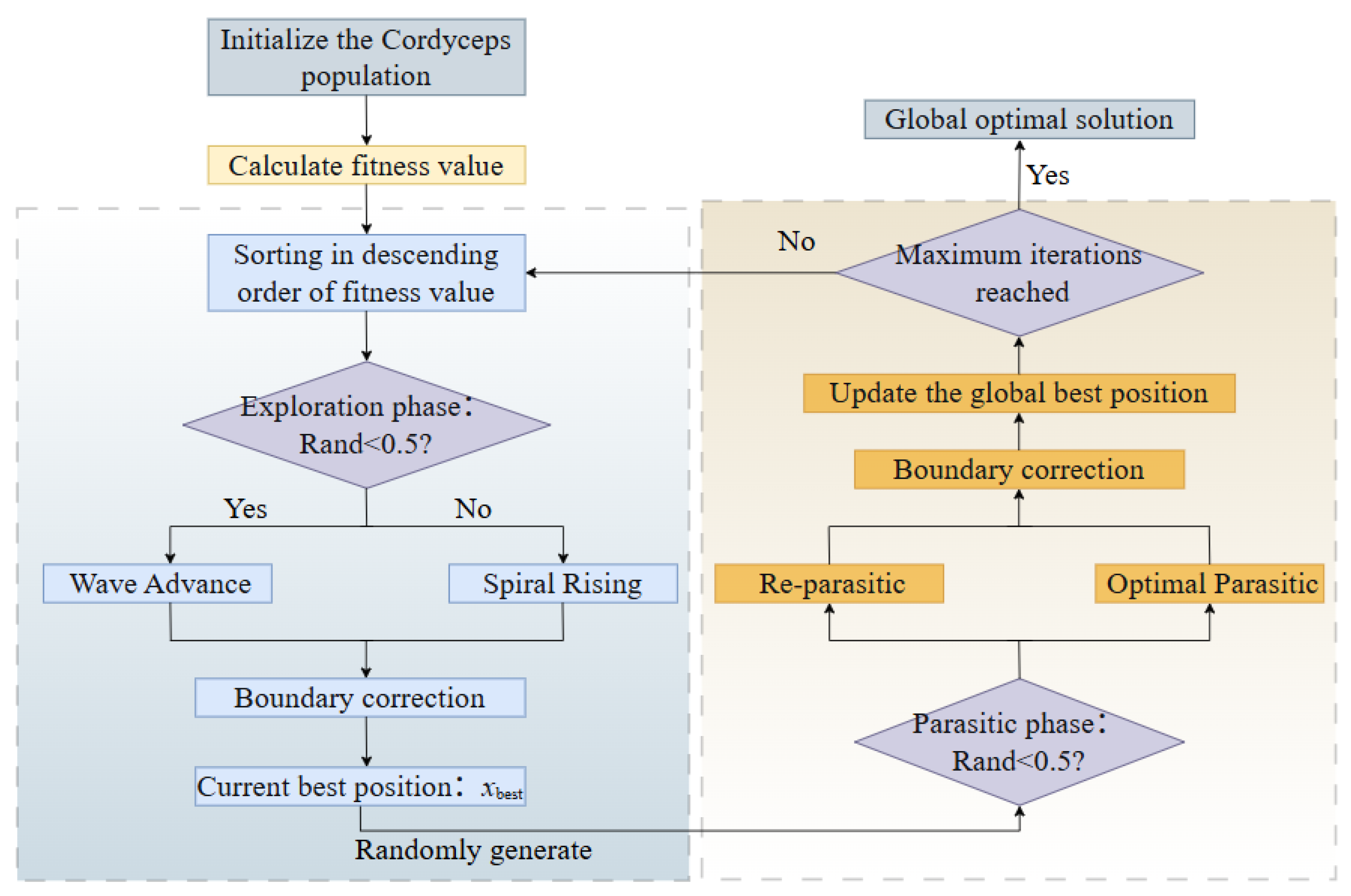
This study used the independent validation set to train the models. To ensure optimal performance, the Caterpillar Fungus Optimizer (CFO) algorithm was applied to perform a global search for the optimal combination of hyperparameters [39]. The optimized hyperparameters for all models are summarized in Table 5, while the other hyperparameters not listed are set to their default values in the Statistics and Machine Learning Toolbox. The flowchart of the CFO algorithm is illustrated in Figure 8.
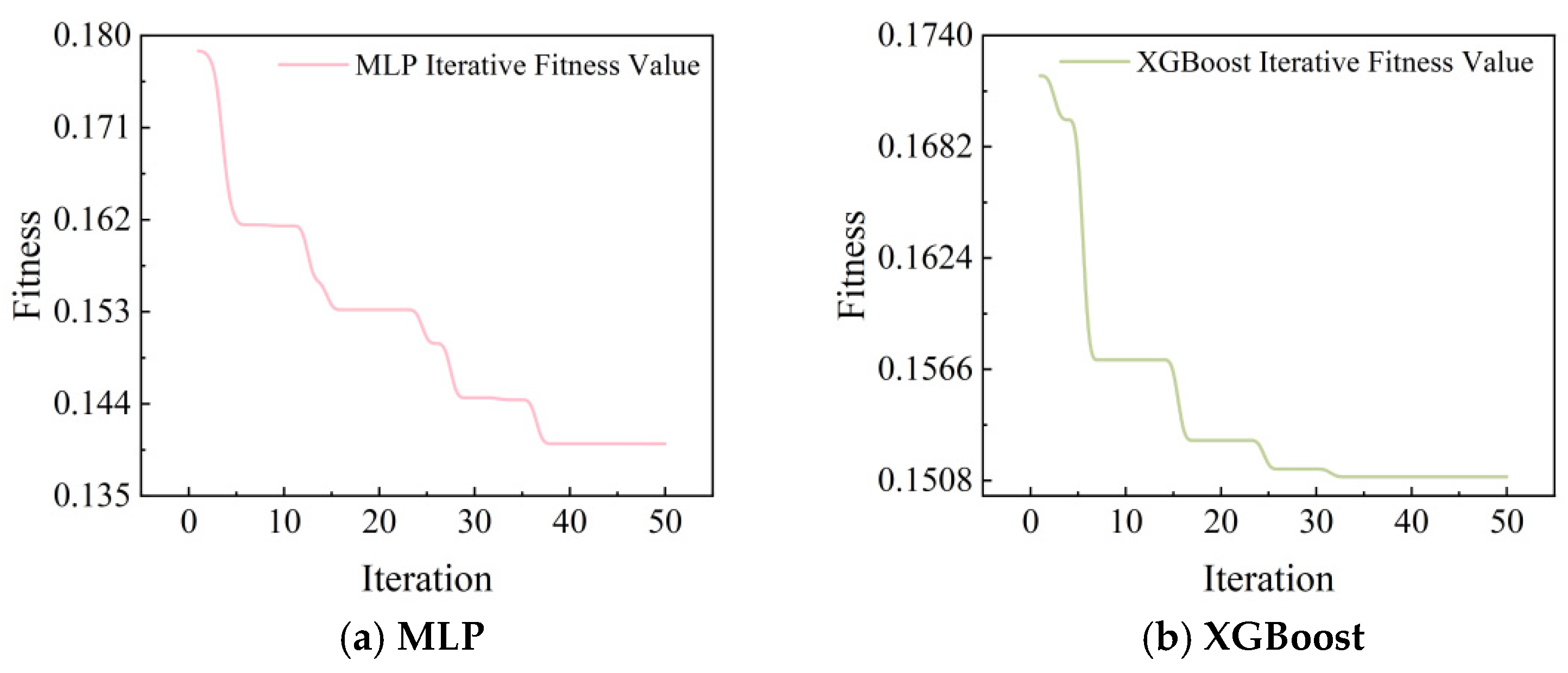
The Caterpillar Fungus Optimizer (CFO) is a novel bio-inspired metaheuristic algorithm inspired by the parasitic propagation and spore dispersal behavior of Ophiocordyceps sinensis. The algorithm performs optimization through two core phases: global exploration and local exploitation. In the exploration phase, individuals conduct adaptive search using two complementary operators: the wave advance operator for extensive spatial exploration and the spiral ascent operator for refined local neighborhood search. These operators dynamically adjust the search step sizes and trajectories to maintain population diversity. In the parasitic exploitation phase, CFO implements two types of parasitic behavior: re-parasitism, which enhances global search and helps escape local optima, and optimal parasitism, which strengthens convergence toward high-quality solutions. The position update mechanism integrates random walk, adaptive step size adjustment, and elite individual guidance, thereby achieving a balance between exploration and exploitation throughout the iterative process. In this study, the maximum number of iterations is set to 50, and the population size is 15. Figure 9 presents the convergence curve of hyperparameter optimization. To evaluate the algorithm’s convergence behavior, the fitness value of the best individual in each generation was monitored, confirming stable convergence within 50 iterations. Compared with traditional grid search and random search, the CFO optimization algorithm offers higher computational efficiency, avoiding the inherent curse of dimensionality in grid search and the blind nature of random search. Its guided search can progressively converge toward the global optimum through iterations, demonstrating stronger global optimization capability and effectively avoiding local optima [39].

4. Prediction Performance Comparison

4.1. Model Performance Evaluation

Although the dataset scale is relatively limited, considering the feature correlation analysis presented earlier, the factors influencing the shear capacity prediction exhibit nonlinear and complex feature coupling. Therefore, a model with sufficient expressive capacity is required to capture these intrinsic relationships. We comprehensively compared the proposed ensemble model with a series of representative baseline models with varying levels of complexity, including Decision Tree (DT), Random Forest (RF), LightGBM, standalone MLP, and standalone XGBoost. The results consistently demonstrate that the proposed ensemble framework achieves superior accuracy and stability without showing obvious overfitting. This confirms that the selected model complexity is reasonable and well-balanced with the available data.
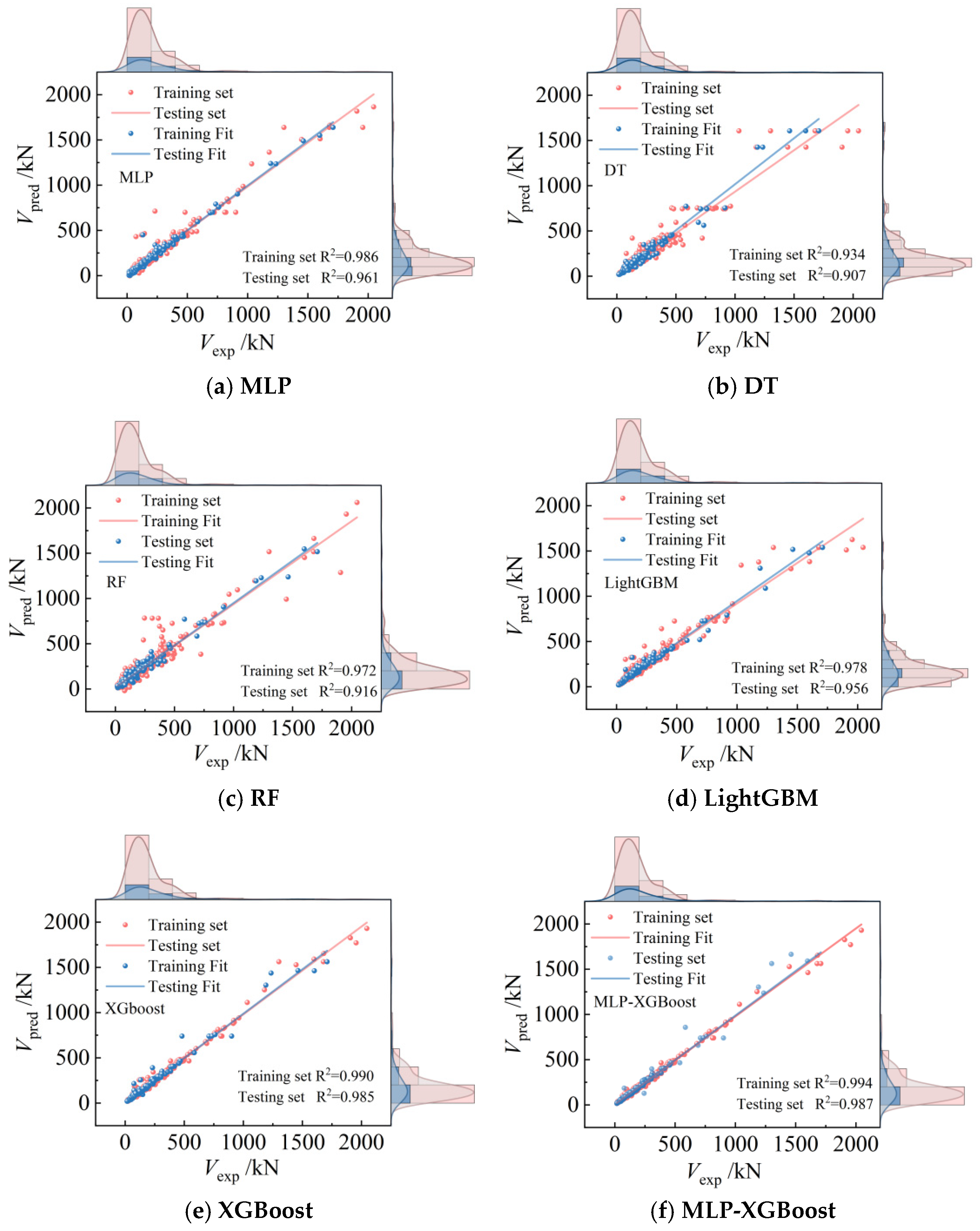
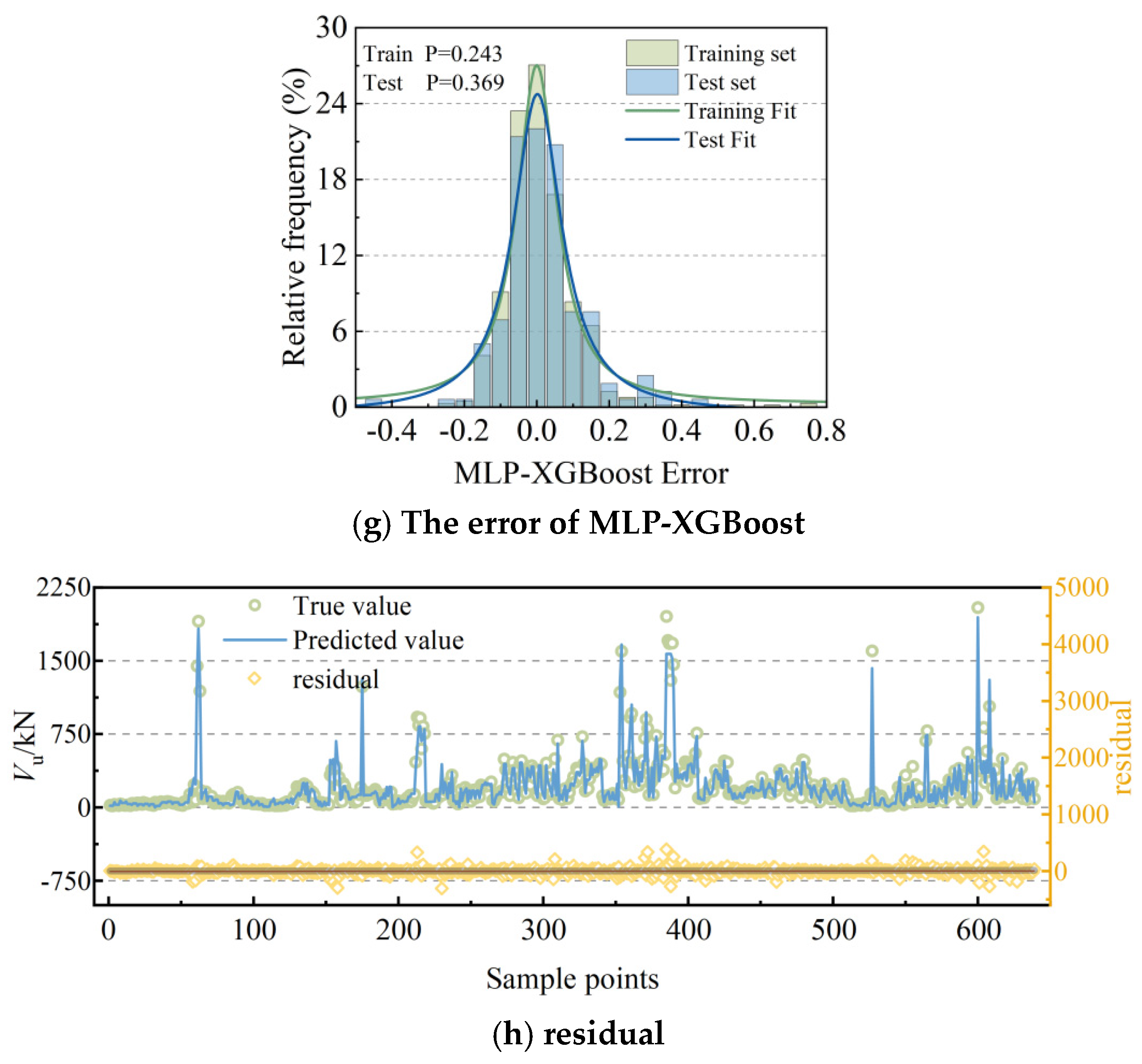
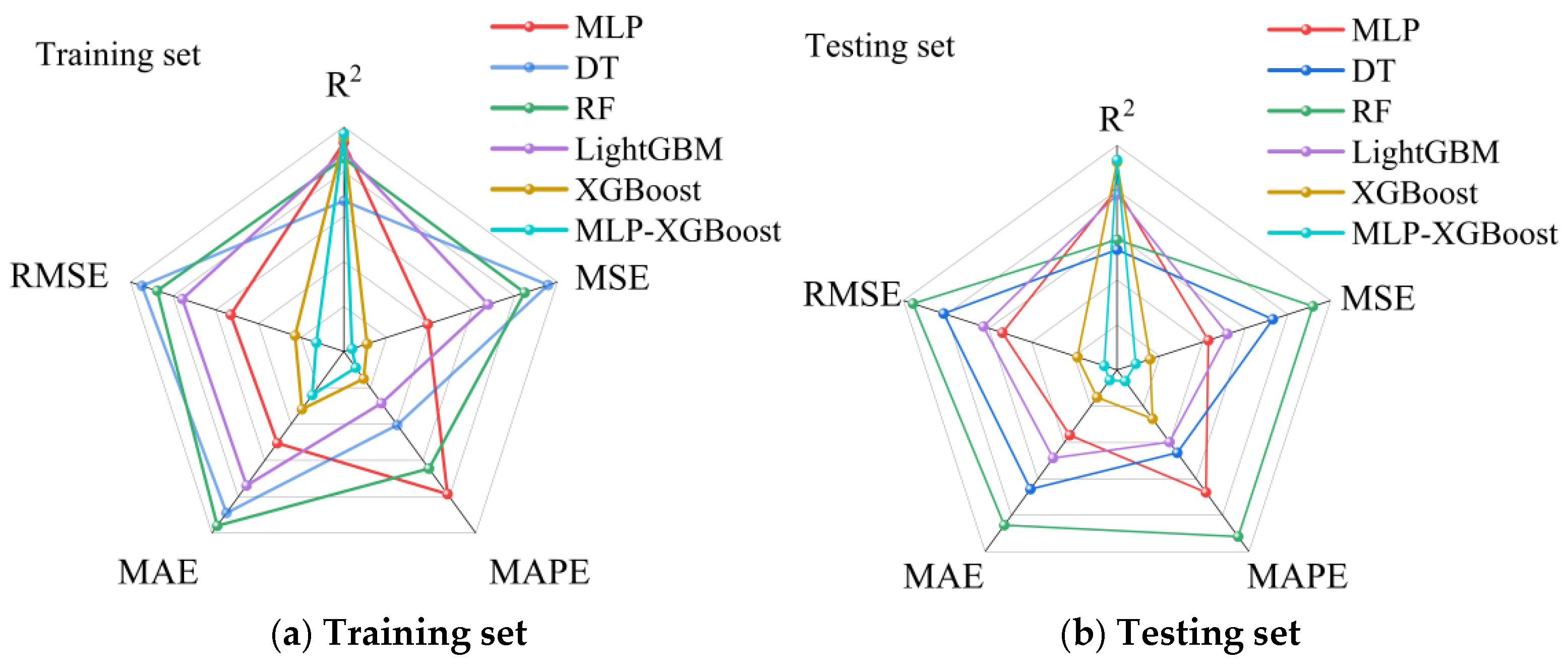
In this study, the proposed MLP-XGBoost ensemble model was compared with five conventional machine learning models in predicting the shear capacity of FRP-RC beams. Table 6 presents a comprehensive summary of the performance metrics for all six models, while Figure 10 and Figure 11 illustrate their predictive performance on the training and testing datasets, respectively. To further assess the prediction reliability and potential systematic bias of the MLP-XGBoost model relative to the traditional models, a residual distribution analysis with 95% confidence intervals was conducted. As shown in Figure 10h, the vast majority of residuals for the MLP-XGBoost model lie within the 95% confidence interval and fluctuate randomly around zero, showing no apparent trend or heteroscedasticity. This indicates that the model does not systematically overestimate or underestimate the shear capacity across the entire dataset. Moreover, the confidence interval is relatively narrow, demonstrating that the model’s prediction uncertainty remains low and stable regardless of the magnitude of shear capacity. Collectively, these results indicate that the proposed model possesses satisfactory generalization ability and statistical robustness within the scope of the existing dataset, with its prediction errors consistently constrained within a reasonable confidence interval. Figure 11 presents multiple performance metrics of each model on both the training and testing datasets. Among the traditional models, XGBoost achieves the highest predictive accuracy, followed by MLP, both outperforming other machine learning models, including DT, RF, and LightGBM.
The superior performance of XGBoost can be attributed to its gradient-boosting framework, which builds the model iteratively. In each iteration, the optimization algorithm fits the residuals from the previous iteration. This iterative process allows the model to progressively learn complex patterns in the data, ultimately approximating the true regression function. Meanwhile, the MLP model also demonstrated competitive performance, surpassing other models such as DT, RF, and LightGBM on this dataset.
Overall, the MLP-XGBoost ensemble, which integrates two high-accuracy base models, achieved superior predictive accuracy and generalization capability among all models. Therefore, the MLP-XGBoost model can be regarded as the preferred choice for predicting the shear capacity of FRP-RC beams. To further verify the reliability, soundness, and generalization capability of the model, this study performed the Kolmogorov–Smirnov (K-S) statistical test on the relative errors between the actual and predicted values of the MLP-XGBoost model. The results of the statistical test are shown in Figure 10g, with the corresponding p-values for the training and test sets being 0.243 and 0.369, respectively. This indicates that, at the 0.05 significance level, the relative errors of both the training and test sets approximately follow a normal distribution, confirming that the model’s predictive performance shows good reliability.

4.2. Comparison with the Empirical Model

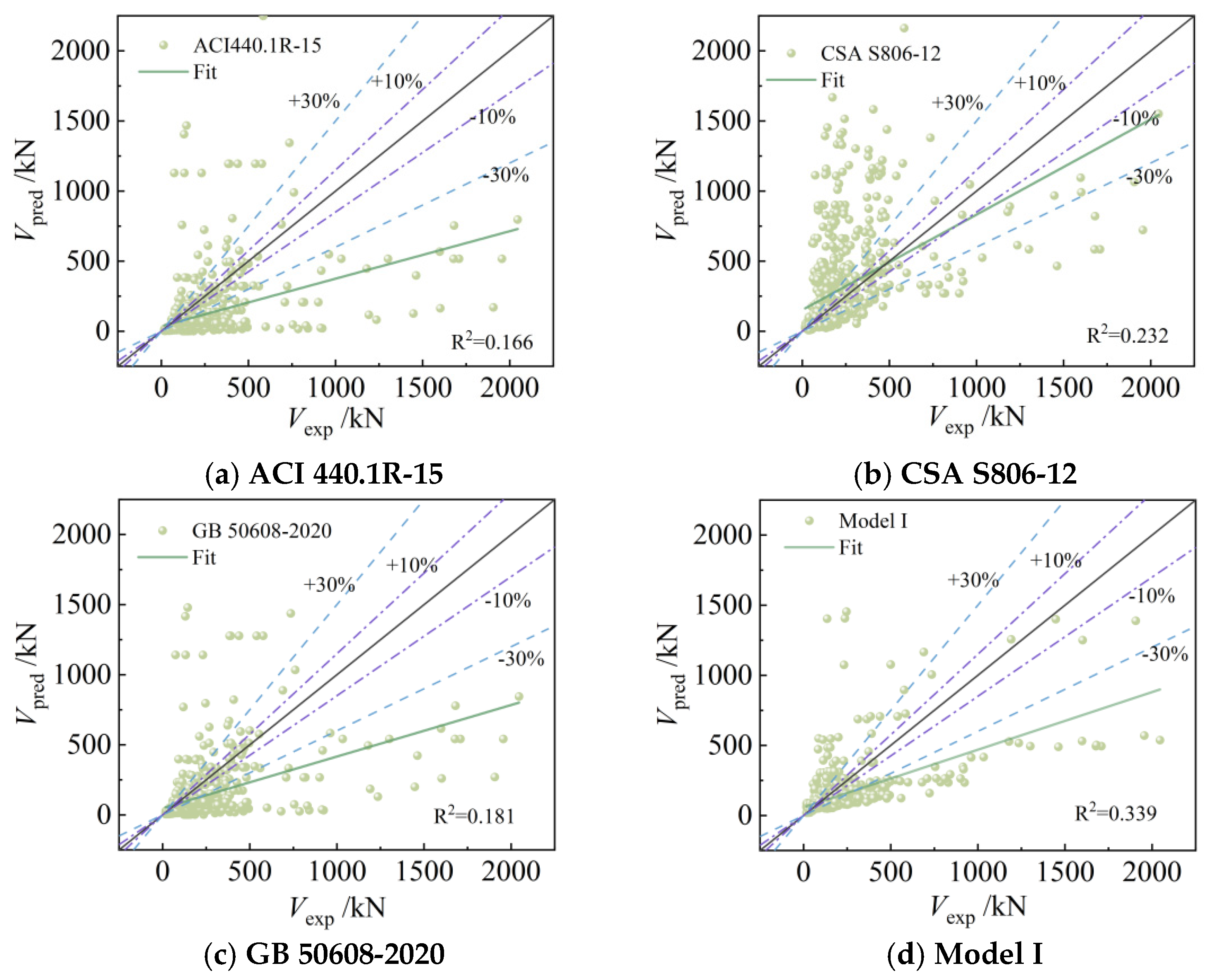
To conduct a more comprehensive evaluation of the MLP-XGBoost model’s predictive performance and strengthen the reliability of the evaluation results, this study compared the model with existing prediction formulas based on the complete dataset. The specific formulas are detailed in Table 7. The comparison results are presented in Figure 12, and the performance evaluation metrics for the formulas and models are summarized in Table 8. As shown in Figure 12, the existing prediction formulas show noticeable deviations from the actual trends, with their accuracy significantly lower than that of the MLP-XGBoost model. Specifically, the predictions of the ACI 440.1R-15 [48], GB 50608-2020 [49], and Model I [50] formulas are relatively conservative, potentially leading to underutilization of member capacity in practical engineering applications. In contrast, the predictions of the CSA S806-12 [51] formula often exceed the actual bond strength, which could pose considerable safety risks if applied directly in engineering practice. The data in Table 8 show that the R2 values of the existing formulas are below 35%, indicating notable limitations in their ability to integrate parameters. Furthermore, the MAE, RMSE, MSE, and MAPE values of these formulas are all substantially higher than those of the MLP-XGBoost model. Among the existing formulas, Model I, which demonstrates the highest prediction accuracy, still shows substantially higher values for all performance metrics compared to the MLP-XGBoost model. Specifically, the MAE of Model I is more than seven times that of the MLP-XGBoost model. In conclusion, the MLP-XGBoost model proposed in this study outperforms existing prediction formulas in both parameter integration and prediction accuracy.
In addition, engineering design codes such as ACI 440.1R-15, CSA S806-12, and GB 50608-2020 prioritize structural safety. Their empirical formulas are deliberately made conservative and adjusted using partial safety factors, resulting in relatively conservative predictions of shear capacity. These formulas are calibrated to ensure structural safety and control failure probability rather than to maximize the accuracy of fitting experimental data. In contrast, the proposed machine learning model achieves higher predictive accuracy and lower bias. Nevertheless, appropriate safety calibration and reliability evaluation are still required before its direct application in engineering practice, in order to balance predictive accuracy with structural safety.
Existing code formulas and empirical formulas are mechanism-driven approaches, derived through mechanical analysis and parameter fitting. The inaccuracy of mechanism-driven formulas for predicting the shear behavior of reinforced concrete beams can be attributed to several factors: (1) The shear resistance mechanism is extremely complex, with highly nonlinear and coupled relationships among various parameters. (2) Numerous factors affect shear capacity, and the practical range of parameter values is wide. Traditional formulas are calibrated based on limited experimental data under specific conditions, resulting in a narrow applicability range. (3) Many assumptions and simplifications are introduced during formula derivation, making it impossible to capture threshold effects, saturation characteristics, and complex interactions among input variables. (4) For practical engineering safety, code formulas generally incorporate sufficient safety margins, leading to relatively conservative predictions. In contrast, machine learning algorithms are data-driven approaches that can directly capture complex mapping relationships between input and output variables, enabling the construction of more accurate predictive models. It should be noted that the predictive accuracy and reliability of machine learning models strongly depend on the size and quality of the dataset.

5. Interpretation of the SHAP Model

5.1. SHapley Additive Explanations (SHAP) Method

SHapley Additive exPlanations (SHAP) is a game-theoretic approach grounded in the concept of Shapley values from cooperative game theory. It quantifies the contribution of each feature to the model’s prediction results, ensuring a fair distribution of contributions among players [52]. SHAP is categorized as a post hoc explanation method: by perturbing the input features and measuring the resulting changes in predictions, it can reveal the specific effect of each feature on the model output in any black-box model. Its mathematical formulation is presented in Equation (11).
f ( x ) = φ 0 + i = 1 M φ j x j ¯
where f(x) and φ 0 are the mapping function and average predicted value of the model, respectively; φ j and x j ¯ are the value of the j-th input variable and the joint vector of the j-th feature, respectively; M is the number of input variables.

5.2. Global Interpretation

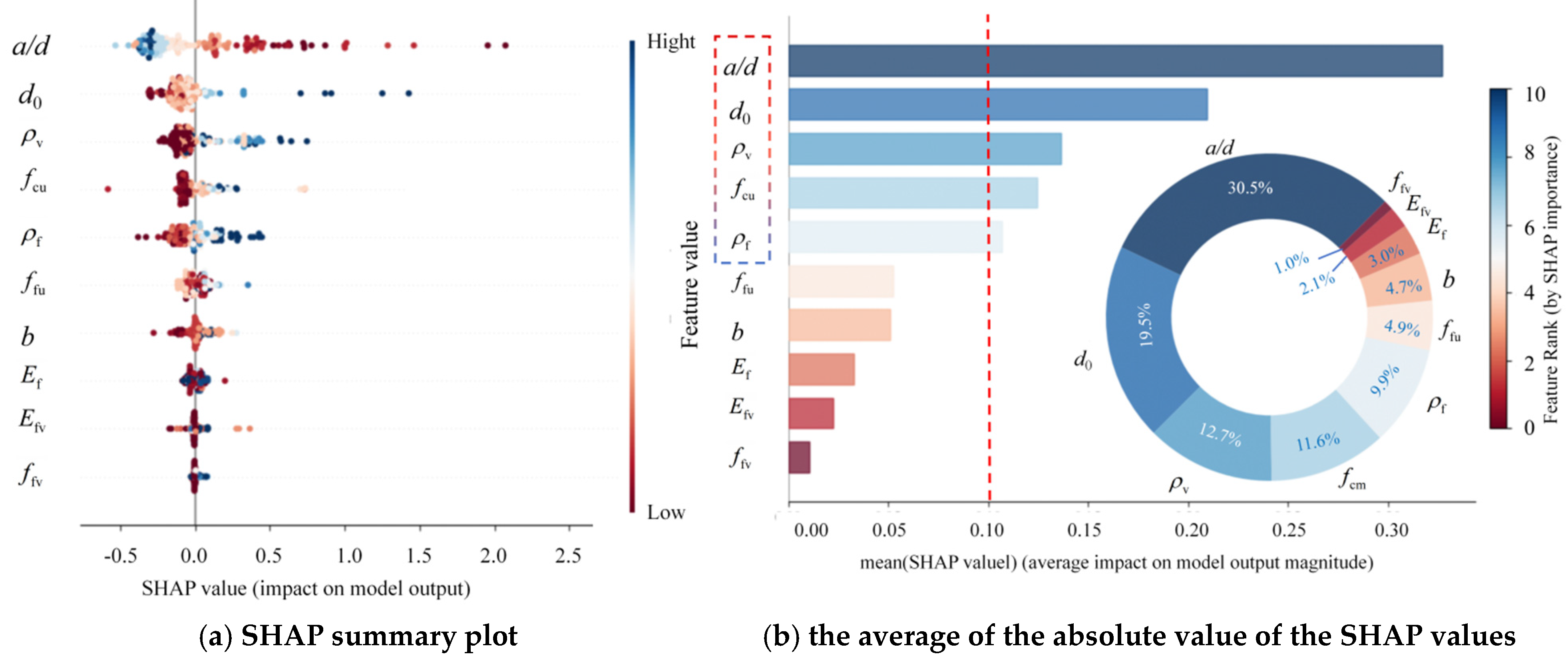
In this study, the SHAP method was employed to interpret the MLP-XGBoost model using the test set. The interpretation results are presented in Figure 13, with Figure 13a showing the SHAP beeswarm plot and Figure 13b presenting the feature contribution bar and donut charts. As shown in Figure 13a, the input features are arranged along the y-axis according to their contribution to the shear capacity of the structural members, with the most influential factor placed at the top of the plot. Each point represents the SHAP value of a specific feature for an individual sample from the dataset. The color of the scatter points is determined by the corresponding scale on the right, with a transition from red to blue indicating an increase in influence. As shown in Figure 13a, for the shear span-to-depth ratio, the blue scatter points are concentrated on the negative semi-axis, indicating a negative correlation with the shear capacity of the members. The bar chart in Figure 13b presents the mean absolute SHAP value of each input feature across the full sample pool, which is used to assess feature importance: a higher value indicates a greater impact on member shear capacity. The donut chart shows the contribution proportion of each feature in the total SHAP values across all samples, providing an intuitive representation of the relative influence of each input feature. In conclusion, the shear span-to-depth ratio has the greatest impact on the shear capacity of members, followed by the effective depth. According to the ranking of average SHAP values, the shear span-to-depth ratio, effective depth, stirrup ratio, concrete strength, and longitudinal reinforcement ratio are identified as the five key parameters influencing the shear capacity of FRP-RC beams.

5.3. Parametric Analysis and Predictive Equation

SHAP analysis quantifies the statistical importance and correlation trends of each input feature, rather than directly reflecting inherent physical causality. The identified feature influences and variation trends represent statistical patterns derived from the experimental dataset. The interpretation of the physical mechanism is supported by integrating the SHAP statistical results with classical structural mechanics and shear resistance theory.
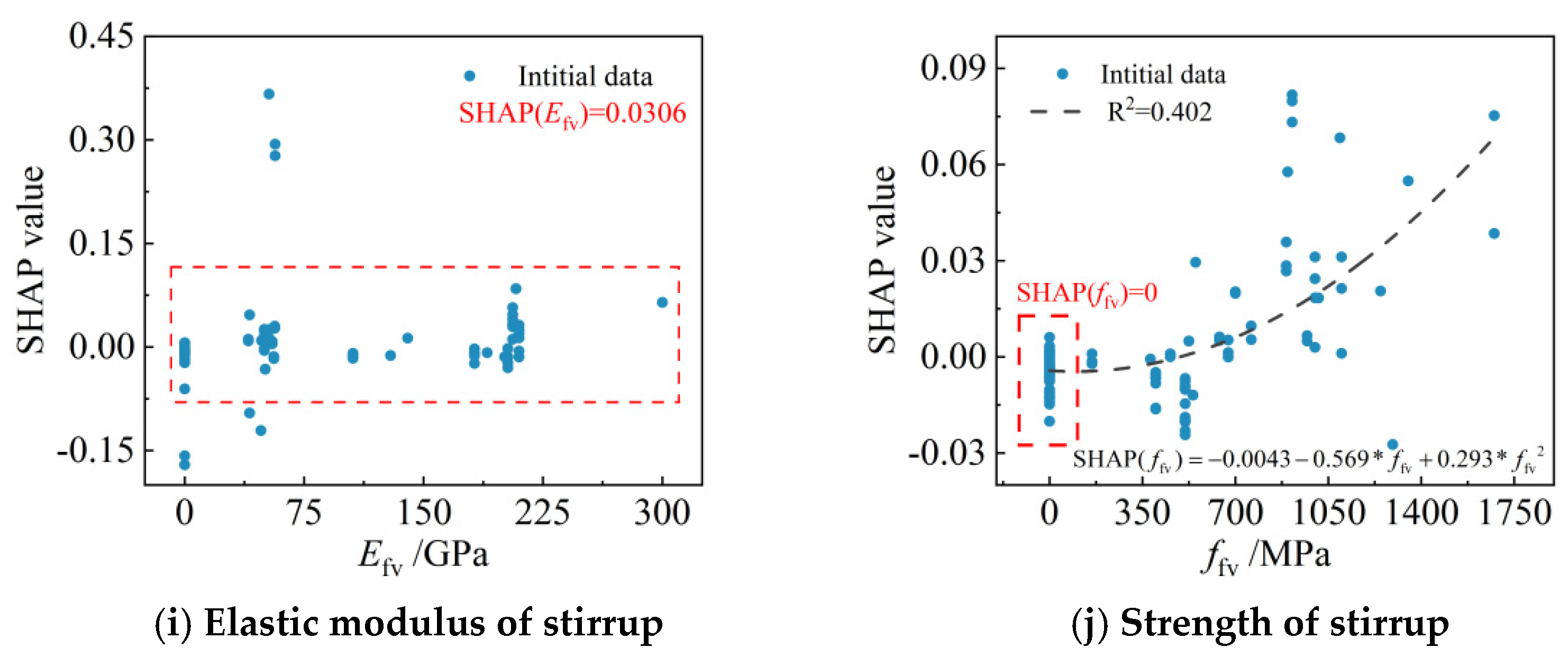
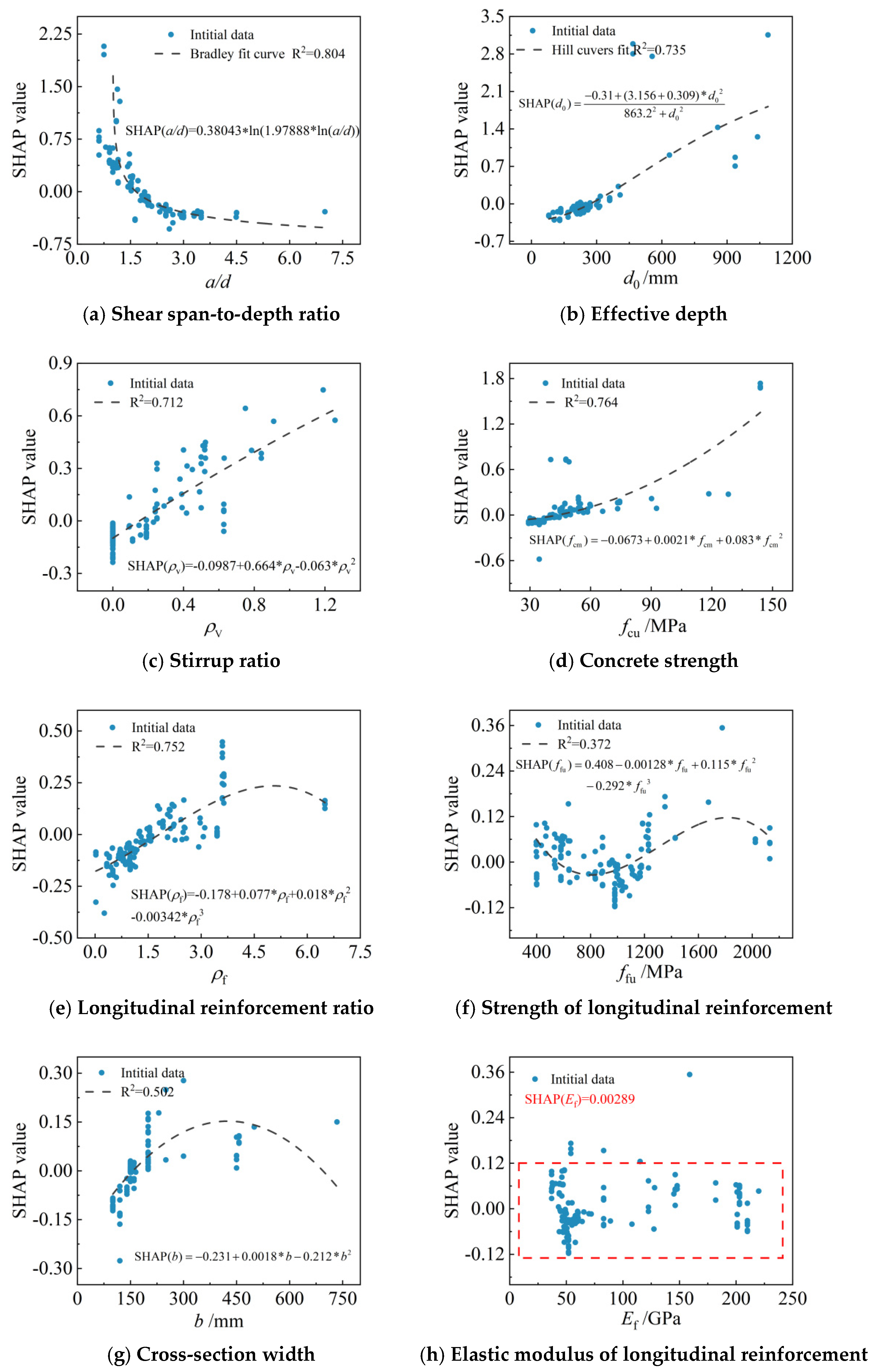
Figure 14 shows the variation patterns of SHAP values with respect to each input feature. Figure 14a illustrates the relationship between the shear span-to-depth ratio and SHAP values. It can be observed that the SHAP values decrease initially at a rapid rate and then gradually as the shear span-to-depth ratio increases, indicating a negative nonlinear correlation between the shear span-to-depth ratio and the beam’s shear capacity. This observation is consistent with the findings of Razaqpur and Isgor [53]. Figure 14b shows the variation in SHAP values with effective depth. As shown in the figure, the SHAP values increase as the effective depth rises, suggesting a significant size-dependent effect on shear capacity and a positive correlation between effective depth and shear capacity. Figure 14c and Figure 14d display the influence of stirrup ratio and concrete strength on SHAP values, respectively. In both cases, the SHAP values increase with the corresponding input features. Figure 14c shows that when the stirrup ratio is 0, the SHAP values are negative, indicating that the presence of stirrups significantly enhances the shear capacity of FRP-RC beams. Figure 14e shows the influence of the longitudinal reinforcement ratio on the SHAP values. The trend of the fitted curve clearly indicates that the SHAP values first increase and then decrease as the reinforcement ratio increases. This suggests that, within a certain range, increasing the reinforcement ratio can effectively improve the shear capacity of FRP-RC beams. However, when the longitudinal reinforcement ratio becomes too high, the interaction between concrete and FRP bars deteriorates, leading to stress concentration around the longitudinal reinforcement and a subsequent decrease in shear capacity [54]. Since FRP bars are inherently linear elastic materials, an over-reinforced condition exacerbates the brittle failure characteristics of FRP-RC beams. As shown in the corresponding figure, the strength of longitudinal reinforcement has a negligible effect on the shear capacity of FRP-RC beams. The SHAP values associated with longitudinal reinforcement strength in Figure 14f exhibit considerable dispersion. Figure 14g illustrates the effect of section width on the distribution of SHAP values. Compared with effective depth, section width has a relatively smaller impact on shear capacity. As shown in Figure 14g, within the sample range considered in this study, SHAP values increase with section width. Figure 14h and Figure 14i show the influence of the elastic modulus of longitudinal reinforcement and stirrups on SHAP values, respectively. It can be observed that over 90% of the SHAP value points fall within the range of −0.12 to 0.12. Figure 14j illustrates the effect of stirrup strength on SHAP values. As shown, more than 90% of the SHAP values for beams without web reinforcement are negative, while those for beams with web reinforcement increase with stirrup strength. However, the fitted curve reveals considerable scatter of SHAP values with respect to this parameter.
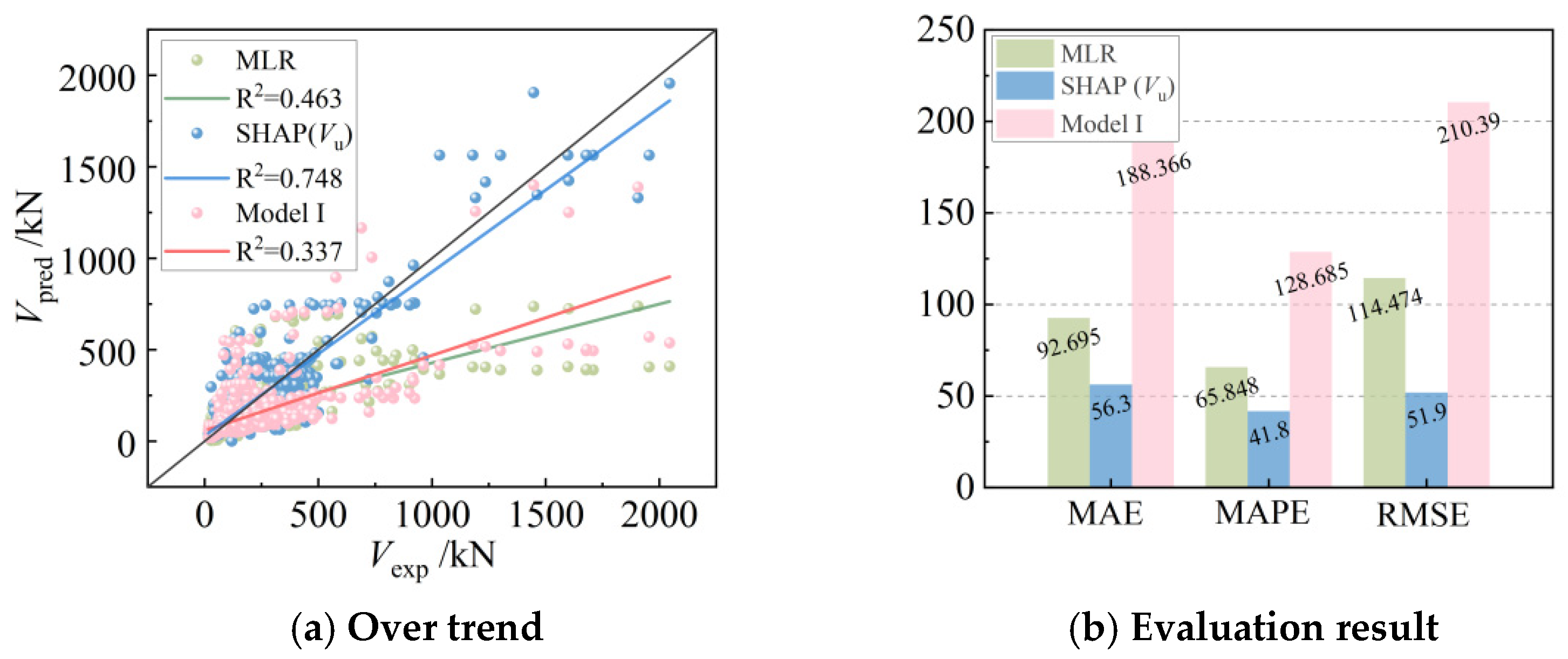
To address the insufficient prediction accuracy caused by the limited parameters in existing equations, this study employed a multiple regression model to perform linear regression analysis on 10 input features, resulting in Equation (12). Furthermore, based on the shear resistance mechanism of FRP-RC beams and the analysis of the influence of various parameters on SHAP values and shear capacity, a prediction equation for the shear capacity of FRP-RC beams was developed. This equation takes into account the variation patterns of SHAP values with respect to the parameters. A comparative study was then conducted between this equation, the traditional MLR model, and Model I, which exhibits the highest prediction accuracy among existing equations. It should be noted that Equation (12) does not consider the physical significance of each parameter.
M L R ( V u ) = 0.163 b + 0.4659 d 0 + 0.239 f cu 0.3584 a d + 0.063 ρ f 0.0285 E f + 0.0444 f fu + 0.0582 ρ v + 0.0027 E fv + 0.0414 f fv
Based on the SHAP analysis results shown in Figure 13, the five input features with the largest mean absolute SHAP values were identified as the key factors influencing the shear capacity of beams and were selected as the independent variables for formula derivation. Subsequently, Figure 14 presents a detailed analysis of the distribution characteristics and variation trends of SHAP values for each parameter. For each feature, functions consistent with the scatter distribution trends were chosen to fit the relationship with the SHAP values, as detailed below. The SHAP values corresponding to the shear span-to-depth ratio exhibit a skewed distribution, showing a trend of initially rapid decrease followed by gradual decline. This indicates that, as the shear span-to-depth ratio increases, the shear-resisting mechanism of the beam gradually transitions from arch action to beam action, and the trend of the Bradley function can accurately capture this transformation. Accordingly, the Bradley function is employed for fitting in this study, yielding Equation (13).
SHAP ( a / d ) = 0.38043 ln ( 1.97888 ln ( a / d ) )
The SHAP values of the effective depth show a monotonically increasing trend. As the effective depth increases, both the shear cross-sectional height and the internal lever arm of the beam increase. This not only enlarges the shear-resisting area of the concrete but also extends the load transfer path of diagonal cracks, thereby enhancing the inherent shear resistance of the concrete [55]. Therefore, the Hill function was selected for fitting, as shown in Equation (14).
SHAP ( d 0 ) = 0.31 + ( 3.156 + 0.309 ) d 0 2 863.2 2 + d 0 2
The SHAP values of the stirrup ratio, concrete strength, and longitudinal reinforcement ratio all exhibit a clear increasing trend, although they exhibit greater dispersion than the first two features. Therefore, quadratic or cubic polynomial functions were employed to fit these features, as presented in Equations (15)–(17).
SHAP ( ρ v ) = 0.0987 + 0.664 ρ v 0.063 ρ v 2
SHAP ( f cm ) = 0.0673 + 0.0021 f cu + 0.083 f cu 2
SHAP ( ρ f ) = 0.178 + 0.077 ρ f + 0.018 ρ f 2 0.00342 ρ f 3
It is worth noting that the R2 values of all fitting curves exceed 0.7, confirming the presence of stable and continuous functional relationships between each parameter and its corresponding SHAP contribution. Finally, the five fitted SHAP values were employed as inputs in a multiple linear regression analysis. Based on the additivity of SHAP values, a closed-form prediction equation for the shear capacity of FRP-RC beams was established, as shown in Equation (18).
SHAP ( V u ) = 484.9 + 18.6 × SHAP ( a / d ) + 1.827 × SHAP ( d 0 ) + 7.78 × SHAP ( ρ f ) + 2.92 × SHAP ( f cu ) + 0.63 × SHAP ( ρ v )
The coefficients in Equation (18) are determined using the ordinary least squares (OLS) method. This regression establishes a linear additive relationship between the shear capacity Vu of the beam and the SHAP contributions of the key features. The OLS algorithm solves for the optimal coefficients by minimizing the sum of squared residuals between the predicted and observed Vu values. The formula selects the top five key features with the highest mean absolute SHAP values and removes redundant variables. Low-complexity functions, such as the Hill function, Bradley function, and low-order polynomials, are employed for fitting. The R2 for all univariate fittings range from 0.7 to 0.81. The final formula adopts a linear superposition form with a simple structure, effectively avoiding overfitting.
The SHAP-based prediction equation is established based on standardized machine learning features and dimensionless SHAP values. Essentially, this equation constitutes an empirical, data-driven statistical model; it is constructed by fitting the characteristic trends of influencing factors identified through SHAP interpretability analysis, rather than being a theoretical formula rigorously derived from first principles of structural mechanics. The equation does not satisfy strict dimensional homogeneity in the mechanical sense and is valid only under a specific unit system (mm, MPa, kN). All parameters in the formula are defined with fixed units corresponding to the training dataset, and high numerical accuracy is guaranteed only if these units are applied consistently. The feasibility of this method has been validated in the relevant literature [56,57]. Furthermore, the prediction accuracy and generalizability of this equation are inherently constrained by the parameter distribution and sample coverage of the existing experimental database.
The predictive performance of Equations (12) and (18), and Model I was compared, with the results presented in Figure 15. As shown in Figure 15a, Equation (18) achieves the highest R2 and demonstrates the best overall fitting performance, confirming the effectiveness of the MLP-XGBoost model in selecting key predictive parameters. Figure 15b indicates that Equation (18) yields lower values of MAE, RMSE, and MAPE for the shear capacity of FRP-RC beams. Compared to Model I (which has the lowest MAPE among existing formulas), Equation (18) reduces the MAE by 67.52%. It is noteworthy that the shear capacity prediction equation proposed in this study is based on SHAP analysis results, and its prediction logic closely aligns with the shear resistance mechanism of FRP-RC beams, achieving a coherent integration of model predictions with the mechanical behavior of the parameters.

6. Conclusions

This study focuses on constructing a reliable machine learning model based on a weighted ensemble of heterogeneous machine learning models to predict the shear capacity of FRP-RC beams. The ensemble model integrates the MLP and XGBoost algorithms. The results demonstrate that the proposed MLP-XGBoost ensemble model outperforms all conventional models and empirical formulas considered in this study in terms of prediction accuracy. The 10-fold cross-validation results indicate that the stability of the ensemble model is superior to that of the conventional base models. In addition, the SHAP interpretability framework was adopted to dissect the prediction mechanism of the MLP-XGBoost model and to identify the influence patterns of individual input features on shear capacity. Based on the findings derived from SHAP interpretation, this research developed an explicit formula for predicting the shear capacity of FRP-RC beams. The main conclusions are presented as follows:
  • Compared with existing calculation formulas, all machine learning models exhibit significantly higher accuracy in predicting the shear capacity of FRP-RC beams. Among them, the weighted ensemble model MLP-XGBoost achieves the best predictive performance. Results from the cross-validation indicate that the predictive stability of the MLP-XGBoost model surpasses that of the conventional MLP and XGBoost models; across the 10 rounds of training, the model’s Mean Absolute Error (MAE) fluctuates within ±15% of its average MAE.
  • The Shapley Additive Explanations (SHAP) algorithm can reveal the contribution of various input features to the shear capacity of FRP-RC beams. The analysis results indicate that the shear span-to-depth ratio has the greatest influence and is negatively correlated with the shear capacity. In comparison, all other influencing factors contribute positively to the shear capacity.
  • Based on the SHAP interpretability analysis results, five key parameters, namely the shear span-to-depth ratio, effective depth, stirrup ratio, concrete strength, and longitudinal reinforcement ratio, were selected to establish an explicit prediction formula for the shear capacity of FRP-reinforced concrete beams with high prediction accuracy. Verification shows that the predicted values of this formula are in good agreement with the experimental data.

7. Practical Significance and Future Prospects

The research findings of this study have valuable practical significance for engineering design. Compared with conventional machine learning models and empirical formulas, the established MLP-XGBoost ensemble model achieves higher prediction accuracy and stability for the shear capacity of FRP-reinforced concrete beams, and can serve as a reliable tool for engineering evaluation. Through SHAP interpretability analysis, the influence of each parameter and the inherent shear-resistance mechanism are quantitatively clarified, providing a theoretical basis for the optimization of structural design parameters. Meanwhile, the derived high-precision explicit prediction formula for shear capacity can be conveniently applied by engineers for routine structural calculations, shear capacity verification, and component optimization design of FRP-RC beams in practical engineering.
It should be noted that the machine learning model proposed in this study, as well as the SHAP-derived predictive equation, can provide reasonably reliable predictions only within the applicable scope of the current database. Furthermore, this study focuses solely on the shear capacity of rectangular FRP-reinforced concrete beams, with parameter distributions mainly concentrated under conventional working conditions, while investigations under extreme conditions remain limited. In light of this, future research could supplement experimental tests under extreme conditions, combined with extended finite element analyses, to further expand the existing database, thereby better supporting the training and optimization of machine learning models.

Author Contributions

C.X.: Writing—review and editing, Investigation, Data curation. Y.F.: Writing—original draft, Methodology, Formal analysis, Data curation. S.C.: Writing—review and editing, Resources, Methodology, Funding acquisition, Data curation. H.Z.: Writing—original draft, Data curation. All authors have read and agreed to the published version of the manuscript.

Funding

This research was funded by the Nature Science Foundation of Guangxi (Grant No. 2025GXNSFHA069213) and Science and Technology Project of Guangxi (Grant No. AD23026136), and Doctoral Foundation of Guangxi University of Science and Technology (Grant No. 21Z58). And The APC was funded by Doctoral Foundation of Guangxi University of Science and Technology (Grant No. 21Z58).

Data Availability Statement

The data that support the findings of this study are available from the corresponding author upon reasonable request.

Conflicts of Interest

The authors hereby state that there are no competing financial or non-financial interests that could be perceived as influencing the work presented in this paper.

Appendix A. List of References for Database

ReferenceNumber of SpecimensStirrupsLongitudinal BarCompressive Strength of Concrete (MPa)Vexp (kN)
Evan C. Bentz [58]21with or without stirrupsGFRP35–4954.5–690
Ahmed S F [59]4without stirrupsGFRP and CFRP38.7–39.31191–1906
Chung Ho Kim [60]80without stirrupsGFRP and CFRP30–40.316.3–170.2
Douglas Tomlinson [61]9with or without stirrupsBFRP51–6023–106.9
Mohsen A [62]12with or without stirrupsBFRP35.929–195.8
Mohamed Said [63]10with or without stirrupsGFRP24.5–74.4109.82–351
G.B. Maranan [64]18with or without stirrupsGFRP31126–723
Farid Abed [65]10without stirrupsBFRP5079–240.5
Ghazi B J [66]19with or without stirrupsBFRP73.4107.3–402.2
M. Krall [67]17with or without stirrupsGFRP47.3125.1–466.9
Tung T. Tran [68]18without stirrupsBFRP28.7–6628.7–53.5
Farid Abed [69]13without stirrupsBFRP45–60189.39–385.79
Abathar Al-H [70]14with or without stirrupsBFRP44.554.7–142.2
Fei Peng [71]11without stirrupsGFRP55.5–62.7235–290
Zhiqiang Gu [72]7without stirrupsCFRP and GFRP30127.5–245.6
Fei Peng [73]14with or without stirrupsGFRP40.31179–2045
Lingzhu Zhou [74]9with or without stirrupsGFRP48–54277–962
Baoqiang Liao [75]9with stirrupsBFRP55211–458
Hetao Qi [76]5with stirrupsCFRP46.1481–901
Kangkang Yang [4]13without stirrupsGFRP52.8–59.7122–235.1
A. Ghani R [77]7without stirrupsCFRP40.5–4936.11–96.18
M. S. Alam [78]12without stirrupsGFRP and CFRP34.5–44.760.1–200.1
Ahmed El Refai [79]10without stirrupsBFRP4933.8–93.6
Omar Salman [80]10without stirrupsGFRP144348–914
Mahdi Nematzadeh [81]15without stirrupsGFRP54–6451–143
Ghazi B J [82]22without stirrupsBFRP42.2–73.4107–331
Ashraf F. Ashour [56]6without stirrupsCFRP27–3535.17–72.32
Koray Tureyen [83]9without stirrupsGFRP39.7–43.694.7–203.7
Andrea Rizzo [84]9with stirrupsCFRP29.3244.3–352.8
Gyuseon Kim [85]16without stirrupsCFRP34.762.5–182
Amr M.A. Moussa [86]21with or without stirrupsCFRP48113–261
Bo Song [87]11with stirrupsBFRP34.6130.3–735.4
Chenchen Li [88]7with stirrupsGFRP47.81033.6–1954.7
Rui Zhou [89]5with stirrupsBFRP54.26–62.68267.86–568.45
Shoutan Song [90]6with stirrupsCFRP118.5361–460
Cheng Chen [91]12with stirrupsFFRP42.8319.6–443.9
Shiwen Han [92]22with or without stirrupsCFRP37137.1–177.7
Adel Younis [93]6with or without stirrupsGFRP46–47.764.2–101.2
Abathar Al-H [94]14with stirrupsGFRP35.0599–196
Wenlong Li [50]6with stirrupsGFRP28.67159–206
Fen Zhou [95]7with stirrupsBFRP128.15250–497.02
Jiamei Lv [96]4with stirrupsGFRP34.6–39.3277–476
Yuan Ye [97]14with stirrupsGFRP4292.9–168.4
Zhiquan Xing [98]70without stirrupsGFRP29.35–33.8717.3–50.91

References

  1. Duo, Y.; Liu, X.; Liu, Y.; Tafsirojjaman, T.; Sabbrojjaman, M. Environmental impact on the durability of FRP reinforcing bars. J. Build. Eng. 2021, 43, 102909. [Google Scholar] [CrossRef]
  2. Siddika, A.; Al Mamun, A.; Alyousef, R.; Amran, Y.M. Strengthening of reinforced concrete beams by using fiber-reinforced polymer composites: A review. J. Build. Eng. 2019, 25, 100798. [Google Scholar] [CrossRef]
  3. Ahmed, A.; Guo, S.; Zhang, Z.; Shi, C.; Zhu, D. A review on durability of fiber reinforced polymer (FRP) bars reinforced seawater sea sand concrete. Constr. Build. Mater. 2020, 256, 119484. [Google Scholar] [CrossRef]
  4. Yang, K.; Wu, Z.; Zheng, K.; Shi, J. Shear behavior of regular oriented steel fiber-reinforced concrete beams reinforced with glass fiber polymer (GFRP) bars. Structures 2024, 63, 106339. [Google Scholar] [CrossRef]
  5. Dhahir, M.K. Shear strength of FRP reinforced deep beams without web reinforcement. Compos. Struct. 2017, 165, 223–232. [Google Scholar] [CrossRef]
  6. El-Hacha, R. Prestressing Concrete Structures with FRP Tendons (ACI 440.4R-04). In Proceedings of the Structures Congress 2005: Metropolis and Beyond, New York, NY, USA, 20–24 April 2005; pp. 1–8. [Google Scholar]
  7. Chowdhury, M.A.; Islam, M.M. Shear strength prediction of FRP-reinforced concrete beams: A state-of the-art review of available models. J. Civ. Environ. Eng. 2015, 5, 1–10. [Google Scholar] [CrossRef]
  8. Vecchio, F.J.; Collins, M.P. Predicting the response of reinforced concrete beams subjected to shear using modified compression field theory. ACI Struct. J. 1988, 85, 258–268. [Google Scholar] [CrossRef]
  9. Classen, M. Shear Crack Propagation Theory (SCPT)—The mechanical solution to the riddle of shear in RC members without shear reinforcement. Eng. Struct. 2020, 210, 110207. [Google Scholar] [CrossRef]
  10. Softened Membrane Model for Reinforced Concrete Elements in Shear. ACI Struct. J. 2002, 99, 460–469. [CrossRef]
  11. Liu, C.; Xu, D.; Duanmu, X. Analysis of shear strength influencing factors in reinforced concrete deep beams: A modified calculating model. J. Build. Eng. 2024, 95, 110243. [Google Scholar] [CrossRef]
  12. Ma, C.; Wang, W.; Wang, S.; Guo, Z.; Feng, X. Prediction of shear strength of RC slender beams based on interpretable machine learning. Structures 2023, 57, 105171. [Google Scholar] [CrossRef]
  13. Oller, E.; Marí, A.; Bairán, J.M.; Cladera, A. Shear design of reinforced concrete beams with FRP longitudinal and transverse reinforcement. Compos. Part B Eng. 2015, 74, 104–122. [Google Scholar] [CrossRef]
  14. ACI Committee. Building Code Requirements for Structural Concrete (ACI 318-08) and Commentary; American Concrete Institute: Farmington Hills, MI, USA, 2008. [Google Scholar]
  15. 50010-2010; Code for Design of Concrete Structures. Building Industry Press: Beijing, China, 2010.
  16. Somala, S.N.; Karthikeyan, K.; Mangalathu, S. Time period estimation of masonry infilled RC frames using machine learning techniques. Structures 2021, 34, 1560–1566. [Google Scholar] [CrossRef]
  17. Nguyen, H.D.; Truong, G.T.; Shin, M. Development of extreme gradient boosting model for prediction of punching shear resistance of r/c interior slabs. Eng. Struct. 2021, 235, 112067. [Google Scholar] [CrossRef]
  18. Vu, Q.-V.; Truong, V.-H.; Thai, H.-T. Machine learning-based prediction of CFST columns using gradient tree boosting algorithm. Compos. Struct. 2021, 259, 113505. [Google Scholar] [CrossRef]
  19. Marani, A.; Nehdi, M.L. Machine learning prediction of compressive strength for phase change materials integrated cementitious composites. Constr. Build. Mater. 2020, 265, 120286. [Google Scholar] [CrossRef]
  20. Wakjira, T.G.; Alam, M.S.; Ebead, U. Plastic hinge length of rectangular RC columns using ensemble machine learning model. Eng. Struct. 2021, 244, 112808. [Google Scholar] [CrossRef]
  21. Inel, M. Modeling ultimate deformation capacity of RC columns using artificial neural networks. Eng. Struct. 2007, 29, 329–335. [Google Scholar] [CrossRef]
  22. Mangalathu, S.; Jang, H.; Hwang, S.-H.; Jeon, J.-S. Data-driven machine-learning-based seismic failure mode identification of reinforced concrete shear walls. Eng. Struct. 2020, 208, 110331. [Google Scholar] [CrossRef]
  23. Deng, C.; Xue, X. Hybrid particle swarm optimization and group method of data handling for the prediction of ultimate strength of concrete-filled steel tube columns. Adv. Eng. Softw. 2024, 195, 103708. [Google Scholar] [CrossRef]
  24. Naderpour, H.; Poursaeidi, O.; Ahmadi, M. Shear resistance prediction of concrete beams reinforced by FRP bars using artificial neural networks. Measurement 2018, 126, 299–308. [Google Scholar] [CrossRef]
  25. Chou, J.-S.; Pham, T.-P.; Nguyen, T.-K.; Pham, A.-D.; Ngo, N.-T. Shear strength prediction of reinforced concrete beams by baseline, ensemble, and hybrid machine learning models. Soft Comput. 2019, 24, 3393–3411. [Google Scholar] [CrossRef]
  26. Feng, D.; Wang, W.-J.; Mangalathu, S.; Hu, G.; Wu, T. Implementing ensemble learning methods to predict the shear strength of RC deep beams with/without web reinforcements. Eng. Struct. 2021, 235, 111979. [Google Scholar] [CrossRef]
  27. Moj, M.; Czarnecki, S. Comparative analysis of selected machine learning techniques for predicting the pull-off strength of the surface layer of eco-friendly concrete. Adv. Eng. Softw. 2024, 195, 103710. [Google Scholar] [CrossRef]
  28. Ge, P.; Yang, O.; He, J.; Liu, Z.; Chen, H. Metaheuristic algorithms-optimized machine learning models for FRP-concrete interfacial bond strength prediction. Adv. Eng. Softw. 2025, 208, 103971. [Google Scholar] [CrossRef]
  29. Hwang, S.-H.; Mangalathu, S.; Shin, J.; Jeon, J.-S. Machine learning-based approaches for seismic demand and collapse of ductile reinforced concrete building frames. J. Build. Eng. 2021, 34, 101905. [Google Scholar] [CrossRef]
  30. Mangalathu, S.; Hwang, S.-H.; Choi, E.; Jeon, J.-S. Rapid seismic damage evaluation of bridge portfolios using machine learning techniques. Eng. Struct. 2019, 201, 109785. [Google Scholar] [CrossRef]
  31. Mangalathu, S.; Sun, H.; Nweke., C.C.; Yi, Z.; Burton, H.V. Classifying earthquake damage to buildings using machine learning. Earthq. Spectra 2020, 36, 183–208. [Google Scholar] [CrossRef]
  32. Zhang, C.; Liu, P.; Song, T.; He, B.; Li, W.; Peng, Y. Elastic Modulus Prediction of Ultra-High-Performance Concrete with Different Machine Learning Models. Buildings 2024, 14, 3184. [Google Scholar] [CrossRef]
  33. Alam, M.S.; Sultana, N.; Hossain, S.M.Z. Bayesian optimization algorithm based support vector regression analysis for estimation of shear capacity of FRP reinforced concrete members. Appl. Soft Comput. 2021, 105, 107281. [Google Scholar] [CrossRef]
  34. Nguyen, P.D.; Dang, V.H. Shear strength of FRP—Reinforced concrete deep beams: Extension of beam and arch action model based on data-driven analysis. Structures 2025, 74, 108553. [Google Scholar] [CrossRef]
  35. Zhao, J.; Zhu, M.; Xu, L.; Chen, M.; Shi, M. Prediction of Shear Capacity of Fiber-Reinforced Polymer-Reinforced Concrete Beams Based on Machine Learning. Buildings 2025, 15, 1908. [Google Scholar] [CrossRef]
  36. Benavoli, A.; Corani, G.; Mangili, F. Should we really use post-hoc tests based on mean-ranks? J. Mach. Learn. Res. 2016, 17, 152–161. [Google Scholar]
  37. XuanRui, Y. Developing an artificial neural network model to predict the durability of the RC beam by machine learning approaches. Case Stud. Constr. Mater. 2022, 17, e01382. [Google Scholar] [CrossRef]
  38. Sujon, K.M.; Hassan, R.B.; Towshi, Z.T.; Othman, M.A.; Samad, A.; Choi, K. When to Use Standardization and Normalization: Empirical Evidence From Machine Learning Models and XAI. IEEE Access 2024, 12, 135300–135314. [Google Scholar] [CrossRef]
  39. Yang, B.; Liang, B.; Zhou, S.; Qian, Y.; Zheng, R.; Shu, H.; He, P.; Wang, J.; Jiang, L.; Sang, Y.; et al. A novel bio-inspired caterpillar fungus (Ophiocordyceps sinensis) optimizer for SOFC parameter identification via GRNN. Renew. Energy 2026, 256, 123995. [Google Scholar] [CrossRef]
  40. Hassoun, M.H. Fundamentals of Artificial Neural Networks; MIT Press: Cambridge, MA, USA, 1995. [Google Scholar]
  41. Gardner, M.W.; Dorling, S.R. Artificial neural networks (the multilayer perceptron)—A review of applications in the atmospheric sciences. Atmos. Environ. 1998, 32, 2627–2636. [Google Scholar] [CrossRef]
  42. Farnaaz, N.; Jabbar, M.A. Random forest modeling for network intrusion detection system. Procedia Comput. Sci. 2016, 89, 213–217. [Google Scholar] [CrossRef]
  43. Ke, G.; Meng, Q.; Finley, T.; Wang, T.; Chen, W.; Ma, W.; Ye, Q.; Liu, T.Y. Lightgbm: A highly efficient gradient boosting decision tree. Adv. Neural Inf. Process. Syst. 2017, 30, 3146–3154. [Google Scholar]
  44. Chen, T.; Guestrin, C. XGBoost: A scalable tree boosting system. In Proceedings of the 22nd ACM SIGKDD International Conference on Knowledge Discovery and Data Mining, Association for Computing Machinery, San Francisco, CA, USA, 13–17 August 2016; pp. 785–794. [Google Scholar]
  45. Nguyen, H.; Vu, T.; Vo, T.P.; Thai, H.-T. Efficient machine learning models for prediction of concrete strengths. Constr. Build. Mater. 2021, 266, 120950. [Google Scholar] [CrossRef]
  46. Bui, D.-K.; Nguyen, T.; Chou, J.-S.; Nguyen-Xuan, H.; Ngo, T.D. A modified firefly algorithm-artificial neural network expert system for predicting compressive and tensile strength of high-performance concrete. Constr. Build. Mater. 2018, 180, 320–333. [Google Scholar] [CrossRef]
  47. Degtyarev, V.V. Neural networks for predicting shear strength of CFS channels with slotted webs. J. Constr. Steel Res. 2021, 177, 106443. [Google Scholar] [CrossRef]
  48. ACI 440.1R-15; Guide for the Design and Construction of Structural Concrete Reinforced with Fiber-Reinforced Polymer (FRP) Bars. American Concrete Institute: Farmington Hills, MI, USA, 2015.
  49. GB 50608-2020; Technical Standard for Fiber Reinforced Polymer (FRP) in Construction. Ministry of Housing and Urban-Rural Development of the People’s Republic of China: Beijing, China, 2020.
  50. Li, W.; Huang, W.; Fang, Y.; Zhang, K.; Liu, Z.; Kong, Z. Experimental and theoretical analysis on shear behavior of RC beams reinforced with GFRP stirrups. Structures 2022, 46, 1753–1763. [Google Scholar] [CrossRef]
  51. CSA S806–12; Design and Construction of Building Structures with Fibre-Reinforced Polymers. Canadian Standards Association: Ottawa, ON, Canada, 2012.
  52. Yang, Y.; Zhou, C.; Peng, J.; Li, H.; Dong, Y.; Cai, C. Theory-informed deep neural network-based time-dependent flexural reliability assessment of corroded PC structures. Eng. Struct. 2025, 329, 119819. [Google Scholar] [CrossRef]
  53. Razaqpur, A.G.; Isgor, O.B. Proposed Shear Design Method for FRP-Reinforced Concrete Members without Stirrups. ACI Struct. J. 2006, 103, 93. [Google Scholar] [CrossRef] [PubMed]
  54. Rasheed, M.H.F.; Taha, B.O.; Agha, A.Z.S.; Arbili, M.M.; Abdulrahman, P.I. Shear Capacity of Fiber-Reinforced Polymer (FRP)–Reinforced Concrete (RC) Beams Without Stirrups: Comparative Modeling with FRP Modulus, Longitudinal Ratio, and Shear Span-to-Depth. J. Compos. Sci. 2025, 9, 554. [Google Scholar] [CrossRef]
  55. Ashour, A.F.; Kara, I.F. Size effect on shear strength of FRP reinforced concrete beams. Compos. Part B Eng. 2014, 60, 612–620. [Google Scholar] [CrossRef]
  56. Yu, Y.; Li, S.; Wang, L.; Xian, G. Prediction and interpretation of bond strength between FRP bars and fiber reinforced concrete using machine learning and Shapley Additive exPlanations Analysis. Constr. Build. Mater. 2025, 496, 143797. [Google Scholar] [CrossRef]
  57. Tian, L.; Wang, L.; Xian, G. Machine learning prediction of interfacial bond strength of FRP bars with different surface characteristics to concrete. Case Stud. Constr. Mater. 2024, 21, e03984. [Google Scholar] [CrossRef]
  58. Bentz, E.C.; Massam, L.; Collins, M.P. Shear Strength of Large Concrete Members with FRP Reinforcement. J. Compos. Constr. 2010, 14, 637–646. [Google Scholar] [CrossRef]
  59. Farghaly, A.S.; Benmokrane, B. Shear Behavior of FRP-Reinforced Concrete Deep Beams without Web Reinforcement. J. Compos. Constr. 2013, 17, 10. [Google Scholar] [CrossRef]
  60. Kim, C.H.; Jang, H.S. Concrete Shear Strength of Normal and Lightweight Concrete Beams Reinforced with FRP Bars. J. Compos. Constr. 2014, 18, 9. [Google Scholar] [CrossRef]
  61. Tomlinson, D.; Fam, A. Performance of concrete beams reinforced with basalt FRP for flexure and shear. J. Compos. Constr. 2015, 19, 04014036. [Google Scholar] [CrossRef]
  62. Issa, M.A.; Ovitigala, T.; Ibrahim, M. Shear Behavior of Basalt Fiber Reinforced Concrete Beams with and without Basalt FRP Stirrups. J. Compos. Constr. 2016, 20, 11. [Google Scholar] [CrossRef]
  63. Said, M.; Adam, M.A.; Mahmoud, A.A.; Shanour, A.S. Experimental and analytical shear evaluation of concrete beams reinforced with glass fiber reinforced polymers bars. Constr. Build. Mater. 2016, 102, 574–591. [Google Scholar] [CrossRef]
  64. Maranan, G.; Manalo, A.; Benmokrane, B.; Karunasena, W.; Mendis, P.; Nguyen, T. Shear behaviour of geopolymer-concrete beams transversely reinforced with continuous rectangular GFRP composite spirals. Compos. Struct. 2018, 187, 454–465. [Google Scholar] [CrossRef]
  65. Abed, F.; El Refai, A.; Abdalla, S. Experimental and finite element investigation of the shear performance of BFRP-RC short beams. Structures 2019, 20, 689–701. [Google Scholar] [CrossRef]
  66. Jumaa, G.B.; Yousif, A.R. Size effect on the shear failure of high-strength concrete beams reinforced with basalt FRP bars and stirrups. Constr. Build. Mater. 2019, 209, 77–94. [Google Scholar] [CrossRef]
  67. Krall, M.; Polak, M. Concrete beams with different arrangements of GFRP flexural and shear reinforcement. Eng. Struct. 2019, 198, 109333. [Google Scholar] [CrossRef]
  68. Tran, T.T.; Pham, T.M.; Hao, H. Effect of hybrid fibers on shear behaviour of geopolymer concrete beams reinforced by basalt fiber reinforced polymer (BFRP) bars without stirrups. Compos. Struct. 2020, 243, 112236. [Google Scholar] [CrossRef]
  69. Abed, F.; Sabbagh, M.K.; Karzad, A.S. Effect of basalt microfibers on the shear response of short concrete beams reinforced with BFRP bars. Compos. Struct. 2021, 269, 114029. [Google Scholar] [CrossRef]
  70. Al-Hamrani, A.; Alnahhal, W.; Elahtem, A. Shear behavior of green concrete beams reinforced with basalt FRP bars and stirrups. Compos. Struct. 2021, 277, 114619. [Google Scholar] [CrossRef]
  71. Peng, F.; Xue, W. Shear Behavior of Post-Tensioned Concrete Beams with Draped FRP Tendons and without Transverse Reinforcement. J. Compos. Constr. 2021, 25, 13. [Google Scholar] [CrossRef]
  72. Gu, Z.; Hu, Y.; Gao, D.; Wang, T.; Yang, L. Shear behavior and strength prediction of HFRP reinforced concrete beams without stirrups. Eng. Struct. 2023, 297, 117030. [Google Scholar] [CrossRef]
  73. Peng, F.; Cai, Y.; Yi, W.; Xue, W. Shear behavior of two-span continuous concrete deep beams reinforced with GFRP bars. Eng. Struct. 2023, 290, 116367. [Google Scholar] [CrossRef]
  74. Zhou, L.; Zheng, Y.; Di, B.; Lv, J.; Taylor, S. Shear behaviour of SWSS-SCC beams reinforced with GFRP bars and Stirrups: Experimental and analytical investigations. Structures 2023, 56, 104946. [Google Scholar] [CrossRef]
  75. Liao, B.; Du, Y.; Zhou, R.; Rahman, M.Z.; Zhu, D. Shear Behavior of Seawater-Sea Sand Concrete Beams Reinforced with BFRP Bars and Stirrups. J. Compos. Constr. 2024, 28, 21. [Google Scholar] [CrossRef]
  76. Qi, H.; Jiang, H.; Wang, B.; Zhuge, P. Experimental Study on Shear Performance of Concrete Beams Reinforced with Externally Unbonded Prestressed CFRP Tendons. Fibers 2024, 12, 23. [Google Scholar] [CrossRef]
  77. Razaqpur, A.G.; Isgor, B.O.; Greenaway, S.; Selley, A. Concrete Contribution to the Shear Resistance of Fiber Reinforced Polymer Reinforced Concrete Members. J. Compos. Constr. 2004, 8, 452–460. [Google Scholar] [CrossRef]
  78. Alam, M.S.; Hussein, A. Size Effect on Shear Strength of FRP Reinforced Concrete Beams without Stirrups. J. Compos. Constr. 2013, 17, 507–516. [Google Scholar] [CrossRef]
  79. El Refai, A.; Abed, F. Concrete Contribution to Shear Strength of Beams Reinforced with Basalt Fiber-Reinforced Bars. J. Compos. Constr. 2016, 20, 13. [Google Scholar] [CrossRef]
  80. Salman, O.; Abed, F.; Alhoubi, Y. Shear performance of GFRP reinforced UHPC short beams. Compos. Struct. 2024, 351, 118637. [Google Scholar] [CrossRef]
  81. Nematzadeh, M.; Hosseini, S.-A.; Ozbakkaloglu, T. The combined effect of crumb rubber aggregates and steel fibers on shear behavior of GFRP bar-reinforced high-strength concrete beams. J. Build. Eng. 2021, 44, 102981. [Google Scholar] [CrossRef]
  82. Jumaa, G.B.; Yousif, A.R. Size Effect in Shear Failure of High Strength Concrete Beams without Stirrup reinforced with Basalt FRP Bars. KSCE J. Civ. Eng. 2019, 23, 1636–1650. [Google Scholar] [CrossRef]
  83. Tureyen, A.K.; Frosch, R.J. Shear Tests of FRP-Reinforced Concrete Beams without Stirrups. Struct. J. 2002, 99, 427–434. [Google Scholar] [CrossRef]
  84. Rizzo, A.; De Lorenzis, L. Behavior and capacity of RC beams strengthened in shear with NSM FRP reinforcement. Constr. Build. Mater. 2009, 23, 1555–1567. [Google Scholar] [CrossRef]
  85. Kim, G.; Sim, J.; Oh, H. Shear strength of strengthened RC beams with FRPs in shear. Constr. Build. Mater. 2008, 22, 1261–1270. [Google Scholar] [CrossRef]
  86. Moussa, A.M.; Said, H.O.; Khodary, F.; Hassanean, Y.A. Shear behavior of high-strength concrete beams reinforced with carbon fiber-reinforced polymer bars. Eng. Struct. 2025, 325, 119411. [Google Scholar] [CrossRef]
  87. Song, B.; Jin, L.; Du, X.L. Experimental study and calculation of shear capacity of FRP-reinforced concrete short beams. J. Southeast Univ. (Nat. Sci. Ed.) 2024, 54, 1080–1088, (In Chinese with English Abstract). [Google Scholar] [CrossRef]
  88. Li, C.; Wei, F.; Xing, X.; Zhu, H. Shear performance of GFRP bars reinforced basalt fiber concrete deep beams. J. Huazhong Univ. Sci. Tech. (Nat. Sci. Ed.) 2025, 53, 104–110, (In Chinese with English Abstract). [Google Scholar] [CrossRef]
  89. Zhou, R.; Zhu, D.J. Shear behavior of BFRP bars reinforced seawater sea-sand concrete beam. J. Railw. Sci. Eng. 2023, 20, 3396–3405, (In Chinese with English Abstract). [Google Scholar] [CrossRef]
  90. Song, S.T.; Cao, T.; Duan, N.; Liu, D.Y. Experiment and analysis on shear capacity of CFRP reinforced steel fiber concrete beams. J. Disaster Prev. Mitig. Eng. 2021, 41, 1012–1019, (In Chinese with English Abstract). [Google Scholar] [CrossRef]
  91. Chen, C.; Li, X.; Li, C.; Zhou, Y.; Sui, L. Optimized flax FRP stirrup in reinforced concrete beam: Material property and shear performance. Compos. Struct. 2022, 302, 116219. [Google Scholar] [CrossRef]
  92. Han, S.; Fan, C.; Zhou, A.; Ou, J. Shear behavior of concrete beams reinforced with corrosion-resistant and ductile longitudinal steel-FRP composite bars and FRP stirrups. Eng. Struct. 2022, 278, 115520. [Google Scholar] [CrossRef]
  93. Younis, A.; El-Sherif, H.; Ebead, U. Shear strength of recycled-aggregate concrete beams with glass-FRP stirrups. Compos. Part C Open Access 2022, 8, 100257. [Google Scholar] [CrossRef]
  94. Al-Hamrani, A.; Alnahhal, W. Shear behavior of basalt FRC beams reinforced with basalt FRP bars and glass FRP stirrups: Experimental and analytical investigations. Eng. Struct. 2021, 242, 112612. [Google Scholar] [CrossRef]
  95. Zhou, F.; Chen, Y.M.; Zhu, D.J. Study on shear behavior of ultra-high performance seawater sea-sand concrete beams with FRP bars. J. Hunan Univ. (Nat. Sci.) 2023, 50, 159–168, (In Chinese with English Abstract). [Google Scholar] [CrossRef]
  96. Lü, J.M.; Pan, J.R.; Di, B.; Zheng, Y.; Zhu, W.; Li, J.; Zhang, Z.; Zhou, L. Experimental study on shear capacity of seawater sea-sand and self-compacting concrete beams with GFRP bars and stirrups. Concrete 2021, 385, 53–57, (In Chinese with English Abstract). [Google Scholar] [CrossRef]
  97. Yuan, Y.; Wang, Z.Y.; Wang, D.Y. Experimental study on the shear performance of concrete beams reinforced with new type closed winding GFRP stirrups. Acta Mater. Compos. Sin. 2022, 39, 5074–5085, (In Chinese with English Abstract). [Google Scholar] [CrossRef]
  98. Xing, Z.; Zhu, Y.; Shao, Y.; Ma, E.; Chung, K.-F.; Chen, Y. Experimental and numerical research on shear performance of GFRP bar reinforced seawater sea-sand concrete deep beams without stirrups. Case Stud. Constr. Mater. 2024, 20, e03142. [Google Scholar] [CrossRef]
Figure 1. Schematic Diagram of Shear Mechanism.
Buildings 16 02162 g001
Figure 2. Sample Distribution and Cumulative Percentage of FRP-RC Beams.
Buildings 16 02162 g002aBuildings 16 02162 g002b
Figure 3. Pearson correlation coefficients.
Buildings 16 02162 g003
Figure 4. Procedures of model development and prediction.
Buildings 16 02162 g004
Figure 5. Schematic Diagram of 10-Fold CV.
Buildings 16 02162 g005
Figure 6. Cross-validation with ten folds.
Buildings 16 02162 g006
Figure 7. Flowchart of dataset partitioning.
Buildings 16 02162 g007
Figure 8. Flowchart of the CFO optimization algorithm.
Buildings 16 02162 g008
Figure 9. CFO Iterative Fitness Value.
Buildings 16 02162 g009
Figure 10. Comparison of prediction accuracy of machine learning models.
Buildings 16 02162 g010aBuildings 16 02162 g010b
Figure 11. Radar chart of the performance evaluation indicators for ML models.
Buildings 16 02162 g011
Figure 12. Comparison of prediction accuracy of code formulas.
Buildings 16 02162 g012
Figure 13. Summary graph of the SHAP values based on predictions by the MLP-XGBoost model.
Buildings 16 02162 g013
Figure 14. The influence of input features on the SHAP values.
Buildings 16 02162 g014aBuildings 16 02162 g014b
Figure 15. Comparison of the prediction equations SHAP, MLR, and model I.
Buildings 16 02162 g015
Table 1. Statistical Distribution of Database Parameters.
Input Parameterb/mmd0/mmfcu/MPaa/dρf/%Ef/GPaffu/MPaρv/%Efv/GPaffv/MPa
Max500.001111.00144.007.006.502402438.673.35300.002438.14
Min100.0080.0024.500.500.0237.00397.000.07140.00160.00
Average168.11251.7141.862.071.9089.12940.140.40135.08703.89
SD60.90146.4319.440.951.3762.05410.760.3873.52338.94
Skewness3.833.893.211.101.076.631.331.391.130.75
Kurtosis21.7421.2314.835.894.1259.324.903.772.981.88
Normality (H)1111111111
H = 0: The data follows a normal distribution. H = 1: The data does not follow a normal distribution.
Table 2. Parameter sensitivity analysis.
R2RMSEMAE
a = 0.050.98624.25413.26
a = 0.10.99220.19811.131
a = 0.150.99120.89711.247
a = 0.20.98721.2412.335
a = 0.250.98522.59712.813
Table 3. Formulas for performance evaluation metrics.
IndicatorsFormulas
MAE M A E = 1 n i = 1 n V pred , i V exp , i
MAPE M A P E = 1 n i = 1 n V pred , i V exp , i V exp , i × 100 %
MSE M S E = 1 n i = 1 n ( V pred V exp ) 2
RMSE R M S E = 1 n i = 1 n ( V pred , i V exp , i ) 2
R2 R 2 = 1 i = 1 n V exp , i V pred , i 2 i = 1 n ( V exp , i V ¯ pred , i ) 2
Table 4. Repeated cross-validation metrics of the MLP-XGBoost model.
12345
Average32.8934.9729.2733.1534.56
standard deviation4.153.764.215.554.02
coefficient of variation0.130.110.140.170.12
Table 5. Hyperparameters of the machine learning model.
ML ModelHyperparameterOptimal Value
MLPLayer Sizes23, 4
Lambda0.031749
DTMinLeafsize2
max_depth13
max_features9
criterionsquared_error
RFTree_num166
MinLeafsize2
LightGBMNum_leaves6
Max_depth12
Learning_rate0.9
Num_max_iter63
Num_early_stop11
XGBoostmaxiter98
Depth_max7
Min_child3
Table 6. Performance evaluation metrics.
ML ModelMAEMAPEMSERMSER2
TrainTestTrainTestTrainTestTrainTestTrainTest
MLP17.61420.76020.720.91125.5912195.47233.55046.8560.9860.961
DT27.2329.69313.113.52309.2713674.68448.09560.6190.9340.907
RF28.99235.62517.929.22079.0884595.46245.59767.7900.9720.916
LightGBM23.44224.55210.711.51719.8502631.53441.47151.2980.9780.956
XGBoost12.94414.5258.018.5528.689858.34322.99329.2970.9900.985
MLP-XGBoost10.99411.6936.87.16380.228528.79019.49922.9950.9940.987
Table 7. Code formula.
Equation SourceEquations
ACI440.1R-15 [48] V u b h 0 = 2 5 k f c + ρ sv f fv k = 2 ρ f n f + ρ f n f 2 ρ f n f
CSA S806-12 [51] V u b h 0 = 0.05 α k m k r k a k s f c 1 3 + cot θ ρ sv f fv
k m = V h 0 M 1.0 k r = 1 + E f ρ f 1 3   1.0 k a = 2.5 V h 0 M 2.5 k s = 750 450 + d 1.0
GB 50608-2020 [49] V u b h 0 = 0.86 k f t + ρ sv f yv k = 2 ρ f n f + ρ f n f 2 ρ f n f
Model I [50] V u = 1.75 ( a / d ) + 1 f t b h 0 + ( a / d ) 0.19 ( a / d ) 3 + 1.97 ( a / d ) 2 6.48 ( a / d ) + 8.52 f fy h 0 s A fv
Note: fcu denotes the compressive strength of concrete; b represents the beam width; and k is the ratio of the depth of the neutral axis to the depth of the reinforcement; ρ f denotes the longitudinal reinforcement ratio; n f represents the ratio of the elastic modulus of the longitudinal reinforcement to that of concrete; f fv is the tensile strength of the FRP stirrup; f t and denotes the tensile strength of concrete; ε x denotes the concrete strain at the depth of the interface; V and M represent the design shear force and design bending moment under load combination, respectively; θ is the angle of the diagonal compressive stress; and d v denotes the effective shear depth. K m , K r , K a and K s represent the influence factors accounting for the effects of interface moment, reinforcement stiffness, arch action, and member size on the shear capacity of the member, respectively; α is the concrete density influence factor.
Table 8. Existing formulas.
ModelMAEMAPEMSERMSER2
MLP-XGBoost12.4090.073672.13225.9260.988
ACI440.1R-15150.9870.71170,395.881265.3220.166
CSA S806-12189.1091.030102,780.348320.5940.232
GB 50608-2020140.6940.63466,803.374258.4630.181
Model I114.4740.51944,263.89210.3900.337
Disclaimer/Publisher’s Note: The statements, opinions and data contained in all publications are solely those of the individual author(s) and contributor(s) and not of MDPI and/or the editor(s). MDPI and/or the editor(s) disclaim responsibility for any injury to people or property resulting from any ideas, methods, instructions or products referred to in the content.