Article

How Key Success Factors Improve Delay Mitigation in Construction Projects: The Mediating Role of Project Readiness


by
Sophon Lithanarung
,
Laemthong Laokhongthavorn
,
Mukhtar Ahmed
and
Vuttichai Chatpattananan
*
School of Engineering, King Mongkut’s Institute of Technology Ladkrabang, Bangkok 10520, Thailand
*
Author to whom correspondence should be addressed.
Buildings 2026, 16(11), 2137; https://doi.org/10.3390/buildings16112137
Submission received: 29 April 2026 / Revised: 18 May 2026 / Accepted: 23 May 2026 / Published: 27 May 2026
(This article belongs to the Section Construction Management, and Computers & Digitization)

Abstract

Construction projects continue to experience persistent schedule delays that adversely affect cost efficiency, quality, productivity, and stakeholder satisfaction. Although prior studies have extensively examined the causes of delays, limited empirical evidence explains how integrated managerial success conditions proactively improve delay mitigation capability. This study investigates the structural relationships among Key Success Factors (KSF), Project Readiness (PR), and Delay Mitigation (DM) in construction projects. The analysis primarily focuses on delay mitigation during the construction execution phase, where managerial capability and project readiness directly influence schedule performance and disruption response. A quantitative research design was employed using questionnaire data collected from 308 construction professionals in Thailand. KSF was conceptualized as a higher-order construct reflected by Project Execution Capability, Managerial and Digital Support, and Supply Chain Capability. Data was analyzed using Exploratory Factor Analysis, Confirmatory Factor Analysis, and Structural Equation Modeling. The findings indicate that KSF significantly enhances both Project Readiness and Delay Mitigation, while Project Readiness positively contributes to delay mitigation performance and partially mediates the relationship between managerial capability and project delay mitigation outcomes. The study provides an integrated capability-based framework and practical guidance for improving project delivery performance in uncertain construction environments.

1. Introduction

1.1. Background

Construction projects worldwide continue to experience persistent delays, which remain one of the most critical challenges in construction management [1,2]. Delays adversely affect not only schedule performance, but also cost efficiency, quality standards, productivity, and stakeholder satisfaction [3,4]. In large-scale and highly complex projects, even minor disruptions may escalate into broader systemic consequences across interdependent project activities [5]. Previous studies have extensively examined the causes of construction delay, frequently identifying ineffective planning, financial constraints, design changes, shortages of labor and materials, delayed decision-making, and poor communication among project participants [1,2,4,6]. Although this body of knowledge has substantially advanced understanding of delay causation, the dominant perspective remains focused on failure-inducing conditions rather than on positive drivers that sustain project time performance [7]. Within the context of this study, the analysis primarily emphasizes delay mitigation during the construction execution phase, where operational coordination, managerial capability, and project readiness directly influence schedule stability and disruption response throughout project delivery.
Within this context, the concept of Critical Success Factors (CSFs) has emerged as a proactive lens for project management [8]. CSFs refer to the essential conditions that must be effectively managed for projects to achieve their intended objectives [8,9]. In construction environments, these factors commonly include leadership commitment, team competency, realistic planning, effective communication, risk management, and resource readiness [9,10]. Such conditions are relevant not only to overall project success, but also to the prevention, absorption, and recovery of schedule disruptions [11]. However, although CSFs are frequently discussed as separate managerial dimensions, project success in practice rarely results from isolated factors operating independently [10]. Rather, success conditions interact as an integrated system of organizational and managerial capabilities in which multiple mechanisms jointly shape project outcomes [9].
In complex construction settings, leadership commitment, planning quality, coordination effectiveness, and resource readiness are often mutually reinforcing rather than independent determinants of performance [8]. Therefore, modeling multiple first-order CSF dimensions as a higher-order construct—referred to in this study as Key Success Factors (KSF)—provides a more parsimonious and theoretically meaningful representation of how success conditions collectively influence project outcomes [12,13]. Nevertheless, despite the extensive literature on CSFs, limited studies have explicitly examined which success factors most significantly contribute to construction delay mitigation [14]. Existing research often treats delay causes and success factors as separate streams of inquiry, resulting in insufficient empirical evidence regarding the relationship between these two important dimensions [15]. This gap has become increasingly important in contemporary construction environments characterized by uncertainty, supply-chain volatility, and rising stakeholder expectations [16].
In addition, Project Readiness has increasingly been recognized as a fundamental precondition for project success, particularly in projects characterized by high complexity and strict time constraints [16,17]. Project readiness encompasses scope clarity, resource availability, team preparedness, operational support systems, as well as the capability to make timely decisions and respond effectively to uncertainty [11,18]. Even when organizations possess strong CSFs, delays may still occur if projects are not adequately prepared for execution [19]. In other words, success factors may not always influence schedule outcomes directly but may operate through enhancing readiness before translating into delay mitigation capability [20]. Therefore, Project Readiness may serve as an important mediating mechanism explaining the relationship between KSF and Delay Mitigation in modern construction environments [21]. Accordingly, this study addresses this scholarly gap by examining how the higher-order construct of KSF, derived from multiple CSF dimensions, influences construction project delay mitigation [22].

1.2. Research Gap

Although prior studies have generated valuable insights into Critical Success Factors (CSFs) and the causes of delay in construction projects, the dominant stream of research has largely focused on examining factors in isolation or ranking the relative importance of individual variables [1,2]. Such approaches are useful for identifying which factors matter most; however, they do not adequately capture the systemic nature of construction project management, where multiple factors interact simultaneously and influence project outcomes through complex interdependencies [9,10]. As a result, current knowledge remains fragmented and provides only limited explanation of how managerial capabilities collectively shape delay-related outcomes.
In the context of delay mitigation, many existing studies rely on descriptive analysis, importance indices, or simple regression techniques to assess the influence of individual factors on project performance [4,23]. While informative, these methods remain limited in explaining the collective structural effect of CSFs on delay mitigation because they are not designed to test direct effects, indirect effects, or the interrelationships among multidimensional latent constructs [24,25,26]. More importantly, prior research has rarely emphasized the integration of multiple first-order CSF dimensions into a higher-order construct that more parsimoniously represents holistic managerial capability [12,13]. Consequently, there remains a lack of structural models explaining how Key Success Factors (KSF), as an integrated system of project management capability, jointly contribute to construction delay mitigation at the holistic level [12,13,25,26].
Another unresolved issue concerns the role of Project Readiness as a potential mediating mechanism between CSFs and delay mitigation. Previous studies have recognized readiness in terms of resource availability, planning preparedness, organizational capability, and team readiness as an important precondition for successful project execution [11,16]. However, limited empirical evidence exists as to whether readiness merely serves as a supportive contextual factor or functions as a true transmission mechanism through which the benefits of CSFs are translated into improved schedule performance [15]. Despite the suitability of Structural Equation Modeling (SEM) for examining such complex relationships, SEM-based evidence in this area remains limited [13,25,26].
This gap is significant from both theoretical and practical perspectives. Theoretically, there is a need for an integrated explanatory framework that systematically links CSFs, Project Readiness, and Delay Mitigation within a single model [7]. Practically, project managers require evidence-based guidance regarding whether investments in strengthening success factors should be translated through readiness enhancement to maximize delay reduction outcomes, particularly in construction environments facing supply-chain disruption, cost volatility, and labor uncertainty [8,16,18,22]. Therefore, this study addresses these gaps by developing and testing a structural model that explains the combined influence of Critical Success Factors on Delay Mitigation while simultaneously examining the mediating role of Project Readiness.

1.3. Research Objectives

This study aims to quantitatively investigate the structural relationships among Key Success Factors (KSF), Project Readiness, and Delay Mitigation in construction projects using Structural Equation Modeling (SEM). Specifically, the study pursues the following objectives:
  • To examine the direct effect of KSF on Delay Mitigation and determine whether integrated success conditions significantly reduce schedule delays and improve time performance.
  • To investigate the influence of KSF on Project Readiness and assess whether strong managerial capability enhances project preparedness prior to execution and strengthens the ability to cope with uncertainty during implementation.
  • To assess the effect of Project Readiness on Delay Mitigation and determine whether higher readiness improves preventive planning, responsive actions, and schedule recovery capability throughout the project lifecycle.
  • To test the mediating role of Project Readiness in the relationship between KSF and Delay Mitigation in order to explain whether KSF improves project outcomes directly, indirectly, or through both structural pathways.

1.4. Research Contributions

This study is expected to make important theoretical, methodological, and practical contributions to the field of construction management. Theoretically, the study develops and validates a novel structural model explaining how managerial and organizational capability influences delay mitigation in construction projects. Unlike prior studies that primarily examine isolated variables, the proposed framework conceptualizes Key Success Factors (KSF) as a higher-order construct integrating multiple dimensions of Critical Success Factors, thereby providing a more comprehensive and parsimonious explanation of project performance [8,12,18]. In addition, the study extends existing knowledge by integrating KSF, Project Readiness, and Delay Mitigation into a unified analytical framework, which clarifies both the direct and indirect pathways through which managerial capability is translated into schedule-related outcomes via readiness mechanisms [13,16,18]. Methodologically, the study contributes by applying Exploratory Factor Analysis (EFA), Confirmatory Factor Analysis (CFA), and Structural Equation Modeling (SEM) to rigorously assess both measurement and structural relationships among multidimensional latent constructs, including mediation effects [13,25]. From a practical perspective, the findings provide evidence-based guidance for project managers, contractors, consultants, and other industry stakeholders in prioritizing managerial factors, strengthening readiness systems, allocating resources effectively, and implementing proactive strategies to reduce delays and improve project delivery performance under uncertain construction environments [27,28].

2. Literature Review and Hypothesis Development

2.1. Key Success Factors (KSF)

The concept of Critical Success Factors (CSFs) has long been recognized in the project management literature as the strategic and operational conditions that must be effectively managed for projects to achieve objectives related to time, cost, quality, and stakeholder satisfaction [29,30]. CSFs are not merely a list of important variables; rather, they represent managerial conditions that substantially increase the likelihood of project success when properly addressed [10]. Conversely, inadequate management of these factors may increase the probability of project failure, inefficiency, and schedule delay [31]. Accordingly, CSFs remain a central theoretical foundation for explaining project success, project delivery performance, and schedule-related outcomes in construction management research.
Their relevance is particularly pronounced in the construction industry, where projects are inherently complex, resource-intensive, multi-stakeholder, and highly constrained by time pressure, uncertainty, and operational interdependence [32]. Project success therefore depends not only on technical competence but also on planning and control capability, risk management, communication effectiveness, managerial decision-making, information management, resource utilization, and supply chain readiness [33]. Empirical studies consistently indicate that projects with stronger managerial capability across these domains are more likely to maintain schedule stability, reduce operational inefficiencies, and achieve superior delivery performance [29,31]. However, many prior studies still conceptualize CSFs as isolated variables. While useful for diagnostic purposes, such an approach may provide only a partial explanation of how managerial factors interact as an integrated system in practice [10,30].
In reality, CSFs rarely operate independently. Instead, they are mutually reinforcing and function as an interconnected system of managerial capabilities. Effective planning, for example, is more likely to generate desirable outcomes when supported by accurate information, reliable monitoring systems, and timely decision-making [30]. Likewise, resource management becomes more effective when combined with strong coordination and responsive procurement processes [34,35]. Therefore, explaining construction project performance solely through isolated success factors may not adequately capture the systemic nature of contemporary construction management. To address this limitation, the present study conceptualizes Key Success Factors (KSF) as a higher-order construct synthesized from multiple dimensions of CSFs, representing the overall managerial capability of a project at a holistic level [13,35].
Specifically, KSF is reflected by three first-order dimensions: Project Execution Capability, Managerial and Digital Support, and Supply Chain Capability. These dimensions represent distinct yet interrelated aspects of project management capability. Project Execution Capability captures the ability to translate plans into operational outcomes; Managerial and Digital Support reflects the administrative and information-based infrastructure supporting project control; and Supply Chain Capability represents the continuity of resources and procurement-related support required for timely delivery. Conceptualizing KSF in this manner enhances model parsimony, reduces construct redundancy, strengthens theoretical clarity, and provides an appropriate structure for empirical testing using EFA, CFA, and SEM [13,35].
The selection of these three first-order dimensions was theoretically guided by recurring themes identified across the prior Critical Success Factor (CSF) and construction delay literature [1,2,9,15]. Given the large number of CSFs identified across previous construction management studies, conceptually similar factors were synthesized and grouped according to their managerial functions, operational roles, and contributions to schedule performance and project continuity [2,9,15]. CSFs associated with operational execution and implementation processes were categorized under Project Execution Capability, whereas factors related to managerial coordination, communication, and information-control support were grouped under Managerial and Digital Support. In addition, resource continuity, procurement responsiveness, and supply-related factors were synthesized under Supply Chain Capability [1,2]. Specifically, Project Execution Capability reflects operational implementation capability, Managerial and Digital Support represents coordination and information-control infrastructure, while Supply Chain Capability captures resource continuity and procurement-related responsiveness. These dimensions were selected because they collectively represent managerial and organizational capabilities closely associated with schedule stability, disruption response, and delay mitigation performance within construction project environments [1,2]. Accordingly, KSF was conceptualized as an integrated higher-order construct to provide a more parsimonious and theoretically coherent representation of managerial capability in construction project delivery [9,15].

2.1.1. Project Execution Capability

Project Execution Capability refers to the ability of a project to transform plans, objectives, and available resources into effective operational outcomes. This dimension encompasses managerial activities related to planning quality, scope and integration management, schedule control, risk management, site supervision, quality assurance, and workforce utilization [11,16,33,36]. In construction projects, execution capability reflects not only the operational implementation of project plans, but also the coordination and integration of multiple interdependent project activities, stakeholders, and managerial processes within complex project environments [16,18]. Effective scope management is particularly important because unclear project scope, uncontrolled scope changes, and scope creep frequently contribute to schedule overruns, resource inefficiencies, and coordination problems during project delivery [11,37]. Likewise, integration management supports the alignment of planning, communication, monitoring, procurement, and execution-related functions, thereby improving project coordination and reducing fragmentation across organizational and operational boundaries [16,18]. Accordingly, Project Execution Capability represents the operational core of construction project delivery because it determines whether project plans can be effectively implemented under real constraints of time, resources, and site conditions [32,33]. Projects with stronger execution capability are generally better able to minimize waste, reduce rework, prevent site-level errors, and respond promptly to construction-related disruptions. In addition, effective integration across managerial systems and clear scope governance can enhance decision consistency, resource synchronization, and implementation stability throughout the project lifecycle [11,16]. Consequently, this capability directly contributes to reducing the risk of schedule delay and improving delivery stability in uncertain construction environments.

2.1.2. Managerial and Digital Support

Managerial and Digital Support reflects the role of managerial systems and digital technologies in enabling effective project implementation. This dimension includes budgetary control, information systems, progress monitoring, stakeholder communication, real-time data visibility, and data-driven decision-making [32,38]. In contemporary construction environments, where projects require continuous coordination among multiple parties and the management of large volumes of information, managerial and digital systems serve as critical infrastructure for project control [32]. When such support mechanisms are strong, projects are better positioned to reduce delays caused by inaccurate information, communication breakdowns, slow decision-making, and poor coordination across organizational boundaries [38].

2.1.3. Supply Chain Capability

Supply Chain Capability refers to the ability to manage materials, suppliers, subcontractors, and procurement processes in alignment with project schedules and operational requirements [34,35]. This dimension includes procurement planning, supplier selection, delivery control, subcontractor coordination, and collaborative relationships within the construction supply network [34]. Since material shortages, delayed deliveries, and resource discontinuity are major causes of work interruptions on construction sites, supply chain capability plays a direct role in maintaining workflow continuity, reducing idle time, and improving the reliability of timely project delivery [35].

2.1.4. KSF as an Integrated Higher-Order Construct

Taken together, these three dimensions suggest that project success is not driven by a single managerial capability, but by the integration of execution capability, managerial and digital support, and responsive supply chain systems. Project Execution Capability functions as the operational mechanism through which plans are translated into action. Managerial and Digital Support provides the control, communication, and decision-making infrastructure required for effective implementation. Supply Chain Capability ensures the continuity of resources and delivery processes [13,35]. When these dimensions operate together, they form a higher-level managerial capability that is more comprehensive than any individual factor considered in isolation.
Therefore, conceptualizing KSF as a higher-order construct is appropriate from both theoretical and statistical perspectives. It enables a systematic explanation of project managerial capability, improves model parsimony, and supports the examination of relationships between higher-order constructs and other latent variables within SEM [13,35]. Within the conceptual framework of this study, KSF is expected to enhance Project Readiness and contribute to Delay Mitigation in construction projects. In other words, the theoretical value of KSF lies in explaining how CSFs, when integrated as a system of managerial capabilities, can be translated into project preparedness and improved capability to mitigate construction delays.

2.2. Delay Mitigation

Although projects may possess strong managerial capability through Key Success Factors (KSF), the true value of such capability becomes evident only when it is translated into tangible schedule and delivery outcomes. In construction projects, this practical outcome is closely associated with the project’s ability to prevent, control, and minimize the effects of delay, which remains one of the most critical challenges in modern project management [1,2]. Construction delay continues to affect project delivery performance worldwide, often leading not only to schedule overrun, but also cost escalation, productivity loss, contractual disputes, quality deterioration, and stakeholder dissatisfaction [3,4]. In highly complex projects, delay in one activity may propagate across interdependent tasks and create systemic disruption throughout the project lifecycle [5].
Previous studies have predominantly focused on factors causing delay, such as financial difficulties, design changes, labor shortages, late material delivery, ineffective coordination, and slow decision-making processes [1,6,39]. While such studies provide valuable insights into why delays occur, project organizations require more than diagnostic knowledge. They also need to understand how delays can be effectively managed and how their impacts can be minimized under real project constraints. Consequently, the contemporary literature has increasingly adopted a capability-based perspective, emphasizing that project teams and organizations can develop internal capabilities to cope with uncertainty, stabilize schedules, and sustain delivery performance [11,40].
In the present study, Delay Mitigation is defined as the overall capability of a project to prevent, control, reduce, and manage events that may lead to schedule delay in order to preserve time performance and maintain project continuity as effectively as possible. This definition reflects a proactive view of schedule management that goes beyond traditional schedule monitoring toward the ability to respond, adapt, and restore project performance when disruptions occur [18,27]. Accordingly, Delay Mitigation is not merely a retrospective indicator of delay outcomes, but a managerial capability representing how effectively a project can sustain schedule performance under uncertainty. Within the context of this study, Delay Mitigation primarily refers to the capability to prevent, control, and respond to schedule disruptions occurring during the construction execution phase. Although certain readiness-related mechanisms may originate during pre-construction planning activities, the principal analytical emphasis remains on execution-stage project delivery and operational schedule performance.
Conceptually, this capability includes managerial behaviors such as early risk detection, contingency planning, rapid response to site problems, activity resequencing, resource reallocation, schedule acceleration, coordination to remove constraints, and restoring project progress after time deviations occur [41,42]. Although these practices differ operationally, they collectively reflect a common underlying capability related to schedule control and disruption management. Therefore, this study conceptualizes Delay Mitigation as a unidimensional latent construct measured by indicators DM1–DM9. Projects with stronger delay mitigation capability are more likely to maintain schedule targets, reduce cumulative disruptions, minimize unexpected impacts, and improve delivery reliability compared with projects lacking such capability [4,43].

2.3. Project Readiness

Although projects may possess strong managerial capability through Key Success Factors (KSF) and demonstrate the potential to mitigate delays, such outcomes do not emerge automatically. They depend on internal conditions that enable managerial capability to be translated into effective execution. These enabling conditions can be explained through the concept of Project Readiness, which reflects the extent to which a project is adequately prepared before commencement and during the early stage of implementation. Accordingly, Project Readiness plays a critical role as the mechanism linking project managerial capability to delay mitigation outcomes [41,42].
Project Readiness has increasingly been recognized in the project management literature as a foundational condition determining whether a project can commence, operate, and deliver outcomes effectively. This is particularly important in the construction industry, where projects are inherently complex, resource-intensive, highly interdependent, and constrained by demanding schedules [44,45]. When projects enter execution without sufficient readiness, they often experience planning deviations, inefficient resource deployment, delayed decisions, inter-organizational conflict, and an elevated risk of schedule overruns in later phases [45]. Conversely, projects with higher readiness are generally better positioned to maintain control, absorb constraints, and sustain delivery performance [33,46].
Conceptually, Project Readiness extends beyond document preparation, formal approvals, or administrative pre-start activities. Rather, it represents a systemic condition indicating whether the organization and project team have adequately established the critical enablers required for effective execution. These enablers include clarity of information, feasibility of plans, availability of resources, responsiveness and reliability of decision-making mechanisms, and effective coordination among internal and external stakeholders [11,16]. In this sense, Project Readiness can be understood as a pre-execution capability that enables the smooth translation of plans into operational reality, minimizes early-stage inefficiencies, and reduces the likelihood of cumulative disruptions during construction delivery [44,47]. Strong monitoring systems and forward-looking control mechanisms are also essential components of readiness because they allow deviations to be identified and corrected before they escalate into serious delay events [38,48].
In the present study, Project Readiness is conceptualized as a unidimensional latent construct measured through five indicators (PR1–PR5): pre-start health, safety, and environment readiness; workforce competency and training readiness; top management support; look-ahead planning efficiency; and monitoring and performance control capability [32,45]. Within the structural framework of this research, Project Readiness is positioned as a mediating construct between Key Success Factors (KSF) and Delay Mitigation. Projects with stronger execution capability, managerial systems, and supply chain capability are expected to establish higher readiness, which in turn enhances their ability to prevent, control, and respond effectively to delay-related disruptions [41,42].

2.4. Research Constructs and Hypotheses Development

Based on the preceding literature review, Key Success Factors (KSF), Project Readiness, and Delay Mitigation are identified as the principal constructs of this study and are theoretically interconnected within the context of construction project management. KSF represents the overall managerial capability of a project, Project Readiness reflects the level of preparedness prior to commencement and during the early stage of execution, while Delay Mitigation captures the project’s capability to prevent, control, and minimize the effects of delay. The research constructs, measurement codes, and indicators are summarized in Table 1.
As shown in Table 1, KSF is specified as a higher-order construct reflected by three first-order dimensions: Project Execution Capability, Managerial and Digital Support, and Supply Chain Capability. In contrast, Project Readiness and Delay Mitigation are specified as unidimensional latent constructs measured by PR1–PR5 and DM1–DM9, respectively. This measurement structure is appropriate from both theoretical and methodological perspectives and can be empirically validated through CFA and subsequently tested through SEM.
Prior studies have consistently suggested that projects with stronger managerial capability are more likely to maintain schedules, manage constraints, and achieve superior delivery outcomes than projects with weaker management systems [8,9]. Such capability encompasses planning, control, information management, coordination, and resource continuity, all of which are embedded within the KSF construct. Therefore, it is theoretically reasonable to expect that KSF will exert a positive direct influence on a project’s capability to mitigate delays.
H1. 
Key Success Factors positively influence Delay Mitigation.
Beyond its direct effect on Delay Mitigation, the capability-based literature also suggests that projects with stronger managerial systems are better able to establish readiness conditions before execution, including information readiness, planning readiness, resource readiness, decision responsiveness, and executive support [11,16]. In other words, managerial capability contributes not only to final project outcomes but also to the quality of the project’s initial operating conditions. Therefore, KSF is expected to positively influence Project Readiness.
H2. 
Key Success Factors positively influence Project Readiness.
Likewise, projects with higher levels of readiness are generally better able to mobilize in a structured manner, identify constraints early, allocate resources effectively, and respond promptly to site-level problems. These capabilities reduce the likelihood of delay occurrence and minimize the accumulation of disruptions during construction delivery [33,46]. Accordingly, Project Readiness should not be viewed merely as a pre-start condition, but as a strategic capability with a direct positive effect on Delay Mitigation.
H3. 
Project Readiness positively influences Delay Mitigation.
Taken together, the above theoretical arguments indicate that KSF may influence Delay Mitigation not only through a direct path, but also indirectly through the enhancement of Project Readiness. Projects with stronger managerial capability are more likely to establish accurate information, robust plans, available resources, and responsive decision mechanisms, which in turn improve their ability to prevent, control, and reduce the effects of delay [41,42]. Therefore, Project Readiness is expected to mediate the relationship between KSF and Delay Mitigation.
H4. 
Project Readiness mediates the relationship between Key Success Factors and Delay Mitigation.
Based on these four hypotheses, the conceptual framework of this study proposes both direct and indirect relationships among managerial capability, project readiness, and delay mitigation performance, which are illustrated in the following.

2.5. Conceptual Framework

Based on the synthesis of the prior literature and the hypotheses developed in the preceding section, this study proposes a structural conceptual framework to explain the relationships among project managerial capability, project readiness, and delay mitigation in construction projects. The framework is grounded in the capability-based perspective, which suggests that project outcomes are not determined solely by isolated resources or individual factors, but by the organization’s ability to integrate resources, processes, and managerial mechanisms in response to constraints and uncertainty [70,71].
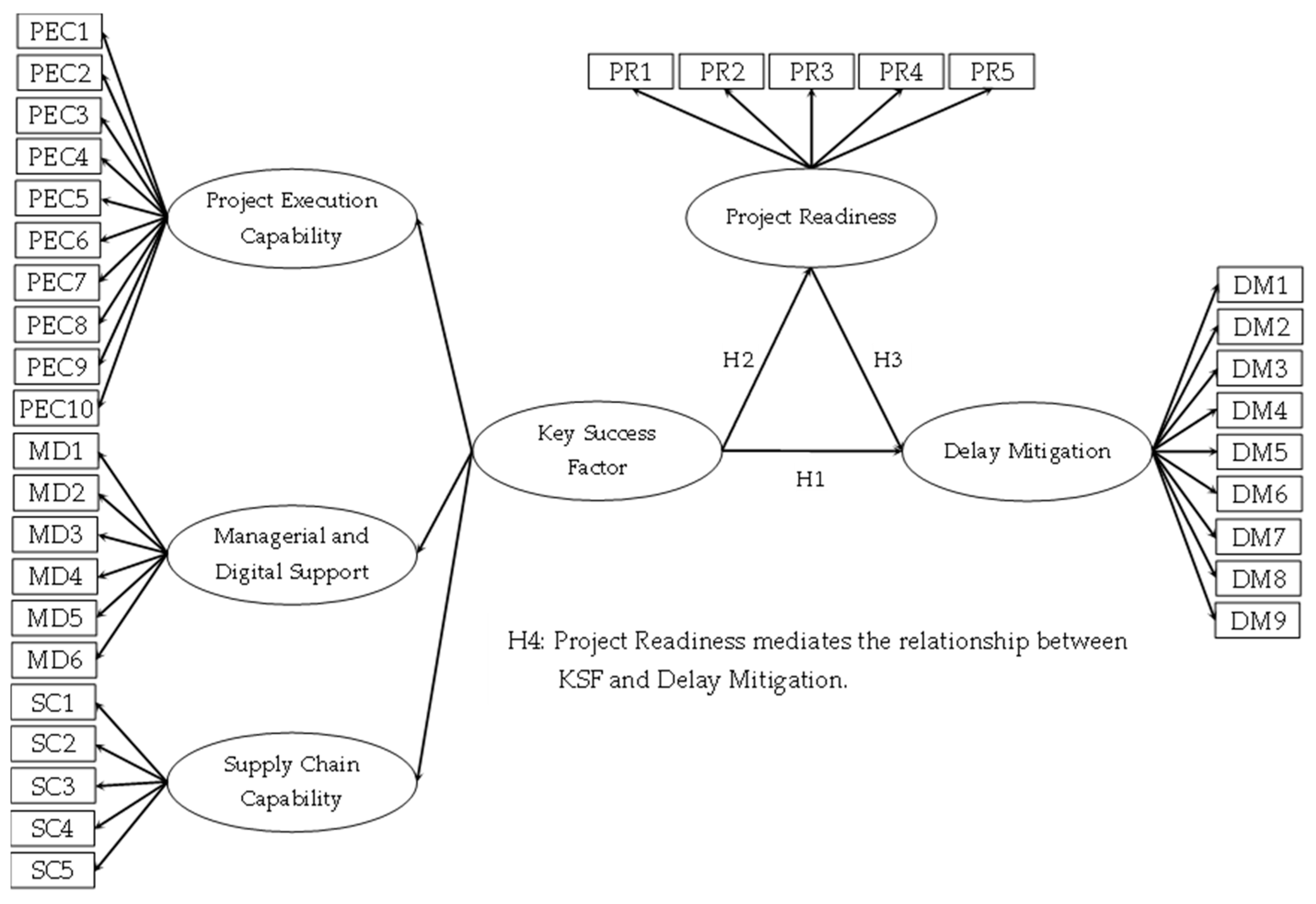
Within this framework, Key Success Factors (KSF) are specified as a higher-order construct representing the overall managerial capability of a project. It is reflected by three first-order dimensions: Project Execution Capability, Managerial and Digital Support, and Supply Chain Capability, as discussed in Section 2.1 and operationalized in Table 1. Conceptualizing KSF in this manner emphasizes that project success does not arise from any single factor in isolation, but from the combined functioning of execution capability, managerial systems, and supply chain continuity as an integrated capability system.
At the same time, Project Readiness is positioned as a mediating construct reflecting the degree of preparedness before project commencement and during the early execution stage. This includes readiness of information, plans, resources, decision-making systems, and control mechanisms, as elaborated in Section 2.3. Positioning Project Readiness as a mediator reflects the theoretical argument that managerial capability can generate schedule-related outcomes more effectively when it is translated into actual operational readiness [11,16].
Meanwhile, Delay Mitigation is specified as the principal endogenous construct representing the project’s capability to prevent, control, reduce, and recover from delay-related disruptions, as discussed in Section 2.2. In this framework, Delay Mitigation is therefore treated as a strategic performance outcome that reflects the effectiveness of the overall project management system rather than merely a retrospective indicator of schedule deviation.
Based on these theoretical arguments, the proposed framework includes three primary structural paths: (1) the direct effect of KSF on Delay Mitigation (H1), (2) the effect of KSF on Project Readiness (H2), and (3) the effect of Project Readiness on Delay Mitigation (H3). In addition, the framework proposes an indirect effect of KSF on Delay Mitigation through Project Readiness as a mediating mechanism (H4). These relationships are illustrated in Figure 1.
Figure 1 illustrates that KSF serves as the source of project managerial capability, Project Readiness functions as the mechanism translating that capability into operational preparedness, and Delay Mitigation represents the project’s capability to maintain schedule performance and minimize the consequences of delay. The framework therefore captures both direct and indirect effects of managerial capability on project outcomes and is suitable for empirical examination through Confirmatory Factor Analysis (CFA) and Structural Equation Modeling (SEM).
From a methodological perspective, the framework also offers advantages in terms of model parsimony, theoretical clarity, and systematic testing of mediation effects. It is therefore well suited to complex construction project environments that require proactive and capability-driven approaches to delay reduction and delivery improvement.

3. Methodology

3.1. Research Design

This study adopted a quantitative research approach under an explanatory research design to examine the structural relationships among Key Success Factors (KSF), Project Readiness, and Delay Mitigation in construction projects. A quantitative approach was appropriate because the proposed framework required the simultaneous estimation of multiple relationships among latent constructs, including a higher-order construct and mediating effects, using numerical data collected from construction professionals with direct project experience [24,72]. The explanatory design was selected because the objective extended beyond descriptive reporting or simple identification of influential factors. Rather, the study sought to explain whether and how KSF, conceptualized as an integrated representation of project managerial capability, influences Delay Mitigation directly and indirectly through Project Readiness [25,26].
The study employed a cross-sectional survey design in which data were collected from respondents at a single point in time through a structured questionnaire. Cross-sectional surveys are widely used in construction management research because they enable efficient collection of professional judgments, managerial practices, and organizational conditions from relatively large samples while providing a sound basis for advanced multivariate analysis [73,74]. This design was particularly suitable because the proposed model contains multiple interrelated constructs and hypothesized structural paths that must be examined simultaneously within an integrated analytical framework.
To operationalize the framework, a structured questionnaire was developed from a structured review of the prior literature and refined for the construction project context. The measurement items were designed to capture practical conditions related to project management capability, project readiness, and delay mitigation in real project environments. All indicators were measured using a five-point Likert scale ranging from very low (1) to very high (5), reflecting respondents’ evaluations of the level of capability, readiness, or effectiveness demonstrated in their project experience [75,76]. Participation in the survey was voluntary, and respondents were informed that all responses would be treated confidentially and reported only in aggregated form for academic purposes.
Data analysis followed a sequential multivariate procedure. Preliminary data screening was first conducted to assess missing values, outliers, normality, and overall data quality. Exploratory Factor Analysis (EFA) was then used to identify the underlying factor structure of observed indicators, followed by Confirmatory Factor Analysis (CFA) to validate the measurement model in terms of reliability and validity. Finally, Structural Equation Modeling (SEM) was employed to test the hypothesized direct effects, indirect effects, and mediation relationships among all constructs simultaneously. EFA was conducted using IBM SPSS Statistics (version 23), whereas CFA and SEM were performed using AMOS software (version 24) [13,77,78]. Overall, the selected design provides a rigorous methodological foundation for explaining how Key Success Factors strengthen Project Readiness and mitigate delays in construction projects.

3.2. Population, Sampling, and Data Collection

The target population of this study consisted of professionals directly involved in planning, coordination, execution, supervision, and control of construction projects. Because the proposed model focuses on managerial capability, project readiness, and delay mitigation performance, respondents were required to possess practical knowledge derived from real project environments rather than solely theoretical understanding. Accordingly, the population included project managers, construction managers, site engineers, civil engineers, consultants, contractors, and other practitioners with direct responsibilities in construction projects [73,74]. Since variables such as Key Success Factors (KSF), Project Readiness, and Delay Mitigation are highly operational and context-dependent, only individuals with relevant project experience were considered appropriate respondents [11]. Individuals without relevant construction project experience were therefore excluded from the scope of the study.
Geographically, the study focused on construction professionals working in Thailand. Thailand provides an appropriate empirical context because its construction sector includes a wide range of building, infrastructure, and development projects that frequently require strict schedule control, multi-stakeholder coordination, and efficient resource utilization. These characteristics make Thailand a relevant setting for examining how managerial success conditions contribute to project readiness and schedule performance improvement [79,80]. In addition, the Thai construction sector reflects several operational characteristics commonly observed in developing construction economies, including fragmented project environments, complex stakeholder coordination, and resource-related constraints. These contextual conditions further support the relevance of Thailand as an empirical setting for examining managerial capability and delay mitigation practices within construction projects. The respondents represented a diverse range of construction project types, including residential, building, and condominium projects, roads and bridges, rail transit systems, factory and industrial projects, irrigation and dam projects, as well as utilities and infrastructure projects. Including multiple project categories helped improve the practical representativeness of the empirical context and enabled the study to capture managerial and operational conditions across diverse construction project environments. The study employed a non-probability sampling strategy combining purposive sampling with snowball sampling support. Purposive sampling ensured that only respondents with relevant qualifications, professional roles, and direct project experience participated, while snowball sampling expanded access through professional networks and referrals [77,81]. This approach is widely accepted in construction management research when the primary objective is theory testing among specialized professional groups rather than statistical generalization to an entire population [15,82].
The study initially targeted a minimum sample size exceeding 200 respondents based on commonly accepted recommendations for Structural Equation Modeling (SEM). To improve response adequacy and compensate for potential incomplete or invalid responses, 350 questionnaires were distributed to construction professionals across multiple project sectors in Thailand. A total of 308 valid responses were obtained and retained for final analysis. This sample size was considered statistically adequate and methodologically appropriate for Structural Equation Modeling (SEM). The prior methodological literature suggests that SEM generally requires adequate sample sizes and reliable indicators to ensure stable parameter estimation and robust model evaluation [83]. The present study included 35 observed indicators across all constructs, comprising 10 indicators for Project Execution Capability, 6 for Managerial and Digital Support, 5 for Supply Chain Capability, 5 for Project Readiness, and 9 for Delay Mitigation. Therefore, the final sample represents approximately 8.8 cases per indicator, which falls comfortably within the commonly recommended range of 5:1 to 10:1 for multivariate and factor-based analysis [24,25,84,85].
Data were collected using a structured questionnaire administered through a mixed-mode approach. An online version was distributed through Google Forms via professional contacts and industry communication channels, while paper-based questionnaires were administered in person at project sites and workplaces. Combining online and face-to-face methods helped broaden respondent reach, improve participation rates, and include practitioners with limited access or time for online participation [86,87]. Before participation, respondents were informed of the academic purpose of the study, voluntary participation, confidentiality, and aggregated reporting procedures [88,89]. All returned questionnaires were subsequently screened for completeness, consistency, missing values, and usability before inclusion in EFA, CFA, and SEM analyses.

3.3. Measurement Instrument/Questionnaire Design

The measurement instrument used in this study was a structured questionnaire developed from the findings of the structured literature review and prior studies in construction management, project performance, and organizational readiness [73,76]. The instrument was refined to ensure conceptual consistency and practical relevance within the Thai construction context. By grounding the questionnaire in prior empirical and theoretical evidence, the study sought to enhance construct validity and ensure that each item appropriately represented the domain of interest.
The final questionnaire consisted of four sections: Part 1, demographic information; Part 2, Key Success Factors (KSF); Part 3, Project Readiness (PR); and Part 4, Delay Mitigation (DM). In total, the instrument contained 35 observed indicators across five constructs. KSF was modeled as a higher-order construct comprising three first-order dimensions: Project Execution Capability (PEC, 10 items), Managerial and Digital Support (MD, 6 items), and Supply Chain Capability (SC, 5 items). Project Readiness and Delay Mitigation were measured using 5 and 9 items, respectively [24,25]. This structure was designed to align the measurement model with the theoretical framework proposed in the study.
All indicators were measured using a five-point Likert scale ranging from 1 = Very Low to 5 = Very High. Respondents were asked to assess the actual extent to which each capability, readiness condition, or delay mitigation outcome existed in their projects. This response format was considered particularly suitable for capturing real implementation conditions and managerial effectiveness rather than simple attitudinal agreement [75,90]. As such, the instrument focused on practical project realities rather than subjective preferences alone.
To establish content validity, the draft questionnaire was reviewed by four industry experts with more than ten years of project management experience across housing, condominium, pipeline, road, and bridge projects. Their feedback was incorporated to improve wording clarity, contextual relevance, and construct coverage. The review process was conducted as an expert evaluation of the questionnaire rather than formal semi-structured interviews. The revised questionnaire was subsequently pilot tested and confirmed to be suitable for the main survey [91,92]. The final questionnaire was administered primarily in Thai to maximize respondent comprehension, while reliability and validity were later confirmed through factor loadings, Cronbach’s alpha, Composite Reliability (CR), Average Variance Extracted (AVE), and model fit indices, as reported in the results section [24,26].

3.4. Data Analysis Procedure

The collected data were analyzed using IBM SPSS Statistics and AMOS following a sequential procedure commonly recommended for covariance-based structural equation modeling (CB-SEM) research [24,25]. The analytical process comprised data screening, descriptive statistics, exploratory factor analysis (EFA), confirmatory factor analysis (CFA), structural model assessment, and mediation analysis. This stepwise procedure is appropriate because it enables researchers to verify data quality, validate measurement properties, and test hypothesized relationships among latent constructs in a systematic and rigorous manner [26,93].
Initially, the dataset was screened prior to formal analysis. Missing data were examined before model estimation, and the final dataset was confirmed to be complete. Preliminary distributional assumptions were assessed using skewness statistics and critical ratio (C.R.) values generated in AMOS. In addition, multivariate outliers were examined using Mahala Nobis distance, which is widely recommended for detecting abnormal response patterns in multivariate datasets [78,94]. Descriptive statistics were then used to summarize respondents’ demographic and professional characteristics. Frequencies and percentages were reported for categorical variables, while means and standard deviations were used to describe the central tendency and dispersion of construct-level responses [77].
To examine the dimensional structure of the proposed constructs, Exploratory Factor Analysis (EFA) was first conducted in SPSS using Principal Component Analysis with Varimax rotation. Sampling adequacy was assessed through the Kaiser–Meyer–Olkin (KMO) statistic, while Bartlett’s Test of Sphericity was used to confirm whether the correlation matrix was suitable for factor extraction. Indicators with insufficient factor loadings were considered for removal based on established methodological thresholds [24,95]. Subsequently, Confirmatory Factor Analysis (CFA) was conducted in AMOS to validate the measurement model. Model adequacy was evaluated using multiple goodness-of-fit indices, including χ2/df, RMSEA, CFI, TLI, NFI, SRMR, and GFI, based on recommended cut-off criteria reported in the prior SEM literature [25,96,97].
Reliability and convergent validity were assessed using multiple complementary criteria. Internal consistency was evaluated through Cronbach’s alpha, while construct reliability was examined through Composite Reliability (CR). Convergent validity was assessed using standardized factor loadings and Average Variance Extracted (AVE) [98,99]. After validation of the measurement model, the proposed hypotheses were tested using Structural Equation Modeling (SEM) in AMOS. SEM was selected because it enables simultaneous estimation of multiple dependence relationships while accounting for measurement error among latent variables [25,100]. To further examine the mediating role of Project Readiness, indirect effect analysis was performed to determine whether KSF influenced Delay Mitigation directly, indirectly through Project Readiness, or through both pathways simultaneously [13].

4. Results

4.1. Respondent and Project Profile

A total of 308 valid questionnaires were collected from construction professionals actively involved in project delivery. This sample size is adequate for multivariate statistical analysis and structural equation modeling, while the professional backgrounds of respondents enhance the reliability of the empirical evidence generated in this study [24,101]. Regarding educational attainment, most respondents held a bachelor’s degree (83.12%), followed by a master’s degree (11.04%), while smaller proportions reported vocational qualifications (5.19%) and doctoral degrees (0.65%). This distribution indicates that the majority of participants possessed formal technical or managerial education relevant to construction project execution and organizational decision-making.
In terms of current job positions, Site Engineers and Office Engineers represented the largest group (60.39%), followed by Project Engineers (11.69%) and Project Managers (5.84%). Additional respondents were drawn from Quantity Surveying/Cost functions (5.19%), consultancy roles (5.84%), Owner/Client representatives (3.90%), and other related positions (7.14%). Most respondents also reported direct responsibility for project activities (75.32%), while 20.78% indicated partial involvement and 3.90% reported indirect involvement. This finding is important because respondents with direct operational responsibilities are more likely to provide accurate assessments of project constraints, managerial practices, and delay mitigation mechanisms [1,2].
With respect to experience, 38.31% of respondents had 3–5 years of construction experience, followed by 33.77% with less than 3 years and 20.13% with 6–10 years. For management experience, the largest segment had less than 3 years (45.45%), followed by 3–5 years (31.17%) and 6–10 years (16.88%). These patterns indicate a balanced representation of early-career and mid-career professionals, allowing the study to capture both operational and emerging managerial viewpoints. The respondents were involved in a broad range of project types, with residential, building, and condominium projects accounting for the largest share (54.55%), followed by industrial projects (22.73%) and other public utility projects (14.94%). Transportation projects such as roads and bridges represented 6.49%, while rail projects accounted for 1.30%.
In terms of project value, the largest proportion of respondents worked on projects valued at 50–200 million THB (33.77%), followed by projects below 50 million THB (22.73%), above 500 million THB (22.73%), and 200–500 million THB (20.78%). Most projects had durations of 12–24 months (46.10%), followed by less than 12 months (24.68%) and 24–36 months (21.43%). Overall, the respondent profile confirms that the dataset was obtained from practitioners with relevant qualifications, practical responsibilities, and experience across diverse project contexts, thereby providing a credible foundation for evaluating the relationships among critical success factors, project readiness, and construction project delay mitigation.

4.2. Descriptive Statistics of Measurement Items

Descriptive statistical analysis was performed to examine the central tendency and dispersion of responses across all observed indicators prior to factor validation and structural model assessment. The mean scores ranged from 3.500 to 4.539, indicating that respondents generally expressed moderate-to-high agreement with the measurement items. Standard deviation values ranged from 0.672 to 1.066, suggesting an acceptable level of variability and sufficient response dispersion for subsequent multivariate analyses [24,102]. The descriptive statistics of the measurement indicators are presented in Table 2.
For the Project Execution Capability (PEC) construct, all indicators demonstrated relatively high mean values (4.065–4.539). The highest-rated item was Clear Project Scope and Manageable Complexity (PEC8; Mean = 4.539), followed by Project Execution Planning and Control (PEC1; Mean = 4.448), Competent Project Team Leadership (PEC7; Mean = 4.422), and Change Control Discipline (PEC9; Mean = 4.481). These findings indicate that respondents perceived planning discipline, scope clarity, leadership capability, and formal control mechanisms as essential operational competencies for maintaining project performance and minimizing delays. The consistently strong scores across PEC items reinforce the importance of execution-focused management capability in construction environments [11,16].
The Managerial and Digital Support (MD) construct reported comparatively lower mean scores (3.500–3.903). The highest-rated indicator was Real-Time Progress Monitoring (MD4; Mean = 3.903), followed by Budget and Cost Control (MD1; Mean = 3.792). In contrast, Inter-System Compatibility (MD5; Mean = 3.500) was the lowest-rated indicator in the overall model. This pattern suggests that while respondents recognized the value of managerial monitoring and cost governance, digital integration across systems remains less mature. The findings may reflect an industry context in which digital transformation is progressing, but interoperability and data connectivity have not yet been fully institutionalized [101,103].
For the Supply Chain Capability (SC) construct, mean scores ranged from 3.662 to 3.903, indicating moderate but positive perceptions. The highest score was observed for Vendor and Subcontractor Qualification Management (SC5; Mean = 3.903), followed by Collaborative Contracting and Partnering (SC4; Mean = 3.786). Lower values were found for Supply Chain Risk Management (SC1; Mean = 3.662) and Material Requirements Planning and Inventory Control (SC3; Mean = 3.669). These results imply that organizations place stronger emphasis on contractor selection and collaborative relationships than on proactive supply risk governance and integrated materials planning. Strengthening these lower-rated dimensions may improve project resilience and schedule reliability [104,105].
The Project Readiness (PR) construct demonstrated favorable mean values (3.864–4.208). The highest-rated indicator was Pre-Start Health, Safety and Environment Process (PR1; Mean = 4.208), followed by Workforce Competency and Training (PR2; Mean = 4.110) and Top Management Support (PR3; Mean = 4.091). The results indicate that readiness conditions established before project commencement are strongly valued by practitioners. In particular, pre-start preparation, workforce capability, and executive commitment appear to be foundational conditions for reducing disruptions during project implementation [106].
For the Delay Mitigation (DM) construct, mean scores ranged from 3.721 to 4.234, reflecting positive perceptions regarding organizational capability to respond to schedule disruptions. The highest-rated indicator was Rapid Resource Reallocation (DM5; Mean = 4.234), followed by Schedule Recovery Acceleration (DM7; Mean = 4.162) and Critical Activity Continuity (DM1; Mean = 4.110). By contrast, Adaptive Work Resequencing (DM4; Mean = 3.721) recorded the lowest score within the construct. These findings suggest that respondents were relatively confident in accelerating recovery actions and reallocating resources when delays occur, whereas dynamic replanning and workflow resequencing may remain more difficult in practice [1,2].
Overall, the descriptive results indicate that respondents evaluated all five constructs positively, with particularly strong perceptions toward execution capability, readiness, and delay response capacity. Lower scores in selected digital and supply chain indicators reveal potential improvement areas for construction organizations. These preliminary findings provide an appropriate empirical basis for proceeding to exploratory factor analysis and subsequent model validation.

4.3. Exploratory Factor Analysis

Exploratory factor analysis (EFA) was conducted to examine the dimensional structure of the measurement items prior to confirmatory factor analysis and structural model testing. Given the theoretically distinct nature of the constructs, separate EFAs were performed for three measurement domains: (1) Key Success Factors (KSF), comprising the indicators of Project Execution Capability (PEC), Managerial and Digital Support (MD), and Supply Chain Capability (SC); (2) Project Readiness (PR); and (3) Delay Mitigation (DM). Principal component extraction with Varimax rotation was employed, and a minimum factor loading threshold of 0.50 was adopted for item retention [24,102]. As presented in Table 3.
For the KSF domain, the analysis extracted three factors with a cumulative variance explained of 65.868%, which is considered satisfactory for social science research. The extracted dimensions were fully consistent with the proposed conceptual structure, namely PEC, MD, and SC. All retained items demonstrated acceptable loadings above the recommended threshold, ranging from 0.675 to 0.884. In addition, the Kaiser–Meyer–Olkin (KMO) values indicated excellent sampling adequacy for PEC (0.921) and MD (0.907), and strong adequacy for SC (0.840). These findings confirm that the multidimensional structure of KSF is empirically supported and that the grouped indicators appropriately represent distinct managerial capability domains within construction projects [78,107].
For the PR construct, the EFA extracted a single-factor solution explaining 53.918% of the total variance. All five indicators loaded satisfactorily on the intended factor, with loadings ranging from 0.652 to 0.810. The KMO value of 0.770 indicates acceptable sampling adequacy, while Bartlett’s Test of Sphericity was statistically significant (p < 0.001), confirming the suitability of the correlation matrix for factor analysis. The results suggest that PR can be treated as a unidimensional construct representing the degree of preparedness established before project execution begins [24,106].
For the DM construct, a one-factor solution was also obtained, explaining 66.822% of the total variance. Factor loadings ranged from 0.514 to 0.860, exceeding the minimum retention criterion. The KMO value of 0.906 indicates excellent sampling adequacy, and Bartlett’s Test was significant at p < 0.001. These results provide strong empirical support for modeling DM as a single latent construct reflecting organizational capability to prevent, absorb, and recover from project delays through responsive managerial actions [1,2].
Overall, the EFA results demonstrate that the measurement items possess clear and theoretically meaningful dimensional structures. All constructs satisfied accepted standards of sampling adequacy, explained variance, and factor loading strength as shown in Table 3. These findings provide a robust foundation for proceeding to confirmatory factor analysis, reliability assessment, and structural equation modeling in the subsequent section.

4.4. Confirmatory Factor Analysis and Measurement Quality

Confirmatory factor analysis (CFA) was conducted to validate the measurement structure identified in the exploratory factor analysis and to assess the overall quality of the latent constructs prior to structural model testing. CFA is a critical procedure in covariance-based structural equation modeling because it evaluates whether the observed indicators adequately represent their intended constructs and whether the measurement model demonstrates satisfactory reliability, validity, and goodness-of-fit with the empirical data [24,107]. The reliability and convergent validity results are presented in Table 4.
The reliability results indicate strong internal consistency across all constructs. Cronbach’s alpha values ranged from 0.783 to 0.936, exceeding the commonly accepted threshold of 0.70 and demonstrating satisfactory scale reliability [108]. The highest alpha value was observed for Delay Mitigation (0.936), followed by Project Execution Capability (0.918) and Managerial and Digital Support (0.900), suggesting highly consistent responses across the indicators used to measure these constructs. Although Project Readiness reported the lowest alpha value (0.783), it remained well above the minimum acceptable criterion and therefore supports adequate reliability.
Composite reliability (CR) values ranged from 0.836 to 0.946 as shown in Table 4, surpassing the recommended benchmark of 0.70 for all constructs [24]. These findings further confirm that the latent variables exhibit strong construct reliability beyond the limitations of coefficient alpha. In particular, Delay Mitigation demonstrated the highest CR value (0.946), indicating a highly stable internal structure among its indicators. Project Readiness also achieved an acceptable CR value (0.836), confirming the consistency of its measurement items.
Convergent validity was evaluated using the average variance extracted (AVE). All AVE values exceeded the recommended threshold of 0.50, ranging from 0.506 to 0.663, thereby confirming that each construct explained more than half of the variance in its respective indicators [98]. Supply Chain Capability reported an AVE of 0.601, while Delay Mitigation achieved the highest AVE value of 0.663, indicating strong explanatory power of the measurement items. Collectively, the alpha, CR, and AVE results provide robust evidence that the measurement model possesses satisfactory reliability and convergent validity. The CFA model fit indices are presented in Table 5.
The overall model fit statistics in Table 5 indicate that the CFA model achieved an excellent fit with the observed data. The chi-square-to-degrees-of-freedom ratio (χ2/df = 1.623) was below the recommended threshold of 3.00, indicating an acceptable parsimonious fit [107]. The root mean square error of approximation (RMSEA = 0.045) and standardized root mean square residual (SRMR = 0.043) were both below 0.08, demonstrating a close approximate fit and low residual discrepancy [97]. Incremental fit indices also exceeded recommended criteria, including the comparative fit index (CFI = 0.973), Tucker–Lewis index (TLI = 0.959), and normed fit index (NFI = 0.933), all of which were above 0.90. In addition, the goodness-of-fit index (GFI = 0.900) met the acceptable threshold, further supporting the adequacy of the model.
Overall, the CFA results confirm that the proposed measurement model is psychometrically sound and empirically supported. All constructs demonstrated satisfactory internal consistency, convergent validity, and model fit. Therefore, the validated measurement model provides a strong foundation for proceeding to structural model assessment and hypothesis testing in the next section.

4.5. Structural Model and Hypothesis Testing

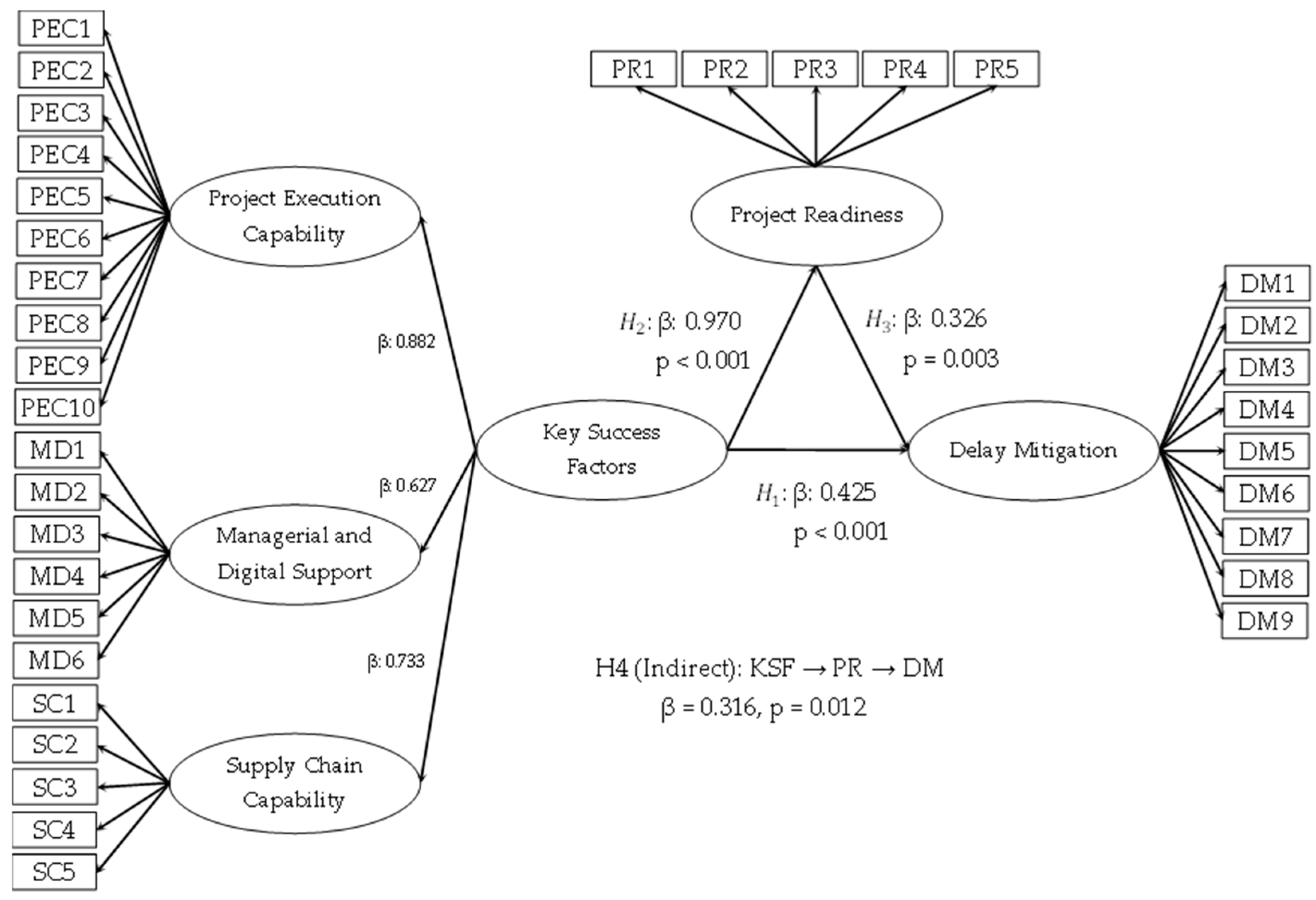
Following the validation of the measurement model, structural equation modeling (SEM) was performed to examine the hypothesized relationships among Key Success Factors (KSF), Project Readiness (PR), and Delay Mitigation (DM). Structural model analysis is essential because it enables simultaneous testing of multiple causal relationships among latent constructs and determines the explanatory power of the proposed theoretical framework [24,107]. The structural model results are presented in Figure 2.
The structural results revealed that KSF had a strong and statistically significant positive effect on PR (β = 0.970, p < 0.001) as shown in Table 6, thereby supporting H2. This finding indicates that organizations possessing stronger managerial capability, execution capacity, and supply chain readiness are substantially more likely to achieve higher levels of project preparedness prior to implementation. In practical terms, critical success factors provide the organizational foundation required for effective planning, coordination, and operational readiness before project execution begins [106,109].
In addition, KSF exerted a significant positive direct effect on DM (β = 0.425, p < 0.001), supporting H1. As shown in Table 6 this result confirms that well-developed success factors directly enhance an organization’s ability to minimize delays through stronger supervision, improved coordination, better resource management, and more effective execution processes. The finding suggests that critical success factors are not merely background conditions, but active drivers of project time performance [1,2].
These findings are generally consistent with previous construction management studies reporting that managerial coordination, planning effectiveness, and organizational capability significantly contribute to project performance and schedule control outcomes [4,110]. Prior studies have similarly emphasized that effective project execution, organizational coordination, and proactive managerial systems are essential for reducing operational disruptions and improving project delivery efficiency [14,111]. However, unlike many previous studies that examined Critical Success Factors (KSF) as isolated operational variables, the present study conceptualizes KSF as an integrated higher-order managerial capability and empirically demonstrates its direct influence on delay mitigation performance within complex construction project environments. This finding extends the existing literature by highlighting that delay mitigation capability is influenced not only by operational control mechanisms but also by the integrated managerial readiness and coordination capacity embedded within construction organizations.
Project Readiness also demonstrated a significant positive influence on DM (β = 0.326, p = 0.003), supporting H3 (Table 6). This indicates that projects entering the implementation stage with stronger readiness conditions are better equipped to respond to disruptions, absorb uncertainty, and maintain schedule continuity. Readiness therefore functions as a practical organizational capability that contributes directly to delay mitigation outcomes [112].
As presented in Table 6, all hypothesized relationships were statistically supported. The model explained 94.0% of the variance in PR (R2 = 0.940), indicating that project readiness was strongly determined by the underlying success factors included in the model. Furthermore, KSF and PR jointly explained 55.5% of the variance in DM (R2 = 0.555), demonstrating meaningful predictive capability for delay mitigation performance in construction projects.
In terms of direct effects, all hypothesized structural paths were positive and statistically significant. KSF directly influenced Delay Mitigation (β = 0.425, p < 0.001), KSF directly influenced Project Readiness (β = 0.970, p < 0.001), and Project Readiness directly influenced Delay Mitigation (β = 0.326, p = 0.003). These findings further confirm the immediate explanatory role of managerial capability and readiness in the proposed structural model.
Overall, the structural model provides strong empirical support for the proposed framework. The findings confirm that KSF plays a central role in improving construction project outcomes by enhancing readiness conditions and directly reducing delay risks. These results also establish a strong basis for the mediation analysis presented in the next section.

4.6. Mediation Analysis

To obtain a deeper understanding of the causal mechanism underlying the proposed framework, mediation analysis was conducted to examine whether Project Readiness (PR) mediates the relationship between Key Success Factors (KSF) and Delay Mitigation (DM). The results indicate that the indirect effect of KSF on DM through PR was statistically significant (β = 0.316, p = 0.012), thereby supporting H4 [100,113] (shown in Table 7).
Beyond the indirect pathway, the decomposition of effects demonstrates that KSF influences Delay Mitigation through both direct and mediated mechanisms. The direct effect of KSF on DM was 0.425, while the indirect effect through PR was 0.316, resulting in a total effect of 0.741, which indicates that the overall influence of KSF on DM becomes substantially stronger when the readiness mechanism is considered [24]. This finding suggests that managerial capability creates project value not through a single pathway, but through the combined influence of immediate operational capability and enhanced readiness conditions at the project level.
These findings are consistent with prior studies emphasizing the importance of organizational readiness, managerial preparedness, and operational coordination in improving project resilience and schedule performance within construction environments [22,114]. Previous research has similarly suggested that readiness-related mechanisms can strengthen project adaptability, reduce operational uncertainty, and improve the effectiveness of managerial decision-making during project execution [115,116]. However, unlike many earlier studies that examined readiness primarily as an operational or planning-related condition, the present study empirically demonstrates the mediating role of Project Readiness in translating integrated managerial capability into delay mitigation performance. This finding extends the existing literature by clarifying that delay mitigation outcomes are influenced not only through direct managerial intervention but also through the indirect strengthening of organizational readiness mechanisms embedded within construction project systems. The direct, indirect, and total effects analysis results are presented in Table 7.
Given that both the direct and indirect effects were statistically significant, the mediation pattern can be interpreted as partial mediation. This means that although KSF independently improves delay mitigation, Project Readiness substantially strengthens the overall effect by converting managerial capability into actionable project preparedness [107]. From a managerial perspective, the findings imply that organizations should not focus solely on strengthening internal capability but must also translate such capability into practical readiness systems at the project level in order to maximize schedule performance and operational continuity [11].
Overall, the mediation results enrich the theoretical model by confirming that Project Readiness functions as a strategic transmission mechanism linking managerial capability to superior delay mitigation outcomes in construction projects. These findings provide further empirical support for the strategic role of readiness in construction project governance.

5. Discussion

This study examined the structural relationships among Key Success Factors (KSF), Project Readiness (PR), and Delay Mitigation (DM) in construction projects. The empirical results confirm that all hypothesized paths were statistically significant, providing strong support for the proposed framework. Collectively, the findings demonstrate that effective delay mitigation is not merely the consequence of reactive problem-solving during project execution, but rather the outcome of integrated managerial capability, systemic coordination, and readiness conditions established from the pre-construction stage through active project delivery [24,107]. This evidence is particularly important because it shifts the dominant perspective from reactive delay control toward proactive capability building as a strategic pathway to project time performance [11].
First, the findings confirm that KSF has a significant positive direct effect on Delay Mitigation (β = 0.425), thereby supporting H1. This indicates that projects with stronger execution capability, managerial and digital support, and supply chain capability are substantially better positioned to prevent workflow interruption, control schedule deviation, and accelerate recovery when unexpected events occur [106]. From a managerial perspective, effective planning systems, disciplined supervision, data-informed decision-making, and timely resource coordination function as critical safeguards against schedule disruption [109,117]. This result is consistent with prior studies suggesting that success factors should not be viewed solely as predictors of overall project success, but also as strategic drivers of time performance and operational continuity in complex project environments [118].
Second, KSF exerts a strong positive influence on Project Readiness, thereby supporting H2, and this path demonstrates the highest explanatory power within the structural model. The finding suggests that readiness is not a naturally occurring project condition, but a direct outcome of managerial quality. Projects characterized by strong leadership, competent teams, effective monitoring systems, and systematic resource preparation are more likely to enter the execution stage with superior readiness levels [115]. This extends prior literature that often treats readiness as a procedural checklist by repositioning readiness as a strategic manifestation of managerial and organizational capability [16,18]. Moreover, the substantial explanatory power of PR (R2 = 0.940) further reinforces the central role of KSF in shaping project preparedness in contemporary construction settings [24].
Third, Project Readiness has a significant positive effect on Delay Mitigation, thereby supporting H3. This finding suggests that projects commencing with stronger readiness are more capable of absorbing uncertainty, adapting to site constraints, and maintaining schedule targets under dynamic operating conditions [119]. Readiness enables project teams to mobilize resources rapidly, coordinate activities proactively, detect emerging constraints at an early stage, and implement corrective measures before minor deviations escalate into severe delays [4]. Accordingly, readiness should be interpreted not as a passive pre-start requirement, but as a dynamic organizational capability that generates measurable time-performance benefits [120].
Most importantly, the mediation analysis confirms that Project Readiness significantly mediates the relationship between KSF and Delay Mitigation, thereby supporting H4. Because both the direct and indirect effects were statistically significant, the mediation pattern can be interpreted as partial mediation. Importantly, the total effect of KSF on Delay Mitigation was substantial (β = 0.741), clearly indicating that the overall influence of managerial capability becomes considerably stronger when readiness mechanisms are embedded within the structural pathway. In other words, KSF improves delay mitigation not only through its immediate operational influence but also through its ability to establish readiness conditions that facilitate smoother execution and faster responses to emerging risks [100,113]. From a practical standpoint, the finding implies that organizations should not stop at strengthening internal capability alone; they must translate that capability into actionable readiness systems at the project level [121].
It is also important to interpret the findings in light of the sample composition of the present study. A substantial proportion of the respondents were involved in residential, building, and condominium projects, which commonly operate under strict schedule constraints, intensive stakeholder coordination, and continuous progress monitoring requirements [1,4]. These project environments may partially contribute to the relatively high perceptions observed regarding execution capability and delay mitigation responsiveness. In practice, such construction settings often require rapid operational decision-making, close site supervision, and proactive coordination mechanisms to minimize schedule disruption risks during project execution [11,79].
Taken together, this study contributes to construction management knowledge by demonstrating that superior delay mitigation emerges from the alignment between organizational capability and project readiness rather than reliance on any single factor in isolation. Although much of the earlier literature has focused on diagnosing delay causes such as financial problems, design changes, labor shortages, and ineffective coordination [1,122], the present findings suggest that such reactive perspectives are insufficient in contemporary environments characterized by supply chain volatility, cost escalation, workforce scarcity, and increasingly demanding stakeholder expectations. Under these conditions, a proactive strategy centered on capability development and readiness enhancement offers a more sustainable route to improving project schedule performance. These findings further provide empirical support for the strategic role of readiness in construction project governance [123,124].

5.1. Theoretical Implications

This study offers several theoretical contributions to the field of construction project management. First, it extends the traditional Critical Success Factors (CSFs) literature by moving beyond fragmented factor-by-factor explanations toward an integrated hierarchical conceptualization of Key Success Factors (KSF). The findings suggest that project success should not be attributed to isolated variables alone, but rather to the combined influence of execution capability, managerial and digital support, and supply chain capability operating as an interrelated system [109,117]. This perspective advances the theoretical understanding of project success from a checklist orientation to a systemic capability-based explanation better suited to contemporary construction environments characterized by complexity and interdependence [11].
Second, the study advances the concept of Project Readiness by positioning it as a strategic construct within the causal model rather than a purely procedural pre-start condition. Earlier studies have frequently treated readiness as preparation activities or front-end planning requirements before execution begins [115]. However, the present findings indicate that readiness should be reconceptualized as an organizational capability that transforms managerial resources, planning systems, and decision quality into measurable schedule outcomes. In this sense, readiness is not merely an initial project condition, but a strategic mechanism linking managerial capability to operational performance [16,18].
Third, the mediation results provide theoretical support for the argument that the relationship between success factors and project outcomes does not operate solely through direct pathways. Instead, internal transmission mechanisms play a critical role in shaping performance outcomes. The substantial total effect of KSF on Delay Mitigation (β = 0.741) suggests that single-layer linear explanations may be insufficient for understanding project performance in dynamic construction settings [24]. This finding aligns with systems theory and the capability-based view, both of which emphasize the conversion of internal resources into sustainable performance advantages through embedded organizational processes [125,126].
Fourth, this study broadens the delay management literature by shifting attention from reactive diagnosis of delay causes toward proactive explanations of how organizations build the capacity to mitigate delay impacts effectively. Prior studies have largely focused on problematic drivers such as financial constraints, design changes, labor shortages, and coordination failure [1,122]. While those explanations remain valuable, the present study suggests that internal capability development and readiness enhancement provide a more sustainable theoretical foundation for improving time performance in the long term [124]. Overall, the principal theoretical implication of this study lies in proposing an integrated explanatory framework that systematically links organizational capability, project readiness, and delay mitigation outcomes. This framework provides a useful foundation for future research on resilience, project governance, dynamic capability, and construction project management under conditions of heightened uncertainty and environmental turbulence [120,123].

5.2. Practical Implications

This study offers clear practical implications for project managers, contractors, clients, and policymakers in the construction industry. First, the findings indicate that delay mitigation should not be viewed merely as a corrective response after a project falls behind schedule. Instead, it should be managed as a strategic capability that must be developed from the earliest stages of project delivery [11,16]. Accordingly, project leaders should invest in management systems, proactive planning routines, and control mechanisms designed to prevent delay before disruptions emerge [106].
Second, because Key Success Factors (KSF) consist of execution capability, managerial and digital support, and supply chain capability, organizations can use the findings as a diagnostic framework to assess internal preparedness before launching new projects. For example, contractors may develop internal readiness audits covering team competence, schedule clarity, digital information availability, reporting systems, and the reliability of key suppliers prior to construction mobilization [18]. Such front-end assessments can substantially reduce later risks associated with resource shortages, coordination breakdowns, or material disruption [1].
Third, the mediating role of Project Readiness implies that organizations should not confine improvement efforts to corporate policy or head-office strategy alone. Instead, managerial capability must be translated into project-level readiness practices such as resource mobilization plans, clear responsibility structures, risk response protocols, decision-escalation procedures, and real-time progress monitoring systems [115,121]. Even well-resourced organizations may fail to achieve schedule gains if capability is not operationalized at the project level.
Fourth, for clients and public-sector agencies, the findings provide a basis for improving contractor selection and contract governance processes. Traditional procurement systems often emphasize price, duration, or experience alone. The present study suggests that organizational capability and readiness should also be incorporated into evaluation criteria [120]. Tender documents, for instance, may require bidders to demonstrate readiness plans, digital control systems, supply chain management strategies, and schedule risk mitigation procedures before contract award decisions are made [115]. In addition, the findings may provide useful insights for construction policy development and regulatory improvement within the Thai construction industry. Regulatory agencies and public-sector organizations may benefit from strengthening project readiness assessment procedures, contractor capability evaluation systems, and coordination-related governance standards within construction project approval and monitoring processes. The findings may further support the development of more systematic policy guidelines related to delay prevention, risk mitigation planning, and organizational readiness assessment across both public and private sector construction projects.
Fifth, at the industry level, the findings support the transition toward data-driven, technology-enabled, and resilience-oriented construction management. Firms that invest in integrated information systems, digital monitoring, predictive risk analysis, and stable supplier networks are more likely to sustain time performance under volatile market and project conditions [123,124].
Overall, the principal practical implication of this study is that stakeholders should move beyond reactive delay control and instead build organizational capability and project readiness systematically. Doing so can improve schedule reliability, strengthen project continuity, and enhance the long-term competitiveness of construction organizations [117].

6. Conclusions

This study aimed to evaluate the structural relationships among Key Success Factors (KSF), Project Readiness (PR), and Delay Mitigation (DM) in construction projects using a quantitative research design and Structural Equation Modeling (SEM). The findings provide strong empirical evidence that effective delay mitigation is not merely the result of corrective actions after delays occur but rather the outcome of managerial capability, project preparedness, and coordinated operational mechanisms developed systematically from the earliest stages of project delivery [24,107].
The results confirmed that all hypothesized relationships were supported. KSF had a significant positive direct effect on Delay Mitigation, while KSF also exerted a strong positive influence on Project Readiness. In turn, Project Readiness significantly improved Delay Mitigation performance. Furthermore, the mediation analysis demonstrated that Project Readiness serves as a partial mediator in the relationship between KSF and Delay Mitigation. The substantial total effect of KSF on Delay Mitigation (β = 0.741) indicates that managerial capability creates stronger schedule outcomes when translated through readiness mechanisms at the project level [100,113].
From a theoretical perspective, this study extends the Critical Success Factors literature by proposing an integrated framework that systematically links organizational capability, readiness, and delay mitigation outcomes. It also advances the concept of Project Readiness by repositioning it from a procedural pre-start condition to a strategic mechanism that generates measurable time-performance benefits [109,125]. From a practical perspective, the findings suggest that construction organizations should move beyond reactive delay control and instead invest in management systems, readiness planning, digital technologies, and supply chain capability in order to improve sustainable on-time project delivery [11].
Overall, this study confirms that reducing delay in construction projects is not the product of any single factor in isolation but the result of alignment between organizational capability and project readiness within an effective management system. These findings offer both academic value and strategic guidance for improving construction project performance in increasingly uncertain and complex environments [124].

6.1. Limitations of the Study

This study should be interpreted in light of several research limitations. First, the empirical data were collected from construction professionals working in Thailand, and therefore, the findings may reflect country-specific institutional conditions, regulatory environments, labor market structures, and project delivery practices that differ across national contexts [127,128]. Nevertheless, the study attempted to alleviate contextual limitations by incorporating respondents from diverse construction project sectors, including residential, infrastructure, transportation, industrial, and utility-related projects, thereby improving the practical representativeness of the empirical setting. In addition, purposive and snowball sampling approaches were adopted to ensure that respondents possessed direct professional experience relevant to construction project management and delay mitigation practices [129]. While caution is still required when generalizing the findings beyond the present context, the inclusion of experienced practitioners from multiple project environments helps strengthen the practical relevance and contextual robustness of the study.
Second, this research employed a cross-sectional design in which all constructs were measured at a single point in time. Although cross-sectional approaches remain widely accepted in construction management and organizational research [77,130], such a design cannot fully capture temporal changes in managerial capability, project readiness, and delay mitigation conditions throughout the project lifecycle. To reduce potential measurement inconsistencies, the questionnaire items were developed from the established literature, reviewed by industry experts, pilot tested prior to the main survey, and statistically validated through EFA, CFA, and SEM procedures [24,91,92]. Nevertheless, the findings should be interpreted primarily as associative relationships rather than definitive long-term causal dynamics. Future longitudinal studies may further examine how Project Readiness evolves across planning, execution, and project delivery stages, as well as how managerial capability influences delay mitigation performance over time within dynamic construction project environments.
Third, this study relied predominantly on self-reported questionnaire responses obtained from experienced construction professionals. Although procedural remedies such as voluntary participation, respondent anonymity, confidentiality assurance, expert review, pilot testing, and clear questionnaire wording were implemented to reduce potential response bias [131,132,133], perceptual measurement may still be associated with common method variance and subjective judgment limitations [134]. Future studies may therefore strengthen methodological robustness by integrating survey responses with objective project indicators, including schedule performance records, productivity metrics, cost performance data, digital monitoring outputs, or independent assessments from project owners, consultants, and contractors [135].
Finally, the proposed structural framework focused primarily on the direct and mediating roles of Key Success Factors (KSF), Project Readiness (PR), and Delay Mitigation (DM) within construction project environments. Although the model demonstrated satisfactory explanatory capability, other contextual and organizational factors may also influence delay mitigation performance. Variables such as project size, procurement method, contractual structure, digital maturity, organizational culture, sectoral differences, supply chain volatility, and external uncertainty conditions may operate as moderators or control variables within construction management systems. Accordingly, the present findings should be interpreted within the analytical scope of the proposed framework, while recognizing that additional contextual dimensions may further enrich the explanation of construction project delay mitigation performance in future studies [21,135].

6.2. Future Research

Future research may extend this study in several important directions. First, longitudinal or repeated-measure designs should be adopted to examine how Project Readiness evolves and influences time performance across different stages of the project lifecycle [24,131]. Such approaches would provide deeper insight into how readiness is developed, accumulated, or transformed over time.
Second, comparative studies across countries, project types, procurement systems, and public–private contexts would help test the external validity of the proposed model under diverse conditions [11]. Institutional arrangements, organizational culture, and industry maturity may alter the relationships among KSF, Project Readiness, and Delay Mitigation.
Third, future studies may enrich the framework by incorporating additional constructs such as organizational resilience, digital maturity, stakeholder behavior, project complexity, or transformational leadership in order to provide a broader explanation of project performance outcomes [123,125]. The inclusion of moderators, additional mediators, or multilevel structures may further reveal more complex underlying mechanisms.
Finally, mixed-method research designs that combine quantitative analysis with case studies, in-depth interviews, or field observations are strongly encouraged. Such approaches can generate a more comprehensive understanding of both statistical relationships and the managerial realities embedded in construction projects [72]. This would strengthen both the academic rigor and practical relevance of future construction management research.

Author Contributions

Conceptualization, S.L. and V.C.; methodology, S.L. and V.C.; software, S.L.; validation, S.L.; formal analysis, S.L. and M.A.; investigation, S.L. and M.A.; resources, V.C. and L.L.; data curation, S.L. and M.A.; writing—original draft preparation, S.L.; writing—review and editing, V.C. and L.L.; visualization, S.L. and M.A.; supervision, V.C.; project administration, V.C. All authors have read and agreed to the published version of the manuscript.

Funding

This research received no external funding.

Institutional Review Board Statement

The study was conducted in accordance with recognized ethical principles for voluntary and anonymous questionnaire-based research. No personally identifiable information was collected, and all responses were analyzed in aggregated form.

Informed Consent Statement

Participation in this study was voluntary. Respondents were informed of the academic purpose of the research, and completion of the questionnaire was considered as implied consent to participate.

Data Availability Statement

The data presented in this study are available from the corresponding author upon reasonable request.

Acknowledgments

The authors would like to express their sincere appreciation to all construction professionals who participated in the survey and shared their valuable experience and insights. The authors also gratefully acknowledge the academic guidance and support provided throughout this research.

Conflicts of Interest

The authors declare no conflicts of interest.

Abbreviations

The following abbreviations are used in this manuscript:
KSFKey Success Factors
PRProject Readiness
DMDelay Mitigation
PECProject Execution Capability
MDManagerial and Digital Support
SCSupply Chain Capability
SEMStructural Equation Modeling
CFAConfirmatory Factor Analysis
EFAExploratory Factor Analysis
AVEAverage Variance Extracted
CRComposite Reliability

References

  1. Assaf, S.A.; Al-Hejji, S. Causes of delay in large construction projects. Int. J. Proj. Manag. 2006, 24, 349–357. [Google Scholar] [CrossRef]
  2. Sambasivan, M.; Soon, Y.W. Causes and effects of delays in Malaysian construction industry. Int. J. Proj. Manag. 2007, 25, 517–526. [Google Scholar] [CrossRef]
  3. Aibinu, A.A.; Jagboro, G.O. The effects of construction delays on project delivery. Int. J. Proj. Manag. 2002, 20, 593–599. [Google Scholar] [CrossRef]
  4. Doloi, H.; Sawhney, A.; Iyer, K.C.; Rentala, S. Analysing factors affecting delays in Indian construction projects. Int. J. Proj. Manag. 2012, 30, 479–489. [Google Scholar] [CrossRef]
  5. Flyvbjerg, B. What you should know about megaprojects. Proj. Manag. J. 2014, 45, 6–19. [Google Scholar] [CrossRef]
  6. Enshassi, A.; Al-Najjar, J.; Kumaraswamy, M. Delays and cost overruns in construction projects in the Gaza Strip. J. Financ. Manag. Prop. Constr. 2009, 14, 126–151. [Google Scholar] [CrossRef]
  7. Ika, L.A. Project success as a topic in project management journals. Proj. Manag. J. 2009, 40, 6–19. [Google Scholar] [CrossRef]
  8. Pinto, J.K.; Slevin, D.P. Critical factors in successful project implementation. IEEE Trans. Eng. Manag. 1987, 34, 22–27. [Google Scholar] [CrossRef]
  9. Belassi, W.; Tukel, O.I. A new framework for determining critical success/failure factors in projects. Int. J. Proj. Manag. 1996, 14, 141–151. [Google Scholar] [CrossRef]
  10. Fortune, J.; White, D. Framing of project critical success factors by a systems model. Int. J. Proj. Manag. 2006, 24, 53–65. [Google Scholar] [CrossRef]
  11. Kerzner, H. Project Management: A Systems Approach to Planning, Scheduling, and Controlling; Wiley: Hoboken, NJ, USA, 2018. [Google Scholar]
  12. Becker, J.-M.; Klein, K.; Wetzels, M. Hierarchical latent variable models in PLS-SEM: Guidelines for using reflective-formative type models. Long Range Plan. 2012, 45, 359–394. [Google Scholar] [CrossRef]
  13. Hair, J.F.; Hult, G.T.M.; Ringle, C.M.; Sarstedt, M. A Primer on Partial Least Squares Structural Equation Modeling (PLS-SEM), 3rd ed.; Sage: Thousand Oaks, CA, USA, 2022. [Google Scholar]
  14. Alias, Z.; Zawawi, E.M.A.; Yusof, K.; Aris, N.M. Determining critical success factors of project management practice. Procedia Soc. Behav. Sci. 2014, 153, 61–69. [Google Scholar] [CrossRef]
  15. Chan, A.P.C.; Scott, D.; Chan, A.P.L. Factors affecting the success of a construction project. J. Constr. Eng. Manag. 2004, 130, 153–155. [Google Scholar] [CrossRef]
  16. Project Management Institute (PMI). A Guide to the Project Management Body of Knowledge (PMBOK® Guide), 7th ed.; PMI: Newtown Square, PA, USA, 2021. [Google Scholar]
  17. Meredith, J.R.; Mantel, S.J. Project Management: A Managerial Approach, 10th ed.; Wiley: Hoboken, NJ, USA, 2017. [Google Scholar]
  18. Too, E.G.; Weaver, P. The management of project management: A conceptual framework for project governance. Int. J. Proj. Manag. 2014, 32, 1382–1394. [Google Scholar] [CrossRef]
  19. Turner, J.R. Handbook of Project-Based Management, 4th ed.; McGraw-Hill: New York, NY, USA, 2014. [Google Scholar]
  20. Müller, R.; Turner, J.R. Leadership competency profiles of successful project managers. Int. J. Proj. Manag. 2010, 28, 437–448. [Google Scholar] [CrossRef]
  21. Joslin, R.; Müller, R. Relationships between project management methodology and project success in different project governance contexts. Int. J. Proj. Manag. 2015, 33, 1377–1392. [Google Scholar] [CrossRef]
  22. Osei-Kyei, R.; Chan, A.P.C. Review of studies on the critical success factors for Public–Private Partnership (PPP) projects from 1990 to 2013. Int. J. Proj. Manag. 2015, 33, 1335–1346. [Google Scholar] [CrossRef]
  23. Famiyeh, S.; Amoatey, C.T.; Adaku, E.; Agbenohevi, C.S. Major causes of construction time and cost overruns: A case of selected educational sector projects in Ghana. J. Eng. Des. Technol. 2017, 15, 181–198. [Google Scholar] [CrossRef]
  24. Hair, J.F.; Black, W.C.; Babin, B.J.; Anderson, R.E. Multivariate Data Analysis, 8th ed.; Cengage: Andover, UK, 2019. [Google Scholar]
  25. Kline, R.B. Principles and Practice of Structural Equation Modeling, 4th ed.; Guilford Press: New York, NY, USA, 2016. [Google Scholar]
  26. Byrne, B.M. Structural Equation Modeling with AMOS: Basic Concepts, Applications, and Programming, 3rd ed.; Routledge: New York, NY, USA, 2016. [Google Scholar]
  27. Love, P.E.D.; Smith, J.; Ackermann, F.; Irani, Z.; Teo, P. The costs of rework: Insights from construction and opportunities for learning. Prod. Plan. Control 2018, 29, 1082–1095. [Google Scholar] [CrossRef]
  28. Project Management Institute (PMI). Pulse of the Profession; PMI: Newtown Square, PA, USA, 2021. [Google Scholar]
  29. Albtoosh, A.M.F.; Doh, S.I.; Rahman, R.A.; Al-Momani, A.H. Critical success factors of construction projects in Jordan: An empirical investigation. Asian J. Civ. Eng. 2022, 23, 1087–1099. [Google Scholar] [CrossRef]
  30. Trang, T.T.; Likhitruangsilp, V.; Yabuki, N. A fuzzy cognitive map for identifying the interrelationships of critical success factors in digital transformation implementation by construction contractors. Eng. J. 2025, 29, 45–60. [Google Scholar] [CrossRef]
  31. Kumar, V.; Pandey, A.; Singh, R. Critical success factor models for project success. J. Eng. Proj. Prod. Manag. 2023, 13, 148–158. [Google Scholar]
  32. Mohd Fateh, M.A.; Amri, Q.; Zulkeflee, A.A. Cloud-based real-time collaboration in the construction planning phase. J. Constr. Dev. Ctries. 2024, 29, 207–230. [Google Scholar]
  33. Naji, K.K.; Gunduz, M.; Adalı, M. Analysis of critical project success factors—Sustainable management of the fast-track construction industry. Buildings 2023, 13, 2890. [Google Scholar] [CrossRef]
  34. Kilwasi, G.J.; Sospeter, N.G.; Rwelamila, P.D. Critical success factors for adopting supply chain management in Tanzanian construction projects. J. Constr. Dev. Ctries. 2023, 28, 43–61. [Google Scholar] [CrossRef]
  35. Whang, S.W.; Park, K.S.; Kim, S. Critical success factors for implementing integrated construction project delivery. Eng. Constr. Archit. Manag. 2019, 26, 2432–2446. [Google Scholar] [CrossRef]
  36. Mohammed, A.J. Evaluating the management of critical success factors of residential complex projects and their impact on cost, time, and quality in Erbil governorate. Open Civ. Eng. J. 2022, 16, e187414952207270. [Google Scholar] [CrossRef]
  37. Mirza, M.N.; Pourzolfaghar, Z.; Shahnazari, M. Significance of scope in project success. Procedia Technol. 2013, 9, 722–729. [Google Scholar] [CrossRef]
  38. Antoniou, F.; Tsavlidou, E. Ranking public infrastructure project success using multi-criteria analysis. Buildings 2025, 15, 2807. [Google Scholar] [CrossRef]
  39. Alsuliman, J.A. Causes of delay in Saudi public construction projects. Alex. Eng. J. 2019, 58, 801–808. [Google Scholar] [CrossRef]
  40. Munikanan, V.; Hamid, Z.A.; Yusof, M.A.; Yahya, M.A.; Ibrahim, A. Mitigation of delay in Malaysian armed forces construction projects. J. Kejuruter. 2025, 37, 1459–1466. [Google Scholar] [CrossRef]
  41. Al-Attabi, A.M.A.N. Toward delay mitigation in Iraqi construction projects: Evaluating the causes and implications. Ain Shams Eng. J. 2025, 16, 103598. [Google Scholar] [CrossRef]
  42. Irankunda, G.; Zhang, W.; Abdullahi, U.I.; Fernand, M.; David, B.; Jean-Petit, S. Understanding critical delay causative factors and their mitigation measures in Burundi communal construction projects: A factor analysis and SEM approach. Buildings 2025, 15, 473. [Google Scholar] [CrossRef]
  43. Coffie, G.H.; Abeka, H.K.; Adzivor, E.K.; Afenyegbor, E.K. Investigating the drivers of cost and schedule performance in Ghana’s road construction. Afr. J. Appl. Res. 2025, 11, 21–46. [Google Scholar] [CrossRef]
  44. Federal Transit Administration. Project and Construction Management Guidelines; U.S. Department of Transportation: Washington, DC, USA, 2025. [Google Scholar]
  45. Komarudin, M.; Nugroho, R.E. Analysis of project success factors through time, cost, labour, health safety environment, and quality aspects at PT XYZ. Int. J. Prod. Manag. Eng. 2022, 10, 33–50. [Google Scholar] [CrossRef]
  46. Rasebotsa, A.R.; Agumba, J.N.; Adebowale, O.J.; Edwards, D.J.; Posillico, J. A critical success factors framework for improved delivery of social infrastructure projects in South Africa. Buildings 2025, 15, 92. [Google Scholar] [CrossRef]
  47. Zighan, S.; Abualqumboz, M. A project life-cycle readiness approach to manage construction waste in Jordan. Australas. J. Constr. Econ. Build. 2021, 21, 58–79. [Google Scholar] [CrossRef]
  48. Torres, K.; Torres, K.; Bonilla, M.; Castañeda, K.; Sánchez, O.; Serrano, J.; Cristancho, L.A. Enhancing construction project management competencies through AI assistants. Results Eng. 2025, 28, 108195. [Google Scholar] [CrossRef]
  49. Sharuddin, N.M.; Azman, M.A.; Abdul Samad, Z.; Mohd Rodzi, R. Relationship between schedule delay factors and project performance in civil engineering works. Built Environ. J. 2024, 21, 23–36. [Google Scholar] [CrossRef]
  50. Alshihri, S.; Al-Gahtani, K.; Almohsen, A. Risk factors that lead to time and cost overruns of building projects in Saudi Arabia. Buildings 2022, 12, 902. [Google Scholar] [CrossRef]
  51. Aldossari, K.M. Cost and schedule performance in higher education construction projects in Saudi Arabia. Adv. Civ. Eng. 2025, 2025, 7448384. [Google Scholar] [CrossRef]
  52. Belay, S.; Goedert, J.; Woldesenbet, A.; Rokooi, S. AHP-based multi-criteria decision analysis of success factors to enhance decision-making in infrastructure construction projects. Cogent Eng. 2022, 9, 2043996. [Google Scholar] [CrossRef]
  53. Qammar, A.S.B.; Al Maian, R.Y. A critical success factors model for effective implementation of risk management process in construction projects. J. Eng. Res. 2020, 8, 50–70. [Google Scholar] [CrossRef]
  54. Wang, T.; Ford, D.N.; Chong, H.Y.; Zhang, W. Causes of delays in the construction phase of Chinese building projects. Eng. Constr. Archit. Manag. 2018, 25, 1534–1551. [Google Scholar] [CrossRef]
  55. Bravo, C.R.Y.; Mogollon, W.O.R. Identification of delay causes in Peruvian construction projects: An expert AHP approach. Rev. Ing. Construcción 2025, 40, 1–9. [Google Scholar] [CrossRef]
  56. Luthan, P.L.; Sitanggang, N.; Alvan, S.; Prayogo, W. Analysing the causes of management and production delays in the implementation of construction project work. J. Appl. Eng. Technol. Sci. 2024, 5, 1221–1231. [Google Scholar] [CrossRef]
  57. Duale, A.Y.; Harrun, W.K.; Ghebrab, T.; Mulugeta, S.; Gedelaye, T. Assessment of factors causing construction delays in building construction projects in Somaliland. Adv. Civ. Eng. 2025, 2025, 7915818. [Google Scholar] [CrossRef]
  58. Zhang, D.; Zhang, H.; Cheng, T. Causes of delay in the construction projects of subway tunnel. Adv. Civ. Eng. 2020, 2020, 8883683. [Google Scholar] [CrossRef]
  59. Kumar, V.; Pandey, A.; Singh, R. Project success and critical success factors of construction projects: Project practitioners’ perspectives. Organ. Technol. Manag. Constr. 2023, 15, 1–22. [Google Scholar] [CrossRef]
  60. Bakr, G.A. Ranking the factors that influence the construction project success: The Jordanian perspective. Int. J. Eng. Technol. 2018, 7, 97–102. [Google Scholar] [CrossRef]
  61. Devi, L.P.; Sindhu, N. Delay analysis of infrastructure construction projects in India. J. Inst. Eng. India Ser. A 2025, 106, 763–771. [Google Scholar] [CrossRef]
  62. Soomro, F.A.; Memon, M.J.; Chandio, A.F.; Sohu, S.; Soomro, R. Causes of time overrun in construction of building projects in Pakistan. Eng. Technol. Appl. Sci. Res. 2019, 9, 3762–3764. [Google Scholar] [CrossRef]
  63. Indhu, B.; Yogeswari, K. Structural equation modeling (SEM) approach on inappropriate construction equipment delay factors. Civ. Eng. J. 2021, 7, 1156–1168. [Google Scholar] [CrossRef]
  64. Hamad, R.J.A.; Tayeh, B.A.; Al Aisri, H.A. Critical factors affecting the success of construction projects in Oman. J. Sustain. Archit. Civ. Eng. 2021, 29, 121–138. [Google Scholar] [CrossRef]
  65. Rivera, L.; Bagui, H.J.; Yeom, C. A study on causes of delay in road construction projects across 25 developing countries. Infrastructures 2020, 5, 84. [Google Scholar] [CrossRef]
  66. Javed, S.; Hussain, M.I.; Al Aamri, A.M.; Akhtar, J. Investigation on factors causing construction delay and their effects on the development of Oman’s construction industry. EUREKA Phys. Eng. 2022, 3, 33–44. [Google Scholar] [CrossRef]
  67. Ovalle, O.R.; Correa-Cepeda, D.; Estrada-Cifuentes, J.P.; Anacona Mopan, Y. Analysis and prioritisation of critical delay factors in construction projects: A Colombian case. Organ. Technol. Manag. Constr. 2024, 16, 237–250. [Google Scholar] [CrossRef]
  68. Karimi, S.; Piroozfar, P. Exploring causes of delays in national road and highway projects in developing construction economy. Eng. Proj. Prod. Manag. 2022, 12, 137–148. [Google Scholar] [CrossRef]
  69. Stević, Ž.; Bouraima, M.B.; Subotić, M.; Qiu, Y.; Buah, P.A.; Ndiema, K.M.; Ndjegwes, C.M.; Jan, N. Assessment of causes of delays in road construction projects in the Benin Republic using fuzzy PIPRECIA method. Probl. Eng. 2022, 2022, 5323543. [Google Scholar] [CrossRef]
  70. Teece, D.J.; Pisano, G.; Shuen, A. Dynamic capabilities and strategic management. Strateg. Manag. J. 1997, 18, 509–533. [Google Scholar] [CrossRef]
  71. Eisenhardt, K.M.; Martin, J.A. Dynamic capabilities: What are they? Strateg. Manag. J. 2000, 21, 1105–1121. [Google Scholar]
  72. Creswell, J.W.; Creswell, J.D. Research Design: Qualitative, Quantitative, and Mixed Methods Approaches, 5th ed.; Sage: Thousand Oaks, CA, USA, 2018. [Google Scholar]
  73. Fellows, R.; Liu, A. Research Methods for Construction, 4th ed.; Wiley-Blackwell: Oxford, UK, 2015. [Google Scholar]
  74. Naoum, S.G. Dissertation Research and Writing for Construction Students, 3rd ed.; Routledge: London, UK, 2013. [Google Scholar]
  75. Likert, R. A technique for the measurement of attitudes. Arch. Psychol. 1932, 140, 1–55. [Google Scholar]
  76. DeVellis, R.F. Scale Development: Theory and Applications, 4th ed.; Sage: Thousand Oaks, CA, USA, 2017. [Google Scholar]
  77. Saunders, M.; Lewis, P.; Thornhill, A. Research Methods for Business Students, 8th ed.; Pearson: Harlow, UK, 2019. [Google Scholar]
  78. Tabachnick, B.G.; Fidell, L.S. Using Multivariate Statistics, 7th ed.; Pearson: New York, NY, USA, 2019. [Google Scholar]
  79. Ofori, G. Nature of the Construction Industry, Its Needs and Its Development. J. Constr. Dev. Ctries. 2015, 20, 115–135. [Google Scholar]
  80. Pheng, L.S.; Hou, L.S. The economy and the construction industry. In Construction Quality and the Economy; Springer: Singapore, 2019; pp. 1–20. [Google Scholar]
  81. Etikan, I.; Musa, S.A.; Alkassim, R.S. Comparison of convenience sampling and purposive sampling. Am. J. Theor. Appl. Stat. 2016, 5, 1–4. [Google Scholar] [CrossRef]
  82. Dulaimi, M.F.; Ling, F.Y.Y.; Ofori, G.; De Silva, N. Enhancing integration and innovation in construction. Build. Res. Inf. 2002, 30, 237–247. [Google Scholar] [CrossRef]
  83. Westland, J.C. Lower bounds on sample size in structural equation modeling. Electron. Commer. Res. Appl. 2010, 9, 476–487. [Google Scholar] [CrossRef]
  84. Comrey, A.L.; Lee, H.B. A First Course in Factor Analysis, 2nd ed.; Lawrence Erlbaum Associates: Hillsdale, NJ, USA, 1992. [Google Scholar]
  85. Cohen, J. Statistical Power Analysis for the Behavioral Sciences, 2nd ed.; Lawrence Erlbaum Associates: Hillsdale, NJ, USA, 1988. [Google Scholar]
  86. Dillman, D.A.; Smyth, J.D.; Christian, L.M. Internet, Phone, Mail, and Mixed-Mode Surveys: The Tailored Design Method, 4th ed.; Wiley: Hoboken, NJ, USA, 2014. [Google Scholar]
  87. Sekaran, U.; Bougie, R. Research Methods for Business, 7th ed.; Wiley: Chichester, UK, 2016. [Google Scholar]
  88. Bryman, A.; Bell, E. Business Research Methods, 4th ed.; Oxford University Press: Oxford, UK, 2015. [Google Scholar]
  89. Available online: https://www.niehs.nih.gov/research/resources/bioethics/whatis/index.cfm (accessed on 30 March 2026).
  90. Boone, H.N.; Boone, D.A. Analyzing Likert Data. J. Ext. 2012, 50, 2TOT2. [Google Scholar] [CrossRef]
  91. Polit, D.F.; Beck, C.T. The content validity index: Are you sure you know what’s being reported? Res. Nurs. Health 2006, 29, 489–497. [Google Scholar] [CrossRef]
  92. Lynn, M.R. Determination and quantification of content validity. Nurs. Res. 1986, 35, 382–385. [Google Scholar] [CrossRef]
  93. Collier, J.E. Applied Structural Equation Modeling Using AMOS: Basic to Advanced Techniques; Routledge: New York, NY, USA, 2020. [Google Scholar]
  94. Cabana, E.; Lillo, R.E.; Laniado, H. Multivariate outlier detection based on a robust Mahalanobis distance with shrinkage estimators. Stat. Pap. 2021, 62, 1583–1610. [Google Scholar] [CrossRef]
  95. Watkins, M.W. Exploratory factor analysis: A guide to best practice. J. Black Psychol. 2018, 44, 219–246. [Google Scholar] [CrossRef]
  96. Brown, T.A. Confirmatory Factor Analysis for Applied Research, 2nd ed.; Guilford Press: New York, NY, USA, 2015. [Google Scholar]
  97. Hu, L.; Bentler, P.M. Cutoff criteria for fit indexes in covariance structure analysis: Conventional criteria versus new alternatives. Struct. Equ. Model. 1999, 6, 1–55. [Google Scholar] [CrossRef]
  98. Fornell, C.; Larcker, D.F. Evaluating structural equation models with unobservable variables and measurement error. J. Mark. Res. 1981, 18, 39–50. [Google Scholar] [CrossRef]
  99. Schreiber, J.B.; Nora, A.; Stage, F.K.; Barlow, E.A.; King, J. Reporting structural equation modeling and confirmatory factor analysis results: A review. J. Educ. Res. 2006, 99, 323–338. [Google Scholar] [CrossRef]
  100. Zhao, X.; Lynch, J.G.; Chen, Q. Reconsidering Baron and Kenny: Myths and truths about mediation analysis. J. Consum. Res. 2010, 37, 197–206. [Google Scholar] [CrossRef]
  101. Qadir, S.; Alawag, A.M.; Baarimah, A.O.; Alyami, H.; Almujibah, H.R.; Alyami, H. The role of digital technologies in enhancing construction project management. Sci. Rep. 2025, 16, 1486. [Google Scholar] [CrossRef]
  102. Field, A. Discovering Statistics Using IBM SPSS Statistics, 5th ed.; Sage: London, UK, 2018. [Google Scholar]
  103. Lima, M.G.T.; Cunha, T.M.; Cândido, L.F.; Barros Neto, J.P. Digital transformation in the construction industry: Lessons and challenges from the journey of Brazilian construction companies. Sustainability 2026, 18, 407. [Google Scholar] [CrossRef]
  104. Doloi, H. Cost overruns and failure in project management: Understanding the roles of key stakeholders in construction projects. J. Constr. Eng. Manag. 2013, 139, 267–279. [Google Scholar] [CrossRef]
  105. Vrijhoef, R.; Koskela, L. The four roles of supply chain management in construction. Eur. J. Purch. Supply Manag. 2000, 6, 169–178. [Google Scholar] [CrossRef]
  106. Zwikael, O. Critical planning processes in construction projects. Constr. Innov. 2009, 9, 372–387. [Google Scholar] [CrossRef]
  107. Kline, R.B. Principles and Practice of Structural Equation Modeling, 5th ed.; Guilford Press: New York, NY, USA, 2023. [Google Scholar]
  108. Nunnally, J.C.; Bernstein, I.H. Psychometric Theory, 3rd ed.; McGraw-Hill: New York, NY, USA, 1994. [Google Scholar]
  109. Pinto, J.K.; Slevin, D.P. Critical success factors across the project life cycle. Proj. Manag. J. 1988, 19, 67–75. [Google Scholar]
  110. Gunduz, M.; Nielsen, Y.; Ozdemir, M. Quantification of delay factors using the relative importance index method for construction projects in Turkey. J. Manag. Eng. 2013, 29, 133–139. [Google Scholar] [CrossRef]
  111. Ika, L.A.; Diallo, A.; Thuillier, D. Critical success factors for World Bank projects: An empirical investigation. Int. J. Proj. Manag. 2012, 30, 105–116. [Google Scholar] [CrossRef]
  112. Williams, T. Assessing and moving on from the dominant project management discourse in the light of project overruns. IEEE Trans. Eng. Manag. 2005, 52, 497–508. [Google Scholar] [CrossRef]
  113. Baron, R.M.; Kenny, D.A. The moderator–mediator variable distinction in social psychological research. J. Pers. Soc. Psychol. 1986, 51, 1173–1182. [Google Scholar] [CrossRef]
  114. Zwikael, O.; Meredith, J. Evaluating the success of a project and the performance of its leaders. IEEE Trans. Eng. Manag. 2021, 68, 1745–1757. [Google Scholar] [CrossRef]
  115. Serrador, P.; Turner, R. The relationship between project success and project efficiency. Proj. Manag. J. 2015, 46, 30–39. [Google Scholar] [CrossRef]
  116. Rezvani, A.; Chang, A.; Wiewiora, A.; Ashkanasy, N.M.; Jordan, P.J.; Zolin, R. Manager emotional intelligence and project success: The mediating role of job satisfaction and trust. Int. J. Proj. Manag. 2016, 34, 1112–1122. [Google Scholar] [CrossRef]
  117. Müller, R.; Jugdev, K. Critical success factors in projects. Int. J. Manag. Proj. Bus. 2012, 5, 757–775. [Google Scholar] [CrossRef]
  118. Cooke-Davies, T. The “real” success factors on projects. Int. J. Proj. Manag. 2002, 20, 185–190. [Google Scholar] [CrossRef]
  119. Love, P.E.D.; Smith, J.; Ackermann, F.; Irani, Z. The praxis of stupidity: An explanation to understand the barriers mitigating rework in construction. Prod. Plan. Control 2018, 29, 1112–1125. [Google Scholar] [CrossRef]
  120. Derakhshan, R.; Turner, R.; Mancini, M. Project governance and stakeholders. Int. J. Proj. Manag. 2019, 37, 98–115. [Google Scholar] [CrossRef]
  121. Hillson, D. Managing Risk in Projects, 2nd ed.; Routledge: London, UK, 2024. [Google Scholar]
  122. Odeh, A.M.; Battaineh, H.T. Causes of construction delay. Int. J. Proj. Manag. 2002, 20, 67–73. [Google Scholar] [CrossRef]
  123. Bello, J.O.; Stephen, S.; Adetoro, P.; Mogaji, I.J. Supply chain resilience in the construction industry: A bibliometric review on operations management practices from Industry 4.0 to Industry 5.0. Benchmarking Int. J. 2025, 32, 3772–3792. [Google Scholar] [CrossRef]
  124. Tobar-Montilla, C.D.; Muñoz-Añasco, M.; Nieto-Muñoz, A.M. Managing uncertainty in construction project scheduling: A systematic review and educational taxonomy. Int. J. Constr. Educ. Res. 2025. [Google Scholar] [CrossRef]
  125. Teece, D.J. Explicating dynamic capabilities: The nature and microfoundations of sustainable enterprise performance. Strateg. Manag. J. 2007, 28, 1319–1350. [Google Scholar] [CrossRef]
  126. Barney, J. Firm resources and sustained competitive advantage. J. Manag. 1991, 17, 99–120. [Google Scholar] [CrossRef]
  127. Ofori, G. Challenges of construction industries in developing countries. In Proceedings of the 2nd International Conference on Construction in Developing Countries: Challenges Facing the Construction Industry in Developing Countries, Gaborone, Botswana, 15–17 November 2000. [Google Scholar] [CrossRef]
  128. Doloi, H. Understanding impacts of time and cost related construction risks on operational performance of PPP projects. Int. J. Strateg. Prop. Manag. 2012, 16, 316–337. [Google Scholar] [CrossRef]
  129. Etikan, I.; Bala, K. Sampling and sampling methods. Biom. Biostat. Int. J. 2017, 5, 215–217. [Google Scholar] [CrossRef]
  130. Bryman, A. Social Research Methods; Oxford University Press: Oxford, UK, 2016. [Google Scholar]
  131. Menard, S. Longitudinal Research, 2nd ed.; Sage: Thousand Oaks, CA, USA, 2002. [Google Scholar]
  132. Podsakoff, P.M.; MacKenzie, S.B.; Lee, J.Y.; Podsakoff, N.P. Common method biases in behavioral research: A critical review. J. Appl. Psychol. 2003, 88, 879–903. [Google Scholar] [CrossRef] [PubMed]
  133. Fuller, C.M.; Simmering, M.J.; Atinc, G.; Atinc, Y.; Babin, B.J. Common methods variance detection in business research. J. Bus. Res. 2016, 69, 3192–3198. [Google Scholar] [CrossRef]
  134. Love, P.E.D.; Edwards, D.J.; Irani, Z. Moving Beyond Optimism Bias and Strategic Misrepresentation: An Explanation for Social Infrastructure Project Cost Overruns. IEEE Trans. Eng. Manag. 2012, 59, 560–571. [Google Scholar] [CrossRef]
  135. Qi, W.; Moashian, Q. Coordination and Knowledge Sharing in Construction Project-Based Organization: A Longitudinal Equation Model Analysis. Autom. Constr. 2016, 72, 309–320. [Google Scholar]
Figure 1. Proposed Conceptual Framework of the Study.
Buildings 16 02137 g001
Figure 2. Structural model results.
Buildings 16 02137 g002
Table 1. Research Constructs, Codes, and Measurement Indicators.
CategoryCodeMeasurement IndicatorsReference
Project Execution CapabilityPEC1Project Execution Planning and Control[38,43,45,49,50]
PEC2On-Site Quality Management [45,50,51]
PEC3Risk Management and Contingency Planning [42,52,53]
PEC4Execution-Stage Supply Risk Management[39,42,54,55]
PEC5Realistic Project Duration Estimation[38,43,49,50,52,56]
PEC6Effective Site Supervision and Control[45,50,56,57,58]
PEC7Competent Project Team Leadership[32,50,59]
PEC8Clear Project Scope and Manageable Complexity[31,38,46,52,60]
PEC9Change Control Discipline[38,60,61,62]
PEC10Labor Productivity Management[45,56,57]
Managerial and Digital SupportMD1Budget and Cost Control [34,38,46,52]
MD2Information Integration and IT Systems [30,32,53,63]
MD3Integrated Project Coordination[35,52,64]
MD4Real-Time Progress Monitoring[50,52,64,65]
MD5Inter-System Compatibility [32,35]
MD6Data Security and Privacy [30,32]
Supply Chain CapabilitySC1Supply Chain Risk Management[43,55]
SC2Supply Chain Competency Development[34,66]
SC3Material Requirements Planning (MRP) and Inventory Control[67,68]
SC4Collaborative Contracting and Partnering [34,52]
SC5Vendor and Subcontractor Qualification Management[36,40,52]
Project ReadinessPR1Pre-Start Health, Safety and Environment Process[52,54,58]
PR2Workforce Competency and Training [45,56,57,69]
PR3Top Management Support [32,35,46,65]
PR4Look-ahead Planning Efficiency[31,52,60,61,62]
PR5Performance Monitoring and Control Readiness[38,43,45,50]
Delay MitigationDM1Critical Activity Continuity[31,35,52,60,61,62,64]
DM2Schedule Variance Control[38,43,45,49,50,52,56]
DM3Delay Impact Containment[38,42,43,45,50,52,53]
DM4Adaptive Work Resequencing[31,50,52,53,55,58,60,61,62]
DM5Rapid Resource Reallocation[34,43,45,50,56,57,58,66]
DM6Baseline Schedule Protection[38,43,50,52]
DM7Schedule Recovery Acceleration[45,49,55,56,57,67]
DM8Stakeholder Progress Confidence[33,35,40,41,46,59,66]
DM9Final Milestone Achievement[32,34,38,46,52]
Note: Key Success Factors (KSF) are specified as a higher-order construct reflected by Project Execution Capability, Managerial and Digital Support, and Supply Chain Capability.
Table 2. Descriptive statistics of measurement indicators.
CodeMeasurement IndicatorsSample SizeMeanStandard Deviation
PEC1Project Execution Planning and Control3084.4480.731
PEC2On-Site Quality Management3084.1820.717
PEC3Risk Management and Contingency Planning3084.2080.836
PEC4Execution-Stage Supply Risk Management3084.0650.672
PEC5Realistic Project Duration Estimation3084.0650.746
PEC6Effective Site Supervision and Control3084.3180.797
PEC7Competent Project Team Leadership3084.4220.720
PEC8Clear Project Scope and Manageable Complexity3084.5390.741
PEC9Change Control Discipline3084.4810.733
PEC10Labor Productivity Management3084.2080.813
MD1Budget and Cost Control3083.7920.836
MD2Information Integration and IT Systems3083.6690.877
MD3Integrated Project Coordination3083.7600.799
MD4Real-Time Progress Monitoring3083.9030.845
MD5Inter-System Compatibility3083.5001.066
MD6Data Security and Privacy3083.8180.888
SC1Supply Chain Risk Management3083.6620.943
SC2Supply Chain Competency Development3083.7730.851
SC3Material Requirements Planning (MRP) and Inventory Control3083.6690.955
SC4Collaborative Contracting and Partnering3083.7860.831
SC5Vendor and Subcontractor Qualification Management3083.9030.797
PR1Pre-Start Health, Safety and Environment Process3084.2080.701
PR2Workforce Competency and Training3084.1100.787
PR3Top Management Support3084.0910.794
PR4Look-ahead Planning Efficiency3083.9610.846
PR5Performance Monitoring and Control Readiness3083.8640.870
DM1Critical Activity Continuity3084.1100.851
DM2Schedule Variance Control3083.9350.737
DM3Delay Impact Containment3083.8380.753
DM4Adaptive Work Resequencing3083.7210.843
DM5Rapid Resource Reallocation3084.2340.837
DM6Baseline Schedule Protection3084.0580.886
DM7Schedule Recovery Acceleration3084.1620.819
DM8Stakeholder Progress Confidence3084.0580.776
DM9Final Milestone Achievement3084.0780.827
Table 3. Exploratory factor analysis results for measurement constructs.
CategoryCodeMeasurement IndicatorsFactor LoadingsKMO
Project Execution CapabilityPEC1Project Execution Planning and Control0.7510.921
PEC2On-Site Quality Management 0.779
PEC3Risk Management and Contingency Planning 0.726
PEC4Execution-Stage Supply Risk Management0.700
PEC5Realistic Project Duration Estimation0.678
PEC6Effective Site Supervision and Control0.832
PEC7Competent Project Team Leadership0.820
PEC8Clear Project Scope and Manageable Complexity0.785
PEC9Change Control Discipline0.784
PEC10Labor Productivity Management0.734
Managerial and Digital SupportMD1Budget and Cost Control 0.8630.907
MD2Information Integration and IT Systems 0.808
MD3Integrated Project Coordination0.760
MD4Real-Time Progress Monitoring0.853
MD5Inter-System Compatibility 0.848
MD6Data Security and Privacy 0.783
Supply Chain CapabilitySC1Supply Chain Risk Management0.8840.840
SC2Supply Chain Competency Development0.869
SC3Material Requirements Planning (MRP) and Inventory Control0.829
SC4Collaborative Contracting and Partnering 0.798
SC5Vendor and Subcontractor Qualification Management0.776
Project ReadinessPR1Pre-Start Health, Safety and Environment Process0.6670.770
PR2Workforce Competency and Training 0.777
PR3Top Management Support 0.810
PR4Look-ahead Planning Efficiency0.652
PR5Performance Monitoring and Control Readiness0.753
Delay MitigationDM1Critical Activity Continuity0.8600.906
DM2Schedule Variance Control0.851
DM3Delay Impact Containment0.776
DM4Adaptive Work Resequencing0.648
DM5Rapid Resource Reallocation0.814
DM6Baseline Schedule Protection0.848
DM7Schedule Recovery Acceleration0.848
DM8Stakeholder Progress Confidence0.857
DM9Final Milestone Achievement0.832
Table 4. Reliability and convergent validity results.
CategoryCronbach’s AlphaComposite ReliabilityAVE
Project Execution Capability0.9180.9160.524
Managerial and Digital Support0.9000.8860.570
Supply Chain Capability0.8880.8810.601
Project Readiness0.7830.8360.506
Delay Mitigation0.9360.9460.663
Table 5. Confirmatory factor analysis model fit indices.
Model Fit IndexValueRecommended ThresholdResult
χ 2 / d f 1.623<3.00Good Fit
GFI0.900>0.90Good Fit
NFI0.933>0.90Good Fit
TLI0.959>0.90Excellent Fit
CFI0.973>0.90Excellent Fit
RMSEA0.045<0.08Excellent Fit
SRMR0.043<0.08Excellent Fit
Table 6. Structural model results and hypothesis testing.
HypothesisStructural PathStandardized Coefficient (β)p-ValueR2
(Endogenous Construct)
Decision
H1KSF → DM0.425<0.0010.555Supported
H2KSF → PR0.970<0.0010.940Supported
H3PR → DM0.3260.0030.555Supported
H4KSF → PR → DM
(Indirect Effect)
0.3160.012Supported
Note: β = standardized path coefficient. R2 values are reported for endogenous constructs only. Project Readiness (PR) is predicted by Key Success Factors (KSF), whereas Delay Mitigation (DM) is jointly predicted by KSF and PR. The indirect effect represents the mediating role of PR in the relationship between KSF and DM. Statistical significance was evaluated at p < 0.05.
Table 7. Results of Direct, Indirect, and Total Effects Analysis.
Effect TypeRelationship PathStandardized Effect
(β)
Interpretation
Direct EffectKSF → DM0.425Immediate direct contribution to delay mitigation
Indirect EffectKSF → PR → DM0.316Contribution through readiness enhancement
Total EffectKSF → DM (total)0.741Overall combined influence of KSF
Disclaimer/Publisher’s Note: The statements, opinions and data contained in all publications are solely those of the individual author(s) and contributor(s) and not of MDPI and/or the editor(s). MDPI and/or the editor(s) disclaim responsibility for any injury to people or property resulting from any ideas, methods, instructions or products referred to in the content.