How Key Success Factors Improve Delay Mitigation in Construction Projects: The Mediating Role of Project Readiness


Abstract
1. Introduction
1.1. Background
1.2. Research Gap
1.3. Research Objectives
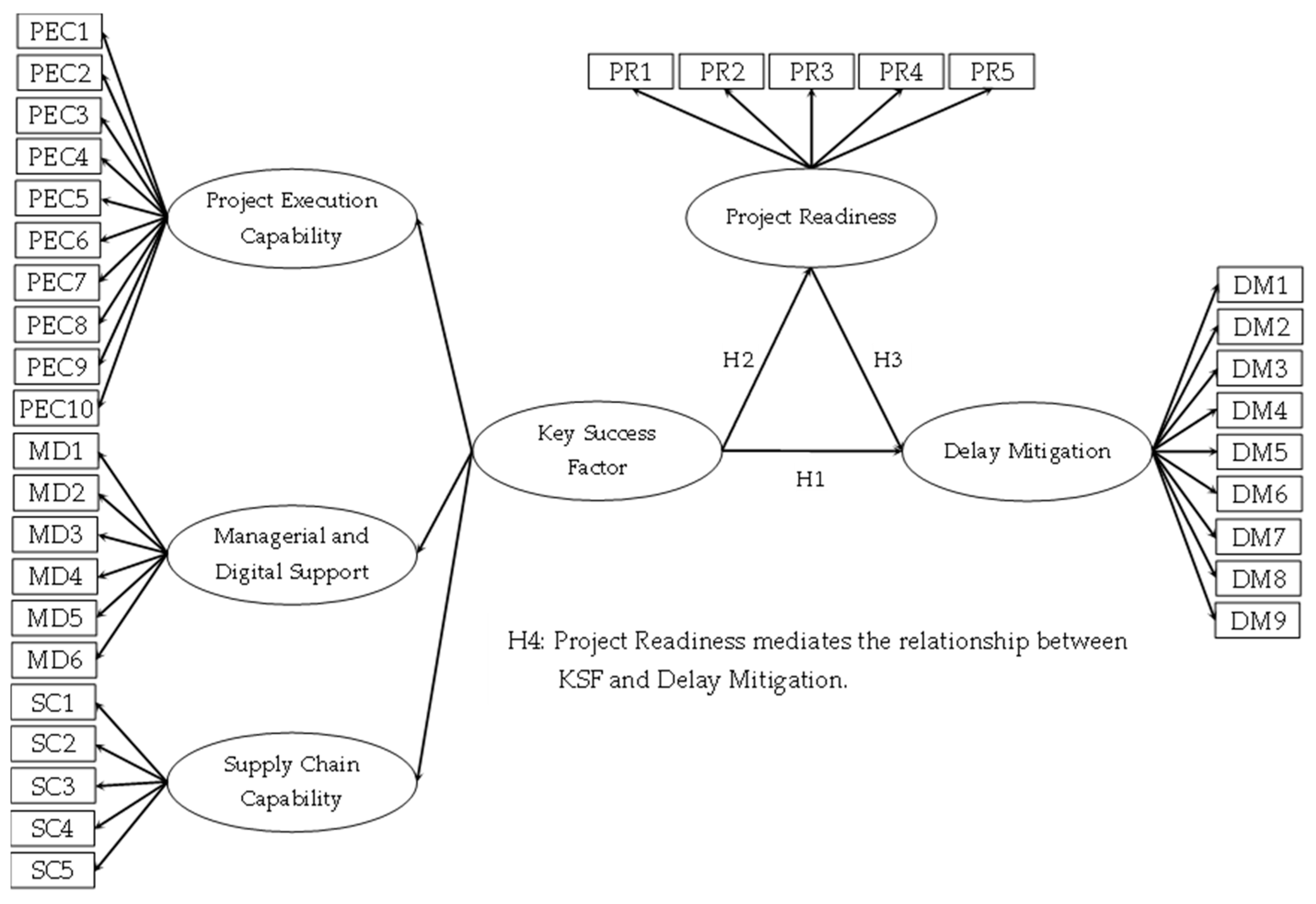
- To examine the direct effect of KSF on Delay Mitigation and determine whether integrated success conditions significantly reduce schedule delays and improve time performance.
- To investigate the influence of KSF on Project Readiness and assess whether strong managerial capability enhances project preparedness prior to execution and strengthens the ability to cope with uncertainty during implementation.
- To assess the effect of Project Readiness on Delay Mitigation and determine whether higher readiness improves preventive planning, responsive actions, and schedule recovery capability throughout the project lifecycle.
- To test the mediating role of Project Readiness in the relationship between KSF and Delay Mitigation in order to explain whether KSF improves project outcomes directly, indirectly, or through both structural pathways.
1.4. Research Contributions
2. Literature Review and Hypothesis Development
2.1. Key Success Factors (KSF)
2.1.1. Project Execution Capability
2.1.2. Managerial and Digital Support
2.1.3. Supply Chain Capability
2.1.4. KSF as an Integrated Higher-Order Construct
2.2. Delay Mitigation
2.3. Project Readiness
2.4. Research Constructs and Hypotheses Development
2.5. Conceptual Framework
3. Methodology
3.1. Research Design
3.2. Population, Sampling, and Data Collection
3.3. Measurement Instrument/Questionnaire Design
3.4. Data Analysis Procedure
4. Results
4.1. Respondent and Project Profile
4.2. Descriptive Statistics of Measurement Items
4.3. Exploratory Factor Analysis
4.4. Confirmatory Factor Analysis and Measurement Quality
4.5. Structural Model and Hypothesis Testing
4.6. Mediation Analysis
5. Discussion
5.1. Theoretical Implications
5.2. Practical Implications
6. Conclusions
6.1. Limitations of the Study
6.2. Future Research
Author Contributions
Funding
Institutional Review Board Statement
Informed Consent Statement
Data Availability Statement
Acknowledgments
Conflicts of Interest
Abbreviations
| KSF | Key Success Factors |
| PR | Project Readiness |
| DM | Delay Mitigation |
| PEC | Project Execution Capability |
| MD | Managerial and Digital Support |
| SC | Supply Chain Capability |
| SEM | Structural Equation Modeling |
| CFA | Confirmatory Factor Analysis |
| EFA | Exploratory Factor Analysis |
| AVE | Average Variance Extracted |
| CR | Composite Reliability |
References
- Assaf, S.A.; Al-Hejji, S. Causes of delay in large construction projects. Int. J. Proj. Manag. 2006, 24, 349–357. [Google Scholar] [CrossRef]
- Sambasivan, M.; Soon, Y.W. Causes and effects of delays in Malaysian construction industry. Int. J. Proj. Manag. 2007, 25, 517–526. [Google Scholar] [CrossRef]
- Aibinu, A.A.; Jagboro, G.O. The effects of construction delays on project delivery. Int. J. Proj. Manag. 2002, 20, 593–599. [Google Scholar] [CrossRef]
- Doloi, H.; Sawhney, A.; Iyer, K.C.; Rentala, S. Analysing factors affecting delays in Indian construction projects. Int. J. Proj. Manag. 2012, 30, 479–489. [Google Scholar] [CrossRef]
- Flyvbjerg, B. What you should know about megaprojects. Proj. Manag. J. 2014, 45, 6–19. [Google Scholar] [CrossRef]
- Enshassi, A.; Al-Najjar, J.; Kumaraswamy, M. Delays and cost overruns in construction projects in the Gaza Strip. J. Financ. Manag. Prop. Constr. 2009, 14, 126–151. [Google Scholar] [CrossRef]
- Ika, L.A. Project success as a topic in project management journals. Proj. Manag. J. 2009, 40, 6–19. [Google Scholar] [CrossRef]
- Pinto, J.K.; Slevin, D.P. Critical factors in successful project implementation. IEEE Trans. Eng. Manag. 1987, 34, 22–27. [Google Scholar] [CrossRef]
- Belassi, W.; Tukel, O.I. A new framework for determining critical success/failure factors in projects. Int. J. Proj. Manag. 1996, 14, 141–151. [Google Scholar] [CrossRef]
- Fortune, J.; White, D. Framing of project critical success factors by a systems model. Int. J. Proj. Manag. 2006, 24, 53–65. [Google Scholar] [CrossRef]
- Kerzner, H. Project Management: A Systems Approach to Planning, Scheduling, and Controlling; Wiley: Hoboken, NJ, USA, 2018. [Google Scholar]
- Becker, J.-M.; Klein, K.; Wetzels, M. Hierarchical latent variable models in PLS-SEM: Guidelines for using reflective-formative type models. Long Range Plan. 2012, 45, 359–394. [Google Scholar] [CrossRef]
- Hair, J.F.; Hult, G.T.M.; Ringle, C.M.; Sarstedt, M. A Primer on Partial Least Squares Structural Equation Modeling (PLS-SEM), 3rd ed.; Sage: Thousand Oaks, CA, USA, 2022. [Google Scholar]
- Alias, Z.; Zawawi, E.M.A.; Yusof, K.; Aris, N.M. Determining critical success factors of project management practice. Procedia Soc. Behav. Sci. 2014, 153, 61–69. [Google Scholar] [CrossRef]
- Chan, A.P.C.; Scott, D.; Chan, A.P.L. Factors affecting the success of a construction project. J. Constr. Eng. Manag. 2004, 130, 153–155. [Google Scholar] [CrossRef]
- Project Management Institute (PMI). A Guide to the Project Management Body of Knowledge (PMBOK® Guide), 7th ed.; PMI: Newtown Square, PA, USA, 2021. [Google Scholar]
- Meredith, J.R.; Mantel, S.J. Project Management: A Managerial Approach, 10th ed.; Wiley: Hoboken, NJ, USA, 2017. [Google Scholar]
- Too, E.G.; Weaver, P. The management of project management: A conceptual framework for project governance. Int. J. Proj. Manag. 2014, 32, 1382–1394. [Google Scholar] [CrossRef]
- Turner, J.R. Handbook of Project-Based Management, 4th ed.; McGraw-Hill: New York, NY, USA, 2014. [Google Scholar]
- Müller, R.; Turner, J.R. Leadership competency profiles of successful project managers. Int. J. Proj. Manag. 2010, 28, 437–448. [Google Scholar] [CrossRef]
- Joslin, R.; Müller, R. Relationships between project management methodology and project success in different project governance contexts. Int. J. Proj. Manag. 2015, 33, 1377–1392. [Google Scholar] [CrossRef]
- Osei-Kyei, R.; Chan, A.P.C. Review of studies on the critical success factors for Public–Private Partnership (PPP) projects from 1990 to 2013. Int. J. Proj. Manag. 2015, 33, 1335–1346. [Google Scholar] [CrossRef]
- Famiyeh, S.; Amoatey, C.T.; Adaku, E.; Agbenohevi, C.S. Major causes of construction time and cost overruns: A case of selected educational sector projects in Ghana. J. Eng. Des. Technol. 2017, 15, 181–198. [Google Scholar] [CrossRef]
- Hair, J.F.; Black, W.C.; Babin, B.J.; Anderson, R.E. Multivariate Data Analysis, 8th ed.; Cengage: Andover, UK, 2019. [Google Scholar]
- Kline, R.B. Principles and Practice of Structural Equation Modeling, 4th ed.; Guilford Press: New York, NY, USA, 2016. [Google Scholar]
- Byrne, B.M. Structural Equation Modeling with AMOS: Basic Concepts, Applications, and Programming, 3rd ed.; Routledge: New York, NY, USA, 2016. [Google Scholar]
- Love, P.E.D.; Smith, J.; Ackermann, F.; Irani, Z.; Teo, P. The costs of rework: Insights from construction and opportunities for learning. Prod. Plan. Control 2018, 29, 1082–1095. [Google Scholar] [CrossRef]
- Project Management Institute (PMI). Pulse of the Profession; PMI: Newtown Square, PA, USA, 2021. [Google Scholar]
- Albtoosh, A.M.F.; Doh, S.I.; Rahman, R.A.; Al-Momani, A.H. Critical success factors of construction projects in Jordan: An empirical investigation. Asian J. Civ. Eng. 2022, 23, 1087–1099. [Google Scholar] [CrossRef]
- Trang, T.T.; Likhitruangsilp, V.; Yabuki, N. A fuzzy cognitive map for identifying the interrelationships of critical success factors in digital transformation implementation by construction contractors. Eng. J. 2025, 29, 45–60. [Google Scholar] [CrossRef]
- Kumar, V.; Pandey, A.; Singh, R. Critical success factor models for project success. J. Eng. Proj. Prod. Manag. 2023, 13, 148–158. [Google Scholar]
- Mohd Fateh, M.A.; Amri, Q.; Zulkeflee, A.A. Cloud-based real-time collaboration in the construction planning phase. J. Constr. Dev. Ctries. 2024, 29, 207–230. [Google Scholar]
- Naji, K.K.; Gunduz, M.; Adalı, M. Analysis of critical project success factors—Sustainable management of the fast-track construction industry. Buildings 2023, 13, 2890. [Google Scholar] [CrossRef]
- Kilwasi, G.J.; Sospeter, N.G.; Rwelamila, P.D. Critical success factors for adopting supply chain management in Tanzanian construction projects. J. Constr. Dev. Ctries. 2023, 28, 43–61. [Google Scholar] [CrossRef]
- Whang, S.W.; Park, K.S.; Kim, S. Critical success factors for implementing integrated construction project delivery. Eng. Constr. Archit. Manag. 2019, 26, 2432–2446. [Google Scholar] [CrossRef]
- Mohammed, A.J. Evaluating the management of critical success factors of residential complex projects and their impact on cost, time, and quality in Erbil governorate. Open Civ. Eng. J. 2022, 16, e187414952207270. [Google Scholar] [CrossRef]
- Mirza, M.N.; Pourzolfaghar, Z.; Shahnazari, M. Significance of scope in project success. Procedia Technol. 2013, 9, 722–729. [Google Scholar] [CrossRef]
- Antoniou, F.; Tsavlidou, E. Ranking public infrastructure project success using multi-criteria analysis. Buildings 2025, 15, 2807. [Google Scholar] [CrossRef]
- Alsuliman, J.A. Causes of delay in Saudi public construction projects. Alex. Eng. J. 2019, 58, 801–808. [Google Scholar] [CrossRef]
- Munikanan, V.; Hamid, Z.A.; Yusof, M.A.; Yahya, M.A.; Ibrahim, A. Mitigation of delay in Malaysian armed forces construction projects. J. Kejuruter. 2025, 37, 1459–1466. [Google Scholar] [CrossRef]
- Al-Attabi, A.M.A.N. Toward delay mitigation in Iraqi construction projects: Evaluating the causes and implications. Ain Shams Eng. J. 2025, 16, 103598. [Google Scholar] [CrossRef]
- Irankunda, G.; Zhang, W.; Abdullahi, U.I.; Fernand, M.; David, B.; Jean-Petit, S. Understanding critical delay causative factors and their mitigation measures in Burundi communal construction projects: A factor analysis and SEM approach. Buildings 2025, 15, 473. [Google Scholar] [CrossRef]
- Coffie, G.H.; Abeka, H.K.; Adzivor, E.K.; Afenyegbor, E.K. Investigating the drivers of cost and schedule performance in Ghana’s road construction. Afr. J. Appl. Res. 2025, 11, 21–46. [Google Scholar] [CrossRef]
- Federal Transit Administration. Project and Construction Management Guidelines; U.S. Department of Transportation: Washington, DC, USA, 2025. [Google Scholar]
- Komarudin, M.; Nugroho, R.E. Analysis of project success factors through time, cost, labour, health safety environment, and quality aspects at PT XYZ. Int. J. Prod. Manag. Eng. 2022, 10, 33–50. [Google Scholar] [CrossRef]
- Rasebotsa, A.R.; Agumba, J.N.; Adebowale, O.J.; Edwards, D.J.; Posillico, J. A critical success factors framework for improved delivery of social infrastructure projects in South Africa. Buildings 2025, 15, 92. [Google Scholar] [CrossRef]
- Zighan, S.; Abualqumboz, M. A project life-cycle readiness approach to manage construction waste in Jordan. Australas. J. Constr. Econ. Build. 2021, 21, 58–79. [Google Scholar] [CrossRef]
- Torres, K.; Torres, K.; Bonilla, M.; Castañeda, K.; Sánchez, O.; Serrano, J.; Cristancho, L.A. Enhancing construction project management competencies through AI assistants. Results Eng. 2025, 28, 108195. [Google Scholar] [CrossRef]
- Sharuddin, N.M.; Azman, M.A.; Abdul Samad, Z.; Mohd Rodzi, R. Relationship between schedule delay factors and project performance in civil engineering works. Built Environ. J. 2024, 21, 23–36. [Google Scholar] [CrossRef]
- Alshihri, S.; Al-Gahtani, K.; Almohsen, A. Risk factors that lead to time and cost overruns of building projects in Saudi Arabia. Buildings 2022, 12, 902. [Google Scholar] [CrossRef]
- Aldossari, K.M. Cost and schedule performance in higher education construction projects in Saudi Arabia. Adv. Civ. Eng. 2025, 2025, 7448384. [Google Scholar] [CrossRef]
- Belay, S.; Goedert, J.; Woldesenbet, A.; Rokooi, S. AHP-based multi-criteria decision analysis of success factors to enhance decision-making in infrastructure construction projects. Cogent Eng. 2022, 9, 2043996. [Google Scholar] [CrossRef]
- Qammar, A.S.B.; Al Maian, R.Y. A critical success factors model for effective implementation of risk management process in construction projects. J. Eng. Res. 2020, 8, 50–70. [Google Scholar] [CrossRef]
- Wang, T.; Ford, D.N.; Chong, H.Y.; Zhang, W. Causes of delays in the construction phase of Chinese building projects. Eng. Constr. Archit. Manag. 2018, 25, 1534–1551. [Google Scholar] [CrossRef]
- Bravo, C.R.Y.; Mogollon, W.O.R. Identification of delay causes in Peruvian construction projects: An expert AHP approach. Rev. Ing. Construcción 2025, 40, 1–9. [Google Scholar] [CrossRef]
- Luthan, P.L.; Sitanggang, N.; Alvan, S.; Prayogo, W. Analysing the causes of management and production delays in the implementation of construction project work. J. Appl. Eng. Technol. Sci. 2024, 5, 1221–1231. [Google Scholar] [CrossRef]
- Duale, A.Y.; Harrun, W.K.; Ghebrab, T.; Mulugeta, S.; Gedelaye, T. Assessment of factors causing construction delays in building construction projects in Somaliland. Adv. Civ. Eng. 2025, 2025, 7915818. [Google Scholar] [CrossRef]
- Zhang, D.; Zhang, H.; Cheng, T. Causes of delay in the construction projects of subway tunnel. Adv. Civ. Eng. 2020, 2020, 8883683. [Google Scholar] [CrossRef]
- Kumar, V.; Pandey, A.; Singh, R. Project success and critical success factors of construction projects: Project practitioners’ perspectives. Organ. Technol. Manag. Constr. 2023, 15, 1–22. [Google Scholar] [CrossRef]
- Bakr, G.A. Ranking the factors that influence the construction project success: The Jordanian perspective. Int. J. Eng. Technol. 2018, 7, 97–102. [Google Scholar] [CrossRef]
- Devi, L.P.; Sindhu, N. Delay analysis of infrastructure construction projects in India. J. Inst. Eng. India Ser. A 2025, 106, 763–771. [Google Scholar] [CrossRef]
- Soomro, F.A.; Memon, M.J.; Chandio, A.F.; Sohu, S.; Soomro, R. Causes of time overrun in construction of building projects in Pakistan. Eng. Technol. Appl. Sci. Res. 2019, 9, 3762–3764. [Google Scholar] [CrossRef]
- Indhu, B.; Yogeswari, K. Structural equation modeling (SEM) approach on inappropriate construction equipment delay factors. Civ. Eng. J. 2021, 7, 1156–1168. [Google Scholar] [CrossRef]
- Hamad, R.J.A.; Tayeh, B.A.; Al Aisri, H.A. Critical factors affecting the success of construction projects in Oman. J. Sustain. Archit. Civ. Eng. 2021, 29, 121–138. [Google Scholar] [CrossRef]
- Rivera, L.; Bagui, H.J.; Yeom, C. A study on causes of delay in road construction projects across 25 developing countries. Infrastructures 2020, 5, 84. [Google Scholar] [CrossRef]
- Javed, S.; Hussain, M.I.; Al Aamri, A.M.; Akhtar, J. Investigation on factors causing construction delay and their effects on the development of Oman’s construction industry. EUREKA Phys. Eng. 2022, 3, 33–44. [Google Scholar] [CrossRef]
- Ovalle, O.R.; Correa-Cepeda, D.; Estrada-Cifuentes, J.P.; Anacona Mopan, Y. Analysis and prioritisation of critical delay factors in construction projects: A Colombian case. Organ. Technol. Manag. Constr. 2024, 16, 237–250. [Google Scholar] [CrossRef]
- Karimi, S.; Piroozfar, P. Exploring causes of delays in national road and highway projects in developing construction economy. Eng. Proj. Prod. Manag. 2022, 12, 137–148. [Google Scholar] [CrossRef]
- Stević, Ž.; Bouraima, M.B.; Subotić, M.; Qiu, Y.; Buah, P.A.; Ndiema, K.M.; Ndjegwes, C.M.; Jan, N. Assessment of causes of delays in road construction projects in the Benin Republic using fuzzy PIPRECIA method. Probl. Eng. 2022, 2022, 5323543. [Google Scholar] [CrossRef]
- Teece, D.J.; Pisano, G.; Shuen, A. Dynamic capabilities and strategic management. Strateg. Manag. J. 1997, 18, 509–533. [Google Scholar] [CrossRef]
- Eisenhardt, K.M.; Martin, J.A. Dynamic capabilities: What are they? Strateg. Manag. J. 2000, 21, 1105–1121. [Google Scholar]
- Creswell, J.W.; Creswell, J.D. Research Design: Qualitative, Quantitative, and Mixed Methods Approaches, 5th ed.; Sage: Thousand Oaks, CA, USA, 2018. [Google Scholar]
- Fellows, R.; Liu, A. Research Methods for Construction, 4th ed.; Wiley-Blackwell: Oxford, UK, 2015. [Google Scholar]
- Naoum, S.G. Dissertation Research and Writing for Construction Students, 3rd ed.; Routledge: London, UK, 2013. [Google Scholar]
- Likert, R. A technique for the measurement of attitudes. Arch. Psychol. 1932, 140, 1–55. [Google Scholar]
- DeVellis, R.F. Scale Development: Theory and Applications, 4th ed.; Sage: Thousand Oaks, CA, USA, 2017. [Google Scholar]
- Saunders, M.; Lewis, P.; Thornhill, A. Research Methods for Business Students, 8th ed.; Pearson: Harlow, UK, 2019. [Google Scholar]
- Tabachnick, B.G.; Fidell, L.S. Using Multivariate Statistics, 7th ed.; Pearson: New York, NY, USA, 2019. [Google Scholar]
- Ofori, G. Nature of the Construction Industry, Its Needs and Its Development. J. Constr. Dev. Ctries. 2015, 20, 115–135. [Google Scholar]
- Pheng, L.S.; Hou, L.S. The economy and the construction industry. In Construction Quality and the Economy; Springer: Singapore, 2019; pp. 1–20. [Google Scholar]
- Etikan, I.; Musa, S.A.; Alkassim, R.S. Comparison of convenience sampling and purposive sampling. Am. J. Theor. Appl. Stat. 2016, 5, 1–4. [Google Scholar] [CrossRef]
- Dulaimi, M.F.; Ling, F.Y.Y.; Ofori, G.; De Silva, N. Enhancing integration and innovation in construction. Build. Res. Inf. 2002, 30, 237–247. [Google Scholar] [CrossRef]
- Westland, J.C. Lower bounds on sample size in structural equation modeling. Electron. Commer. Res. Appl. 2010, 9, 476–487. [Google Scholar] [CrossRef]
- Comrey, A.L.; Lee, H.B. A First Course in Factor Analysis, 2nd ed.; Lawrence Erlbaum Associates: Hillsdale, NJ, USA, 1992. [Google Scholar]
- Cohen, J. Statistical Power Analysis for the Behavioral Sciences, 2nd ed.; Lawrence Erlbaum Associates: Hillsdale, NJ, USA, 1988. [Google Scholar]
- Dillman, D.A.; Smyth, J.D.; Christian, L.M. Internet, Phone, Mail, and Mixed-Mode Surveys: The Tailored Design Method, 4th ed.; Wiley: Hoboken, NJ, USA, 2014. [Google Scholar]
- Sekaran, U.; Bougie, R. Research Methods for Business, 7th ed.; Wiley: Chichester, UK, 2016. [Google Scholar]
- Bryman, A.; Bell, E. Business Research Methods, 4th ed.; Oxford University Press: Oxford, UK, 2015. [Google Scholar]
- Available online: https://www.niehs.nih.gov/research/resources/bioethics/whatis/index.cfm (accessed on 30 March 2026).
- Boone, H.N.; Boone, D.A. Analyzing Likert Data. J. Ext. 2012, 50, 2TOT2. [Google Scholar] [CrossRef]
- Polit, D.F.; Beck, C.T. The content validity index: Are you sure you know what’s being reported? Res. Nurs. Health 2006, 29, 489–497. [Google Scholar] [CrossRef]
- Lynn, M.R. Determination and quantification of content validity. Nurs. Res. 1986, 35, 382–385. [Google Scholar] [CrossRef]
- Collier, J.E. Applied Structural Equation Modeling Using AMOS: Basic to Advanced Techniques; Routledge: New York, NY, USA, 2020. [Google Scholar]
- Cabana, E.; Lillo, R.E.; Laniado, H. Multivariate outlier detection based on a robust Mahalanobis distance with shrinkage estimators. Stat. Pap. 2021, 62, 1583–1610. [Google Scholar] [CrossRef]
- Watkins, M.W. Exploratory factor analysis: A guide to best practice. J. Black Psychol. 2018, 44, 219–246. [Google Scholar] [CrossRef]
- Brown, T.A. Confirmatory Factor Analysis for Applied Research, 2nd ed.; Guilford Press: New York, NY, USA, 2015. [Google Scholar]
- Hu, L.; Bentler, P.M. Cutoff criteria for fit indexes in covariance structure analysis: Conventional criteria versus new alternatives. Struct. Equ. Model. 1999, 6, 1–55. [Google Scholar] [CrossRef]
- Fornell, C.; Larcker, D.F. Evaluating structural equation models with unobservable variables and measurement error. J. Mark. Res. 1981, 18, 39–50. [Google Scholar] [CrossRef]
- Schreiber, J.B.; Nora, A.; Stage, F.K.; Barlow, E.A.; King, J. Reporting structural equation modeling and confirmatory factor analysis results: A review. J. Educ. Res. 2006, 99, 323–338. [Google Scholar] [CrossRef]
- Zhao, X.; Lynch, J.G.; Chen, Q. Reconsidering Baron and Kenny: Myths and truths about mediation analysis. J. Consum. Res. 2010, 37, 197–206. [Google Scholar] [CrossRef]
- Qadir, S.; Alawag, A.M.; Baarimah, A.O.; Alyami, H.; Almujibah, H.R.; Alyami, H. The role of digital technologies in enhancing construction project management. Sci. Rep. 2025, 16, 1486. [Google Scholar] [CrossRef]
- Field, A. Discovering Statistics Using IBM SPSS Statistics, 5th ed.; Sage: London, UK, 2018. [Google Scholar]
- Lima, M.G.T.; Cunha, T.M.; Cândido, L.F.; Barros Neto, J.P. Digital transformation in the construction industry: Lessons and challenges from the journey of Brazilian construction companies. Sustainability 2026, 18, 407. [Google Scholar] [CrossRef]
- Doloi, H. Cost overruns and failure in project management: Understanding the roles of key stakeholders in construction projects. J. Constr. Eng. Manag. 2013, 139, 267–279. [Google Scholar] [CrossRef]
- Vrijhoef, R.; Koskela, L. The four roles of supply chain management in construction. Eur. J. Purch. Supply Manag. 2000, 6, 169–178. [Google Scholar] [CrossRef]
- Zwikael, O. Critical planning processes in construction projects. Constr. Innov. 2009, 9, 372–387. [Google Scholar] [CrossRef]
- Kline, R.B. Principles and Practice of Structural Equation Modeling, 5th ed.; Guilford Press: New York, NY, USA, 2023. [Google Scholar]
- Nunnally, J.C.; Bernstein, I.H. Psychometric Theory, 3rd ed.; McGraw-Hill: New York, NY, USA, 1994. [Google Scholar]
- Pinto, J.K.; Slevin, D.P. Critical success factors across the project life cycle. Proj. Manag. J. 1988, 19, 67–75. [Google Scholar]
- Gunduz, M.; Nielsen, Y.; Ozdemir, M. Quantification of delay factors using the relative importance index method for construction projects in Turkey. J. Manag. Eng. 2013, 29, 133–139. [Google Scholar] [CrossRef]
- Ika, L.A.; Diallo, A.; Thuillier, D. Critical success factors for World Bank projects: An empirical investigation. Int. J. Proj. Manag. 2012, 30, 105–116. [Google Scholar] [CrossRef]
- Williams, T. Assessing and moving on from the dominant project management discourse in the light of project overruns. IEEE Trans. Eng. Manag. 2005, 52, 497–508. [Google Scholar] [CrossRef]
- Baron, R.M.; Kenny, D.A. The moderator–mediator variable distinction in social psychological research. J. Pers. Soc. Psychol. 1986, 51, 1173–1182. [Google Scholar] [CrossRef]
- Zwikael, O.; Meredith, J. Evaluating the success of a project and the performance of its leaders. IEEE Trans. Eng. Manag. 2021, 68, 1745–1757. [Google Scholar] [CrossRef]
- Serrador, P.; Turner, R. The relationship between project success and project efficiency. Proj. Manag. J. 2015, 46, 30–39. [Google Scholar] [CrossRef]
- Rezvani, A.; Chang, A.; Wiewiora, A.; Ashkanasy, N.M.; Jordan, P.J.; Zolin, R. Manager emotional intelligence and project success: The mediating role of job satisfaction and trust. Int. J. Proj. Manag. 2016, 34, 1112–1122. [Google Scholar] [CrossRef]
- Müller, R.; Jugdev, K. Critical success factors in projects. Int. J. Manag. Proj. Bus. 2012, 5, 757–775. [Google Scholar] [CrossRef]
- Cooke-Davies, T. The “real” success factors on projects. Int. J. Proj. Manag. 2002, 20, 185–190. [Google Scholar] [CrossRef]
- Love, P.E.D.; Smith, J.; Ackermann, F.; Irani, Z. The praxis of stupidity: An explanation to understand the barriers mitigating rework in construction. Prod. Plan. Control 2018, 29, 1112–1125. [Google Scholar] [CrossRef]
- Derakhshan, R.; Turner, R.; Mancini, M. Project governance and stakeholders. Int. J. Proj. Manag. 2019, 37, 98–115. [Google Scholar] [CrossRef]
- Hillson, D. Managing Risk in Projects, 2nd ed.; Routledge: London, UK, 2024. [Google Scholar]
- Odeh, A.M.; Battaineh, H.T. Causes of construction delay. Int. J. Proj. Manag. 2002, 20, 67–73. [Google Scholar] [CrossRef]
- Bello, J.O.; Stephen, S.; Adetoro, P.; Mogaji, I.J. Supply chain resilience in the construction industry: A bibliometric review on operations management practices from Industry 4.0 to Industry 5.0. Benchmarking Int. J. 2025, 32, 3772–3792. [Google Scholar] [CrossRef]
- Tobar-Montilla, C.D.; Muñoz-Añasco, M.; Nieto-Muñoz, A.M. Managing uncertainty in construction project scheduling: A systematic review and educational taxonomy. Int. J. Constr. Educ. Res. 2025. [Google Scholar] [CrossRef]
- Teece, D.J. Explicating dynamic capabilities: The nature and microfoundations of sustainable enterprise performance. Strateg. Manag. J. 2007, 28, 1319–1350. [Google Scholar] [CrossRef]
- Barney, J. Firm resources and sustained competitive advantage. J. Manag. 1991, 17, 99–120. [Google Scholar] [CrossRef]
- Ofori, G. Challenges of construction industries in developing countries. In Proceedings of the 2nd International Conference on Construction in Developing Countries: Challenges Facing the Construction Industry in Developing Countries, Gaborone, Botswana, 15–17 November 2000. [Google Scholar] [CrossRef]
- Doloi, H. Understanding impacts of time and cost related construction risks on operational performance of PPP projects. Int. J. Strateg. Prop. Manag. 2012, 16, 316–337. [Google Scholar] [CrossRef]
- Etikan, I.; Bala, K. Sampling and sampling methods. Biom. Biostat. Int. J. 2017, 5, 215–217. [Google Scholar] [CrossRef]
- Bryman, A. Social Research Methods; Oxford University Press: Oxford, UK, 2016. [Google Scholar]
- Menard, S. Longitudinal Research, 2nd ed.; Sage: Thousand Oaks, CA, USA, 2002. [Google Scholar]
- Podsakoff, P.M.; MacKenzie, S.B.; Lee, J.Y.; Podsakoff, N.P. Common method biases in behavioral research: A critical review. J. Appl. Psychol. 2003, 88, 879–903. [Google Scholar] [CrossRef] [PubMed]
- Fuller, C.M.; Simmering, M.J.; Atinc, G.; Atinc, Y.; Babin, B.J. Common methods variance detection in business research. J. Bus. Res. 2016, 69, 3192–3198. [Google Scholar] [CrossRef]
- Love, P.E.D.; Edwards, D.J.; Irani, Z. Moving Beyond Optimism Bias and Strategic Misrepresentation: An Explanation for Social Infrastructure Project Cost Overruns. IEEE Trans. Eng. Manag. 2012, 59, 560–571. [Google Scholar] [CrossRef]
- Qi, W.; Moashian, Q. Coordination and Knowledge Sharing in Construction Project-Based Organization: A Longitudinal Equation Model Analysis. Autom. Constr. 2016, 72, 309–320. [Google Scholar]



| Category | Code | Measurement Indicators | Reference |
|---|---|---|---|
| Project Execution Capability | PEC1 | Project Execution Planning and Control | [38,43,45,49,50] |
| PEC2 | On-Site Quality Management | [45,50,51] | |
| PEC3 | Risk Management and Contingency Planning | [42,52,53] | |
| PEC4 | Execution-Stage Supply Risk Management | [39,42,54,55] | |
| PEC5 | Realistic Project Duration Estimation | [38,43,49,50,52,56] | |
| PEC6 | Effective Site Supervision and Control | [45,50,56,57,58] | |
| PEC7 | Competent Project Team Leadership | [32,50,59] | |
| PEC8 | Clear Project Scope and Manageable Complexity | [31,38,46,52,60] | |
| PEC9 | Change Control Discipline | [38,60,61,62] | |
| PEC10 | Labor Productivity Management | [45,56,57] | |
| Managerial and Digital Support | MD1 | Budget and Cost Control | [34,38,46,52] |
| MD2 | Information Integration and IT Systems | [30,32,53,63] | |
| MD3 | Integrated Project Coordination | [35,52,64] | |
| MD4 | Real-Time Progress Monitoring | [50,52,64,65] | |
| MD5 | Inter-System Compatibility | [32,35] | |
| MD6 | Data Security and Privacy | [30,32] | |
| Supply Chain Capability | SC1 | Supply Chain Risk Management | [43,55] |
| SC2 | Supply Chain Competency Development | [34,66] | |
| SC3 | Material Requirements Planning (MRP) and Inventory Control | [67,68] | |
| SC4 | Collaborative Contracting and Partnering | [34,52] | |
| SC5 | Vendor and Subcontractor Qualification Management | [36,40,52] | |
| Project Readiness | PR1 | Pre-Start Health, Safety and Environment Process | [52,54,58] |
| PR2 | Workforce Competency and Training | [45,56,57,69] | |
| PR3 | Top Management Support | [32,35,46,65] | |
| PR4 | Look-ahead Planning Efficiency | [31,52,60,61,62] | |
| PR5 | Performance Monitoring and Control Readiness | [38,43,45,50] | |
| Delay Mitigation | DM1 | Critical Activity Continuity | [31,35,52,60,61,62,64] |
| DM2 | Schedule Variance Control | [38,43,45,49,50,52,56] | |
| DM3 | Delay Impact Containment | [38,42,43,45,50,52,53] | |
| DM4 | Adaptive Work Resequencing | [31,50,52,53,55,58,60,61,62] | |
| DM5 | Rapid Resource Reallocation | [34,43,45,50,56,57,58,66] | |
| DM6 | Baseline Schedule Protection | [38,43,50,52] | |
| DM7 | Schedule Recovery Acceleration | [45,49,55,56,57,67] | |
| DM8 | Stakeholder Progress Confidence | [33,35,40,41,46,59,66] | |
| DM9 | Final Milestone Achievement | [32,34,38,46,52] |
| Code | Measurement Indicators | Sample Size | Mean | Standard Deviation |
|---|---|---|---|---|
| PEC1 | Project Execution Planning and Control | 308 | 4.448 | 0.731 |
| PEC2 | On-Site Quality Management | 308 | 4.182 | 0.717 |
| PEC3 | Risk Management and Contingency Planning | 308 | 4.208 | 0.836 |
| PEC4 | Execution-Stage Supply Risk Management | 308 | 4.065 | 0.672 |
| PEC5 | Realistic Project Duration Estimation | 308 | 4.065 | 0.746 |
| PEC6 | Effective Site Supervision and Control | 308 | 4.318 | 0.797 |
| PEC7 | Competent Project Team Leadership | 308 | 4.422 | 0.720 |
| PEC8 | Clear Project Scope and Manageable Complexity | 308 | 4.539 | 0.741 |
| PEC9 | Change Control Discipline | 308 | 4.481 | 0.733 |
| PEC10 | Labor Productivity Management | 308 | 4.208 | 0.813 |
| MD1 | Budget and Cost Control | 308 | 3.792 | 0.836 |
| MD2 | Information Integration and IT Systems | 308 | 3.669 | 0.877 |
| MD3 | Integrated Project Coordination | 308 | 3.760 | 0.799 |
| MD4 | Real-Time Progress Monitoring | 308 | 3.903 | 0.845 |
| MD5 | Inter-System Compatibility | 308 | 3.500 | 1.066 |
| MD6 | Data Security and Privacy | 308 | 3.818 | 0.888 |
| SC1 | Supply Chain Risk Management | 308 | 3.662 | 0.943 |
| SC2 | Supply Chain Competency Development | 308 | 3.773 | 0.851 |
| SC3 | Material Requirements Planning (MRP) and Inventory Control | 308 | 3.669 | 0.955 |
| SC4 | Collaborative Contracting and Partnering | 308 | 3.786 | 0.831 |
| SC5 | Vendor and Subcontractor Qualification Management | 308 | 3.903 | 0.797 |
| PR1 | Pre-Start Health, Safety and Environment Process | 308 | 4.208 | 0.701 |
| PR2 | Workforce Competency and Training | 308 | 4.110 | 0.787 |
| PR3 | Top Management Support | 308 | 4.091 | 0.794 |
| PR4 | Look-ahead Planning Efficiency | 308 | 3.961 | 0.846 |
| PR5 | Performance Monitoring and Control Readiness | 308 | 3.864 | 0.870 |
| DM1 | Critical Activity Continuity | 308 | 4.110 | 0.851 |
| DM2 | Schedule Variance Control | 308 | 3.935 | 0.737 |
| DM3 | Delay Impact Containment | 308 | 3.838 | 0.753 |
| DM4 | Adaptive Work Resequencing | 308 | 3.721 | 0.843 |
| DM5 | Rapid Resource Reallocation | 308 | 4.234 | 0.837 |
| DM6 | Baseline Schedule Protection | 308 | 4.058 | 0.886 |
| DM7 | Schedule Recovery Acceleration | 308 | 4.162 | 0.819 |
| DM8 | Stakeholder Progress Confidence | 308 | 4.058 | 0.776 |
| DM9 | Final Milestone Achievement | 308 | 4.078 | 0.827 |
| Category | Code | Measurement Indicators | Factor Loadings | KMO |
|---|---|---|---|---|
| Project Execution Capability | PEC1 | Project Execution Planning and Control | 0.751 | 0.921 |
| PEC2 | On-Site Quality Management | 0.779 | ||
| PEC3 | Risk Management and Contingency Planning | 0.726 | ||
| PEC4 | Execution-Stage Supply Risk Management | 0.700 | ||
| PEC5 | Realistic Project Duration Estimation | 0.678 | ||
| PEC6 | Effective Site Supervision and Control | 0.832 | ||
| PEC7 | Competent Project Team Leadership | 0.820 | ||
| PEC8 | Clear Project Scope and Manageable Complexity | 0.785 | ||
| PEC9 | Change Control Discipline | 0.784 | ||
| PEC10 | Labor Productivity Management | 0.734 | ||
| Managerial and Digital Support | MD1 | Budget and Cost Control | 0.863 | 0.907 |
| MD2 | Information Integration and IT Systems | 0.808 | ||
| MD3 | Integrated Project Coordination | 0.760 | ||
| MD4 | Real-Time Progress Monitoring | 0.853 | ||
| MD5 | Inter-System Compatibility | 0.848 | ||
| MD6 | Data Security and Privacy | 0.783 | ||
| Supply Chain Capability | SC1 | Supply Chain Risk Management | 0.884 | 0.840 |
| SC2 | Supply Chain Competency Development | 0.869 | ||
| SC3 | Material Requirements Planning (MRP) and Inventory Control | 0.829 | ||
| SC4 | Collaborative Contracting and Partnering | 0.798 | ||
| SC5 | Vendor and Subcontractor Qualification Management | 0.776 | ||
| Project Readiness | PR1 | Pre-Start Health, Safety and Environment Process | 0.667 | 0.770 |
| PR2 | Workforce Competency and Training | 0.777 | ||
| PR3 | Top Management Support | 0.810 | ||
| PR4 | Look-ahead Planning Efficiency | 0.652 | ||
| PR5 | Performance Monitoring and Control Readiness | 0.753 | ||
| Delay Mitigation | DM1 | Critical Activity Continuity | 0.860 | 0.906 |
| DM2 | Schedule Variance Control | 0.851 | ||
| DM3 | Delay Impact Containment | 0.776 | ||
| DM4 | Adaptive Work Resequencing | 0.648 | ||
| DM5 | Rapid Resource Reallocation | 0.814 | ||
| DM6 | Baseline Schedule Protection | 0.848 | ||
| DM7 | Schedule Recovery Acceleration | 0.848 | ||
| DM8 | Stakeholder Progress Confidence | 0.857 | ||
| DM9 | Final Milestone Achievement | 0.832 |
| Category | Cronbach’s Alpha | Composite Reliability | AVE |
|---|---|---|---|
| Project Execution Capability | 0.918 | 0.916 | 0.524 |
| Managerial and Digital Support | 0.900 | 0.886 | 0.570 |
| Supply Chain Capability | 0.888 | 0.881 | 0.601 |
| Project Readiness | 0.783 | 0.836 | 0.506 |
| Delay Mitigation | 0.936 | 0.946 | 0.663 |
| Model Fit Index | Value | Recommended Threshold | Result |
|---|---|---|---|
| 1.623 | <3.00 | Good Fit | |
| GFI | 0.900 | >0.90 | Good Fit |
| NFI | 0.933 | >0.90 | Good Fit |
| TLI | 0.959 | >0.90 | Excellent Fit |
| CFI | 0.973 | >0.90 | Excellent Fit |
| RMSEA | 0.045 | <0.08 | Excellent Fit |
| SRMR | 0.043 | <0.08 | Excellent Fit |
| Hypothesis | Structural Path | Standardized Coefficient (β) | p-Value | R2 (Endogenous Construct) | Decision |
|---|---|---|---|---|---|
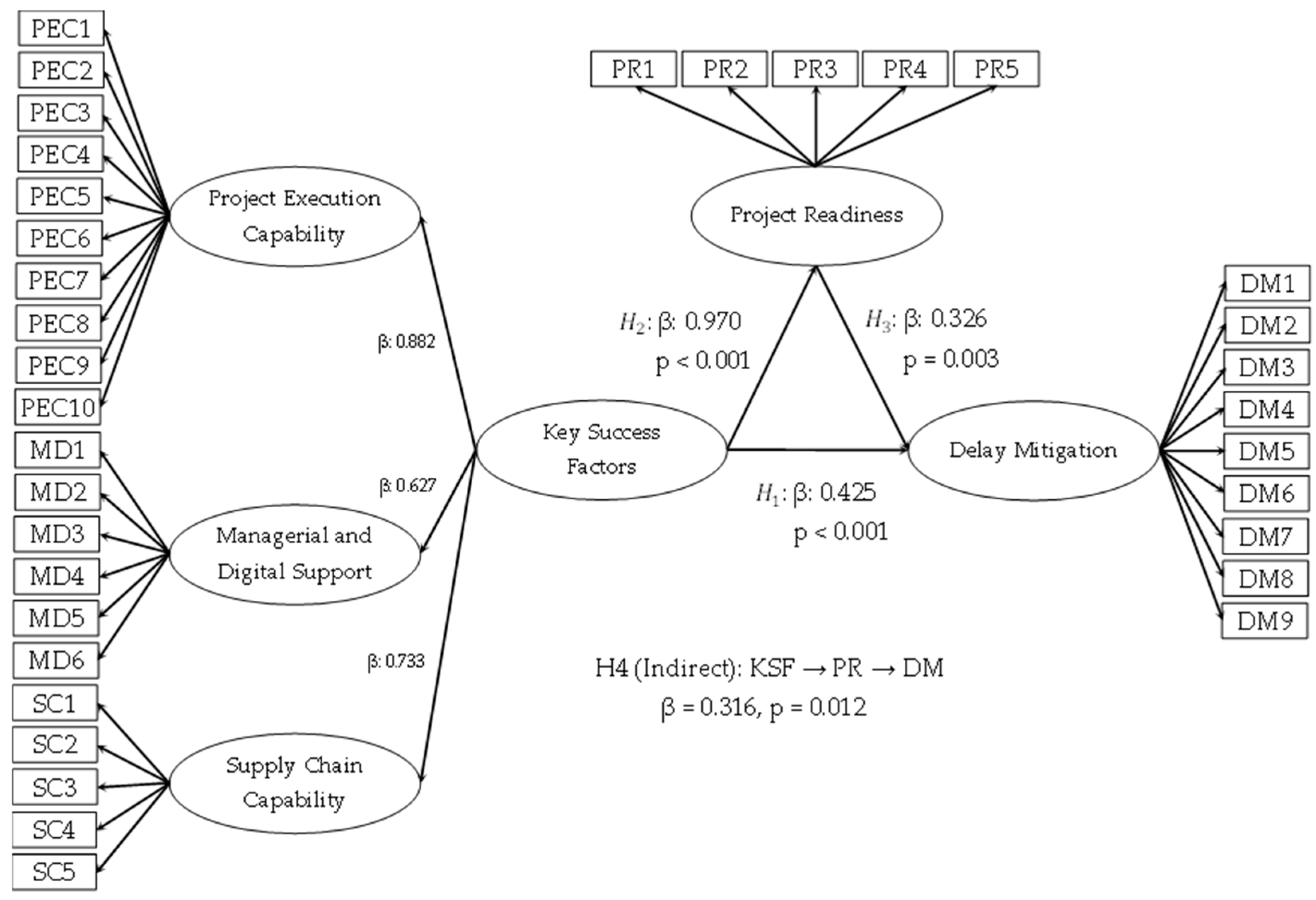
| H1 | KSF → DM | 0.425 | <0.001 | 0.555 | Supported |
| H2 | KSF → PR | 0.970 | <0.001 | 0.940 | Supported |
| H3 | PR → DM | 0.326 | 0.003 | 0.555 | Supported |
| H4 | KSF → PR → DM (Indirect Effect) | 0.316 | 0.012 | — | Supported |
| Effect Type | Relationship Path | Standardized Effect (β) | Interpretation |
|---|---|---|---|
| Direct Effect | KSF → DM | 0.425 | Immediate direct contribution to delay mitigation |
| Indirect Effect | KSF → PR → DM | 0.316 | Contribution through readiness enhancement |
| Total Effect | KSF → DM (total) | 0.741 | Overall combined influence of KSF |
Disclaimer/Publisher’s Note: The statements, opinions and data contained in all publications are solely those of the individual author(s) and contributor(s) and not of MDPI and/or the editor(s). MDPI and/or the editor(s) disclaim responsibility for any injury to people or property resulting from any ideas, methods, instructions or products referred to in the content. |
© 2026 by the authors. Licensee MDPI, Basel, Switzerland. This article is an open access article distributed under the terms and conditions of the Creative Commons Attribution (CC BY) license.
Share and Cite
Lithanarung, S.; Laokhongthavorn, L.; Ahmed, M.; Chatpattananan, V. How Key Success Factors Improve Delay Mitigation in Construction Projects: The Mediating Role of Project Readiness. Buildings 2026, 16, 2137. https://doi.org/10.3390/buildings16112137
Lithanarung S, Laokhongthavorn L, Ahmed M, Chatpattananan V. How Key Success Factors Improve Delay Mitigation in Construction Projects: The Mediating Role of Project Readiness. Buildings. 2026; 16(11):2137. https://doi.org/10.3390/buildings16112137
Chicago/Turabian StyleLithanarung, Sophon, Laemthong Laokhongthavorn, Mukhtar Ahmed, and Vuttichai Chatpattananan. 2026. "How Key Success Factors Improve Delay Mitigation in Construction Projects: The Mediating Role of Project Readiness" Buildings 16, no. 11: 2137. https://doi.org/10.3390/buildings16112137
APA StyleLithanarung, S., Laokhongthavorn, L., Ahmed, M., & Chatpattananan, V. (2026). How Key Success Factors Improve Delay Mitigation in Construction Projects: The Mediating Role of Project Readiness. Buildings, 16(11), 2137. https://doi.org/10.3390/buildings16112137