This is an early access version, the complete PDF, HTML, and XML versions will be available soon.
Article

Short-Term Effects of Indoor Infiltration Exposure to Particulate Matter and Ozone on Mortality Risk

1
Department of Occupational and Environmental Health Sciences, School of Public Health, Peking University, Beijing 100191, China
2
Department of Otolaryngology Head and Neck Surgery, Peking University Third Hospital, Beijing 100191, China
3
Non-Communicable Chronic Disease Control and Prevention Institute, Jiangsu Provincial Center for Disease Control and Prevention, Nanjing 210009, China
4
School of Public Health, Shanxi Medical University, Taiyuan 030001, China
5
MOE Key Laboratory of Coal Environmental Pathogenicity and Prevention, Taiyuan 030001, China
6
Shanxi Key Laboratory of Environmental Pollution Pathogenicity and Prevention, Taiyuan 030001, China
7
Key Laboratory of Epidemiology of Major Diseases (Peking University), Ministry of Education, Beijing 100191, China
*
Authors to whom correspondence should be addressed.
These authors contributed equally to this work
Buildings 2026, 16(11), 2129; https://doi.org/10.3390/buildings16112129

Submission received: 5 April 2026 / Revised: 16 May 2026 / Accepted: 22 May 2026 / Published: 26 May 2026
(This article belongs to the Section Building Energy, Physics, Environment, and Systems)

Abstract

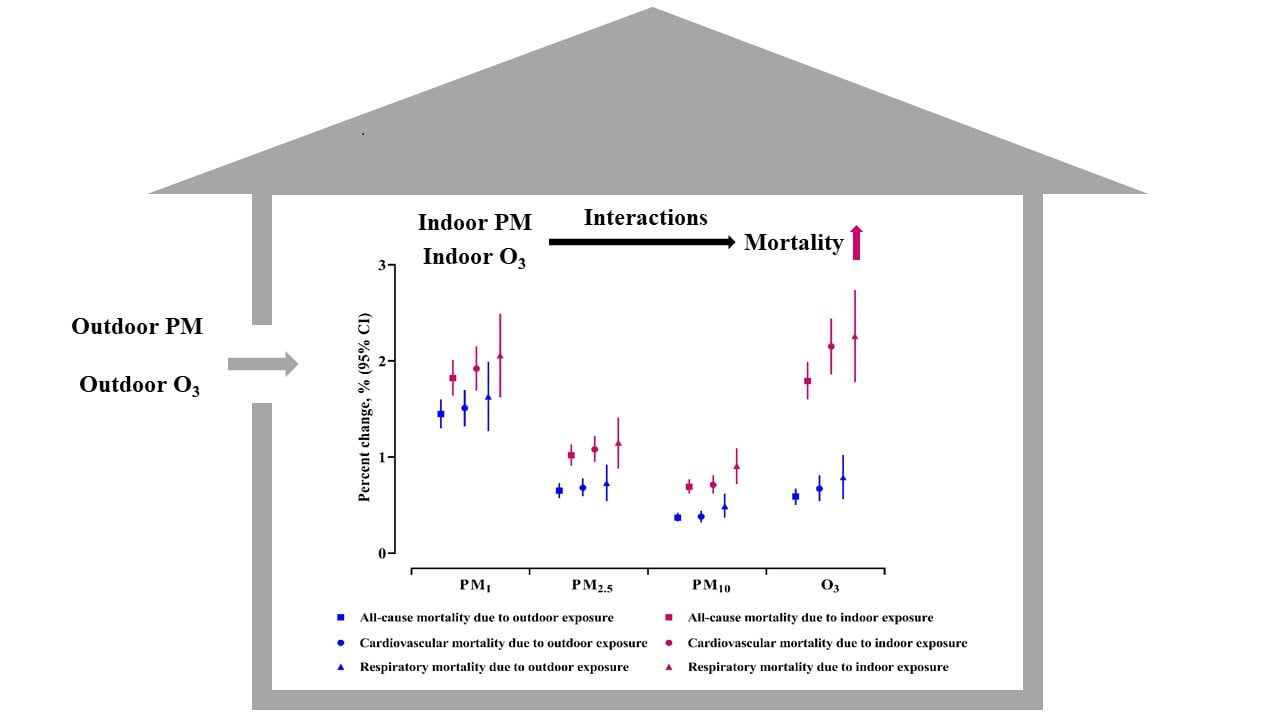
People spend the majority of their time indoors; however, most previous studies on the health effects of particulate matter (PM) and ozone (O3) have used outdoor concentrations as a proxy for personal exposure, which may introduce misclassification bias. Since indoor PM and O3 originate primarily from outdoors, estimating their indoor infiltration levels provides a closer approximation of true personal exposure. This study used data on approximately four million deaths occurring over an eight-year period in Jiangsu Province, China. The infiltration factor method and time-series analysis were employed to assess the linear and nonlinear associations of short-term indoor exposure to outdoor-origin PM1, PM2.5, PM10, and O3 with all-cause, cardiovascular, and respiratory mortality. In addition, the interactions between indoor PM and O3 were investigated. The results indicate that indoor exposure to outdoor-origin PM and O3 was positively associated with mortality, and these associations were stronger than those observed for direct outdoor exposure. Each 10 μg/m3 increase in the 2-day moving average concentration of indoor PM1, PM2.5, PM10, and O3 was associated with a 1.82% (95% confidence interval [CI]: 1.64, 2.01), 1.02% (95% CI: 0.91, 1.13), 0.69% (95% CI: 0.62, 0.77), and 1.79% (95% CI: 1.60, 1.99) increase in all-cause mortality, respectively. No threshold was observed in the exposure-response associations. Furthermore, significant multiplicative and additive interactions were identified between infiltrated PM and O3. Consequently, greater attention should be directed toward indoor air quality, particularly the coordinated management of combined exposure to indoor PM and O3, in order to better protect public health.
Keywords: particulate matter; ozone; mortality; indoor exposure; time-series particulate matter; ozone; mortality; indoor exposure; time-series
Graphical Abstract