Article

Effect of Elevated Temperature on the Deformation Behaviors of Early-Age Concrete

1
Department of Civil Engineering, Shanxi Institute of Technology, Yangquan 045000, China
2
School of Mechanics and Civil Engineering, China University of Mining & Technology, Xuzhou 221116, China
*
Author to whom correspondence should be addressed.
Buildings 2026, 16(11), 2102; https://doi.org/10.3390/buildings16112102
Submission received: 13 March 2026 / Revised: 13 May 2026 / Accepted: 15 May 2026 / Published: 25 May 2026
(This article belongs to the Section Building Materials, and Repair & Renovation)

Abstract

Concrete structures are vulnerable to fire-induced damage throughout their service life, with high-temperature exposure presenting a critical safety hazard. This study addresses the critical safety risks posed by fire-induced damage in concrete structures, particularly focusing on the distinct behavioral differences between early-age and mature concrete during both heating and cooling. To investigate these variations, concrete specimens cured for 3, 14, 28, 60, and 90 days were subjected to deformation tests and heated to target temperatures ranging from 100 to 800 °C. Key parameters, including compressive strength, mass loss, and linear expansion rate, were measured. The results show that the linear expansion rate and thermal expansion coefficient increased with temperature at all ages, with residual linear expansion rates at 800 °C ranging from 0.49% to 0.55%, decreasing slightly with age. While compressive strength was higher in older specimens at room temperature, it became similar across ages after exposure to high temperatures, especially above 500 °C. Notably, constant-temperature exposure significantly influenced the deformation behavior. These findings suggest that fire resistance assessments should account for concrete age and, more importantly, the effects of sustained high-temperature exposure, which critically alter deformation patterns and residual properties.

1. Introduction

Concrete and steel bars work well together primarily because of their similar coefficients of linear expansion [1,2]. Reinforced concrete structures have many advantages, such as good molding and ease of construction, which is why they are among the most commonly used structural forms [3,4,5]. However, with the widespread construction of reinforced concrete structures, many safety issues involving concrete have been observed. Among disasters, fire poses a major threat to public safety and social development. The behavior of concrete materials can be severely affected by high temperatures, significantly reducing the safety of the structure [6]. Sudden damage to reinforced concrete members due to fire can directly cause the structure to collapse [7,8,9]. Therefore, the fire resistance of reinforced concrete is crucial. Numerous studies have been conducted on the mechanical properties of concrete structures exposed to fire [10,11,12].
As is known, concrete structures must be properly cured to develop the required mechanical and durability-related properties [13]. However, many concrete elements are cured for less than 28 days, which is insufficient time for the completion of the cement hydration reaction within the concrete. In such cases, the mechanical properties may not meet design requirements [14,15]. Differences in concrete properties caused by varying curation ages can significantly affect the safety of the structure if it is exposed to high temperatures. Therefore, the effect of age on concrete properties has been extensively investigated.
In a previous study, the adhesive strength of concrete specimens cured at 0 °C for 3 and 7 days dropped dramatically compared to those cured at 20 °C, and it gradually increased with the curing age [16]. The strength of concrete was rapidly enhanced early in the curing process, a finding that aligns with subsequent studies on age-dependent mechanical properties [17]. The macroscopic and microscopic mechanical properties of fiber-reinforced composites were investigated at ages ranging from 1 to 120 days. Both compressive and tensile strengths initially increased and then stabilized as curing time was extended [18]. Similarly, under torsional loading conditions, the compressive strength and fracture toughness of concrete were evaluated at 3, 7, 28, 90, 180, and 365 days, with the authors noting a significant improvement in mature concrete when 20% fly ash partially replaced ordinary silicate cement [19]. Further insights were gained by examining fracture parameters and ductility behavior in self-compacting concrete mixtures with water–cement ratios of 0.45 and 0.65 and curing ages of 3, 7, 28, and 90 days. The results revealed a notable increase in fracture toughness with age [20]. Consistent with these trends, quasi-static flexural strength, similarly to compressive and tensile strengths, was also high during the early curing stage [21]. Early-age concrete has a lower hydration degree, resulting in more unhydrated cement particles and fewer hydration products compared to older concrete. Consequently, its porosity is higher, with larger and more interconnected pores that facilitate moisture and gas transport. The C-S-H gel in early-age concrete is less dense and more disordered, resulting in lower mechanical strength and thermal stability. In contrast, older concrete exhibits a higher hydration degree, a refined pore structure with lower porosity, and a more mature, denser C-S-H gel, which enhances its resistance to high temperatures and mechanical loading.
The compressive and splitting tensile strengths of concrete vary depending on curing age. In a previous study, the greatest recovery strength was observed after the concrete had been cured for 3 days. For early-age concrete, water-cooled specimens had greater relative recovery strength than air-cooled specimens at temperatures below 800 °C, while the opposite was true for 28-day concrete specimens. When exceeding 800 °C, all water-cooled specimens had lower relative strength than air-cooled specimens [6]. The preconditioning time affected the hydration of adhesive material, and the steam-curing conditions affected the performance of concrete. In contrast, the preconditioning time barely influenced the degree of hydration, compressive strength, or pore structure of the binder material [22]. However, the late compressive strength of concrete with high fly ash content can be significantly improved by increasing the preconditioning time [23].
As can be seen from the above studies, the effect of age on the performance of concrete cannot be ignored. The physical behavior of concrete at different ages after its exposure to elevated temperatures has not been studied systematically enough [24]. The damage process in concrete structures and the factors influencing it are very complex. The safety of a structure can be compromised if the concrete’s material properties deteriorate [25], and curing age is one of the most crucial factors affecting concrete performance. Properly maintaining concrete can ensure that its properties are sound, make it more impermeable and resistant to aggressive environments, and better protect the internal reinforcement [26].
Variability in thermal deformation is a major trigger of thermal damage in concrete [27]. Thermal expansion parameters are essential for the accuracy of finite element modeling of concrete. Existing research has systematically documented the heating-induced expansion behavior of normal concrete, demonstrating that both its material constituents and mix proportions critically shape its thermal expansion characteristics [28,29]. This damage not only determines how concrete structures degrade under high-temperature conditions but also serves as a basis for post-fire residual performance evaluations [30]. Previous studies have investigated the effects of different strengths [28], humidity levels [31], heating rates [32], and cooling processes [2] on the deformation performance of concrete during high-temperature exposure.
However, the influence of curing age on the deformation performance of concrete structures after exposure to high temperatures has received relatively little research attention, but it is essential to understand. Proper curing and aging can accelerate the hardening and formation of the concrete, as well as reduce the chances of concrete quality problems caused by unfavorable environmental factors. However, during actual projects, many quality issues do arise in both construction and curing processes. Such problems lead to damage to concrete in the curing process, which poses a major safety risk and other hidden dangers during later use. Therefore, the effect of age on concrete expansion deformation deserves further study. In this study, the influence of age on various properties of concrete, including compressive strength, mass loss rate, linear expansion rate (LER), coefficient of thermal expansion (CTE), and residual linear expansion rate, was investigated at various temperatures. To investigate the impact of age on the free expansion deformation of concrete exposed to high temperatures, high-temperature deformation tests were conducted on concrete specimens cured for 3, 14, 28, 60, and 90 days by heating them to target temperatures of 100, 200, 300, 400, 500, 600, 700, and 800 °C using an experimental electric furnace.

2. Overview of the Experiment

2.1. Research Purpose

In our previous studies, the effects of moisture content and heating rate on the free expansion deformation of concrete were investigated. The free expansion deformation was also examined throughout the heating and cooling processes. In this study, the effects of age on the high-temperature deformation performance of concrete exposed to different target temperatures were investigated. The LER and CTE of concrete specimens with five curing ages (3, 14, 28, 60, and 90 days) exposed to nine temperatures (room temperature, 100, 200, 300, 400, 500, 600, 700, and 800 °C) were determined. In addition, the residual linear expansion rate, compressive strength, and mass loss rate after high-temperature exposure were evaluated. During the experiment, the deformation of each specimen was measured when its central area was close to the target temperature.

2.2. Test Specimen Design

In the mix design of the concrete used in this study, the ratio of cement, water, sand, and coarse aggregate was 1:0.5:1.95:3.2, with specific quantities of 350, 175, 682.92, and 1119.54 kg per cubic meter, respectively, and the dosage of water reducer was 6.30 kg. The characteristics of the materials are listed in Table 1, while the concrete mix is specified in Table 2, and the chemical composition of the cement is shown in Table 3. Cement produced by Huaihai Zhonglian Cement Plant in Xuzhou was added to the concrete as a cementitious material. The river sand and gravel used were purchased from Shuhui Building Materials Trading Company in Quanshan District, Xuzhou, Jiangsu Province. For coarse aggregate, the cumulative sieve residues of 2.36, 4.75, 9.50, 19.0, and 26.5 mm were 99.78, 92.39, 45.45, 1.40, and 0, respectively. For fine aggregate, the cumulative sieve residues of 0.15, 0.30, 0.60, 1.18, 2.36, and 4.75 mm were 94.76, 74.58, 42.58, 24.62, 12.57, and 1.48, respectively.

2.3. Test Methods and Procedures

Concrete specimens with dimensions of 100 mm × 100 mm × 100 mm were divided into 8 groups. They were demolded after 24 h and then cured for 3, 14, 28, 60, or 90 days under standard curing conditions of R.H.95% and 20 ± 2 °C.

2.3.1. Measurement of Compressive Strength and Mass Loss

The compressive strength of concrete was determined according to [33]. The specimens that underwent high-temperature expansion tests were weighed before and after high-temperature exposure to determine the mass loss.
The influence of water content on the deformation and expansion of concrete was taken into consideration. The water content of a group of specimens was determined by weighing their mass after they were cured. They were then baked in an oven at 105 °C until they reached constant mass, and their water content was computed according to Equation (1).
ω = m w m 0 m 0 × 100 %
where
mw is the initial mass of the specimen after being cured (kg);
m0 is the mass of the specimen after being dried (kg);
ω is the moisture content of specimens (%).
Before they were exposed to high temperatures, the concrete specimens aged 3, 14, 28, 60, and 90 days had moisture contents of 5.68%, 5.58%, 3.22%, 2.37%, and 3.03%, respectively.

2.3.2. Deformation Test During High-Temperature Exposure

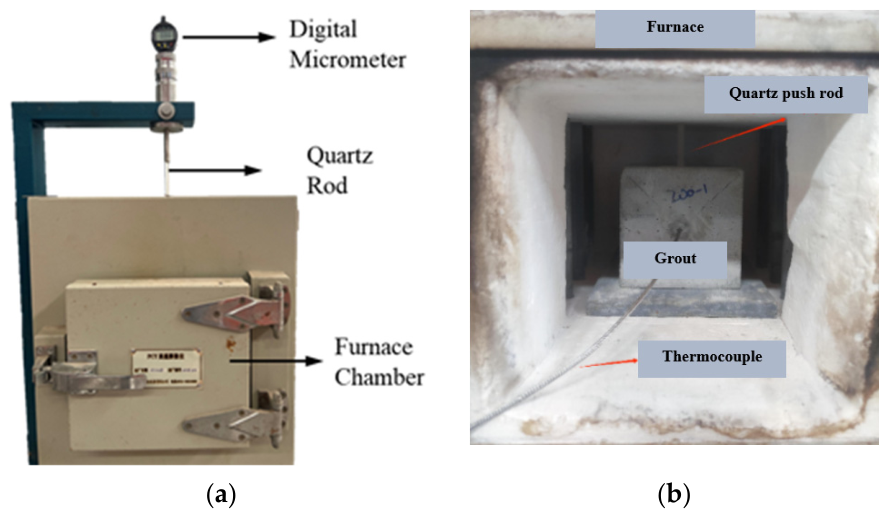
The high-temperature expansion instrument is shown as Figure 1. During the expansion test, the expansion deformation value corresponding to the end of the thermostatic temperature stage was automatically recorded by the expansion apparatus, manufactured by Xiangtan Xiangyi Instrument Limited Company. At the end of the thermostatic stage, the specimens were allowed to cool spontaneously. During the cooling period, the variation in specimen length along one dimension was recorded. The LER (γl), CTE (αc), and residual LER (R) of the specimen were computed according to Equations (2)–(4).
γ l = L t L 0 L 0 × 100 %
α c = ( L t L c ) / L 0 T c T t
R = L R L 0 L 0 × 100 %
where
γ l —LER (%);
α c —TEC (1/°C);
R —Residual LER (%);
L 0 —Length of test piece before heating (mm);
L t —Deformed length of test piece (mm);
L R —Length of test piece when cooled to room temperature (mm);
T t —Sample temperature at time t (°C);
T 0 —Room temperature (°C).

2.4. Comprehensive Thermal Analysis

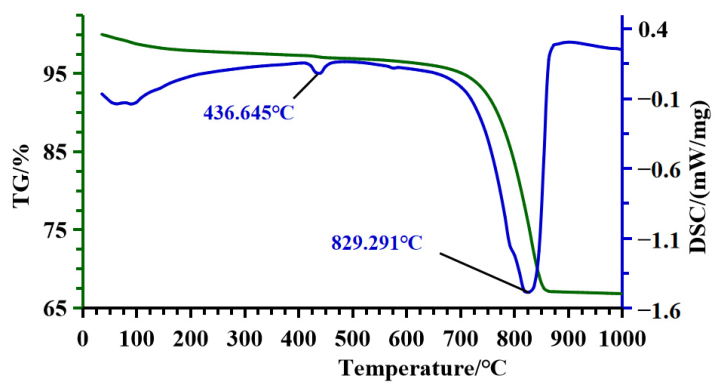
The TGA-DSC measurement was performed using a thermal analyzer (model STA449F3), with the temperature ramped from 40 °C up to 1000 °C at a rate of 15 °C per minute. Figure 2 illustrates the TGA-DSC curves of concrete. Its mass reduction was minimal at temperatures below 700 °C, resulting primarily from moisture evaporation and oxidation of small amounts of impurities. A marked mass loss was recorded for NCA over the 700–8429 °C range. A distinct endothermic peak emerged at 829 °C, reflecting the thermal decomposition of carbonate phases, specifically calcium carbonate (CaCO3) and magnesium carbonate (MgCO3), i.e., decarbonation.

2.5. Scanning Electron Microscope Test

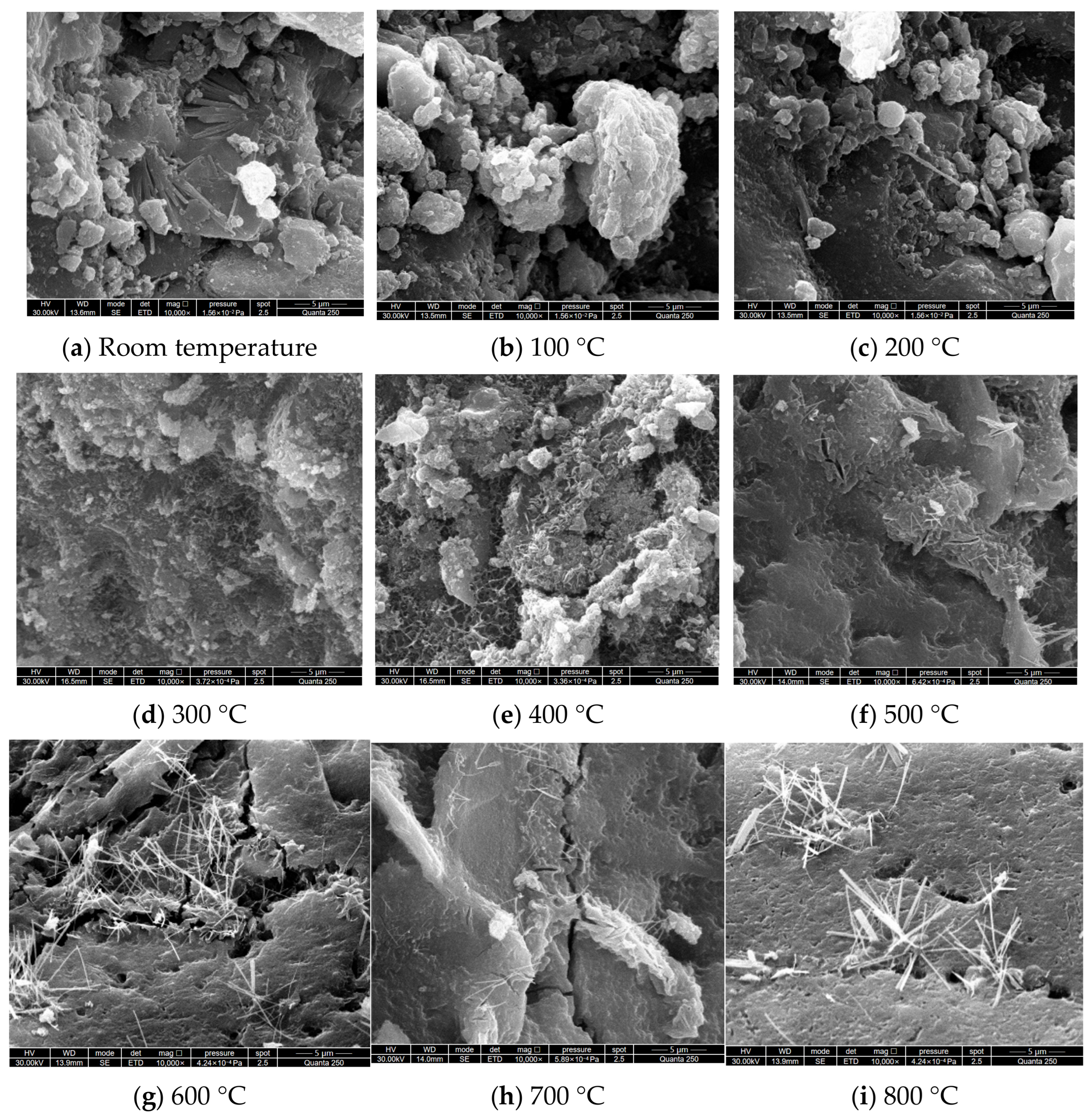
An FEI*/Quanta250 scanning electron microscope manufactured by FEI/Thermo Fisher Scientific Company in Czech Republic was used to capture microscopic photographs. SEM analysis was performed to observe the microstructural changes in 28-day concrete as the temperature was raised from ambient to 800 °C. SEM images of concrete exposed to various temperatures are presented in Figure 3.
The SEM images reveal that at room temperature, the C-S-H gel exhibited a cotton-like fibrous structure, while Ca(OH)2 displayed a plate-like morphology. As the temperature rose to 100–200 °C, small microcracks and voids gradually appeared, with the overall structure remaining relatively dense. Physically adsorbed water and interlayer water were largely expelled, indicating that C-S-H had not yet significantly degraded. After exposure to 300–400 °C, the overall structure appeared looser, with significantly enhanced porosity. Hydrated products began to decompose, the gel volume markedly shrank, and the residual gel quantity decreased substantially, far below the level measured at room temperature. After exposure to 500 °C, the bonding forces between phases in the C-S-H gel significantly weakened, and the cement paste as a whole appeared extremely loose, with microcracks appearing. After exposure to 600–700 °C, cracks intersected in all directions, and their width increased significantly, leading to greater loosening. These structural changes were primarily due to the substantial loss of crystalline water, resulting in increased porosity of the dehydrated C-S-H gel. The microscopic structure of the cement paste severely deteriorated after exposure to 800 °C, presenting a loose and discontinuous arrangement.
As the concrete was heated from room temperature to 800 °C, its microstructure underwent severe and irreversible deterioration. The dense C-S-H gel, flaky Ca(OH)2 crystals, and other hydration products observed at room temperature had distinct morphology and a dense structure as a whole. With the increase in temperature, the C-S-H gel decomposed significantly, and its structure was destroyed. Some products may have undergone sintering at extremely high temperatures, resulting in glassy melts appearing on local surfaces, but the overall structure had been severely damaged.

3. Analysis of Experimental Results

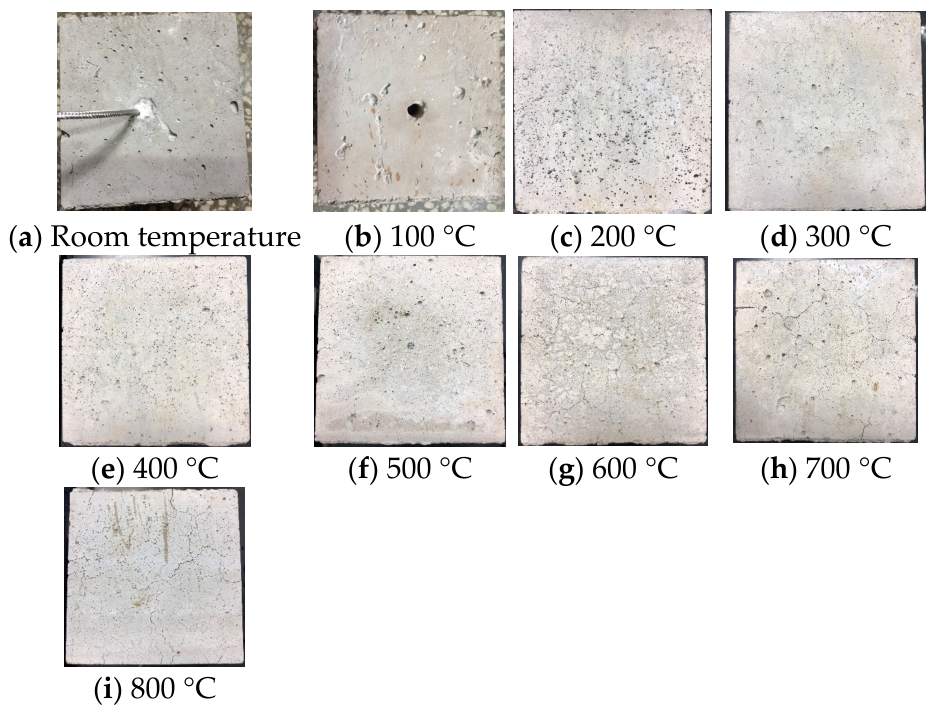
The compressive strength, mass loss rate, LER, CTE, and residual linear expansion rate of concrete cured for 3, 14, 28, 60, and 90 days were analyzed after they were heated to each target temperature. Photos of the concrete surfaces exposed to different temperatures are presented in Figure 4.

3.1. Influence of Age on Compressive Strength of Concrete

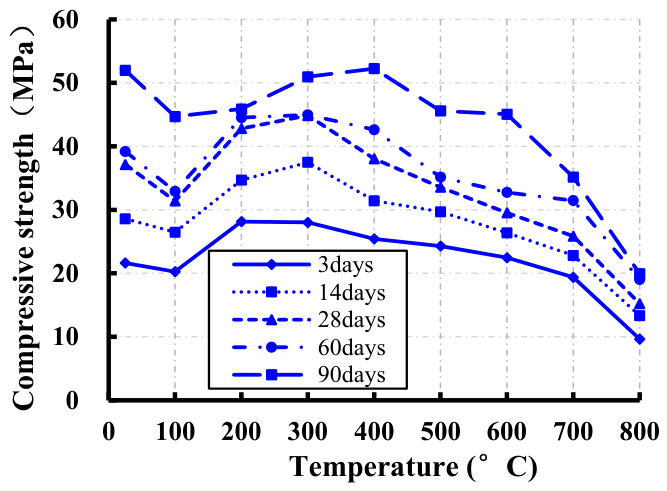
The variation in compressive strength of concrete with temperature is presented in Figure 5.
Figure 5 demonstrates that the change in compressive strength of concrete exposed to elevated temperatures was similar across ages. The overall evolution can be roughly divided into three stages. In the first stage, the low-temperature stage, the temperature was increased from ambient to 100 °C, and the strength of the concrete decreased substantially. The fraction of the recovered compressive strength of the specimens increased by approximately 10–15% at 200 °C [6]. The increase in strength below 200 °C was partly ascribed to the enhanced strength of hydrated cement during the dissolution of free water. As the hydrogel layers approached each other, van der Waals forces increased. Since the transport of water in concrete was rather slow, the water remaining in the concrete accelerated hydration in the early stages when the concrete was heated to elevated temperatures. Further hydration of the cementitious material is a key reason for the setting of hydrated cement [34,35,36]. The next period, from about 200 to 400 °C, was the strength recovery stage. At this stage, the concrete strength started to rise steadily, surpassing the room-temperature strength for all ages except for the specimens aged 90 days. The strength of the specimens at all ages peaked at 300 °C, except for the specimens aged 3 and 90 days, which peaked at 200 °C and 400 °C, respectively. The third stage was characterized by a decline in strength at high temperatures, around 400 to 800 °C, which is consistent with [37]. The strength of the concrete at this stage declined linearly with increasing temperature. At 800 °C, the strength was only 38 to 50% of that at room temperature.
A reduction in the strength of the concrete can be observed at 100 °C. The gradual vaporization of free water inside the concrete caused the formation of capillary cracks and voids within the specimen. Tension on the surrounding solid medium was created as water and water vapor in crevices became pressurized due to the increase in temperature [38,39]. During the loading process, stress became concentrated at the tip of the seam, prompting the crack to expand and causing the concrete compressive strength to decrease. Feng et al. [38] measured the compressive strength of high-ductility magnesium phosphate bone cement matrix composite specimens after 1, 3, and 7 days of curing. Their results indicated that the compressive strength increased with increasing curing duration, while it decreased with increasing water–cement ratio. The porosity of the hardened cement paste increased with the increase in the water–cement ratio, which reduced the compressive strength. The strength of concrete increased at 200 to 300 °C, possibly due to the large number of unhydrated cement particles within the concrete at early ages. At 300 °C, the high temperature promoted the continued hydration of cement particles, resulting in an accumulation of calcium silicate hydrates (C-S-H) and portlandite. This compensated, to some extent, for the loss of strength caused by cracks. Additionally, the cementation of the cement particles was enhanced by the extraction of bound water from the cement gel. The stress concentration at the cracked end was moderated, and the strength of the concrete at this temperature section increased [35]. The concrete cured for 3 days had more unhydrated particles and internal pores than specimens at other curing ages and was more affected by high temperature.
The compressive strength of alkali-activated fiber-reinforced composite cubic specimens showed a continuous increase with increasing age, reaching a maximum at 28 days [18], beyond which the compressive strength changed little. It is noteworthy that cracks appeared on the surfaces of the 56- and 120-day concrete specimens. Self-contraction under ambient conditions has been commonly observed for calcium-rich alkali-activated slurries, mortars, and concretes, which can lead to matrix cracking [40,41].

3.2. Effect of Age on Loss of Concrete Mass

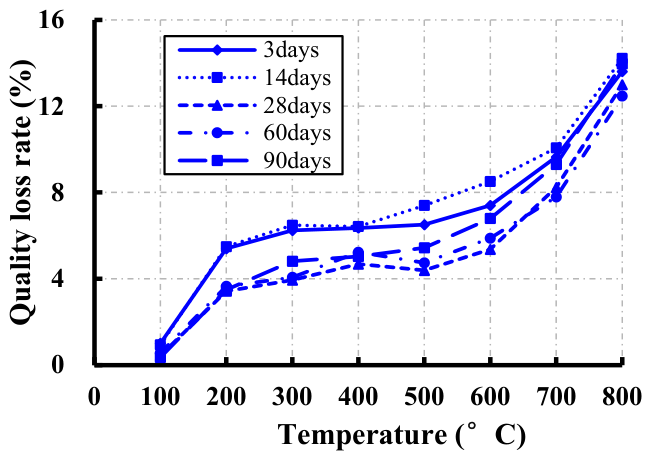
Figure 6 shows that the variation trend of mass loss is similar for concrete at different ages after being subjected to high temperatures.
The concrete began to lose mass at 100 °C, representing the initial stage. The mass loss was more moderate at temperatures from 200 to 600 °C, with an overall increasing trend. The temperature range from 600 to 800 °C was the rapid development stage, where the mass loss increased sharply. When the temperature was 250 °C or below, the concrete lost no more than approximately 1% of its mass. Notably, the mass loss temperature profile decreased significantly when the temperature exceeded 270 °C, and the average mass loss rate rose rapidly. The mass loss of activated powder concrete depended on the method of heating.
The mass loss increased gradually with the increase in temperature, but the absolute mass loss value remained small [42]. When the temperature was 250 °C or less, the concrete lost no more than approximately 1% of its mass. Notably, when the temperature exceeded 270 °C, the mass loss temperature profile decreased significantly, and the average mass loss rate rose rapidly. The mass loss and mass loss rate of activated powder concrete depended on the method of heating and the volume fraction of fibers.
The mass loss, which reflects the decomposition of water and other compounds, increased with increasing temperature and accelerated above 500 °C [20]. The mass loss below 200 °C was mainly related to the evaporation of free water from the concrete [21]. Above 200 °C, the concrete started to lose bound water in the hydrated calcium silicate. This process was slow and required absorption of a large amount of heat; mass loss increased slowly at this stage. Ma et al. [40] also found a rapid increase in the mass loss of specimens exposed to temperatures between 150 and 300 °C. They attributed this loss to the initial removal of water contained in C-S-H and the decomposition of gypsum. C-S-H and calcium hydroxide extensively decomposed above 600 °C, and a large amount of water evaporated. The coarse aggregate was no longer stable because of the breakdown of the calcium carbonate and magnesium carbonate within it. Surface damage, porosity, and cracking of the concrete can occur, so the mass loss can increase dramatically. The heat generated in high-strength concrete increased pore pressure, which led to direct spalling of the specimen at 800 °C [35,36].

3.3. Effect of Age on LER and CTE of Concrete

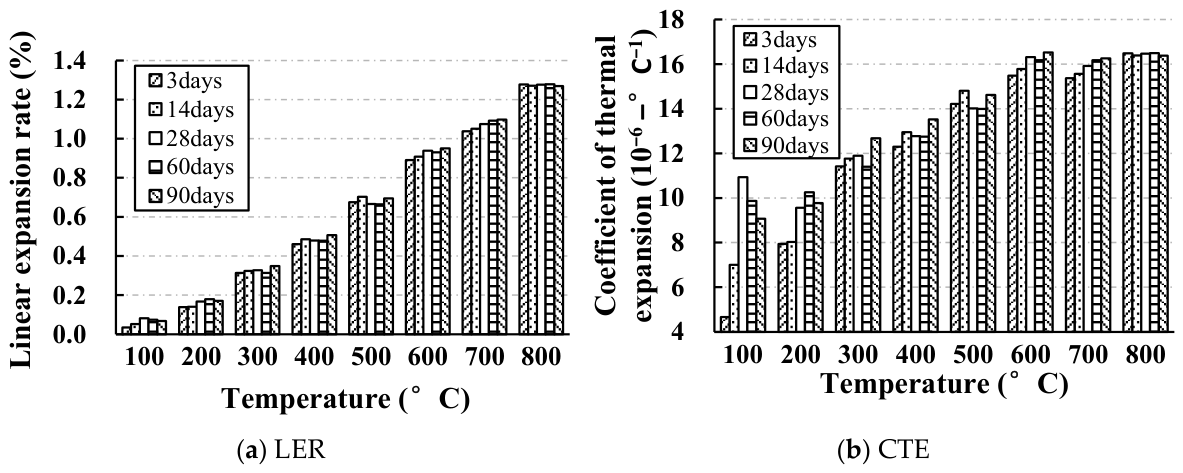
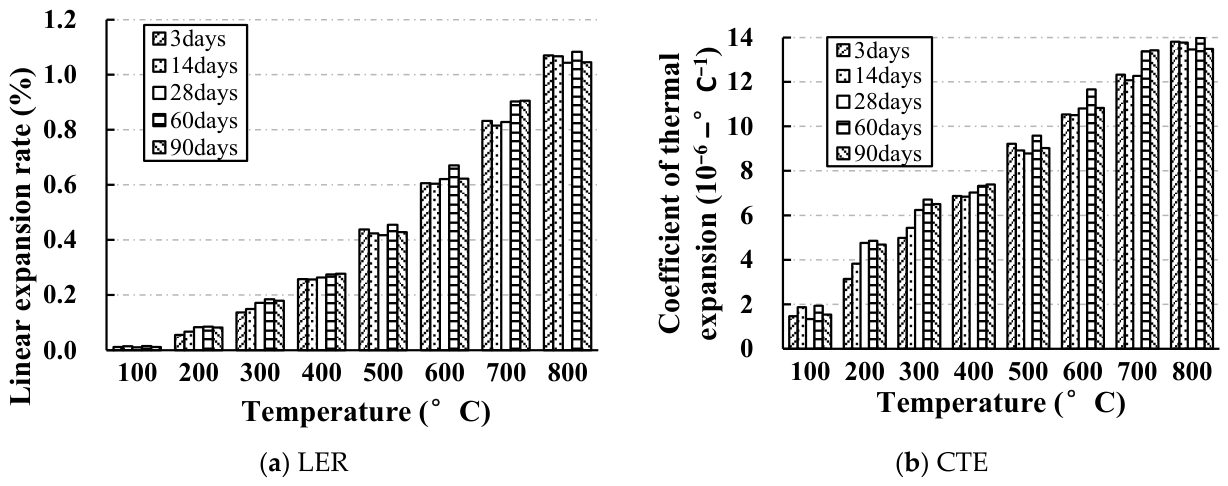
Figure 7 and Table 4 show the LER and CTE of concrete at different ages. The reported deformation values for temperatures from 100 to 800 °C are averages of measurements of three specimens at the end of the thermostatic stage.
As can be seen in Figure 7a, concrete specimens at different ages show similar variation in the LER, which gradually increased as the temperature rose from 100 to 800 °C. The CTE in Figure 7b also shows an increasing trend. Between 100 and 200 °C, the CTE of specimens at 28 days decreased, while it increased at other ages. The CTE of specimens at different ages increased at 200 to 600 °C and stabilized above 600 °C. Specimens cured for 3 days had LERs of 0.035%, 0.139%, 0.314%, 0.461%, 0.675%, 0.890%, 1.038%, and 1.277%, respectively, and CTEs of 4.667, 7.943, 11.418, 12.293, 14.211, 15.478, 15.370, and 16.477 × 10⁻⁶/°C, respectively. The LER and CTE of the other specimens at different ages are detailed in Table 4.
In a previous high-temperature experiment, the impact of steel fibers on the thermal expansion of concrete was gradually detected when the temperature exceeded 400 °C [42]. The difference in the coefficients of linear expansion between steel fiber and concrete is relatively small. Internal crack extension would be inhibited by steel fibers; therefore, specimens devoid of steel fibers underwent greater thermal expansion. However, at 800 to 900 °C, the thermal expansion increased with the increase in steel fiber content. This was due to the softening of the steel fibers at high temperatures, which reduced their ability to inhibit cracking. Numerous macroscopic and microscopic cracks were observed, accompanied by obvious mechanical expansion.
Concrete specimens at different ages showed different deformation characteristics at each temperature stage. From 100 to 700 °C, the LER and CTE of early-age concrete gradually increased with curing age, whereas at 800 °C, they tended to show the opposite pattern. For older concrete, curing age was negatively correlated with the LER and CTE at 100 to 200 °C and positively correlated with them at 300 to 700 °C. The specimens continued to expand after being heated from 300 to 700 °C, but at a much lower rate than in the former stage [42]. The thermal strain sharply decreased between 700 and 800 °C and then sharply increased.
The moisture content was high, and the pores were filled with water in early-age concrete. The hydration degree of cement was low in concrete at 3 days, and the porosity was high compared to that of concrete at 14 days. At 100 and 200 °C, the expansion of the specimen was primarily due to volume expansion of the solid phase, which can be accommodated to some extent by the higher porosity. Hence, the LER was lower for concrete at 3 days than at 14 days. In the early stages, especially in the first 10 h, the CTE of concrete changed dramatically due to the influence of moisture, particularly changes in the amount of water that was not yet chemically bound, since the CTE of water is 20 times higher than that of the other concrete components [43,44]. Above 250 °C, the cement stone began to shrink, and the coarse aggregate continued to expand with heat. The linear expansion of the specimen continued to increase because of crack formation at the aggregate interface due to the difference in deformation between the two aggregate materials. Cementite was formed by the hardening of hydrated calcium silicate gel. The degree of hydration of concrete at 3 days was low, so less cementite was produced compared to concrete at 14 days. Cementite shrinkage had a relatively small effect on crack development and volume. Hence, at 300 to 700 °C, the LER of concrete at 3 days was still less than that at 14 days. Above 700 °C, porosity increased rapidly. This is the reason that the LER of specimens cured for 3 days was greater than that for 14 days when exposed to 800 °C.
Concrete specimens at 90 days had higher moisture content than those at 60 days. When the temperature was 100 to 200 °C, the volume of solid components in concrete expanded with the increase in temperature. Shrinkage was induced by water vaporization. Specimens at 90 days had a greater degree of shrinkage than those at 60 days and thus had a lower LER. At 300 to 700 °C, the concrete was relatively dense and less porous. At this stage, more severe crack development would be caused by the difference in deformation between the more abundant cement stone and the coarse aggregate. The pores can accommodate less expansion of the aggregate, resulting in greater linear expansion. The porosity of coarse aggregates increased sharply above 700 °C. This effect was better resisted by the denser structure of the 90-day concrete. Therefore, the specimens had a relatively small linear expansion at 800 °C. In general, the CTE tended to decrease with age, but its value was highly variable. This variability could be attributed to continuous hydration, changes in the main components, and surrounding conditions, as these factors can affect the free water content and concrete composition ratios at the test age [45].

3.4. Influence of Age on Residual Linear Expansion Rate of Concrete

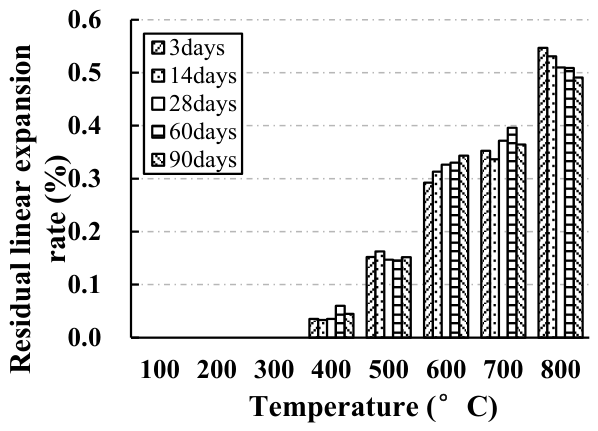
Figure 8 shows the residual LER of concrete at different ages after exposure to different temperatures.
Figure 8 demonstrates that, from 100 to 800 °C, the residual linear expansion rate of concrete varied similarly across different ages. The deformation that occurred at high temperatures could be fully recovered at 100 to 300 °C. Residual deformation became evident above 400 °C. The residual linear expansion rate progressively increased with increasing temperature. At 400, 700, and 800 °C, the greater the curing age of concrete, the lower its residual linear expansion rate. Conversely, at 500 °C and 600 °C, the greater the curing age of concrete, the higher its residual linear expansion rate. The residual linear expansion rate decreased with age at temperatures of 400 °C, 700 °C, and 800 °C, whereas it increased with age at 500 °C and 600 °C.
When exposed to temperatures from 400 to 800 °C, the residual linear expansion rates of 3-day concrete were 0.035%, 0.152%, 0.293%, 0.353%, and 0.547%, respectively, which accounted for 7.59%, 22.52%, 32.87%, 33.98%, and 42.83% of the linear expansion of concrete at the corresponding temperatures, respectively. The residual linear expansion rates of 14-day specimens at temperatures from 400 to 800 °C were 0.033%, 0.163%, 0.313%, 0.337%, and 0.531%, which accounted for 6.80%, 23.12%, 34.49%, 32.03%, and 41.81%, respectively. As evident from Figure 5, from 400 to 800 °C, the residual linear expansion rates of concrete aged 28 days were 0.035%, 0.147%, 0.327%, 0.372%, and 0.510%, which accounted for 7.31%, 22.09%, 34.81%, 34.60%, and 39.97%, respectively. Similarly, from 400 to 800 °C, the residual linear expansion rates of 60-day specimens were 0.060%, 0.146%, 0.330%, 0.396%, and 0.509%, which accounted for 12.55%, 21.90%, 35.48%, 36.28%, and 39.83%, respectively. The residual linear expansion rates of 90-day specimens at 400 to 800 °C followed a similar pattern, with 0.045%, 0.152%, 0.344%, 0.365%, and 0.491%, accounting for 8.78%, 21.81%, 36.16%, 33.23%, and 38.69%, respectively.
The type of silicate cement affected the expansion of cement-stabilized phosphogypsum lines [46]. The results showed that the majority of expansion could be detected during the initial 28 days of solidification. Thermal expansion rates of cement pastes containing different mineral admixtures revealed a nonlinear relationship between thermal expansion and temperature for all cement pastes [47]. In addition, the morphology of the main hydration products (C-S-H) was transformed by water loss, which changed the pore structure and further affected the thermal expansion rate.
The deformation of concrete occurred during the heating and thermostatic temperature stage. Deformation can be induced by the expansion of solid particles in the concrete. It can also be influenced by the contraction of cement, cracks, expansion at the interfacial transition zone (ITZ), and destruction of the aggregate interior. The other three deformations were irrecoverable, but between 100 °C and 200 °C, the heating expansion of solid particles could be almost fully recovered. As the temperature increased to 250 °C, the LER of cement approached 0. Afterward, heat caused negative expansion of the concrete, meaning that it shrank. As the coarse aggregate continued to expand, cracks developed in the concrete due to the difference in deformation between coarse aggregate and cement. This deformation was irreversible, but the expansion induced by the crevices and contraction due to the stripping of combined water could be offset below 300 °C. The fully recovery of deformation at 300 °C was easily detected. The sample’s brittleness stabilized to some extent as the temperature increased [48]. At 200 °C, relatively large cracks were observed on the specimens, whereas they were smaller at 400 °C. When the temperature reached 600 °C, cracking was reduced proportionally.
Once the concrete was heated to 400 °C, deformation could no longer be fully recovered. This stage of deformation was mainly caused by aggregate expansion and crevices at the ITZ. Crack development was not yet extensive, and the solid phase had a high expansion recovery rate. In addition, older concrete had a lower residual linear expansion rate because it was inherently denser and more resilient to deformation damage after cooling. The irrecoverable deformation increased dramatically after the temperature was raised to 500 °C. The older concrete was highly hydrated, generating more cement, and more cracks were produced due to the difference in deformation between cement and coarse aggregate. Substantial dewatering of hydrated calcium silicate also occurred. The recovery rate of linear expansion was lower at 500 °C and 600 °C, so the residual linear expansion rate was higher at this stage. The increment of the residual linear expansion rate dropped when the temperature exceeded 700 °C. This was primarily because the coarse aggregate porosity remained constant at this stage, and the volume expansibility started to decline. Coarse aggregate porosity then increased sharply at 800 °C, and the non-recoverable distortion was significantly higher than at lower temperatures. The accumulated destruction within the aggregate had grown dramatically, and crevices had developed quickly, resulting in another large rise in the residual line expansion rate. The concrete itself was less porous at older ages. The recoverable deformation was relatively large at this stage, which resulted in a lower residual linear expansion rate. Below 500 °C, the thermal expansion of concrete was less affected by the percentage substitution of coarse recycled aggregates [49]. Above 500 °C, the specimen with a 50% replacement rate had high thermal expansion. The relatively high heat expansion of the specimens with 50% replacement may be due to microcracks arising from the inhomogeneous heat pressure between the coarse sodium and the recycled aggregate.

3.5. Influence of Age on LER and CTE of Concrete Without Considering Thermostatic Temperature

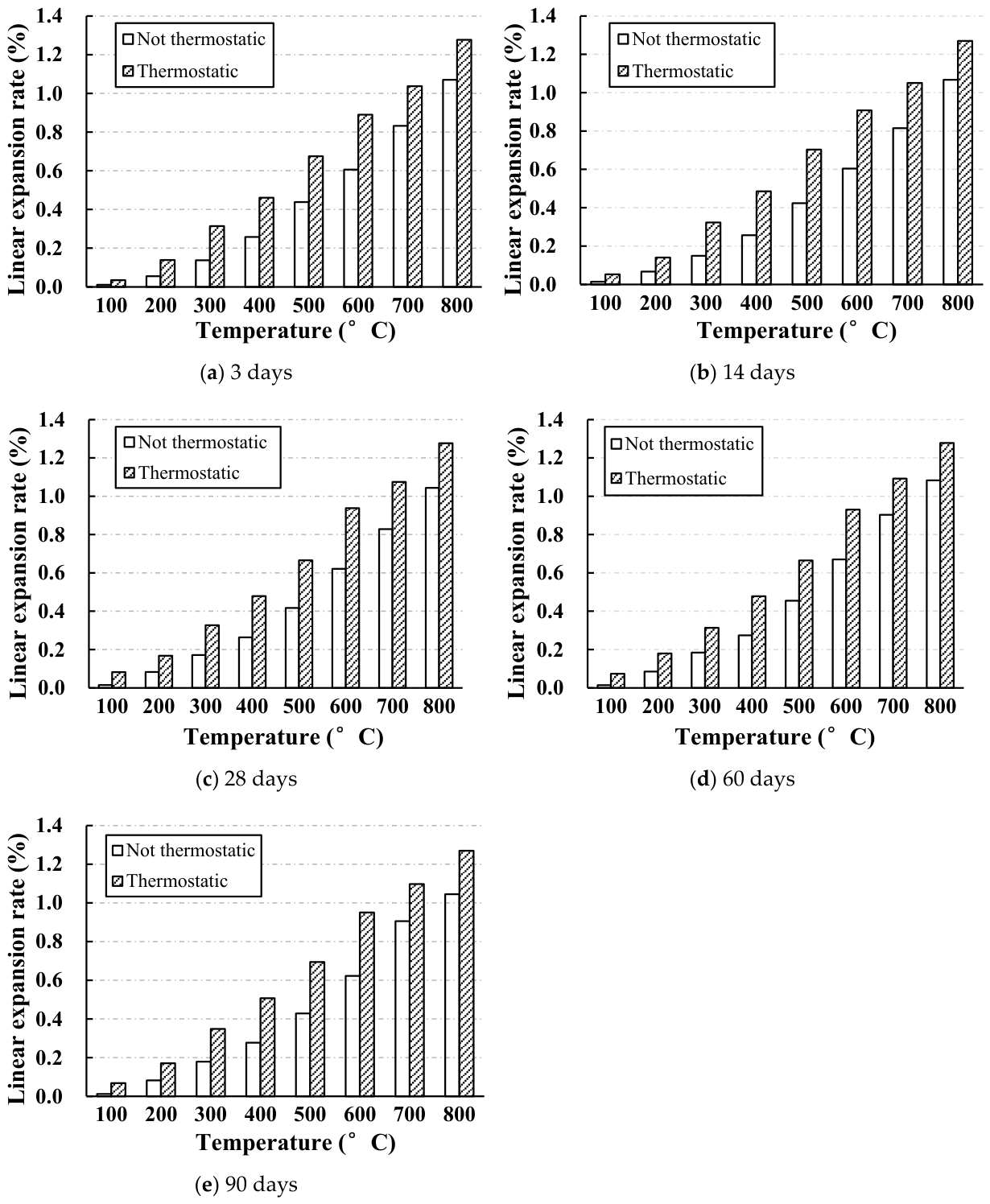
Concrete specimens at different ages were heated from the environmental temperature to the target temperature at a rate of 10 °C/min. The measured deformation at this point was used to calculate the LER and CTE of the specimens as a function of temperature without considering the thermostatic stage, as indicated in Figure 9a,b, respectively.
As depicted in Figure 9, the LER and CTE of concrete at different ages increased with increasing temperature from 100 to 800 °C when the thermostatic temperature time was not considered. From 100 to 300 °C, the LER and CTE of early-age concrete increased with age. In contrast, from 400 to 800 °C, the LER and CTE decreased with increasing age. In particular, the LER and CTE were positively correlated with age for older concrete at 400 °C and 700 °C. At the other temperatures, the opposite variation trend was observed, with the LER and CTE decreasing with age.
The LERs of 3-day specimens at each temperature from 100 to 800 °C were 0.011%, 0.055%, 0.137%, 0.258%, 0.438%, 0.606%, 0.832%, and 1.070%, respectively, and the CTEs were 1.467, 3.143, 4.982, 6.867, 9.221, 10.539, 12.326, and 13.806 × 10⁻⁶/°C, respectively. Detailed data for 14, 28, 60, and 90 days are displayed in Table 5.
Below 800 °C, the thermal expansion increased with the temperature [49]. This expansion was mainly attributed to the aggregates and cement paste. A sharp increase in expansion between 500 °C and 600 °C was associated with the transformation of quartz into siliceous aggregates. The average CTE and dispersion CTE for cement paste and mortar were previously derived [50]. It was concluded that the CTE decreased with increasing total porosity for both cement paste and mortar.
When the furnace temperature was raised to the target temperature, the concrete specimen’s internal temperature, shown on the thermocouple, was apparently below the chamber temperature. Below 300 °C, the internal temperature of the cube had not yet reached half of the set temperature. The deformation at this time was mainly due to the thermal expansion of the solid-phase volume. For early-age concrete, the calcium silicate gel generated by hydration decreased with age, resulting in greater porosity. For this reason, more expansion deformation could be accommodated at this stage, which resulted in a lower LER. The thermal expansion of calcium aggregates increased linearly with temperature, reaching 1–1.33% at 750 °C. At this temperature, the CTE was about 40 × 10−6/°C [51]. For fiber-reinforced silica-aggregate concrete, the thermal expansion increased with increasing temperature [52]. The pronounced increase in thermal expansion around 550 °C could be ascribed to the transformation of quartz into siliceous aggregates. When the temperature was 600 °C, thermal expansion was more stable. The reduction in the specimen’s volume was a consequence of water evaporation due to heat at this temperature stage, which led to a lower LER. At 400 °C, the temperature in most areas of the specimen had exceeded 250 °C. At this time, the heat shrinkage of the concrete caused cracks at the aggregate interface. At the same time, crack development was promoted by the temperature gradient generated by the difference in temperature between the specimen’s surface and interior, making the linear expansion rate speed up quickly. A concrete structure with a longer curing duration would be dense at the early stage, with a relatively strong ability to resist deformation during heating, thus decreasing the LER. The expansion of the solid-phase volume of the specimen still played a dominant role in the initial stage of crack development. At 400 °C, concrete with an age of 90 days had a high linear expansion rate due to its lower porosity and limited accommodation of expansion deformation. As the temperature continued to increase to 500 °C, the aggregate interface cracks caused by the temperature gradient and the differential deformation between the cement stone and coarse aggregates began to play a dominant role in the overall deformation of the specimen. The 90-day concrete had lower porosity and denser structure than the 60-day concrete, making the former more resistant to cracking and deformation during the heating stage, and had a lower LER. At 700 °C, the coarse aggregate porosity remained constant, and a decline in volume expandability was observed. The coarse aggregate porosity increased sharply as the temperature continued to increase to 800 °C. The denser structure of the concrete aged 90 days could better resist this effect, and therefore, its linear expansion was smaller. Shui et al. [47] found that replacing silicate cement with three mineral admixtures reduced the thermal expansion of the cement. At 85 °C, the thermal expansion of the solidified silicate cement at 28 days was 1270 × 10−6. Replacing silicate cement with fly ash significantly reduced the thermal expansion. Cagnon et al. [53] discovered that during the heating phase, for dry samples, the expansion of the cement paste was two to five times greater than that of the limestone aggregate; for sealed samples, the expansion of the cement paste was 6 to 12 times greater than that of the limestone aggregate. For concrete and aggregates, the CTE increased slightly with increasing temperature and moisture content.

3.6. Effect of Thermostatic Temperature on LER and CTE of Concrete at Different Ages

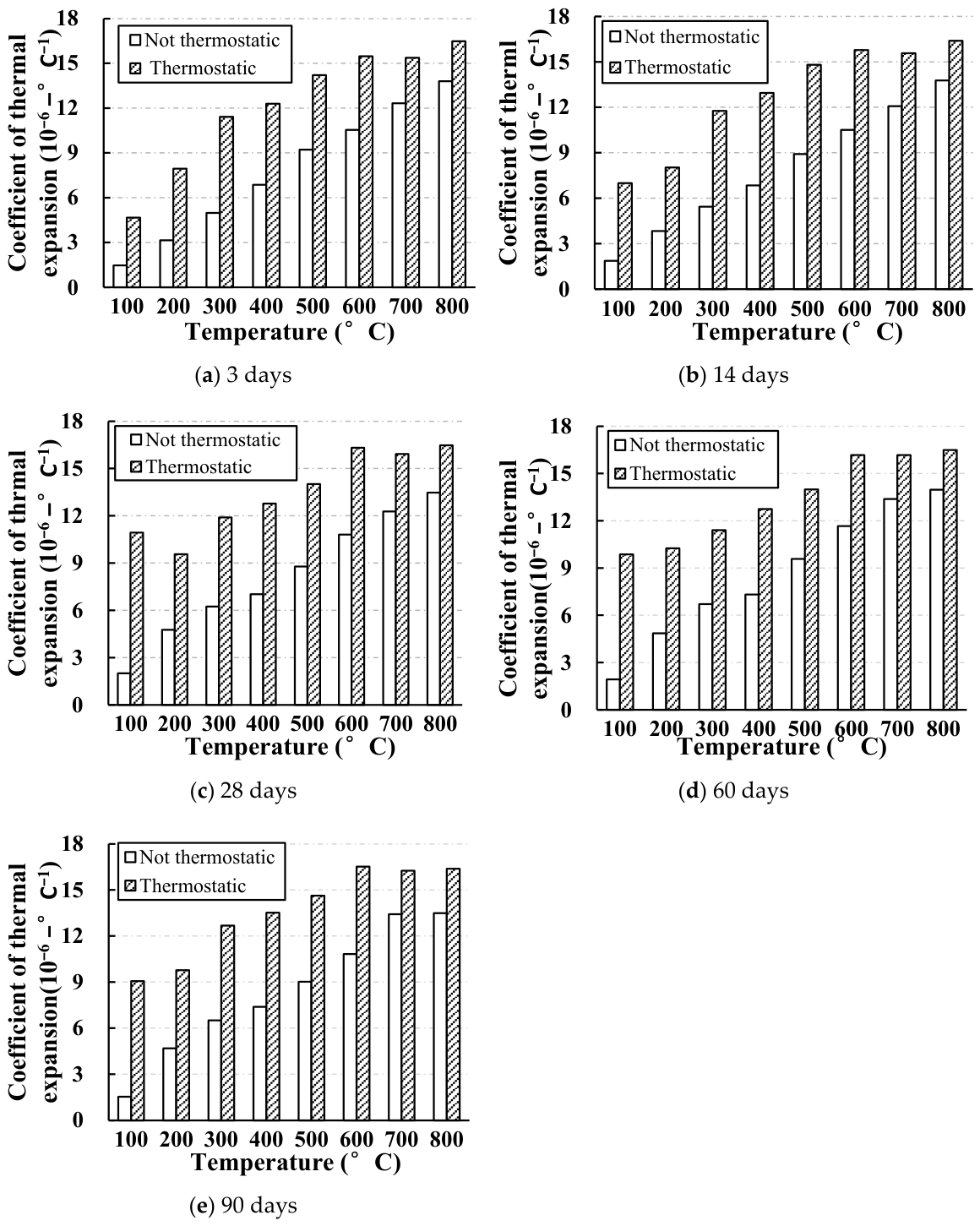
The effects of thermostatic temperature on the LER and CTE of concrete aged 3, 14, 28, 60, and 90 days are illustrated in Figure 10 and Figure 11.
Concrete aged 3 days and exposed to 100–800° C had LERs of 0.035%, 0.139%, 0.314%, 0.461%, 0.675%, 0.890%, 1.038%, and 1.277% after the thermostatic temperature stage, respectively. The CTE values were 4.667, 7.943, 11.418 × 10, 12.293, 14.221, 15.478, 15.370, and 16.477 × 10⁻⁶/°C, respectively. The LER and CTE increased on average by 0.178% and 4.438, respectively, compared to the pre-exposure period. The LER and CTE for the other four curing ages of concrete are presented in Table 5.
Figure 10 and Figure 11 reveal that the LER and CTE of concrete at different ages were both influenced by the thermostatic stage from 100 to 800 °C. The LER and CTE of the specimens increased after the thermostatic stage. Kodur et al. [54] found that thermal expansion increased with elevated temperature, including 800 °C. However, the thermal expansion of the specimens remained almost constant at 400 °C, then increased at about 650 °C, and finally reached a plateau in the 650 to 800 °C range.
Due to the significant thermal inertia of concrete, the center of the specimen may not reach the target temperature by the end of heating. The center and the surface of the specimen had a large gap in temperature, and the internal structural components were not sufficiently altered, which meant a larger deformation space remained. Higher LERs and CTEs were found after the specimens were exposed to a thermostatic temperature. This was well demonstrated in the concrete specimens aged 3, 14, 28, 60, and 90 days. Between 600 °C and 800 °C, the expansion rate of three types of concrete decreased because of the contraction induced by the loss of chemically bound water in the hydrate [54]. Above 800 °C, the thermal expansion rose sharply again, caused by the decarburization of the limestone aggregate during the development of macroscopic crevices. The maximum thermal expansion would occur between 800 °C and 1000 °C due to the dehydration of calcium hydroxide in the concrete matrix above 800 °C.
In this study, concrete specimens of different ages were heated at a rate of 10 °C/min from room temperature to the target temperature; they were kept at the target temperature until it was reached at the center. The formula for calculating the thermal expansion coefficient of the specimen at this temperature is shown in Equation (5). This formula can be used to predict the thermal expansion coefficients for concrete at different curing ages.
The relationship between the thermal expansion coefficient of concrete at high temperatures and the temperature under fire is modeled uniformly in Equation (5).
αT = AT3 + BT2 + CT + D
where
α is the coefficient of thermal expansion of concrete at the end of heating/constant temperature (1/°C).
A, B, C, and D are the calculation model parameters for the thermal expansion coefficient of concrete, which are listed in Table 6.
T is the target temperature (°C).

4. Conclusions

An experimental study of concrete deformation at elevated temperatures was conducted on specimens cured for 3, 14, 28, 60, or 90 days, and the effects of curing age on the compressive strength, mass loss rate, LER, CTE, and residual linear expansion rate of concrete exposed to high temperatures were analyzed. The following conclusions were obtained:
(1)
The strength of concrete at all ages, except for 90 days, exceeded the strength at ambient temperature, and it declined significantly as the temperature increased from 400 to 800 °C.
(2)
The mass loss rate of concrete at all ages gradually increased with the increase in temperature, with the quality loss being particularly significant at the high-temperature stage. Concrete cured for 3 and 14 days exhibited higher initial mass loss at lower temperatures, and with increasing temperature, the overall mass loss exceeded that of concrete cured for 28d or longer. The longer the curing period, the smaller the mass loss of concrete exposed to high temperatures.
(3)
The linear expansion rate (LER) gradually increased with temperature, and the coefficient of thermal expansion (CTE) also exhibited an overall upward trend. Specifically, at 100 °C and 200 °C, the CTE of 28-day concrete decreased, while that of concrete at other ages increased. Between 200 °C and 600 °C, the CTE of concrete showed a consistent increasing trend across different ages and tended to stabilize at 800 °C.
(4)
Concrete at different ages exhibited distinct deformation characteristics depending on temperature. Within 100–700 °C, early-age concrete showed greater LER and CTE, whereas the opposite was true at 800 °C. For older concrete, the LER and CTE were negatively correlated with age at 100–200 °C and at 800 °C but positively correlated at 300–700 °C.
(5)
Residual deformation was first observed above 400 °C, and the residual linear expansion rate increased steadily with rising temperature. At 400 °C, 700 °C, and 800 °C, older concrete exhibited a lower residual linear expansion rate. However, between 500 °C and 600 °C, older concrete showed a higher residual linear expansion rate.
(6)
The deformation pattern of concrete specimens at different ages was influenced by the thermostatic stage. The LERs and CTEs of the specimens increased after being kept at a thermostatic temperature.

Author Contributions

Conceptualization, data curation, investigation, writing—original draft, J.L.; methodology, resources, G.Y.; rewriting—review and editing, funding acquisition, Q.L. All authors have read and agreed to the published version of the manuscript.

Funding

This research was funded by the National Natural Science Foundation of China (Grant No. 51208504).

Data Availability Statement

The original contributions presented in the study are included in the article. Further inquiries can be directed to the corresponding author.

Conflicts of Interest

Author Jianguo Li was employed by Shanxi Institute of Technology. The remaining authors declare that the research was conducted in the absence of any commercial or financial relationships that could be construed as a potential conflict of interest.

References

  1. Li, W.; Chen, H. Study on the bond performance of steel bars in early-age concrete considering the effect of circumferentially lateral pressures. Constr. Build. Mater. 2024, 425, 135978. [Google Scholar] [CrossRef]
  2. Li, Q.; Xia, H.; Yuan, G. Experimental study on the free expansion deformation of concrete during the cooling process after being heated to high temperature. Constr. Build. Mater. 2022, 337, 127617. [Google Scholar] [CrossRef]
  3. Wang, N.; Zhou, F.; Li, Z. Experimental and numerical investigation on the L-joint composed of steel-plate composite (SC) walls under seismic loading. Eng. Struct. 2021, 227, 111360. [Google Scholar] [CrossRef]
  4. Wang, N.; Zhou, F.; Li, Z. Behavior of L-joint composed of steel-plate composite wall and reinforced concrete wall. J. Constr. Steel Res. 2021, 176, 106439. [Google Scholar] [CrossRef]
  5. Hua, J.; Yang, Z.; Xue, X. Bond properties of bimetallic steel bar in seawater sea-sand concrete at different ages. Constr. Build. Mater. 2022, 323, 126539. [Google Scholar] [CrossRef]
  6. Wang, T.; Yu, M.; Tian, J.; Sun, Z.; Yu, C.; Ye, J. Residual properties of ultra-high performance concrete containing steel-polypropylene hybrid fiber exposed to elevated temperature at early age. J. Build. Eng. 2025, 99, 111507. [Google Scholar] [CrossRef]
  7. Wang, Y.; Zhou, H.; Hu, N.; Beiraghi, H. Modeling fire-induced progressive collapse of reinforced concrete structures with explicit cooling-phase effects. J. Build. Eng. 2026, 120, 115425. [Google Scholar] [CrossRef]
  8. Wang, Y.; Zhou, H.; Wu, J. Hybrid fire collapse simulation of reinforced concrete structures under localized fires. Eng. Struct. 2023, 292, 116525. [Google Scholar] [CrossRef]
  9. Yao, Y.; Zhang, H.; Zhu, Y.F.; Liu, Y. Progressive collapse resistance of reinforced concrete beam-column connection under fire conditions. Structures 2023, 47, 1265–1283. [Google Scholar] [CrossRef]
  10. Li, L.; Shi, L.; Wang, Q. A review on the recovery of fire-damaged concrete with post-fire-curing. Constr. Build. Mater. 2020, 237, 117564. [Google Scholar] [CrossRef]
  11. Wróblewska, J.; Kowalski, R. Assessing concrete strength in fire-damaged structures. Constr. Build. Mater. 2020, 254, 119122. [Google Scholar] [CrossRef]
  12. Zawadowska, A.; Giuliani, L.; Hertz, K.D. Experimental study on the mechanical properties of fire exposed concrete. Saf. Sci. 2021, 142, 105357. [Google Scholar] [CrossRef]
  13. Atsbha, T.G.; Zhutovsky, S. The effect of external curing methods on the development of mechanical and durability-related properties of normal-strength concrete. Constr. Build. Mater. 2022, 324, 126706. [Google Scholar] [CrossRef]
  14. Song, X.; Wu, Y.; Gu, X. Bond behaviour of reinforcing steel bars in early age concrete. Constr. Build. Mater. 2015, 94, 209–217. [Google Scholar] [CrossRef]
  15. Tang, B.; Zhao, F.; Jiang, Z.; Zhang, B.; Cui, W. New insights into the time-dependent interfacial bond behavior between steel element and early-age concrete based on low field-NMR. Constr. Build. Mater. 2025, 501, 144301. [Google Scholar] [CrossRef]
  16. Esfeh, S.K.; Rong, H.; Dong, W. Experimental investigation on bond behaviours of deformed steel bars embedded in early age concrete under biaxial lateral pressures at low curing temperatures. Constr. Build. Mater. 2021, 303, 124419. [Google Scholar] [CrossRef]
  17. Chen, D.; Liu, F.; Yang, F. Dynamic compressive and splitting tensile response of unsaturated polyester polymer concrete material at different curing ages. Constr. Build. Mater. 2018, 177, 477–498. [Google Scholar] [CrossRef]
  18. Kan, L.; Wang, F.; Zhang, Z. Mechanical properties of high ductile alkali-activated fiber reinforced composites with different curing ages. Constr. Buil. Mater. 2021, 306, 124833. [Google Scholar] [CrossRef]
  19. Golewski, G.L. Effect of curing time on the fracture toughness of fly ash concrete composites. Com. Struct. 2018, 185, 105–112. [Google Scholar] [CrossRef]
  20. Beygi, M.H.A.; Kazemi, M.T.; Nikbin, I.M. The effect of aging on the fracture characteristics and ductility of self-compacting concrete. Mater. Des. 2014, 55, 937–948. [Google Scholar] [CrossRef]
  21. Cai, H.; Yuan, B.; Yang, F. Dynamic three-point flexural performance of unsaturated polyester polymer concrete at different curing ages. J. Build. Eng. 2022, 45, 103449. [Google Scholar] [CrossRef]
  22. Özkilic, Y.O.; Karalar, M.; Celik, A.I.; Alasiri, M.R.; Mohamud, M.A. Microstructural, mechanical and statistical evaluation of concrete incorporating waste glass wool exposed to elevated temperatures. Sci. Rep. 2025, 16, 434. [Google Scholar] [CrossRef]
  23. Wang, Q.; Li, M.; Zhang, B. Influence of pre-curing time on the hydration of binder and the properties of concrete under steam curing condition. J. Therm. Anal. Calorim. 2014, 118, 1505–1512. [Google Scholar] [CrossRef]
  24. Zhu, B.; Zheng, Y.; Luo, C.; Zhang, H.; Gong, L.; Yang, J.; Yang, B. Experimental investigation and micro-mechanisms of early-age vibration effects on the strength and permeability of fiber reinforced concrete. Constr. Build. Mater. 2025, 504, 144634. [Google Scholar] [CrossRef]
  25. Kanema, M.; de Morais, M.V.G.; Noumowe, A. Experimental and numerical studies of thermo-hydrous transfers in concrete exposed to high temperature. Heat Mass Transf. 2007, 44, 149–164. [Google Scholar] [CrossRef]
  26. Wang, Y.; Xiao, R.; Lu, H.; Hu, W.; Jiang, X.; Huang, B. Effect of curing conditions on the strength and durability of air entrained concrete with and without fly ash. Clean. Mater. 2023, 7, 100170. [Google Scholar] [CrossRef]
  27. Malik, M.; Bhattacharyya, S.K.; Barai, S.V. Thermal and mechanical properties of concrete and its constituents at elevated temperatures: A review. Constr. Build. Mater. 2021, 270, 121398. [Google Scholar] [CrossRef]
  28. Li, Q.T.; Liu, P.; Sun, H.F. Investigation on the free expansive deformation of concrete during the heating process. Constr. Build. Mater. 2021, 306, 124871. [Google Scholar] [CrossRef]
  29. Vigroux, M.; Eslami, J.; Beaucour, A.-L.; Bourgès, A.; Noumowé, A. High temperature behaviour of various natural building stones. Constr. Build. Mater. 2021, 272, 121629. [Google Scholar] [CrossRef]
  30. Bai, Y.J.; Su, H.; Yin, B.; Cai, Y.B. Mechanical properties and damage mechanisms of concrete under four temperature gradients combined with acoustic emission method. J. Build. Eng. 2022, 57, 104906. [Google Scholar] [CrossRef]
  31. Li, Q.T.; Sun, H.F.; Wang, M.H.; Liu, P. Effects of moisture content and heating temperature on the thermal expansion deformation of concrete. Struct. Concr. 2021, 23, 2301–2312. [Google Scholar] [CrossRef]
  32. Li, Q.T.; Wang, M.H.; Sun, H.F.; Yu, G.Y. Effect of heating rate on the free expansion deformation of concrete during the heating process. J. Build. Eng. 2021, 34, 101896. [Google Scholar] [CrossRef]
  33. GB/T 50081-2019; Standard for Test Method of Mechanical Properties on Ordinary Concrete. MOC (Ministry of Construction): Beijing, China, 2019.
  34. Özkilic, Y.O.; Ecemis, A.S.; Stel’makh, S.A.; Beskopylny, A.N.; Shcherban, E.M.; Yildizel, S.A.; Aksoylu, C.; Madenci, E. Thermo-mechanical and data-driven assessment of sustainable concrete incorporating waste tire aggregates and recycled steel fibers. Buildings 2026, 16, 946. [Google Scholar] [CrossRef]
  35. Ahsan, M.H.; Siddique, M.S.; Farooq, S.H. Mechanical behavior of high-strength concrete incorporating seashell powder at elevated temperatures. J. Build. Eng. 2022, 50, 104226. [Google Scholar] [CrossRef]
  36. Vafaei, D.; Ma, X.; Hassanli, R. Microstructural and mechanical properties of fiber-reinforced seawater sea-sand concrete under elevated temperatures. J. Build. Eng. 2022, 50, 104140. [Google Scholar] [CrossRef]
  37. Özkilic, Y.O.; Karalar, M.; Celik, A.I.; Althaqafi, E. Performance enhancement and post-fire behavior of concrete incorporating waste fire clay as sustainable solution. Struct. Eng. Mech. 2025, 94, 479–494. [Google Scholar] [CrossRef]
  38. Feng, H.; Shaukat, A.J.; Rin, D. Mechanical properties of high-ductility magnesium phosphate cement composite cured at low temperatures. J. Build. Eng. 2021, 44, 103275. [Google Scholar] [CrossRef]
  39. Zhao, Z.; Liu, Y.; Xie, C.; Zheng, K.; Zhao, Z.; Shi, T. Study on time-varying coefficient of thermal expansion of Carbon nanotubes-modified face slab concrete at early age. Mater. Lett. 2024, 362, 136198. [Google Scholar] [CrossRef]
  40. Ma, Y.; Yang, X.; Hu, J. Accurate determination of the “time-zero” of autogenous shrinkage in alkali-activated fly ash/slag system. Compos. Part B Eng. 2019, 177, 107367. [Google Scholar] [CrossRef]
  41. Horma, O.; Channouf, S.; Hammouti, A.E.; Hassani, S.E.; Miri, H.; Moussaoui, M.A.; Mezrhab, A. Enhancing concrete sustainability using crushed peanut shells: An analysis of thermophysical properties, durability, and application potential in construction. J. Build. Eng. 2024, 90, 109343. [Google Scholar] [CrossRef]
  42. Xue, C.; Yu, M.; Xu, H. Experimental study on thermal performance of ultra-high performance concrete with coarse aggregates at high temperature. Constr. Build. Mater. 2022, 314, 125585. [Google Scholar] [CrossRef]
  43. Kada, H.; Lachemi, M.; Petrov, N. Determination of the coefficient of thermal expansion of high performance concrete from initial setting. Mater. Struct. Constr. 2002, 35, 35–41. [Google Scholar] [CrossRef]
  44. Nehdi, M.; Soliman, A.M. Early-age properties of concrete: Overview of fundamental concepts and state-of-the-art research. Constr. Mater. 2011, 164, 57–77. [Google Scholar] [CrossRef]
  45. Maanser, A.; Benouis, A.; Ferhoune, N. Effect of high temperature on strength and mass loss of admixture concretes. Constr. Build. Mater. 2018, 166, 916–921. [Google Scholar] [CrossRef]
  46. Parreira, A.B.; Kobayashi, A.R.K.; Silvestre, O.B., Jr. Influence of portland cement type on unconfined compressive strength and linear expansion of cement-stabilized phosphogypsum. J. Environ. Eng. 2003, 129, 956–960. [Google Scholar] [CrossRef]
  47. Shui, Z.; Zhang, R.; Chen, W. Effects of mineral admixtures on the thermal expansion properties of hardened cement paste. Constr. Build. Mater. 2010, 24, 1761–1767. [Google Scholar] [CrossRef]
  48. Glória Gomes, M.; Moret Rodrigues, A.; Alexandre Bogas, J.; Freitas, A. Thermophysical properties under different hygroscopic conditions of an innovative composite concrete pre-walls system. Constr. Build. Mater. 2021, 307, 124938. [Google Scholar] [CrossRef]
  49. Zhao, H.; Liu, F.; Yang, H. Thermal properties of coarse RCA concrete at elevated temperatures. Appl. Therm. Eng. 2018, 140, 180–189. [Google Scholar] [CrossRef]
  50. Zeng, Q.; Li, K.; Chong, T. Effect of porosity on thermal expansion coefficient of cement pastes and mortars. Constr. Build. Mater. 2012, 28, 468–475. [Google Scholar] [CrossRef]
  51. Razafinjato, R.N.; Beaucour, A.; Hebert, R.L. High temperature behavior of a wide petrographic range of siliceous and calcareous aggregates for concretes. Constr. Build. Mater. 2016, 123, 261–273. [Google Scholar] [CrossRef]
  52. Lie, T.T.; Kodur, V.K.R. Thermal and mechanical properties of steel-fibre-reinforced concrete at elevated temperatures. Can. J. Civ. Eng. 1996, 23, 511–517. [Google Scholar] [CrossRef]
  53. Cagnon, H.; Vidal, T.; Sellier, A. Effects of water and temperature variations on deformation of limestone aggregates, cement paste, mortar and high performance concrete (HPC). Cem. Concr. Compos. 2016, 71, 131–143. [Google Scholar] [CrossRef]
  54. Kodur, V.; Khaliq, W. Effect of temperature on thermal properties of different types of high-strength concrete. J. Mater. Civ. Eng. 2011, 23, 793–801. [Google Scholar] [CrossRef]
Figure 1. PCY high-temperature expansion instrument. (a) Photos of experimental instruments. (b) Specimen in the chamber.
Buildings 16 02102 g001
Figure 2. TG-DSC curves of concrete.
Buildings 16 02102 g002
Figure 3. SEM images of concrete at different temperatures.
Buildings 16 02102 g003
Figure 4. Photos of concrete after exposure to different temperatures.
Buildings 16 02102 g004
Figure 5. Compressive strength of concrete at different ages.
Buildings 16 02102 g005
Figure 6. Mass loss rate of concrete at different ages and temperatures.
Buildings 16 02102 g006
Figure 7. Expansion properties of concrete at different ages.
Buildings 16 02102 g007
Figure 8. Residual linear expansion rate of concrete at different ages.
Buildings 16 02102 g008
Figure 9. LER and CTE of concrete without considering the thermostatic stage.
Buildings 16 02102 g009
Figure 10. Effect of thermostatic temperature on the LER of concrete at different ages.
Buildings 16 02102 g010
Figure 11. Effect of thermostatic temperature on the CTE of concrete at different ages.
Buildings 16 02102 g011
Table 1. Characteristics of concrete materials.
MaterialsParametersSpecific Gravity
CementCement Huahai P.O 42.53.15
Fine aggregatesRiver sand, maximum size 5.0 mm2.34
Coarse aggregatesLimestone, maximum size 5.0–20.0 mm2.71
WaterTap water1.0
Table 2. Mix ratio of concrete.
28-Day StrengthContent (kg/m3)
WaterCementFine AggregateCrushed StonesWater-Reducing Admixture
36 MPa175350682.921119.546.30
Table 3. Chemical composition and properties of cement.
Components/PropertyValue
SiO223.06%
Al2O37.14%
Fe2O33.24%
CaO56.64%
Na2O0.15%
MgO1.94%
K2O0.93%
SO32.02%
TiO20.38%
MnO0.07%
P2O50.06%
Cl0.029%
Ignition loss (%)4.14
Specific gravity3.15
Table 4. The LER, CTE, and residual linear expansion rate of concrete with different ages.
Age
(Days)
Temperature
(°C)
LERCTE
(10−6/°C)
Residual Linear Expansion Rate
31000.035%4.6670.000%
2000.139%7.9430.000%
3000.314%11.4180.000%
4000.461%12.2930.035%
5000.675%14.2110.152%
6000.890%15.4780.293%
7001.038%15.3700.353%
8001.277%16.4770.547%
141000.053%7.0000.000%
2000.141%8.0290.000%
3000.324%11.7640.000%
4000.486%12.9470.033%
5000.703%14.8000.163%
6000.908%15.7830.313%
7001.051%15.5630.337%
8001.270%16.3870.531%
28 1000.082%10.9330.000%
2000.167%9.5620.000%
3000.327%11.8910.000%
4000.479%12.7730.035%
5000.666%14.0110.147%
6000.938%16.3130.327%
7001.074%15.9160.372%
8001.276%16.4650.510%
60 1000.074%9.8670.000%
2000.180%10.2570.000%
3000.314%11.4000.000%
4000.478%12.7470.060%
5000.665%13.9890.146%
6000.930%16.1740.330%
7001.092%16.1700.396%
8001.278%16.4900.509%
90 1000.068%9.0670.000%
2000.171%9.7710.000%
3000.349%12.6730.000%
4000.507%13.5200.045%
5000.695%14.6210.152%
6000.950%16.5220.344%
7001.097%16.2520.365%
8001.269%16.3740.491%
Table 5. The LER and CTE of concrete without considering the thermostatic temperature.
Age (Days)Temperature (°C)LERCTE (×10−6/°C)
31000.035%4.667
2000.139%7.943
3000.314%11.418
4000.461%12.293
5000.675%14.211
6000.890%15.478
7001.038%15.370
8001.277%16.477
141000.014%1.867
2000.067%3.829
3000.150%5.436
4000.257%6.840
5000.424%8.916
6000.604%10.504
7000.815%12.074
8001.067%13.768
281000.015%2.000
2000.083%4.762
3000.172%6.236
4000.263%7.022
5000.417%8.779
6000.621%10.800
7000.828%12.267
8001.043%13.462
601000.015%1.933
2000.085%4.857
3000.185%6.709
4000.275%7.320
5000.455%9.579
6000.671%11.661
7000.903%13.378
8001.083%13.974
901000.012%1.533
2000.082%4.686
3000.179%6.509
4000.277%7.387
5000.429%9.021
6000.623%10.826
7000.906%13.415
8001.045%13.484
Table 6. Parameters of calculation model for thermal expansion coefficient of concrete.
Curing Age (Day)T (°C)ABCD
3100–5002.56 × 10−14−1.3 × 10−111.93 × 10⁻⁸−3.6 × 10⁻⁷
500–80004.06 × 10−121.03 × 10−83.04 × 10−6
14100–5008.55 × 10−14−7.68 × 10−113.72 × 10⁻⁸−1.18 × 10⁻⁶
500–80002.63 × 10−121.27 × 10−81.91 × 10−6
28100–3000−7.73 × 10−115.23 × 10⁻⁸−2.68 × 10⁻⁶
300–5001.88 × 10−13−1.89 × 10−107.18 × 10⁻⁸−3.5 × 10⁻⁶
500–8000−2.06 × 10−114.23 × 10⁻⁸−7.22 × 10⁻⁶
60100–5002.27 × 10−13−2.22 × 10−108.23 × 10⁻⁸−4.34 × 10⁻⁶
500–8000−3.71 × 10−116.32 × 10⁻⁸−1.28 × 10⁻⁵
90100–5001.74 × 10−13−1.85 × 10−107.58 × 10⁻⁸−4.39 × 10⁻⁶
500–8000−4.34 × 10−117.24 × 10⁻⁸−1.65 × 10⁻⁵
Disclaimer/Publisher’s Note: The statements, opinions and data contained in all publications are solely those of the individual author(s) and contributor(s) and not of MDPI and/or the editor(s). MDPI and/or the editor(s) disclaim responsibility for any injury to people or property resulting from any ideas, methods, instructions or products referred to in the content.