Article

Influence of Tunnel Air Temperature and Velocity on the Heat Transfer Characteristics of Energy Segments


1
School of Environmental and Municipal Engineering, Qingdao University of Technology, Qingdao 266033, China
2
Qingdao Urban Rail Transit Technology Co., Ltd., Qingdao 266035, China
3
Qingdao Metro Group Co., Ltd., Qingdao 266035, China
*
Authors to whom correspondence should be addressed.
Buildings 2026, 16(11), 2066; https://doi.org/10.3390/buildings16112066
Submission received: 29 April 2026 / Revised: 18 May 2026 / Accepted: 21 May 2026 / Published: 22 May 2026

Abstract

Thermal pollution in underground spaces is one of the current challenges faced by subway tunnels. Energy tunnel technology based on heat pumps can not only solve the problem of thermal pollution but also realize the resource utilization of waste heat. However, the influence mechanisms of the tunnel air environment on the heat transfer characteristics of energy segments are still insufficiently studied. Taking the shield energy tunnel as the research object, this study proposed an energy segment model based on a capillary heat exchanger and established a fluid-thermal coupled numerical model on the COMSOL 6.4 simulation platform. Then, the effects of tunnel air temperature and speed on the heat transfer performance of the energy segment were systematically investigated. The results indicate that an increase in the temperature differential between the tunnel air and the inlet water of the capillary heat exchanger significantly enhances the heat transfer rate of the energy segments. Specifically, a 5 °C rise in air temperature corresponds to a 60.7% increase in the heat extraction rate of the CHE during the heating season, whereas it results in a 58.8% decrease in the heat release rate of the CHE during the cooling season. An increase in tunnel air speed enhances the overall heat transfer coefficient by strengthening convective heat transfer between the tunnel air and the energy segment. Although the enhancement of convective heat transfer is limited, the system already demonstrates relatively optimal heat transfer performance at a wind speed of 4.61 m/s. The study further reveals that increasing these two parameters not only enhances heat exchange but also exacerbates the non-uniformity of temperature distribution across the segment. This study conducts an in-depth analysis of how tunnel environmental parameters impact the thermal performance of energy segments, thereby offering a theoretical foundation for the optimized design of these energy segments in shield tunnels.

1. Introduction

With the continuous expansion of urban space and sustained growth of economic output, severe congestion on above-ground transportation networks has significantly constrained travel efficiency. In this context, the metro, due to its high transport efficiency, has become the optimal solution for alleviating traffic congestion. However, during operation, metro systems continuously release substantial amounts of waste heat into the tunnel space, leading to a continuous deterioration of the thermal environment within the tunnel. This poses significant challenges to the safe operation of metro systems [1], along with the stability of the tunnel structure and the durability of the materials [2,3]. To address this, scholars have proposed an energy tunnel technology. This technology utilizes heat exchange pipes pre-embedded in the tunnel lining to collect waste heat from the tunnel, thereby improving the internal thermal environment, while simultaneously meeting the cooling and heating demands of above-ground buildings in conjunction with a heat pump system.
To verify the feasibility of this technology, several scholars have conducted relevant engineering experiments. Barla et al. [4,5,6] analyzed the feasibility of using heat exchange pipes in tunnel linings as the front-end heat exchangers for such systems. Yang et al. [7] demonstrated that heat pump systems applied in energy tunnels offer greater long-term benefits compared to traditional heating systems. Brandl et al. [8] proposed a technical scheme for an energy tunnel designed to provide heating for a nearby educational institution. Lee et al. [9] conducted field tests on various construction methods for tunnel lining heat exchange systems.
The heat transfer performance of energy tunnel technology based on metro source heat pumps is influenced by the system’s front-end heat exchanger. To optimize system performance, researchers worldwide have conducted extensive studies on the design parameters of these exchangers. Tong et al. [10] developed a theoretical heat transfer model for heat exchangers, concluding that their performance increases with a larger temperature difference between the inlet water and the surrounding rock, as well as with a higher heat transfer coefficient. Zhang et al. [11] concluded that the heat exchange capacity of the exchanger increases exponentially with the inlet water flow rate and linearly with the inlet temperature of the heat carrier fluid; specifically, for every 1 °C increase in inlet temperature, the heat exchange rate increases by 2.494 W/m. Kong et al. [12] found that as the inlet flow velocity of the exchanger increased from 0.2 m/s to 1.2 m/s, its heat transfer performance could improve by 43%.
The heat exchange process of the heat exchanger within the tunnel lining primarily occurs with the air inside the tunnel; therefore, tunnel air conditions affect the exchanger’s performance. Research by Ji et al. [13] and Wang et al. [14] indicated that the initial tunnel air temperature significantly impacts the heat transfer performance of the lining heat exchanger, warranting careful consideration during the design phase. Ogunleye et al. [15] established a transient three-dimensional numerical model of the heat exchanger, showing that its heat transfer rate changes synchronously and periodically with the tunnel air temperature. Buhmannet et al. [16] investigated the effect of the temperature difference between the tunnel air and the circulating working fluid at the inlet on the heat exchange amount. Their study showed that when this temperature difference decreased by 12 °C, the heat flux of the exchanger dropped from 30 W/m2 to 5 W/m2. Zhang et al. [17] and Luo et al. [18], through model tests, concluded that tunnel ventilation can significantly enhance the heat transfer efficiency of the lining heat exchanger. Zheng et al. [19] and Luo et al. [20] found that lower tunnel air speeds effectively improve the heat transfer efficiency of the exchanger, while the enhancing effect of higher wind speeds diminishes. Ma et al. [21] proposed a fitted formula, with tunnel air velocity as the primary weighting parameter, for calculating the heat transfer coefficient of the lining heat exchanger. Zhang et al. [22] explored the influence of wind speed on the tunnel heat exchange rate, finding that as wind speed increased, the heat exchange rates for tunnels without and with insulation layers increased by 5.82% and 6.45%, respectively.
Literature reviews indicate that traditional ground heat exchangers are mostly adopted in existing studies. However, traditional heat exchange pipes are bulky, exhibit poor adaptability to tunnel structures in practical engineering applications, and struggle to meet sufficient heat exchange demands. Conversely, capillary tubes offer advantages such as small space occupation, large heat exchange area, and ease of bending. Leveraging these advantages, the research team led by Hu installed capillary tubes within tunnel linings to serve as the front-end heat exchangers for metro source heat pump systems. The feasibility of this technical scheme has been validated through numerical simulation analysis and practical engineering applications. Tong et al. [23], via numerical simulation, derived the temperature distribution patterns and heat transfer characteristics of capillary heat exchangers (CHEs). Ji et al. [24] developed a CHE performance testing system, providing important theoretical guidance for the engineering implementation of heat exchangers in shield tunnel linings.
Although existing research has comprehensively investigated the heat transfer characteristics and influencing factors of energy tunnels, there is still a lack of in-depth research on the coupling laws between the tunnel’s thermal environment and the heat transfer performance of energy tunnels. Moreover, in terms of research objects, most existing studies focus on mining tunnels, while there are relatively fewer studies on shield tunnels. Regarding the heat exchangers within the lining, influenced by the traditional ground heat exchanger system in soil source heat pump technology, existing studies mainly use traditional ground heat exchangers with larger pipe diameters and lower heat exchange efficiency. In particular, the effect patterns of tunnel air factors on the heat transfer performance of shield energy tunnels equipped with CHEs still need to be fully elucidated.
In our previous study [25], an investigation was carried out to examine the thermal performance of energy segments under the influence of the inlet temperature of the heat exchanger and the laying shape. This study intends to further explore the influence laws of environmental parameters within the tunnel on the heat transfer characteristics of shield energy tunnels. To this end, this study selects shield energy tunnels equipped with CHEs as the research object and investigates the influence patterns of tunnel air temperature and velocity on the heat transfer characteristics of energy segments in shield tunnels through numerical simulation. This study provides a theoretical basis for the practical engineering design of shield energy tunnels equipped with CHEs.

2. Model Development

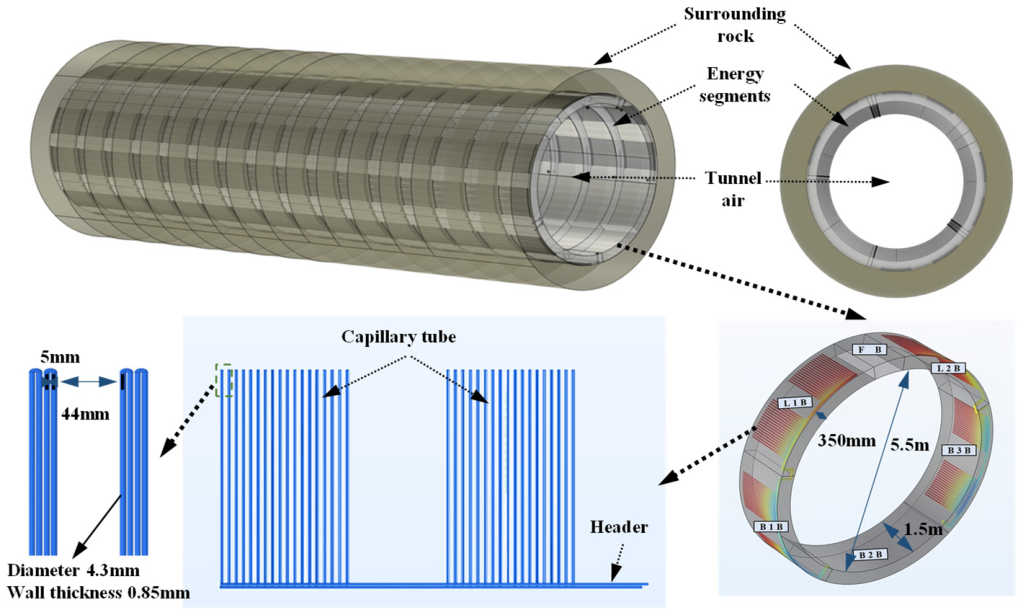
Considering the structural characteristics of shield tunnels, this study proposes a technical scheme for a shield tunnel energy segment based on CHEs. A single energy segment has a width of 1.5 m and a thickness of 350 mm. The return header (Φ16 × 2 mm) is arranged circumferentially within the segment. A total of 36 groups of U-shaped capillary bundles (Φ4.3 × 0.85 mm) are connected to the return header in a parallel, longitudinal arrangement with a spacing of 44 mm between adjacent bundles. Each bundle consists of two single capillaries separated by 5 mm. The total lengths of the capillary tubes and the return header used are 188.56 m and 7.61 m, respectively. The capillary network is located 26 mm from the outer arc surface of the energy segment. The specific design scheme of the energy segment is shown in Figure 1.
This study takes a single energy segment as the research object and establishes a numerical model based on the COMSOL simulation platform. The overall research approach employed in this study is a numerical simulation method based on the finite–element method. Three physical fields, namely solid–fluid heat transfer, turbulence, and non–isothermal pipe flow, are set up to respectively simulate the solid heat transfer process, the tunnel air flow process, and the fluid flow process within the heat exchanger. Moreover, the non–isothermal flow calculation method and the pipe wall heat transfer calculation method are utilized to couple the physical fields and achieve heat exchange between the capillary heat exchanger and the energy segment.
The heat transfer process between the energy segment and the tunnel environment in actual engineering is complex. To simplify the model analysis, the following assumptions are made:
(1)
The contact thermal resistance between adjacent objects is neglected.
(2)
All objects within the metro tunnel have constant properties and are isotropic.
(3)
The inlet temperature and velocity of the tunnel air remain constant during metro operation.
(4)
The initial temperature of the surrounding rock is the local annual average soil temperature.
(5)
The heat transfer characteristics of all energy segments are identical, and the contact surfaces between segments are adiabatic.
(6)
The influence of radiative heat transfer is neglected.
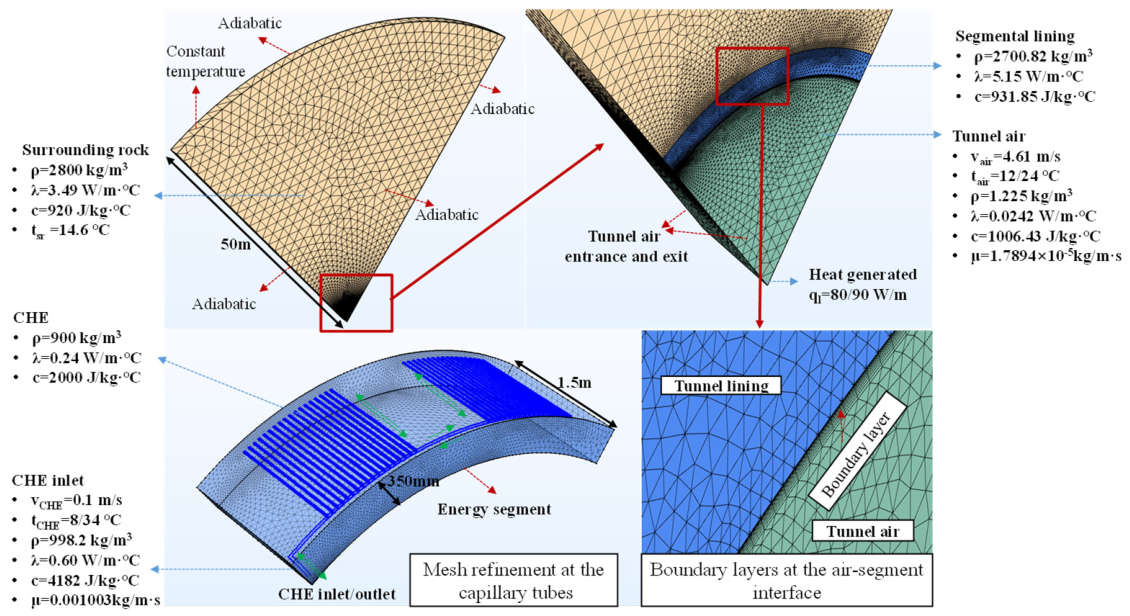
Based on the above assumptions and after comprehensive consideration of the metro operation mode and the heat transfer characteristics of the CHE, the distance between the surrounding rock and the tunnel central axis was set to 50 m. To simplify the analysis, the complex influence of the reinforcement cage structure on the heat exchange process is not considered, and the three-dimensional capillary tube network was simplified into one-dimensional curve segments or straight lines. To precisely study the heat transfer performance of the energy segment during CHE operation, the mesh for the CHE section was refined, and an additional 20 boundary layers were applied to the turbulent air region near the tunnel wall. The meshing scheme and boundary conditions for the model are shown in Figure 2.

2.1. Governing Equations

The heat transfer process in the energy tunnel primarily includes: convective heat transfer between the tunnel air and the inner arc surface of the energy segment; heat conduction within the concrete of the energy segment; heat conduction between the concrete and the outer wall of the heat exchanger; convective heat transfer between the fluid inside the heat exchanger and the inner wall of the capillary tubes; heat conduction between the outer arc surface of the energy segment and the surrounding rock; and heat conduction within the heat exchanger components. Therefore, the coupled heat and mass transfer process in the model is governed by the following four equations: the continuity equation, the momentum equation, the energy equation, and the heat conduction equation [26,27].
This study assumes the fluid density is constant. Consequently, the continuity equation can be expressed as:
u x + v y + w z = 0
The energy equation is:
ρ di d τ = dp d τ + q v τ + Φ + x λ t x + y λ t y + z λ t z
Φ = 2 μ u x 2 + v y 2 + w z 2 + 1 2 u y + v x 2 + 1 2 v z + w y 2 + 1 2 w x + u z 2 + λ u x + v y + w z 2
where ρ is the fluid density, kg/m3; i is the specific enthalpy of fluid, J/kg; p is the pressure, Pa; q v is the internal heat source of fluid, W/m3; Φ is the dissipative function, W/m3; u, v and w are the velocity components in the x, y, z directions, m/s; τ is the time, s; t is the temperature, K; μ is the dynamic viscosity coefficient, Pa·s; and   λ is the thermal conductivity, W/(m·K).
The momentum equation is:
τ ( ρ u i ) + x j ( ρ u j u i ) = - p x i + t ji x j + ρ F i
where ui and uj are the instantaneous velocity components in the i and j directions, m/s; tji is the component of the viscous stress tensor, N; and Fi is the volume force acting on the fluid, m/s2.
The heat conduction equation is:
s λ g r a d t n   d s + v q v d V = v τ ( ρ c t )   d V
where n is the unit direction vector; s is the distance along the temperature gradient direction, m; c is the specific heat, J/(kg·K); V is the volume, m3.
Based on the construction data of the demonstration project and the geological exploration analysis report, the thermal physical parameters of the model were determined, as detailed in Table 1.

2.2. Boundary and Initial Conditions

The air velocity inside the tunnel (vair, m/s) is influenced by both train operation and the mechanical ventilation system. Its dynamic nature poses significant challenges for subsequent analysis. To obtain a stable value, the wind speeds under conditions of no train, train acceleration, constant speed, and deceleration were weighted, resulting in an average tunnel wind speed (vair, m/s) of 4.61 m/s [28].
Research findings suggest that the seasonal average air temperature within the tunnel approximates the outdoor average air temperature [29]. Consequently, drawing on the measured data from a demonstration project, the average outdoor temperatures during the heating and cooling seasons are employed as the initial tunnel air temperatures (tair, °C): 12 °C for the heating season and 24 °C for the cooling season [30].
Heat generated in the metro tunnel mainly originates from train operation and passengers, differing significantly between peak and off-peak hours. To simplify calculation, the heat generated per unit length of tunnel (ql, W/m) is set to 80 W/m for the heating season and 90 W/m for the cooling season [31].
Based on measured data from a demonstration project in Qingdao, the source-side water supply temperature ranges from 2 to 15 °C in the heating season and from 21 to 35 °C in the cooling season. This study approximates the CHE inlet water temperature (tCHE, °C) as the source-side supply temperature, setting it to 8 °C for the heating season and 34 °C for the cooling season.
Through an actual demonstration project and considering the source-side flow rate of the heat pump system, Wu et al. [31] concluded that the CHE exhibits efficient thermal response and the fluid inside the tube maintains laminar flow when the inlet flow velocity (vCHE, m/s) is controlled at 0.1 m/s.
Metro tunnels are typically constructed within the underground constant-temperature layer. Measured data from the demonstration project shows the temperature of this layer to be 14.6 °C. Therefore, the initial temperature of the surrounding rock (tsr, °C) and its boundary condition at infinity are both set to 14.6 °C for model analysis [32].

2.3. Model Validation

This study is a continuation of our previous research [25]. In the earlier work, our team constructed a field test platform based on a demonstration project of the Qingdao Metro to validate the numerical model. The results showed that the measured CHE outlet water temperature stabilized within the range of 9.1–9.5 °C, while the simulated values stabilized between 8.5 and 9.1 °C. The average relative error was 7.4%. Considering the uncertainties inherent in field conditions and the simplifications adopted in the simulation, the deviation between the numerical results and the measured data is within an acceptable range. Therefore, the established numerical model is considered to have high predictive accuracy and can meet the requirements for subsequent simulation analysis.
In comparison with our previous research, the numerical model developed in this study remains completely consistent in terms of boundary and initial conditions. The sole difference is in the variables selected during the analysis of influencing factors. To avoid redundancy, the detailed model validation process is not repeated here, but it can be fully referred to in the literature [25].

3. Evaluation Indices

Based on the fundamental theories of heat transfer, this study established an evaluation index system encompassing heat flux, overall heat transfer coefficient, logarithmic mean temperature difference, and temperature non–uniformity coefficient. Among these indicators, heat flux and overall heat transfer coefficient are the universal core indicators that directly reflect the heat exchange capacity of the capillary heat exchanger, and they meet the analysis requirements for the heat exchanger performance in this study. The logarithmic mean temperature difference (LMTD), recommended as the temperature difference expression method in the heat exchanger design standard, can more accurately reflect the real temperature difference driving heat transfer. The temperature non–uniformity coefficient, which is a common statistical method for evaluating the uniformity of the temperature field in the thermal field, meets the uniformity analysis requirements of this study. The physical meanings and calculation formulas of each indicator are as follows:
Under steady-state conditions, the heat transfer process of the energy segment adheres to the law of energy conservation. The heat flux (heat absorbed or released per unit area) by the heat carrier fluid within the CHE is calculated as follows:
q = Q F = M f c Δ t F
where q is the heat flux of the CHE, W/m2; Q is the total heat exchange rate of the CHE, W; F is the projected area of the capillary bundle contour of the heat exchanger, m2; M f is the mass flow rate of the heat transfer medium inside the tubes, kg/s; Δ t is the temperature difference between the inlet and outlet, °C.
The energy segments are composed of heat exchangers and traditional shield tunnel lining segments, which represent a novel type of heat exchanger integrating both heat–exchange and structural functions. Consequently, the performance evaluation indicator of traditional heat exchangers, namely the overall heat transfer coefficient, was referenced for the assessment of the thermal performance of the energy segments. The overall heat transfer coefficient heat transfer between the tunnel air, surrounding rock, and the energy segment can be calculated using the following formula:
k = Q F Δ T m
where k   is the overall heat transfer coefficient, W/(m2·°C); Δ T m   is the logarithmic mean temperature difference (LMTD) of the medium inside the heat exchanger, °C.
The LMTD can be obtained from the Formula (8). When the heat exchanger absorbs heat, Δ T max   =   T w - T 2 ,   Δ T min   =   T w - T 1 ; when the heat exchanger releases heat to the tunnel environment, Δ T max   =   T 2 - T w ,   Δ T min   =   T 1 - T w .
Δ T m = Δ T max - Δ T min ln ( Δ T max / Δ T min )
where T w   is the ambient temperature for the CHE, °C; T 2   is the CHE inlet temperature, °C; and T 1   is the CHE outlet temperature, °C.
When the CHE is in operation, temperature differences exist within the concrete of the segment. This temperature non-uniformity may lead to inconsistent aging rates in different parts of the energy segment over long-term operation, thereby negatively impacting the overall performance and service life of the CHE. A total of 12,306 temperature monitoring points were evenly distributed within the energy segment to assess the uniformity of its temperature distribution. A lower segment temperature non-uniformity coefficient indicates better temperature distribution uniformity. The coefficient is calculated as follows:
σ T = 1 n i = 1 n T i - T ¯ T ¯ 2
where   σ T   is the temperature non-uniformity coefficient; n is the number of temperature monitoring points; T i is the temperature at monitoring point, °C; and   T ¯   is the average temperature of the CHE, °C.

4. Results and Discussion

4.1. Performance of Energy Segments

4.1.1. Influence of Tunnel Air Temperature

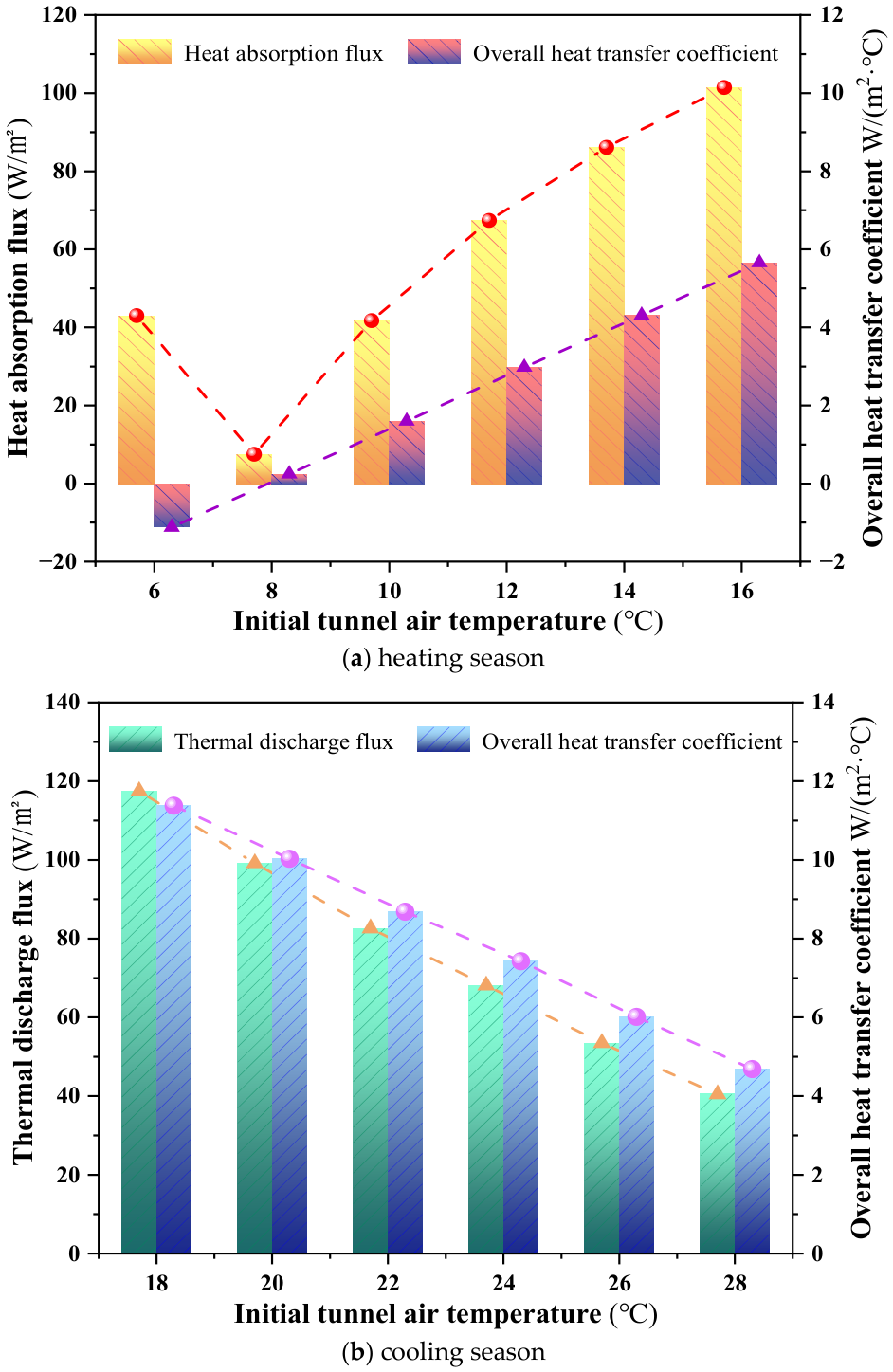
The heat flux per unit area and the overall heat transfer coefficient of the CHE under different initial air temperatures during the heating and cooling seasons are shown in Figure 3. In this study, the energy tunnel is employed to provide heating and cooling to the above–ground buildings. As a result, its operational status is influenced by the heating and cooling demands of the buildings. Thus, in the subsequent analysis, the terms “heating season” and “cooling season” respectively denote the conditions when the energy tunnel is in heating and cooling operation.
As shown in Figure 3, changes in the initial tunnel air temperature exhibit different trends in their influence on the heat transfer performance of the CHE during the heating and cooling seasons. In the heating season, when the initial air temperature is 6 °C, the CHE releases a heat flux of 11.18 W/m2 to the tunnel because the air temperature is lower than the CHE inlet water temperature. As the initial air temperature increases from 8 °C to 16 °C, the heat extraction rate per unit area of the CHE increases significantly, from 2.43 W/m2 to 56.66 W/m2. In the cooling season, as the initial air temperature increases from 18 °C to 28 °C, the heat release rate per unit area of the CHE decreases linearly from 113.75 W/m2 to 46.88 W/m2.
During the heating season, at an initial temperature of 6 °C, the air temperature is lower than the CHE inlet water temperature. Although the surrounding rock acts as a heat source, the lower-temperature tunnel air removes a substantial amount of heat via convective heat transfer, causing the CHE to release heat to the tunnel instead. As the initial air temperature continues to rise, the CHE switches to a heat absorption mode, absorbing heat from the tunnel to raise the temperature of the circulating medium. When the initial air temperature is 8 °C, equal to the CHE inlet water temperature, the temperature difference between the fluid inside the tubes and the tunnel environment is small. Under this condition, the overall heat transfer coefficient of the CHE is at its lowest, only 0.75 W/(m2·°C). With a further increase in the initial air temperature, the heat transfer temperature difference between the inlet water and the tunnel environment increases correspondingly, promoting higher overall heat transfer coefficient for the CHE, and consequently increasing its heat absorption rate.
In the cooling season, since the initial temperatures of both the tunnel air and the surrounding rock are consistently lower than the CHE inlet water temperature, the CHE acts as a cold source, releasing heat to the tunnel. As the initial air temperature increases, the heat transfer temperature difference between the CHE and the tunnel environment gradually narrows, causing the overall heat transfer coefficient of the CHE to decrease from 11.74 W/(m2·°C) to 4.05 W/(m2·°C), which in turn reduces the heat release rate of the CHE.
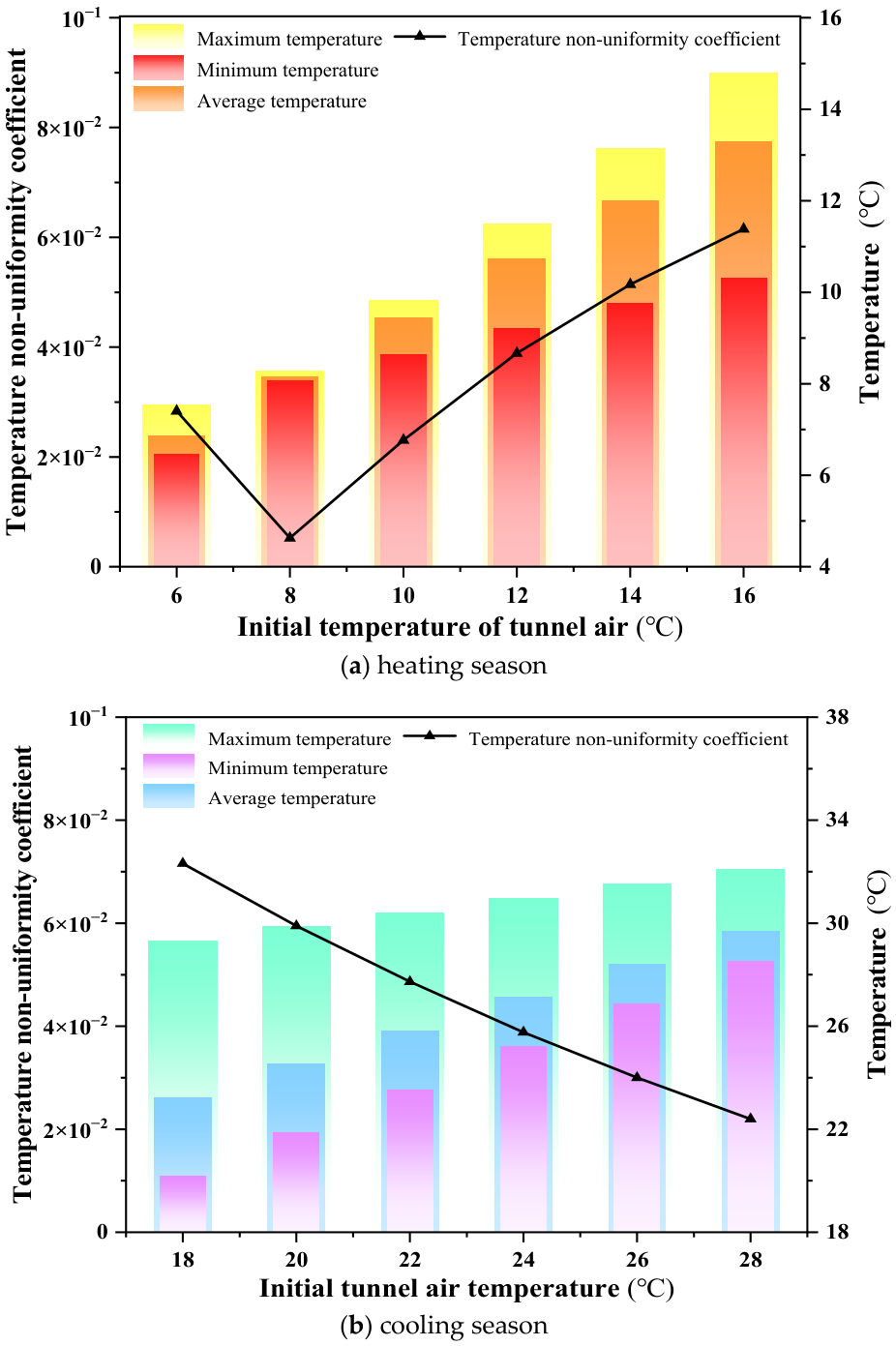
The temperature non-uniformity coefficients of the segment under different initial air temperatures during the heating and cooling seasons are shown in Figure 4.
Analyzing from the perspective of segment temperature distribution uniformity, as shown in Figure 4, during both the heating and cooling seasons, the temperature distribution under different initial air temperatures follows a trend similar to that of the CHE’s overall heat transfer coefficient. In the heating season, as the initial air temperature increases, the segment’s temperature non-uniformity coefficient first decreases and then increases. At an initial air temperature of 8 °C, the coefficient reaches its minimum value of 5 × 10⁻³. When the initial air temperature rises to 16 °C, the coefficient reaches its maximum value of 6.15 × 10⁻². Conversely, in the cooling season, as the initial air temperature increases from 18 °C to 28 °C, the segment’s maximum, minimum, and average temperatures increase by 2.78 °C, 8.35 °C, and 6.46 °C, respectively. The temperature non-uniformity coefficient decreases with increasing initial air temperature, dropping from 7.16 × 10⁻² to 2.2 × 10⁻².
During the heating season, as the initial air temperature increases, the temperature difference between the CHE and the tunnel initially decreases and then increases. Consequently, the operation mode of the CHE changes from heat release to heat extraction, resulting in a trend where the overall heat transfer coefficient of the CHE first decreases and then increases. This results in a similar trend for the segment’s temperature non-uniformity coefficient. Simultaneously, the enhanced heat extraction capacity of the CHE with rising air temperature causes the segment temperature to increase accordingly. However, influenced by the temperature of the circulating medium inside the CHE, the temperature rise in the cooler zones of the segment is relatively smaller. In the cooling season, the increase in tunnel air temperature raises the overall segment temperature. However, due to the reduced temperature difference between the CHE and the tunnel environment, the CHE’s overall heat transfer coefficient declines, leading to a more uniform temperature distribution across the segment and a consequent decrease in the temperature non-uniformity coefficient.
In summary, the mechanism by which the initial air temperature affects the heat transfer performance of the energy segment is primarily reflected in the following aspect: an increased heat transfer temperature difference between the air temperature and the inlet water temperature enhances the CHE’s heat exchange capacity. Therefore, in practical engineering, to improve the CHE’s overall heat transfer coefficient, the difference between the CHE inlet water temperature and the tunnel air temperature should be appropriately increased, considering the local variation range of tunnel air temperature and the temperature uniformity requirements of the segment.

4.1.2. Influence of Tunnel Air Velocity

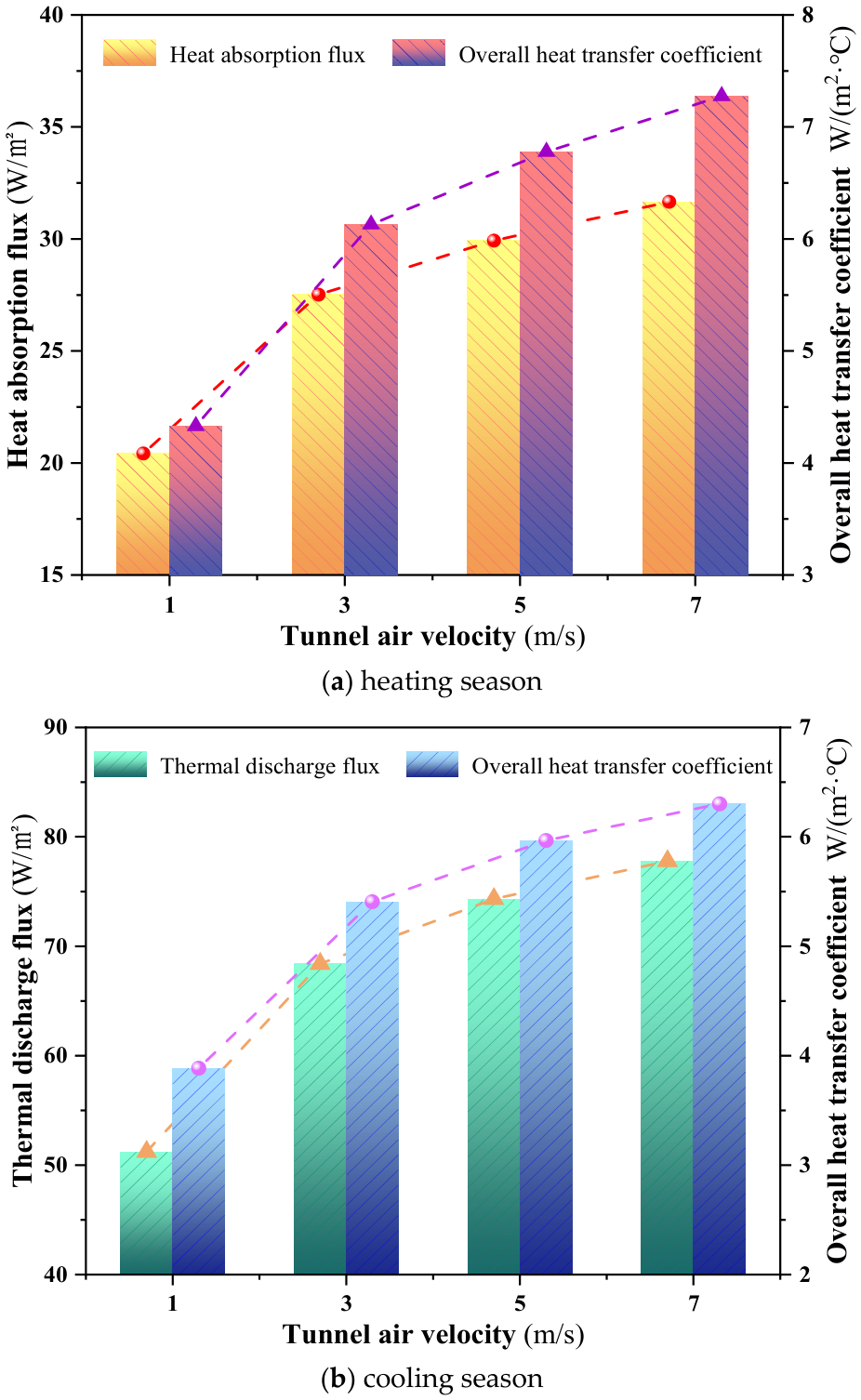
Tunnel air velocity is a crucial parameter affecting the heat exchange intensity between the energy segment and the tunnel. This study analyzed the variation patterns of CHE heat transfer performance under different tunnel air velocities during both the heating and cooling seasons, as shown in Figure 5.
During both the heating and cooling seasons, as the tunnel air velocity gradually increases from 1 m/s to 7 m/s, the heat flux per unit area of the CHE increases, but the growth rate gradually slows down. In the heating season, when the tunnel air velocity increases from 1 m/s to 3 m/s, the heat extraction rate per unit area of the CHE increases from 20.43 W/m2 to 27.52 W/m2, a growth rate of 35%. When the velocity increases from 5 m/s to 7 m/s, the growth rate drops to 6%. In the cooling season, when the tunnel air velocity increases from 1 m/s to 3 m/s, the heat release rate per unit area of the CHE increases from 51.22 W/m2 to 68.4 W/m2, a growth of 34%. When the velocity increases from 5 m/s to 7 m/s, the growth rate drops to 5%.
Upon further analysis of the segment’s heat transfer coefficient, it is observed that as the tunnel air velocity increases, the convective heat transfer coefficient between the energy segment and the tunnel air also increases. This enhancement in the convective heat transfer coefficient improves the overall heat transfer coefficient of the CHE, enabling it to absorb a greater amount of heat from the tunnel air. When the tunnel air velocity increases from 1 m/s to 7 m/s, the overall heat transfer coefficient of the CHE increases from 4.33 W/(m2·°C) to 7.28 W/(m2·°C) in the heating season, and from 3.89 W/(m2·°C) to 6.30 W/(m2·°C) in the cooling season. However, as the tunnel air velocity increases further, the rate of increase in the segment’s convective heat transfer coefficient diminishes, subsequently affecting the efficiency of heat transfer between the CHE and the tunnel air.
Additionally, with increasing air velocity, the intense convective heat transfer between the tunnel air and the energy segment causes the segment temperature to approach that of the surrounding rock, slowing down the heat exchange rate between the rock and the CHE. Consequently, the heat provided by the surrounding rock to the CHE decreases as the air velocity increases. Under the combined effect of tunnel air and surrounding rock, the heat gained by the CHE increases with air velocity, but the growth rate gradually slows down. Therefore, in practical engineering, when the tunnel air velocity is 4.61 m/s, the CHE can already achieve excellent heat exchange performance.
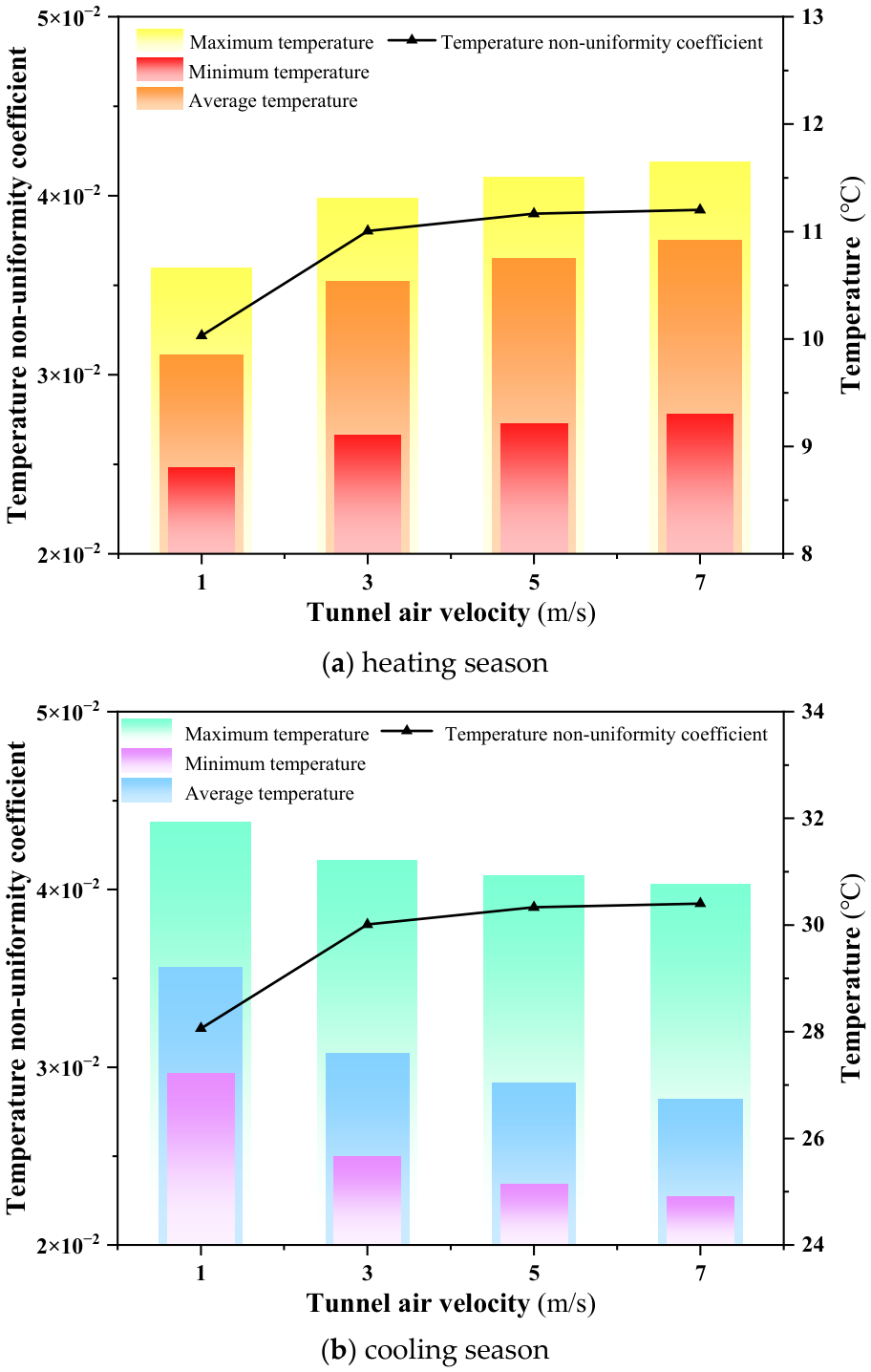
The temperature non-uniformity coefficients of the segment under different tunnel air velocities during the heating and cooling seasons are shown in Figure 6.
As shown in Figure 6, when the tunnel air velocity increases from 1 m/s to 7 m/s, in the heating season, the segment’s maximum, minimum, and average temperatures increase by 0.99 °C, 0.50 °C and 1.06 °C, respectively. The temperature non-uniformity coefficient increases from 3.22 × 10⁻² to 3.92 × 10⁻², a 21% increase. In the cooling season, the segment’s maximum, minimum, and average temperatures increase by 1.16 °C, 2.33 °C and 2.48 °C, respectively. The temperature non-uniformity coefficient increases from 2.82 × 10⁻² to 4.01 × 10⁻², a 42% increase.
Due to the relatively low thermal conductivity of the surrounding rock, the heat exchange on the rock side remains largely stable with changes in tunnel air velocity. However, changes in air velocity significantly affect the amount of heat absorbed or released by the energy segment from the air side. Tunnel air velocity regulates the heat exchange intensity of the CHE by altering the temperature of the segment’s inner arc surface. This effect is primarily concentrated in high-temperature regions during the heating season and in low-temperature regions during the cooling season, thereby influencing the distribution uniformity of the segment’s temperature field. Compared to the heating season, the temperature differences among the CHE, tunnel air, and surrounding rock are larger during the cooling season, and the effect of air velocity on the CHE operating in heat release mode is more pronounced. Therefore, the impact of increased air velocity on the segment’s temperature non-uniformity coefficient is also more significant during the cooling season.
In practical engineering, the operation of trains and tunnel ventilation equipment can increase tunnel air velocity, enhancing the convective heat transfer intensity at the segment surface and improving the overall heat transfer coefficient of CHE. Simultaneously, air velocity alters the temperature distribution characteristics on the segment surface, leading to increased local temperature differences and worsening temperature distribution uniformity.
Based on the above research results, in practical engineering applications, considering the influence of tunnel air velocity on segment temperature uniformity, it is recommended to control the tunnel air velocity in a reasonable range (4.61 m/s in this study). Furthermore, the operating state of the CHE should be reasonably optimized to enhance overall heat transfer coefficient while avoiding excessively high temperature non-uniformity coefficients. This approach aims to achieve a good balance between overall heat transfer coefficient and temperature uniformity, ensuring the system can operate stably and efficiently in the long term.
This study solely analyzed the heat transfer characteristics of single energy segments under typical design conditions. Nevertheless, in actual engineering applications, energy segments typically adopt a combined operation mode, and the operating conditions are more intricate. Consequently, the findings of this study are unable to reflect the dynamic heat transfer characteristics of energy segments in practical applications, which restricts the engineering promotion and application of the research results. Therefore, subsequent research should take into account more engineering indicator factors and conduct investigations on the heat–transfer characteristics of energy segments under coupled and continuous operation conditions. Nevertheless, this study, focusing on shield energy tunnels, has revealed the influence laws of environmental parameters within the tunnel on the heat transfer characteristics of energy segments. The research findings can provide references for the optimized design of energy segments.

5. Conclusions

Energy tunnel technology is an effective approach for mitigating thermal pollution in subway tunnels. This research presents a shield tunnel energy segment model founded on a capillary heat exchanger (CHE) and examines the variation patterns of its thermal performance through a COMSOL numerical model. By analyzing the thermodynamic characteristics of energy segments under typical conditions, this research has successfully uncovered the coupling relationship and regularity between the internal environmental parameters of the tunnel and the thermal performance of the energy pipe segments. The conclusions are as follows:
(1)
The initial temperature of the tunnel air exerts a significant influence on the heat–transfer performance of the energy segment. Augmenting the temperature differential between the tunnel air and the inlet water flow of the CHE enhances the heat–transfer capacity of the energy segment. For every 5 °C increment in the tunnel air temperature, the heat extraction rate of the CHE rises by 60.7% during the heating season, whereas its heat release rate declines by 58.8% during the cooling season.
(2)
Increasing the air velocity within the tunnel enhances the convective heat transfer between the energy segment and the air, consequently improving the efficiency of heat exchange. Nevertheless, this enhancement effect gradually diminishes as the air velocity rises. The research findings suggest that the CHE already demonstrates high heat–exchange performance when the tunnel air velocity attains 4.61 m/s.
(3)
The variation trends of the overall heat transfer coefficient and temperature non-uniformity of the energy segments are consistent with the changes in the air temperature and wind speed in the tunnel.
Based on the comprehensive analysis above, it is recommended that in practical engineering applications, a dynamic parameter control mechanism for the CHE based on the tunnel air environment should be established. This mechanism is expected to balance the overall heat transfer coefficient and the temperature distribution uniformity, thereby ensuring the long-term stable operation of the energy segment across different seasons and operating conditions.
This study solely analyzed the heat transfer characteristics of single energy segments under typical design conditions. Future research ought to take into account more engineering factors and carry out investigations on the thermal performance of energy segments under more intricate working conditions. Nevertheless, the research findings can offer references for the optimized design of energy segments with embedded CHEs.

Author Contributions

Conceptualization, Y.J.; Methodology, Y.J.; Software, Q.Z. (Qinghan Zeng) and J.H.; Validation, Q.Z. (Qinghan Zeng); Resources, B.D., F.Z. and Q.Z. (Qingjian Zhang); Writing—original draft, Q.Z. (Qinghan Zeng), B.D., F.Z., J.H. and Q.Z. (Qingjian Zhang); Writing—review & editing, Y.J.; Visualization, B.D., F.Z. and J.H.; Supervision, Q.Z. (Qingjian Zhang) and Y.J.; Project administration, Y.J. All authors have read and agreed to the published version of the manuscript.

Funding

This research and APC were funded by the National Natural Science Foundation of China (Grant no. 52478092, 52308097), Science and Technology Demonstration Project of Qingdao (24-1-8-cspz-1-nsh), Natural Science Foundation of Shandong Province (ZR2025MS701) and Shandong Engineering Research Center of Healthy Environment and Low-Carbon Energy.

Data Availability Statement

The original contributions presented in this study are included in the article material. Further inquiries can be directed to the corresponding authors.

Conflicts of Interest

Author Bo Dong was employed by the company Qingdao Urban Rail Transit Technology Co., Ltd. and Author Fengjun Zhang was employed by the company Qingdao Metro Group Co., Ltd. The remaining authors declare that the research was conducted in the absence of any commercial or financial relationships that could be constructed as a potential conflict of interest.

Nomenclature

cSpecific heat capacity of the medium, J/(kg·°C)
tCHECHE inlet water temperature, °C
FProjected area of the capillary bundle contour of the heat exchanger, m2
FiVolume force acting on the fluid, m/s2
i Specific enthalpy of fluid, J/kg
kOverall heat transfer coefficient, W/(m2·°C)
MfMass flow rate of the heat transfer medium inside the tubes, kg/s
nNumber of temperature monitoring points
n Unit direction vector
pPressure, Pa
qHeat flux of the CHE, W/m2
qlHeat generated per unit length of tunnel, W/m
q v Internal heat source of fluid, W/m3
QTotal heat exchange rate of the CHE, W
sDistance along the temperature gradient direction, m
tTemperature, K
tairInitial tunnel air temperatures, °C
tjiComponent of the viscous stress tensor, N
tsrInitial temperature of the surrounding rock, °C
∆tTemperature difference between the inlet and outlet, °C
T i Temperature at monitoring point, °C
T ¯ Average temperature of the CHE, °C
T1CHE outlet temperature, °C
T2CHE inlet temperature, °C
TwAmbient temperature for the CHE, °C
∆TmLogarithmic mean temperature difference of the medium inside the heat exchanger, °C
Δ T max Maximum temperature difference, °C
Δ T min Minimum temperature difference, °C
uVelocity components in the x-direction, m/s
uiInstantaneous velocity components in the i-direction, m/s
ujInstantaneous velocity components in the j-direction, m/s
vVelocity components in the y-direction, m/s
vairAverage tunnel wind speed, m/s
vCHEInlet flow velocity, m/s
VVolume, m3
wVelocity components in the z-direction, m/s
x, y, zThree-dimensional space coordinate axes
Greek symbols
ρDensity of circulating fluid in CHE, kg/m3
μDynamic viscosity coefficient, Pa·s
λThermal conductivity, W/(m·K)
σ T Temperature non-uniformity coefficient
τ Time, s
Φ Dissipative function, W/m3
Abbreviations
CHECapillary heat exchanger
LMTDLogarithmic mean temperature difference

References

  1. Tong, Z.; Guan, Y.; Cao, T.; Ji, Y.; Hu, S.; Liu, G.; Liu, N.; Fan, Y. Onsite measurement and performance analysis of capillary heat pump system used in subway tunnels. Appl. Therm. Eng. 2022, 204, 118008. [Google Scholar] [CrossRef]
  2. Yuan, B.; Huang, X.; Huang, Q.; Shiau, J.; Liang, J.; Zhang, B.; Zheng, J.; Fahimizadeh, M.; Sabri, M.M. Effects of particle size on properties of engineering muck-based geopolymers: Optimization through sieving treatment. Constr. Build. Mater. 2025, 492, 142967. [Google Scholar] [CrossRef]
  3. Yuan, B.; Huang, X.; Li, R.; Luo, Q.; Shiau, J.; Wang, Y.; Yuan, J.; Sabri, S.M.; Huang, S.; Liao, C. Dynamic behavior and deformation of calcareous sand under cyclic loading. Soil Dyn. Earthq. Eng. 2025, 199, 109730. [Google Scholar] [CrossRef]
  4. Barla, M.; Di Donna, A.; Insana, A. Energy tunnel experimental site in Turin metro. In Proceedings of the 15th International Conference of the International Association for Computer Methods and Advances in Geomechanics (15th IACMAG); Chinese Academy of Sciences: Beijing, China, 2017; pp. 1–10. [Google Scholar]
  5. Di Donna, A.; Cecinato, F.; Loveridge, F.; Barla, M. Energy performance of diaphragm walls used as heat exchangers. Proc. Inst. Civ. Eng.-Geotech. Eng. 2017, 170, 232–245. [Google Scholar] [CrossRef]
  6. Insana, A.; Barla, M. Experimental and numerical investigations on the energy performance of a thermo-active tunnel. Renew. Energy 2020, 152, 781–792. [Google Scholar] [CrossRef]
  7. Yang, C.; Peng, F.-L.; Xu, K.; Zheng, L.-N. Feasibility study on the geothermal utility tunnel system. Sustain. Cities Soc. 2019, 46, 101445. [Google Scholar] [CrossRef]
  8. Brandl, H. Energy foundations and other thermo-active ground structures. Géotechnique 2006, 56, 81–122. [Google Scholar] [CrossRef]
  9. Lee, C.; Park, S.; Choi, H.-J.; Lee, I.-M.; Choi, H. Development of energy textile to use geothermal energy in tunnels. Tunn. Undergr. Space Technol. 2016, 59, 105–113. [Google Scholar] [CrossRef]
  10. Tong, Z.; Cao, T.; Zang, G.; Hu, S.; Liu, G.; Wang, Y. Performance analysis of capillary front-end heat exchanger for subway tunnel. Appl. Therm. Eng. 2020, 174, 115360. [Google Scholar] [CrossRef]
  11. Zhang, G.; Xia, C.; Yang, Y.; Sun, M.; Zou, Y. Experimental study on the thermal performance of tunnel lining ground heat exchangers. Energy Build. 2014, 77, 149–157. [Google Scholar] [CrossRef]
  12. Kong, X.-R.; Deng, Y.; Li, L.; Gong, W.-S.; Cao, S.-J. Experimental and numerical study on the thermal performance of ground source heat pump with a set of designed buried pipes. Appl. Therm. Eng. 2017, 114, 110–117. [Google Scholar] [CrossRef]
  13. Ji, Y.; Ji, C.; Shen, S.; Zhang, J.; Hu, S. Performance and optimal design parameters of tunnel lining CHEs under typical design conditions. Renew. Energy 2025, 238, 121962. [Google Scholar] [CrossRef]
  14. Wang, Y.; Zhou, G.; Liu, J.; Wang, F.; Qiao, G.; Xiao, W. Experimental investigation on heat transfer performance and thermal stress of segment lining in a heating power energy tunnel. Tunn. Undergr. Space Technol. 2025, 161, 106544. [Google Scholar] [CrossRef]
  15. Ogunleye, O.; Singh, R.M.; Cecinato, F.; Choi, J.C. Effect of intermittent operation on the thermal efficiency of energy tunnels under varying tunnel air temperature. Renew. Energy 2020, 146, 2646–2658. [Google Scholar] [CrossRef]
  16. Buhmann, P.; Moormann, C.; Westrich, B.; Pralle, N.; Friedemann, W. Tunnel geothermics—A German experience with renewable energy concepts in tunnel projects. Geomech. Energy Environ. 2016, 8, 1–7. [Google Scholar] [CrossRef]
  17. Zhang, G.; Liu, S.; Zhao, X.; Ye, M.; Chen, R.; Zhang, H.; Yang, J.; Chen, J. The coupling effect of ventilation and groundwater flow on the thermal performance of tunnel lining GHEs. Appl. Therm. Eng. 2017, 112, 595–605. [Google Scholar] [CrossRef]
  18. Luo, M.; Yuan, Z.; Fan, L.; Tao, L.; Zeng, Y.; Yan, Q. Investigating the coupling effect of ventilation and GHEs on temperature distribution and heat transfer characteristics. Appl. Therm. Eng. 2024, 248, 123211. [Google Scholar] [CrossRef]
  19. Zheng, L.; Zhong, Z.; Chen, Z.; Yang, S.; Zhou, X.; Xiao, H. Experimental study on heat transfer and thermal storage performance of tunnel GHEs in cold regions. Appl. Therm. Eng. 2025, 278, 127344. [Google Scholar] [CrossRef]
  20. Luo, M.; Yuan, Z.; Fan, L.; Tao, L.; Zeng, Y.; Yuan, Y.; Zhou, J. Effects of longitudinal ventilation and GHEs on geothermal energy extraction and HRC in high geothermal tunnels. Renew. Energy 2024, 232, 121031. [Google Scholar] [CrossRef]
  21. Ma, M.; Yuan, X.; Wang, T.; Xiao, Y. Computational method for convective heat transfer coefficients along sizable air-intake tunnel passages based on empirical data. Appl. Energy 2024, 367, 123363. [Google Scholar] [CrossRef]
  22. Zhang, G.; Cao, Z.; Zhao, X.; Xie, Y.; Liu, X.; Cao, S. Investigation of the thermal performance of energy tunnel equipped with the insulation layer considering ventilation and groundwater seepage. Geofluids 2021, 2021, 6021585. [Google Scholar] [CrossRef]
  23. Tong, L.; Hu, S.; Shan, L.; Wang, Y. Study on heat transfer performance of metro tunnel capillary heat exchanger. Sustain. Cities Soc. 2019, 45, 683–685. [Google Scholar] [CrossRef]
  24. Ji, Y.; He, J.; Guo, X.; Zheng, S.; Zheng, J.; Hu, S. Field Test of the Performance of an Energy Tunnel Employing Capillary Heat Exchangers. Energy Built Environ. 2026, 7, 742–752. [Google Scholar] [CrossRef]
  25. Sun, Y.; He, J.; Ye, R.; Ji, Y.; Hu, S. Thermal performance of capillary heat exchanger-based energy segments for metro tunnel source heat pump system. Case Stud. Therm. Eng. 2025, 75, 107292. [Google Scholar] [CrossRef]
  26. Zhai, Z. Computational Fluid Dynamics for Built and Natural Environments; Springer: Singapore, 2020. [Google Scholar]
  27. Islam, S.; Fukuhara, T.; Watanabe, H.; Nakamura, A. Horizontal U-tube road heating system using tunnel ground heat. J. Snow Eng. Jpn. 2006, 22, 229–234. [Google Scholar] [CrossRef]
  28. Liu, G.; Li, C.; Hu, S.; Ji, Y.; Tong, Z.; Wang, Y.; Tong, L.; Mao, Z.; Lu, S. Study on heat transfer model of capillary exchanger in subway source heat pump system. Renew. Energy 2020, 150, 1074–1088. [Google Scholar] [CrossRef]
  29. Tong, L.; Zhang, M.; Hu, S.; Ji, Y. Changing Rules in Subway Tunnel Thermal Environment and Comprehensive Utilization of Waste Heat. Buildings 2024, 14, 2524. [Google Scholar] [CrossRef]
  30. Ji, Y.; Jiao, J.; Yin, Z.; Ji, C.; Hu, S. Rapid performance prediction model for capillary heat exchangers in subway tunnel linings. Appl. Therm. Eng. 2023, 232, 120967. [Google Scholar] [CrossRef]
  31. Wu, W.; Ji, Y.; Jiao, J.; Hu, S. Thermal response characteristics of tunnel lining CHEs for a subway source heat pump system. Case Stud. Therm. Eng. 2025, 73, 106675. [Google Scholar] [CrossRef]
  32. Hu, S.; Xu, W.; Tong, Z.; Cheng, Y. Study on cooling effect prediction of capillary heat exchanger applied to subway tunnels. J. Qingdao Univ. Sci. Technol. 2019, 5, 78–84. [Google Scholar]
Figure 1. Design scheme of the energy segment in the shield tunnel.
Buildings 16 02066 g001
Figure 2. Mesh division, boundary conditions and initial conditions of energy segment model.
Buildings 16 02066 g002
Figure 3. Effect of initial air temperature on the heat transfer performance of the CHE.
Buildings 16 02066 g003
Figure 4. Effect of initial air temperature on the temperature distribution of the segment.
Buildings 16 02066 g004
Figure 5. Effect of tunnel air velocity on the heat transfer performance of the CHE.
Buildings 16 02066 g005
Figure 6. Effect of tunnel air velocity on the temperature distribution of the segment.
Buildings 16 02066 g006
Table 1. Thermal physical parameters of the model.
Model PartsDensity ρ, kg/m3Thermal Conductivity λ, W/m·°CSpecific Heat c, J/kg·°CViscosity μ, kg/m·s
Segmental lining2700.825.15931.85--
Surrounding rock28003.49920--
CHE9000.242000--
Water998.20.6041820.001003
Air1.2250.02421006.431.7894 × 10−5
Disclaimer/Publisher’s Note: The statements, opinions and data contained in all publications are solely those of the individual author(s) and contributor(s) and not of MDPI and/or the editor(s). MDPI and/or the editor(s) disclaim responsibility for any injury to people or property resulting from any ideas, methods, instructions or products referred to in the content.