A Dual-Height AI Framework for Proxy Assessment of Children’s Spatial Perception in a Large Cultural Complex


Abstract
1. Introduction
2. Literature Review
2.1. Child-Friendly Environments, Age-Sensitive Design, and Children’s Spatial Perception
2.2. Street-View Imagery and Semantic Segmentation in Built Environment Evaluation
2.3. Explainable Machine Learning for Design-Support Analytics
3. Methodology
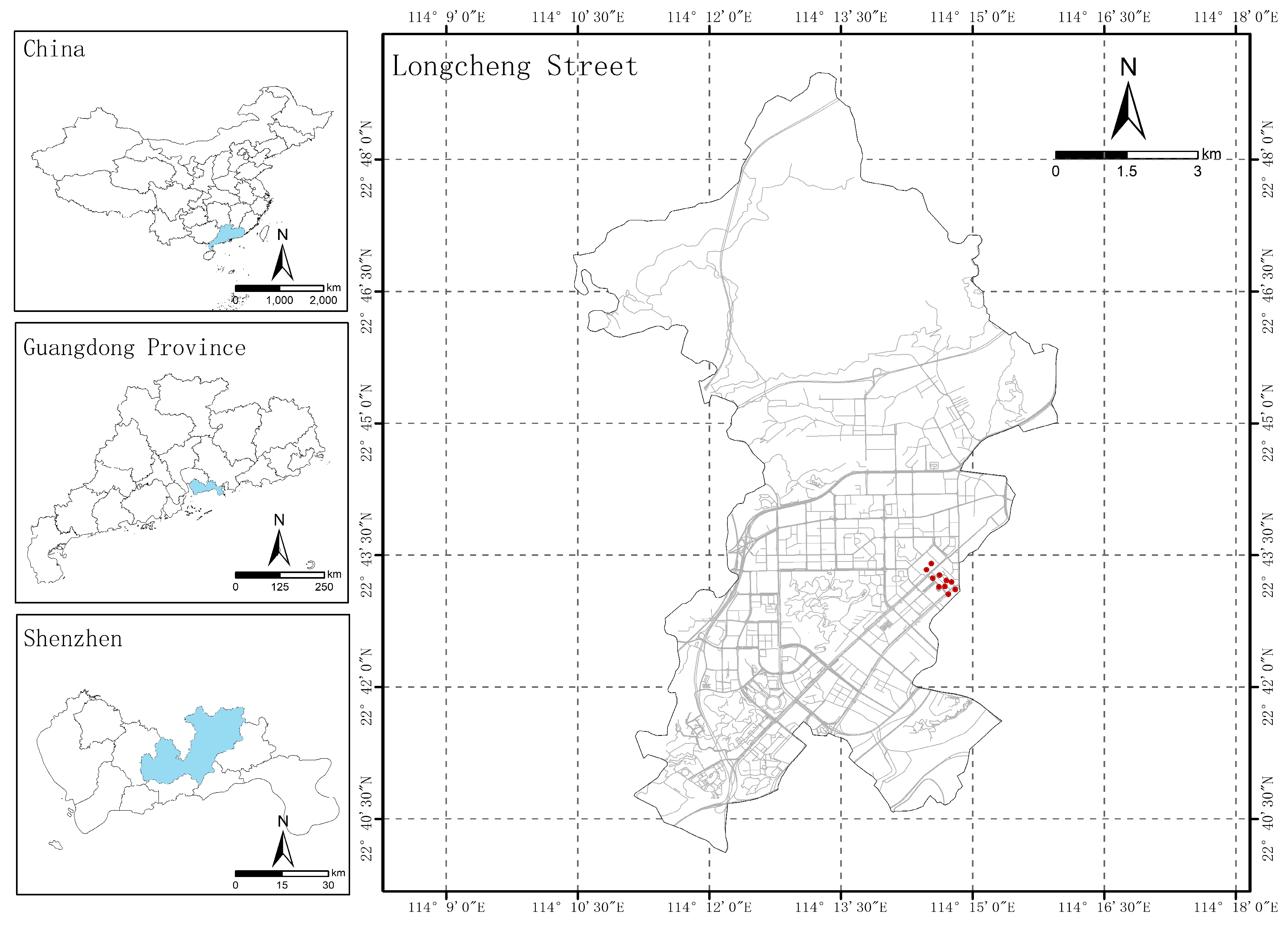
3.1. Study Area
3.2. Data Collection
- Street View Imagery:
- GIS Accessibility Data:
3.3. AI Feature Extraction
3.4. Proxy Index Construction and Synthetic Score Generation
3.5. Associations Between Environmental Features and Proxy Perceptual Indices
3.6. Explainability Analysis
3.7. Spatial Analysis and Mismatch Mapping
4. Results
4.1. Environmental Feature Distribution and Height-Based Variations
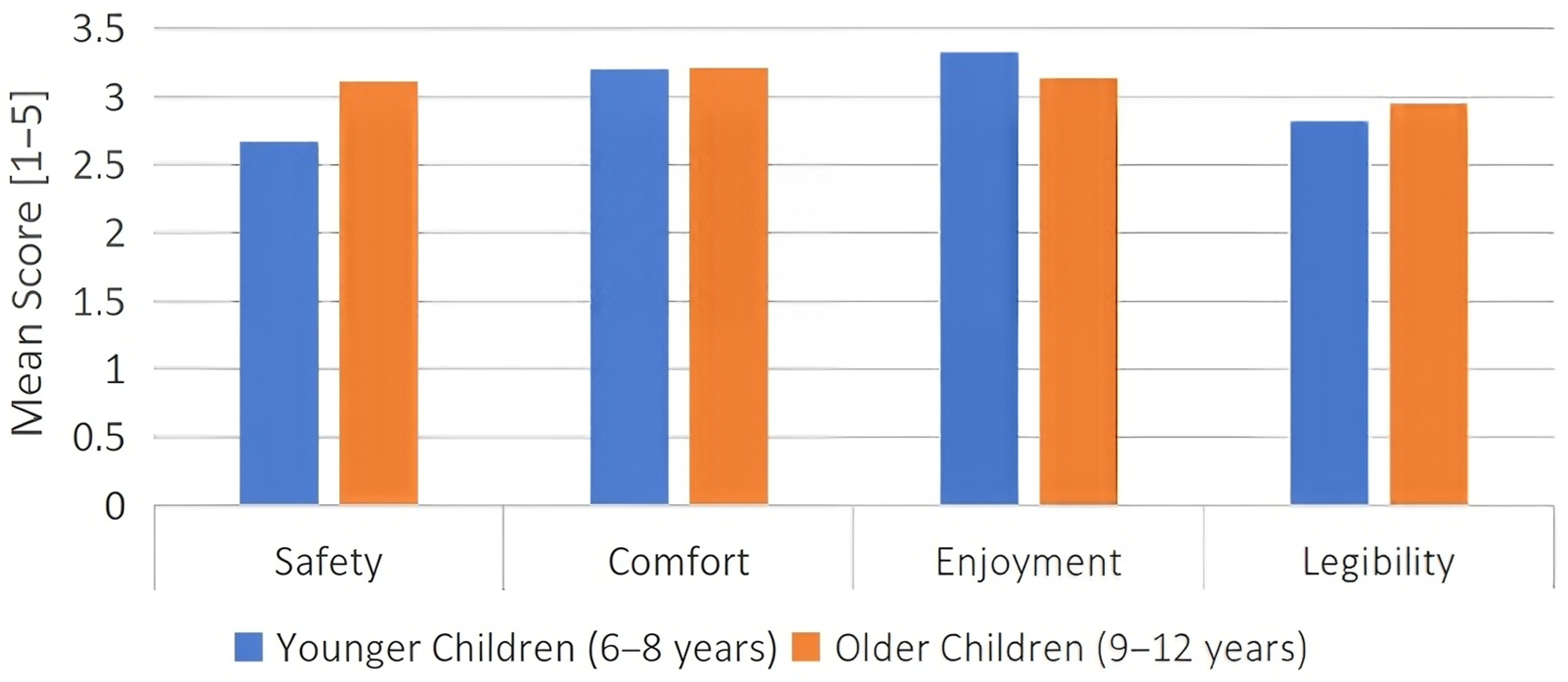
4.2. Perception Scores and Age-Group Differences
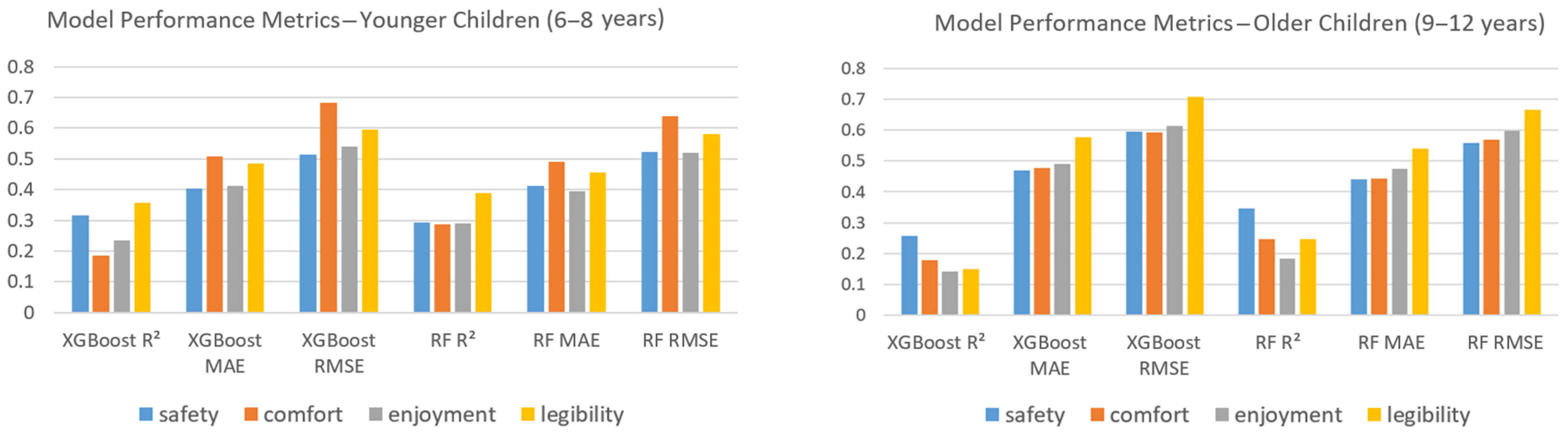
4.3. Machine Learning Model Performance
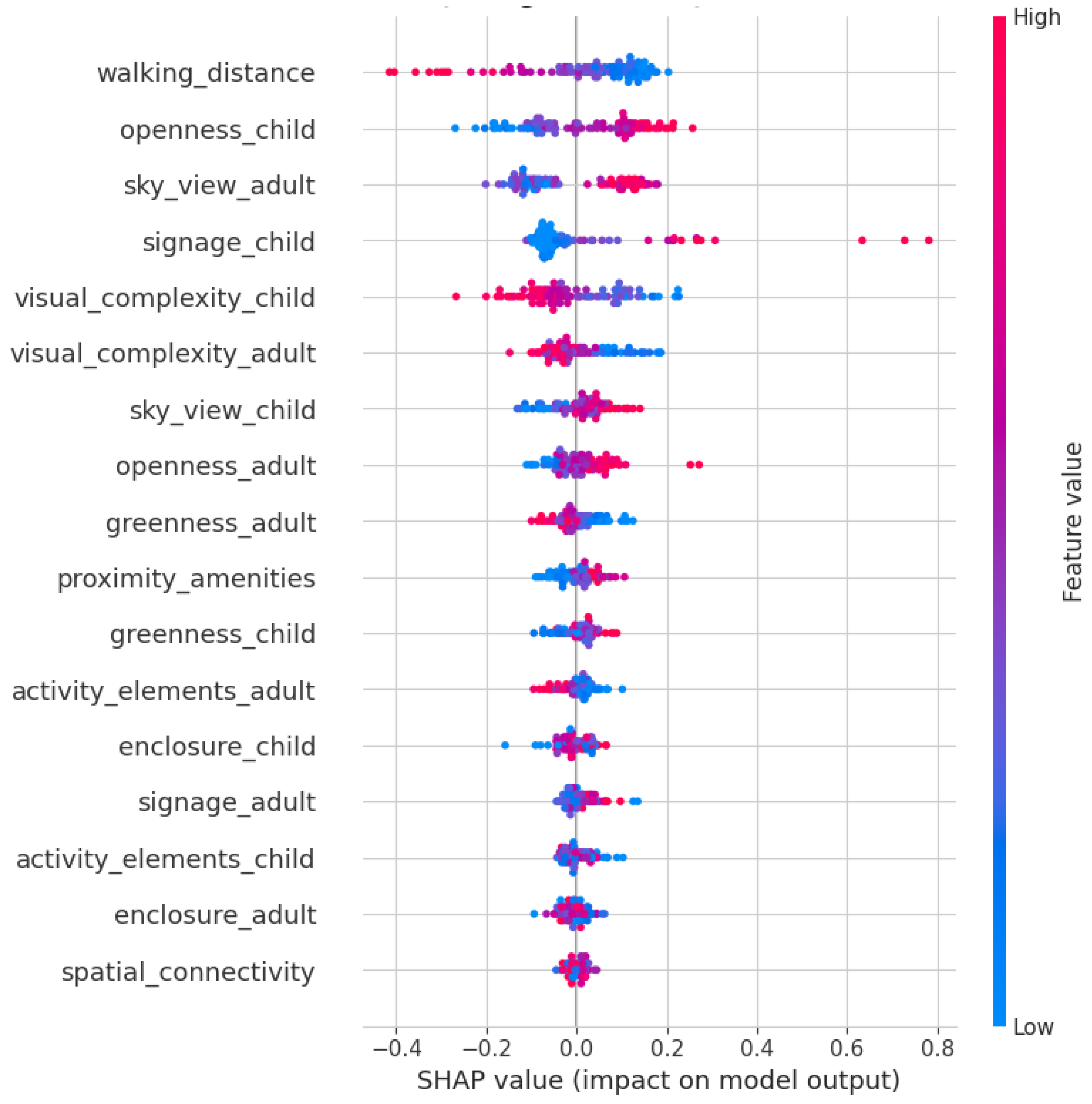
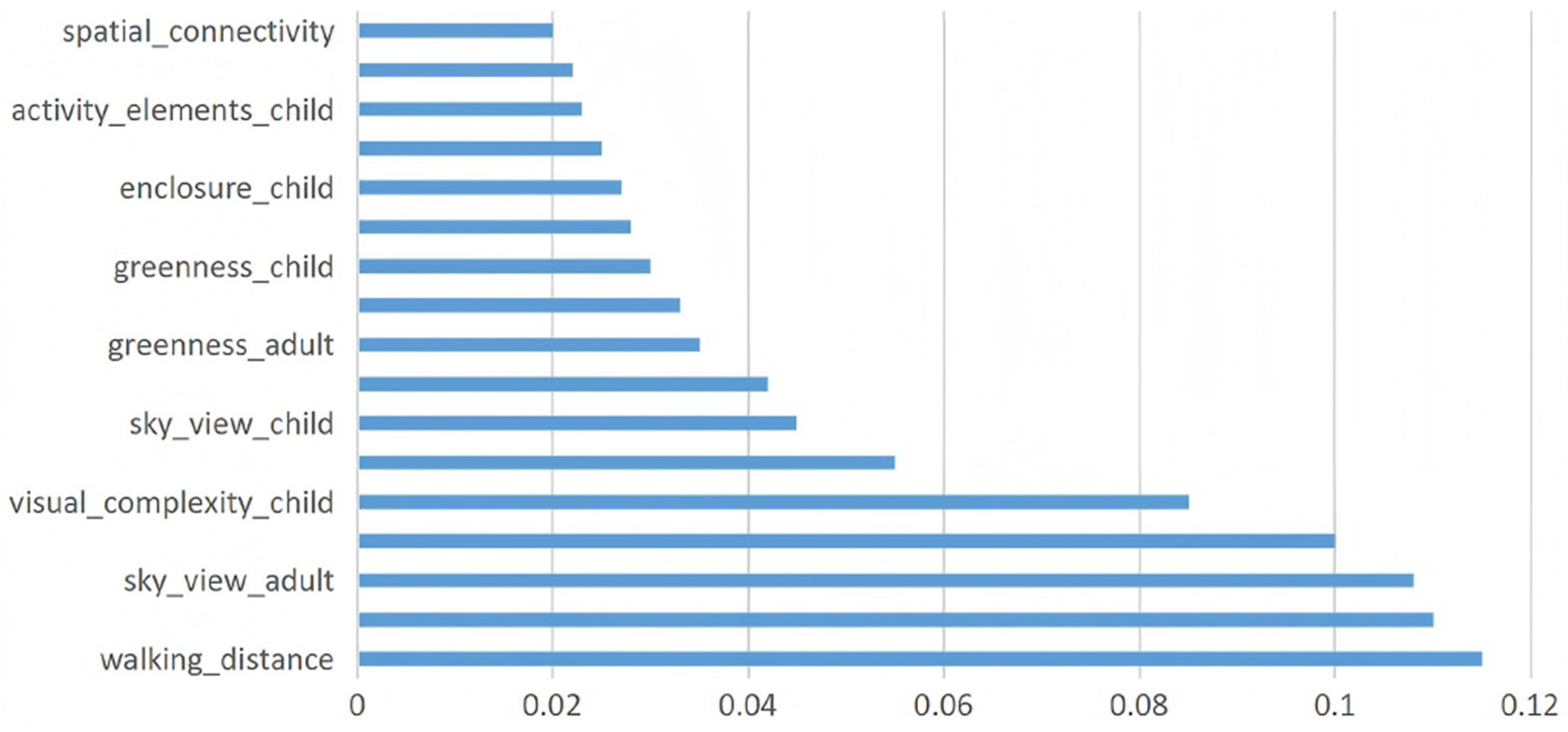
4.4. SHAP Feature Importance Analysis
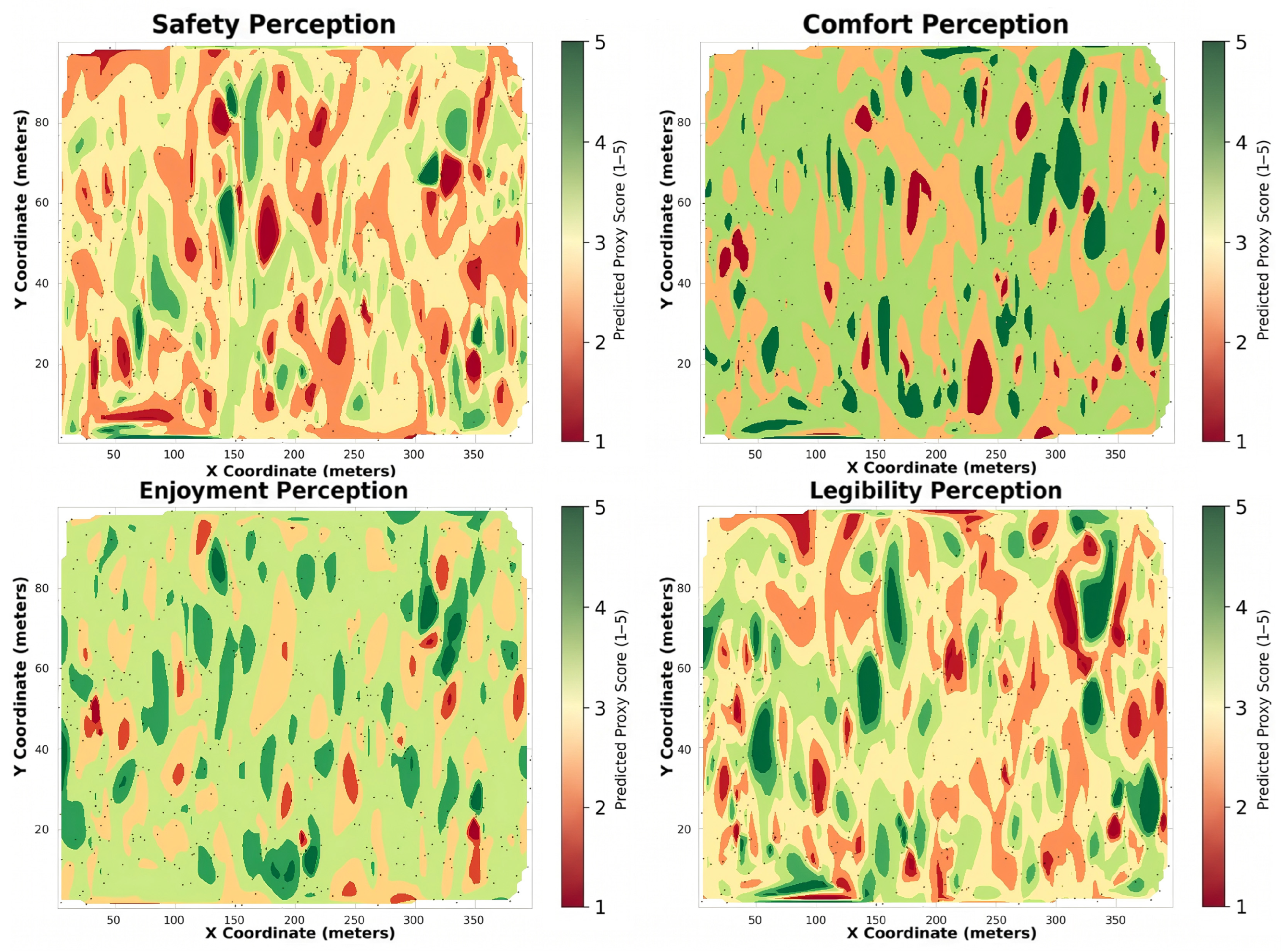
4.5. Spatial Distribution Patterns
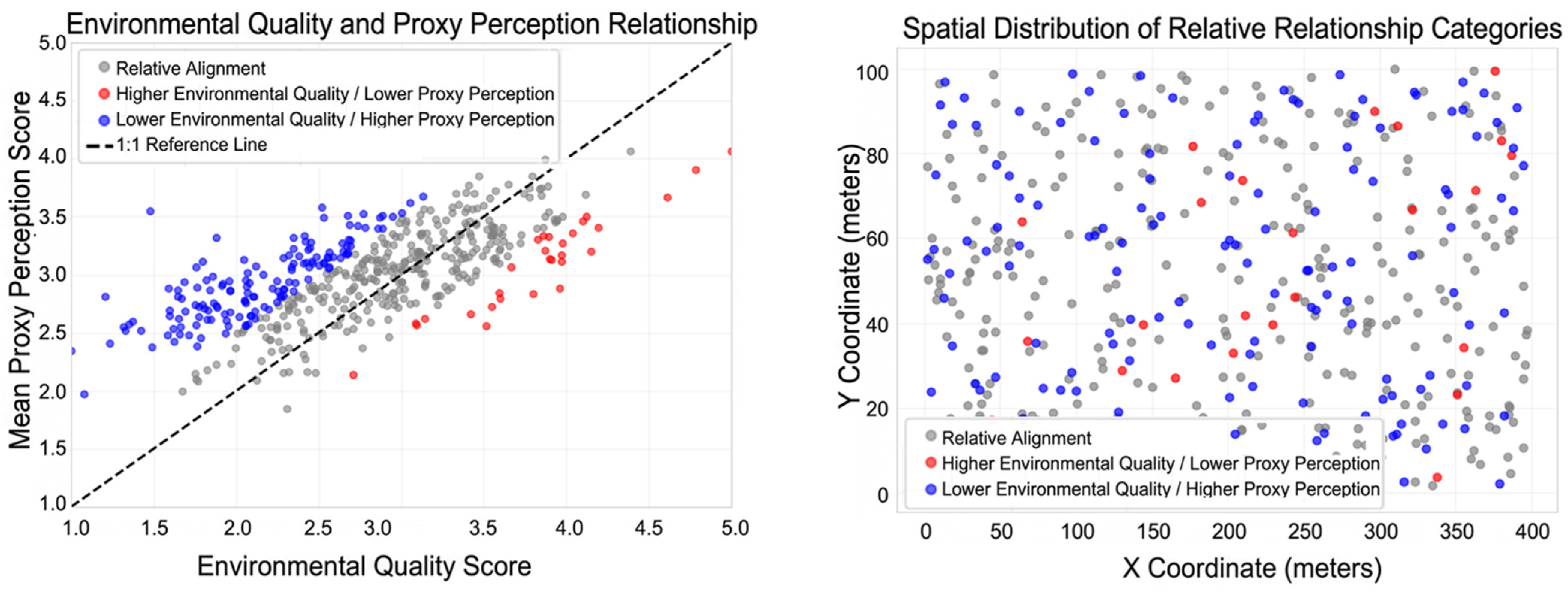
4.6. Spatial Mismatch Analysis
5. Discussion
5.1. Age-Related Differences and Design Implications
5.2. Advantages of the Proxy Assessment Framework over Conventional Methods
5.3. Limitations and Future Research Directions
6. Conclusions
Author Contributions
Funding
Institutional Review Board Statement
Informed Consent Statement
Data Availability Statement
Conflicts of Interest
References
- Ataol, S.; Krishnamurthy, S.; Van Wesemael, P. Children’s Participation in Urban Planning and Design: A Systematic Review. Child. Youth Environ. 2019, 29, 27. [Google Scholar] [CrossRef] [Scilit]
- Nordström, M. Children’s views on child-friendly environments in different geographical, cultural and social neighbourhoods. Urban Stud. 2010, 47, 514–528. [Google Scholar] [CrossRef] [Scilit]
- Yu, M.; Chen, X.; Zheng, X.; Cui, W.; Ji, Q.; Xing, H. Evaluation of spatial visual perception of streets based on deep learning and spatial syntax. Sci. Rep. 2025, 15, 18439. [Google Scholar] [CrossRef] [Scilit]
- Pilarczyk, A.; Kondak, A.; Grzelka, K.; Vizzari, M.; Bieda, A. Assessing the perception of urban landscape from the perspective of residents of multi-storey buildings. Cities 2026, 169, 106594. [Google Scholar] [CrossRef] [Scilit]
- Hodgkiss, A.; Gilligan-Lee, K.A.; Thomas, M.S.C.; Tolmie, A.K.; Farran, E.K. The developmental trajectories of spatial skills in middle childhood. Br. J. Dev. Psychol. 2021, 39, 566–583. [Google Scholar] [CrossRef] [Scilit] [PubMed]
- Fernández-Méndez, L.M.; Contreras, M.J.; Mammarella, I.C.; Feraco, T.; Meneghetti, C. Mathematical achievement: The role of spatial and motor skills in 6–8 year-old children. PeerJ 2020, 8, e10095. [Google Scholar] [CrossRef] [Scilit]
- Lasc, D.; Grinshpun, S.; Bixter, M.T.; Yang, Y. Predicting large-scale spatial ability from small-scale spatial abilities in children: An application of the double-dimension framework. Cognition 2025, 254, 105982. [Google Scholar] [CrossRef] [Scilit] [PubMed]
- Iurchyshyn, O. Involving children in design processes: A systematic review. Civ. Archit. Eng. 2025, 24, 25004. [Google Scholar] [CrossRef] [Scilit]
- Malinverni, L.; Schaper, M.-M.; Pares, N. An evaluation-driven design approach to develop learning environments based on full-body interaction. Educ. Technol. Res. Dev. 2016, 64, 1337–1360. [Google Scholar] [CrossRef] [Scilit]
- Ishikawa, T. Spatial thinking, cognitive mapping, and spatial awareness. Cogn. Process. 2021, 22, 89–96. [Google Scholar] [CrossRef] [Scilit]
- Zhang, J.; Wang, Z.; Antwi, C.O.; Liang, X.; Ge, J. Geospatial Thinking and Sense of Place: The Mediating Role of Creativity. Sustainability 2022, 15, 523. [Google Scholar] [CrossRef] [Scilit]
- Liu, D.; Lou, M. How spatial perception and psychological distance activate immersive experiences for tourists—An expanded study of the mind-body dualism. Kybernetes 2025, ahead of printing. [Google Scholar] [CrossRef] [Scilit]
- Mix, K.S.; Levine, S.C.; Cheng, Y.-L.; Young, C.J.; Hambrick, D.Z.; Konstantopoulos, S. The Latent Structure of Spatial Skills and Mathematics: A Replication of the Two-Factor Model. J. Cogn. Dev. 2017, 18, 465–492. [Google Scholar] [CrossRef] [Scilit]
- Gilligan, K.A.; Flouri, E.; Farran, E.K. The contribution of spatial ability to mathematics achievement in middle childhood. J. Exp. Child Psychol. 2017, 163, 107–125. [Google Scholar] [CrossRef] [Scilit]
- Assel, M.A.; Landry, S.H.; Swank, P.; Smith, K.E.; Steelman, L.M. Precursors to Mathematical Skills: Examining the Roles of Visual-Spatial Skills, Executive Processes, and Parenting Factors. Appl. Dev. Sci. 2003, 7, 27–38. [Google Scholar] [CrossRef] [Scilit]
- Weir, H. Spaces for children’s play and travel close to home: The importance of threshold spaces. Child. Geogr. 2023, 21, 1071–1086. [Google Scholar] [CrossRef] [Scilit]
- Su, C.; Cheng, Y.; Chen, S.; Li, W.; Nie, K.; Ding, Z. Perception of Child-Friendly Streets and Spatial Planning Responses in High-Density Cities Amidst Supply–Demand Disparities. Buildings 2025, 15, 3908. [Google Scholar] [CrossRef] [Scilit]
- Olawade, D.B.; Wada, O.Z.; Ige, A.O.; Egbewole, B.I.; Olojo, A.; Oladapo, B.I. Artificial intelligence in environmental monitoring: Advancements, challenges, and future directions. Hyg. Environ. Health Adv. 2024, 12, 100114. [Google Scholar] [CrossRef] [Scilit]
- Patil, M. Environmental Sustainability in the Age of Deep Learning: Balancing Technological Advancement with Ecological Responsibility. J. Electr. Syst. 2024, 20, 2377–2388. [Google Scholar] [CrossRef] [Scilit]
- Li, R.; Zhao, J.; Fan, Y. Research on CTSA-DeepLabV3+ Urban Green Space Classification Model Based on GF-2 Images. Sensors 2025, 25, 3862. [Google Scholar] [CrossRef] [Scilit]
- Liu, H.; Chen, Y.; Wang, R.; Li, M.; Li, Z. MFA-Deeplabv3+: An improved lightweight semantic segmentation algorithm based on Deeplabv3+. Complex Intell. Syst. 2025, 11, 424. [Google Scholar] [CrossRef] [Scilit]
- Anilkumar, P.; Venugopal, P.; Satheesh Kumar, S.; Jagannadha Naidu, K. Adaptive multilevel attention deeplabv3+ with heuristic based framework for semantic segmentation of aerial images using improved golden jackal optimization algorithm. Results Eng. 2024, 24, 103164. [Google Scholar] [CrossRef] [Scilit]
- Chen, L.-C.; Zhu, Y.; Papandreou, G.; Schroff, F.; Adam, H. Encoder-Decoder with Atrous Separable Convolution for Semantic Image Segmentation. arXiv 2018, arXiv:1802.02611. [Google Scholar] [CrossRef] [Scilit]
- Zhao, H.; Shi, J.; Qi, X.; Wang, X.; Jia, J. Pyramid Scene Parsing Network. arXiv 2016, arXiv:1612.01105. [Google Scholar] [CrossRef] [Scilit]
- Cheng, X.; Chen, J.; Li, J.; Yin, J.; Cheng, Q.; Chen, Z.; Li, X.; You, H.; Han, X.; Zhou, G. Enhanced DeepLabV3+ with OBIA and Lightweight Attention for Accurate and Efficient Tree Species Classification in UAV Images. Sensors 2025, 25, 7501. [Google Scholar] [CrossRef] [Scilit]
- Soundararajan, J.; Kalukin, A.; Malof, J.; Xu, D. Deep Learning-Driven Multi-Temporal Detection: Leveraging DeeplabV3+/Efficientnet-B08 Semantic Segmentation for Deforestation and Forest Fire Detection. Remote Sens. 2025, 17, 2333. [Google Scholar] [CrossRef] [Scilit]
- Wang, Y.; Wang, C.; Wu, H.; Chen, P. An improved Deeplabv3+ semantic segmentation algorithm with multiple loss constraints. PLoS ONE 2022, 17, e0261582. [Google Scholar] [CrossRef] [Scilit]
- Xia, D.; Wu, Z.; Zou, Y.; Chen, R.; Lou, S. Developing a bottom-up approach to assess energy challenges in urban residential buildings of China. Front. Archit. Res. 2025, 14, 6. [Google Scholar] [CrossRef] [Scilit]
- Zou, Y.; Ren, S.; Wu, Z.; Yao, L.; Lou, S.; Li, H.; Huang, Y.; Lin, J. Evaluating the impact of urban climate on building energy: Discrepancies during the hottest period in a sub-tropical city. Energy 2025, 341, 139431. [Google Scholar] [CrossRef] [Scilit]
- Du, S.; Du, S.; Liu, B.; Zhang, X.; Zheng, Z. Large-scale urban functional zone mapping by integrating remote sensing images and open social data. GIScience Remote Sens. 2020, 57, 411–430. [Google Scholar] [CrossRef] [Scilit]
- Chen, T.; Guestrin, C. XGBoost: A Scalable Tree Boosting System. In Proceedings of the 22nd ACM SIGKDD International Conference on Knowledge Discovery and Data Mining, San Francisco, CA, USA, 13–17 August 2016; pp. 785–794. [Google Scholar] [CrossRef] [Scilit]
- Chen, J.; Li, P.; Lei, Y.; Li, H.; Zhang, D.; Chen, B.; Liu, J.; Schnabel, M.A. Unraveling the nexus between spatial quality and buzz behavior: Analyzing geo-tagged social media and multisource spatial data using text mining and XGBoost. Appl. Geogr. 2026, 186, 103858. [Google Scholar] [CrossRef] [Scilit]
- Li, T.; Xu, H.; Sun, H. Spatial Patterns and Multi-Dimensional Impact Analysis of Urban Street Quality Perception under Multi-Source Data: A Case Study of Wuchang District in Wuhan, China. Appl. Sci. 2023, 13, 11740. [Google Scholar] [CrossRef] [Scilit]
- Ahmadi, E.; Taniguchi, G. Influential Factors on Children′s Spatial Knowledge and Mobility in Home–School Travel A Case Study in the City of Tehran. J. Asian Archit. Build. Eng. 2007, 6, 275–282. [Google Scholar] [CrossRef] [Scilit]
- Wang, R.; Lu, Y.; Zhang, J.; Liu, P.; Yao, Y.; Liu, Y. The relationship between visual enclosure for neighbourhood street walkability and elders’ mental health in China: Using street view images. J. Transp. Health 2019, 13, 90–102. [Google Scholar] [CrossRef] [Scilit]
- Liu, X.; Lu, P.; Van Ameijde, J. Development of a machine-simulated human scoring model for assessing child-friendly street environments: A case study of Sham Shui Po, Hong Kong SAR, China. J. Chin. Archit. Urban. 2024, 7, 3578. [Google Scholar] [CrossRef] [Scilit]
- Lundberg, S.; Lee, S.-I. A Unified Approach to Interpreting Model Predictions. arXiv 2017, arXiv:1705.07874. [Google Scholar] [CrossRef] [Scilit]
- Li, Z. Extracting spatial effects from machine learning model using local interpretation method: An example of SHAP and XGBoost. Comput. Environ. Urban Syst. 2022, 96, 101845. [Google Scholar] [CrossRef] [Scilit]
- Xie, W.; Yao, L.; Xia, D.; Zou, Y.; Lou, S.; Yang, L. Occupant behavior and building type jointly shape indoor heat stress in Guangzhou urban villages. Build. Environ. 2026, 296, 114505. [Google Scholar] [CrossRef] [Scilit]
- Jansson, M.; Herbert, E.; Zalar, A.; Johansson, M. Child-Friendly Environments—What, How and by Whom? Sustainability 2022, 14, 4852. [Google Scholar] [CrossRef] [Scilit]
- Kee, T.; Ho, W.K.O. EXplainable Machine Learning for Real Estate: XGBoost and Shapley Values in Price Prediction. Civ. Eng. J. 2025, 11, 2116–2133. [Google Scholar] [CrossRef] [Scilit]
- Chen, L.; Cai, X.; Liu, Z. Multi-Source Data and Semantic Segmentation: Spatial Quality Assessment and Enhancement Strategies for Jinan Mingfu City from a Tourist Perception Perspective. Buildings 2025, 15, 2298. [Google Scholar] [CrossRef] [Scilit]
- Zhang, F.; Zhou, B.; Liu, L.; Liu, Y.; Fung, H.H.; Lin, H.; Ratti, C. Measuring human perceptions of a large-scale urban region using machine learning. Landsc. Urban Plan. 2018, 180, 148–160. [Google Scholar] [CrossRef] [Scilit]
- Cordts, M.; Omran, M.; Ramos, S.; Rehfeld, T.; Enzweiler, M.; Benenson, R.; Franke, U.; Roth, S.; Schiele, B. The Cityscapes Dataset for Semantic Urban Scene Understanding. arXiv 2016, arXiv:1604.01685. [Google Scholar] [CrossRef] [Scilit]
- Lou, S.; Huang, Y.; Zou, Y.; Xia, D. Mapping the mismatch between building and population growth: A global study of 1700 cities. iScience 2025, 28, 113289. [Google Scholar] [CrossRef] [Scilit] [PubMed]
- Kyttä, M. The extent of children’s independent mobility and the number of actualized affordances as criteria for child-friendly environments. J. Environ. Psychol. 2004, 24, 179–198. [Google Scholar] [CrossRef] [Scilit]





| Variable | Mean | Std Dev | Min | Max |
|---|---|---|---|---|
| Greenness adult | 0.291 | 0.153 | 0.007 | 0.738 |
| Openness adult | 0.504 | 0.192 | 0.03 | 0.969 |
| Enclosure adult | 0.491 | 0.217 | 0 | 1 |
| Signage adult | 0.198 | 0.128 | 0.006 | 0.622 |
| Activity elements adult | 0.194 | 0.132 | 0.001 | 0.743 |
| Visual complexity adult | 0.486 | 0.163 | 0.152 | 0.927 |
| Sky view adult | 0.503 | 0.195 | 0 | 0.97 |
| Greenness child | 0.34 | 0.17 | 0 | 0.866 |
| Openness child | 0.406 | 0.199 | 0 | 0.912 |
| Enclosure child | 0.637 | 0.219 | 0.033 | 1 |
| Signage child | 0.068 | 0.106 | 0 | 0.57 |
| Activity elements child | 0.291 | 0.14 | 0.012 | 0.798 |
| Visual complexity child | 0.593 | 0.182 | 0.066 | 1 |
| Sky view child | 0.409 | 0.205 | 0 | 1 |
| Perception Dimension | Younger Children (6–8 years) | Older Children (9–12 years) | Difference | |
|---|---|---|---|---|
| 0 | Safety | 2.663 | 3.108 | 0.444 |
| 1 | Comfort | 3.2 | 3.205 | 0.005 |
| 2 | Enjoyment | 3.327 | 3.135 | −0.192 |
| 3 | Legibility | 2.825 | 2.951 | 0.126 |
| Perception | XGBoost R2 | XGBoost MAE | XGBoost RMSE | RF R2 | RF MAE | RF RMSE | |
|---|---|---|---|---|---|---|---|
| 0 | safety | 0.3153 | 0.4037 | 0.5135 | 0.2938 | 0.4109 | 0.5216 |
| 1 | comfort | 0.1847 | 0.5091 | 0.6818 | 0.2863 | 0.4916 | 0.6379 |
| 2 | enjoyment | 0.2358 | 0.4129 | 0.5387 | 0.2913 | 0.3959 | 0.5187 |
| 3 | legibility | 0.3563 | 0.4845 | 0.5963 | 0.3897 | 0.4544 | 0.5807 |
| Perception | XGBoost R2 | XGBoost MAE | XGBoost RMSE | RF R2 | RF MAE | RF RMSE | |
|---|---|---|---|---|---|---|---|
| 0 | safety | 0.2562 | 0.4706 | 0.5963 | 0.3463 | 0.4414 | 0.559 |
| 1 | comfort | 0.1775 | 0.4765 | 0.5941 | 0.2454 | 0.4425 | 0.569 |
| 2 | enjoyment | 0.141 | 0.4916 | 0.6148 | 0.1835 | 0.475 | 0.5993 |
| 3 | legibility | 0.1497 | 0.5776 | 0.7094 | 0.2467 | 0.5416 | 0.6677 |
Disclaimer/Publisher’s Note: The statements, opinions and data contained in all publications are solely those of the individual author(s) and contributor(s) and not of MDPI and/or the editor(s). MDPI and/or the editor(s) disclaim responsibility for any injury to people or property resulting from any ideas, methods, instructions or products referred to in the content. |
© 2026 by the authors. Licensee MDPI, Basel, Switzerland. This article is an open access article distributed under the terms and conditions of the Creative Commons Attribution (CC BY) license.
Share and Cite
Shen, Y.; Zhu, S.; Zhang, F. A Dual-Height AI Framework for Proxy Assessment of Children’s Spatial Perception in a Large Cultural Complex. Buildings 2026, 16, 2030. https://doi.org/10.3390/buildings16102030
Shen Y, Zhu S, Zhang F. A Dual-Height AI Framework for Proxy Assessment of Children’s Spatial Perception in a Large Cultural Complex. Buildings. 2026; 16(10):2030. https://doi.org/10.3390/buildings16102030
Chicago/Turabian StyleShen, Yingying, Shuyan Zhu, and Fei Zhang. 2026. "A Dual-Height AI Framework for Proxy Assessment of Children’s Spatial Perception in a Large Cultural Complex" Buildings 16, no. 10: 2030. https://doi.org/10.3390/buildings16102030
APA StyleShen, Y., Zhu, S., & Zhang, F. (2026). A Dual-Height AI Framework for Proxy Assessment of Children’s Spatial Perception in a Large Cultural Complex. Buildings, 16(10), 2030. https://doi.org/10.3390/buildings16102030