Multi-Dimensional Urban Waterfront Landscape Attributes and Recreational Vitality: Correlations and Strategies Based on the Beijing-Hangzhou Grand Canal


Abstract
1. Introduction
2. Research Methods
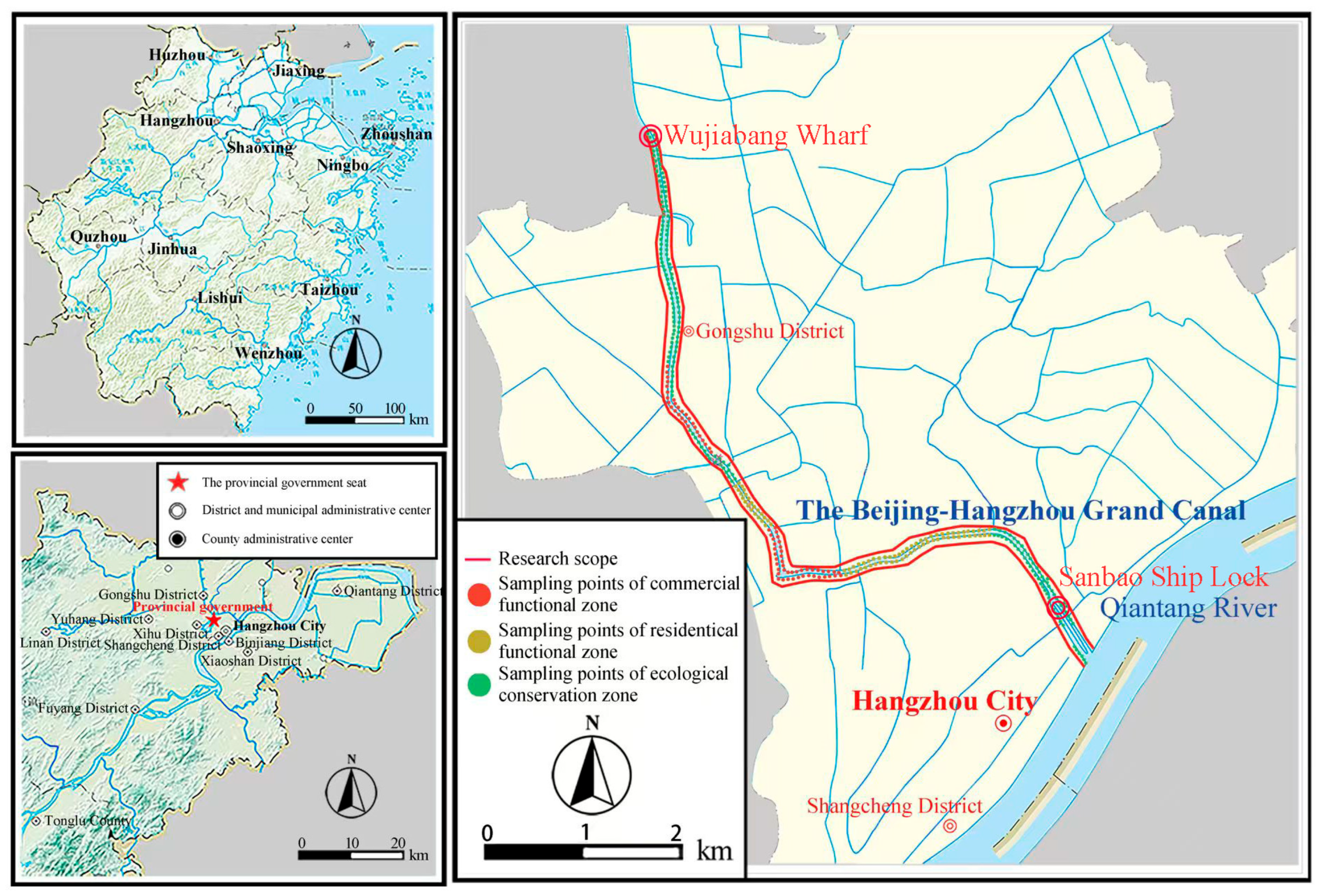
2.1. Study Area
2.2. Spatial Sample Selection for the Beijing–Hangzhou Grand Canal (Hangzhou Section)
2.3. Research Framework and Robustness Validation
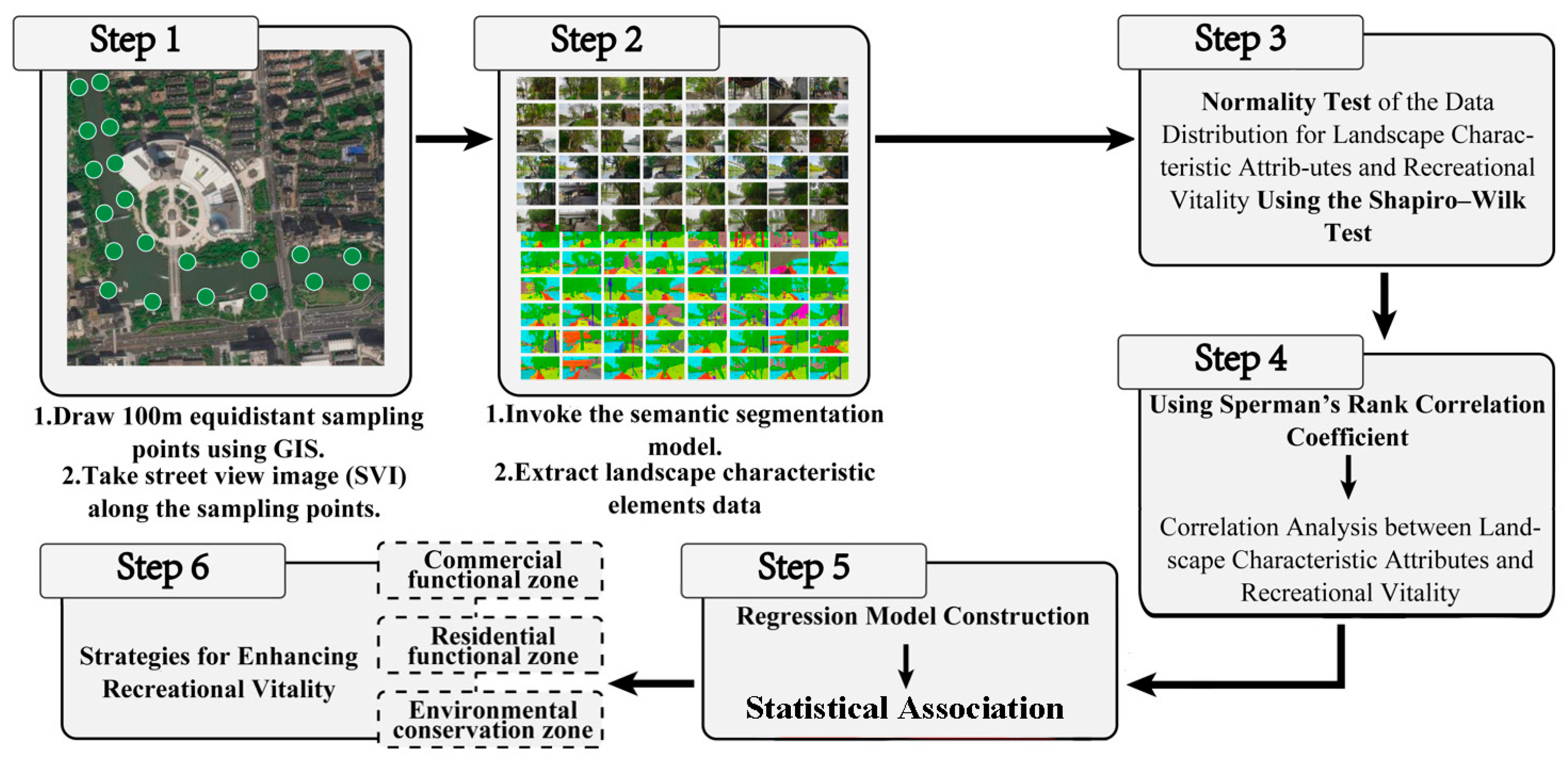
2.3.1. Research Framework
- (1)
- Construction of a systematic indicator system for landscape characteristic attributes in the waterfront space of the Beijing–Hangzhou Grand Canal (Hangzhou section).
- (2)
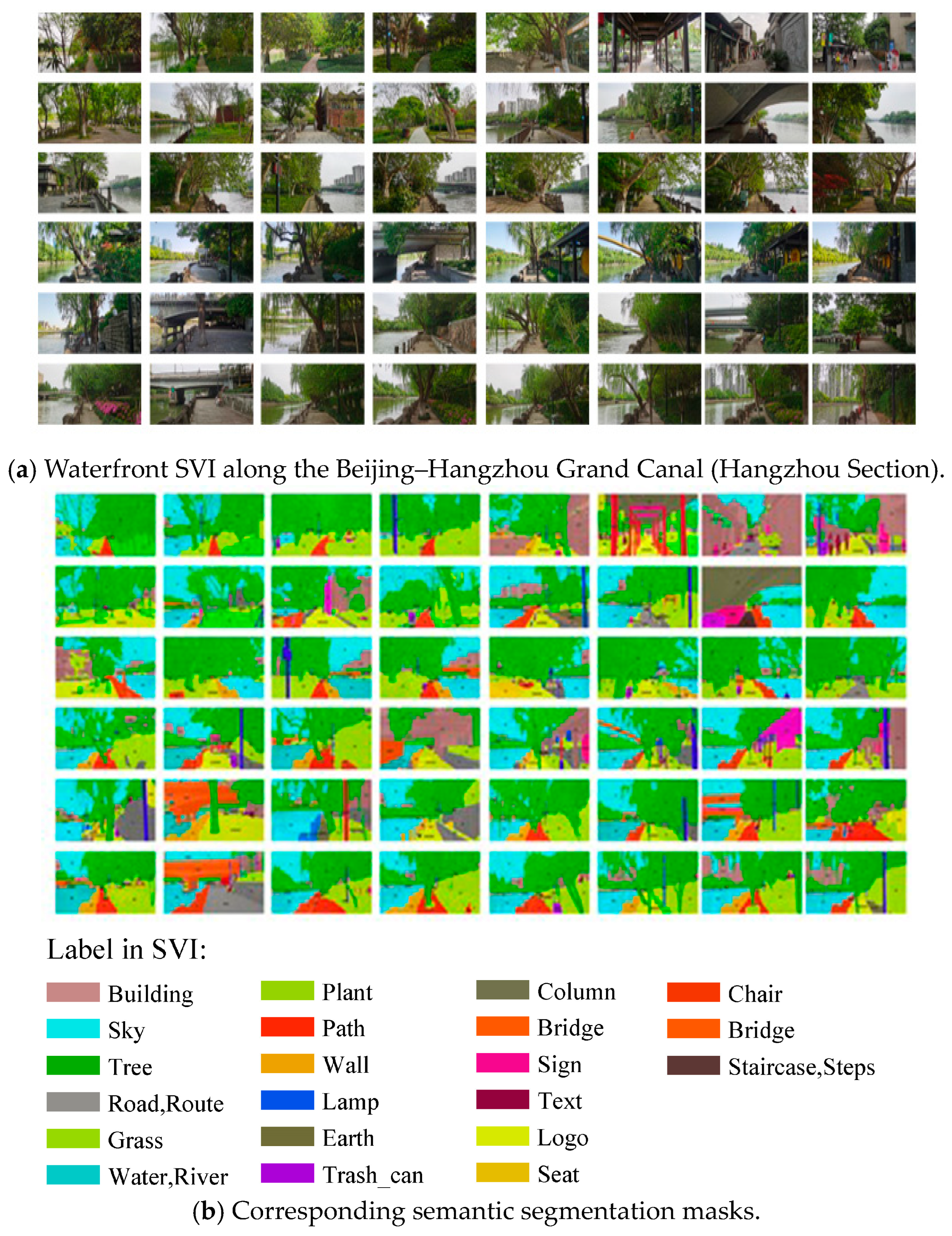
- Identification and quantification of waterfront landscape characteristic attributes based on the Mask2Former semantic segmentation model.
- (3)
- Normality test of the data distributions for landscape characteristic attributes and recreational vitality using the Shapiro–Wilk test.
- (4)
- Correlation analysis between landscape characteristic attributes and recreational vitality based on Spearman’s correlation coefficient.
- (5)
- Quantitative analysis of the statistical association via regression model construction.
- (6)
- Formulation of strategies for enhancing recreational vitality in the waterfront space of the Beijing–Hangzhou Grand Canal (Hangzhou section).
2.3.2. Robustness Validation
2.4. Data Collection and Processing
3. Indicator System Construction
3.1. Recreational Vitality
3.2. Waterfront Landscape Characteristic Attributes
4. Results
4.1. Spatiotemporal Differentiation Characteristics of Recreational Vitality in the Beijing–Hangzhou Grand Canal (Hangzhou Section)
- (1)
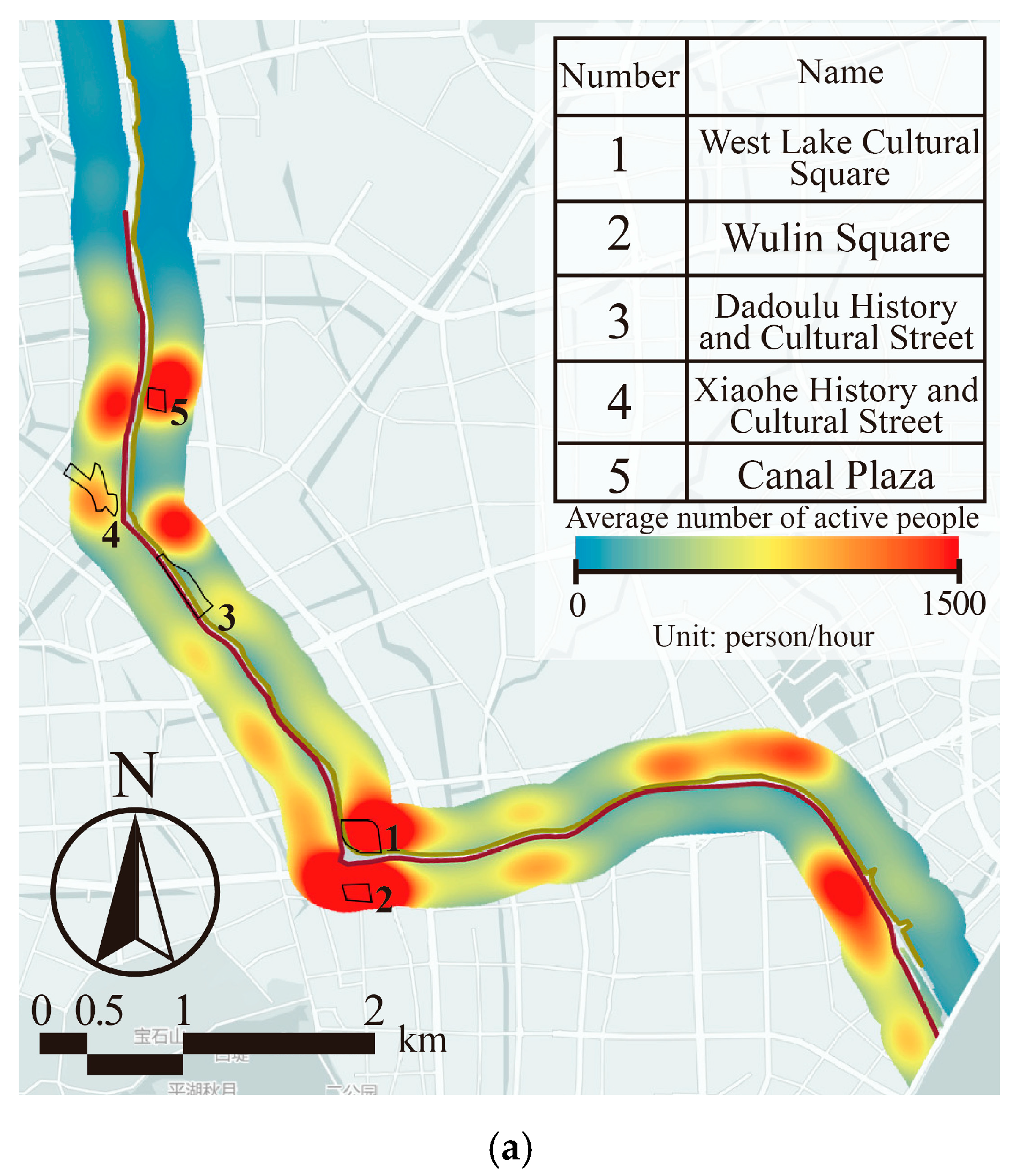
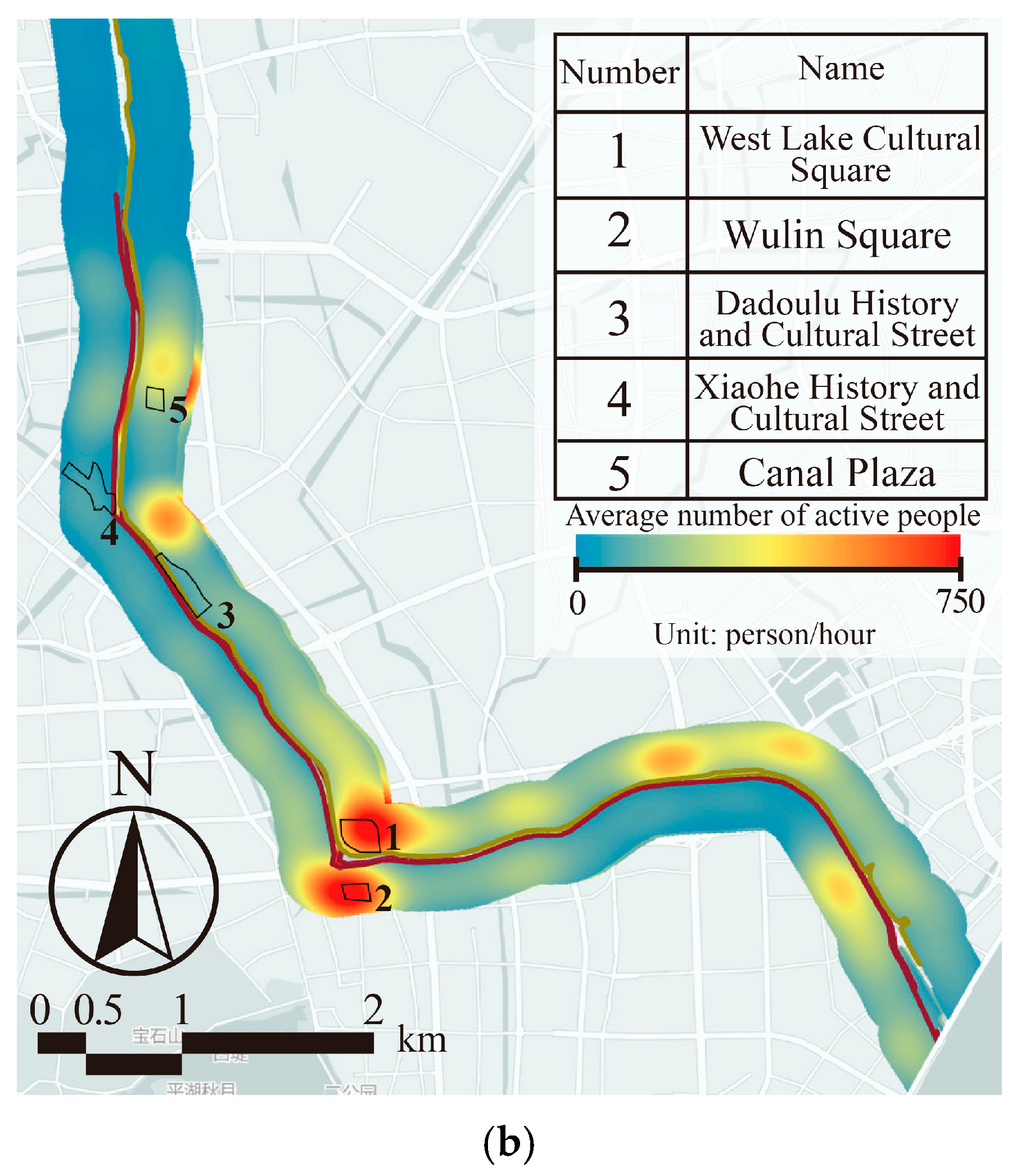
- Spatial Pattern Characteristics: During both holidays and workdays, spatially, the recreational vitality in the study area exhibits prominent linear agglomeration patterns along the canal corridor, consistently conforming to the spatial gradient differentiation rule of “lower in the east and higher in the west, lower in the north and higher in the south”. High-vitality agglomeration zones are primarily distributed in urban core areas characterized by high population density, vibrant commercial activities, high traffic accessibility, and well-developed supporting facilities, specifically including Canal Square, Wulin Square, West Lake Culture Square, and other similar areas. In contrast, peripheral sections distant from the urban core with relatively low development levels remain at a persistently low vitality level throughout the entire observation period.
- (2)
- Temporal Evolution Characteristics: The overall recreational vitality of the canal waterfront space is significantly higher on holidays than on workdays, with marked disparities in the spatial coverage of high-vitality zones. During holidays, the elevated vitality in core commercial zones (e.g., Canal Square and Wulin Square) is not only further intensified but also gradually extends to representative historical and cultural blocks (including Dadou Road and Xiaohe Historical and Cultural Block), thereby forming contiguous high-intensity vitality clusters. By contrast, the spatial distribution of recreational vitality on workdays is more concentrated, with high-intensity activity hotspots primarily restricted to the central commercial functional zone of the urban core.
- (3)
- Temporal Stability Characteristics: The waterfront spaces within commercial functional sections along the Beijing–Hangzhou Grand Canal (Hangzhou section) maintain consistently high daily average activity intensity and recreational vitality density throughout the entire observation period, serving as the most stable core vitality nodes across the urban area. Recreational vitality in these sections displays the least temporal fluctuation and the strongest temporal stability, and is resilient to periodic holiday–workday temporal variations. This stability is further corroborated by inter-segment comparisons of vitality dynamics: recreational vitality drops sharply in non-core sections on workdays, whereas only a modest, gradual reduction is detected in commercial functional sections.


4.2. Correlation Analysis Between Waterfront Landscape Characteristic Attributes and Recreational Vitality
- (1)
- Among all the landscape characteristic indicators included in this study, Sky View Factor (SVF), Visual Openness Index (VOI), Enclosure Interface View Factor (EIVF), Text Signage View Factor (TSVF), Hard Pavement View Factor (HPVF), and Natural Surface View Factor (NSVF) are identified as the six core driving indicators that exert statistically significant effects on recreational vitality.
- (2)
- Core landscape characteristics related to spatial enclosure (including Sky View Factor (SVF), Enclosure Interface View Factor (EIVF), High-rise Green View Factor (HGVF), and Visual Openness Index (VOI)) all exhibit stable and statistically significant correlations with recreational vitality. By contrast, no statistically significant correlation between recreational vitality and most indicators related to landscape visual features and service facility allocation was observed.
- (3)
- The Enclosure Interface View Factor (EIVF) exhibits a significant negative correlation with recreational vitality. This finding indicates that the visual accessibility of historical and cultural landscapes in waterfront areas is closely associated with the allocation of public service facilities and the rational layout of the built environment, which in turn affects the efficiency of recreational activities and the overall experience of users.
- (4)
- Both the Sky View Factor (SVF) and Visual Openness Index (VOI) demonstrate a significant negative correlation with recreational vitality. One plausible mechanism underlying this correlation is the impairment of thermal comfort induced by excessive solar radiation: waterfront areas characterized by high visual openness and insufficient shading are more prone to direct solar radiation exposure, which elevates both surface and ambient air temperatures. This thermal environment degradation subsequently reduces users’ perceived thermal comfort, thereby discouraging users from prolonged stays in such areas.
- (1)
- Compared with holidays, the negative associations between Hard Pavement View Factor (HPVF), Text Signage View Factor (TSVF) and recreational vitality are more pronounced and statistically significant on workdays. A potential mechanism underlying this observation is that the primary user groups in waterfront spaces on workdays are efficiency-driven commuters and transient passersby. Hard-paved areas without adequate shading intensify exposure to solar thermal radiation and substantially reduce users’ perceived thermal comfort. For commuters, such spaces merely function as quick-passage corridors that are unsuitable for lingering or recreational engagement, thereby strengthening the negative relationships between these two landscape indicators and recreational vitality.
- (2)
- Four core indicators—Low-rise Green View Factor (LGVF), Vertical Spatial Change Rate (VSCR), Cross River Connectivity (CRC), and Landscape Element Richness (LER)—exhibit heterogeneous effects on recreational vitality between holidays and workdays. A plausible mechanism underlying this phenomenon is the divergence in dominant user behaviors and activity patterns across different time periods. Specifically, holiday visitors are primarily motivated by leisure-oriented demands, with a focus on sensory experiences and landscape appreciation, thus showing a stronger correlation with recreational vitality. In contrast, workday users are mainly efficiency-driven commuters, whose core needs center on rapid transit and basic service access rather than leisure engagement. Among these indicators, Low-rise Green View Factor (LGVF) and Landscape Element Richness (LER) are significantly positively correlated with recreational vitality, while Vertical Spatial Change Rate (VSCR) and Cross River Connectivity (CRC) display relatively weak correlations with vitality levels. This suggests that the optimization of low-rise vegetation coverage and landscape diversity plays a more critical role in enhancing waterfront recreational vitality than traffic accessibility and connectivity.
4.3. Non-Linear Regression Analysis of Key Landscape Characteristic Attributes on Recreational Vitality Across Functional Zoning Types
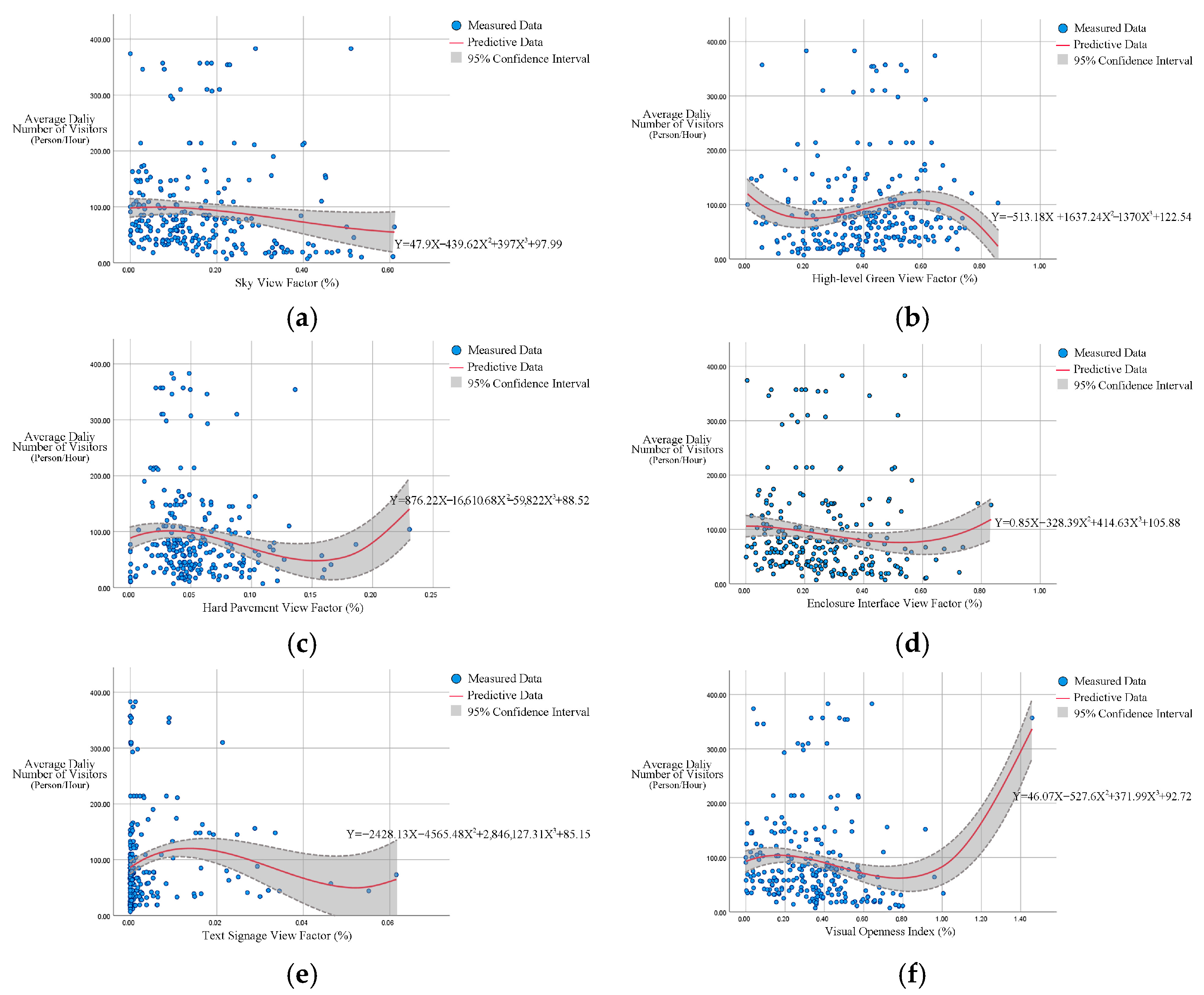
4.3.1. Non-Linear Regression Analysis for the Commercial Functional Zone
- (1)
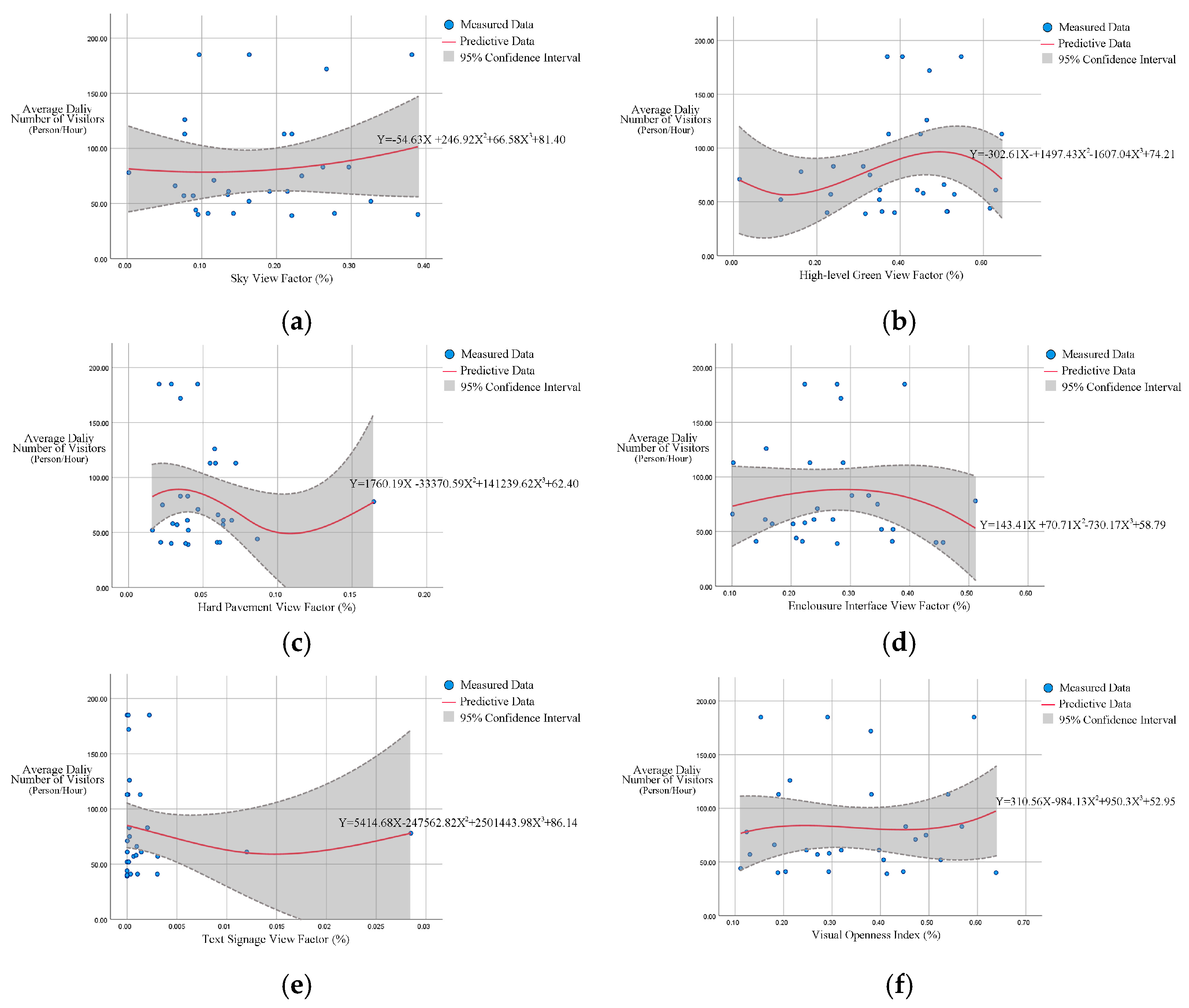
- Both Sky View Factor (SVF) and Visual Openness Index (VOI) demonstrate a significant unimodal inverted U-shaped nonlinear correlation with recreational vitality, indicating the existence of an optimal spatial openness interval. Within this interval, spatial openness effectively enhances the visibility of commercial facades and the clarity of place identity. Once exceeding the critical threshold, excessive openness leads to inadequate shading, blurred spatial boundaries, and loss of place sense, thereby significantly reducing users’ dwell time and consumption willingness.
- (2)
- The Enclosure Interface View Factor (EIVF) demonstrates a weakly positive, increasing nonlinear correlation with recreational vitality, indicating that the enhancement of recreational vitality in commercial waterfront spaces relies on continuous, well-defined street wall interfaces. Such interfaces not only cultivate a consumption environment featuring a strong sense of security and territoriality, but also promote pedestrian agglomeration through the spatial enclosure effect, thereby enhancing the immersive commercial experience.
- (3)
- When the High-rise Green View Factor (HGVF) surpasses the critical threshold of 0.416, its impact on recreational vitality undergoes a directional reversal. This finding indicates that greening design strategies in commercial waterfront spaces ought not to blindly pursue a high green view index; instead, the compatibility between greening configurations and commercial display functions must be comprehensively considered to prevent excessive shading of commercial signs and building facades by upper-layer arbor vegetation.
- (4)
- The Text Signage View Factor (TSVF) exhibits a significant positive linear correlation with recreational vitality, confirming the fundamental role of spatial wayfinding systems in commercial waterfront spaces. A well-defined, legible and hierarchically structured signage system effectively enhances spatial legibility and accessibility, serving as a crucial driver to promote pedestrian flow conversion efficiency and improve commercial operation efficiency.
- (5)
- The Hard Pavement View Factor (HPVF) exhibits a significant U-shaped nonlinear correlation with recreational vitality, indicating that commercial waterfront spaces require an optimal balance between hard pavement and green space allocation. An excessively low proportion of hard pavement cannot meet the requirements of high-intensity pedestrian flow intensity and commercial activity operation, whereas an excessively high proportion results in inadequate spatial ecological performance and diminished user comfort.
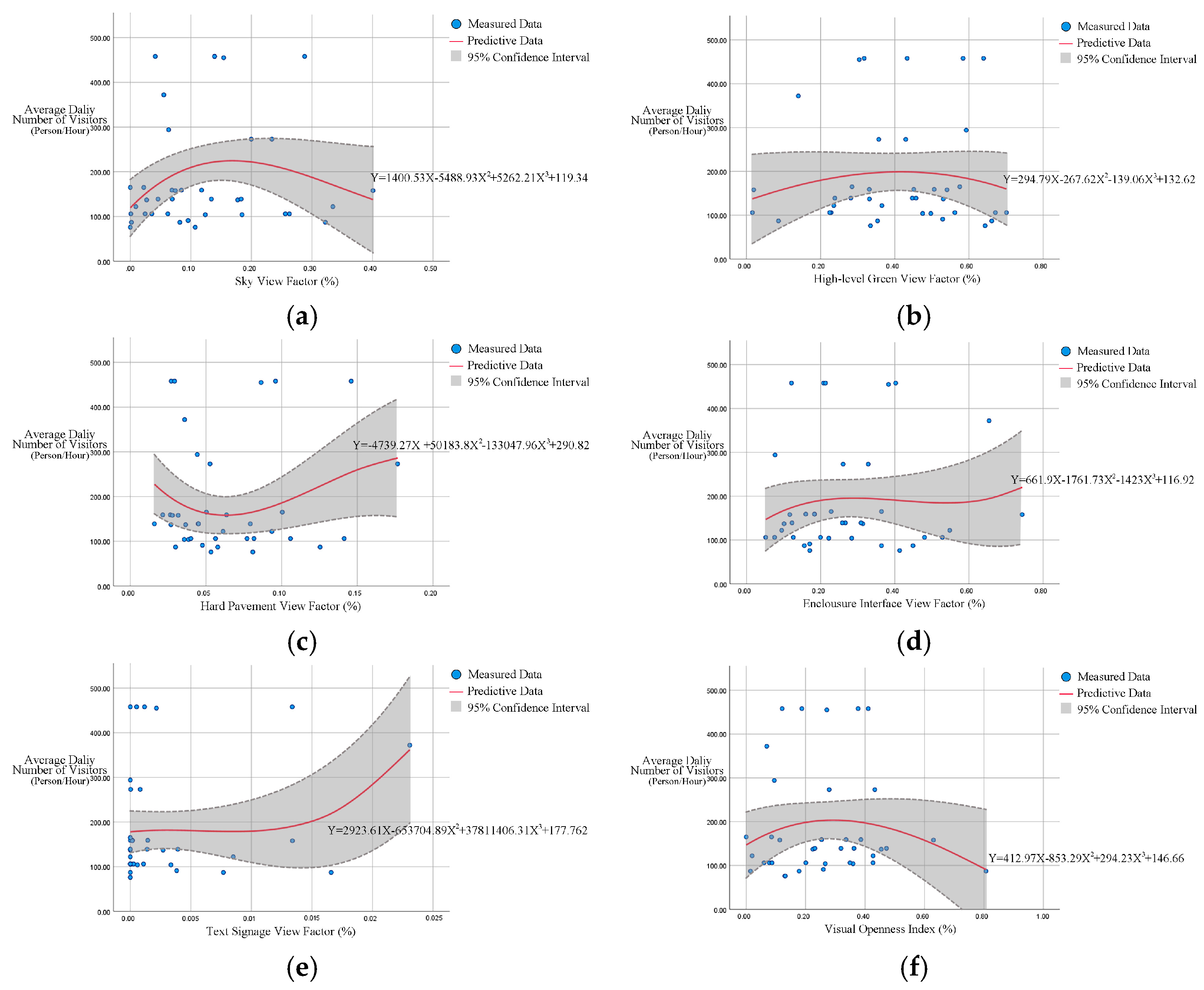
4.3.2. Non-Linear Regression Analysis for the Residential Functional Zone
- (1)
- The Sky View Factor (SVF) exhibits a statistically significant positive nonlinear correlation with recreational vitality, which can effectively enhance residents’ natural lighting experience and their perception of unobstructed waterfront vistas, thereby boosting their willingness to participate in daily recreational activities.
- (2)
- The Enclosure Interface View Factor (EIVF) exhibits a statistically significant unimodal inverted U-shaped nonlinear correlation with recreational vitality: specifically, when the EIVF value is below the critical threshold, excessive spatial openness is prone to impair the sense of place and territoriality; when the EIVF value exceeds the critical threshold, excessive spatial enclosure induces a strong sense of spatial oppression and visual constraint among users.
- (3)
- The nonlinear response relationships between the Hard Pavement View Factor (HPVF) and High-rise Green View Factor (HGVF) with recreational vitality exhibit a statistically significant trade-off and complementary relationship. This finding profoundly reflects the inherent planning contradictions and tensions between artificial construction demands and natural ecological supply under the constraints of high-density urban residential contexts, and highlights the core planning principle of synergistic integration rather than antagonistic confrontation between artificial activity spaces and natural ecological landscapes.
- (4)
- The Text Signage View Factor (TSVF) exhibits a statistically significant U-shaped nonlinear response relationship with recreational vitality, which is characterized by a statistically validated trend of initial decrease followed by an upward trajectory. This finding reveals two optimal design strategies for signage systems in residential waterfront spaces: one is to construct a quiet, natural ecological environment with extremely low information density to cater to residents’ demands for leisure, relaxation, and natural healing; the other is to foster a robust community culture and interactive atmosphere with high information density (e.g., community bulletin boards, cultural display panels, and activity guide signs) to meet residents’ needs for community participation and social interaction.
4.3.3. Non-Linear Regression Analysis for the Ecological Conservation Zone
- (1)
- The Sky View Factor (SVF) displays a decreasing nonlinear negative correlation, whereas the Visual Openness Index (VOI) exhibits a characteristic unimodal U-shaped nonlinear correlation. This finding implies that in ecological conservation zones, fully open and unshaded spaces possess relatively low recreational attractiveness, whereas the moderate and sufficient canopy coverage established by native mature vegetation can substantially enhance thermal comfort conditions, thereby serving as the core driving factor for boosting the recreational vitality of ecological zones.
- (2)
- The Hard Pavement View Factor (HPVF) and High-level Green View Factor (HGVF) demonstrate a distinct yet complementary relationship characterized by significant dynamic trade-offs. This indicates that large-scale interventions involving hardscape renovation and intensified commercial development substantially degrade ecosystem integrity, which in turn undermines the area’s recreational attractiveness.
- (3)
- The Enclosure Interface View Factor (EIVF) initially registers low, fluctuating values before transitioning to a marked, positive nonlinear correlation. This pattern suggests that moderate spatial enclosure, shaped by natural landforms and native vegetation, fosters perceived tranquility and enhances environmental immersion, thereby supporting a high-quality natural recreational experience.
- (4)
- The Text Signage View Factor (TSVF) exerts a marginally positive effect at minimal levels but shifts to a suppressive influence upon exceeding a critical threshold. This result reinforces that the appeal of ecological conservation–oriented waterfront spaces stems primarily from their inherent natural attributes, whereas proliferating artificial signage detracts from the immersive natural ambiance.
4.4. Comparative Analysis Across Functional Zones: Functional Heterogeneity in Influence Mechanisms
- (1)
- Differences in the effects of spatial openness and enclosure on recreational vitality across different functional types.
- (2)
- Trade-offs between hard landscape and green space functions across different functional types.
- (3)
- Effects of the Text Signage View Factor (TSVF) on recreational vitality across different functional types.
4.5. Summary of Research Findings
- (1)
- Recreational vitality exhibits significant spatiotemporal heterogeneity. Spatially, it adheres to a distinct linear agglomeration pattern along the canal corridor, aligning with an overall spatial gradient of “lower in the east and higher in the west, and lower in the north and higher in the south”. Temporally, the overall vitality level is markedly higher on holidays than on workdays. Meanwhile, recreational vitality in the commercial functional zones of the Beijing–Hangzhou Grand Canal (Hangzhou section) remains consistently elevated across all observed periods with minimal fluctuation, demonstrating limited sensitivity to the holiday–workday cycle and thus exhibiting strong temporal stability.
- (2)
- Sky View Factor (SVF), High-level Green View Factor (HGVF), Hard Pavement View Factor (HPVF), Enclosure Interface View Factor (EIVF), Text Signage View Factor (TSVF), and Visual Openness Index (VOI) exert a significant influence on recreational vitality. Among these, SVF, EIVF, and VOI consistently show significant negative correlations with recreational vitality during both holiday and workday periods. Several other landscape characteristic attributes—including Low-level Green View Factor (LGVF), Vertical Spatial Change Rate (VSCR), Cross-River Connectivity (CRC), and Landscape Element Richness (LER)—exhibit considerable temporal heterogeneity in their associations with recreational vitality.
- (3)
- The influences of the Sky View Factor (SVF), the Enclosure Interface View Factor (EIVF), and the Visual Openness Index (VOI) on recreational vitality differ across functional zone types. A pronounced trade-off relationship characterizes the Hard Pavement View Factor (HPVF) and the High-level Green View Factor (HGVF) in commercial functional zones, whereas in residential living and ecological conservation zones, these factors display a complementary relationship. Meanwhile, the influence of the Text Signage View Factor (TSVF) on recreational vitality demonstrates functional specificity, being most pronounced in commercial functional zones and least evident in ecological conservation zones.
5. Discussion
5.1. Impacts of Key Landscape Characteristic Attributes on Recreational Vitality
5.2. Strategies for Enhancing Recreational Vitality
- (1)
- For commercial functional zones, a landscape optimization strategy centered on “moderate openness with selective shading” should be implemented to balance between the Sky View Factor (SVF), the Visual Openness Index (VOI), and the High-level Green View Factor (HGVF), with HGVF held below 0.416. Tree planting density and canopy parameters should be optimized to prevent obstruction of commercial signage and building facades. By harnessing the positive effect of the Text Signage View Factor (TSVF), the development of immersive scenes along continuous commercial interfaces should be promoted to prolong visitor dwell time and increase revisit rates.
- (2)
- For residential functional zones, an integrated approach to modulating the Sky View Factor (SVF), Visual Openness Index (VOI), and Enclosure Interface View Factor (EIVF) should be implemented to ensure a balanced, moderately open visual field that addresses residents’ needs for natural lighting and open landscapes. The Enclosure Interface View Factor should be carefully controlled to prevent both a loss of place identity due to excessive openness and a sense of spatial compression caused by over-enclosure. Furthermore, the Text Signage View Factor (TSVF) should be regulated through the deployment of a clear and concise wayfinding system to enhance recreational vitality levels.
- (3)
- For ecological conservation zones, human disturbance should be minimized to prevent large-scale conversion to hardscapes and to reduce the proportion of hard pavement. The High-level Green View Factor (HGVF) should be enhanced by leveraging the shading effect of multi-layered canopy structures integrating trees, shrubs, and grasses. Moderately enclosed interfaces dominated by natural elements can be shaped through micro-topographic refinement and clustered vegetation planting. Moreover, the positive effect of the Enclosure Interface View Factor (EIVF) on recreational vitality should be fully utilized to balance visual openness with spatial closure, thereby avoiding both the loss of ecological privacy due to excessive permeability and the sense of spatial oppression induced by over-enclosure.
5.3. Research Contributions
5.4. Research Limitations
- (1)
- Using street view imagery and machine learning-based semantic segmentation, this study quantitatively examines how micro-scale landscape characteristic attributes influence recreational vitality in waterfront public spaces. However, recreational vitality is a multifactorial outcome shaped by macro-level urban structure, population distribution patterns, policy and institutional constraints, and micro-scale environmental elements. The effects of macro-level factors and their interactions with micro-scale landscape characteristics were not systematically examined in this study and warrant further exploration.
- (2)
- The empirical analysis of this study is restricted to the multifunctional shoreline sections of the Beijing–Hangzhou Grand Canal (Hangzhou section). While this case holds strong representativeness, the generalizability of the findings requires validation through multi-case comparisons across urban public spaces of varying regions and types. The developmental stage, regional cultural context, climatic conditions, and urban fabric of different cities may substantially modulate the quantitative relationships between landscape characteristics and recreational vitality. Future research could extend the scope to encompass cross-regional and cross-typological case comparisons, aiming to systematically examine the universality and regional specificity of the mechanisms identified herein, thereby generating insights with broader generalizability and explanatory power.
6. Conclusions
Author Contributions
Funding
Data Availability Statement
Conflicts of Interest
Abbreviations
| CRC | Cross-River Connectivity |
| EIVF | Enclosure Interface View Factor |
| FFVF | Functional Facilities View Factor |
| GVF | Green View Factor |
| HGVF | High-level Green View Factor |
| HPVF | Hard Pavement View Factor |
| LER | Landscape Element Richness |
| LGVF | Low-level Green View Factor |
| NSVF | Natural Surface View Factor |
| RFVF | Rest Facilities View Factor |
| SVF | Sky View Factor |
| SVI | Street View Imagery |
| SVT | Spatial Visual Tendency |
| TSVF | Text Signage View Factor |
| VGI | Vertical Greening Index |
| VOI | Visual Openness Index |
| VSCR | Vertical Spatial Change Rate |
| WBVF | Water Body View Factor |
Appendix A

| First-Level Dimension | Second-Level Indicators | Whether the Data Follows a Normal Distribution |
|---|---|---|
| Natural Spatial Composition | Sky View Factor | No |
| Water Body View Factor | No | |
| High-level Green View Factor | Yes | |
| Low-level Green View Factor | No | |
| Vertical Greening Index | No | |
| Natural Surface View Factor | No | |
| Artificial Built Environment Composition | Hard Pavement View Factor | No |
| Functional Facilities View Factor | No | |
| Enclosure Interface View Factor | No | |
| Text Signage View Factor | No | |
| Rest Facilities View Factor | No | |
| Vertical Spatial Change Rate | No | |
| Cross-River Connectivity | No | |
| Comprehensive Visual Composition | Landscape Element Richness | No |
| Visual Openness Index | No | |
| Spatial Visual Tendency | No |
References
- Mouratidis, K.; Alió, D.X. Urban vitality versus urban livability: Does vibrancy matter for neighborhood satisfaction and neighborhood happiness? Cities 2026, 168, 168106473. [Google Scholar] [CrossRef] [Scilit]
- Zheng, D.; Zhang, K.; Li, P. Urban dynamic space: The transition from growth doctrine to structuralism. Urban Plan. Forum 2025, 3, 16–24. [Google Scholar] [CrossRef]
- Han, Y.; Wang, S.; Deng, Z. Critique, empirical study, and implications of the vitality and quality of urban central waterfront: A case study of Guangzhou. Urban Plan. Forum 2021, 4, 104–111. [Google Scholar] [CrossRef]
- Ge, Y.; Gan, Q.; Ma, Y.; Guo, Y.; Chen, S.; Wang, Y. Spatial vitality detection and evaluation in Zhengzhou’s main urban area. Buildings 2024, 14, 3648. [Google Scholar] [CrossRef] [Scilit]
- Zhang, X.; Wang, Q.; Yun, Y.; Gong, T. A preliminary study on the temporal and spatial characteristics and influence mechanism of urban day and night vitality flow in the built-up area environment: Taking the main urban area of Tianjin as an example. J. Hum. Settl. West China 2025, 40, 132–140. [Google Scholar] [CrossRef]
- Wang, Y.; You, Y.; Huang, J.; Yue, X.; Sun, G. Differences in urban daytime and night block vitality based on mobile phone signaling data: A case study of Kunming’s urban district. Open Geosci. 2024, 16, 20220596. [Google Scholar] [CrossRef] [Scilit]
- Shi, Y.; Li, T.; Yang, J. Research on urban waterfront space vitality based on mobile phone signaling data—A case study of Jinji Lake in Suzhou. Landsc. Archit. 2021, 28, 31–38. [Google Scholar] [CrossRef]
- Niu, X.; Kang, N. Spatio-temporal characteristics and influencing factors of tourist activities in shanghai country parks—A study based on mobile phone signaling data. Chin. Landsc. Archit. 2021, 37, 39–43. [Google Scholar] [CrossRef]
- Tao, Z.; Ding, J.; Wang, L.; Chen, D. A study on the spatial and temporal heterogeneity of the influence of urban Park characteristics on recreational vitality. Chin. Landsc. Archit. 2023, 39, 108–113. [Google Scholar] [CrossRef]
- Yin, J.; Tang, X.; Wang, Y. Research on the vitality evaluation and regulation of waterfront public space from the perspective of humanism—A case study of the core section of Huangpu River in Shanghai as an example. Chin. Landsc. Archit. 2022, 38, 81–86. [Google Scholar] [CrossRef]
- Fan, Y.; Zhang, M. Measurement of the space vitality and influence factors of urban water front space before and after renewal from the perspective of Spatio-temporal Differentiation. Chin. Landsc. Archit. 2023, 39, 77–83. [Google Scholar] [CrossRef]
- Jin, A.; Ge, Y.; Zhang, S. Spatial Characteristics of Multidimensional Urban Vitality and Its Impact Mechanisms by the Built Environment. Land 2024, 13, 991. [Google Scholar] [CrossRef] [Scilit]
- Wei, H.; Wang, G. Investigating the spatiotemporal pattern between street vitality in historic cities and built environments using multisource data in Chaozhou, China. J. Urban Plan. Dev. 2024, 150, 05024027. [Google Scholar] [CrossRef] [Scilit]
- Huang, Y.; Hong, X.; Zheng, Y.; Luo, Z.; Li, Z. Spatial-temporal 0characteristics and influencing factors of urban parkrecreational vitality in Nanjing City. J. Nanjing For. Univ. 2025, 1–15. [Google Scholar]
- Fan, Y.; Kuang, D.; Tu, W.; Ye, Y. Which spatial elements influence waterfront space vitality the most?—A comparative tracking study of the Maozhou River renewal project in Shenzhen, China. Land 2023, 12, 1260. [Google Scholar] [CrossRef] [Scilit]
- Lyu, G.; Angkawisittpan, N.; Fu, X.; Sonasang, S. Investigating the relationship between built environment and urban vitality using big data. Sci. Rep. 2025, 15, 579. [Google Scholar] [CrossRef] [Scilit]
- Chen, J.; Wang, H.; Yang, Z.; Li, P.; Ma, G.; Zhao, X. Comparative Spatial Vitality Evaluation of Traditional Settlements Based on SUF: Taking Anren Ancient Town’s Urban Design as an Example. Sustainability 2023, 15, 8178. [Google Scholar] [CrossRef] [Scilit]
- Jiang, Y.; Sun, Z.; Wei, D.; Zhao, P.; Yang, L.; Lu, Y. Revealing the spatiotemporal pattern of urban vibrancy at the urban agglomeration scale: Evidence from the Pearl River Delta, China. Appl. Geogr. 2025, 181, 103694. [Google Scholar] [CrossRef] [Scilit]
- Wang, M.; Zhao, J.; Zhang, D.; Xiong, Z.; Sun, C.; Zhang, M.; Fan, C. Assessing urban vitality in high-density cities: A spatial accessibility approach using POI reviews and residential data. Humanit. Soc. Sci. Commun. 2025, 12, 1119. [Google Scholar] [CrossRef] [Scilit]
- Li, Q.; Cui, C.; Liu, F.; Wu, Q.; Run, Y.; Han, Z. Multidimensional Urban Vitality on Streets: Spatial Patterns and Influence Factor Identification Using Multisource Urban Data. ISPRS Int. J. Geo Inf. 2022, 11, 2. [Google Scholar] [CrossRef] [Scilit]
- Wu, C.; Ye, X.; Ren, F.; Du, Q. Check-in behaviour and spatio-temporal vibrancy: An exploratory analysis in Shenzhen, China. Cities 2018, 77, 104–116. [Google Scholar] [CrossRef] [Scilit]
- Chen, J.; Xu, K. On space vitality of city recreation based on space syntax—Taking Haohe scenic spot in Nantong city as an example. Artif. Intell. Sci. Eng. 2020, 45, 70–77. [Google Scholar] [CrossRef]
- Tan, D.; Rao, J. Analysis on influencing factors of urban waterfront space vitality in Shenzhen. J. Geo Inf. Sci. 2023, 25, 809–822. [Google Scholar]
- Ou, Y.; Lin, L.; Yang, Y. Investigation of the unbalanced of vitality of public space in Dayan old city, Lijiang base on space syntax. Planners 2018, 34, 94–100. [Google Scholar]
- Ding, J.; Luo, L.; Shen, X.; Xu, Y. Influence of built environment and user experience on the waterfront vitality of historical urban areas: A case study of the Qinhuai River in Nanjing, China. Front. Archit. Res. 2023, 12, 820–836. [Google Scholar] [CrossRef] [Scilit]
- Gao, F.; Liao, S.; Wang, Z.; Cai, G.; Feng, L.; Yang, Z.; Chen, W.; Chen, X.; Li, G. Revealing disparities in different types of park visits based on cellphone signaling data in Guangzhou, China. J. Environ. Manag. 2023, 351, 119969. [Google Scholar] [CrossRef] [Scilit]
- Li, X.; Wu, D.; Li, L.; Wang, X. Research on visual perception evaluation of urban riverside greenway landscape based on deep learning. J. Beijing For. Univ. 2021, 43, 93–104. [Google Scholar]
- Wu, Z.; Zheng, M.; Zhang, T. Impact characteristics and interaction effects of built environment on street space quality in megacities: A case study of Xi’an, China. City Environ. Interact. 2025, 28, 100257. [Google Scholar] [CrossRef] [Scilit]
- Wang, J.; Jiang, H.; Chen, J.; Ke, N.; Wang, M. Identification of autumn landscape characteristics and vitality improvement in urban waterfront spaces based on artificial intelligence: A case study of Huangpu River in Shanghai. Chin. Landsc. Archit. 2024, 40, 15–21. [Google Scholar] [CrossRef]
- Nathvani, R.; Cavanaugh, A.; Suel, E.; Bixby, H.; Clark, S.N.; Metzler, A.B.; Nimo, J.; Moses, J.B.; Baah, S.; Arku, R.E.; et al. Measurement of urban vitality with time-lapsed street-view images and object-detection for scalable assessment of pedestrian-sidewalk dynamics. ISPRS 2025, 221, 251–264. [Google Scholar] [CrossRef] [Scilit]
- Jiang, X.; Li, X.; Wang, M.; Zhang, X.; Zhang, W.; Li, Y.; Zhang, Q. Multidimensional visual preferences and sustainable management of heritage canal waterfront landscape based on panoramic Image Interpretation. Land 2025, 14, 220. [Google Scholar] [CrossRef] [Scilit]
- Zhang, S.; Lu, J.; Guo, R.; Yang, Y. Exploring the relationship between visual perception of the urban riverfront core landscape area and the vitality of riverfront road: A case study of Guangzhou. Land 2024, 13, 2142. [Google Scholar] [CrossRef] [Scilit]
- Ji, G.; Sun, H. Assessing urban river landscape visual quality with extreme learning machines: A case study of the yellow river in ningxia hui autonomous region, China. Ecol. Indic. 2024, 165, 112173. [Google Scholar] [CrossRef] [Scilit]
- Li, P.; Xu, Y.; Liu, Z.; Jiang, H.; Liu, A. Evaluation and optimization of urban street spatial quality based on street view images and machine learning: A case study of the Jinan old city. Buildings 2025, 15, 1408. [Google Scholar] [CrossRef] [Scilit]
- Wang, Y.; Xiu, C. Spatial quality evaluation of historical blocks based on street view image data: A case study of the fangcheng district. Buildings 2023, 13, 1612. [Google Scholar] [CrossRef] [Scilit]
- Li, X.; Zhang, C.; Li, W.; Robert Ricard Meng, Q.; Zhang, W. Assessing street-level urban greenery using Google Street View and a modified green view index. Urban For. Urban Green. 2015, 14, 675–685. [Google Scholar] [CrossRef] [Scilit]
- Chen, J.; Zhou, C.; Li, F. Quantifying the green view indicator for assessing urban greening quality: An analysis based on Internet-crawling street view data. Ecol. Indic. 2020, 113, 106192. [Google Scholar] [CrossRef] [Scilit]
- Sun, S.; Huss, A.; Hensch, N.P.; Vienneau, D.; de Hoogh, K. Comparison of machine learning algorithms for green view index (GVI) prediction using, NDVI and urban form metrics. Urban For. Urban Green. 2026, 120, 129412. [Google Scholar] [CrossRef] [Scilit]
- Sztuka, M.I.; Kühn, S. Blue skies: Does visual composition of sky guide subjective judgments of naturalness in the environment? Environ. Res. 2024, 262, 119845. [Google Scholar] [CrossRef] [Scilit] [PubMed]
- Hangzhou Municipal People’s Government. Master Plan for Territorial Space of Hangzhou (2021–2035), (Public Draft). Available online: https://www.hangzhou.gov.cn/art/2025/2/6/art_1229063390_4330896.html (accessed on 6 February 2025).
- Fan, R.; Meng, D.; Xu, D. Survey of research process on statistical correlation analysis. Math. Model. Its Appl. 2014, 3, 1–12. [Google Scholar]
- Peng, Y.; Li, Z.; Shah, A.M.; Lv, B.; Liu, S.; Liu, Y.; Li, X.; Song, H.; Chen, Q. Decoding the Role of Urban Green Space Morphology in Shaping Visual Perception: A Park-Based Study. Land 2025, 14, 495. [Google Scholar] [CrossRef] [Scilit]
- Kang, W.; Kang, N.; Wang, P. Predicting Perceived Restorativeness of Urban Streetscapes Using Semantic Segmentation and Machine Learning: A Case Study of Liwan District, Guangzhou. Buildings 2025, 15, 3671. [Google Scholar] [CrossRef] [Scilit]
- Zhou, M.; Yin, P.; Cui, J.; Lou, H.; Yang, Z.; Liu, J.; Peng, C. From pixels to 3D models: Mask2Former-driven automated reconstruction of Jiangnan traditional villages using remote sensing images. J. Build. Eng. 2025, 114, 114277. [Google Scholar] [CrossRef] [Scilit]
- Cheng, B.; Schwing, A.G.; Kirillov, A. Per-pixel classification is not all you need for semantic segmentation. In Proceedings of the IEEE/CVF Conference on Computer Vision and Pattern Recognition (CVPR), Nashville, TN, USA, 20–25 June 2021; pp. 1–10. [Google Scholar]
- Zhang, P.; Liu, W.; Lei, Y.; Wang, H.; Lu, H. Deep Multiphase Level Set for Scene Parsing. IEEE Trans. Image Process. 2020, 29, 4556–4567. [Google Scholar] [CrossRef] [Scilit]
- Cheng, B.; Misra, I.; Schwing, A.G.; Kirillov, A.; Girdhar, R. Masked-attention Mask Transformer for Universal Image Segmentation. arXiv 2021, arXiv:2112.01527. [Google Scholar]
- Ma, Z. Deep exploration of street view features for identifying urban vitality: A case study of Qingdao city. Int. J. Appl. Earth Obs. Geoinf. 2023, 123, 103476. [Google Scholar] [CrossRef] [Scilit]
- Xiong, F.; Wang, Y.; Zheng, X.; Jin, C. Research on the Space Perception and Vitality Character Based on Street View Da-ta-Taking Old Street of Kunming as an Example. Hous. Sci. 2023, 43, 27–33. [Google Scholar] [CrossRef]
- Liu, H.; Wu, G.; Liu, M. Measurement of Environmental Restorative Effects and Perceptual Preference from the Perspective of Privacy Driven Activities: A Case Study of Waterfront Public Spaces in Guilin. New Archit. 2025, 4, 108–113. [Google Scholar]
- Xiong, X.; Wen, X.; Yang, S.; Liu, L.; Zeng, W. Visual Quality Assessment and Influencing Factors Analysis of Urban Waterfront Greenway Landscape: A Case Study of Nanjing Jiajiang Riverside Greenway. Landsc. Archit. Acad. J. 2024, 41, 69–77. [Google Scholar]
- Lee, S.; Cho, N. Nonlinear and interaction effects of multi-dimensional street-level built environment features on urban vitality in Seoul. Cities 2025, 165, 106145. [Google Scholar] [CrossRef] [Scilit]
- Bao, Z. Measurement and Analysis of Visual Landscape Characteristics of Urban Waterfront Greenways Based on Deep Learning: A Case Study of the Dasha River in Shenzhen. Master’s Thesis, Harbin Institute of Technology, Harbin, China, 2025. [Google Scholar] [CrossRef]
- Liu, W.; Yang, Z.; Gui, C.; Li, G.; Xu, H. Investigating the Nonlinear Relationship Between the Built Environment and Urban Vitality Based on Multi-Source Data and Interpretable Machine Learning. Buildings 2025, 15, 1414. [Google Scholar] [CrossRef] [Scilit]
- Cui, X. Research on Visual Perception Satisfaction of Mountain Views in Urban Streets Based on Street View Images. Master’s Thesis, China University of Mining and Technology, Xuzhou, China, 2025. [Google Scholar] [CrossRef]



| Backbone | Mean Intersection over Union |
|---|---|
| ResNet-50 | 55.40% [45] |
| ResNet-101 | 54.21% [46] |
| Swin-Large | 64.7% [47] |
| Data Name | Acquisition Methods | Processing Methods |
|---|---|---|
| Mobile phone signaling data | Acquired from licensed telecom operator | Anonymization processing, spatial aggregation calculation at sampling point scale |
| Waterfront SVI | On-site field survey and fixed-parameter image acquisition | Standardized shooting with 3840 × 2160 resolution, 24 mm focal length, 160 cm fixed shooting height, and horizontal shooting angle (Fixed at 160 cm, the shooting height corresponds to the average eye level of adults in Hangzhou, consistent with the actual visual perception of pedestrians) |
| Waterfront landscape characteristic attribute data | Semantic segmentation of SVI via the Mask2Former model | Min-max normalization of all indicator data to eliminate dimensional effects |
| First-Level Dimension | Second-Level Indicator | Calculation Formula & Interpretation |
|---|---|---|
| Natural Spatial Composition | Sky View Factor (SVF) [27,32,34,36,38,39] | |
| represents the number of pixels occupied by the “Sky” label in the SVI; represents the total number of pixels in the corresponding SVI. | ||
| Water Body View Factor (WBVF) [27,32,37] | ||
| represents the number of pixels occupied by the “Water” label in the SVI; represents the total number of pixels in the corresponding SVI. | ||
| Natural Surface View Factor (NSVF) | ||
| represents the number of pixels occupied by the “Earth” label in the SVI; represents the total number of pixels in the corresponding SVI. | ||
| High-level Green View Factor (HGVF) [45,46,47] | ||
| represents the number of pixels occupied by the “Tree” label in the SVI; represents the total number of pixels in the corresponding SVI. | ||
| Low-level Green View Factor (LGVF) [27] | ||
| represents the number of pixels occupied by the “Grass” label in the SVI; represents the number of pixels occupied by the “Plant” label in the SVI; represents the total number of pixels in the corresponding SVI. | ||
| Vertical Greening Index (VGI) | ||
| represents the number of pixels occupied by the “Grass” label in the SVI; represents the number of pixels occupied by the “Plant” label in the SVI; represents the number of pixels occupied by the “Tree” label in the SVI; represents the total number of pixels in the corresponding SVI. | ||
| Artificial Built Environment Composition | Hard Pavement View Factor (HPVF) | |
| represents the number of pixels occupied by the “Road” label in the SVI; represents the number of pixels occupied by the “Path” label in the SVI; represents the total number of pixels in the corresponding SVI. | ||
| Functional Facilities View Factor (FFVF) | ||
| represents the number of pixels occupied by the “Lamp” label in the SVI; represents the number of pixels occupied by the “Trash_can” label in the SVI; represents the total number of pixels in the corresponding SVI. | ||
| Enclosure Interface View Factor (EIVF) [32,34] | ||
| represents the number of pixels occupied by the “Wall” label in the SVI; represents the number of pixels occupied by the “Building” label in the SVI; represents the number of pixels occupied by the “Ceiling” label in the SVI; represents the number of pixels occupied by the “Column” label in the SVI; represents the total number of pixels in the corresponding SVI. | ||
| Text Signage View Factor (TSVF) | ||
| represents the number of pixels occupied by the “Sign” label in the SVI; represents the number of pixels occupied by the “Text” label in the SVI; represents the number of pixels occupied by the “Logo” label in the SVI; represents the total number of pixels in the corresponding SVI. | ||
| Rest Facilities View Factor (RFVF) | ||
| represents the number of pixels occupied by the “Seat” label in the SVI; represents the number of pixels occupied by the “Chair” label in the SVI; represents the total number of pixels in the corresponding SVI. | ||
| Cross-River Connectivity (CRC) | ||
| represents the number of pixels occupied by the “Bridge” label in the SVI; represents the total number of pixels in the corresponding SVI. | ||
| Vertical Spatial Change Rate (VSCR) | ||
| represents the number of pixels occupied by the “Staircase” label in the SVI; represents the number of pixels occupied by the “Steps” label in the SVI; represents the total number of pixels in the corresponding SVI. | ||
| Comprehensive Visual Composition | Landscape Element Richness (LER) | LER = The number of Label_name output by the Mask2Former semantic segmentation model |
| Visual Openness Index (VOI) [34] | ||
| represents the number of pixels occupied by the “Sky” label in the SVI; represents the number of pixels occupied by the “Water” label in the SVI; represents the number of pixels occupied by the “Tree” label in the SVI; represents the number of pixels occupied by the “Bridge” label in the SVI; represents the number of pixels occupied by the “Wall” label in the SVI; represents the number of pixels occupied by the “Column” label in the SVI; | ||
| Spatial Visual Tendency (SVT) | ||
| represents the number of pixels occupied by the “Road” label in the SVI; represents the number of pixels occupied by the “Lamp” label in the SVI; represents the number of pixels occupied by the “Wall” label in the SVI; represents the number of pixels occupied by the “Bridge” label in the SVI; represents the number of pixels occupied by the “Bridge” label in the SVI; represents the number of pixels occupied by the “Sign” label in the SVI; represents the number of pixels occupied by the “Bridge” label in the SVI; represents the number of pixels occupied by the “Bridge” label in the SVI; represents the number of pixels occupied by the “Sky” label in the SVI; represents the number of pixels occupied by the “Water” label in the SVI; represents the number of pixels occupied by the “Earth” label in the SVI; represents the number of pixels occupied by the “Tree” label in the SVI; represents the number of pixels occupied by the the “Grass” label in the SVI; represents the number of pixels occupied by the “Plant” label in the SVI. |
| Landscape Characteristics Indicators | Correlation Coefficient |
|---|---|
| Sky View Factor | −0.241 ** |
| Water Body View Factor | 0.030 |
| High-level Green View Factor | 0.127 * |
| Low-level Green View Factor | 0.030 |
| Vertical Greening Index | −0.087 |
| Natural surface View Factor | −0.062 |
| Hard Pavement View Factor | −0.106 |
| Functional Facilities View Factor | 0.080 |
| Enclosure Interface View Factor | −0.163 ** |
| Text Signage View Factor | 0.098 |
| Rest Facilities View Factor | 0.051 |
| Vertical Spatial Change Rate | 0.013 |
| Cross-River Connectivity | −0.021 |
| Landscape Element Richness | 0.013 |
| Visual Openness Index | −0.216 ** |
| Spatial Visual Tendency | −0.069 |
| Landscape Characteristics Indicators | Correlation Coefficient |
|---|---|
| Sky View Factor | −0.193 ** |
| Water Body View Factor | −0.035 |
| High-level Green View Factor | 0.131 * |
| Low-level Green View Factor | −0.023 |
| Vertical Greening Index | −0.082 |
| Natural surface View Factor | −0.047 |
| Hard Pavement View Factor | −0.139 * |
| Functional Facilities View Factor | 0.012 |
| Enclosure Interface View Factor | −0.143 * |
| Text Signage View Factor | 0.154 * |
| Rest Facilities View Factor | 0.020 |
| Vertical Spatial Change Rate | −0.069 |
| Cross-River Connectivity | 0.038 |
| Landscape Element Richness | −0.018 |
| Visual Openness Index | −0.207 ** |
| Spatial Visual Tendency | −0.043 |
Disclaimer/Publisher’s Note: The statements, opinions and data contained in all publications are solely those of the individual author(s) and contributor(s) and not of MDPI and/or the editor(s). MDPI and/or the editor(s) disclaim responsibility for any injury to people or property resulting from any ideas, methods, instructions or products referred to in the content. |
© 2026 by the authors. Licensee MDPI, Basel, Switzerland. This article is an open access article distributed under the terms and conditions of the Creative Commons Attribution (CC BY) license.
Share and Cite
Dai, W.; Kang, R.; Jiang, Z. Multi-Dimensional Urban Waterfront Landscape Attributes and Recreational Vitality: Correlations and Strategies Based on the Beijing-Hangzhou Grand Canal. Buildings 2026, 16, 1774. https://doi.org/10.3390/buildings16091774
Dai W, Kang R, Jiang Z. Multi-Dimensional Urban Waterfront Landscape Attributes and Recreational Vitality: Correlations and Strategies Based on the Beijing-Hangzhou Grand Canal. Buildings. 2026; 16(9):1774. https://doi.org/10.3390/buildings16091774
Chicago/Turabian StyleDai, Wei, Ran Kang, and Zixin Jiang. 2026. "Multi-Dimensional Urban Waterfront Landscape Attributes and Recreational Vitality: Correlations and Strategies Based on the Beijing-Hangzhou Grand Canal" Buildings 16, no. 9: 1774. https://doi.org/10.3390/buildings16091774
APA StyleDai, W., Kang, R., & Jiang, Z. (2026). Multi-Dimensional Urban Waterfront Landscape Attributes and Recreational Vitality: Correlations and Strategies Based on the Beijing-Hangzhou Grand Canal. Buildings, 16(9), 1774. https://doi.org/10.3390/buildings16091774