1. Introduction
Current global challenges related to climate change, increasing pressure on energy resources, and the need to upgrade the existing building stock require a reformulation of sustainability assessment criteria in the construction sector. The building sector, which is largely responsible for greenhouse gas emissions and natural resource consumption, is increasingly called upon to adopt design and management strategies that integrate environmental, economic, and social considerations over the entire life cycle of buildings [
1].
In response to these sustainability and energy-efficiency requirements, a growing diffusion of Nearly Zero Energy Buildings (NZEBs) can be observed. These buildings are characterized by very low energy demand, high efficiency standards, and significant integration of renewable energy sources. NZEBs represent one of the most advanced solutions for aligning the construction sector with the climate neutrality and sustainability objectives outlined in the United Nations 2030 Agenda and European Green Deal policies [
2].
Within the context of urban regeneration and the enhancement of the existing building stock, design choices generally revolve around two main scenarios: (i) renovation and retrofit of the existing building, through conservative interventions aimed at improving energy efficiency; and (ii) demolition and reconstruction based on advanced energy and environmental criteria. The selection between these alternatives cannot rely solely on initial investment costs but requires an integrated assessment that considers the entire life cycle of the intervention [
3].
From this perspective, the integration of Life Cycle Costing (LCC) and Life Cycle Assessment (LCA) methodologies represents a robust approach for simultaneously evaluating the economic and environmental sustainability of buildings. In accordance with ISO 15686-5, LCC enables the calculation of the total discounted cost of a building over its entire service life, including initial, maintenance, replacement, and end-of-life costs. In parallel, LCA—interpreted according to EN 15978 and based on life cycle thinking principles—provides a structured framework for quantifying environmental impacts associated with material and energy flows throughout the production, construction, use, and end-of-life phases of the building [
4].
The present study is framed within this methodological context and aims to implement and validate an integrated LCC–LCA model applied to a representative case of traditional Swedish wooden residential architecture—the so-called röd stuga—located in the Municipality of Falun, in the Dalarna County. In the Nordic context, and particularly in Sweden, traditional wooden single-family dwellings still represent a significant portion of the existing residential building stock. Although many of these buildings exhibit relatively low energy performance compared to contemporary construction standards, they play a crucial role both in the cultural identity of the territory and in the spatial structure of rural and peri-urban settlements. For this reason, analyzing intervention strategies for this building typology is particularly relevant within the broader debate on the sustainable transformation of the existing building stock.
As an iconic element of the Nordic landscape and a symbol of Scandinavian architecture, this building typology typically exhibits construction and system characteristics that are often energy-inefficient, yet of high cultural and territorial value.
The originality of this study lies in the combined and comparative application of LCC and LCA methodologies to a traditional building typology within a sustainable regeneration perspective. Unlike previous studies, which tend to apply LCC and LCA in parallel or focus on new construction cases, the proposed model integrates the two analyses synergistically within a comparative framework applied to a vernacular wooden residential building.
This approach makes it possible to analyze the long-term economic and environmental implications of alternative intervention strategies and to highlight the trade-offs between investment costs, operational energy consumption, and life-cycle environmental impacts. Moreover, the proposed methodological framework is conceived as a replicable analytical tool that can support decision-making processes related to urban regeneration and the sustainable transformation of the residential building stock.
This approach provides a systemic evaluation of two intervention scenarios: (i) conservative retrofit of the existing building, preserving the original components; and (ii) demolition and reconstruction according to NZEB criteria, including the integration of photovoltaic systems and energy storage technologies. Through a comparative assessment of total discounted costs (Net Present Value) over 50- and 100-year time horizons, as well as the quantification of environmental impacts (CO2-equivalent emissions and cumulative energy demand), the study seeks to identify the most sustainable solution from both an economic and environmental perspective, while introducing an operational model that is replicable and scalable to similar building contexts. The ultimate objective of the research is to provide an integrated decision-support framework based on objective and verifiable metrics, capable of supporting decision-making processes for policy makers, urban planners, designers and researchers involved in the sustainable regeneration and transformation of the existing residential building stock, while promoting the reduction of ecological footprints and long-term economic costs within a circular economy perspective.
The article is structured into six main sections.
Section 2 presents the literature review, providing a theoretical framework of the methodological principles of Life Cycle Costing (LCC) and Life Cycle Assessment (LCA), together with a critical overview of studies that have explored their integration in the building sector and the NZEB design paradigm.
Section 3 describes the adopted methodological framework and the application of the integrated LCC–LCA model to the selected case study, illustrating the calculation procedures and the parameters used for the economic and environmental analyses.
Section 4 presents the main results of the analysis, providing a synthetic comparison of the two intervention scenarios in terms of economic and environmental performance.
Section 5 discusses these results within a broader scientific and operational perspective, highlighting the implications of the proposed approach for sustainable building regeneration strategies. Finally,
Section 6 outlines the conclusions of the study, summarizing the main findings, discussing the limitations of the research, and identifying possible directions for future methodological developments and applications of the proposed framework.
2. Literature Review
The Swedish construction sector is currently facing a range of structural and systemic challenges, arising from both sustainability requirements and economic constraints. On the one hand, the transition toward construction models consistent with the principles of sustainable development calls for buildings and processes characterized by high standards of environmental and energy efficiency; on the other hand, there remains a need to contain construction, operation, and maintenance costs, which are further exacerbated by factors such as taxation levels and stagnating productivity within the sector [
5].
Historically, however, the Swedish approach has tended to prioritize the construction phase over the operational phase. As early as the late 1960s and early 1970s, with the launch of the so-called “Million Programme”, the Swedish construction market became strongly oriented toward the rapid and large-scale production of housing. This process was supported by a system of subsidized financing that reduced the pressure on economic operators to ensure the long-term efficiency of investments [
6].
In this context, a production model progressively emerged in which the quantity and speed of delivery of housing developments prevailed over considerations related to operating, maintenance, and adaptation costs throughout the building life cycle.
This approach has also influenced the orientation of Swedish scientific research on the energy performance of the building stock. A significant portion of the literature has focused on large residential developments constructed during the “Million Programme”, while comparatively less attention has been devoted to traditional vernacular wooden dwellings. However, these buildings—still widespread in rural and peri-urban areas of Sweden—represent an important component of the national residential landscape and are often characterized by aging construction systems and relatively low energy performance. In this context, economic assessments of building interventions have frequently prioritized the analysis of initial construction costs, while overlooking the economic implications associated with the subsequent phases of the building life cycle.
The literature indicates that reductions in initial costs can be achieved through the rationalization of built areas, the adoption of simplified construction systems, component standardization, and the selection of appropriate technological solutions. However, an analysis focused exclusively on initial costs is inherently limited, as a substantial share of total expenditures arises during the use phase of the building, associated with operation, maintenance, and component replacement [
7].
In this regard, Boussabaine et al. [
8] have shown that the costs of operation, maintenance, and refurbishment of buildings—both newly constructed and existing—may exceed 80% of total costs, highlighting the need to consider these aspects already at the design stage. Similarly, Ziemski [
9], through an analysis of a single-family residential building, found that the largest share of total costs is attributable to operating costs, followed by initial costs and, to a much lesser extent, end-of-life costs. The same author observed that consumers often tend to emphasize initial investment costs while underestimating the impact of operating costs over a 40–60 year time horizon and argued that the adoption of energy-efficient solutions can lead to a significant reduction in the total cost of residential buildings over the medium to long term. Further confirmation is provided by a Danish study conducted by Haugbølle and Raffnsøe [
10] on office buildings, whose results indicate that construction costs account for approximately half of the total cost, while the remaining share is attributable to operating costs.
In parallel, within this context, a sociocultural trend can be observed that favors single-family housing over multi-family residential buildings. This preference is supported by generally lower rental levels for equivalent usable floor areas, as well as by the desire for proximity to nature and the availability of private green spaces [
9]. However, this housing typology often exhibits critical issues in terms of energy efficiency, with negative implications for both energy consumption and overall environmental impacts.
Consequently, the decision to retrofit or reconstruct a single-family dwelling cannot be based solely on aesthetic or functional considerations but must be grounded in rational economic-financial and environmental assessments. In addition to initial construction or acquisition costs and ongoing operating expenses, it is essential to consider the total costs over the entire life cycle of the building, the optimization of which represents a strategic objective in the decision-making phase [
11]. The rationale for this approach is further reinforced by the urgency of reducing energy consumption derived from non-renewable sources, both due to their limited availability and the high levels of environmental pollution associated with their use.
In this regard, an increasingly central role is attributed to Net Zero Energy Buildings (NZEBs), characterized by significantly reduced energy demand, high envelope and systems efficiency, and the integration of renewable energy sources [
12]. They represent an effective response to the critical issues affecting the construction sector, as they combine consumption reduction with renewable energy production, contributing not only to the mitigation of greenhouse gas emissions and the reduction of dependence on fossil resources, but also to the lowering of operating costs in the medium to long term [
13]. In this sense, NZEBs constitute not merely a technological advancement, but an integrated sustainability strategy capable of simultaneously addressing economic, environmental, and social needs, in line with European and international decarbonization objectives, promoted through instruments such as the Green Deal [
14], the EPBD Directive (2018/844/EU) [
15], and the United Nations 2030 Agenda [
16].
The evolution of the NZEB concept, as highlighted by Marszal et al. [
17], represents a crucial step in mitigation strategies within the building sector, outlining low-energy buildings capable of dynamically interacting with the energy infrastructure, up to offsetting annual consumption through renewable energy production. However, this approach is not limited to energy efficiency alone; it requires a holistic perspective that includes operating and replacement costs throughout the entire life cycle, going beyond the mere logic of initial investment. Confirming its techno-economic feasibility, Charron et al. [
18] document numerous international experiences: Japan, with the large-scale deployment of residential photovoltaic systems starting in 1994; the United States, with the Net Zero Energy Buildings Program and the Solar Decathlon competition; and Canada, with initiatives such as the Advanced House Program and the Net-Zero Energy Home Coalition. Mitchell et al. [
19] clarify that the very definition of Net Zero Energy Home (NZEH) is closely linked to the capacity of integrated technological systems to convert renewable energy in an amount equal to or greater than the annual primary energy demand, thereby underscoring the strategic role of technological innovation in building systems. Finally, Torcellini et al. [
20] emphasize the more restrictive interpretation of the NZEB concept, in which the entire energy demand is met through on-site renewable generation from local, low-cost sources with no environmental impact.
The above-mentioned contributions therefore demonstrate that the NZEB paradigm today represents not only a technical objective, but also a strategic reference in the redefinition of the building stock, with significant implications for new construction and building replacement policies at both European and international levels.
To address in an integrated manner the challenges posed by sustainability in the construction sector, international research has progressively developed approaches based on Life Cycle Costing (LCC) and Life Cycle Assessment (LCA), which are now considered fundamental tools to support decision-making processes. LCC, as defined by ISO 15686-5, enables the estimation of the total discounted cost of a building over its entire service life, including ownership, construction, maintenance, operation, and end-of-life costs [
21]. This methodology can be framed as an economic evaluation technique capable of considering, in an integrated manner, both immediate and long-term costs and benefits, thus providing significant support for planning and managing real estate investments. Although LCC does not directly address policies and strategies at the organizational level, it represents a useful tool for guiding design decisions and has been recognized as an effective driver for stakeholder engagement, also with respect to sustainability dimensions that are not strictly economic, such as energy efficiency and water conservation [
22].
In parallel, Life Cycle Assessment (LCA), as defined by the ISO 14040-44 standards developed by ISO/TC 207/SC 5, provides a holistic assessment of the environmental impacts associated with material and energy flows characterizing the different phases of the building life cycle. The methodology makes it possible to translate these impacts into synthetic indicators, such as CO
2-equivalent emissions and life cycle carbon footprint (LCCF). In general terms, LCA can be defined as a technique for analyzing and quantifying energy and environmental loads, as well as the potential impacts of a product, process, or activity, considered from the production phase through to end-of-life [
4].
Historically, the application of LCC predates that of LCA, with the first economic studies dating back to 1987 [
23], while from 1996 onwards, there was a progressive integration of environmental concerns with the life cycle cost-based approach [
24].
In recent years, particularly in the Nordic countries, there has been growing interest in the integrated use of LCC and LCA within the building sector, in line with ambitious national objectives such as Sweden’s target of achieving carbon neutrality by 2045 [
25].
Both approaches share a life cycle perspective and, although often applied separately, are complementary, enabling a more holistic evaluation of building performance. Recent literature highlights an increasing number of studies aimed at integrating the two methodologies, with the development of combined LCC + LCA models designed to support complex decision-making processes, both in the case of a single design solution and in the comparison among alternatives. This evolution reflects the growing need for tools capable of combining the economic and environmental dimensions of sustainability within a coherent and multidimensional methodological framework.
The integration of LCA and LCC in the building sector represents a significant methodological advancement, which over the past decades has consolidated these tools as essential references for supporting design decisions and the sustainable management of buildings. The literature highlights that their combined application enables the simultaneous evaluation of environmental and economic dimensions, providing a robust methodological basis for identifying the most sustainable solutions in the long term [
26]. This perspective is particularly relevant in the Swedish context, characterized by a widespread stock of often energy-intensive single-family dwellings and by the growing need to reconcile economic and environmental objectives in line with national and European strategies aimed at climate neutrality.
The scientific literature shows that these tools have been applied in heterogeneous contexts—from single-family houses to school and commercial buildings, as well as urban renewal strategies—and with diverse objectives: from greenhouse gas reduction to long-term cost optimization, from identifying methodological barriers to defining near-zero impact energy scenarios.
As early as the 1970s, Helias A. Udo de Haes et al. [
27] emphasized how LCA progressively became a standardized instrument, supported by international organizations such as ISO and SETAC, capable of guiding energy and environmental choices. However, its integration with LCC has encountered non-negligible methodological barriers: Monique Fouché et al. [
28], for instance, identified critical issues related to data transparency, the prevalent use of process-based approaches, and the difficulty of extending analyses to traditional or retrofitted buildings. Similarly, Seyda Emekci et al. [
29] described the evolution of LCC from a theoretical approach to a practical tool, while highlighting institutional and cultural obstacles that still hinder its widespread adoption. Filipa Salvado et al. [
30], in turn, proposed a conceptual framework based on the PDCA (Plan-Do-Check-Act) cycle, aimed at integrating LCC into building management and facility management processes.
Alongside these theoretical frameworks, numerous applied studies demonstrate the advantages of an integrated approach. Monique Schmidt et al. [
31], analyzing different glazing configurations in Australia, showed that double glazing with a wooden frame represents the option capable of simultaneously reducing both life cycle costs and emissions, highlighting the value of graphical decision-support tools in the early design phases. In the same vein, the work of Miro Ristimäki et al. [
32] in Finland emphasized the economic viability of combined ground-source heat pump and photovoltaic systems, while Joshua Kneifel [
33], in the United States, demonstrated that energy efficiency measures generate both economic and environmental benefits, further strengthened by the introduction of a carbon cost. From a methodological perspective, Elena Fregonara et al. [
34] proposed a monetized synthetic indicator to compare technological alternatives, shedding light on the trade-offs between economically advantageous solutions and environmentally preferable ones.
Residential housing is a recurring theme in the literature and represents a particularly relevant field of application. Bojana Petrovic et al. [
7] showed that, in Sweden, construction costs dominate the life cycle of a single-family house, whereas the integration of photovoltaic systems reduces operational costs. Jarosław Ziemski [
9], through a study conducted in Poland, confirmed that passive buildings, despite their high initial cost, prove to be the most cost-effective over the long term due to energy savings. Similarly, Anna Joanna Marszal et al. [
17], in Denmark, highlighted that investment in energy efficiency is more profitable than merely increasing renewable energy production, while Marie-Claude Hamelin et al. [
35], analyzing a prefabricated house in Canada, demonstrated that optimal configurations vary depending on whether the objective is cost minimization or energy consumption reduction.
Analyses conducted on non-residential buildings provide further insights. Jamie Bull et al. [
36] highlighted, for historic British school buildings, that the most effective interventions consist of replacing boilers with condensing models and improving airtightness. Yair Schwartz et al. [
37] employed multi-objective genetic algorithms to simultaneously optimize costs and carbon footprint, demonstrating the importance of advanced insulation and the reduction of window-to-wall ratios. In commercial contexts, Y. Jiao et al. [
38] emphasized the strong correlation between embodied energy and costs, although with significant variations depending on the national context.
A particularly relevant aspect concerns urban regeneration, addressed by Laure Itard et al. [
39] in the Netherlands. By analyzing residential districts, they compared maintenance, consolidation, transformation, and demolition–reconstruction strategies. Transformation proved to be the most sustainable solution, reducing waste generation and material use by 60% compared to reconstruction, while achieving a balanced compromise between energy performance and environmental impacts. This approach suggests the need to prioritize adaptive renewal solutions over destructive, resource-intensive interventions.
While clearly demonstrating the potential of life cycle analysis tools, several studies also highlight their practical limitations. Eva Sterner [
5], in one of the earliest investigations of the Swedish building sector, observed that although many clients claim to adopt a life cycle perspective, only a few actually perform concrete calculations, mainly due to the lack of reliable data and methodological complexity. More recently, Hamidul Islam et al. [
26] emphasized that LCA and LCC results are highly dependent on baseline assumptions and system boundaries, confirming the importance of transparent approaches grounded in local data.
Consistently, Bogenstätter [
40] notes that applying LCC in early design phases is characterized by high informational uncertainty: precisely when decisions with the greatest life cycle impact are made, the available data are incomplete and highly simplified. The author also stresses the difficulty of reliably estimating long-term maintenance and adaptation costs, warning against a merely justificatory use of LCC and reaffirming the need for a critical and interdisciplinary approach.
Overall, the review highlights a common underlying thread: integrated LCA–LCC approaches make it possible to identify solutions that, although sometimes associated with higher initial costs, prove to be more sustainable and cost-effective in the long term. However, the effective dissemination of these tools requires not only methodological and technological advancements, but also a cultural and institutional shift capable of translating scientific evidence into standard practice within the construction sector.
Table 1 provides a systematic synthesis of the analyzed studies, reporting for each the authors, year of publication, geographical context, methodological approach adopted, and main findings achieved.
3. Methodology
The study develops and applies an integrated Life Cycle Costing (LCC) and Life Cycle Assessment (LCA) model to evaluate the economic and environmental sustainability of two alternative intervention scenarios for a traditional Swedish single-family house, the so-called röd stuga, located in the municipality of Falun, in Dalarna County. The objective is to compare the conservative renovation of the existing building with demolition and reconstruction according to Nearly Zero Energy Building (NZEB) criteria, in order to determine which option proves more sustainable in the long term from both an economic and an environmental perspective. The model is therefore based on the methodological integration of ISO 15686-5:2017 [
41], concerning life cycle cost calculation, and a simplified LCA-oriented framework inspired by EN 15978:2011 [
42], applied for comparative environmental assessment purposes. The scenarios are analyzed over time horizons of 50 and 100 years, assuming the traditional Swedish dwelling as the reference functional unit.
More specifically, the model considers the entire building life cycle according to the modular structure A-B-C-D, with optional accounting of credits (Module D) from reuse and energy recovery. The two alternative scenarios analyzed are: (i) Scenario 1—Conservative renovation (Retrofit): retention of the original structures and systems, targeted replacement of windows, internal insulation with wood fiber, and installation of an air-to-air heat pump. (ii) Scenario 2—NZEB demolition and reconstruction: new timber frame construction (C24 spruce), continuous bio-based insulation, triple-glazed windows, photovoltaic system (6 kWp), and battery storage (7 kWh). The scenarios are evaluated over 50- and 100-year time horizons in terms of net present value of costs (NPV, €) and cumulative environmental impacts (GWP, kgCO2e; CED, MJ).
According to ISO 15686-5:2017 [
41], the LCC life cycle cost analysis is structured into four main modules—identified by the letters A, B, C, and D—which systematically describe the stages of a building’s life cycle, from initial production to benefits deriving from reuse or recycling of materials.
Module A represents the production and construction phase, including all initial investment costs associated with the realization of the asset. This phase encompasses the production of construction materials, transportation, assembly activities, and on-site construction processes. It therefore includes the direct capital costs linked to project initiation, from component manufacturing to installation.
Module B describes the use phase, namely the operational period during which the building or infrastructure generates management, maintenance, and operating costs. This phase includes ordinary and extraordinary maintenance, repairs, and component replacements, as well as energy and water consumption costs. It generally represents the most economically significant portion of the overall life cycle, as it reflects material durability, system efficiency, and management quality.
Module C refers to the end-of-life phase, which includes all activities required for the decommissioning of the building. It comprises dismantling or demolition costs, transportation of waste materials, treatment, and final disposal. This phase allows for the assessment of the economic impact of closing the life cycle, including the management of materials that cannot be reused or recycled.
Finally, Module D represents effects and benefits occurring beyond the system boundaries, that is, outside the direct life cycle of the building. It accounts for credits or costs deriving from reuse, recycling, or energy recovery of materials, contributing to an extended and circular perspective of economic analysis.
The modules related to LCC life cycle cost analysis are reported in
Table 2.
3.1. Case Study
The building analyzed does not correspond to an existing structure but rather to a representative case study constructed on the basis of the average characteristics of the traditional residential building stock in the city of Falun, Dalarna County.
This context is representative of rural and peri-urban areas of central Sweden, where the
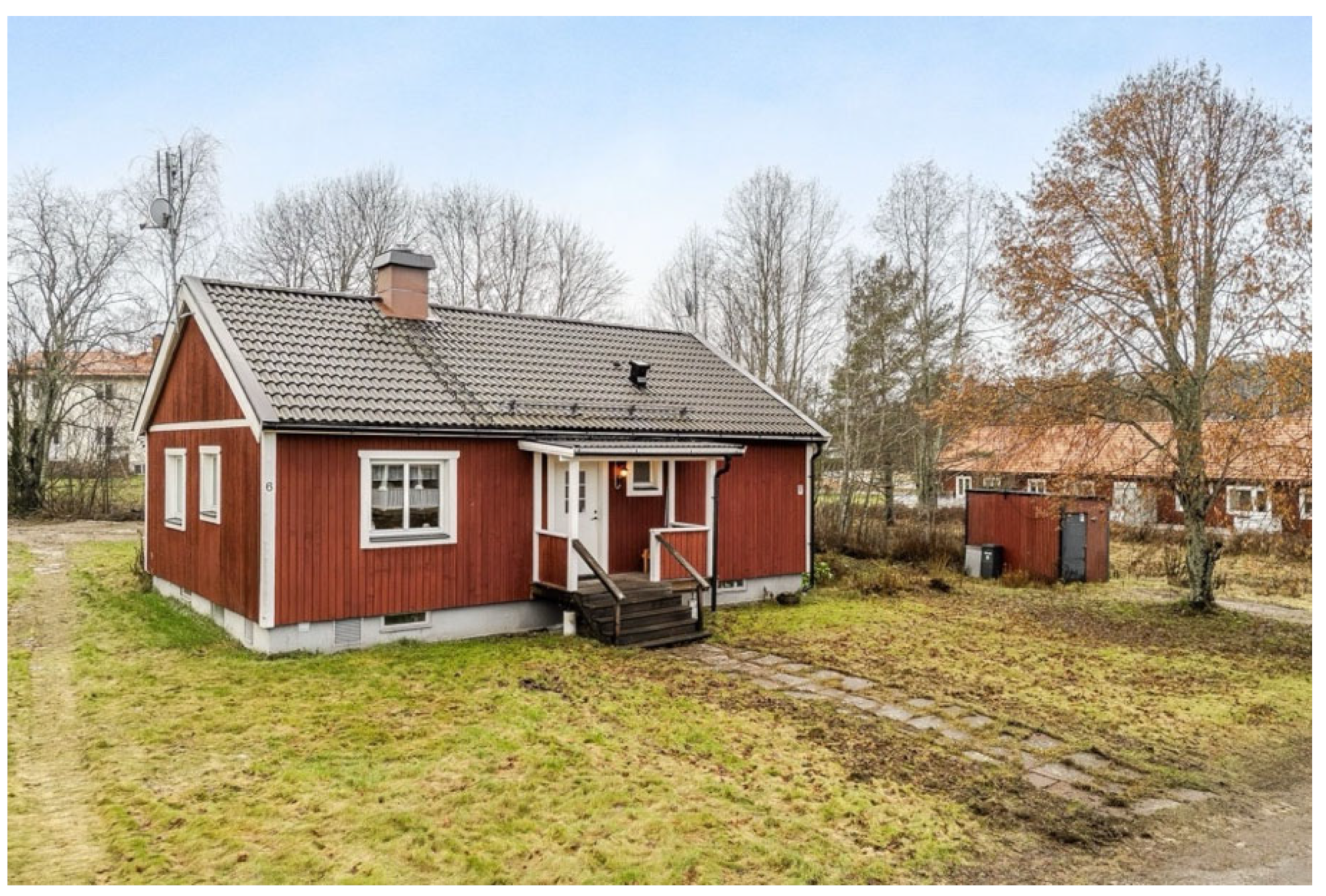
röd stuga typology is widespread—a small-scale wooden single-family dwelling shown in
Figure 1, historically used as a permanent or seasonal residence and recognized as a symbol of Swedish vernacular architecture.
It should be noted that the adopted configuration does not aim to reproduce a specific historical building in a strictly typological sense, but rather to define a representative reference model suitable for life-cycle economic and environmental assessment. The selected construction solutions therefore reflect typical characteristics observed in the existing residential building stock of the region, allowing the definition of a consistent analytical framework for the comparative evaluation of alternative intervention scenarios.
Considering the prevailing morphologies of the local building stock, the reference case was defined as a detached single-family house on one floor, with a usable floor area of 100 m2 and a net internal height of 2.5 m. The load-bearing structure consists of a timber frame in Norway spruce (Picea abies), with wooden plank cladding and a wood-fiber insulated cavity in the retrofit scenario, while in the original condition, the insulation is assumed to be absent or significantly reduced, in line with construction practices widespread between the 1950s and 1970s. The external walls are clad with horizontal boards painted with Falu Rödfärg pigment, typical of local mining production, and the gable roof is made of timber with a dark red painted galvanized steel sheet covering.
In the original state, the windows consist of wooden frames with single glazing, while in the retrofit scenario, they are replaced with wooden frames with double or triple low-emissivity glazing. The reference building systems include, in the existing condition, an electric stove and a small natural ventilation system, whereas the NZEB reconstruction scenario envisages an integrated system with an air-to-air heat pump, mechanical ventilation with heat recovery, a 6 kWp photovoltaic system, and a 7-kWh battery storage system. It should be noted that, in the Swedish climatic context, characterized by relatively low winter solar irradiation and strong seasonal variability, the photovoltaic system is not intended to fully cover the annual energy demand but rather to contribute as part of an integrated energy system. In this configuration, the overall performance of the NZEB scenario is primarily driven by the combined effect of envelope efficiency and high-performance building systems, while on-site renewable generation plays a complementary role.
The selection of these construction and system characteristics is based on statistical and technical sources such as the Boverket Building Regulation [
43] and the Swedish National Board of Housing [
44]. The objective is to define a model representative of the traditional Swedish building stock, capable of accurately reflecting the construction quality and average performance of dwellings in the Falun region.
3.2. Data
The economic variables considered in the study include the initial investment costs (CAPEX) related to the interventions and building and system components (load-bearing structure, opaque and transparent envelope, windows and doors, HVAC systems, photovoltaic system, and storage system), as well as operating costs (OPEX) associated with scheduled maintenance, operational energy consumption, replacement costs of components with service lives shorter than the analysis horizon, end-of-life costs, and residual value. The economic results are expressed in terms of Net Present Value (NPV), adopting a real discount rate of 3%, with sensitivity analysis in the 2–4% range, an inflation rate of 2%, and an annual energy price growth rate of 1.5%.
With regard to the environmental dimension, the analysis considers as main indicators the Global Warming Potential over 100 years (GWP100, kgCO2e) and the Cumulative Energy Demand (CED, MJ). The LCA characterization factors for materials and energy were derived from established databases and scientific literature reviews. In particular, for Swedish grid electricity, an emission factor of 0.020 kgCO2e/kWh (range 0.018–0.025 kgCO2e/kWh; CED ≈ 8 MJ/kWh) was adopted, consistent with the national low-carbon profile. For C24-class timber structures, fossil “cradle-to-gate” processes were considered, estimated at approximately +120 kgCO2e/m3. For wood fiber insulation, an emission factor of 0.08 kgCO2e/kg with a CED of 5 MJ/kg was adopted, in line with values reported in the literature for bio-based materials. Photovoltaic modules were modeled with an average factor of approximately 700 kgCO2e/kWp (CED ≈ 25,000 MJ/kWp), assuming replacement after 25 years, while for lithium-ion storage systems average values of approximately 100 kgCO2e/kWh (CED ≈ 8000 MJ/kWh) were considered, with replacement after 12 years.
Operational energy was modeled in terms of annual electricity consumption, equal to 9000 kWh/year in the Retrofit scenario and 4500 kWh/year in the NZEB scenario, assuming a photovoltaic self-consumption rate of 50% and a battery charge–discharge efficiency of 92%, where applicable. The component quantities (Bill of Quantities, BoQ) and service lives were defined based on typical values for traditional timber buildings and NZEB-compliant buildings, in accordance with the indications of Boverket [
43] and the EPBD [
45], with the possibility of replacement by project-specific or survey-based data.
Uncertainty was addressed through local deterministic sensitivity analysis (±20%), applied to the main critical variables of the model, including energy prices, the real discount rate, and material conversion factors.
All numerical values used in the integrated LCC + LCA analysis are reported in
Table 3 and are derived from recognized databases and peer-reviewed studies, selected to ensure methodological robustness. Environmental data were primarily drawn from Ecoinvent v3.9 [
46] and from international reference databases and sources, including IEA PVPS [
47], as well as scientific contributions [
5,
7,
9,
17,
18,
19,
20,
24,
26,
27,
28,
29,
30,
31,
32,
33,
34,
35,
36,
37,
38,
39,
40]. These sources were used to define emission factors for materials, energy processes, and the main end-of-life assumptions.
The economic parameters employed in the Life Cycle Costing (LCC) analysis were derived from institutional and regulatory sources, including Eurostat [
48], the European Commission (Cost-Benefit Analysis Guide, 2021–2027) [
49], and ISO 15686-5 [
41], with reference to discount rates, inflation, energy price dynamics, and the service lives of the main building and system components.
The LCC economic analysis was developed through a customized calculation model implemented by the authors in a spreadsheet environment, applying the Global Cost Method in accordance with EN 15459, enabling the accounting of initial investment costs, recurring operation and maintenance costs, discrete replacement costs, and end-of-life residual values.
The Life Cycle Assessment (LCA) environmental analysis was conducted through a simplified and parametric approach, based on inventory data derived from the literature and the aforementioned databases. The methodological framework was defined in accordance with EN 15978, adopting a simplified and parametric life-cycle-oriented approach based on transparent assumptions regarding system boundaries, the reference time horizon, and the main impact drivers, in order to ensure replicability [
4]. The analysis is limited to selected impact categories and is intended to support a comparative and scenario-based evaluation rather than a full LCA.
3.3. LCC Economic Analysis
The economic analysis was conducted using the Life Cycle Costing (LCC) approach, with the aim of estimating, in terms of Net Present Value (NPV), the overall cost associated with two distinct intervention scenarios referring to the functional unit under analysis, over the entire reference time horizon, set respectively at 50 and 100 years.
In the present study, the Net Present Value (NPV) is adopted as the expression of the global discounted cost, calculated according to the
Global Cost Method defined by EN 15459, and therefore represents the total life cycle cost of the building [
4].
In accordance with ISO 15686-5, the adopted model is based on a
Whole Life Cost approach, structuring the analysis of economic flows consistently with the modular breakdown of the building life cycle (modules A–B–C–D) and including, in addition to initial investment costs, the operation, maintenance, replacement, and end-of-life phases, as well as the valuation of residual economic values [
41,
50].
From an operational standpoint, the determination of the global cost is carried out through the discounting of cost flows over the building’s service life, reducing initial costs, recurring costs, and discrete costs to a single temporal reference basis, while accounting for the final residual value.
Within this methodological framework, the extended LCC formulation, referring to each analysis scenario
and to a time horizon
, can be expressed in the following form:
where
(initial investment cost) represents the initial investment cost (CAPEX);
(annual operating costs) denotes the annual operation and management costs, including energy consumption;
(replacement cost of component k) expresses the discrete costs associated with the replacement of component k;
(end-of-life costs) represents the end-of-life costs;
(residual value at the end of the analysis period) indicates the residual value of components whose service life exceeds the analysis time horizon.
The formulation previously illustrated can be expressed in a compact form, in which the term
summarizes the set of cost components relevant at time
t,
r represents the real discount rate, while
denotes the residual value at the end of the analysis time horizon
T:
The real discount rate r is assumed to be 3%, with a sensitivity analysis performed within the 2–4% range. Regarding macroeconomic parameters, an annual inflation rate of 2% is assumed and, for the energy component only, a real annual increase in electricity prices equal to 1.5%, with a base price of €0.20/kWh. Energy costs are therefore modeled as recurring costs increasing over time, while ordinary maintenance costs are considered constant in real terms.
The main component service lives are assumed to be 15 years for HVAC systems, 25 years for photovoltaic modules, and 12 years for the battery storage system. Replacement costs are modeled as discrete expenditures occurring in the respective replacement years and discounted using the same real discount rate r.
The final residual value is determined proportionally to the remaining service life of components that do not complete their life cycle within the analysis time horizon, in accordance with the Whole Life Cost approach.
For interpretative purposes, the overall Net Present Value (NPV) is further disaggregated into macro cost categories (CAPEX, energy costs, maintenance and replacement costs, end-of-life costs), in order to highlight the main economic drivers of the two intervention scenarios and to analyze their evolution as the considered time horizon varies.
Table 4 presents the results of the economic analysis in terms of Net Present Value (NPV), together with the corresponding percentage breakdown for each cost item.
As expected, the NZEB scenario is characterized by a higher incidence of initial investment costs (CAPEX) on the global cost (approximately +25–30% in percentage terms compared to the Retrofit scenario), mainly attributable to the adoption of a high-performance building envelope and the integration of photovoltaic and storage systems.
However, the significant reduction in electricity consumption during the use phase (≈−50%) leads to a marked decrease in the energy component of the global cost, whose percentage share declines from 70% in the Retrofit scenario (50-year horizon) to 45% in the NZEB scenario, and from 68% to 50% in the case of a 100-year analysis horizon.
The relative weight of maintenance and replacement costs is instead higher in the NZEB scenario, due to the replacement of photovoltaic modules and the storage system at the end of their respective service lives.
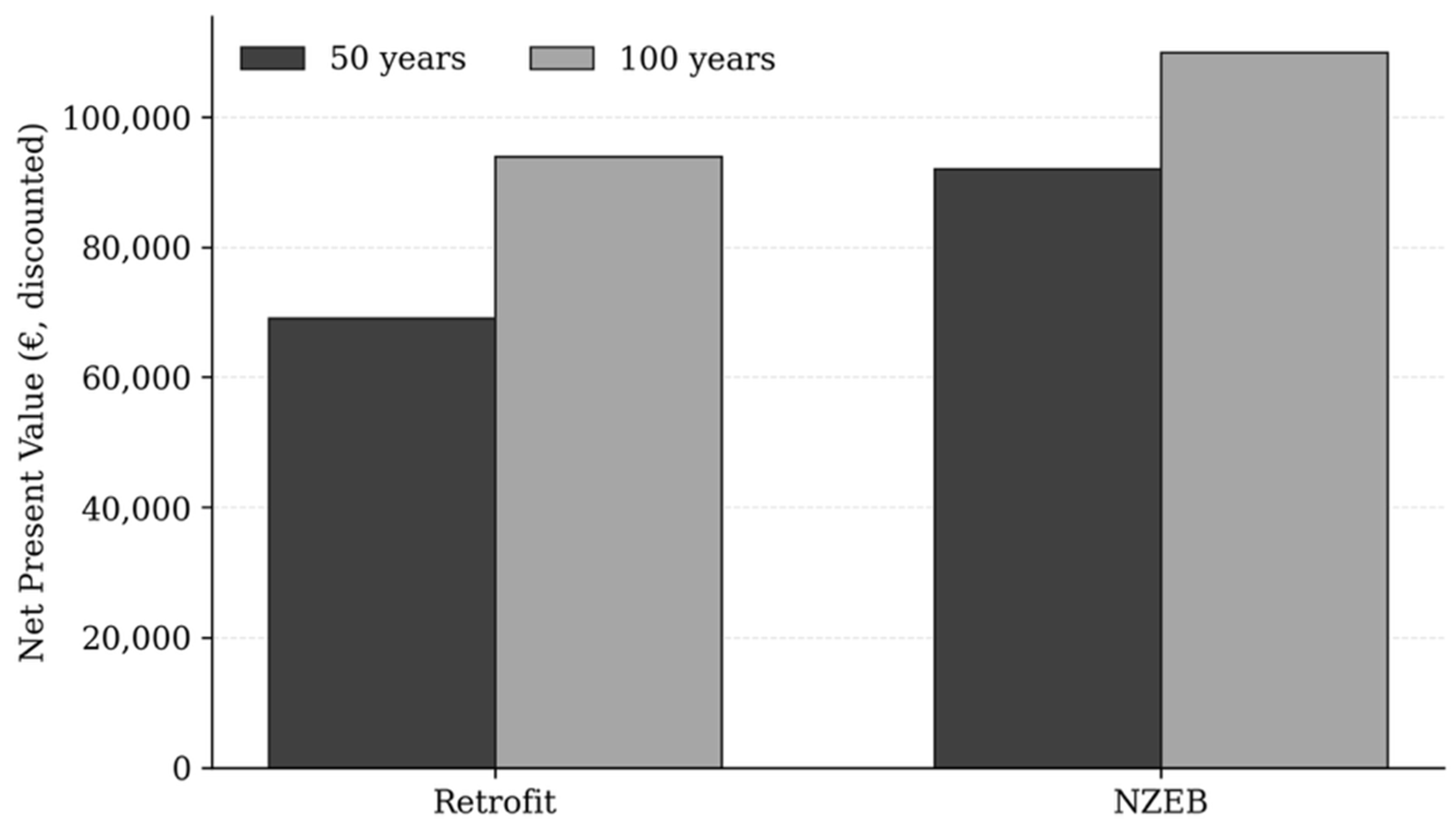
The comparison of the overall Net Present Value (NPV), illustrated in
Figure 2, shows that the NZEB scenario is associated with a higher global cost than the Retrofit scenario for both time horizons considered. This result reflects the significant increase in initial investment costs required by the NZEB configuration, mainly attributable to the adoption of high-performance envelope solutions and the integration of renewable energy generation and storage systems.
Extending the analysis horizon from 50 to 100 years results in an increase in NPV in both scenarios; however, as shown in
Figure 2, the absolute economic gap between the NZEB and Retrofit scenarios tends to decrease over the long term. This trend suggests that, although not fully offset in strictly economic terms, the higher initial investment required by the NZEB scenario is partially mitigated over time through the reduction of cumulative operational energy costs.
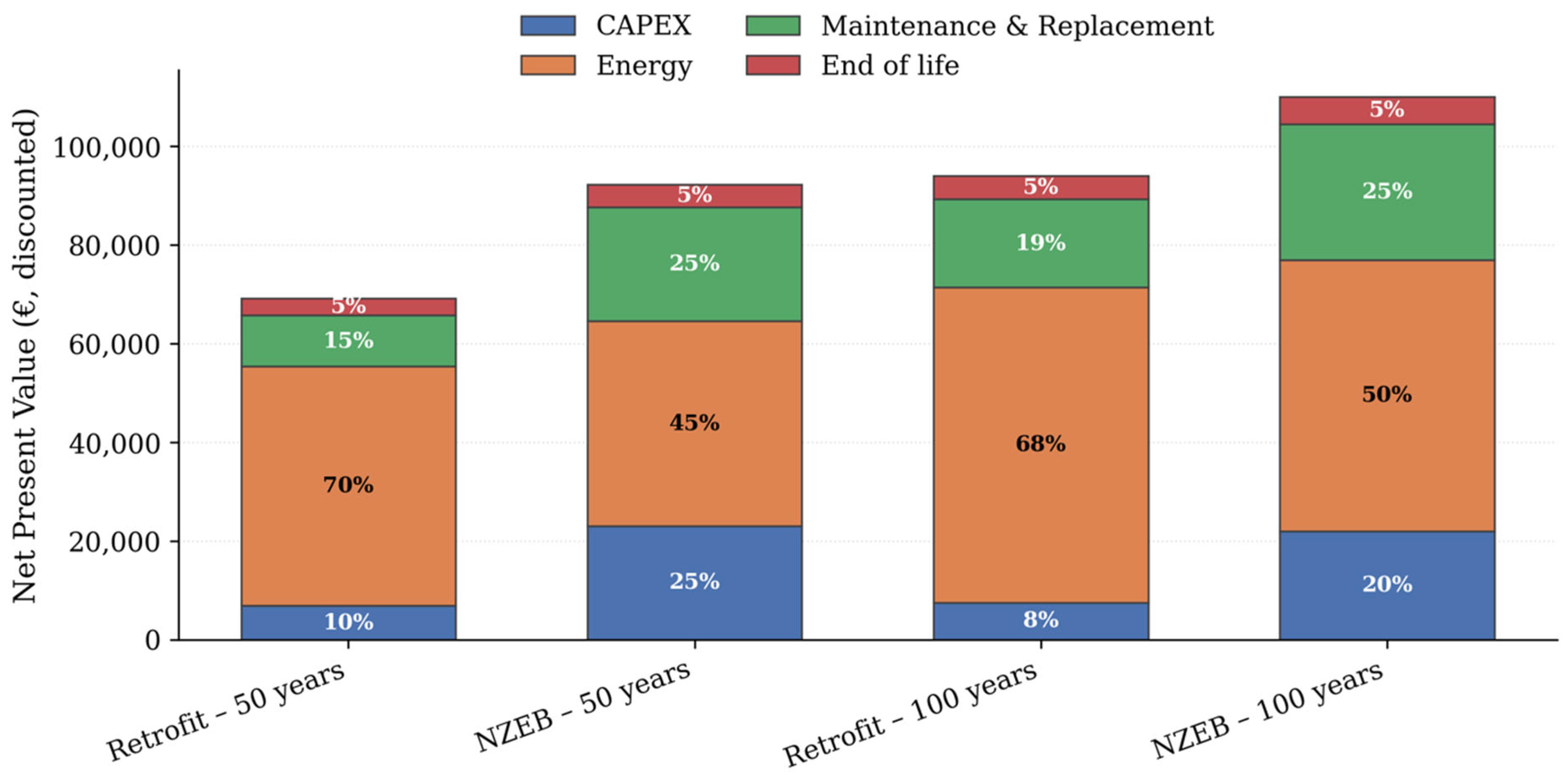
The breakdown of the NPV by macro cost categories, reported in
Figure 3, helps clarify the main economic drivers underlying the overall results. In the Retrofit scenario, the energy component is dominant over both the 50- and 100-year horizons, confirming the strong dependence of the global cost on operational consumption and on the evolution of energy prices.
Conversely, in the NZEB scenario, a marked reduction in the percentage incidence of energy costs is observed, accompanied by an increase in the relative weight of CAPEX and maintenance and replacement costs. The latter component particularly reflects the finite service lives of the advanced technological systems adopted in the NZEB scenario, such as photovoltaic modules and the storage system, which introduce discrete expenditures over the analysis time horizon.
Overall, the chart shown in
Figure 3 highlights a differentiated economic profile between the two scenarios: predominantly energy-driven in the case of Retrofit and more capital- and technology-driven in the NZEB case [
51]. Taken together, the results demonstrate that the economic evaluation of NZEB solutions cannot be conducted solely on the basis of operational energy savings but requires a life cycle approach capable of capturing the temporal redistribution of costs across investment, operation, and component replacement phases.
3.4. LCA Environmental Analysis
The environmental analysis was conducted using a simplified Life Cycle Assessment (LCA) approach, following a life-cycle-oriented framework inspired by EN 15978, which is adopted as a reference for structuring the assessment of building life cycle stages [
4,
34]. The analysis focuses on selected environmental indicators and is not intended to represent a complete LCA according to EN 15978 or ISO 14044, but rather a parametric and comparative evaluation. The functional unit coincides with that used in the economic analysis (LCC), namely a single-family dwelling with a floor area of 100 m
2, thereby ensuring full methodological consistency and direct comparability between the environmental and economic dimensions of the analysis.
The system boundaries are defined according to a cradle-to-grave approach, structured modularly in line with EN 15978, including the material production phase (A1–A3), transport to site (A4), construction (A5), use phase (B), end-of-life phase (C), and the optional accounting of Module D, related to potential benefits deriving from recycling, reuse, or energy recovery of building materials and components. This framework enables a transparent interpretation of the environmental contributions associated with the different life cycle stages and facilitates comparison with analogous studies in the literature.
The LCA was developed with reference to a 100-year time horizon, consistent with the reference service life commonly adopted for buildings in the aforementioned standards, as well as with established practices in the international scientific literature. This choice allows for a comprehensive and cumulative assessment of environmental impacts over the entire building life cycle, while ensuring the international comparability of results.
An LCA over a 50-year horizon was not explicitly reported because, under the same assumptions regarding operational consumption and environmental characterization factors, it would have resulted in a substantially proportional reduction of cumulative impacts, without significantly altering the relative comparison between the analyzed scenarios.
The selection of GWP100 and CED as the main indicators is consistent with the objective of the study, which focuses on energy use and climate-related impacts rather than a comprehensive environmental assessment.
Environmental impacts were quantified using two primary indicators: (i) the Global Warming Potential over 100 years (GWP100, kgCO2e), as an indicator of climate impact, and (ii) the Cumulative Energy Demand (CED, MJ), as a measure of cumulative energy requirement over the life cycle.
A summary of the LCA results for the two scenarios, referred to the 100-year horizon, is presented in
Table 5, which reports both the total environmental impact values and the relative contribution of the operational and embodied life cycle phases.
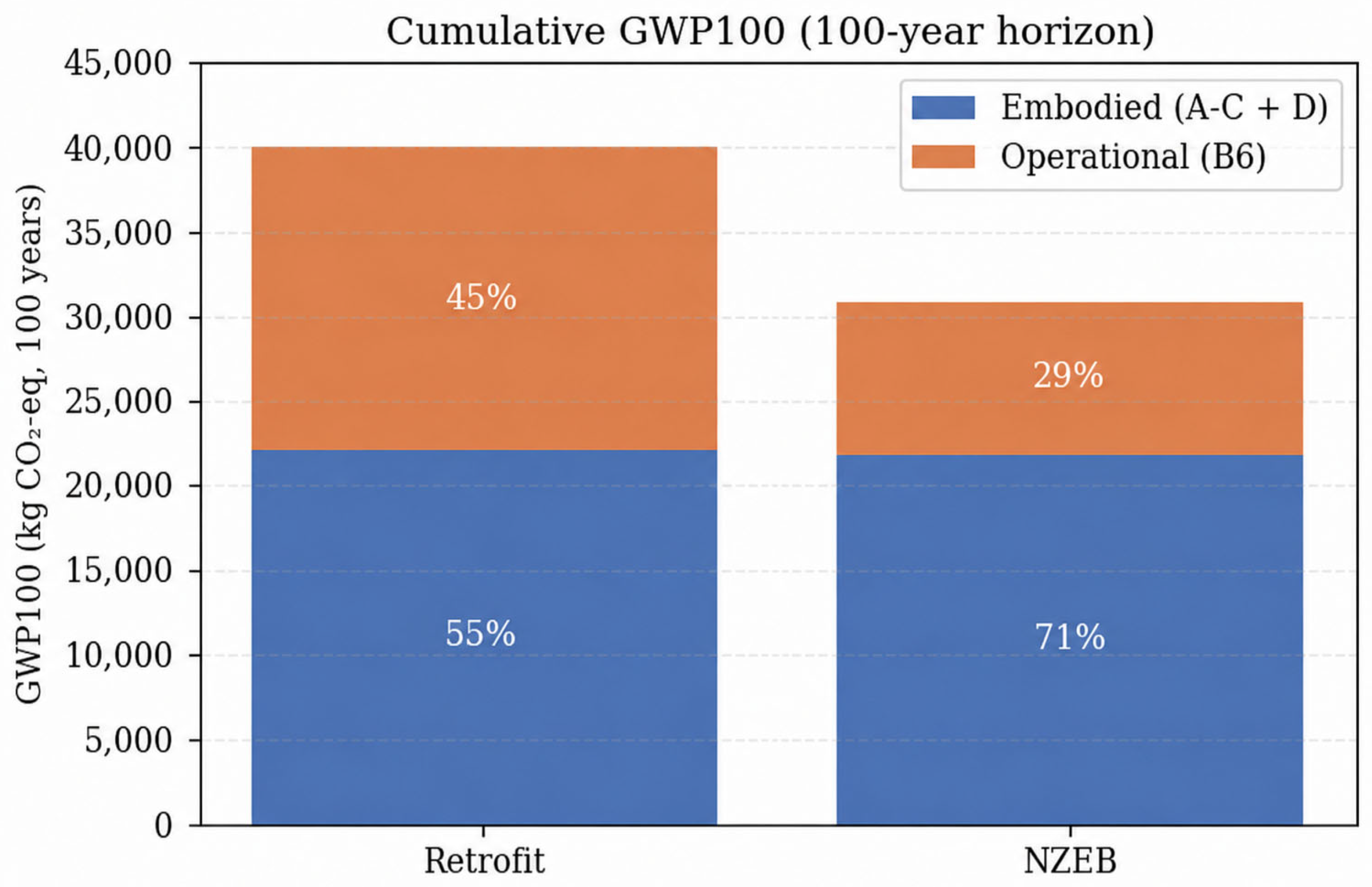
The overall results for each scenario, referred to the 100-year time horizon, are presented in
Figure 4 (cumulative GWP100) and
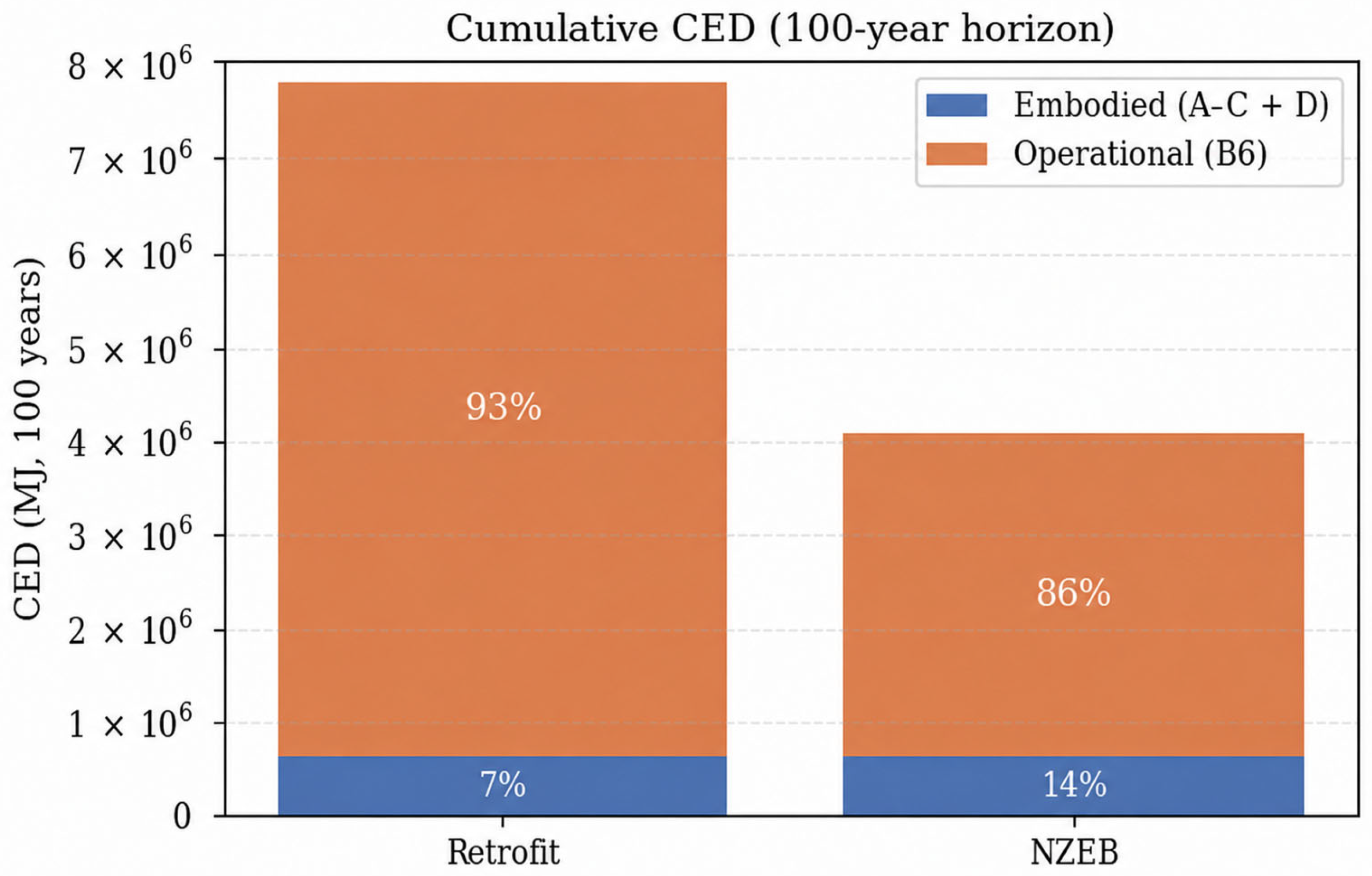
Figure 5 (cumulative CED). The results are aggregated by macro life cycle stages, distinguishing between impacts associated with material production (A1–A3, “embodied impacts”), transport (A4), operational energy use during the use phase (B6), end-of-life (C), and potential environmental credits (D).
For Swedish grid electricity, an emission factor of 0.020 kgCO2e/kWh was adopted, with a variation range between 0.018 and 0.025 kgCO2e/kWh, consistent with the national profile characterized by a low-carbon electricity mix.
It should be noted that the adopted emission factor reflects the current Swedish electricity mix and is assumed to remain constant over the analysis period. However, future changes in the electricity grid decarbonization trajectory may significantly affect the results of the environmental assessment, particularly over long-time horizons such as 100 years. In particular, a further reduction in grid emission intensity would decrease the relative contribution of operational impacts (B6), thereby reducing the environmental advantage of the NZEB scenario compared to the retrofit option. Conversely, in the case of slower decarbonization or increased carbon intensity, the benefits associated with reduced operational energy demand would become more pronounced.
For the assessment of CED, an average value of approximately 8 MJ/kWh was assumed for electricity, in line with the values reported in the main LCA databases and reference literature.
For bio-based components, in particular C24 structural timber and wood fiber insulation, a dual carbon reporting approach was implemented. In addition to fossil cradle-to-gate emission loads (estimated at approximately +120 kgCO2e/m3 for C24 timber), a temporary carbon storage credit of about −1000 kgCO2e/m3 was explicitly accounted for, consistent with the adopted input assumptions and literature references. This approach preserves the international comparability of the results, allowing outcomes to be presented both with and without the accounting of biogenic carbon and end-of-life credits.
The operational energy component (B6) was estimated based on annual electricity consumption, assumed to be 9000 kWh/year for the Retrofit scenario and 4500 kWh/year for the NZEB scenario [
52,
53,
54]. For the latter, a photovoltaic self-consumption rate of 50% and an overall battery charge–discharge efficiency of 92% were also assumed, where applicable. Under this configuration, the use phase emerges as a crucial driver for both climate impact and cumulative energy demand, decisively influencing the overall LCA results.
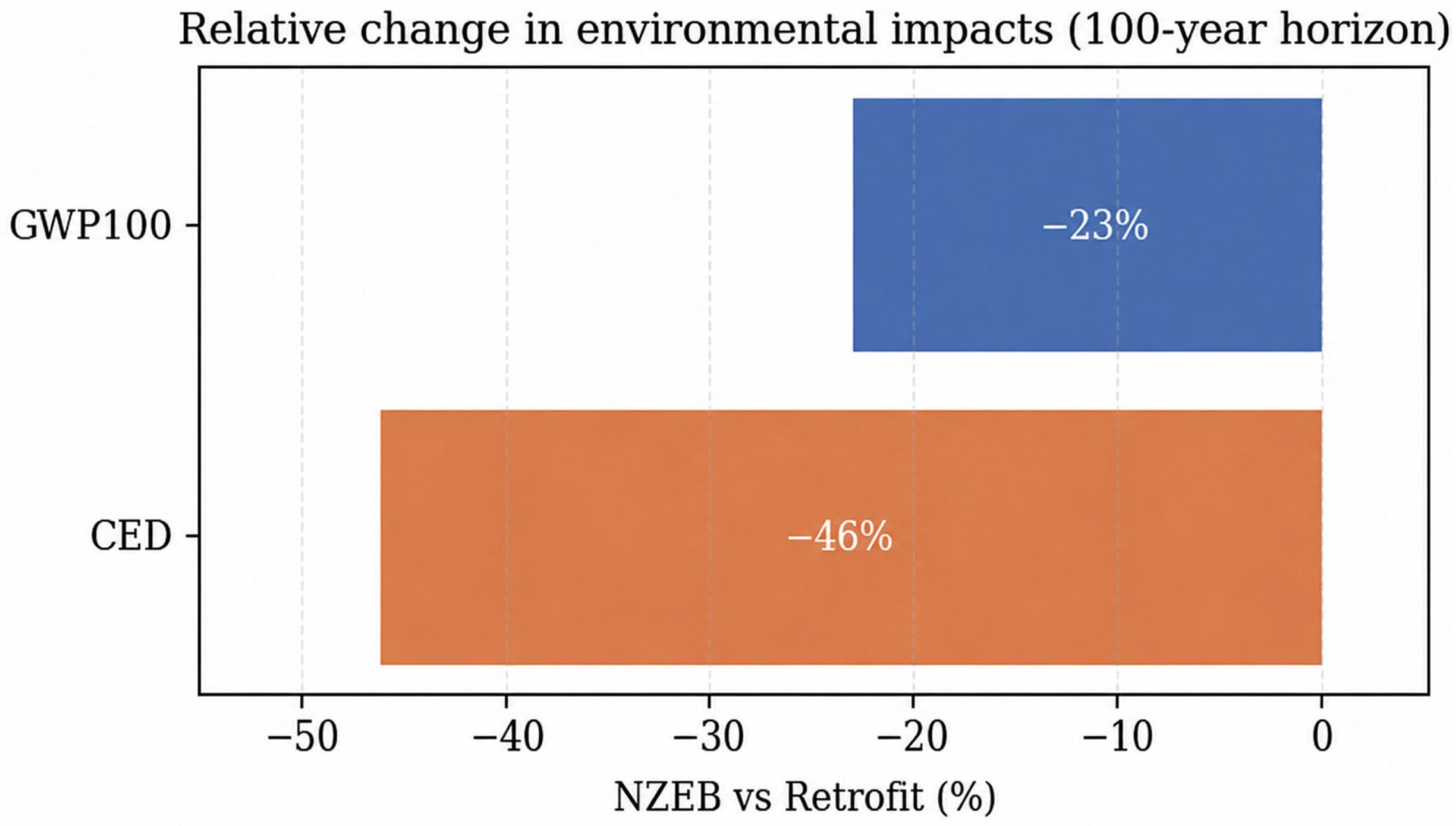
The results show a reduction in overall climate impact associated with the NZEB scenario on the order of approximately 20–25% compared to the Retrofit scenario. A significantly larger reduction is observed for CED, which decreases by approximately 45–50%, as summarized in
Figure 6, reporting the percentage variation of environmental indicators relative to the reference scenario.
The relative contribution of the use phase (B6) differs significantly depending on the indicator considered. In terms of GWP100, embodied impacts (A − C + D) represent a major share of total life-cycle emissions, particularly in the NZEB scenario. Conversely, for CED, the use phase remains the dominant component in both scenarios, reflecting the relevance of operational energy demand in cumulative energy terms.
With specific reference to the operational electricity component (B6), the cumulative emission estimate over 100 years amounts to approximately 18 tCO2e for the Retrofit scenario and 9 tCO2e for the NZEB scenario (values calculated net of photovoltaic self-consumption), confirming the decisive role of energy efficiency and renewable-based electrification in reducing environmental impacts over the building life cycle.
3.5. Integrated LCC + LCA Synthesis
The integration of the results from the Life Cycle Costing (LCC) economic analysis and the Life Cycle Assessment (LCA) environmental analysis enables a comprehensive and balanced evaluation of the intervention strategies considered, overcoming sectoral approaches focused solely on initial investment costs or exclusively on operational energy performance.
The comparison between the scenarios highlights a typical economic–environmental trade-off: the Retrofit scenario is characterized by a lower initial expenditure and a lower Net Present Value (NPV) over the 50-year time horizon, whereas the NZEB scenario, despite requiring a higher upfront investment, allows for a significant reduction in dependence on future energy costs and in cumulative climate and energy impacts over the entire building life cycle.
This effect is particularly evident in terms of cumulative energy demand (CED), where the reduction associated with the NZEB scenario is significantly higher than that observed for GWP100. This highlights the differentiated behavior of environmental indicators and reinforces the need for a multi-criteria evaluation framework capable of capturing both energy and emission-related impacts.
When the economic and environmental dimensions are jointly considered, the results indicate that the higher initial costs associated with the NZEB scenario are partially offset, in the medium to long term, by the reduction in operational costs and environmental impacts during the use phase. This effect becomes progressively more relevant as the analysis time horizon increases, making the NZEB scenario relatively more competitive in contexts characterized by high energy price volatility and stringent decarbonization targets.
From a decision-making perspective, the integrated LCC + LCA analysis suggests that the preferable intervention strategy critically depends on boundary conditions: the Retrofit scenario appears more suitable under capital constraints and limited time horizons, whereas the NZEB scenario is more consistent with long-term policies oriented toward climate neutrality and overall economic sustainability.
In this sense, the systematic integration of LCC and LCA results enables a direct linkage between the economic and environmental outcomes discussed in the previous sections, providing a coherent interpretative framework for the trade-offs among costs, energy consumption, and life cycle impacts. This approach offers robust quantitative support for selecting the most appropriate building regeneration strategy, explicitly clarifying the balance between costs and benefits as a function of the time horizon and the pursued sustainability objectives.
4. Results
The economic analysis based on Life Cycle Costing highlights significant differences between the two scenarios in the medium term, which progressively diminish over the long term. Over a 50-year time horizon, the Net Present Value (NPV) of the Retrofit scenario amounts to approximately €69,200.00, whereas the NZEB scenario shows a more unfavorable NPV of about €92,300.00, mainly attributable to the higher initial investment (CAPEX) required for the integration of high-efficiency systems and renewable energy generation technologies. Extending the analysis period to 100 years, the NPVs reach approximately €94,000.00 for the Retrofit scenario and €110,000.00 for the NZEB scenario, respectively.
The reduction in the economic differential between the two scenarios indicates a gradual convergence of their economic performance in the long term, driven by the contraction of energy costs in the NZEB scenario and by the impact—common to both scenarios—of system replacements associated with the life cycles of technological components.
To further investigate this aspect, a deterministic sensitivity analysis was carried out on the main economic parameters, including the real discount rate and energy price assumptions. The results confirm that the ranking between the analyzed scenarios remains unchanged, with the Retrofit option consistently showing a lower NPV. However, the economic gap between the two scenarios is sensitive to the discount rate and energy price dynamics. Lower discount rates and higher energy price growth increase the relative competitiveness of the NZEB scenario in the long term, while higher discount rates reinforce the economic advantage of the Retrofit option.
The percentage breakdown of the NPV by cost category shows that the energy component represents the dominant cost item in both scenarios. However, in the NZEB scenario, this share is significantly reduced (approximately 45% over 50 years and about 50% over 100 years), while the relative weight of maintenance and replacement costs increases, reaching values close to 25%, due to the life cycles of photovoltaic and storage systems. This result demonstrates that, despite the higher upfront expenditure, the NZEB scenario enables a structural reduction in exposure to future energy costs, making overall economic performance less sensitive to potential increases in electricity prices.
From an environmental perspective, the NZEB scenario shows a reduction in the overall Global Warming Potential (GWP100) of approximately 9000 kgCO2e over a 100-year time horizon compared to the Retrofit scenario, with values decreasing from about 40,000 to 31,000 kgCO2e.
The Cumulative Energy Demand (CED) shows a substantially larger reduction, decreasing from approximately 7.78 × 10⁶ MJ (7,780,000 MJ) to about 4.20 × 10⁶ MJ (4,200,000 MJ) over the same time horizon.
The relative contribution of life-cycle phases varies depending on the indicator considered. In terms of GWP100, embodied impacts (A − C + D) represent a substantial share of total emissions, particularly in the NZEB scenario, whereas for CED, the use phase (B6) remains clearly predominant.
However, the reduction in annual electricity demand in the NZEB scenario (approximately 4500 kWh/year), together with on-site photovoltaic self-consumption, leads to a significant decrease in operational impacts compared to the Retrofit scenario, which is characterized by an annual consumption of about 9000 kWh.
The integration of LCC and LCA results enables a comprehensive assessment of the performance of the two scenarios. The Retrofit option proves more advantageous in terms of minimizing the initial investment and short- to medium-term costs, whereas the NZEB scenario demonstrates greater effectiveness from a life-cycle perspective, owing to the combined reduction in greenhouse gas emissions and dependence on energy costs. These findings are consistent with the main evidence in the literature, while also highlighting that, in low-carbon energy contexts, the relative importance of embodied impacts increases, particularly in high-performance scenarios such as NZEB.
5. Discussion
The results of the integrated Life Cycle Costing (LCC) and Life Cycle Assessment (LCA) analysis provide an articulated and multidimensional evaluation of the two intervention strategies considered—conservative renovation (Retrofit) and demolition with reconstruction according to Nearly Zero Energy Building (NZEB) standards—thus overcoming reductionist approaches based solely on initial costs or exclusively on operational energy performance.
From an economic standpoint, the LCC analysis shows that the NZEB scenario exhibits, for both time horizons considered (50 and 100 years), a higher Net Present Value (NPV) compared to the Retrofit scenario, mainly due to the greater initial investment cost (CAPEX) associated with the adoption of a high-performance building envelope and the integration of advanced technological systems, such as photovoltaic installations and energy storage systems. This finding is consistent with a broad body of literature documenting how NZEB solutions, although characterized by significant energy benefits, require a higher upfront financial commitment.
However, extending the analysis horizon from 50 to 100 years reveals a progressive reduction in the economic differential between the two scenarios, indicating a partial convergence of economic performance over the long term. This dynamic is attributable to the structural reduction in energy costs in the NZEB scenario, which mitigates the incidence of cumulative operating costs, as well as to the inevitable occurrence of system replacement costs in both scenarios. The percentage breakdown of the NPV highlights a different cost structure: in the Retrofit scenario, the overall cost is strongly “energy-driven,” with the energy component predominating, whereas in the NZEB scenario, the economic profile is more “capital- and technology-driven,” with a higher incidence of CAPEX and of maintenance and replacement costs related to the life cycles of technological systems.
It should be noted that the economic analysis is based on a neutral life-cycle cost framework and does not explicitly consider financing schemes; therefore, the reported NPVs are independent of funding sources, while incentives could improve the feasibility of NZEB solutions.
From an environmental perspective, the LCA analysis highlights a clear superiority of the NZEB scenario in terms of reducing climate impacts and cumulative energy demand over the life cycle. The decrease in the 100-year Global Warming Potential (GWP100) and in the Cumulative Energy Demand (CED) compared to the Retrofit scenario is mainly attributable to the reduction in electricity consumption during the use phase and to the integration of on-site photovoltaic generation, which mitigates impacts associated with operational energy (module B6), despite an increase in “embodied” impacts related to new technological components. In both scenarios, the use phase remains the primary environmental driver, confirming findings widely reported in the literature on residential buildings in cold climate contexts; however, in the NZEB scenario, the reduction in operational consumption makes the contributions associated with material production and system replacements relatively more significant.
The integration of LCC and LCA results allows the two scenarios to be interpreted as expressions of different sustainability strategies. The Retrofit option proves more advantageous from a short- to medium-term perspective and in contexts characterized by strong financial constraints, representing a solution oriented toward minimizing initial expenditure. It should be noted that, in real-world applications, the retrofit of existing wooden buildings may involve additional costs due to unforeseen conditions, such as structural degradation or hidden moisture damage. These factors may increase the initial capital expenditure (CAPEX) of conservative renovation and potentially reduce its economic advantage compared to the NZEB reconstruction scenario.
Conversely, the NZEB scenario demonstrates greater long-term robustness, due to the simultaneous reduction of environmental impacts and dependence on future energy costs, making it less exposed to energy price increase scenarios and more consistent with long-term decarbonization objectives.
From a scientific perspective, the main contribution of this study lies in the integrated and consistent application of LCC and LCA methodologies to a traditional and vernacular building typology, which has rarely been investigated in the international literature through a comparative life-cycle approach.
The results highlight a relevant methodological implication: in low-carbon electricity systems such as the Swedish context, the relative importance of embodied impacts increases significantly, particularly in high-performance buildings such as NZEBs. This finding underscores the need to extend sustainability assessments beyond operational energy consumption, incorporating life-cycle impacts associated with materials and construction processes.
While the integration of LCC and LCA methodologies has been explored in previous studies, the existing literature has predominantly focused on newly constructed or highly standardized buildings. Conversely, the application of integrated life-cycle economic and environmental assessment to traditional vernacular residential buildings remains extremely limited, particularly in the Nordic context. In this sense, the present study contributes to the scientific debate by extending the LCC–LCA analytical framework to a building typology that plays a crucial role in the existing residential stock but has rarely been investigated through a comparative life-cycle perspective. By systematically comparing conservative retrofit and NZEB reconstruction strategies, the proposed model provides an operational and replicable methodological approach capable of supporting evidence-based decision-making processes in the field of sustainable building stock regeneration.
The adoption of a representative case study of traditional Swedish residential construction helps bridge a knowledge gap between studies predominantly focused on newly built buildings and the increasingly urgent need to support regeneration decisions concerning the existing building stock. The proposed model therefore constitutes a replicable operational tool capable of supporting complex decision-making processes and guiding intervention policies based on objective and transparent metrics.
6. Conclusions
This study developed and applied an integrated Life Cycle Costing (LCC) and Life Cycle Assessment (LCA) model for the comparative evaluation of two intervention strategies for a traditional Swedish wooden residential building: conservative renovation of the existing structure and demolition with reconstruction according to NZEB criteria. The analysis, conducted over 50- and 100-year time horizons for the economic dimension and 100 years for the environmental dimension, enabled a systematic assessment of the trade-offs among costs, energy consumption, and environmental impacts across the entire life cycle.
The results indicate that the Retrofit scenario is economically more advantageous in terms of global discounted cost, particularly in the medium term, whereas the NZEB scenario demonstrates significantly superior environmental performance and greater long-term resilience, owing to reduced energy consumption and greenhouse gas emissions. These findings confirm that the sustainability assessment of building interventions cannot be confined to a single dimension—instead requiring an integrated approach capable of capturing the temporal redistribution of both costs and environmental impacts.
The results also demonstrate that, in low-carbon energy contexts, the reduction of operational emissions alone is not sufficient to achieve optimal environmental performance. Instead, the contribution of embodied impacts becomes increasingly significant, especially in advanced energy scenarios such as NZEB, requiring integrated design strategies that simultaneously address operational and material-related impacts.
Beyond the specific results obtained for the analyzed case study, the research provides a methodological contribution to the international literature by demonstrating the applicability of integrated LCC–LCA approaches to traditional residential buildings. This aspect is particularly relevant because a large portion of the existing European building stock is composed of vernacular dwellings characterized by relatively low energy performance, which are rarely investigated through combined economic and environmental life-cycle models. The proposed framework therefore contributes to bridging this gap, offering a structured and replicable analytical tool for evaluating alternative regeneration strategies in similar building contexts.
A limitation of the analysis lies in the simplified and parametric treatment of biogenic carbon effects and end-of-life credits, which were considered through standard assumptions but not further explored through dynamic or scenario-specific modeling approaches. This aspect represents a relevant area for further research.
The building analyzed does not correspond to an actual structure, but rather to a reference case defined on the basis of the average characteristics of traditional wooden residential buildings in the city of Falun, Dalarna County. This methodological choice aims to reduce the influence of local specificities and site-specific conditions that are difficult to generalize, thereby ensuring a more controlled and consistent evaluation of the main construction, energy, and economic variables. While the case study is inherently context-specific, the proposed methodological framework is designed to be transferable to other geographical and building contexts, provided that locally appropriate input data are adopted. The adoption of a reference case also allows for a consistent comparative evaluation of the effects of different intervention strategies and makes the integrated LCC + LCA model applicable and transferable to similar building contexts characterized by comparable climatic and typological conditions.
Future methodological developments include the integration of probabilistic sensitivity analyses and the extension of the model to additional environmental and socio-economic indicators. Further advancements may involve embedding the model within advanced decision-support environments, such as BIM-based platforms or multi-criteria decision analysis tools [
55].
In this perspective, a further development may also concern the inclusion of indicators related to indoor environmental quality and occupant well-being, in order to more comprehensively account for the potential implications of energy-efficiency measures on comfort and health conditions within buildings.
In conclusion, the proposed integrated LCC + LCA model constitutes an effective decision-support tool in the field of residential building stock regeneration, capable of highlighting trade-offs between alternative solutions and guiding design choices and public policies toward more sustainable long-term outcomes. Its applicability to analogous building typologies and comparable climatic contexts strengthens its potential contribution to international research and professional practice in the field of sustainable construction.




 ,
,