Interpreting Failure-Related Load Transition in Static Tests of PHC Pipe Piles Using a Work-Based Abrupt Change Method


Abstract
1. Introduction
2. Materials and Methods
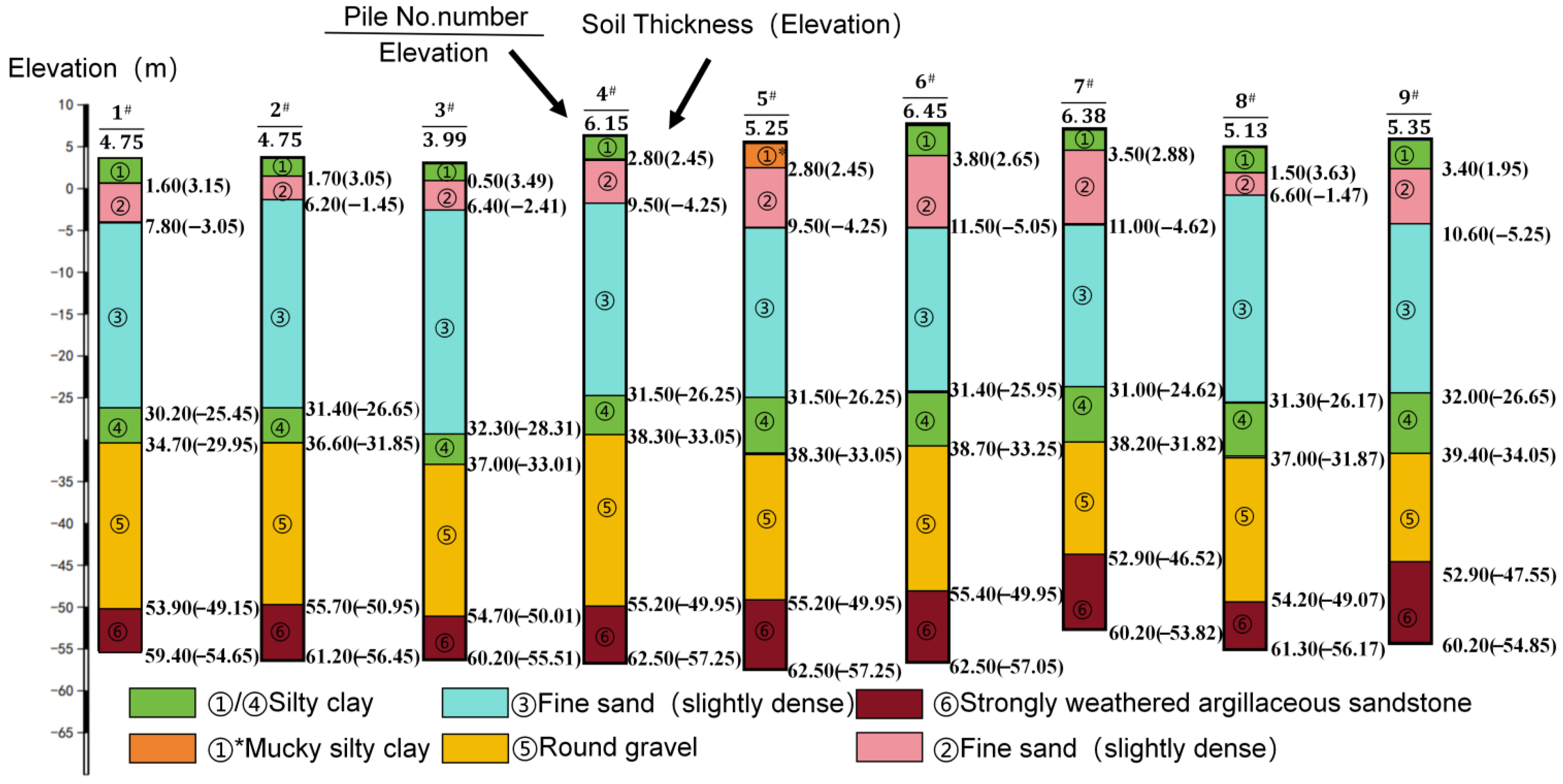
2.1. Ground Conditions
2.2. Methods
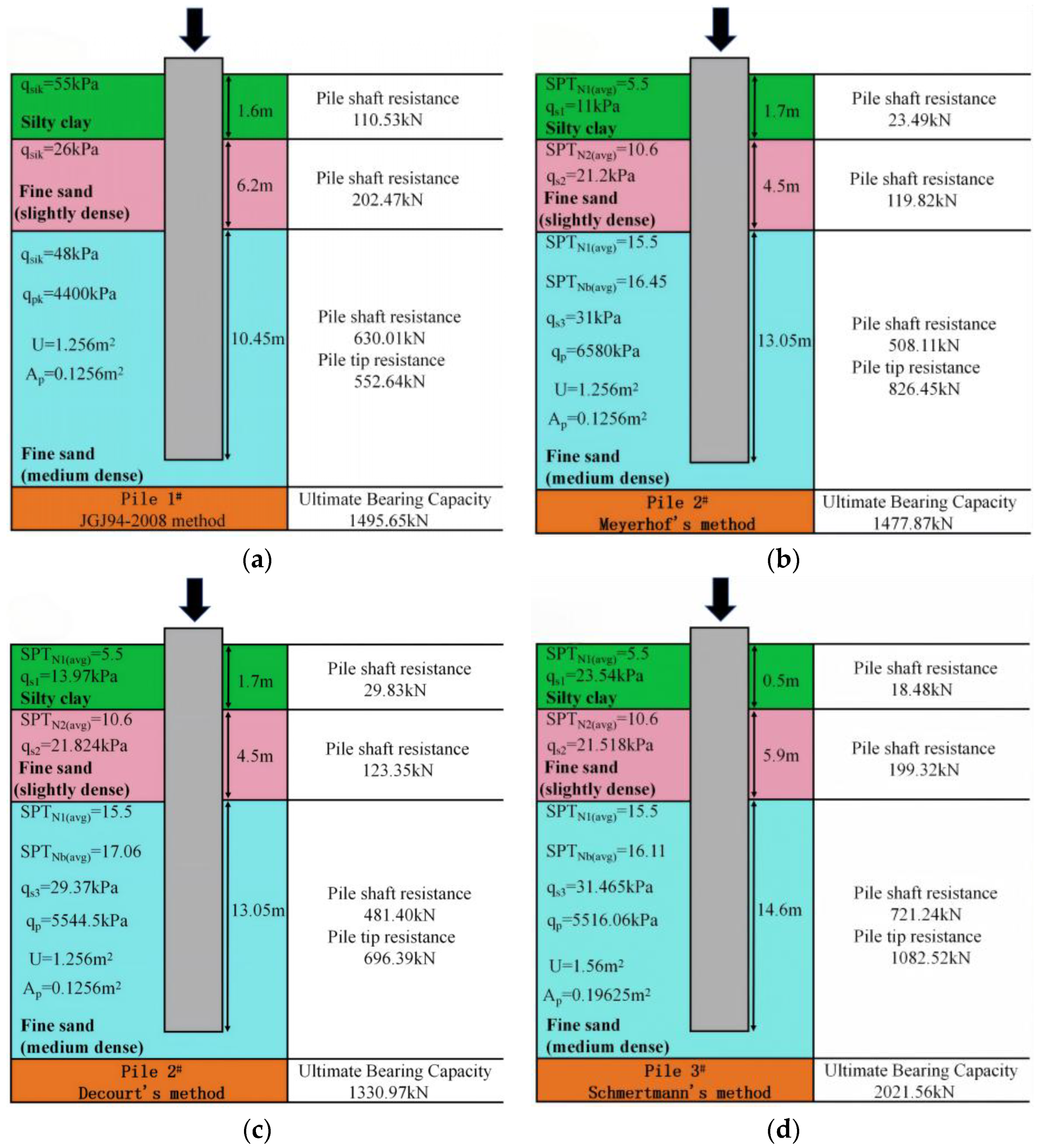
2.2.1. SPT-Based Empirical Methods as Design-Stage References
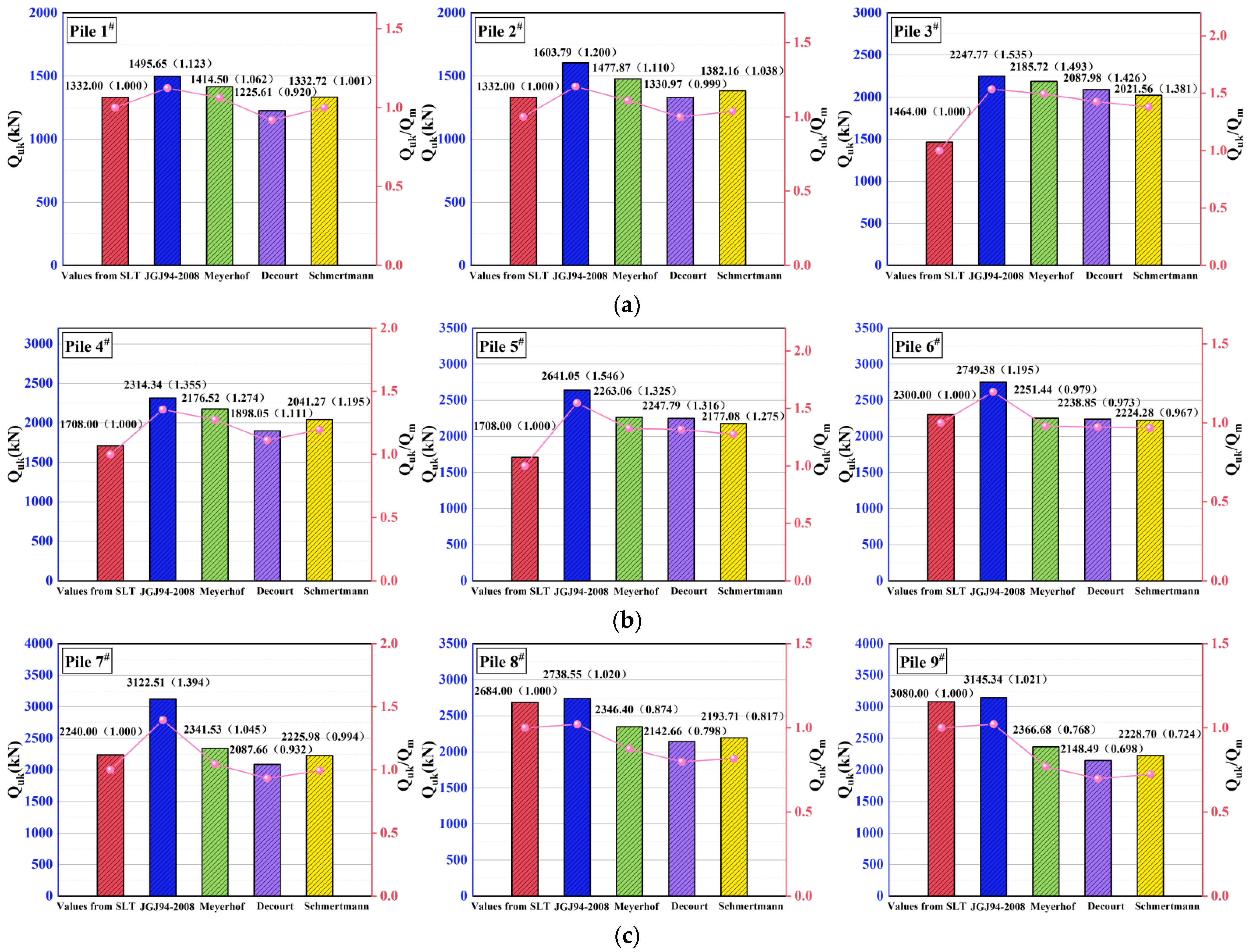
- JGJ94-2008 method [32]. This method calculates the ultimate bearing capacity Quk of pile foundations based on their geometric dimensions and soil properties, using the following formula:where Qsk denotes the ultimate lateral friction resistance (kN); Qpk denotes the ultimate pile tip resistance (kN); qsik denotes the standard value of ultimate lateral resistance for each soil layer (kPa); qpk denotes the standard value of ultimate tip resistance (kPa); u denotes the pile circumference (m); Ap denotes the pile tip area (m2); li denotes the length of contact between the pile foundation and soil layer i (m).
- Meyerhof method [9]. Meyerhof proposed an empirical correlation between SPT-N and pile bearing capacity, which effectively estimates the ultimate bearing capacity Quk of pile foundations. The specific formula is as follows:where qpk denotes the unit ultimate resistance at the pile tip (MPa); qsik denotes the unit ultimate lateral resistance of the soil in the i-th layer (MPa); u denotes the pile circumference (m); li denotes the length of contact between the pile and the soil in the i-th layer (m); Ap denotes the pile tip area (m2); Nb represents the average SPT value measured within the range of 10 D above the pile tip to 5 D below; Nsi is the average N value for the i-th soil layer where the pile foundation is located. The bearing layer at the pile tip in this study is sandy soil. Calculations are performed as for driven piles, with parameters set as a = 0.4 and b = 0.002.
- Decourt method [10]. Decourt estimates the end resistance and lateral resistance of pile foundations by introducing specific empirical coefficients, adjusting their values according to different soil types and pile configurations. This enables the calculation of the ultimate bearing capacity Quk, with the specific formula as follows:where qpk denotes the unit ultimate bearing capacity at the pile tip (MPa); qsik denotes the unit ultimate lateral bearing capacity of the soil layer at position i (MPa); u denotes the pile circumference (m); li denotes the length of soil contact between the pile and layer i (m); Ap denotes the pile tip area (m2); Nb and Nsi represent the average SPT values (N) measured at the pile tip and the i-th soil layer, respectively; for fine-grained soils, α is taken as 1.0, with kb set to 0.10 for driven piles and 0.08 for cast-in-place piles; and for coarse-grained soils, α = 0.5–0.6 (with an average value of 0.55 adopted in this study) and kb = 0.325.
- Schmertmann method [8]. Schmertmann employs the N-value to determine the ultimate end bearing capacity and ultimate axial friction, as shown in Table 3, where qc/N represents the ratio of tip resistance to standard penetration value; Nb denotes the average N value within the range extending 3 D above the pile tip to 3 D below.
2.2.2. Established Q-S Curve Interpretation Methods
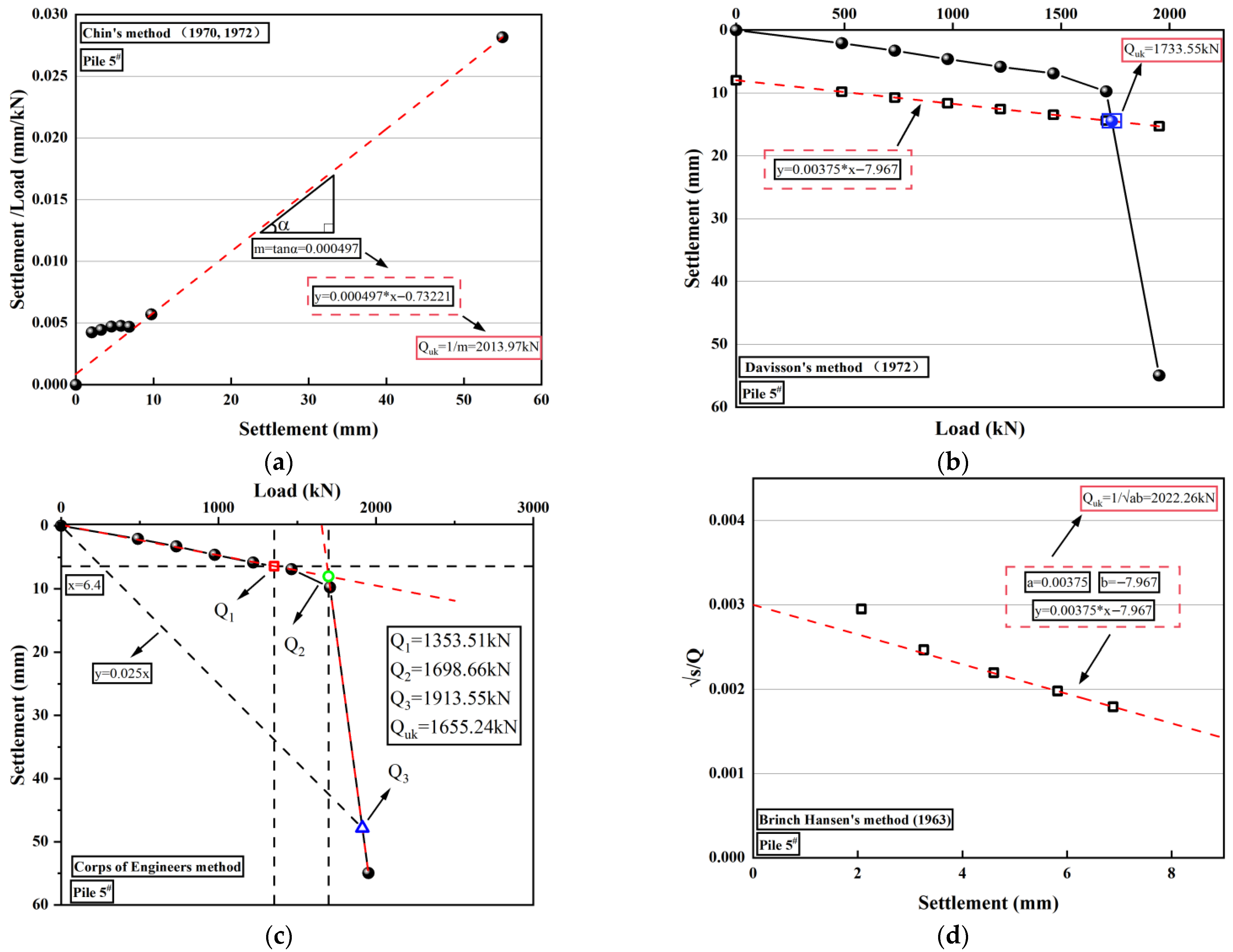
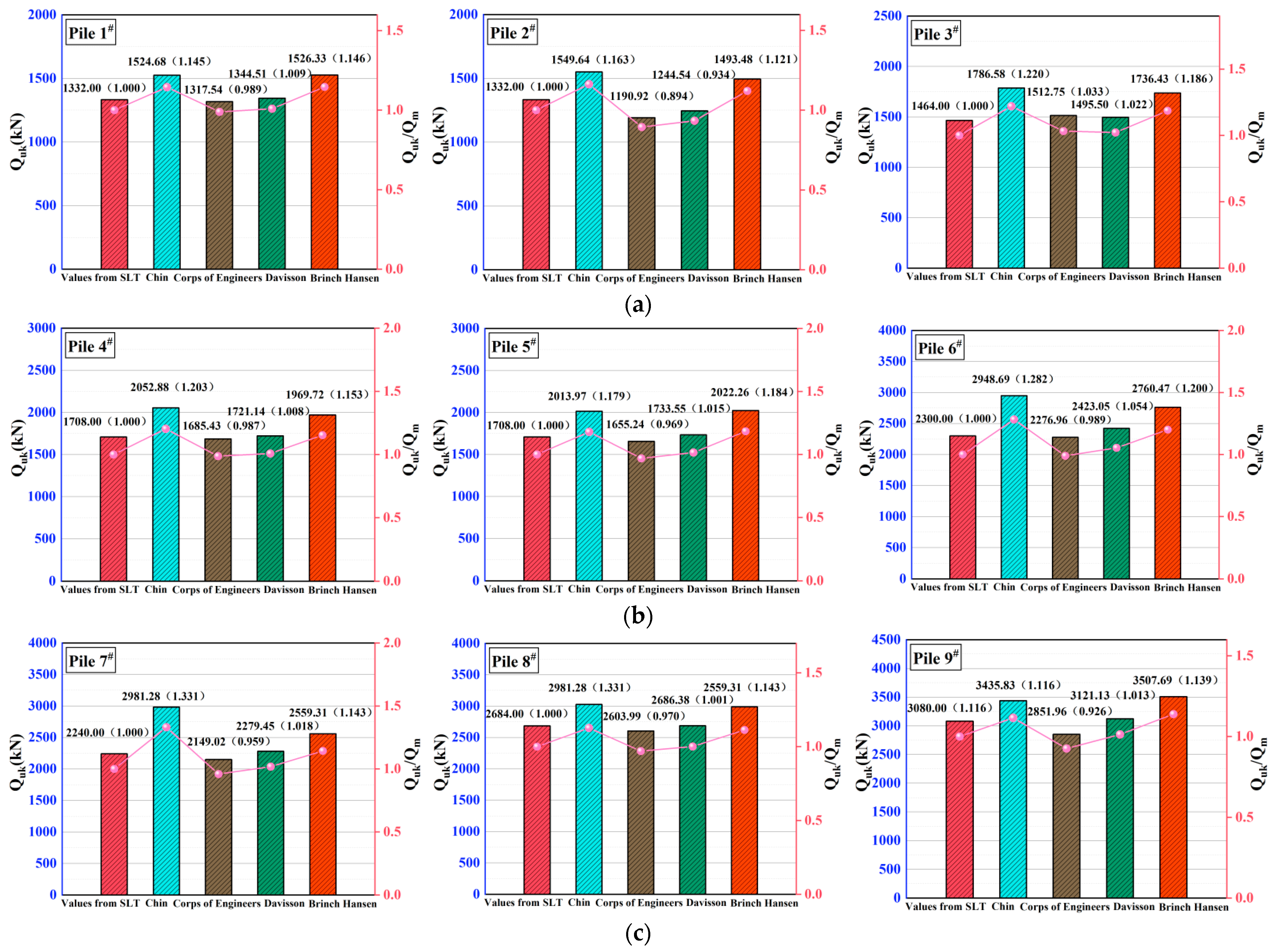
- Chin method [18,19]. Chin hypothesized that the failure stage of pile foundation Q-s curves exhibits hyperbolic characteristics. The graph is redrawn with the pile head settlement value s as the horizontal axis and the ratio of the settlement value to the corresponding load as the vertical axis. We perform a linear regression on the last three loading points, defining the reciprocal of the slope of the fitted line as the UBC of the pile foundation, denoted as Quk. The specific mathematical expression is as follows:where Pi denotes the i-th level of vertical load (kN) applied to the pile cap; si represents the settlement (mm) corresponding to the i-th level of vertical load; m is the slope of the fitted straight line; c is the intercept of the fitted line on the vertical axis.
- Corps of Engineers method [20]. In this method, the Q-s curve is drawn first, and then uses three distinct criteria—displacement control, slope control, and inflection point control—to obtain three representative bearing capacity values. The first load (Q1) is the load corresponding to the 6.4 mm settlement level. We draw tangents to the initial segment and final segment of the curve, respectively. The load corresponding to the intersection point of these two tangents is the second one (Q2). The third one (Q3) is the load corresponding to the point where the line makes an angle of 0.025 mm/kN intersecting with the Q-s curve. The average of these three load values is considered as the ultimate bearing capacity Quk of the pile.
- Davisson method [21]. In this method, an offset curve is plotted in the Q-s coordinate system, and the corresponding load at the intersection point of the Q-s curve and offset curve is defined as the ultimate bearing capacity Quk The formula for determining the offset curve S is as follows:where Q denotes the vertical load applied to the pile cap (kN); A denotes the cross-sectional area of the pile body (m2); E denotes the elastic modulus of the pile foundation material (kPa); L denotes the pile length (m); D denotes the diameter of the pile foundation (mm).
- Hansen method [17]. The Hansen method transforms each measured load Qi and its corresponding settlement si into transformed quantities yi. Subsequently, using si as the independent variable and yi as the dependent variable, a linear regression is performed on the final two measured data points via the least squares method. The slope a and intercept b of the fitted straight line are extracted, and the regression coefficients are utilized to determine the ultimate bearing capacity Quk of the pile foundation. The specific mathematical expression is as follows:
2.2.3. Segmented-Regression-Based Idea Method
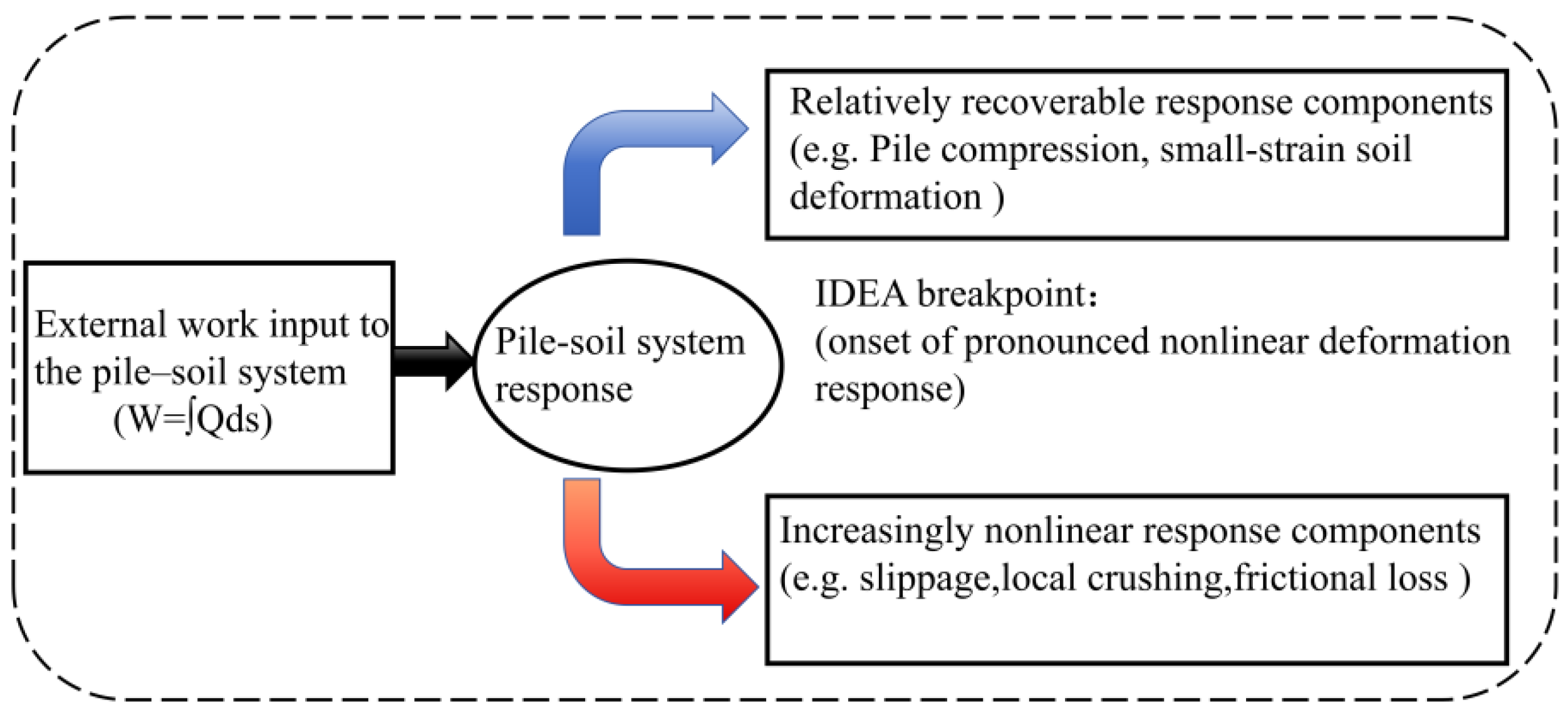
Theoretical Basis
Computational Procedure
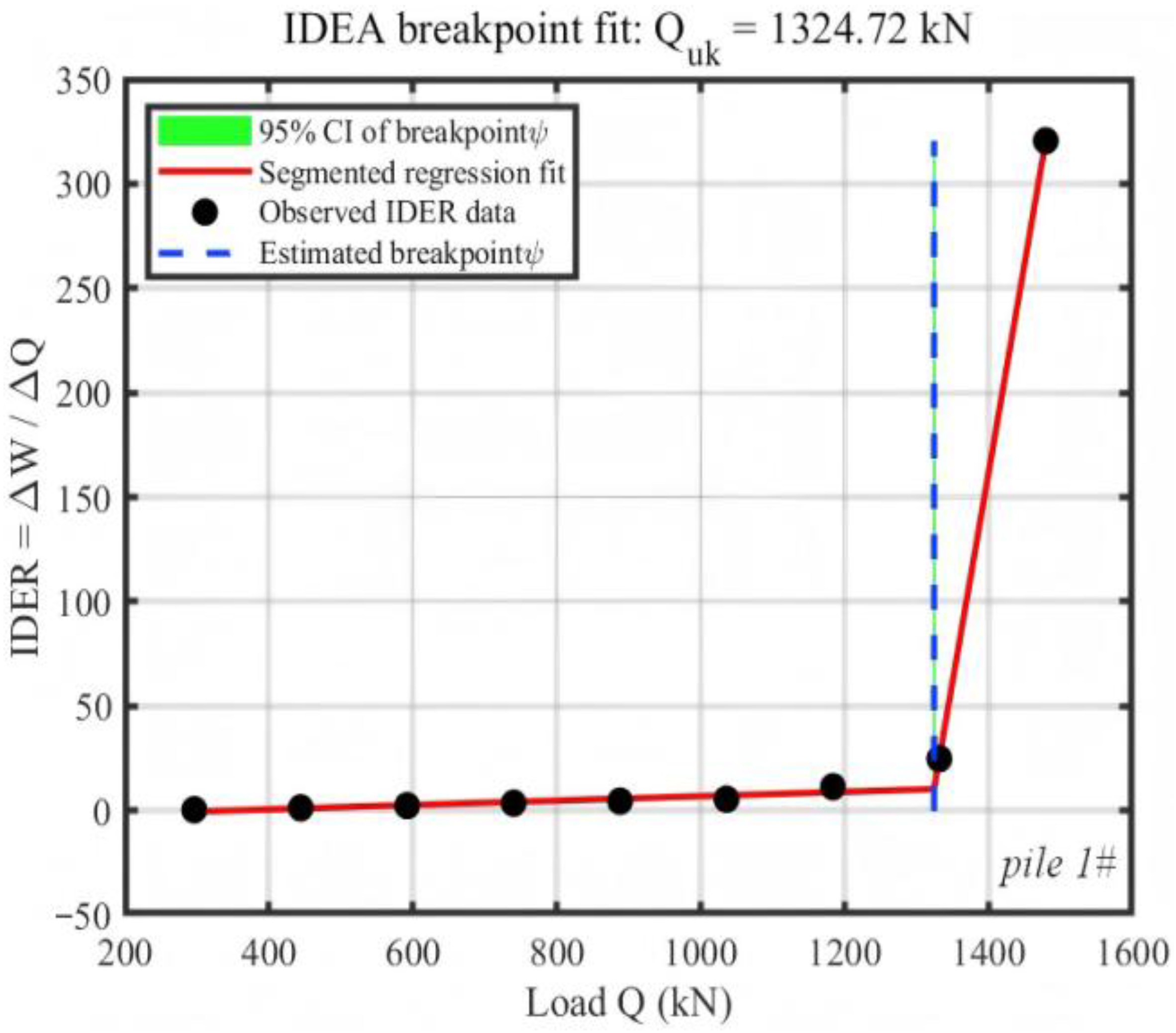
Representative Example
2.2.4. Statistical Metrics for Method Comparison
3. Results and Discussion
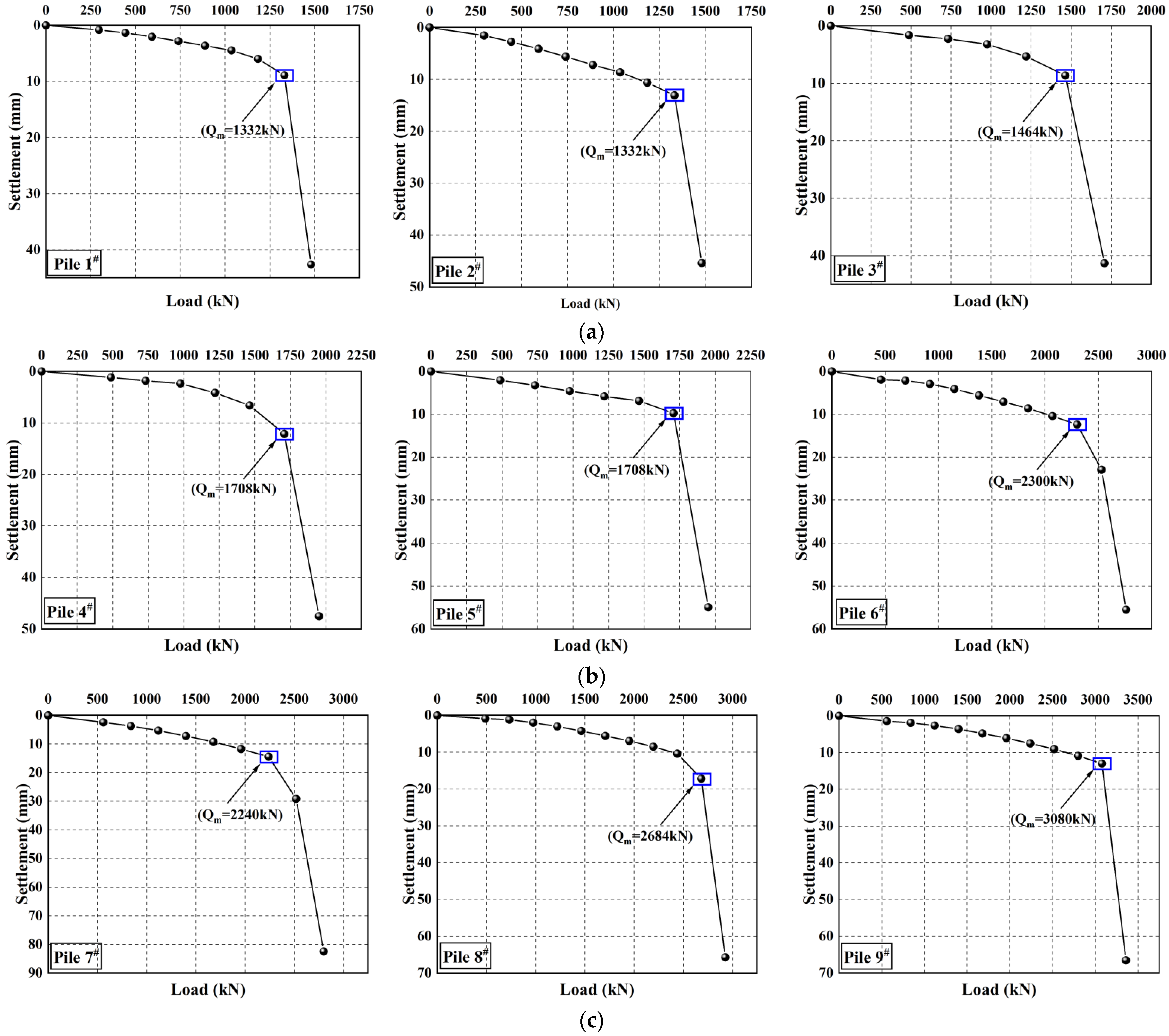
3.1. Results of Vertical Static Load Tests for Single Piles
3.2. Results of SPT-Based Empirical Methods (Engineering Reference Comparison)
3.3. Results of Q-S Curve Interpretation Methods (Primary Methodological Comparison)
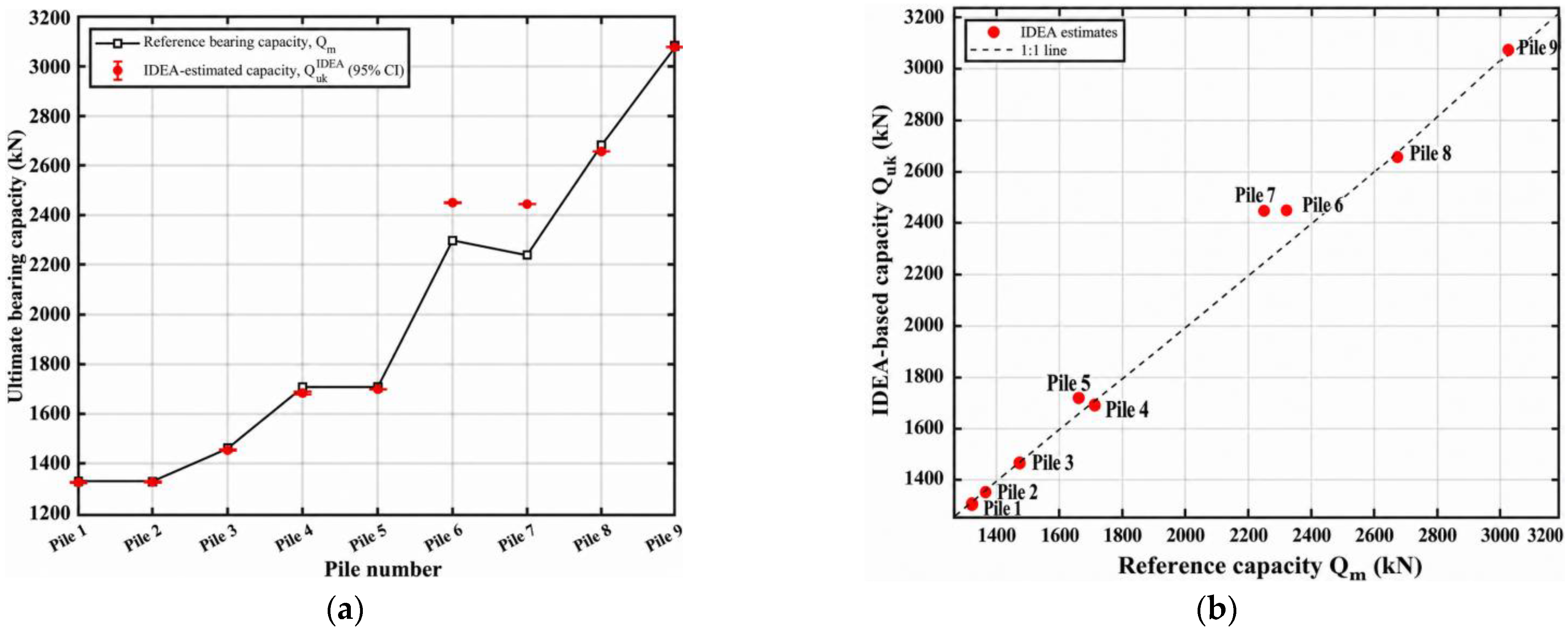
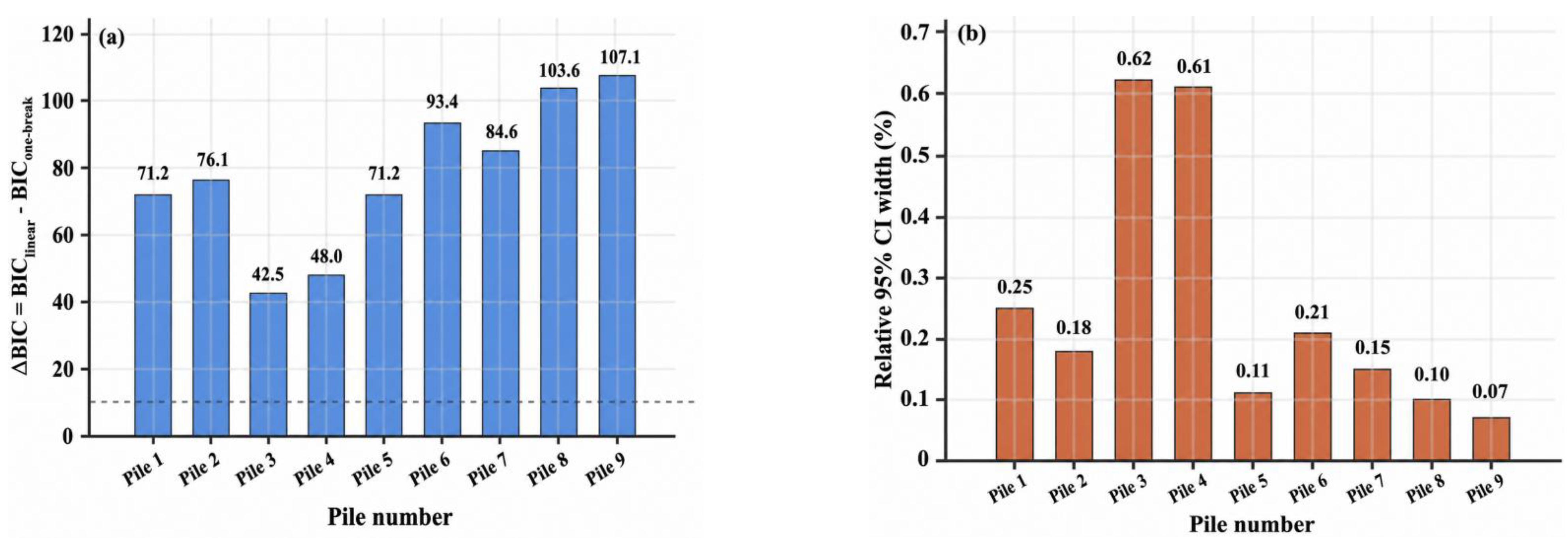
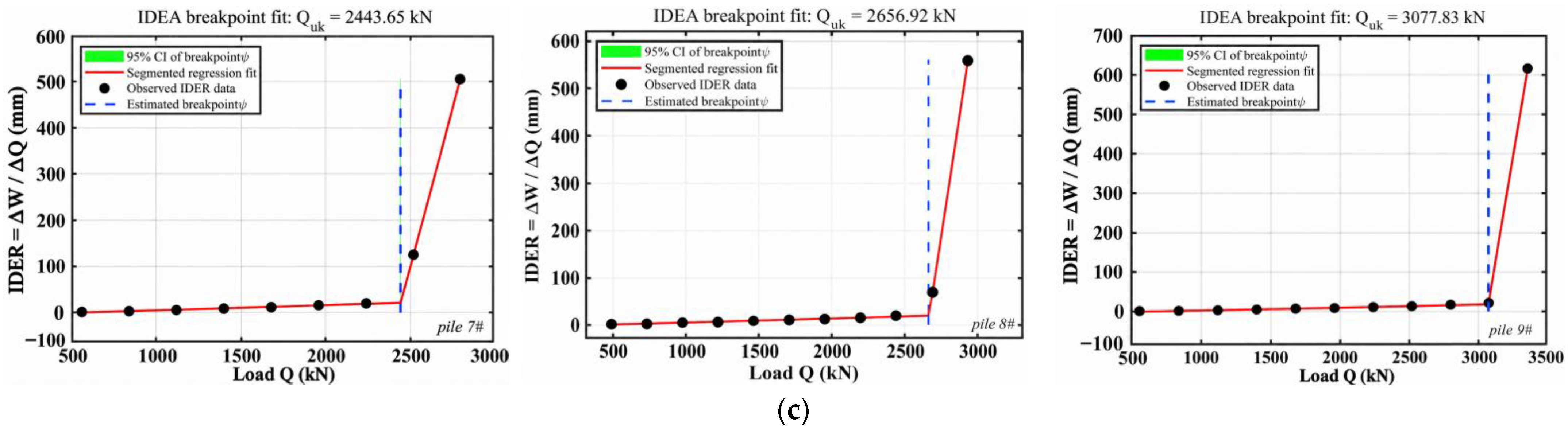
3.4. Results of IDEA Method and Statistical Comparison of Q-s Curve Interpretation Methods on the Present Datasets
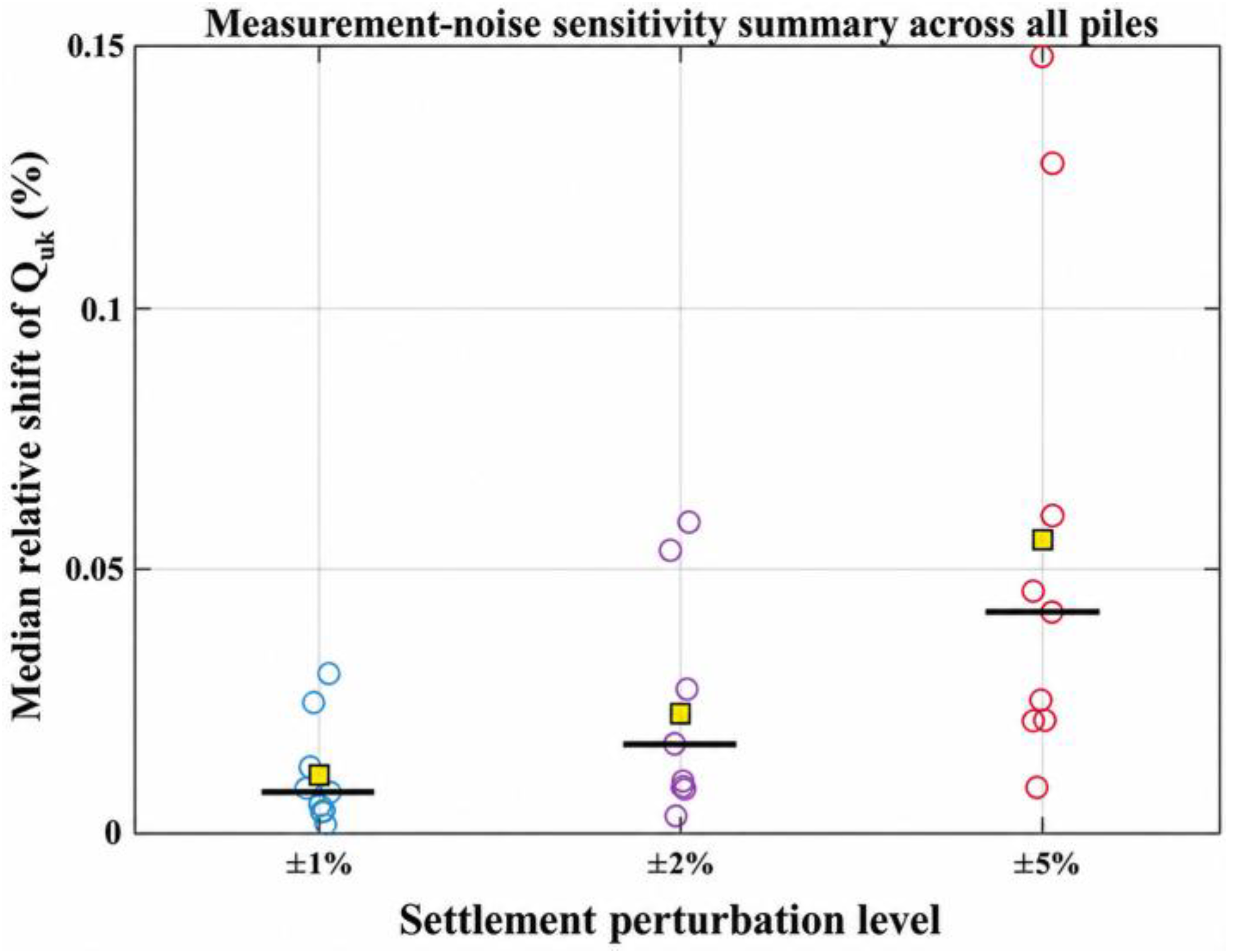
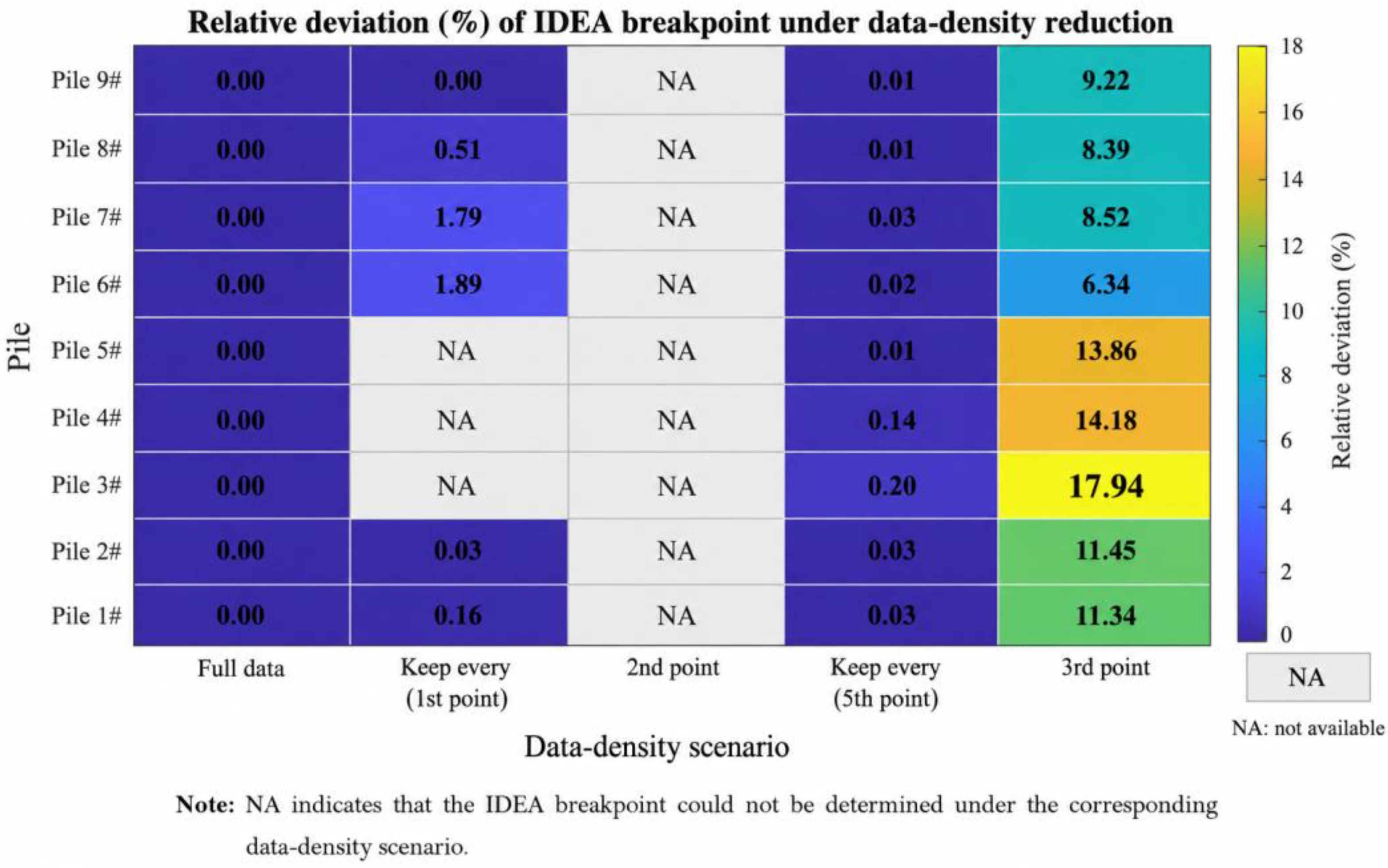
3.5. Sensitivity of the IDEA Breakpoint to Measurement Noise and Data Density
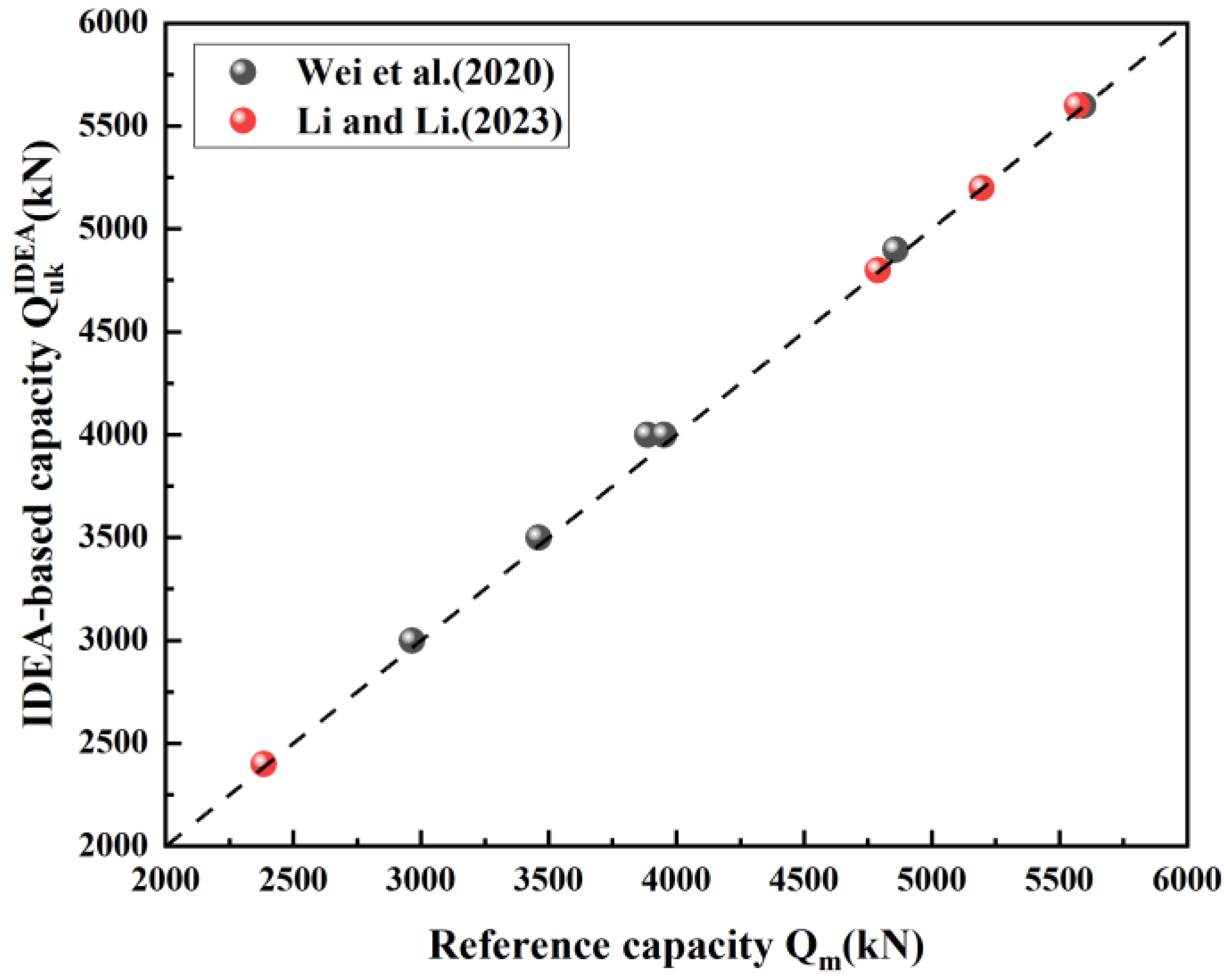
3.6. External Validation and Comparative Evaluation on Independent Published Q-S Datasets
3.7. Limitations and Recommended Scope of Application
4. Conclusions
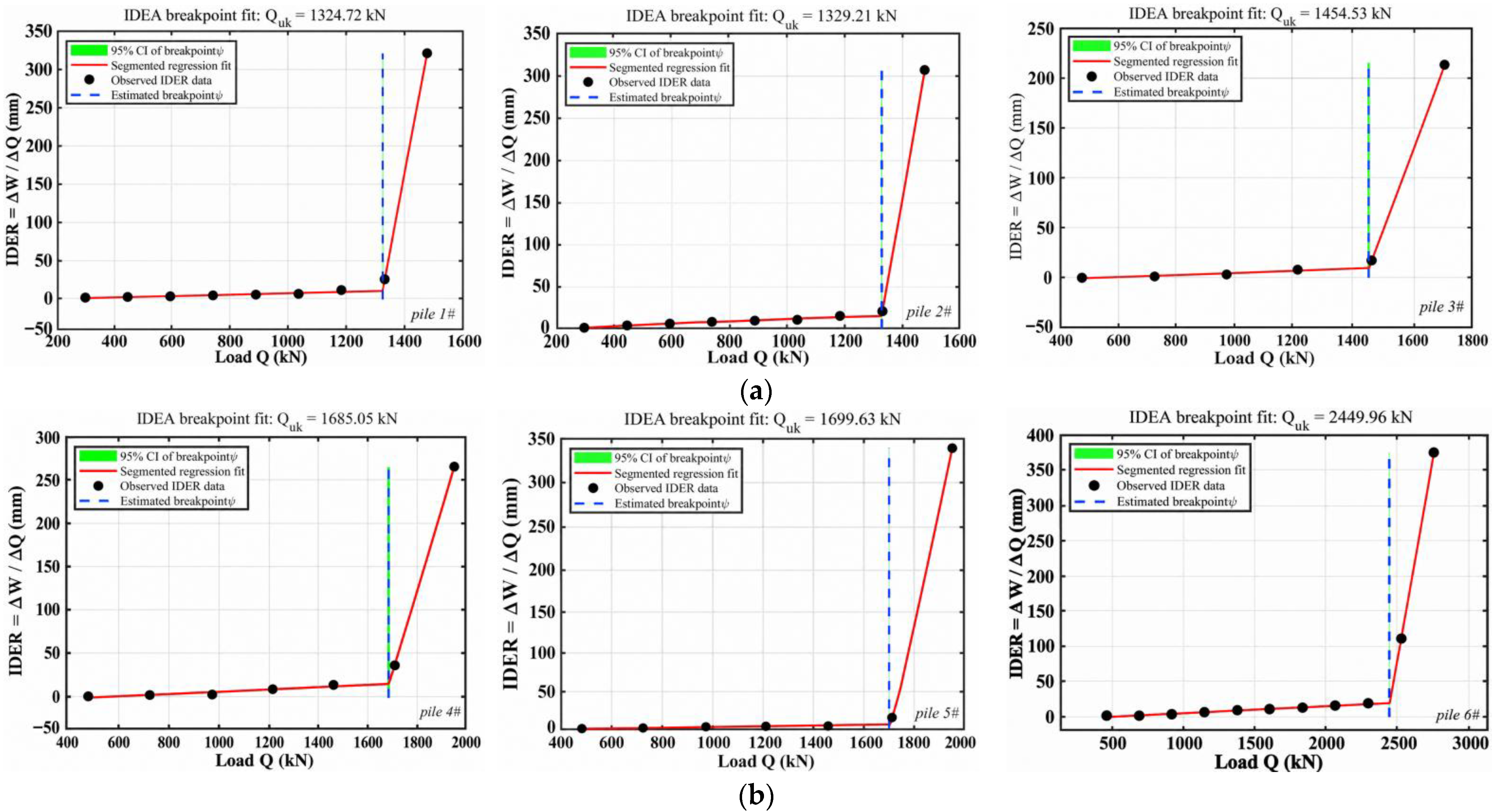
- The proposed IDEA procedure provides an objective and reproducible framework for interpreting PHC pile Q-s curves. By reconstructing cumulative work from the measured load–settlement response and fitting the IDER-Q relationship with a one-break continuous segmented-regression model, the transition load can be identified without manual breakpoint selection. Bootstrap confidence intervals and ΔBIC values further provide numerical support for the identified breakpoint.
- For the nine PHC test piles considered in this study, the segmented model was strongly supported and numerically stable. All piles showed a clear preference for the segmented model over a single-line model, and the relative widths of the 95% confidence intervals remained small. The marked increase from the pre-breakpoint slope to the post-breakpoint slope indicates that the identified breakpoint corresponds to a pronounced change in the work-based response of the tested pile system.
- Among the five Q-s curve interpretation methods compared on the present dataset, IDEA and Davisson showed the closest overall agreement with the reference capacities interpreted from the static load tests according to JGJ 106-2014. IDEA yielded the smallest MAPE, whereas Davisson showed slightly lower COV and RMSE. These results indicate that IDEA is a competitive and promising interpretation method within the examined PHC pile cases, but they do not imply universal superiority over existing interpretation criteria.
- The IDEA breakpoint was insensitive to moderate settlement measurement noise but sensitive to data completeness near the failure-related transition stage. The perturbation analysis showed only very small breakpoint shifts under ±1%, ±2%, and ±5% settlement noise. In contrast, reducing the density of loading points or removing pre-failure information could lead to unstable identification or substantial breakpoint deviations. Therefore, reliable application of IDEA requires not only generally dense loading records, but preferably at least two to three recorded loading stages within or immediately around the pre-failure transition zone. The record should include the last stable loading stage, the failure-related transition stage, and the initial post-transition response; otherwise, early termination may lead to unstable or biased breakpoint identification.
- The preliminary external application to a common ten-case subset of published PHC pile datasets provided initial support for the transferability of IDEA. However, because the internal dataset is limited to one field condition and the external cases remain limited and partly reconstructed from published figures, the present evidence should be regarded as preliminary. Further validation using original test records from broader pile types, soil conditions, and loading schemes is necessary before stronger general conclusions can be drawn.
Author Contributions
Funding
Data Availability Statement
Conflicts of Interest
References
- Weng, K.; Jia, M.; Su, Y. Prediction of long pile tip resistance based on CTNOA-SBL-MIC model. China J. Geotech. Eng. 2025, 47, 2163–2172. (In Chinese) [Google Scholar] [CrossRef]
- Wang, F.; Zhang, H.-Q.; Lyu, Z.-D.; Zhao, Z.; Zhang, R.H. Experimental on dynamic response of PHC pipe piles under near-field pulsed ground motion. China J. Highw. Transp. 2024, 37, 128–141. (In Chinese) [Google Scholar] [CrossRef]
- Kou, H.-L.; Diao, W.-Z.; Liu, T.; Yang, D.-L.; Horpibulsuk, S. Field performance of open-ended prestressed high-strength concrete pipe piles jacked into clay. Sensors 2018, 18, 4216. [Google Scholar] [CrossRef]
- Kou, H.-L.; Chu, J.; Guo, W.; Zhang, M.-Y. Field study of residual forces developed in prestressed high-strength concrete pipe piles. Can. Geotech. J. 2016, 53, 696–707. [Google Scholar] [CrossRef]
- Yang, Z.-X.; Guo, W.-B.; Jardine, R.J.; Chow, F.; Cai, Y.-Q. Field behavior of driven prestressed high-strength concrete piles in sandy soils. J. Geotech. Geoenviron. Eng. 2015, 141, 04015031. [Google Scholar] [CrossRef]
- Li, G.W.; Pei, H.F.; Yin, J.H.; Lu, X.C.; Teng, J. Monitoring and analysis of PHC pipe piles under hydraulic jacking using fiber-optic sensing. Measurement 2014, 49, 358–367. [Google Scholar] [CrossRef]
- Huang, F.-Y.; Wu, S.-W.; Luo, X.-Y.; Chen, B.-C.; Lin, Y. Pseudo-static low-cycle tests on mechanical behavior of PHC pipe piles considering soil-pile interaction. Eng. Struct. 2018, 171, 992–1006. [Google Scholar] [CrossRef]
- Schmertmann, J.H. Penetration testing in USA. In Proceedings of the European Symposium on Penetration Testing, Stockholm, Sweden, 5–7 June 1974; Volume 1, pp. 217–218. [Google Scholar]
- Meyerhof, G.G. Bearing capacity and settlement of pile foundations. J. Geotech. Eng. Div. 1976, 102, 197–228. [Google Scholar] [CrossRef]
- Decourt, L. Prediction of load-settlement relationships for foundations on the basis of the SPT-T. In Ciclo de Conferencias Internacionales Leonardo Zeevaert; UNAM: Mexico City, Mexico, 1995; pp. 85–104. [Google Scholar]
- Wei, Y.; Wang, D.; Li, J.; Jie, Y.; Ke, Z.; Li, J.; Wong, T. Evaluation of ultimate bearing capacity of pre-stressed high-strength concrete pipe pile embedded in saturated sandy soil based on in-situ test. Appl. Sci. 2020, 10, 6269. [Google Scholar] [CrossRef]
- Huynh, V.-H.; Nguyen, T.; Nguyen, D.-P.; Nguyen, T.-S.; Huynh, T.-M.; Nguyen, T.-C. A novel direct SPT method to accurately estimate ultimate axial bearing capacity of bored PHC nodular piles with 81 case studies in Vietnam. Soils Found. 2022, 62, 101163. [Google Scholar] [CrossRef]
- Alielahi, H.; Mousavi, D.; Nadernia, Z. Statistical assessment of bearing capacity of cast-in-situ bored piles using direct CPT and SPT methods: A case study. Indian Geotech. J. 2023, 53, 698–714. [Google Scholar] [CrossRef]
- Jesswein, M.; Liu, J. Reliability-based serviceability limit state design of driven piles in glacial deposits. Geotech. Geol. Eng. 2022, 40, 4447–4471. [Google Scholar] [CrossRef]
- Jiang, H.; Geng, K.; Yang, H.; Lu, H.K.; Lan, P.W. Analysis of single-pile bearing capacity of prestressed concrete pipe piles. Build. Struct. 2022, 52, 2759–2762. (In Chinese) [Google Scholar] [CrossRef]
- Fernandes, M.M. Analysis and Design of Geotechnical Structures; CRC Press: Boca Raton, FL, USA, 2020. [Google Scholar]
- Hansen, J.B. Discussion of “Hyperbolic stress-strain response: Cohesive soils”. J. Soil Mech. Found. Div. 1963, 89, 241–242. [Google Scholar] [CrossRef]
- Chin, F.K. Estimation of the ultimate load of piles from tests not carried to failure. In Proceedings of the 2nd Southeast Asian Conference on Soil Engineering, Singapore, 11–15 June 1970. [Google Scholar]
- Chin, F.K. The inverse slope as a prediction of ultimate bearing capacity of piles. In Proceedings of the 2nd Southeast Asian Conference on Soil Engineering, Singapore, 11–15 June 1970; pp. 83–91. [Google Scholar]
- Department of the Army, U.S. Army Corps of Engineers. Engineering and Design: Design of Pile Foundations, Engineer Manual EM 1110-2-2906; U.S. Army Corps of Engineers: Washington, DC, USA, 1991.
- Davisson, M.T. High capacity piles. In Proceedings of the Innovations in Foundation Construction, Chicago, IL, USA, 22 March 1972; Volume 52. [Google Scholar]
- Adel, R.; Shakir, R.R. Evaluation of static pile load test results of ultimate bearing capacity by interpreting methods. Proc. IOP Conf. Ser. Earth Environ. Sci. 2022, 961, 012013. [Google Scholar] [CrossRef]
- Vural, I.; Kabaca, H.; Poyraz, S. A novel approach proposal for estimation of ultimate pile bearing capacity based on pile loading test data. Appl. Sci. 2023, 13, 7993. [Google Scholar] [CrossRef]
- Yang, J. Determination of ultimate bearing capacity of foundation piles from static load tests based on the cusp catastrophe model. Hydrogeol. Eng. Geol. 2024, 51, 114–123. (In Chinese) [Google Scholar] [CrossRef]
- Wang, X.; Wang, J.; Zhang, Z. A thermo-mechanical model for pile-soil interface behavior. IOP Conf. Ser. Earth Environ. Sci. 2021, 861, 072145. [Google Scholar] [CrossRef]
- Jia, J.; Tang, H.; Chen, H. Dynamic mechanical properties and energy dissipation characteristics of frozen soil under passive confined pressure. Acta Mech. Solida Sin. 2021, 34, 184–203. [Google Scholar] [CrossRef]
- Wang, J.; Wang, X.; Liu, T.; Ye, A. Seismic uplift behavior and energy dissipation mechanism of scoured bridge pile-group foundations: Quasi-static test and numerical analysis. Ocean Eng. 2022, 266, 113172. [Google Scholar] [CrossRef]
- Jiang, J.H.; Huang, X.L.; Shu, X.R.; Ning, X.; Qu, Y.; Xiong, W.-L. Application of a damage constitutive model to pile–slope stability analysis. Front. Mater. 2022, 9, 1082292. [Google Scholar] [CrossRef]
- Xie, Y.; Tang, B.; Liu, S.; Zhang, B. Study on energy dissipation law of vibration disturbance damaged Zhanjiang Formation structural clay. PLoS ONE 2025, 20, e0325285. [Google Scholar] [CrossRef]
- GB/T 50123-1999; Standard for Soil Test Method. China Planning Press: Beijing, China, 1999. (In Chinese)
- JGJ 106-2014; Technical Specification for Testing of Building Foundation Piles. China Architecture & Building Press: Beijing, China, 2014. (In Chinese)
- JGJ 94-2008; Technical Code for Building Pile Foundations. China Architecture & Building Press: Beijing, China, 2008. (In Chinese)
- Reich, C. Analysis of Hysteretic Damping in Axially Loaded Piles; University of Rhode Island: Kingston, RI, USA, 2021. [Google Scholar]
- Gavin, K.; Gallagher, D.; Doherty, P.; McCabe, B. Field investigation of the effect of installation method on the shaft resistance of piles in clay. Can. Geotech. J. 2010, 47, 730–741. [Google Scholar] [CrossRef]
- Abou-Samra, G.; Silvestri, V.; Desjardins, S.L.; Labben, R. Drained-undrained shaft resistance of piles in soft clays. Int. J. Civ. Eng. 2021, 19, 115–125. [Google Scholar] [CrossRef]
- Yuan, B.; Huang, X.; Huang, Q.; Shiau, J.; Liang, J.; Zhang, B.; Zheng, J.; Fahimizadeh, M.; Sabri, M.M. Effects of particle size on properties of engineering muck-based geopolymers: Optimization through sieving treatment. Constr. Build. Mater. 2025, 492, 142967. [Google Scholar] [CrossRef]
- Dung, N.T.; Chung, S.G.; Kim, S.R.; Beak, S.H. Applicability of the SPT-based methods for estimating toe bearing capacity of driven PHC piles in the thick deltaic deposits. KSCE J. Civ. Eng. 2011, 15, 1023–1031. [Google Scholar] [CrossRef]
- Yang, J.; Mu, F. Relating the maximum radial stress on pile shaft to pile base resistance. Geotechnique 2011, 61, 1087–1092. [Google Scholar] [CrossRef]
- Xing, H.F.; Zhao, H.W.; Ye, G.B.; Xu, C. Effect of driving long pre-stressed high-strength concrete pipe piles in alluvium and its mechanical behavior. Bull. Eng. Geol. Environ. 2012, 71, 771–781. [Google Scholar] [CrossRef]
- Cai, G.; Liu, S.; Tong, L.; Du, G. Assessment of direct CPT and CPTU methods for predicting the ultimate bearing capacity of single piles. Eng. Geol. 2009, 104, 211–222. [Google Scholar] [CrossRef]
- Xu, B.; Yang, K.; Fan, J.; Shi, W.; Wu, Y. Influence of slenderness ratio and variation of pile-soil modulus on the vertical bearing behavior of bored piles. Munic. Eng. Technol. 2024, 42, 54–61, 77. (In Chinese) [Google Scholar] [CrossRef]
- Yuan, B.; Liang, J.; Li, R.; Luo, Q.; Shiau, J.; Wang, Y.; Yuan, J.; Sabri, S.M.M.; Huang, S.; Liao, C. Dynamic behavior and deformation of calcareous sand under cyclic loading. Soil Dyn. Earthq. Eng. 2025, 199, 109730. [Google Scholar] [CrossRef]
- Jalali, U.H.; Alshameri, B.; Khalid, M.H.; Hassan, W.; Abdeldjouad, L.; Jamil, S.M.; Farooq, H.; Maqsood, Z. Data-driven approach to enhance deep foundation safety: Reliable methods for predicting bored pile capacity. Int. J. Geo-Eng. 2025, 16, 16. [Google Scholar] [CrossRef]
- Olgun, M.; Yenginar, Y.; Hanati, A. Interpreting load-settlement curves of pile foundations by graphical methods. Eurasian J. Civ. Eng. Archit. 2017, 1, 1–10. [Google Scholar]
- Baligh, F.A.; Abdelrahman, G.E. Modification of Davisson’s method. In Proceedings of the 16th International Conference on Soil Mechanics and Geotechnical Engineering, Osaka, Japan, 12–16 September 2005; IOS Press: Amsterdam, The Netherlands, 2005; pp. 2079–2082. [Google Scholar]
- Othman, M.M.; Voyagaki, E.; De Luca, F.; Mylonakis, G.; Vardanega, P.; Crispin, J. Preliminary study of ultimate load prediction using the DINGO database. In Smart Geotechnics for Smart Societies; CRC Press: Boca Raton, FL, USA, 2023; pp. 1487–1492. [Google Scholar]
- Król, M.; Rybak, J. Accuracy of extrapolation methods for non-failed static load tests. In Effect of Water on Geotechnical Structures, Proceedings of the 11th Slovak Geotechnical Conference, Bratislava, Slovakia, 3–4 June 2013; Slovak University of Technology in Bratislava: Bratislava, Slovakia, 2013; pp. 285–294. [Google Scholar]
- Yuan, B.; Huang, Q.; Xu, W.; Han, Z.; Luo, Q.; Chen, G.; Yuan, J.; Zhang, Q.; Sabri, S.M.M. Study on the interaction between pile and soil under lateral load in coral sand. Geomech. Energy Environ. 2025, 42, 100674. [Google Scholar] [CrossRef]
- Yan, J.; Kong, L.; Xiong, C.; Xu, G. Damage analysis of shear mechanical behavior of pile–structural soil interface considering shear rate effect. Acta Geotech. 2023, 18, 5369–5383. [Google Scholar] [CrossRef]
- Li, C.; Li, X. Evaluation of bearing capacity of PHC pipe piles via the dynamic and static loading test. Front. Earth Sci. 2023, 11, 1130294. [Google Scholar] [CrossRef]







| Test Pile No. | Length (m) | Outer Diameter (mm) | Wall Thickness (mm) | Concrete Grade | Elastic Modulus (GPa) | Compressive Pre-Stress (MPa) | Design Bearing Capacity Ra (kN) |
|---|---|---|---|---|---|---|---|
| 1# | 18.25 | 400 | 95 | C80 | 38 | 6 | 700 |
| 2# | 19.25 | 400 | 95 | C80 | 38 | 6 | 700 |
| 3# | 21.00 | 500 | 100 | C80 | 38 | 6 | 1220 |
| 4# | 22.00 | 500 | 100 | C80 | 38 | 6 | 1220 |
| 5# | 28.00 | 500 | 100 | C80 | 38 | 6 | 1220 |
| 6# | 28.00 | 500 | 100 | C80 | 38 | 6 | 1220 |
| 7# | 30.82 | 500 | 100 | C80 | 38 | 6 | 1400 |
| 8# | 27.00 | 500 | 100 | C80 | 38 | 6 | 1200 |
| 9# | 31.00 | 500 | 100 | C80 | 38 | 6 | 1400 |
| Test Pile No. | Ground Conditions | Soil Thickness (m) | Na(avg) | qsik | qpk |
|---|---|---|---|---|---|
| (kPa) | (kPa) | ||||
| 1# | Silty clay | 0.00–1.60 | 5.5 | 55 | * |
| Fine sand (slightly dense) | 1.60–7.80 | 10.6 | 26 | * | |
| Fine sand (medium-dense) | 7.80–30.20 | 15.5 | 48 | 4400 | |
| 2# | Silty clay | 0.00–1.70 | 5.5 | 55 | * |
| Fine sand (slightly dense) | 1.70–6.2 | 10.6 | 26 | * | |
| Fine sand (medium-dense) | 6.20–31.40 | 15.5 | 48 | 4400 | |
| 3# | Silty clay | 0.00–0.50 | 5.5 | 55 | * |
| Fine sand (slightly dense) | 0.50–6.40 | 10.6 | 26 | * | |
| Fine sand (medium-dense) | 6.40–32.30 | 15.5 | 48 | 4400 | |
| 4# | Silty clay | 0.00–1.90 | 5.5 | 55 | * |
| Fine sand (slightly dense) | 1.90–8.50 | 10.6 | 26 | * | |
| Fine sand (medium-dense) | 8.50–31.70 | 15.5 | 48 | 4400 | |
| 5# | mucky silty clay | 0.00–2.80 | 1.5 | 25 | * |
| Fine sand (slightly dense) | 2.80–9.50 | 10.6 | 26 | * | |
| Fine sand (medium-dense) | 9.50–31.50 | 15.5 | 48 | 4400 | |
| 6# | Silty clay | 0.00–3.80 | 5.5 | 55 | * |
| Fine sand (slightly dense) | 3.80–11.50 | 10.6 | 26 | * | |
| Fine sand (medium-dense) | 11.50–31.40 | 15.5 | 48 | 4400 | |
| 7# | Silty clay | 0.00–3.50 | 5.5 | 55 | * |
| Fine sand (slightly dense) | 3.50–11.00 | 10.6 | 26 | * | |
| Fine sand (medium-dense) | 11.00–31.00 | 15.5 | 48 | 5200 | |
| 8# | Silty clay | 0.00–1.50 | 5.5 | 55 | * |
| Fine sand (slightly dense) | 1.50–6.60 | 10.6 | 26 | * | |
| Fine sand (medium-dense) | 6.60–31.30 | 15.5 | 48 | 4400 | |
| 9# | Silty clay | 0.00–3.40 | 5.5 | 55 | * |
| Fine sand (slightly dense) | 3.40–10.60 | 10.6 | 26 | * | |
| Fine sand (medium-dense) | 10.60–32.00 | 15.5 | 48 | 5200 |
| Soil Type | qc/N | Friction Ratio (%) | Ultimate End Bearing Capacity (kPa) | Ultimate Shaft Friction Capacity (kPa) |
|---|---|---|---|---|
| Clean sand with various densities | 0.3745 | 0.60 | 342.4 × Nb | 2.03 × Ni(avg) |
| Mixed sand with clay and silt Plastic clay | 0.2140 | 2.00 | 171.2 × Nb | 4.28 × Ni(avg) |
| Plastic clay | 0.1070 | 5.00 | 74.9 × Nb | 5.35 × Ni(avg) |
| Shell-containing sand and soft argillaceous limestone | 0.4280 | 0.25 | 385.2 × Nb | 1.07 × Ni(avg) |
| Loading Steps | Load (kN) | Settlement (mm) | ∆Q (kN) | = ∆W (kN·mm) | ΣWi (kN·mm) | IDER = ΔW/ΔQ (mm) |
|---|---|---|---|---|---|---|
| - | 0 | 0 | - | - | - | 0 |
| 1 | 296 | 0.82 | 296 | 121.36 | 121.36 | 0.41 |
| 2 | 444 | 1.34 | 148 | 192.4 | 313.76 | 1.3 |
| 3 | 592 | 2.02 | 148 | 352.24 | 544.64 | 2.38 |
| 4 | 740 | 2.8 | 148 | 519.48 | 871.72 | 3.51 |
| 5 | 888 | 3.62 | 148 | 667.48 | 1186.96 | 4.51 |
| 6 | 1036 | 4.46 | 148 | 808.08 | 1475.56 | 5.46 |
| 7 | 1184 | 5.98 | 148 | 1687.2 | 2495.28 | 11.4 |
| 8 | 1332 | 8.9 | 148 | 3673.36 | 5360.56 | 24.82 |
| 9 | 1480 | 42.64 | 148 | 47,438.44 | 51,111.8 | 320.53 |
| Test Pile NO. | Qm (kN) | (kN) | 95% CI (kN) | (kN) | Relative Error (%) | k1 | k2 | ∆BIC | Relative CI Width (%) |
|---|---|---|---|---|---|---|---|---|---|
| 1# | 1332 | 1324.72 | 1322.99–1326.28 | −7.28 | 0.55 | 0.0105 | 1.998 | 71.2146 | 0.25 |
| 2# | 1332 | 1329.21 | 1328.06–1330.48 | −2.79 | 0.21 | 0.0143 | 1.9357 | 76.1245 | 0.18 |
| 3# | 1464 | 1454.53 | 1450.02–1459.1 | −9.47 | 0.65 | 0.0115 | 0.7963 | 42.4725 | 0.62 |
| 4# | 1708 | 1685.05 | 1680.16–1690.49 | −22.95 | 1.34 | 0.0132 | 0.9397 | 48.022 | 0.61 |
| 5# | 1708 | 1699.63 | 1698.72–1700.53 | −8.37 | 0.49 | 0.005 | 1.3138 | 71.1631 | 0.11 |
| 6# | 2300 | 2449.96 | 2446.99–2452.14 | 149.96 | 6.52 | 0.01 | 1.1483 | 93.3877 | 0.21 |
| 7# | 2240 | 2443.65 | 2441.86–2445.52 | 203.65 | 9.09 | 0.0113 | 1.3619 | 84.6018 | 0.15 |
| 8# | 2684 | 2656.92 | 2655.45–2657.99 | −27.08 | 1.01 | 0.0086 | 1.9947 | 103.5901 | 0.10 |
| 9# | 3080 | 3077.83 | 3076.67–3078.79 | −2.17 | 0.07 | 0.0073 | 2.1206 | 107.1138 | 0.07 |
| Method | Mean Ratio | COV | MAPE (%) | RMSE (kN) | Mean Bias (kN) |
|---|---|---|---|---|---|
| Chin | 1.1961 | 0.0625 | 20.4 | 345.18 | 385.68 |
| Davisson | 1.0081 | 0.0312 | 2.45 | 46.82 | 22.36 |
| Corps of Engineers | 0.9687 | 0.0414 | 3.87 | 101.65 | −67.13 |
| Hansen | 1.1539 | 0.0258 | 15.39 | 314.92 | 301.58 |
| IDEA | 1.0126 | 0.0374 | 2.21 | 85.28 | 30.39 |
| Test Pile No. | Source | Length (m) | Diameter (mm) | Thickness (mm) | Bearing Soil Layer | Source-Reported SLT Value (kN) | Adopted Qref in This Study (kN) | Qref Determination Basis |
|---|---|---|---|---|---|---|---|---|
| C-1 | Wei et al. [11] | 21 | 500 | 125 | Medium sand | 5600 | 5600 | Reinterpreted from digitized Q-s curve; same as source-reported value |
| C-2 | Wei et al. [11] | 21 | 500 | 125 | Medium sand | 4900 | 4900 | |
| D-1 | Wei et al. [11] | 12.5 | 500 | 125 | Coarse sand | 3500 | 3500 | |
| D-3 | Wei et al. [11] | 12.5 | 500 | 125 | Coarse sand | 4000 | 4000 | |
| D-2 | Wei et al. [11] | 12.5 | 500 | 125 | Coarse sand | 3500 | 3000 | Preceding load before abrupt settlement response identified from digitized Q-s curve |
| K-1 | Wei et al. [11] | 21 | 500 | 125 | Medium sand | 4500 | 4000 | |
| 3# | Li and Li [50] | 24 | 500 | 125 | Strongly weathered mudstone | 4800 | 4800 | Source Q-s interpretation; consistent with abrupt-settlement criterion |
| 5# | Li and Li [50] | 25 | 500 | 125 | Strongly weathered mudstone | 5200 | 5200 | |
| 6# | Li and Li [50] | 25 | 500 | 125 | Strongly weathered mudstone | 5600 | 5600 | |
| 7# | Li and Li [50] | 25 | 400 | 95 | Strongly weathered mudstone | 2400 | 2400 |
| Test Pile NO. | Qref (kN) | (kN) | /Qref | Error (kN) | Absolute Percentage Error (%) |
|---|---|---|---|---|---|
| C-1 | 5600 | 5592.65 | 0.9987 | −7.35 | 0.13% |
| C-2 | 4900 | 4858.43 | 0.9915 | −41.57 | 0.85% |
| D-1 | 3500 | 3459.73 | 0.9885 | −40.27 | 1.15% |
| D-2 | 3000 | 2963.83 | 0.9879 | −36.17 | 1.21% |
| D-3 | 4000 | 3885.22 | 0.9713 | −114.78 | 2.87% |
| K-1 | 4000 | 3951.09 | 0.9878 | −48.91 | 1.22% |
| 3# | 4800 | 4788.96 | 0.9977 | −11.04 | 0.23% |
| 5# | 5200 | 5195.38 | 0.9991 | −4.62 | 0.09% |
| 6# | 5600 | 5569.04 | 0.9945 | −30.96 | 0.55% |
| 7# | 2400 | 2383.51 | 0.9931 | −16.49 | 0.69% |
| Test Pile NO. | Qref (kN) | Chin (kN) | Davisson (kN) | Corps of Engineers (kN) | Hansen (kN) |
|---|---|---|---|---|---|
| C-1 | 5600 | 6694.56 | 5716.39 | 4524.00 | 6314.98 |
| C-2 | 4900 | 6075.69 | 5028.01 | 4238.19 | 5600.24 |
| D-1 | 3500 | 3806.22 | 3477.87 | 3096.9 | 4014.33 |
| D-2 | 3000 | 2468.96 | 3067.20 | 2867.57 | 3501.70 |
| D-3 | 4000 | 4781.96 | 3672.14 | 3473.07 | 4510.66 |
| K-1 | 4000 | 5688.19 | 4204.41 | 3767.27 | 4500.21 |
| 3# | 4800 | 5503.17 | 4812.53 | 3554.99 | 5184.71 |
| 5# | 5200 | 6007.87 | 5240.67 | 3710.8 | 5584.82 |
| 6# | 5600 | 6312.90 | 5629.31 | 4051.7 | 5993.60 |
| 7# | 2400 | 3324.42 | 2404.30 | 4339.76 | 2670.72 |
| Method | Mean Ratio | COV (%) | MAPE (%) | RMSE (kN) | Mean Bias (kN) |
|---|---|---|---|---|---|
| Chin | 1.1778 | 14.02 | 21.32 | 944.85 | 766.39 |
| Davisson | 1.0050 | 3.45 | 2.26 | 136.71 | 25.28 |
| Corps of Engineers | 0.9310 | 34.39 | 23.07 | 1097.05 | −537.58 |
| Hansen | 1.1175 | 2.95 | 11.75 | 505.28 | 487.60 |
| IDEA | 0.991 | 0.8243 | 0.8987 | 46.53 | −35.22 |
Disclaimer/Publisher’s Note: The statements, opinions and data contained in all publications are solely those of the individual author(s) and contributor(s) and not of MDPI and/or the editor(s). MDPI and/or the editor(s) disclaim responsibility for any injury to people or property resulting from any ideas, methods, instructions or products referred to in the content. |
© 2026 by the authors. Licensee MDPI, Basel, Switzerland. This article is an open access article distributed under the terms and conditions of the Creative Commons Attribution (CC BY) license.
Share and Cite
Cao, L.; Zhao, X.; Zhu, D.; Yang, B. Interpreting Failure-Related Load Transition in Static Tests of PHC Pipe Piles Using a Work-Based Abrupt Change Method. Buildings 2026, 16, 1918. https://doi.org/10.3390/buildings16101918
Cao L, Zhao X, Zhu D, Yang B. Interpreting Failure-Related Load Transition in Static Tests of PHC Pipe Piles Using a Work-Based Abrupt Change Method. Buildings. 2026; 16(10):1918. https://doi.org/10.3390/buildings16101918
Chicago/Turabian StyleCao, Ligang, Xiaoyan Zhao, Di Zhu, and Bo Yang. 2026. "Interpreting Failure-Related Load Transition in Static Tests of PHC Pipe Piles Using a Work-Based Abrupt Change Method" Buildings 16, no. 10: 1918. https://doi.org/10.3390/buildings16101918
APA StyleCao, L., Zhao, X., Zhu, D., & Yang, B. (2026). Interpreting Failure-Related Load Transition in Static Tests of PHC Pipe Piles Using a Work-Based Abrupt Change Method. Buildings, 16(10), 1918. https://doi.org/10.3390/buildings16101918