To enhance the clarity and readability of the article, several tables, figures, and corresponding texts have been revised or added.
Text Correction
To incorporate the new figures and table, corresponding textual modifications have been made. A consistent correction has been made to the title, abstract Section, Sections 1, 4, 5, 7 and 8.
Title
Web Crippling Behaviour of 7075-T6 and AA-6086 High-Strength Aluminium Alloy Channel Sections Under End-Two-Flange and Interior-Two-Flange Loading
Abstract
Two types of high-strength aluminium alloy (HA) namely AA-6086, and 7075-T6 have been developed and extensively used in recent years. These high-strength aluminium alloys offer advantages such as lower prices and higher yield strength than traditional ones. The webs of aluminium channel members under concentrated loads are susceptible to web buckling failure, which restricts their applications. However, no research work has been reported that evaluated the web buckling performance of high-strength aluminium alloy channel sections, and the material characteristics of these high-strength aluminium alloys differ significantly from those of conventional aluminium alloys. This work addresses this research gap through a detailed numerical investigation, focusing on AA-6086 and 7075-T6 alloys under both end-two-flange (ETF) and interior-two-flange (ITF) loading conditions. For comparison, specimens with web openings were also analysed under the ETF loading case. A parametric investigation consisting of 3506 models was performed using the finite element (FE) models previously developed for traditional aluminium alloys. Specifically, 1024 models represented imperforated specimens under ITF loading, 1024 under ETF loading, and 1458 perforated specimens under ETF loading. A wide range of high-strength aluminium alloy sections covering varying web slenderness ratios, internal corner radii, bearing lengths, and aluminium alloy grades were considered in this investigation. It was shown that the latest design recommendations in the Australian and New Zealand Standards (AS/NZ S4600) and (AS/NZS 1664.1) cannot accurately predict the web buckling strength of such channel sections. Finally, new design equations were proposed for AA-6086 and 7075-T6 high-strength aluminium alloy channel sections under both end-two-flange (ETF) and interior-two-flange (ITF) loading conditions, including cases with web openings.
1. Introduction
The Australian/New Zealand Standard (AS/NZS 4600) classifies web crippling into four distinct loading cases: End-Two-Flange (ETF), End-One-Flange (EOF), Interior-Two-Flange (ITF), and Interior-One-Flange (IOF).
No research study has been reported investigating the web buckling strength of HA channels subjected to end-two-flange (ETF) loading or interior-two-flange (ITF) loading.
This study addresses this research gap through a detailed numerical investigation, focusing on AA-6086 and 7075-T6 alloys under both end-two-flange (ETF) and interior-two-flange (ITF) loading conditions. For comparison, specimens with web openings were also analysed under the ETF loading case. This research was built upon the work of Alsanat et al. [23] but focused on HA sections instead of traditional aluminium alloy. Both material grades of AA-6086 and 7075-T6 were considered. The finite element (FE) models were developed and verified using the data obtained from the laboratory testing. A parametric investigation consisting of 3506 models was undertaken to examine the impact of various parameters on the web buckling performance of HA sections. Based on the outcomes of the numerical investigation, the accuracy of the latest design recommendations in the AS/NZS 4600 [30] and AS/NZS 1664.1 [32] was assessed. Moreover, new design equations were proposed for AA-6086 and 7075-T6 high-strength aluminium alloy channel sections under both end-two-flange (ETF) and interior-two-flange (ITF) loading conditions, including cases with web openings.
4. Development of Numerical Models and Parametric Study
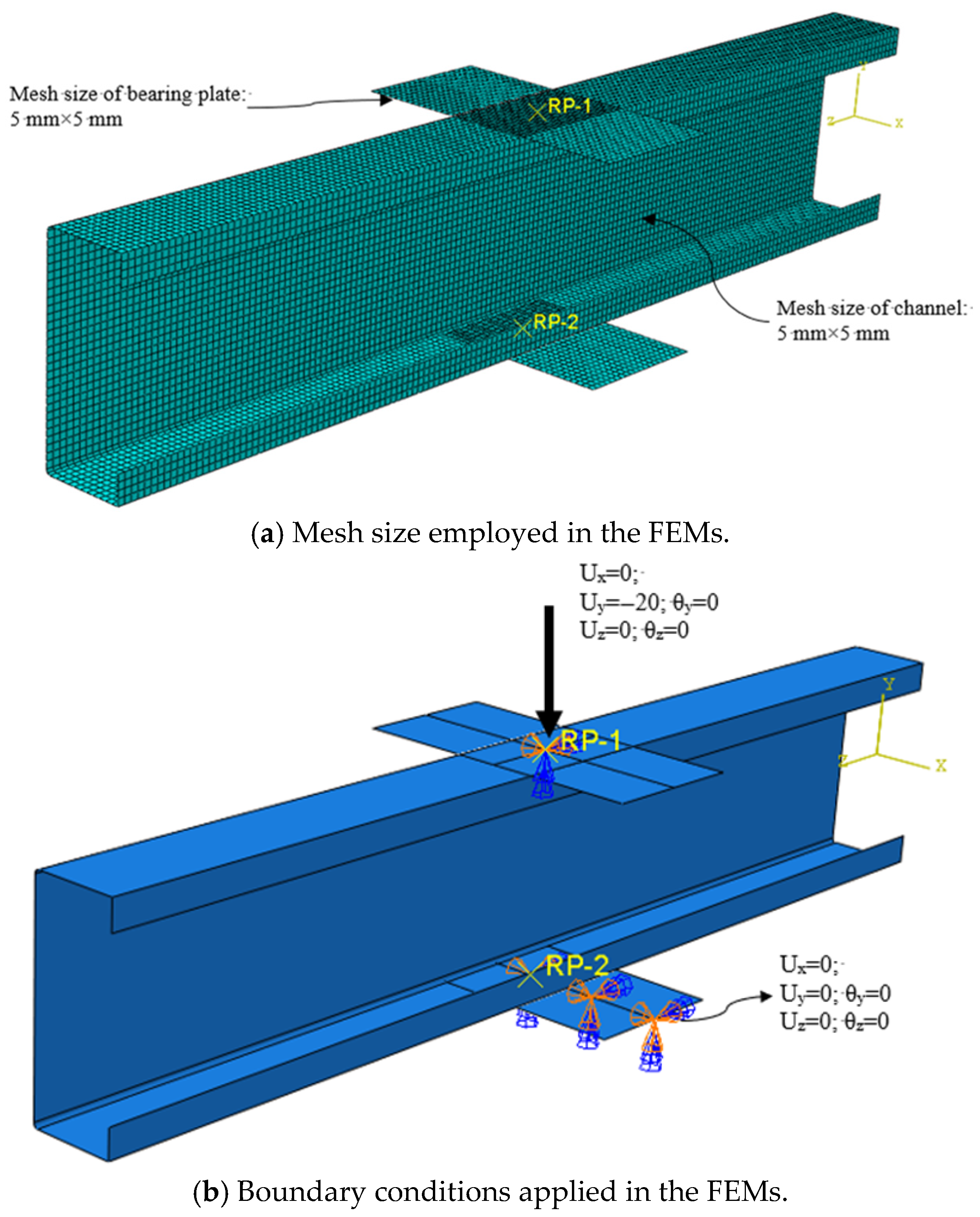
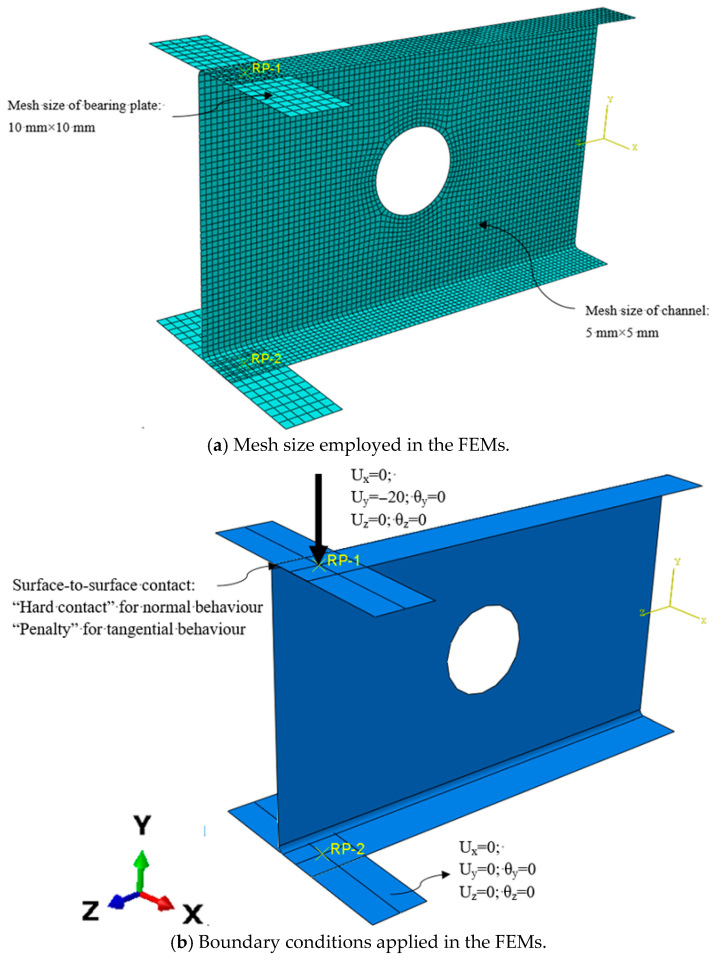
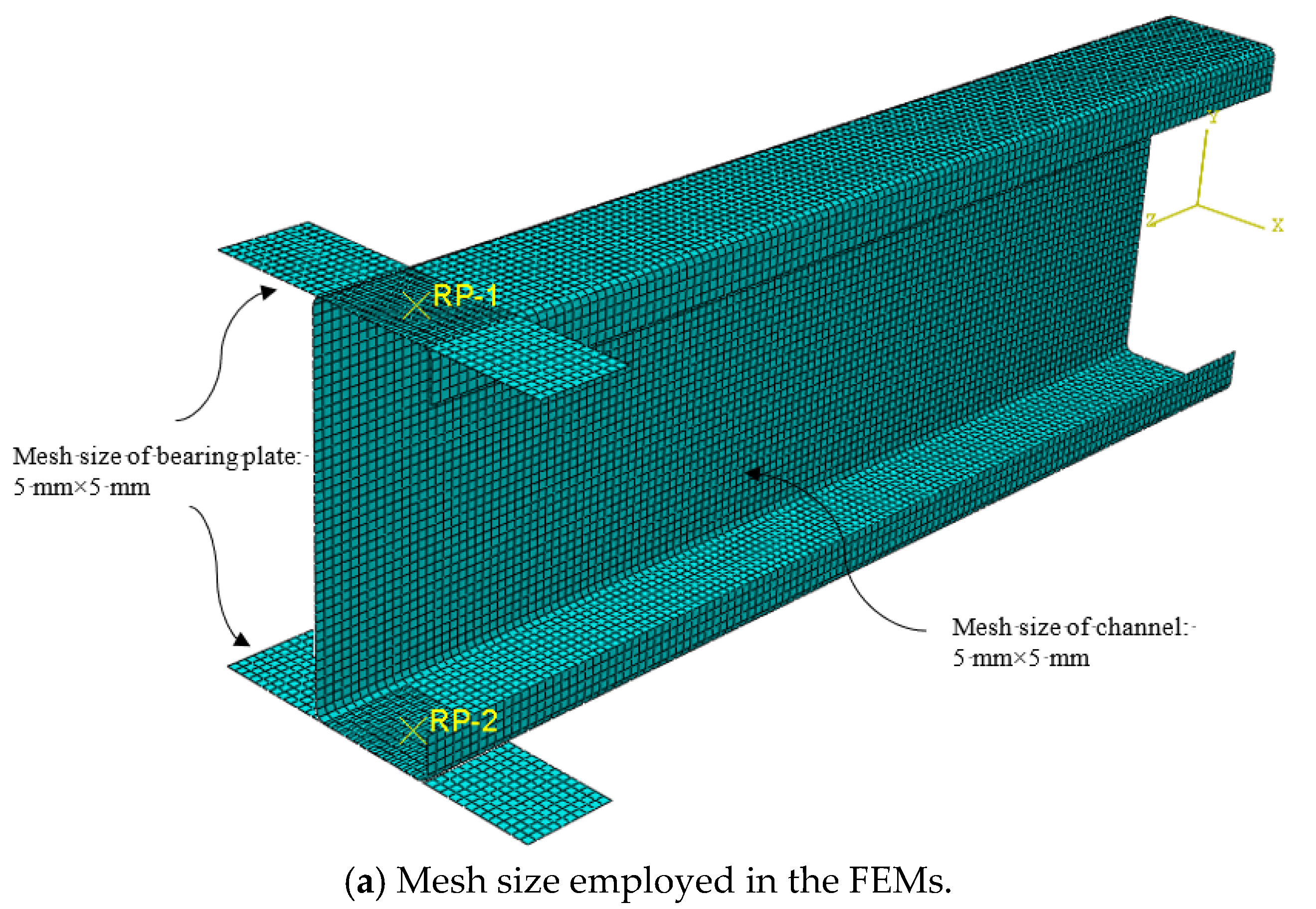
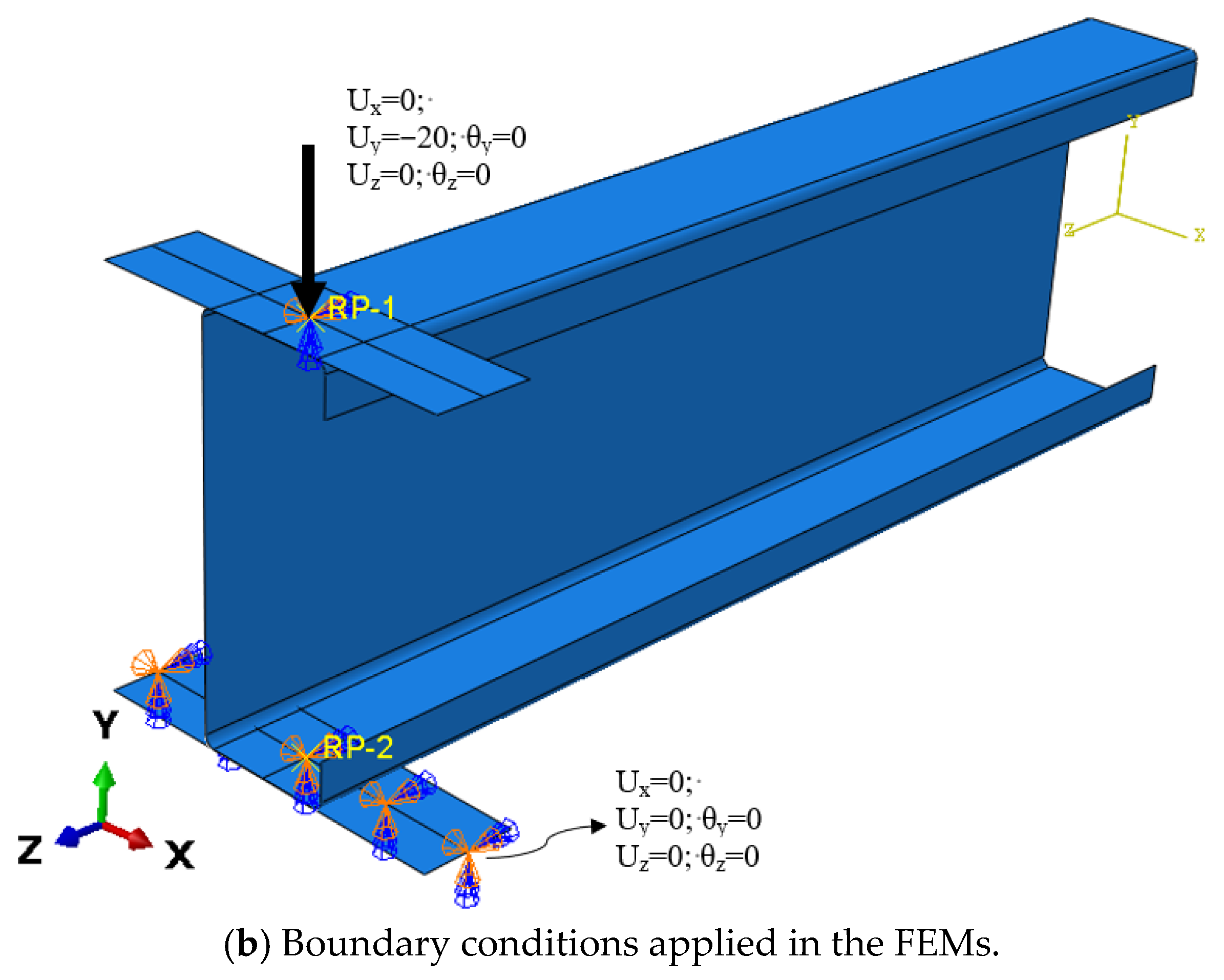
The ABAQUS software was employed to establish FE models that can simulate the nonlinear behaviour and web buckling performance of HA channel sections under both ETF and ITF loading conditions. For comparison, specimens with web openings were also analysed under the ETF loading case.
5. Parametric Investigation
After the verification of the FE models for conventional aluminium alloy channel sections, A parametric investigation consisting of 3506 models was performed. Specifically, 1024 models represented imperforated specimens under ITF loading, 1024 under ETF loading, and 1458 perforated specimens under ETF loading.
Previous work reported by Chen et al. [29] demonstrated that the web buckling strength of CFS sections was primarily affected by the length of bearing plate (N), web slenderness ratio (h/tw), and internal corner radii ratio (ri/tw). Therefore, a wide range of HA sections covering varying web slenderness ratios, perforation diameter ratio, perforation distance ratio, internal corner radii, bearing lengths, loading cases and aluminium alloy grades were examined in the parametric study (Table 3).
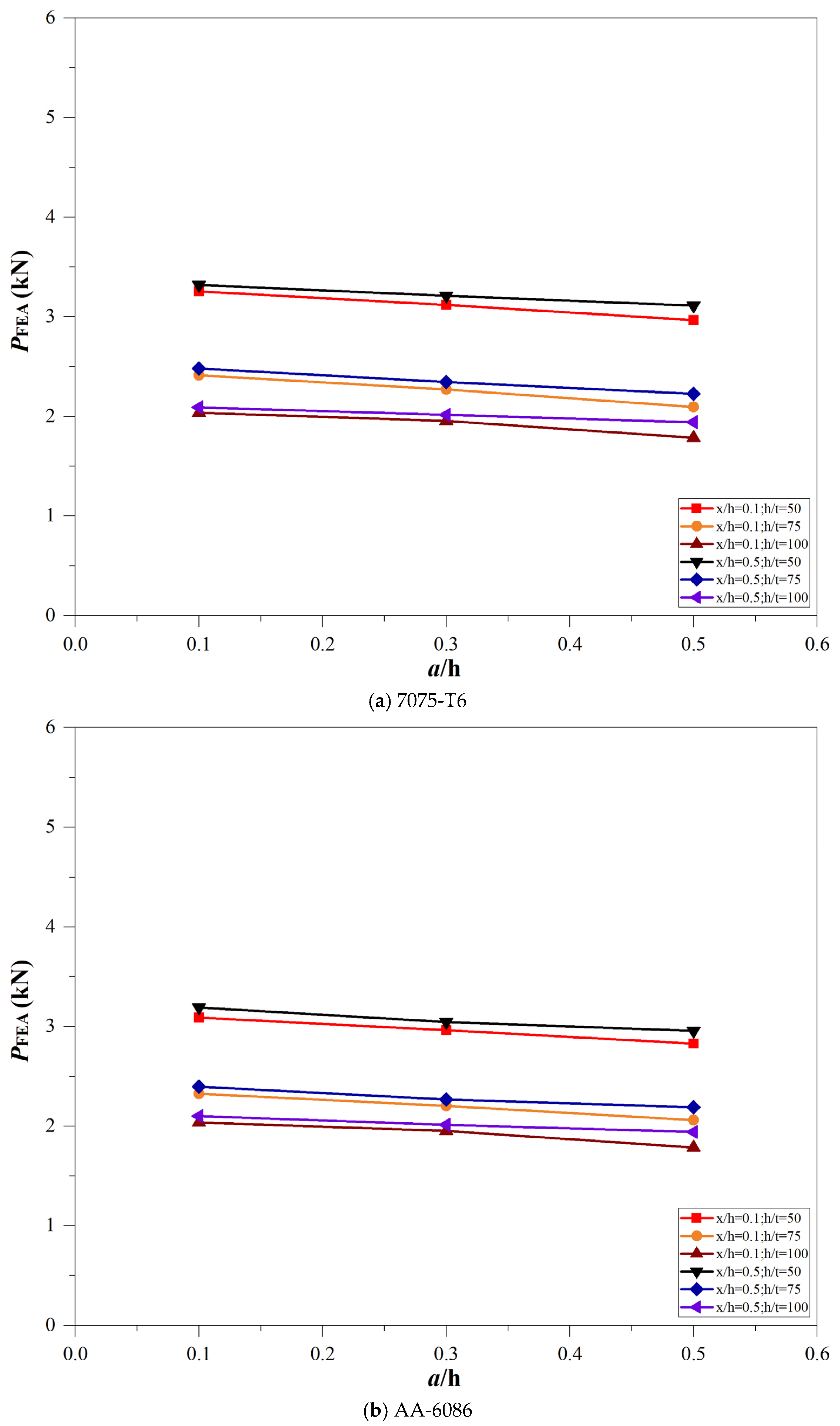
The web slenderness ratio (h/tw) was considered as 50, 75, 100, and 125. Four bearing plate lengths (N) were selected, 25, 50, 75, and 100 mm. The internal corner radii ratio (ri/tw) was considered as 1.0, 2.0, 3.0, and 4.0. Four web thicknesses of aluminium alloy channels (tw) were included in the parametric study, namely 1.0, 2.0, 3.0, and 4.0 mm. In terms of web openings, this study assessed a total of three different perforation distance ratios (x/h)—0.1, 0.3 and 0.5. The study also included varying perforation diameter ratio (a/h) at three different ratios-0.1, 0.3 and 0.5. Two material grades were considered: 7075-T6, AA-6086.
5.1. Effect of ETF Loading on Web Crippling Capacity of Imperforated Specimens
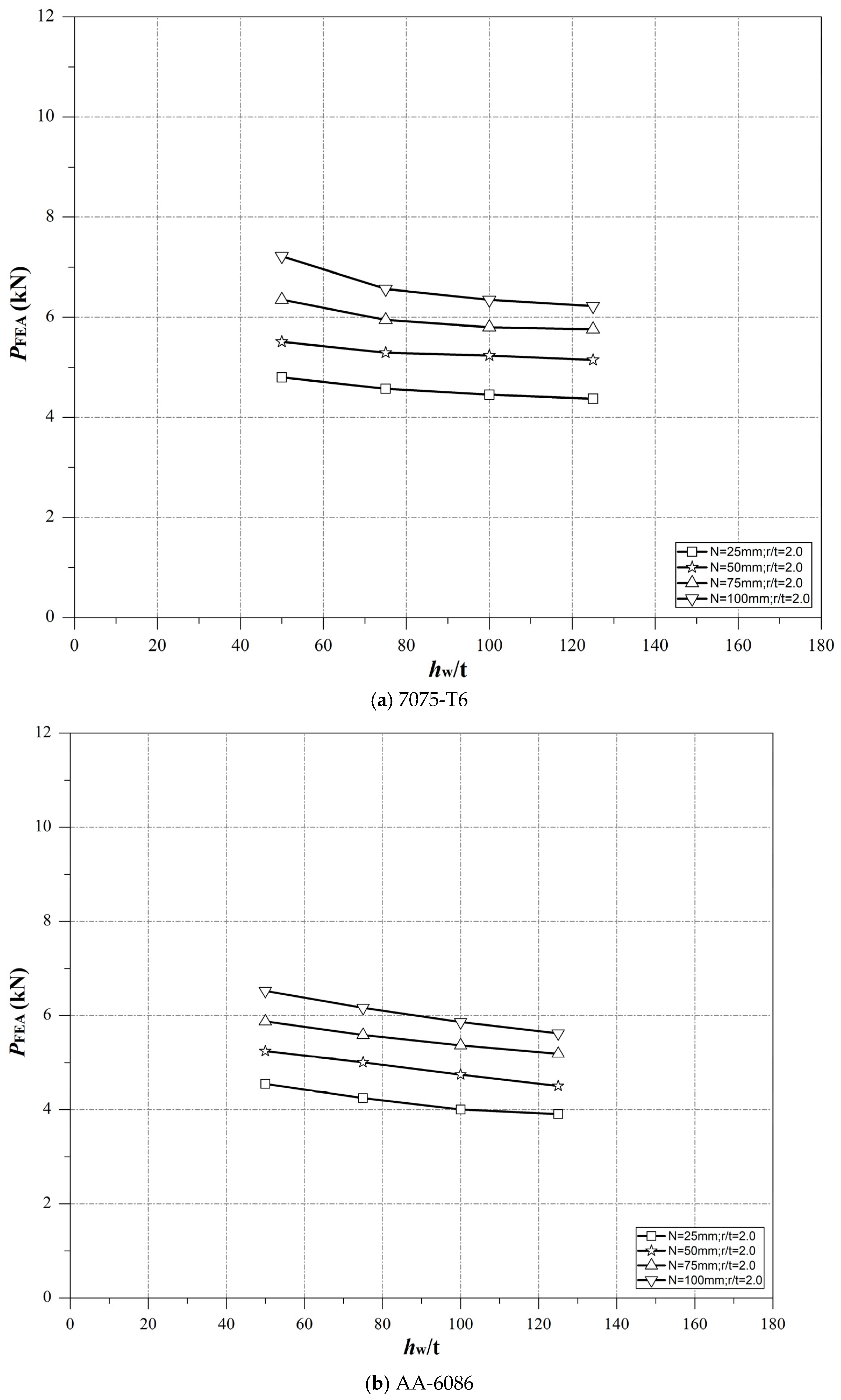
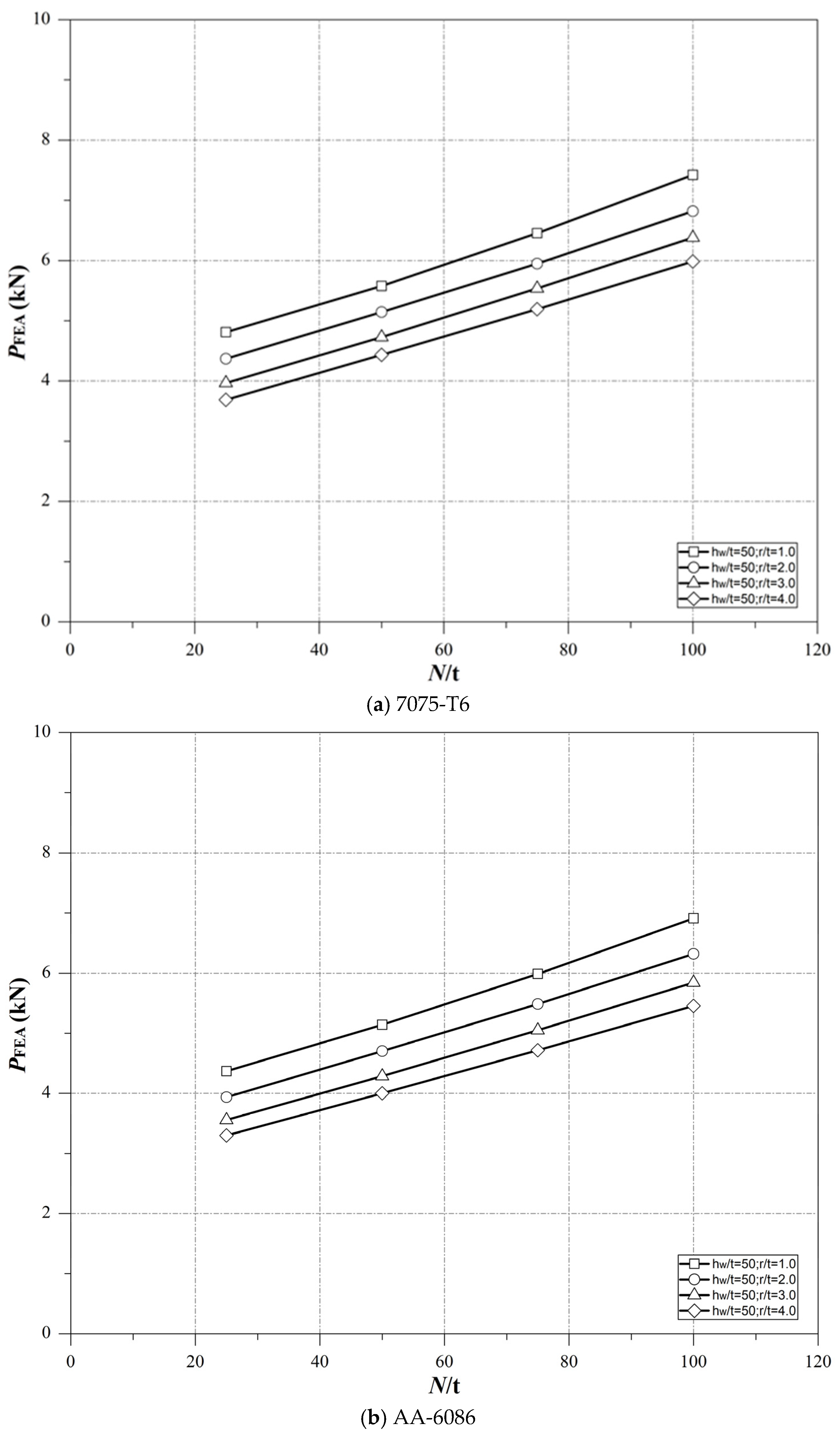
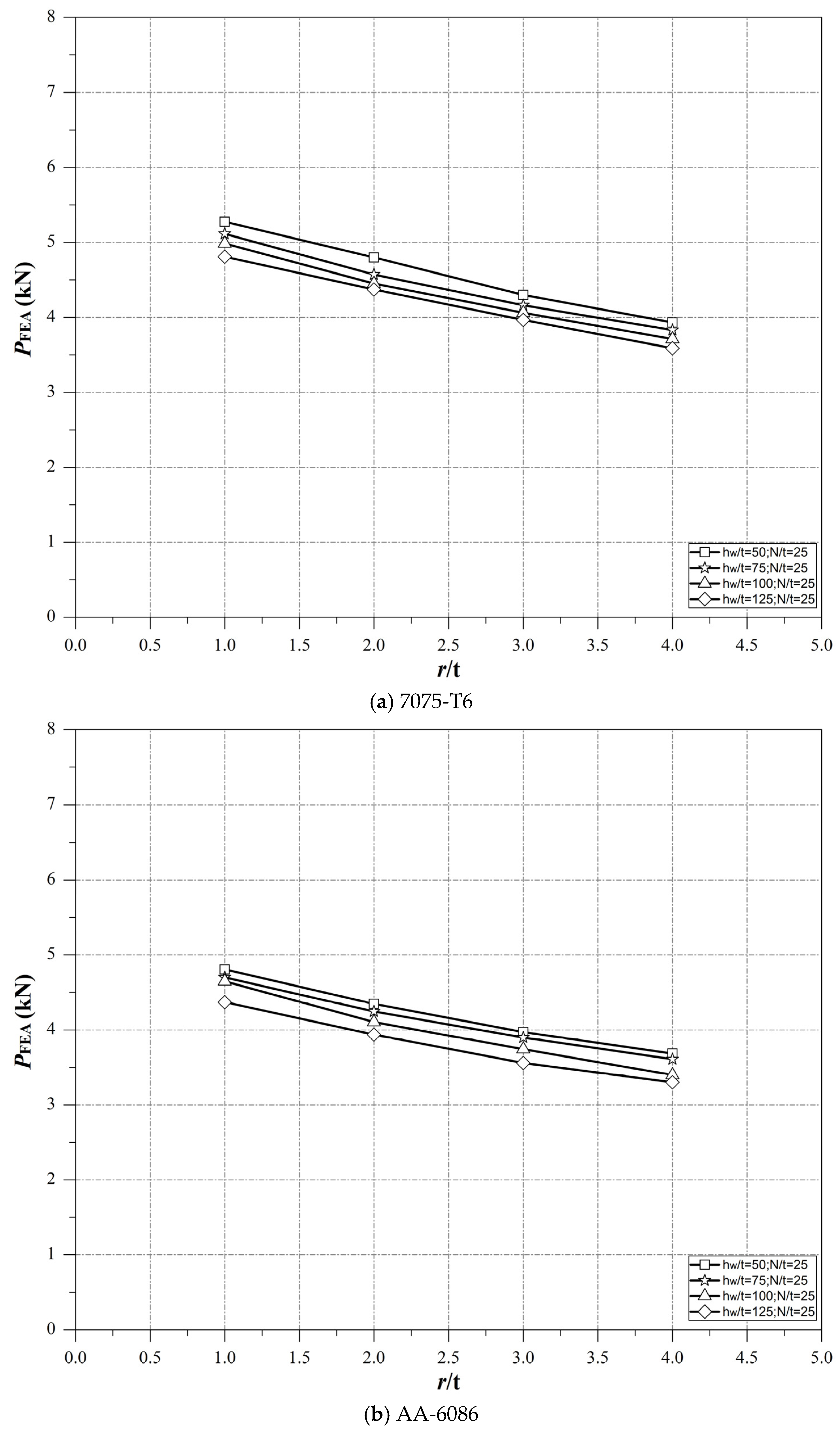
Figures 10–12 show the impact of ratios hw/t, N/t, and ri/t on the web buckling strength of HA sections, correspondingly. When hw/t rises from 50 to 125, a minor reduction in strength is noticed, as illustrated in Figure 10. As depicted in Figure 11, the web buckling strength increases significantly when N/t increases from 25 to 100. The impact of r/t ratio on the web buckling strength of HA sections was studied as illustrated in Figure 12, and it was found that a considerable decrease in strength was observed when r/t increases from 1.0 to 4.0. This indicated that the impact of r/t ratio on the web buckling strength cannot be ignored.
5.2. Effect of ITF Loading on Web Crippling Capacity of Imperforated Specimens
5.2.1. Effect of hw/t on Web Buckling Behaviour
As depicted in Figure 13, how the ratio hw/t could affect the web bearing capacity of high-strength aluminium channels was comprehensively analysed. The outcomes revealed that, on average, there was a 9.7% reduction in web buckling behaviour of C-sections made from 7075-T6 when hw/t escalated from 50 to 125. Similarly, the strength experienced an average decrease of 13.4% for AA-6086 aluminium in the same hw/t ratio range. This observation underscores the criticality of accounting for the influence of hw/t while designing structures composed of HA.
5.2.2. Effect of N/t on Web Buckling Behaviour
The effects of N/t on the web bearing capacity of high-strength aluminium channels were investigated, as depicted in Figure 14. Notably, elevating the N/t ratio from 25 to 100 yielded an augmentation in web buckling behaviour. Specifically, the data indicated that, on average, the web bearing capacity experienced a 36.8% increment for 7075-T6 aluminium and 38.3% for AA-6086 aluminium. The observation emphasises the necessity to account for the effect of the N/t in the context of web buckling behaviour, which in turn holds significance when devising novel design equations for HA C-sections.
5.2.3. Effect of ri/t on Web Buckling Behaviour
Figure 15 displays the investigation delved into the effects of the ri/t on the web bearing capacity of high-strength aluminium channels. When the ri/t ratio transitioned from 1.0 to 4.0, a marginal reduction in strength was discerned. Specifically, the data revealed that, on average, there was a 25.3% decrease in web buckling behaviour for 7075-T6, while a 24.5% decline in strength was observed for AA-6086, with an increase in ri/t from 1.0 to 4.0. This underlines the significance of incorporating the influence of ri/t when formulating design equations targeted at HA C-sections.
5.3. Effect of ETF Loading on Web Crippling Capacity of Perforated Specimens
5.3.1. Impact of a/h Ratio on Web Buckling Resistance
Figure 16 evaluated the impact of a/h ratio on the web buckling resistance of HA C-shaped members that contain perforated webs. The results showed that for 7075-T6 aluminium, a/h ratio increment from 0.1 to 0.5 resulted in an average decrease of 9.7% in web buckling resistance. Similarly, for AA-6086 aluminium, a decrease of 9.3% on average in web buckling resistance was observed. This indicates the importance of including the impact of a/h ratio when proposing the design formulas for estimating the web buckling resistance of HA C-shaped members that contain perforated webs.
5.3.2. Impact of N/h Ratio on Web Buckling Resistance
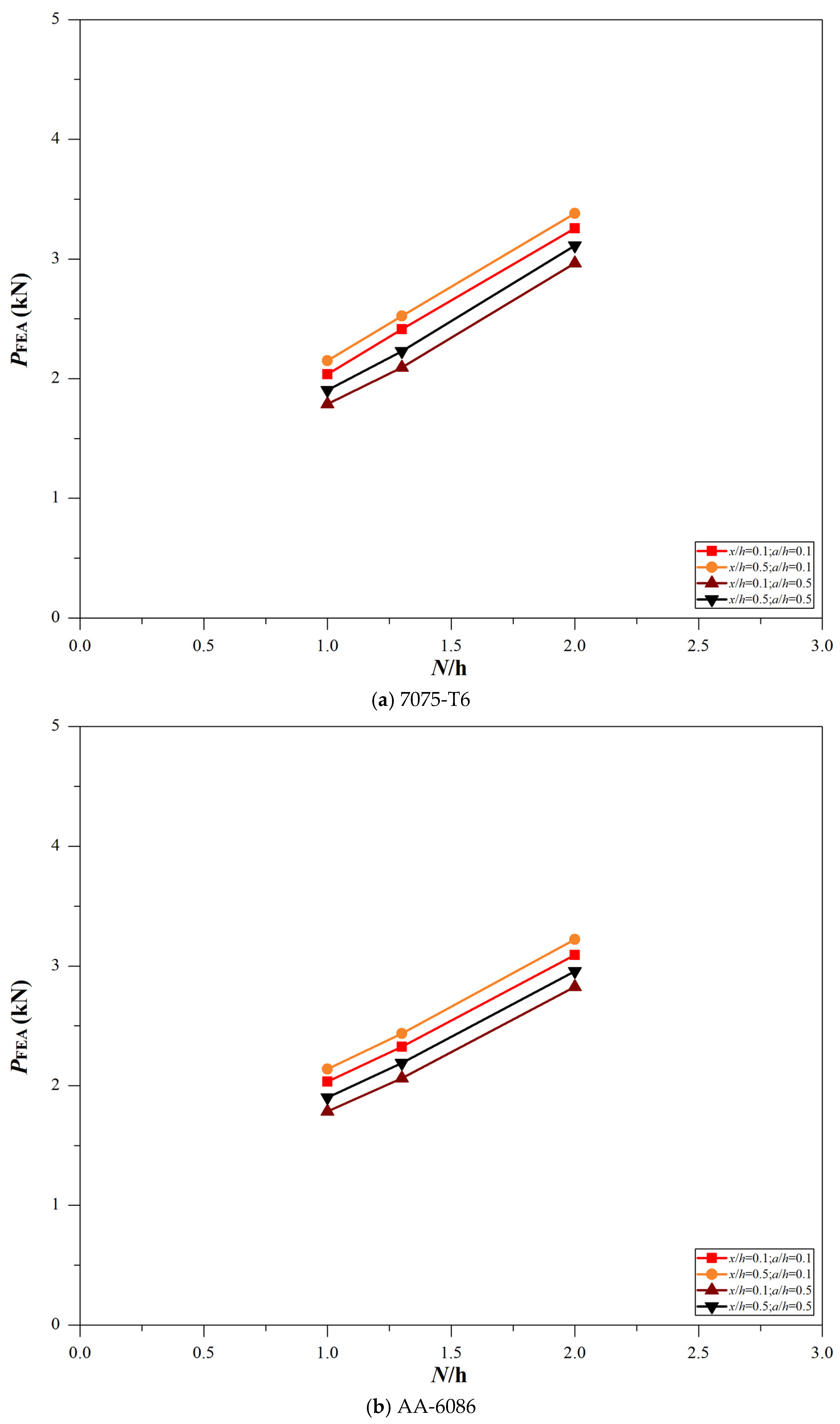
As illustrated in Figure 17, the length of bearing plates (N) was varied from 100 mm to 200 mm, and the N/h ratio was assessed at three different ratios—1.0, 1.3 and 2.0. It can be found that increasing N/h from 1.0 to 2.0 resulted in an increase in web buckling resistance. As depicted in Figure 10, the web buckling resistance experiences an average increase of 61.7% for 7075-T6 aluminium and 54.1% for AA-6086 aluminium. This demonstrates that the impact of N/h ratio on the web buckling resistance of HA C-shaped members that contain perforated webs needs to be included when developing new design formulas.
5.3.3. Impact of x/h Ratio on Web Buckling Resistance
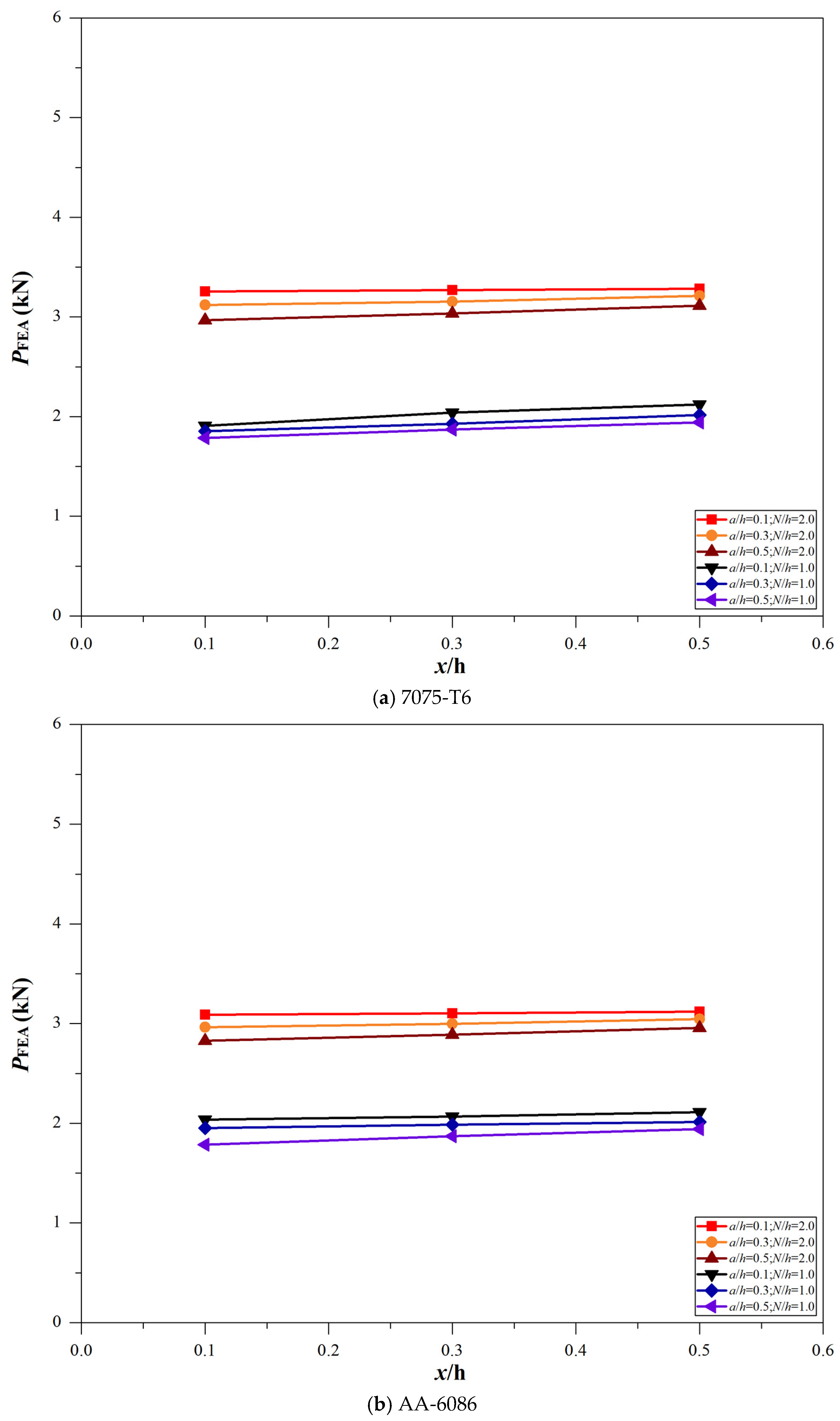
The impact of the perforation distance ratio (x/h) on the web buckling resistance of HA C-shaped members that contain perforated webs was studied as illustrated in Figure 18. It was found that when the x/h ratio varied from 0.1 to 0.5, there was a minor increase in web crippling resistance. The findings showed that the web buckling resistance increased by 6.2% for 7075-T6 aluminium alloy, while the strength increased by 4.0% for AA-6086 aluminium alloy when the x/h ratio was increased from 0.1 to 0.5. This highlights the significance of considering the impact of x/h ratio when proposing new design formulas for HA C-shaped members that contain perforated webs.
7. Proposed Design Equations for High-Strength Aluminium Alloys
7.1. Development of New Design Equations for Imperforated Section Under ETF Case
In this investigation, new design calculations for imperforated section under ETF case were presented based on three key parameters.
7.2. Development of New Design Equations for Imperforated Section Under ITF Case
This section introduces four web crippling equations, specifically tailored for high-strength aluminium (HA) members under ITF case, which were developed utilising the insights gleaned from the parametric analysis. These updated design formulas adhere to the structure of AS/NZS 1664.1 [32]. It is worth emphasising that pivotal factors, for instance, the 0.452 and 0.018 in Equation (10), were computed using a bivariate linear regression analysis.
The web buckling behaviour (Pprop) can be computed as follows:
For a 7075-T6 lipped C-section,
For a 7075-T6 unlipped C-section,
For an AA-6086 lipped C-section,
For an AA-6086 unlipped C-section,
These equations are applicable within specific limitations to 7075-T6 and AA-6086, and under certain constraints such as 1 ≤ ≤ 4, 25 ≤ ≤ 100, 50 ≤ ≤ 125, and = 90°.
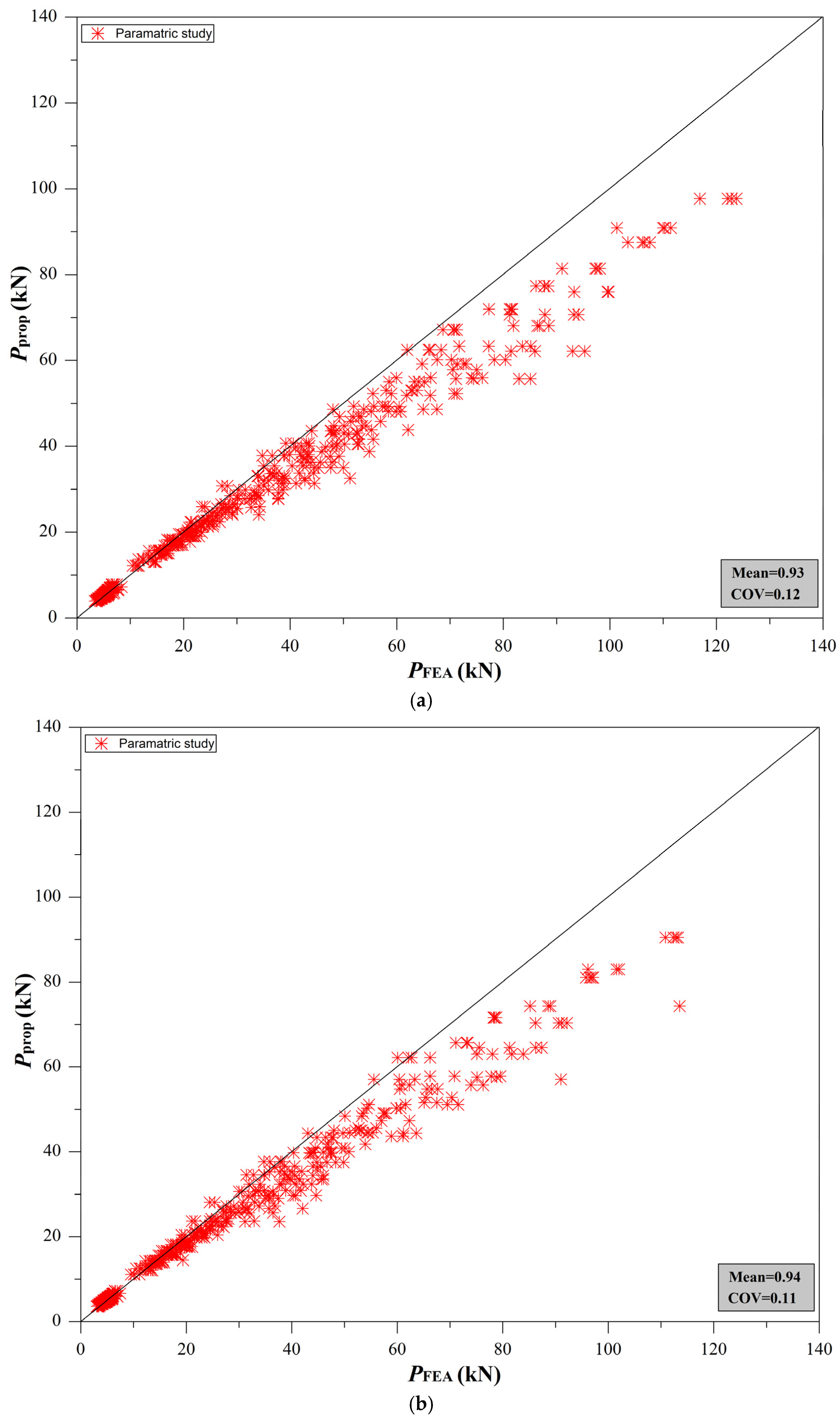
Figure 22 compares the outcomes derived from the parametric analysis and the design strengths computed using the newly introduced equations (M-AS/NZS 1664.1). The ratio between the design values and the numerical outcomes was determined to be 0.93 for 7075-T6 aluminium on average, exhibiting a coefficient of variation of 0.12. Likewise, the ratio between the design values and the numerical outcomes was determined to be 0.94 on average for AA-6086 aluminium, accompanied by a coefficient of variation of 0.11. The findings underscore the efficiency of the introduced equations (M-AS/NZS 1664.1) in precisely predicting the strengths of HA C-sections, thereby presenting a dependable and secure design methodology.
7.3. Development of New Design Equations for Perforated Section Under ETF Case
In this section, new web buckling formulas for perforated section under ETF case in the form of strength reduction factors were presented based on the outcomes of the parametric examination. The results derived from the parametric examination indicated that the web buckling resistance of high-strength aluminium members that contain perforated webs was significantly influenced by the bearing plate ratio (N/h), perforation diameter ratio (a/h) and perforation distance ratio (x/h). Therefore, such new design formulae were proposed based on three key parameters (N/h, a/h and x/h), which followed the format of design rules presented by Fang et al. [33,41,42]. Also, it is important to note that key variables such as 0.763, 0.647,0.152 and 0.059 were generated by the bivariate linear regression analysis.
The strength reduction factor (Rprop) for 7075-T6 and AA-6086 high-strength aluminium alloy can be determined from Equations (14) and (15):
For 7075-T6 C-shaped member,
For AA-6086 C-shaped member,
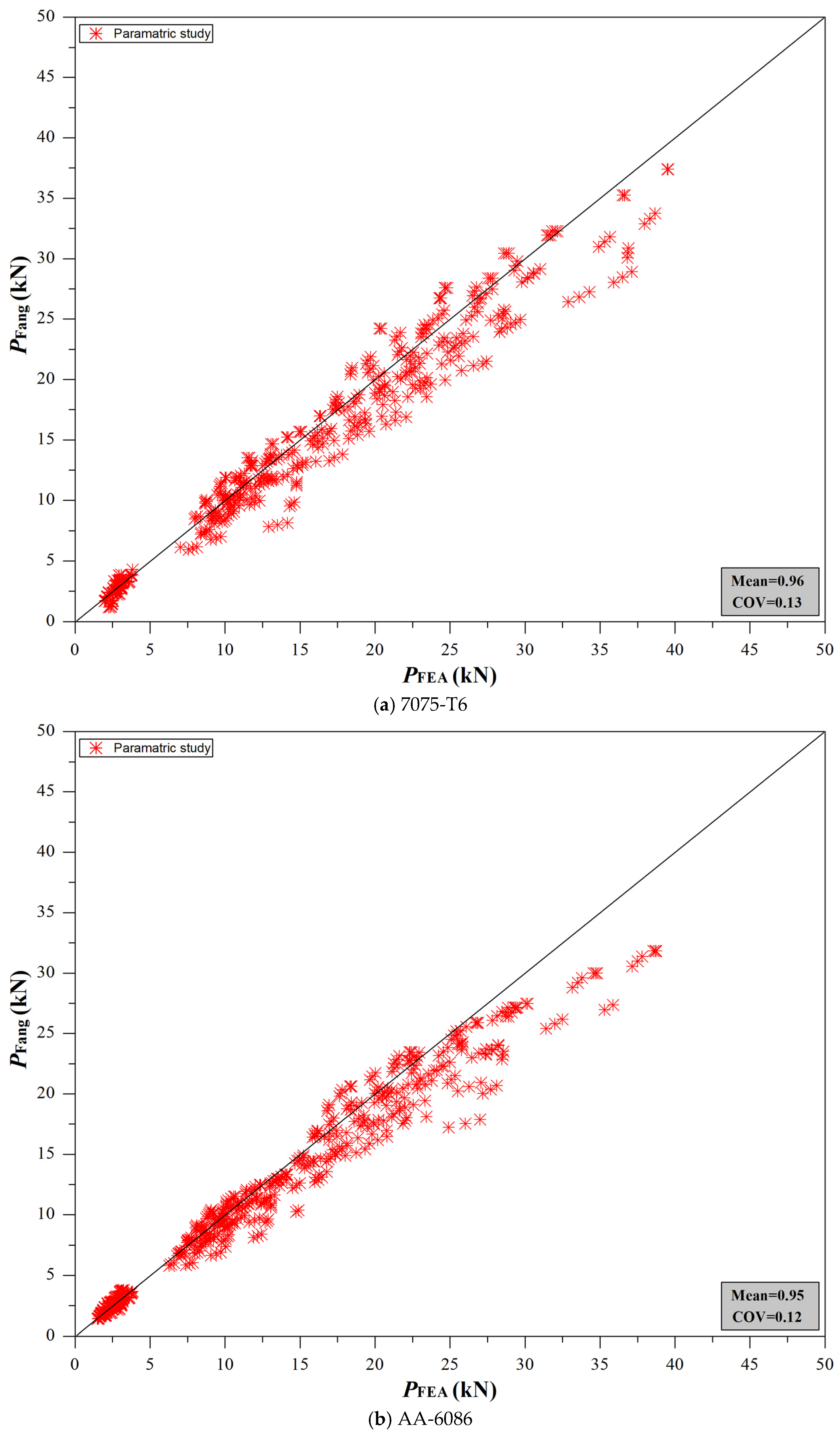
Figure 23 present the results of the comparison between the parametric examination and the newly proposed formulas (M-Fang). The findings show that for 7075-T6 aluminium, the average ratio of design values to the simulation results was 0.96 with a COV of 0.13, while for AA-6086 aluminium, the average ratio was 0.95 with a COV of 0.12. These results indicate that the newly suggested design formulas are both reliable and accurate in estimating the web buckling resistance of HA C-shaped members that contain perforated webs.
8. Conclusions
This work addresses this research gap through a detailed numerical investigation, focusing on AA-6086 and 7075-T6 alloys under both end-two-flange (ETF) and interior-two-flange (ITF) loading conditions. For comparison, specimens with web openings were also analysed under the ETF loading case. Both material grades of AA-6086 and 7075-T6 were investigated. Based on the outcome of this study, the following conclusions can be drawn:
A parametric investigation consisting of 3506 models was performed using the finite element (FE) models previously developed for traditional aluminium alloys. Specifically, 1024 models represented imperforated specimens under ITF loading, 1024 under ETF loading, and 1458 perforated specimens under ETF loading. A wide range of high-strength aluminium alloy sections covering varying web slenderness ratios, internal corner radii, bearing lengths, and aluminium alloy grades were considered in this investigation. The results obtained from the parametric investigation suggested that the impact of hw/t, N/t, and ri/t ratios on the web buckling strength of high-strength aluminium alloy sections was significant. This indicates the importance of including the impact of hw/t, N/t, and ri/t ratios when proposing the design calculations for estimating the web buckling strength of such members.
The accuracy of the latest design recommendation provided in the Australian and New Zealand Standards (AS/NZ S4600) (2018) and Australia Standards (AS/NZS 1664.1) (1997) was evaluated by comparing them with parametric analysis results. The results showed that for imperforated section under ETF case, the average design strength calculated by AS/NZ S4600 to the simulation results was 1.53 and 1.37 for 7075-T6 and AA-6086, respectively. The web buckling strength predicted by AS/NZS 1664.1 was slightly un-conservative by 14% and 2% for 7075-T6 and AA-6086, respectively, compared to simulation results. It was shown that the latest design recommendations were over-conservative when estimating the web buckling strength of such channel sections. For imperforated section under ITF case, it was found that the design methods provided in AS/NZS 4600 were excessively cautious, whereas the design specifications outlined in AS/NZS 1664.1 (1997) led to unconservative estimations when calculating the web buckling behaviour of C-sections made from high-strength aluminium alloy.
For imperforated section under ETF case, new unified web buckling equations with new coefficients for high-strength aluminium alloys were presented based on the simulation results. The same methodology as AS/NZS 4600 (2018) was adopted in developing the new design calculations. The average ratio of design values to simulation results was found to be 0.94, and the coefficient of variation (COV) was 0.24 for 7075-T6 aluminium, while the average ratio was 0.93, and the COV was 0.25 for AA-6086 aluminium. A comparison revealed that the design strengths calculated by the newly presented formulas (M-AS/NZ S4600) were close to the simulation results. For imperforated section under ITF case, the results from testing demonstrated that, on average and in the case of 7075-T6, the ratio between design values and numerical results was 0.93, accompanied by a coefficient of variation of 0.12. Similarly, in the case of AA-6086, the ratio between design values and numerical results was 0.94 on average, accompanied by a coefficient of variation of 0.11. For perforated section under ETF case, the findings show that for 7075-T6 aluminium, the average ratio of design values to the simulation results was 0.96 with a COV of 0.13, while for AA-6086 aluminium, the average ratio was 0.95 with a COV of 0.12.
Although an extensive parametric investigation has been undertaken, an experimental program should be performed to evaluate the accuracy of the design calculations presented in this investigation.
The authors state that the scientific conclusions are unaffected. This correction was approved by the Academic Editor. The original publication has also been updated.