1. Introduction
The advancement of earthquake monitoring technologies and the accumulation of observational data have revealed that the characteristics of vertical ground motions often exceed the assumptions adopted in traditional seismic design codes. Empirical evidence, such as the 1.6 g peak vertical acceleration recorded during the Imperial Valley earthquake [
1], the 1.79 vertical-to-horizontal acceleration ratio observed in the Northridge earthquake [
2], the 2.0 vertical-to-horizontal ratio recorded in the Kobe earthquake, and the 0.89 average vertical-to-horizontal ratio reported in the near-fault region of the Wenchuan earthquake [
3], indicates a strong correlation between the intensity of vertical and horizontal ground-motion components. Previous studies have also shown that vertical seismic action cannot simply be estimated as two-thirds of the horizontal component, because its characteristics are affected by multiple factors, including local site conditions, epicentral distance, and response-spectrum period [
4,
5,
6]. The vertical seismic response spectrum model proposed by Zhou et al. based on 436 datasets [
7], as well as the near-field design spectrum considering damping effects established by Elnashai et al. [
8], provides important theoretical foundations for analyzing vertical ground-motion characteristics.
Vertical ground motions can significantly affect the failure mechanisms of bridge piers. The coupling of increased axial force and bending moment may lead to axial compression or flexural failure, whereas axial tension may transform ductile flexural failure into brittle shear failure. The 2021 Maduo earthquake in Qinghai provided preliminary field evidence of the direct damage effect of vertical ground motions on bridge piers, as reflected by the concrete crushing observed at the base of the Yaniang Yellow River Bridge pier [
9]. Regarding the seismic performance of reinforced concrete bridge piers, most existing studies have relied on numerical models of dual-column piers and validation using quasi-static test data [
10]. The influence of vertical seismic excitation is commonly evaluated by comparing the structural responses under horizontal-only and combined horizontal–vertical ground motions using near-fault records [
11,
12]. The vertical component of seismic ground motion can significantly influence the structural response of reinforced concrete moment-resisting frames, as demonstrated through incremental dynamic collapse analysis [
13]. In addition, the effect of higher-order vibration modes on the internal force distribution of high bridge piers has been quantitatively investigated [
14], and fiber models have been used to compare the effects of different ground-motion durations on pier damage [
15]. However, these studies generally assume that the main girder remains in continuous contact with the bearing, thereby neglecting the possible separation effect induced by vertical earthquakes.
The flexible nature of bridge structures further increases their vulnerability to vertical ground motions. The flexural stiffness of the main girder is much lower than the vertical compressive stiffness of the piers, and the increased span lengths enabled by prestressing technology can lead to more pronounced vertical deformation of the main girder under earthquake excitation [
16]. Widely used plate-rubber bearing systems, which are typical weak connections, are prone to girder–bearing separation and even girder unseating under near-fault vertical ground motions with high amplitudes [
17,
18,
19,
20]. Earthquake damage observations have shown that such separation is often accompanied by a sharp increase in vertical impact forces. For example, Tanimura et al. reported that the fracture of the bearing in the Nielson Bridge was caused by vertical collision between the pier and the girder [
21,
22]. This multi-directional coupling failure mechanism associated with separation may further deteriorate the horizontal seismic response, highlighting the vulnerability of flexible girder bridges to vertical seismic excitation.
Existing analytical methods for evaluating the failure mechanisms of multi-span girder bridges under vertical earthquake excitation still have notable limitations. Current studies on impact dynamics have mainly focused on idealized two-span or simplified multi-span models, which may not fully capture the actual force-transfer characteristics of such structures. For instance, studies on bearing separation thresholds [
23,
24], decoupled dynamic response analysis [
25,
26], and vertical impact simulation of curved bridges [
27,
28,
29,
30] have provided important insights, but they do not fully represent the complex behavior of multi-span continuous girder bridges under coupled vertical and horizontal seismic excitations. Moreover, structural failures during actual earthquakes are often accompanied by the coupled effects of bidirectional ground-motion components. Vertical ground motions not only increase vertical collision forces but may also influence the failure mechanism by altering the horizontal dynamic response of bridge piers. Therefore, a systematic investigation of the vertical separation–collision response of multi-span continuous girder bridges remains necessary.
In addition to seismic excitation and impact-related studies, recent research on bridge and infrastructure performance assessment has increasingly emphasized durability degradation, fatigue damage, and data-driven prediction. For example, corrosion-induced seismic performance degradation of existing reinforced concrete motorway viaducts has been investigated [
31], novel composite-confined concrete columns have been experimentally studied for structural performance enhancement [
32,
33], and fatigue-life prediction methods have been developed for orthotropic steel-deck rib-to-deck welds using Bayesian-optimized deep learning models [
34,
35]. Multi-scale mechanical modeling has also been applied to the fatigue crack growth of corroded high-strength steel wires [
36,
37,
38], while multi-source monitoring data and machine learning have been used for deformation–strain mapping in infrastructure systems [
39,
40,
41,
42,
43,
44,
45]. These studies demonstrate the broader trend of integrating deterioration mechanisms, experimental testing, monitoring data, and data-driven models into structural safety assessment. Nevertheless, they do not directly address the vertical separation–collision mechanism of bridge bearings or its influence on pier failure evolution and system-level fragility.
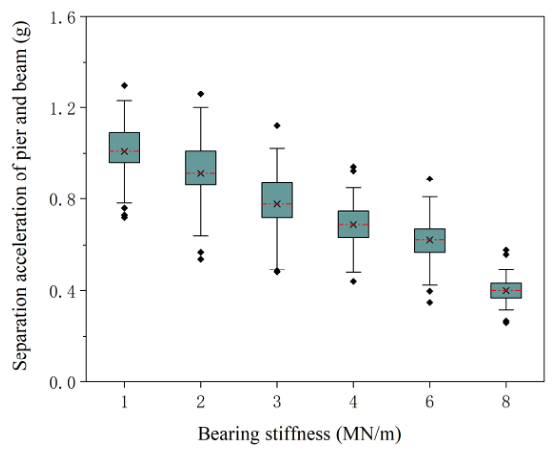
Despite previous studies on vertical pounding, bridge seismic response, and structural fragility, the manner in which vertical separation–collision further alters the horizontal failure evolution of bridge piers and the system fragility of multi-span continuous girder bridges under near-fault earthquakes remains insufficiently understood. In particular, many existing analyses either rely on simplified bridge models or assume permanent contact between the girder and the bearing, and therefore cannot capture the loss of bearing restraint after separation and its subsequent influence on pier demand and system-level vulnerability. In addition, the roles of bearing damping and stiffness under separation conditions have not yet been clarified in a systematic manner.
To address these gaps, this study develops a three-dimensional nonlinear finite-element model of a multi-span continuous girder bridge in OpenSees and introduces a bi-state interaction model to represent the change in contact condition between the girder and the bearing after separation. On this basis, the study investigates not only the occurrence of vertical separation–collision itself, but also how the post-separation loss of bearing restraint modifies pier response, damage evolution, and system fragility. Furthermore, the effects of bearing damping and stiffness are examined under separation conditions. Therefore, the main novelty of this study lies in explicitly linking vertical separation, state-dependent bearing restraint degradation, pier failure evolution, and bridge-system fragility within a unified analysis framework for a multi-span continuous bridge subjected to near-fault bidirectional excitation.
2. Computational Model
2.1. Overview and Theoretical Model of the Bridge
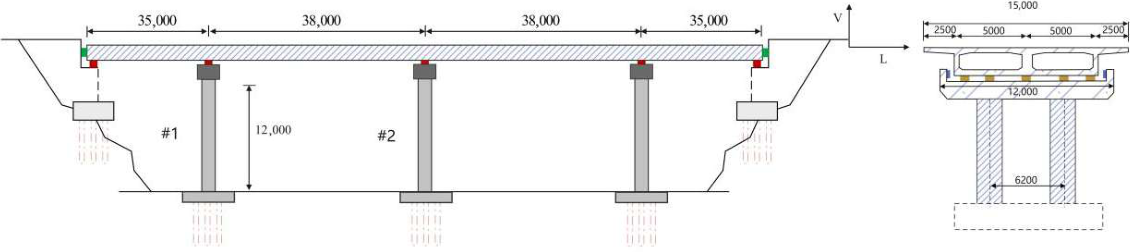
The bridge examined in this study is a four-span continuous prestressed concrete box-girder highway bridge with equal-span design: the end spans are 35 m each, the interior spans are 38 m each, and the total length is 146 m. The superstructure employs a twin-box prestressed concrete continuous girder system with a single-cell double-chamber section of uniform depth. The main girder is constructed with C50-grade concrete, and the longitudinal prestressing is provided by low-relaxation high-strength steel strands. For details, see
Figure 1.
The structural bearing system employs lead rubber bearings (LRBs) firmly attached to the bent cap. The substructure consists of a three-column frame bridge pier. Each pier column has a circular cross-section with a diameter of 1100 mm, a height of 15 m, and is constructed with C35 grade concrete. The longitudinal reinforcement ratio is maintained above 1.2% in accordance with the “Code for Design of Steel and Timber Structures of Highway Bridges and Culverts”. Transverse connections between the pier columns are implemented to enhance overall spatial stability.
2.2. Finite Element Model
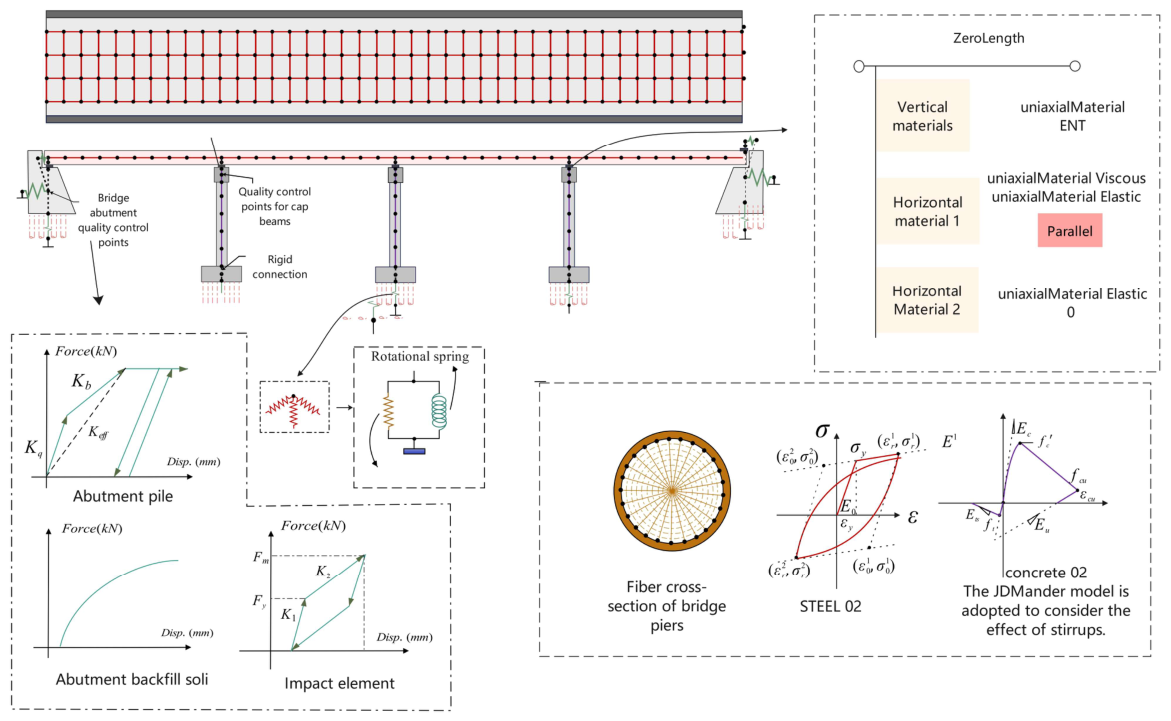
A three-dimensional nonlinear finite element model of the bridge was established in OpenSees (3.7.1). The superstructure and cap beam were modeled using elastic beam elements with distributed masses to capture their spatial dynamic characteristics, and were rigidly connected to the substructure. This idealization was adopted because the present study focuses on the effect of girder–pier separation and impact on the global dynamic response of the bridge, whereas the superstructure was assumed to remain essentially elastic under the considered ground motions. A schematic of the model is shown in
Figure 2.
The piers were modeled using displacement-based nonlinear beam-column elements. Each pier section was discretized by means of a fiber-section approach, including unconfined cover concrete, confined core concrete, and longitudinal reinforcing steel. Concrete was represented by the Concrete02 material model in OpenSees, which accounts for tensile strength and tension softening, while the confinement effect of transverse reinforcement was incorporated through the Mander confined-concrete model. The longitudinal reinforcement was modeled using the Steel02 material based on the Menegotto–Pinto constitutive law to capture cyclic hysteretic behavior. This modeling strategy allows the nonlinear flexural response of the piers in both the vertical and horizontal directions to be represented with sufficient accuracy, thereby providing a basis for evaluating base moment demand and damage evolution.
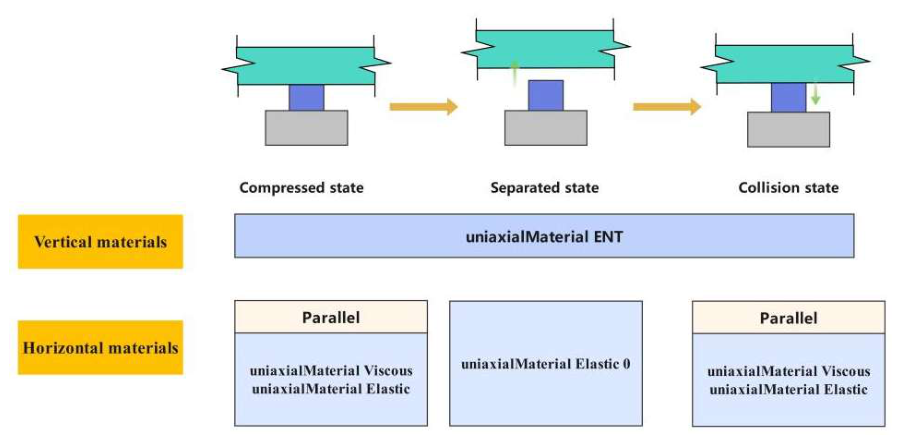
The bearings were modeled using ZeroLength elements, with uncoupled constitutive behavior assigned in the vertical and horizontal directions. In the vertical direction, an Elastic No-Tension (ENT) uniaxial material was adopted to represent the compression-only behavior of the bearing. Accordingly, vertical separation was allowed once the compressive contact between the girder and the bearing was lost. In the horizontal direction, a parallel combination of viscous and elastic uniaxial materials was employed to represent the energy dissipation and restoring capacity of the bearing.
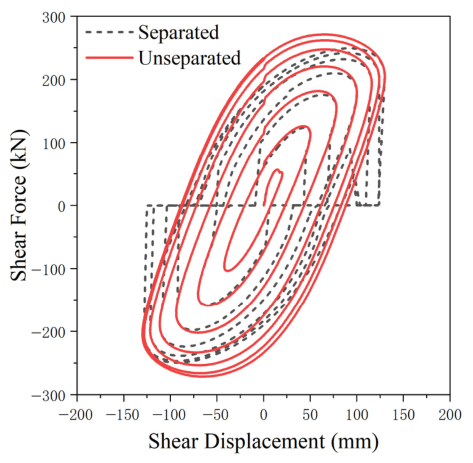
To characterize the change in bearing behavior during contact loss and re-contact, a bi-state bearing model was introduced. In this model, the bearing was idealized as having two working states, namely a connected state (State 1) and a separated state (State 2). In State 1, the bearing provides full horizontal restraint, and its horizontal stiffness and damping are governed by the parallel viscous–elastic material model. In State 2, the horizontal restraint vanishes completely, and the bearing no longer provides horizontal stiffness or damping. The transition between the two states was controlled by the vertical contact condition. When the vertical contact force dropped below a prescribed separation threshold, the bearing switched to the separated state. Once compressive contact was re-established, the bearing returned to the connected state, together with the recovery of horizontal stiffness and damping.
In the separation–collision analysis, ZeroLength elements were further used to simulate the contact, separation, and re-contact behavior between the girder and the pier. By continuously monitoring the contact force between the bearing and the girder, the occurrence of separation could be identified in real time. When contact was maintained, the vertical contact reaction computed by the ZeroLength element corresponded to the vertical impact force. When the contact force reduced to zero, separation between the girder and the bearing was considered to occur. Once the contact force reappeared, re-contact was deemed to take place, accompanied by a rapid recovery of the impact force. During time-history analysis, the contact force was updated at each time step, and its evolution reflected the dynamic characteristics of the relative motion between the girder and the pier. This quantity is therefore essential for evaluating the influence of impact on the overall bridge response.
The transition between the two bearing states was assumed to occur instantaneously, i.e., no intermediate transition stage was considered between the connected and separated states. This idealization is consistent with the objective of the present study, which is concerned primarily with the global dynamic response of the bridge. Compared with the overall response, the detailed transition process of the bearing is considered to be of secondary importance. The instantaneous switching assumption therefore improves computational efficiency while maintaining adequate accuracy for the problem addressed herein. Nevertheless, the modeling of transitional behavior, as well as the possible effects of progressive degradation and cumulative damage, deserves further investigation in future work.
Regarding the boundary conditions, the pier foundations were modeled using lumped-mass nodes and rotational springs to account for the dynamic impedance of the soil–foundation system. The abutments were represented by a hysteretic model that incorporates the force–displacement relationship of the abutment piles, the nonlinear resistance of the backfill soil, and impact effects. The corresponding impact forces were obtained from the response of impact elements in the time-history analysis.
Figure 3 illustrates the numerical framework adopted to evaluate the mechanical behavior of the bridge bearings. For the lead-rubber bearing, the vertical response was modeled using the ENT material with a vertical elastic modulus of 1.0 GPa. In the horizontal direction, a parallel viscous–elastic model was employed, with a shear modulus of 1.0 MPa and a damping ratio of 10%. This modeling approach enables the bearing response in both the vertical and horizontal directions to be captured simultaneously, including vertical compressive contact, horizontal restoring capability, and energy dissipation.
Based on the above bi-state material model, the mechanical response of the bearing under vertical separation can be effectively represented. When compressive contact is maintained, the bearing exhibits the full hysteretic–elastic combined behavior. Once compressive contact is lost, the bearing automatically switches to the separated state, and the horizontal restraint vanishes accordingly. The response curves shown in
Figure 3 further highlight the marked difference between the contact and separation states, revealing the evolution of the state-transition mechanism during the dynamic process. Through this idealized treatment, the local separation–recontact behavior of the bearing can be directly linked to the global horizontal seismic response of the bridge.
It should be noted that this study mainly focuses on the coupled effect of vertical separation and horizontal seismic response in multi-span continuous girder bridges. During the cross-validation between the theoretical solution and the finite element solution, soil–structure interaction and other complex factors were not considered in order to maintain consistent boundary conditions and ensure a meaningful comparison, since such effects are difficult to incorporate into the theoretical solution. In the subsequent finite element analyses, however, soil–structure interaction was explicitly taken into account through foundation springs and damping components, so that the model could more comprehensively reflect the actual dynamic characteristics of the bridge. Therefore, soil–structure interaction was not neglected throughout the study, but was omitted only in the cross-validation stage for consistency between the theoretical and numerical models.
2.3. Verification of Finite Element Calculation Results
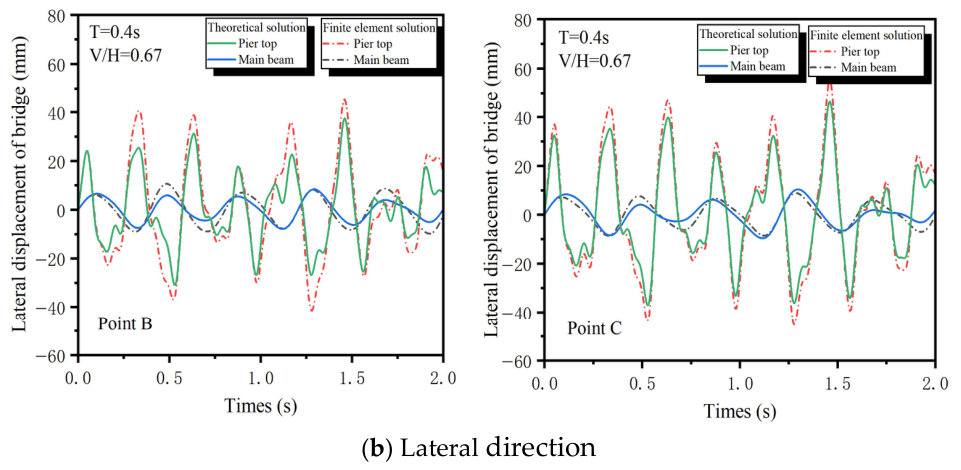
To verify the validity of the established finite element model, the finite element solutions were compared with the theoretical solutions derived from the transient wave function method proposed by An et al. [
25]. Because the theoretical solution is based on certain idealized assumptions, the finite element model was simplified consistently with the theoretical model during the verification phase to ensure comparability. These simplifications included considering only vertical and longitudinal seismic inputs, treating the connections between the pier bases and the foundations as rigid, and adopting boundary constraints between the girder ends and the abutments identical to those in the theoretical model. Through these treatments, the dynamic response characteristics of the finite element model can be verified under unified boundary conditions and loading assumptions.
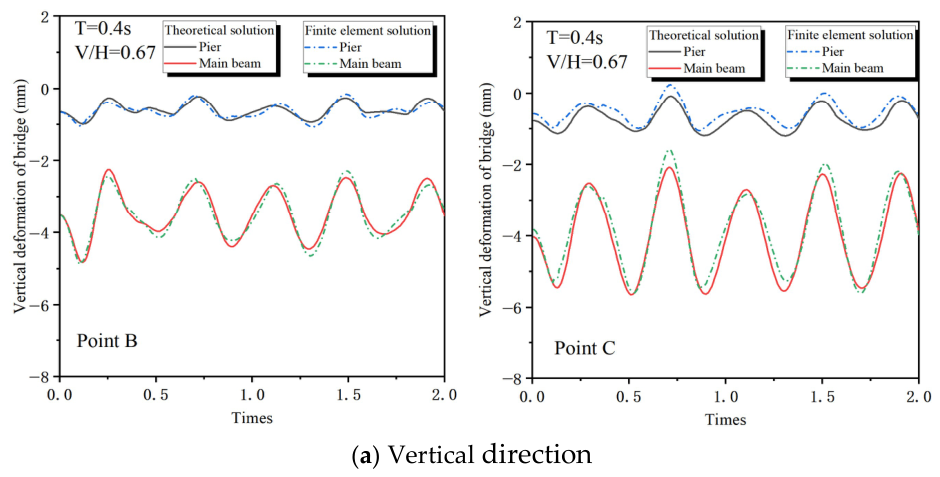
First, the vertical dynamic responses of the bridge were compared.
Figure 4a presents the vertical time-history responses at key measurement points of the bridge under typical load cases. Under harmonic wave excitation, the finite element solutions and the theoretical solutions exhibited a high degree of consistency in terms of response amplitude evolution, phase variation, peak levels, and periodic characteristics. This indicates that the finite element model can accurately reproduce the fundamental characteristics of the bridge’s vertical vibration and separation phenomena, as reflected by the theoretical solution.
Building upon this,
Figure 4b further presents a comparative verification of the bridge’s lateral dynamic responses. The newly added lateral dynamic response plots demonstrate that under identical input conditions, the overall trends of the lateral responses from both solutions are quite close, showing good agreement in response peaks, variation rhythms, and primary fluctuation characteristics. This suggests that the established finite element model not only reasonably captures the vertical dynamic behavior of the bridge but also adequately describes the fundamental patterns of its lateral dynamic response, thereby enhancing the completeness of the model verification to a certain extent.
It should be noted that certain discrepancies still exist between the theoretical and finite element solutions. The primary reason is that the theoretical model employs a decoupled approach for the vertical and lateral dynamic responses during its derivation, whereas actual bridges exhibit pronounced multi-directional coupling characteristics under seismic action. In contrast, the finite element model accounts for the coupling effects among structural geometry, component connections, and dynamic responses within a unified framework, thus providing a more comprehensive representation of the bridge’s actual mechanical state. The resulting differences represent reasonable deviations arising from the idealizations in the theoretical model and do not undermine the finite element model’s correct characterization of the overall dynamic response patterns of the bridge.
Nevertheless, the aforementioned verification still has certain limitations. First, the theoretical solution itself is based on simplifying assumptions and is insufficient to capture the full-process dynamic behavior under conditions involving bearing nonlinearity, contact re-establishment, failure of horizontal restraints, and complex boundary conditions. Second, the verification load cases were configured primarily to ensure comparability between the theoretical and finite element solutions; hence, not all complex factors present in actual bridge analyses were incorporated at this stage. Third, the agreement between the theoretical and finite element solutions only demonstrates the validity of the finite element model under simplified conditions and should not be regarded as a complete validation of all subsequent analytical results in this study.
Based on this, the subsequent formal analyses in this study further incorporated factors such as soil–structure interaction, multi-directional seismic inputs, and the bi-state switching of bearings into the finite element model, in order to more comprehensively evaluate the dynamic response and fragility evolution characteristics of multi-span continuous girder bridges under near-fault earthquakes. In other words, the simplifying assumptions adopted during the verification phase were utilized solely to establish a basis for comparison between the theoretical and finite element solutions, and do not imply that these relevant complex effects were neglected in the subsequent analyses of this study.
2.4. Separation–Collision Dynamic Response
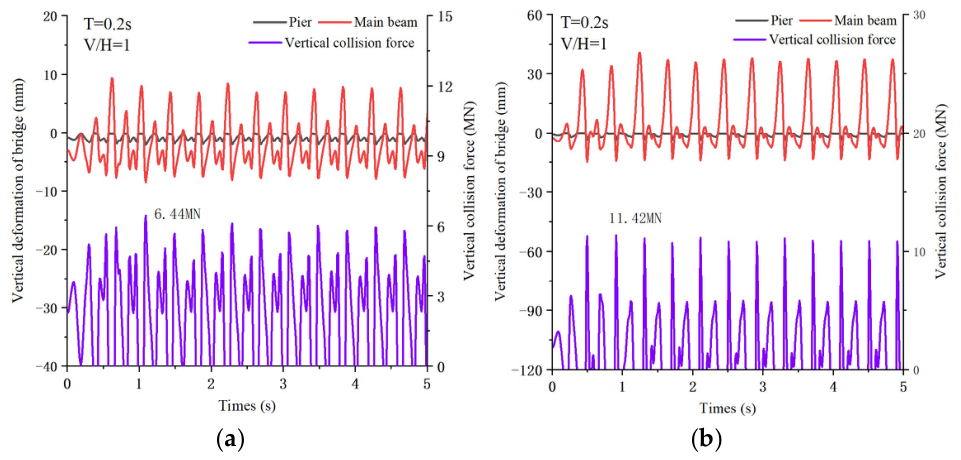
Figure 5 depicts the vertical dynamic response of the bridge structure under an excitation period of T = 0.2 s and a vertical acceleration of 0.5 g. The time-history curve illustrates the static and dynamic deformation characteristics of the main girder and pier. When the deformation curves of the main girder and pier align, their displacements at the bearing connection are identical, indicating a stress-free state. Conversely, if the main girder’s deformation curve arches upward relative to the pier, it indicates vertical separation between the components.
The findings indicate vertical separation between the piers and girders at Pier 1 and Pier 2. A comparative analysis shows that Pier 1’s dynamic response is distinct. Under similar excitation, the vertical separation duration between Pier 1 and the girder is shorter than at Pier 2, with separation more likely at Point C. Furthermore, the upward arch displacement of the main girder near Pier 1 is significantly greater than near Pier 2, leading to a higher vertical contact force between the main girder and the pier.
The vertical separation between the pier and the beam, along with the failure of the horizontal restraint of the bearings, alters the pier’s natural frequency, affecting its dynamic response. In the elastic stage of the pier, refer to Formula (1) for details on the separation stage. For definitions of the formula symbols, consult Ref. [
26].
When the constraint fails, the pier’s lateral natural frequency decreases, leading to an increased offset during the separation stage, as indicated by the formula.
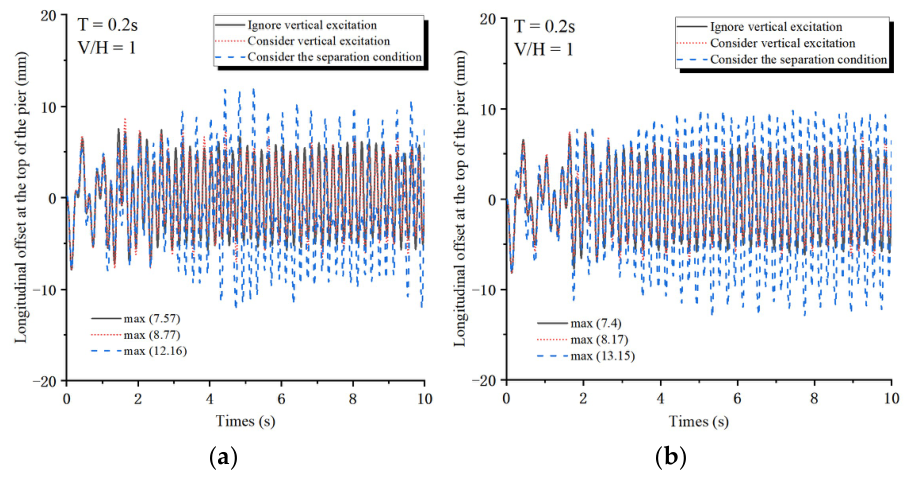
Figure 6 illustrates the longitudinal offset characteristics of the bridge top under various conditions. The study examines three scenarios: (1) considering only horizontal seismic excitation while ignoring vertical excitation; (2) considering both horizontal and vertical seismic excitations simultaneously, with vertical-to-horizontal amplitude ratio (V/H) set to 1, but excluding the bearing failure effect; and (3) fully considering the structural separation effect induced by vertical seismic excitation. The analysis of historical data reveals that neglecting vertical excitation results in an extreme longitudinal displacement of 7.57 mm at the top of the side pier. Incorporating vertical excitation increases this value to 8.77 mm. When the separation effect is considered, the maximum displacement reaches 12.16 mm. Similarly, the extreme longitudinal displacements at the top of the middle pier are 7.4 mm (under horizontal excitation only), 8.17 mm (including vertical excitation), and 13.15 mm (including the separation effect), respectively. The findings indicate that, without accounting for the separation effect, vertical seismic excitation increases the peak displacement at the pier top by approximately 10–20%. However, when the separation effect is considered, the increase in peak displacement expands to 40–60%. This significant difference suggests that the coupling between vertical seismic excitation and structural separation effect may substantially elevate the risk of pier failure.
3. System Fragility Analysis
3.1. Analytical Methods
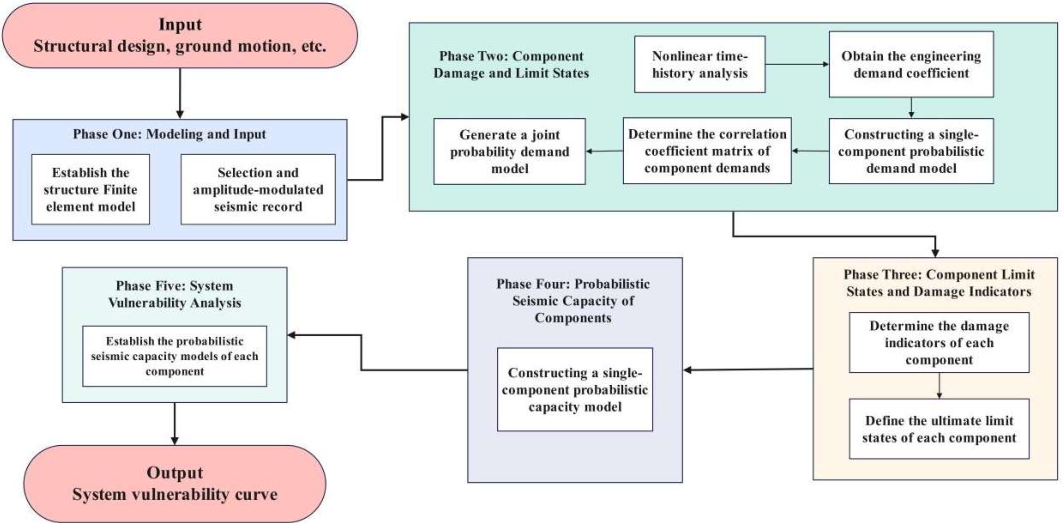
System seismic fragility is defined as the conditional probability that a bridge structure reaches or exceeds a prescribed damage state under a given level of seismic intensity. Unlike component-level fragility analysis, system fragility accounts for both the damage states of individual components and their interaction effects, and therefore provides a more comprehensive basis for evaluating the seismic performance of the entire bridge. In this study, the joint probabilistic seismic demand model (JPSDM) is adopted to assess the system fragility of the bridge, because this approach can simultaneously account for the dispersion of component demands, the correlation among component demands, and the uncertainty in component capacities.
For the
-th ground-motion record, the first separation point is identified from the vertical contact-force history, and the separation-onset threshold is defined as:
where
denotes the vertical contact-force history between the girder and the bearing for the
-th ground-motion record at the
-th PGA level. When the vertical contact force remains compressive throughout the entire time history, no separation is considered to occur. Once the contact force first reaches zero, the corresponding PGA is taken as the separation-onset threshold of that record. If a ground-motion record does not trigger separation within the investigated PGA range, all of its samples are assigned to the non-separation branch.
Accordingly, the branch-state variable is defined as:
Based on this classification, probabilistic seismic demand models are established separately for the non-separation and separation branches. For the
-th component demand, the regression model is written as:
where
and
are the regression intercept and slope corresponding to the branch state, respectively, and
is the regression residual.
After establishing the joint probabilistic seismic demand model and the probabilistic capacity model, Monte Carlo simulation is employed to evaluate the system fragility. At each PGA level,
1,000,000 samples are generated from the demand and capacity distributions. This sample size was selected based on convergence checks, which showed that further increases in
produced negligible changes in the estimated system fragility curves. The bridge system is treated as a series system, meaning that the system is considered to have reached or exceeded a given damage state once the demand of any key component exceeds its corresponding capacity. The system failure indicator is therefore defined as:
Accordingly, the probability that the bridge system reaches or exceeds damage state
at PGA level
can be calculated as:
where
denotes the system fragility at PGA level
. The overall workflow of the proposed system fragility analysis is shown in
Figure 7.
3.2. Selection and Input of Seismic Waves
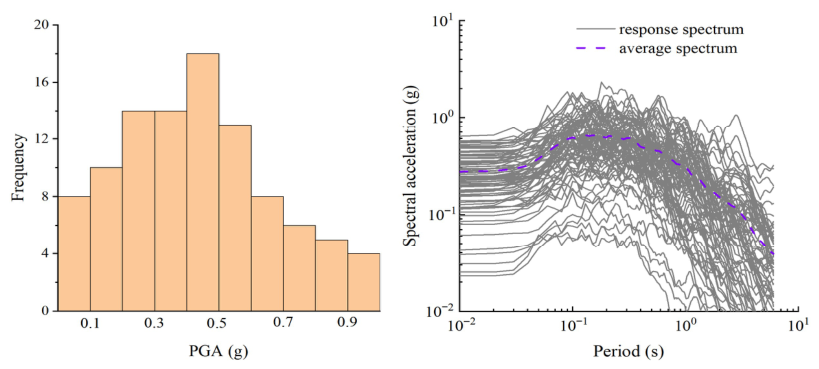
To account for the influence of ground-motion variability on bridge response and fragility results, 100 ground-motion records were selected from the PEER strong-motion database for nonlinear time-history analysis, with peak ground acceleration (PGA) adopted as the intensity measure. The selected records satisfy the following criteria: moment magnitude ranging from Mw 6.5 to 7.62, fault distance between 15 km and 31 km, and site conditions with Vs30 values between 183 m/s and 365 m/s. These records were chosen to reflect the variability of near-fault ground motions in terms of amplitude, spectral characteristics, and vertical components, thereby providing a sufficient sample basis for the development of probabilistic seismic demand models and subsequent system fragility analysis.
Because this study focuses on vertical separation in bridges under near-fault earthquakes and its effect on the overall dynamic response, all selected records include complete horizontal and vertical components. Both horizontal and vertical ground motions were applied simultaneously in the dynamic analysis to capture the coupled effects of vertical excitation on pier–girder separation, re-contact, and amplification of the horizontal response.
Figure 8 shows the PGA distribution and spectral variability of the selected original ground-motion records.
During the seismic input process, each original ground-motion record was scaled at equal PGA increments over a range from 0.015 g to 1.50 g, with a step size of 0.015 g, resulting in 100 scaled records for each motion. Nonlinear time-history analyses were then carried out at each intensity level, and key response indices were extracted, including pier-base moment, pier-base shear, bearing shear response, and whether vertical separation occurred between the pier and girder. PGA was adopted as the unified intensity measure because it is convenient for engineering comparison and can effectively capture the influence of input intensity on separation- and collision-related responses.
3.3. Damage Indicators
In system-level seismic vulnerability assessments, the present study does not use a single global displacement ductility ratio as the sole criterion for assigning bridge damage states. Instead, the system-level damage state is defined through a component–indicator–limit-state mapping that reflects the dominant failure mechanisms induced by pier–girder separation and collision. The displacement ductility ratio is therefore treated only as a supplementary descriptor of pier response, rather than the governing criterion for damage-state assignment. It should be noted that pier-superstructure separation and collision under seismic excitation can induce multiple mechanical response variations, manifested specifically as follows: (1) the horizontal dynamic response characteristics of the pier change markedly, potentially exacerbating bending and shear effects on the pier; (2) the vertical contact forces between the pier and the superstructure undergo nonlinear variation, thereby affecting the pier’s allowable bending and shear capacities; and (3) the pattern of transverse relative displacement between the girder and the pier is altered.
Considering the impact mechanisms of pier–girder separation collisions and the resulting component damage characteristics, three component-level indicators are adopted in this study for bridge damage assessment: (1) pier-base flexural damage, evaluated by curvature-based limit states at the pier base; (2) pier-base shear damage, evaluated by shear-capacity-related indices; and (3) bearing damage, evaluated by bearing shear strain. This definition is adopted because separation and re-contact modify not only the horizontal response of the pier, but also the vertical contact condition at the bearing, which in turn affects both pier force demand and bearing deformation demand.
Table 1 shows the shear and bending damage indicators of bridge piers. More specifically,
Table 1 summarizes the correspondence between the above three component-level indicators and the four damage states considered in the fragility analysis. For pier shear,
Vd,
Vk,,
Vm denote the inclined-section shear capacities calculated using the design, standard, and mean values of material strength, respectively [
46], and these quantities are used to define the shear-related damage thresholds listed in
Table 1. For pier flexure,
and
represent the first to fourth characteristic curvature limits correspond to the four flexural damage states from minor to complete damage. The yield curvature is given by Equation (7); the 2nd and 3rd curvatures are expressed as Equation (8) respectively; and the ultimate curvature is given by Equation (9) [
46]. For the bearings, the damage states are defined directly by bearing shear strain, and the corresponding thresholds are also listed in
Table 1. Through this explicit indicator–component–limit-state mapping, the subsequent fragility analysis can consistently distinguish the contributions of pier flexure, pier shear, and bearing deformation to system-level damage.
For the bending of bridge piers, the yield curvature is:
The second and third degrees of curvature are respectively:
The limiting curvature is:
3.4. System Fragility Curve
Based on the nonlinear time-history analysis results in
Section 3.2, this paper first establishes a bifurcated probabilistic seismic demand model (PSDM) for critical bridge components and calculates the component correlation coefficient matrices under the unseparated and separated branches, respectively.
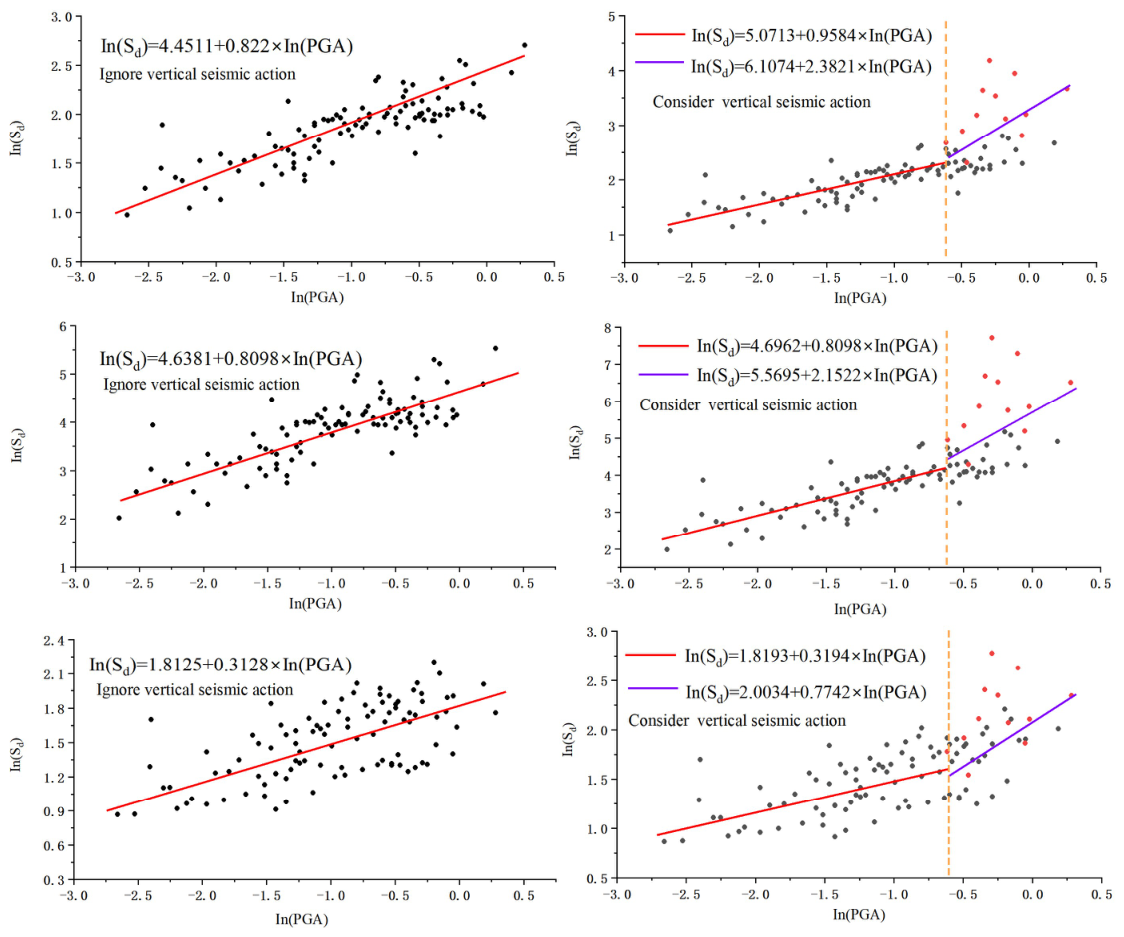
Figure 9 presents the regression analysis results for critical components under different seismic input conditions. It should be emphasized that the dual-branch characteristic exhibited in
Figure 9 is not subjectively identified based on the appearance of the scatter plots; rather, the first separation point for each ground motion record is initially identified based on the contact force time history, and regression analyses are then performed separately on the samples before and after this point. Therefore, the two regression branches in
Figure 9 should be understood as “the unseparated branch before the first separation point” and “the separated branch at and after the first separation point.”
Comparative analysis indicates that vertical seismic excitation significantly alters the growth path of bridge component demands. When the vertical component is ignored, the damage-related responses and PGA generally exhibit a single and relatively consistent growth relationship. However, when the vertical component is included, pier–girder separation initiates at a certain PGA level for some records, and their subsequent responses transition into another piecewise regression branch with a distinctly larger slope. Quantitatively, the regression slope of the bearing response in the separated branch increases significantly from 0.822 to 2.3821, while the sensitivities of the pier shear response and pier flexural response increase to approximately 2.7 times and 2.4 times their original values, respectively. These slope increases indicate that once the structural response enters the separated branch, the component damage demand will grow at a faster rate with seismic intensity, thereby significantly increasing the likelihood of higher-order damage and brittle failure.
Table 2 further reflects the differences in the correlation structure of component demands between the two categories of samples partitioned by the first separation point. The purpose of this table is to illustrate that the correlation structure among component demands changes after partitioning the samples, rather than serving as the sole statistical basis for identifying the existence of the dual branches in
Figure 9. In the unseparated branch, the correlation coefficients among the component demands are generally high, ranging from 0.8779 to 0.9246. This indicates that under continuous contact conditions, there is strong coordination among the pier flexural response, pier shear response, and bearing response, resulting in a relatively unified overall structural response mode. In the separated branch, although a high correlation is maintained between the pier flexural and shear responses (0.9071), the correlation coefficients between the bearing response and the pier responses decrease to 0.8233–0.8264. This weakening indicates that vertical separation significantly increases the relative displacement between the girder and the pier, weakens the traditional coupling relationship between bearing deformation and pier internal force demands, and alters the load-transfer path and local response amplification mechanisms of the structure.
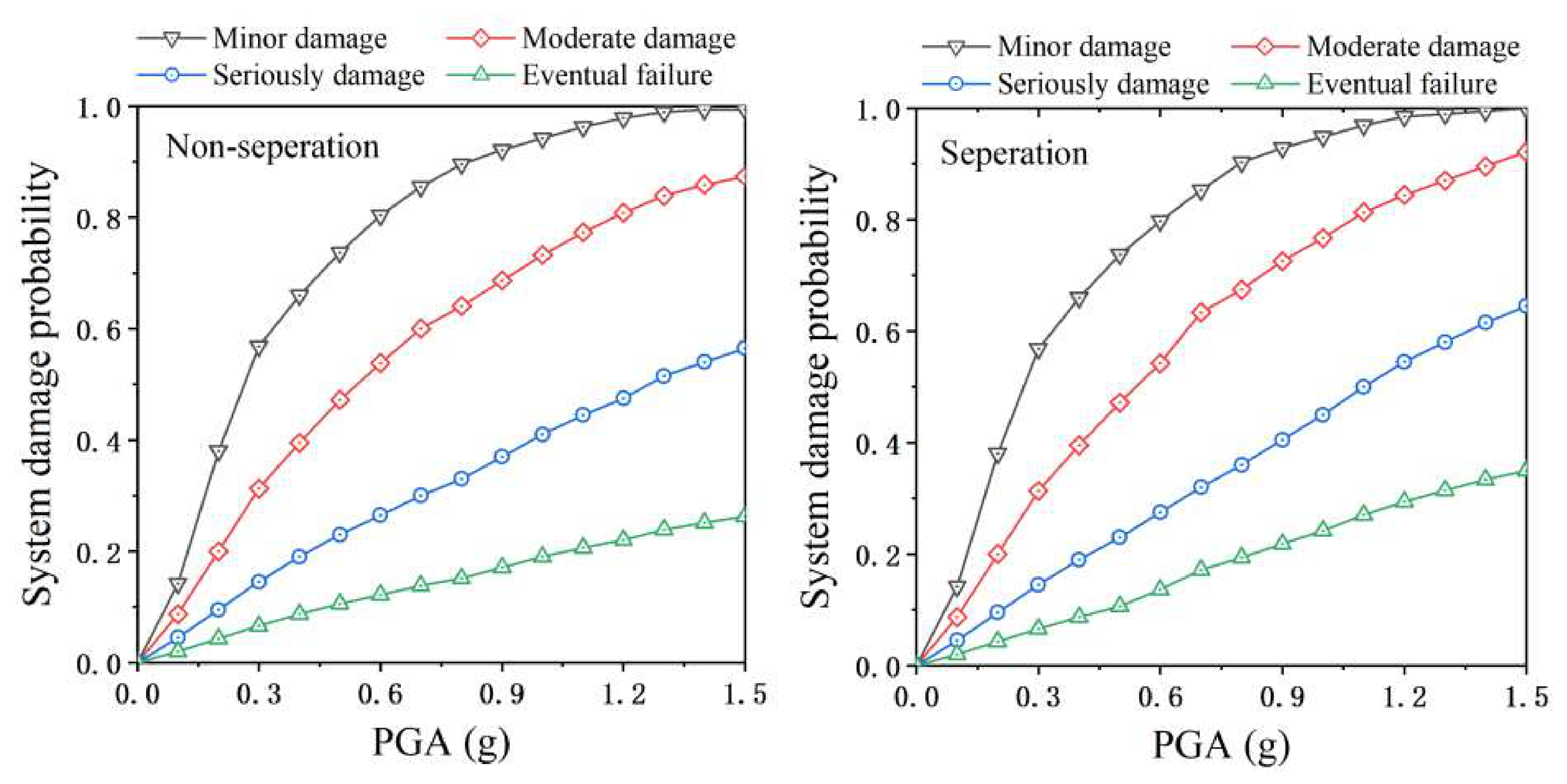
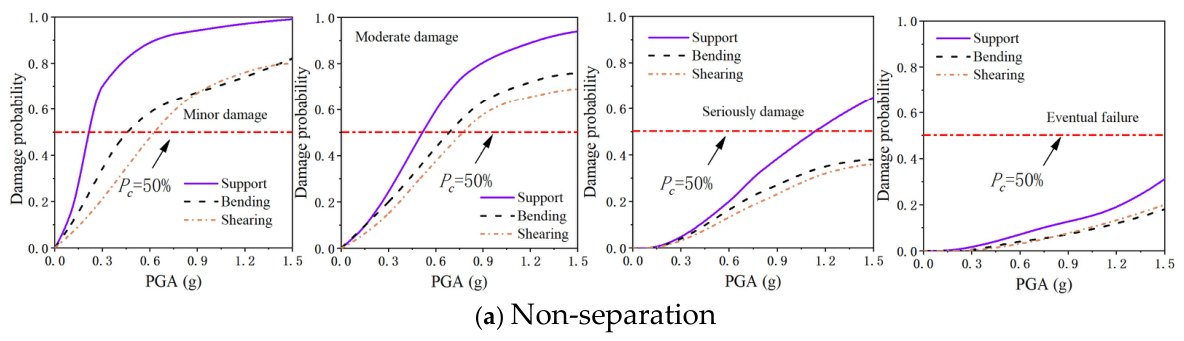
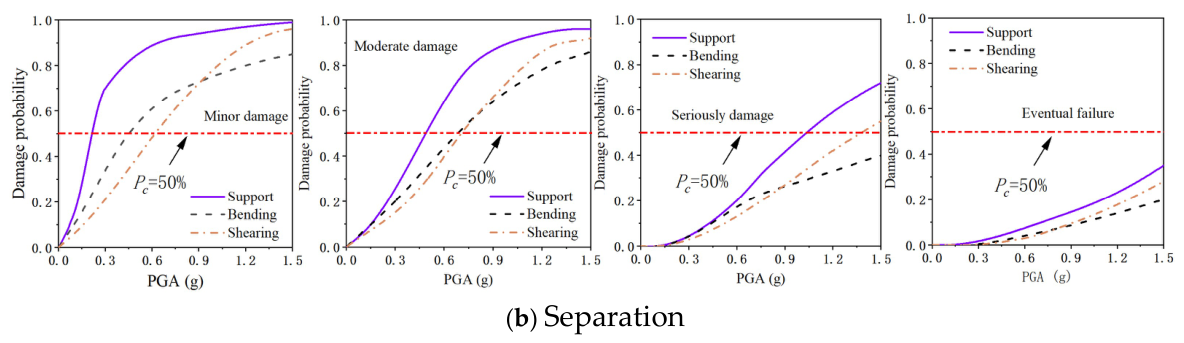
By comparing the component damage probability curves under unseparated and separated conditions,
Figure 10 reveals the systematic impact of vertical separation on damage modes at the bridge component level. Overall, when separation is considered, the various damage probability curves shift upward as a whole relative to the unseparated condition. This indicates that under the same PGA level, the probabilities of the bridge reaching various damage states all increase, leading to a decrease in the overall seismic safety margin of the structure. Among the various failure modes, the bearing failure curve is consistently positioned at the top under both operating conditions, indicating that the bearing remains the most vulnerable component in the structural system. Furthermore, under the separated condition, the bearing failure probability rises more rapidly, demonstrating that the vertical separation–collision significantly exacerbates bearing fragility.
Vertical separation also alters the relative risk relationship between the two failure modes of the pier. Under the unseparated condition, the probability of pier shear failure is higher than that of flexural failure in most intensity ranges, indicating that the structure is more prone to brittle shear failure under conventional horizontal earthquake dominance. However, under the separated condition, the shear failure probability curve becomes noticeably steeper, and the gap between it and the flexural failure probability curve is significantly narrowed, even reversing in certain PGA ranges. This implies that the axial force variations, load path alterations, and impact effects induced by vertical separation increase the uncertainty of pier shear failure and relatively amplify the risk of brittle shear damage.
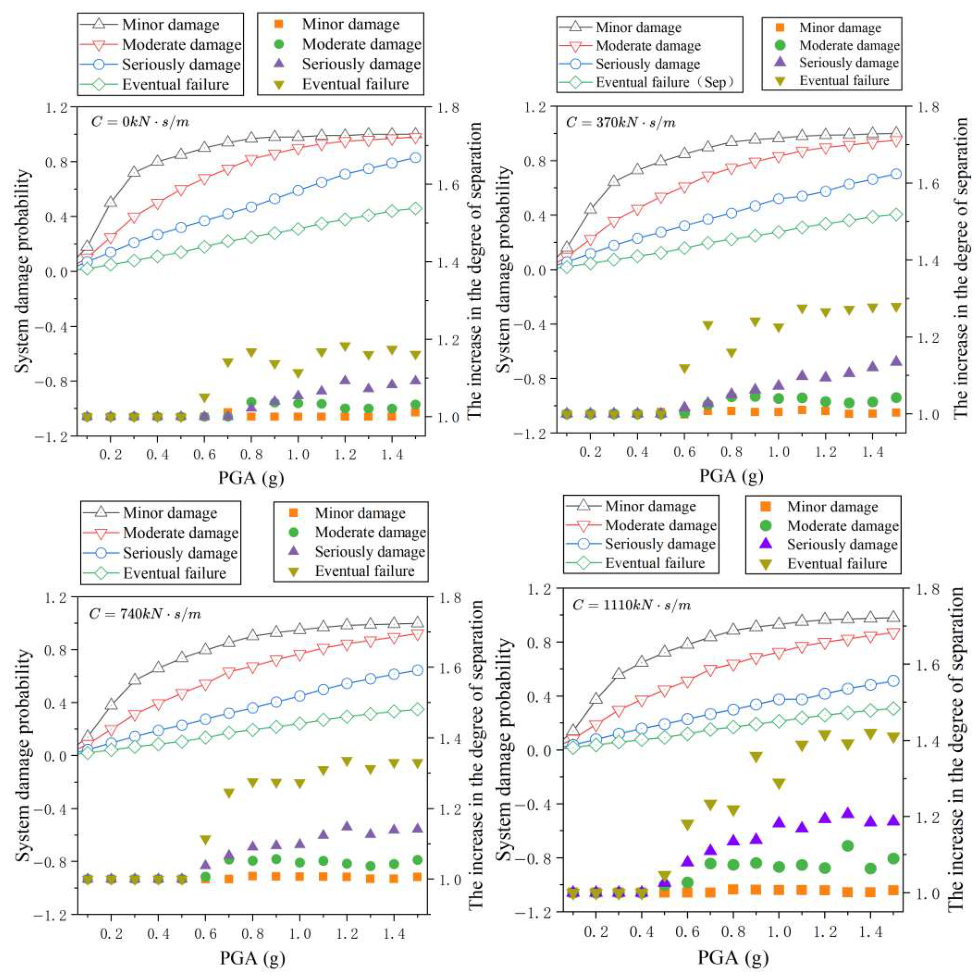
Figure 11 further compares the system fragility curves with and without considering separation. Overall, at the same PGA level, the system fragility curves considering separation are systematically higher and noticeably shift to the left at high damage stages. This demonstrates that once the vertical separation effect is explicitly considered, the probabilities of the bridge system reaching various damage states increase, and the overall seismic risk resistance capacity of the bridge decreases significantly. This difference is particularly pronounced in the high damage stages, indicating that ignoring vertical separation will severely underestimate the actual risk of the structure experiencing severe damage or even approaching collapse under strong earthquakes.
For minor and moderate damage states, the two system fragility curves are relatively close and nearly coincide in the low PGA range. This indicates that at the early stage of structural damage, whether the bridge reaches a lower-level damage state is still primarily governed by the input intensity, and the complex nonlinear effects introduced by vertical separation have not yet become dominant. However, as the damage level progresses to the severe damage and complete failure stages, the gap between the two curves widens rapidly. The system fragility curves under the separated condition are steeper and significantly shifted to the left, indicating that once the structure enters the highly nonlinear response stage, mechanisms such as loss of contact, impact amplification, and constraint degradation triggered by vertical separation–collision will significantly accelerate damage accumulation, thereby substantially increasing the probability of the bridge system reaching higher-order damage states under the same seismic input.




 ,
,